(April–July 1857)
The contents of Notebook 2 mainly consist of navigation instructions and landmarks derived from Clemens’s navigation lessons on the Mississippi River. Some of the landmarks no longer exist, the majority of the notes are idiosyncratically abbreviated, and the handwriting is often inscrutable in the holograph manuscript. Additionally, the circumstances under which Clemens used the notebook can be only partially derived from his account of riverboat piloting in Life on the Mississippi and in a retrospective note made by Clemens in 1880 on the first recto leaf of the notebook itself. The editors of Mark Twain’s Notebooks and Journals, Volume 1 (1975) therefore decided not to publish a full transcription of the notebook. Instead, they proposed a narrative of Clemens’s use of the notebook with a summary of its contents, accompanied by transcribed excerpts. The 1975 narrative makes illuminating observations about the different notetaking methods used by Clemens. The editors also convincingly identify three separate sequences of notes.
Because the digital edition publishes facsimiles of the manuscript notebook, we believe it was necessary to publish a full transcription to accompany them. This new transcription corrects transcription errors from the 1975 transcribed excerpts where necessary and therefore supersedes them. The new transcription also incorporates contextual information from the 1975 narrative into footnotes for the new transcription whenever possible. Factual errors in the 1975 narrative are corrected in this new introduction’s sections on notebook Sequences 1–3 below. Following the sections on Sequences 1–3, we have provided the text of the 1975 narrative, which can also be found in the printed volume of N&J1, pages 40–48.
The digital edition features a toggle that allows the reader to turn line breaks from the manuscript on and off. This feature has been implemented to help the reader to easily match a line from the transcription with a line from the manuscript facsimile, when and if the reader needs to consult the manuscript. We provide a glossary of abbreviations, which can be accessed on the supplements page of this website, for readers who want to decipher the text. Landmarks are highlighted light blue, indicating a note that provides the location’s name and position on the Mississippi river, whenever possible. The landmark notes and their highlighting can be turned off with a toggle for readers who do not want to read the text without the light-blue highlighting.
New Orleans to Kentucky Bend on the Back Endpaper
The editors of N&J1 identified Clemens’s notes on the back endpaper of Notebook 2 as the earliest. They summarized his notes as follows:
“The first entries describe river points for a boat heading north from New Orleans. Writing at Bixby’s direction, Clemens began to set down piloting information in short, unorganized paragraphs, beginning with landmarks near the city wharf from which the boat departed. He copied the Louisiana portion of Bixby’s directions on the endpaper at the back of the inverted notebook. . . . These notes continue to a point near Morganza, Louisiana.”
The evidence that these notes are the earliest made by Clemens is supplied by Chapter 6 of Life on the Mississippi, where Clemens tells us that he at last convinced Horace Bixby, the pilot of the steamboat Paul Jones, “to teach me the Mississippi River from New Orleans to St. Louis for five hundred dollars, payable out of the first wages I should receive after graduating” (80). One of the earliest landmarks Clemens notes is Carrollton, a neighborhood in downtown New Orleans, thus suggesting that these notes document his first trip upstream as a cub pilot. Later in Chapter 6, however, Clemens recalls his mentor Horace Bixby giving him a pop quiz on river landmarks north of New Orleans, at which point, after Clemens fails miserably, Bixby tells his student to “get a little memorandum book, and every time I tell you a thing, put it down right away” (87).
The notes in sequence 1 were most likely made after the fact of an upstream trip from New Orleans. They leap great distances over the river, beginning in the area of New Orleans, then recommencing 145 miles north at Profit Island, then another 80 miles north at Consort Point, and then at a landmark he notes as “Kentuck Bend.” If this last location refers to Kentucky Bend, Arkansas, then the notes leap approximately 280 miles from Consort Point to the last noted landmark.
The fragmented and selective character of the notes suggest that they were not made on the spot but taken from dictation by a mentor who wanted his student to learn about specific locations along the river. Bixby’s teaching style is confirmed by the prepared notes in sequence. For this reason, the notes are not easily located in time. Whether these notes were in fact made during Clemens’s first trip upstream from New Orleans must remain an open question.
For reasons that are not made clear in their narrative, the editors of N&J1 estimated that Clemens’s notes end near Morganza, Louisiana, which is approximately 120 miles north of New Orleans. Before the end of sequence 1, however, Clemens was already making references to Black Hawk Point and Jackson Point, which are approximately 225 and 235 miles north of New Orleans. This 115-mile difference clarifies the fact that the notes in sequence 1 are more of a précis, perhaps from a navigation lesson given by Bixby or perhaps from memory.
Cairo, Illinois, to Natchez, Mississippi on Leaves 1–33
Sequence 2 mainly consists of section headings that Clemens made in blue pencil. The headings name one or sometimes two landmarks on the downstream trip from Cairo, Illinois, to Natchez, Mississippi. There are usually one or two such headings per page. Sometimes a heading is repeated on the next page, followed by an abbreviation for “continued,” as if in preparation for a landmark that would pose so many variables to the pilot that it would require more than one page of notes. Such headings, which required knowledge of significant landmarks and their complexities, could only have been dictated to Clemens by an experienced pilot such as Bixby, or, as the previous editors put it, “probably from Bixby’s dictation.” While the headings were likely prepared before departing Cairo, Illinois, for a downstream trip, it is impossible to say whether or not it was his first.
Sequence 2 begins with a heading for Cairo, Illinois, 1055 miles north of New Orleans. The headings proceed downstream to a series of islands, bends, points, landings, and towns. The last heading in the sequence, left blank and overwritten by notes in Sequence 3, is for Natchez Island, approximately 178 miles north of New Orleans. As the editors of N&J1 speculate, Clemens either ran out of room for headings south of Natchez or was instructed to finish there. It is possible that Bixby wanted Clemens to focus on the Cairo–Natchez run.
Cairo, Illinois, to St. Louis, Missouri, and Back on Two Leaves Inscribed Upside Down from the Back Cover
Sequence 3 consists of landmarks from an upstream trip from Cairo, Illinois, to St. Louis, Missouri, followed by more focused and concise notes for a downstream trip from St. Louis to Cairo. The notes in Sequence 3 resemble the notes in Sequence 1, though as the N&J1 editors observe, “They differ from Clemens’ first, chaotic Louisiana entries in that each new paragraph begins with a key landmark name.“ Comparison of the transcriptions of Sequences 1 and 3 suggests that Sequence 3 may have benefited from the preparation of headings in Sequence 2, given Sequence 3’s clearly labeled sections.
With these facts in mind, we may consider multiple possibilities for the chronology of inscriptions in Sequences 2 and 3. Perhaps Clemens prepared the headings for the Cairo-Natchez trip (Sequence 2) before making the trip upstream to St. Louis and back to Cairo. It is also possible that he made the notes under the Sequence 2 headings while taking dictation from Horace Bixby.
The point is that Sequences 1 through 3 should not be considered an established series of successive events documented in Notebook 2. There is a chance that Sequence 1 was not made on Clemens’s first upstream trip as a cub pilot but sometime after Sequence 3; it is very likely that Clemens wrote Sequence 3 after preparing Sequence 2, but that the notes in Sequence 2 were made at various times after Sequence 3. Indeed, Sequence 2 emulated a form to be filled in over time, and Clemens didn’t always respect the headings, as at least one out-of-sequence list of notes informs us.
One of the main points of interest in Notebook 2 is the light it sheds on Clemens’s later notebooks. Despite of the technical nature of the notebook’s inscriptions, the editors of N&J1 say, “Many of the entries seem to be exact transcriptions of Bixby’s speech, occasionally even capturing his verbal ellipses and colloquialisms.” On more than one occasion, Clemens does indeed transcribe fragments of speech among his technical abbreviations, such as “run ‘em close if you want to.” In those moments, we glimpse the same author who wrote an American masterpiece set on the Mississippi River in the idioms found along its lower banks.
The first of the two memorandum books which survive from Clemens’ piloting career served specifically as a river guide rather than as a record of literary and biographical events. It came into being out of the necessity of coping with the bars, snags, shallows, and other navigational hazards on the Mississippi, and Clemens allowed none of his personal life to invade its complex technical content. He developed a system of notation which today is often undecipherable without knowledge of the geography of the area and familiarity with the language peculiar to piloting. Because of the abbreviated words, the frequent illegibility of penciled entries, the difficulty of identifying many of the now-vanished river points, but above all because of the technical subject matter, the full text of these notes is not printed here. The representative selections which follow illustrate the techniques Clemens used to record information for safely retracing his route on the changing river course.
As described in the Introduction, Clemens obtained the first notebook after he was already on board a steamboat—presumably the Paul Jones—while it was near New Orleans. The thin book is ruled for use as a ledger, and a steamboat clerk’s cargo records are scattered through its pages: the number of barrels shipped by “H & E,” the weight of kegs dispatched by “J. B. Boyles,” lengthy accounts of rates for boxes belonging to “K,” “I & Mayer,” “M K & M,” and “S & Bro,” and shipments of casks for “S. Glick” and “W & S.” Clemens simply crossed out these penciled figures where they interfered with his own entries and left the others. Obliged to acquire a memorandum book on short notice, he had evidently persuaded one of the clerks on the Paul Jones to relinquish his ledger. This evidence corroborates Mark Twain’s account in chapter 6 of Life on the Mississippi, where he recalled Horace Bixby’s vexation when he realized that his pupil was failing to record his comments as their boat steamed northward from New Orleans. “My boy,” Bixby said after his indignation subsided, “you must get a little memorandum-book, and every time I tell you a thing, put it down right away. There’s only one way to be a pilot, and that is to get this entire river by heart.”
The frequency with which the author reshaped his river experiences in Life on the Mississippi is amply demonstrated by Allan C. Bates in his dissertation “Mark Twain and the Mississippi River” (University of Chicago, 1968). The accuracy of Clemens’ reminiscences about “the little memorandum-book,” however, is documented by the entries in this notebook. The first entries describe river points for a boat heading north from New Orleans. Writing at Bixby’s direction, Clemens began to set down piloting information in short, unorganized paragraphs, beginning with landmarks near the city wharf from which the boat departed. He copied the Louisiana portion of Bixby’s directions on the endpaper at the back of the inverted notebook:
Sto— Ladg—When stock ldg lights come out fm behind rope walk blow for McGill’s brick warehouse1—300 G
Abreast thick bch is flat pt stand out 100 & go in 200 above—flat pt shows sharp & treeless. Leave shore abreast Carrolton 2
Went through Covington bar—20 foot bank—go that way till dd lo water.
3 fath in Prophet when wilows out on Manchac. B. Sara nearly same. R. h. shore above Bat. Rouge—1st part, up to lo place, 3 or 400 above sng.
These notes continue to a point near Morganza, Louisiana.
During this trip Clemens may have established the final form of his notebook: a series of distinctive blue pencil headings which label the major river points between Cairo, Illinois, and Natchez, Mississippi. These headings begin on the first page of the memorandum book and list the landmarks—islands, bends, and towns—probably from Bixby’s dictation. This new system of note-taking allotted only one or two place names to each blank page, in order to allow for a fairly full description of navigational conditions under each heading. His notes thus became promptly accessible for reference on return voyages, and they could be read easily even in the poor light of the pilothouse at night.
Either Clemens decided that the ledger book did not contain enough pages to accommodate additional landmarks beyond the Cairo–Natchez run, or else Bixby wanted him to concentrate on that central portion of the river. At any rate his arrangement of headings proved disproportionate to the inscriptions he actually entered: the sections reserved for many regions remain blank or nearly blank. And because he had elected to set aside most of his space in the memorandum book for the Cairo–Natchez headings, Clemens was compelled to squeeze his records of voyages above and below this area into the four last pages of the notebook, adjacent to the back endpaper, on which he had previously noted his initial departure from New Orleans. These passages extend onto pages originally designated for “Hole-in the wall to Natchez I,” “Natchez II,” and “Below Natchez II” and are in part written directly over the blue pencil headings. Made with the notebook inverted, these additional notes begin on the notebook’s last page and read toward the front of the notebook. They differ from Clemens’ first, chaotic Louisiana entries in that each new paragraph begins with a key landmark name. This portion of the notebook is also more succinct than preceding notes. The first part of these faint, minutely-inscribed entries concerns a voyage from Cairo, Illinois, to Saint Louis. Although the order in which the towns are mentioned reveals that his boat was headed upstream, Clemens sometimes begins entries with “D. S.” instructions—presumably in anticipation of the return trip downstream.
Cairo—D. S.—Com clear past ft of towh—Then, S on same h t or cor. of bar in ½ h on green clear Bnk ft big willows, till abr. old Bird’s house, then S near ft Bird’s fld, h about on or bel. 2 white houses ¼ m under pt.—bel. 2 sngs—1 in mid, tother in water line— ¼ l 2. Ft of towh. is abr mid of O. City.3 3 fath out fm Bd in h of II toward ft of II.
Bird’s II.—Hd towh br, & 250 under hd of II—9 ft. D. S.—faint circle fm pt to hd towh, S open on pt.
As the boat approached Saint Louis, Clemens’ records expand enough to convey some sense of the piloting experience, although the information is minimal:
Hoss-Tail—s on upper h. t (just bel. 2 dd t) h on work house, (open on cor of w bar—go far in toward where 3d towhead was, round servnt. Then shape up to pt, 150 out.
In Vide Poch Bd. fm Ill to bel. Lime Kiln, flat rock.
St. L.—St fm mid Kiho fld, wear till s high on hill, h opn on cor II, (or on Bullard Church)—till full abr. hd of II.—Then S on Ill cor. of II, h opn on Ms pt.—go outside 2 sngs in neighborhood of wrecks mk 2 at h of II.—D Went in to shore abov where pt begins to round off.
Saint Louis was generally the stopping place for steamboats engaged in the Lower Mississippi trade; at this point Clemens drew a heavy pencil line horizontally across his page, below which he recorded steering data on the return voyage from Saint Louis to Cairo. During the departure he assembled further instructions for the same stretch of the river:
St. L.—Toward Ill. cor. of Quai II, till S on Ct House4 h on ptch-roof house, op on ft of dry bar, up on upper jog Ill. hills, takes you shap of upper bar, 150 or 200 out—till abr. Sombart, ¼ 2—Then shap Quai. II, 300 out, S at first bet. 2 pts, h about ft of blffs—shap r l.h. boi-s, S will finally fall on ft Bloody II, go in just bel. ft Kiho.
No chanl in next xg.
Hosstail— General shape is 200 out, S under upper toh, h about mid of WB.
Further downstream Clemens wrote:
Tower. II.—S. on 2d house bel. blff.h in sawmill fld ¼ l 2 fath—then S down on white bank, h on 1.h. pt till abr. cottons on ft of II, pull up on fall-off of blff. S touching h of II. Up— start fm lowest houses.
Young Ship.— Inside of snag. (S. Shape shore, h 250 under h of Dev.—then S under h of blff, h. on h t. 700 bel. h of II. Down to houses—till can see into Bd under shoul of Dev. Then S on Shoul, h. in h of low. pl. upper bayou, big Sycamores—till p within 150 of shore, pull down to lower bayous, S on pt of dry bar.
Ft. of Dev.— Go close down around pt till can see the whole shap of Bd under it, then 2 r. h. pts open.—will take close to r. of logs ½ way bet. the 2 pts.
This succession of notes ends with the arrival of the steamboat at Cairo. There Clemens returned to his blue pencil headings, filling in information about each area as the boat reached it. Some entries under the headings begin with instructions for downstream navigation; probably Clemens had not been on watch when these points were passed during the initial trip upstream. Below his first heading (“Cairo Bend”) Clemens many years later recorded his rediscovery of this early notebook:
(Notes made by me when I was learning to be a Mississippi River pilot, in 1856–7.)—
Found this book among some old rubbish to-day, Dec. 8, 1880.
S. L. Clemens
Hartford, Conn.
It is intriguing that Clemens entered his inscription in 1880 near the entry for Cairo Bend, the landmark that Huck and Jim miss because of their inexperience and inattentiveness. He was slightly mistaken in the date he assigned to the notebook, since his training as a pilot began in the spring of 1857.
There is another note, in Charles L. Webster’s hand, further down the first page: “This book was found in an old box of rubbish in Chas. L. Webster’s attic at Fredonia.” The notebook had been left with Jane Clemens and the William Moffett family in Saint Louis when Clemens’ career as a pilot came to an end. It was probably among the belongings which Jane Clemens brought with her when she moved to Fredonia, New York, in 1870 with her daughter and granddaughter, Annie Moffett, who married Charles L. Webster in 1875.
The notebook demonstrates on its remaining pages Clemens’ increased proficiency in cataloguing information he needed under the orderly headings:
Cairo Bend.
Down inside the wreck & just shape of shore—down around pt & h above bch s on A. G. & Co. lower wharfboat. Up—go up shore till naturaly head some distance above wharfboat.
The notebook clearly was not intended as a log of his river trips, but merely as a working record of essential landmarks. Clemens occasionally made a note referring to specific dates and steamboats. The entry for Island No. 10, for example, places at least some of these entries in midsummer of 1857:
Island No. 10
July 11th—no bottom around it. Go in at ft of t—take mid fm bel. ft of fld. & keep out fm l. h. shore till—S on ft of I. h on Harris ugly dd t.
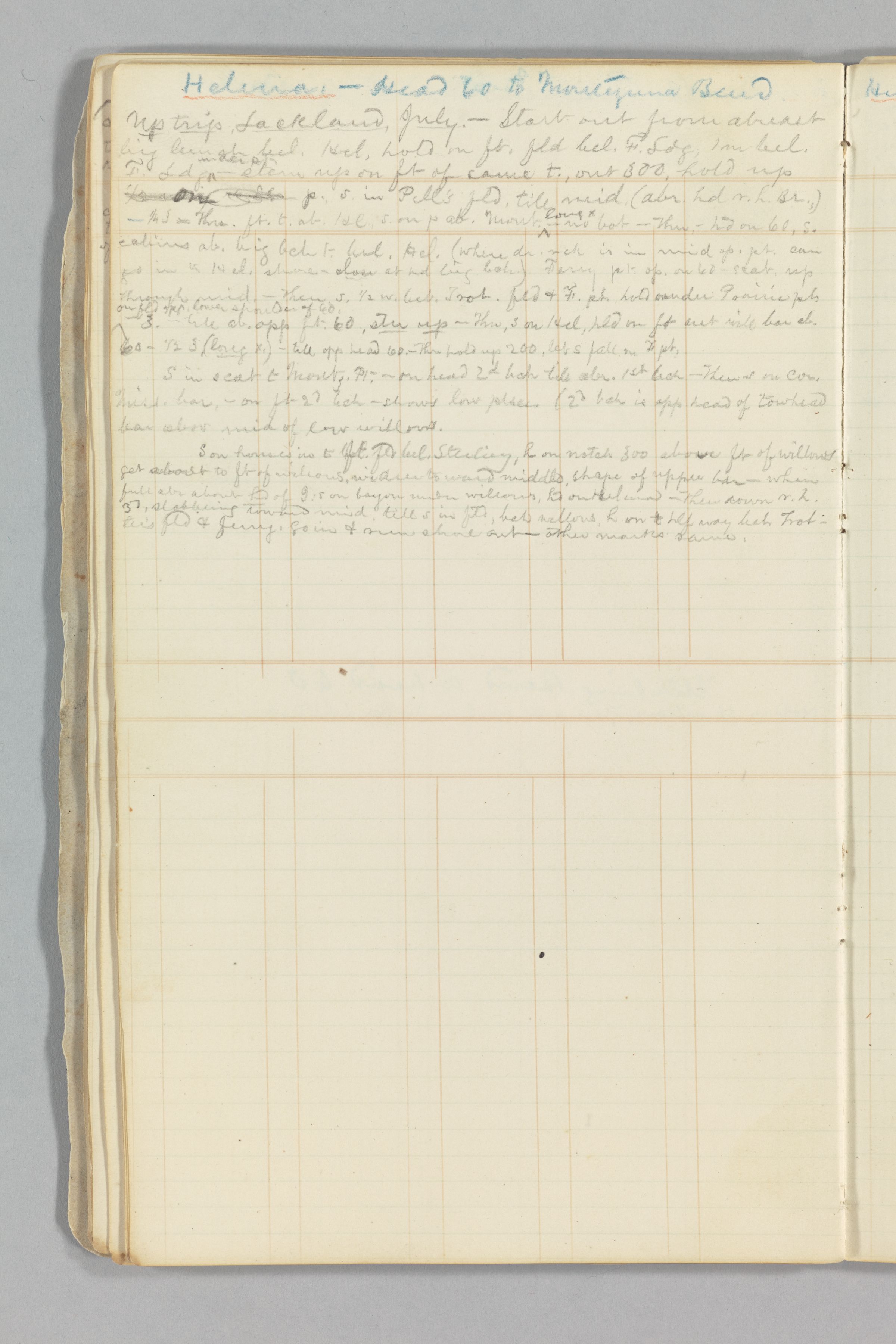
Clemens made at least one of the trips recorded here on a boat other than the Paul Jones, for the entry under the Helena, Arkansas, heading begins, “Up trip. Lackland, July.” The R. J. Lackland was a sidewheel steamboat which operated on the Lower Mississippi from 1857 until 1863. There is no evidence that Clemens actually served aboard this ship; he may merely have made this one “up trip” as an observer in the pilothouse.
Many of the entries seem to be exact transcriptions of Bixby’s speech, occasionally even capturing his verbal ellipses and colloquialisms. His great respect for Bixby, his precocious interest in and ear for language, or both, may have motivated Clemens to set down the veteran pilot’s words this fully. This tendency is discernible in some explicit notes about navigating several troublesome areas below Helena:
Delta to head 62–3.
Outside of Montezuma.—6 or 8 feet more water. Shape bar till high timber on towhead gets nearly even with low willows do. do., then hold a little open on right of low willows—run 'em close if you want to, but come out 100 yards, when you get nearly to head of T. H.
These sample entries illustrate the two methods by which Clemens organized his notations about the entire reach of the Lower Mississippi—a prefabricated chart of the main (Cairo-Natchez) stretch, supplemented by a makeshift listing of river points on the lower (Louisiana) and upper (Cairo-Saint Louis) segments of the river. This notebook became his guide to the river, but it is only a rudimentary outline of landmarks. Most of the headings are followed by two brief entries, an upstream and a downstream description; very few places receive repeated treatment. The main work had to be done by what Mark Twain would call “about the most wonderful thing in the world”—the pilot’s memory, which enabled him “to know every trivial detail of twelve hundred miles of river and know it with absolute exactness” (Life on the Mississippi, chapter 13). “Give a man a tolerably fair memory to start with,” Mark Twain would write, “and piloting will develop it into a very colossus of capability . . . . Astonishing things can be done with the human memory if you will devote it faithfully to one particular line of business.”
Notebook 2 now contains 70 pages, all inscribed, although the sole entries on some are Clemens’ blue pencil headings, which name major points on the river. The pages measure 7 13/16 by 4¾ inches (19.8 by 12 centimeters). They are divided approximately in half by a rust-colored double rule and are ruled with fifteen pale green horizontal lines above and seventeen such lines below this division. There are two rust-colored horizontal double rules at the top of each half-page, forming a band intended for column headings; rust-colored vertical lines divide the pages into ten unequal columns in ledger fashion. On many pages Clemens made use of the double-page format to enter two of his blue pencil headings, one at the top and one in the center; but for the most part he ignored the design of the page, often squeezing two lines of writing into the space intended for one. The endpapers are gray. The notebook was originally bound in a stiff cover of black fabric; the back and the spine were long ago recovered with black, grained oilcloth. The cover has come loose from the pages. With the exception of his 1880 inscription in blue ink on the first page and his blue pencil headings, all of Clemens’ entries are in black pencil.
Sequence 1 1
[MS: N02_ back cover]
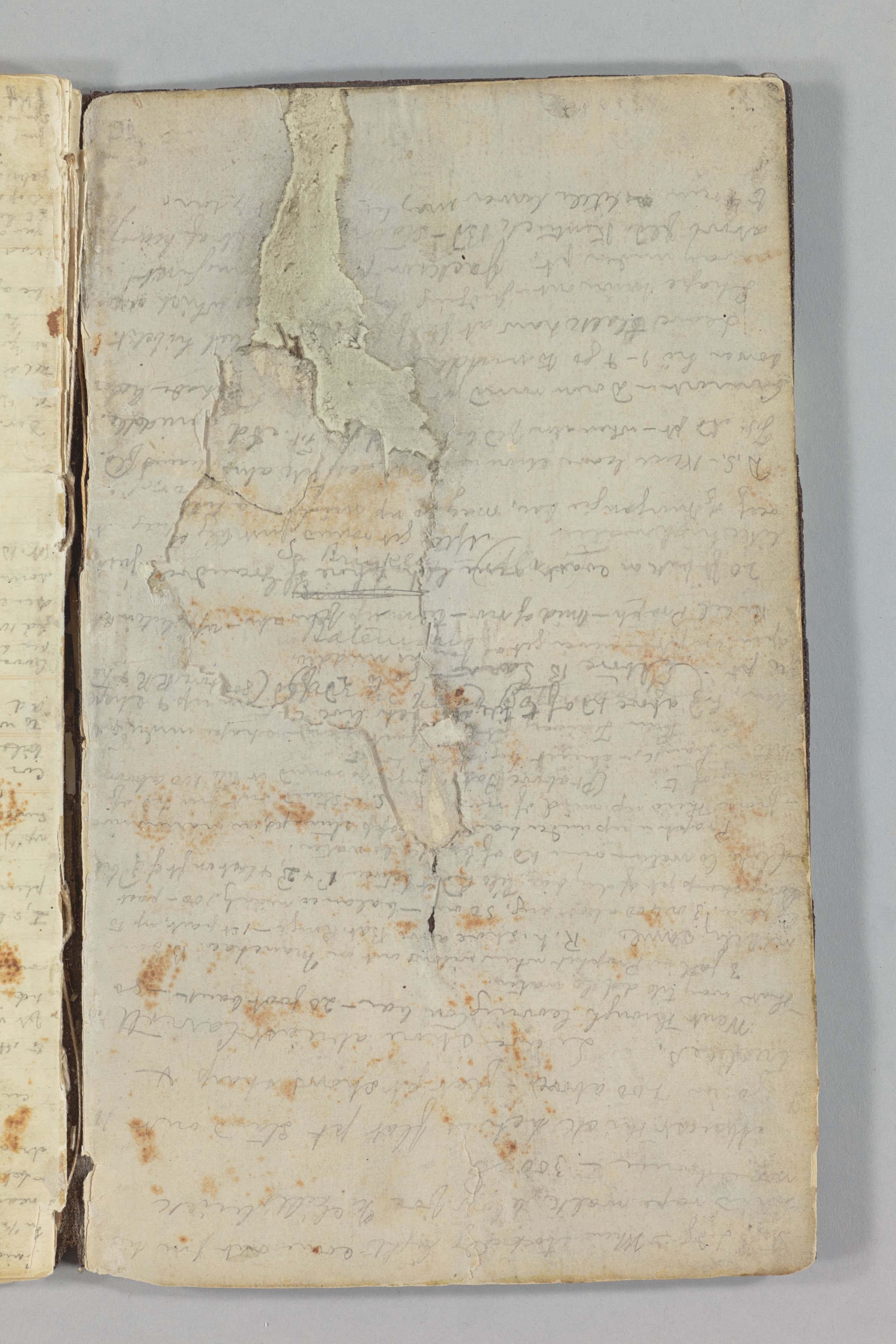
[MS: N02_back endpaper]
Stock Ldg—When stock Ldg lights come out fm hd
Land
rope walk blow for McGill’s brick
warehouse—300 Q
Abreast thick bch is flat pt stand out 10
& go in 200 above—flat pt shows sharp &
treeless. Leave shore abreast Carrollton
Went through Covington bar—20 foot bank—go
that way till dd lo water.
3 fath in Prophet when willows out on Manchac. B. Sara
nearly same. R. h. shore above Bat. Rouge—1st part, up to
lo place. 3 or 400 above sng. 50 out—balance nearly 100—past
long sharp pt of dry bar till hd
1st
Ⓜemendation between 2
1
d & 3
2
d, & last on ft of 3d bch
or (like lo water run hd of banksⓂemendation lo water.
Proph in up under bank torn opp stumps, in narrow river
—from there up mid of
riv torn S.—stand out fm hd of
string of t. (Pt above Bat Rouge
Ⓜemendation go round it till 100 above
bite in bank—abreast big round low t.
Run TⓂemendation river, pt ◊◊◊Ⓜemendation bank against shape under spitⓂemendation
bar, hd above hd of t symbol till abr bch line t—turn up & shape
to pt. Above2
B Sara—go to 2d fld (800' above RR, & hd
open on pt—never get as far as middle.
Br bel. Proph—mid of riv—turn up fm abr—up chute in pt.
20 ft bnk on coast, run l. h shore of Grandvel just
like high water After get round first big
sticking out
reef of Morgangie bar, may go up mid a little or, of ◊◊◊Ⓜemendation
D. S.—Never leave shore in ◊◊Ⓜemendation R.R. ◊esⓂemendation bnk abrs
MearnsⓂemendation fld.
Ft. Ad. pt—when abr fld be tear ld in Ft. Ad middle.
Consort—Down round pt tear hade below
lower hi I—& go to middle tear
Leave—black haw at ft of fldtear bel. hi bch t.
Shape hi on out—judging by tear es, which slipⓂemendation
away under
pt. Jackson p
tearfarm first
above fld. Kentuck Bd—start tear aft of heavy
t & run lo little lower may be tear dry bar.
Sequence 2 3
[MS: N02_front cover]
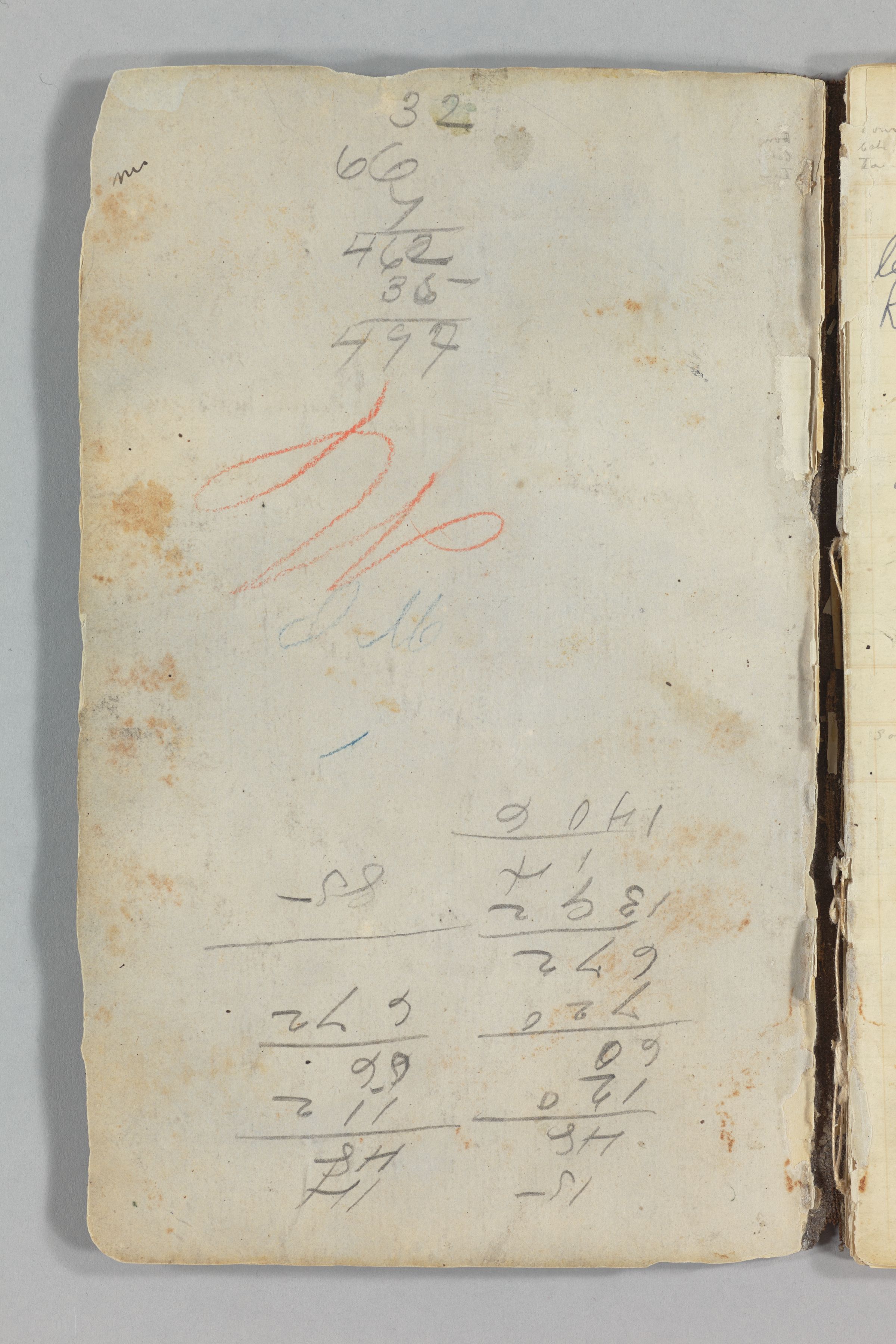
[MS: N02_front endpaper]
calculations not in Clemens’s hand
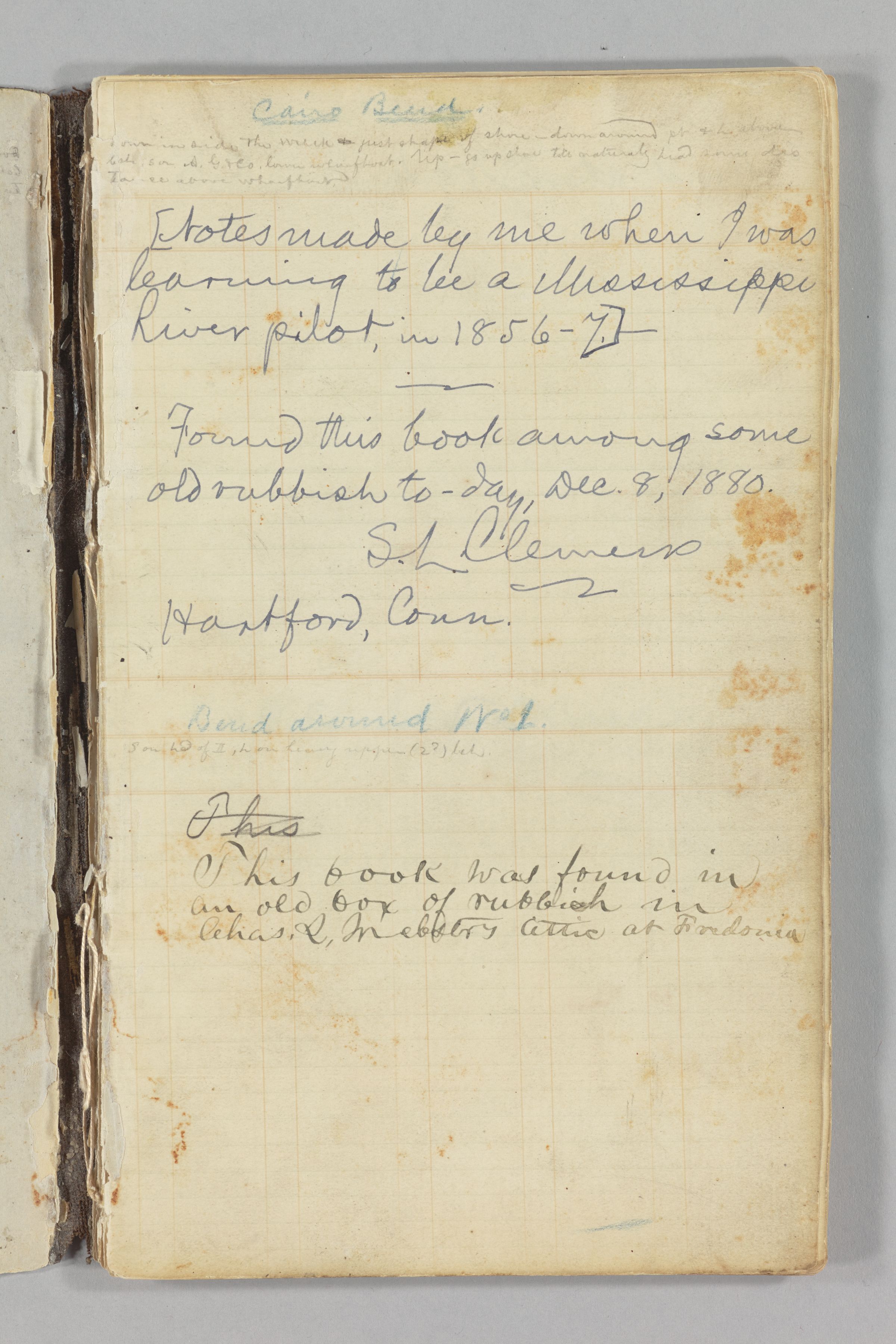
[MS: N02_leaf_001r]
Down in side the wreck & just shape of shore—down around
pt & h above
bch, s on A. G. & Co. lower wharfboat. Up—go up
shore till naturally head some
dis
tance
distance
above wharfboat.
note by Clemens in blue ink
‸begin insertion span⟦Notes made by me when I was
learning to be a Mississippi
River pilot, in 1856–7.⟧

Found this book among some
old rubbish to-day, Dec. 8, 1880.
S. L. Clemens
Hartford, Conn.‸end insertion span
S on hd of II, h on heavy upper (2d) bch.
note by Charles L. Webster in black ink
‸begin insertion span
This
This book was found in
an old box of rubbish in
Chas. L. Webster’s attic at Fredonia
‸end insertion span
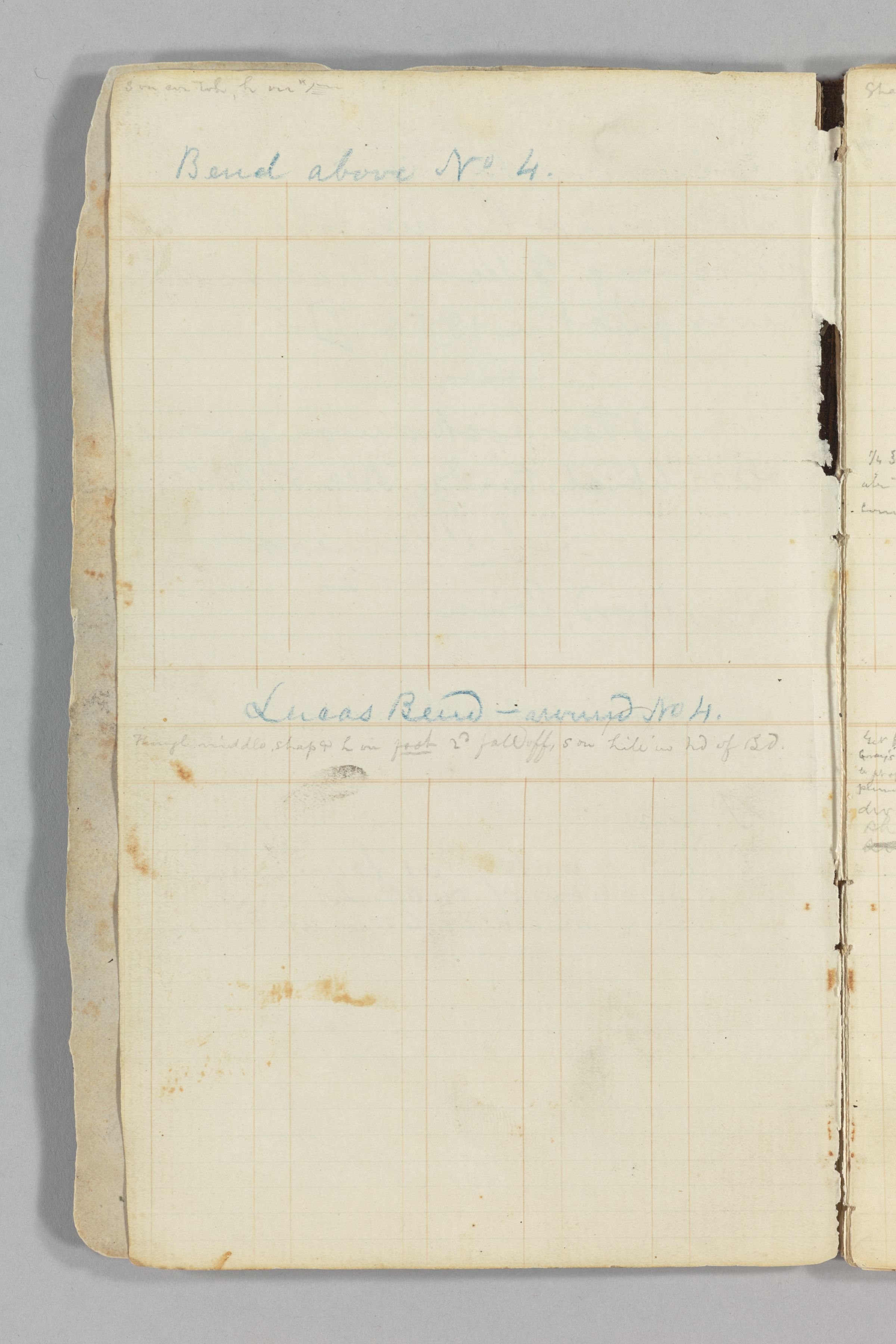
[MS: N02_leaf_001v]
blank
Through middle, shap & h on foot 2d fall off, s on hill in hd of Bd.
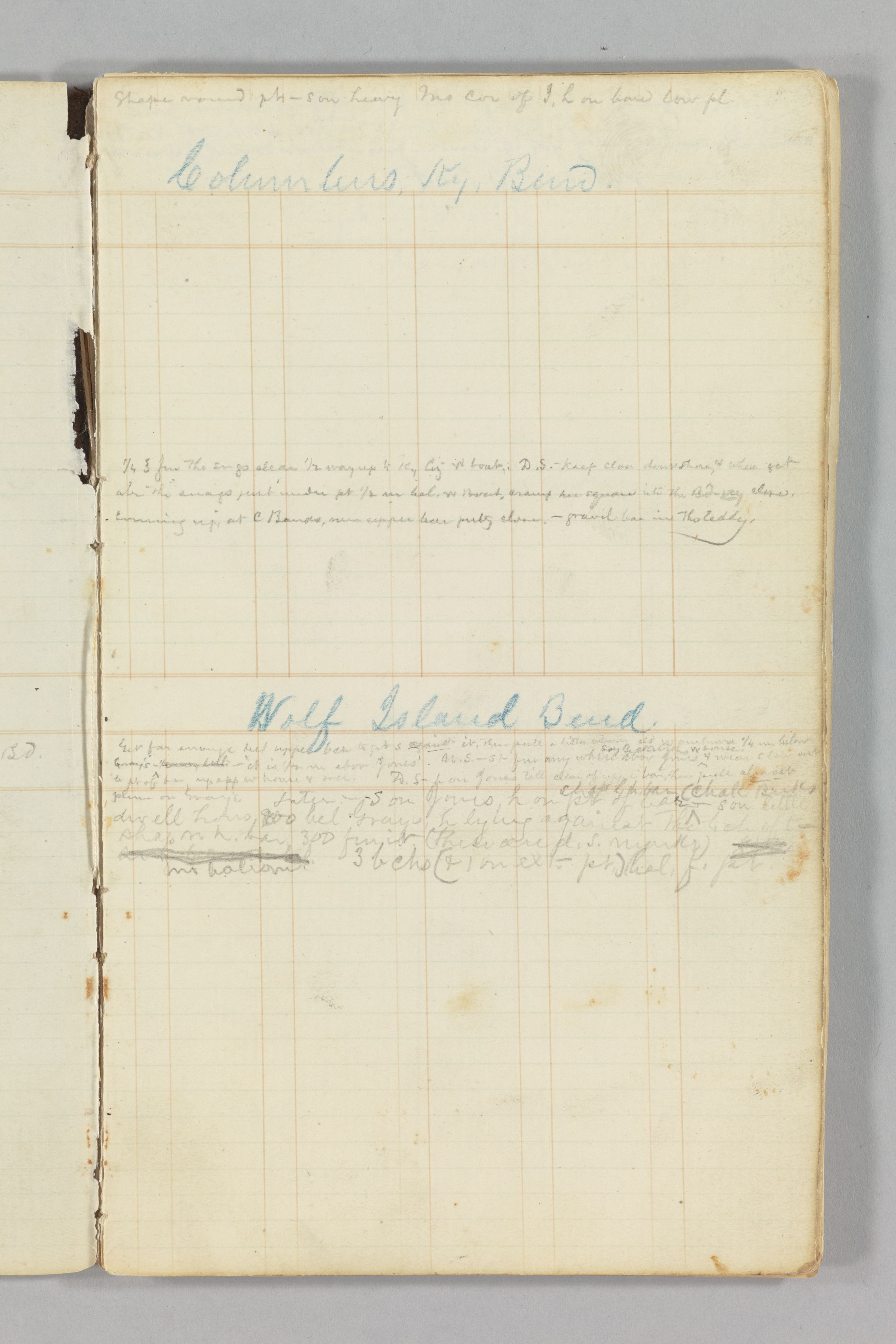
[MS: N02_leaf_002r]
1/4 3 fm the sn go clear 1/2 way up to Ky City W boat. D.S.
—Keep clear down shore, & when get
abr the snags just under
pt 1/2 m bel. W Boat, cramp her square into the Bd—very
close.
Coming up, at C Bends, run upper bar pretty close.—gravel bar in the Eddy.
Get far enough bel upper bar to get s against it, then pull
a little above old warehouse 1/4 m below
Gray’s—1/2 very blt
Ⓜemendation
—it is 1/2 m above Jones’. U.S.—st fm any where abov Jones
Say Beckwiths W house. & wear s low out
to pt of br, up opp w house
& over. D.S—h on Jones till clear of upper bar, then pull
almost
plum on Gray’s. Later—S on Jones, h on pt of bar
shap l. h. bar (Chalk Bnks
—s on little
dwell hous, 800 bel
Gray’s, h lying against the bch of t—
shap r. h. bar, 300 fm
it. (These are pl. s. marks.)
◊◊◊◊
sng ◊◊ ◊◊◊◊ h. l.
Ⓜemendation
no bottom
3 bchs (& 1 on ext. pt.) (bel. f. pt
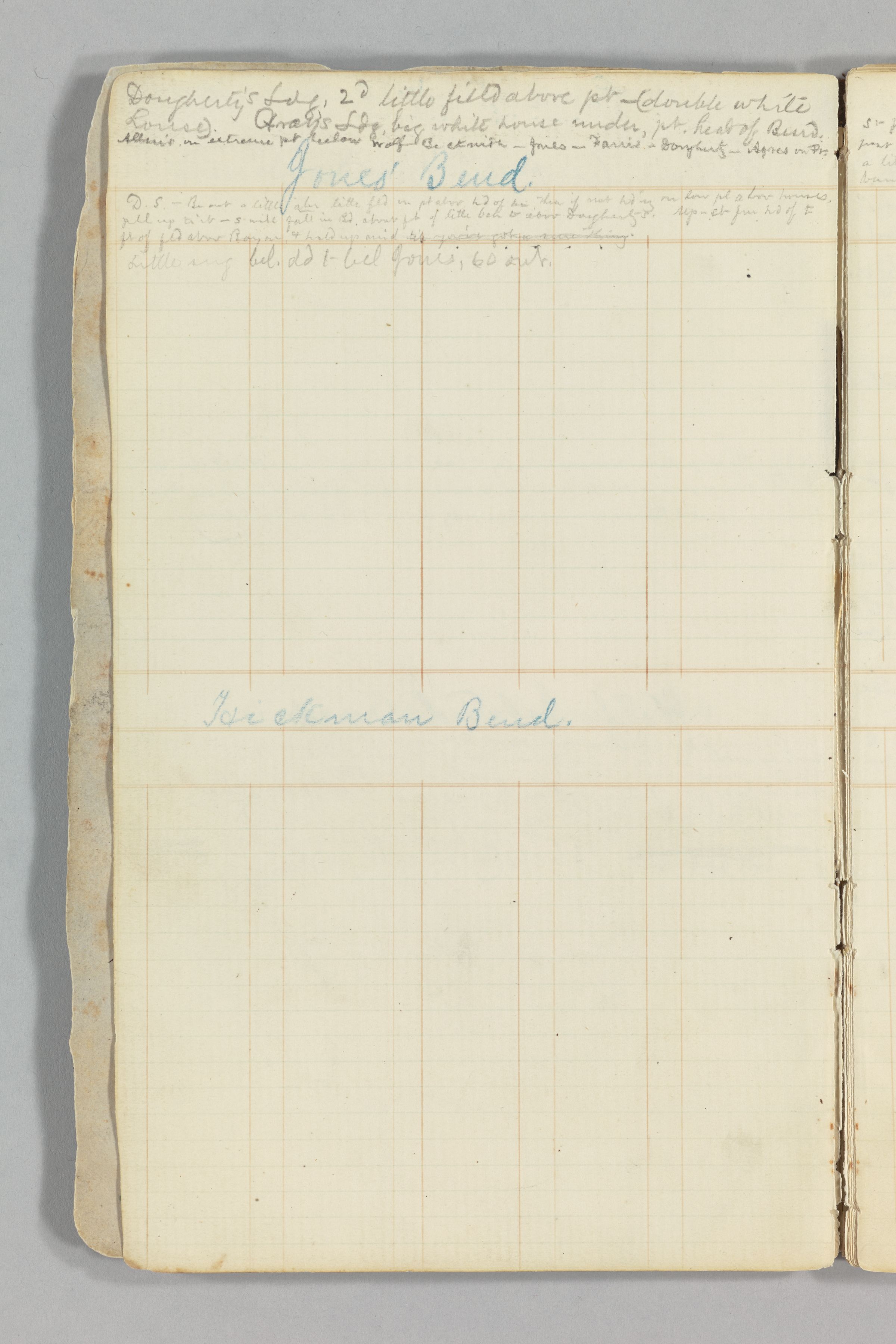
[MS: N02_leaf_002v]
house). Gray’s Ldg, big white house under, pt. head of Bend.
Allen’s on extreme pt below Wolf Beckwith—Jones—Farris —Dougherty—Agues on Pt.
D. S.—Be out a little abr little fld on pt abov hd of br,
then if not hding on low pl abov houses,
pull up to it—s
will fall in Bd. about ft of little bch to abov Dougherty’s.
Up—st fm hd of t
ft of fld abov Bayou, & hold up mid till you've
got a sure thing.
Little sng bel. dd t bel Jones, 60 out.
blank
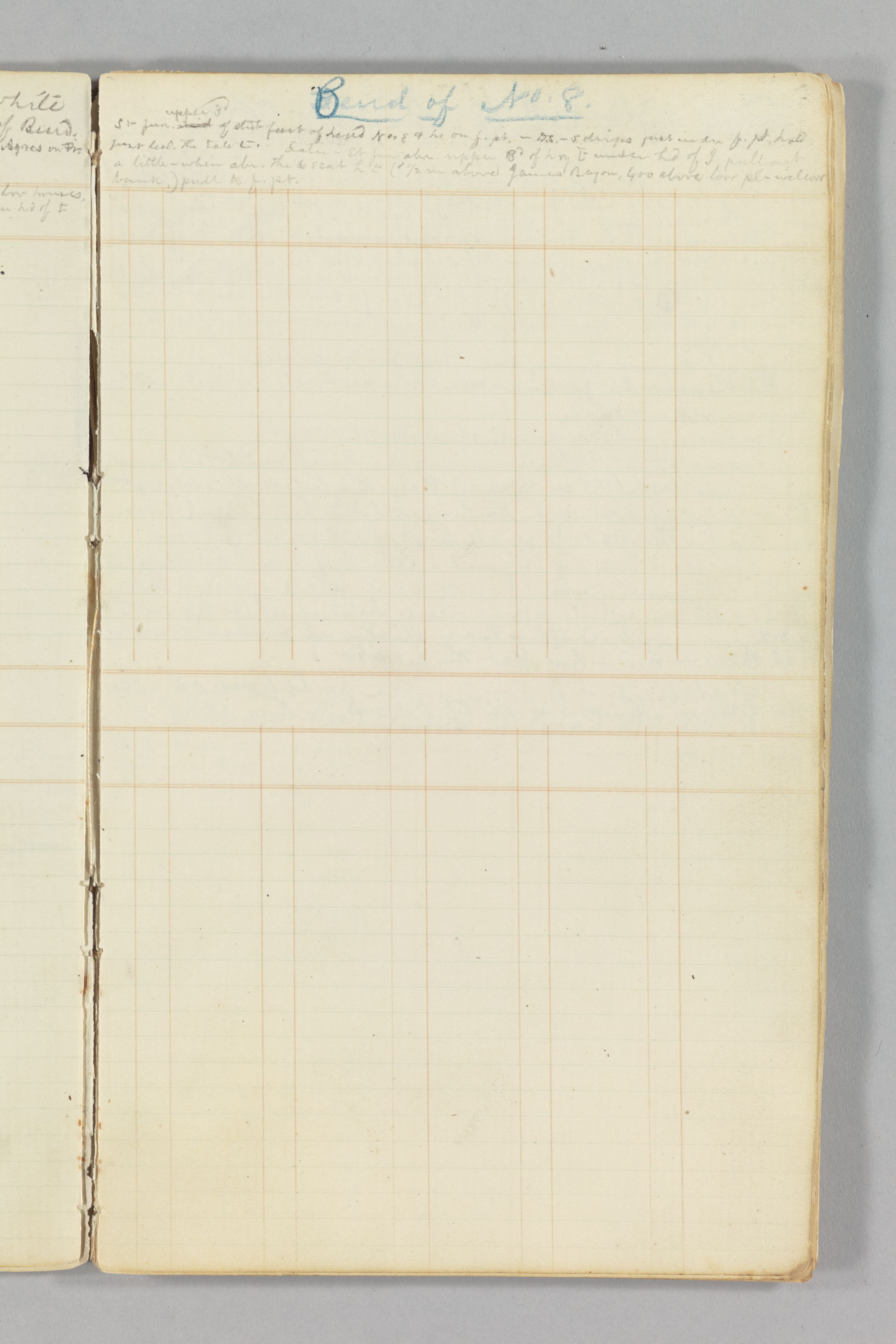
[MS: N02_leaf_003r]
St fm. mid
upper 3d
of stick just of bend No. 8 & h. on f.
pt.—D.S.—s drips just in on f. pt. hold
just bel. the
tall t. Later—St fm abr upper 3d of hvy t under hd of I,
pull out
a little—when abr. the do scat h t (1 1/2 m above
James Bayou, 400 above low pl—willow
bank,) pull to f. pt.
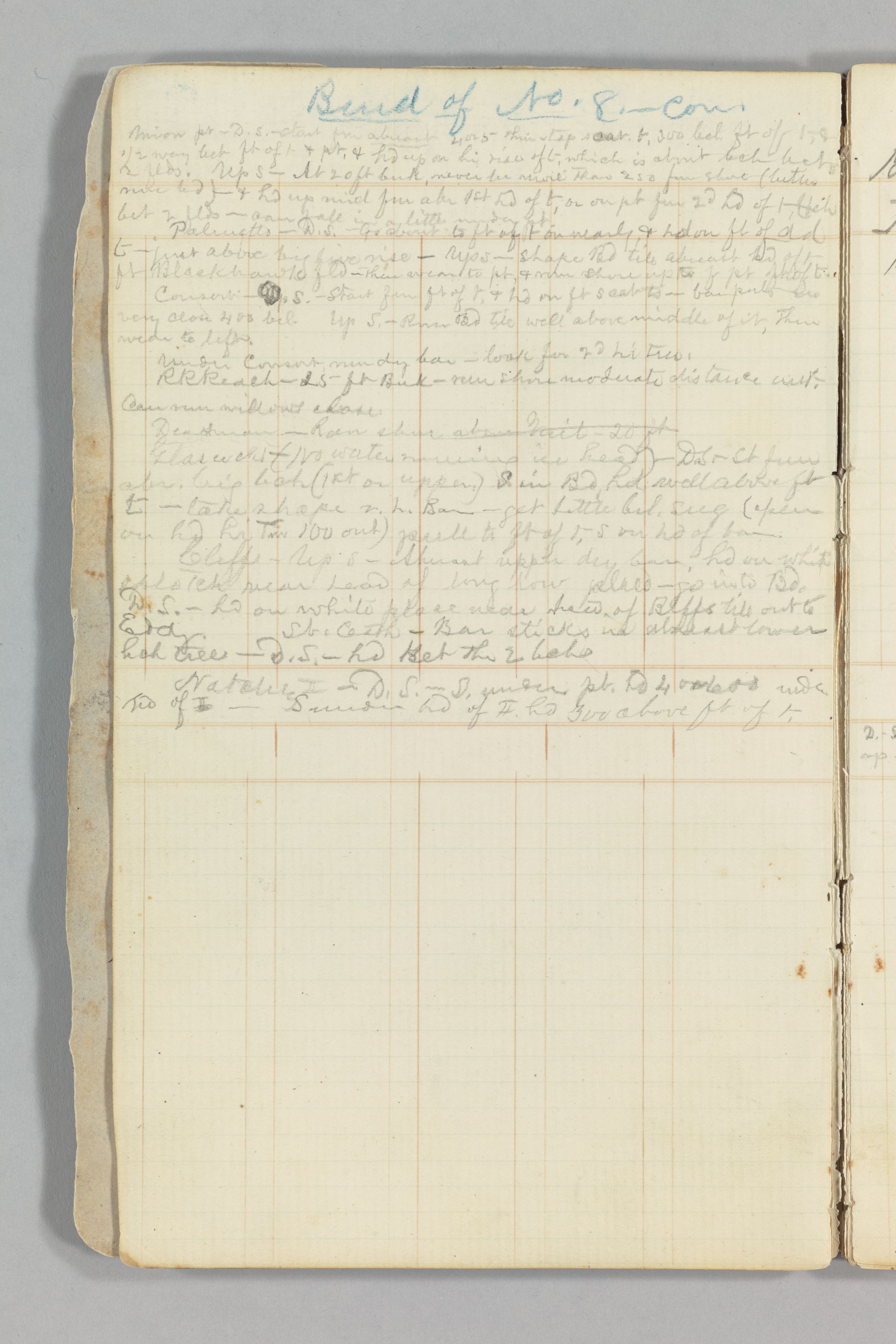
[MS: N02_leaf_003v]
Union pt
4—D. S.—Start fm abreast 4 or 5 then stop scat. t.
300 bel. ft of t, &
1/2 way bet ft of t & pt, & hd up on hi rise
of t. which is about bch bet.
2 flds. Up S—At 20 ft. bnk,
never be more than 250 fm shore (better
run bd)—& hd up mid fm abr 1st hd of t, or on pt fm 2d hd of t, (bch
bet 2 flds—can pull in a little under pt.
Palmetto—D.S.—Go about to ft of t or nearly, & hd
on ft of dd
t—just above big five rise—Up S—Shape Bd
till abreast hd of t
pt Blackhawk fld—then wear to pt, &
run shore up to f pt ft of t.
Consort—Up
D. S.—Start fm ft of t, & hd on ft scat
ts—bar puts in
very close 400 bel. Up S.—Run Bd till well
above middle of it, then
wear to left.
Under Consort, run dry bar—look for 2d hi tree.
R R Reach—25 ft Bnk—run Shore moderate distance out.
Can run willows close.
Deadman—Run shore above Mil—20 ft
Glascock’s—(No water running in head)—D.S.—St fm
abr. big bch (1st on upper,) S. in Bd, hd well above ft
t—
take shape r. h. Bar—get little bel. sng (open
on hd hi T in
100 out) pull to ft of t, s on hd of bar.
Cliffs—Up S—Abreast upper dry bar, hd on white
splotch
near head of long low place—go into Bd.
D.S.—hd on white
place near head of Blffs till out to
Eddy.
St. Cath—Bar
sticks in abreast lower
bch tree—d.S.—hd Bet the 2
bchs
Natchez II—D. S.—S. under pt. to 4 or 600 under
hd of II—S under hd of II. hd 300 above ft of t.
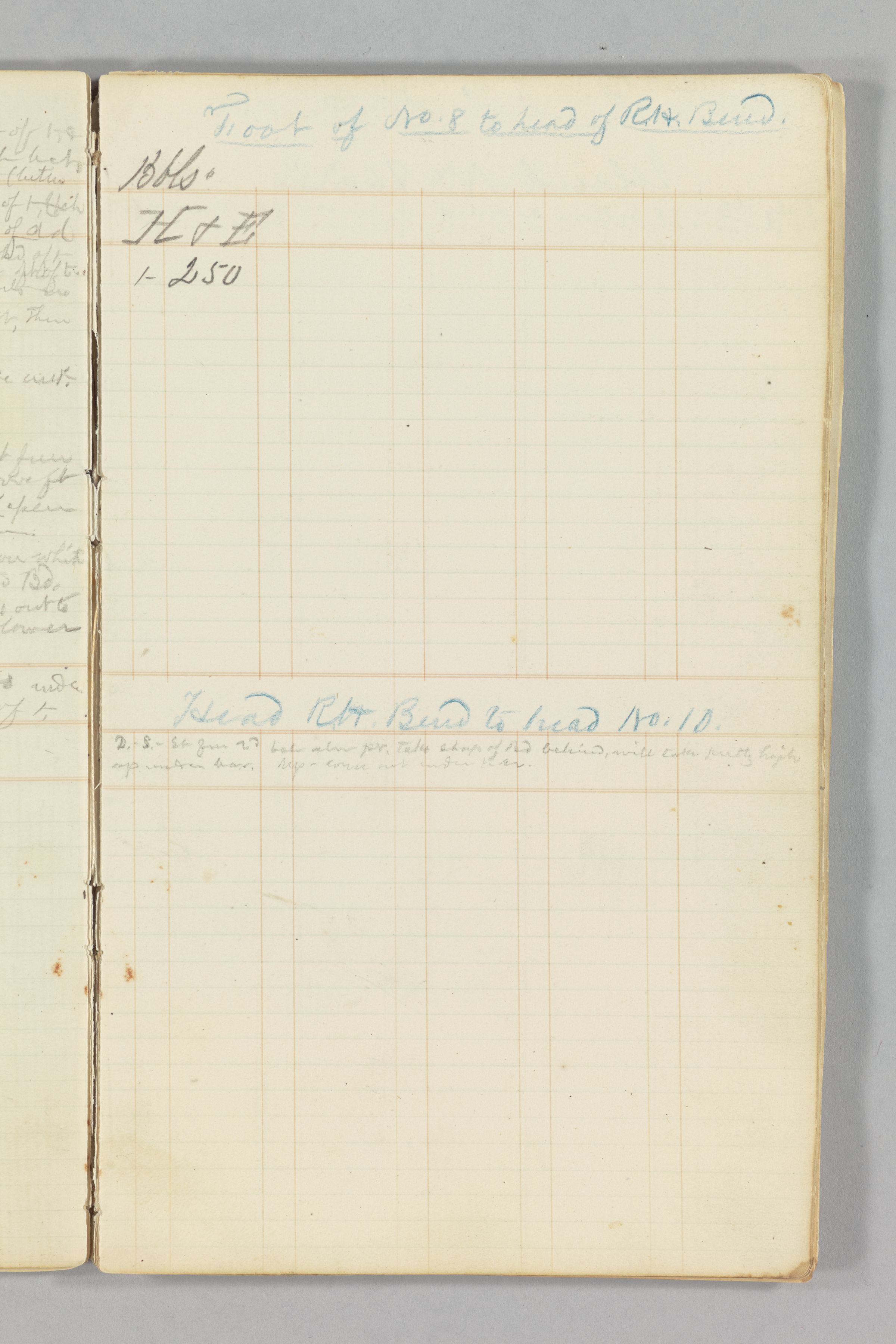
[MS: N02_leaf_004r]
notes in unknown hand
D.—S.—st fm 2d bch abr pt. take shap of Bd behind, will
take pretty high
up under bar. Up—come out under bar.
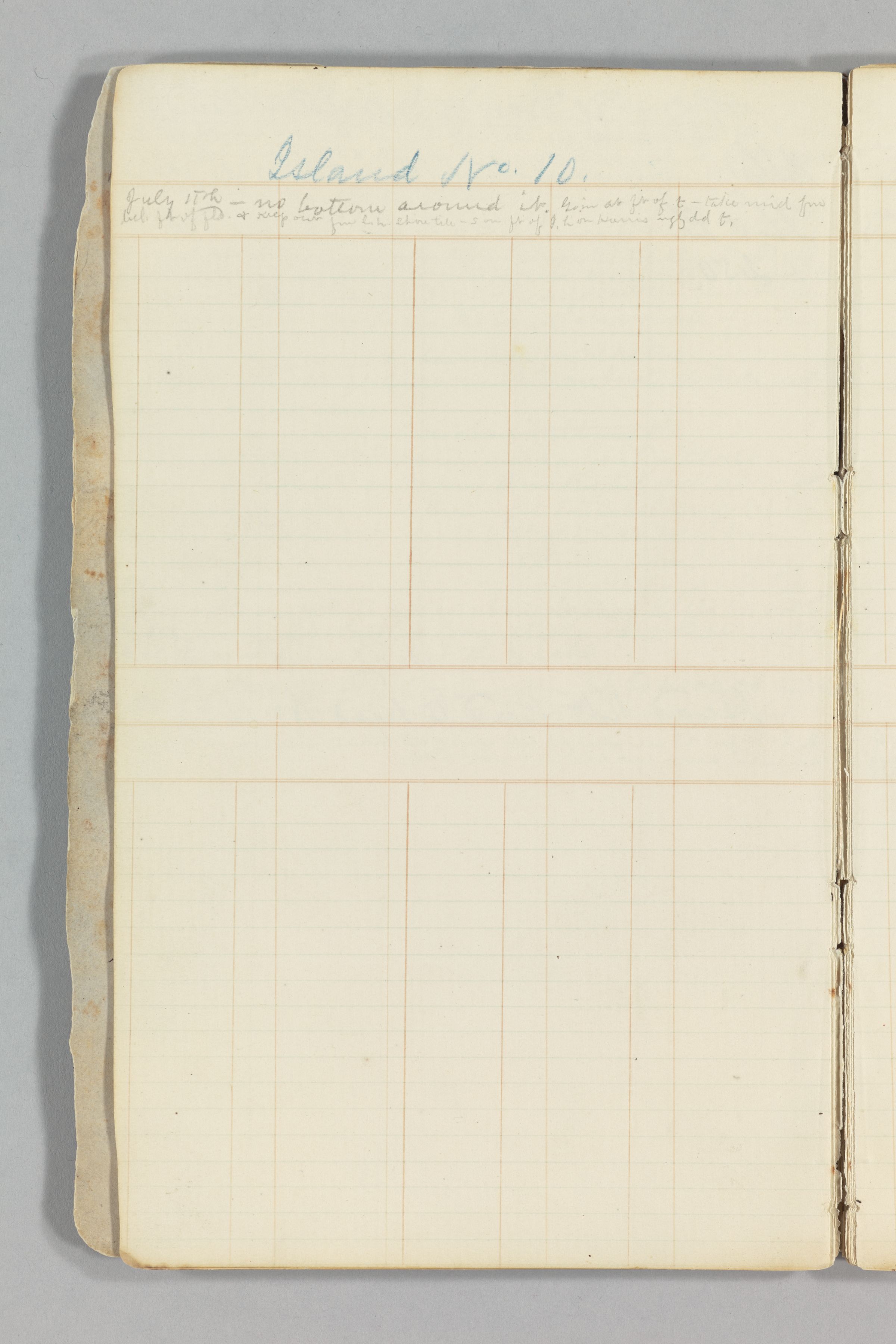
[MS: N02_leaf_004v]
July 11th—no bottom around it. Go in at ft of t—take
mid fm
bel. ft of fld. & keep out fm l. h shore till—s on ft of I, h on Harris ugly dd t.
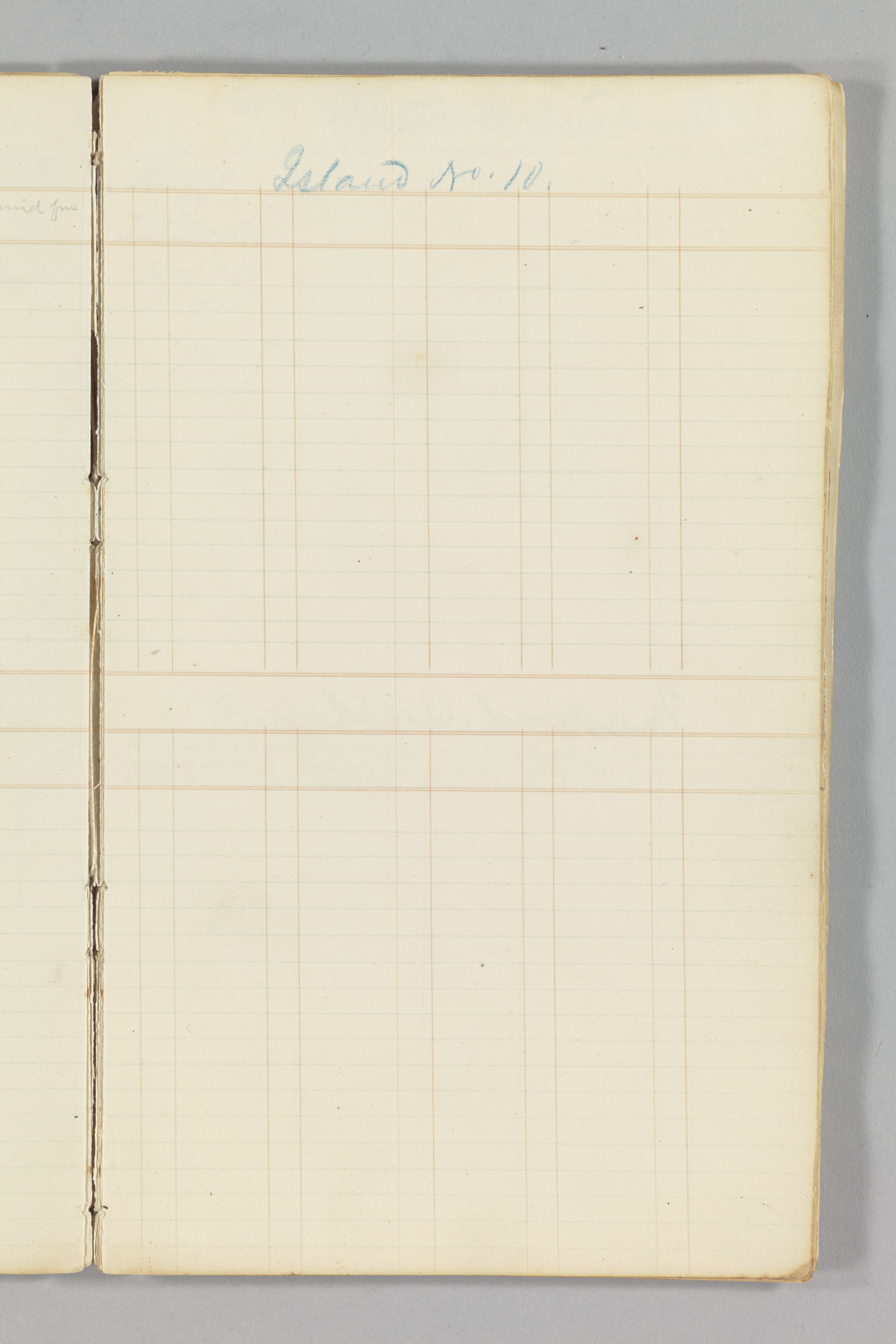
[MS: N02_leaf_005r]
blank
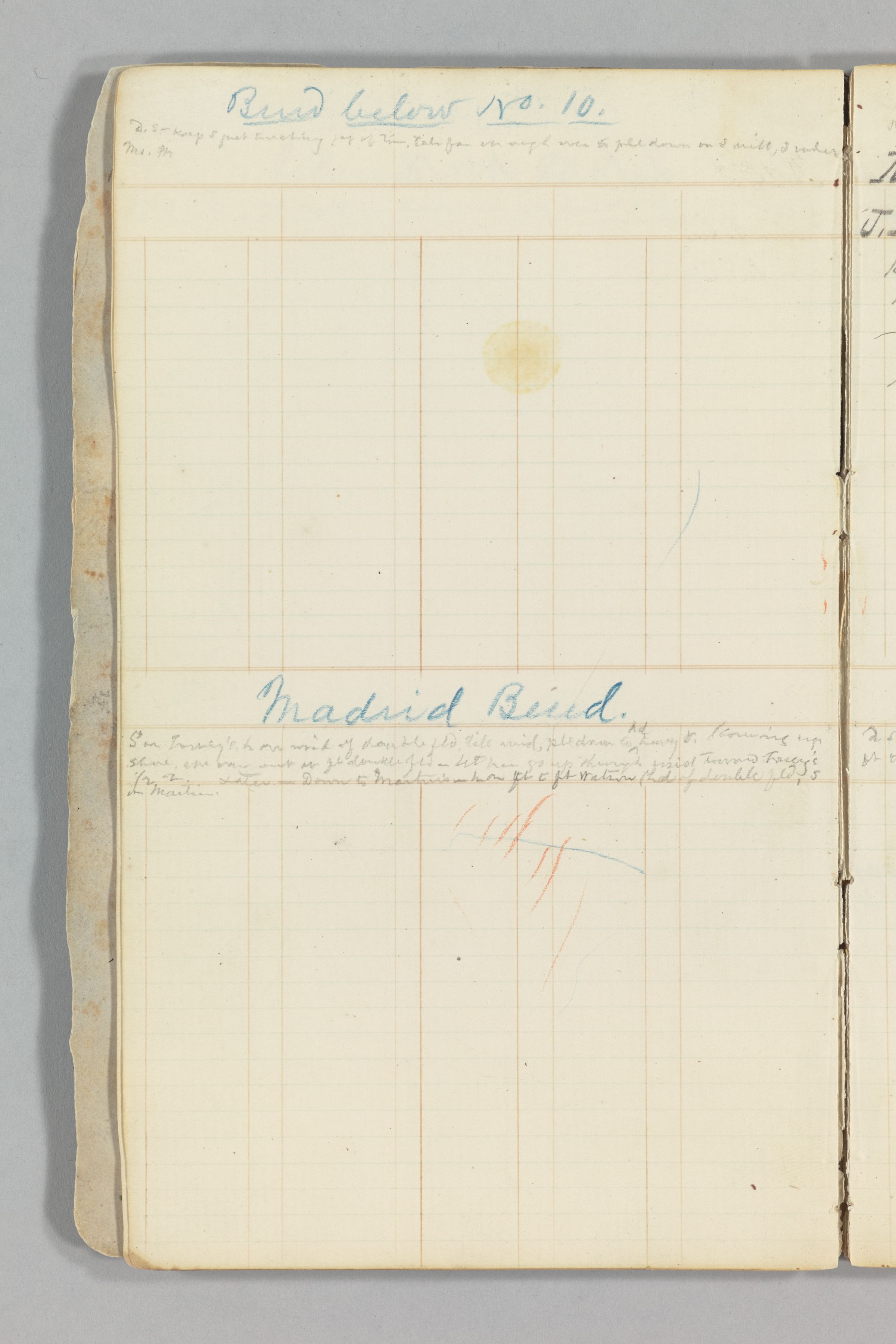
[MS: N02_leaf_005v]
D. S.—Keep s just touching jag of tim, take far enough
over to pll down on s mill, s under
Ms. Pt.
S on Toney’s, h on mid of double fld, till mid, pll down to hd heavy t. (Coming up
shore, she ran out at ft double fld—
Let her go up through mid toward Toney’s
1/2 2. Later.—Down
to Martin’s in h on ft t ft Watson (hd of double fld, s
on Martin.
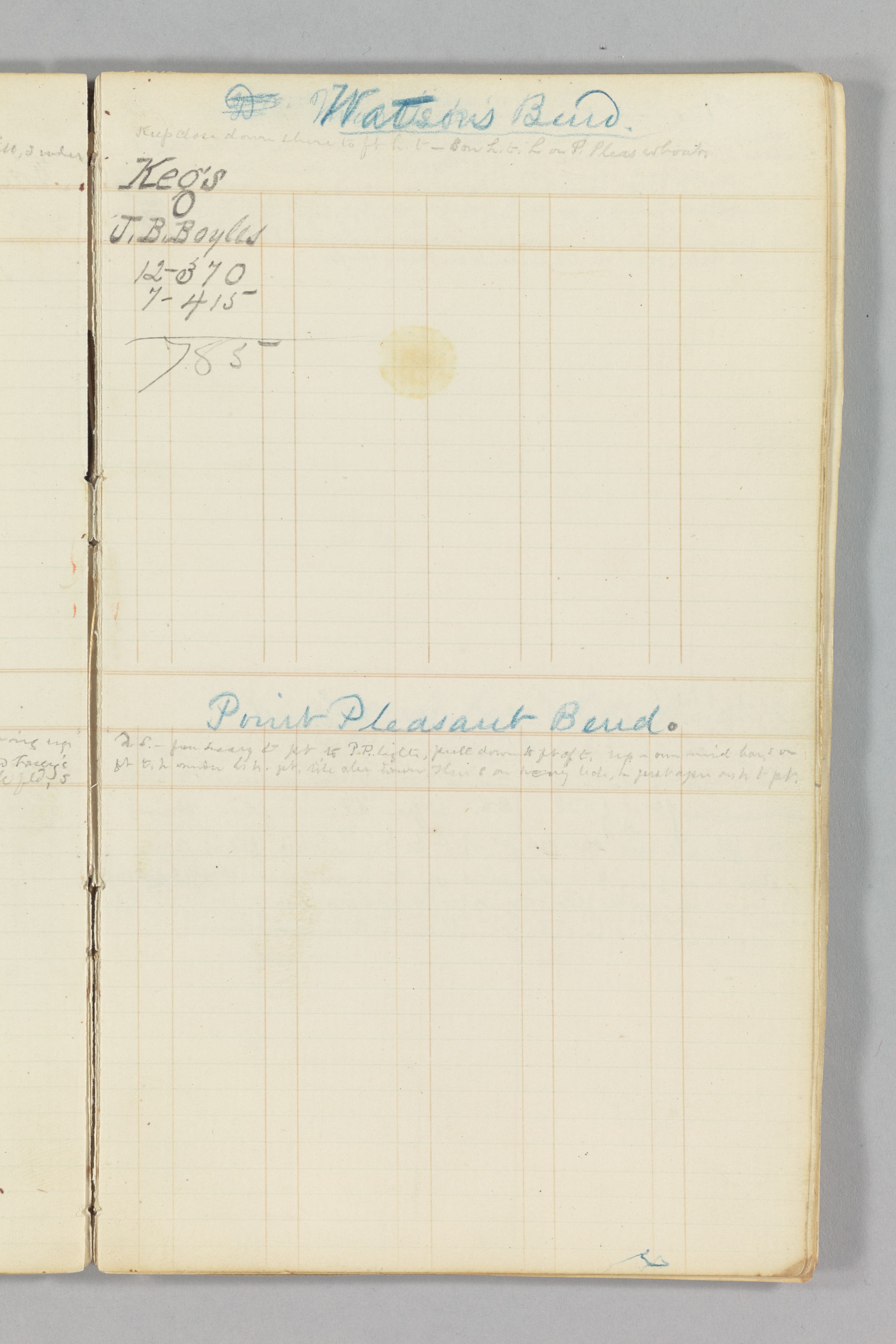
[MS: N02_leaf_006r]
Keep close down shore to ft h. t—s on h. t. h on P. Pleas wboat
notes in unknown hand
d. s.—from heavy t pt to P. P. lights, pull down to ft of t.
Up—over mid bar, s on
ft t. h under br h. pt, till abr town,
then s on hevy bch, in just opn on h t pt.
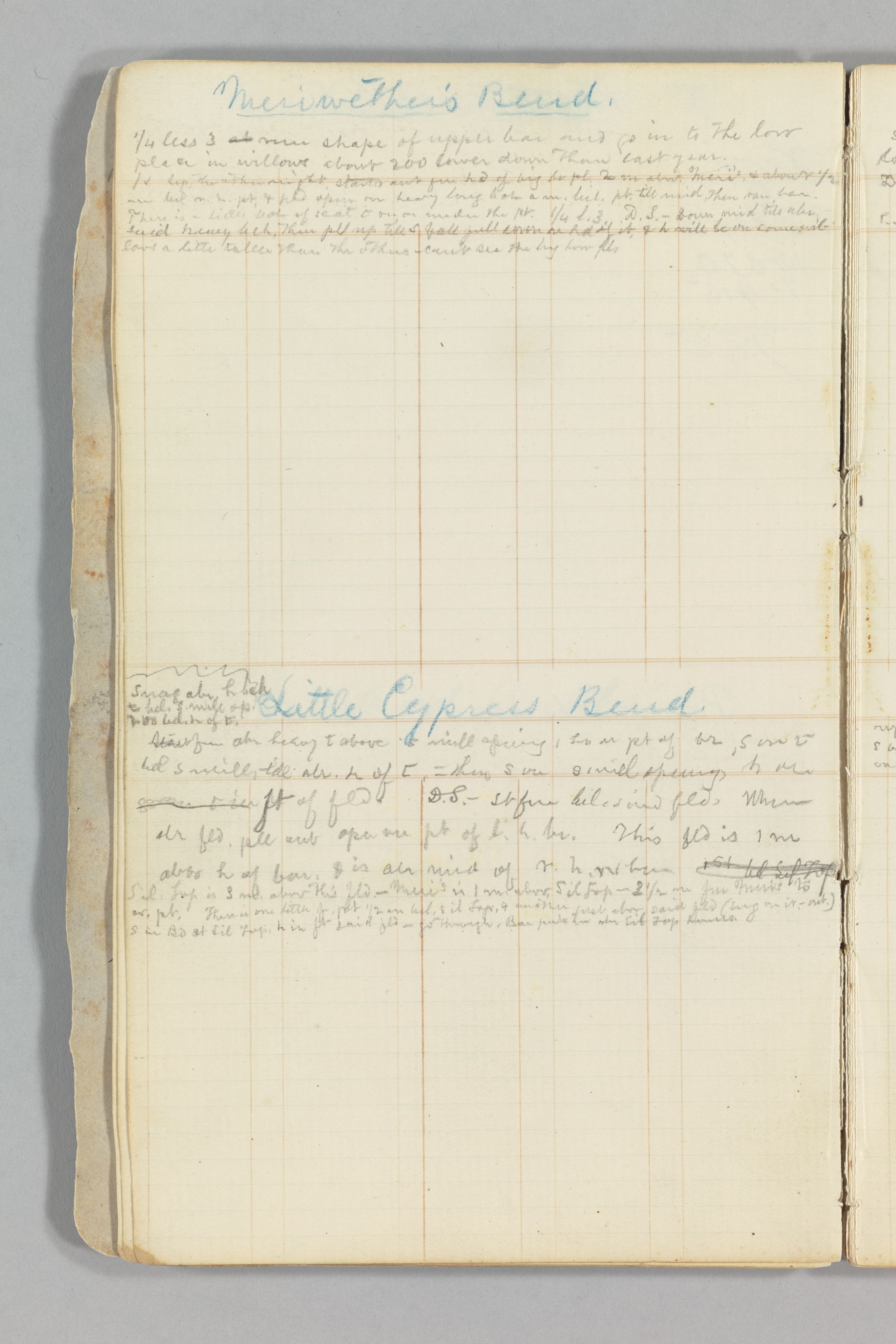
[MS: N02_leaf_006v]
1/4 less 3 at run shape of upper bar and go in to the low
place in willows about 200 lower down than last year.
1s
Ⓜemendation
Up the other night, started out fm hd of big do pl. 2 m abov Meri’s,
& about 1/2
m bel r. h. pt, & hld open on heavy long bch a m.
bel. pt. till mid, then run bar.
There is a little bch of scat t
on or under the pt. 1/4 l. 3. D. S.—Down mid till abr.
said heavy bch, then pll up till s fall pull down on hd of it,
& h will be on some
wil-
lows
willows
a little taller than the others—
can't see the big low pl.
Snag abr h bch
t bel. s. mill op.
200 bel. h of t.
StartⓉtextual note fm abr heavy t above s mill opening, Lo on pt of
br, S on t
hd s mill, till abr. h of t,—then s on s. mill
opening, h on
green t in
◊◊
Ⓜemendation ft of fld. D.S.—st fm bel. s ind
fld. When
abr fld. pll out open on pt of l. h. br. This fld is
1 m
abov h of bar, & is abr mid of r. h. W bar 1st bel Sil
Top
Sil. Top is 3 ml. abov this fld.—Meri’s is 1 m. abov.
Sil Top—2 1/2 m fm Meri’s to
ar. pt. There is one little f.
pt 1/2 m bel. Sil Top, & another just abov said fld (sng on it.
—out.)
S in Bd at Sil Top, h in ft said fld—go through.
Bar puts in abr Sil Top houses.
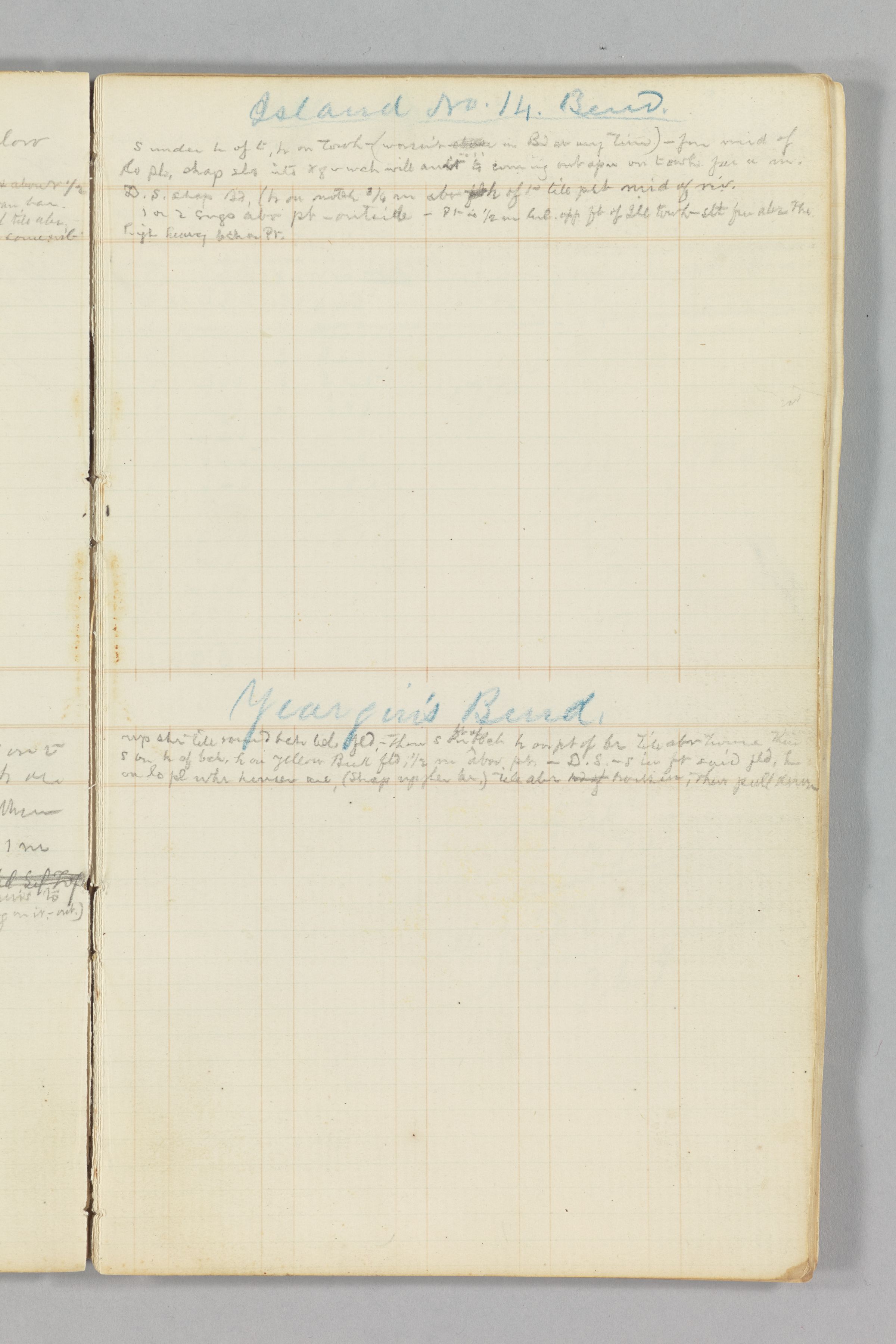
[MS: N02_leaf_007r]
S under h of t, h on towh—(wasn't above in Bd at my time)
—fm mid of
lo pl. shap slo into x g—wch will ant
mt to coming
out opn on towh for a m.
D. S. shap Bd. (h on notch 3/4 m abv
ft h of t till pst mid of riv.
1 or 2 sngs abv pt—outside—Pt is 1/2 m bel. opp ft
of Ill towh—slt fm abr the
high heavy bch on Pt.
Up shr till round bch bel. fld.—then s on ft of bch h on pt
of br till abr house then
s on h of bch, h on yellow Buk fld,
1/2 m abov pt.—D.S.—s in ft said fld, h
on lo pl whr houses
are, (shap upper br.) till abr hd of houses, then pull dwn
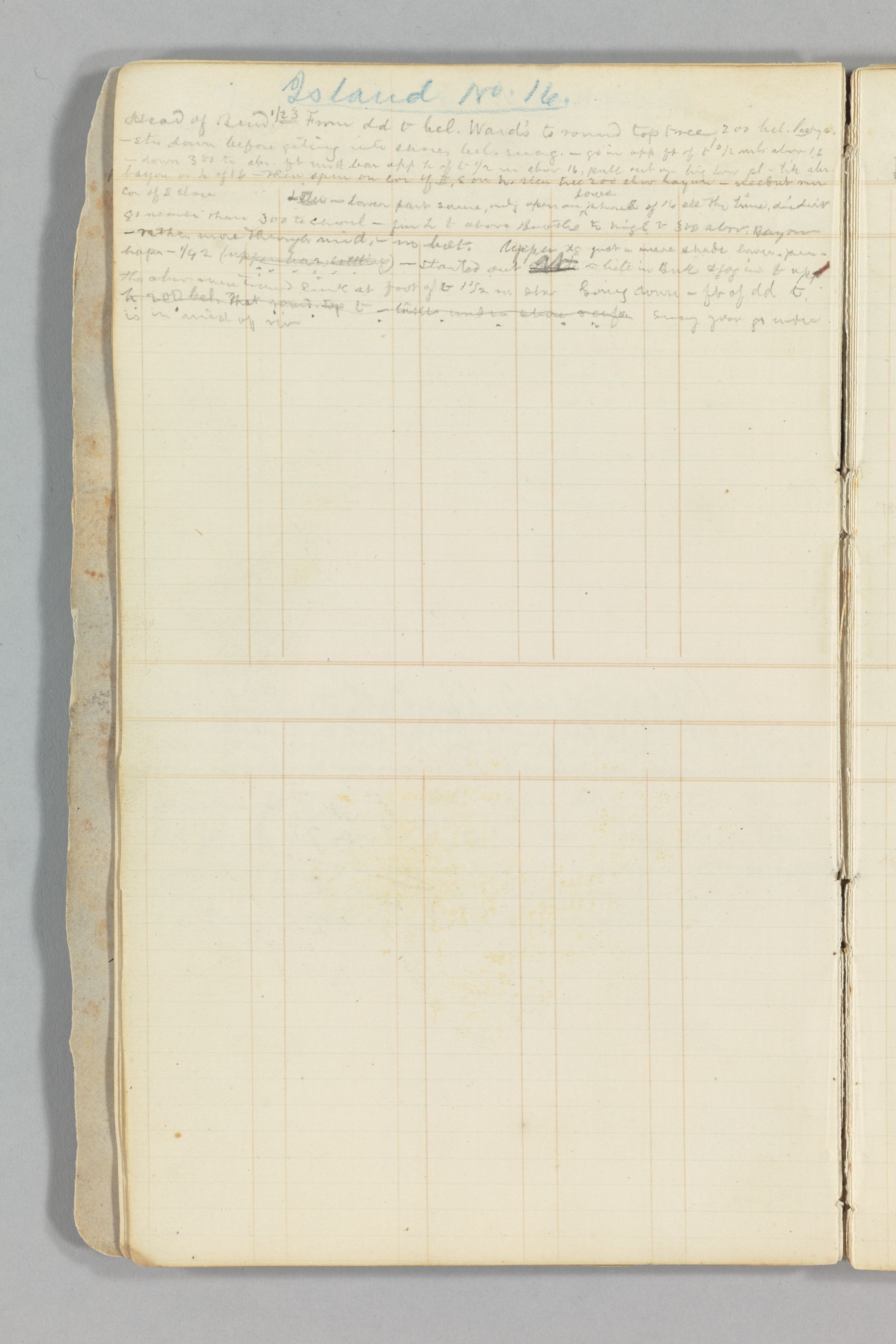
[MS: N02_leaf_007v]
Head of Bend 1/2 3—From dd t bel. Ward’s to round top tree, 200
bel. last
y 2Ⓜemendation.
—stn down before geting into shore, bel. snag.
—go in opp ft of t 1 1/2 mls abov 16
—down 300 to abr. ft mid
bar opp h of t 1/2 m abov 16, pull out on big low pl—till abr.
bayou on h of 16— Then open on cor of II, s on h. slen tree
200 abov bayou—needn't run
cor of II close.
Later—lower
part same, only open on lower shoal of 16 all the time, didn't
go nearer than 300 to shoal—fm h t above Booths to high t
300 abov. Bayou
—rather more through mid.—no bot. Upper
xg just a mere shade lower,
per-
haps
perhaps
—1/4 2 (upper bar,
settling)—started out
◊◊◊◊
Ⓜemendation
W in bite in Bnk & jog
in t upp
the above mentioned sink at foot of t 1 1/2 m abv.
Going down—ft of dd t.
h 200 bel. that round top t—takes
under above & eifes snag go or go under
is in mid of rivr
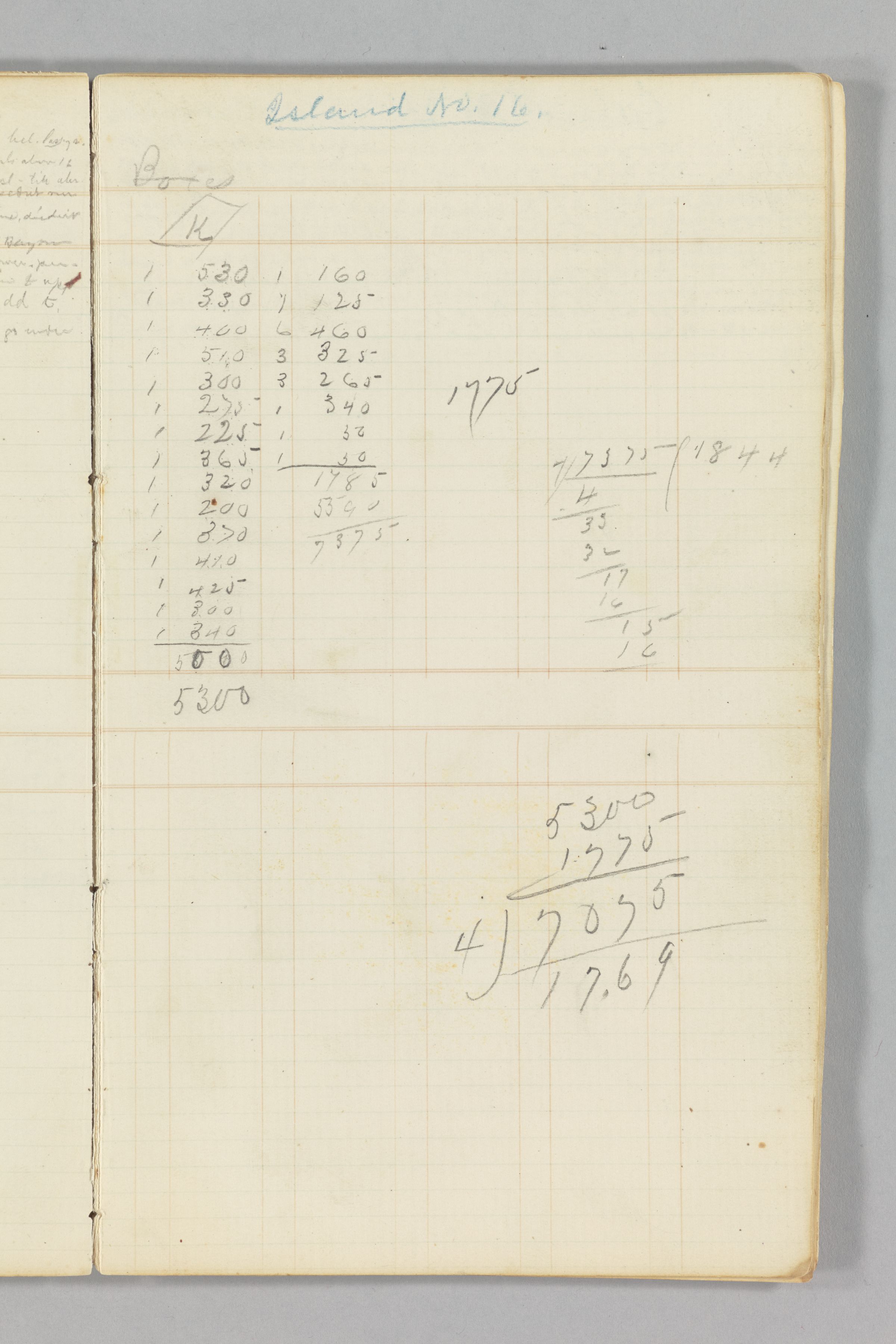
[MS: N02_leaf_008r]
notes in unknown hand
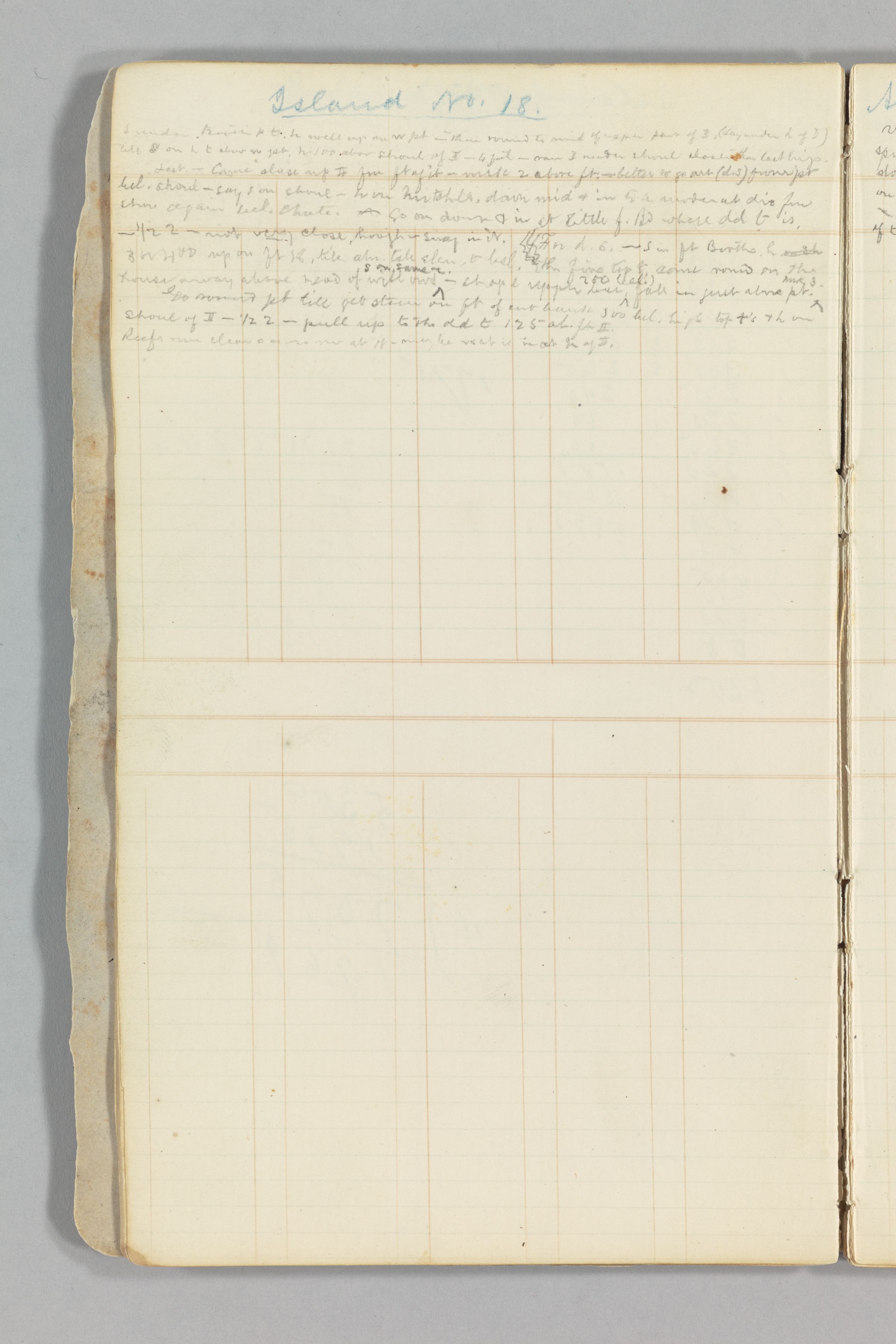
[MS: N02_leaf_008v]
S under Booth p t. h well up on W pt—then round to mid of
upper part of II, (stay under h of II)
till s on h t abov w
pt, h 100 abov shoal of II—4 fath—ran II under shoal
closer than last trip.
Last.—Came close up II fm ft of it—mrk 2 above ft.—
better to go out (d.s) from pt
bel. shoal—say s on shoal—
h on Mitchl’s, down mid & in to a moderat dis fm
shore again
bel. chute. A go on down & in at little f. Bd where dd t is.
—1/2 2—not very close, though—snag in it.
For d.s.—S in ft Booths, h on sh
3 or 400 up on ft 18, till abr. tall
Elm, t bel. the five top t come round on the
house away above
head of willows s on same t.—shap l upper bar, 200 bel.), fall
in just above pt. mk 3.
Go round pt till get stern on ft of cut bank 300 bel. high
top t’s & h on
Reefs run clear can use riv at 18—may be 25
at is in at Is of II.
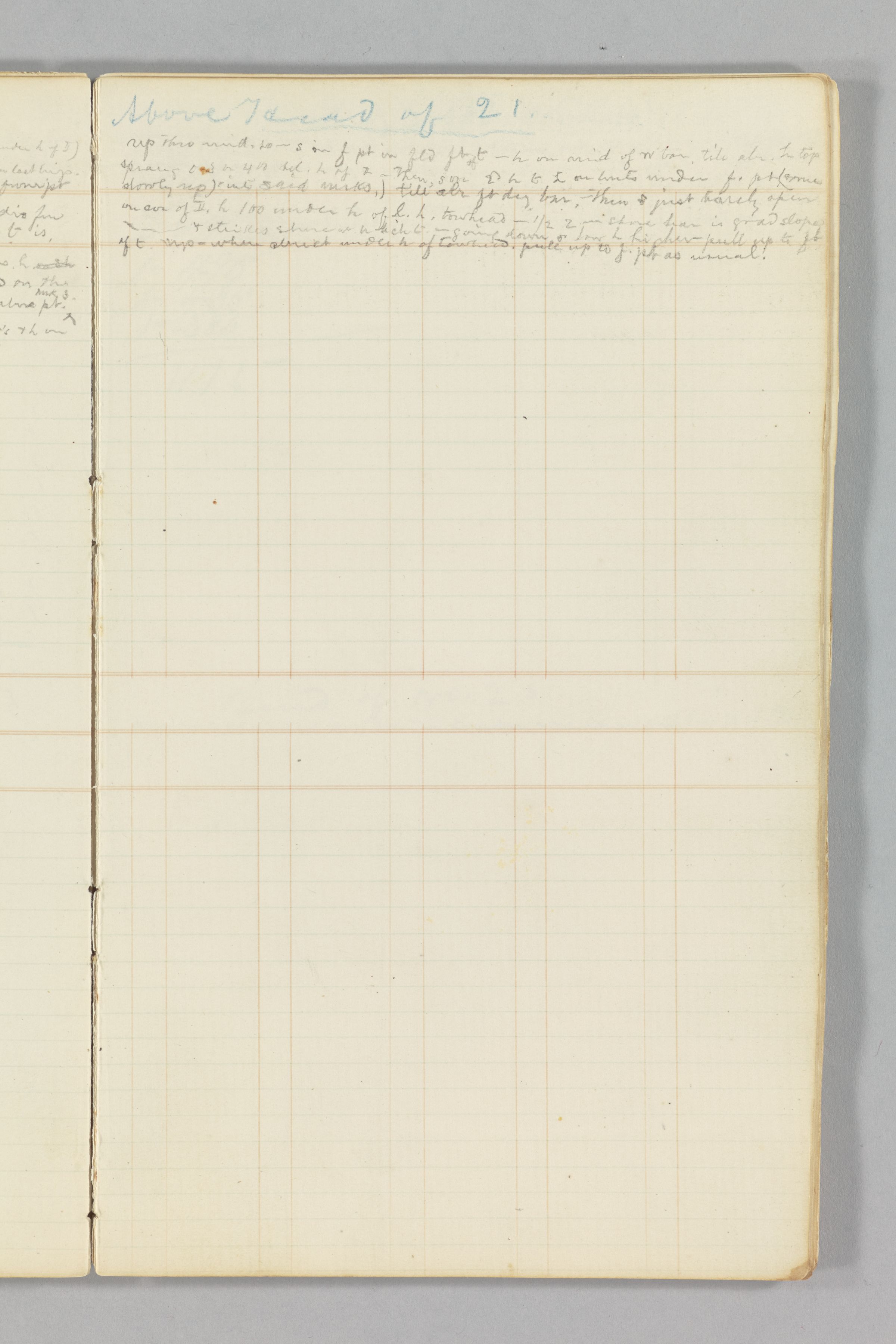
[MS: N02_leaf_009r]
Up thro mid. Lo—s o in f pt in fld ft of t—h on mid of
w bar, till abr. h top
sprang t 3 or 400 bel. h of II—Then,
s on 2d h t L on huts under f. pt (come
slowly up) & into said
mrks,) till abr ft dry bar,—Then s just barely open
on cor of
II, h 100 under h of l. h. towhead—1/2 2 in shore bar is grad
slope
symbol & strikes shore at h bch t.—going down s low h
higher—pull up to ft
of t. Up—when abrest under h of
towhead, pull up to f. pt as usual.
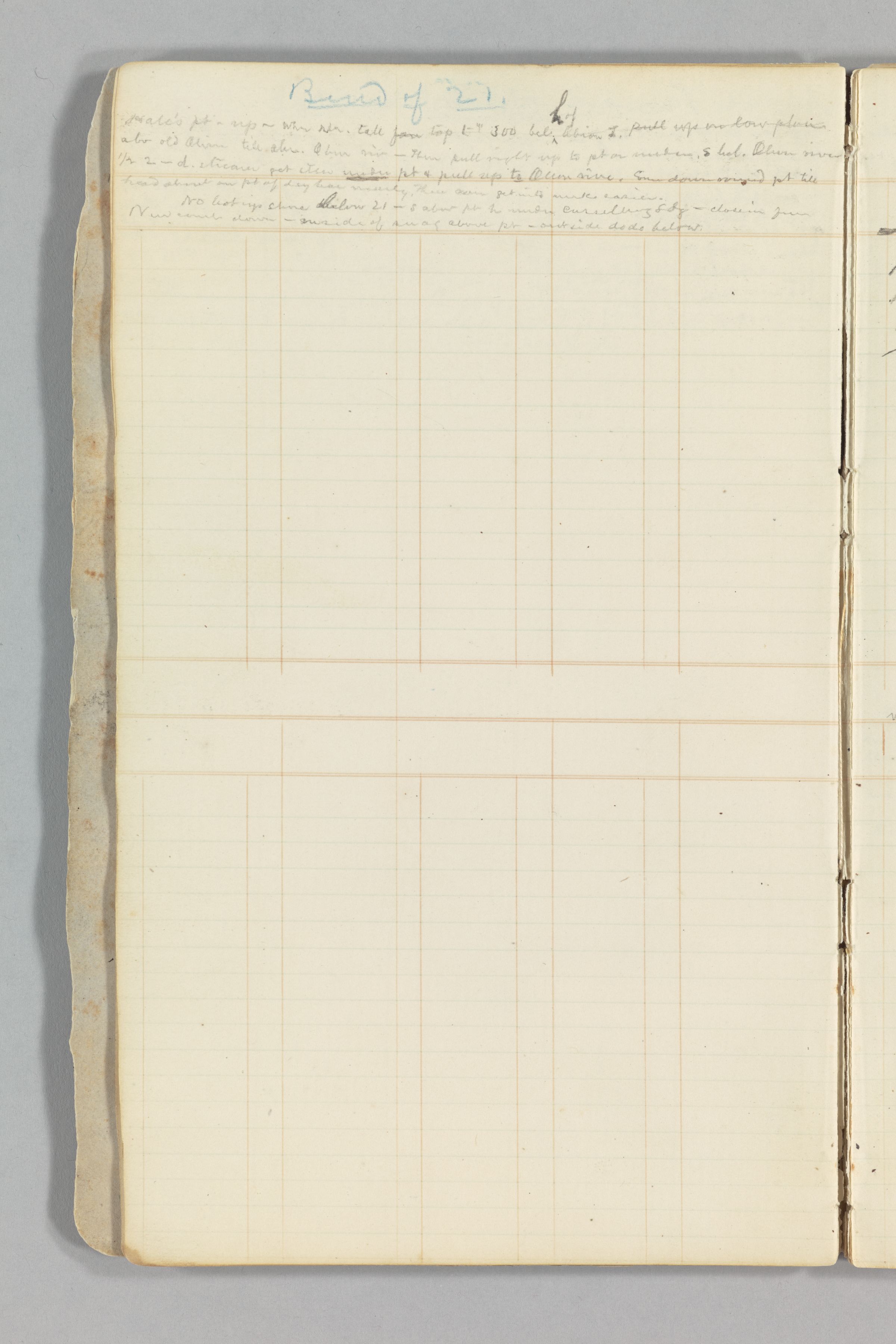
[MS: N02_leaf_009v]
Hale’s pt—up—When abr. tall fan top t symbol 300 bel h of
Obion I. pull up on low plainⓉtextual note
abv old Obion till abr. Obion
riv—then pull right up to pt or under, s bel. Obion river
1/2 2—d. stream get stern under pt & pull up to
Obion rivr.
Come down round pt till
head about on pt of dry bar nearby. Then
can get into mrks easier.
No bot up shore below 21—s abov pt h under Casselberry Ldg—close in fm
N w come down—inside of snag above pt—outside dodo below.
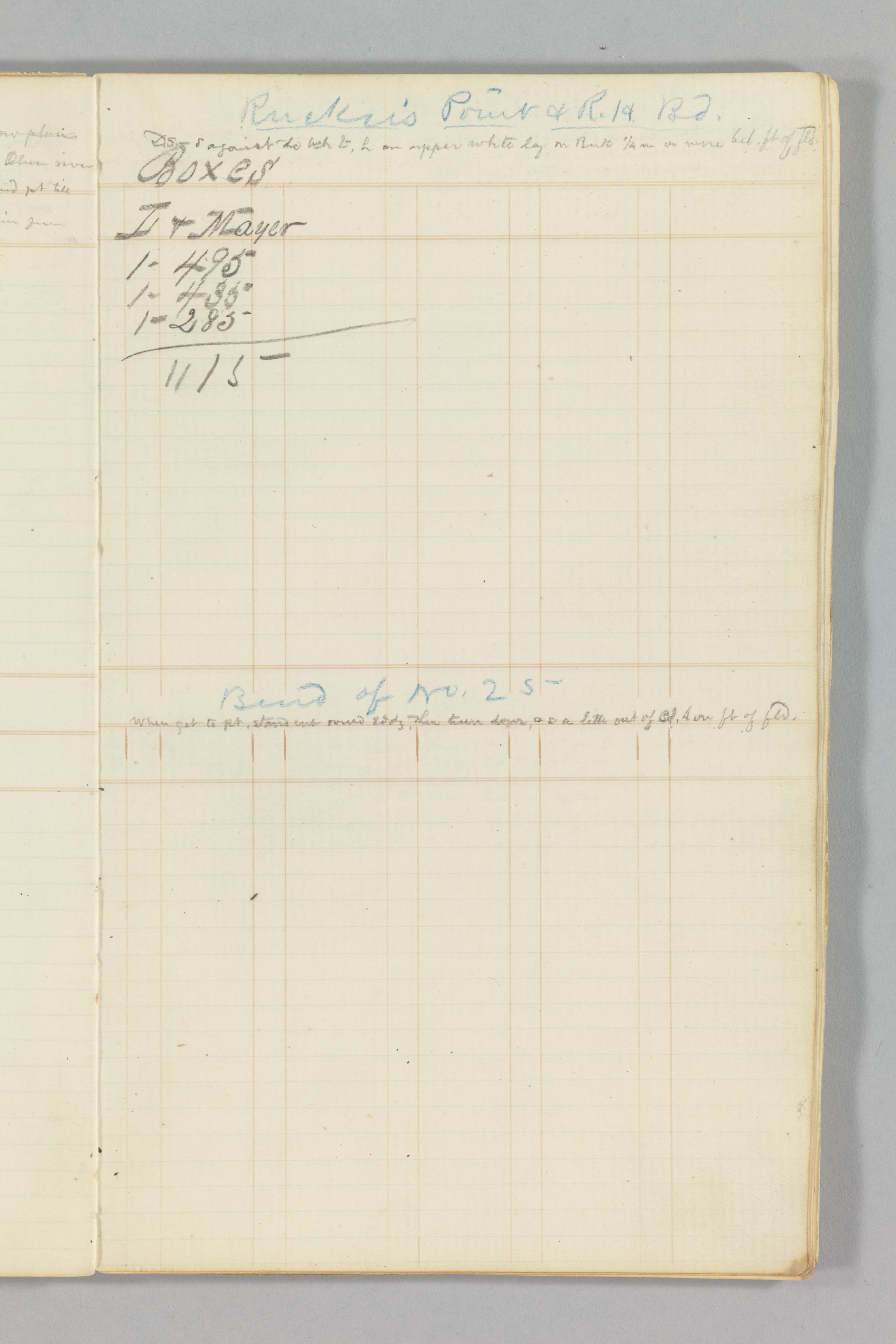
[MS: N02_leaf_010r]
D.S.—s against the bch t, h on upper white log on Bnk 1/4 m or more bel. fit of fld.
notes in unknown hand
When get to pt, stand out round Eddy, then turn down, & s a little out of Bd, h on ft of fld.
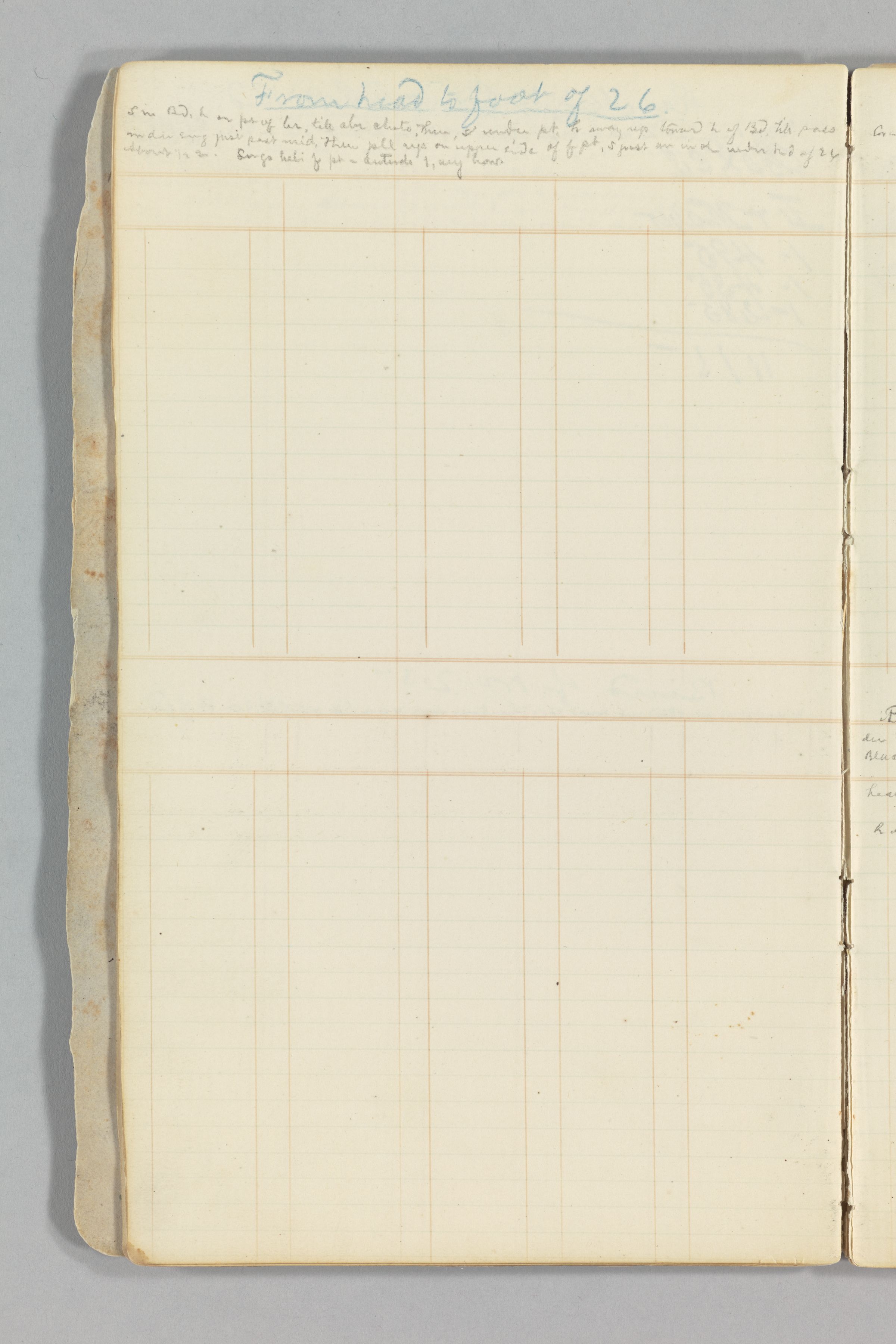
[MS: N02_leaf_010v]
S in Bd. h on pt of br, till abr chute, then, s under pt. h
away up toward h of Bd. till pass
under sng just past mid, Then
pll up on upper side of f pt, s just on in ch under hd of 26
About 1/2 2. Sngs bel. f. pt—outside I, any how.
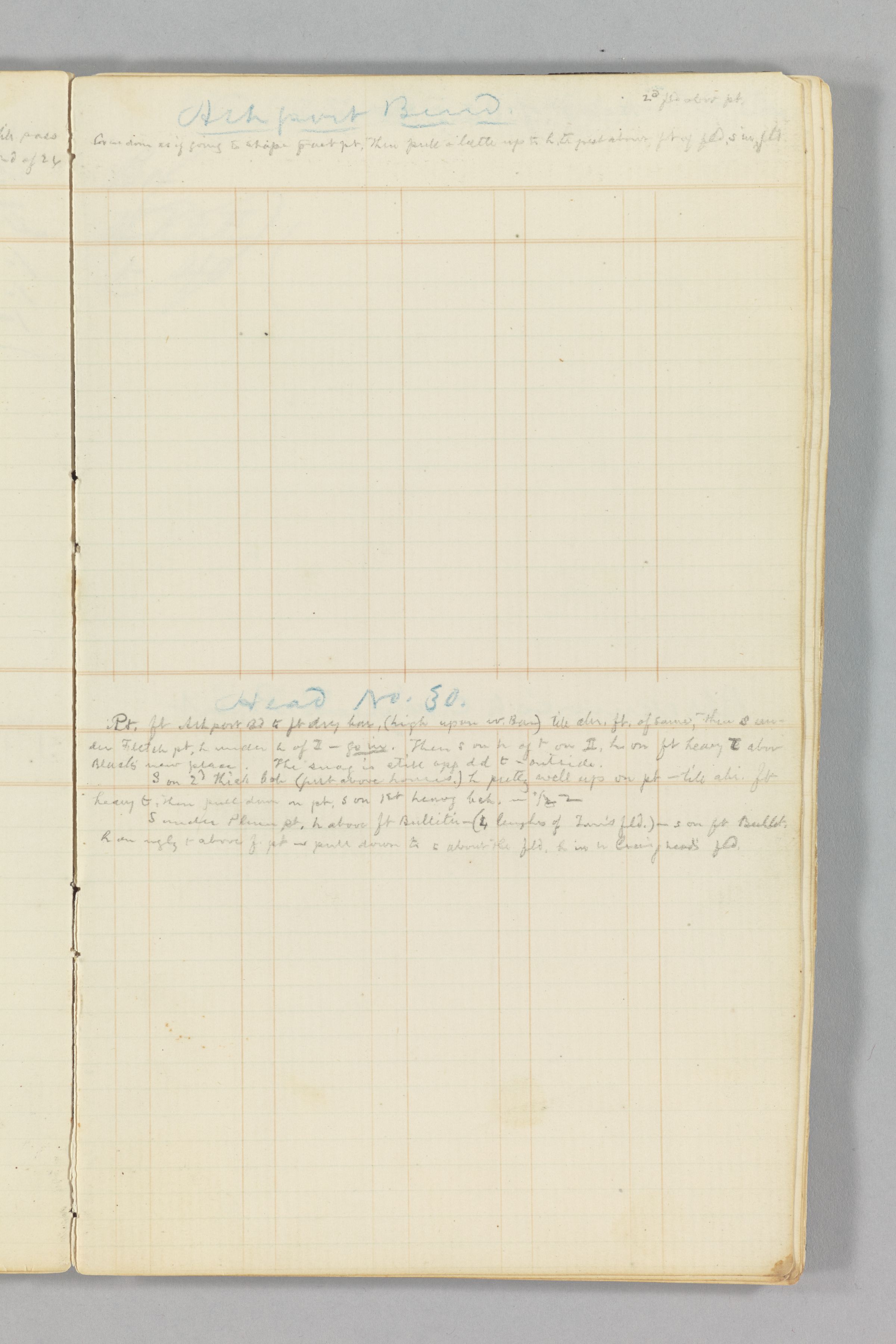
[MS: N02_leaf_011r]
2d fld abov pt.
Come down as if going to shape past pt, then pull a little up to h. tr just about ft of fld, s in fld.
Pt. ft Ashport Bd to ft dry bar, (high upon w. Bar) till abr.
ft. of same, then s
un-
der
under
Fletch pt, h under h of II—go in.
Then s on h of t on II, h on ft heavy t abov
Black’s new place.
The snag is still opp dd t—outside.
S on 2d thick bob (just above houses.) h pretty well up on
pt—till abr. ft
heavy t, then pull down on pt. s on 1st heavy
bch.—1/3
2 2
S under Plum pt, h above ft Bullitir—(4 lenghes of Tom’s
fld.)—s on ft Bullet.
h on ugly t above f. pt—pull down
to symbol about the fld, h in in Craighead’s fld.
[MS: N02_leaf_011v]
blank
blank
[MS: N02_leaf_012r]
notes in unknown hand
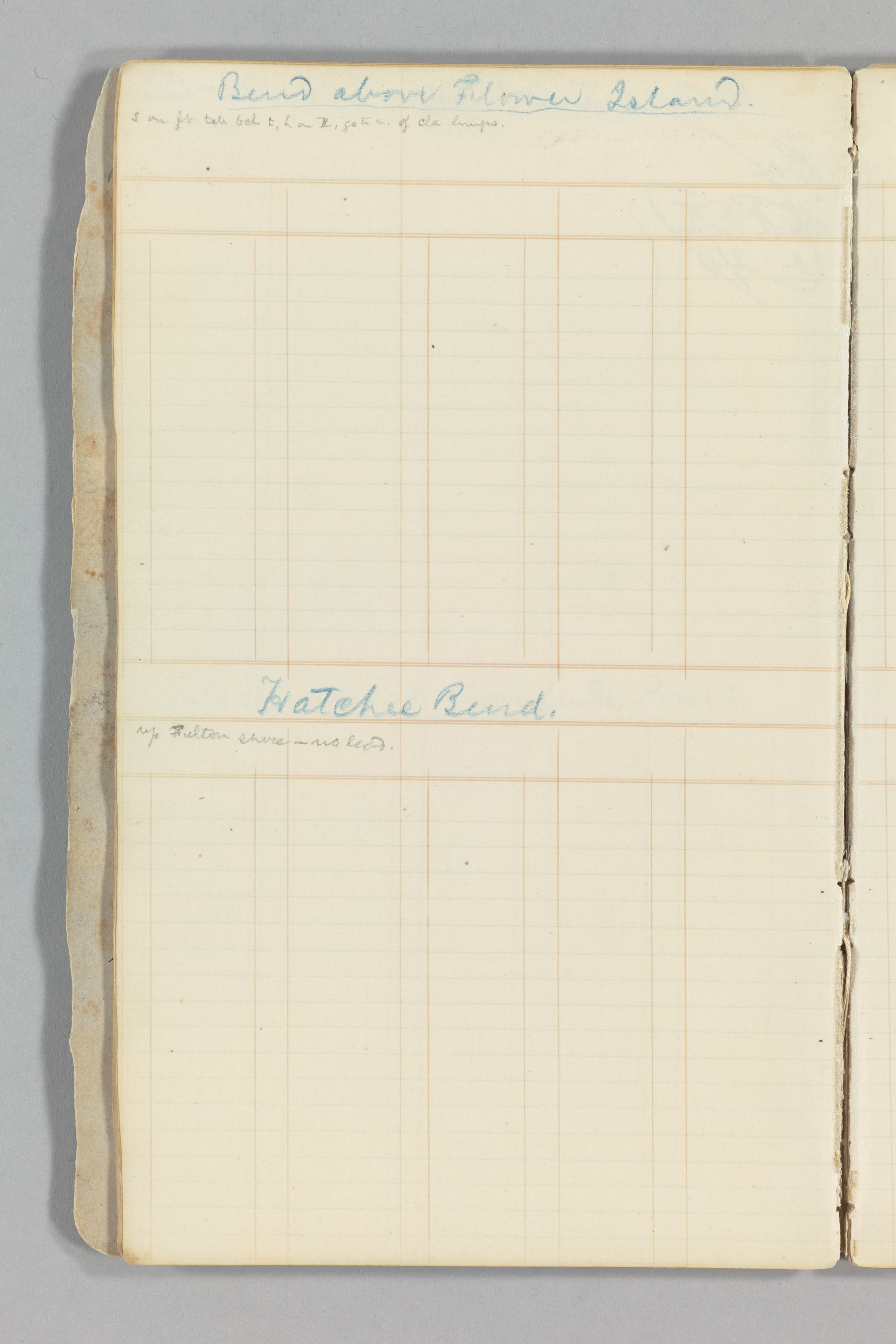
[MS: N02_leaf_012v]
S on ft tall bch t, h on II, go to n. of cla lumps.
Up Fulton shore—no lead.
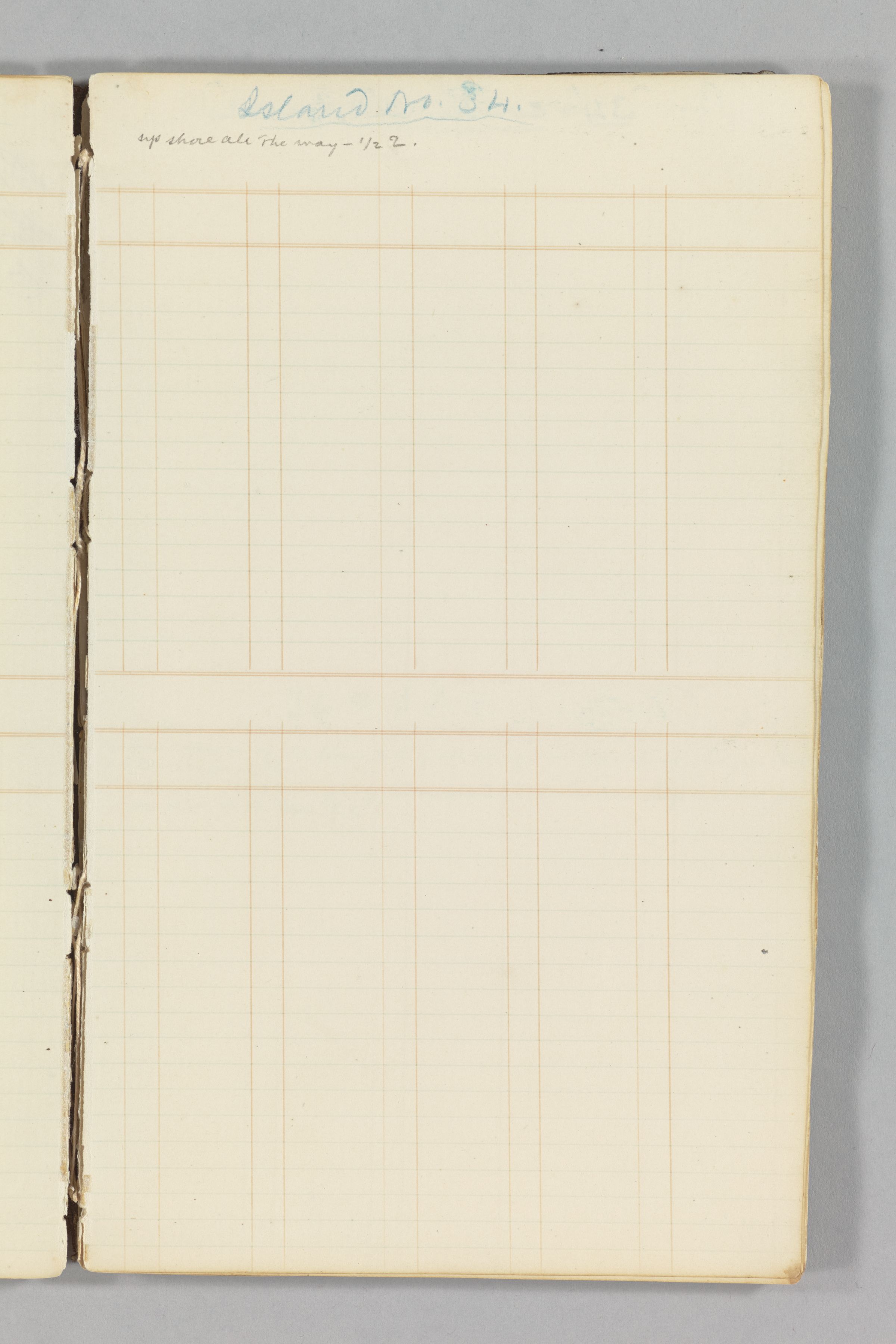
[MS: N02_leaf_013r]
Up shore all the way—1/2 2.
[MS: N02_leaf_013v]
blank
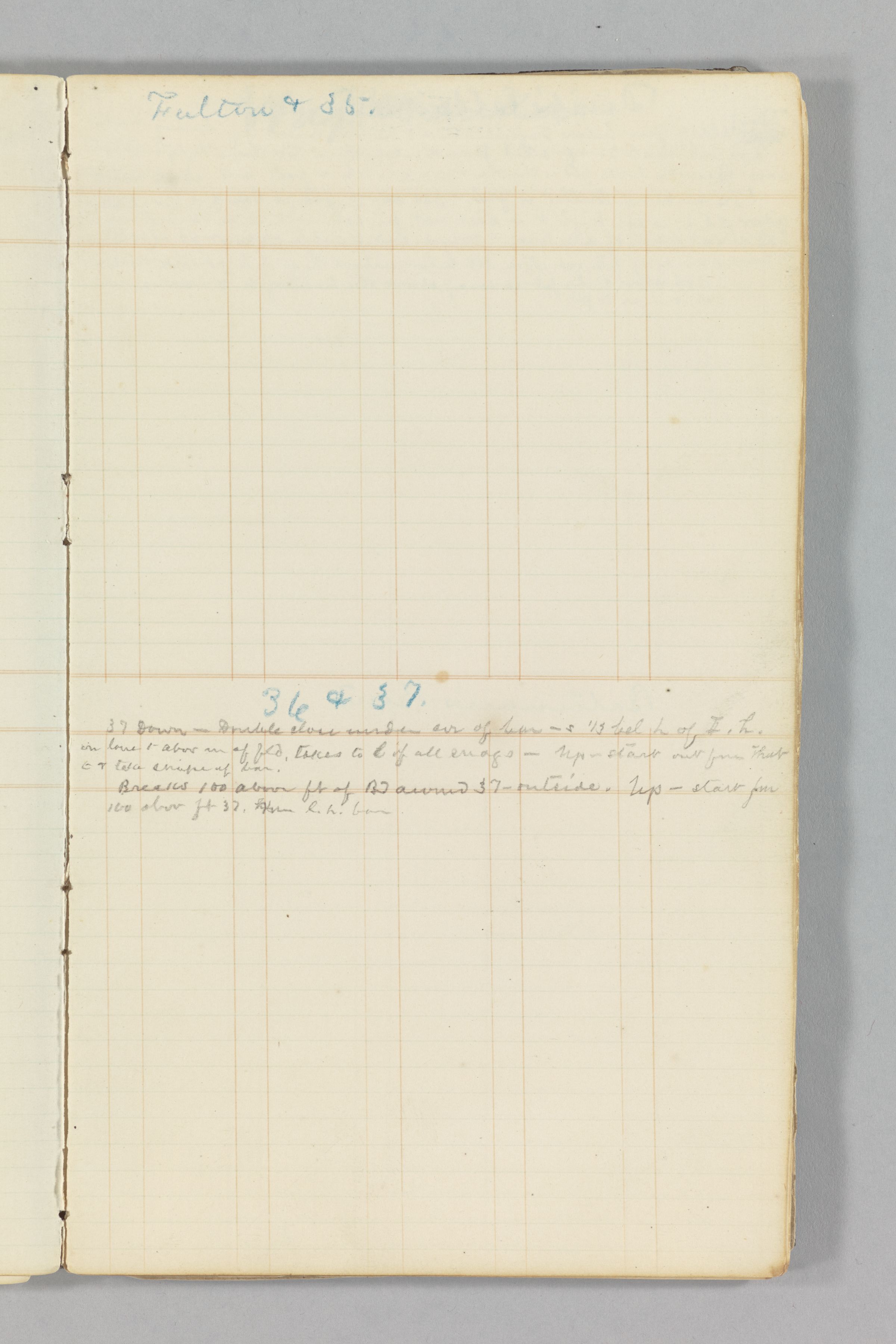
[MS: N02_leaf_014r]
blank
37 Down—Double close under cor of bar—s 1/3 bel h of II.
h.
on low t abov m of fld, takes to l of all snags—Up—
start out fm that
t & take shape of bar.
Breaks 100 above ft of Bd around 37—outside. Up—start
fm
100 abov ft 37. h t run l. h. bar.
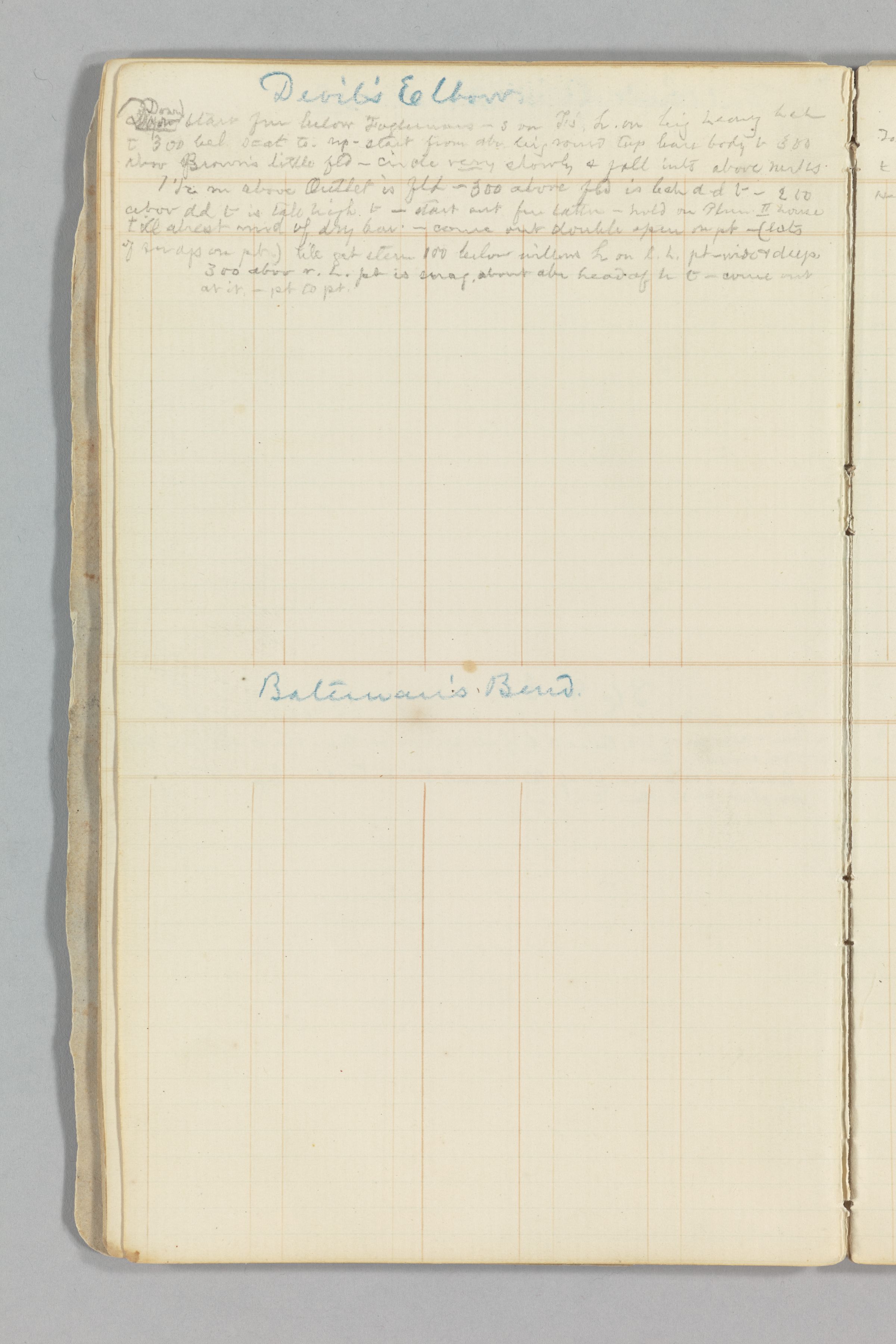
[MS: N02_leaf_014v]
DownⓂemendation—Start fm below Foglermans—s on F’s L. on big
heavy bch
t 300 bel. scat to. up—start from abr big round
top bars body t 300
abov of
Brown’s little fld—circle very
slowly & fall into above mrks
1 1/2 m above Outlet is fld—300 above fld is bch d-d
t—200
above dd t is tall high t—start out fm latter—
hold on Plum II house
till abrest mid of dry bar.—come out
double open on pt—(lots
of snags on pt.) till get stern 100
below willows h on l. h. pt—wide & deep.
300 abov r. h. pt is snag, about abr head of h t—come out
at it.—pt to pt.
blank
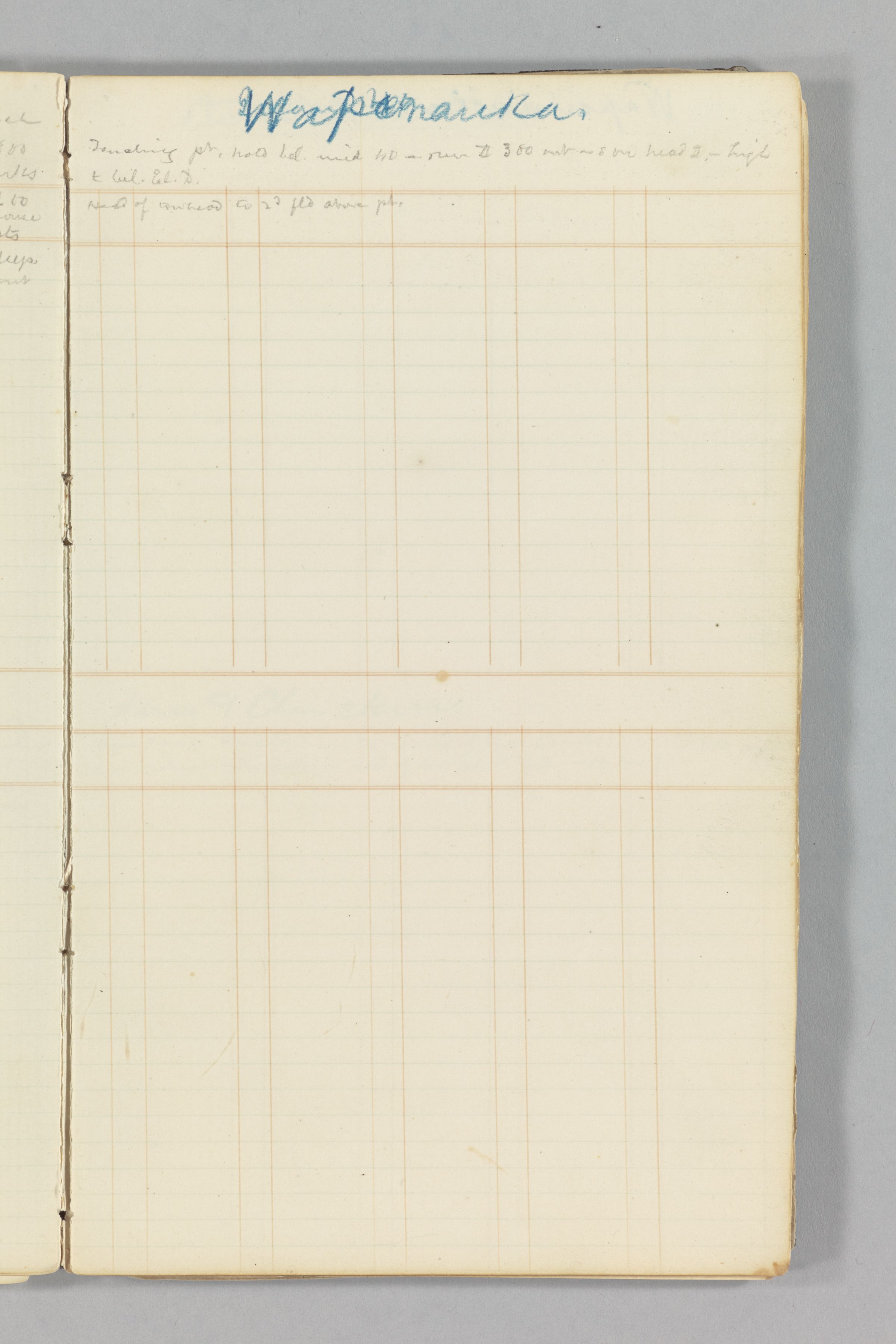
[MS: N02_leaf_015r]
Touching pt. hold bel. mid 40—run II 300 out—s on head
II.—high
t bel. El. D.
Head of towhead to 2d fld above pt.
[MS: N02_leaf_015v]
blank
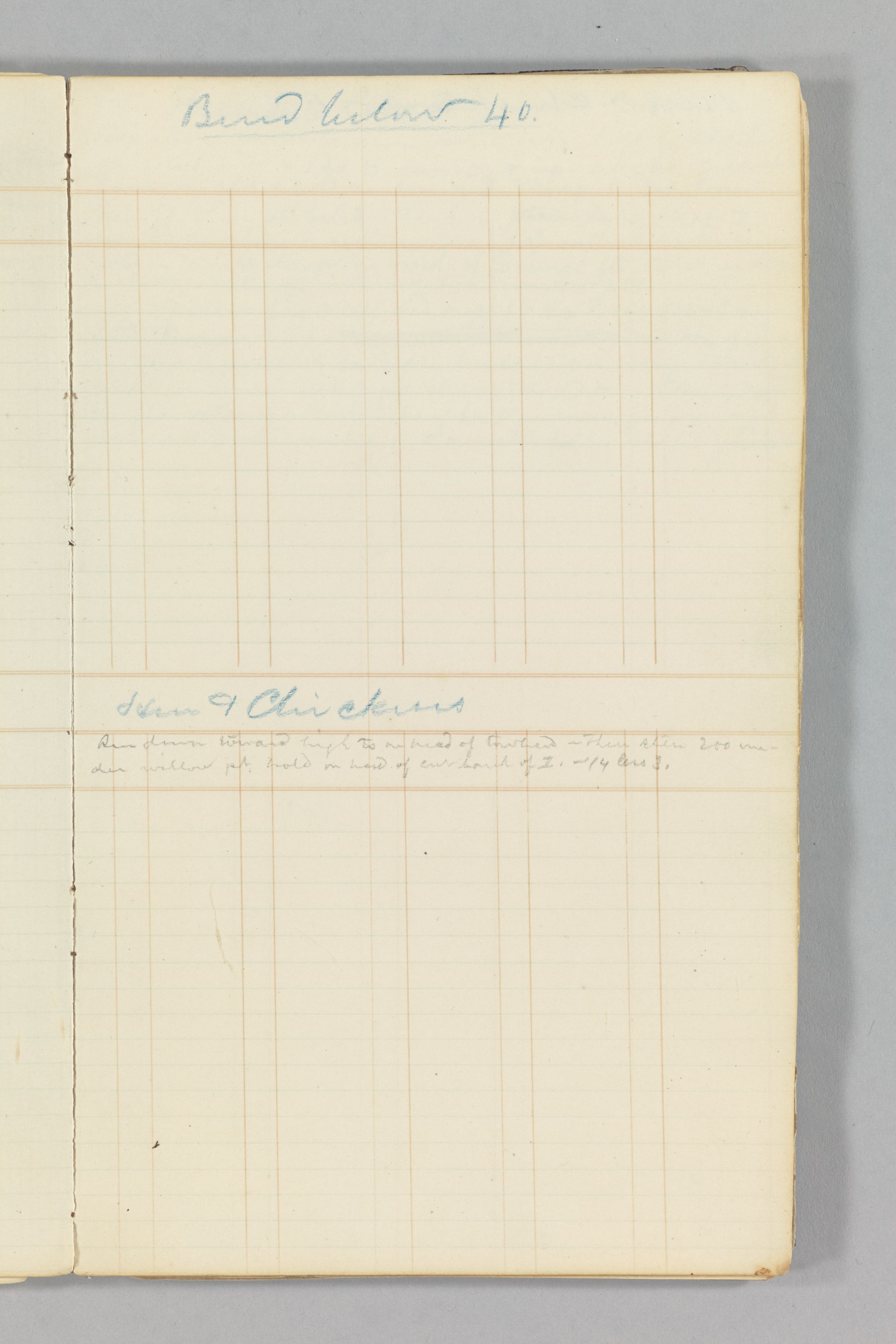
[MS: N02_leaf_016r]
blank
Run down toward high Ts on head of towhead—then stern 200
un-
der
under
willow pt, hold on head of cut bank of II.—14 less 3.
[MS: N02_leaf_016v]
blank
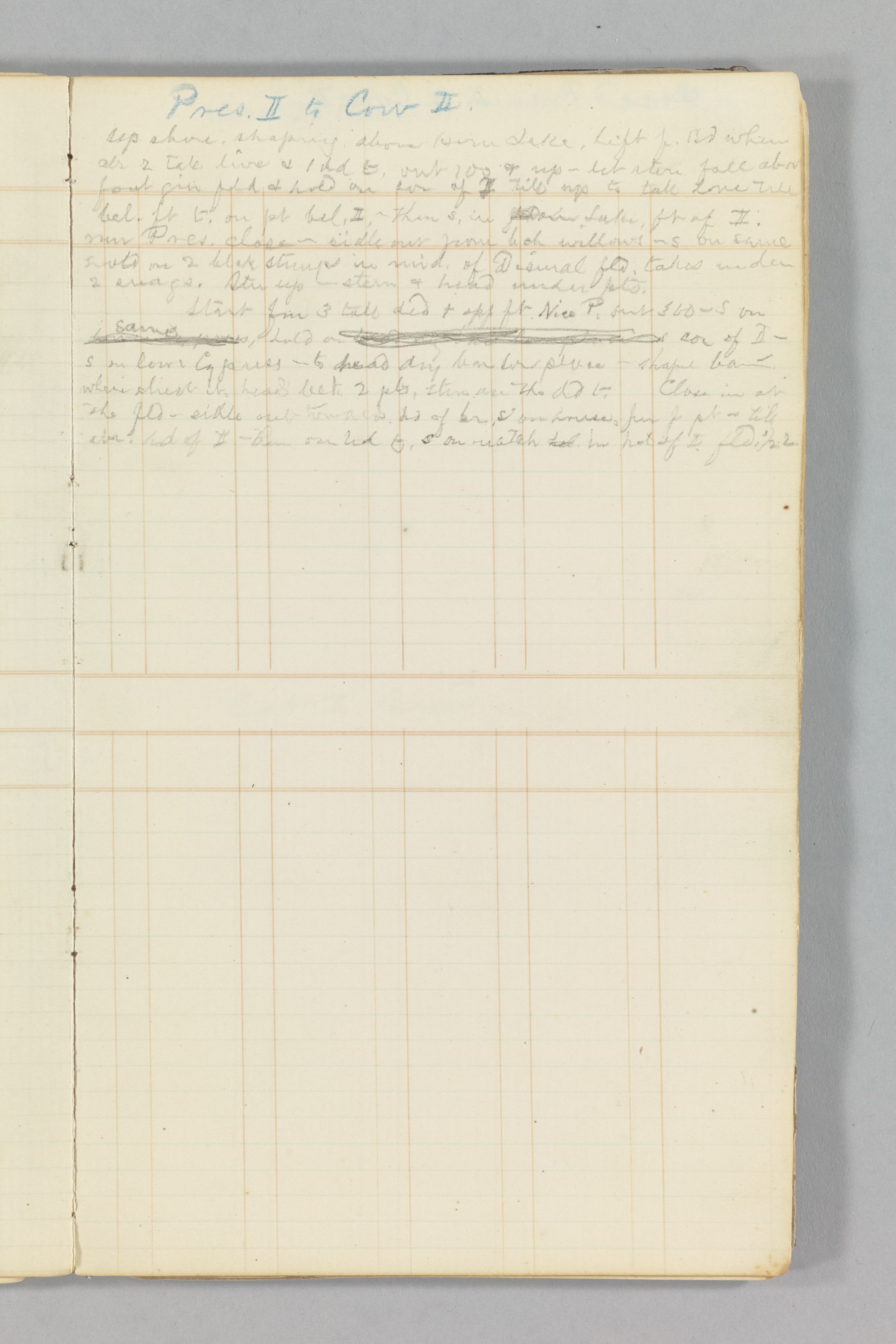
[MS: N02_leaf_017r]
Up shore, shaping above Horn Lake, lift f. Bd when
abr 2 tall
line & 1 dd t. out 100 & up—let stern fall abov
foot gin
fld & hold on cor of II till up to tall lone tree
bel. ft t.
on pt bel. II,—then s, in fld
Davis
Ⓜemendation Lake, ft of II,
run Pres.
close—sidle out from bch willows—s on same
hold on 2 blck
stumps in mid. of Dismal fld. takes under
2 snags. Stn up --
stern & head under pts.
Start fm 3 tall ded t opp ft Nice P. out 300—s on
lower bar ◊◊◊◊Ⓜemendation
same, hold on head dry bar low place s cor of II—
s on lower Cypress—to dr head dry bar low place—shape bar—
where chest is, head’s bet. 2 pts, strn on the dd t. Close in at
the fld—sidle out towards hd of br, st on houses, fm f pt—
till
abr. hd of II—then on hd t. s on notch bel in hd of
II fld. 1/2 2
[MS: N02_leaf_017v]
blank
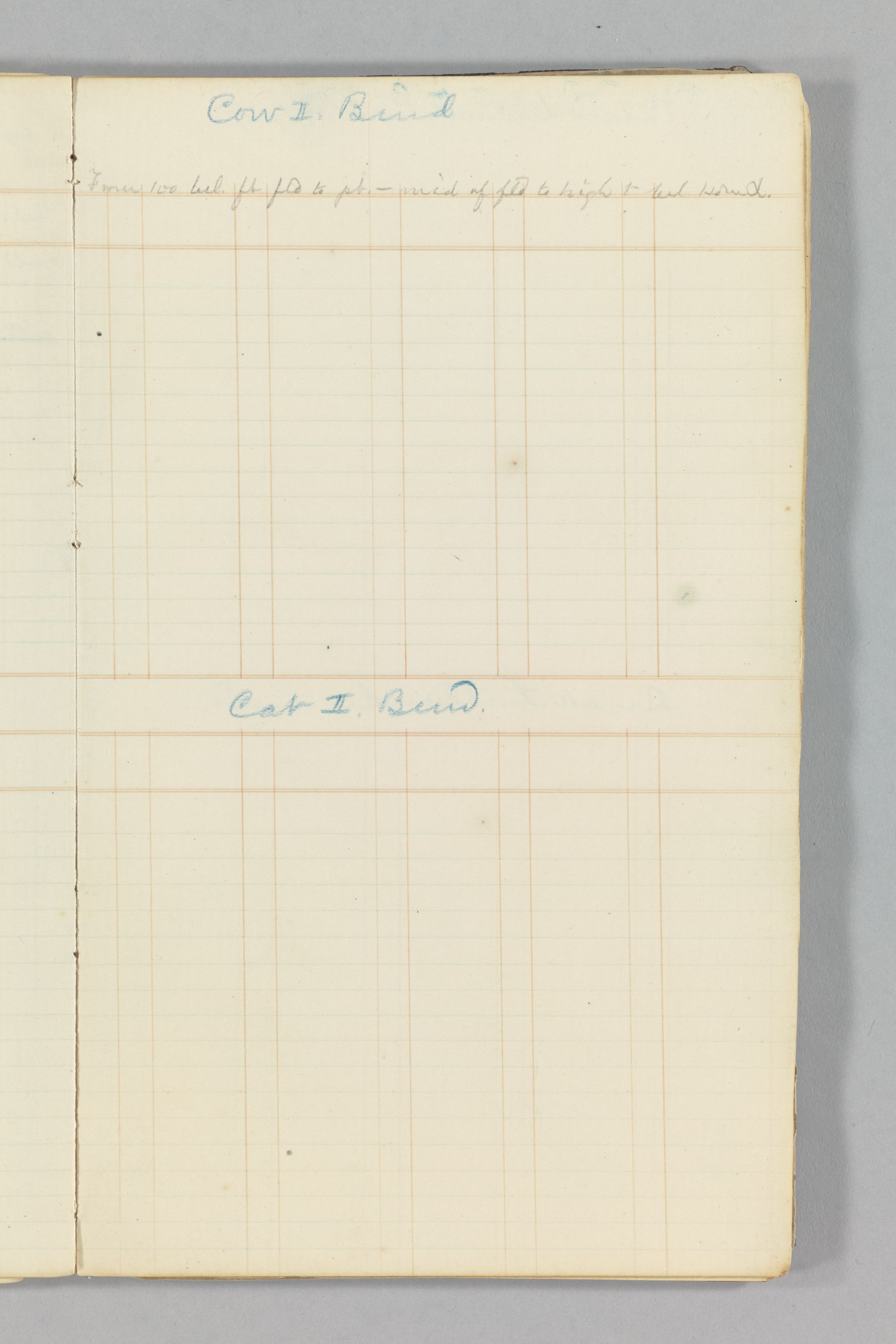
[MS: N02_leaf_018r]
From 100 bel. ft fld to pt.—mid of fld to high t bel Horn L.
blank
[MS: N02_leaf_018v]
blank
blank
[MS: N02_leaf_019r]
blank
blank
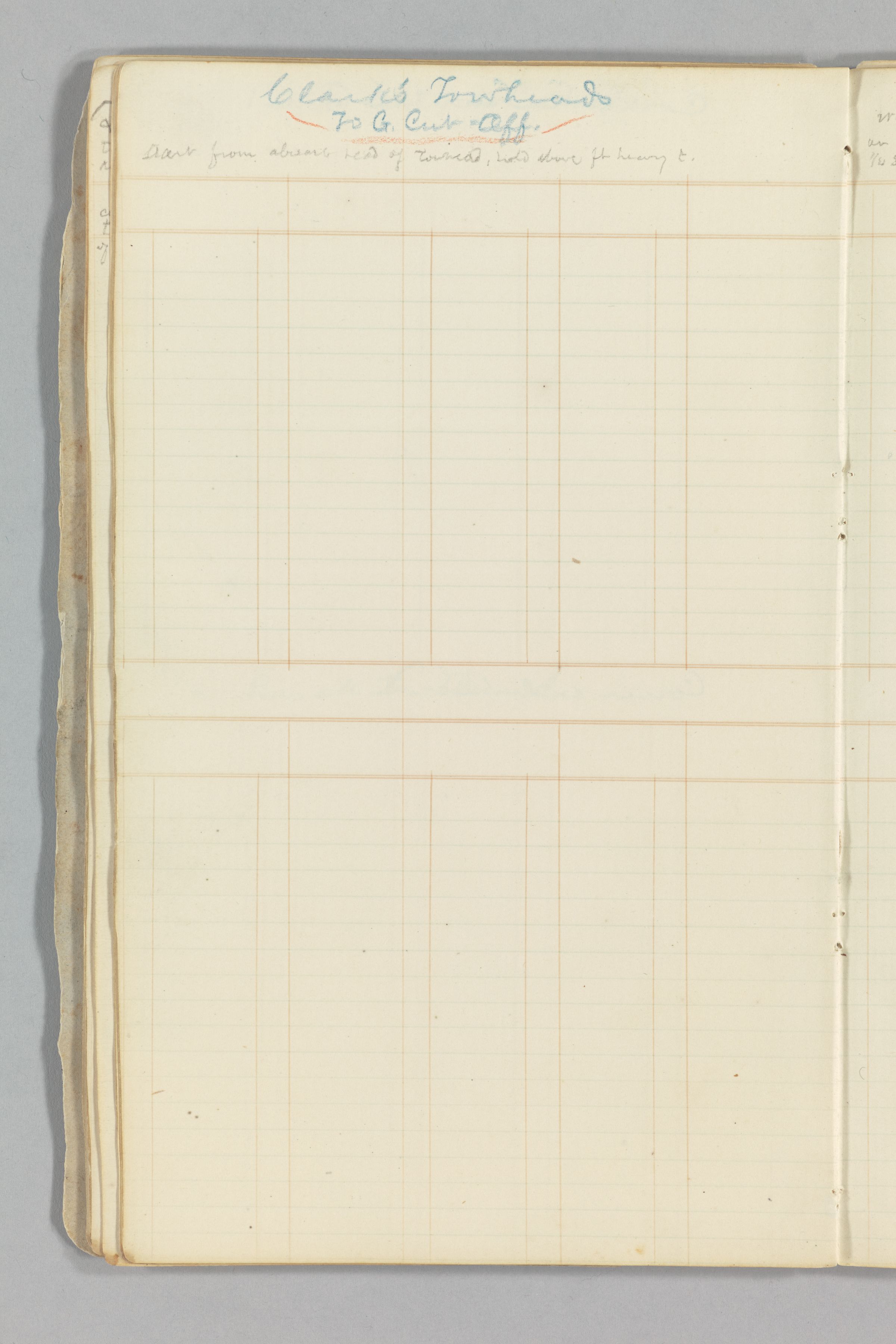
[MS: N02_leaf_019v]
To G. Cut-Off.
Start from abreast head of towhead, hold above ft heavy t.
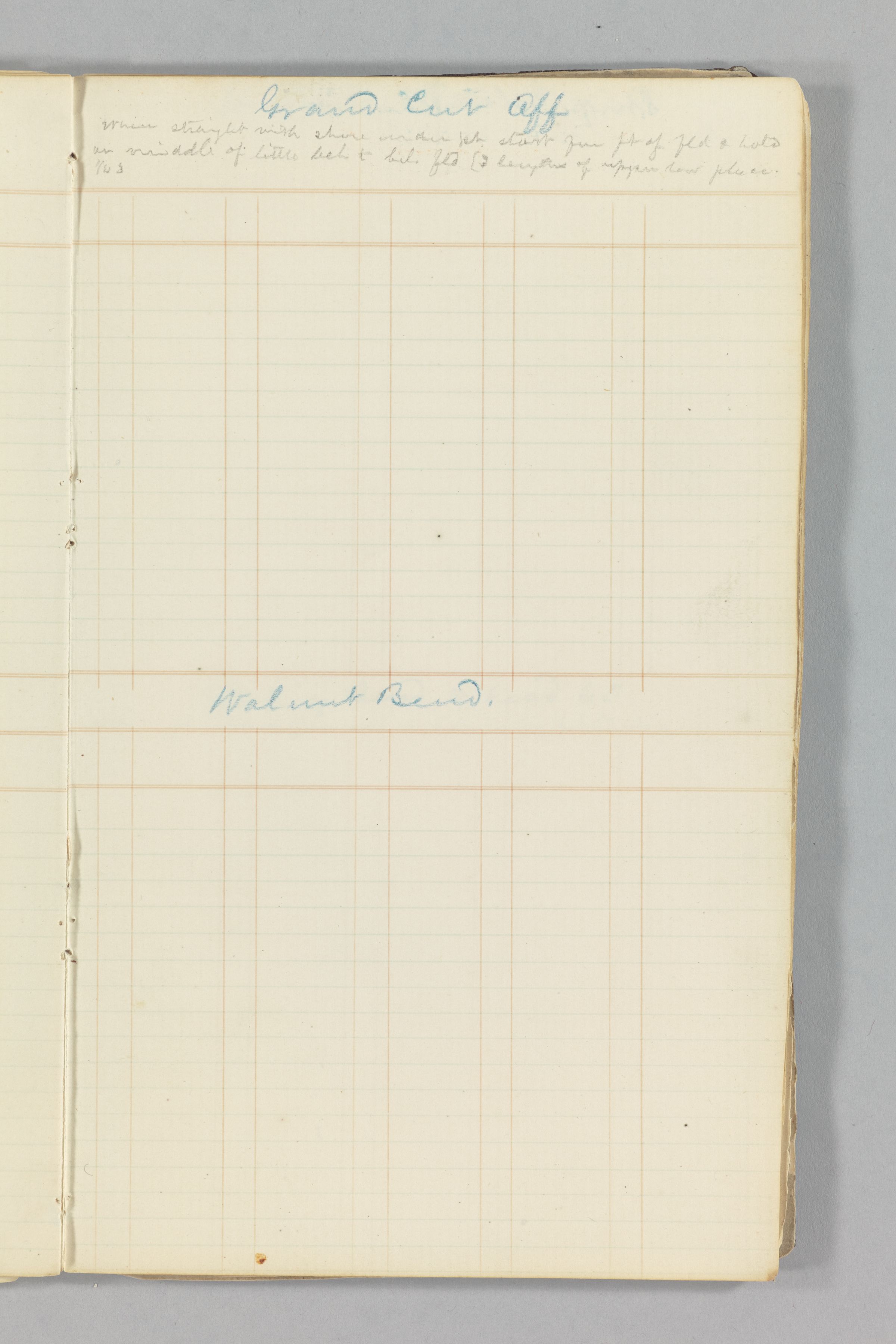
[MS: N02_leaf_020r]
When straight with shore under pt, start fm ft of fld & hold
on
middle of little bch t bel. fld ⟦3 lengths of upper low place.
1/4 3
blank
[MS: N02_leaf_020v]
blank
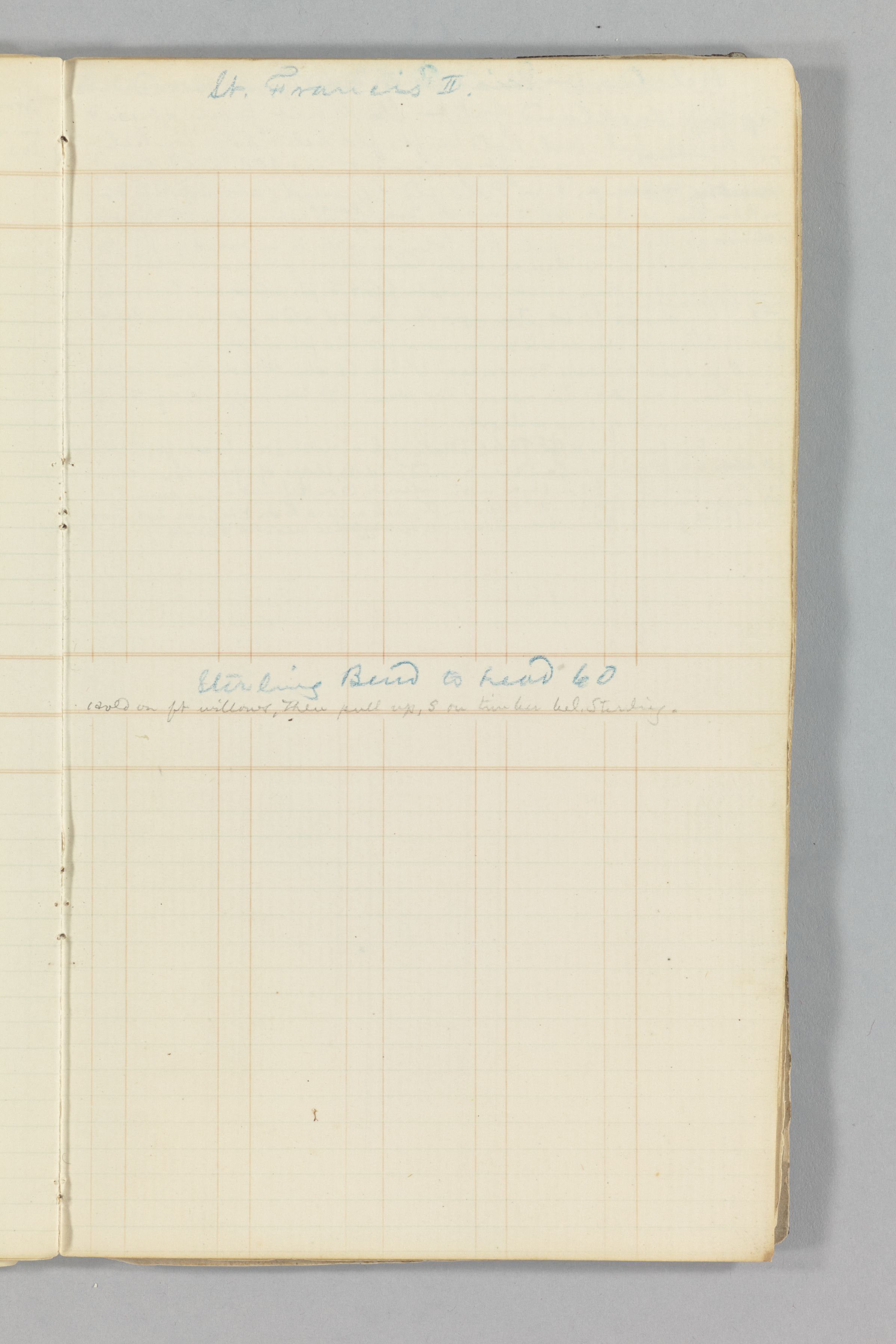
[MS: N02_leaf_021r]
blank
Hold on ft willows, then pull up, s on timber bel. Sterling.
[MS: N02_leaf_021v]
Up trip, Lackland, July.—Start out from abreast
big bar abr
bel. Hel, hold on ft. fld bel. F. Ldg, 1 m bel.
F. Ldg
under
pt—stern up on ft of same t., out 300, hold up
1/2 m
on p., s. in Pell’s fld, till mid. (abr. hd r. h. Br.,)
—1/4 3
—Then, ft. t. ab. Hl., s on p ab. Mont.
long x—no bot—then,
—hd on 60, S.
cabins ab. big bch t. bel. Hel. (where dr. rck
is in mid op. pt. can
go in to Hel. shore—close at hd big
bch.) Ferry pt. op. on 60—scat, up
through mid.—then, s.
1/2 w. bet. Trot. fld & F. pt. hold on under Prairie pts
on fld
opp. lower shoulder of 60.—3.—till ab. opp ft. 60, stn
up—Then, s on Hel, hld on ft out mill bar ab.
60—1/2 3,
(long x.)—till opp head 60.—Then hold up 200, let s fall
on F pt.
S in scat t Montz. Pt.—on head 2d bch till abr. 1st bch
—Then s on cor.
Miss. bar,—on ft 2d bch—shows low place.
(2d bch is opp head of towhead
bar abov mid of low willows.
S on houses in to bel ft. fld bel. Sterling, h on notch
300 above ft of willows
get about to ft of willows, widen
toward middle, shape of upper bar—when
full abr about hd of
I. s on bayou under willows, hd on Helena—then down r. h.
37, stabbing toward mid. till S in fld, bch willows, h on t hlf
way bet.
Trot-
ter’s
Trotter’s
fld & ferry, go in & run shore out—other
marks same.
[MS: N02_leaf_022r]
blank
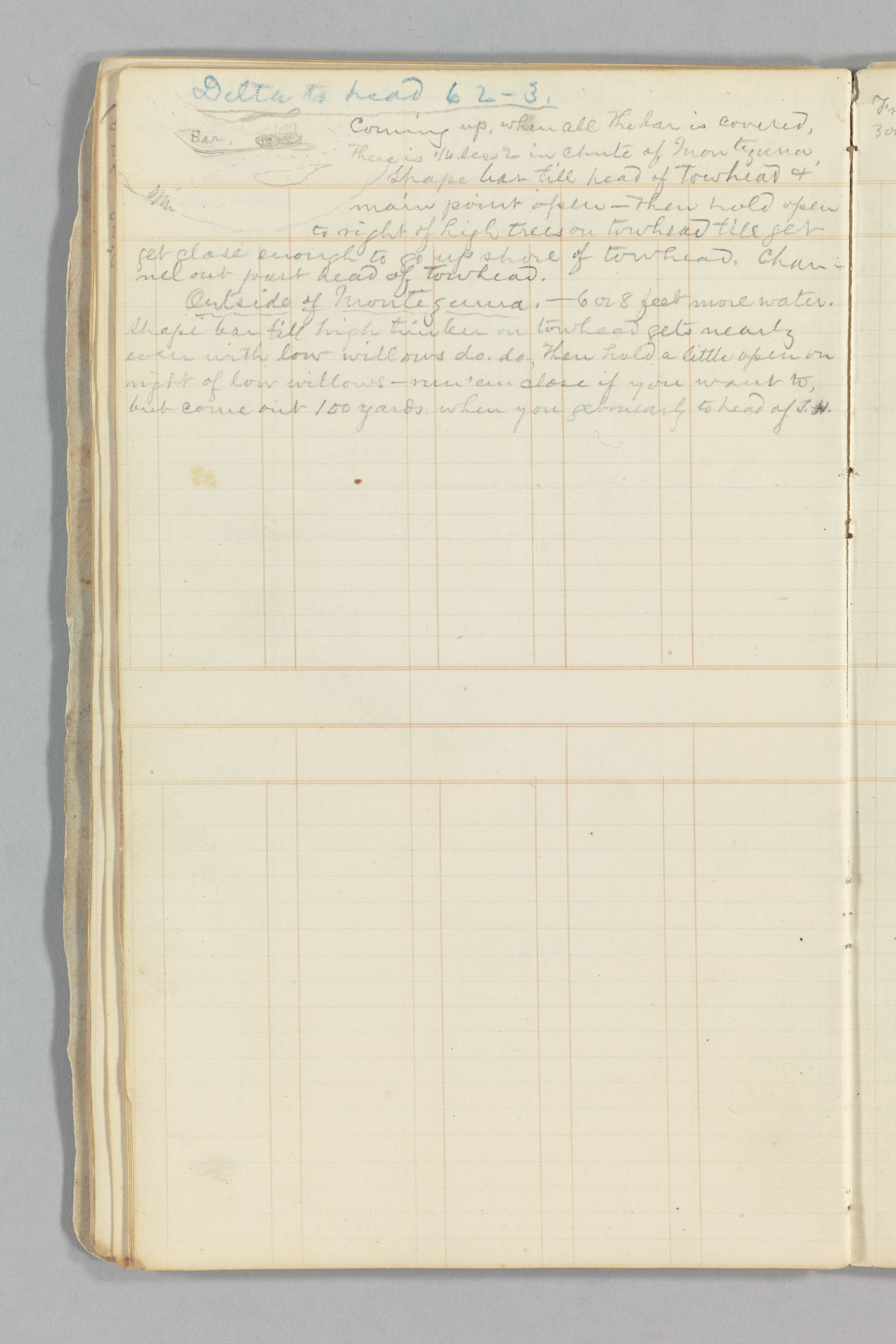
[MS: N02_leaf_022v]
in upper-left corner of entry, a drawing of river, labeled ‘Bar.’
Coming up, when all the bar is covered,
there is 1/4 less 2 in chute of Montezuma,
Shape bar till head of towhead &
main point open—then hold open
to right of high trees on towhead till get
get close enough to go up shore of towhead.
Chan-
nel
channel
out past head of towhead.
Outside of Montezuma
.—6 or 8 feet more water.
Shape
bar till high timber on towhead gets nearly
even with low willows
do. do., Then hold a little open on
right of low willows—
run 'em close if you want to,
but come out 100 yards, when you
get nearly to head of T. H.
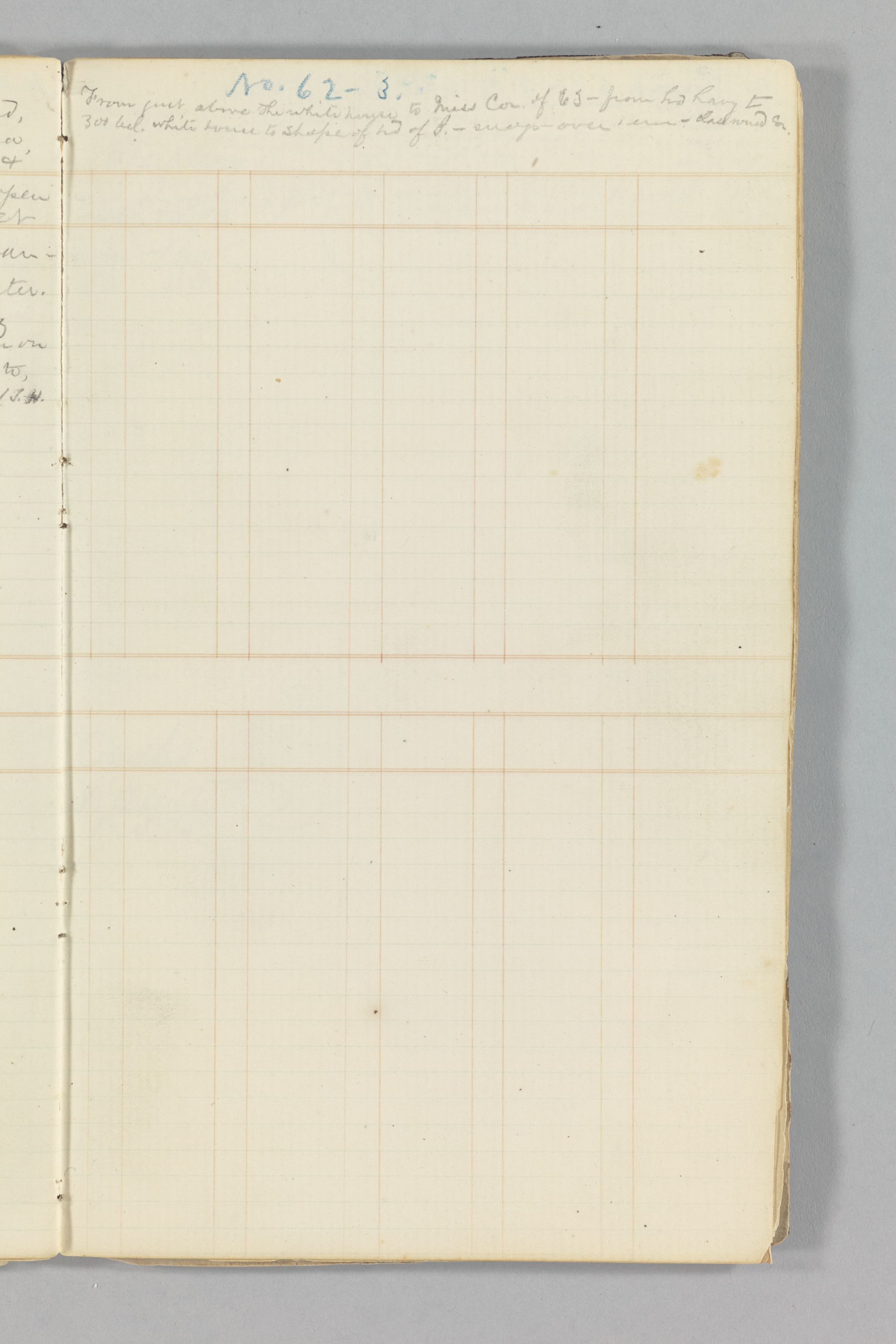
[MS: N02_leaf_023r]
From just above the white house to Miss Cor. of 63—from hd
havy t
300 bel. white house to shape of hd of I.—snap—over 'em—close round cor.
[MS: N02_leaf_023v]
blank
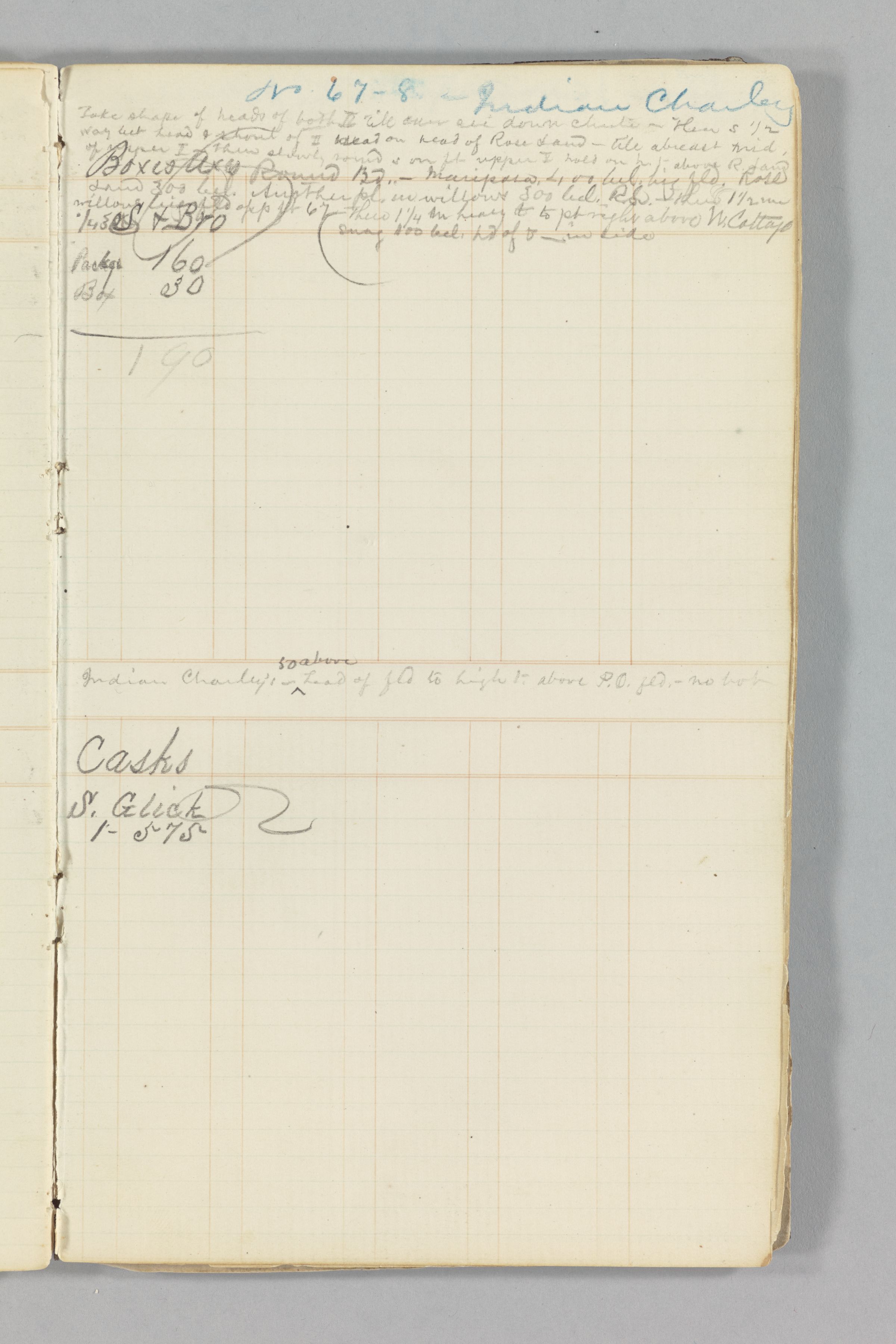
[MS: N02_leaf_024r]
notes in unknown hand
Take shape of heads of both II till can see down chute—Then
s 1/2
way bet head & shoal of II d Head on head of Rose
Land—till abreast mid.
of upper II.—then slowly round s
on ft upper II hold on h. t. above R. Land
Round Bd..—Mariposa, 400 bel. big fld. Rose
Land 300
bel. Another pl. in willows 300 bel. R. L.—then 1 1/2 m
willows big fld opp ft 67 Then 1 1/4 on heavy t to pt right
above W. Cottage
1/4 3
snag 100 bel. hd of t—in side
large gap
Indian Charley’s—50 above head of fld to high t. above P.O. fld.—No bot
notes in unknown hand
[MS: N02_leaf_024v]
blank
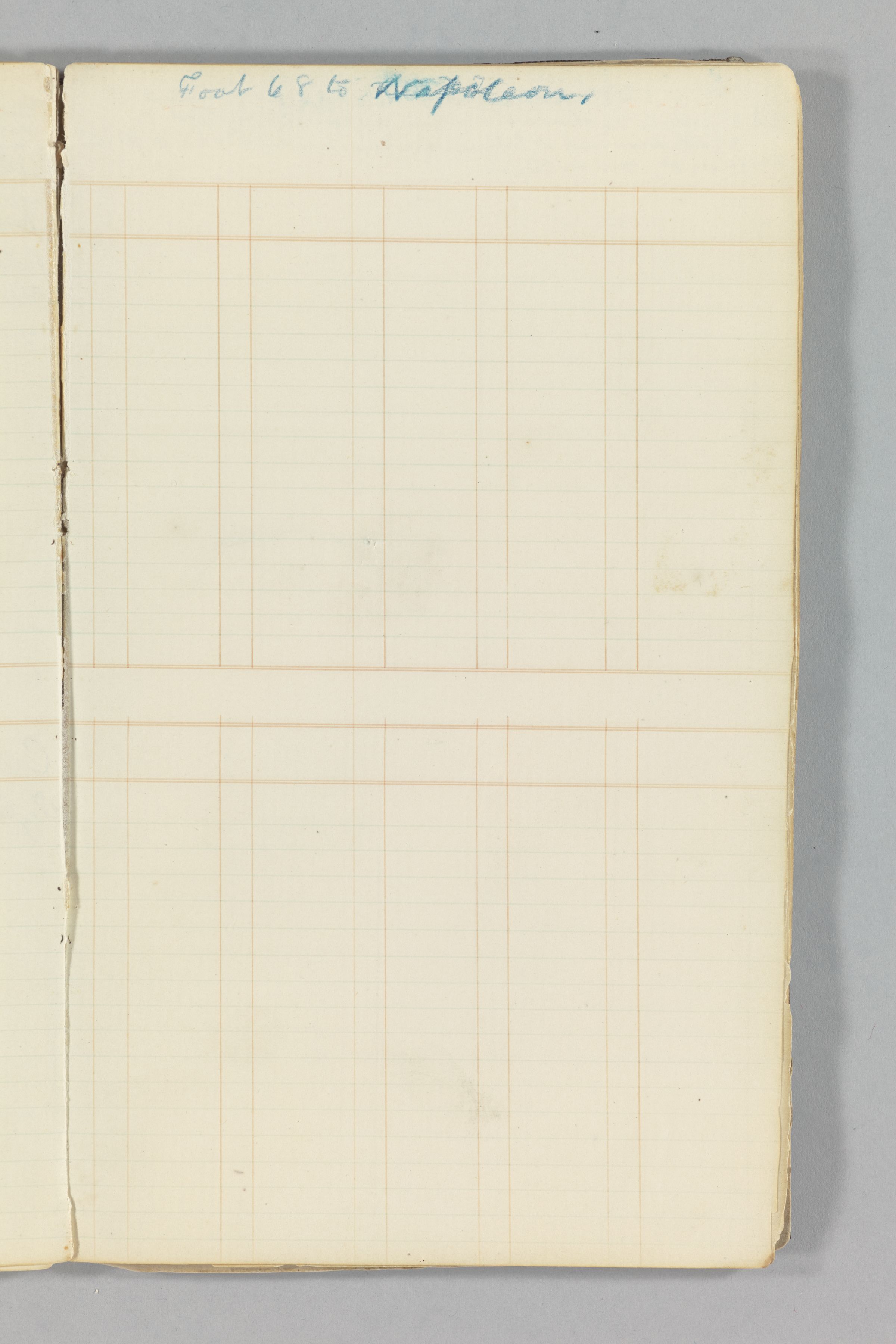
[MS: N02_leaf_025r]
blank
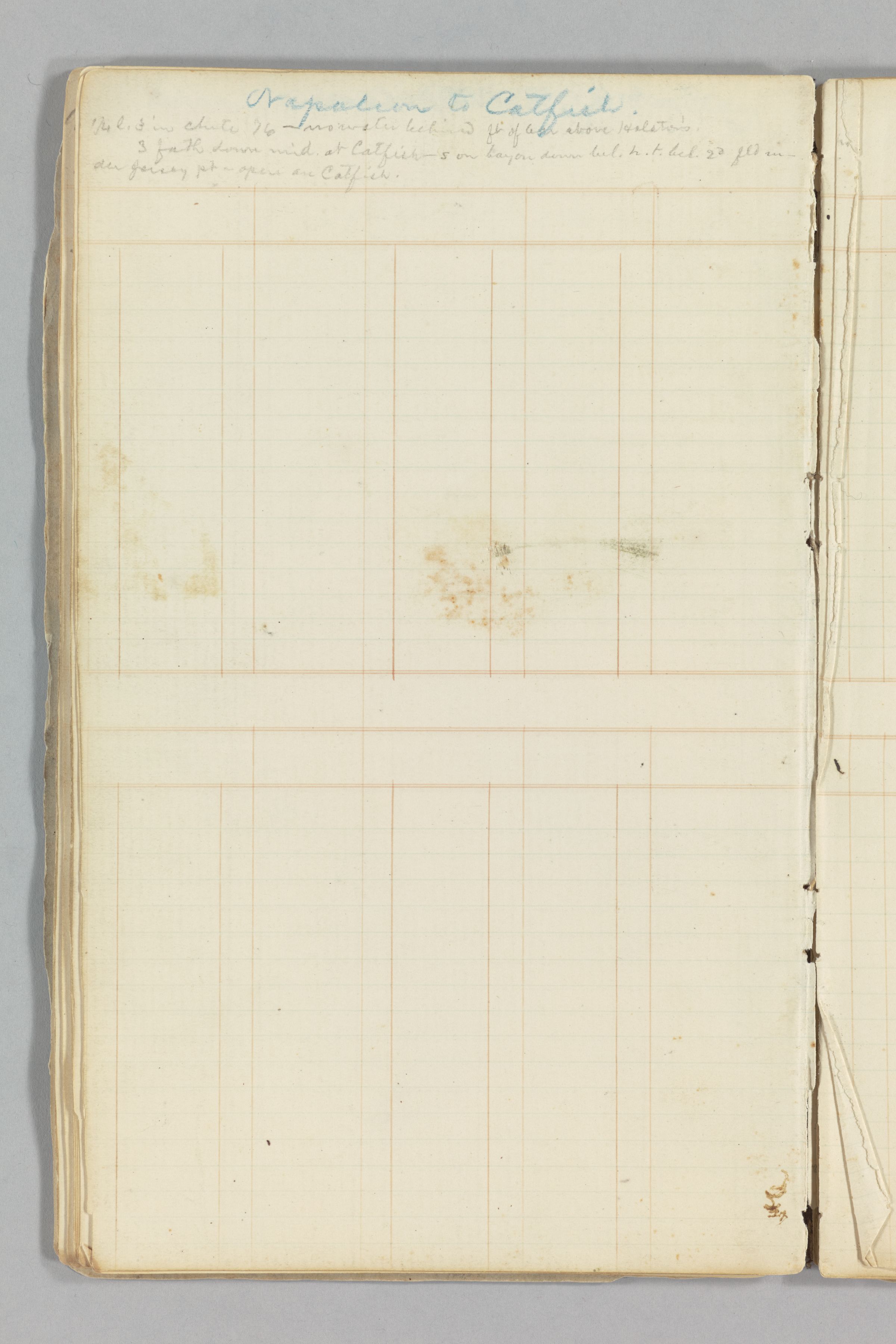
[MS: N02_leaf_025v]
1/4 l. 3 in chute 76—no water behind ft of bar above Holston’s.
3 fath down mid. at Catfish—s on bayou
down bel. h. t. bch. 2d fld
un-
der
under
Jersey pt—open
on Catfish.
[MS: N02_leaf_026r]
blank
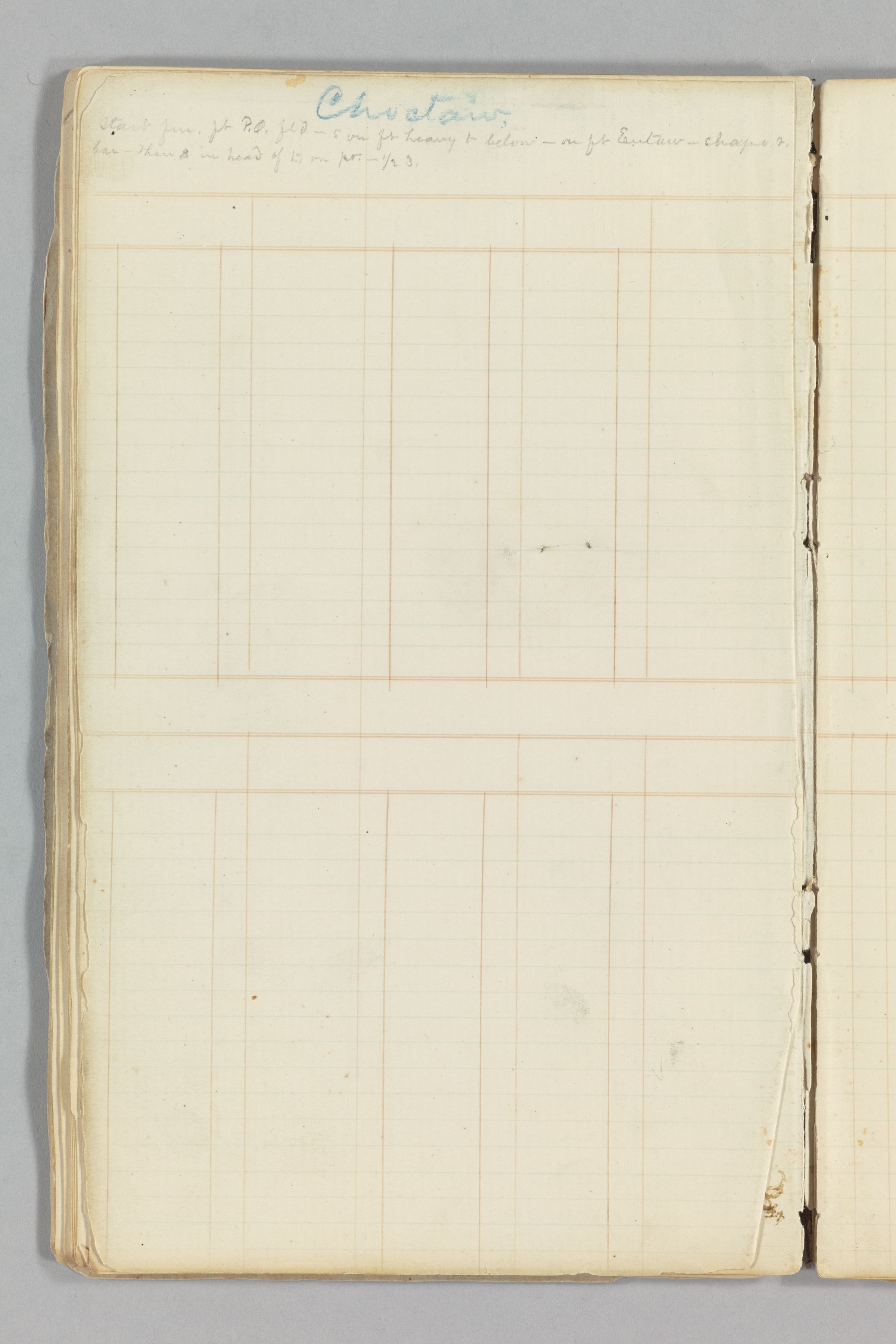
[MS: N02_leaf_026v]
start fm. pt P.O. fld—s on ft heavy t below—on ft Eutaw—
shape r.
bar—then s in head of t. on pt.—1/2 3.
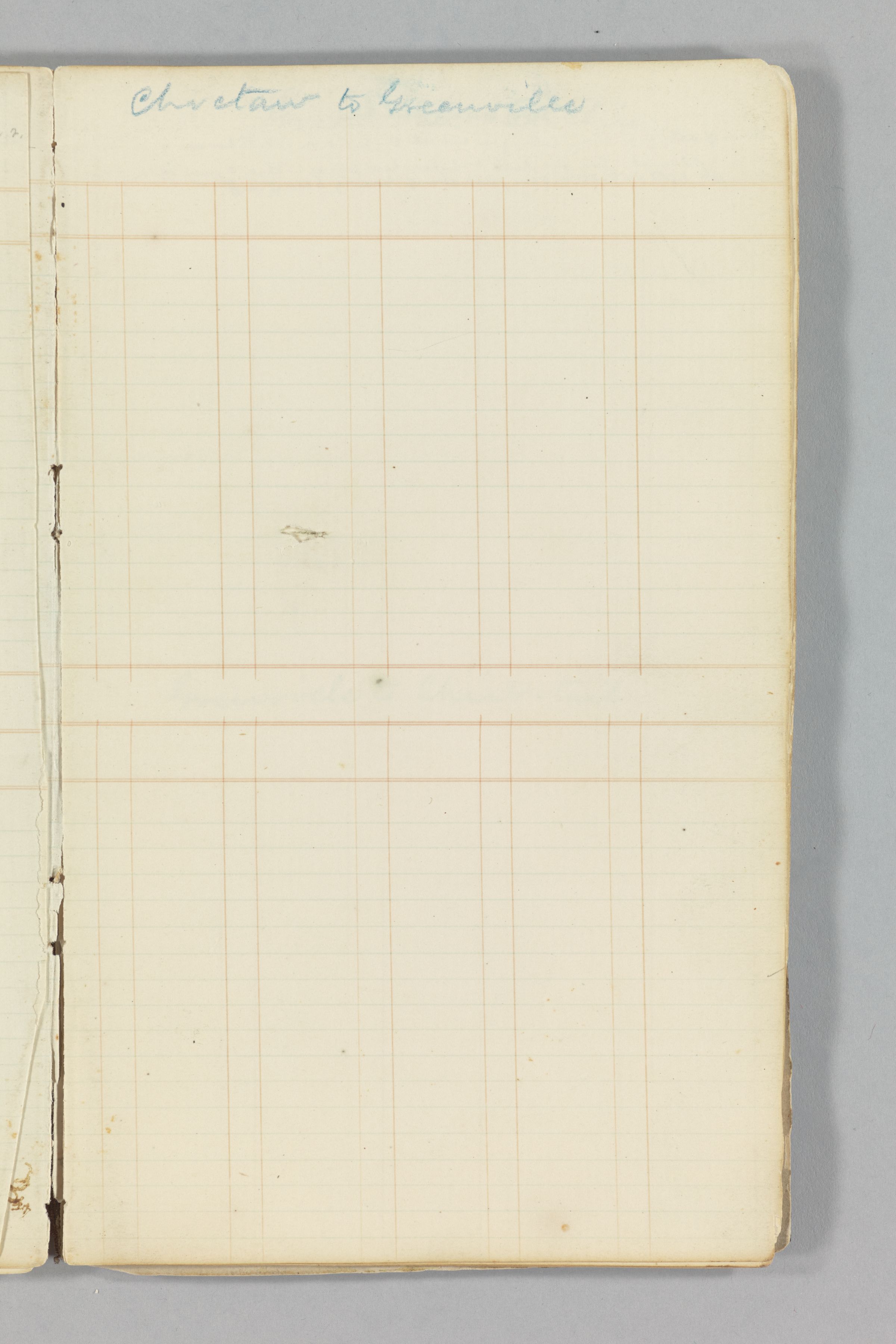
[MS: N02_leaf_027r]
blank
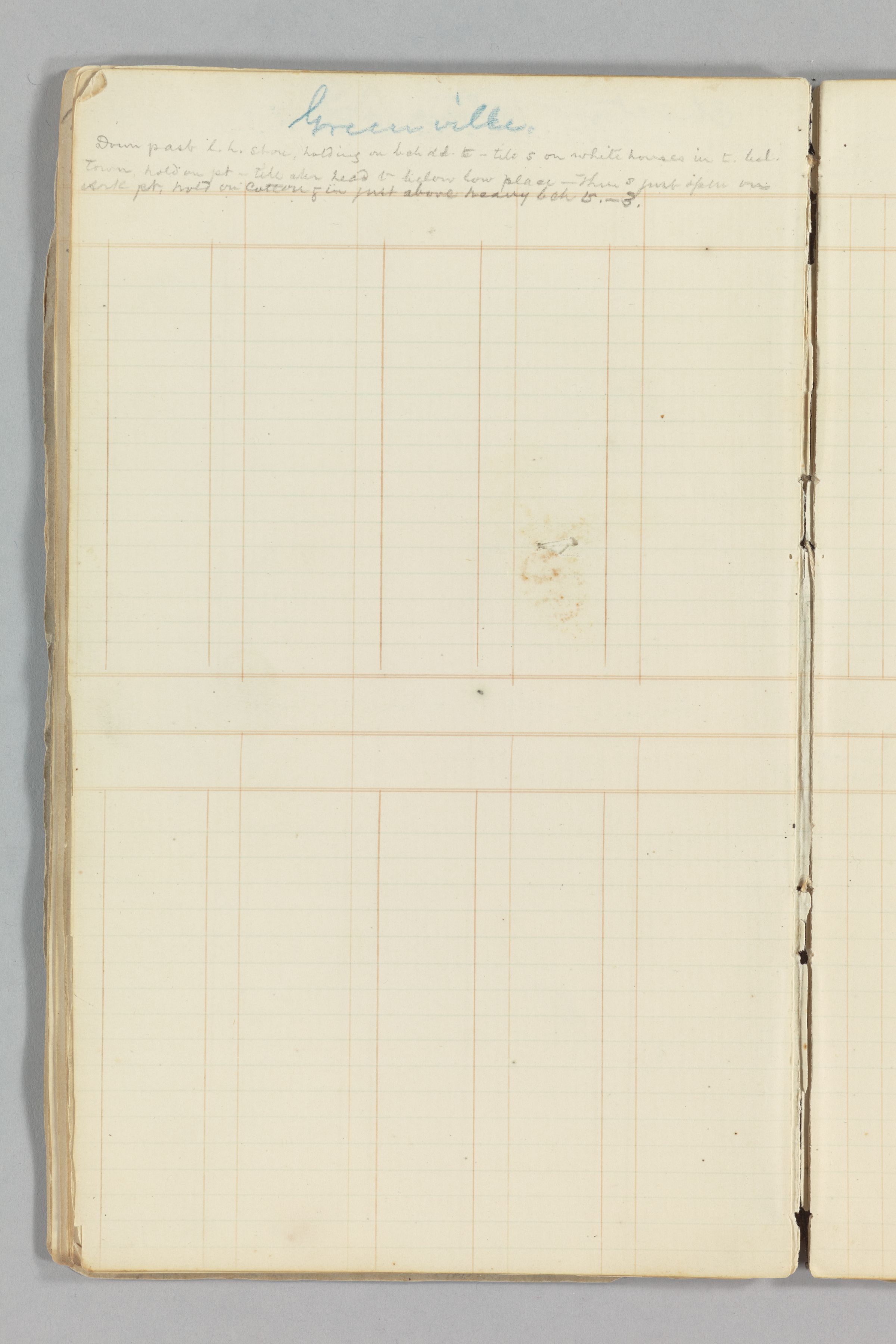
[MS: N02_leaf_027v]
Down past l. h. shore, holding on bch dd. t—till s on white
houses in t. bel.
town, hold on pt—till abr head t below low
place—then s just open on
Ark pt. hold on cotton g in just
above heavy bch t.—3.
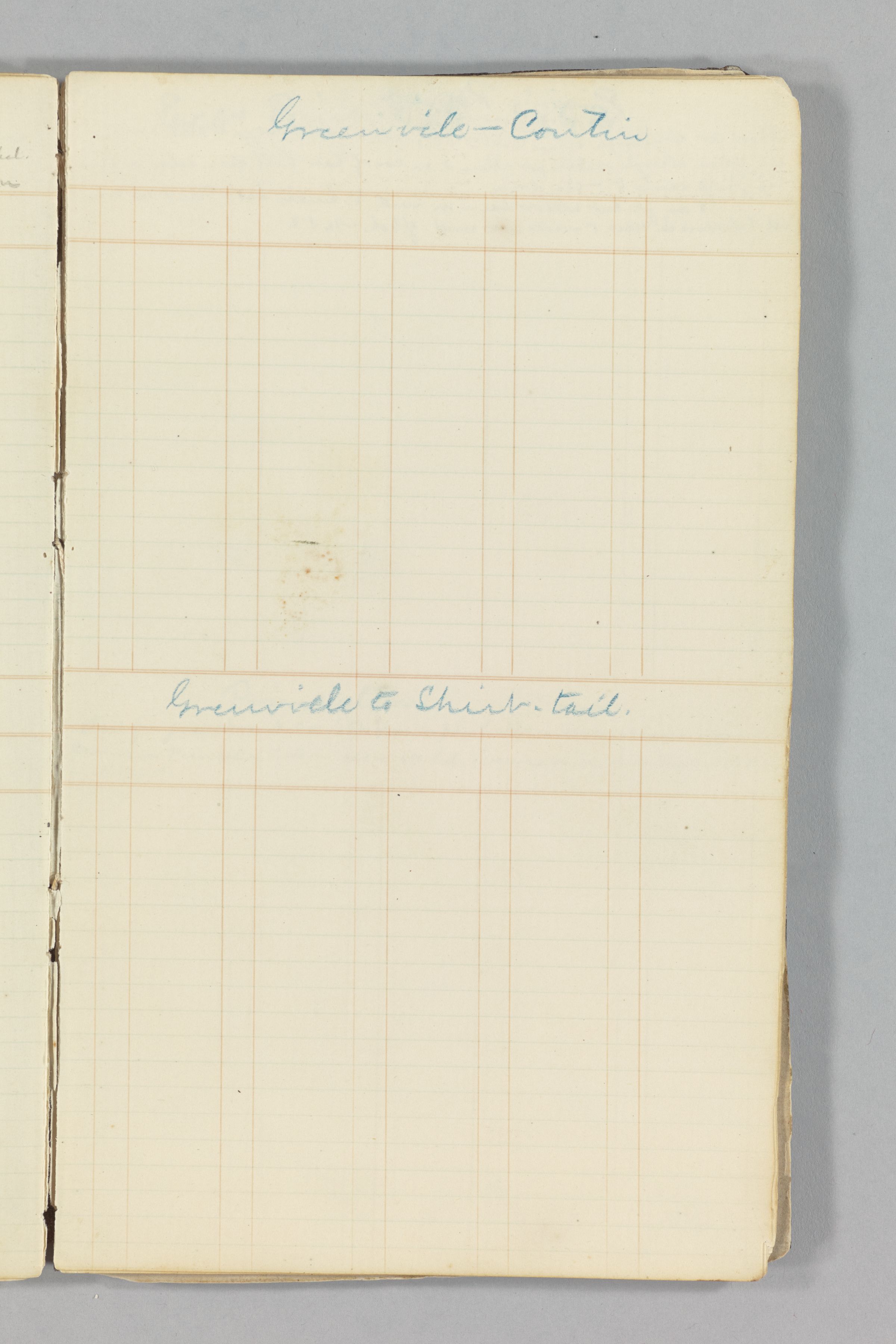
[MS: N02_leaf_028r]
blank
blank
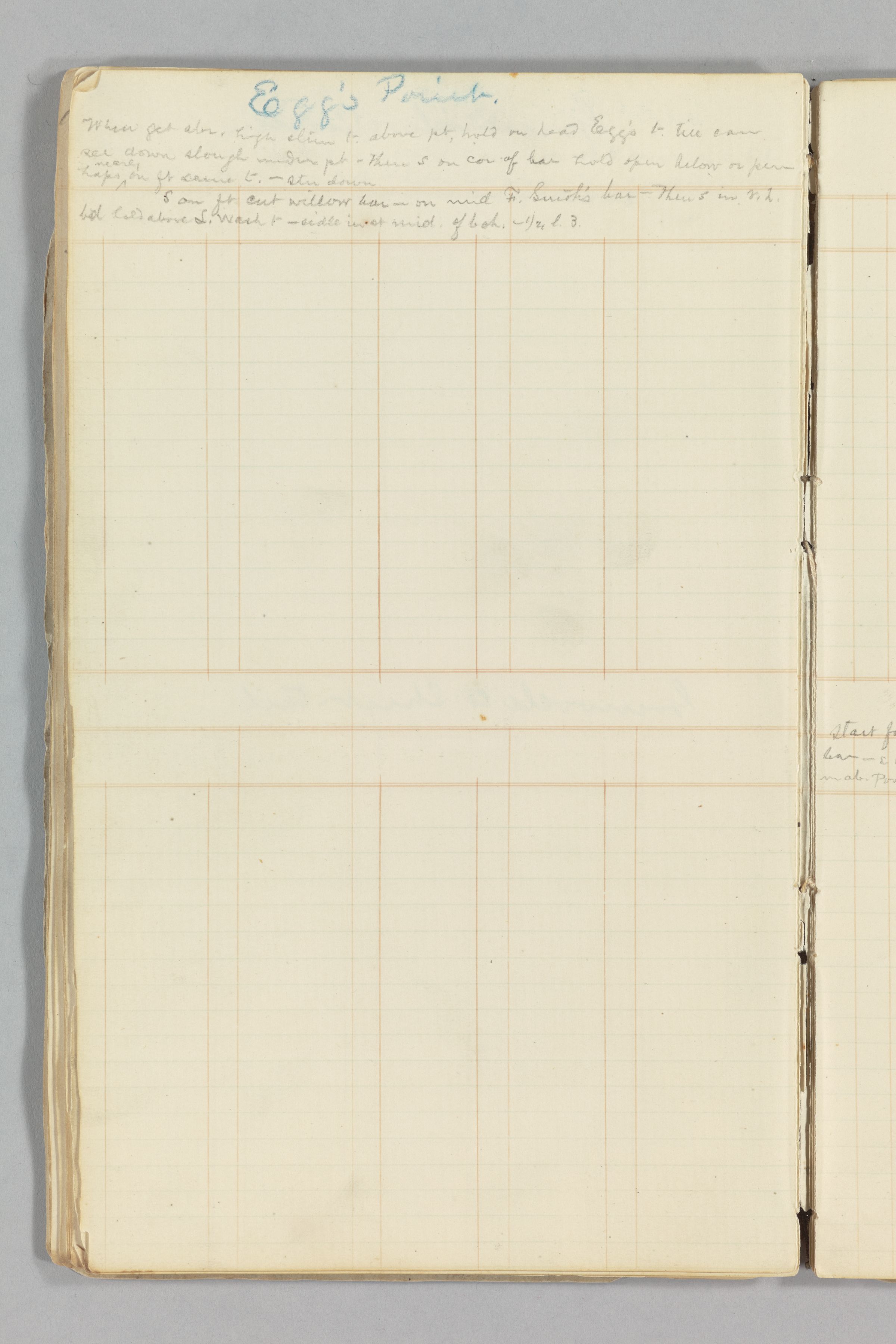
[MS: N02_leaf_028v]
When get abr. high slim t. above pt, hold on head Egg’s t. till
can
see down slough under pt—then s on cor of bar hold open
below or
per-
haps
perhaps
nearly on ft same t.—stn down.
S on ft cut willow bar—on mid F. Smith’s bar—Then s
in r. h.
bd hold above L. Wash t—sidle in at mid. of bch.
—1/4 l. 3.
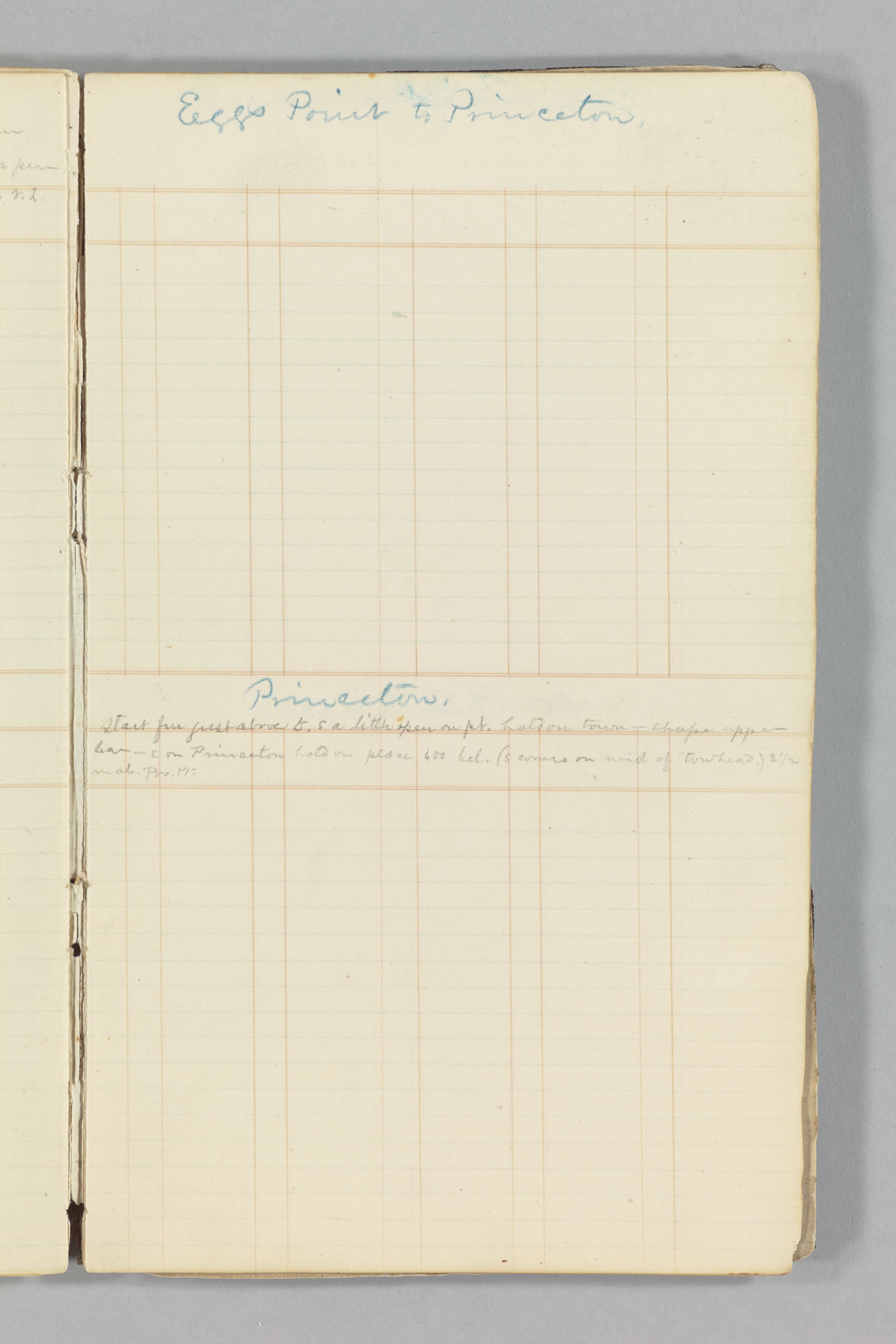
[MS: N02_leaf_029r]
blank
start fm just above t. s a little open on pt. hold on town—
shape upper
bar—E on Princeton hold on place 400 bel. (s comes
on mid of towhead.) 2 1/2
m ab. Pov. Pt.
[MS: N02_leaf_029v]
blank
blank
[MS: N02_leaf_030r]
blank
blank
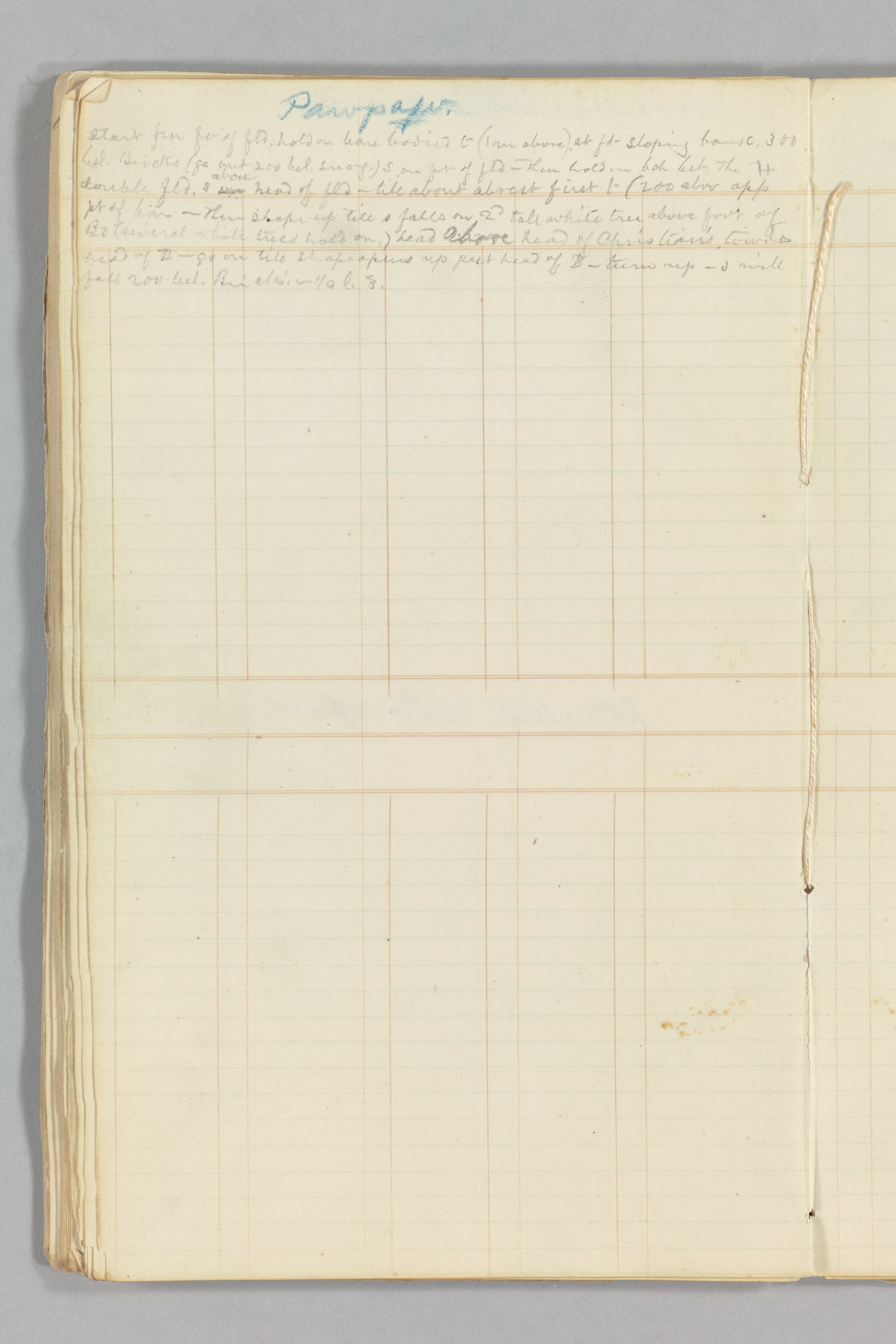
[MS: N02_leaf_030v]
start fm ft of fld. hold on bare bodied t (1 m above), at ft
sloping bank, 300
bel. Bricks (go out 200 bel. snag.) s on
ft of fld—Then hold on bch bet. the H
double fld. s on
above head of fld—till about abreast first t (200 abov opp
pt of bar—then shape up till s falls on 2d tall white tree
above foot of
Bd (several white trees hold on.) head s run
above
head of Christian’s, toward
head of II—go on till shape opens
up past head of II—turn up—s will
fall 200 bel. Brick’s.
—1/4 l. 3.
[MS: N02_leaf_031r]
blank
[MS: N02_leaf_031v]
blank
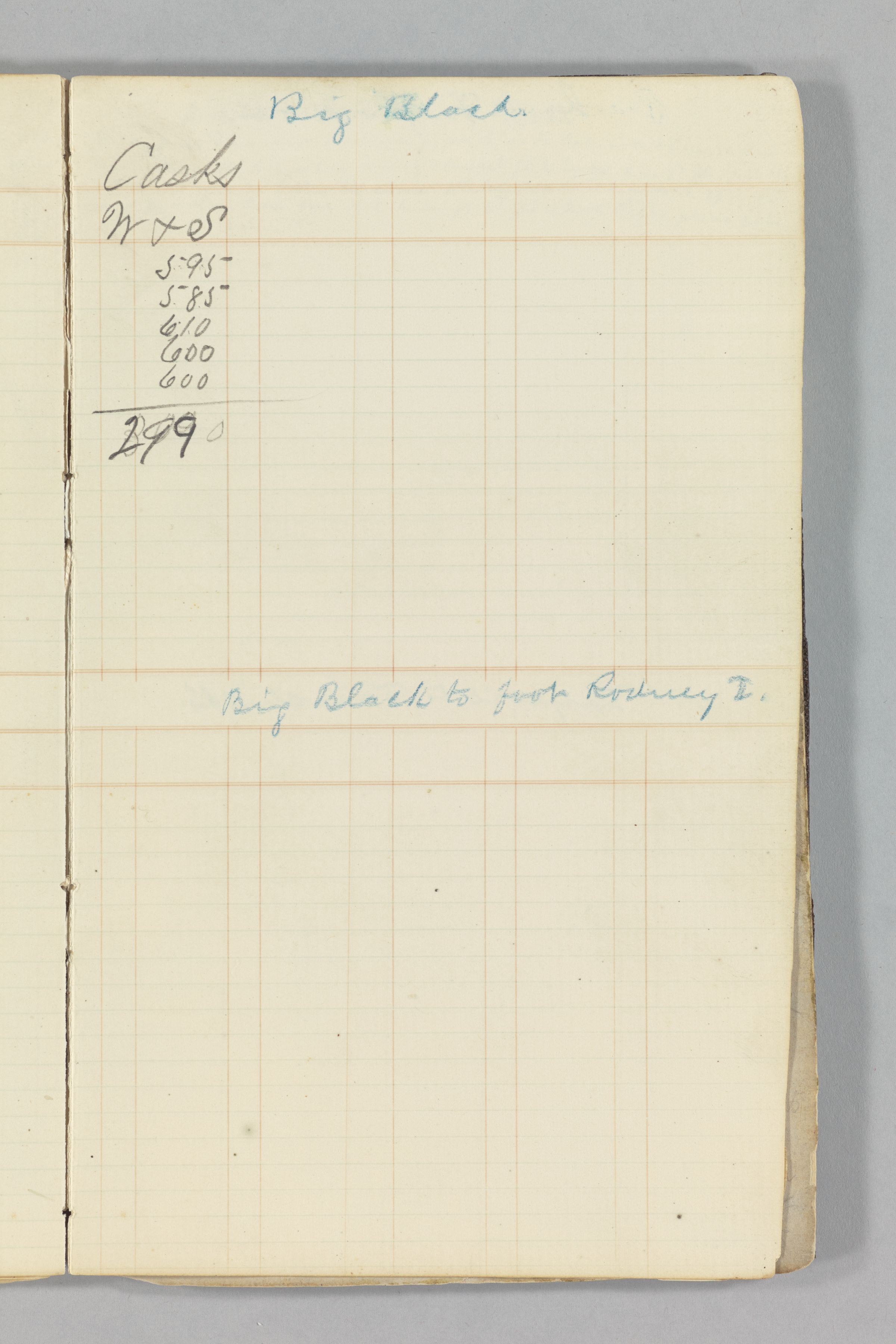
[MS: N02_leaf_032r]
notes in unknown hand
blank
[MS: N02_leaf_032v]
blank
blank
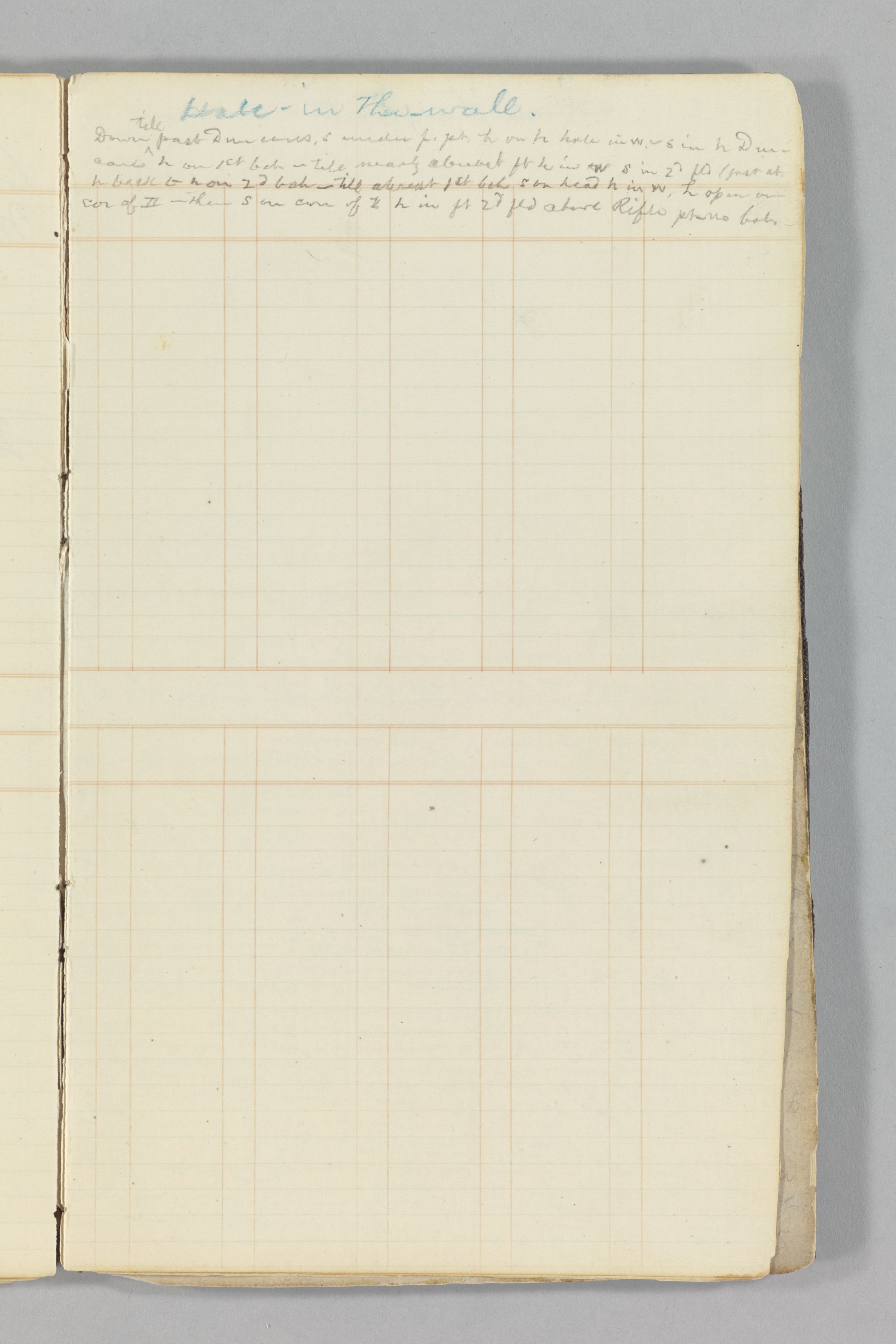
[MS: N02_leaf_033r]
Down till past Duncans, s under f. pt. h on h hole in w.—s in
h
Dun-
can’s
Duncan’s
h on 1st bch—till nearly abreast ft h in w s in
2d fld (just at.
h back t h on 2d bch—till abreast 1st bch s
on head h in w. h open on
cor of II—then s on cor of II h in
ft 2d fld above Rifle pt—no bot.
[MS: N02_leaf_033v]
blank
Sequence 3 5
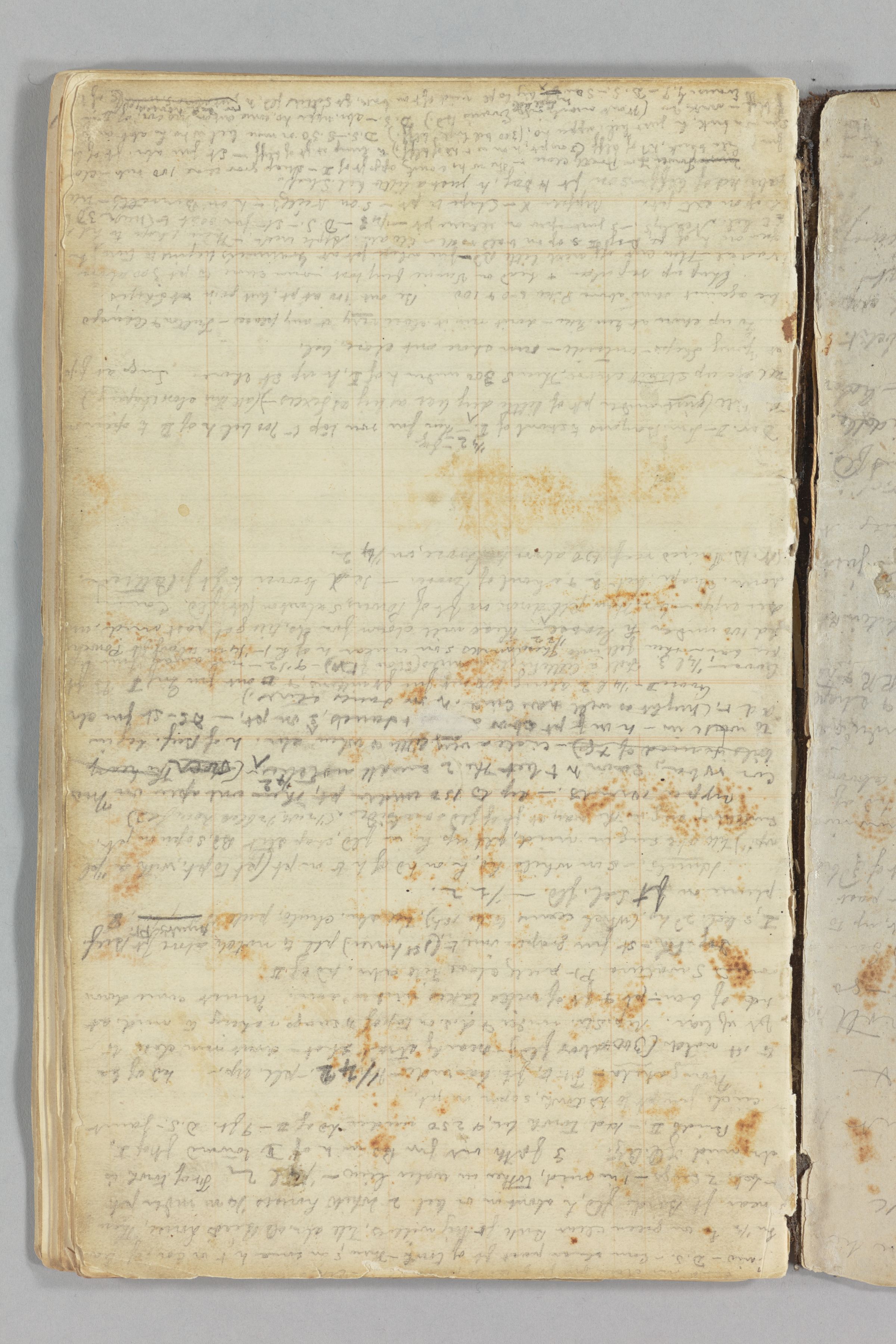
[MS: N02_leaf_001r]
Cairo—D. S.—Come slow past ft of towh—Then, s on some h t or cor. of bar
Ln 1/2 h on green clear Bnk ft. big willows; till
abr. old Bird’s house, then
s near ft Bird’s fld, h about on or bel. 2 white houses 1/4 m under pt.
—bel. 2 sngs—1 in mid, tother in water line—f◊◊dⓂemendation
symbol Ft of towh is
clr mid of Q. Btz. 3 fath out frm Bd in h of II toward ft of I.
Birds II.—Hd Towh br, & 250 wider hd of II.—9 ft. D.S.—faint
circle frm pt to hd towh, s open no. pt.
Nongahela
—Ft. t, ft. bar, wide—m 1/4 2.—pll. up.—hd of Ca
to 1st notch (300 abov flag —nearly strait shot—dont run close to
ft uf bar. Up. Str. under & d.s. on top of 4 snags rching to mid at
hd of bar.—pt & ft of wiks takes under ’em. Must come down
around Swatura Pt pretty close till abr. hd of II
Dog-Tth.—st fm grape-vine t. (1st haven.) pll to notch above ft Buf.
I, s bel. 2d ho. (which seems to be 1st). till
abr. chute, pull to dry bar
Hunt’s Pt.
, l
s
plum on pt
ft
Sal. fld.— 1/2 2.
Hunts
.—s on white hi, h on hd of h t on pt (pt to pt., with a “pl
up.”) till abr sng in mid, pll up h in fld, shap
strt Bd, s opn on pt.
switching sng in the way at ft of
fld—outside. (1/2 wh 1/2 blck hous fld.)
Upper Hunts.—up to 150 under pt, then out open on Ind
cor w bar, soon n t bet the 2 small notches 1/4 2—(str
over
The heavy
bils in mid of xg)—circle—very little & when ‸Ⓜemendation
abr. h of Buf. begin
to work in—h on f pt abov a
◊◊◊
Ⓜemendation &
Lane’s, s on pt.—DS—st fm ch
dd t. (might as well have circled w on Lanes stonesⓂemendation
Goose II—1/4 l 2 along jag out fm ft willows, & s
square out
fm Buf I to ft
Goose, 1/4 l 3. Fell a little high in mrks
(store ft square)—9 1/2—run away fm
up
per
upper
bar—then fell
into these mrks s on or near h of h t 1/4 in abov ft
Powers
hd 100 under h Goose
1/22—these will down for d.s.,
till get past mid
un
der
under
upper br. Then pll down on ft
of Powers, s abrst on pt fld. Coming
down, shape, bet 2 &
shoal of Goose.—Hd Goose to ft fr Pattrsn.
(N.B. symbol mired
reef 150 above Goose, on 1/4 2.
gap
Dev. II—Fm Bayous to shoal of II. 1/4 2—fig.—then fm
run top t 700 bel h of II to open
◊◊ tillⓂemendation (just under pt of
little dry bar as big as Texas—) (all this above shaping)
till
edgeⓂemendation up strait shore. Then s 300 under h of II, h up st shore. Sngs at f.p.
at Young Shep’s—outside—run shore out close
bel.
Go up shore at Gen. Pike—don't run it close very at any
place—Fulton & Oswego
liee against shore above Pike 50 & 100. Be out 100 at pt, but go in at Shep’s.
Chup up regular & head on Venice ferry boat—run shore
to pt 300 above
radial—Then cut off next little Bd—fm
where pt at Grammer’s begins to turn, h
open on h of pt Dog
II—s up on bald rock—till abr. Apple creek.—Then,
shape to hd of
h t bel. Neely’s.—s just open on extreme pt
—1/4 3—D. S.—st fm scat t (Mrk 30
h op on ext pt. Upper X—shape to pt—s on Neelly’s—h on Bennett’s—till
abr. hd of blff—s on pt H Dog, h just a little bel. Shef.
Tower
Ⓜemendation F—Pretty close in the w ho county opp
ft of II—shap grov shre 100 out—close
fm ◊hileⓂemendation bank,
hd of blff (s on pt, h on w & hd of blff,) h lump at ft of
bluff—st fm abr. ft of blff
s on out in bnk, h just bel
upper ho, (300 bel high blff.) D.S.—S 30 or more bel w ho ho
abt on ft
f blff—mrk 2. (Work nearly into Evan’s Bd.)
D.S.—abr. upper ho. come out on Mo cor. of II.
Evans—G.T.—D.S.—S on ft in till bel. big lo pl mid of t on bnk. ft Setter’s fld, h just after S. well run ◊◊ ◊ Ⓜemendation houses (c of t
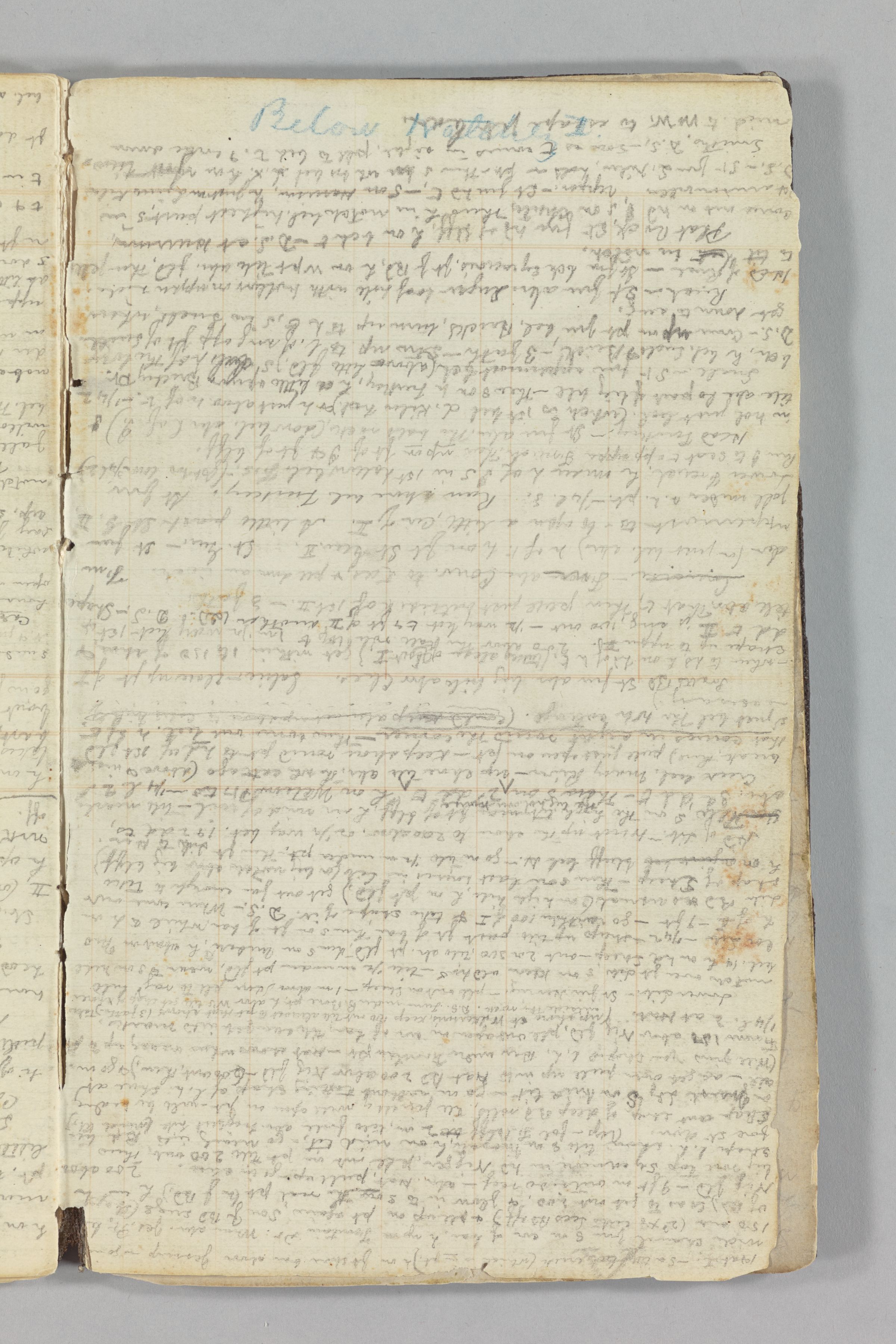
[MS: N02_leaf_001v]
Hat II.—s or till bel creek (which is in pt.) h on ft shore
bar above Jessup—go into
mid channel fm s on cor of bar,
h up on Fountain Pt. When abr. Jes. Pt. be
150 out (2d Xs
cuts Lees Bd off.) & pll up on pt again, S on J Bd sngs (Shape
of Bd,) so as to get out 200, & flow in to s on the
real pt (in J Bd,) h in h
Nig fld—9 ft on outside reef—
abr. Hat, pull up—go in shre. 200 abov
big rou top 5m or
more in hd Nigger, pll out on pt till 200 out, then
shape
l. h. shore till s on Moosts, h on mid tit, & go nearly into
Bd
be-
fore
before
st dwn. (Up—fol F. Blff tit 2 on, till full abr.
highest hill (Marsh Ldg,)
Shap out shrp of deep Bd rolls, till
fm M y will open on pt—will be heading
on Marsh Ldg S
on mid tit—go on without taking shap of l. h. shore at
all
—as get over pull up into Hat Bd 200 abov Nig fld—(200
out, then,) & go in.
(Will grind your shaped l. h. Bar under
Fountain Pt—Map shows when to snug up to pt
From 100 abov Nig fld, pll out again in dir of bar, till u get into marks,
1/4 l. 2 at Hat. (upshore at Wilkerson’s, keep 100 out till
almost to pt that shows (3 fath.) take
outside the rock. D.S.
Turn under B. Bone pt, h abov W’s till get shap of shore
Lower Lib.—St fm Hering—pll out on Sheep—1 m
above Her pll to ragd hill
notch over ft Lib, s on Her old
hrs—till 1/2 m under pt fld, near to s on hill
bel.
H h on hd Sheep—out 2 or 300, till sh. pt fld, then s on
Midare, h about on Mo
Cor Lib—1/4 2—shap up till past
ft of bar, then s on ft of bar, whirl to fr on
h of II—9 ft
—go within 100 of I & take shape of it. D.S.—When come
out
Lib Bd as usual (s on high hill, h on pt fld,) get out
far enough to take
shap of Sheep—then s on last houses in
Lib (or big notch abov big blff)
h on or just bel bluff bel
H.—go in till 1/2 m under pt.—then ft Lib to Her.
Hd of Lib.—Went up the shore to 200 abov, or 1/2 way
bet. 1 & 2 dd ts,
Start Then, s on the high tit near ft of blff,
h on mid of nil—till nearly
abr. 3d dd t—then s on the
big hol. over house 2 dd t ‸Ⓜemendation
h on Watson Pt. ts—1/4 l. 2
Creek bel. Mary River—up shore till abr. the wh cottage
(above & inside
break, there,) pull just open on pt—keep
shore round pt to hd of 1st fld
that comes in right round the
corner—then come out bel. h of 6,
st just bel the Wh cottage.
(
could keep almost upshore to Cole’s mil if
necessary.)
Pratt’s Bd St fm abr. big pile abov Ches.
Saline.—close
up pt of II
—when to hd, h on hd of h t. (takes close of symbol out I,) get within 1 to 150 of shore, &
shape up to upper II. 200
abov the tall run top t 1 m 1/2 way bet 1st &
dd t II is sng,
100 out—1/2 way bet t & ft of II another (2). D.S.—Shape
till abr. that t, then pull just outside h of 1st II.—3 fath.
Converse
—Fromm abr Conv. to Cas, & pll dwn an inch.
Fm
abr (or just bel. abr) h of t. h on ft St Gen. II.
St. Gen.
—st fm
uppermost ts—ts opn a littl, cor of II. A little
past St G. II.
pll under s. h. pt.—1/4 l. 3. Run shore
bel Turkey. St fm
Lower French, h under h of I S in 1st hollow
bel. Frs.—(got too low—3/4 l 2.)
Run I to scat t opp
upper French. Then up on ft of I & ft of blff.
Head Turkey.—St fm abr. the bald rock, (dow bel. abr h
of I.) &
in hol just bel. (which is 1st bel L. Kiln hol.)
& h just abov. h of t.—1/4 2
till abr lo part of big hll
—Then s on h Turkey, h a little open on Breckey Pt.
Snell.—St fm uppermost bch (above littl fld.) S
abr
bel h of the long
bch, h bel. Snell & Brick,—3 fath——Stn up to l. of sng opp ft of Snell.
D.S.—Come up on pt
fm bel. Bricks’, turn up to h t, s in Snell, when
get down
to sng.
Rush—St fm abr. Sugar-loaf hill with hollow on upper
side.
Hed of Rush—St fm bch Sycamore’s, ft of Bd, h on W
pt till abr. fld, then pll
to tit bet. in notch
Plat Rock, St fm hd of blff, h on bch t—D.S. at Harrisons.
Come out on hd I, s on chute, thus h in notch bel. highest
part, s in
Harrisonville. Upper.—St fm hd t.—s on Harrison,
h just on Lime Kiln
D.S.—St fm L. Kiln, hold on pt—then
s bar wh ho bel L. K. h on mid
ft.tier.
Smiths, D.S.—s on as t comes in sight, pll to bch t. &
come down
mid. to W.W. to escape pt bar.Ⓣtextual note
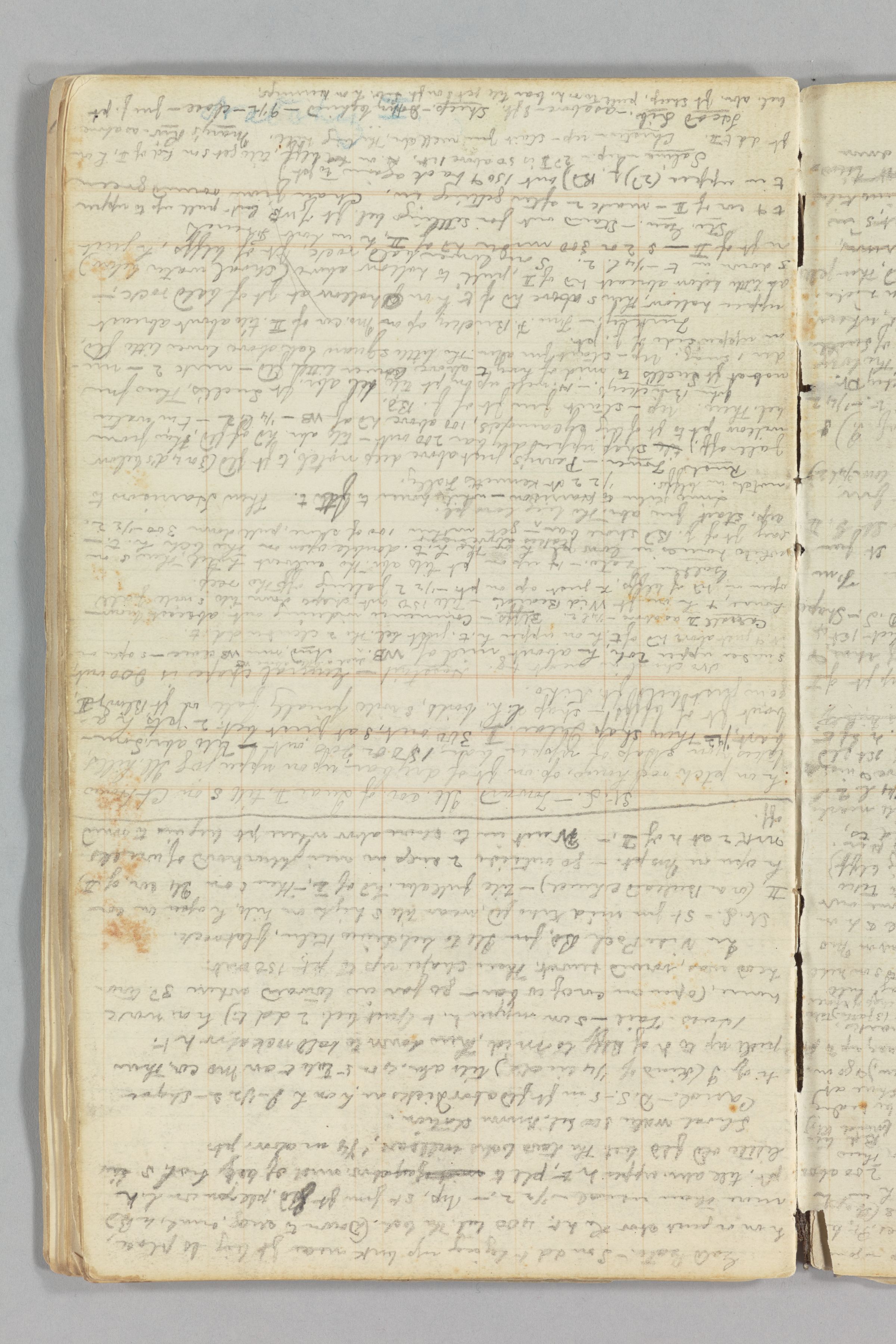
[MS: N02_leaf_002r]
Gold Gate.—S on dd t lying up bnk near ft big lo place,
h on or just abov R. h t. 400 bel. the bch. (Down to snag,
sunk, h Bd
more than usual—1/2 2.—Up, st fm ft fld,
pll opn on l. h
pt, till abr. upper h t, pll to mid of
ay
abov. mid of big bch s blw
little old fld bet. the two bchs
willows, 1 1/4 m abov. pt.
Shoal water 300 bel. Brown station.
Carrol.—D. S.—s in ft fld abov Dicks on h on h I—
1/2 2—shape
h of I (Kind of 1/4 circle,) till abr. 4 or 5
tall t on Mo Cor. Then
pull up to h of Blff to mid, then down
to bald rock abov h t.
Hoss-Tail—s on upper h. t (just bel. 2 dd t.) h on work
house, (open on cor of w bar—go far in toward where 3d
tow-
head
towhead
was, round servnt. Then shape up to pt, 150 out.
In Vide Poch. Bd, fm Ill to bel. Lime Kiln, flat rock.
St. L.—st fm mid Keho fld, wear till s high on hill, h open
on cor
II, (or on Bullard Church)—till full abr. hd of II.
—Then s on Ill cor. of II)
h open on Ms pt.—go outside 2
sngs in neighborhood of wrecks
mk 2 at h of II.—2 Went in to
shore abov where pt begins to round
off.
St. L.— Toward Ill. cor. of Quai II, till S on Ct House
h on ptch-roof house, op. on ft of dry bar, up on upper jog
Ill. hills,
takes you shap of upper bar, 150 or 200 out—
till abr.
Lom-
bart
Lombart
, 1/4 2— Then shap. Quai II, 300 out, s at first bet. 2 pts, h
a-
bout
about
ft of blffs— shap r l. h. boils, s
will finally fall on ft Bloody II,
go in just bel. ft Kiho.
No chanl in next xg.
Hosstail
—General shape is 200
out,
s under upper toh, h about mid of WB. Just a little above
WB
And, run WB close—s open on
it, & just above hd of t.
h on upper h. t. just bel. the 2 slender dd. t.
Carroll II as above—1/4 l 2. Bliffs.—Commence widening
out abreast brown
house, & h on ft Wid Beard’s—till 150 out,
shape down till s will fall
open on hd of blffs, h just up on
pt.—1/2 2 falling off the reef.
Golden Gate
.—H up on pt till abr. the culvert hotel,
then s on
white houses in low pl. h on the h. t. double open
on the bch h. t.—
say ft of f. Bd shore bar takes above
Suser
—get within 100 of shore, pull down 300—1/2 2.
Up, start fm abr. the big low pl.
Lime Kiln to Harrison—white house to bch
ft t. Then
Harrison to
notch in blffs. 1/2 2 N Kennett’s Folly.
Rush Tower
.—Perry’s just above deep notch, to ft fld
(3 or 4 d’s below
fall-off.) till shap upper dry bar 200 out
—till abr. hd of fld, s then from
willow pt to ft of big
sycamore’s, 100 above hd of WB—1/4 l. 2—t in water
bel.
these. Up—start fm ft of f. Bd.
John Brickey’s
.—H. well up on pt till bel. abr.
ft Snell’s, then fm
nob at ft Snell’s to mid of hvy t above
st lower little fld—mrk 2—
un-
der
under
1 snag. Up—start
fm abr. the little square bch above lower litte fld.
on upper side of f. pt.
Turkey
.—Fm. F. Brickey op on Mo. cor of II. till about
abreast
upper hollow, then s r above hd of t, h on ft
hollow at ft of bald rock.—
ab little below abreast hd of
II, pull to hollow above (shoal water below.)
s down in t—
1/4 l. 2. s on lower bald rock, ft of blffs, h just
on ft of
II—s 2 or 300 under hd of II, h in low French
Ste. Gen
.—Stand out for settlings bel. ft of WB, but pull
up to upper
t & cor of II—mark 2 after getting in. Chan
from round green
t in upper (2d) f. Bd.) out 150 & back again
to pt.)
Saline
—up.—2d II is 50 above 1st. H. on hd blff,
till get s on hd of II, h on
ft dd t II.
Chester
—up—
start fm well abr. the big hill.
Mary’s Riv
—as above.
Head Lib
.—as above—8 ft.
Sheep
.—Down behind—9 1/2—close—fm f. pt
bel. abr. ft Sheep, pull to r. h.
bar till get s on ft. Lib. h on Herrings.
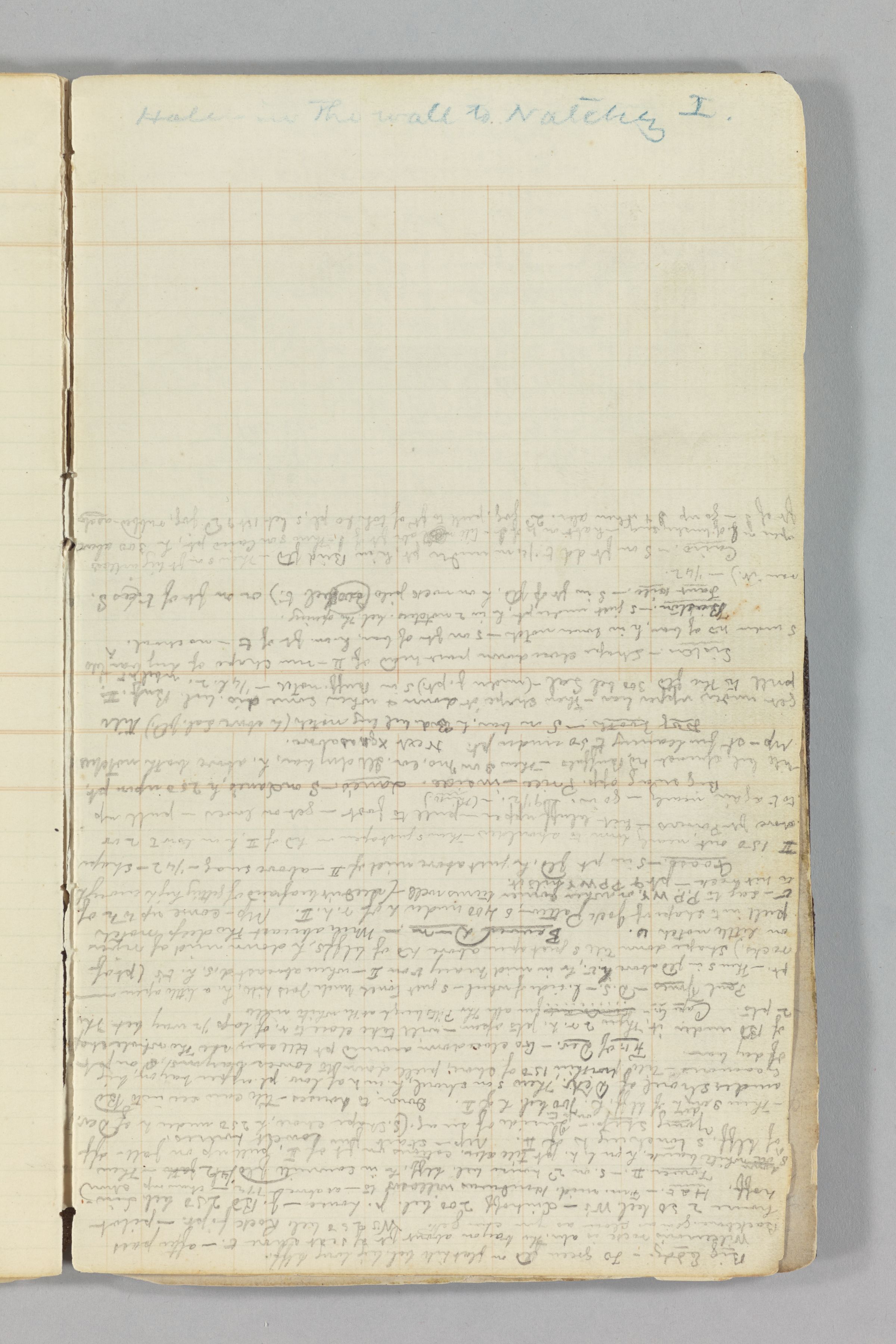
[MS: N02_leaf_002v]
Big Eddy .—To green fld on flat hill bel. big long blff.
Wilkerson’s rock is abr. the bayou about ft of scat shore t.—after pass
Backbone. go in as close
as you can get. W’s 250 bel. Rock fi pt.—pilot
house 230
bel W’s—Linhoff 200 bel. p. house—f. Bd 250 bel
Lin-
hoff
Linhoff
.
Hat
.—Fm. mid. Honduras willows to—as above—7 1/2—
chan up shore
Tower II.—s. on 2d house bel. bluff, h in sawmill fld 1/4 1 2 fath—Then
s
down
on white bank, h on l. h. pt till abr.
cottons on ft of II, pull up on fall-off
of blff. s touching
h of II. Up—Start fm lowest houses.
Young Shep
.—Inside of snag. (s. shape shore, h 250 under
h of Dev.
—then s on dn h of blff, h. on p. t. 700 bel. h of II.
Down to houses—till can see into Bd
under shoal of Dev. Then
s on shoul, h. in h of low pl upper bayou, big
sycamores—till p within 150 of shore, pull down to lower bayous, s on pt
of dry bar.
Ft. of
Dev
.—Go close down around pt till can
see the whole shap
of Bd under it, then 2 r. h. pts open.—
will take close to r. of logs 1/2 way bet. the
2 pts.
Cape G. —Run bank fm abr The Pittsburgh at the white mill.
Paul Jones
—D.S.—l. side of wheel—s just touch Uncle
Joe’s hill, h. a little open——
pt.—Then s in fld above h.t.,
h in mid heavy t on II—when abreast d.s. h. t’s (pt of
rocks.)
Shape down till s just open above hd of blffs, h down mid of river
on little notch symbol.
Beaver D—n
.—When abreast the
deep notch
pull in to shape of Jack Patten, s 400 under h of
r. h. II. Up—Come up to h of
t—sag to P.P. WY. or when
corner turns well—(needn't be afraid of getting high enough
to hit rock—pt & PPWY hits it.
Goose
.—s in pt fld. h just above mid of II—above
snag—1/4 2—shape
II 150 out, nearly down to shoulder—
then s just open on hd of II, h on low t 200
above ft Powers—
hit bluff upper—pull to foot—get on lower—pull up
to
t again nearly—go in.—9 1/2.—(think.)
Big snag opp. Price—inside.
Lane’s
.—S on Lane’s, h 250 up on pt.
till bel. abreast hd, Buffalo—then s on
Mo. cor. Ill dry bar, h. above both notches
Up—st fm leaning
t 50 under pt. Next xg◊ as above.
Dog Tooth
.—S on bar, h on
Bd. bel big notch (h above
Sal. fld.) till
get under upper bar—then Shape it down &
when some dis. bel. Buf. II.
pull to the fld 300 bel Sal—
(under f. pt.) s in Buff. notch—1/4 l. 2.
Sisters
.—Shape close down past head of II—run shape
of dry bar in bel pt till
s under hd of bar, h in lower
notch—s on ft of bar, h. on. ft of t—no shoal.
First Boston .—s just under pt, h in 2 notches. bel. the opening.
Fant Hill
.—S in ft of fld, h on rock pile (or 300 bel. t.)
or on ft of t. (as S.
ran it.)—1/4 2.
Cairo
.—S on ft dd t 1/4 m under pt, h in Bird fld—
Then s on ft big willows
open on l. of bushy sng—h abt on h of
I—till well abr ft of I.—then s on Cairo pt, h 300 above
ft of I—go up I & when abr. 2d jog, pull to pt of toh lo
pl, s bet 1st & 2d jog, rubbed—as ab
Ⓣtextual note