[MTP: N&J1_63]
(January–February 1865)
There is a gap of four years between Notebooks 3 and 4, a period for which no notebooks are
known to exist. Following his experience as a Mississippi River pilot, Clemens helped
form the Marion Rangers in the summer of 1861, after the outbreak of the Civil War.
This informal connection with the Confederacy is described in “The Private History
of a Campaign That Failed.” Having had his “taste” of the war, Clemens “stepped out
again permanently” and in late July 1861 took advantage of his brother Orion's recent
appointment as Nevada territorial secretary to accompany him West. They arrived in
Carson City in mid-August 1861. It was not long before Samuel Clemens caught the mining
fever. His letters of the next months are replete with the details of his own mining
endeavors in Humboldt and Esmeralda counties and with the statistics of his irrepressible
stock speculations and transactions in “feet.” It was from Aurora, Esmeralda County,
that in the spring of 1862 he sent his first pieces to the Virginia City Territorial Enterprise over the pen name Josh. By the summer of that year he was beginning to doubt that
he would
[MTP: N&J1_64]
strike it rich and, pressed for funds, in August he accepted a regular post as local
reporter for the Enterprise at twenty-five dollars a week. He arrived in Virginia City near the end of that September
and, except for assignments in Carson City in late 1862 to report the proceedings
of the second Territorial Legislature of Nevada and again in late 1863 to cover the
Nevada State Constitutional Convention and occasional trips to San Francisco, Lake
Bigler Tahoe, and Steamboat Springs, he remained there until 29 May 1864. On that date, after
an exchange of abuse with James L. Laird, publisher of the Virginia City Daily Union, and the challenges to Laird which followed his accusation that the staff of the
Union had reneged on its Sanitary Fund pledges, Mark Twain left for San Francisco with
Steve Gillis, one of the Enterprise compositors and a close friend. The flight was probably to avoid ridicule and not,
as he later claimed, to escape prosecution under a nonexistent “brand-new law” which
made sending or carrying a challenge a penitentiary offense. (For an account of the
entire Sanitary Fund controversy, see Mark Twain of the “Enterprise,” edited by Henry Nash Smith Berkeley and Los Angeles: University of California Press, 1957.)
Clemens planned to stay in San Francisco for a month to dispose of some mining stock on Orion's behalf and then go East, but the market was not favorable. Two hundred dollars which he had asked Orion to forward to him in San Francisco was evidently not forthcoming, so in the first week of June he became a local reporter for the San Francisco Morning Call, probably at a salary of forty dollars a week; Gillis took a job as a compositor on the same paper. Mark Twain corresponded at least once with the Enterprise that month and also began weekly contributions to the San Francisco Golden Era. But it was the Call that demanded most of his time and energy in a fashion that he found oppressive since the paper's publishers allowed him little of the latitude he had enjoyed as “local” for the Enterprise. Working for the Call was tedious, he recalled in 1906, a “fearful drudgery, soulless drudgery, and almost destitute of interest” ( MTE , p. 256) that began early in the police court and ended late in the theaters. By the autumn of 1864 he was reducing his commitment to the Call, for on 25 September he wrote his mother and sister:
I am taking life easy, now, and I mean to keep it up for awhile. I don't work at night any more. I told the “Call” folks to pay me $25 a week and let me work only in daylight. So I get up at 10 in the morning, & quit work at 5 or 6 in the afternoon.
[MTP: N&J1_65]
But his object was not entirely an increase in leisure, for he went on to inform them:
I have engaged to write for the new literary paper—the “Californian”—same pay I used to receive on the “Golden Era”—one article a week, fifty dollars a month. I quit the “Era,” long ago. It wasn't high-toned enough. I thought that whether I was a literary “jackleg” or not, I wouldn't class myself with that style of people, anyhow. The “Californian” circulates among the highest class of the community, and is the best weekly literary paper in the United States—and I suppose I ought to know. (TS in MTP; partially published in MTL , pp. 99–100)
Clemens had even more ambitious literary plans than this, however. On 28 September he informed Orion and Mollie Clemens that soon “I believe I will send to you for the files, & begin on my book,” apparently to deal with material eventually to go into Roughing It, a project he was keeping secret for the moment. Preoccupation with such a book may have contributed to the growing neglect which precipitated his departure from the Call, although in Roughing It Mark Twain recalled that it was disappointment over a missed chance for a big mine sale (see note 17) that caused his indifference, and still later he attributed it to the suppression of a piece with “fire in it” condemning the persecution of an unoffending Chinese ( MTE , pp. 256–257). At any rate, given the opportunity to resign around the middle of October 1864, Mark Twain promptly accepted. There followed the period in which, according to chapter 59 of Roughing It, he became “a very adept at ‘slinking’ ”:
I slunk from back street to back street, I slunk away from approaching faces that looked familiar, I slunk to my meals, ate them humbly and with a mute apology for every mouthful I robbed my generous landlady of, and at midnight, after wanderings that were but slinkings away from cheerfulness and light, I slunk to my bed. I felt meaner, and lowlier and more despicable than the worms. During all this time I had but one piece of money—a silver ten cent piece—and I held to it and would not spend it on any account, lest the consciousness coming strong upon me that I was entirely penniless, might suggest suicide. I had pawned every thing but the clothes I had on; so I clung to my dime desperately, till it was smooth with handling.
Actually, although he wasn't working regularly, Clemens was neither as miserably unoccupied
nor as penniless as he insists. Between 1 October and 3 December 1864 he wrote ten
weekly articles for the Californian, for which he received twelve dollars each. He was also contributing to the
[MTP: N&J1_66]
Territorial Enterprise, for it was his criticism of police lassitude in the face of official corruption,
published in Virginia City but also circulated in San Francisco, that helped hasten
his departure for Jackass Hill. These now lost Enterprise dispatches had already made Clemens unpopular with San Francisco police chief Martin
Burke when, late in 1864, Steve Gillis fled to Virginia City to avoid trial on charges
resulting from a barroom brawl, and Clemens, Gillis' bondsman, found himself the object
of Burke's displeasure. When Steve's older brother Jim offered Mark Twain the sanctuary
of his cabin on Jackass Hill, a “serene and reposeful and dreamy and delicious sylvan
paradise” (
MTE
, p. 360), he reportedly left San Francisco as he liked to think he had come, one
step ahead of the police.
He arrived at Jackass Hill on 4 December 1864. He began Notebook 4 soon after New
Year's Day 1865 with a highly elliptical recapitulation of his movements during the
last half of the preceding year. The balance of the notebook reflects his activities
until his return to San Francisco on 26 February 1865, for the most part consisting
of a record of leisurely travels around Tuolumne and Calaveras counties. Chief among
these was his four-week visit in January and February to Angel's Camp, where Jim Gillis
had a pocket mining claim. Inclement weather limited Clemens' attempts to mine with
Gillis, but even his brief experience of pocket mining had associative significance
for him. While he and Gillis were stormbound during their first two weeks at Angel's
Camp, Clemens jotted down reminiscences of his own mining days in Nevada, several
of which he later expanded in Roughing It. On 8 February, probably to break the monotony of their days, Clemens, who in 1861
had joined Polar Star Masonic Lodge No. 79 in Saint Louis and in 1862 had attended
meetings of the Carson City lodge, served as junior deacon at a meeting of Bear Mountain
Masonic Lodge No. 76. The weather had cleared, but for the most part the fine days
that came, like the rainy ones that had ended, were passed exchanging tales with Jim
Gillis, with Dick Stoker, who came over from Tuttletown to visit, and with the regular
patrons of the Angel's Hotel saloon. A number of these anecdotes and incidents, and
others he heard at Jackass Hill and elsewhere, are recorded or alluded to in Notebook
4. Although the 1855 notebook gives clues about Clemens' biography which are relevant
to the sources for his fiction and the two notebooks recording piloting information
are clearly relevant to Life on the Mississippi, Notebook 4, with its combination of present and recollected experience, is the first
that can accurately be considered a writer's notebook. Despite its
[MTP: N&J1_67]
brevity this notebook contains a considerable amount of literary material used in
works that span Mark Twain's career. The note which proved to be most immediately
useful to Clemens was the synopsis of what became “The Celebrated Jumping Frog of
Calaveras County,” but there are also a number of entries later developed in Roughing It and Huckleberry Finn and others that would not emerge again until his Autobiographical Dictations. Mark
Twain's retentiveness of his source materials is demonstrated by the almost thirty-year
interval between the 1893 writing and publication of “The Californian's Tale” and
the original note for it in this notebook.
There is evidence of an awareness of his audience in the broad humor and scatological references of the long entry about the “Great Vide Poche Mine,” perhaps intended for a reading before a male gathering. This frankness strongly contrasts with the mild language of the most daring sketches and “hoaxes” Mark Twain had written for publication, even in the permissive Territorial Enterprise. Mark Twain's ambivalent attitudes toward profanity and propriety are present in this notebook, particularly in the juxtaposition of his familiar modifications “d—d” and “G— d—dest” and the weak disguise merde with vulgarisms such as piss-ants and ass.
The conjunction in Notebook 4 of shorthand symbols, French words or phrases, and an unusual incidence of erratic abbreviations and simplified spellings forms a verbal texture uncharacteristic of any of Clemens' other notebooks.
Notebook 4 now contains 110 pages, 66 of them blank. At least one
leaf has been torn out and is missing. Because it was designed to be
used as an indexed memorandum or account book, right-hand pages at
intervals are printed on their outside margin with an alphabet letter,
and all but the last pages in the notebook are notched approximately
3/16 inch (0.5 centimeter), so that when the notebook is closed all of
the letters are visible from the front. The unnotched pages measure
6⅝ by 4 1/16 inches (16.3 by 10.3 centimeters). The page edges
are tinted blue. The pages are ruled with twenty-three blue horizontal
lines and are divided by red vertical lines into four unequal columns
in account book fashion. The endpapers and flyleaves are white. The
notebook is bound in a stiff cover of tan calf. Clemens wrote
“Use this on Mississippi trip.” in ink on the front
cover (see note 1), and someone, probably Paine, has written
“1865” in ink on the front cover. The front cover, the
front flyleaf, and the first 19
[MTP: N&J1_68]
ruled leaves are loose; the rest of
the notebook is only loosely attached to the spine, which is badly
deteriorated. All entries are in pencil, except two later entries,
which are in blue ink (see notes 34 and 37). Clemens used the same
blue ink to inscribe use marks on several entries in this
notebook. Most of the material so marked does not appear in his known
writings. In four entries in Notebook 4 Clemens experimented with
shorthand, mixing shorthand symbols and script letters. In the printed
text of these four entries (identified in note 7) letters which appear
in italics are transliterations of Clemens' shorthand.
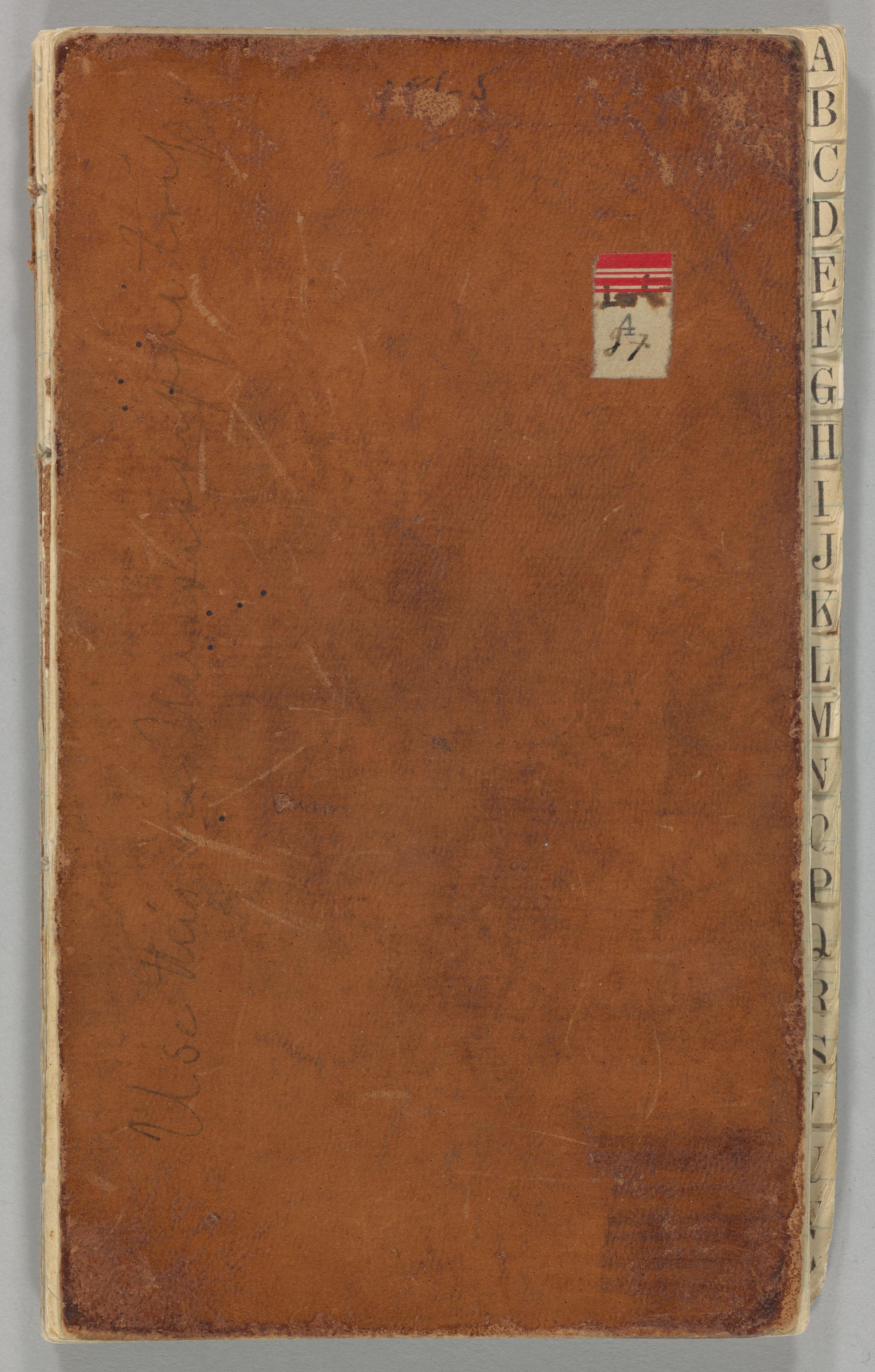
[MS: N04_front cover]
Use this on Mississippi trip.Ⓣtextual note 1
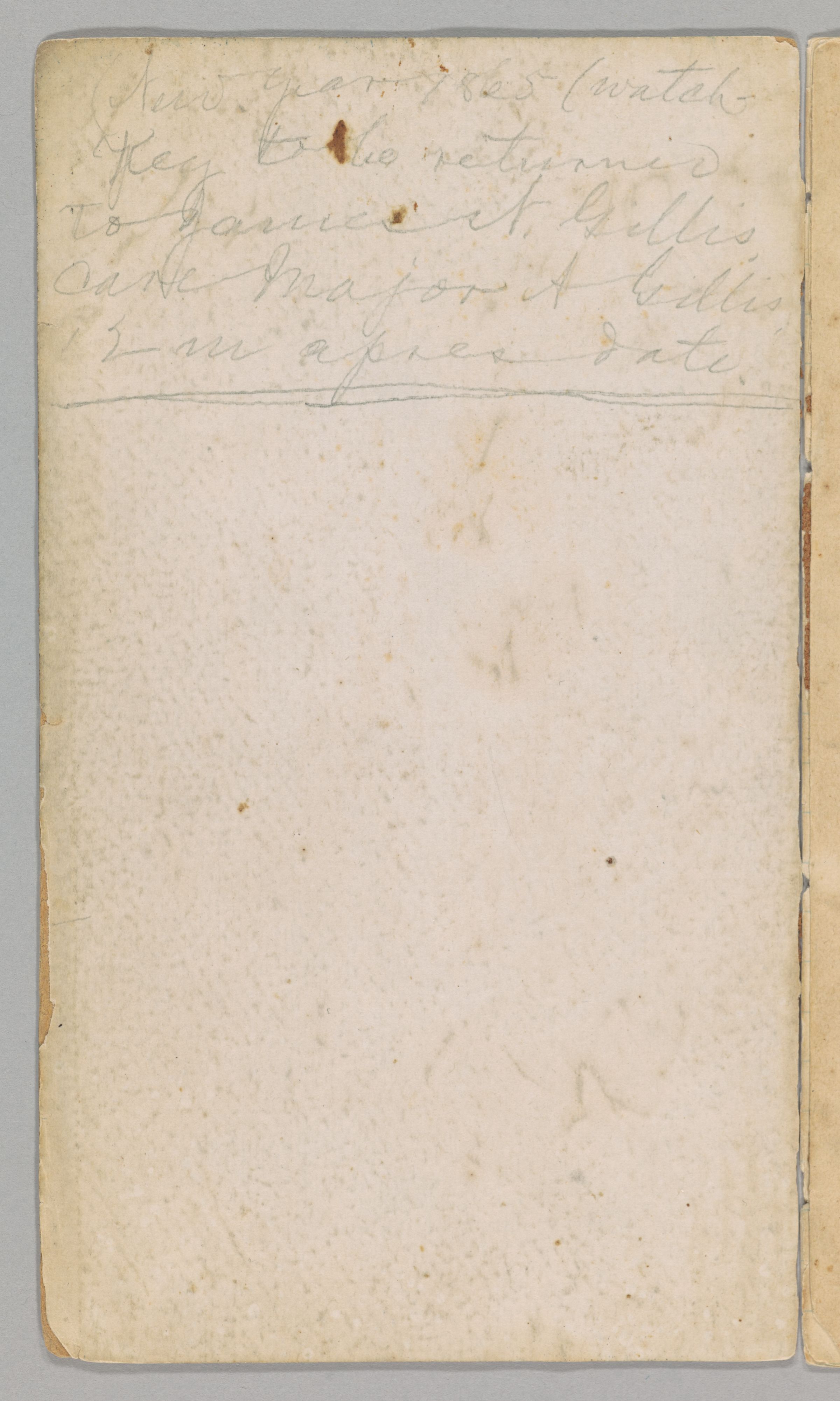
[MS: N04_front endpaper]
(New Year 1865 (watch-
y keyⓂemendation to be returned
to James N. Gillis,
care Major A Gillis,2
12 m apres date.
[MS: N04_leaf_001r]
[MS: N04_leaf_001v]
[MS: N04_leaf_002r]
[MS: N04_leaf_002v]
[MS: N04_leaf_003r]
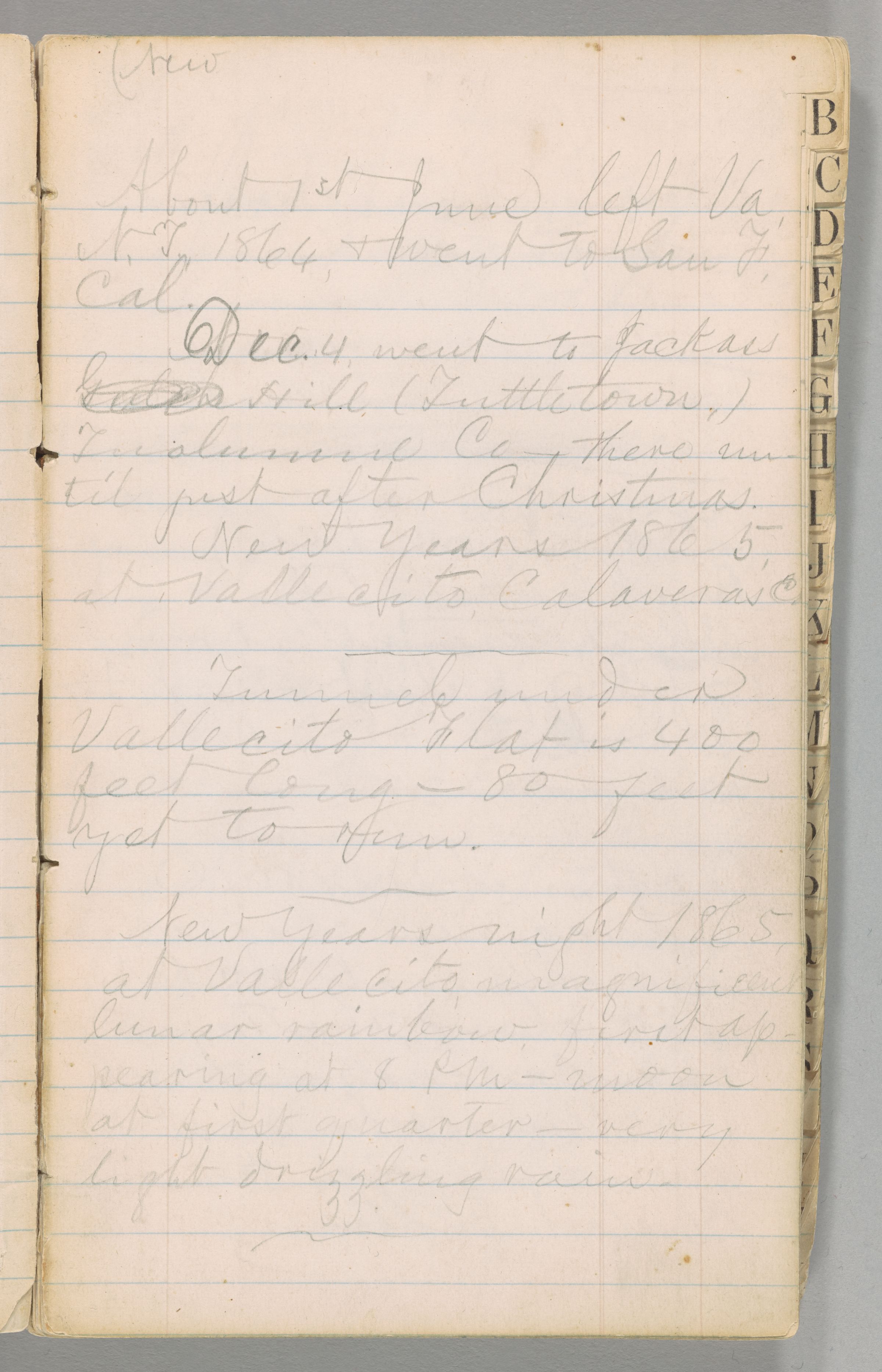
(New
About 1st June left Va,
N.T., 1864, & went to San F,
Cal.
Nov. Dec. 4, went to Jackass
Gulch Hill (Tuttletown,)
Tuolumne Co—there
un-
til
until
just after Christmas.
New Years 1865,
at Vallecito, Calaveras Co

Tunnel under
Vallecito Flat is 400
feet long—80 feet
yet to run.
[MTP: N&J1_69]
New Years night 1865,
at Vallecito, magnificent
lunar rainbow, first
ap-
pearing
appearing
at 8 PM—moon
at first quarter—very
light drizzling rain.
[MS: N04_leaf_003v]
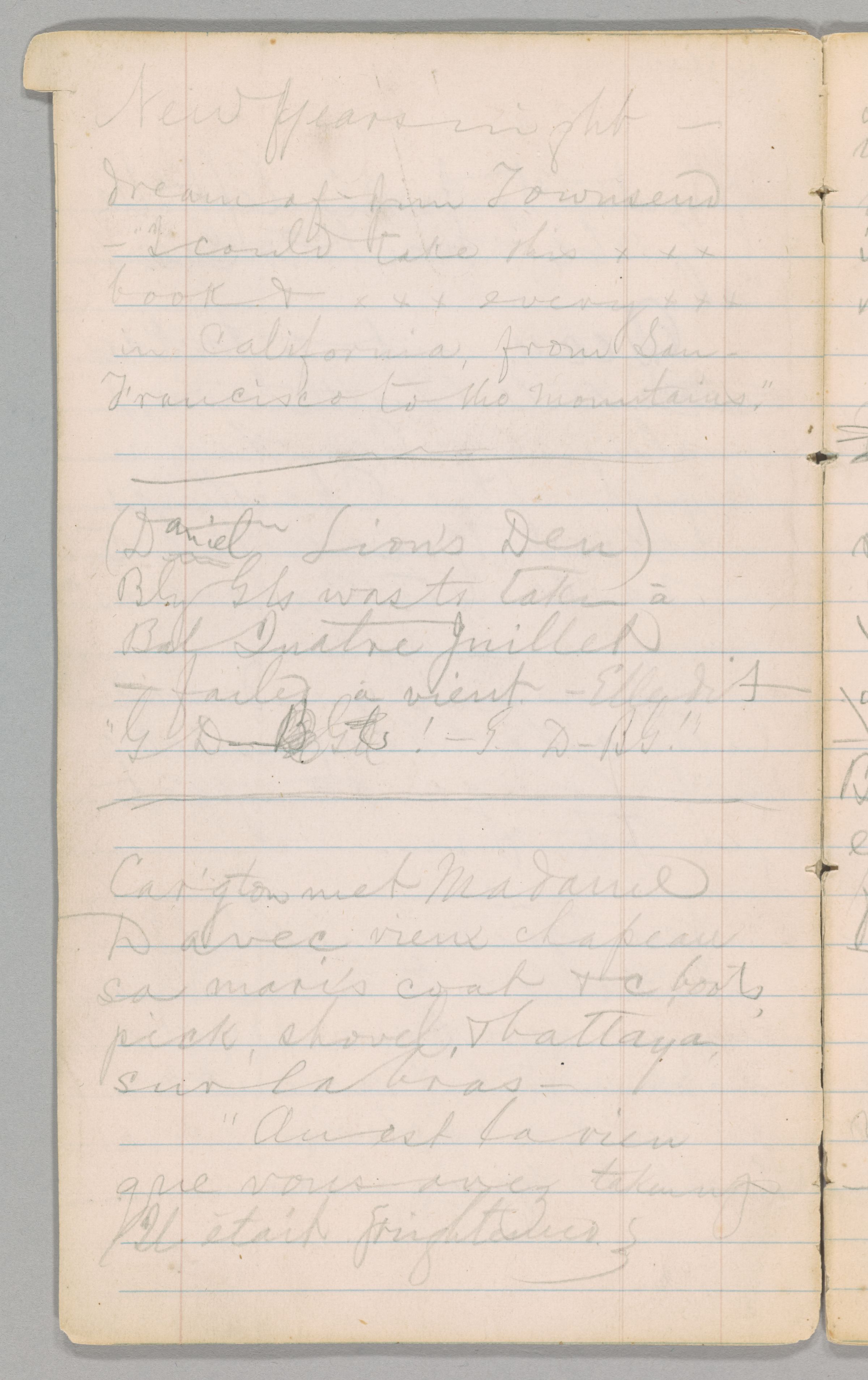
New Years night—
dream of Jim Townsend3
—“I could take this x x x
book & x x x every x x x
in California, from San
Francisco to the mountains.”
(DanielⓉtextual note Lion's Den)4
Bly Gls was to take à
Bal Quatre Juillet
—failed à vientⓂemendation.—Elle dit
“G D— B GlsⓉtextual note!—G. D— B G!”5
Car'gton6 met Madame
D avec vieux chapeau
sa mari's coat &cⓂemendation, boots,
pick, shovel, & battaya,
sur la bras—
“Ou est la vieuⓂemendation
que vous avez taken up
(Il était frightened.)
[MS: N04_leaf_004r]
[MTP: N&J1_70]
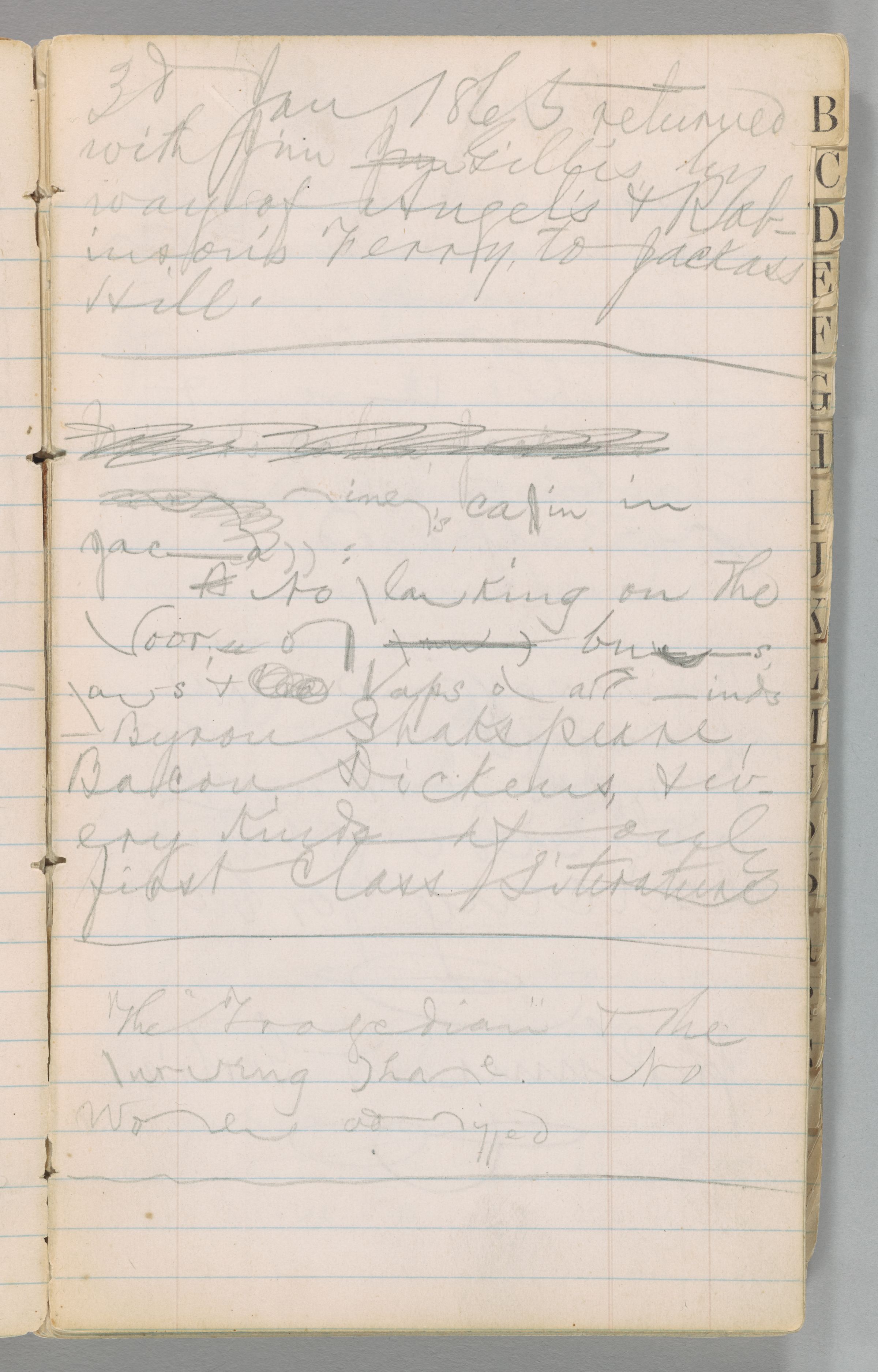
3d Jan 1865 returned
with Jim Jim Gillis, by
way of Angel's &
Rob-
inson’s
Robinson's
Ferry, to Jackass
Hill.
Miner's cabin, Jackass
miner's
miner's cabin in
Jackass:7
B No planking on the
floor;
-
old
punks
bunks,
pans & tra
traps of all kinds
—Byron Shakspeare,
Bacon Dickens, &
ev-
ery
every
kinds of only
first class Literature8
The “Tragedian” & the
Burning Shame. No
women admitted9
[MS: N04_leaf_004v]
[MTP: N&J1_71]
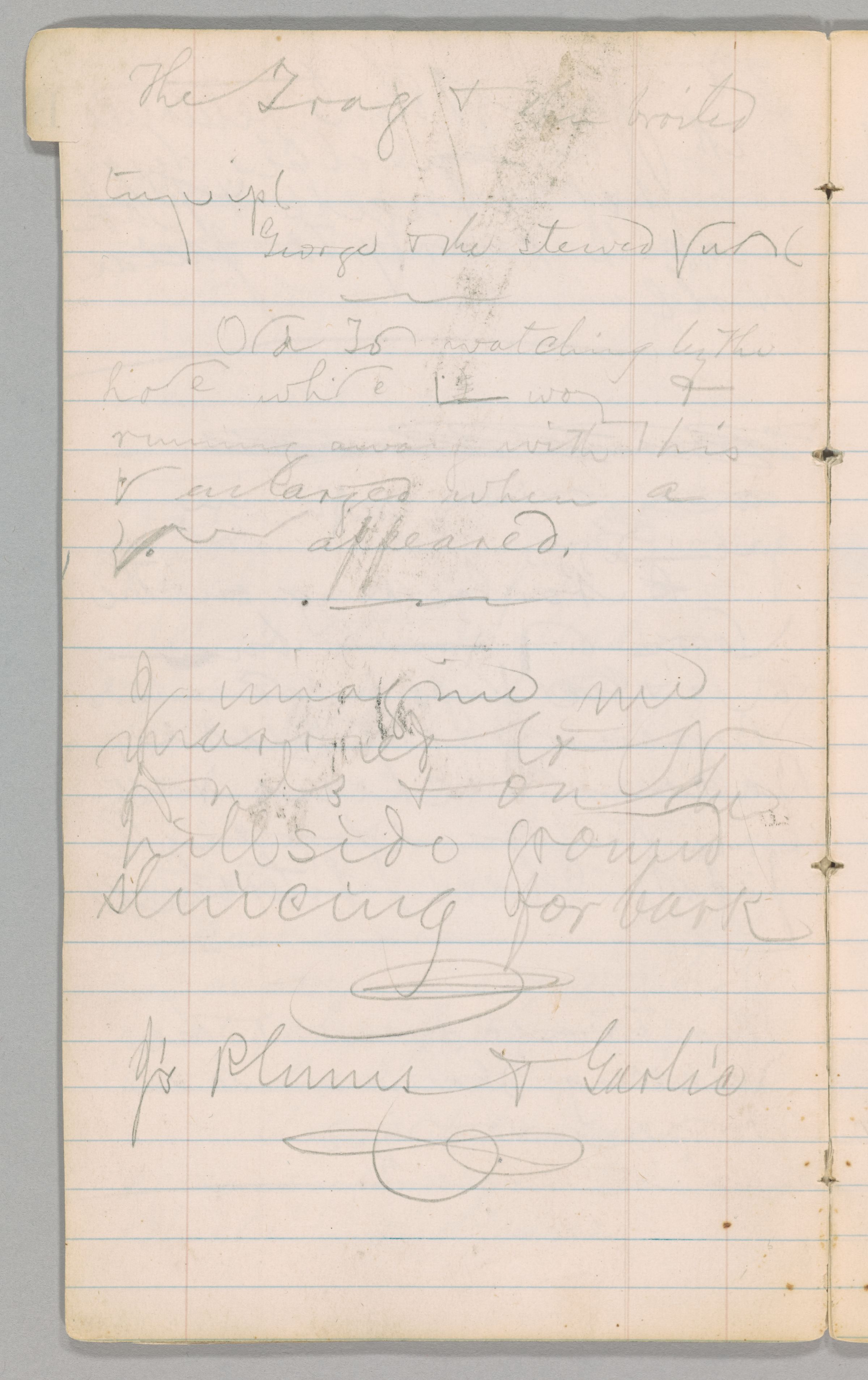
The Trag & the broiled turnips
George & the stewed plums 10
Old Tom watching by the
hole while Dick worked &
running away with his
tail enlarged when a
stranger appeared.11
J imagine me
married to N
Dnls & on the
hillside ground
sluicing for bark
J's Plums & Garlic
[MS: N04_leaf_005r]
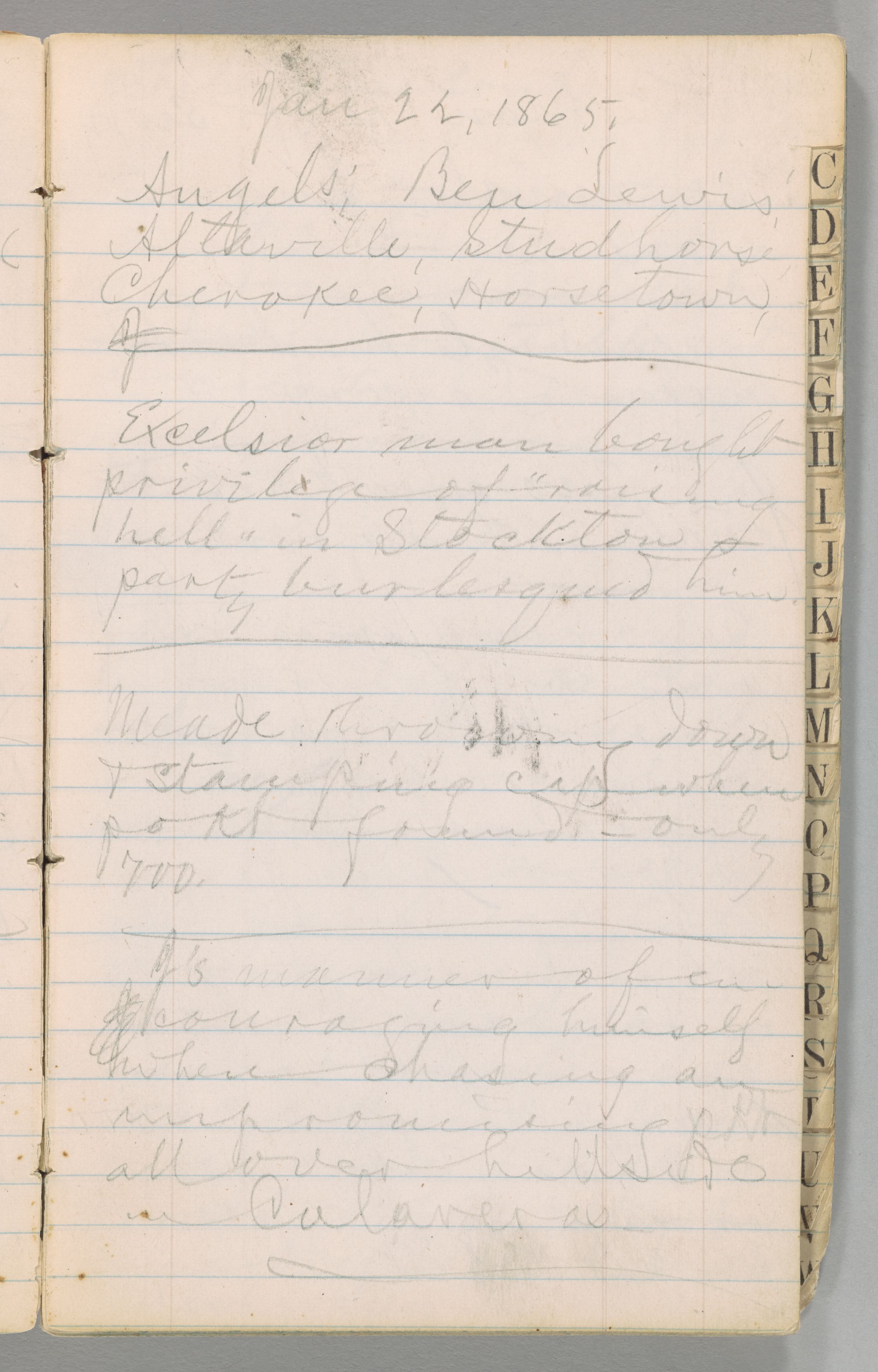
Jan 22, 1865.
Angels', Ben Lewis',
Altaville, Studhorse,
Cherokee, Horsetown,
J
Excelsior man bought
privilege of “raising
hell” in Stockton—
party burlesqued him.
Meade throwing down
& stamping cap when
pokt found—only
700.
J's manner of
en-
J couraging
encouraging
himself
when chasing an
unpromising pkt
all over hillside
in Calaveras.
[MS: N04_leaf_005v]
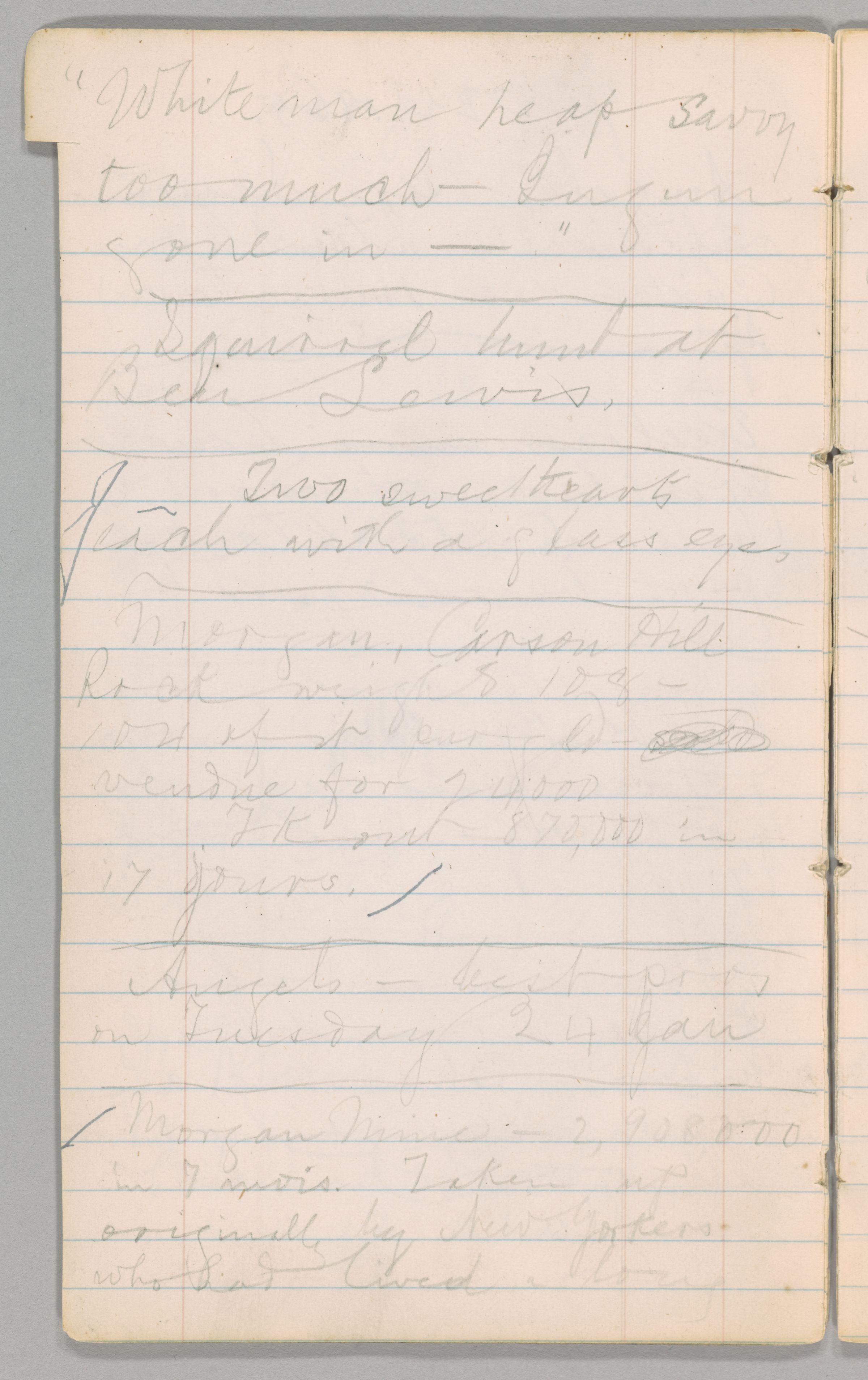
“White man heap savvy
too much—Injun
gone in—.”
Squirrel hunt at
Ben Lewis.
[MTP: N&J1_72]
Two sweethearts
each with a glass eye.12
Morgan, Carson Hill
Rock weighs 108—
104 of it pur gld—sold
vendue for 24,00013
Tk out 870,000 in
17 d jours.
Angels—best pros
on Tuesday 24 Jan
Morgan Mine—2,908,000
in 7 mois. Taken up
originally by New Yorkers
who had lived a long
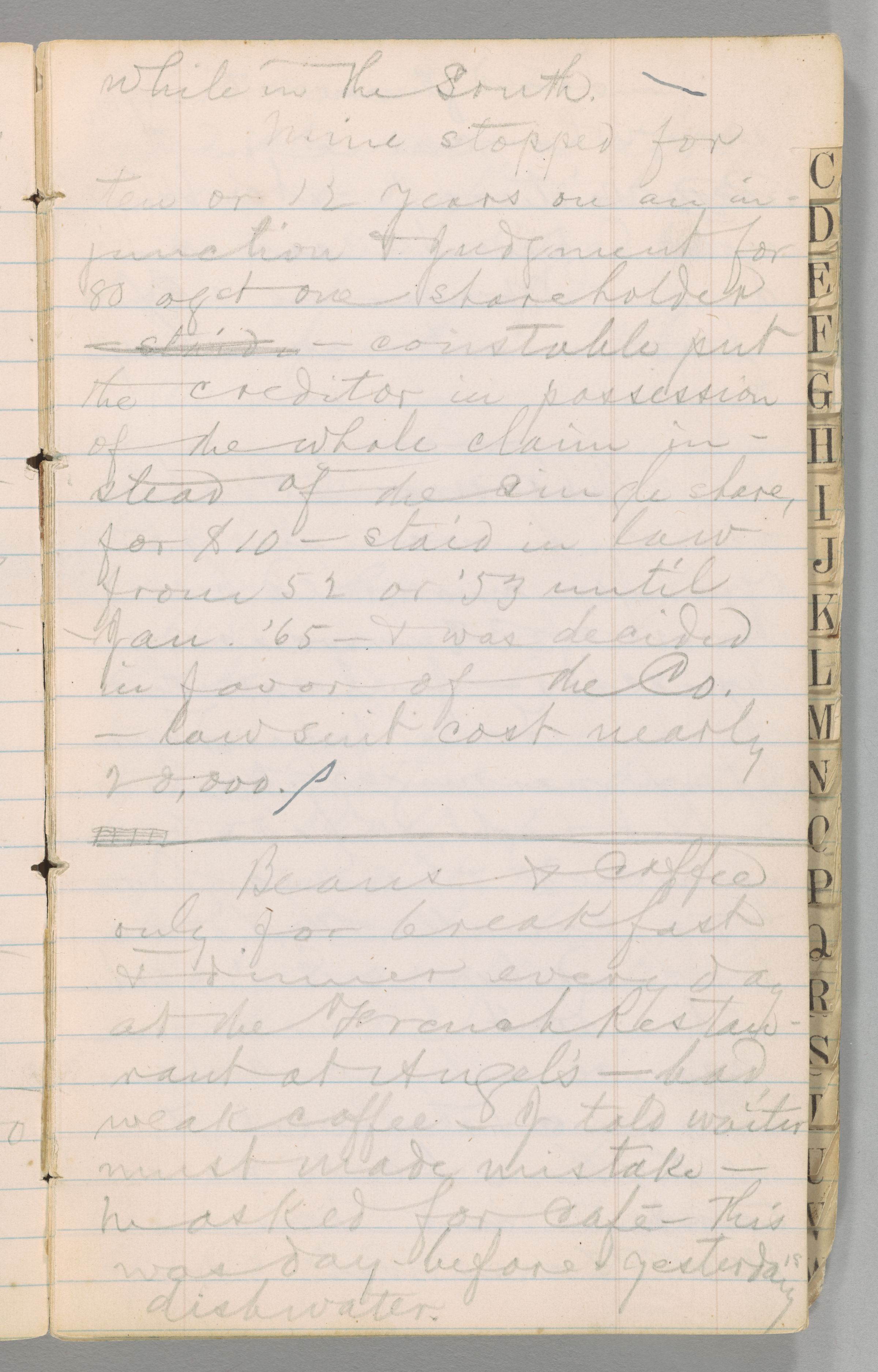
[MS: N04_leaf_006r]
while in The South.
Mine stopped for
ten or 12 years on an
in-
junction
injunction
& Judgment for
80 agst one shareholder
—staid i—constable put
the creditor in possession
of the whole claim
in-
instead
of the single share,
for $10—staid in law
from 52 or '53 until
Jan. '65—& was decided
in favor of the Co.
—lawsuit cost nearly
20,000.14
Beans & coffee
only for breakfast
& dinner every day
at the French
Restau-
rant
Restaurant
at Angel's—bad,
weak coffee—J told waiter
must made mistake—
he asked for café—this
was day-before-yesterday's
dishwater.
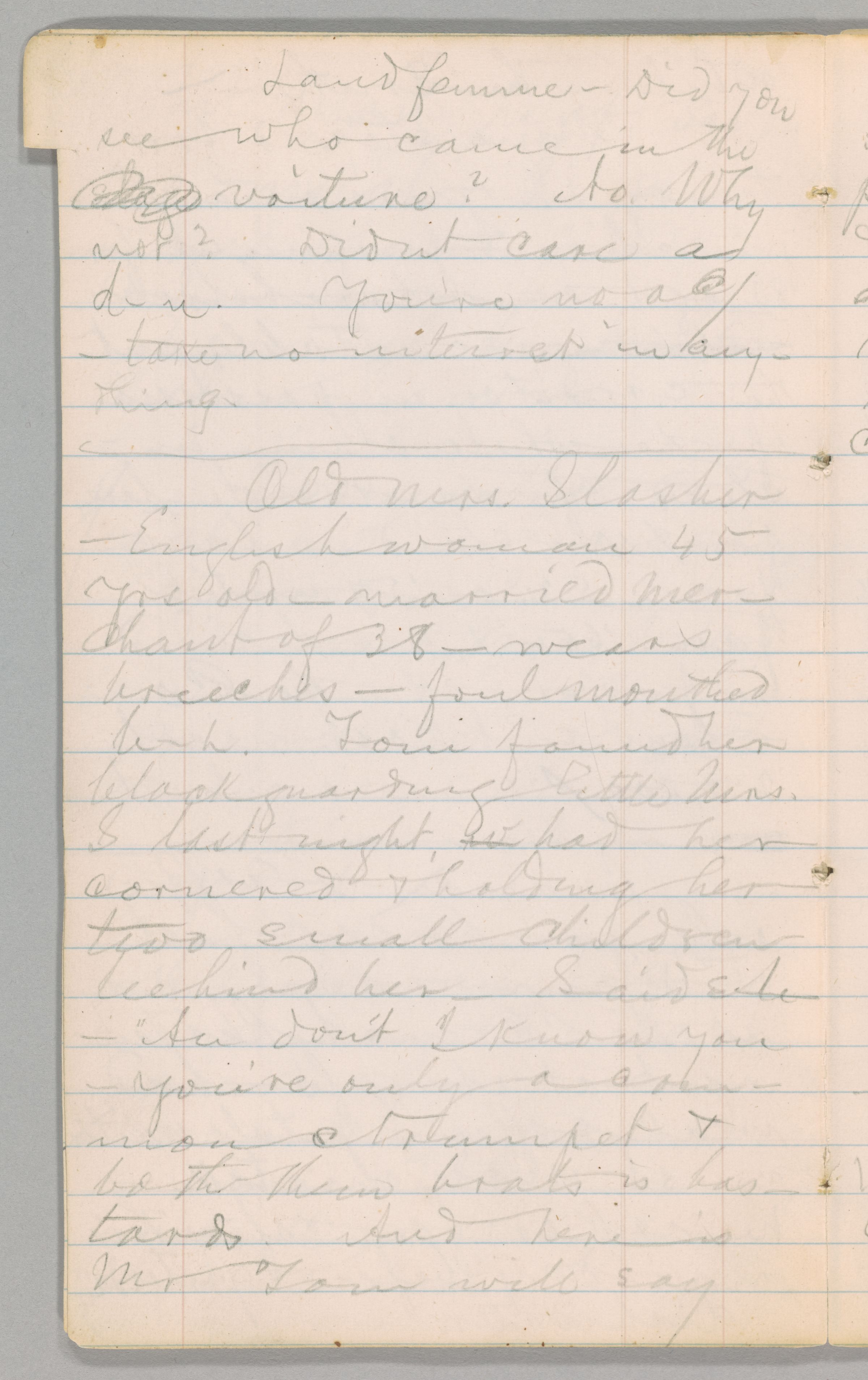
[MS: N04_leaf_006v]
LoudⓂemendation femme—Did you
see who came in the
stage voiture? No. Why
not? Didnt care a
d—n. You're no ac/
—take no interest in
any-
thing
anything
.
[MTP: N&J1_73]
Old Mrs. Slasher
—Englishwoman 45
yrs old—married
mer-
chant
merchant
of 38—wears
breeches—foulmouthed
b—h. Tom found her
blackguarding little Mrs.
S last night, w had her
cornered & holding her
two small children
behind her. Said
— sheⓉtextual note
— “An don't I know you
—you're only a
com-
mon
common
strumpet &
both them brats is
bas-
tards
bastards
. And here is
Mr Tom will say
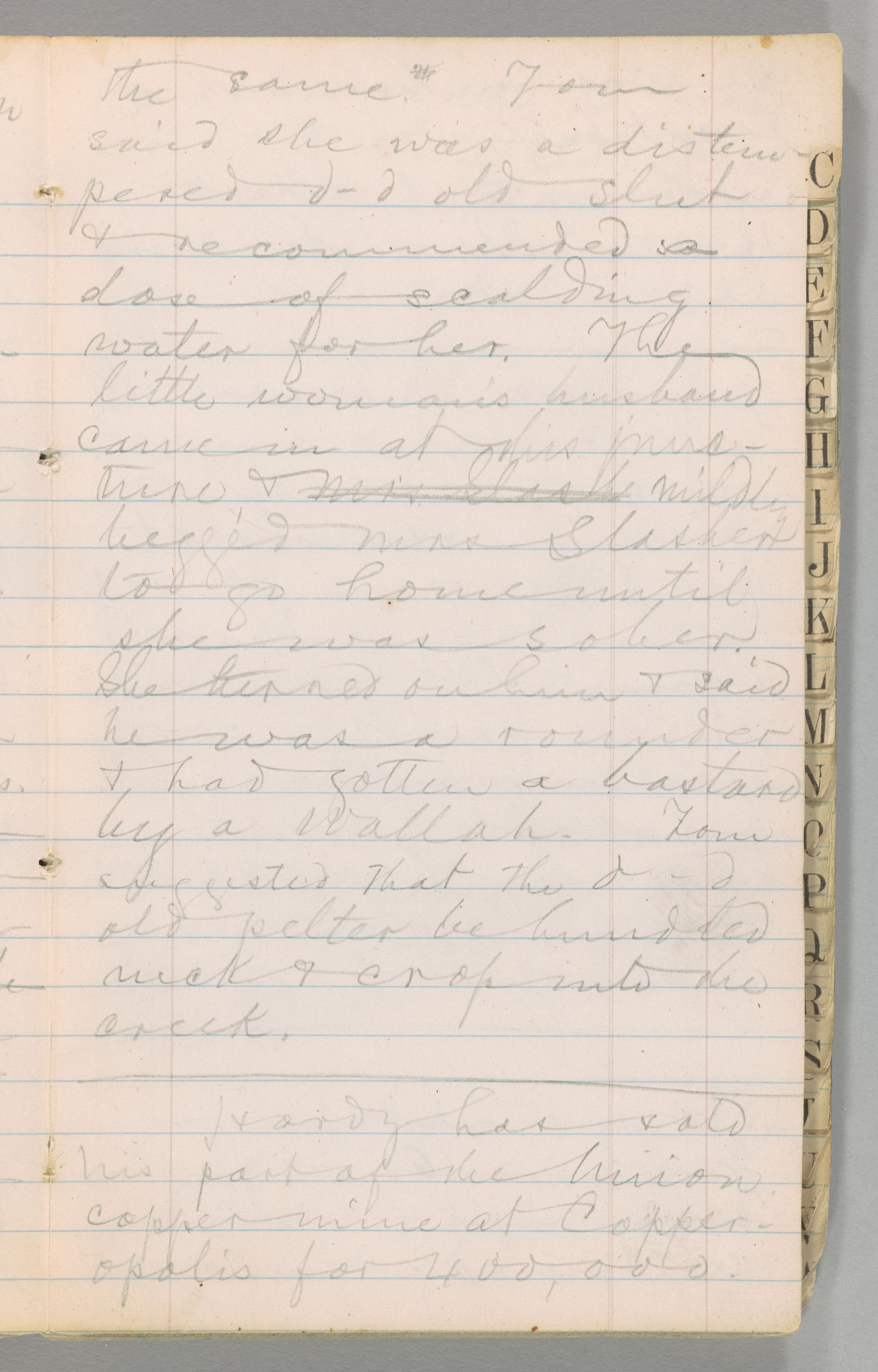
[MS: N04_leaf_007r]
the same.” Tom
said she was a
distem-
pered
distempered
d—d old slut
& recommended sc a
dose of scalding
water for her. The
little woman's husband
came in at this
junc-
ture
juncture
, & Mrs. Slash mildly
begged Mrs Slasher
to go home until
she was sober.
She turned on him & said
he was a rounder
& had gotten a bastard
by a Wallah. Tom
suggested that the d—d
old pelter be bundled
neck & crop into the
creek.
Hardy has sold
his part of the Union
copper mine at
Copper-
opolis
Copperopolis
for 400,000.
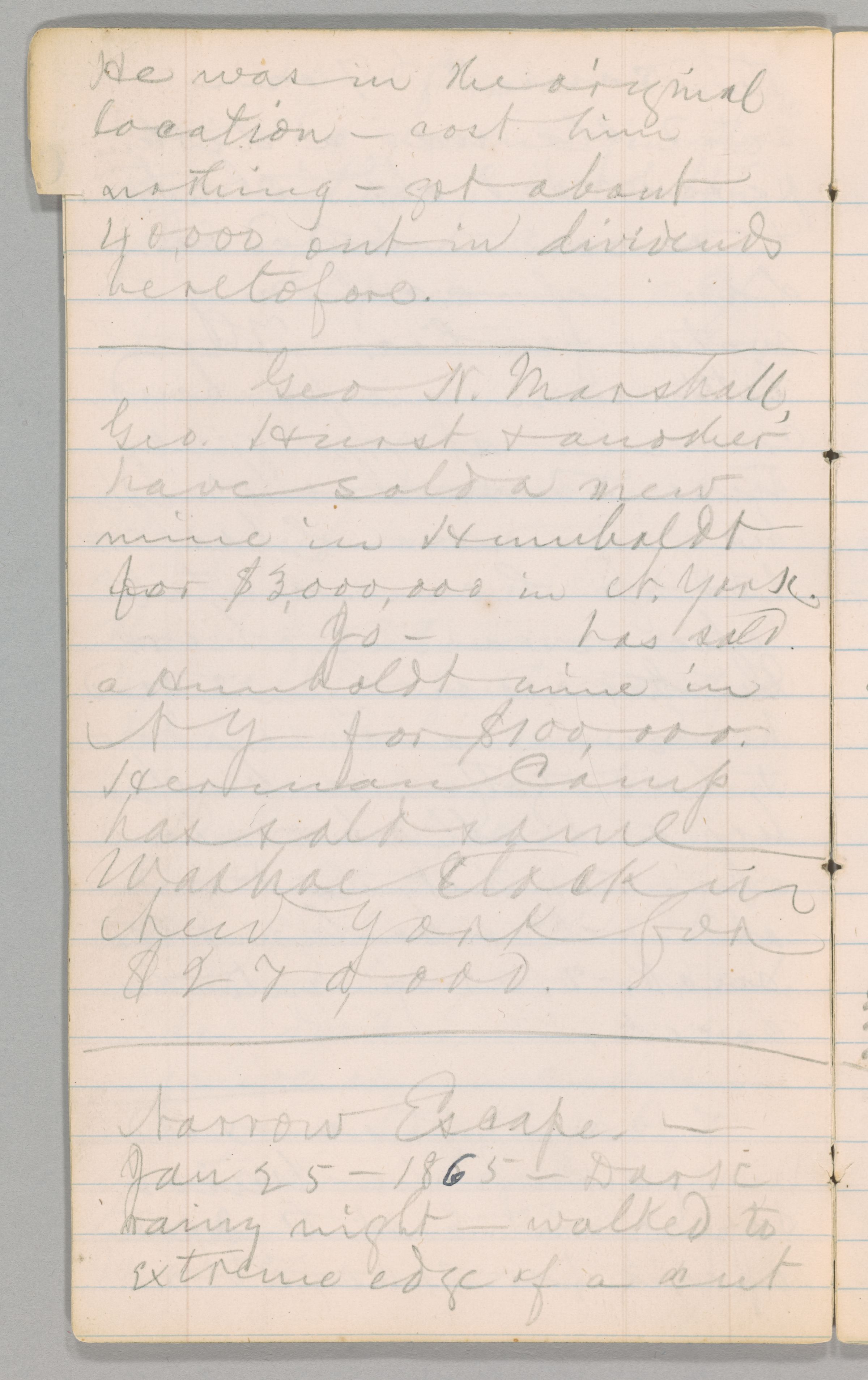
[MS: N04_leaf_007v]
He was in the original
location—cost him
nothing—got about
40,000 out in dividends
heretofore.15
Geo N. Marshall,
Geo. Hurst & another
have sold a new
mine in Humboldt
in for $3,000,000 in N. York.16
Jo— blank has sold
a Humboldt mine in
NY for $100,000.
Herman Camp
has sold someⓂemendation
Washoe Stock in
New York for
$270,000.17
[MTP: N&J1_74]
Narrow Escape.—
Jan 25—180
65Ⓣtextual note—Dark
rainy night—walked to
extreme edge of a cut
[MS: N04_leaf_008r]
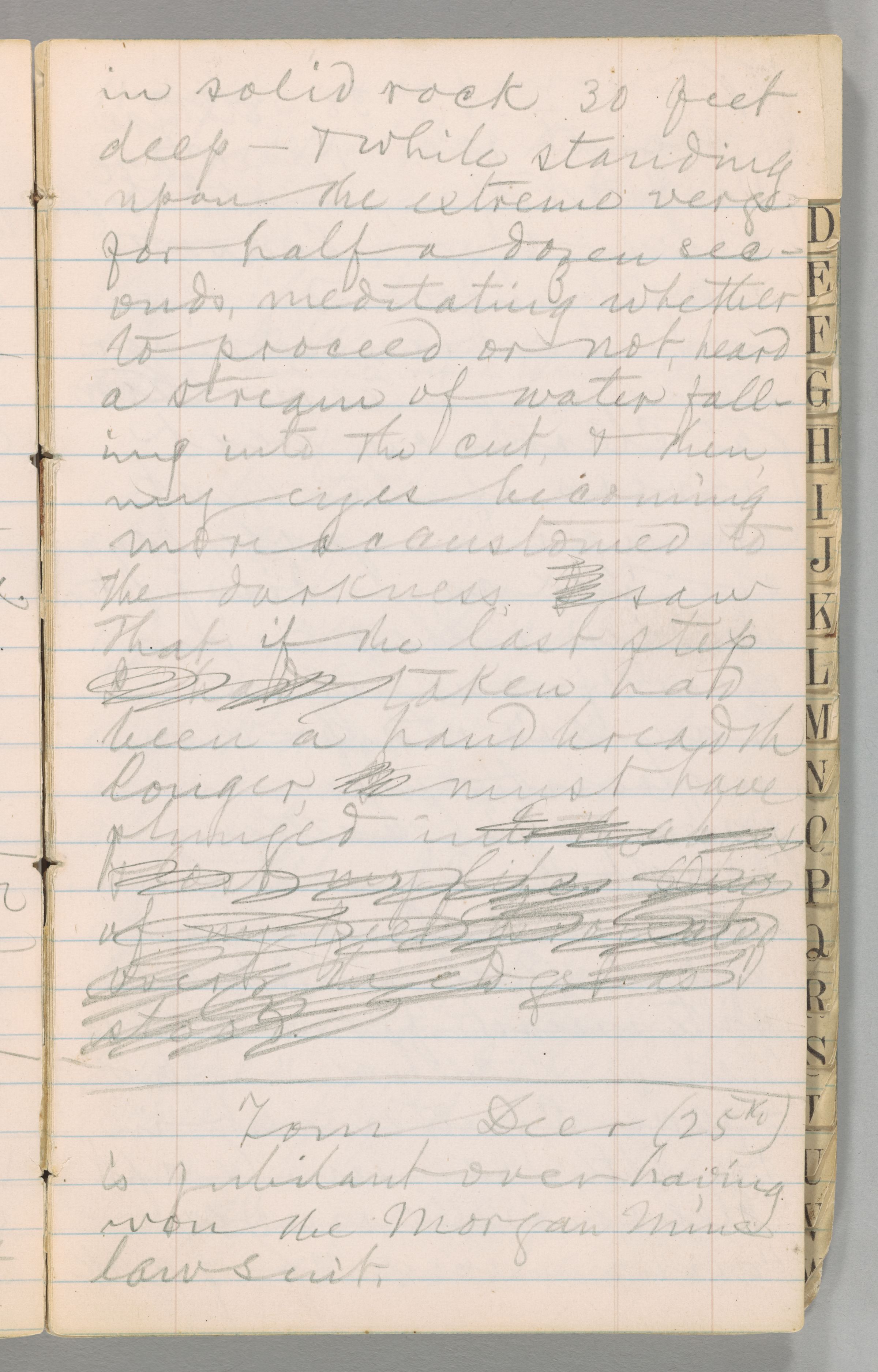
in solid rock 30 feet
deep—& while standing
upon the extreme verge
for half a dozen
sec-
onds
seconds
, meditating whether
to proceed or not, heard
a stream of water
fall-
ing
falling
into the cut, & then,
my eyes becoming
more accustomed to
the darkness, I saw
that if the last step
I had taken had
been a hand breadth
longer, I must have
plunged in to the abyss
& lost my life. One
of my feet projected
over the edge as I
stood.
Tom Deer18 (25th)
is jubilant over having
won the Morgan Mine
lawsuit.
[MS: N04_leaf_008v]
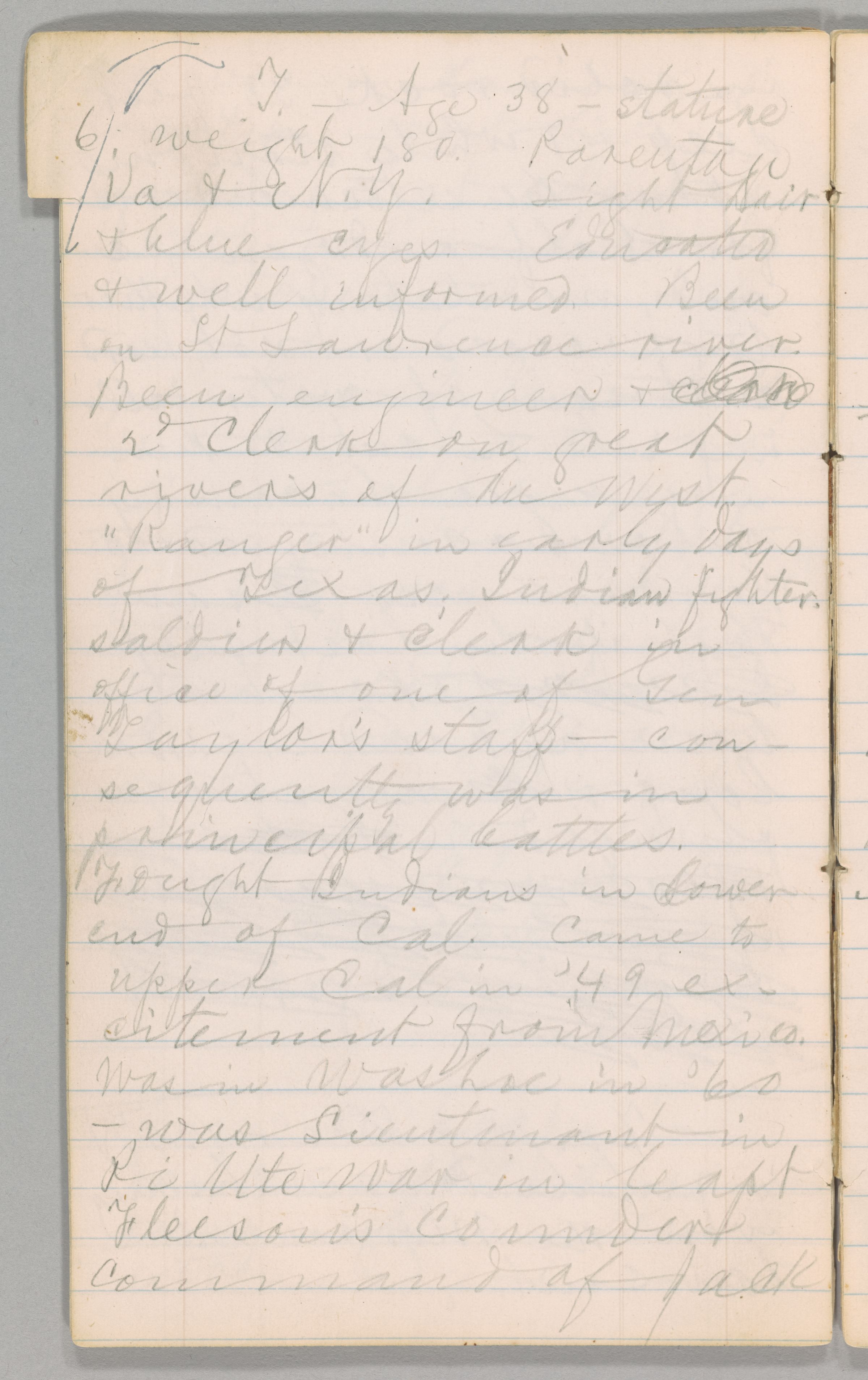
T.—Age 38—stature
6, weight 180. Parentage
Va & N.Y. Light hair
& blue eyes. Educated
& well informed. Been
on St Lawrence river.
Been engineer & clerk
2d clerk on great
rivers of the West.
“Ranger” in early days
of Texas; Indian fighter,
soldier & clerk in
office of one of Gen
Taylor's staff—
con-
sequently
consequently
was in
principal battles.
Fought Indians in L lower
end of Cal. Came to
upper Cal in '49
ex-
citement
excitement
from Mexico.
Was in Washoe in '60
—was Lieutenant in
Pi Ute War in Capt
Fleeson's Co under
command of Jack
[MS: N04_leaf_009r]
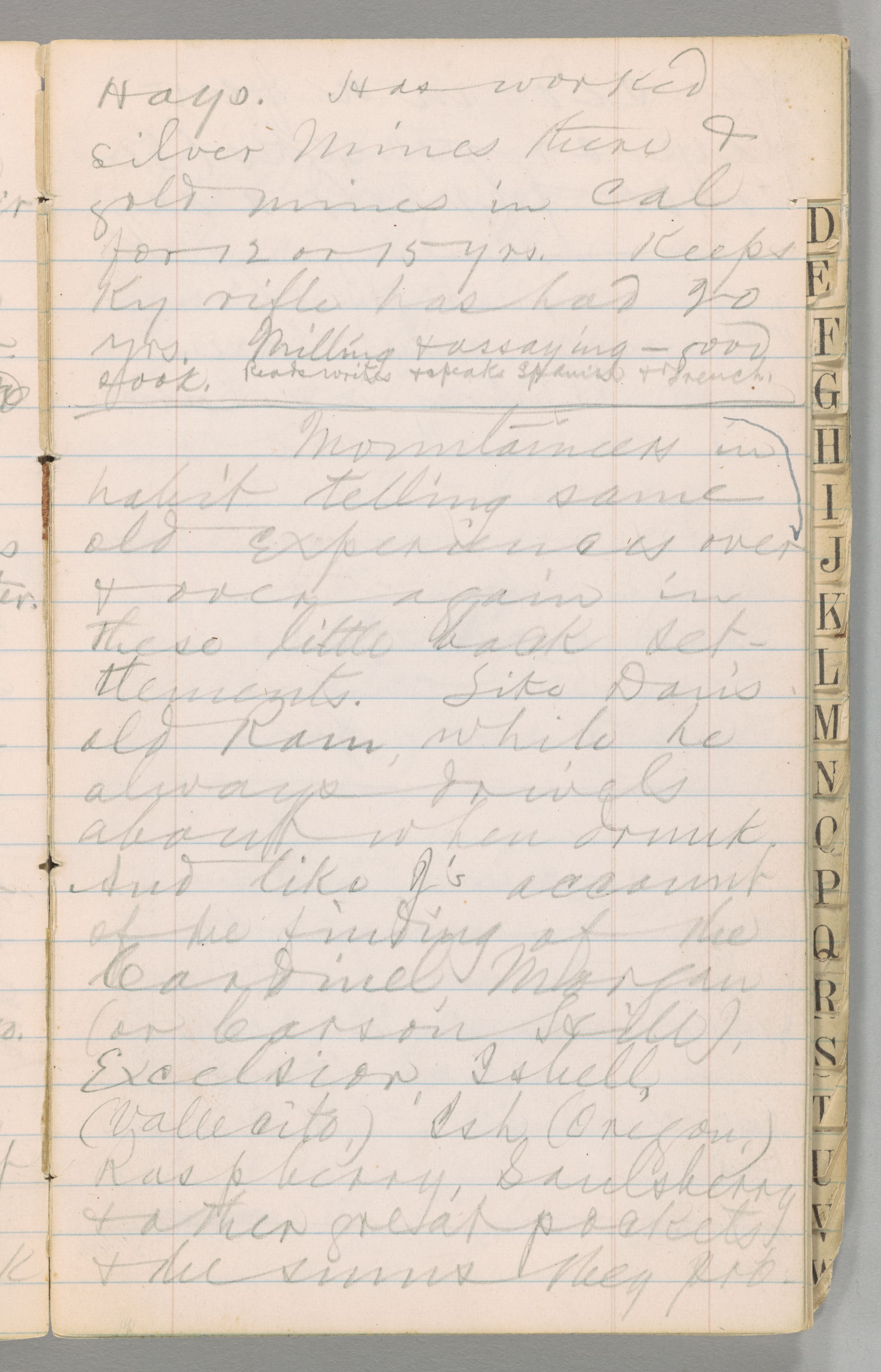
Hays. Has worked
silver mines there &
gold mines in Cal
for 12 or 15 yrs. Keeps
Ky rifle has had 20
yrs. Milling & assaying—good
cook. Reads writes & speaks Spanish & French.
Mountaineers in
habit telling same
old experiences over
& over again in
these little back
set-
tlements
settlements
. Like Dan's
old Ram,19
whihⓂemendation
[MTP: N&J1_75]
he
always drivels
about when drunk.
And like J's account
of the finding of the
Cardinel, Morgan
(or Carson Hill),
Excelsior, Isbell,
(Vallecito,) Ish (Oregon,)
Raspberry,20 Saulsberry
& other great pockets,
& the sums they pro-
[MS: N04_leaf_009v]
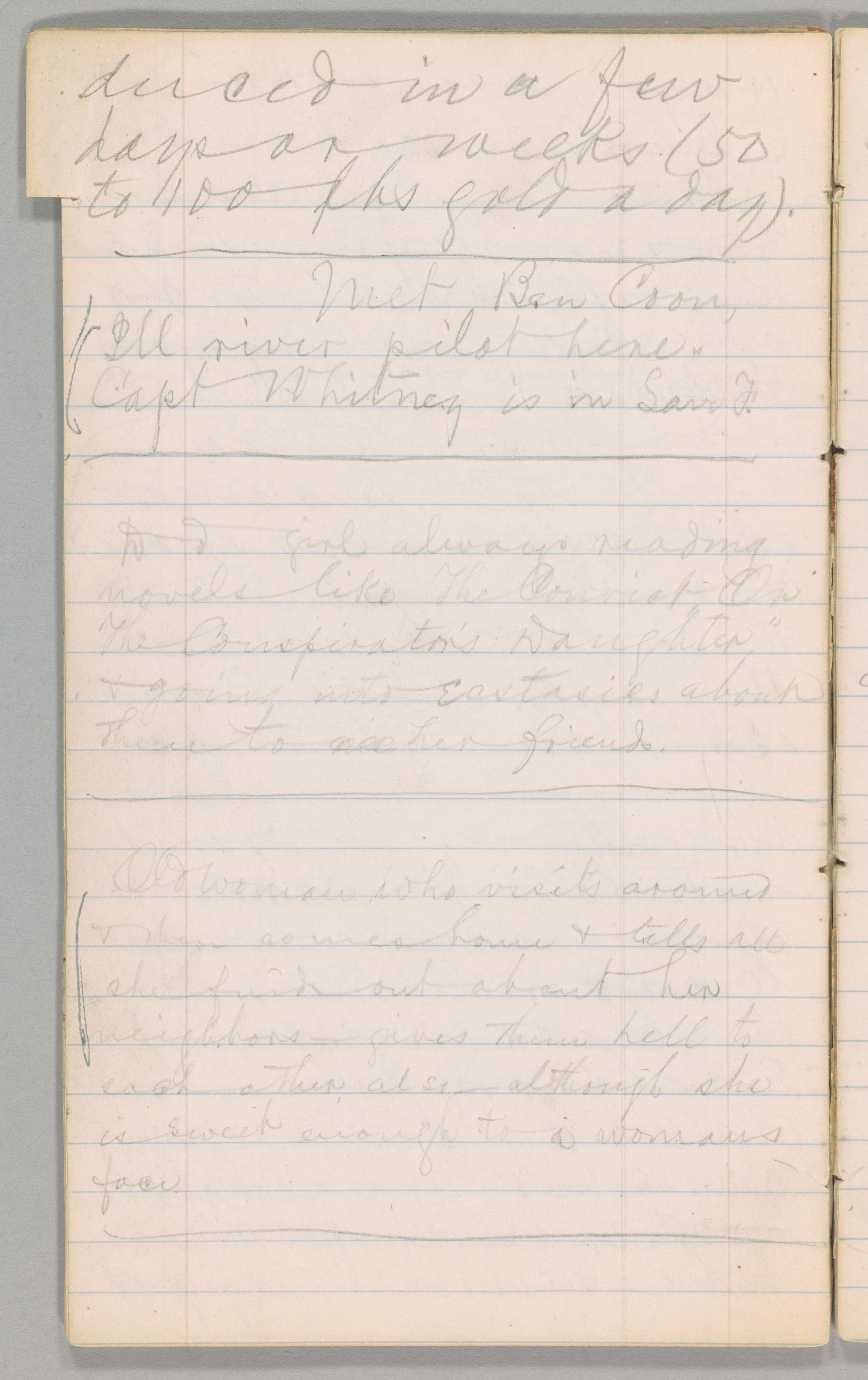
duced in a few
days or weeks (50
to 100 lbs gold a day).
Met Ben Coon,
Ill river pilot here.21
Capt Whitney22 is in San F.
[MTP: N&J1_76]
D—d girl always reading
novels like The Convict, Or
The Conspirator's Daughter,”23
& going into ecstasies about
them to me her friends.
Old woman who visits around
& then comes home & tells all
she finds out about her
neighbors—gives them hell to
each other, also—although she
is sweet enough to a womans
face.
[MS: N04_leaf_010r]
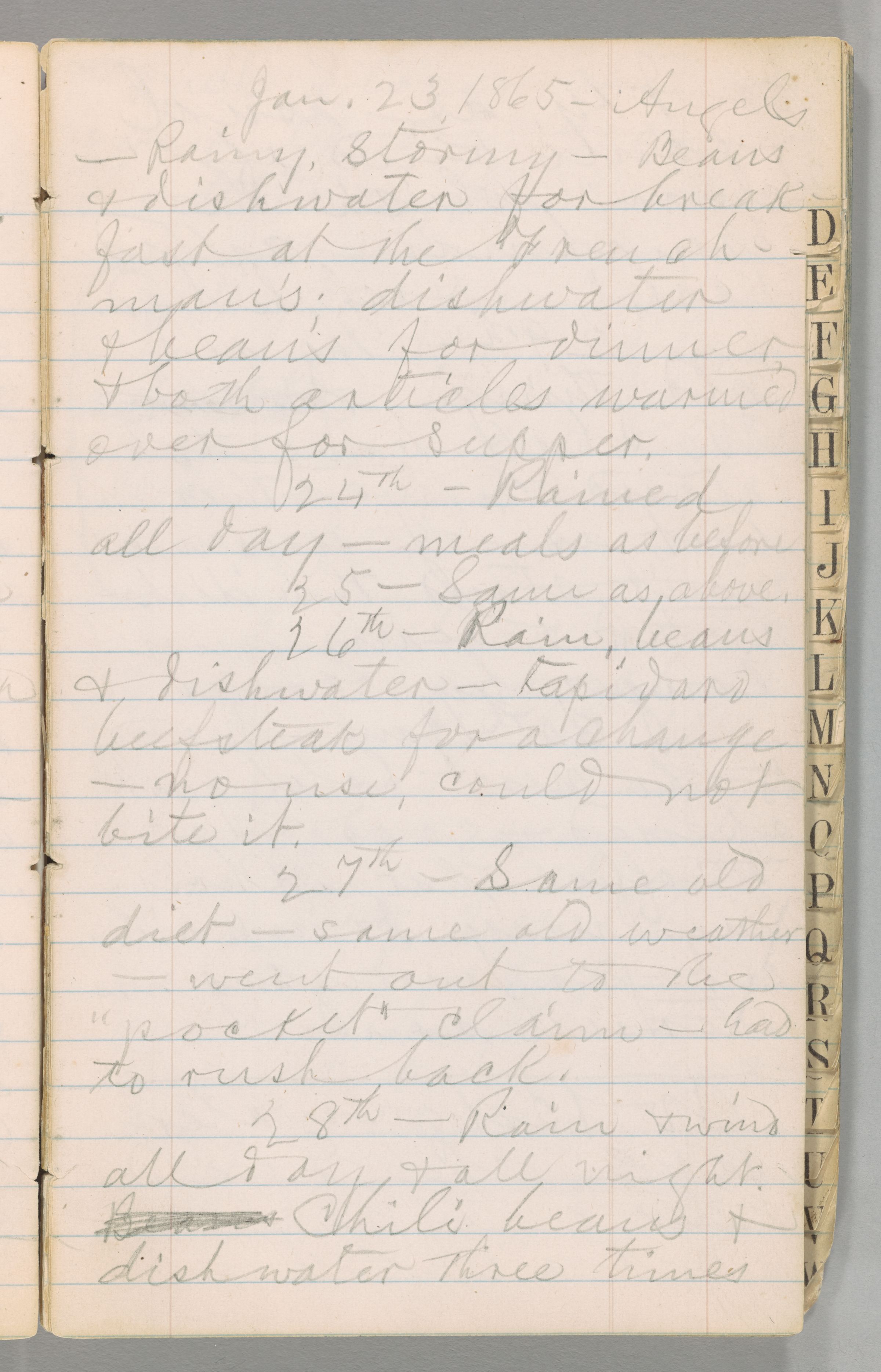
Jan. 23, 1865—Angels
—Rainy, stormy—Beans
& dishwater for
break-
fast
breakfast
at the
French-
man’s
Frenchman's
; dishwater
& beans for dinner,
& both articles warmed
over for supper.
24th—Rained
all day—meals as before
25—Same as above.
26th—Rain, beans
& dishwater—tapidaro24
beefsteak for a change
—no use, could not
bite it.
27th—Same old
diet—same old weather
—went out to the
“pocket” claim—had
to rush back.
28th—Rain & wind
all day & all night.
Beans Chili beans &
dishwater three times
[MS: N04_leaf_010v]
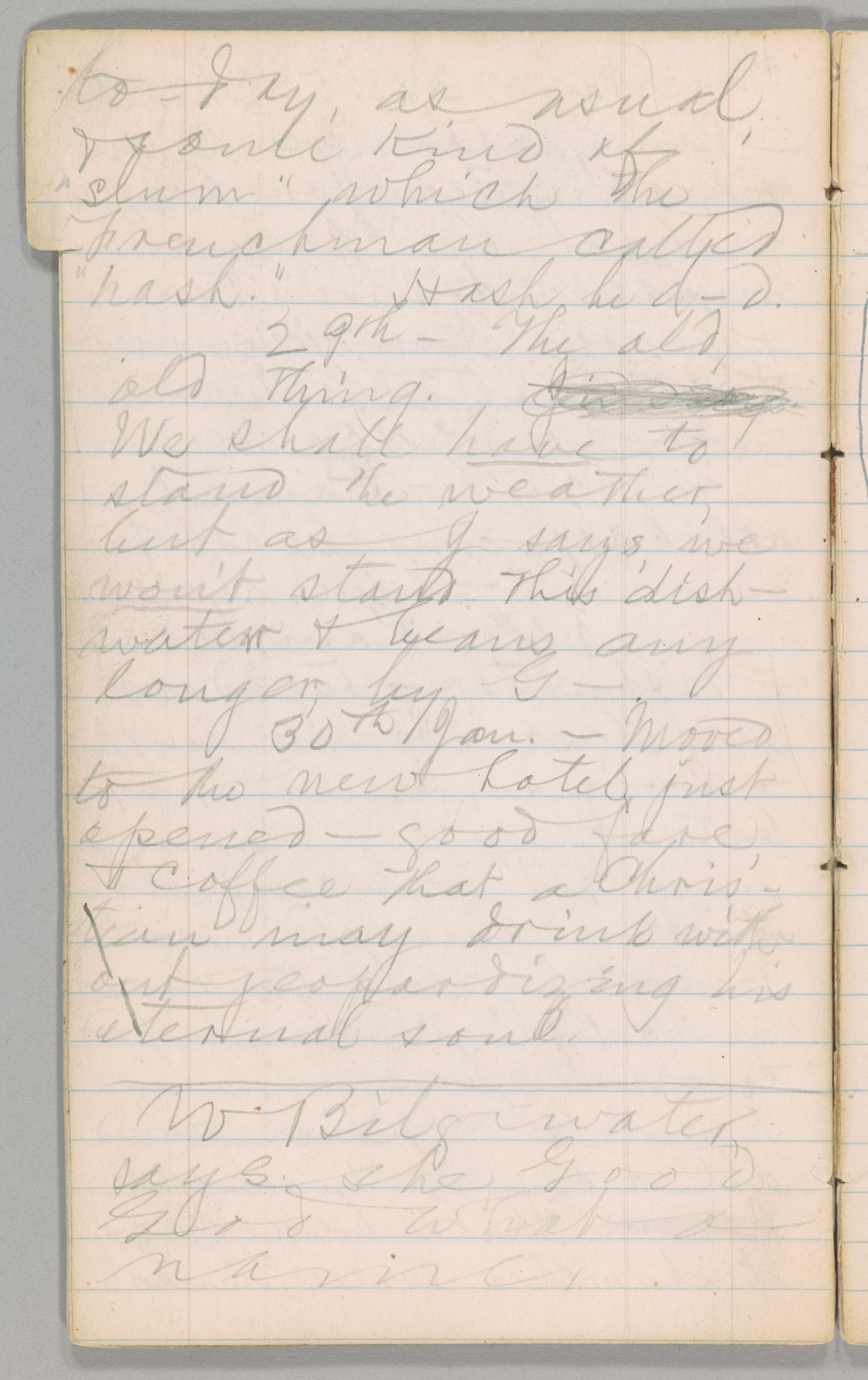
to-day, as usual,
& some kind of
“slum” which the
Frenchman called
“hash.” Hash be d—d.
29th—The old,
old thing. Jim says
We shall have to
stand the weather,
but as J says, we
won't stand this
dish-
water
dishwater
Ⓜemendation & beans any
longer, by G—.
30th Jan.—Moved
to the new hotel, just
opened—good fare,
& coffee that a
Chris-
tian
Christian
may drink
with
out
without
jeopardizing his
eternal soul.
W Bilgewater,
says she, Good
God what a
name.25
[MS: N04_leaf_011r]
[MTP: N&J1_77]
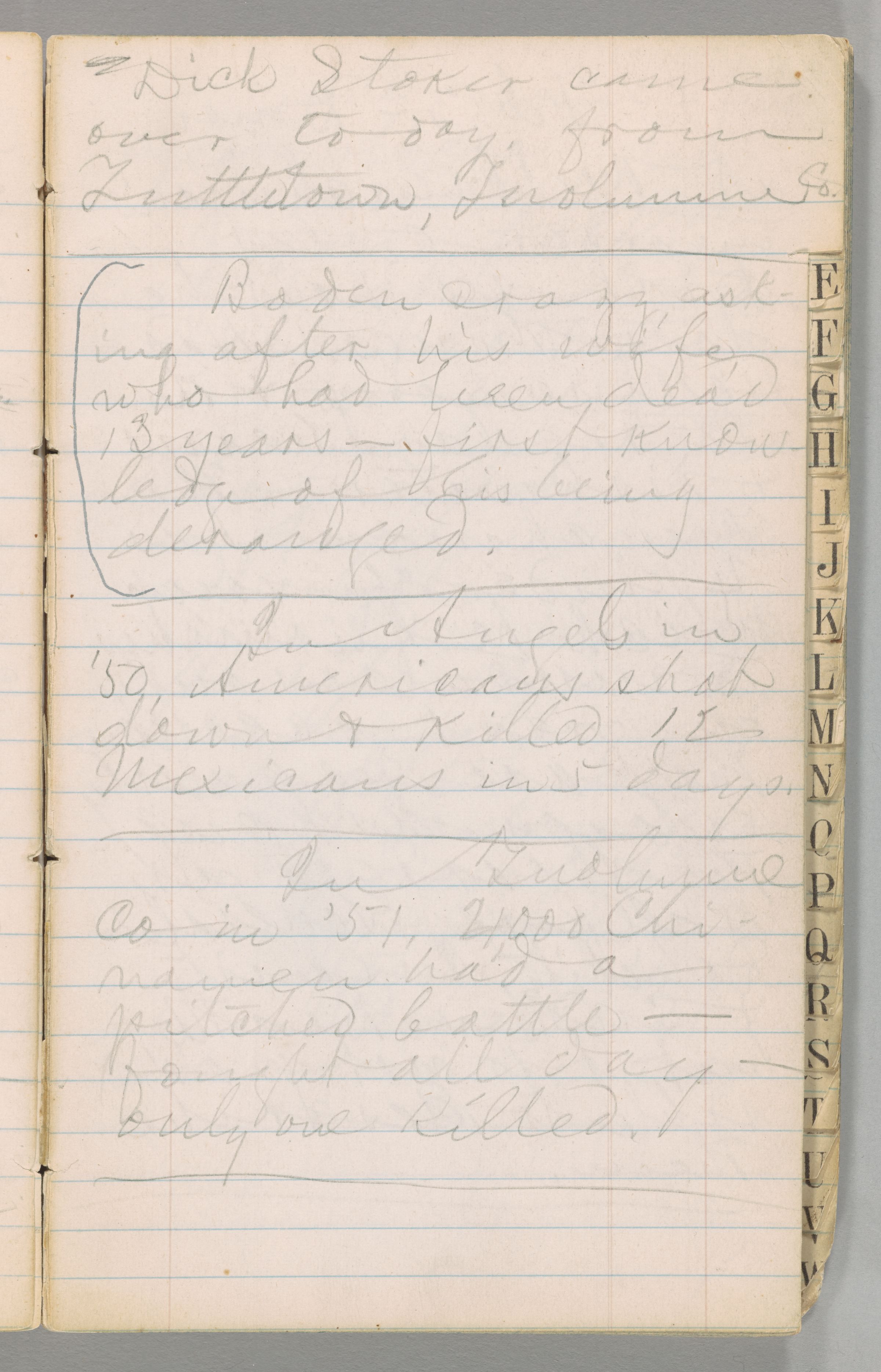
“Dick Stoker came
over to-dayⓂemendation, from
Tuttletown, Tuolumne Co.
Boden crazy,
ask-
ing
asking
after his wife,
who had been dead
13 years—first
know-
ledge
knowledge
of his being
deranged.26
In Angels in
'50, Americans shot
down & killed 12
Mexicans in 5 days.27
In Tuolumne
Co in '51,
2 4,000Ⓣtextual note
Chi-
namen
Chinamen
had a
pitched battle—
fought all day—
only one killed.28
[MS: N04_leaf_011v]
[MTP: N&J1_78]
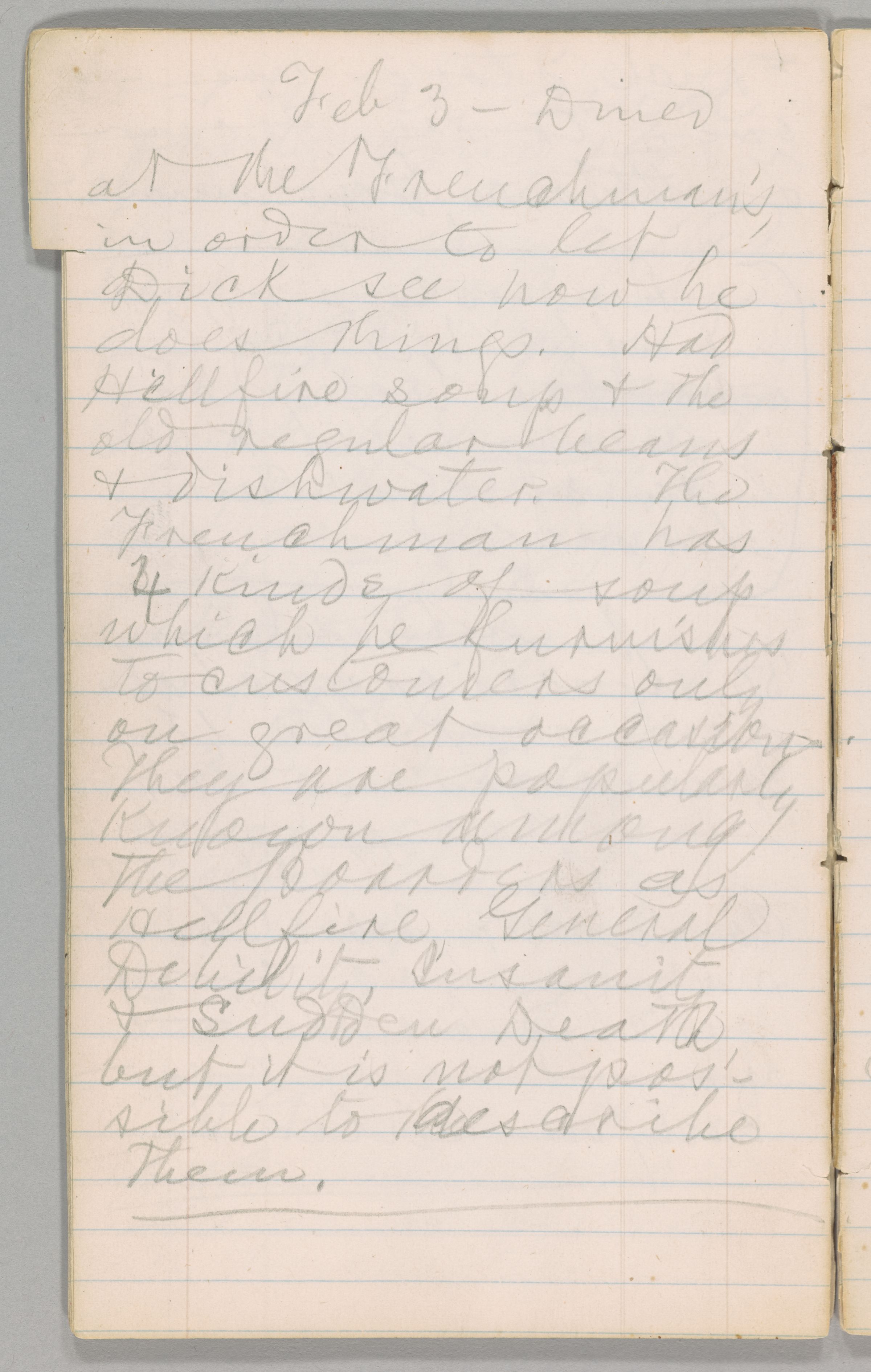
Feb 3—Dined
at the Frenchman's,
in order to let
Dick see how he
does things. Had
Hellfire soup & the
old regular beans
& dishwater. The
Frenchman has
3 4 kinds of soup
which he furnishes
to customers only
on great occasions.
They are popularly
known among
the Boarders as
Hellfire, General
Debility, Insanity
& Sudden Death,
but it is not
pos-
sible
possible
to the describe
them.
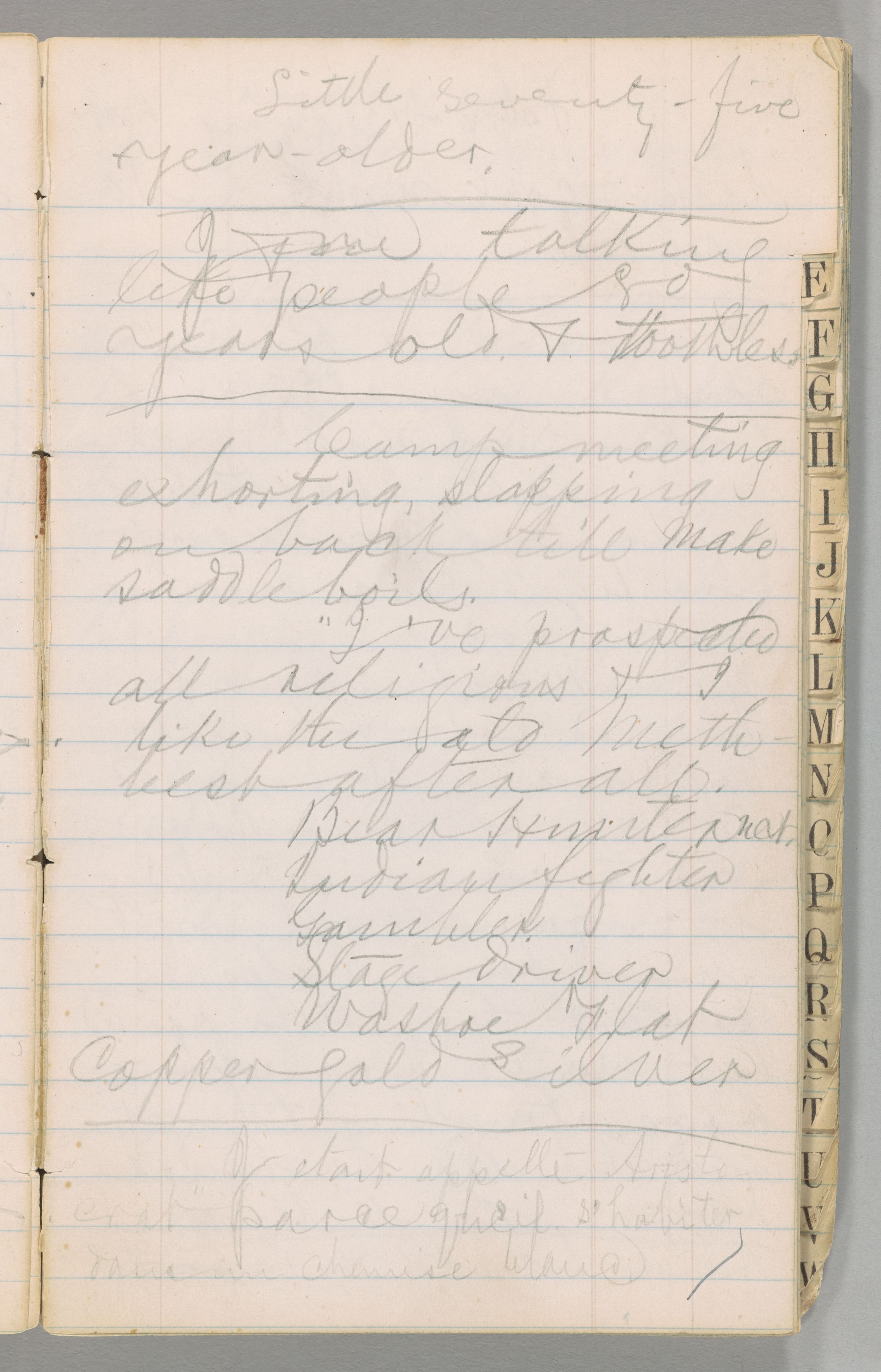
[MS: N04_leaf_012r]
Little seventy-five
-year-older.
Jim
J & meⓉtextual note talking
like people 80
years old & toothless.
Camp meeting
exhorting, slapping
on back till make
saddle boils.
“I've prospected
all religions & I
like the old Meth-
best after all.
Bear Hunter next.
Indian fighter
Gambler.
Stage driver
Washoe Flat
Copper gold silver
J etait appellé “
Aristo-
crat
Aristocrat
” parce queil qu'ilⓉtextual note s'habiter
dans un chemise blanc.
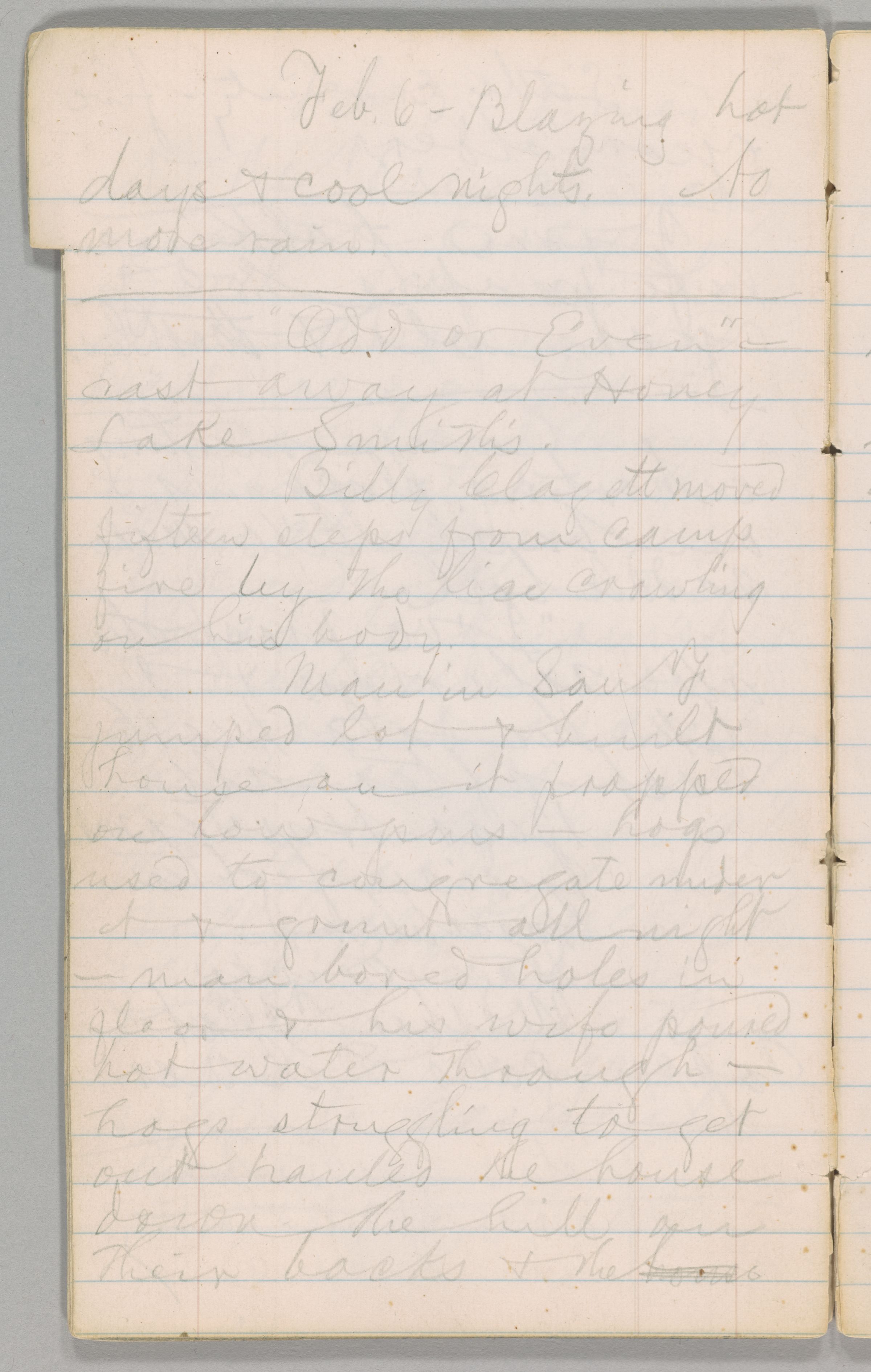
[MS: N04_leaf_012v]
Feb. 6—Blazing hot
days & cool nights. No
more rain.
“Odd or Even”—
cast away at Honey
Lake Smith's.29
Billy Clagett moved
fifteen steps from camp
fire by the lice crawling
on his body.30
Man in San F
jumped lot & built
house on it propped
on low pins
[MTP: N&J1_79]
—hogs
used to congregate under
it & grunt all night
—man bored holes in
floor & his wife poured
hot water through—
hogs struggling to get
out hauled the house
down the hill on
their backs & the house
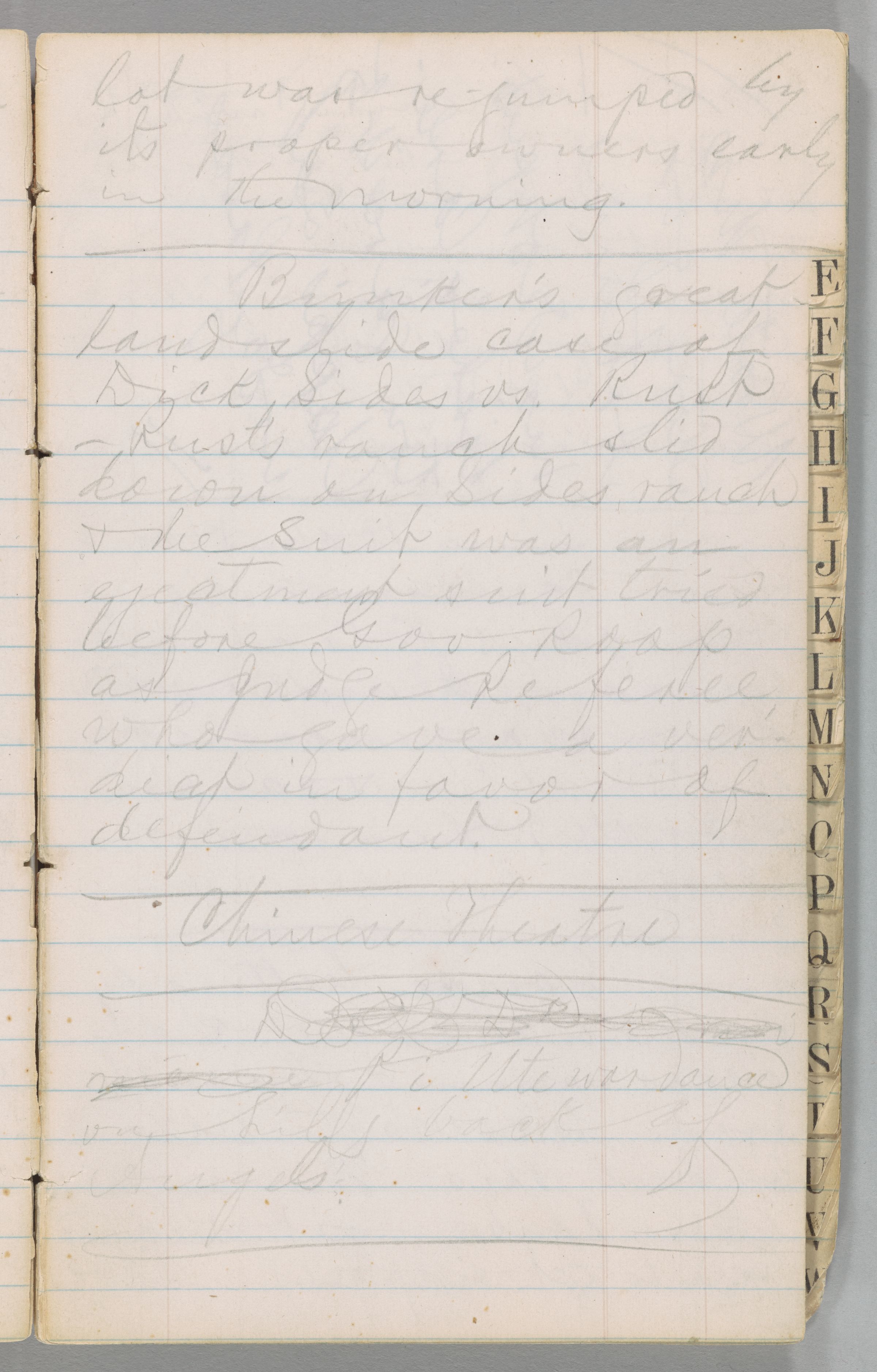
[MS: N04_leaf_013r]
lot was re-jumped by
its proper owners early
in the morning.31
Bunker's gereatⓉtextual note
landslideⓂemendation case of
Dick Sides vs. Rust
—Rust's ranch slid
down on Sides ranch
& the suit was an
ejectment suit tried
before Gov Roop
as Judge Referee,
who gave a
ver-
dict
verdict
in favor of
defendant.32
Chinese Theatre33
D---- D ◊◊◊◊
◊◊◊◊◊◊ Pi Ute war dance
on hills back of
Angels'.
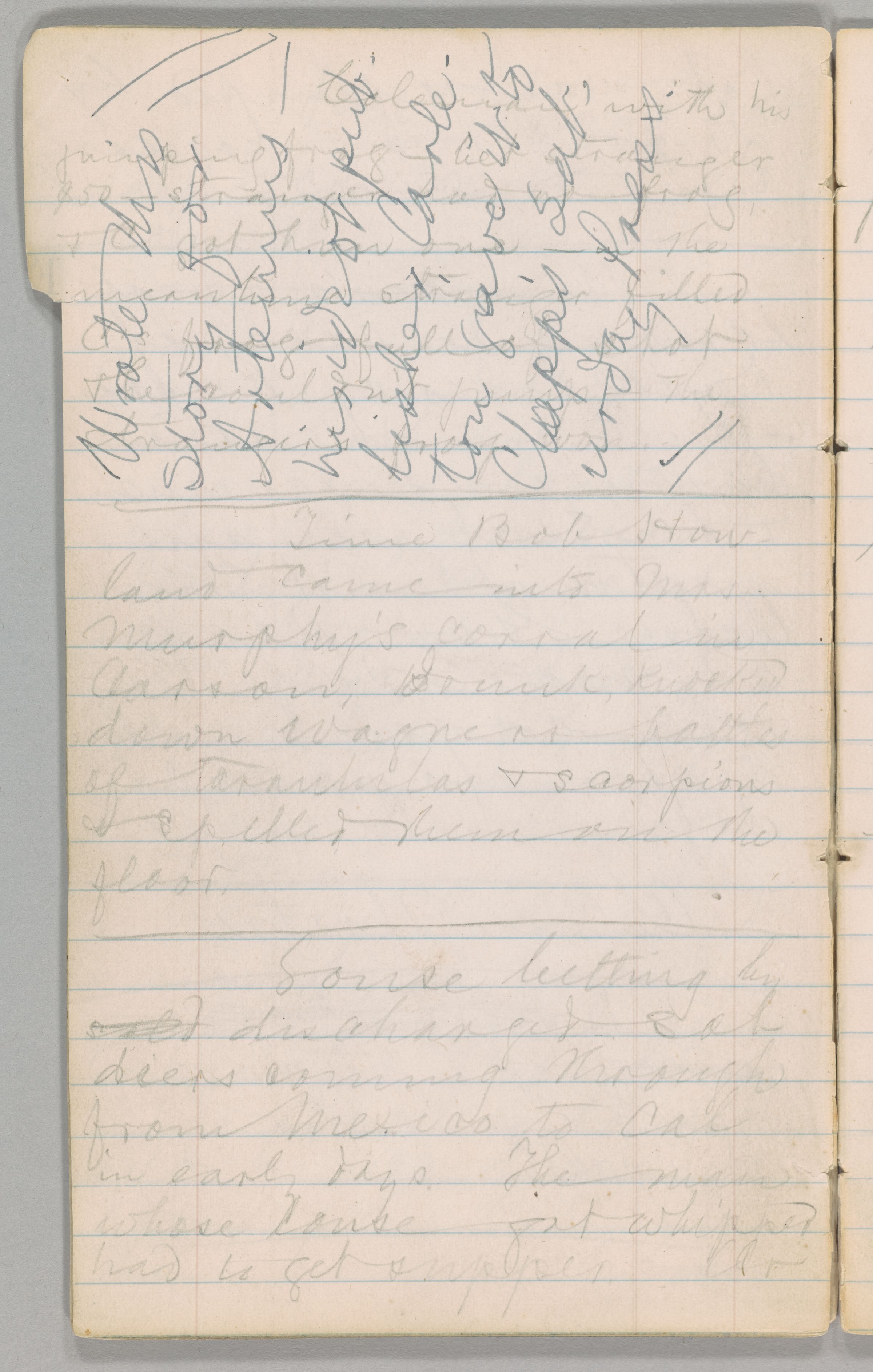
[MS: N04_leaf_013v]
[MTP: N&J1_80]
Coleman with his
jumping frog—bet stranger
$50—stranger had no frog,
& C got him one—in the
meantime stranger filled
C's frog full of shot
& he couldn't jump—the
stranger's frog won.
story for
Artemus—
his idiot pub-
lisher publisher , Carle-
ton Carleton gave it to
Clapp's Sat-
urday Saturday Press. Ⓣtextual note 34
Time Bob
How-
land
Howland
came into Mrs.
Murphy's corral in
Carson, k drunk, knocked
down Wagners bottles
of tarantulas & scorpions
& spilled them on the
floor.35
[MTP: N&J1_81]
Louse betting by
sold discharged
sol-
diers
soldiers
coming through
from Mexico to Cal
in early days. The man
whose louse got whipped
had to get supper. Or
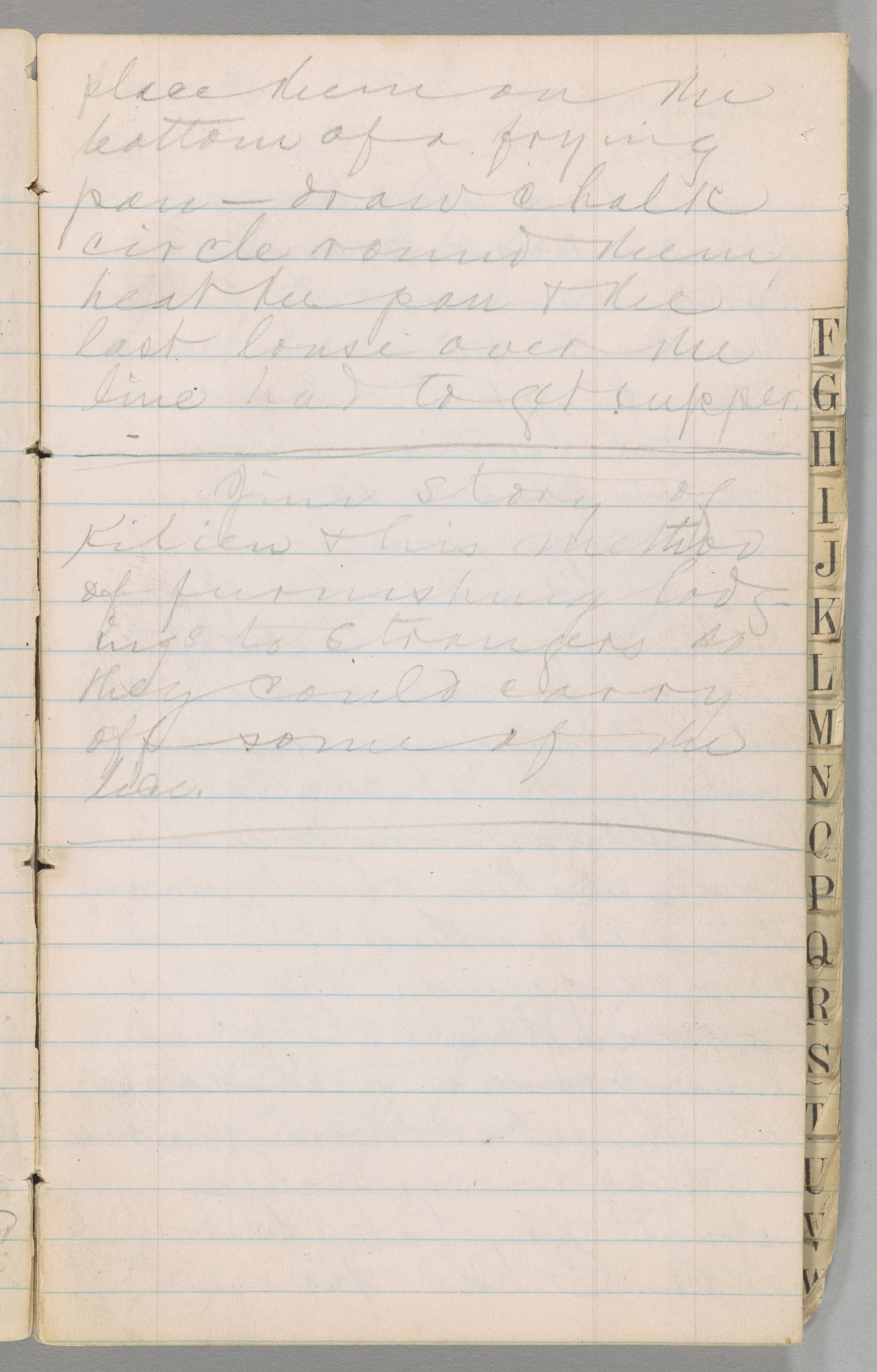
[MS: N04_leaf_014r]
place them on the
bottom of a frying
pan—draw chalk
circle round them,
heat the pan & the
last louse over the
line had to get supper.
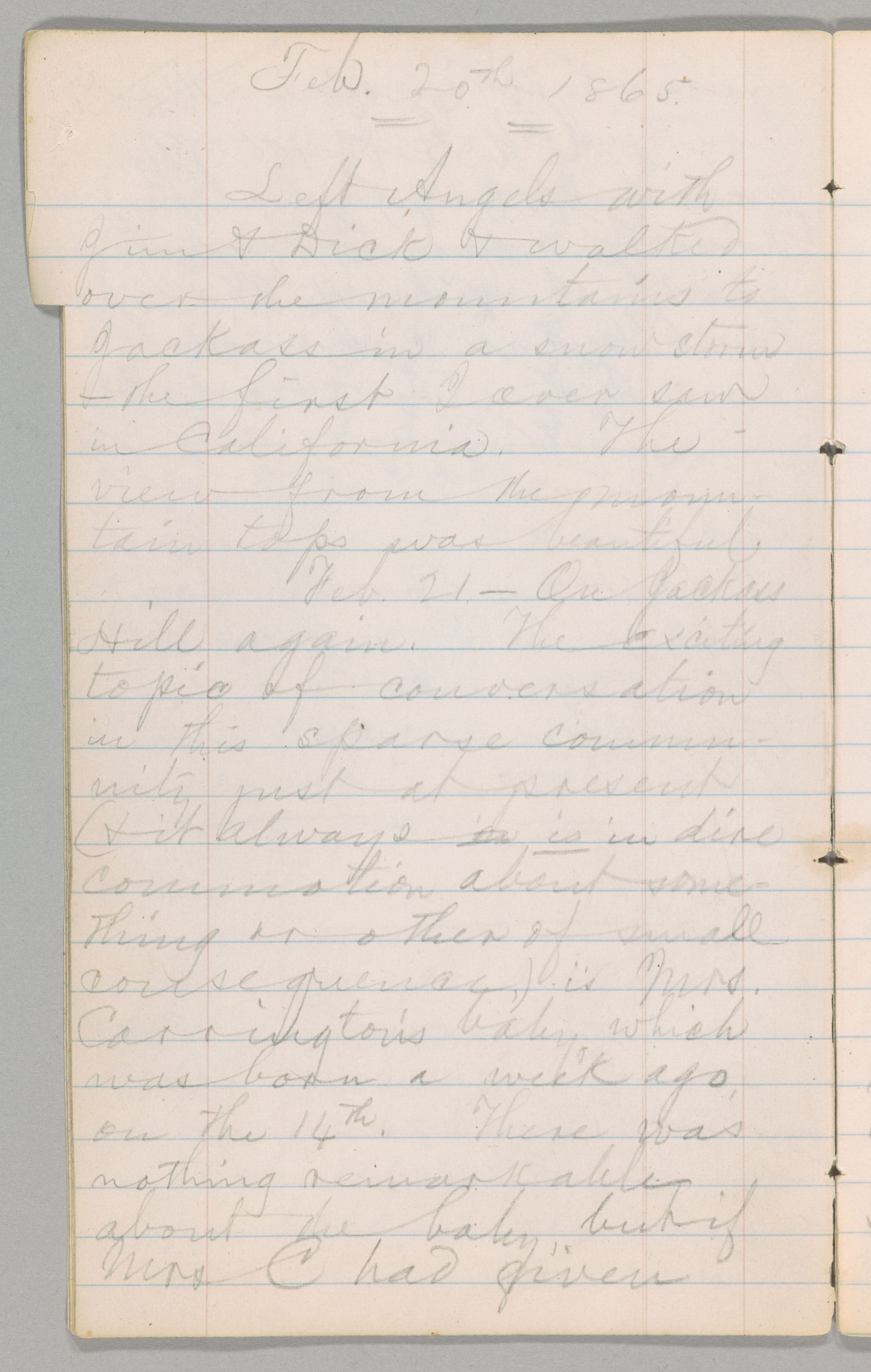
Jim story of
Kilien & his method
of furnishing
lodg-
ings
lodgings
to strangers so
they could carry
off some of the
lice.
[MS: N04_leaf_014v]
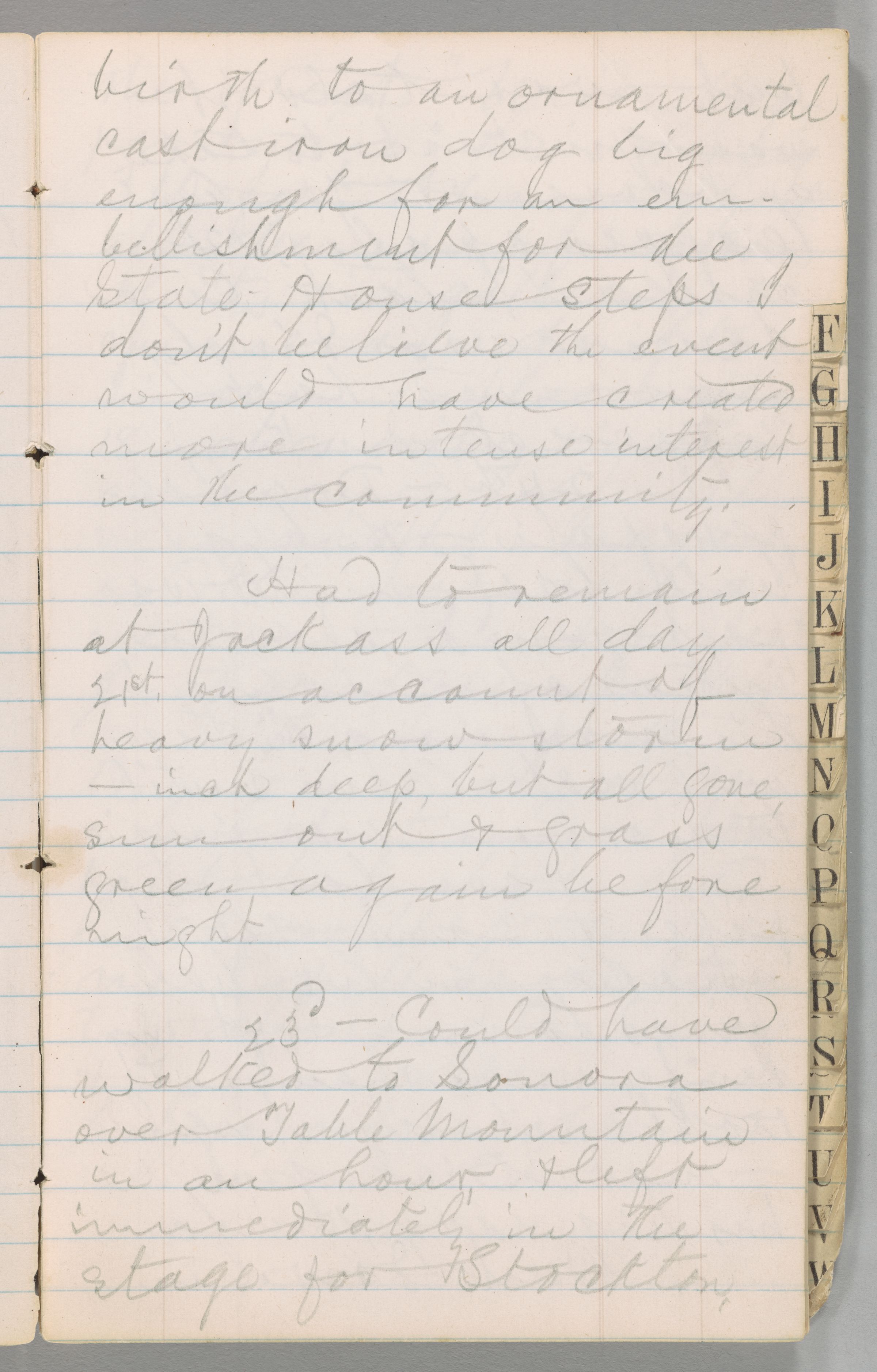
Feb. 20th 1865.
Left Angels with
Jim & Dick & walked
over the mountains to
Jackass in a snow stormⓂemendation
—the first I ever saw
in California. The
view from the
moun-
tain
mountain
tops was beautiful.
Feb. 21—On Jackass
Hill again. The exciting
topic of conversation
in this sparse
commu-
nity
community
just at present
(& it always in
is in dire
commotion about
some-
thing
something
or other of small
consequence,) is Mrs.
Carrington's baby, which
was born a week ago,
on the 14th. There was
nothing remarkable
about the baby, but if
Mrs C had given
[MS: N04_leaf_015r]
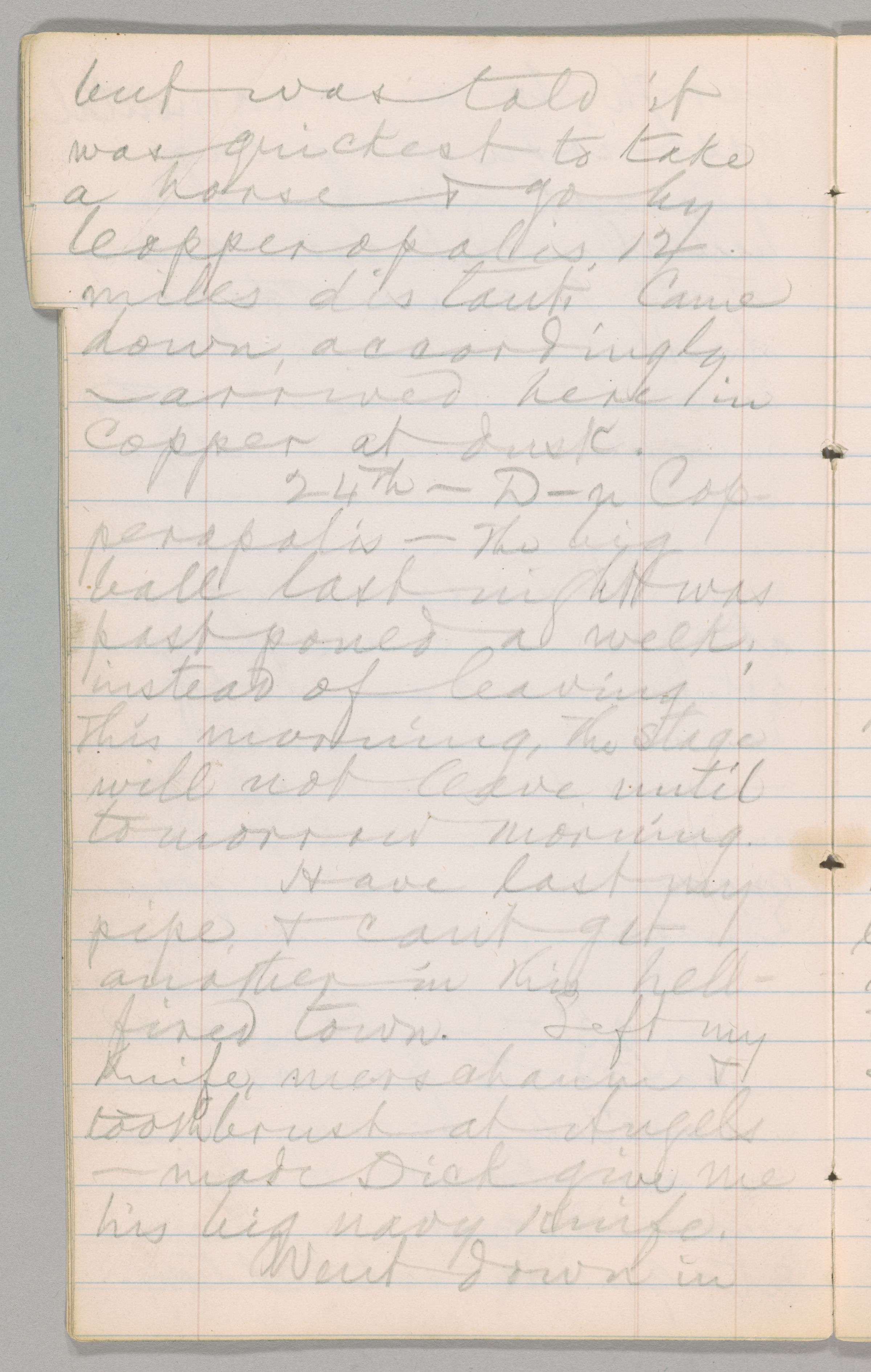
birth to an ornamental
cast-ironⓂemendation dog big
enough for an
em-
bellishment
embellishment
for the
State-House steps I
don't believe the event
would have created
more intense interest
in the community.
Had to remain
at Jackass all day
21st, on account of
heavy snow stormⓂemendation
—inch deep, but all gone,
sun out & grass
green again before
night.
23d—Could have
walked to Sonora
over Table Mountain
in an hour, & left
immediately in the
stage for Stockton,
[MS: N04_leaf_015v]
but was told it
was quickest to take
a horse & go by
Copperopolis, 12
miles distant. Came
down, accordingly
—arrived here in
Copper at dusk.
[MTP: N&J1_82]
24th—D—n
Cop-
peropolis
Copperopolis
—the big
ball last night was
postponed a week;
instead of leaving
this morning, the stage
will not leave until
to-morrowⓂemendation morning.
Have lost my
pipe, & cant get
another in this
hell-
fired
hellfired
Ⓜemendation town. Left my
knife, merschaum &
toothbrush at Angels
—made Dick give me
his big navy knife.
Went down in
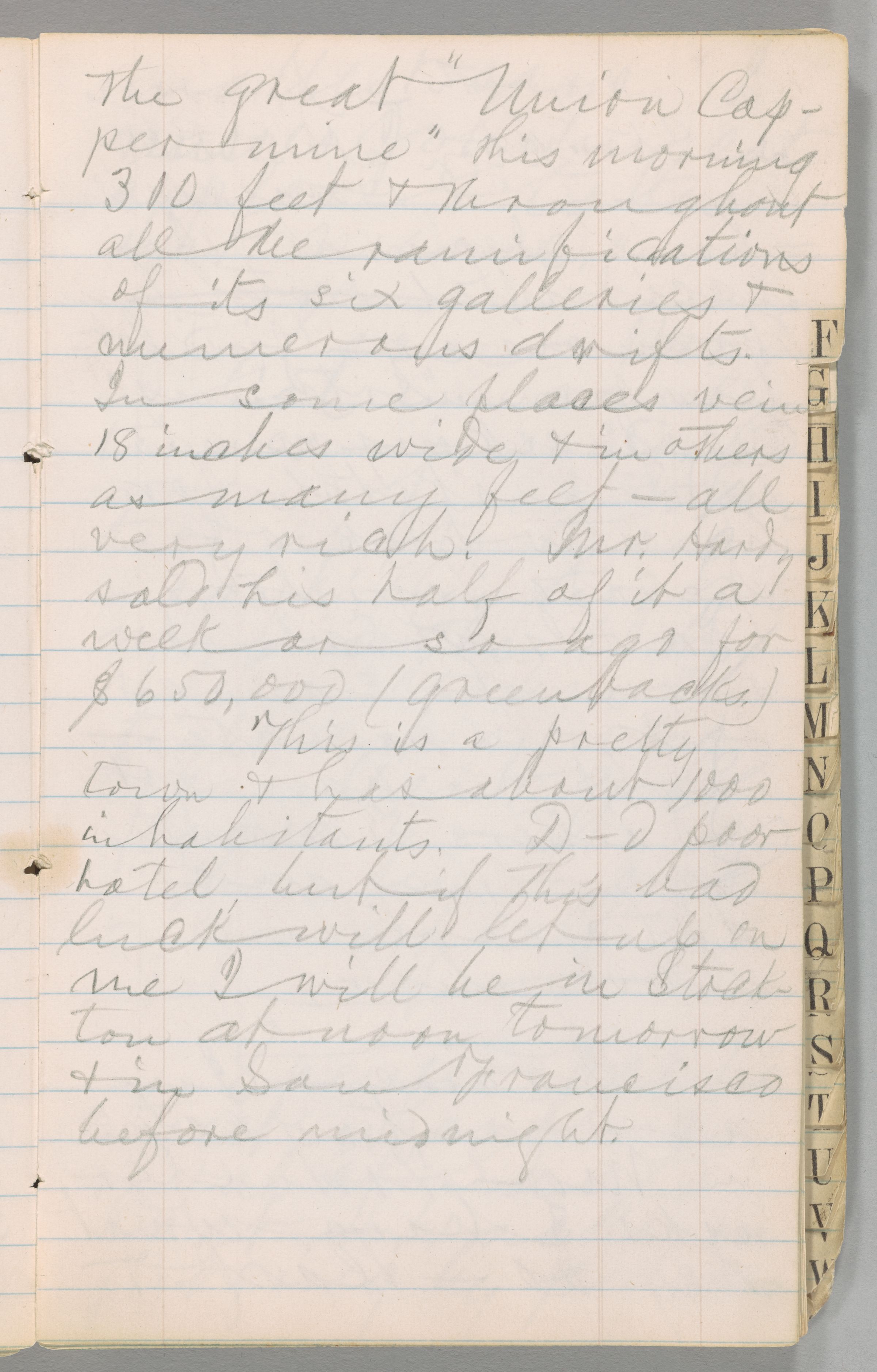
[MS: N04_leaf_016r]
the great “Union
Cop-
per
Copper
mine” this morning
300 feet & throughout
all the ramifications
of its six galleries &
numerous drifts.
In some places vein
18 inches wide & in others
as many feet—all
very rich. I Mr. Hardy
sold his half of it a
week or so ago for
$650,000 (greenbacks.)
This is a pretty
town & has about 1000
inhabitants. D—d poor
hotel, but if this bad
luck will let up on
me I will be in
Stock-
ton
Stockton
at noon to-morrowⓂemendation
& in San Francisco
before midnight.
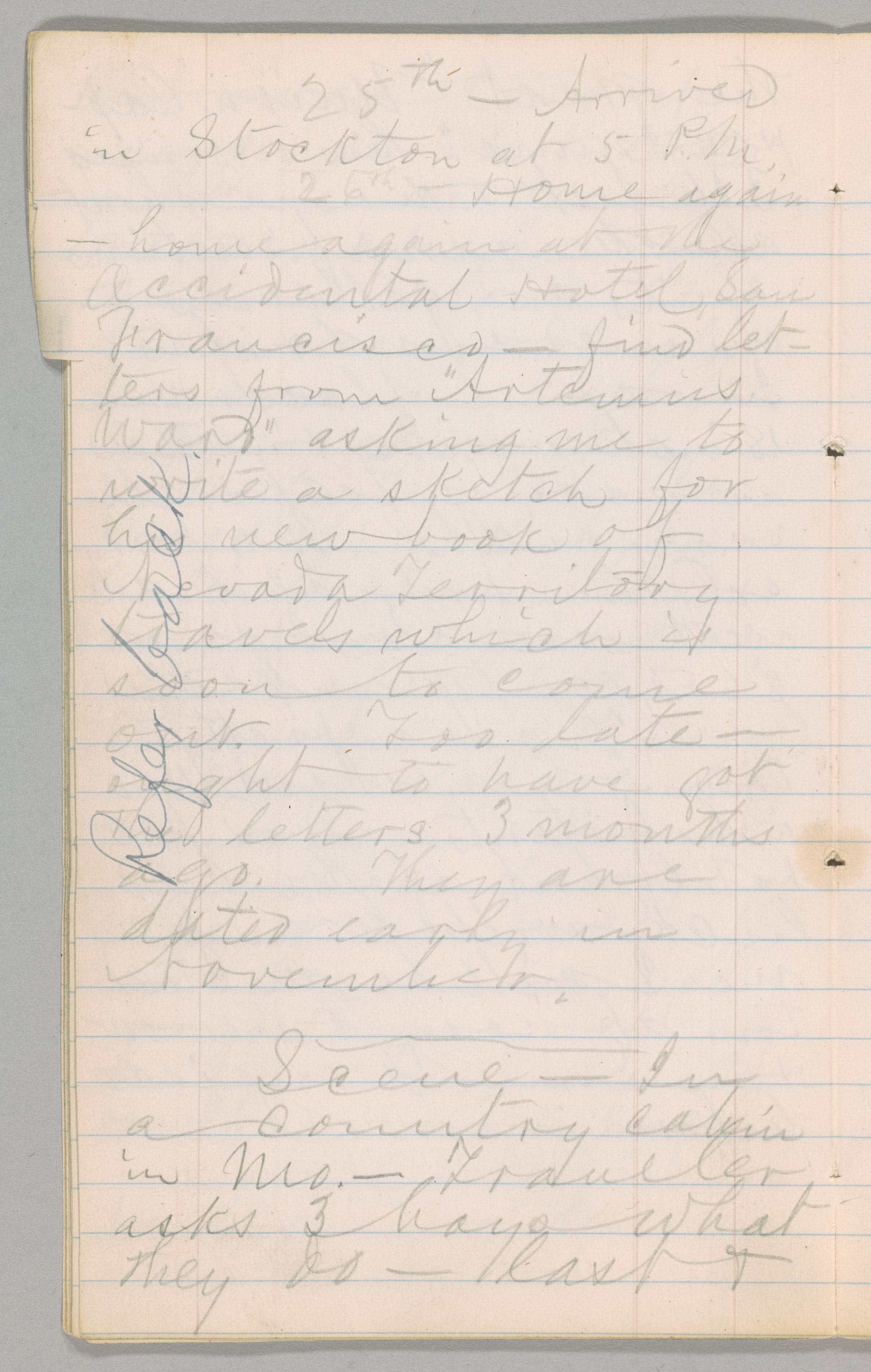
[MS: N04_leaf_016v]
25th—Arrived
in Stockton at 5 P.M.
26th—Home again
—home again at the
Occidental Hotel,36 San
Francisco—find
let-
ters
letters
from “Artemus
Ward” asking me to
write a sketch for
his new book of
Nevada Territory
travels which is
soon to come
out. Too late—
ought to have got
the letters 3 months
ago. They are
dated early in
November.
[MTP: N&J1_83]
Scene—In
a country cabin
in Mo.—Traveler
asks 3 boys what
they do—last &
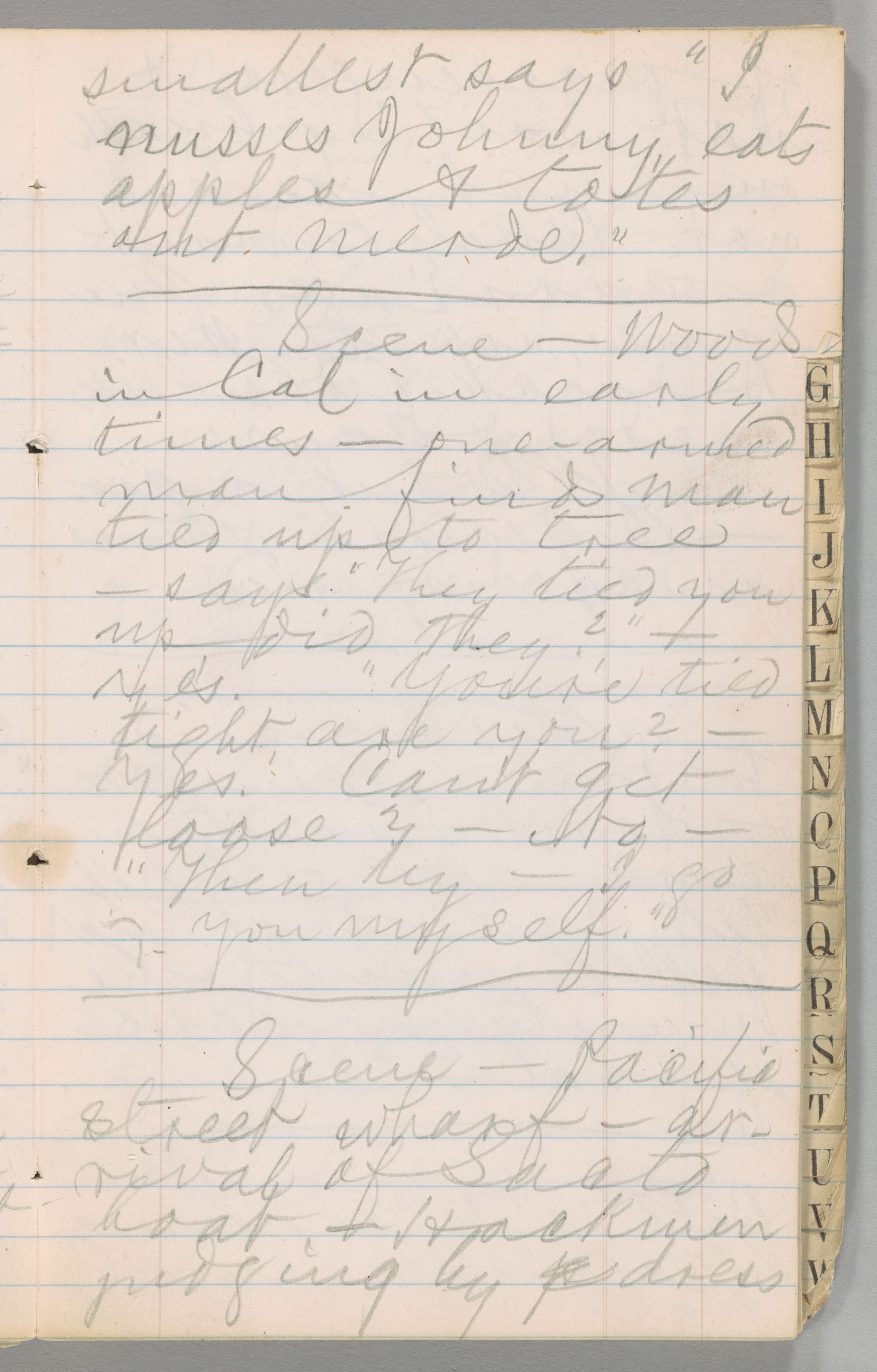
[MS: N04_leaf_017r]
smallest says “I
e nusses Johnny, eats
apples & totes
out merde.”
Scene—Woods
in Cal in early
times—one-armed
man finds man
tied up to tree
—says “They tied you
up, did they?”—
yes. “Your'e tied
tight, are you?—
yes. Can't get
loose?—No—
“Then by — I go
indecipherable shorthand word you myself.”
Scene—Pacific
street wharf—
ar-
rival
arrival
of Sacto
boat—Hackmen
judging by p dress
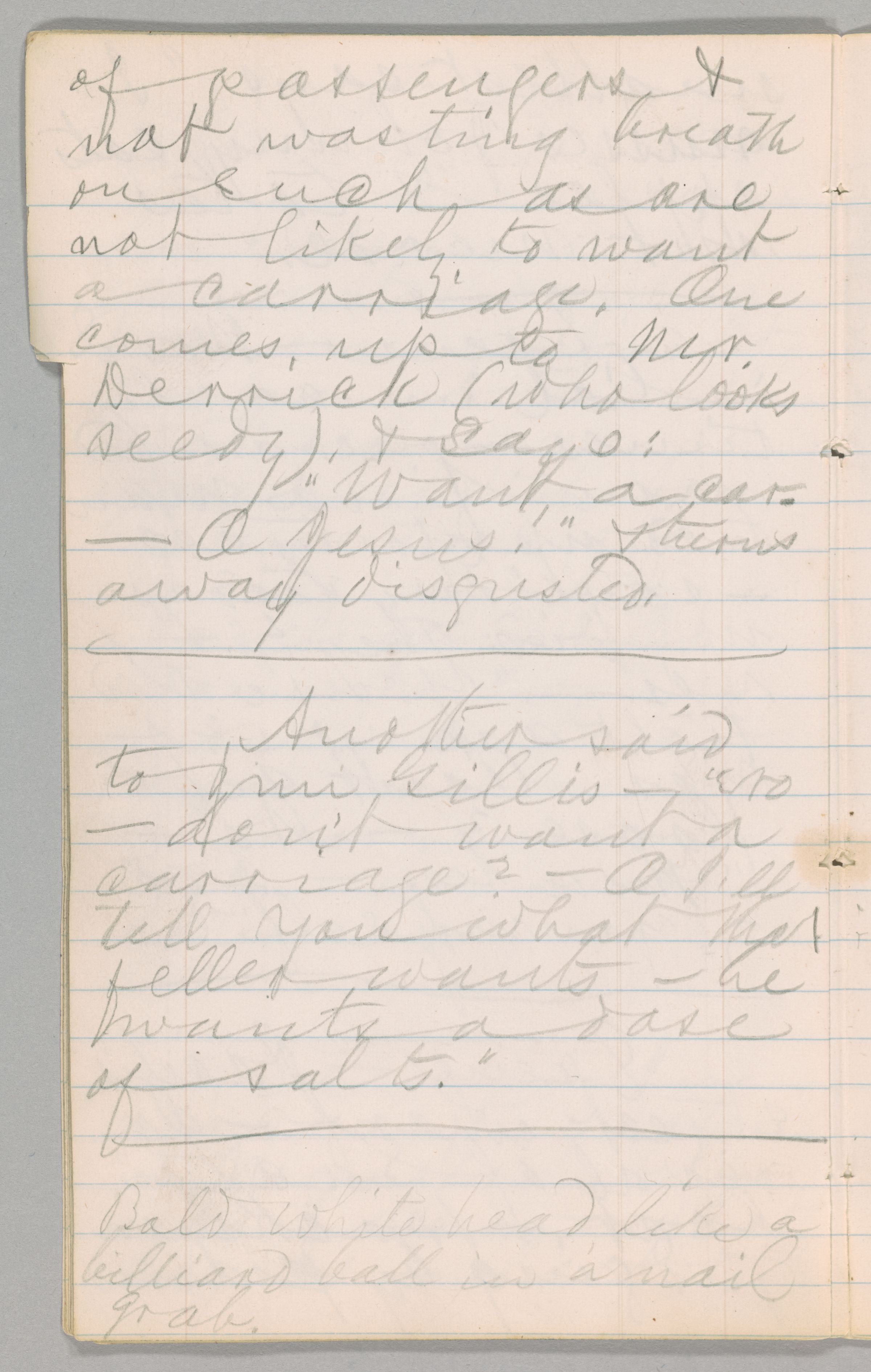
[MS: N04_leaf_017v]
of passengers &
not wasting breath
on such as are
not likely to want
a carriage. One
comes up to Mr.
Derrick (who looks
seedy), & says:
“Want a car.
—O Jesus!” & turns
away disgusted.
Another said
to Jim Gillis—“No
—don't want a
carriage?—O I'll
tell you what the
feller wants—he
wants a dose
of salts.”
Bald white head, like a
billiard ball in a nail
grab.
[MS: N04_leaf_018r]
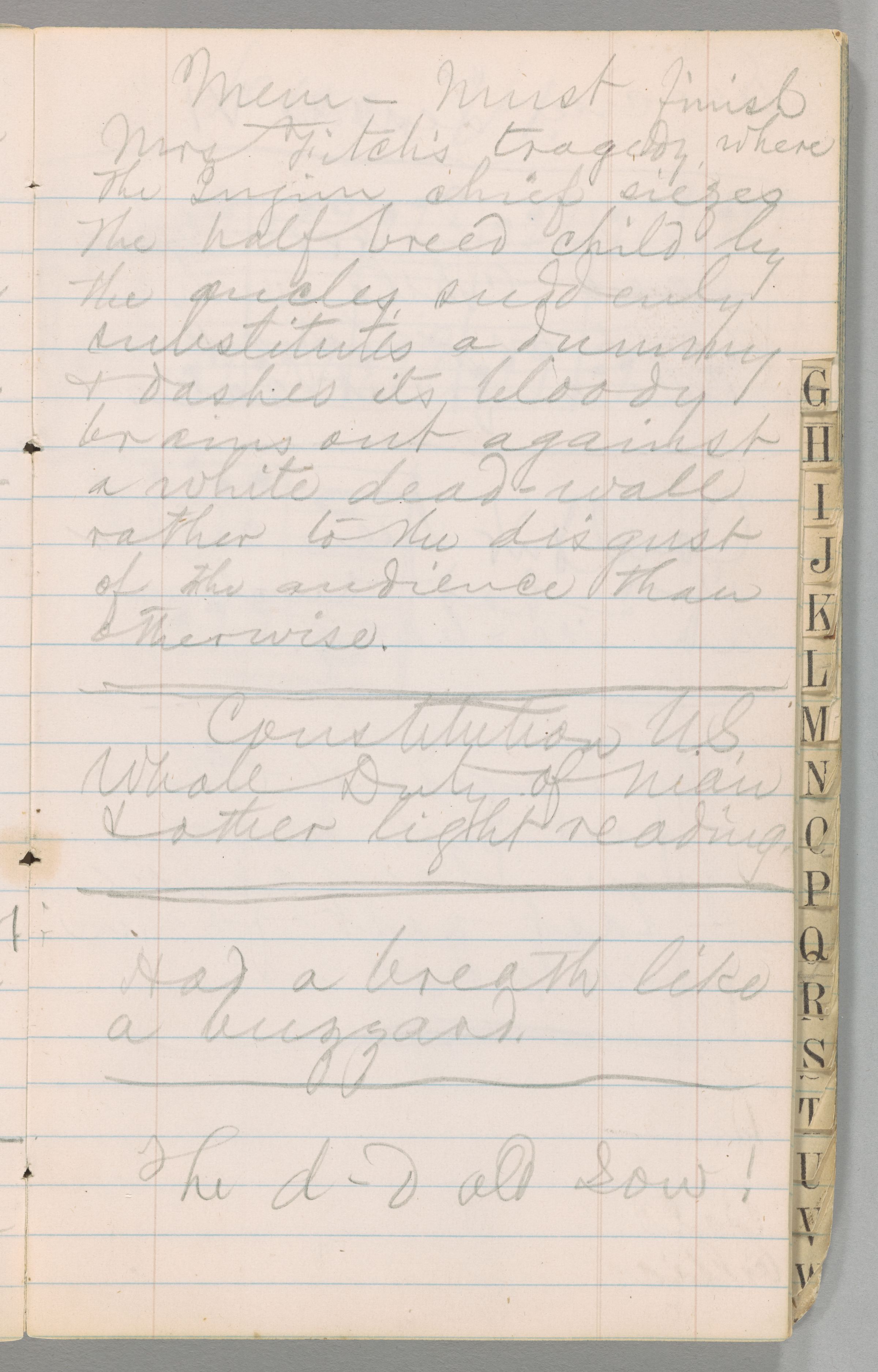
Mem—Must finish
Mrs Fitch's tragedy, where
the Injun chief siezes
the halfbreedⓂemendation child by
the ancles, suddenly
substitutes a dummy
& dashes its bloody
brains out against
a white dead-wall
rather to the disgust
of the audience than
otherwise.38
Constitution U.S,
Whole Duty of Man
& other light reading.
Had a breath like
a buzzard.
The d—d old sow!
[MS: N04_leaf_018v]
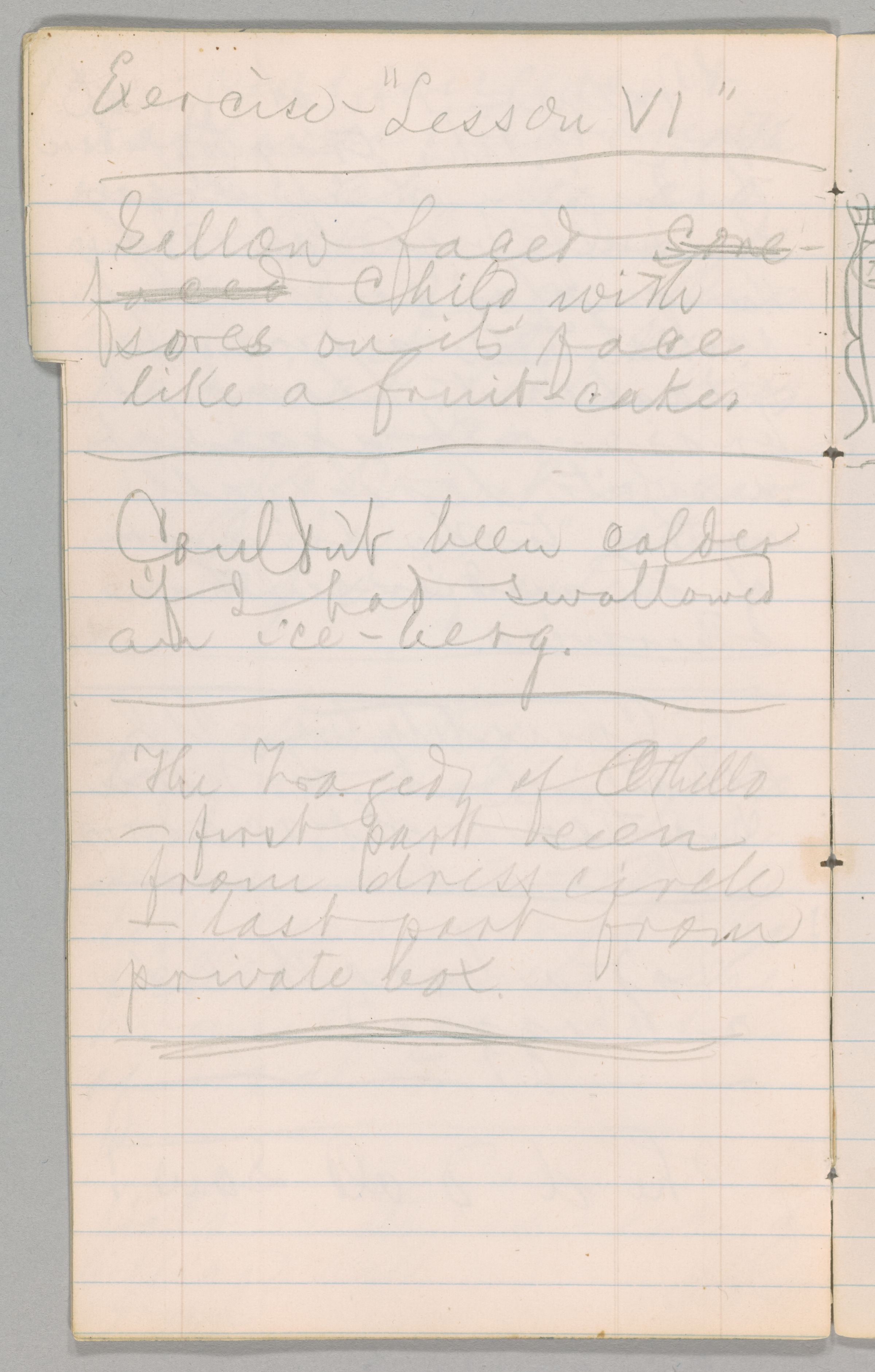
Exercise—“Lesson VI”
[MTP: N&J1_84]
Sallow facedⓂemendation
sore-
faced child, with
sores on its face
like a fruit-cake.
Couldn't been colder
if I had swallowed
an ice-berg.
The Tragedy of Othello
—first part seen
from dress circle
—last part from
private box.
[MS: N04_leaf_019r]
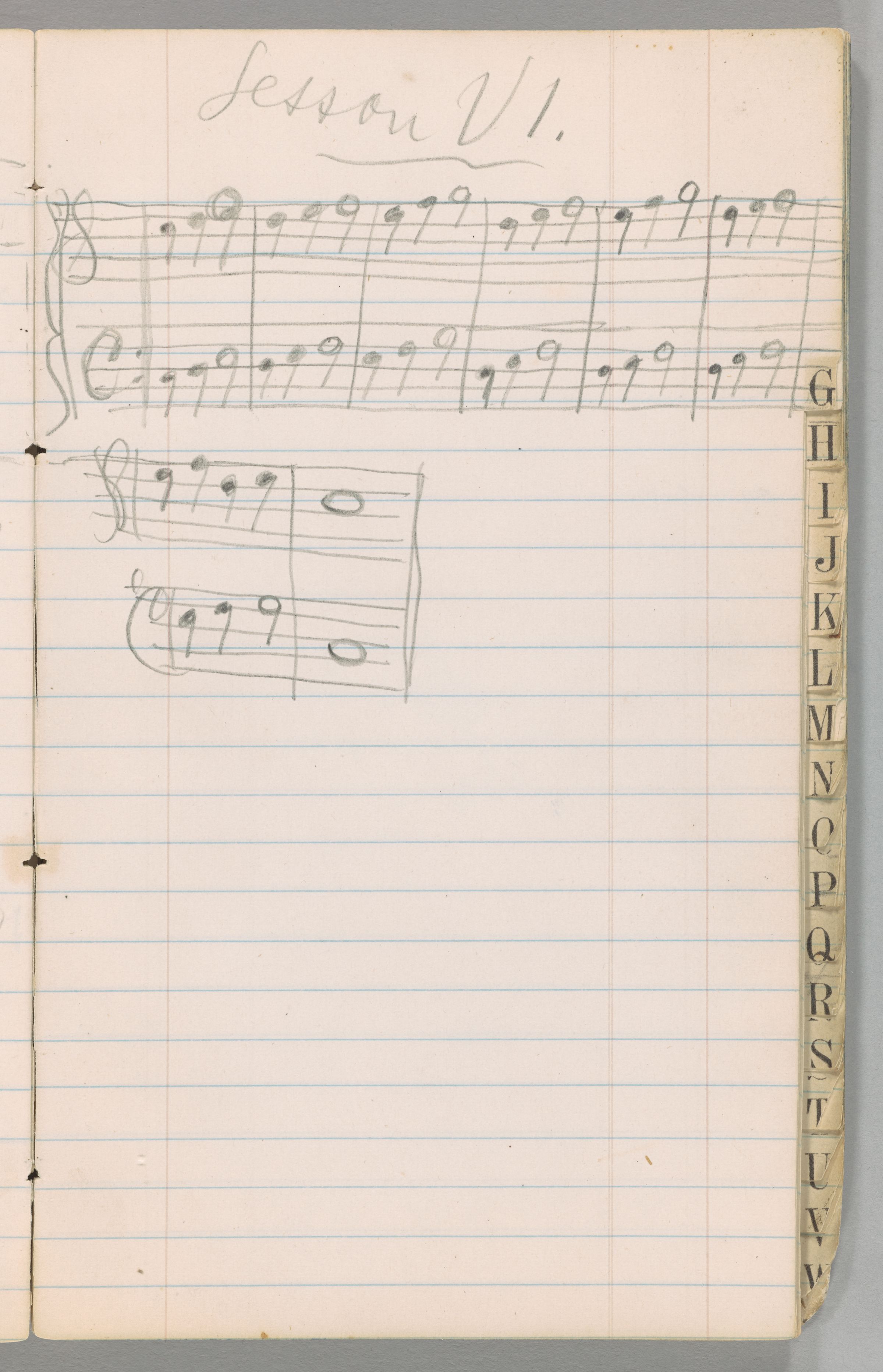
Clemens inscribed this musical notation on the first page of tabbed section "G" of the notebook. The rest of section "G" is blank as are the subsequent sections. Only the first page of each section has been provided.
[MS: N04_leaf_022r]
first page of section "H"
[MS: N04_leaf_025r]
first page of section "I"
[MS: N04_leaf_027r]
first page of section "J"
[MS: N04_leaf_029r]
first page of section "K"
[MS: N04_leaf_031r]
first page of section "L"
[MS: N04_leaf_034r]
first page of section "M"
[MS: N04_leaf_037r]
first page of section "N"
[MS: N04_leaf_039r]
first page of section "O"
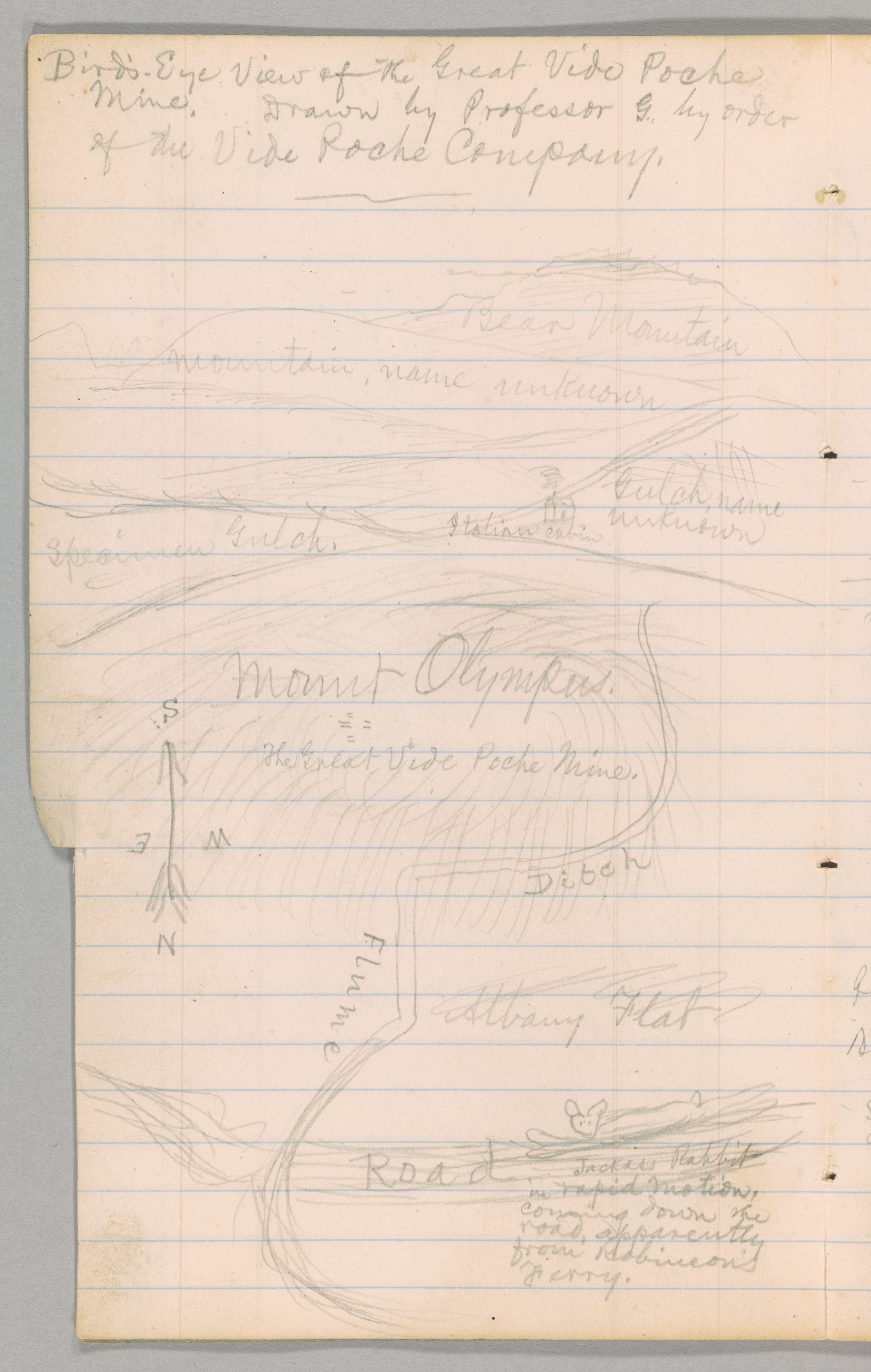
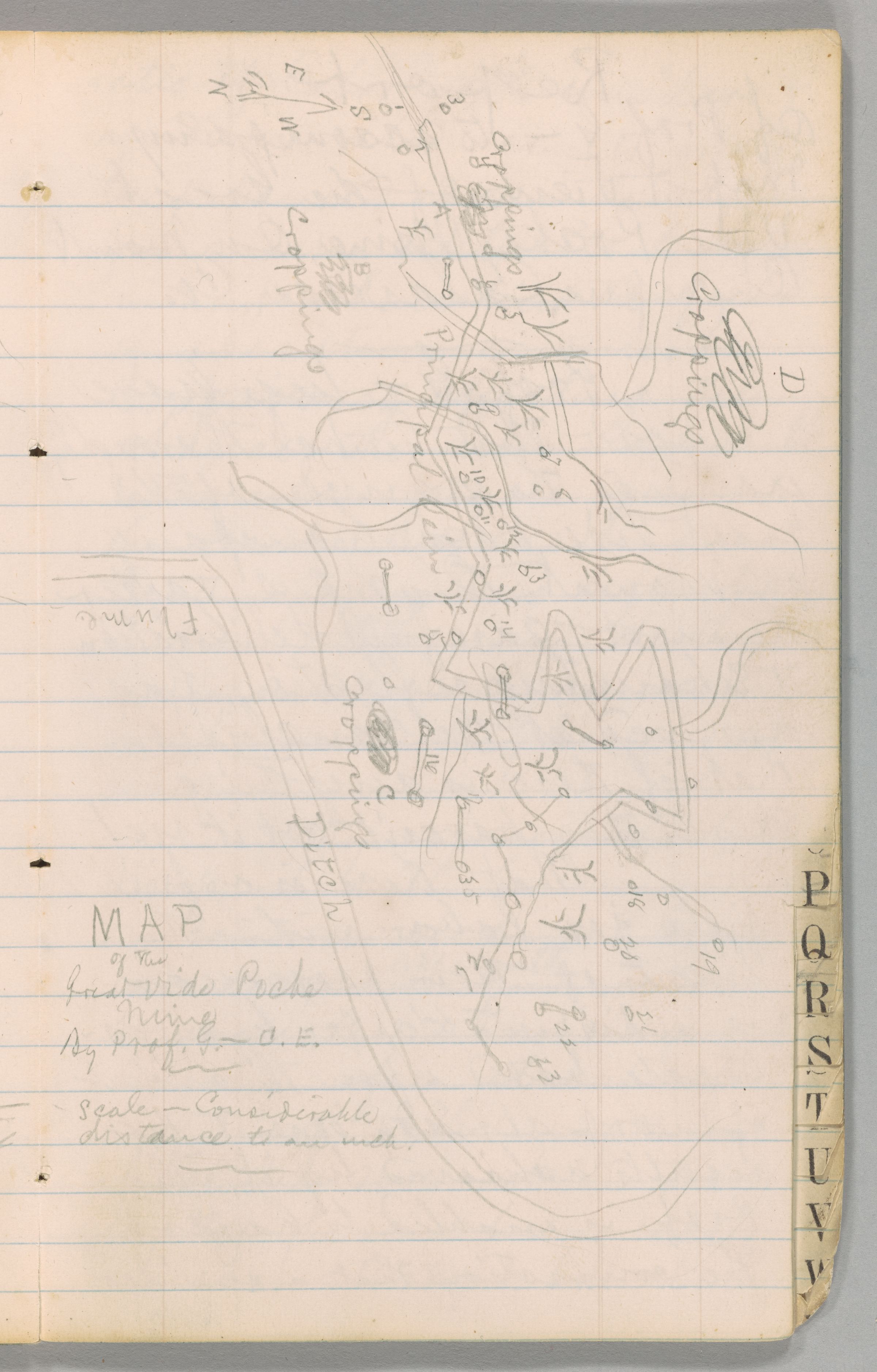
[MS: N04_leaf_039v] Map text (verso):
Bird's-Eye View of the Great Vide Poche
Mine. Drawin by Professor G. by order
of the Vide Poche Company.
Bear Mountain
Mountain, name unknown
Gulch, name unknown
Specimen Gulch.
Italian cabin
Mount Olympus.
The Great Vide Poche Mine.
Ditch
Flume
Albany Flat
Road.
Jackass Rabbit
in rapid motion,
coming down the
road, apparently
from Robinson's
Ferry
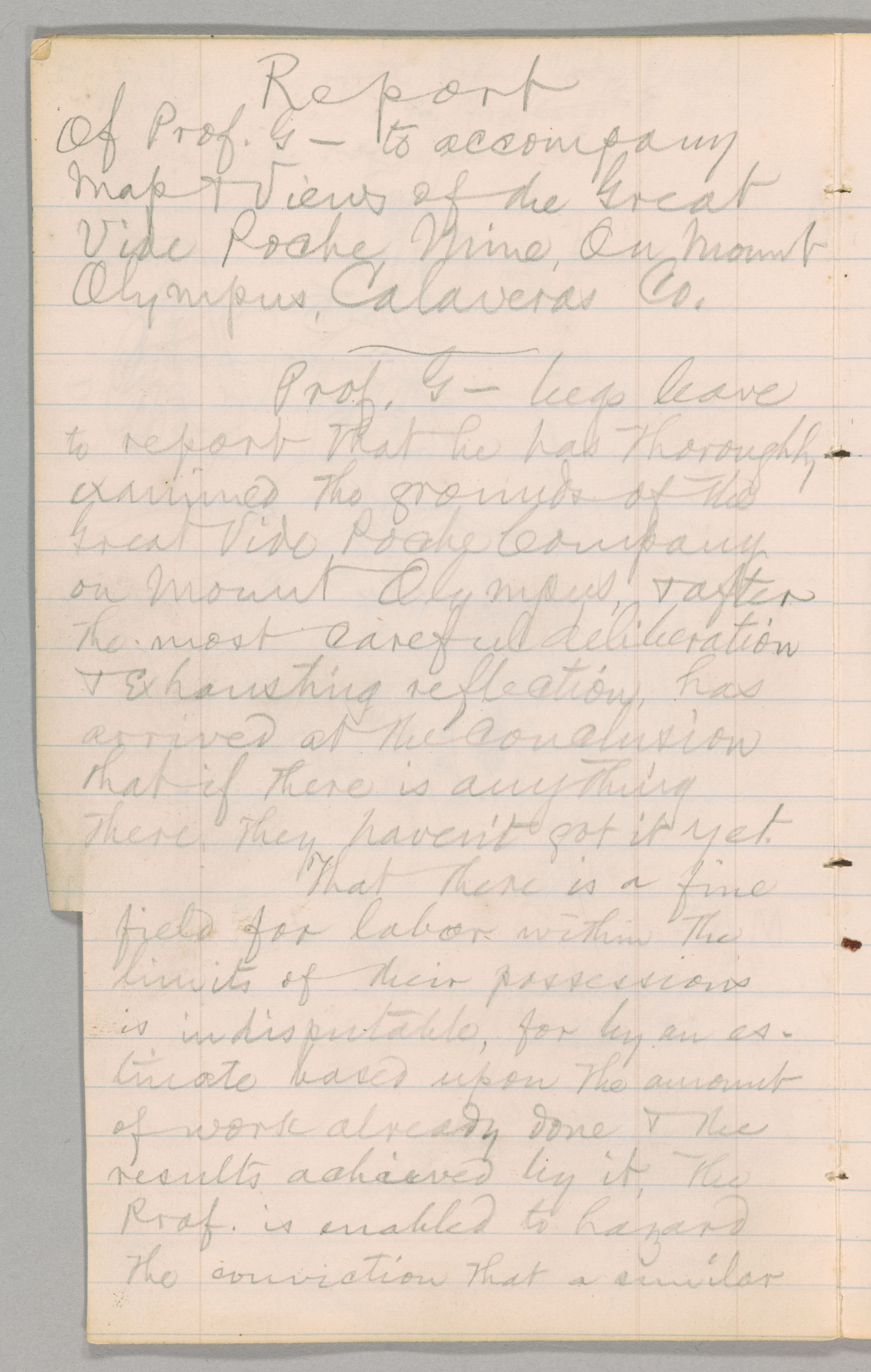
[MS: N04_leaf_040r] Map text (recto):
Croppings
Croppings
Croppings
Principal Vein
Flume
Croppings
Ditch
MAP
of the
Great Vide Poche
Mine
By Prof. G.— C. E.
scale—Considerable
distance to and inch.
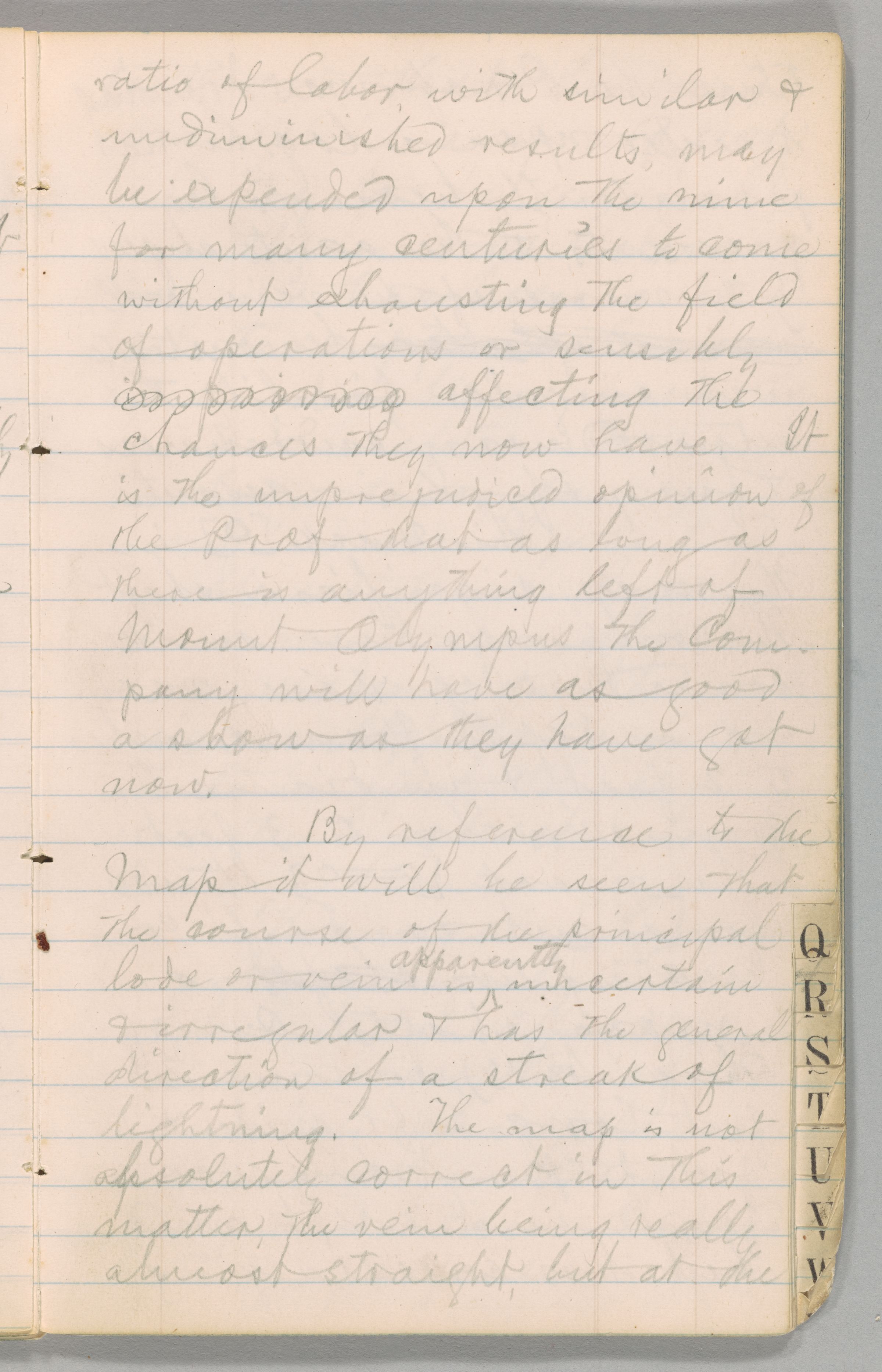
[MS: N04_leaf_040v]
Report39
Of Prof. G—to accompany
Map & Views of the Great
Vide Poche Mine, On Mount
Olympus, Calaveras Co.
Prof. G—begs leave
to report that he has thoroughly
examined
[MTP: N&J1_85]
the grounds of the
Great Vide Poche Company
on Mount Olympus, & after
the most careful deliberation
& exhausting reflection, has
arrived at the conclusion
that if there is anything
there, they haven't got it yet.
That there is a fine
field for labor within the
limits of their possessions
is indisputable, for by an
es-
timate
estimate
based upon the amount
of work already done & the
results achieved by it, the
Prof. is enabled to hazard
the conviction that a similar
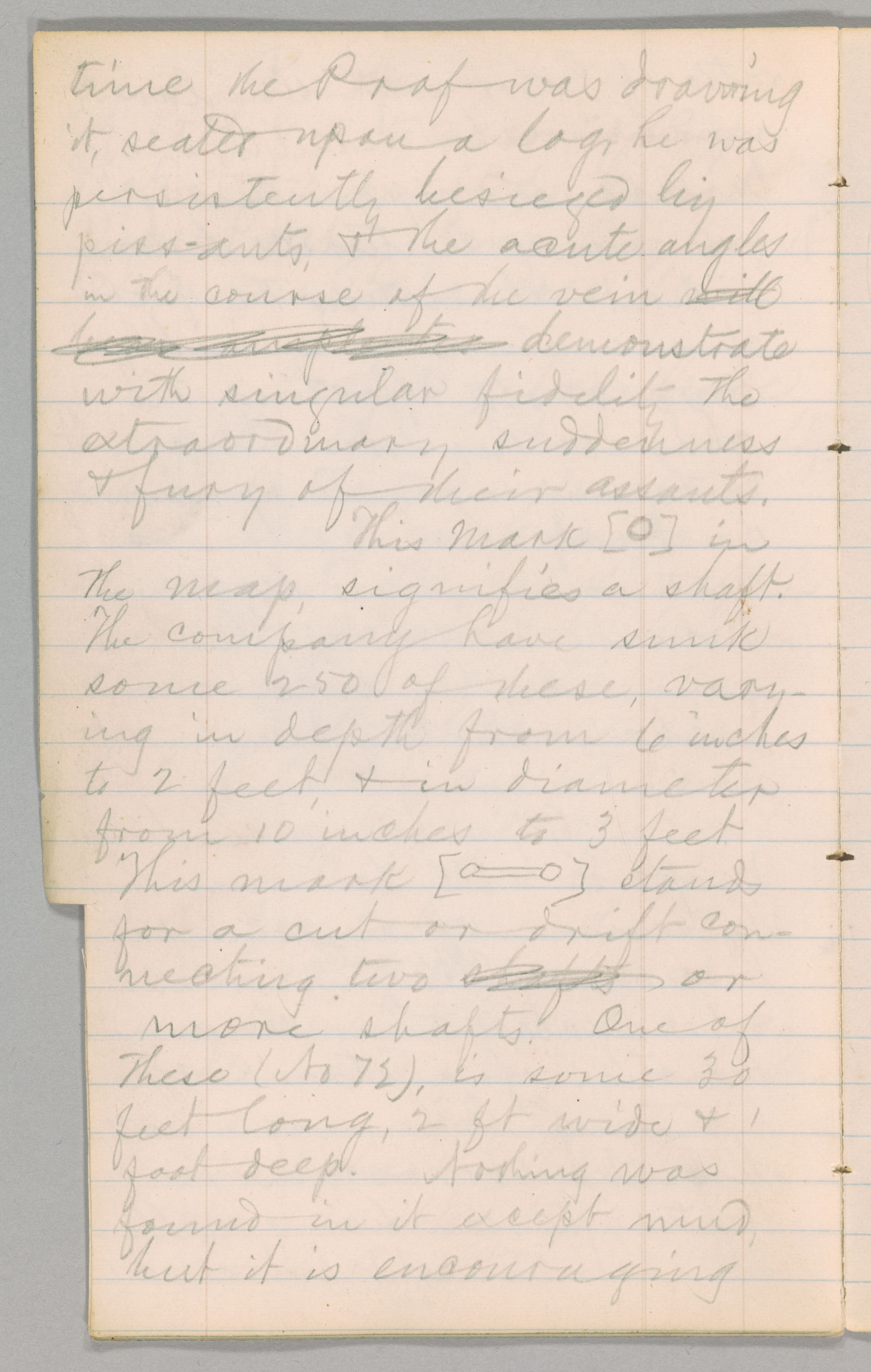
[MS: N04_leaf_041r]
ratio of labor, with similar &
undiminished results, may
be expended upon the mine
for many centuries to come
without exhausting the field
of operations or sensibly
impairing affecting the
chances they now have. It
is the unprejudiced opinion of
the Prof that as long as
there is anything left of
Mount Olympus the
Com-
pany
Company
will have as good
a show as they have got
now.
By reference to the
Map it will be seen that
the course of the principal
lode or vein is apparently
uncertain
& irregular, & has the general
direction of a streak of
lightning. The map is not
apbsolutelyⓉtextual note correct in this
matter, the vein being really
almost straight, but at the
[MS: N04_leaf_041v]
time the Prof was drawing
it, seated upon a log, he was
persistently besieged by
piss-ants, & the acute angles
in the course of the vein will
bear ample tes demonstrate
with singular fidelity the
extraordinary suddenness
& fury of their assauts.
This mark ( ) in
) in
the map, signifies a shaft.
The company have sunk
some 250 of these,
vary-
ing
varying
in depth from 6 inches
to 2 feet, & in diameter
from 10 inches to 3 feet.
This mark (
 ) stands
for a cut or drift
con-
necting
connecting
two shafts or
more shafts. One of
[MTP: N&J1_86 (illustriation of leaf_039v)]
[MTP: N&J1_87 (illustration of leaf_040r)]
[MTP: N&J1_88]
these (No 72), is some 30
feet long, 2 ft wide & 1
foot deep. Nothing was
found in it except mud,
but it is encouraging
[MS: N04_leaf_042r]
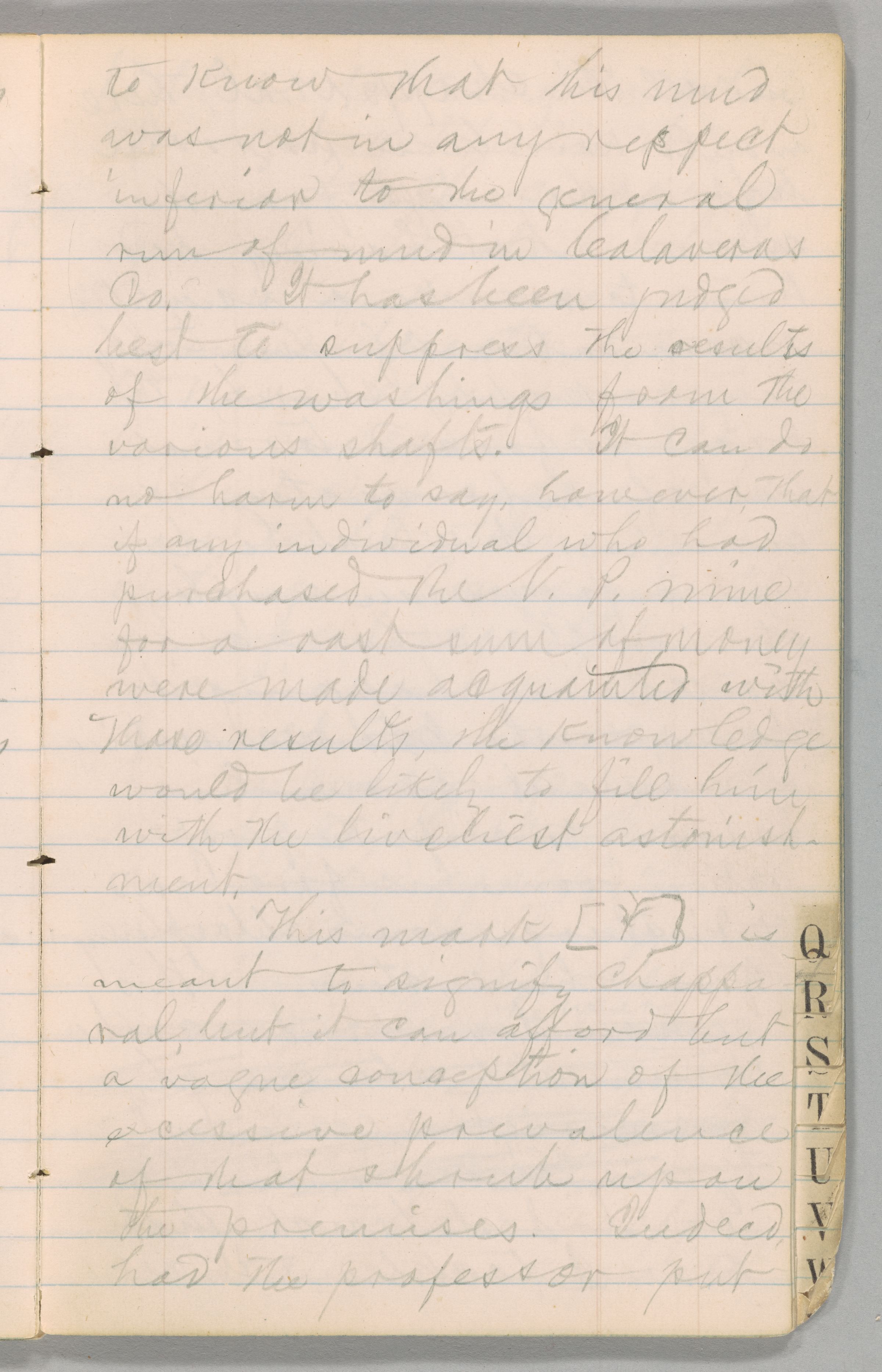
to know that this mud
was not in any respect
inferior to the general
run of mud in Calaveras
Co. It has been judged
best to suppress the results
of the washings from the
various shafts. It can do
no harm to say, however, that
if any individual who had
purchased the V.P. mine
for a vast sum of money
were made acquainted with
those results, the knowledge
would be likely to fill him
with the liveliest
astonish-
ment
astonishment
.
This mark (
 ) is
) is
meant to signify
chappa-
ral
chapparal
, but it can afford but
a vague conception of the
excessive prevalence
of that shrub upon
the premises. Indeed,
had the professor put
[MS: N04_leaf_042v]
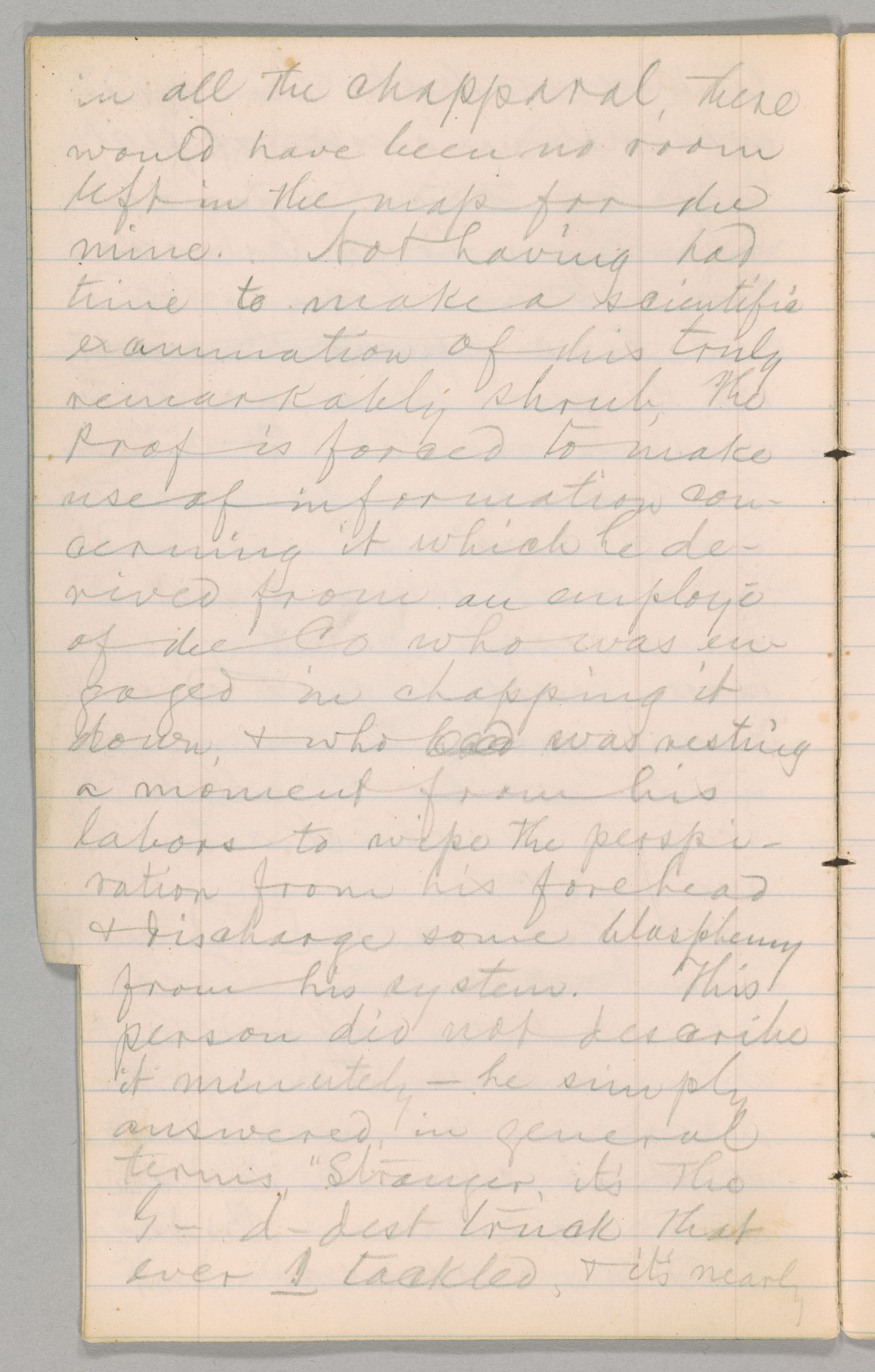
in all the chapparal, there
would have been no room
left in the map for the
mine. Not having had
time to make a scientific
examination of this truly
remarkably shrub, the
Prof is forced to make
use of information
con-
cerning
concerning
it which he
de-
rived
derived
from an employé
of the Co who was
en-
gaged
engaged
in chopping it
down, & who had was resting
a moment from his
labors to wipe the
perspi-
ration
perspiration
from his forehead
& discharge some blasphemy
from his system. This
person did not describe
it minutely—he simply
answered, in general
terms, “Stranger, it's the
G— d—dest truck that
ever I tackled, & it's nearly
[MS: N04_leaf_043r]
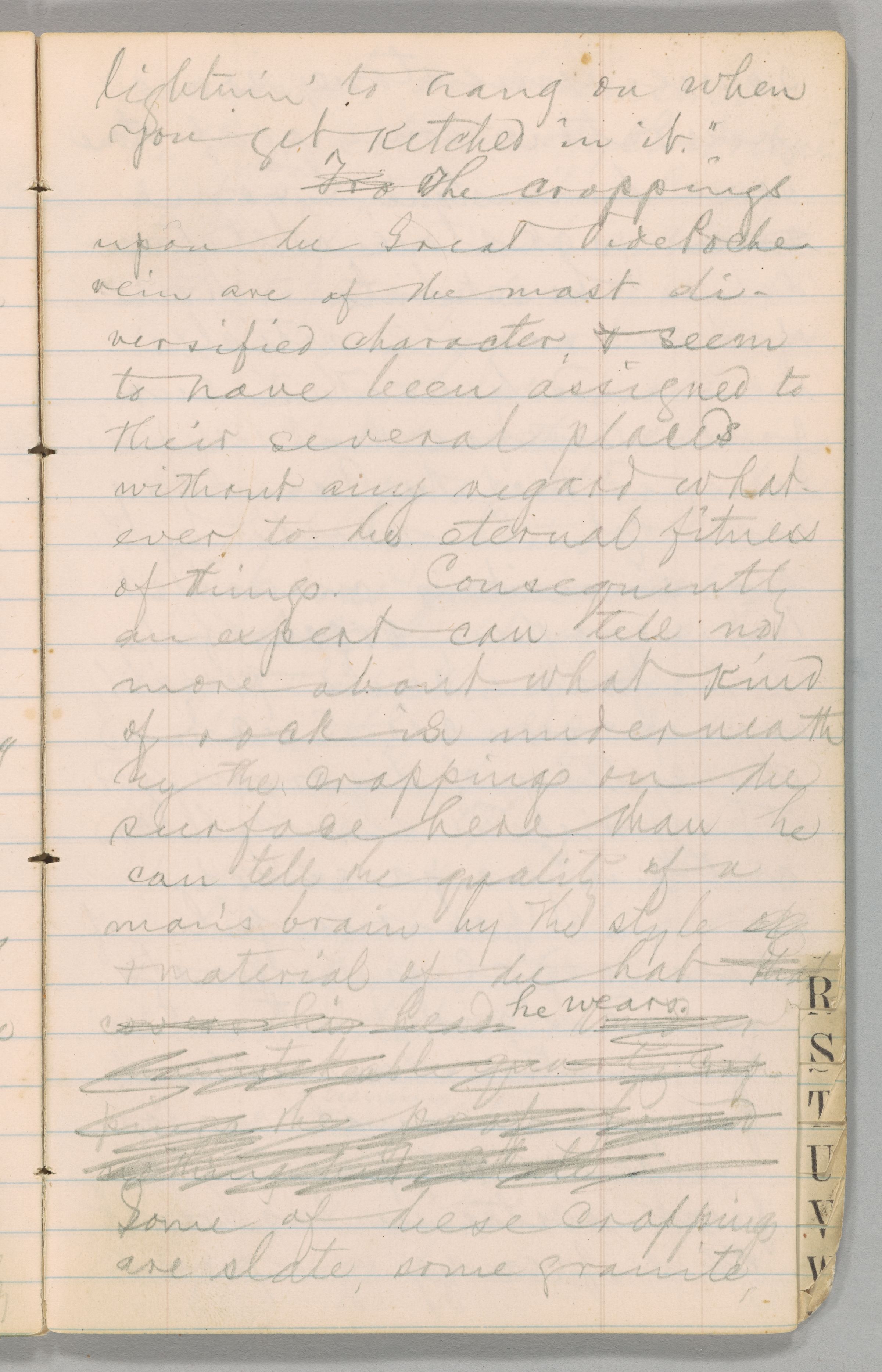
lightnin' to hang on when
you get ketched in it.”
Fro The croppings
upon the Great Vide Poche
vein are of the most
di-
versified
diversified
character, & seem
to have been assigned to
their several placedsⓉtextual note
without any regard
what-
ever
whatever
to the eternal fitness
of things. Consequently
an expert can tell no
more about what kind
of rock insⓉtextual note underneath
by the croppings on the
surface here than he
can tell the quality of a
man's brain by the style of
& material of the hat that
covers his head.
he wears.
Under
unmistakeable quartz
crop-
pings
croppings
the prof found
nothing but slate.
Some of these croppings
are slate, some granite,
[MS: N04_leaf_043v]
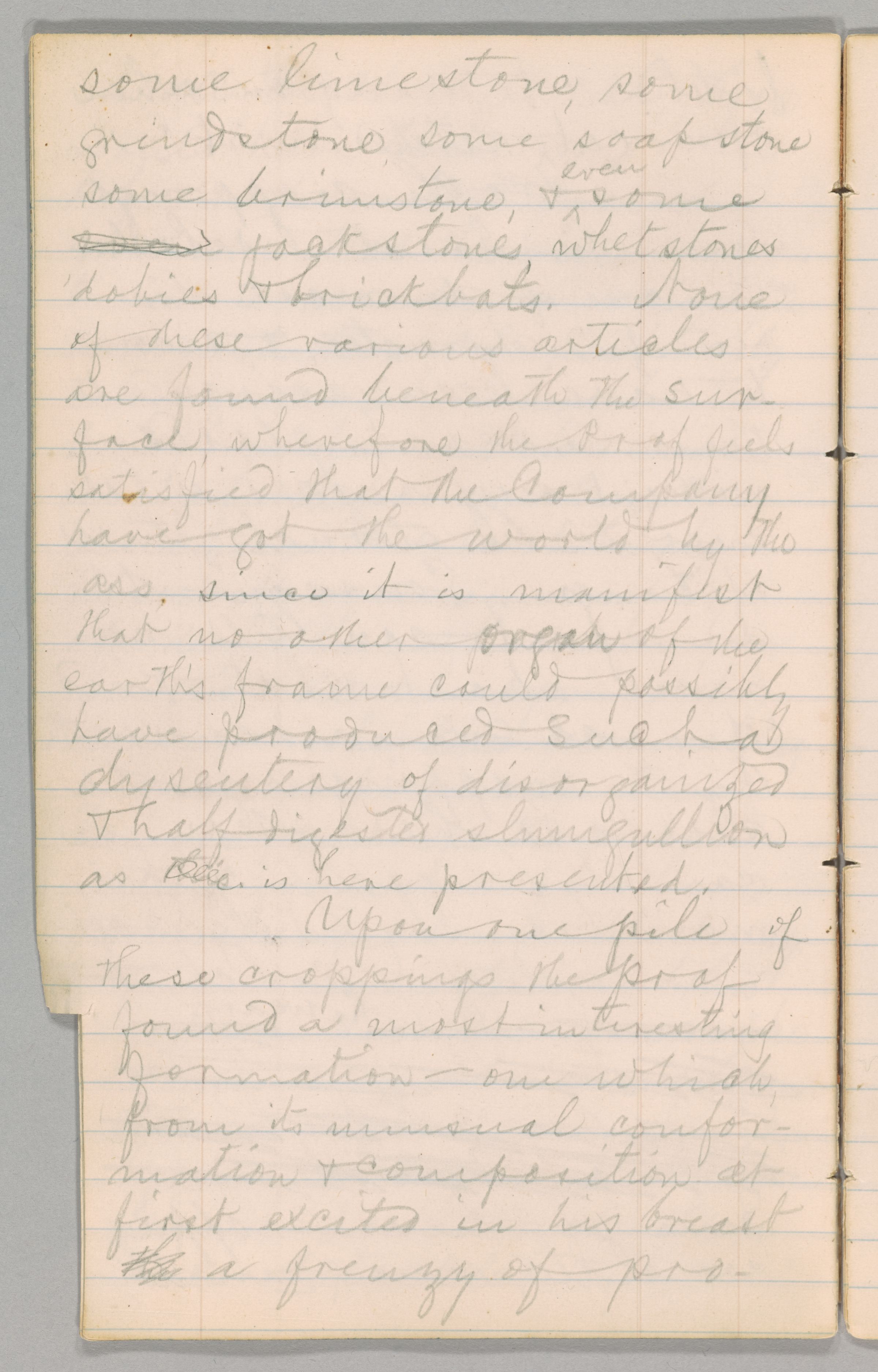
some limestone, some
grindstone, some soapstone
some brimstone, &
even some
even
Ⓣtextual note jackstones, whetstones
'dobies & brickbats. None
of these various articles
are found beneath the
sur-
face
surface
, wherefore the Prof feels
satisfied that the Company
have got the
[MTP: N&J1_89]
world by the
ass, since it is manifest
that no other part
organ of the
earth's frame could possibly
have produced such a
dysentery of disorganized
& half-digested slumgullion
as this. is here present.ed.Ⓣtextual note
Upon one pile of
these croppings the prof
found a most interesting
formation—one which,
from its unusual
confor-
mation
conformation
& composition at
first excited in his breast
the a frenzy of pro-
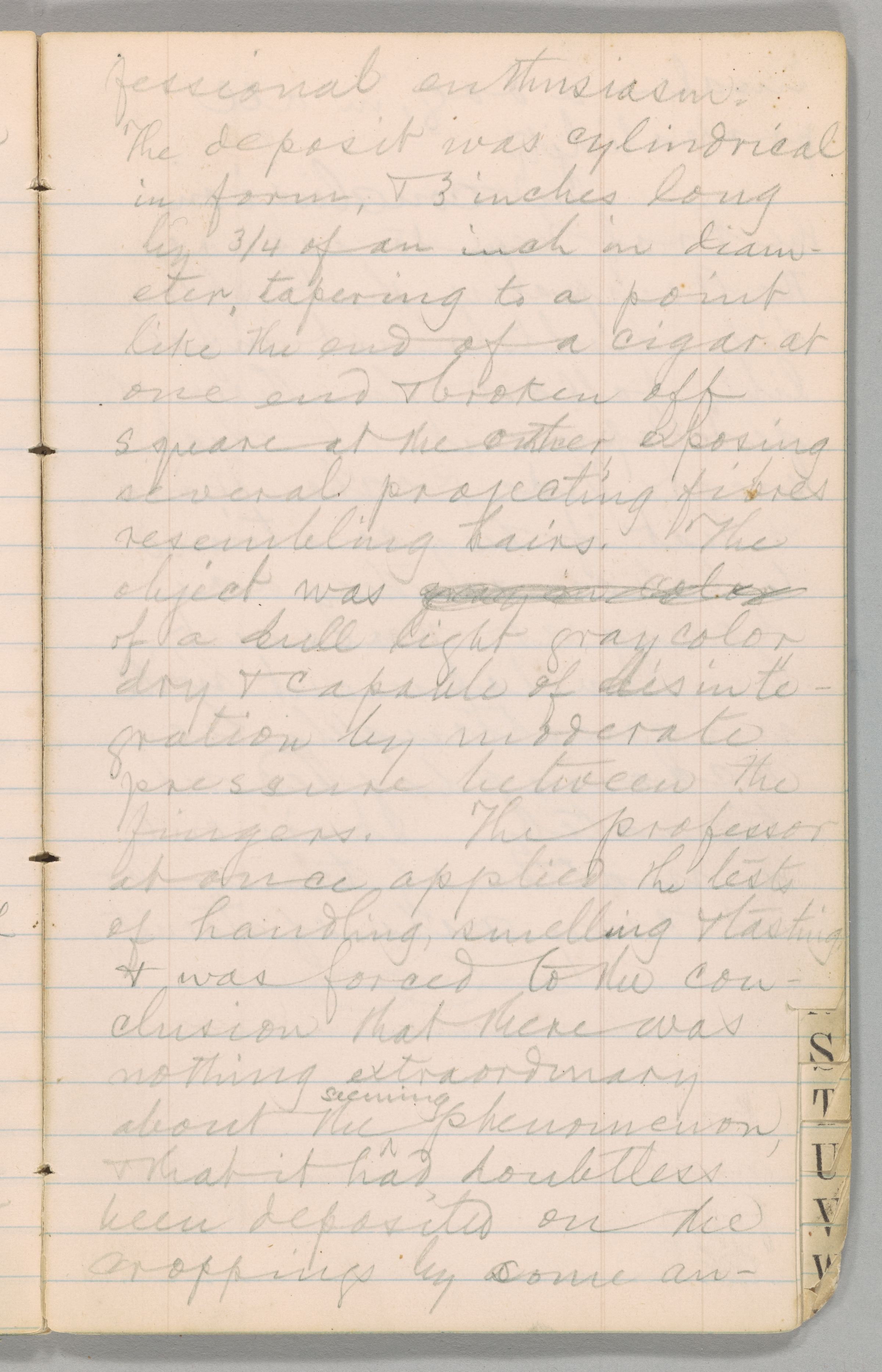
[MS: N04_leaf_044r]
fessional enthusiasm.
The deposit was cylindrical
in form, & 3 inches long
by ¾ of an inch in
diam-
eter
diameter
, tapering to a point
like the end of a cigar at
one end & broken off
square at the en other, exposing
several projecting fibres
resembling hairs. The
object was gray in color
of a dull light gray color,
dry & capable of
disinte-
gration
disintegration
by moderate
pressure between the
fingers. The professor
at once applied the tests
of handling, smelling & tasting,
& was forced to the
con-
clusion
conclusion
that there was
nothing extraordinary
about the seeming
phenomenon,
& that it had doubtless
been deposited on the
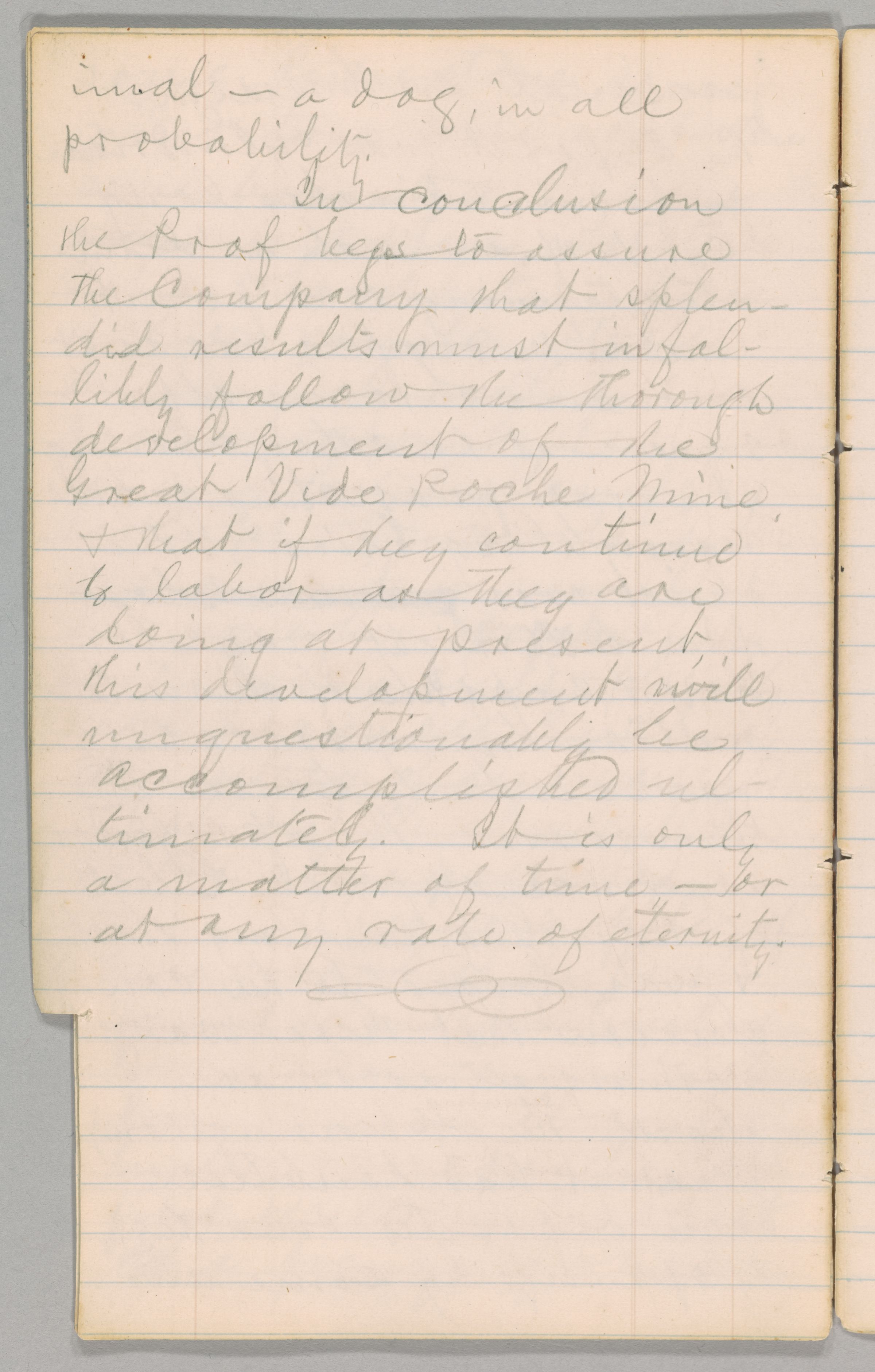
croppings by a some an-
[MS: N04_leaf_044v]
imal—a dog, in all
probability.
In conclusion
the Prof begs to assure
the Company that
splen-
did
splendid
results must
infal-
libly
infallibly
follow the thorough
development of the
Great Vide Poche Mine,
& that if they continue
to labor as they are
doing at present,
this development u will
unquestionably be
accomplished
ul-
timately
ultimately
. It is only
a matter of time,—or
at any rate of eternity.Ⓣtextual note
[MS: N04_leaf_045r]
first page of "S" section
[MS: N04_leaf_048r]
first page of "T" section
[MS: N04_leaf_051r]
first page of "U" section
[MS: N04_leaf_052r]
first page of "V" section
[MS: N04_leaf_054r]
first page of "W" section
[MS: N04_leaf_056r]
blank recto
[MS: N04_leaf_056v]
blank verso
[MS: N04_leaf_057r]
blank recto
[MS: N04_leaf_058v]
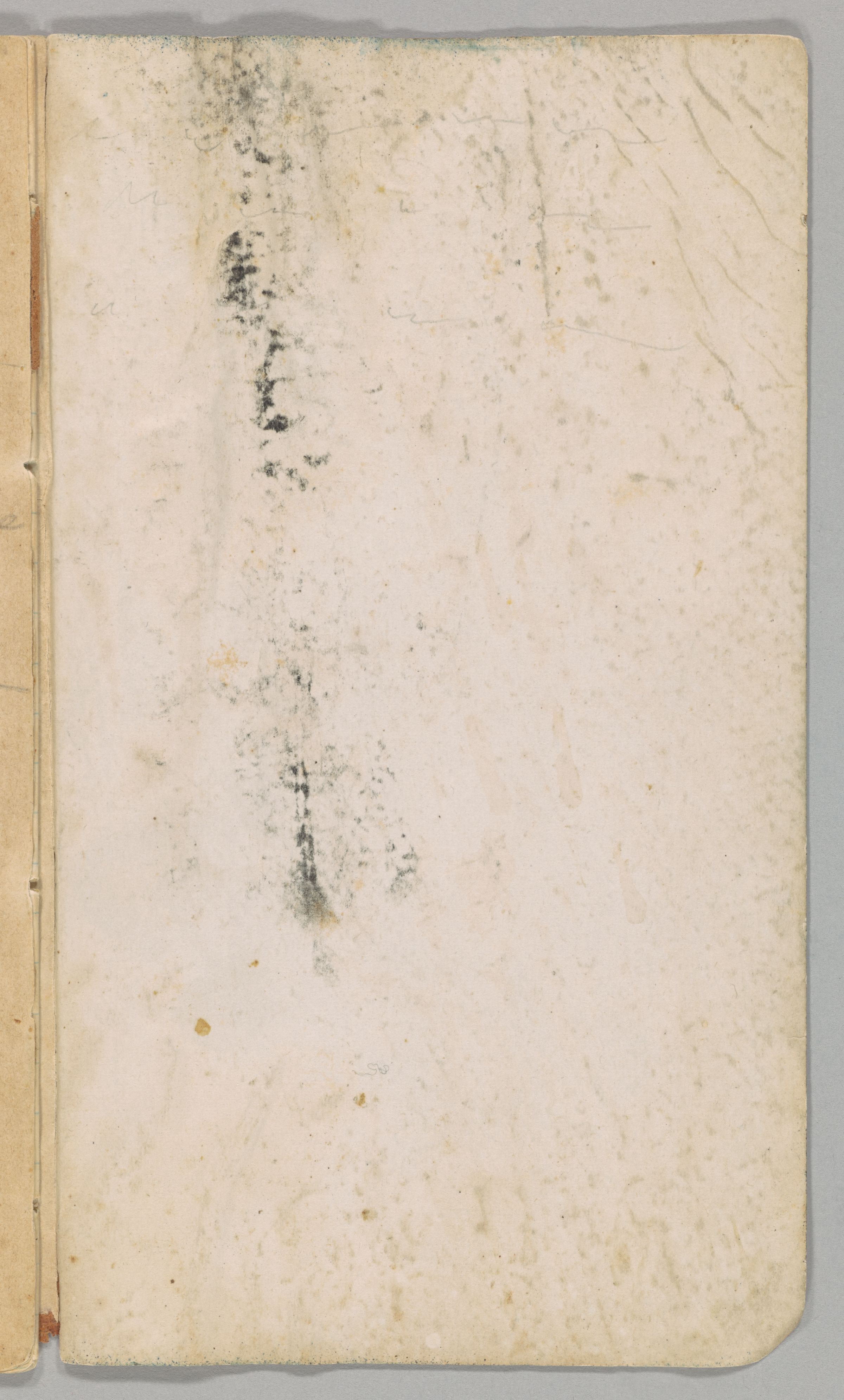
W Bilgewater
Jesus Maria (Suce Mariea)40
Jan. February 1st—
Saw L. Mark WrighteⓉtextual note
41
in a
[MTP: N&J1_90]
dream ce matin-ce
—in carriage—said good
bye & shook hands.Ⓣtextual note
three lines of undecipherable shorthandⓉtextual note
[MS: N04_back endpaper]
blank
[MS: N04_back cover]
On 25 June 1865 the San Francisco Call noted:
The almond-eyed manipulators of Celestial chop-sticks and terrestrial chickens have fitted up a theatre on the first floor of the Globe Hotel, corner of Dupont and Jackson streets, which is to be opened during the present week. Any white man will be permitted to go in and enjoy the “divine racket,” and inhale the heavenly odors of the entertainment, for four bits.
Mark Twain may have visited this theater, which is not listed by name in directories of the period, after his return to San Francisco. However, none of the surviving dramatic criticism he contributed to the Territorial Enterprise, the Golden Era, the Californian, and the San Francisco Dramatic Chronicle mentions it.
Mark Twain first took up residence at the Occidental Hotel on 8 June 1864 as he was beginning to report for the San Francisco Call. Soon after, in a piece called “In the Metropolis,” he remarked:
To a Christian who has toiled months and months in Washoe; whose hair bristles from a bed of sand, and whose soul is caked with a cement of alkali dust; whose nostrils know no perfume but the rank odor of sage-brush—and whose eyes know no landscape but barren mountains and desolate plains; where the winds blow, and the sun blisters, and the broken spirit of the contrite heart finds joy and peace only in Limberger cheese and lager beer—unto such a Christian, verily the Occidental Hotel is Heaven on the half shell. He may even secretly consider it to be Heaven on the entire shell, but his religion teaches a sound Washoe Christian that it would be sacrilege to say it. (Golden Era, 26 June 1864, reprinted in WG , pp. 74–76)