(March, June–September 1866)
[MTP: N&J1_91]
There is an interval of slightly more than a year, from the end of February 1865 to the beginning of March 1866, between Notebooks 4 and 5. Mark Twain thought this period worthy of only a single paragraph in chapter 62 of Roughing It:
After a three months' absence, I found myself in San Francisco again, without a cent. When my credit was about exhausted, (for I had become too mean and lazy, now, to work on a morning paper, and there were no vacancies on the evening journals,) I was created San Francisco correspondent of the Enterprise, and at the end of five months I was out of debt, but my interest in my work was gone; for my correspondence being a daily one, without rest or respite, I got un-speakably tired of it. I wanted another change. The vagabond instinct was strong upon me. Fortune favored and I got a new berth and a delightful one. It was to go down to the Sandwich Islands and write some letters for the Sacramento Union, an excellent journal and liberal with employés.
Although no notebook and little correspondence or other contemporary documentation
has survived, a number of details can be provided to expand
[MTP: N&J1_92]
and modify this abbreviated account. It is clear, for example, that Mark Twain did
not depend entirely on credit in 1865. Contributions to the Californian, occasional pieces in the Golden Era, and correspondence for Joseph Goodman's Virginia City Territorial Enterprise helped support a bohemian existence during the spring, summer, and fall of that year.
On 19 October Clemens informed Orion and Mollie that he intended “to work in dead
earnest” to get out of debt by writing regularly for the Territorial Enterprise and the San Francisco Dramatic Chronicle:
Joe Goodman pays me $100 a month for a daily letter, and the Dramatic Chronicle pays me or rather will begin to pay me, next week—$40 a month for dramatic criticisms. Same wages I got on the Call, & more agreeable & less laborious work.
In the same letter he belittled his emergent creative awareness in order to exhort Orion to become a “preacher of the gospel,” a profession he himself had despaired of attaining:
I have had a “call” to literature, of a low order—i.e. humorous. It is nothing to be proud of, but it is my strongest suit, & if I were to listen to that maxim of stern duty which says that to do right you must multiply the one or the two or the three talents which the Almighty entrusts to your keeping, I would long ago have ceased to meddle with things for which I was by nature unfitted & turned my attention to seriously scribbling to excite the laughter of God's creatures. Poor, pitiful business! . . . You see in me a talent for humorous writing, & urge me to cultivate it. But I always regarded it as brotherly partiality on your part, & attached no value to it. It is only now, when editors of standard literary papers in the distant east give me high praise, & who do not know me & cannot of course be blinded by the glamour of partiality, that I really begin to believe there must be something in it. (My Dear Bro: A Letter from Samuel Clemens to His Brother Orion, ed. Frederick Anderson [Berkeley, California: The Berkeley Albion, 1961], pp. 6–8)
Mark Twain's first great success with an eastern paper was imminent. On 26 February, upon his return from the Mother Lode country, he had written in Notebook 4, p. 82:
home again at the Occidental Hotel, San Francisco—find letters from “Artemus Ward” asking me to write a sketch for his new book of Nevada Territory travels which is soon to come out. Too late—ought to have got the letters 3 months ago. They are dated early in November.
[MTP: N&J1_93]
By the time his sketch, “Jim Smiley and His Jumping Frog,” apparently written between 16 and 23 October, was ready, it was indeed too late for inclusion in Artemus Ward, His Travels (New York: Carleton, 1865) and was instead offered to the New York Saturday Press, where it appeared on 18 November 1865. Acclaim was instantaneous, and the sketch was widely reprinted. Fed by this unexpected success, Mark Twain's impatience with the routine of daily newspaper reporting, even of the “more agreeable & less laborious” kind, grew. Anxious perhaps for a reason to appear on the eastern scene of his “Jumping Frog” triumph, on 13 December 1865 he wrote Orion of a plan to dispose of the Clemens property in Tennessee. He would accomplish this with the assistance of Herman Camp, a mining acquaintance with New York business connections:
He leaves for the east 5 days hence—on the 19th. I told him we had 30,000 acres land in Tennessee, & there was oil on it—& if he would send me $500 from New York to go east with, $500 more after I got there, & pay all my expenses while I assisted him in selling the land, I would give him one-half of the entire proceeds . . . .
Now I don't want that Tenn land to go for taxes, & I don't want any “slouch” to take charge of the sale of it. I am tired being a beggar—tired being chained to this accursed homeless desert,—I want to go back to a Christian land once more—& so I want you to send me immediately all necessary memoranda to enable Camp to understand the condition, quantity & resources of the land, & how he must go about finding it. He will visit St Louis & talk with the folks, & then go at once & see the land, & telegraph me whether he closes with my proposition or not.
Clemens later recalled that Camp “agreed to buy our Tennessee land for two hundred
thousand dollars . . . . His scheme was to import foreigners from grape-growing and
wine-making districts in Europe, settle them on the land, and turn it into a wine-growing
country.” But Orion, then a temperance advocate, “said that he would not be a party
to debauching the country with wine” (
MTA
, 2:320). His schemes for riches and release at an end, Mark Twain continued to write
for the Enterprise during the tedious winter of 1865/1866. He exorcised some of his frustration in a
journalistic feud with Albert S. Evans, a reporter and editorial writer on the Alta California, who used the pseudonym Fitz Smythe in San Francisco and signed himself Amigo in
dispatches to the Gold Hill Evening News, a rival of the Enterprise. In the course of this sometimes bitter exchange, Mark Twain launched an attack on
the San Francisco police, who were
[MTP: N&J1_94]
championed by Fitz Smythe. A similar attack had contributed to his hasty departure
from San Francisco in December 1864, and in late 1865 and early 1866 this new one
was signaling his readiness to leave again. In a letter of 20 January 1866 Clemens
complained to his mother and sister: “I don't know what to write—my life is so uneventful.
I wish I was back there piloting up & down the river again.” He went on to express
unhappiness at having foregone a recent opportunity to get away, at least temporarily:
That Ajax is the finest Ocean Steamer in America, & one of the fastest. She will make this trip to the Sandwich Islands & back in a month, & it generally take a sailing vessel three months. She had 52 invited guests aboard—the cream of the town—gentlemen & ladies both, & a splendid brass band. I know lots of the guests. I got an invitation, but I could not accept it, because there would be no one to write my correspondence while I was gone. But I am so sorry now. If the Ajax were back I would go—quick!—and throw up the correspondence. Where could a man catch such another crowd together?
Clemens' desire for escape found expression in a sudden proliferation of literary projects, a reaction to stress or boredom that was to be characteristic throughout his life. According to the 20 January letter home, in the works were commissions to write for the New York Weekly Review and the New York Saturday Press and a collaboration with Bret Harte on a book of sketches and a book-length burlesque of “all the tribe of California poets” which would “just make them get up & howl.” He also noted a rumor current in San Francisco that Mark Twain “has commenced the work of writing a book . . . on an entirely new subject, one that has not been written about heretofore,” commenting:
The book referred to . . . is a pet notion of mine—nobody knows what it is going to be about but just myself. Orion don't know. I am slow & lazy, you know, & the bulk of it will not be finished under a year. I expect it to make about three hundred pages, and the last hundred will have to be written in St Louis, because the materials for them can only be got there. If I do not write it to suit me at first I will write it all over again, & so, who knows?—I may be an old man before I finish it.
The need to return to Saint Louis suggests that this book was to deal with material
later to appear in Life on the Mississippi, but there is no indication that it, or any of the other literary projects of the
moment, were advanced from the planning stage. Still at loose ends in late February,
[MTP: N&J1_95]
after the return of the Ajax from Hawaii, Clemens made a brief trip to Sacramento whose purpose may be inferred
from a letter of 5 March in which he jubilantly informed his mother and sister:
I start to do Sandwich Islands day after tomorrow .., in the steamer “Ajax.” We shall arrive there in about twelve days . . . . I am to remain there a month and ransack the islands, the great cataracts and the volcanoes completely, and write twenty or thirty letters to the Sacramento Union—for which they pay me as much money as I would get if I staid at home. ( MTL , p. 103)
The pleasure junket he had regretted declining some six weeks before had materialized again, this time as a roving commission. But if Mark Twain's assignment was in fact to write a letter a day for a month to report all that was important in Hawaii, its offer as well as its blithe acceptance suggest an innocence about these islands whose geography alone would have made compliance impossible. Still, boredom with the routine of his life in San Francisco precluded sober consideration of the conditions of escape. Two days after the exultant letter, Mark Twain went on board the Ajax and made his first entries in Notebook 5. Almost immediately he began gathering advance information about Hawaii from residents among the passengers. Although he diluted this seriousness of purpose with a readiness to yield to “the most magnificent, balmy atmosphere in the world” (Notebook 6, p. 192), the fact that he needed four months to “ransack” the Sandwich Islands was the result not of indolence, and not only of geography, but rather of the islands' variety and amplitude as subject matter.
The year 1866 was a watershed in Mark Twain's career, ending his period of apprentice journalism and introducing him to the expansive and independent labor that would culminate in the book-length travel narratives that established and propagated his fame. It marked a corresponding period of change for Hawaii. For by that year an era that had seen the Sandwich Islands become a sometimes volatile blend of mission and saloon had already begun to draw to a close, and the reign of the missionary and the whaler as dominant and conflicting forces in Hawaiian life was ending.
In the late eighteenth and early nineteenth centuries their location had made the
Sandwich Islands a provisioning stop and trading center for merchant cargo ships.
After 1820 Hawaii became an important whaling port, and it was the whaling industry,
particularly in the years from 1843
[MTP: N&J1_96]
to 1860, that was most important to its commercial development. The island complex
was soon a service area for whalers, offering those commodities essential to the enterprise:
provisions, shipyard facilities, seamen recruits, taverns, women. After 1850 Hawaii
even sent out a few whaling ships of local registry. But by the early 1860s a decline
had set in, the effect of a scarcity of whales, competition from the growing petroleum
industry, and the Civil War, which brought the destruction of many United States whalers
by Confederate privateers and the laying up of others. After the war there was some
recovery and widespread hope for more, but the bright prospects Mark Twain envisioned
in an early letter to the Sacramento Daily Union probably reflected the forced optimism of Honolulu businessmen too accustomed to
the easy profits from whaling to readily face reality. In fact, although it was not
to proceed without reverses, the transformation to an agricultural economy had already
begun, boosted by a Civil War boom in Hawaiian sugar, a smaller boom in rice cultivation,
and some success in the production of cotton. And there were clear indications of
what was to be Hawaii's greatest twentieth-century industry, the tourist, for in 1865
there had already been talk of the need for a first-class hotel in Honolulu, and the
volcano Kilauea on Hawaii was attracting enough visitors for a new hotel to open there
shortly before Mark Twain's arrival. Mark Twain's reporting of this economic ferment
was influenced by a sense of mission, and in some of his Union letters he seems almost an evangelist for American capitalism, fervidly urging the
commercial exploitation of the Sandwich Islands.
The influence of the whaler in Hawaii's early commercial history was matched in social
and political areas by that of the American Protestant missionary. Late in 1819, just
after the arrival of the first whalers, and with the missionaries already en route,
a fortuitous series of events prepared the Hawaiian soil for seeding with Christianity.
Fortified by drink and impelled by a strong-willed female chief in rebellion against
restrictions imposed upon women, Kamehameha II sanctioned the existing disaffection
with the kapu, or tabu, system by dramatically violating the interdiction against
the mixing of the sexes at meals. Encouraged by the failure of the gods to take immediate
revenge, the king proceeded to order the destruction of their images and the desecration
of the temples. Thus, the Sandwich Islands discarded the religion that was an integral
part of its social and political system. Into the void sailed the New England missionaries,
fearing the worst kind of resistance and finding instead that God had
[MTP: N&J1_97]
rewarded their faith and readiness for self-sacrifice by eliminating the competition.
The missionaries' righteousness would probably have carried opposition before it in
any case, but this turn of affairs fortified them for the initial encounter with the
native condition and the subsequent difficulties of adjusting it to their own conception
of morality and social order. Despite injunctions from the American Board of Commissioners
for Foreign Missions, their controlling agency, the missionaries found it impossible
to avoid assuming political as well as religious control of the Sandwich Islands,
particularly when called upon by the king and chiefs to extricate them from difficulties
with foreigners. Although theirs was a benign foreign intervention, at least in intent,
the missionaries had no greater sense of the worth of the native way of life than
the whalers, merchants, and grog-shop proprietors with whom they were frequently in
conflict and from whom they were sometimes under physical attack. In the three decades
after their arrival, particularly in the 1840s, the era of their greatest participation
in government, the missionaries affected every aspect of Hawaiian life, supplying
and enforcing an ideal of industry and self-denial and transforming the nation from
a feudal autocracy to a monarchy with a constitution and an imposing bureaucracy that
included a national assembly, cabinet, civil service, and independent judiciary. A
good example of the profundity of missionary intercourse in Hawaii is the career of
Gerrit Parmele Judd, whom Mark Twain met in Hawaii and mentions with approval and
admiration in Notebook 5.
It would be difficult to overestimate the influence Judd had during the reign of Kamehameha
III. He went to the Sandwich Islands in 1828 as a missionary doctor, but his activities
as adviser to the king and chiefs soon took precedence over all other endeavors, leading
him in 1842 to resign from the mission to devote himself entirely to government affairs.
For more than ten years Judd literally “was the government” (Notebook 5, p. 115), holding successively the offices of minister of foreign affairs,
minister of the interior, and minister of finance and enjoying almost dictatorial
authority. His achievements were in accord with his power. Within a few years of his
entry into the service of Kamehameha III, the government debt was liquidated. By the
end of the reign of Kamehameha III in 1854, government income had been increased nearly
eightfold and expenses were well in hand, a condition reversed during succeeding administrations,
so that by the time of Mark Twain's visit the government was again in debt. Until
he became convinced of the necessity of annex-
[MTP: N&J1_98]
ation to the United States, Judd was an indomitable proponent of Hawaiian independence
who played a crucial role in maintaining Hawaiian sovereignty in the face of challenges
by England and France. During his political career the man Herman Melville called
“a sanctimonious apothecary-adventurer” in Typee managed to alienate almost every element in the Sandwich Islands' foreign population—Americans
as well as nationals of other countries, missionaries as well as merchants—by his
unyielding insistence that they emulate his loyalty and commitment to Hawaii and by
an unfortunate though understandable habit of identifying the government with himself.
Judd's strict temperance opinions upset not only the merchants and whalers, but also
Prince Alexander Liholiho (Kamehameha IV), who found revenge for the moral rigidity
of his upbringing in political opposition to Judd. Attempts to impeach Judd were made
in 1845 and 1848, but it wasn't until 1853 that his opponents finally succeeded in
forcing his retirement. When he left office, Judd, who in 1843 had rejected the chiefs'
offer of the entire Manoa Valley, a fertile area on Oahu facing Waikiki Beach, had
only a thousand-dollar annuity to support a wife and eight children and tried a variety
of enterprises, agricultural and commercial, to meet his expenses. Despite indifferent
success, he lived in Hawaii for the remainder of his life. When he died in 1873, his
estate amounted to about $50,000, only a fraction of what it might have been had he
been willing to take advantage of his political position.
By the 1840s and 1850s the Protestant monopoly was beginning to break down, even though
Judd and the other missionaries were becoming an integral and permanent part of the
Hawaiian community, assuming citizenship, acquiring title to lands, engaging in secular
pursuits, all with the approval of the American Board of Commissioners for Foreign
Missions, which desired to prevent their exodus by allowing them these means of providing
for growing families. In 1839/1840 the Roman Catholics and in the 1850s the Mormons
had established Sandwich Islands missions. In the early 1860s the Anglicans would
also do so, and though this last addition to the ranks of their rivals was most bitterly
resented by the original missionaries, it did not so much weaken their influence as
indicate that it was already weak. For Kamehameha IV (1855–1863) and Kamehameha V
(1863–1872) were the first rulers raised entirely under American missionary auspices.
Both had become strong monarchists and adherents of the Anglican church in reaction
against the rigid political and religious princ-
[MTP: N&J1_99]
iples of their childhood teachers. Both seemed to present a political threat to the
ambitions and security of Americans resident in Hawaii.
During the first half of the nineteenth century, through a succession of treaties and agreements, England, France, and the United States had, not always delicately, jockeyed for position in Hawaii. The two European empire-builders sometimes threatened to take influence away from the United States with intimidating displays of naval force. If the United States eschewed forceful tactics, it may have been partly because it had the wisdom to let biology accomplish what diplomacy of the gunboat variety could do only with more difficulty and less permanence. For the foreign community was disproportionately American, and the United States was inevitably on the way to assuming control by populating the islands with Americans and part-Americans, descendants of merchants and the prolific missionaries. Mark Twain recognized this means of achieving ascendancy and contended that “the main argument in favor of a line of fast steamers” between San Francisco and Honolulu was that “they would soon populate these islands with Americans, and loosen that French and English grip which is gradually closing around them” (Sacramento Daily Union, 17 April 1866, MTH , p. 266). Political possibilities were, of course, bound to economic realities, and the most significant of these was Hawaii's growing dependence upon the United States. There was a certain innocence about the attempts of the Hawaiian government to secure a reciprocity treaty to further and formalize its economic connection with the United States while at the same time trying to persuade the United States to enter into a tripartite treaty with England and France to guarantee Hawaiian independence. A sense of the relentlessness of the assimilation process was a cause of the definite unease that existed in Hawaii in 1866. Kamehameha V feared American political and economic domination, and his desire to keep Hawaii independent helped create an impression among Americans that official policy was anti-American. The resulting tension was exacerbated by the attitudes of the English and French officials in Hawaii who, although not actually plotting to annex the islands for their respective countries, were conspiring to preserve their independence from the United States.
What Mark Twain made of this is recorded in Notebooks 5 and 6 and in his twenty-five
letters to the Sacramento Daily Union. The latter were a mélange of tourism, chauvinism, easy ridicule of the remnants of
native culture, and exhortations to California capitalists, all set forth in a fashion
[MTP: N&J1_100]
which, for all its frequent insensibility, was making literature out of the materials
of a travel guide. Clemens' travel itself was extraordinary. After he had been in
Honolulu for about two weeks preparing his first letters for the Union, he wrote his mother and sister: “The steamer I came here in sails tomorrow, and
as soon as she is gone I shall sail for the other islands of the group and visit the
great volcano—the grand wonder of the world. Be gone two months” (SLC to Jane Clemens
and Pamela Moffett, 3 April 1866,
MTL
, p. 104). At about the same time he composed an overambitious itinerary of the six
major islands (see Notebook 6, p. 229), part of which, however, he wasn't able to
carry out. Although many of the particulars of his peregrinations cannot now be recovered,
the general sequence is clear. He remained on Oahu from his arrival on 18 March until
about mid-April, when he went to Maui by small island schooner, returning to Honolulu
on 22 May. On 26 May he departed again, this time for the island of Hawaii and the
volcano Kilauea. After a hasty three-week survey of Hawaii, which “ought to have taken
five or six weeks” (SLC to Jane Clemens and Pamela Moffett, 21 June 1866,
MTL
, p. 106) and which did produce an incapacitating case of saddle boils, Mark Twain
returned to Honolulu on 16 June. He planned to spend three weeks on Kauai, but the
arrival in Honolulu of the Anson Burlingame party on 18 June and the survivors of
the Hornet shipwreck on 23 June, as well as the lingering effects of his Hawaii trip, kept him
on Oahu until his departure for San Francisco on 19 July.
This almost constant movement helps account for irregularities in Mark Twain's Hawaiian notebooks. The sequence of his notes is sometimes confused, not merely because of his practice of inserting entries at random, but primarily because of his alternation between Notebooks 5 and 6 and the loss of an intervening notebook.
It was on 11 March, while still aboard the Ajax, that Mark Twain first shifted from Notebook 5 to Notebook 6. After misplacing the
former, he began the latter by recapitulating briefly his observations of the first
four days of the voyage. He continued to use Notebook 6 for the balance of the down
trip and in Honolulu until early April. There is then a gap in the notebooks corresponding
to his eight weeks of interisland travel. Sometime after his final return to Honolulu
on 16 June, apparently in the last days of the month, Mark Twain recovered Notebook
5 and with one exception (see Notebook 6, note 142), used it exclusively during his
re-
[MTP: N&J1_101]
maining weeks in the Sandwich Islands, on the voyage to San Francisco, and for about
a month after his return.
The period embraced by the unrecovered notebook is thus apparent. On 22 May, the day he returned from Maui, Mark Twain had informed Mollie Clemens that in five weeks there “I have not written a single line, and have not once thought of business, or care or human toil or trouble or sorrow or weariness” ( MTL , p. 106), but this disclaimer must have referred only to sustained formal writing. It would have been so uncharacteristic of Mark Twain not to make notes, particularly when his Maui observations would be needed for letters to the Union, that it must be assumed that a notebook which succeeded Notebook 6 and preceded the return to Notebook 5 no longer exists. Indications of the contents of this unrecovered notebook can be found in the Sacramento Daily Union. In a letter published on 21 May ( MTH , p. 301) Mark Twain asserted: “I seldom place implicit confidence in my memory in matters where figures and finance are concerned and have not been thought of for a fortnight.” Nevertheless, his surviving Hawaiian notebooks contain only fragments of the statistical information about Hawaiian agriculture and commerce that appeared in the Union. Again, in a letter printed on 30 August ( MTH , pp. 379–380), Mark Twain reproduced inscriptions from the monument to Captain Cook which, while on Hawaii in June, he “with patience and industry” had copied in his notebook but which appear neither in Notebook 5 nor in Notebook 6. In fact, there is little correspondence between the Union letters devoted to events of late April, May, and early June, which were not written until mid-August in San Francisco, and the extant notebooks. Some information Clemens must have gathered during that period occurs sporadically in Notebook 5, but, given the associative and recollective tendencies of his mind, such notes probably repeat material originally recorded in the unrecovered notebook. As late as 20 August, a week after his return to San Francisco, the missing notebook was still in his possession, for on that date he quoted the following entry from it to his mother and sister:
On board ship Emmeline, off Hawaii, Sandwich Islands: Corn-bread brick-bats for dinner today—I wonder what Margaret [probably Margaret Sexton, formerly a boarder in the Clemens home] would think of such corn-bread? (journal letter to Jane Clemens and Pamela Moffett, 30 July–20 August 1866, TS in MTP)
[MTP: N&J1_102]
In addition to the missing notebook, there are other lacunae in the Sandwich Islands materials. As would be expected, no drafts of Mark Twain's Sacramento Daily Union letters have survived. Nor is there any significant documentation of his relationship with Anson Burlingame, United States minister resident to China, whom Mark Twain later lauded for having directed him to the paths of propriety and success ( MTA , 2:123–126). Burlingame receives only passing mention—and that only once—in Notebook 6, although it was he who interviewed the survivors of the Hornet fire while Mark Twain, prostrate with saddle-boils, managed to take notes for what was to be his most celebrated piece of reporting. Mark Twain won the confidence of Hornet captain Josiah A. Mitchell and passengers Samuel and Henry Ferguson and was allowed to make longhand copies of their diaries during the return voyage to San Francisco, but these copies, the basis of his subsequent Hornet writings, have never been located. The few excerpts from the Ferguson and Mitchell journals which occur in Notebooks 5 and 6 are certainly too fragmentary to be a complete transcription. Although it is possible that some of these lost materials were included in the missing travel notebook, their length suggests that they were separate documents. At any rate, it is clear that the Hawaiian record is not complete with Notebooks 5 and 6.
Notebook 5 is largely a shipboard diary, devoted to Mark Twain's journeys to and from the Sandwich Islands. Unlike the quick eleven-day steamer trip down, the voyage to San Francisco, which occupies a major part of the notebook, extended monotonously over twenty-five days aboard the clipper Smyrniote. Mark Twain occupied himself with considerations, sometimes angry ones, of Hawaii's past and future, speculated about the missionary temperament, talked with the other passengers—particularly Captain Mitchell and the Ferguson brothers and the Reverend Franklin S. Rising, a Nevada acquaintance—made notes for a Hornet article he planned to write for Harper's and for other sketches, read, and was lulled into reveries of childhood. As the tedious voyage dragged on, his true creative inspiration began to emerge. Hackneyed ideas for a collection of eloquent public addresses and for cheap burlesques gave way to notes which anticipate passages in Huckleberry Finn, Tom Sawyer, and Roughing It.
Clemens also filled the time with a long journal letter to his mother and sister,
sometimes copying passages from his notebook into the letter and other times transferring
material from the letter to the notebook. He began this letter on 30 July with the
explanation: “I write, now, because
[MTP: N&J1_103]
I must go hard at work as soon as I get to San Francisco, and then I shall have no
time for other things.” After arrival on 13 August his first task was to finish his
letters to the Sacramento Union, eight of which were yet to be published. On 20 August he was able to report: “I
have been up to Sacramento and squared accounts with the Union. They paid me a great deal more than they promised me. I suppose that means that I
gave satisfaction, but they did not say so” (journal letter to Jane Clemens and Pamela
Moffett, 30 July—20 August 1866, TS in MTP). In the months after his return he found
time to work on a book based on his Sandwich Islands letters, but in early 1867 he
gave up trying to secure its publication. He completed an article for Harper's about the Hornet in time for it to appear in December as “Forty-Three Days in An Open Boat,” unfortunately
attributed to “Mark Swain.” But perhaps the most significant use of his initial foreign
experience came on 2 October 1866, when he gave his first Sandwich Islands lecture
at Maguire's Academy of Music, a performance which, according to his own later reckoning,
he repeated one hundred fifty times. After a brief visit to Sacramento in mid-September
to report on the thirteenth annual fair of the California State Agricultural Society,
again for the Union, Mark Twain spent most of the fall and early winter of 1866, a period for which no
notebooks are known to exist, on an extended lecture tour of California and Nevada
towns. Some of these towns are described in three “Interior Notes” to the San Francisco
Bulletin, published in late November and early December. The lecture tour ended with a farewell
discourse on the Sandwich Islands and a portentous tribute to San Francisco's coming
brilliance at Congress Hall on 10 December 1866, just five days before his departure
for New York. At one time Clemens had considered taking the new mail steamer to China
at the invitation of Anson Burlingame, but although “everybody says I am throwing
away a fortune in not going in her” (SLC to “My Dear Folks,” 4 December 1866,
MTL
, p. 122) he was occupied with a new assignment as traveling correspondent for the
Alta California, was enjoying the prospect of a world tour, and was content to be going home for
the first time in more than five years.
More than once he would return to the Sandwich Islands in his writings, for despite
the early failure he did not give up his plans for a Sandwich Islands book. On 20
December 1870 he informed Albert F. Judd, the son of Gerrit P. Judd and later chief
justice of Hawaii: “I am under contract to write 2 more books the size of Innocents
Abroad (600 pp 8vo.) & after
[MTP: N&J1_104]
that I am going to do up the Islands & Harris. They have ‘kept’ 4 years, & I guess
they will keep 2 or 3 longer.” Just two years later Mark Twain's Sandwich Islands
letters and notes, perhaps still in the form of the manuscript of the 1866/1867 book,
provided needed material for Roughing It. Even this did not satisfy his literary ambitions regarding Hawaii, however, and in
1884 he began a Sandwich Islands novel about Bill Ragsdale, a “half-white” interpreter
in the Hawaiian legislature whom Mark Twain had known in Hawaii. Ragsdale had later
given up a “prosperous career” and the “beautiful half-caste girl” he was about to
marry when he discovered he had leprosy and committed himself to Hawaii's leper settlement
and “the loathsome and lingering death that all lepers die” (Following the Equator [Hartford: American Publishing Company, 1897], p. 63). The Ragsdale novel, Mark Twain
wrote to William Dean Howells on 7 January 1884:
will illustrate a but-little considered fact in human nature: that the religious folly you are born in you will die in, no matter what apparently reasonabler religious folly may seem to have taken its place meanwhile & abolished & obliterated it. I start Bill Ragsdale at 12 years of age, & the heroine at 4, in the midst of the ancient idolatrous system, with its picturesque & amazing customs & superstitions, 3 months before the arrival of the missionaries & the erection of a shallow Christianity upon the ruins of the old paganism.
Then these two will become educated Christians, & highly civilized. And then I will jump 15 years, & do Ragsdale's leper business. ( MTHL , p. 461)
Despite the seriousness of this outline, Mark Twain had comic intentions as well, for on the flyleaf of his copy of James Jackson Jarves' History of the Hawaiian or Sandwich Islands (Boston: James Munroe and Company, 2d ed., 1844), he made these notes, evidently at the time he was planning the Ragsdale book:
The Mish have given native boys a college education—put in my horse-boy, translating Greek, &c but wholly helpless to earn a living where the land was importing mechanics!
Let old Commodore curse the Mish & always be laughing at them.
And on the back cover of the Jarves history Mark Twain listed four books that must
have been among those he told Howells he had stacked up on his billiard table while
saturating himself with Hawaiian information: William Root Bliss, Paradise in the Pacific; A Book of Travel, Adventure,
[MTP: N&J1_105]
and Facts in the Sandwich Islands (New York: Sheldon and Company, 1873); Charles Samuel Stewart, Private Journal of a Voyage to the Pacific Ocean and a Residence at the Sandwich Islands
in the Years 1822–25 (New York: John P. Haven, 1828); Rufus Anderson, The Hawaiian Islands: Their Progress and Condition Under Missionary Labors (Boston: Gould and Lincoln, 1865); George Leonard Chaney, “Alo'ha”: A Hawaiian Salutation (Boston: Roberts Brothers, 1880 [© 1879]). But although Mark Twain's plans and preparations
for the Ragsdale novel were considerable, the work seems to have been abortive, and
only fragments of it survive.
Throughout his career references to Hawaii would persist in many of Mark Twain's writings, but it was as a lecturer that he presented his best-known comment about the islands, the evocative “prose poem” delivered on 8 April 1889 at a reception at Delmonico's in New York for two touring baseball teams that had stopped briefly in Honolulu:
No alien land in all the world has any deep, strong charm for me but that one, no other land could so longingly and so beseechingly haunt me sleeping and waking, through half a lifetime, as that one has done. Other things leave me, but it abides; other things change, but it remains the same. For me its balmy airs are always blowing, its summer seas flashing in the sun, the pulsing of its surfbeat is in my ear; I can see its garlanded crags, its leaping cascades, its plumy palms drowsing by the shore, its remote summits floating like islands above the cloud rack; I can feel the spirit of its woodland solitudes, I can hear the plash of its brooks; in my nostrils still lives the breath of flowers that perished twenty years ago. ( MTH , p. 217)
In 1881, in a wistful letter to Charles Warren Stoddard, Mark Twain spoke of abandoning care and distraction and fleeing to the solitudes of Hawaii, but in 1895, while on his debt-paying world lecture tour, a cholera outbreak in Honolulu frustrated his desire for a nostalgic return to “the loveliest fleet of islands that lies anchored in any ocean” (SLC to H. P. Wood, 30 November 1908, MTH , pp. 242–243). The 1866 trip to Hawaii, Clemens' first excursion outside the North American continent, initiated the familiar conjunction of travel and literature that would establish his fame with Innocents Abroad and Roughing It, would be revived for A Tramp Abroad and Following the Equator, and would influence the narrative form of such important works as Huckleberry Finn, Life on the Mississippi, and A Connecticut Yankee, all of which are narrated by travelers.
[MTP: N&J1_106]
Pages 107 and 108 are photographic facsimiles from the notebook; their placement here is obviated by the facsimiles provided with the transcription below
[MTP: N&J1_108]
Notebook 5 now contains 182 pages, 27 of them blank. They measure 6 13/16 by 4 inches (17.3 by 10.1 centimeters). Each page is ruled with twenty-four blue horizontal lines and divided by red vertical lines into four unequal columns in account book fashion. The page edges are marbled in red, black, and gold; the endpapers and flyleaves are white; and the cover is stiff tan calf. Notebook 5 is worn with use, and it is possible that leaves no longer traceable are missing; the binding has been repaired recently. There are single entries in ink on the front and back covers and numerous entries on the flyleaves and endpapers. Most entries are in pencil, with scattered notes in brown ink. The front cover was dated “1866” in ink, apparently by Paine.
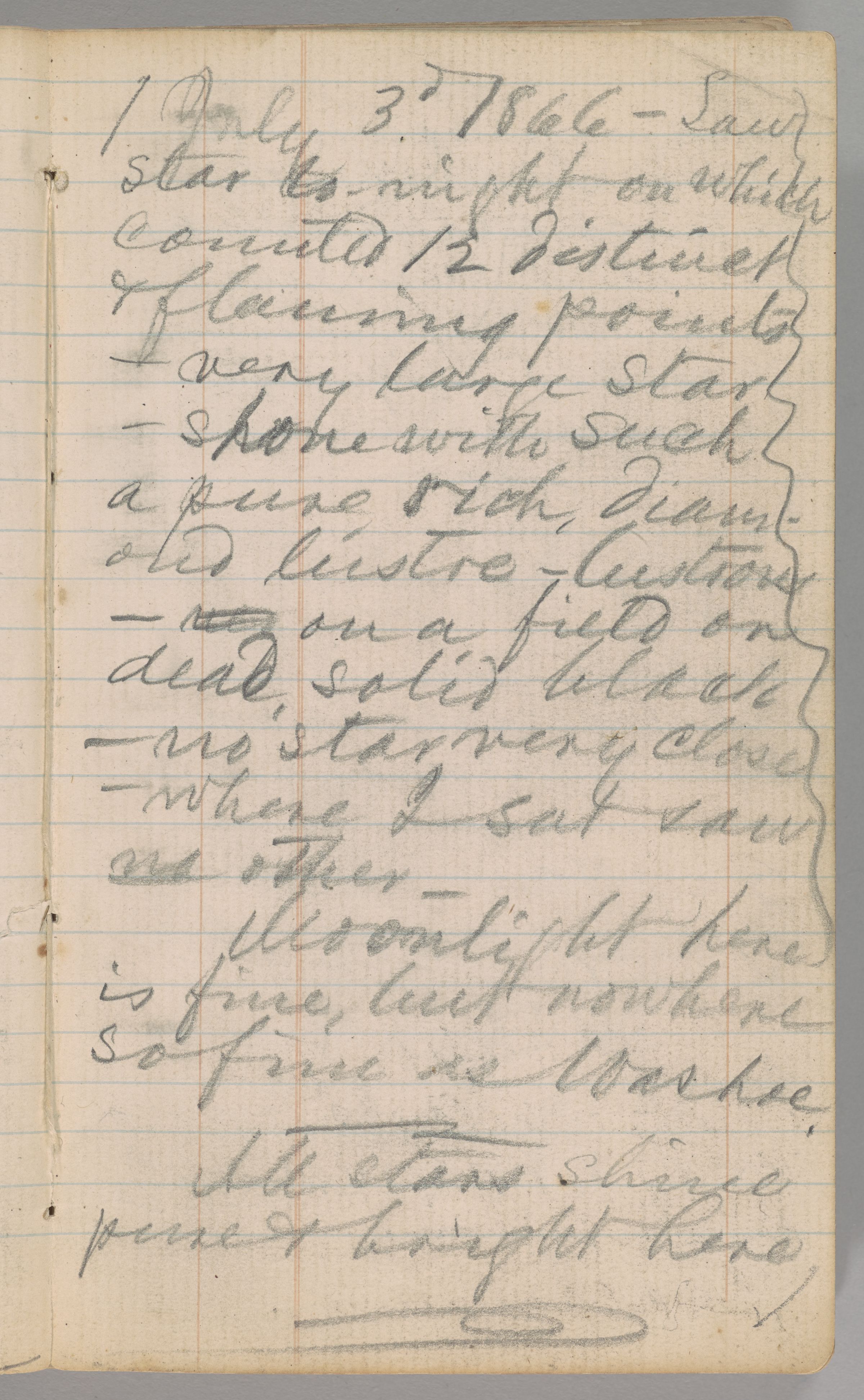
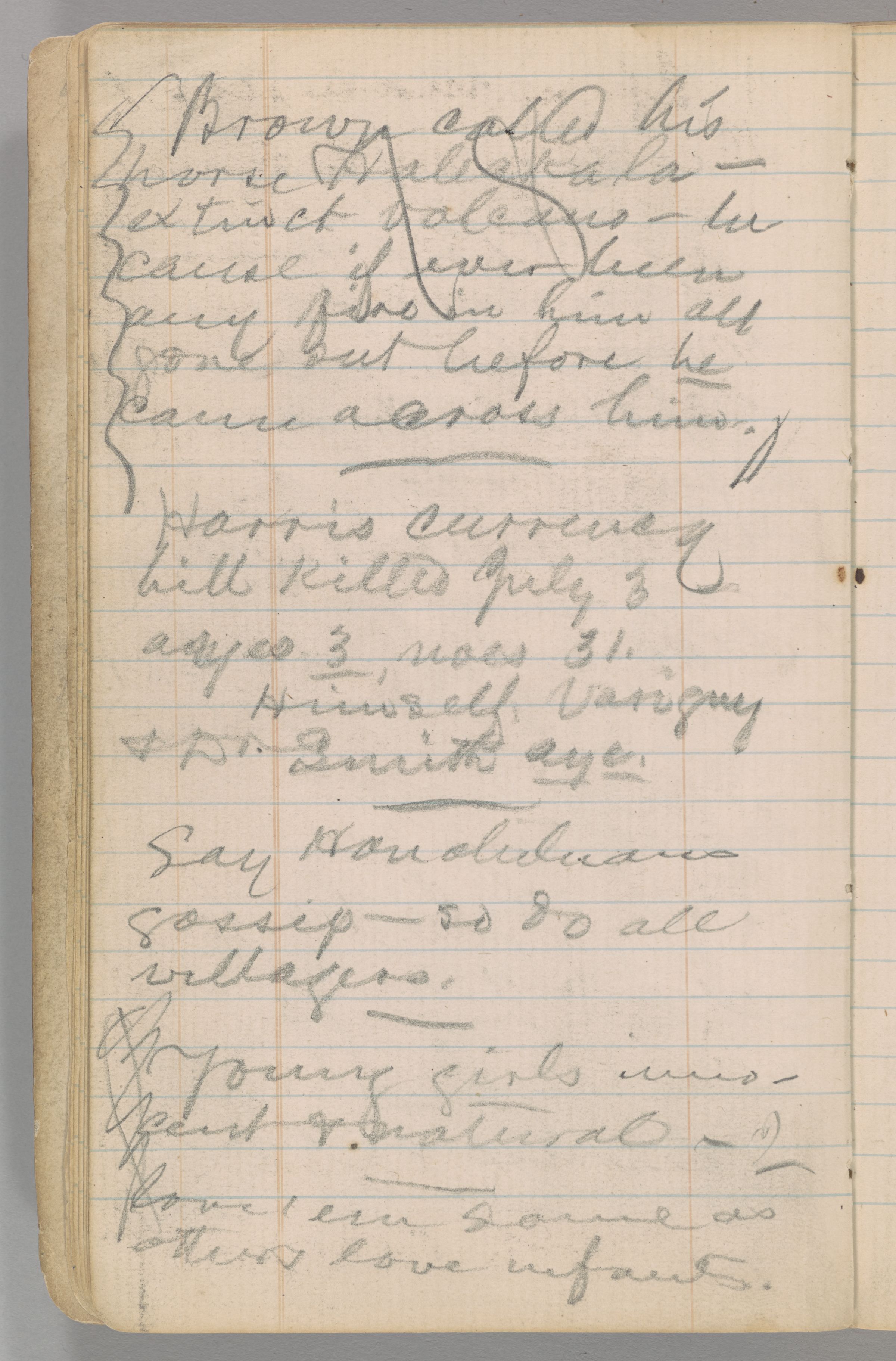
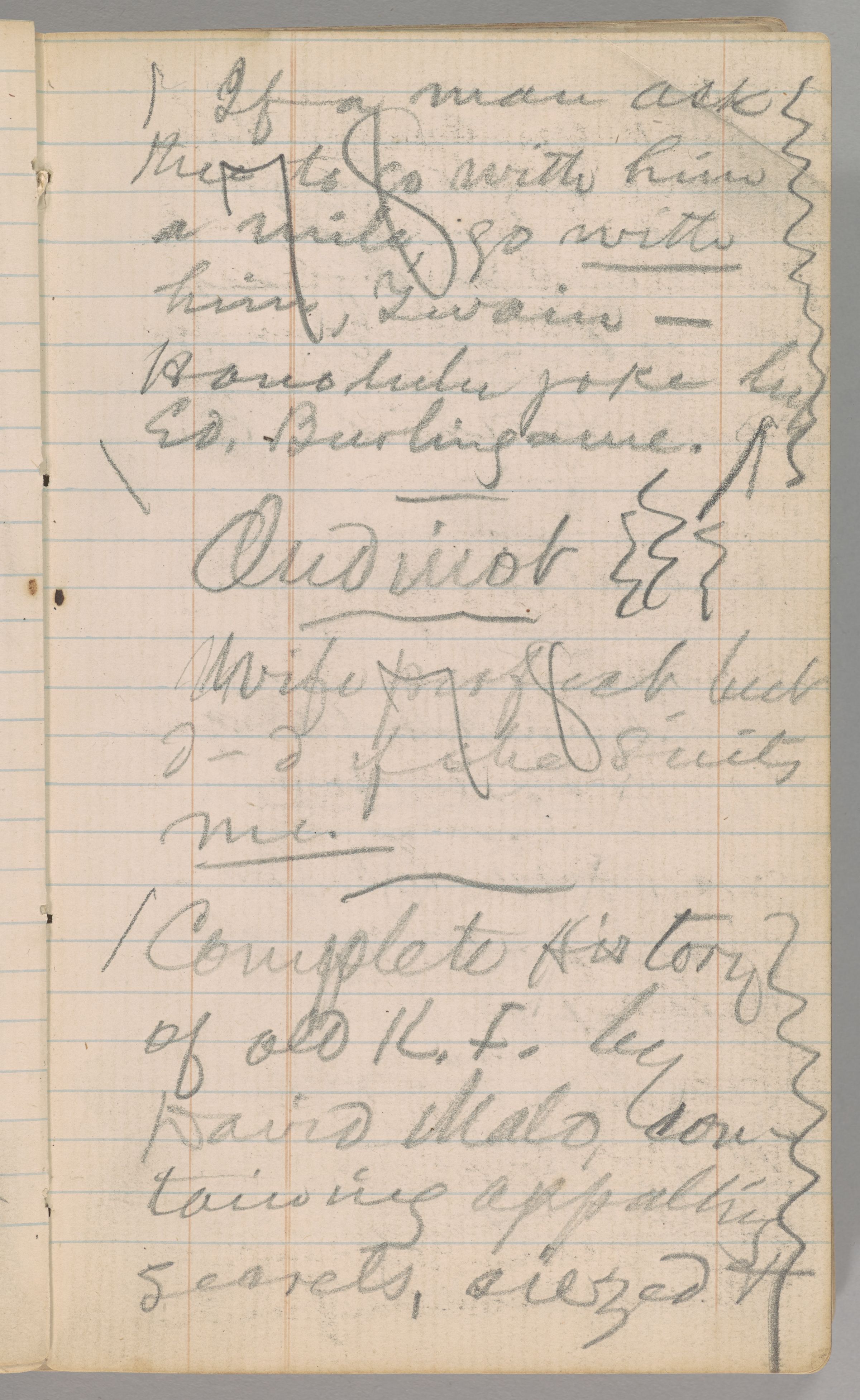
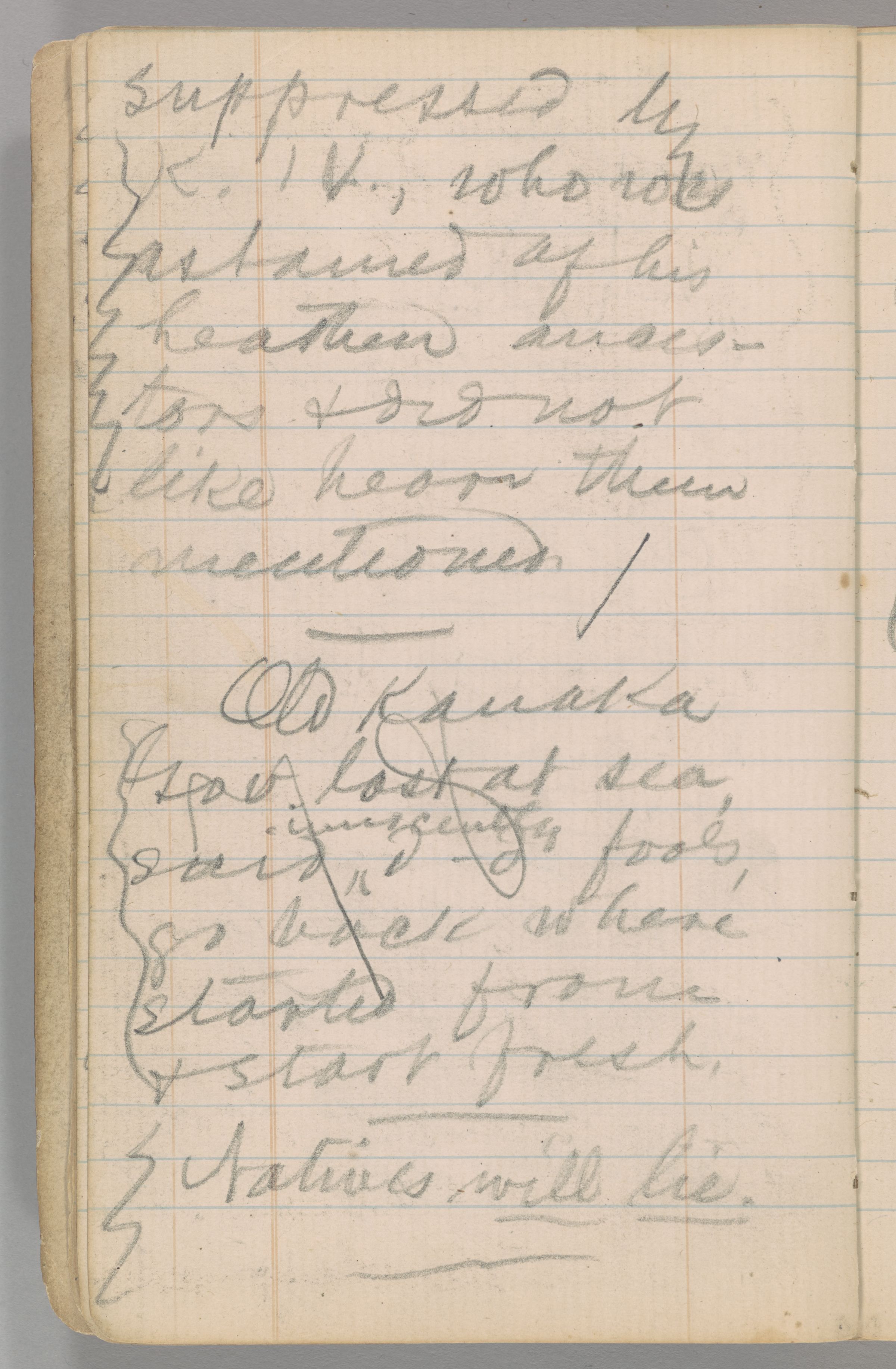
Paine's penciled use marks appear throughout, in addition to Clemens' usual use marks. Clemens also imposed on many entries in this notebook a system of symbols and numbers in pencil that are now only partially understandable (see illustrations). The significant symbols, which are represented or described in the present text immediately following the entries across which they were written, are: a spiral on entries concerning the Hornet shipwreck, the number 8 written over examples of historical eloquence, and a 78 used to designate contemporary anecdote, quotation, and other potential literary material (although most of this material does not appear in Clemens' extant Sandwich Islands writings). The categories designated seem sufficiently clear, but it has not been determined why Clemens selected these particular symbols.
The following bibliography gathers the sources most consistently used to document
Mark Twain's Sandwich Islands notebooks. A number of additional studies and articles
of more circumscribed use are cited in notes, where appropriate. Contemporary files
of the Pacific Commercial Advertiser, the Hawaiian Gazette, and the Daily Hawaiian Herald provided a variety of information, as did issues of The Friend, an important Honolulu temperance periodical. The Hawaiian Almanac and Annual series, published for many years by Thomas G. Thrum, was frequently consulted for
its retrospective notes and articles about Hawaiian life at the time of Mark Twain's
visit. All of these sources were supplemented by reference to works too numerous and
sometimes too ephemeral to mention, more important in establishing a sense of period
than for providing specific annotations. At several
[MTP: N&J1_109]
points in the preparation of the Sandwich Islands notebooks, information and counsel
were most graciously supplied by Agnes C. Conrad, Hawaiian state archivist.
Alexander, William De Witt. A Brief History of the Hawaiian People. New York: American Book Co., [1891].
Anderson, Rufus. The Hawaiian Islands: Their Progress and Condition Under Missionary Labors. 3d ed. Boston: Gould and Lincoln, 1865.
Anderson, Rufus. History of the Sandwich Islands Mission. Boston: Congregational Publishing Society, 1870.
Andrews, Lorrin. A Dictionary of the Hawaiian Language. Honolulu, 1865.
Bradley, Harold Whitman. The American Frontier in Hawaii: The Pioneers, 1789–1843. Stanford, California: Stanford University Press, 1942.
Daws, Gavan. Shoal of Time: A History of the Hawaiian Islands. New York: Macmillan, [1968].
Frear, Walter F. Mark Twain and Hawaii. Chicago: Lakeside Press, 1947.
Judd, Laura Fish. Honolulu: Sketches of Life in the Hawaiian Islands from 1828 to 1861. Edited by Dale L. Morgan. Chicago: Lakeside Press, 1966.
Kuykendall, Ralph S. The Hawaiian Kingdom. 3 vols. Honolulu: University of Hawaii Press, 1938–1967.
Morgan, Theodore. Hawaii: A Century of Economic Change, 1778–1876. Cambridge: Harvard University Press, 1948.
Pukui, Mary Kawena, and Elbert, Samuel H. Hawaiian Dictionary. Honolulu: University of Hawaii Press, 1971.
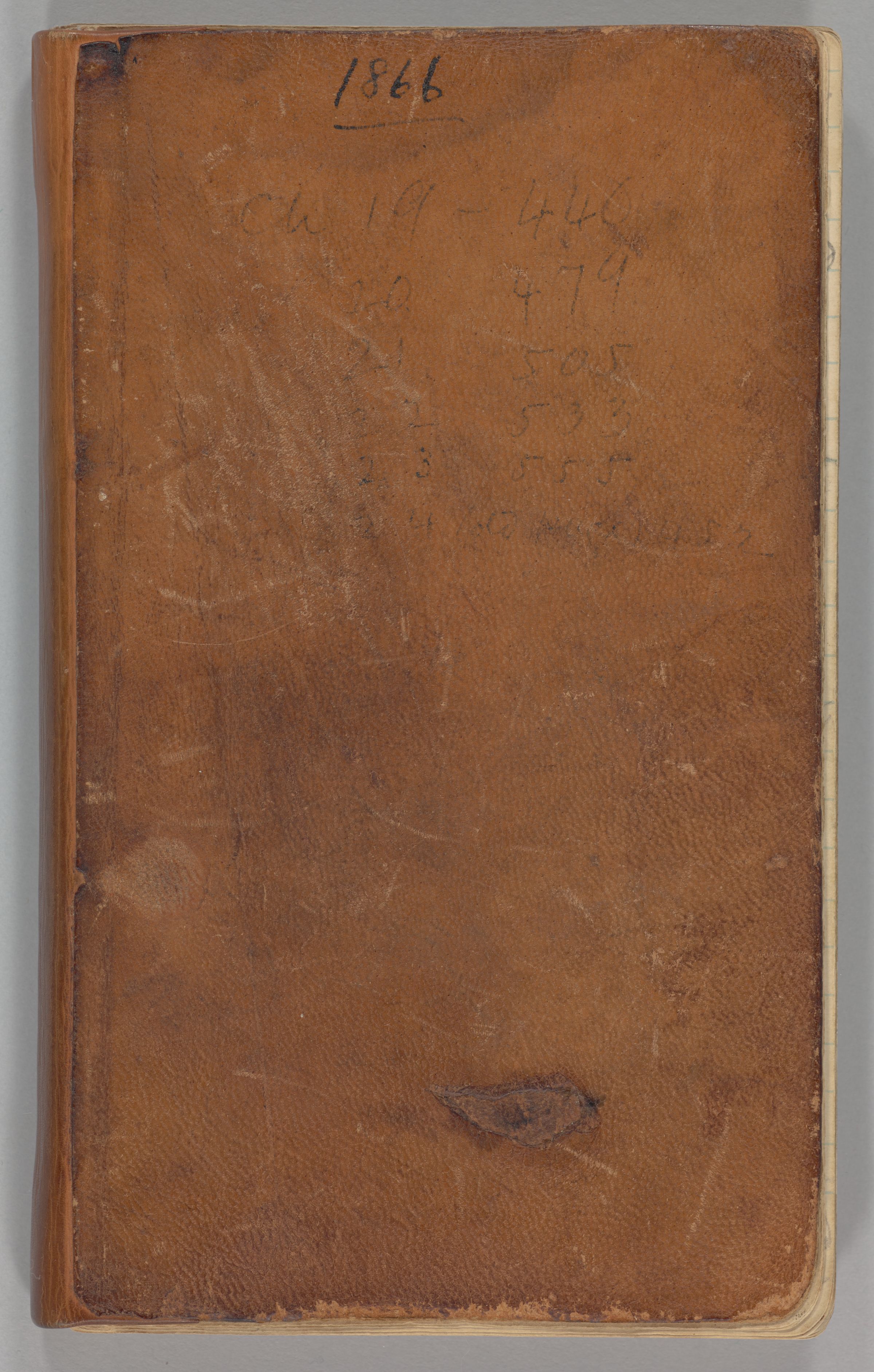
[MS: N05_front cover]
Ch 19—440
20 479
21 505
22 533
23 555
24 (old page) 452Ⓣtextual note 1
[MTP: N&J1_110]
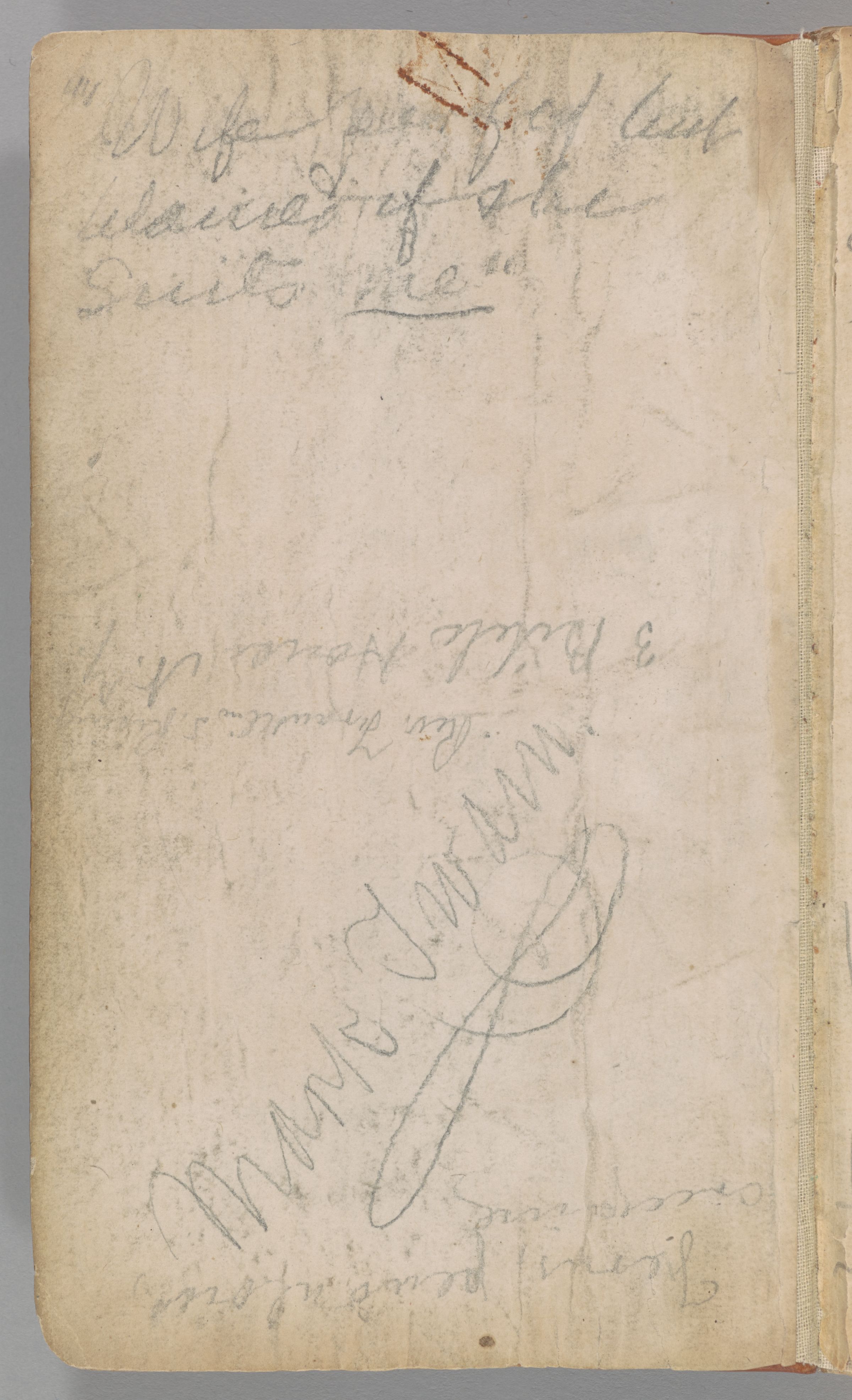
[MS: N05_front endpaper]
“Wife perfect but
blamed if she
suits me”
Ferns, pendulous, creepingⓉtextual note 3
Mark Twain. Ⓣtextual note
Rev. Franklin S. Rising.
3 Bible House N.Y.Ⓣtextual note 2
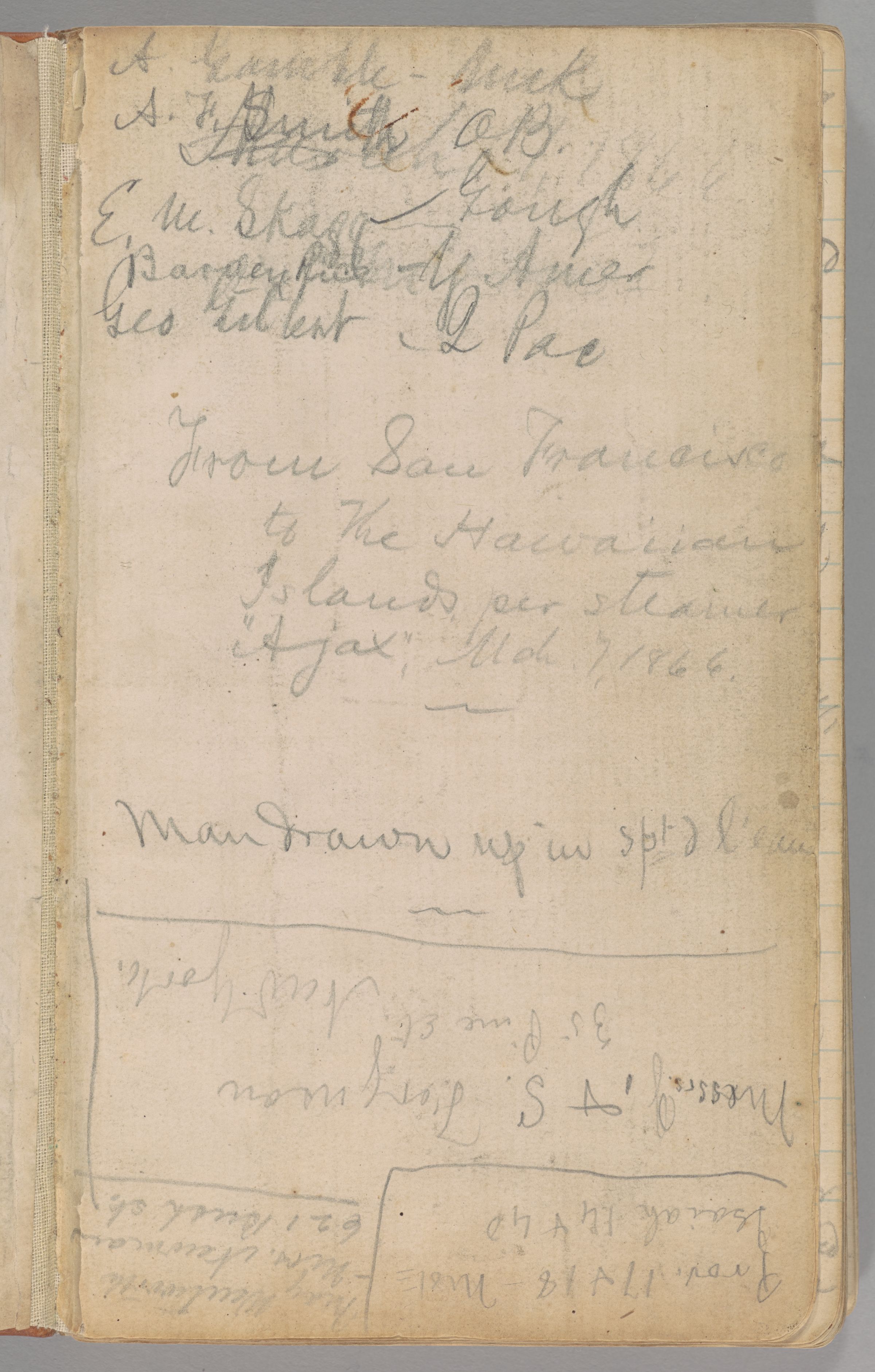
[MS: N05_front flyleaf recto]
March 7, 1866.
A. Gamble—Unk4
[MTP: N&J1_111]
A. F. Smith O B.
E. M. Skagg—Gough
Barney Rice—Y Amer
Geo Gilbert—Q PacⓉtextual note
From San Francisco
to the Hawaiian
Islands per steamer
“Ajax,” Mch. 7, 1866.5

Man drawn up in spt d l'eau6
Prov 17 & 18—M[◊◊]
Isaiah 14 & 40
May Wentworth
—Mrs. Newman
621 Bush st.7
Mrsessrs.Ⓣtextual note J. & S. Ferguson
35 Pine st.
New York.Ⓣtextual note 8
[MS: N05_front flyleaf verso]
blank verso
[MS: N05_leaf_001r]
[MTP: N&J1_112]
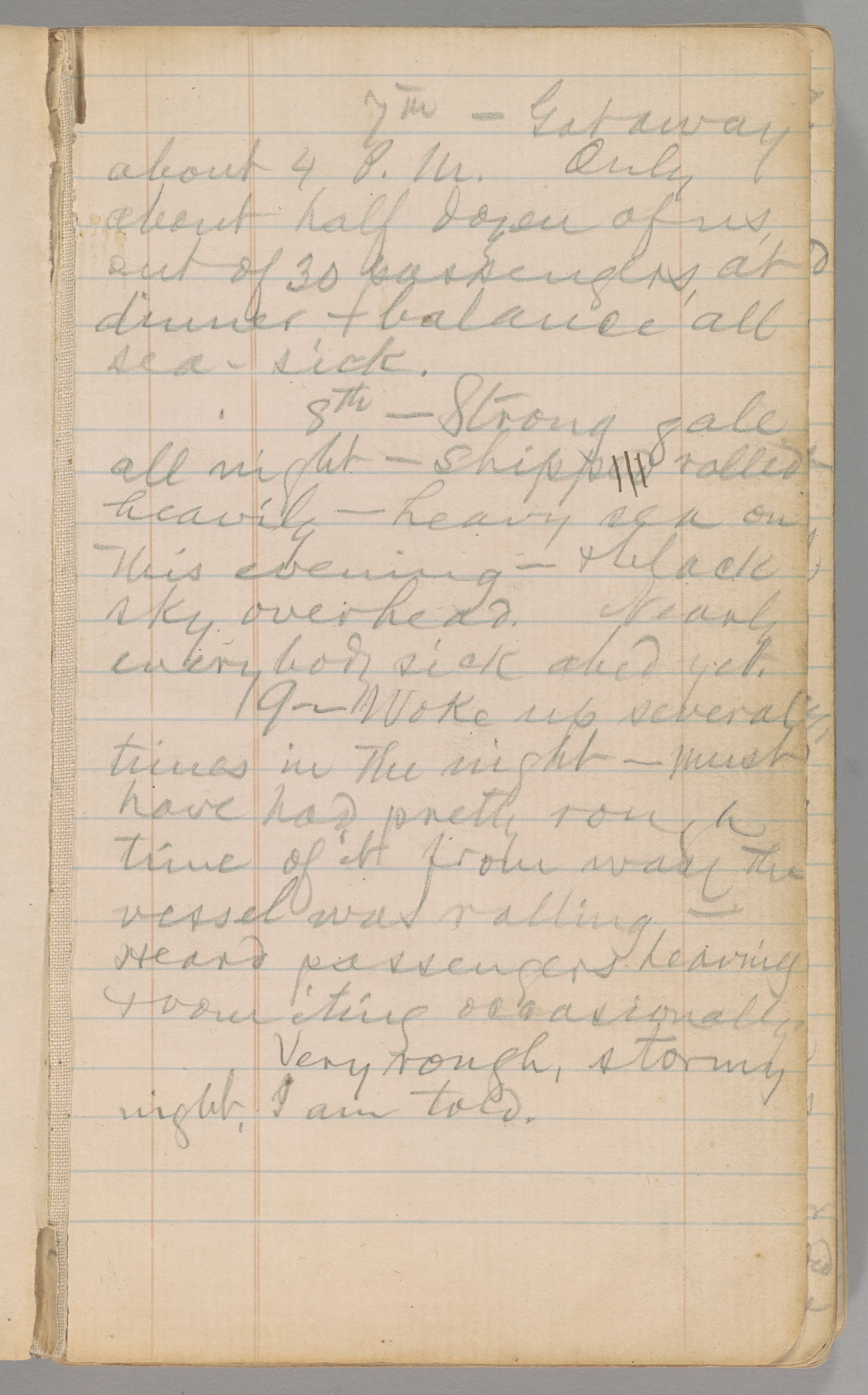
7th—Got away
about 4 P.M. Only
about half dozen of us,
out of 30 passengers, at
dinner—balance all
sea-sick.9
8th—Strong gale
all night—shipp ed
Ⓣtextual note rolled
heavily—heavy sea on
this evening—& black
sky overhead. Nearly
everybody sick abed yet.
9—Woke up several
times in the night—must
have had pretty rough
time of it from way the
vessel was rolling.—
Heard passengers heaving
& vomiting occasionally.
Very rough, stormy
night, I am told.
[MS: N05_leaf_001v]
blank verso
[MS: N05_leaf_002r]
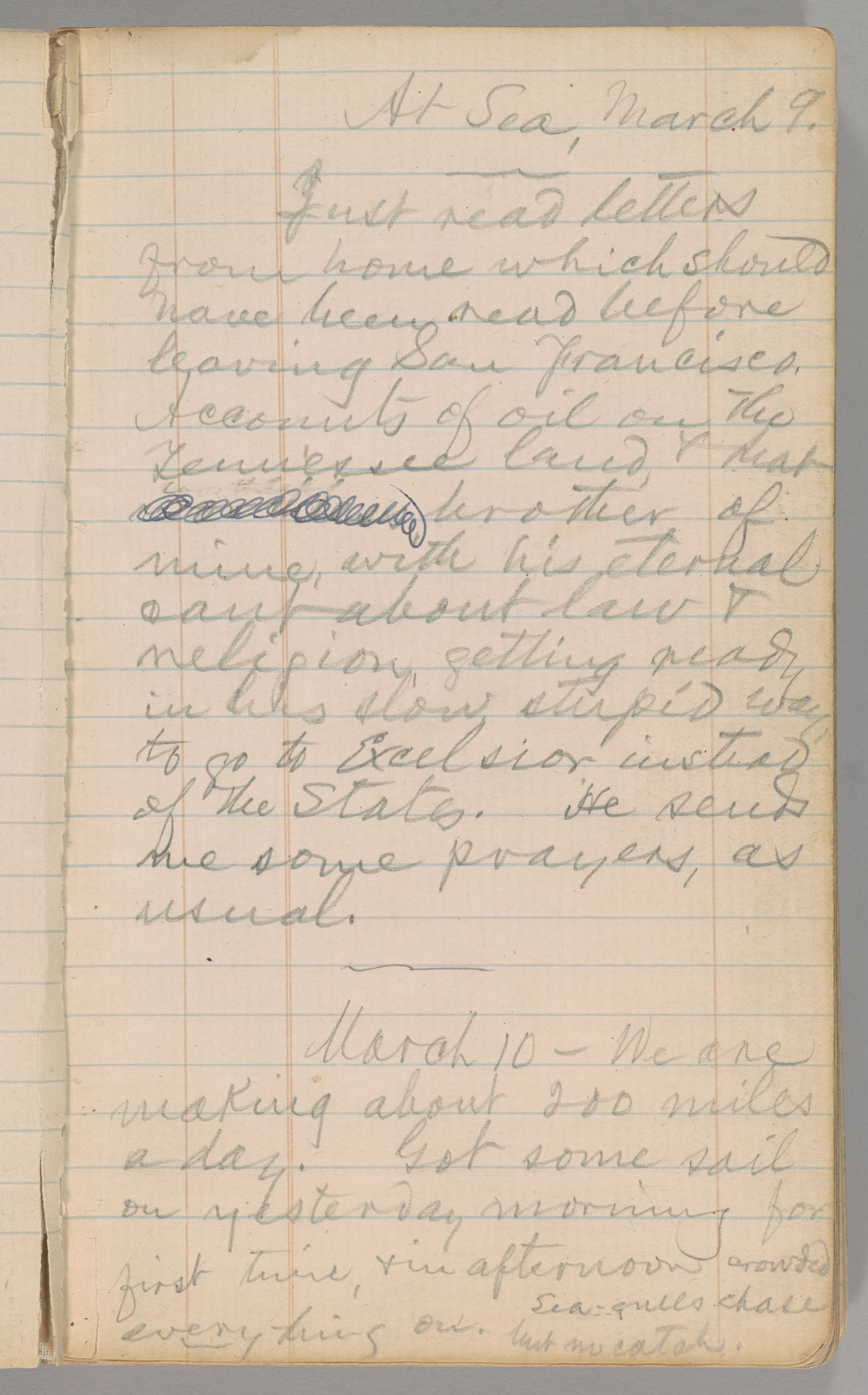
At Sea, March 9.
I Just read letters
from home which should
have been read before
leaving San Francisco.
Accounts of oil on the
Tennessee land,10 & that
worthless
worthless
brotherⓉtextual note of
mine, with his eternal
cant about law &
religion, getting ready
in his slow, stupid way,
to go to Excelsior, insteadⓂemendation
of the States. He sends
me some prayers, as
usual.
March 10—We are
making about 200 miles
a day. Got some sail
[MTP: N&J1_113]
on yesterday morning for
first time, & in afternoon crowded
everything on. Sea-gulls chase but no catch.
[MS: N05_leaf_002v]
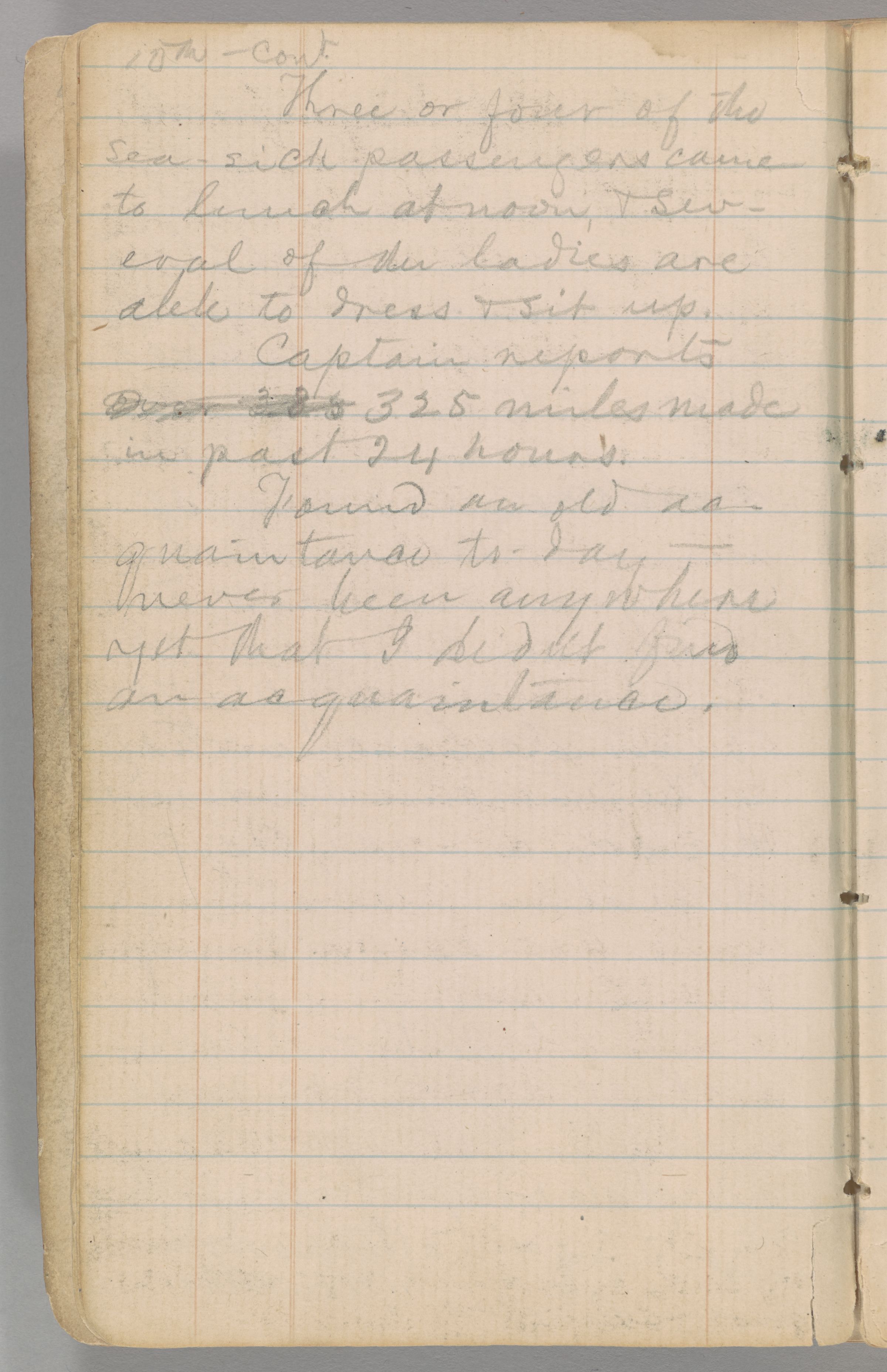
10th—cont.
Three or four of the
sea-sick passengers came
to lunch at noon, &
sev-
eral
several
of the ladies are
able to dress & sit up.
Captain reports
over 335 325 miles made
in past 24 hours.
Found an old
ac-
quaintance
acquaintance
to-day—
never been anywhere
yet that I didn't find
an acquaintance.Ⓣtextual note
11
[MS: N05_leaf_003r]
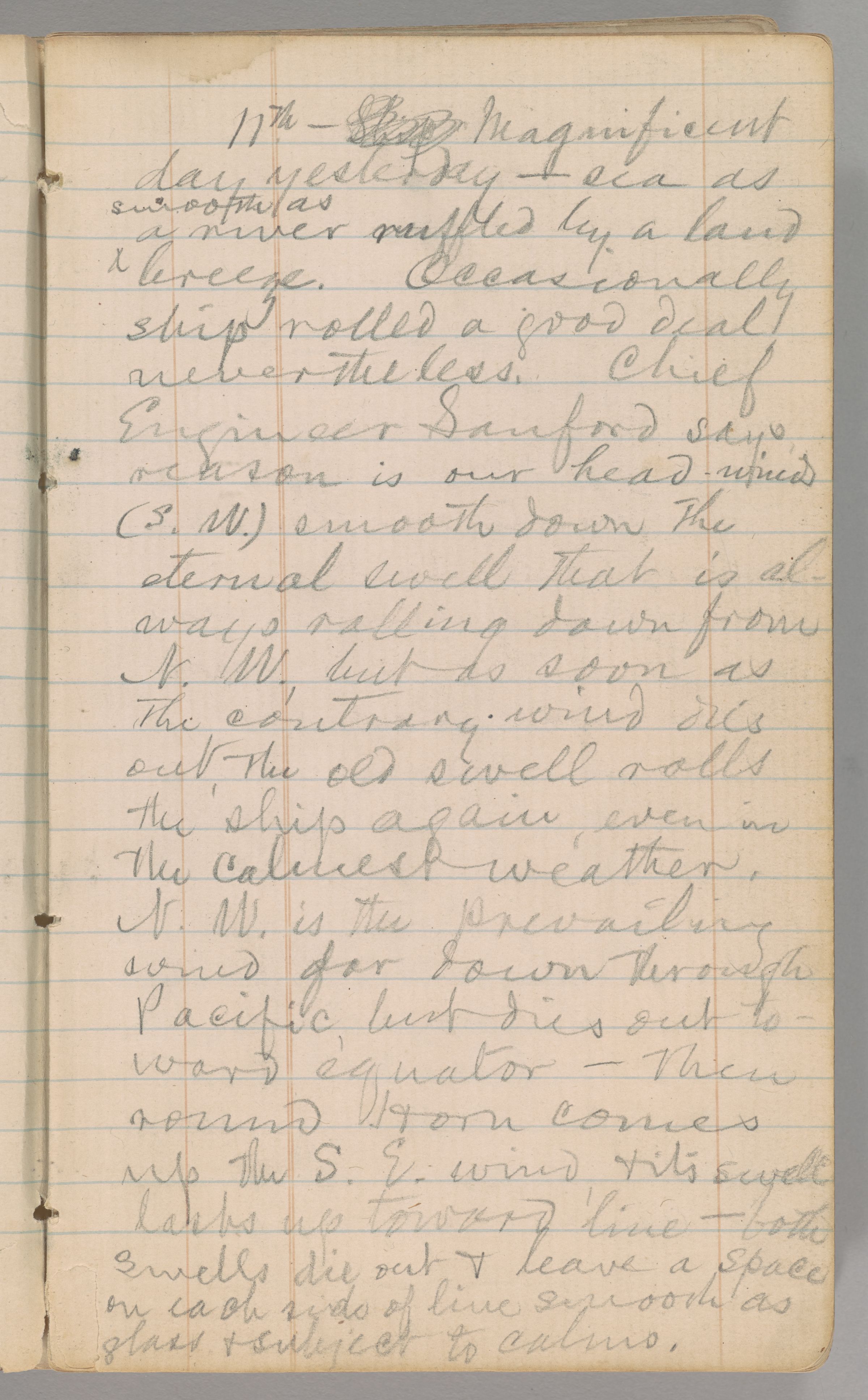
11th—Ship Magnificent
day yesterday—sea as
smooth as
a river w ruffled by a land
breeze. Occasionally
ship rolled a good deal,
nevertheless. Chief
Engineer Sanford says
reason is our head-winds
(S. W.) smooth down the
eternal swell that is
al-
ways
always
rolling down from
N. W., but as soon as
the contrary wind dies
out, the old swell rolls
the ship again, even in
the calmest weather.
N. W. is the prevailing
wind farⓂemendation down through
Pacific, but dies out
to-
ward
toward
equator—then
round Horn comes
up the S. E. wind, & its swell
lasts up toward line—both
swells die out & leave a space
on each side of line smooth as
glass & subject to calms.
[MS: N05_leaf_003v]
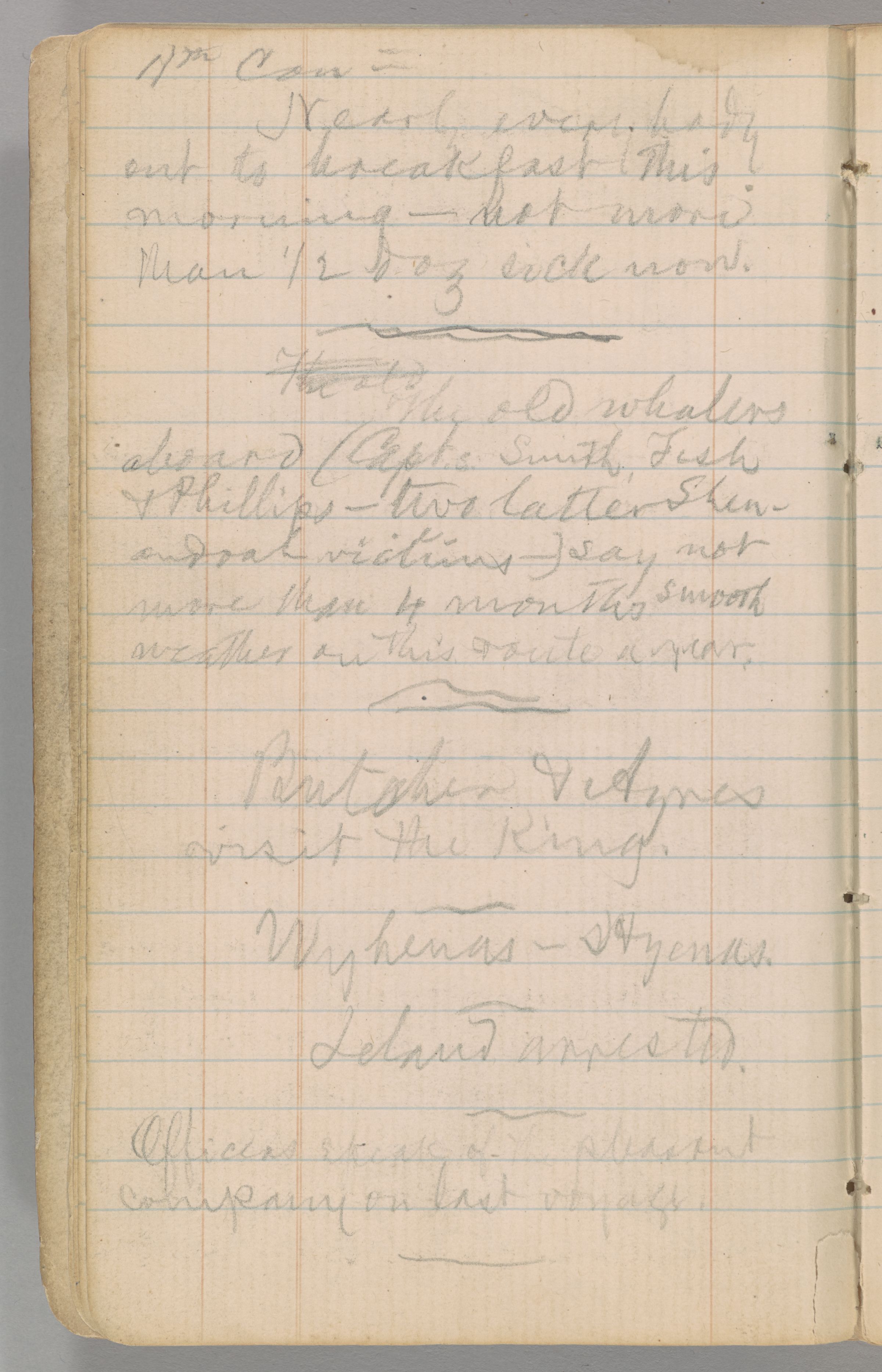
11th Con—
Nearly everybody
out to breakfast this
morning—not more
than ½ doz sick now.
The old
The old whalers
aboard (Capt.s. Smith, Fish
& Phillips12—two latter
Shen-
andoah
Shenandoah
13 victims—) say not
more than 4 months smooth
weather on this route a year.
[MTP: N&J1_114]
Butcher & Ayres visit the King.14
Wyhenas—[W] Hyenas.15
Leland arrested.16
Officers speak of the pleasant company on last voyage.17
[MS: N05_leaf_004r]
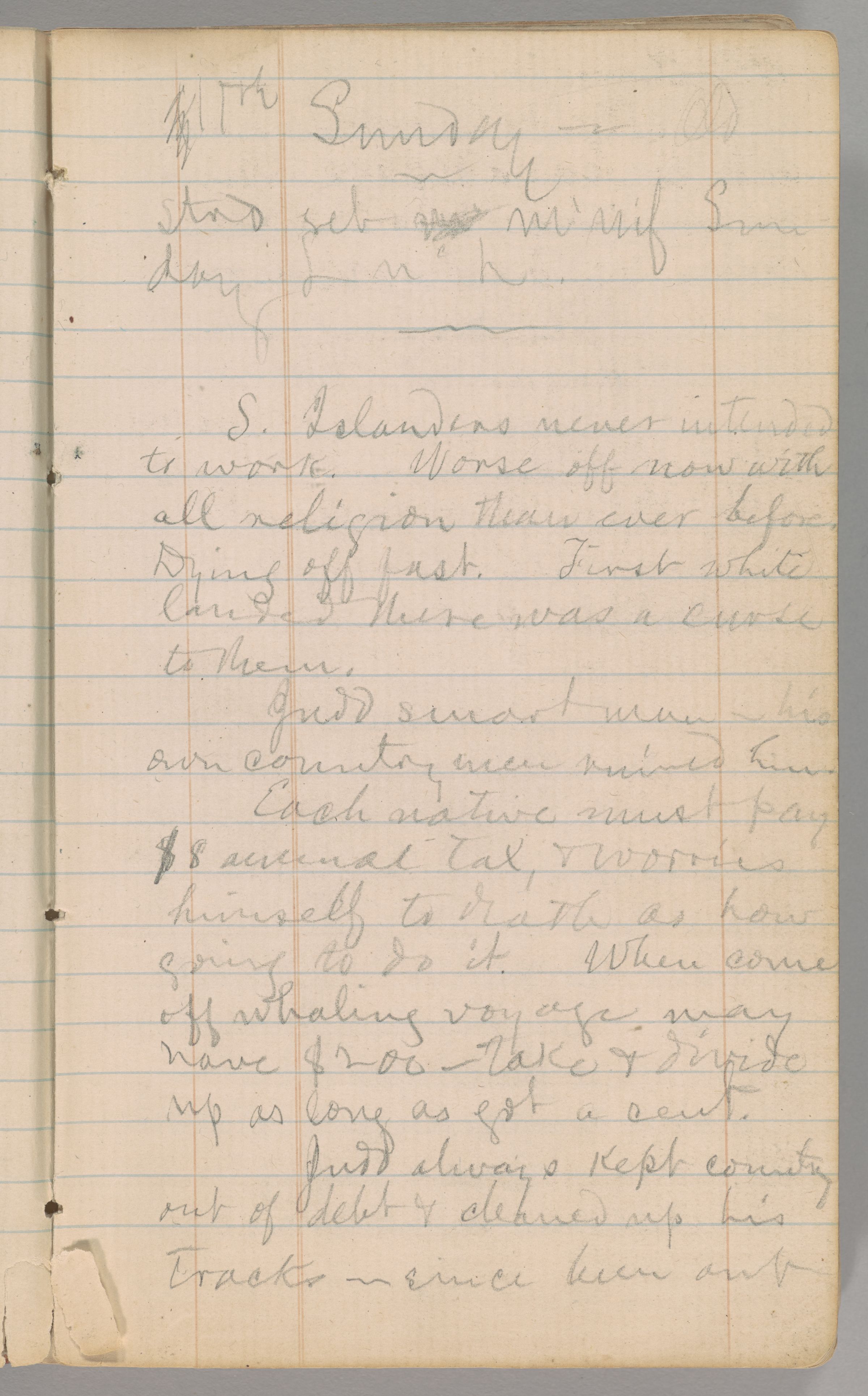
11th
Sunday—OldⓉtextual note
strd setⓂemendation
mn' m'nif
Sun-
day
Sunday
Lnch.18
S. Islanders never intended
to work. Worse off now with
all religion than ever before.
Dying off fast. First white
landed there was a curse
to them.
Judd smart man—his
own countrymen ruined him.19
[MTP: N&J1_115]
Each native must pay
$8 annual tax, & worries
himself to death as how
going to do it. When come
off whaling voyage may
have $200—take & divide
up as long as got a cent.
Judd always kept country
out of debt & cleaned up his
tracks—since been out
[MS: N05_leaf_004v]
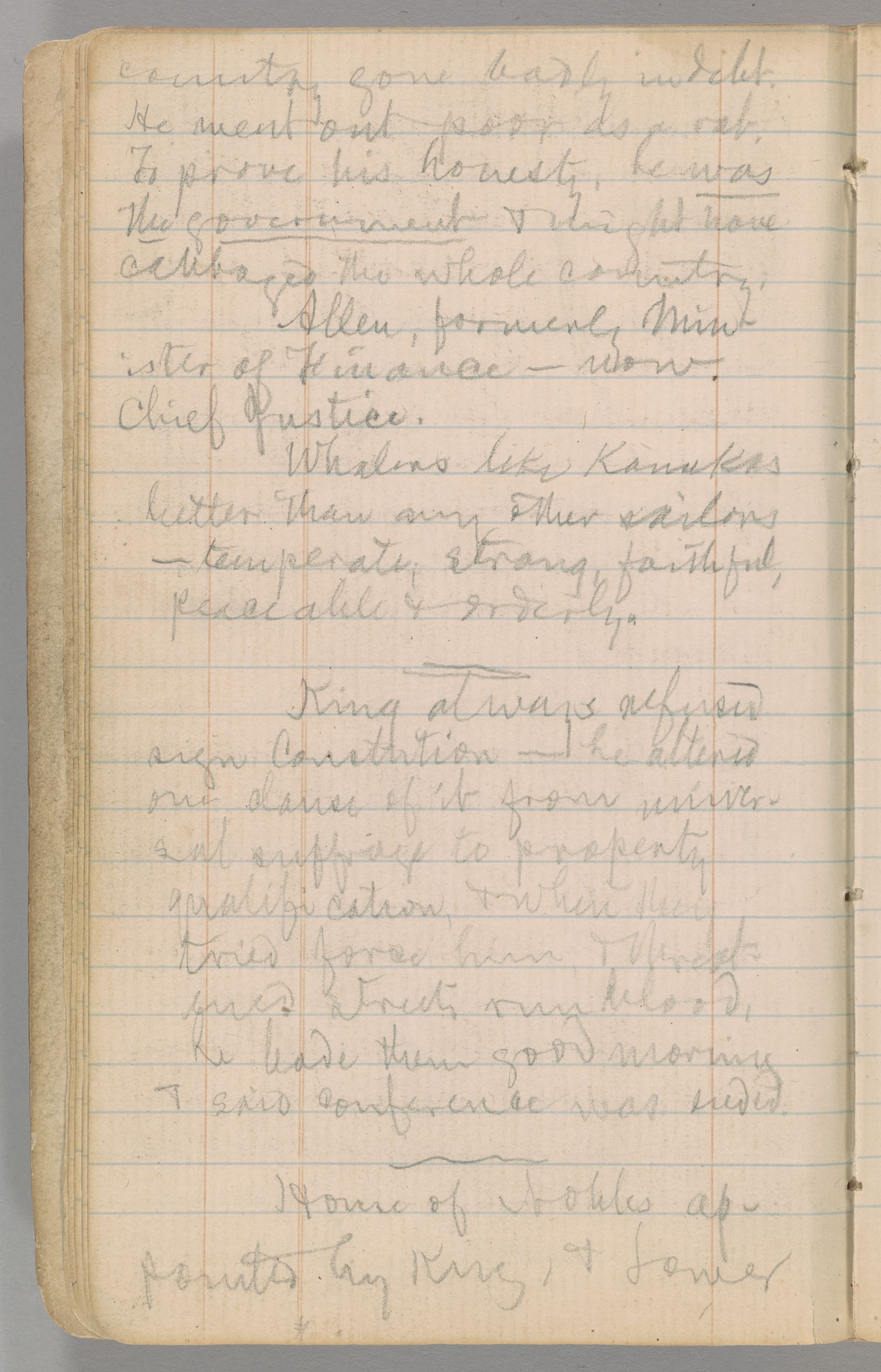
country gone badly in debt.
He went out poor as a rat.
To prove his honesty, he was
the government & might have
cabbaged the whole country.
Allen, formerly
Min-
ister
Minister
of Finance—now
Chief Justice.20
Whalers like Kanakas
better than any other sailors
—temperate, strong, faithful,
peaceable & orderly.
King always refused
sign Constution—he altered
one clause of it from
univer-
sal
universal
suffrage to property
qualification, & when they
tried force him, &
threat-
ened
threatened
streets run blood,
he bade them good morning
& said conference was ended.21
House of Nobles
ap-
pointed
appointed
by King, & Lower
[MS: N05_leaf_005r]
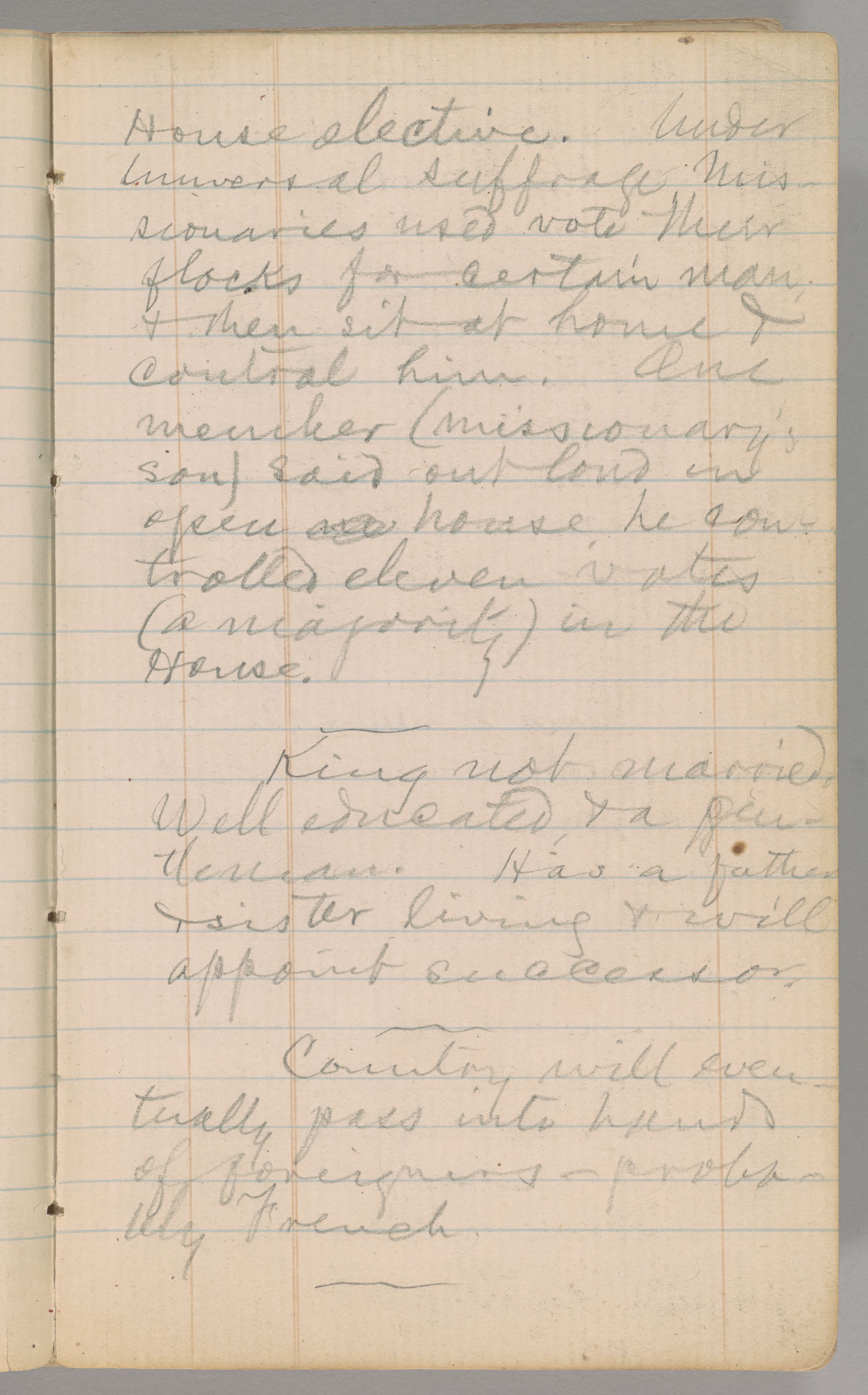
House elective.22 Under
Universal suffrage,
Mis-
sionaries
Missionaries
used vote their
flocks for certain man,
& then sit at home &
control him. One
member (missionary's
son) said out loud in
open ne house, he
con-
trolled
controlled
eleven votes
(a majority) in the
House.
[MTP: N&J1_116]
King not married.23
Well educated, & a P
gen-
tleman
gentleman
. Has a father24
& sister living & will
appoint successor.
Country will
even-
tually
eventually
pass into hands
of foreigners—
proba-
bly
probably
French.25
[MS: N05_leaf_005v]
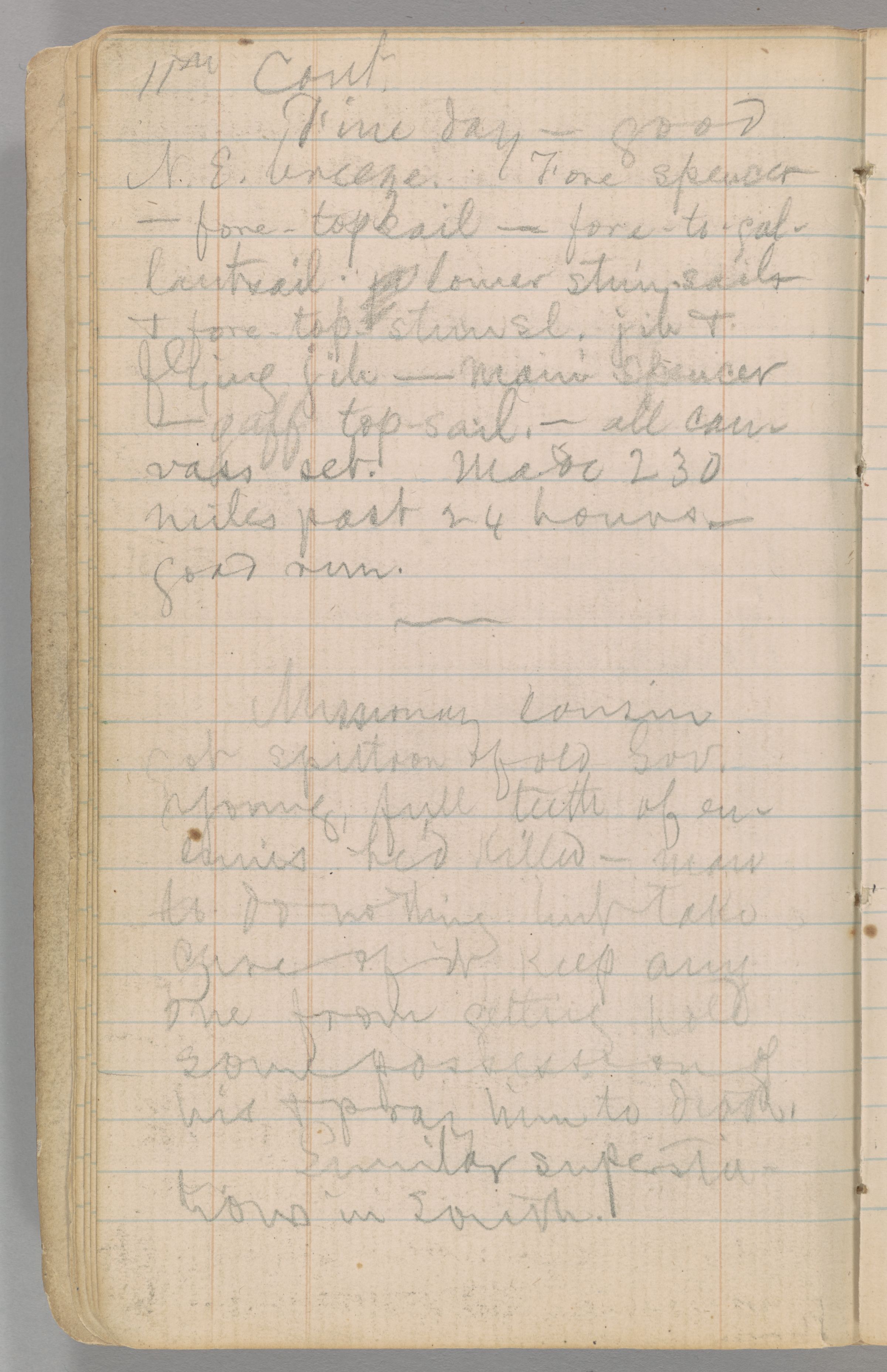
11th Cont.26
Fine day—good
N. E. breeze. Fore spencer
—fore-topsail—fore-to-
gal-
lantsail
gallantsail
; ji lower stu'n sails
—& fore-top-stu'nsl; jib &
[MTP: N&J1_117]
flying jib—main spencer
—gaff top-sail.—all
can-
vass
canvass
set. Made 230
miles past 24 hours—
good run.
Missionary cousin
got spittoon of old Gov.
Young,27 full teeth of
en-
emies
enemies
he'd killed—man
to do nothing but take
care of it, keep any
one from getting hold
some possession of
his & pray him to death.28
Similar
supersti-
tions
superstitions
in south.
[MS: N05_leaf_006r]
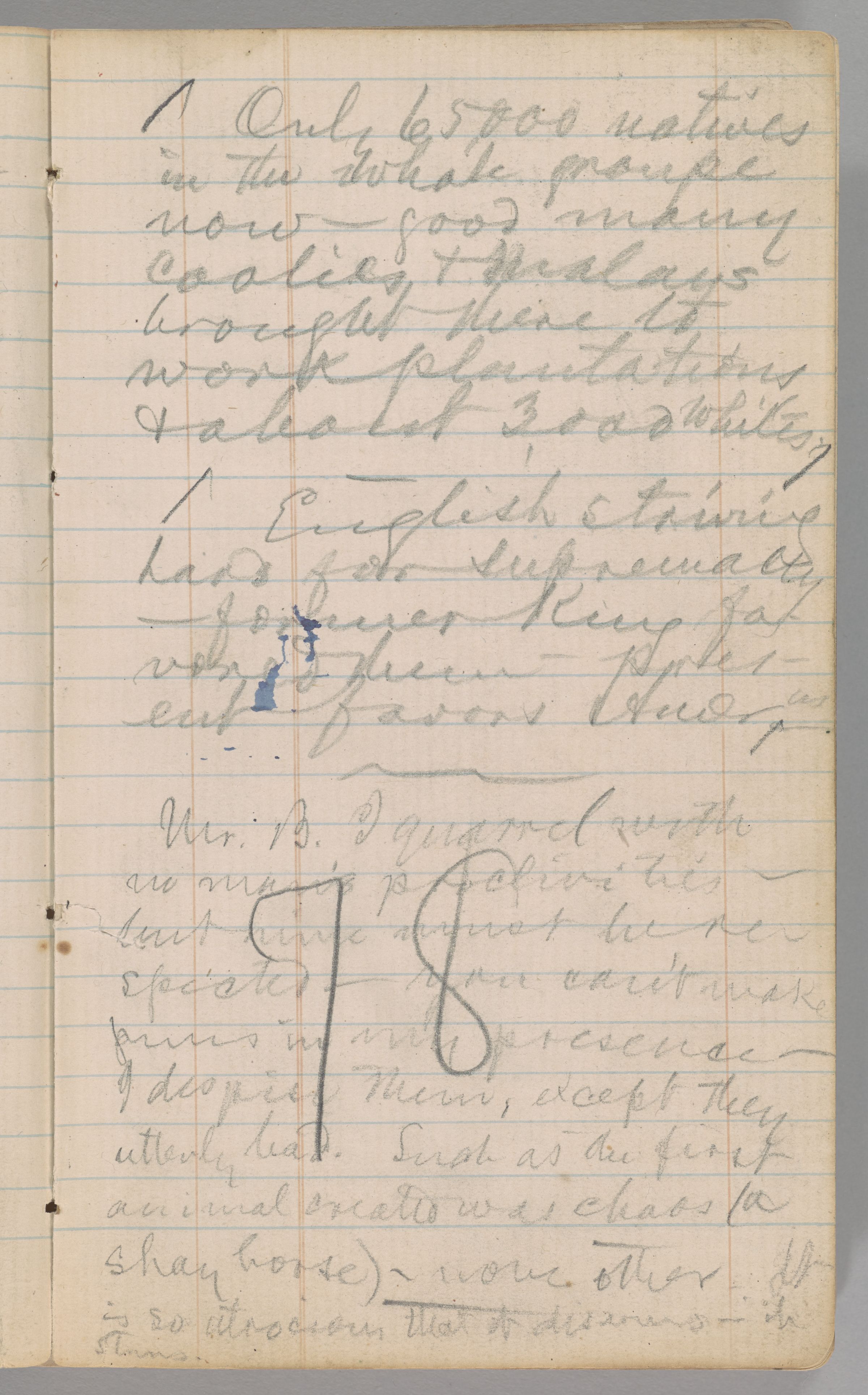
Only 65,000 natives
in the whole groupe
now—good many
coolies & Malays
brought there to
work plantations
& about 3,000 whites.29
English striving
hard for supremacy
—former King
fav-
ored
favored
them—
pres-
ent
present
favors Amerns
30
[MTP: N&J1_118]
Mr. B. I quarrel with
no man's proclivities—
but mine must be
re-
spected
respected
—you can't make
puns in my presence—
I despise them, except they
utterly bad. Such as the first
animal created was chaos (a
shay horse)—none other. It
is so atrocious that it disarms—it
stuns.31
78
[MS: N05_leaf_006v]
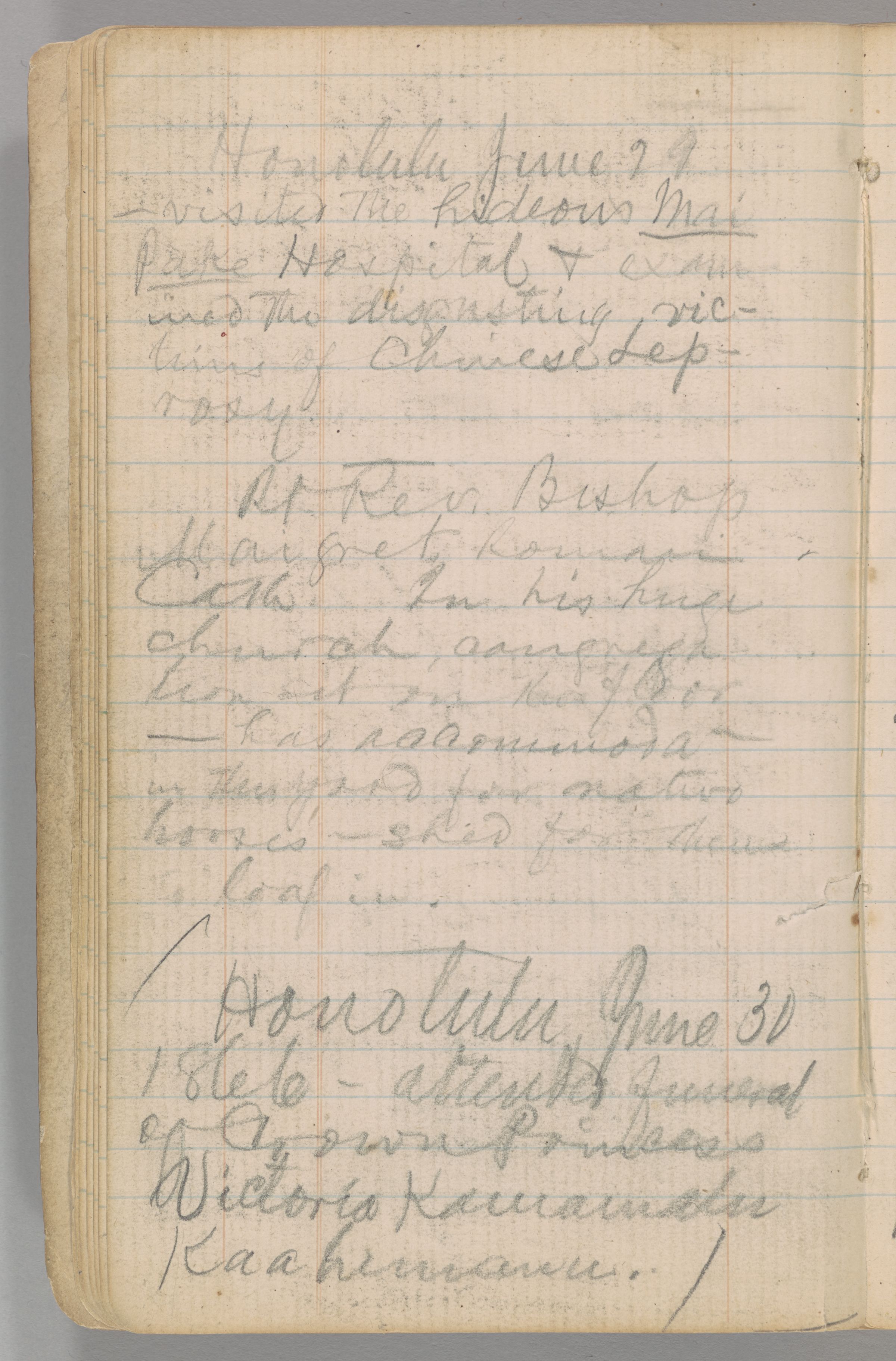
Honolulu, June 29
—visited the hideous Mai
Pake Hospital &
exam-
ined
examined
the disgusting
vic-
tims
victims
of Chinese
Lep-
rosy
Leprosy
.32
Rt. Rev. Bishop
Maigret, Roman
Cath.33 In his huge
church,
congrega-
tion
congregation
sit on the floor
—has accommodan
in the yard for native
horses—shed for them
to loaf in.
Honolulu, June 30
1866—attended funeral
of Crown Princess
Victoria Kamamalu
Kaahumanu.34
[MS: N05_leaf_007r]
[MTP: N&J1_119]
July 3d 1866—Saw
star to-night on which
counted 12 distinct
& flaming points
—very large star
—shone with such
a pure, rich,
diam-
ond
diamond
lustre—lustrous
—nes on a field on
dealdⓉtextual note, solid black
—no star very close
—where I sat saw
no other—
Moonlight here
is fine, but nowhere
so fine as Washoe.
All stars shine
pure & bright here.
[MS: N05_leaf_007v]
Brown called his
horse Haleakala—
extinct volcano—
be-
cause
because
if ever been
any fire in him all
gone out before he came across him.
78
Harris currency
bill killed July 3
—ayes 3, noes 31.35
Himself, Varigny
& Dr. Smith36
aye.
Say Honoluluans
gossip—so do all
villagers.
[MTP: N&J1_120]
Young girls
inno-
cent
innocent
& natural—I
love 'em same as
others love infants.
[MS: N05_leaf_008r]
If a man ask
thee to go with him
a mile, go with
him, Twain—
Honolulu joke by
Ed. Burlingame.37
78
Oudinot38
Wife perfect but
d—d if she suits
me.
78
Complete History
of old K. I. by
David Malo,
con-
taining
containing
appalling
secrets, siezed &
[MS: N05_leaf_008v]
suppressed by
K. IV., who was
ashamed of his
heathen
ances-
tors
ancestors
& did not
like hear them
mentioned.39
Old Kanaka
Gov. lost at sea,
said innocently
d—d fools,
go back where
started from
& start fresh.40
78
Natives will lie.
[MTP: N&J1_121]
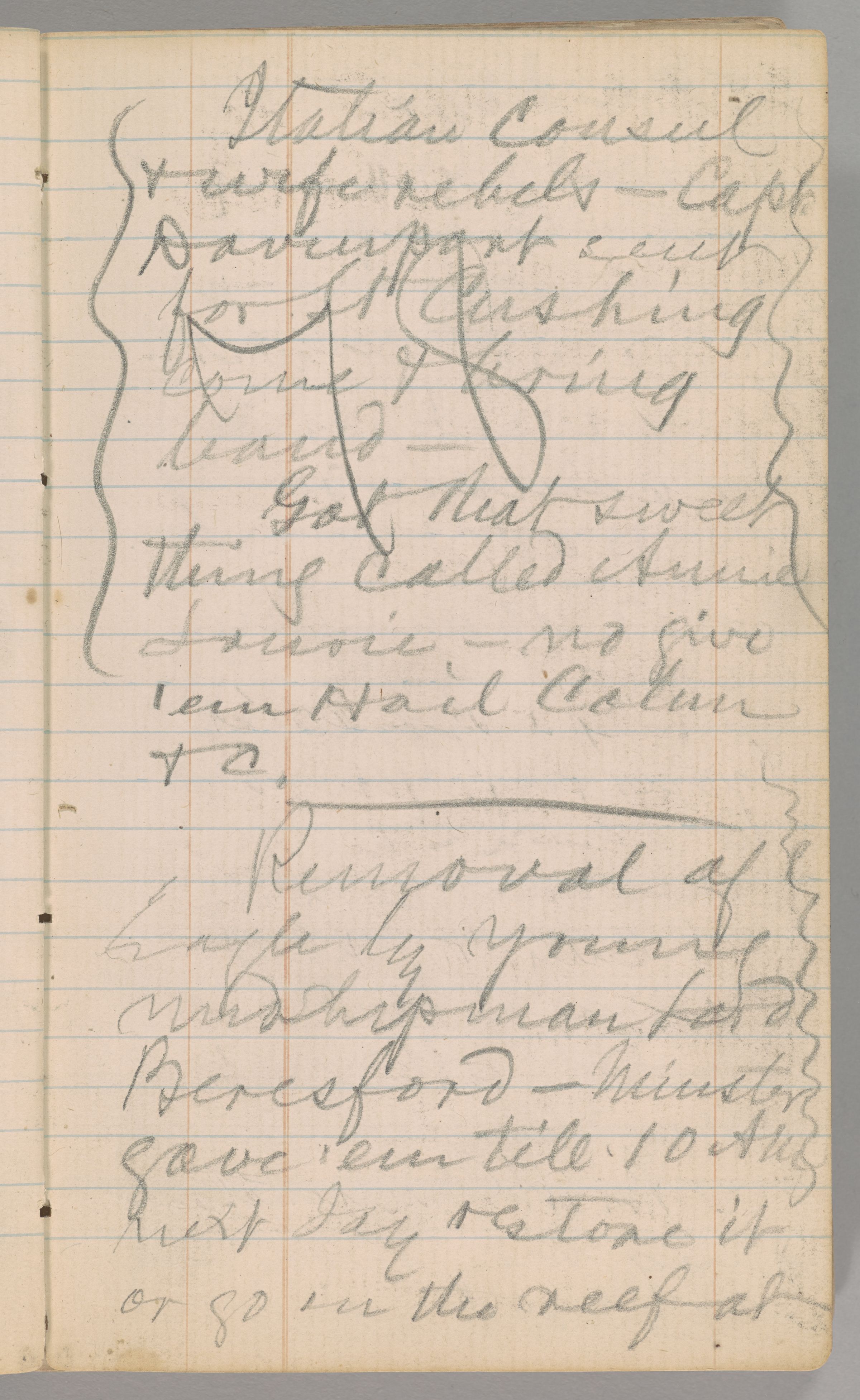
[MS: N05_leaf_009r]
Got that sweet
thing called Annie
Laurie—no give
'em Hail Colum
&c.
Removal of
Eagle43 by young
midshipman Lord
Beresford—Minister
gave 'em till 10 AM
next day restore it,
or go on the reef
[MTP: N&J1_122]
at
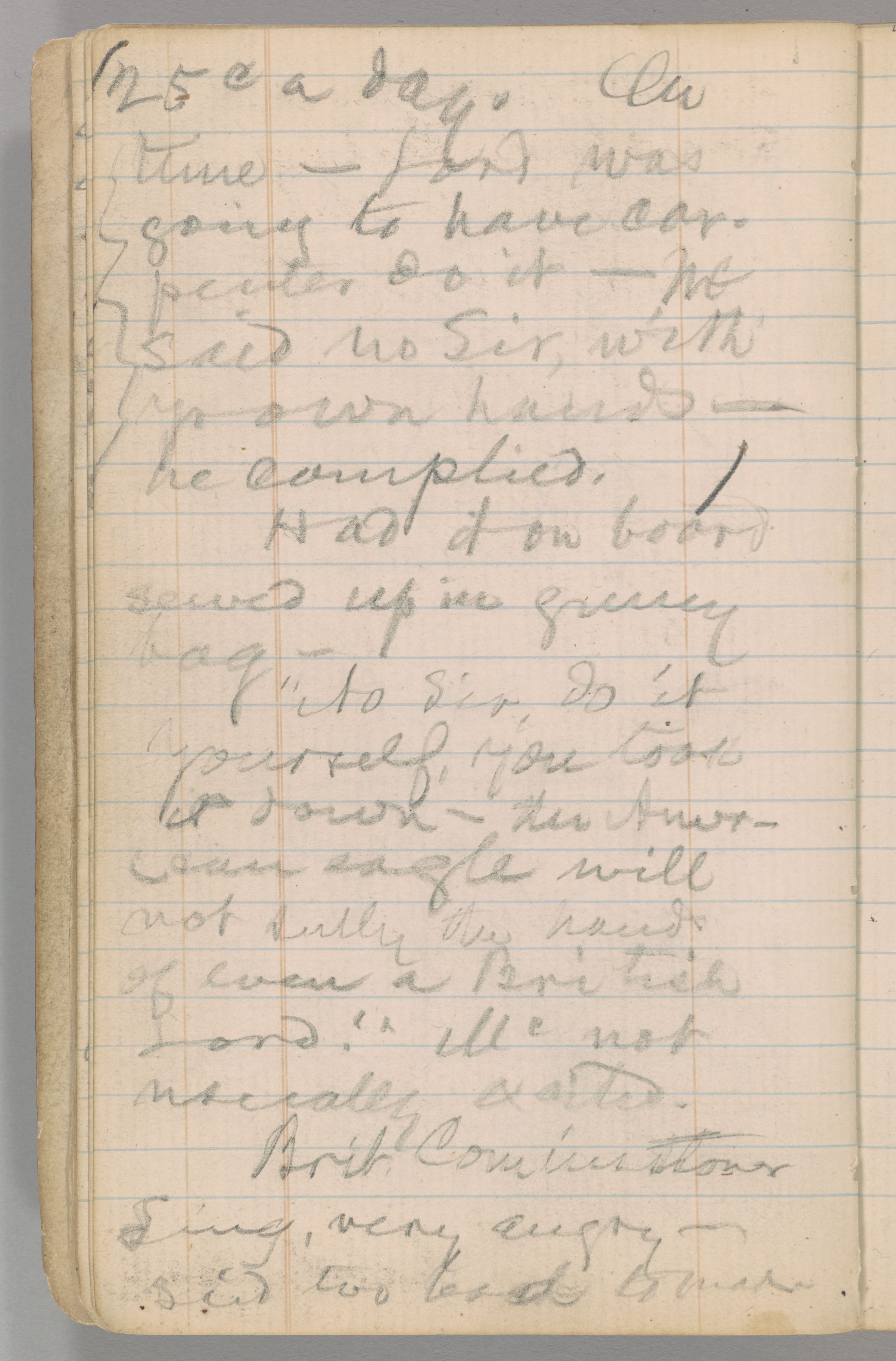
[MS: N05_leaf_009v]
25c a day. On
time—Lord was
going to have
car-
penter
carpenter
do it—Mc
said no Sir, with
yr own hands—
he complied.
Had it on board
sewed up in gunny
bag—
“No Sir, do it
yourself, you took
it down—the
Amer-
ican
American
eagle will
not sully the hands
of even a British
Lord!” Mc not
usually excited.
Brit. Commissioner
Sing, very angry—
said too bad to make
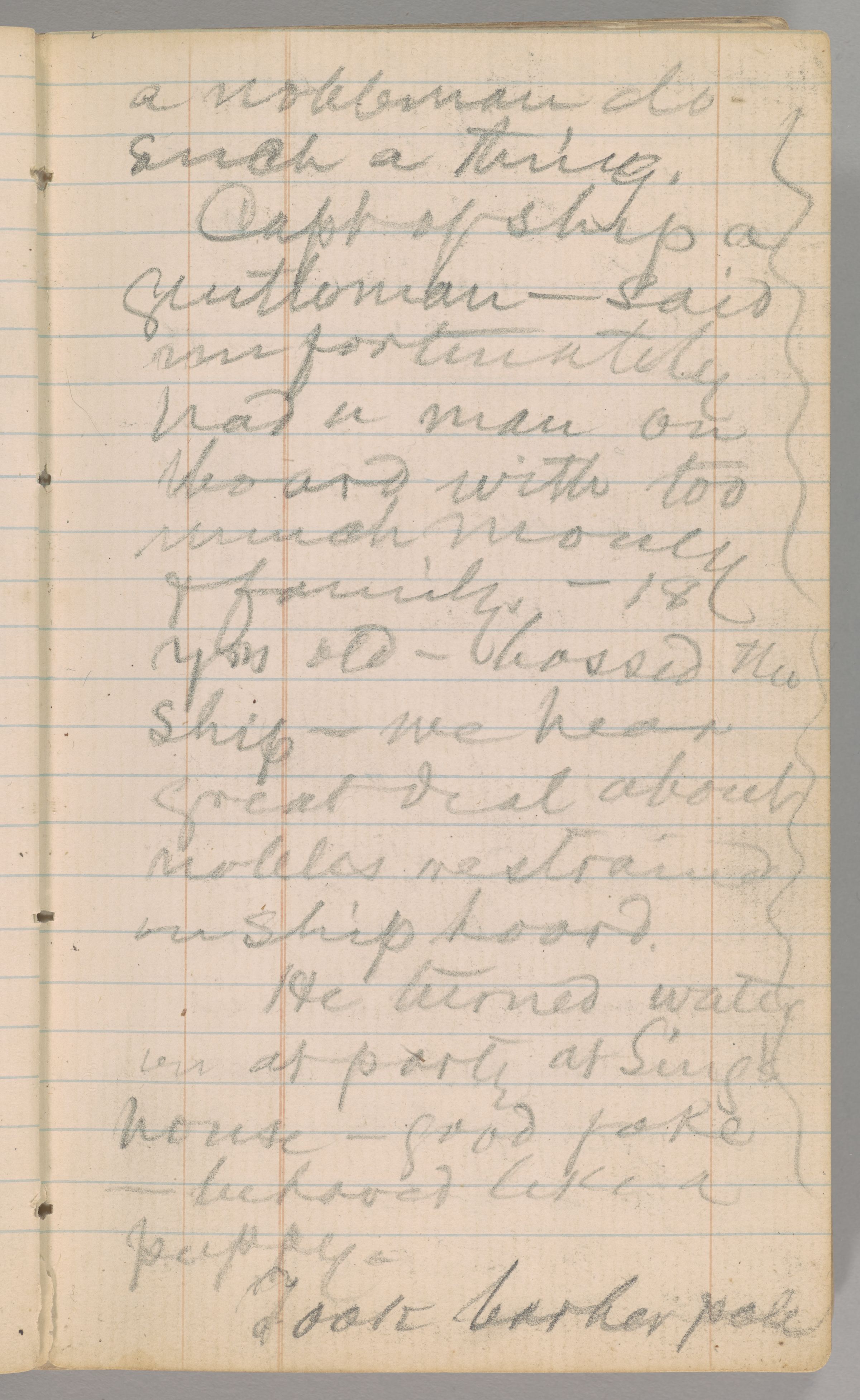
[MS: N05_leaf_010r]
a nobleman do
such a thing.
Capt of ship a
gentleman—said
unfortunately
had a man on
board with too
much money
& family.—18
yrs old—bossed the
ship—we hear
great deal about
nobles restrained
on shipboard.
He turned water
on at party at Sing's
house—good joke
—behaved like a
puppy.
Took barber pole
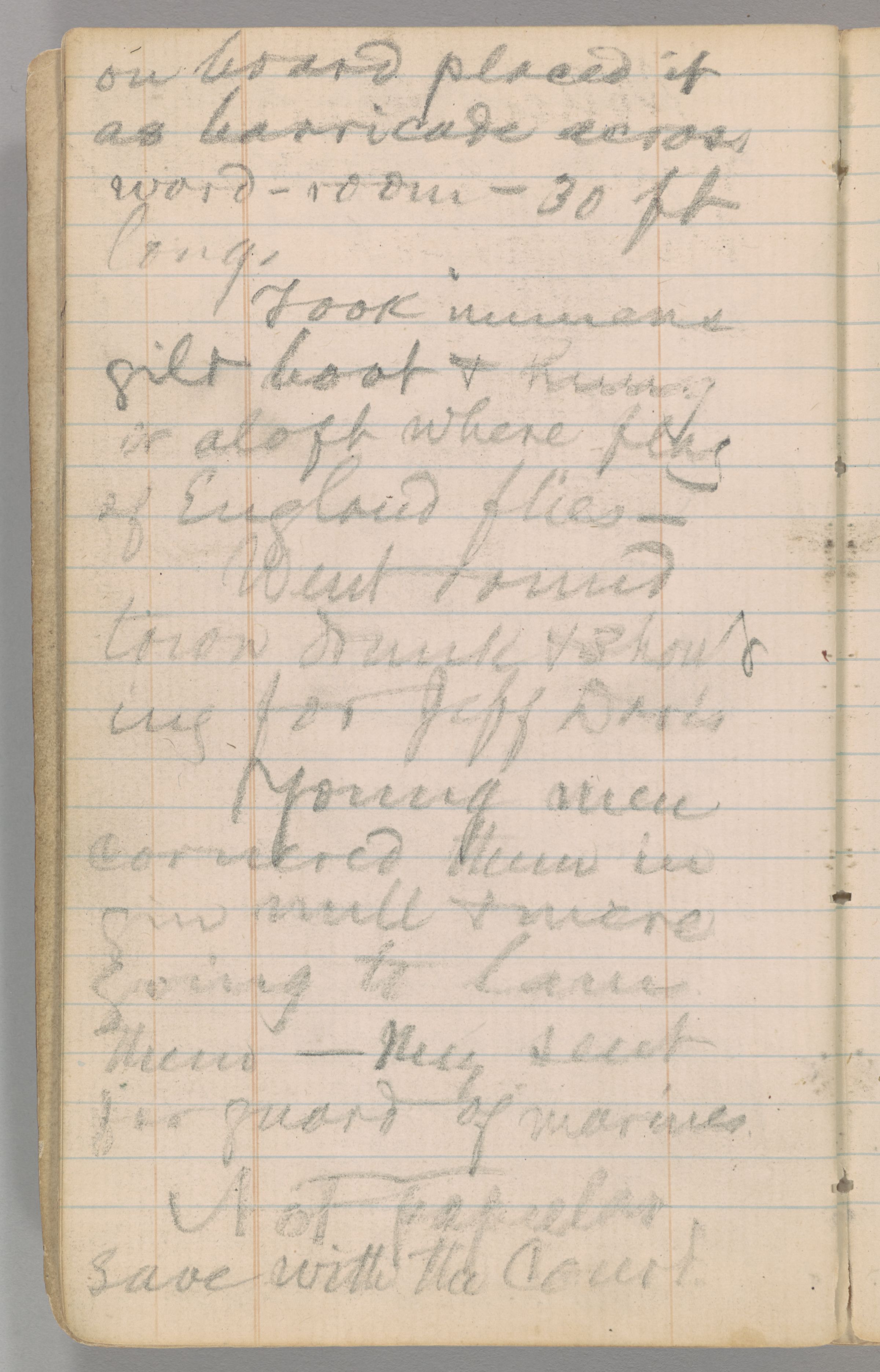
[MS: N05_leaf_010v]
on board placed it
as barricade across
ward-room—30 ft
long.
Took immens
gilt boot & hung
it aloft where flag
of England flies—
Went round
town drunk &
shout-
ing
shouting
for Jeff Davis44
Young men
cornered them in
gin mill & were
going to lam
them—they sent
for guard of marines.45
Not popular
save with the Court.
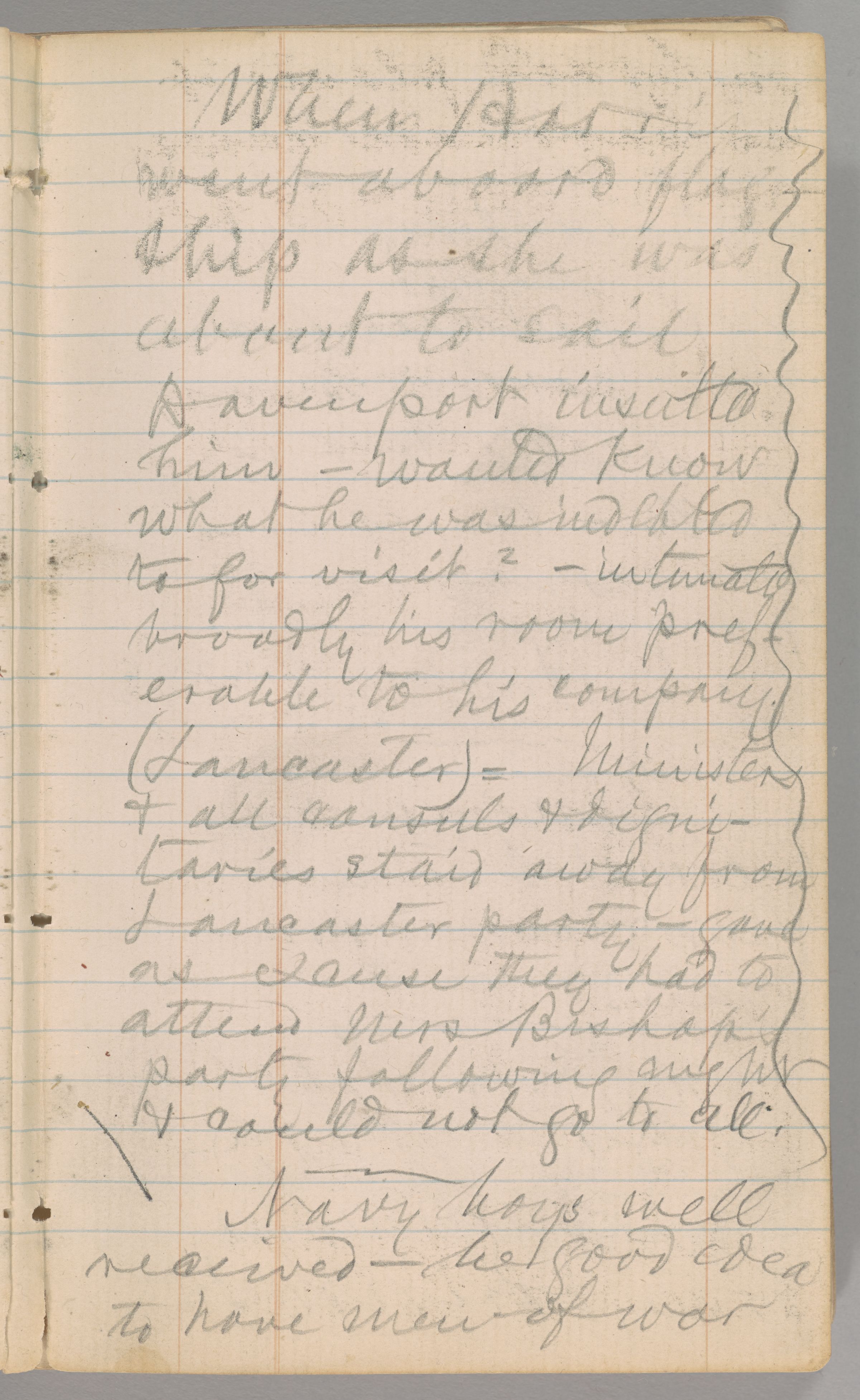
[MS: N05_leaf_011r]
When Harris
went aboard flag-
shipⓂemendation as she was
about to sail
Davenport insulted
him—wanted know
what he was indebted
to for visit?—intimated
broadly his room
pref-
erable
preferable
to his company.
[MTP: N&J1_123]
(Lancaster) = Ministers
& all consuls &
digni-
taries
dignitaries
staid away from
Lancaster party—gave
as excuse they had to
attend Mrs Bishop's
party following night
& could not go to all.46
Navy boys well
received—be good idea
to have men-of-war
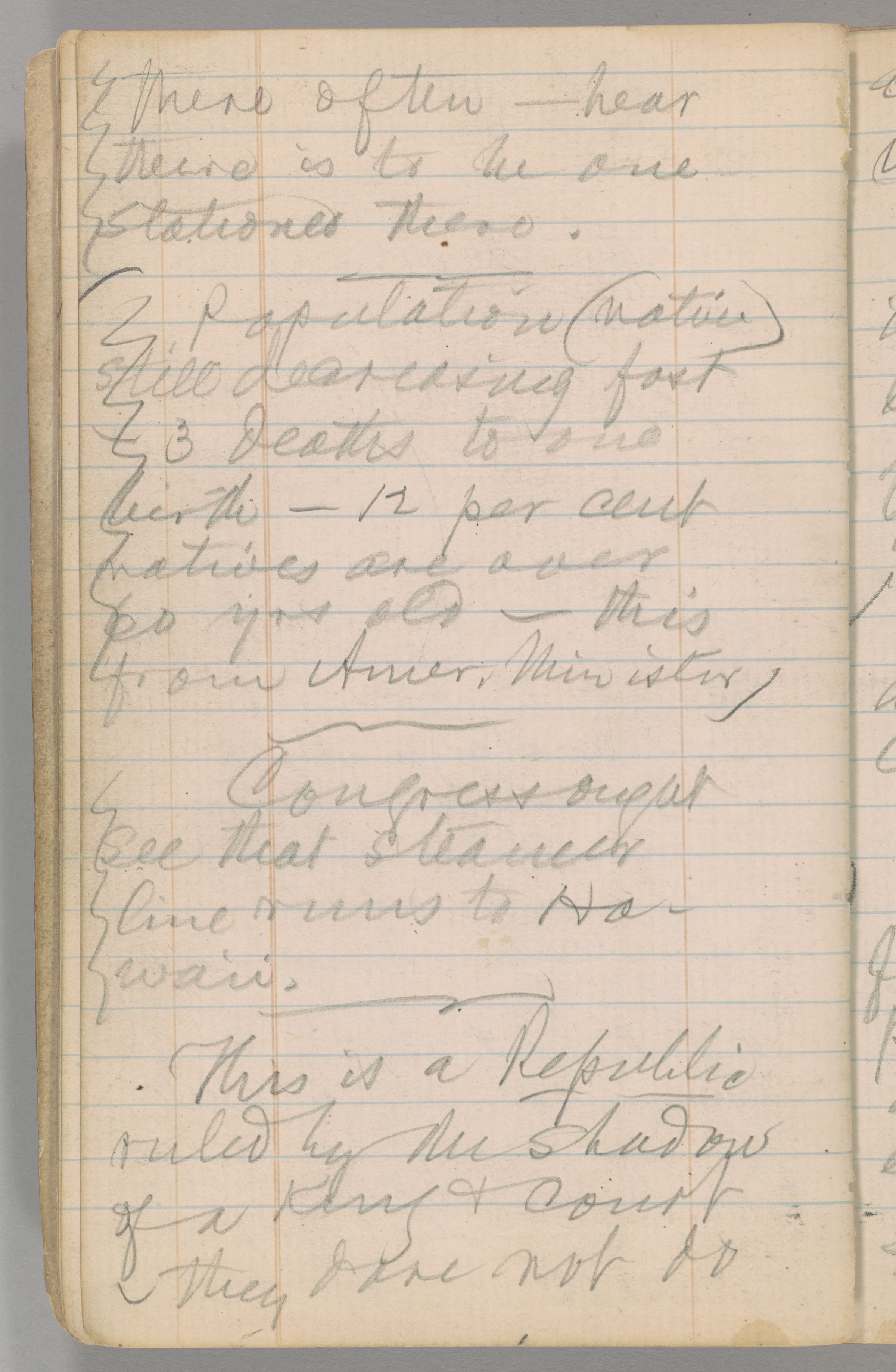
[MS: N05_leaf_011v]
there often—hear
there is to be one
stationed there.47
Population (native)
still decreasing fast
—3 deaths to one
birth—12 per cent
natives are over
60 yrs old—this
from Amer. Minister
Congress ought
see that steamer
line runs to
Ha-
waii
Hawaii
.48
[MTP: N&J1_124]
This is a Republic
ruled by the shadow
of a King & court
—they dare not do
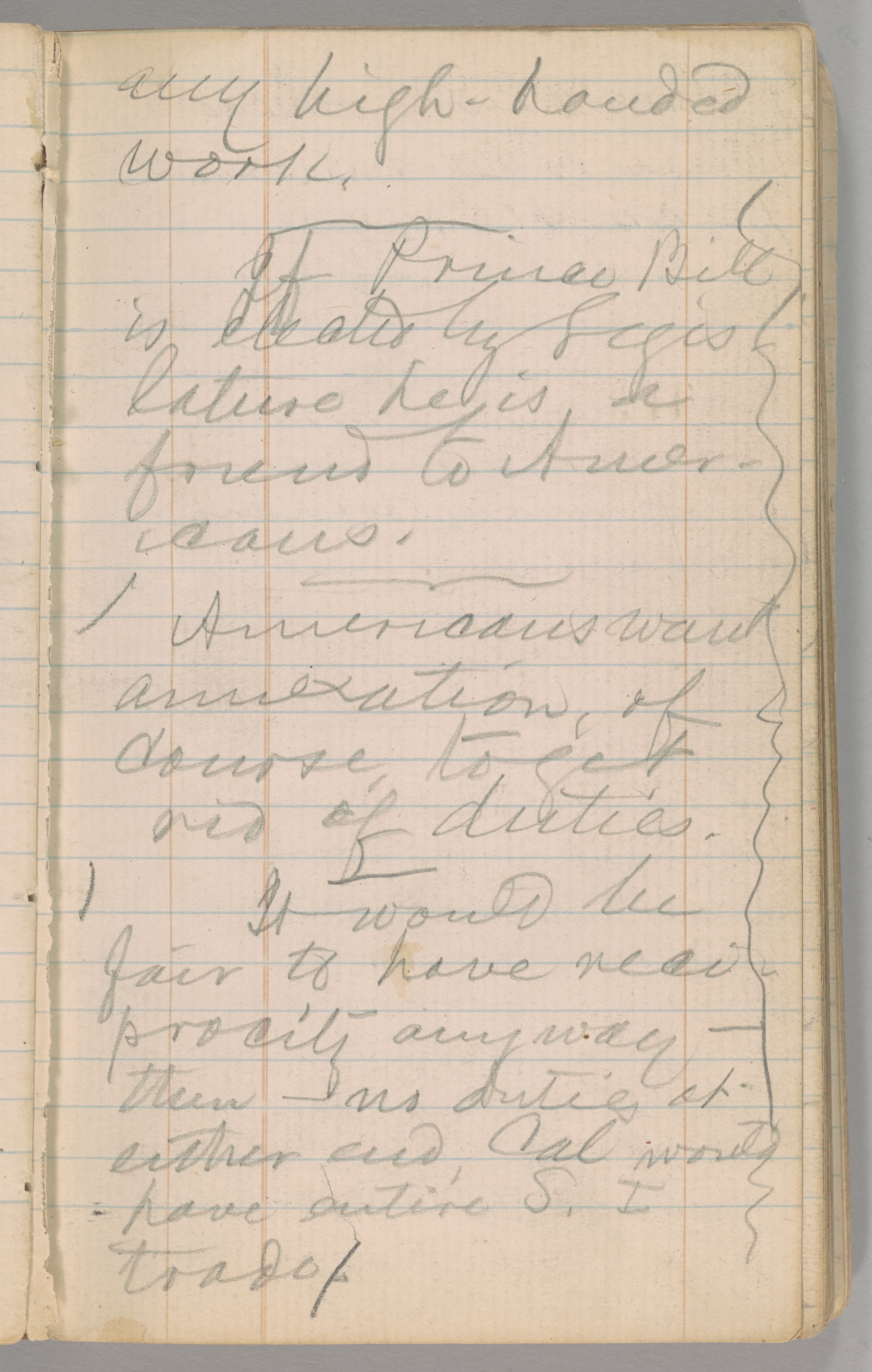
[MS: N05_leaf_012r]
any high-handed
work.49
If Prince Bill
is elected by
Legis-
lature
Legislature
he is a
friend to
Amer-
icans
Americans
.50
Americans want
annexation, of
course, to get
rid of duties.
It would be
fair to have
reci-
procity
reciprocity
anyway—
then—no duties at
either end, Cal would
have entire S. I
trade.
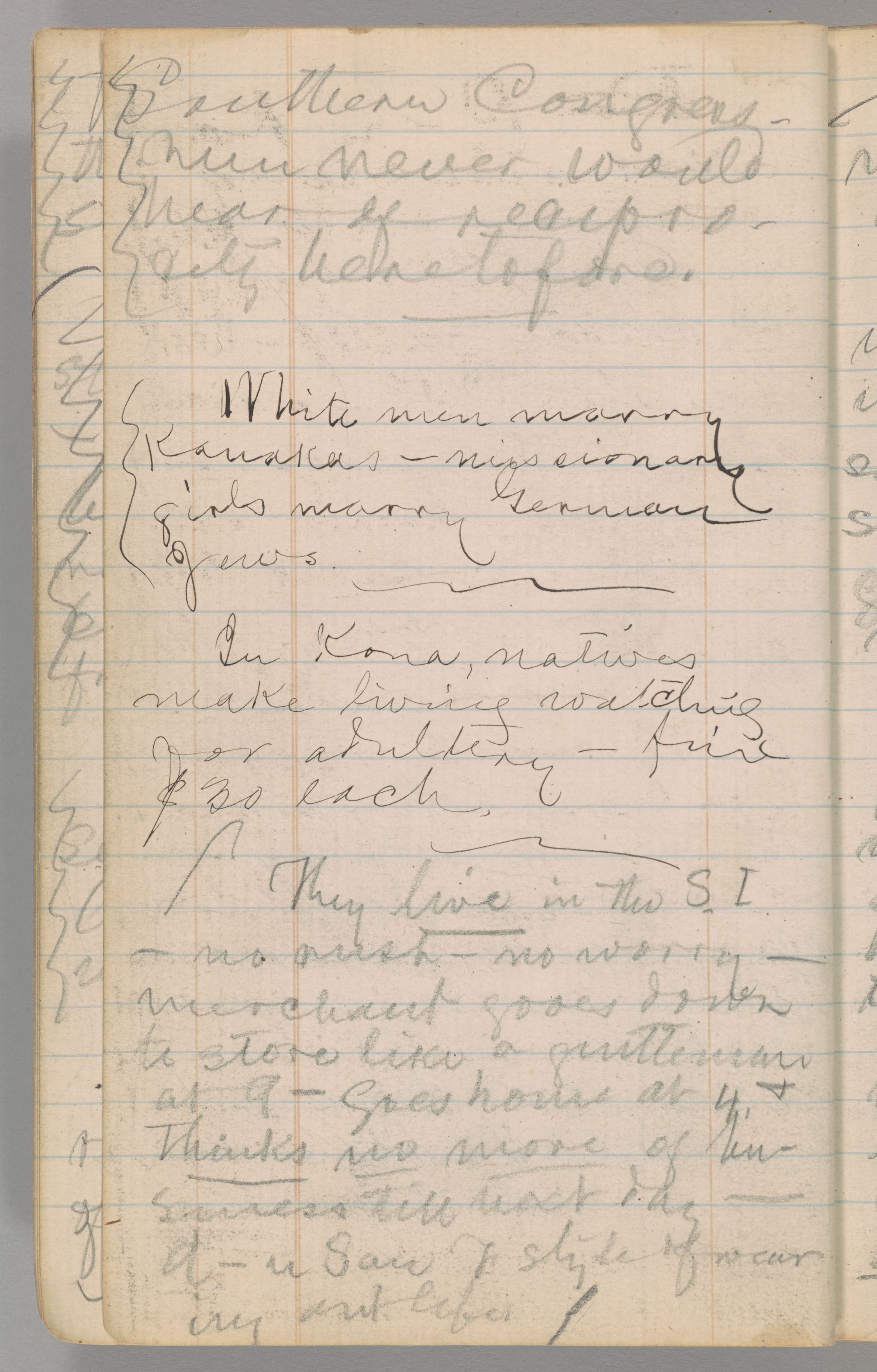
[MS: N05_leaf_012v]
Southern
Congress-
men
Congressmen
never would
hear of
recipro-
city
reciprocity
heretofore.51
[MTP: N&J1_125]
White men marry
Kanakas—missionary
girls marry German
Jews.
In Kona, natives
make living watching
for adultery—fine
$30 each.Ⓣtextual note
52
They live in the S. I
—no rush—no worry—
merchant gooes down
to store like a gentleman
at 9—goes home at 4, &
thinks no more of
bu-
siness
business
till next day—
d—n San F style of
wear
ing
wearing
out life.
[MS: N05_leaf_013r]
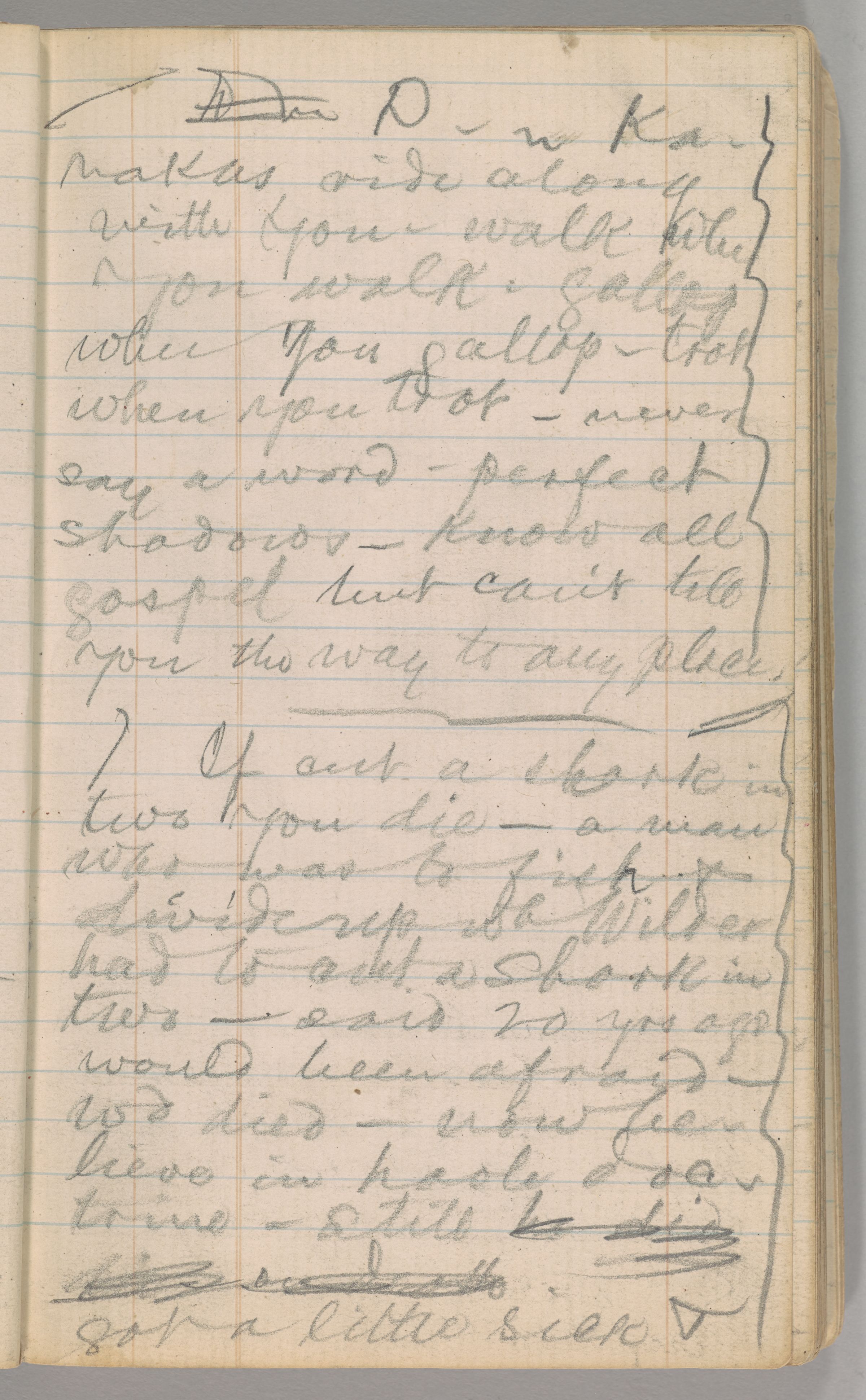
D—m D—n
Ka-
nakas
Kanakas
ride along
with you—walk whn
you walk—gallop
whn you gallop—trot
when you trot—never
say a word—perfect
shadows—know all
gospel but can't tell
you the way to any place.
If cut a shark in
two you die—a man
who was to fish &
divide up wh Wilder53
had to cut a shark in
two—said 20 yrs ago
would been afraid—
wd died—now
be-
lieve
believe
in haole54
doc-
trine
doctrine
—still he did
[---] on death
got a little sick &
[MS: N05_leaf_013v]
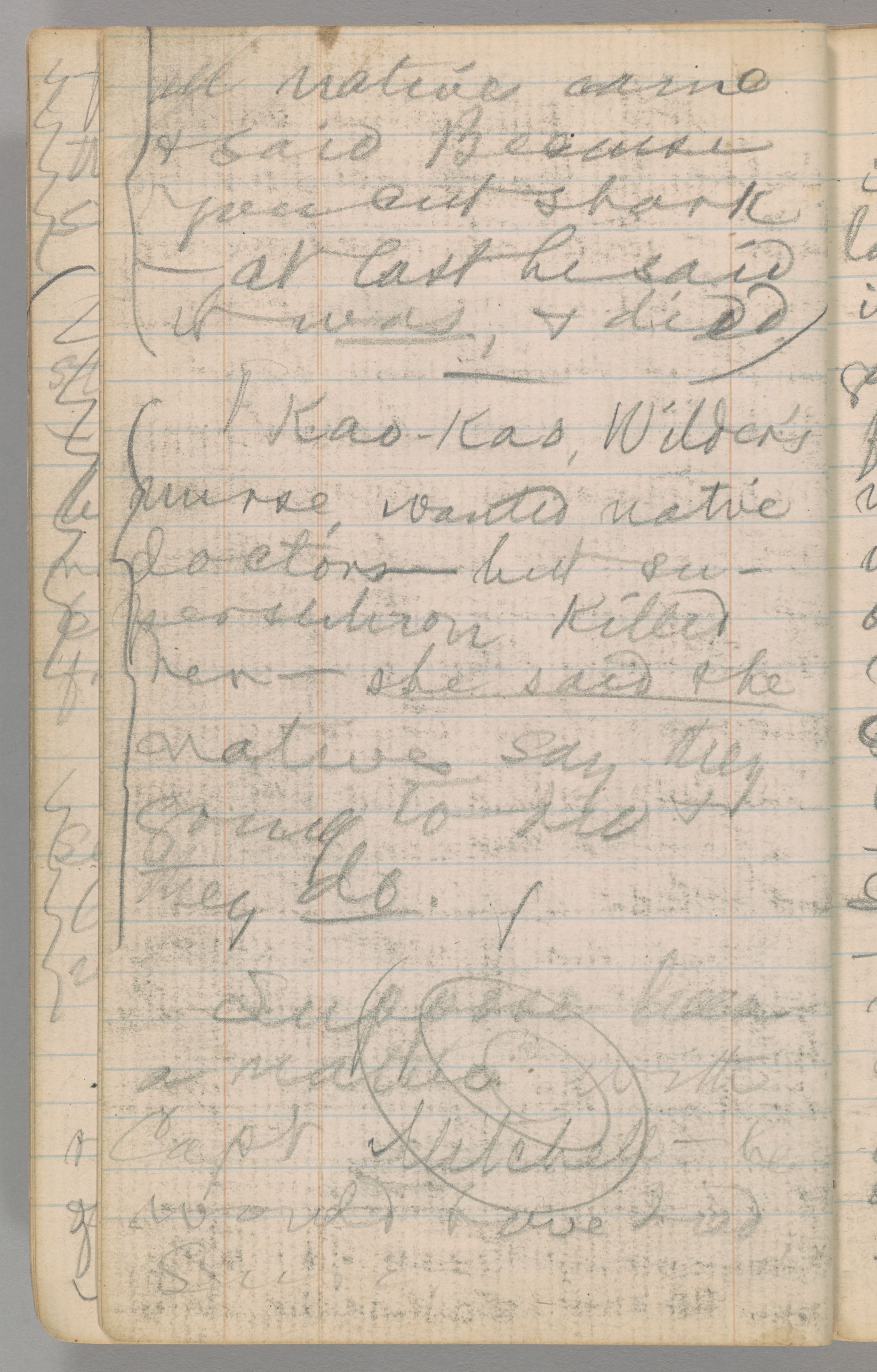
all natives came
& said Because
you cut shark
—at last he said
it was, & dided.Ⓣtextual note
Kao-Kao,55 Wilder's
nurse, wanted native
doctors—but
su-
perstition
superstition
killed
her—she said the
natives say they
going to die &
they do.
Suppose been
a native with
Capt Mitchell56—he
would have died
sure.
꩜
[MTP: N&J1_126]
[MS: N05_leaf_014r]
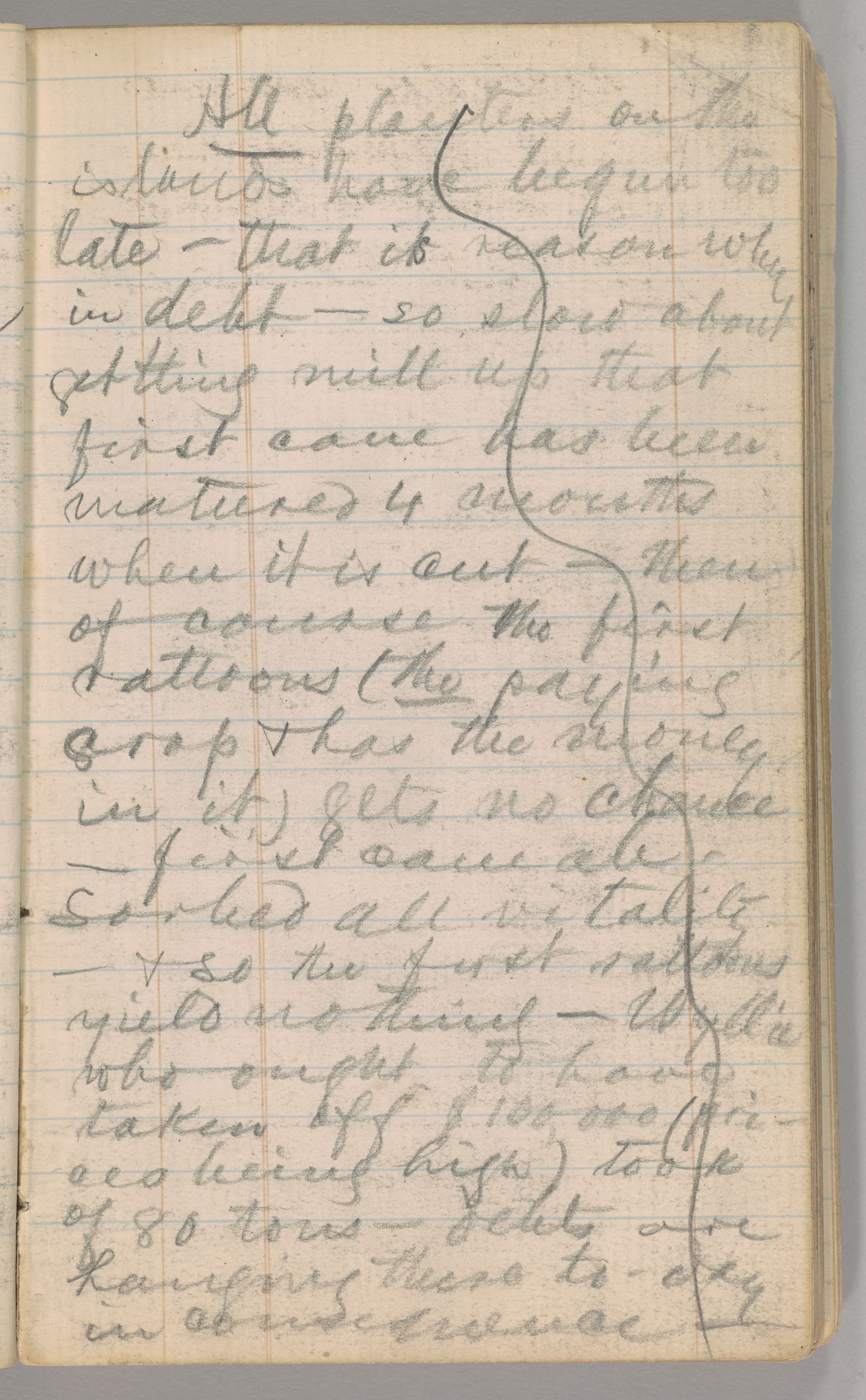
All planters on the
islands have begun too
late—that itsⓉtextual note reason why
in debt—so slow about
getting mill up that
first cane has been
matured 4 months
when it is cut—then
of course the first
rattoons (the paying
g crop & has the money
in it,) gets no chance
—first cane
ab-
sorbed
absorbed
all vitality
—& so the first rattoons
yield nothing—Wyllie
who ought to have
taken off $100,000 (
pri-
ces
prices
being high) took
of 80 tons—debts are
hanging there to-day
in consequence—
[MS: N05_leaf_014v]
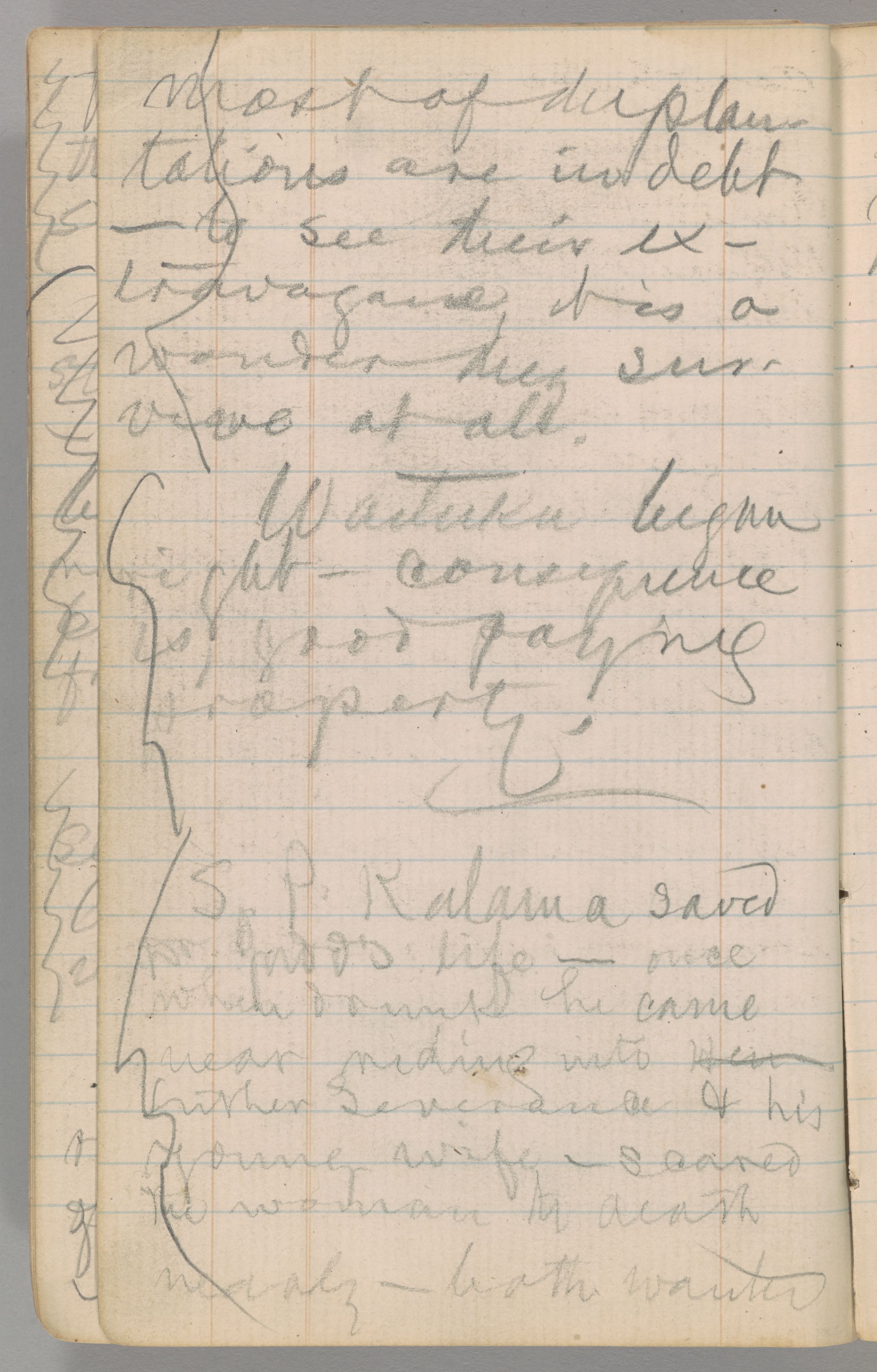
most of the
plan-
tations
plantations
are in debt
—to see their
ex-
travagance
extravagance
, it is a
wonder they
sur-
vive
survive
at all.57
Wailuku58 begun
right—consequence
is, good payingⓂemendation
property.
S. P. Kalama saved
Dr Judd's life59 —once
when drunk he came
[MTP: N&J1_127]
near riding into Hen
Luther Severance & his
young wife—scared
the woman to death
nearly—both wanted
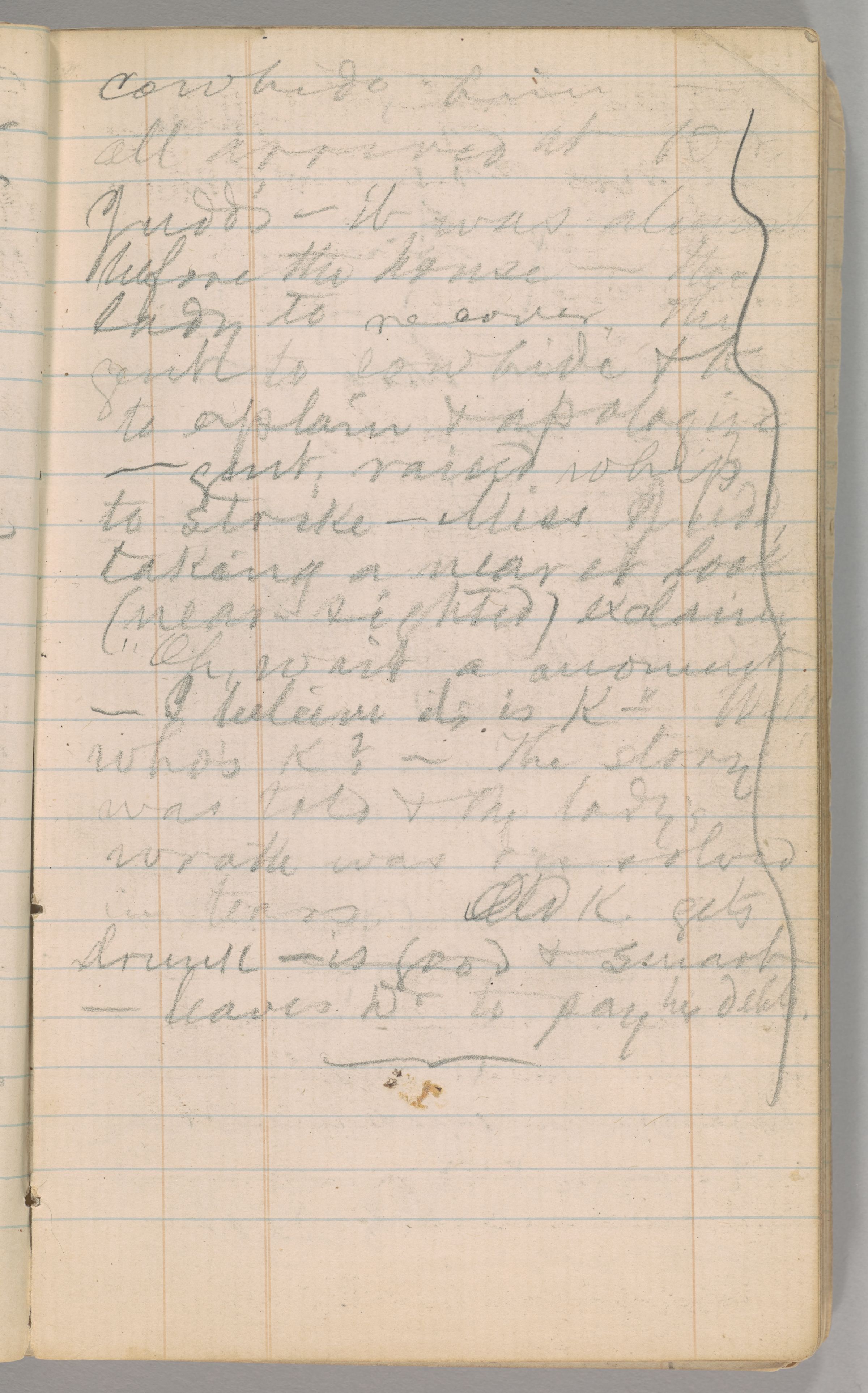
[MS: N05_leaf_015r]
cowhide him—
all arrived at Dr.
Judd's—it was almost
before the house—the
lady to recover, the
gent to cowhide & K
to explain & apologize
—gent. raised whip
to strike—Miss Judd,
taking a nearer look
(near-sighted) exclaim
“Oh, wait a moment
—I believe it is K—” Well,
who's K?—The story
was told & the lady's
wrath was dissolved
in tears. Old K. gets
drunk—is good & smart
—leaves Dr to pay his debts.
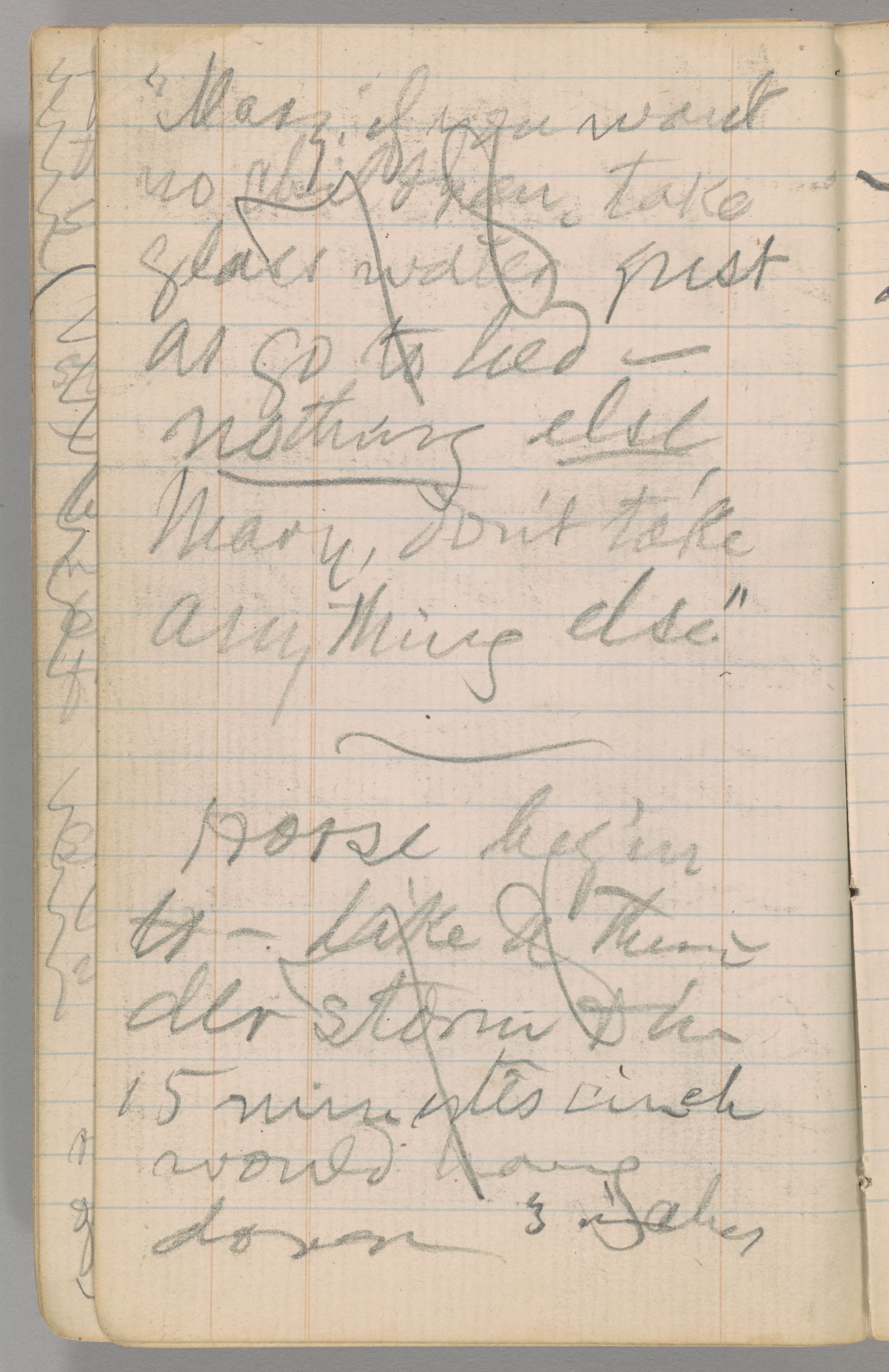
[MS: N05_leaf_015v]
“Mary, if you want
no children, take
glass water just
as go to bed—
nothing else,
Mary, don't take
anything else.”
78
Horse begin
to — like a
thun-
der
thunder
storm & in
15 minutes cinch
would hang
down 3 inches
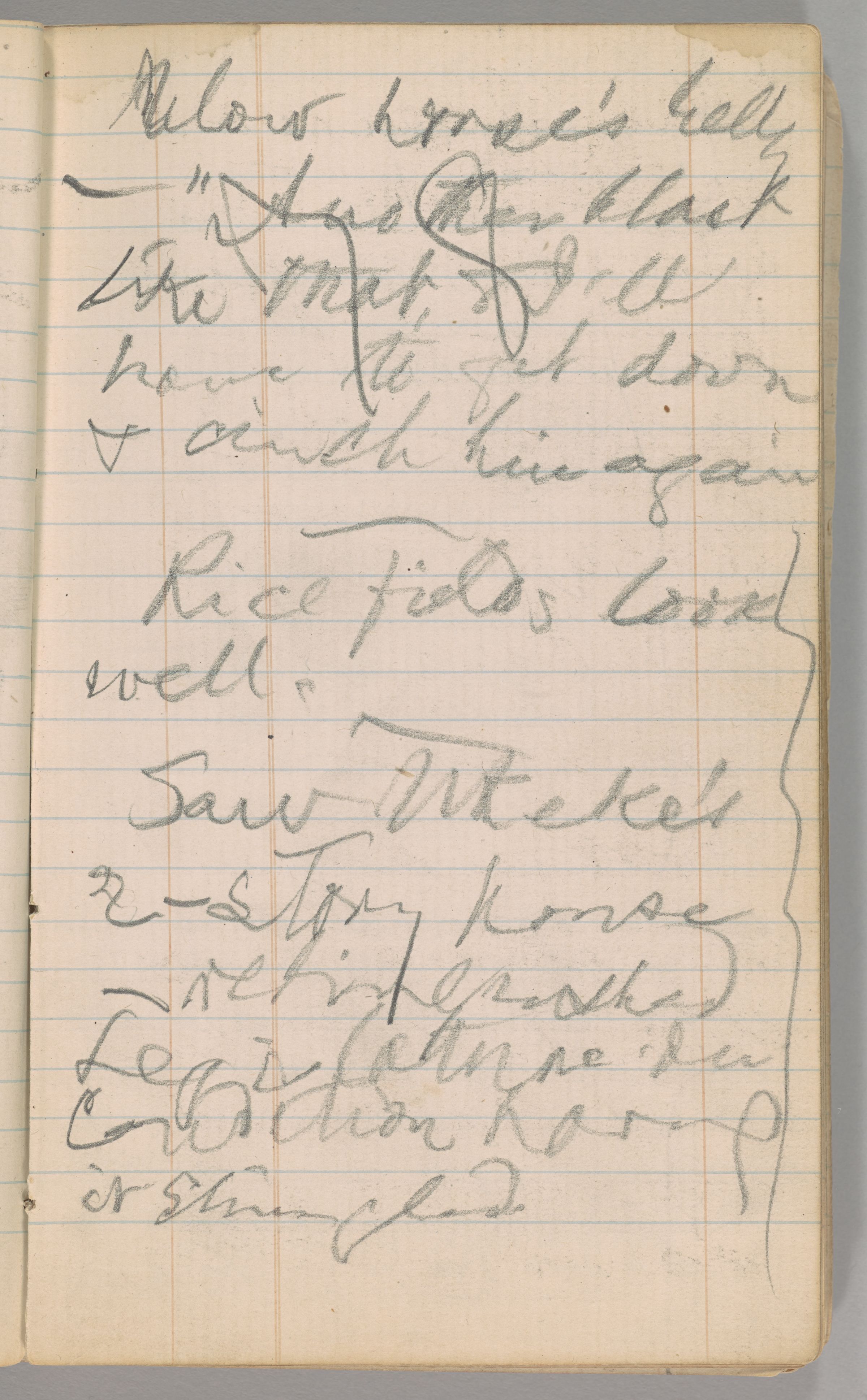
[MS: N05_leaf_016r]
below horse's belly
—“Another blast
like that, & I'll
have to get down
& cinch him again
78
Rice fields look
well.60
Saw Ukeke's
2-story house
—relinquished
Legislature on
condition having
it shingled.61
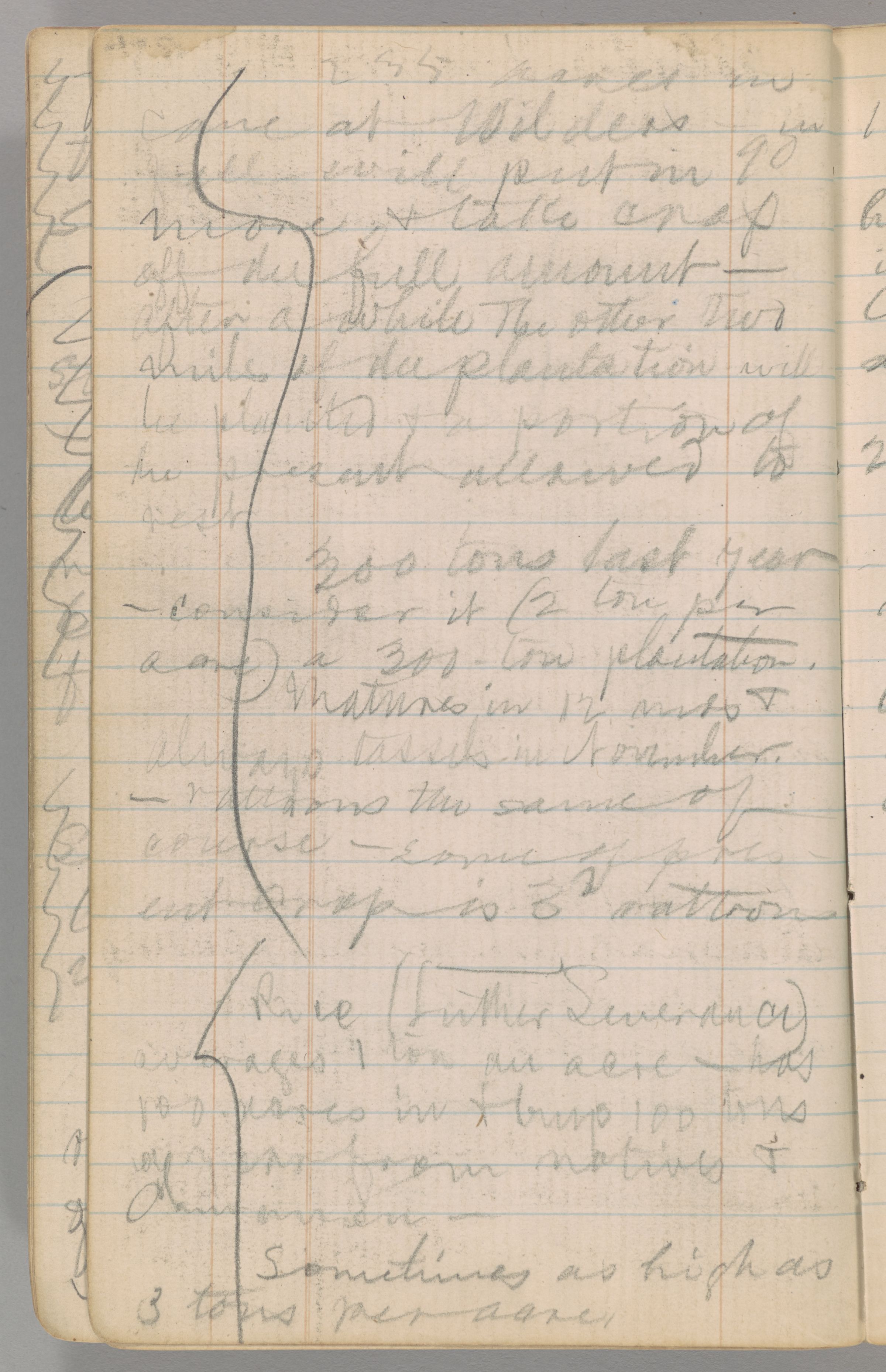
[MS: N05_leaf_016v]
[MTP: N&J1_128]
235Ⓜemendation acres in
cane at Wilders62—in
fall will put in 90
more & take crop
off the full amount—
after a while the other two
miles of the plantation will
be planted & a portion of
the present allowed to
rest.
300 tons last year
—consider it (2 ton per
acre) a 300-ton plantation.
Matures in 12 mos &
always tassels in November.
—rattoons the same of
course—some of
pre-
sent
present
crop is 3d rattoons
Rice (Luther Severance)
averages 1 ton an acre—has
100 acres in & buys 100 tons
a year from natives &
Chinamen—
Sometimes as high as
3 tons per acre.
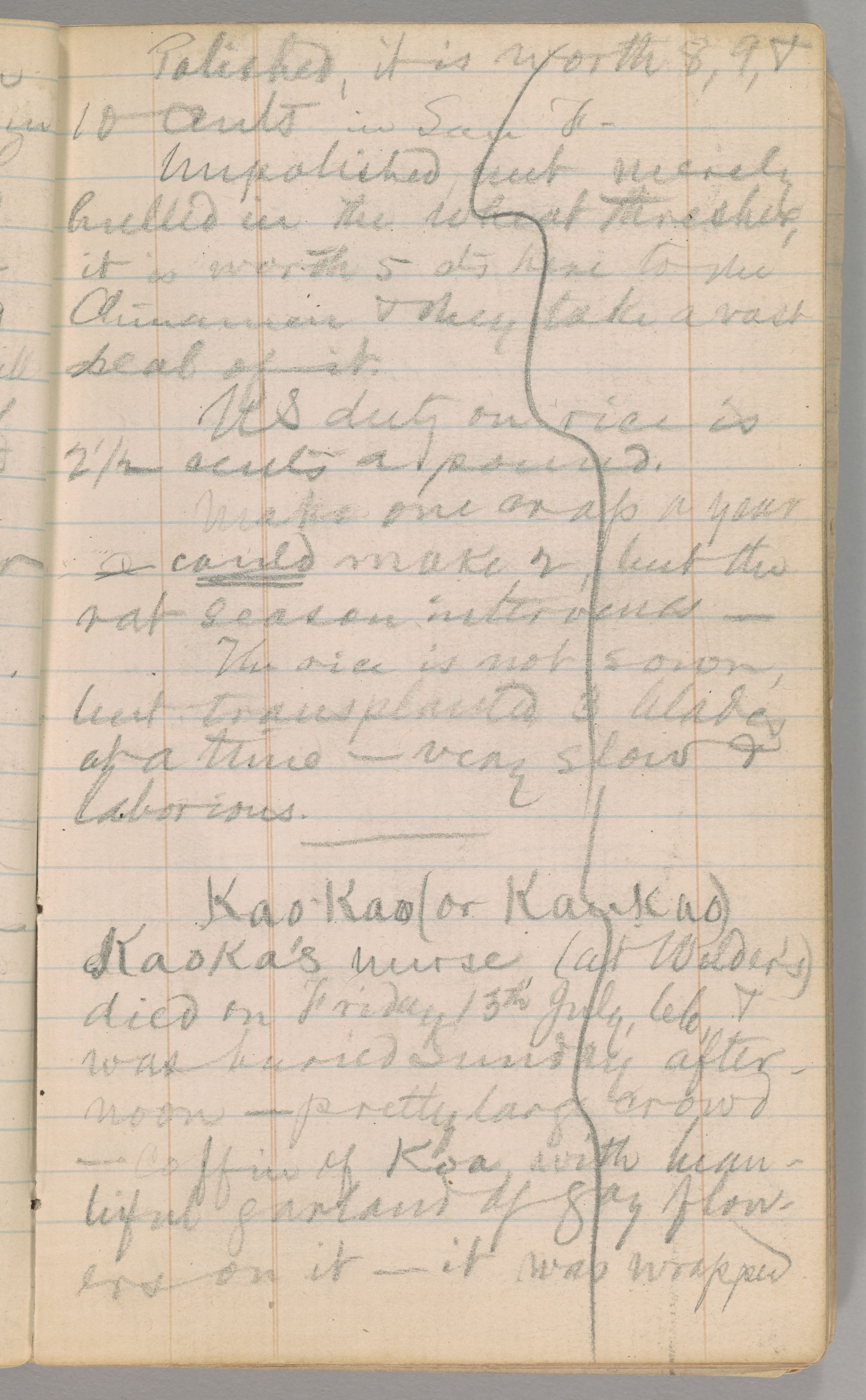
[MS: N05_leaf_017r]
Polished, it is worth 8, 9, &
10 cents in San F.
Unpolished, but merely
hulled in the wheat thresher,
it is worth 5 cts here to the
Chinamen & they take a vast
deal of it.
US duty on rice is
2½ cents a pound.
Make one crop a year
[-]—could make 2, but the
rat season intervenes—
The rice is not sown,
but transplanted, 3 blades
at a time—very slow &
laborious.
Kao-Kao (or Kaukao)
d Kaoka's nurse, (at Wilder's)
died on Friday 13th July, 66, &
was buried Sunday
after-
noon
afternoon
—pretty large crowd
—coffin of Koa, with
beau-
tiful
beautiful
garland of gay
flow-
ers
flowers
on it—it was wrapped
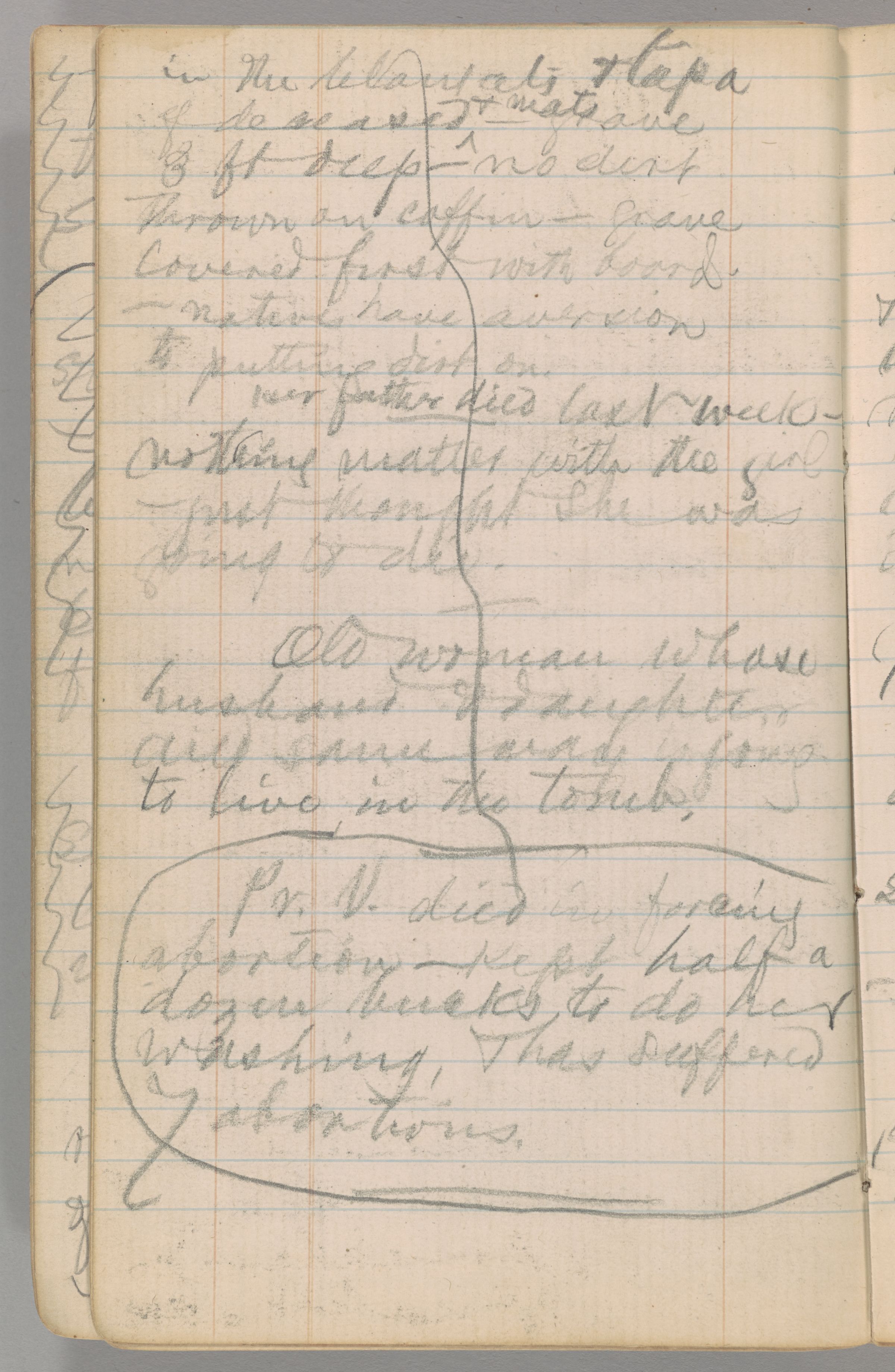
[MS: N05_leaf_017v]
in the blankets & tapa
of deceased & mats
—grave
3 ft deep—no dirt
thrown on coffin—grave
covered first with board.
—natives have aversion
to putting dirt on.Ⓣtextual note
Her father died last week—
nothing matter with the girl
—just thought she was
going to die.63
[MTP: N&J1_129]
Old woman whose
husband & daughter
died same way is going
to live in the tomb.
Pr. V. died in forcing
abortion—kept half a
dozen bucks to do her
washing, & has suffered
7 abortions.Ⓣtextual note
64
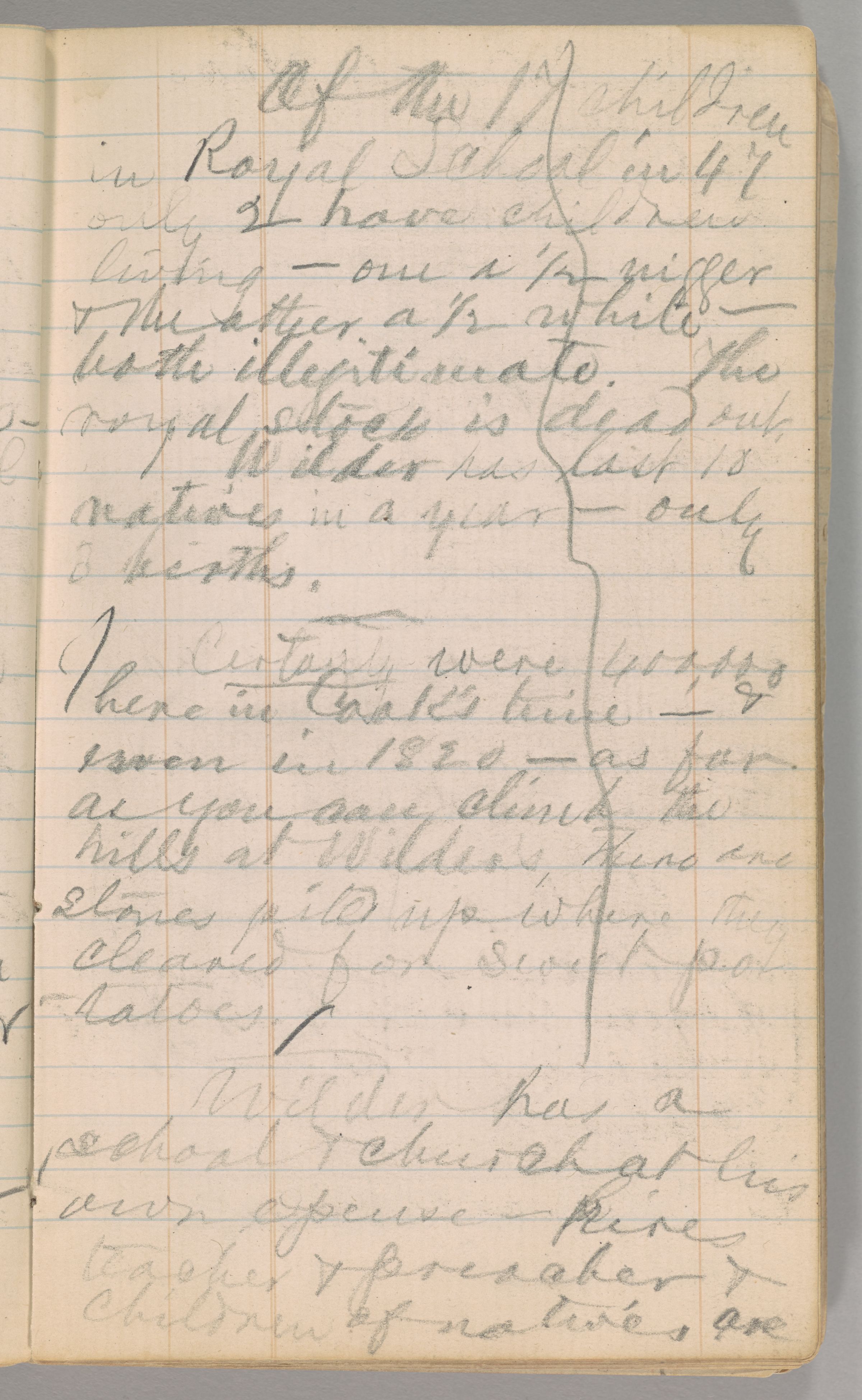
[MS: N05_leaf_018r]
Of the 17 children
in Royal School in 47
only 2 have children
living—one a ½ nigger
& the other a ½ white—
both illegitimate. The
royal stock is dead out.
Wilder has lost 10
natives in a year—only
3 births.
Certainly were 400,000
here in Cook's time—&
even in 1820—as far
as you can climb the
hills at Wilder's, there are
stones piled up where they
cleared for sweet
po-
tatoes
potatoes
.
Wilder has a
school & church at his
own expense—hires
teacher & preacher &
children of natives are
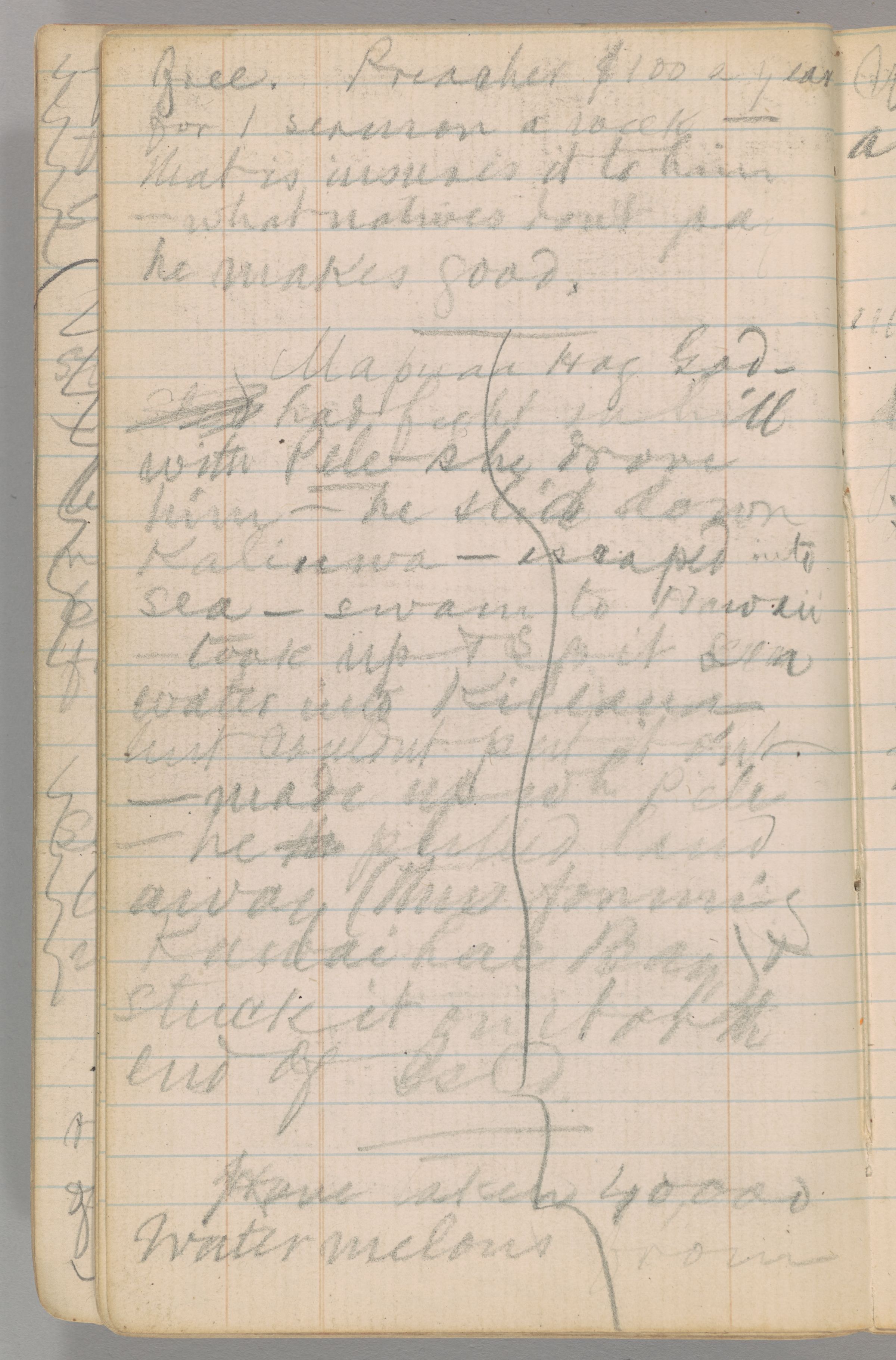
[MS: N05_leaf_018v]
free. Preacher $100 a year
for 1 sermon a week—
that is insures it to him
—what natives don't pay
he makes good.
[MTP: N&J1_130]
Mapuaa Hog God—
Slid had fight on hill
with Pele—she drove
him—he slid down
Kaliuwa—escaped into
sea—swam to Hawaii
—took up & spit sea
water into Kileaua
but couldnt put it out
—made up wh Pele
—he th pulled land
away (thus forming
Kawaihae Bay,) &
stuck it on North
end of Isld.65
Have taken 40,000
watermelonsⓂemendation from
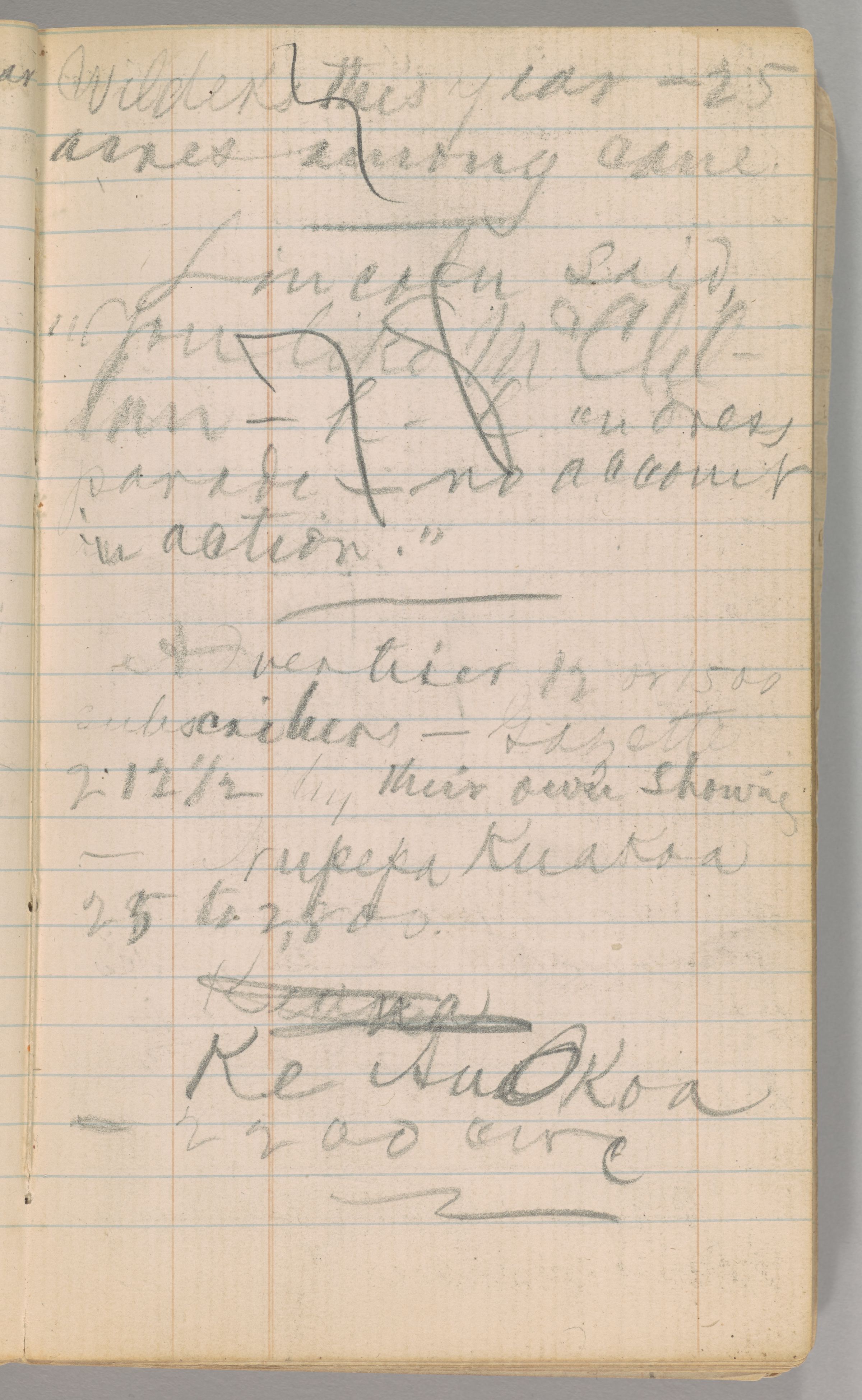
[MS: N05_leaf_019r]
Wilder's this year—25
acres among cane.
Lincoln said,
“You like
McClel-
lan
McClellan
— h—l on dress
parade—no account
in action.”
78
Advertiser 12 or 1500
subscribers—Gazette
212½ by their own showing
—Nupepa Kuakoa
285Ⓣtextual note to 2,800.
Keaua
Ke Au Okoa
—2200 circ66
[MS: N05_leaf_019v]
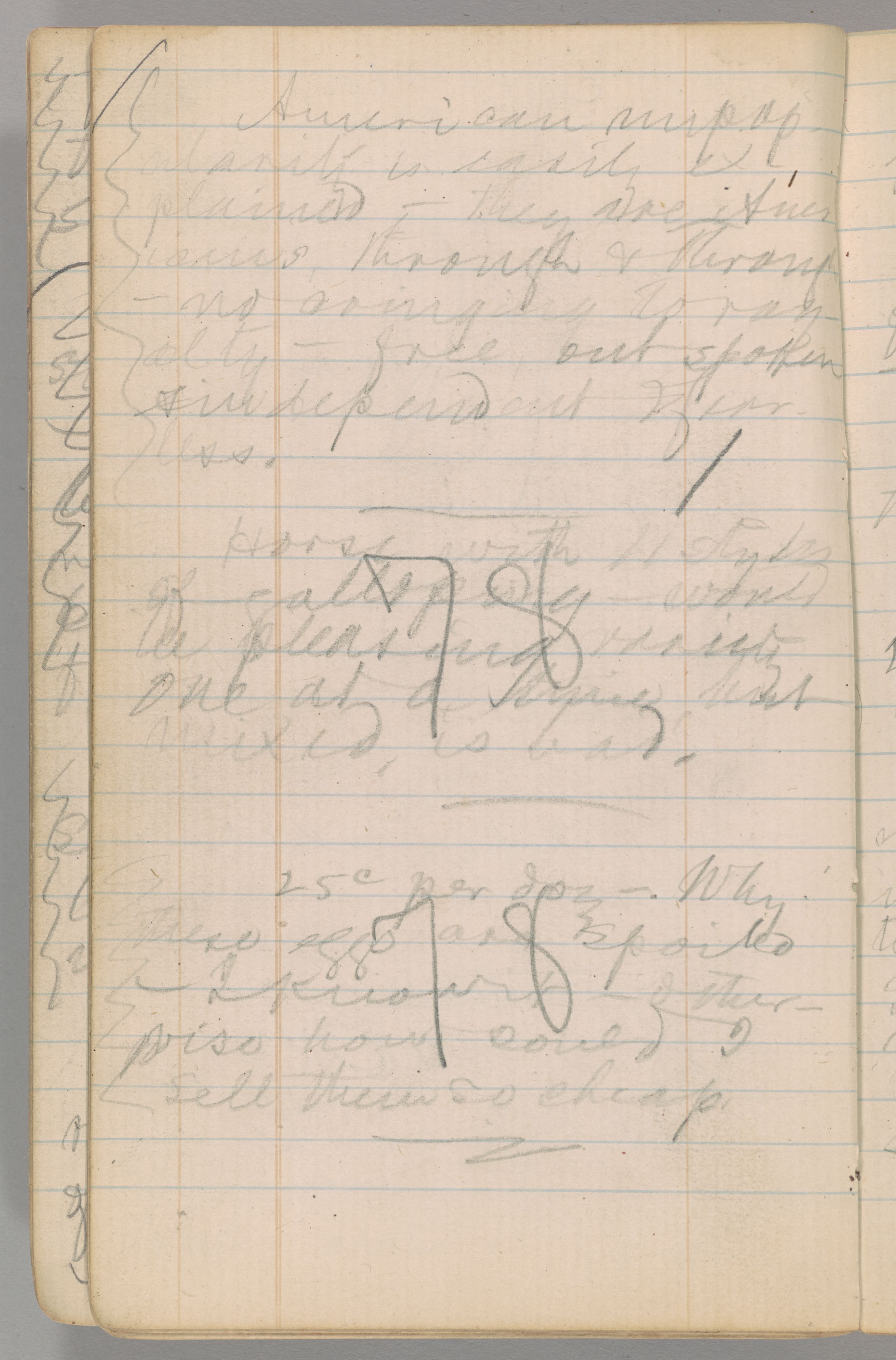
American
unpop-
ularity
unpopularity
is easily
ex-
plained
explained
—they are
Amer-
icans
Americans
, through & through
—no cringing to
roy-
alty
royalty
—free, outspokenⓂemendation
& independent &
fear-
less
fearless
.
Horse with 11 styles
of galloping—would
be pleasing variety
one at a time, but
mixed, is bad.
78
25c per doz—Why
these eggs are spoiled
—I know it—
other-
wise
otherwise
how could I
sell them so cheap.
78
[MS: N05_leaf_020r]
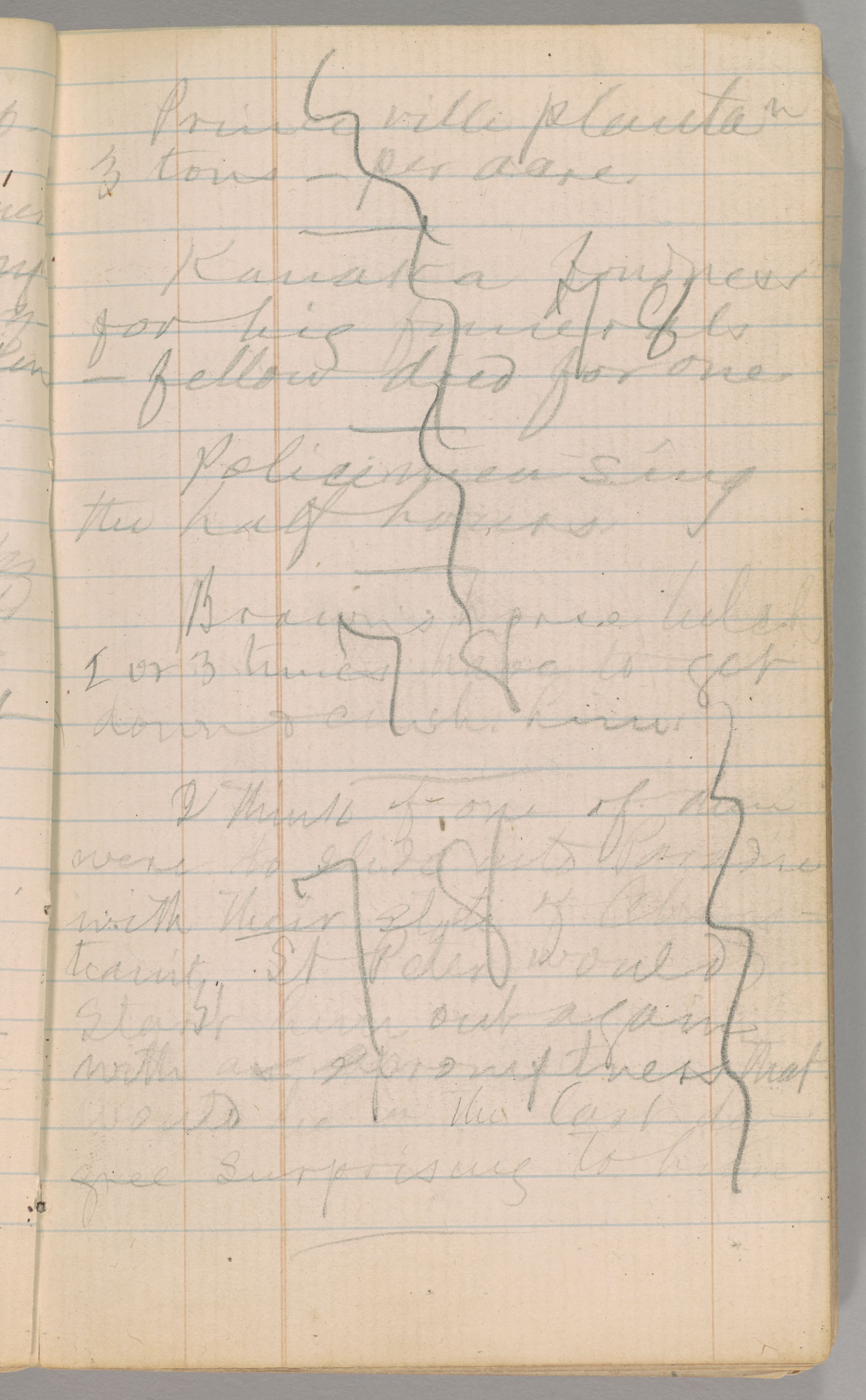
Princeville plantan
3 tons—per acre.67
Kanaka fondness
for big funerals
—fellow died for one.
78
Policemen sing
the half hoursⓂemendation.
[MTP: N&J1_131]
Brown's horse belch
2 or 3 times have to get
down & cinch him.
78
I think if one of them
were to slide into Paradise
with their style of
Chris-
tianity
Christianity
, St Peter would
start him out again
with a n
[e] promptness that
would be in the last
de-
gree
degree
surprising to him
78
[MS: N05_leaf_020v]
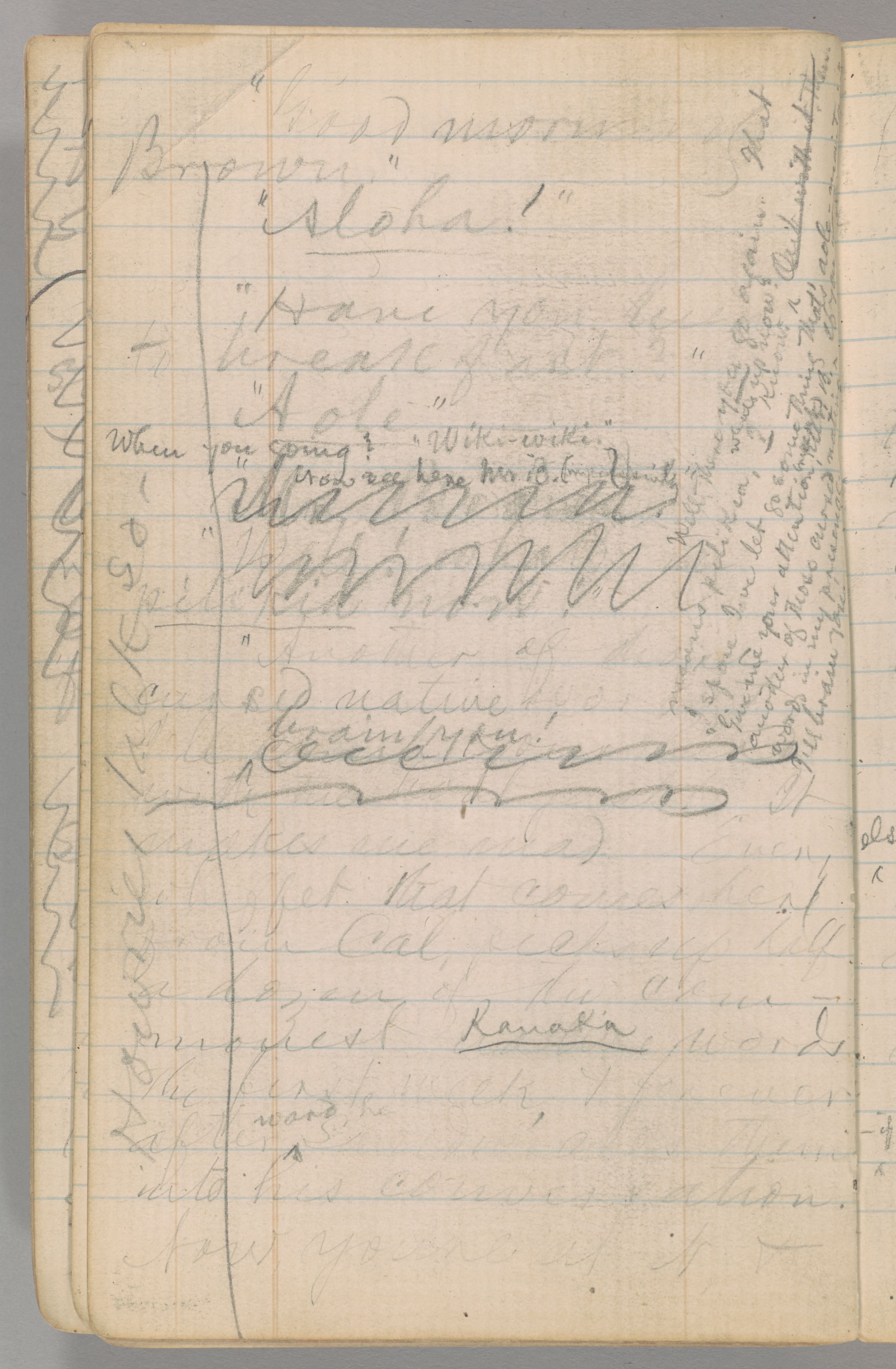
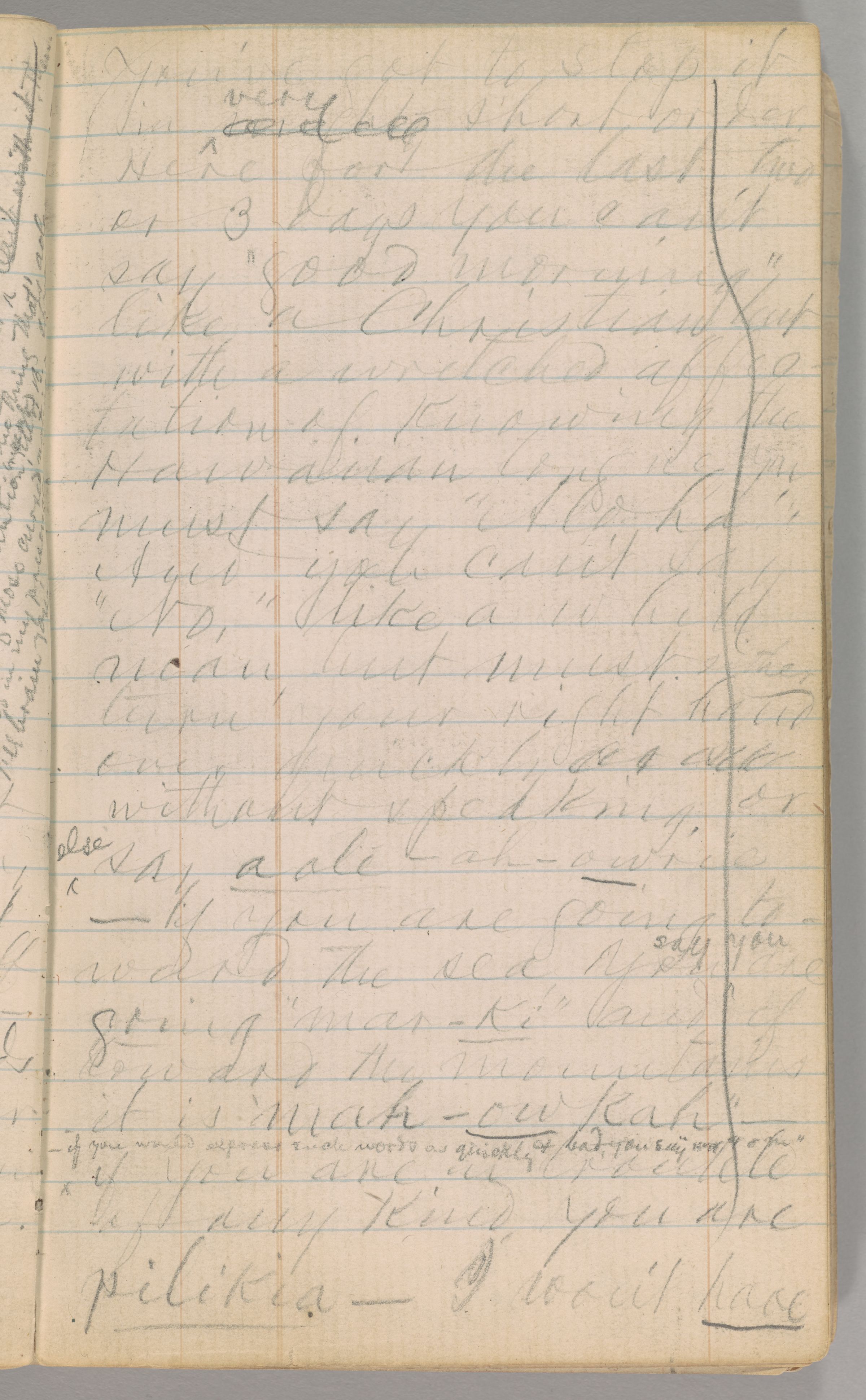
Howries72 talk so— Ⓣtextual note
“Good morning,
Brown.”68
“Aloha!”
“Have you been
to breakfast?”
“Aolé” Ⓜemendation
“Mr. Brown.”
“Well! what's the
pilikia now!”
When you going?
“Wiki-wiki.”
Now see here Mr B. (impressively
Well, there you go again. That
means pilikia, I know. Out with it, then.
What's up now?
I spose I've let go something that's aole-maitai.”
“Give me your attentionⓂemendation, Mr. B. (◊◊◊◊◊◊)
If you utter
another of those cursed native
words in my presence
I'll brain you!
Ⓣtextual note
“Another of those
cursed native words &
I'll comb your head
with the bootjackⓂemendation!
brain you!
It
makes me mad. Every
whiffet that comes here
from Cal, picks up half
a dozen of the
com-
monest
commonest
native
Kanaka
words
the first week,
& forever
afterward he
sandwiches them
into his conversation.
Now, you're at it, &
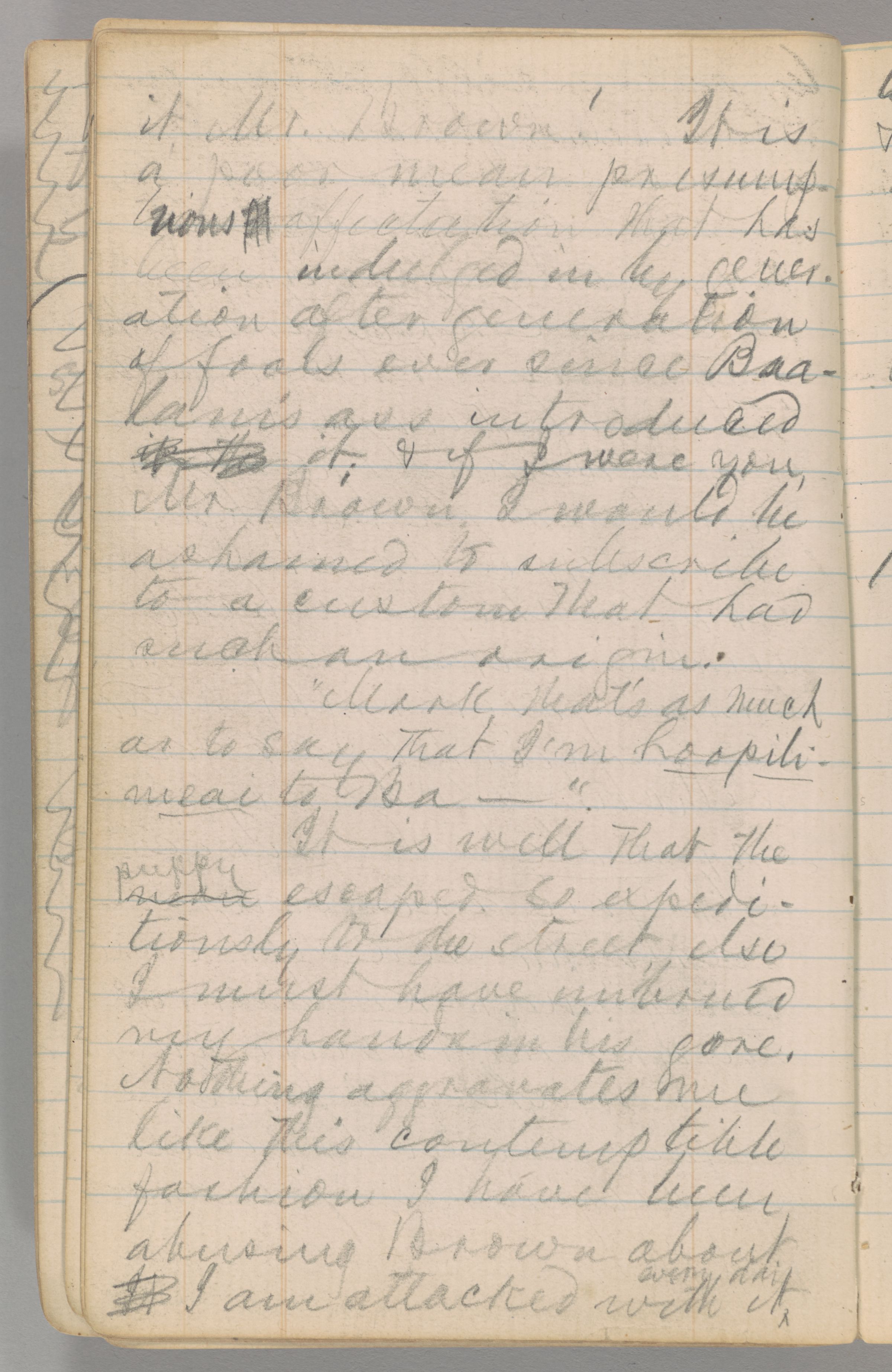
[MS: N05_leaf_021r]
you've got to stop it
in mighty
very
short order.
Here for the last two
or 3 days you can't
say “good morning”
like a Christian, but
with a wretched
affec-
tation
affectation
of knowing the
Hawaiian tongue, you
must say “Aloha!”
And you can't say
“No,” like a white
man, but must either
turn your right hand
over quickly [or s]
without speaking, or
else
say aolé-ah-owrie
—if you are going
to-
ward
toward
the sea, you say you
are
[MTP: N&J1_132]
going “mar-ki” and if
toward the mountains
it is ‘ma-mah-owkah”—
—if you would express such words as quickly & bad, you say “[kiki]Ⓜemendation
69 & oni”
70
if you are in trouble
of any kind, you are
pilikia—I won't have
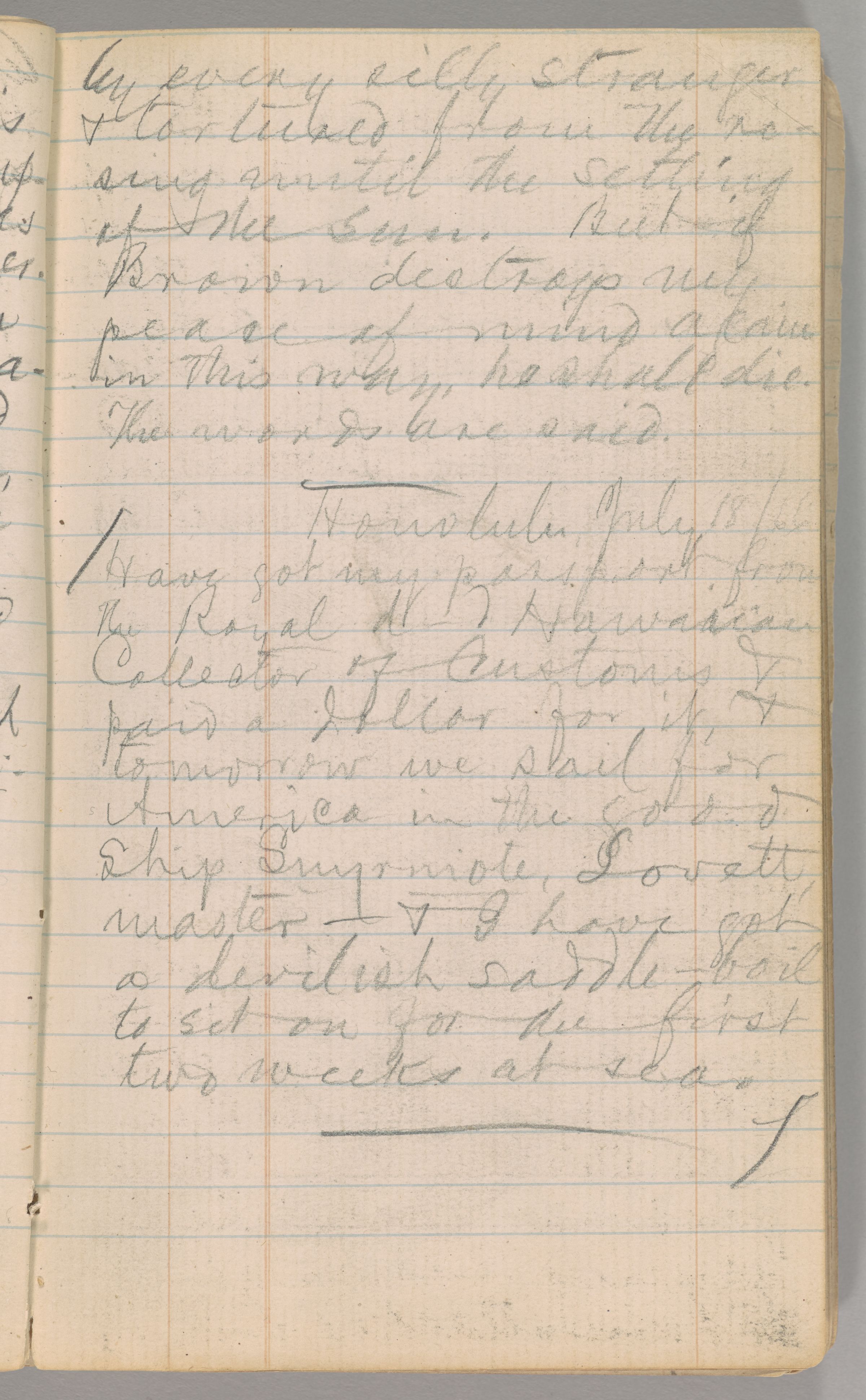
[MS: N05_leaf_021v]
it, Mr. Brown! It is
a poor mean presump-
tion &uousⓉtextual note affectation that has
been indulged in by
gener-
ation
generation
after generation
of fools ever since
Baa-
lam’s
Baalam's
ass introduced
it th it; & if I were you,
Mr. Brown, I would be
ashamed to subscribe
to a custom that had
such an origin.
“Mark, that's as much
as to say that I'm
hoopili-
meai
hoopilimeai
71 to Ba—”
It is well that the
man
puppy
escaped so
expedi-
tiously
expeditiously
to the street, else
I must have imbrued
my hands in his gore.
Nothing aggravates me
like this contemptible
fashion I have been
abusing Brown about.
It I am attacked with it every day
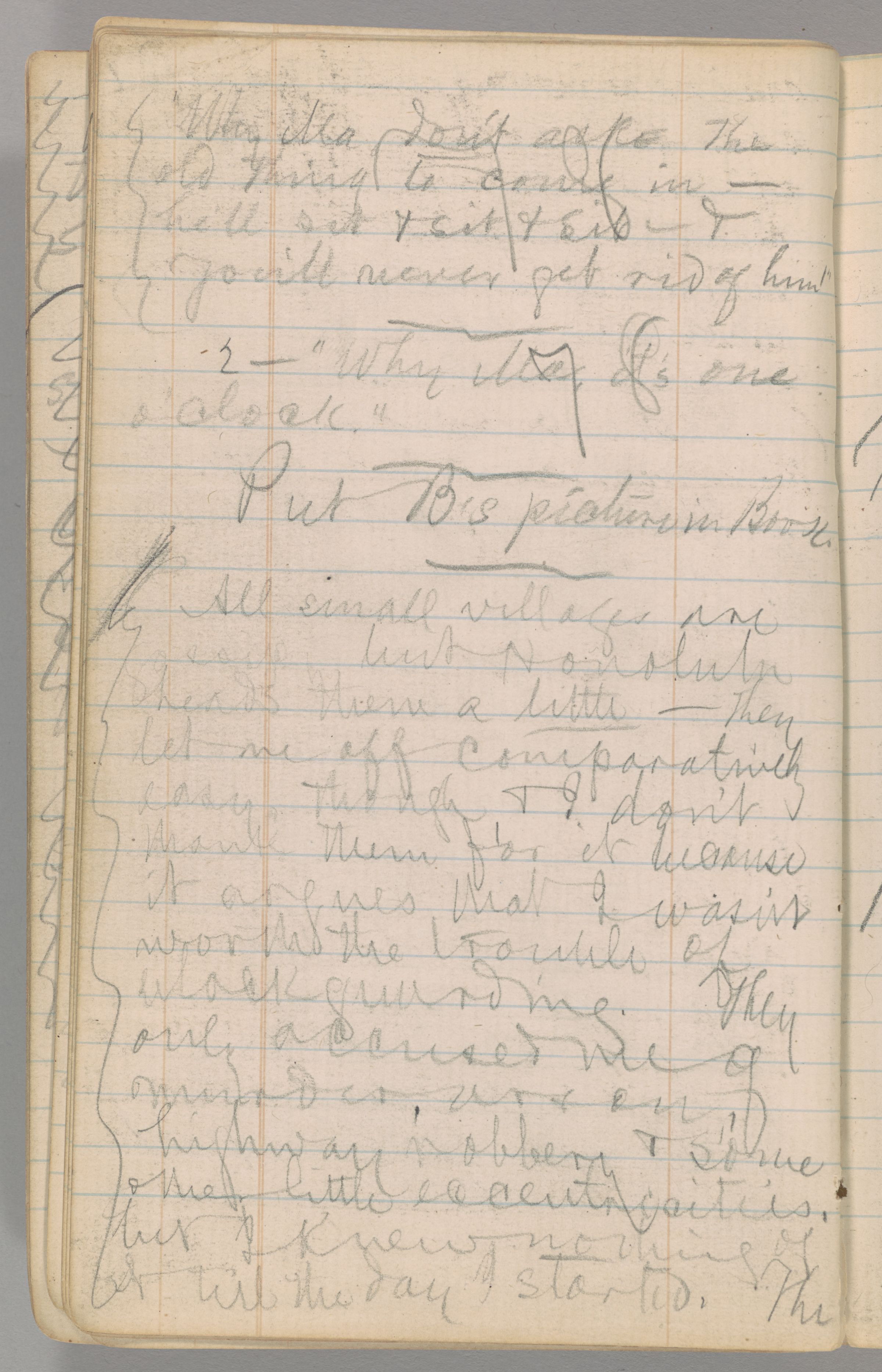
[MS: N05_leaf_022r]
by every silly stranger
& tortured from the
ri-
sing
rising
until the setting
of the sun. But if
Brown destroys my
peace of mind again
in this way, he shall die.
The words are said.
Honolulu, July 18/66
Have got my passport from
the Royal d—d Hawaiian
Collector of Customs &
paid a dollar for it, &
tomorrow we sail for
America in the good
ship Smyrniote, Lovett,
master—& I have got
a devilish saddle-boil
to sit on for the first
two weeks at sea.
[MS: N05_leaf_022v]
“Why Ma, don't aske
Ⓜemendation the
old thing to come in—
he'll sit & sit & sit—&
you'll never get rid of him!”
78
2—“Why Ma, it's one
o'clock.”
78
[MTP: N&J1_133]
Put B's picture in Book.
All small villages are
gossipy, but Honolulu
heads them a little—they
let me off comparatively
easy, though, & I don't
thank them for it because
it argues that I wasn't
worth the trouble of
blackguarding. They
only accused me of
murder, arson,
highway robbery & some
other little eccentricities,
but I knew nothing of
it till the day I started. The
[MS: N05_leaf_023r]
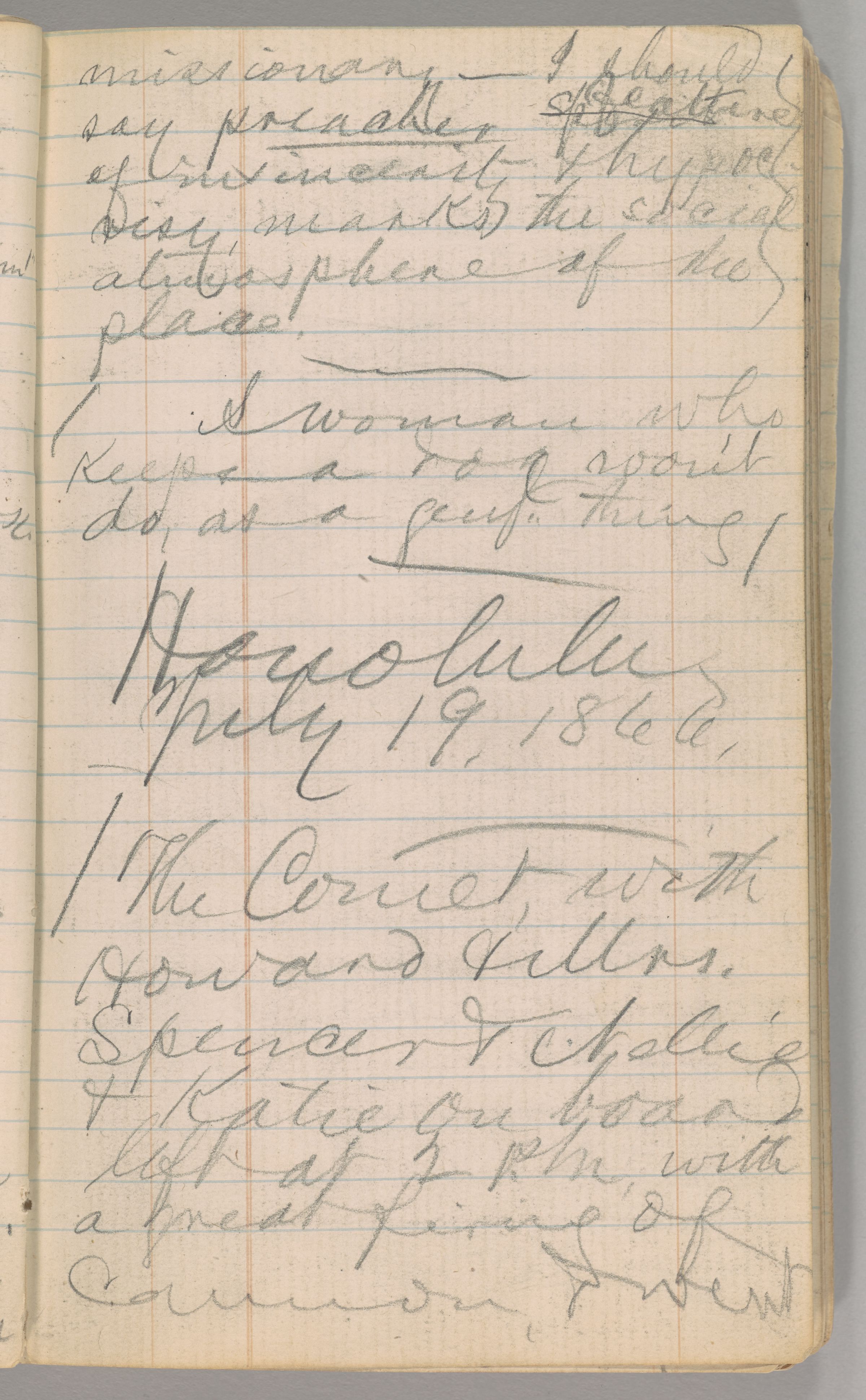
missionary—I should
say preacher
spirit
feature
of insincerity &
hypoc-
risy
hypocrisy
, marks the social
atmosphere of the
place.
A woman who
keeps a dog won't
do, as a gen1 thing.
Honolulu,
July 19, 1866,
The Comet, with
Howard73 & Mrs.
Spencer & Nellie
& Katie74 on board
left at 2 P.M., with
a great firing of
cannon, & went
[MS: N05_leaf_023v]
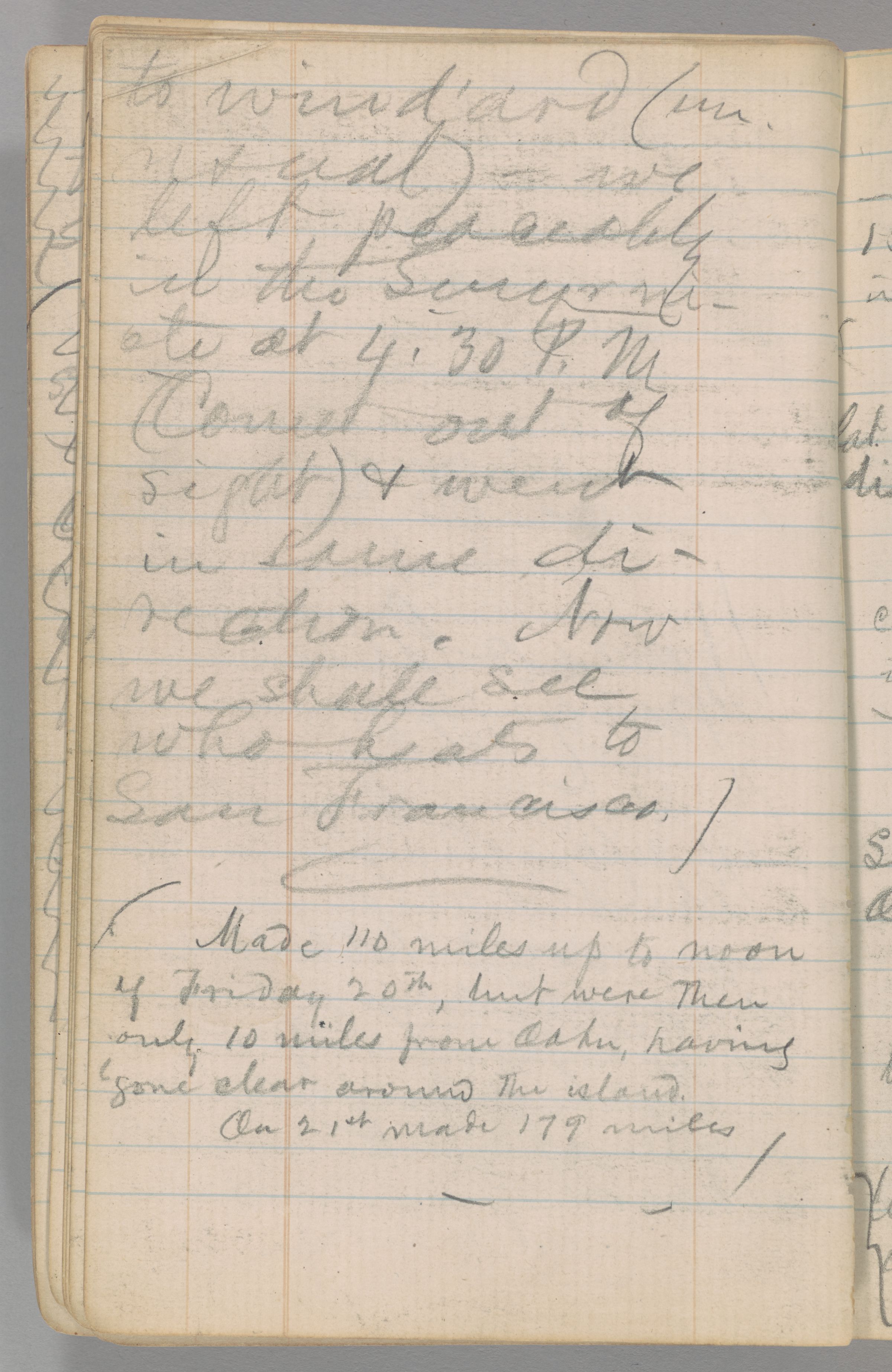
to wind'ard (
un-
usual
unusual
)—we
left peaceably
in the
Smyrni-
ote
Smyrniote
at 4:30 P.M
(Comet out of
sight) & went
in same
di-
rection
direction
. Now
we shall see
who beats to
San Francisco.
Made 110 miles up to noon
of Friday 20th, but were then
only 10 miles from Oahu, having
gone clear around the island.
On 21st made 179 miles
[MS: N05_leaf_024r]
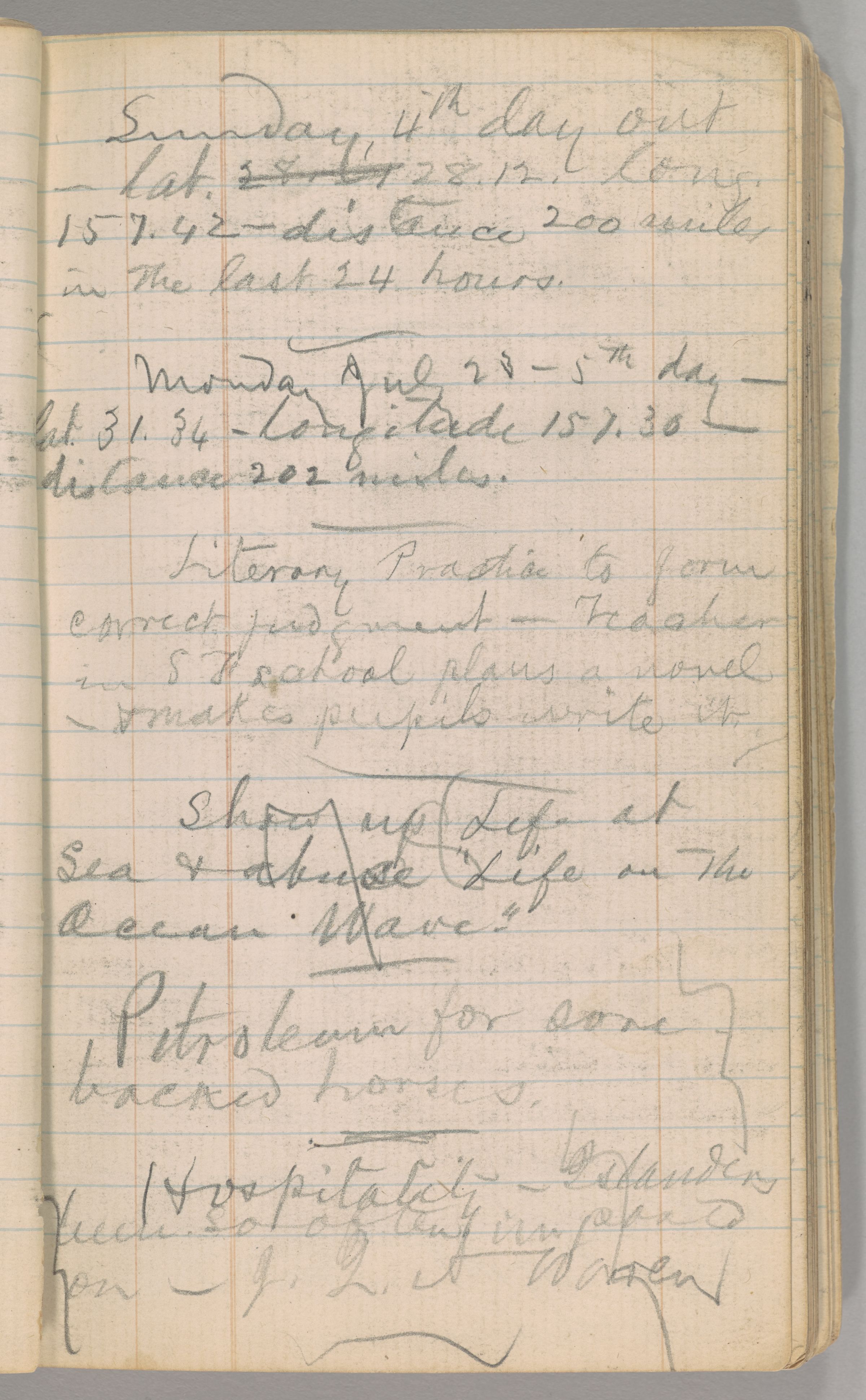
Sunday, 4th day out
—lat. 28.21 28.12. long.
157.42—distance 200 miles
in the last 24 hours.
Monday July 23—5th day—
lat. 31.34—longitude 157.30—
distance 202 miles.
[MTP: N&J1_134]
Literary Practice to form
correct judgment—Teacher
in S F school plans a novel
—& makes pupils write it.
Show up Life at
Sea & abuse “Life on the
Ocean Wave.”75
78
Petroleum for
sore-
backed
sore-backed
horses.
Hospitality—Islanders
been so often imposed
on—J. Q. A Warren76
[MS: N05_leaf_024v]
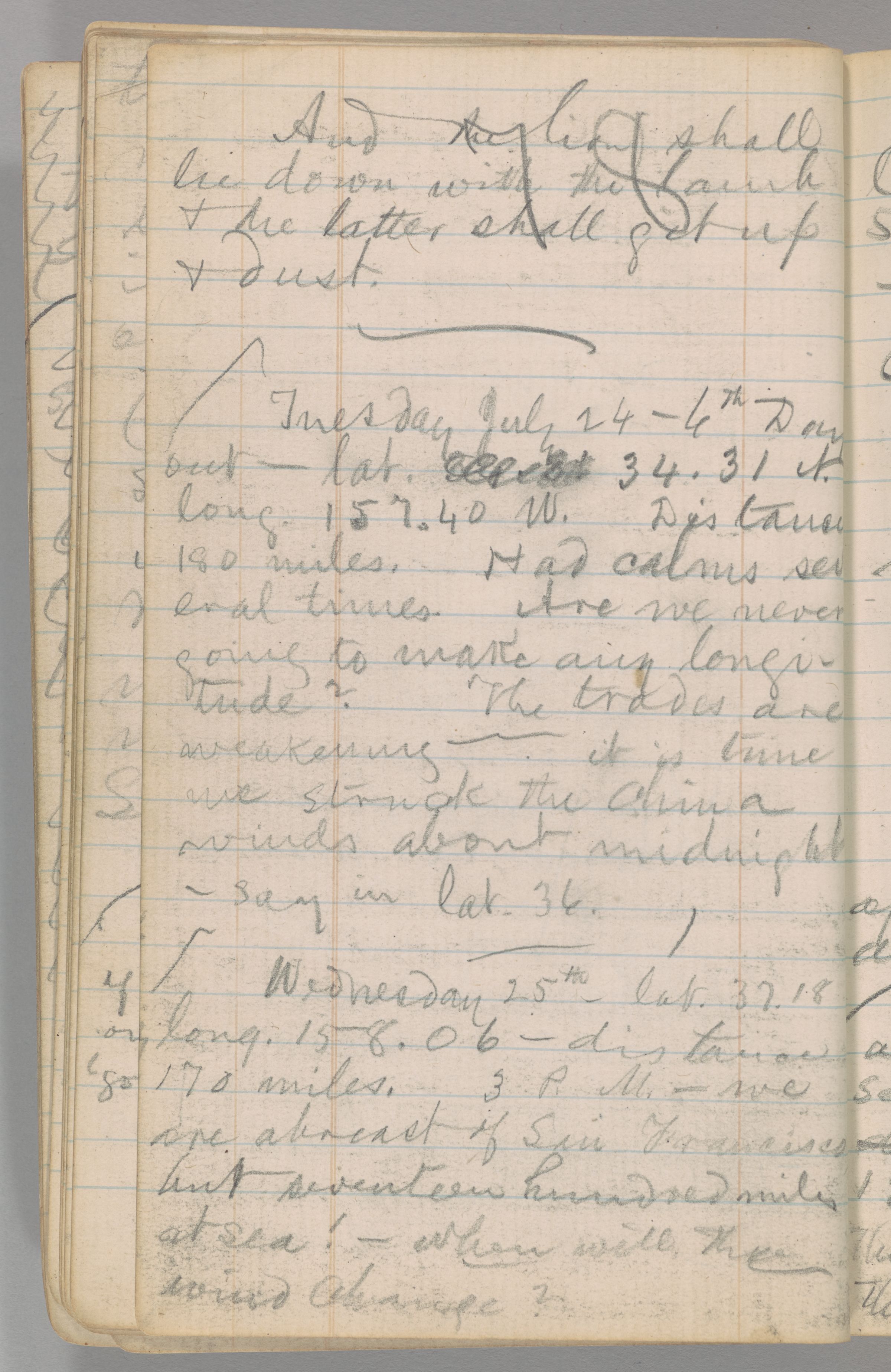
And the lion shall
lie down with the lamb
& the latter shall get up
& dust.
78
Tuesday July 24—6th Day
out—lat. 34.31 34.31 N.
long. 157.40 W. Distance
180 miles. Had calms
sev-
eral
several
times. Are we never
going to make any
longi-
tude
longitude
?Ⓣtextual note The trades are
weakening—it is time
we struck the China
winds about midnight
—say in lat. 36.
Wednesday 25th—lat. 37.18
long. 158.06—distance
170 miles. 3 P.M.—we
are abreast of San Francisco,
but seventeen hundred miles
at sea!—when will the
wind change?
[MS: N05_leaf_025r]
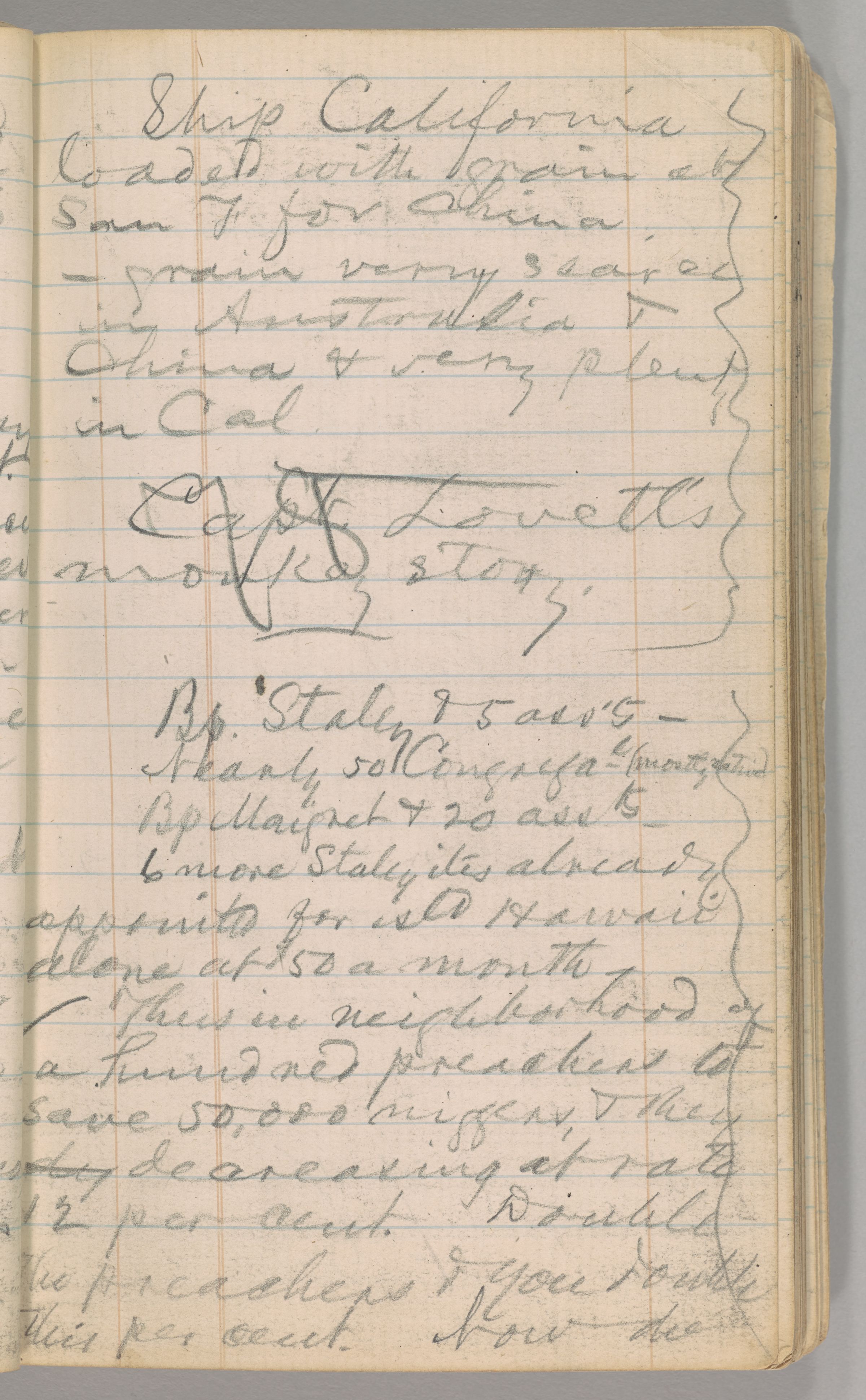
Ship California
loaded with grain at
San F for China.
—grain very scarce
in Australia &
China & very plenty
in Cal.
Capt. Lovett's
monkey story.77
78
Bp. Staley78 & 5 ass'ts—
[MTP: N&J1_135]
Nearly 50 Congregal (mostly native)79
Bp Maigret & 20 assts—
6 more Staleyites already
appointed for isld Hawaii
alone at $50 a month—
Thus in neighborhood of
a hundred preachers to
save 50,000 niggers, & they
dy decreasing at rate
12 per cent. Double
the preachers & you double
this per cent. Now the
[MS: N05_leaf_025v]
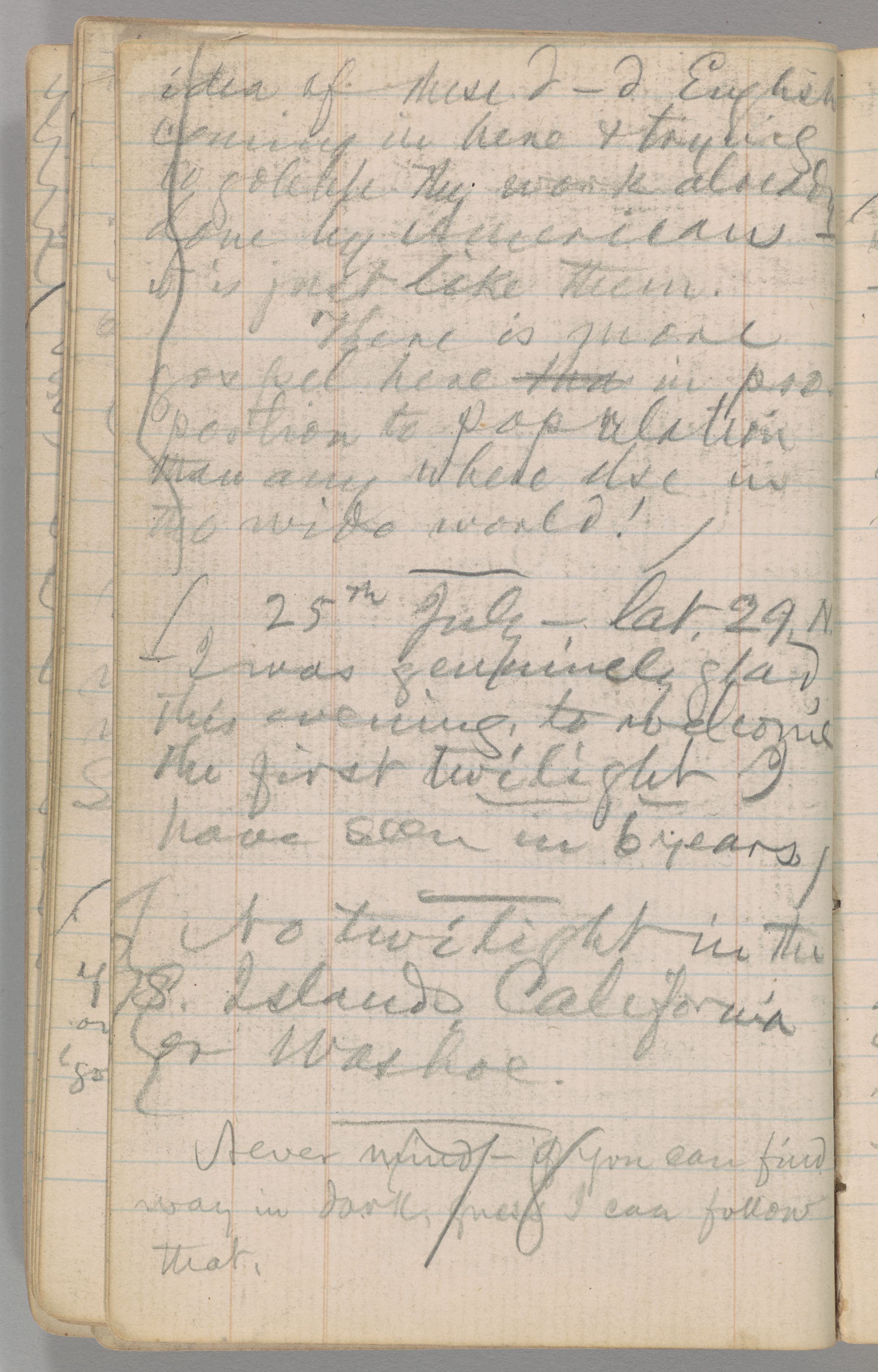
idea of these d—d English
coming in here & trying
to gobble the work already
done by Americans—
it is just like them.80
There is more
gospel here tha in
pro-
portion
proportion
to population
than any where else in
the wide world!
25th July—lat. 29, N.
—I was genuinely glad,
this evening, to welcome
the first twilight I
have seen in 6 years,
No twilight in the
S. Islands, California
or Washoe.
[MTP: N&J1_136]
Never mind—if you can find
way in dark, guess I can follow
that.
78
[MS: N05_leaf_026r]
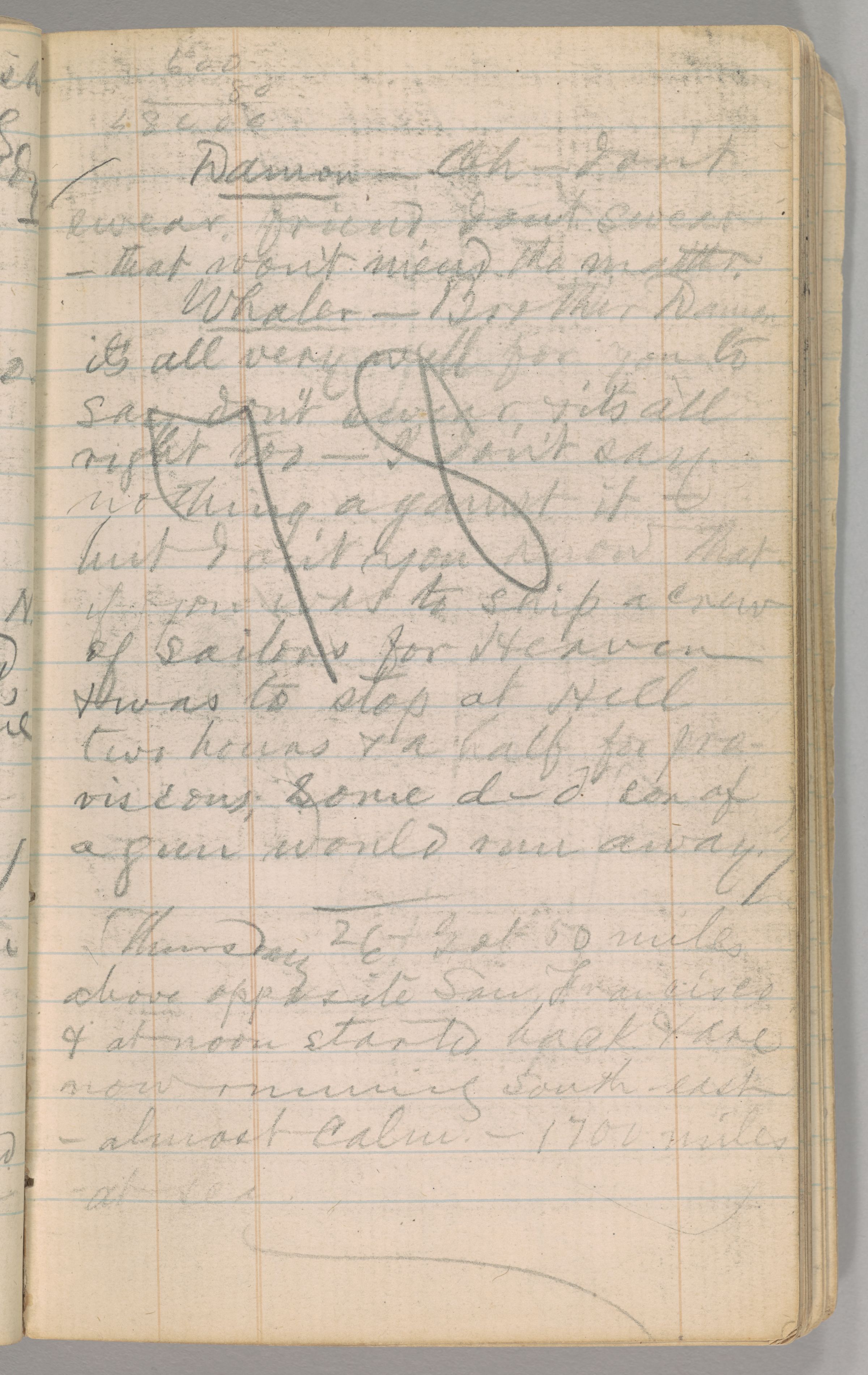
600
80
48000
Damon
81—Oh—don't
swear, friend, don't swear
—that won't mend the matter.
Whaler—Brother Damon
it's all very well for you to
say don't swear, & it's all
right too—I don't say
nothing against it—
but don't you know that
if you was to ship a crew
of sailors for Heaven
& was to stop at Hell
two hours & a half for
pro-
visions
provisions
, some d—d son of
a gun would run away.”
78
Thursday 26—Got 50 miles
above opposite San Francisco
& at noon started back & are
now running south-east
—almost calm.—1700 miles
at sea.
[MS: N05_leaf_026v]
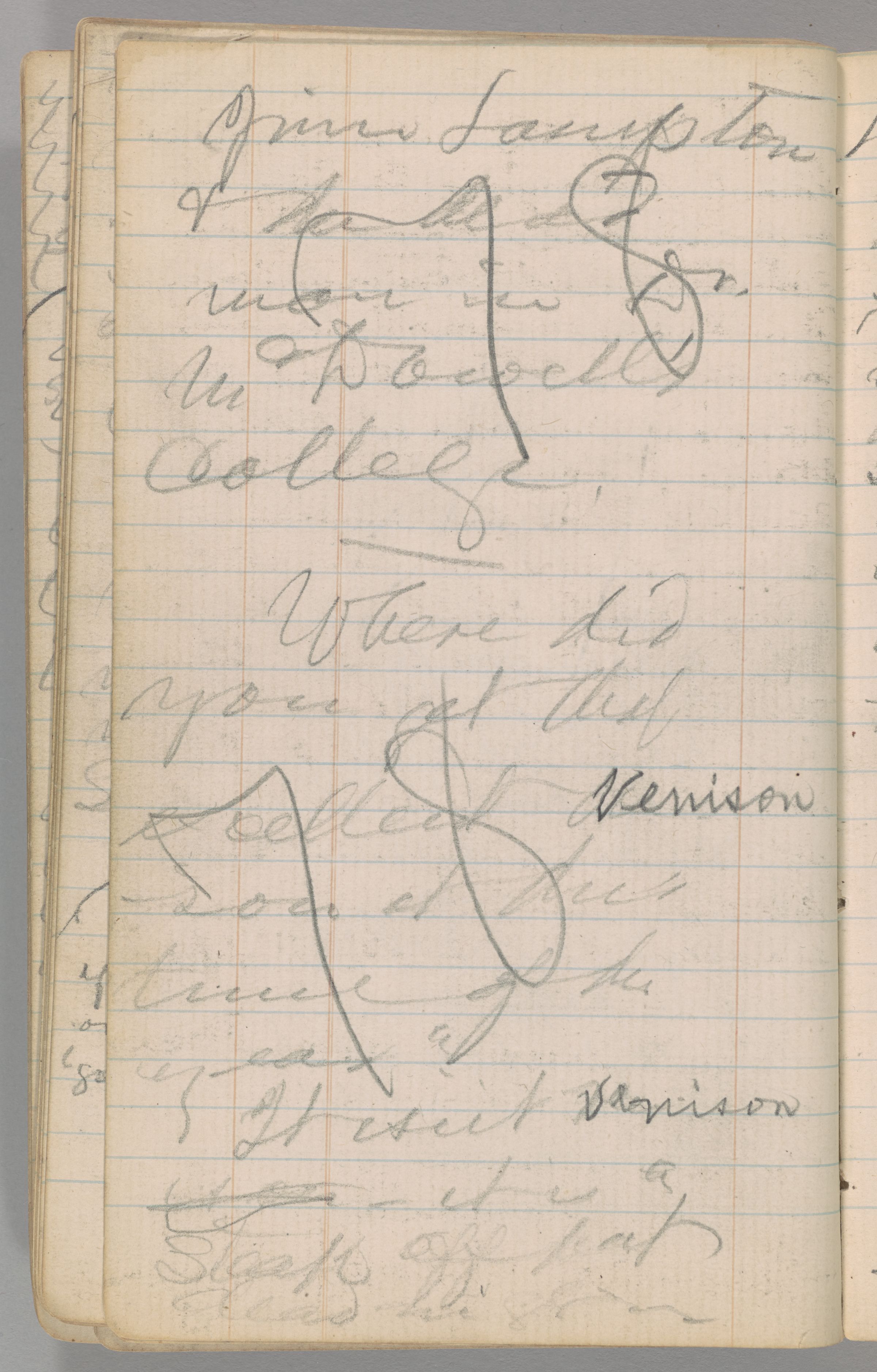
Jim Lampton
& the dead
man in Dr.
McDowell's
College.82
78
Where did
you get that
excellent
veni-
venison
son
venison
venison
at this
time of the
year?
It isn't
veni-
venison
son
venison
venison
—it is a
steak off that
dead nigger.83
78
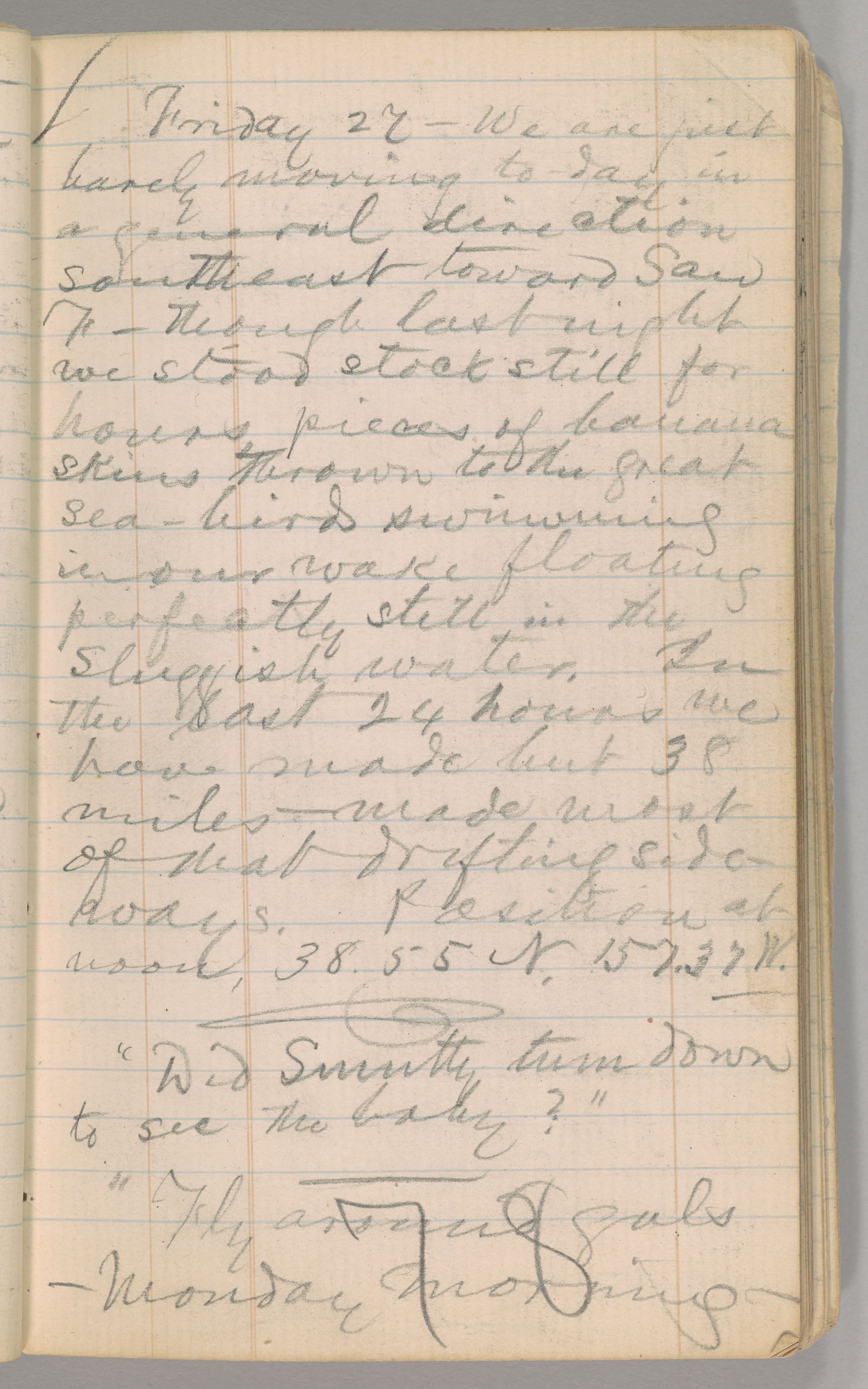
[MS: N05_leaf_027r]
Friday 27—We are just
barely moving to-day in
a general direction
southeast toward San
F—though last night
we stood stock still for
hours, pieces of banana
skins thrown to the great
sea-birds swimming
in our wake floating
perfectly still in the
sluggish water. In
the last
[MTP: N&J1_137]
24 hours we
have made but 38
miles—made most
of that drifting
side-
ways
sideways
. Position at
noon, 38.55 N. 157.37 W.
“Did Smutty tum down
to see the baby?”
“Fly around gals
—Monday morning—
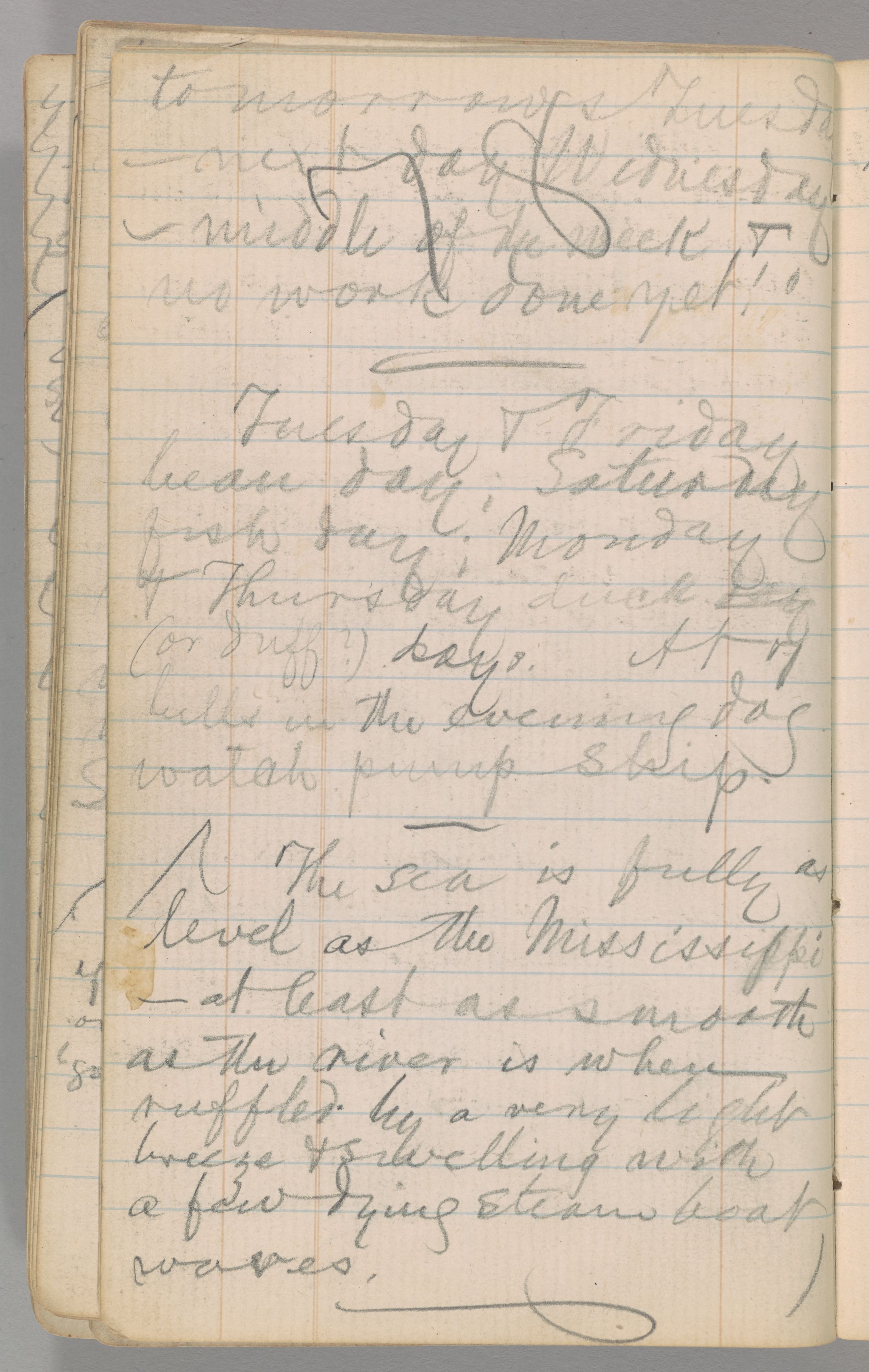
[MS: N05_leaf_027v]
to-morrowsⓂemendation Tuesday
—next day Wednesday
—middle of the week &
no work done yet!”84
78
Tuesday & Friday
bean day; Saturday
fish day; Monday
& Thursday duck day
(or duff?) days. At 7
bells in the evening dog
watch pump ship.
The sea is fully as
level as the Mississippi
—at least as smooth
as the river is when
ruffled by a very light
breeze & swelling with
a few dying steamboat
waves.
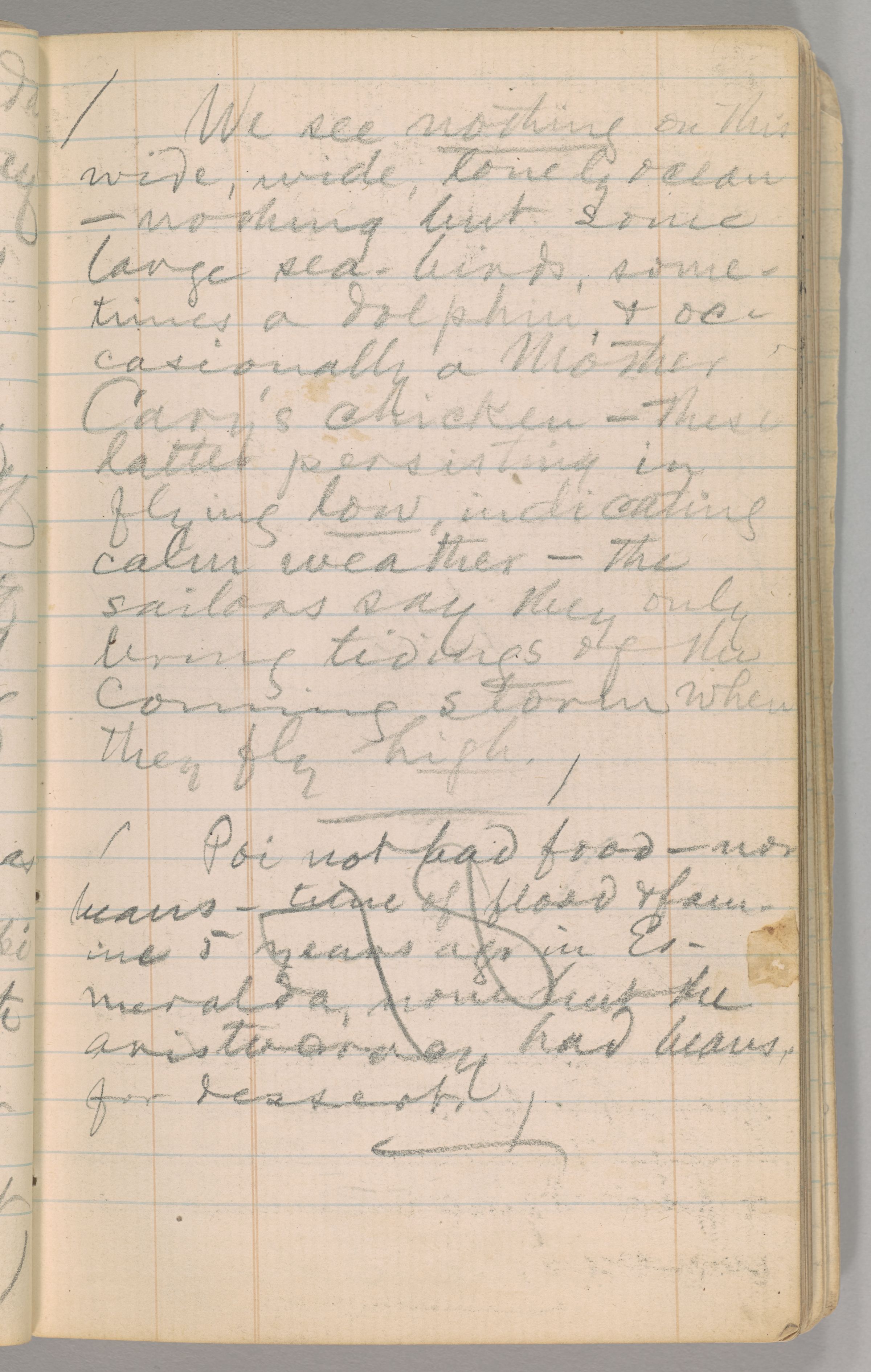
[MS: N05_leaf_028r]
We see nothing on this
wide, wide, lonely ocean
—nothing but some
large sea-birds,
some
times
sometimes
a dolphin, &
oc-
casionally
occasionally
a Mother
Cary's chicken—these
latter persisting in
flying low, indicating
calm weather—the
sailors say they only
bring tidings of the
coming storm when
they fly high.
Poi not bad food—nor
beans—time of flood85 &
fam-
ine
famine
5 years ago in
Es-
merelda
Esmeralda
, none but the
aristocracy had beans,
for dessert.
78
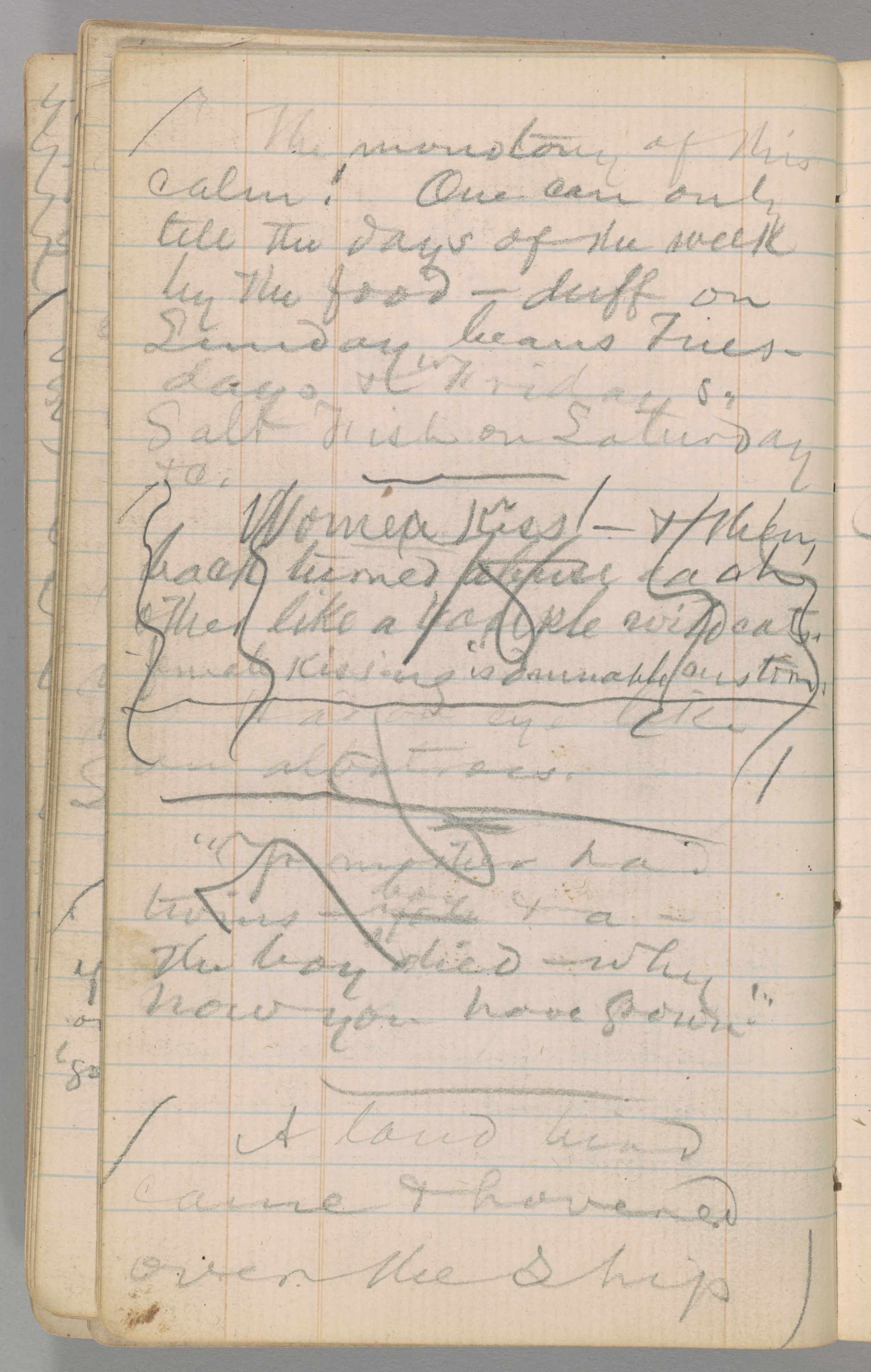
[MS: N05_leaf_028v]
The monotony of this
calm! One can only
tell the days of the week
by the food—duff on
Sunday, beans
Tues-
days
Tuesdays
& Fridays,
Salt Fish on Saturday &c.
Women kiss—& then,
back turned, abuse each
other like a couple wildcats.
—female kissing is damnable custom.
78
Had an eye like
an albatross.
“Yr mother had
twins—you
boy
& a—
the boy died—why
how you have grown!”
78
[MTP: N&J1_138]
A land bird
came & hovered
over the ship
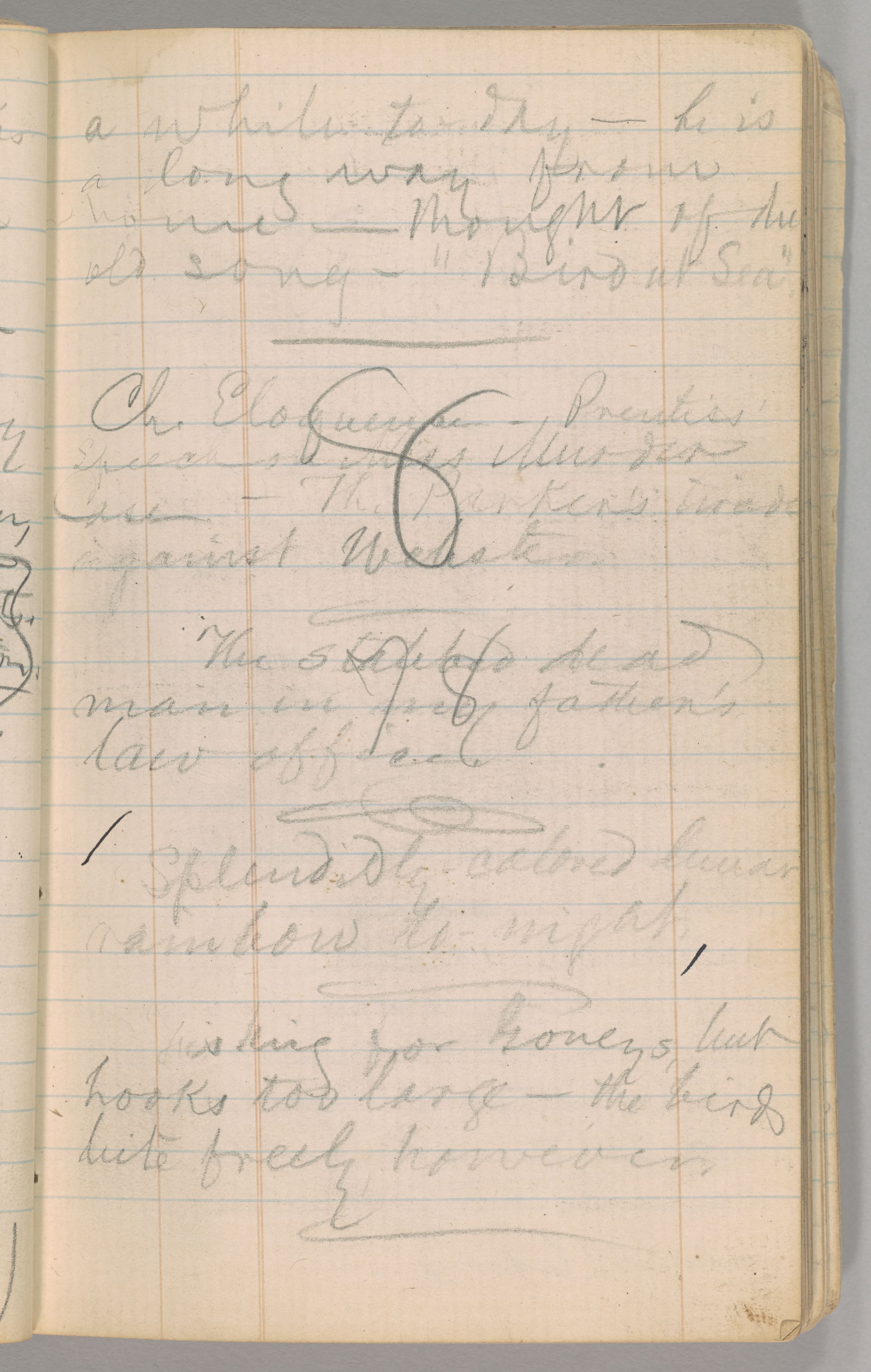
[MS: N05_leaf_029r]
a while to-day—he is
a long way from
home—thought of the
old song—“Bird at Sea.”86
The stabbed dead
man in my father's
law office.89
78
Splendidly-colored lunar
rainbow to-night.
Fishing for Goneys, but
hooks too large—the birds
bite freely, however.
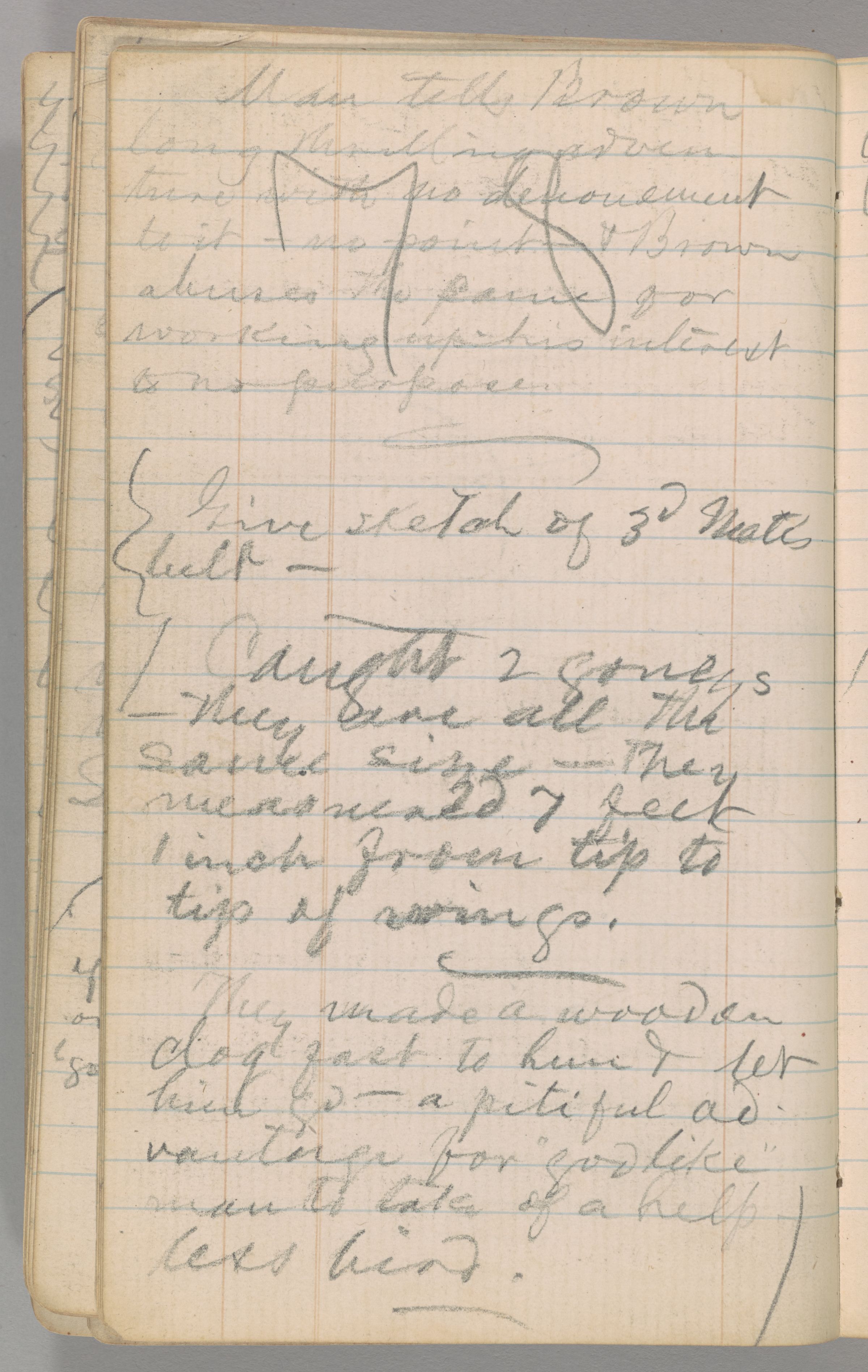
[MS: N05_leaf_029v]
Man tells Brown
long thrilling
adven-
ture
adventure
with no denouement
to it—no point—& Brown
abuses the same for
working up his interest
to no purpose.
78
Give sketch of 3d Mate's
belt—90
Caught 2 goneys
—they are all the
same size—they
measured 7 feet
1 inch from tip to
tip of wings.
They made a wooden
clog fast to him & let
him go—a pitiful
ad-
vantage
advantage
for “godlike”
man to take of a
help-
less
helpless
bird.
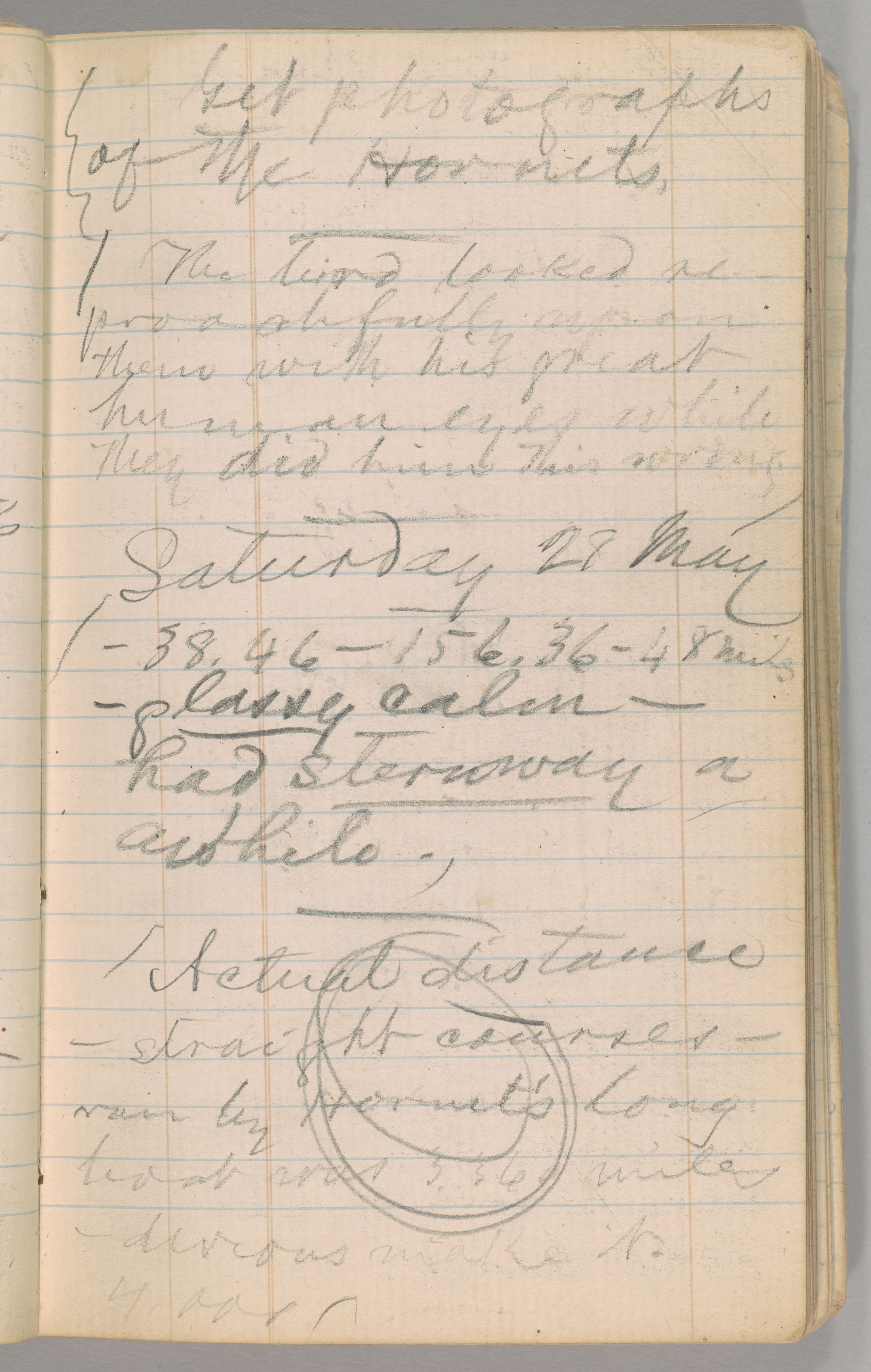
[MS: N05_leaf_030r]
Get photographs
of the Hornets.91
The bird looked
re-
proachfully
reproachfully
upon
them with his great
human eyes while
they did him this wrong.
Saturday 28 May92
—38.46—156.36—48 miles—
glassy calm—had sternway a
awhileⓂemendation.
Actual distance
—straight courses—
ran by Hornet's long
boat was 3,360 miles
—devious make it
4,000
꩜
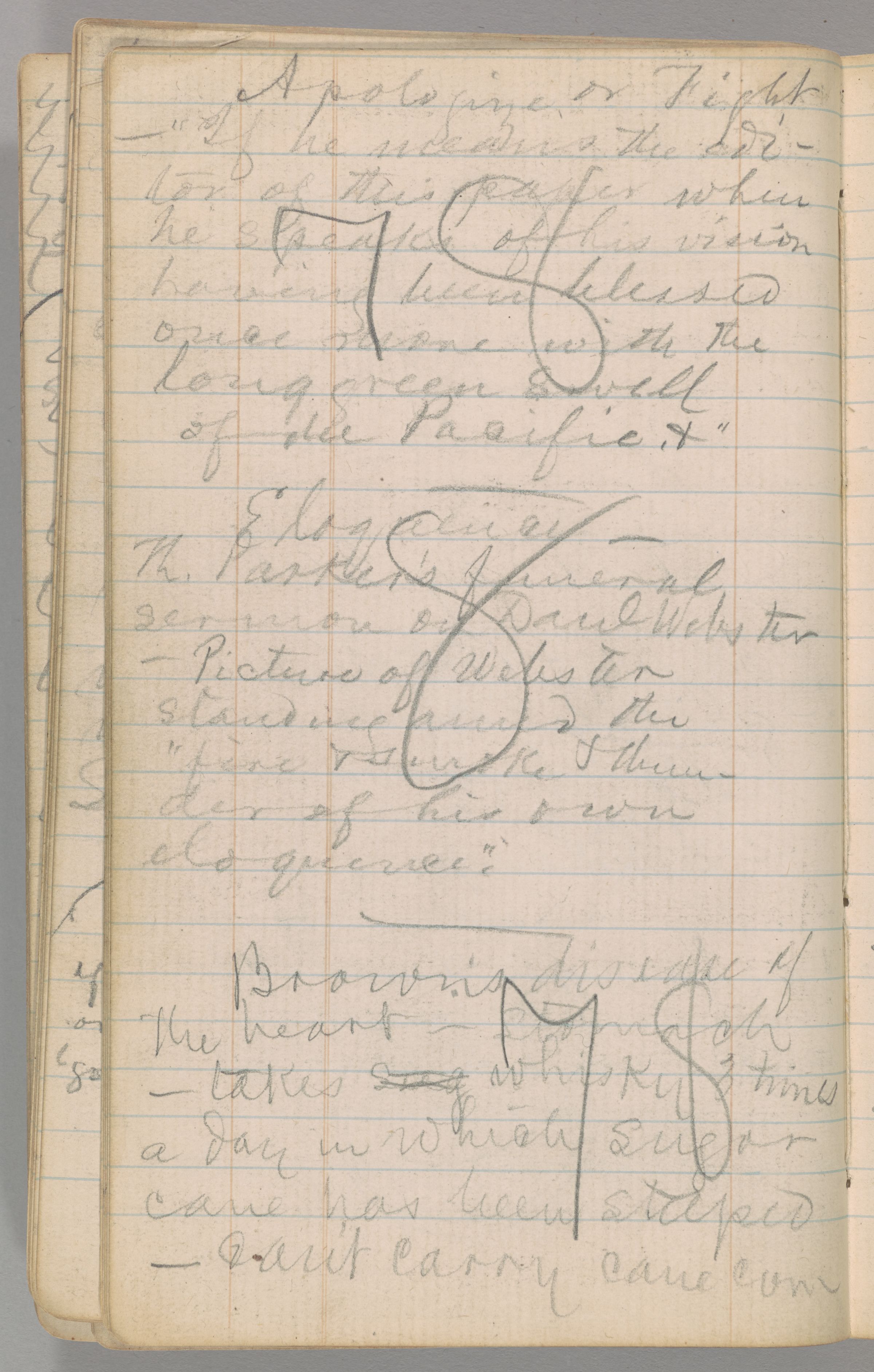
[MS: N05_leaf_030v]
Apologize or Fight
—“If he means the
edi-
tor
editor
of this paper when
he speaks of his vision
having been blessed
once more with the
long green swell
of the Pacific. &”
78
Eloquence—
Th. Parker's funeral
sermon on Danl Webster
—Picture of Webster
standing amid the
“fire & smoke &
thun-
der
thunder
of his own
eloquence.”93
8
Brown's disease of
the heart—stomach
—takes sug whisky 3 times
a day in which sugar
cane has been steeped
—can't carry cane con-
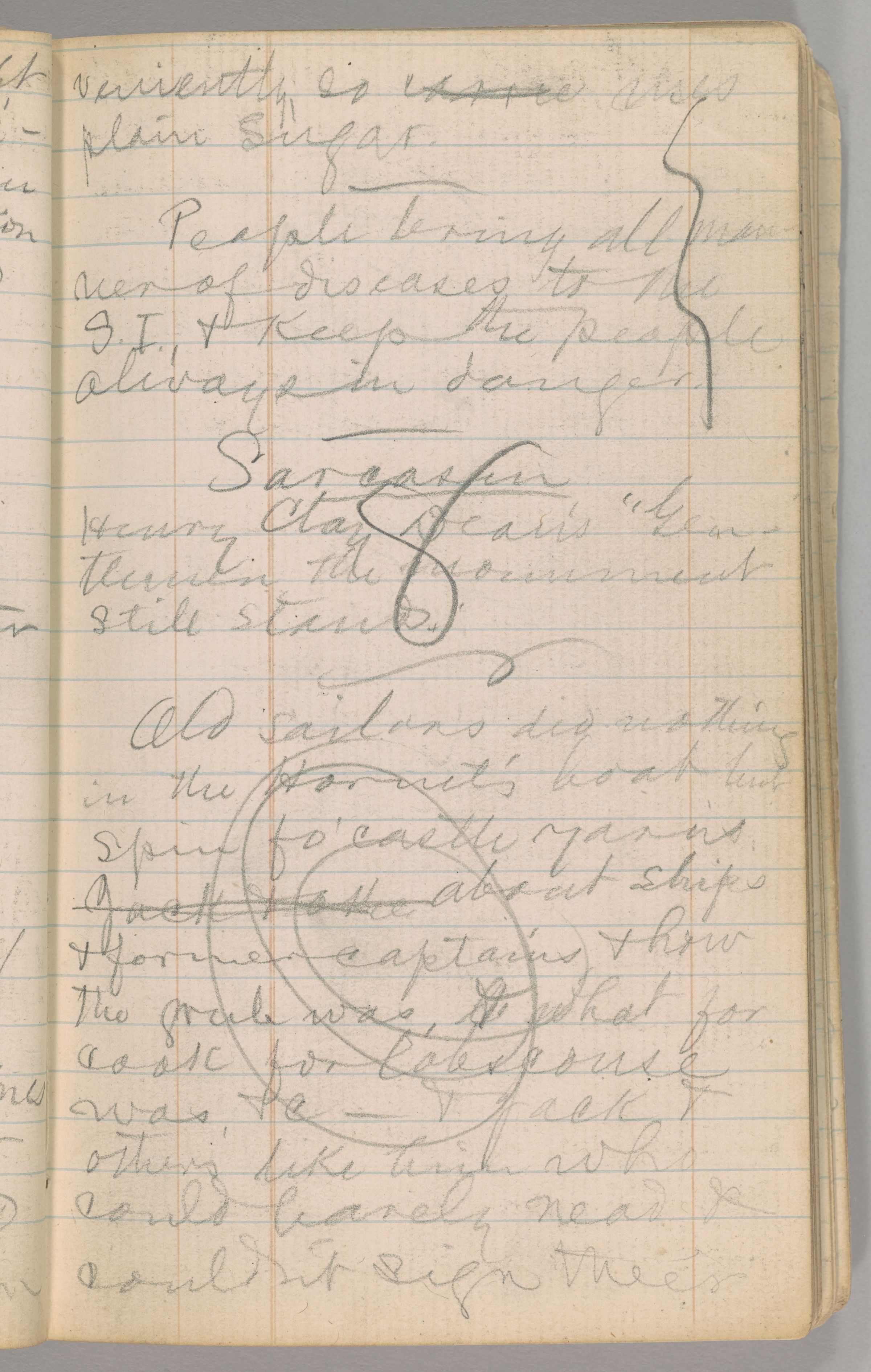
[MS: N05_leaf_031r]
veniently, so carrie uses
plain sugar.
78
[MTP: N&J1_140]
People bring all
man-
ner
manner
of diseases to the
S. I., & keep the people
always in danger.94
Sarcasm
Henry Clay Dean's “
Gen-
tlemen
Gentlemen
, the monument
still stands.”95
8
Old sailors96 did nothing
in the Hornet's boat but
spin fo'castle yarns
Jack & othe about ships
& former captains, & how
the grub was, l & what for
cook for lobscouse
was, &c—& Jack &
others like him who
could barely read &
couldn't sign their
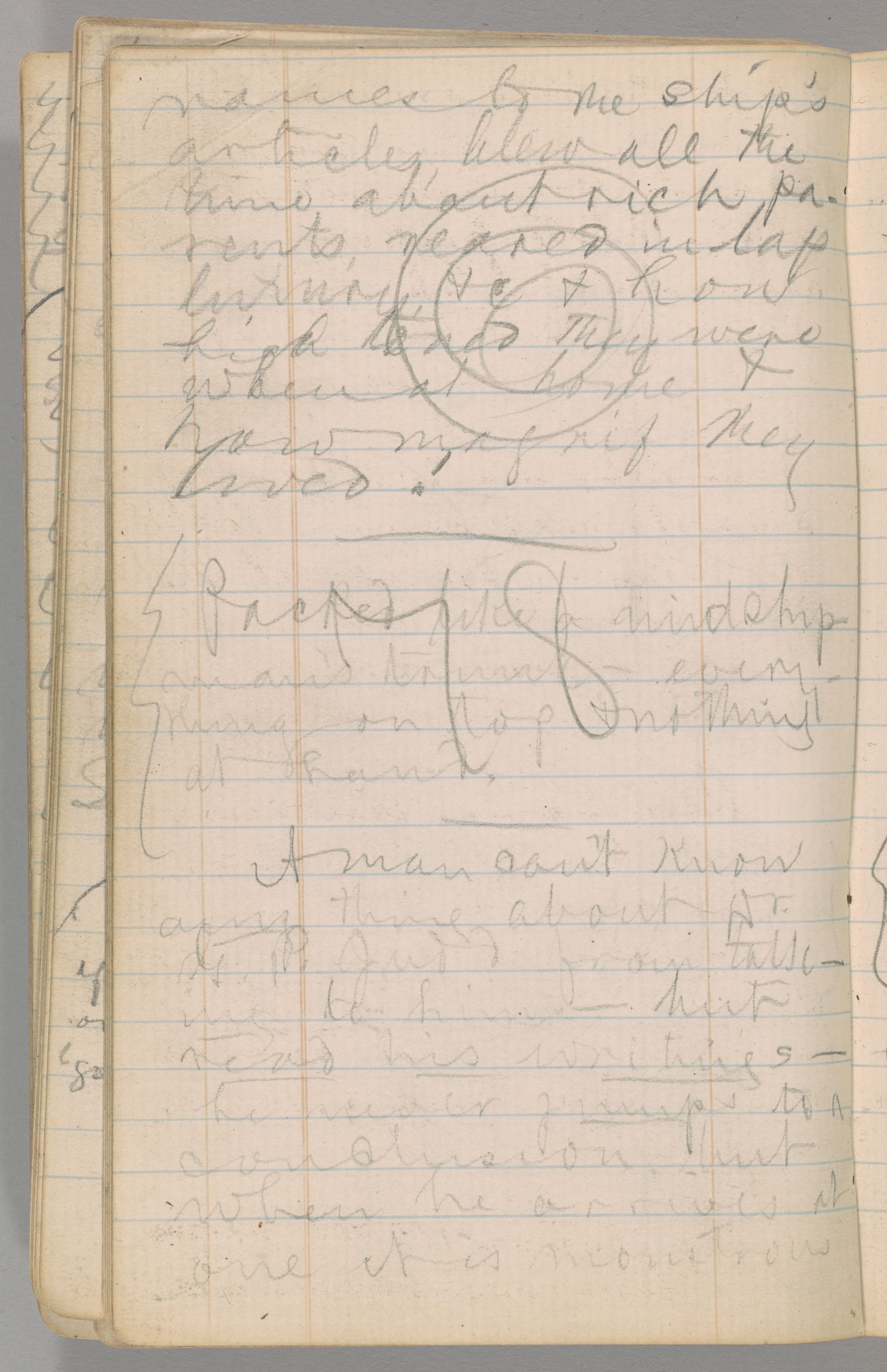
[MS: N05_leaf_031v]
names to the ship's
articles, blew all the
time about rich
pa-
rents
parents
, reared in lap
luxury, &c & how
high toned they were
when at home &
how magnif they
lived!
꩜
Packed like a
midship-
man’s
midshipman's
trunk—
every-
thing
everything
on top & nothing
at hand.
78
A man can't know
any thing about Dr.
G. P. Judd from
talk-
ing
talking
to him—but
read his writings—
he never jumps to a
conclusion but
when he arrives at
one it is monstrous
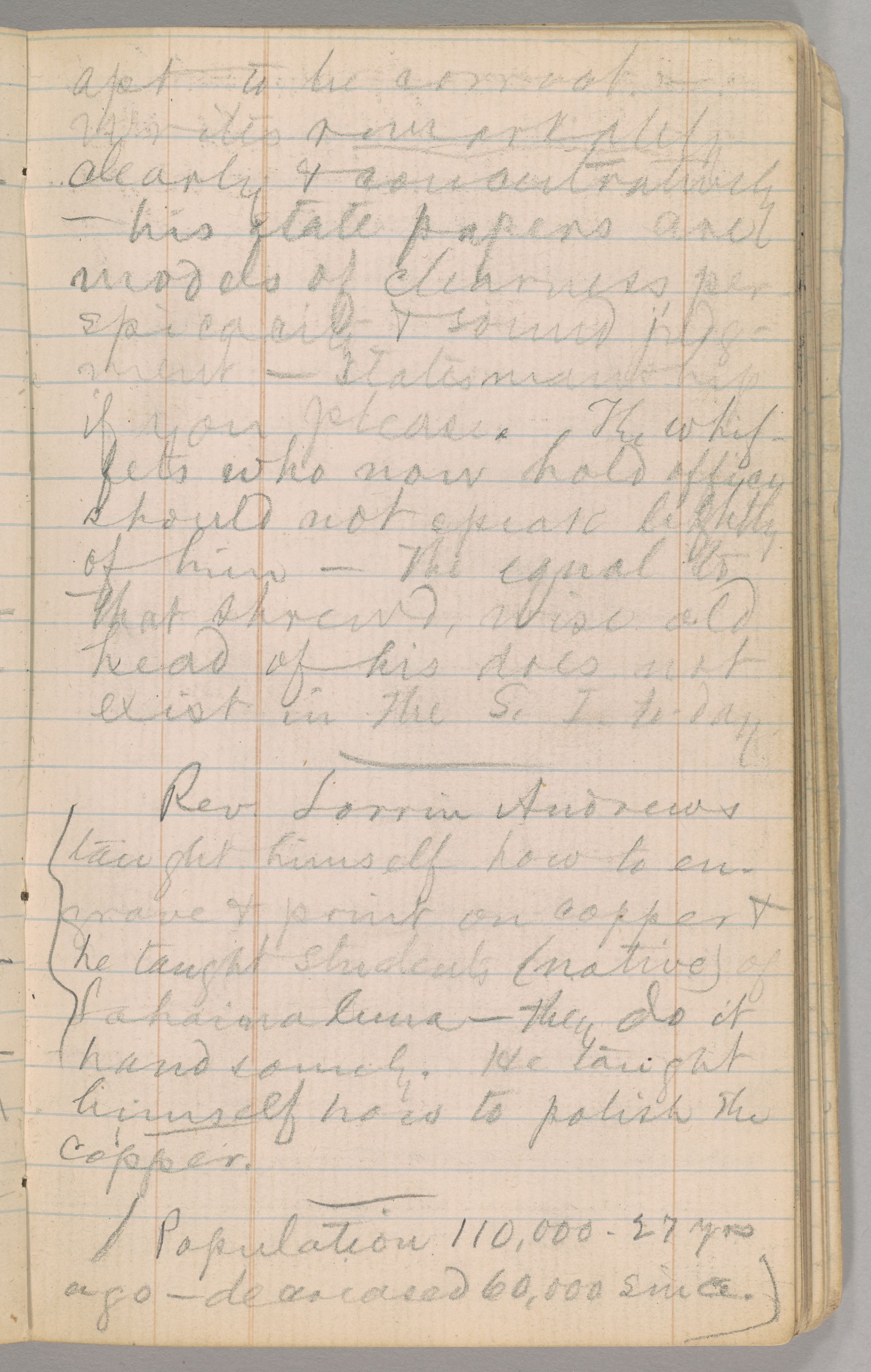
[MS: N05_leaf_032r]
apt to be correct.—
Writes remarkably
clearly & concentratively
—his state papers are
models of clearness,
per-
spicacity
perspicacity
& sound
judg-
ment
judgment
—statesmanship
if you please. The
whif-
fets
whiffets
who now hold office
should not speak lightly
of
[MTP: N&J1_141]
him—the equal to
that shrewd, wise old
head of his does not
exist in the S. I. to-day.97
Rev. Lorrin Andrews98
taught himself how to
en-
grave
engrave
& print on copper &
he taught students (native) of
Lahainaluna—they do it
handsomely. He taught
himself how to polish the
copper.
Population 110,000—27 yrs
ago—decreased 60,000 since.
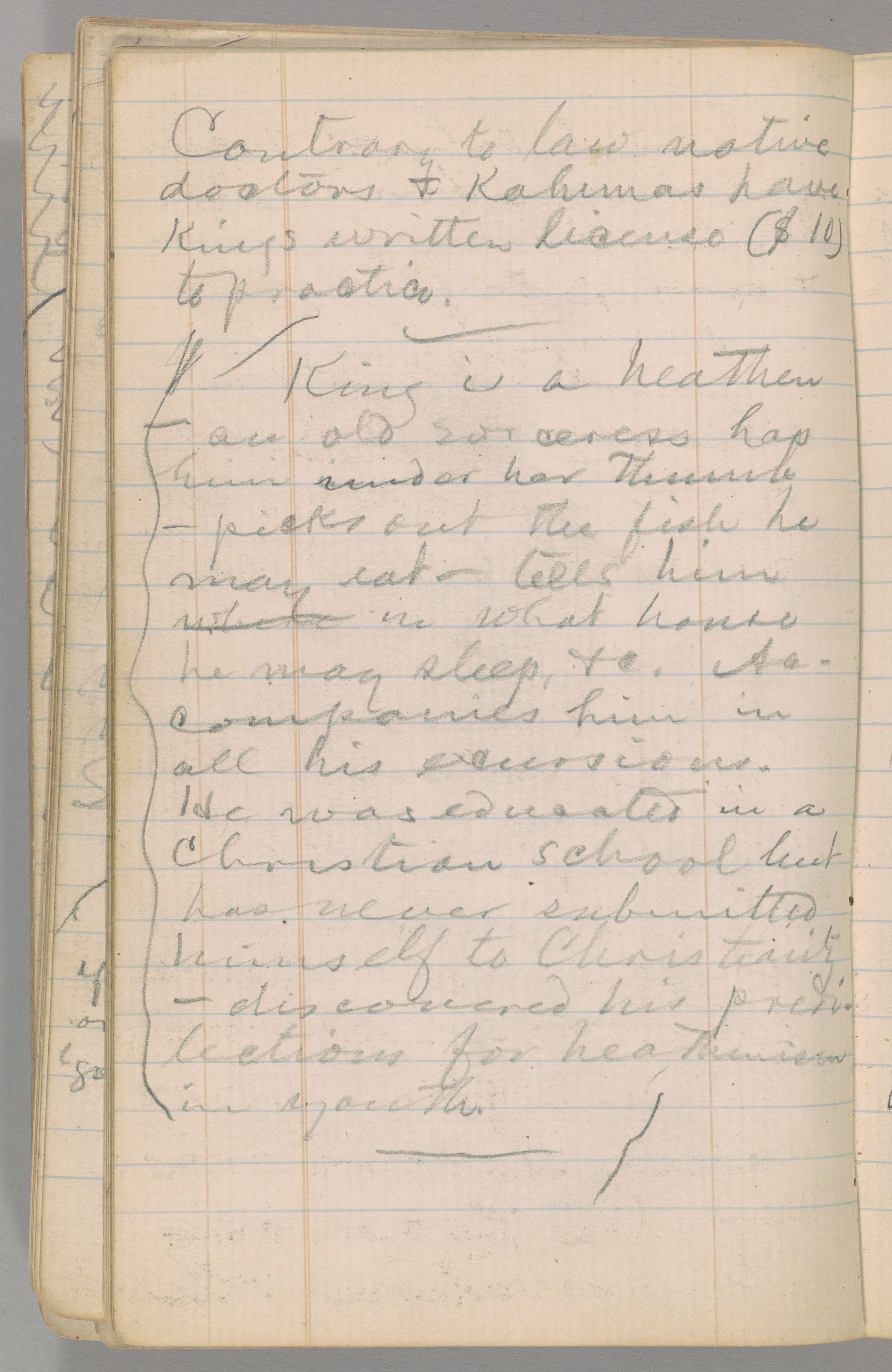
[MS: N05_leaf_032v]
Contrary to law native
doctors & Kahunas have
Kings written license ($10)
to practice.
King is a heathen
—an old sorceress has
him under her thumb
—picks out the fish he
may eat—tells him
where in what house
he may sleep, &c.
Ac-
companies
Accompanies
him in
all his excursions.
He was educated in a
Christian school but
has never submitted
himself to Christianity
—discovered his
predi-
lections
predilections
for heathenism
in youth.
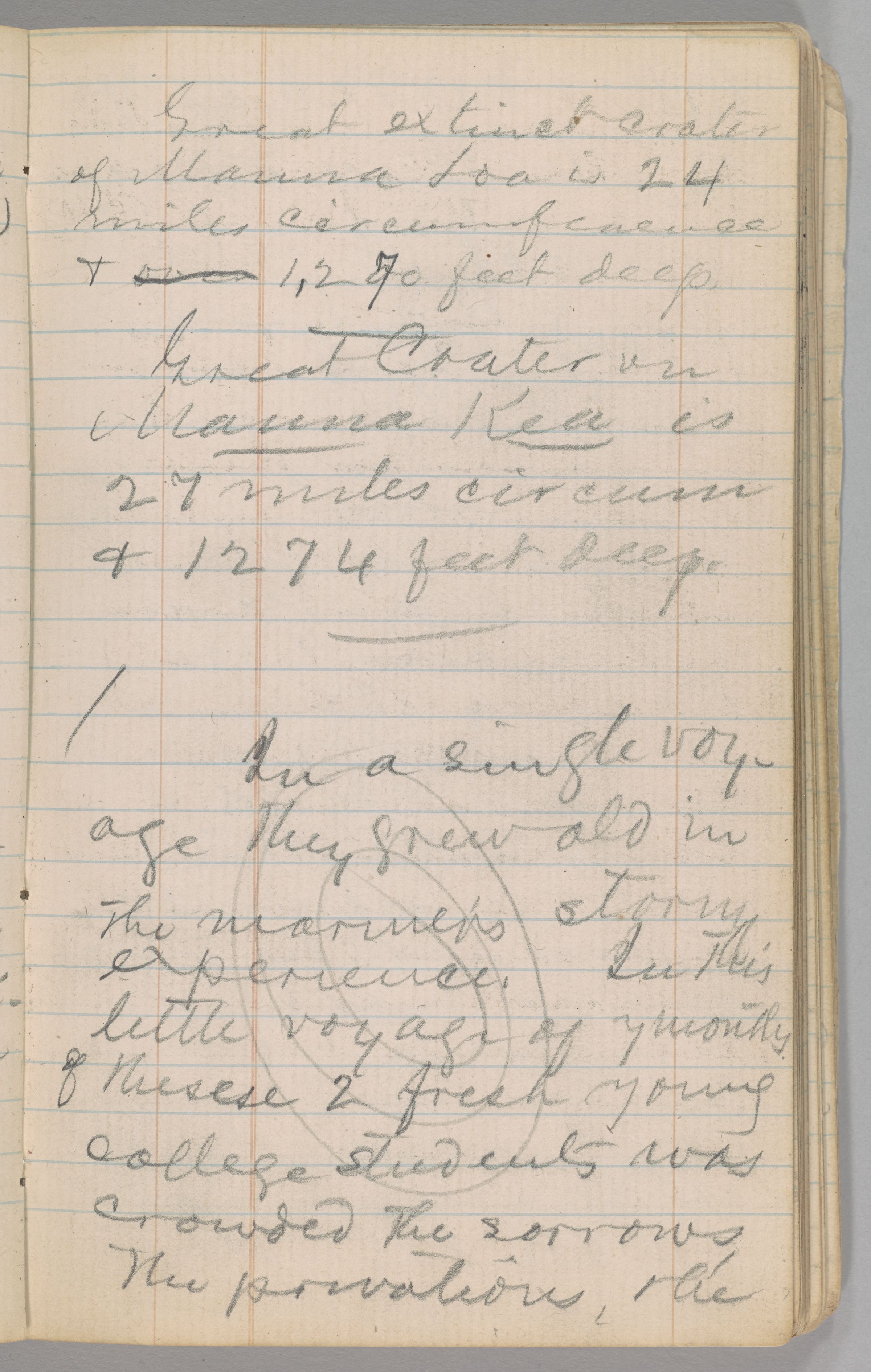
[MS: N05_leaf_033r]
Great extinct crater
of Mauna Loa is 24
miles circumference
& 1,2070Ⓣtextual note feet deep.
Great Crater on
Mauna Kea is
27 miles circum
& 1274 feet deep.
In a single
voy-
age
voyage
they grew old in
the mariner's stormy
experience. In this
little voyage of 7 months
of
theseⓂemendation 2 fresh young
college students was
crowded the sorrows,
the privations, the
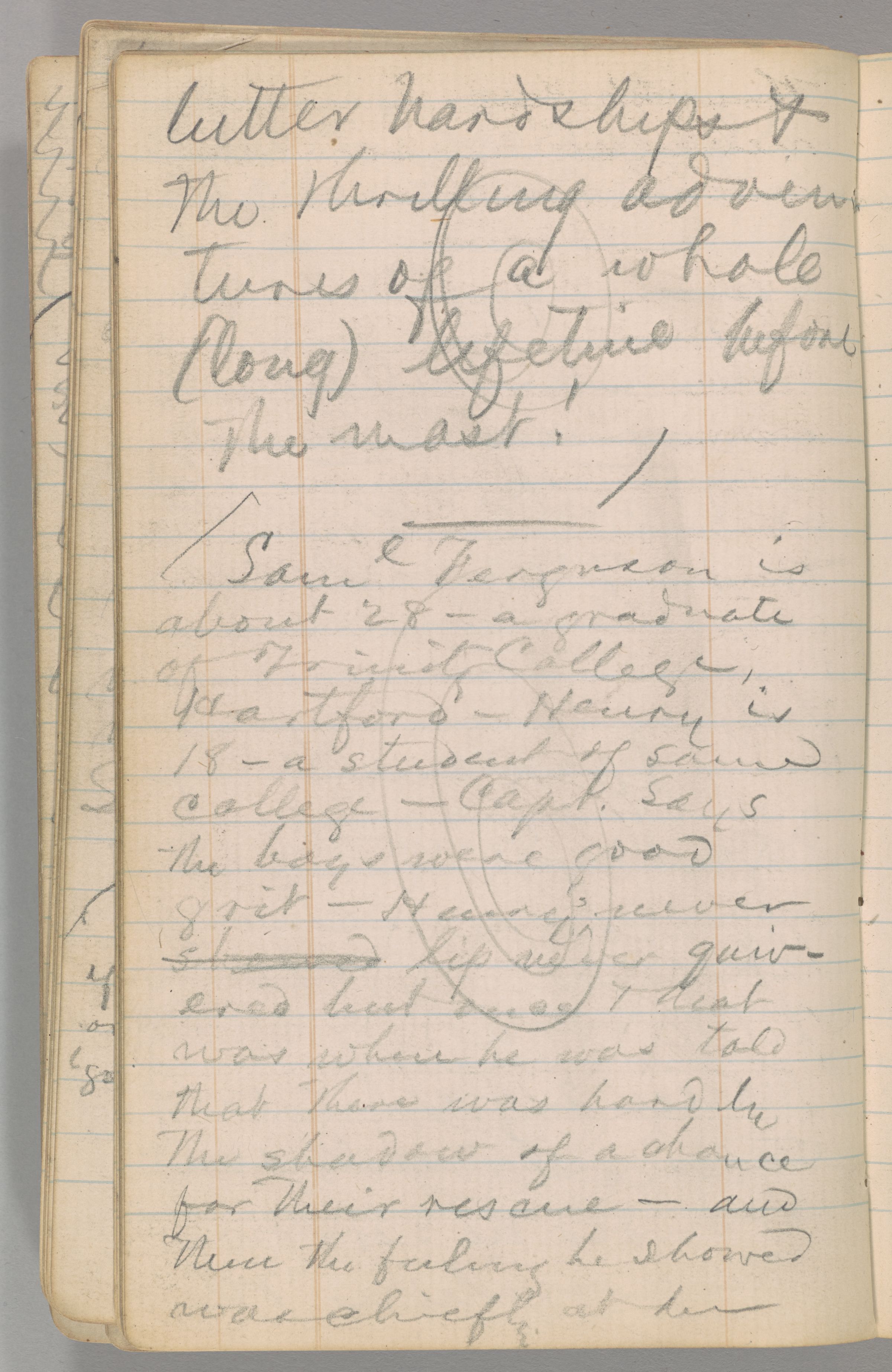
[MS: N05_leaf_033v]
bitter hardships &
the thrilling
adven-
tures
adventures
of a whole
(long) lifetime before
the mast!
꩜
[MTP: N&J1_142]
Saml Ferguson is
about 28—a graduate
of Trinity College,
Hartford—Henry is
18—a student of same
college—Capt. says
the boys were good
grit—
Henry's never
showed
Ⓣtextual note
lip never
quiv-
ered
quivered
but once & that
was when he was told
that there was hardly
the shadow of a chance
for their rescue—and
then the feeling he showed
was chiefly at the
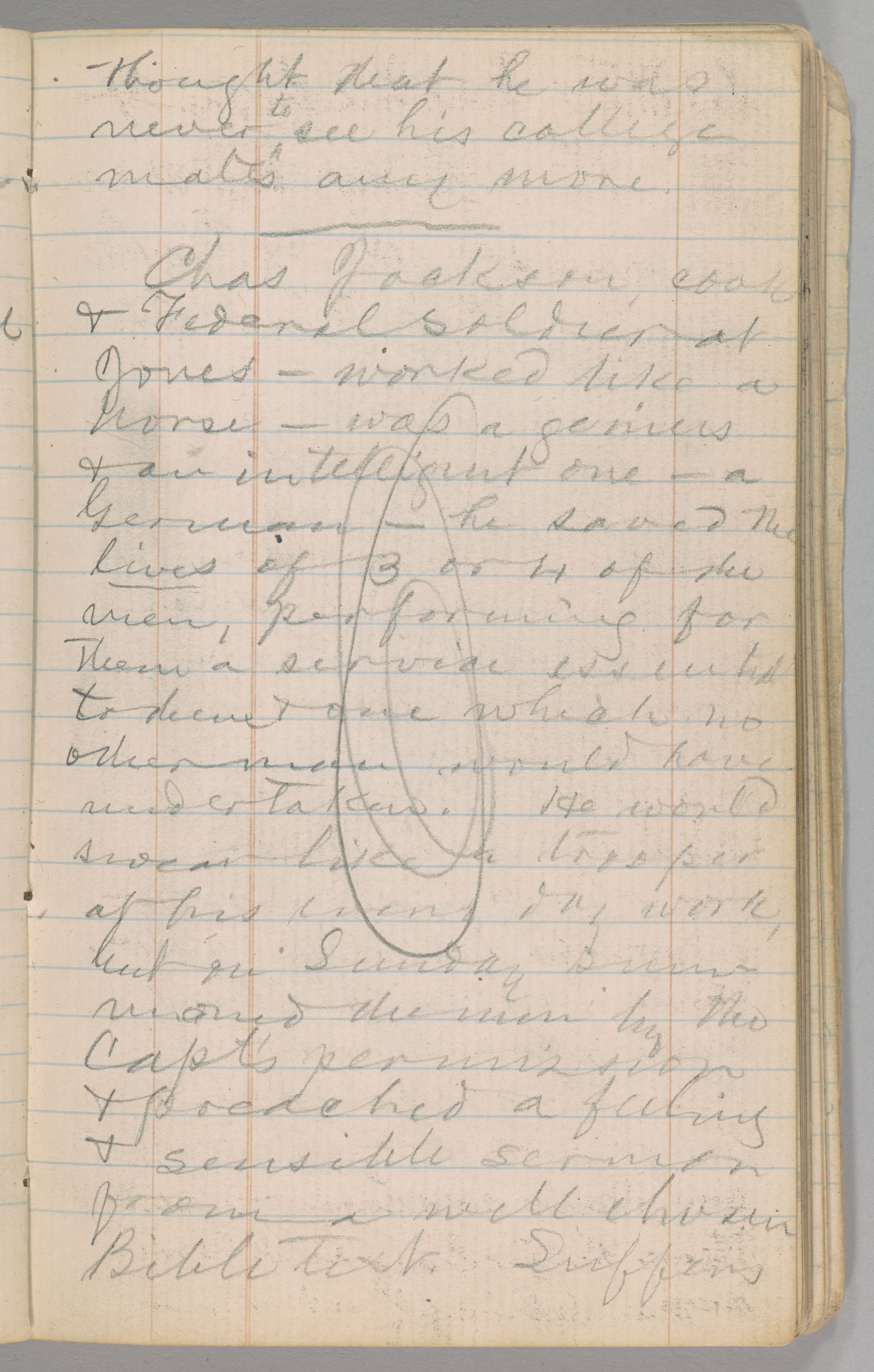
[MS: N05_leaf_034r]
thought that he was
never to
see his college
mates any more.
꩜
Chas Jackson, cook
& Federal soldier at
Jones'99—worked like a
horse—was a genius
& an intelligent one—a
German—he saved the
lives of 3 or 4 of the
men, performing for
them a service essential
to them & one which no
other man would have
undertaken. He would
swear like a trooper
at his every day work,
but on Sunday
sum-
moned
summoned
the men by the
Capt's permission
& preached a feeling
& sensible sermon
from a well chosen
Bible text. Suffers
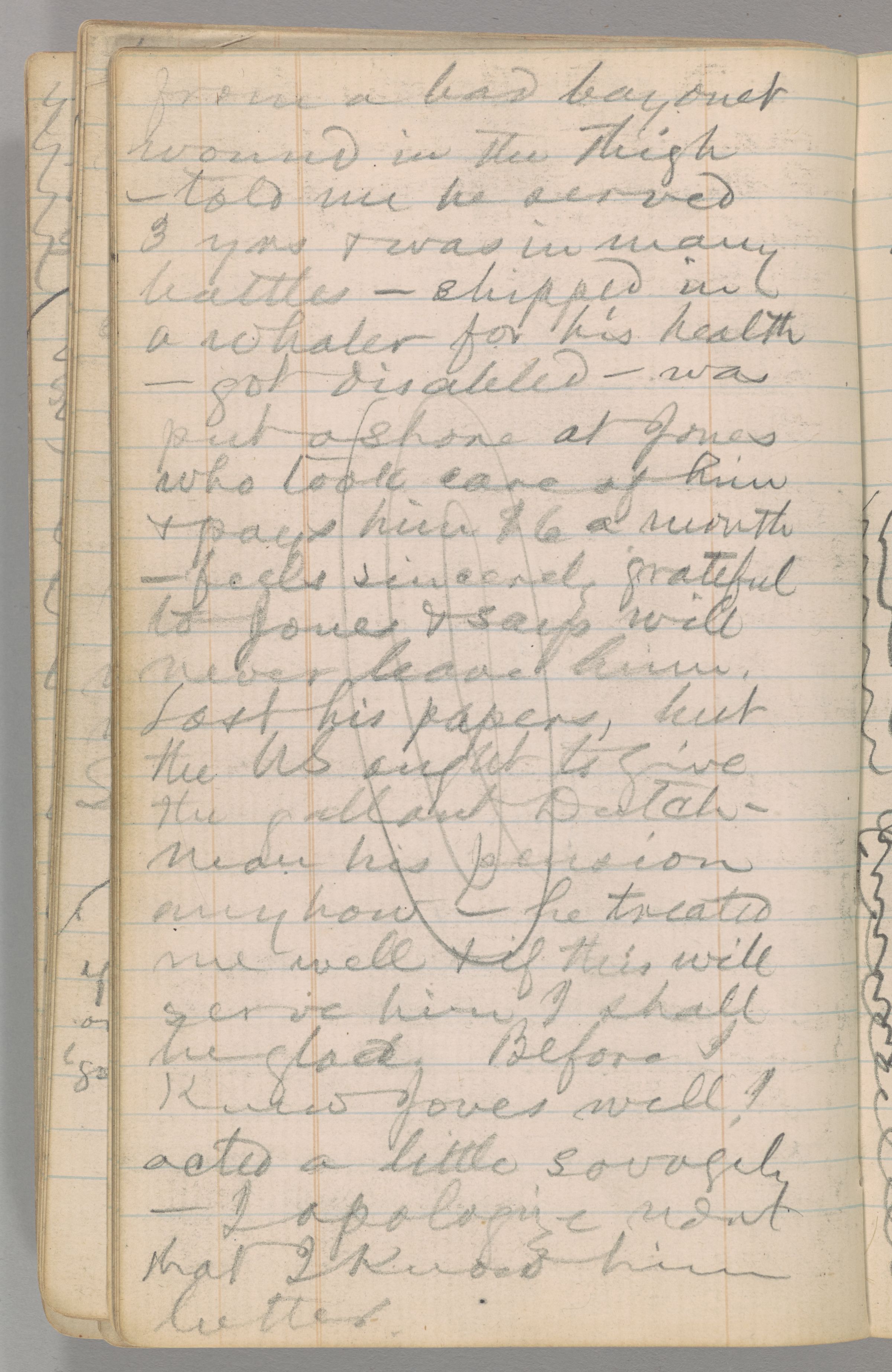
[MS: N05_leaf_034v]
from a bad bayonet
wound in the thigh
—told me he served
3 yrs & was in many
battles—shipped in
a whaler for his health
—got disabled—was
put ashore at Jones
who took care of him
& pays him $6 a month
—feels sincerely grateful
to Jones & says will
never leave him.
Lost his papers, but
the US ought to give
the gallant
Dutch-
man
Dutchman
his pension
anyhow—he treated
me well & if this will
serve him I shall
be glad. Before I
knew Jones well, I
acted a little savagely
—I apologize now
that I know him
better.
꩜
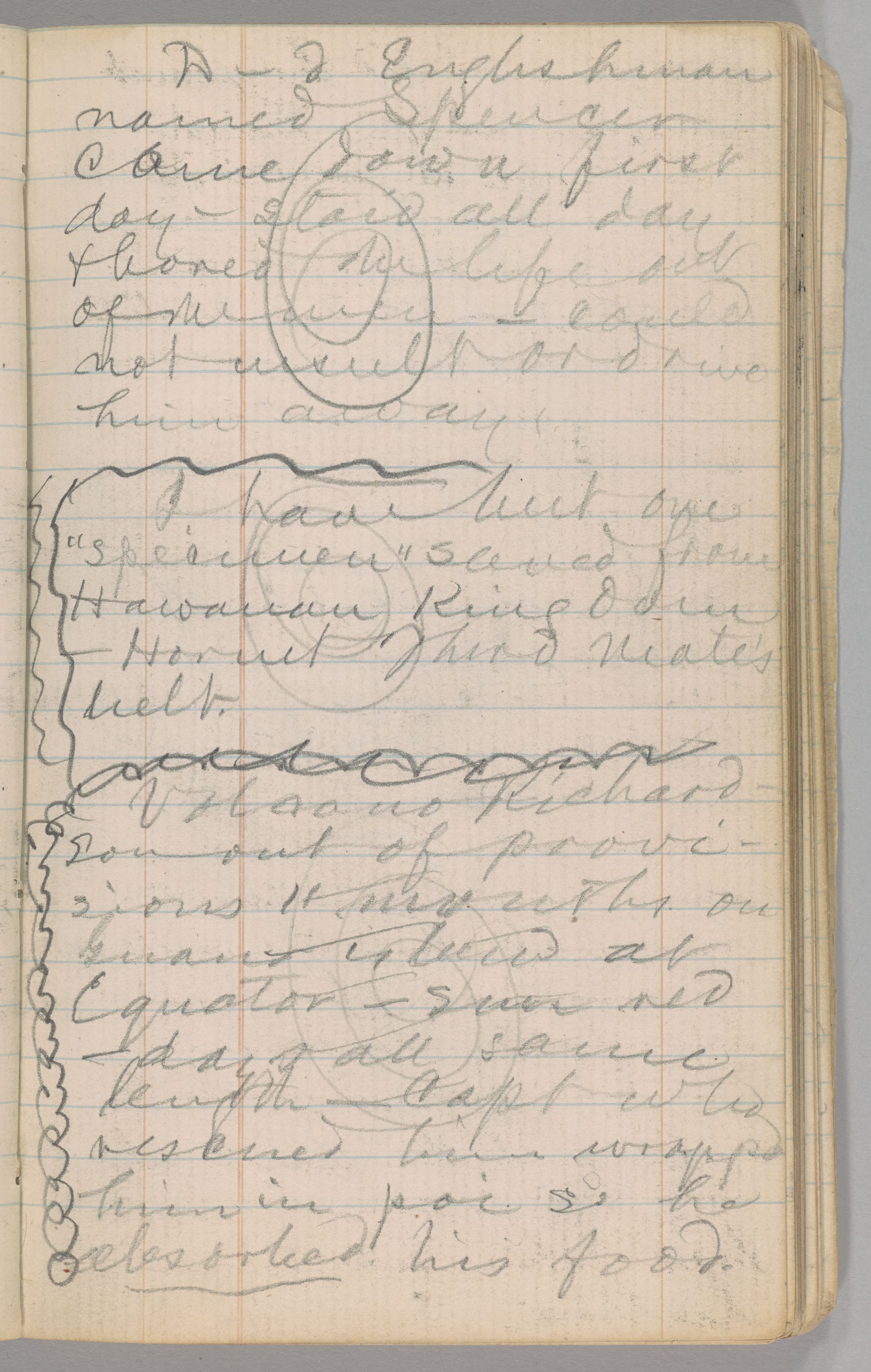
[MS: N05_leaf_035r]
D—d Englishman
named Spencer100
coameⓉtextual note down first
day—staid all day
& bored the life out
of the men—could
not insult or drive
him away.
꩜
I have but one
“specimen” saved from
Hawaiian Kingdom
—Hornet Third Mate's
belt.
꩜
[MTP: N&J1_143]
Volcano
Rcihard-
son
Richardson
101 out of
provi-
sions
provisions
11 months on
Guano island at
Equator—sun red
—days all same
length—Capt who
rescued him wrapped
him in poi so he
absorbed his food.
102
꩜
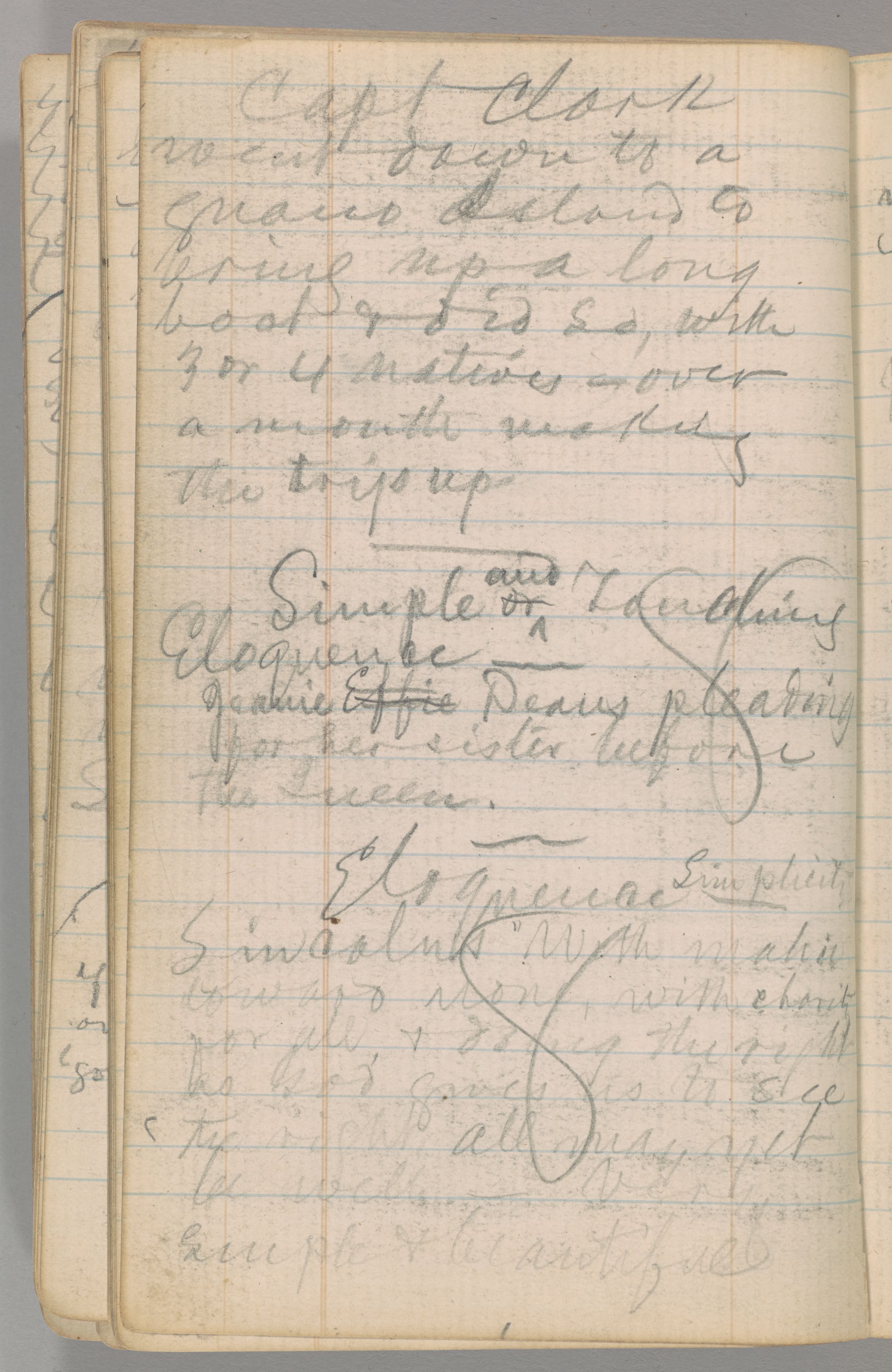
[MS: N05_leaf_035v]
Capt Clark103
went down to a
guano Island to
bring up a long
boat & did so, with
3 or 4 natives—over
a month making
the trip up.
Simple or
and
Touching
Eloquence—
Jeanie
Effie
Deans pleading
for her sister before
the Queen.104
8
Eloquence—Simplicity
Lincoln's “With malice
toward none, with charity
for all, & doing the right
as God gives us to see
the right, all may yet
be well.105—Very
simple & beautiful
8
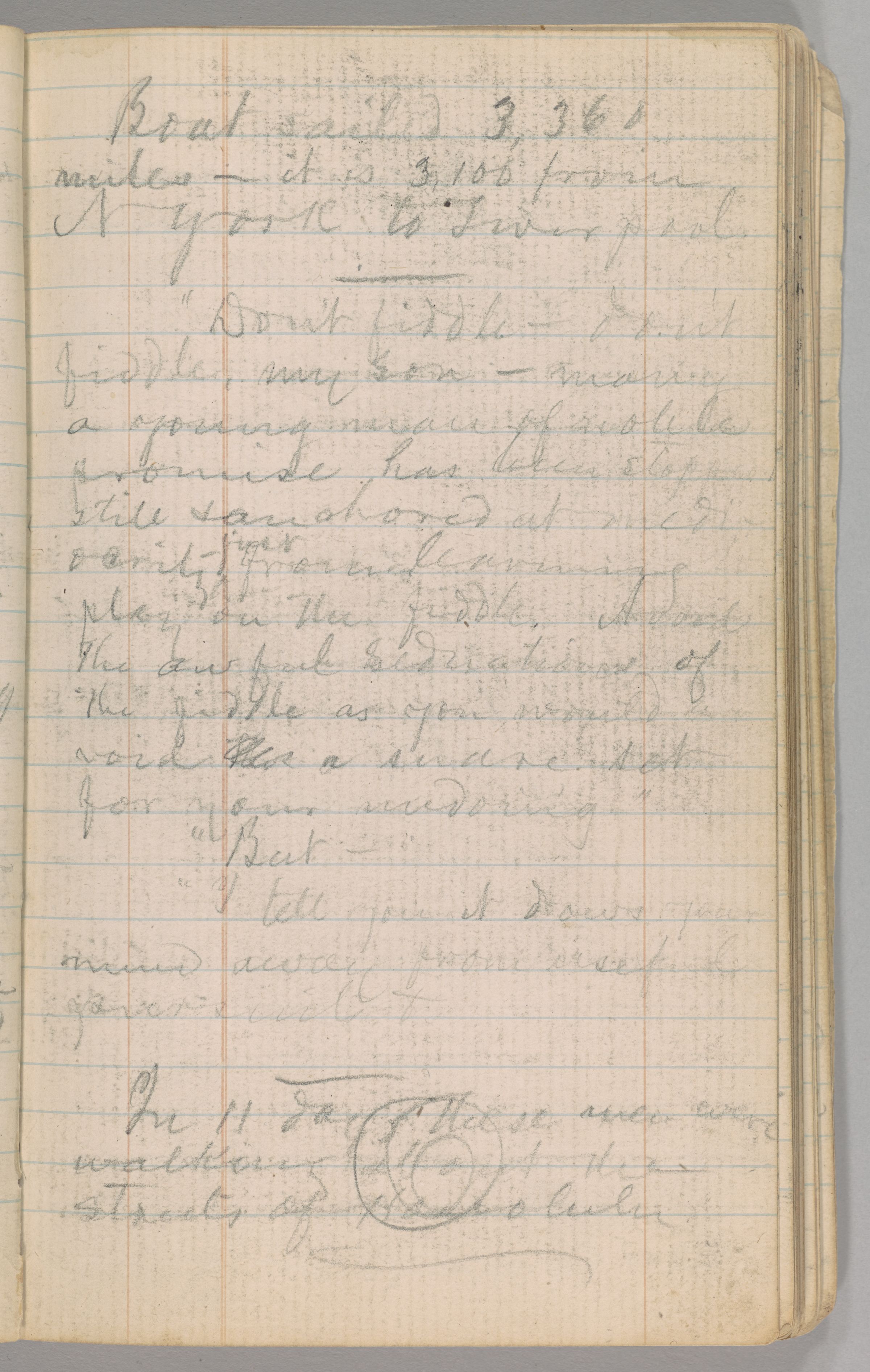
[MS: N05_leaf_036r]
Boat106 sailed 3,360
miles—it is 3,100 from
N York to Liverpool.
“Don't fiddle—don't
fiddle, my son—many
a young man of noble
promise has been stopped
still & anchored at
medi-
ocrity
mediocrity
just
from learning to
play on the fiddle. Avoid
the awful seductions of
the fiddle as you would
a-
void
avoid
the a snare set
for your undoing.”
“But—”
“I tell you it draws your
mind away from useful
pursuits &
[MTP: N&J1_144]
In 11 days these men were
walking about the
streets of Honolulu.
꩜
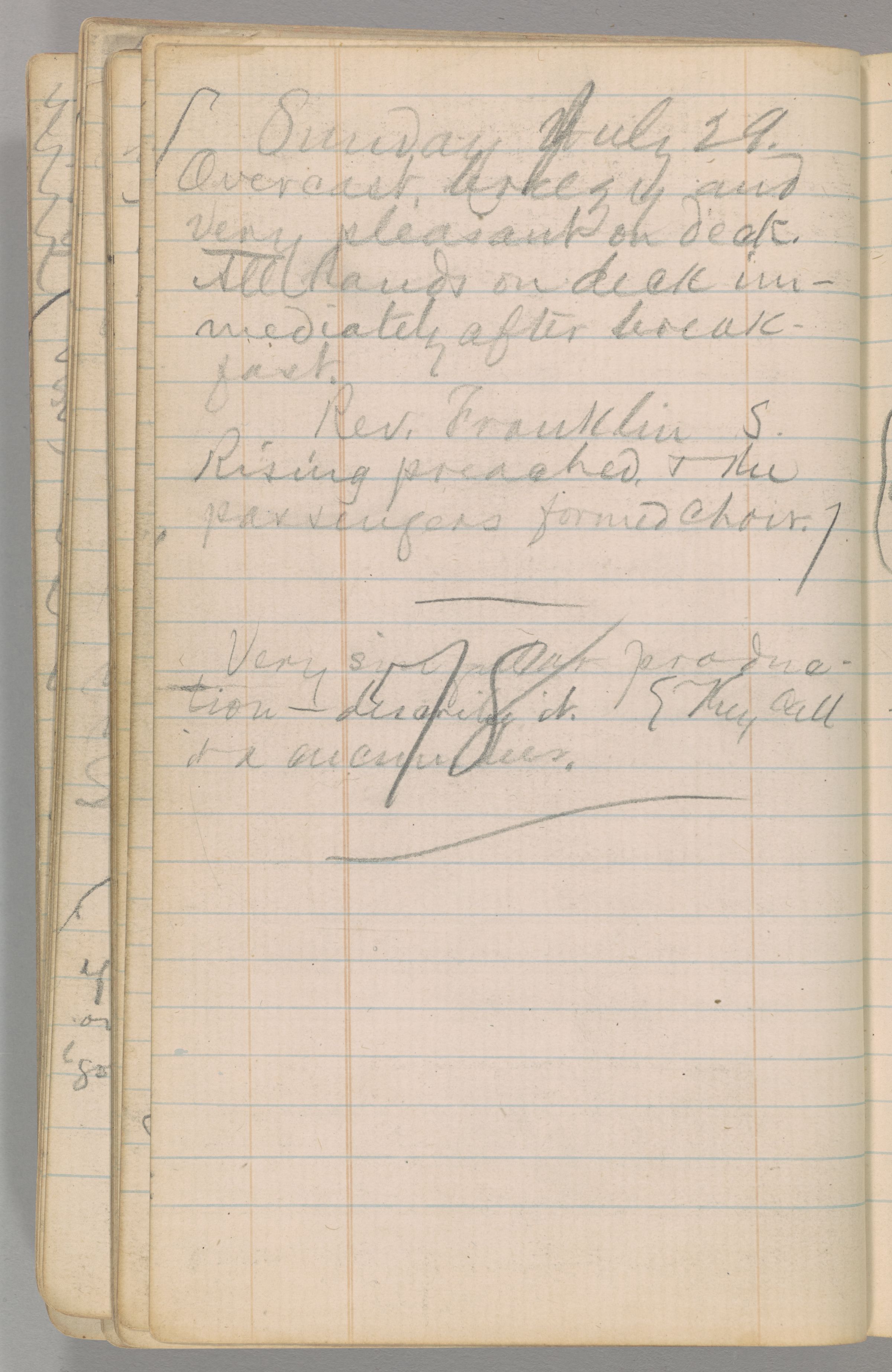
[MS: N05_leaf_036v]
Sunday 2 July 29.
Overcast, breezy and
very pleasant on deck.
All hands on deck
im-
mediately
immediately
after
break-
fast
breakfast
.
Rev. Franklin S.
Rising preached, & the
passengers formed choir.107
Very singular
produc-
tion
production
—describe it. (They call
it a cucumber.Ⓣtextual note
78
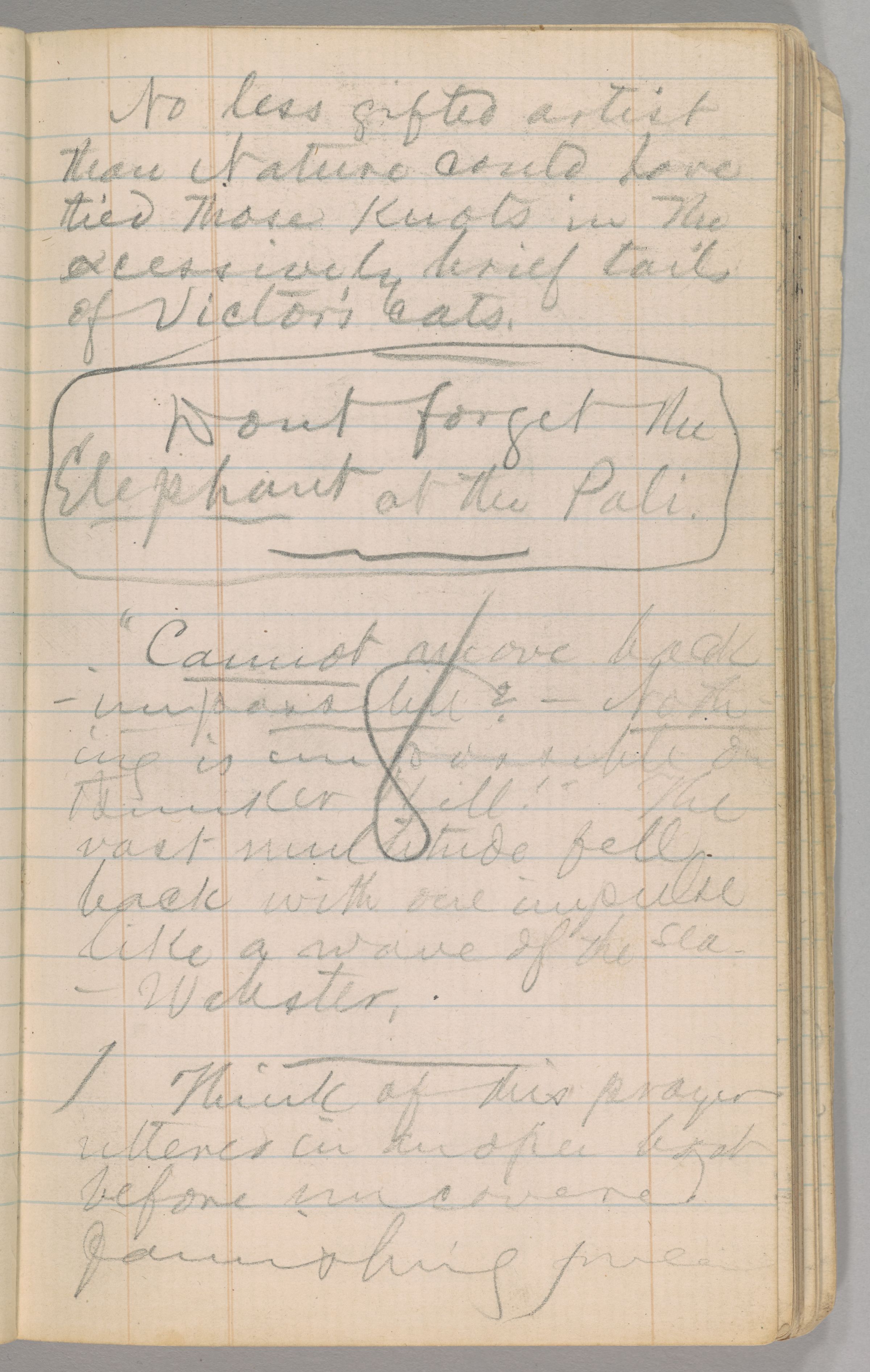
[MS: N05_leaf_037r]
No less gifted artist
than Nature could have
tied those knots in the
excessively brief tails
of Victor's cats.108
Dont forget the
Elephant at the Pali.Ⓣtextual note
“Cannot move back
—impossible?—
Noth-
ing
Nothing
is impossible on
Bunker Hill!” The
vast multitude fell
back with one impulse
like a wave of the sea.
—Webster.109
8
[MTP: N&J1_145]
Think of this prayer
uttered in an open boat
before uncovered
famishing men
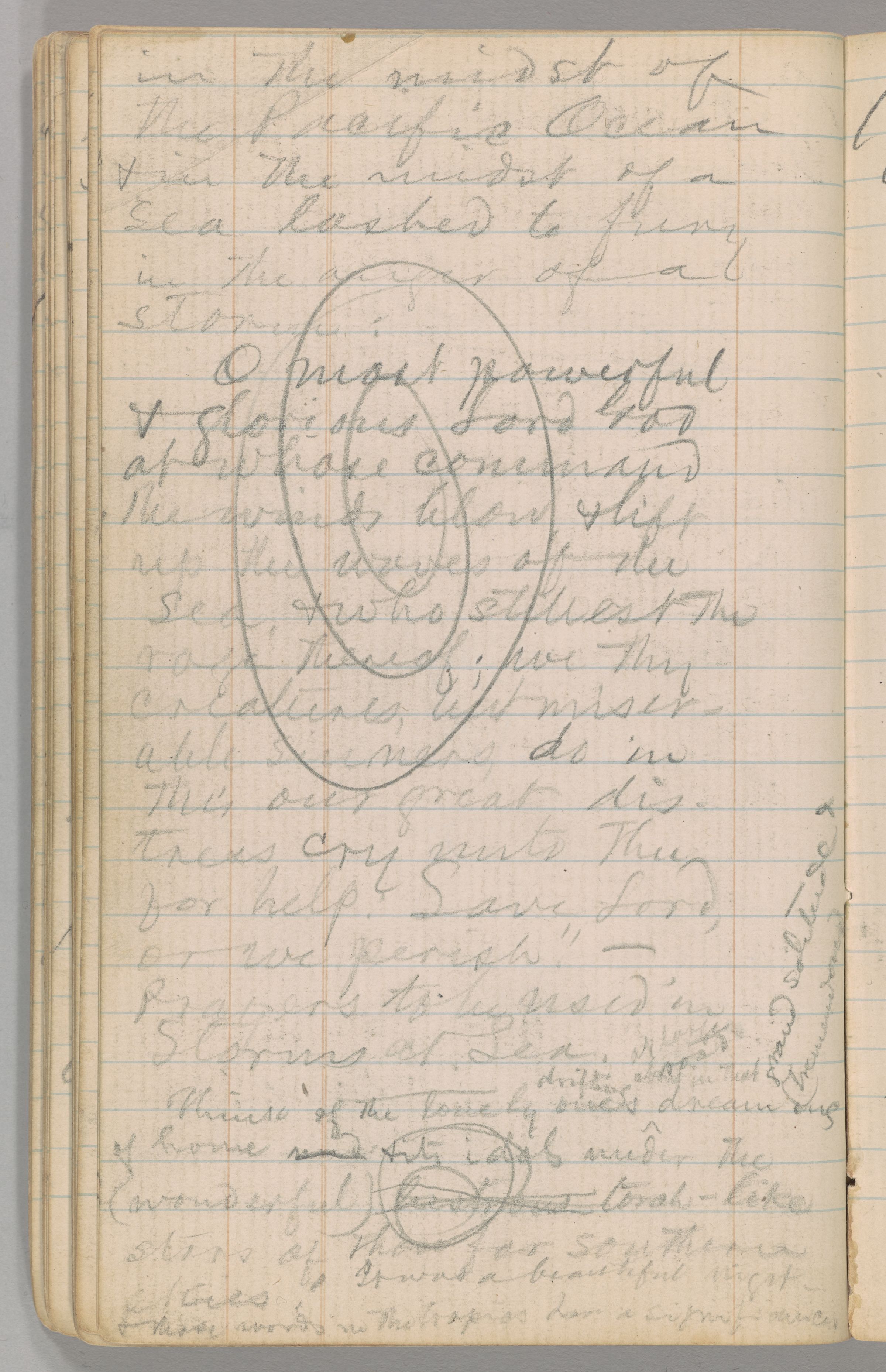
[MS: N05_leaf_037v]
in the midst of
the Pacific Ocean
& in the midst of a
sea lashed to fury
in the anger of a
storm:
O most powerful
& glorious Lord God
at whose command
the winds blow, & lift
up the waves of the
sea, & who stillest the
rage thereof; we thy
creatures, but
mider-
able
miserable
sinners, do in
this our great
dis-
tress
distress
cry unto thee
for help. Save, Lord,
or we perish!—110
Prayers to be used in
Storms at Sea.
꩜
Think of the lonely ones
‸begin insertion spandrifting about
road
at large
Ⓜemendation in that in right margin:
grand (tremendous)
Ⓜemendation solitude &Ⓣtextual note
‸end insertion span dreaming
of home und & its idols under the
(wonderful) lustrous torch-like
stars of those far southern
skies! It was a beautiful night—
& those words in the tropics have a significance.
꩜
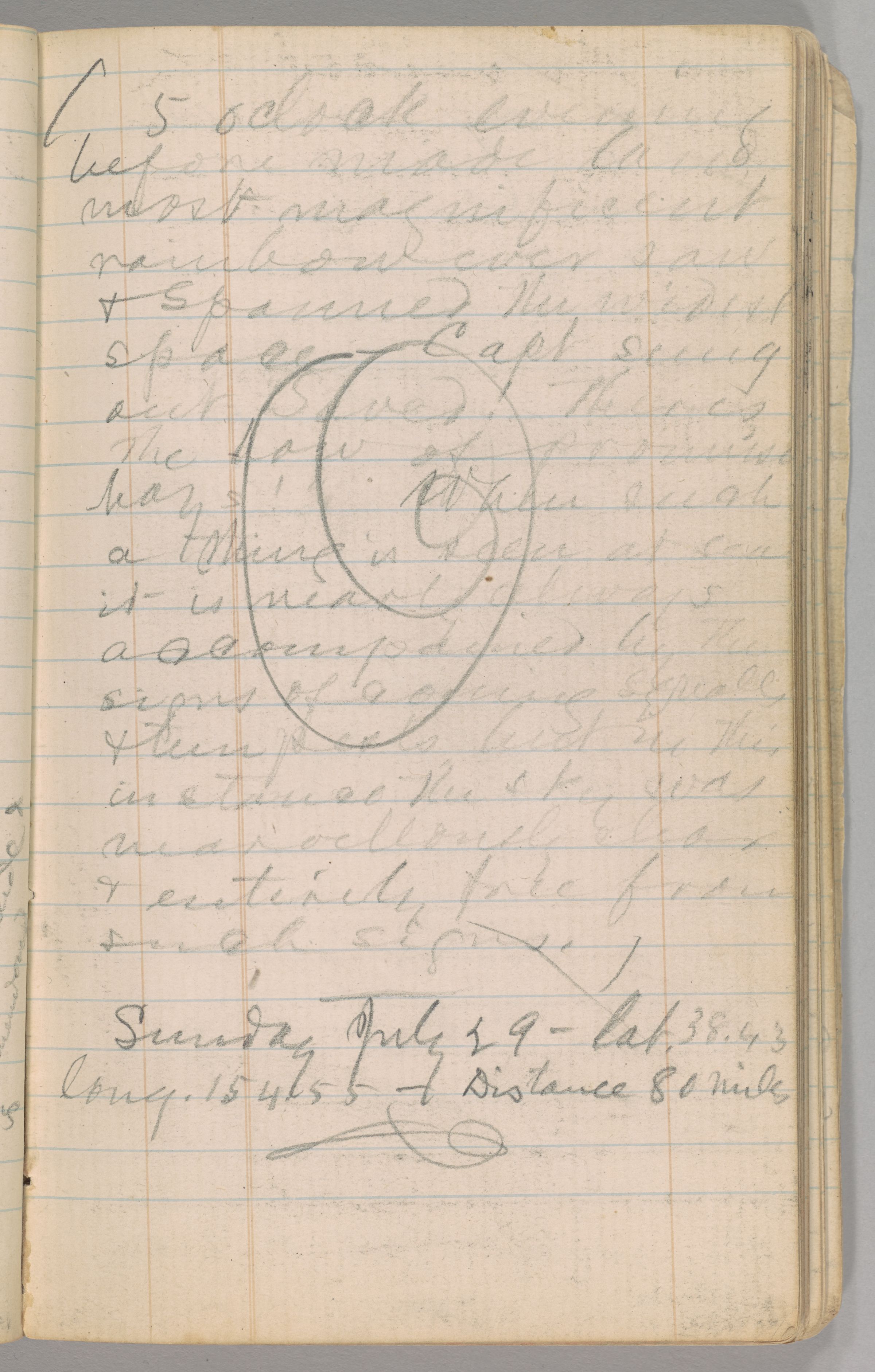
[MS: N05_leaf_038r]
5 o clock evening
before made land,
most magnificent
rainbow ever saw
& spanned the widest
space—Capt sung
out “Saved! Theres
the bow of promise
boys!”111 When such
a thing is seen at sea
it is
[MTP: N&J1_146]
nearly always
accompanied by the
signs of coming squalls
& tempests, but in this
instance the sky was
marvellously clear
& entirely free from
such signs.
꩜
Sunday July 29—lat. 38.43
long. 154.55—Distance 80 miles
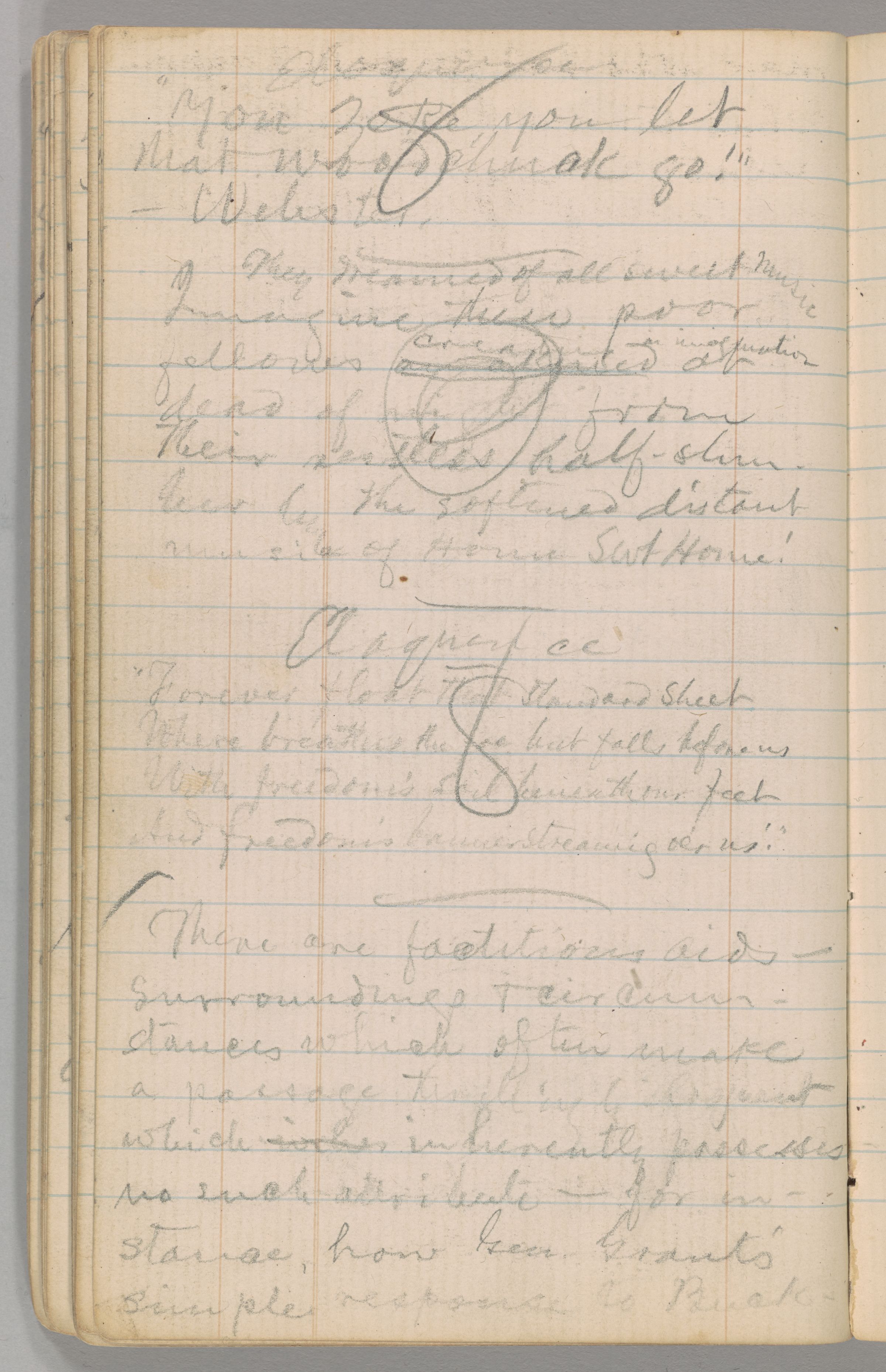
[MS: N05_leaf_038v]
Eloquence
“You Zeke, you let
that woodchuck go!”
—Webster.112
8
They dreamed of all sweet music
Imagine these poor
fellows awakened
creating in imagination
at
dead of night from
their restless half-
slum-
ber
slumber
by the softened distant
music of Home Swt Home!
꩜
Eloquence
“Forever float that standard sheet
Where breathes the foe but falls before us
With freedom's soil beneath our feet
And freedom's banner streaming o'er us!”113
8
There are factitious aids—
surroundings &
circum-
stances
circumstances
which often make
a passage thrillingly eloquent
which inherentlyⓂemendation possesses
no such attribute—for
in-
stance
instance
, how Gen. Grant's
simple response to Buck-
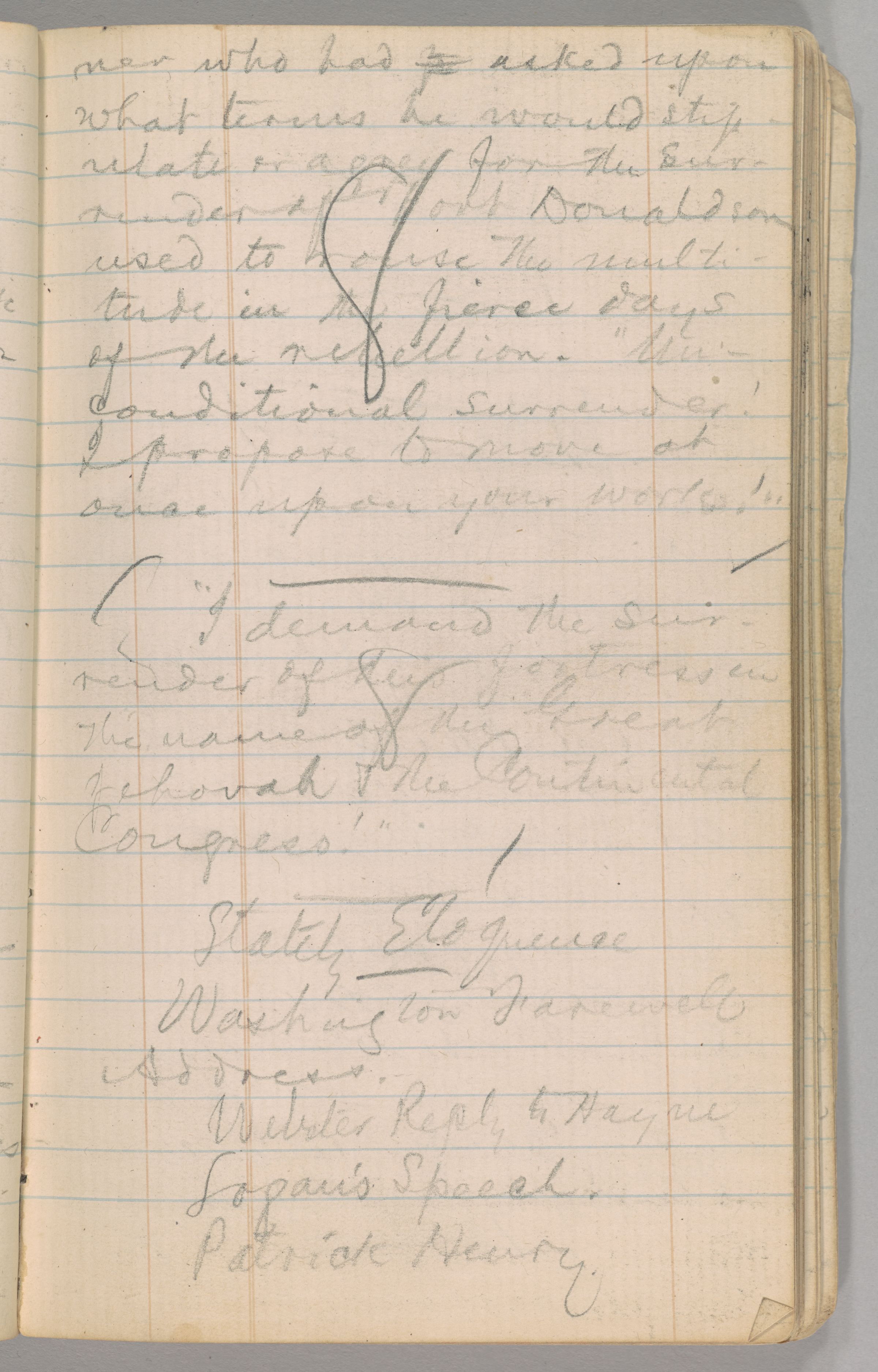
[MS: N05_leaf_039r]
ner who had p asked upon
what terms he would
stip-
ulate
stipulate
or agree for the
sur-
render
surrender
of Fort Donaldson
used to rouse the
[MTP: N&J1_147]
multi-
tude
multitude
in the fierce days
of the rebellion. “
Un-
conditional
Unconditional
surrender! I propose to move at
once upon your works!”114
8
“I demand the
sur-
render
surrender
of this fortress in
the name of the Great
Jehovah & the Continental
Congress!”115
8
Stately Eloquence
Washington Farewell
Address.
Webster Reply to Hayne
Logan's Speech.116
Patrick Henry.
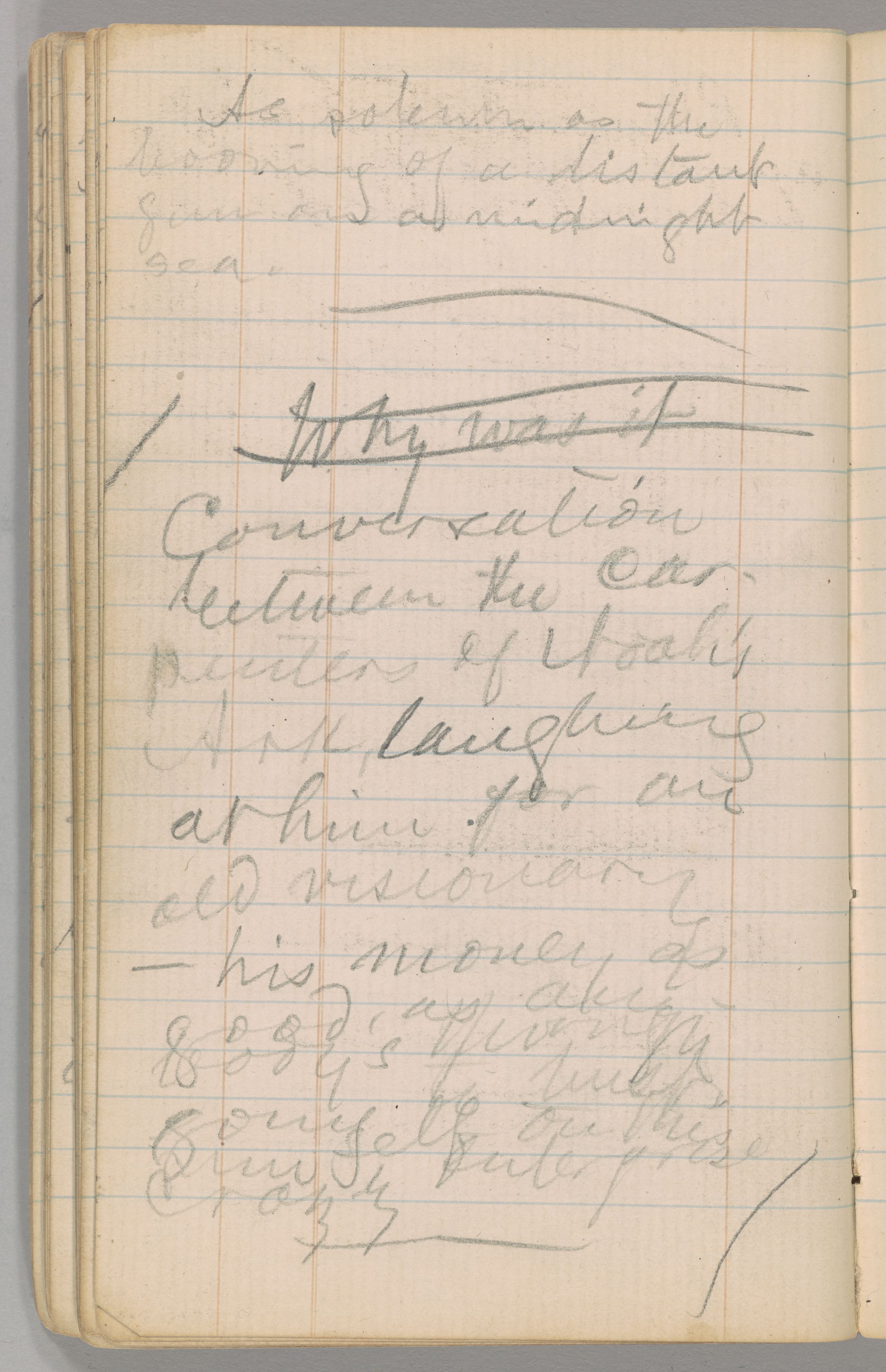
[MS: N05_leaf_039v]
As solemn as the
booming of a distant
gun on a midnight
sea.
Why was it
Conversation
between the
car-
penters
carpenters
of Noah's
Ark, laughing
at him for an
old visionary
—his money as
good as
any-
body’s
anybody's
though
going to bust
himself on this
crazy enterprise
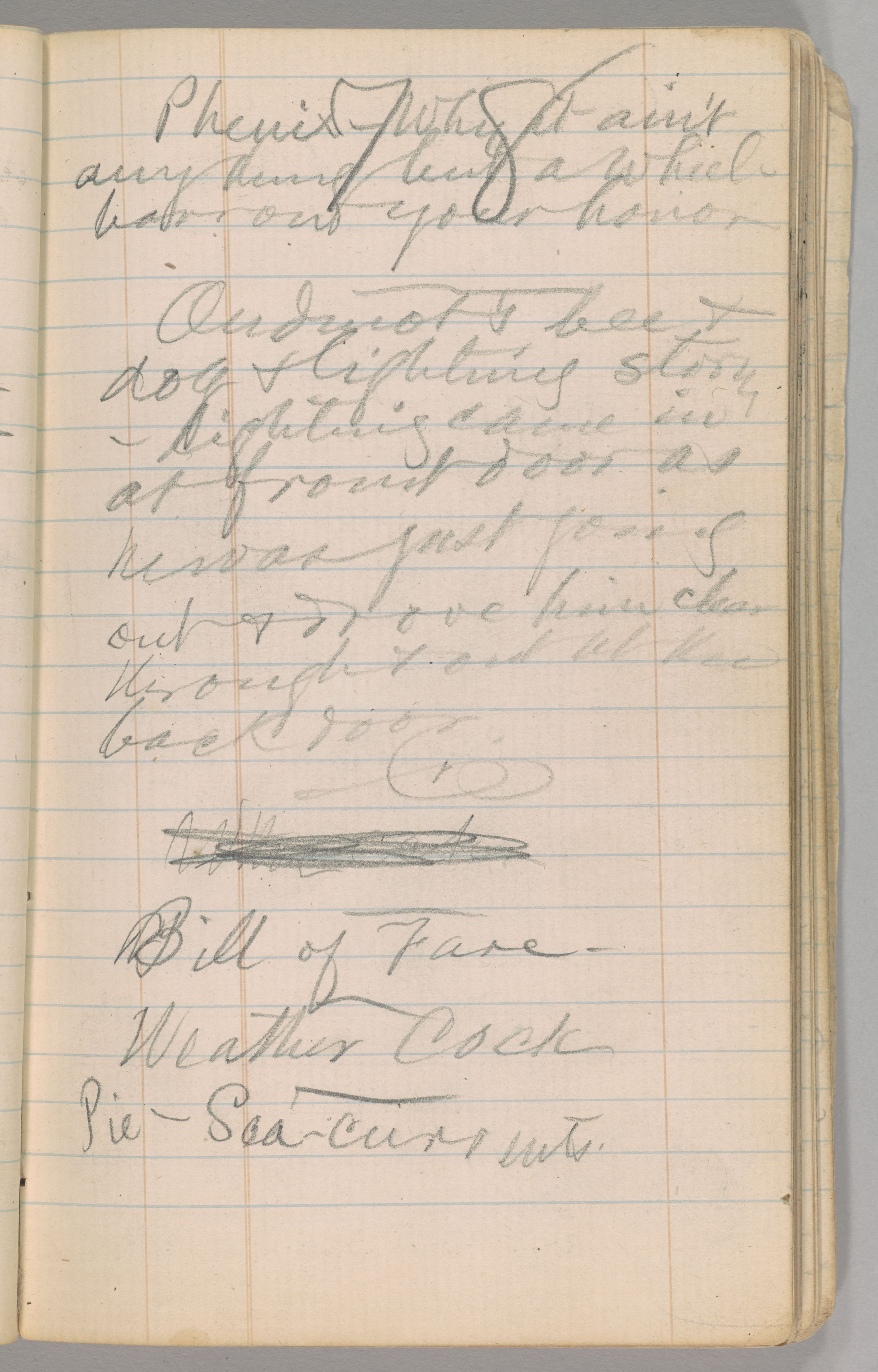
[MS: N05_leaf_040r]
Phenix—Why it ain't
anything but a
wheel-
barrow
wheelbarrow
Ⓜemendation your honor
78
Oudinot's bee &
dog & lightning story
—lightning came in
at front door as
he was just going
out & drove him clear
through & out at the
back door.117
Wthr Cck
Bill of Fare—
Weather Cock
[MTP: N&J1_148]
Pie—Sea-currents.
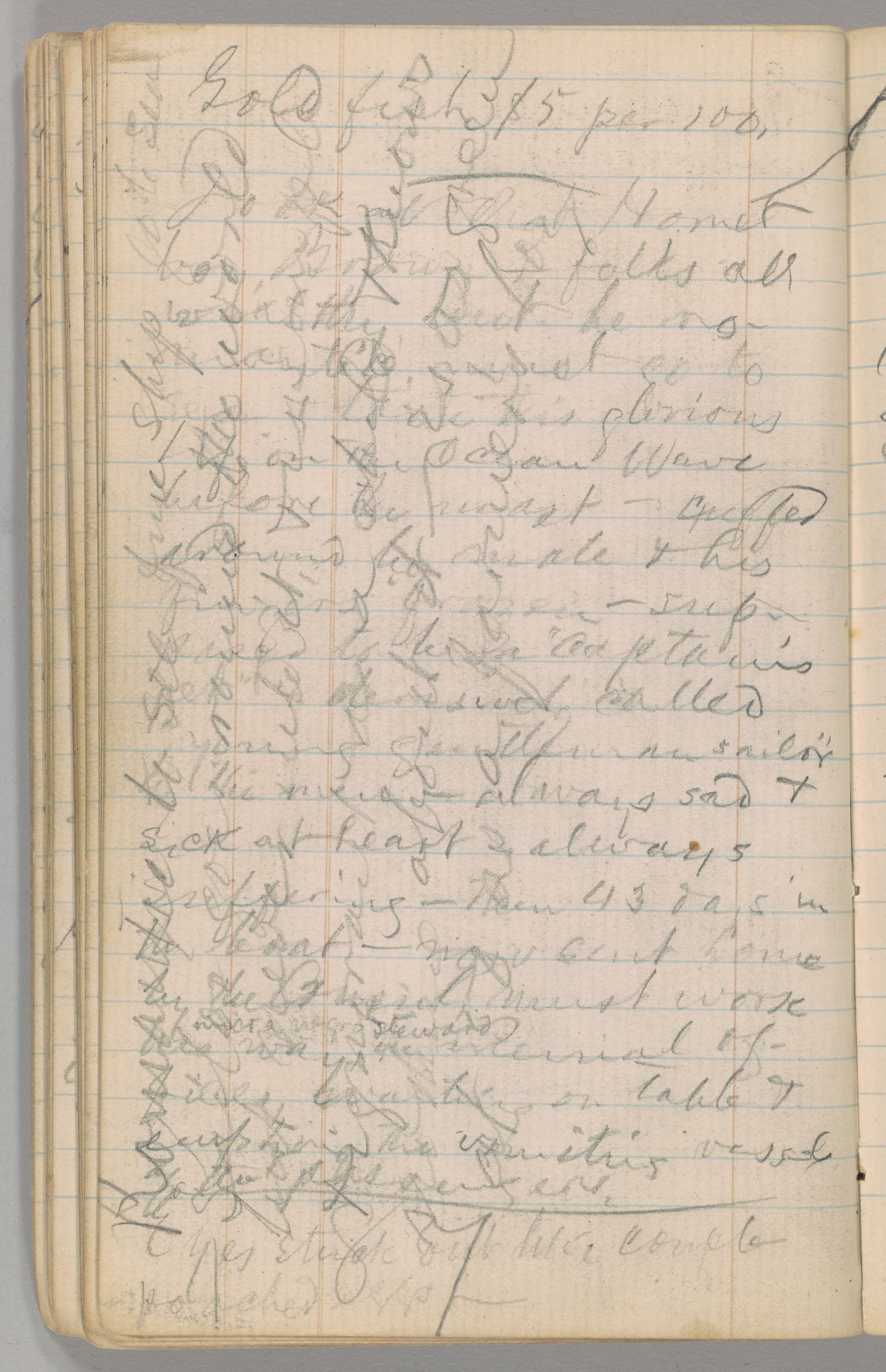
[MS: N05_leaf_040v]
Gold fish $5 per 100.
Look at that Hornet
boy, Brown—folks all
wealthy, but he
ro-
mantic
romantic
, must go to
sea & live this glorious
Life on the Ocean Wave
before the mast—cuffed
around by mate & his
fingers frozen—
sup-
posed
supposed
to be a “Captain's
pet” & derisively called
“young gentleman sailor”
by the men—always sad &
sick at heart—always
suffering—then 43 days in
the boat—now sent home
by the Consul, must work
his way with a negro steward
in menial
of-
fices
offices
, waiting on table &
emptying the vomiting vessels
of the passengers.
Eyes stuck out like couple
poached eggs—
87
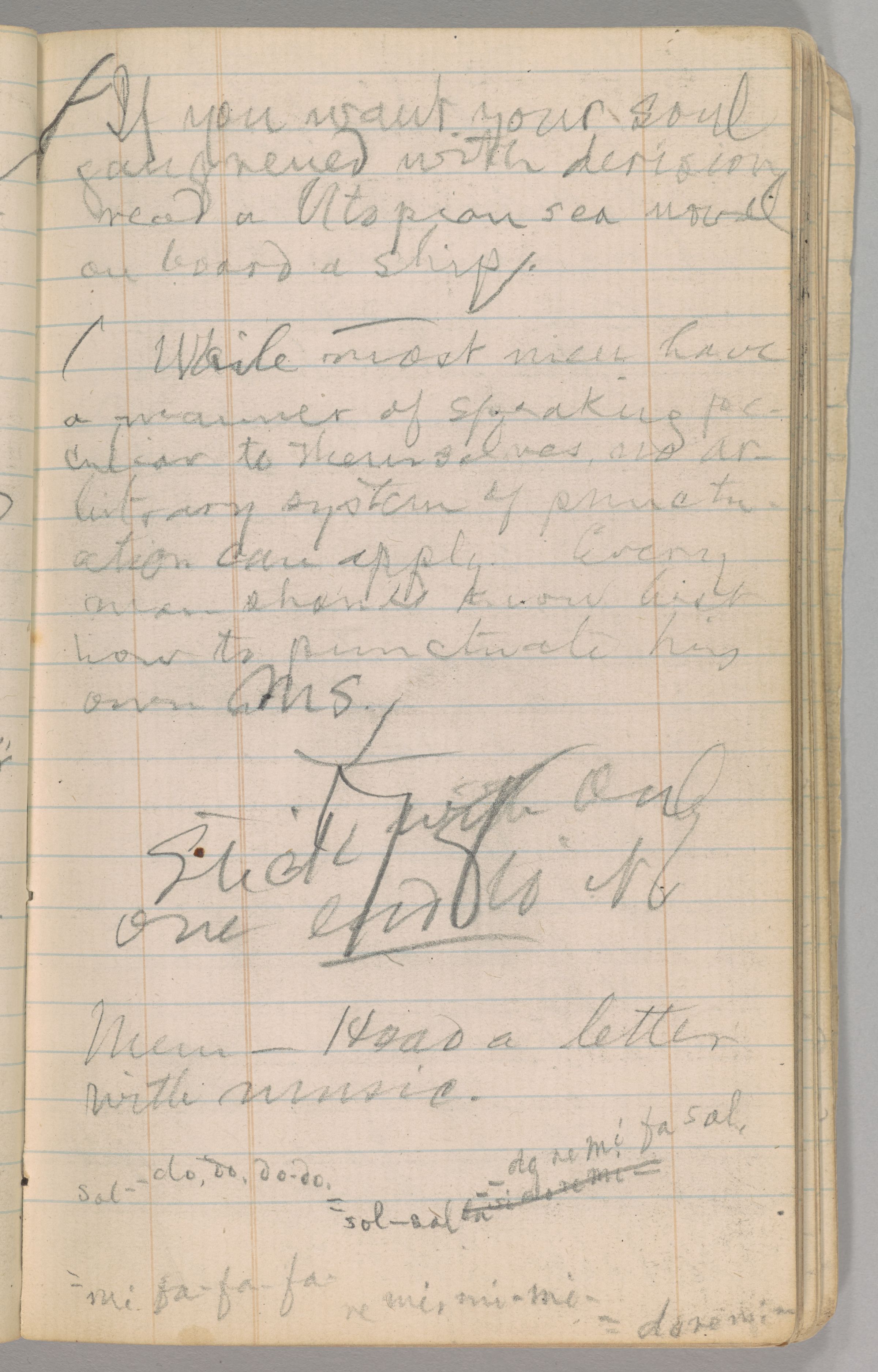
[MS: N05_leaf_041r]
If you want your soul
gangrened with derision
read a Utopian sea novel
on board a ship.
While most men have
a manner of speaking
pe-
culiar
peculiar
to themselves, no
ar-
bitrary
arbitrary
system of
punctu-
ation
punctuation
can apply. Every
man should know best
how to punctuate his
own MS.
Stick with only
one end to it.
Mem—Head a letter
with music.
sol-do, do, do-do,-sol-sol la so do re mi do re mi fa sol.
mi fa-fa-fa re mi, mi-mi- do re mi-
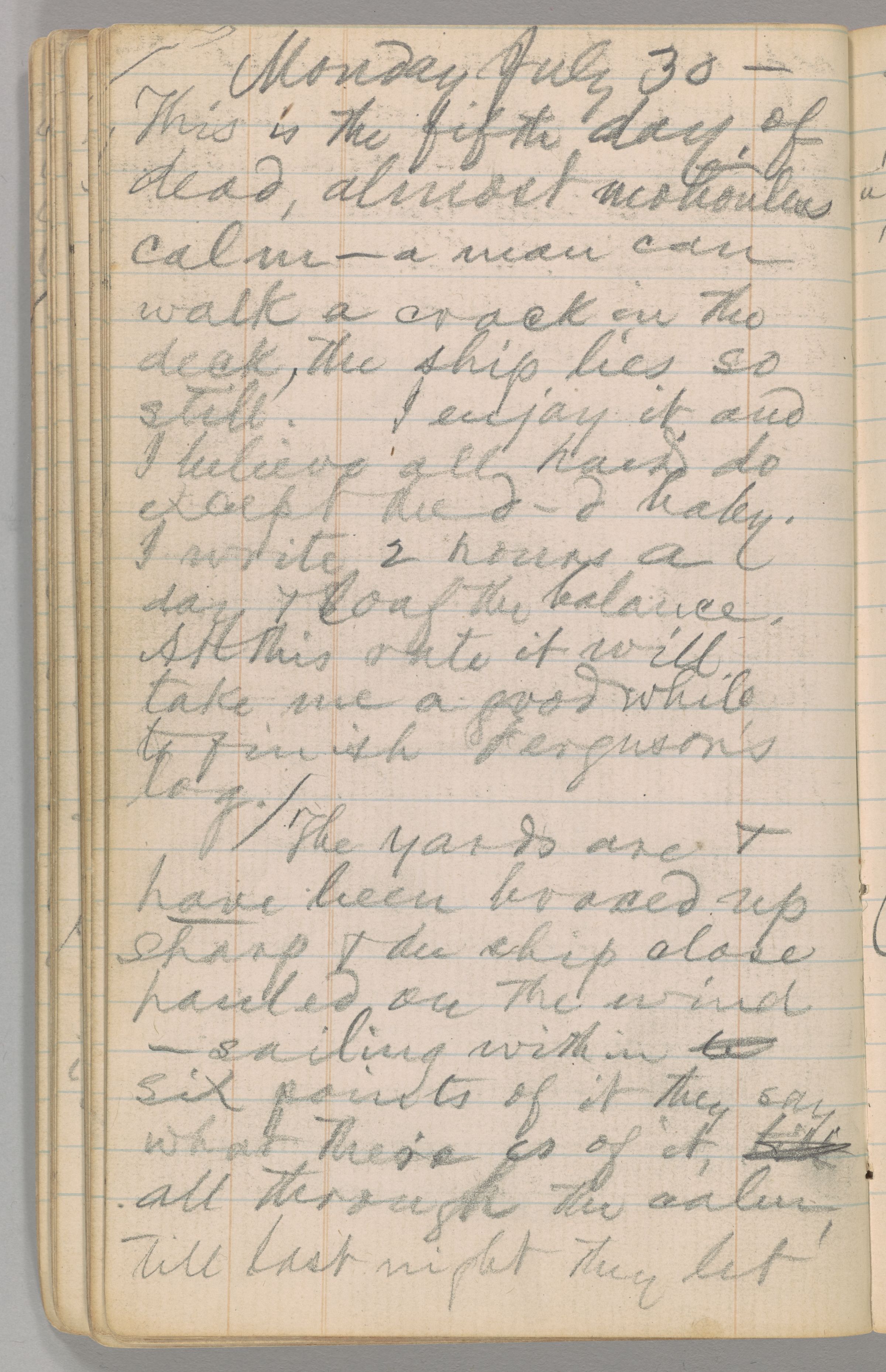
[MS: N05_leaf_041v]
Monday July 30—
This is the fifth day of
dead, almost motionless
calm—a man can
walk a crack in the
deck, the ship lies so
still. I enjoy it, and
I believe
[MTP: N&J1_149]
all hands do
except the d—d baby.
I write 2 hours a
day & s loaf the balance.
At this rate it will
take me a good while
to finish Ferguson's
log.118
The yards are &
have been braced up
sharp & the ship close
hauled on the wind
—sailing within 6
six points of it they say,
what theirreⓉtextual note is of it, till
all through the calm,
till last night they let
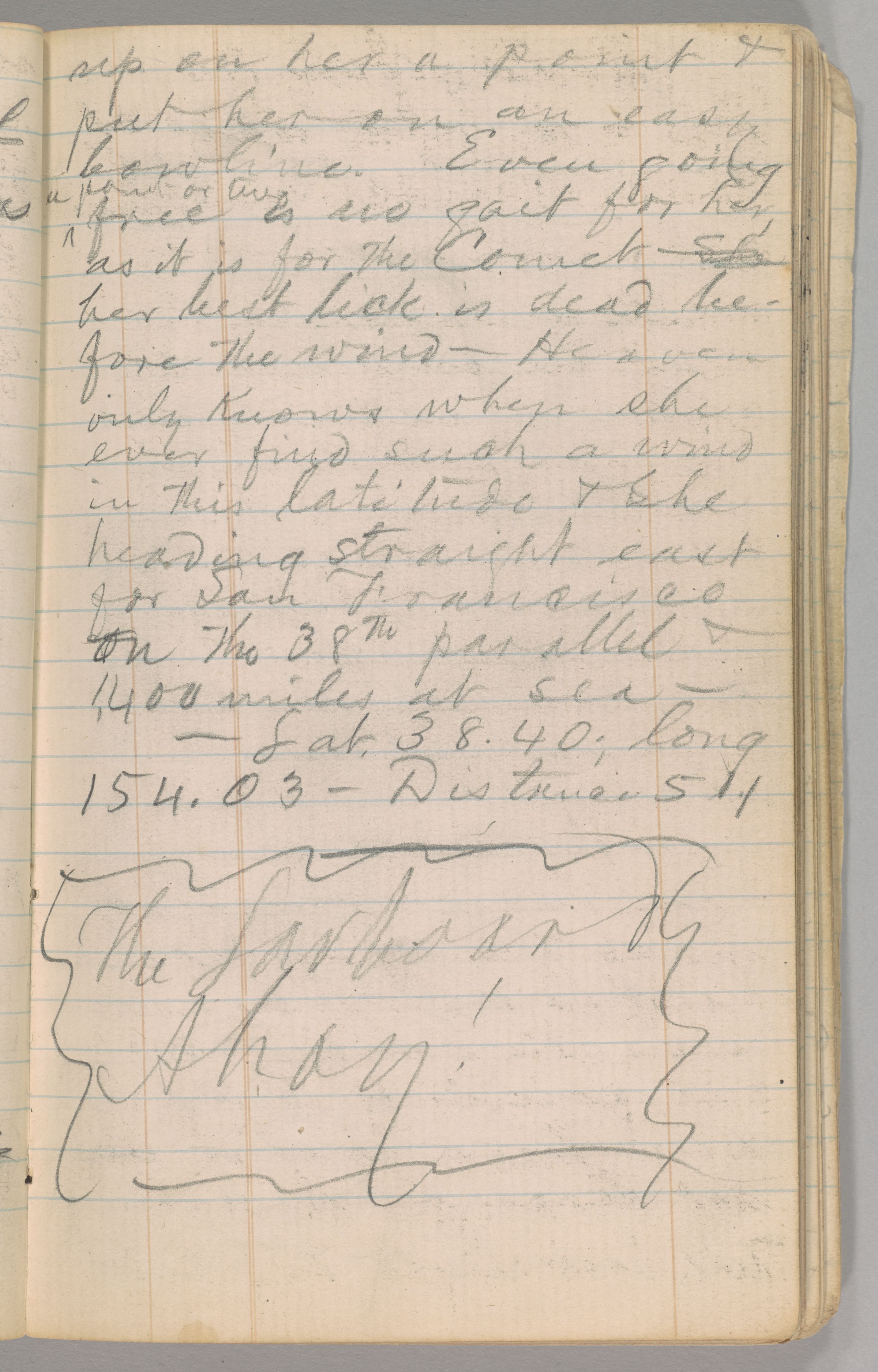
[MS: N05_leaf_042r]
up on her a point &
put her on an easy
bowline. Even going
a point or two
free is no gait for her,
as it is for the Comet—she
her best lick is dead
be-
fore
before
the wind—Heaven
only knows when she
ever find such a wind
in this latitude & she
heading straight east
for San Francisco
&
on the 38th parallel &
1,400 miles at sea—
—Lat. 38.40; long
154.03—Distance 51.
The Larboard
Ahoy!Ⓣtextual note
119
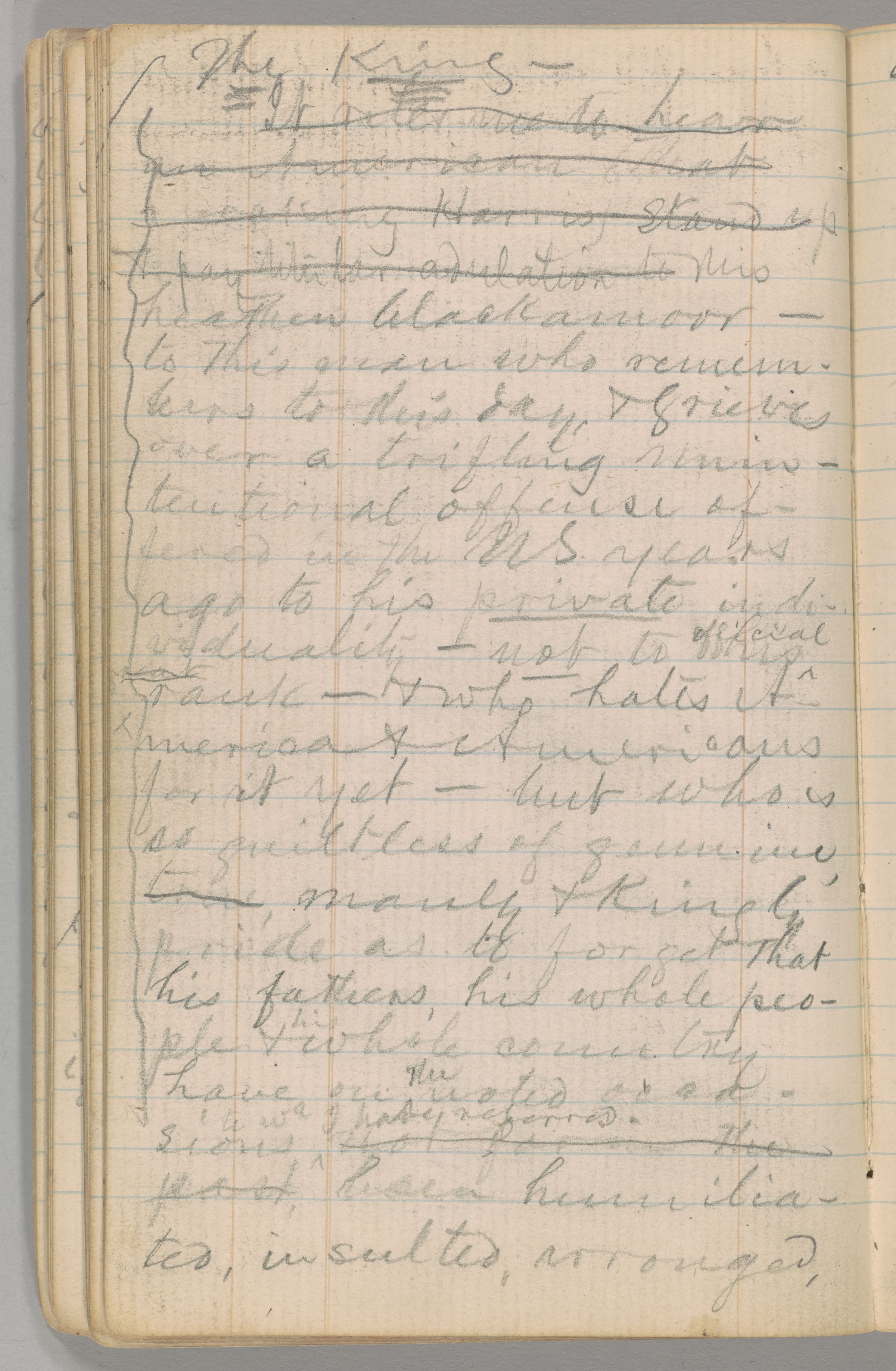
[MS: N05_leaf_042v]
THE KINGⓉtextual note—
It riles me to hear
an American (that
[---]cking Harris) stand up
& pay titular adulation to this
heathen blackamoor—
to this
[MTP: N&J1_150]
man who
remem-
bers
remembers
to this day, & grieves
over a trifling
unin-
tentional
unintentional
offense
of-
fered
offered
in the US. years
ago to his private
indi-
viduality
individuality
—not to his official
great
rank—& who hates
A-
merica
America
& Americans
for it yet—but who is
so guiltless of genuine,
true, manly & kingly
pride as to forget that
his fathers, his whole
peo-
ple
people
& his whole country
have on the noted
occa-
sions
occasions
to wh I have referred,
not far in the
past,
been
humilia-
ted
humiliated
, insulted, wronged,
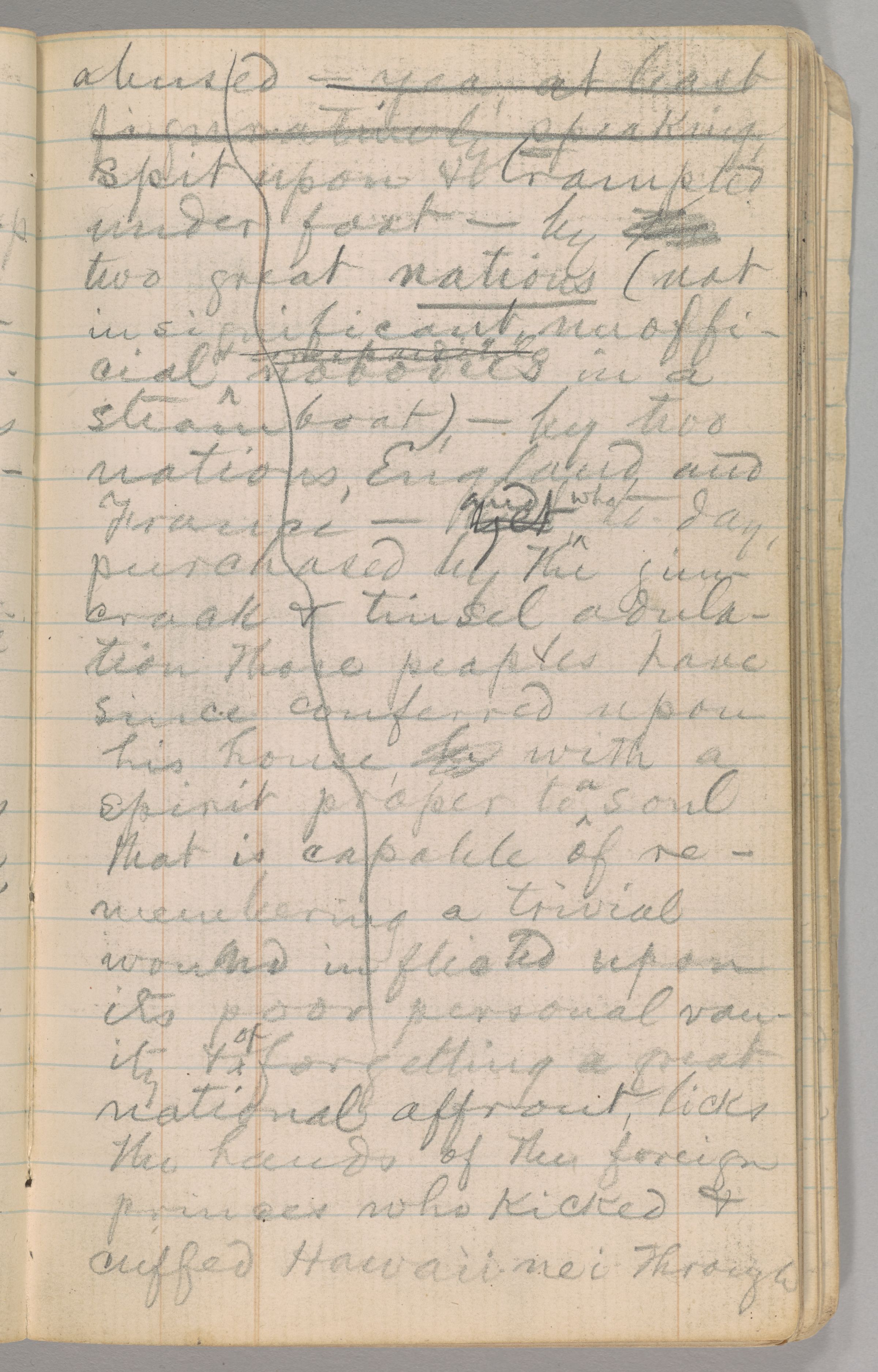
[MS: N05_leaf_043r]
abused—yea, at least
figuratively speaking,
spit upon & trampled
under foot—by the
two great nations (not
insignificant,
unoffi-
cial
unofficial
& irresponsible
nobodies in a
steamboat),—by two
nations, England and
France—but,
yet
and who
to-day,
purchased by the
gim-
crack
gimcrack
Ⓜemendation & tinsel
adula-
tion
adulation
those peoples have
since conferred upon
his house, he with a
spirit proper to a soul that is capable of
re-
membering
remembering
a trivial
woulndⓉtextual note inflicted upon
its poor personal
van-
ity
vanity
& of forgetting a great
national affront, licks
the hands of the foreign
princes who kicked &
cuffed Hawaii-nei through
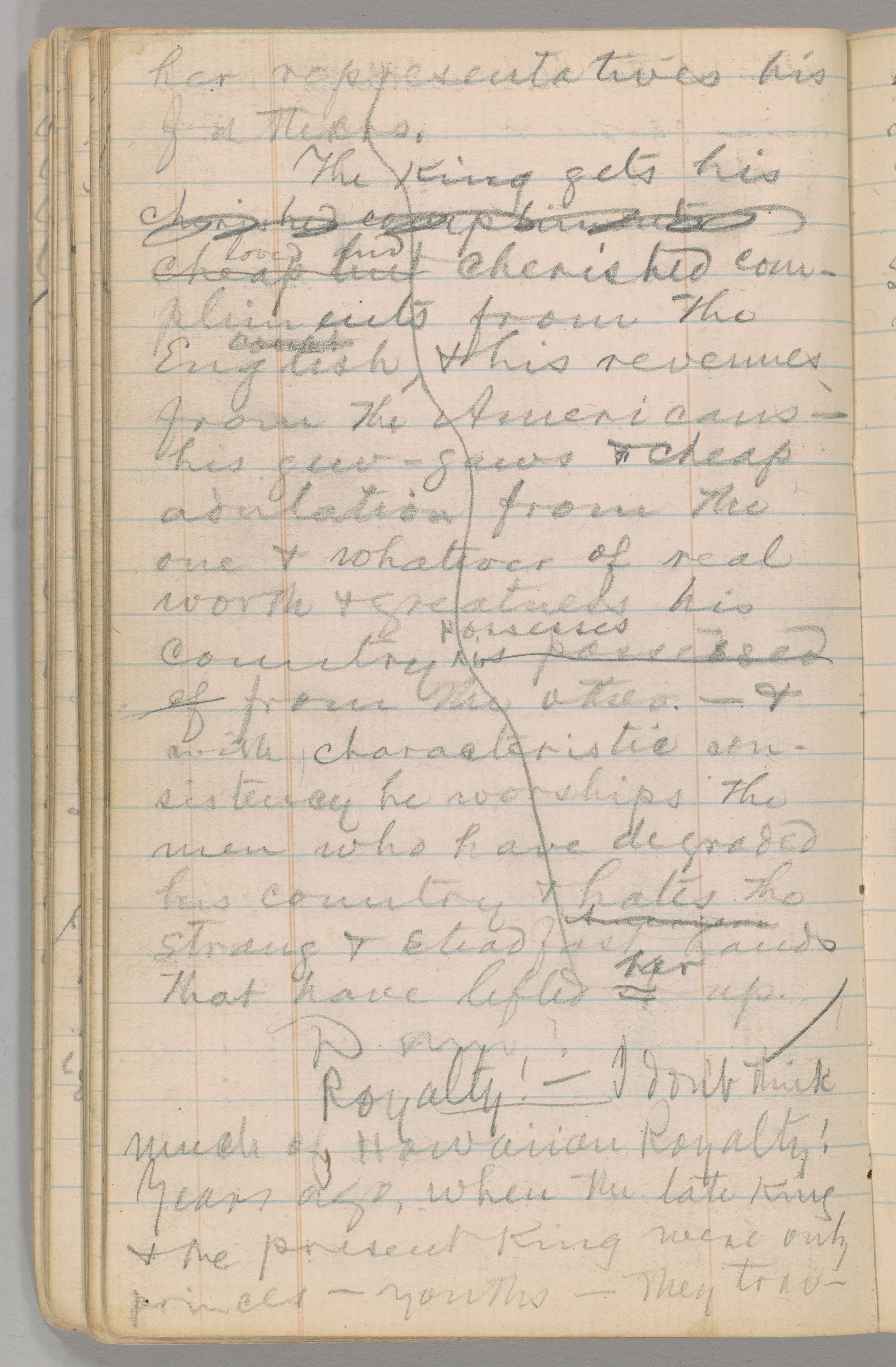
[MS: N05_leaf_043v]
her representatives his fathers.
The King gets his
cherished compliments
cheap but
loved and cherished
com-
pliments
compliments
from the
English
Court
& his revenues
from the Americans—
his gew-gaws & cheap
adulation from the
one & whatever of real
worth & greatness his
country possesses
is possessed
of
from the other—&
with characteristic
con-
sistency
consistency
he worships the
men who have degraded
his country & hates the
strong & steadfast
American
hands
that have lifted it
her
up.
Dam!Ⓣtextual note
Royalty!—I don't think
much of Hawaiian Royalty!
Years ago, when the late King
& the present King were only
princes—youths—they trav-
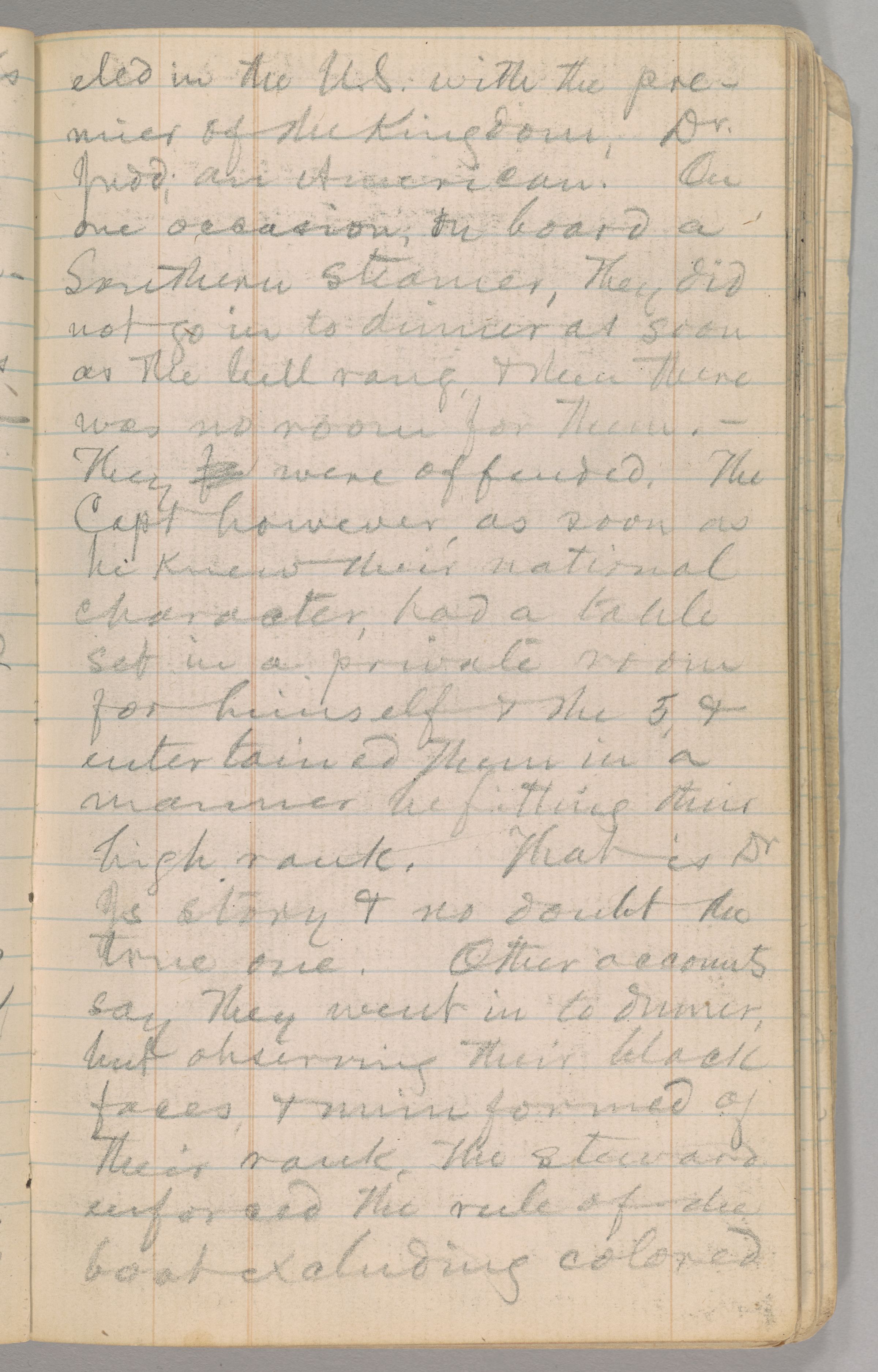
[MS: N05_leaf_044r]
eled in the U.S. with the
pre-
mier
premier
of the kingdom, Dr.
Judd, an American. On
one occasion, on board a
Southern steamer, they did
not go in to dinner as soon
as the bell rang, & then there
was no room for them.—
They f were offended. The
Capt however, as soon as
he knew their national
character, had a table
set in a private room
for himself & the 3, &
entertained them in a
manner befitting their
high rank. That is Dr
Js story & no doubt the
true one.120
[MTP: N&J1_151]
Other accounts
say they went in to dinner,
but observing their black
faces, & uninformed of
their rank, the steward
enforced the rule of the
boat excluding colored
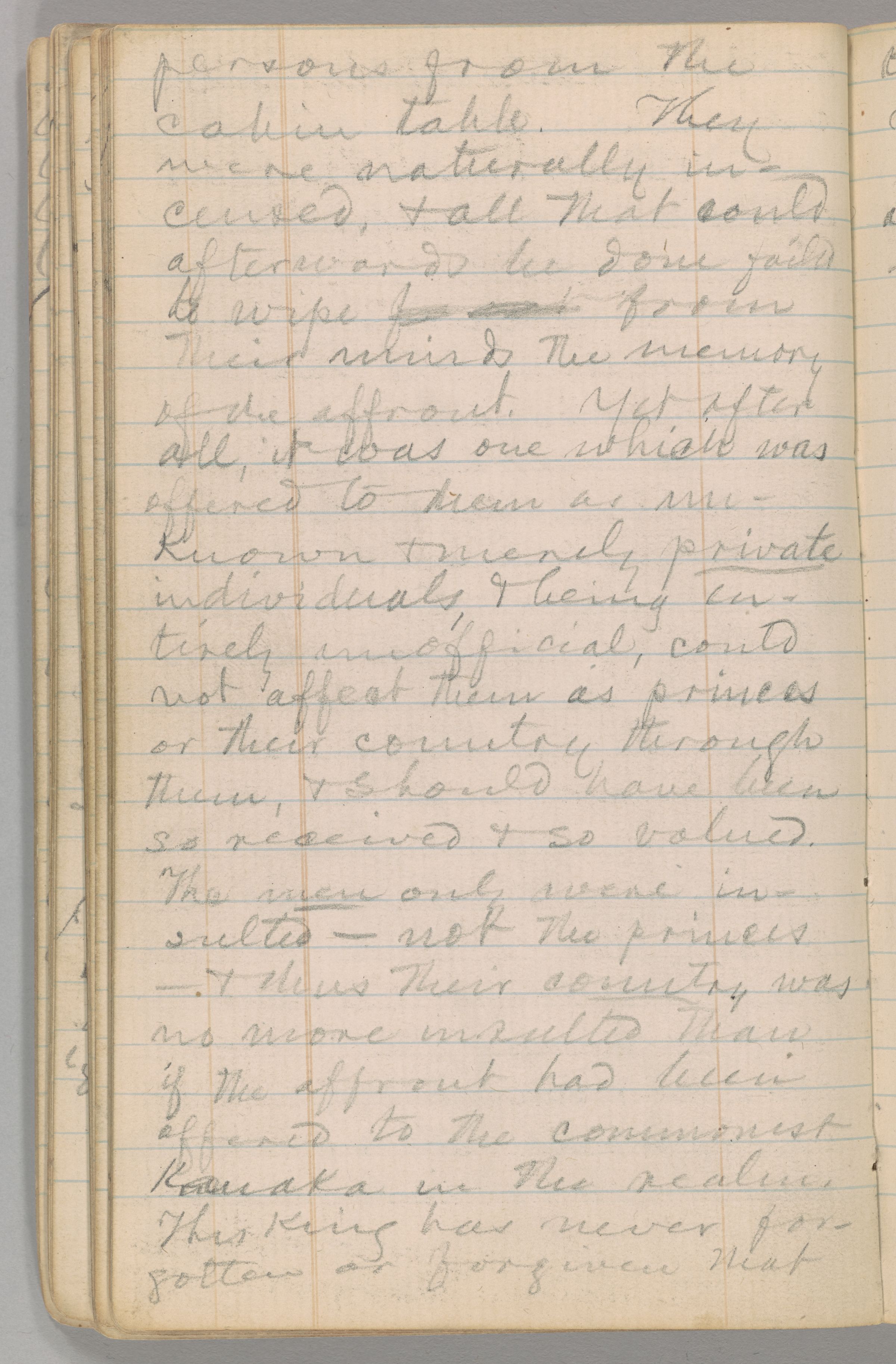
[MS: N05_leaf_044v]
persons from the
cabin table. They
were naturally
in-
censed
incensed
, & all that could
afterwards be done failed
to wipe fr
out from
their minds the memory
of the affront. Yet after
all, it was one which was
offered to them as
un-
known
unknown
& merely private
individuals, & being
en-
tirely
entirely
unofficial, could
not affect them as princes
or their country through
them, & should have been
so received & so valued.
The men only were
in-
sulted
insulted
—not the princes121
—& thus their country was
no more insulted than
if the affront had been
offered to the commonest
Kanaka in the realm.
This King has never
for-
gotten
forgotten
or forgiven that
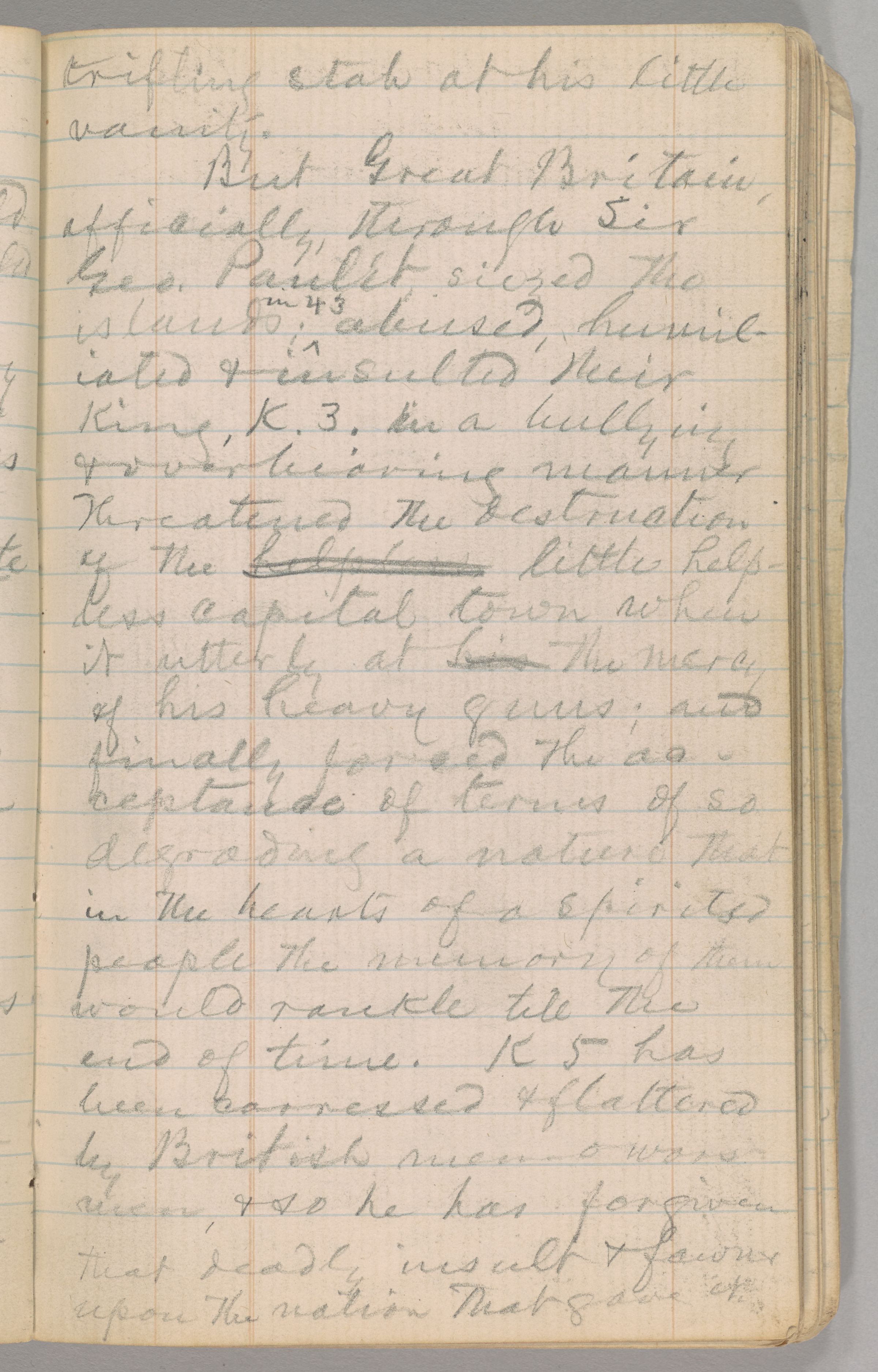
[MS: N05_leaf_045r]
trifling stab at his little
vanity.
But Great Britain,
officially, through Sir
Geo. Paulet, siezed the
islands; in 43
abused,
humil-
iated
humiliated
& insulted their
King, K.3. in a bullying
& overbearing manner
threatened the destruction
of the helpless little
help-
less
helpless
capital town when
it utterly at his the mercy
of his heavy guns; and
finally forced the
ac-
ceptance
acceptance
of terms of so
degrading a nature that
in the hearts of a spirited
people
[MTP: N&J1_152]
the memory of them
would rankle till the
end of time.122 K 5 has
been carressed & flattered
by British
men-o-wars-
men
men-o-wars-men
Ⓜemendation, & so he has forgiven
that deadly insult & fawns
upon the nation that gave it.
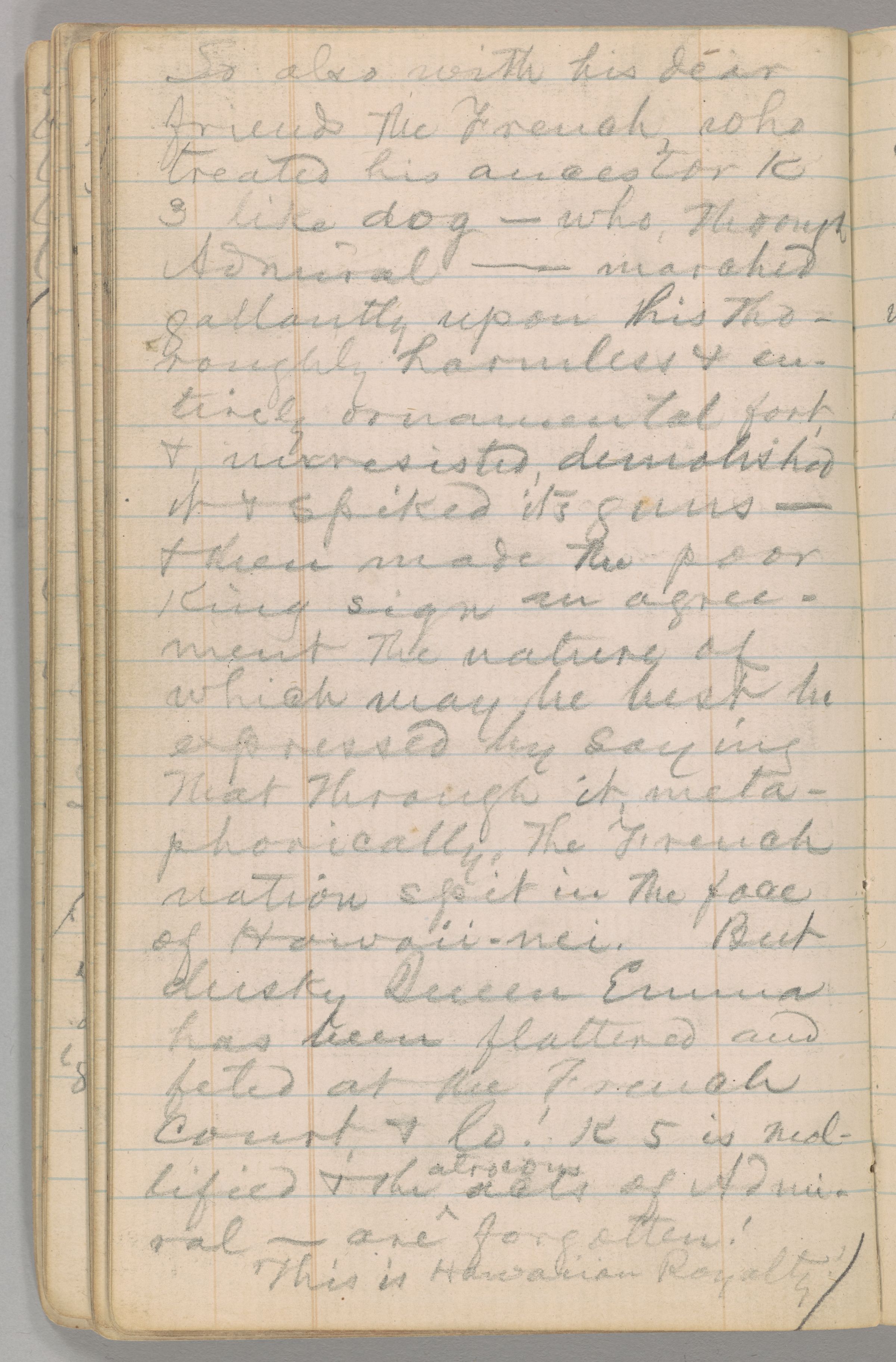
[MS: N05_leaf_045v]
So also with his dear
friends the French, who
treated his ancestor K
3 like dog—who, through
Admiral —— marched
gallantly upon this
tho-
roughly
thoroughly
harmless &
en-
tirely
entirely
ornamental fort,
&, unresisted, demolished
it & spiked its guns—
& then made the poor
King sign an
agree-
ment
agreement
the nature of
which may be best be
expressed by saying
that through it,
mea-
phorically
metaphorically
, the French
nation spit in the face
of Hawaii-nei.123 But
dusky Queen Emma
has been flattered and
feted at the French
Court,124 & lo! K 5 is
mol-
lified
mollified
& the atrocious
acts of
Admi-
ral
Admiral
—— are forgotten!
This is Hawaiian Royalty!
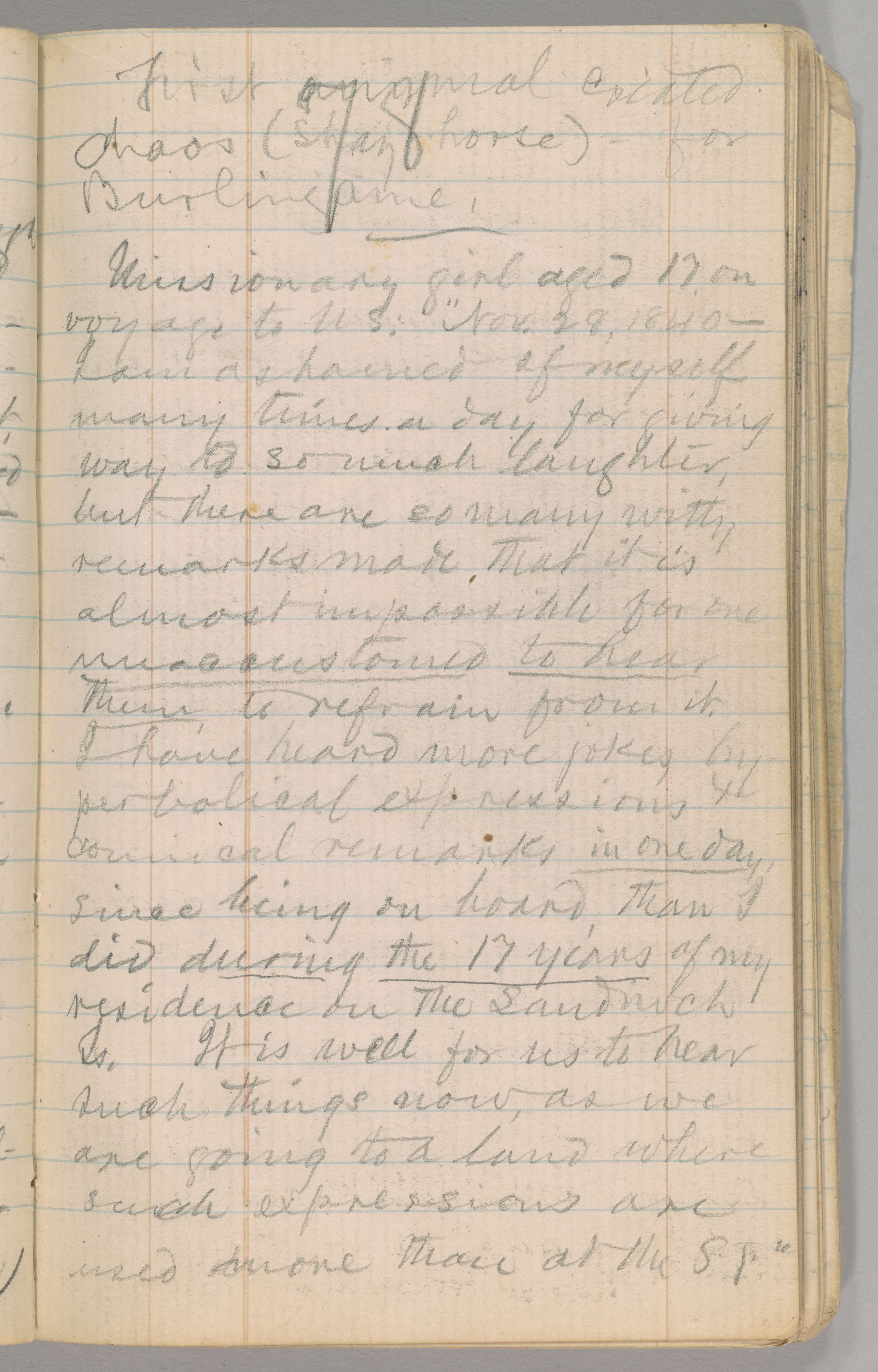
[MS: N05_leaf_046r]
First animal created
Chaos (shay-horse)—for
Burlingame.125
78
Missionary girl aged 17 on
voyage to US: “Nov. 28, 1840—
I am ashamed of myself
many times a day for giving
way to so much laughter,
but there are so many witty
remarks made that it is
almost impossible for one
unaccustomed to hear
them, to refrain from it.
I have heard more jokes,
hy-
perbolical
hyperbolical
expressions &
comical remarks in one day,
since being on board, than I
did during the 17 years of
[MTP: N&J1_153]
my
residence on the Sandwich
Is. It is well for us to hear
such things now, as we
are going to a land where
sumch expressions are
used d more than at the S I”
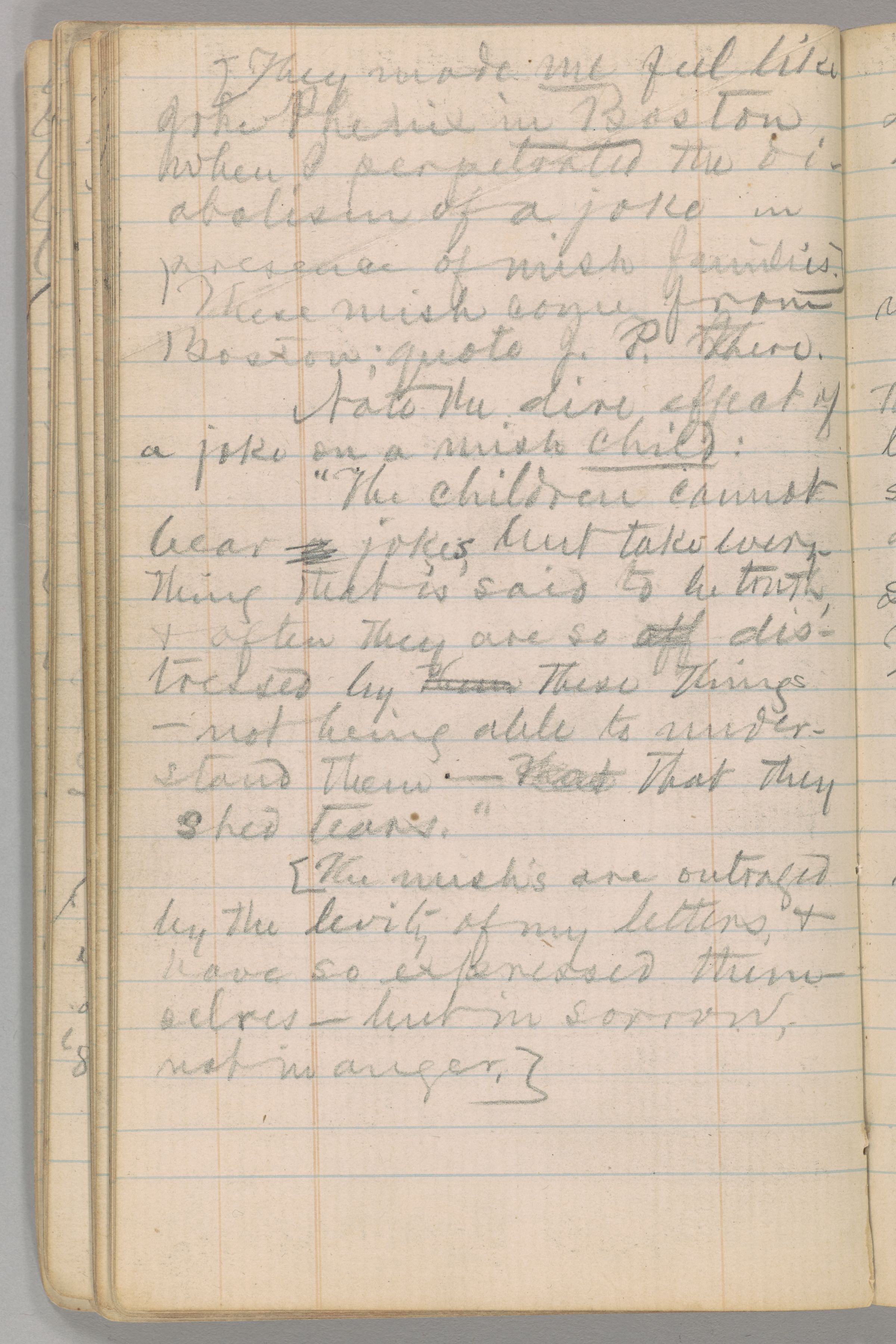
[MS: N05_leaf_046v]
(They made me feel like
John Phenix in Boston
when I perpetrated the
di-
abolism
diabolism
of a joke in
presence of mish families.)
These mish come from
Boston; quote J. P. he there.
Note the dire effect of
a joke on a mish child:
“The children cannot
bear a jokes
, but take
every-
thing
everything
that is said to be truth,
& often they are so aff
dis-
tressed
distressed
by them these things
—not being able to
under-
stand
understand
them—that that they shed tears.”
⟦The mish's are outraged
by the levity of my letters, &
have so expressed
them-
selves
themselves
—but in sorrow,
not in anger.⟧
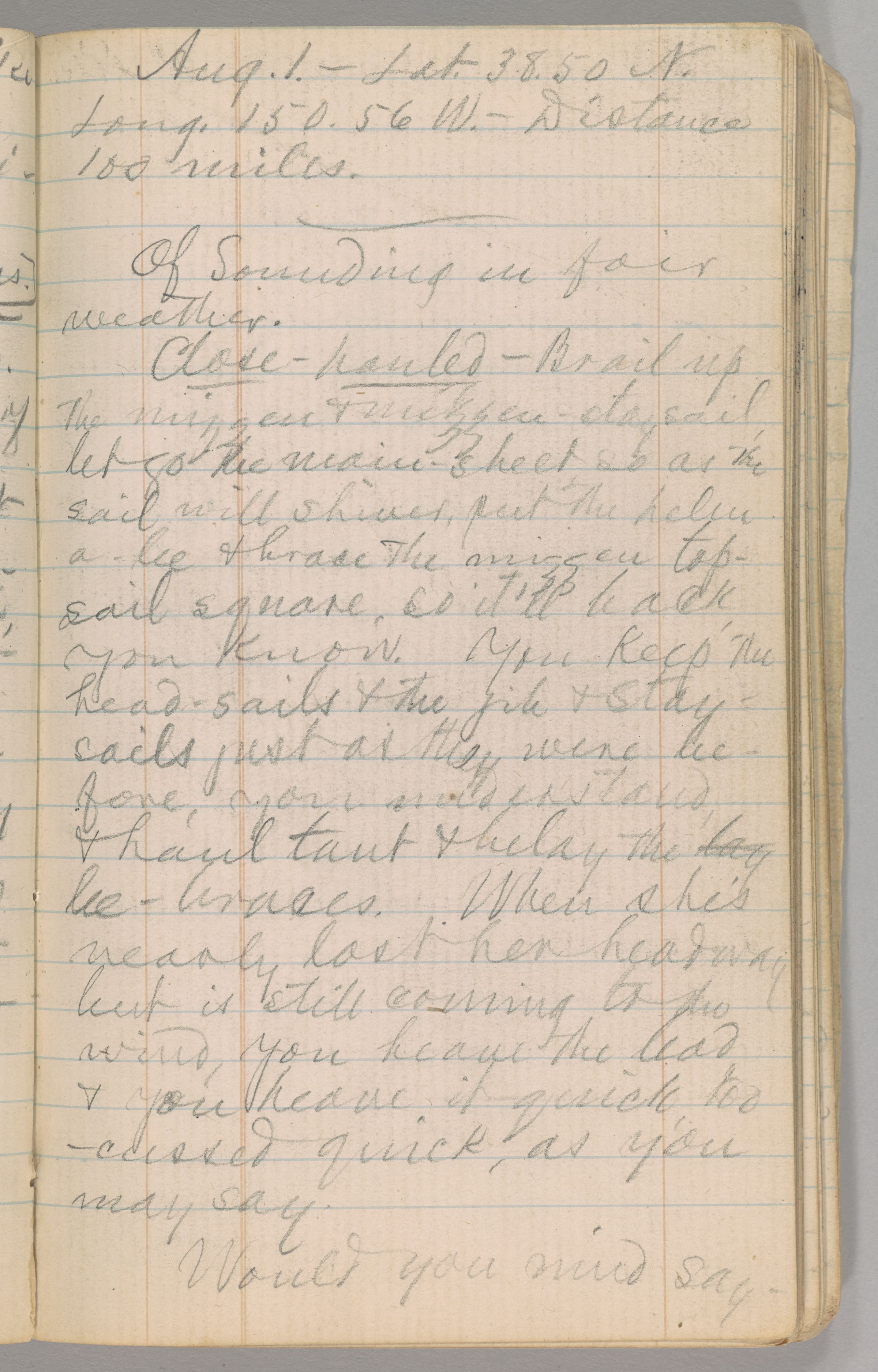
[MS: N05_leaf_047r]
Aug. 1.—Lat. 38.50 N.
Long 150.56 W.—Distance
100 miles.
Of Sounding in fair
weather.126
Close-hauled—Brail up
the mizzen & mizzen-staysail,
let go the main-sheet, so as the
sail will shiver, put the helm
a-lee & brace the mizzen
top-
sail
topsail
Ⓜemendation square, so it'll back,
you know. You keep the
head-sails & the jib &
stay-
sails
staysails
Ⓜemendation just as they were
be-
fore
before
, you understand,
& haul taut & belay the lay
lee-braces. When she's
nearly lost her headway
but is still coming to the
wind, you heave the lead
& you heave it quick, too
—cussed quick, as you
may say.
Would you mind say-
[MS: N05_leaf_047v]
ing that over again if it
ain't too much trouble.
(Repeat.)
Well, yes, I shd say so.
Going large—(Another
method, wh is preferable.)
Brace the headsails
square, haul down the jib
& staysails, without
stir-
ring
stirring
the aftersails, & put
the helm a-lee
Oh, yes, that is much
preferable, I shd think.
Mem—Write some
more biographies of
great men & women.
[MS: N05_leaf_048r]
blank recto
[MS: N05_leaf_048v]
[MTP: N&J1_154]
Whitney about the
cats.127
No—I'll tell you
what's the matter with
you—you have no
conception of a joke
—of anything but
aw-
ful
awful
Puritan
long-
facedness
long-facedness
& petrified
facts. You have got
this spirit on you.
⟦Here quote about jokes from Missionary's daughter.⟧Ⓣtextual note
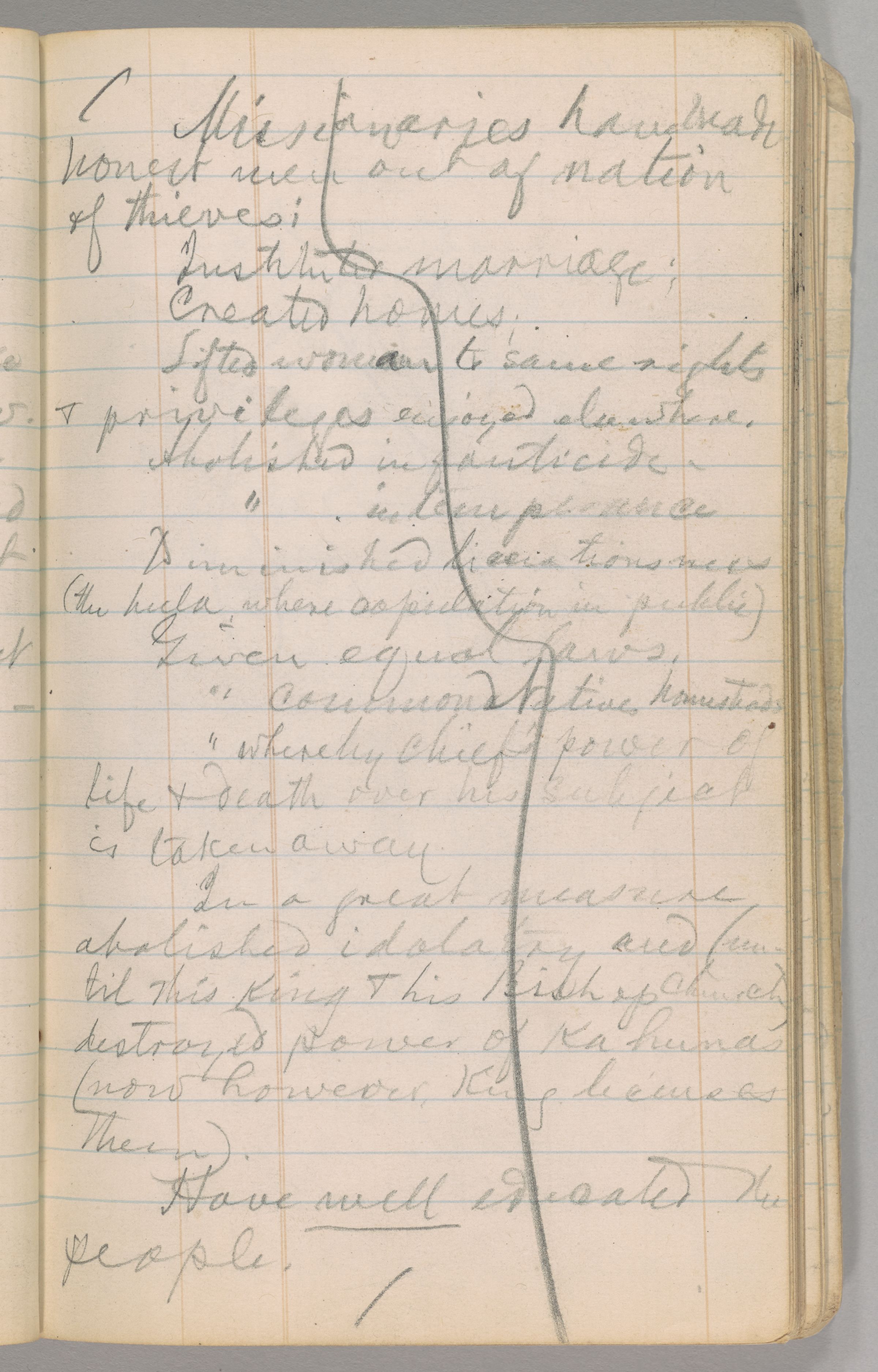
[MS: N05_leaf_049r]
page canceled with wavy line
Missionaries have made
honest men out of nation
of thieves:
Instituted marriage;
Created homes;
Lifted woman to same rights
& privileges enjoyed elsewhere.
Abolished infanticide.
“ intemperance
Diminished licentiousness
(the hula, where copulation in public)
Given equal laws.
“ common Natives homesteads
“ whereby chief's power of
life & death over his subject
is taken away.
In a great measure
abolished idolatry and (
un-
til
until
this King & his Bishop Church)
destroyed power of Kahunas
(now however, King licenses
them).
Have well educated the
people.
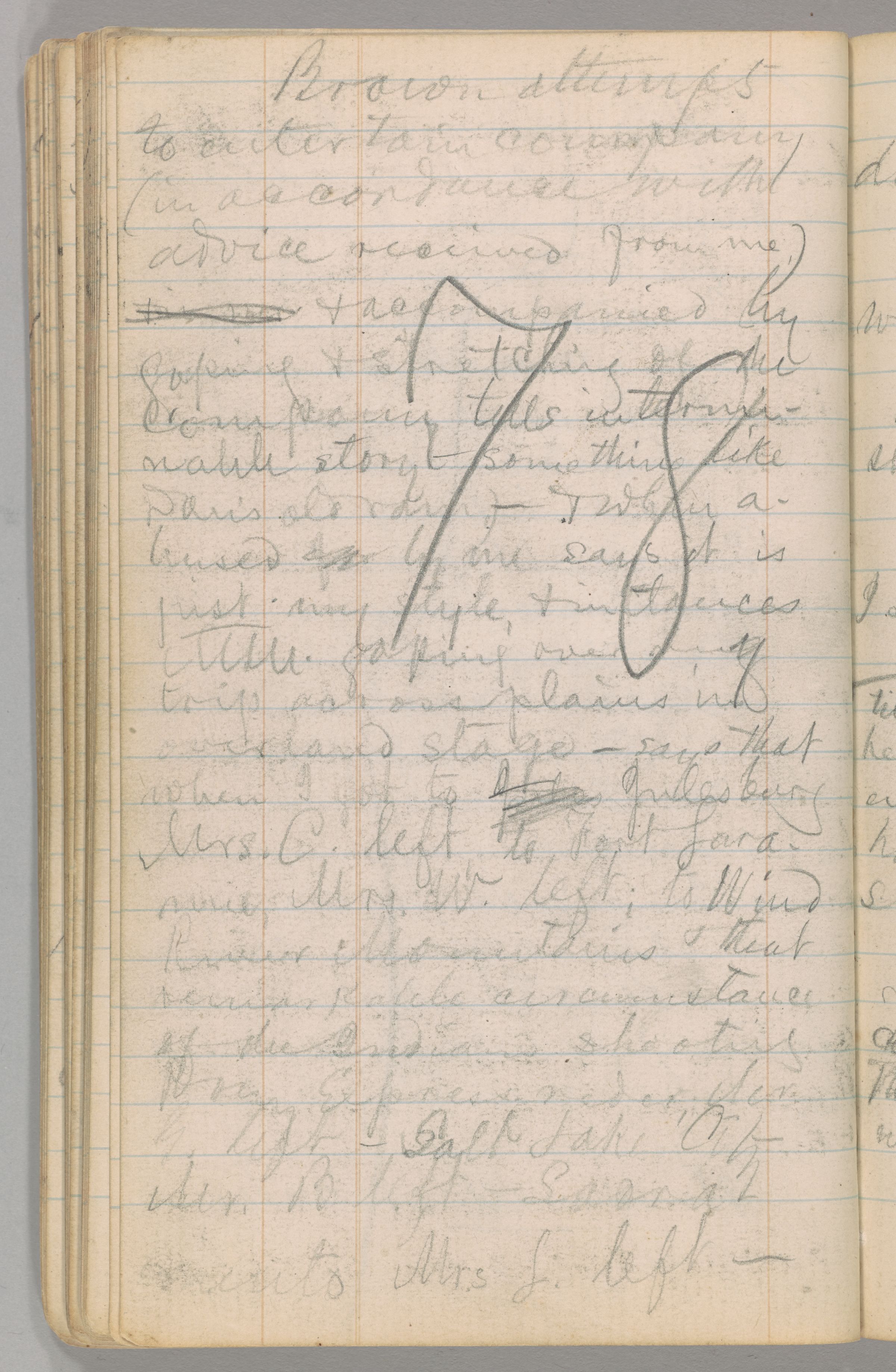
[MS: N05_leaf_049v]
Brown attempts
to entertain company
(in accordance with
advice received from me,)
& is now & accompanied by
gaping & stretching of the
company tells
intermi-
nable
interminable
story—something like
Dan's old ram,)—& when
a-
bused
abused
for by me says it is
just my style, & instances
 gaping over my
trip across plains in
overland stage—says that
when I got to Jules Julesburg
Mrs. C. left, to Fort
Lara-
mie
Laramie
, Mrs. W. left; to Wind
River Mountains & that
remarkable circumstance
of the Indians shooting
Pony Express rider, Mr.
G. left—Salt Lake City
Mr. B left—
Sacra-
mento
Sacramento
Mrs.Ⓣtextual note
Ⓜemendation L. left—
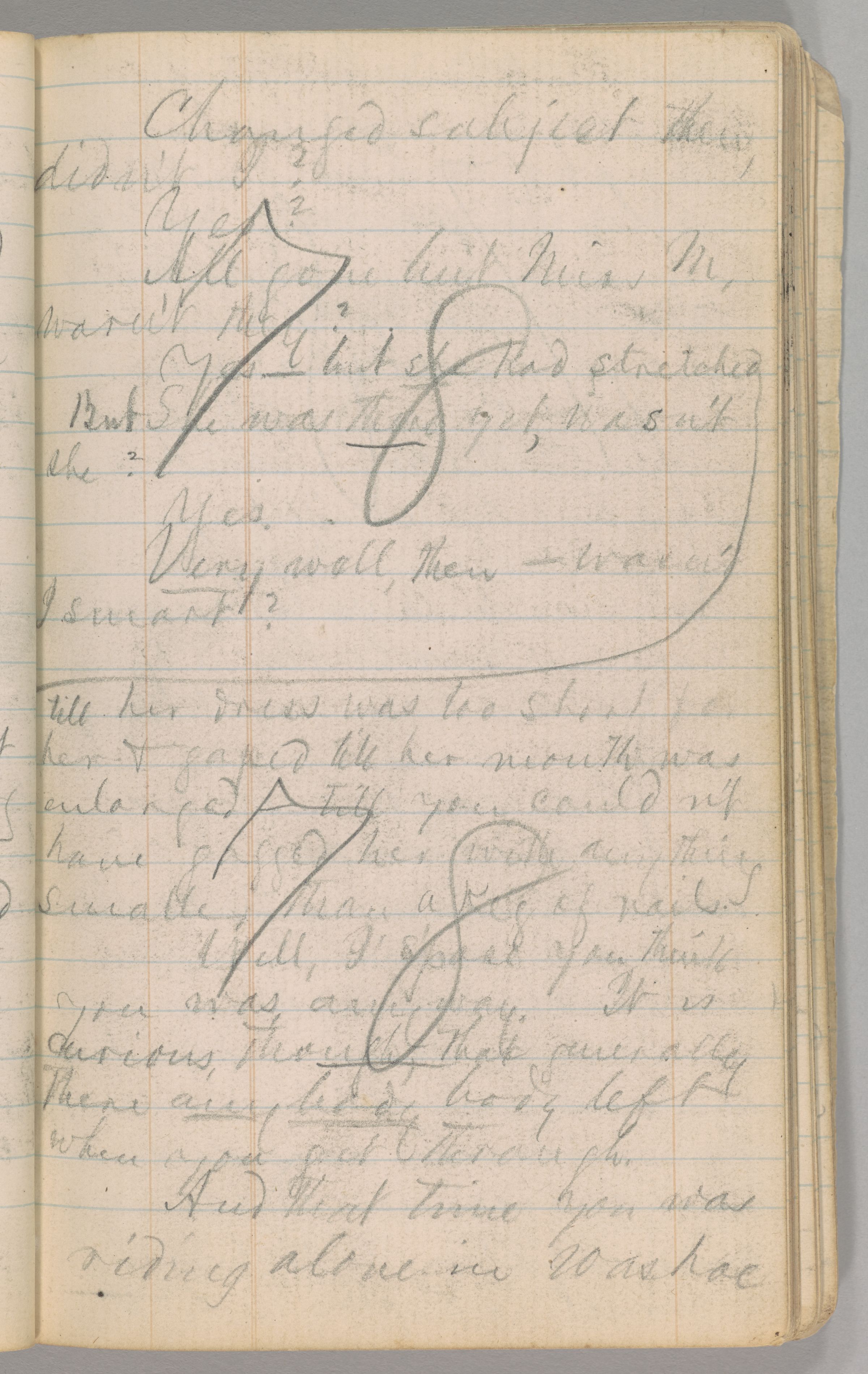
[MS: N05_leaf_050r]
Changed subject then,
didn't I?
[MTP: N&J1_155]
Yes?
All gone but Miss M,
warn't they?
Yes.—but she had stretched
till her dress was too short for
her & gaped till her mouth was
enlarged—till you couldn't
have gagged her with anything
smaller than a keg of nails.
Ⓣtextual note
But She was there yet, war
sn'tⓉtextual note
she?
Yes.
Very well, then—wasn't
I smart?
Well, I' s'pose you think
you was, anyway. It is
curious, though, that generally
there anybody body left
when you get through.
And that time you was
riding alone in Washoe
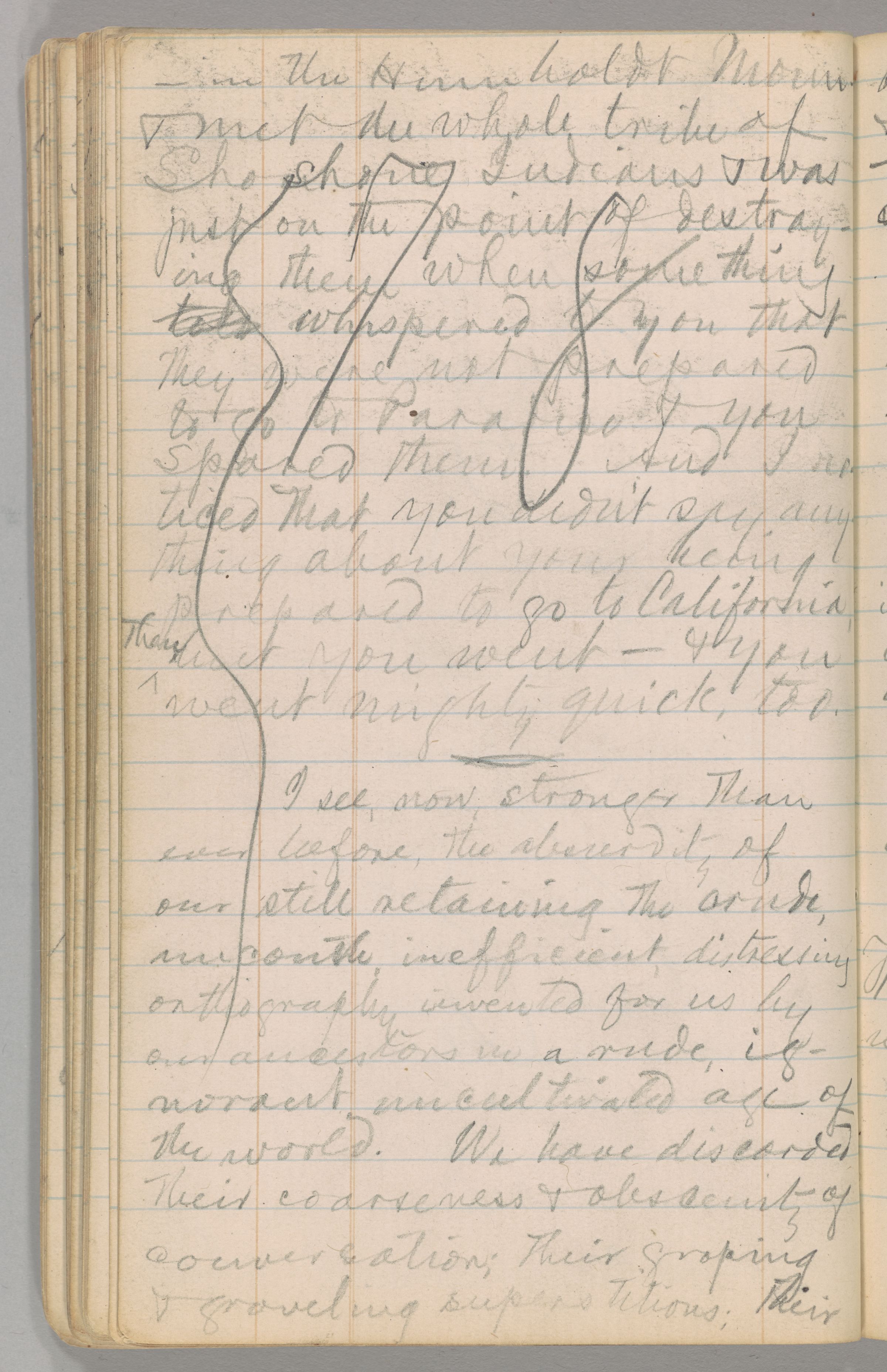
[MS: N05_leaf_050v]
—in the Humboldt Moun.
& met the whole tribe of
ShonshoneⓉtextual note Indians & was
just on the point of
destroy-
ing
destroying
them when something
told whispered to you that
they were not prepared
to go to Paradise & you
spared them. And I
no-
ticed
noticed
that you didn't say
any-
thing
anything
about your being
prepared to go to California,
then,
but you went—& you
went mighty quick, too.
78
I see, now, stronger than
ever before, the absurdity of
our still retaining the crude,
uncouth, inefficient, distressing
orthography invented for us by
our ancestors in a rude,
ig-
norant
ignorant
, uncultivated age of
the world. We have discarded
their coarseness & obscenity of
conversation; their groping
& groveling superstitions; their
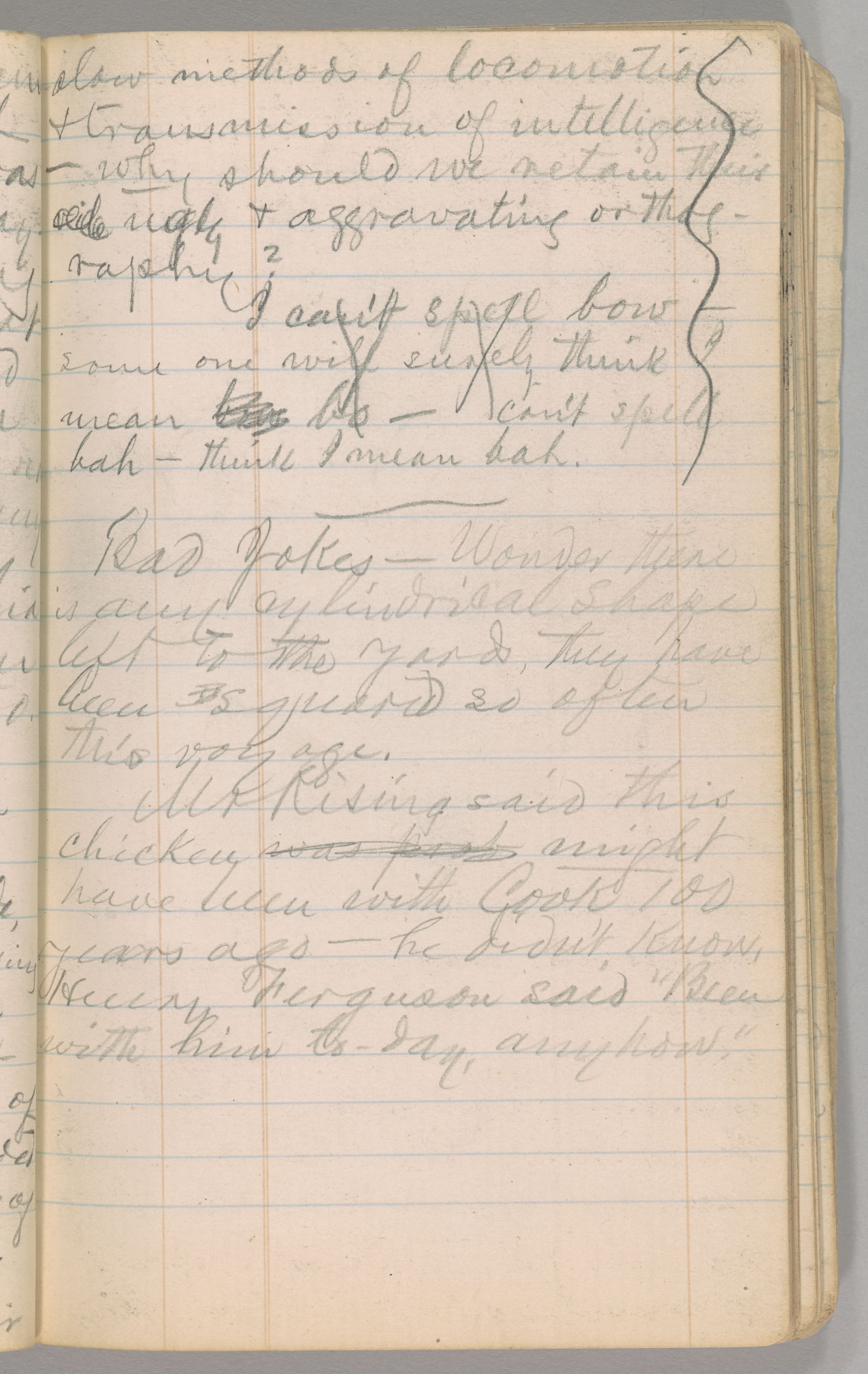
[MS: N05_leaf_051r]
slow methods of locomotion
& transmission of intelligence
—why should we retain their
vile ugly & aggravating
orthog-
raphy
orthography
?
I can't spell bow—
some one will surely think I
mean bow bo—can't spell
bah—think I mean bah.128
Bad Jokes—Wonder there
is any cylindrical shape
left to the yards, they have
been “ squared so often
this voyage.
Mr Rising said this
chicken was prob
might
have been with Cook 100
years ago—he didn't know,
Henry Ferguson said “Been
with him to-day, anyhow.”
[MS: N05_leaf_051v]
blank verso (no page image)
[MS: N05_leaf_052r]
blank verso (no page image)
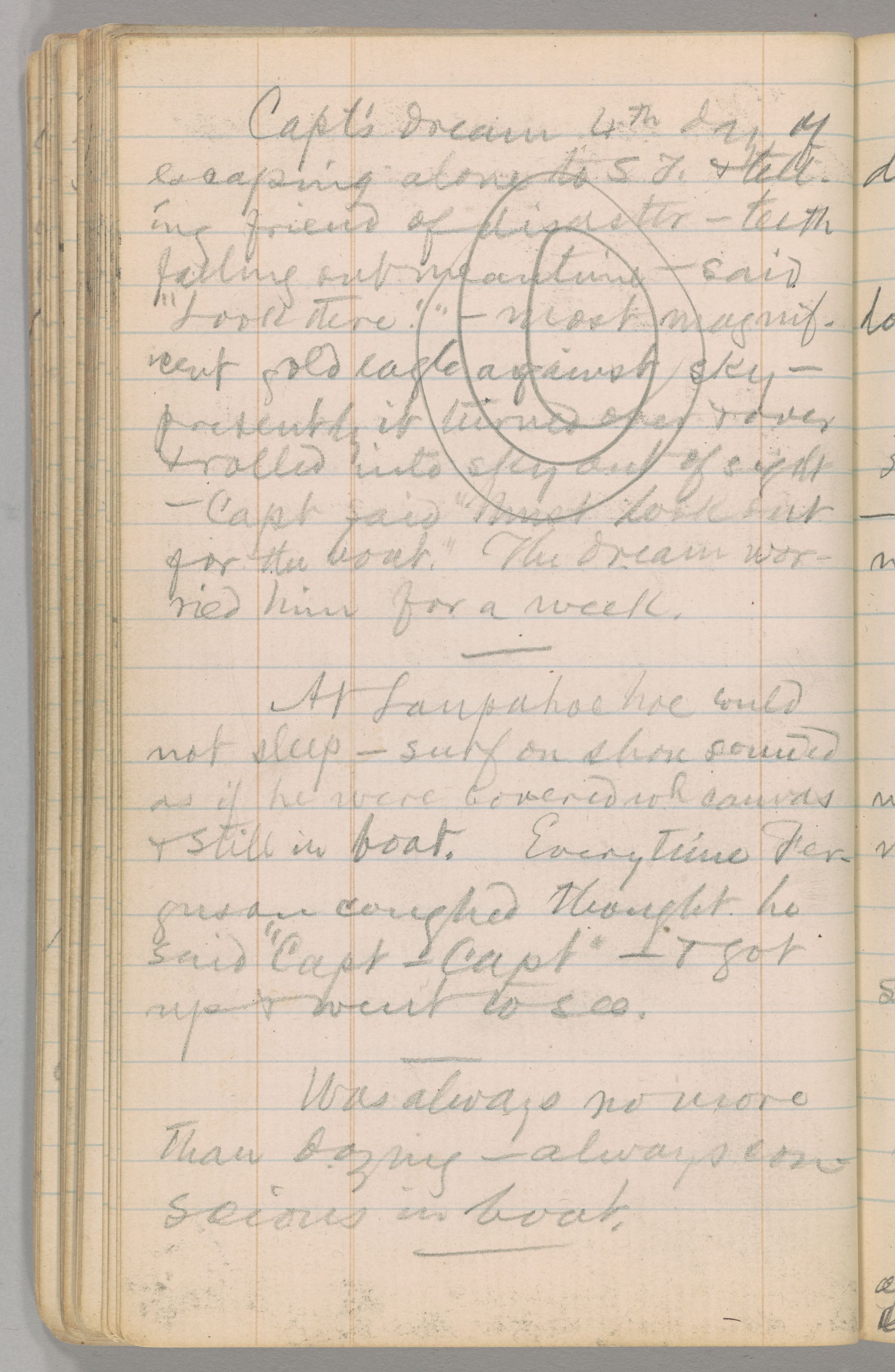
[MS: N05_leaf_052v]
[MTP: N&J1_156]
Capt's dream 4th day of
escaping alone to S F. &
tell-
ing
telling
friend of disaster—teeth
falling out meantime—said
“Look there!”—most
magnif
icent
magnificent
gold eagle against sky—
presently it turned over & over
& rolled into sky out of sight
—Capt said “Must look out
for the boat.” The dream
wor-
ried
worried
him for a week.129
꩜
At Laupahoehoe could
not sleep—surf on shore sounded
as if he were covered wh canvas
& still in boat. Every time
Fer-
guson
Ferguson
coughed130 thought he
said “Capt—Capt”—& got
up & went to see.
Was always no more
than dozing—always
con-
scious
conscious
in boat.
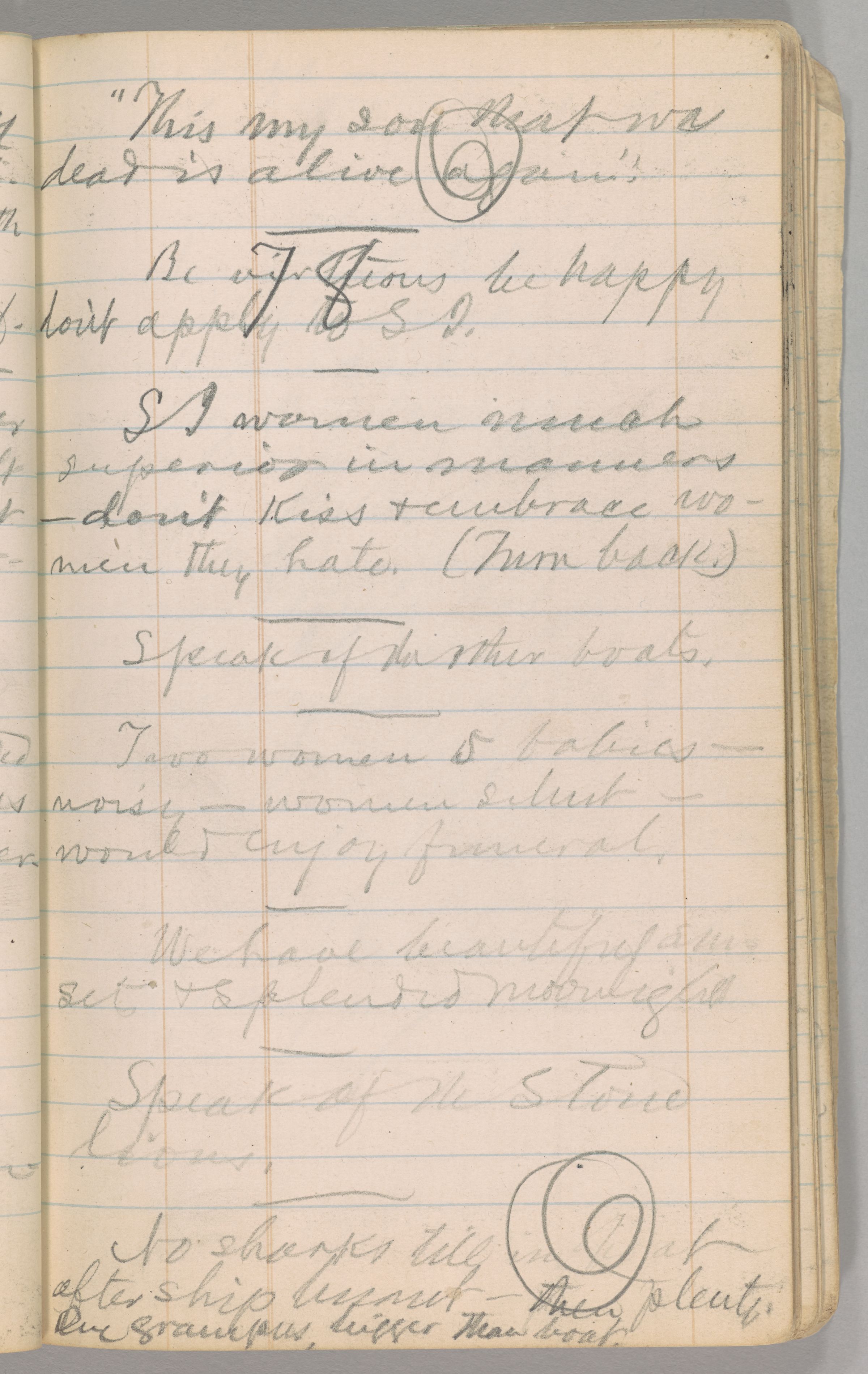
[MS: N05_leaf_053r]
“This my son that was
dead is alive again.”131
꩜
Be virtuous be happy
don't apply to S I.
78
S I women much
superior in manners
—don't kiss & embrace
wo-
men
women
they hate. (Turn back.)
Speak of the other boats.132
Two women 5 babies—
noisy—women silent—
would enjoy funeral.
We have beautiful
sun-
sets
sunsets
& splendid moonlight
Speak of the stone
lions.
No sharks till in boat
after ship burnt—then plenty.
One grampus, bigger than boat.
꩜
[MS: N05_leaf_053v]
blank verso (no page image)
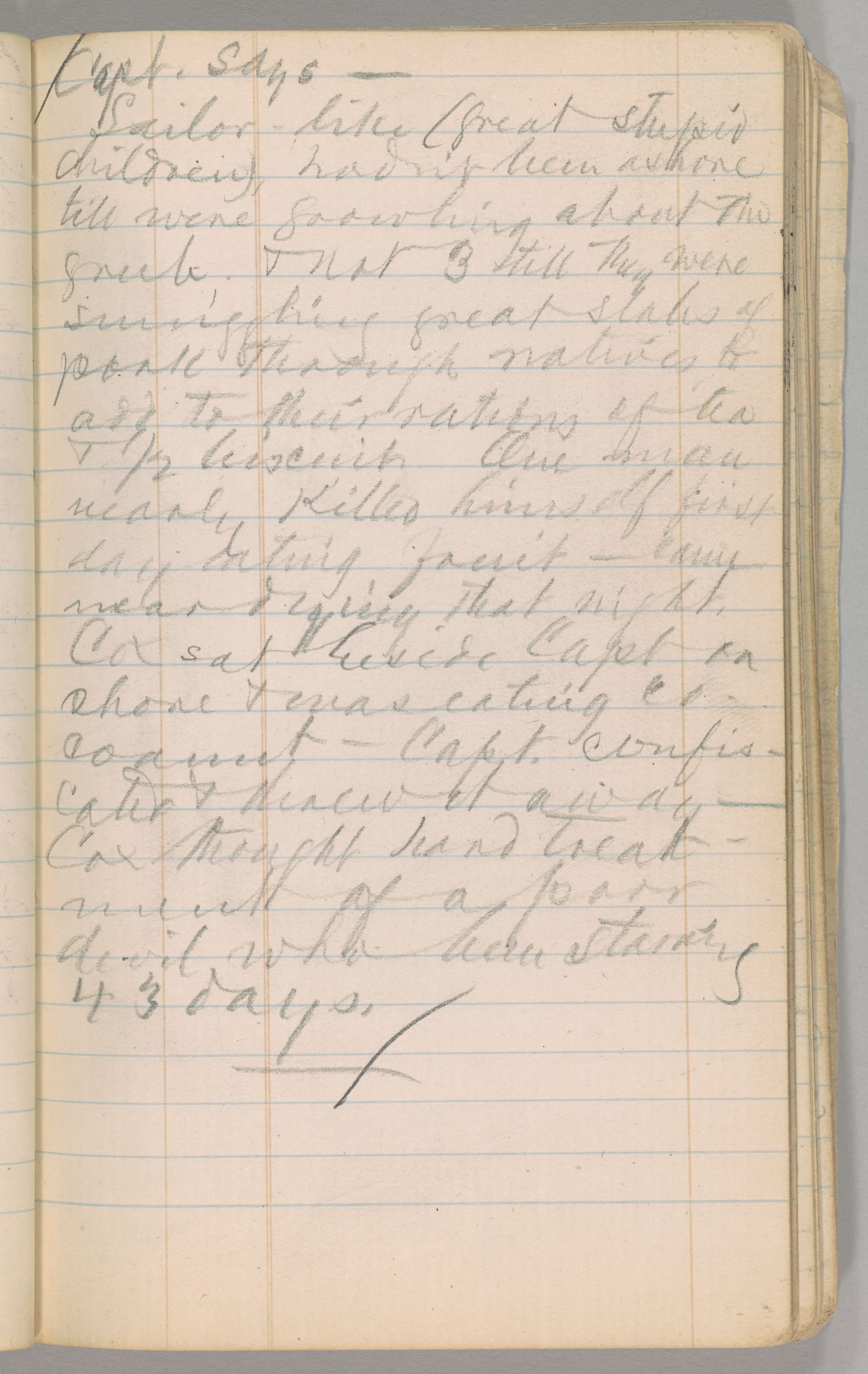
[MS: N05_leaf_054r]
Capt. says—
Sailor-like (great stupid
children), hadn't been ashore
till were growling about the
grub, & not 3 till they were
smuggling great slabs of
pork through natives, to
add to their rations of tea
& ½ biscuit. One man
nearly killed himself first
day eating fruit—came
near dying that night.
Cox sat beside Capt on
shore & was eating
co-
coanut
cocoanut
—Capt.
confis-
cated
confiscated
& threw it away—
Cox thought hard
treat-
ment
treatment
of a poor
devil who been starving
43 days.
[MS: N05_leaf_054v]
blank verso (no page image)
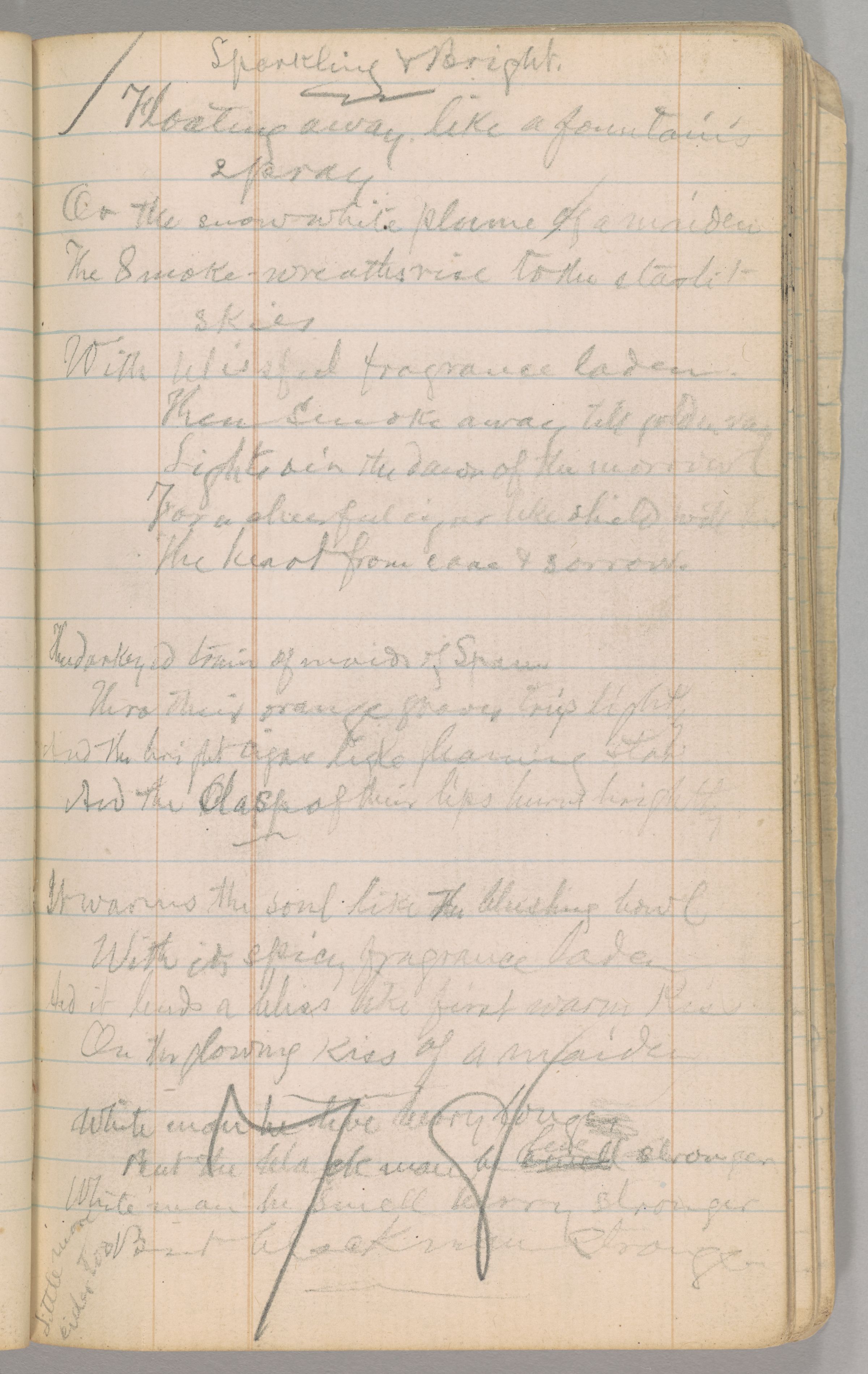
[MS: N05_leaf_055r]
Sparkling & Bright. 133
78
Little more cider too Ⓣtextual note
[MTP: N&J1_158]
[MS: N05_leaf_055v]
blank verso (no page image)
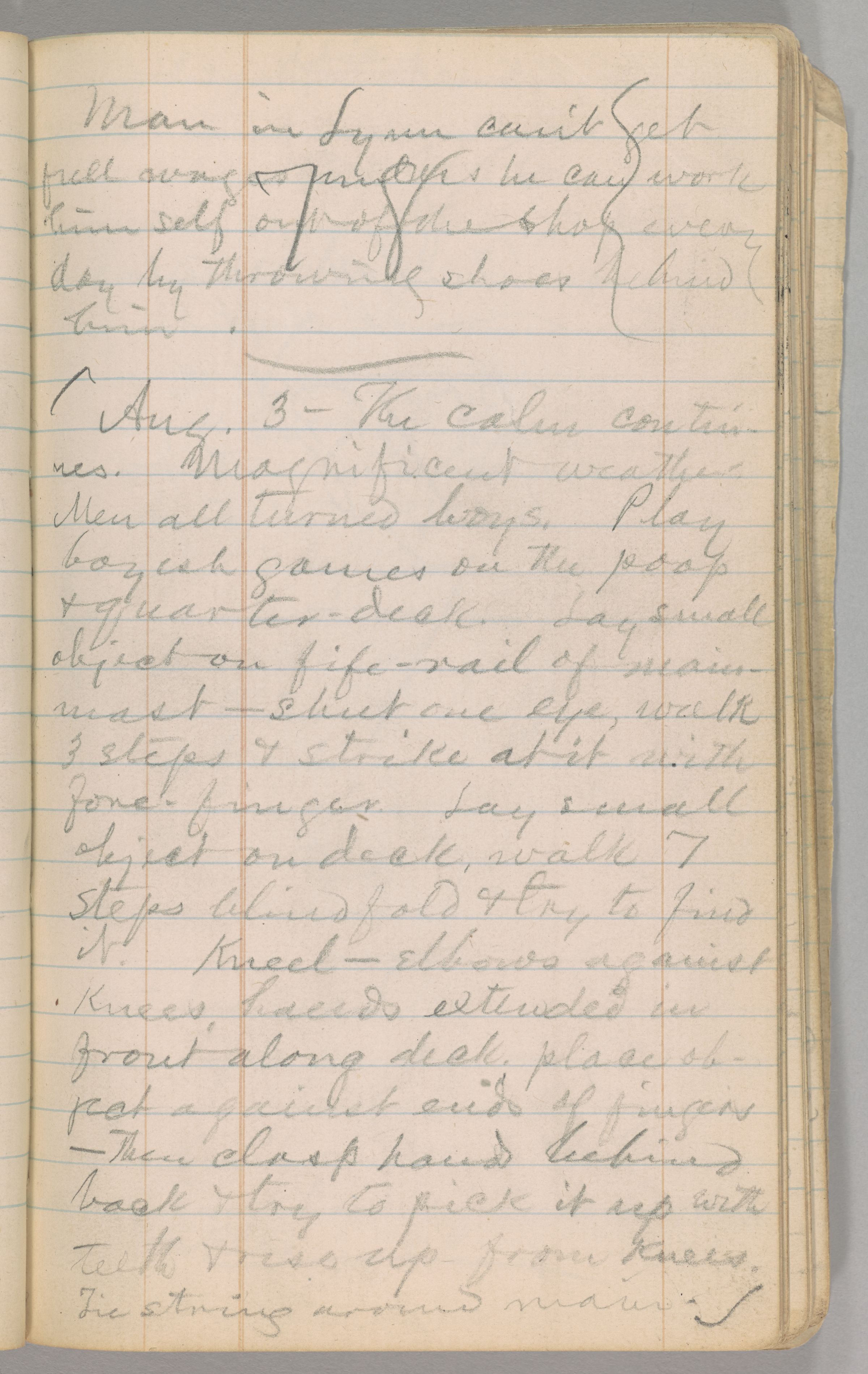
[MS: N05_leaf_056r]
Man in Lynn can't get
full wages unless he can work
himself out of the shop every
day by throwing shoes behind
him.134
78
Aug. 3—The calm
contin-
ues
continues
. Magnificent weather.
Men all turned boys. Play
boyish games on the poop
& quarter-deck. Lay small
object on fife-rail of
main-
mast
mainmast
Ⓜemendation—shut one eye, walk
3 steps & strike at it with
fore-finger. Lay small
object on deck, walk 7
steps blindfold & try to find
it. Kneel—elbows against
knees, hands extended in
front along deck; place
ob-
ject
object
against ends of fingers
—then clasp hands behind
back & try to pick it up with
teeth & rise up from knees.
Tie string around main-
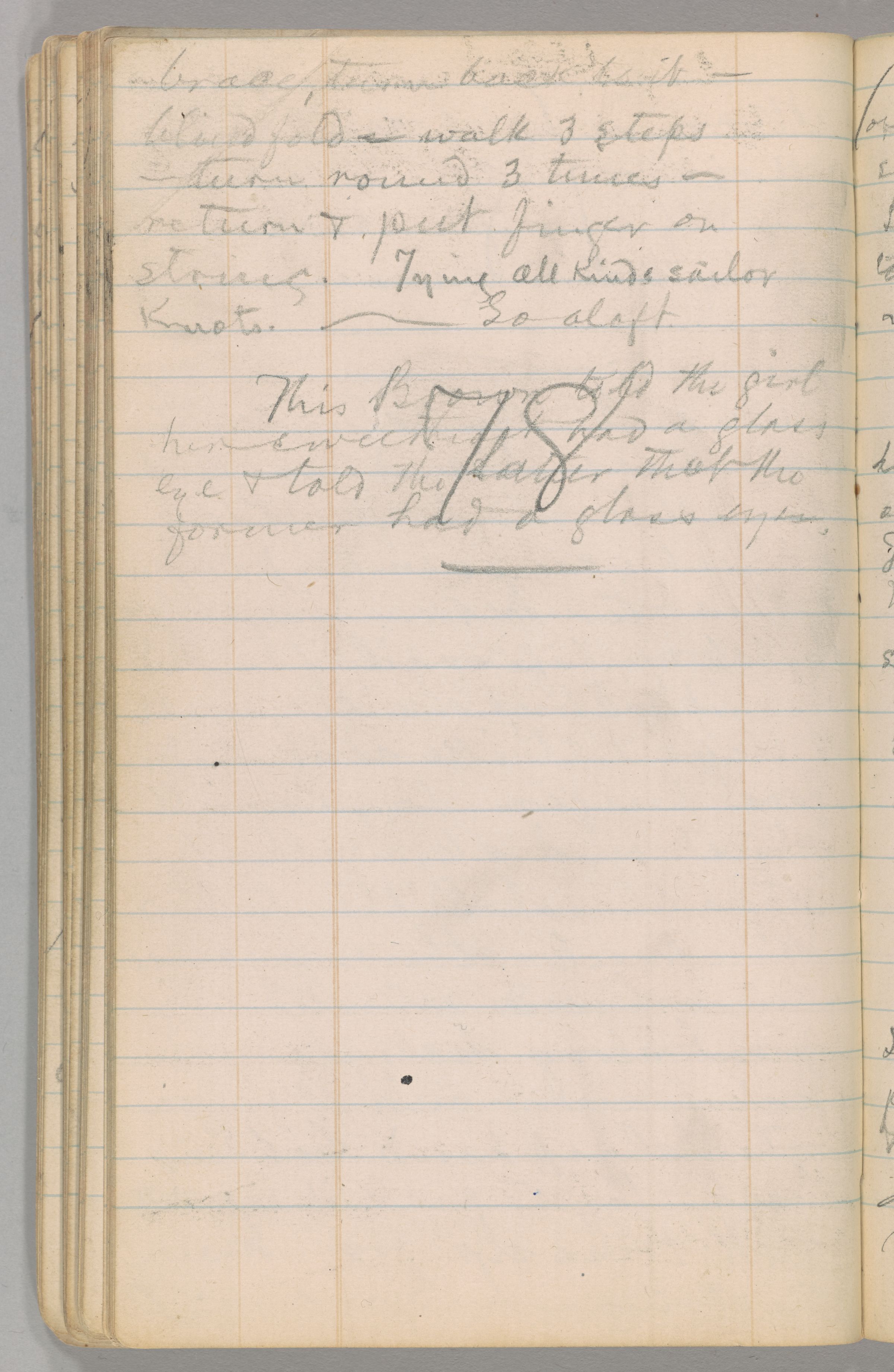
[MS: N05_leaf_056v]
brace, turn back to it—
blindfold—walk 3 steps
—turn round 3 times—
return & put finger on
string. Tying all kinds sailor
knots. flourish
Go aloft.
Ⓣtextual note
135
This Brown told the girl
her sweetheart had a glass
eye & told the sw latter that the
former had a glass eye.Ⓣtextual note
78
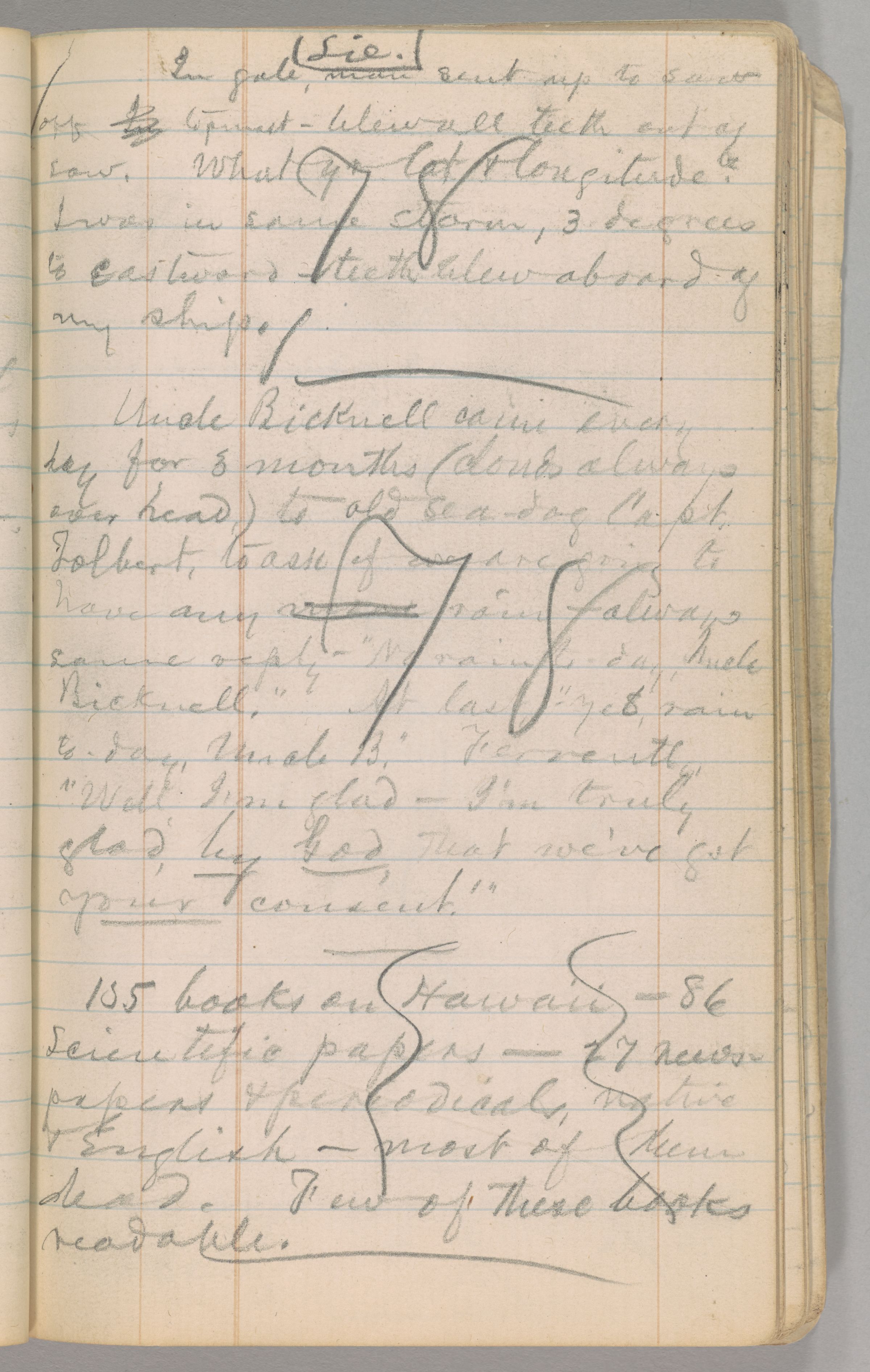
[MS: N05_leaf_057r]
Lie. Ⓣtextual note
In gale, man sent up to saw
off In topmast—blew all teeth out of
saw. What yr lat & longitude?
I was in same storm, 3 degrees
to eastward—teeth blew aboard of
my ship.
78
Uncle Bicknell136 came every
day for 3 months (clouds always
over head,) to old sea-dog Capt.
Tolbert,137 to ask if we are going to
have any more rain—always
same reply—“No rain to-day, Uncle
Bicknell.” At last, “yes, rain
to-day, Uncle B.” Fervently,
[MTP: N&J1_159]
“Well, I'm glad—I'm truly
glad, by God, that we've got
your consent!”
78
155 books on Hawaii—86
scientific papers—27
news
papers
newspapers
& periodicals, native
& English—most of them
dead. Few of these books
readable.
[MS: N05_leaf_057v]
blank verso (no page image)
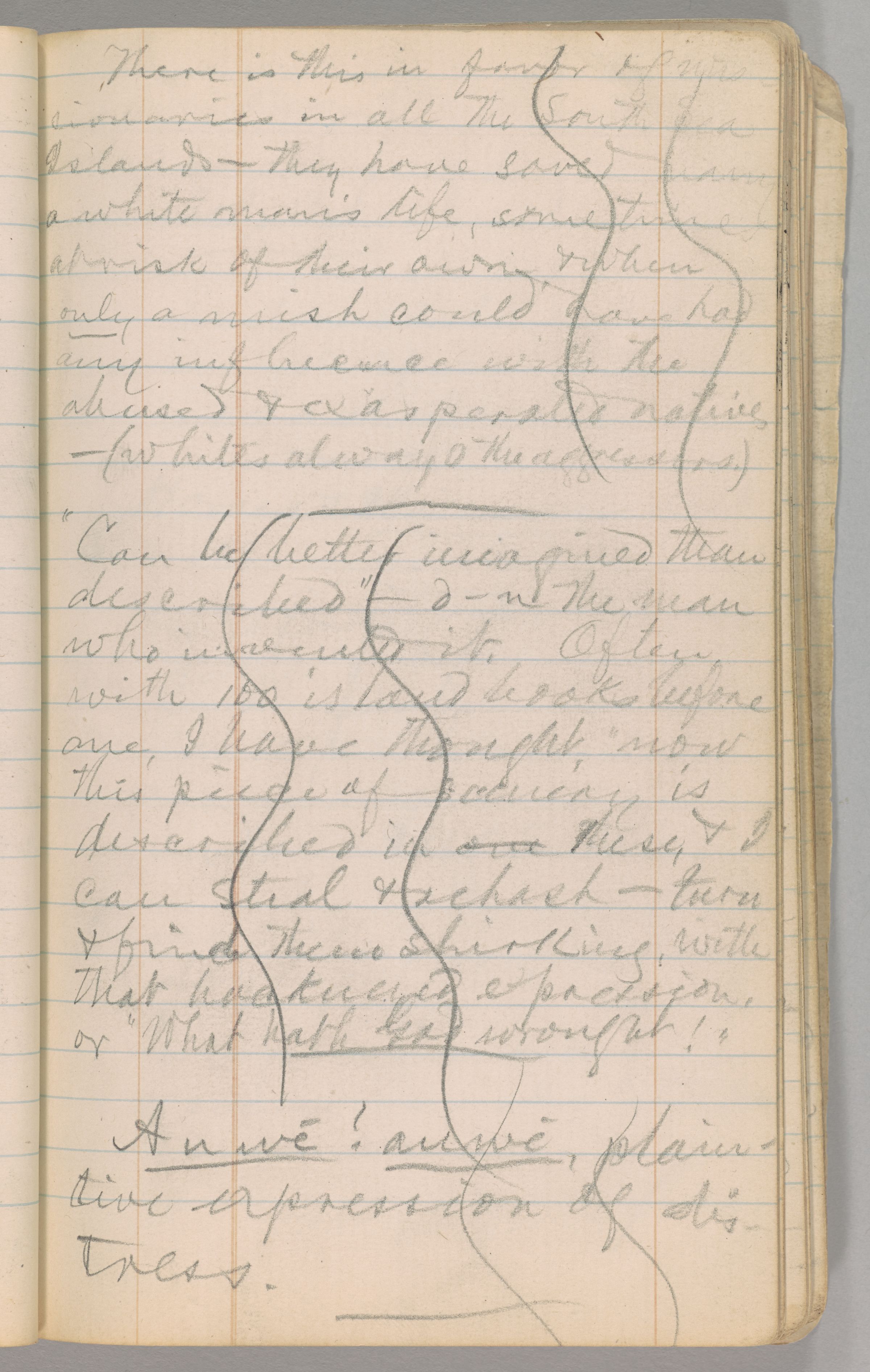
[MS: N05_leaf_058r]
There is this in favor of
missionaries in all the South Sea
Islands—they have saved many
a white man's life, sometimes
at risk of their own, & when
only a mish could have had
any influence with the
abused & exasperated natives
—(whites always the aggressors.)
“Can be better imagined than
described”— d—n the man
who invented it. Often,
with 100 island books before
me, I have thought, “now
this piece of scenery is
described in one
s theseⓉtextual note, & I
can steal & rehash—turn
& find them shirking, with
that hackneyed expression.Ⓣtextual note
or “What hath God wrought!”
Auwē! auwē,
plain-
tive
plaintive
expression of
dis-
tress
distress
.
[MS: N05_leaf_058v]
blank verso (no page image)
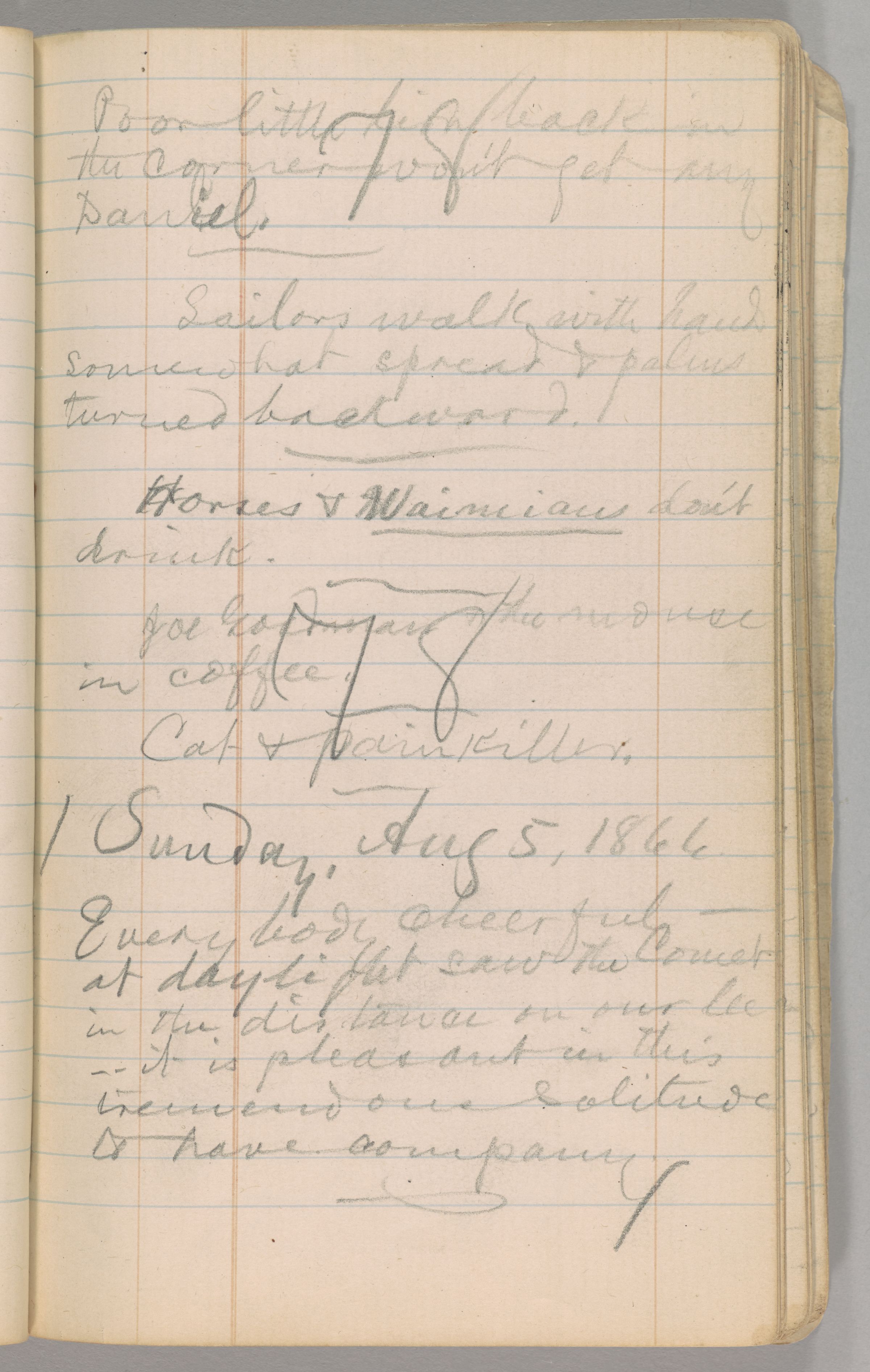
[MS: N05_leaf_059r]
Poor little lion back in
the corner won't get any
Dan
l
iel.Ⓣtextual note
78
Sailors walk with hands
somewhat spread & palms
turned backward.
Horses & Waimians don't
drink.138
Joe Goodman & the mouse
in coffee.
78
Cat & painkiller.Ⓣtextual note Ⓜemendation
Sunday, Aug 5, 1866.
Everybody cheerful—
at daylight saw the Comet
in the distance on our lee
—it is pleasant in this
tremendous solitude
to have company.139
[MS: N05_leaf_059v]
blank verso (no page image)
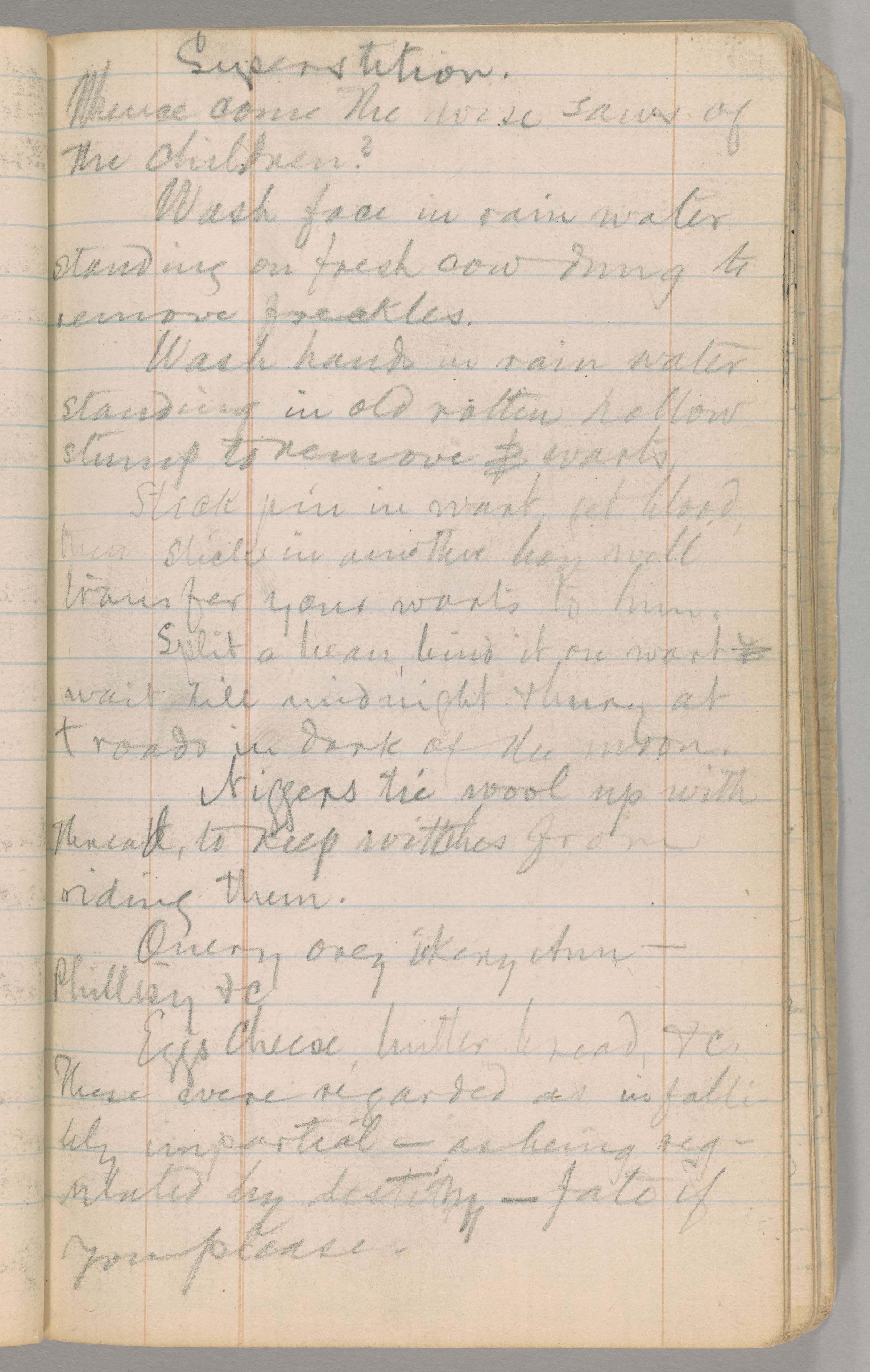
[MS: N05_leaf_060r]
[MTP: N&J1_160]
Superstition. Ⓣtextual note
Whence come the wise saws of
the children?
Wash face in rain water
standing on fresh cow dungⓂemendation to
remove freckles.
Wash hands in rain water
standing in old rotten hollow
stump to remove f warts.
Stick pin in wart, get blood,
then stick in another boy will
transfer your warts to him.
Split a bean, bind it on wart &
wait till midnight & bury at
X roads in dark of the moon.
Niggers tie wool up with
threatdⓉtextual note, to keep witches from
riding them.
Onery orey ickery Ann—
Phillisy &c
Eggs cheese, butter, bread, &c.
These were regarded as
infalli-
bly
infallibly
impartial—as being
reg-
ulated
regulated
by destiny—fate if
you please.
[MS: N05_leaf_060v]
blank verso (page image)
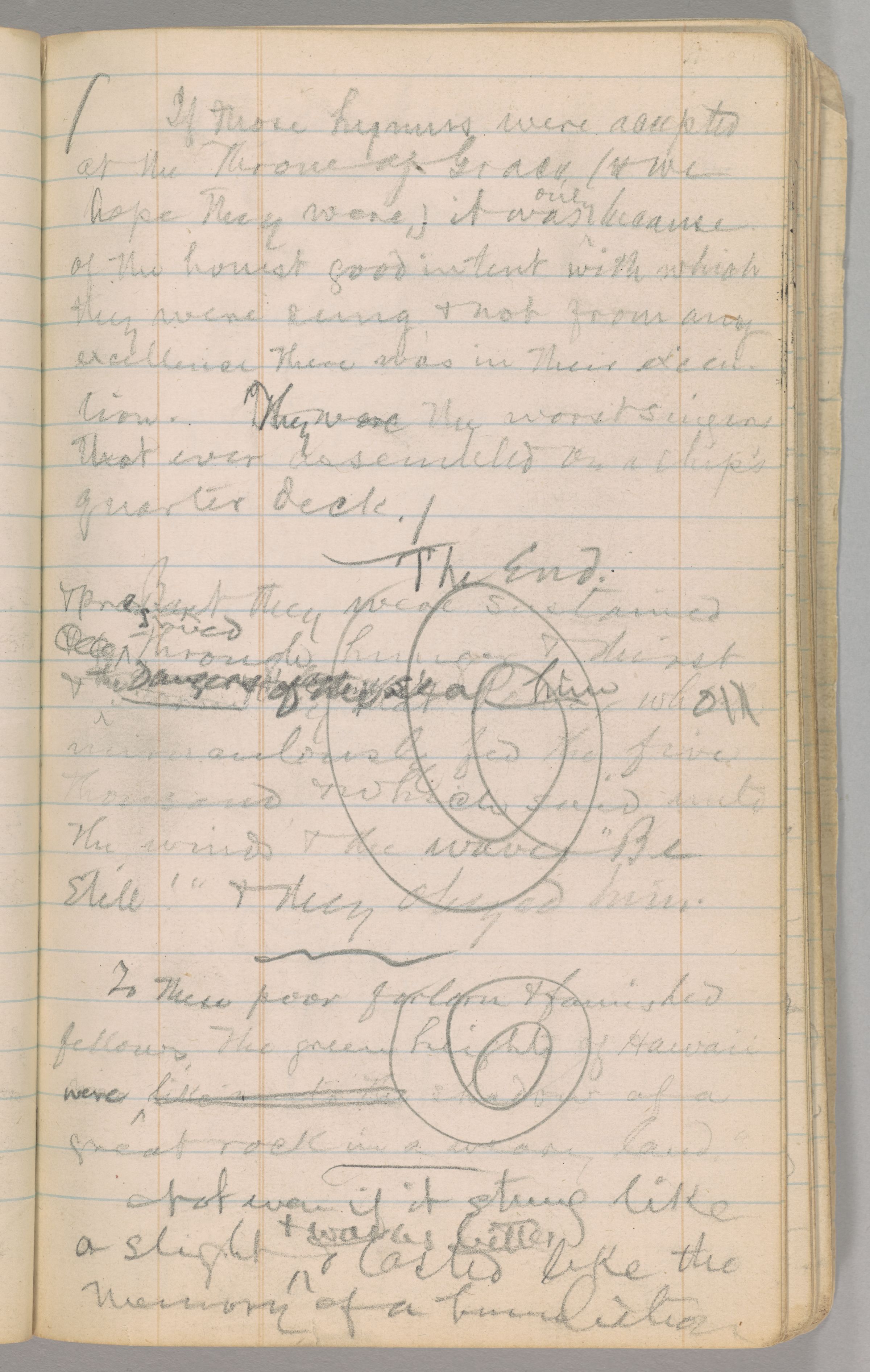
[MS: N05_leaf_061r]
If those hymns were accepted
at the Throne of Grace, (& we
hope they were,) it was only because
of the honest good intent with which
they were sung, & not from any
excellence there was in their
execu-
tion
execution
.
It
They was
ere
Ⓣtextual note the worst singers
that ever assembled on a ship's
quarter deck.140
The End. 141
But they were sustained
& p
& preserved
through hunger & thirst
& storm
the dangers of the
sea
by that Power
him which
o
Ⓣtextual note
miraculously fed the five
thousand, & which said unto
the winds & the waves “Be
still!” & they obeyed him.
꩜
To these poor forlorn & famished
fellows, the green heights of Hawaii
was
were
like unto the
Ⓣtextual note shadow of a
great rock in a weary land.”
꩜
[MTP: N&J1_161]
Not even if it stung like
a slight & was as bitter
& lasted like the
memory of a humiliation
[MS: N05_leaf_061v]
blank verso (no page image)
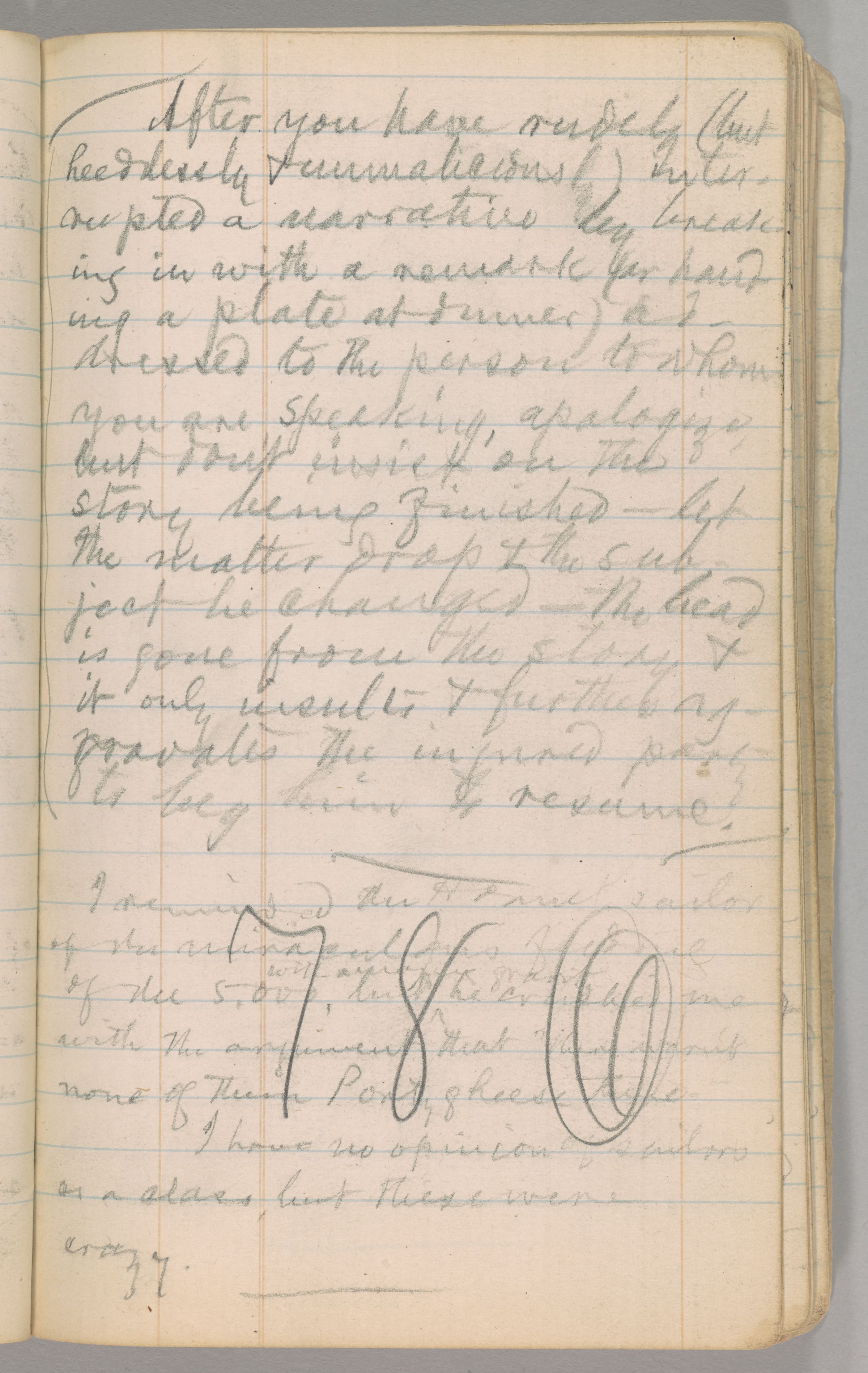
[MS: N05_leaf_062r]
After you have rudely (but
heedlessly & unmaliciously)
inter-
rupted
interrupted
a narrative by
break-
ing
breaking
in with a remark (or
hand-
ing
handing
a plate at dinner)
ad-
dressed
addressed
to the person to whom
you are speaking, apologize,
but don't insist on the
story being finished—let
the matter drop & the
sub-
ject
subject
be changed—the head
is gone from the story &
it only insults & further
ag-
gravates
aggravates
the injured party
to beg him to resume.
I reminded the Hornet sailor
of the miraculous feeding
of the 5,000, but with amazing gravity
he crushed me
with the argument that “there warn't
none of them Portygheese there.142
I have no opinion of sailors
as a class, but these were
crazy.
[MS: N05_leaf_062v]
blank verso (no page image)
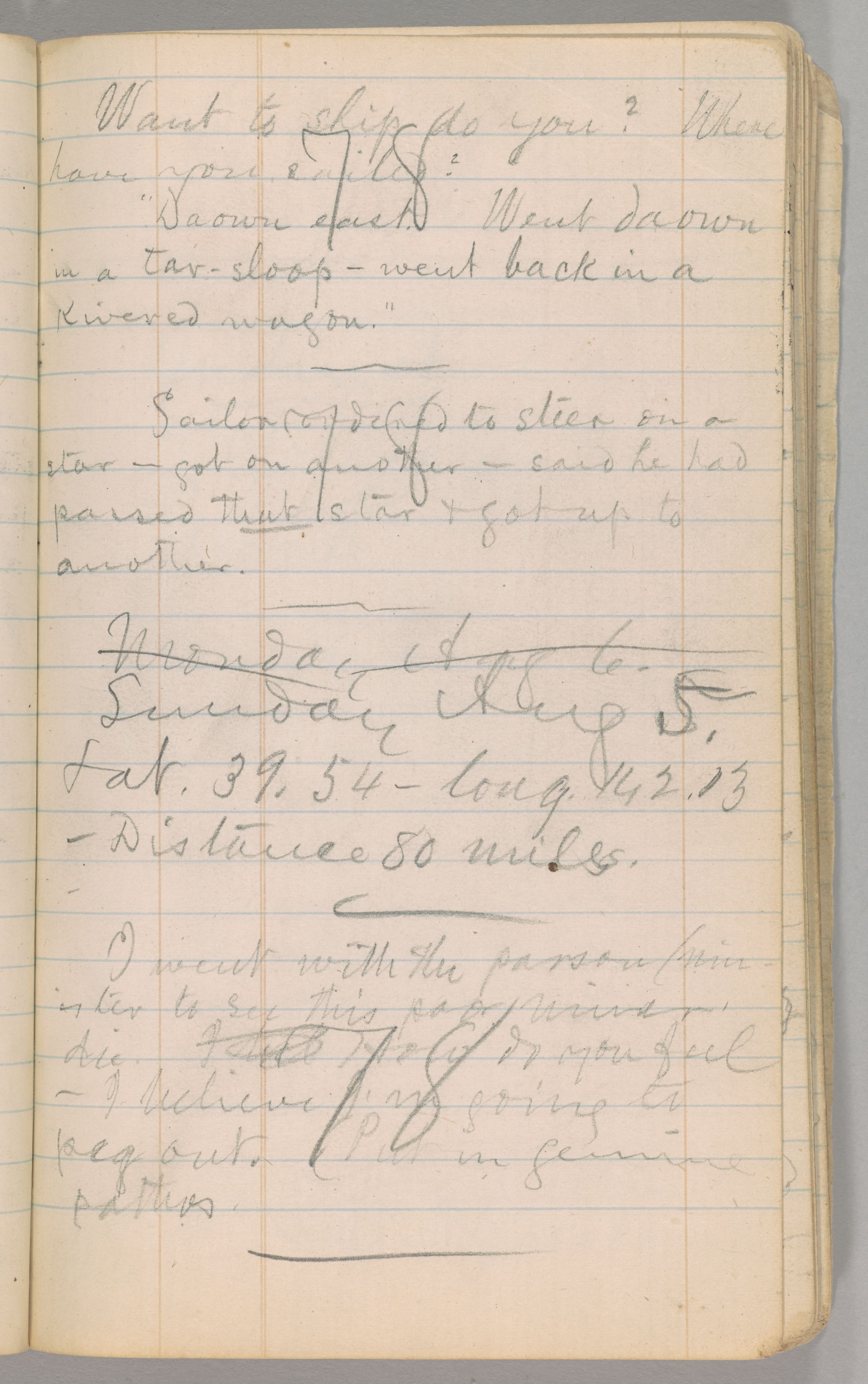
[MS: N05_leaf_063r]
Want to ship do you? Where
have you sailed?
“Daown east. Went daown
in a tar-sloop—went back in a
kivered wagon.”
78
Sailor ordered to steer on a
star—got on another—said he had
passed that star & got up to
another.
78
Monday, Aug 6.
Sunday Aug 5.
Lat. 39.54—long. 142.13
—Distance 80 miles.
I went with the parson (
min-
ister
minister
to see this poor miner
die. I bel How do you feel
—I believe I'm going to
peg out. (Put in genuine
pathos.143
78
[MTP: N&J1_162]
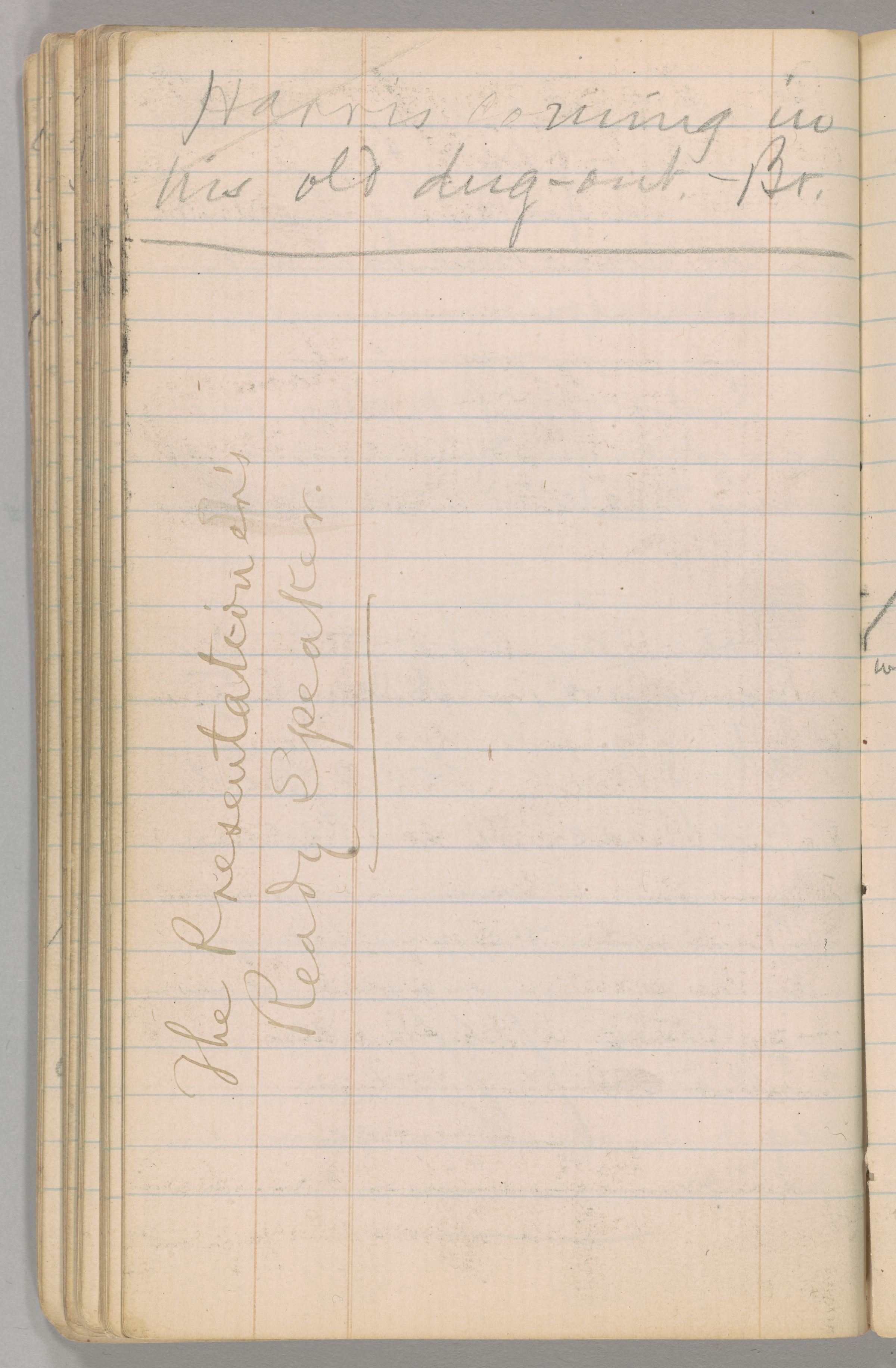
[MS: N05_leaf_063v]
Harris coming in
his old dug-out. —Br.
The Presentationer's Ready Speaker.Ⓣtextual note 144
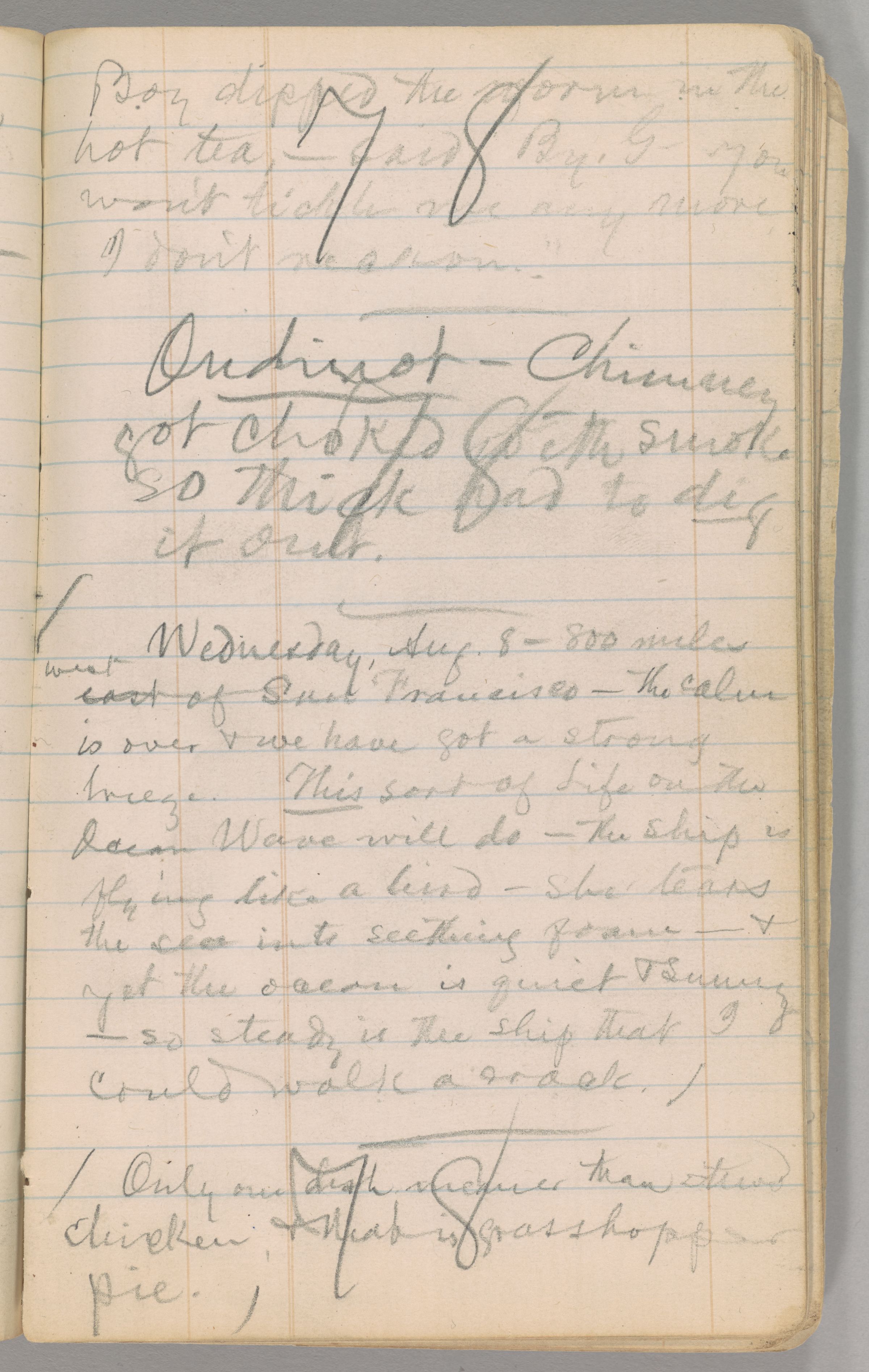
[MS: N05_leaf_064r]
Boy dipped the worm in the
hot tea,—said “By G— you
won't tickle me any more,
I don't reckon.”
78
Oudinot—Chimney
got choked with smoke
so thick had to dig
it out.145
78
Wednesday, Aug. 8—800 miles
east
west
of San Francisco—the calm
is over & we have got a strong
breeze. This sort of Life on the
Ocean Wave will do—the ship is
flying like a bird—she tears
the sea into seething foam—&
yet the ocean is quiet & sunny
—so steady is the ship that I
could walk a crack.
Only one dish meaner than stewed
chicken, & that is grasshopper
pie.
78
[MS: N05_leaf_064v]
blank verso (no page image)
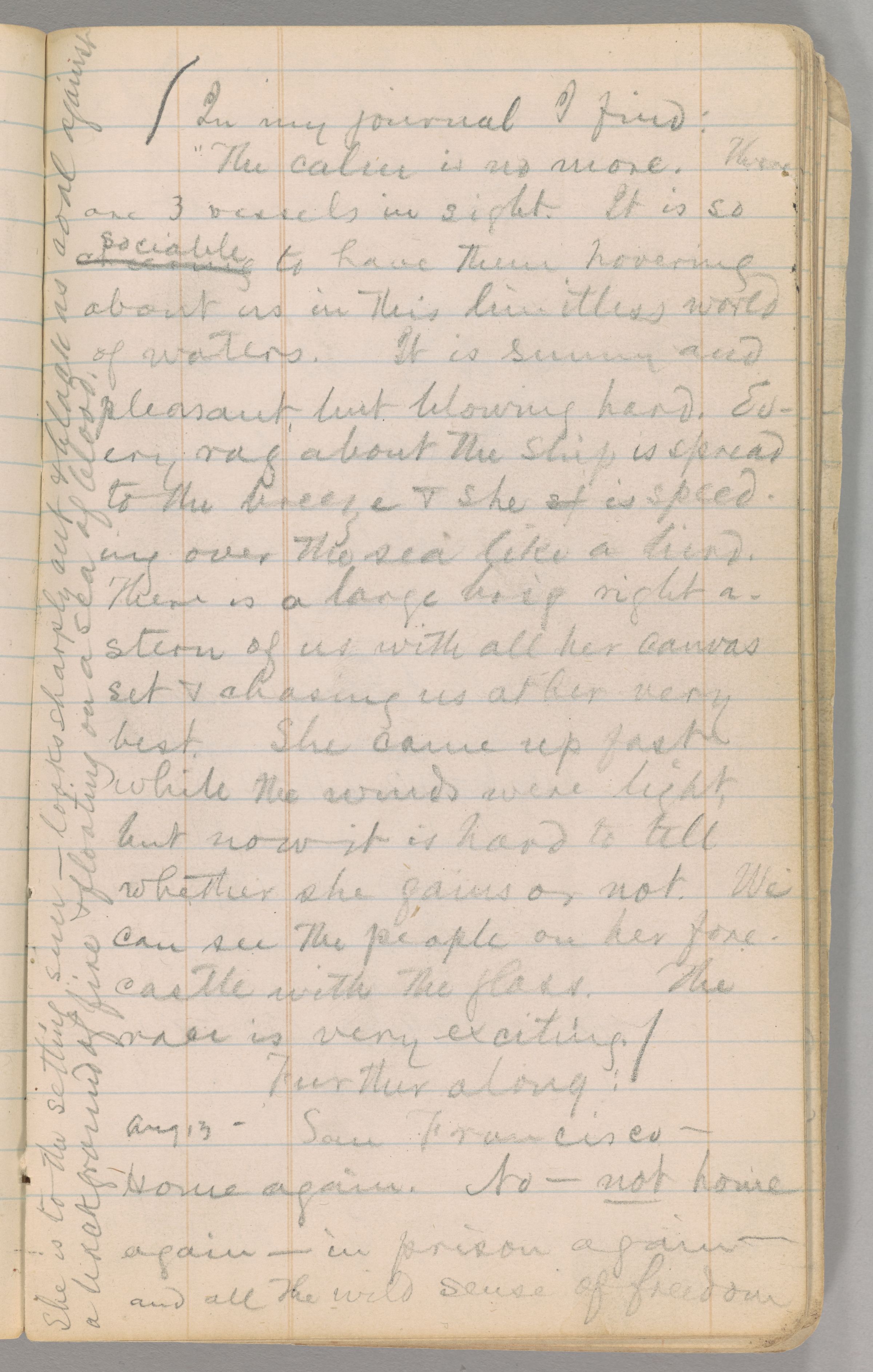
[MS: N05_leaf_065r]
In my journal I find:146
“The calm is no more. There
are 3 vessels in sight. It is so
cheering
sociable
to have them hovering
about us in this limitless world
of waters. It is sunny and
pleasant, but blowing hard.
Ev-
ery
Every
rag about the ship is spread
to the breeze & she sp is
speed-
ing
speeding
over the sea like a bird.
There is a large brig right
a-
stern
astern
Ⓜemendation of us with all her canvas
set & chasing us at her very
best. She came up fast
while the winds were light,
but now it is hard to tell
whether
[MTP: N&J1_163]
she gains or not. We
can see the people on her
fore-
castle
forecastle
Ⓜemendation with the glass. The
race is very exciting.
Further along:
She is to the setting sun—looks sharply cut & black as coal against a background of fire & floating on a sea of blood. Ⓣtextual note
Aug 13Ⓜemendation—San Francisco—
Home again. No—not home
again—in prison again—
and all the wild sense of freedom
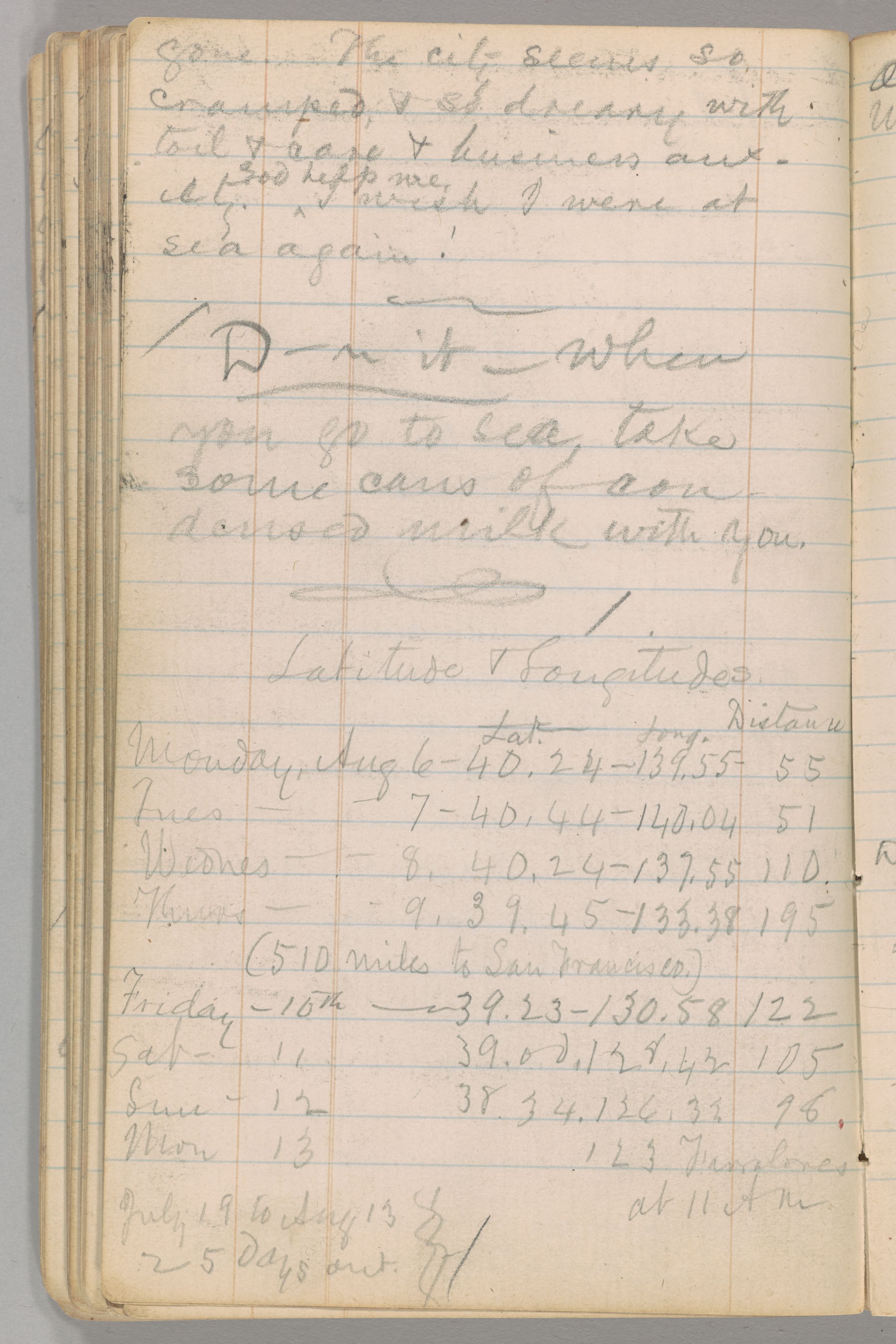
[MS: N05_leaf_065v]
gone. The city seems so
cramped, & so dreary with
toil & care & business
anx-
iety
anxiety
. God help me,
I wish I were at
sea again!147
D—n it—when
you go to sea, take
some cans of
con-
densed
condensed
milk with you.
Latitude & Longitudes.
| Lat. | Long. | Distance | ||
| Monday, | Aug 6 | 40.24 | 139.55 | 55 |
| Tues | 7 | 40.44 | 140.04 | 51 |
| Wednes | 8. | 40.24 | 137.55 | 110 |
| Thurs | 9. | 39.45 | 133.38 | 195 |
(510 miles to San Francisco.)
| Friday | 10th | 39.23 | 130.58 | 122 |
| Sat | 11 | 39.00. | 128.42 | 105 |
| Sun | 12 | 38.34. | 126.33Ⓜemendation | 98 |
| Mon | 13 | 123 | Farralones at 11 AM | |
July 19 to Aug 13
25 days out.Ⓣtextual note
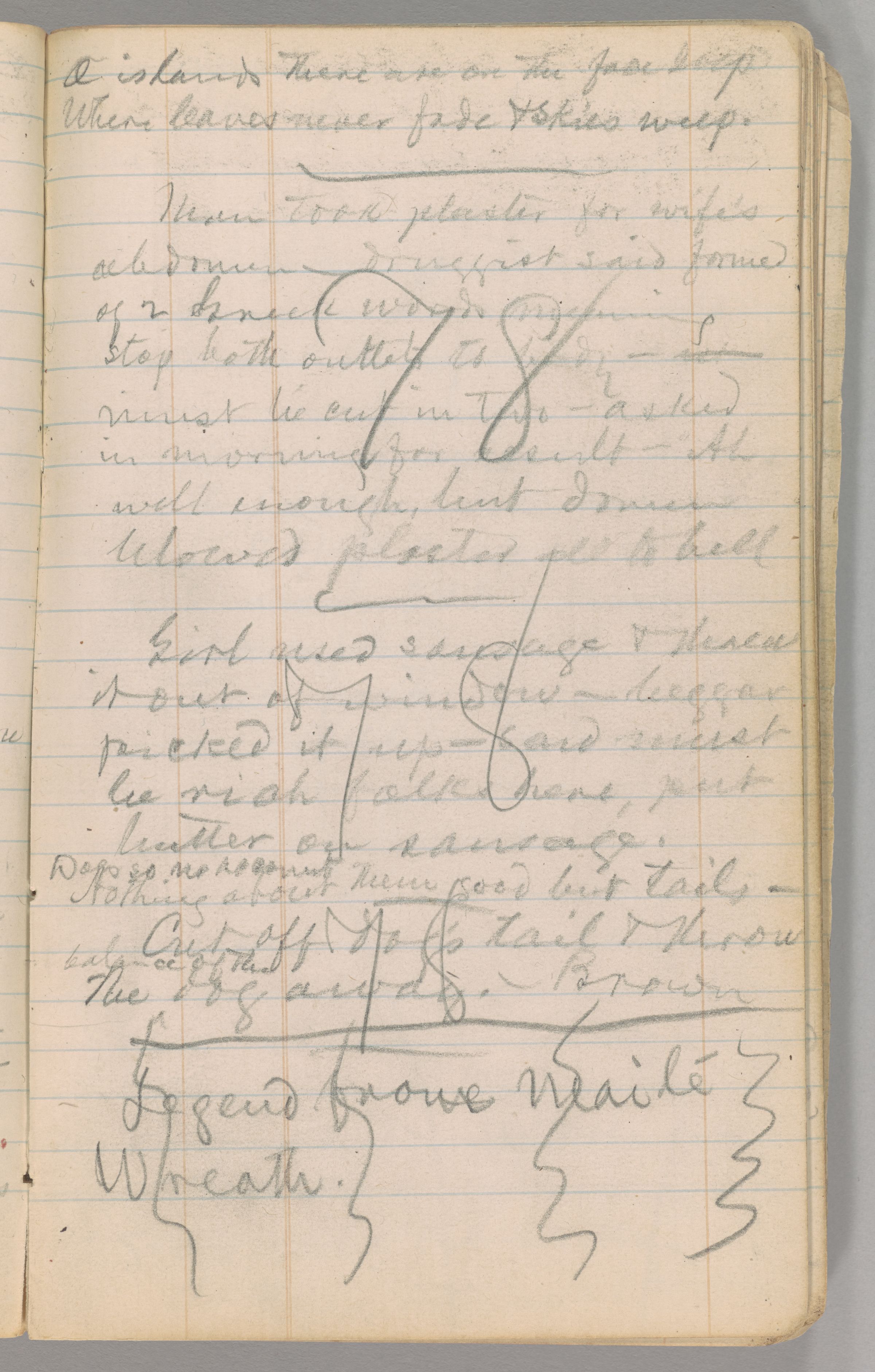
[MS: N05_leaf_066r]
O islands there are on the face deep
Where leaves never fade & skies weep.148
[MTP: N&J1_164]
Man took plaster for wife's
abdomen—druggist said formed
of 2 Greek words, meaning
stop both outlets to body—m
must be cut in two—asked
in morning for result—“Ab
well enough, but domen
blowed plaster all to hell
78
Girl used sausage & threw
it out of window—beggar
picked it up—said must
be rich folks here, put
butter on sausage.
78
Dogs so no account
Nothing about them good but tails—
Cut off dog's tail & throw
the balance of the dog away. —BrownⓉtextual note
78
Legend from Mailé
Wreath.
149
[MS: N05_leaf_066v]
blank verso (no page image)
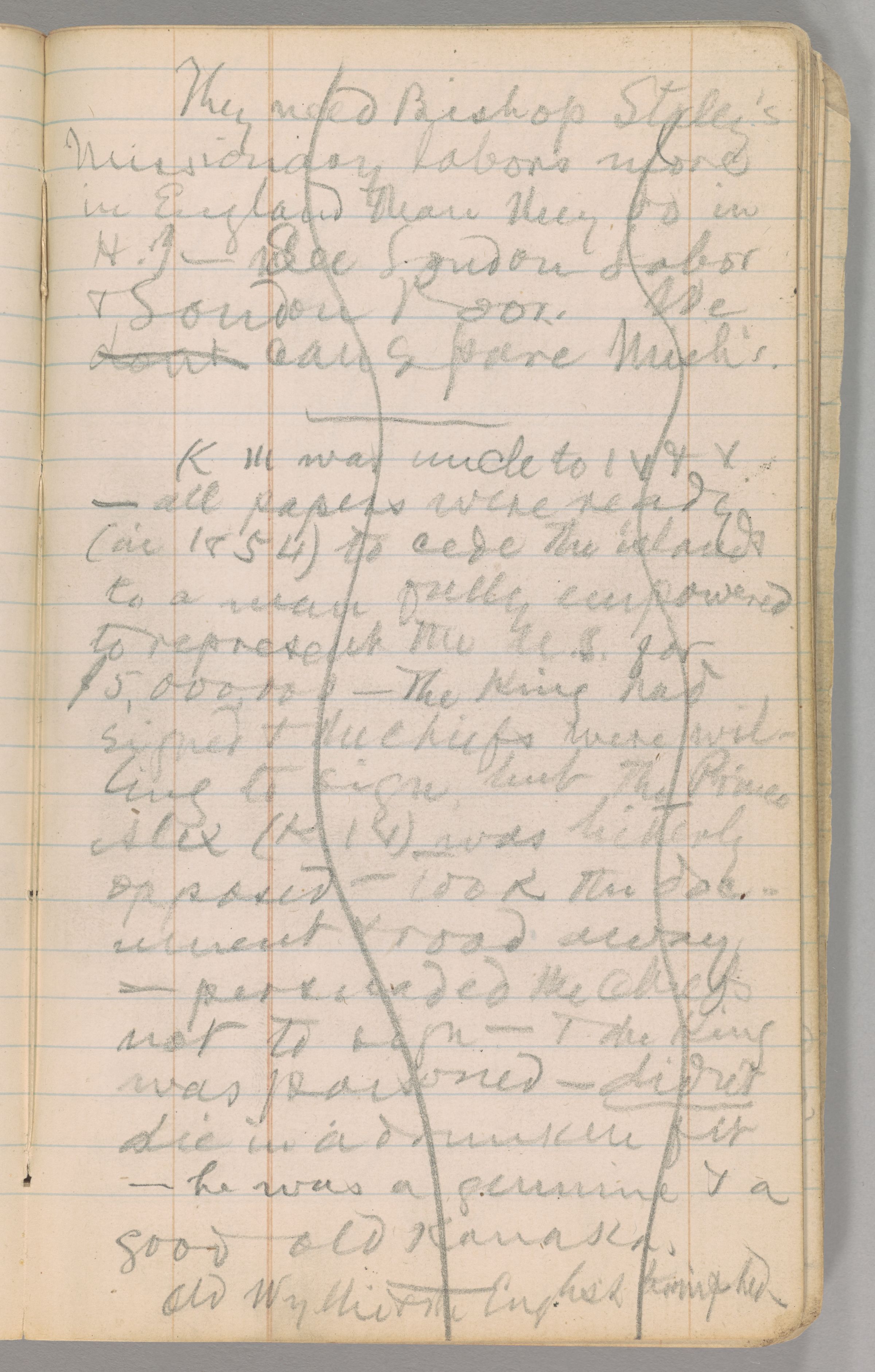
[MS: N05_leaf_067r]
They need Bishop Staley's
Missionary labors more
in England than they do in
H.I—n See London Labor
& London Poor.150 We
dont can spare Mish's.
K III was uncle to IV & V
—all papers were ready
(in 1854) to cede the islands
to a man fully empowered
to represent the U.S. for
$5,000,000—the King had
signed & the chiefs were
wil-
ling
willing
to sign, but the Prince
Alex (K IV) was bitterly
opposed—took the
doc-
ument
document
& road away
—persuaded the chiefs
not to sign—& the King
was poisoned—didn't
die in a drunken fit
—he was a genuine & a
good old Kanaka.151
[MTP: N&J1_165]
Old Wyllie & the English triumphed.152
[MS: N05_leaf_067v]
blank verso (no page image)
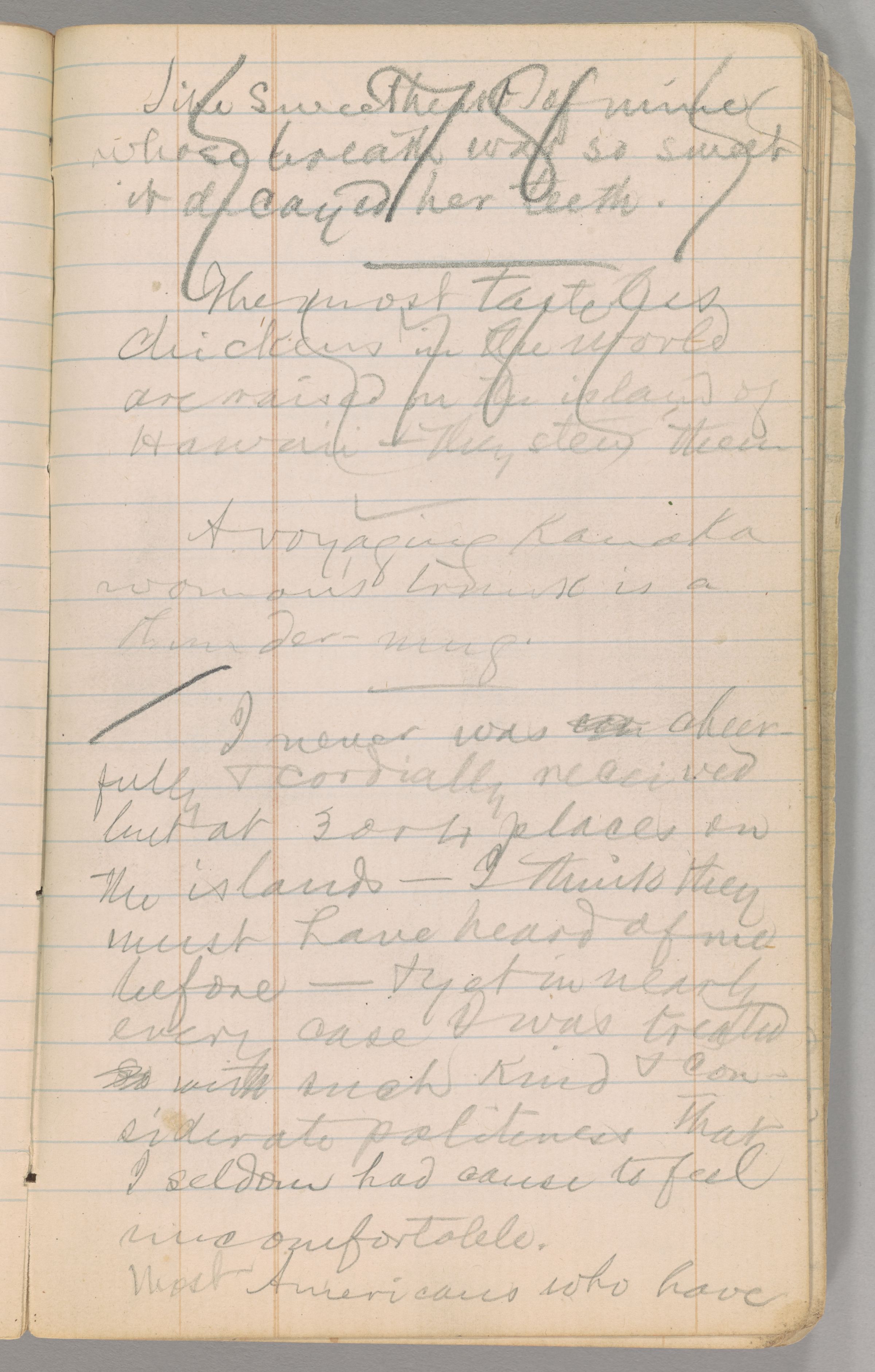
[MS: N05_leaf_068r]
Like sweetheart of mine
whose breath was so sweet
it decayed her teeth.
78
The most tasteless
chickens in the world
are raised on the island
of Hawaii—they stew them
78
A voyaging Kanaka
woman's trunk is a
thunder-mug.
I never was cor
cheer-
fully
cheerfully
& cordially received
but at 3 or 4 places on
the islands—I think they
must have heard of me
before—& yet in nearly
every case I was treated
so with such kind &
con-
siderate
considerate
politeness that
I seldom had cause to feel
uncomfortable.
Most Americans who have
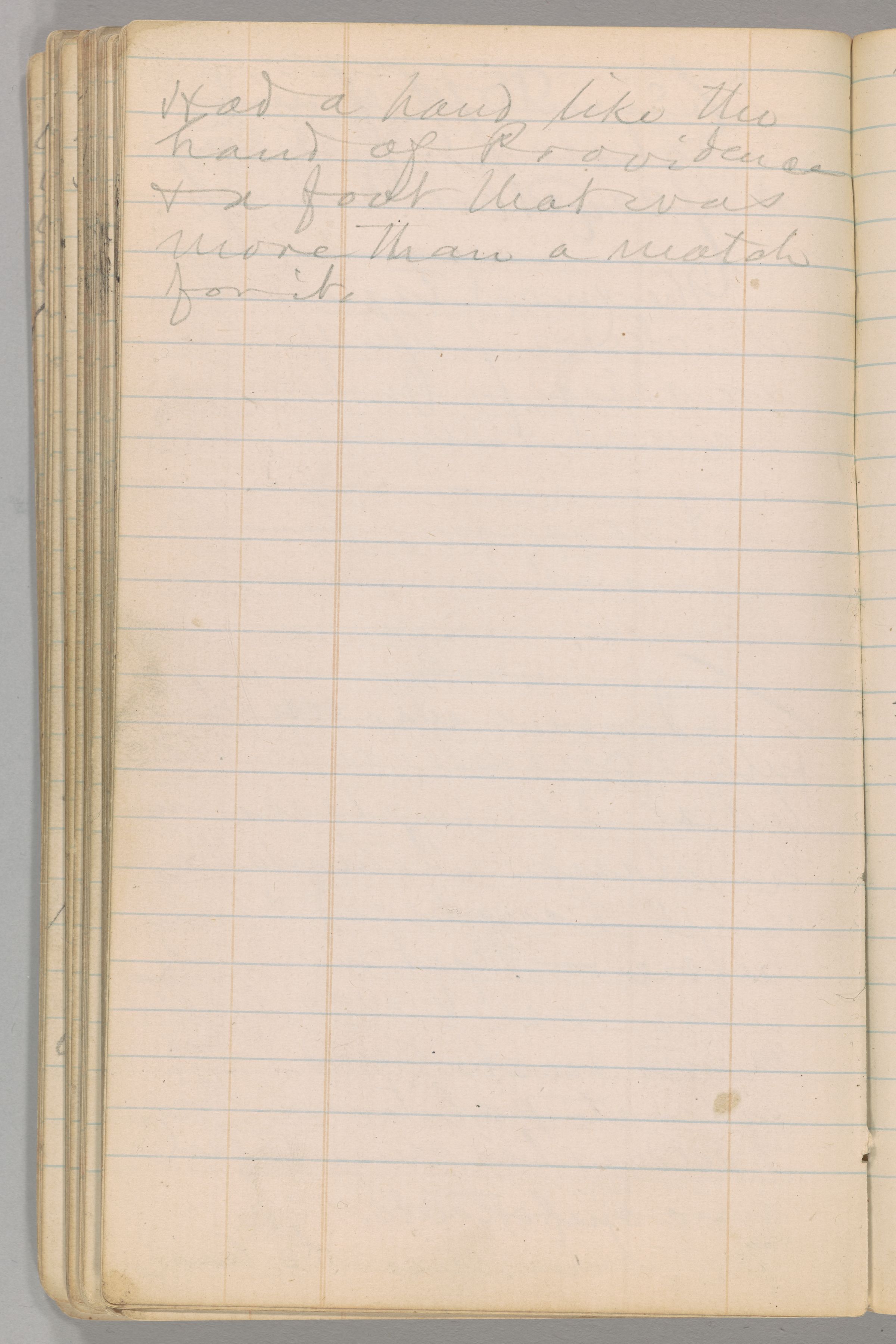
[MS: N05_leaf_068v]
this page is not continuous with the preceding or following leaves
Had a hand like the
hand of Providence
& a foot that was
more than a match
for it.
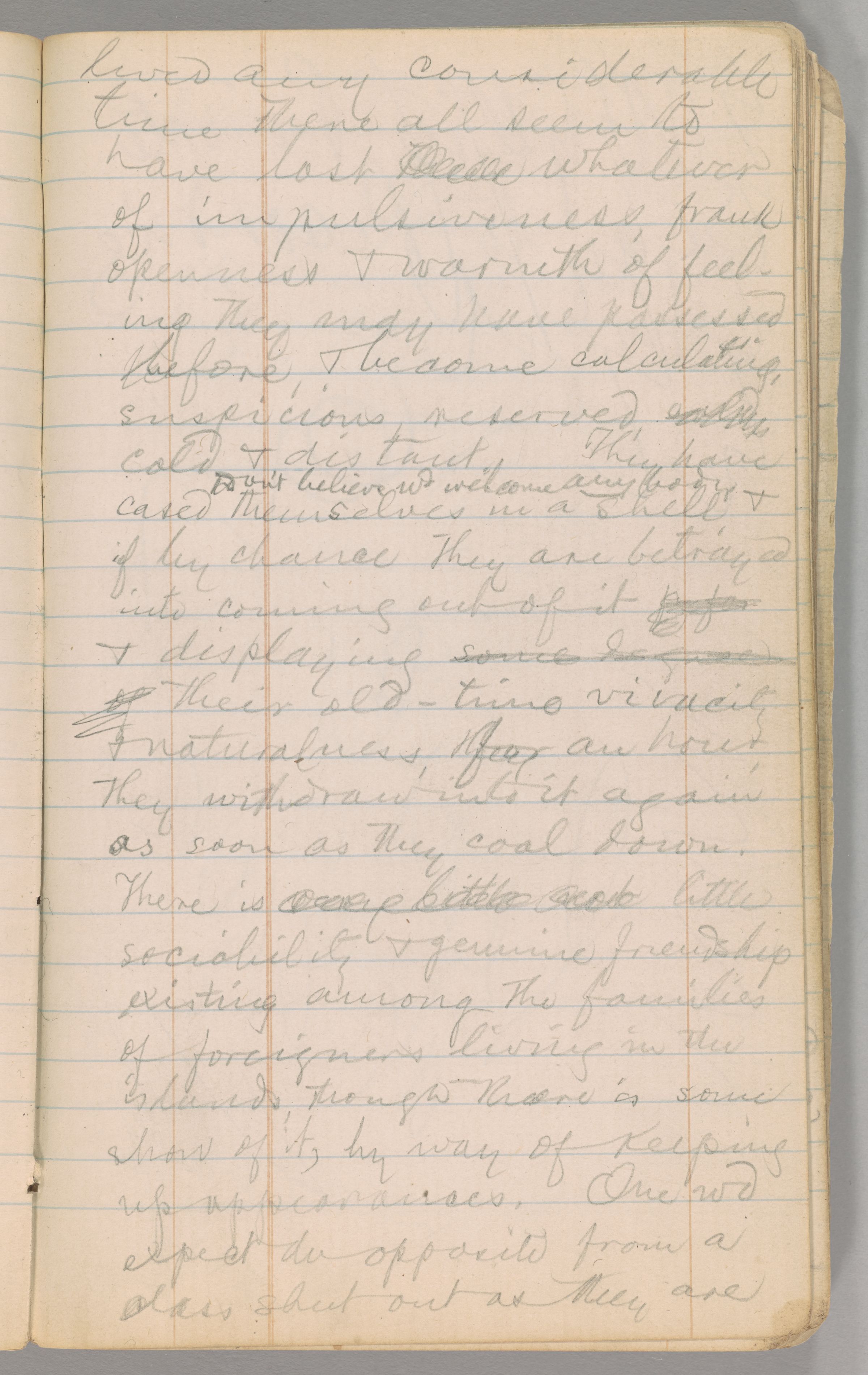
[MS: N05_leaf_069r] lived any considerable
time there all seem to
have lost their whatever
of impulsiveness, frank
openness & warmth of feel-
ing feeling they may have possessed
before, & become calculating,
suspicious, reserved, cold,
cold & distant. Don't believe wd welcome anybody. Ⓣtextual note They have
cased themselves in a shell, &
if by chance they are betrayed
into coming out of it f for
& displaying some degree
of their old-time vivacity
& naturalness, they for an hour,
they withdraw into it again
as soon as they cool down.
There is very little not little
sociability & genuine friendship
existing among the families
of foreigners living in the
islands, though there is some
show of it, by way of keeping
up appearances. One wd
expect the opposite from a
class shut out as they are
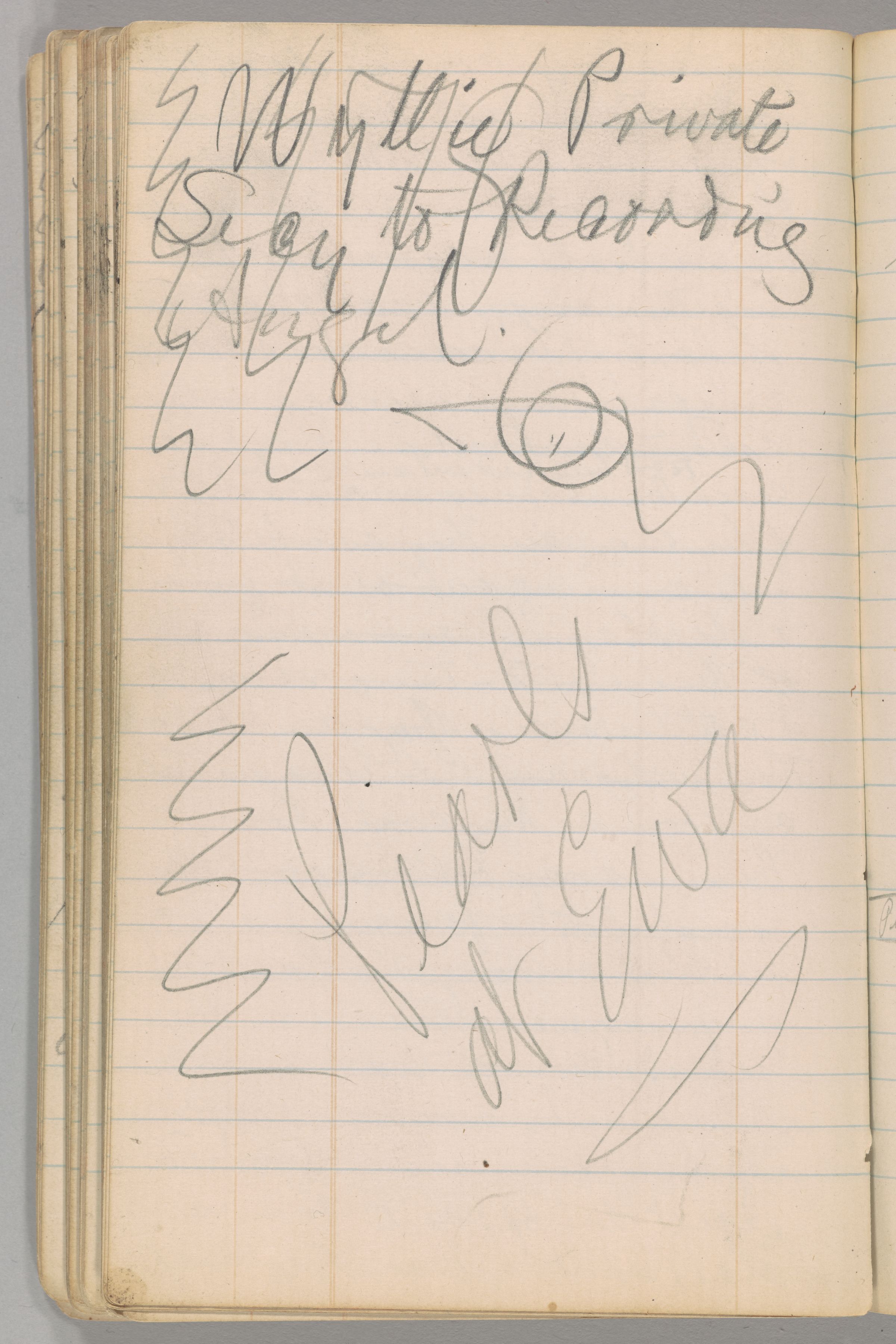
[MS: N05_leaf_069v]
this page is not continuous with the preceding or following leaves
Wyllie Private
Secy to Recording
Angel.155
78
Pearls
at Ewa
Ⓣtextual note
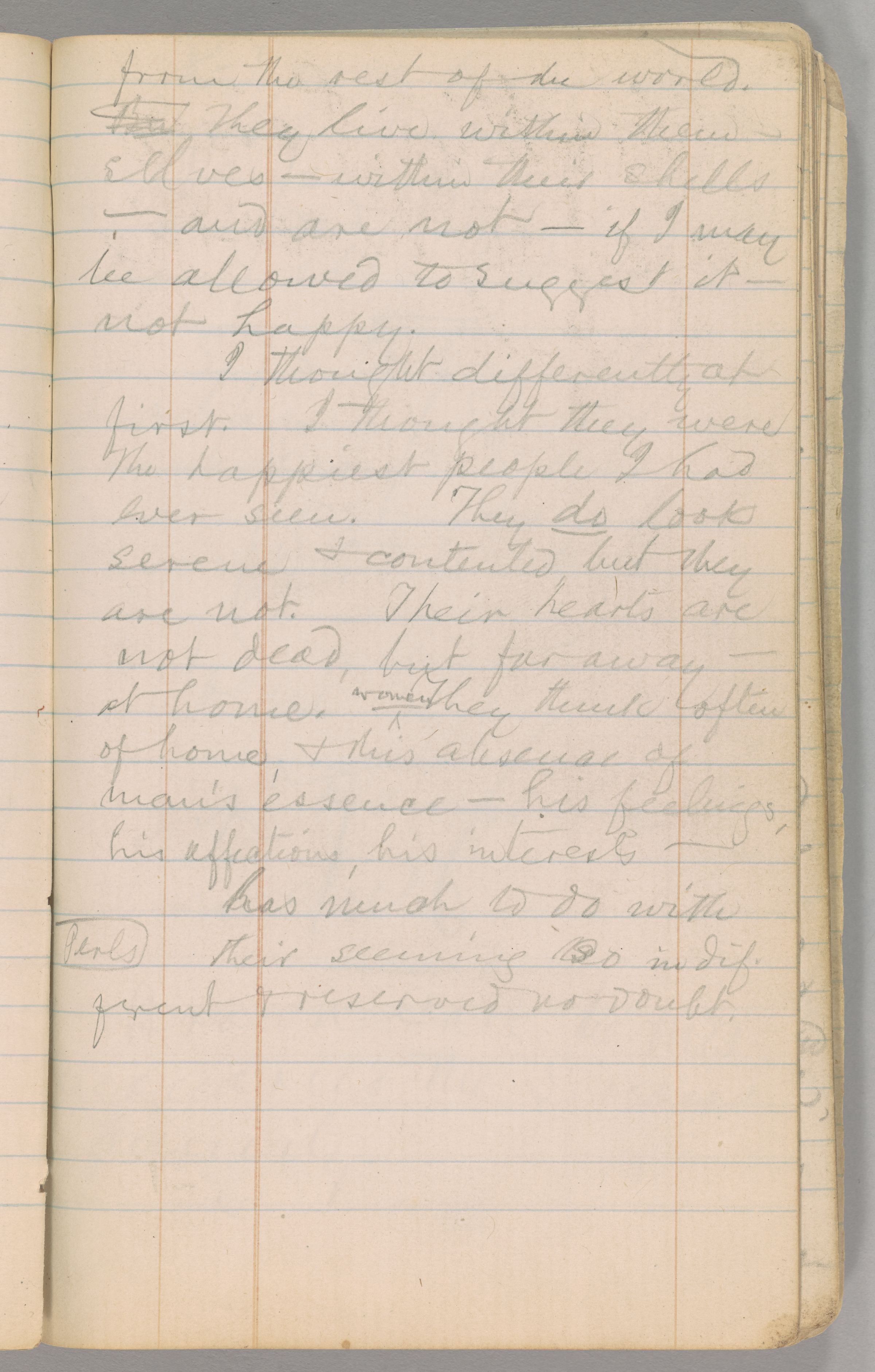
[MS: N05_leaf_070r] from the rest of the world. Bu They live within themselves—within their shells—and are not—if I may be allowed to suggest it—not happy.
I thought differently at first. I thought they were the happiest
[MTP: N&J1_166]
people I had ever seen. They do look serene & contented, but they are not. Their hearts are not dead, but far away—at
home.
women
153 They think often of home, & this absence of man's essence—his feelings, his affections, his
interests—has much to do with their seeming t[-]o so indifferent & reserved no doubt.
PerlsⓉtextual note 154
[MS: N05_leaf_070v]
blank verso (no page image)
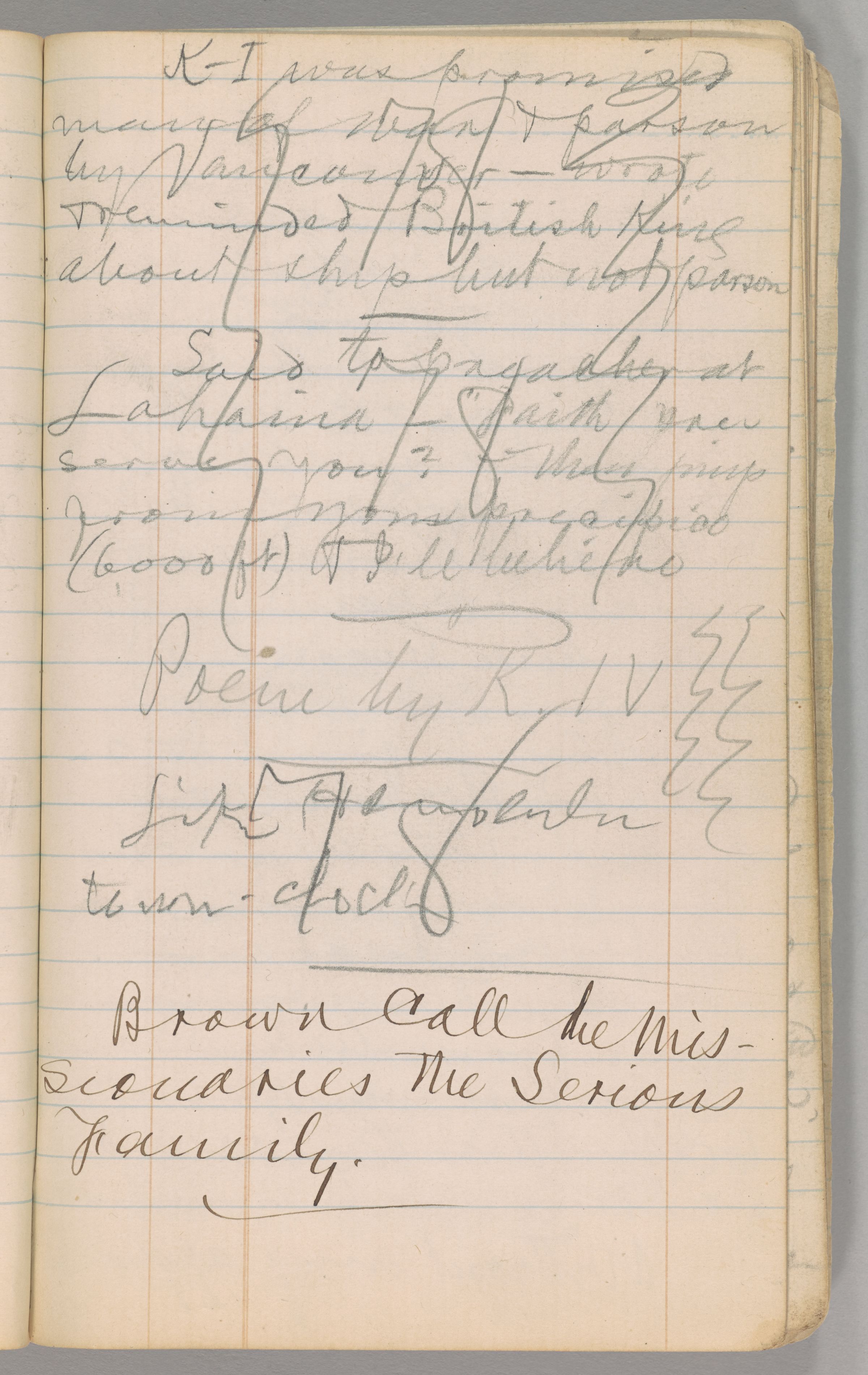
[MS: N05_leaf_071r]
K-I was promised
man of war & parson
by Vancouver—wrote
& reminded British King
about ship but not parson156
78
Said to preacher at
Lahaina—“Faith
pre-
serve
preserve
you?—Then jump
from yon precipice
(6,000 ft) & I'll believe157
78
Poem by K.IV
Like Honolulu
town-clock
78
in ink
Brown call the
Mis-
sionaries
Missionaries
the Serious
Family.Ⓣtextual note
158
[MTP: N&J1_167]
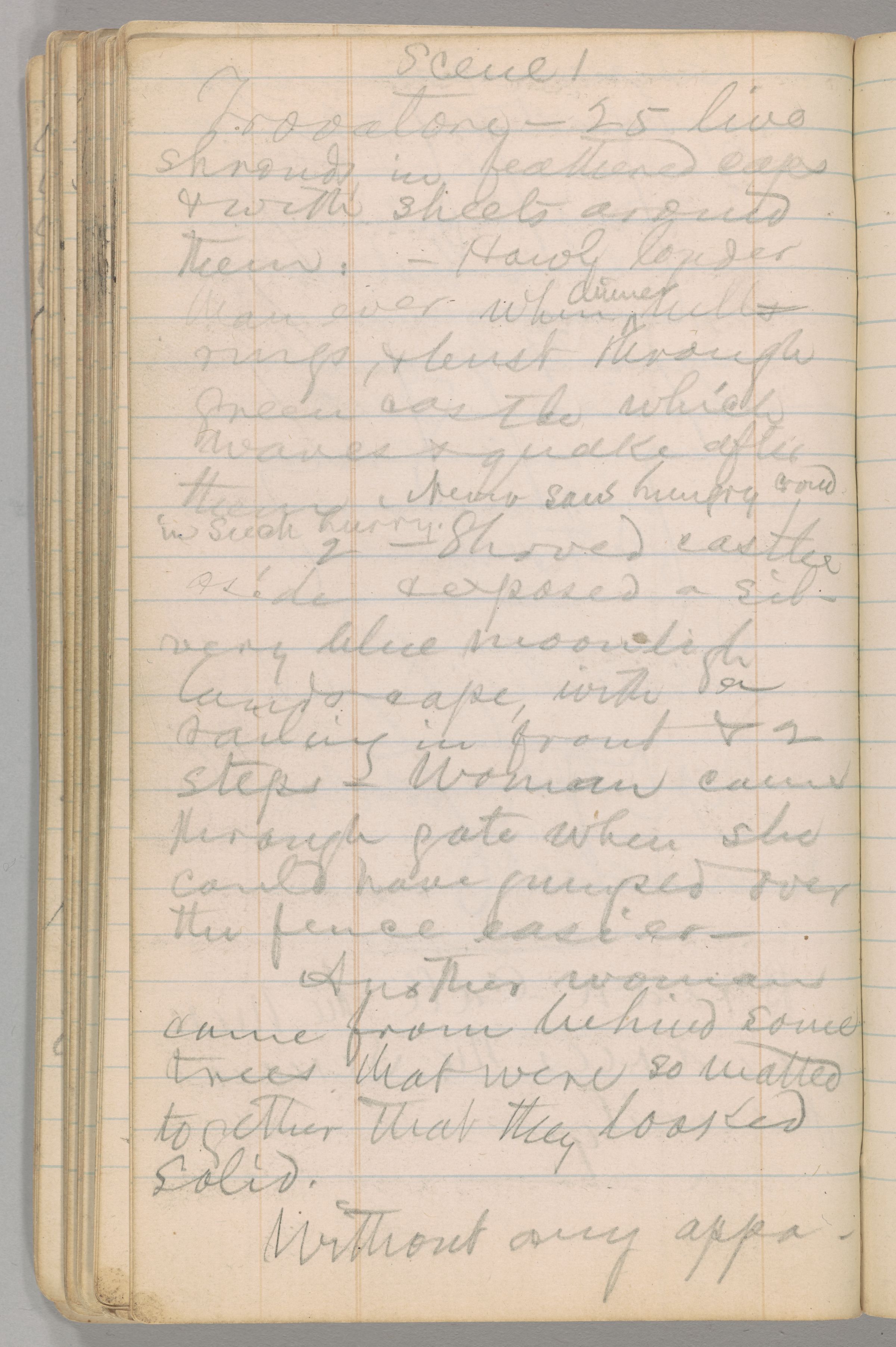
[MS: N05_leaf_071v]
Scene 1159
Trovatore—25 live
shrouds, in feathered caps
& with sheets around
them. —Howl louder
than ever when dinner bells
rings, & bust through
green castle which
waves & quake after
them. Never saw hungry crowd
in such hurry.
2—Shoved castlee
aside & exposed a
sil-
very
silvery
blue moonligh landscape, with a
railing in front & 2
steps—Woman came
through gate when she
could have jumped over
the fence easier—
Another woman
came from behind some
trees that were so matted
together that they looked
solid.
Without any appa-
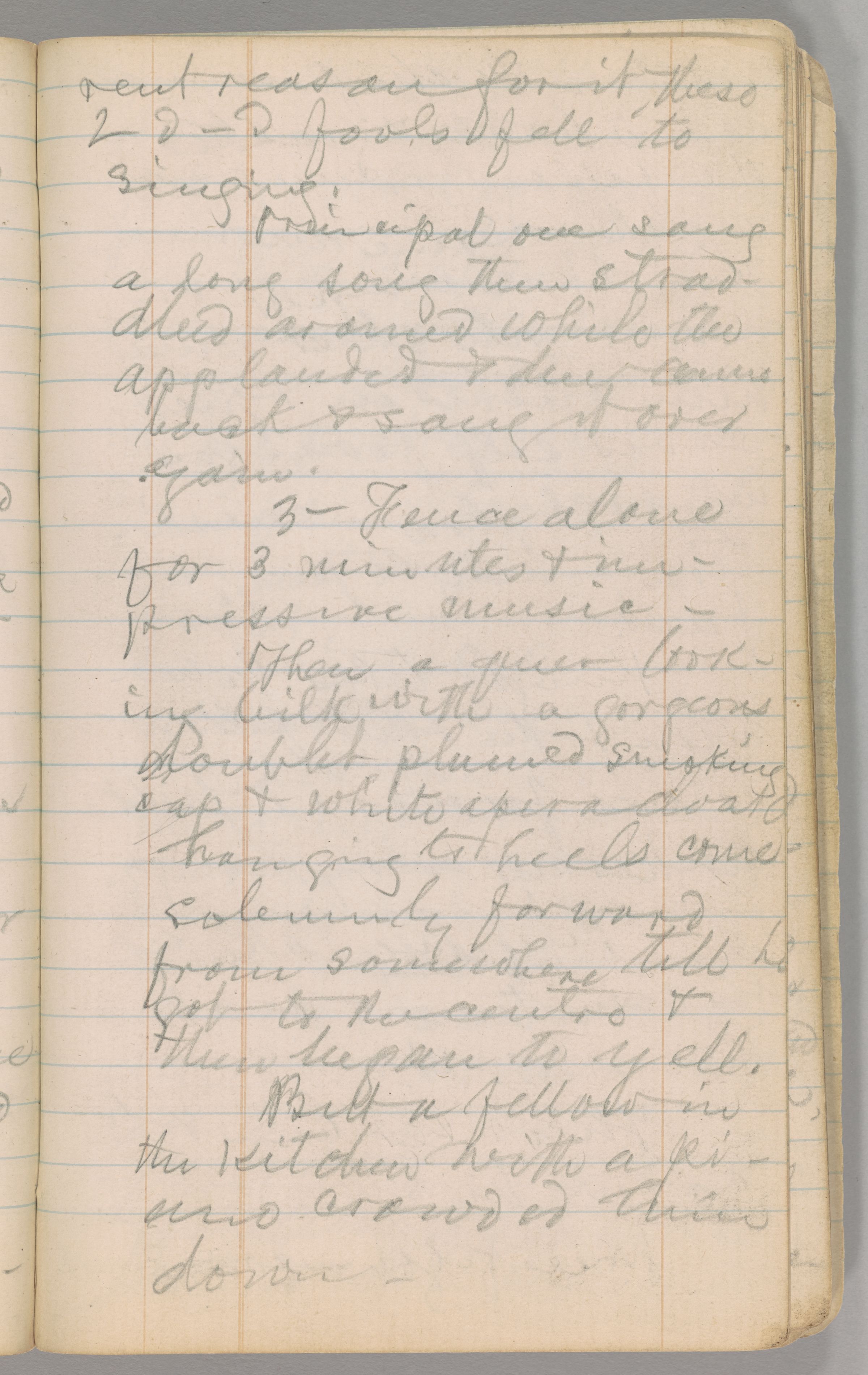
[MS: N05_leaf_072r]
rent reason for it, these
2 d—d fools fell to
singing.
Principal one sang
a long song then
strad-
leed
straddleed
around while the
applauded & then came
back & sang it over
again.
3—Fence alone
for 3 minutes &
im-
pressive
impressive
music—
Then a queer
look-
ing
looking
bilk with a gorgeous
doublet, plumed smoking
cap & white opera cloak
hanging to heels come
solemnly forward
from somewhere till he
got to the centre &
then began to yell.
But a fellow in
the kitchen with a
pi-
ano
piano
crowded him
down—
[MS: N05_leaf_072v]
Then the chief woman
came back & grabbed
the fellow round the
neck—Same moment
knight in complet
ar-
mor
armor
& with sheet round
him rushes in & just
saves self from going
into orchestra—
sensa-
tion
sensation
—hell to pay, in
fact.
Knight takes the
wo-
man
woman
& the other fellow
comes forward & just
wakes up everything.
They
n
Ⓣtextual note
they take up
his own tune & beat
him at it.
[MTP: N&J1_168]
This riles him & he
draws his sword
Free fight—woman
[MS: N05_leaf_073r]
trying to stop it—false
alarm—after singing
& flourishing swords
they rush off & the
woman falls carefully
down on the steps
blow-
ing
blowing
the dust away from
the spot where his
er
Ⓣtextual note
el-
bow
elbow
is going to touch
first.
2d Act.
Excellent
edingly
Ⓣtextual note gay party
of blacksmiths started
in to improve a very
good sort of a poker
& didn't succeed—sung
to much & didn't work.
That same knight
came into the blacksmith
shop with another woman
—(you let him alone
for always find being
around when there is a
[MS: N05_leaf_073v]
woman to tag after
The women sang a
good while, & then the d—d
blacksmiths blasted
away & tried to beat her.
Then made a fizzle of
it & knew enough to
curl their tails & leave
Thus the knight & the
woman were left in
sole possession of the
blacksmith shop, but
without anything to
eat. This As usual,
with the cheerful spirit
this party have
mani-
fested
manifested
from the first
as soon as they found
there was nothing to eat
then fell to singing.
And as usual,
they hadn't sung five
minutes till there
was a misunderstandg
The woman carries
[MS: N05_leaf_074r]
on dreadfully & the man
stands & leans forward
holding his blanket
out out with outspread
hands & looking as if
he would help, if he
could only think of
something that would
to do.
Finally she lets
down on a bass viol
box covered with bear
skins, & he comes to
his milk. They stand
up & come to a
musi-
cal
musical
explanation
This knight looks so
stuffed & fat in his silver
scale armor that he looked
like some sort of a fish,
They have a long
explanan & rush off
in high glee about
some-
thing
something
.
[MTP: N&J1_169]
[MS: N05_leaf_074v]
2—The boss of the
corpses & that plumed
fellow came out in the
dark before that a
castle-gate to sing—
to serenade, likely.
But they made so
Then the to practice,
likely—the d—d fools
—& the blacksmith
shop s must be close
by somewhere.
The Capt of soon
froze out & left, but
the other fellow blasted
away by himself.
At 2 oclock by
the bell the Capt came
back—& of course
those hungry ghosts piled in
too, the moment they
heard that dinner
bell. But that plumed
fellow fooled them for he
kept singing there till they
were about starved out—
[MS: N05_leaf_075r]
& then they left.
Serenading party
heard in the woods—
stage vacant—music
beautiful—church
music & a fine choir
—it brought back the
feathered chap & the
ghosts & the Capt.—&
d—n them they went
to blatting & interrupted
the choir—choked
it off & then left.
Five minutes of
sol-
emn
solemn
horn tooting in the
orchestra—& then out
comes a party of white
dressed young women
out of the wood (2½ AM)
—one with a great black
cross clasped to her
breast—& she stood
out & begun to sing.
In comes those
fel-
lows
fellows
& the ghosts &
[MS: N05_leaf_075v]
& surprises & scares
them—but the bold
knight rushes in
—of course—being so many women—
from where the fence
corner used to be, &
grabbed the X woman
& she was all right,
Then they stand off
in two parties & sing.
◊ I thoughtⓂemendation the knight
was in for it once—
he didn't know any
more than to insult
the wohole crowd &
he unarmed & 20
defenceless women
to take care of—
had ◊ him in the door.
Drew sword but didn't
kill him.
Arrval of 2 dozen
ratty looking soldiers
with brass helmets,
coats with trunk tacks
driven into them &
broom-
stick
broomstick
Ⓜemendation lances—directly
[MS: N05_leaf_076r]
the knight grabbed the
wom X, drew his sword
& tried to shove—the
corpses tried to
pre-
vent
prevent
him, but the
Soldiers took his part
& so they struck a
blow apiece & then
brought their kept
up a desultory sort
of hacking here &
there till the curtain
fell—he holding
his sword in a
warding position &
clasping fainting X.
Act. 3
Very handsome silk
tent with splendid gold
embroidered banner
[MTP: N&J1_170]
hanging at the door—row
of other tents in distance
—all those ghosts in a
row armed with swords
& singing—for hash,
of course—I've got
[MS: N05_leaf_076v]
them spotted—they are
expecting to hear
that bell every moment.
They leave & the
fea-
thered
feathered
chap comes out of
the tent & goes to
swell-
ing
swelling
around & singing
—which disturbs the
Capt of the Ghosts &
he comes out of the
tent to remonstrate
Then the ghosts fetch
in the fat woman
man-
acled
manacled
.—& yowlingⓂemendation as usual
—the great overgrown
scrubs, to impose on a
woman. Sentinels
—trunk-button fellows
—pacing before the tents
Sing awhile & the woman
tries to break away—
d—d fool—they've got
her in the door. Then don't
she throw herself! They
[MS: N05_leaf_077r]
argue the ch case with her
but no use—she'll be
d—d if she will be
satisfied, & keeps
try-
ing
trying
to get away—so
they took her away
—she'sⓂemendation evidently
breeding trouble for
herself the way she
is acting.
TScene—2—That
knight—with that X
woman come into a
mighty common looking
country hotel & go to
making love. She
is dressed in white
satin trimmed with
silver lace & she has
got his bulliest opera
cloak on over his
armor. He sends
her off the stage.
He has lost his
hat somewhere &
[MS: N05_leaf_077v]
he comes down to the
footlight & sings about
it in a way that shows
he considered
put
set
con-
siderable
considerable
store by it.
He went off finally
to hunt for his hat,
& in the meantime the
curtain came down.
I went down to
offer him mine, but
they wouldn't let me
behind.
Act 4—
That old original green
castle—night.
Enter a conspirator
with red rosettes on his
slippers & a black
table-
cloth
table-cloth
Ⓜemendation on—with a woman
in black—(he leaves)
she falls to
serenading, all by
her-
self
herself
—
(Letter KanakaⓉtextual note
[MS: N05_leaf_078r]
Opposition serenade
in the woods—all men's
voices—very solemn
state-
ly
stately
& impressive—she had
the good taste to dry up
her screech while they sang,
because it stood to reason
that she couldn't hold keep
up her end with them—
Then a fellow in the
woods went alone on a
csong about Leonore, &
she started in to beat him,
thinking she had caught
him
[MTP: N&J1_171]
alone & had an
easy thing, but the
others broke in at
once & helped him
out. Grand—that
chorus—inexprribly
grand—she woulndⓉtextual note up
the whole thing herself, tho'
[MS: N05_leaf_078v]
with a final screech
—woman like, sh
would have the last
word. And then
she took up her
sere-
nade
serenade
& b blatted away
till sh had had her
sing out, & left.
Then the feathered
chap came out of a
neighboring house &
with a soldier—sent
him somewhere &
went to sloshing around
& singing till he came
back.
His first blast
fetched that same
wo-
man
woman
back—for
she hadn't got far
—& they two sang
—she appeared to be
[MS: N05_leaf_079r]
wanting to make
up with him—but
he appeared to be
telling her how
cir-
cumstances
circumstances
over
which he had no
control rendered
it entirely out of his
power to accede.
She even knelt to him.
Finally she
hap-
pened
happened
to sing something
he knew or it happened
to strike his fancy, &
he came right back &
made up with her—
it was a song he
knew, for he sailed
in & helped her sing it.
2—They shoved
the castle aside—&
showed the fat woman
[MS: N05_leaf_079v]
sitting on that viol
box in a dungeon—
chained, & only one
poor oil lamp over
her head while there
were hundreds of gas
burners all over the
theatres—but hell—
people never help an
unfortunate—if she
was in luck & wanted
gas she could get it.
The knight was with
her.—Ⓣtextual notealways around
where there is a woman
—if that fat woman
were in hell you could
look for him there
shortly.
Then they sang
beau-
tifully
beautifully
& feelingly to
pathetic accompaniment.
[MS: N05_leaf_080r]
Then she laid down
on the viol case & he
knelt—
Enter the X woman
& a soldier with a torch
&
th
slam
threwⓉtextual note herself
into the knight's arms
He argues with her—
evidently don't like to
have her there—thinks
the fat woman won't
like it no doubt—
but it appears to be
all right—she is
asleep—but if they
keep up that d—d
yelling they are bound
to wake her presently.
She sings in her
sleep, poor devil—(the
fat one,) & they help
her out—beautiful.
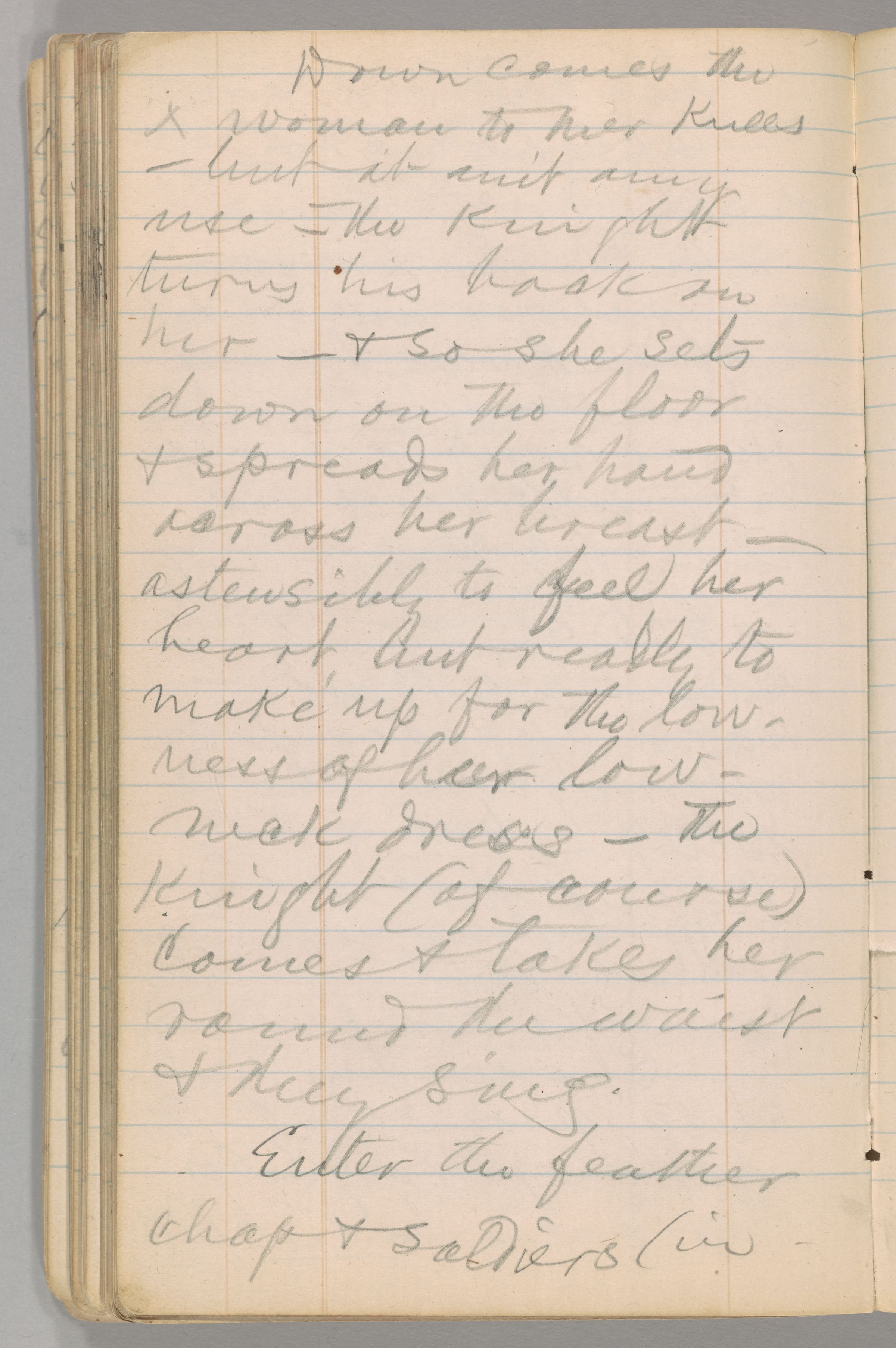
[MS: N05_leaf_080v]
Down comes the
X woman to her knees
—but it ain't any
use—the knight
turns his back on
her—& so she sets
down on the floor
& spreads her hand
across her breast—
ostensibly to c feel her
[MTP: N&J1_172]
heart, but really to
make up for the
low-
ness
lowness
of her
low-
neck
low-neck
Ⓜemendation dress—the
knight (of course)
comes & takes her
round the waist
& they sing.
Enter the feather
chap & soldiers (in
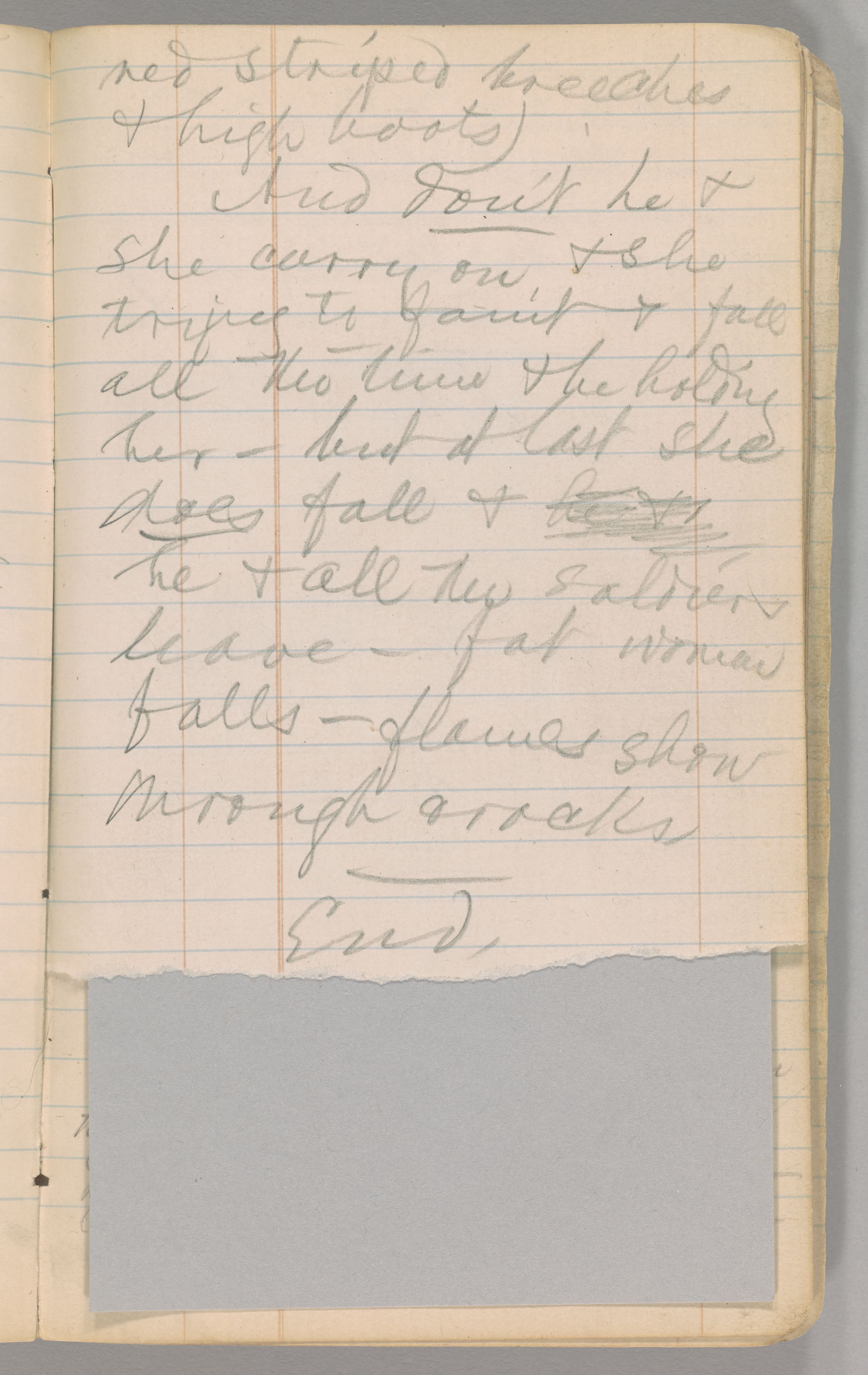
[MS: N05_leaf_081r]
red striped breeches
& high boots)
And don't he &
she carry on, & she
trying to faint & fall
all the time & he holding
her—but at last she
does fall & he &
he & all the soldiers
leave—fat woman
falls—flames show
through cracks.
End.Ⓣtextual note
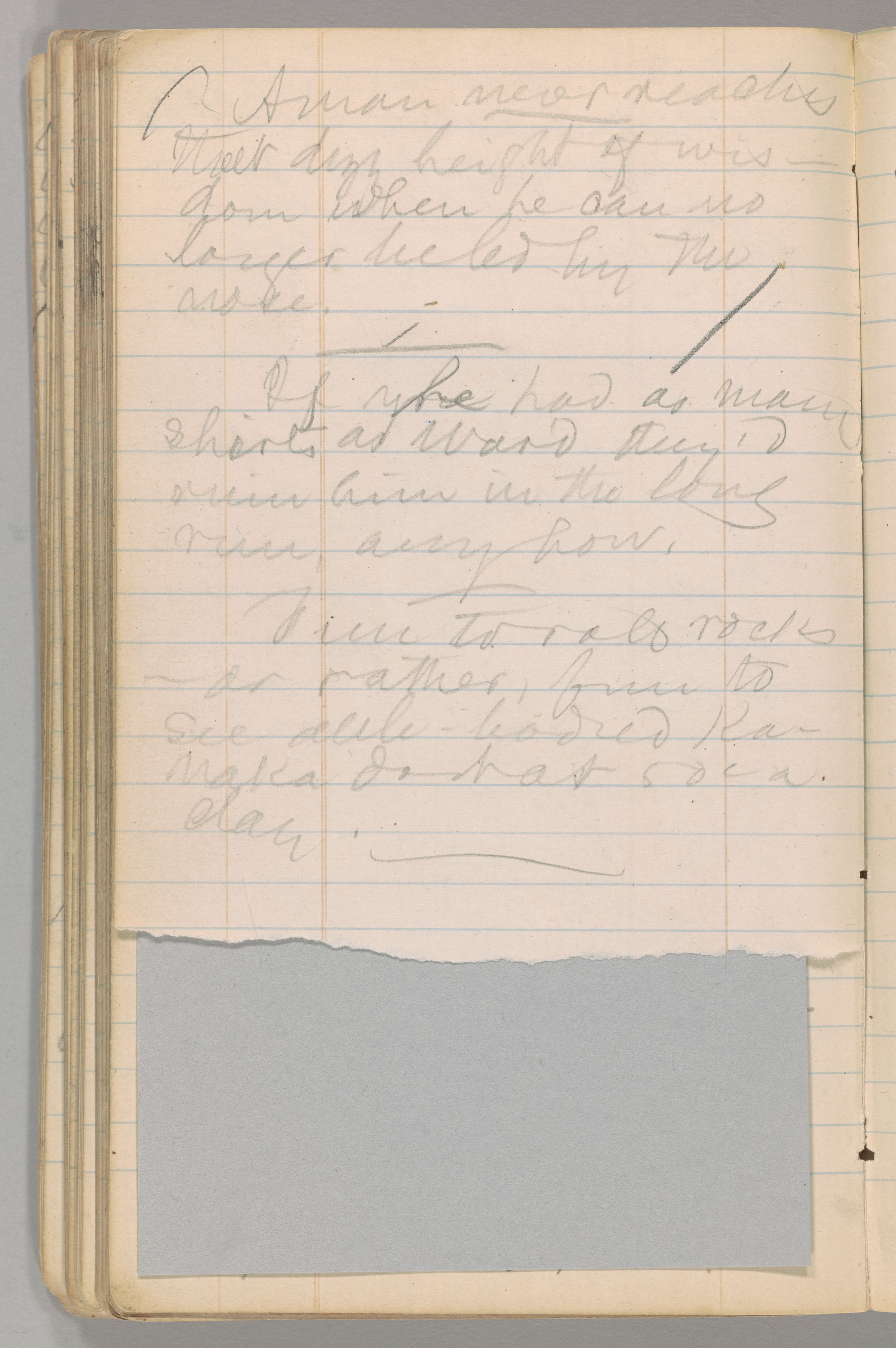
[MS: N05_leaf_081v]
A man nevr reaches
that dizzy height of
wis-
dom
wisdom
when he can no
longer be led by the
nose.
If you
he had as many
shirts as Ward they'd
ruin him in the long
run, anyhow.160
Fun to roll rocks
—or rather, fun to
see able-bodied
Ka-
naka
Kanaka
do it at 50c a
day.
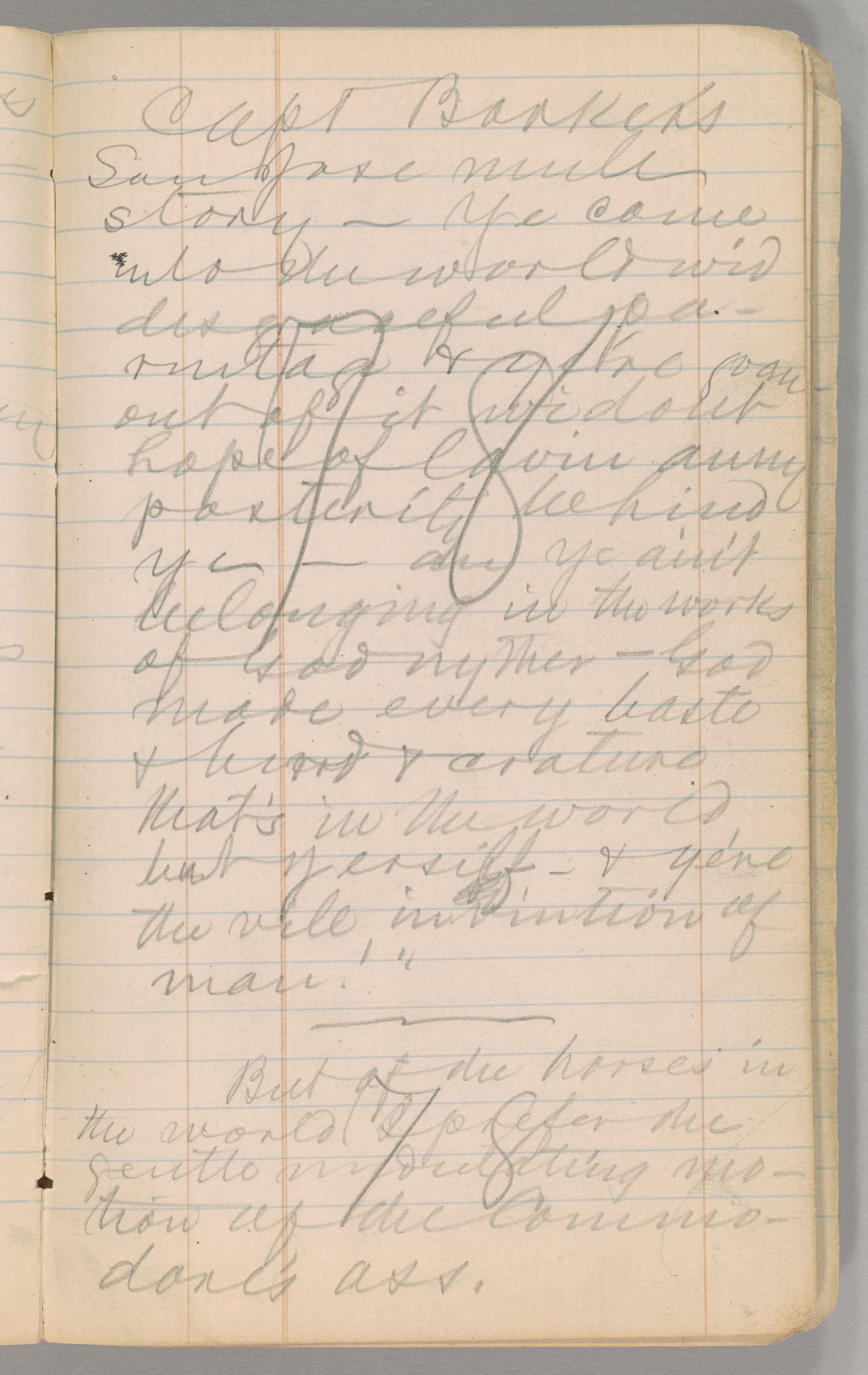
[MS: N05_leaf_082r]
Capt Barker's
San Jose mule
story—Ye come
into the world wid
disgraceful
pa-
rentage
parentage
& ye're goan
out of it widout
hope of lavin anny
posterity behind
ye—an ye ain't
belonging in the works
of God nyther—God
made every baste
& bur
ird
Ⓣtextual note & crature
that's in the world
but yersiflfⓉtextual note—& ye're
the vile invintion of
man!”
78
But of the horses in
the world I prefer the
gentle undulating
mo-
tion
motion
of the
Commo-
dore’s
Commodore's
ass.
78
[MS: N05_leaf_082v]
blank verso (no page image)
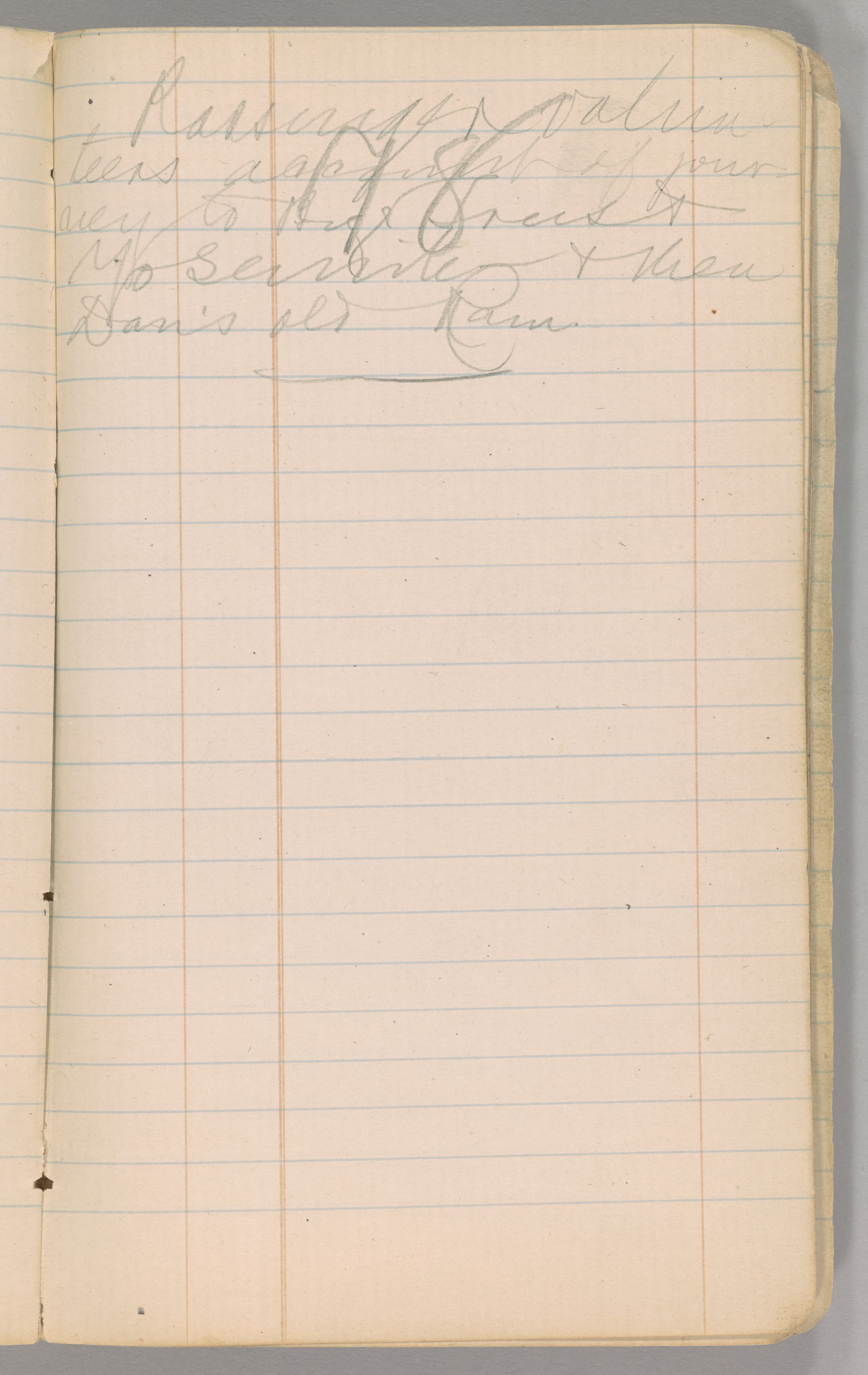
[MS: N05_leaf_083r]
Passenger
volun-
teers
volunteers
account of
jour-
ney
journey
to Big Trees &
Yo Semite —& then
Dan's old Ram.Ⓣtextual note
78
[MTP: N&J1_173]
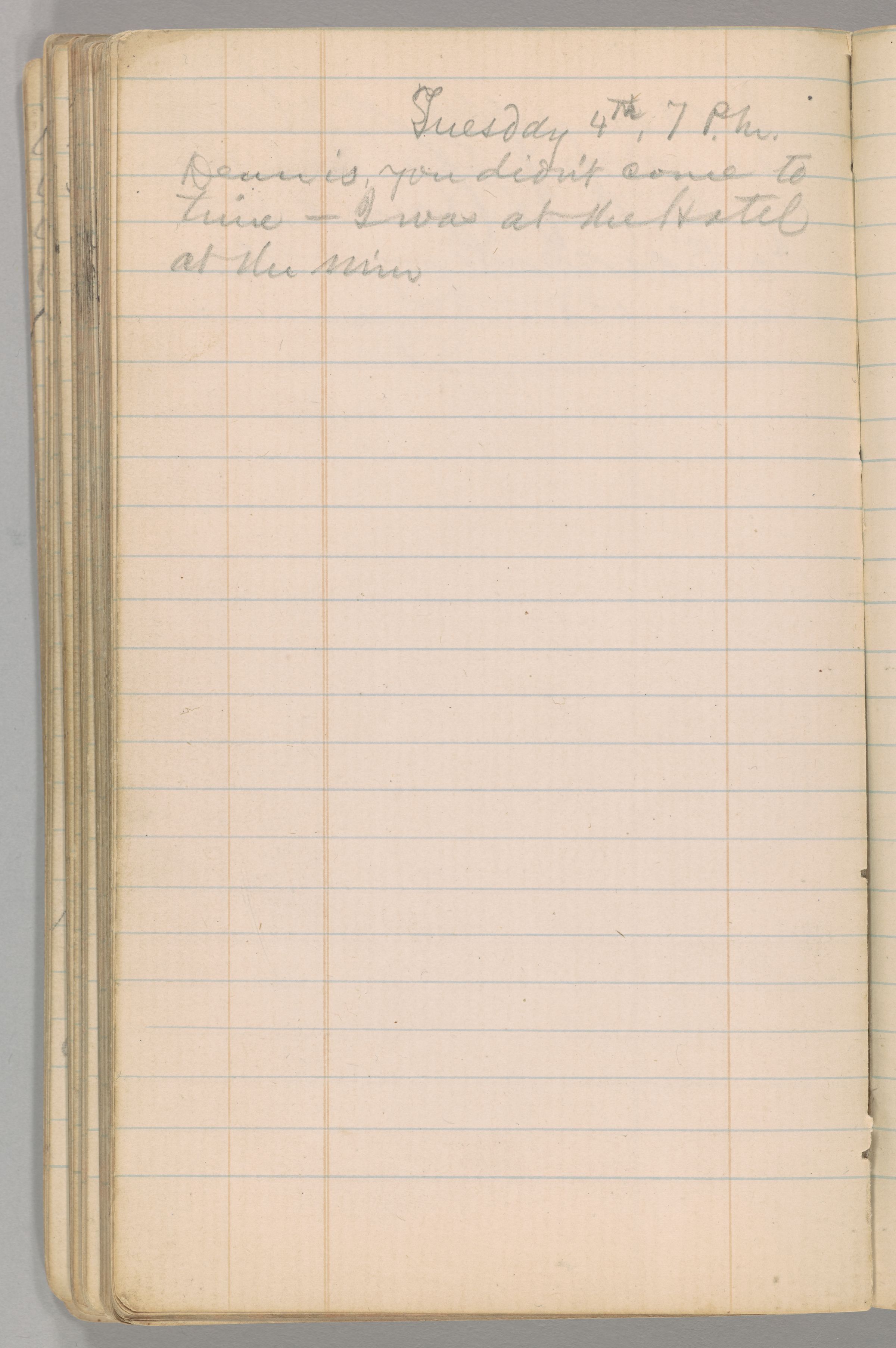
[MS: N05_leaf_083v]
S Tuesday 4th, 7 P. M.
Dennis, you didn't come to
time—I was at the Hotel
at the minⓉtextual note
161
nine blank pages (no page images)
begin reverse sequence Ⓣtextual note
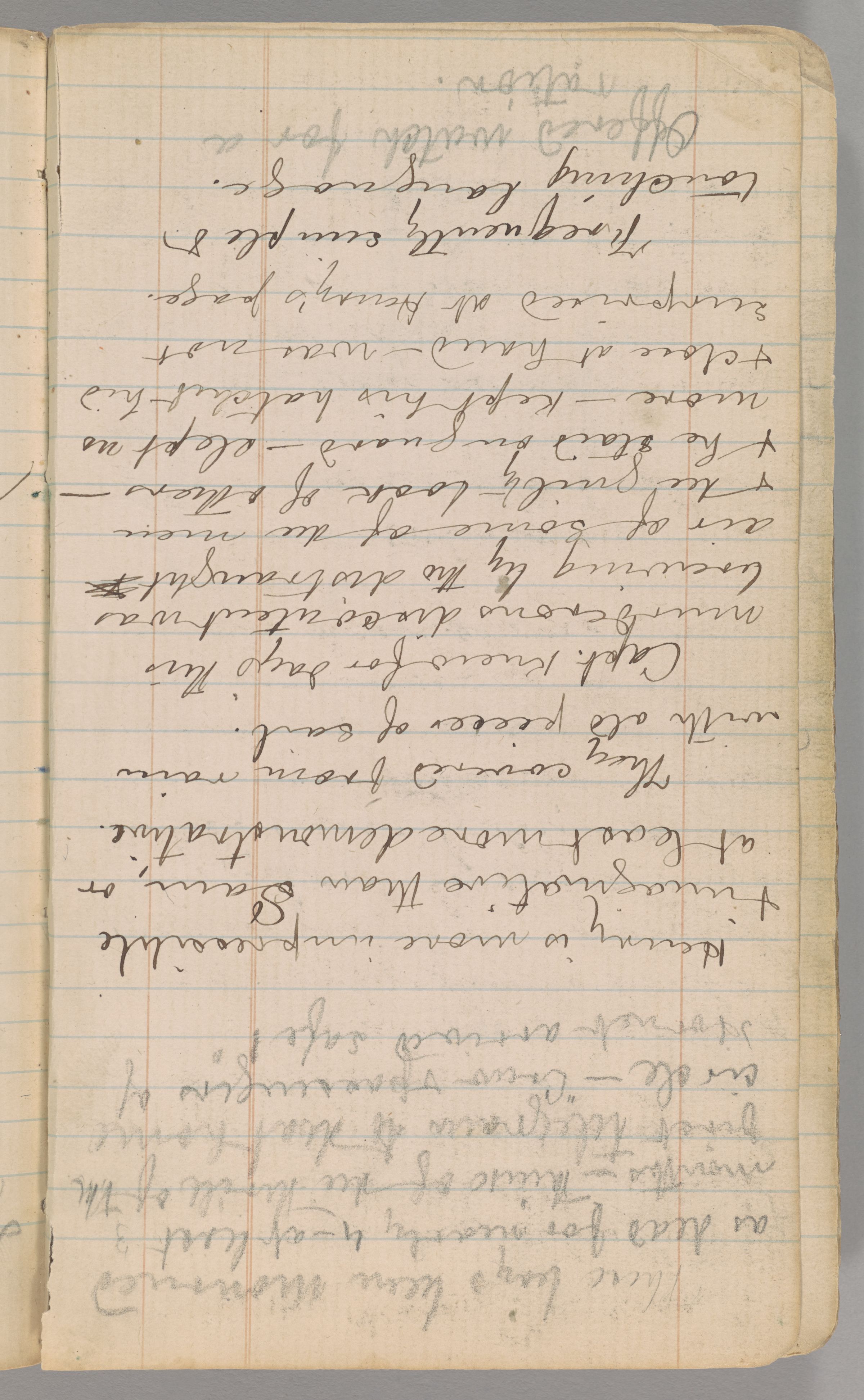
[MS: N05_leaf_090r]
These boys been mourned
as dead for nearly 4—at least 3
months—think of the thrill of the
first telegram to that home
circle—“Crew & passengers of
Hornet arrived safe!”162
Henry is more impressible
& imaginative than Sam, or
at least more demonstrative.
They covered from rain
with old pieces of sail.
Capt. knew for days this
murderous discontent was
brewing by the distraught &
air of some of the men
& the guilty look of others—
& he staid on guard—slept no
more—kept his hatchet hid
& close at hand—was not
surprised at Henry's page.163
Frequently simple &
touching language.Ⓣtextual note
Offered watch for a
ration.
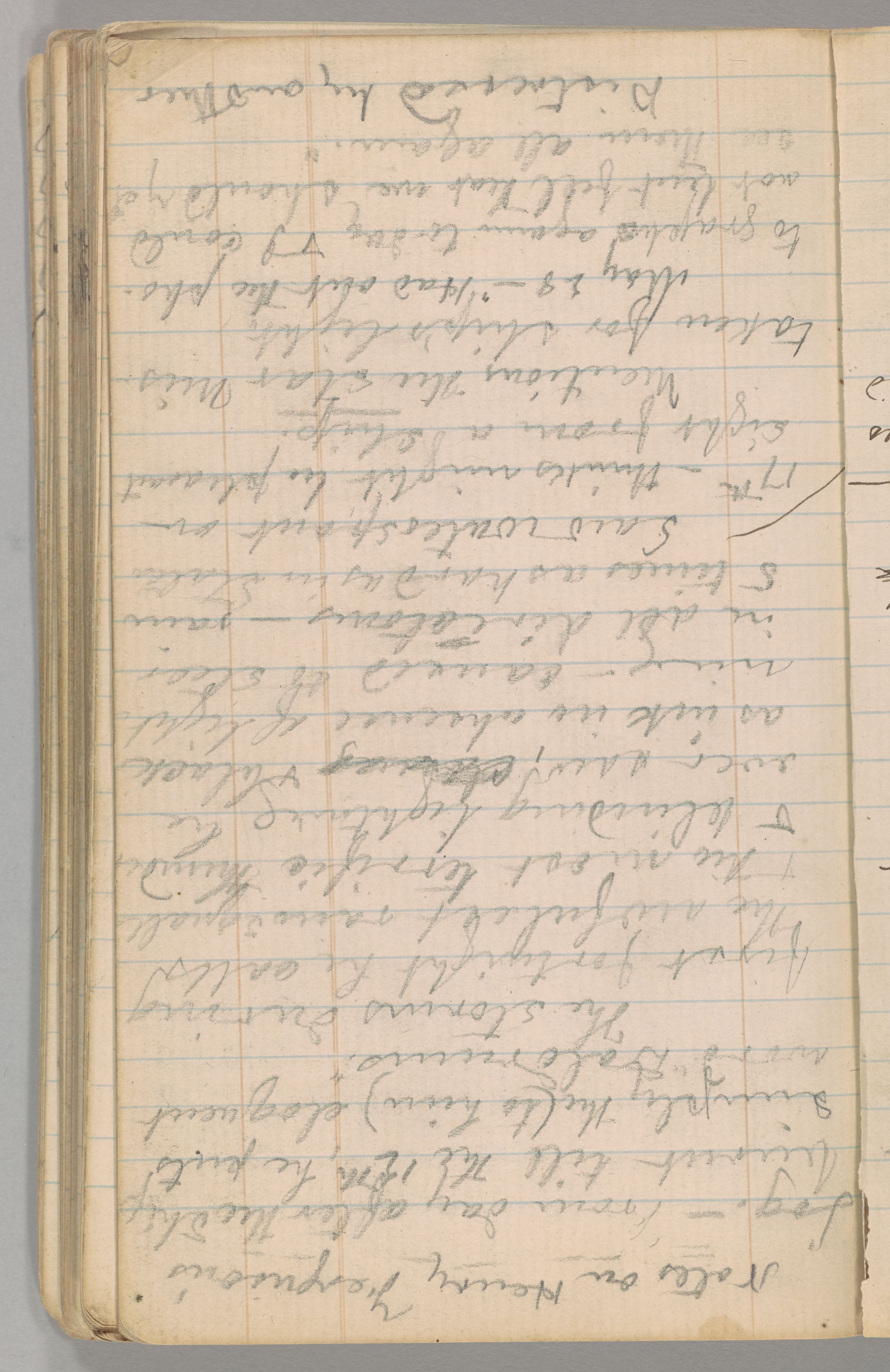
[MS: N05_leaf_089v]
Notes
on Henry Ferguson's
Log.—Ⓣtextual noteFrom day after the ship
burnt till the 12th, he puts
simply the (to him) eloquent
word “Doldrums.”
The storms during
first fortnight he calls
the awfulest rain squalls
& the most terrific thunder
& blinding lightning he
ever saw, closing & black
as ink in absence of
light-
ning
lightning
—caused to steer
in all directions—rain
5 times as hard as in States
Saw waterspout on
17th—thinks might be pleasant
sight from a ship.
[MTP: N&J1_174]
Mentions the star
mis-
taken
mistaken
for ship's light.
May 28—“Had out the
pho-
tographs
photographs
again to-day & I could
not but feel that we should yet
see them all again.”
Distressed by another
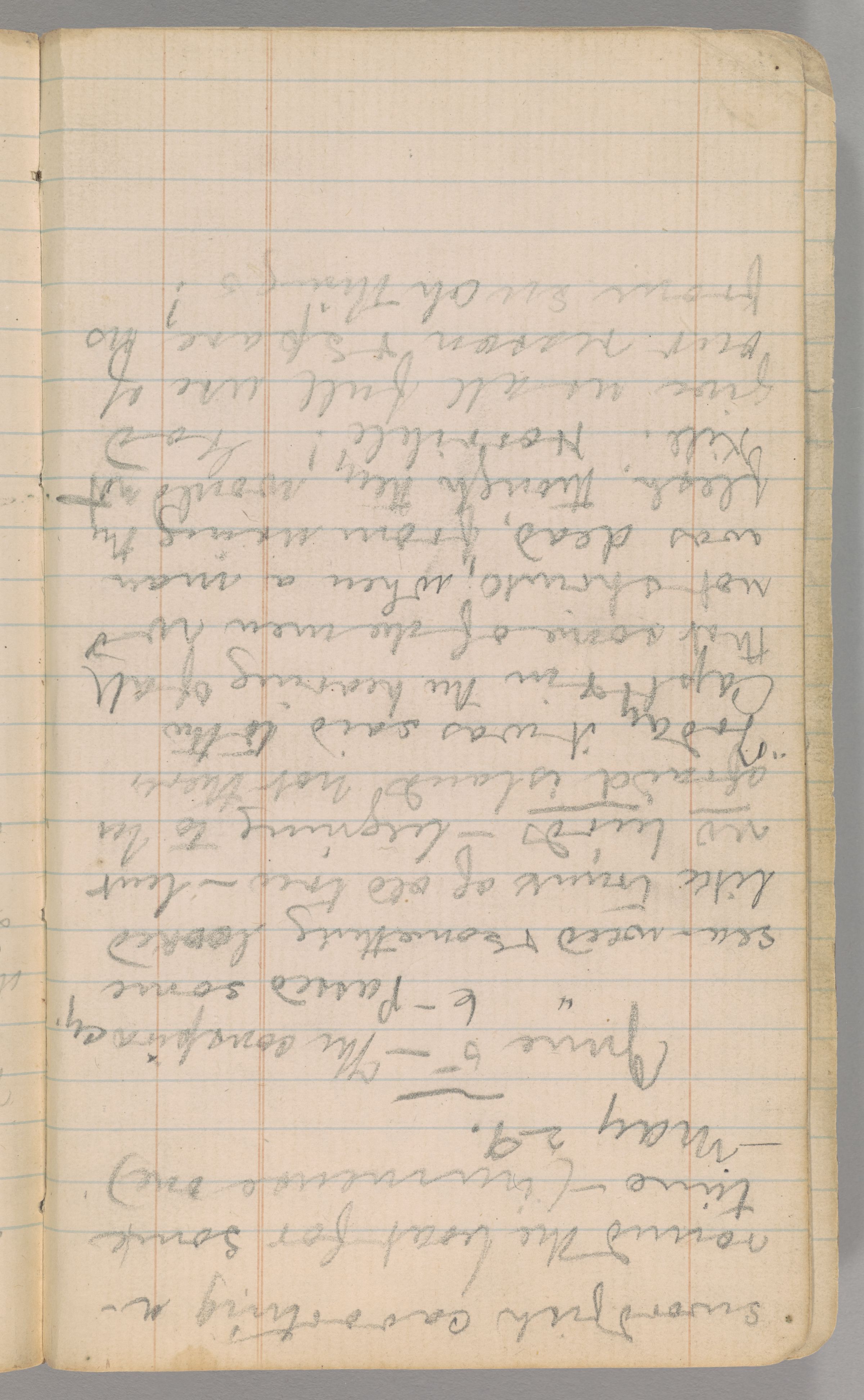
[MS: N05_leaf_089r]
swordfish cavorting
a-
round
around
the boat for some
time—(immense one)
—May 29.
June 5—The conspiracy.
“ 6—Passed some
sea-weed & something looked
like trunk of old tree—but
no birds—begining to be
afraid islands not there.
“Today it was said to the
Capt & in the hearing of all
that some of the men wd
not shrink, when a man
was dead, from using the
flesh, though they would not
kill. Horrible! God
give us all full use of
our reason & spare us
from such things!
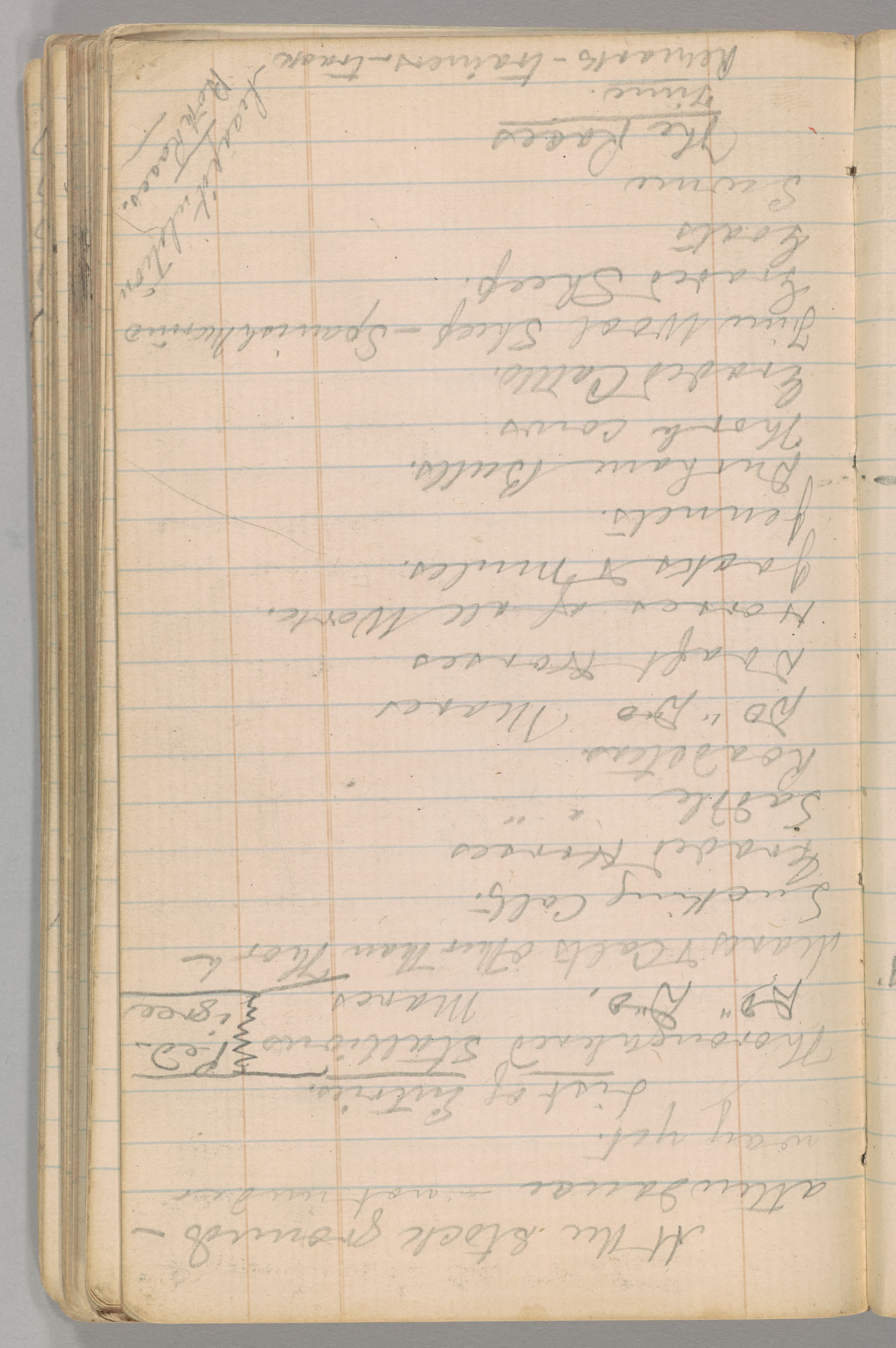
[MS: N05_leaf_088v]
At the stock grounds164—
attendance—not under
way yet.
List of Entries.
in right margin, in reference to the next two lines:
Ped-
igree
Pedigree
Thoroughbred stallions
Do“ D“o. Mares.
Mares & Colts other than Thorb
Sucking Colts.
Graded Horses
Saddle “ “
Roadsters.
Do “ “ Do Mares
Draft Horses
Horses of all Work.
Jacks & Mules.
Jennets.
Durham Bulls.
Thorb cows
[MTP: N&J1_175]
Graded Cattle.
Fine Wool Sheep—Spanish Meriño
Graded Sheep.
Goats
Swine
The Races
Time.
Remarks—trainers—track
—Recapitulation
——
Both Races.
——
end reverse sequence
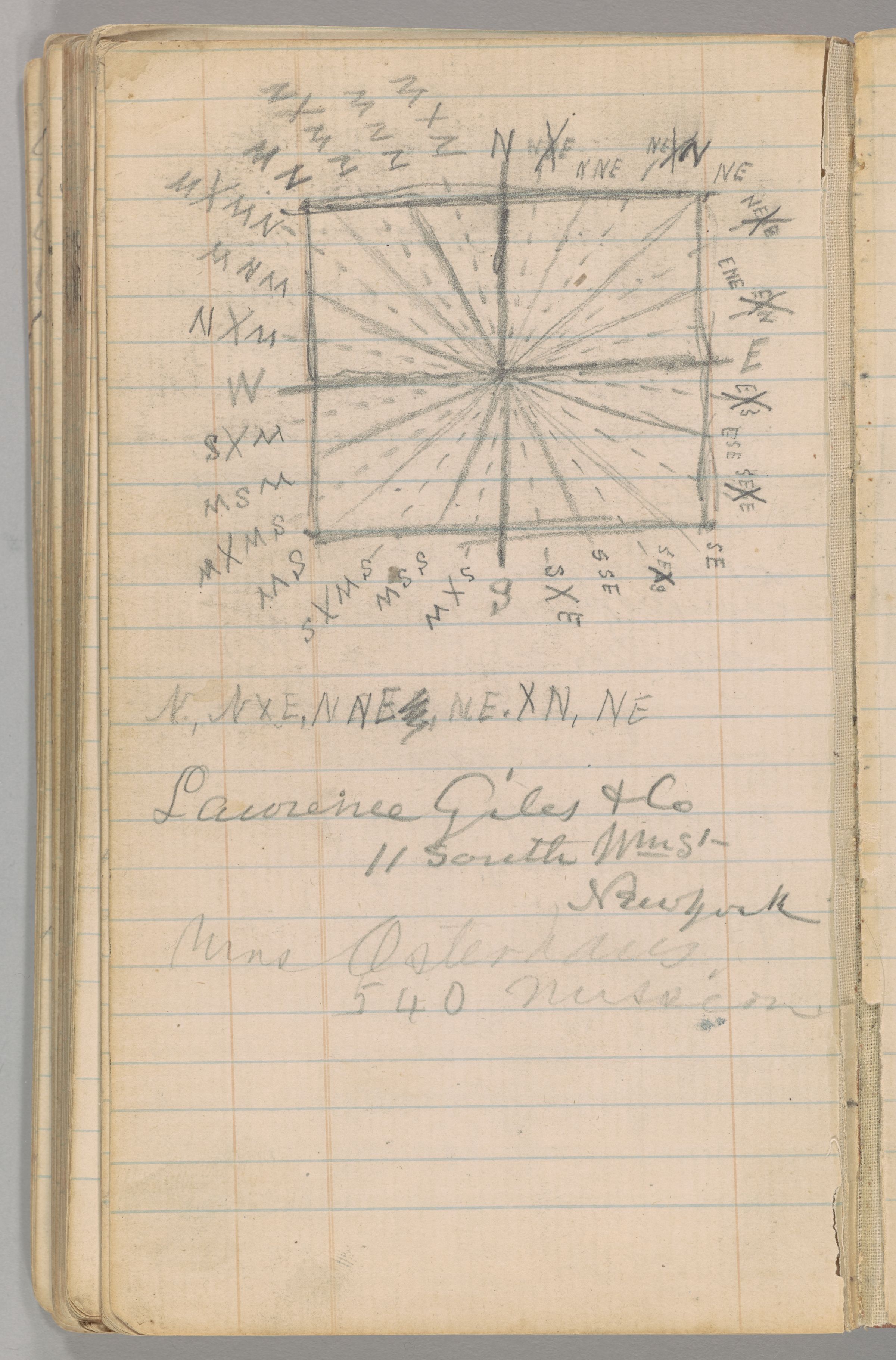
[MS: N05_leaf_090v]
see facsimile for illustration
N., NXE, NEXN NE,Ⓣtextual note N.E.XN, NE
Lawrence Giles & Co
11 south Wm st
New York
[MTP: N&J1_176]
Mrs Osterhaus
540 Mission
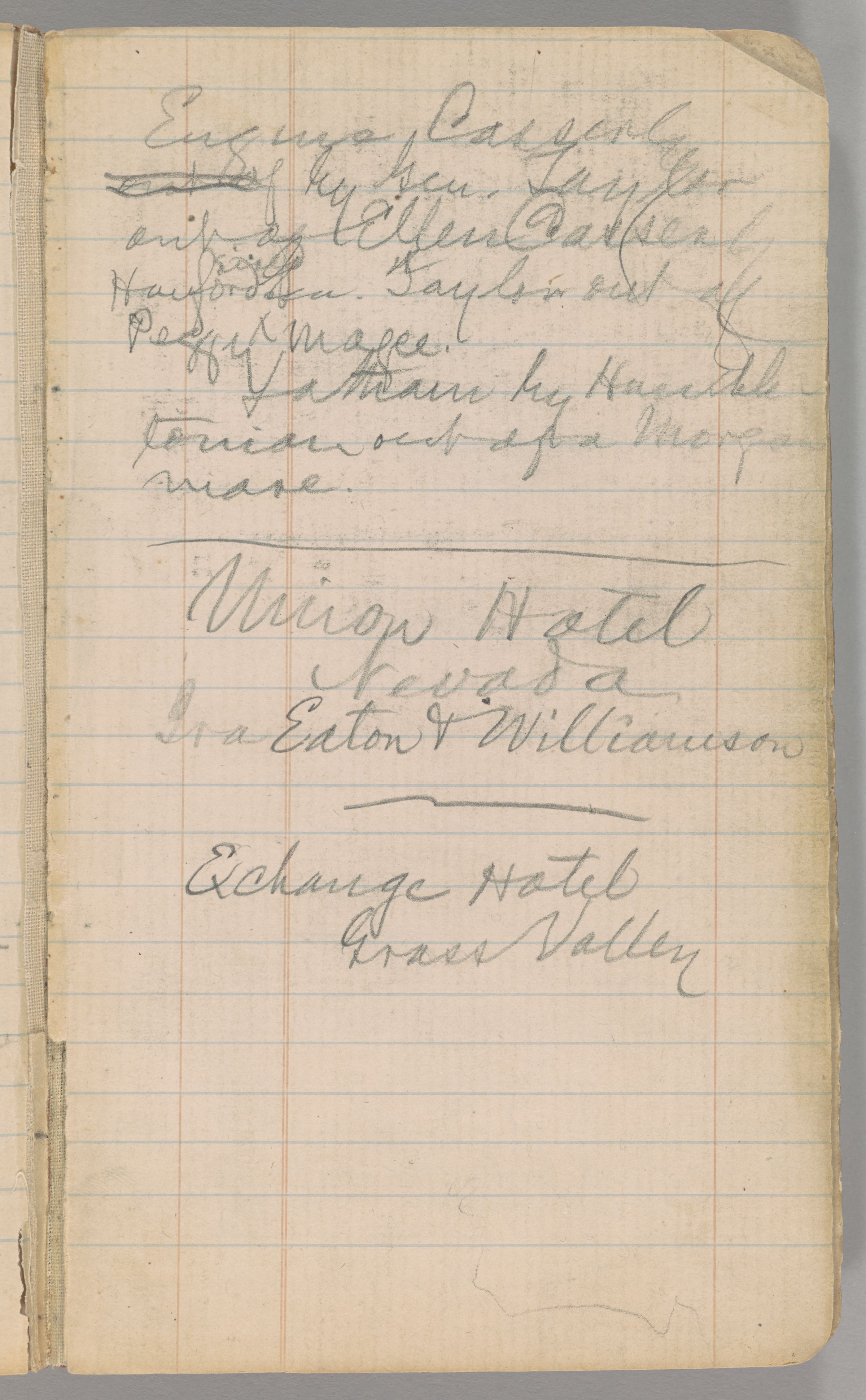
[MS: N05_leaf_091r]
Eugene Casserly165
out of by Gen. Taylor
out of Ellen Casserly
Hanford sired
Gen. Taylor out of
Peggy Magee.
Latham by
Hamble
tonian
Hambletonian
out of a Morgan
mare.
Union Hotel
Nevada
Ira Eaton & Williamson
Exchange Hotel
Grass Valley
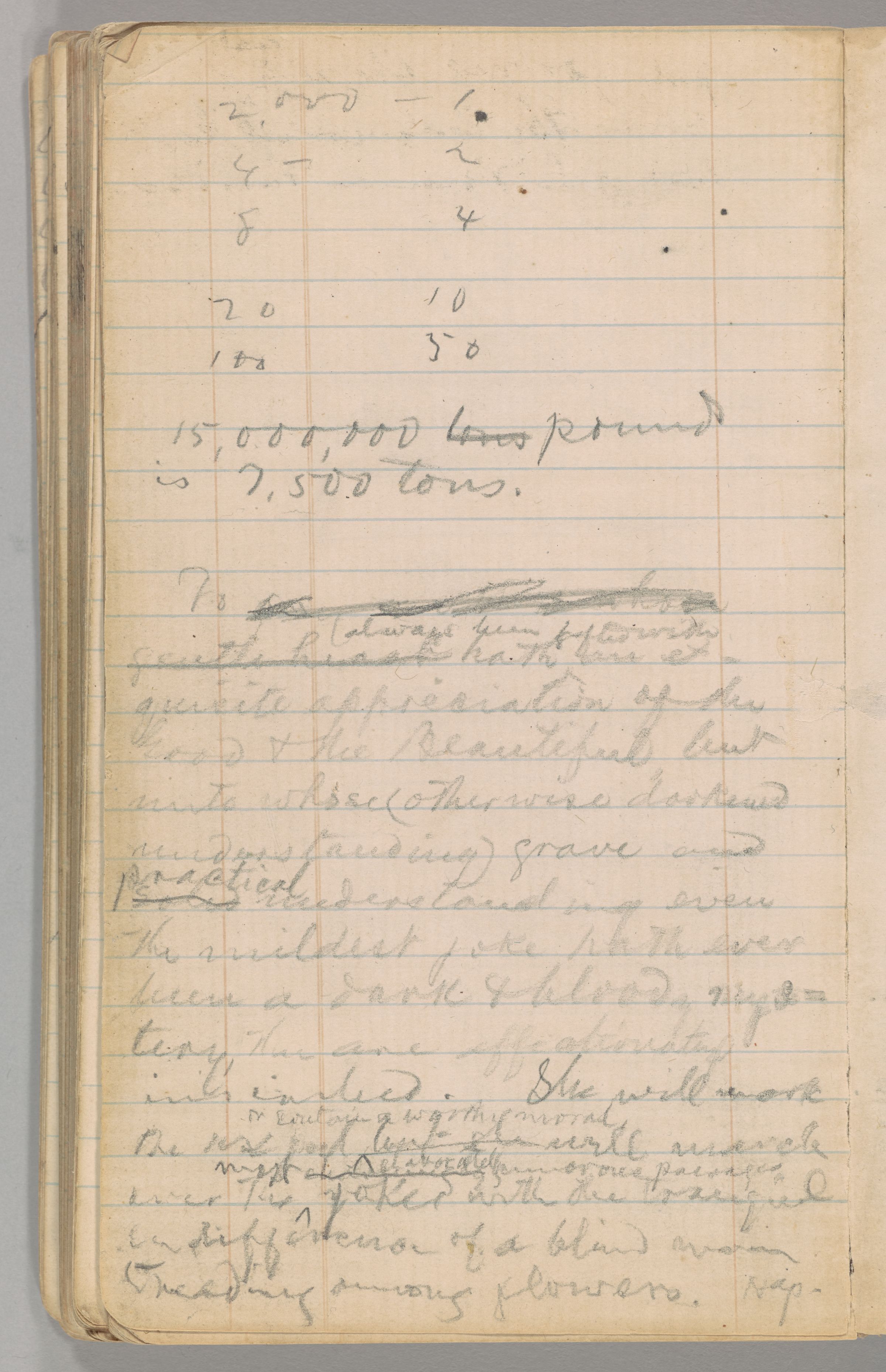
[MS: N05_leaf_091v]
2,000 — 1
4 — 2
8 4
20 10
100 50
15,000,000 tons pounds
is 7,500 tons.
To my mother whose
gentle heart hath always been gifted with
an
ex-
quisite
exquisite
appreciation of the
Good & the Beautiful, but
unto whose (otherwise darkened
understanding) grave and
solid
practical
understanding even
the mildest joke hath ever
been a dark & bloody
mys-
tery
mystery
, these are affectionately
inscribed. She will mark
the useful or contain a worthy moral,
but she will march
over the most charmingly
elaborately humorous passages jokes with the tranquil
indifference of a blind man
treading among flowers. Hap-
[MS: N05_back flyleaf recto]
pily for me she will not
dis-
cover
discover
no
the irreverent levity
that is hidden in this ded-166
[MTP: N&J1_177]
[MS: N05_back flyleaf verso]
XYZS
XYS
‸begin insertion span
Republic of
An-
dorre
Andorre
,167 on Southern
slope of Pyrennees,
36 miles long & 30
wide—owe their
in-
dependence
independence
to
Charlemagne &
have kept it ever
since—are under
protection of
France & Spain
—2,000 inhab—‸end insertion span
Ⓣtextual note
“Give thy thoughts no
tongue”—Polonius to his Son.
“Woe unto the
faint-
hearted
faint-hearted
.”Ⓣtextual note
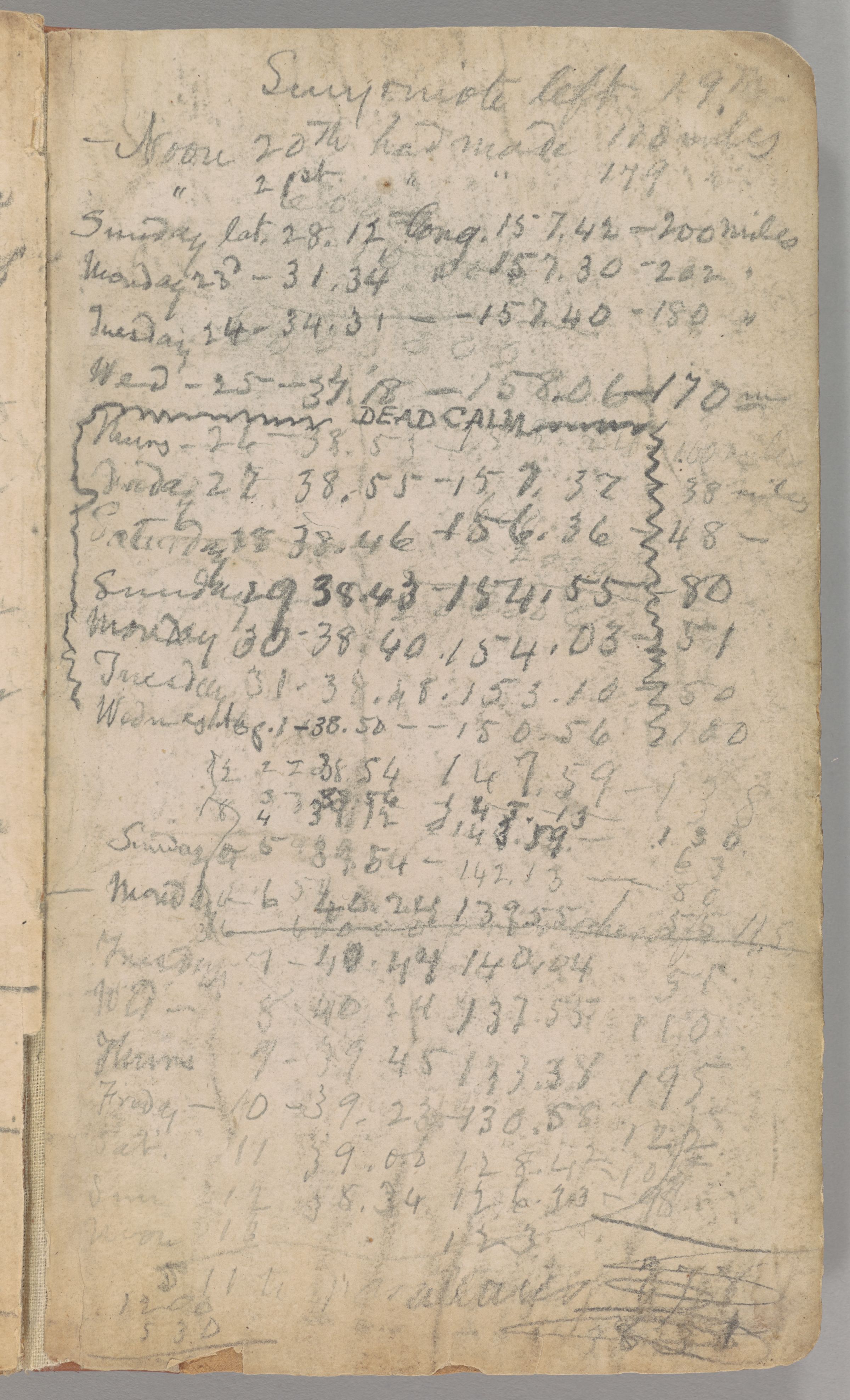
[MS: N05_back endpaper]
[MTP: N&J1_178]
600[0]
10 000
6000,000
600
2000
[1]200000
6 1[0]
12 2[0]
18 3[0]
[2◊] [4◊]
[30] 54
36 60000 [pro◊◊] ch[◊◊◊] for U.S.
‸begin insertion spanSmyrniote left 19th
—Noon 20th had made 110 miles
“ 21st “ “ 179 “
Sunday lat.28.12 long. 157.42—200 miles
Monday 23d—31.34 “ 157.30—202 “
Tuesday 24—34.31——157.40—180 “
Wed—25—37.18—158.06—170m
DEAD CALMⓉtextual note
Thurs—26—38.53—158.24—100 miles
Friday 27 38.55—157.37—38 miles
Saturday 28 38.46 —156.36 —48—
Sunday 29 38.43 —154.55 —80
Monday 30 —38.40 —154.03 —51
Tuesday 31 —38.48 —153.10 —50
Wednes Aug.1 —38.50 —150.56 —100
2 —38.54 —147.59 —138
3 —38.56 —145.13 —130.
4 —39.12 —143.59—.63
Sunday—5 —39.54 —142.13 —80
Monday—6 —40.24 —139.55 —55
Tuesday—7 —40.44 —140.04 —51
Wed —8 —40 24 —137.55 —110
Thurs—9 —39 45 —133.38 —195
Friday —10 —39.23 —130.58 —122.
Sat. 11 —39.00 —128.42 —105
Sun 12 —38.34 —126.33 —98
Mon 13 — —123. —
S 10 to Farallones [◊]78
1200 38331
530
1730 ‸end insertion span Ⓣtextual note
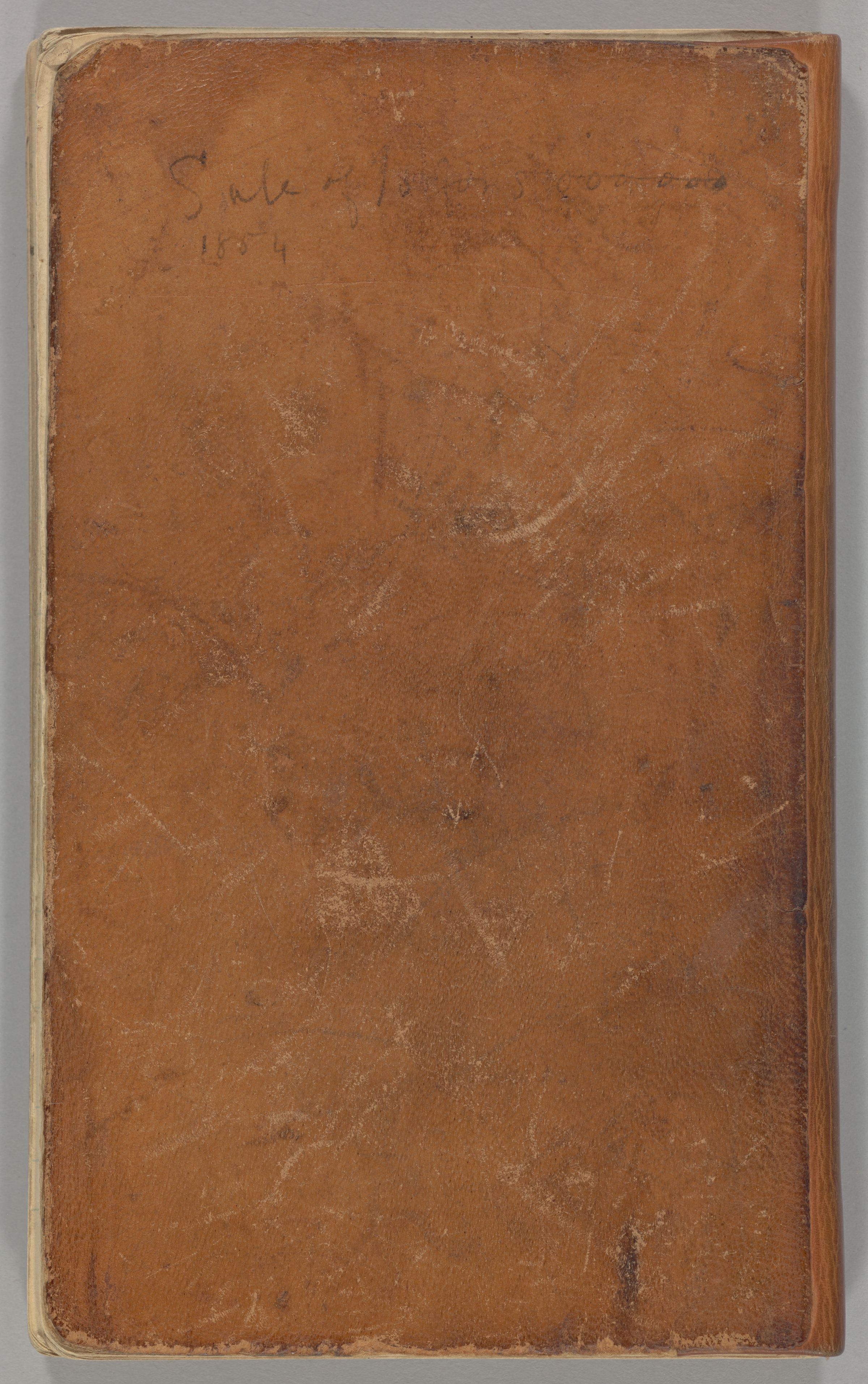
[MS: N05_outside back cover]
Sale of Is for 5000000
1854Ⓣtextual note 168
An example of Mark Twain's increasing use of the notebooks as a repository for literary material. This combination of adjectives, noted upside down on the front endpaper, was borrowed from a passage in Manley Hopkins' Hawaii: The Past, Present, and Future of Its Island-Kingdom (London: Longman, Green, Longman, and Roberts, 1862):
The sides of the hills are clothed with verdure; even the barren rocks that project from among the bushes are ornamented with pendulous or creeping plants of various kinds; and in several places beautiful cascades leap down the steep mountain's side into flowing rivulets beneath. (pp. 50–51)
Mark Twain commented on other passages from Hopkins' controversial book in Notebook 6.
On 19 December 1868, upon learning of Rising's death early that month in the disastrous Ohio River collision of the steamers America and United States, Samuel Clemens recalled his friend, the prototype for the fledgling minister in chapter 47 of Roughing It, in a letter to Olivia Langdon:
He was rector of the Episcopal church in Virginia City, Nevada—a noble young fellow—& for 3 years, there, he & I were fast friends. I used to try to teach him how he ought to preach in order to get at the better natures of the rough population about him, & he used to try hard to learn—for I knew them & he did not, for he was refined & sensitive & not intended for such a people as that . . . . Afterward I stumbled on him in the Sandwich Islands, where he was traveling for his health, & we so arranged it as to return to San Francisco in the same ship . . . . We were together all the time—pacing the deck night & day—there was no other congenial company. He tried earnestly to bring me to a knowledge of the true God. In return, I read his manuscripts & made suggestions for their emendation. We got along well together.
Upon arrival in San Francisco, Rising would embark for New York to become secretary of the Church Missionary Society of the Episcopal Church of the United States, which had offices at this address in Bible House, headquarters of the American Bible Society, in Astor Place, New York City.
Land in Fentress County, Tennessee, was purchased by John Marshall Clemens in the late 1820s and early 1830s in hopes of making the family fortune but was not finally disposed of—after much frustration and none of the anticipated profit—until many years later. The letters from home which so aggravated Clemens were probably related to the plans to sell the land he had been formulating in December 1865 (see headnote). On 22 May 1866 he wrote Mollie Clemens from Honolulu:
It is Orion's duty to attend to that land, & after shutting me out of my attempt to sell it (for which I shall never entirely forgive him,) if he lets it be sold for taxes, all his religion will not wipe out the sin. It is no use to quote Scripture to me, Mollie,—I am in poverty & exile now because of Orion's religious scruples . . . . I always feel bitter & malignant when I think of Ma & Pamela grieving at our absence & the land going to the dogs when I could have sold it & been at home now, instead of drifting about the outskirts of the world, battling for bread. ( MTBus , pp. 87–88)
And on 21 June he informed his mother and sister: “I expect I have made Orion mad, but I don't care a cent. He wrote me to go home & sell the Tenn. land & I wrote him to go to Thunder & take care of it himself. I tried to sell it once & he broke up the trade” ( MTBus , p. 88).
The following events took place in the spring of 1865 and involved seamen of the British ship Clio, which was about to carry the Dowager Queen Emma on the first leg of a trip to England. Midshipman Charles De La Poer Beresford, the chief culprit, was a descendant of two ancient and martial families and had himself joined the navy in 1859, at the age of thirteen. Many years later, Admiral Lord Charles Beresford described this youthful escapade:
A certain lady . . . bet me ... that I would not pull down the American flag. That emblem was painted on wood upon an escutcheon fixed over the entrance to the garden of the Consulate.... Having induced two other midshipmen to come with me, we went under cover of night to the Consulate. I climbed upon the backs of my accomplices, leaped up, caught hold of the escutcheon, and brought the whole thing down upon us. Then we carried the trophy on board in a shore-boat. Unfortunately the boatman recognized what it was, and basely told the American consul, who was naturally indignant, and who insisted that the flag should be nailed up again in its place. I had no intention of inflicting annoyance, and had never considered how serious might be the consequences of a boyish impulse. My captain very justly said that as I had pulled down the flag I must put it up again, and sent me with a couple of carpenters on shore. We replaced the insulted emblem of national honour, to the deep delight of an admiring crowd. (The Memoirs of Admiral Lord Charles Beresford, 2 vols. [London: Methuen & Co., 1914], 1:58–59)
The other participants in the episode were American minister resident James McBride, British commissioner William W. F. Synge, and Captain Tourneur of the Clio.
On 16 January 1841 Simona P. Kalama, later a prominent government official, saved Dr. Gerrit P. Judd from death in the crater of the active volcano Kilauea. According to Dr. Judd, he was collecting specimens of gas and lava when:
Suddenly I heard the report of an explosion; a fiery jet burst up from the center, and a river of fire rolled toward me. The heat was intense. I could not retrace my steps and face the fire, so I turned to the wall, but could not climb over the projecting ledge. I prayed God for deliverance, and shouted to the natives to come and take my hand, which I could extend over the ledge so as to be seen. Kalama heard me and came to the brink, but the intense heat drove him back. “Do not forsake me and let me perish,” I said. He came again and threw himself on the ground, with face averted to avoid the heat, seized my hand with both his, and I threw myself out. The fire swept under as I went over the ledge, burning my shirt-sleeves and wrist, and blistering Kalama's face. (From a letter by Gerrit P. Judd, quoted in Laura Fish Judd, Honolulu: Sketches of Life in the Hawaiian Islands from 1828 to 1861, ed. Dale L. Morgan [Chicago: Lakeside Press, 1966], p. 150)
Elizabeth Kinau Wilder, wife of Samuel G. Wilder, later recalled:
Mark Twain stayed with us for a week. While he was there, Kakau, Gerrit's nurse, died. The coffin was brought onto the veranda, and surrounded by wailing women. Kauka rendered Kaoka by Mark Twain, this Hawaiian word for doctor was used by the natives in addressing Dr. Gerrit P. Judd, but it had also become a family nickname, applied to a dog, then to a horse, and here to the Wilders' son Gerrit seized an umbrella, strode it like a horse, and galloped around the bier, while the natives groaned at the spectacle, and stretched out their arms to stop him. “Leave the child alone,” said the humorist; “he will fight his way to Heaven.” Kakau's husband sat up all night, making a black alpaca coat to wear to the funeral, where Mark Twain followed him, in evident admiration. (The Memoirs of Elizabeth Kinau Wilder, ed. Elizabeth Leslie Wight [Honolulu: Paradise of the Pacific Press, 1909], p. 140)
Accounts of the death at age twenty-seven of Princess Victoria Kaahumanu Kamamalu, whose sexual appetites were celebrated in native chants performed at her funeral, are suspiciously silent about the cause of death. Cognizant perhaps of the diplomatic wisdom of presenting the princess as the royal family wished her to appear—although she had suffered at least one widely known fall from virtue in the company of a Honolulu auctioneer—Mark Twain commented favorably on her character in his 16 July Sacramento Daily Union letter. In 1873, however, he would more candidly characterize her as “the christianized but morally unclean Princess” (letter in the New York Daily Tribune, 9 January 1873, MTH , p. 497), and still later he provided an account of her which expanded upon this early notebook entry:
In the Sandwich Islands in 1866 a buxom royal princess died. Occupying a place of distinguished honor at her funeral were thirty-six splendidly built young native men. In a laudatory song which celebrated the various merits, achievements and accomplishments of the late princess those thirty-six stallions were called her harem, and the song said it had been her pride and boast that she kept the whole of them busy, and that several times it had happened that more than one of them had been able to charge overtime. ( LE , p. 41)
Samuel Clemens' 19 December 1868 description of the Reverend Franklin S. Rising for Olivia Langdon (see note 2) included a romantic re-creation of the scene somewhat different from that present in this notebook:
We were at sea five Sundays. He felt it his duty to preach, but of the 15 passengers, none even pretended to sing, & he was so diffident that he hardly knew how he was to get along without a choir. I said, “Go ahead—I'll stand by you—I'll be your choir.”—And he did go ahead—& I was his choir. We could find only one hymn that I knew. It was “Oh, Refresh us.” Only one—& so for five Sundays in succession he stood in the midst of the assembled people on the quarter-deck & gave out that same hymn twice a day, & I stood up solitary & alone & sang it! And then he went right along, happy & contented, & preached his sermon.... Now the glories of heaven are about him, & in his ears its mysterious music is sounding—but to me comes no vision but a lonely ship in a great solitude of sky & water; & unto my ears comes no sound but the complaining of the waves & the softened cadences of that simple old hymn—but Oh, Livy, it comes freighted with infinite pathos.
On 17 June 1825 Daniel Webster delivered a stirring address to a vast audience assembled for the laying of the cornerstone of the Bunker Hill Monument.
His voice was very clear and full, and his manner very commanding. Once, owing to the great press, some of the seats and barriers gave way, and there was a moment of considerable confusion, notwithstanding the efforts of those whose duty it was to preserve order. One of these gentlemen said to Mr. Webster: “It is impossible, sir, to restore order.” Mr. Webster replied with a good deal of severity: “Nothing is impossible, sir: let it be done.” Another effort was made, and silence was obtained. (Account by George Ticknor, quoted in George Ticknor Curtis, Life of Daniel Webster, 4th ed., 2 vols. [New York: D. Appleton and Company, 1872], 1:249)
Dr. Judd was witness to two racial incidents involving Princes Alexander Liholiho (Kamehameha IV) and Lot Kamehameha (Kamehameha V) while the three were in the United States in 1850 on a diplomatic mission:
The princes' dark coloring led to a singularly ugly episode on the morning of June 4, as they boarded a train for Baltimore. While Dr. Judd was checking the baggage, a conductor “unceremoniously” ordered Alexander out of the railway car.... Alexander protested indignantly until Dr. Judd hurried in to the car and made the necessary explanations. Somewhat later, on a Hudson River boat, the princes were refused admittance to the dining salon. In later years, when he had come to favor Hawaii's annexation by the United States, Dr. Judd did his best to make light of both episodes. He insisted that the railway car was reserved for women and that the princes were excluded from the steamboat salon merely because they were too late for the first sitting. But Alexander, in particular, attributed the incidents to American color prejudice.... After having been cordially received in both England and France the princes developed a violent anti-American prejudice. (Gerrit Parmele Judd, IV, Dr. Judd, Hawaii's Friend: A Biography of Gerrit Parmele Judd [Honolulu: University of Hawaii Press, 1960], p. 186)