(March–April 1866)
Notebooks 5 and 6 were used in overlapping fashion, and the problems of their dating and their relation to each other are fully discussed in the headnote to Notebook 5.
Approximately one-quarter of Notebook 6 is devoted to the Ajax voyage to Hawaii and includes Mark Twain's notes about the ship and its officers, comments about his fellow passengers, and the Hawaiian information he solicited from them. The balance of the notebook is a record of his first weeks on Oahu, from arrival in Honolulu on 18 March 1866 until around mid-April, when he began his tour of the other islands. This section contains firsthand information about Hawaiian customs and the Hawaiian economy, accounts of some of the people he met, lists of places and things to investigate on Oahu and elsewhere, and a “Kanaka Lexicon” he compiled for his own use. At many points the notebook corresponds closely to his early letters to the Sacramento Union.
Notebook 6 now contains 160 pages, 18 of them blank. In design it is identical to Notebook 5, and its front cover, like that of Notebook 5, was dated “1866,” probably by Paine. Its binding is broken, the back cover and portions of some gatherings are loose, and some leaves may have been lost. With the exception of two entries in brown ink, one in black ink (the final entry in the body of the notebook, inscribed more than two months later than the rest of the notebook), and an inscription on the back cover, also in black ink, all entries are in pencil.
In preliminary attempts to identify potential material for his Sacramento Union letters, Clemens employed two apparently independent systems of marks—asterisks and numbers—to distinguish individual entries. In connection with the same effort, he numbered the notebook's first 103 pages (through p. 220.7) and began to organize the marked entries in tabular form at the back of the notebook (p. 236). But the tentative and preliminary nature of both marking systems is evident in the very casual correspondence between marked entries and Mark Twain's published Sandwich Islands writings. Clemens' asterisks and numbers are discussed in notes 3 and 147. The asterisks and numbers appear in the present text at the beginning of the entries they designate, although Clemens' erratic habits of inscription sometimes led him to center them above or to place them at the ends of entries in the manuscript. Paine's use marks, of which there are many in this notebook, are not preserved here.
[MS: N6_outside front cover]
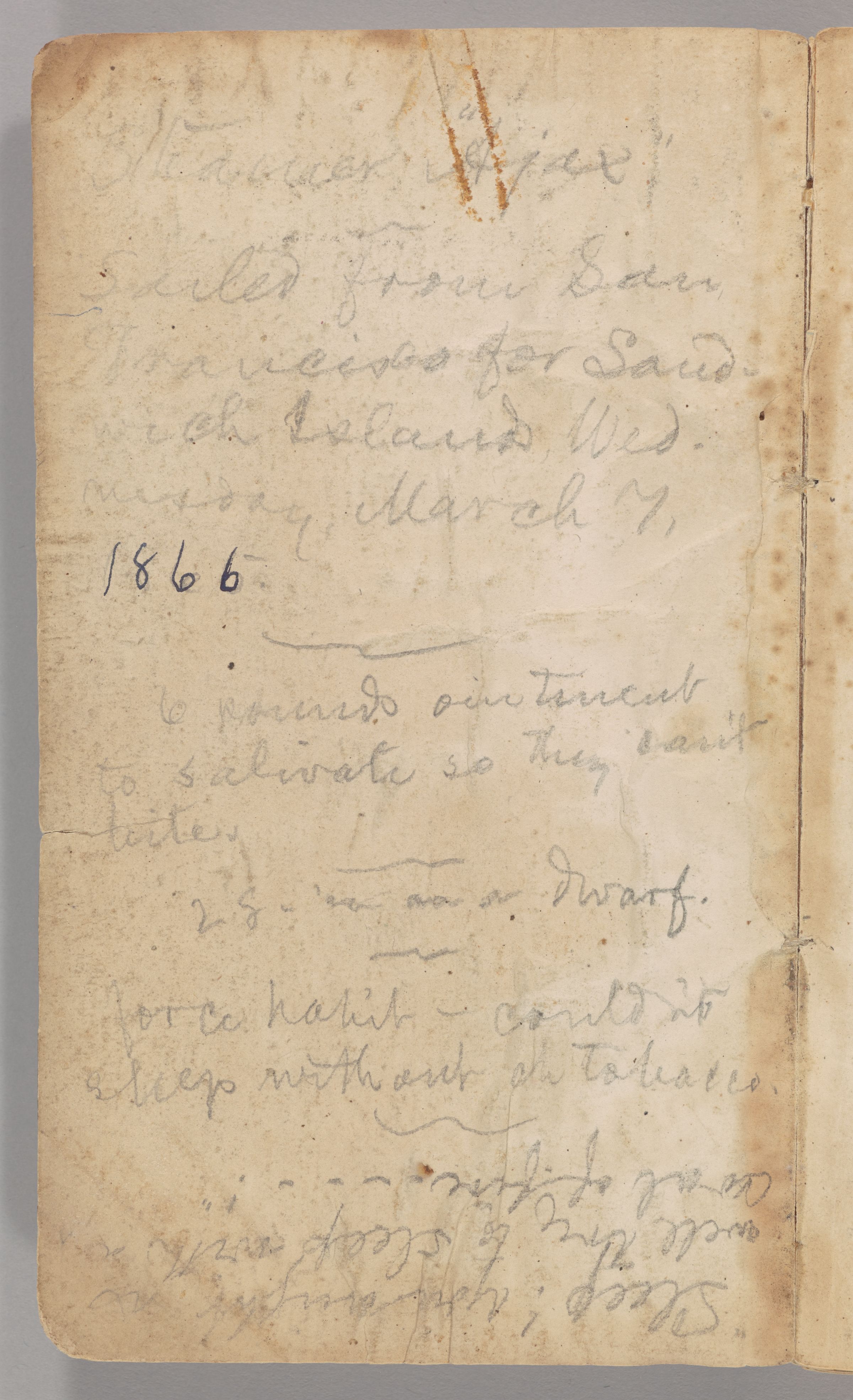
[MS: N6_front endpaper]
[MTP: N&J1_180]
Steamer “Ajax”

Sailed from San
Francisco for Sand-
wichSandwich Islands, Wed-
nesdayWednesday, March 7,
1865 1866Ⓣtextual note.
6 pounds ointment
to salivate so they can't
bite.
2 g ◊ ◊ was a dwarf.
force habit—couldn't
sleep without ch tobacco.
“Sleep! you might as
well try to sleep with a
coal of fire ---- !”Ⓣtextual note
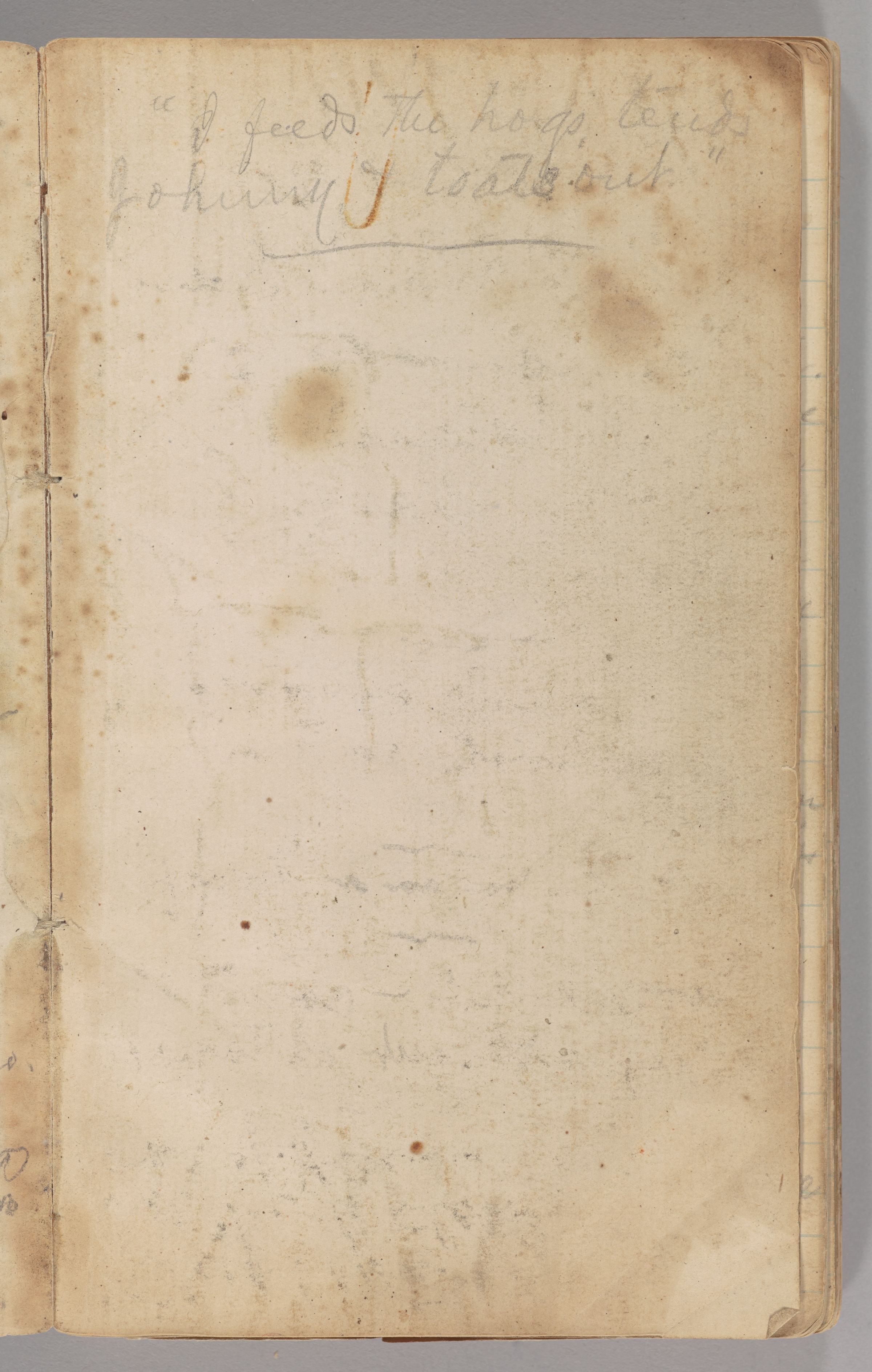
[MS: N6_front flyleaf recto]
“I feeds the hogs, tends
Johnny & toats out”1
[MS: N6_front flyleaf verso]
blank verso
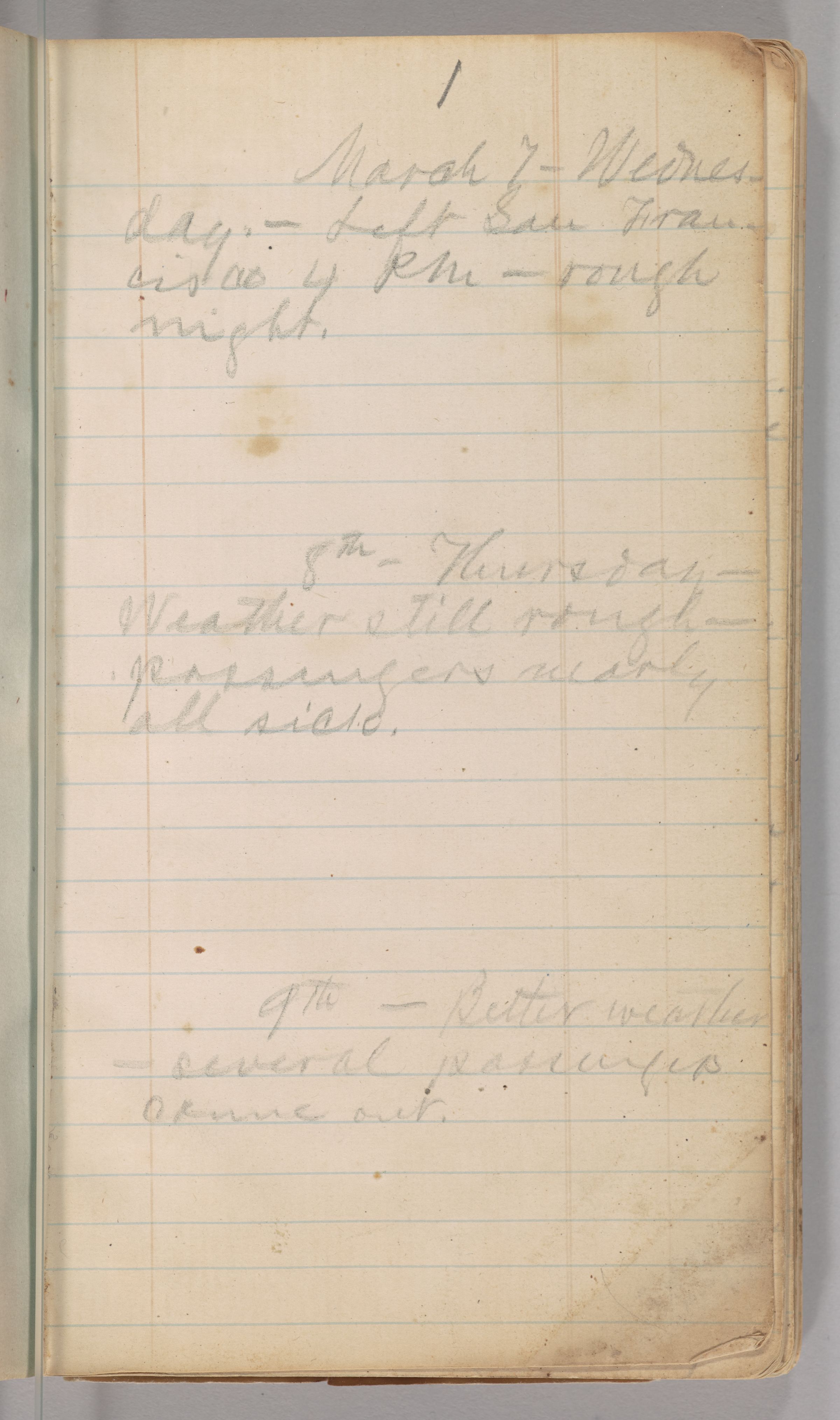
[MS: N6_leaf_001r]
[MTP: N&J1_181]
March 7—Wednes-
dayWednesday.—Left San Fran-
ciscoFrancisco 4 PM—rough
night.2
8th—Thursday—
Weather still rough—
passengers nearly
all sick.
9th—Better weather
—several passengers
came out.
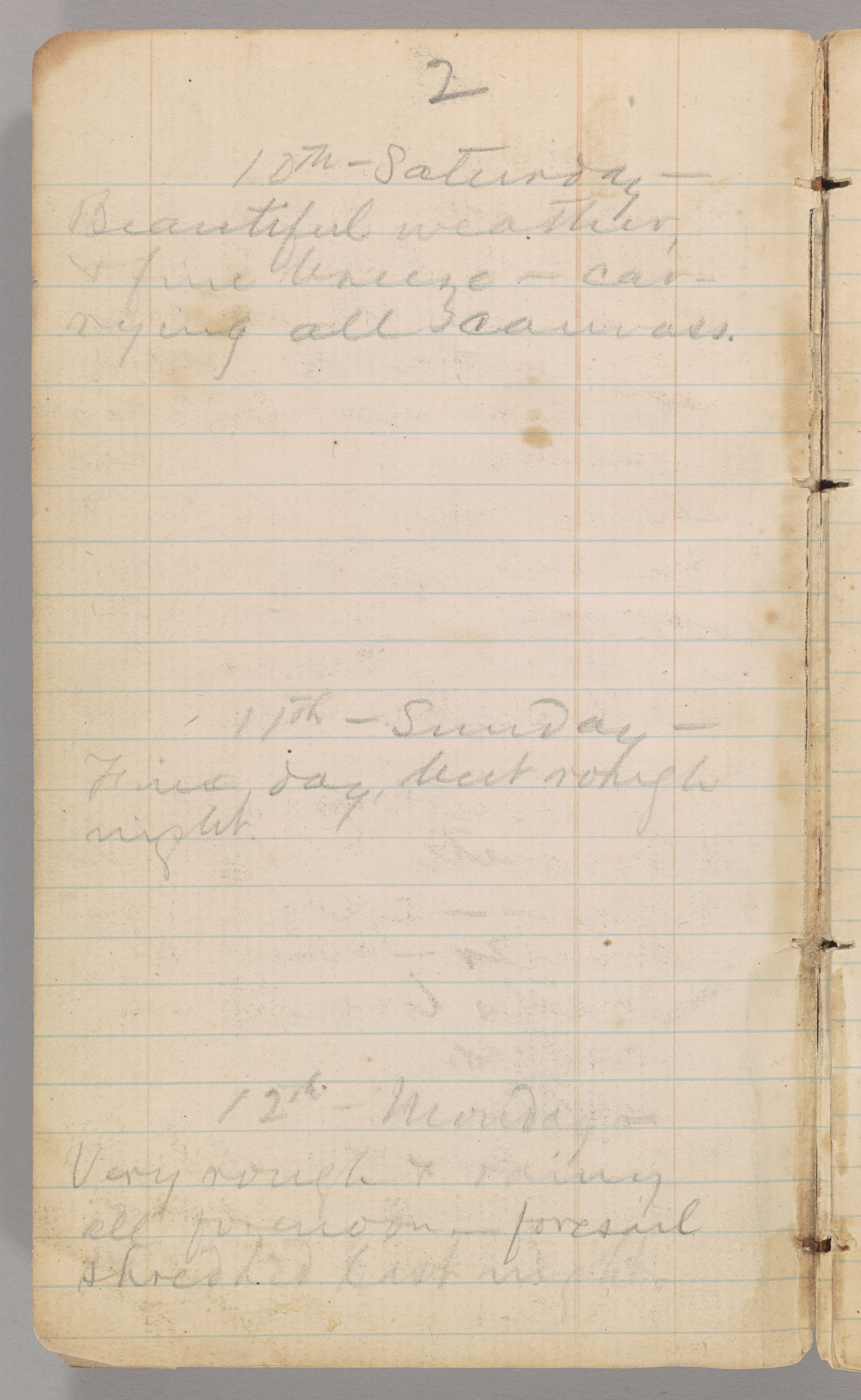
[MS: N6_leaf_001v]
10th—Saturday—
Beautiful weather,
& fine breeze—car-
ryingcarrying all canvass.
11th—Sunday—
Fine day, but rough
night.
12th—Monday—
Very rough & rainy
all forenoon—foresail
shredded last night.
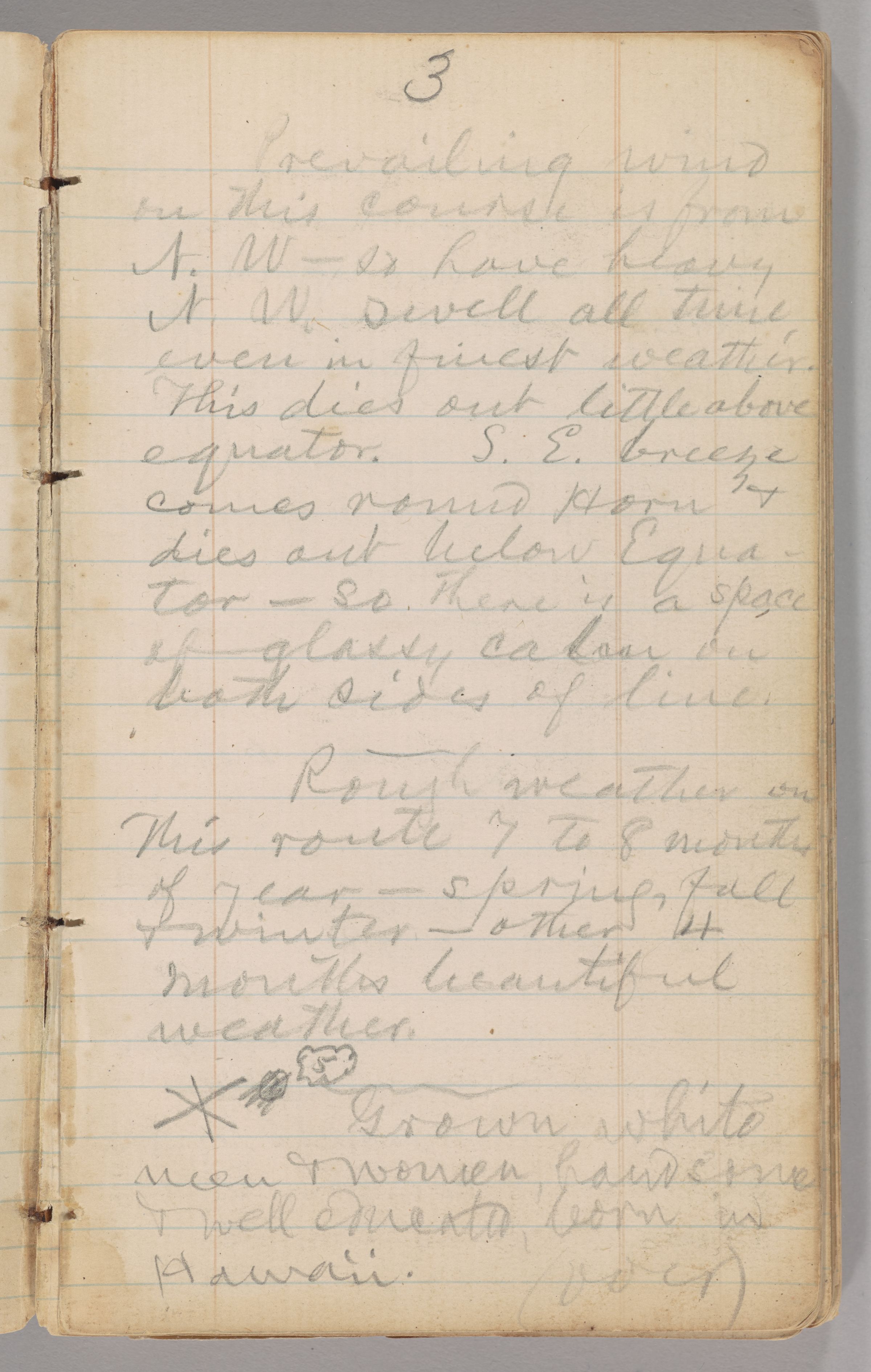
[MS: N6_leaf_002r]
Prevailing wind
on this course is from
N. W—so have heavy
N. W. swell all time,
even in finest weather.
This dies out little above
equator. S. E. breeze
comes round Horn &
dies out below Equa-
torEquator—so there is a space
of glassy calm on
both sides of line.
Rough weather on
this route 7 to 8 months
of year—spring, fall
& winter—other 4
months beautiful
weather.
✱ 1 53 Grown white
men & women, handsome
& well educated, born in
Hawaii.Ⓣtextual note
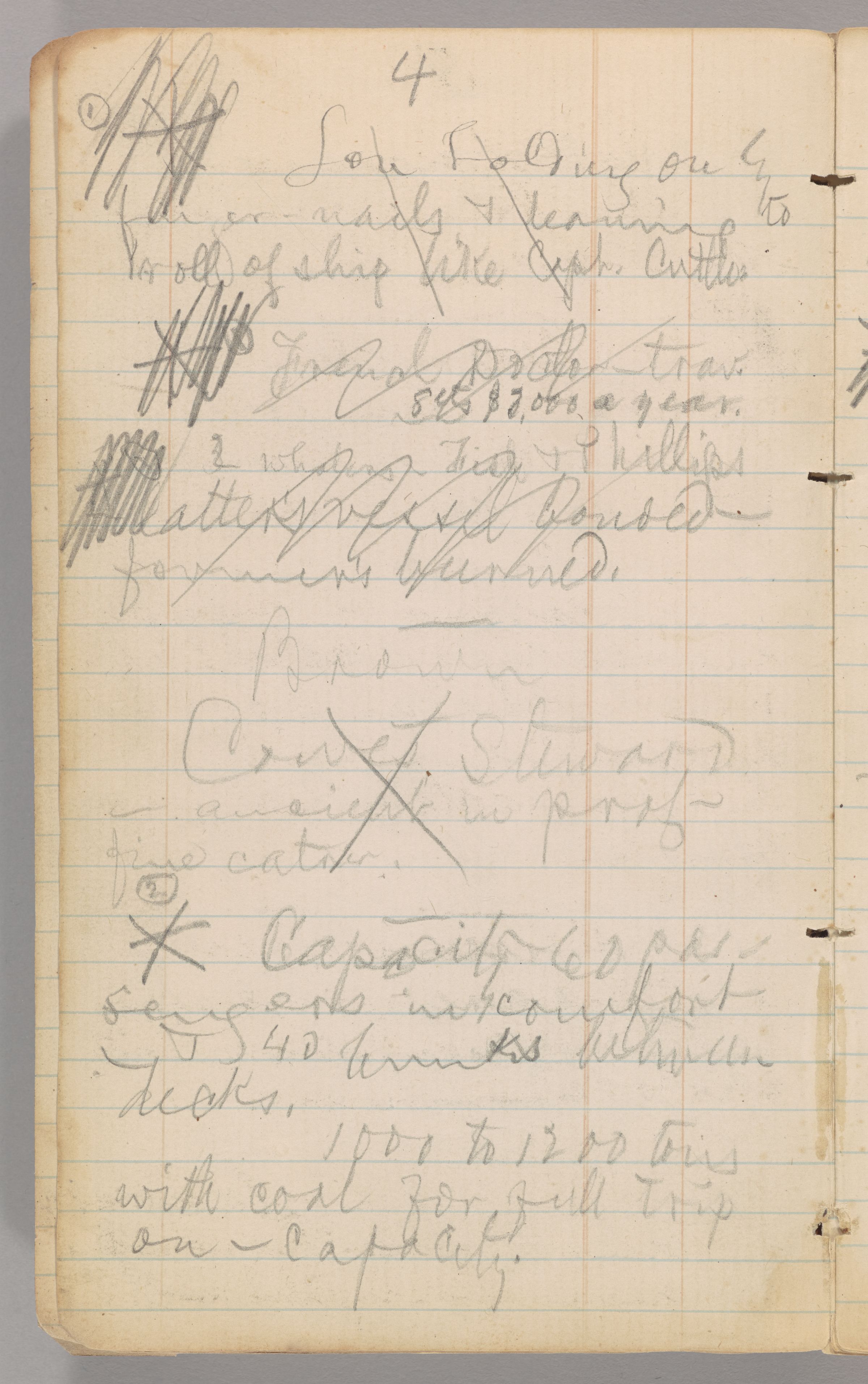
[MS: N6_leaf_002v]
1 ✱ Lon4 holding on by
finger-nails & leaning to
roll of ship like Capt. Cuttle.
[MTP: N&J1_182]
✱ 1 French Doctor—trav.
gets $3,000 a year.5
✱ 1 3 2 whalers—Fish & Phillips
—latter's vessel bonded—
former's burned.
Brown6
Cowes, Steward
—ancient in prof—
fine catrer.
✱ 2 6 Capacity 60 pas-
sengerspassengers in comfort
—& 40 bunks between
decks.
1000 to 1200 tons
with coal for full trip
on—capacity.
[MS: N6_leaf_003r]
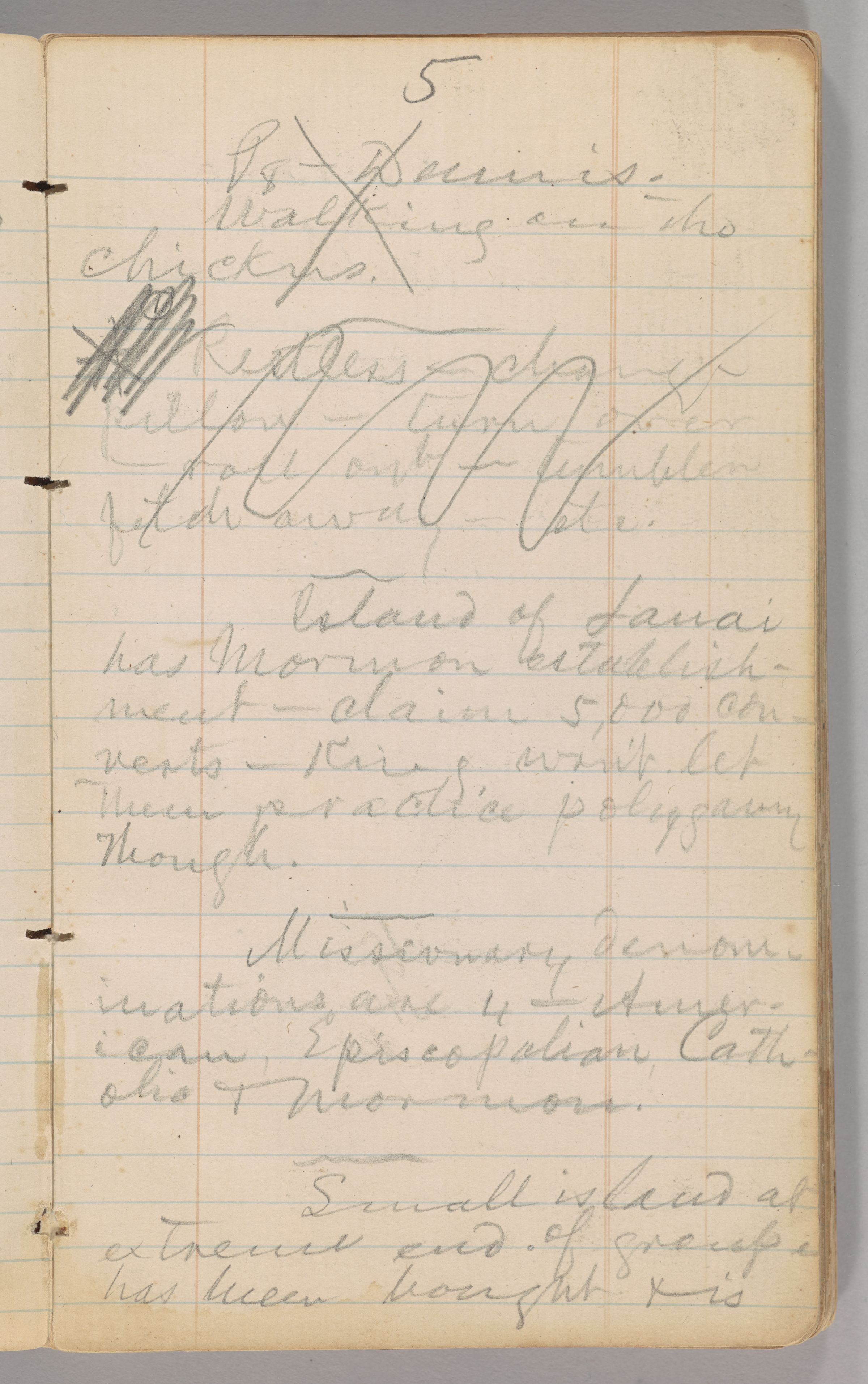
Pg—Dennis.7
Walking on the
chickns.
✱ 1 Restless—change
pillow—turn over
—roll out—tumbler
fetch away—etc.
Island of Lanai
has Mormon establish-
mentestablishment—claim 5,000 con-
vertsconverts—King won't let
them practice polygamy
though.8
[MTP: N&J1_183]
Missionary denom-
inationsdenominations are 4—Amer-
icanAmerican, Episcopalian, Cath-
olicCatholic & Mormon.
Small island at
extreme end of groupⓂemendation
has been bought & is
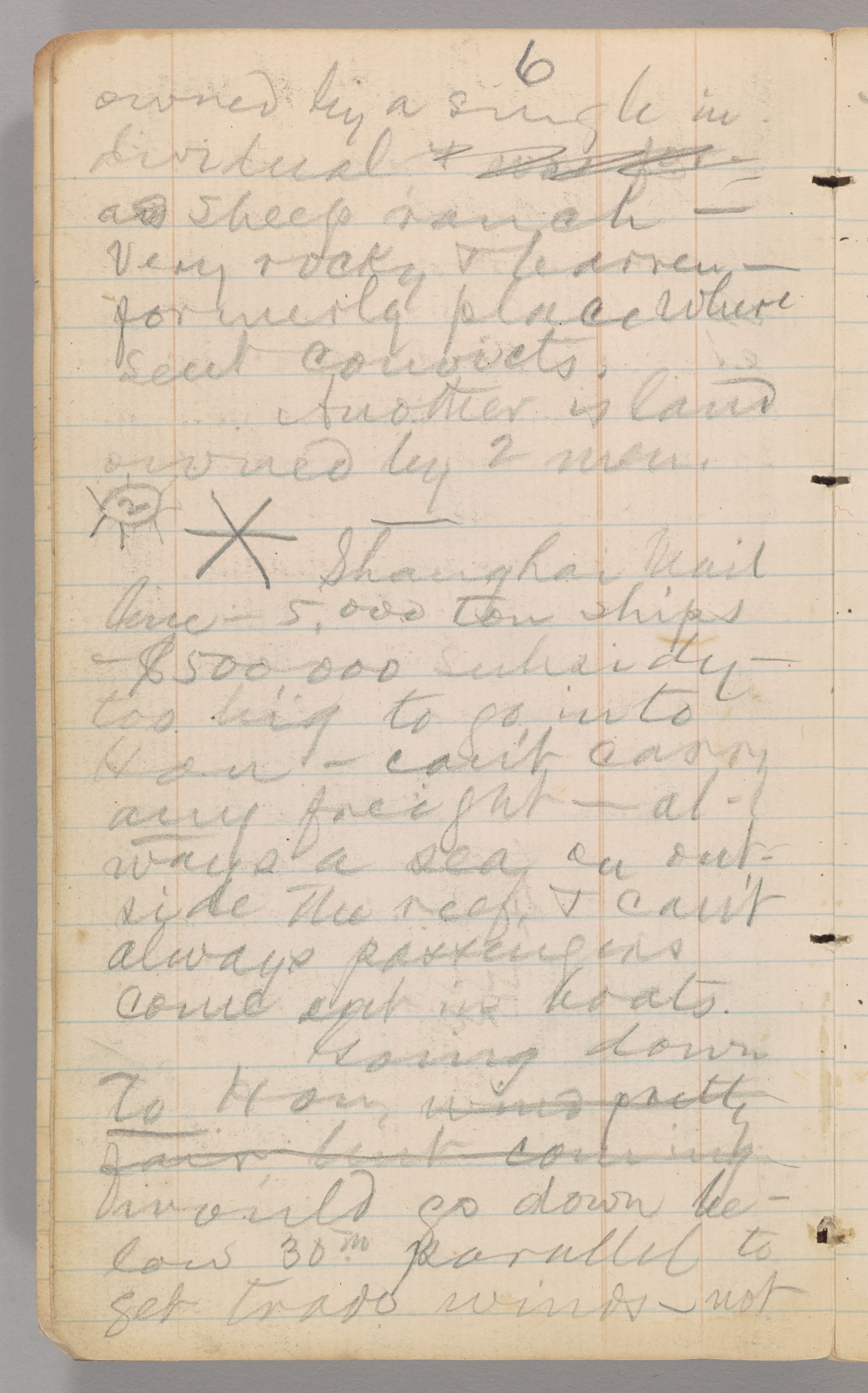
[MS: N6_leaf_003v]
owned by a single in-
dividualindividual, & was for-
a n sheep ranch—
Very rocky & barren—
formerly place where
sent convicts.
Another island
owned by 2 men.
2 ✱ Shanghai Mail
line9—5,000 ton ships
—$500,000 subsidy—
too big to go into
Hon—can't carry
any freight—al-
waysalways a sea on out-
sideoutside the reef, & can't
always passengers
come out in boats.
Going down
to Hon, wind pretty
fair, but coming
would go down be-
lowbelow 30th parallel to
get trade winds—not
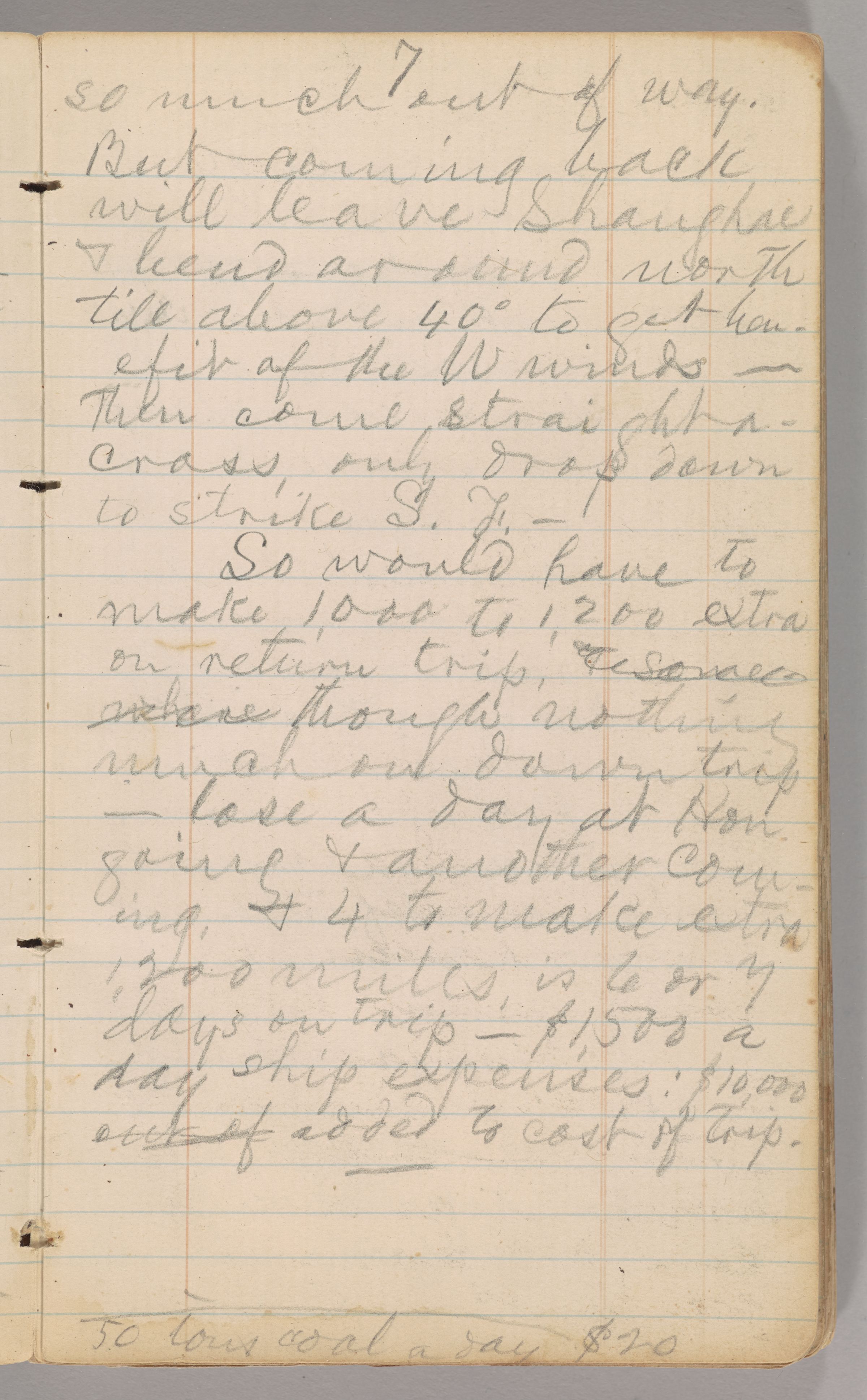
[MS: N6_leaf_004r]
so much out of way.
But coming back
will leave Shanghai
& bend around north
till above 40⁰ to get ben-
efitbenefit of the W winds—
then come straight a-
crossacross, only drop down
to strike S. F.—
So would have to
make 1,000 to 1,200 extra
on return trip, & some-
wheresomewhere though nothing
much on down trip
—lose a day at Hon.
going & another com-
ingcoming, & 4 to make extra
1,200 miles, is 6 or 7
days on trip—$1,500 a
day ship expenses: $10,000
out of added to cost of trip.
50 tons coal a day $20
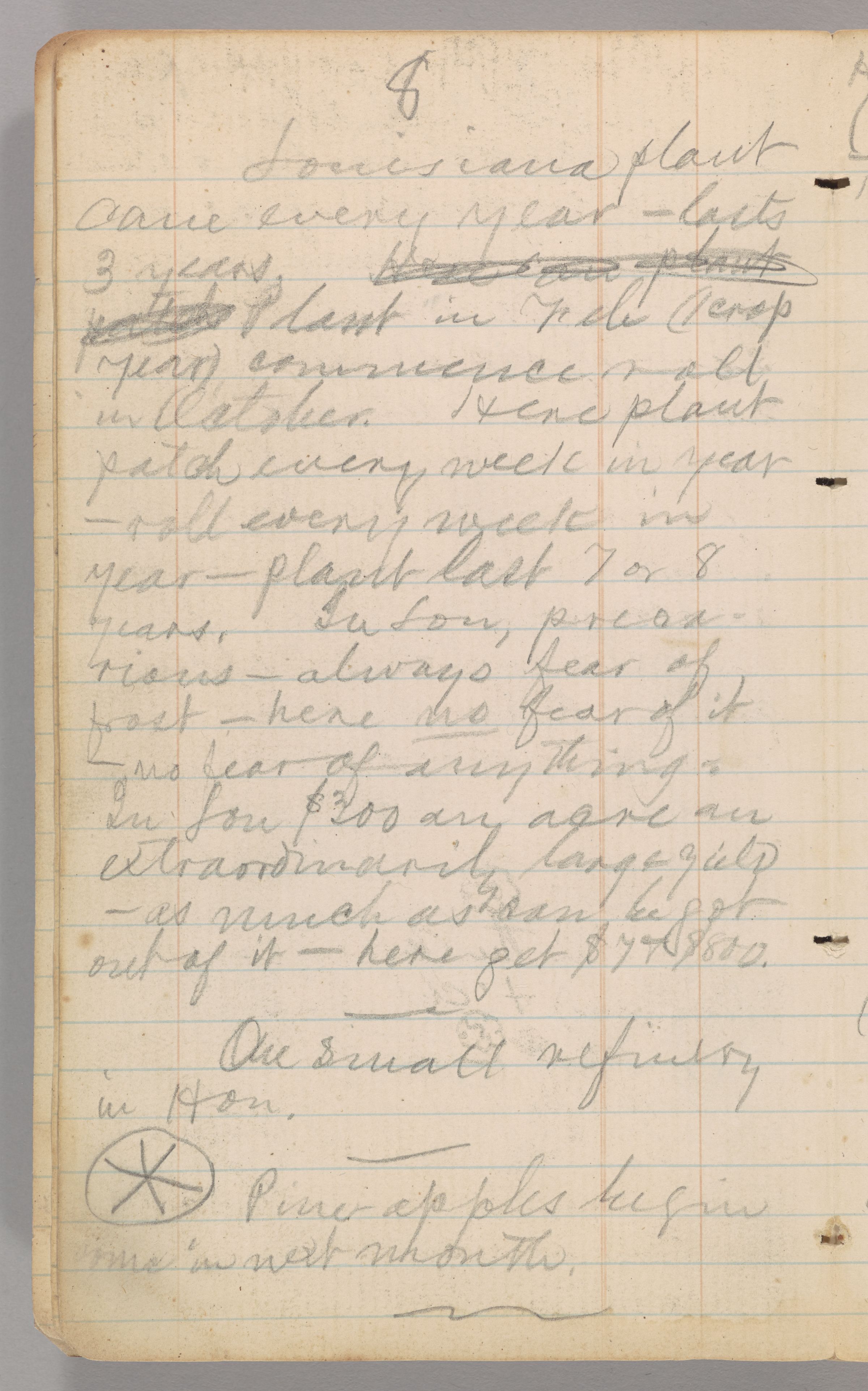
[MS: N6_leaf_004v]
Louisiana plant
cane every year—lasts
3 years. Here can plant
patch Plant in Feb (1 crop
year), commence roll
in October. Here plant
patch every week in year
—roll every week in
year—plant last 7 or 8
years. In Lou, preca-
riousprecarious—always fear of
frost—here no fear of it
—no fear of anything.
In Lou $300 an acre an
extraordinarily large yield
—as much as can be got
out of it—here get $7 & $800.
One small refinery
in Hon.
[MTP: N&J1_184]
✱ Pine-apples begin
come in next month.
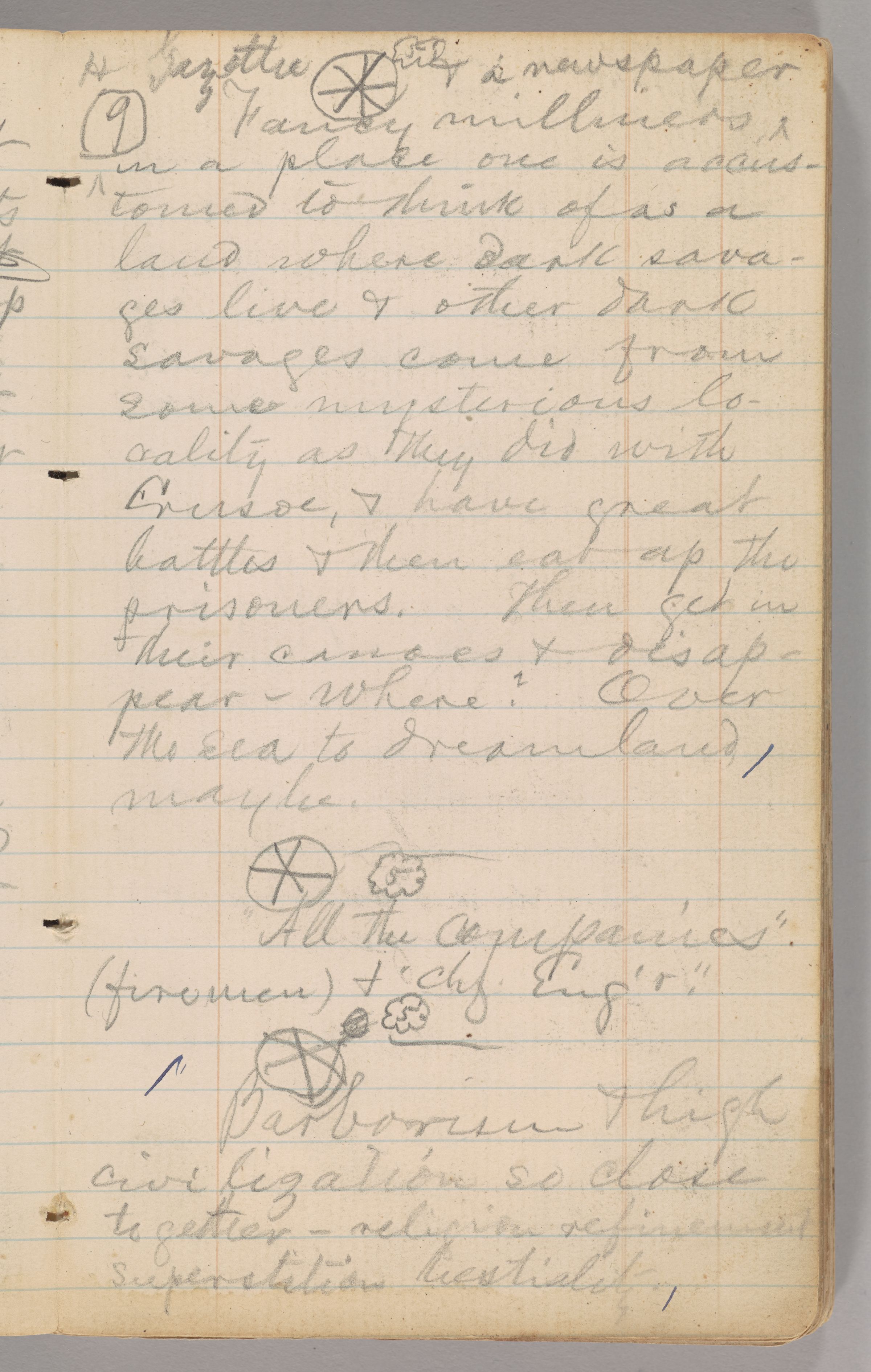
[MS: N6_leaf_005r]
✱ 5
Fancy milliners, & a newspaper
H Gazettee in a place one is accus-
tomedaccustomed to think of as a
land where s dark sava-
gessavages live & other dark
savages come from
some mysterious lo-
calitylocality as they did with
Crusoe, & have great
battles & then eat up the
prisoners. Then get in
their canoes & disap-
peardisappear—where? Over
the sea to dreamland,
maybe.
✱ 5
“All the companies”
(firemen) & “chf. Eng'r.”
✱ 5 5
Barbarism & high
civilization so close
together—religion refinement
superstition bestiality.
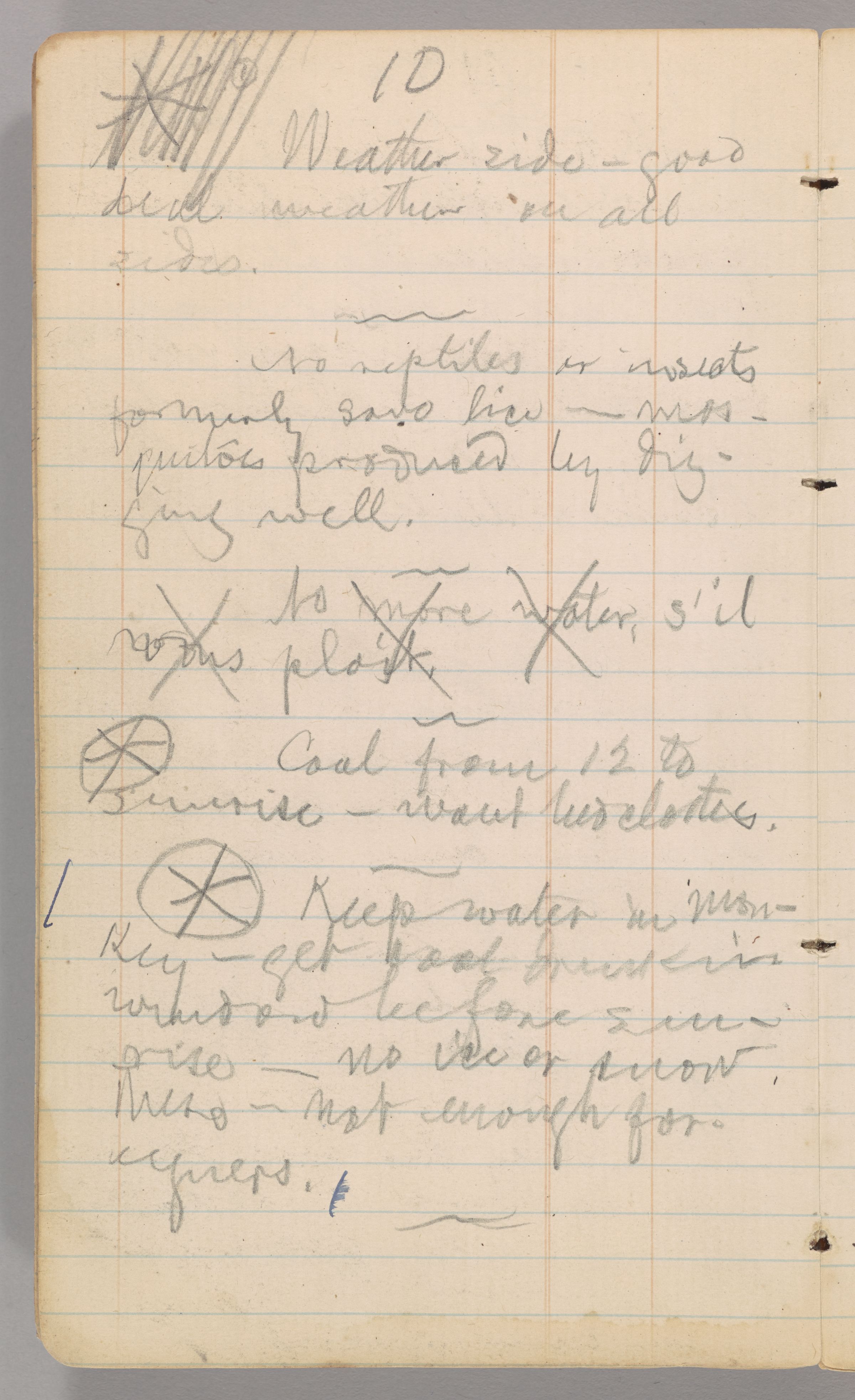
[MS: N6_leaf_005v]
✱ 1 Weather side—good
deal weather on all
sides.
No reptiles or insects
formerly save lice—mos-
quitosmosquitoes produced by dig-
gingdigging well.
No more water, s'il
vous plait.
✱ Cool from 12 to
sunrise—want bedclothes.
✱ Keep water in mon-
keymonkey10—get cool drink in
window before sun-
risesunrise—no ice or snow
there—not enough for-
eignersforeigners.
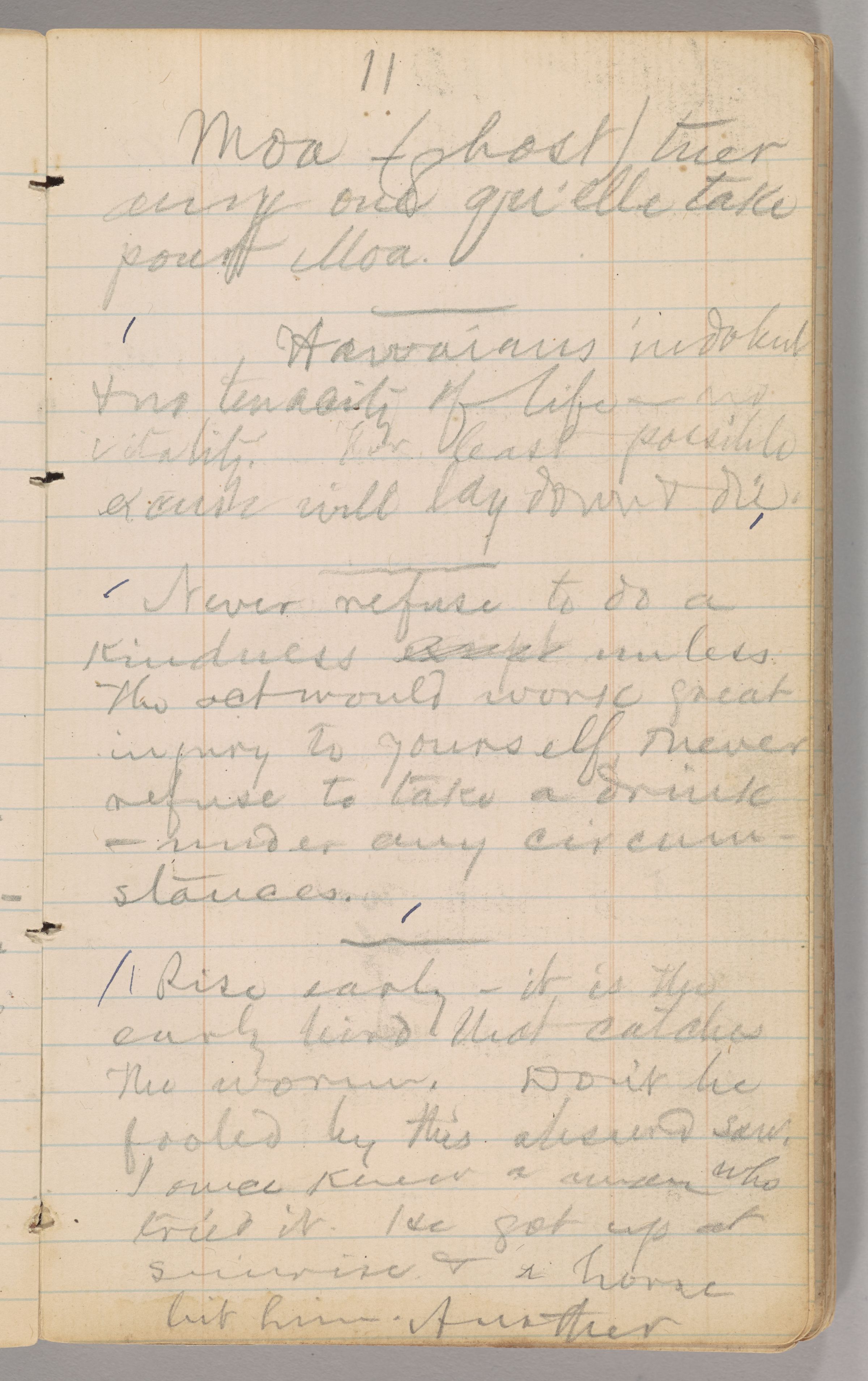
[MS: N6_leaf_006r]
Moa—(ghost) tuer
any one qu'elle take
pour Moa.11
Hawaians indolent
& no tenacity of life—no
vitality. For least possible
excuse will lay down & die.
Never refuse to do a
kindness except unless
the act would work great
injury to yourself, & never
refuse to take a drink
—under any circum-
stancescircumstances.
Rise early—it is the
early bird that catches
the worm. Don't be
fooled by this absurd saw.
I once knew a man who
tried it. He got up at
sunrise & a horse
bit him. Another
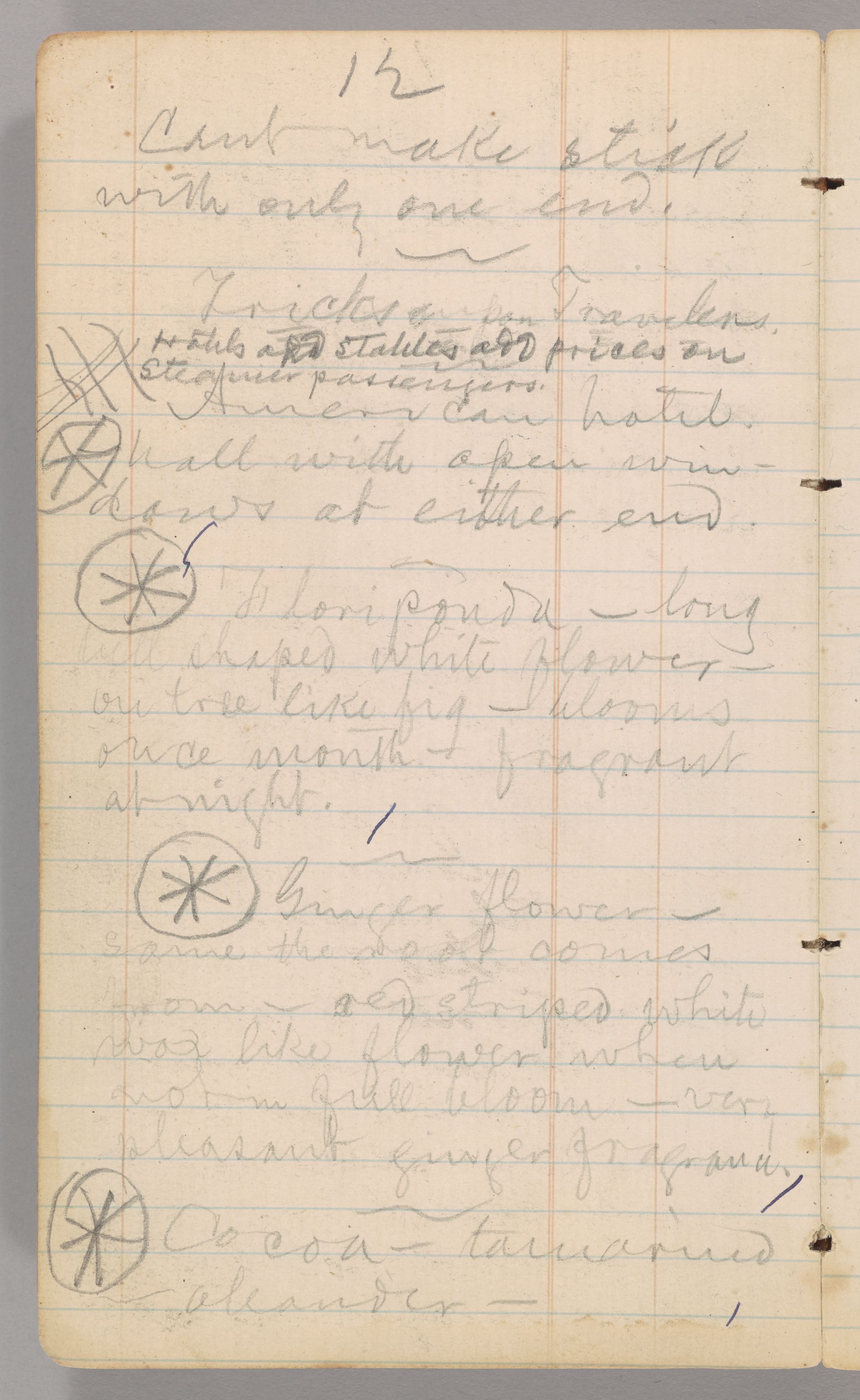
[MS: N6_leaf_006v]
[MTP: N&J1_185]
Cant make stick
with only one end.
Tricks ◊upon Travelers.
Hotels addndⓉtextual note stables add prices on
steamer passengers.
✱ American hotel.
—hall with open win-
dowswindows at either end.
✱ Floriponda—long
bell shaped white flower—
on tree like fig—blooms
once month—fragrant
at night.
✱ Ginger flower—
same the root comes
from—sred striped white
wax like flower when
not in full bloom—very
pleasant ginger fragrance.
✱ Cocoa—tamarind
—oleander—
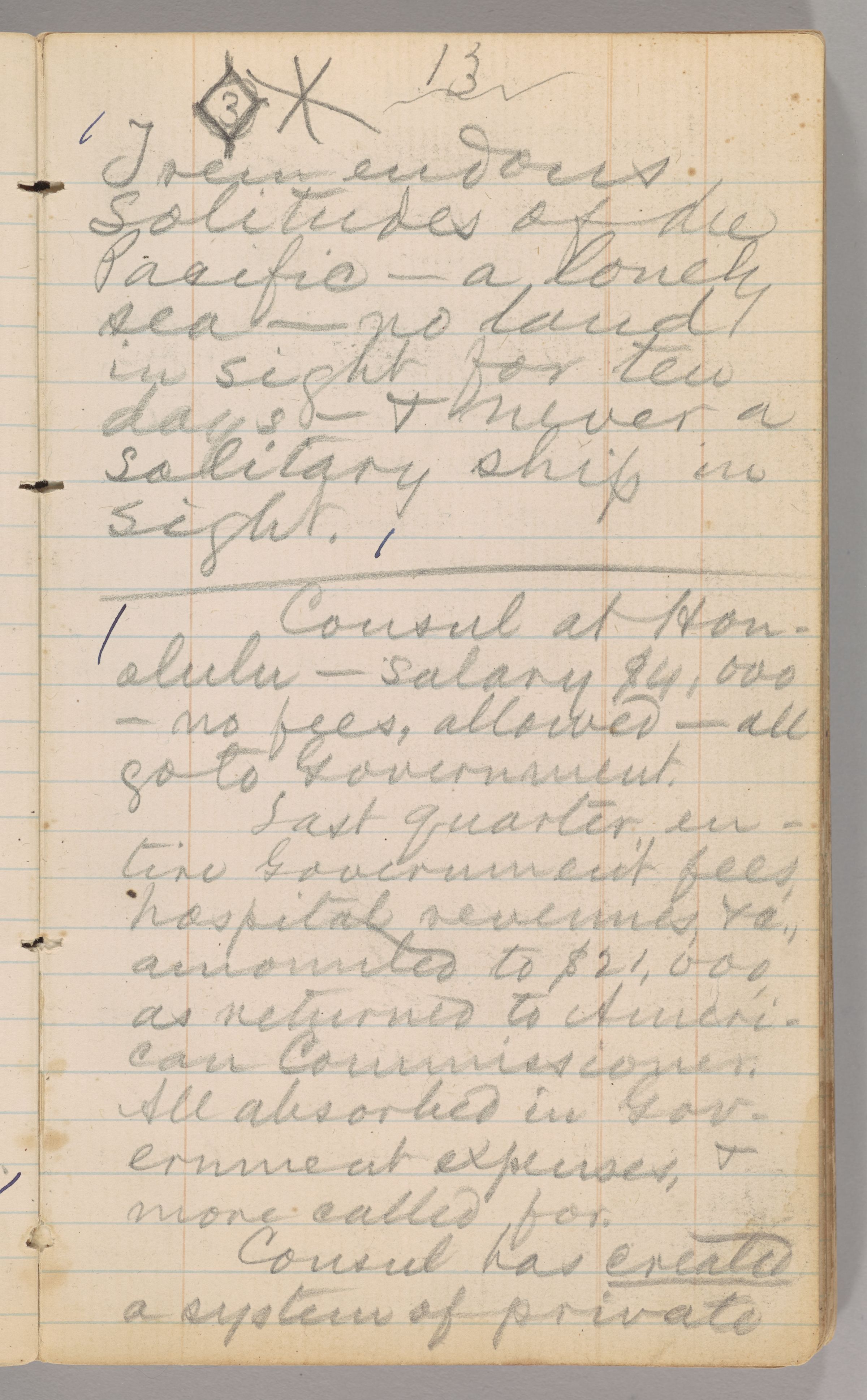
[MS: N6_leaf_007r]
3 ✱
Tremendous
solitudes of the
Pacific—a lonely
sea—no land
in sight for ten
days—& never a
solitary ship in
sight.
Consul at Hon-
oluluHonolulu—salary $4,000
—no fees.,Ⓣtextual note allowed—all
go to Government.
Last quarter, en-
tireentire Government fees,
hospital revenues, &c.,
amounted to $21,000,
as returned to Amer-
canAmerican Commissioner.12
All absorbed in Gov-
ernmentGovernment expenses, &
more called for.
Consul has created
a system of private
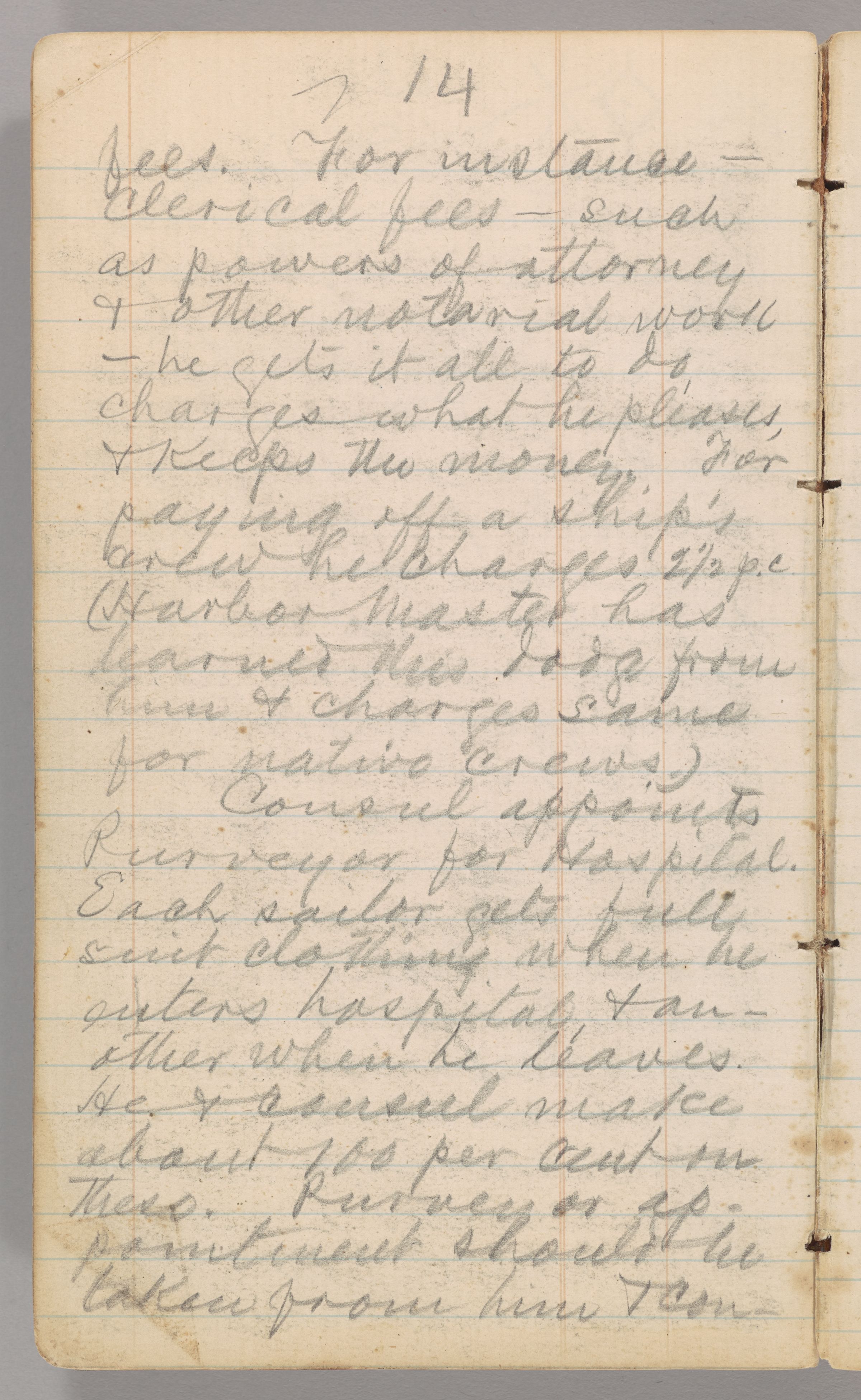
[MS: N6_leaf_007v]
fees. For instance—
clerical fees—such
as powers of attorney
& other notarial work
—he gets it all to do,
charges what he pleases,
& keeps the money. For
paying off a ship's
crew he charges 2½ p.c.
(Harbor Master has
learned this dodge from
him & charges same
for native crews.)
Consul appoints
Purveyor for Hospital.13
Each sailor gets full
[MTP: N&J1_186]
suit clothing when he
enters hospital, & an-
otheranother when he leaves.
He & consul make
about 100 per cent on
these. Purveyor ap-
pointmentappointment should be
taken from him & con-
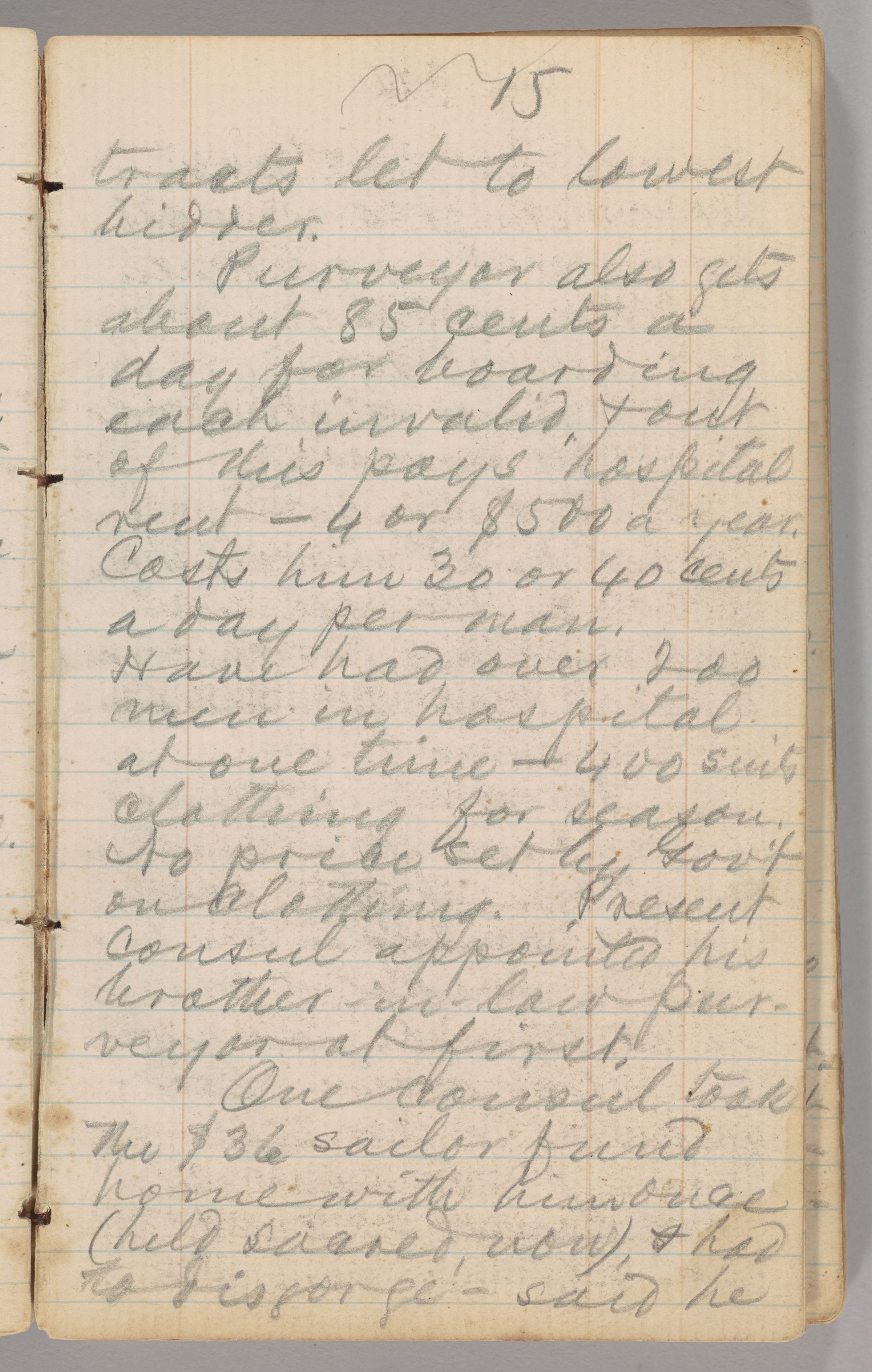
[MS: N6_leaf_008r]
tracts let to lowest
bidder.
Purveyor also gets
about 85 cents a
day for boarding
each invalid, & out
of this pays hospital
rent—4 or $500 a year.
Costs him 30 or 40 cents
a day per man.
Have had over 200
men in hospital
at one time—400 suits
clothing for season.
No price set by Gov't
on clothing. Present
consul appointed his
brother-in-law pur-
veyorpurveyor at first.
One consul took
the $36 sailor fund
home with him once
(held sacred, now), s& had
to disgorge—said he
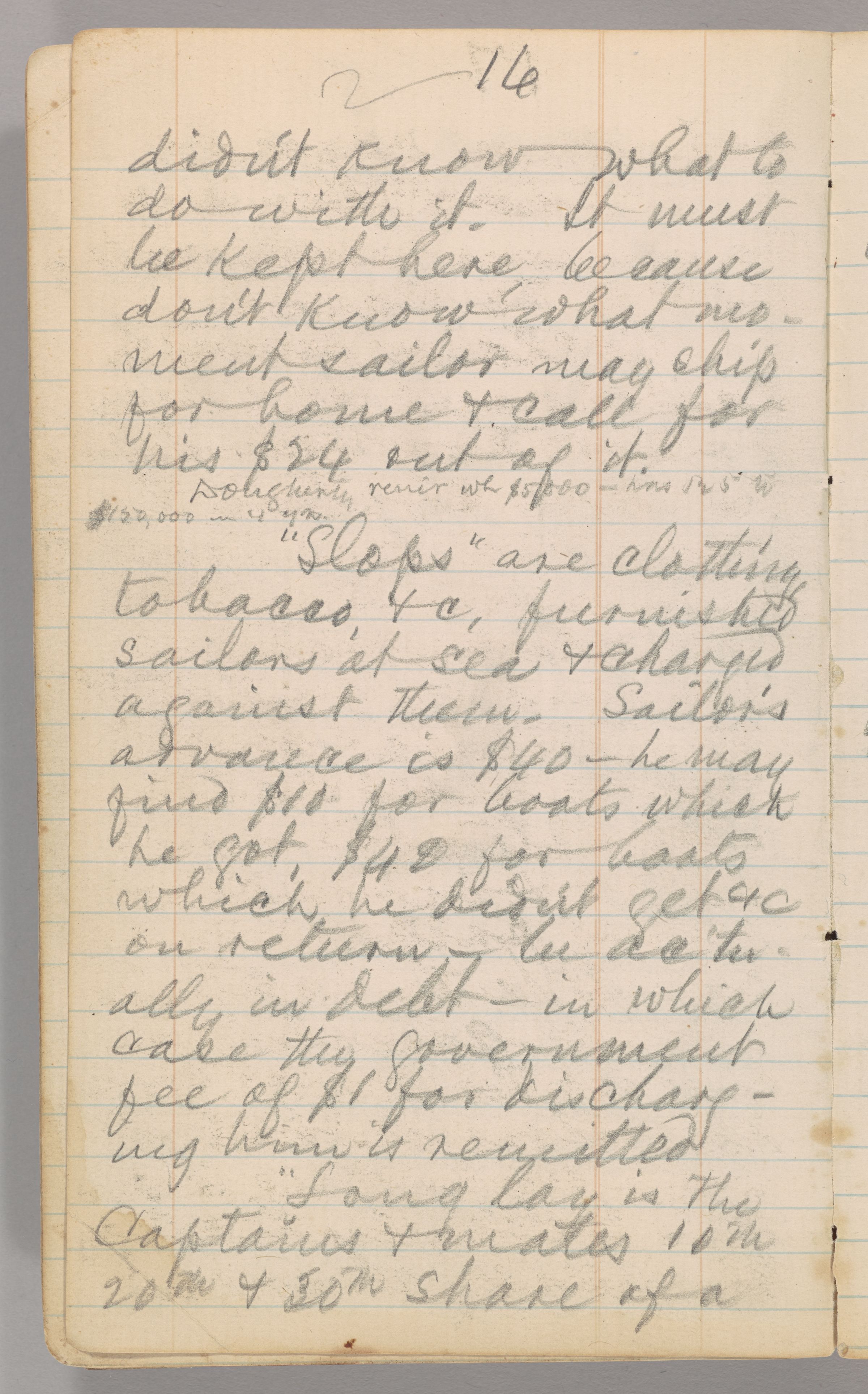
[MS: N6_leaf_008v]
didn't know what to
do with it. It must
be kept here, because
don't know what mo-
mentmoment sailor may ship
for home & call for
his $24 out of it.
Dougherty venir wh $5000—has 125 to
$150,000 in 4 yrs.
“Slops” are clothing,
tobacco, &c, furnished
sailors at sea & charged
against them. Sailor's
advance is $40—he may
find $10 for boots which
he got, $40 for boots
which he didn't get, &c
on return —be actu-
allyactually in debt—in which
case the government
fee of $1 for discharg-
ingdischarging him is remitted
“Long lay is the
Captains & mates 10th
20th & 30th share of a
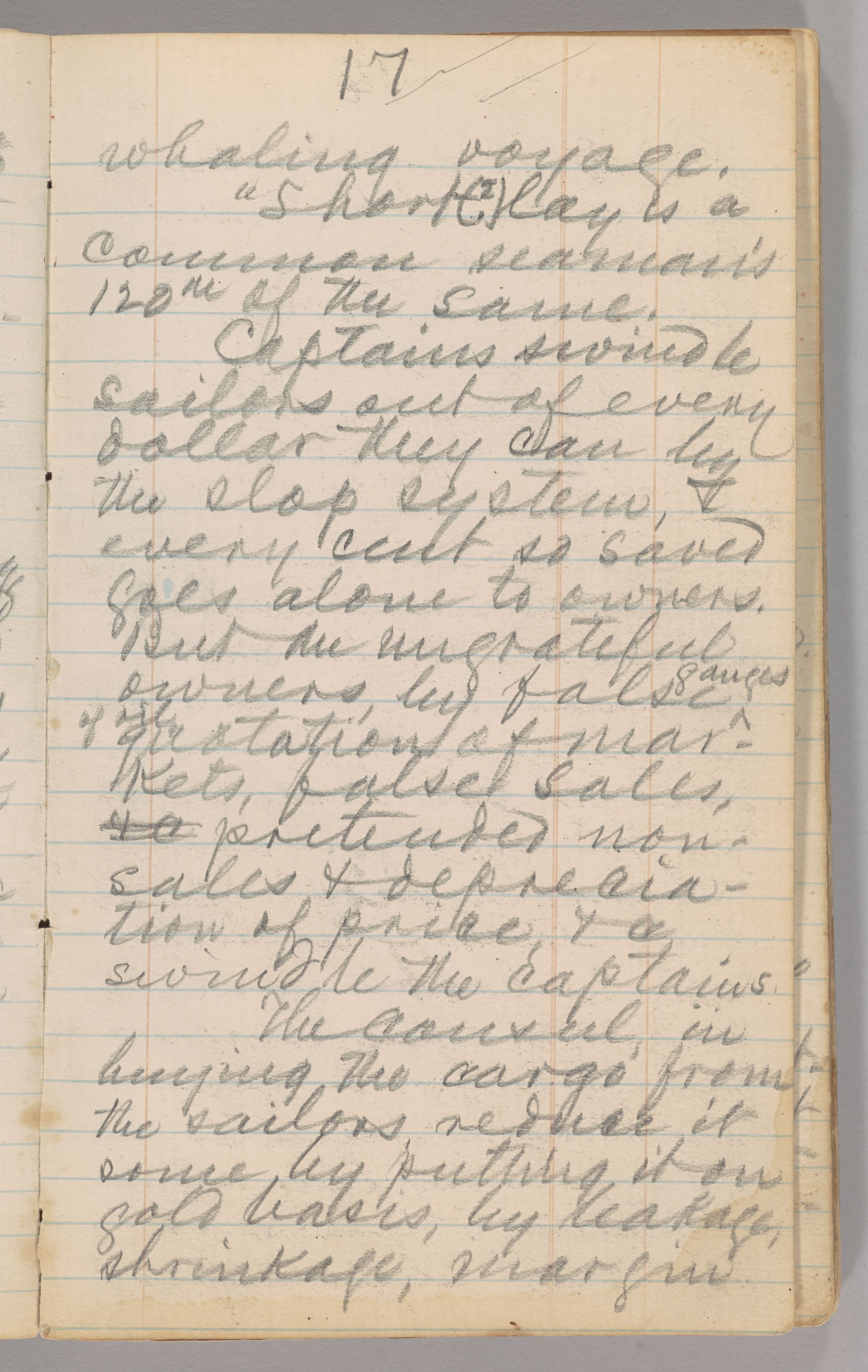
[MS: N6_leaf_009r]
whaling voyage.
“Short(?) lay is a
common seaman's
120th of the same.
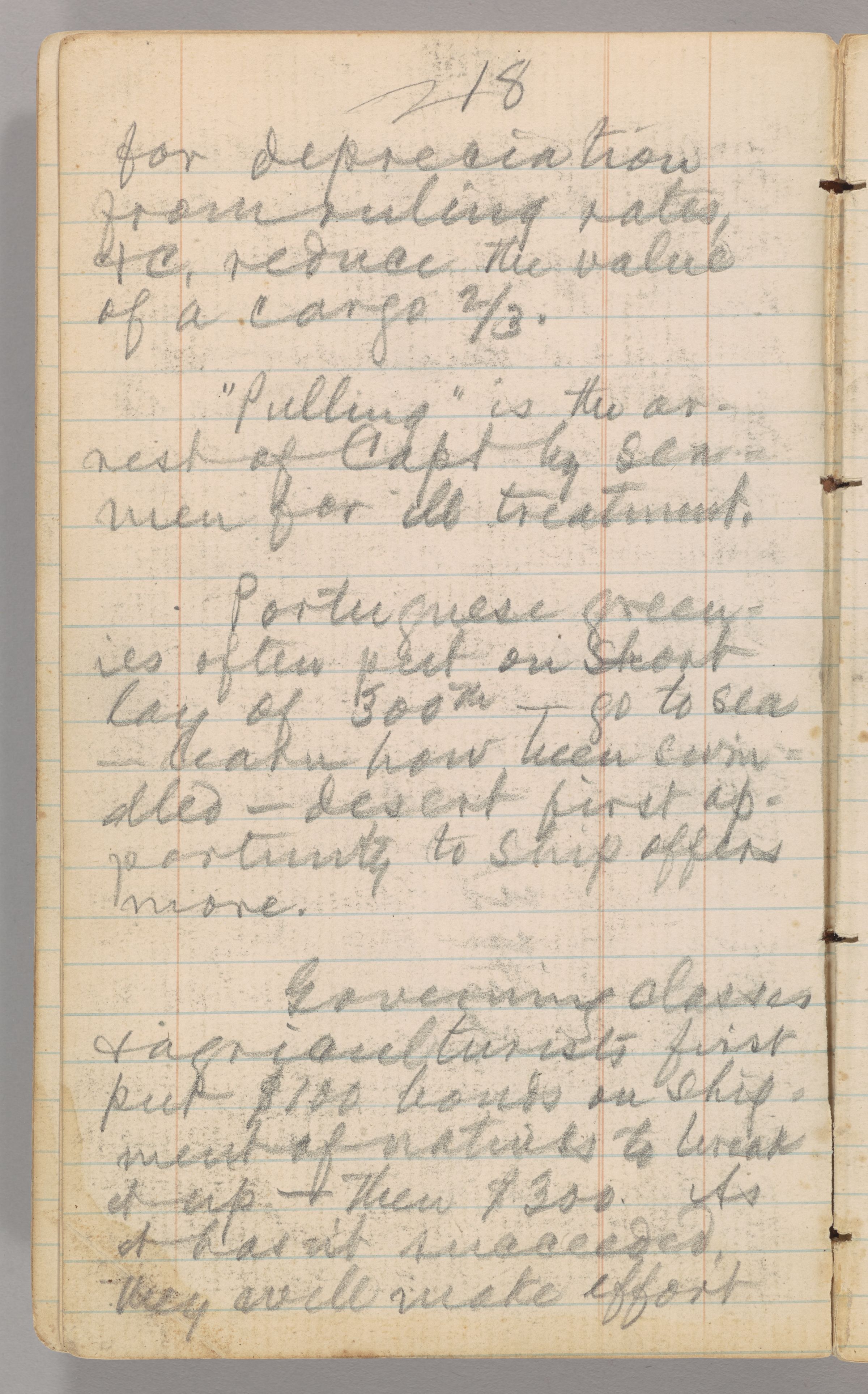
Captains swindle
sailors out of every
dollar they can by
the slop system, &
every cent so saved
goes alone to owners.
But the ungrateful
owners, by false gauges
of oil, quotations of mar-
ketsmarkets, false sales,
&c pretended non-
sales & deprecia-
tiondepreciation of price, &c,
swindle the captains.
The consul, in
buying the cargo from
the sailors, reduce it
some by putting it on
gold basis, by leakage,
shrinkage, margin
[MS: N6_leaf_009v]
for depreciation
from ruling rates,
&c, reduce the value
of a cargo ⅔.
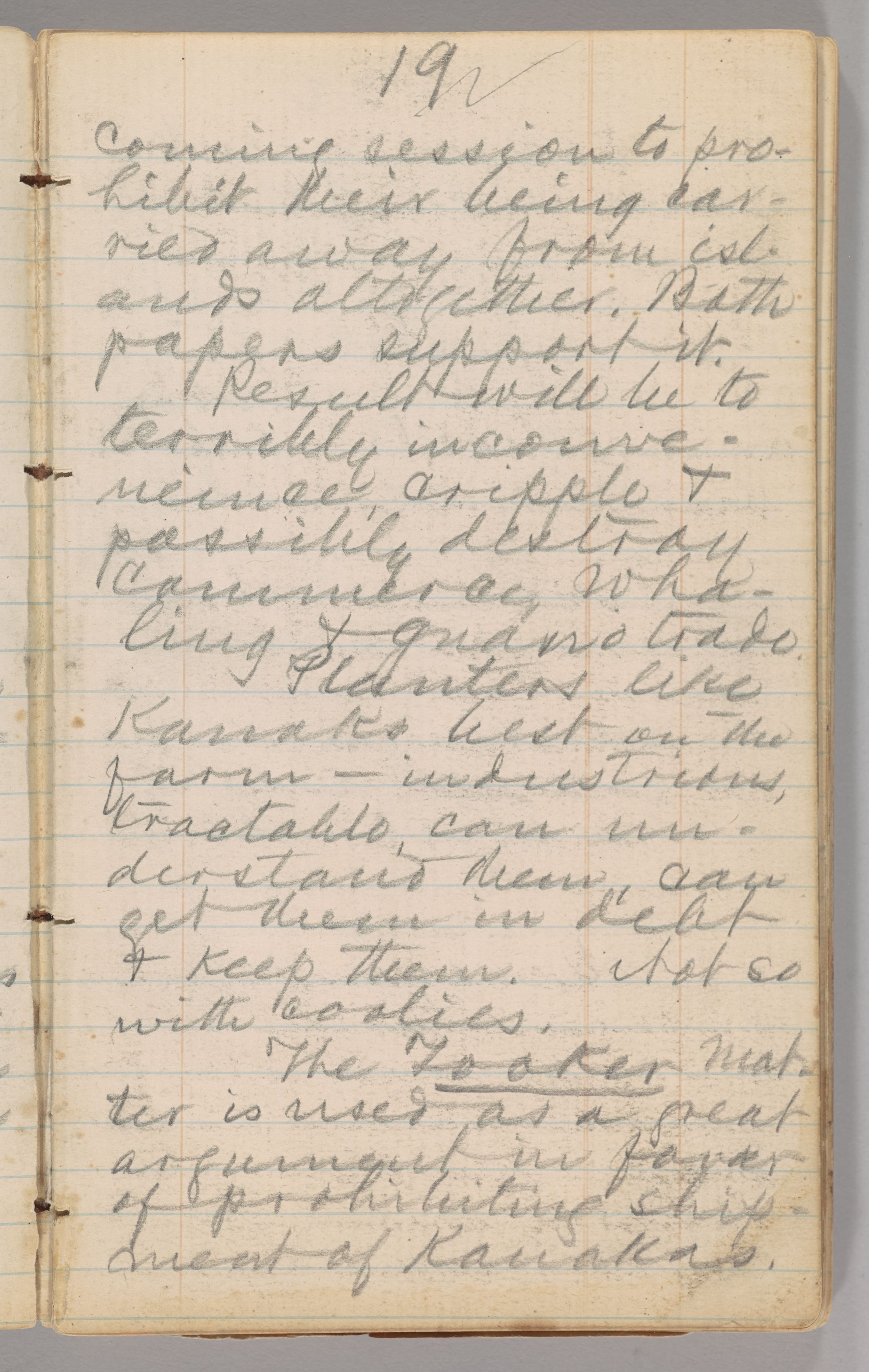
“Pulling” is the ar-
restarrest of Capt by sea-
menseamen for ill treatment.
[MTP: N&J1_187]
Portuguese green-
iesgreenies often put on short
lay of 300th—go to sea
—learn how been swin-
dledswindled—desert first op-
portunityopportunity to ship offers
more.
Governing classes
& agriculturists first
put $100 bonds on ship-
mentshipment of natives to break
it up—then $300. As
it hasn't succeeded,
they will make effort
[MS: N6_leaf_010r]
coming session to pro-
hibitprohibit their being car-
riedcarried away from isl-
andsislands altogether. Both
papers support it.
Result will be to
terribly inconve-
nienceinconvenience, cripple &
possibly destroy
commerce, wha-
lingwhaling & guano trade.
TPlanters like
Kanaks best on the
farm—industrious,
tractable, can un-
derstandunderstand them, can
get them in debt
& keep them. Not so
with coolies.
The Tooker mat-
termatter is used as a great
argument in favor
of prohibiting ship-
mentshipment of Kanakas.14
[MS: N6_leaf_010v]
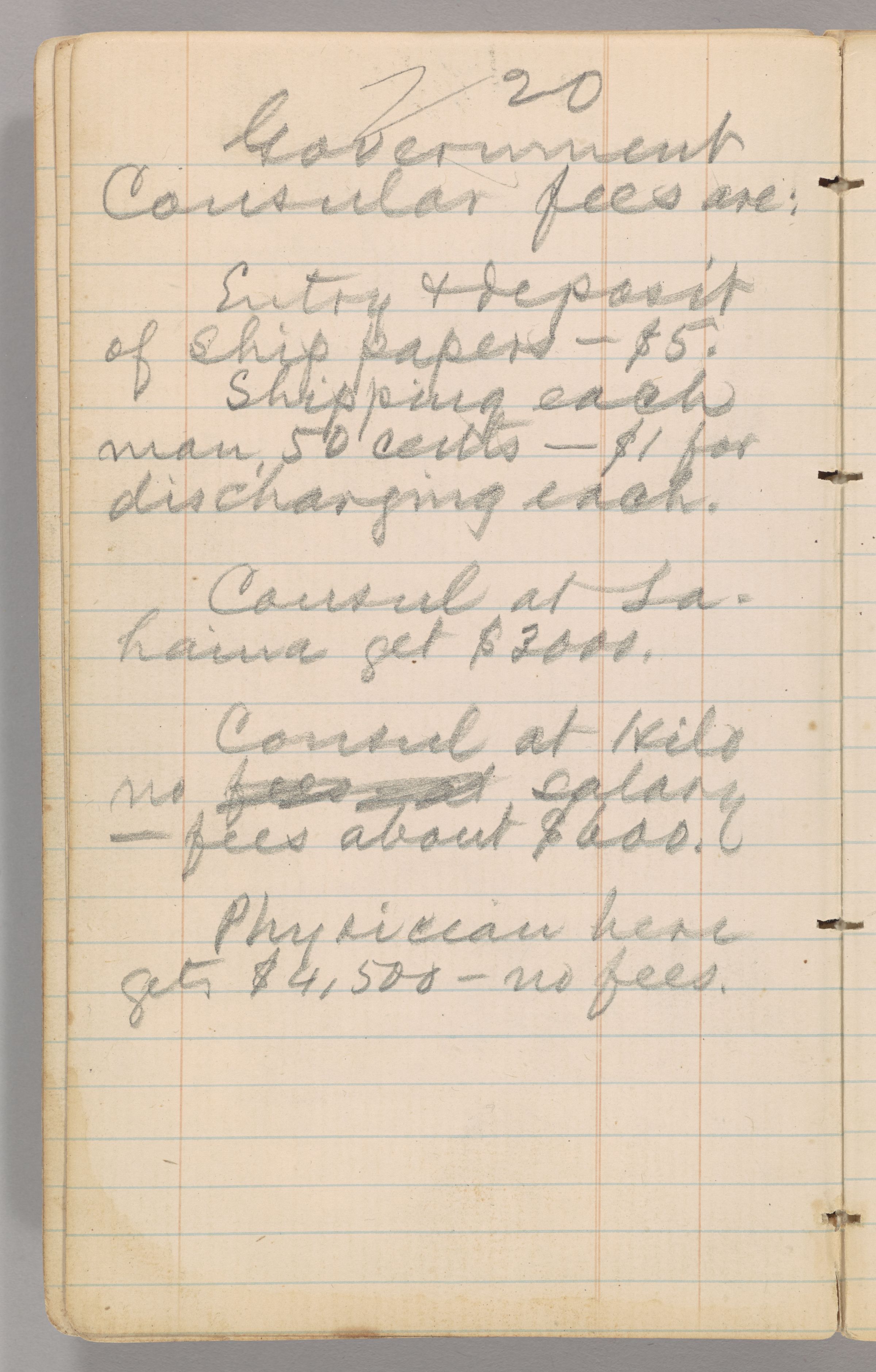
Government
Consular fees are:
Entry & deposit
of ship papers—$5.
Shipping each
man, 50 cents—$1 for
discharging each.
Consul at La-
hainaLahaina get $3000.
Consul at Hilo
no fees—ab salary
—fees about $600.
Physician here
gets $4,500—no fees.
[MS: N6_leaf_011r]
blank recto
[MS: N6_leaf_011v]
blank verso
[MS: N6_leaf_012r]
blank recto
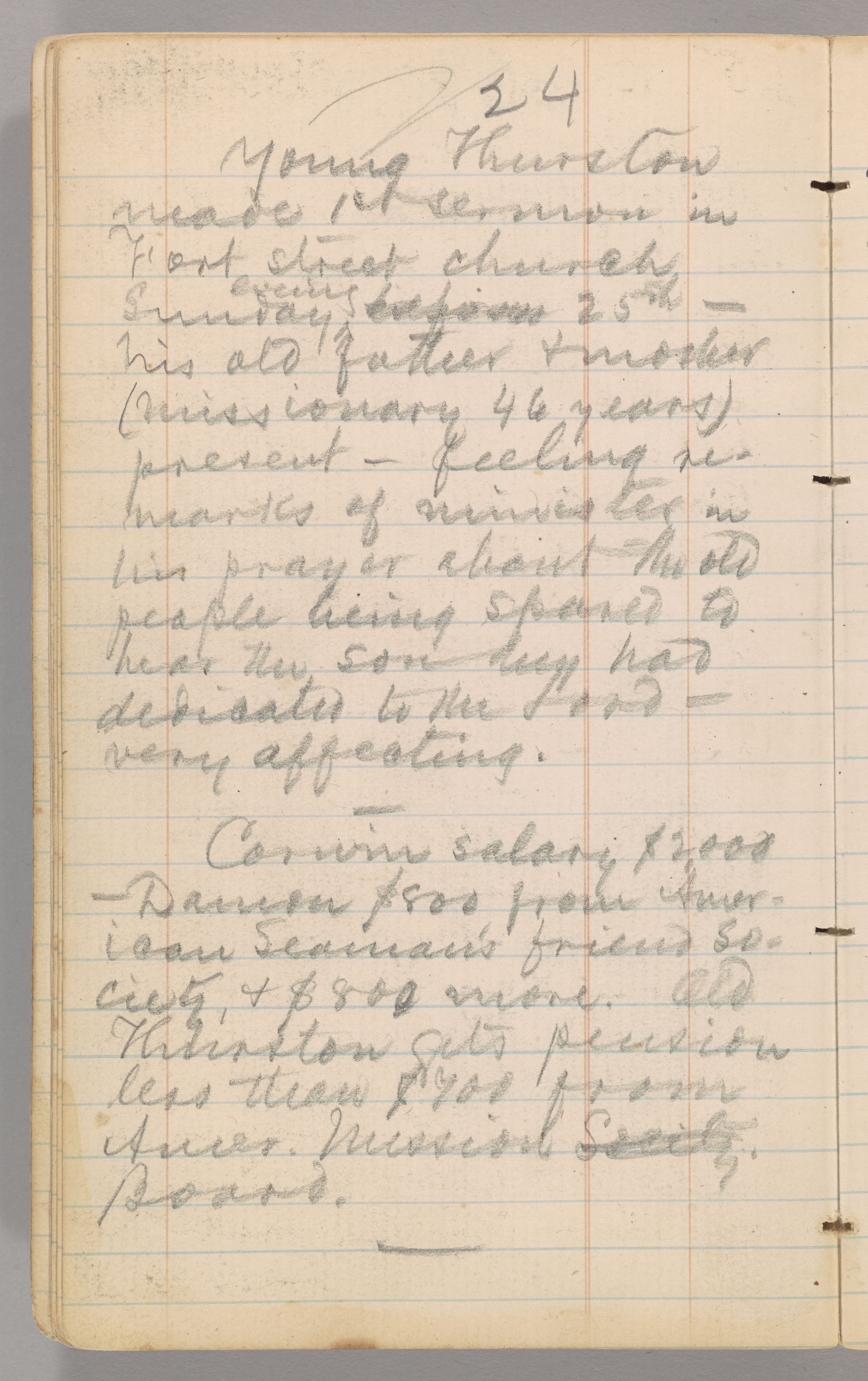
[MS: N6_leaf_012v]
Young Thurston
made 1st sermon in
Fort street church
Sunday eveing before 25th—
his old father & mother
(missionary 46 years)
present—feeling re-
marksremarks of minister in
his prayer about the old
people being spared to
hear the son they had
dedicated to the Lord—
very affecting.15
[MTP: N&J1_188]
Corwin salary $2,000
—Damon $800 from Amer-
icanAmerican Seaman's friend so-
cietysociety,16 & $800 more. Old
Thurston gets pension
less than $700 from
Amer. Mission Socity.
Board.Ⓣtextual note17
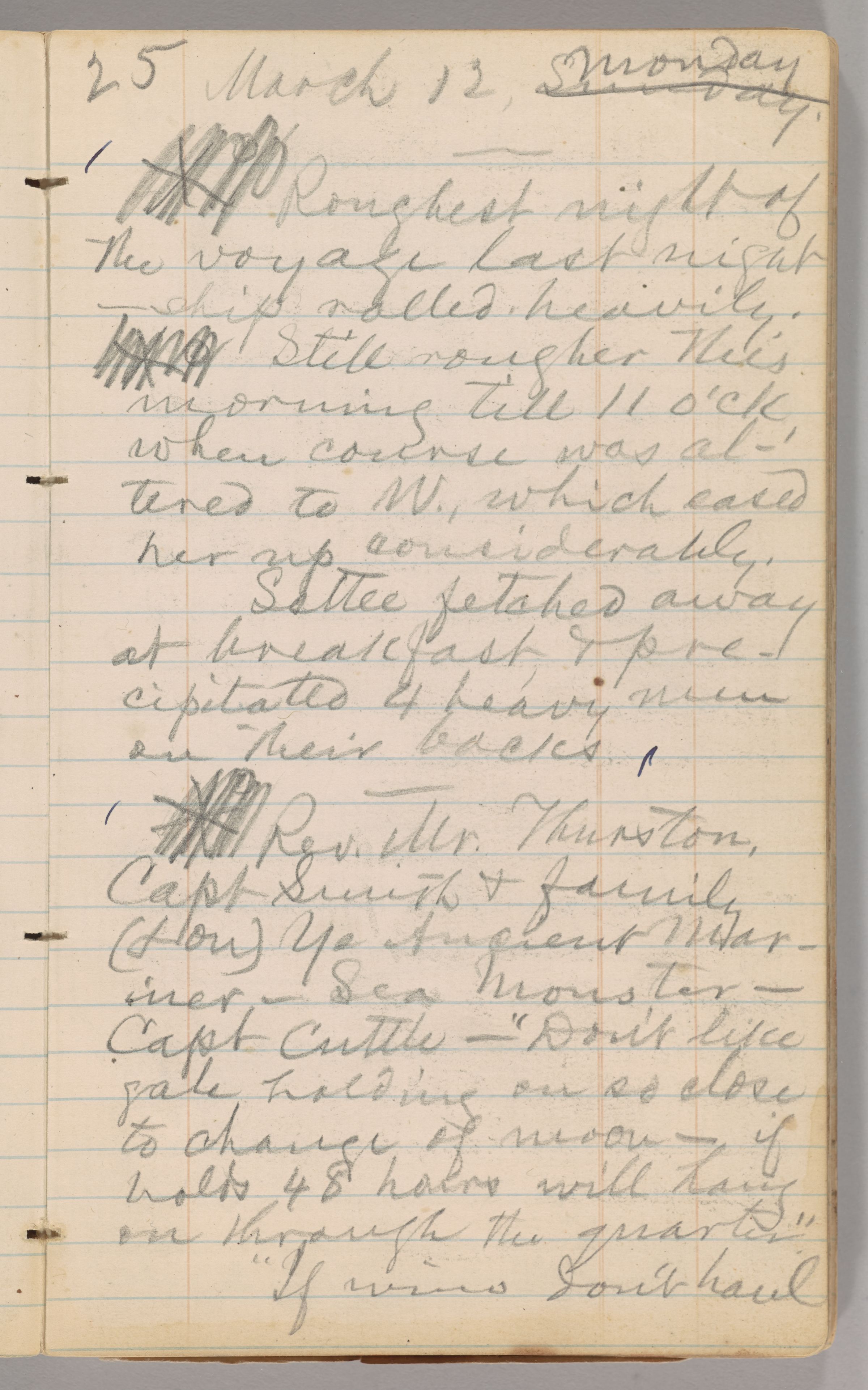
[MS: N6_leaf_013r]
March 12, Sunday. Monday
✱ 1 Roughest night of
the voyage last night
—ship rolled heavily.
✱ 1 Still rougher this
morning till 11 o'ck,
when course was al-
teredaltered to W., which eased
her up considerably.
Settee fetched away
at breakfast, & pre-
cipitatedprecipitated 4 heavy men
on their backs.
✱ 1 Rev. Mr. Thurston,
Capt Smith & family
(Lon) Ye Ancient Mar-
inerMariner—Sea Monster—
Capt Cuttle18—“Don't like
gale
[MTP: N&J1_189]
holding on so close
to change of moon—if
holds 48 hours will hang
on through the quarter.”
“If wind don't haul
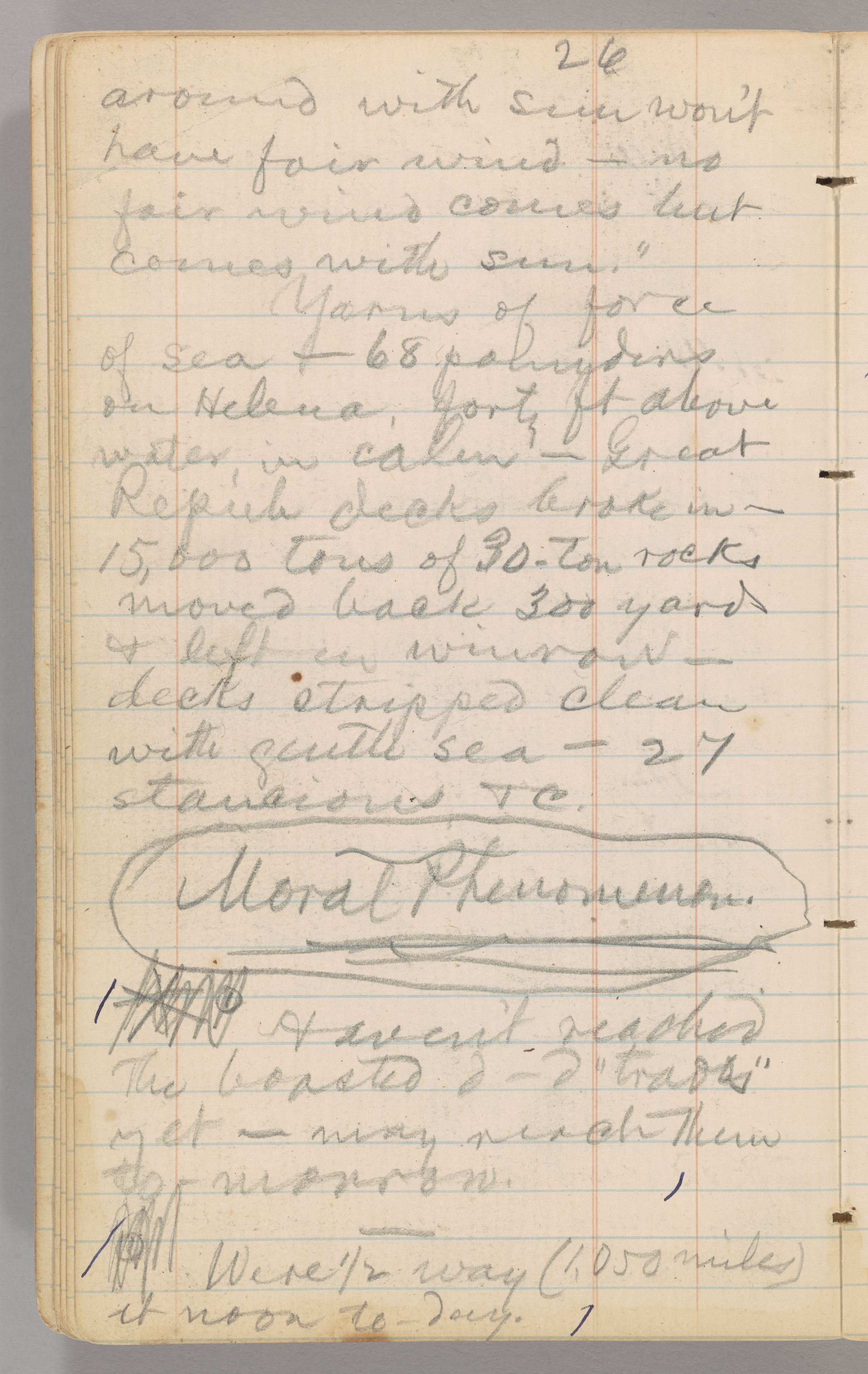
[MS: N6_leaf_013v]
around with sun won't
have fair wind—no
fair wind comes but
comes with sun.”
Yarns of force
of sea—68 pounders
on Helena, forty ft above
water, in calm—Great
Repub decks broke in—
15,000 tons of 1 30-ton rocksⓉtextual note
moved back 300 yards
& left in winrow—
decks stripped clean
with gentle sea—27
stancions, &c.
Moral Phenomenon.Ⓣtextual note
✱ 1 Haven't reached
the boasted d—d “trades”
yet—may reach them
to-morrow.
1 Were ½ way (1,050 miles)
at noon to-day.
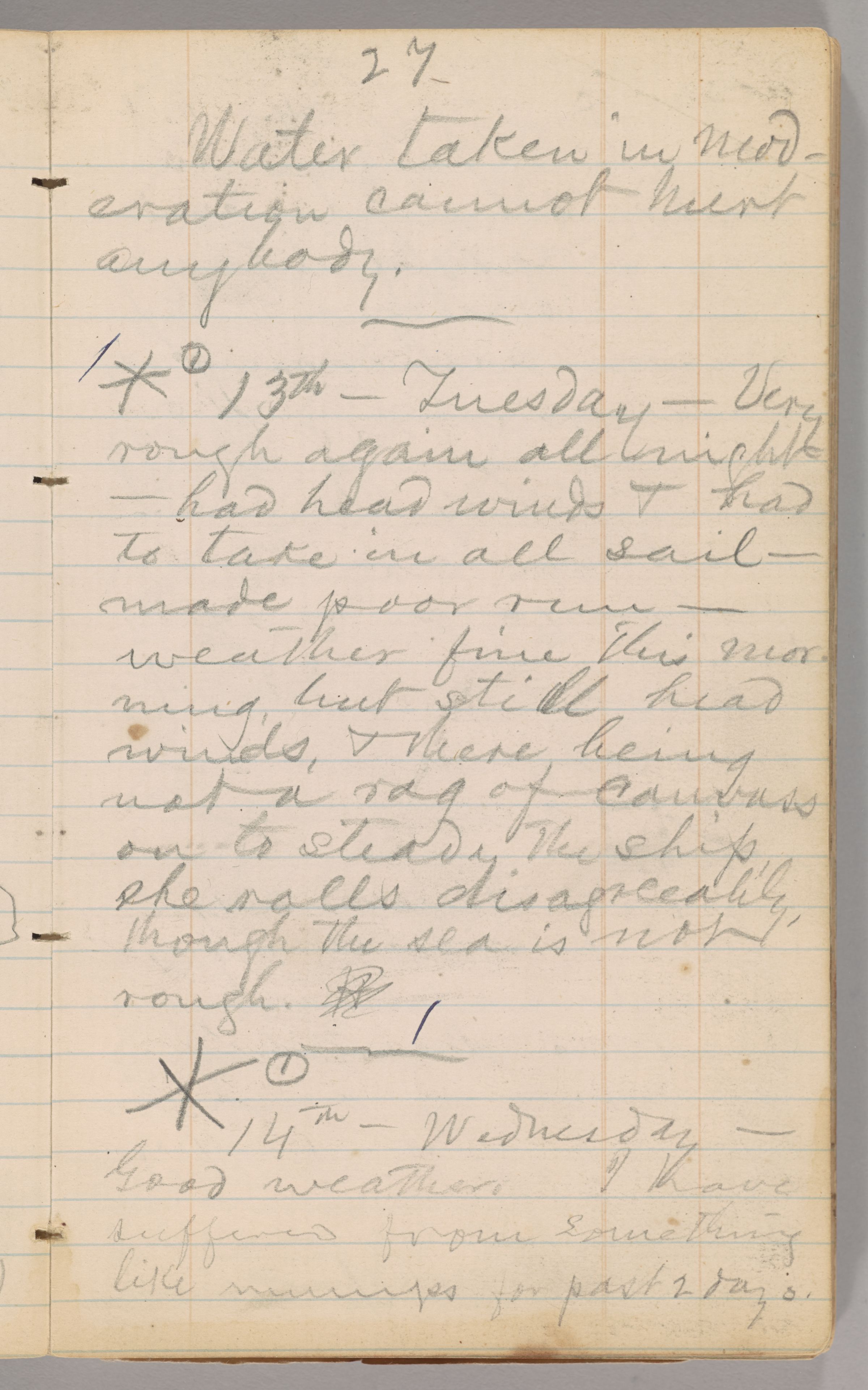
[MS: N6_leaf_014r]
Water taken in mod-
erationmoderation cannot hurt
anybody.
✱ 1 13th—Tuesday—Very
rough again all night
—had head winds & had
to take in all sail—
made poor run—
weather fine this mor-
ningmorning, but still head
winds, & there being
not a rag of canvass
on to steady the ship,
she rolls disagreeably,
though the sea is not
rough. H
✱ 1 14th—Wednesday—
Good weather. I have
suffered from something
like mumps for past 2 days.
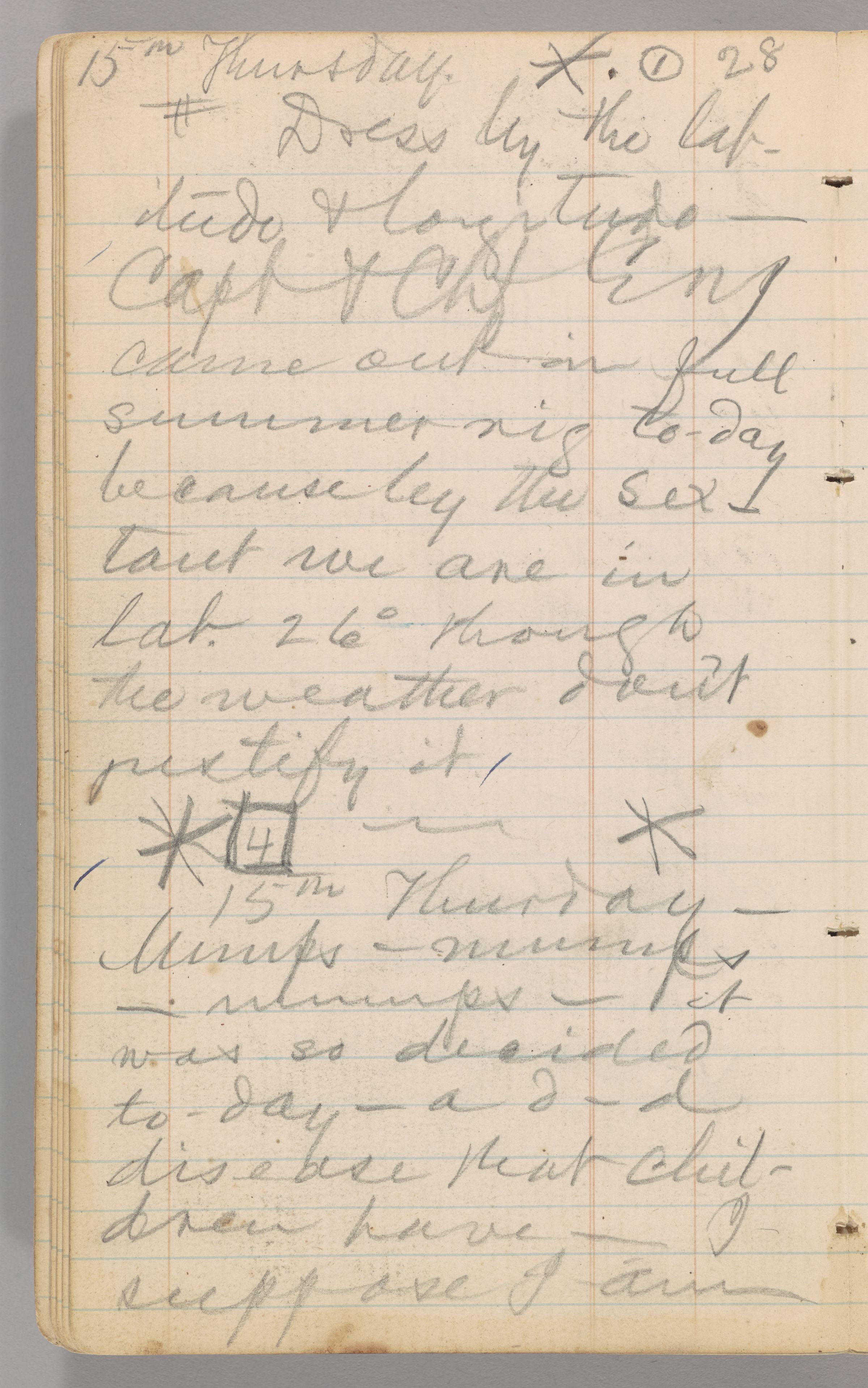
[MS: N6_leaf_014v]
15th Thursday. ✱ 1
Dress by the lat-
itudelatitude & longitude—
Capt & Chf Eng
came out in full
summer rig to-day
because by the sex-
tantsextant we are in
lat. 26⁰ though
the weather don't
justify it.
✱ 4 ✱
15th Thurday—
Mumps—mumps
—mumps—it
was so decided
to-day—a d—d
disease that chil-
drenchildren have—
I suppose I am
[MS: N6_leaf_015r]
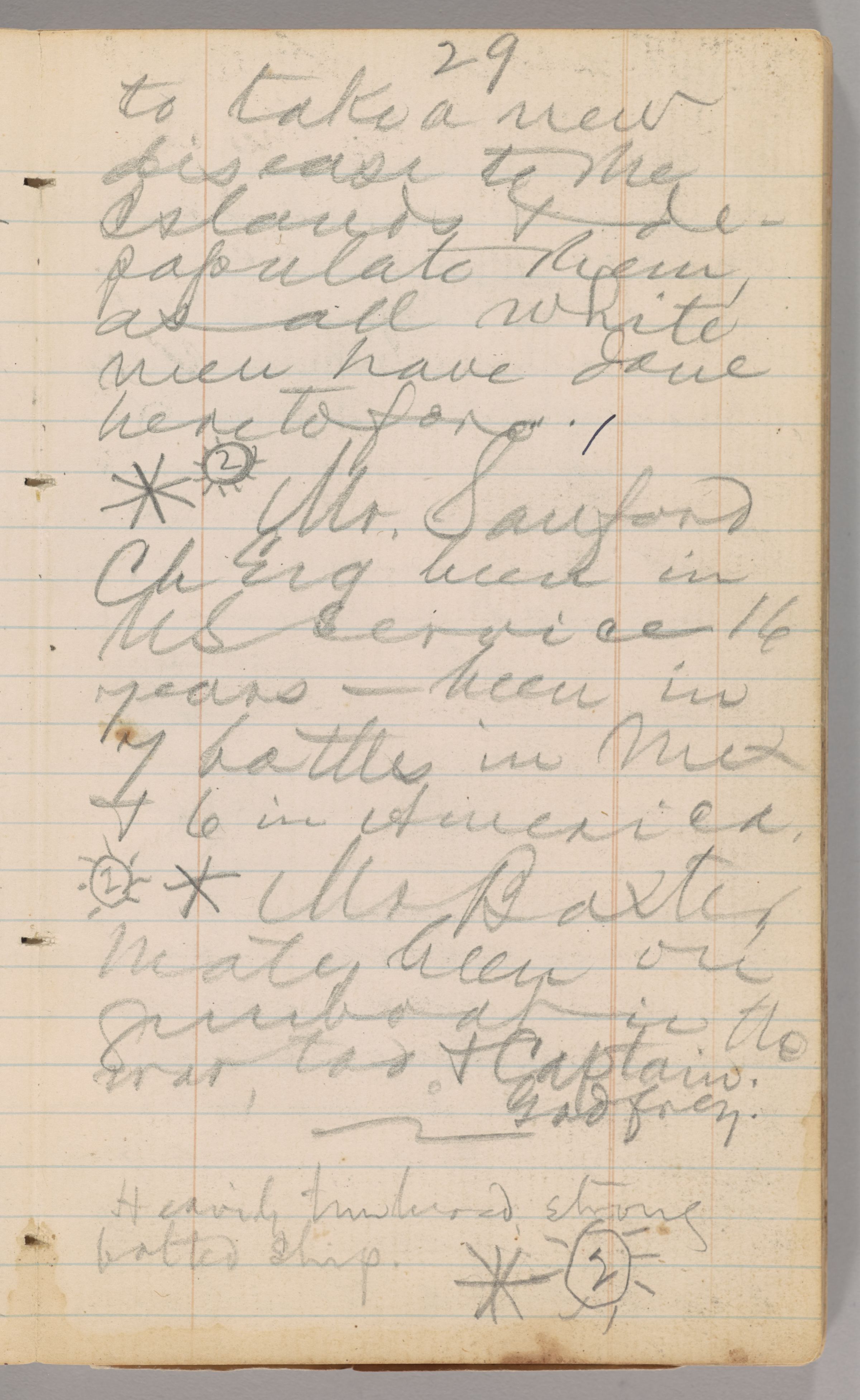
to take a new
disease to the
Islands & de-
populatedepopulate them,
as all white
men have done
heretofore.
[MTP: N&J1_190]
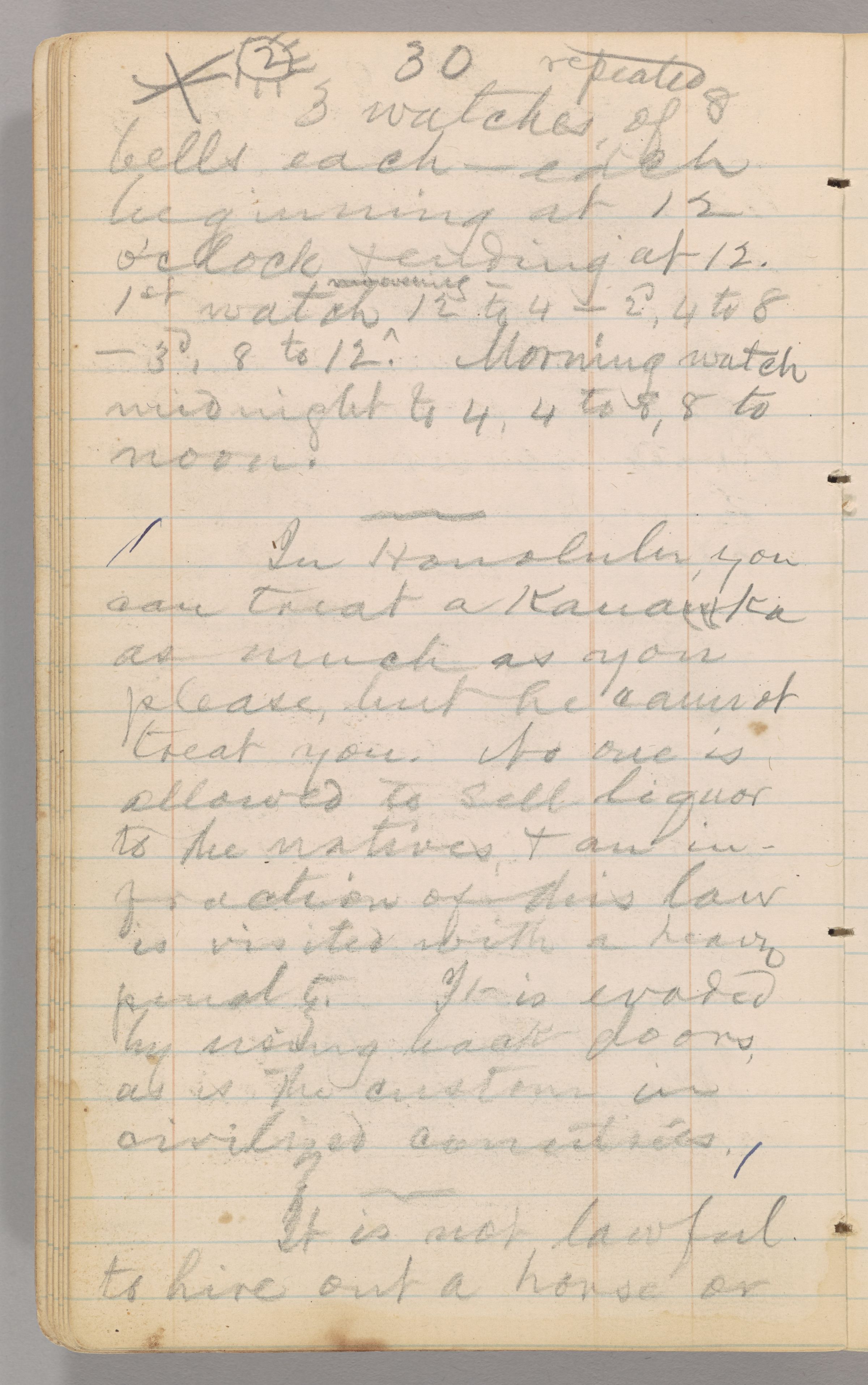
✱ 2 Mr. Sanford
Ch Eng been in
US service 16
years—been in
7 battles in Mex
& 6 in America.
2 ✱ Mr Baxter,
Mate, been on
gunboat in the
war, too. & Captain, Godfrey.
Heavily timbered, strong
bolted ship. ✱ 2
[MS: N6_leaf_015v]
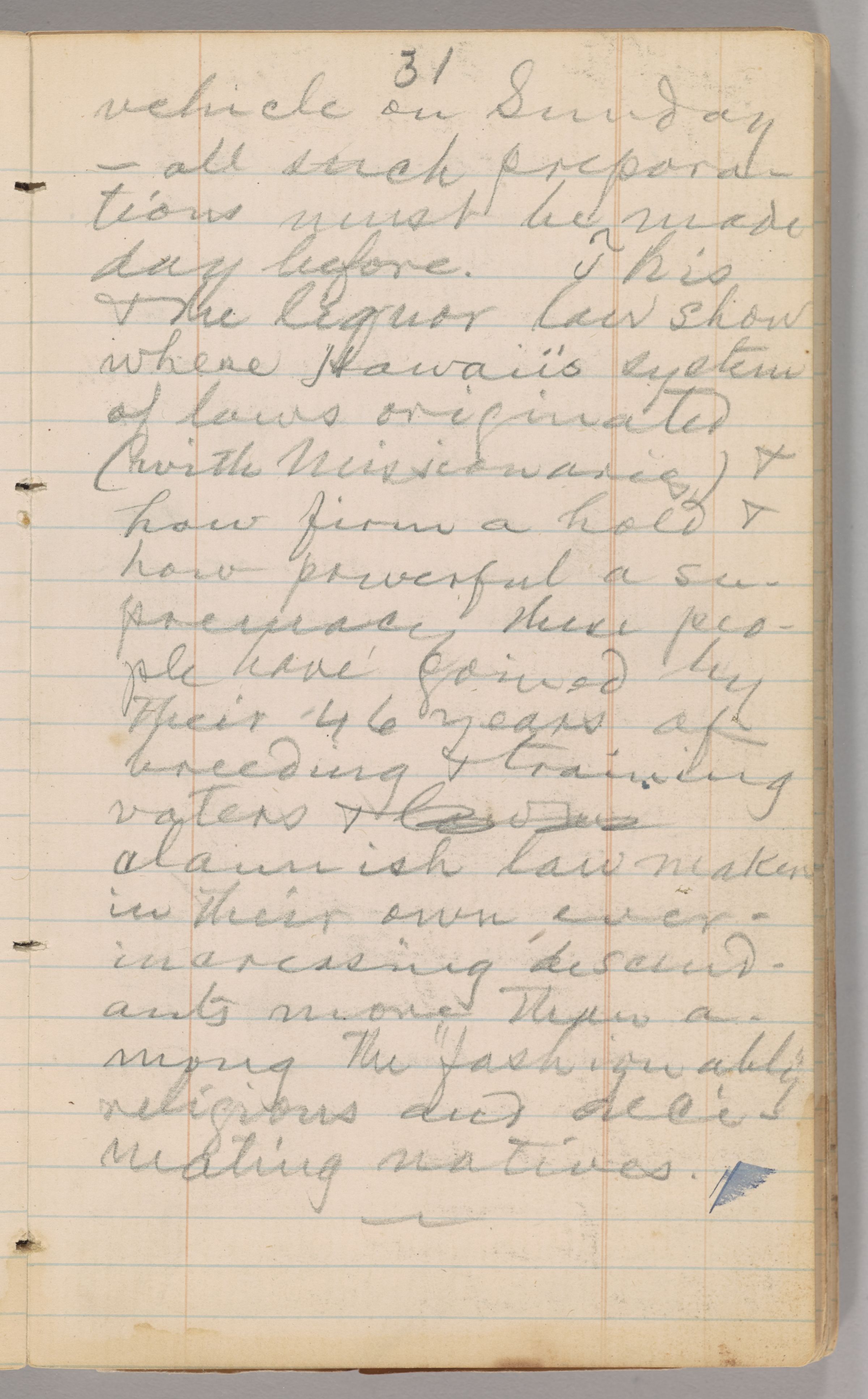
✱ 2 3 watches, repeated of 8
bells each—each
beginning at 12
o'clock & ending at 12.
1st watch mo evening—12 to 4—2d, 4 to 8
—3d, 8 to 12. Morning watch
midnight to 4, 4 to 8, 8 to
noon.
In Honolulu, you
can treat a KanankaⓉtextual note
as much as you
please, but he cannot
treat you. No one is
allowed to sell liquor
to the natives, & an in-
fractioninfraction of this law
is visited with a heavy
penalty. It is evaded
by using back doors,
as is the custom in
civilized countries.
It is not lawful
to hire out a horse or
[MS: N6_leaf_016r]
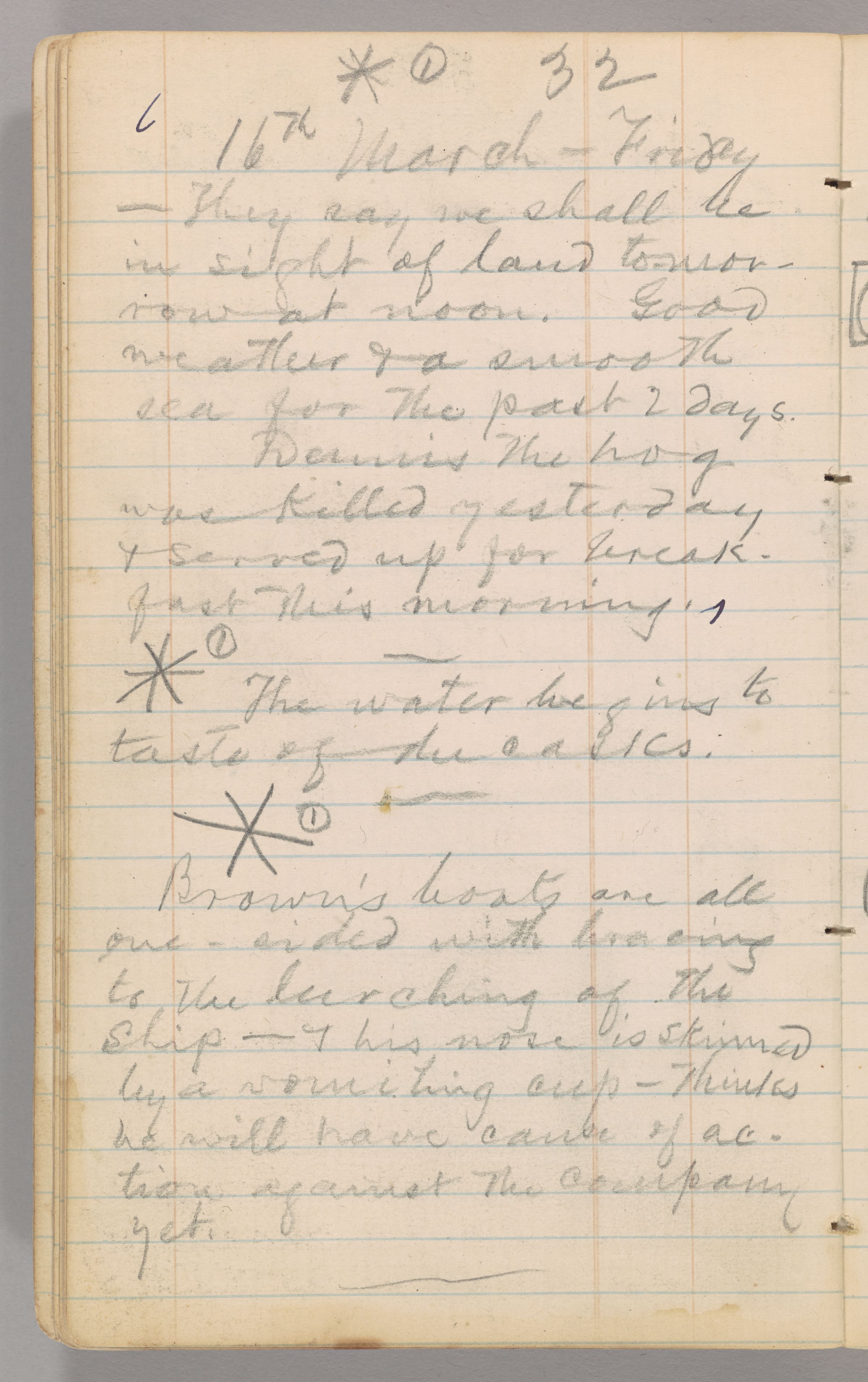
vehicle on Sunday
—all such prepara-
tionspreparations must be made
day before. This
& the liquor law show
where Hawaii's system
of laws originated
(with Missionaries,) &
how firm a hold &
how powerful a su-
premacysupremacy these peo-
plepeople have gained by
their 46 years of
breeding & training
voters & law m
clannish law makers
in their own ever-
increasing descend-
antsdescendants more than a-
mongamong the “fashionably”
religious and deci-
matingdecimating natives.
[MS: N6_leaf_016v]
✱ 1
16th March—Friday
—They say we shall be
in sight of land to-mor-
rowto-morrow at noon. Good
weather & a smooth
sea for the past 2 days.
Dennis the hog
was killed yesterday
& served up for break-
fastbreakfast this morning.
✱ 1 The water begins to
taste of the casks.
✱ 1
Brown's boots are all
one-sided with bracing
to the lurching of the
ship—& his nose is skinned
by a vomiting cup—thinks
he will have cause of ac-
tionaction against the company
yet.
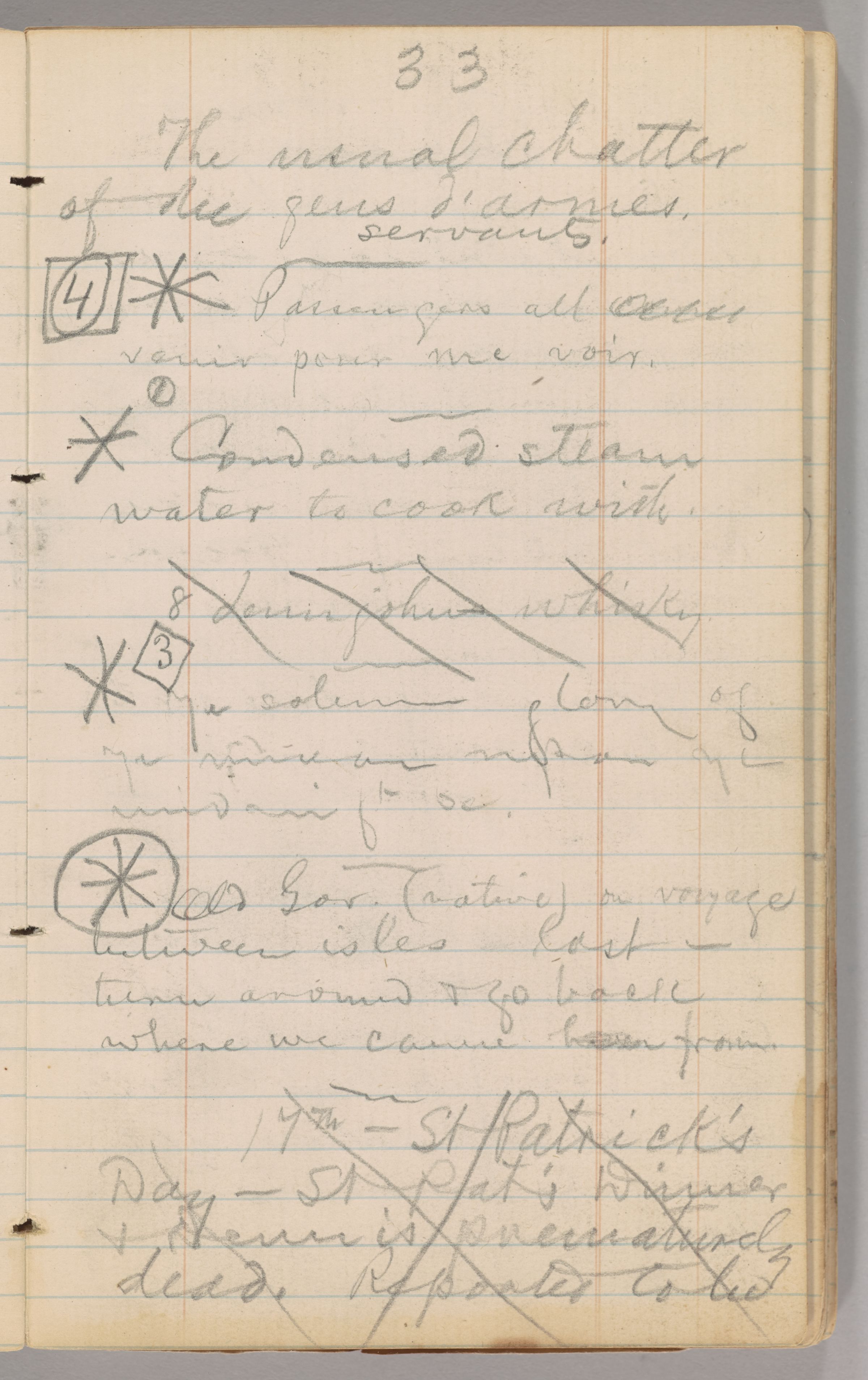
[MS: N6_leaf_017r]
The usual chatter
of the gens d'armes. servants.Ⓣtextual note
4 ✱ Passengers all come
venir pour me voir.
✱ 1 Condensed steam
water to cook with.
[MTP: N&J1_191]
8 demijohns whisky.
✱ 3 Ye solemn glory of
ye moon upon ye
midnigt se.
✱ Old Gov. (native) on voyage
between isles lost—
turn around & go back
where we came h-- from.
17th—St Patrick's
Day—St Pat's Dinner
& Dennis prematurely
dead. Reported to be
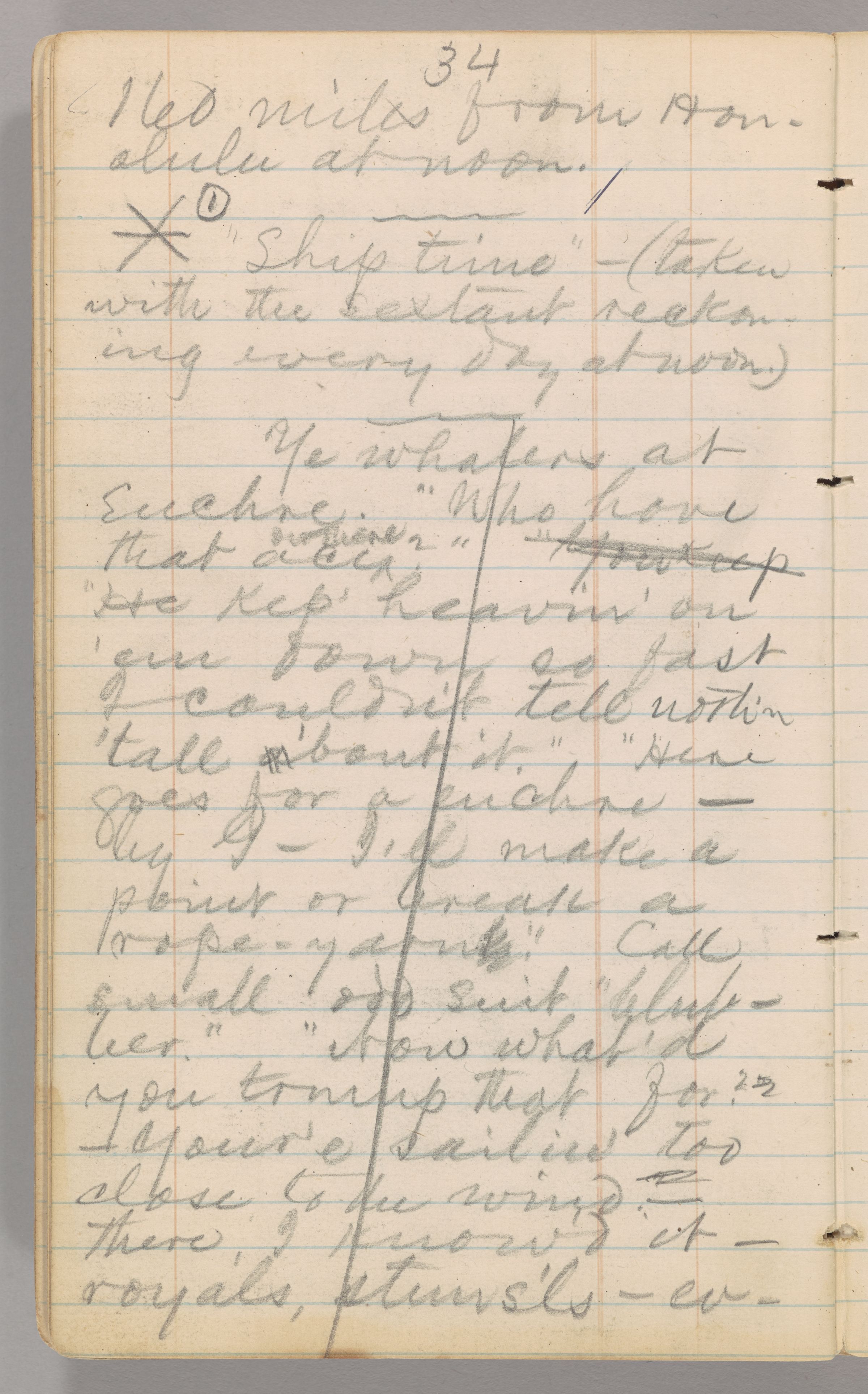
[MS: N6_leaf_017v]
160 miles from Hon-
oluluHonolulu at noon.
✱ 1 “Ship time”—(taken
with the sextant reckon-
ingreckoning every day at noon.)
Ye whalers at
Euchre. “Who hove
that ace on there?” “You keep
“He kep' heavin' on
'em down so fast
I couldn't tell noth'n
'tall a'boutⓉtextual note it.” “Here
goes for a euchre—
by G— I'll make a
point or break a
rope-yarn ◊.” Call
small odd suit “blub-
berblubber.” “Now what'd
you trump that for? ”
—Your'e sailin' too
close to the wind.”—
there, I know'd it—
royals, stuns'ls—ev-
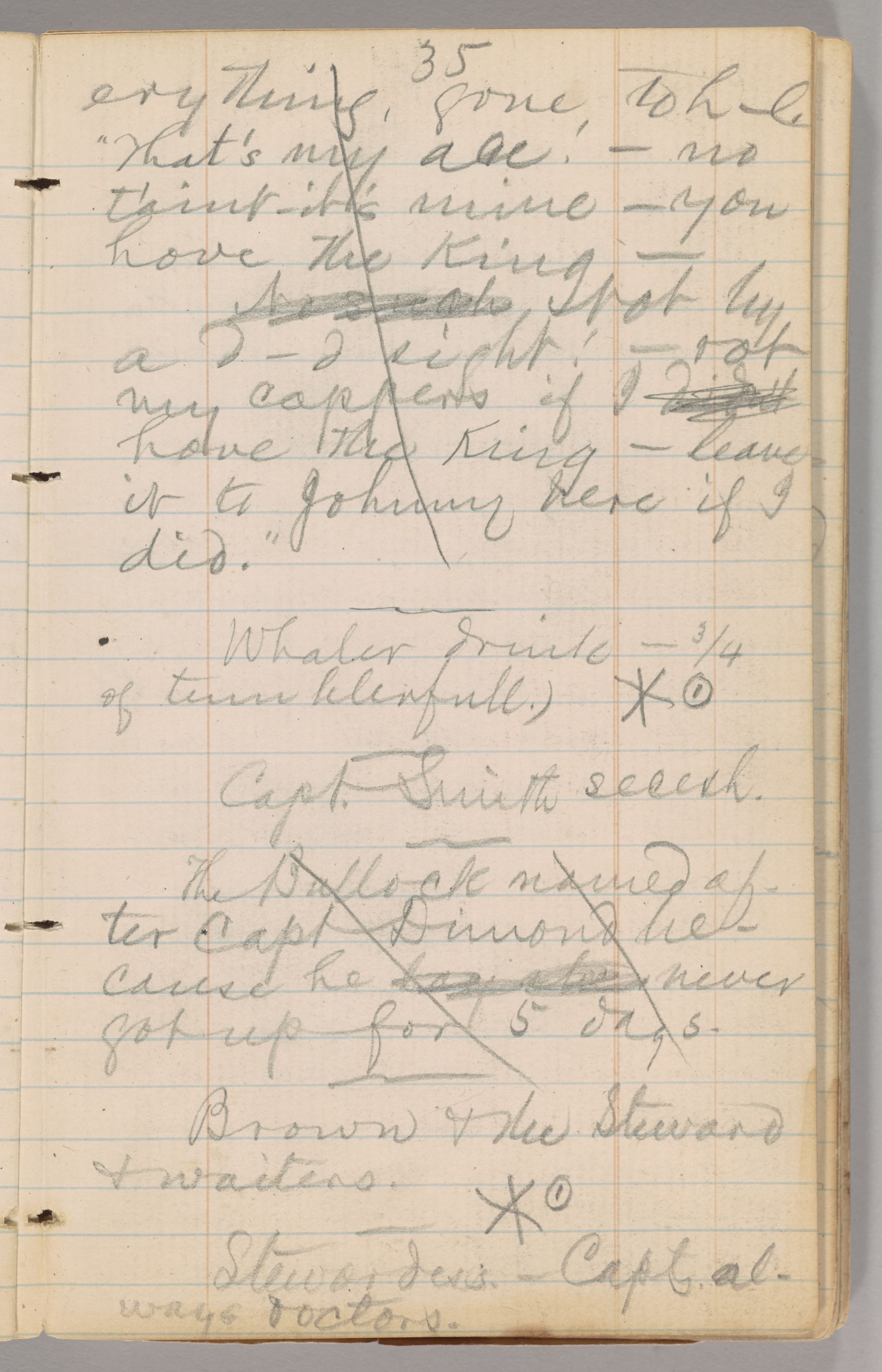
[MS: N6_leaf_018r]
erything, gone to h—l.
“That's my ace!—no
t'aint—it's mine—you
hove the King—
No such Not by
a d—d sight!—rot
my coppers if I didn't
hove the King—leave
it to Johnny here if I
did.”
Whaler drink—¾
of tumblerfull.) ✱ 1
Capt. Smith secesh.19
The Bullock named af-
terafter Capt Dimond20 be-
causebecause he lay abe never
got up for 5 days.
Brown & the Steward
& waiters.
✱ 1
Stewardess.—Capts. al-
waysalways doctors.
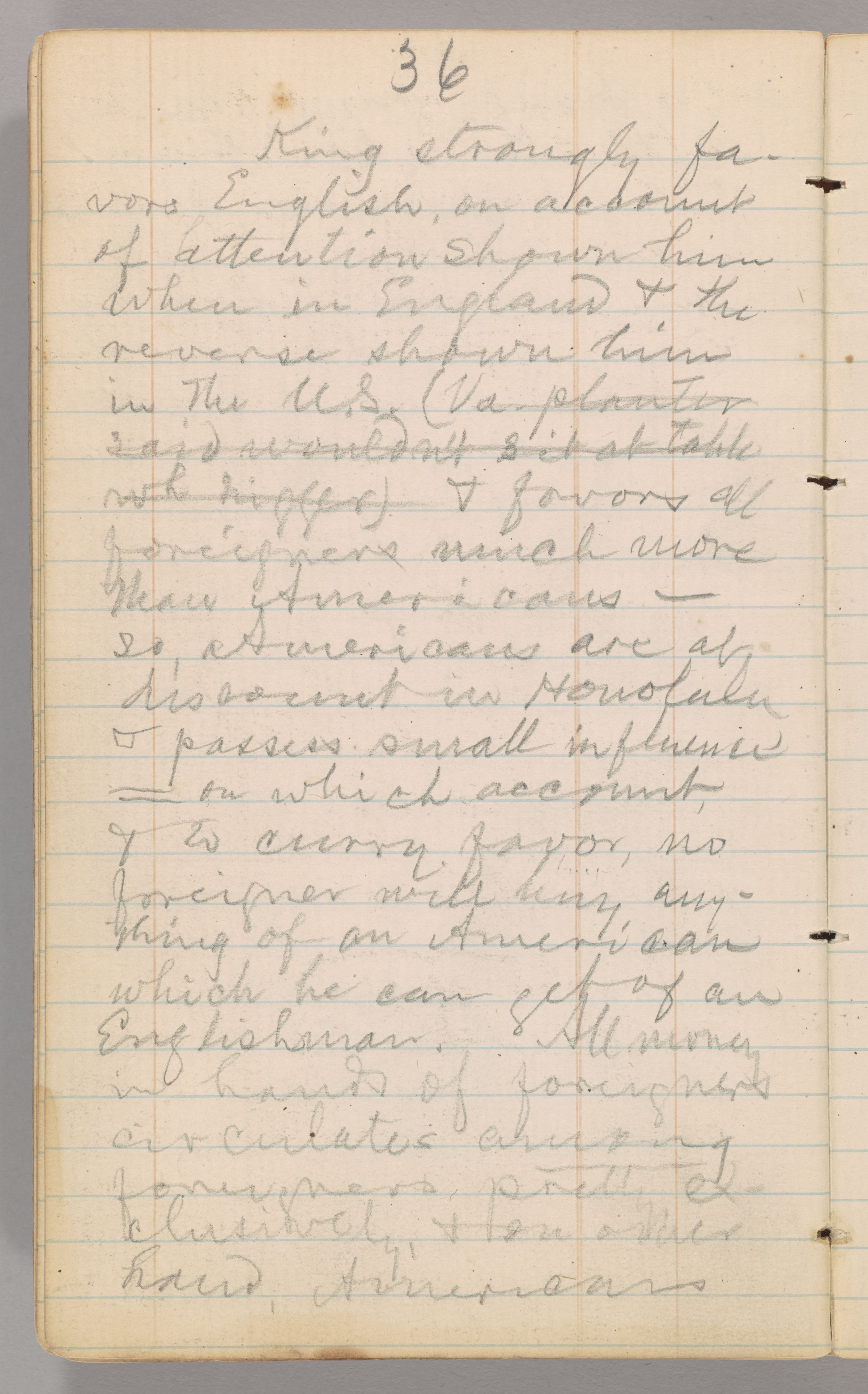
[MS: N6_leaf_018v]
[MTP: N&J1_192]
King strongly fa-
vorsfavors English, on account
of attentions shown him
when in England & the
reverse shown him
in the U.S. (Va. planter
said wouldn't sit at table
wh nigger) & favors all
foreigners much more
than Americans—
so, Americans are at
discount in Honolulu,
& possess small influence
—on which account,
& to curry favor, no
foreigner will buy any-
thinganything of an American
which he can get of an
Englishman. All money
in hands of foreigners
circulates among
foreigners pretty ex-
clusivelyexclusively, & on other
hand, Americans
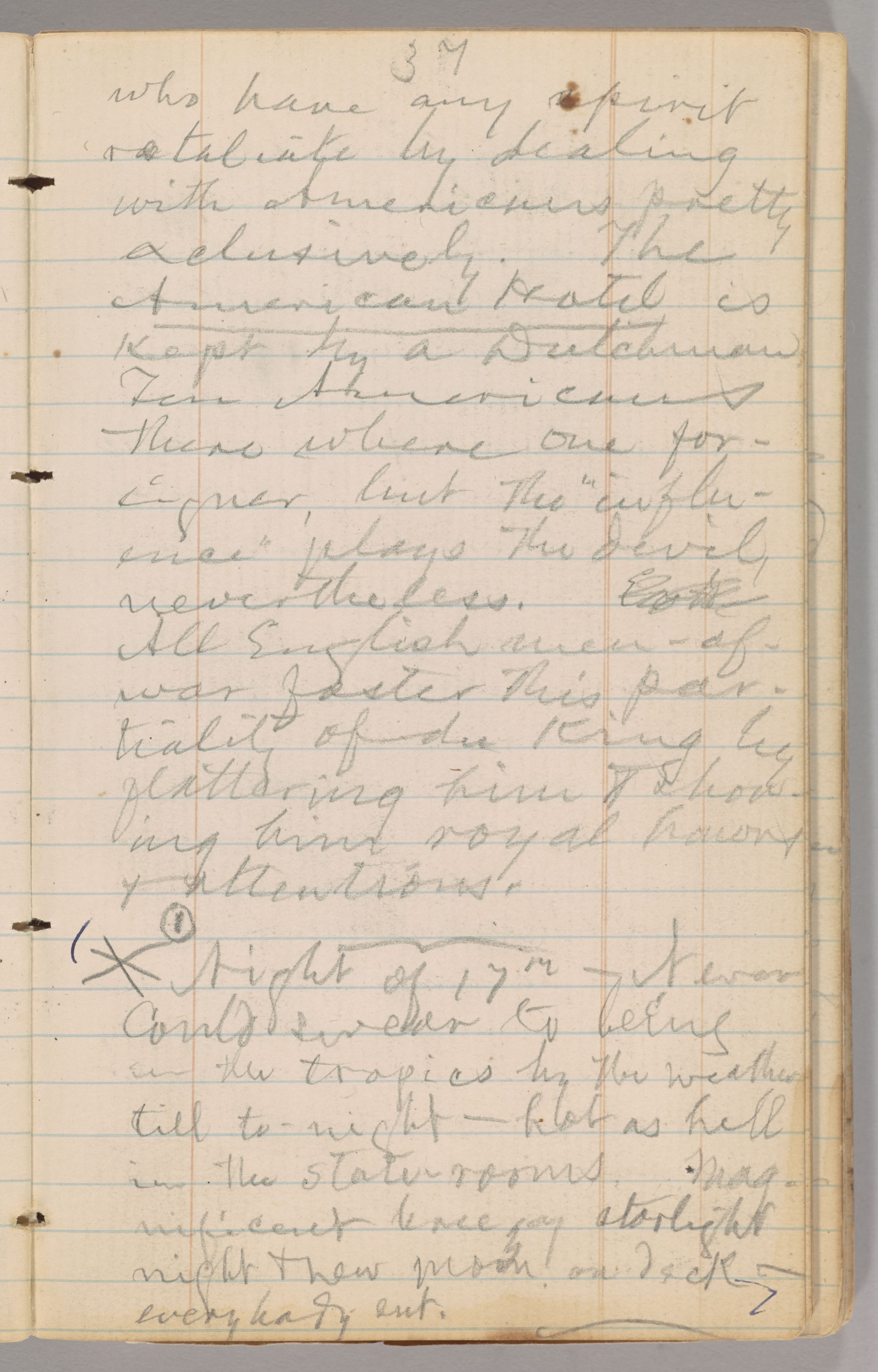
[MS: N6_leaf_019r]
who have any spirit
retaliate by dealing
with Americans pretty
exclusively. The
American Hotel is
kept by a Dutchman.21
Ten Americans
there where one for-
eignerforeigner, but the “influ-
enceinfluence” plays the devil,
nevertheless. En-
All English men-of-
war foster this par-
tialitypartiality of the King by
flattering him & show-
ingshowing him royal honors
& attentions.
✱ 1 Night of 17th—Never
could swear to being
in the tropics by the weather
till to-night—hot as hell
in the state-rooms. Mag-
nificentMagnificent breezy starlight
night & new moon on deck—
everybody out.
[MS: N6_leaf_019v]
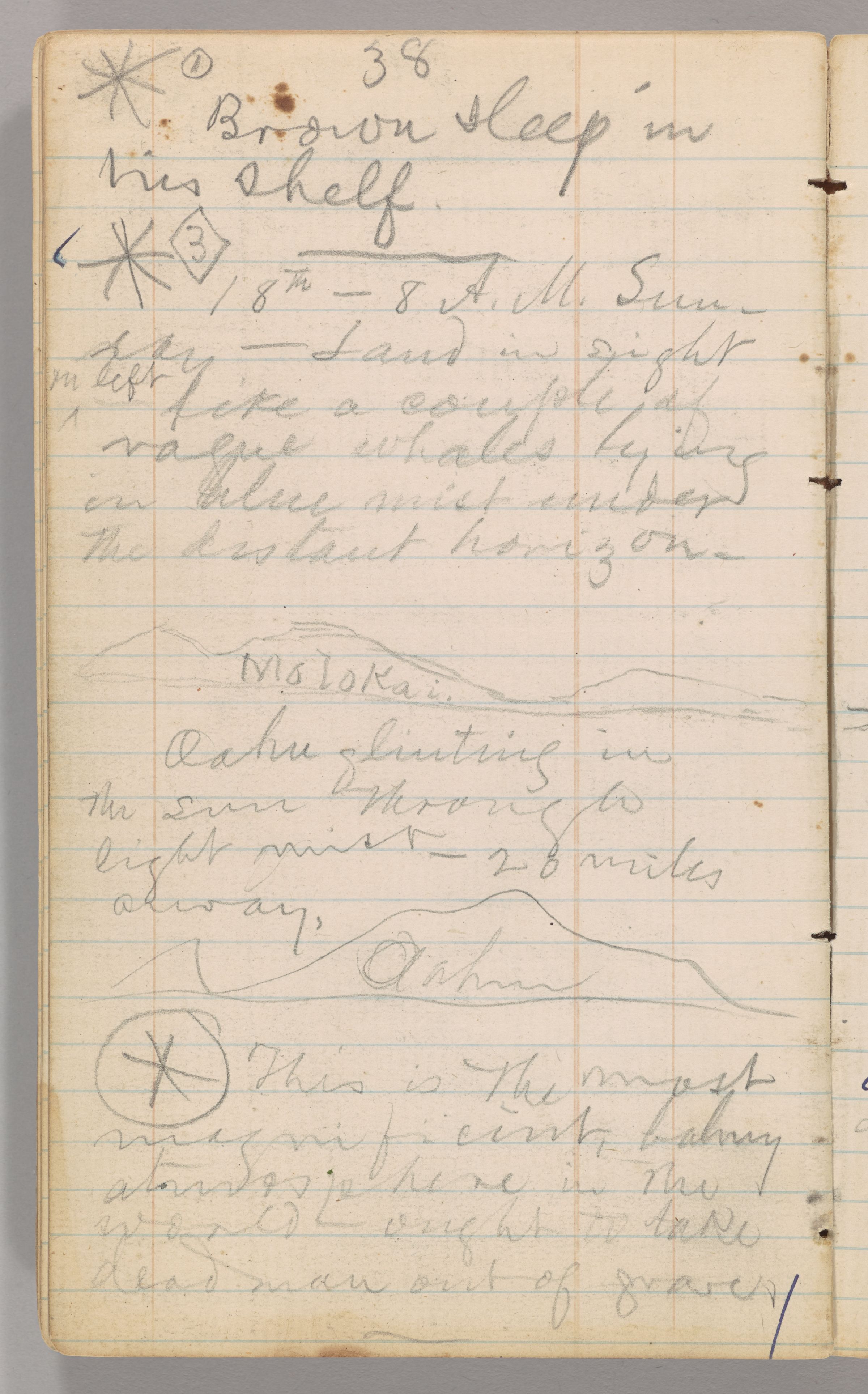
✱ 1 Brown sleep in
his shelf.
✱ 3 18th—8 A.M. Sun-
daySunday—Land in sight
on left—like a couple of
vague whales lying
in blue mist under
the distant horizon.
illustration
Oahu glinting in
the sun through
light mist—20 miles
away.
illustration
✱ This is the most
magnificent, balmy
atmosphere in the
world—ought to take
dead man out of grave.
[MS: N6_leaf_020r]
[MTP: N&J1_193]
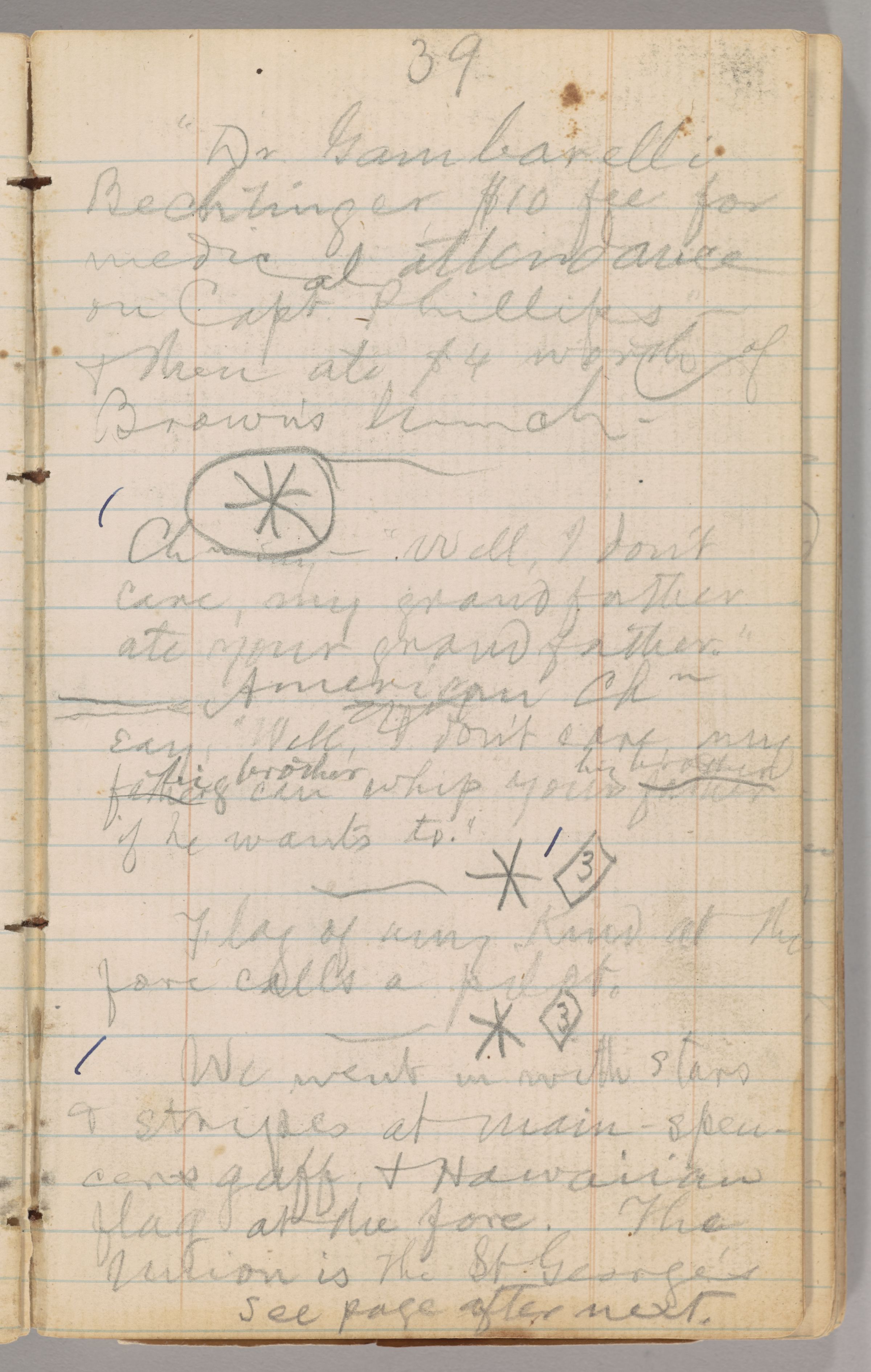
“Dr. Gambarelli
Bechtinger, $10 fee for
medical attendance
on Capt. Phillips”—
& then ate $4 worth of
Brown's lunch.
✱
Chn say—“Well, I don't
care, my grandfather
ate your grandfather.”Ⓣtextual note
American Chn
say, “Well, I don't care, my
father big brother can whip your father big brother
if he wants to.”
✱ 3
Flag of any kind at the
fore calls a pilot.
✱ 3
We went in with stars
& stripes at main-spen-
cersspencers gaff, & Hawaiian
flag at the fore. The
Union is the St George's
see page after next.Ⓣtextual note
[MS: N6_leaf_020v]
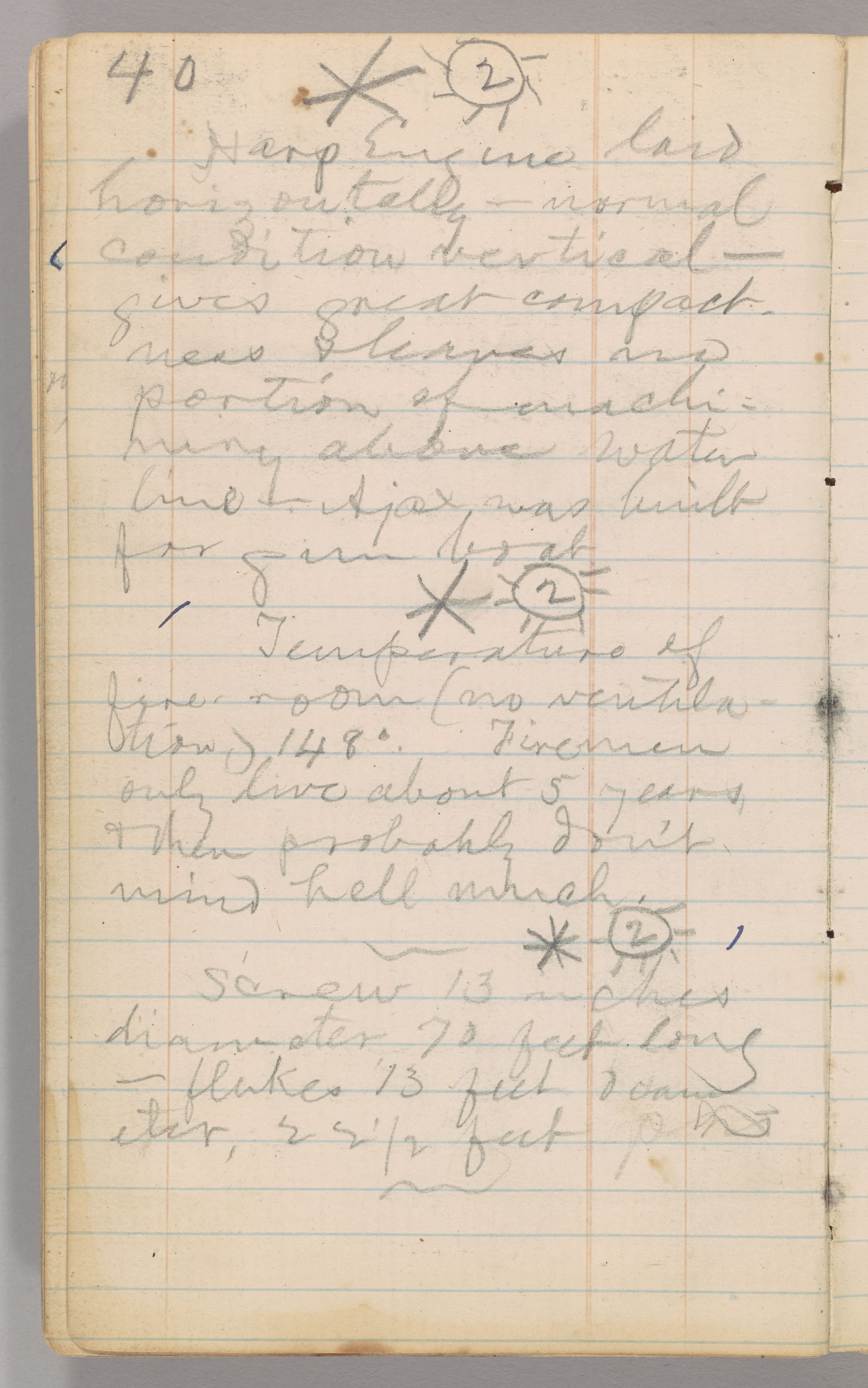
✱ 2
Harp Engine laid
horizontally—normal
condition vertical—
gives great compact-
nesscompactness & leaves no
portion of machi-
nerymachinery above water
line—Ajax was built
for gun boat.
✱ 2
Temperature of
fire-room (no ventila-
tionventilation,) 148⁰. Firemen
only live about 5 years,
& then probably don't
mind hell much.
✱ 2
Screw 13 inches
diameter, 70 feet long
—flukes 13 feet diam-
eterdiameter, 22½ feet p◊◊
[MS: N6_leaf_021r]
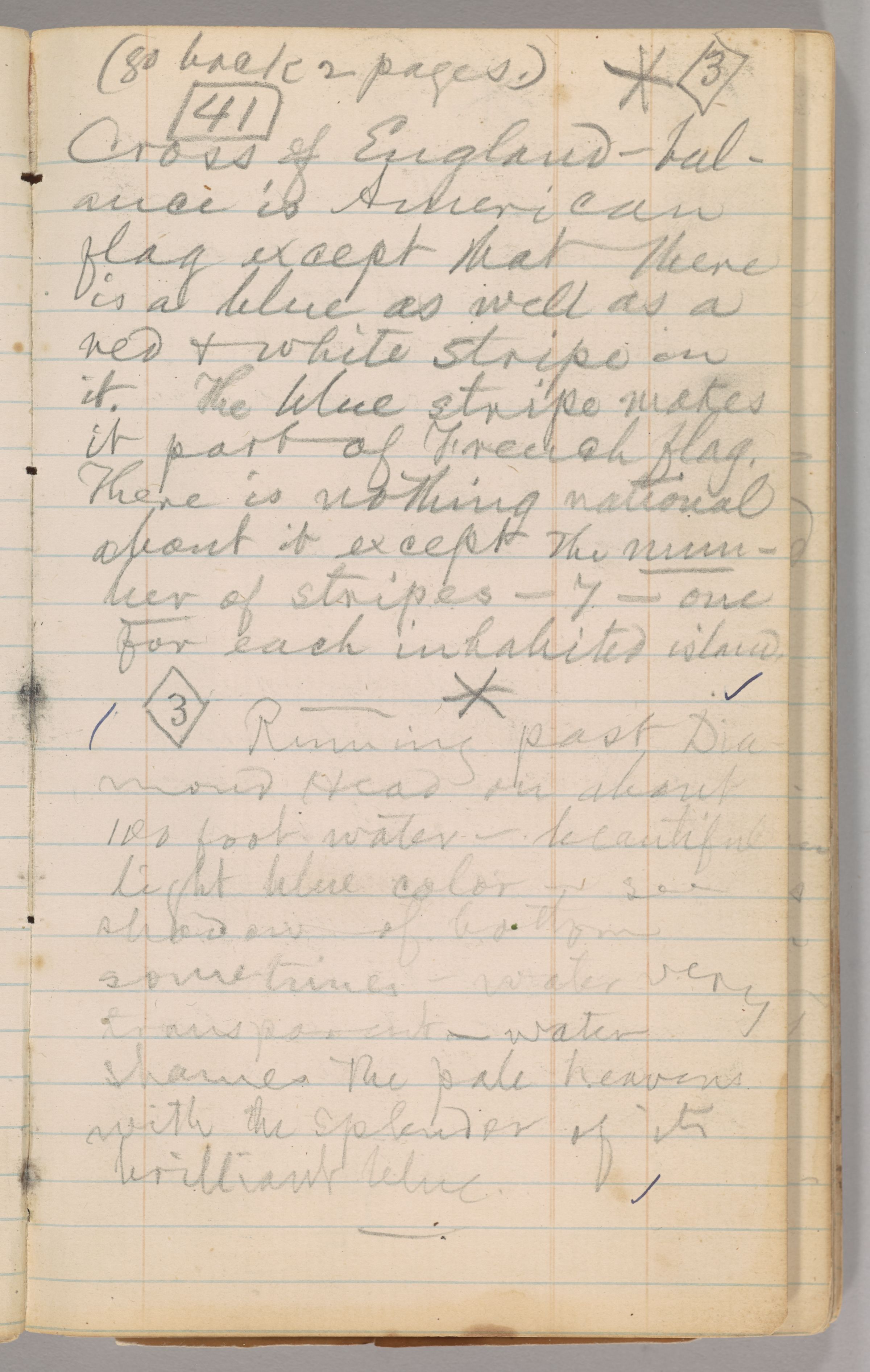
(Go back 2 pages.) ✱ 3Ⓣtextual note
Cross of England—bal-
ancebalance is American
flag except that there
is a blue as well as a
red & white stripe in
it. The blue stripe makes
it part of French flag.
There is nothing national
about it except the num-
bernumber of stripes—7—one
for each inhabited island.22
3 ✱
Running past Dia-
mondDiamond Head on about
100 foot water—beautiful
light blue color—see
shadow of bottom
sometimes— water very
transparent—water
shames the pale heavens
with the splendor of its
brilliant blue.
[MS: N6_leaf_021v]
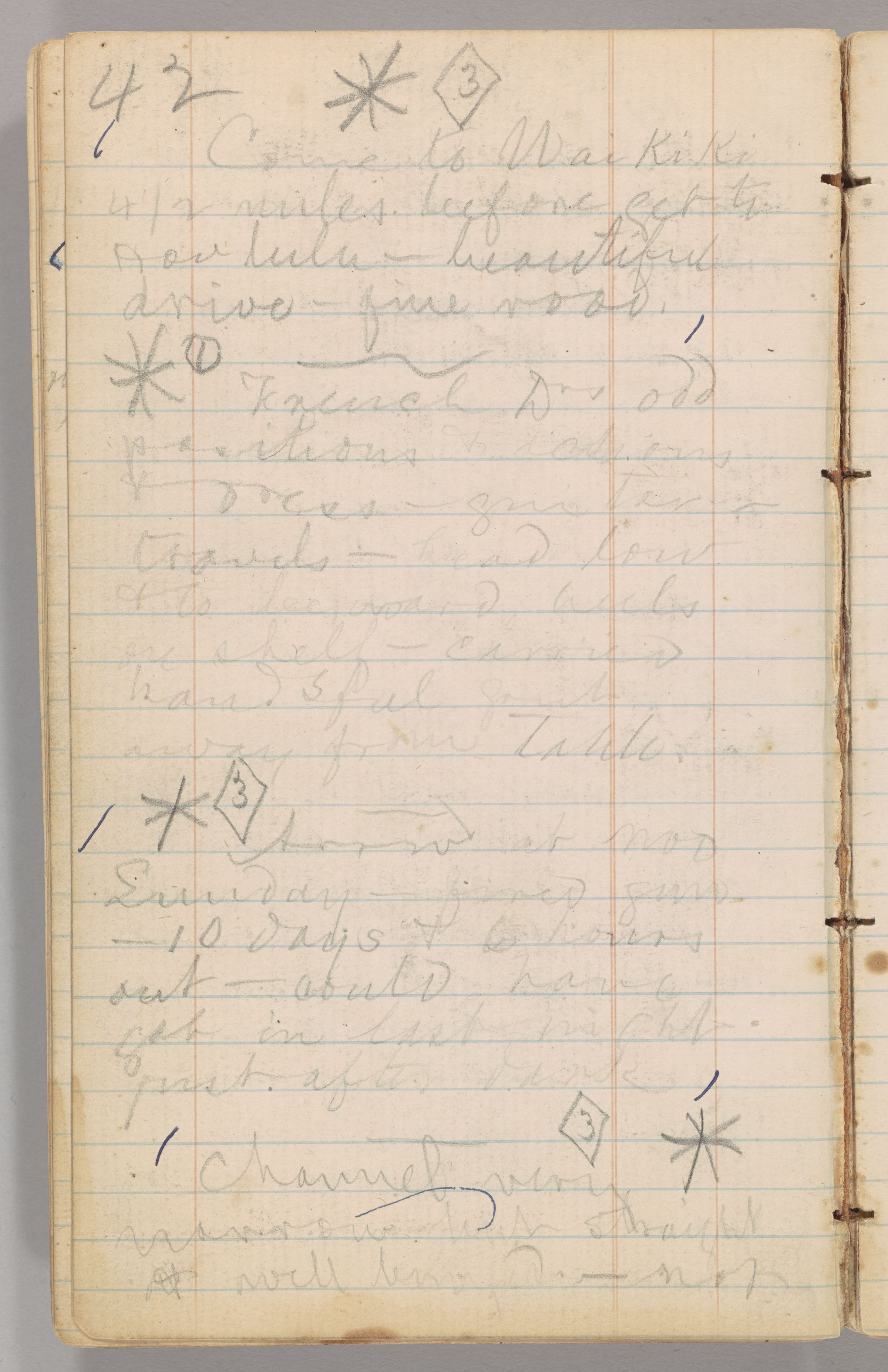
✱ 3
Come to Waikiki
4½ miles before get to
Honlulu— beautiful
drive—fine road.
[MTP: N&J1_194]
✱ 1 French Drs odd
positions & actions
& dress—guitar—
travels— head low
& to leeward, heels
on shelf—carried handsful grub
away from table.
✱ 3 Arrivd at noonⓂemendation
Sunday—fired gun
—10 days & 6 hours
out— could have
got in last night
just after dark
3 ✱
Channel very
narrow but straight
& well buoyed.—not
[MS: N6_leaf_022r]
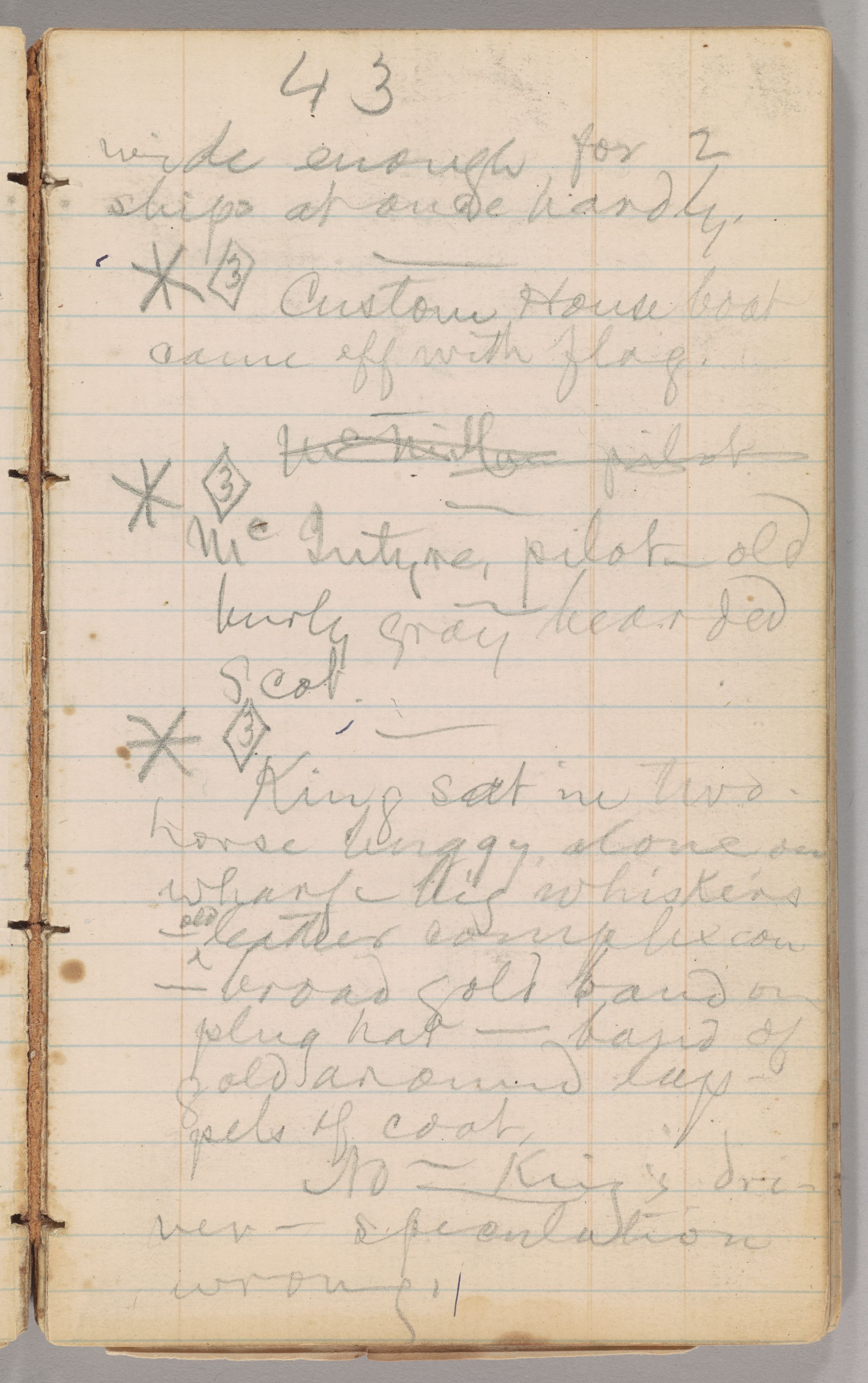
wide enough for 2
ships at once hardly.
✱ 3 Custom House boat
came off with flag.
McMillan pilot
✱ 3
McIntyre, pilot.—Ⓜemendationold
burly gray bearded
Scot.Ⓣtextual note
✱ 3
King sat in two-
horse buggy, alone, on
wharf—big whiskers
—old leather complexion
—broad gold band on
plug hat—band of
gold around lap-
pelslappels of coat.
No—King's dri-
verdriver—speculation
wrong.
[MS: N6_leaf_022v]
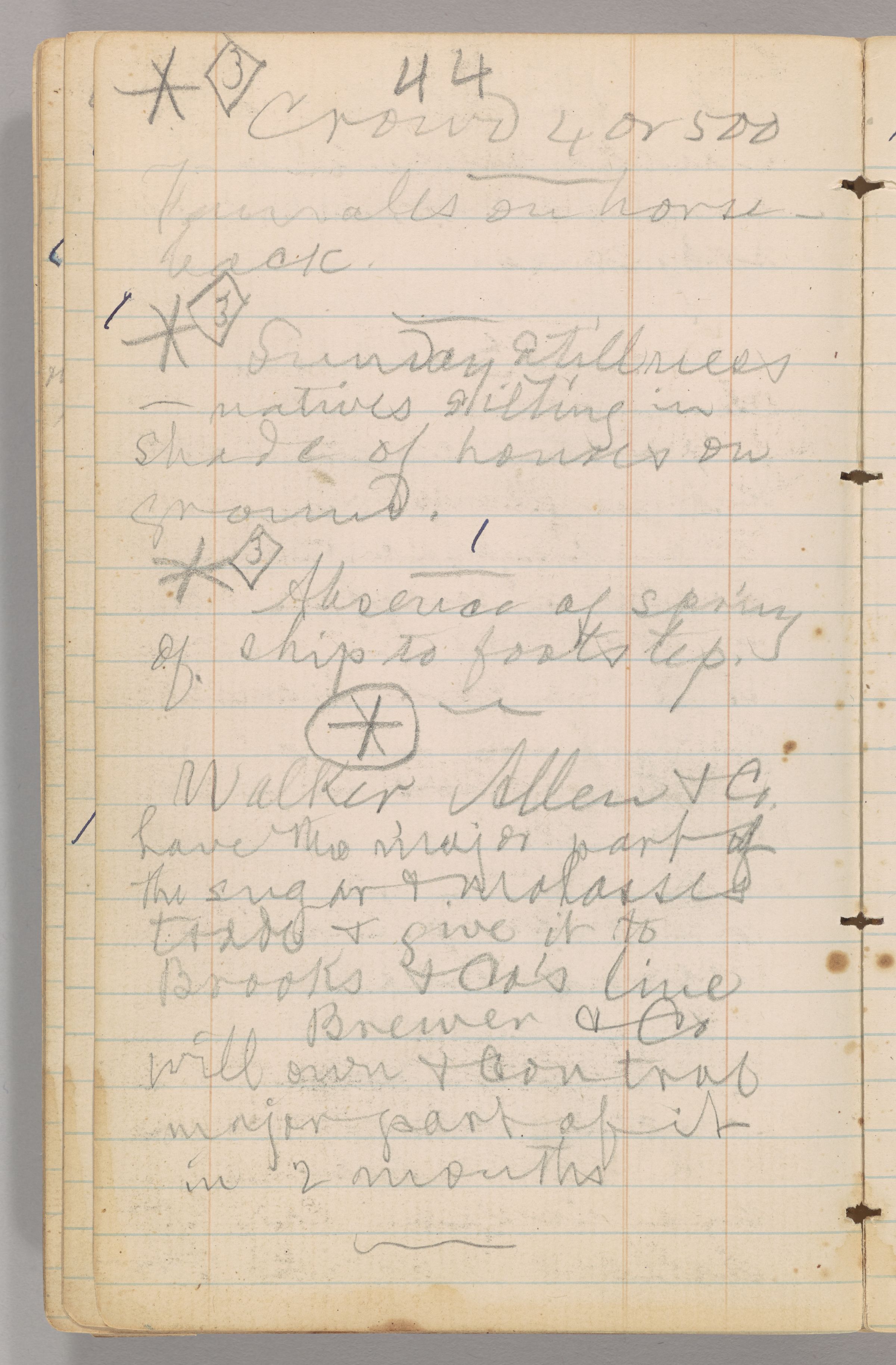
✱ 3 Crowd 4 or 500
Females on horse-
backhorsebackⓂemendation.
✱ 3 Sunday stillness
—natives sitting in
shade of houses on
ground.
✱ 3 Absence of spring
of ship to footstep.
✱
Walker, Allen & Co.
have the major part of
the sugar & molasses
trade & give it to
Brooks & Co's line
Brewer & Co
will own & control
major part of it
in 2 months
[MS: N6_leaf_023r]
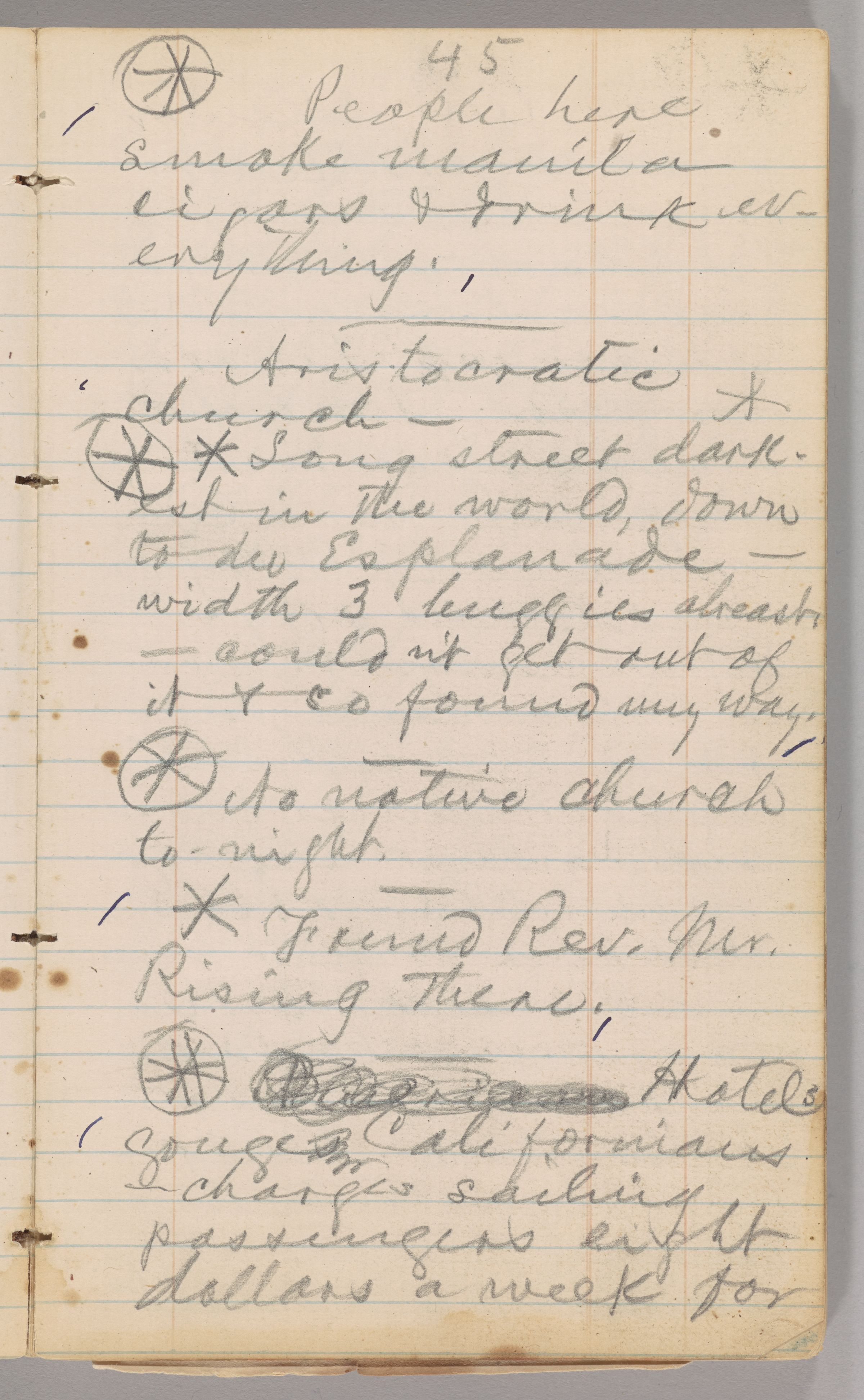
✱ People here
smoke manila
cigars & drink ev-
erythingeverything.
Aristocratic church—23 ✱
✱ ✱Long street dark-
estdarkest in the world, down
to the Esplanade—
width 3 buggies abreast.
—couldn't get out of
it & so found my way.24
[MTP: N&J1_195]
✱ No native church
to-night.
✱ Found Rev. Mr.
Rising there.
✱ American hHotels
gougesⓉtextual note Californians
—chargesⓉtextual note sailing
passengers eight
dollars a week for
[MS: N6_leaf_023v]
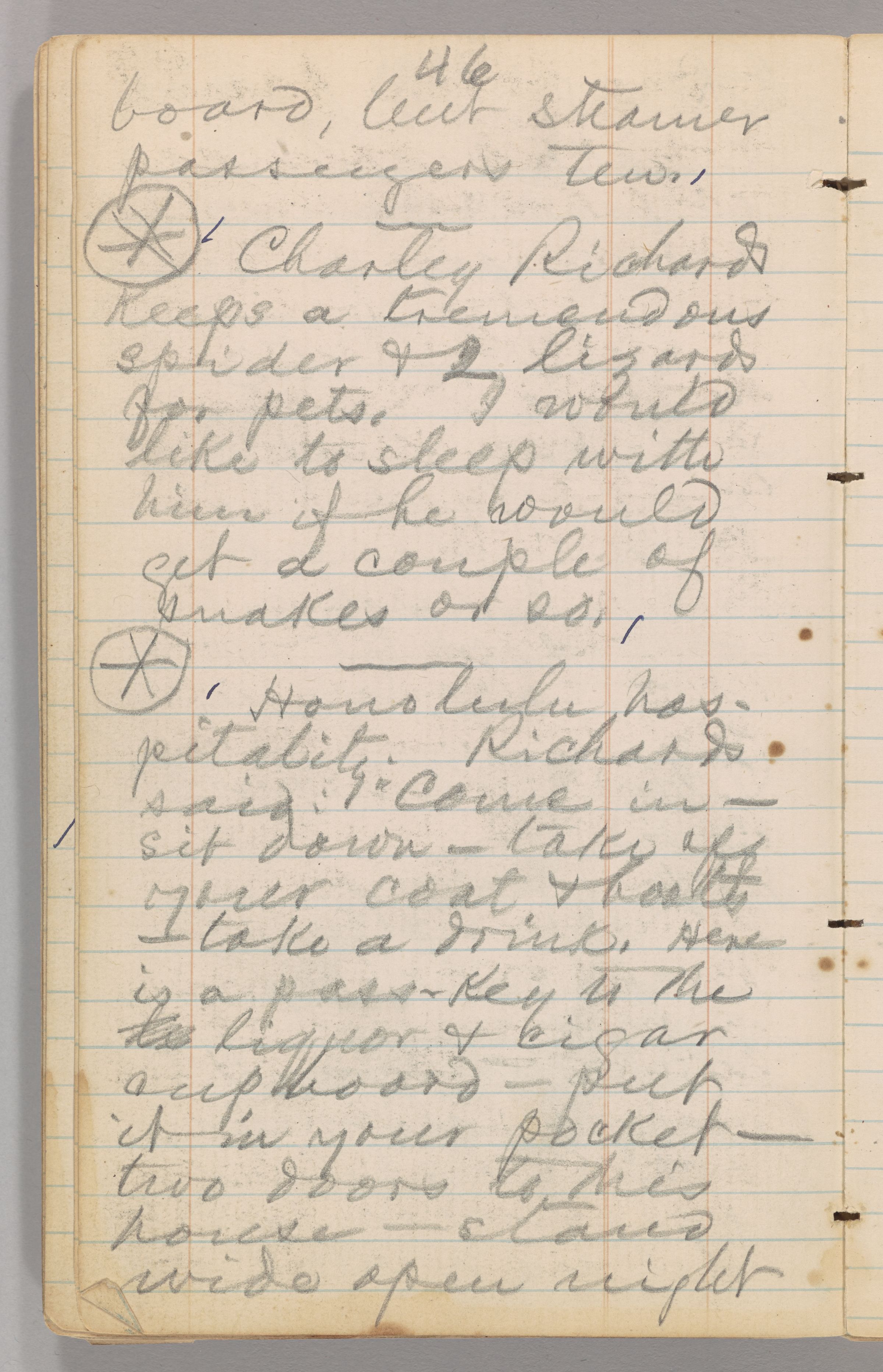
board, but steamer
passengers ten.
✱ Charley Richards25
keeps a tremendous
spider & 2 lizards
for pets. I would
like to sleep with
him if he would
get a couple of
snakes or so.
✱ Honolulu hos-
pitalityhospitality. Richards
said: “Come in—
sit down— take off
your coat & boots
—take a drink. Here
is a pass-key to the
li liquor & cigar
cupboard—put
it in your pocket—
two doors to this
house—stand
wide open night
[MS: N6_leaf_024r]
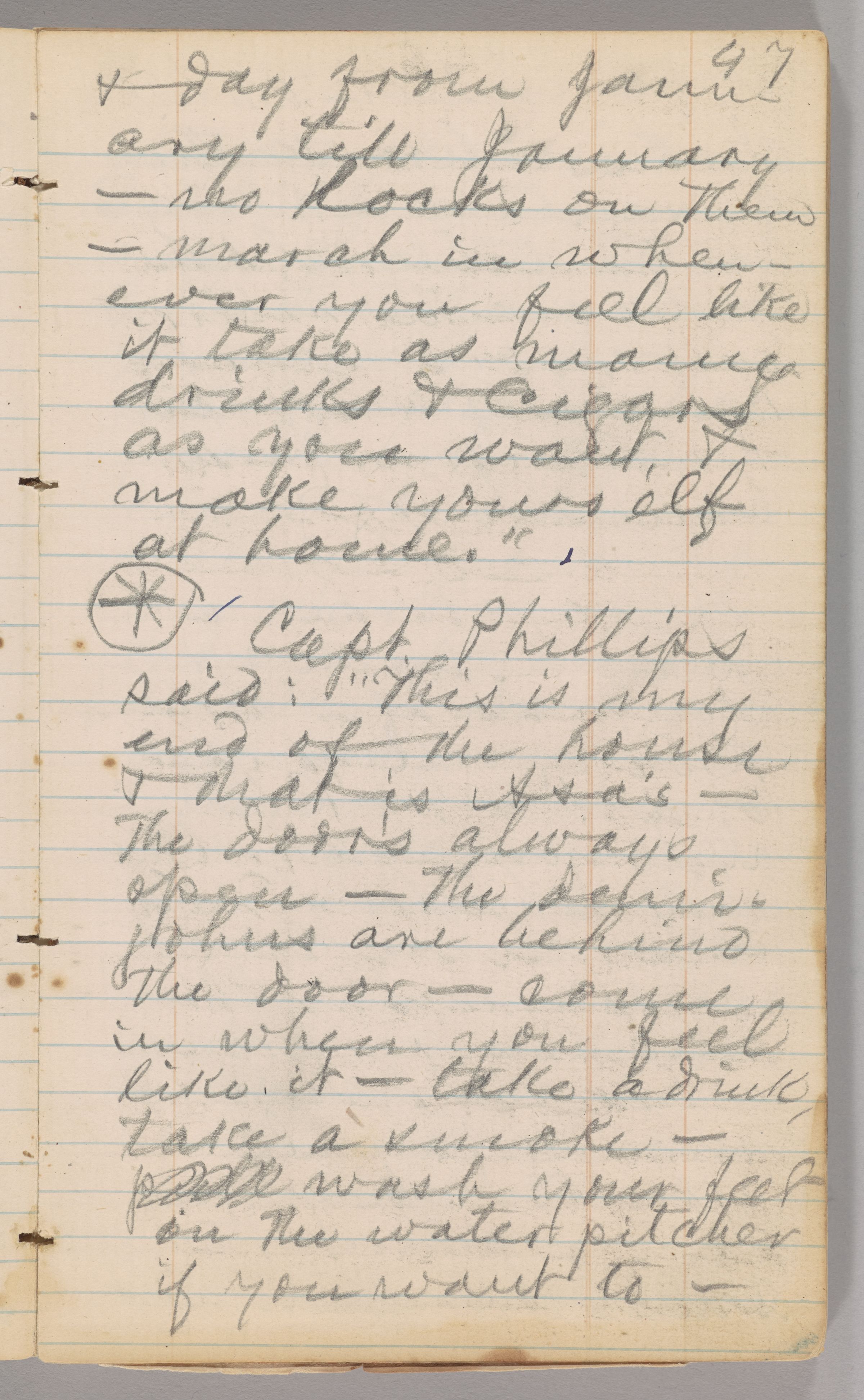
& day from Janu-
aryJanuary till January
—no locks on them
—march in when-
everwhenever you feel like
it, take as many
drinks & cigars
as you want, &
make yourself
at home.”
✱ Capt. Phillips
said: “This is my
end of the house
& that is Asa's—
the door's always
open—the demi-
johnsdemijohnsⓂemendation are behind
the door —come
in when you feel
like it—take a drink,
take a smoke—
pull wash your feet
oinⓉtextual note the water pitcher
if you want to—
[MS: N6_leaf_024v]
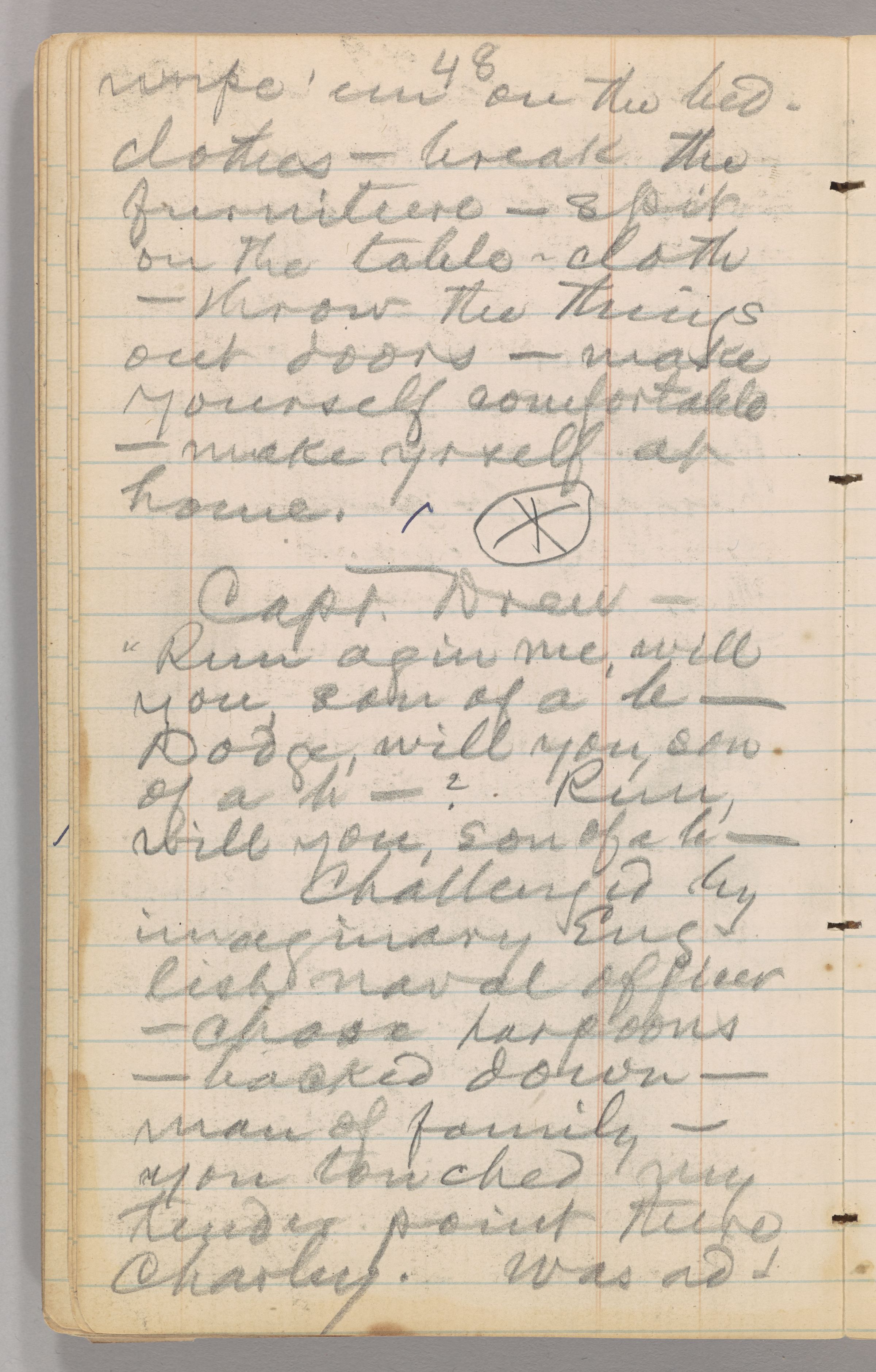
wipe 'em on the bed-
clothesbedclothesⓂemendation—break the
furniture—spit
on the table-cloth
—throw the things
out doors—make
yourself comfortable
—make yrself at
home.
✱
Capt. Drew—
“Run agin me, will
you, son of a b——
Dodge, will you, son
of a b——? Run,
will you, son of a b——
Challenged by
imaginary Eng-
lishEnglish naval officer
—chooseⓉtextual note harpoons
—backed down—
man of family—
you touched my
tender
[MTP: N&J1_196] point there,
Charley. Was ad-
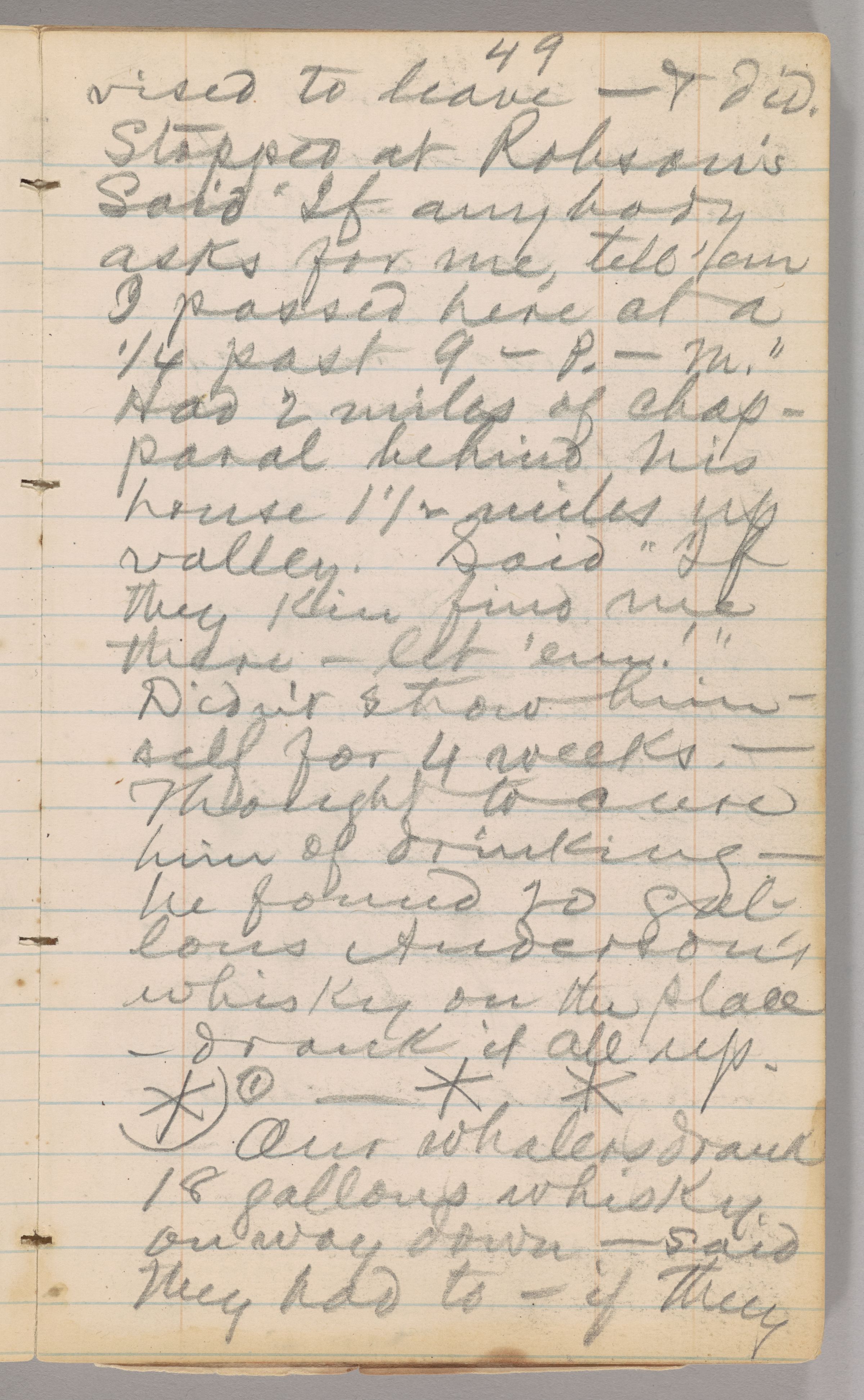
[MS: N6_leaf_025r]
vised to leave—& did.
Stopped at Robson's
Said “If anybody
asks for me, tell 'em
I passed here at a
¼ past 9—P.—M.”
Had 2 miles of chap-
paralchapparal behind his
house 1 ½ miles up
valley. Said “If
they kin find me
there—let 'em!”
Didn't show him-
selfhimself for 4 weeks.—
Thought to cure
him of drinking—
he found 20 gal-
lonsgallons Anderson's
whisky on the place
—drank it all up.
✱ 1 ✱ ✱
Our whalers drank
18 gallons whisky
on way down—said
they had to—if they
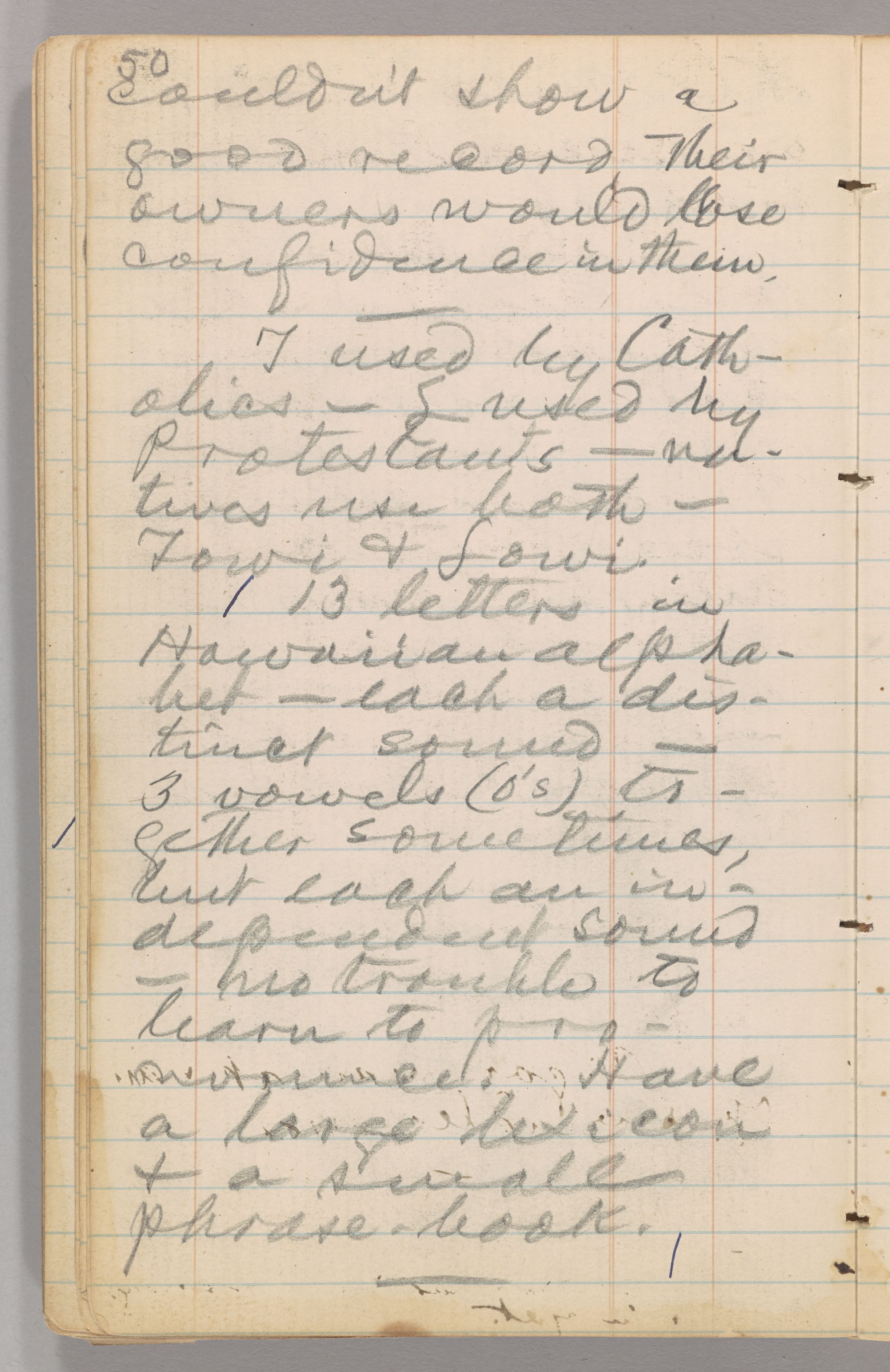
[MS: N6_leaf_025v]
couldn't show a
good record, their
owners would lose
confidence in them.
T used by Cath-
olicsCatholics—L used by
Protestants—na-
tivesnatives use both—
Towi & Lowi.26
13 letters in
Hawaiian alpha-
betalphabet—each a dis-
tinctdistinct sound—
3 vowels (o's) yo-
gethertogether sometimes,
but each an in-
dependentindependent sound
—no trouble to
learn to pro-
nouncepronounce.27 Have
a large lexicon28 & a small
phrase-book.29
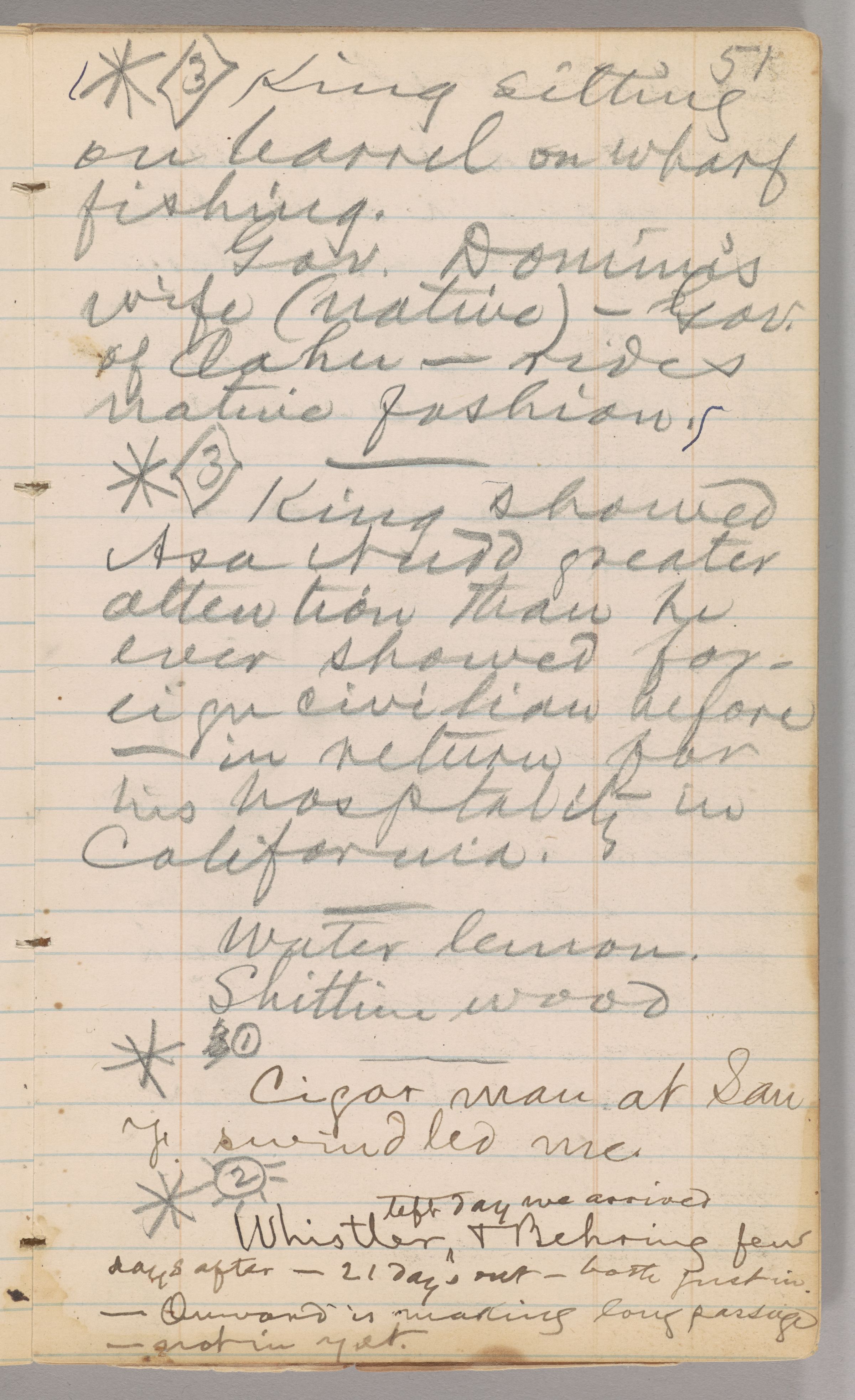
[MS: N6_leaf_026r]
[MTP: N&J1_197]
✱ 3 King sitting
on barrel on wharf
fishing.
Gov. Domini's
wife (native)—Gov.
of Oahu—rides
native fashion.30
✱ 3 King showed
Asa Nudd greater
attention than he
ever showed for-
eignforeign civilian before
—in return for
his hospitality in
California.31
Water lemon.
Shittim wood
✱ 3 1 Cigar man at San
F. swindled me.Ⓣtextual note
✱ 2 Whistler left day we arrived & Behring few
days after—21 days out—both just in.
—Onward is making long passage
—not in yet.Ⓣtextual note32
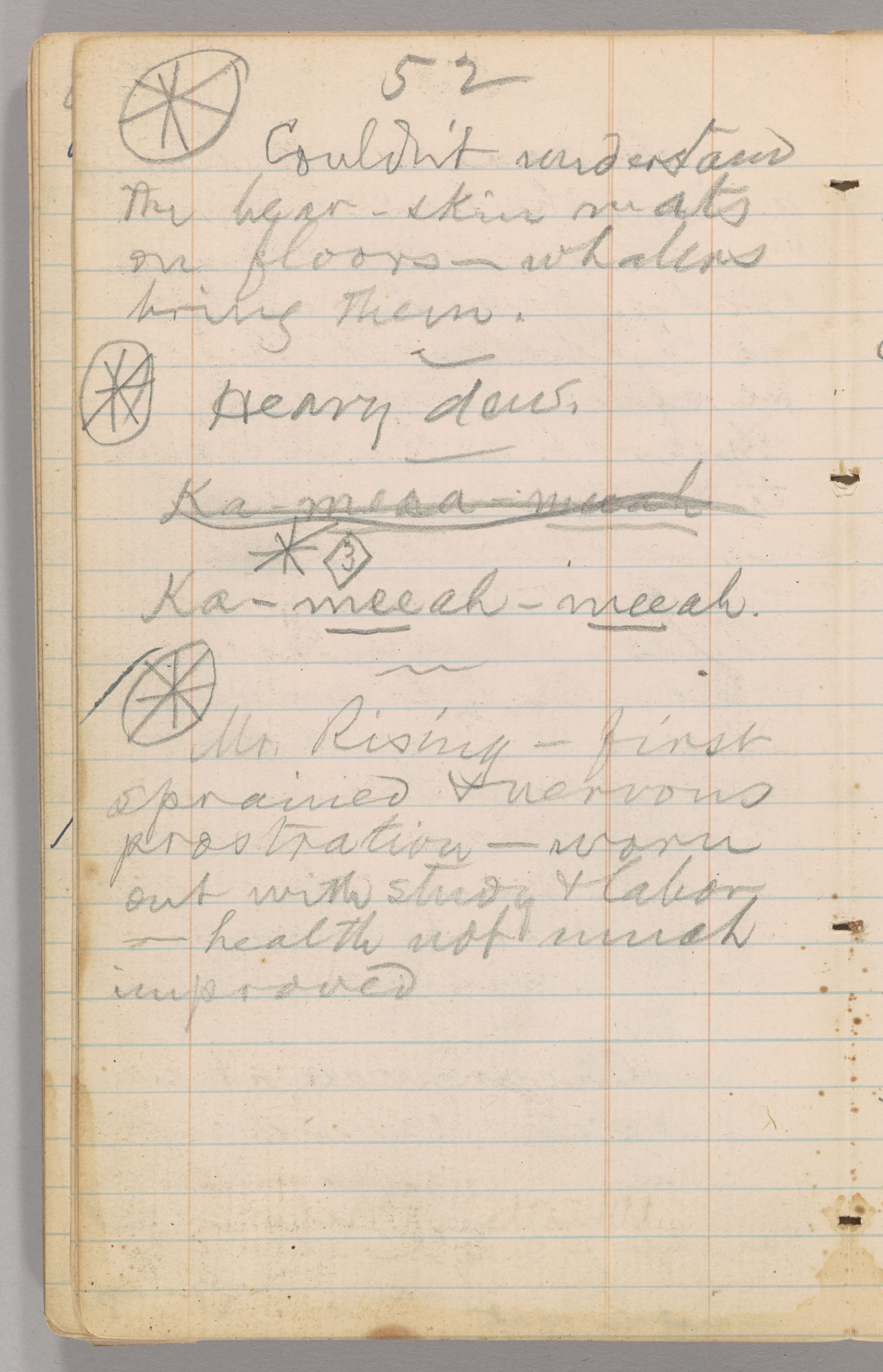
[MS: N6_leaf_026v]
✱ Couldn't understand
the bear-skin mats
on floors—whalers
bring them.
✱ Heavy dew.
Ka-meaa-meeah Ka-meea-meeahⓉtextual note
✱ 3
Ka-meeah-meeah.
✱ Mr. Rising—first
sprained & nervous
prostration—worn
out with study & labor
—health not much
improved
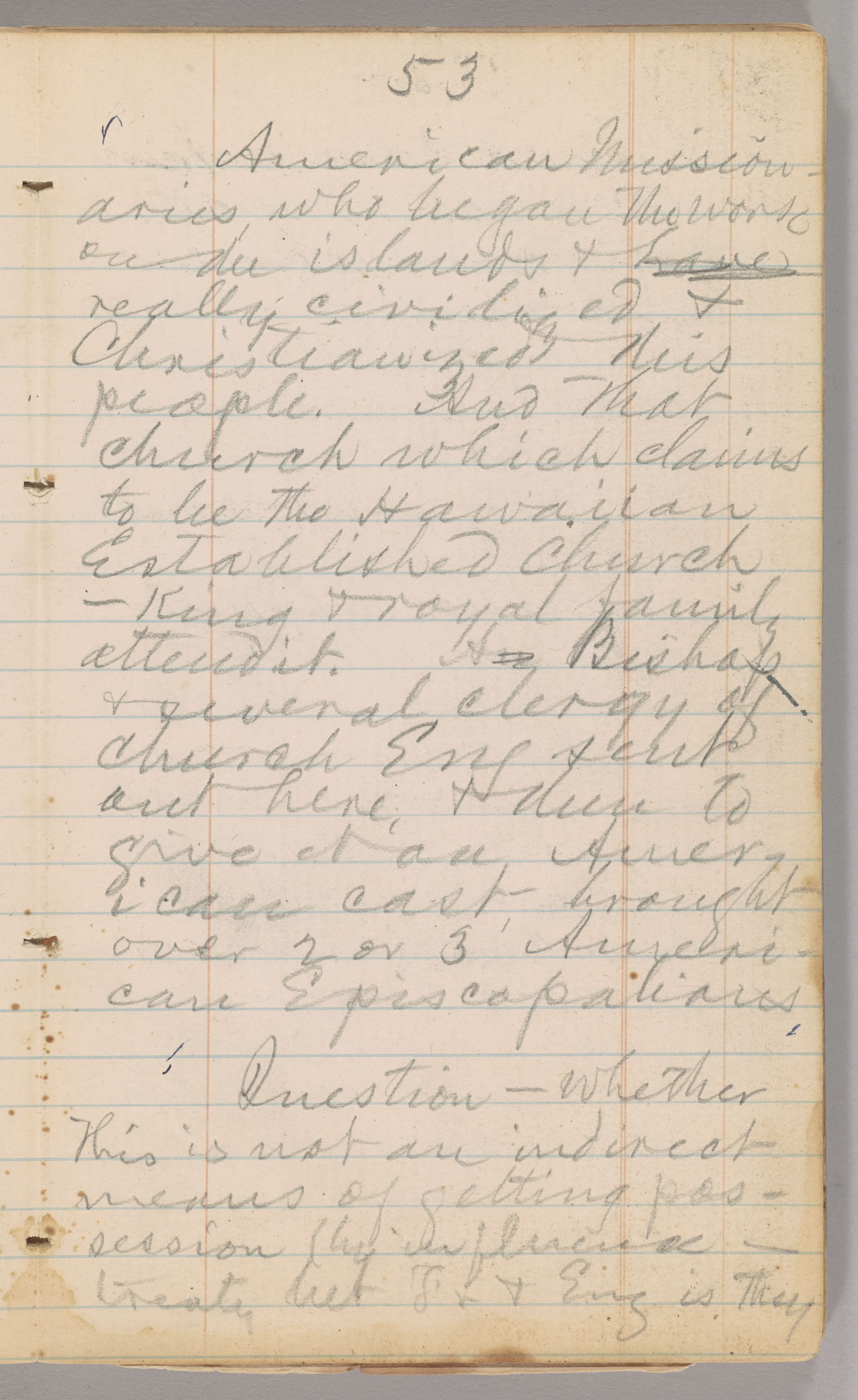
[MS: N6_leaf_027r]
American Mission-
ariesMissionaries, who began the work
on the islands & have
really civilized &
Christianized this
people. And that
church which claims
to be the Hawaiian
Established Church
—King
[MTP: N&J1_198]
& royal family
attend it. An Bishop
& several clergy of
Church Eng sent
out here, & then to
give it an Amer-
icanAmerican cast,—brought
over 2 or 3 Ameri-
canAmerican Episcopalians33
Question—whether
this is not an indirect
means of getting pos-
sessionpossession (by influence—
treaty bet Fr & Eng is they
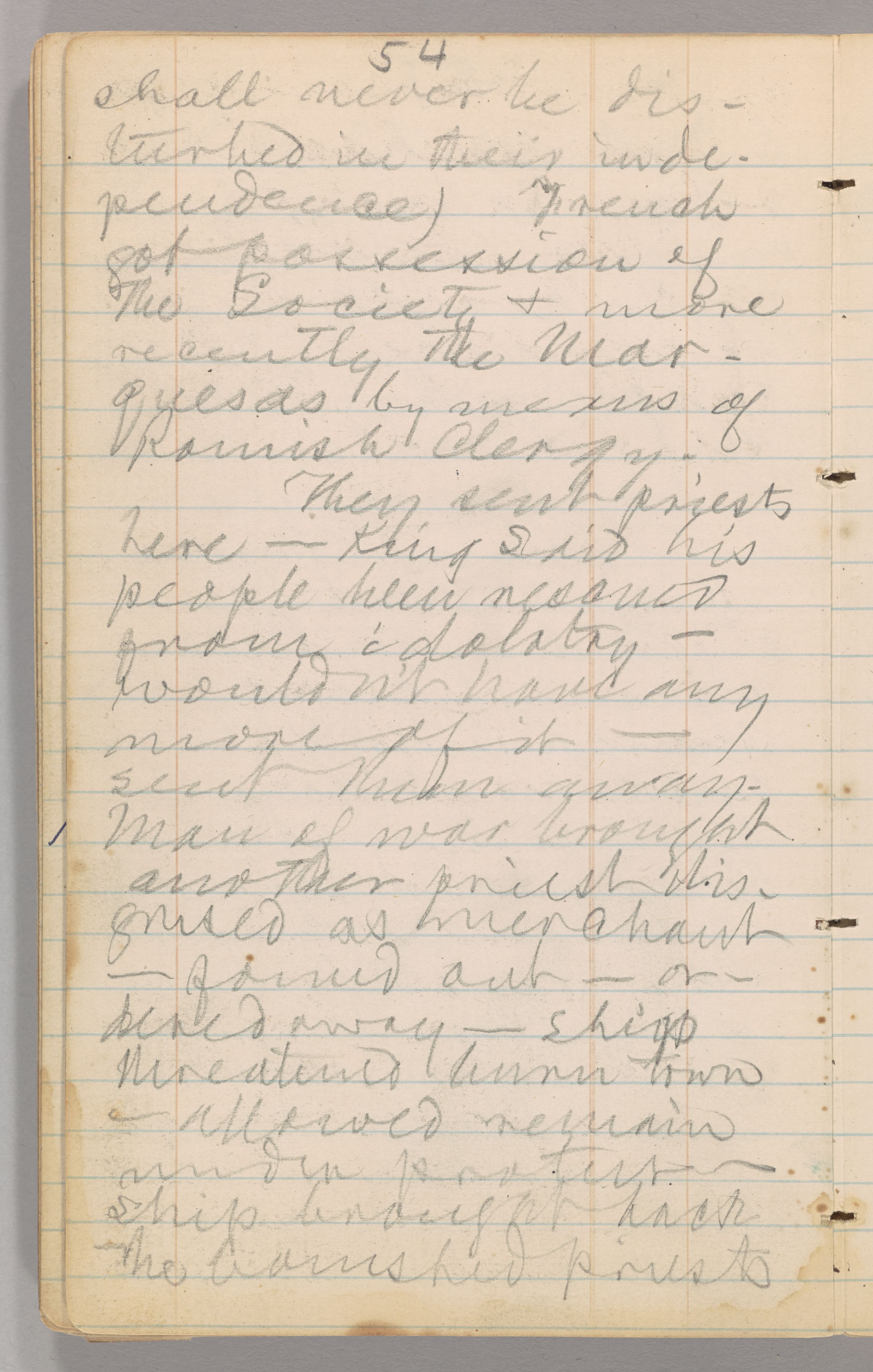
[MS: N6_leaf_027v]
shall never be dis-
turbeddisturbed in their inde-
pendenceindependence)34 French
got possession of
the Society & more
recently the Mar-
quesasMarquesas by means of
Romish Clergy.35
[MTP: N&J1_199]
They sent priests
here36—King said his
people been rescued
from idolatry—
wouldn't have any
more of it—
sent them away.
Man of war brought
another priest dis-
guiseddisguised as merchant
—found out— or-
deredordered away—shi◊p
threatened burn town
—allowed remain
under protest—
ship brought back
the banished priests
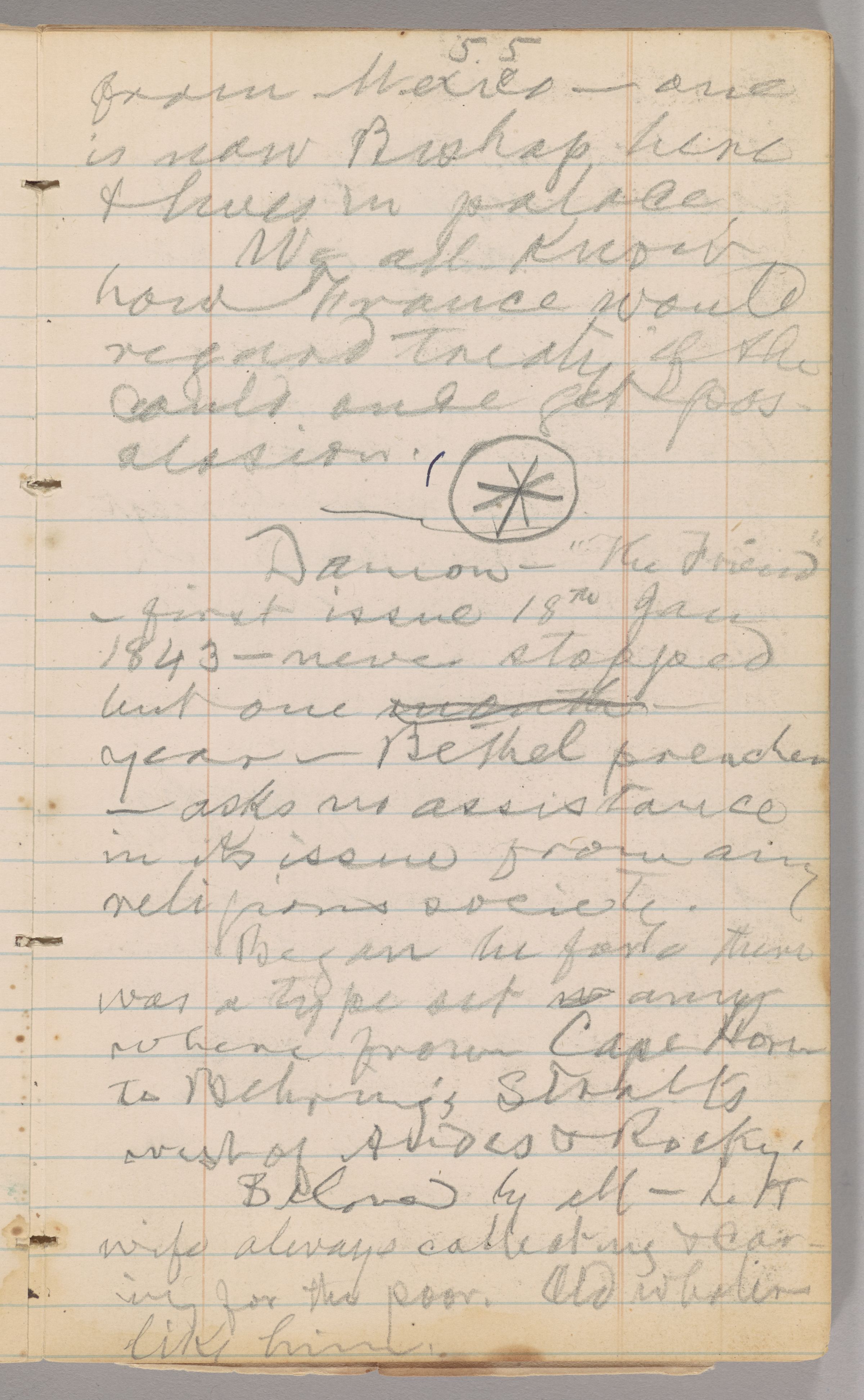
[MS: N6_leaf_028r]
from Mexico—one
is now Bishop here
& lives in palace.
We all know
how France would
regard treaty, if she
could once get pos-
sesionpossession.
✱
Damon—“The Friend”
—first issue 18th Jan
1843—never stopped
but one month—
year—Bethel preacher
—asks no assistance
in its issue from any
religious society.
Began before there
was a type set w any-
whereanywhere from Cape Horn
to Behring's Straits
west of Andes & Rocky.
Beloved by all—he &
wife always collecting & car-
ingcaring for the poor. Old whalers
like him.37
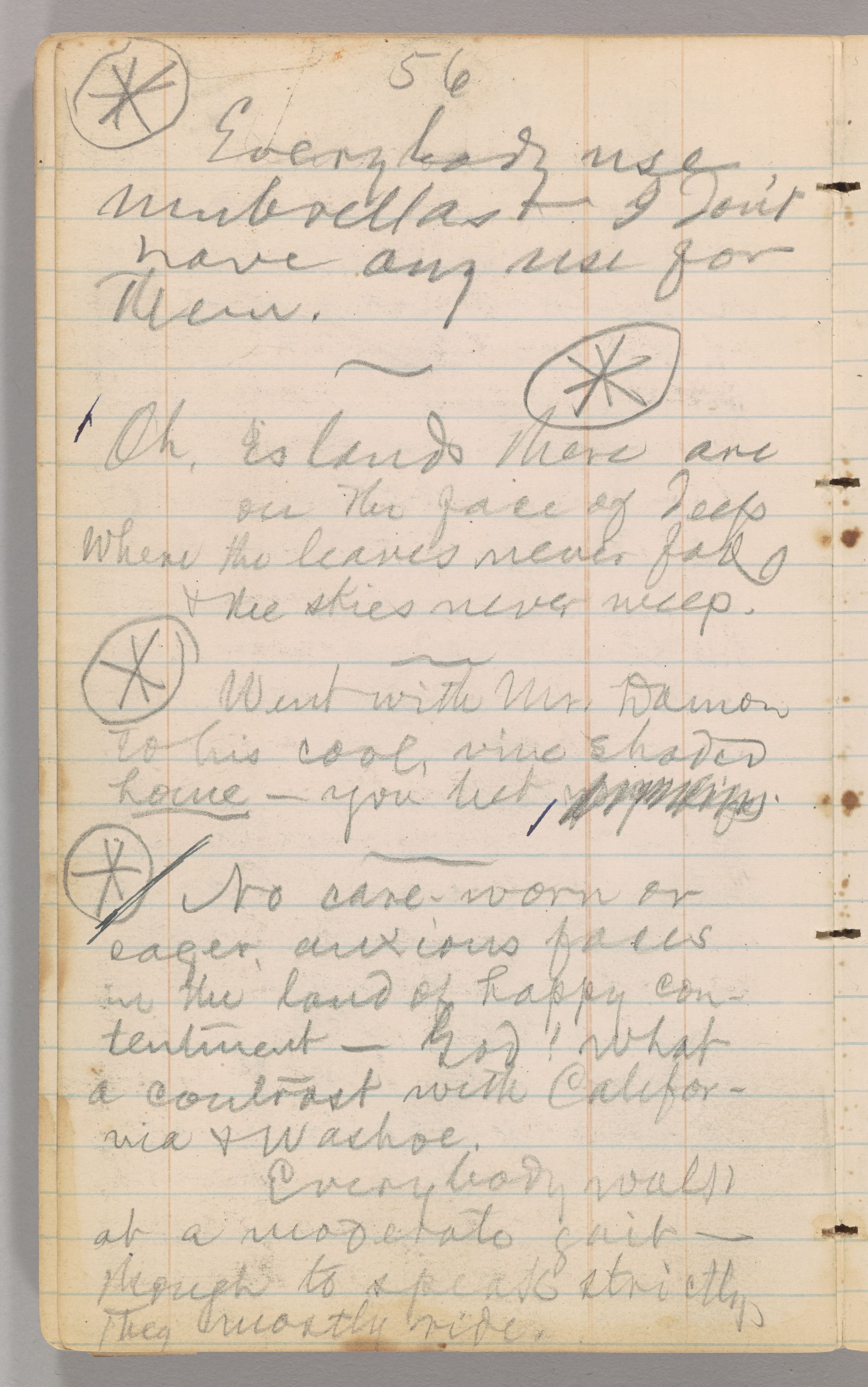
[MS: N6_leaf_028v]
[MTP: N&J1_200]
✱ Everybody use
umbrellas—I don't
have any use for
them.
✱
Oh, islands there are✱ Went with Mr. Damon
to his cool, vine shaded
home39—you bet your life.
✱ No care-worn or
eager, anxious faces
in the land of happy con-
tentmentcontentment—God! what
a contrast with Califor-
niaCalifornia & Washoe.
Everybody walk
at a moderate gait—
though to speak strictly,
they mostly ride.
[MS: N6_leaf_029r]
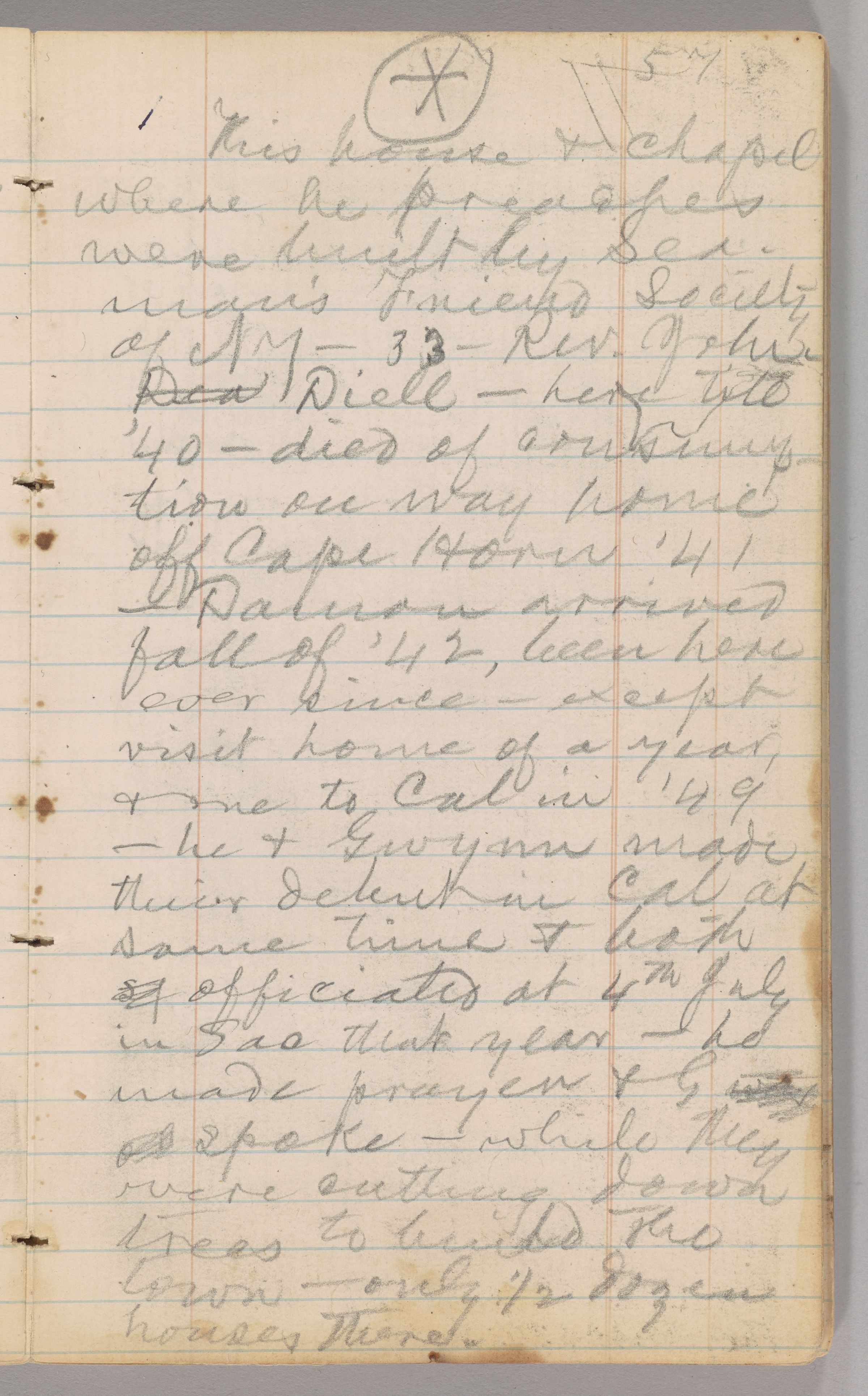
✱ This house & chapel
where he preaches
were built by Sea-
man’sSeaman's Friend Society
of NY—33—Rev. John
Dea Diell40—here till
'40—died of consump-
tionconsumption on way home
off Cape Horn '41
—Damon arrived
fall of '42, been here
ever since—except
visit home of a year,
& one to Cal in '49
—he & Gwynn made
their debut in Cal at
same time & both
sp officiated at 4th July
in Sac that year41—he
made
[MTP: N&J1_201]
prayer & G was
ol spoke—while they
were cutting down
trees to build the
town—only ½ dozen
houses there.
[MS: N6_leaf_029v]
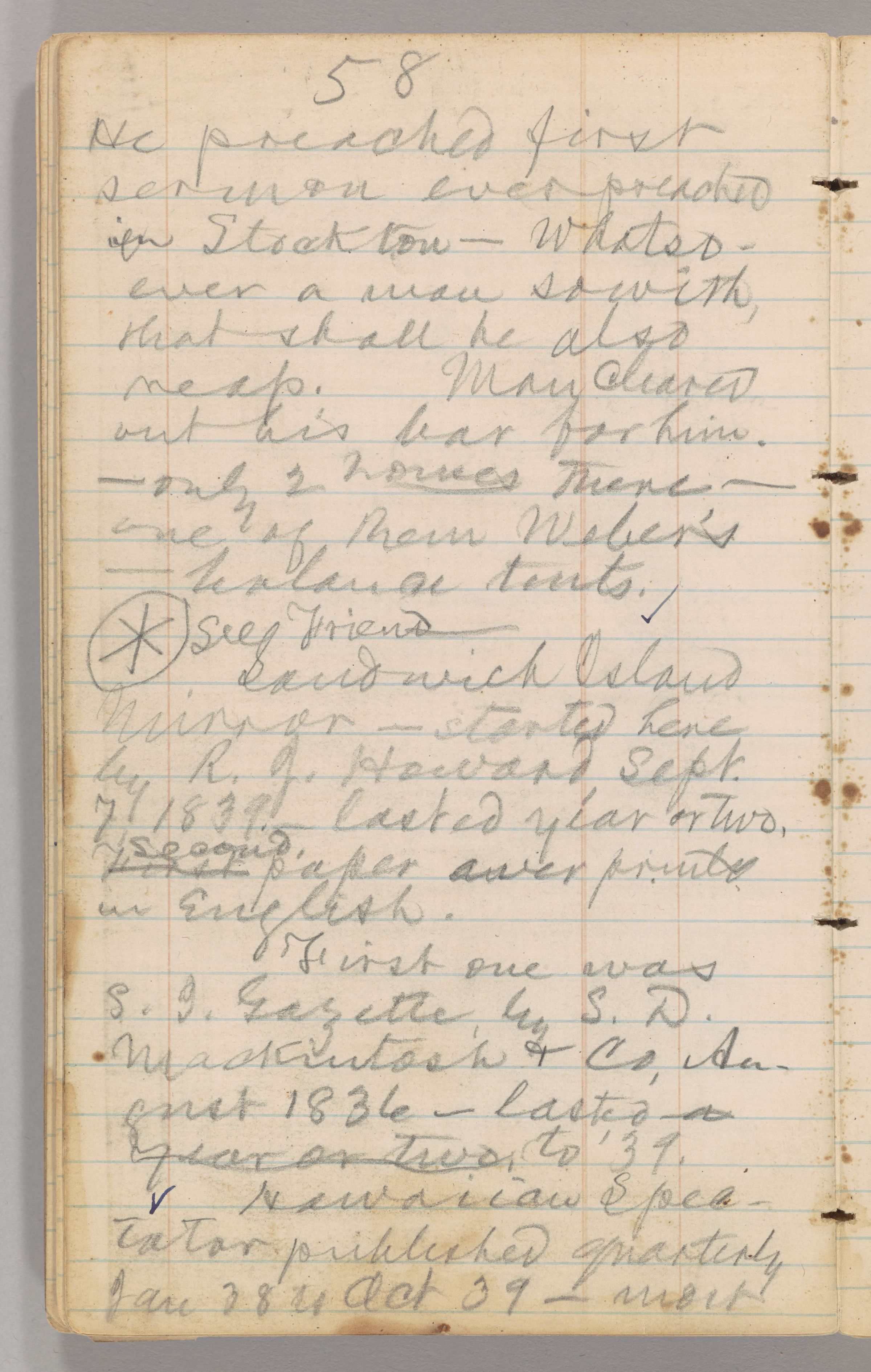
He preached first
sermon ever preached
in Stockton—Whatso-
everWhatsoever a man sowith,
that shall he also
reap. Man cleared
out his bar for him.Ⓣtextual note
—only 2 houses there—
one of them Weber's42
—balance tents.43
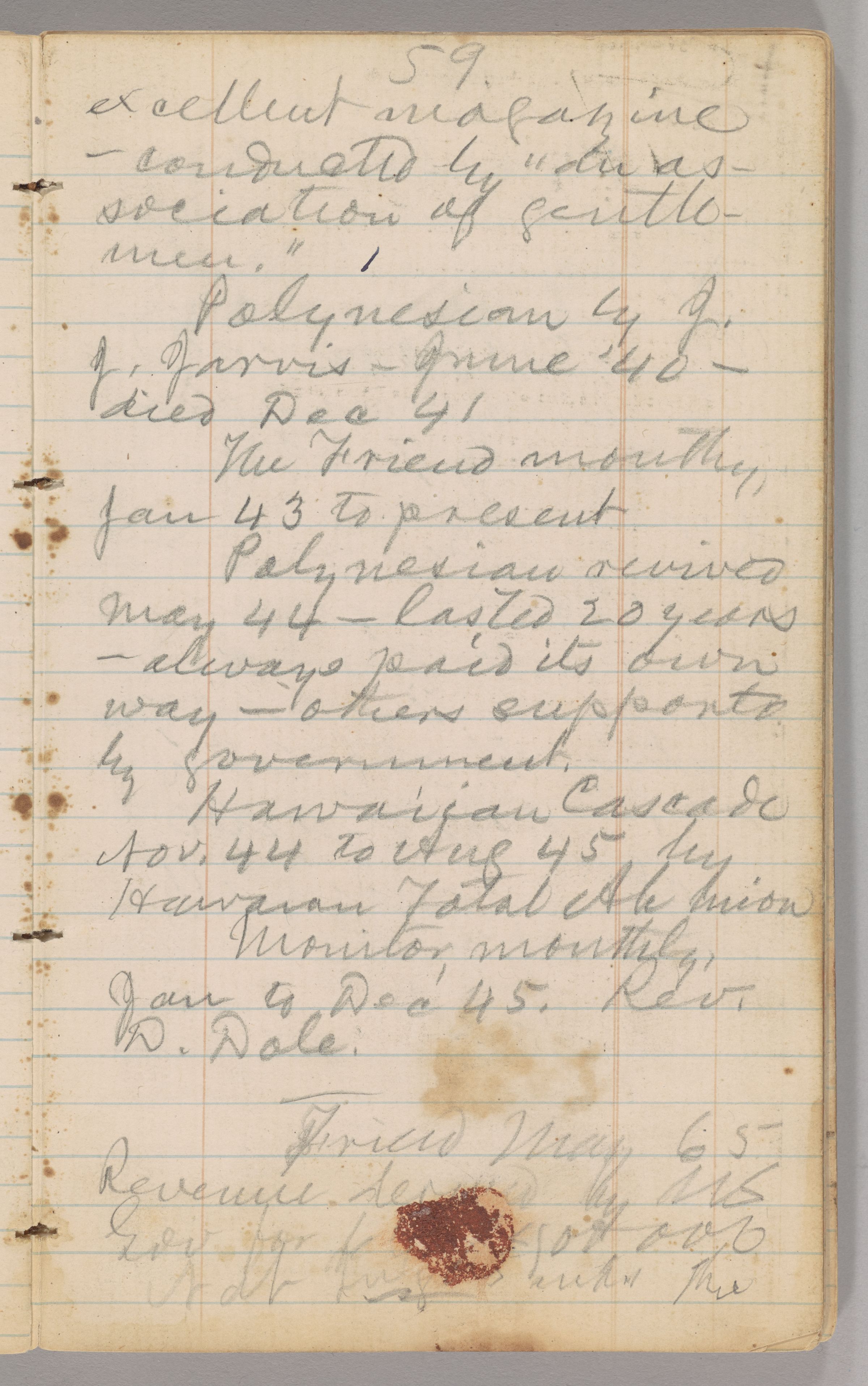
✱ See Friend44 Sandwich Island
Mirror—started here
by R. J. Howard, Sept.
7, 1839.—lasted year or two.
First Second, paper in ever printed
in English.
First one was
S. I. Gazette, by S. D.
Mackintosh & Co, Au-
gustAugust 1836—lasted a
year or two, to '39.
Hawaiian Spec
tatorSpectator published quarterly
Jan 38 to Oct 39—most
[MS: N6_leaf_030r]
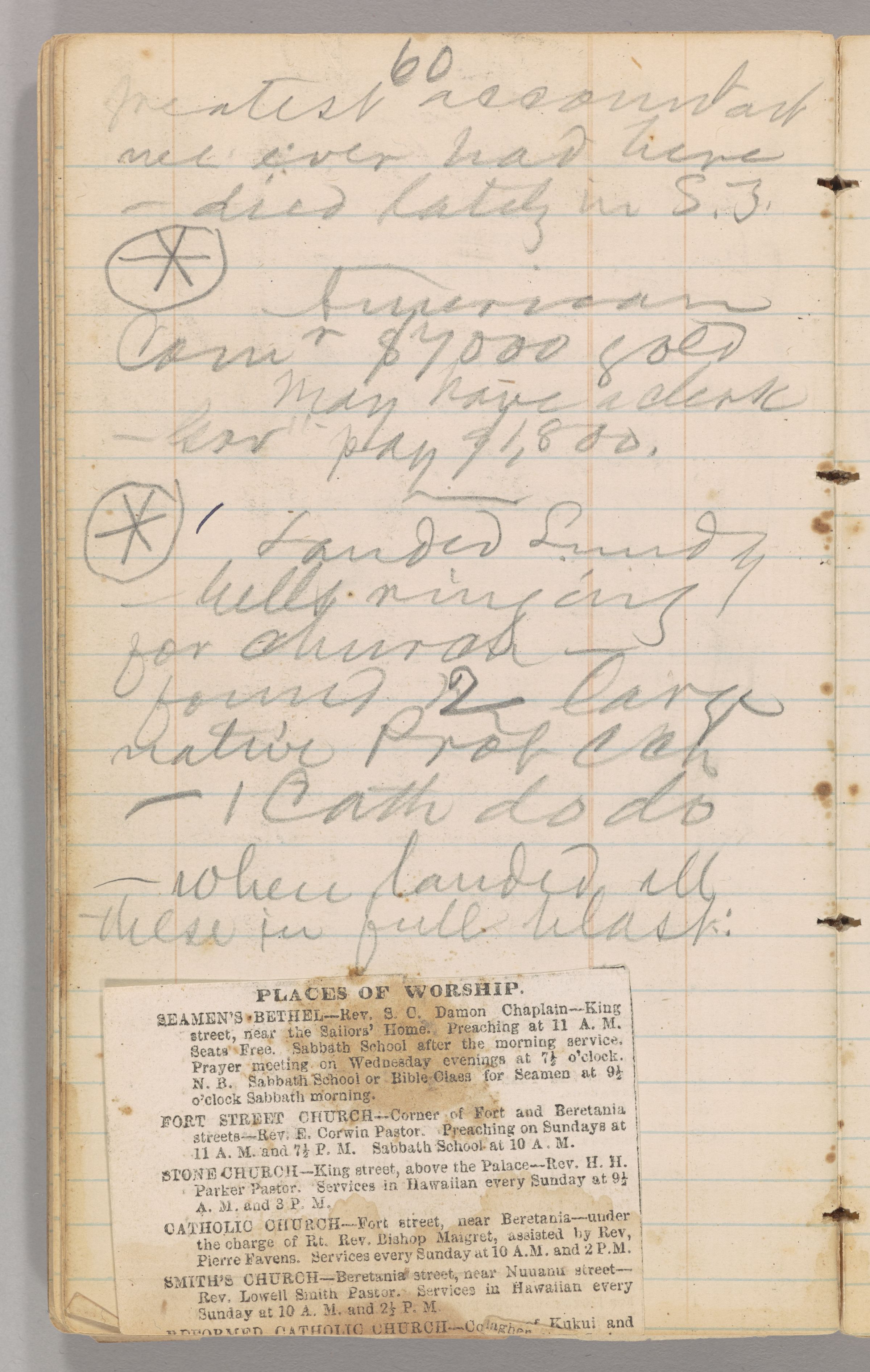
excellent magazine
—conducted by “an as-
sociationassociation of gentle-
mengentlemen.”
Polynesian by J.
J. Jarvis—June '40—
died Dec 41
The Friend monthy,
Jan 43 to present
Polynesian revived
May 44—lasted 20 years
—always paid its own
way—others supportd
by government.
Hawaiian Cascade
Nov. 44 to Aug 45 by
Hawaian Total Ab Union
Monitor, monthly,
Jan to Dec 45. Rev.
D. Dole.
◊ Friend May 6545
Revenue derived by US
Gov for one or
[MTP: N&J1_202] two words 400,000Ⓣtextual note
Nat Ingols was the
[MS: N6_leaf_030v]
greatest accountant
we ever had here
—died lately in S. F.
✱ American
Comr $7000 gold
May have a clerk
—Govt pay $1,800.
✱ Landed Sunday
—bells ringing
for church—
found 2 large
native
[MTP: N&J1_203] Prot Cch
—1 Cath do do
—when landed all
these in full blast.:
46
[MS: N6_leaf_031r]
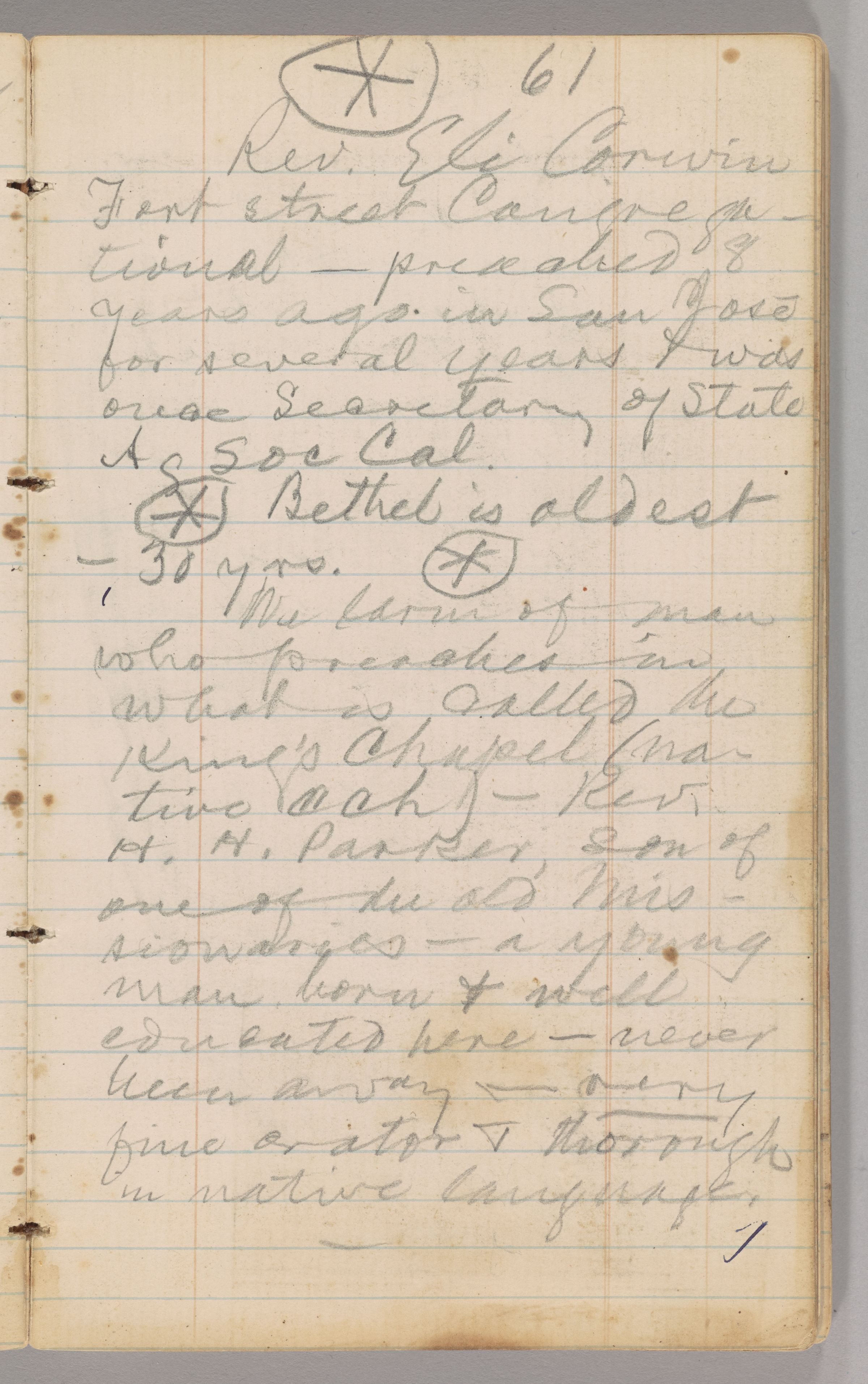
✱
Rev. Eli Corwin
Fort street Congrega-
tionalCongregational—preached 8
years ago in San José
for several years & was
once Secretary of State
Ag Soc Cal.47
✱ Bethel is oldest
—30 yrs.
✱
We larm of man
who preaches in
what is called the
King's Chapel (na-
tivenative cch)—Rev.
H. H. Parker, son of
one of the old Mis-
sionariesMissionaries—a young
man, born e & well
educated here—never
been away—very
fine orator & thorough
in native language.48
[MS: N6_leaf_031v]
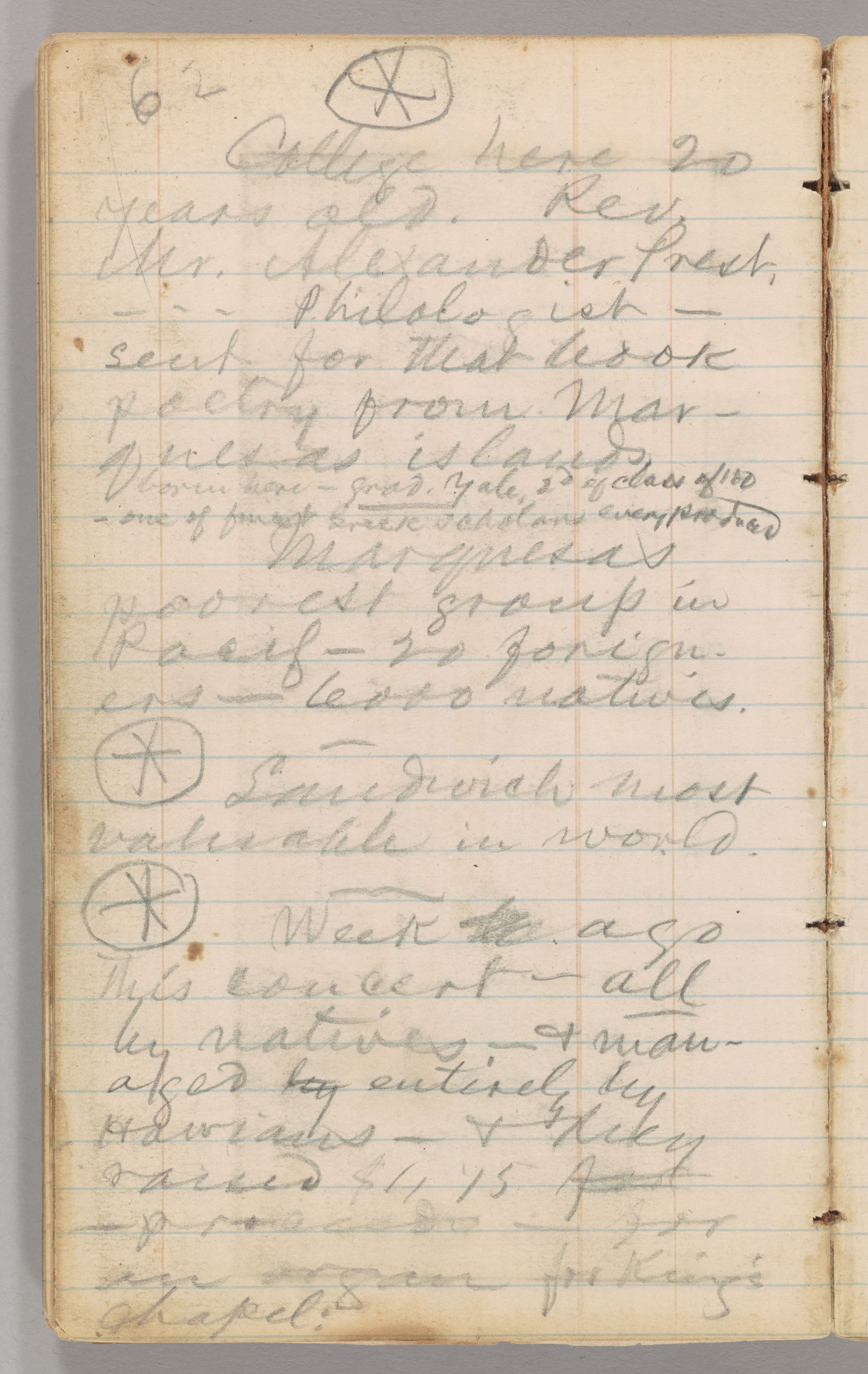
✱
College here 20
years old.49 Rev.
Mr. Alexander Prest,
– – –
[MTP: N&J1_204] Philologist—
sent for that book
poetry from Mar-
quesasMarquesas islands.
born here—grad. Yale, 2d of class of 100
—one of finest Greek scholars every produced50
Marquesas
poorest group in
Pacif—20 forign-
ersforigners—6000 natives.
✱ Sandwich most
valuable in world.
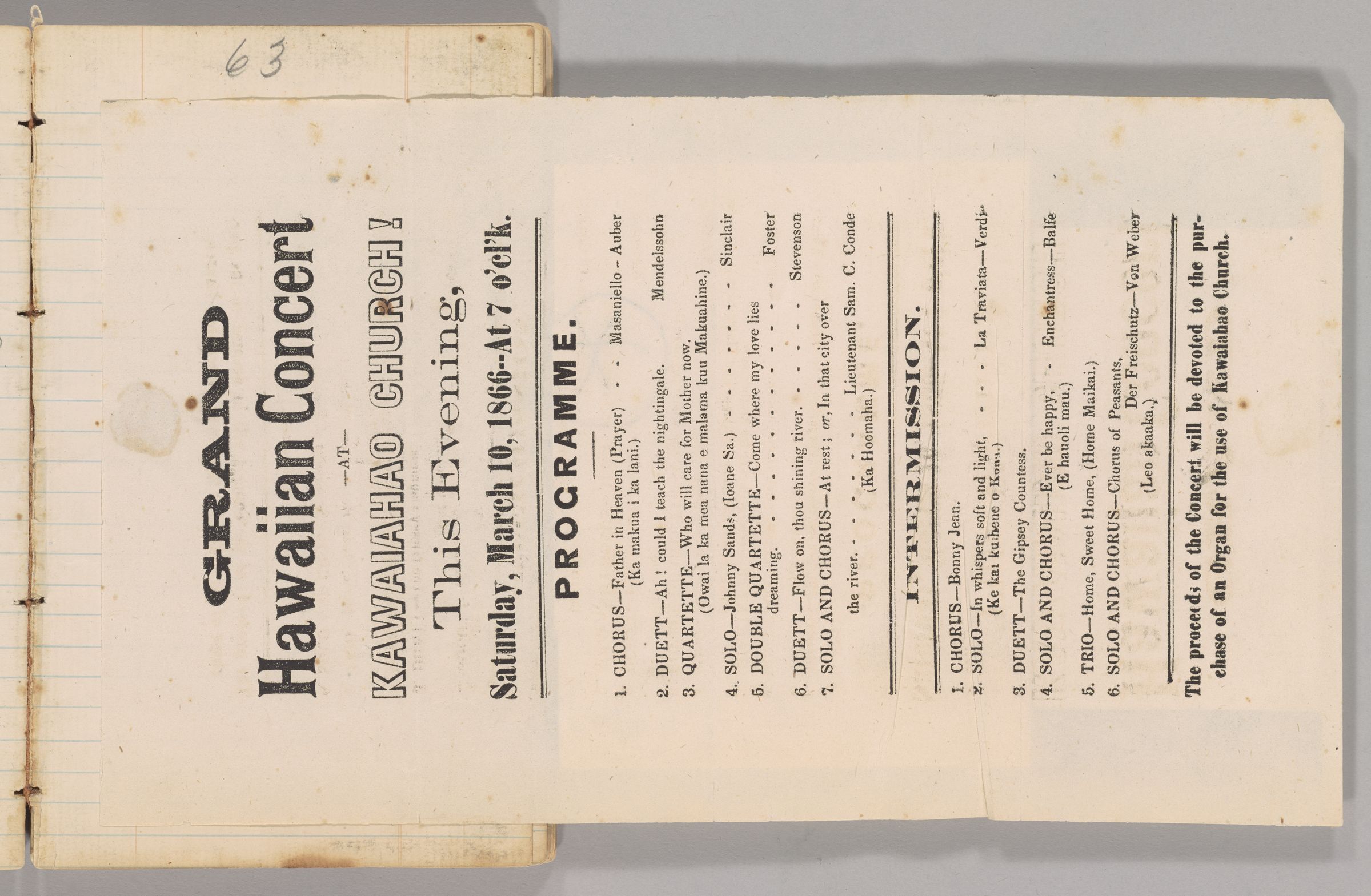
✱ Week be ago
this concert—all
by natives—& man-
agedmanaged by entirely by
Hawians—& they
raised $1175 for
—proceeds—for
an organ for King's
chapel:51
[MS: N6_leaf_032r open]
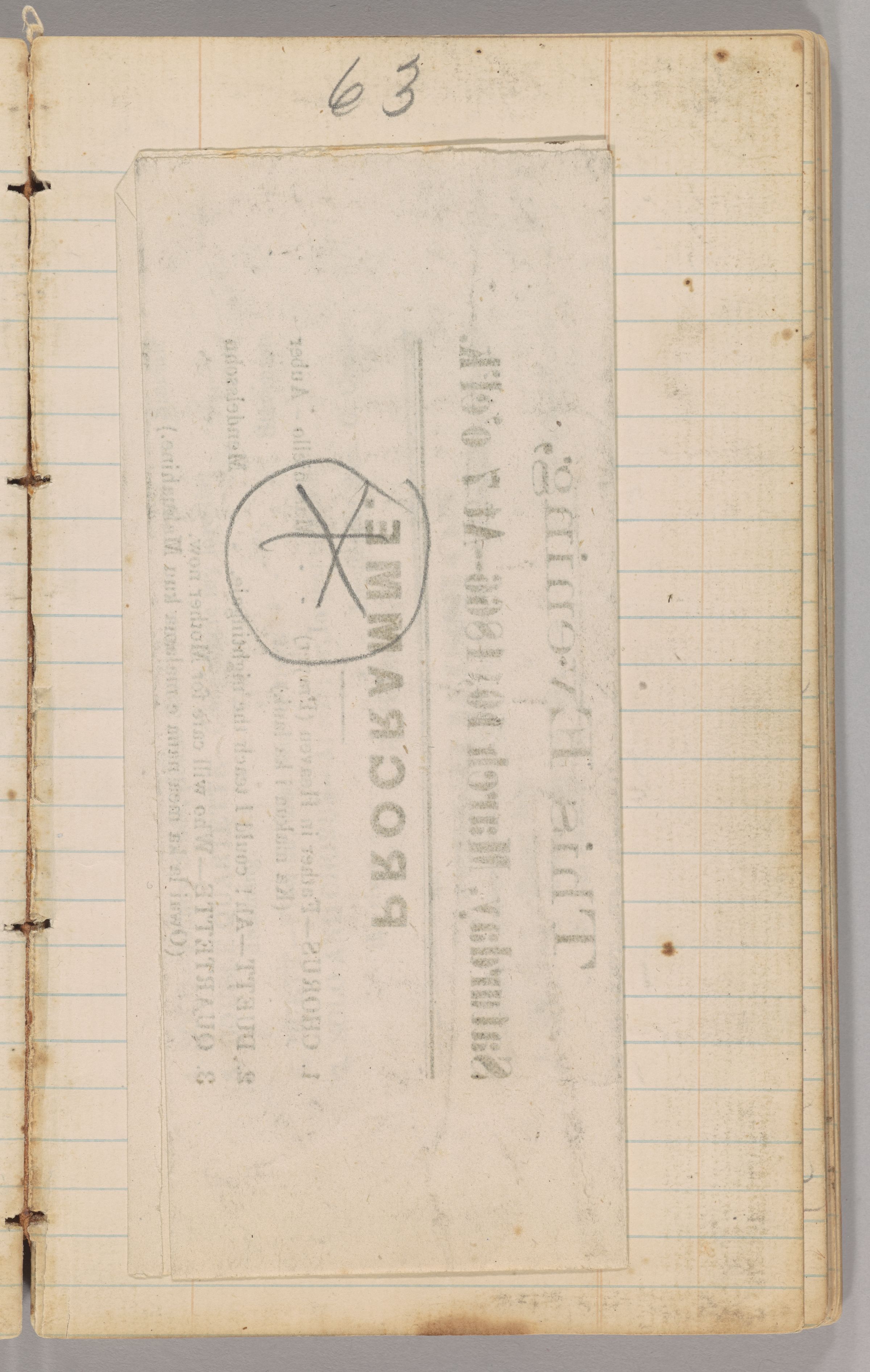
Grand Hawaiian Concert Programme
[MS: N6_leaf_032r closed]
✱
[MS: N6_leaf_032v]
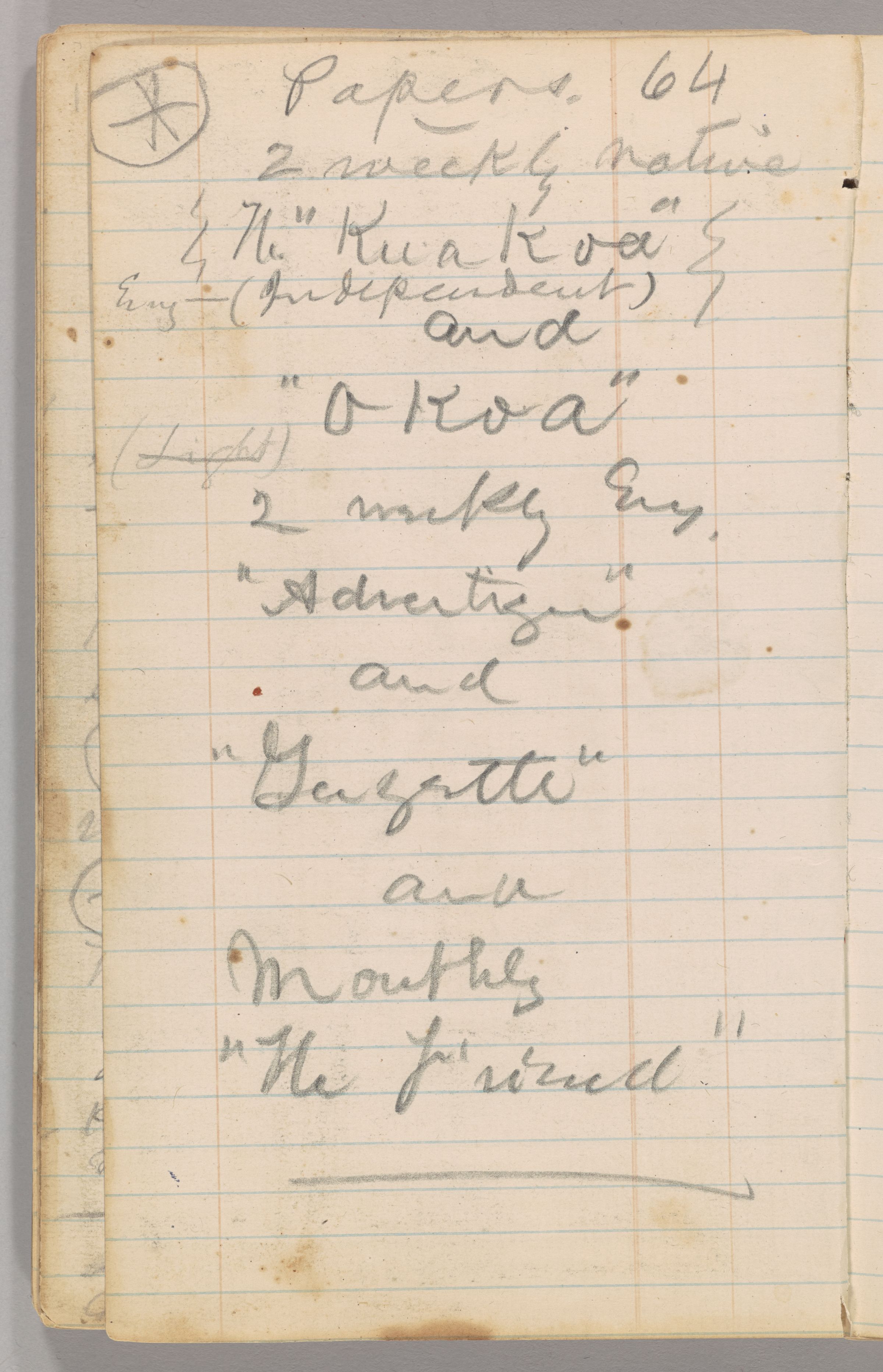
✱ Papers.52
⸺
2 weekly native
N. “Kuakoa”
Eng— (Independent)
and
“Okoa”
(Light)
2 weekly Eng.
“Advertizer”
and
“Gazette”
and
Monthly
“The Friend”
[MS: N6_leaf_033r]
✱
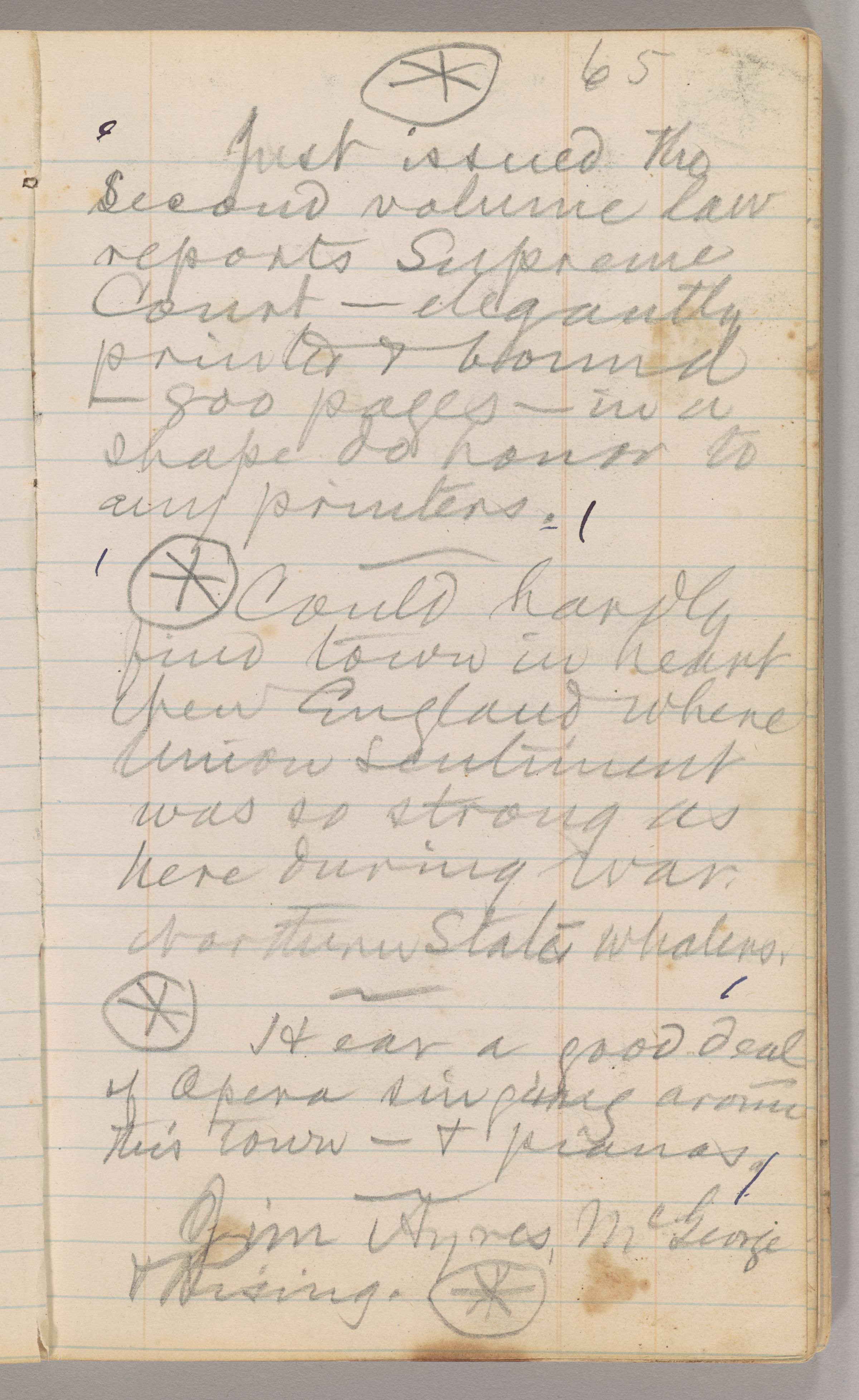
Just issued the
l Second volume law
reports Supreme
Court—elegantly
printed & bound
—800 pages—in a
shape do honor to
any printers.53
[MTP: N&J1_205]
✱ Could hardly
find town in heart
New England where
Union sentiment
was so strong as
here during War.
Northern States Whalers.
✱ Hear a good deal
of Opera singing around
this town—& pianos.54
Jim Ayres, McGeorge
& Rising. ✱
[MS: N6_leaf_033v]
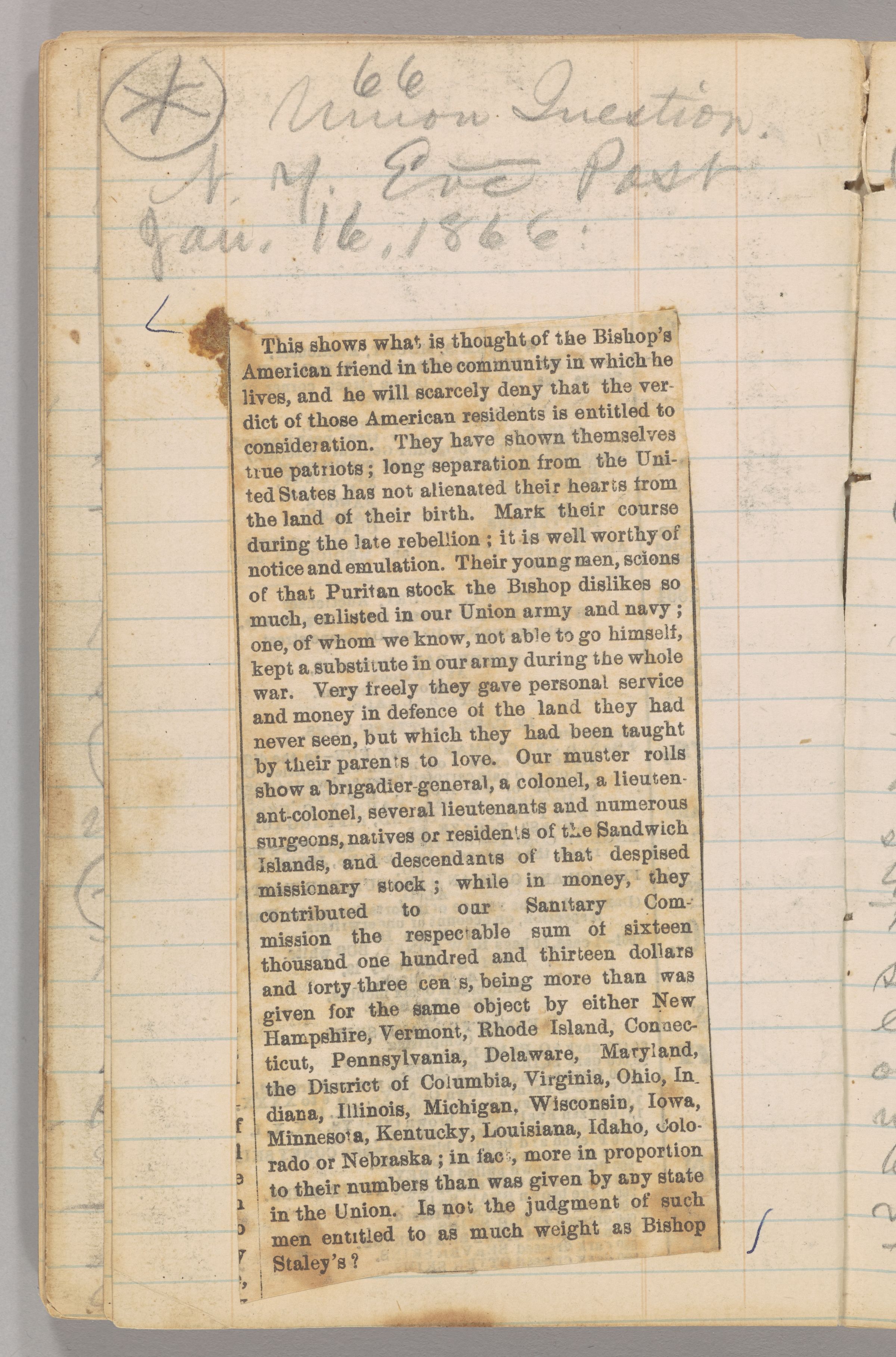
✱ Union Question.Ⓣtextual note
N. Y. Eve Post
Jan. 16, 1866:55
clipping; see facsimile
[MS: N6_leaf_034r]
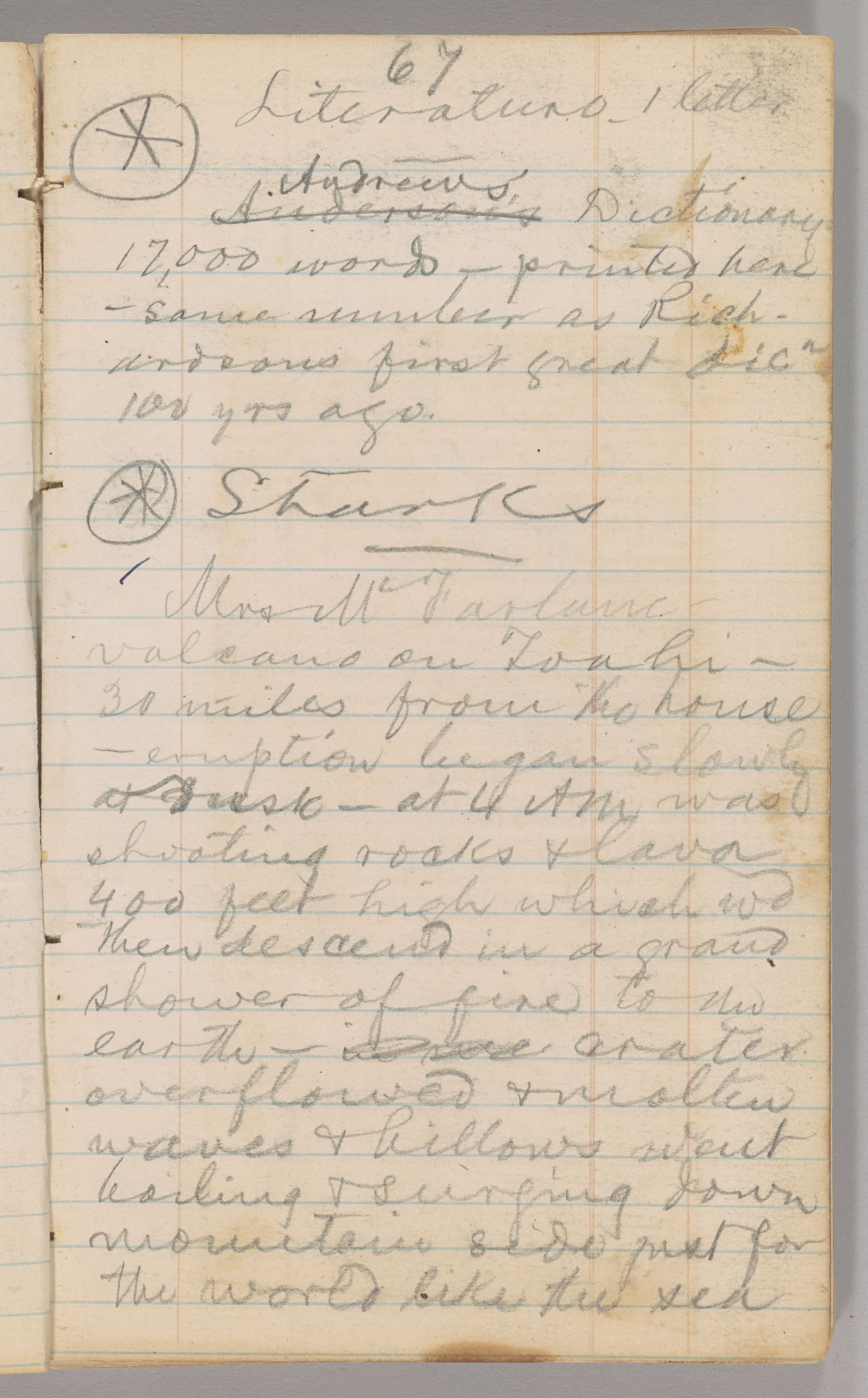
✱ Literature. 1 letter.
[MTP: N&J1_206]
Anderson's Andrews' Dictionary.
17,000 words56—printed here
—same number as Rich-
ardsonsRichardsons first great dicn
100 yrs ago.
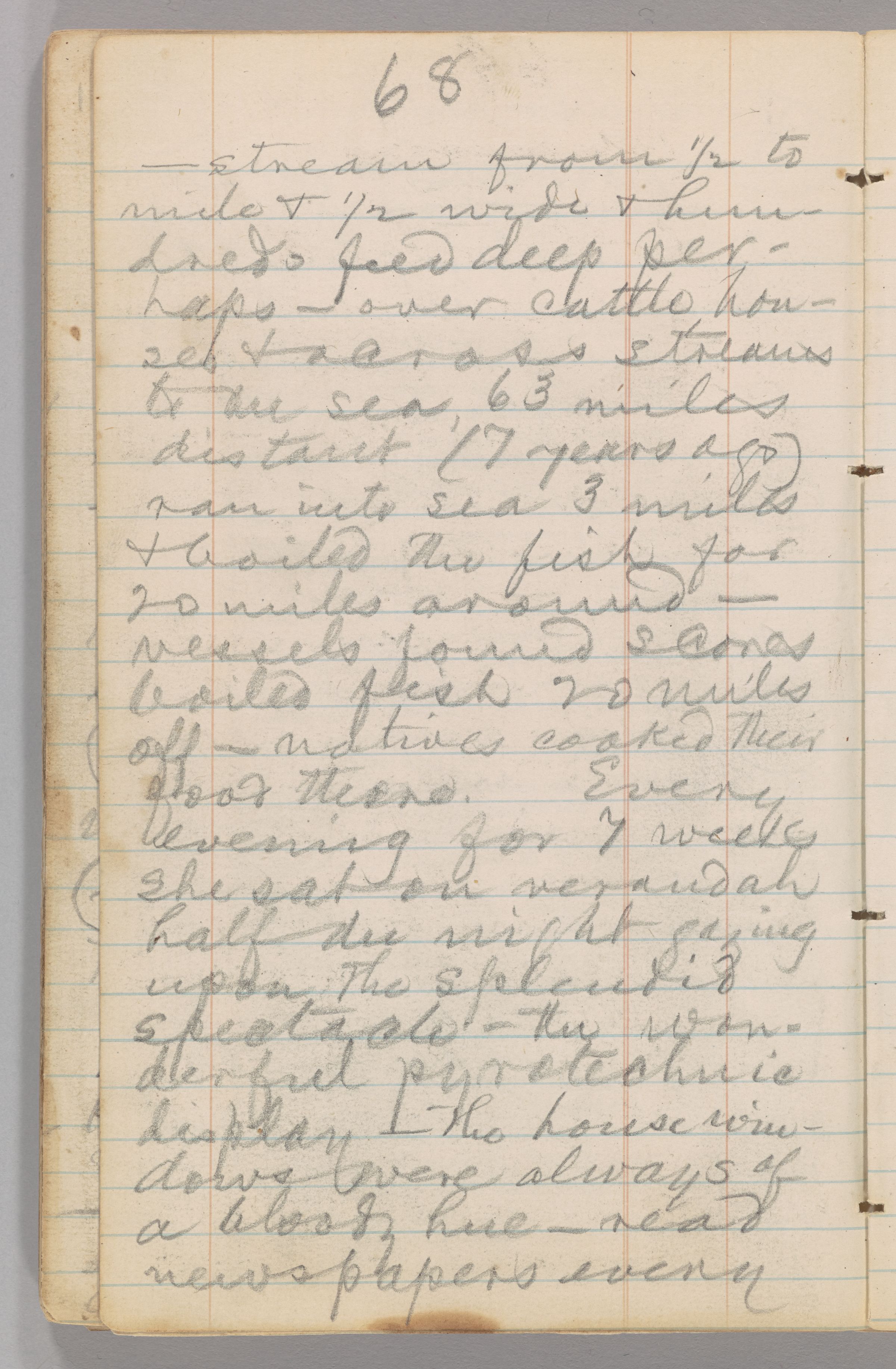
✱ Sharks
Mrs McFarlane—
volcano on Toahi57—
30 miles from the house
—eruption began slowly
at su duskⓉtextual note—at 4 AM was
shooting rocks & lava
400 feet high which wd
then descend in a grand
shower of fire to the
earth—in mⓂemendation crater
overflowed & molten
waves & billows went
boiling & surging down
mountain side just for
the world like the sea
[MS: N6_leaf_034v]
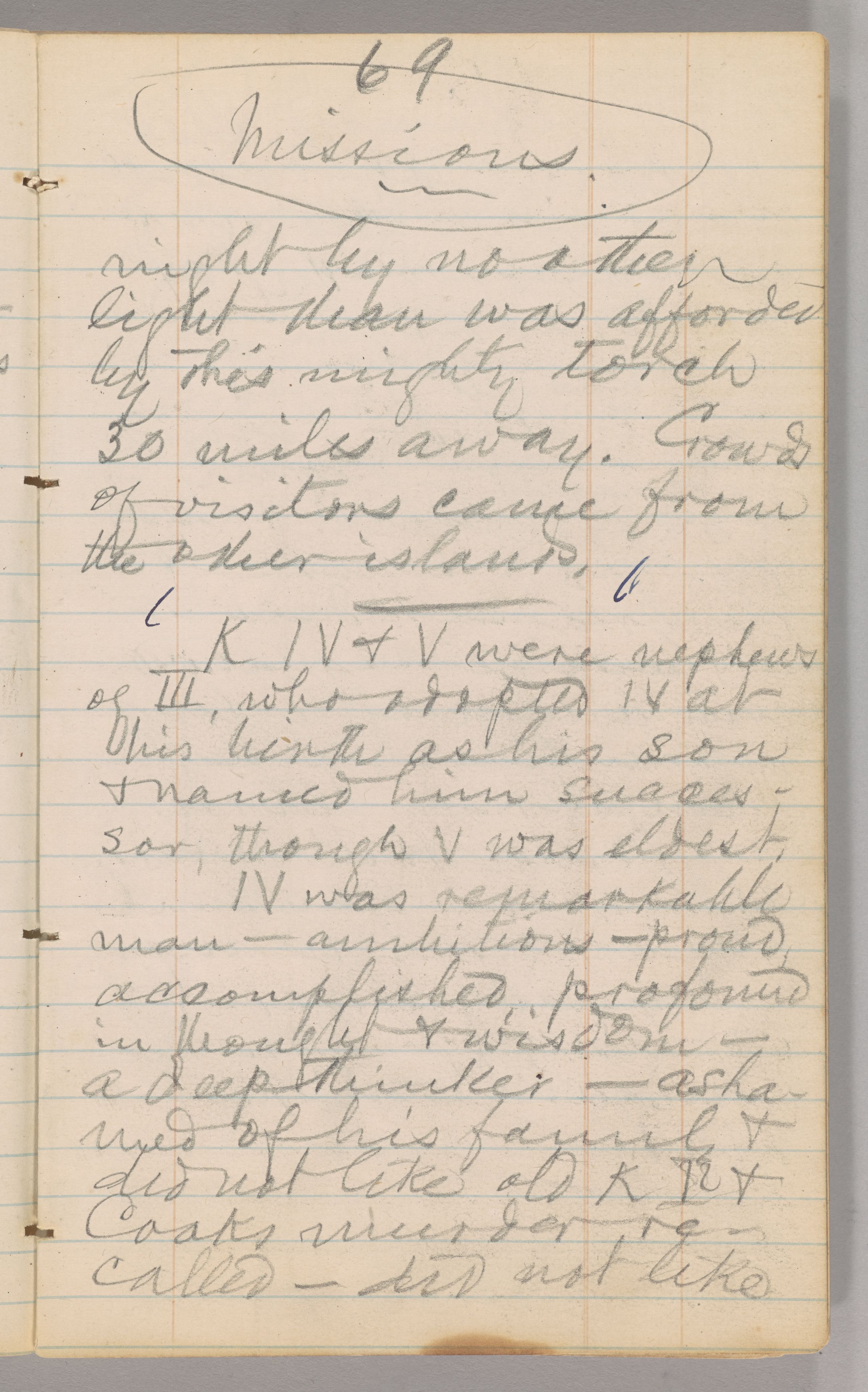
—stream from ½ to
mile & ½ wide & hun-
dredshundreds feed deep per-
hapsperhaps—over cattle, hou-
seshouses & across streams
to the sea, 63 miles
distant (7 years ago)
ran into sea 3 miles
& boiled the fish for
20 miles around—
vessels found scores
boiled fish 20 miles
off—natives cooked their
food there. Every
evening for 7 weeks
she sat on verandah
half the night gazing
upon the splendid
spectacle—the won-
derfulwonderful pyrotechnic
display—the house win-
dowswindows were always of
a bloody hue—read
newspapers every
[MS: N6_leaf_035r]
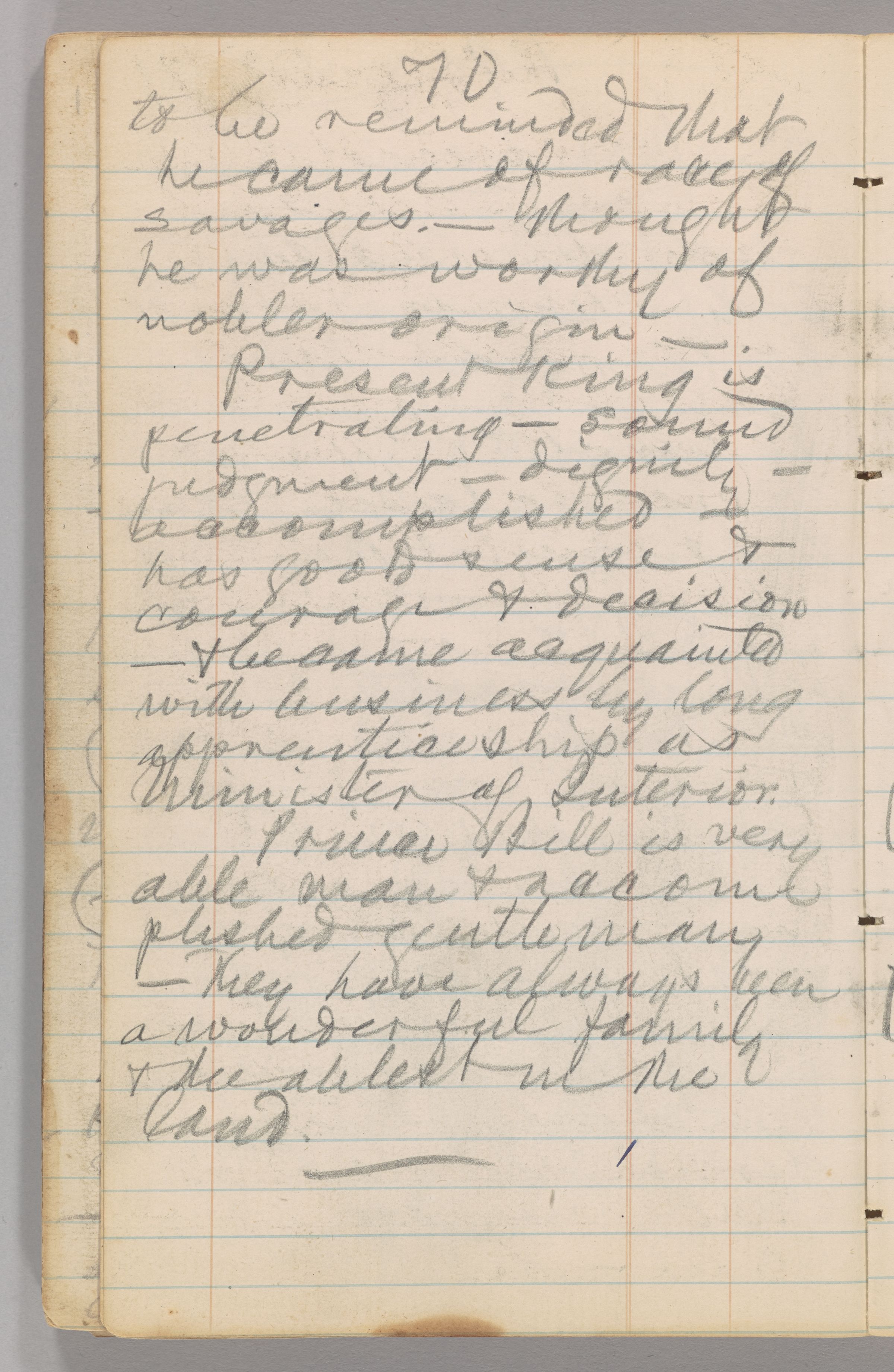
MissionsⓉtextual note.58
night by no other
light than was afforded
by this mighty torch
30 miles away. Crowds
of visitors came from
the other islands.
KIV & V were nephews
of III, who adopted IV at
his birth as his son
& named him succes-
sorsuccessor, though V was eldest.
IV was remarkable
man—ambitious—proud,
accomplished, profound
in thought & wisdom—
a deep thinker—asha-
medashamed of his family &
did not like old K I &
Cooks murder re-
calledrecalled—did not like
[MS: N6_leaf_035v]
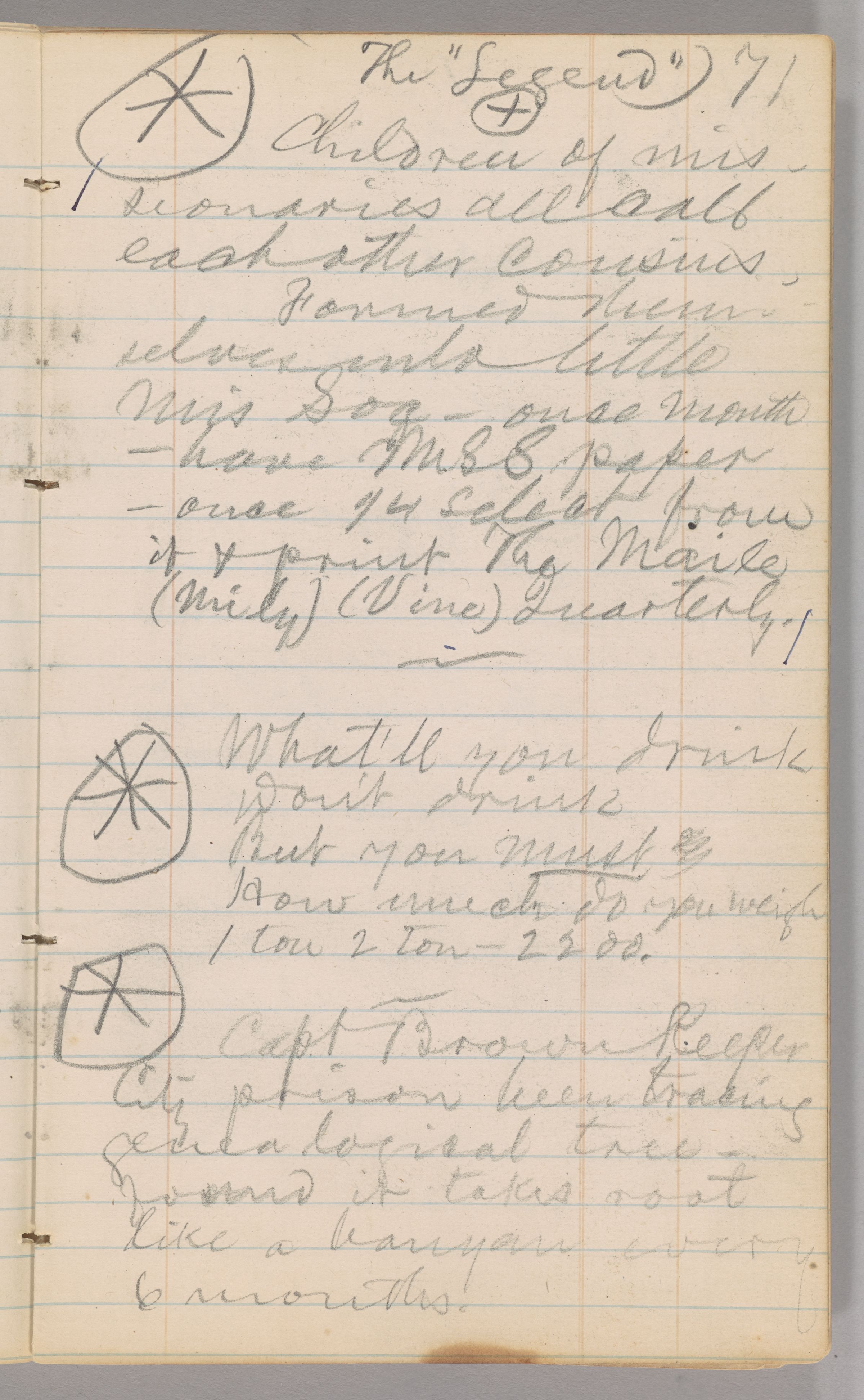
to be reminded that
he came of race of
savages.—thought
he was worthy of
nobler origin—
Present King is
penetrating—sound
judgment—dignity—
accomplished—
has good sense &
courage & decision
—& became
[MTP: N&J1_207] acquainted
with business by long
apprenticeship as
Minister of Interior.
Prince Bill is very
able man & accom-
plishedaccomplished gentleman
—they have always been
a wonderful family
& the ablest in the
land.
[MS: N6_leaf_036r]
The “Legend”59
✱
✱ Children of mis-
sionariesmissionaries all call
each other cousins.60
Formed them-
selvesthemselves into little
Mis Soc—once month
—have MSS paper
—once ¼ select from
it & print The Maile
(Mily) (Vine) Quarterly.
✱
What'll you drink
Don't drink
But you must?
How much do you weigh
1 ton 2 ton—2200.61
[MTP: N&J1_208]
✱ Capt Brown62 Keeper
City prison been tracing
genealogical tree—
found it takes root
like a banyan every
6 months.
[MS: N6_leaf_036v]
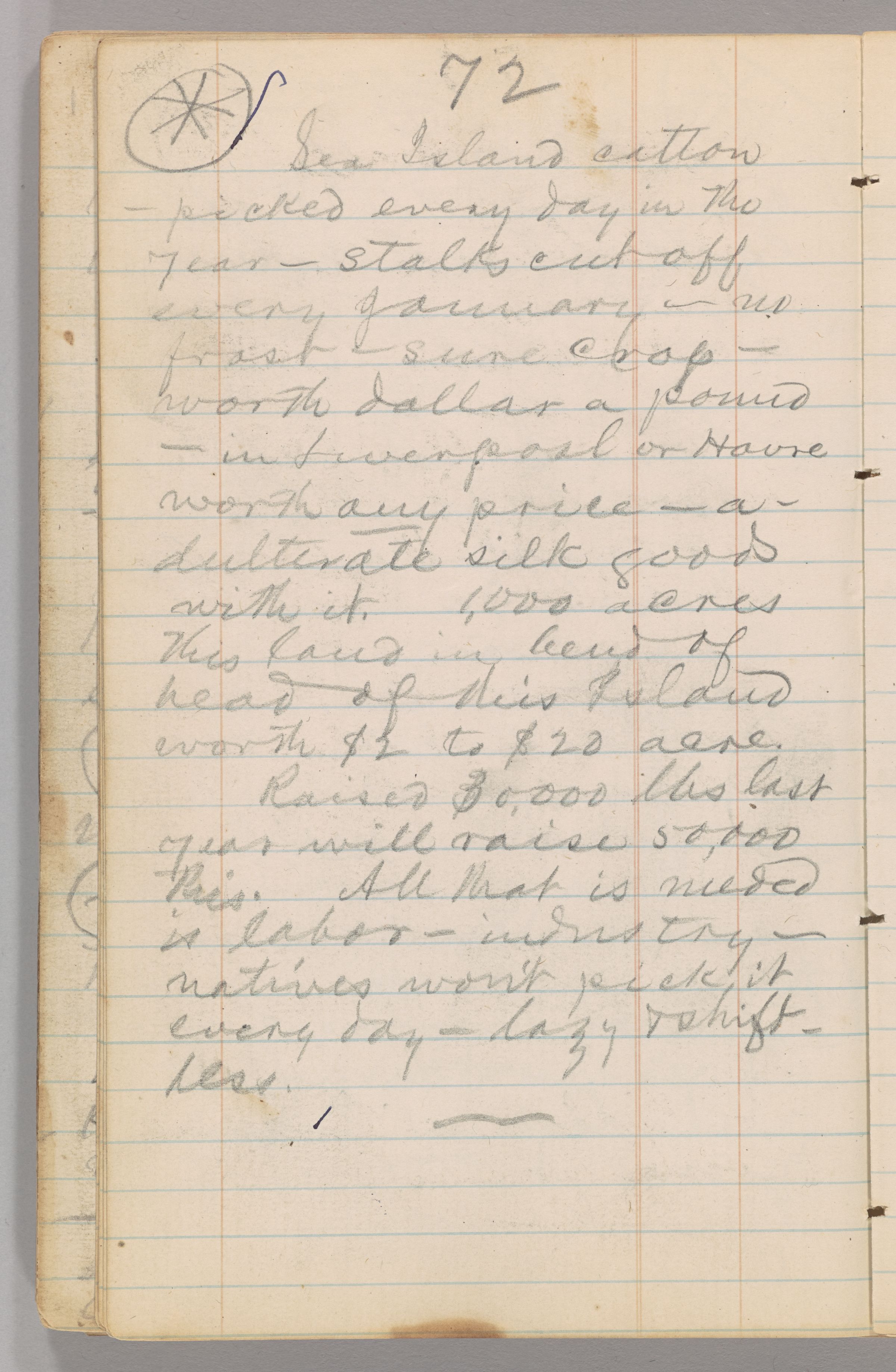
✱ Sea Island cotton
—picked every day in the
year—stalks cut off
every January—no
frost—sure crop—
worth dollar a pound
—in Liverpool or Havre
worth any price—a-
dulterateadulterate silk goods
with it. 1,000 acres
this land in bend of
head of this Island
worth $2 to $20 acre.
Raised $ 30,000 lbs last
year will raise 50,000
this. All that is needed
is labor—industry—
natives won't pick it
every day—lazy & shift-
lessshiftless.
[MS: N6_leaf_037r]
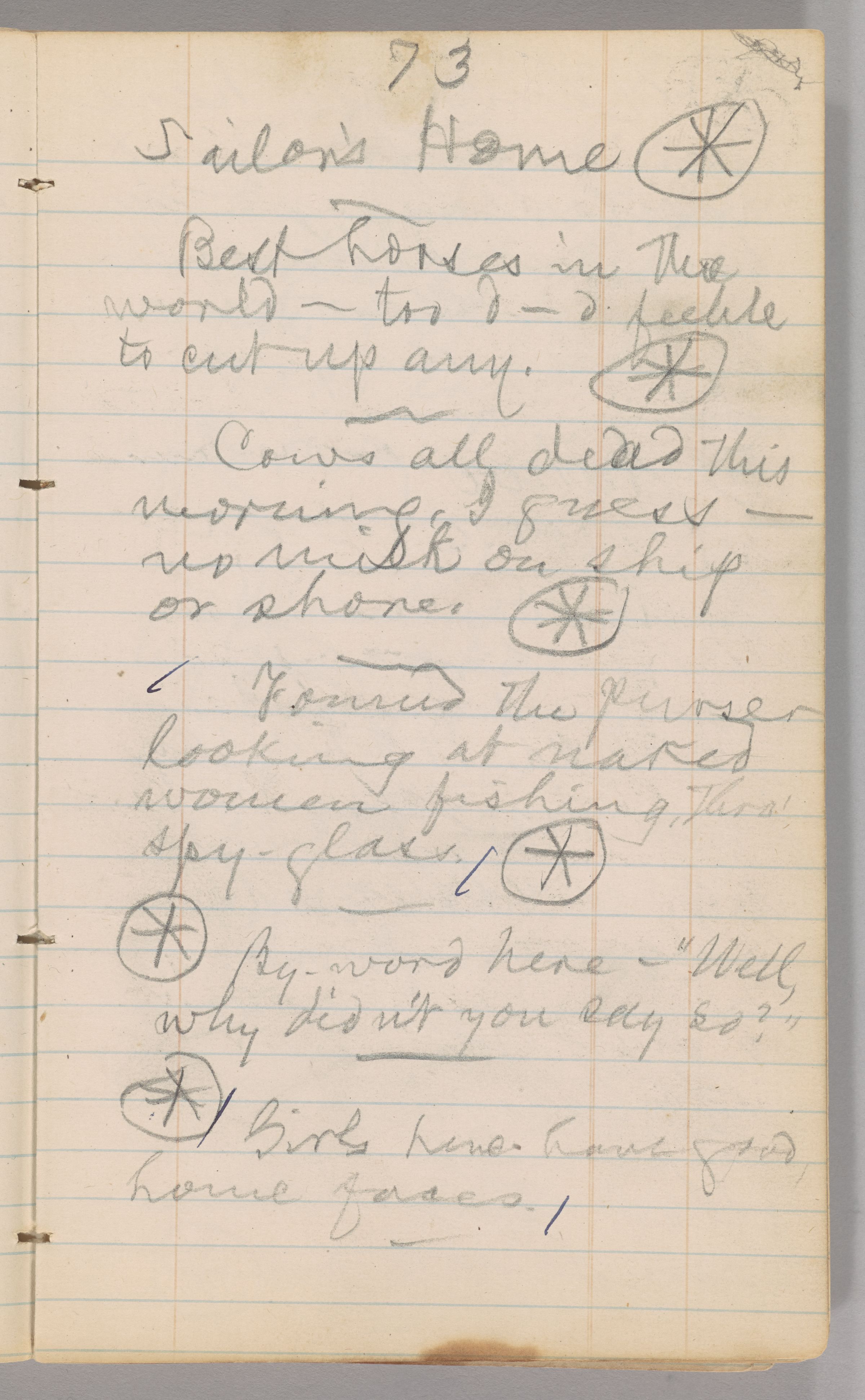
Sailor's Home ✱
Best horses in the
world—too d—d feeble
to cut up any. ✱
Cows all dedadⓉtextual note this
morning, I guess—
no milk on ship
or shore. ✱
Found the purser
looking at naked
women fishing, thro'
spy-glass. ✱
✱ By-word here—“Well,
why didn't you say so?”
✱ Girls here have good
, home faces.
[MS: N6_leaf_037v]
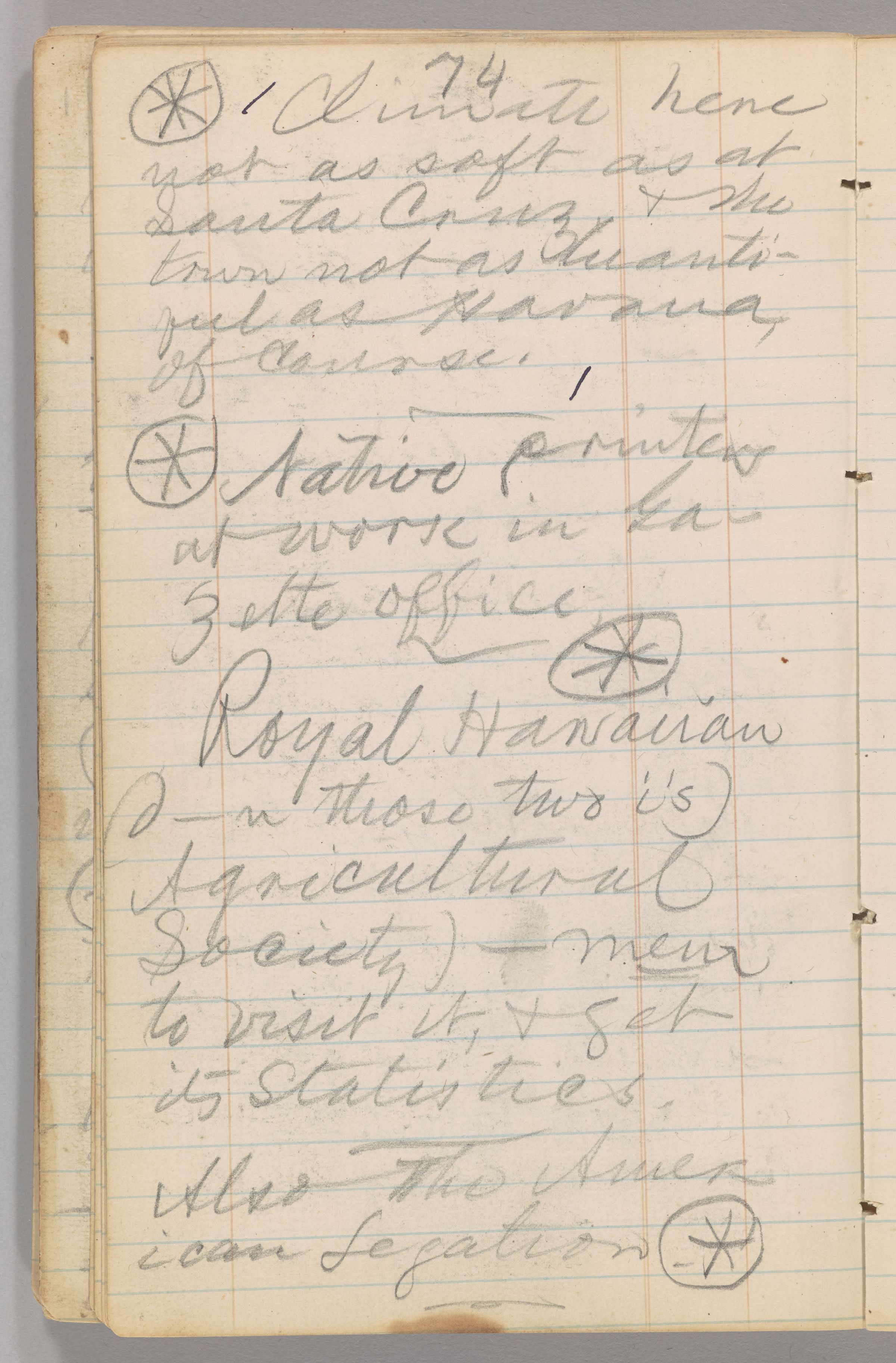
✱ Climate here
not as soft as at
Santa Cruz, & the
town not as beauti-
fulbeautiful as Havana,
of course.
✱ Native printers
at work in Ga-
zetteGazette office.
✱
Royal Hawaiian
(d—n those two i's)
Agricultural
Society)—mem
to visit it, & get
its statistics.63
[MTP: N&J1_209]
Also the Amer
icanAmerican Legation. ✱
[MS: N6_leaf_038r]
✱
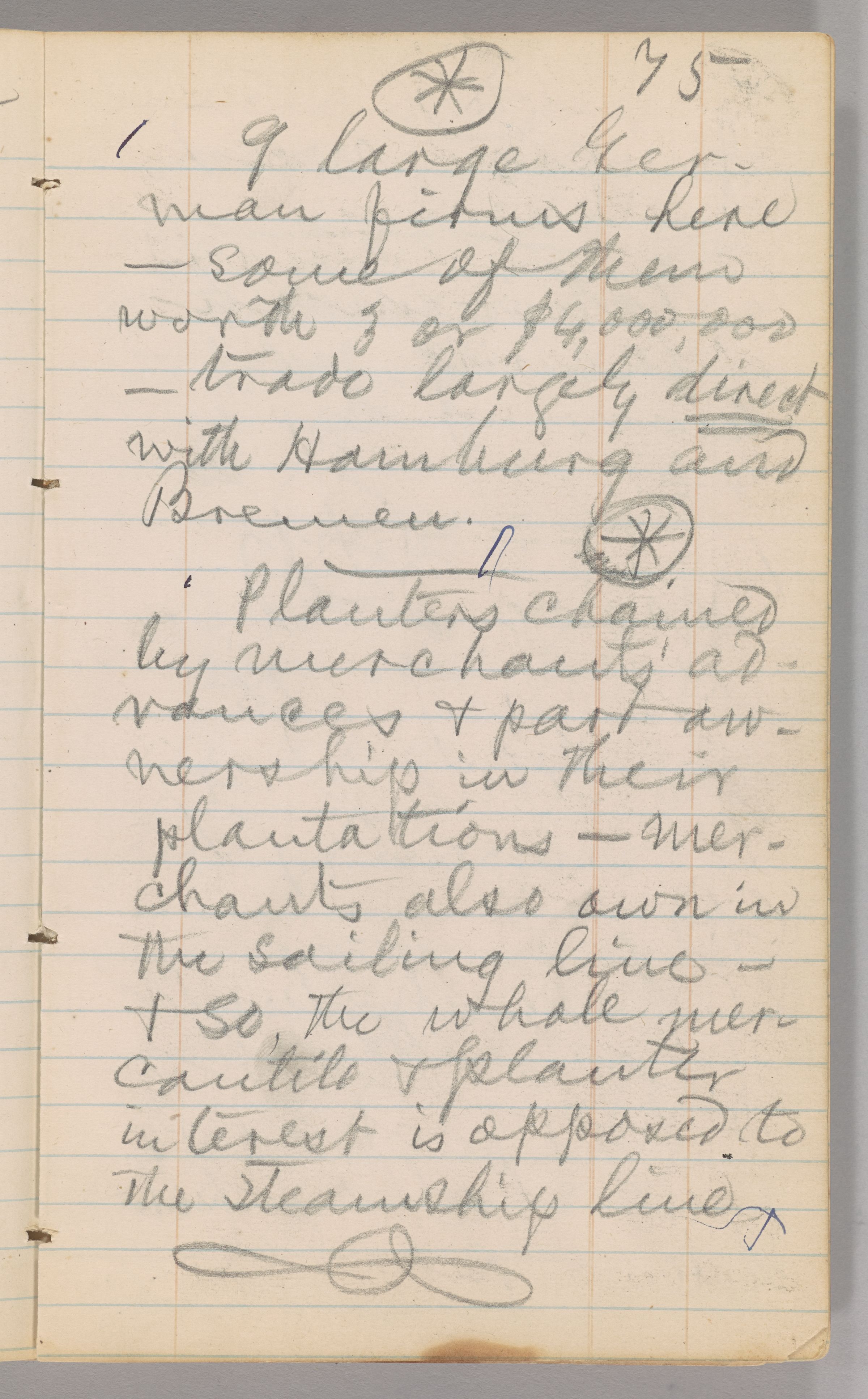
9 large Ger-
manGerman firms here
—some of them
worth 3 or $4,000,000
—trade largely direct
with Hamburg and
Bremen.64
✱
Planters chained
by merchants' ad-
vancesadvances & part ow-
nershipownership in their
plantations—mer-
chantsmerchants also own in
the sailing line—
& so, the whole mer-
cantilemercantile & planter
interest is opposed to
the steamship line.
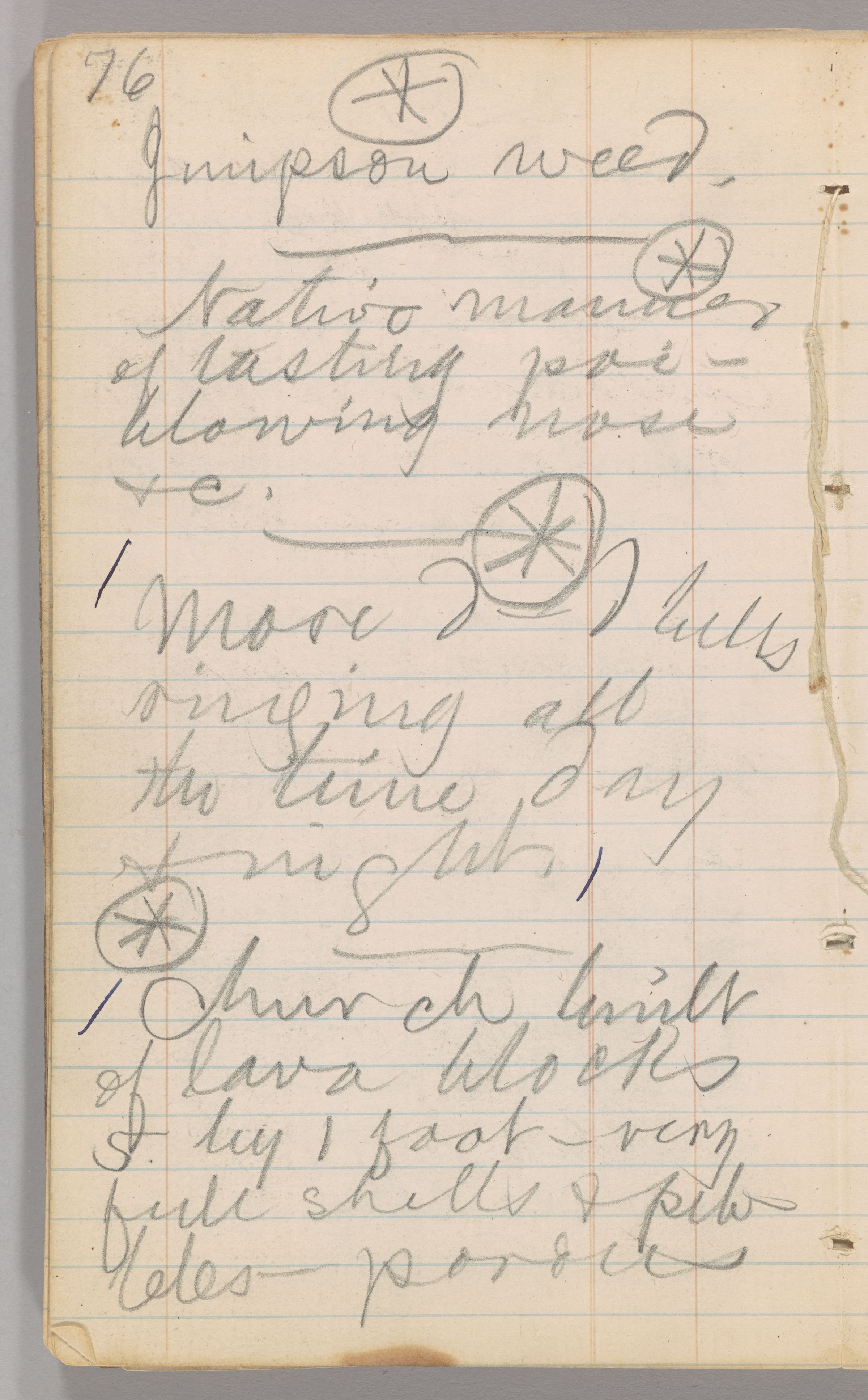
[MS: N6_leaf_038v]
✱
Jimpson weed.
✱
Native manner
of tasting poi—
blowing nose
&c.
✱
More d—d bells
ringing all
the time day
& night.
✱
Church built
of lava blocks
5 by 1 foot—very
full shells & peb-
blespebbles—porous
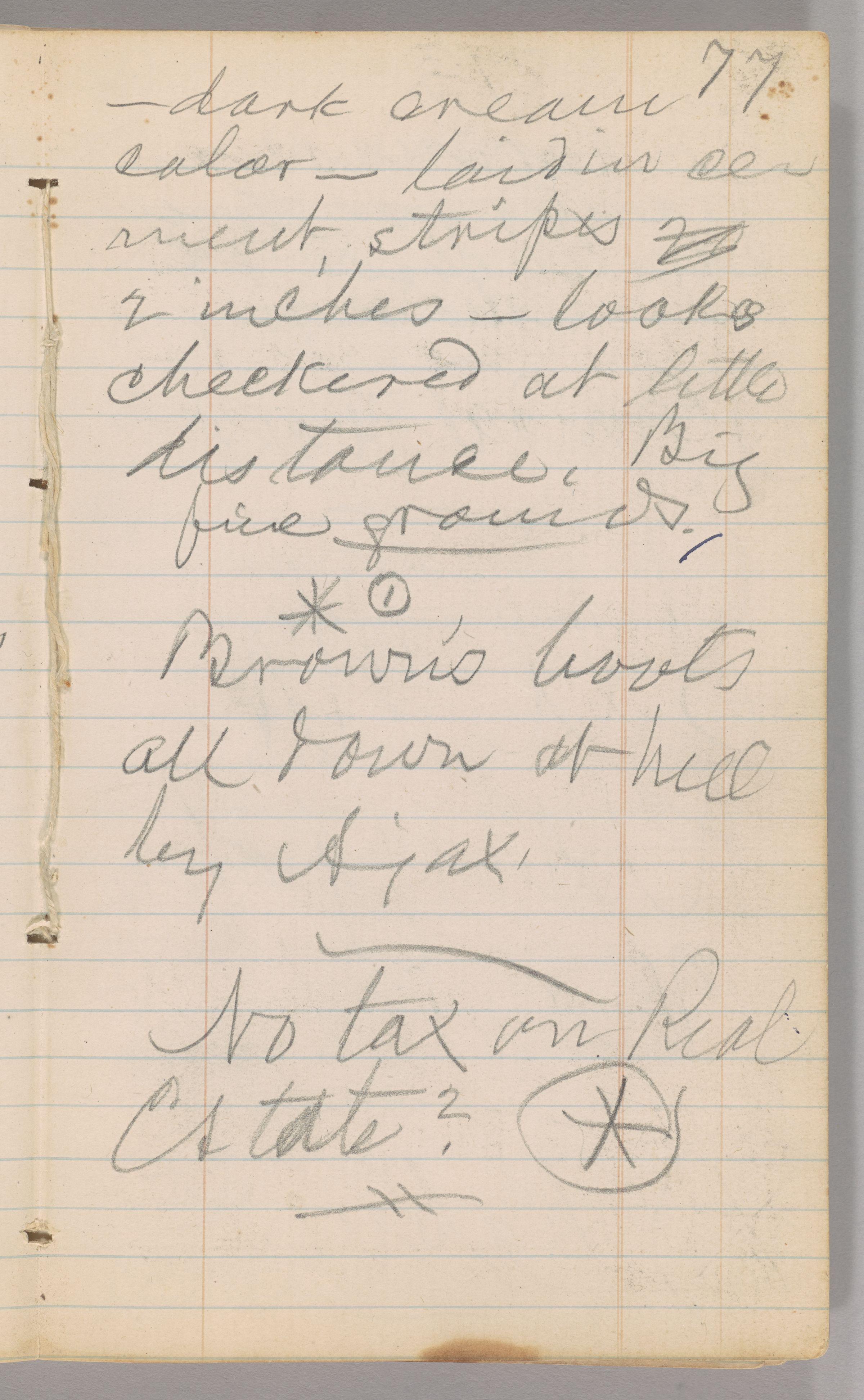
[MS: N6_leaf_039r]
—dark cream
color—laid in ce-
mentcement, stripes 20
2 inches—looks
checkered at little
distance.65 Big
fine grounds.
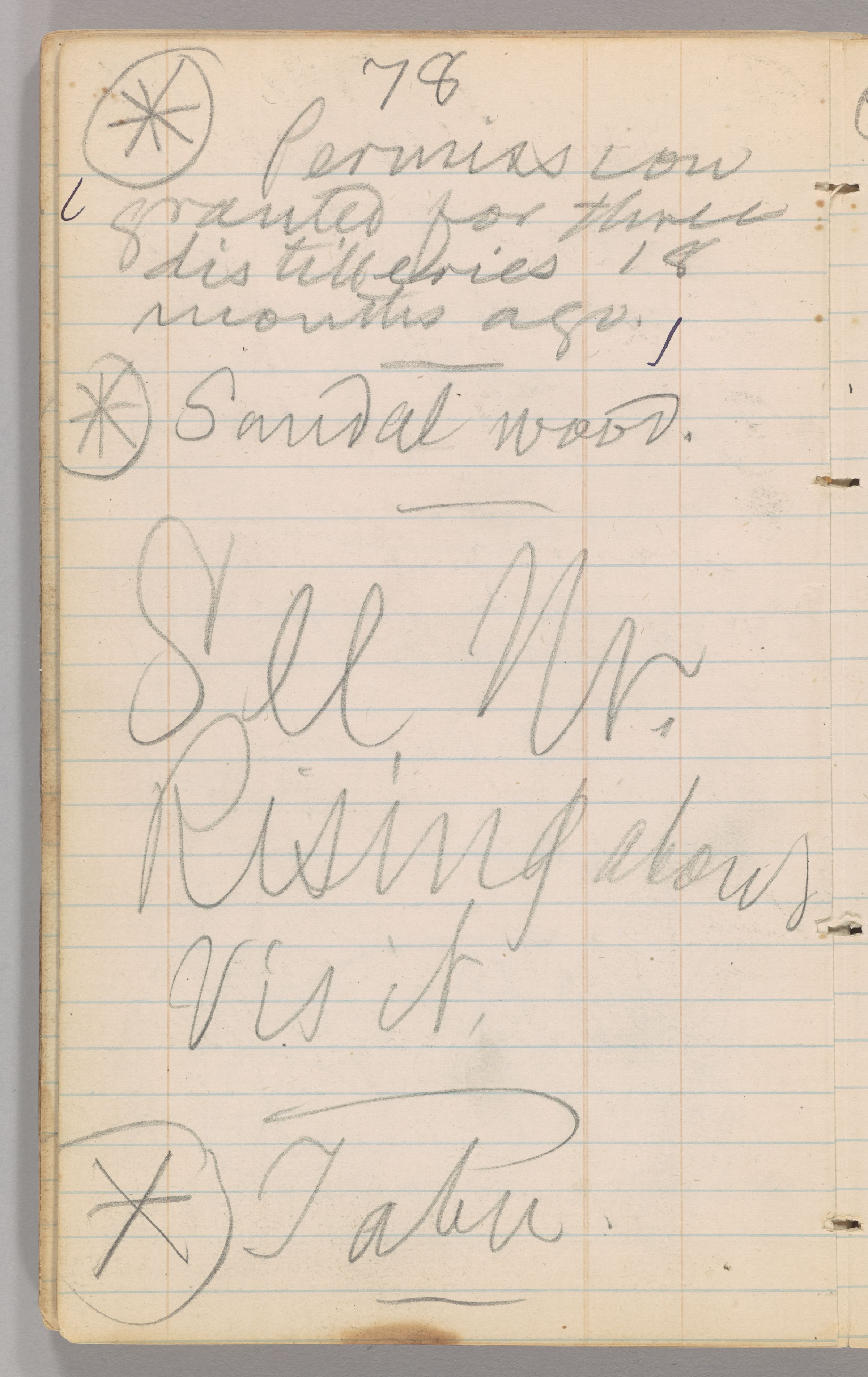
✱ 1
Brown's boots
all down at heel
by Ajax.
No tax on Real
Estate?66 ✱
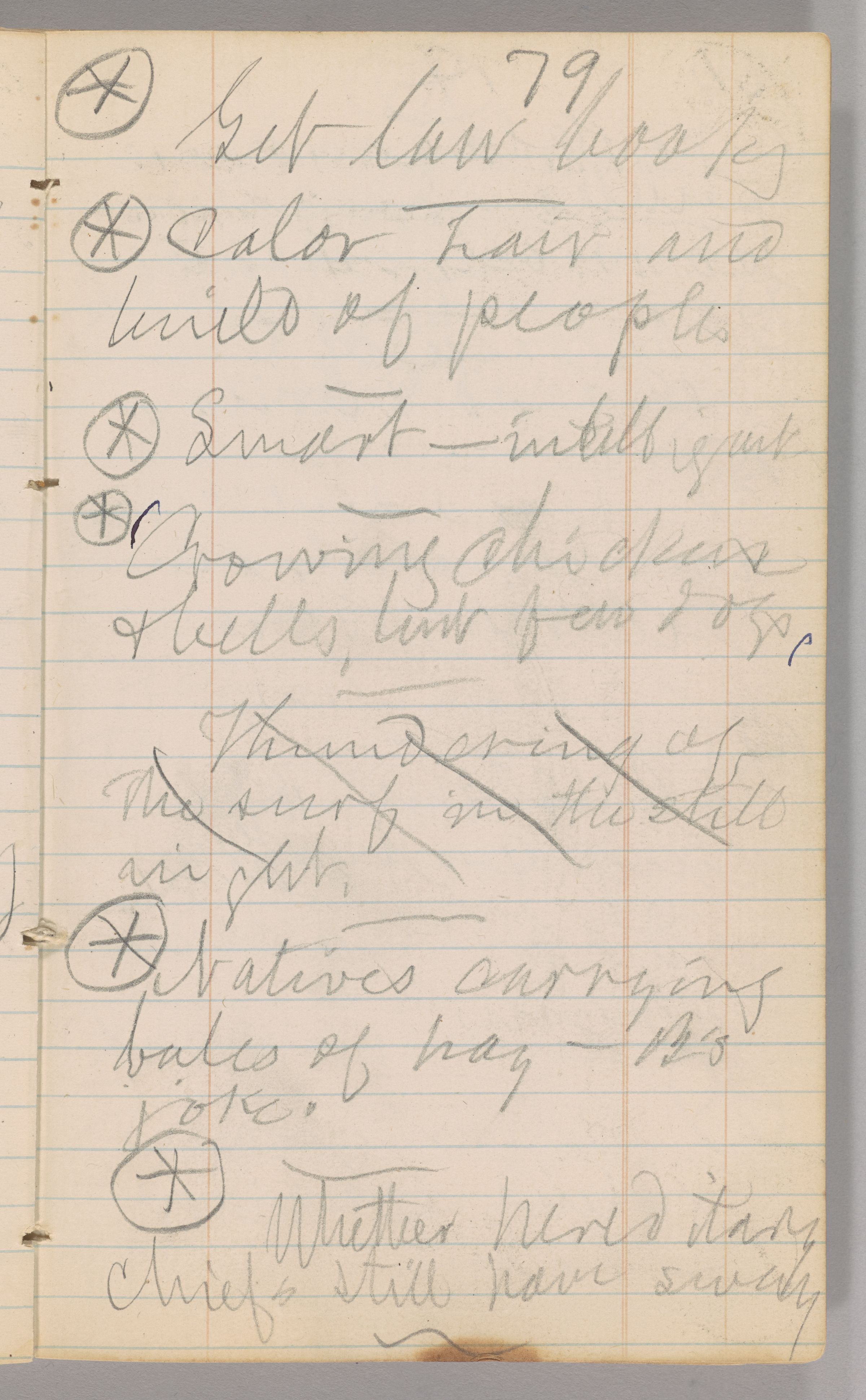
[MS: N6_leaf_039v]
✱ Permission
granted for three
distilleries 18
months ago.
✱ Sandal wood.67
[MTP: N&J1_210]
See Mr.
Rising about
visit.
✱ Tabu.
[MS: N6_leaf_040r]
✱ Get law books
✱ Color hair and
build of peoples
✱ Smart—intelligent.
✱ Crowing chickens
& bells, but few dogs
Thundering of
the surf in the still
night.
✱ Natives carrying
bales of hay—B's
joke.
✱ Whether hereditary
chiefs still have sway
[MS: N6_leaf_040v]
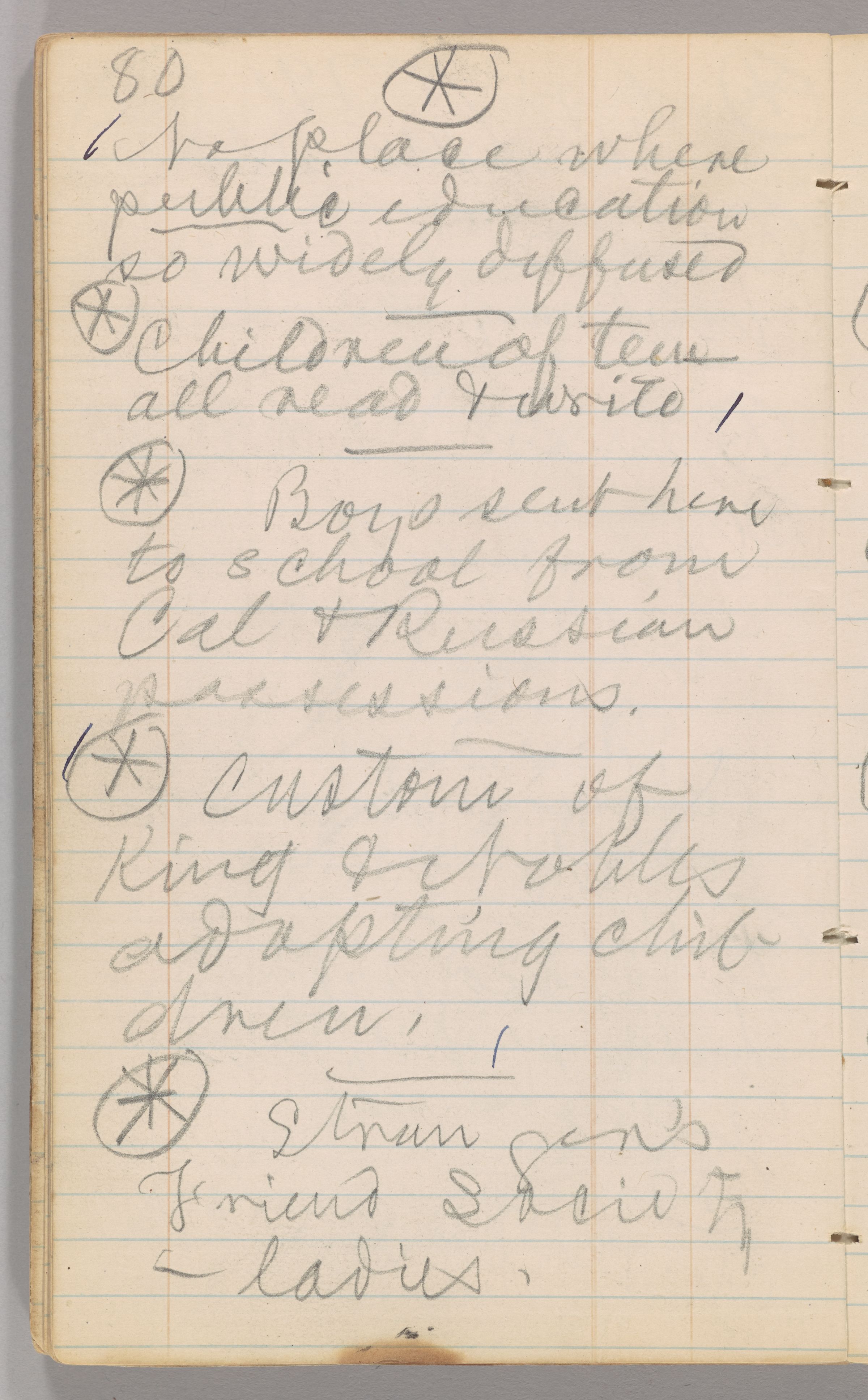
✱
No place where
public education
so widely diffused
✱ Children of ten—
all read & write
✱ Boys sent here
to school from
Cal & Russian
possessions.
✱ Custom of
King & Nobles
adopting chil-
drenchildren.
✱ Stranger's
Friend Society
—ladies.68
[MS: N6_leaf_041r]
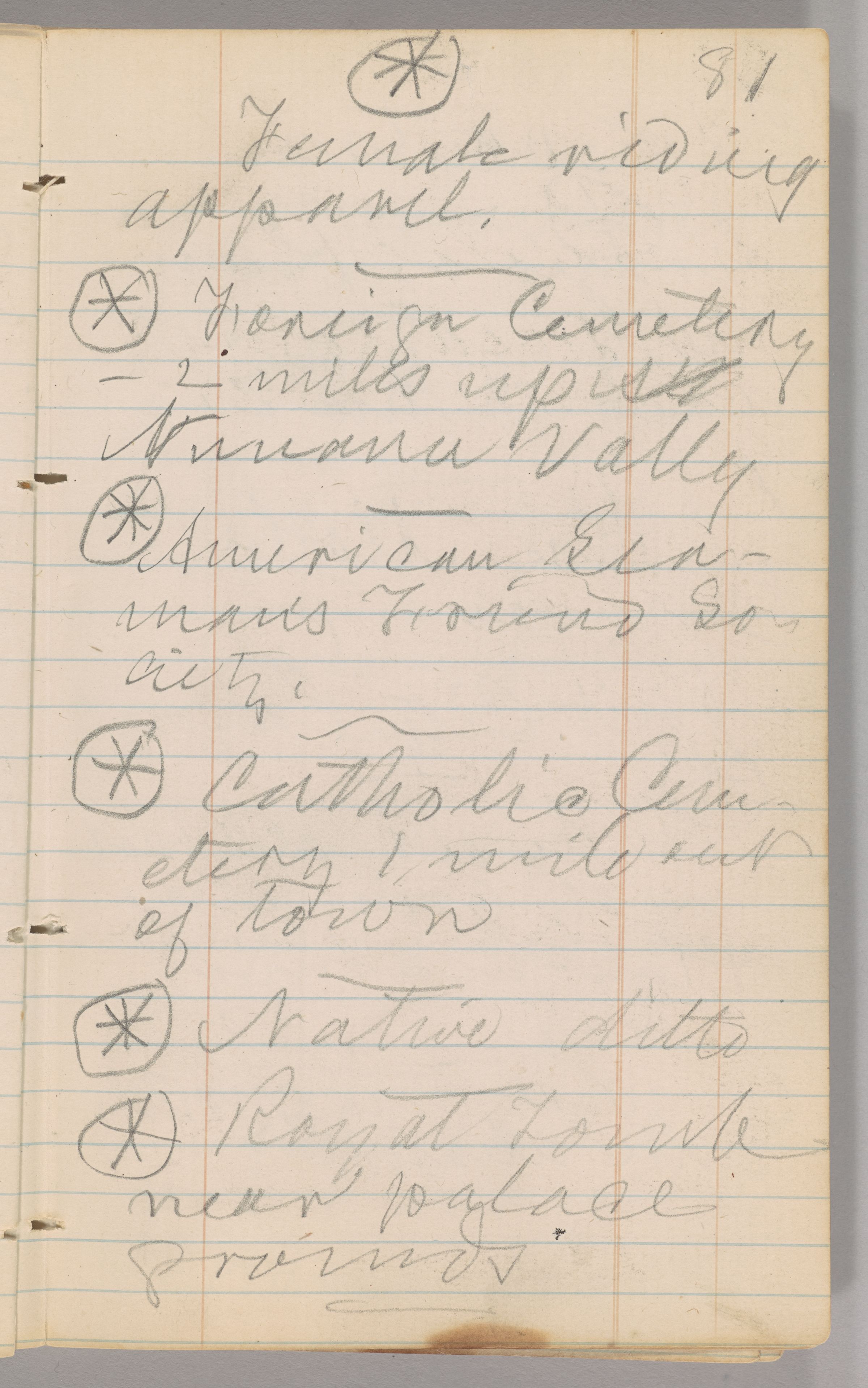
✱
Female riding
apparel.
✱ Foreign Cemetery
—2 miles up isl
Nuuanu Vally
✱ American Sea-
man’sSeaman's Friend So-
cietySociety.
✱ Catholic Cem-
eteryCemetery 1 mile out
of town
✱ Native ditto
✱ Royal Tomb
near palace
grounds
[MS: N6_leaf_041v]
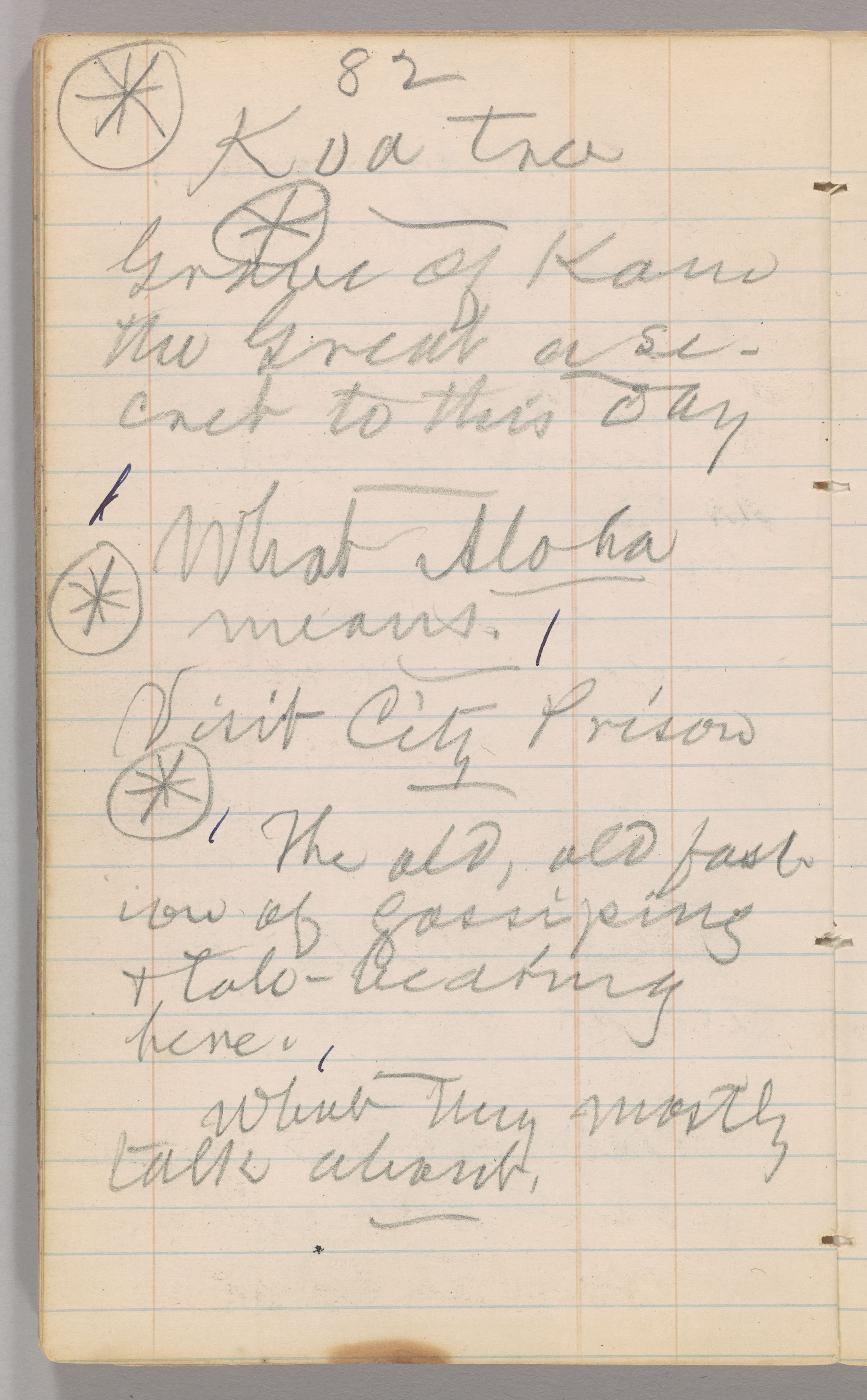
✱ Koa tree69
[MTP: N&J1_211]
✱
Grave of Kam
the Great a se-
cretsecret to this day70
✱ What Aloha
means.71
Visit City Prison
✱ The old, old fash-
ionfashion of gossiping
& tale-bearing
here.
What they mostly
talk about.
[MS: N6_leaf_042r]
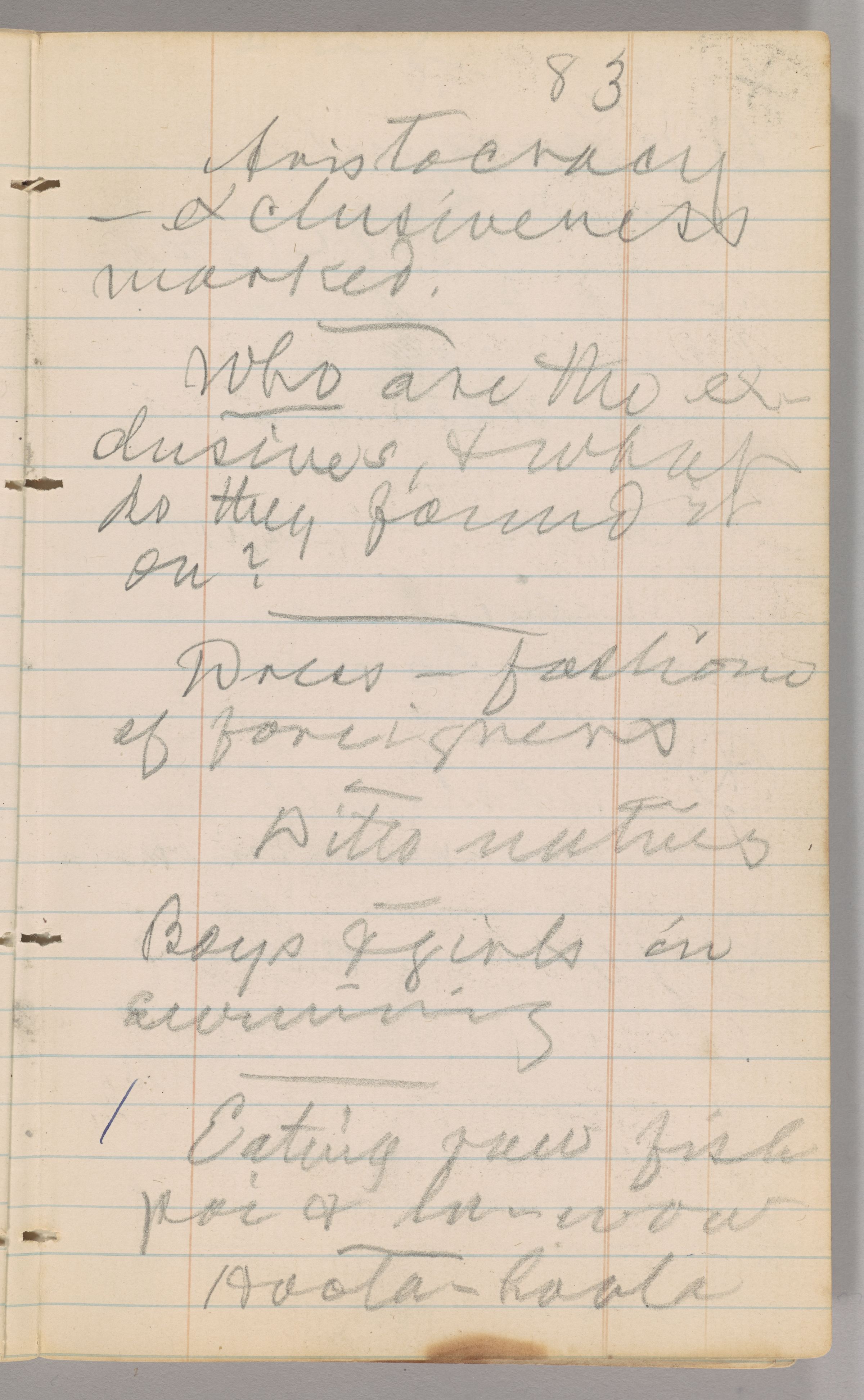
Aristocracy
—exclusiveness
marked.
Who are the ex-
clusivesexclusives, & what
do they found it
on?
Dress—fashion
of foreigners
Ditto natives
Boys & girls in
swimming
[MTP: N&J1_212]
Eating raw fish
poi & lu-wow
Hoola-hoola
[MS: N6_leaf_042v]
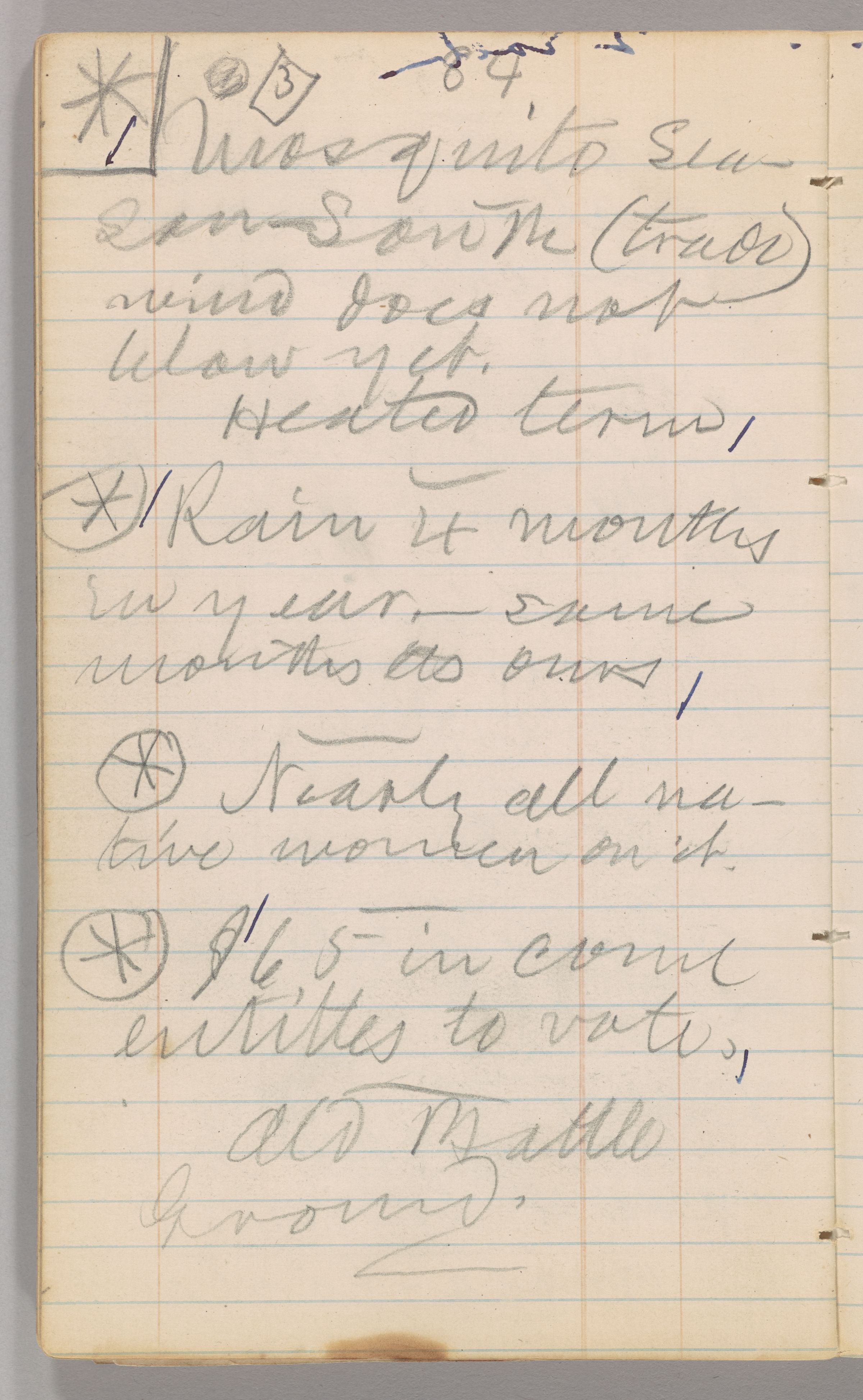
✱ 1 3 Mosquito sea-
sonseason—South (trade)
wind does not
blow yet.
Heated term
✱ Rain 4 months
in year.—Ⓣtextual notesame
months as ours
✱ Nearly all na-
tivenative women on it.
✱ $65 income
entitles to vote.
Old Battle
Ground.
[MS: N6_leaf_043r]
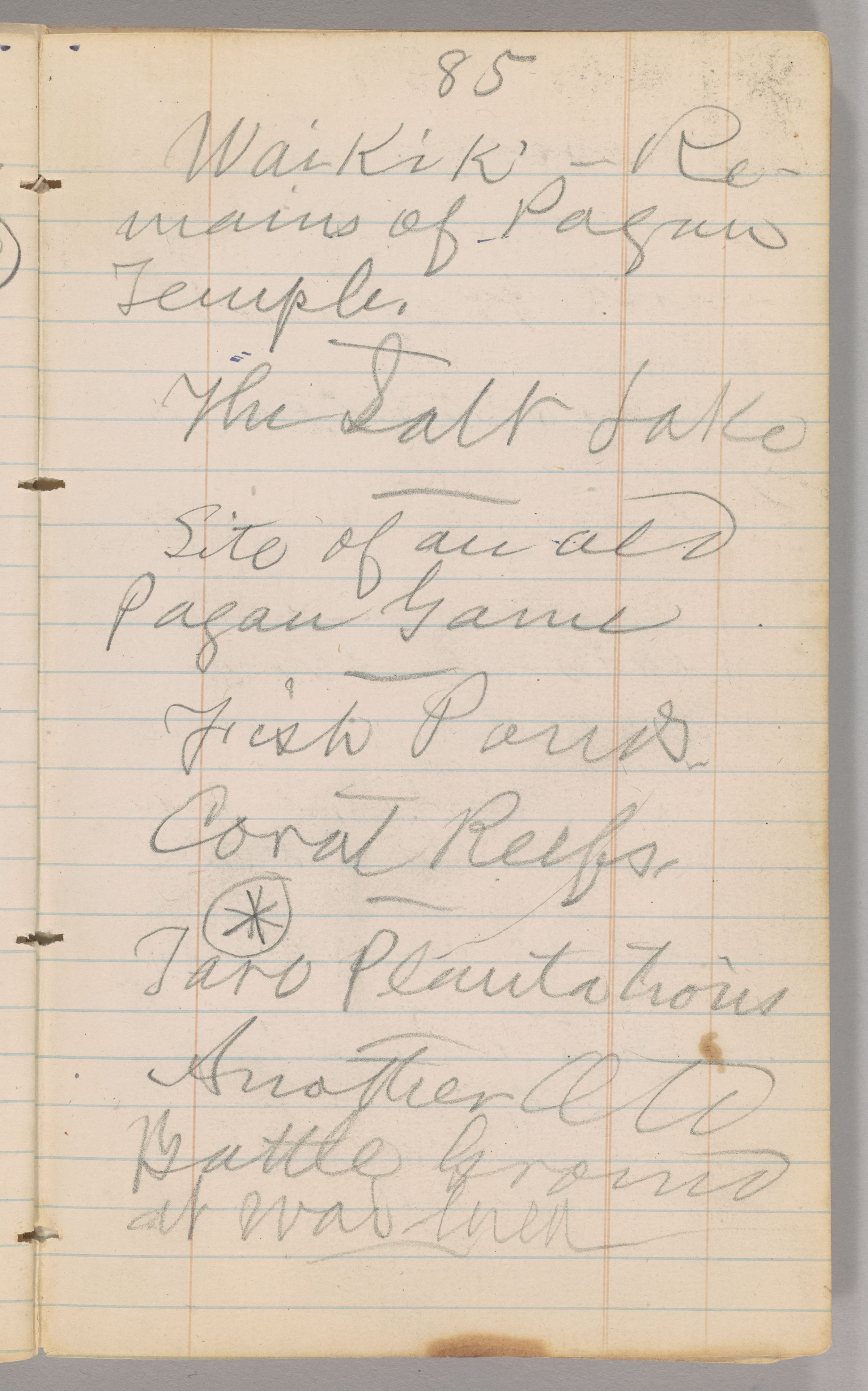
Waikiki—Re-
mainsRemains of Pagan
Temple.
The Salt Lake
Site of an old
Pagan Game
Fish Ponds.
Coral Reefs.
✱
Taro Plantations
Another Old
Battle Ground
at Wailueu
[MS: N6_leaf_043v]
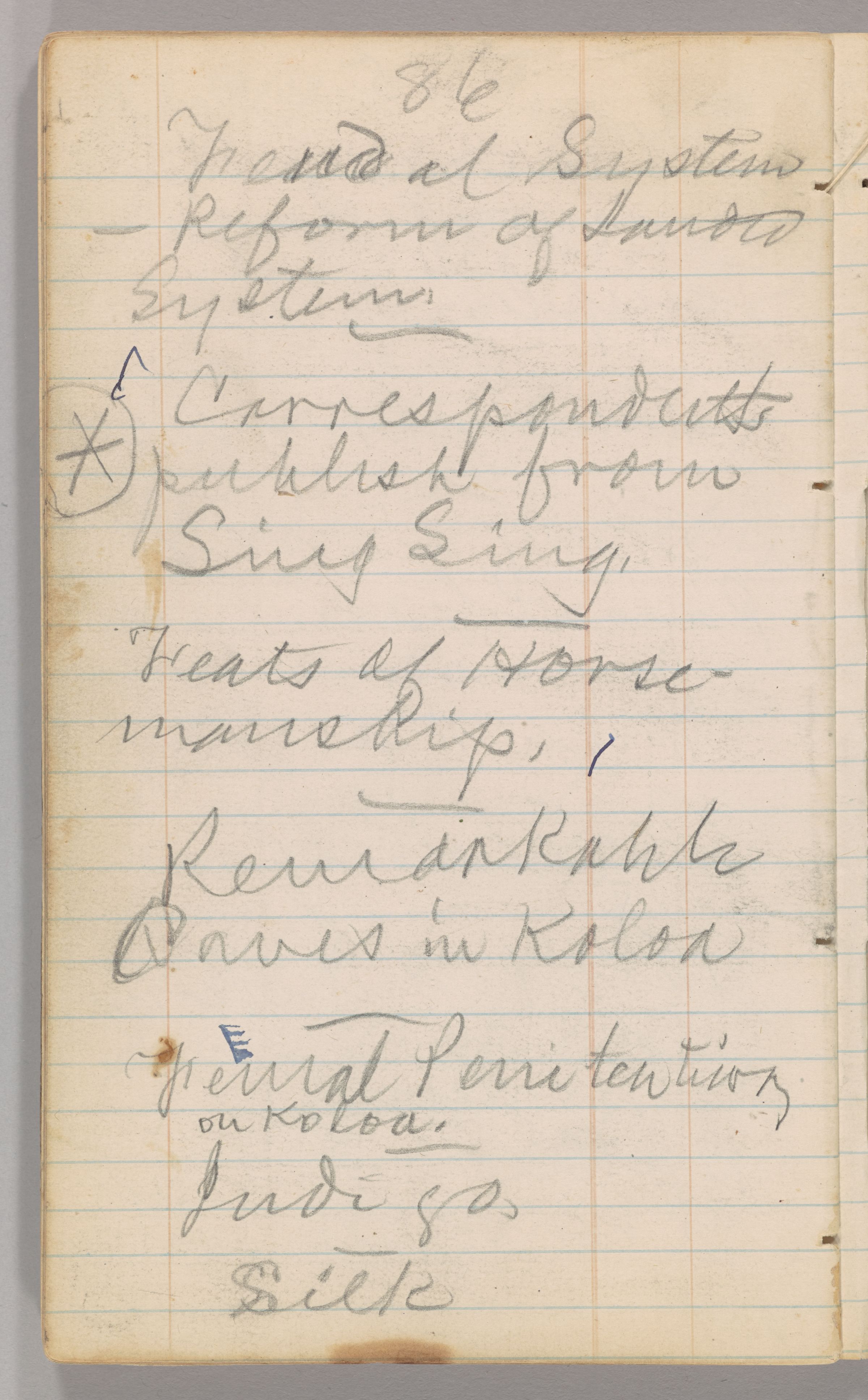
Feudal System
—Reform of Landed
System.72
✱ Correspondents
publish from
Sing Sing.
Feats of Horse-
manshipHorsemanship.
Remarkable
Caves in Koloa
Femal Penitentiary
on Koloa.
Indigo.
Silk
[MS: N6_leaf_044r]
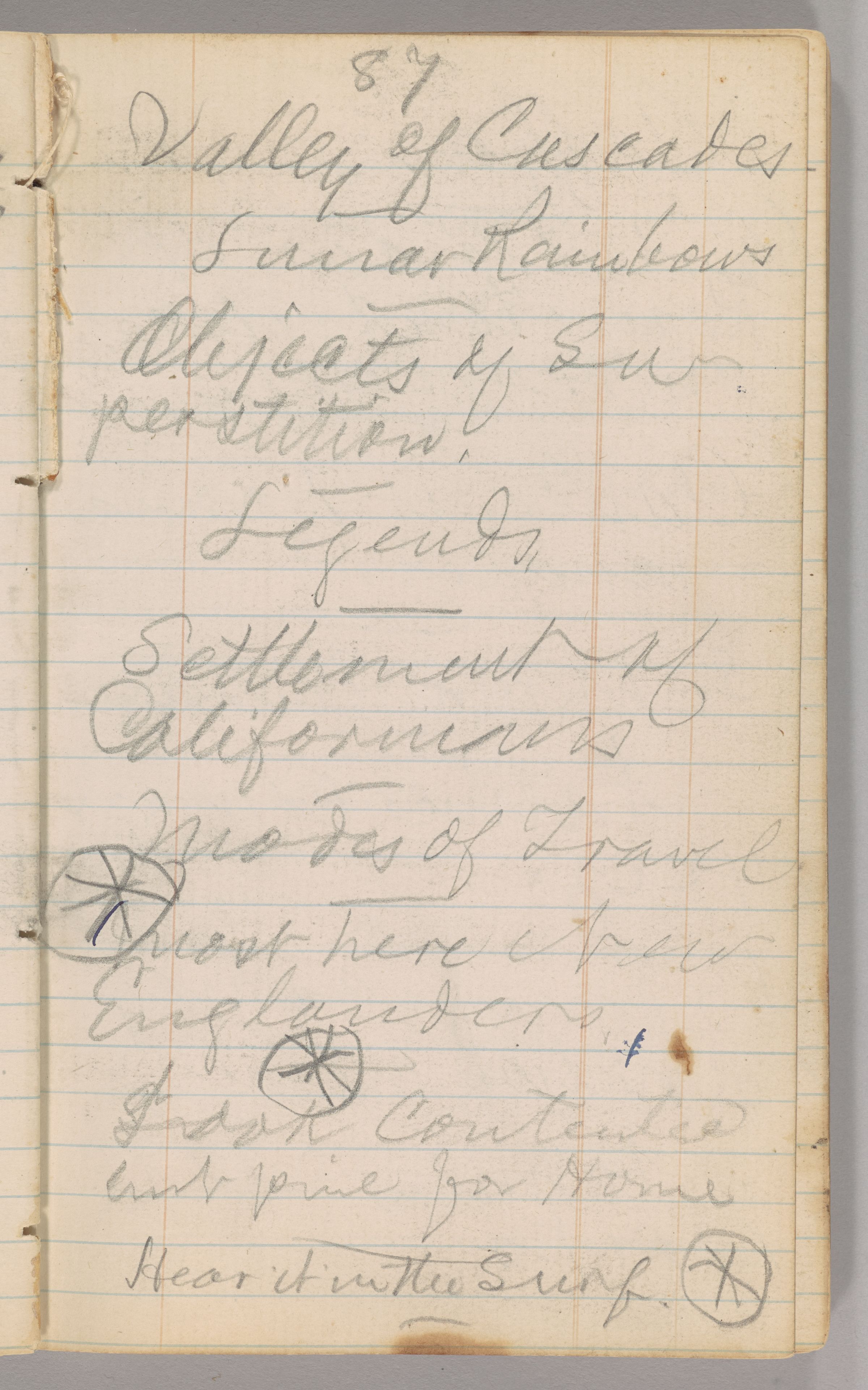
Valley of Cascades
[MTP: N&J1_213]
Lunar Rainbows
Objects of Su-
perstitionSuperstition.
Legends.
Settlement of
Californians
Modes of Travel
✱ Most here New
Englanders.
✱ S◊ Look Contented
but pine for Home
Hear it in the Surf. ✱
[MS: N6_leaf_044v]
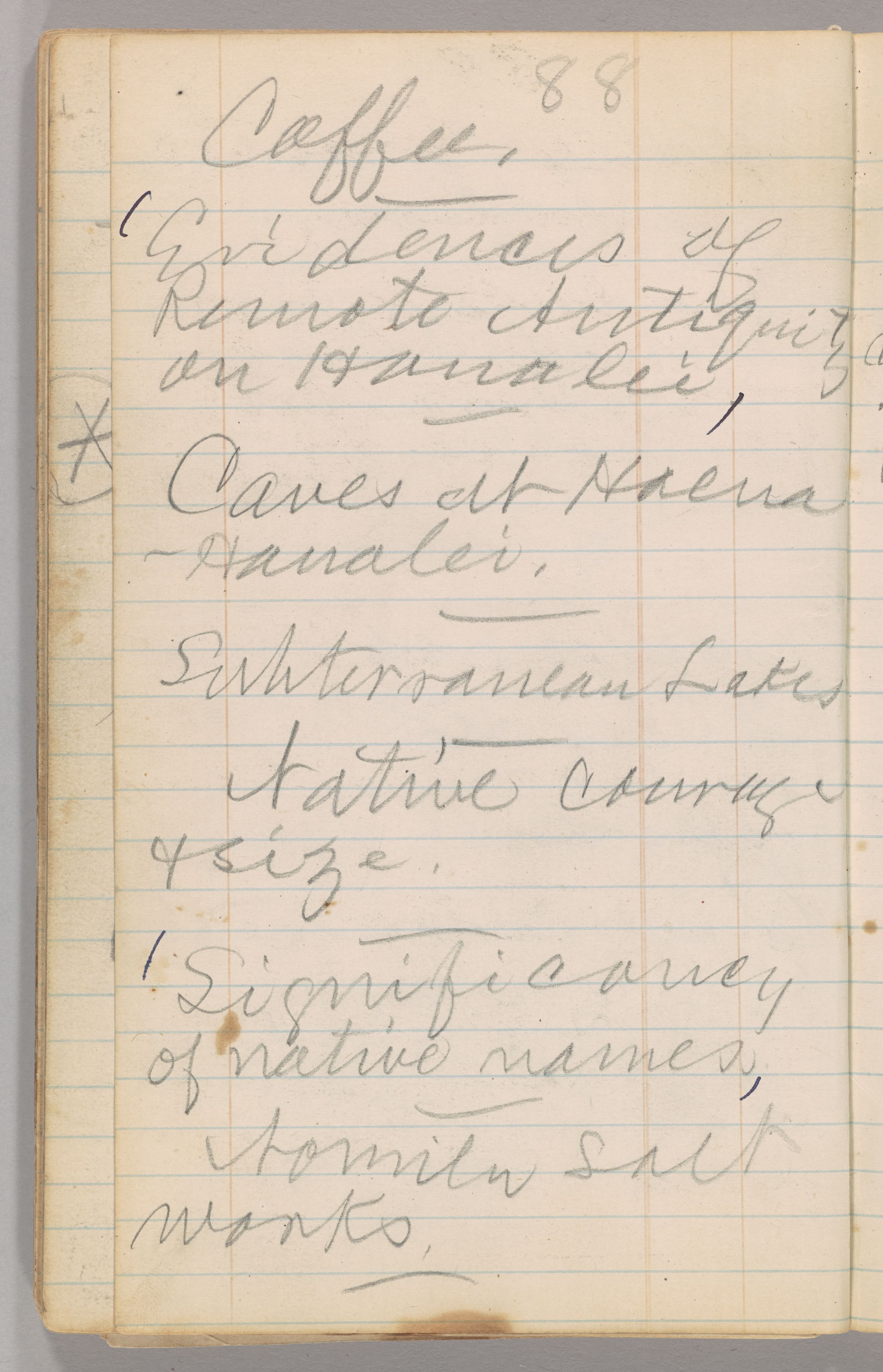
Coffee.
Evidences of
Remote Antiquity
on Hanalei.
Caves at Haena
—Hanalei.
Subterranean Lakes
Native courage
& size.
Significancy
of native names.
Nomilu salt
works.
[MS: N6_leaf_045r]
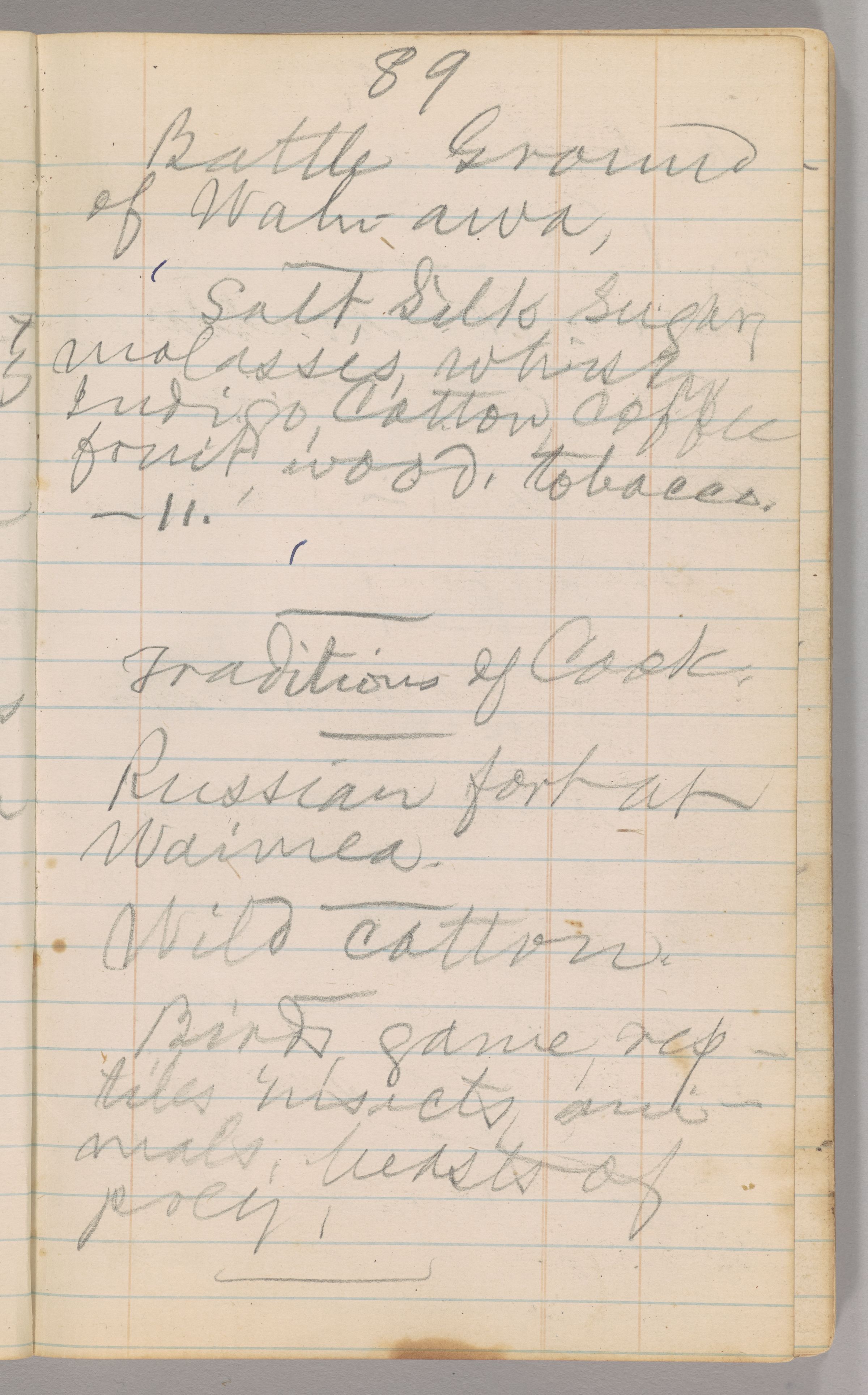
Battle Ground
of Wahi-awa.
Salt, Silk, Sugar,
molasses, whisky
Indigo, Cotton, coffee
fruit, wood, tobacco.
—11.
Traditions of Cook.
Russian fort at
Waimea.73
[MTP: N&J1_214]
Wild cotton.
Birds, game, rep-
tilesreptiles, insects, ani-
malsanimals, beasts of
prey.
[MS: N6_leaf_045v]
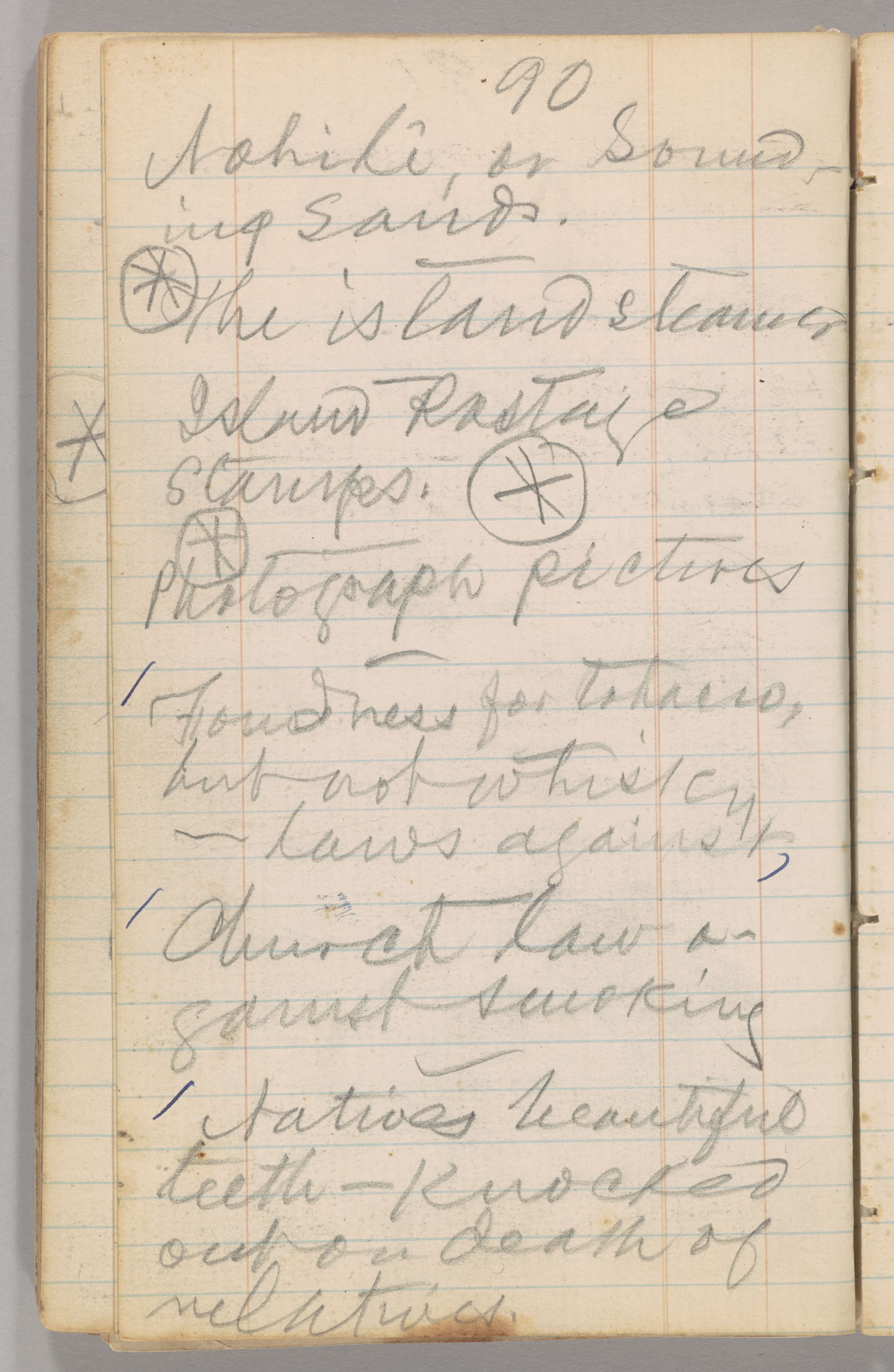
Nohili, or Sound-
ingSounding Sands.74
✱ The island steamer75
Island Postage
Stamps. ✱
✱
Photograph pictures
Fondness for tobacco.,Ⓣtextual note
but not whisky
—laws against
Church law a-
gainstagainst smoking
Natives beautiful
teeth—knocked
out on death of
relatives.
[MS: N6_leaf_046r]
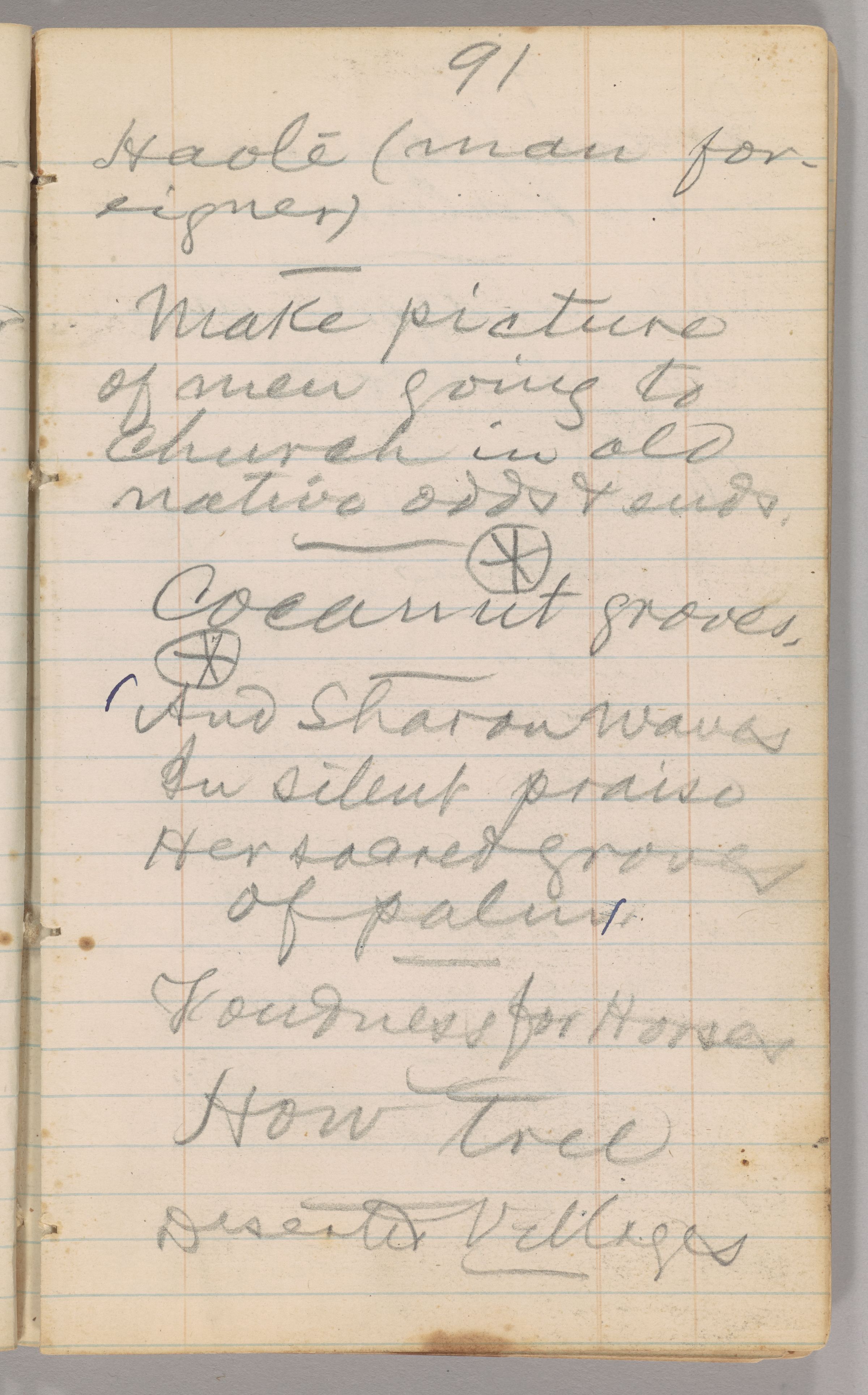
Haolē (man for-
eignerforeigner)
Make picture
of men going to
church in old
native odds & ends.
✱
Cocanut groves.
✱
of palm.76
Fondness for Horses
How tree
[MTP: N&J1_215]
Deserted Villages
[MS: N6_leaf_046v]
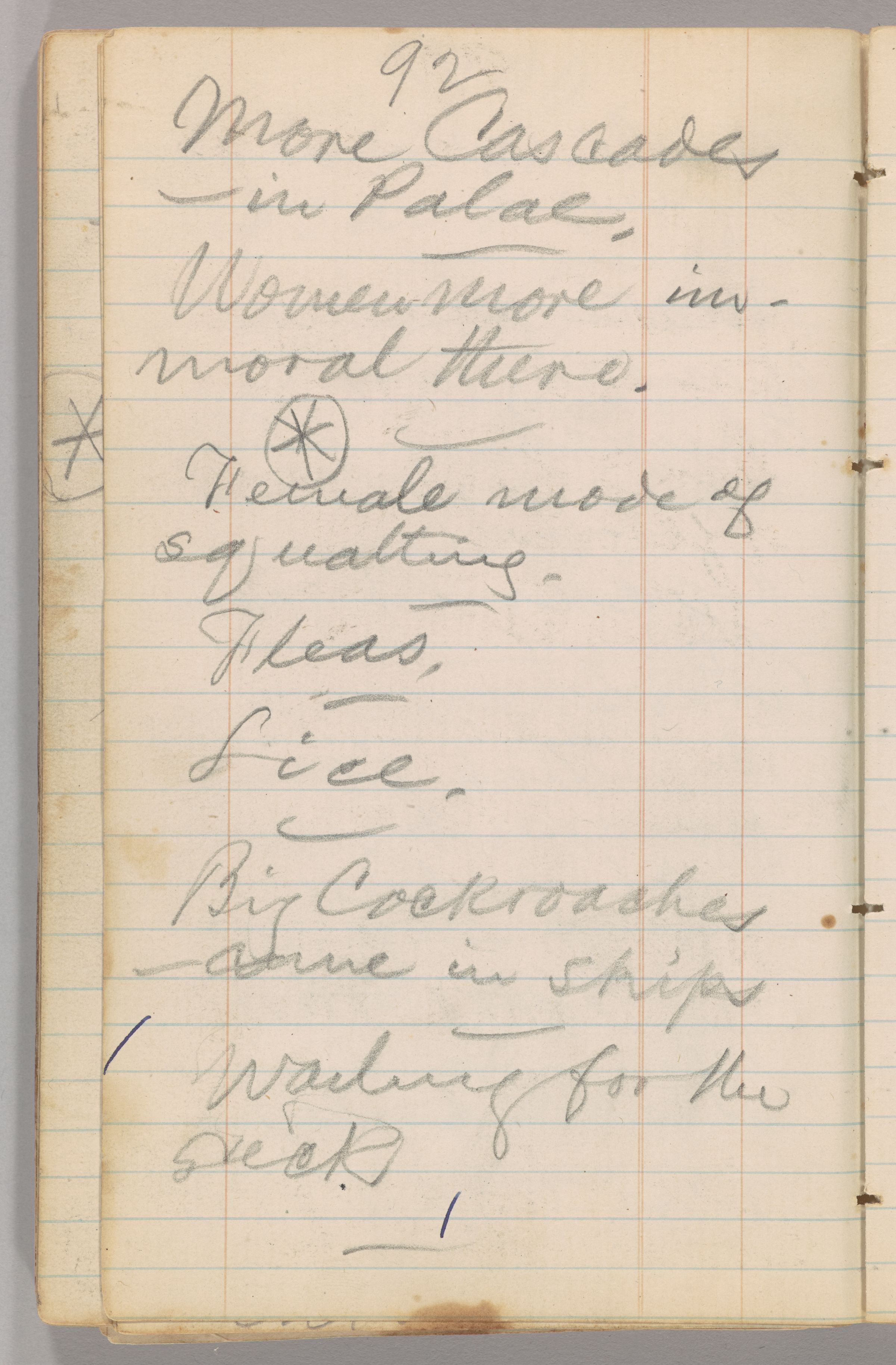
More Cascades
—in Palae.
Women more im-
moralimmoral there.
✱
Female mode of
squatting.
Fleas.
Lice.
Big Cockroaches
—cameⓂemendation in ships
Wailing for the
sick
[MS: N6_leaf_047r]
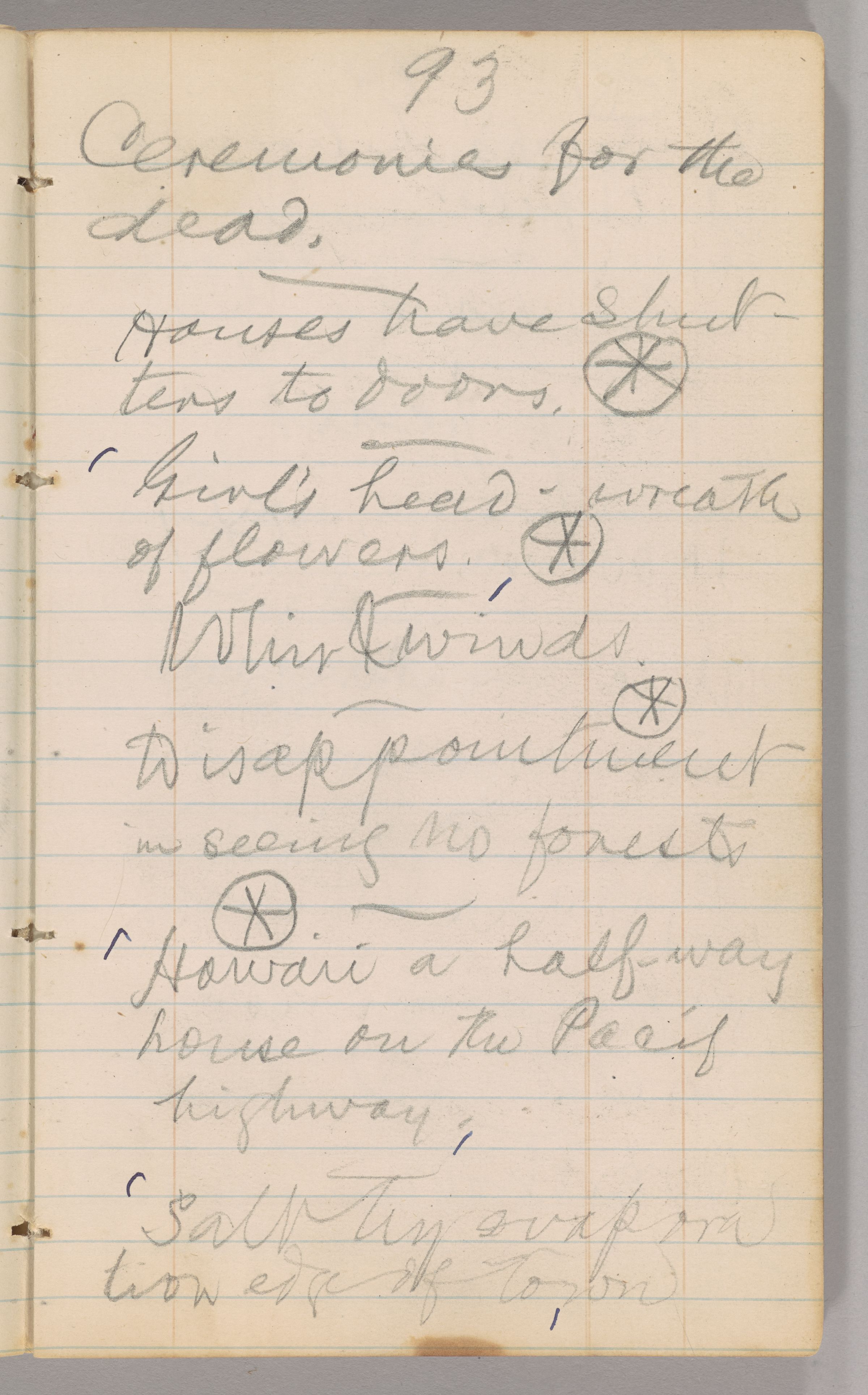
Ceremonies for the
dead.
Houses have shut-
tersshutters to doors. ✱
Girl's head-wreath
of flowers. ✱
Whirlwinds.
✱
Disappointment
in seeing no forests
✱
Hawaii a half-way
house on the Pacif
highway.
Salt by evapora
tionevaporation edge of town
[MS: N6_leaf_047v]
✱
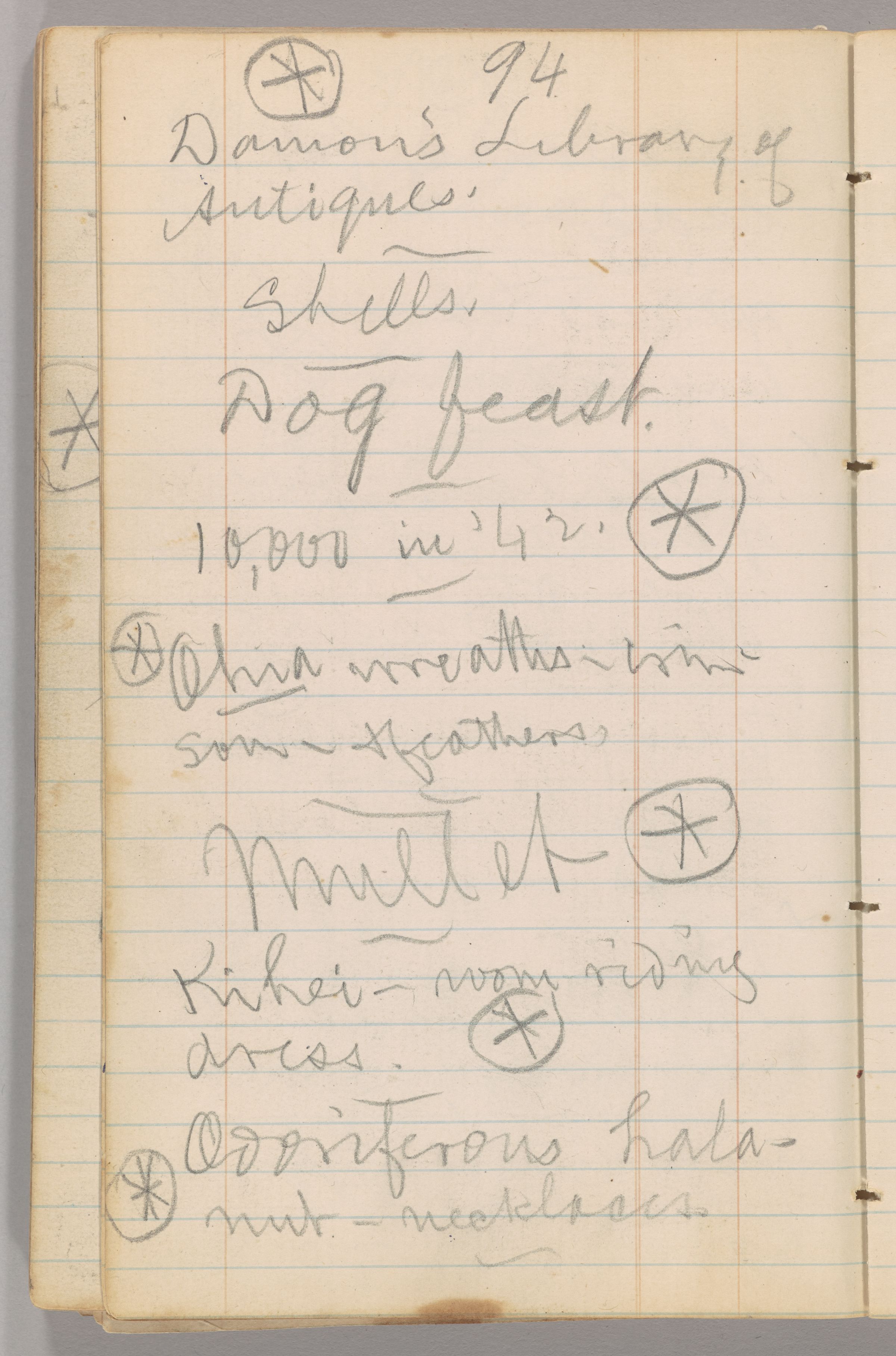
Damon's Library of
Antiques.77
Shells.
Dog feast.
10,000 in '42. ✱
✱ Ohia wreaths—crim-
soncrimson—& feathers.
Mullet ✱
Kihei—wom riding
dress. ✱
✱ Odoriferous hala-
nuthala-nut—necklacesⓂemendation.
[MS: N6_leaf_048r]
[MTP: N&J1_216]
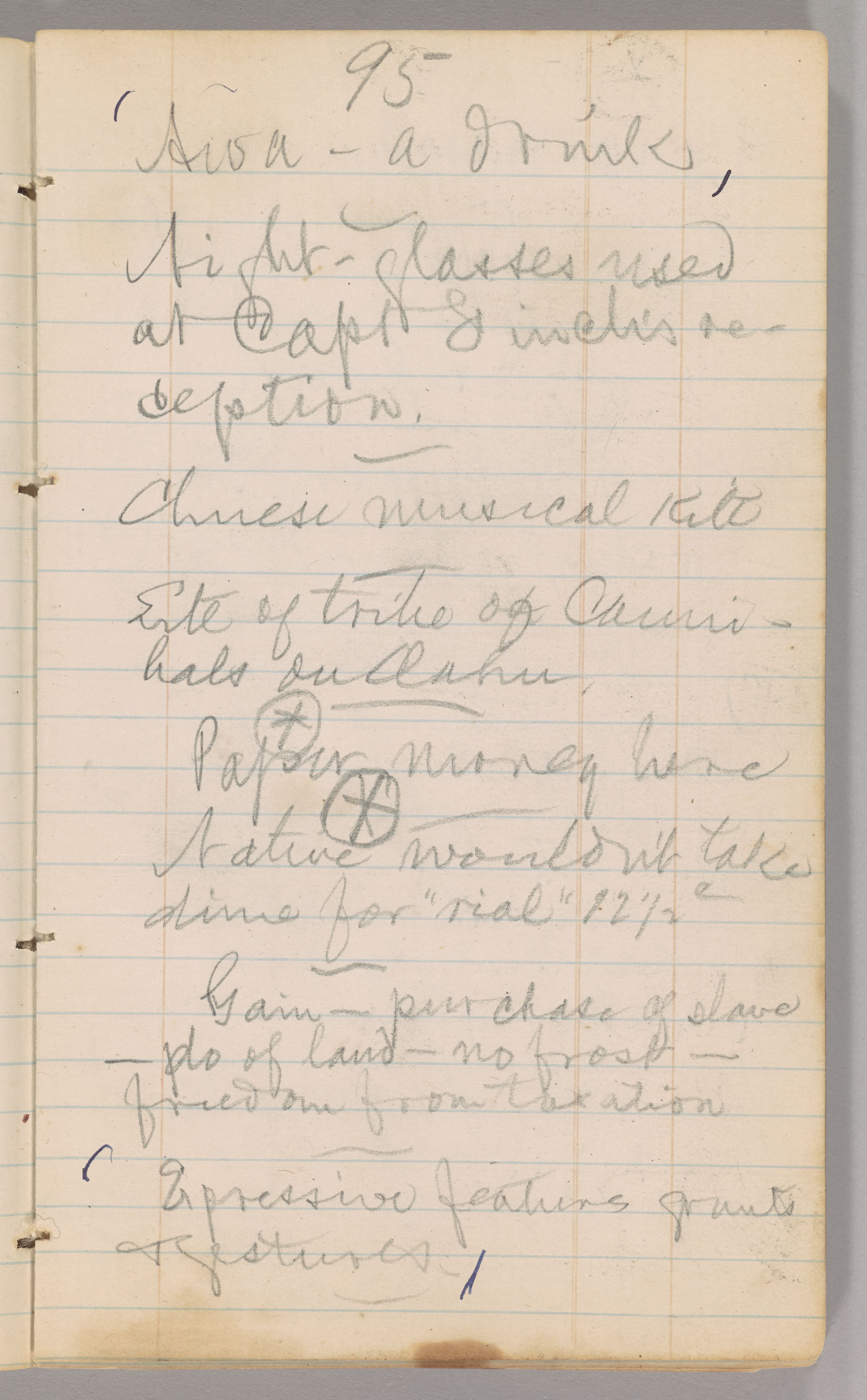
Awa—a drink78
Night-glasses used
at Capt Finch's re-
ceptionreception.79
Chnese musical kite
Site of tribe of Canni-
balsCannibals on Oahu.80
✱
Paper money here81
✱
Native wouldn't take
dime for “rial”82 12½c
Gain—purchase of slave
—do of land—no frost—
freedom from taxation
Expressive features grunts
& gestures.
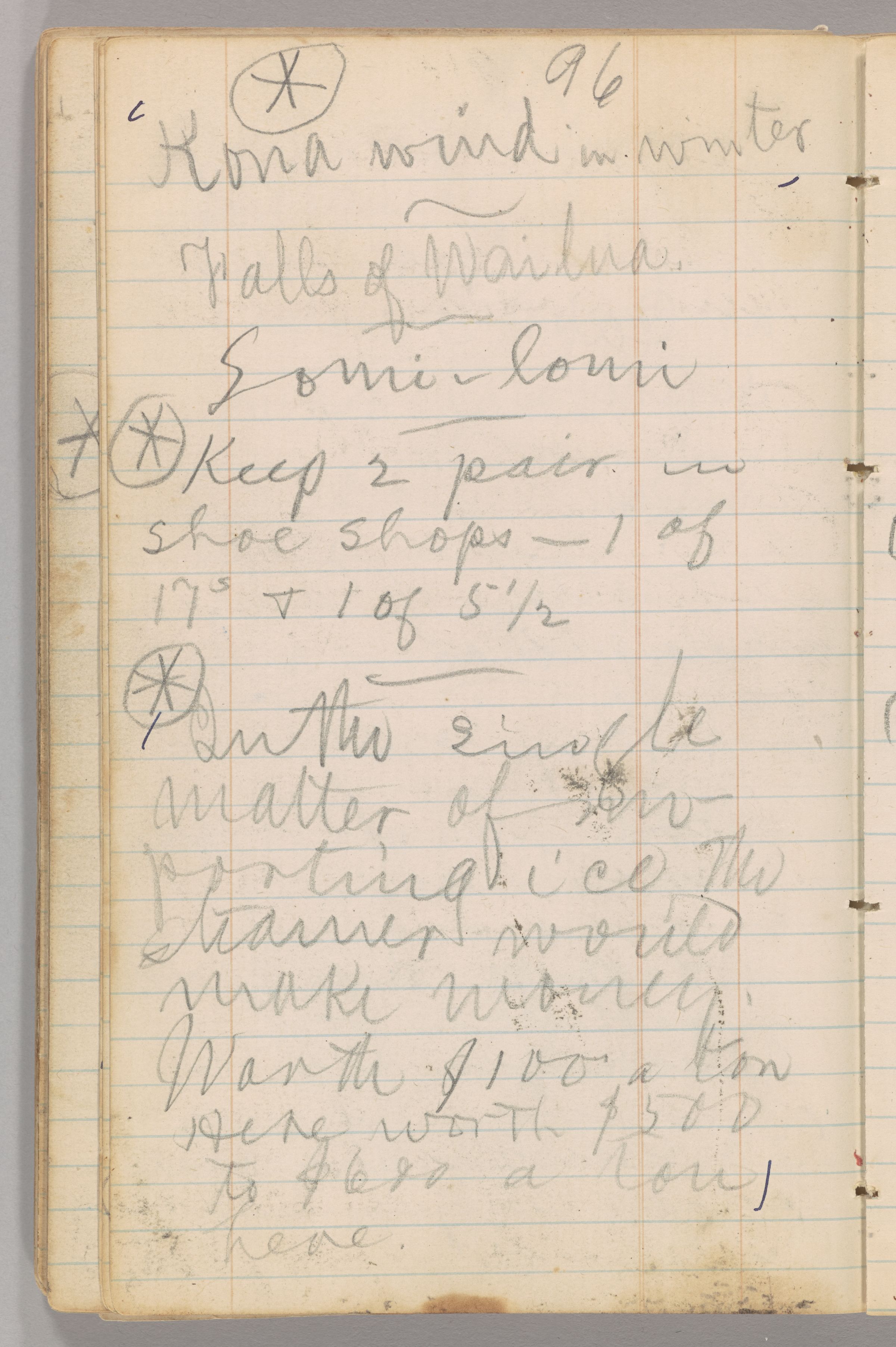
[MS: N6_leaf_048v]
✱
Kona wind in winter
Falls of Wailua.
Lomi-lomi83
[MTP: N&J1_217]
✱ Keep 2 pair in
shoe shops—1 of
17s & 1 of 5½
✱ In the single
matter of im-
portingimporting ice, the
steamer would
make money.
Worth $100 a ton
Here worth $500
to $600 a ton
here.84
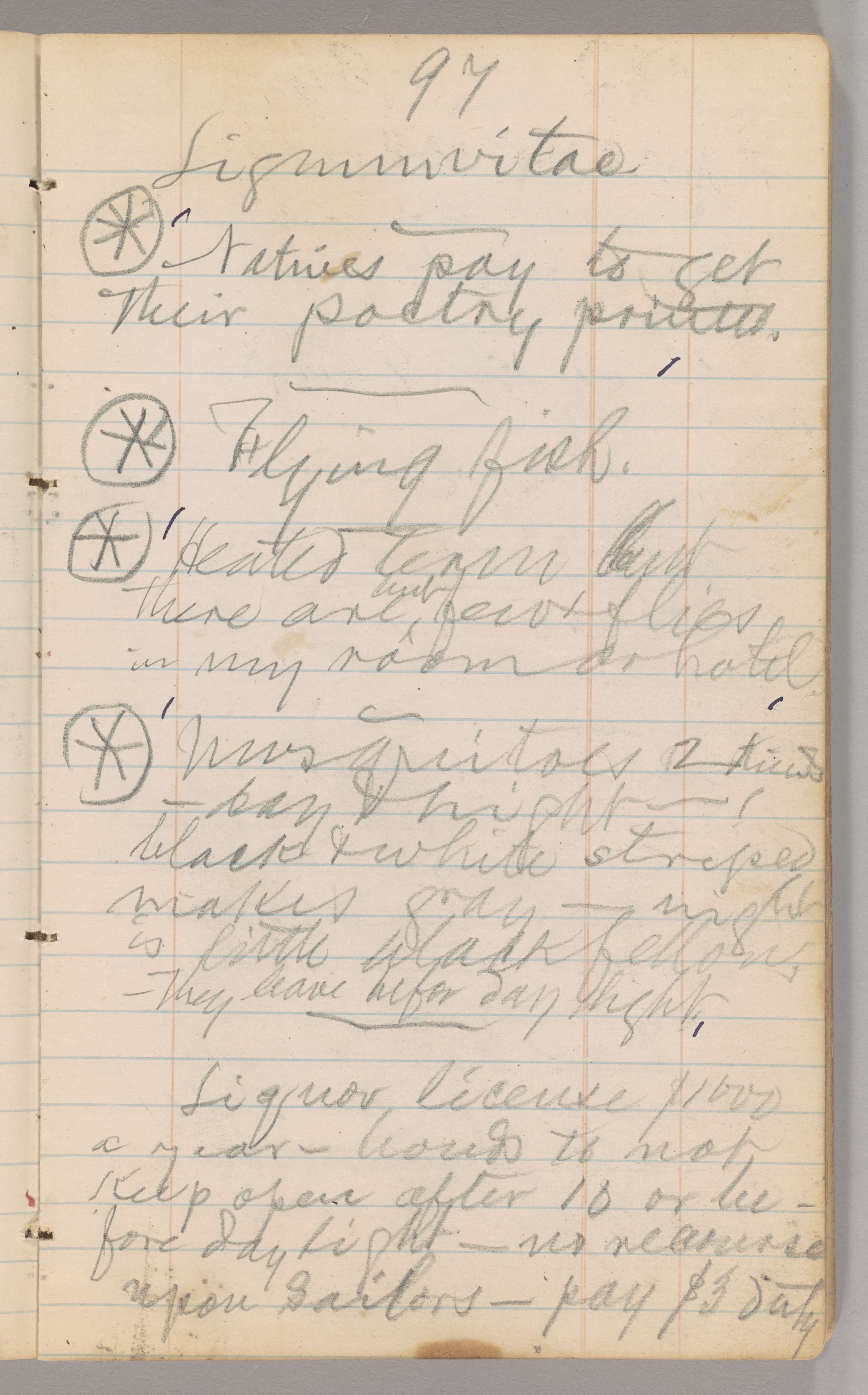
[MS: N6_leaf_049r]
Lignumvitae.
✱ Natives pay to get
their poetry printed.
✱ Flying fish.
✱ Heated term, but
there are but few flies
in my room or hotel.
✱ Mosquitoes 2 kinds
—day & night—1
black & white striped
makes gray—night
is little black fellow,
—they leave befor daylight.
Liquor license $1000
a year—bonds to not
keep open after 10 or be-
forebefore daylight—no recourse
upon sailors—pay $3 duty
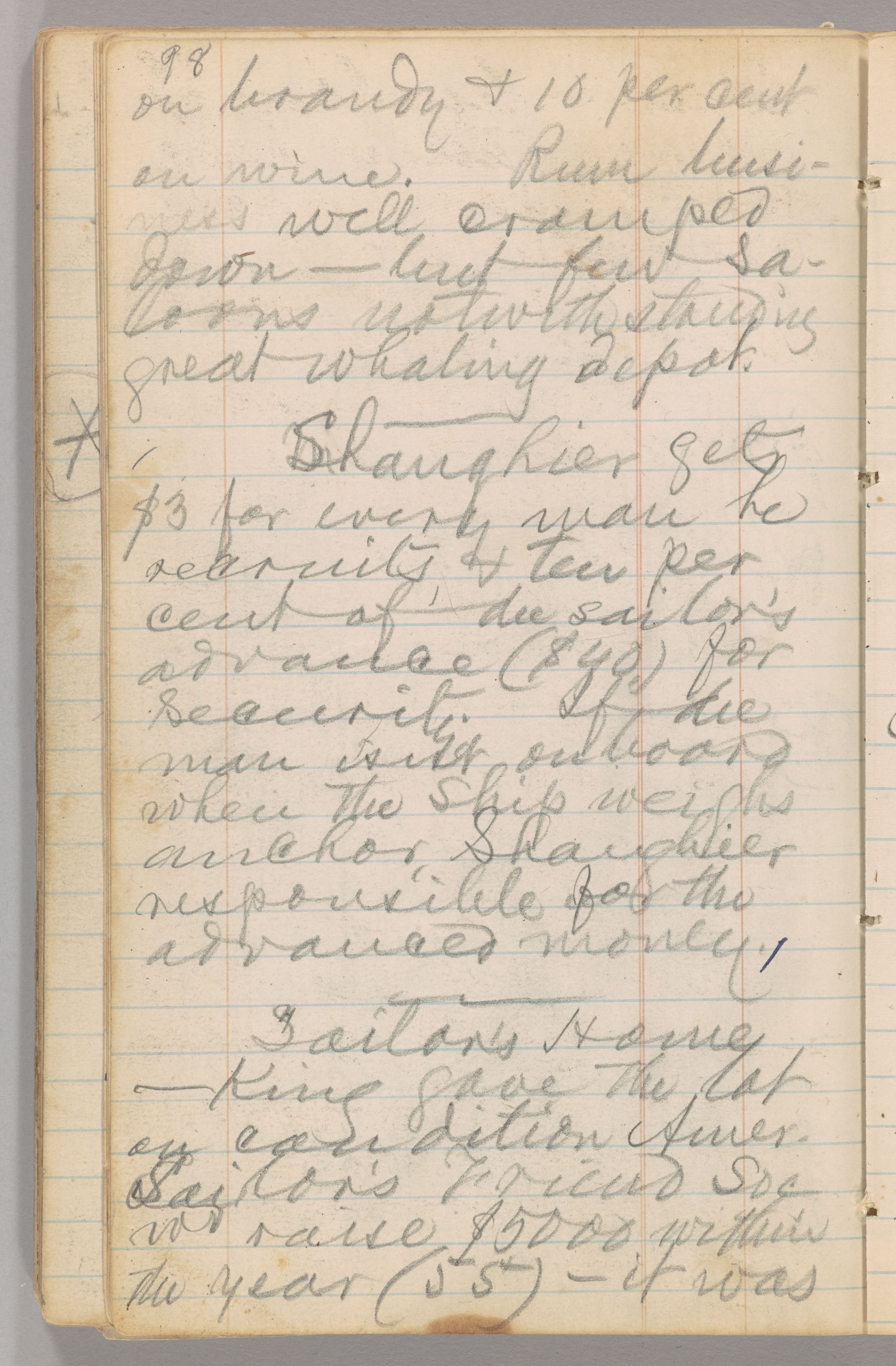
[MS: N6_leaf_049v]
on brandy & 10 per cent
on wine. Rum busi-
nessbusiness well cramped
down—but few sa-
loonssaloons notwithstanding
great whaling depot.85
MShanghier gets
$3 for every man he
recruits, & ten per
cent
[MTP: N&J1_218] of the sailor's
advance ($40,) for
Security. If the
man isn't on board
when the ship weighs
anchor, Shanghier
responsible ◊ for the
advanced money.
Sailor's Home
—King gave the lot
on condition Amer.
FSailor's Friend Soc
wd raise $5,000 within
the year (55)—it was
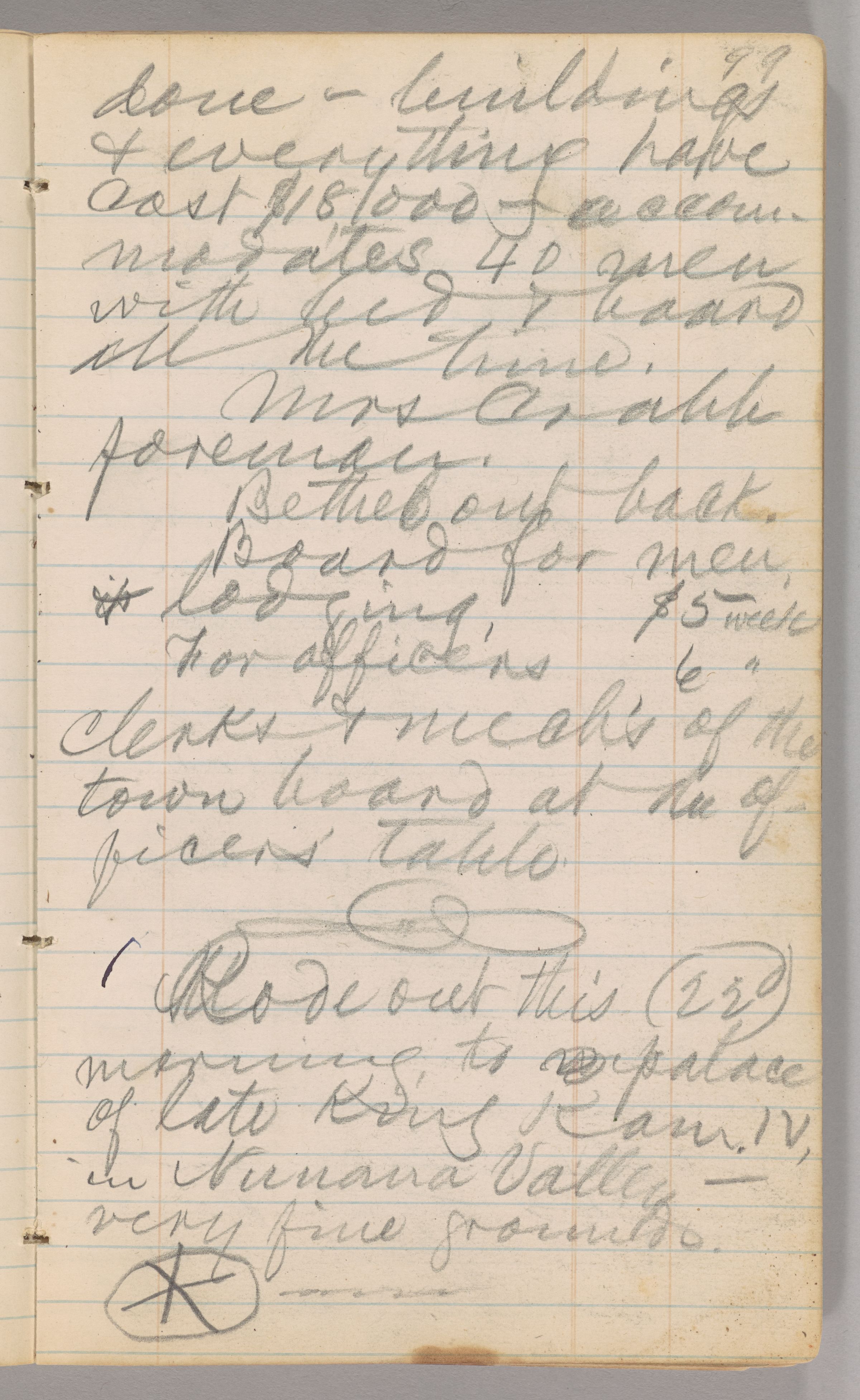
[MS: N6_leaf_050r]
done— buildings
& everything have
cost $18,000—accom-
modatesaccommodates 40 men
with bed & board
all the time.86
Mrs Crabb
foreman.
Bethel out back.87
Board for men,
is& lodging, $5 week
For officers 6 week
Clerks & mech's of the
town board at the of-
ficers’officers' table.
MRodeⓂemendation out this (22d)
morning, to we palace
of late King Kam. IV,
in Nuuana Valley—
very fine grounds.
✱
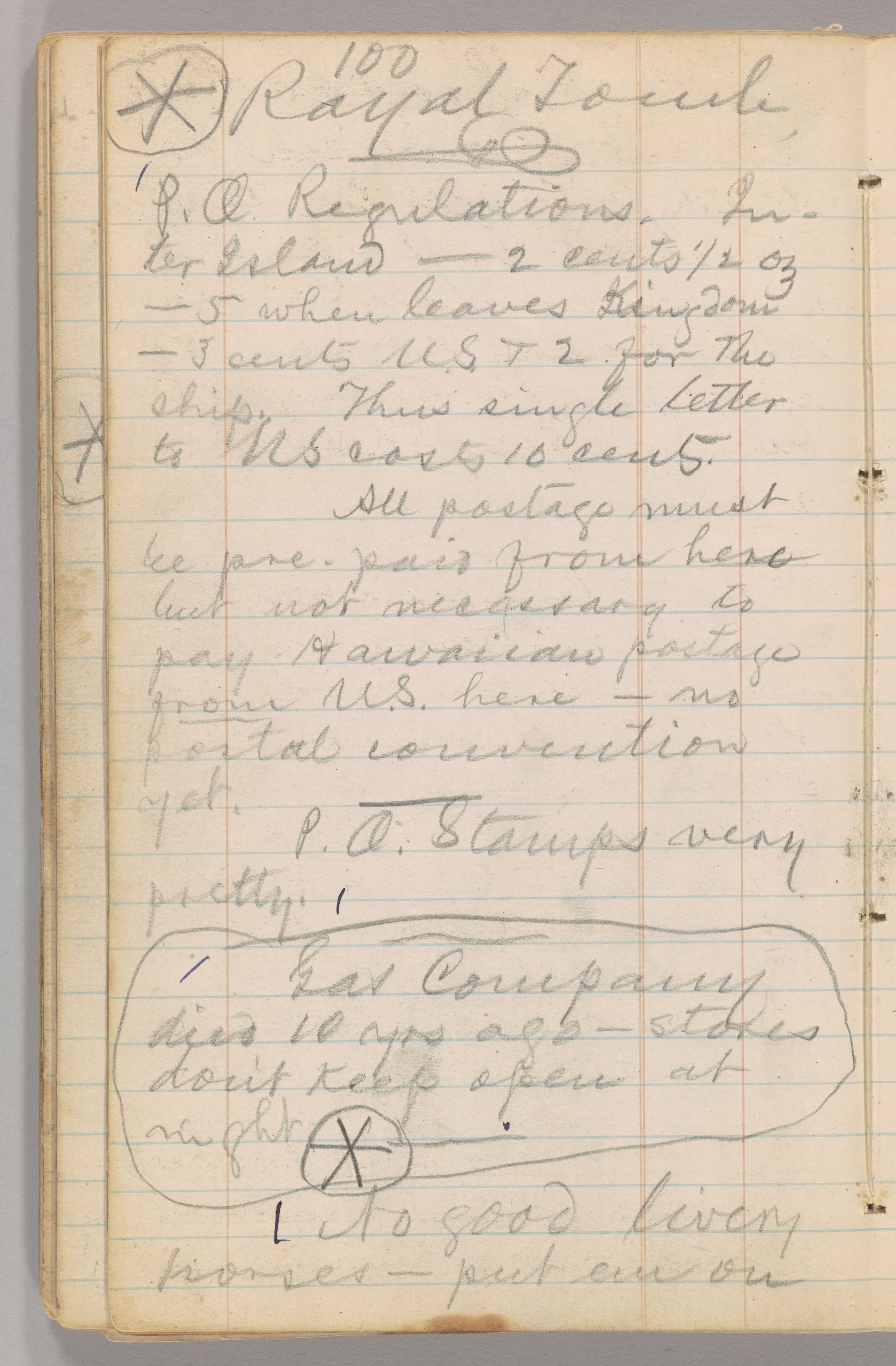
[MS: N6_leaf_050v]
✱ Royal Tomb.
P.O. Regulations. In-
terInter Island—2 cents ½ oz
—5 when leaves Is Kingdom
—3 cents U.S. & 2 for the
ship. Thus single letter
to US costs 10 cents.88
All postage must
be pre-paid from here
but not necessary to
pay Hawaiian postage
from U.S. here—no
postal convention yet.Ⓣtextual note89
P.O. Stamps very
pretty.
[MTP: N&J1_219]
Gas Company
died 10 yrs ago—stores
don't keep open at
night ✱Ⓣtextual note90
No good livery
horses—put em on
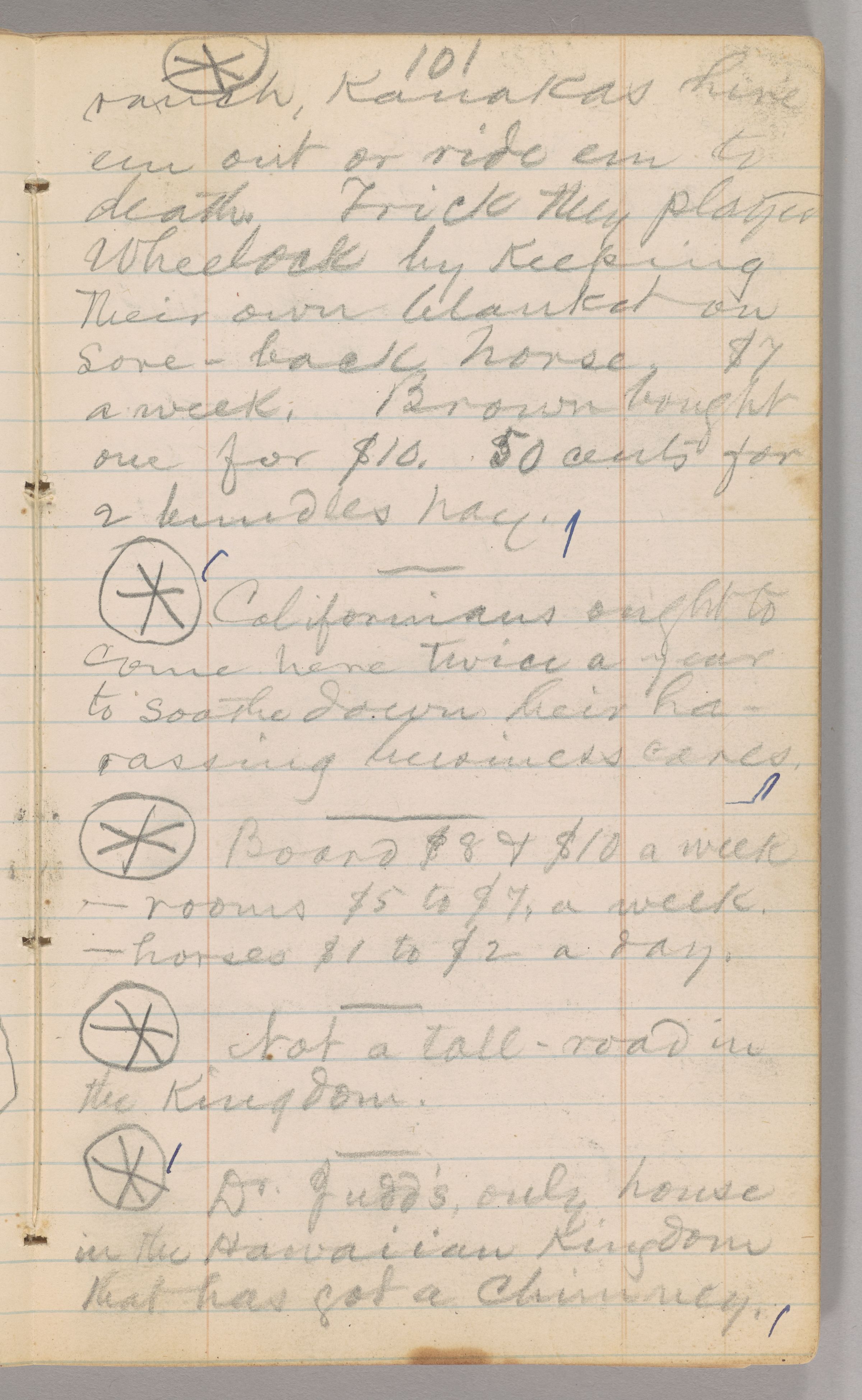
[MS: N6_leaf_051r]
✱ ranch, Kanakas hire
em out or ride em to
death. Trick they played
Wheelock by keeping
their own blanket on
sore-back horse. $7
a week. Brown bought
one for $10. 3 50 cents for
2 bundles hay.
✱ Californians ought to
come here twice a year
to soothe down their ha-
rassingharassing business cares.
✱ Board $8 & $10 a week
—rooms $5 to $7, a week.
—horses $1 to $2 a day.
✱ Not a toll-road in
the Kingdom.
✱ Dr. Judd's, only house
in the Hawaiian Kingdom
that has got a chimney.
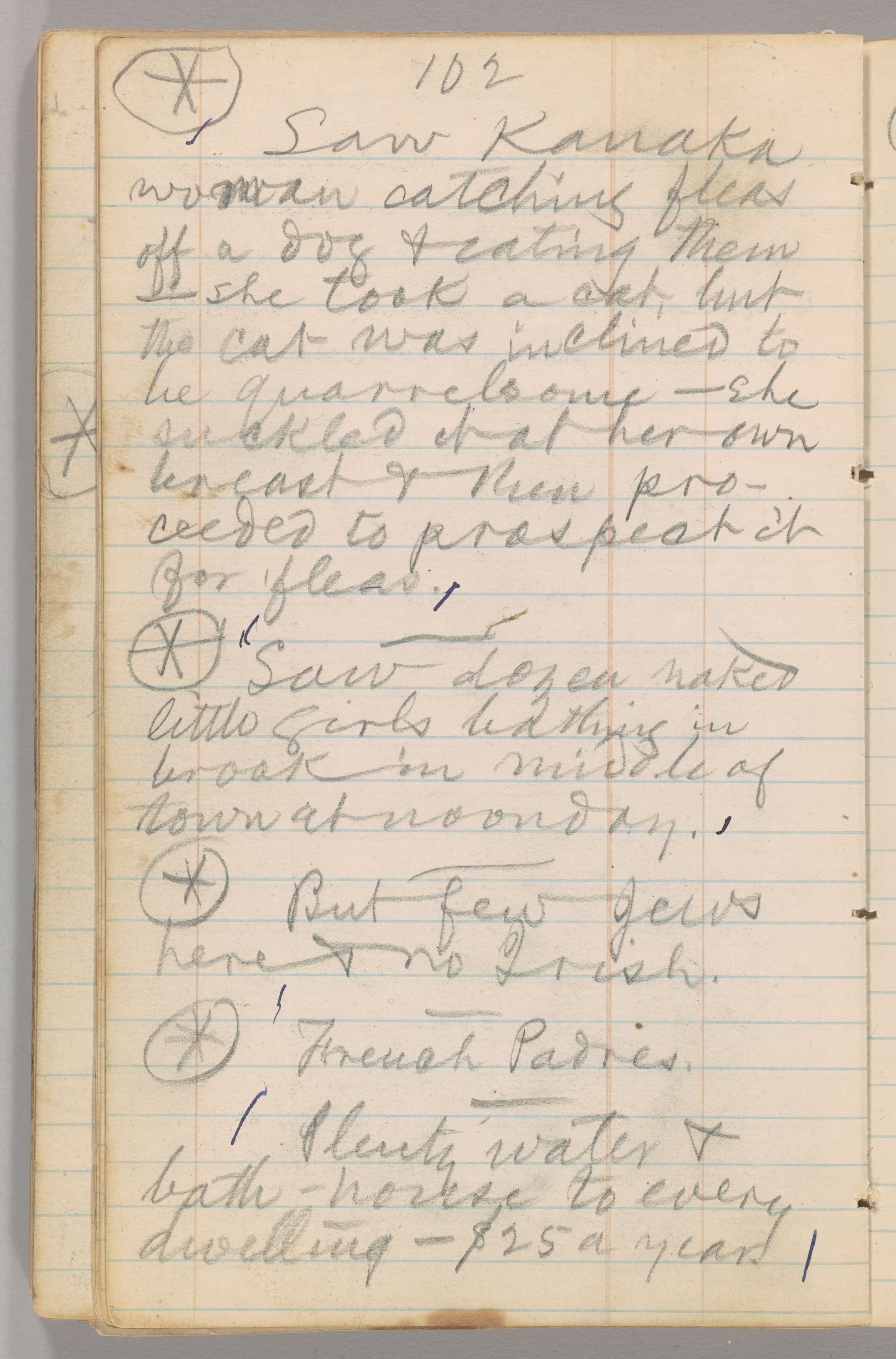
[MS: N6_leaf_051v]
✱ Saw Kanaka
woman catching fleas
off a dog & eating them
— she took a cat, but
the cat was inclined to
be quarrelsome—she
suckled it at her own
breast & then pro-
ceededproceeded to prospect it
for fleas.
✱ Saw dozen naked
little girls bathing in
brook in middle of
town at noonday.
✱ But few Jews
here & no Irish.
✱ French Padres.
Plenty water &
bath-house to every
dwelling—$25 a year.
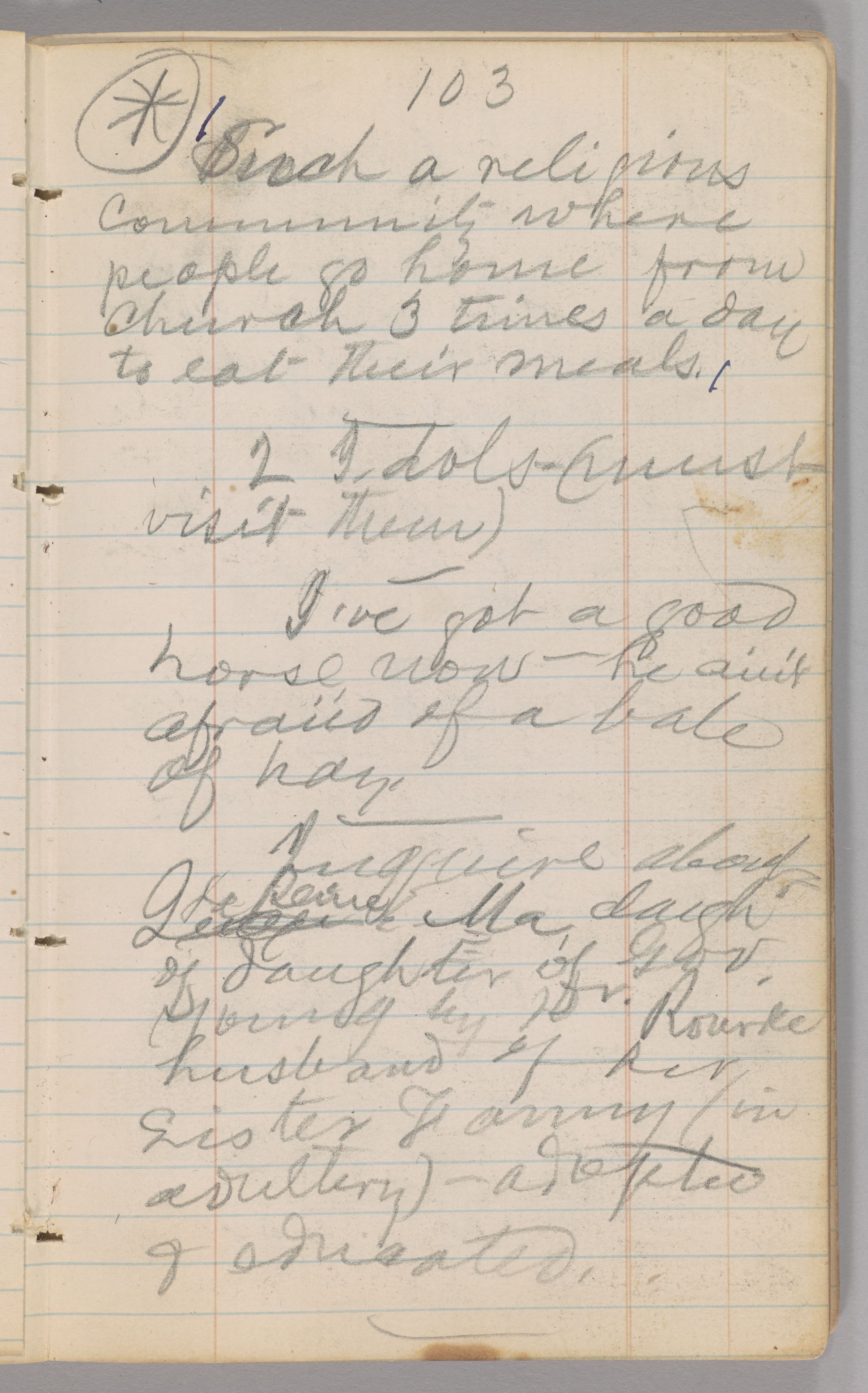
[MS: N6_leaf_052r]
[MTP: N&J1_220]
✱ Peo Such a religious
community where
people go home from
church 3 times a day
to eat their meals.
2 Idols—(must
visit them)
I've got a good
horse, now—he ain't
afraiid of a bale
of hay.
Inquire about
Queen La Reine. Ma, daughr
of daughter of Gov.
Young by Dr. Rourke
husband of her
sister Fanny (in
adultery)—adopted
& educated.91
[MS: N6_leaf_052v]
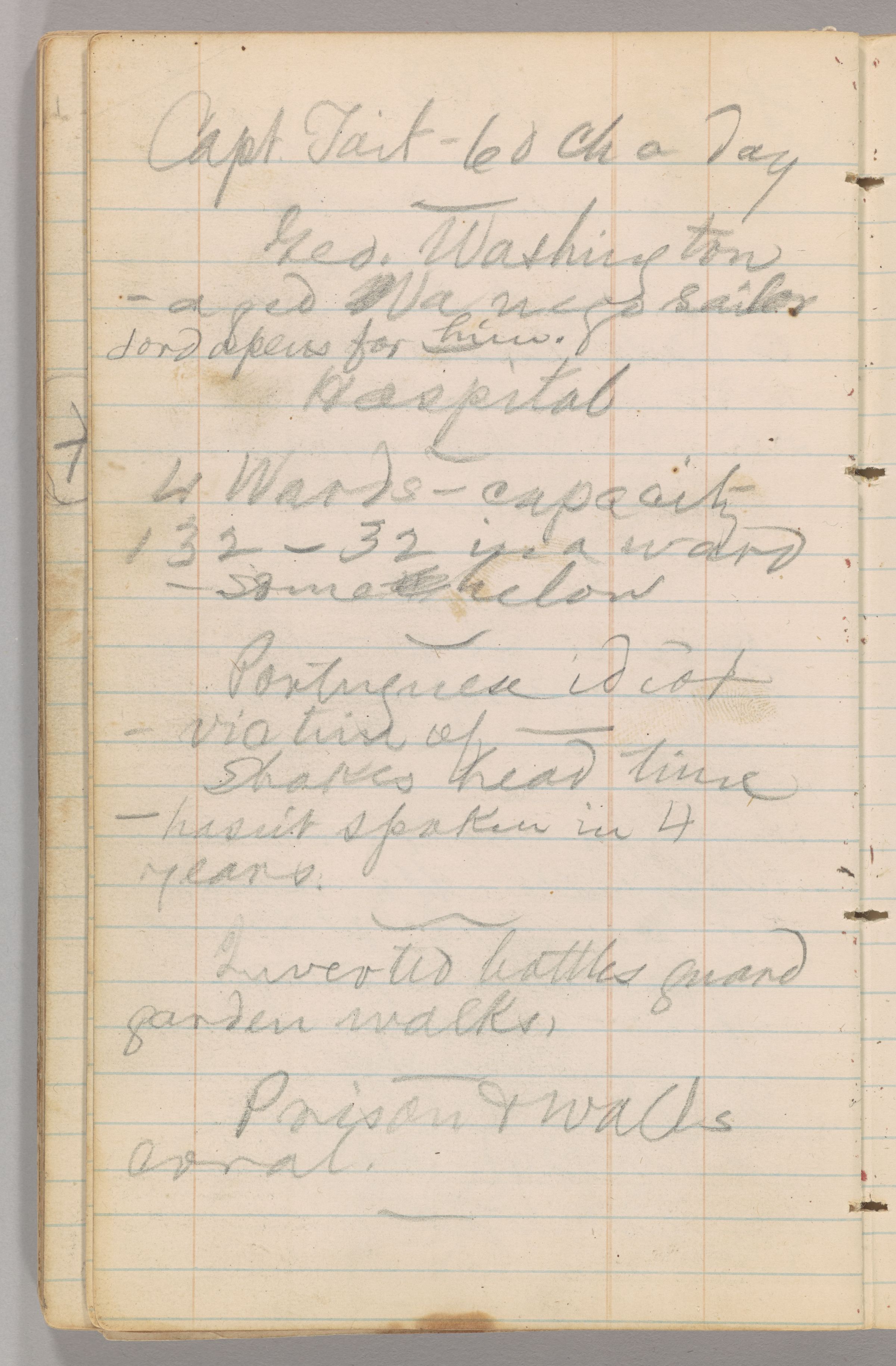
Capt. Tait92—60 Ch a day
Geo. Washington
—aged ◊ Va nego sailor
Lord opens for him.
Hospital
4 Wards—capacity
132—32 in a ward
—some ◊ below
Portuguese idiot
—victim of—
Shakes head time
—hasn't spoken in 4
years.
Inverted bottles guard
garden walks.
Prison & walls
coral.
[MS: N6_leaf_053r]
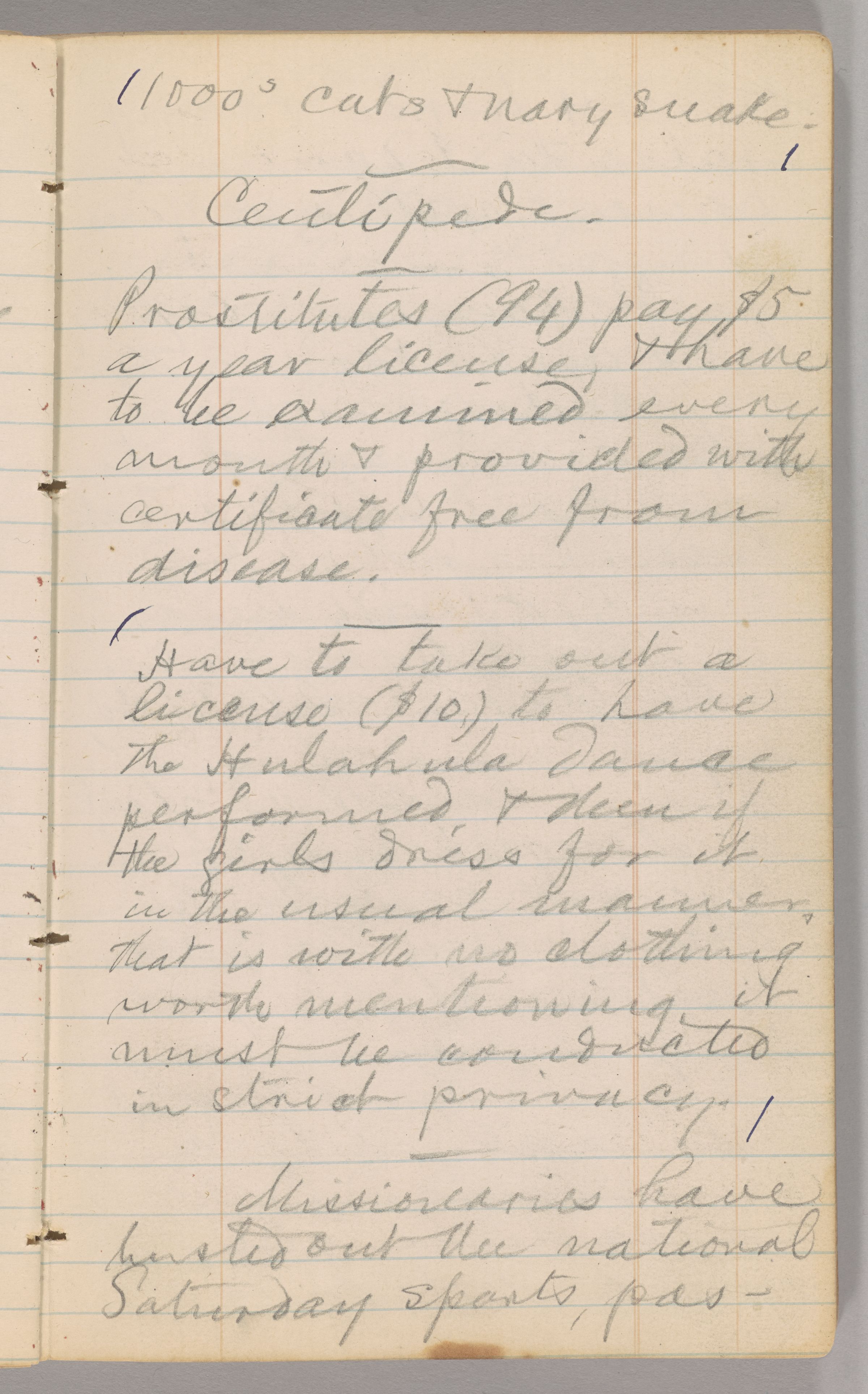
1000s cats & nary snake.
Centipede.
Prostitutes (94) pay $5
a year license, & have
to be examined every
month & provided with
certificate free from
disease.93
[MTP: N&J1_221]
Have to take out a
license ($10,) to have
the Hulahula dance
performed, & then if
the girls dress for it
in the usual manner,
that is with no clothing
worth mentioning, it
must be conducted
in strict privacy.94
Missionaries have
busted out the national
Saturday sports, pas-
[MS: N6_leaf_053v]
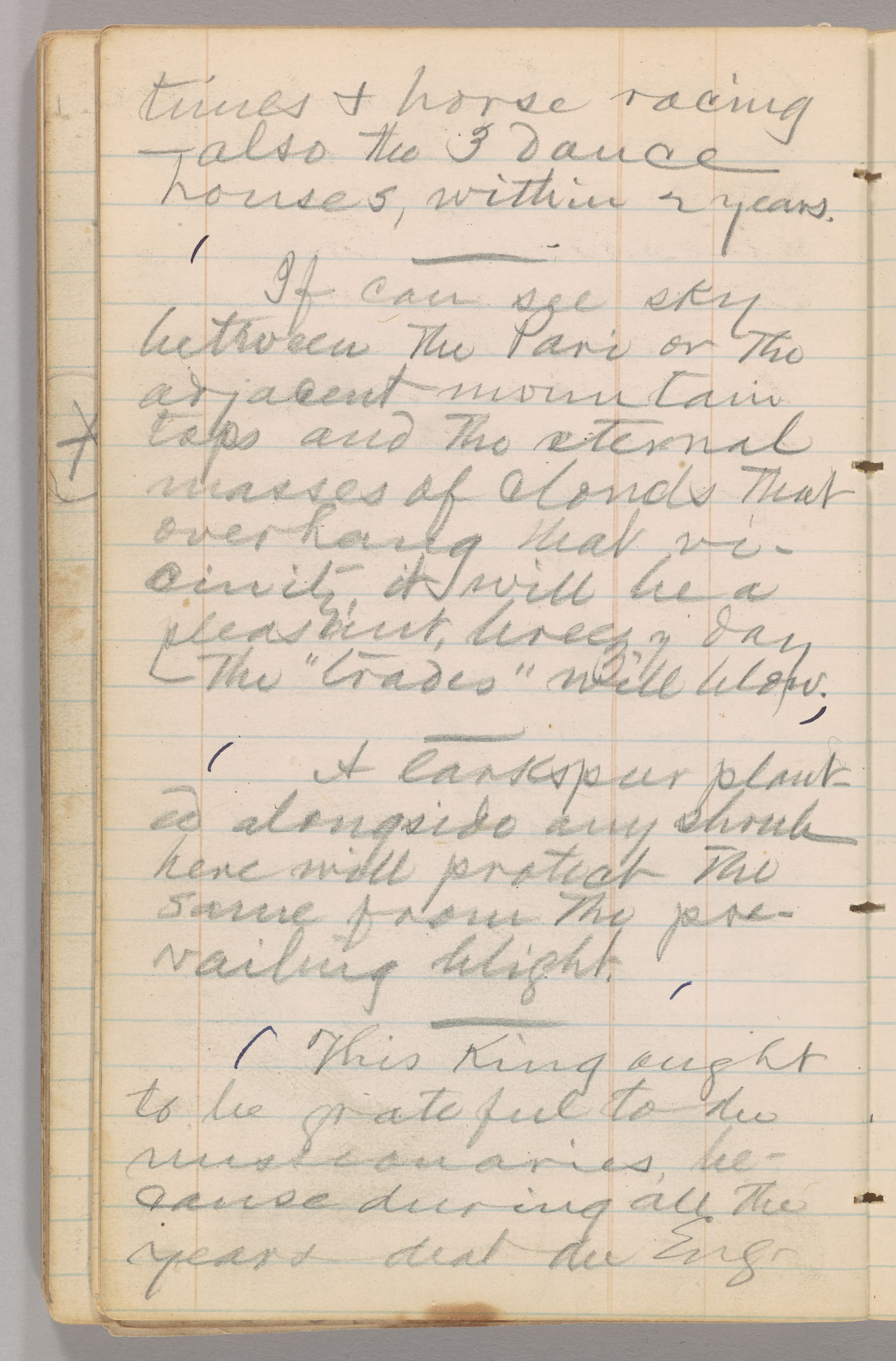
times & horse racing
—also the 3 dance
houses, within 2 years.95
If can see sky
between the Pari or the
adjacent mountain
tops and the eternal
masses of clouds that
overhang that vi-
cinityvicinity, it will be a
pleasant, breezy day
—the “trades” will blow.
A larkspur plant-
edplanted alongside any shrub
here will protect the
same from the pre-
vailingprevailing blight.
This King ought
to be grateful to the
missionaries, be-
causebecause during all the
years that the Eng-
[MS: N6_leaf_054r]
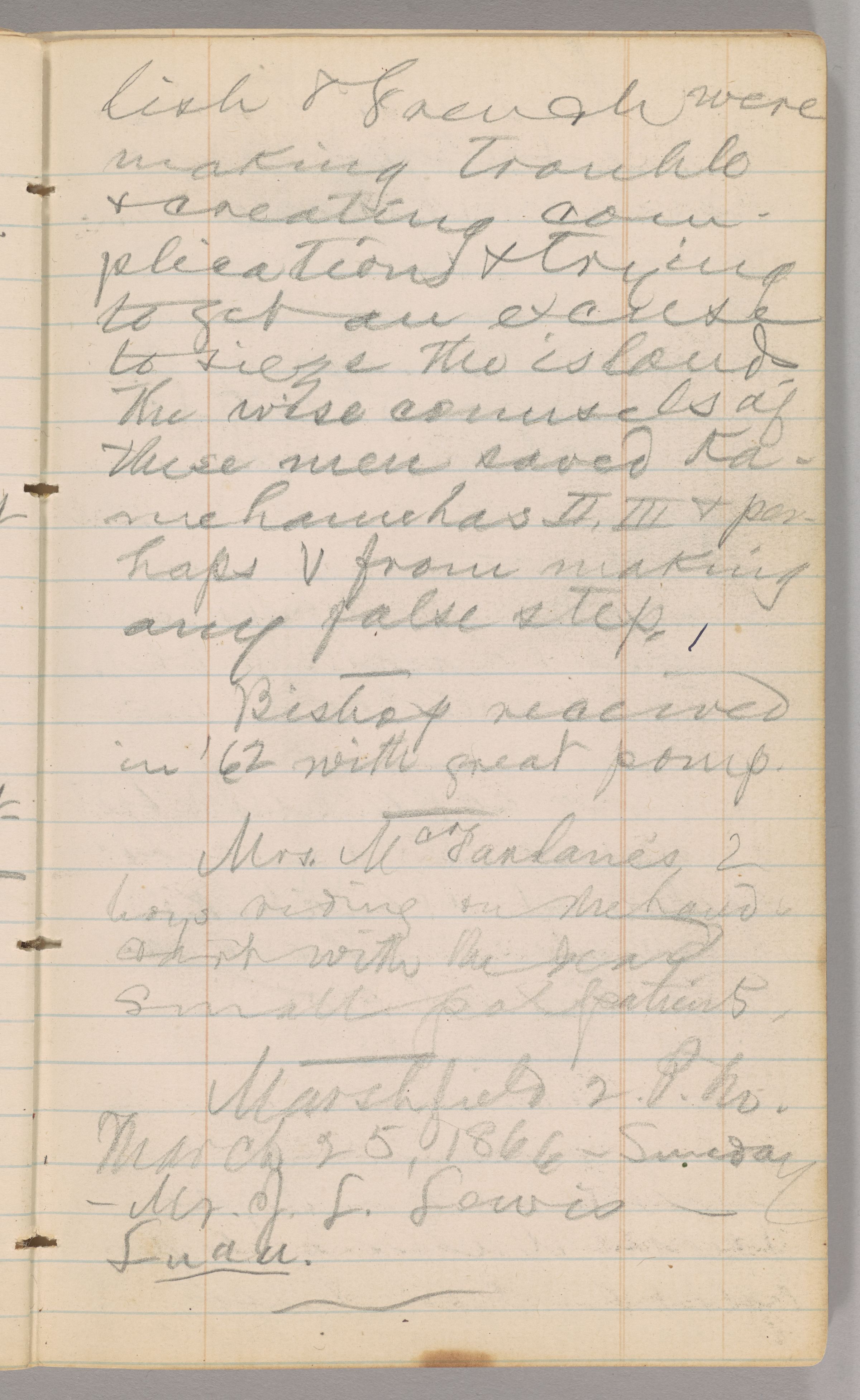
lish & French were
making trouble
& creating com-
plicationscomplications & trying
to get an excuse
to sieze the islands,
the wise counsels of
these men saved Ka-
mehamehasKamehamehas II, III & per-
hapsperhaps V from making
any false step.96
[MTP: N&J1_222]
Bishop received
in '62 with great pomp.
Mrs. McFarlane's 2
boys riding on the hand-
cartⓂemendation with the dead
smallpoxⓂemendation patients.97
Marshfield 2. P.M.
March 25, 1866—Sunday
—Mr. J. L. Lewis98—
Luau.
[MS: N6_leaf_054v]
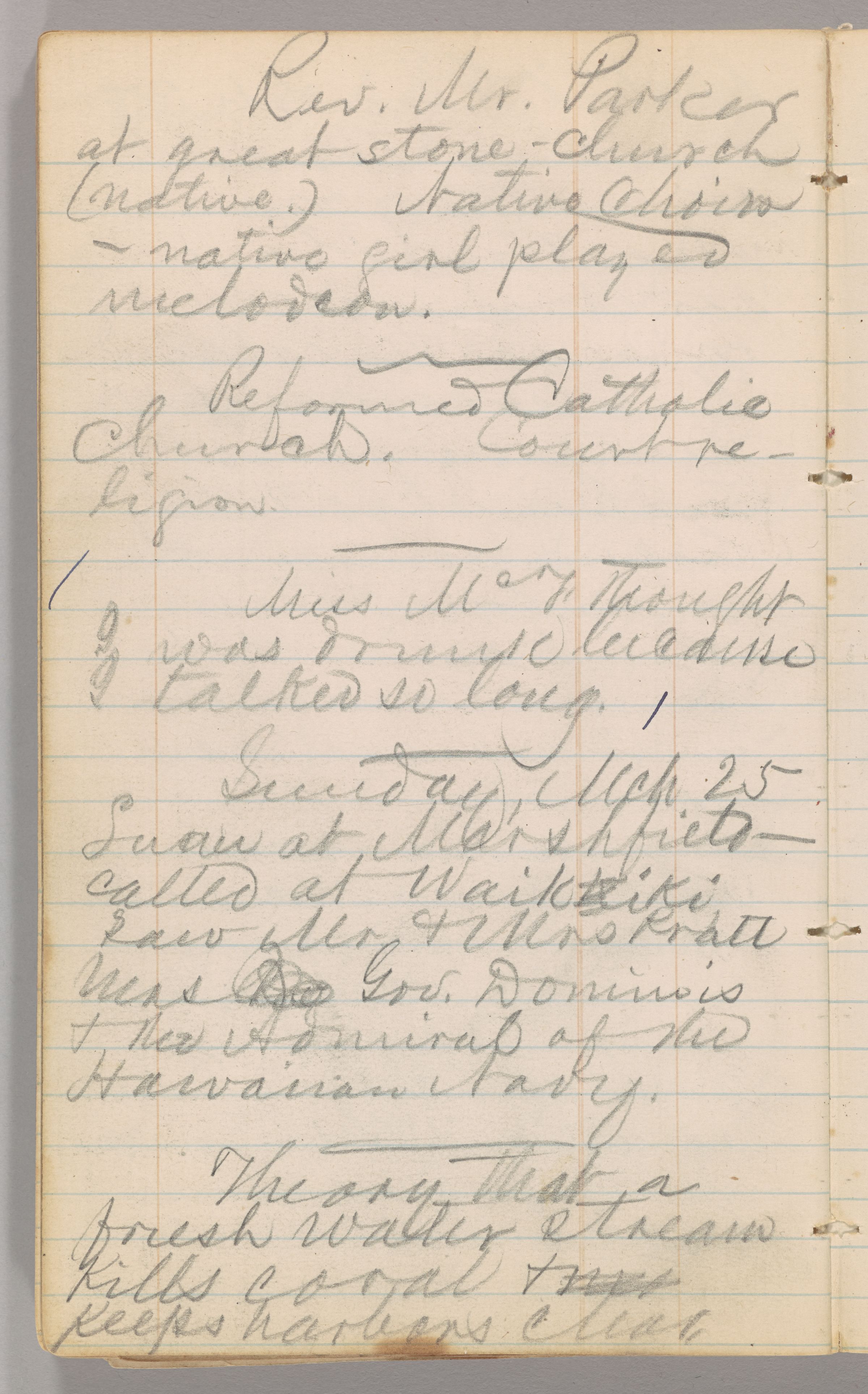
Rev. Mr. Parker
at great stone-church
(native.) Native choirs
—native girl played
melodeon.
Reformed Catholic
Church. Court re-
ligionreligion.
Miss McF thought
I was drunk because
I talked so long.
Sunday, Mch 25
Luau at Marshfield—
called at Waikkiki,
saw Mr. & Mrs Pratt
Mrs Do Gov. Dominis
& the Admiral of the
Hawaiian Navy.99
Theory that a
fresh water stream
kills coral & ma
keeps harbors clear.
[MS: N6_leaf_055r]
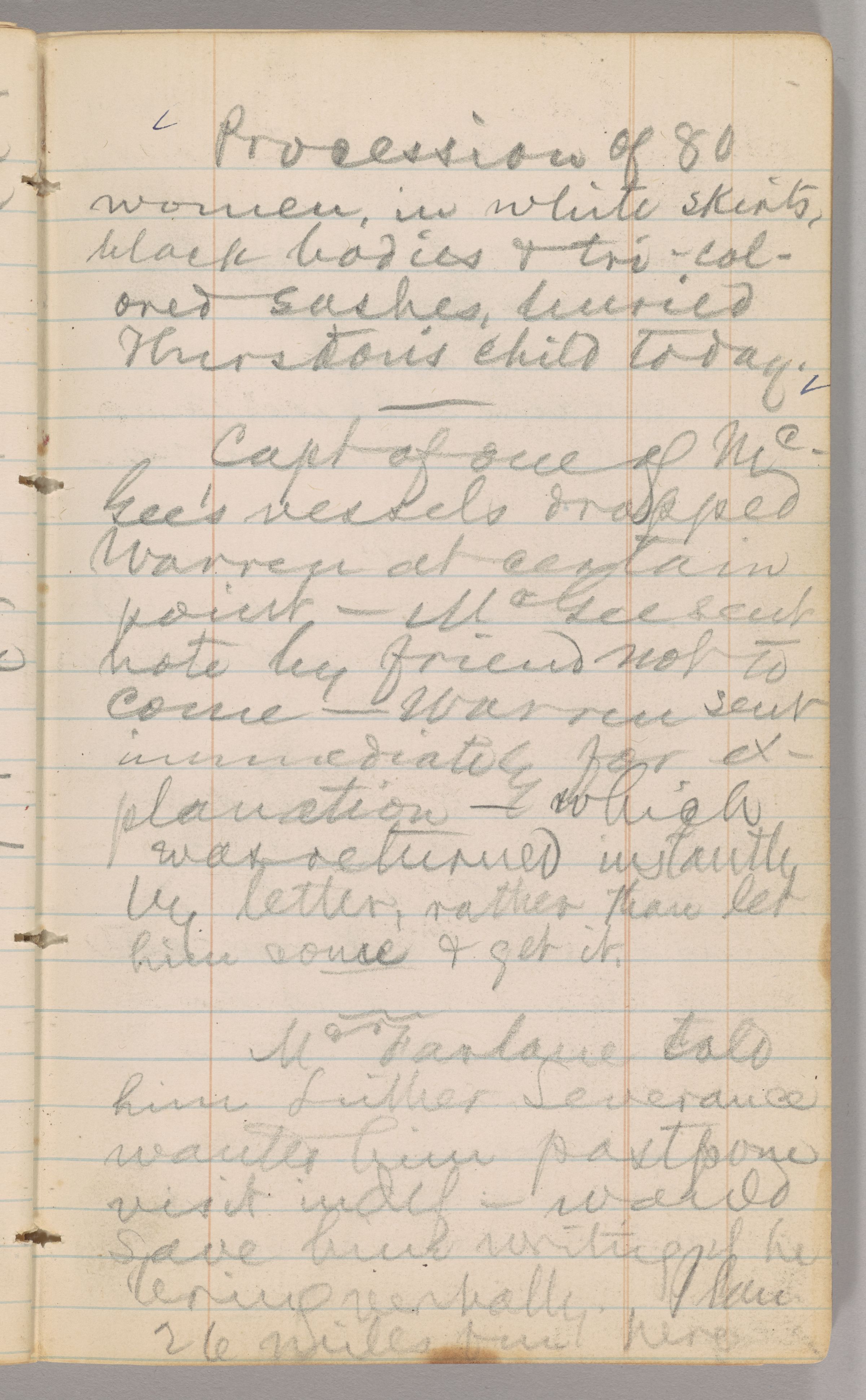
Procession of 80
women, in white skirts,
black bodies & tri-col-
oredtri-colored sashes, buried
Thurston's child to-dayⓂemendation.100
[MTP: N&J1_223]
Capt of one of Mc-
Gee’sMcGee's101 vessels dropped
Warren102 at certain
point—McGee sent
note by friend not to
come—Warren sent
immediately for ex-
planationexplanation—which
was returned instantly
by letter, rather than let
him come & get it.
McFarlane told
him Luther Severance
wanted him postpone
visit indef—would
save him writing if he
bring verbally. Place
26 miles fm here
[MS: N6_leaf_055v]
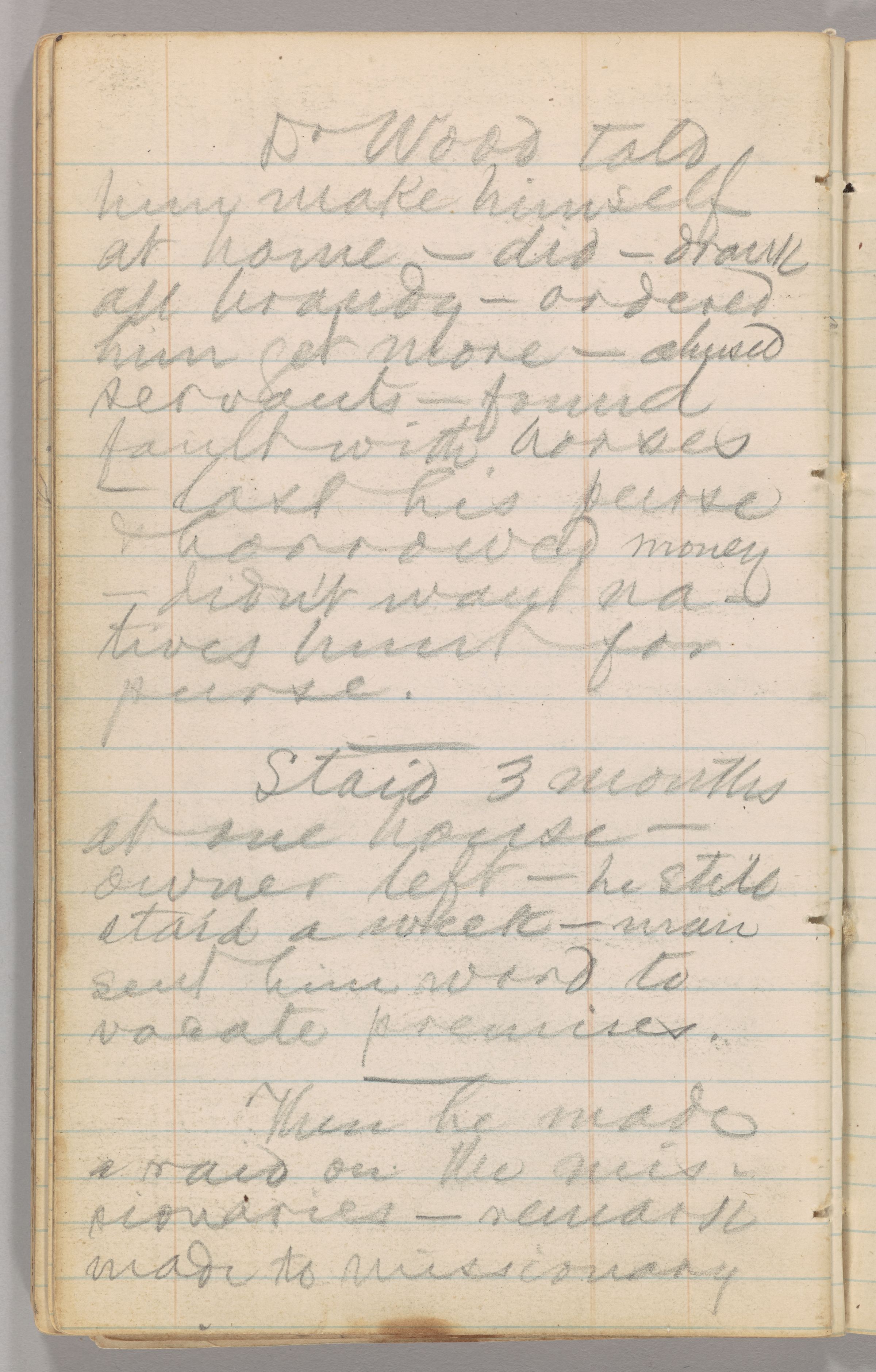
Dr Wood103 told
him make himself
at home—did—drank
all brandy—ordered
him get more—abused
servants—found
fault with horses
—lost his purse
& borrowed money
—didn't want na-
tivesnatives hunt for
purse.
[MTP: N&J1_224]
Staid 3 months
at one house—
owner left—he still
staid a week—man
sent him word to
vacate premises.
Then he made
a raid on the mis-
sionariesmissionaries—remark
made to missionary
[MS: N6_leaf_056r]
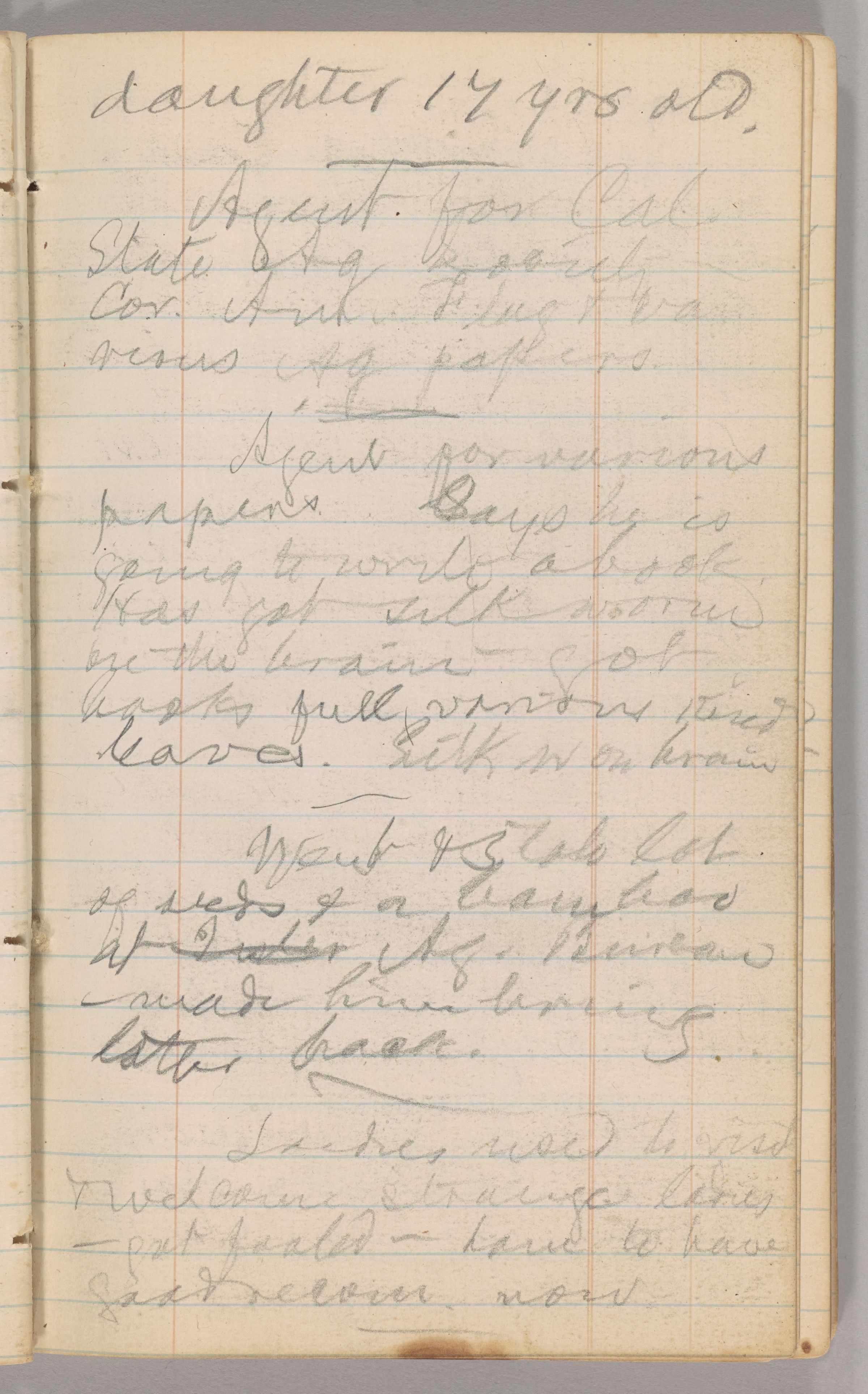
daughter 17 yrs old.
Agent for Cal
State Ag Society—
Cor. Am. Flag & va-
riousvarious Ag papers.
Agent for various
papers. Says he is
going to write a book.
Has got silk wormⓂemendation
on the brain—got
books full various kin
d leaves. Silk w on brain
Went & stole lot
of seeds & a bamboo
at Inter Ag. Bureau
—made him bring
latter back.
Laidies used to visit
& welcome strange ladies
—got fooled—have to have
good recom. now.
[MS: N6_leaf_056v]
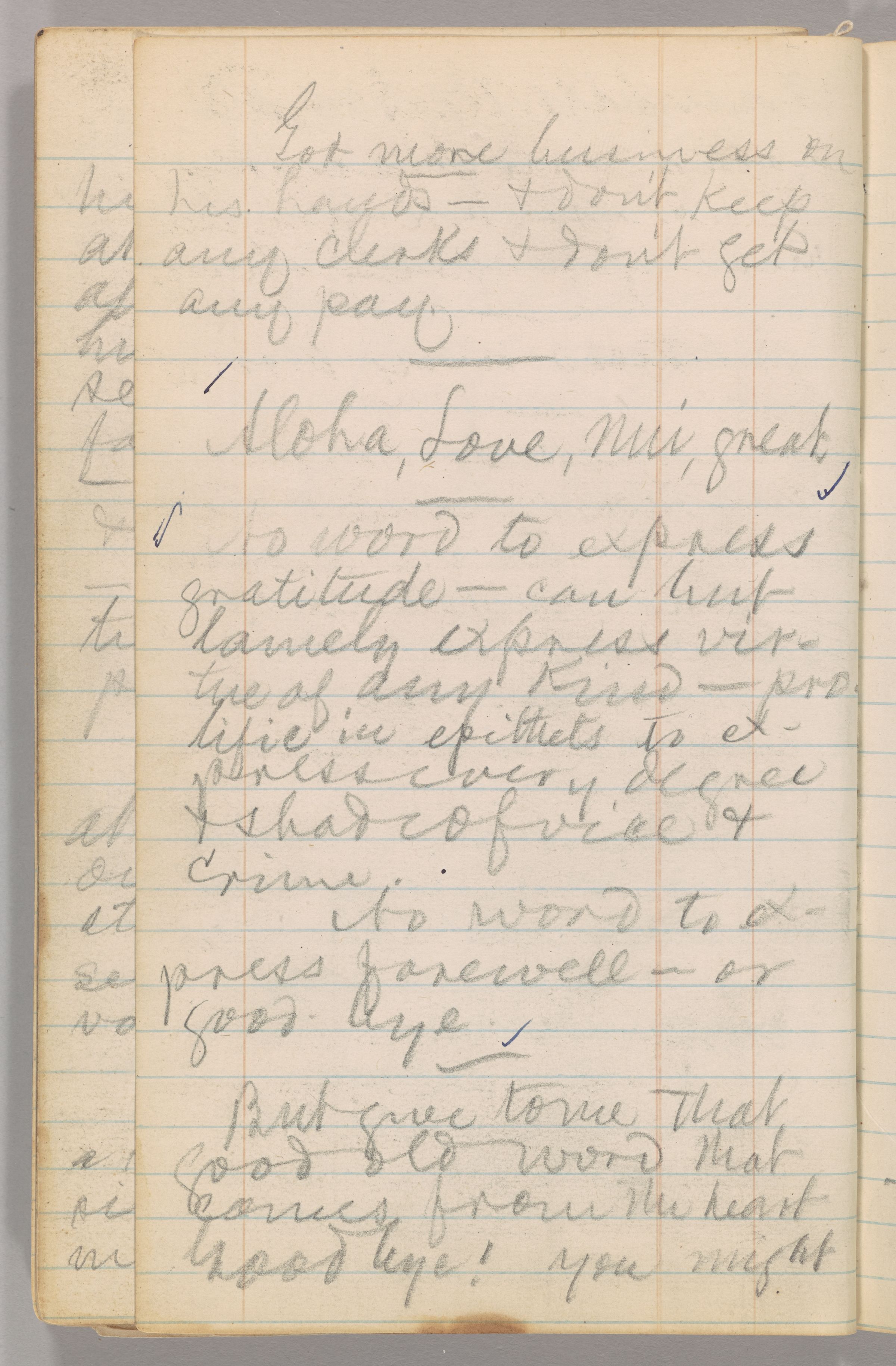
Got more business on
his hands—& don't keep
any clerks & don't get
any pay.
Aloha, Love, nui, great.
No word to express
gratitude—can but
lamely express vir-
tuevirtue of any kind—pro-
lificprolific in epithets to ex-
pressexpress every degree
& shade of vice &
crime.
No word to ex-
pressexpress farewell—or
good-bye.104
But give to me that
good old word that
comes from the heart
Good-byeⓂemendation! you might
[MS: N6_leaf_057r]
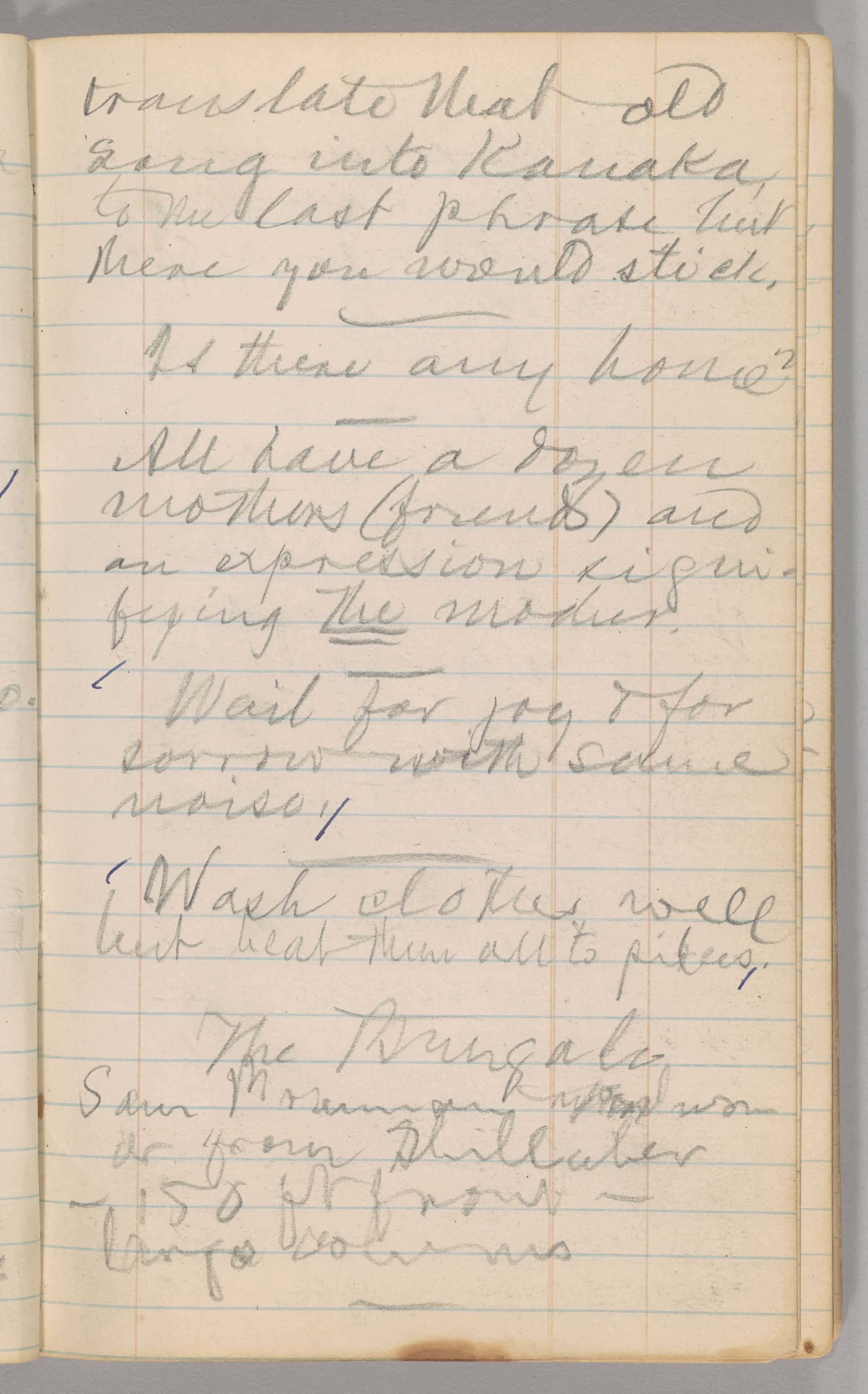
translate that old
song into Kanaka,
to the last phrase, but
there you would stick.
Is there any home?
All have a dozen
mothers (friends)105 and
an expression signi-
fyingsignifying the mother.106
[MTP: N&J1_225]
Wail for joy & for
sorrow with same
noise.
Wash clothes well
but beat them all to pieces.
The Bungalo
Sam Brannan won won
it from Shillaber
—150 ft front—
large colums107
[MS: N6_leaf_057v]
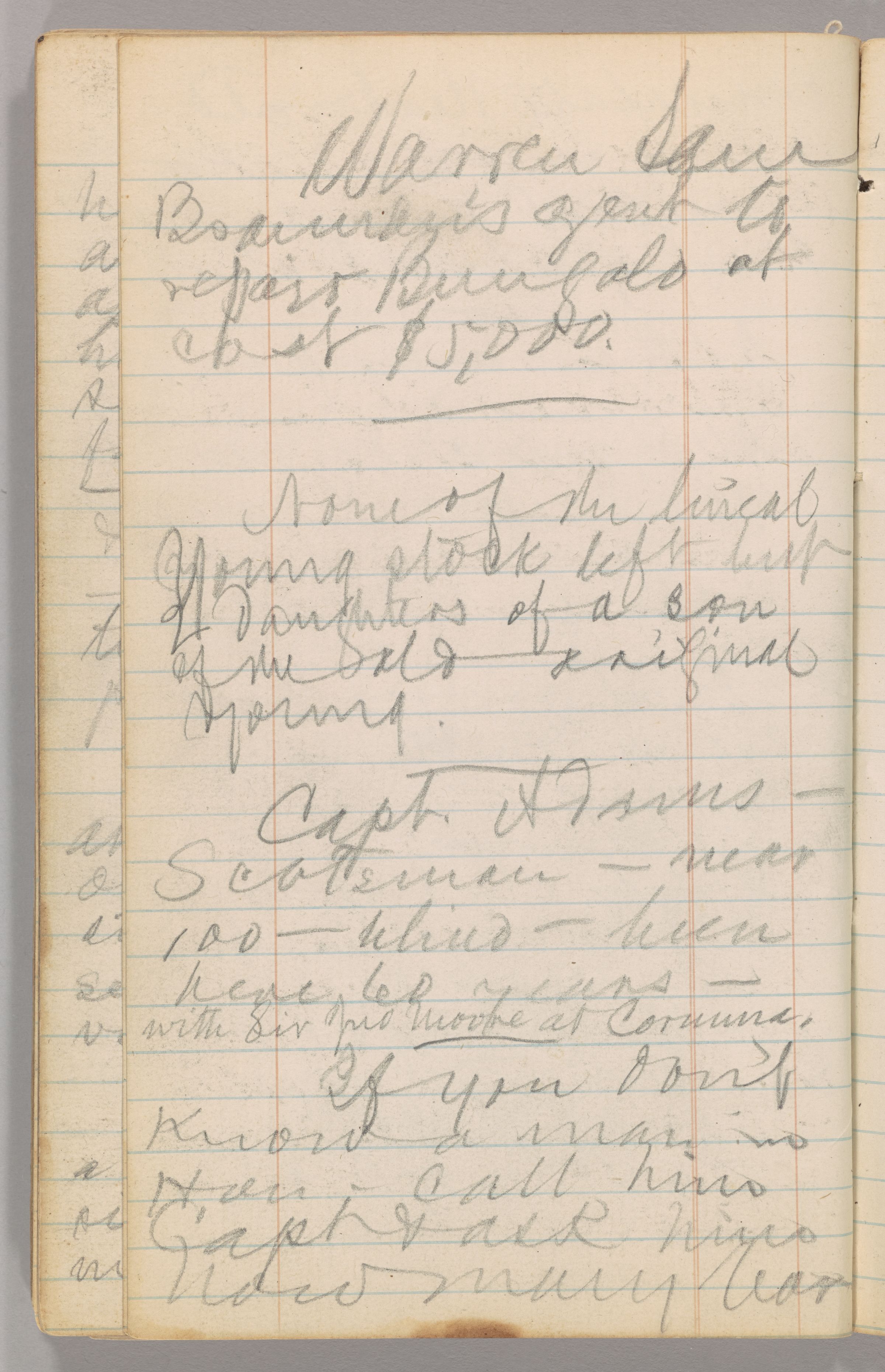
Warren Sam
Brannan's agent to
repair Bungalo at
cost $5,000.
None of the lineal
y Young stock left but
2 daughters of a son
of the old original
Young.108
Capt. Adams—
Scotsman—near
100—blind—been
here 60 years109—
with Sir Jno Moore at Corunna.110
If you don't
know a man in
Hon—call him
Capt & ask him
how many bar-
[MS: N6_leaf_058r]
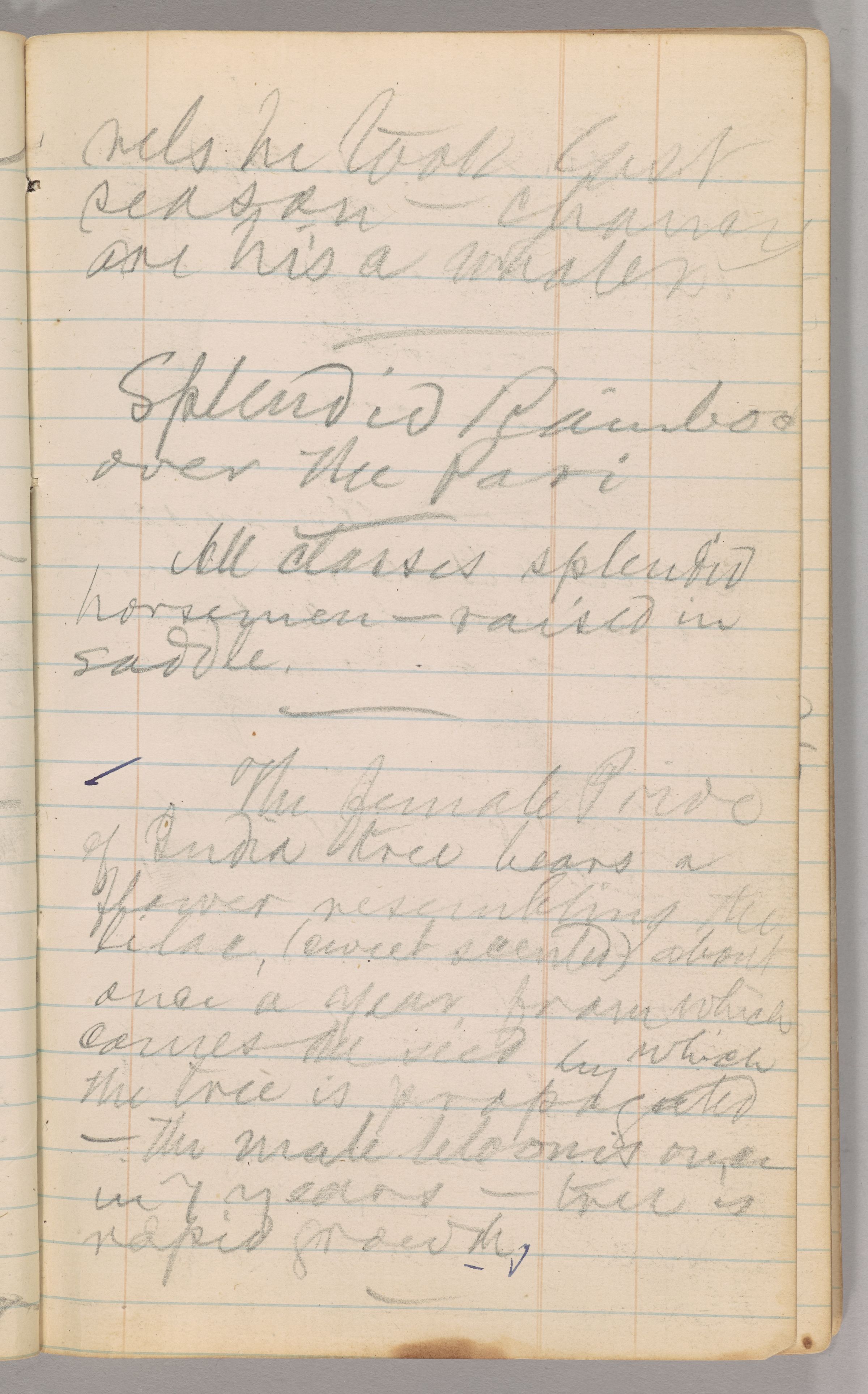
rels he took last
season—chances
are he's a whaler.
Splendid Rainbow
over the Pari
All classes splendid
horsemen—raised in
saddle.
[MTP: N&J1_226]
The female Pride
of India tree bears a
flower resembling the
lilac, (sweet scented) about
once a year, from which
comes the seed by which
the tree is propagated
—the male blooms once
in 7 years—tree is
rapid growth
[MS: N6_leaf_058v]
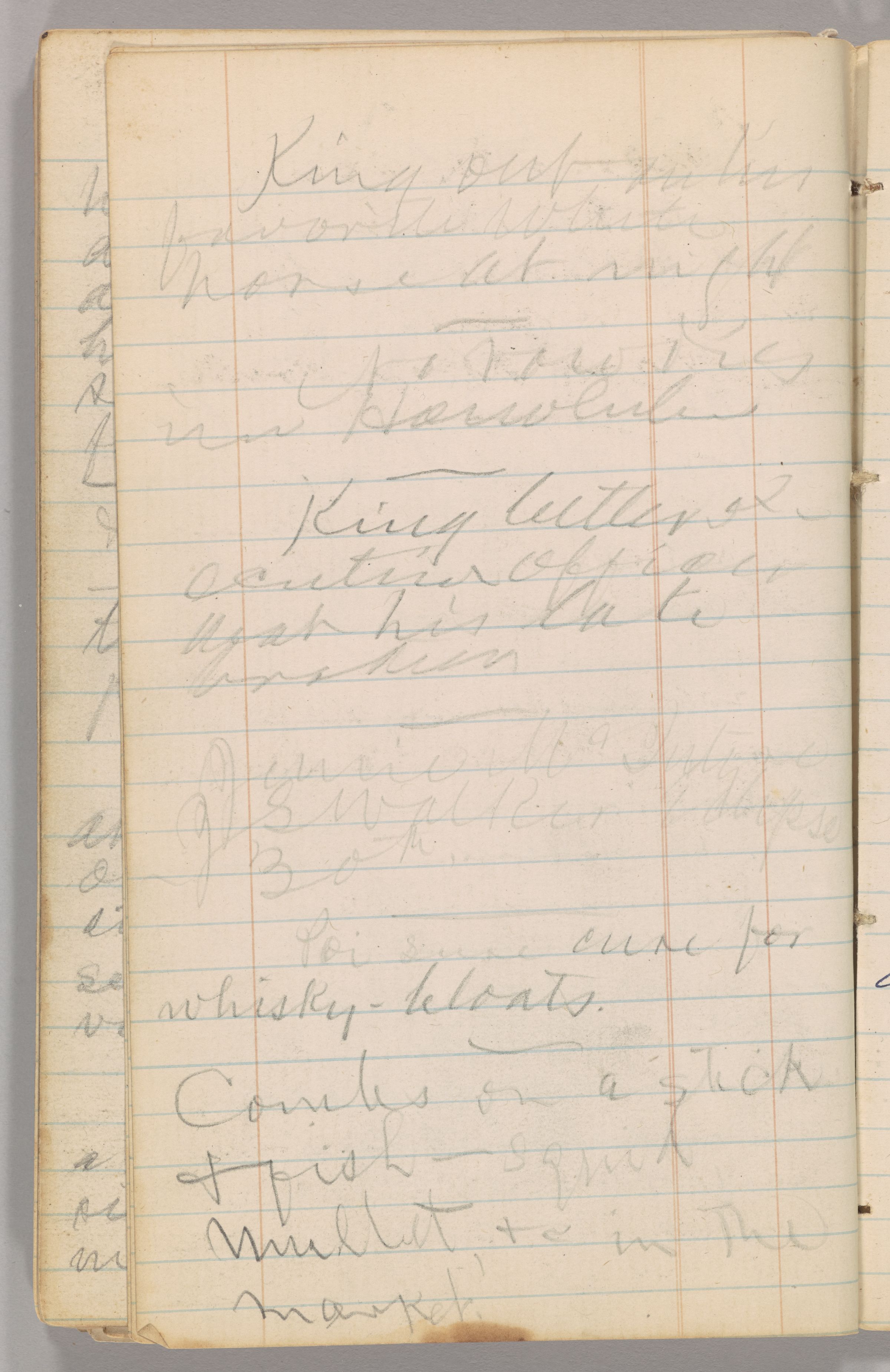
King out on his
favorite white
horse at night
No rowdies
in Honolulu
King better ex-
excutiveexecutive officer
that his late brother
Jennie McIntyre
J S Walker111 Eclipse112
—30th.
Poi sure cure for
whisky-bloats.
Combs on a stick
& fish—squid
mullet, &c in the
market.
[MS: N6_leaf_059r]
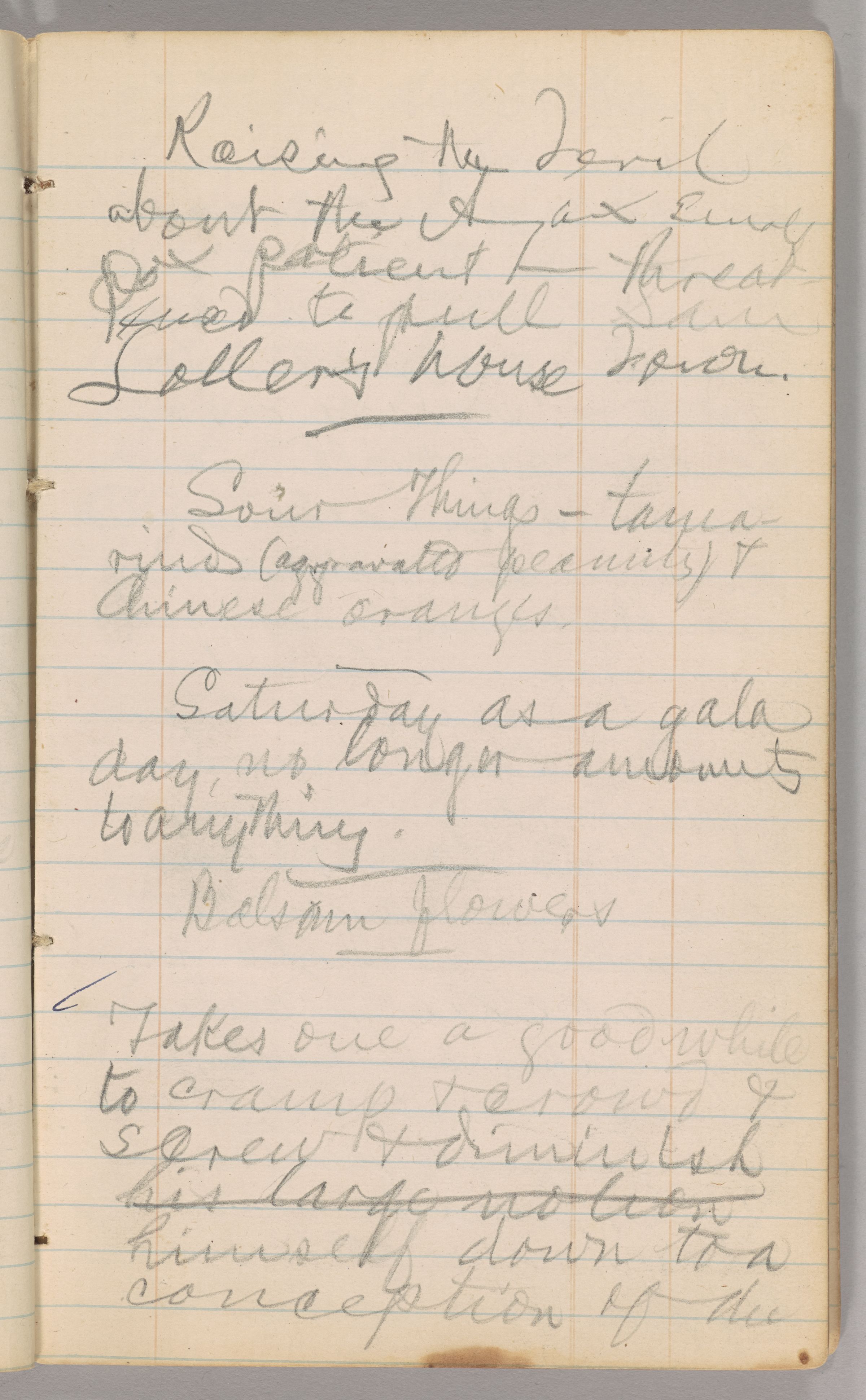
Raising the devil
about the Ajax small
pox patient—threat-
enedthreatened to pull Sam
Loller's house down.113
Sour Things—tama-
rindstamarinds (aggravated peanuts) &
Chinese oranges.
Saturday as a gala
day, no longer amounts
to anything.
Balsam flowers
Takes one a good while
to cramp & crowd &
screw & diminish
his large notion
himself down to a
conception of the
[MS: N6_leaf_059v]
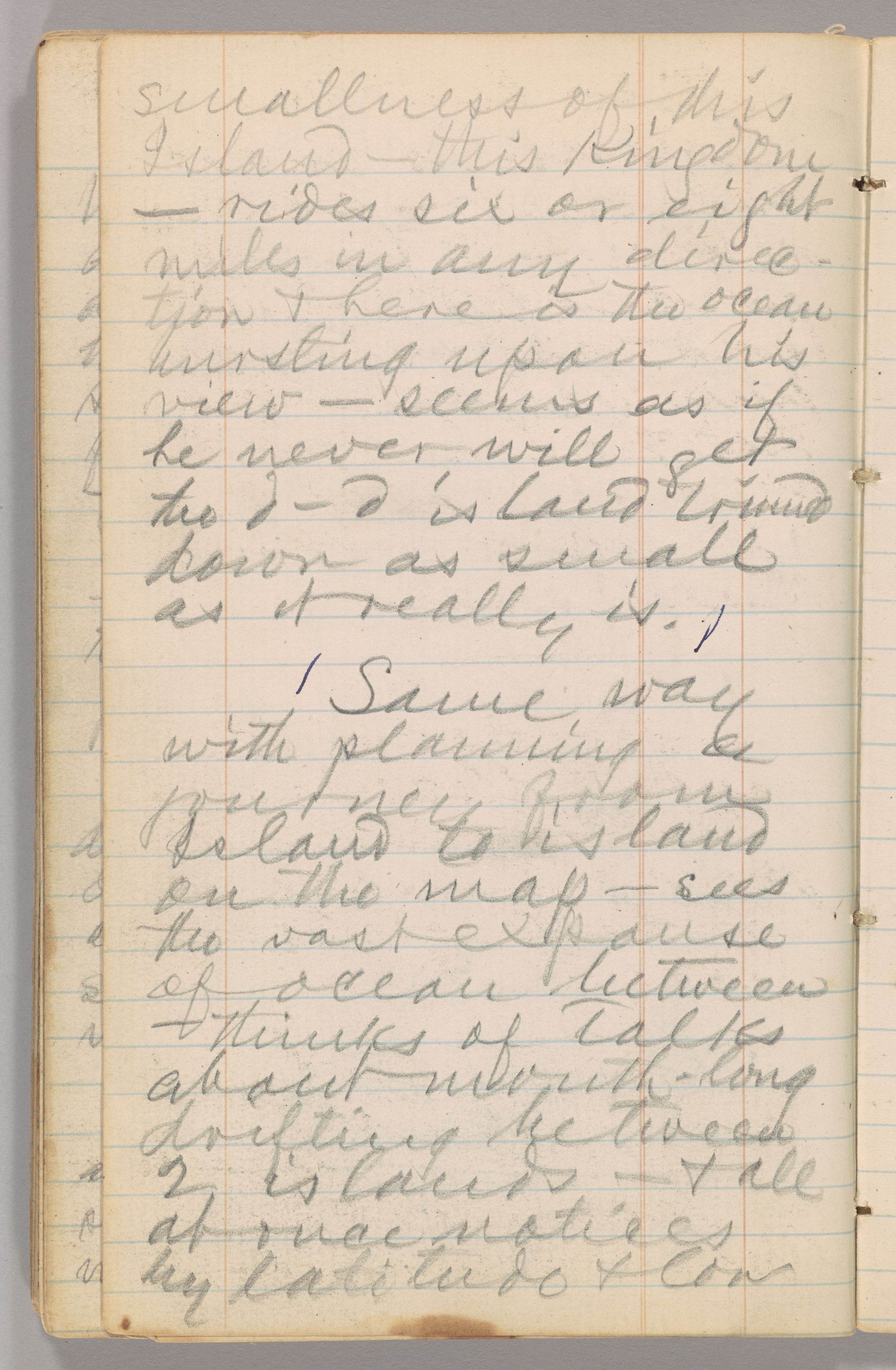
smallness of this
Island—this Kingdom
—rides six or eight
miles in any direc-
tiondirection & here is the ocean
bursting upon his
view—seems as if
he never will get
the d—d island trimmed
down as small
as it really is.
Same way
with planning a
journey from
Island to island
on the map—sees
the vast expanse
of ocean between
—thinks of talks
about month-long
drifting between
2 islands—& all
at once notices
[MTP: N&J1_227] by latitude & lon-
[MS: N6_leaf_060r]
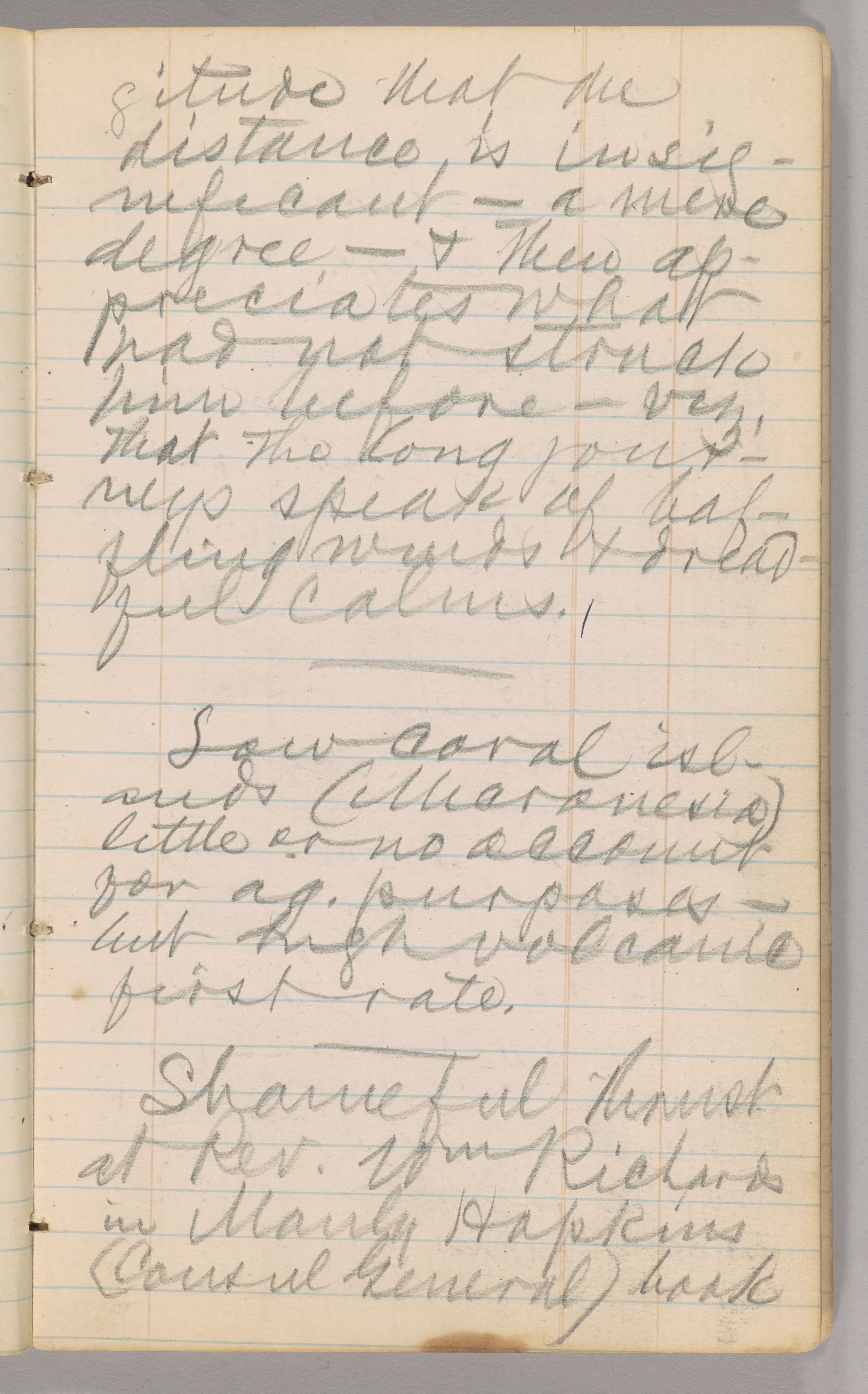
gitude that the
distance is insig-
nificantinsignificant—a mere
degree—& then ap-
preciatesappreciates what
had not struck
him before—viz,
that the long jour-
neysjourneys speak of baf-
flingbaffling winds & dread-
fuldreadful calms.
Low coral isl-
andsislands (Micronesia)
little or no account
for ag. purposes—
but high volcanic
first rateⓂemendation.
Shameful thrust
at Rev. Wm Richards
in Manly Hopkins
(Consul General) book
[MS: N6_leaf_060v]
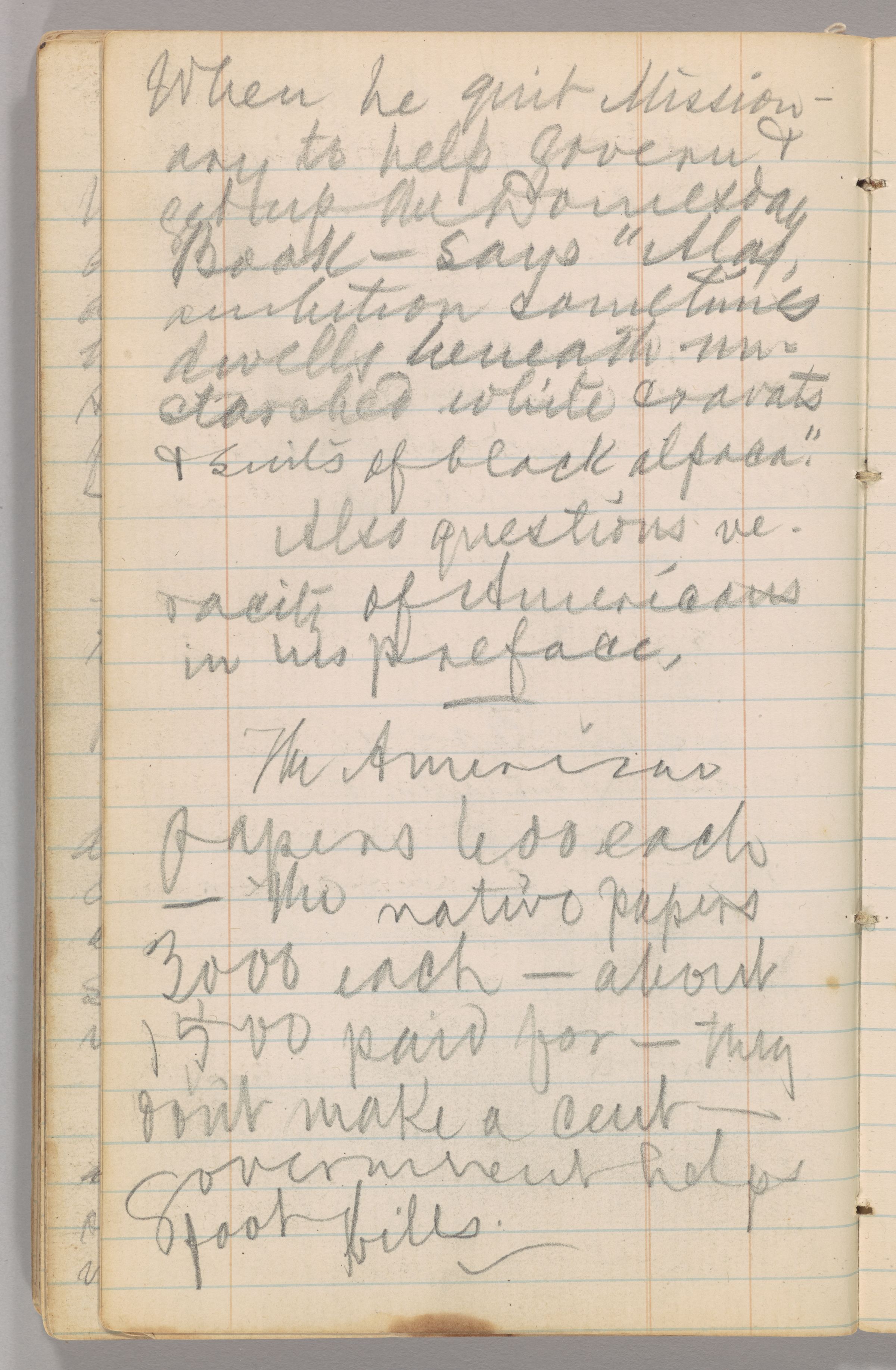
When he quit Mission-
aryMissionary to help govern &
get up the Domesday
Book—says “Alas,
ambition sometimes
dwells beneath un-
starchedunstarched white cravats
& suits of black alpaca.”114
Also questions ve-
racityveracity of Americans
in his preface.115
The American
papers 600 each
—the native papers
3,000 each—about
1,500 paid for—they
don't make a cent—
government helps
foot bills.
[MTP: N&J1_228]
[MS: N6_leaf_061r]
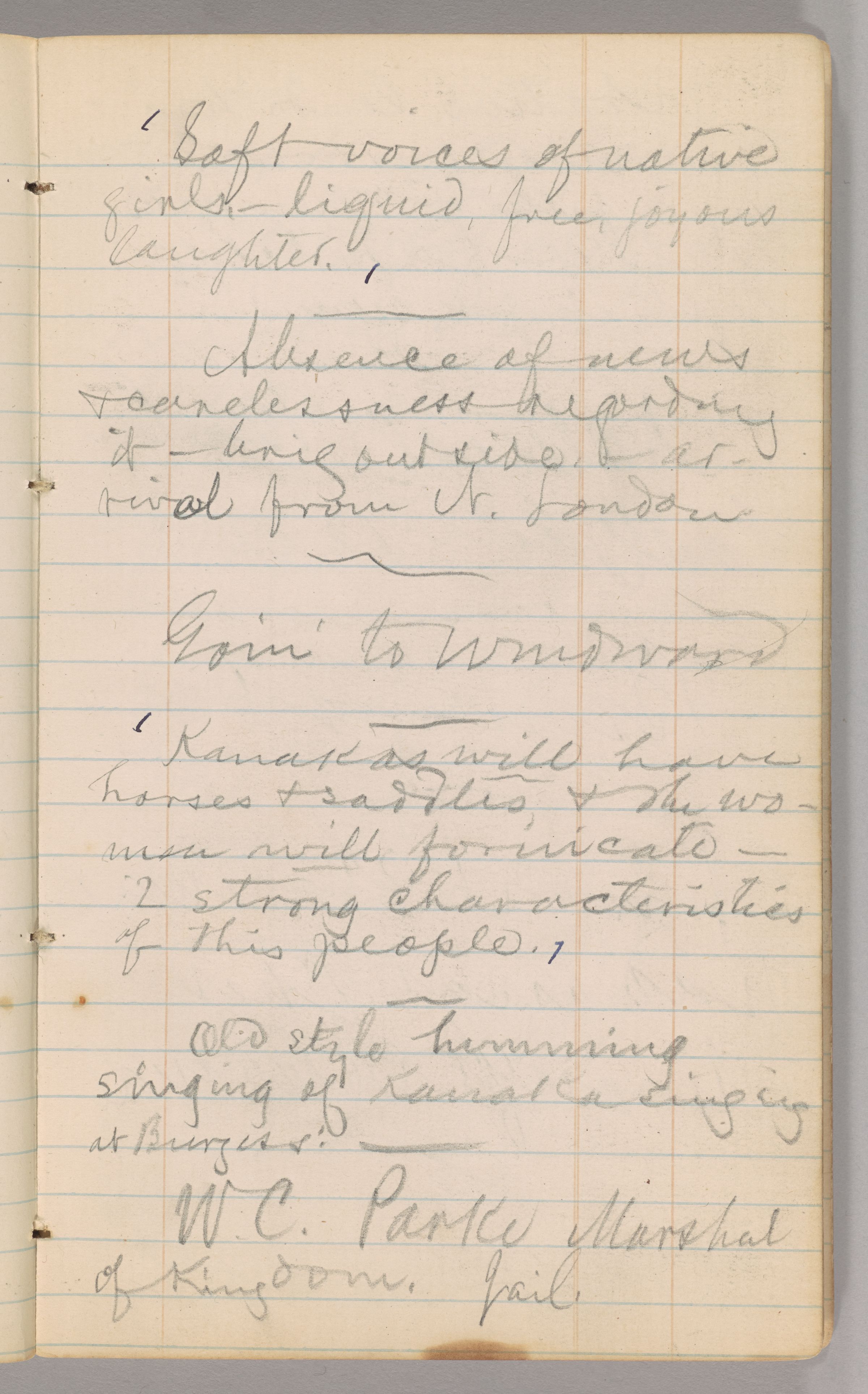
Soft voices of native
girls.—liquid, free, joyous
laughter.
Absence of news
& carelessness regarding
it—brig outside.—ar-
rivalarrival from N. London.
Goin' to windward
Kanakas will have
horses & saddles, & the wo-
menwomen will fornicate—
2 strong characteristics
of this people.
Old style humming
singing of Kanaka singing
at Burgess'.116
W. C. Parke Marshal
of Kingdom.117 Jail.
[MS: N6_leaf_061v]
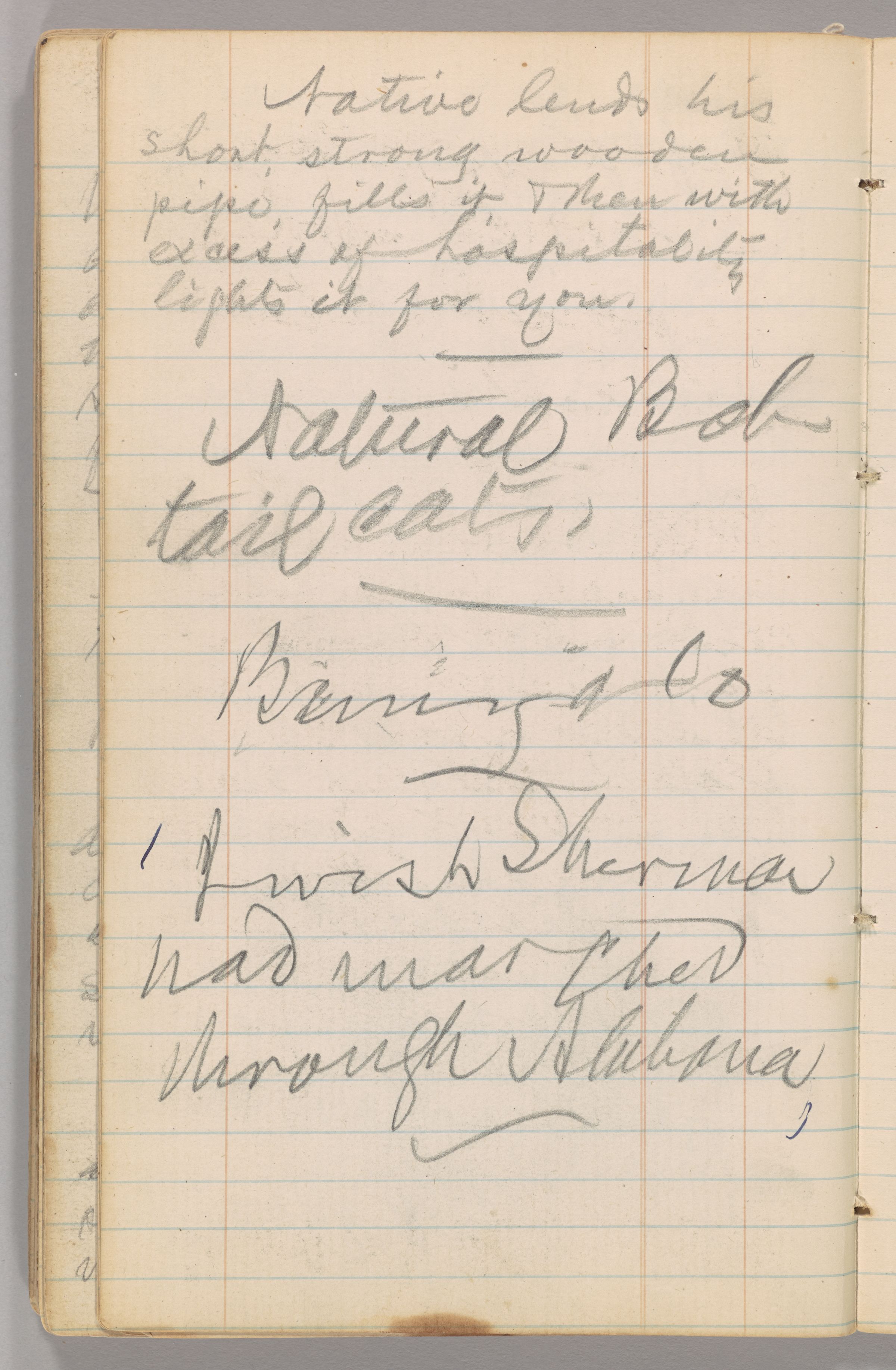
Native lends his
short, strong wooden
pipe, fills it, & then with
excess of hospitality
lights it for you.
Natural Bob-
tailBob-tailⓂemendation cats.118
Bungalo
I wish Sherman
had marched
through Alabama
[MS: N6_leaf_062r]
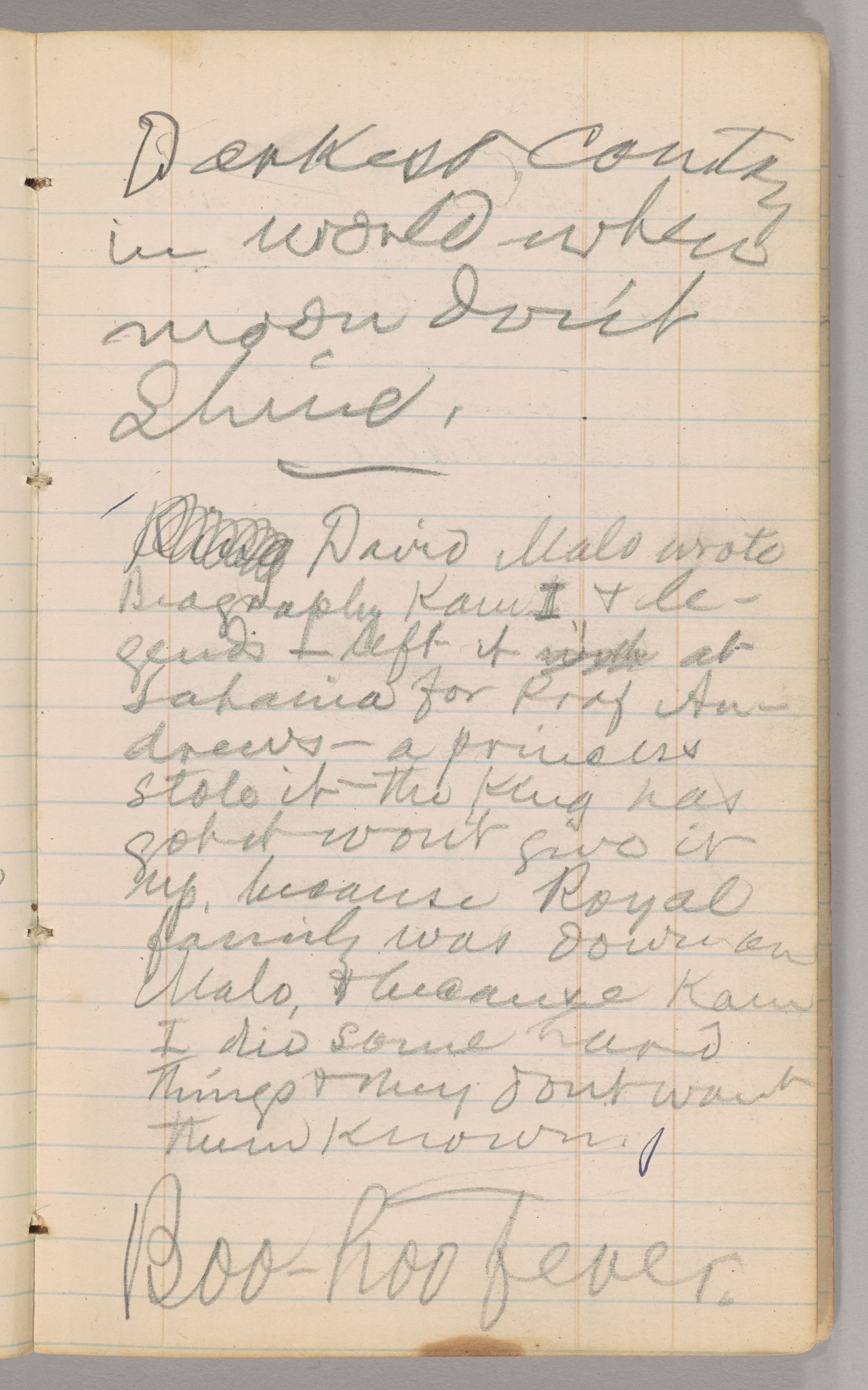
Darkest contry
in world when
moon don't
shine.
King David Malo wrote
Biography Kam. I, & le-
gendslegends—left it with at
Lahaina for Prof An-
drewsAndrews—a princess
stole it119—the King has
got it won't give it
up, because Royal
family was down on
Malo, & because Kam
I did some hard
things & they dont want
them known.
Boo-hoo fever.120
[MS: N6_leaf_062v]
[MTP: N&J1_229]
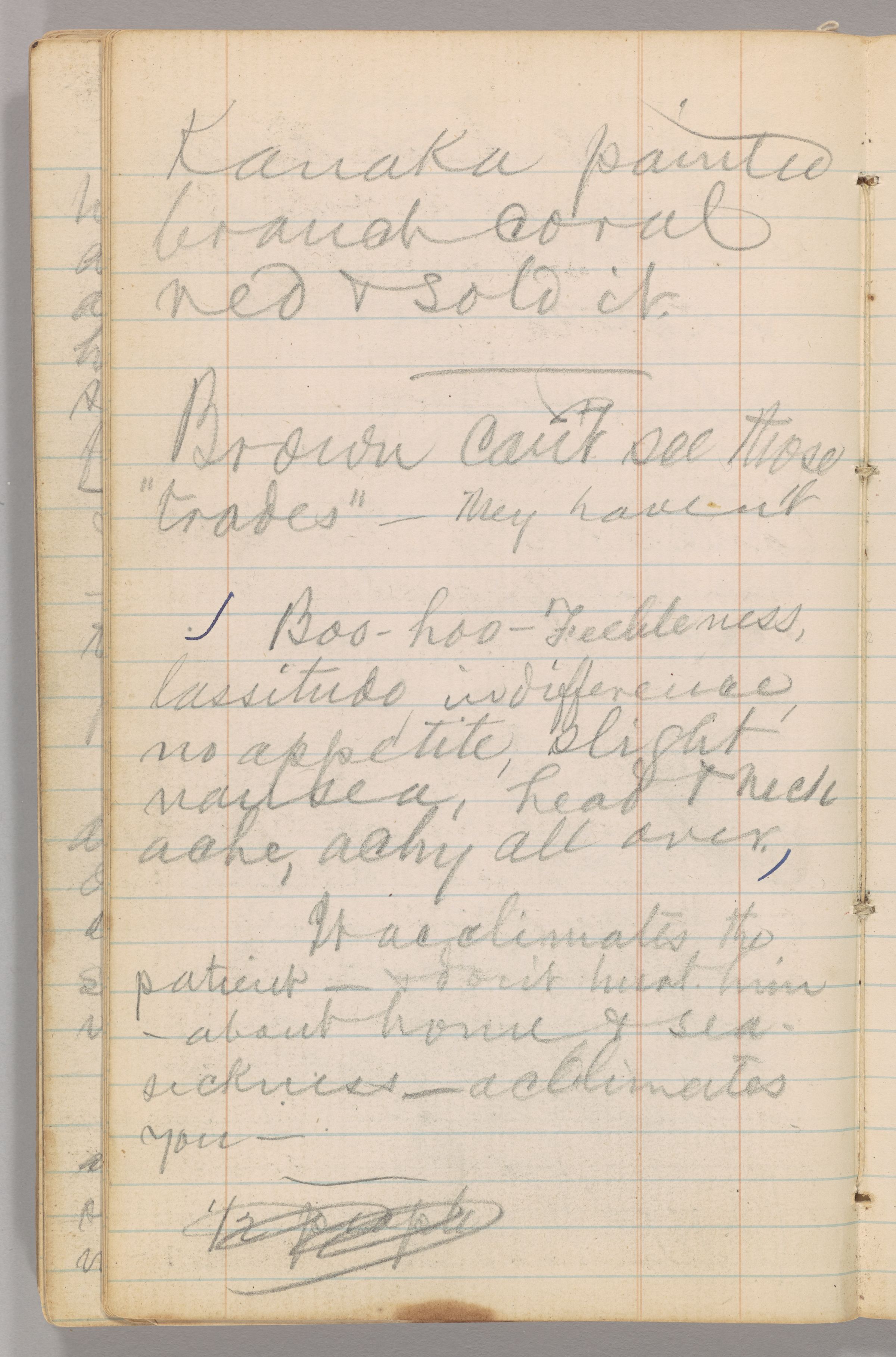
Kanaka painted
branch coral
red & sold it.
Brown can't see those
“trades”—they haven't
Boo-hoo—Feebleness,
lassitude, indifference,
no appetite, slight
nausea, head & neck
ache, achy all over.
It acclimates the
patient—& don't hurt him
—about home & sea-
sicknesssea-sicknessⓂemendation—acclimates
you—
½ people
[MS: N6_leaf_063r]
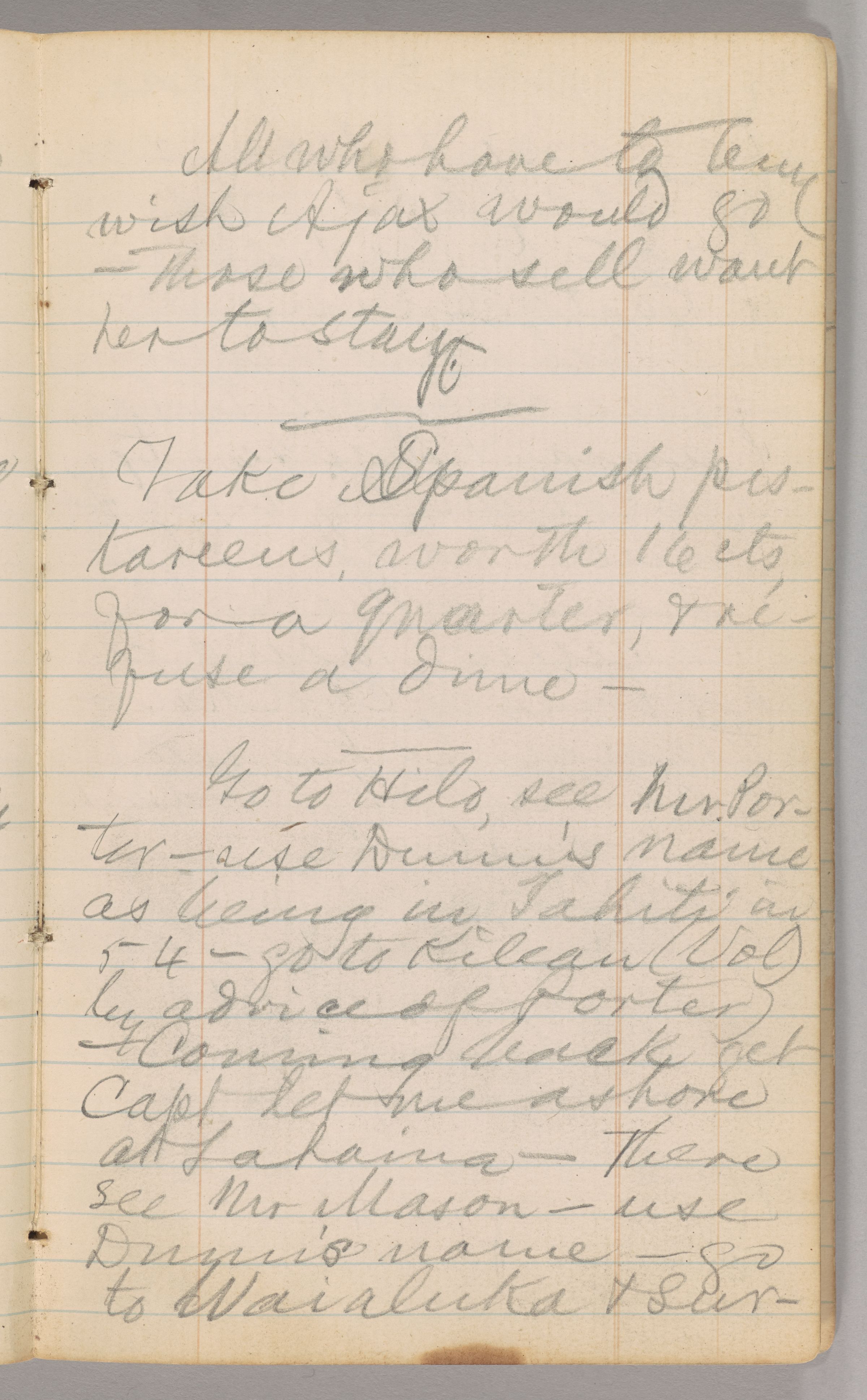
All who have to buy
wish Ajax would go
—those who sell want
her to stay.
Take M Spanish pis-
tareenspistareens, worth 16 cts,
for a quarter, & re-
fuserefuse a dime—
Go to Hilo, see Mr. Por-
terPorter—use Dunn's121 name
as being in Tahiti in
54—go to Kileau (Vol)
by advice of Porter)
—Coming back get
Capt let me ashore
at Lahaina—there
see Mr Mason122—use
Dunn's name—go
to Waialuka & sur-
[MS: N6_leaf_063v]
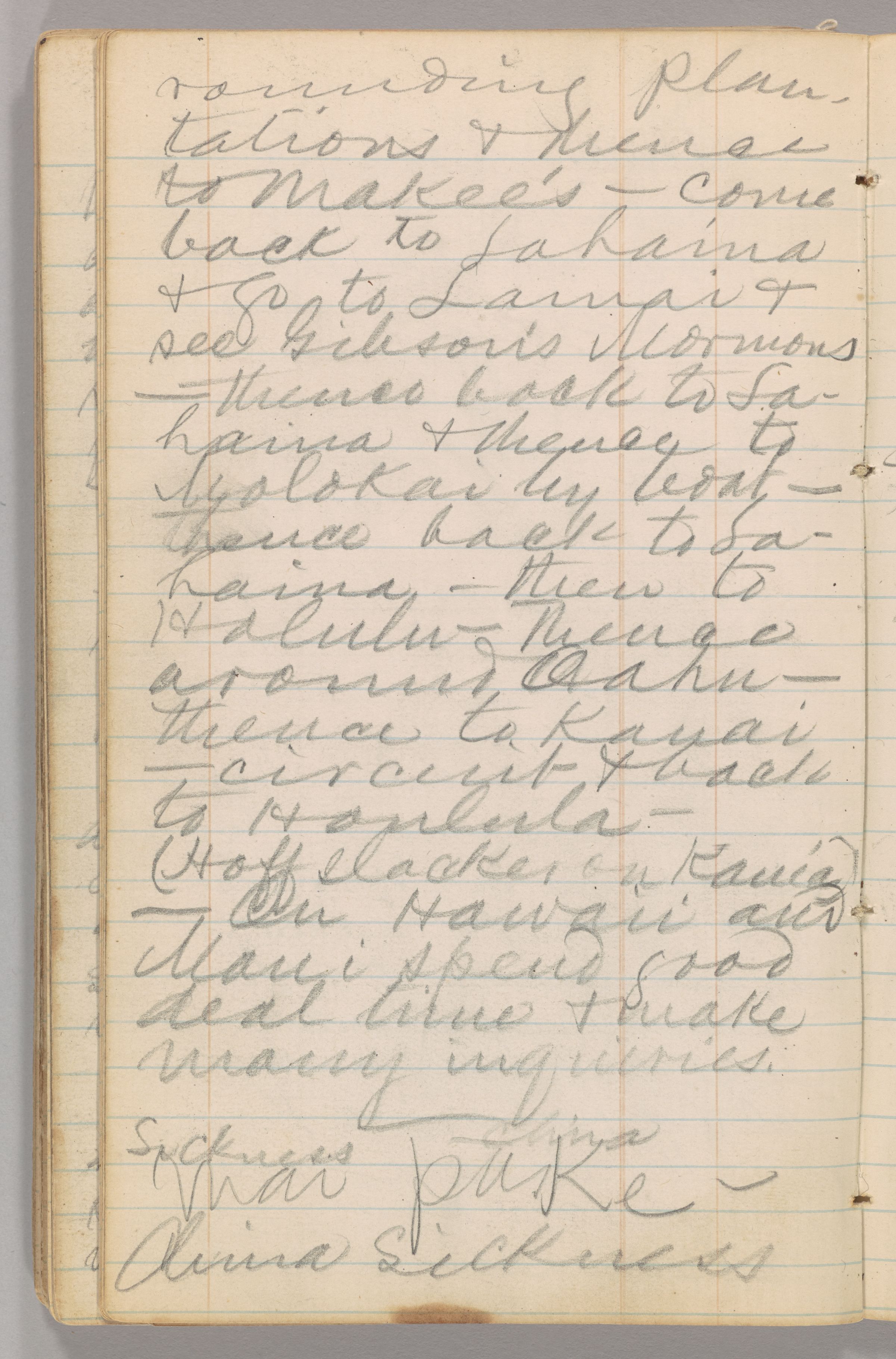
rounding plan-
tationsplantations & thence
to Makee's123—come
back to Lahaina
& go to Lainai &
see Gibson's Mormons124
—thence back to La-
hainaLahaina & thence to
Molokai by boat—
thence back to La-
hainaLahaina—then to
Holulu—thence
around U Oahu—
thence to Kauai
—circuit & back
to Honlula—
(Hoffslacker on Kauia)
—On Hawaii and
Maui spend good
deal time & make
many inquiries.125
Sickness China
[MTP: N&J1_230]
Mai pake—
China sickness126
[MS: N6_leaf_064r]
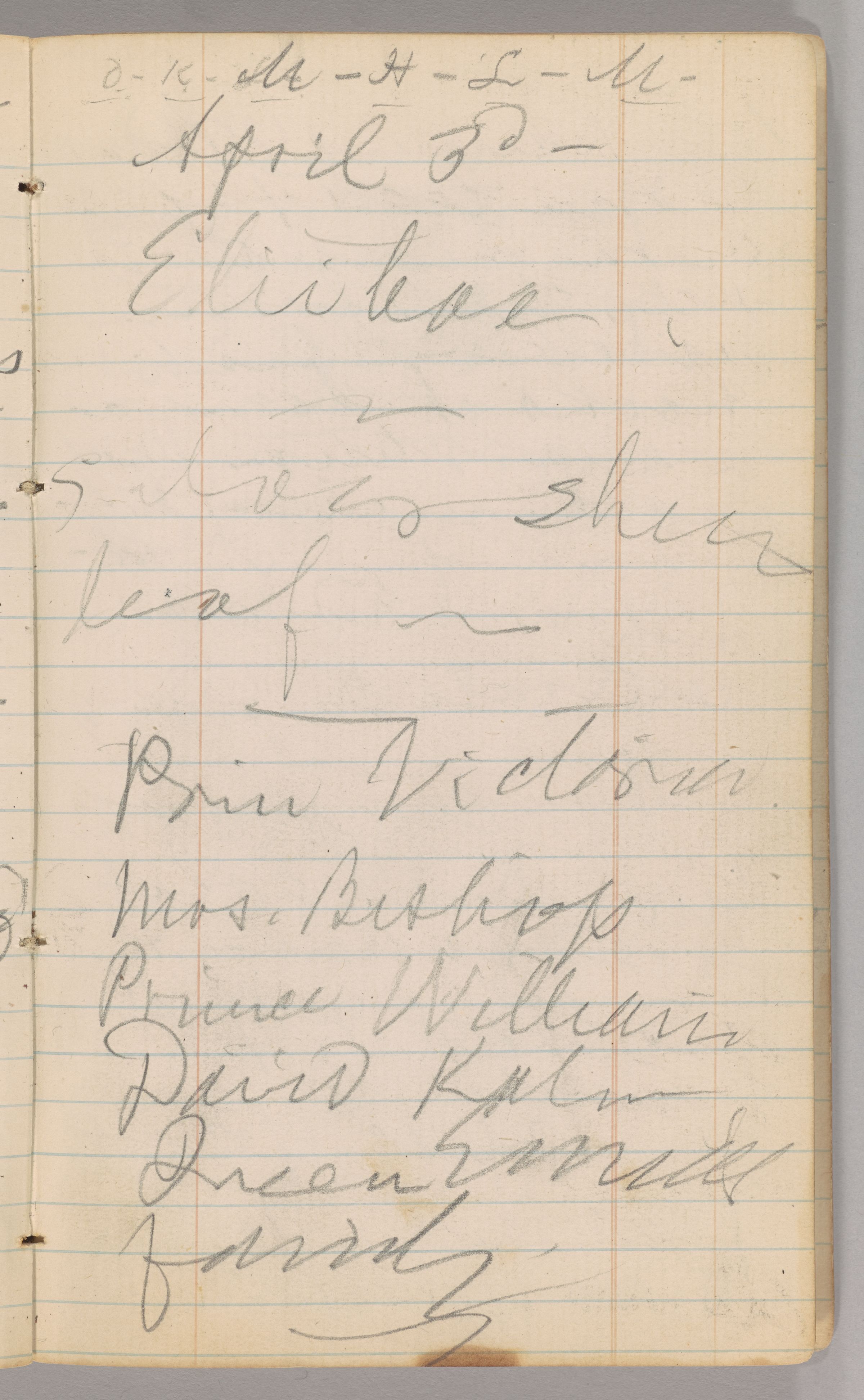
O–K–LM–H–L–M–
April 3d—127
Eliiboe128
Silver sheerⓂemendation leaf—
Prin Victoria
Mrs. Bishop
Prince William
David Kalu
Queen Emma's
family.
[MS: N6_leaf_064v]
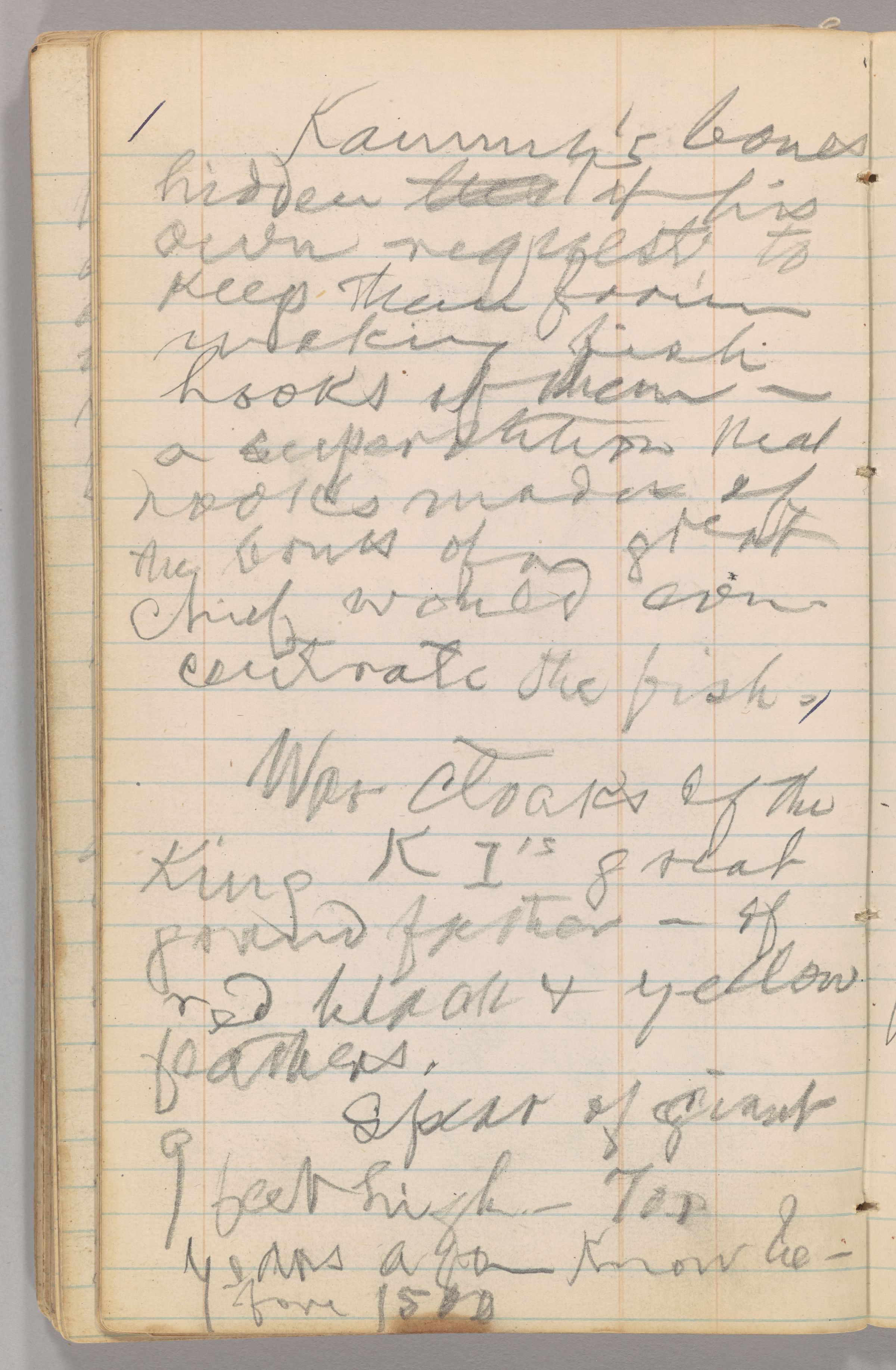
Kammy's bones
hidden luc at his
own request, to
keep them from
making fish
hooks of them—
a superstition that
hooks made of
the bones of a great
Chief would con-
centrateconcentrate the fish.
War cloaks of the
King K I's great
grand father—of
red black & yellow
feathers.
Spear of giant
9 feet high.—700
years ago—know be-
forebefore 1500
[MS: N6_leaf_065r]
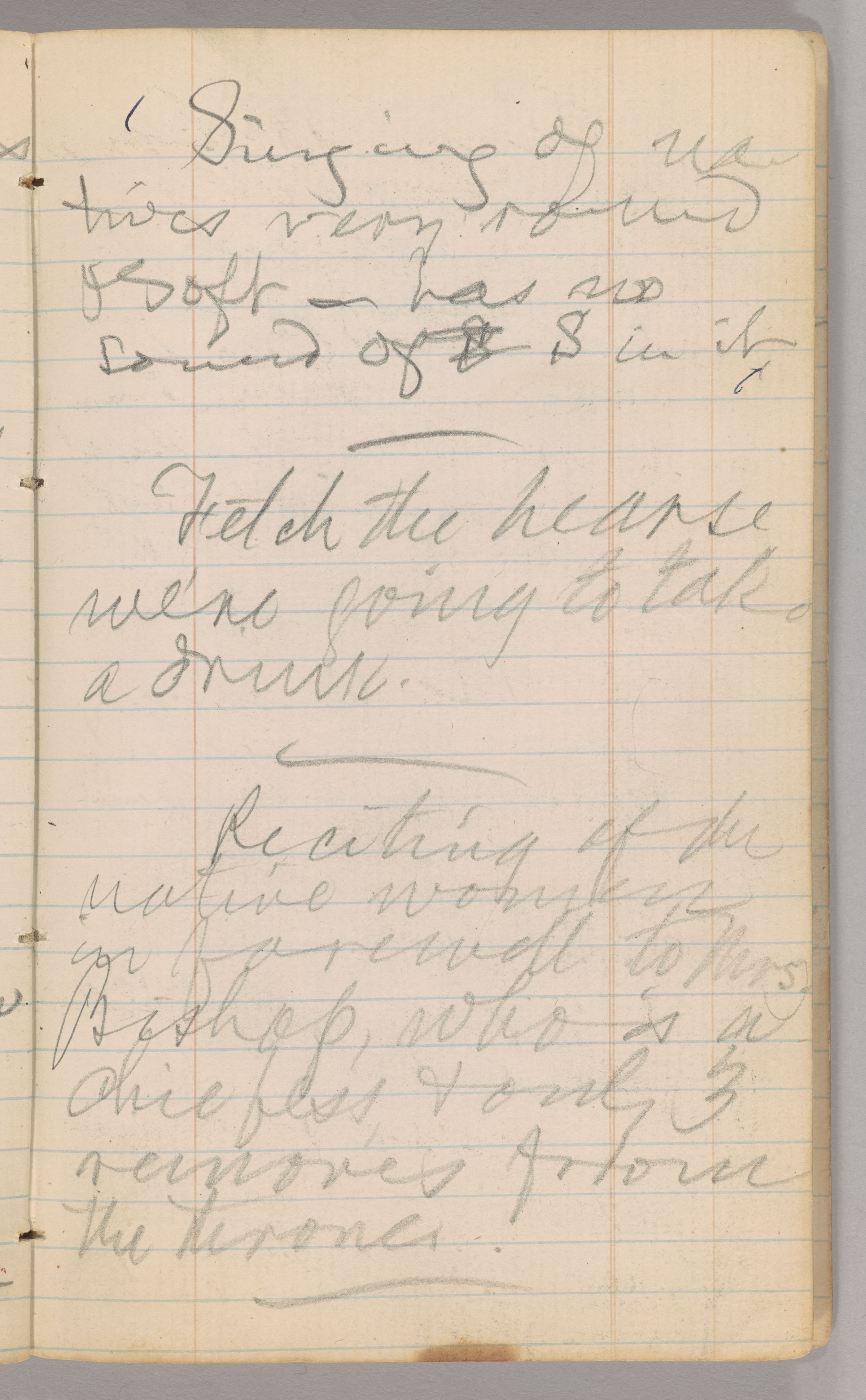
Singing of na-
tivesnatives very round
& soft—has no
sound of SⓂemendation in it.
Fetch the hearse
we're going to take
a drink.
[MTP: N&J1_231]
Reciting of the
native women
in farewell to Mrs.
Bishop, who is a
chiefess, & only 3
removes from
the throne.129
[MS: N6_leaf_065v]
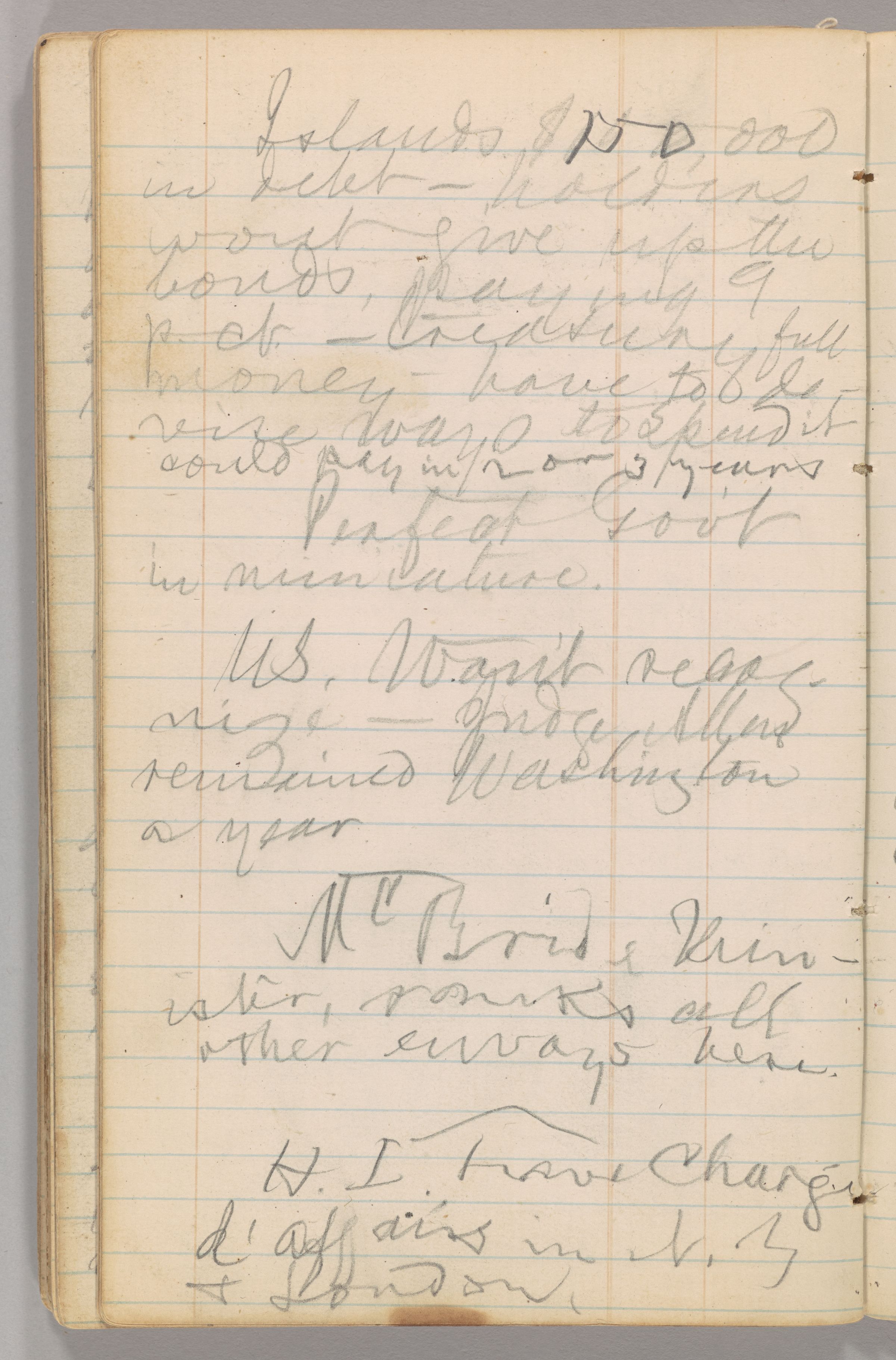
Islands $ 100,000 150,000Ⓣtextual note
in debt—holders
wont give up the
bonds, paying 9
p. ct.—treasury full
money—have to de-
visedevise ways to spend it
could pay in 2 or 3 years
Perfect Gov't
in miniature.
US. Won't recog-
nizerecognize—Judge Allen
remained Washington
a year130
McBride Min-
isterMinister, ranks all
other envoys here.131
H. I. have Chargé
d'affairs in N. Y
& London.
[MS: N6_leaf_066r]
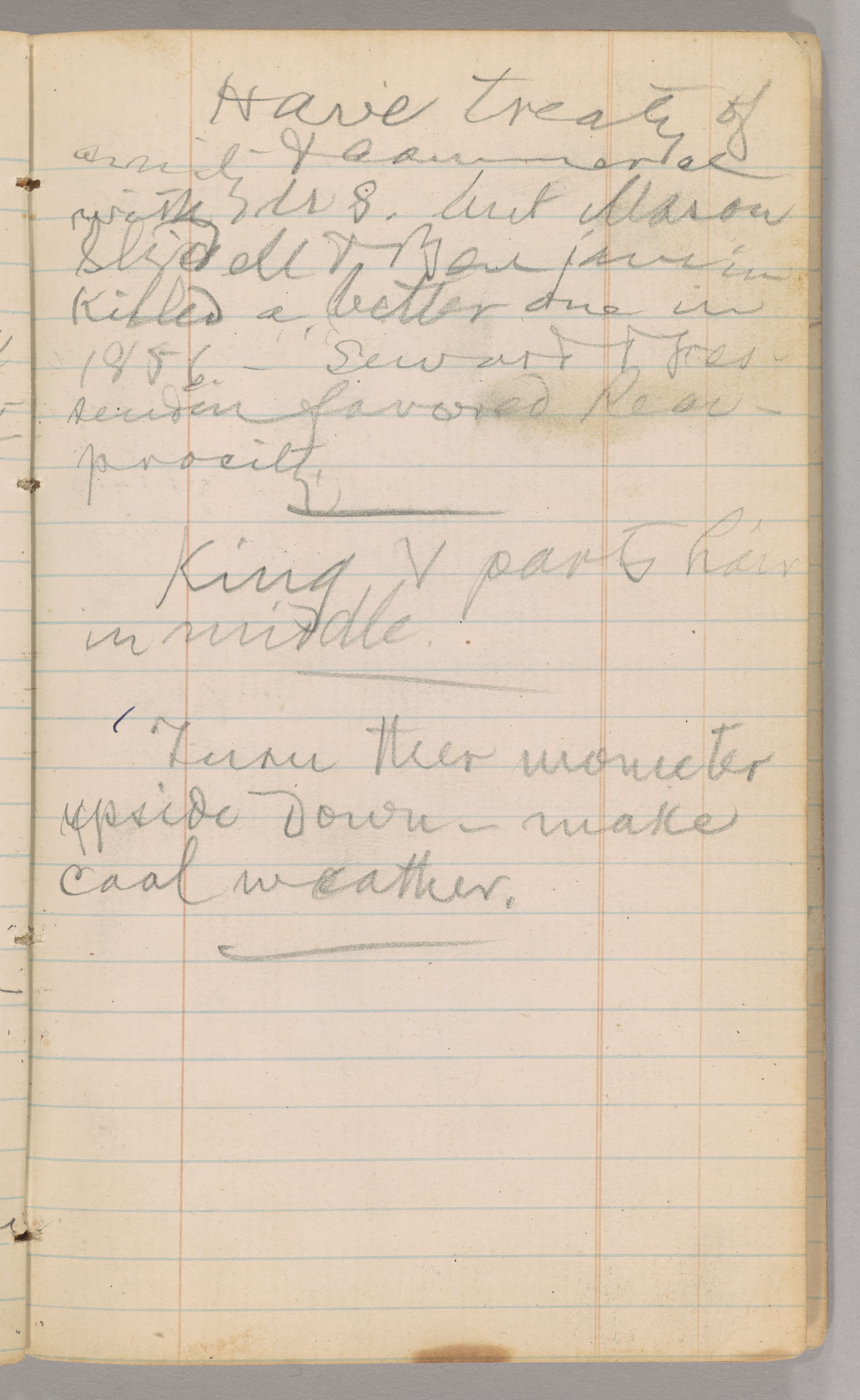
Have treaty of
amity & commerce
with U S.132 but Mason
Slidell & Benjamin
killed a better one in
1856.—Seward & Fes-
sendenFessenden favored Reci--
procityReciprocity.
King V parts hair
in middle.
Turn thermometer
upside down—make
cool weather.
[MS: N6_leaf_066v]
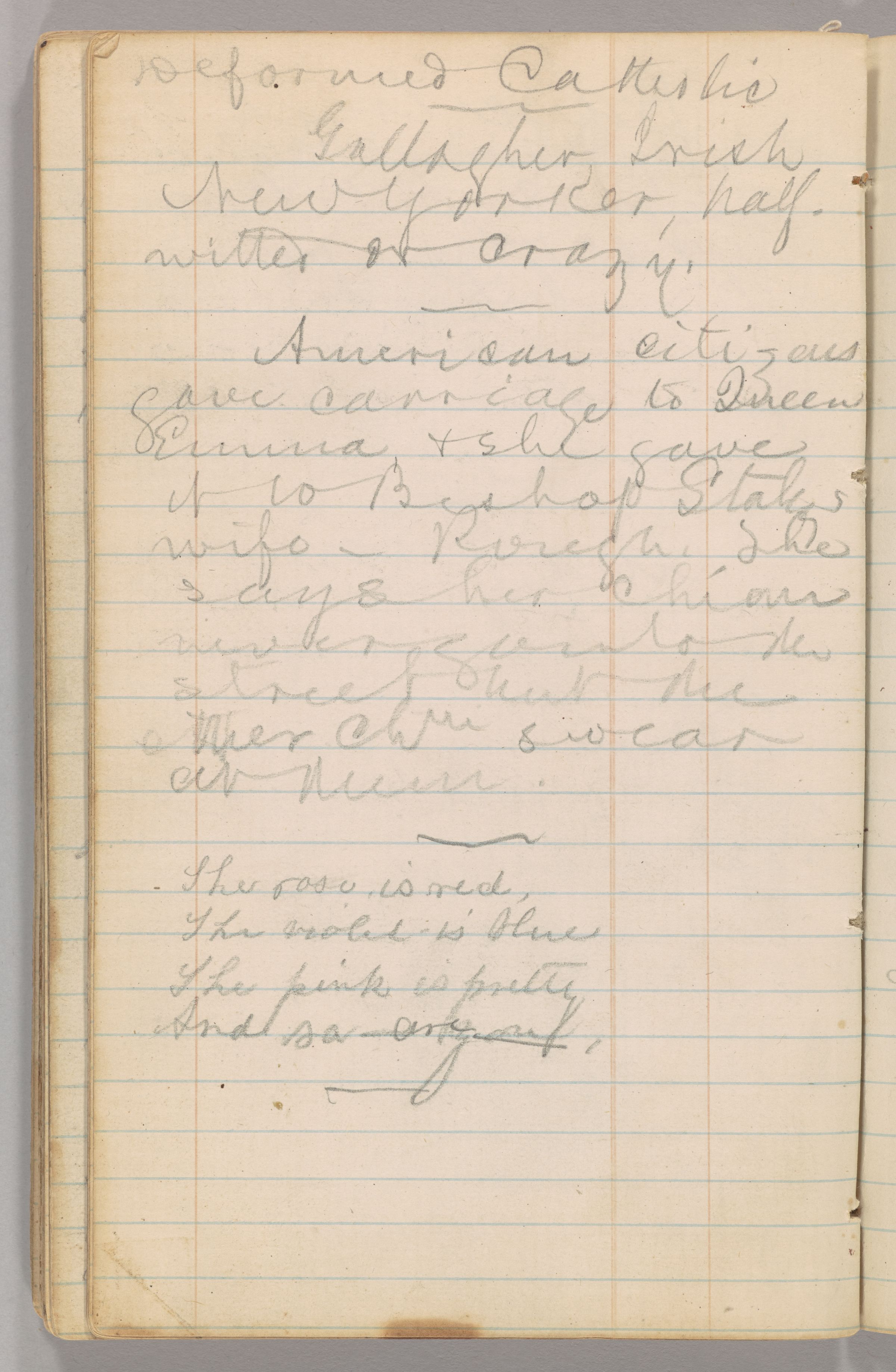
Deformed Catholic
Gallagher, Irish
New Yorker, half-
wittedhalf-wittedⓂemendation or crazy.133
American citizens
gave carriage to Queen
Emma, & she gave
it to Bishop Staleys
wife—Rough. She
says her chian
never go into the
street but the
other chn swear
at them.
[MTP: N&J1_232]
[MS: N6_leaf_067r]
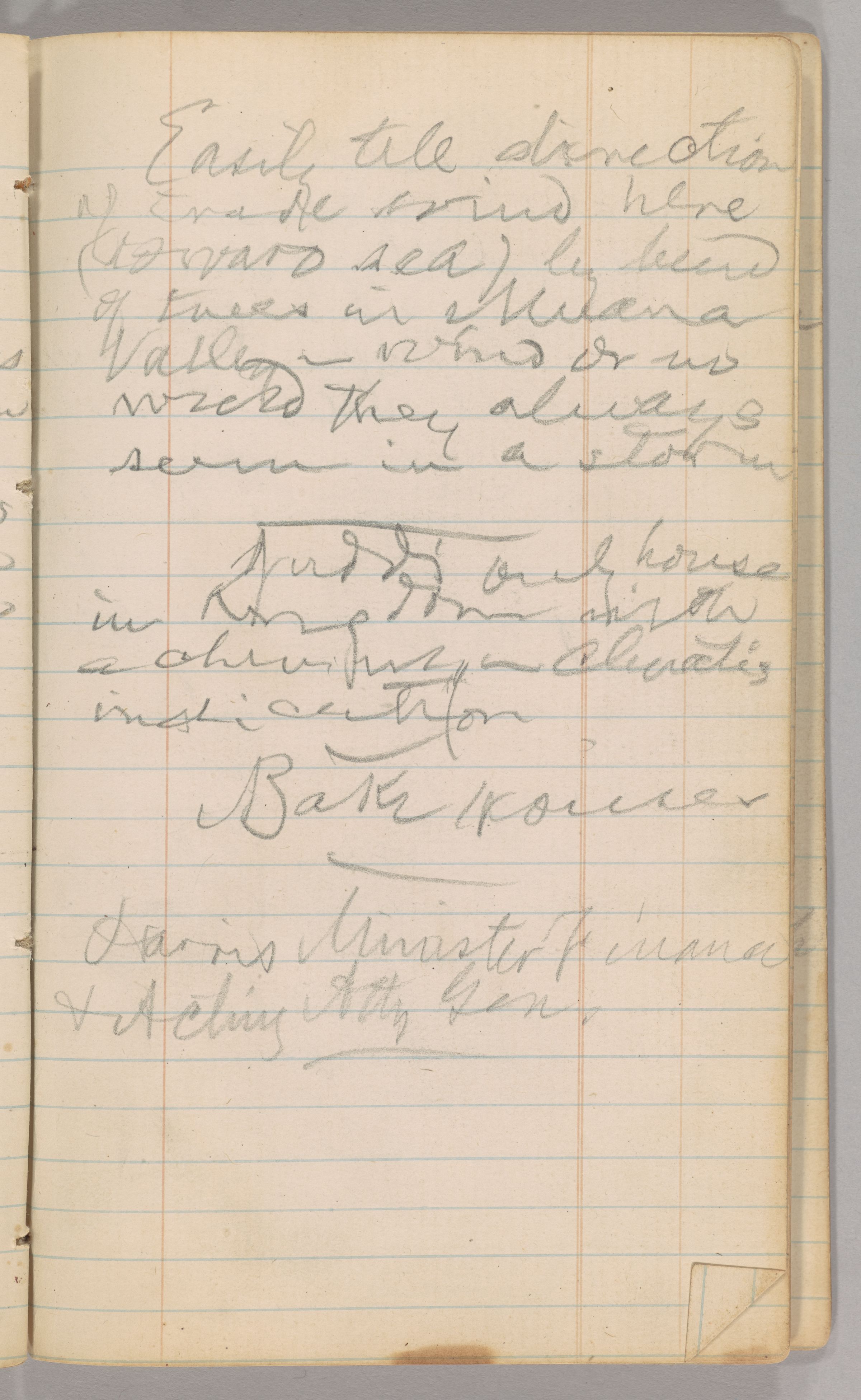
Easily tell direction
of trade wind here
(toward sea) by bend
of trees in Muana
Valley135—wind or no
wind they always
seem in a storm
Judd's only house
in Kingdom with
a chimney—climate's
indication.
Bake Houses
Harris Minister Finance
& Acting Atty Gen.
[MS: N6_leaf_067v]
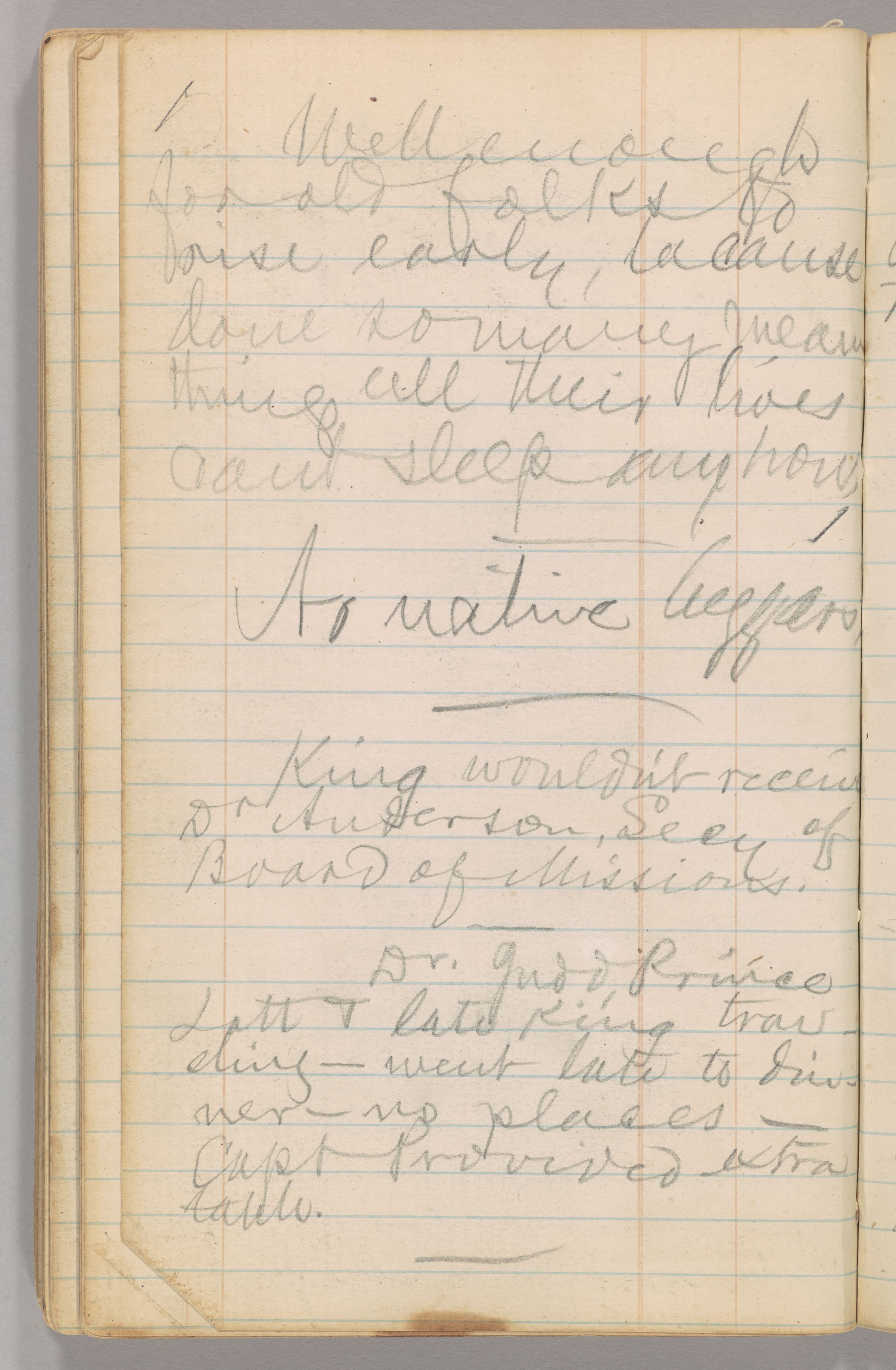
Well enough
for old folks to
rise early, because
done so many mean
things all their lives
cant sleep anyhow.
No native beggars.
King wouldn't receive
Dr Anderson, Secy of
Board of Missions.136
Dr. Judd, Prince
Lott & late King trav-
elingtraveling—went late to din-
nerdinner—no places—
Capt provided extra
table.
[MS: N6_leaf_068r]
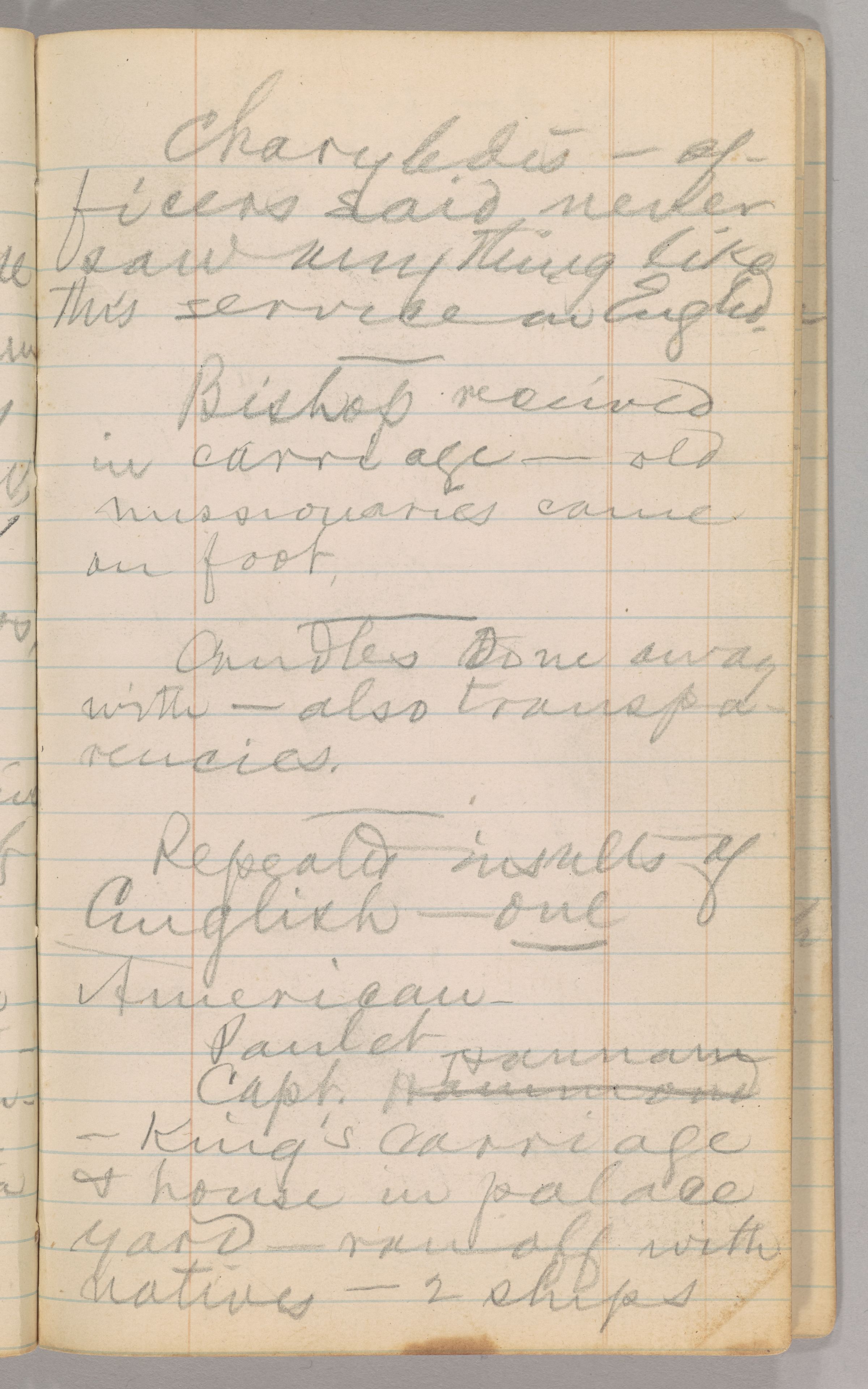
Charybdis—of-
ficersofficers said never
saw anything like
this service in Englnd.
Bishop received
in carriage—old
missionaries came
on foot.
[MTP: N&J1_233]
Candles t done away
with—also transpa-
renciestransparencies.
Repeated insults of
English—one
American—
Paulet
Capt. Hammond Hannam
—King's carriage
& house in palace
yard—ran off with
natives—2 ships
[MS: N6_leaf_068v]
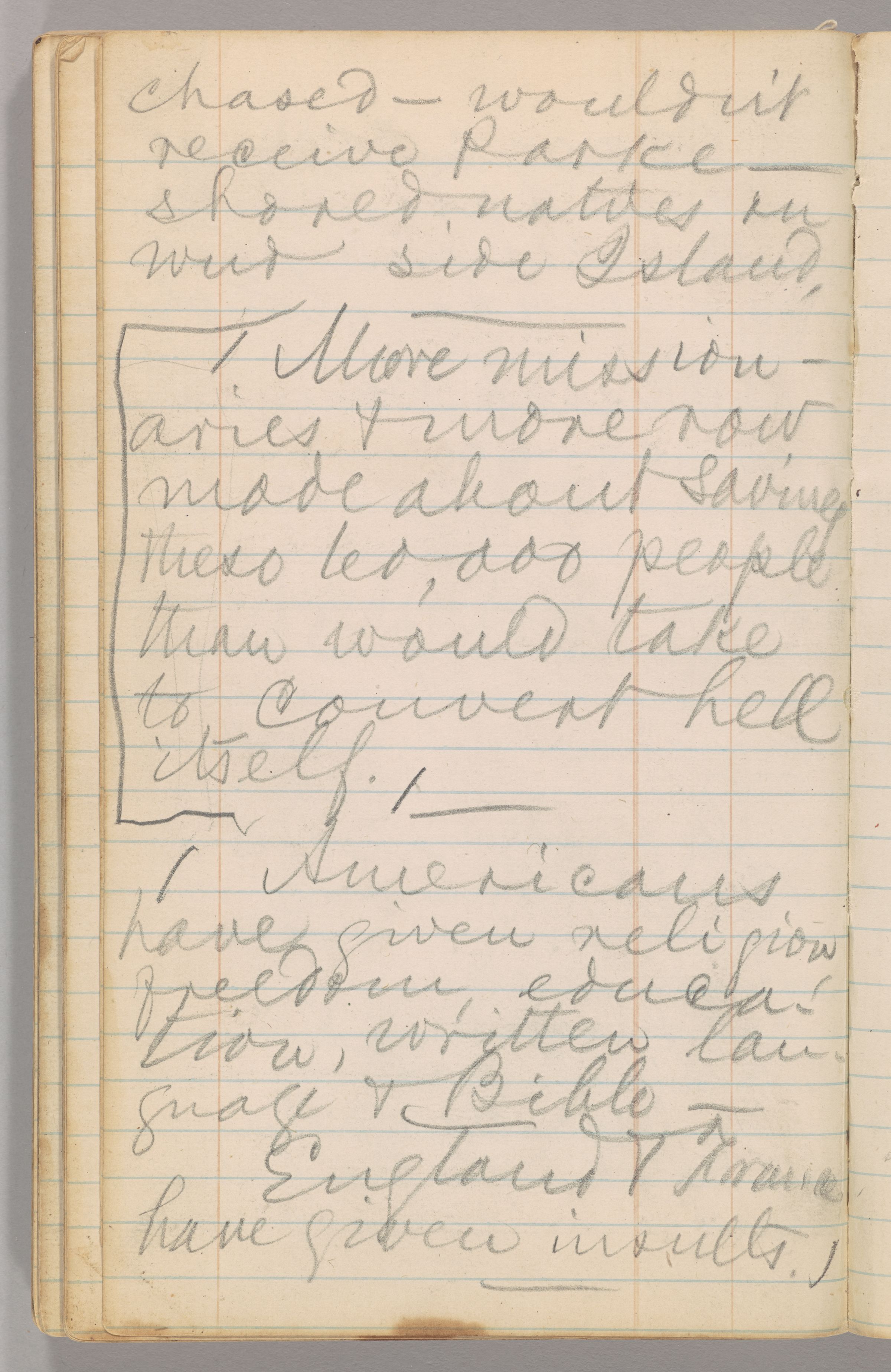
chased—wouldn't
receive Parke—
shored natives on
wnd side Island.137
More mission-
ariesmissionaries & more row
made about saving
these 60,000 people
than would take
to convert hell
itself.
Americans
have given religion,
freedom, educa-
tioneducation, written lan-
guagelanguage & Bible—
England & France
have given insults.
[MS: N6_leaf_069r]
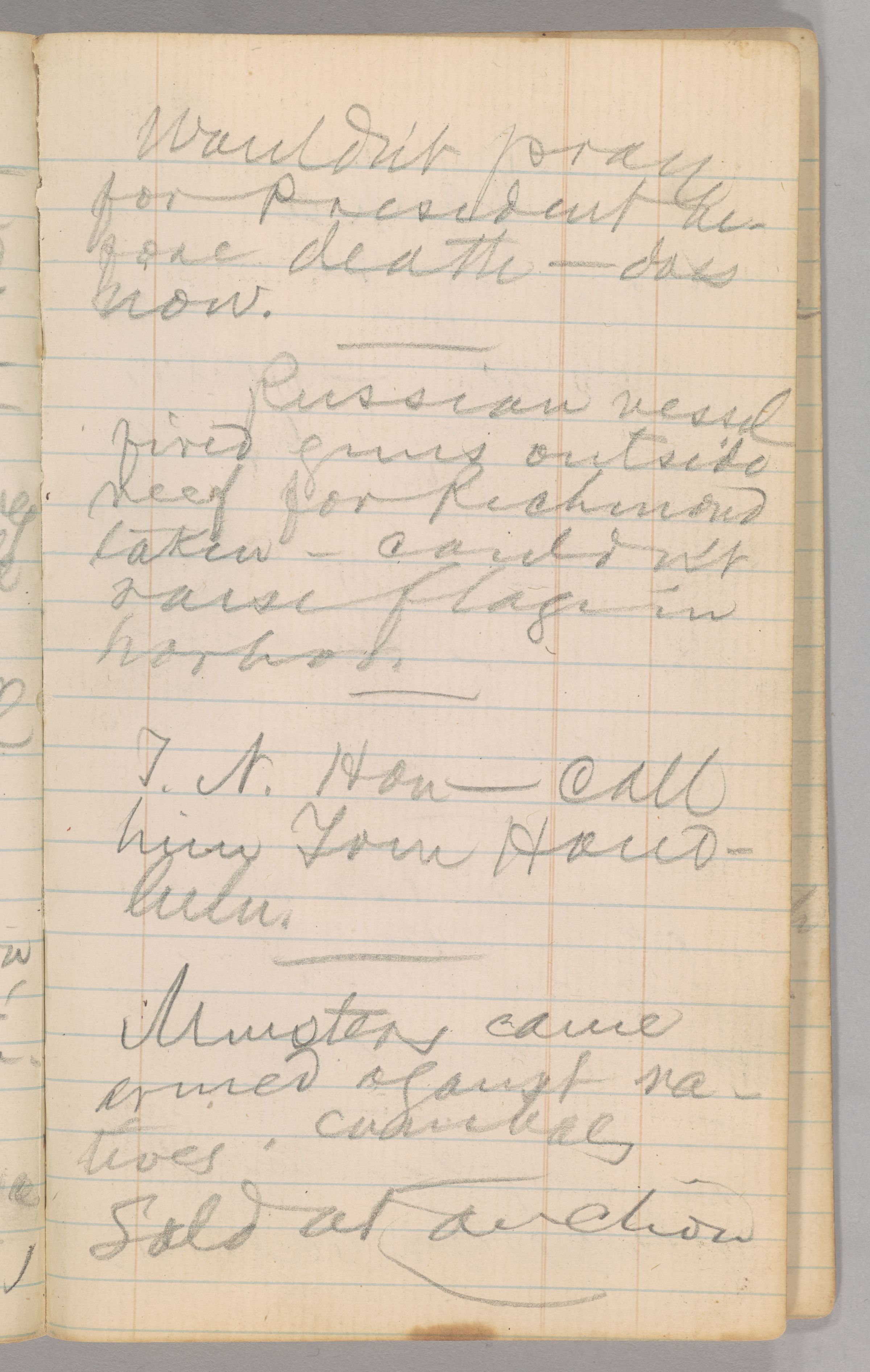
Wouldn't pray
for president be-
forebefore death—does
now.
Russian vessel
fired guns outside
reef for Richmond
taken—couldn't
raise flags in
harbor.
T. N. Hon—Call
him Tom Hono-
luluHonolulu.138
Minsters came
armed aganst na-
tivesnatives, canibals
Sold at auction
[MS: N6_leaf_069v]
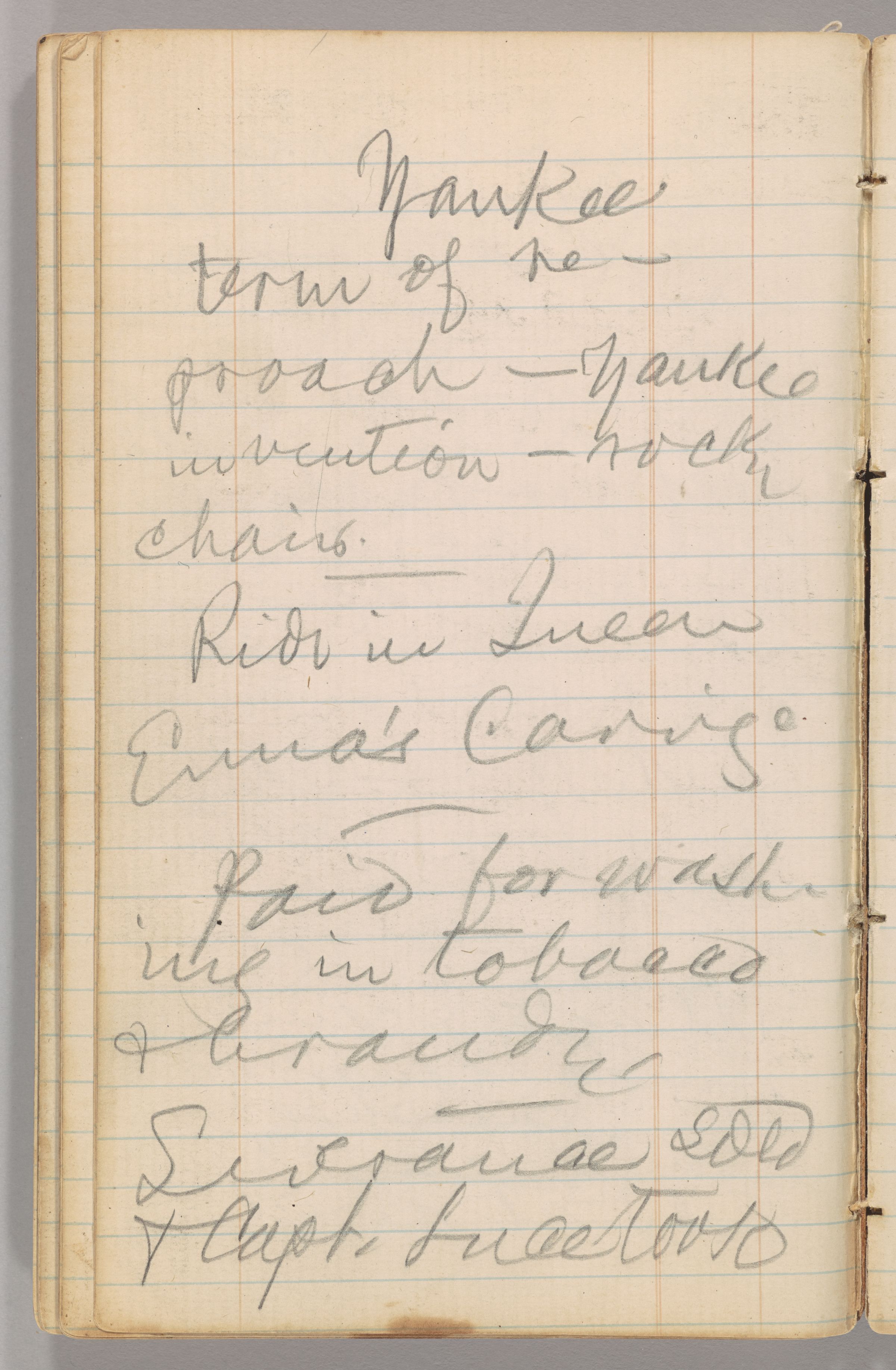
Yankee
term of re-
proachreproach—Yankee
invention—rocky
chairs.
Ride in Queen
Emma's Carrige
Paid for wash-
ingwashing in tobacco
& brandy.
Severance139 sold
& Capt. Luce140 took
[MS: N6_leaf_070r]
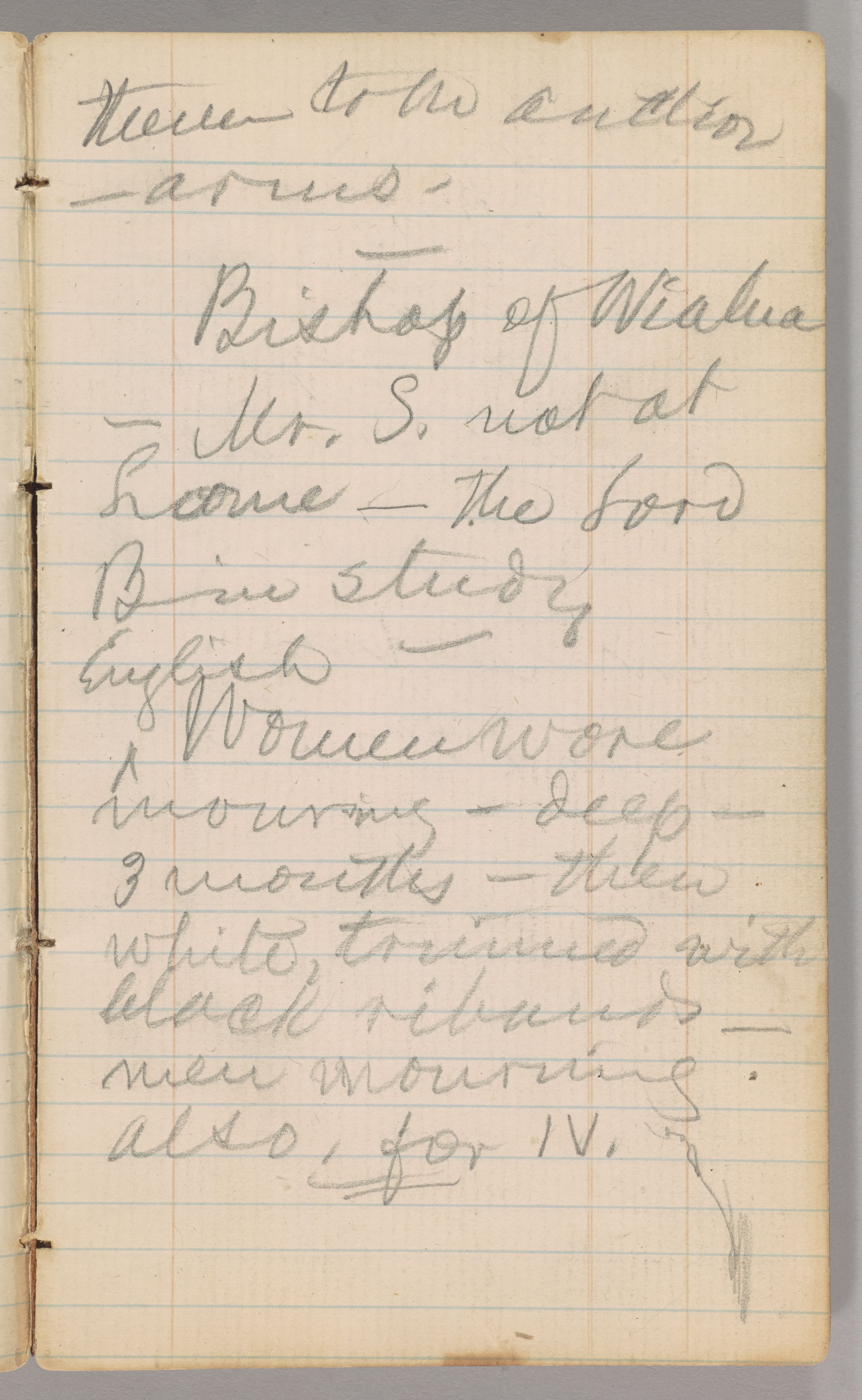
them to the auction
—arms.
Bishop of Wialua
—Mr. S. not at
home—the Lord
B in study
English Women wore
mourning—deep—
3 months—then
white, trimmed with
black ribands—
men mourning
also, for IV.141
[MS: N6_leaf_070v]
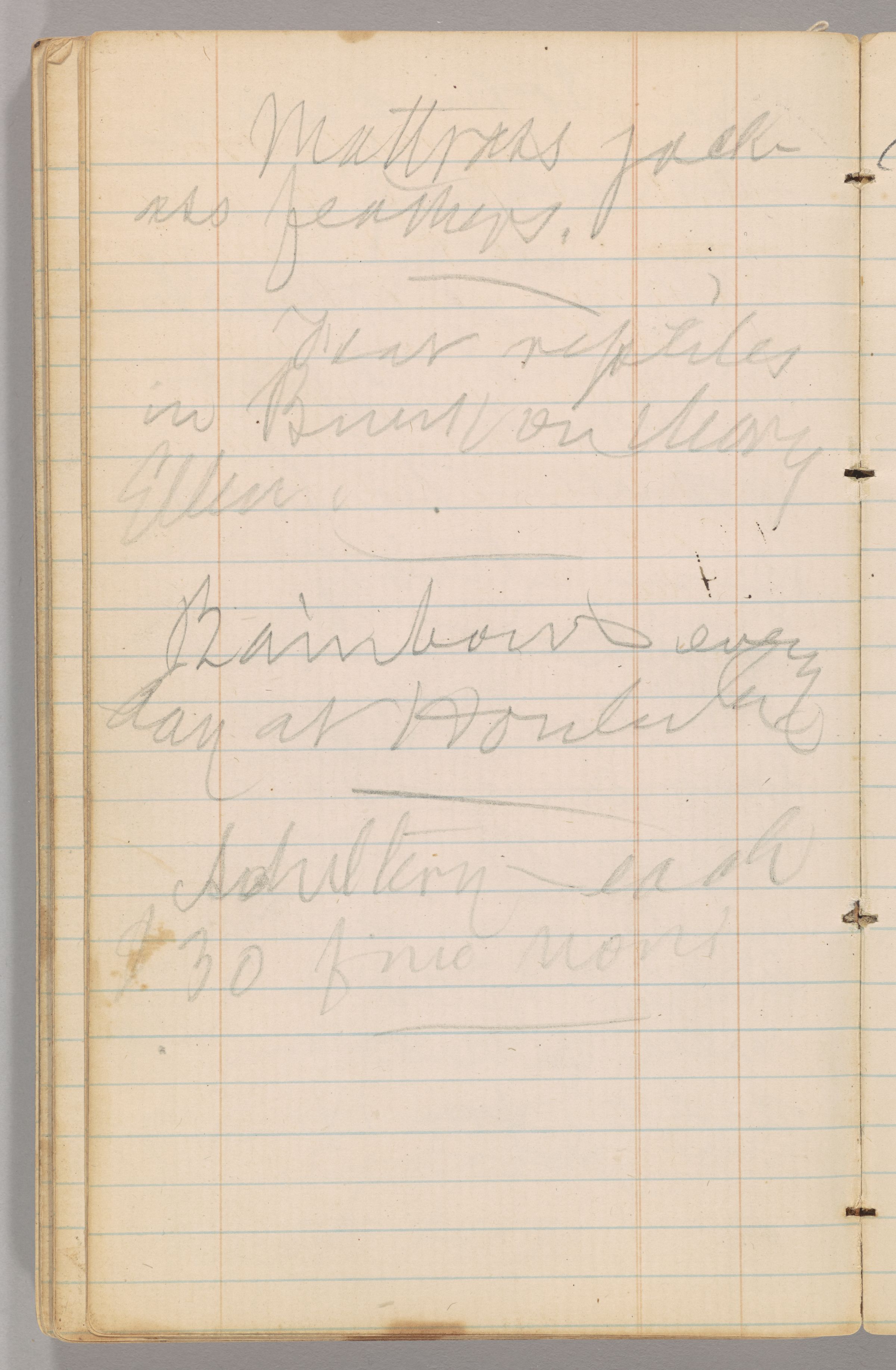
Mattrass jack-
assjackassⓂemendation feathers.
Fear reptiles
in Bunk on Mary
Ellen.
Rainbows every
day at Honlulu.
Adultery—each
$30 fine now.
[MS: N6_leaf_071r]
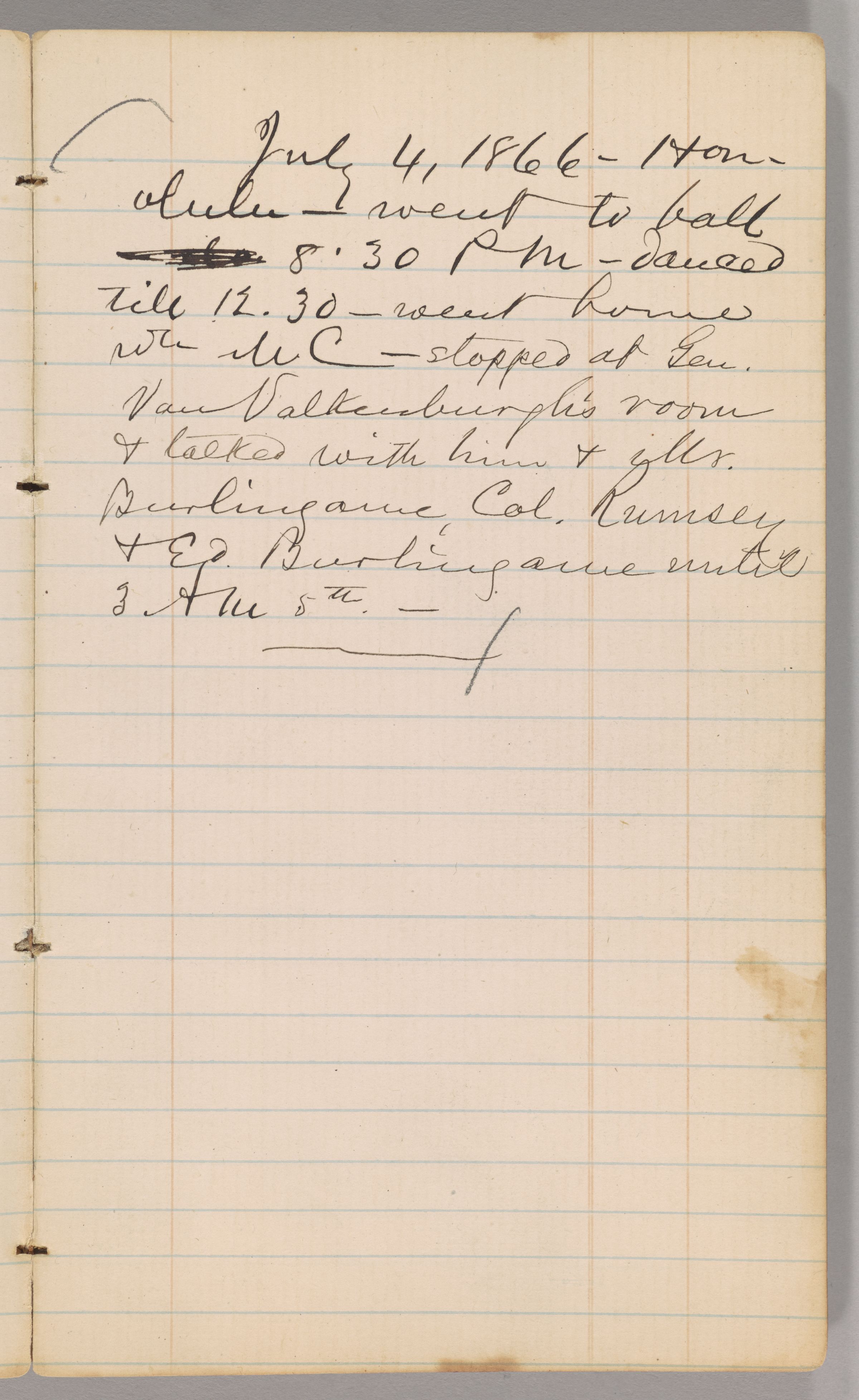
July 4, 1866142—Hon-
oluluHonolulu—went to ball
—da 8.30 PM—danced
till 12.30—went home
wh MC143—stopped at Gen.
Van Valkenburgh's room
& talked with him & Mr.
Burlingame, Col. Rumsey144
& Ed. Burlingame until
3 AM 5th.—Ⓣtextual note145
leaf_071v is a blank verso, followed by eight blank leaves and one blank recto (16.5 pages); the entries continue on leaf_080v
[MS: N6_leaf_080v]
inscribed upside down from the bottom of the page
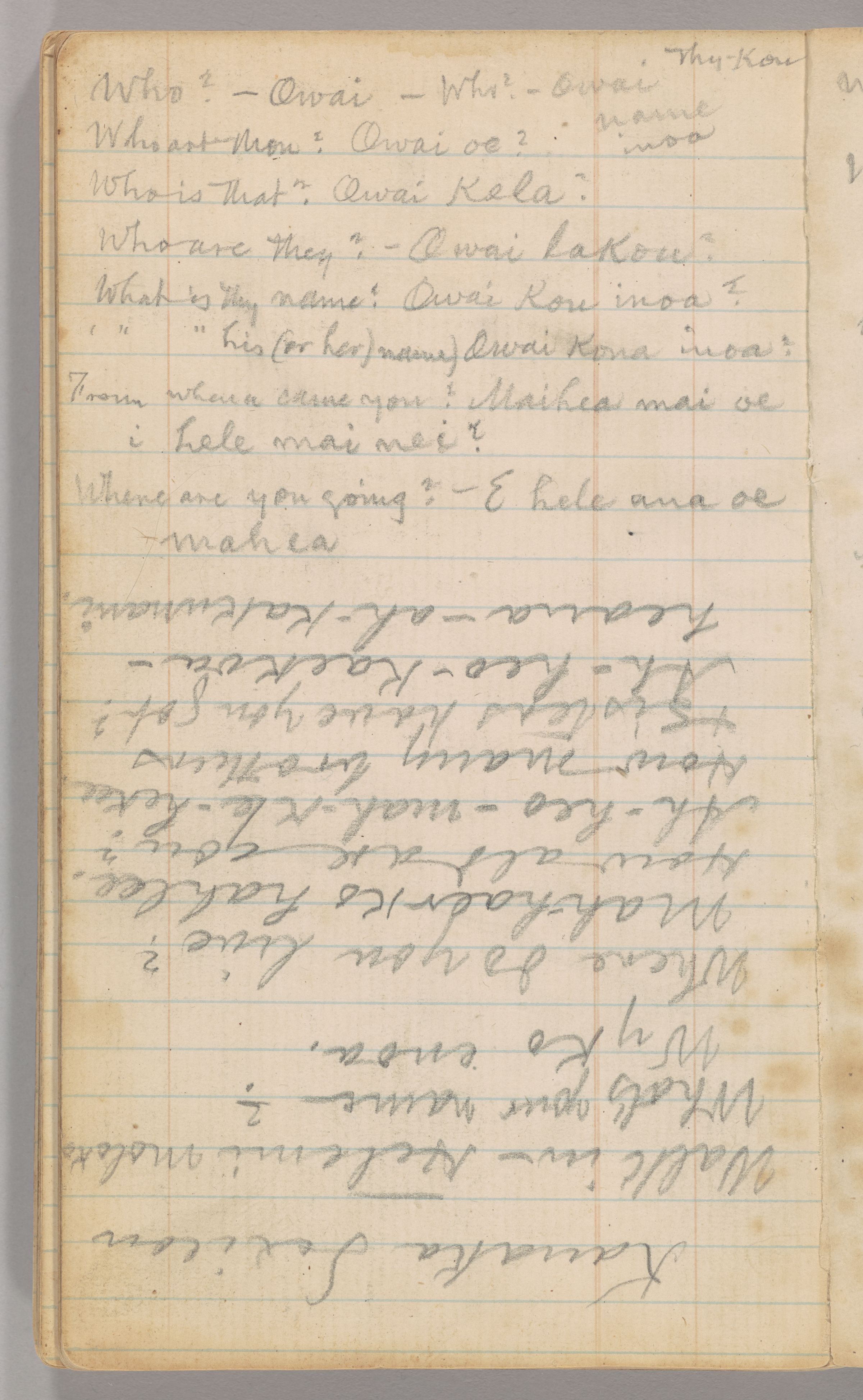
Kanaka Lexicon146
Walk in—Helemi moloko.
What's your name?
Wyko enoa.
Where do you live?
Mah-haerko hahlee.
How old are you?
Ah-heo-mah-ke-hekee.
How many brothers
& sisters have you got?
Ah-heo-kaekoa-
heaua-ah-kakunaniⓉtextual note.
inscribed from the top of the page
Who?—Owai—Who?—Owai Thy—kou
Who art thou? Owai oe? name inoa
Who is that? Owai kela?
Who are they?—Owai lakou?
What is thy name? Owai kou inoa?
“ ” his (or her) name) Owai kona inoa?
From whence came you? Maihea mai oe
i hele mai nei?
Where are you going?—E hele ana oe
maheaⓉtextual note
[MS: N6_back flyleaf recto]
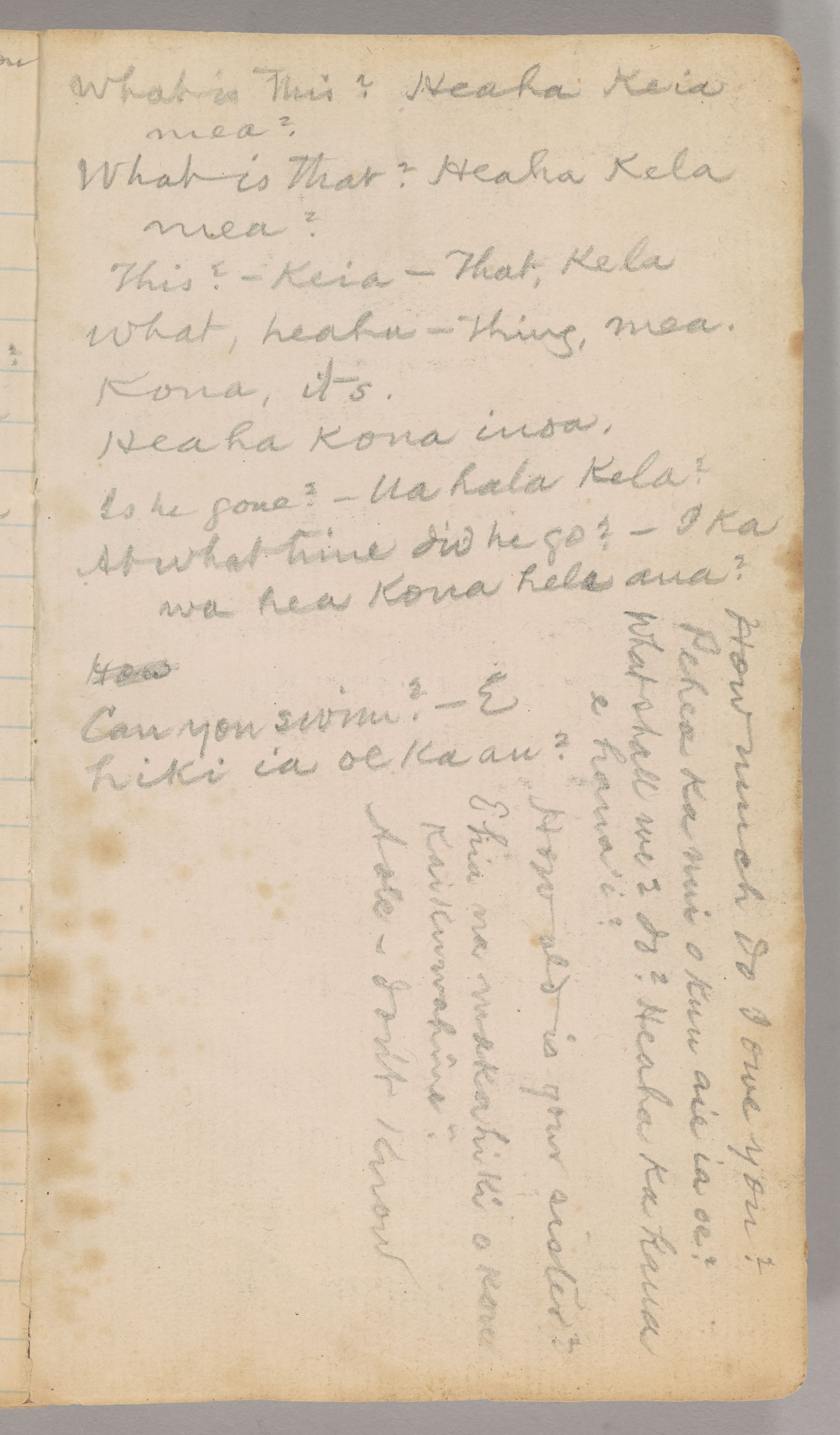
What is this? Heaha keia
mea?
What is that? Heaha kela
mea?
This?—Keia—That, kela
What, heahu—thing, mea.
Kona, its.
Heaha kona inoa.
Is he gone?—Ua hala kela?
At what time did he go?—I ka
wa hea kona hela ana?
How
Can you swim?—E
hiki ia oe ka au?
inscribed lengthwise:
How much do I owe you?
Pehea ka nui o kuu aie ia oe?
What shall we 2 do? Heaha ka kaua
e hana'i?
How old is your sister?
Ehia na makahiki o kou
kaikuwahine?
Aole—don't knowⓉtextual note
[MS: N6_back flyleaf verso]
the numbers in each list item below continue onto the facing page (inside back cover); they have been transcribed below as if the entries were on this page only (back flyleaf verso)
1 —page 4, 5, 10, 25, 26, 27, 28, 32, 33, 34, 35, 37, 38, 42, 49, 51, 72,
2 — — 4, 6, 29, 30, 40, 51,
3 — — 13, 33, 38, 39, 41, 42, 44, 51, 52, 84,
4 — — 28, 33,
5 — — 9,Ⓣtextual note147
Algeroba148
fine foliage
[MS: N6_back endpaper]
25
20
500
inscribed upside down from the bottom of the page
Boy dangled the
worm in the tasse, &
dit, G d yr ame, you
not tkl mon ◊
againⓉtextual note
[MS: N6_outside back cover]
J.Q.A. Warren is in here.Ⓣtextual note
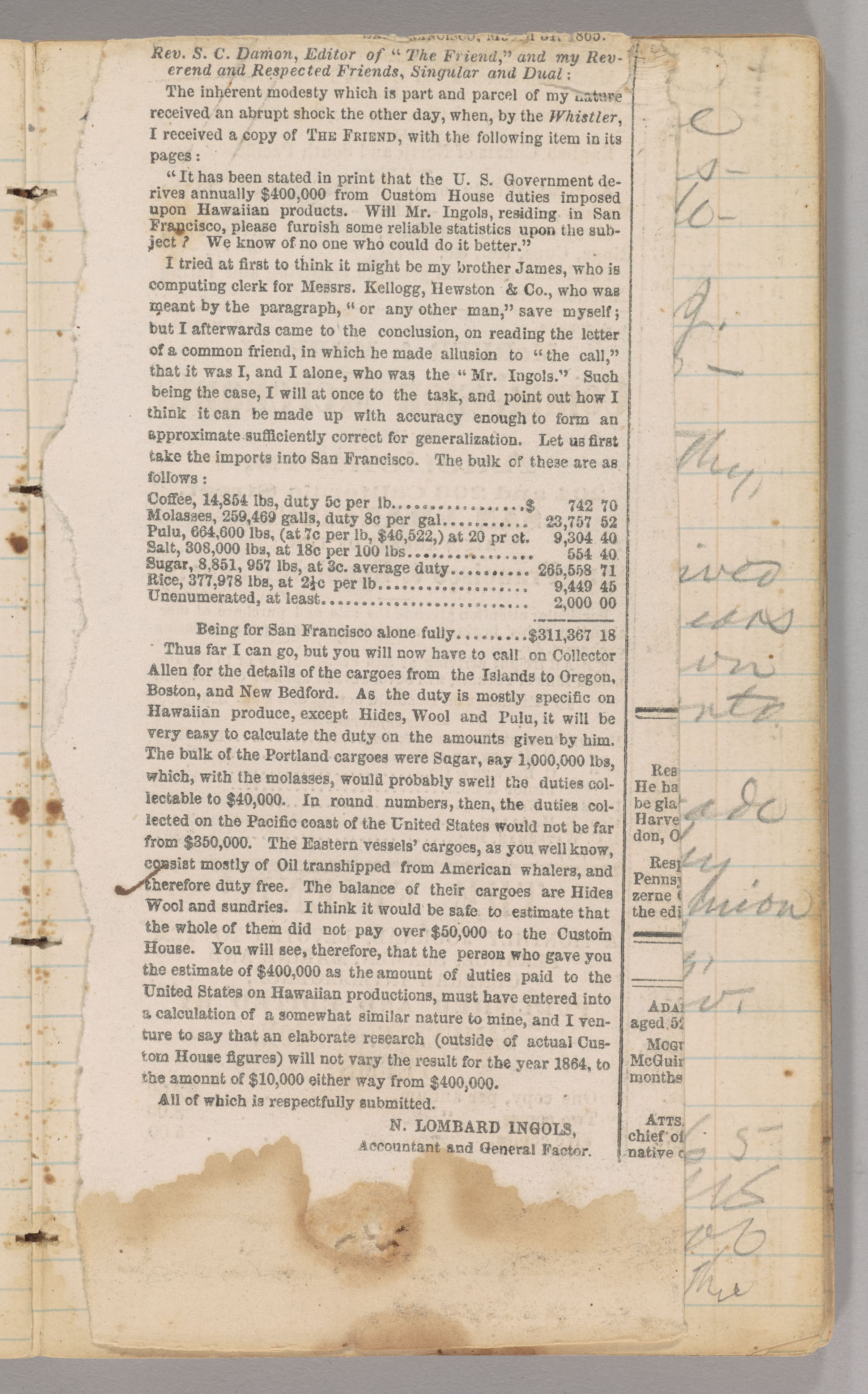
tipped in on top of this entry with wax is the following clipping from The Friend of 1 May 1865:
[MS: N6_clipping01 recto]
Rev. S. C. Damon, Editor of “The Friend,” and my Reverend and Respected Friends, Singular and Dual:
The inherent modesty which is part and parcel of my nature received an abrupt shock the other day, when, by the Whistler, I received a copy of The Friend, with the following item in its pages:
“It has been stated in print that the U. S. Government derives annually $400,000 from Custom House duties imposed upon Hawaiian products. Will Mr. Ingols, residing in San Francisco, please furnish some reliable statistics upon the subject? We know of no one who could do it better.”
I tried at first to think it might be my brother James, who is computing clerk for Messrs. Kellogg, Hewston & Co., who was meant by the paragraph, “or any other man,” save myself; but I afterwards came to the conclusion, on reading the letter of a common friend, in which he made allusion to “the call,” that it was I, and I alone, who was the “Mr. Ingols.” Such being the case, I will at once to the task, and point out how I think it can be made up with accuracy enough to form an approximate sufficiently correct for generalization. Let us first take the imports into San Francisco. The bulk of these are as follows:
| Coffee, 14,854 lbs, duty 5¢ per lb | $ 742.70 |
| Molasses, 259,469 galls, duty 8¢ per gal | 23,757.52 |
| Pulu, 664,600 lbs, (at 7¢ per lb, $46,522,) at 20 pr ct | 9,304.40 |
| Salt, 308,000 lbs, at 18¢ per 100 lbs | 554.40 |
| Sugar, 8,851,957 lbs, at 3¢. average duty | 265,558.71 |
| Rice, 377,978 lbs, at 2½¢ per lb | 9,449.45 |
| Unenumerated, at least | 2,000.00 |
| Being for San Francisco alone fully | $311,367.18 |
Thus far I can go, but you will now have to call on Collector Allen for the details of the cargoes from the Islands to Oregon, Boston, and New Bedford. As the duty is mostly specific on Hawaiian produce, except Hides, Wool and Pulu, it will be very easy to calculate the duty on the amounts given by him. The bulk of the Portland cargoes were Sugar, say 1,000,000 lbs, which, with the molasses, would probably swell the duties collectable to $40,000. In round numbers, then, the duties collected on the Pacific coast of the United States would not be far from $350,000. The Eastern vessels' cargoes, as you well know, consist mostly of Oil transhipped from American whalers, and therefore duty free. The balance of their cargoes are Hides Wool and sundries. I think it would be safe to estimate that the whole of them did not pay over $50,000 to the Custom House. You will see, therefore, that the person who gave you the estimate of $400,000 as the amount of duties paid to the United States on Hawaiian productions, must have entered into a calculation of a somewhat similar nature to mine, and I venture to say that an elaborate research (outside of actual Custom House figures) will not vary the result for the year 1864, to the amount of $10,000 either way from $400,000.
All of which is respectfully submitted.
n. lombard ingols,
Accountant and General Factor.
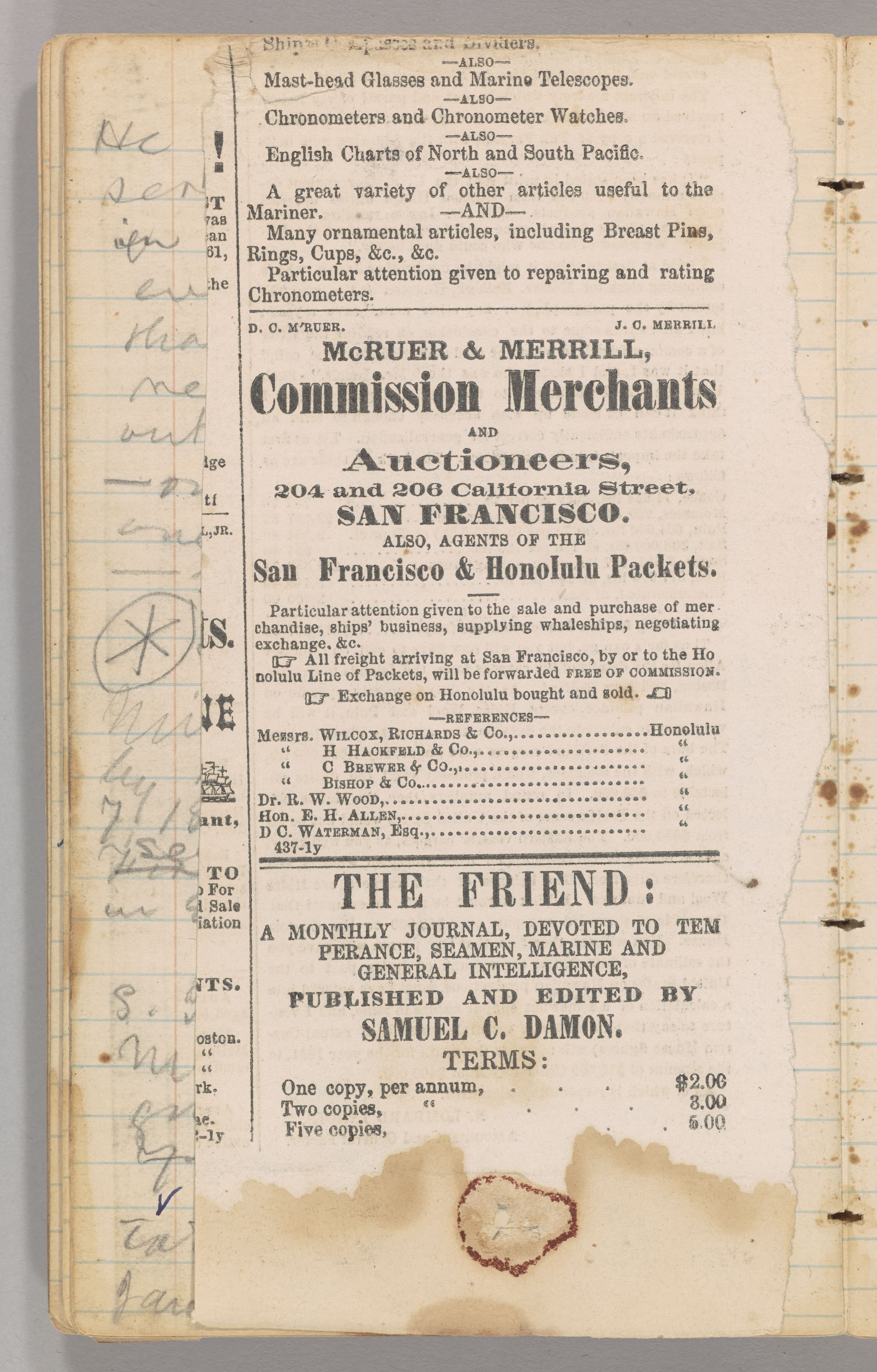
[MS: N6_clipping01 verso]
Ingols, at one time a resident of the Sandwich Islands, had died on 13 October 1865 at the age of forty-three. His calculations, taken from this clipping, appeared in Mark Twain's account of “The Importance of the Hawaiian Trade” in the Sacramento Daily Union on 18 April 1866 (MTH, p. 271).
The following newspaper clipping was attached here:
This shows what is thought of the Bishop's American friend in the community in which he lives, and he will scarcely deny that the verdict of those American residents is entitled to consideration. They have shown themselves true patriots; long separation from the United States has not alienated their hearts from the land of their birth. Mark their course during the late rebellion; it is well worthy of notice and emulation. Their young men, scions of that Puritan stock the Bishop dislikes so much, enlisted in our Union army and navy; one, of whom we know, not able to go himself, kept a substitute in our army during the whole war. Very freely they gave personal service and money in defence of the land they had never seen, but which they had been taught by their parents to love. Our muster rolls show a brigadier-general, a colonel, a lieutenant-colonel, several lieutenants and numerous surgeons, natives or residents of the Sandwich Islands, and descendants of that despised missionary stock; while in money, they contributed to our Sanitary Commission the respectable sum of sixteen thousand one hundred and thirteen dollars and forty-three cents, being more than was given for the same object by either New Hampshire, Vermont, Rhode Island, Connecticut, Pennsylvania, Delaware, Maryland, the District of Columbia, Virginia, Ohio, Indiana, Illinois, Michigan, Wisconsin, Iowa, Minnesota, Kentucky, Louisiana, Idaho, Colorado or Nebraska; in fact, more in proportion to their numbers than was given by any state in the Union. Is not the judgment of such men entitled to as much weight as Bishop Staley's?
The influence of this clipping is evident in the martial depiction of the American missionaries Mark Twain included in his attack on Anglican Bishop Thomas N. Staley in the Sacramento Daily Union of 30 July 1866 (MTH, pp. 352–353).
On this date Clemens wrote his mother and sister:
I went with the American Minister James McBride and took dinner this evening with the King's Grand Chamberlain David Kalakaua, who would reign as King of the Hawaiian Islands from 12 February 1874 until 20 January 1891, who is related to the royal family, and although darker than a mulatto, he has an excellent English education and in manners is an accomplished gentleman. The dinner was as ceremonious as any I ever attended in California—five regular courses, and five kinds of wine and one of brandy. He is to call for me in the morning with his carriage, and we will visit the King at the palace. (MTL, p. 104)
Mark Twain in fact visited Iolani Palace on 4 April 1866, as evidenced by his signature in the guest register, along with that of Ajax purser Ormsby Hite.