(May–July 1867)
Notebook 8 was evidently begun in mid-May 1867, less than three weeks before Clemens sailed in the Quaker City for Europe and the Holy Land. It is the first of three surviving Quaker City notebooks and contains notes that Clemens made primarily for his letters to the San Francisco Alta California, and so by extension for his first major book, The Innocents Abroad. He did make some early notes in New York for letters he sent to the Alta before the trip began, but by far the largest portion of the notebook was filled with his initially enthusiastic record of the excursion, as the travelers made their way across the Atlantic to the Azores, then to Gibraltar and Tangier. He discontinued Notebook 8 shortly after 2 July as the ship sailed for Marseilles, although he added several brief entries at a later time. Clemens used most of his notes in sequence, elaborating on them in four letters to the Alta and one to the New York Herald. Since his newspaper letters often provide the best possible annotation for the notebook, the reader should consult them, along with The Innocents Abroad, which Clemens composed from the letters, incorporating revisions, and making additions occasionally supplied by these Quaker City notebooks. The letters from New York sent before departure have been collected in Mark Twain's Travels with Mr. Brown, edited by Franklin Walker and G. Ezra Dane (New York: Alfred A. Knopf, 1940). The letters from the excursion itself appear in Traveling with the Innocents Abroad, edited by D. M. McKeithan (Norman: University of Oklahoma Press, 1958).
The interval from January 1867 (when Notebook 7 breaks off) to mid-May 1867 (when Notebook 8 begins) was a period of considerable stress and activity for Clemens. He may simply have been too preoccupied with work to keep a notebook, or it may have been lost. Except for a six-week excursion to Saint Louis in March and April, most of the undocumented period was spent in New York. It was very much changed from the city he had first visited in 1853: “I have at last, after several months' experience,” he wrote the Alta on June 5, “made up my mind that it is a splendid desert—a domed and steepled solitude, where the stranger is lonely in the midst of a million of his race” ( MTTB , p. 259). In three long letters to the Alta, all written in February, he inspected varied aspects of city life, ranging from a performance of Broadway's notorious burlesque, The Black Crook (“It is the wonders of the Arabian Nights realized”), to an afternoon church service known as “Bishop Southgate's matinee”—each, as he said of the bishop, “in pursuance of my desire to test all the amusements of the metropolis” ( MTTB , pp. 86, 95). The cure for his restless loneliness, however, was not to be found in New York's amusements, but in the chance to go to sea again.
The strain of urban life seems to have overtaken him as early as February 23, when he wrote to the Alta that he was suffering from “the blues” and that his “thoughts persistently ran on funerals and suicide” ( MTTB , p. 101). The immediate cure was “the monster they call the Russian Bath,” but soon afterward—seven weeks after landing in New York—he hit upon a more congenial way to fulfill his obligations as correspondent. “A great European pleasure excursion for the coming summer,” he wrote the Alta on March 2, “promises a vast amount of enjoyment for a very reasonable outlay.” He went on to describe the extensive itinerary and to specify what kind of a trip these “prominent Brooklynites” had envisioned for themselves. “Isn't it a most attractive scheme?” he asked. “Five months of utter freedom from care and anxiety of every kind, and in company with a set of people who will go only to enjoy themselves, and will never mention a word about business during the whole voyage. It is very pleasant to contemplate” ( MTTB , pp. 111, 113). The prospect of life aboard ship was so pleasant, in fact, that he resolved to go if the Alta would extend his roving commission and pay the $1,250 fare. Even before the paper's response was known, Clemens made a down payment, and then happily left the city for Saint Louis, where he lectured, wrote newspaper articles, and after six weeks said farewell to his family.
When Clemens returned to New York in mid-April, he still had much to do before the ship would sail, and April and May found him increasingly busy. His literary ambition seems clear: to make “Mark Twain” as familiar and acceptable to sophisticated eastern readers as he was already on the Pacific Coast. “Make your mark in New York, and you are a made man,” he wrote the Alta on May 17. “With a New York endorsement you may travel the country over . . . without fear—but without it you are speculating upon a dangerous issue” ( MTTB , p. 176). He had five of his Sandwich Islands letters reprinted in the New York Weekly Review, and by the time of departure he would place seven fresh articles with the New York Sunday Mercury. In late April Charles Henry Webb published Clemens' first book, The Celebrated Jumping Frog of Calaveras County, and Other Sketches, which, as the sympathetic reviewer in the Times suggested, was calculated to introduce Mark Twain “to the lovers of humor in the Atlantic States” (1 May 1867). Finally, he asked Frank Fuller to assist him in arranging his first lectures before a New York audience—on May 6, 10, and 16.
On his return from Saint Louis he moved to more sophisticated lodgings from his usual quarters at the Metropolitan Hotel—which was known as “the resort of Californians and people from the new States and Territories” (Junius Henri Browne in The Great Metropolis Hartford: American Publishing Company, 1869, p. 394). On April 19 he wrote his family from the Westminster: “Direct my letters to this hotel in future. I am just fixed, now. It is the gem of all hotels. I have never come across one so perfectly elegant in all its appointments & so sumptuously & tastefully furnished. Full of ‘bloated aristocrats’ too, & I'm just one of them kind myself.”
Like the Westminster, the Quaker City excursion seemed to offer physical luxury and social prestige. He wrote the Alta on April 30:
Our ship in which we are to sail for the Holy Land, is to be furnished with a battery of guns for firing salutes, by order of the Secretary of the Navy, and Mr. Seward has addressed a letter to all foreign powers, requesting that every attention be shown General Sherman and his party. . . . I have got a handsome state room on the upper deck and a regular brick for a roommate. We have got the pleasantest and jolliest party of passengers that ever sailed out of New York, and among them a good many young ladies and a couple of preachers, but we don't mind them. Young ladies are well enough anywhere, and preachers are always pleasant company when they are off duty. ( MTTB , pp. 165–166)
As Stephen M. Griswold recalled, years later: “Mr. Beecher contemplated writing a Life of Christ. He expressed a desire to visit the sacred places of Palestine . . . and wanted several members of Plymouth Church to go with him” (Sixty Years with Plymouth Church New York: Fleming H. Revell Co., 1907, p. 153). Captain Charles Duncan's prospectus for the voyage assured Clemens, moreover, that the “select company” could be “easily made up in this immediate vicinity, of mutual friends and acquaintances” (The Innocents Abroad, chapter 1). The presence of Beecher and his congregation, accompanied by General Sherman, was designed to assure the congeniality as well as the proper social standing of the passengers, who were to be approved by the “merciless” Committee on Applications. After paying his passage on 15 April, Clemens wrote to his family:
A newspaper man came in & asked how many names were booked & what notabilities were going, & a fellow (I don't know who he was, but he seemed to be connected with the concern,) said, “Lt. Gen. Sherman, Henry Ward Beecher & Mark Twain are going, & probably Gen. Banks!” I thought that was very good—an exceedingly good joke for a poor ignorant clerk. (The Clifton Waller Barrett Library, University of Virginia)
Clemens may have begun to feel that the joke was really on him when, early in May, Beecher withdrew from the excursion. The immediate consequence was that forty members of Plymouth Church who had planned to accompany their pastor also declined to go. Three weeks later, General Sherman publicly announced that he would be detained by the Indian wars and could not travel with the excursion.
The withdrawal of both men had financial consequences as well as diminishing the prestige of the excursion. Captain Duncan, who had been planning the trip as early as November 1866 and who had a personal interest in the financial success of the venture, found his passenger list well short of the one hundred ten travelers he had expected. With only weeks left before departure, it was clearly no longer possible to assemble a select company from mutual friends and acquaintances. As the passenger list shows, a large proportion of the passengers came from Ohio and other western states, and relatively few from Brooklyn, or even the East Coast. The religious influence of Plymouth Church would not now be exerted through the worldly and genial Henry Ward Beecher, but rather through that “psalm singing hypocrite”—as the ship's co owner Daniel Leary called him—Captain Charles Duncan. Moreover, the pleasant and sophisticated companions that Clemens anticipated became instead a solemn and provincial, although prosperous, group of elderly tourists. When the trip was over, Clemens would write Mrs. Fairbanks, one of the few friends he made on the voyage, that there were only eight of the sixty-five passengers that he cared to remember:
My opinion of the rest of the gang is so mean, & so vicious, & so outrageous in every way, that I could not collect the terms to express it with out of any less than sixteen or seventeen different languages. Such another drove of cattle never went to sea before. Select party! Well, I pass. ( MTMF , p. 5)
Clemens had felt some anxiety about his fellow passengers even before sailing. To the Alta he reported encountering one passenger who seriously asked the captain whether “the excursion would come to a halt on Sundays” and when told that it would not, betrayed his shallow piety. “I thought I perceived that he was not good and holy, but only sagacious, and so I turned the key on my valise and moved it out of his reach. I shall have to keep an eye on that fellow” ( MTTB , pp. 276–277). But, as the notebook shows, the dichotomy between pilgrim and sinner that he was to exploit in The Innocents Abroad was actually preceded by a more general dissatisfaction with the passengers. The three travelers that he sketches in the notebook as the voyage begins are all ridiculed for their lack of sophistication, coarseness, and naiveté. As he wrote John Russell Young of the New York Tribune after the voyage, what he really yearned to ridicule was “the Quaker City's strange menagerie of ignorance, imbecility, bigotry & dotage” (Library of Congress).
Clemens' most immediate concern before departure was the preparation of letters to the Alta. Those he sent show him methodically generating copy—by visiting the Society for the Prevention of Cruelty to Animals, the Midnight Mission for prostitutes, the New York Travellers' Club, the Blind Asylum. He reported on the exhibition at the Academy of Design, on Albert Bierstadt's latest painting, the most recent New York crimes, and a variety of touring San Francisco performers who were appearing in New York. Despite his restless enterprise, by mid-May he found himself seriously behind on his Alta correspondence. On May 20 he wrote his family: “Don't—don't ask me to write, for a week or two. I am 18 Alta letters behindhand, & I must catch up or bust. I have refused all invitations to lecture in the interior towns of this & neighboring States, & have settled down to work.” But his own lack of inspiration and the oppressiveness of New York combined to prevent him from completing more than six letters. “I have just written myself clear out in letters to the Alta,” he wrote his family on June 7, “and I think they are the stupidest letters that were ever written from New York. Corresponding has been a perfect drag ever since I got to the states. If it continues abroad, I don't know what the Tribune and Alta folks will think” ( MTL , p. 127).
Clemens' mood gradually darkened as he waited impatiently for the ship to sail, trying at the same time to generate copy for the Alta in New York. Both his public and his private letters reveal a harried, restless state of mind that would not be dispelled for several weeks. On June 1, probably aware of Captain Duncan's deteriorating passenger list, Clemens wrote his family:
I know I ought to write oftener . . . but I cannot overcome my repugnance to telling what I am doing or what I expect to do or propose to do. . . . It isn't any use for me to talk about the voyage, because I can have no faith in that voyage till the ship is under way. How do I know she will ever sail? . . . All I do know or feel, is, that I am wild with impatience to move—move—move! ( MTL , p. 125)
On June 7, just before departure, he seemed filled with vague feelings of guilt—for not helping his brother more, for not writing oftener, perhaps for going away at all.
My mind is stored full of unworthy conduct toward Orion and towards you all, and an accusing conscience gives me peace only in excitement and restless moving from place to place. If I could say I had done one thing for any of you . . . I believe I could go home and stay there and I know I would care little for the world's praise or blame. . . . You observe that under a cheerful exterior I have got a spirit that is angry with me and gives me freely its contempt. I can get away from that at sea. ( MTL , p. 128)
The attraction of “restless moving from place to place” and of the sea voyage seemed to enlarge even though the prospect of genteel association faded. On the same day Clemens wrote Will Bowen that although he anticipated five or six months of a “jolly, sociable, homelike trip,” when it was over “if we all go to the bottom, I think we shall be fortunate. There is no unhappiness like the misery of sighting land (and work) again after a cheerful, careless voyage. They were lucky boys that went down in sight of home the other day when the Santiago de Cuba stranded on the New Jersey shore” ( MTLBowen , p. 15). And perhaps even more explicitly, he confided similar feelings of depression (blaming them on New York) to his Alta readers:
There is something about this ceaseless buzz, and hurry, and bustle, that keeps a stranger in a state of unwholesome excitement all the time, and makes him restless and uneasy, and saps from him all capacity to enjoy anything or take a strong interest in any matter whatever—a something which impels him to try to do everything, and yet permits him to do nothing. . . . This fidgetty, feverish restlessness will drive a man crazy, after a while, or kill him. It kills a good many dozens now—by suicide. I have got to get out of it. ( MTTB , pp. 260–261)
Finally, on June 8, he did leave. Even though rough weather confined the ship to New York harbor for two days, he was glad simply to be aboard. In chapter 2 of The Innocents Abroad he would recall that despite the inauspicious weather he had felt the “cheering influence” of the sea and when he retired that night was “rocked by the measured swell of the waves, and lulled by the murmur of the distant surf” until he passed “tranquilly out of all consciousness of the dreary experiences of the day and damaging premonitions of the future.” The notebook reflects his change of mood with a drastic shift away from the elliptical, desultory New York notes to a series of extended sketches of fellow passengers and a burlesque of the ship's regulations. His depression found relief in private vituperation and ridicule that had obvious literary potential. The spark of the future book is even recorded in somewhat cryptic fashion: “Stupid remarks & ? from ? every now & then—make him a character” (p. 340).
Despite his initial testiness, Clemens seems to have joined, and even to have helped initiate, various shipboard activities: a birthday party for the captain's wife, a social club to discuss routes of travel and points of interest, a mock trial, a debating club. The captain's log records some of the other amusements provided during the sometimes stormy passage to the Azores: Bloodgood Cutter read repeatedly from his verse; stereopticon slides were shown; and the Quaker City trio provided several evening concerts and music for religious services and for the first of the shipboard dances. Clemens attended these functions, but seems to have found as much contentment in playing cards or dominoes, smoking, and drinking late into the night. “Horse-billiards” on the foredeck also attracted him: “It is a fine game. It affords good, active exercise, hilarity, and consuming excitement. It is a mixture of ‘hop-scotch’ and shuffle-board played with a crutch” (The Innocents Abroad, chapter 4).
The ship arrived in the port of Fayal on June 21, and Clemens began taking notes in earnest. The ship's company was entertained by the United States consul, Charles Dabney, whose sister Clara wrote her family on the occasion that “one young man had his note book out all the time and remarked as I gave him some verbena, ‘I am taking notes as I am a correspondent of a paper’ ” (Roxana Lewis Dabney, Annals of the Dabney Family in Fayal, 3 vols. Boston, n.d., 3:1292). Clemens was not the only one with a notebook, of course, and certainly not the only newspaper correspondent. “Everybody taking notes,” he recorded in his notebook, “cabin looks like a reporters congress” (p. 344). He was, however, the most professional and the most thorough of the various correspondents. Before leaving New York he had heard from John J. Murphy of the Alta, “Your only instructions are that you will continue to write at such times and from such places as you deem proper, and in the same style that heretofore secured you the favor of the readers of the Alta California” ( MTB , p. 310). In his Autobiographical Dictations Clemens would recall that he contracted to write fifty letters at twenty dollars per letter, an extension of his original agreement made before leaving California ( MTA , 1:243).
Clemens also arranged to correspond with two eastern newspapers. He agreed to write for the New York Tribune, which, as he told John McComb, had a circulation of 200,000. He wrote Will Bowen on June 7 that he planned to write “two letters a month” for that paper “till we reach Egypt, and then I have to write oftener” ( MTLBowen , p. 16). He eventually completed only seven letters to the Tribune and, as he told his family on November 20, felt “ashamed to go to the Tribune office almost—they have treated me so well & I have not written them a third of the letters I promised” ( MTB us, p. 95). Clemens also agreed to write several letters (to appear unsigned) for the rival New York Herald, and three brief letters were actually published. Significantly, however, he declined to continue his contributions to the New York Weekly Review. “Like all other papers that pay one splendidly,” he told his family on June 1, “it circulates among stupid people and the canaille” ( MTL , p. 126). He was striking out for the larger audiences of New York, and he was willing to make sacrifices for more sophisticated ones.
Novelty was the attraction of Fayal. Clemens took notes on local customs and sights, later marshaling “a paragraph of dry facts” for the Tribune because “the Azores must be very little known in America” ( TIA , p. 16). And he wrote the Alta enthusiastically about an excursion into the hills and valleys of the island: “There was that rare thing, novelty, about it; it was a fresh, new, exhilarating sensation, this donkey riding, and worth a hundred worn and threadbare home pleasures” ( TIA , p. 8). When the Quaker City left the Azores on June 23 bound for Gibraltar, the ship encountered six days of stormy passage. Evidently not yet completely at odds with the religious faction, Clemens led the day's devotions on June 24. But for the remainder of the time he smoked and played dominoes, unable to play “horse-billiards” on the stormy deck. Captain Duncan found little to enter in the log: “Nothing of special interest” happened on June 26, and “Nothing of interest” marked the next day.
On June 29 they arrived at Gibraltar, but their first European port seems to have held only mild interest for Clemens. After touring the town, he told his Alta readers that one might “easily understand that a crowd like ours, made up from fifteen or sixteen States of the Union, found enough to stare at in this shifting panorama of fashion,” but the implication remains that he himself was not impressed ( TIA , pp. 22–23). They toured the military installations and some archaeological sites, and Clemens wrote to his family on June 30 that he was “clear worn out with riding and climbing in and over and around this monstrous rock and its fortifications” ( MTL , p. 129). He pondered traveling through Spain to Paris with Moses S. Beach and others, but through indecision was excluded from that party when it sailed for Cadiz.
If he was disappointed in missing that adventure, his reaction seems to have been merely a stronger resolve to do something even more exciting. “Now as to Tangiers there shall be no pulling & hauling—we will go. I shall answer no questions, & not listen to any d—d fears, surmises, or anything else,” he wrote in the notebook (p. 351). It was, in fact, a daring and somewhat dangerous trip, but with the Quaker City delayed at Gibraltar for coaling and boiler work, there was just enough time to sail across the strait to Morocco and visit the second oldest city on the itinerary. On Sunday morning, June 30, Clemens set out with six fellow passengers—Major James Barry, Dr. Jackson, Dan Slote, Frederick Greer, Colonel Foster, and Colonel Denny—guided by an English merchant named Redman. The rest of the passengers went to church.
As the notebook and his newspaper letters testify, Clemens found the city entirely and excitingly strange. “This is jolly!” he exploded in his Alta letter.
This is altogether the infernalest place I have ever come across yet. Let those who went up through Spain make much of it—these dominions of the Emperor of Morocco suit me well enough. We have had enough of Spain at Gibraltar for the present. Tangier is the spot we have been longing for all the time. Everywhere else one finds foreign-looking things and foreign-looking people, but always with things and people intermixed that we were familiar with before, and so the novelty of the situation lost a deal of its force. We wanted something thoroughly and uncompromisingly foreign . . . nothing to remind us of any other people or any other land under the sun. And lo! in Tangier we have found it. ( TIA , pp. 25–26)
They visited the American consul resident in the city, Jesse H. McMath, who was apparently glad to entertain these Americans with gossip about consular history and information on local customs and practices. Engaging a guide, Sadi Mohammed Lamarty, the party toured the city on their first day, and spent part of the second on a brief, uneasy ride outside its walls. They narrowly escaped Moorish wrath when Clemens prevented Major Barry from heedlessly entering a mosque, forbidden by custom to “Christian dogs.” Clemens took voluminous notes on local history and legend, filling nearly one-third of the notebook. These notes furnished him more than enough material for two letters to the Alta, which overflowed with chaotic details of their new experiences. In fact, concluding the second of these letters, Clemens threw up his hands: “I find I cannot write up my notes, and so I will stop” ( TIA , p. 35).
Returning to the ship late on July 1, he wrote his family in the same vein of enthusiasm: “I would not give this experience for all the balance of the trip combined. This is the infernalest hive of infernally costumed barbarians I have ever come across yet” ( MTL , p. 130), a comment that records the height of his excitement rather than any contempt for Tangier. “It seems like profanation to laugh, and jest, and bandy the frivolous chat of our day amid its hoary relics” ( TIA , p. 27). Unlike the disappointment that he would feel in Turkey and Palestine, his excitement here exceeded even his expectations:
Here is not the slightest thing that ever we have seen save in pictures—and we always mistrusted the pictures before. We cannot any more. The pictures used to seem lies—they seemed too wierd and fanciful for reality. But behold, they were not wild enough—they were not fanciful enough—they have not told half the story. Tangier is a foreign land if ever there was one. And the true spirit of it can never be found in any book save the Arabian Nights. ( TIA , p. 26)
Nevertheless, his earlier restlessness persisted, and the brevity of the visit to Africa undoubtedly contributed to its success. Clemens himself concluded that “Tangier is full of interest for one day, but after that it is a weary prison” ( TIA , p. 35). The returning adventurers brought Moorish tobacco pipes, Moroccan dates, and “full, flowing, picturesque Moorish costumes . . . purchased in the bazaars of Tangier” ( MTL , p. 131). And during the last shipboard dance the “Tangier 3” (Clemens, Slote, and Dr. Jackson or Frederick Greer) cavorted in their oriental finery. That midnight Clemens remarked on the end of the adventure. “After all this racing, & bustling & rollicking excitement in Africa” he wrote in the notebook, “it seems good to get back to the old ship once more. It is so like home. After all our weary time, we shall sleep peacefully to-night” (pp. 367–368). The quest for novelty would resume the next day, however, as the ship steamed toward Marseilles, where Clemens planned to disembark and take the train to Paris.
The passenger list derives ultimately from that given by Paine in Mark Twain: A Biography, pp. 1609–1610, but uses and sometimes corrects the fuller list given by Dewey Ganzel in Mark Twain Abroad: The Cruise of the “Quaker City” (Chicago: University of Chicago Press, 1968), pp. 319–322. Passengers who figure prominently in The Innocents Abroad have been marked with asterisks. When Mark Twain referred to a passenger by a nickname, it follows the formal name in quotation marks.
Passengers
Allen, Anthony Bezenet. New York, N.Y.
* Andrews, Dr. Edward (“The Oracle”). Albany, N.Y.
Barry, Major James G. Saint Louis, Mo.
*Beach, Moses Sperry. Brooklyn, N.Y.
Beach, Miss Emeline. Brooklyn, N.Y.
Beckwith, Thomas S. Cleveland, Ohio
Bell, Mr. and Mrs. R. A. H. Portsmouth, Ohio
*Birch, Dr. George Bright. Hannibal, Mo.
Bond, Mr. and Mrs. John W. Saint Paul, Minn.
Bond, Miss Ada. Saint Paul, Minn.
Bond, Miss Mary E. Plaquemine, La.
Brown, Dr. M. Circleville, Ohio
Brown, Miss Kate L. Circleville, Ohio
Brynam, John. Philadelphia, Pa.
*Bullard, Rev. Henry. Wayland, Mass.
Chadeyne, Miss Carrie D. Jersey City, N.J.
*Church, William F. Cincinnati, Ohio
*Clemens, Samuel Langhorne (“Mark Twain”). San Francisco, Calif.
Crane, Dr. Albert. New Orleans, La.
Crane, Albert Jr. New Orleans, La.
Crocker, Mr. and Mrs. Timothy D. Cleveland, Ohio
*Cutter, Bloodgood Haviland (“Poet Lariat”). Little Neck, Long Island, N.Y.
Davis, Joshua William. New York, N.Y.
Decan, Nathan. Long Island, N.Y.
*Denny, Col. William R. (“The Colonel”). Winchester, Va.
Dimon, Mr. and Mrs. Fred. Norwalk, Conn.
Duncan, Mrs. Charles C. Brooklyn, N.Y.
Duncan, George. Brooklyn, N.Y.
Duncan, Henry E. Brooklyn, N.Y.
Elliott, P. A. Columbus, Ohio
Fairbanks, Mary Mason (Mrs. Abel W.). Cleveland, Ohio
Foster, Col. J. Heron. Pittsburgh, Pa.
*Gibson, Dr. and Mrs. William. Jamestown, Pa.
Green, Mrs. J. O. Washington, D.C.
Greenwood, John Jr. New York, N.Y.
*Greer, Frederick H. (“Blucher”). Boston, Mass.
Griswold, Mr. and Mrs. Stephen M. Brooklyn, N.Y.
Grubb, Gen. B. B. Burlington, N.J.
Haldeman, Hon. Jacob Samils. Harrisburg, Pa.
Heiss, Goddard. Philadelphia, Pa.
Hoel, Capt. W. R. Cincinnati, Ohio
Hutchinson, Rev. E. Carter. Saint Louis, Mo.
Hyde, Hon. James K. Hydeville, Vt.
Isham, John G. Cincinnati, Ohio
*Jackson, Dr. Abraham Reeves (“The Doctor”). Stroudsburg, Pa.
James, William E. Brooklyn, N.Y.
Jenkins, Frederick P. Boston, Mass.
Kinney, Col. Peter. Portsmouth, Ohio
Krauss, George W. Harrisburg, Pa.
*Langdon, Charles Jervis (possibly the “Interrogation Point”). Elmira, N.Y.
Larrowe, Miss Nina. San Francisco, Calif.
*Leary, Daniel D. New York, N.Y.
Lee, Mrs. S. G. Brooklyn, N.Y.
Lockwood, Mr. and Mrs. E. K. Norwalk, Conn.
May, J. M. Janesville, Wis.
McDonald, Louis. Bristol, England
Moody, Capt. Lucius. Canton, N.Y.
*Moulton, Julius (“Moult”). Saint Louis, Mo.
Nelson, Arba. Alton, Ill.
Nesbit, Dr. Benjamin B. Louisville, Ky.
Nesbit, Thomas B. Fulton, Mo.
Newell, Miss Julia. Janesville, Wis.
Otis, William Augustus. Cleveland, Ohio
Paine, C. C. Pa.
Park, Rev. A. L. Boston, Mass.
Park, Miss. Boston, Mass.
Parsons, Samuel B. New York, N.Y.
Payne, Dr. and Mrs. James H. Boston, Mass.
Quereau, Rev. George W. Aurora, Ill.
Sanford, S. N. Cleveland, Ohio
Serfaty, M. A. Gibraltar
Severance, Solon Long. Cleveland, Ohio
Severance, Emily C. (Mrs. Solon L.). Cleveland, Ohio
Sexton, Nicholas. New York, N.Y.
*Slote, Daniel (“Dan”). New York, N.Y.
*Van Nostrand, John A. (“Jack”). Greenville, N.J.
Willets, Samuel. Islip, Long Island, N.Y.
Ship's Officers
Duncan, Charles C. Captain
Bursley, Ira. Sailing Master and Executive Officer
Jones, William. Second Officer
Burdick, Benjamin. Steward
Harris, John. Chief Engineer
Vail, Robert. Purser
Pratt, William A. Quartermaster
Notebook 8 now contains 198 pages, 71 of them blank. At least two leaves have been cut out and are missing, and it is possible that other leaves no longer traceable are also missing. The notebook is identical in design and format to Notebook 7, but its binding has been repaired recently. Most entries are in pencil; occasional entries and several use marks are in brown ink. Clemens probably used brown ink when he returned to his notes while writing the Alta letters. All occurrences of brown ink, including use marks, which Clemens made by striking through an entry, are reported in Details of Inscription. Paine made use marks in black pencil throughout.
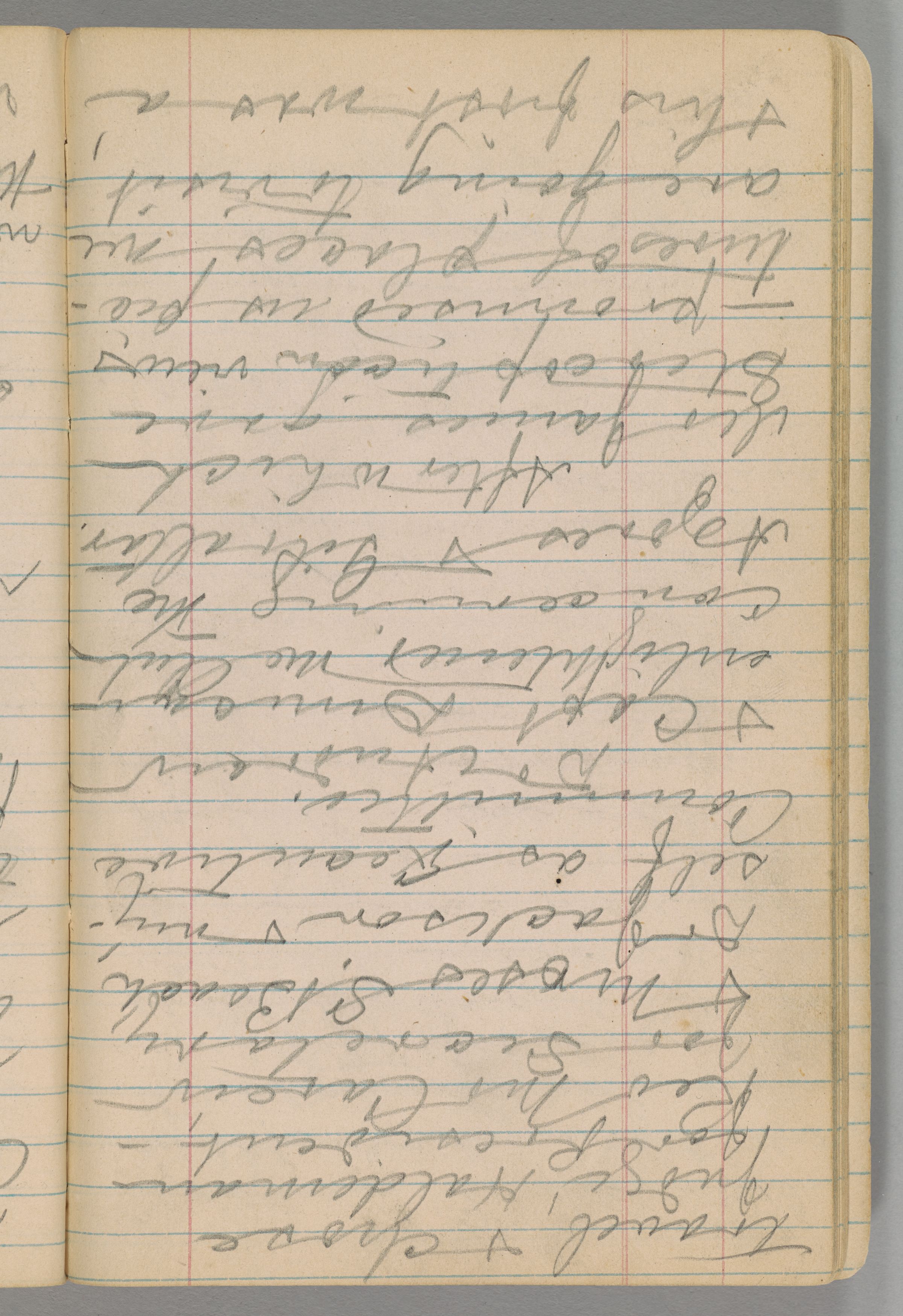
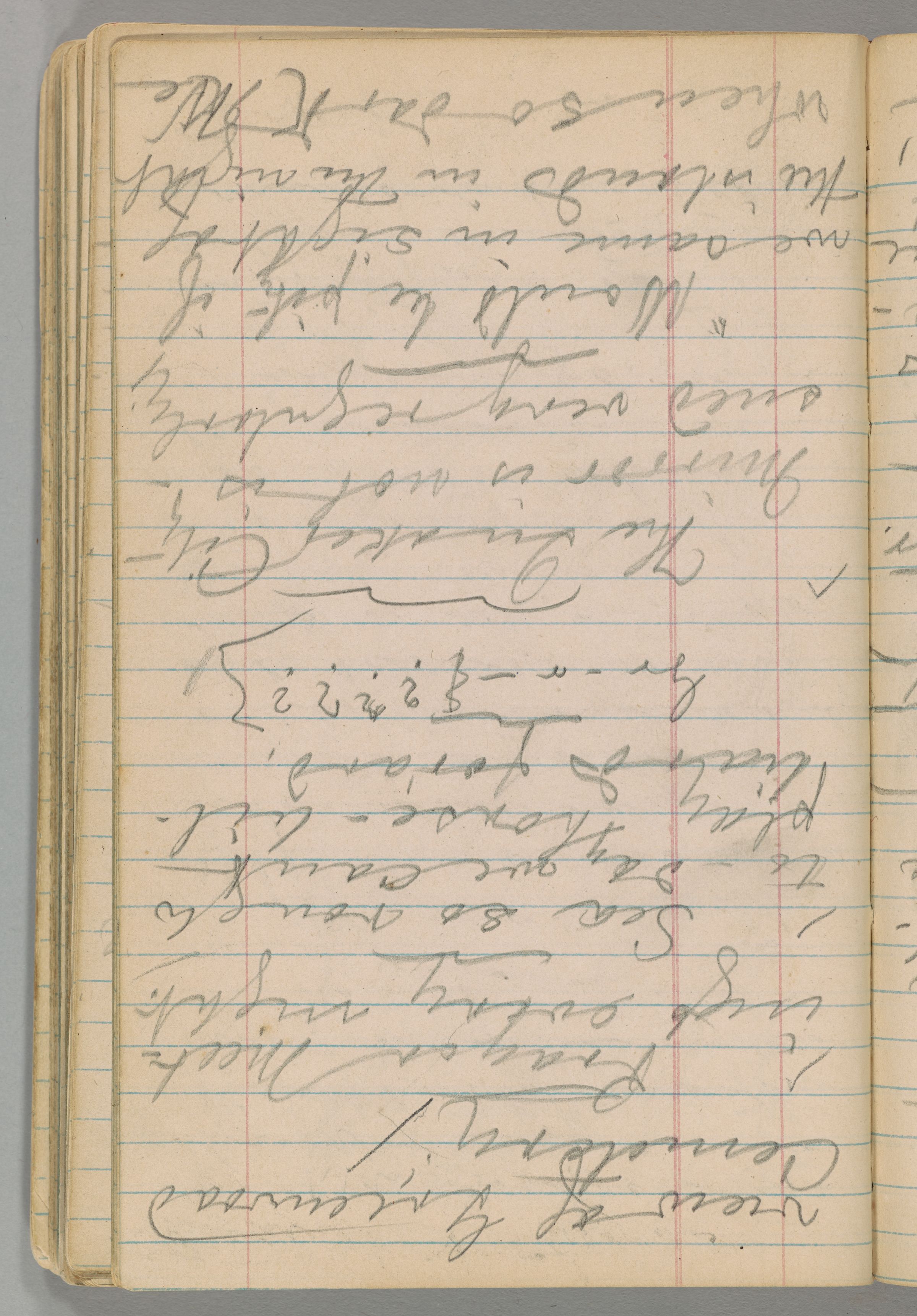
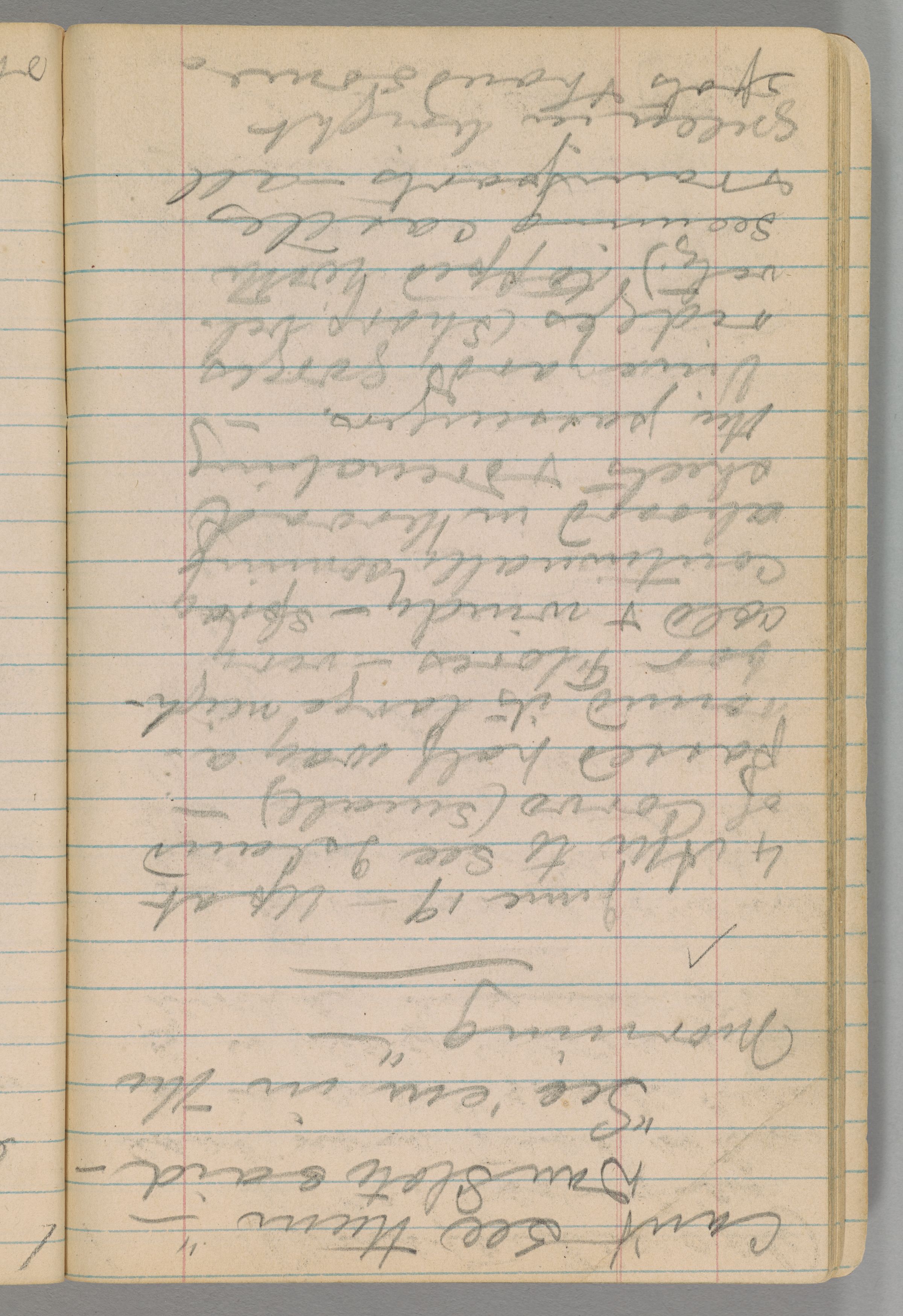
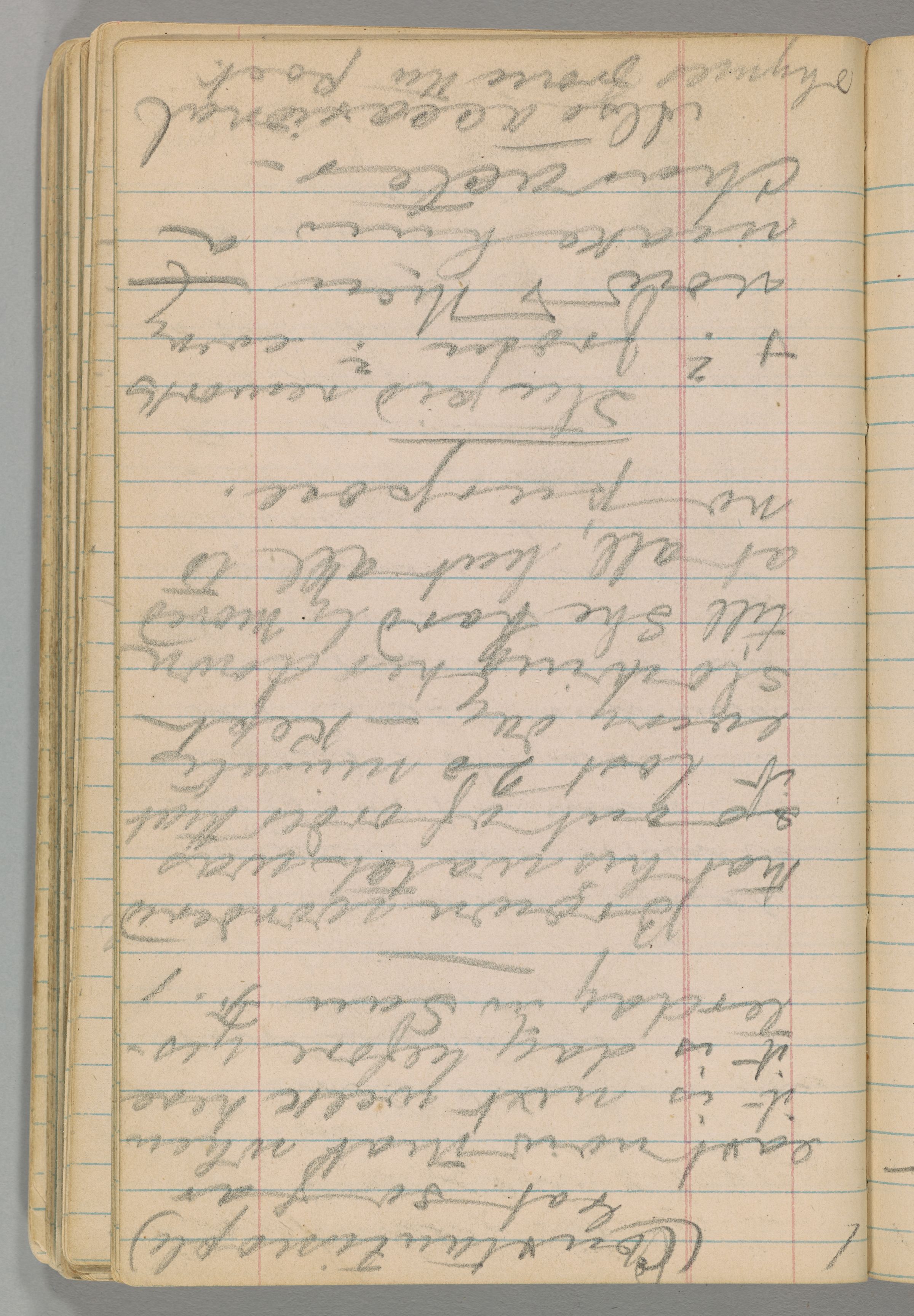
Clemens did not fill the notebook consecutively from first page to last, so the left-to-right sequence of pages does not necessarily correspond to the chronological sequence of entries. Two main sequences can nevertheless be distinguished. Beginning on the ninth page, Clemens filled most of twenty-one consecutive pages with his notes on New York City (from mid-May through the first week of June 1867). He then turned the notebook end-for-end and wrote his notes on the Quaker City voyage in a second sequence covering most of 114 pages (from June 8 through early July 1867). From time to time during the trip he turned to blank pages selected at random to enter lists that he wished to keep distinct from his day-to-day entries.
The chronological sequence of entries, when it can be determined, has been preferred to the physical sequence. Although entries on flyleaves and endpapers (and two entries on the back cover) are printed in the order in which they appear in the notebook, the two main sequences and the various lists are printed in chronological order. All deviations from physical sequence are reported in Details of Inscription and described in the notes.
The following books are those most immediately relevant to a study of Clemens' Quaker City notebooks (8–10) and The Innocents Abroad. They provide the letters he constructed from the notebooks, an independent history of the voyage, and a distinguished analysis of the evolution of the book. A number of more obscure texts (cited in the notes) have, however, been used to annotate these notebooks: Captain Duncan's log in the Patten Free Library of Bath, Maine, quoted with the permission of John E. Duncan; travel letters written by two of Clemens' friends, Mrs. Fairbanks and Mrs. Severance; and a variety of travel letters by several other passengers, graciously made available by Leon T. Dickinson.
Ganzel, Dewey. Mark Twain Abroad: The Cruise of the “Quaker City.” Chicago: University of Chicago Press, 1968.
McKeithan, D. M. Traveling with the Innocents Abroad. Norman: University of Oklahoma Press, 1958.
Smith, Henry Nash. “Pilgrims and Sinners.” In Mark Twain: The Development of a Writer. Cambridge: Harvard University Press, Belknap Press, 1962.
Walker, Franklin, and Dane, G. Ezra, eds. Mark Twain's Travels with Mr. Brown. New York: Alfred A. Knopf, 1940.
sequence 1: on the Quaker City tour, possibly in Tangier, ca. 30 June–1 July 1867
[MS: N8_outside front cover]
blank
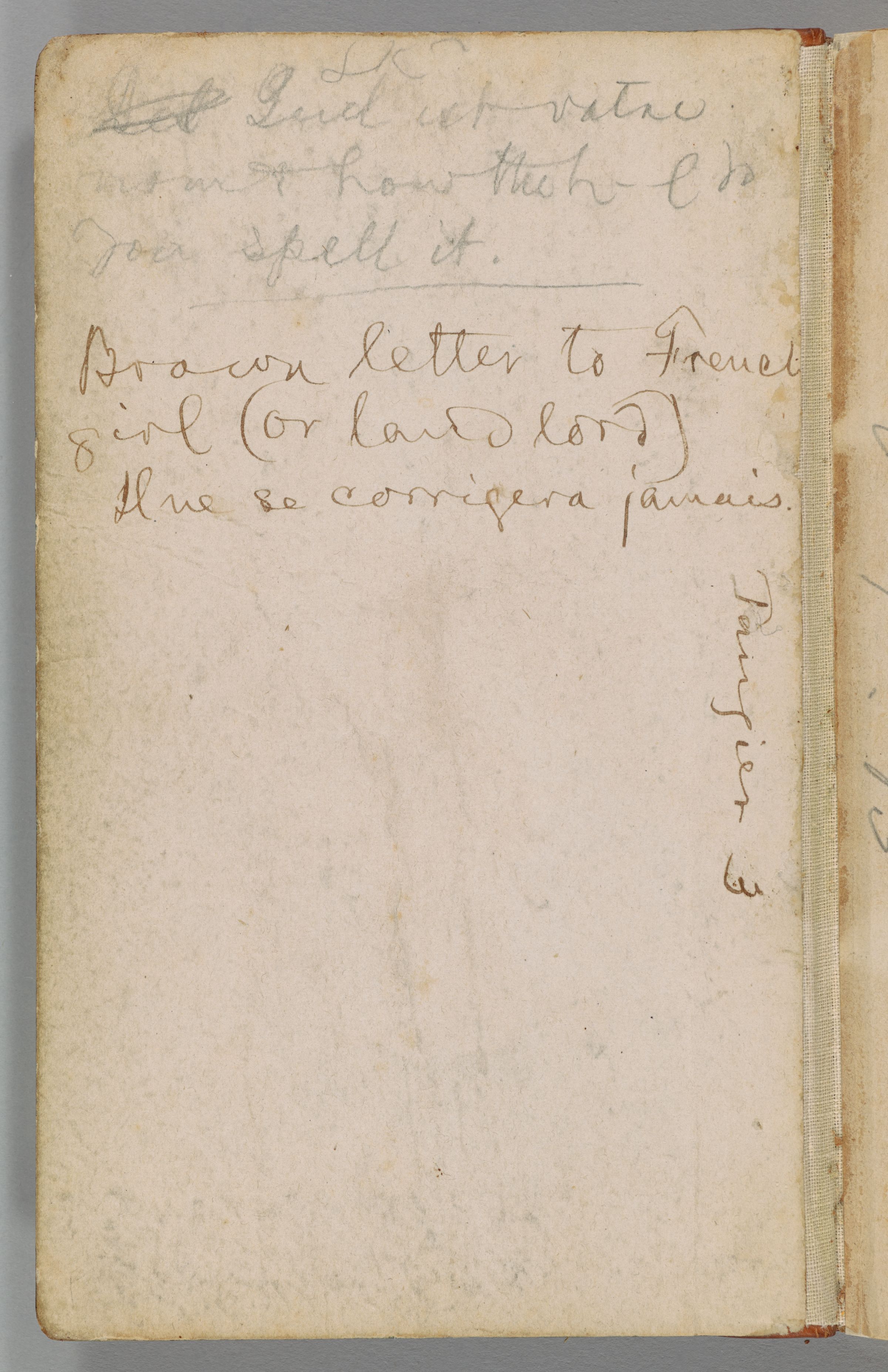
[MS: N8_front endpaper]
[MTP: N&J1_314]
Qel Quel est votre
nom & how the h—l do
you spell it.
Brown letter to French
girl (or landlord)
Il ne se corrigera jamais.
sequence 2: New York City, mid-May 1967
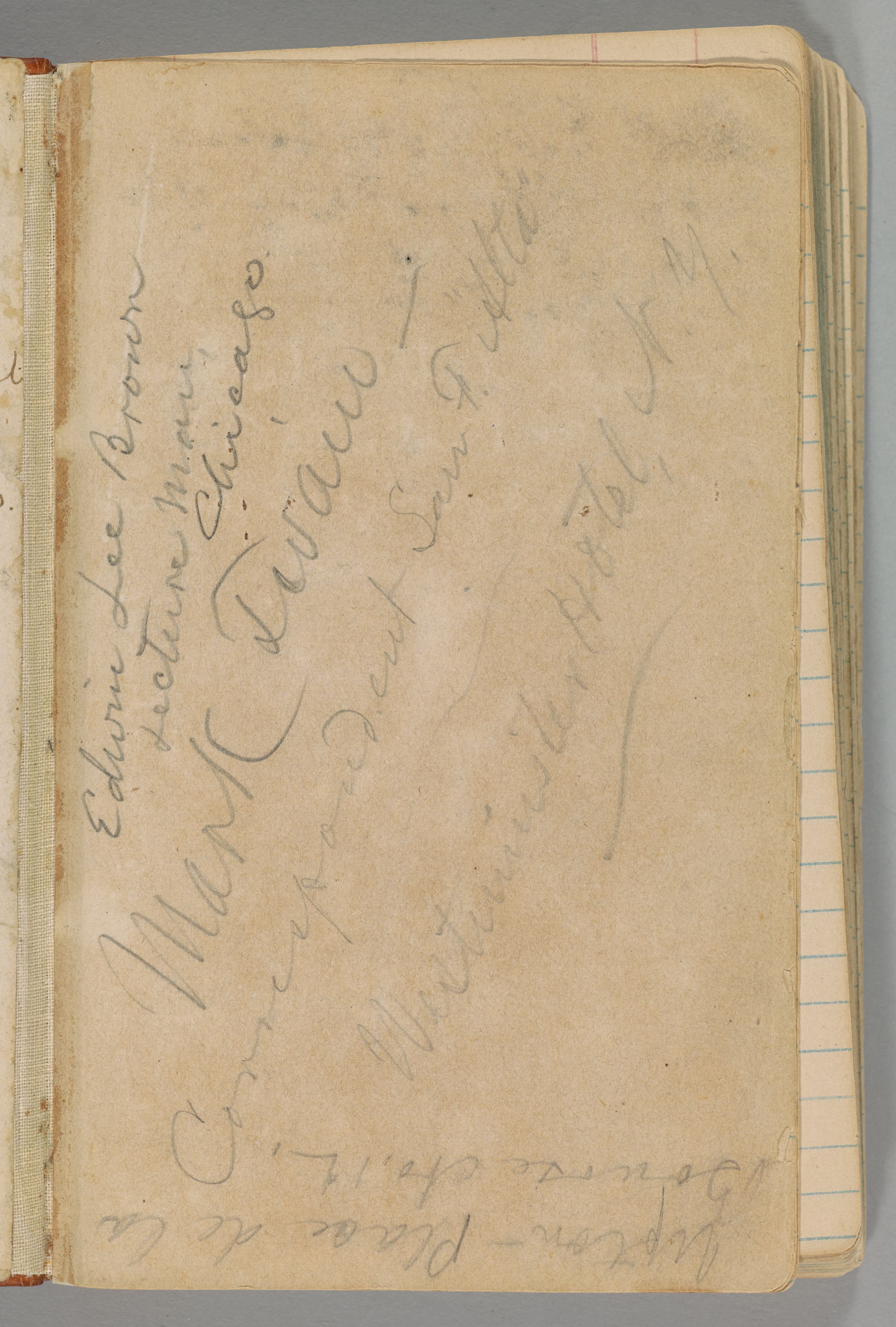
[MS: N8_front flyleaf recto]
Mark Twain—
Correspondent San F. “Alta”

[MTP: N&J1_315]
Edwin Lee Brown
Lecture Man,
Upton—Place de la Bourse No. 12.

[MS: N8_front flyleaf verso]
blank verso
[MTP: N&J1_368]
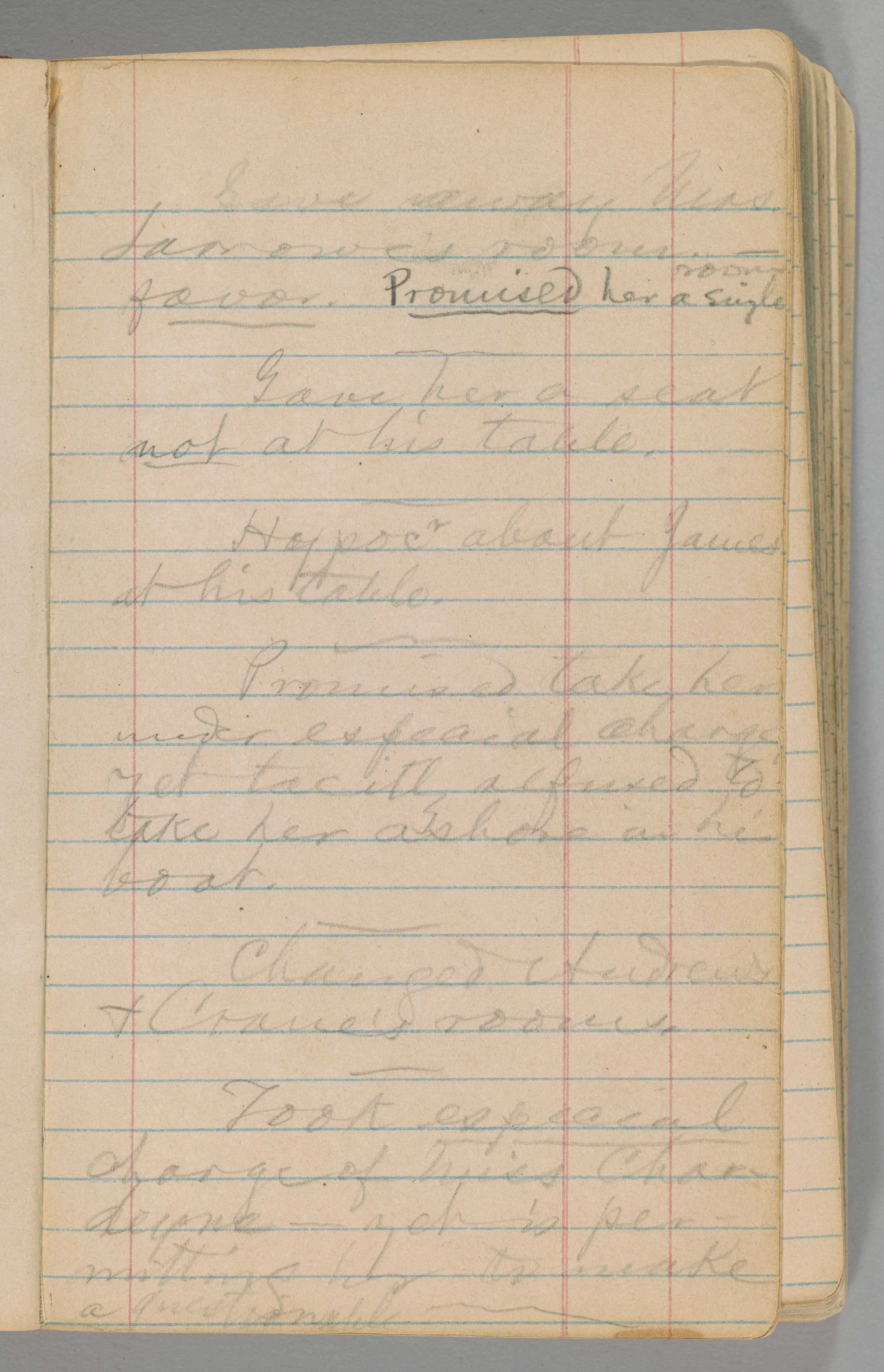
[MS: N8_leaf_001r]
Gave away Mrs.
Larrowe's room.—
favor.
Promised her a single room
[MTP: N&J1_369]
Gave her a seat
not at his table.
Hypocr about James
at his table.
Promised take her
under especial charge,
yet tacitly refused to
take her ashore in his
boat.
Changed Andrews
& Crane's rooms.
Took especial
charge of Miss
Char-
deyne
Chardeyne
—yet is
per-
mitting
permitting
her to make
a questionable——
[MS: N8_leaf_001v]
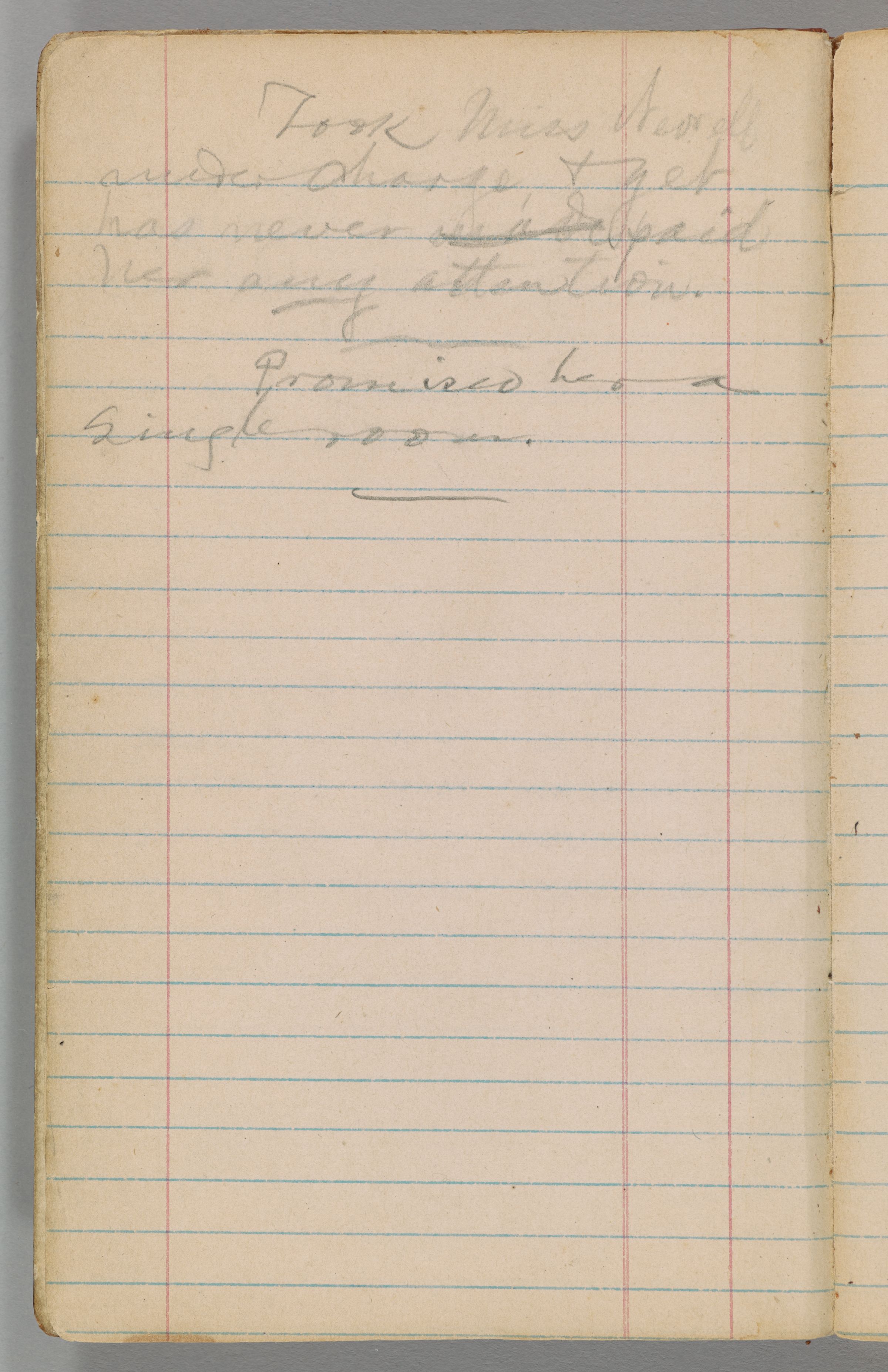
Took Miss Newell
under charge, & yet
has never made paid
her any attention.
Promised her a
single room.
six blank pages follow leaf 001v (002r–004v)
[MS: N8_leaf_005r]
[MTP: N&J1_316]
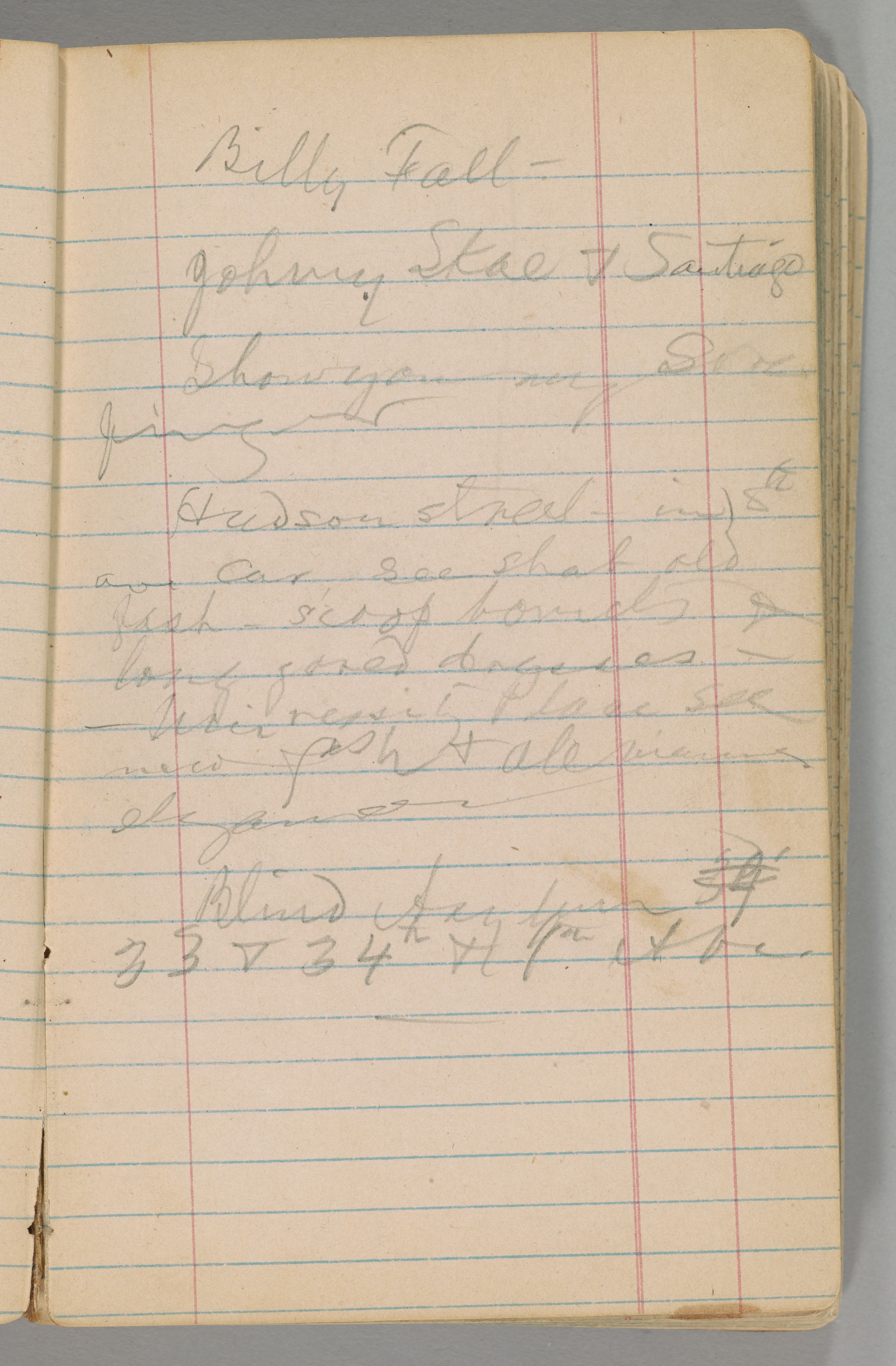
Show you my sore
finger
Hudson street—in 8th
ave car, see shab old
fash—scoop bonnets &
long gored dresses—
—University Place, see
new fash & all manner
elegance
Blind Asylum
3d.
34
33 & 34th & 9th Ave.
[MS: N8_leaf_005v]
[MTP: N&J1_317]
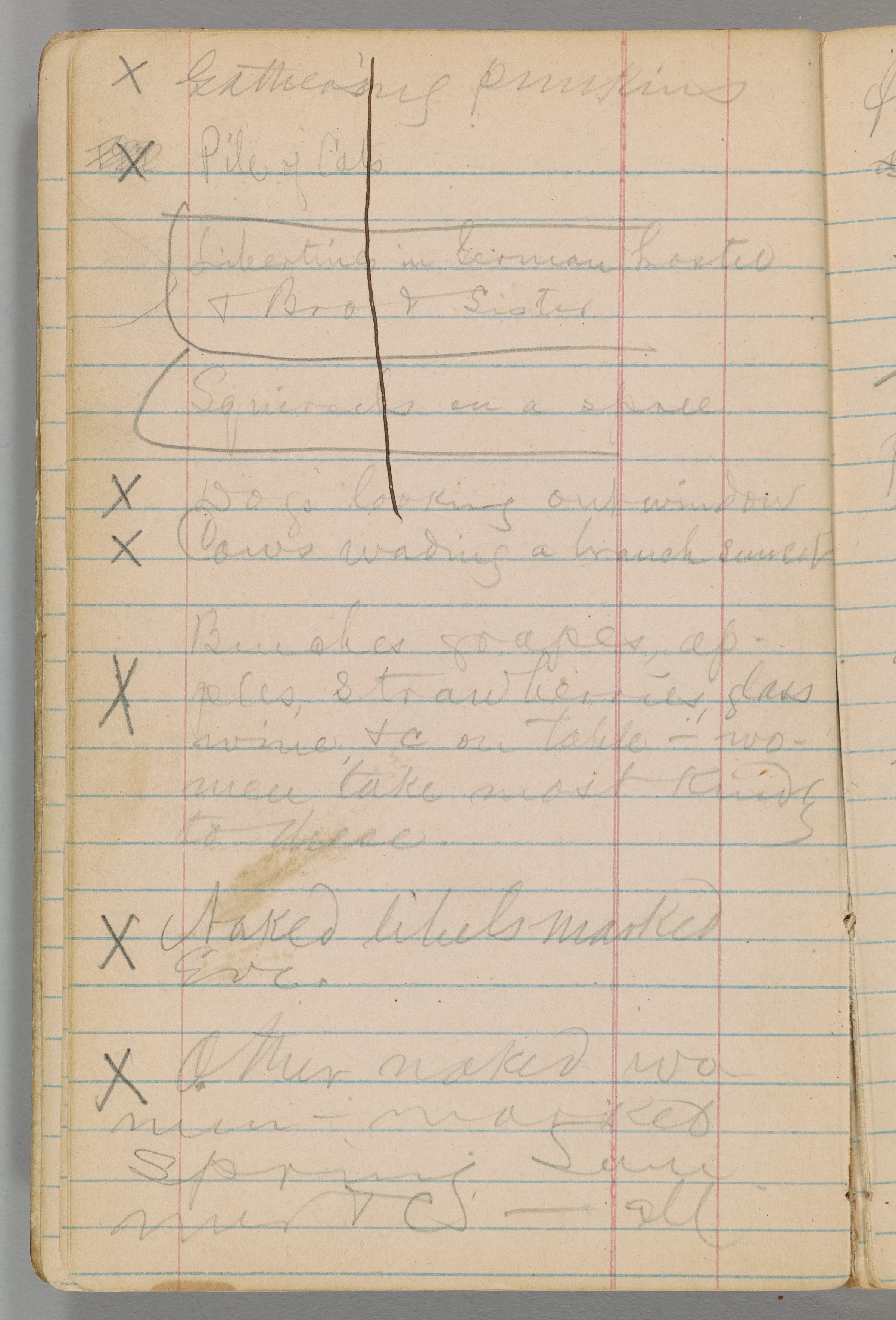
Libertines in German hostel
& Bro & Sister
✗ Cows wading a branch sunset
✗ Bunches grapes,
ap-
ples
apples
, strawberries, glass
wine, &c on table—
wo-
men
women
take most kindly
to these.
✗ Naked libels marked
Eve.
✗ Other naked
wo-
men
women
—marked
Spring
Sum-
mer
Summer
&c—all
[MS: N8_leaf_006r]
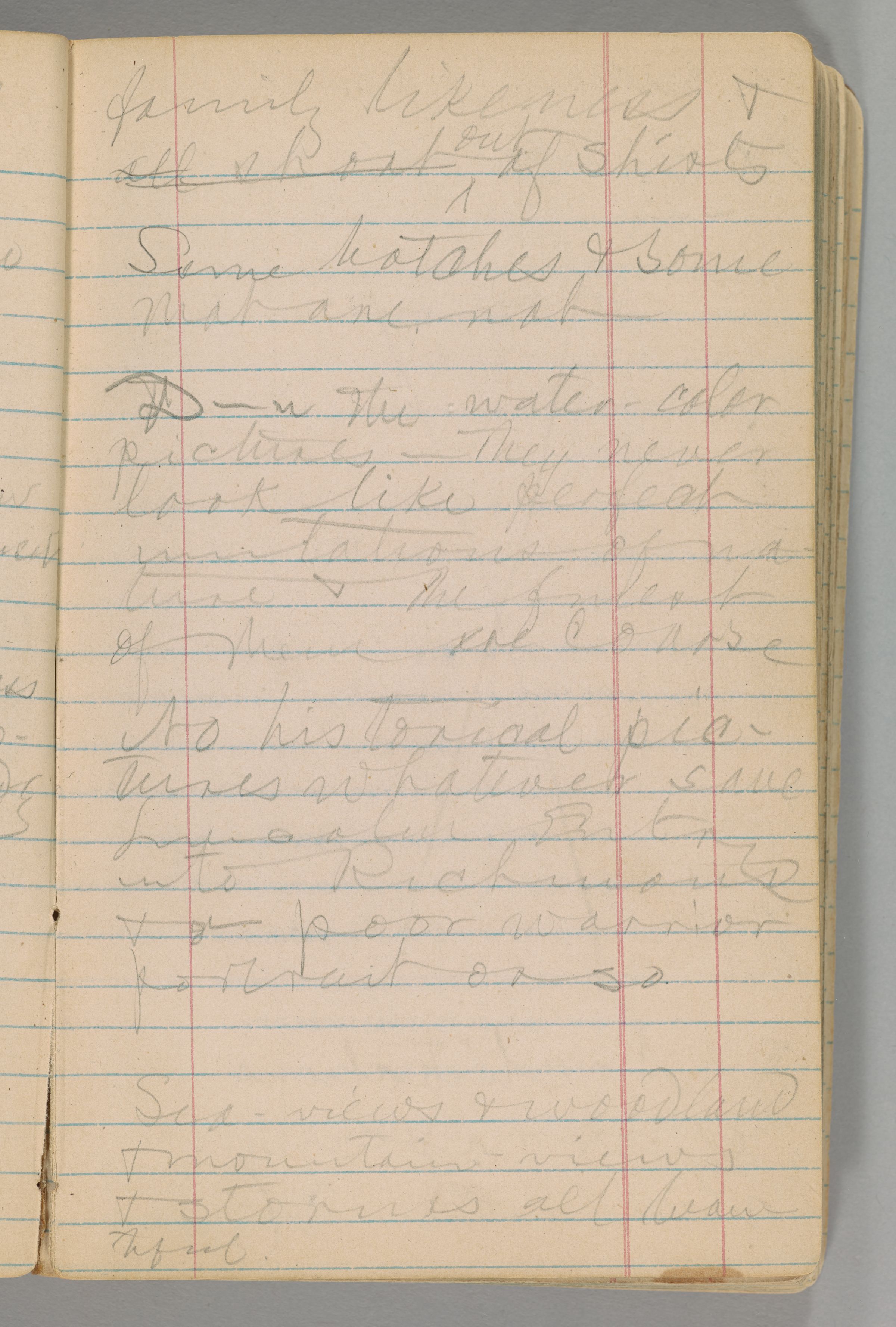
family likeness &
all short
out of shirts
Some botches & some
that are not
T D—n the water-color
pictures—they never
look like perfect
imitations of
na-
ture
nature
& the finest
of them are coarse
No historical
pic-
tures
pictures
whatever save
Lincolns Entry
into Richmond
& a poor warrior
portrait or so
Sea-views & woodland
& mountain-views
& storms all
beau-
tiful
beautiful
.
[MS: N8_leaf_006v]
[MTP: N&J1_318]
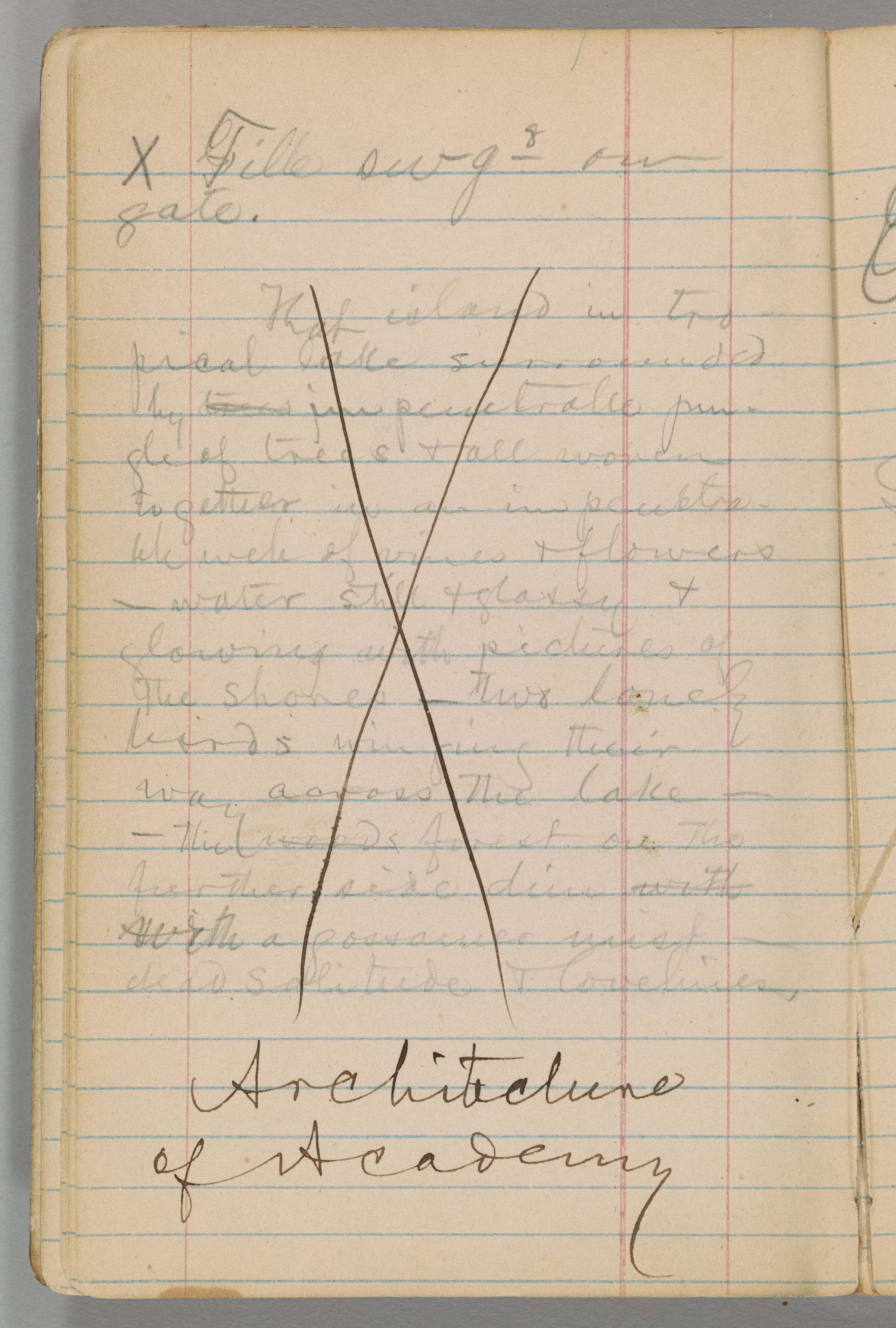
That island in
tro-
pical
tropical
lake surrounded
by trees
j impenetrable
jun-
gle
jungle
of trees & all woven
together in an
impenetra-
ble
impenetrable
web of vines & flowers
—water still & glassy &
glowing with pictures of
the shores—two lonely
birds winging their
way across the lake—
—the woods forest on the
further side dim with
& with a gossamer mist—
dead solitude & loveliness
[MS: N8_leaf_007r]
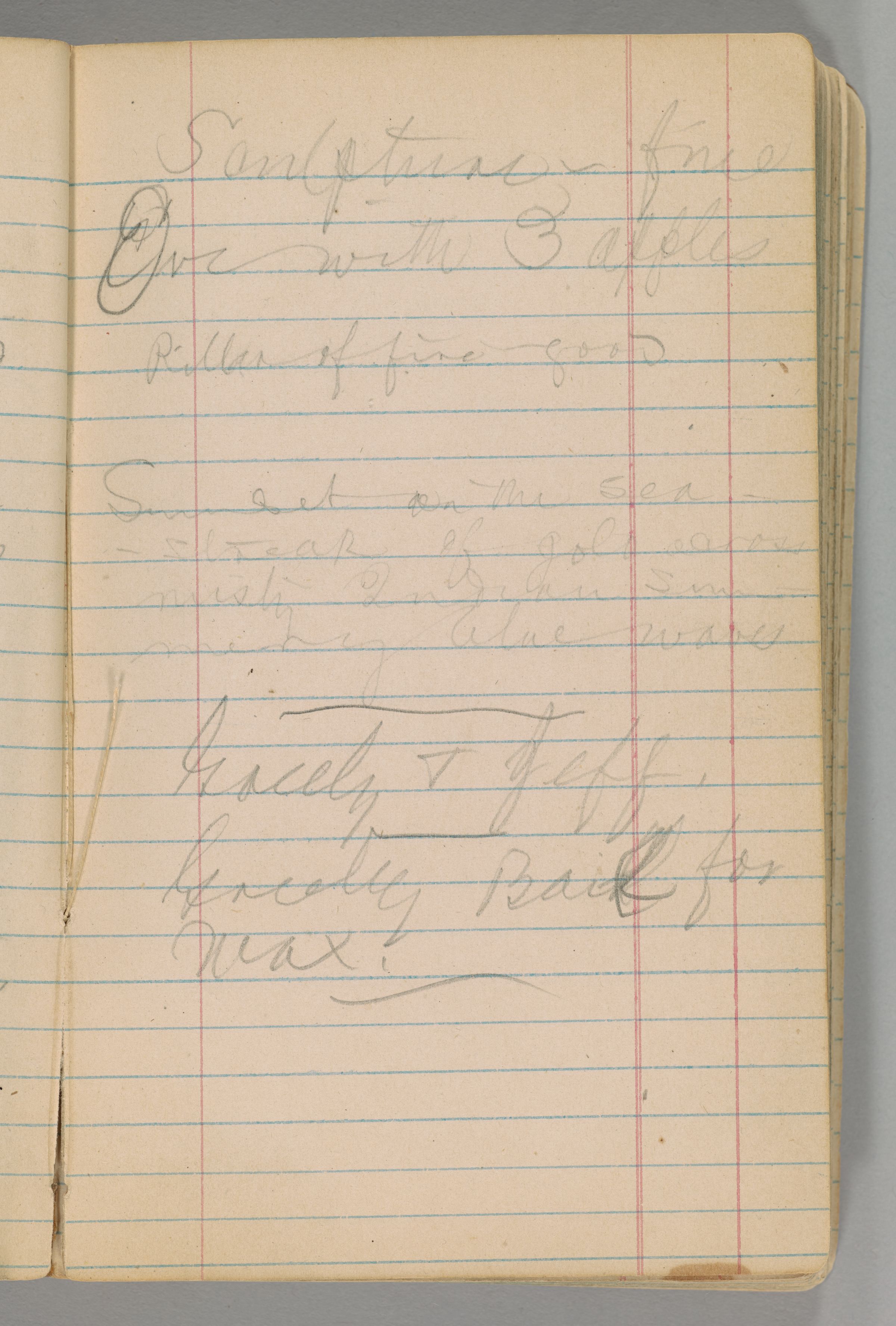
Sculpture—fine
Sunset on the sea—
—streak of gold across
misty Indian
sum-
mery
summery
blue waves
[MTP: N&J1_319]
Greeley Bail for
Max.
four blank pages follow 007r (007v–009r
[MS: N8_leaf_009v]
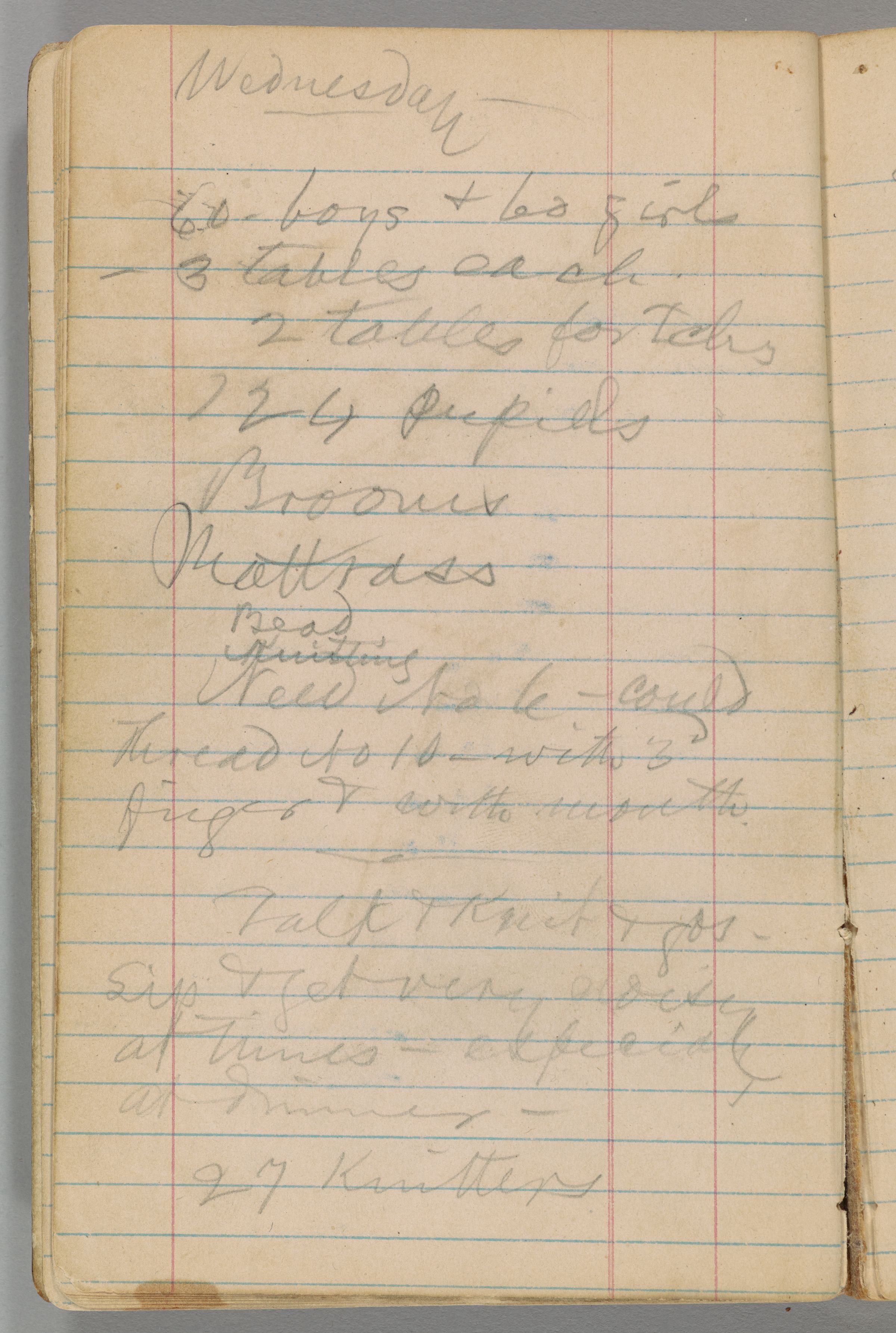
60 boys & 60 girls
—3 tables each.
2 tables for tchs
124 pupills
Brooms
Mattrass
Bead
Knitting
Need No 6—could
thread No 10—with 3d
finger & with mouth.
Talk & knit &
gos-
sip
gossip
& get very noisy
at times—especialy
at dinner—
27 knitters
[MS: N8_leaf_010r]
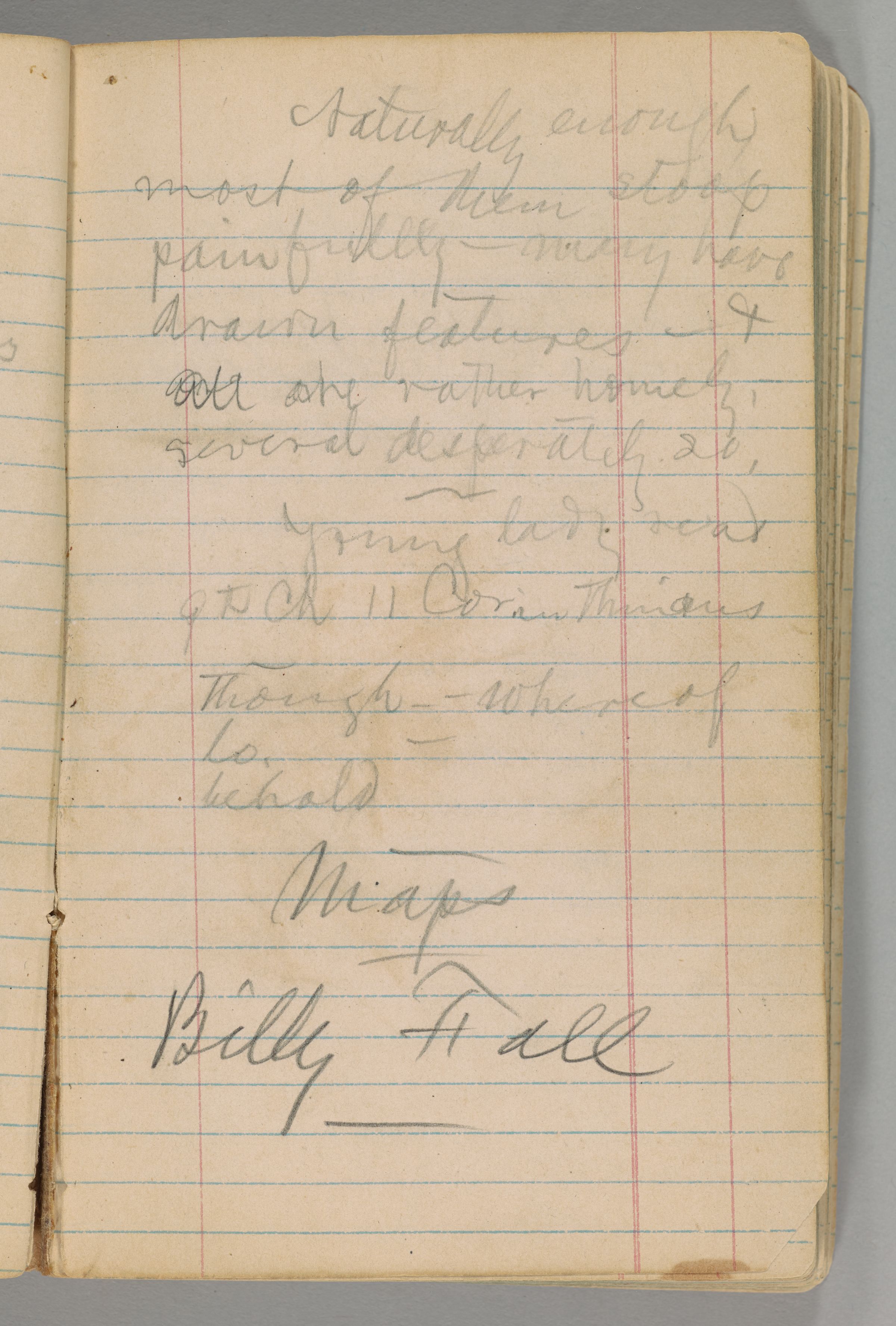
Naturally enough,
most of them stoop
painfully—many have
drawn features—&
are al all are rather homely,
several desperately so.
Young lady read
9th Ch II Corinthinans
—
though—whereof
lo.—
[MTP: N&J1_320]
Maps
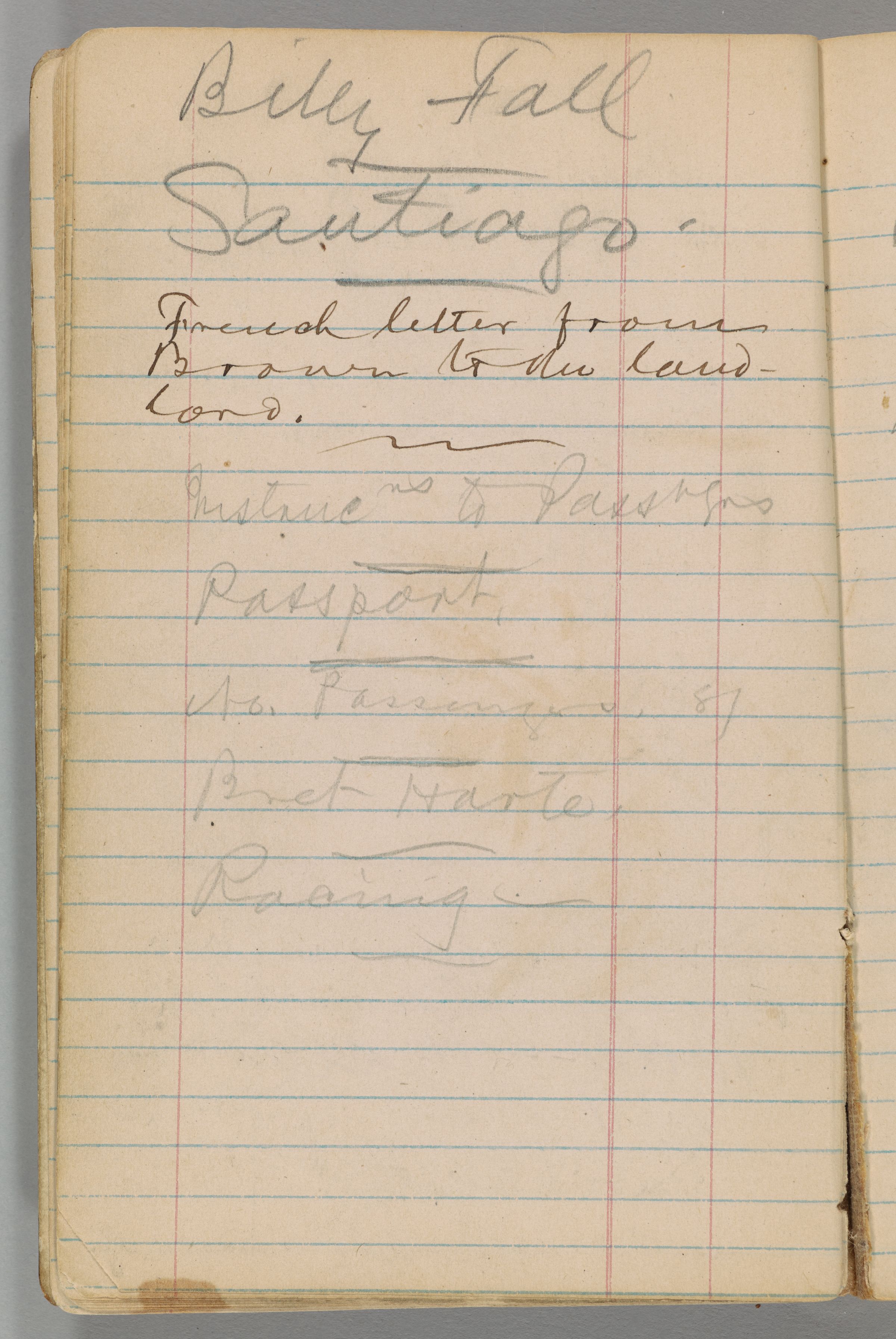
[MS: N8_leaf_010v]
Billy Fall
Santiago.
French letter from
Brown to the
land-
lord
landlord
.
[MTP: N&J1_321]
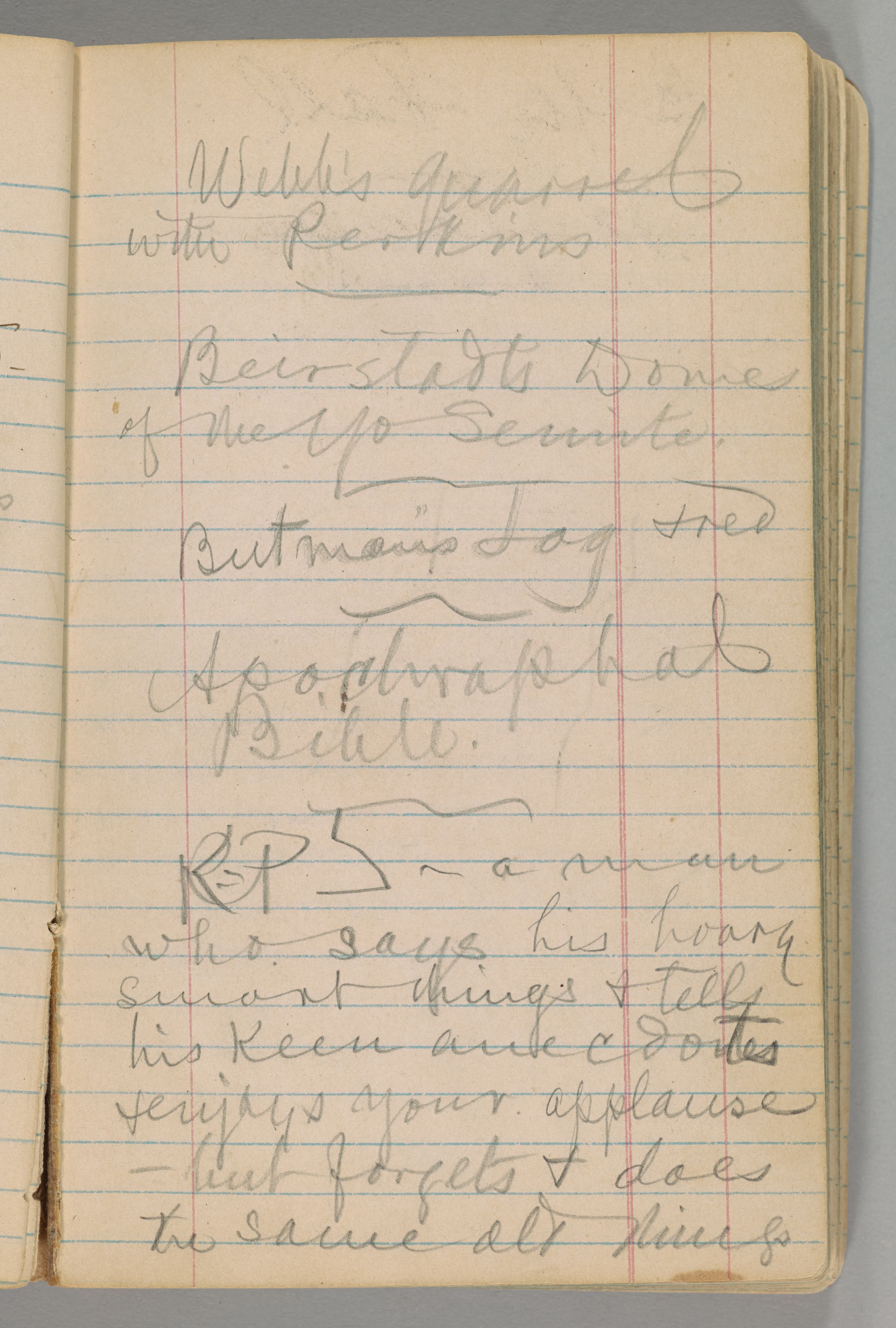
[MS: N8_leaf_011r]
Webb's quarrel
with Perkins
Beirstadts Domes
of the Yo Semite.
R K=P ◊
—a man
who says his hoary
smart things & tells
his keen anecdoststes
& enjoys your applause
—but forgets & does
the same old things
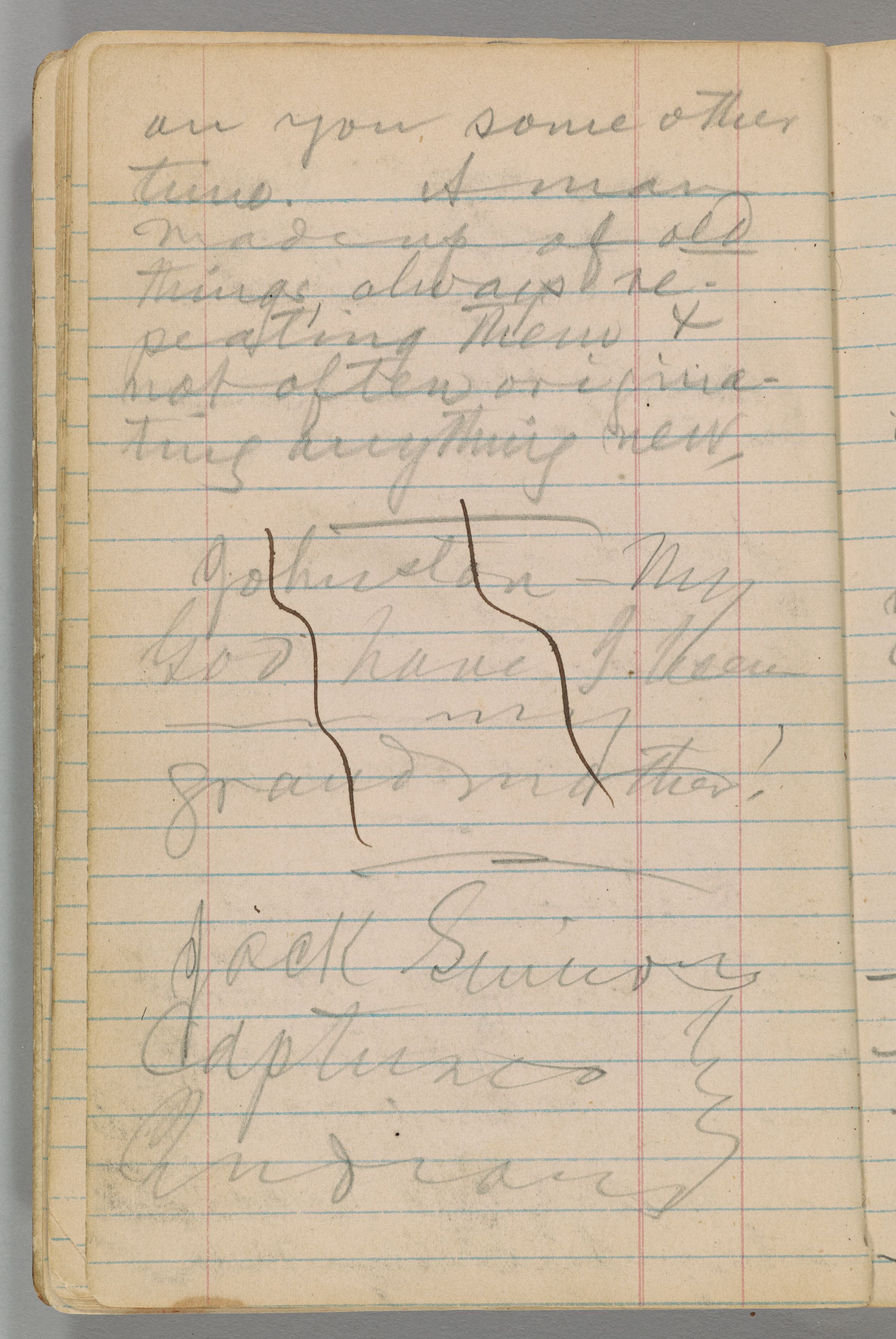
[MS: N8_leaf_011v]
on you some other
time. A man
made up of old
things, always
re-
peating
repeating
them &
not often
origina-
ting
originating
anything new.
Johnston—My
God have I been
———my
grandmother!
[MTP: N&J1_322]
Jack Simmons
Captured by
Indians
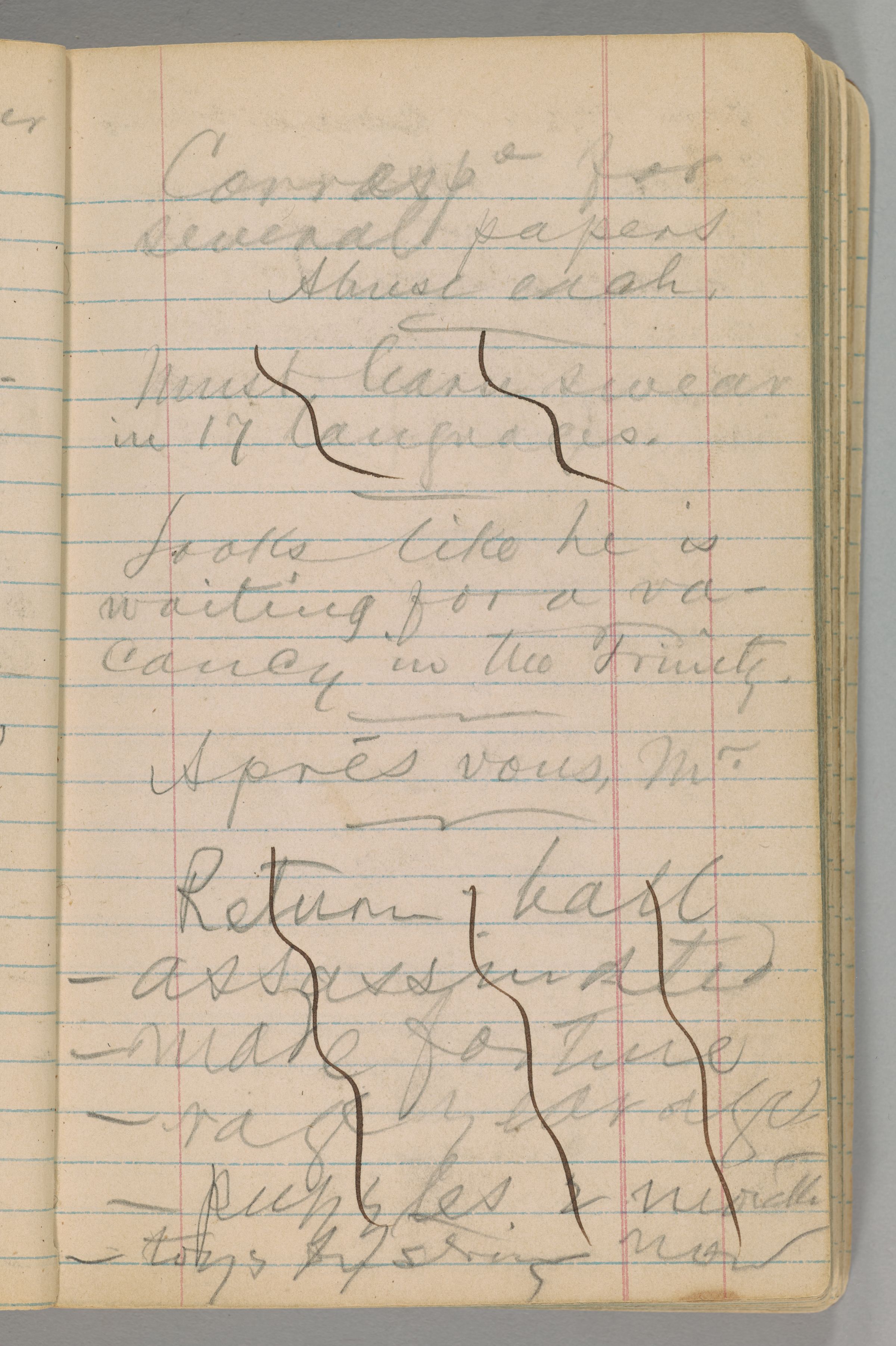
[MS: N8_leaf_012r]
Correspe for
several papers.
Abuse each.
Must learn swear
in 17 languages.
Looks like he is
waiting for a
va-
cancy
vacancy
in the Trinity.
Aprés vous, Mr.
Return-ball
—assassinated
—made fortune
—rage year ago,
—puzzles 2 month
—toys on string now
[MS: N8_leaf_012v]
[MTP: N&J1_323]
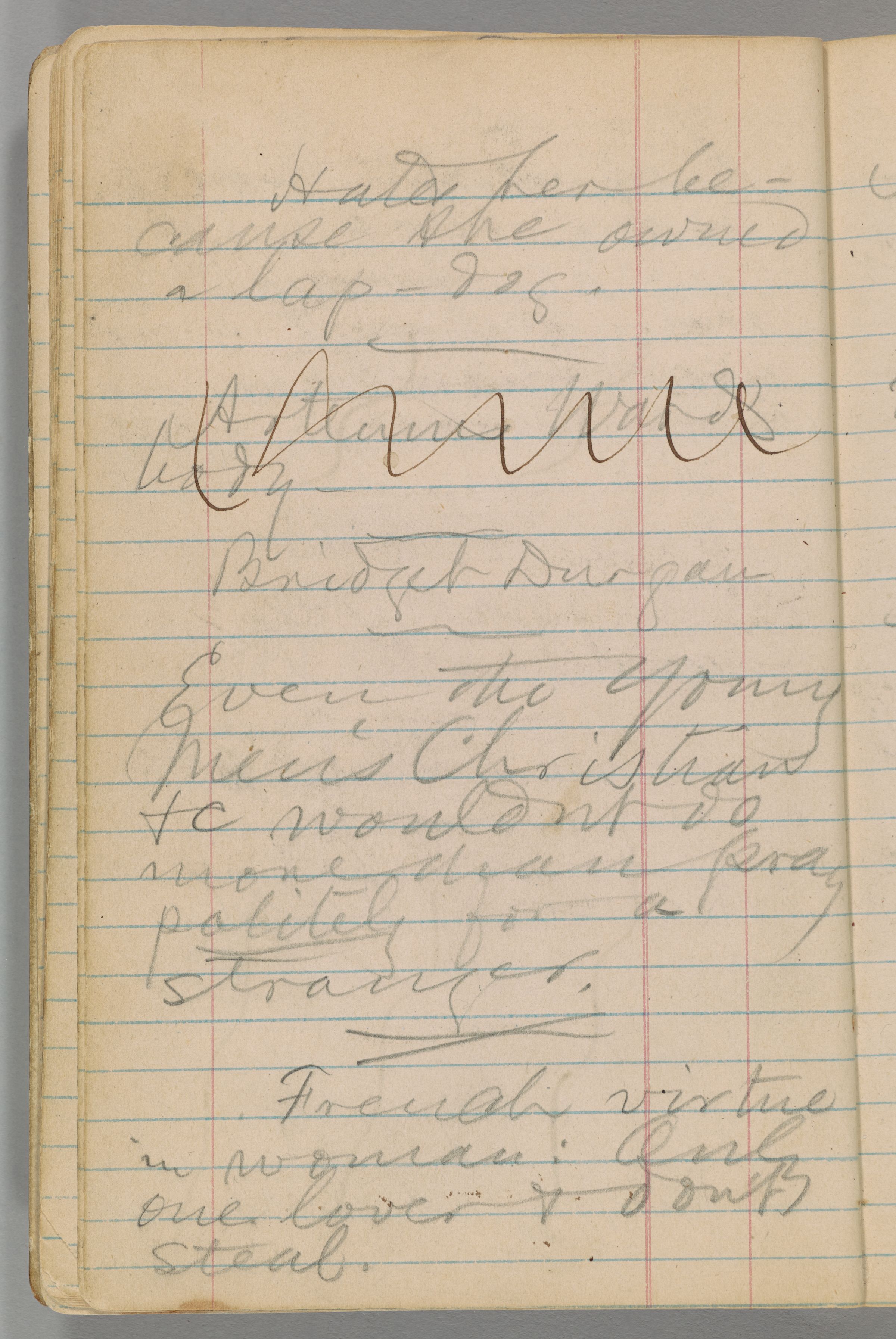
Hates her
be-
cause
because
she owned
a lap-dog.
Even the Young
Men's Christian
&c wouldnt do
more than pray
politely for a
stranger.
French virtue
in woman: Only
one lover & don't
steal.
[MS: N8_leaf_013r]
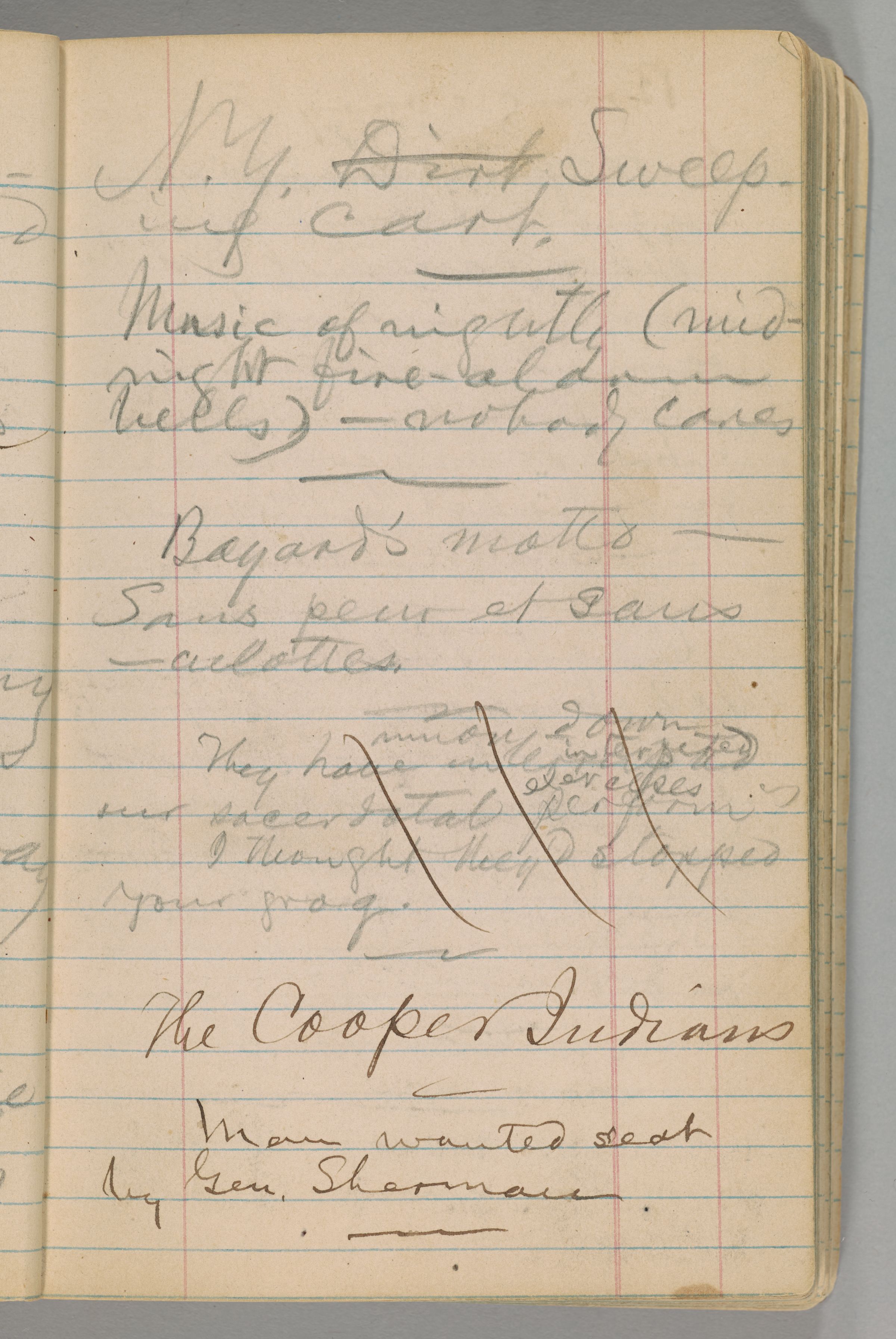
N.Y. Dirt
Sweep-
ing
Sweeping
cart.
Music of nightly (
mid-
night
midnight
fire-alarm
bells)—nobody cares
Bayard's motto—
Sans peur et sans
—culottes.
[MTP: N&J1_324]
union down
They have
interrupted
interfered
our sacerdotal
performes
exercises
I thought they'd stopped
your grog.
Man wanted seat
by Gen. Sherman
[MS: N8_leaf_013v]
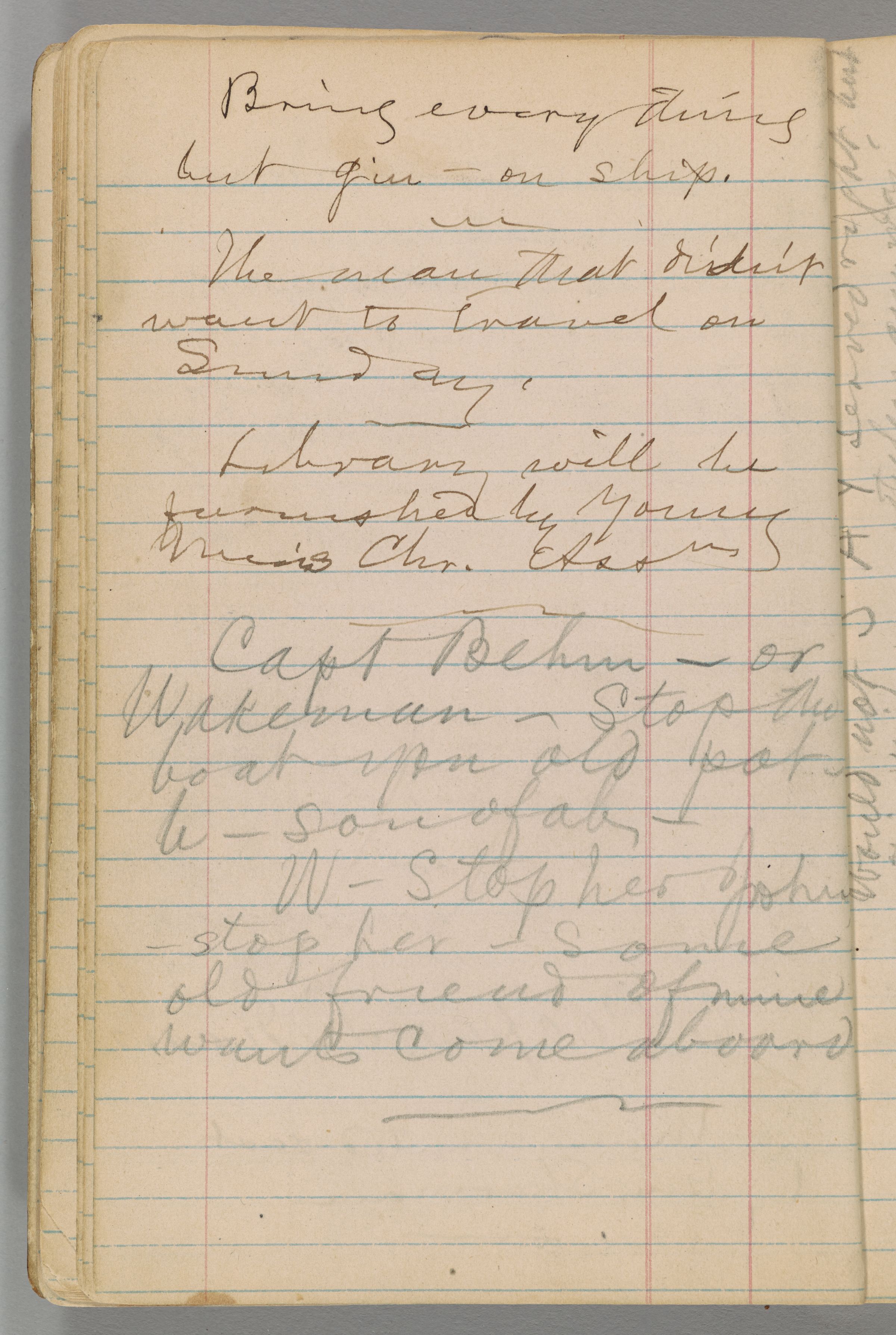
Bring everything
but gin—on ship.
The man that didn't
want to travel on
Sunday.
Library will be
furnished by Young
Men's Chr. Assn
[MTP: N&J1_325]
Capt Behm—or
Wakeman—Stop the
boat you old
pot-
b
pot-b
—sonofab—
W— Stop her John,
—stop her—some
old friend of mine
wants come aboard
[MS: N8_leaf_014r]
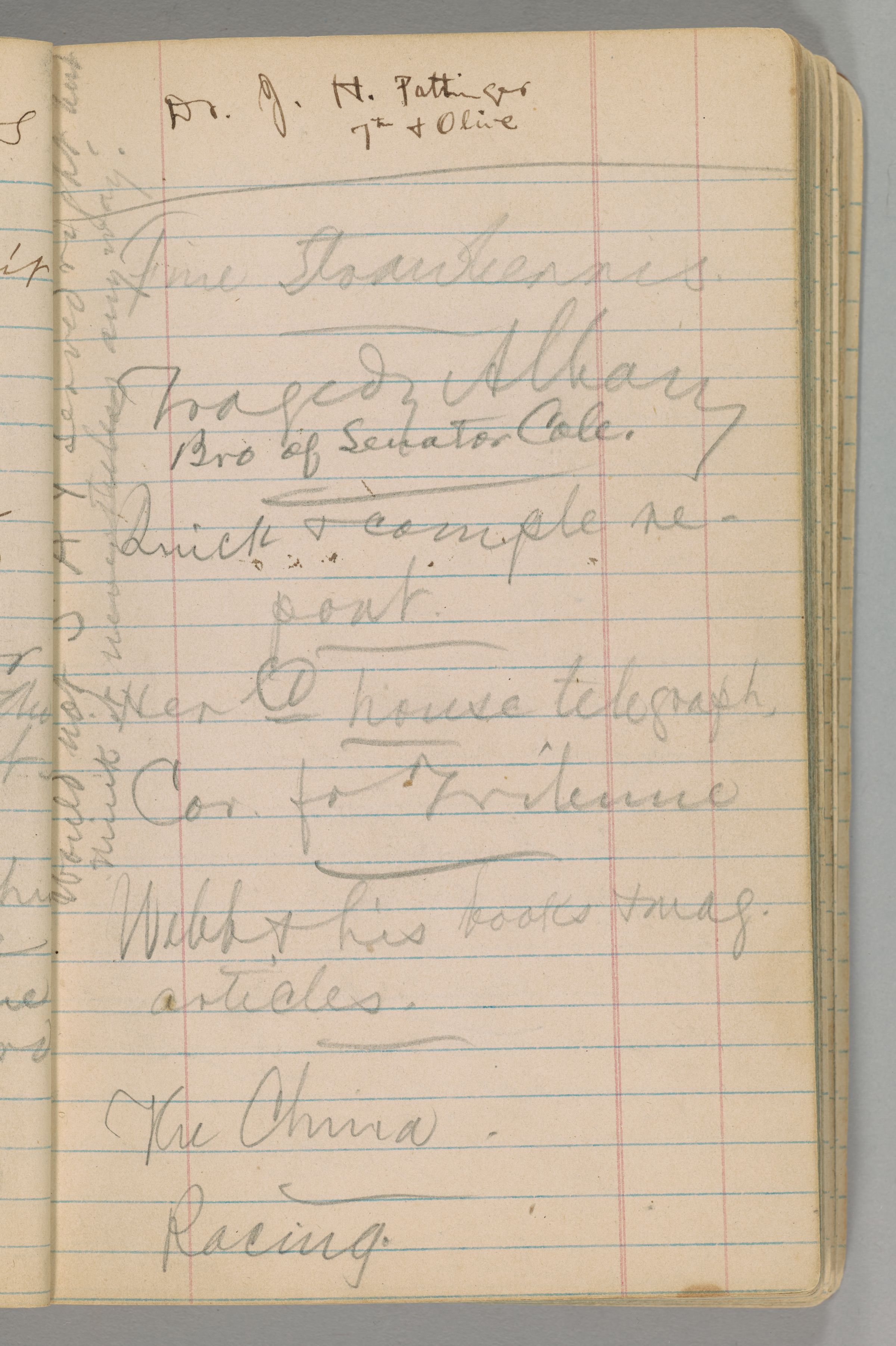
Dr. J. H. Pottinger
Fine Strawberris.
Tragedy Albany
Quick & comple
re-
port
report
.
Herld house telegraph.
Cor. fr Tribune
Would not SAY served right, but
think it, nevertheless any way.
Webb & his books & mag.
articles.
[MTP: N&J1_326]
Racing.
[MS: N8_leaf_014v]
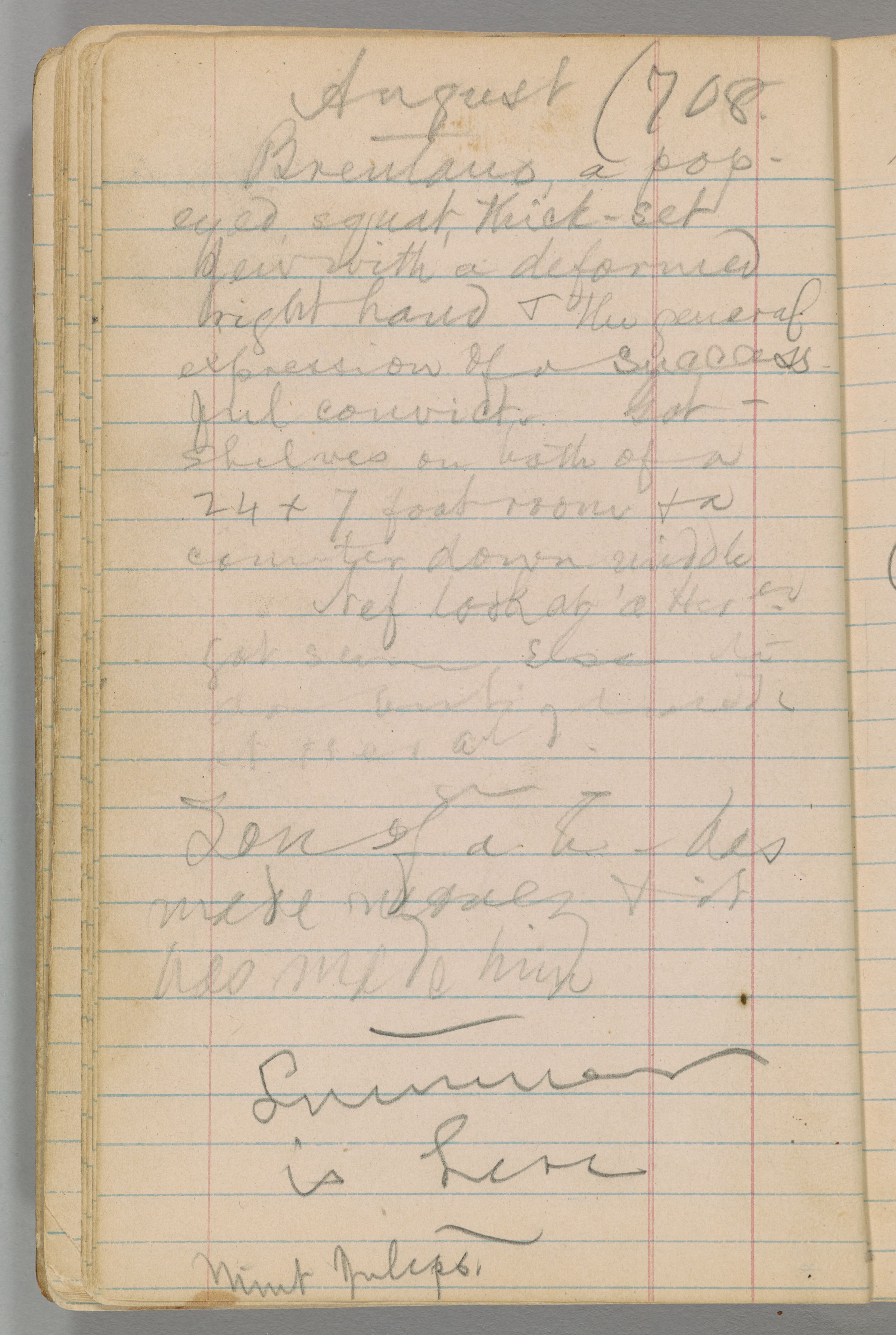
August Brentano,
a
pop-
eyed
pop-eyed
, squat, thick-set
Jew with a deformed
right hand & the general
expression of a
success-
ful
successful
convict. Got—
shelves on both of a
24 × 7 foot room & a
counter down middle
Nef look at 'a Herld
got sum else to do but work
at Herald.
Son of a b— has
made money & it
has made him
Mint Juleps.
[MS: N8_leaf_015r]
Dumas
Balzac.

[MS: N8_leaf_015v]
blank verso, followed by four blank pages (016r–017v)
[MS: N8_leaf_018r]
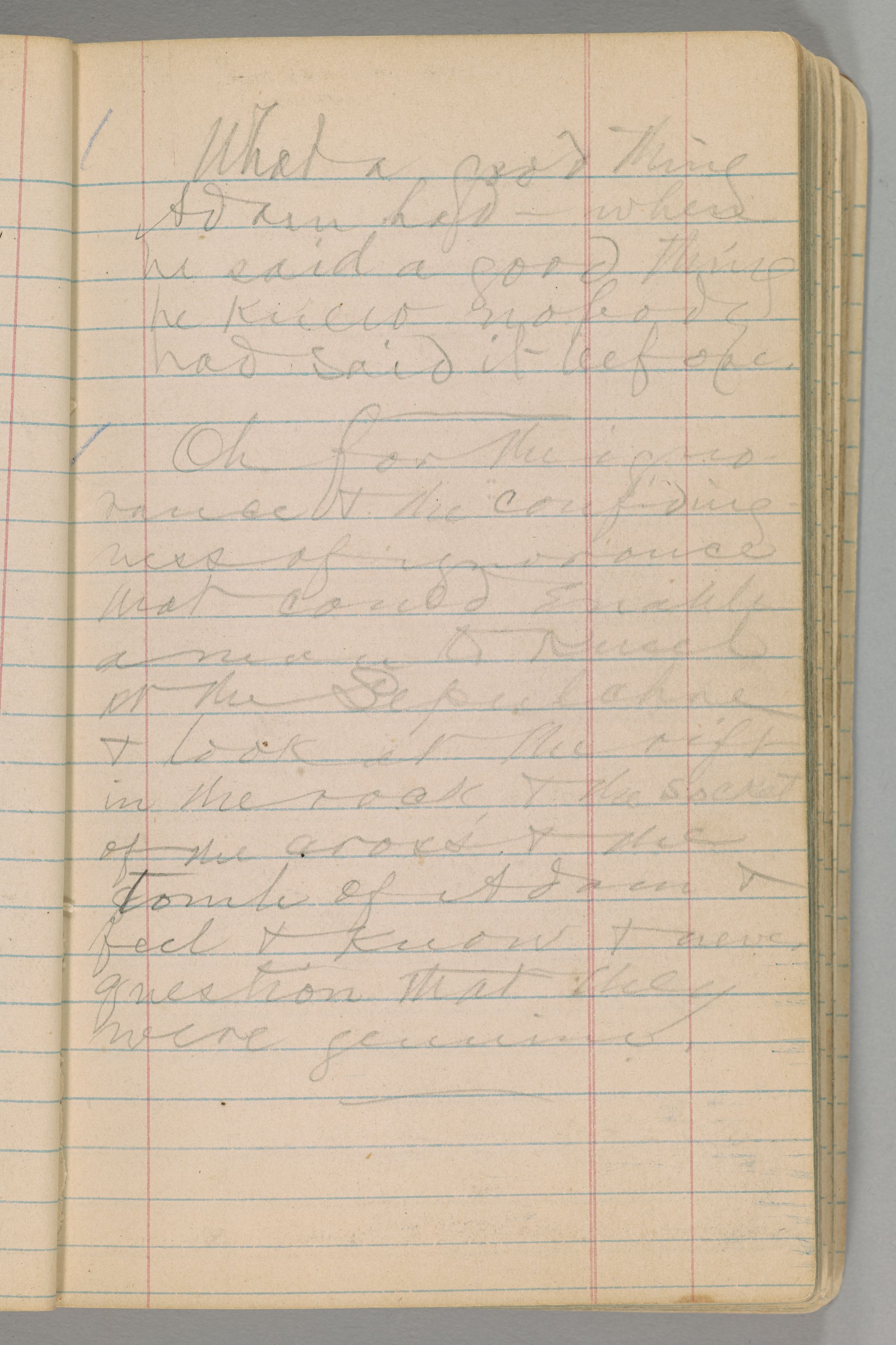
What a good thing
Adam had—when
he said a good thing
he knew nobody
had said it before.
Oh for the
igno-
rance
ignorance
& the
confiding-
ness
confidingness
of ignorance
that could enable
a man to kneel
at the Sepulchre
& look at the rift
in the rock, & the socket
of the cross & the
g tomb of Adam &
feel & know & never
question that they
were genuine.
sequence 3: on the Quaker City tour, 8 June–ca. 2 July 1867
Clemens used the remainder of the notebook from back to front; the text below begins with the back cover; rectos and versos are determined by the use of the book from the back to front
[MS: N8_outside back cover]
679 Broad st
Room 66
New York to Azores Islands—Gibraltar—Tangier,
Africa.
[MS: N8_back endpaper]
[MTP: N&J1_327]
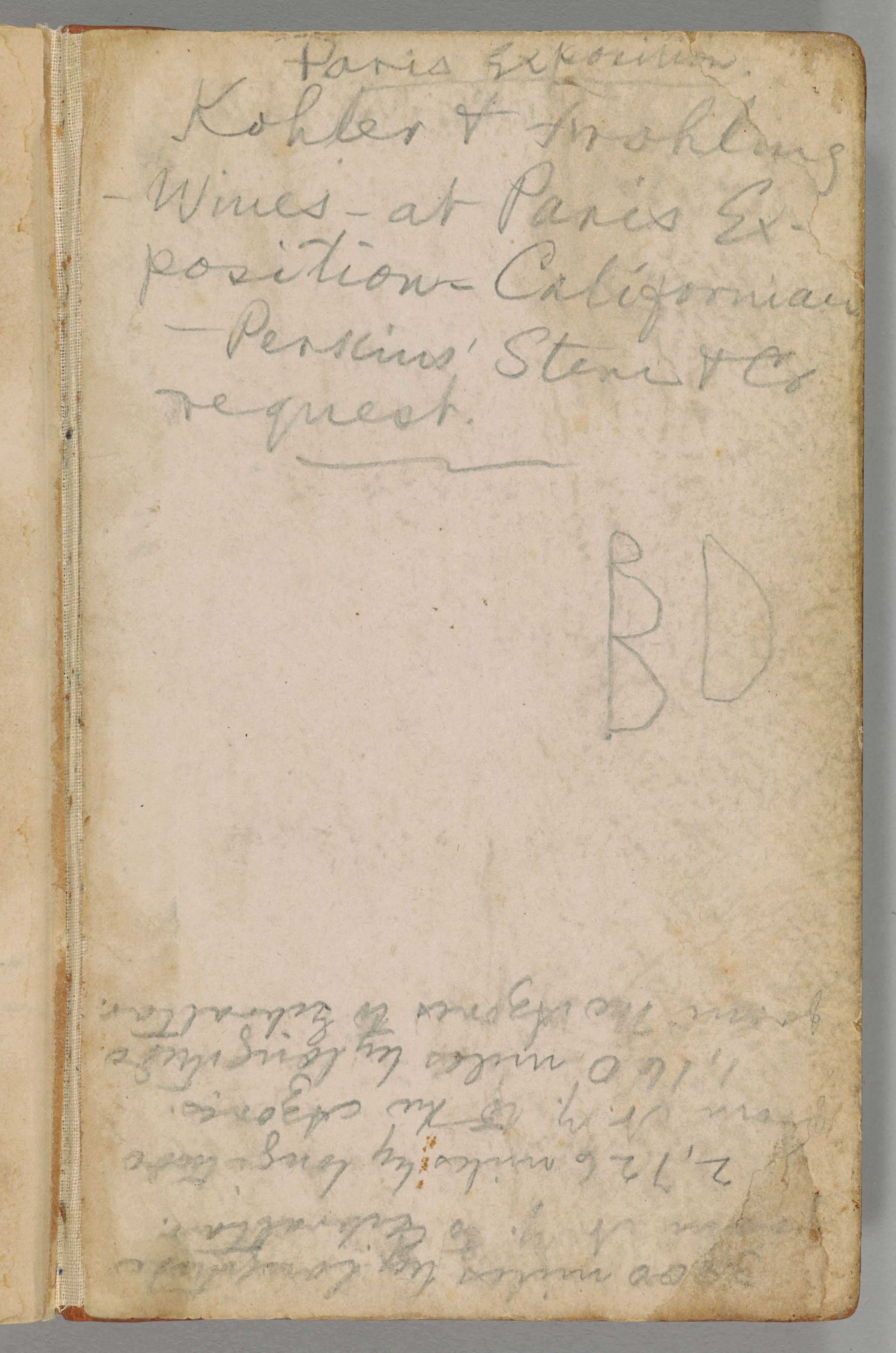
Kohler & Frohling
—Wines—at Paris
Ex-
position
Exposition
—Californian
—Perkins' Stern & Co
request.
drawing (see facsimile)
3800 miles by longitude
from N.Y. to Gibraltar.
2,726 miles by longitude
from N.Y. to the Azores.
1,160 miles by longitude
from the Azores to Gibraltar.
[MS: N8_back flyleaf recto]
[MTP: N&J1_328]
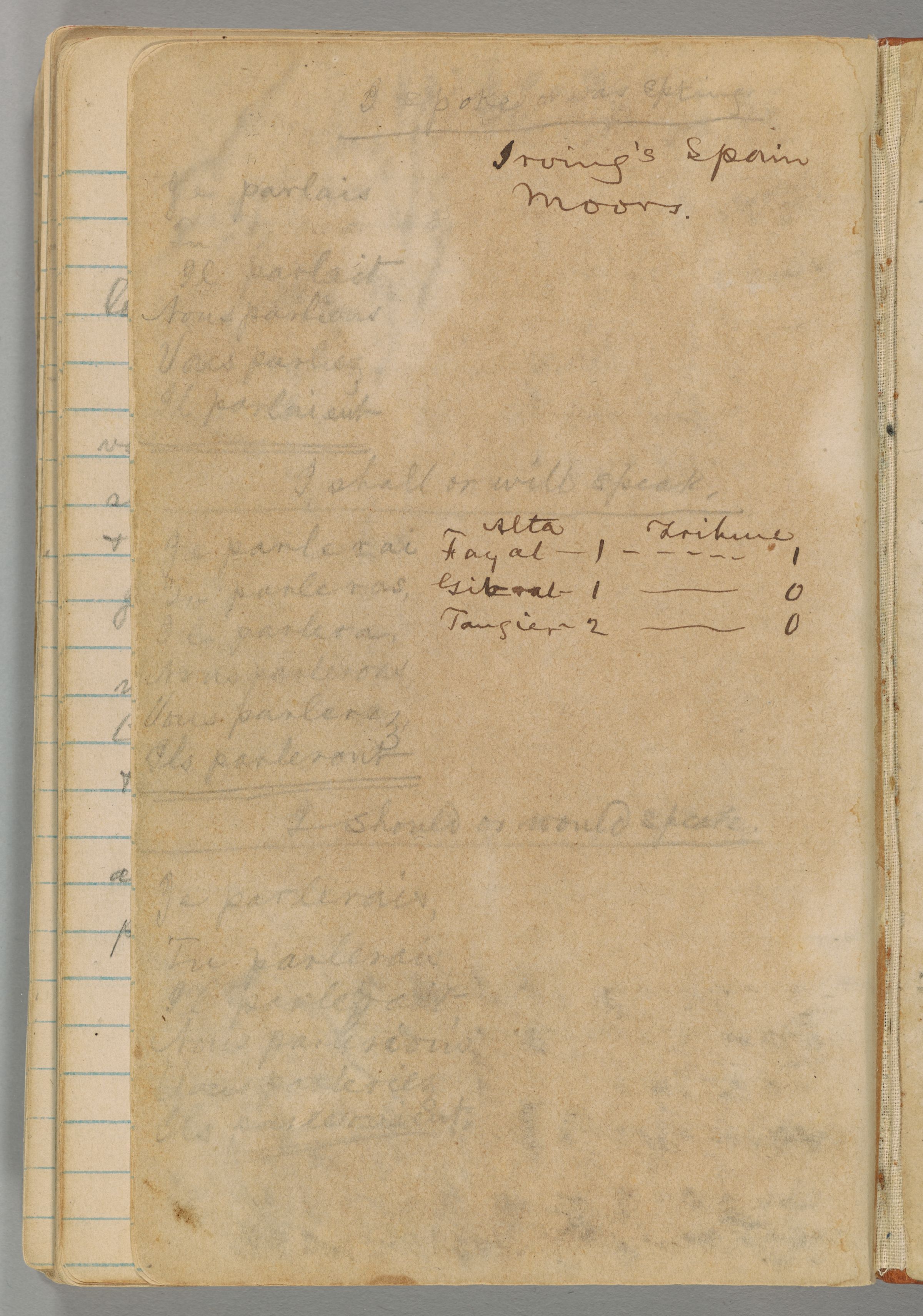
Je parlais
Tu
Il parlait
Nous parlions
Vous parliez
Il parlaient
I shall or will speak.
Je parlerai
Tu parleras,
Il parlera,
Nous parlerons,
Vous parlerez,
Ils parleront
I should or would speak.
Je parlerais,
Tu parlerais,
Il parlerait,
Nous parlerions,
Vous parleriez
Ils parleraient.

[MS: N8_back flyleaf verso]
blank verso, followed by two blank pages (leaves 001r and 001v)
[MS: N8_leaf_002r]
[MTP: N&J1_329]
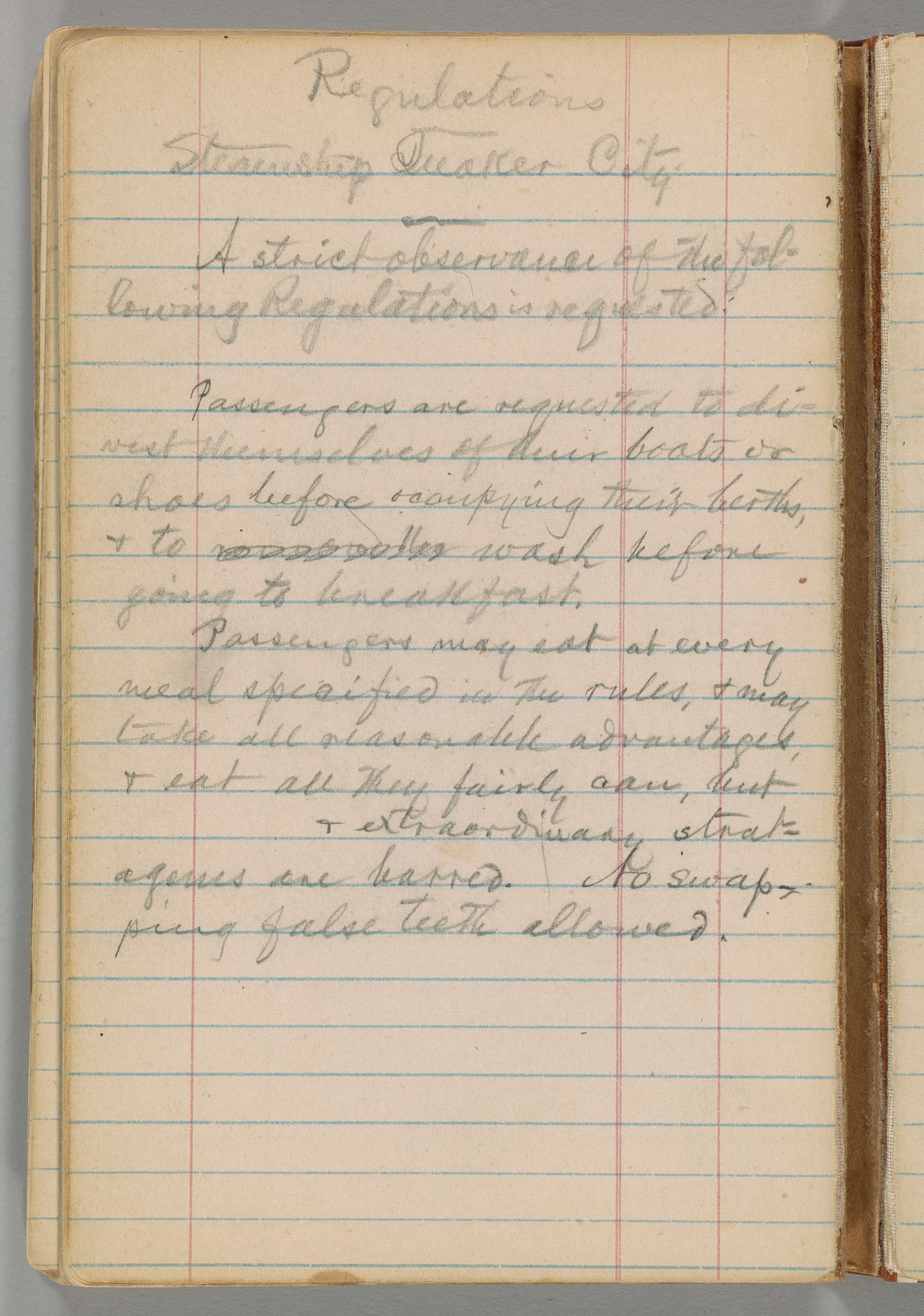
Steamship Quaker City.
A strict observance of the
fol-
lowing
following
Regulations is requested:
Passengers are requested to
di-
vest
divest
themselves of their boots or
shoes before occupying their berths,
& to remove the wash before
going to breakfast.
Passengers may eat at every
meal specified in the rules, & may
take all reasonable advantages,
& eat all they fairly can, but
& extraordinary
strat-
agems
stratagems
are barred. No
swap-
ping
swapping
false teeth allowed.

[MS: N8_leaf_002v]
blank verso
[MS: N8_leaf_003r]
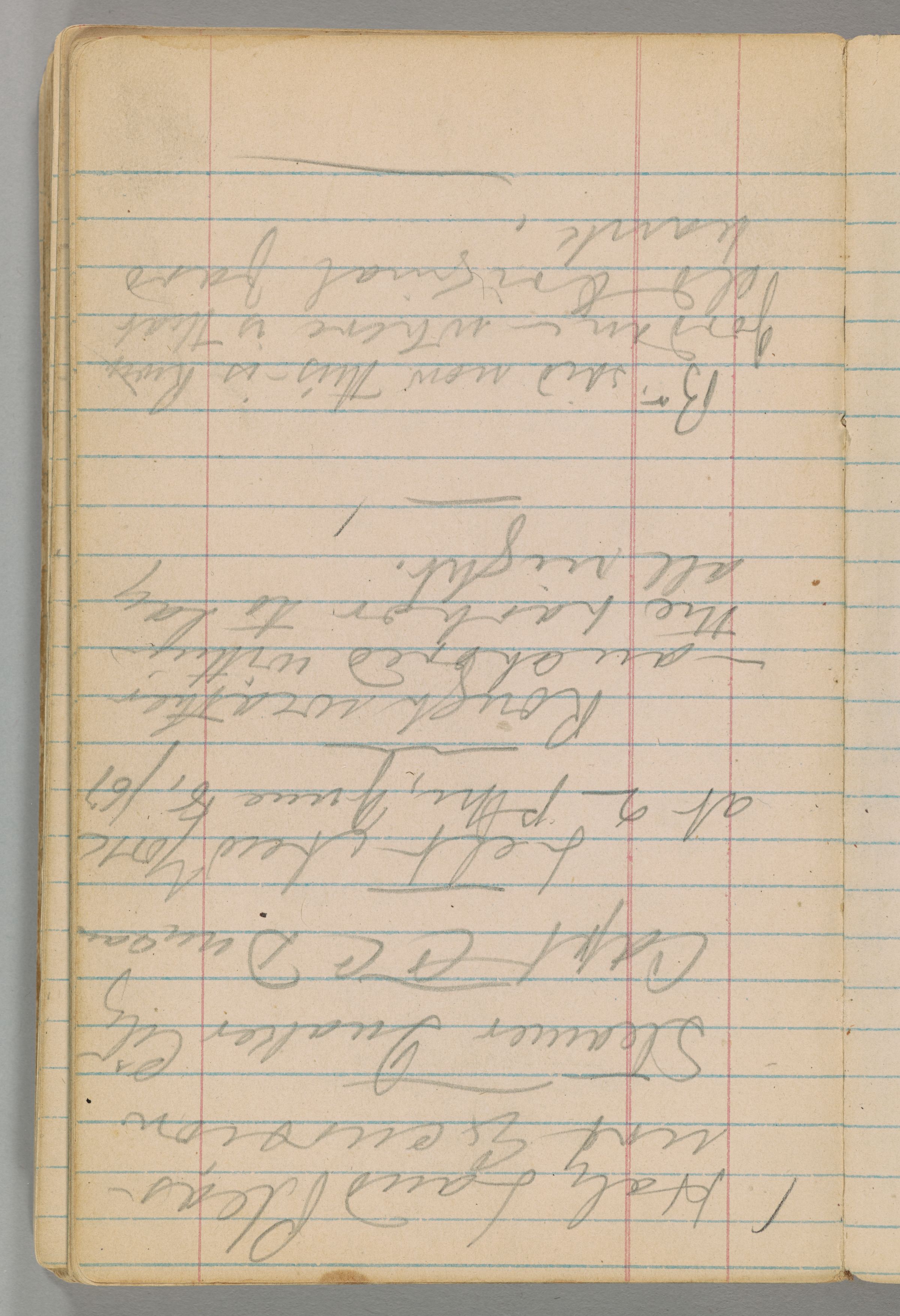
Holy Land
Pleas-
ure
Pleasure
Excursion
Steamer Quaker City
Capt C C Duncan
Left New York
at 2 PM, June 8, /67
Rough weather
—anchored within
the harbor to lay
all night.
Br. said now this is River
Jordan—where is that
old Original faro
bank.
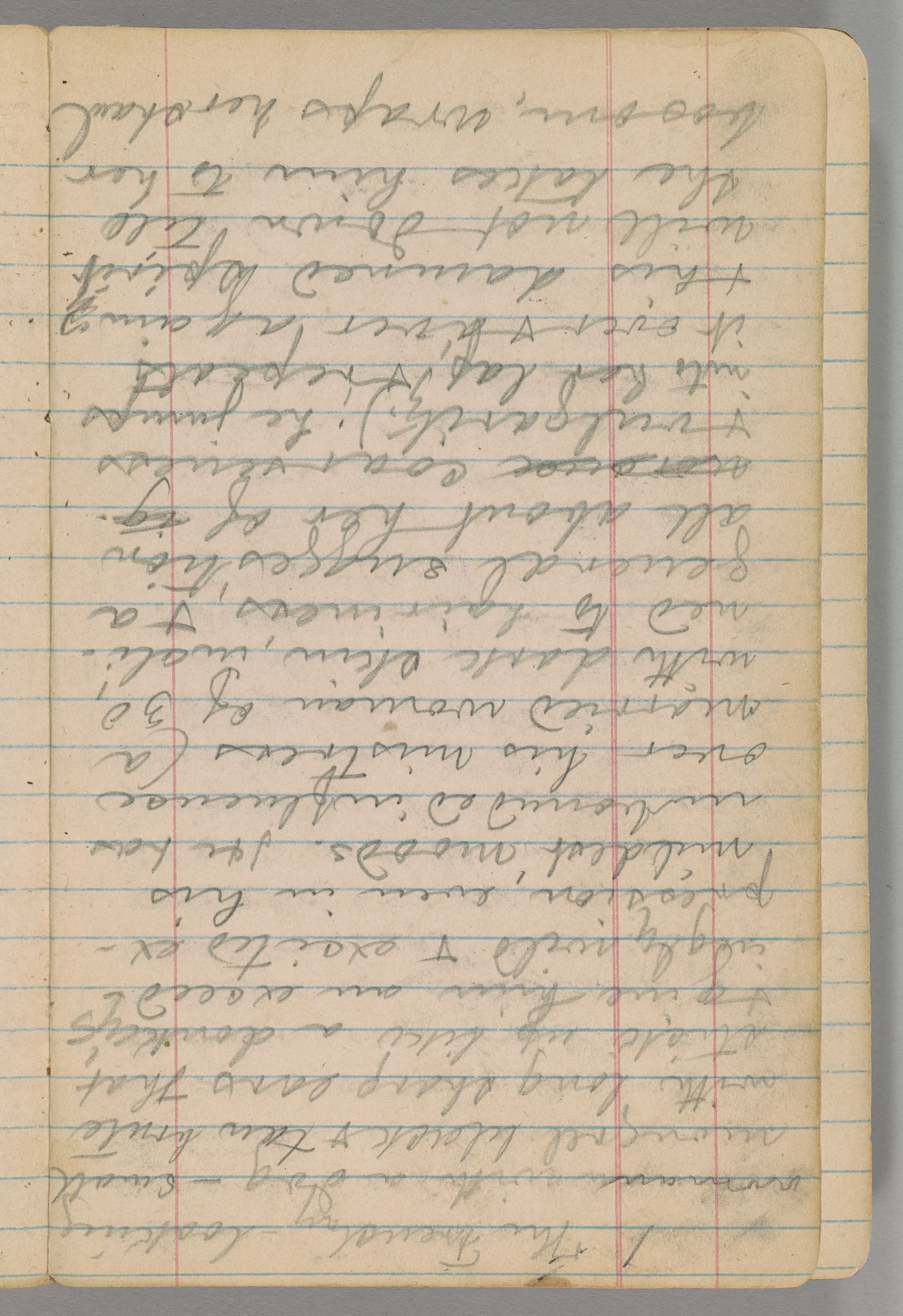
[MS: N8_leaf_003v]
The Frenchy-looking
woman with a dog—small
mongrel black & tan brute
with long sharp ears that
stick up like a donkey's
& give
[MTP: N&J1_330] him an
exceed-
ingly
exceedingly
wild & excited
ex-
pression
expression
, even in his
mildest moods. He has
unbounded influence
over his mistress (a
married woman of 30,
with dark skin,
incli-
ned
inclined
to hairiness, & a
general suggestion
all about her of
ig-
norance
ignorance
coarseness
& vulgarity,); he jumps
into her lap, & repeats
it over & over again ;
& his damned spirit
will not down till
she takes him to her
bosom, wraps her shawl
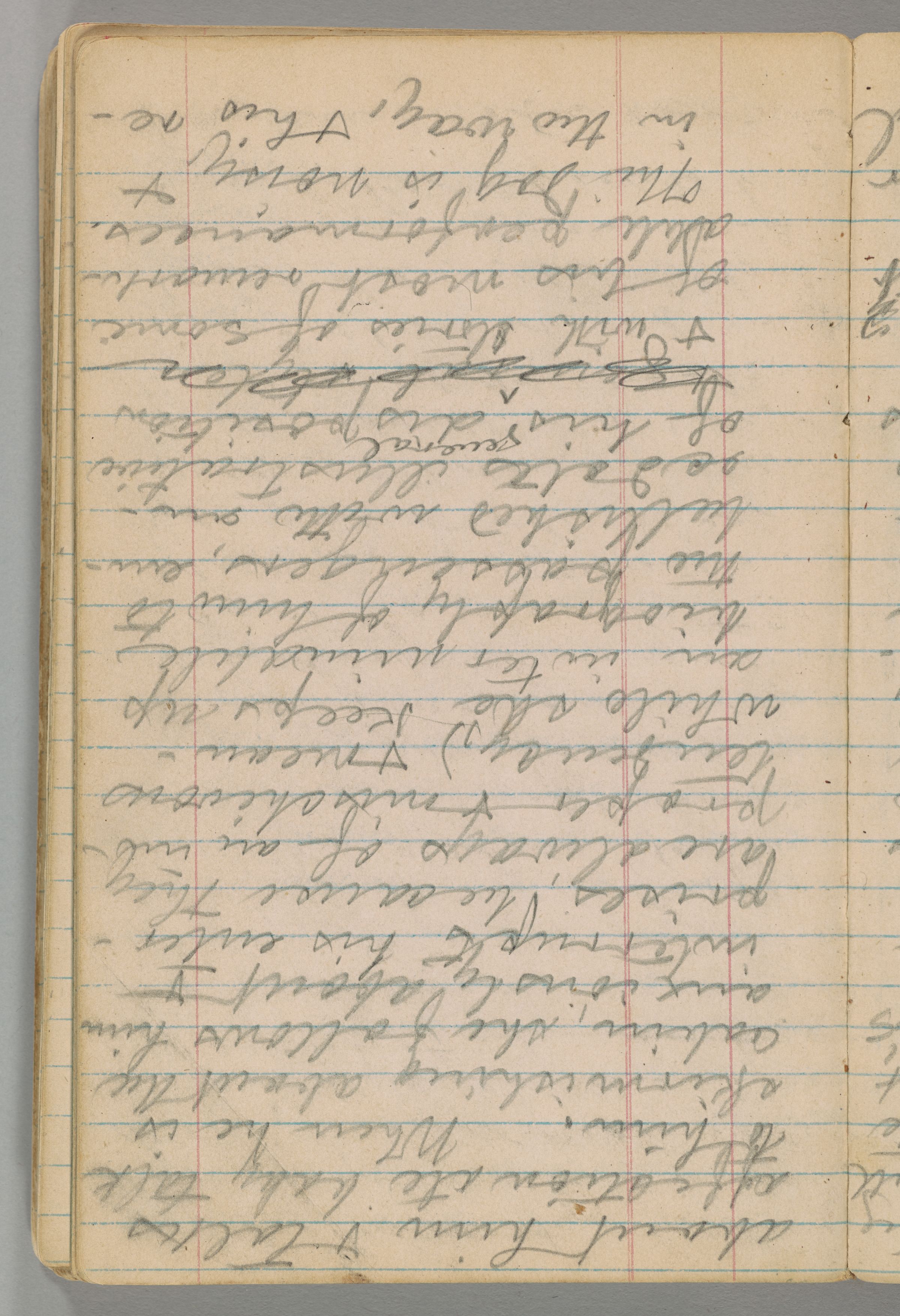
[MS: N8_leaf_004r]
about him & talks
affectionate baby talk
to him. When he is
skirmishing about the
cabin, she follows him
anxiously about &
interrupts his
enter-
prises
enterprises
, because they
are always of an
im-
proper
improper
& mischivous
tendency,) &
mean-
while
meanwhile
she keeps up
an interminable
biography of him to
the passengers,
em-
bellished
embellished
with
an-
ecdotes
anecdotes
illustrative
of his general disposition
& general style.
& with stories of some
of his most
remark-
able
remarkable
performances.
The dog is noisy, &
in the way, & his re-
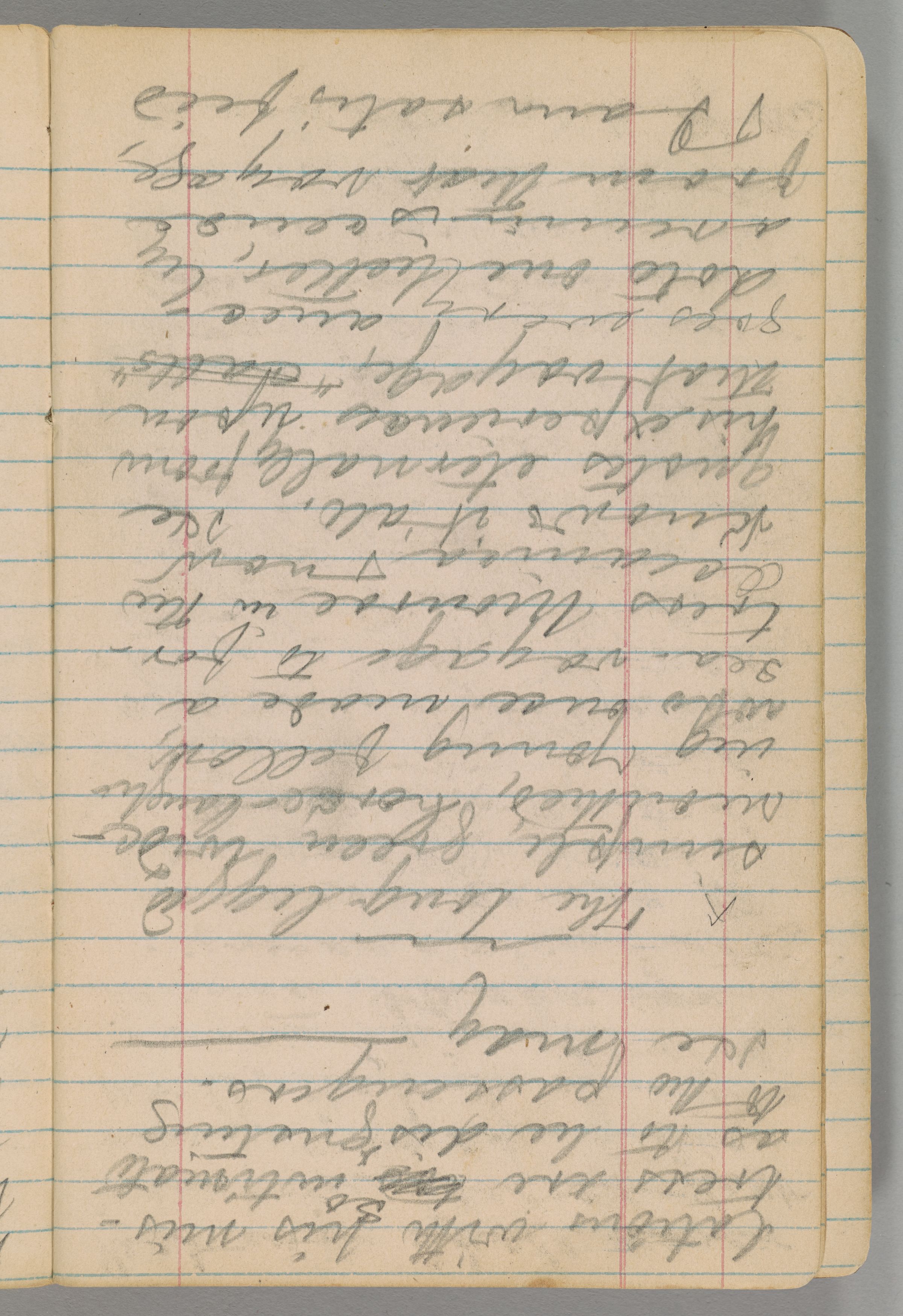
[MS: N8_leaf_004v]
lations with his
mis-
tress
mistress
are too
so
intimate
as to be disgusting
to the passengers. He may———
The long-legged,
simple, green, wide-
mouthed,
horse-laugh-
ing
horse-laughing
young fellow,
who once made a
sea-voyage to
for-
tress
fortress
Monroe in the
Oceanica, & now
knows it all. He
quotes eternally from
his experiences upon
that voyage, “calls”
goes every
anec-
dote
anecdote
one better, by
a reminiscence
from that voyage,
& I am satisfied
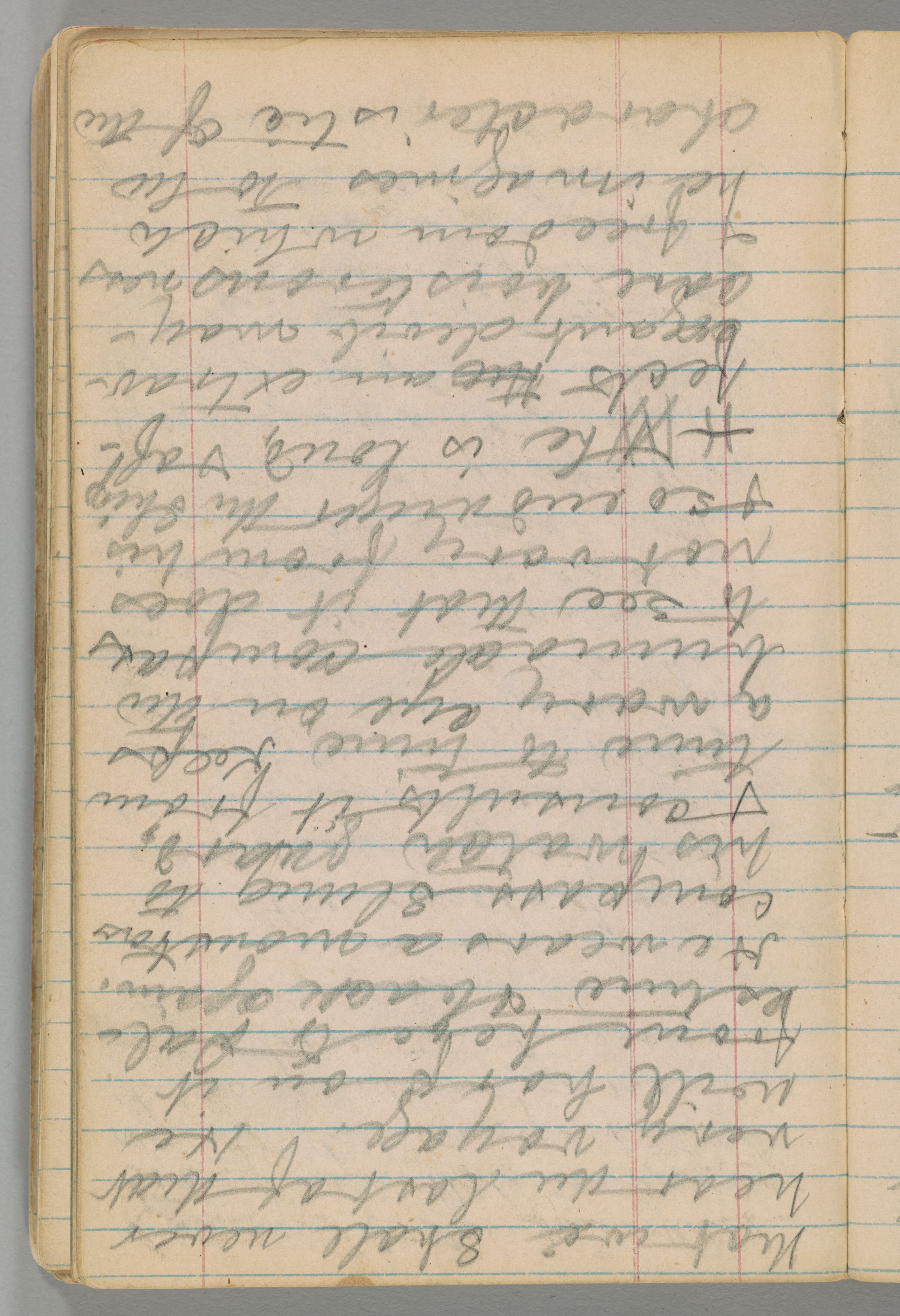
[MS: N8_leaf_005r]
that we shall never
hear the last of that
very voyage. He
will harp on it
from here to
Pal-
estine
Palestine
& back again.
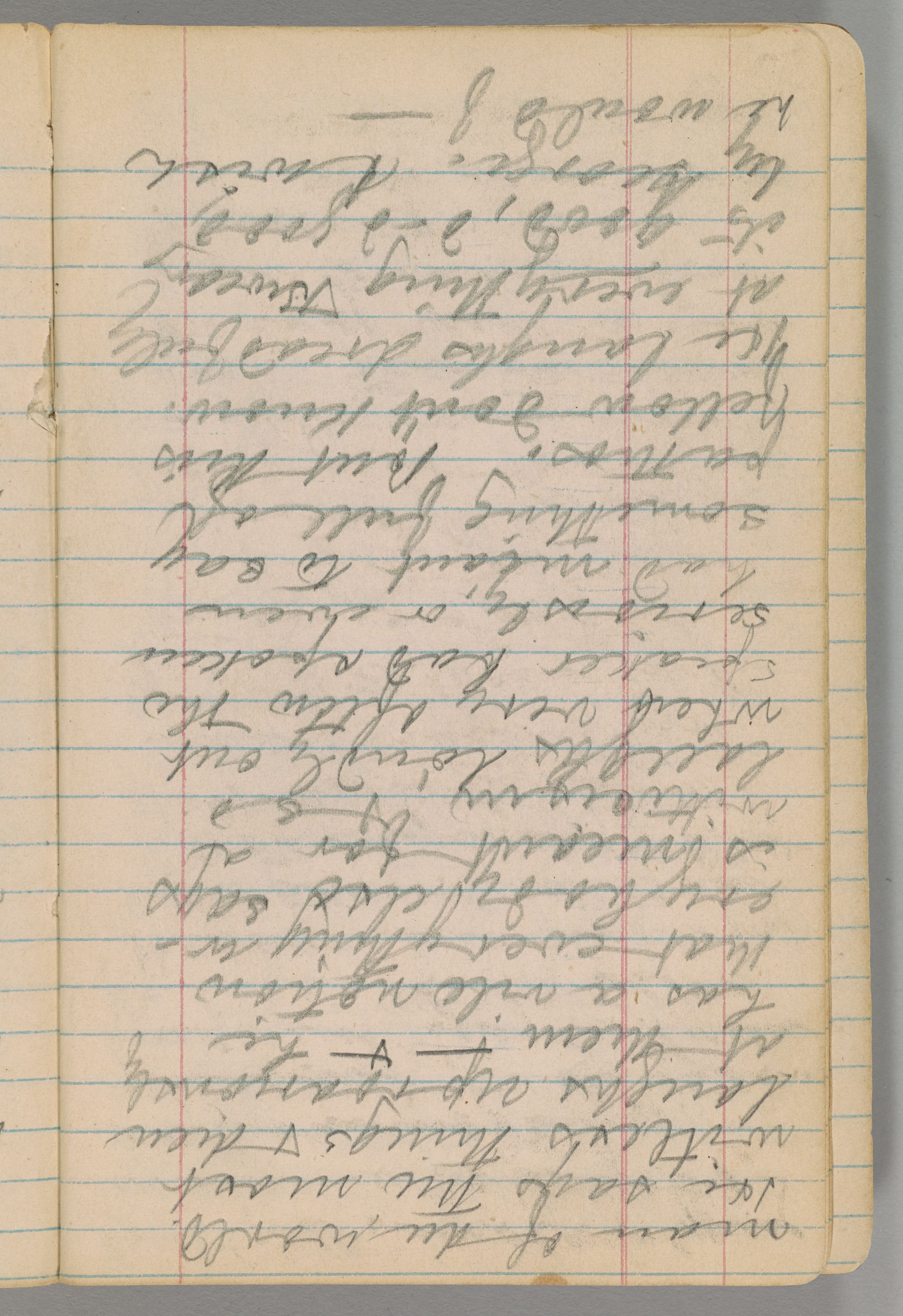
He wears a monstrous
compass slung to
his watch guard,
& consults it from
time to time, keeps
a wary eye on the
binnacle compass
to see that it does
not vary from his
& so endanger the ship
—& he is loud, &
af-
fects
affects
the an
extrav-
agant
extravagant
devil-may-
care boisterousness
& freedom which
he imagines to be
characteristic of the
[MS: N8_leaf_005v]
man of the world.
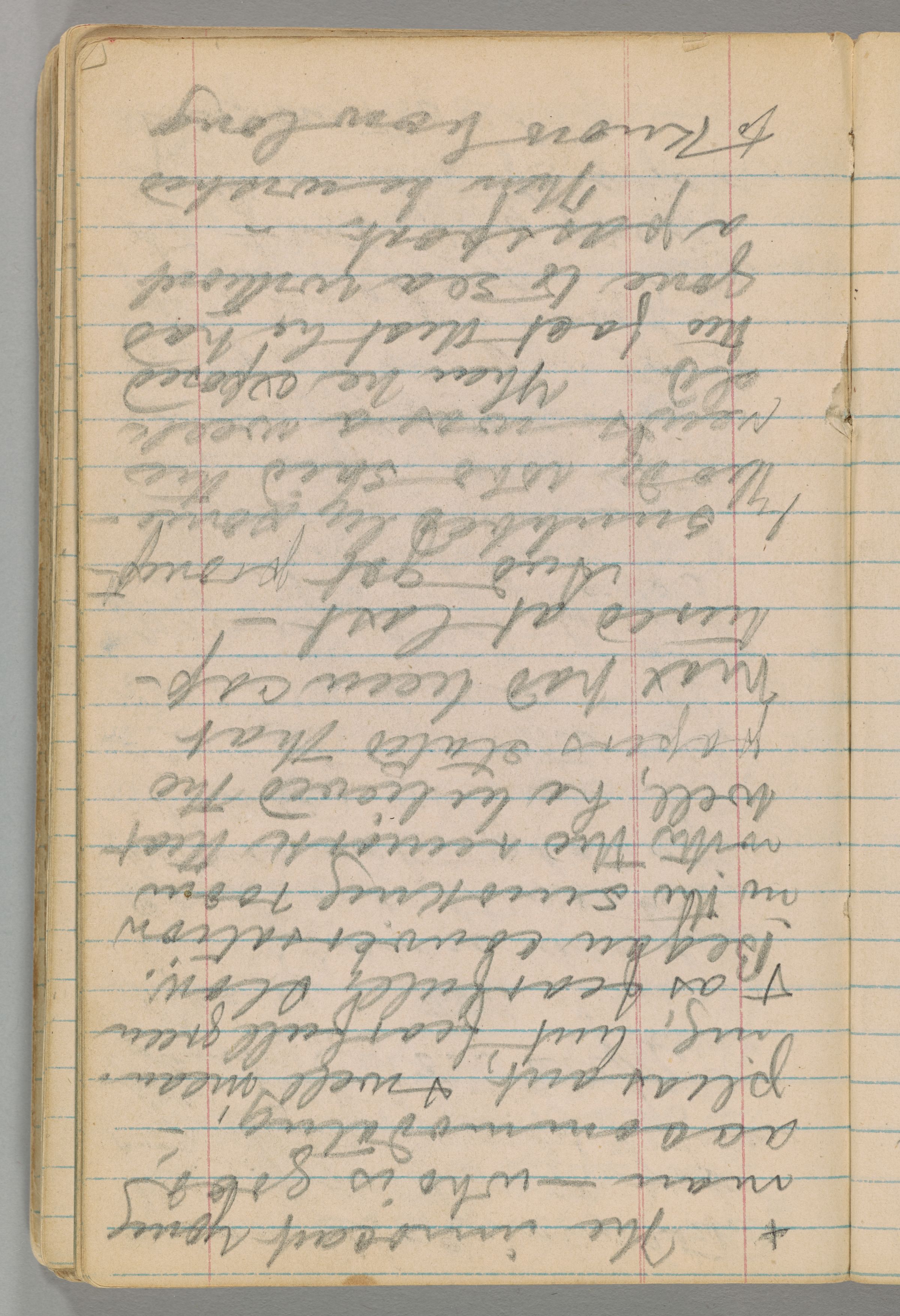
He says the most
witless things & then
laughs uproariously
at them—& he
has a vile notion
that everything
ev-
erybody
everybody
else says
is meant for a
witticism, & so
laughs loudly out
when very often the
speaker had spoken
seriously, or even
had meant to say
something full of
pathos. But this
fellow
[MTP: N&J1_331] don't know.
He laughs dreadfuly
at everything & swears
its good, d—d good,
by George. I wish
he would f———
[MS: N8_leaf_006r]
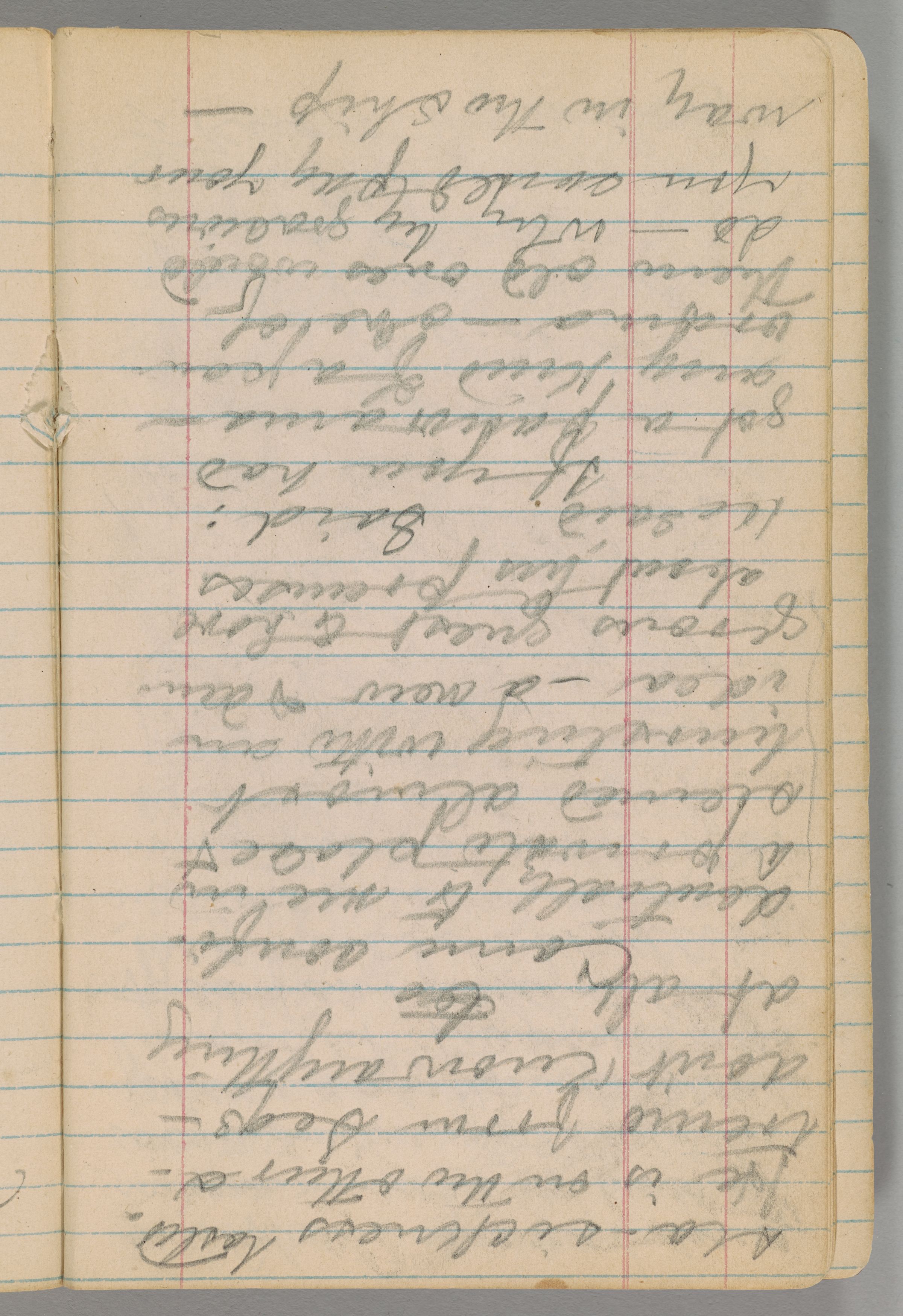
The innocent young
man—who is good,
accommodating,—
pleasant, & well
mean-
ing
meaning
, but fearfull green
& as fearfully slow.
Began conversation
in the smoking room
with the remark that
well, he believed the
papers stated that
Max had been
cap-
tured
captured
at last—
And got
prompt-
ly
promptly
snubbed by
some-
body
somebody
who said the
news was a week
old. Then he exposed
the fact that he had
gone to sea without
a passport.—
Then he wished
to know how long
[MS: N8_leaf_006v]
sea-sickness lasted.
He is on the other
ex-
treme
extreme
from Legs—
don't know anything
at all. le
Came
confi-
dentially
confidentially
to me in
a private place &
seemed almost
bursting with an
idea—a new &
dan-
gerous
dangerous
guest to have
about his premises.
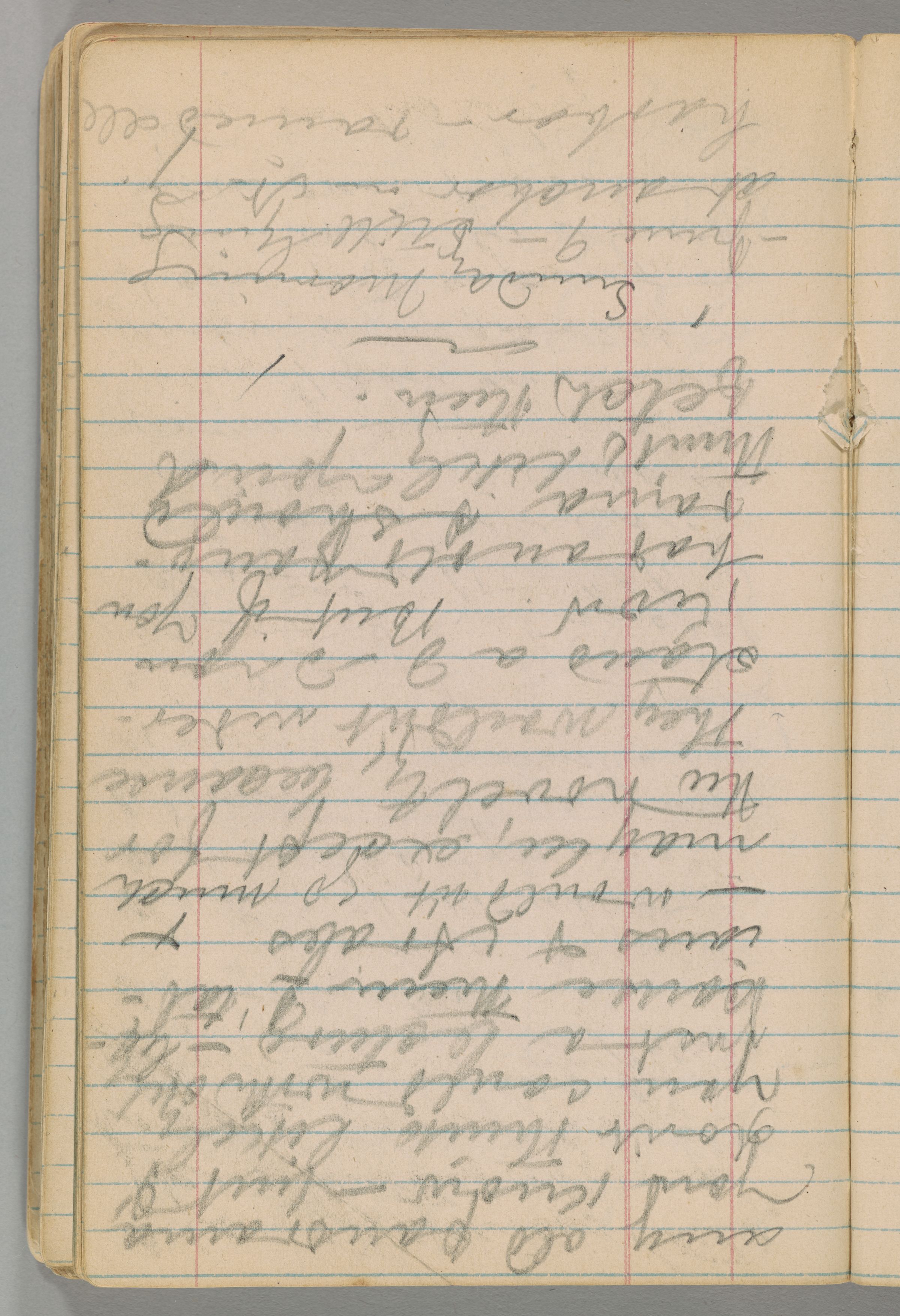
He said
Said:
If you had
got a panorama—
any kind of a
pan-
orama
panorama
—one of
them old ones would
do—why by gracious
you could pay your
way in the ship—
[MS: N8_leaf_007r]
any old panorama,
you know—but I
don't think likely
you could with only
just a lecture,—
be-
cause
because
them
I’tal-
ians
I’talians
& Arabs &
—wouldn't go much
maybe, except for
the novelty, because
they wouldn't
under-
stand
understand
a d—d you
know. But if you
had an old
pano-
rama
panorama
, I should
think likly you'd
fetch them.
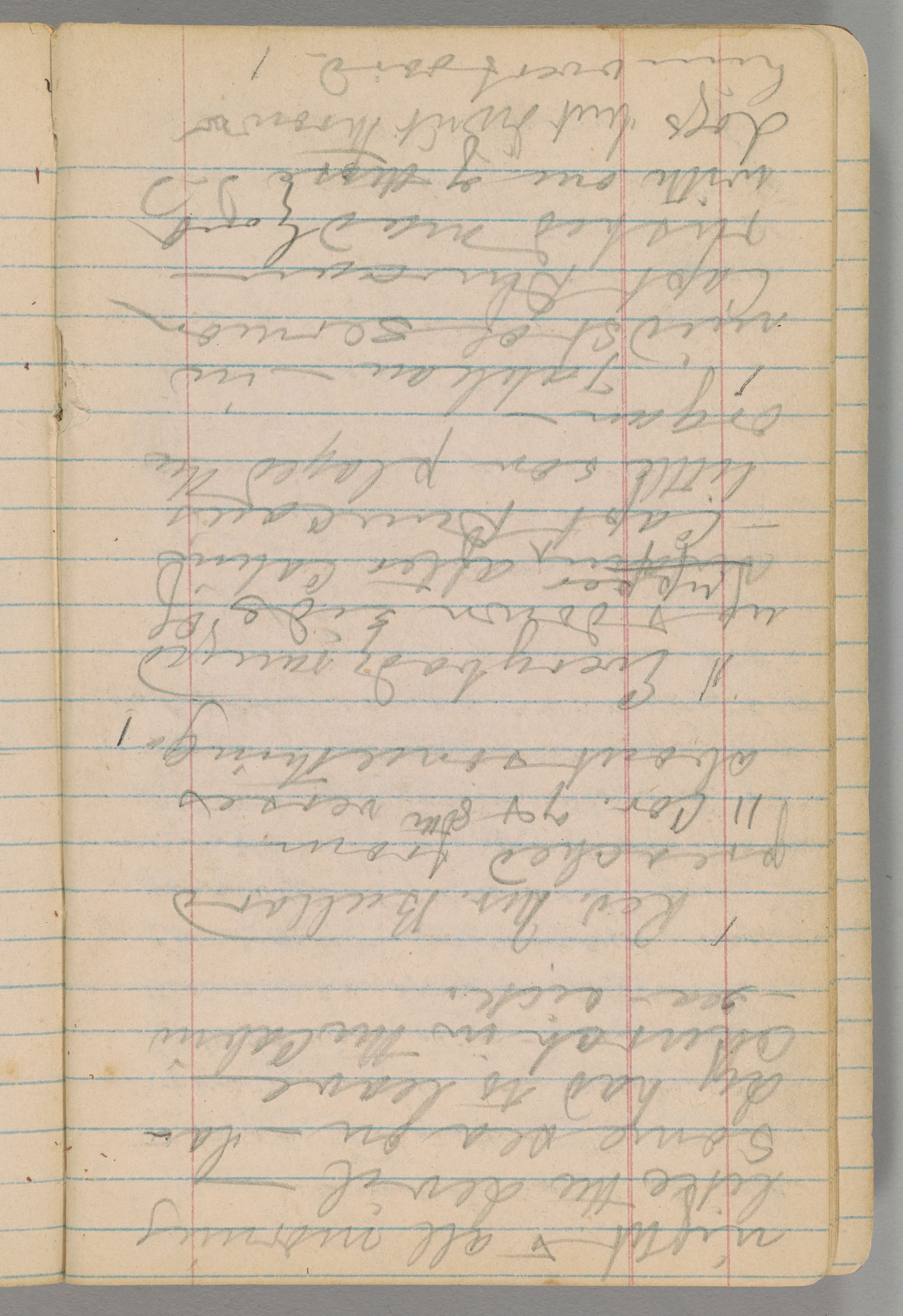
Sunday Morning
—June 9—Still lying
at anchor in N.Y.
harbor—rained all
[MS: N8_leaf_007v]
night & all morning
like the devil—
some sea on—
la-
dy
lady
had to leave
church in the cabin
—sea-sick.
[MTP: N&J1_332]
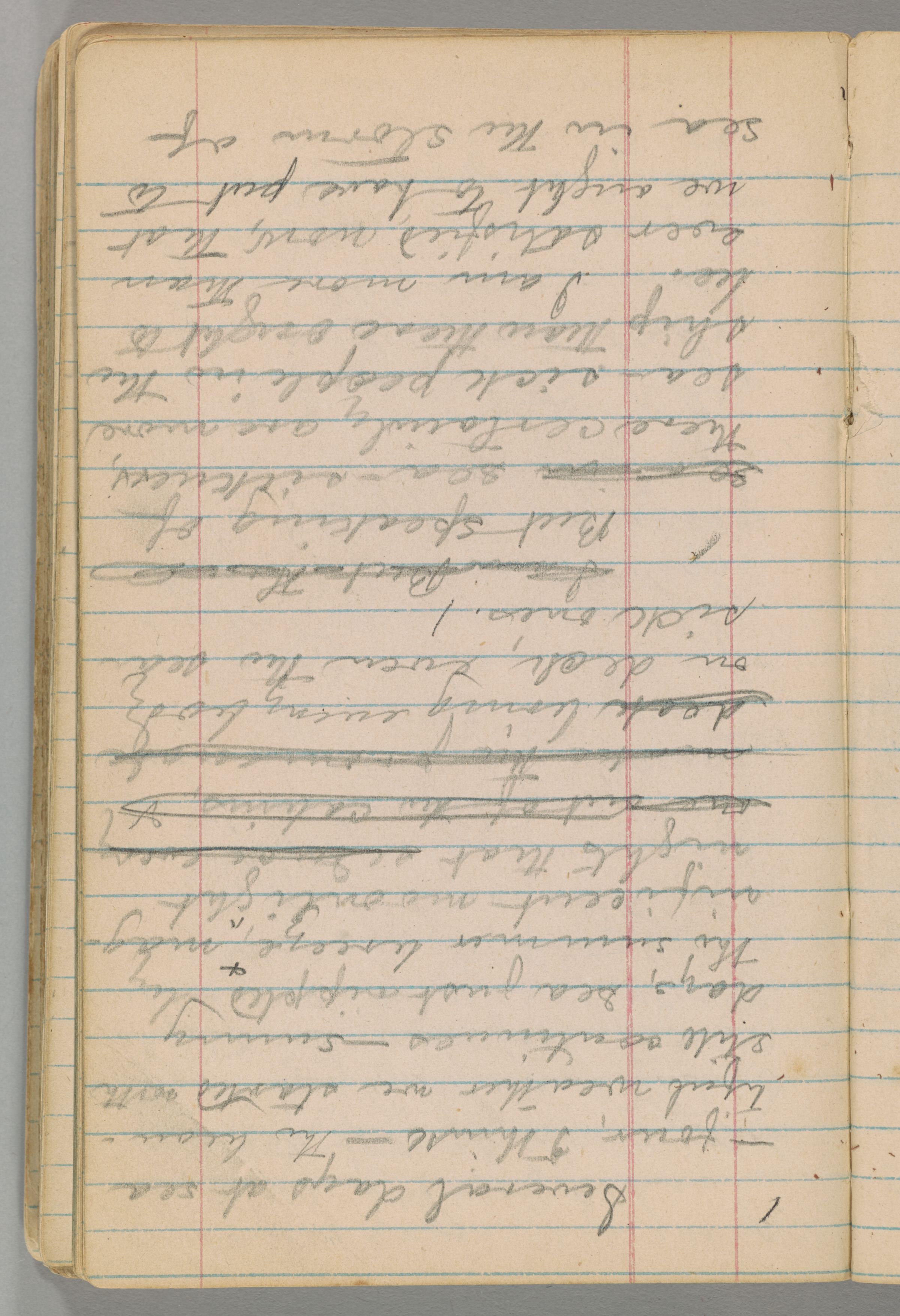
Rev. Mr. Bullard
preached from
II Cor. 7 & 8th verses
about something.
Everybody ranged
up & down sides of
main
upper
after cabin
—Capt Duncan's
little son played the
organ—
Tableau—in
midst of sermon
Capt Duncan
rushed madly out
with one of those d—d
dogs but didn't throw
him overboard.
[MS: N8_leaf_008r]
Several days at sea
—four, I think—the
beau-
tiful
beautiful
weather we started with
still continues—sunny
days, sea just rippled by
the summer breeze, &
mag-
nificent
magnificent
moonlight
nights that seduce every
one out of the cabins, &
make the promenade
deck bring every body
on deck, even the
sea-
sick
sea-sick
ones.
I am But—there
But speaking of
sea in sea-sickness,
there certainly are more
sea-sick people in the
ship than there ought to
be. I am more than
ever satisfied, now, that
we ought to have put to
sea in the storm of
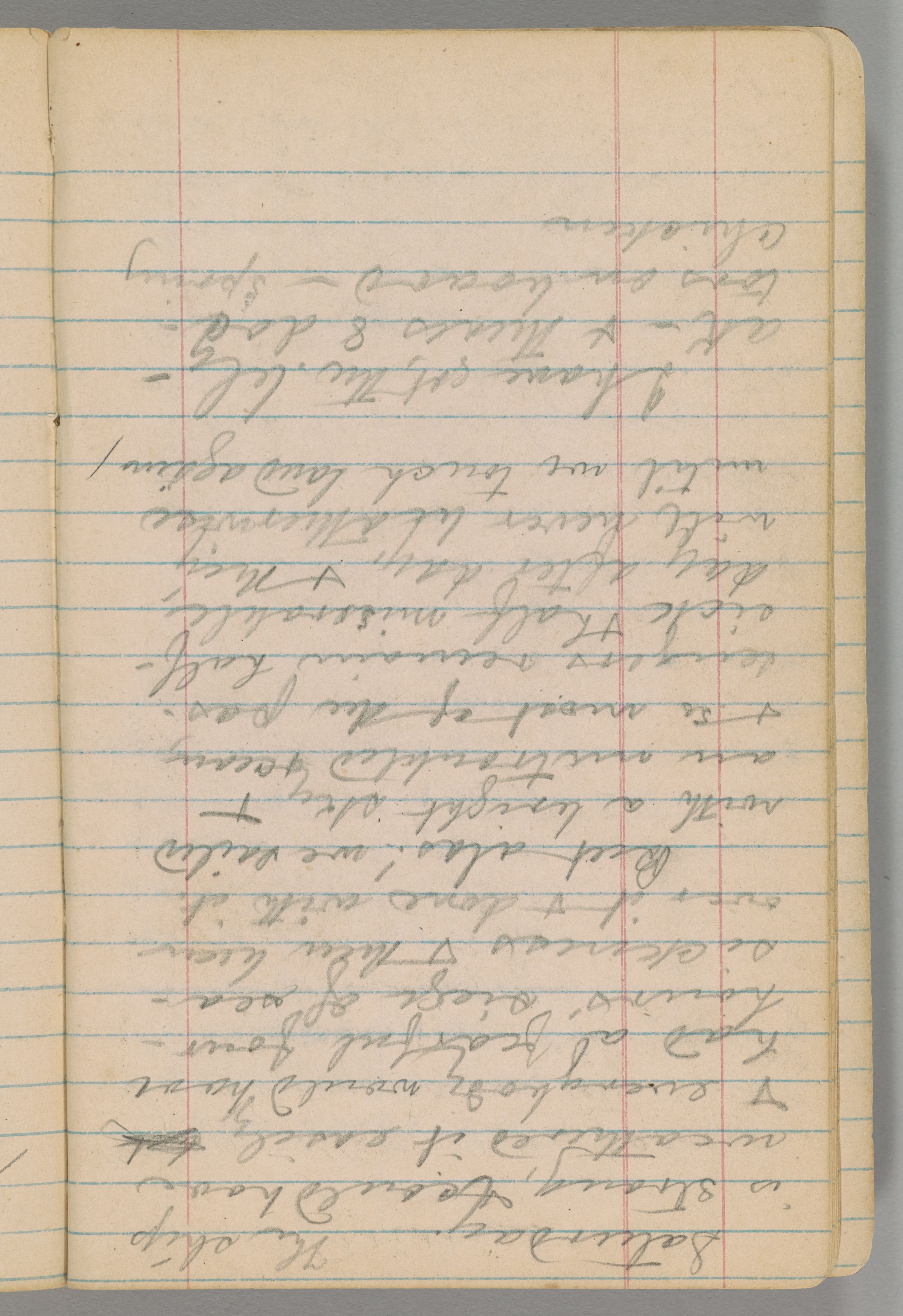
[MS: N8_leaf_008v]
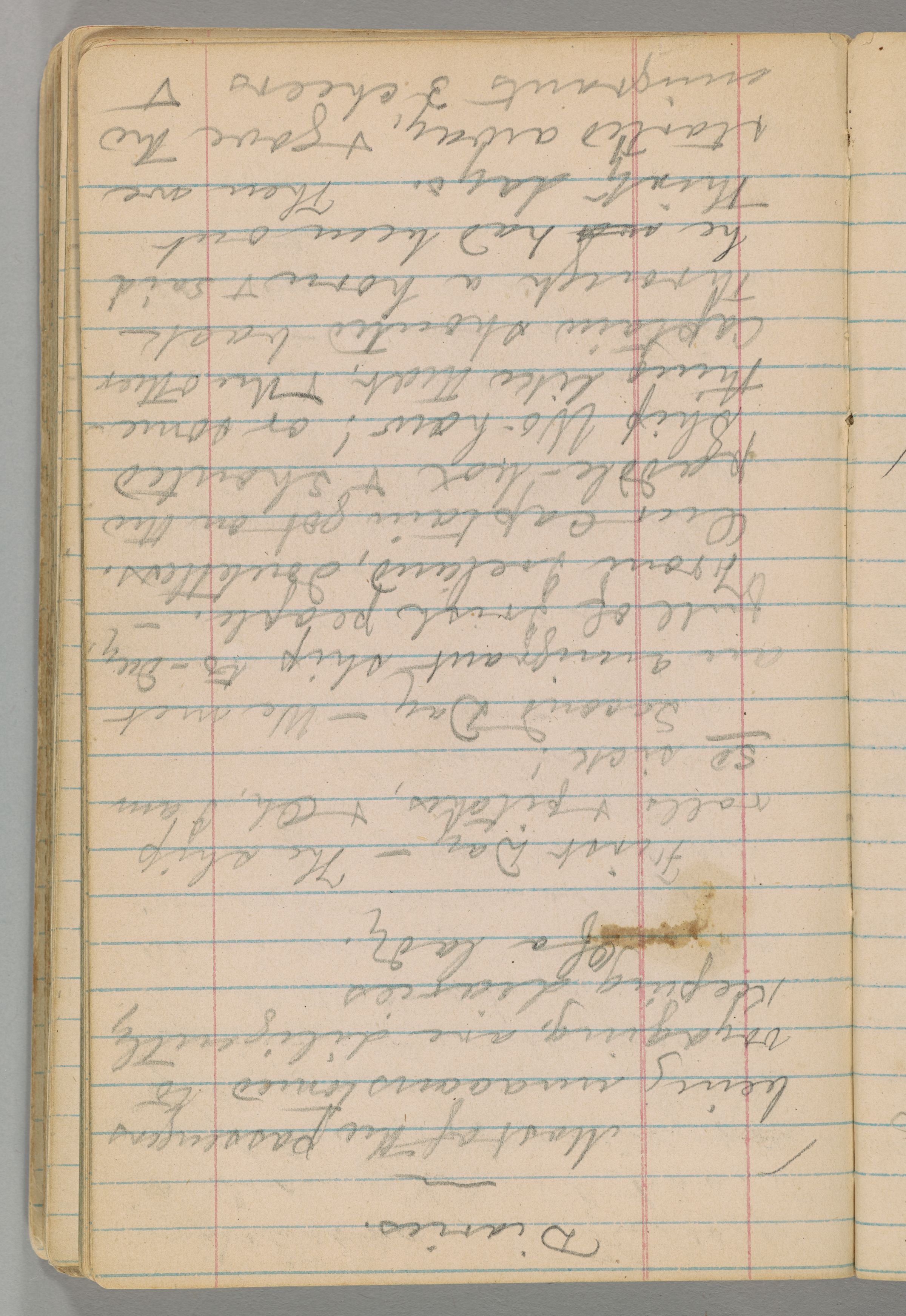
Saturday. The ship
is strong, & could have
weathered it easily, but
& everybody would have
had a fearful four-
hours' siege of
sea-
sickness
sea-sickness
& then been
over it & done with it.
But alas! we sailed
with a bright sky &
an untroubled ocean,
& so most of the
pas-
sengers
passengers
remain half-
sick & half miserable,
day after day, & they
will never be otherwise
until we touch land again.
I have got the
bly-
ak
bly-ak
—& there's 8
doc-
tors
doctors
on board—spring
chicken
[MS: N8_leaf_009r]
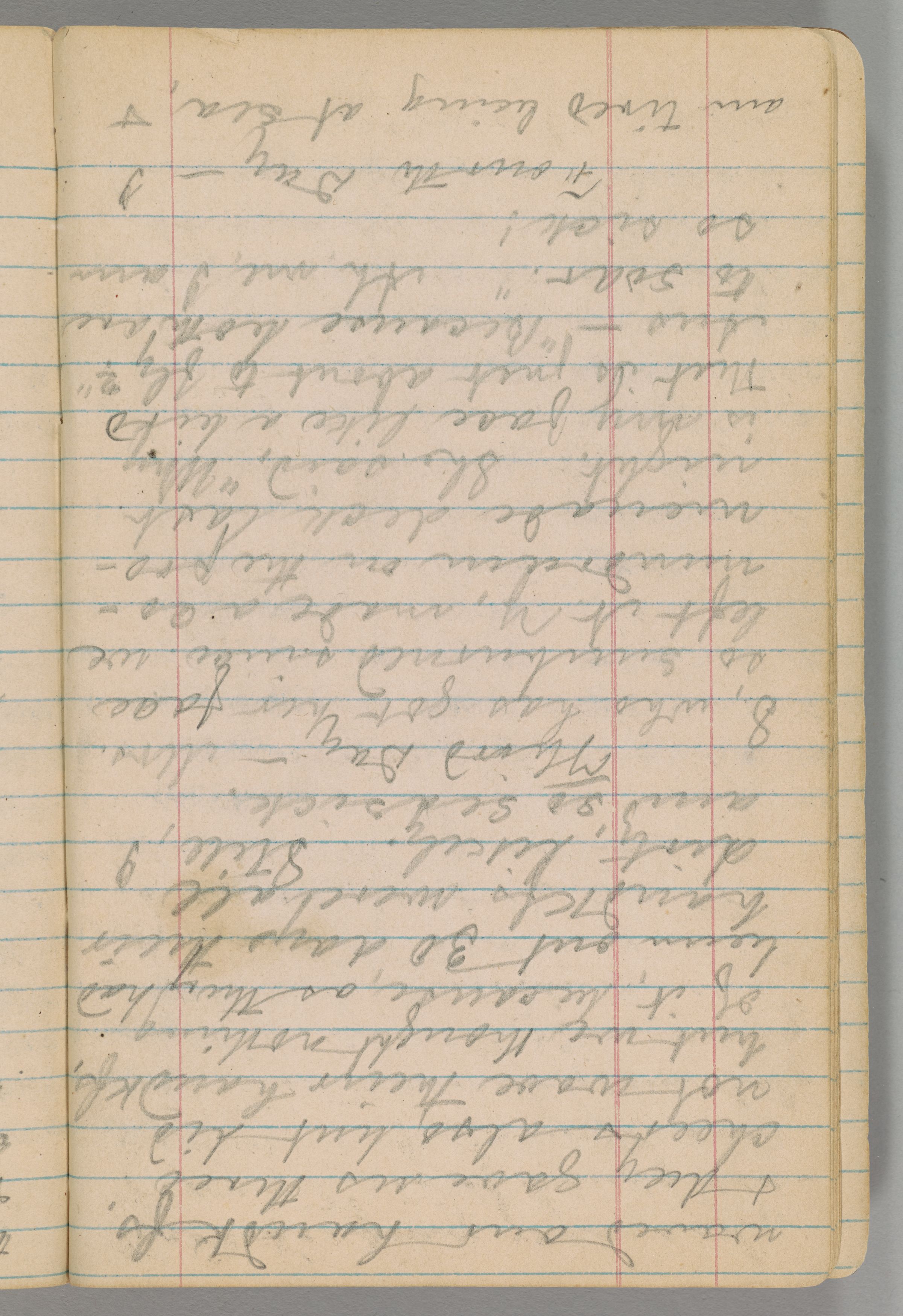
Diaries.
Most of the passengers
being unaccustomed to
voyaging, are diligently
keeping diaries
[MTP: N&J1_333]
Of a lady.
First Day—The ship
rolls & pitches, & Oh, I am
so sick!
Second Day—We met
an emigrant ship to-day,
full of Irish people.—
From Ireland, doubtless.
Our captain got on the
paddle-box & shouted
Ship Wo-haw! or
some-
thing
something
like that, & the other
captain shouted back
through a horn & said
he wa had been out
thirty days. Then we
started away, & gave the
emigrants 3 cheers &
[MS: N8_leaf_009v]
waved our handkfs,
& they gave us three
cheers also, but did
not wave their handkfs,
but we thought nothing
of it, because, as they had
been out 30 days their
handkfs were all
dirty, likely. Still, I
am so
seasick.
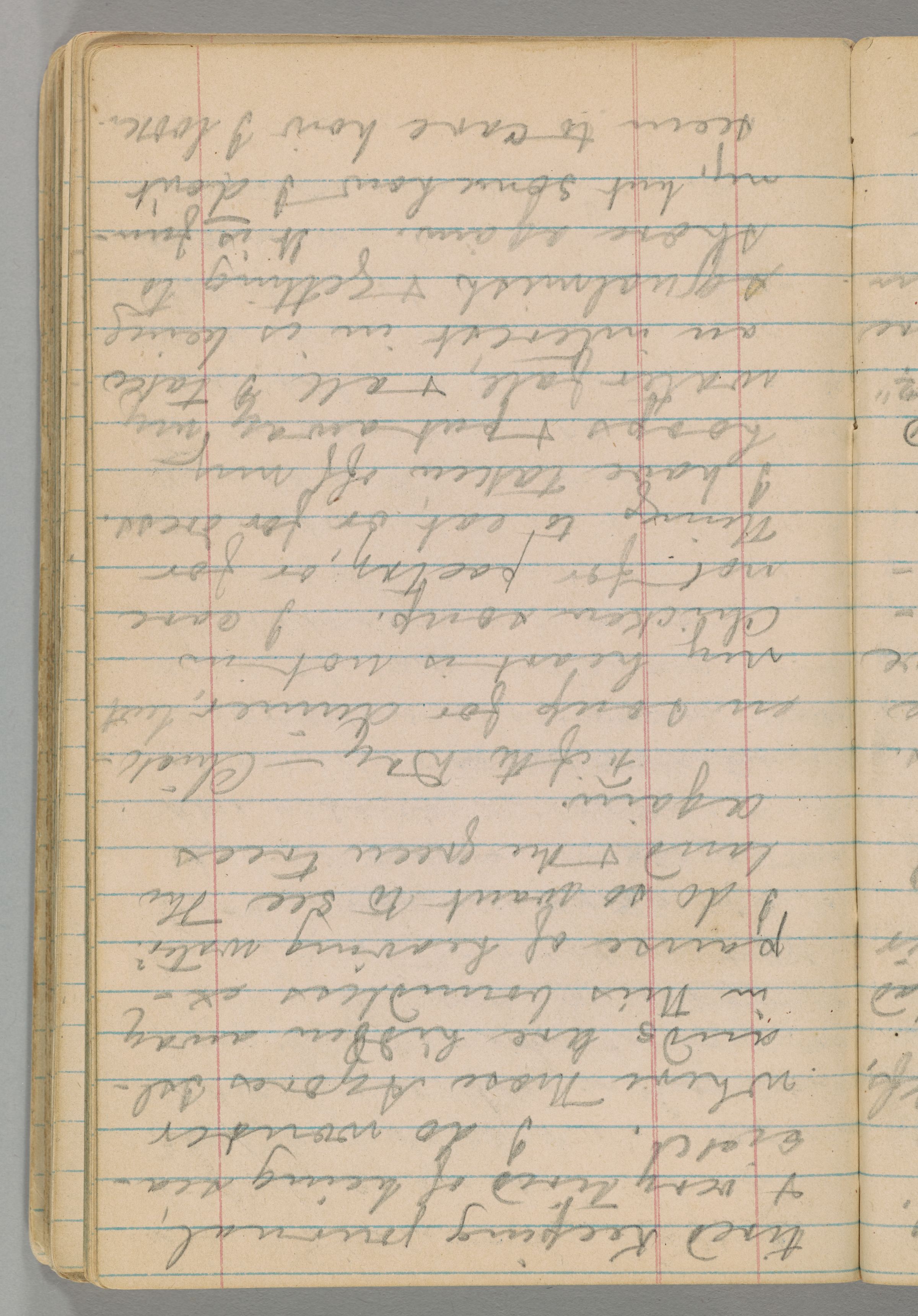
Third Day—Mrs.
S., who has got her face
so sunburned since we
left N.Y, made a
co-
nundrum
conundrum
on the
pro-
menade
promenade
deck last
night. She said, “Why
is my face like a bird
that is just about to fly?”
Ans—“Because both are
to soar.” Ah, me, I am
so sick!
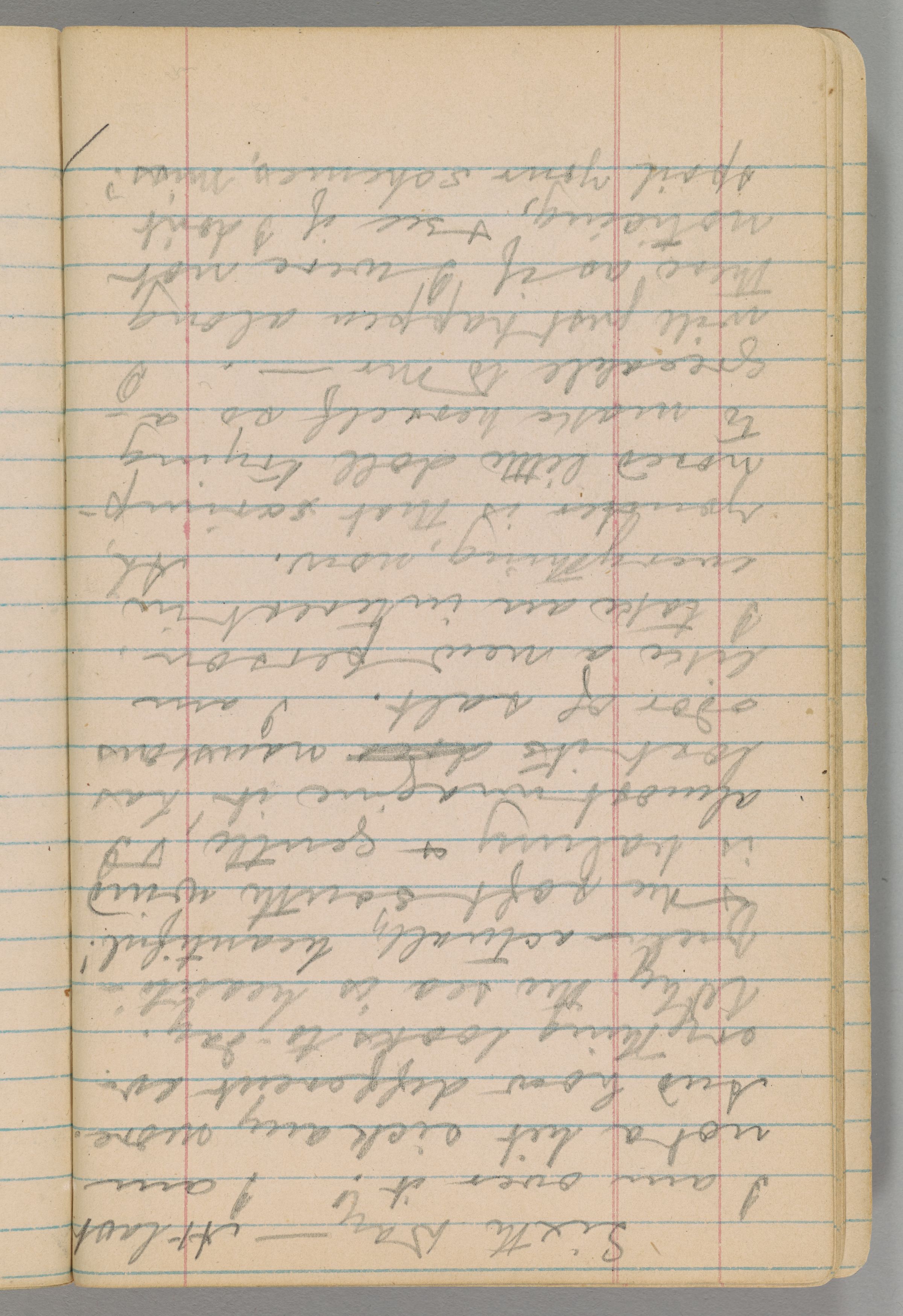
Fourth Day—I
am tired being at sea, &
[MS: N8_leaf_010r]
tired keeping journal,
& very tired of being
sea-
sick
sea-sick
. I do wonder
where those Azores
Isl-
ands
Islands
h are hidden away
in this boundless
ex-
panse
expanse
of heaving water?
I do so want to see the
land & the green trees
again.
Fifth Day—
Chick-
en
Chicken
soup for dinner, but
my heart is not in
chicken soup. I care
not for poetry, or for
things to eat, or for dress.
I have taken off my
hoops & put away my
waterfall, & all I take
an interest in is being
squalmish & getting to
shore again. It is
fun-
ny
funny
, but somehow I don't
seem to care how I look.
[MS: N8_leaf_010v]
Sixth Day—At last
I am over it! I am
not a bit sick any more.
And how different
ev-
erything
everything
looks to-day.
Why the sea is
beauti-
ful
beautiful
—actually beautiful!
& the soft south wind
is balmy & gentle, & I
almost imagine it has
lost its drea nauseous
odor of salt. I am
like a new person.
I take an interest in
everything, now. Ah,
yonder is that scrimp-
nosed little doll trying
to make herself so
a-
greeable
agreeable
to Mr——. I
will just happen along
there as if I were not
noticing, & see if I don't
spoil your schemes, Miss?
four blank pages (011r–012v)
[MS: N8_leaf_013r]
[MTP: N&J1_334]
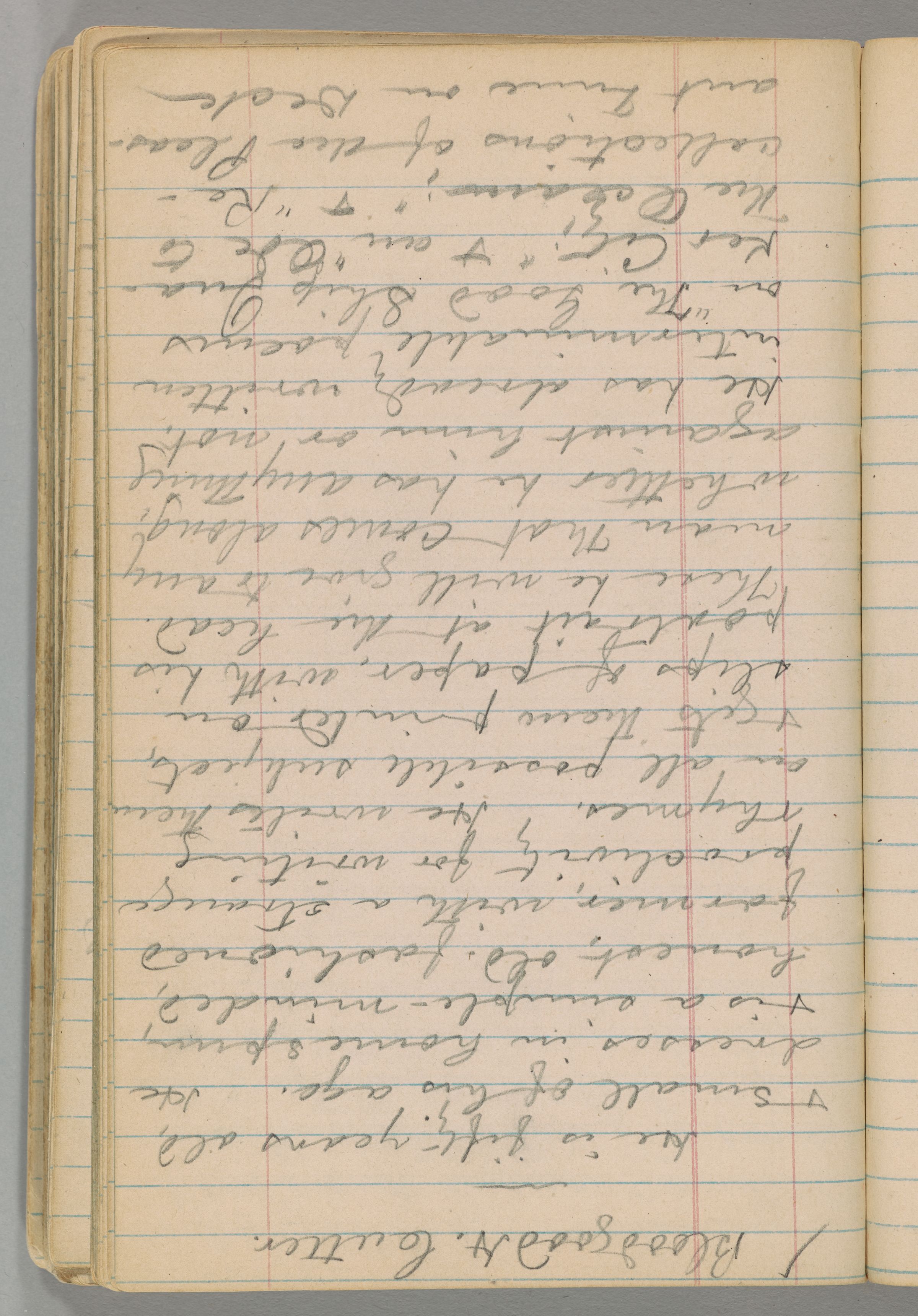
He is fifty years old,
& small of his age. He
dresses in homespun,
& is a simple-minded,
honest, old-fashioned
farmer, with a strange
proclivity for writing
rhymes. He writes them
on all possible subjects,
& gets them printed on
slips of paper, with his
portrait at the head.
These he will give to any
man that comes along,
whether he has anything
against him or not.
He has already written
interminable poems
on “The Good Ship
Qua-
ker
Quaker
City;” & an “Ode to
the Ocean;” & “
Re-
collections
Recollections
of the
Pleas-
ant
Pleasant
Time on Deck
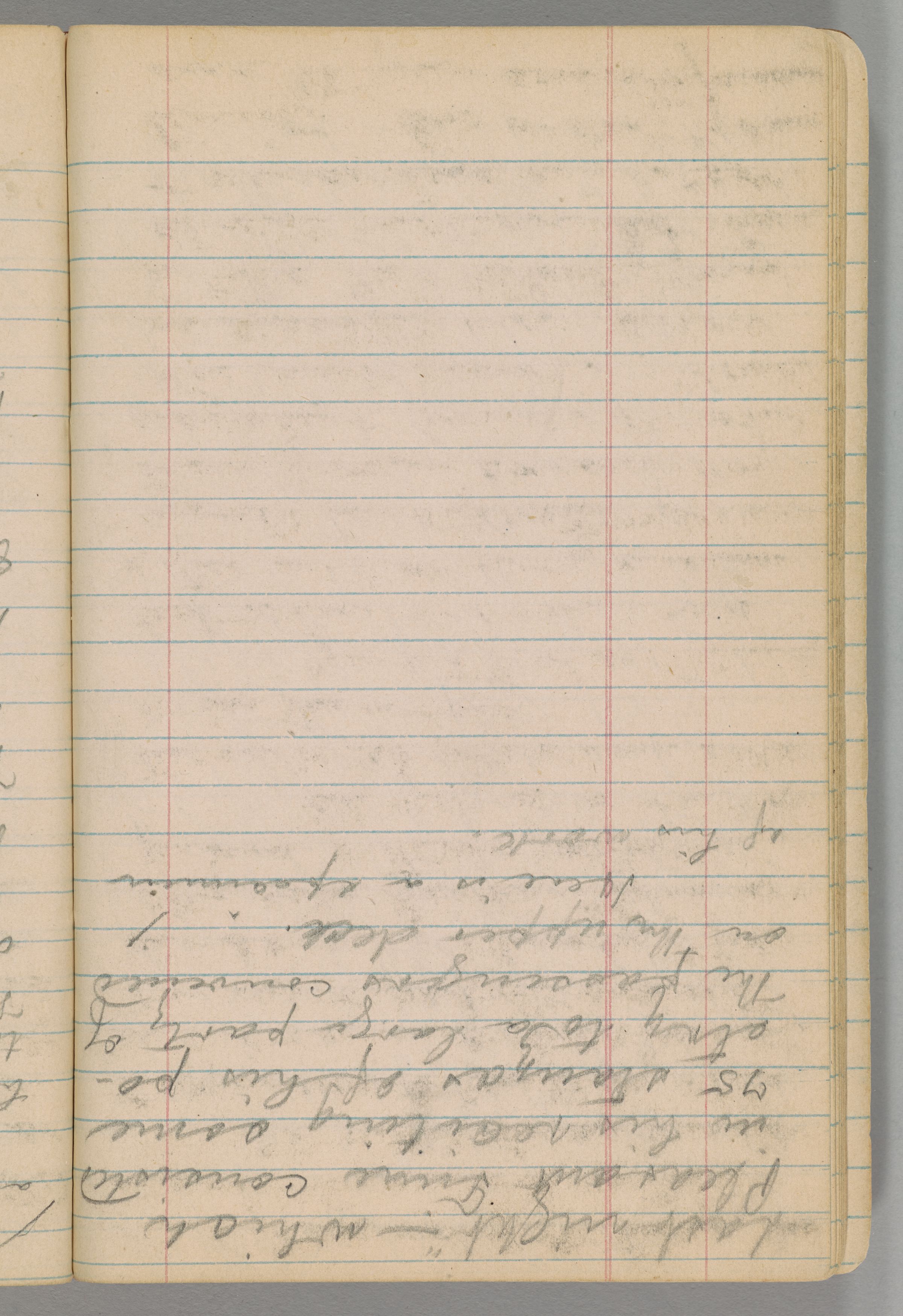
[MS: N8_leaf_013v]
Last night”—which
Pleasant Time consisted
in his reciting some
75 stanzas of his
po-
etry
poetry
to a large party of
the passengers convened
on the upper deck.
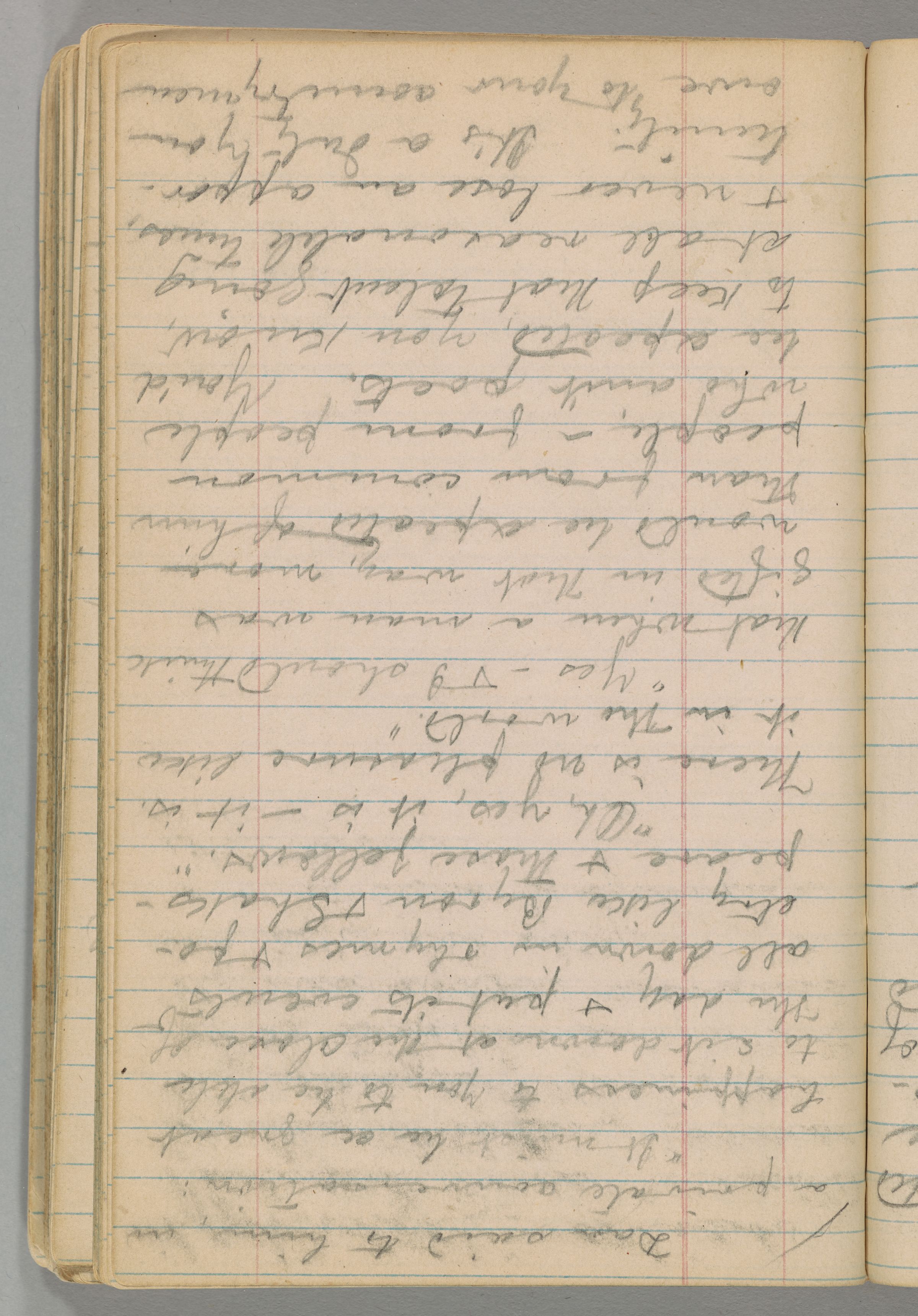
Here is a specimen
of his work.
[MS: N8_leaf_014r]
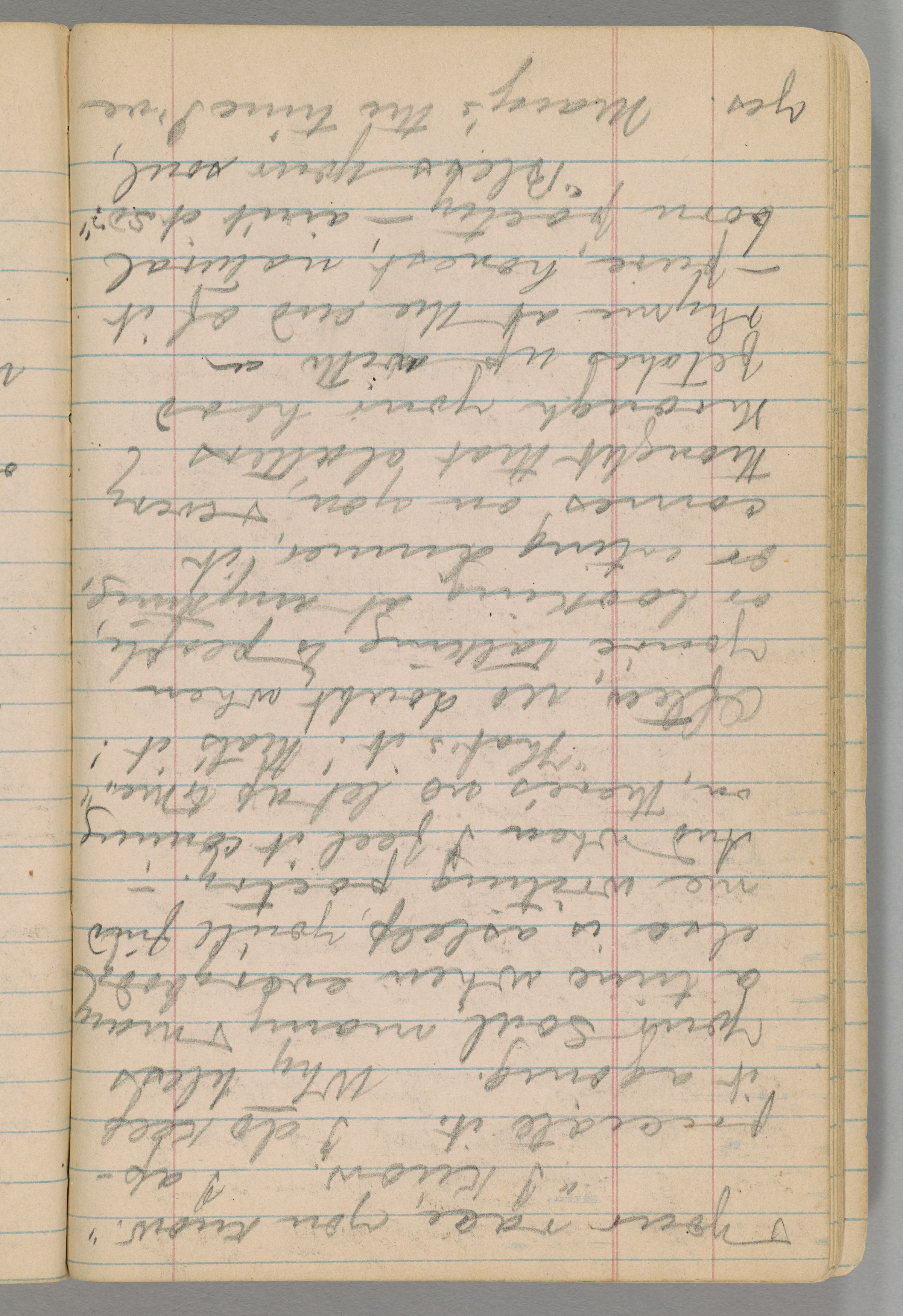
Dan said to him, in
a private conversation:
“It must be a great
happiness to you to be able
to sit down at the close of
the day & put its events
all down in rhymes &
po-
etry
poetry
like Byron &
Shaks-
peare
Shakspeare
& those fellows.”
“Oh, yes, it is—it is.
There is no pleasure like
it in the world.”
“Yes—& I should think
that when a man was
gifted in that way, more
would be expected of him
than from common
people—from people
who ain't poets. You'd
be expected, you know,
to keep that talent going
at all reasonable times,
& never lose an
oppor-
tunity
opportunity
. It's a duty you
owe to your countrymen
[MS: N8_leaf_014v]
& your race, you know.”
“I know. I
ap-
preciate
appreciate
it. I do keep
it agoing. Why bless
your soul, many & many
a time when everybody
else is asleep, you'll find
me
[MTP: N&J1_335] writing poetry.—
And when I feel it coming
on, there's no let up to me.”
“That's it! that's it!
Often, no doubt, when
you're talking to people,
or looking at anything,
or eating dinner, it
comes on you, & every
thought that clatters
through your head
fetches up a with a
rhyme at the end of it
—pure, honest, natural
born poetry—ain't it so?”
“Bless your soul,
yes. Many's the time I've
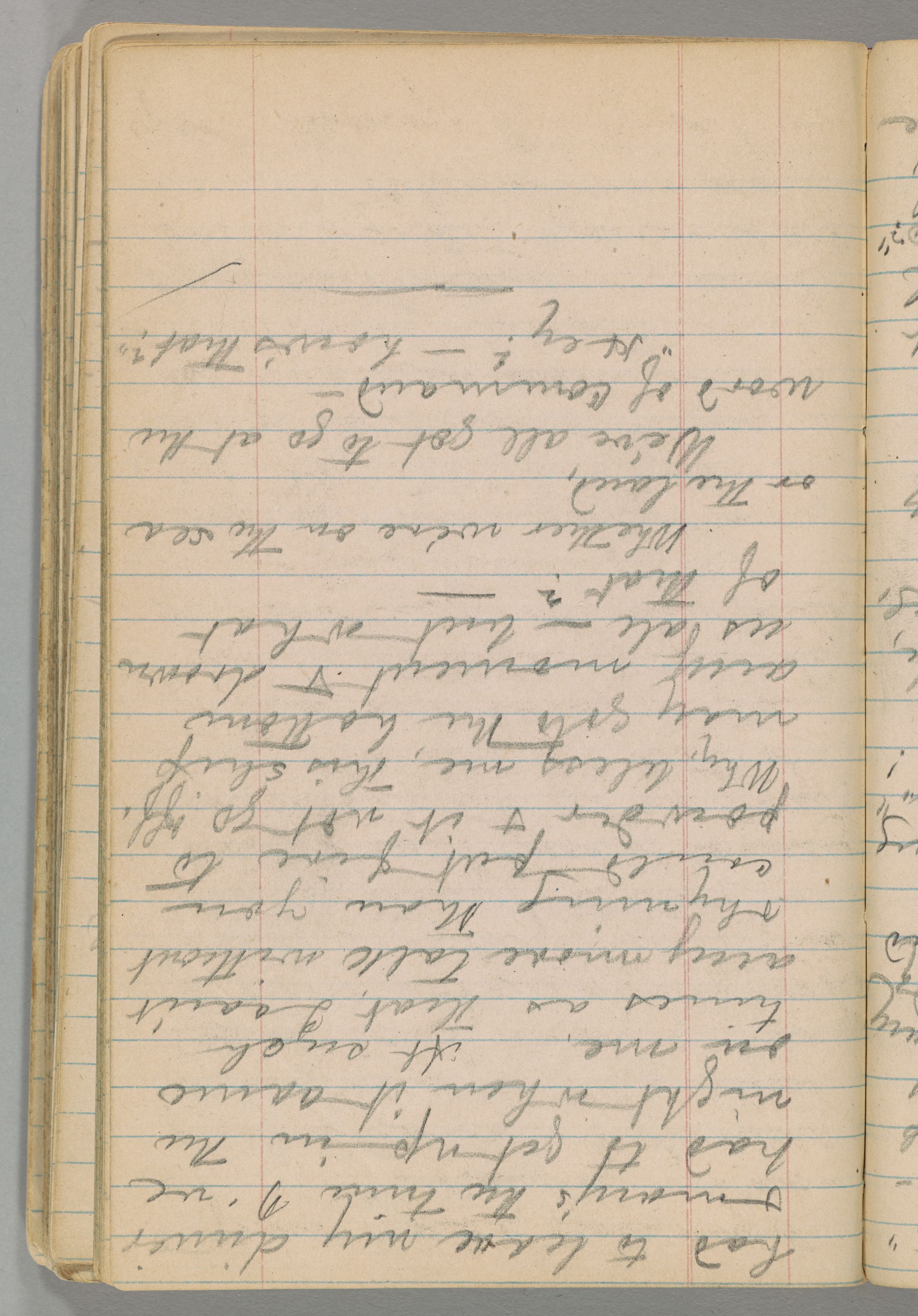
[MS: N8_leaf_015r]
had to leave my dinner
& many's the time I've
had to get up in the
night when it came
on me. At such
times as that, I can't
any more talk without
rhyming than you
could put fire to
powder & it not go off.
Why, bless me, this ship
may go to the bottom
any moment & drown
us all—but what
of that?—
Whether we're on the sea
or the land,
We've all got to go at the
word of command—
“Hey?—how's that?”
[MS: N8_leaf_015v]
blank verso
[MS: N8_leaf_016r]
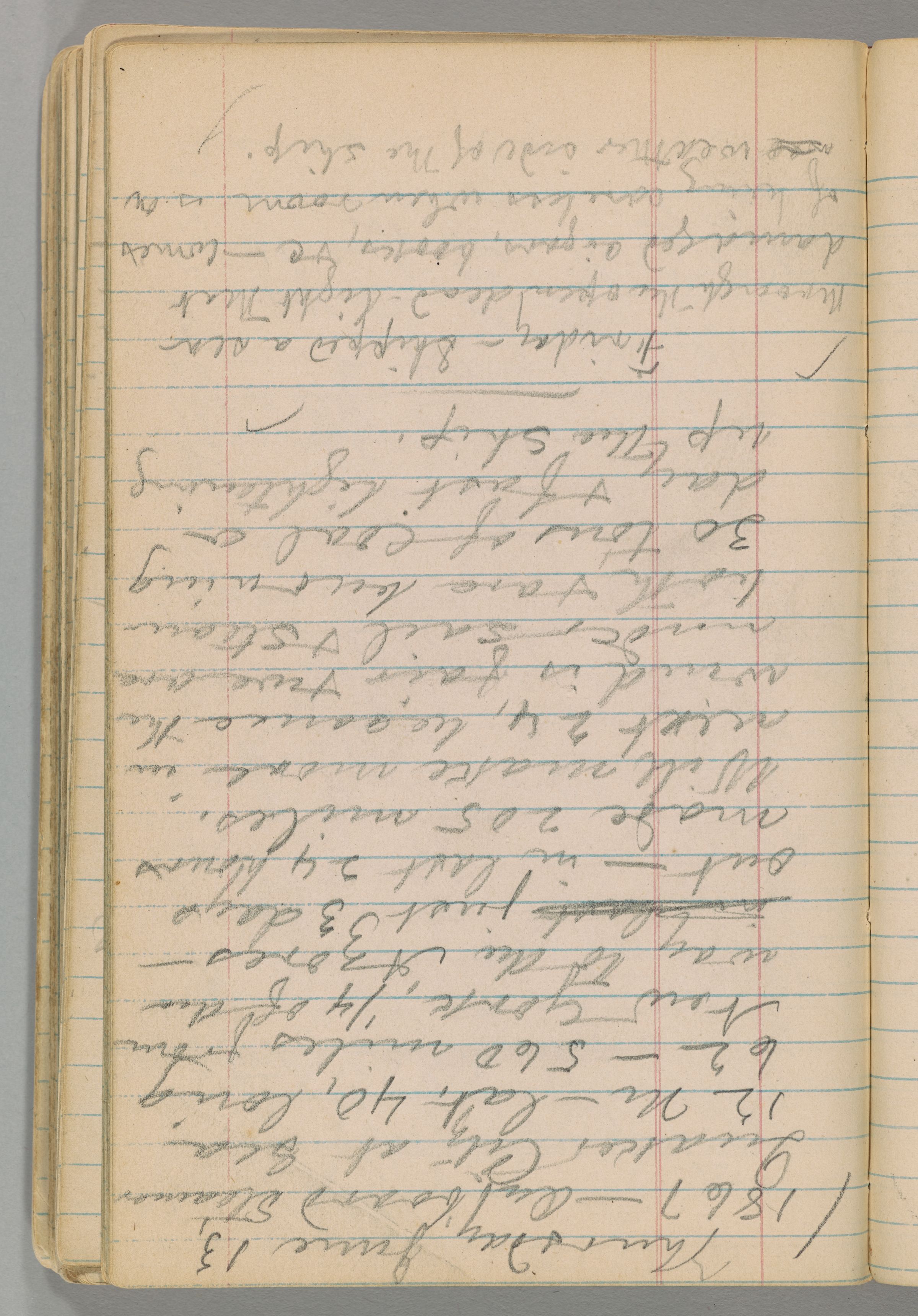
Thursday, June 13,
1867—On board Steamer
Quaker City at sea,
12 M—lat. 40, long
62—560 miles from
New York, ¼ of the
way to the Azores—
in last just 3 days
out—in last 24 hours
made 205 miles.
Will make more in
next 24, because the
wind is fair & we are
under sail & steam
both, & are burning
30 tons of coal a
day & fast lightening
up the ship.
Friday—Shipped a sea
through the open dead-light that
damaged cigars, books, &c—comes
of being careless when room is on
weather side of the ship.
[MS: N8_leaf_016v]
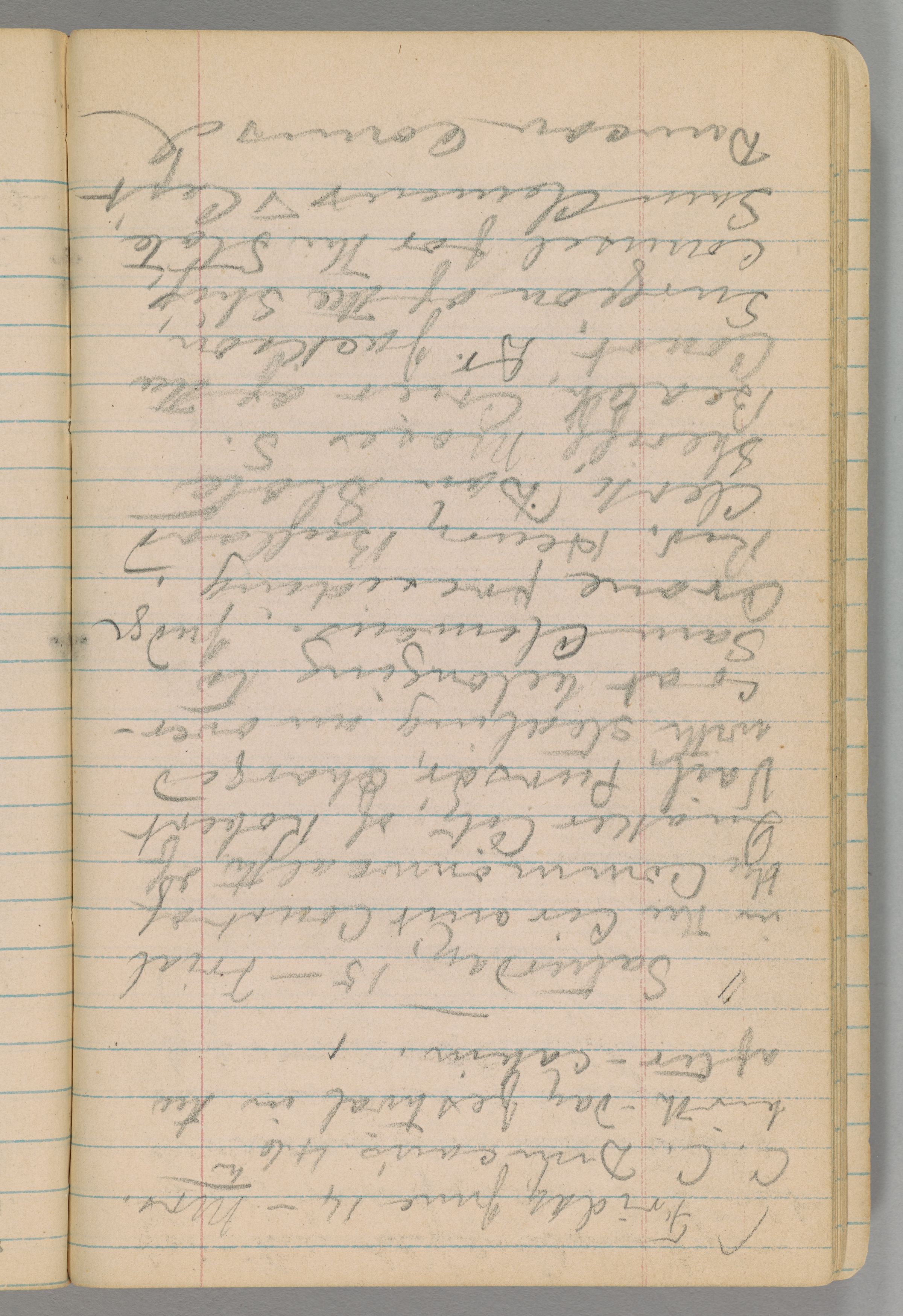
Friday, June 14—Mrs.
C. C. Duncan's 46th
birth-day festival in the
after-cabin.
[MTP: N&J1_336]
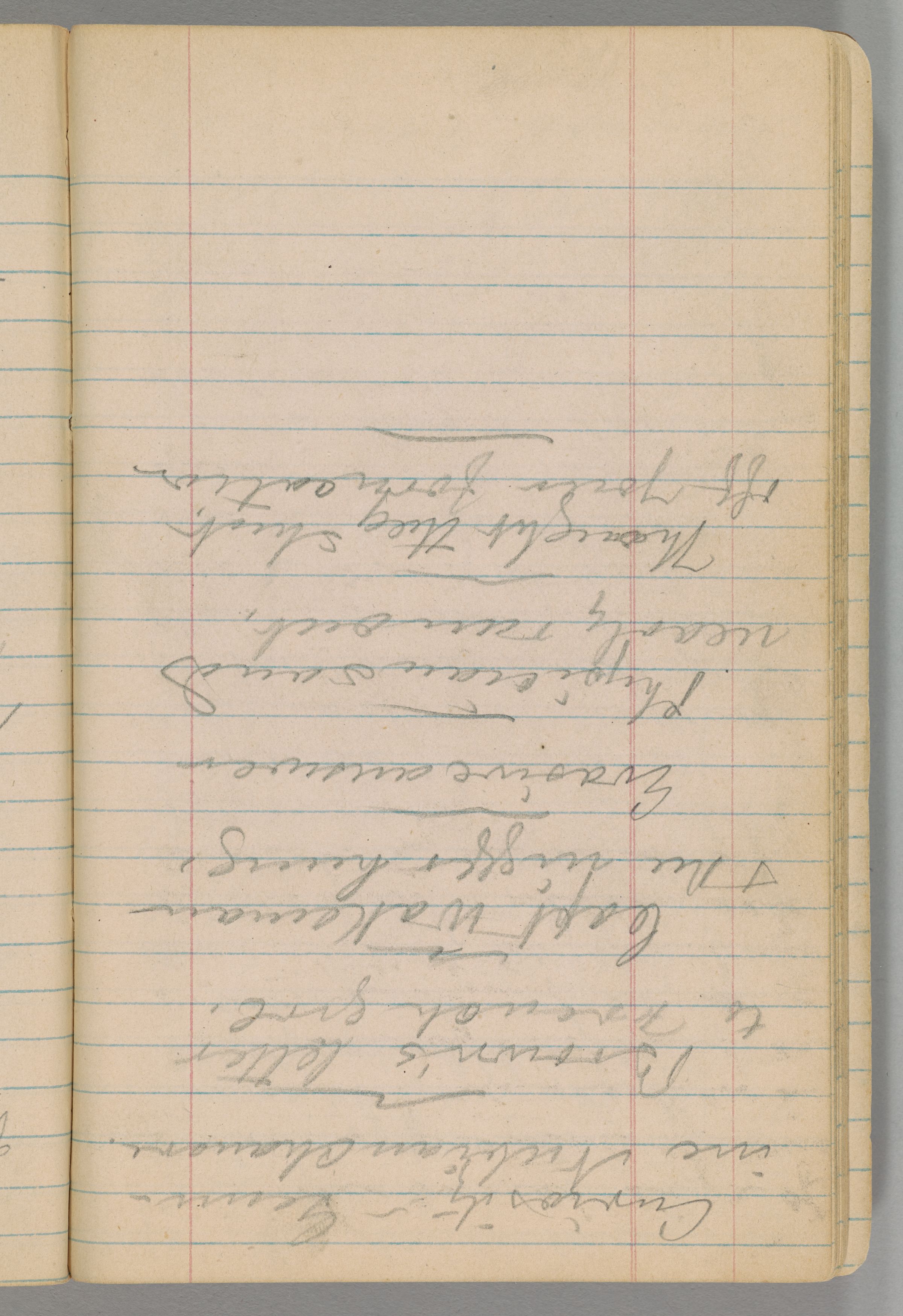
Saturday, 15—Trial
in the Circuit Court of
the Commonwealth of
Quaker City, of Robert
Vail, Purser, charged
with stealing an
over-
coat
overcoat
belonging to
Sam Clemens. Judge
Crane presiding.
Rev. Henry Bullard
Clerk, Dan Slote
Sheriff, Moses S.
Beach, Crier of the
Court, Dr. Jackson,
Surgeon of the Ship,
Counsel for the State,
Sam Clemens & Capt
Duncan Counsel
[MS: N8_leaf_017r]
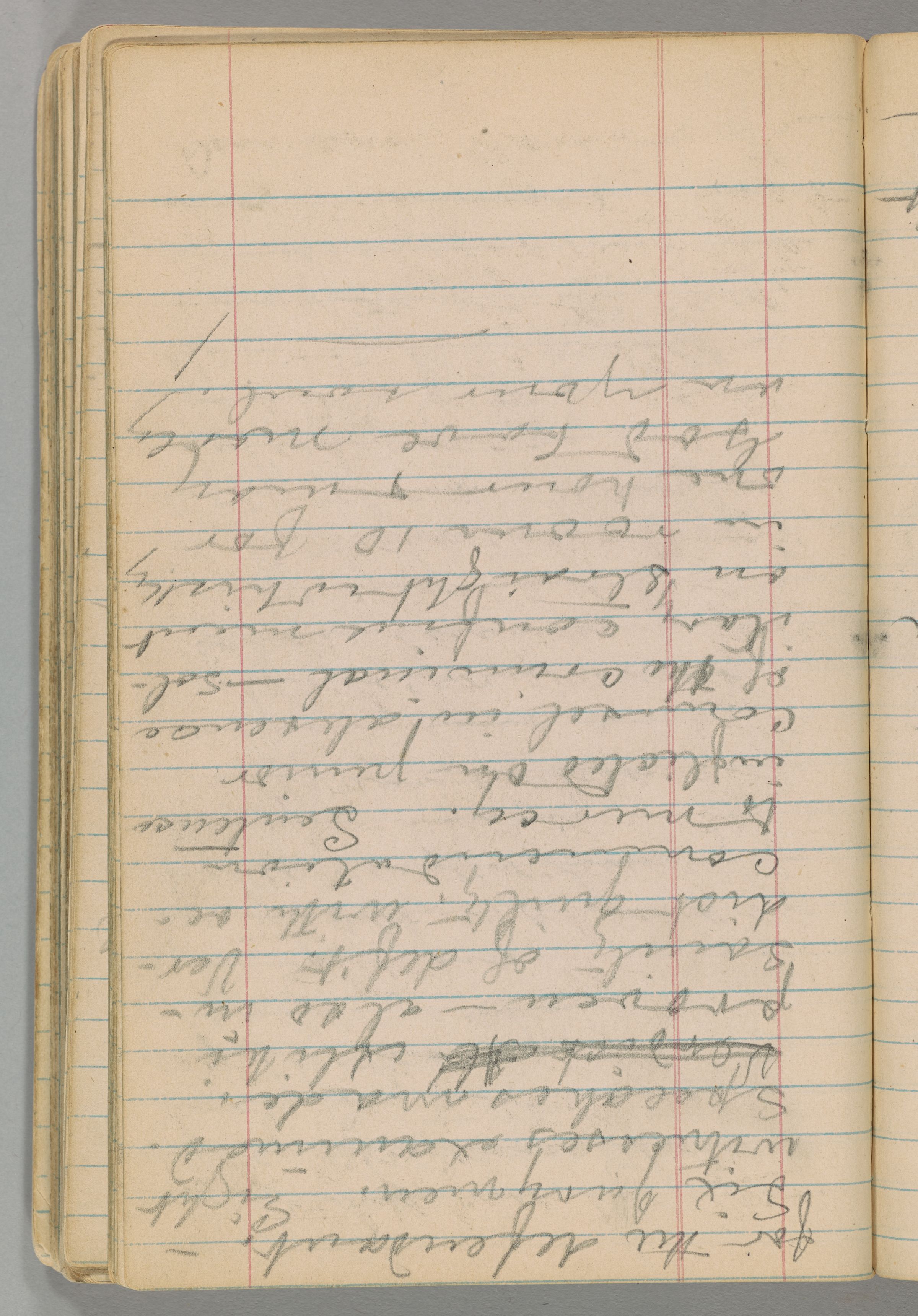
for the defendant.—
Six Jurymen. Eight
witnesses examined.
Speeches made.
Verdict
Ali Alibi
proven—also
in-
sanity
insanity
of def't.
Ver-
dict
Verdict
guilty, with
re-
commendation
recommendation
to mercy. Sentence
inflicted on junior
counsel in absence
of c the criminal—
sol-
itary
solitary
confinement
on straight whisky
in room 10 for
one hour & may
God have mercy
on your soul.
[MS: N8_leaf_017v]
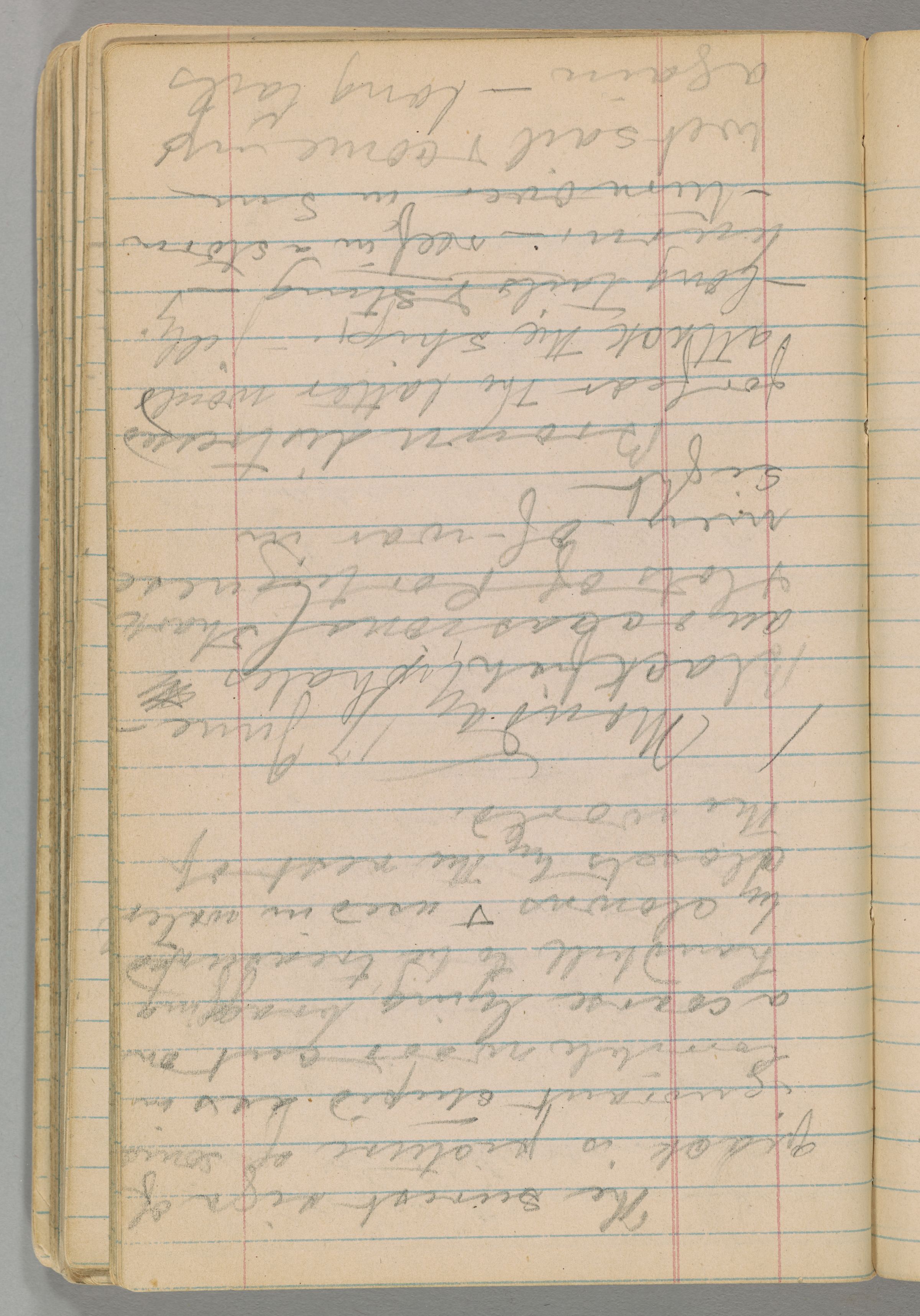
Curiosity—
Genu-
ine
Genuine
Nubian chancre.
Brown's letter
to French girl.
Capt Wakeman
& the nigger hung.
Evasive answer
Physician sands
nearly run out.
Thought they shut
off your forncation
[MS: N8_leaf_018r]
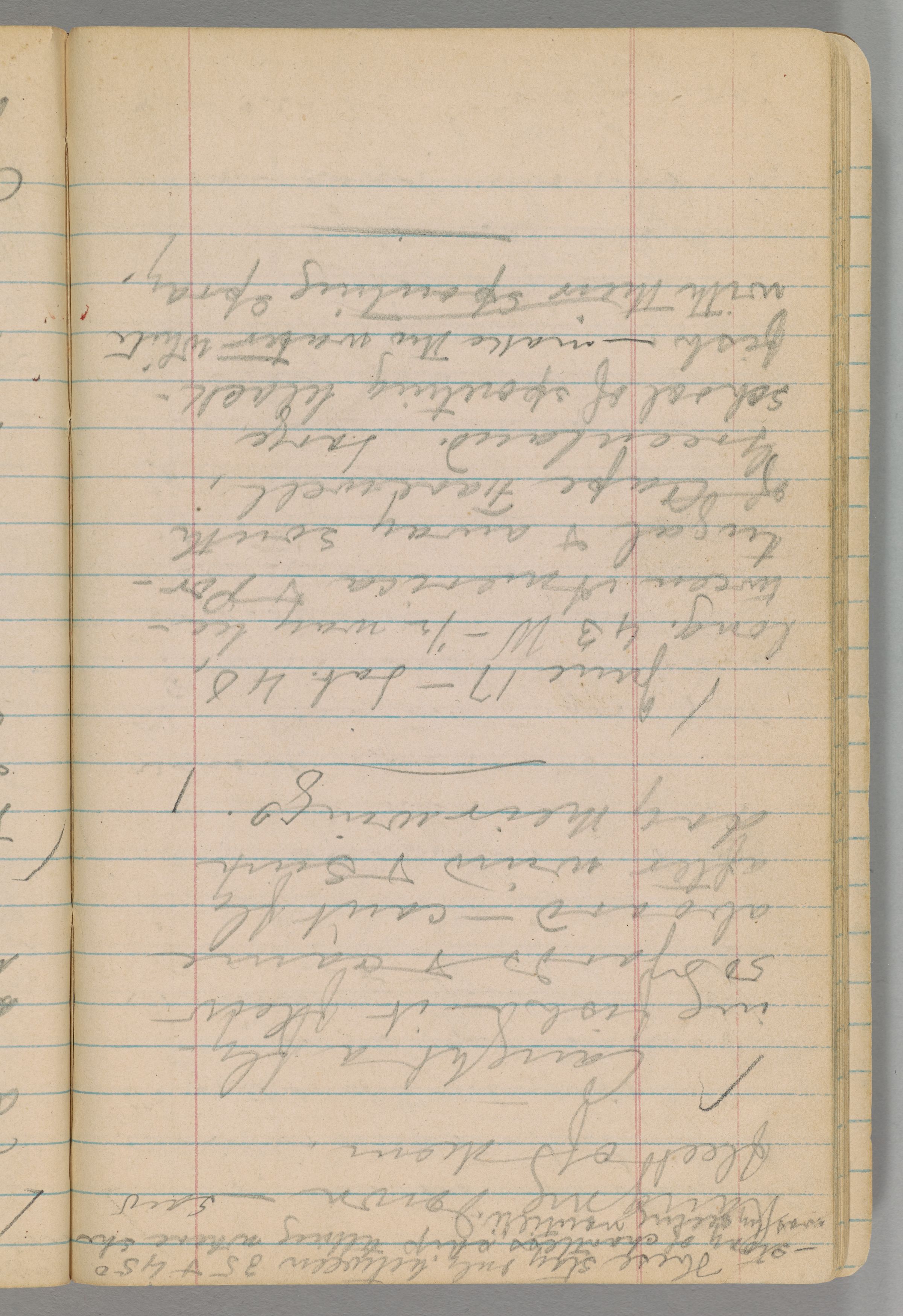
The surest sign of
quack is picture of some
ignorant stupid ass in
[MTP: N&J1_337] horrible woodcut on
a coarse lying, bragging
handbill to be treasured
by clowns & used in water
closets by the rest of
the world.
Monday 17 June—
Blackfish, whales &
an occasional shark
& lots of Portuguese
men-of-war in
sight
Brown distressed
for fear the latter would
attack the ship,.—jelly.
—long tails & sting—
burn,—reef in a storm
—turn over in sun,
wet sail & come up
again—long tails
[MS: N8_leaf_018v]
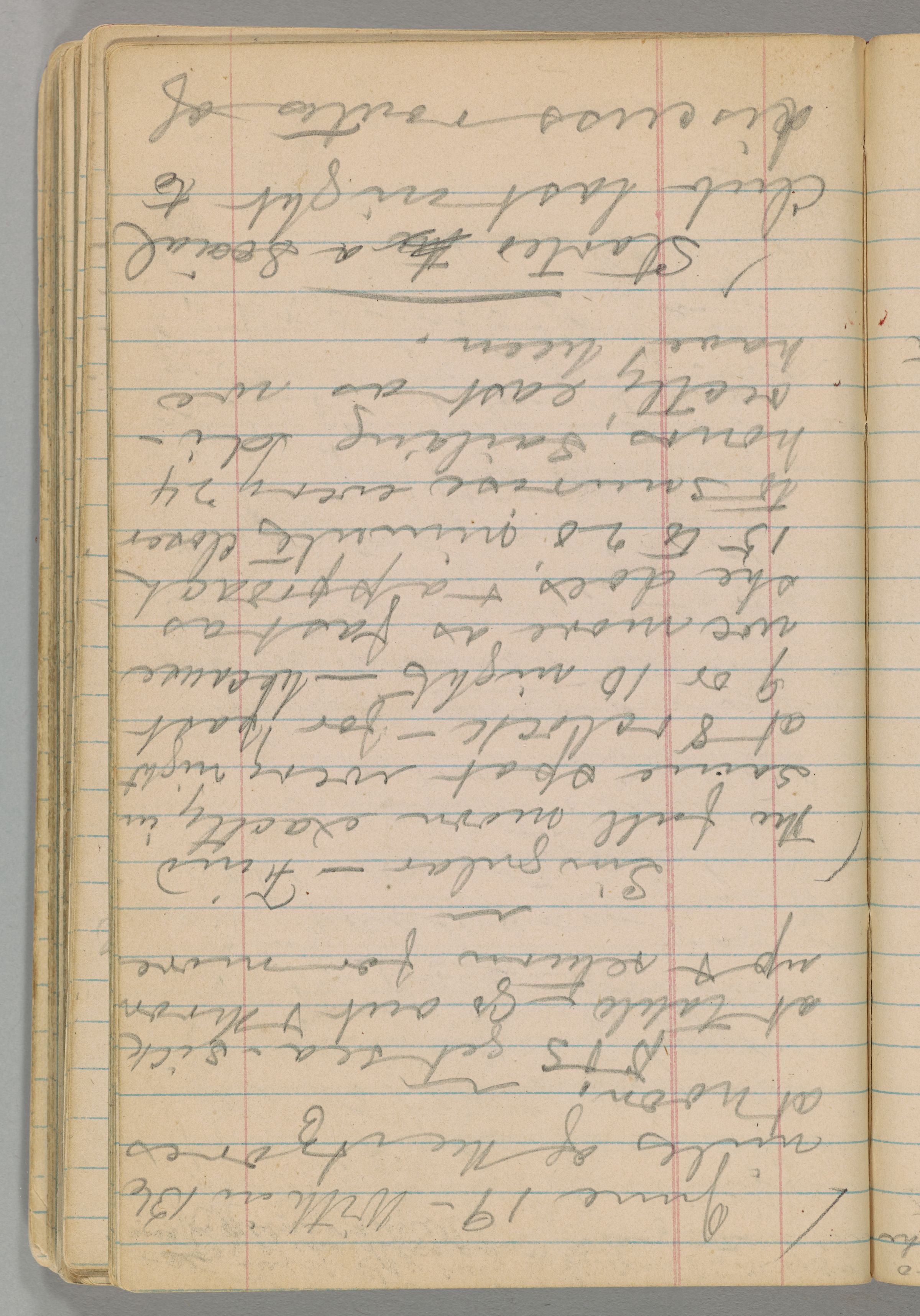
hanging down—saw
fleet of them.
These stay only between 35 & 45⁰
—story of chartless ship telling where she
was by seeing nautilli.
Caught a
fly-
ing
flying
fish—it flew
50 yards & came
aboard—can't fly
after wind & sun
dry their wings.
June 17—Lat. 40,
long. 43 W—½ way
be-
tween
between
America &
Por-
tugal
Portugal
& away south
of Cape Farewell,
Greenland. Large
school of spouting
black-
fish
blackfish
.—make the water white
with their spouting spray.
[MS: N8_leaf_019r]
June 19—Within 136
miles of the Azores
at noon.
Dr & S get sea-sick
at table—go out & throw
up & return for more.
Singular—Find
the full moon exactly in
same spot every night
at 8 oclock—for past
9 or 10 nights—because
we move as fast as
she does, & approach
15 to 20 minutes closer
to sunrise every 24
hours, sailing
di-
rectly
directly
east as we
have been.
Started the a Social
Club last night to
discuss routes of
[MS: N8_leaf_019v]
travel, & chose
Judge Haldeman
for President,—
Rev Mr Carew
[MTP: N&J1_338] for Secretary,
& MrosesS. Beach,
Dr Jackson &
my-
self
myself
as Executive
Committee.
Dr Andrew
& Capt Duncan
enlightened the Club
concerning the
Azores & Gibraltar.
After which
Mr James gave
Stereopticon views
—promised us
pic-
tures
pictures
of places we
are going to visit,
& his first was a
[MS: N8_leaf_020r]
view of Greenwood
Cemetery!
Prayer
Meet-
ings
Meetings
every night.
Sea so rough
to-day we cant
play horse-
bil-
iards
billiards
for'ard.
Gr-r-{????}
The Quaker City
Mirror is not
is-
sued
issued
very regularly.
[MTP: N&J1_339]
“Would be pity if
we came in sight of
the islands in the night
when so dark
I c we
[MS: N8_leaf_020v]
can't see them”—
Dan Slote said—
“See 'em in the morning”—
June 19—Up at
4 AM to see Island
of Corvo (small)—
passed half way
a-
round
around
its large
neigh-
bor
neighbor
Flores—very
cold & windy—spray
continually coming
aboard in broad
sheets & drenching
the passengers.—
Vineyards, gorges,
ridges (sharp,
vel-
vety
velvety
.) topped with
seeming castles
& ramparts—all
green in bright
spots & handsome.
[MS: N8_leaf_021r]
Got so far
east now that when
it is next week here
it is day before
yes-
terday
yesterday
in San F.
Brown wondered
that his watch was
so out of order that
it lost 20 minutes
every day—kept
slowing her down
till she hardly moved
at all, but all to
no purpose.
[MTP: N&J1_340]
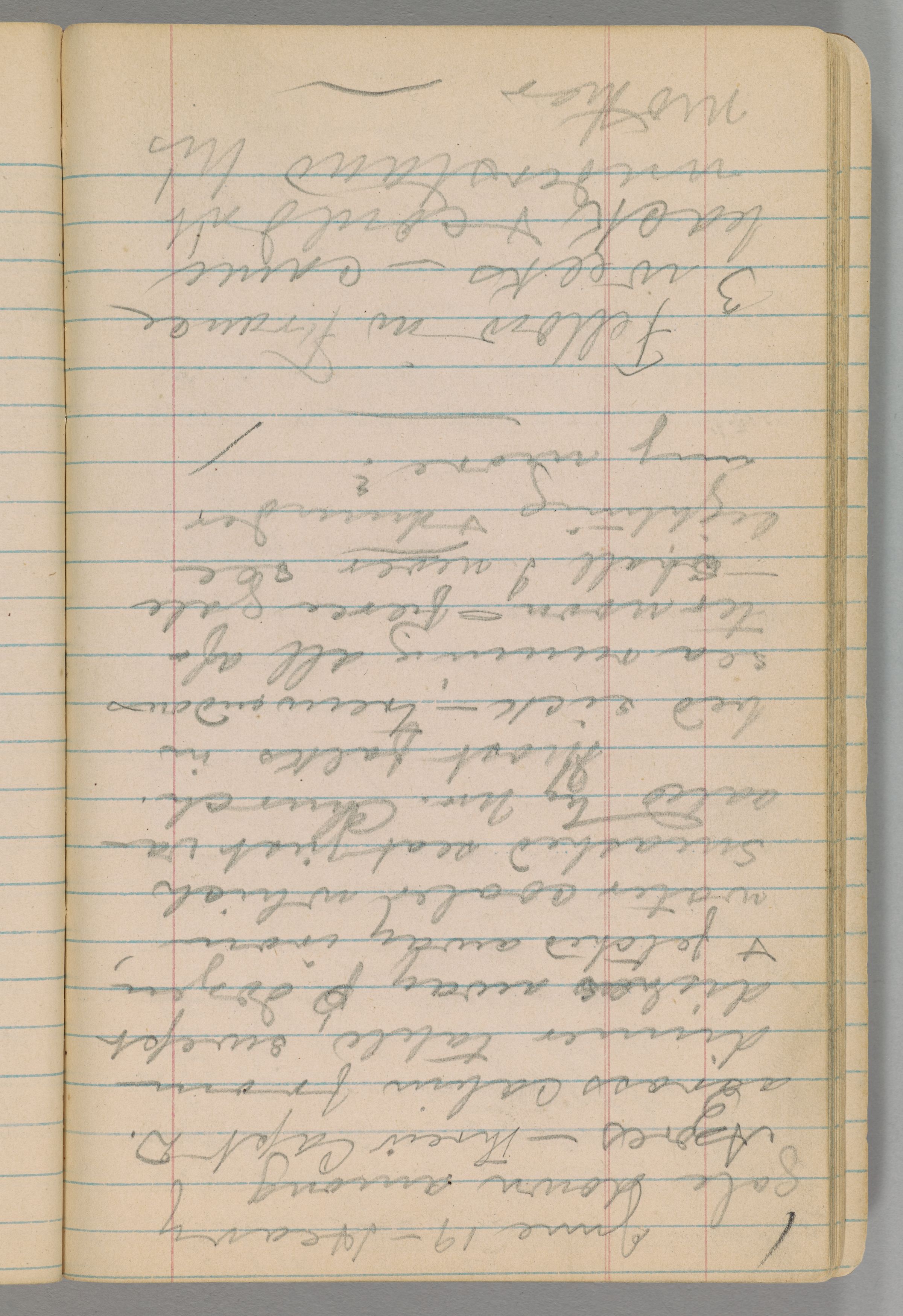
Stupid remarks
& ? from ? every
now & then—
make him a
character.
Also occasional
rhymes from the poet.
[MS: N8_leaf_021v]
June 19—Heavy
gale down among
Azores—threw Capt D.
across cabin from
dinner table, swept
dishes away p dozen,
& fetched away iron
water cooler which
smashed seat just
va-
cated
vacated
by Mr. Church.
Most folks in
bed sick—tremendous
sea running all
af-
ternoon
afternoon
—fierce gale
—shall I never see
lightning & thunder
any more?
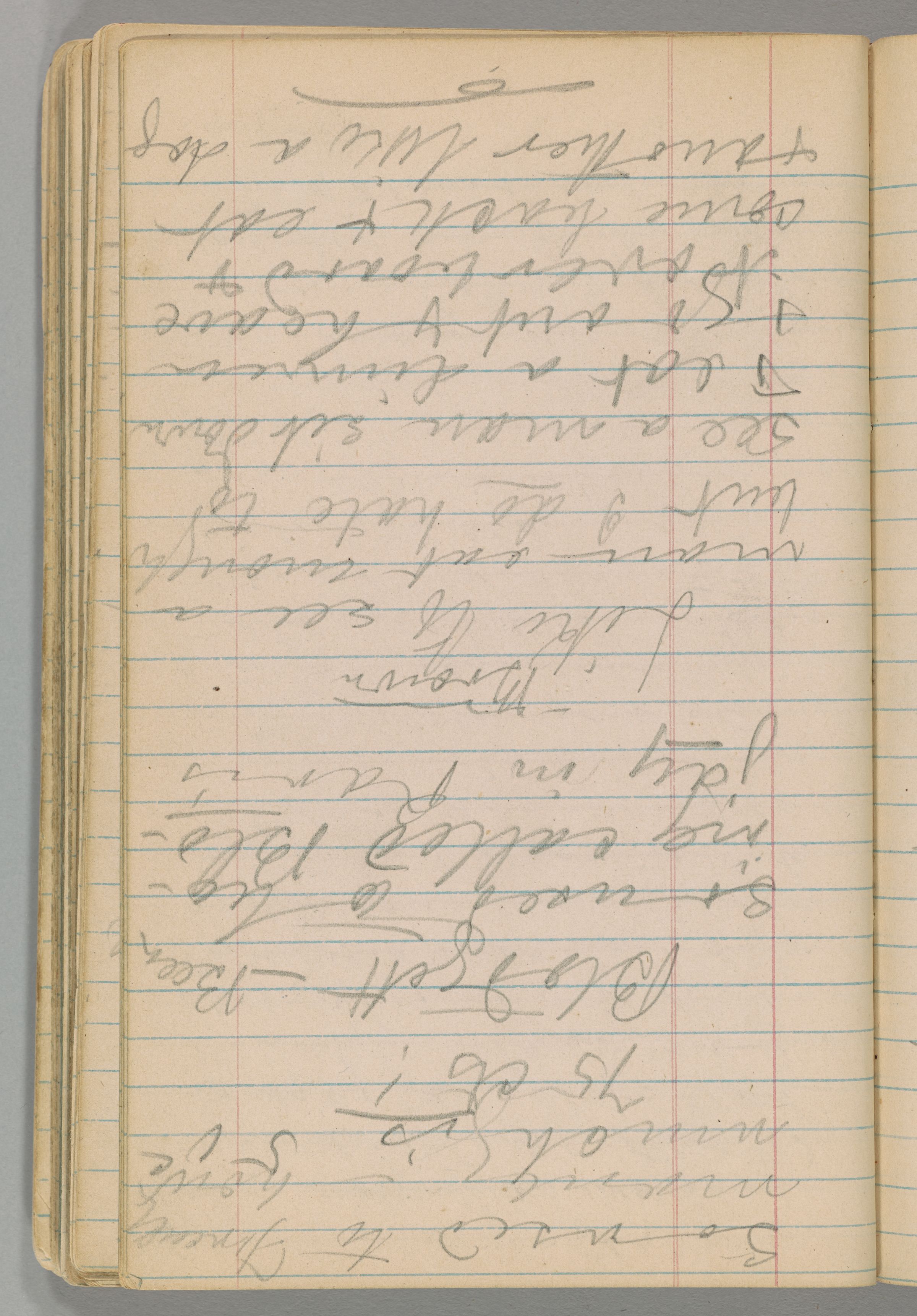
Fellow in France
3 weeks—came
back & couldn't
understand his
mother—
[MS: N8_leaf_022r]
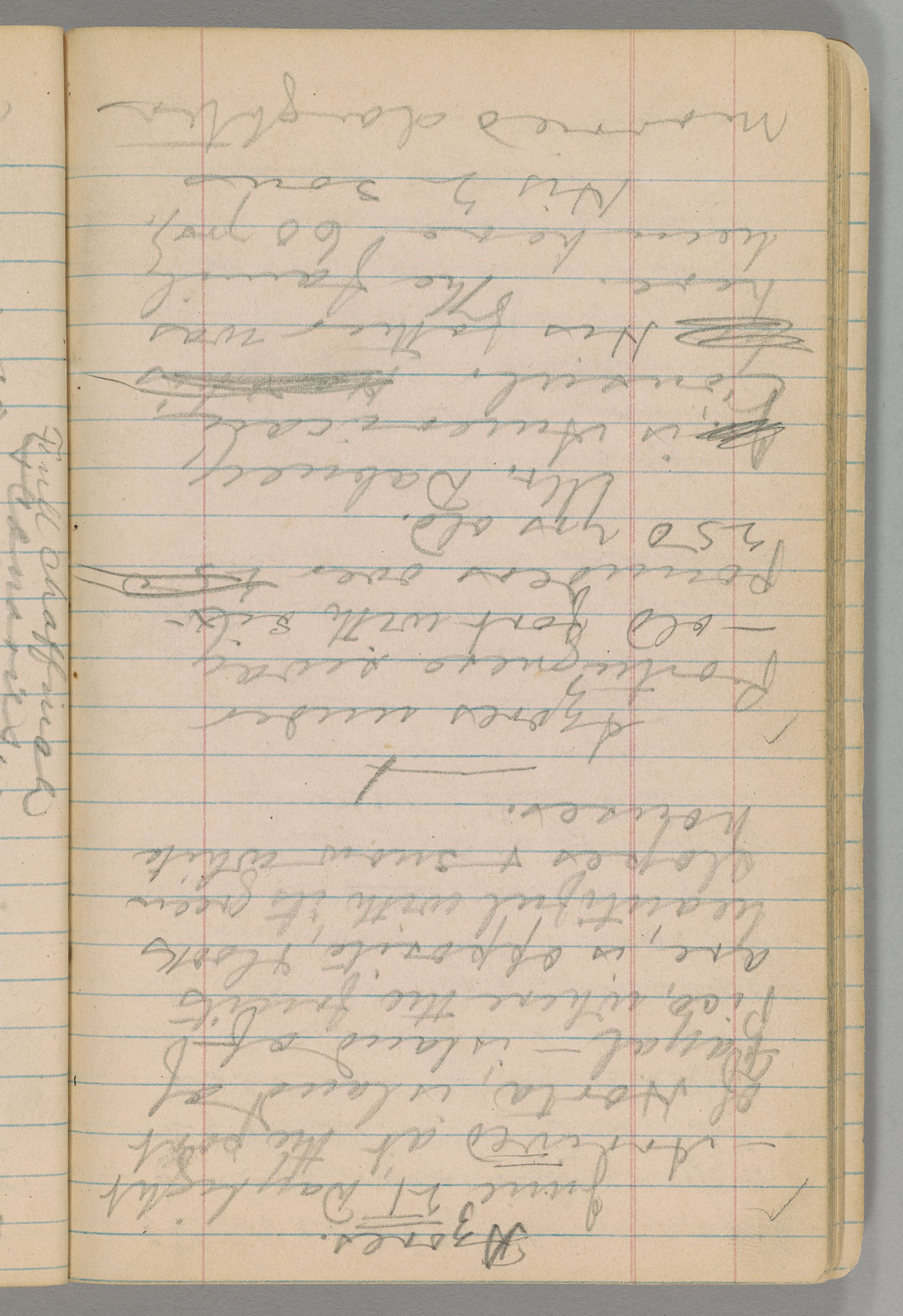
So used to French
money—how
much is 50c
75 cts!
Blodgett—Been
so used to
be-
ing
being
called
Blo-
jay
Blojay
in Paris
Brown
Like to see a
man eat enough
but I do hate to
see a man sit down
& eat a dinner
& go out & heave
it overboard &
come back & eat
& another like a dog
[MS: N8_leaf_022v]
[MTP: N&J1_341]
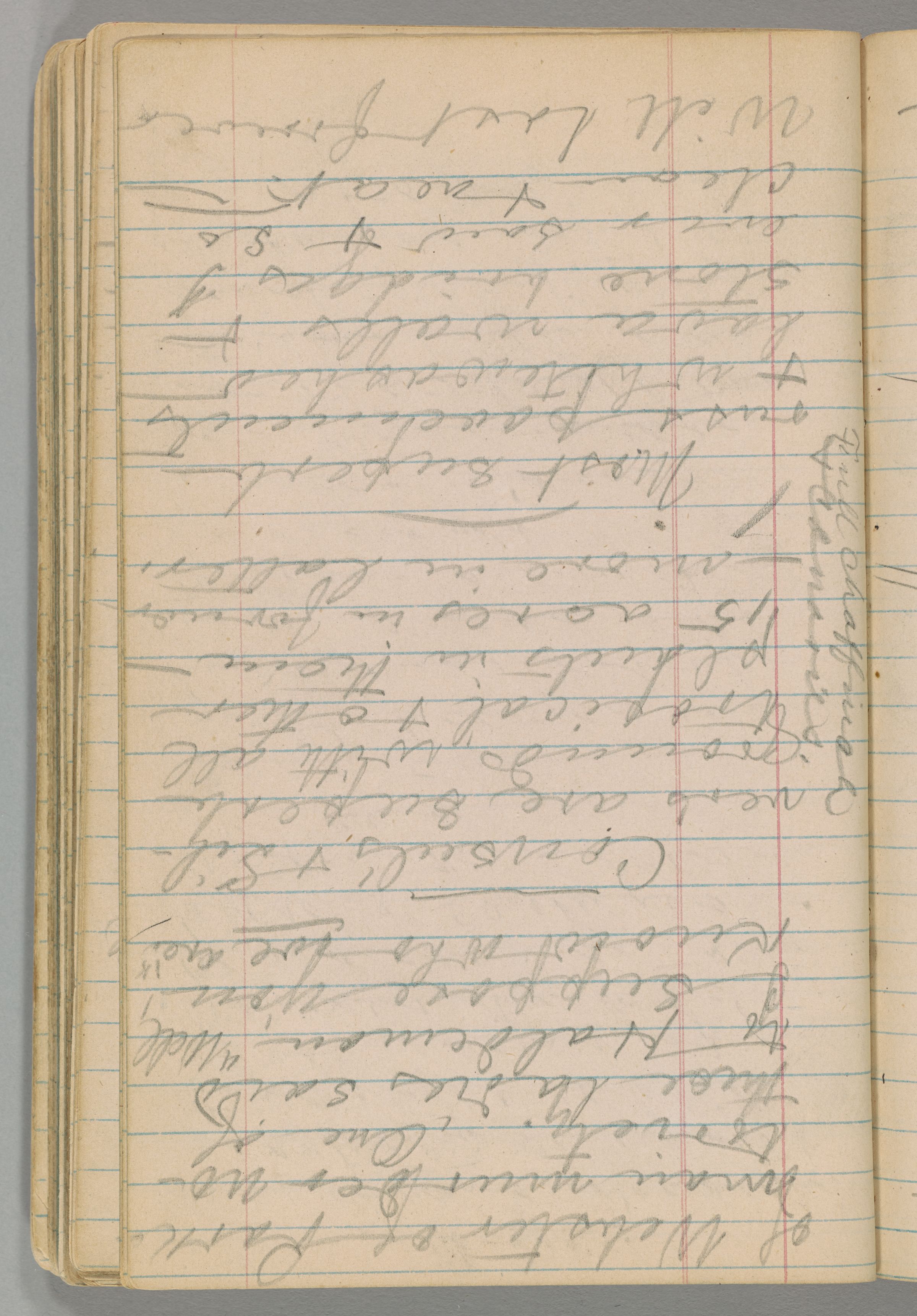
F Azores.
June 21, Daylight
—Arrived at the port
of Horta, island of
Fayal—island of
Pico, where the fruits
are, is opposite, & looks
beautiful with its green
slopes & snow-white
houses.
Azores under
Portuguese sway
—old fort with
six-
pounders
six-pounders
over
250 yrs old.
Mr. Dabney,
Jr., is American
Consul. He & his
br His father was
here. The family
been here 60 yrs.
His 2 sons
married daughters
[MS: N8_leaf_023r]
of Webster of
Park-
man
Parkman
murder
no-
toriety
notoriety
. One of
these ladies said
to Haldeman, “Well,
I suppose you
know who we are!”
Consul's &
Sil-
ver’s
Silver's
are superb
grounds, with all
tropical & other
plants in them—
15 acres in former
—more in latter.
[MTP: N&J1_342]
Most superb
russ pavements
& whitewashed
lava walls &
stone bridges I
ever saw & so
clean & neat.—
Will last forever.
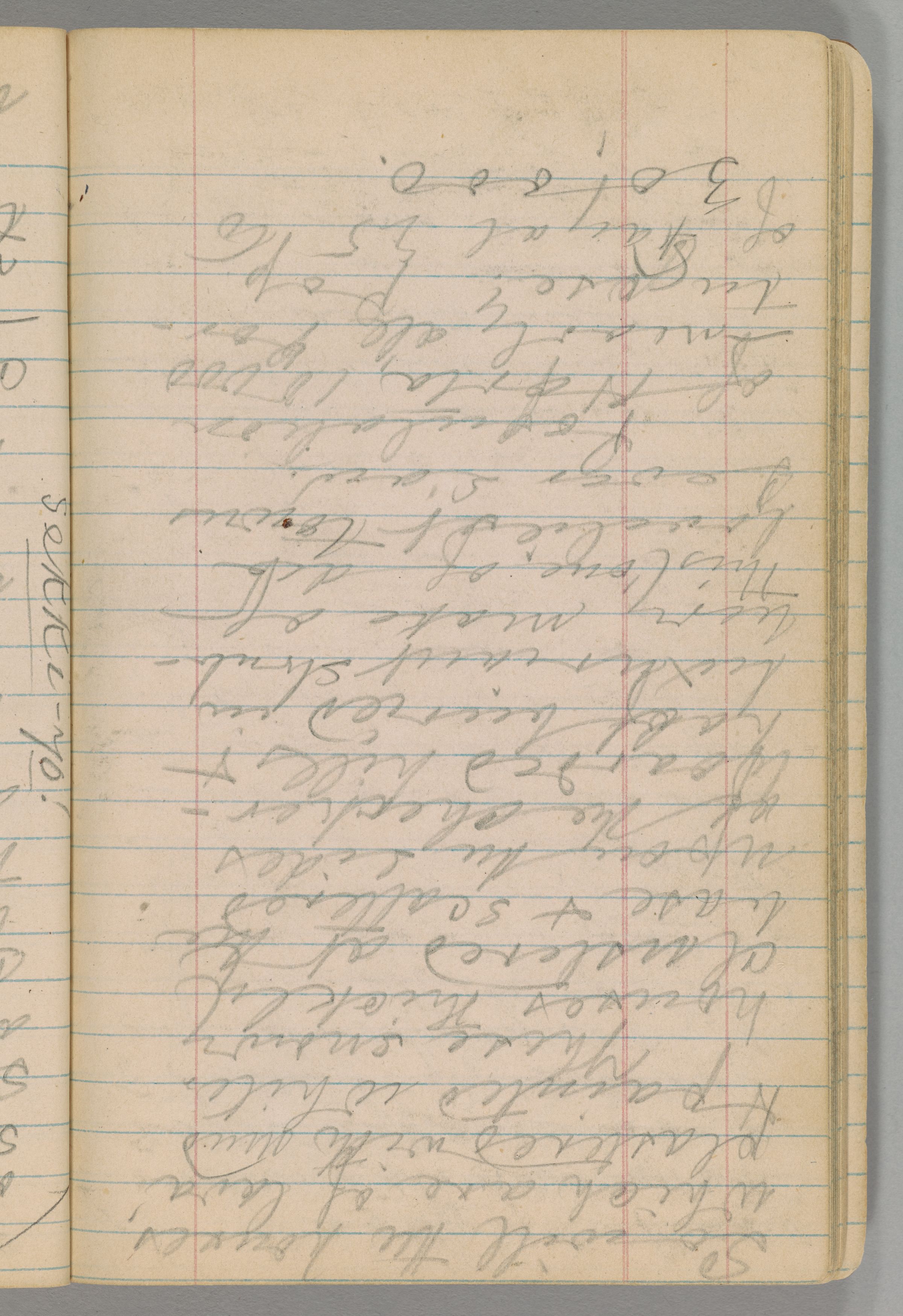
[MS: N8_leaf_023v]
So will the houses,
which are of lava
plastered with mud
& painted white.
These snowy
houses thickly
clustered at the
base & scattered
upon the sides
of the checker-
boarded hills &
havlf buried in
luxuriant
shrub-
bery
shrubbery
, make of
this one of the
loveliest towns
I ever saw.
Population
of Horta, 10,000
—nearly all
Por-
tuguese
Portuguese
. Pop.
of Fayal 25 to
30,000.
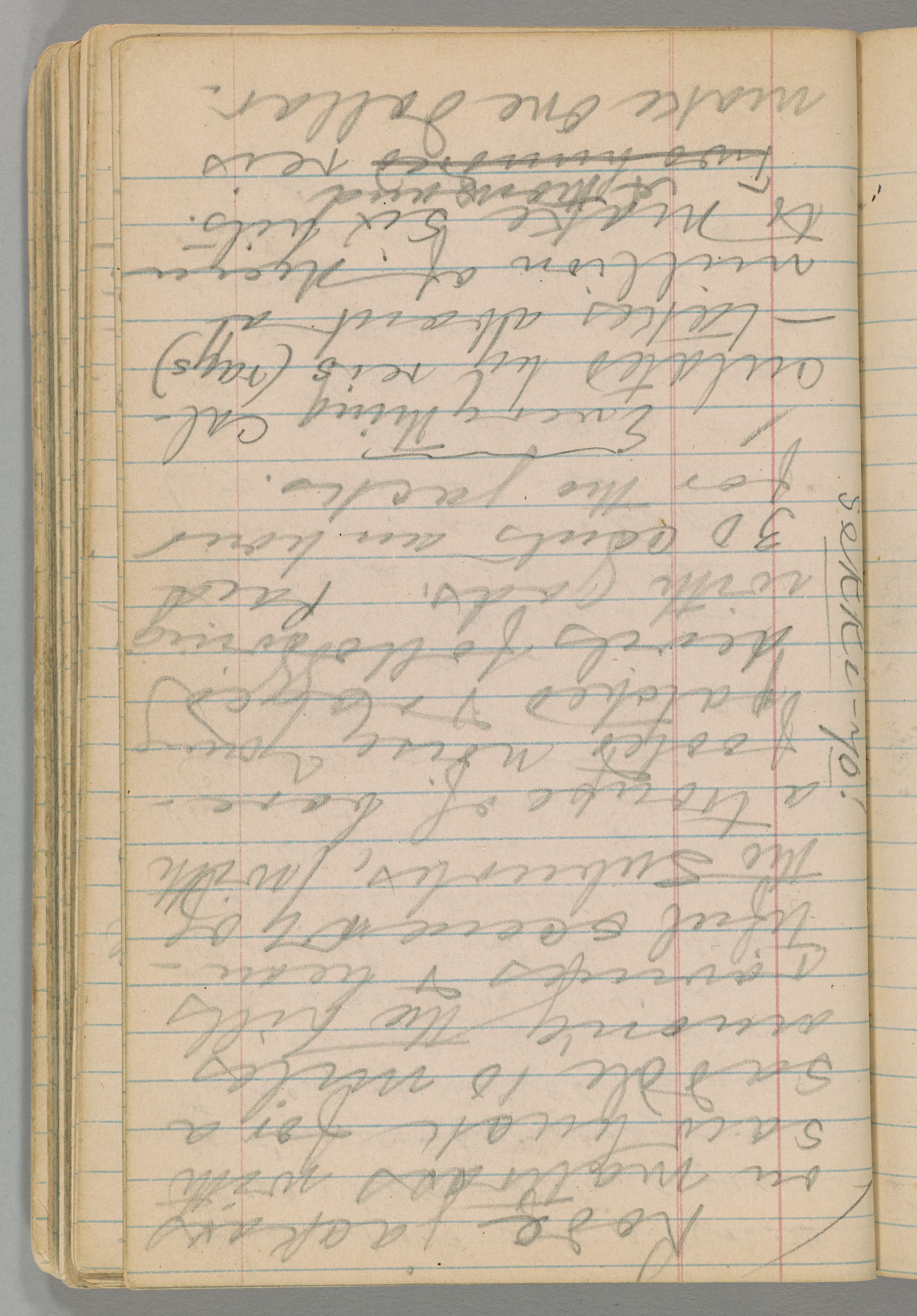
[MS: N8_leaf_024r]
Rode jackass
on mattrass with
sawbuck for a
saddle, 10 miles
among the hills
ravines &
beau-
tiful
beautiful
scenery of
the suburbs, with
a troupe of
bare-
footed
barefooted
noisy young
patched & ragged
devils following
with gads. Paid
30 cents an hour
for the jacks.
Everything
cal-
culated
calculated
by reis (rays)
—takes about a
million of them
to make six bits.
Two hundred
A thousand
reis
make one dollar.
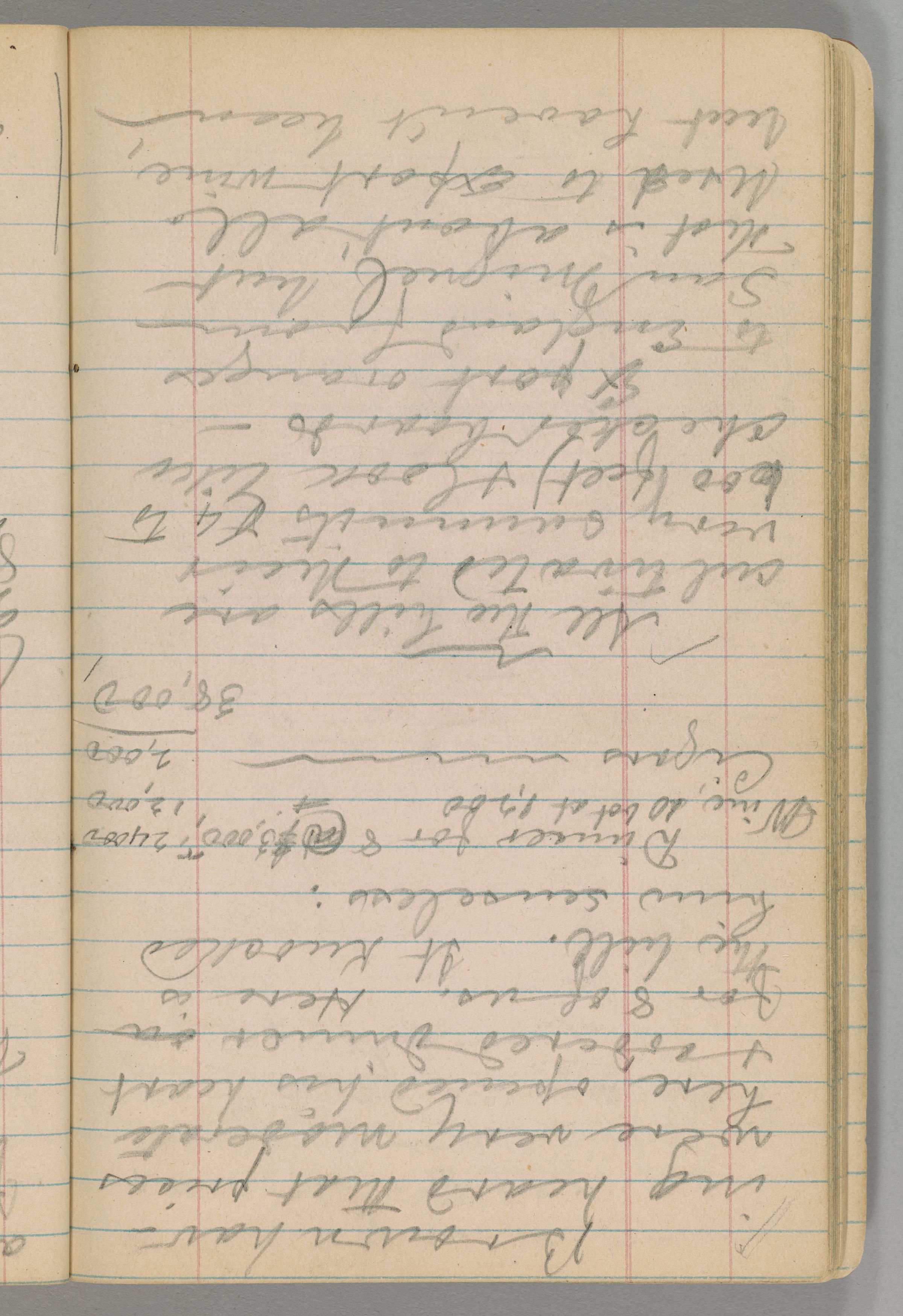
[MS: N8_leaf_024v]
Brown
hav-
ing
having
heard that prices
were very moderate
here, opened his heart
& ordered dinner on
for 8 of us. Here is
the bill. It knocked
him senseless:
| Dinner for 8 at @ $ 3,000, r, | 24 000 |
| C Wine, a 10 bot at 1,200 | 12,000 |
| Cigars | 2,000 |
| 38,000 |
[MTP: N&J1_343]
All the hills are
cultivated to their
very summits & (4 to
600 feet) & look like
checker-boards—
Export oranges
to England from
San Miguel, but
that is about all.
Used to export wine,
but haven't been
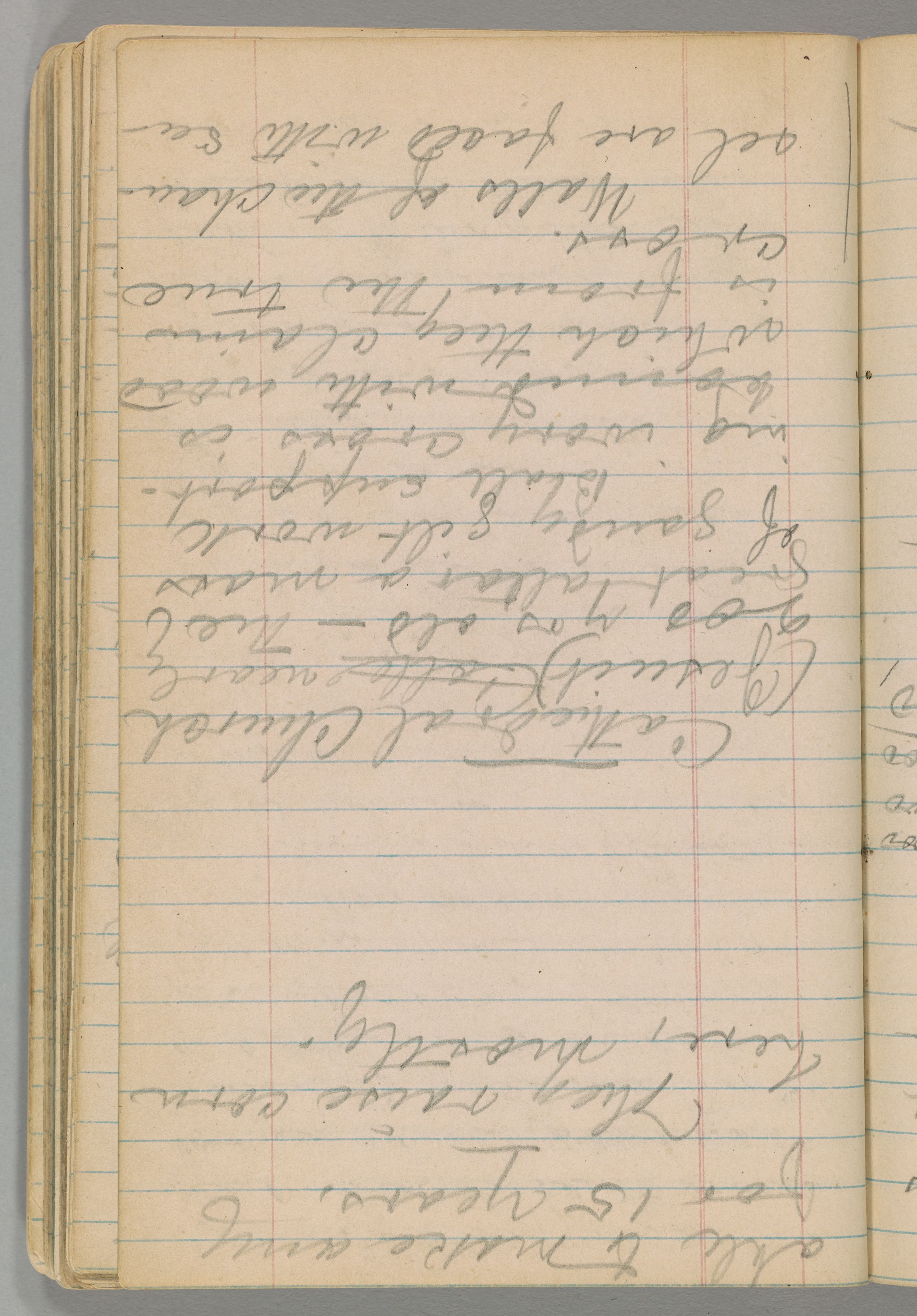
[MS: N8_leaf_025r]
able to make any
for 15 years.
six lines left blank
Cathedral Church
(Jesuit)
Colle
nearly
200 yrs. old—the
great altar a mass
of gaudy gilt work
Ball
support-
ing
supporting
ivory cross is
bound with wood
which they claim
is from the true
cross.
Walls of the
chan-
cel
chancel
are faced with su-
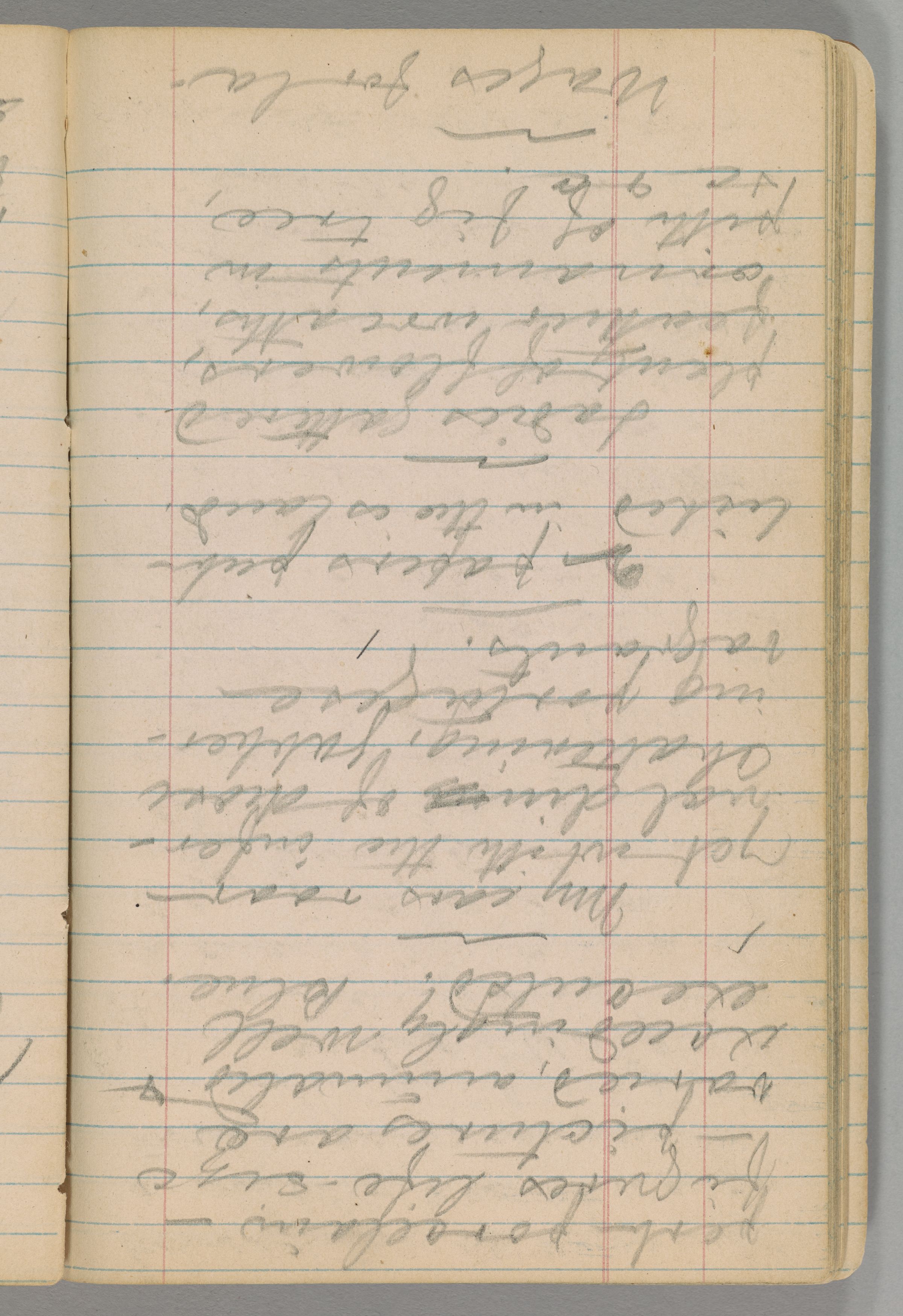
[MS: N8_leaf_025v]
perb porcelain—
figures life-size
—pictures are
varied, animated &
exceedingly well
executed. Blue.
My ears roar
yet with the
infer-
nal
infernal
din ni of those
chattering,
jabber-
ing
jabbering
portugese
vagrants.
2 papers
pub-
lished
published
in the islands.
Ladies gathered
plenty of flowers,
feather wreaths,
ornaments in
pith of fig tree,
&c &c.
Wages for la-
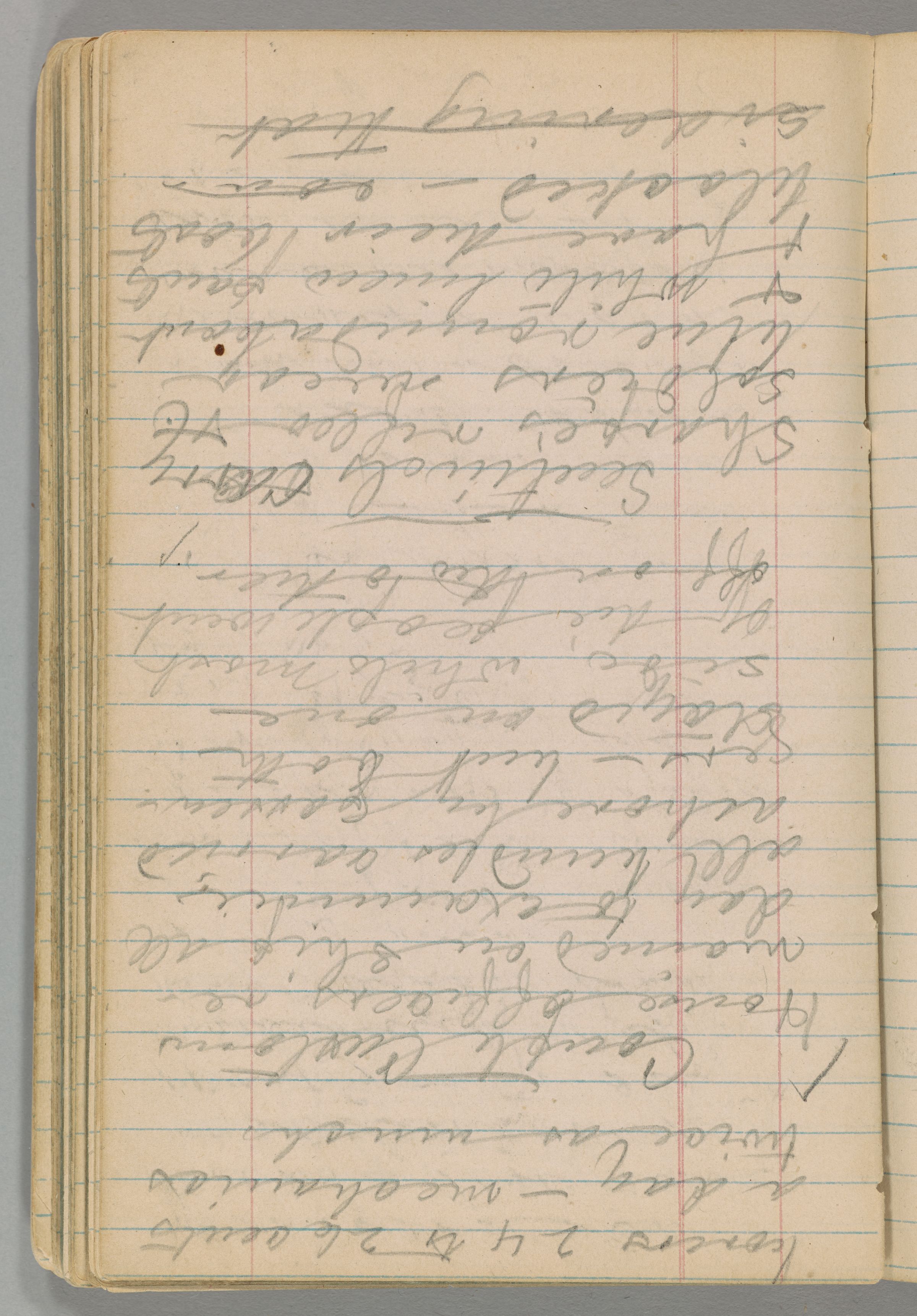
[MS: N8_leaf_026r]
borers 24 to 26 cents
a day—mechanics
twice as much.
Couple Custom
House officers
re-
mained
remained
on ship all
day to
[MTP: N&J1_344] examine
all bundles carried
ashore by g
passen-
gers
passengers
—but both
stayed on one
side, while most
of the people went
off on the other.
Sentinels & s carry
Sharpe's rifles &
soldiers wear
blue roundabout
& white linen pants
& have their boots
blacked—
con-
sidering
considering
that
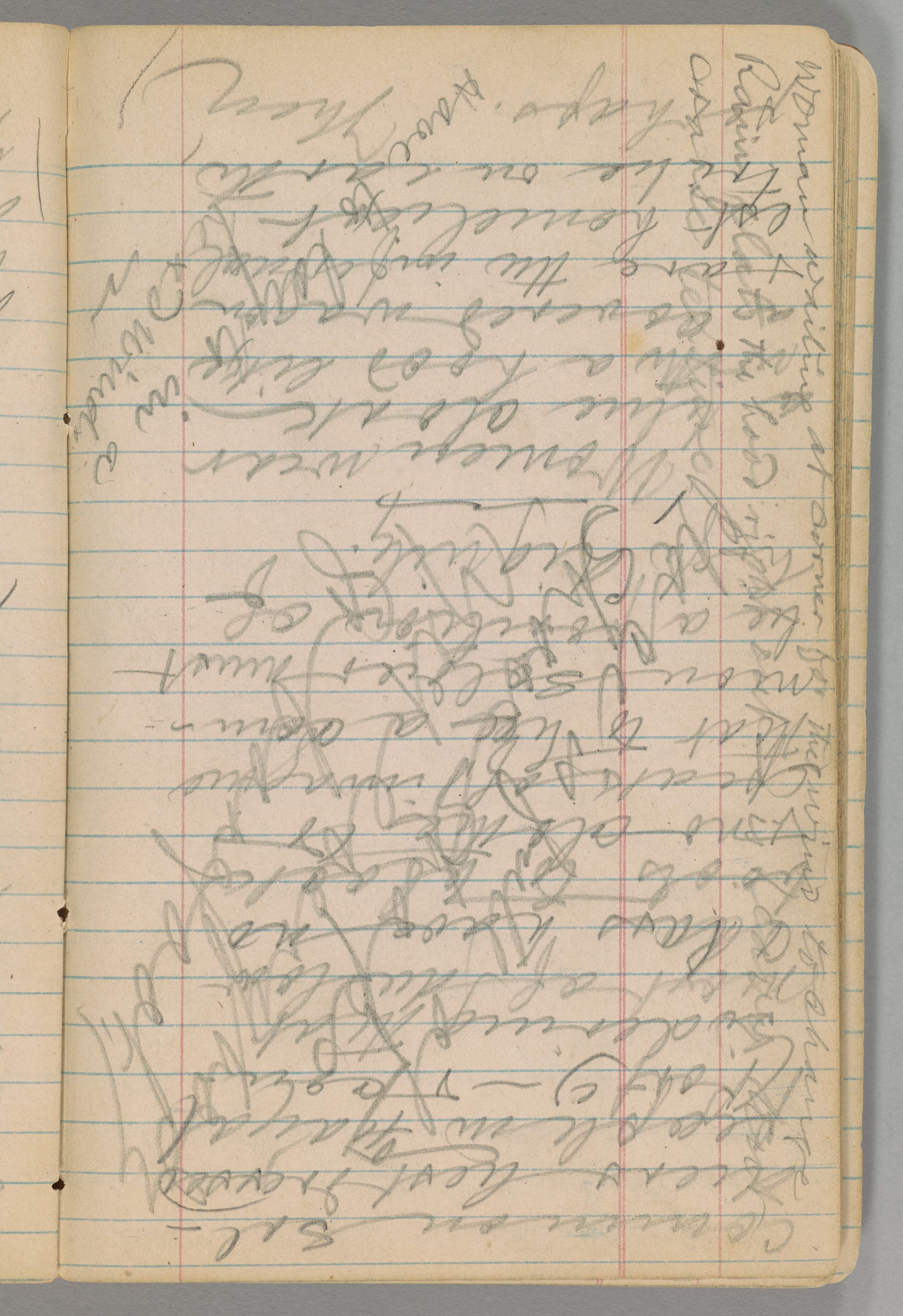
[MS: N8_leaf_026v]
Woman waiting at corner for the wind to change
Rain flats the hood right out—is heavy but
coarse texture.
Women wear a blue cloak with a hood like a covered wagon & are the infernalest homeliest tribe on earth, perhaps. They
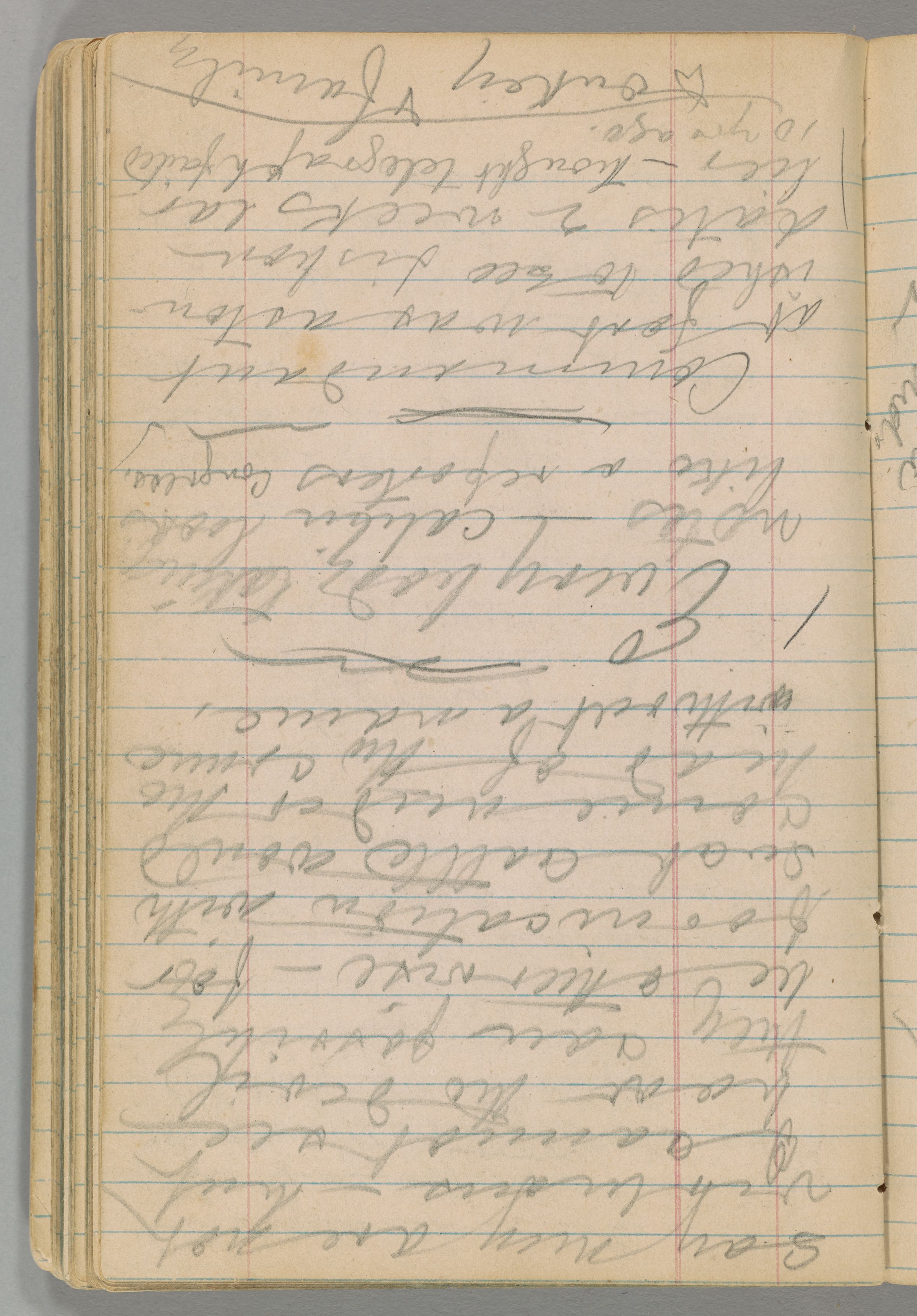
[MS: N8_leaf_027r]
say they are not
virtuous—but
I cannot see
how the devil
they can possibly
be otherwise—for
fornication with
such cattle would
come under the
head of the crime
without a name.
Everybody taking
notes—cabin looks
like a reporters congress.
[MTP: N&J1_345]
Commandant
at fort was
aston-
ished
astonished
to see Lisbon
dates 2 weeks
ear-
lier
earlier
—thought telegraph failed
10 yrs ago.
Donkey & family
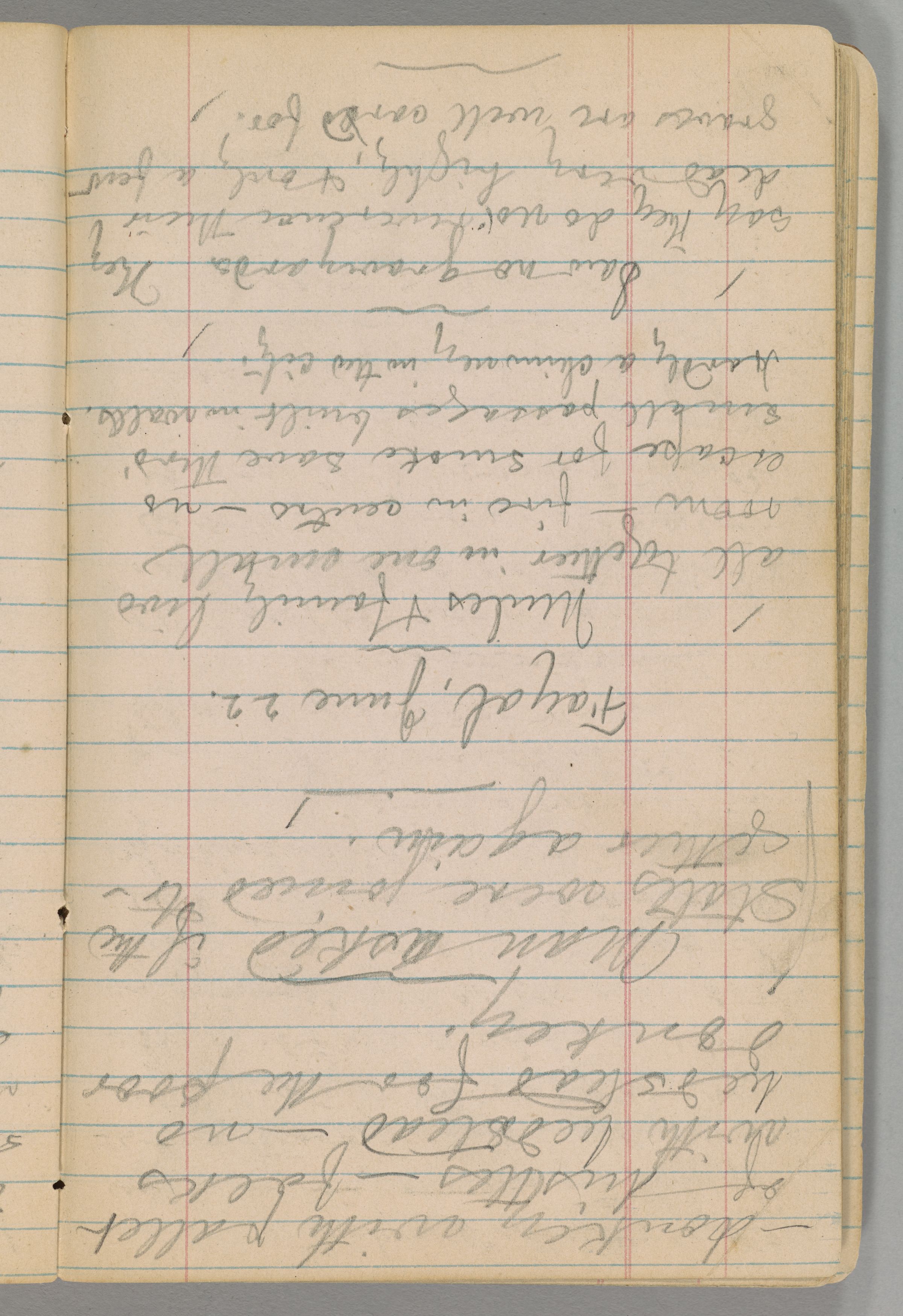
[MS: N8_leaf_027v]
—donkey with pallet
of thistles—folks
with bedstead—no
bedstead for the poor
donkey.
Man asked if the
States were joined
to-
gether
together
again.
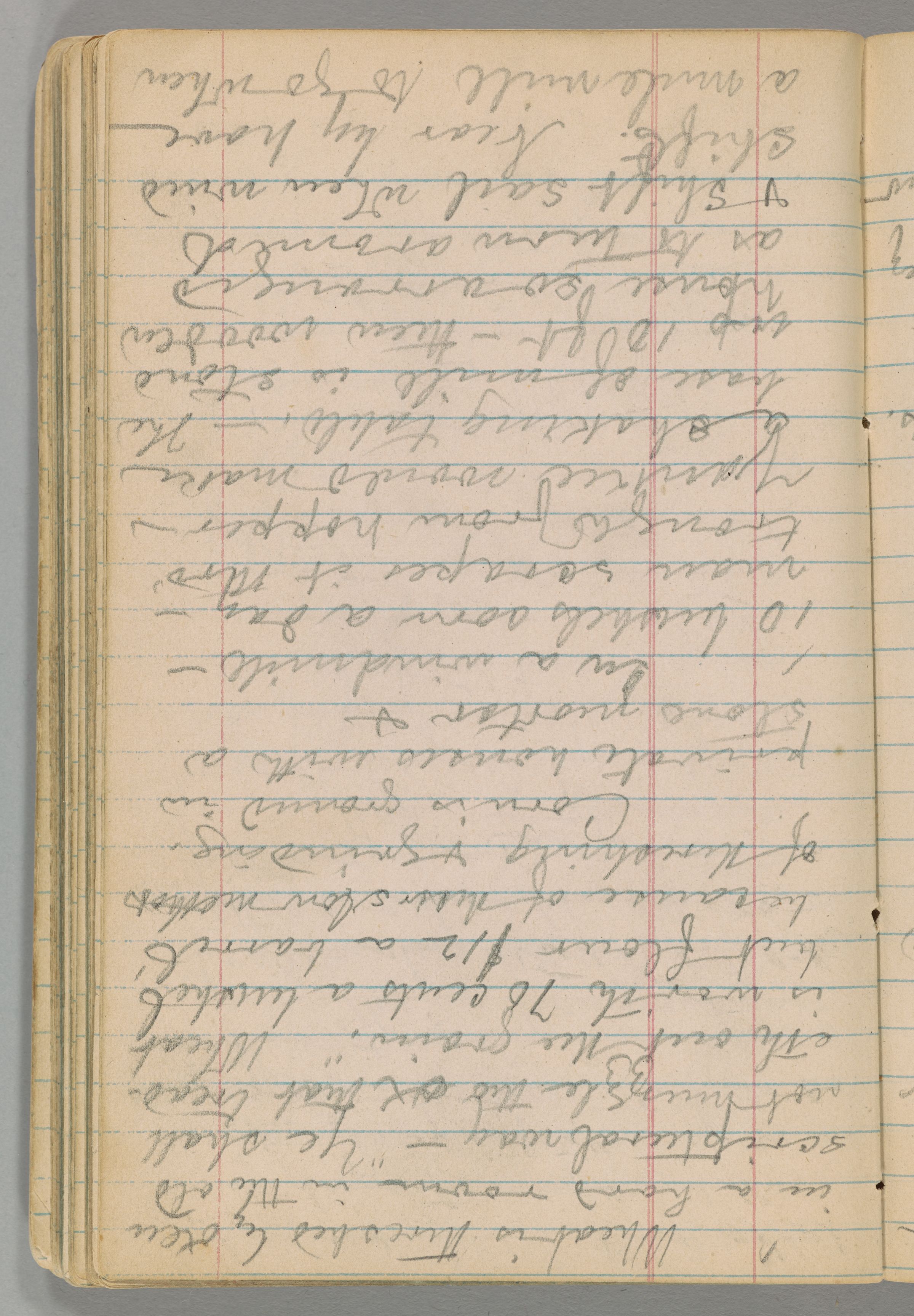
Fayal, June 22.
Mules & family live
all together in one small
room—fire in centre—no
escape for smoke save thro'
small passages built in walls.
Hardly a chimney in the city.
Saw no graveyards. They
say they do not reverence their
dead very highly, & only a few
graves are well cared for.
[MS: N8_leaf_028r]
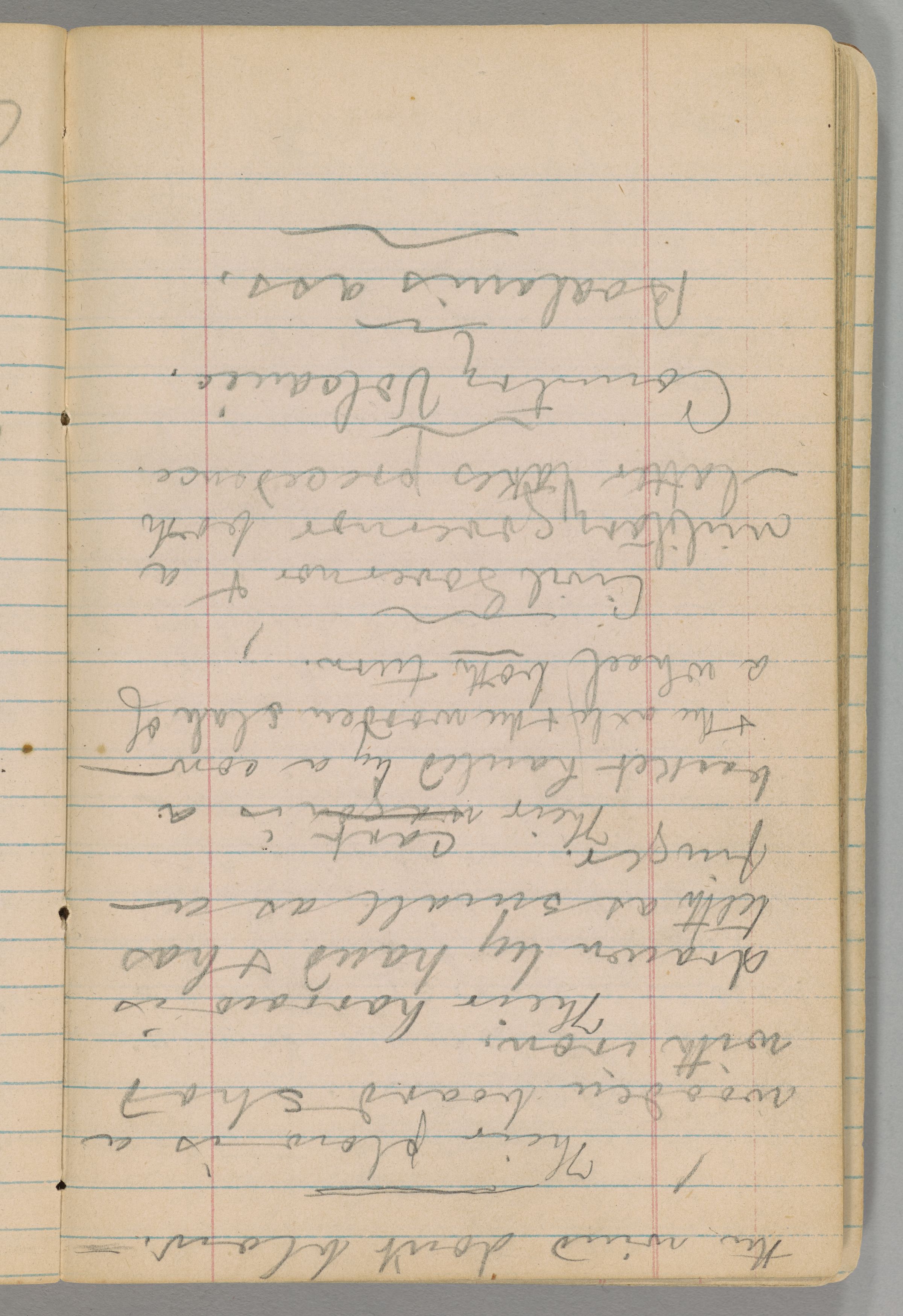
Wheat is threshed by oxen
in a hard room in the old
scriptural way—“Ye shall
not muzzle the ox that
tread-
eth
treadeth
out the grain.” Wheat
is worth 70 cents a bushel,
but flour $12 a barrel
because of thiseir slow methods
of threshing & grinding.
Corn is ground in
private houses with a
stone mortar &
In a windmill—
10 bushels corn a day—
man scrapes it thro'
trough from hopper—
Yankee would make
a shaking table. —The
base of mill is stone
up 10 ft—then wooden
house so arranged
as to turn around
& shift sail when wind
shifts. Near by have
a mule mill to go when
[MS: N8_leaf_028v]
the wind don't blow.—
Their plow is a
wooden board shod
with iron.
Their harrow is
drawn by hand & has
teeth as small as a
finger.
[MTP: N&J1_346]
Their wagon
cart
is a
basket hauled by a cow
& the axle & the wooden slab of
a wheel both turn.
Civil Governor & a
military governor both
—latter takes precedence.
Country Volcanic.
Baalam's ass.
[MS: N8_leaf_029r]
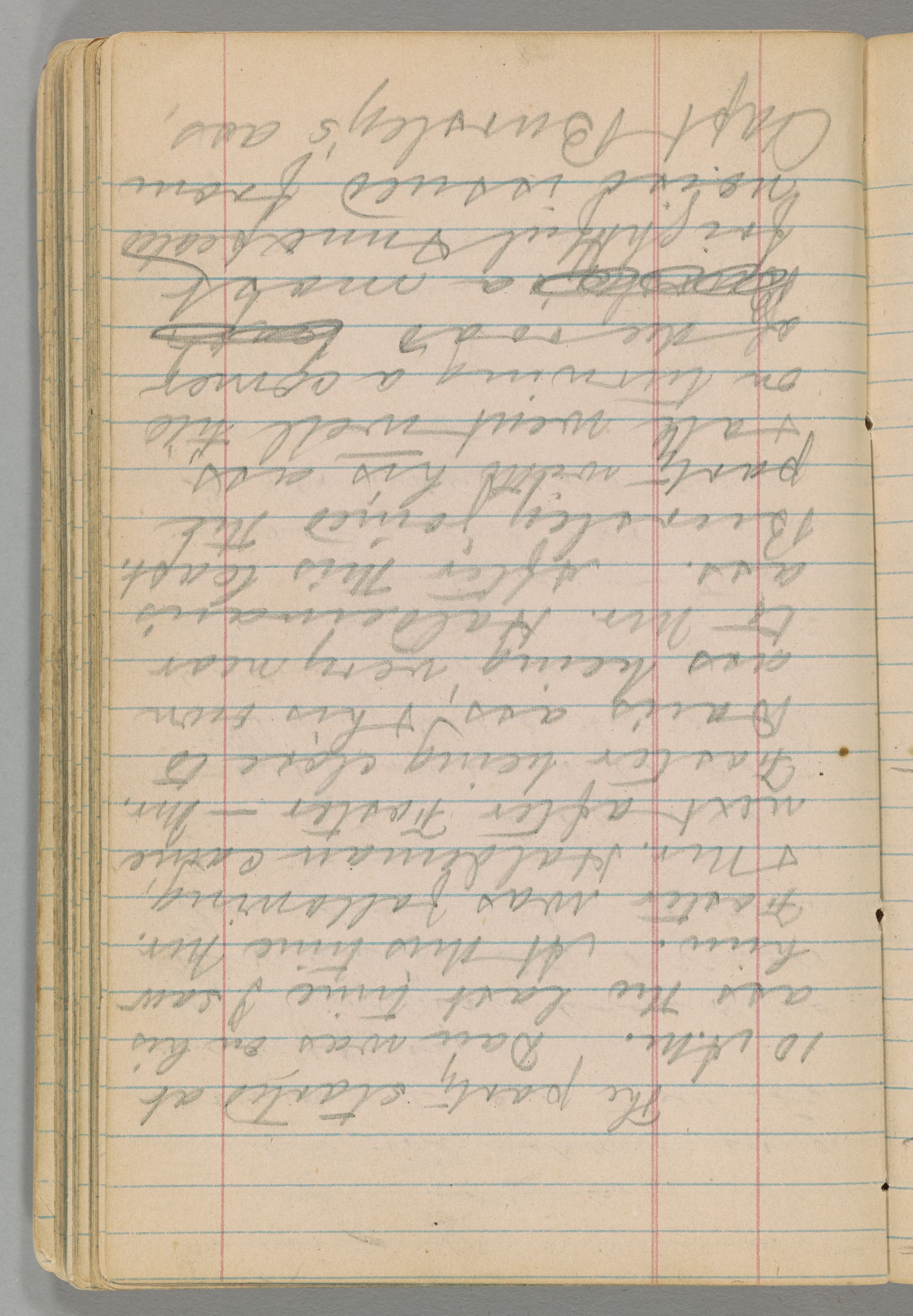
The party started at
10 A.M. Dan was on his
ass the last time I saw
him. At this time Mr.
Foster was following,
& Mr. Haldeman came
next after Foster—Mr.
Foster being close to
Dan's ass, & his own
ass being very near
to Mr. Haldeman's
ass. After this Capt.
Bursley joined the
party with his ass,
& all went well till
on turning a corner
of the road Capt.
Bursley's a most
frightful & unexpected
noise issued from
Capt Bursley's ass,
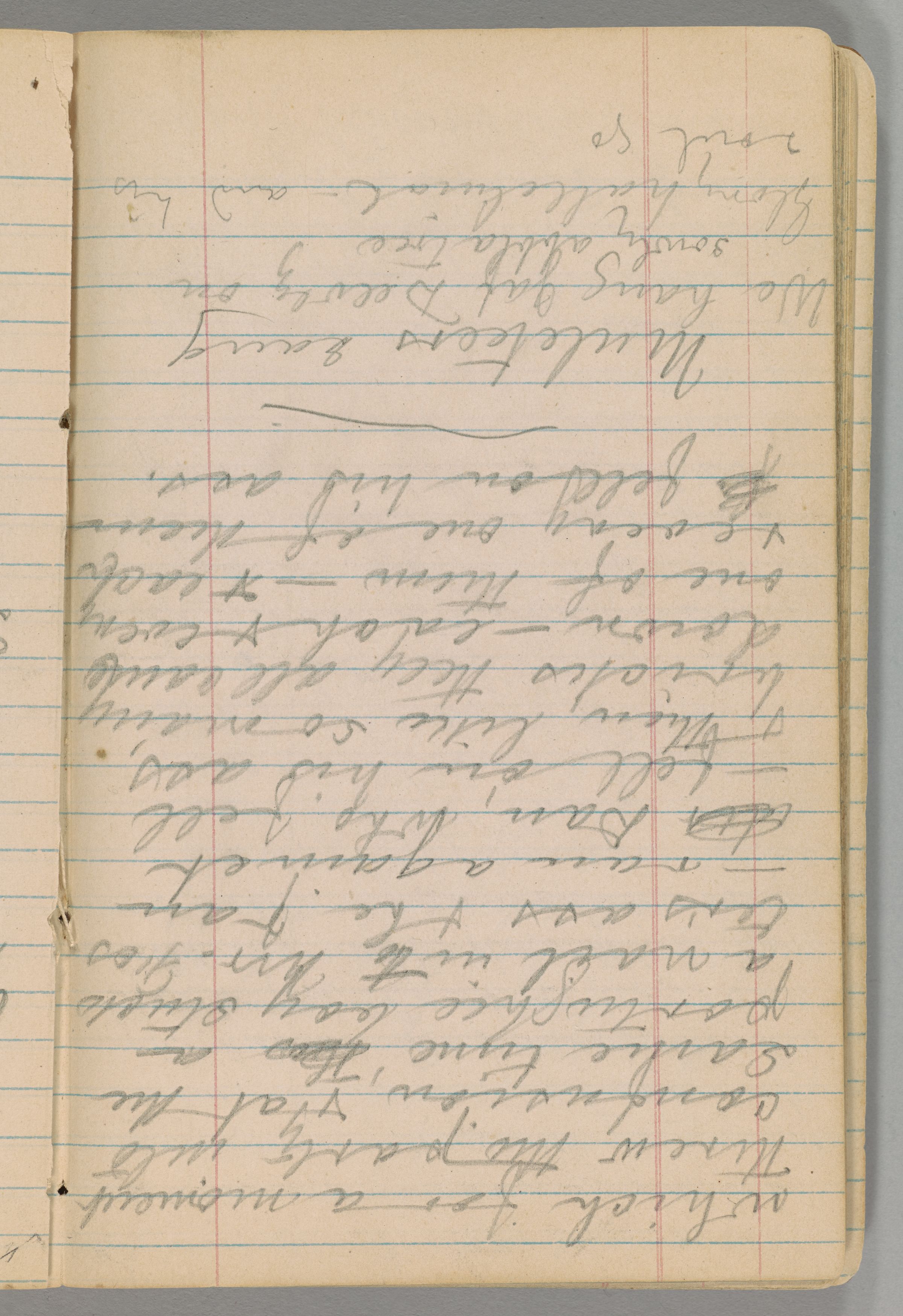
[MS: N8_leaf_029v]
which for a moment
threw the party into
confusion, & at the
same time the a
portughee boy stuck
a nail in M to Mr.
Fos-
ter’s
Foster's
ass & he f ran
—ran against
Mr Dan, who fell
—fell on his ass,
& then, like so many
bricks they all came
down—each & every
one of them—& each
& every one of them
fell on his ass.
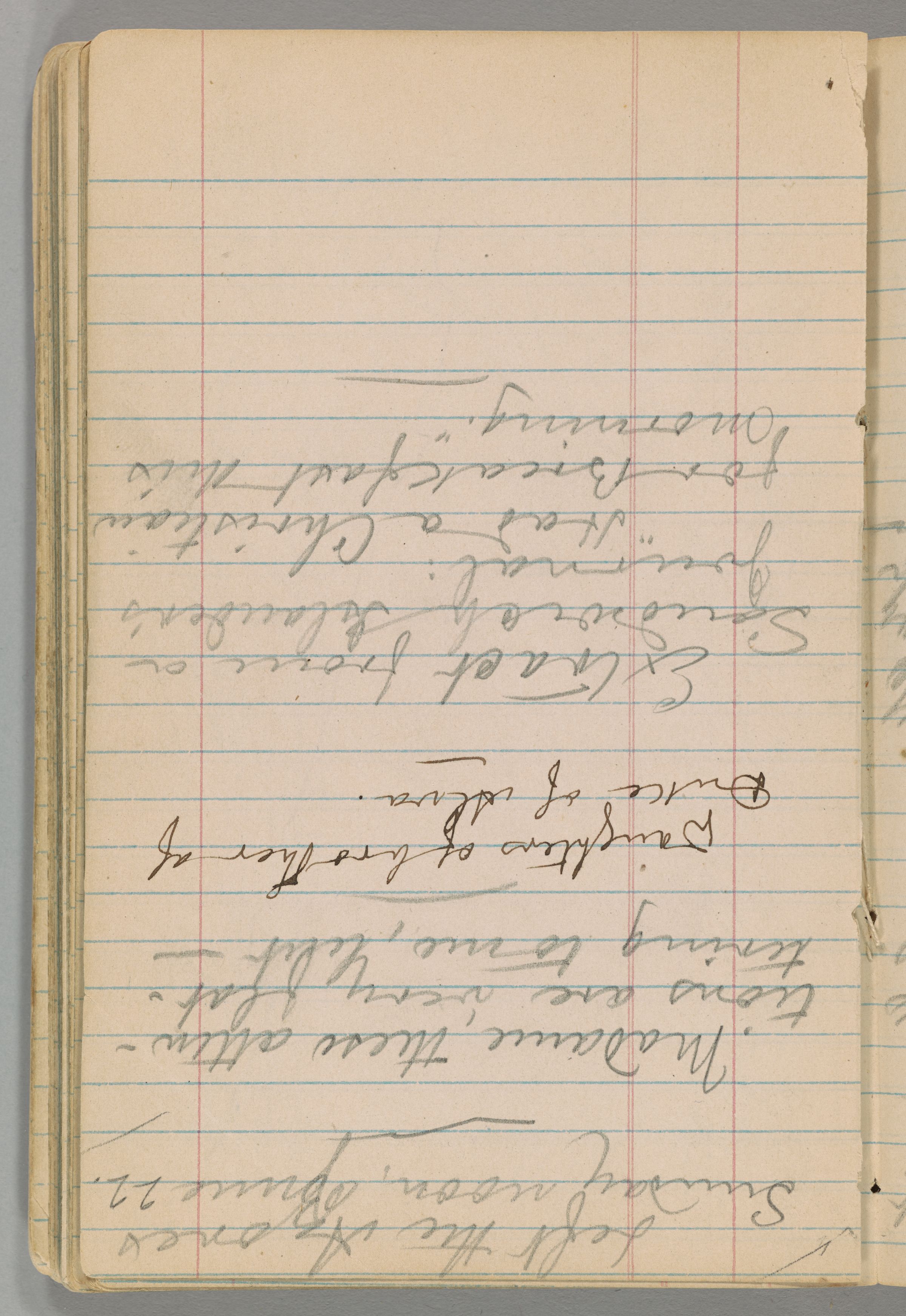
Muleteers sang
We hang Jaf Deevez on
sowly abbla tree
Glory halleluiah—and his
soul go
[MS: N8_leaf_030r]
Left the Azores
Sunday noon, June 22.
[MTP: N&J1_348]
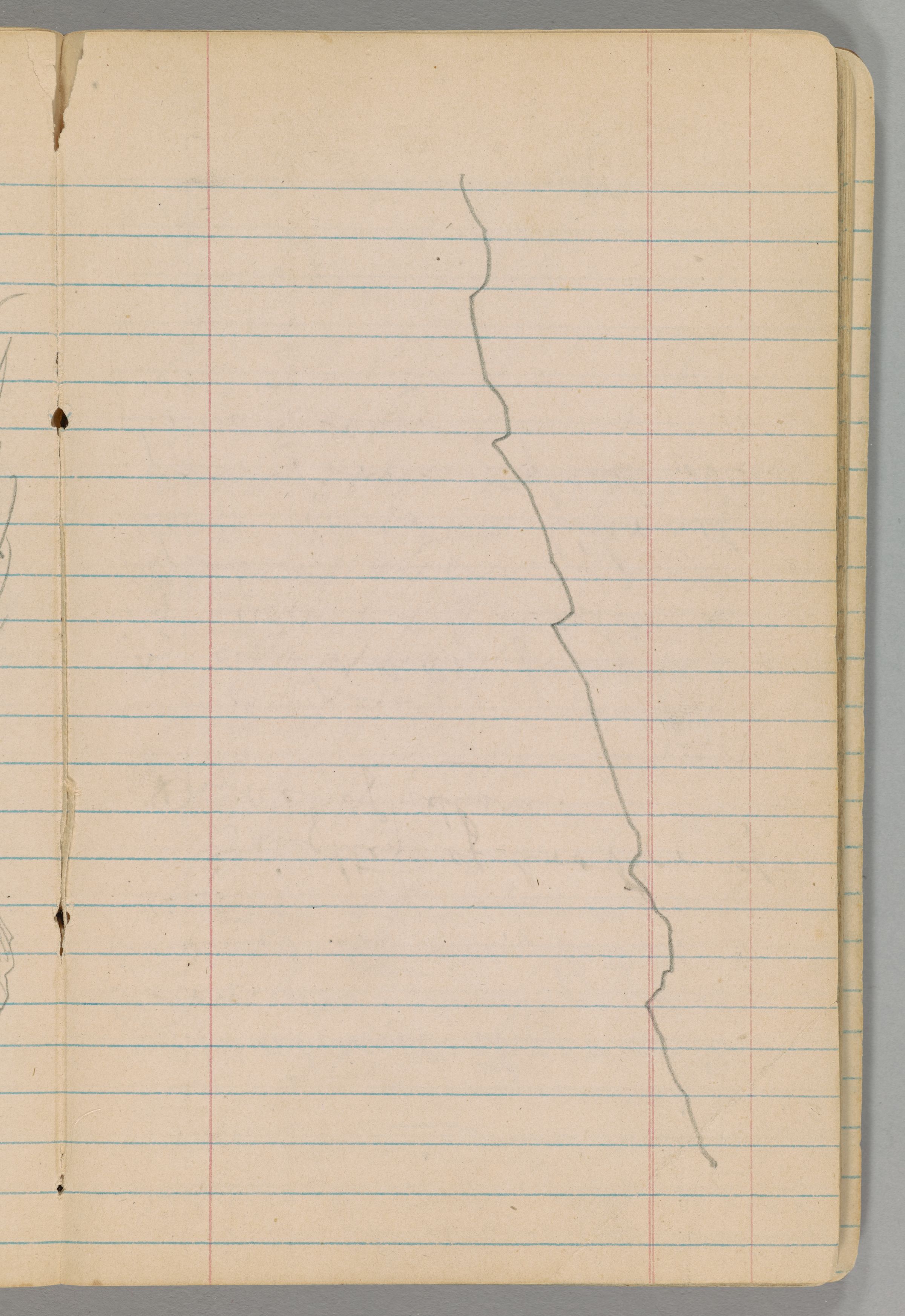
Madame, these
atten-
tions
attentions
are very
flat-
tering
flattering
to me, but—
Daughters of brother of
Duke of Alva.
Extract from a
Sandwich Islander's
Journal:
“Had a Christian
for Breakfast this
morning.”
[MS: N8_leaf_030v]
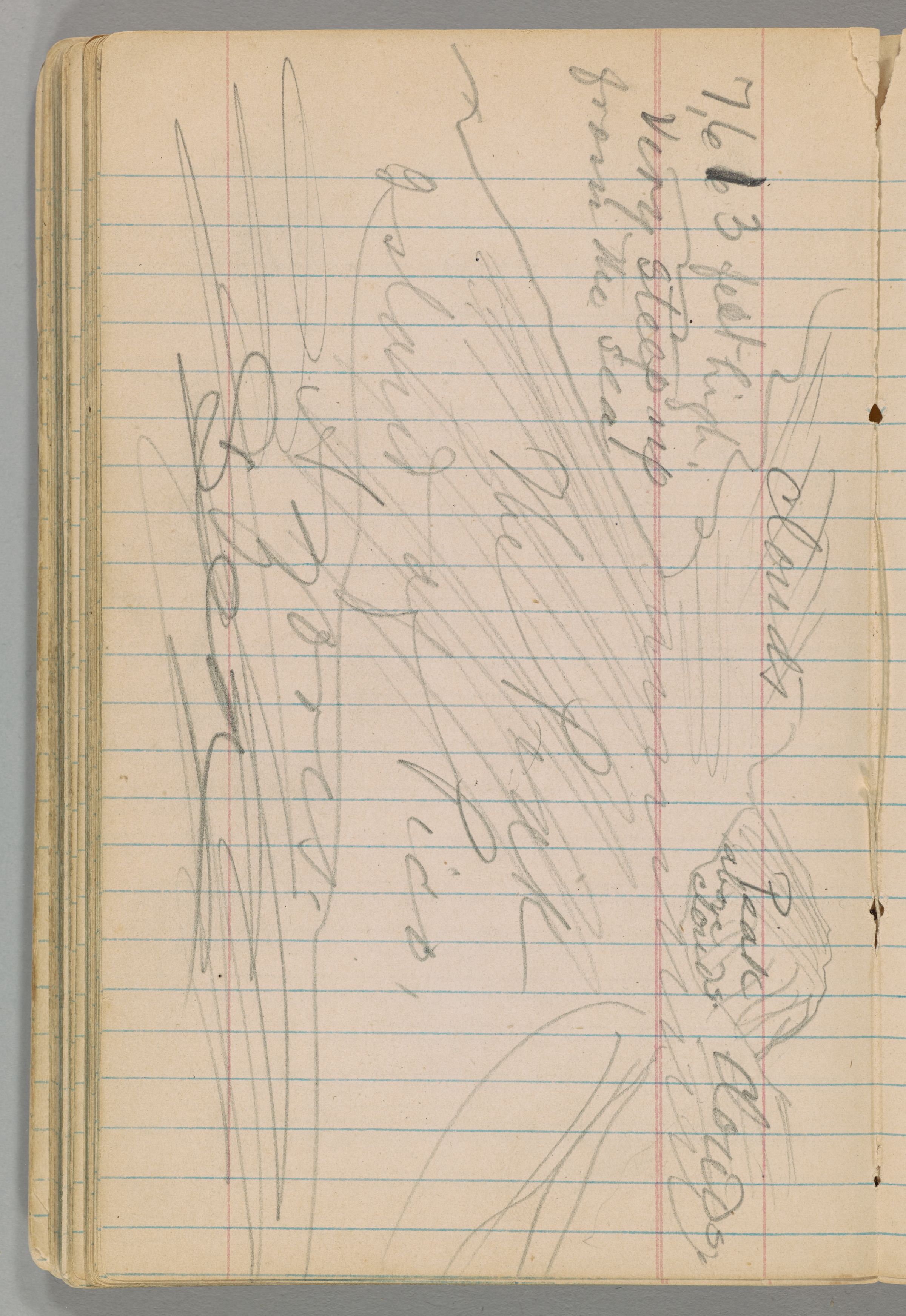
diagonal line, possibly the beginning of an abandoned drawing (see leaf 031r)
[MS: N8_leaf_031r]
drawing

[MS: N8_leaf_031v]
blank verso
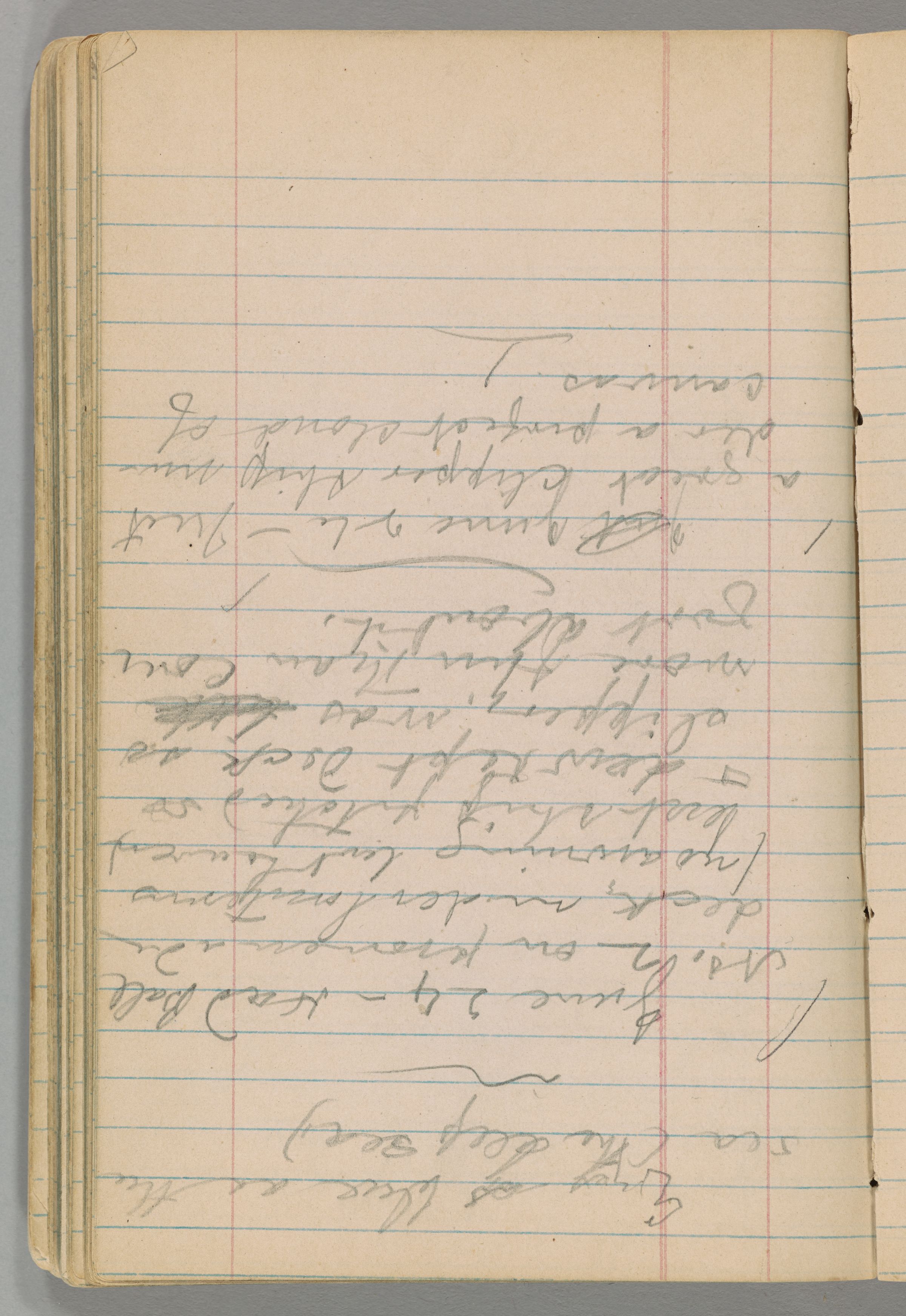
[MS: N8_leaf_032r]
Eyes as blue as the
sea (the deep sea.)
June 24—Had Ball
No. 2 on promenade
deck, under lanterns
(no awning but heaven)
but ship pitched so
& dew kept deck so
slippery, was
little
more fun than
com
fort
comfort
about it.
June 26—Met
a great clipper ship
un-
der
under
a perfect cloud of
canvas.
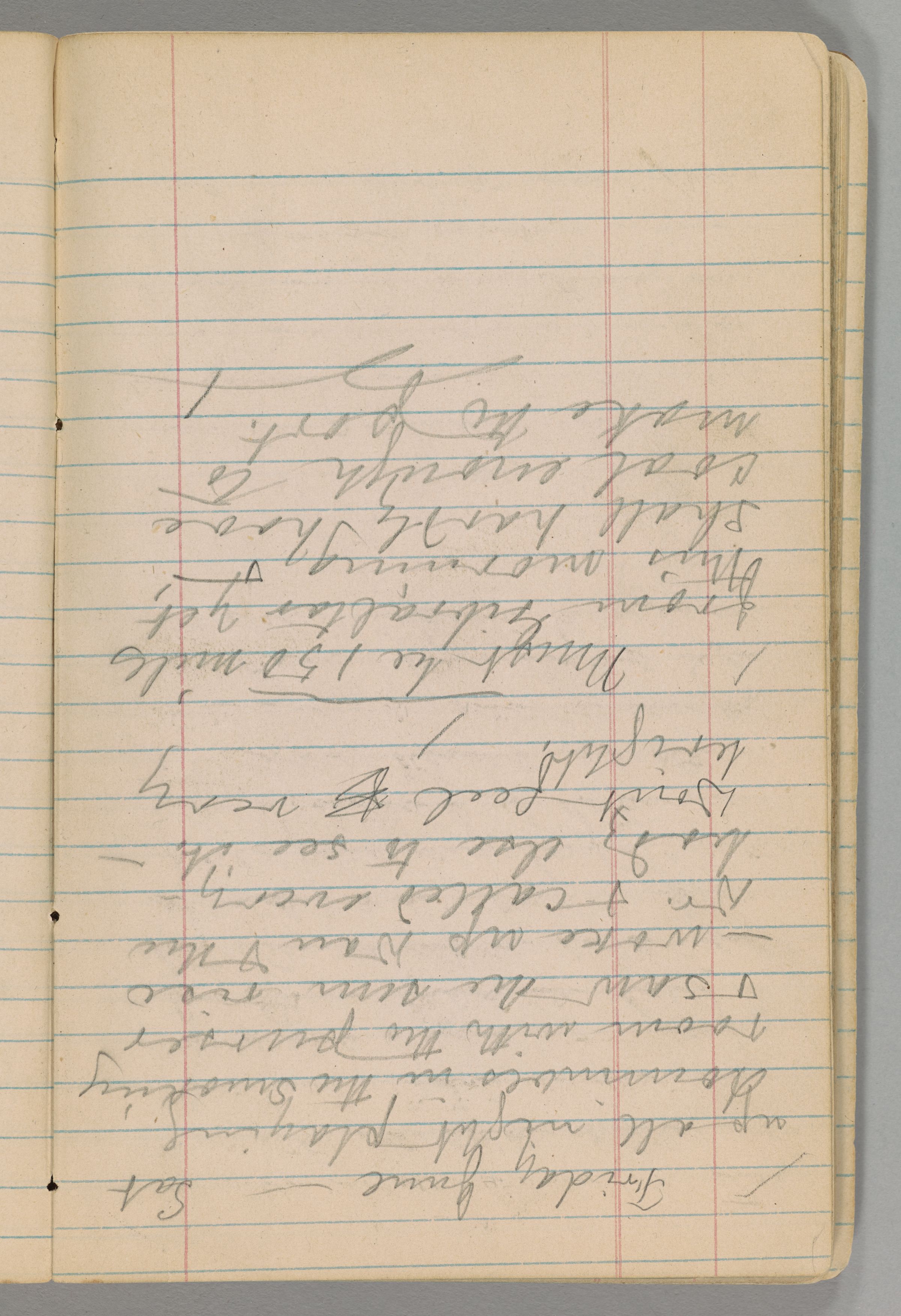
[MS: N8_leaf_032v]
Friday June — Sat
up all night playing
dominoes in the smoking
room with the purser
& saw the sun rise
—woke up Dan & the
Dr. & called
every-
body
everybody
else to see it.—
Don't feel f very bright.
Must be 150 miles
from Gibraltar yet,
this morning &
shall hardly have
coal enough to
make the port.
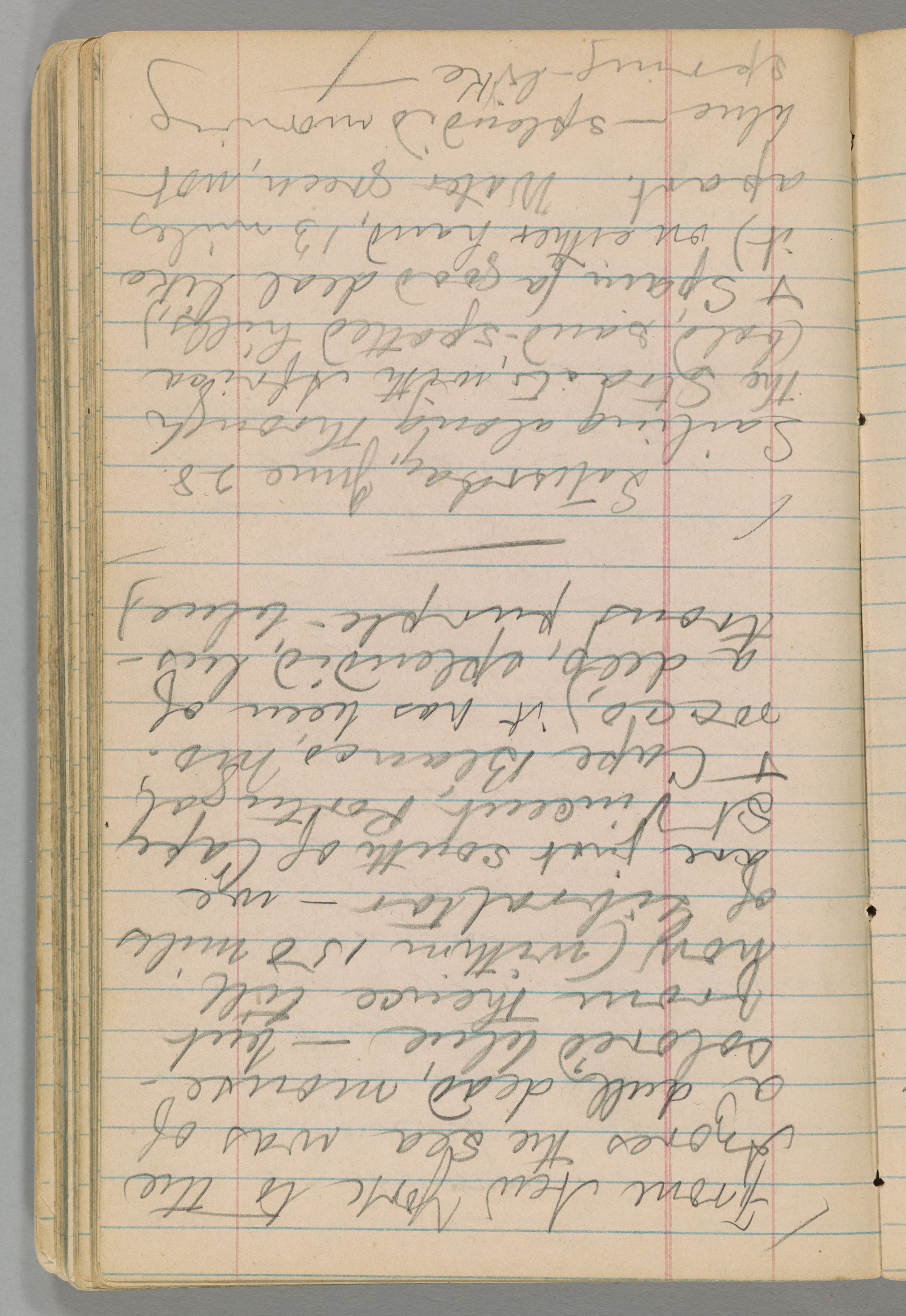
[MS: N8_leaf_033r]
From New York to the
Azores the sea was of
a dull, dead,
[MTP: N&J1_349] mouse-
colored blue—but
from thence till
now (within 150 miles
of Gibraltar—we
are just south of Cape
St Vincent, Portugal,
& Cape Blanco,
Mo-
rocco
Morocco
,) it has been of
a deep, splendid,
lus-
trous
lustrous
purple-blue.)
Saturday, June 28.
Sailing along through
the Straits, with Africa
(bold, sand-spotted hills,)
& Spain (a good deal like
it) on either hand, 13 miles
apart. Water green, not
blue—splendid morning
spring-like—
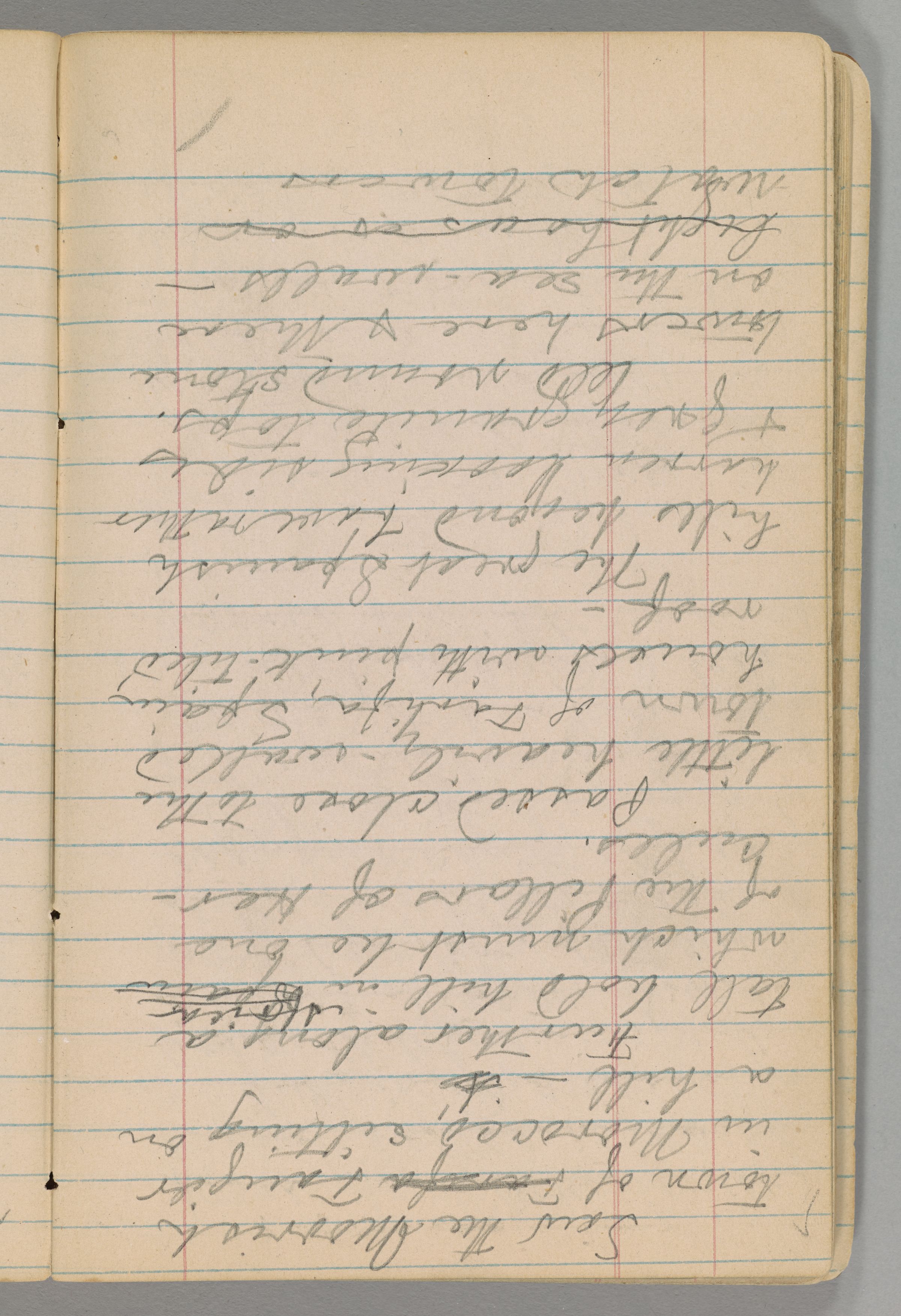
[MS: N8_leaf_033v]
Saw the Moorish
town of Tarifa Tangier
in Morocco, sitting on
a hill—it
Further along a
tall bold hill in Spain
Africa
which must be one
of the Pillars of
Her-
cules
Hercules
.
Passed close to the
little heavily-walled
town of Tarifa, Spain,
houses with pink-tiled
roof—
The great Spanish
hills beyond have rather
barren looking sides
& grey granite tops.
Old round stone
towers here & there
on the sea-walls—
lighthouses or
watch towers
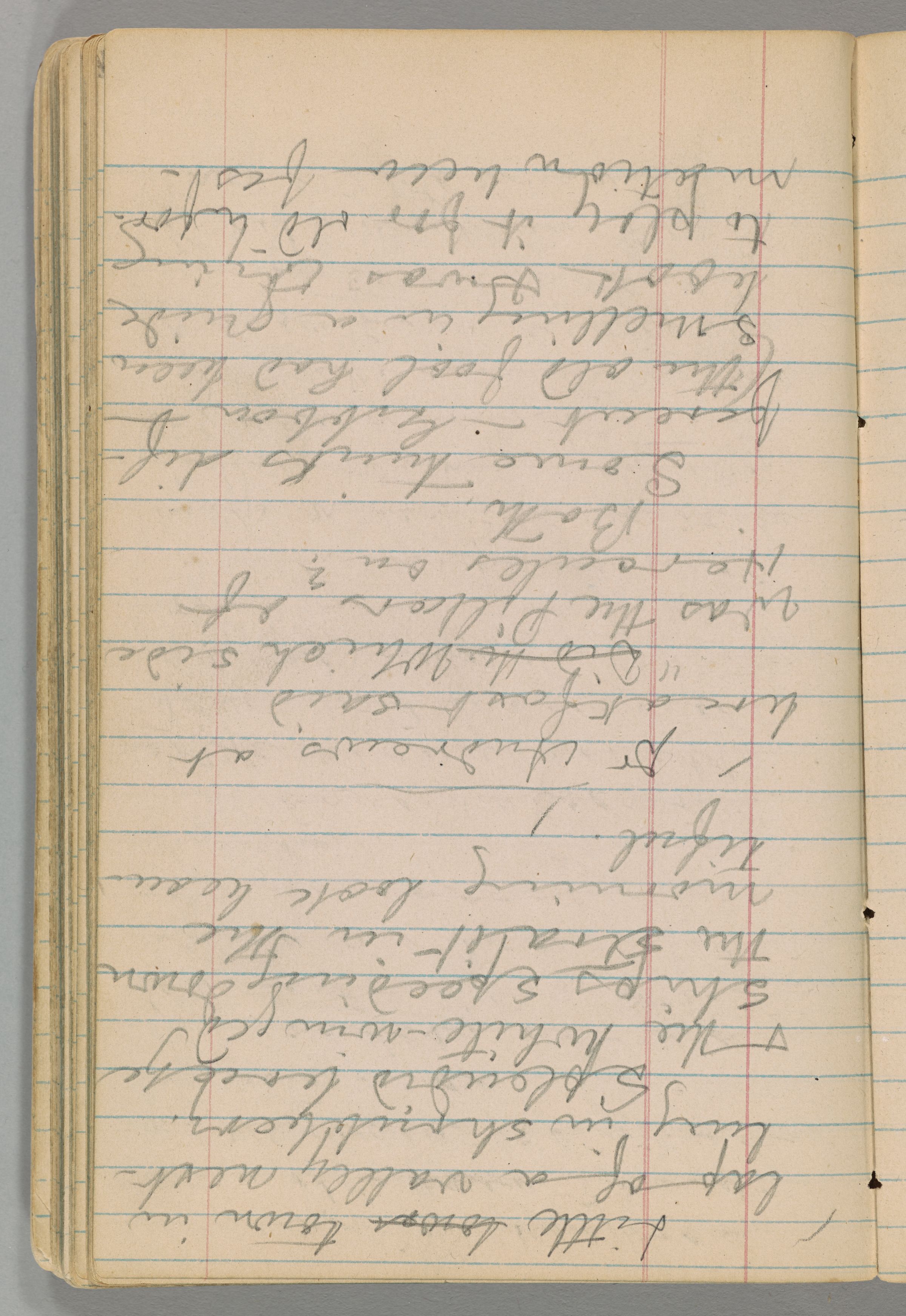
[MS: N8_leaf_034r]
Little town in
lap of a valley
nest-
ling
nestling
in shrubbery.
Splendid breeze
& the white-winged
ships speeding down
the strait in the
morning look
beau-
tiful
beautiful
.
Dr Andrews at
breakfast said
“Did th Which side
was the Pillars of
Hercules on?
Both.
Some thinks
dif-
ferent
different
—Gibbon—
(the old fool had been
smelling in a guide
book & was trying
to play it for old
infor-
mation
information
been fes-
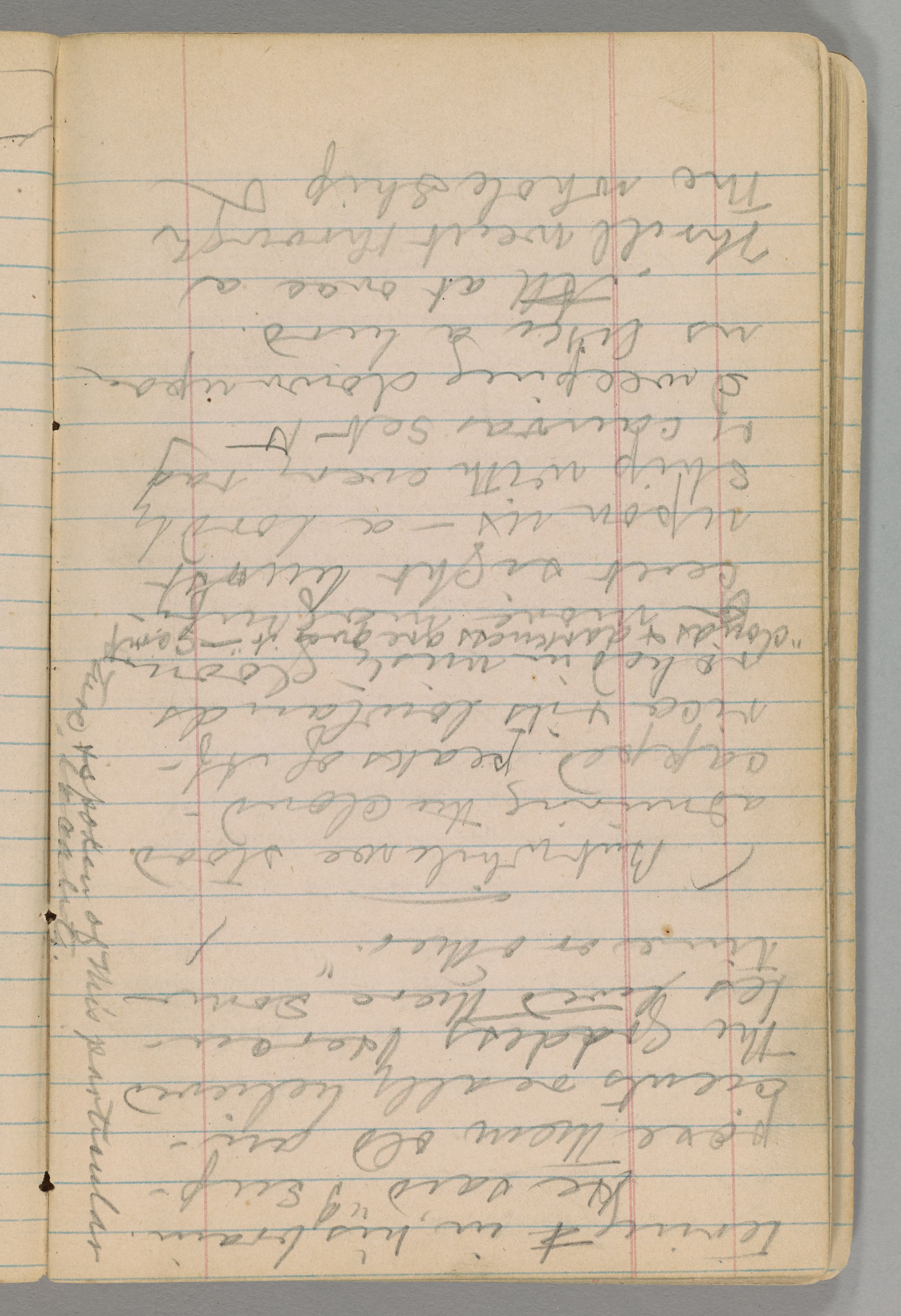
[MS: N8_leaf_034v]
tering in his brain.
[MTP: N&J1_340]
He said “I
sup-
pose
suppose
them old
an-
cients
ancients
really believed
the goddess
Hercu-
les
Hercules
lived there some
time or other.”
But while we stood
admiring the cloud-
capped peaks of
Af-
rica
Africa
& its lowlands
robed in misty gloom,
“clouds & darkness are over it”—Scripture, & spoken of this particular
locality.
a more
magnifi-
cent
magnificent
sight burst
upon us—a lordly
ship with every rag
of canvas set &
sweeping down upon
us like a bird.
All at once a
thrill went through
the whole ship &
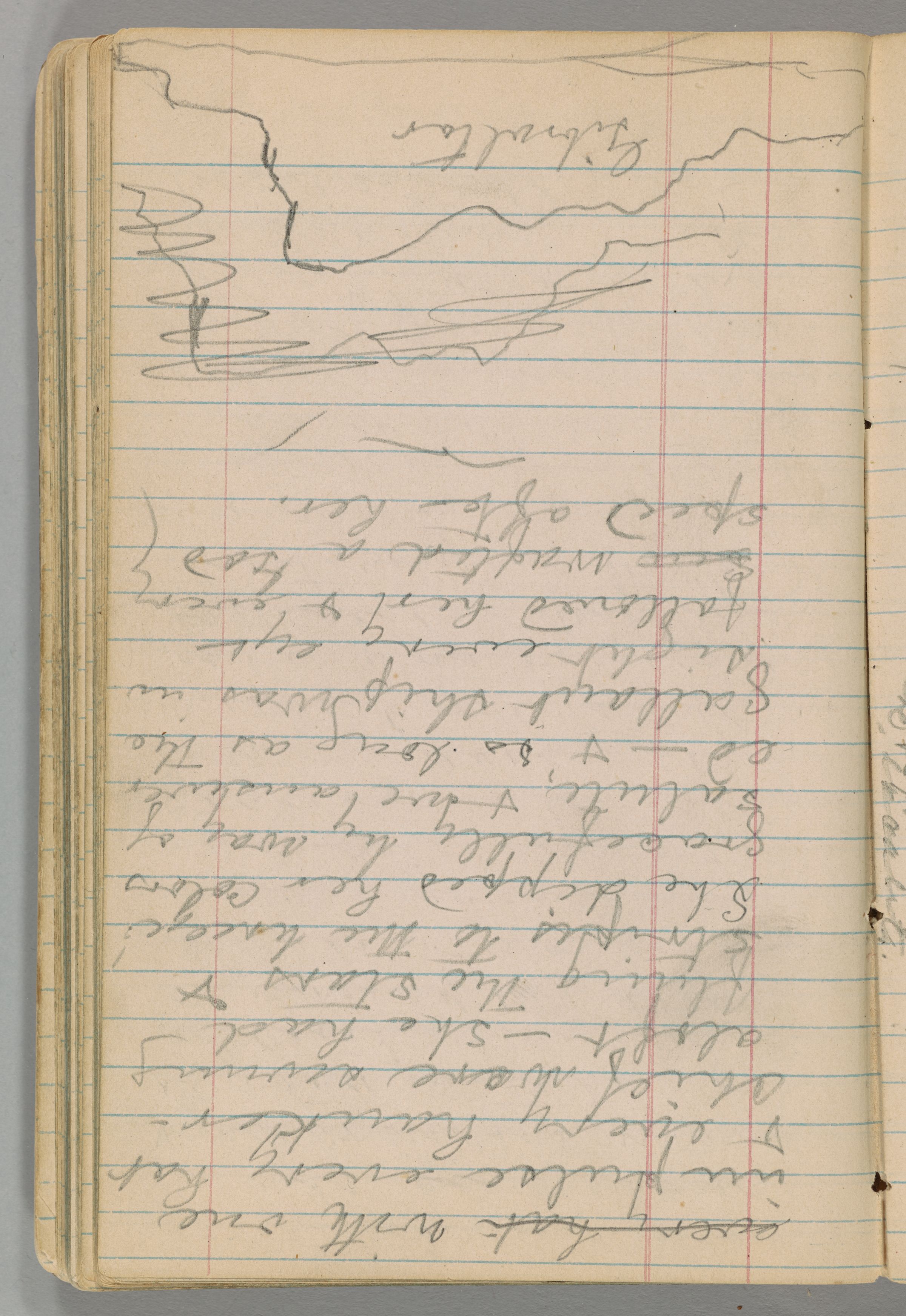
[MS: N8_leaf_035r]
every hat with one
impulse every hat
& every
hanker-
chief
hankerchief
waere swung
aloft—she had
flung the stars &
stripes to the breeze!
She dipped her colors
gracefully by way of
salute, & we
answer
ed
answered
—& so long as the
gallant ship was in
sight every eye
followed her & every
sen
wafted a God
speed after her.
drawing
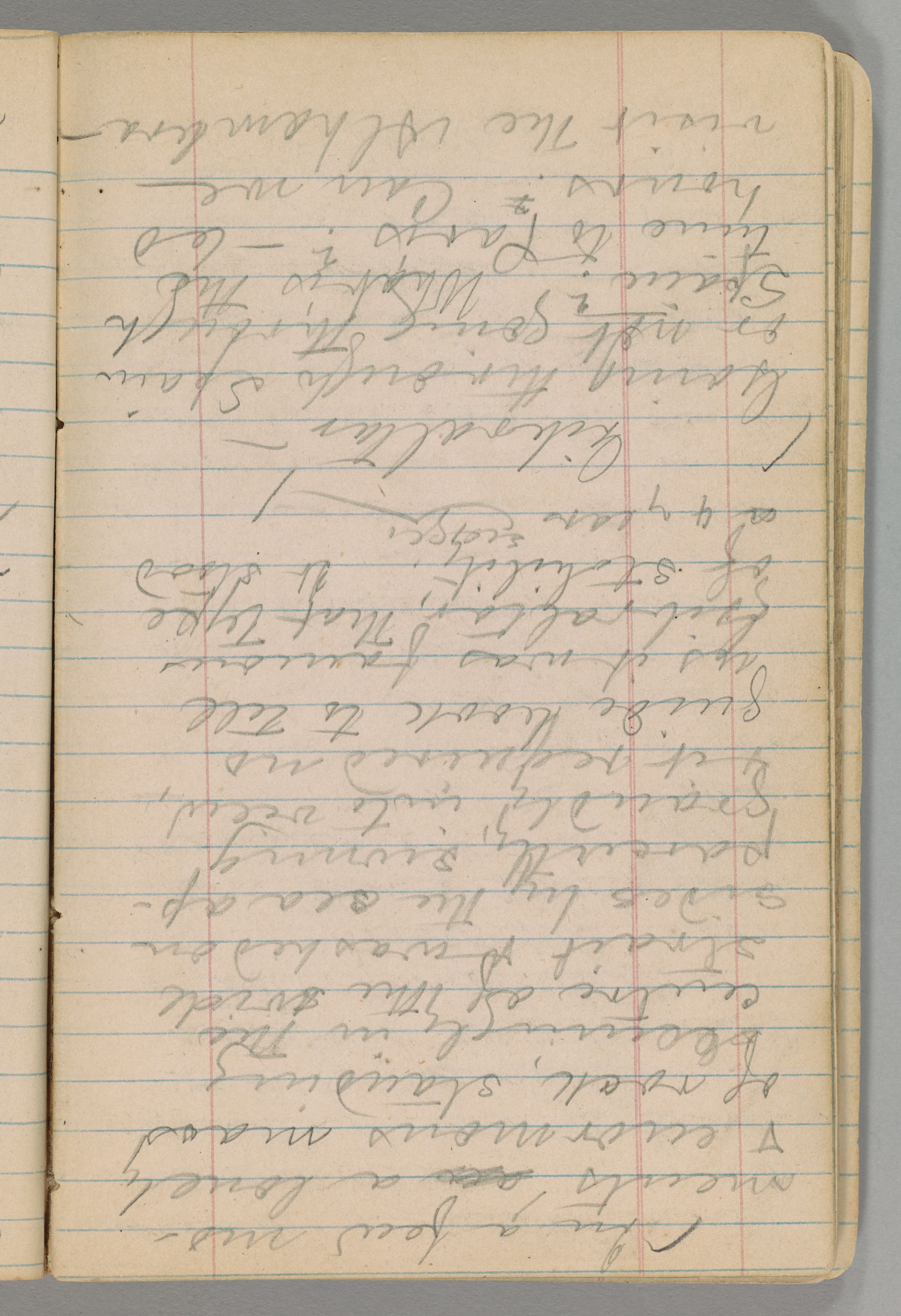
[MS: N8_leaf_035v]
In a few
mo-
ments
moments
an a lonely
& enormous mass
of rock, standing
seemingly in the
centre of the s wide
strait & washed on
sides by the o sea
ap-
parently
apparently
, swung
grandly into view,
& it required no
guide book to tell
us it was famous
g Gibraltar, that type
of stability. It stood
a 4 years siege.
Gibraltar—
Going through Spain
or not going through
Spain? What is the
[MTP: N&J1_351] time to Paris?—60
hours ?. Can we
visit the Alhambra—
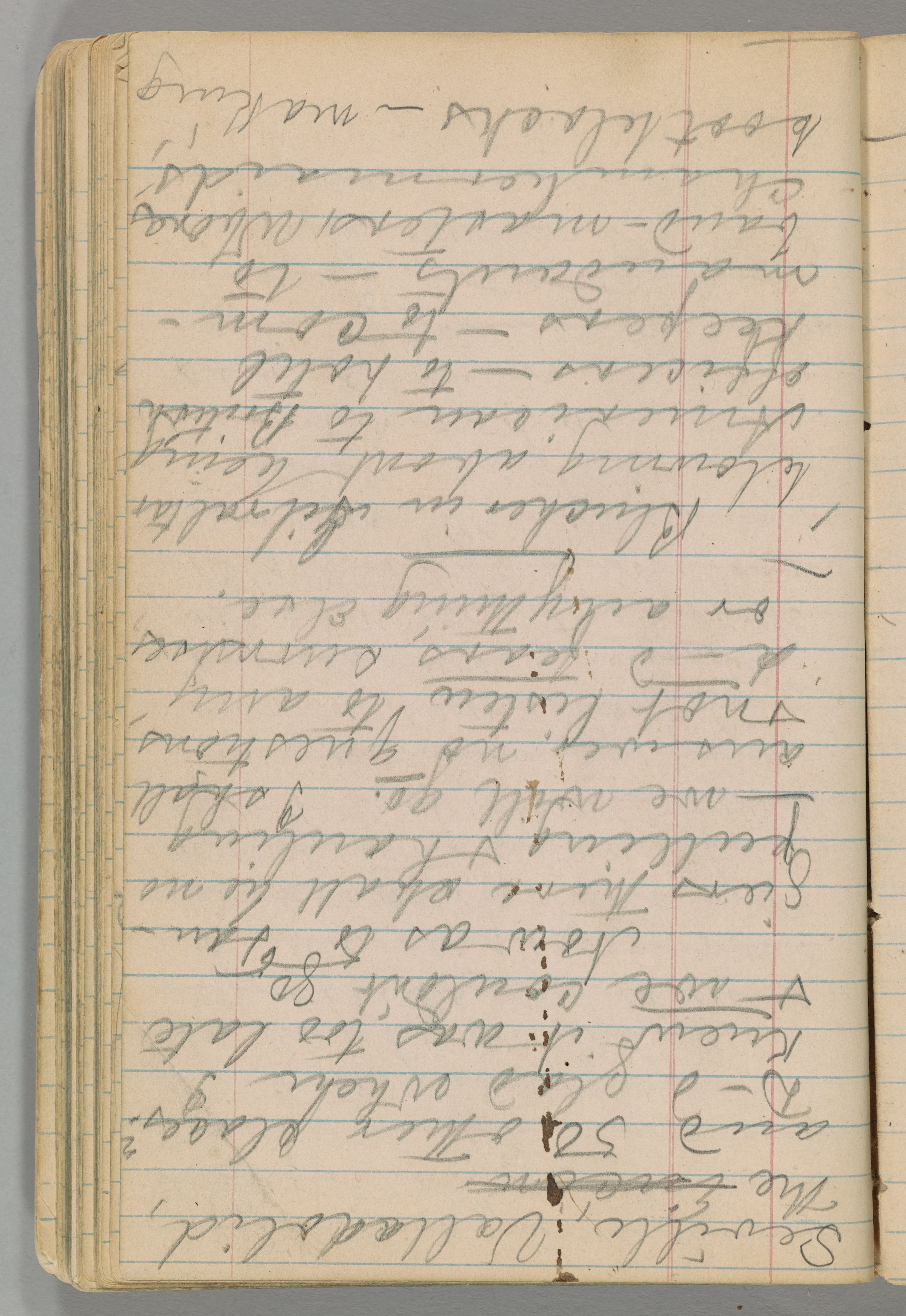
[MS: N8_leaf_036r]
Seville, Valladolid,
the Encin
and 50 other places?
D—d glad when I
knew it was too late
& we couldn't go.
Now as to
Tan-
giers
Tangiers
there shall be no
pulling & hauling
—we will go. I shall
answer no questions,
& not listen to any
d—d fears, surmises,
or anything else.
Blucher in Gibraltar
blowing about being
American to British
officers—to hotel
keepers—to
com-
mandants
commandants
—to
band-masters, whores,
chambermaids,
bootblacks—making
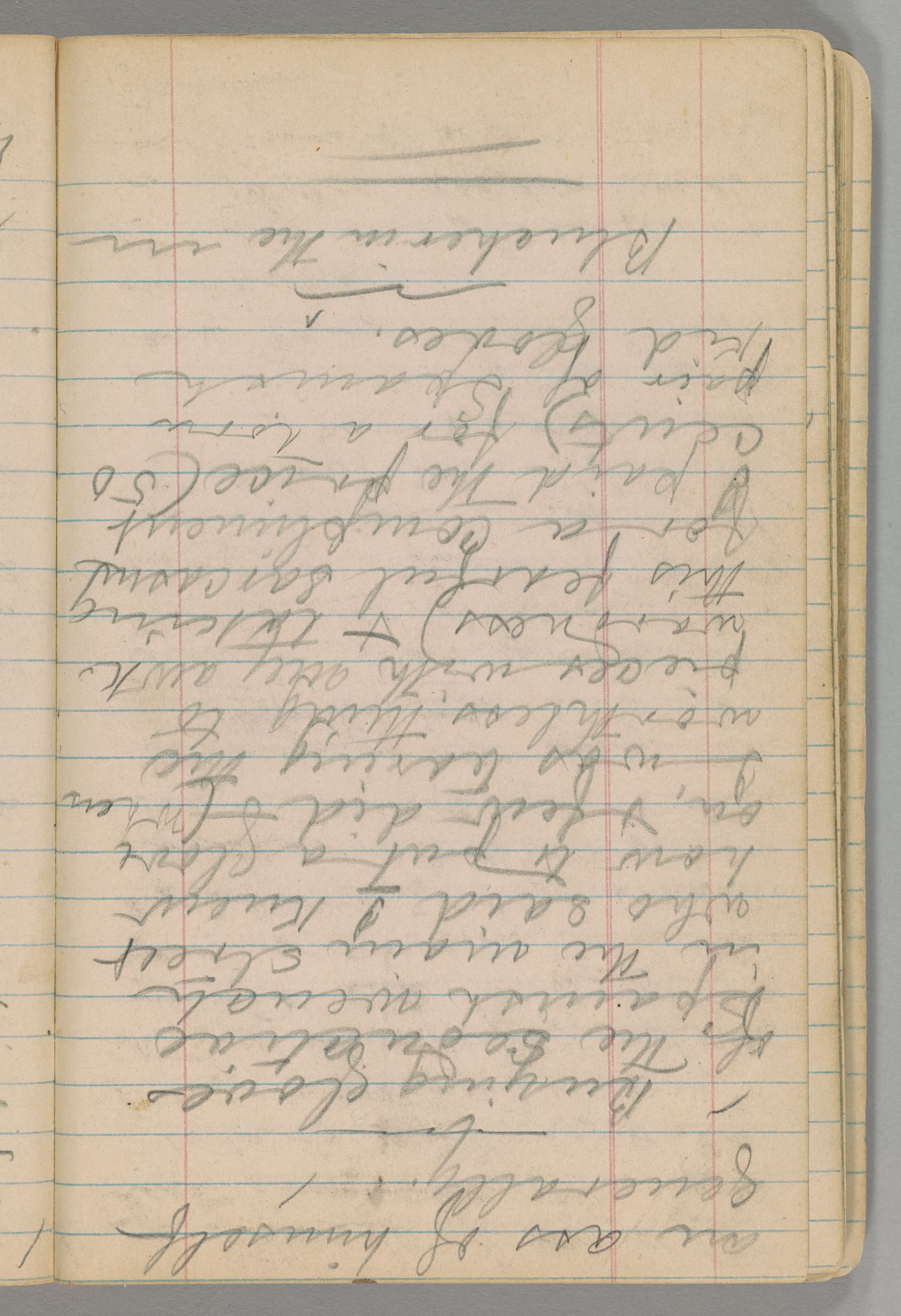
[MS: N8_leaf_036v]
an ass of himself
generally.
Buying gloves
of the seductive
Spanish wench
in the main street
who said I knew
how to put a glove
on, & few did—(when
I was tearing the
worthless thing to
pieces with my
awk-
wardness
awkwardness
) & taking
this fearful sarcasm
for a compliment
I paid the price (50
cents) for a torn
pair of Spanish
kid gloves.
[MTP: N&J1_352]
Blucher in the —
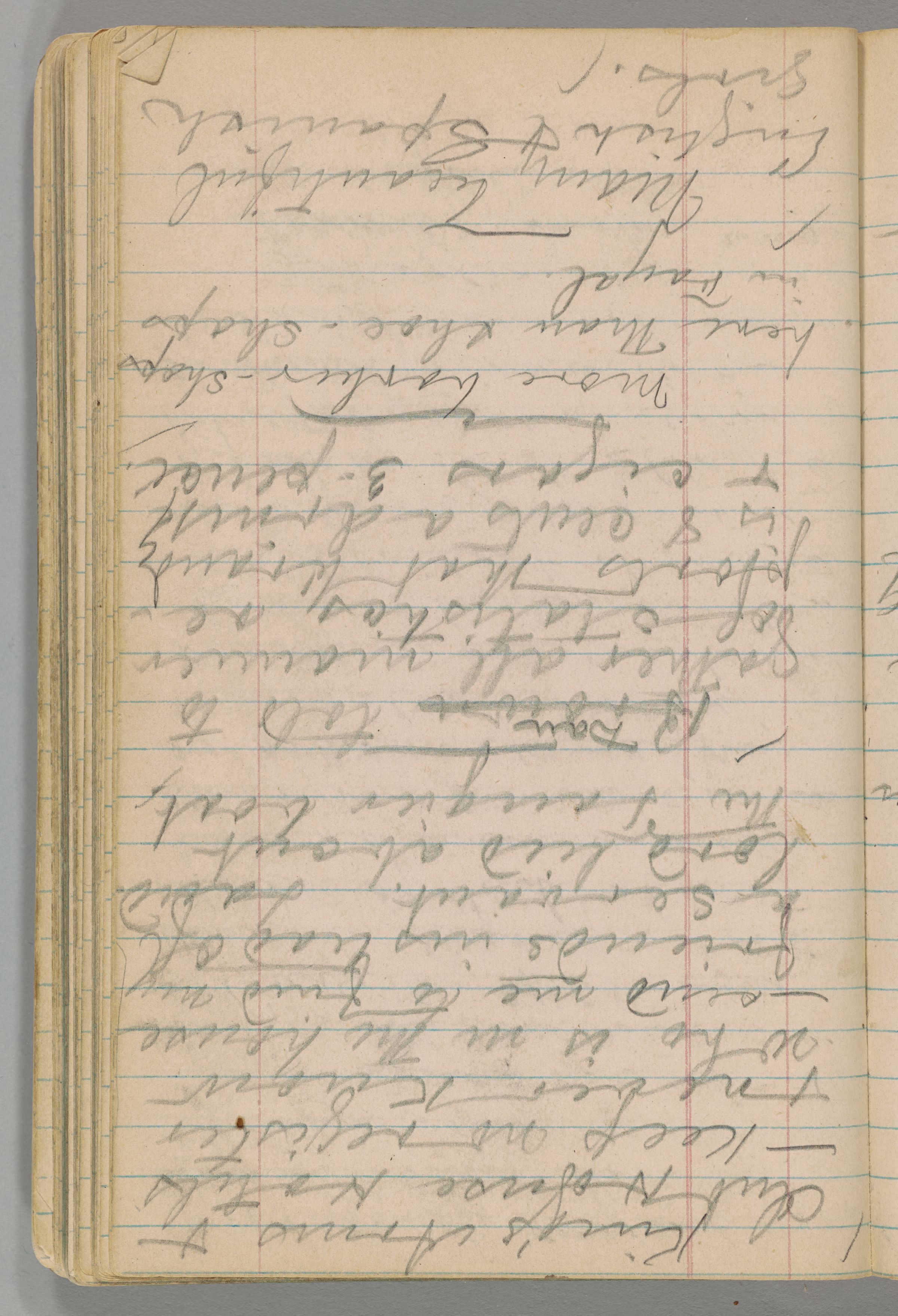
[MS: N8_leaf_037r]
King's Arms &
Club House Hotels
—keep no register
& never know
who is in the house
—send me to find my
friends instead of
a servant.
Land-
lord
Landlord
lied about
the Tangier boat.
Brown Dan told to
gather all manner
of statistics,
re-
ports
reports
that brandy
is 8 cents a drink,
& cigars 3-pence.
More barber-shops
here than shoe-shops
in Fayal.
Many beautiful
English & Spanish
girls.
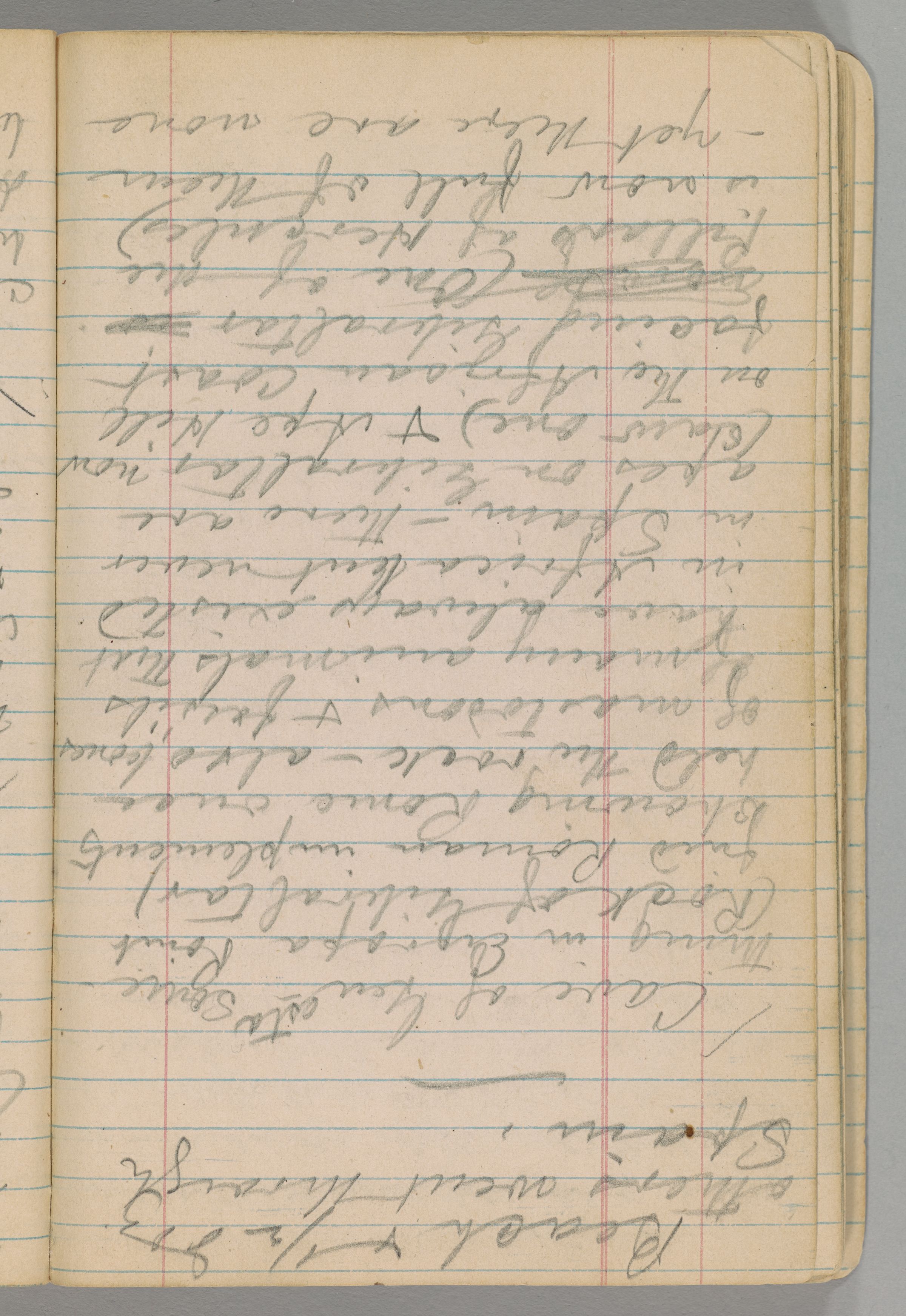
[MS: N8_leaf_037v]
Beach & ½ doz.
others went through
Spain.
Cave of Genesta-
some-
thing
something
in Europa Point
(Rock of Gibraltar)
find Roman implements
showing Rome once
held the rock—also, bones
of mastodons & fossils
of many animals that
have always existed
in Africa but never
in Spain—there are
apes on Gibraltar now
(saw one) & Ape Hill
on the African Coast
facing Gibraltar is
now f (One of the
Pillars of Hercules)
is now full of them
—yet there are none
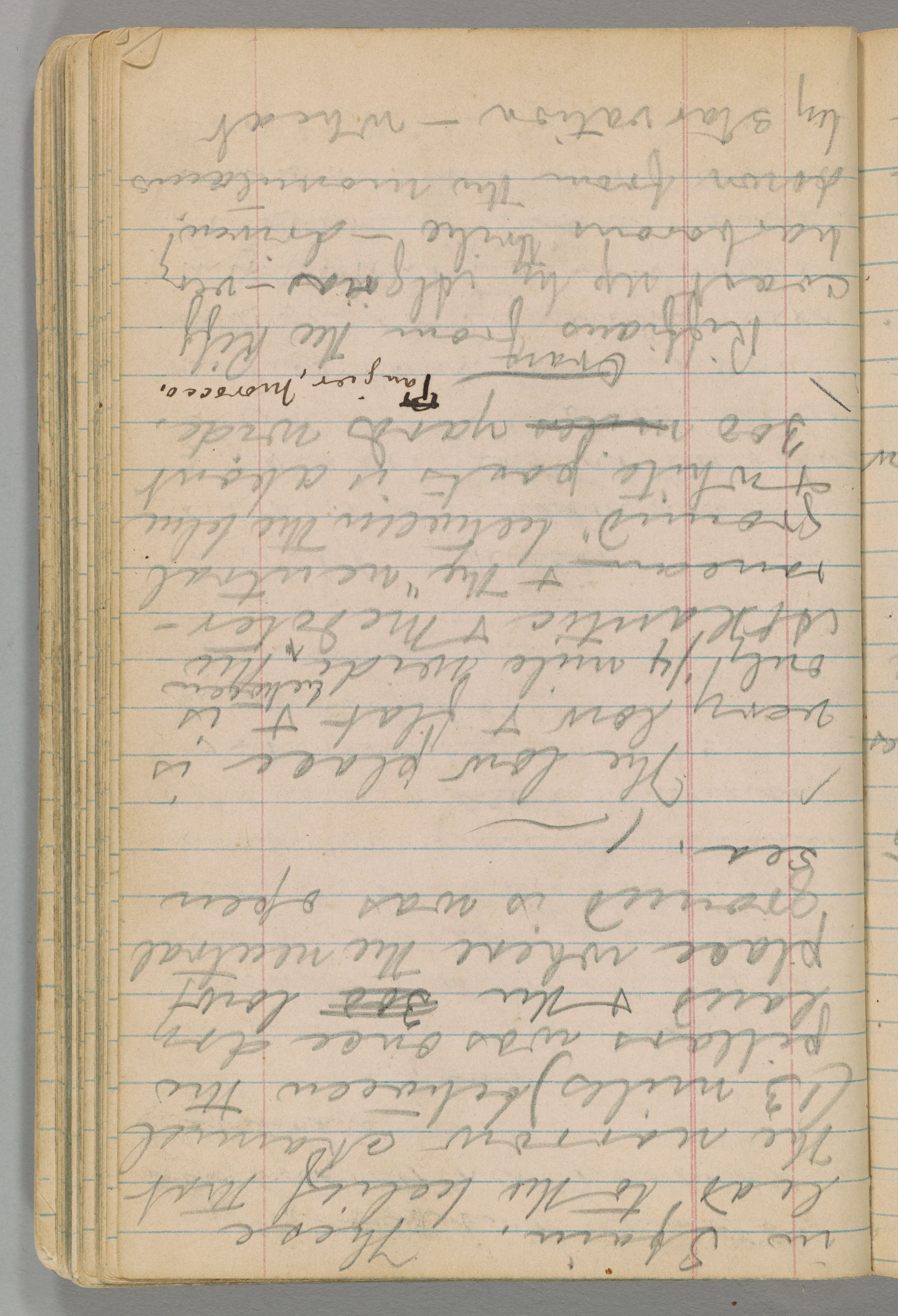
[MS: N8_leaf_038r]
in Spain. These
lead to the belief that
the narrow channel
(13 miles) between the
pillars was once dry
land & the 300 low
place where the neutral
ground is was open
sea.
[MTP: N&J1_353]
The low place is
very low & flat & is
only ¼ mile widebetween
the
Atlantic &
Mediter-
anean
Mediterranean
& the “neutral
ground” between the blue
& white posts is about
300 miles yards wide.
Oran
Riffians from the Riff
coast up by Algiers
ria
—very
barbarous tribe—driven
down from the mountains
by starvation—wheat
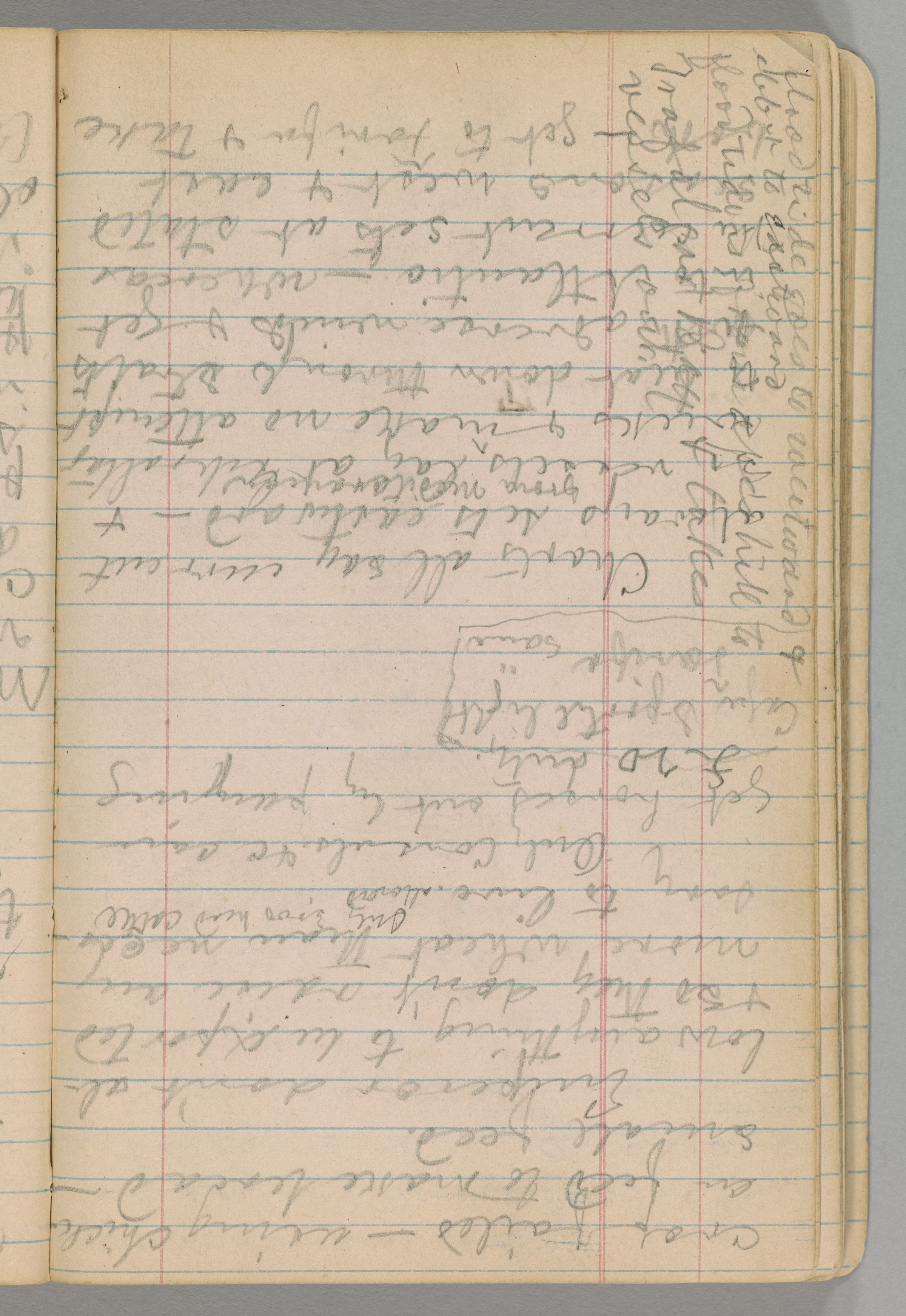
[MS: N8_leaf_038v]
crop failed—using
chick-
en
chicken
feed to make bread—
small feed.
Emperor don't
al-
low
allow
anything to be exported
& so they don't raise any
more wheat than
neces-
sary
necessary
to live. Only 3,000 head cattle allowed
Only consuls &c can
get horses out by paying
£20 duty.
Cape Spartel light
Tarifa “
Charts all say current
always sets eastward—&
so vessels from Mediteranean
lay at Gibraltar
weeks & make no attempt
to beat down through Straits
with adverse winds & get
into Atlantic—whereas
the current sets at stated
seasons west & east
both—get to Tarifa & take
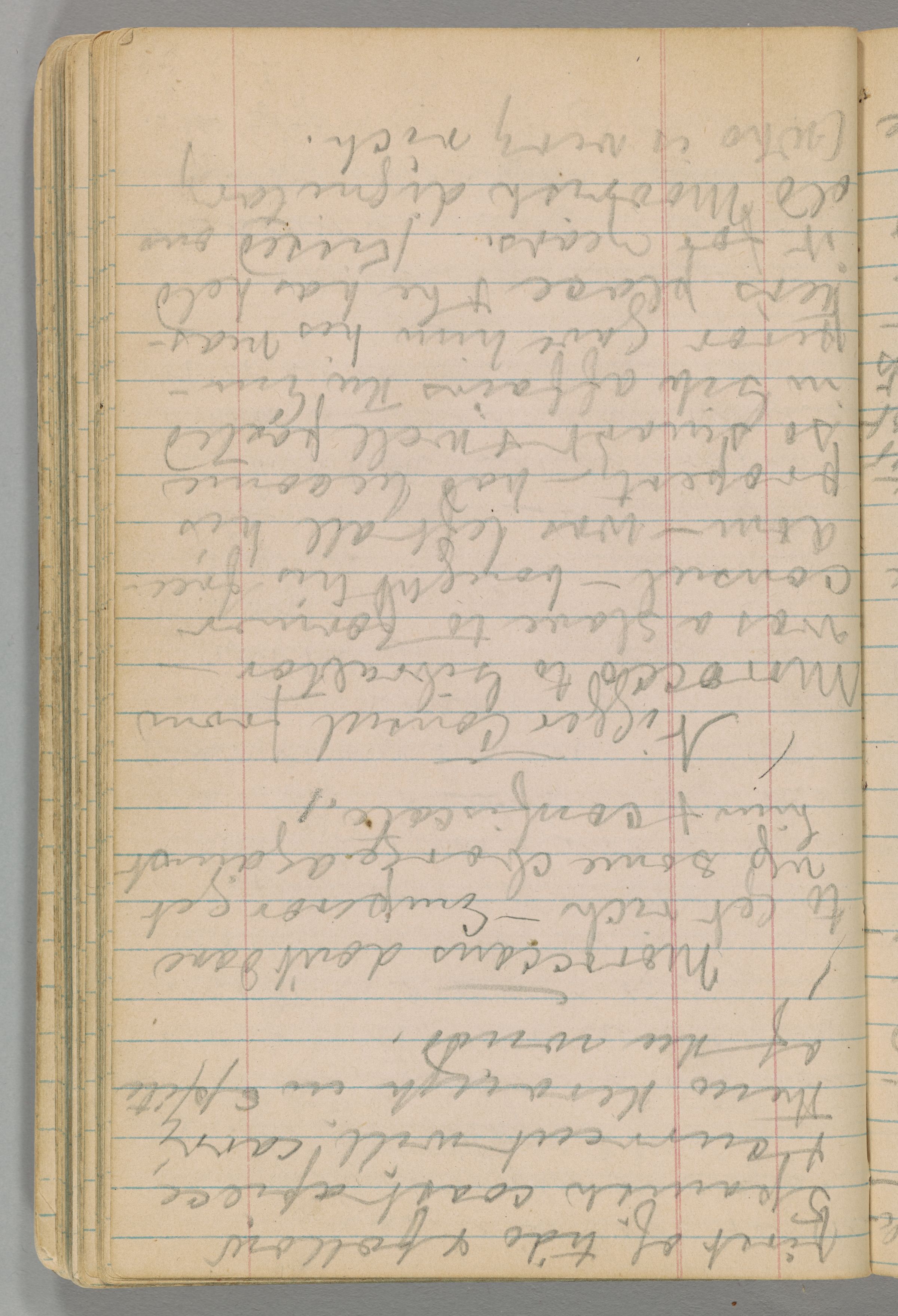
[MS: N8_leaf_039r]
first of tide & follow
Spanish coast apiece,
& current will carry
them through in spite
of the wind.
[MTP: N&J1_354]
Moroccans don't dare
to get rich—Emperor get
up some charge against
him & confiscate.
Nigger Consul from
Morrocco to Gibraltar—
was a slave to former
consul—bought his
free-
dom
freedom
—was left all his
property—had become
so smart & well posted
in Gib affairs the
Em-
peror
Emperor
gave him his
mas-
ter's
master's
place & he has held
it for years. Kissed one
old Moorish dignitary
(who is very rich.
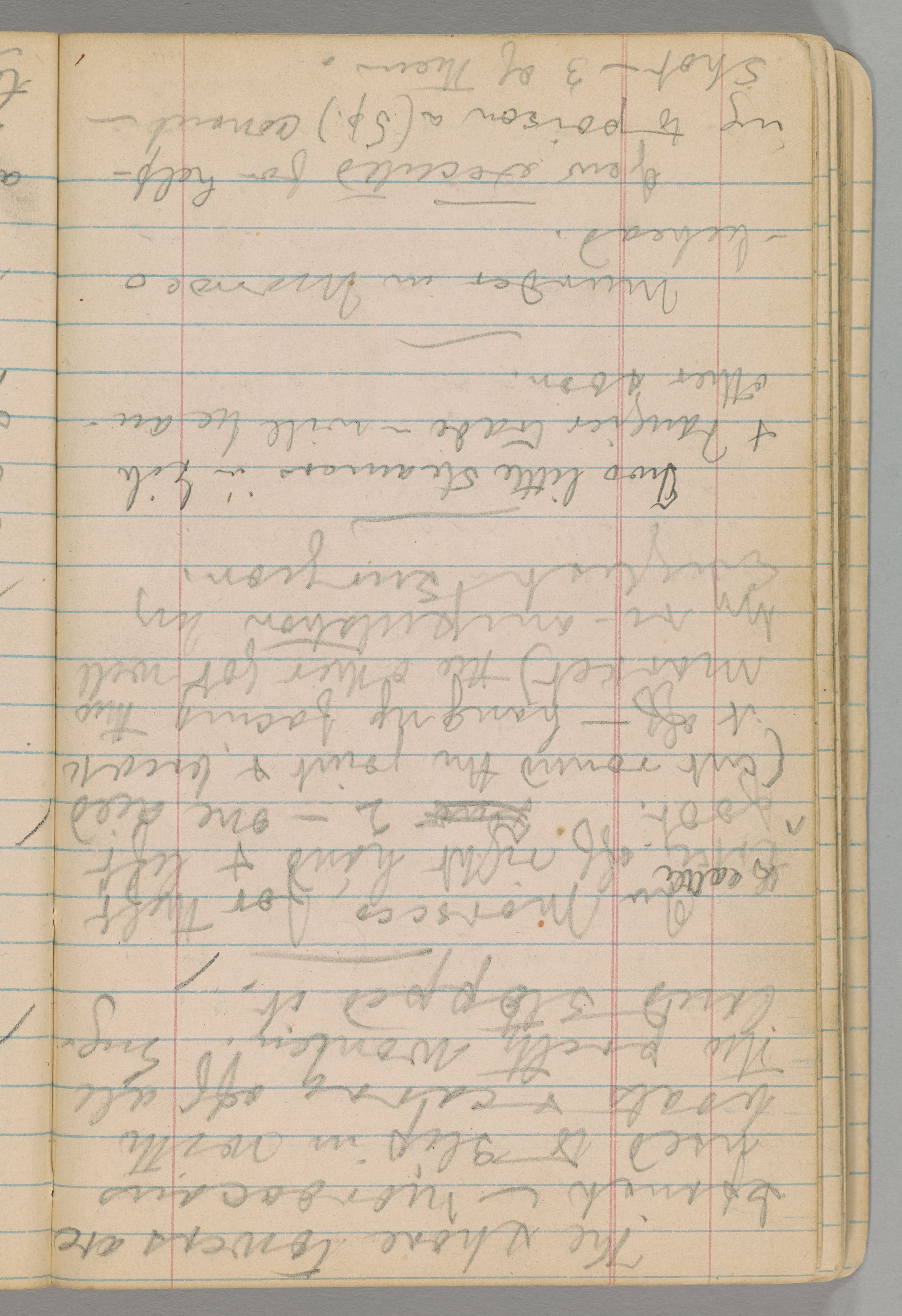
[MS: N8_leaf_039v]
The shore towers are
Spanish—Moroccans
used to slip in with
boats & carry off all
the pretty women.
Eng-
land
England
stopped it.
In Morocco, for theft,
of cattle
take off right hand & left
foot. Two 2—one died
(cut round the joint & break
it off—hang up facing the
market) the other got well
by re-amputation by
English surgeon.
Two little steamers in Gib
& Tangier trade—will be
an-
other
another
soon.
Murder in Morroco
—behead.
Jew executed for
help-
ing
helping
to poison a (Sp.) consul—
shot—3 of them.
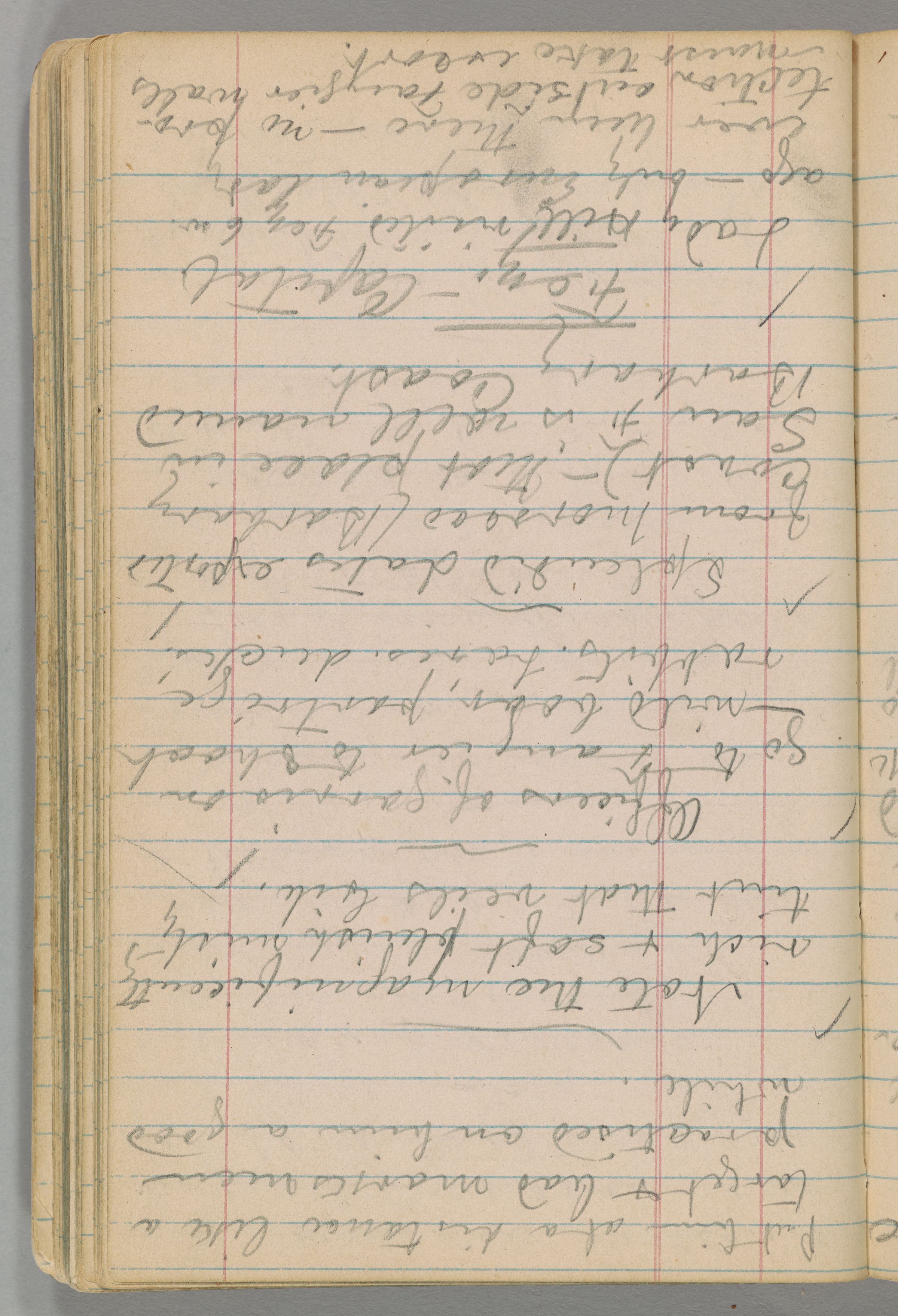
[MS: N8_leaf_040r]
Put him at a distance like a
target & bad marksmen
practised on him a good
while.
Note the magnificently
rich & soft bluish misty
tint that veils Gib.
[MTP: N&J1_355]
Officers of garrison
go to Tangier to shoot
—wild boar, partrige,
rabbits, hares, ducks.
Splendid dates exported
from Morocco (Barbary
Coast)—that place in
San F is well named
Barbary Coast.
Lady Hill visited Fez 6 w.
ago—only European lady
ever been there—no
pro-
tection
protection
outside Tangier walls
—must take escort.
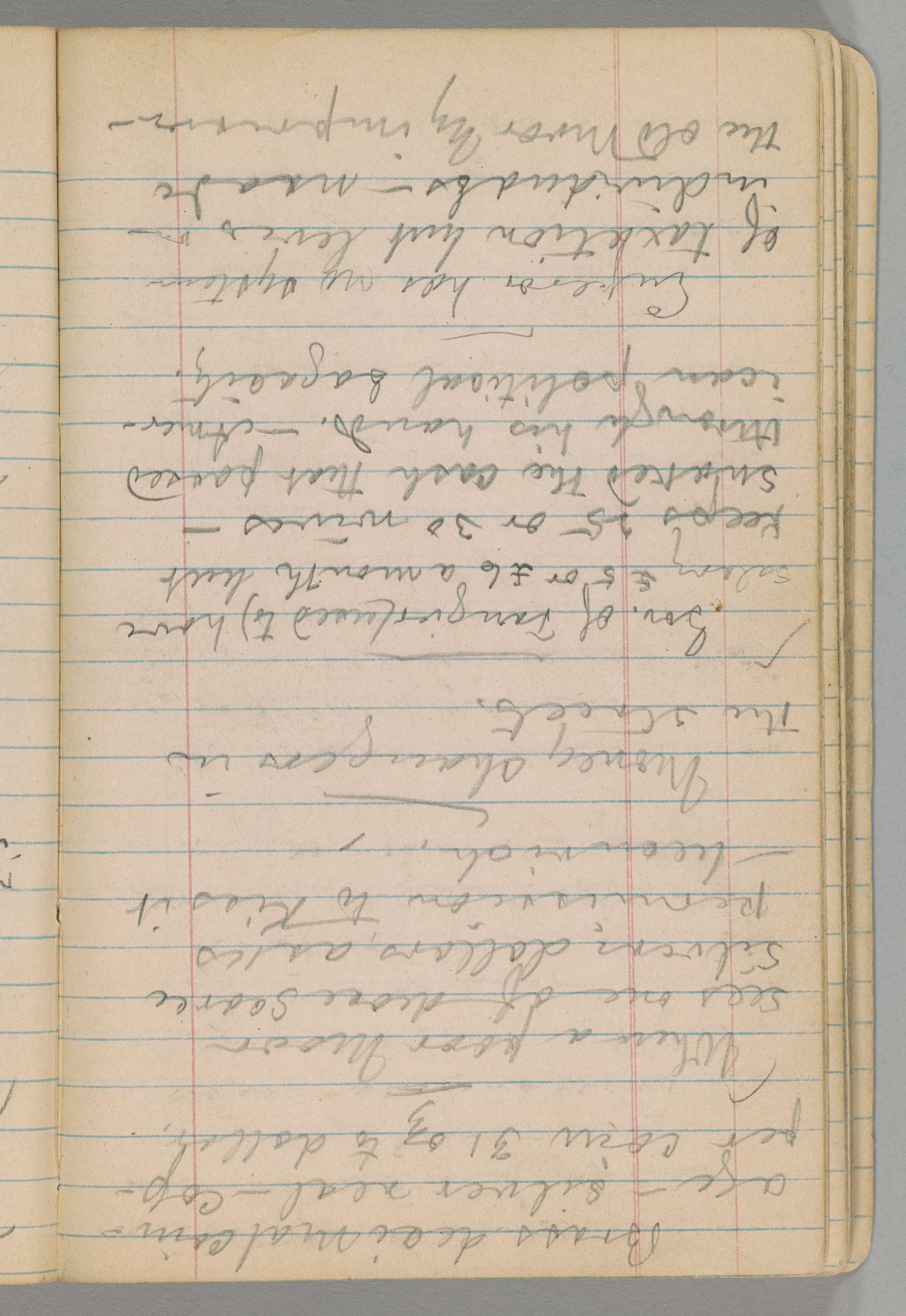
[MS: N8_leaf_040v]
Brass decimal
coin-
age
coinage
—silver real—
cop-
per
copper
coin 31 oz to dollar.
When a poor Moor
sees one of those scarce
silvers dollars, asks
permission to kiss it
—been rich.
Money changers in
the streets.
Gov. of Tangier (used to) have
salary £5 or £6 a month but
keeps 25 or 30 wives—
snaked the cash that passed
through his hands. —
Amer-
ican
American
political sagacity.
Emperor has no system
of taxation but levies on
individuals—made
the old Moor by imprison-
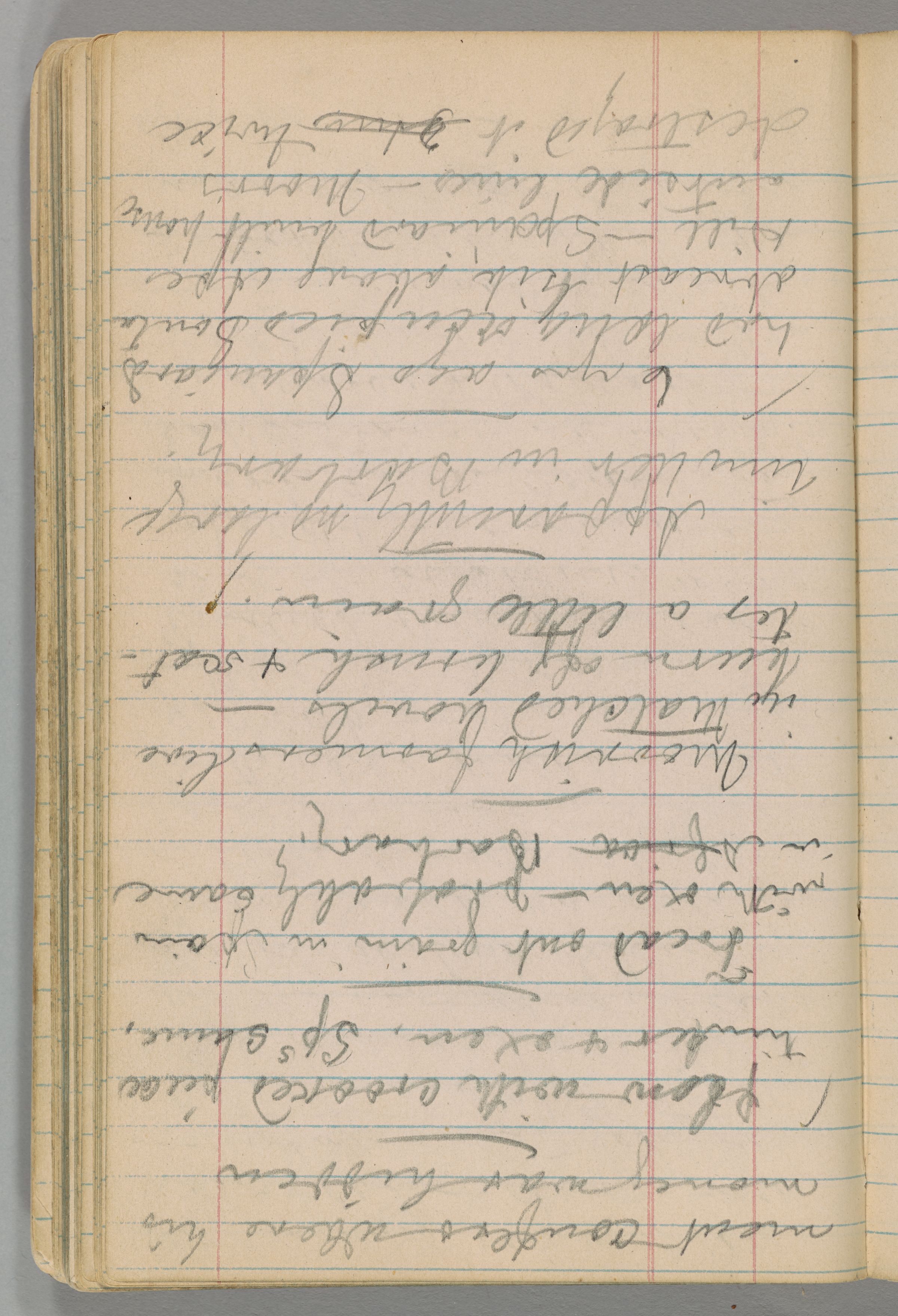
[MS: N8_leaf_041r]
ment confess where his
money was hidden
Plow with crooked piece
timber & oxen. Sps same.
[MTP: N&J1_356]
Tread out grain in Spain
with oxen—probably same
in Africa Barbary.
Moorish farmers live
in thatched hovels—
burn off brush &
scat-
ter
scatter
a little grain.
Apparently no large
timber in Barbary.
6 yrs ago Spaniards
had long occupied Souta
abreast Gib, above Ape
Hill—Spaniard built house
outside lines—Moor's
destroyed it
32 tim twice
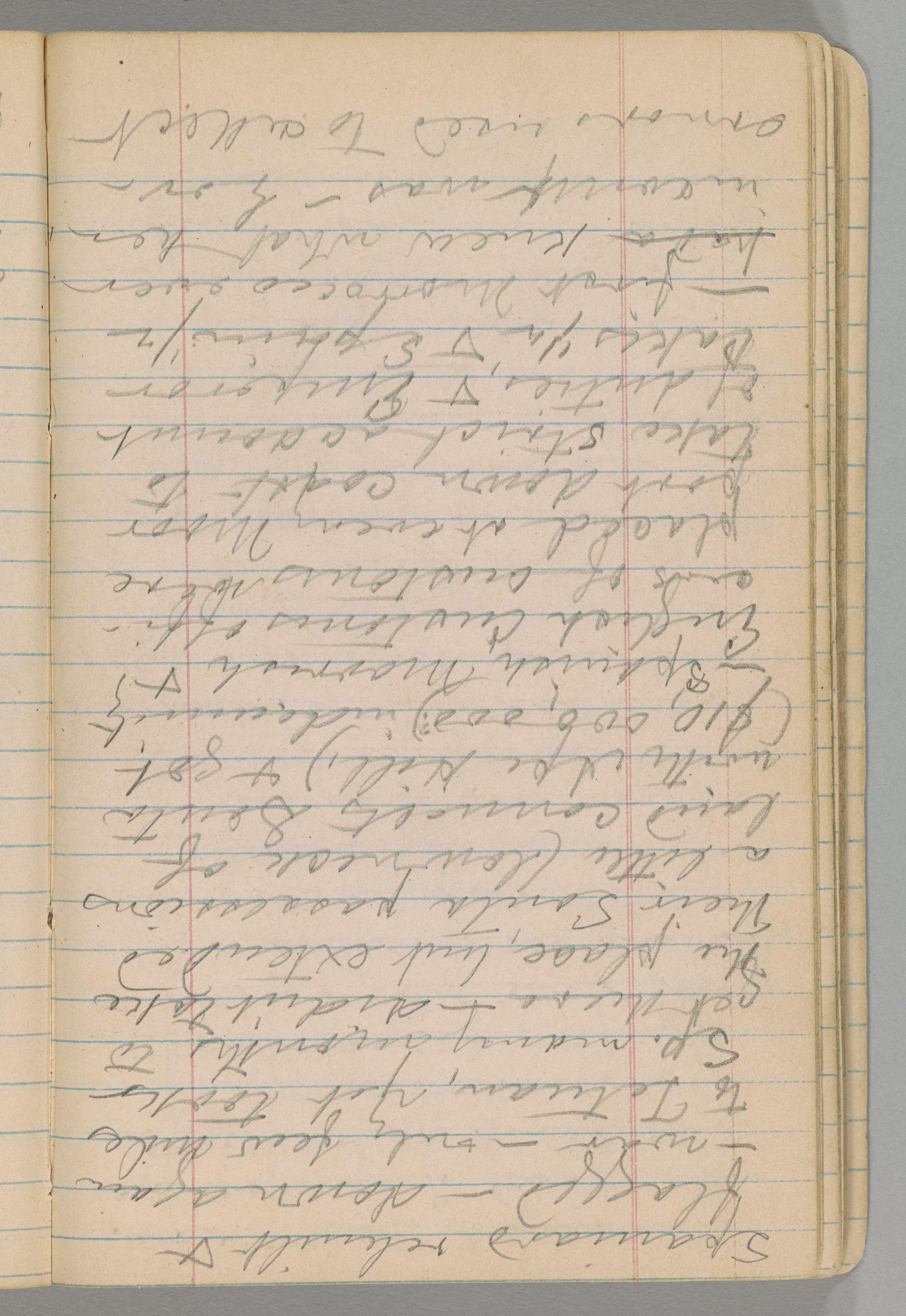
[MS: N8_leaf_041v]
Spaniard rebuilt &
flagged—down again
—war—only few miles
to Tetuan, yet took
Sp. many months to
get there—didn't take
the place, but extended
their Souta possessions
a little (low neck of
land connects Souta
with Ape Hill,) & got
($10,000,000?) indemnity
—Spanish, Moorish &
English customs
offi-
cers
officers
of customs were
placed at every Moor
port down coast to
take strict account
of duties, & Emperor
takes ½ & Spain ½
—first Morrocco ever
had a knew what her
income was—
Gov-
erners
Governors
used to collect
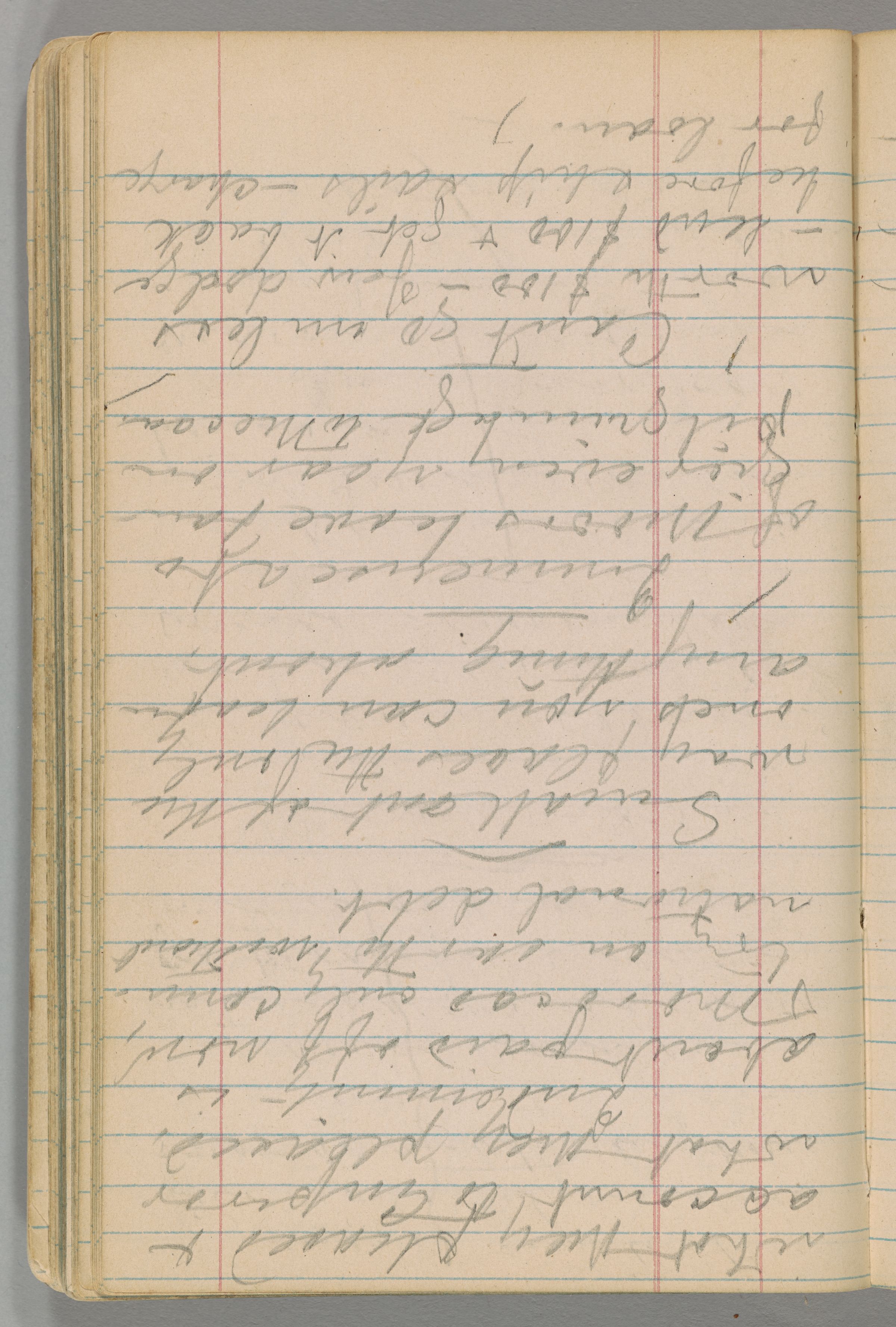
[MS: N8_leaf_042r]
what they pleased &
account to Emperor
what they pleased.
Indemnity is
about paid off now,
& Morocco only
coun-
try
country
on earth without
national debt.
Small out of the
way places the only
ones you can learn
anything about.
Immense No
of Moors leave
Tan-
gier
Tangier
every year on pilgrimage to Mecca.
Can't go unless
worth $100—Jew dodge
—lend $100 & get it back
before ship sails—charge
for loan.
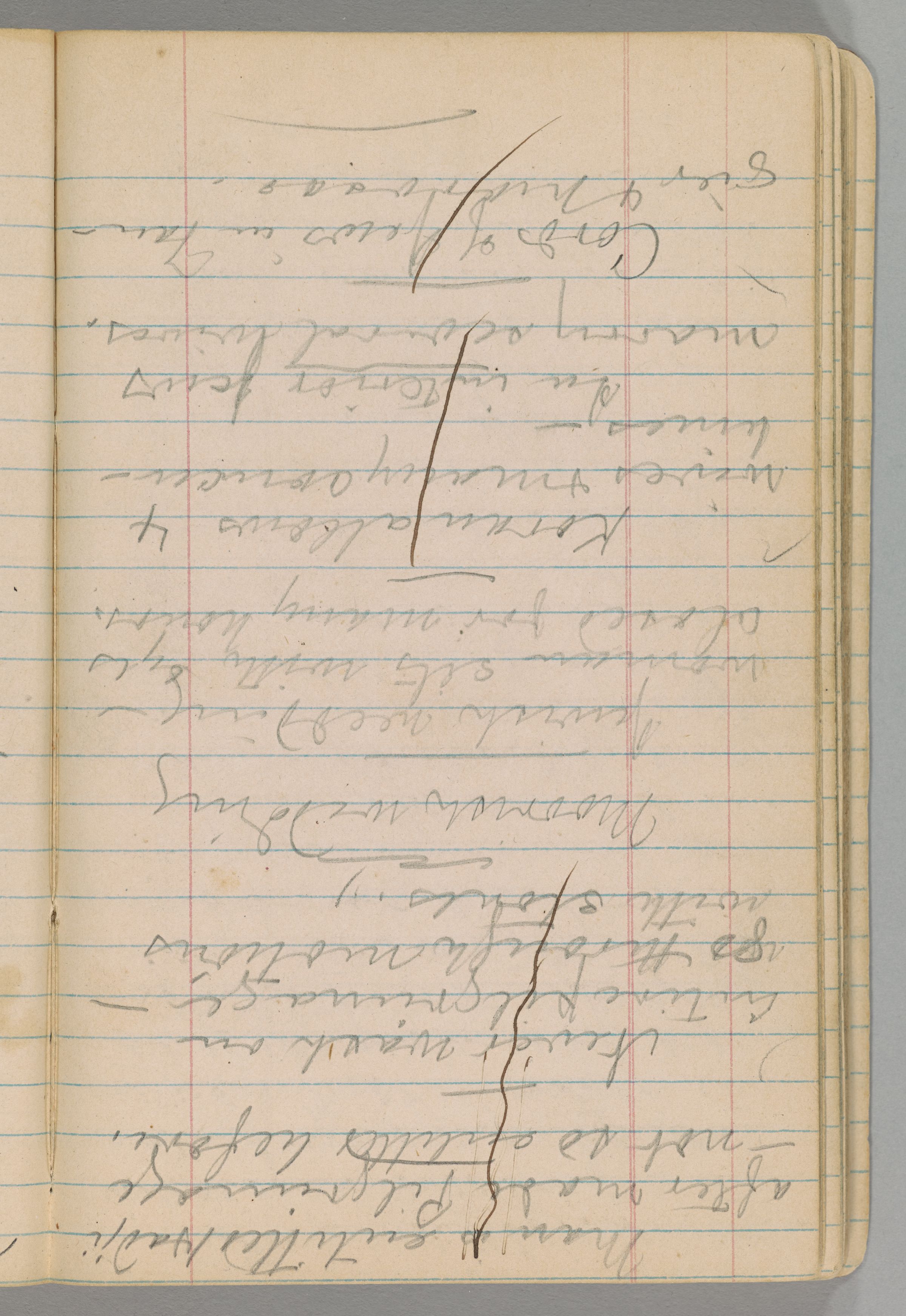
[MS: N8_leaf_042v]
[MTP: N&J1_357]
Man is entitled Hadji
after made Pilgrimage
—not so entitled before.
Never wash on
entire pilgrimage—
w go through motions
with stones.
Moorish wedding
Jewish wedding—
woman sits with eyes
closed for many hours.
Koran allows 4
wives & many
concu-
bines
concubines
—
In interior Jews
marry several wives.
Cords of Jews in
Tan-
gier
Tangier
& Morocco.
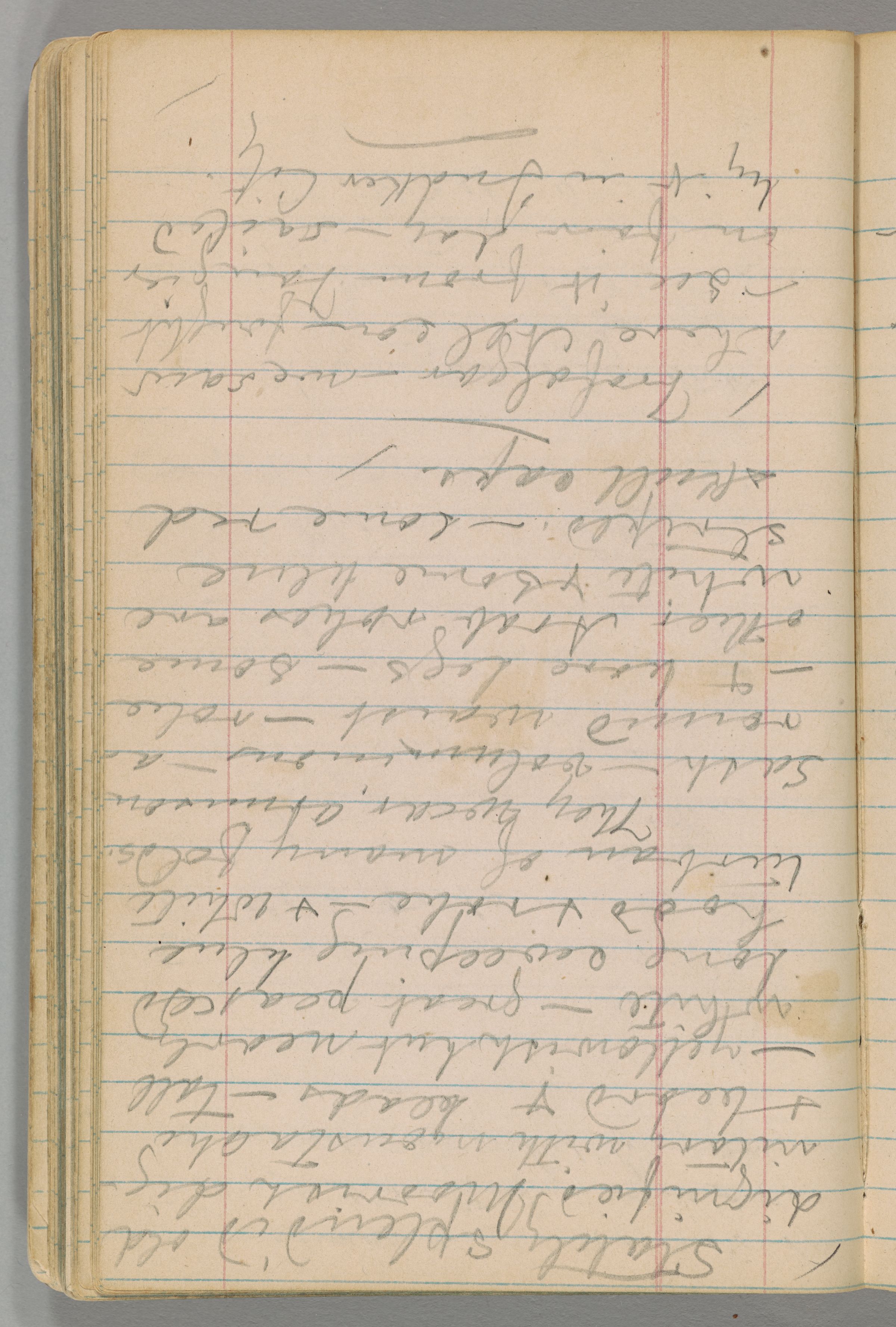
[MS: N8_leaf_043r]
Stately splendid old
dignified Moorish
dig-
nitary
dignitary
with moustache
& beard & beads—tall
—yellowish but nearly
white—great peaked
long sweeping blue
hood & robe—& white
turban of many folds.
They wear crimson
sash—voluminous—
a-
round
around
waist—robe
—& bare legs—some
other Arab robes are
white & some blue
striped.—some red
skull caps.
[MTP: N&J1_358]
Trafalgar—we saw
where Nelson fought
—see it from Tangier
on fair day—sailed
by it in Quaker City.
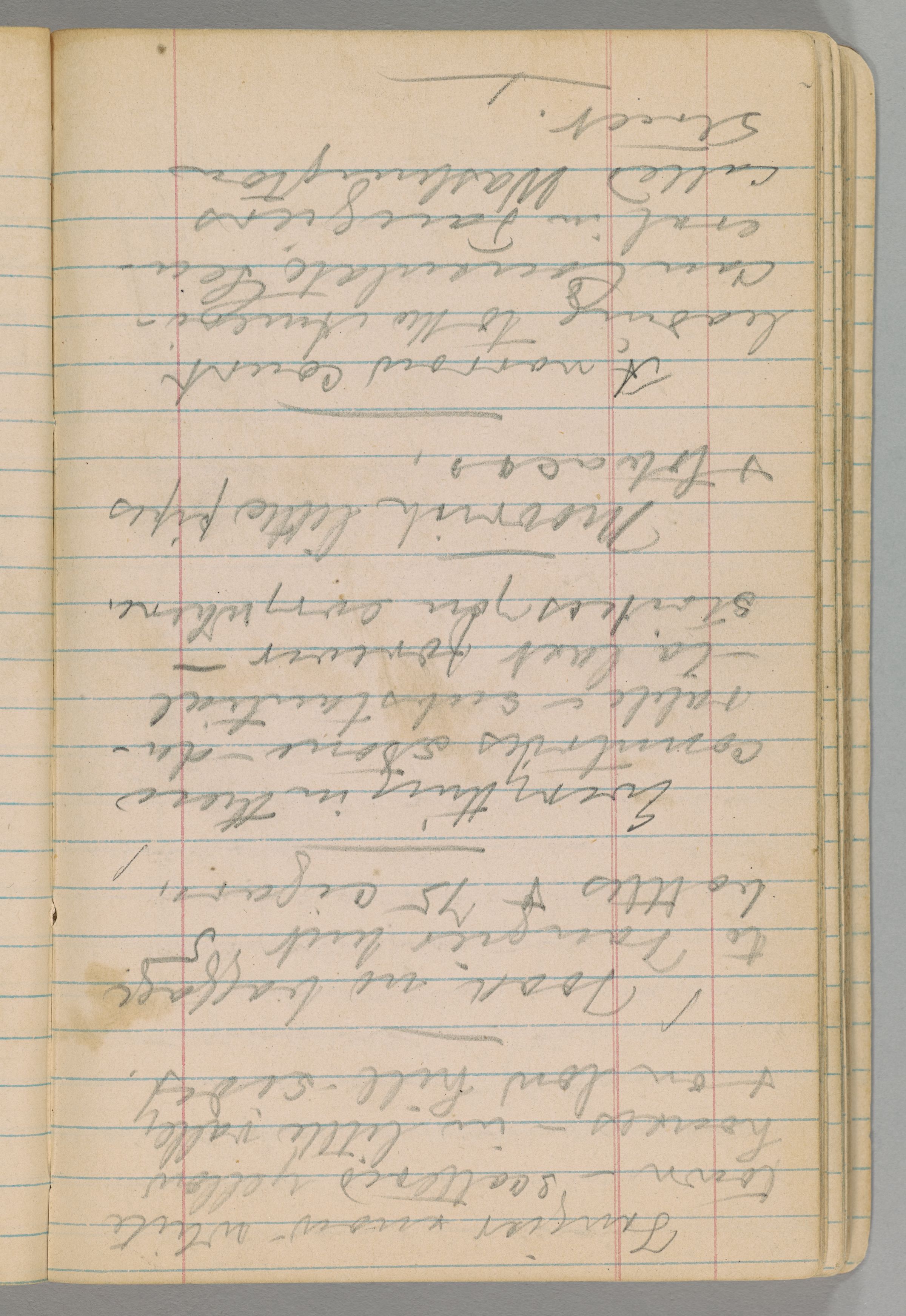
[MS: N8_leaf_043v]
Tangier snow-white
town—scattered yellow
houses—in little valley
& on low hill-sides.
Took no baggage
to Tangier but 5
bottles & 75 cigars.
Everything in these
countries stone—
du-
rable
durable
—substantial
—to last forever—
strikes you evrywhere.
Moorish little pipes
& tobacco.
A narrow court
leading to the
Ameri-
can
American
Consulate
Gen-
eral
General
in Tangiers
called Washington
Street.
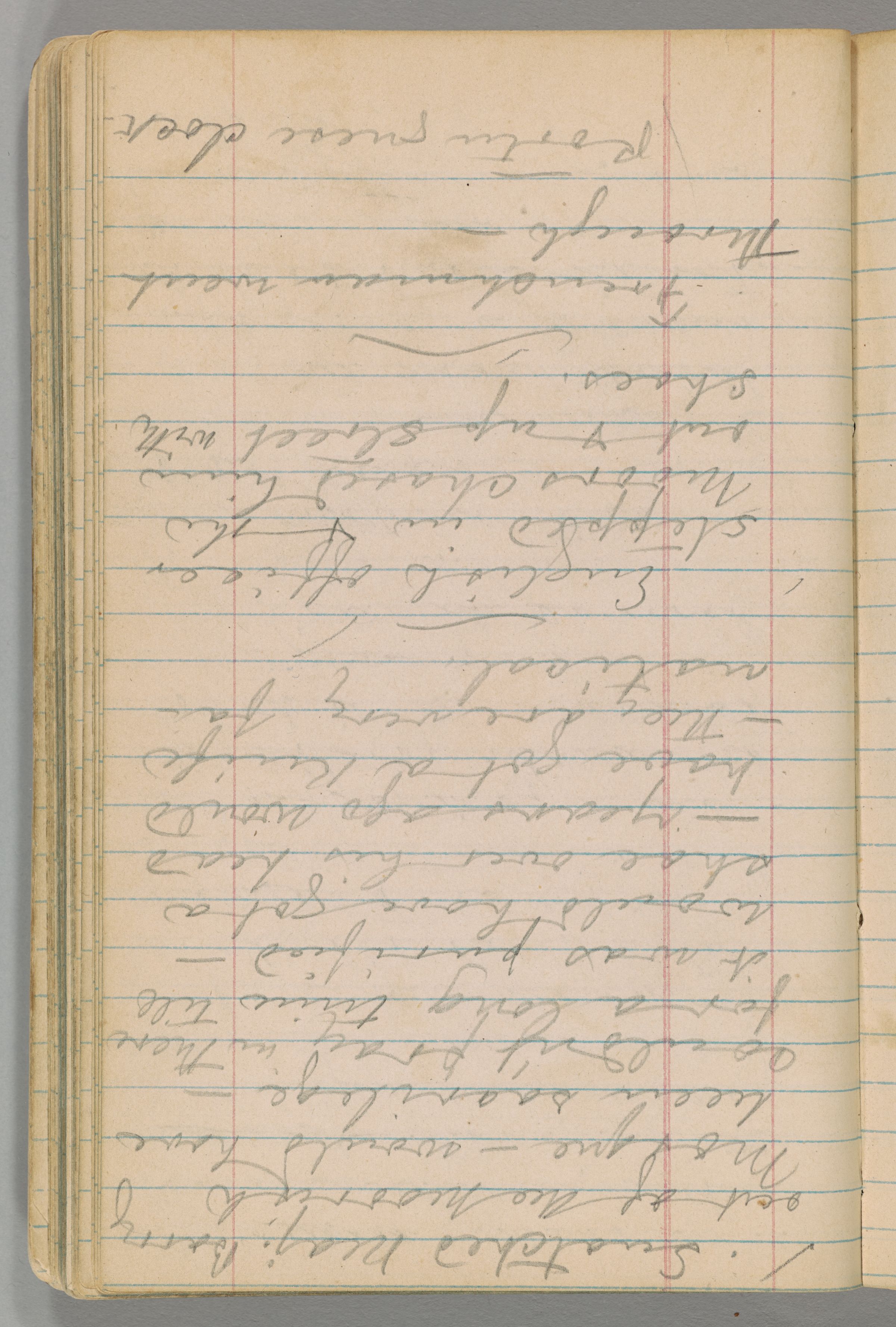
[MS: N8_leaf_044r]
Snatched Maj. Barry
out of the Moorish
Mosque—would have
been sacrilege—
couldn't pray in there
for a long time till
it was purified—
would have got a
shoe over his head
—years ago would
have got a knife
—they are very
fa-
natical
fanatical
.
English officer
stepped in & the
Moors chased him
out & up street with
shoes.
Frenchman went
through—
Portuguese clock-
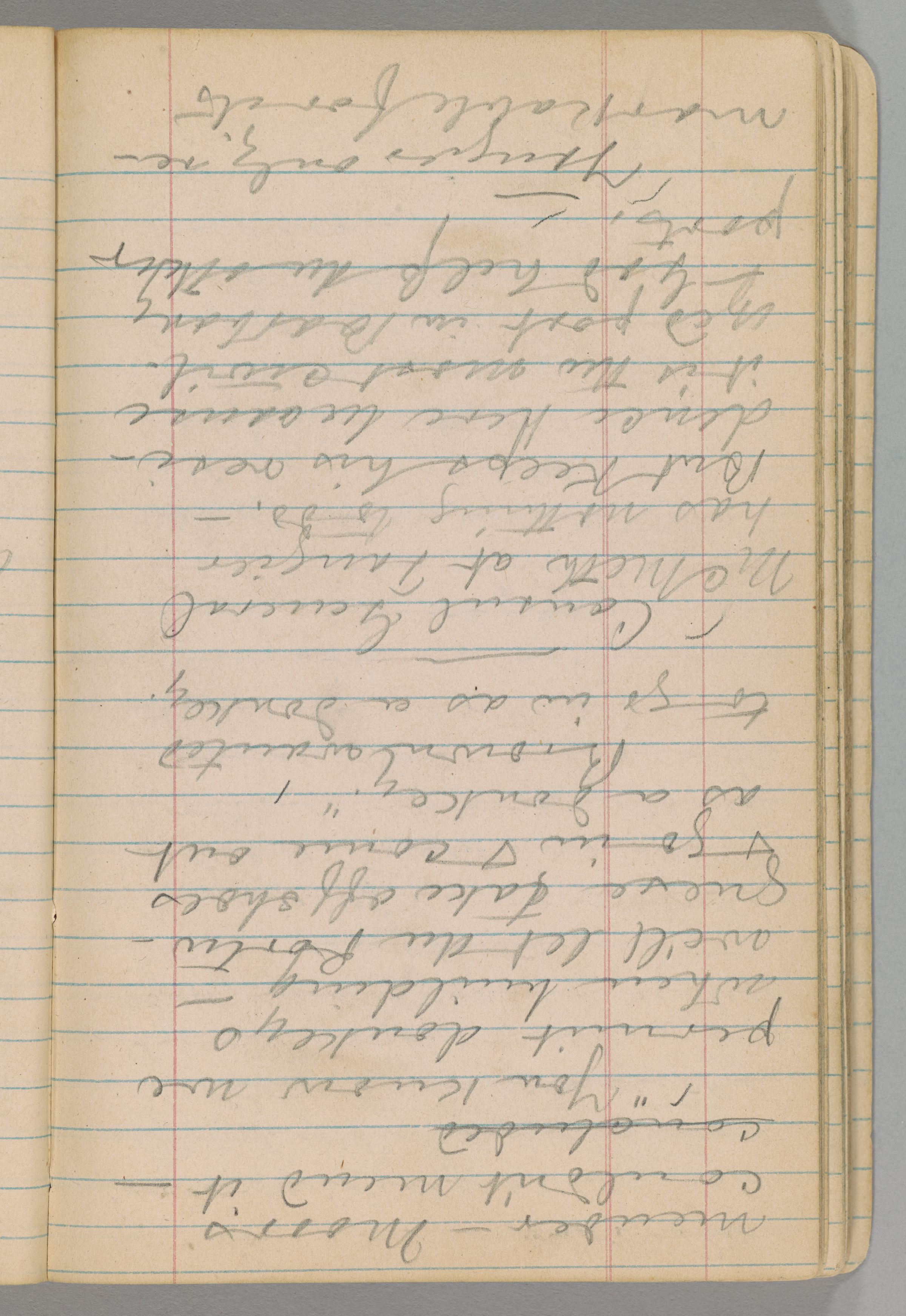
[MS: N8_leaf_044v]
mender—Moors
couldn't mend it—
concluded
[MTP: N&J1_359]
“You know we
permit donkeys
when building—
we'll let the
Portu-
guese
Portuguese
c take off shoes
& go in & come out
as a donkey.”
Brown wanted
to go in as a donkey.
Consul General
McMeth at Tangier
has nothing to do.—
But keeps his
resi-
dence
residence
here because
it is the most
civil-
ized
civilized
port in Barbary
—God help the other
ports.
Tangier only
re-
markable
remarkable
for its
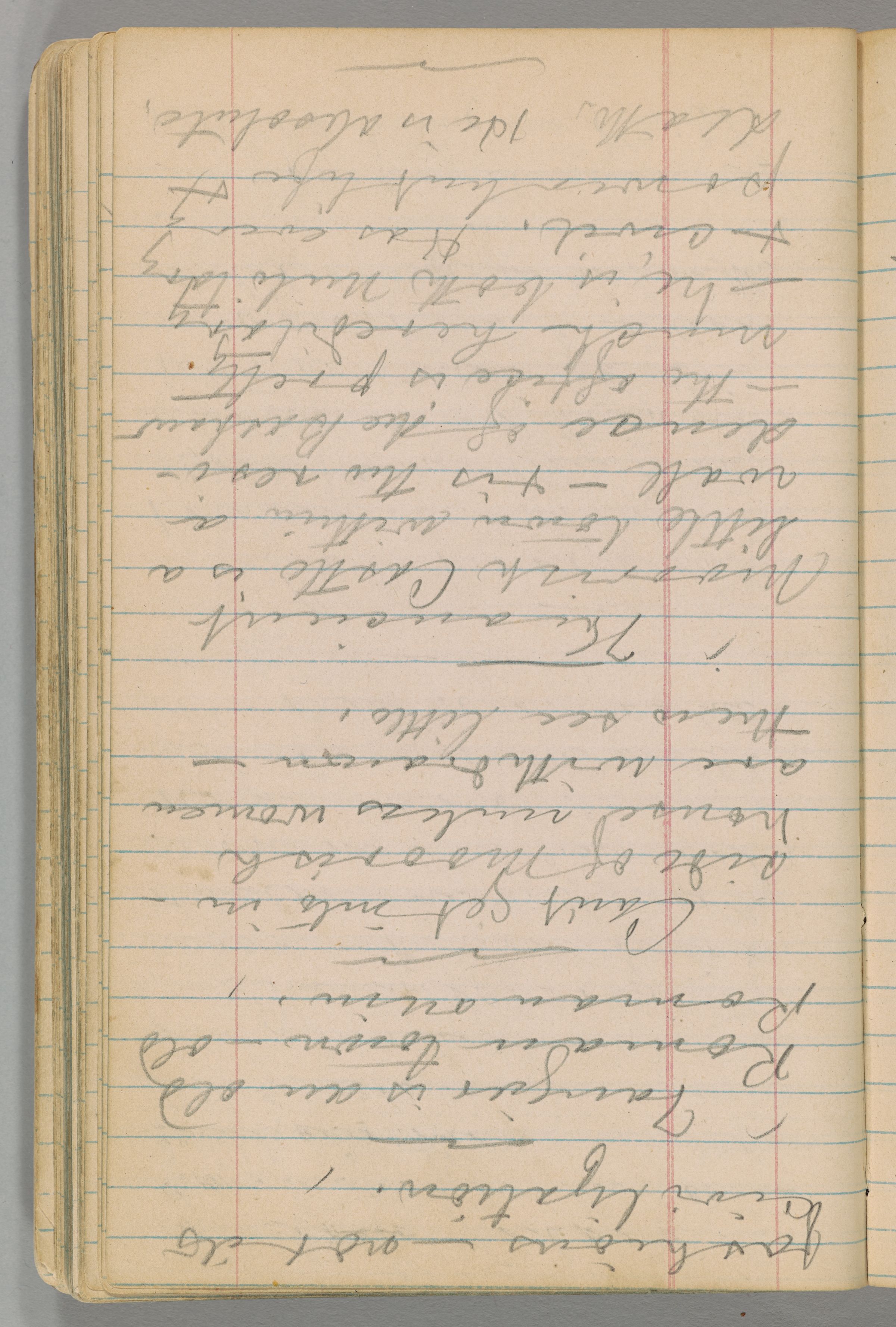
[MS: N8_leaf_045r]
fashions—not its
civilization.
Tangier is an old
Roman town—old
Roman ruin.
Can't get into
in-
side
inside
of Moorish
house unless women
are withdrawn—
then see little.
The ancient
Moorish Castle is a
little town within a
wall—& is the
resi-
dence
residence
of the Bashaw
—the office is pretty
much hereditary
—he is both military
& civil. Has every
power but life &
death. He is absolute.
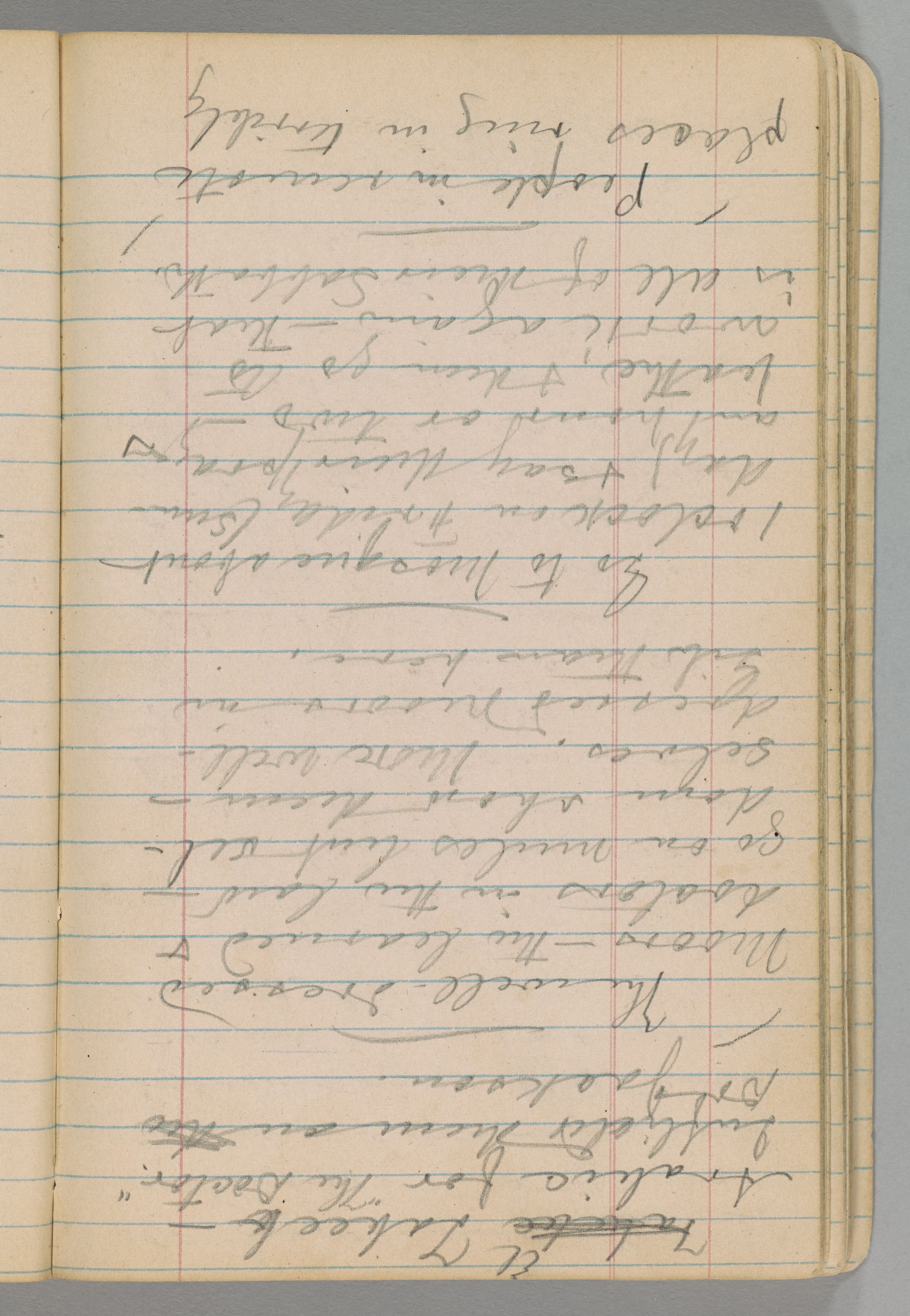
[MS: N8_leaf_045v]
Tabebe
El Tabeeb—
Arabic for “The Doctor.”
Inflicted them on the
Dr Jackson.
The well-dressed
Moors—the learned &
doctors in the law—
go on mules but
sel-
dom
seldom
show
them-
selves
themselves
. More well-
dressed Moors in
Gib than here.
Go to Mosque about
1 oclock on Friday (
Sun-
day
Sunday
) & say their prayers
an hour or two—
bathe, & then go to
work again—that
is all of their Sabbath.
People in remote
places ring in terribly
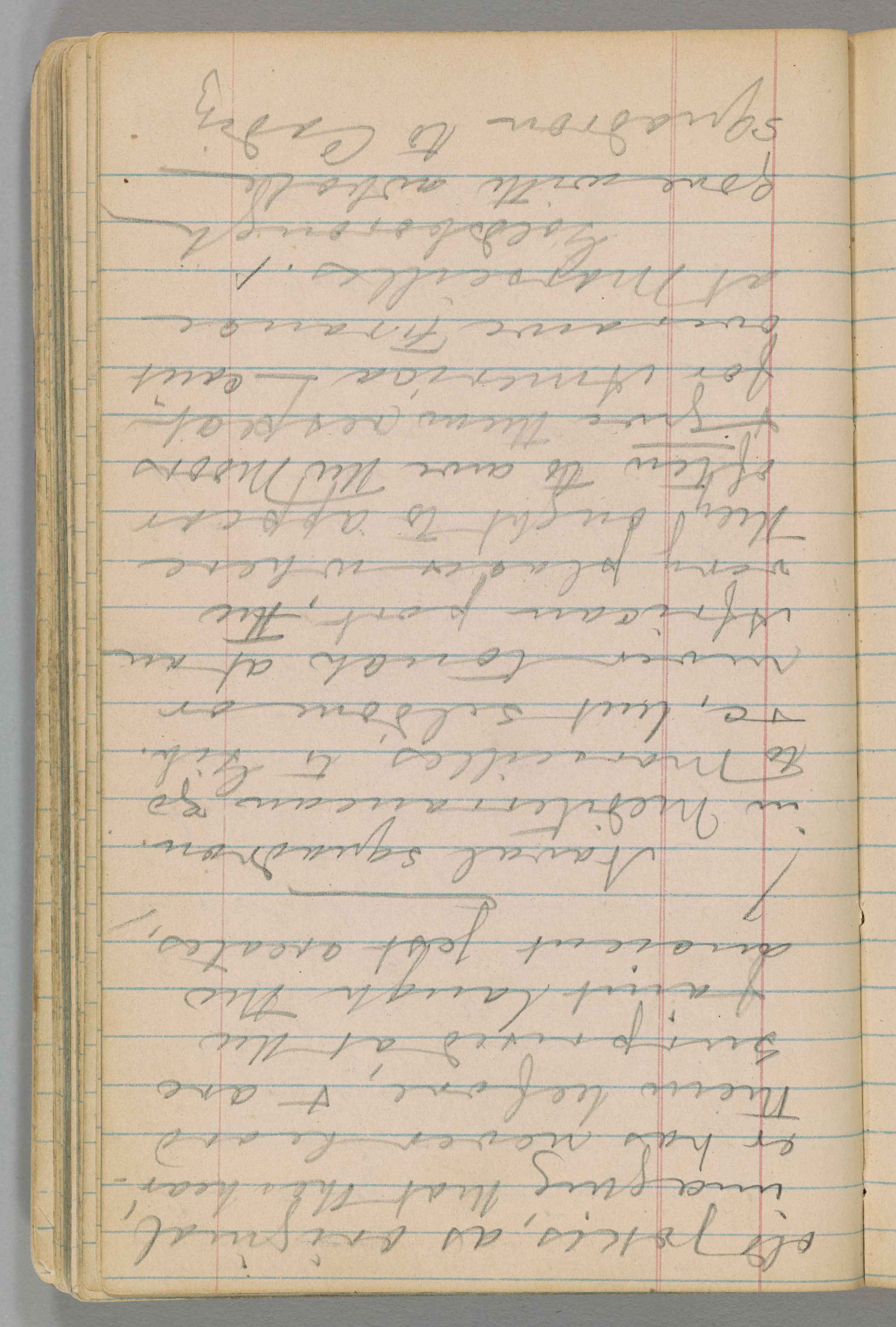
[MS: N8_leaf_046r]
old jokes, as original,
imaging that the
hear-
er
hearer
has never heard
them before, & are
surprised at the
faint laugh the
ancient jest creates.
Naval squadron
in Mediterranean go
to Marseilles, to Gib.
&c, but seldom or
never touch at an African port,— the
very places where
they ought to appear
often to awe the Moors
& give them respect
for America—can't
overawe France
at Marseilles.
Goldsborough
gone with whole
squadron to Cadiz
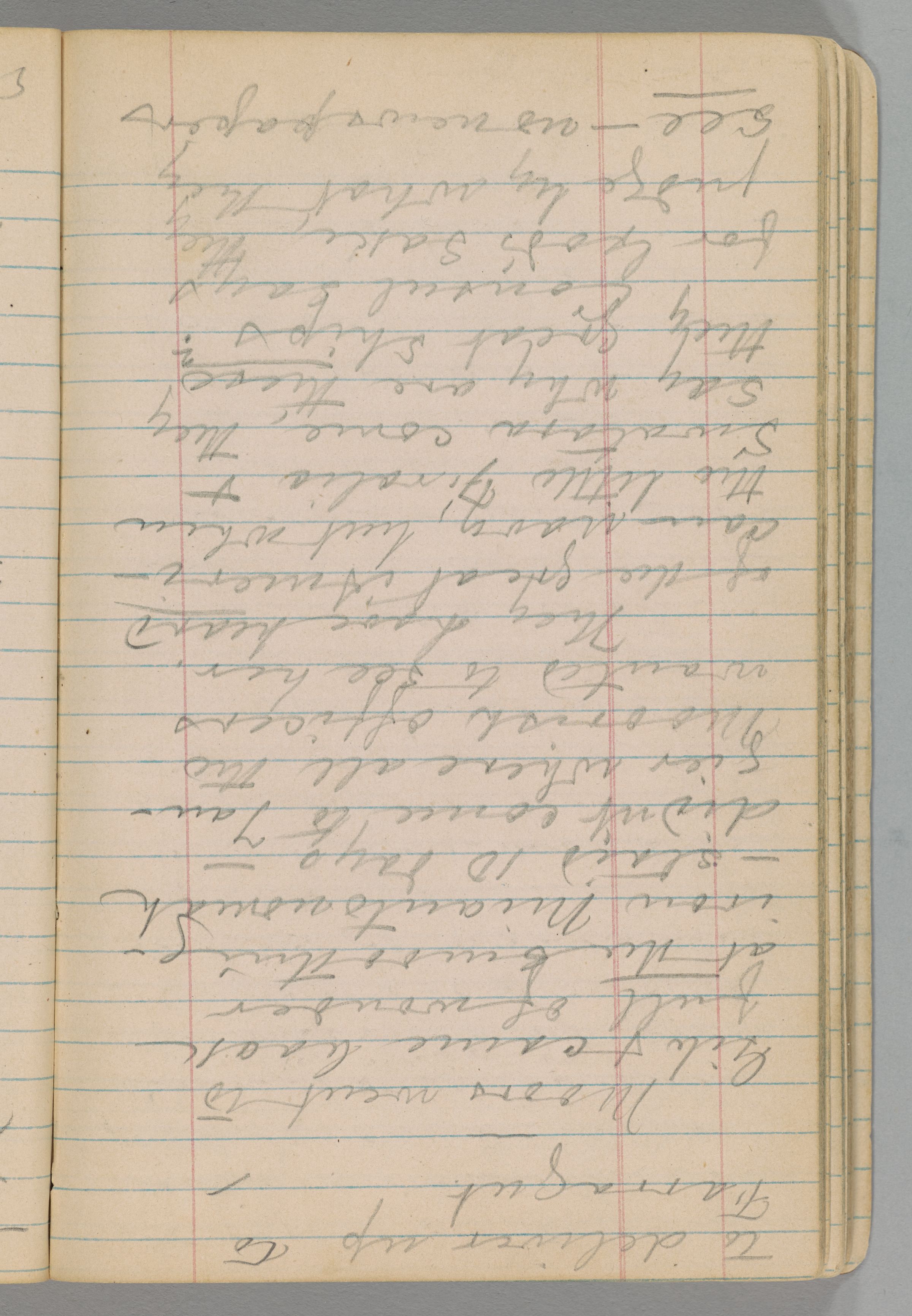
[MS: N8_leaf_046v]
to deliver up to
Farragut.
Moors went to
Gib & came back
full of wonder
at the smoothing
-iron Miantonomoh
—staid 10 days—
didn't come to
Tan-
gier
Tangier
where all the
Moorish officers
wanted to see her.
They have heard
of the great
Ameri-
can
American
navy, but when
the little Frolic &
Swatara come, they
say why are these
they great ships?
Consul says
for God's sake, they
judge by what they
see—no newspapers
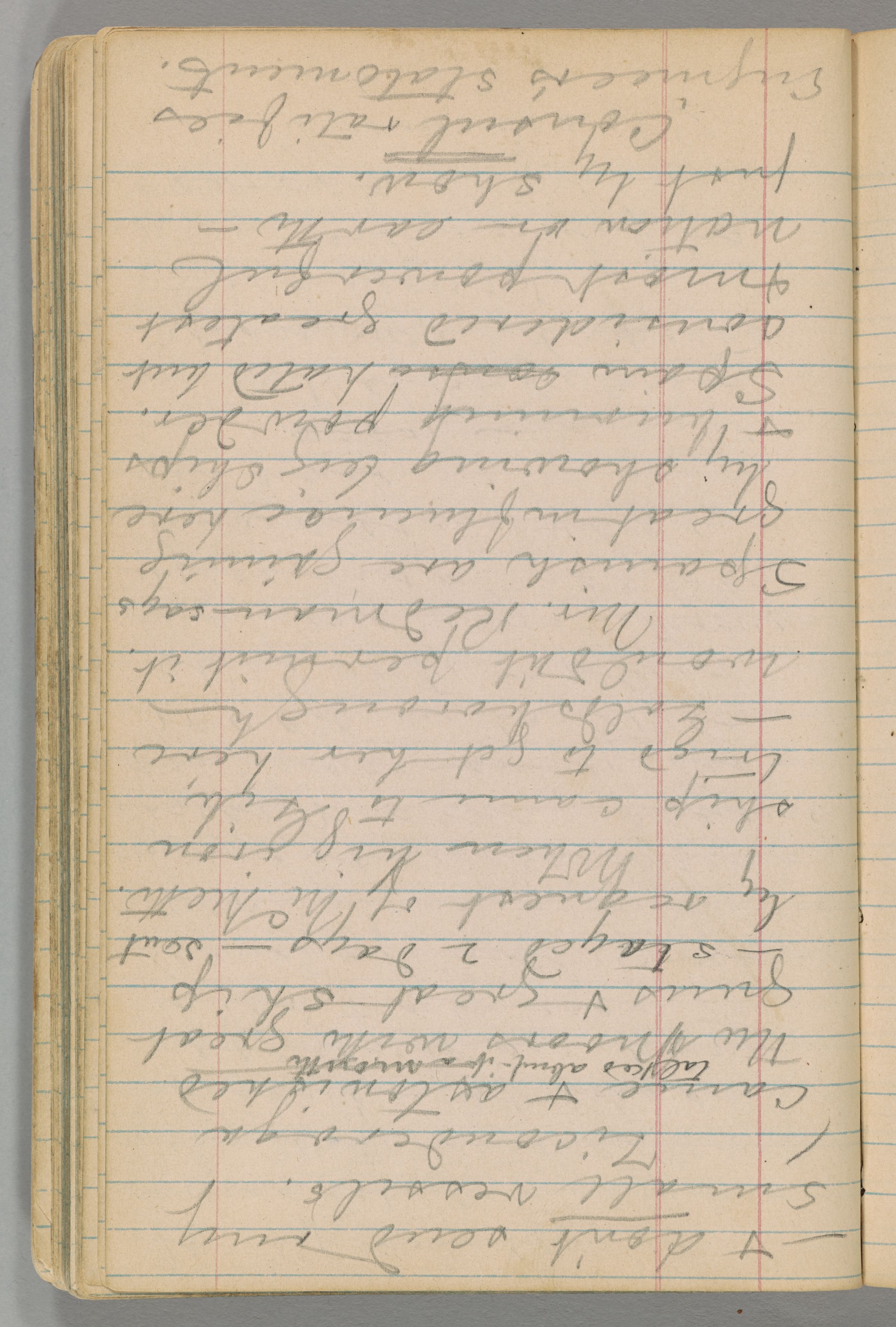
[MS: N8_leaf_047r]
—& don't send any
small vessels.
Ticonderoga
came & astonished
the Moors
talked about it a month
with great
guns & great ship
—sentayed 2 days—sent
by request of McMeth.
When big iron
ship came to Gib,
tried to get her here
—Goldsborough
wouldn't permit it.
Mr. Redman says
Spanish are gaining
great influence here
by showing big ships
& burning powder.
Spain consi hated but
considered greatest
& most powerful
nation on earth—
just by show.
Consul ratifies
engineer's statements.
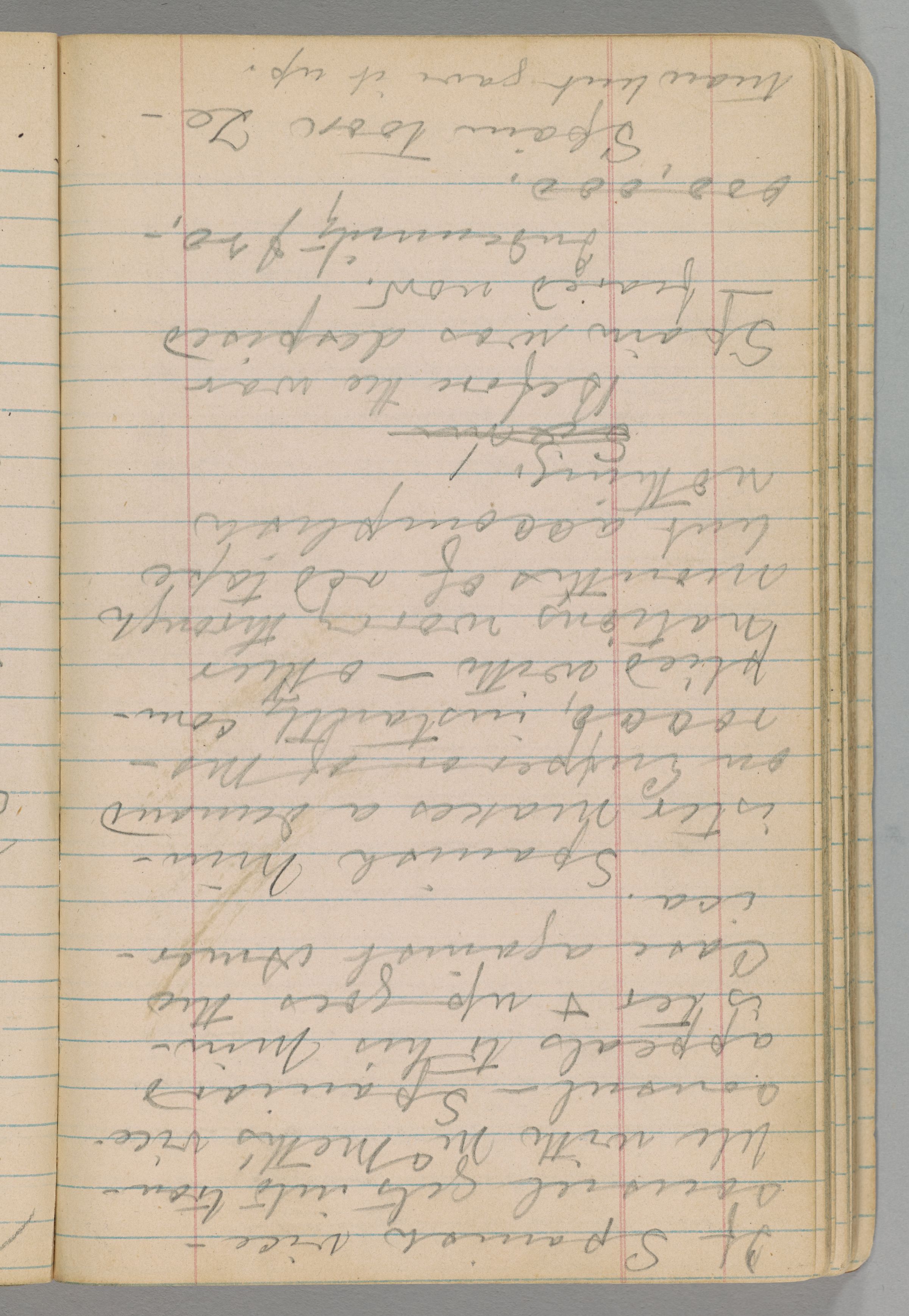
[MS: N8_leaf_047v]
If Spanish vice-
consul gets into
trou-
ble
trouble
with McMeth's vice-
consul—Spaniard
appeals to his
Min-
ister
Minister
& up goes the
case against
Amer-
ica
America
.
Spanish
Min-
ister
Minister
makes a demand
on Emperor of
Mo-
rocco
Morocco
,
[MTP: N&J1_361] instantly
com-
plied
complied
with—other
nations worry through
months of red tape
but accomplish
nothing.
Six mi
Before the war
Spain was despised
—feared now.
Indemnity
$20,-
000,000
$20,000,000
.
Spain took
Te-
tuan
Tetuan
but gave it up.
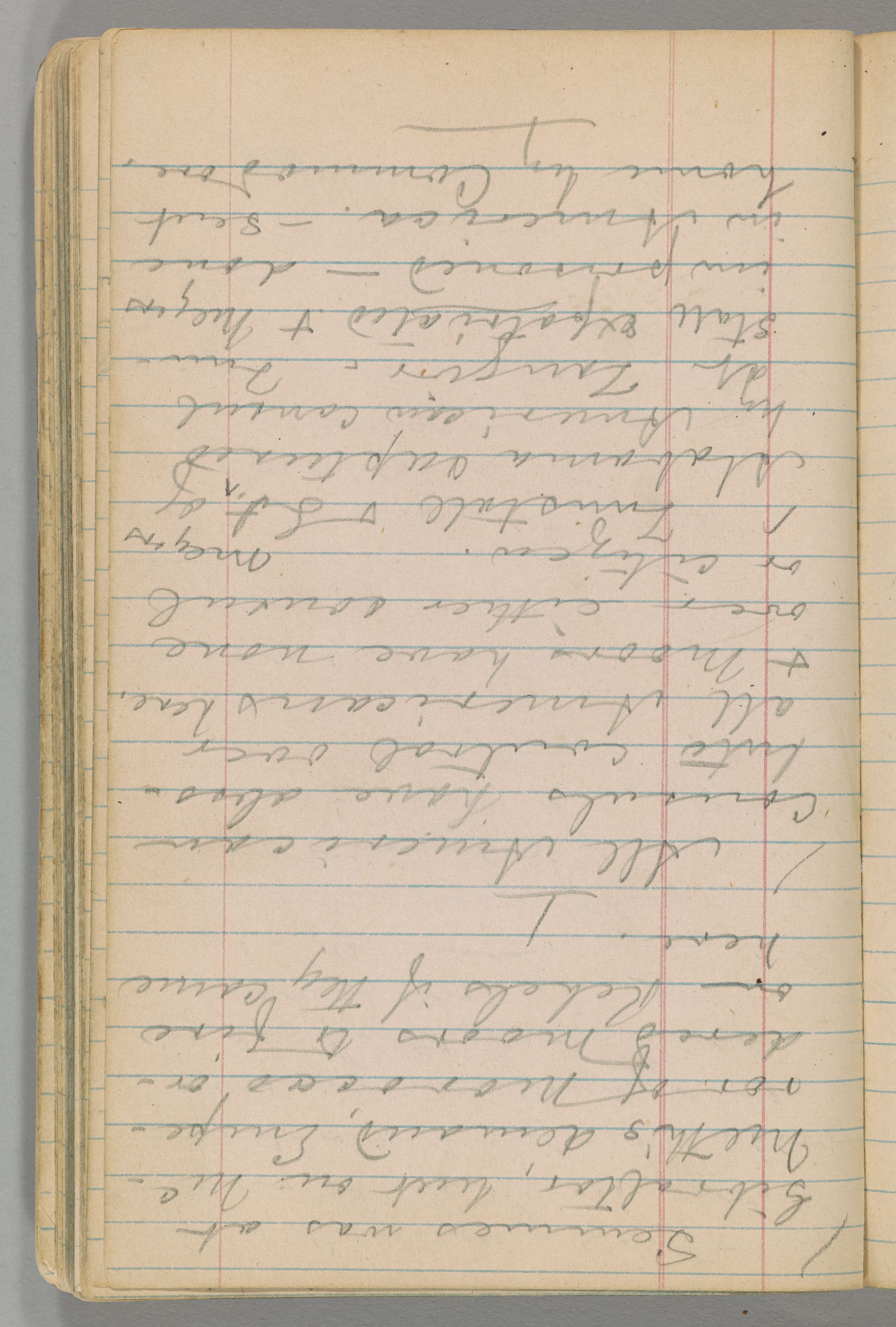
[MS: N8_leaf_048r]
Semmes was at
Gibraltar, but on Mc-
Meth's demand,
Empe-
ror
Emperor
of Morocco
or-
dered
ordered
Moors to fire
on Rebels if they came
here.
All American
consuls have
abso-
lute
absolute
control over
all Americans here,
& Moors have none
over either consul
or citizen.
Tunstall & Lt. Meyers
of
Alabama captured
by American consul
at Tangier. Tunstall
expatriated & Meyers
imprisoned—done
in America.—sent
home by Commodore.
[MTP: N&J1_362]
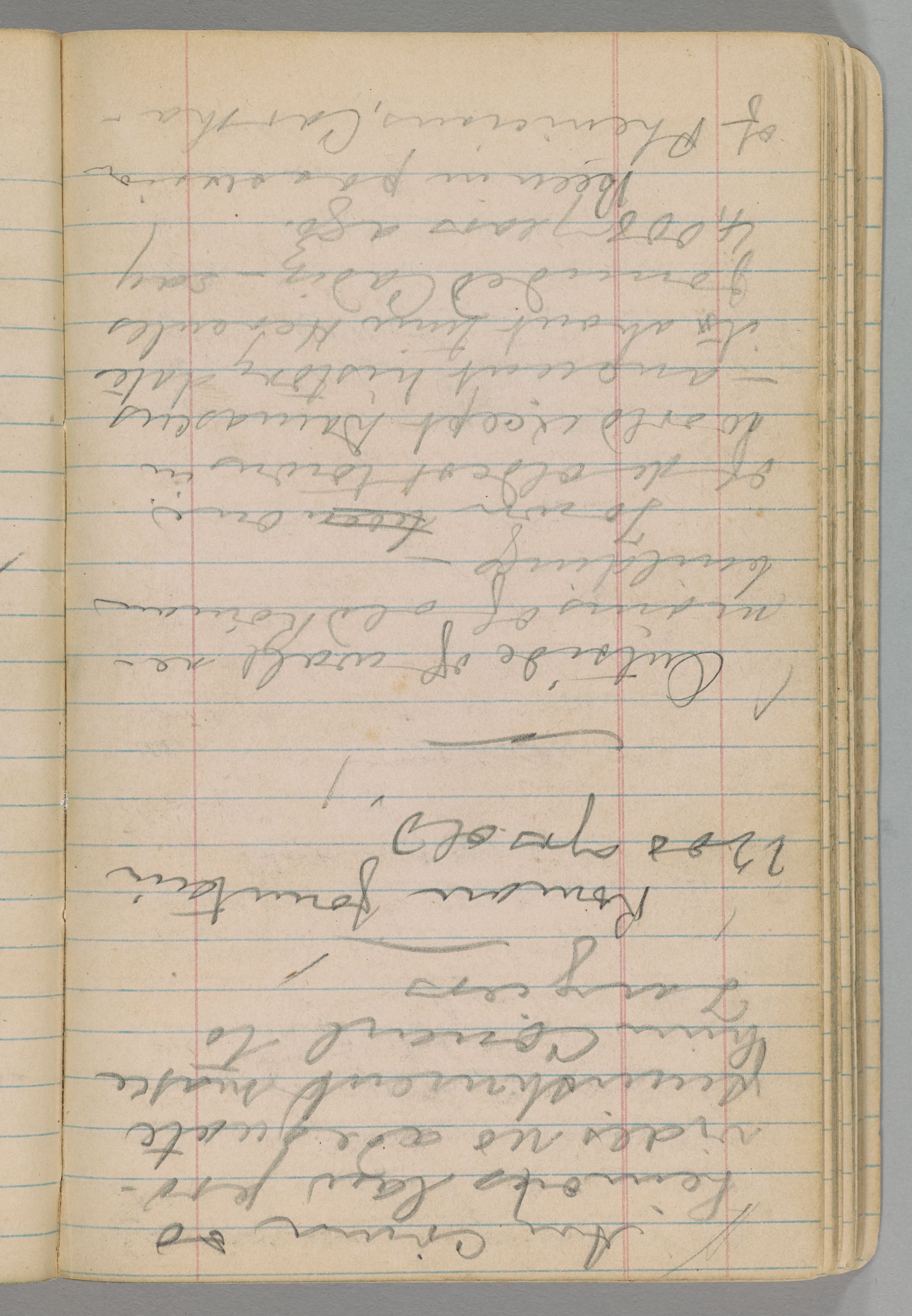
[MS: N8_leaf_048v]
Any crime so
heinous law
pro-
vides
provides
no adequate
punishment make
him Consul to
Tangiers
Roman fountain
2200 yrs old.
Outside of wall,
re-
mains
remains
of old Roman
buildings—
Town been one
of the oldest towns in
world except Damascus
—ancient history dates
its about time Hercules
founded Cadiz—say
4,000 years ago.
Been in possession
of Phenicians, Cartha-
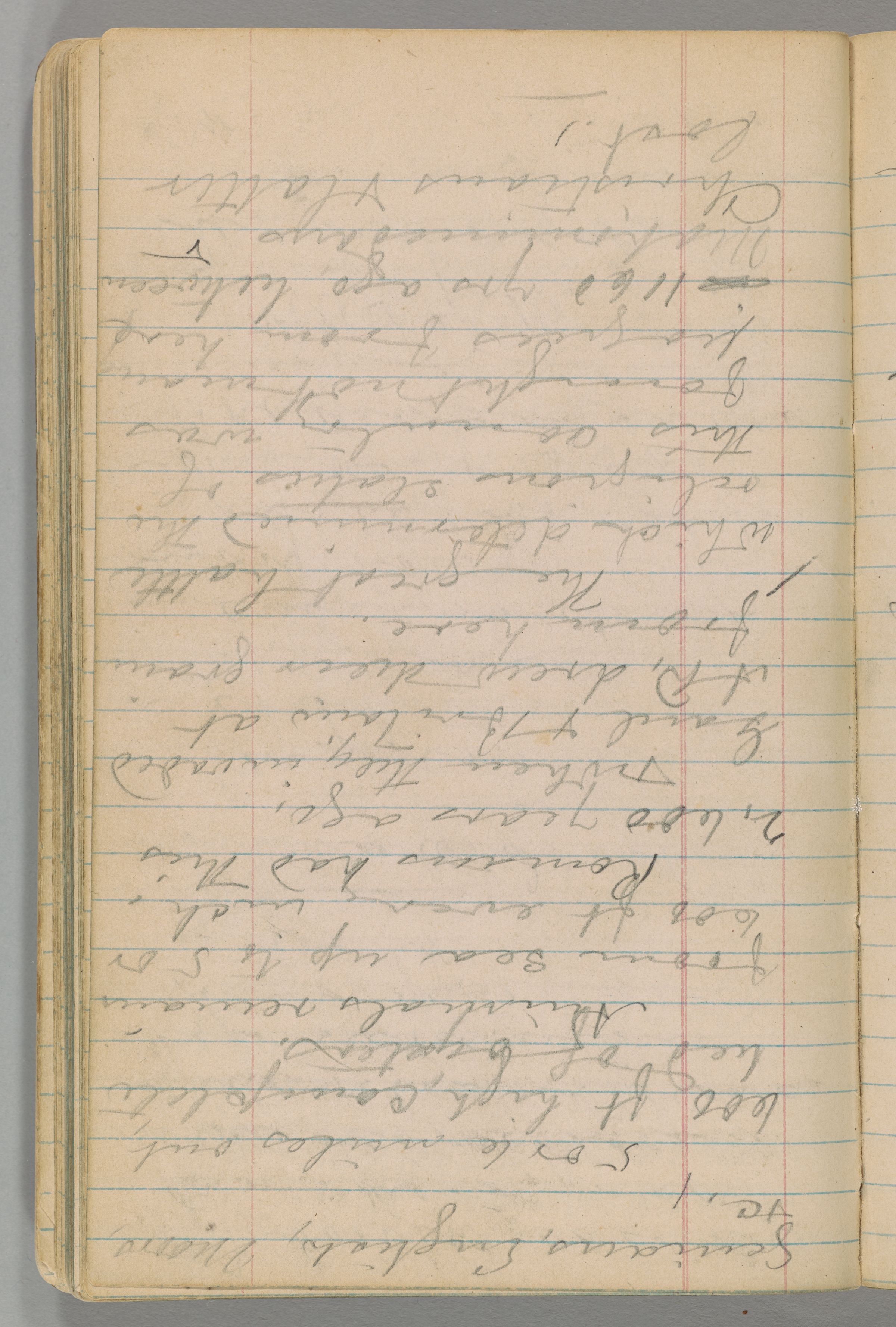
[MS: N8_leaf_049r]
genians, English, Moors, &c.
5 or 6 miles out,
600 ft high, complete
bed of oysters.
Animals remain
from sea up to 5 or
600 ft every inch.
Romans had this
2,600 years ago,
blank
blank &
blank &
when they invaded
Gaul & Britain at blank
AD, drew their grain
from here.
The great battle
which determined the
religious status of
this country was
fought not many
leagues from here
in 1160 yrs ago, between
Mahommedans &
Christians & latter
lost.
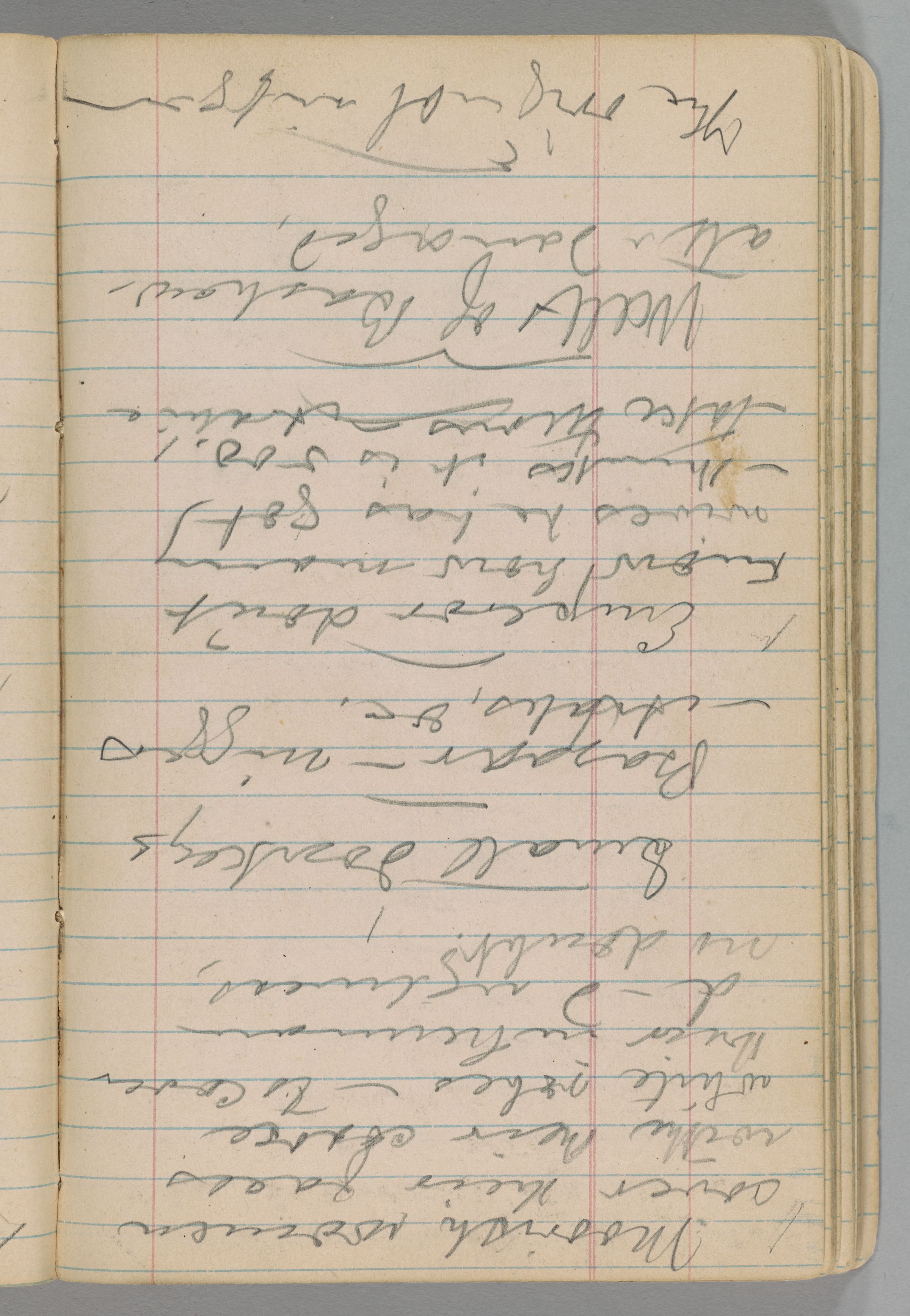
[MS: N8_leaf_049v]
Moorish women
cover their faces
with their coarse
white robes—to cover
their inhuman
d—d ugliness,
no doubt.
Small donkeys
Bazaar—niggers
—Arabs, &c.
Emperor don't
know how many
wives he has got
—thinks it is 500.
—take turns—Arabic
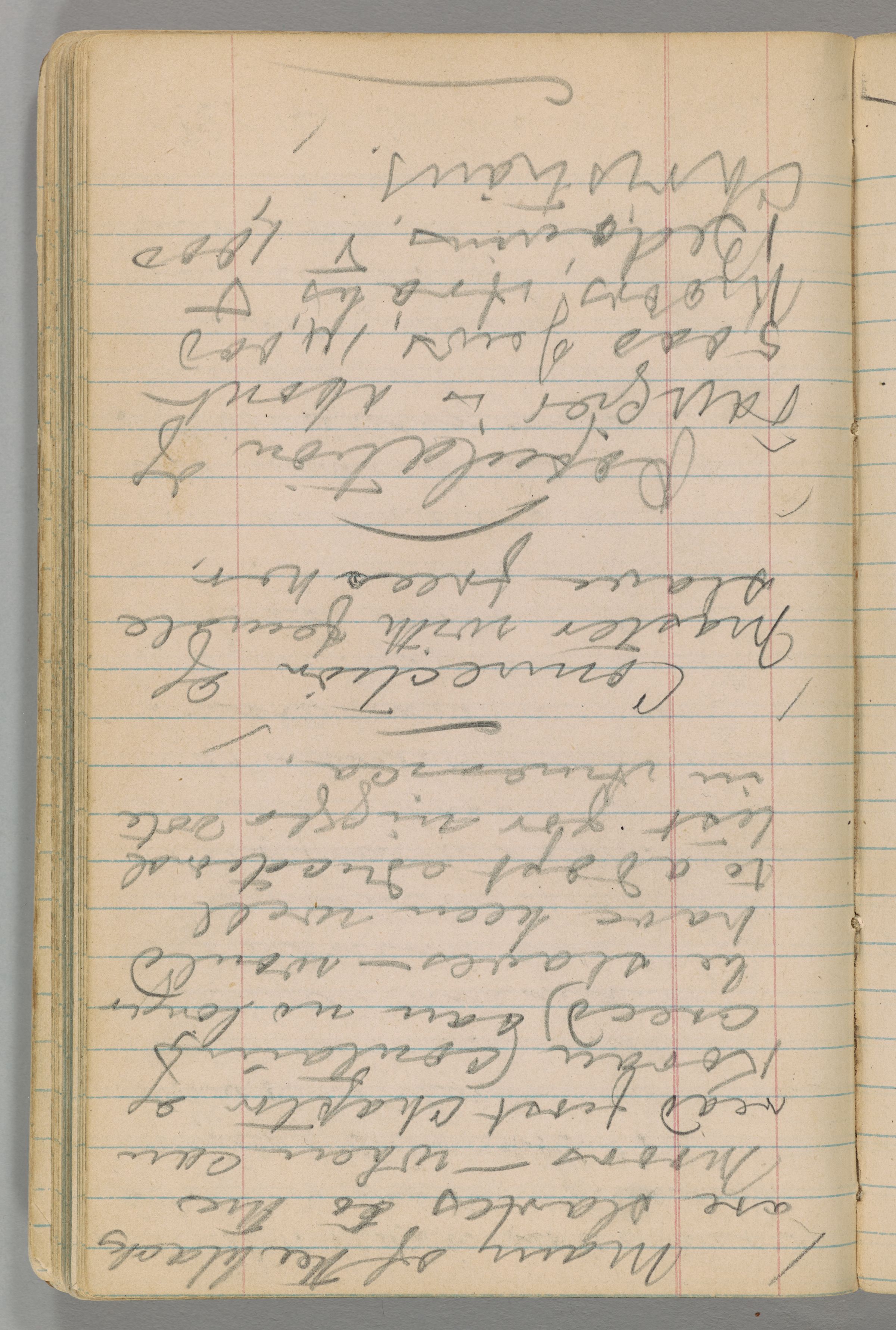
[MS: N8_leaf_050r]
Many of the blacks
are slaves o to the
Moors—when can
read
[MTP: N&J1_363] first chapter of
Koran (contains
creed) can no longer
be slaves—would
have been well
to adopt educational
test for nigger vote
in America.
Connection of
Master with female
slave frees her.
Population of
Tangier is about
5,000 Jews, 14,000
Moors, Arabs &
Bedouins, & 1,000
Christians.
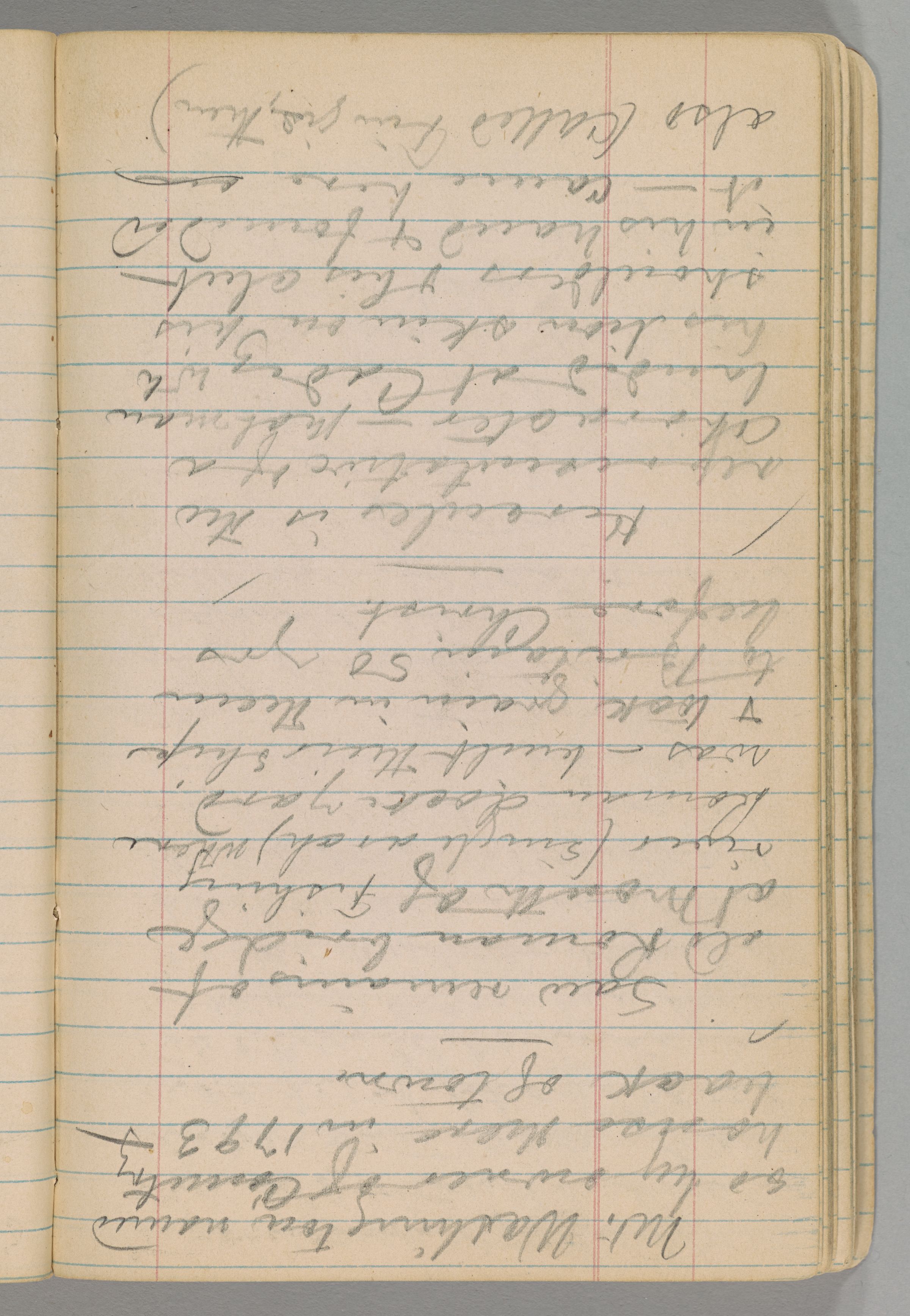
[MS: N8_leaf_050v]
Mt. Washington, named
so by owner of country
house there in 1793—
back of town.
Saw remains of
old Roman bridge
at mouth of Fishing
river (single arch) where
Roman dock-yard
was—built their ships
& took grain in them
to Britain 50 yrs
before Christ.
Hercules is the
representative of a
character—that man
landed at Cadiz wh
his lion skin on his
shoulders & his club
in his hand & founded
it—came here on
also (called Tingis, then)
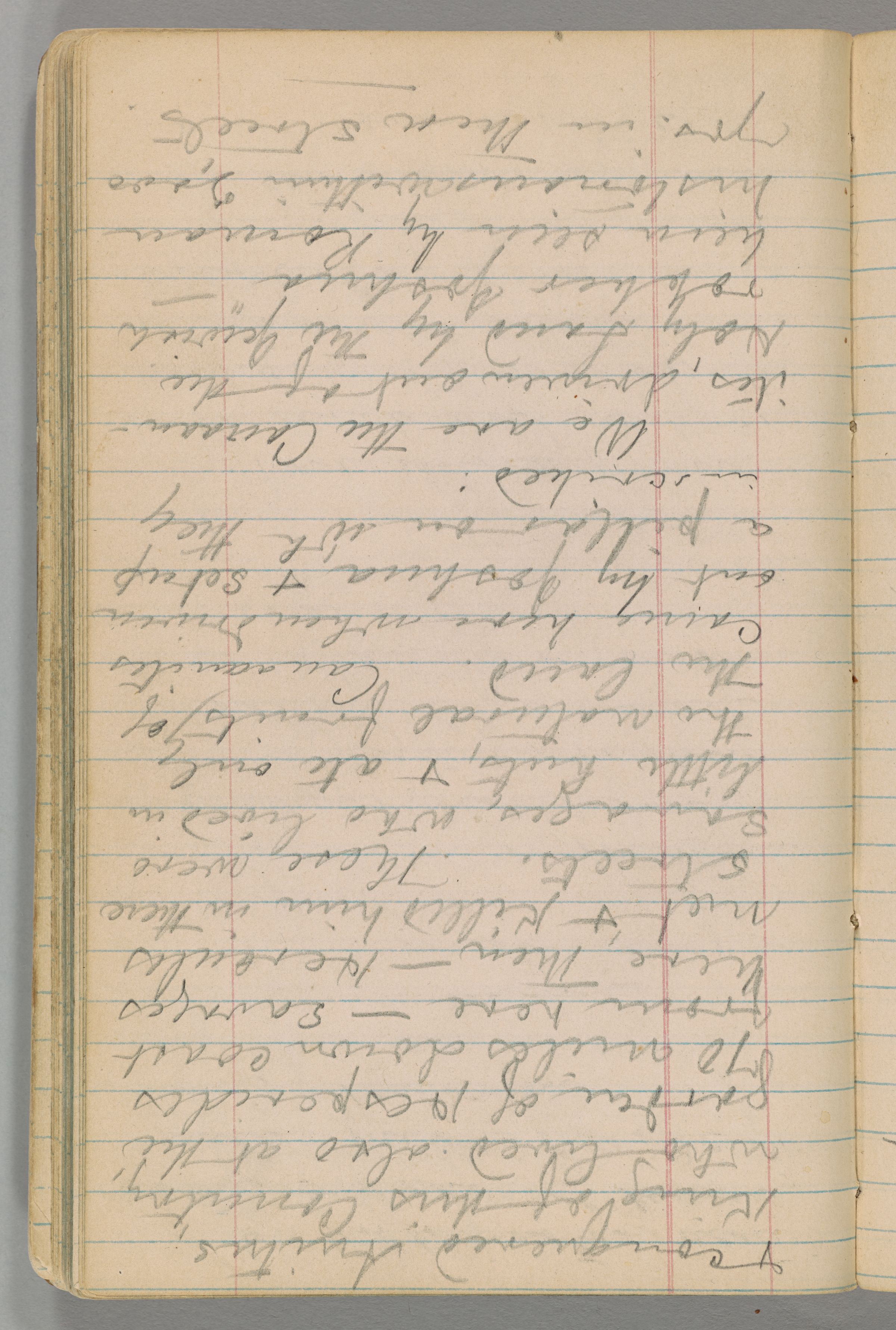
[MS: N8_leaf_051r]
& conquered Anitus,
King of this Country,
who lived also at the
garden of Hesperides
70 miles down coast
from here—savages
here, then—Hercules
met & killed him in these
streets. These were
savages, who lived in
little huts, & ate only
the natural fruits of
the land. Canaanites
came here when driven
out by Joshua, & set up
a pillar on wh they
inscribed:
We are the
Canaan-
ites
Canaanites
, driven out of the
Holy Land by the Jewish
robber Joshua”—
been seen by Roman
historians within 2,000
yrs. in these streets.
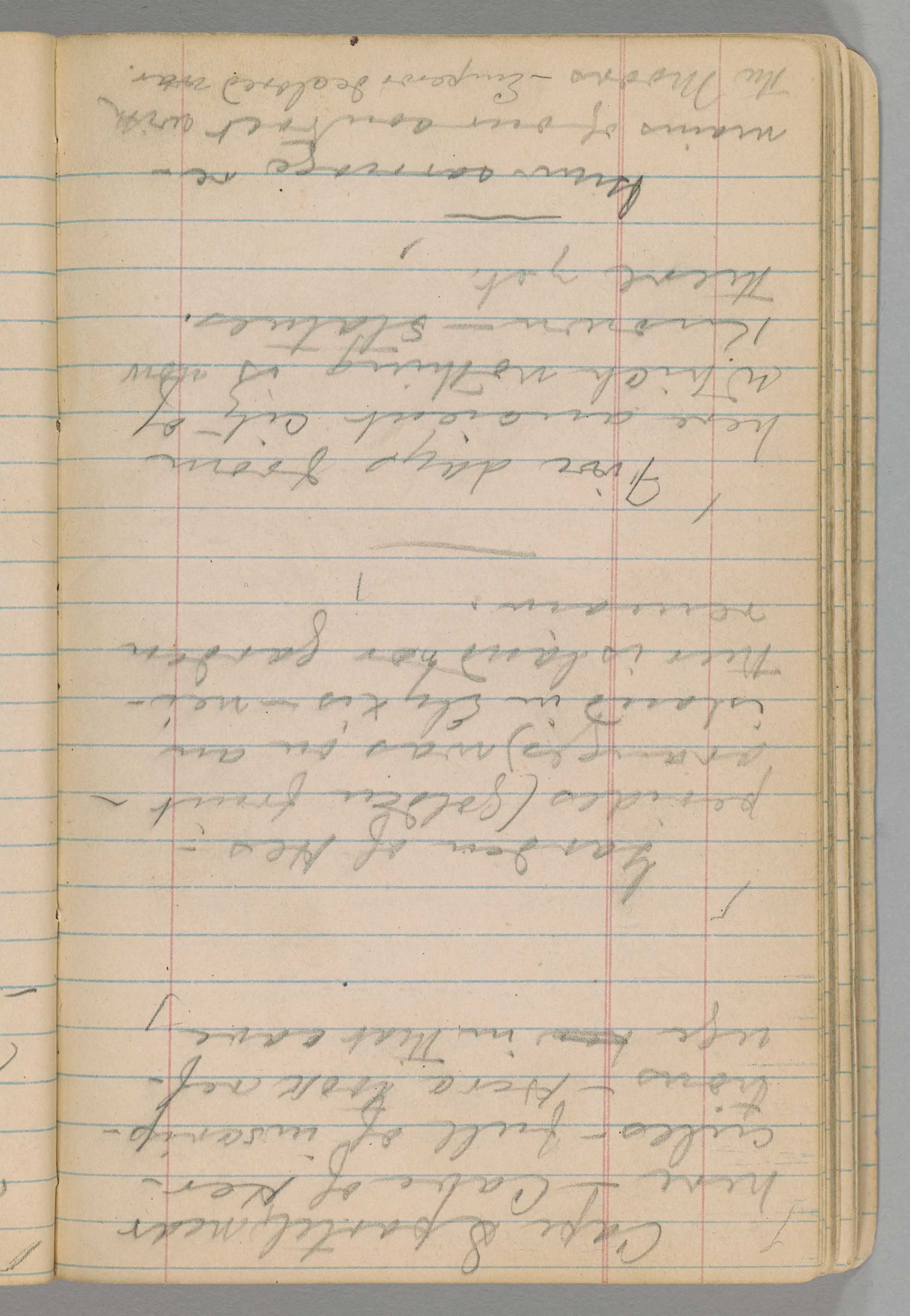
[MS: N8_leaf_051v]
Cape Spartel, near
here—Cave of
Her-
cules
Hercules
—full of
inscrip-
tions
inscriptions
—Here took
ref-
uge
refuge
her in that cave.
[MTP: N&J1_364]
Garden of
Hes-
perides
Hesperides
(golden fruit—
oranges) was on an
island in Elyxis—
nei-
ther
neither
island nor garden
remain.
Five days from
here ancient city of
which nothing is now
known—statues.
there yet.
Gun-carriage
re-
mains
remains
of our contact with
the Moors—Emperor declared war.
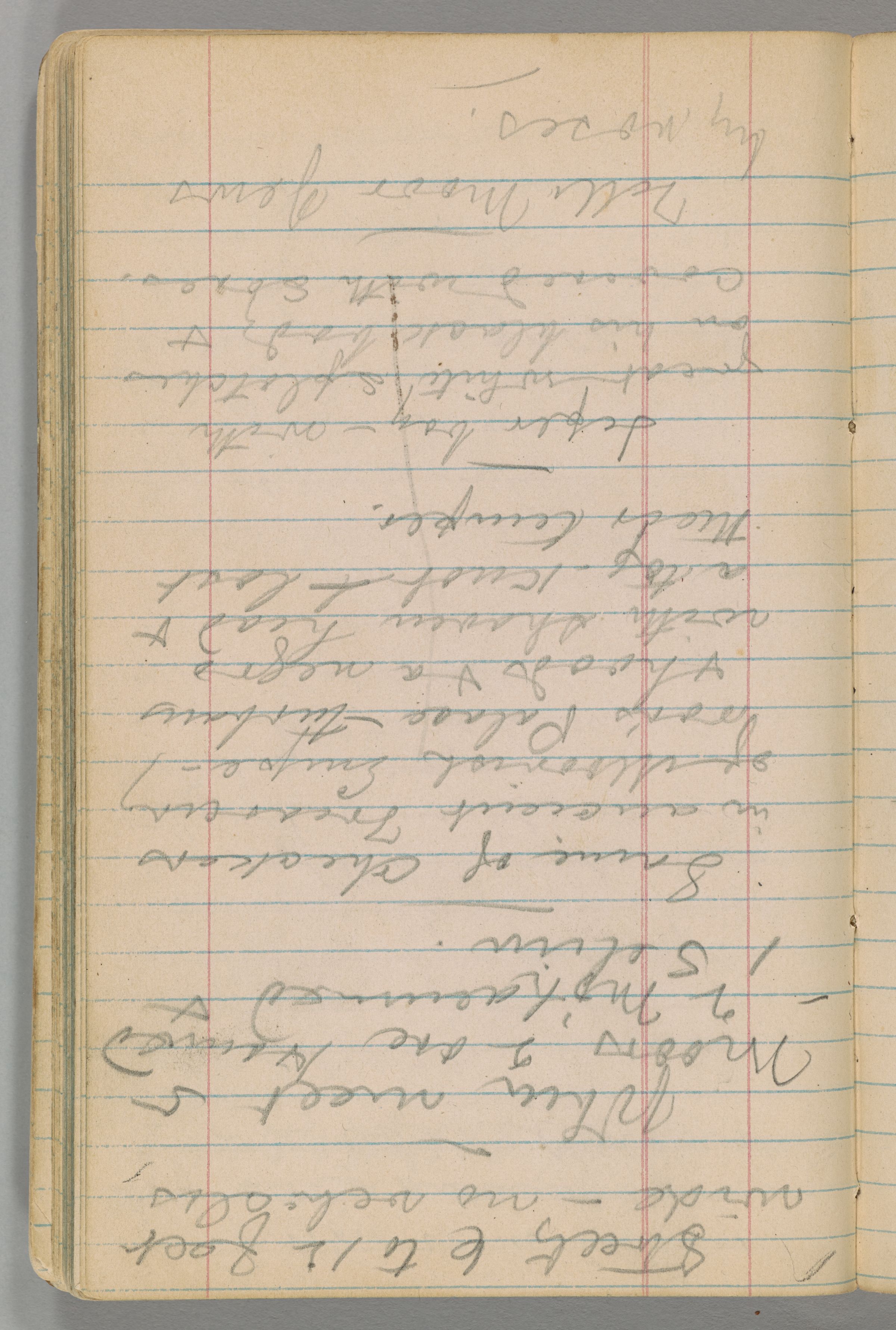
[MS: N8_leaf_052r]
Streets 6 to 12 feet
wide—no vehicles
When meet 5
Moors, 2 are Haemed
—2 Mohaemmed &
1 Selim.
Game of checkers
in ancient Treasury
of Moorish
Empe-
ror's
Emperor's
Palace—turbans
& hoods & a negro
with shaven head &
a top-knot—lost
their temper.
Leper boy—with
great white splotches
on his black body &
covered with sores.
Tell Moor Jews
by noses.
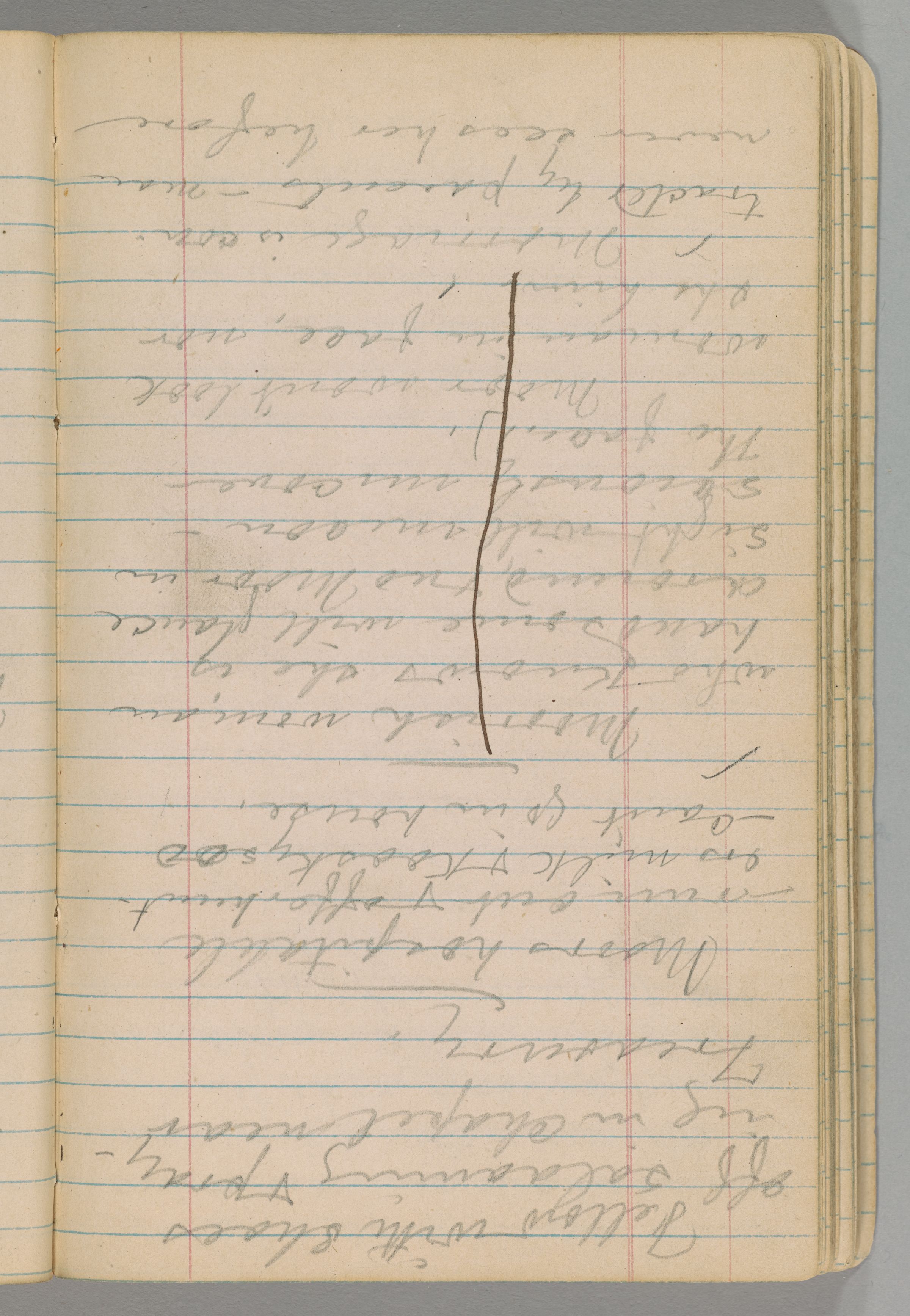
[MS: N8_leaf_052v]
Fellow with shoes
off salaaming &
pray-
ing
praying
in chapel near
Treasury.
Moors hospitable
—run out & offer
hunt-
ers
hunters
milk & kooskysoo
—can't go in house.
Moorish woman
who knows she is
handsome will glance
around, & no Moor in
sight will
uncon-
ciously
unconsciously
uncover
the face.).
Moor won't look
woman in face, nor
she him.
[MTP: N&J1_365]
Marriage is
con-
tracted
contracted
by parents—man
never sees her before
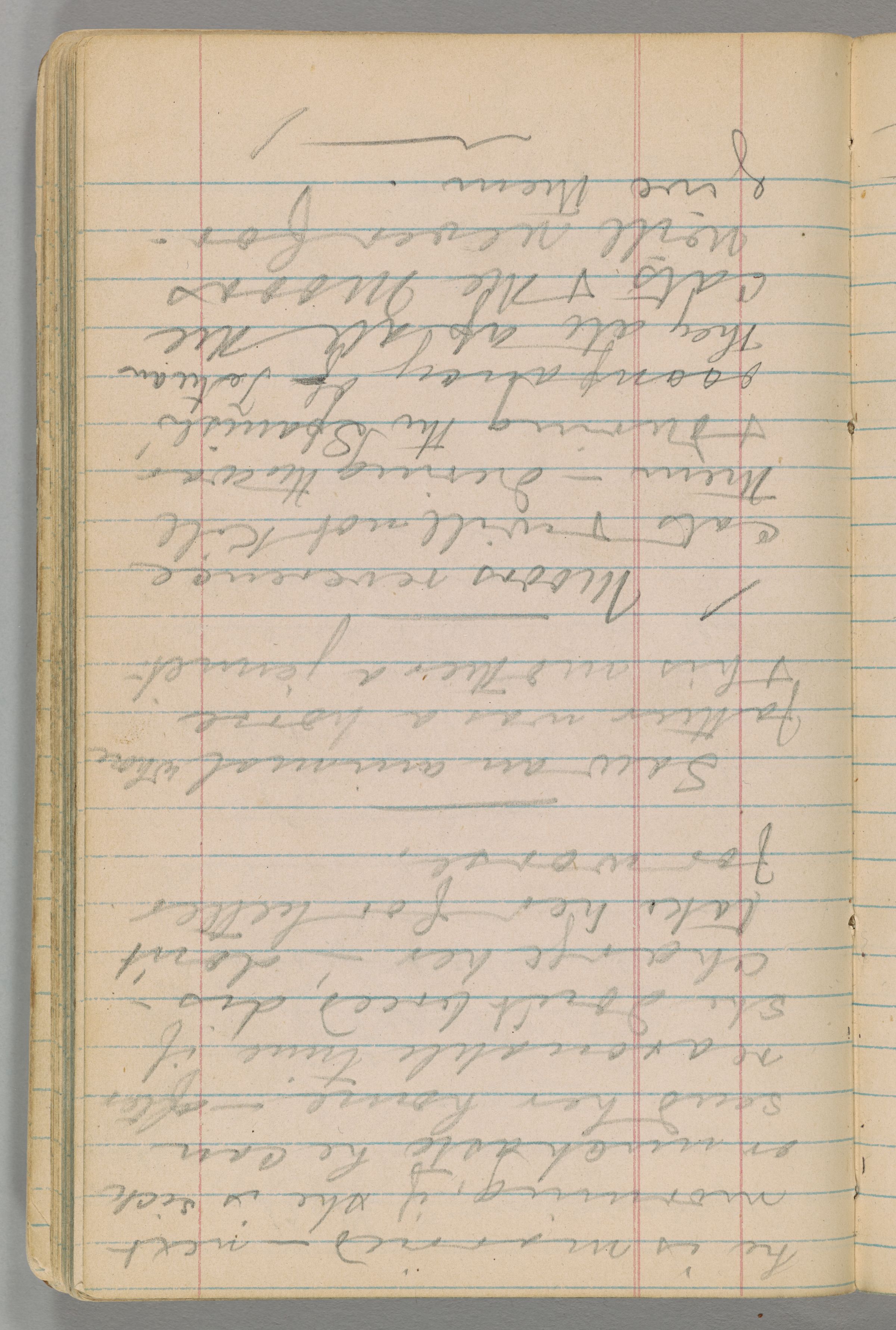
[MS: N8_leaf_053r]
he is married—next
morning, if she is sick
or unchaste he can
send her home—after
reasonable time if
she don't breed,
dis-
charge
discharge
her—don't
take her for better
for worse.
Saw an animal whose
father was a horse
& his mother a jennet.
Moors reverence
cats & will not kill
them—during the war,
& during the Spanish
occupancy of Tetuan
they ate up all the
cats & the Moors
will never
for-
give
forgive
them.
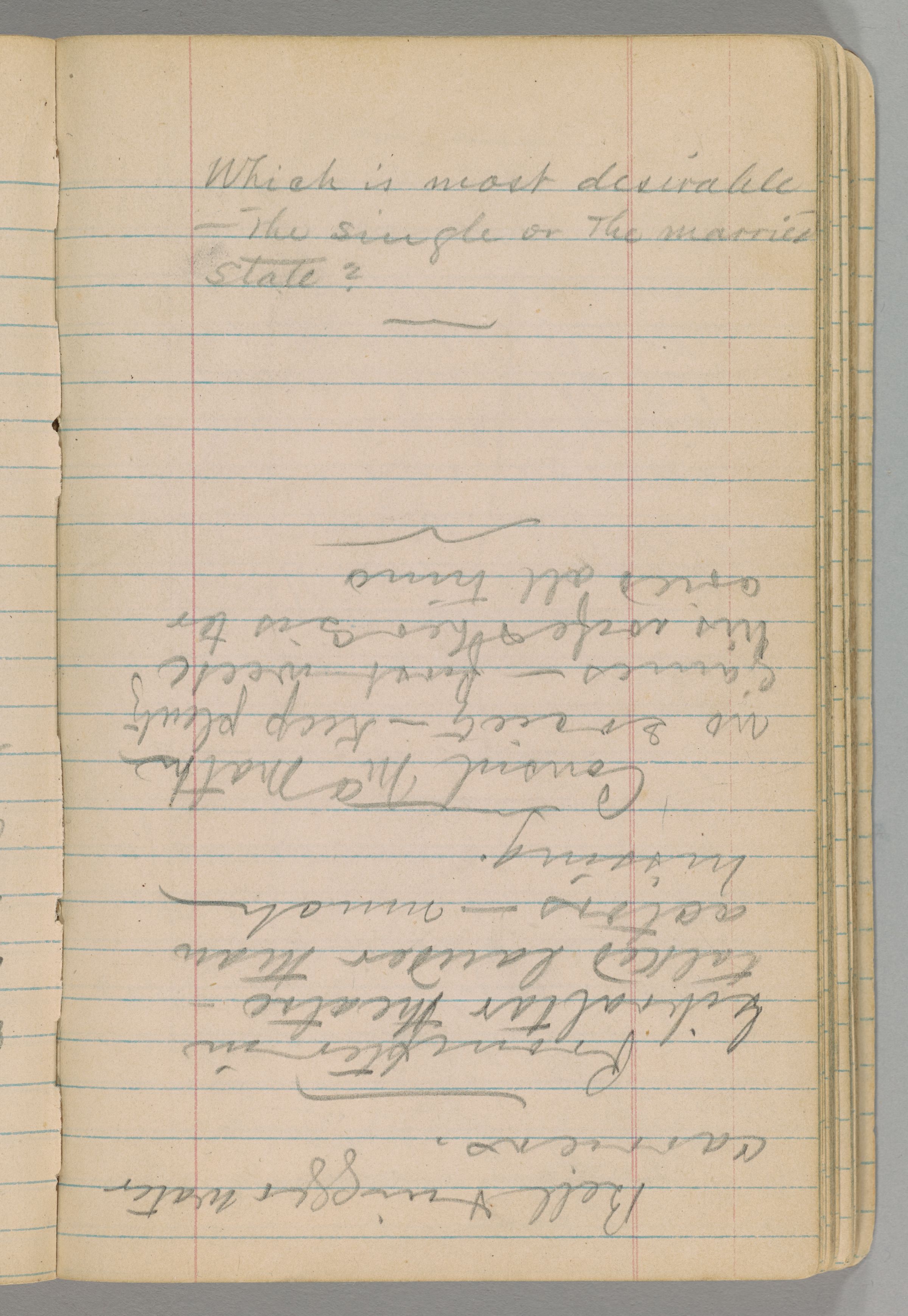
[MS: N8_leaf_053v]
Prompter in
Gibraltar theatre
—talked louder than
actors—much
hissing.
Consul McMath◊
no society—keep plenty
games—first week
his wife & her sister
cried all time.
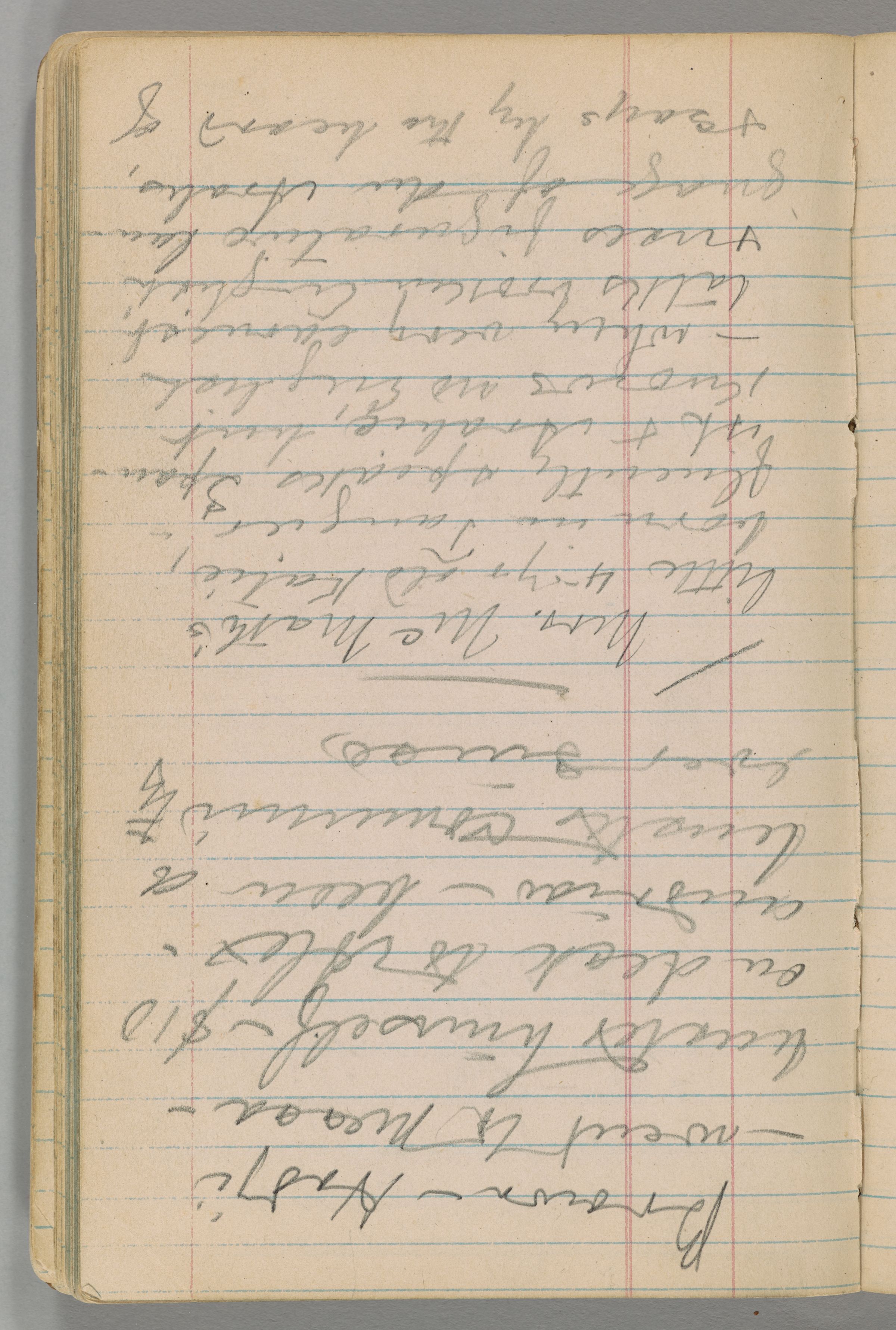
[MS: N8_leaf_054r]
Brown—Hadji
—went to Mecca—
busted himself—$10
on deck to
Alex-
andria
Alexandria
—been a
busted community
ever since.
Mrs. McMath's
little 4-yr old Katie,
born in Tangier,—
fluently speaks
Span-
ish
Spanish
& Arabic, but
knows no English
—when very earnest,
talks broken English
& uses figurative
lan-
guage
language
of the Arabs,
& says by the beard of
this page continues on leaf 55r below
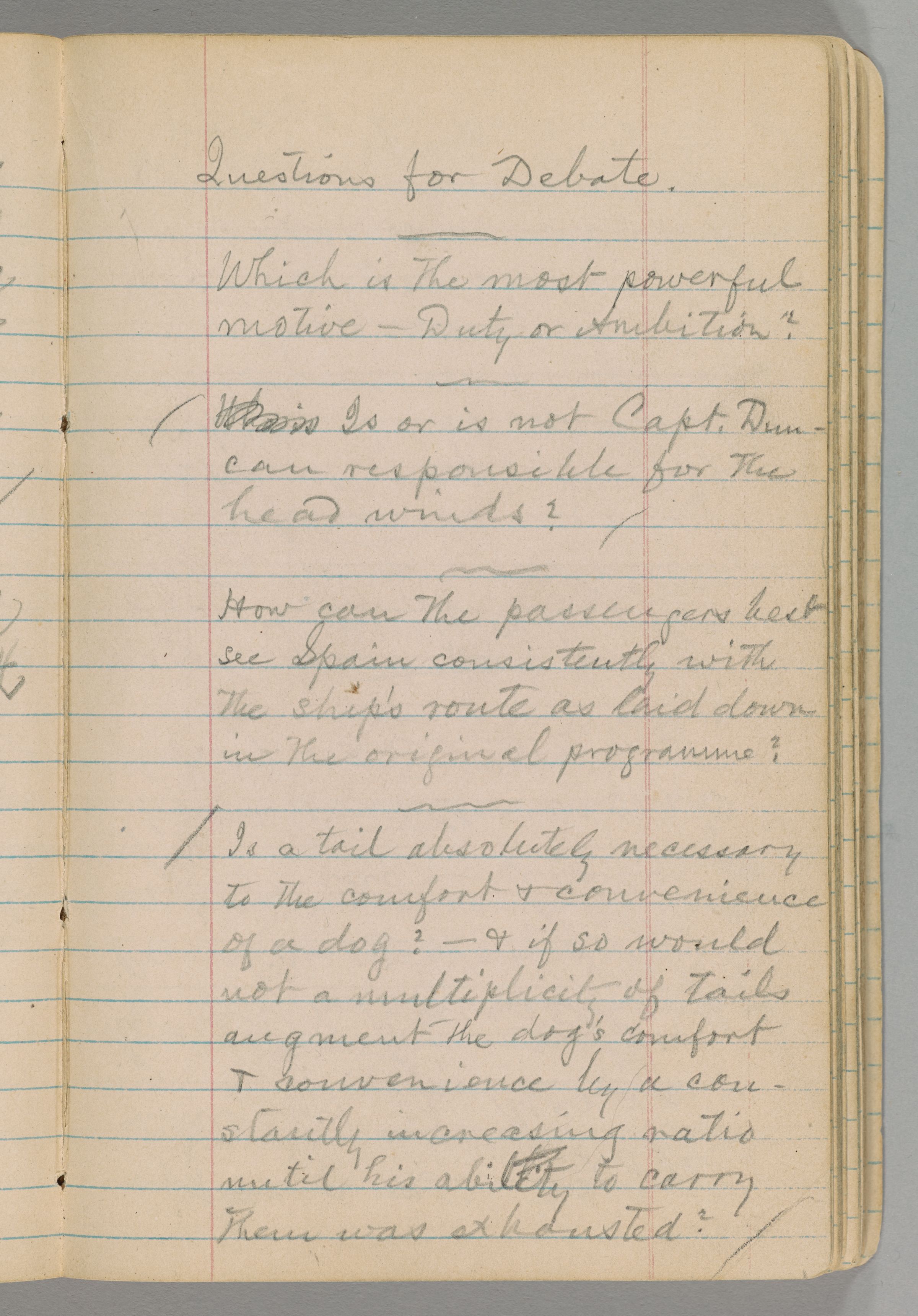
[MS: N8_leaf_054v]
this page is inscribed upside down in relation to the other pages in this sequence; it is not continuous with the preceding or following pages, except for the question at the bottom of leaf 053v
Which is the most powerful
motive—Duty or Ambition?
Who is Is or is not Capt.
Dun-
can
Duncan
responsible for the
head winds?
How can the passengers best
see Spain consistently with
the ship's route as laid down
in the original programme?
Is a tail absolutely necessary
to the comfort & convenience
of a dog?—& if so would
not a multiplicity of tails
augment the dog's comfort
& convenience by a
con-
stantly
constantly
increasing ratio
until his abillity to carry
them was exhausted?
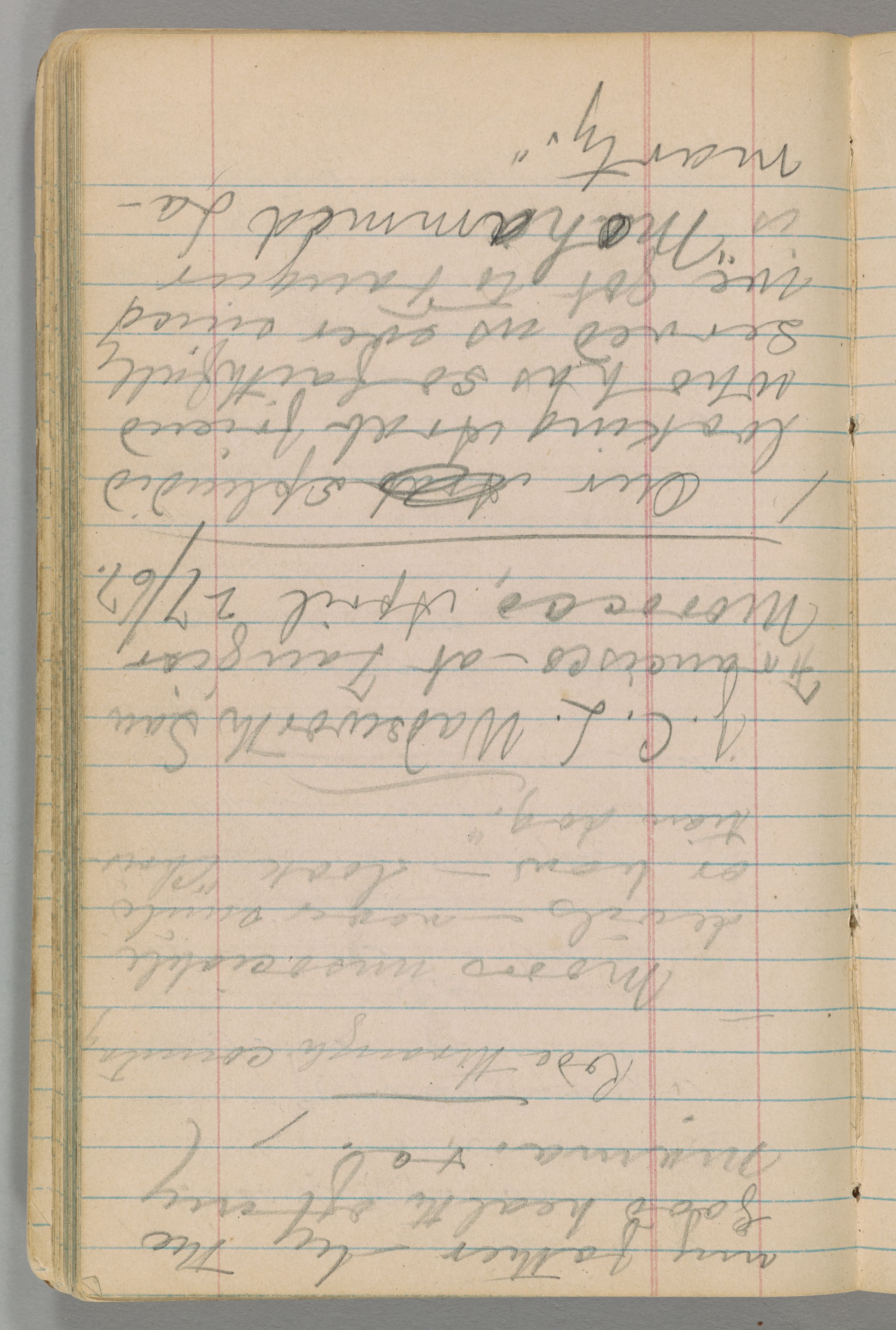
[MS: N8_leaf_055r]
this page resumes the entry on leaf 054r above
my father—by the
good health of my
mama, &c.
Rode through country
—
Moors unsociable
devils—never smile
or bow—look “
Chris-
tian
Christian
dog.”
[MTP: N&J1_366]
J. C. L. Wadsworth, San
Francisco—at Tangier,
Morocco, April 27/67.
Our Arab splendid
looking Arab friend
who has so faithfully
served us ever since
we got to Tangier
is “Mohammed
La-
marty
Lamarty
.”
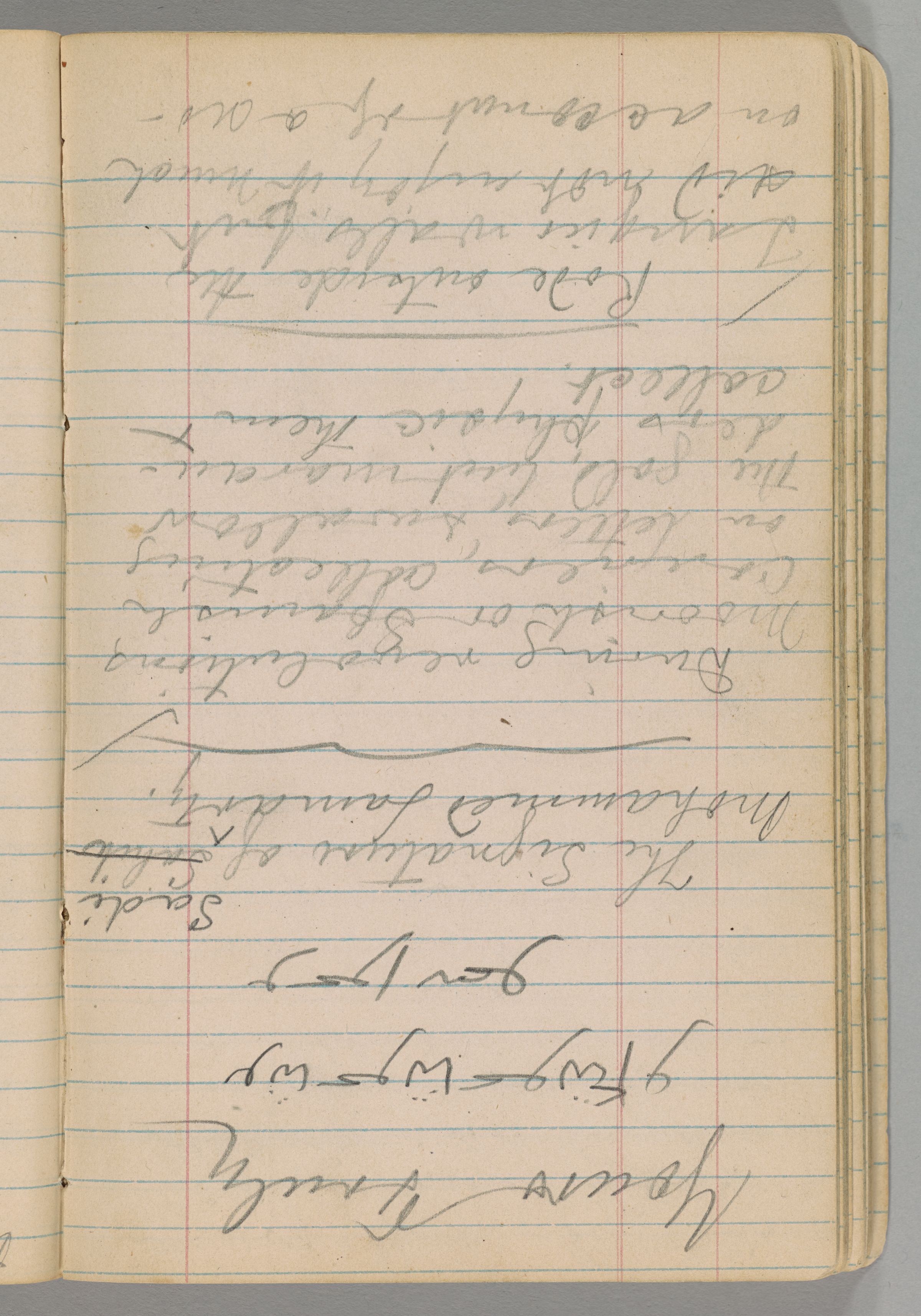
[MS: N8_leaf_055v]
Yours Truly
signature (see facsimile)
The Signature of Sahib
Sadi
Mohammed Lamarty.
During revolutions,
Moorish or Spanish
couriers, collecting
on letters, swallow
the gold, but
marau-
ders
marauders
physic them &
collect.
Rode outside the
Tangier walls, but
&did not enjoy it much
on account of a no-
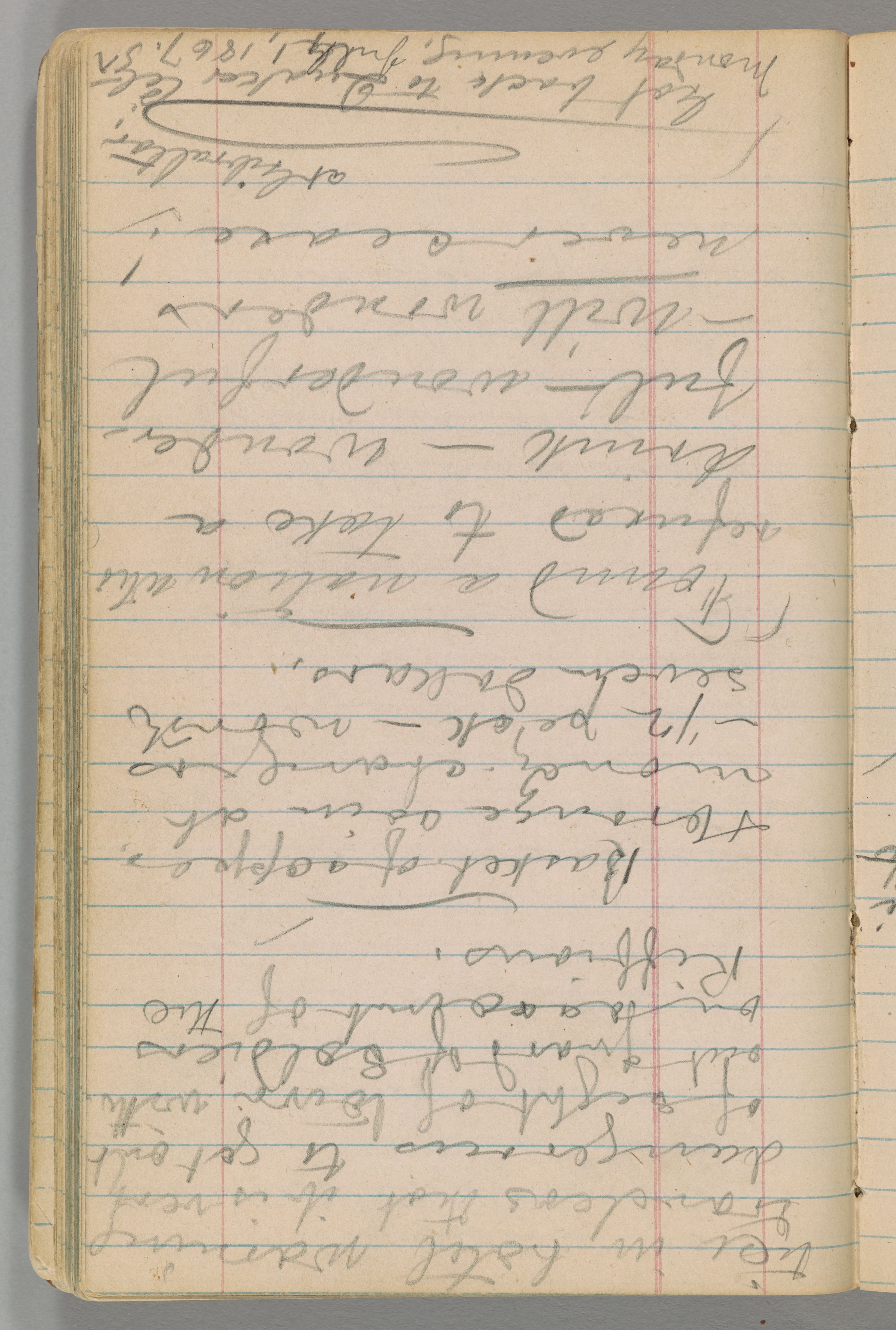
[MS: N8_leaf_056r]
tice in hotel warning
travelers that it is very
dangerous to get out
of sight of town
with-
out
without
guard of soldiers
on account of the
Riffians.
[MTP: N&J1_367]
Basket of copper,
& bronze coin at
money-changers
—½ peck—worth
seven dollars.
Found a nation who
refused to take a
drink—
wonder-
ful
wonderful
—wonderful
—will wonders
never cease!
Got back to Quaker City at Gibraltar,
Monday evening, Junely 1, 1867.
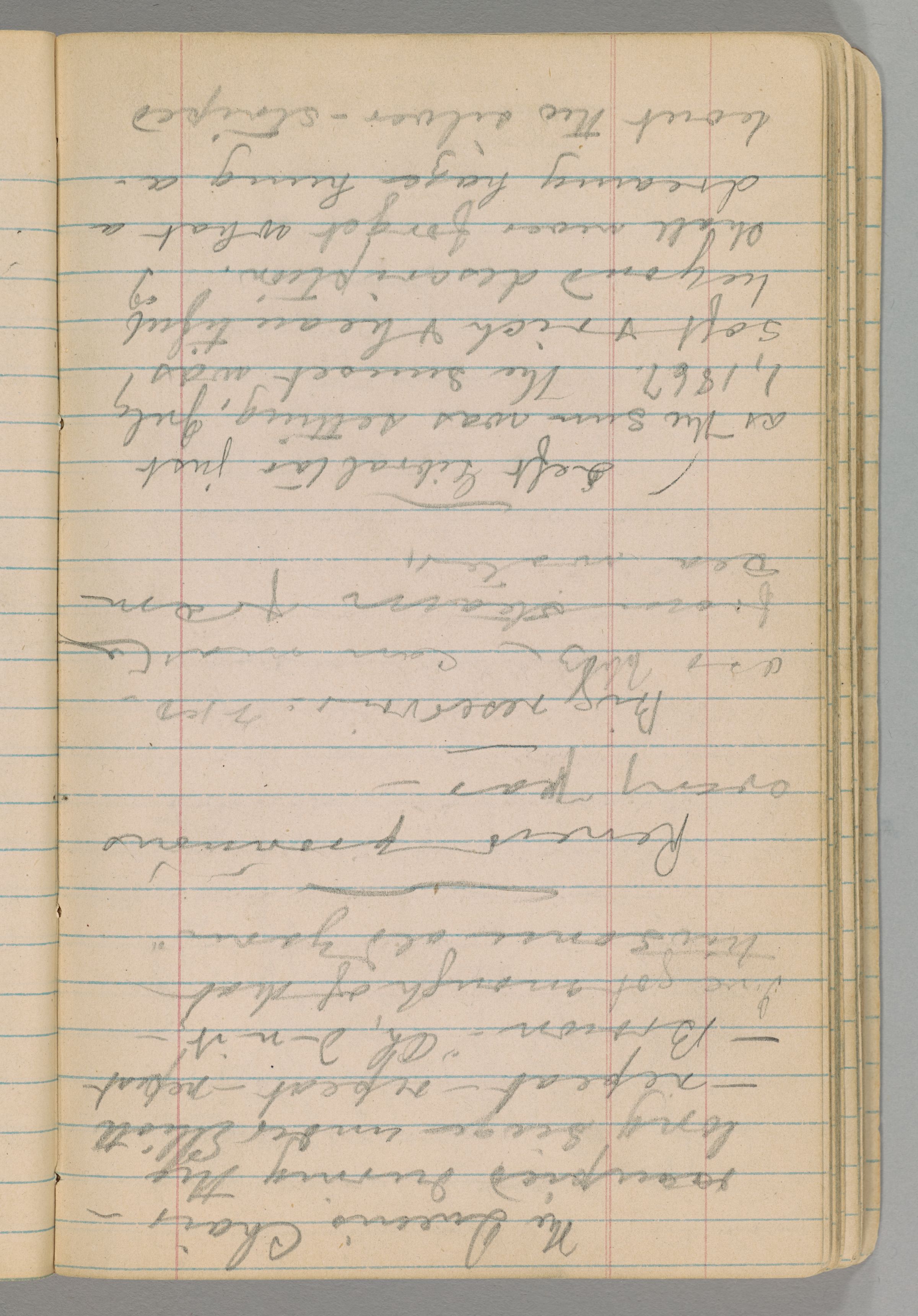
[MS: N8_leaf_056v]
The Queen's Chair—
occupied during the
long siege under Elliott
—repeat—repeat—repeat
—Brown. “Oh, d—n it,—
I've got enough of that
tiresome old yarn”
Renew provisions
every year—
Big reservoir:
210-
000
210000
bbls—can make
from steam from
sea water.
Left Gibraltar just
as the sun was setting, July
1, 1867. The sunset was
soft & rich & beautiful
beyond description. I
shall never forget what a
dreamy haze hung
a-
bout
about
the silver-striped
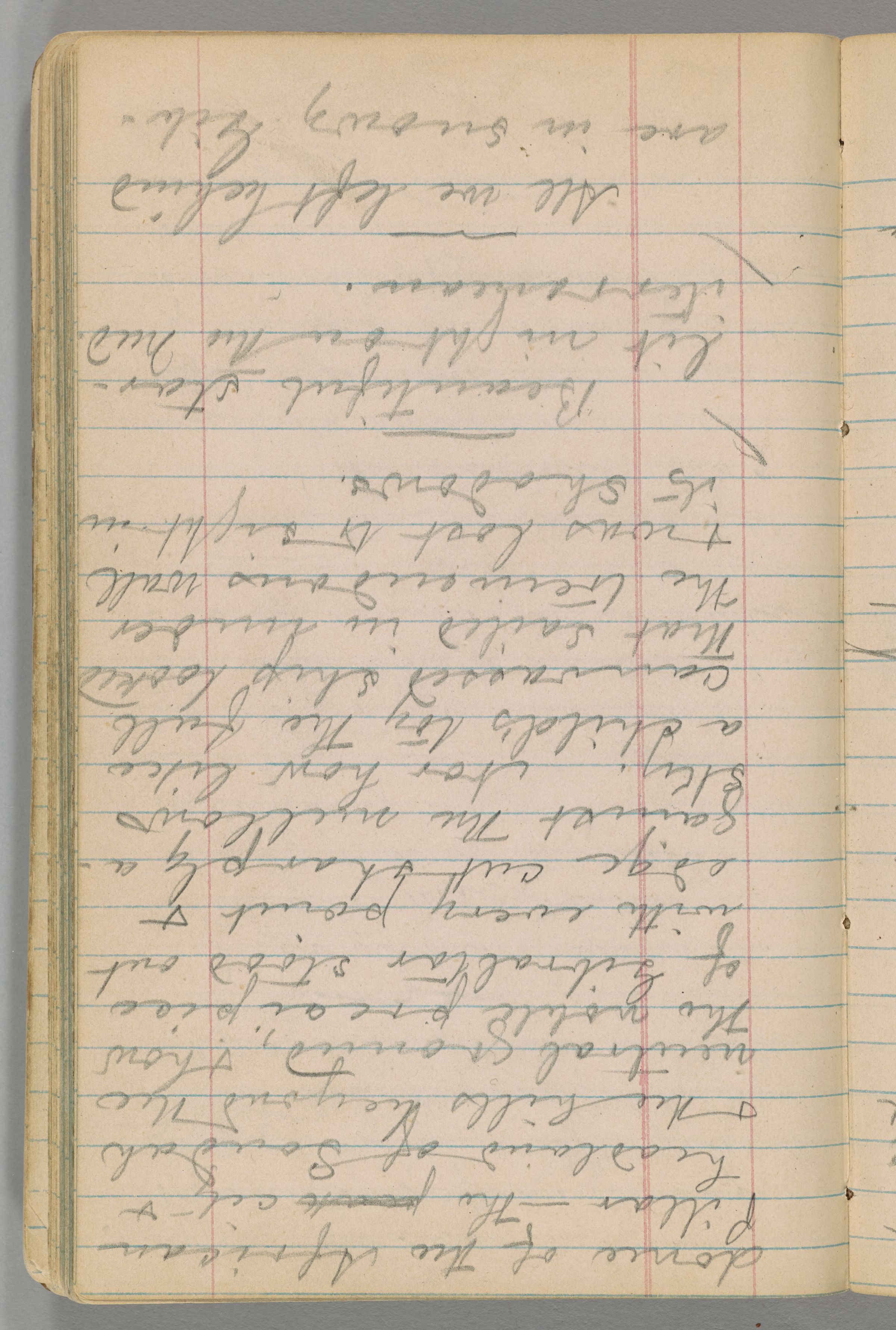
[MS: N8_leaf_057r]
dome of the African
Pillar—the peak city &
headland of Soudah
& the hills beyond the
neutral ground, & how
the noble precipice
of Gibraltar stood out
with every point &
edge cut sharply
a-
gainst
against
the mellow
sky. Nor how like
a child's toy the full
canvassed ship looked
that sailed in under
the tremendous wall
& was lost to sight in
its shadows.
Beautiful star-
lit night on the
Med-
iterranean
Mediterranean
.
All we left behind
are in snowy Gib-
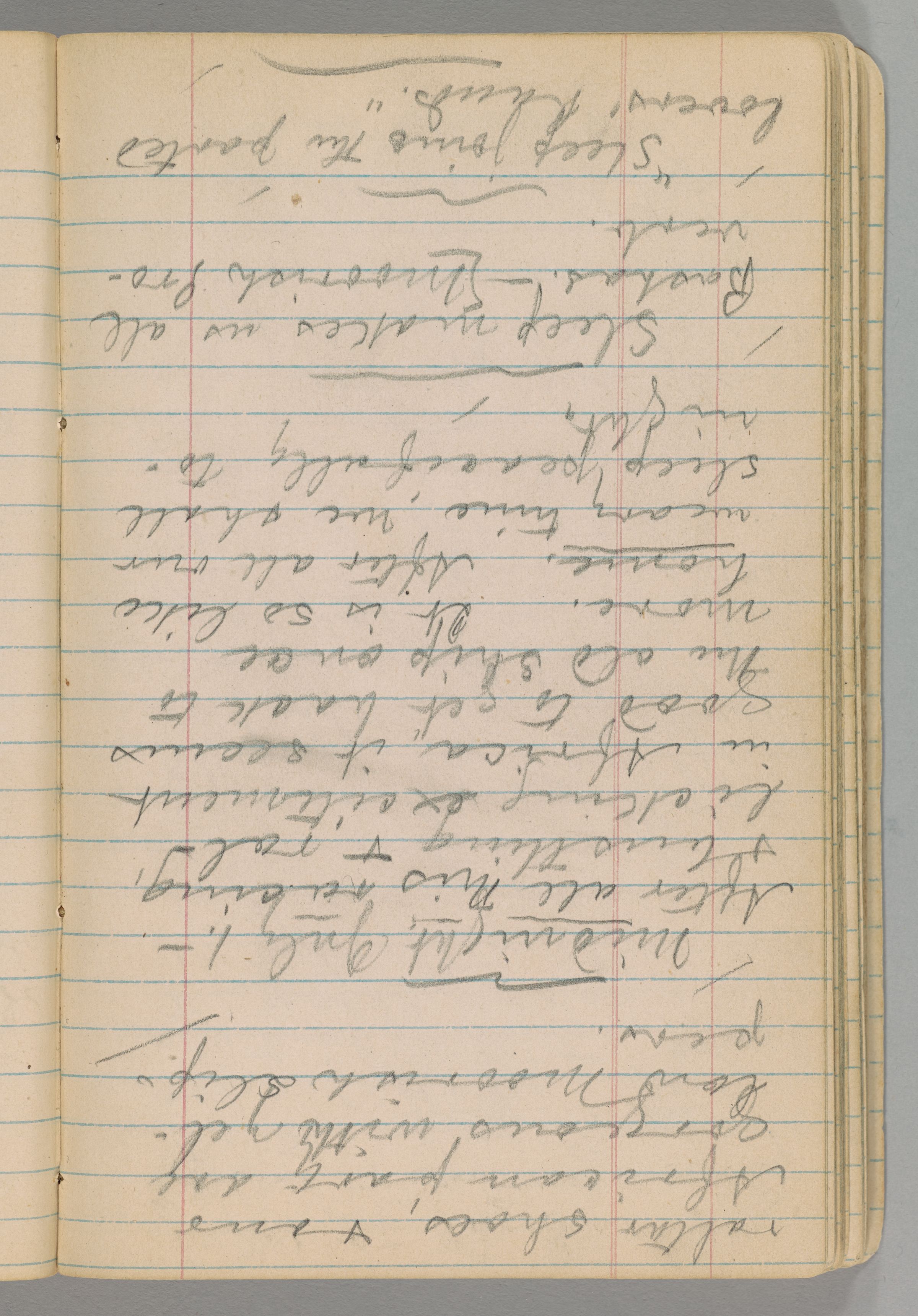
[MS: N8_leaf_057v]
raltar shoes, & our
African party are
gorgeous with
yel-
low
yellow
Moorish
slip-
pers
slippers
.
Midnight, July 1.—
After all this racing,
& bustling &
rol-
licking
rollicking
excitement
in Africa, it seems
good to get back to
the old ship once
[MTP: N&J1_368] more. It is so like
home. After all our
weary time, we shall
sleep peacefully to-
night.
Sleep makes us all
Bashas.—⟦Moorish
Pro-
verb
Proverb
.
“Sleep joins the parted
lovers' hands.”
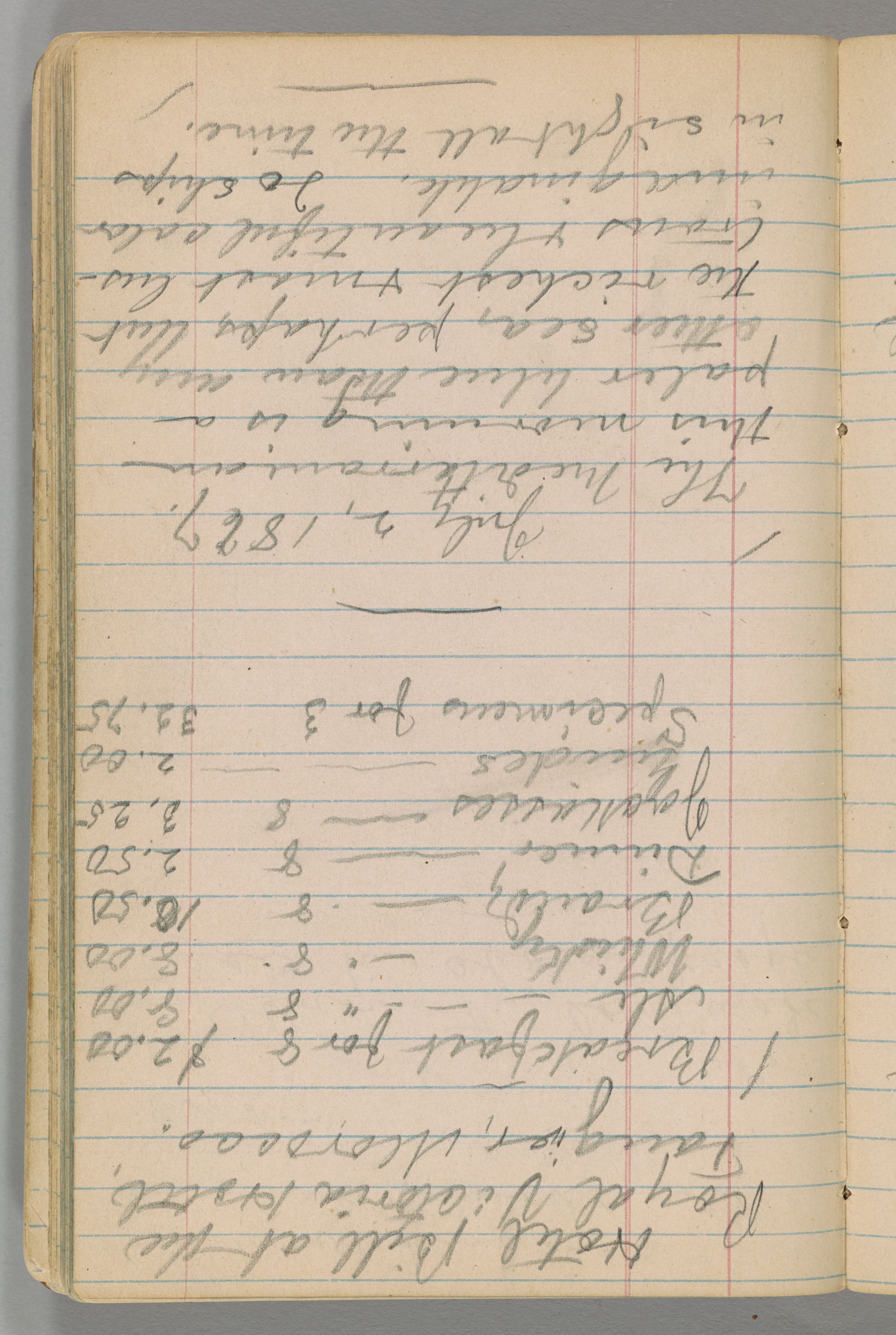
[MS: N8_leaf_058r]
Hotel Bill at the
Royal Victoria Hotel,
Tangier, Morocco.
| Breakfast for | 8 | $2.00 |
| Ale for | 8 | 8.00 |
| Whisky for | 8 | 8.00 |
| Brandy for | 8 | 8 10.50 |
| Dinner | 8 | 2.50 |
| Jackasses | 8 | 3.25 |
| Guides | 2.00 | |
| Specimens for | 3 | 32.75 |
The Mediterranean
this morning is a
paler blue than any
other sea, perhaps, but
the richest & most
lus-
trous
lustrous
& beautiful color
imaginable. 20 ships
in sight all the time.
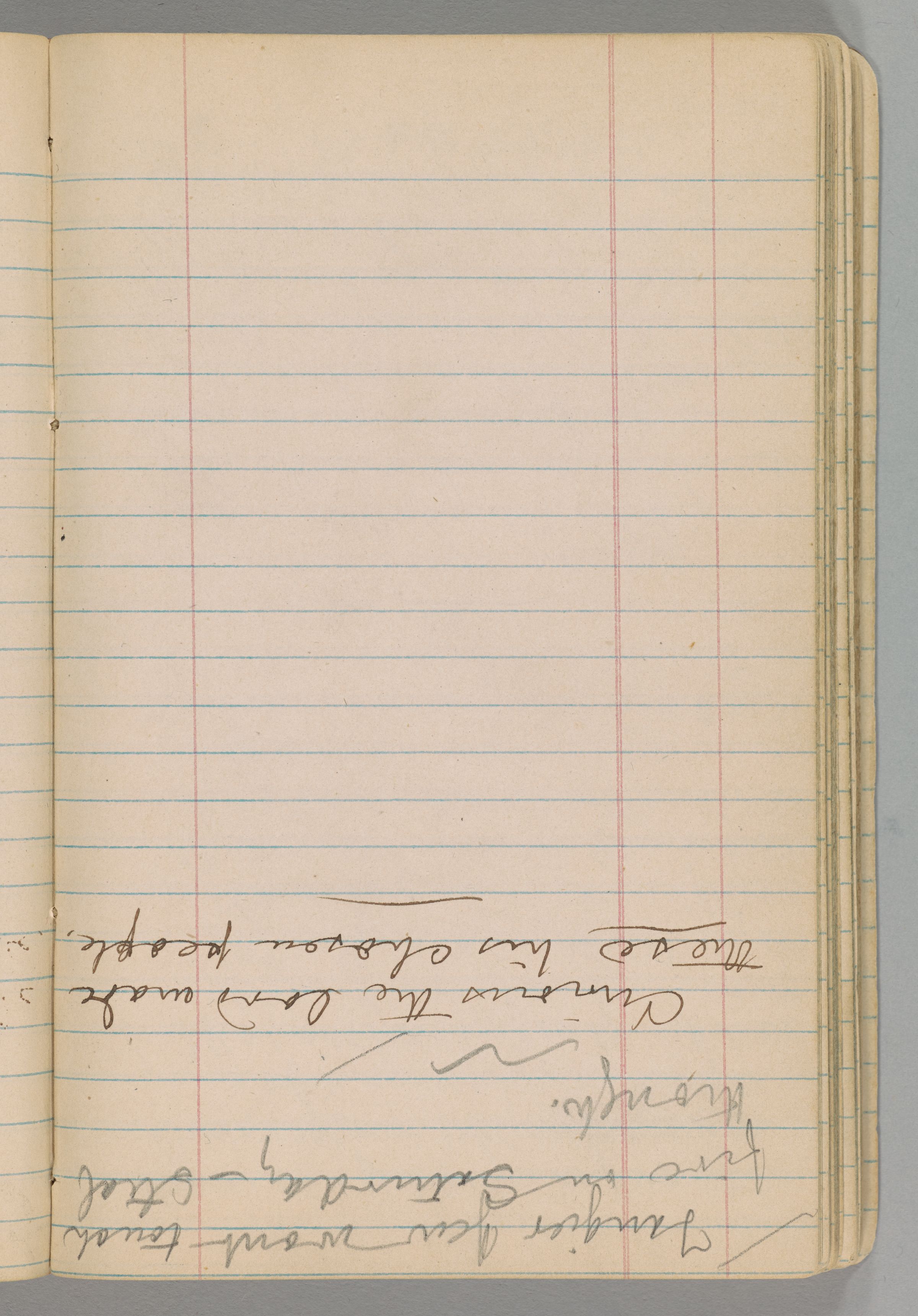
[MS: N8_leaf_058v]
Tangier Jew wont touch
fire on Saturday—steal
though.
Curious the lord made
these his chosen people.
In his letter to the Alta dated 19 May Clemens reported that he had visited the establishment of “Messrs. Perkins, Stern & Co., which is the New York department of the Kohler & Frohling house in San Francisco. . . . California wine is destined to become a very important article of trade, and the firm I speak of hope to get it all into their own hands eventually” ( MTTB , pp. 192–193). The firm was exhibiting California wines at the Paris Exposition, and their “request” may have been for some publicity through his letters to the Alta California. The heading “Paris Exposition.” was added later than the original entry.
Beginning here, Clemens wrote the entries through “Tangier . . . o” (p. 328.27) at different times on the back endpaper and facing side of the flyleaf.
On 27 June Mrs. Severance remarked that there were
at least a dozen correspondents for different papers: Mrs. Fairbanks, “Cleveland Herald”; Mr. Crocker, “Cleveland Leader”; Mr. Foster, “The Pittsburgh Dispatch”; Mr. Clemens, “The California Alta” and “The New York Tribune”; Mr. Beach, “The New York Sun”; Mr. Sanford (I think) for a Granville Ohio paper; Dr. Jackson for one in Philadelphia the Monroe County (Pa.) Democrat ; Mr. Bullard for one in Boston; Dr. Hutchinson for one in St. Louis. Captain Duncan urged me very strongly to write for him a letter which he had promised to send to the “Independent,” and I have done so, but I confess to feeling poorly satisfied with my effort.” ( JLS , p. 33)
In addition, Stephen M. Griswold and William E. James both wrote occasional letters for the Brooklyn Daily Eagle; John G. Isham for the Cincinnati Commercial; Julius Moulton for the Saint Louis Missouri Republican, and Julia Newell for the Janesville (Wis.) Gazette. Only Mrs. Fairbanks, Moses Beach, and Julia Newell were as regular as Mark Twain in their correspondence, and no one wrote as much as he did. But the initial excitement of the Azores must have fired the ambitions of less experienced journalists, whose interest waned as the journey progressed.
” continuing into the right margin. When he came to write his 30 June Alta letter from Gibraltar, he described the African hills in his first paragraph: “their bases vailed in a blue haze and their summits swathed in clouds—the same being according to Scripture, which says that ‘clouds and darkness are over the land.’ The words were spoken of this particular portion of Africa, I believe” ( TIA , p. 18). Clemens may have had Exodus 14:20 in mind, but the “cloud and darkness” mentioned there of course refer to a different part of Africa: Moses stretched forth his hand “that there may be darkness over the land of Egypt” (Exodus 10:21).