(August—December 1867)
Notebook 10 was used by Clemens intermittently and somewhat erratically between mid-August 1867 and the end of that year. It contains entries related to the Quaker City trip and entries made during Clemens' subsequent brief stint in Washington as a newspaper correspondent.
It is clear that Clemens originally intended to use Notebook 10 as a portable reference guide during his travels in the Holy Land. Some time before he reached Beirut, he compiled the two extensive lists in this notebook: one, a skeleton list of biblical references, providing chapter and verse information for a number of Holy Land localities which Clemens supposed he might be visiting (pp. 458.6–469.15); the second, a day by day itinerary for his Holy Land travels, including detailed historical and geographical notes (pp. 469.16–485.11). The background notes in the projected itinerary are extracted from the second volume of the Reverend David A. Randall's The Handwriting of God in Egypt, Sinai, and the Holy Land (Philadelphia: John E. Potter and Co., 1862). Some of the notes are paraphrased from Randall's work, but the majority of them are quoted exactly, with a few irreverent parenthetical intrusions by Clemens. He had apparently read widely, if somewhat skeptically, among the books in the ship's library as the Quaker City approached Beirut. He mentions his researches in his letter of 5 September 1867 to the Alta California from Smyrna: “The ship is full of books concerning the Holy Land, and holy places . . . and you cannot be surprised to know that I have read whole volumes of the far-fetched conclusions of these curious prophecy-fulfillers” (TIA, p. 166). In one of his final letters to the Alta (TIA, p. 303), Clemens names the books in the Quaker City's library. Curiously, Randall's Handwriting of God, from which he drew so extensively, is not mentioned—unless it is the mythical “ ‘Dusenberry's Researches’ ” of Clemens' letter.
Upon arriving in Beirut, Clemens decided to make a longer, more difficult overland trip to Jerusalem than originally planned. This change in itinerary forced him to bypass several intended stops and to hurry through many others, so that most of the information in Notebook 10 became useless to him. There is little specific historical or biblical information in the Alta letters that Clemens wrote while actually traveling through the Holy Land (TIA, pp. 178–193)—rather, they contain a lively personal narrative drawn from the daily account of the trip in Notebook 9. It is only in the additional Holy Land letters which he composed some time after leaving Alexandria (TIA, pp. 193–306), when his recollections were no longer fresh, that Clemens' reliance on his background notes becomes apparent. In particular, his letters on Nazareth, Jacob's Well, and Joseph's Tomb (TIA, pp. 248–253, 260–266) draw upon the information, and even the language, of the notes in this notebook.
Notebook 10 contains two other sets of entries relating to the Quaker City excursion. The notes labeled “Holy Land.” (pp. 485.12–486.19), apparently written when Clemens was in Jerusalem at the end of September, are a very brief continuation of the daily account of the trip in Notebook 9. In the middle of the notebook, preceded and followed by several blank pages, there is a page and a half of notes, apparently a fragment of a comic situation intended for a play about the Quaker City voyage. The fragment (p. 487.1–14) cannot be dated precisely in relation to the other entries in this notebook; however, Clemens probably sketched the comic scene shortly after the return of the Quaker City to America. Clemens did not incorporate the notebook fragment into the manuscript of his unfinished play, The Quaker City Holy Land Excursion.
The Quaker City docked in New York on 19 November 1867. By 22 November Clemens was in Washington ready to assume his post as secretary to Senator William M. Stewart of Nevada. Clemens had written to his family from Naples on 9 August 1867 that he had just accepted Stewart's “private secretaryship in Washington next winter.” Clemens expected that this job, while providing him only a modest salary, would allow him time for literary work. He wrote to his friend Frank Fuller on 24 November 1867: “There is no question about that I have solemly yielded up my liberty for a whole session of Congress.—enrolled my name on the regular Tribune staff, made the Tribune bureau here my headquarters, taken correspondences for two other papers and one magazine” (Collection of Mrs. Robin Craven, New York City). In addition to his New York Tribune letters, Clemens would be writing “special correspondence” for the Alta and the Territorial Enterprise, as well as occasional pieces for several other journals.
Clemens felt that this newspaper work would put his reputation on a firm footing. “If I lecture now,” he wrote Fuller, “I shall have to do it solely on the Quaker City's fame, and take many, very many chances—chances that might utterly dam me. If I stay here all winter and keep on hanging out my sign in the Tribune and getting well acquainted with great dignitaries to introduce me . . . I can lecture next season on my own reputation, to 100 houses, and houses that will be readier to accept me without a criticism than they are now. . . . Here in the next six months I will make . . . a reputation that will not be as precarious a capital as it is now, See it?”
When Clemens arrived in Washington, the Fortieth Congress was in the final days of its first session. Clemens was a frequent visitor to the Congress, gathering impressions of congressmen and congressional language and manners and making friends among the correspondents of Washington's newspaper row. Clemens' capsule impressions of various congressmen occupy several pages in the notebook. He wrote to his family on 25 November, shortly after his arrival in Washington: “Tired and sleepy—been in Congress all day and making newspaper acquaintances. . . . Am pretty well known now—intend to be better known. Am hobnobbing with these old Generals and Senators and other humbugs for no good purpose” (MTB, pp. 346–347). The few pages of Washington notes in this notebook, written in November and December 1867, are all the notebook material that survives for the period. Many of these notes were incorporated within a few weeks into Clemens' newspaper correspondence for the Alta and the Territorial Enterprise.
Clemens grew progressively restless and discontented with Washington—with its weather, its hotels, its congressional “humbugs,” and the legion of political scramblers in Washington society, whom he would later satirize in The Gilded Age. He gladly resigned from his position with Stewart and burlesqued this short-lived career in “My Late Senatorial Secretaryship” (Galaxy 5 May 1868: 633–636) and “The Facts Concerning the Recent Important Resignation” (New York Tribune, 13 February 1868). Senator Stewart presented his own rancorous recollections of his association with Clemens in his Reminiscences (New York: Neale Publishing Co., 1908, pp. 219–220):
I was seated at my window one morning when a very disreputable-looking person slouched into the room. He was arrayed in a seedy suit, which hung upon his lean frame in bunches with no style worth mentioning. A sheaf of scraggy black hair leaked out of a battered old slouch hat, like stuffing from an ancient Colonial sofa, and an evil-smelling cigar butt, very much frazzled, protruded from the corner of his mouth. He had a very sinister appearance. . . . When I first knew him he was a reporter on the Territorial Enterprise, which was otherwise a very reputable paper. . . . He went around putting things in the paper about people, stirring up trouble. He did not care whether the things he wrote were true or not, just so he could write something, and naturally he was not popular. I did not associate with him.
Stewart describes Clemens' night-long, cigar-smoking vigils and recalls having threatened his ungentlemanly clerk with a “thrashing.” Despite this uneasy relationship, Clemens remained for some time: “He wrote his book in my room, and named it ‘The Innocents Abroad.’ I was confident that he would come to no good end, but I have heard of him from time to time since then, and I understand that he has settled down and become respectable” (p. 224).
By 13 December 1867, with the regular session of the Fortieth Congress hardly begun, Clemens was reconsidering his position. He wrote Fuller: “I believe I have made a mistake in not lecturing this winter. I did not suppose I was any better known when I got back than I was before I started—but every day I find additional reasons for thinking I was mistaken about that. . . . When are you coming down? I might take a ‘disgust’ any moment & sail for Cal” (Collection of Mrs. Robin Craven, New York City).
Clemens had just received an offer which made him even more impatient with his safe berth in Washington. On 1 December 1867 a letter arrived from Elisha Bliss, Jr., of the American Publishing Company in Hartford, Connecticut, proposing a venture in subscription publishing: “We are desirous of obtaining from you a work of some kind, perhaps compiled from your letters from the East, &c., with such interesting additions as may be proper. . . . If you have any thought of writing a book, or could be induced to do so, we should be pleased to see you” (MTL, p. 140). Clemens' reply was predictably prompt and enthusiastic. With the prospect of preparing a book, his restlessness in Washington grew. He wrote his family on 21 February 1868: “I was at 224 first Clemens had been rooming with Senator Stewart at 224 F Street—Stewart is there yet—I have moved five times since—shall move again, shortly. Shabby furniture & shabby food—that is Washn—I mean to keep moving” (MTBus, p. 98). Hearing that the Alta was planning book publication of the Quaker City letters, Clemens left Washington in March without regrets and sailed for California to forestall those plans.
Notebook 10 now contains 184 pages, 92 of them blank. They measure 6½ by 4 inches (16.5 by 10.2 centimeters) and are ruled with twenty-four blue horizontal lines. The edges of the pages are marbled in red, black, and gold. The endpapers and flyleaves are white. The notebook is bound in stiff tan calf. There are single computations in pencil on each of the endpapers, entries in pencil on the front flyleaf, and a computation in ink on the front cover. Someone has dated the front cover “1867” in ink. The binding is worn and loose, and a few leaves are no longer bound in. Four and one-half leaves have been torn out and are missing. With the exception of one page inscribed in orange pencil, all the entries are in black pencil. There are use marks throughout, in black pencil, blue pencil, and black ink—all of them probably by Paine.
Because Clemens did not use the pages consecutively from first to last but several times turned the notebook end-for-end and wrote from the back toward the front, the left-to-right sequence of pages does not necessarily correspond to the chronological sequence of entries. When it can be determined, chronological sequence has been preferred to physical sequence. Thus, the Quaker City entries have been grouped in the first portion of the printed text, although they actually are inscribed in various places throughout the notebook, and the several groups of Quaker City entries are themselves printed here in chronological rather than physical order. Likewise, the notes on Congress written on the front flyleaf are printed here immediately before the other Washington entries that Clemens made near the center of the notebook. All deviations from physical sequence are reported in Details of Inscription and the chronology of entries is discussed in the notes.
Clemens entered running heads throughout his notes on the Holy Land excursion. When they interrupt continuing entries, these headings are omitted from the text and are recorded as emendations.
[MS: N10_outside front cover]
1739
1867
3606Ⓣtextual note
[MS: N10_front endpaper]
6) 100.50
16.75Ⓣtextual note1
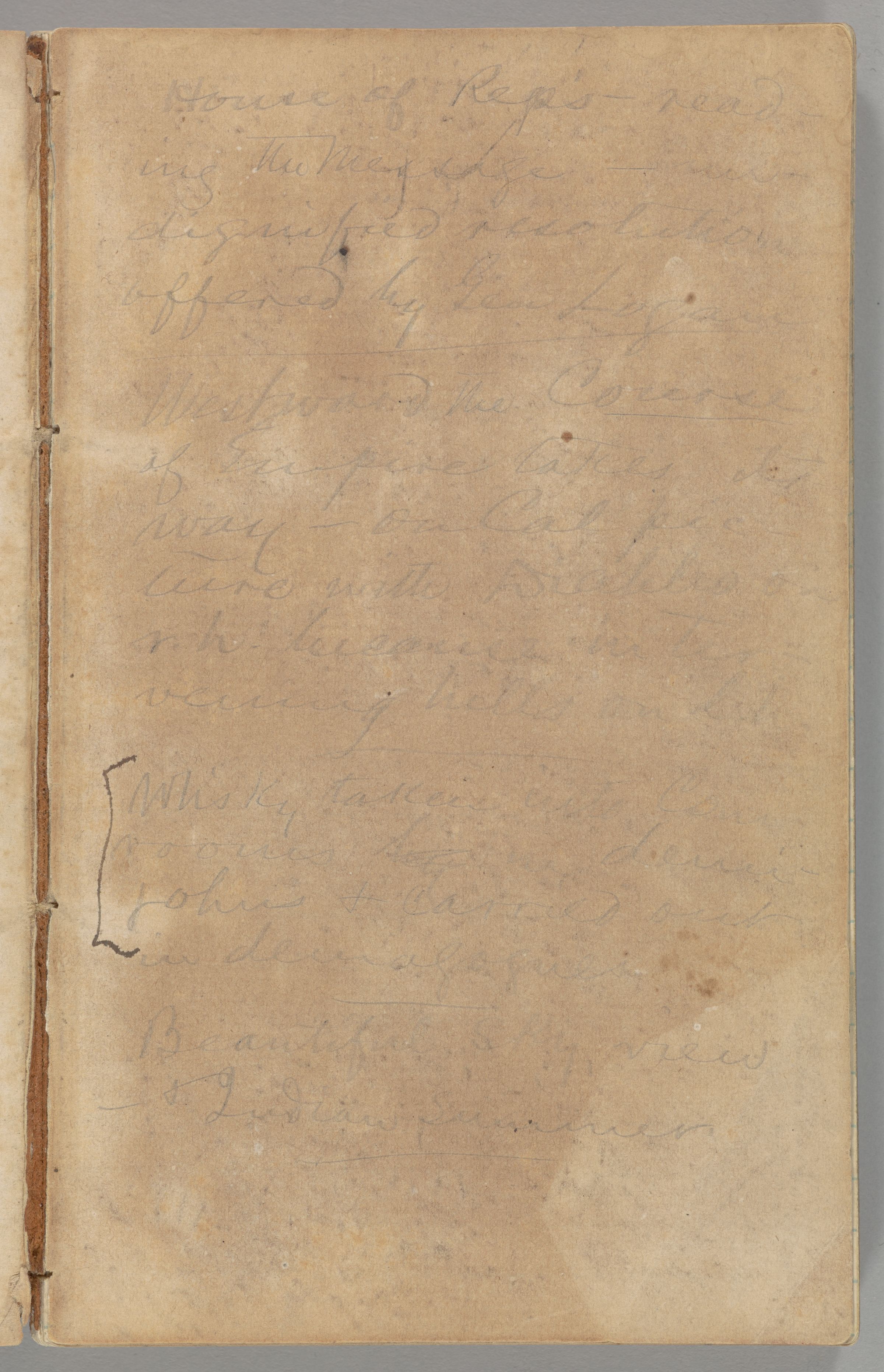
[MS: N10_front flyleaf recto]
House of Rep's—reading the Message—undignified resolution offered by Gen Logan19
Westward the Course of Empire takes its way—on Cal picture with Diablio on r. h. because intervening hills on l. h.20
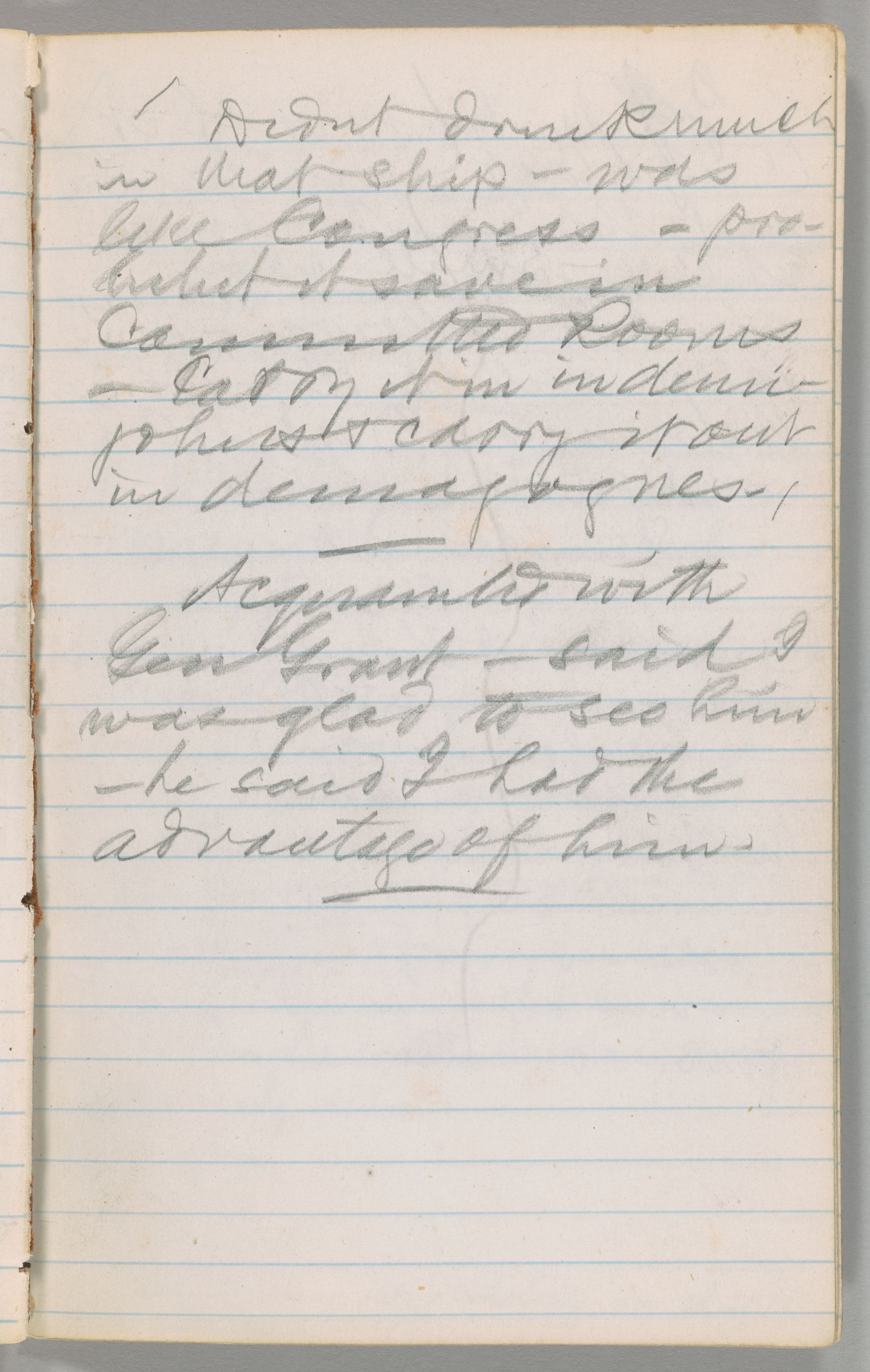
Whisky taken into Com rooms by in demijohnsⓂemendation & carried out in demagogues.
Beautiful sky, view—& Indian summer.Ⓣtextual note
[MS: N10_front flyleaf verso]
blank verso

[MS: N10_leaf_001r]
blank recto
[MS: N10_leaf_001v]
blank verso

[MS: N10_leaf_002r]
Beirut.Ⓣtextual note3

[MS: N10_leaf_002v]
blank verso
[MS: N10_leaf_003r]
Baalbec.Ⓣtextual note

[MS: N10_leaf_003v]
blank verso

[MS: N10_leaf_004r]
blank recto

[MS: N10_leaf_004v]
blank verso
[MS: N10_leaf_005r]
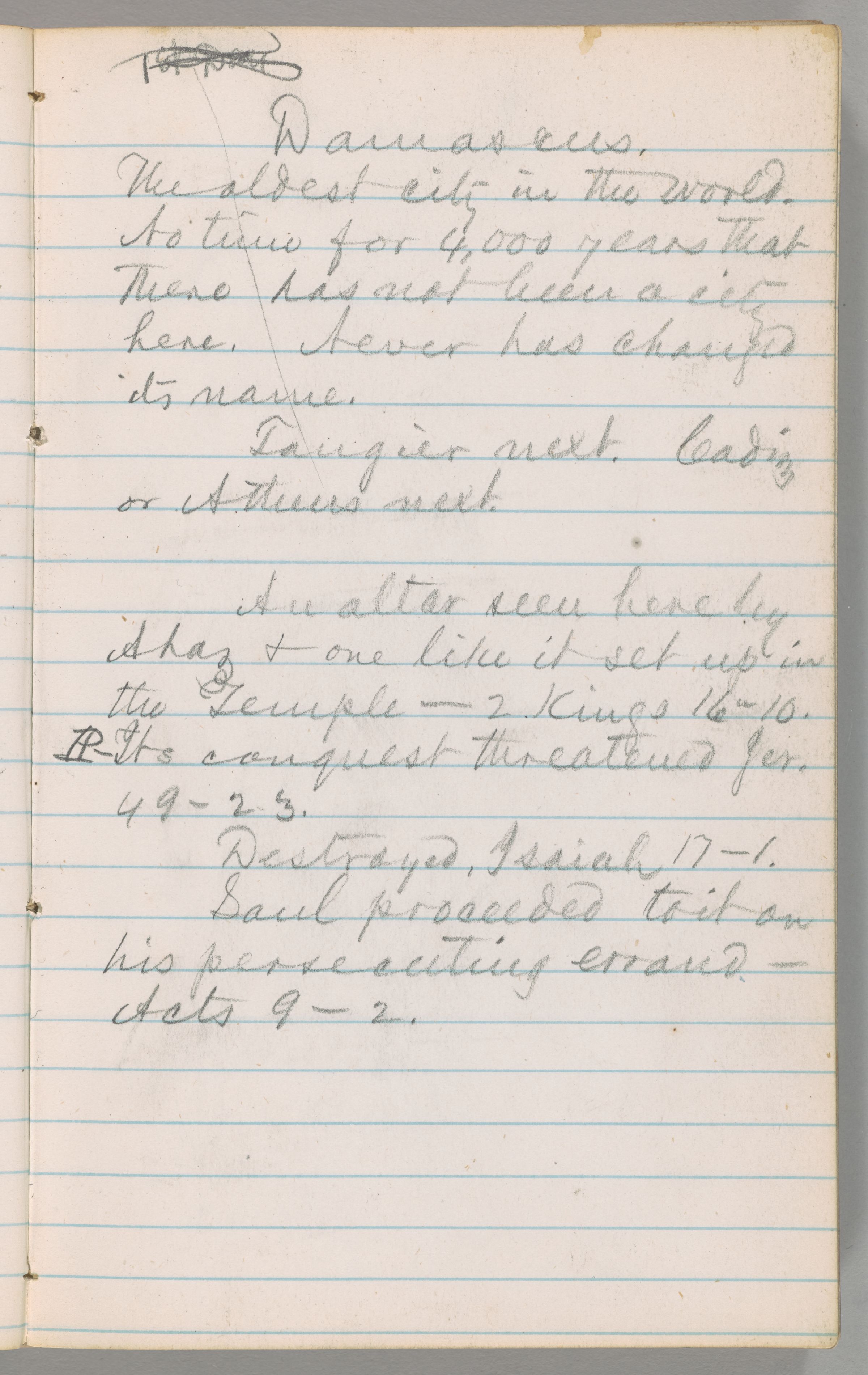
1st Day
Damascus.
The oldest city in the world. No time for 4,000 years that there has not been a city here. Never has changed its name.
Tangier next. Cadiz or Athens next.
An altar seen here by Ahaz & one like it set up in the Temple—2 Kings 16-10.
Its conquestⓉtextual note threatened Jer. 49-23.
Destroyed, Isaiah 17-1.
Saul proceeded to it on his persecuting errand—Acts 9-2.Ⓣtextual note

[MS: N10_leaf_005v]
blank verso
[MS: N10_leaf_006r]
1st D.
Kishon*Ⓣtextual note
[MS: N10_leaf_006v]
1st D
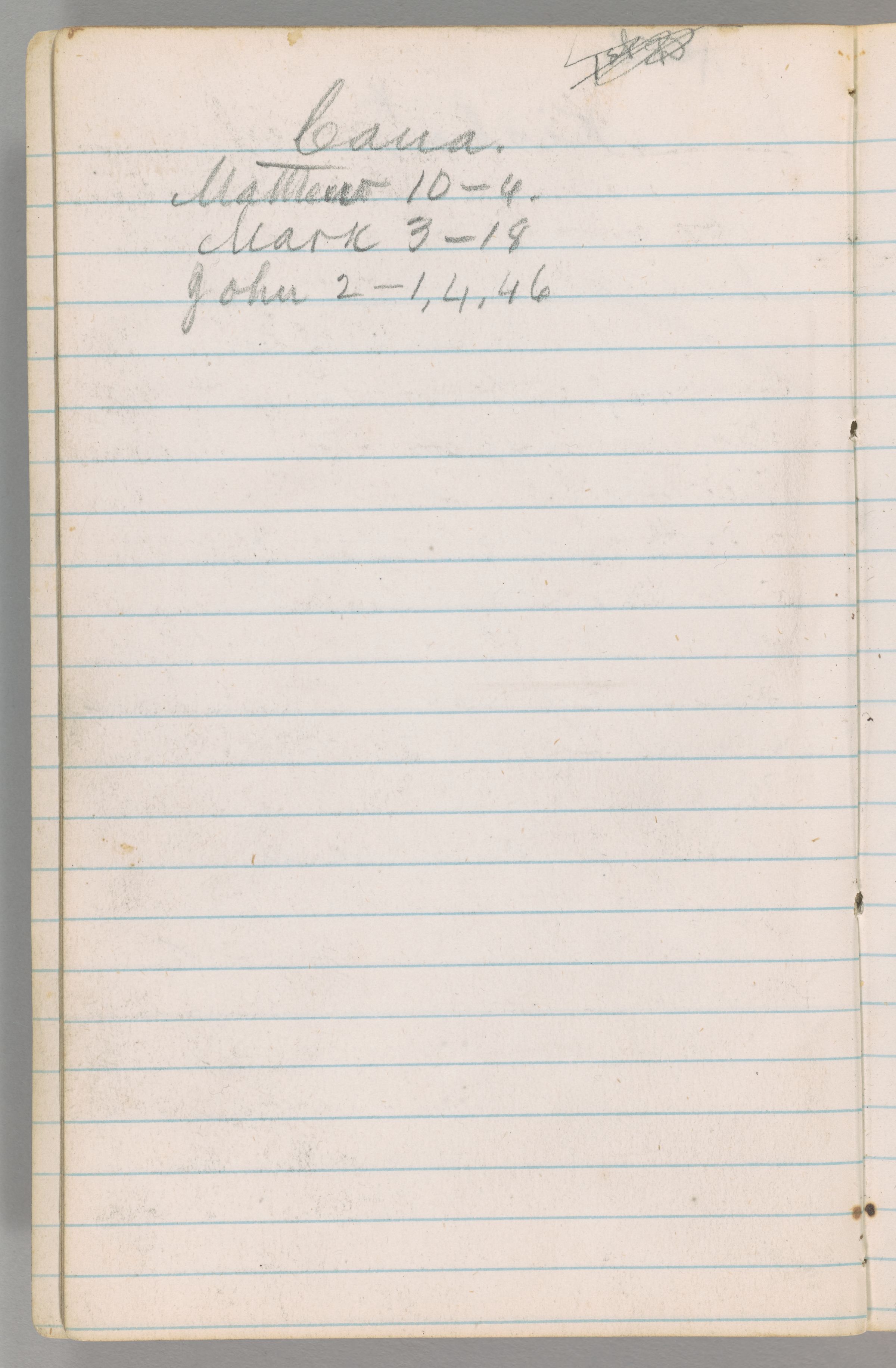
Cana.
Matthew 10-4.
Mark 3-18
John 2-1, 4, 46
[MS: N10_leaf_007r]
1st D4
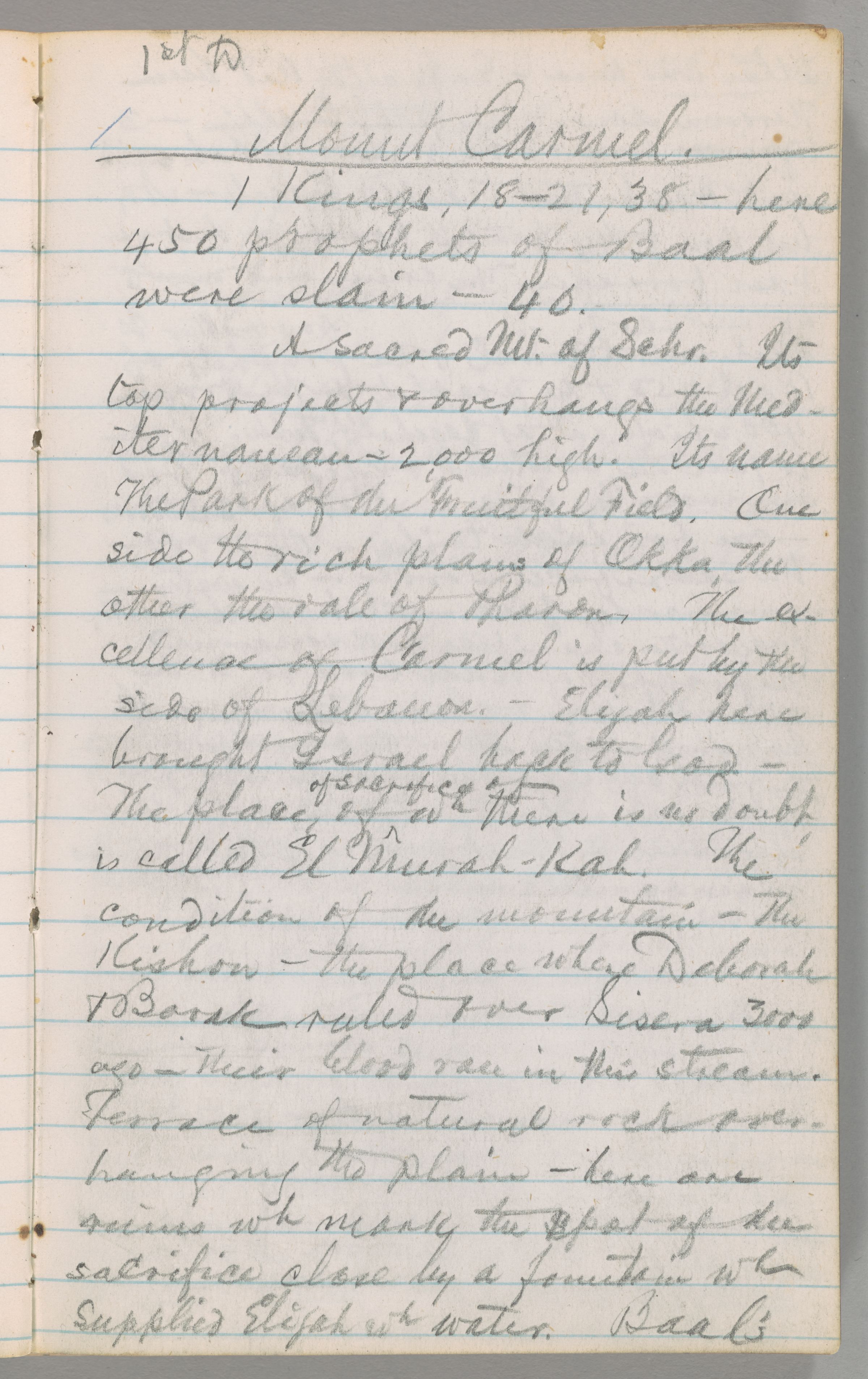
Mount Carmel.
1 Kings, 18-21, 38—here 450 prophets of Baal were slain—40.
A sacred Mt. of Schr. Its top projects & overhangs the Mediterranean—2,000 high. Its
name The Park of the Fruitful Field. One side the rich plains of Okka, the other the
vale of Pharon. The excellence of Carmel is put by the side of Lebanon.—Elijah here
brought Israel back to God.—The place, of of sacrifice ofⓉtextual note wh there is no doubt, is called El Murah-Kah.5 The condition of the mountain—the Kishon—the place where Deborah & Barak ruled over
Sisera 3000 ago—their blood ran in this stream. Terrace of natural rock overhangingⓂemendation the plain—here are ruins wh mark the spot of the sacrifice close by a fountain wh supplied Elijah wh water. Baal's
[MS: N10_leaf_007v]
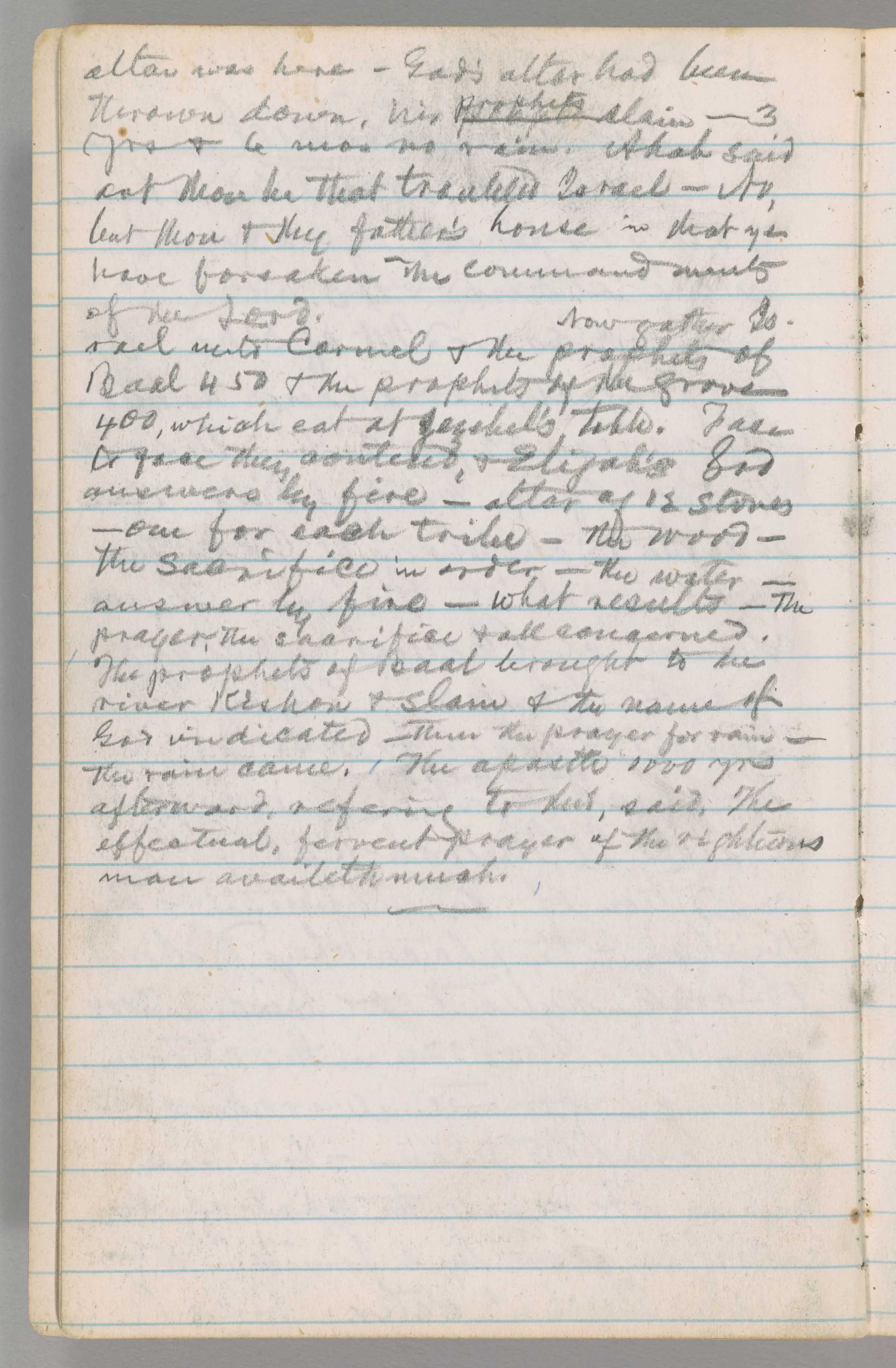
altar was here—God's altar had been thrown down, his people prophetsⓉtextual note slain—3 yrs & 6 mos no rain. Ahab said art thou he that troubled Israel—No, but thou
& thy father's house in that ye have forsaken the commandments of the Lord. blank Now gather Israel unto Carmel & the prophets of Baal 450 & the prophets of the grove
400, which eat at Jezebel's table. Face to face they contend, & Elijah's God answers
by fire—altar of 12 stones—one for each tribe—the wood—the sacrifice in order—the
water—answer by fire—what results—the prayer, the sacrifice & all concerned. The prophets
of Baal brought to the river Kishon & slain & the name of God vindicated—then the
prayer for rain—the rain came. The apostle 1000 yrs afterward, refering to this, said,
The effectual, fervent prayer of the righteous man availeth much.
[MS: N10_leaf_008r]
End 1st Day
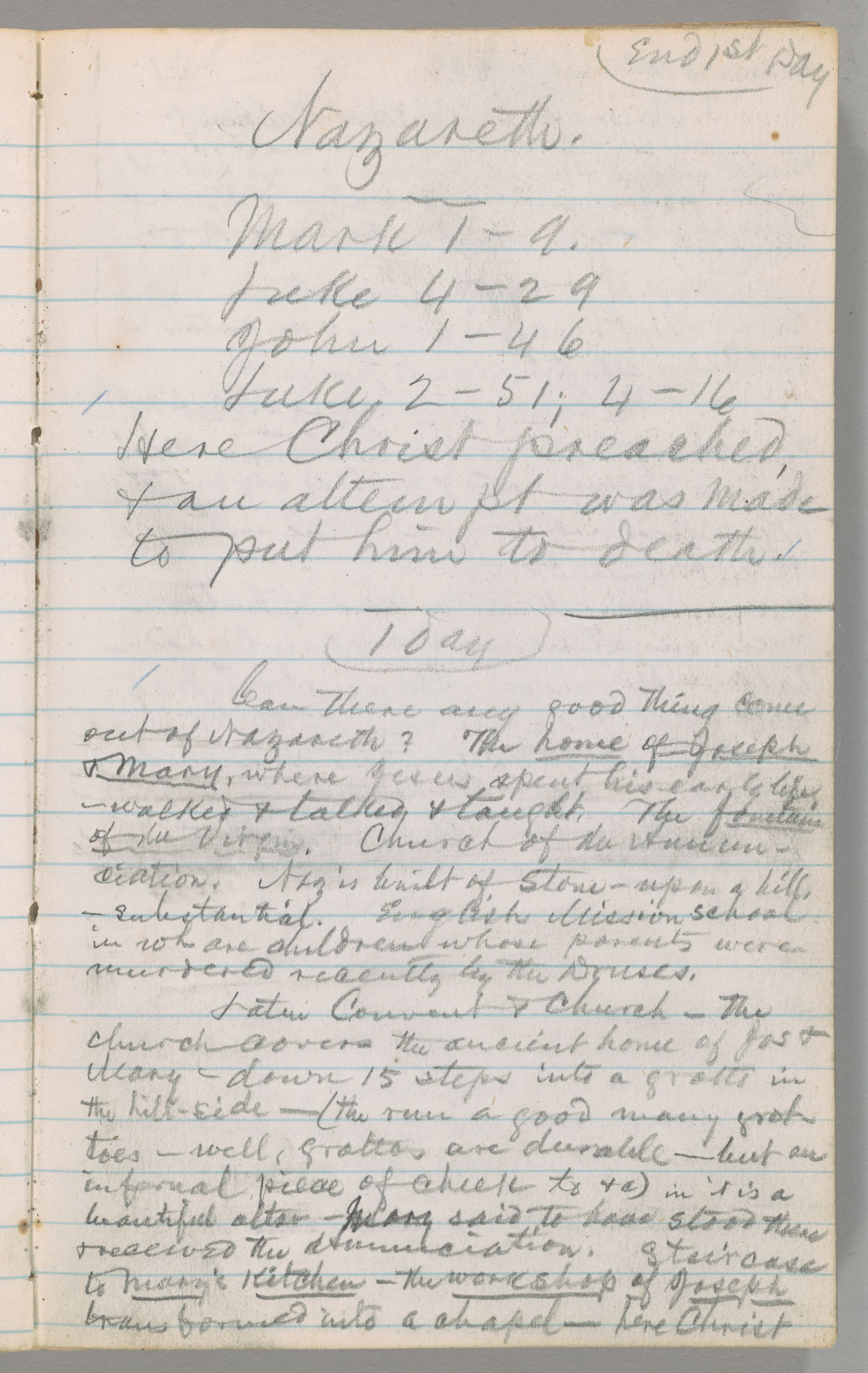
Nazareth.
Mark 1-9.
Luke 4-29
John 1-46
Luke 2-51; 4-16
Here Christ preached, & an attempt was made to put him to death.
1 day
Can there any good thing come out of Nazareth?6 The home of Joseph & Mary, where Jesus spent his early life,—walked & talked & taught. The fountain of the Virgin. Church of the Annunciation. Naz is built of stone—upon a hill,—substantial. English Mission school in wh are children whose parents were murdered recently by the Druses.
Latin Convent & Church—the church covers the ancient home of Jos & Mary—down 15 steps
into a grotto in the hill-side—(they runⓂemendation a good many grottoes—well, grottos are durable—but an infernal piece of cheek to
&c) in it is a beautiful altar—---- Mary said to have stood there & received the a Annunciation. Staircase to Mary's kitchen—the workshop of Joseph transformed into a chapel—here Christ
[MS: N10_leaf_008v]
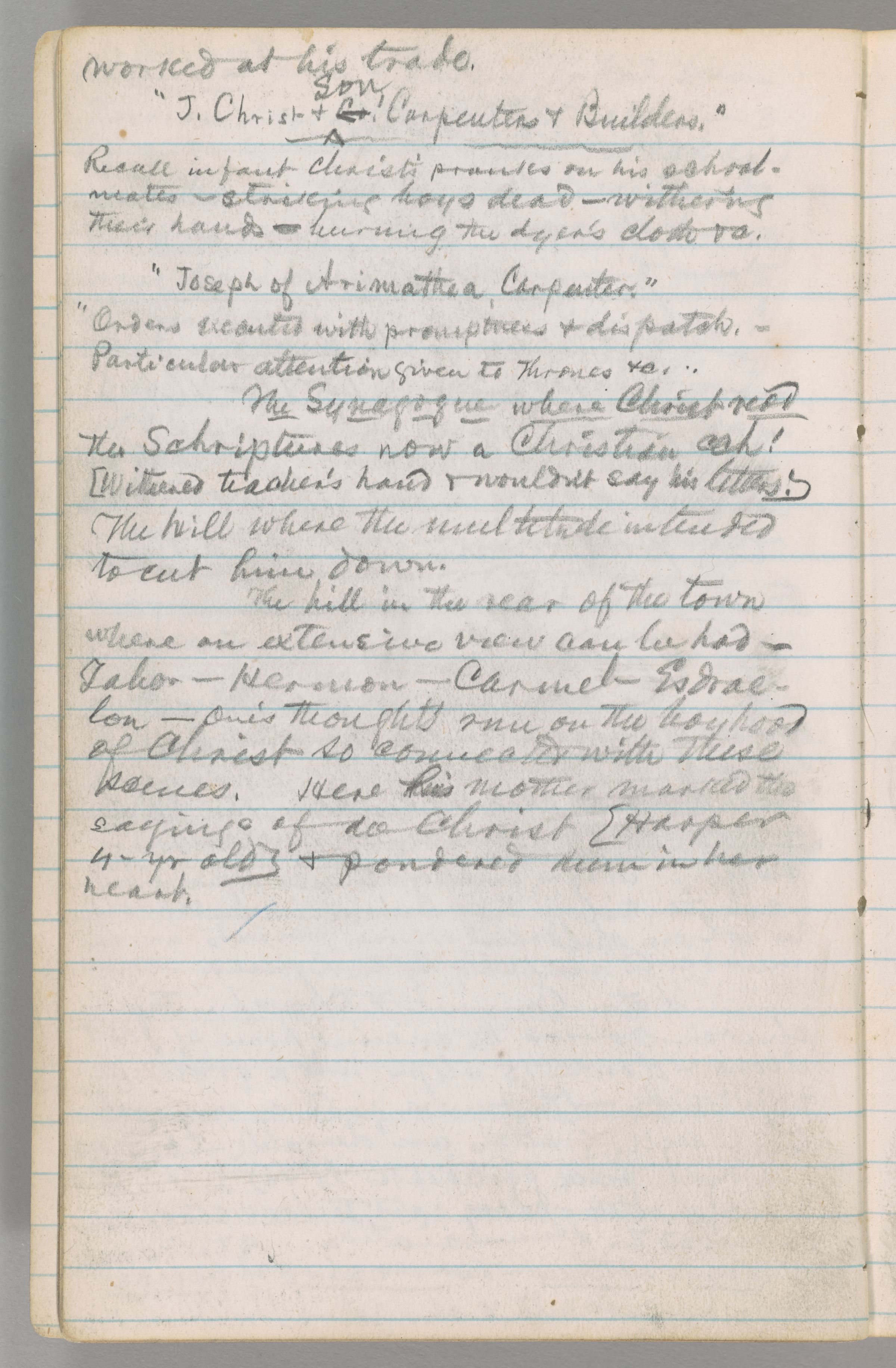
worked at his trade.
“J. Christ & Co. Son,Ⓣtextual note Carpenters & Builders.”
Recall infant Christ's pranks on his school-matesⓂemendation—striking boys dead—withering their hands—burning the dyer's cloth &c.
“Joseph of Arimathea, Carpenter.”
“Orders executed with promptness & dispatch.—Particular attention given to thrones &c.”
The Synagogue where Christ read the Schriptures now a Christian cch! (Withered teacher's hand & wouldn't say his letters.) The hill where the multitude intended to cut him down.
The hill in the rear of the town where an extensive view can be had—Tabor—Hermon—Carmel—Esdraelon—one's thoughts run on the boyhood of Christ so connected with these scenes. Here his mother marked the sayings of the Christ (Harper 4-yr old)7 & pondered them in her heart.
[MS: N10_leaf_009r]
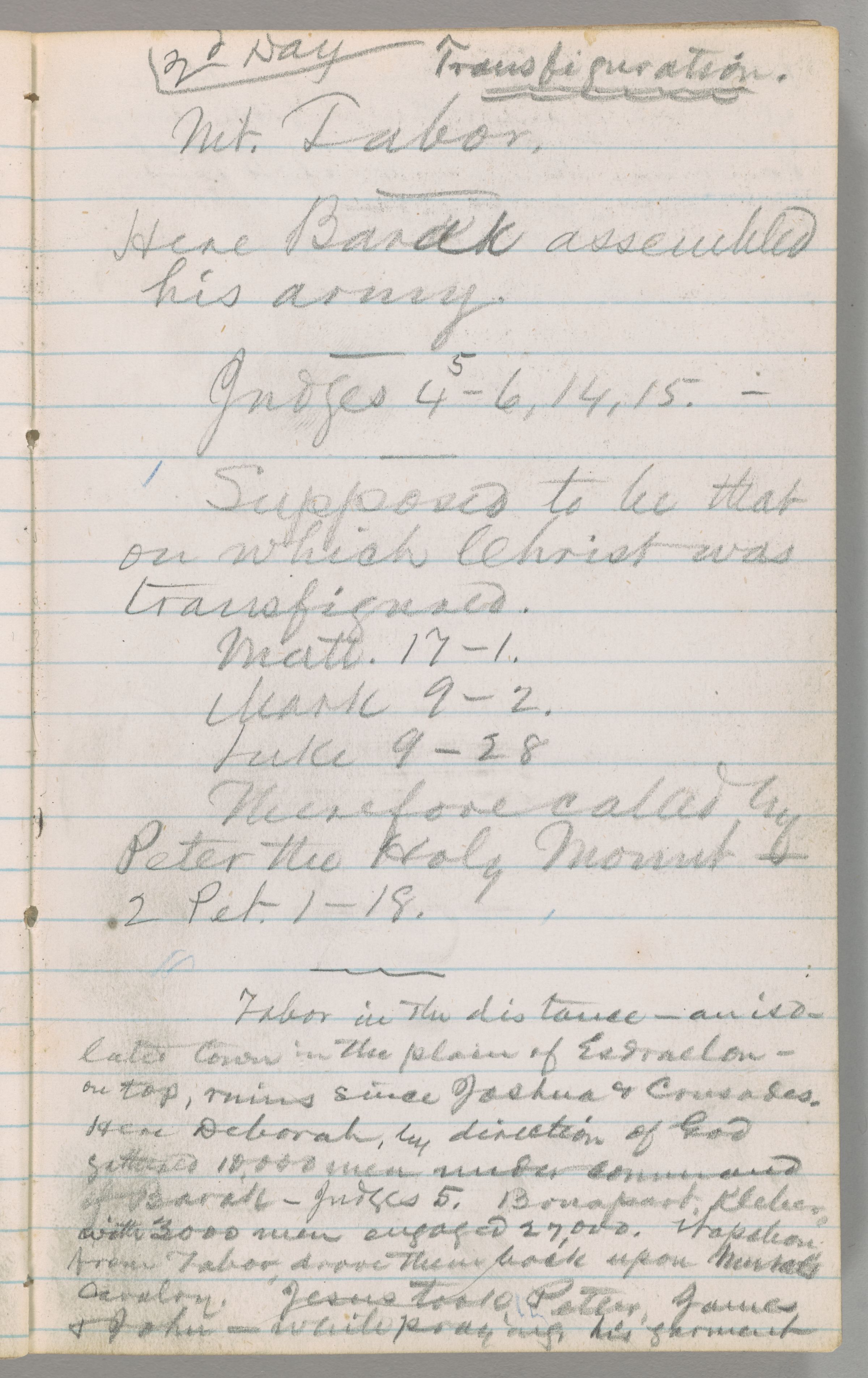
2d DayTransfiguration.
Mt. Tabor.
Here Bark BarakⓉtextual note assembled his army.
Judges 5 4-6Ⓣtextual note, 14, 15.—
Supposed to be that on which Christ was transfigured.
Matt. 17-1.
Mark 9-2.
Luke 9-28
Therefore called by Peter the Holy Mount—2 Pet. 1-18.
Tabor in the distance—an isolated town in the plain of Esdraelon—on top, ruins since
Joshua & Crusades. Here Deborah, by direction of God gathered 10,000 men under command
of Barak—Judges . 5.Ⓣtextual note Bonapart, Kleber, with 3000 men engaged 27,000. Napoleon from Tabor, drove them back
upon Murat's cavalry. Jesus took Peter, James, & John—while praying, his garment
[MS: N10_leaf_009v]
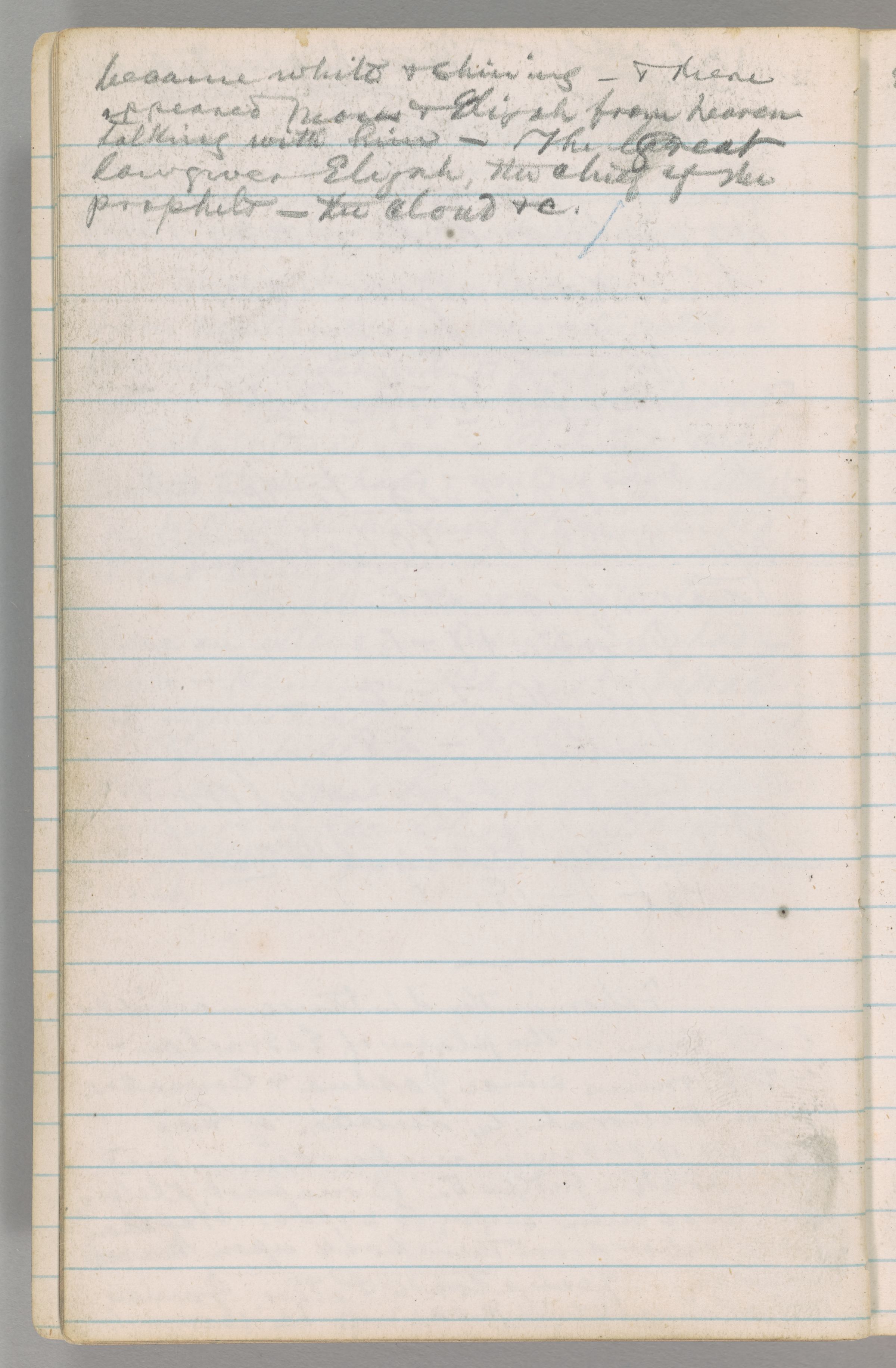
became white & shining—& there appeared Moses & Elijah from heaven talking with him—The
la great lawgiver Elijah, the chief of the prophets—the cloud &c.
[MS: N10_leaf_010r]
End of 2d Day
Tiberias. (Sea of.)
John 6-23-1.
Matt. 8, 18–27.
Mark 4, 35–41.
Luke 8. 22–25. & 9th, 57–62.Ⓣtextual note

[MS: N10_leaf_010v]
blank verso
[MS: N10_leaf_011r]
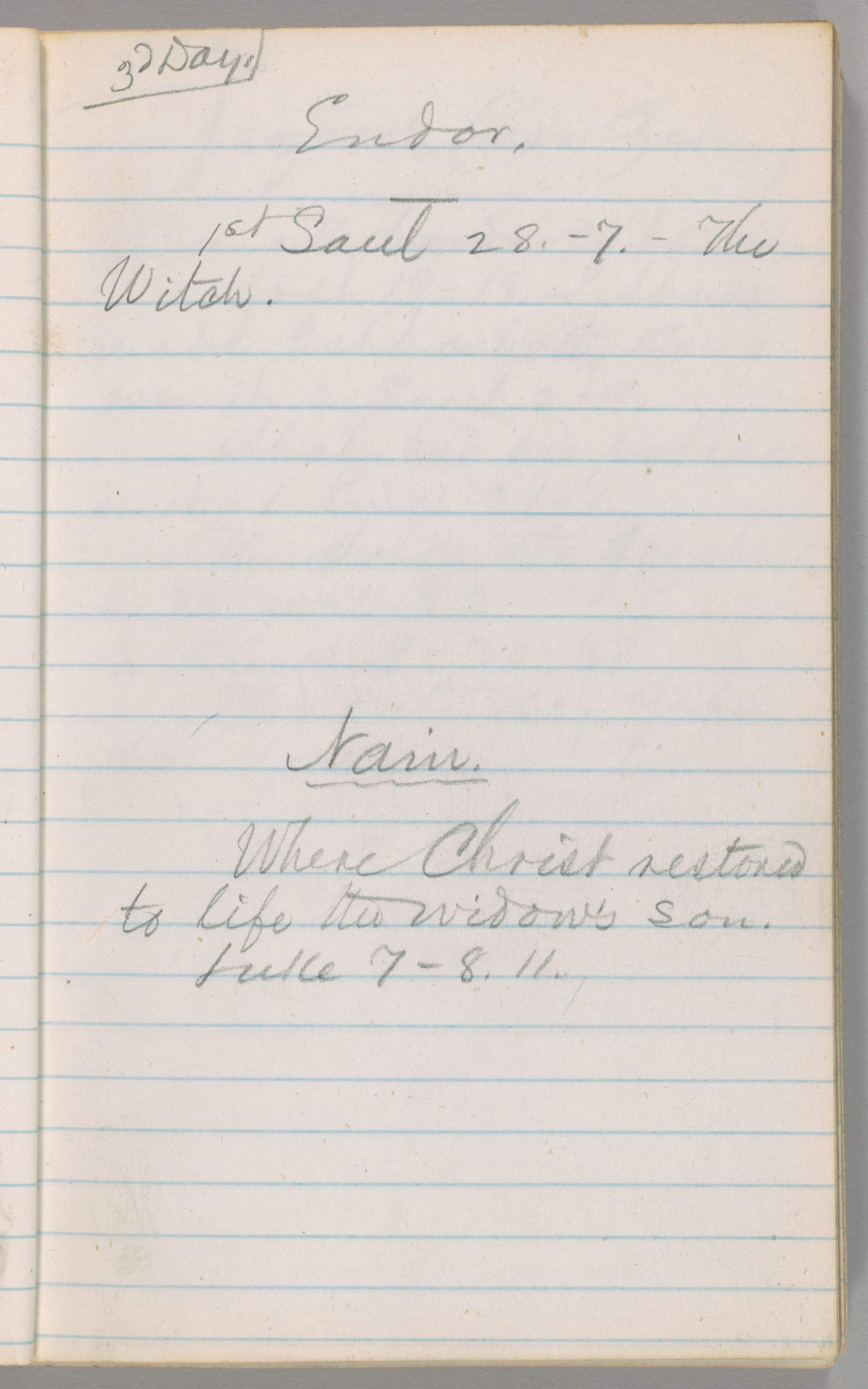
3d Day.
Endor.
1st Saul8 28.-7.—The Witch.
Nain.
Where Christ restored to life the widow's son.
Luke 7-8. 11.Ⓣtextual note

[MS: N10_leaf_011v]
blank verso
[MS: N10_leaf_012r]
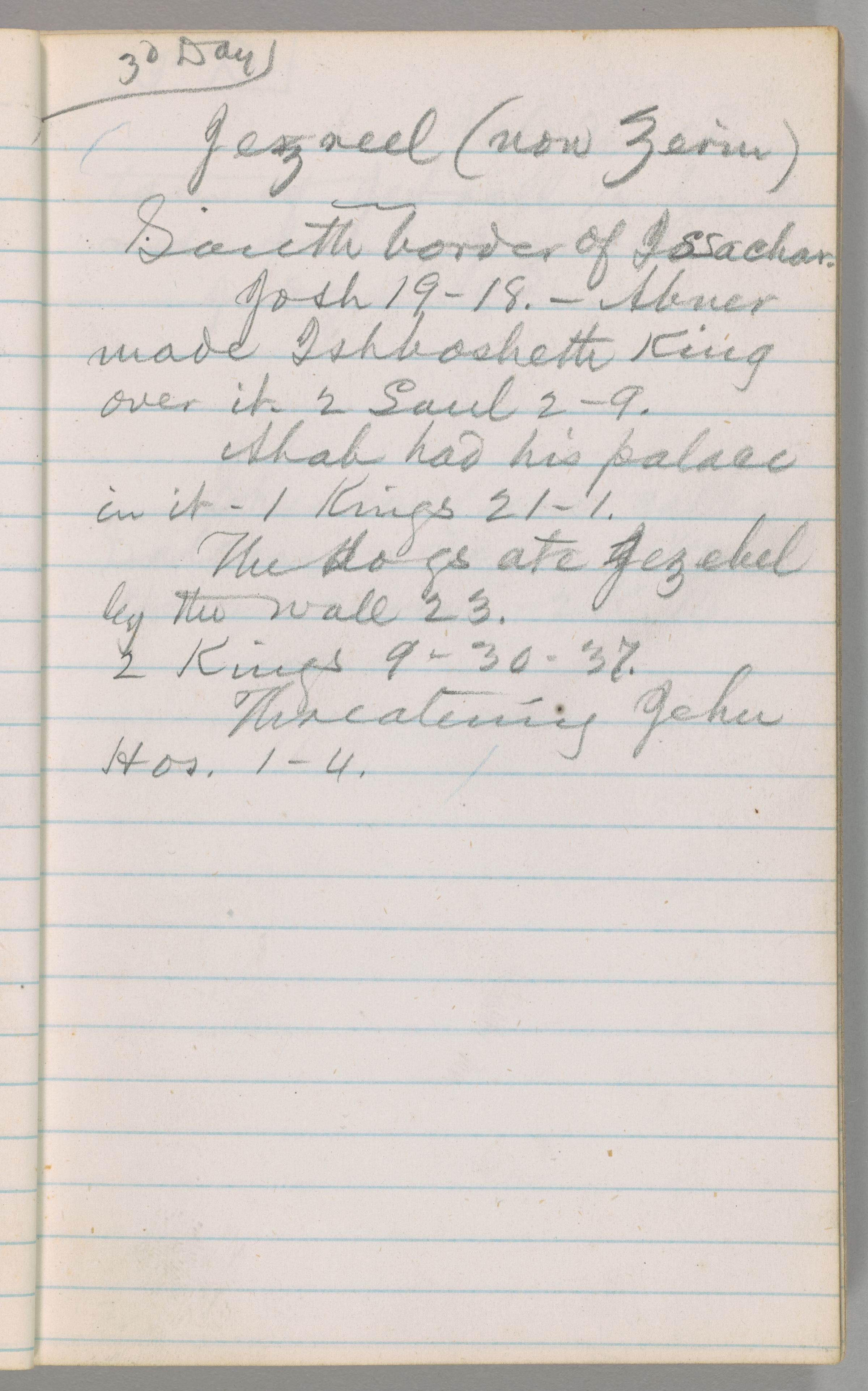
3d Day
Jer JezreelⓉtextual note (now Zerin)
South border of Isachar IssacharⓉtextual note.
Josh 19-18.—Abner made Ishbosheth King over it. 2 Saul 2-9.
Ahab had his palace in it—1 Kings 21-1.
The dogs ate Jezebel by the wall 23.
2 Kings 9-30–37.
Threatening Jehu Hos. 1-4.Ⓣtextual note
[MS: N10_leaf_012v]
blank verso
[MS: N10_leaf_013r]
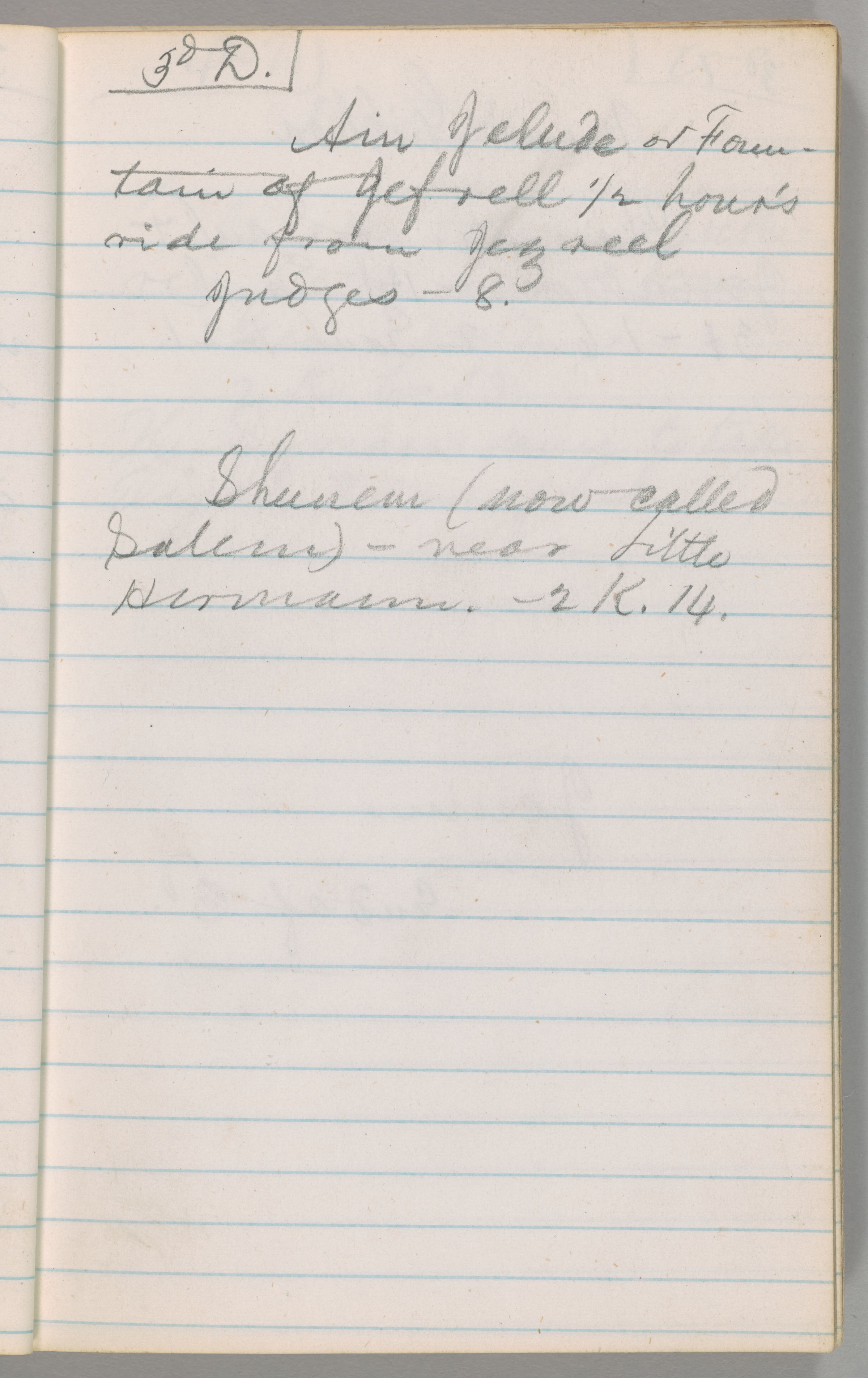
3d D.
Ain Jelude or Fountain of Jefrell ½ hour's ride from Jezreel Judges—8.
Shunem (now called Salem)—near Little Hermann.—2 K. 14.
[MS: N10_leaf_013v]
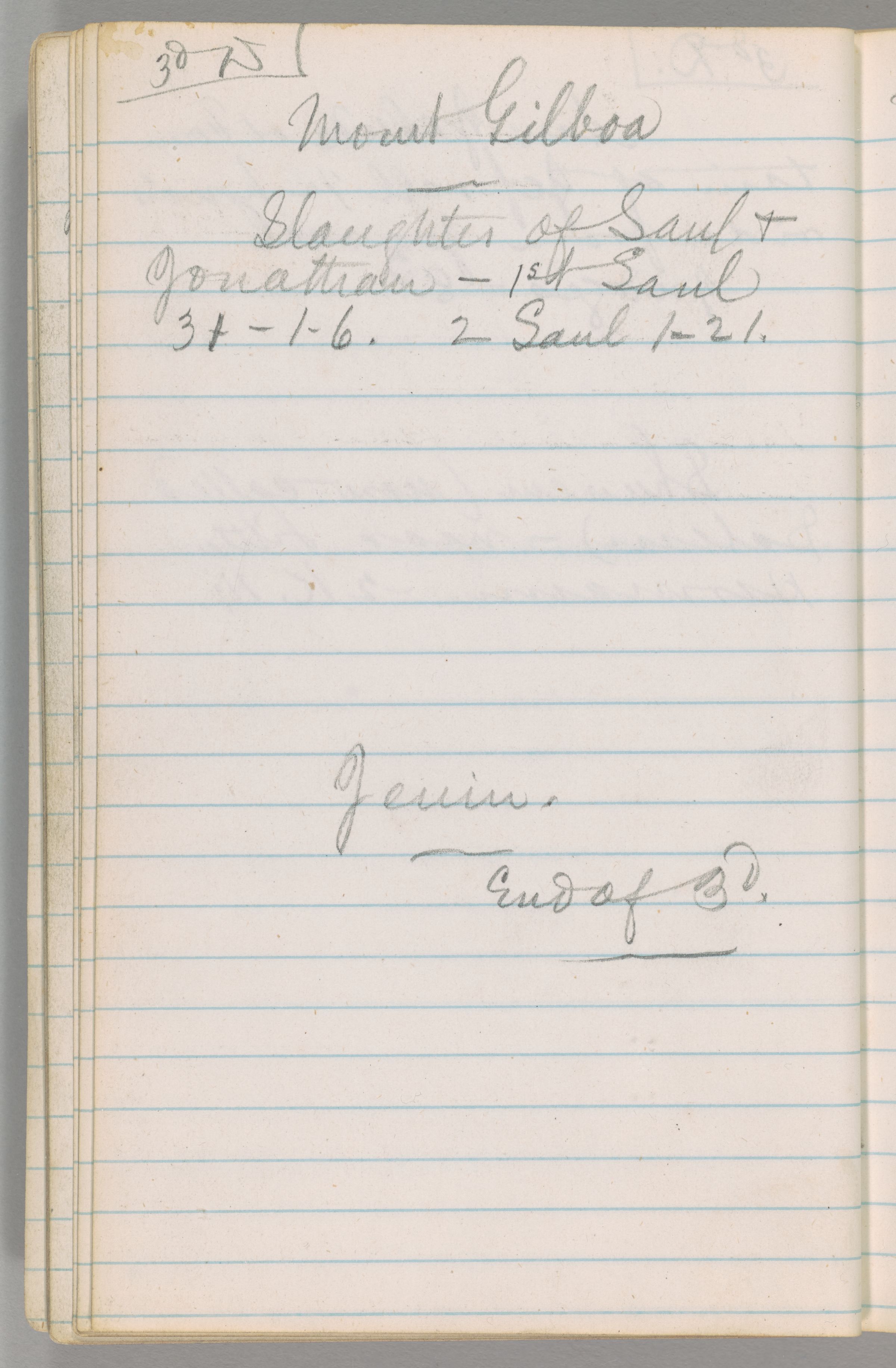
3d D
Mount Gilboa
Slaughter of Saul & Jonathan—1st Saul 3- 31-1–6Ⓣtextual note. 2 Saul 1-21.
Jenin.
End of 3d.
[MS: N10_leaf_014r]
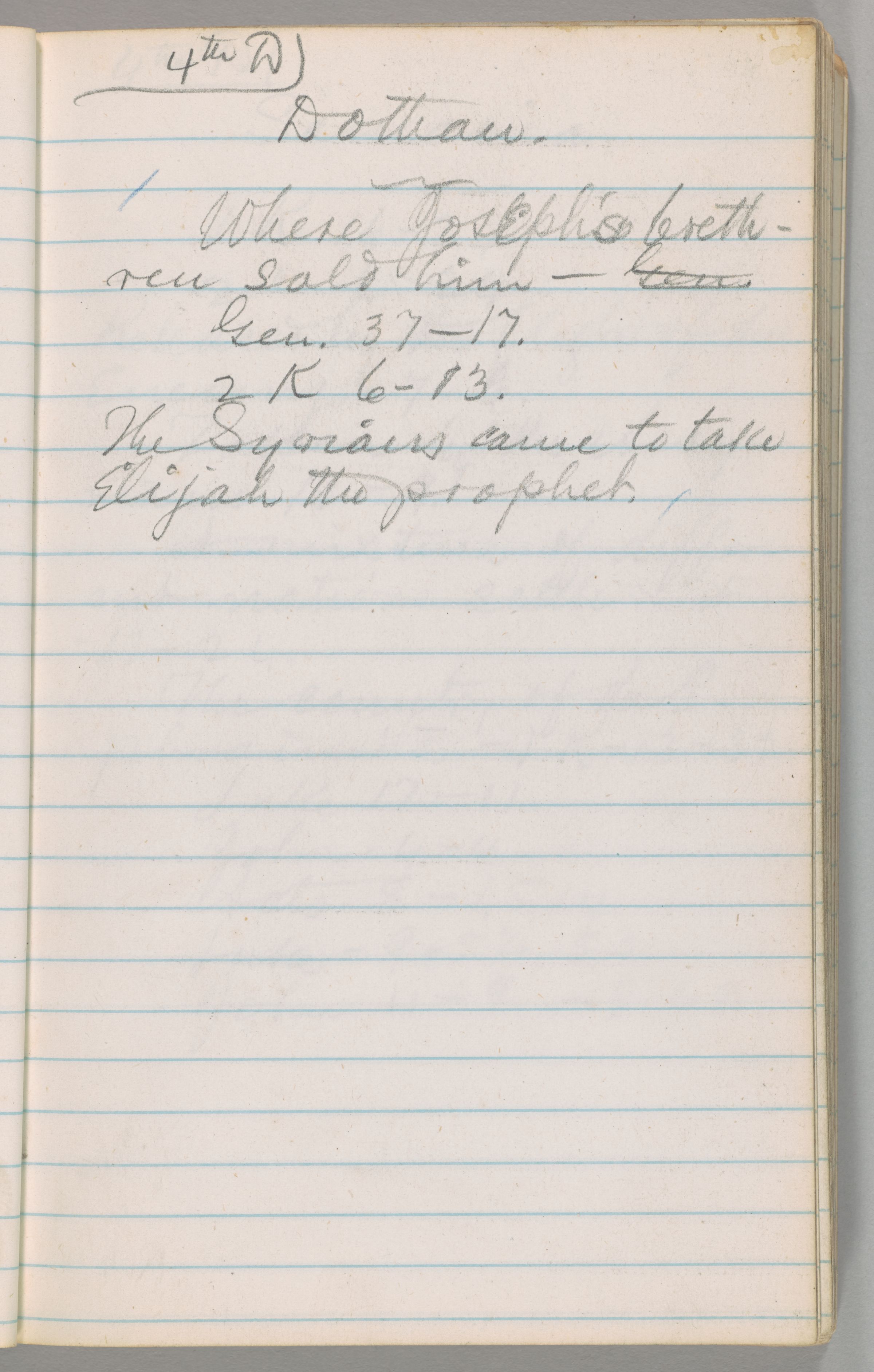
4th D
Dothan.
Where Joseph's brethren sold him—
Gen. 37-17.
2 K 6-13.
The Syrians came to take Elijah the prophet.Ⓣtextual note
[MS: N10_leaf_014v]
blank verso
[MS: N10_leaf_015r]
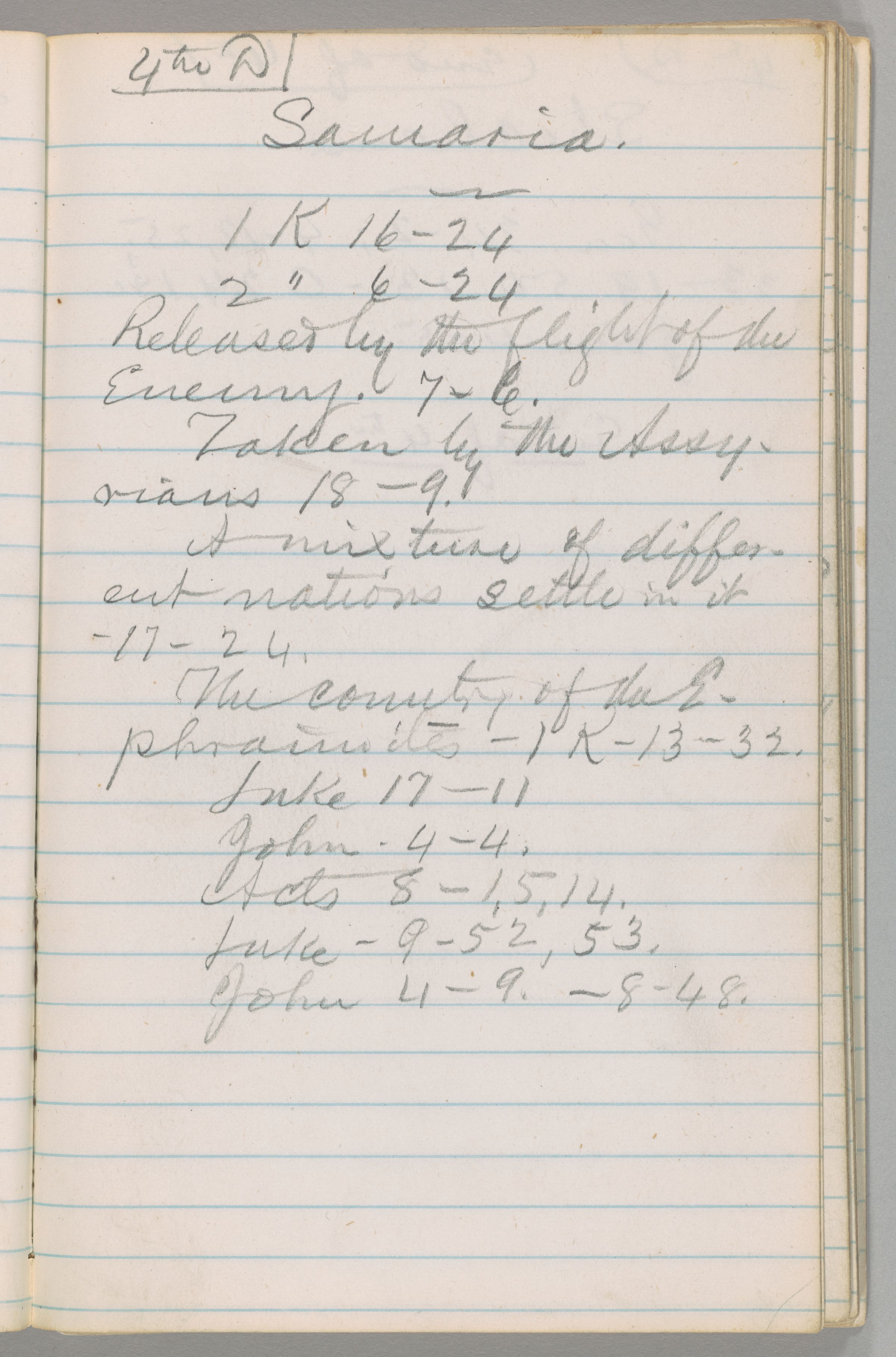
4th D
Samaria.
1 K 16-24
2 K 6-24
Released by the flight of the Enemy. 7-6.
Taken by the Assyrians 18-9.
A mixture of different nations settle in it—17-24.
The country of the Ephraimites—1 K—13-32.
Luke 17-11
John—4-4.
Acts 8-1, 5, 14.
Luke—9-52, 53.
John 4-9.—8-48.
[MS: N10_leaf_015v]
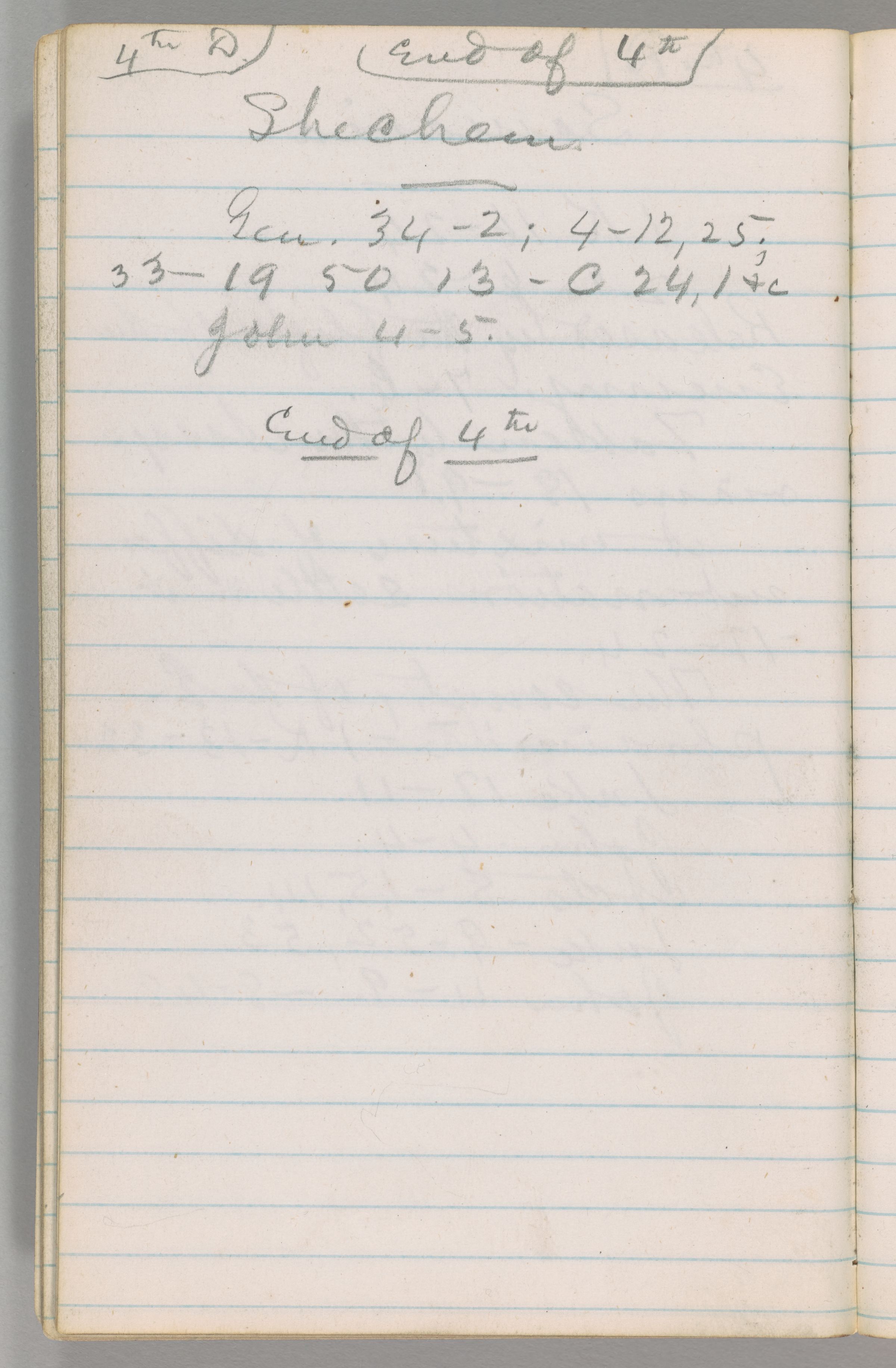
4th D.End of 4th
Shechem.
Gen. 34-2; 4-12, 25; 33-19 50 13—C 24, 1 &c
John 4-5.
End of 4thⓉtextual note

[MS: N10_leaf_016r]
blank recto

[MS: N10_leaf_016v]
blank verso
[MS: N10_leaf_017r]
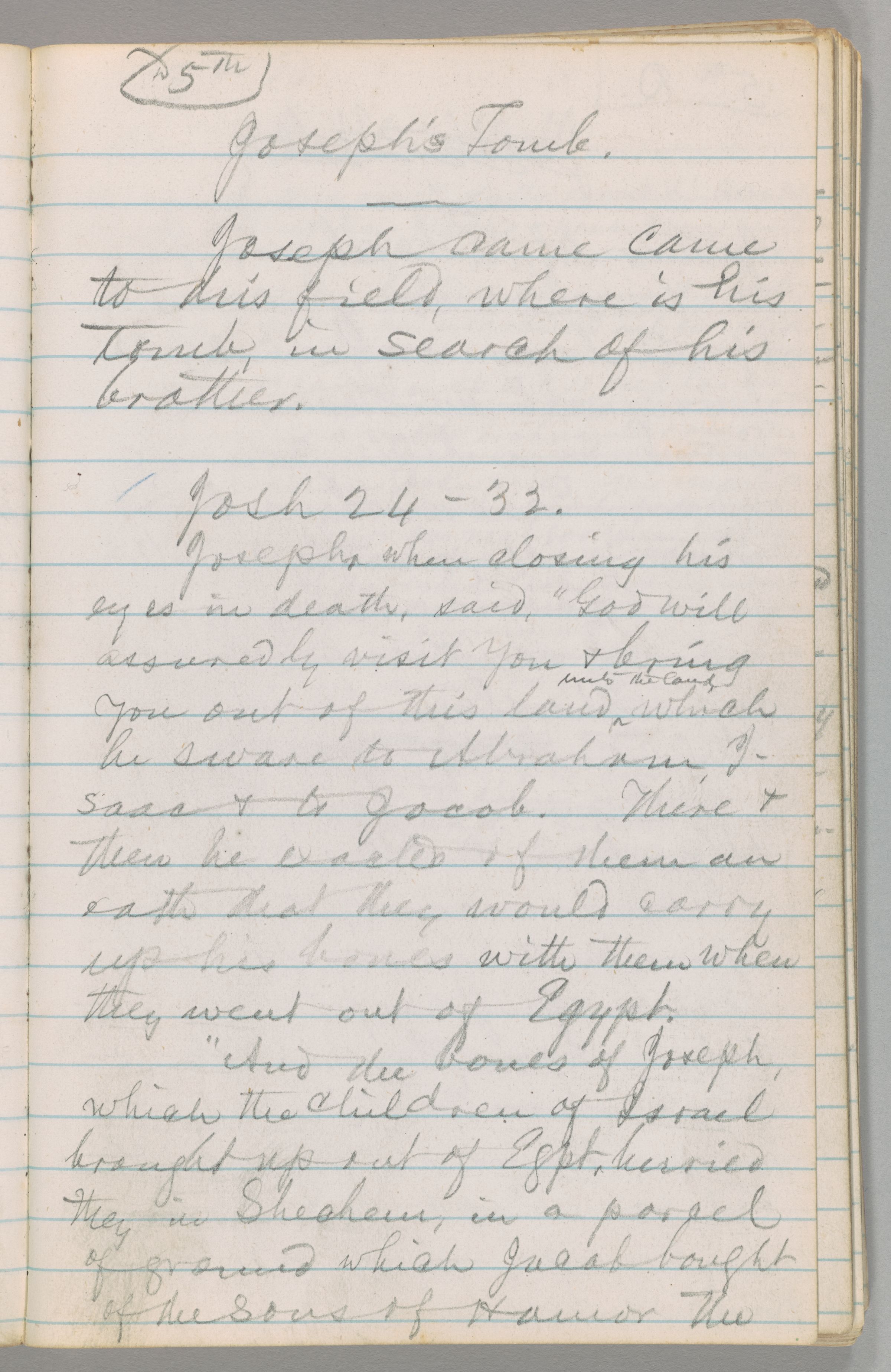
D 5th
Joseph's Tomb.
Joseph came came to this field, where is his tomb, in search of his brother.
Josh 24-32.
Joseph, when closing his eyes in death, said, “God will assuredly visit you & bring you out of this land, unto the landⓉtextual note which he sware to Abraham, Isaac & to Jacob. There & then he exacted of them an oath that they would carry up his bones with them when they went out of Egypt.
“And the bones of Joseph, which the children of Israel brought up out of Egpt, buried
they in Shechem, in a parcel of ground which Jacob bought of the sons of Hamor the
[MS: N10_leaf_017v]
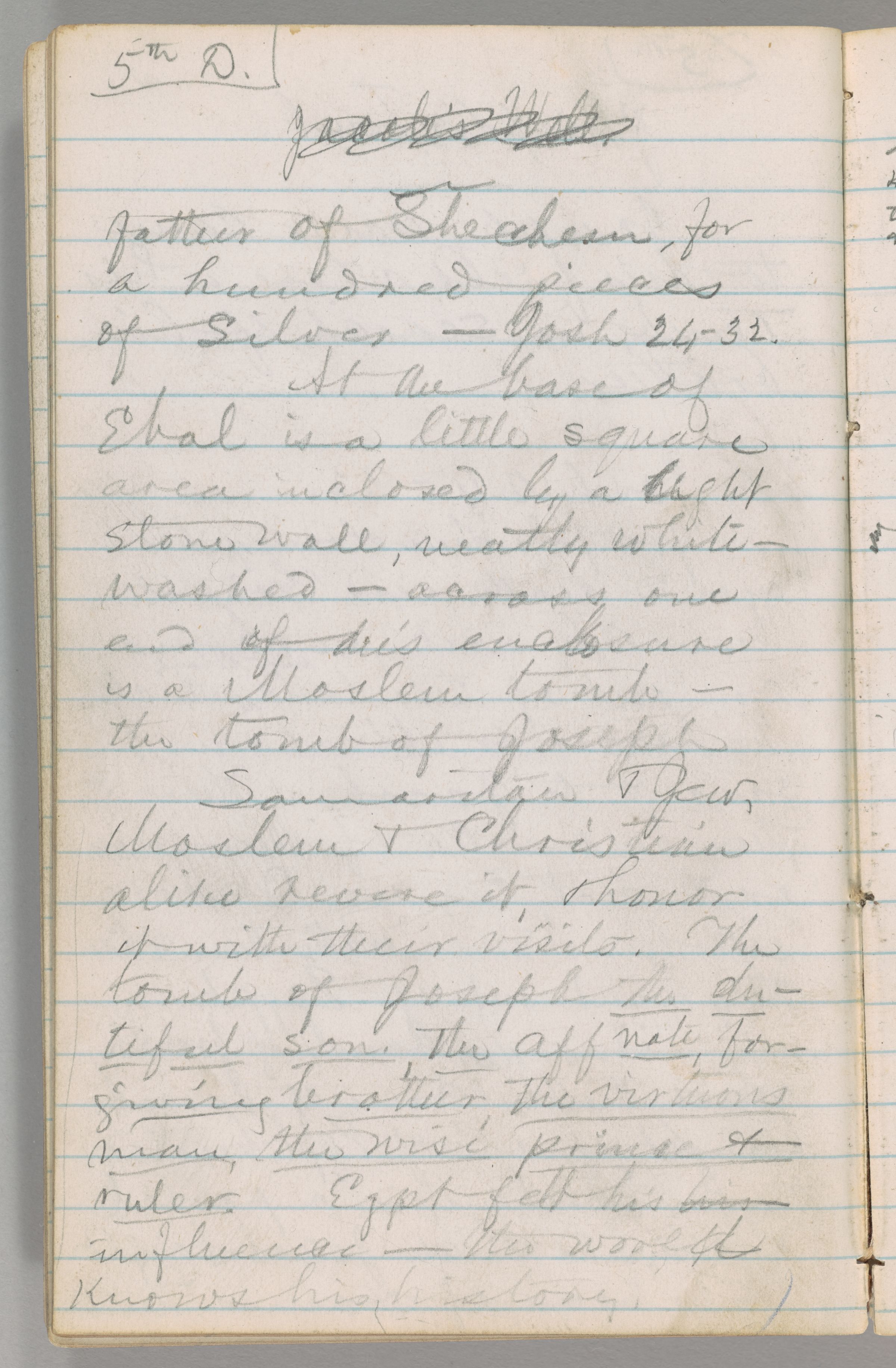
father of ShechemⓂemendation, for a hundred pieces of silver—Josh 24-32.
At the base of Ebal is a little square area inclosed by a hight lightⓉtextual note9 stone wall, neatly whitewashedⓂemendation—across one end of this enclosure is a Moslem tomb—the tomb of Joseph.
Samaritan & Jew, Moslem & Christian alike revere it, & honor it with their visits. The tomb of Joseph the dutiful son., the affnate, forgiving brother, the virtuous man, the wise prince & ruler. Egpt felt his his influence—the world knows his history.
[MS: N10_leaf_018r]
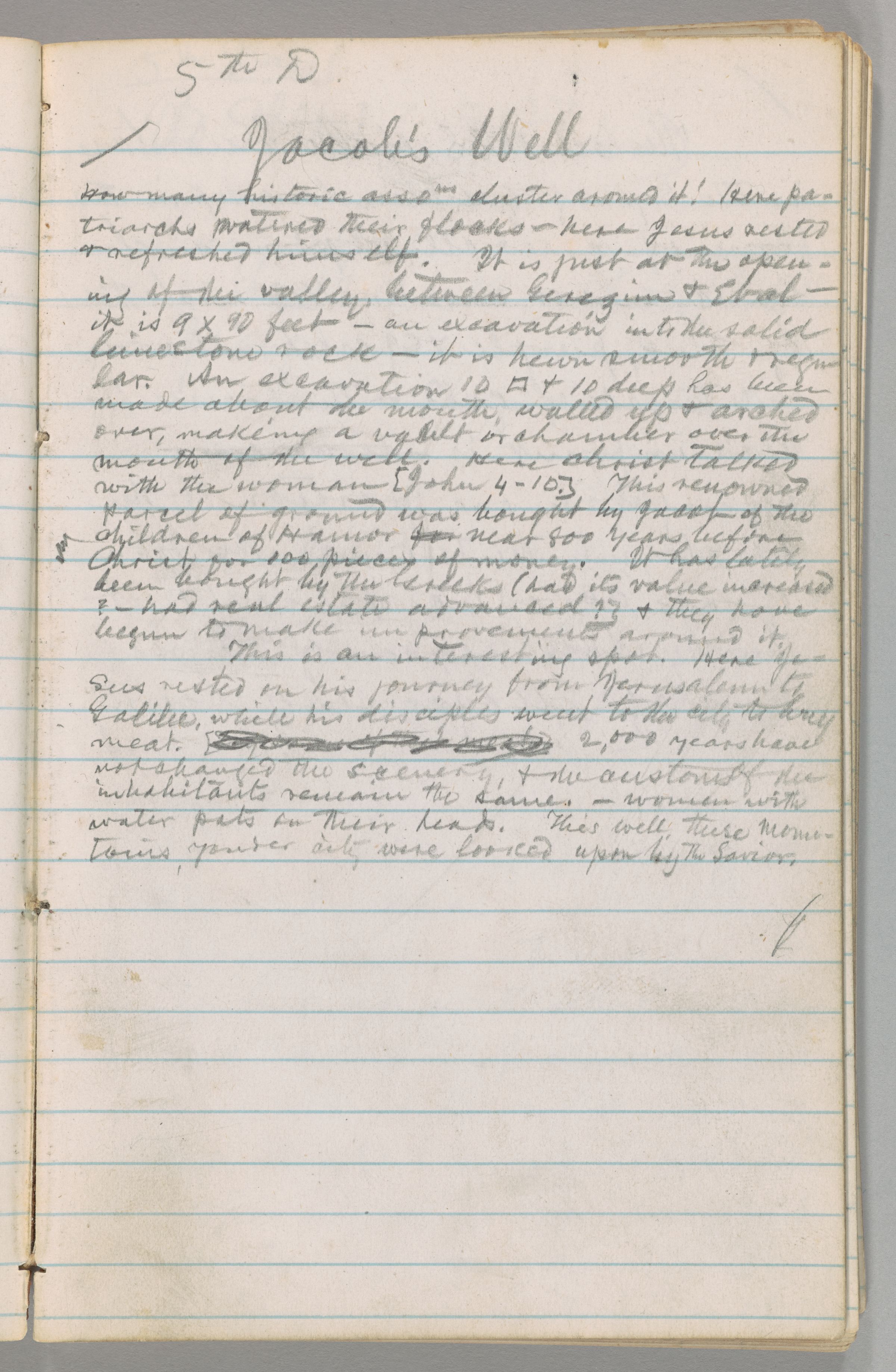
5th D.
Jacob's Well
How many historic assons cluster around it! Here patriarchs watered their flocks—here Jesus rested & refreshed himself. It is just at the opening of the valley, between Gerezim & Ebal—it is 9 × 90 feet—an excavation into the solid limestone rock—it is hewn smooth & regular. An excavation 10 □ & 10 deep has been made about the mouth, walled up & arched over, making a vault or chamber over the mouth of the well. Here Christ talked with the woman (John 4-10.) This renowned parcel of ground was bought by Jacob of the children of Hamor for near 800 years before Christ for 100 pieces of money. It has lately been bought by the Greeks (had its value increased?—had real estate advanced?) & they have begun to make improvements around it.
This is an interesting spot. Here Jesus rested on his journey from Jerusalem to Galilee, while his disciples went to the city to buy meat. (Try some of that meat.) 2,000 years have not changed the scenery, & the customs of the inhabitants remain the same.—women with water pots on their heads. This well, these mountains, yonder city were looked upon by the Savior.
[MS: N10_leaf_018v]
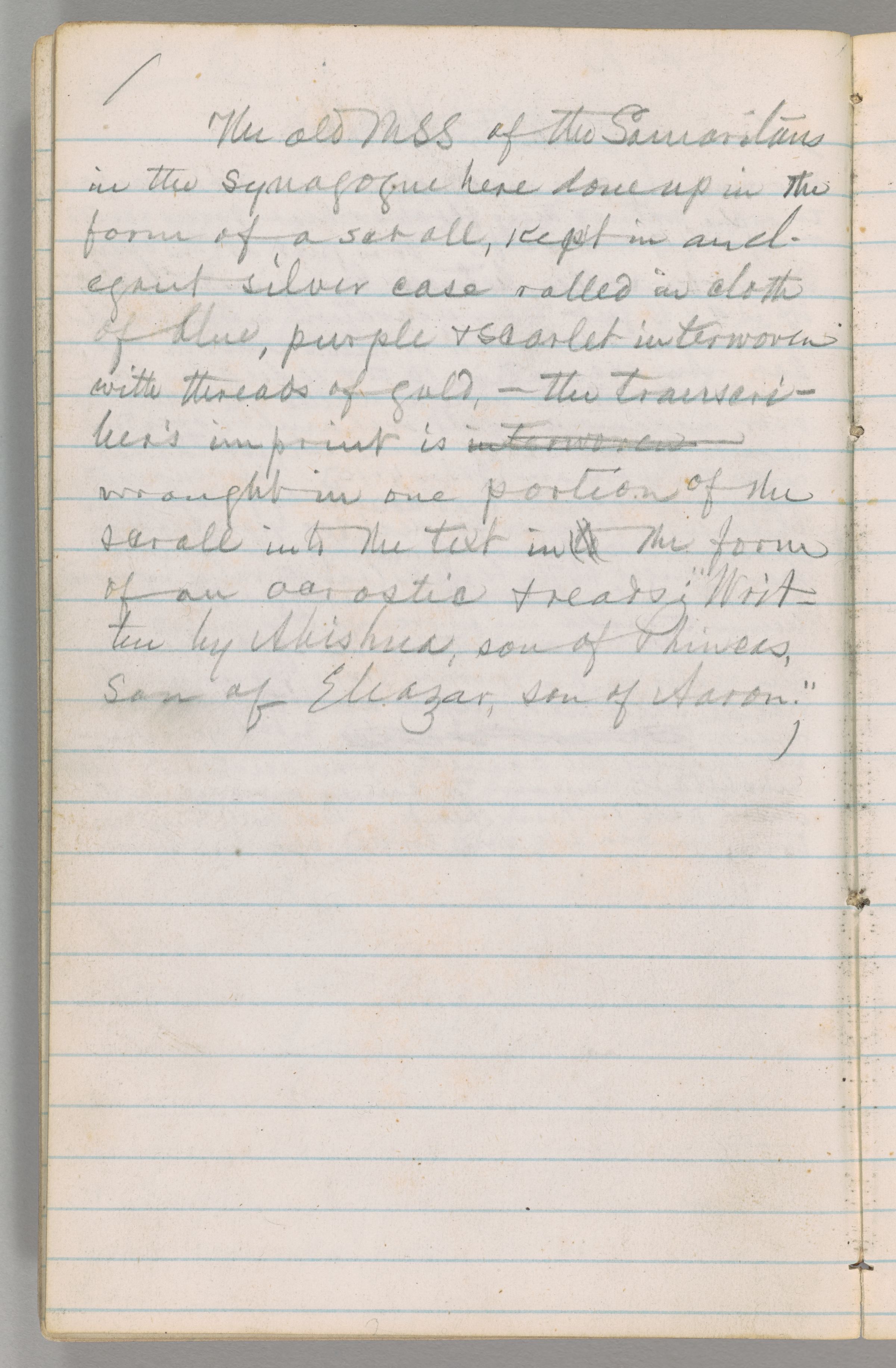
The old MSS of the Samaritans in the synagogue here done up in the form of a scroll, kept in an elegant silver case rolled in cloth of blue, purple & scarlet interwoven with threads of gold,—the transcriber's imprint is interwoven wrought in one portion of the scroll into the text in to the form of an acrostic & reads: “Written by Abishua, son of Phineas, son of Eleazar, son of Aaron.”
[MS: N10_leaf_019r]
5th Day
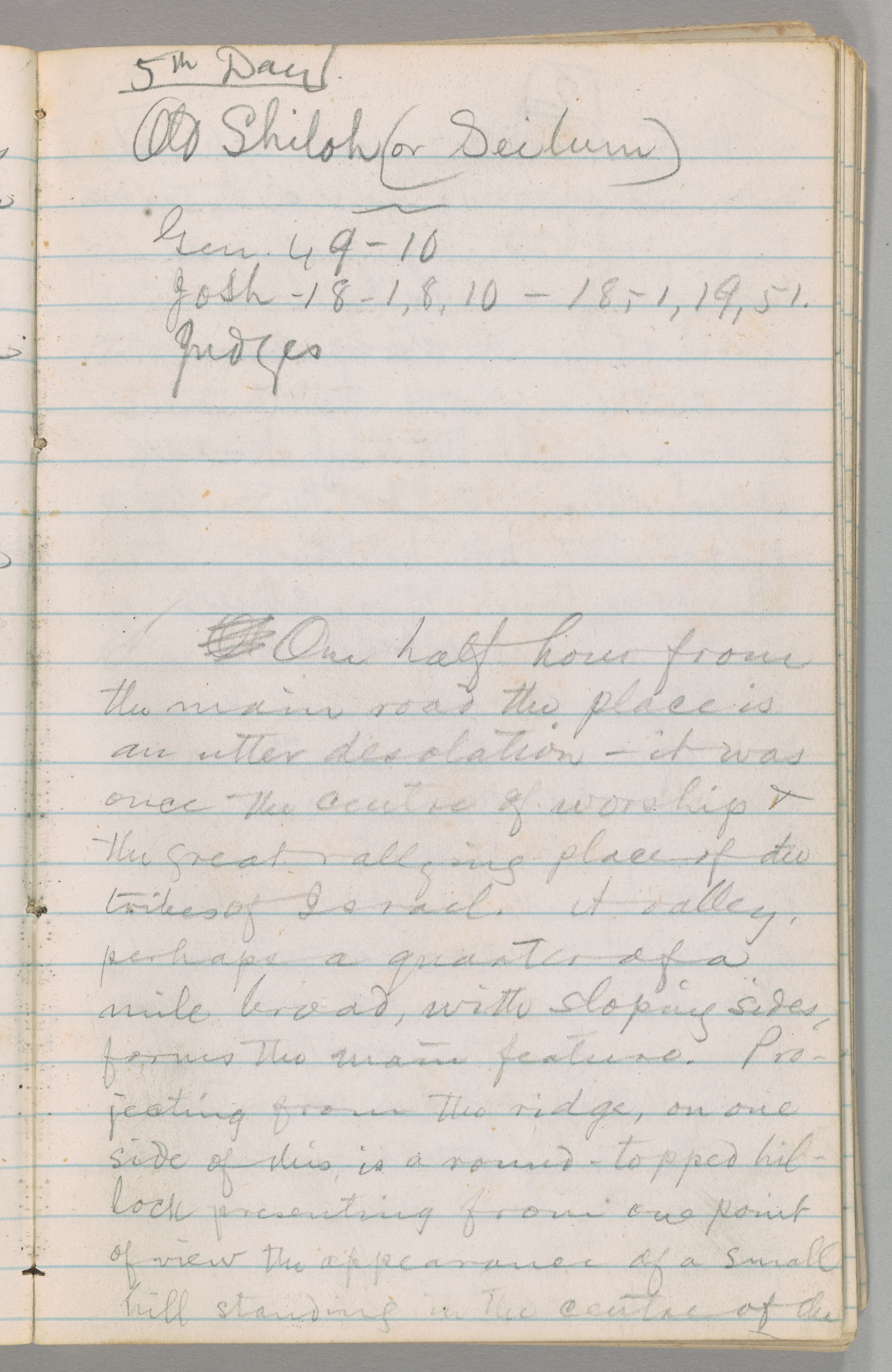
Old Shiloh (or Seilum)
Gen. 4- 49-10Ⓣtextual note
Josh—18-1, 8, 10—18,-1Ⓜemendation, 19, 51.
Judges
One half hour from the main road the place is an utter desolation—it was once the
centre of worship & the great rallying place of the tribes of Israel. A valley, perhaps
a quarter of a mile broad, with sloping sides, forms the main feature. Projecting
from the ridge, on one side of this, is a round-topped hillock presenting from one
point of view the appearance of a small hill standing in the centre of the
[MS: N10_leaf_019v]
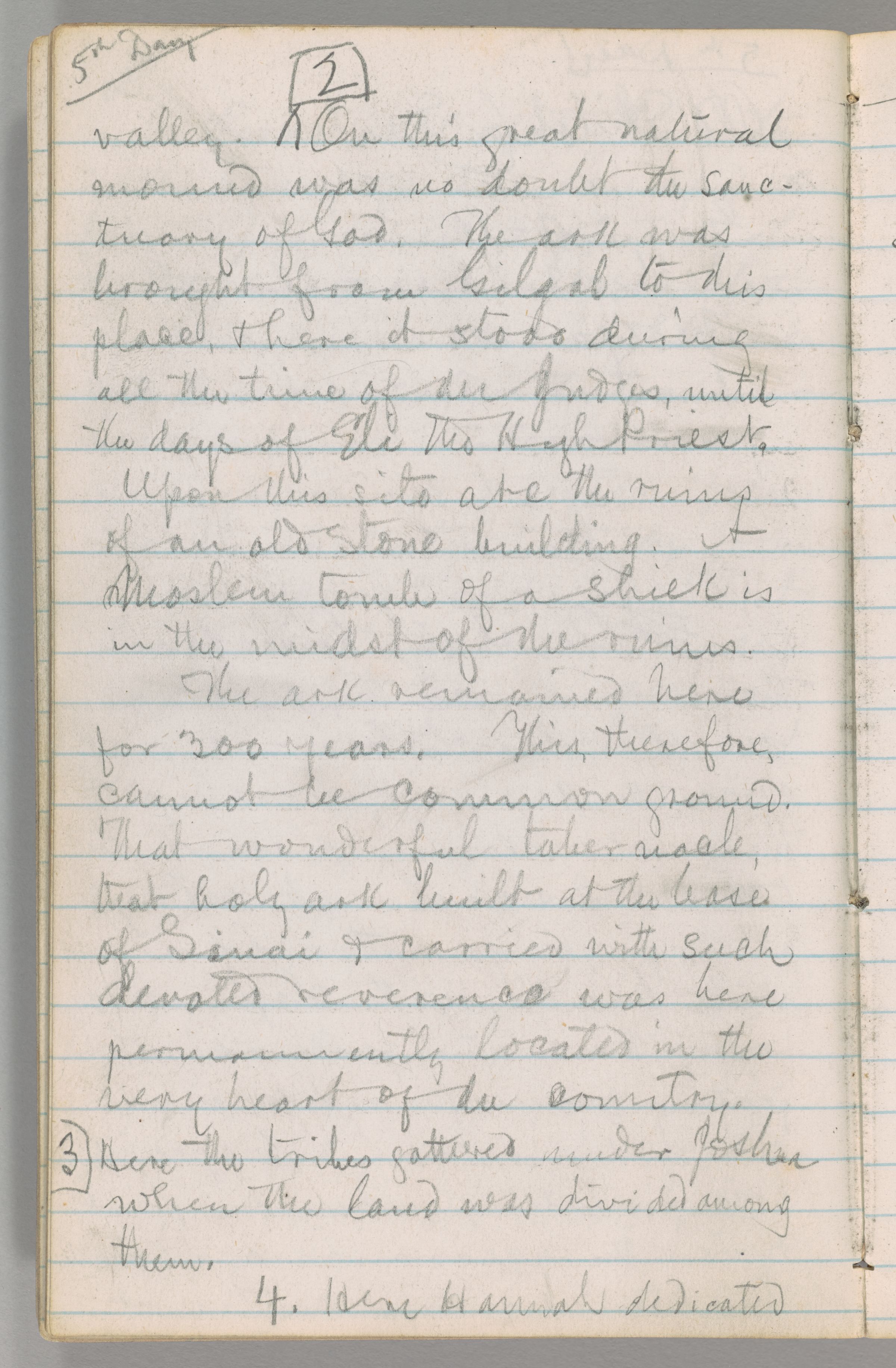
valley.Ⓜemendation 2 On this greatⓉtextual note natural mound was no doubt the sanctuary of God. The ark was brought from Gilgal
to this place, & here it stood during all the time of the Judges, until the days of
Eli the High Priest. Upon this site are the ruins of an old stone building. A Moslem
tomb of a shiek is in the midst of the ruins.
The ark remained here for 300 years. This, therefore, cannot be common ground. That wonderful tabernacle, that holy ark built at the base of Sinai & carried with such devoted reverence was here permanently located in the very heart of the country. 3 HereⓉtextual note the tribes gathered under Joshua when the land was divided among them.
4. Here Hannah dedicated
[MS: N10_leaf_020r]
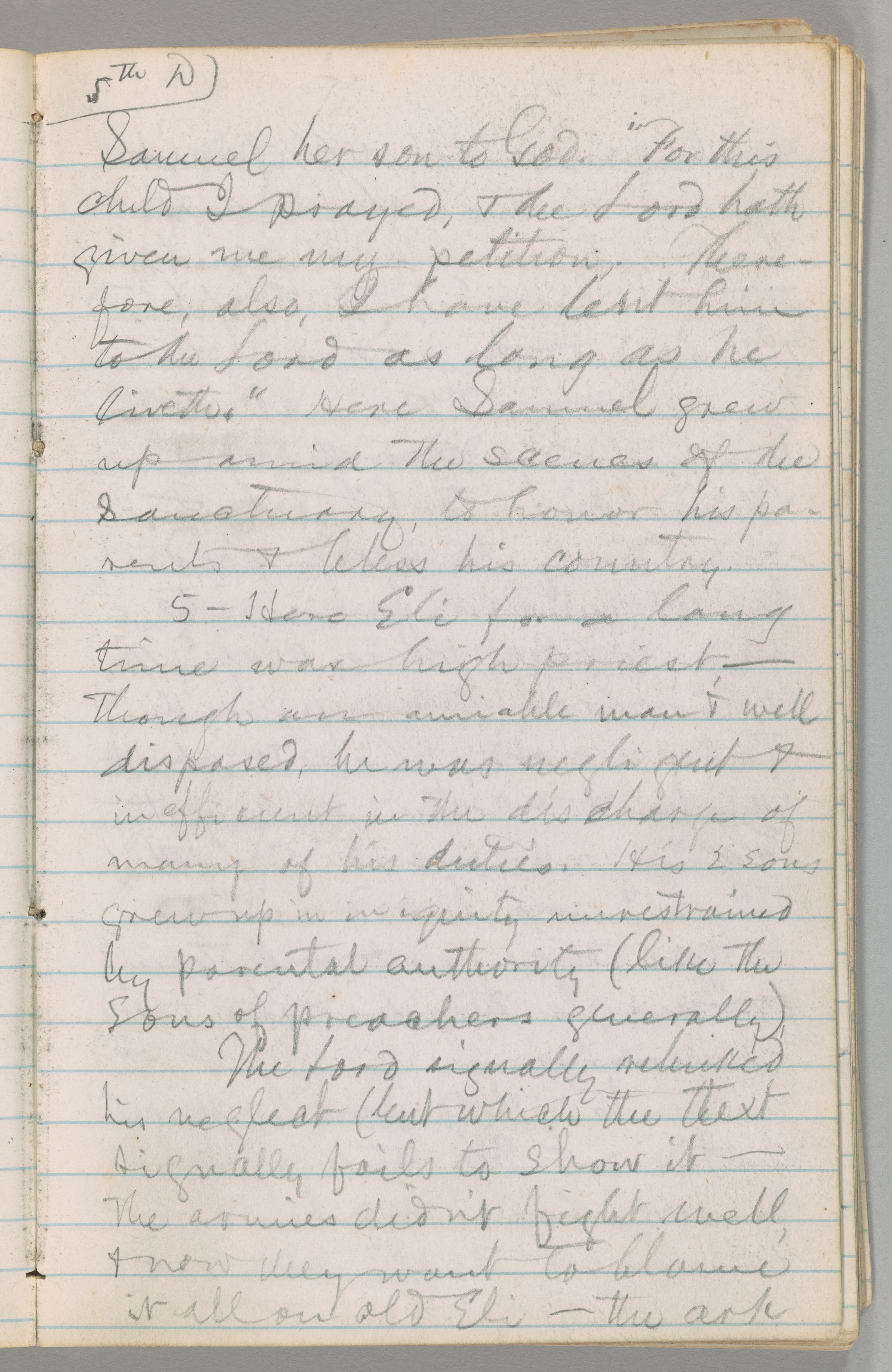
SamuelⓂemendation her son to God. “For this child I prayed, & the Lord hath given me my petition,.
Therefore, also, I have lent him to the Lord as long as he liveth.” Here Samuel grew
up amid the scenes of the Sanctuary, to honor his parents & bless his country.
5—Here Eli for a long time was high priest,—though an amiable man & well disposed, he was negligent & inefficient in the discharge of many of his duties. His 2 sons grew up in iniquity unrestrained by parental authority (like the sons of preachers generally).
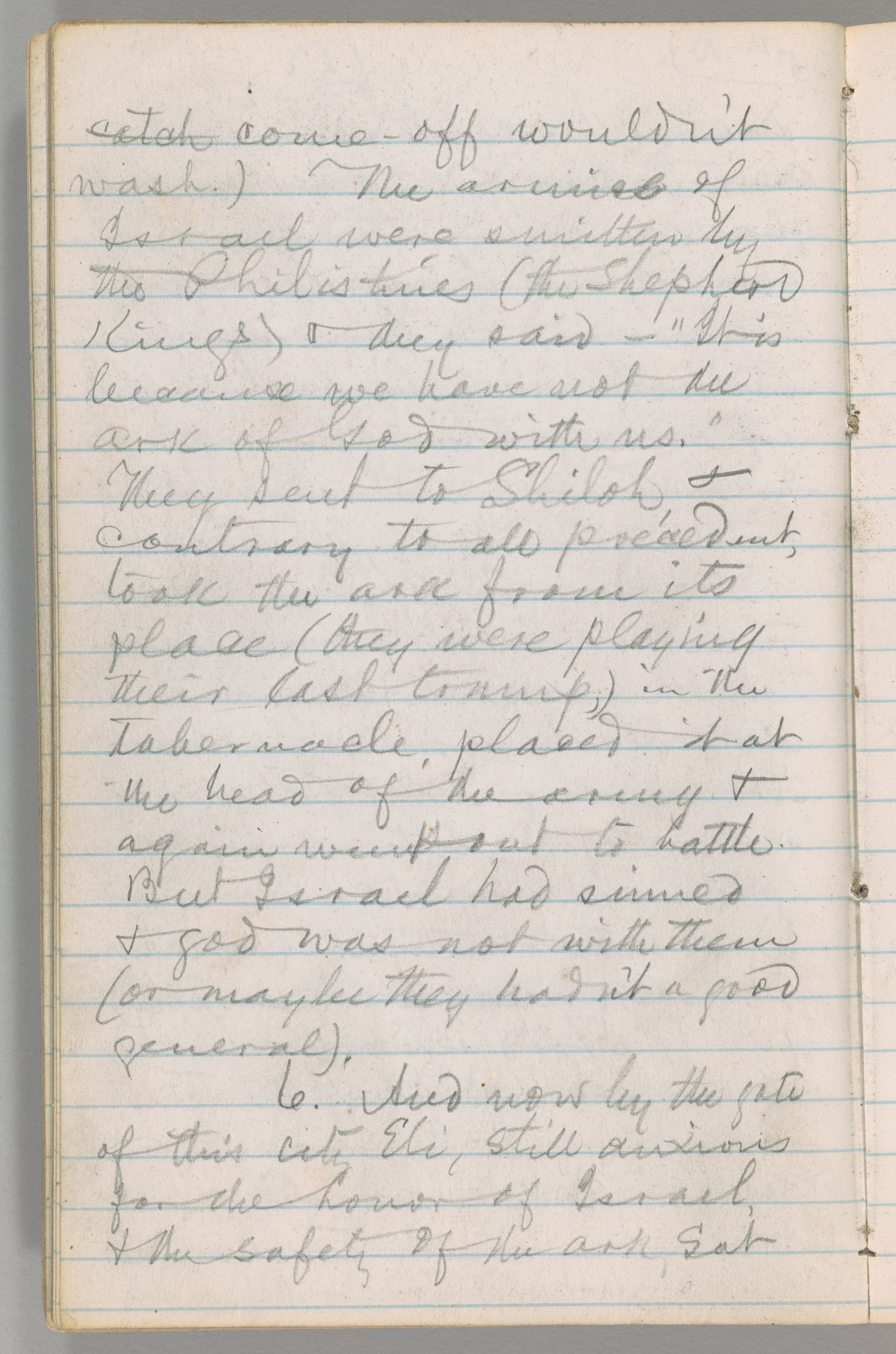
The Lord signally rebuked his neglect (but which the text signally fails to show it—the
armies didn't fight well, & now they want to blame it all on old Eli—the ark
[MS: N10_leaf_020v]
catch come-off wouldn't wash.) The armies of Israel were smitten by the Philistines (the
Shepherd Kings) & they said—“It is because we have not the ark of God with us.” They
sent to Shiloh, & contrary to all precedent, took the ark from its place (they were
playing their last trump,) in the tabernacle, placed it at the head of the army &
again went out to battle. But Israel had sinned & god was not with them (or maybe
they hadn't a good general).
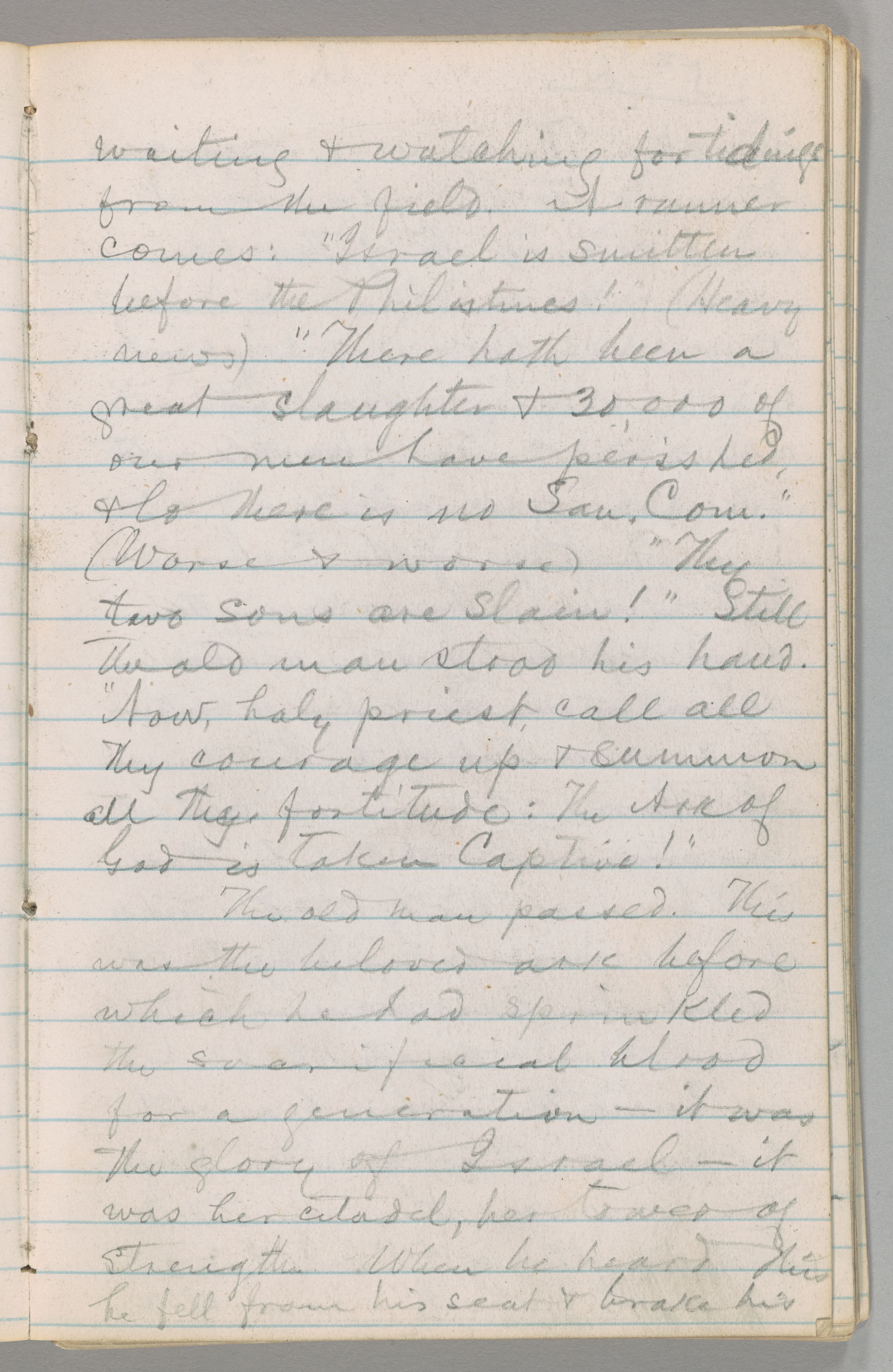
6. And now by the gate of this city Eli, still anxious for the honor of Israel, &
the safety of the ark, sat
[MS: N10_leaf_021r]
waiting & watching for tidings from the field. A runner comes: “Israel is smitten
before the Philistines!” (Heavy news) “There hath been a great slaughter & 30,000
of our men have perished, & lo there is no San. Com.” (Worse & worse) “Thy two sons
are slain!” Still the old man stood his hand. “Now, holy priest, call all thy courage
up & summon all the thyⓉtextual note fortitude: The Ark of God is taken Captive!”10
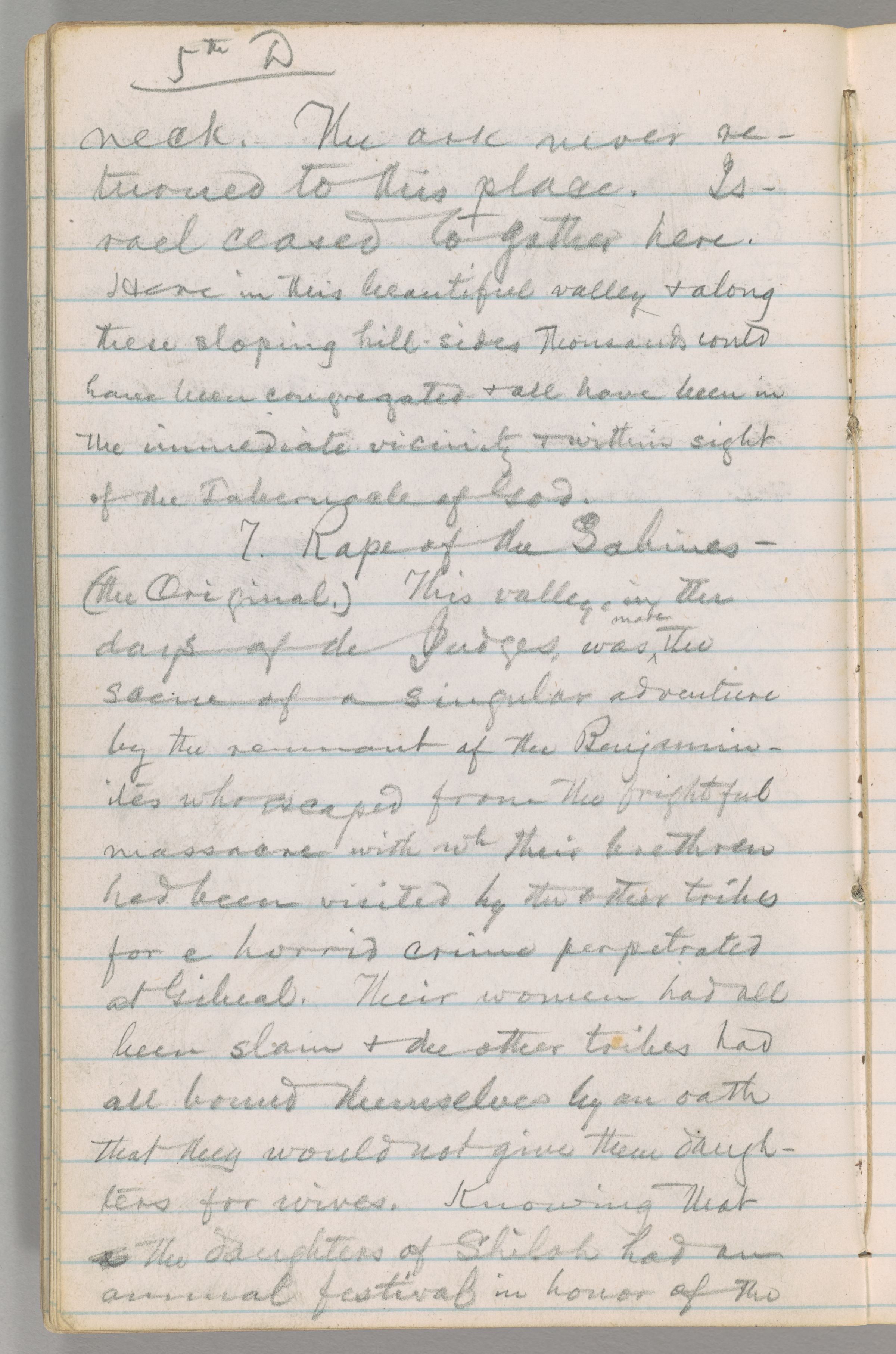
The old man passed. This was the beloved ark before which he had sprinkled the sacrificial
blood for a generation—it was the glory of Israel—it was her citadel, her tower of
strength. When he heard this he fell from his seat & brake his
[MS: N10_leaf_021v]
neckⓂemendation. The ark never returned to this place. Israel ceased to gather here. Here in this
beautiful valley & along these sloping hill-sides thousands could have been congregated
& all have been in the immediate vicinity & within sight of the Tabernacle of God.
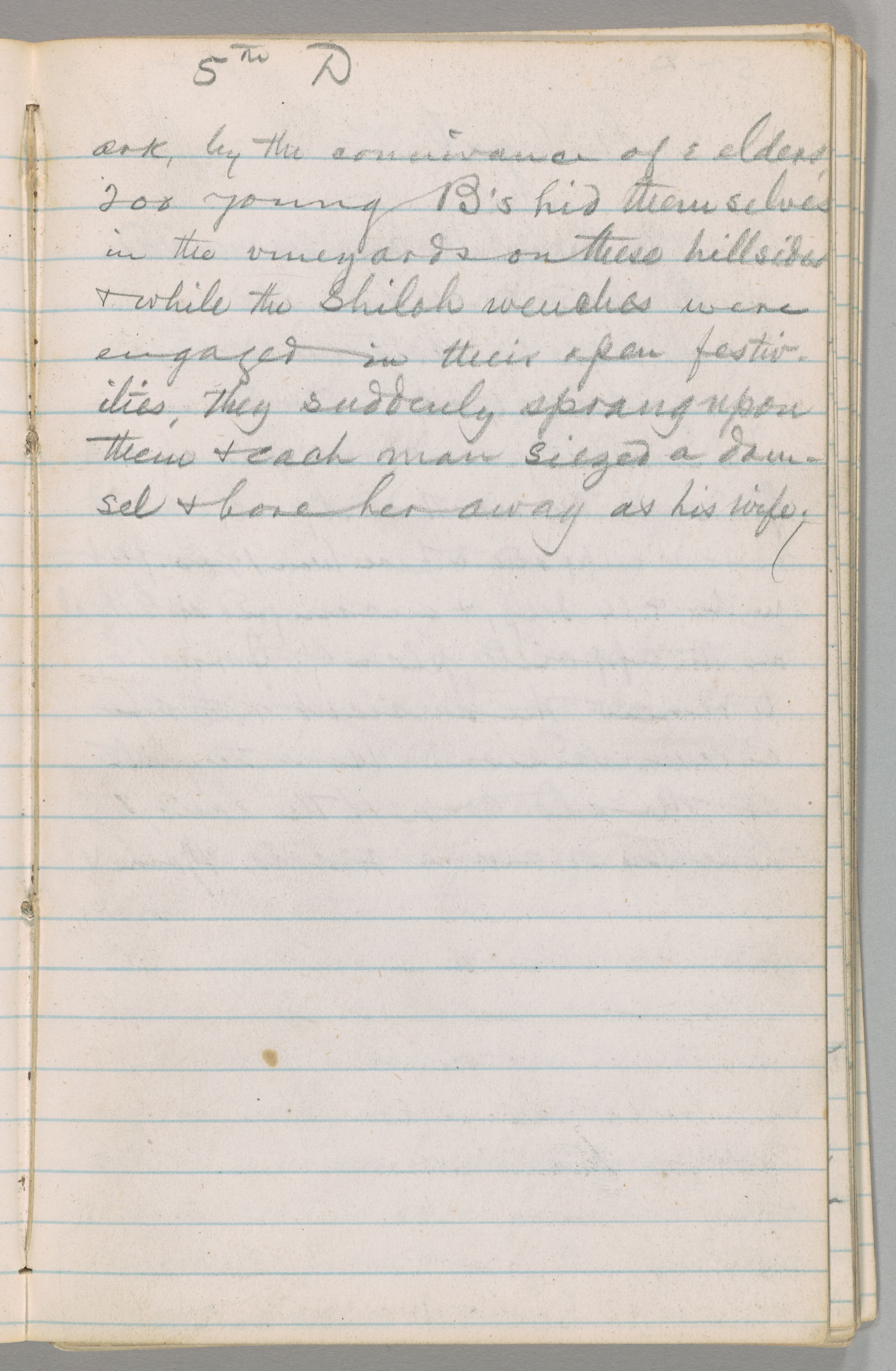
7. Rape of the Sabines—(the Original.) This valley, in the days of the Judges, was
madeⓉtextual note the scene of a singular adventure by the remnant of the Benjaminites who escaped
from the frightful massacre with wh their brethren had been visited by the other tribes for e horridⓂemendation crime perpetrated at Gibeal. Their women had all been slain & the other tribes had
all bound themselves by an oath that they would not give them daughters for wives.
Knowing that e the daughtersⓂemendation of Shiloh had an annual festival in honor of the
[MS: N10_leaf_022r]
arkⓂemendation, by the connivance of e eldersⓂemendation, 200 young B's hid themselves in the vineyards on these hillsides & while the Shiloh
wenches were engaged in their open festivities, they suddenly sprang upon them & each
man siezed a damsel & bore her away as his wife.
[MS: N10_leaf_022v]
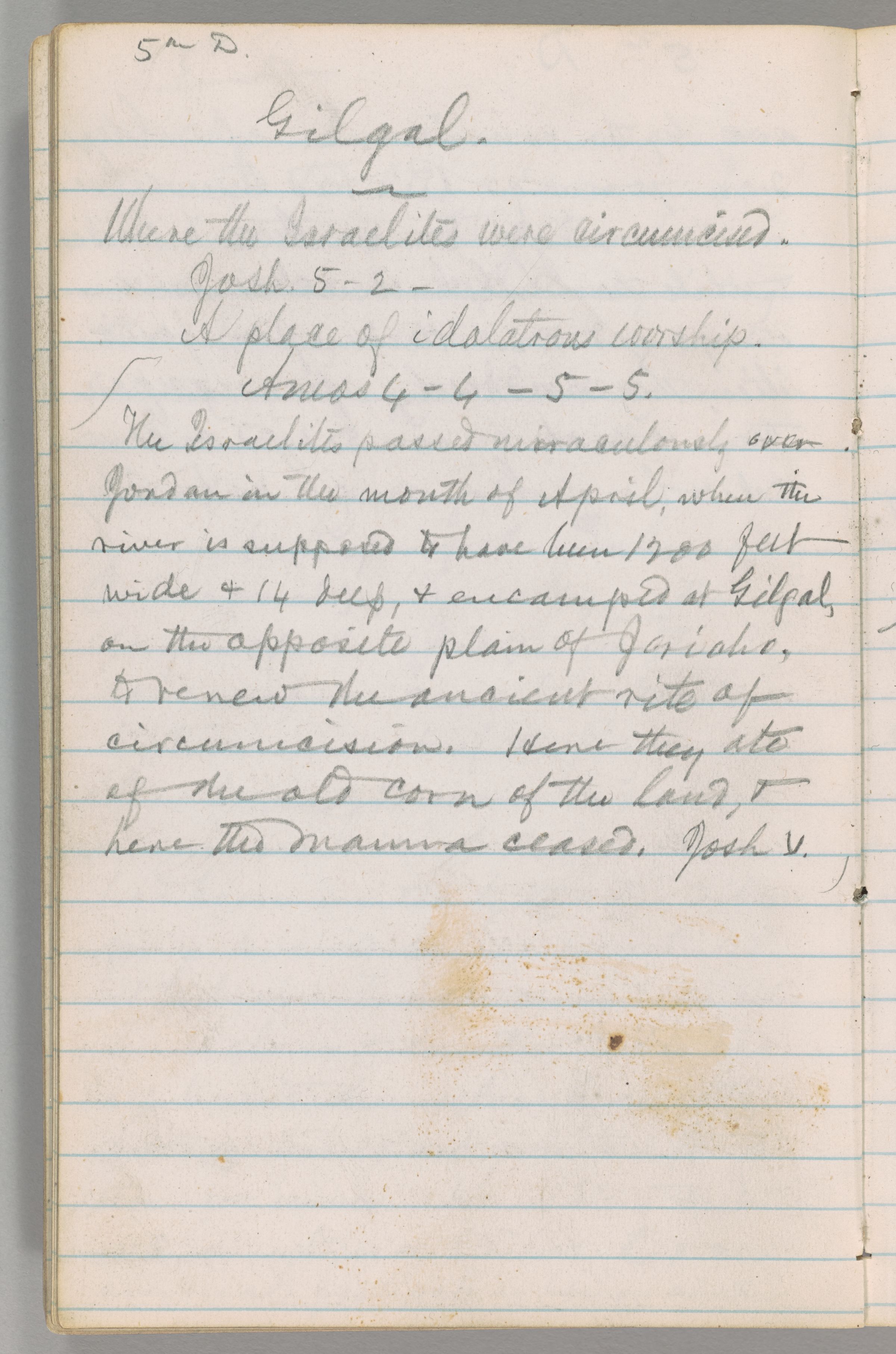
5th D.
Gilgal.
Where the Israelites were circumcised. Josh. 5-2—
A place of idolatrous worship. Amos 4-4—5-5.
The Israelites passed miraculously over Jordan in the month of April, when the river is supposed to have been 1200 feet wide & 14 deep, & encamped at Gilgal, on the opposite plain of Jericho, to renew the ancient rite of circumcision. Here they ate of the old corn of the land, & here the manna ceased. Josh V.
[MS: N10_leaf_023r]
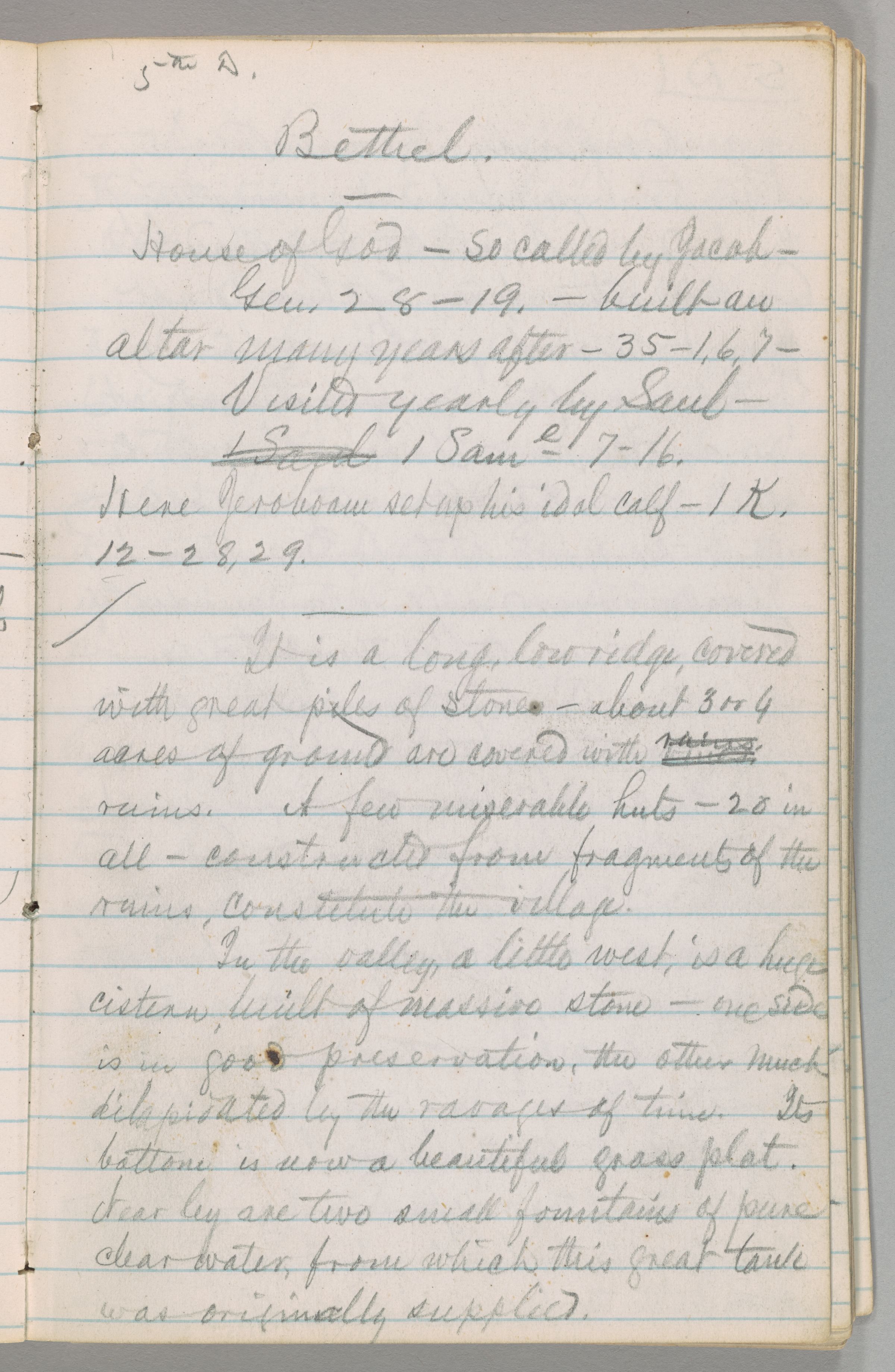
5th D.
Bethel.
House of God—so called by Jacob—Gen. 28-19.—built an altar many years after—35-1, 6, 7—
Visited yearly by Saul—1 Saul 1 Sam1 7-16.
Here Jeroboam set up his idol calf—1 K. 12-28, 29.
It is a long, low ridge, covered with great piles of stones—about 3 or 4 acres of ground are covered with vines. ruins. A few miserable huts—20 in all—constructed from fragments of the ruins, constitute the village.
In the valley, a little west, is a huge cistern, built of massive stone—one side is in good preservation, the other much dilapidated by the ravages of time. Its bottom is now a beautiful grass plat. Near by are two small fountains of pure clear water, from which this great tank was originally supplied.
[MS: N10_leaf_023v]
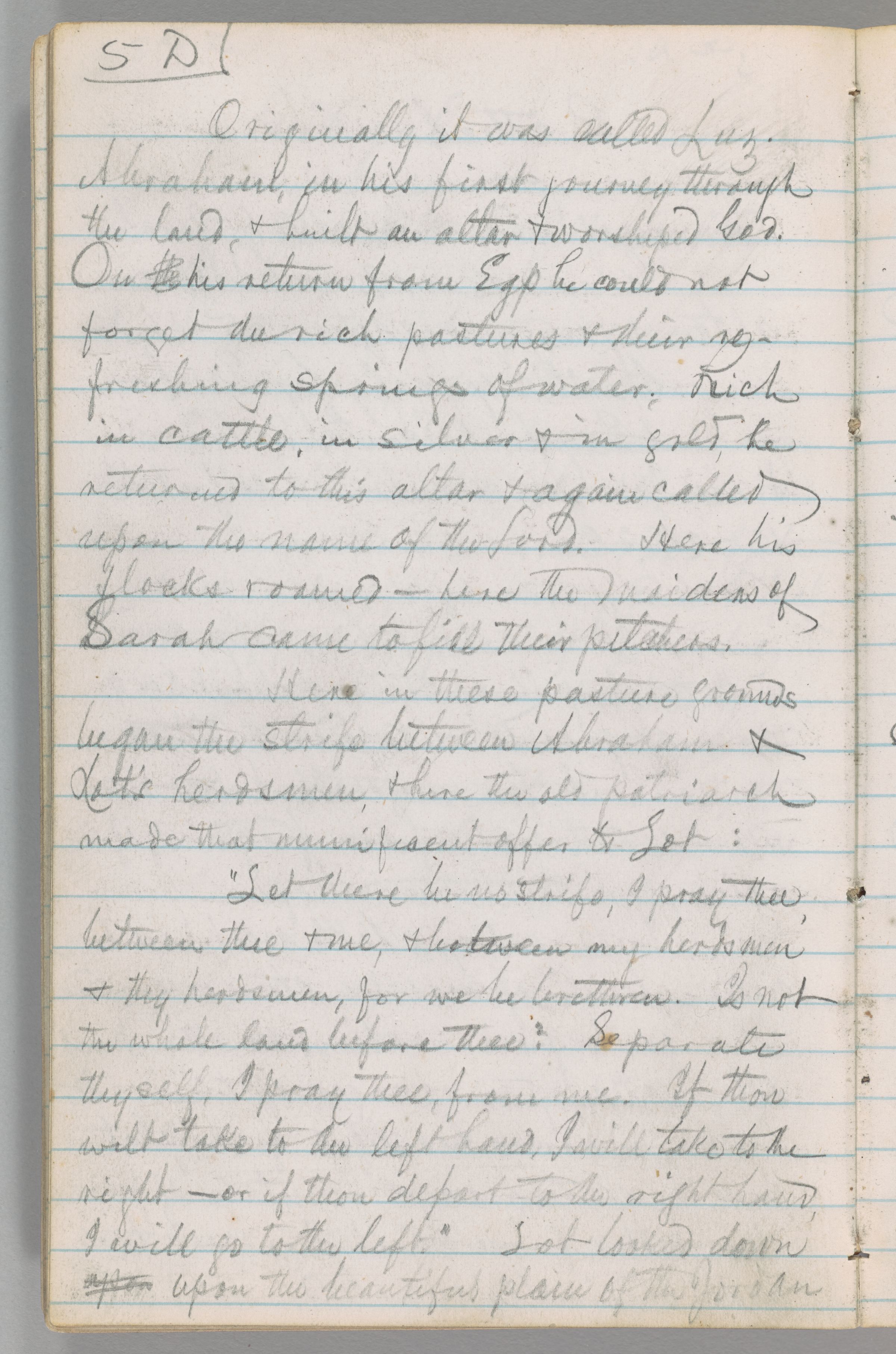
OriginallyⓂemendation it was called Luz. Abraham, in his first journey through the land, & built an altar & worshiped God. On th his return from Egp he could not forget the rich pastures & their refreshing springs of water ,. rich RichⓉtextual note in cattle, in silver & in gold, he returned to this altar & again called upon the name of the Lord. Here his flocks roamed—here the Maidens of Sarah came to fill their pitchers.
Here in these pasture grounds began the strife between Abraham & Lot's herdsmen, & here the old patriarch made that munificent offer to Lot:
“Let there be no strife, I pray thee, between thee & me, & between my herdsmen & thy
herdsmen, for we be brethren. Is not the whole land before thee? Separate thyself,
I pray thee, from me. If thou wilt take to the left hand, I will take to the right—or
if thou depart to the right hand, I will go to the left.” Lot looked down upon the
beautiful plain of the Jordan
[MS: N10_leaf_024r]
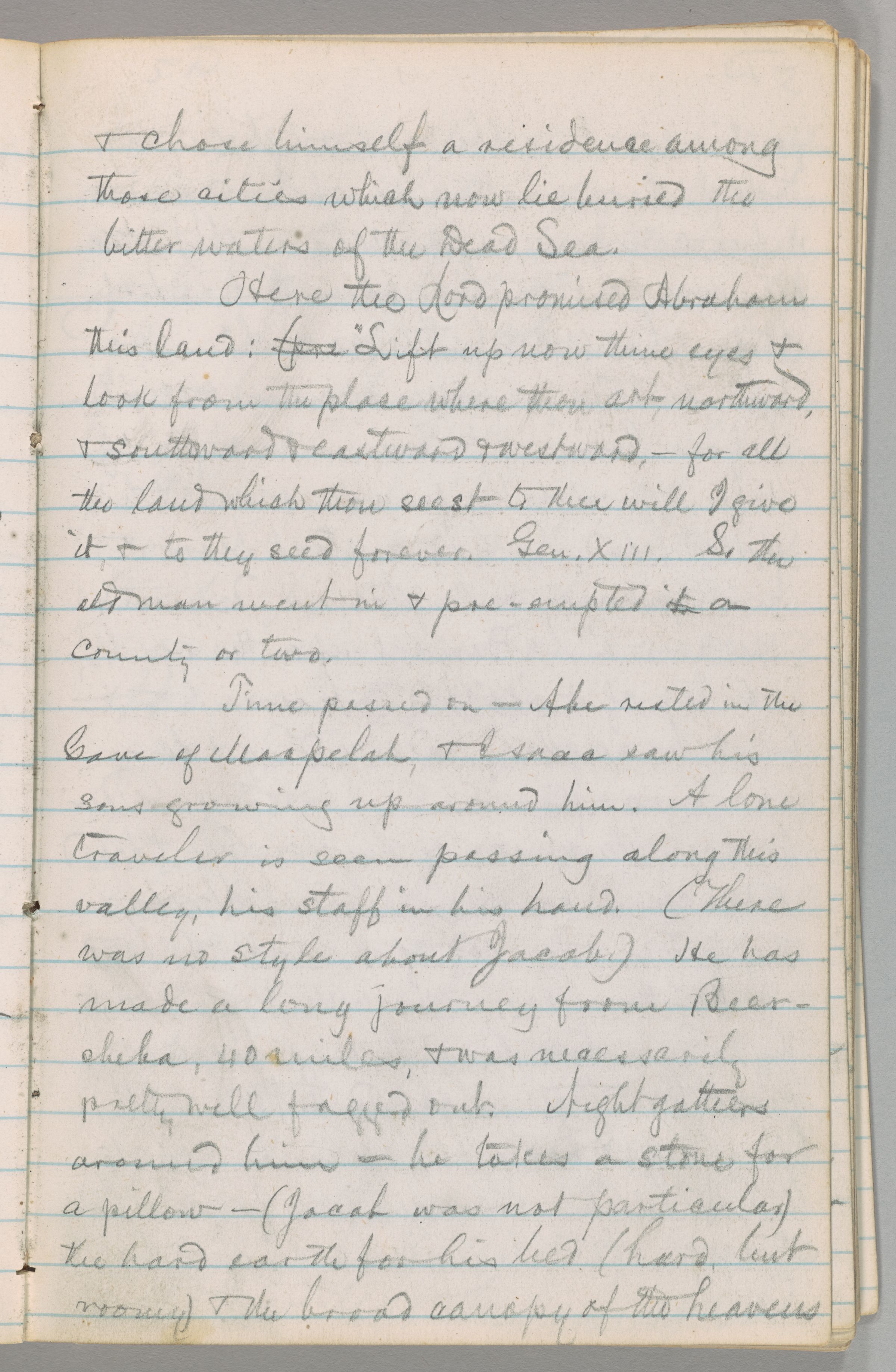
& chose himself a residence among those cities which now lie buried the bitter waters
of the Dead Sea.
Here the Lord promised Abraham this land: (pre “Lift up now thine eyes & look from the place where thou art, northward, & southward & eastward & westward,—for all the land which thou seest to thee will I give it, & to thy seed forever. Gen. XIII. So the old man went in & pre-empted it a county or two.
Time passed on—Abe rested in the Cave of Macpelah, & Isaac saw his sons growing up
around him. A lone traveler is seen passing along this valley, his staff in his hand.
(There was no style about Jacob.) He has made a long journey from Beersheba, 40 miles,
& was necessarily pretty well fagged out. Night gathers around him—he takes a stone
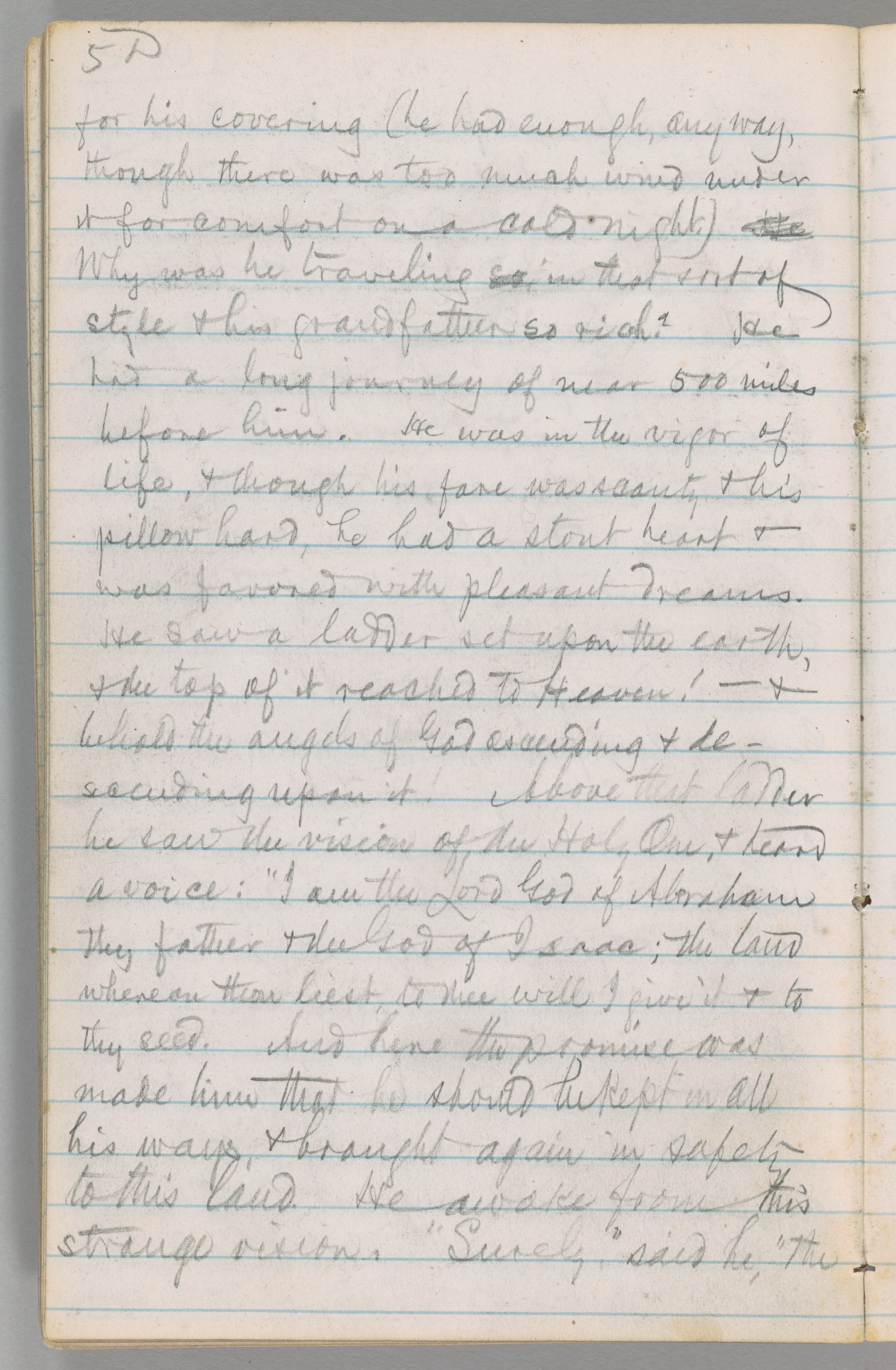
for a pillow—(Jacob was not particular) the hard earth for his bed (hard, but roomy)
& the broad canopy of the heavens
[MS: N10_leaf_024v]
for his coveringⓂemendation (he had enough, anyway, though there was too much wind under it for comfort on a
cold night.) He Why was he traveling so, in that sort of style & his grandfather so rich? He had a long journey of near 500
miles before him. He was in the vigor of life, & though his fare was scanty & his
pillow hard, he had a stout heart & was favored with pleasant dreams. He saw a ladder
set upon the earth, & the top of it reached to Heaven!—& behold the angels of God
ascending & descending upon it! Above that ladder he saw the vision of the Holy One,
& heard a voice: “I am the Lord God of Abraham thy father & the God of Isaac; the
land whereon thou liest, to thee will I give it & to thy seed. And here the promise
was made him that he should be kept in all his ways, & brought again in safety to
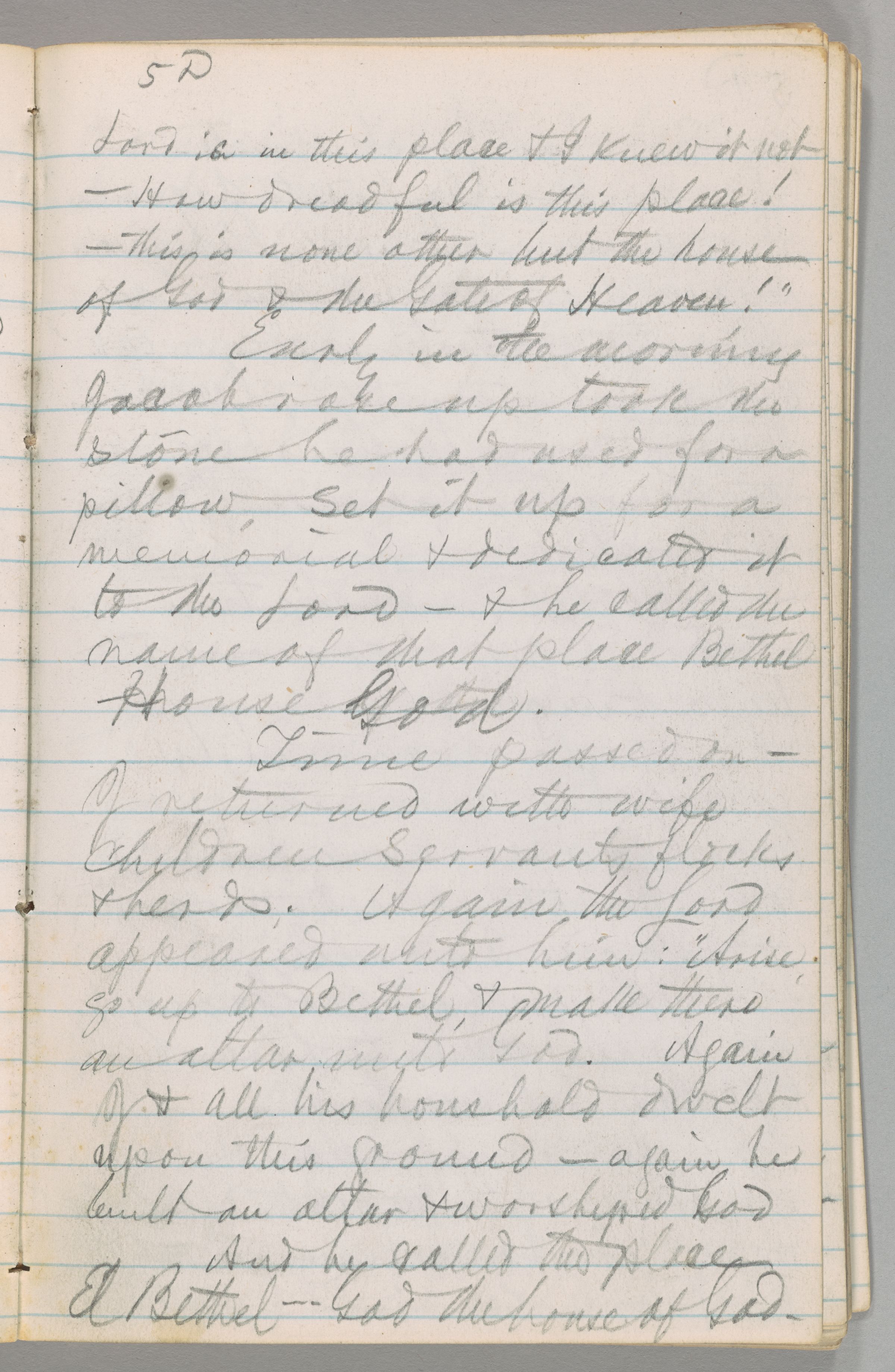
this land. He awoke from this strange vision. “Surely,” said he, “the
[MS: N10_leaf_025r]
LordⓂemendation in isⓉtextual note in this place & I knew it not—How dreadful is this place!—this is none other but
the house of God & the Gate of Heaven!”
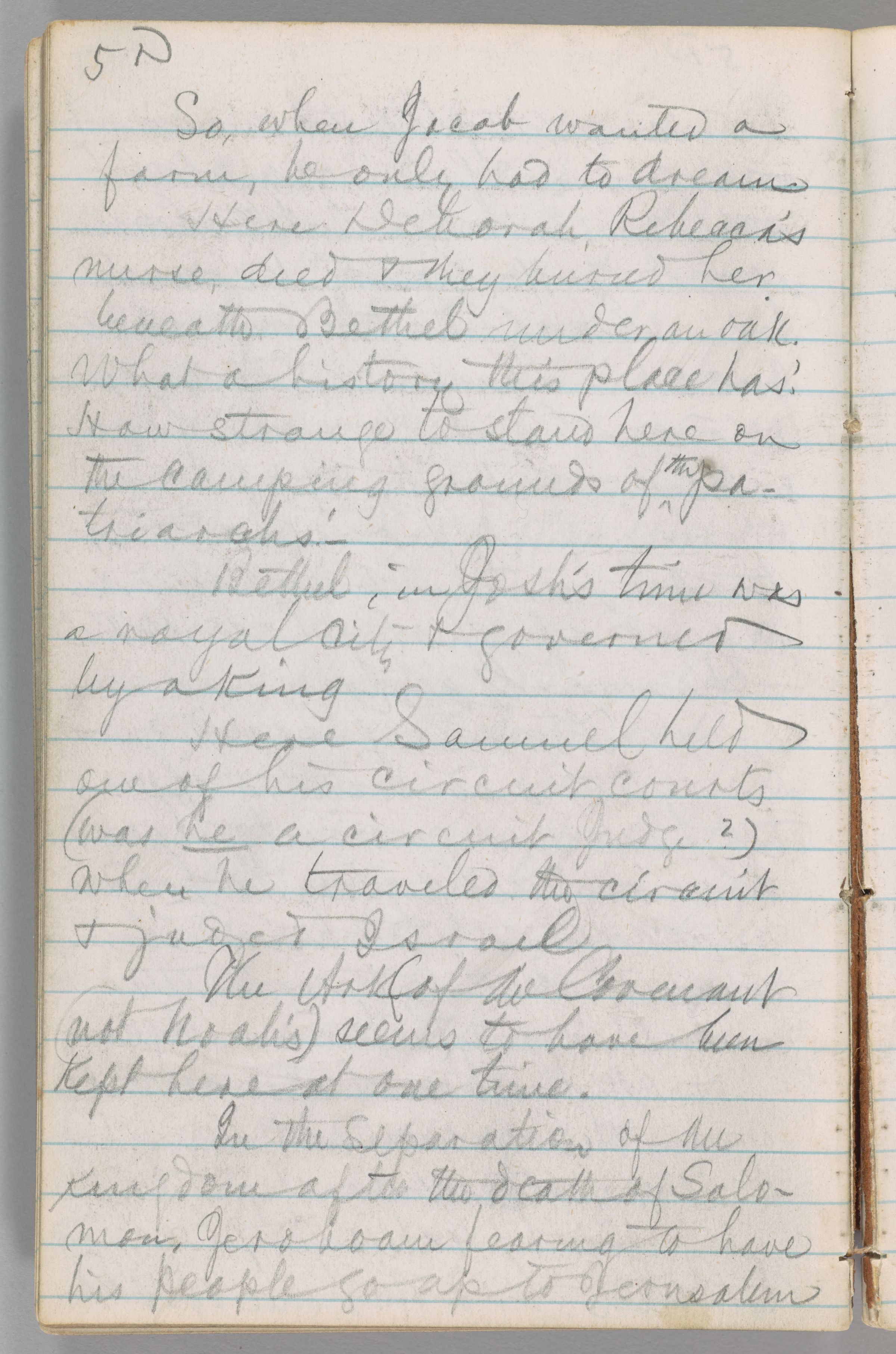
Early in the morning Jacob rose up took the stone he had used for a pillow, set it up for a memorial & dedicated it to the Lord—& he called the name of that place Bethel—house of the House God.Ⓣtextual note
Time passed on—J returned with wife children servants flocks & herds,. Again the Lord appeared unto him: “Arise, go up to Bethel, & make there an altar unto God. Again J & all his houshold dwelt upon this ground—again he built an altar & worshiped God
And he called the place El Bethel—God the house of God.
[MS: N10_leaf_025v]
So, when JacobⓂemendation wanted a farm, he only had to dream.
Here Deborah, Rebecca's nurse, died & they buried her beneath Bethel under an oak. What a history this place has! How strange to stand here on the camping grounds of the patriarchsⓉtextual note!—
Bethel, in Josh's time was a royal city & governed by a King.
Here Samuel held one of his circuit courts (was he a circuit Judge?) when he traveled the circuit & judged Israel
The Ark (of the Covenant (not Noah's)Ⓣtextual note seems to have been kept here at one time.
In the separation of the kingdom after the death of Solomon, Jeroboam fearing to have
his people go up to Jerusalem
[MS: N10_leaf_026r]
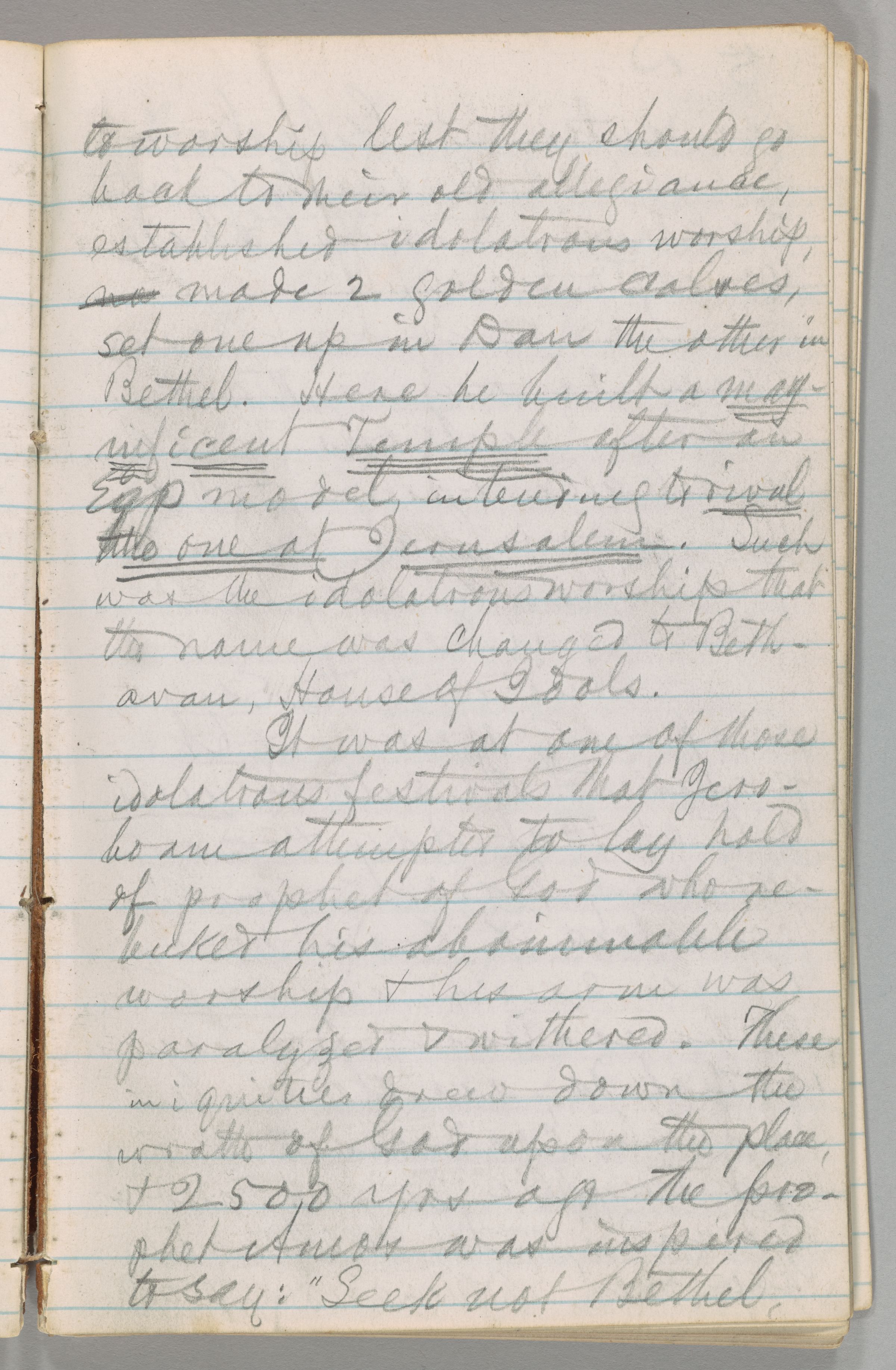
to worship lest they should go back to their old allegiance, established idolatrous
worship, no made 2 golden calves, set one up in Dan the other in Bethel. Here he built a MAGNIFICENT TEMPLEⓉtextual note after an Egp model, intending to rival the one at Jerusalem. Such was the idolatrous worship that the name was changed to Beth-avanⓂemendation, House of Idols.
It was at one of those idolatrous festivals that Jeroboam attempted to lay hold of
prophet of God who rebuked his abominable worship & his arm was paralyzed & withered.
These iniquities drew down the wrath of God upon the place, & 2500 yrs ago the prophet
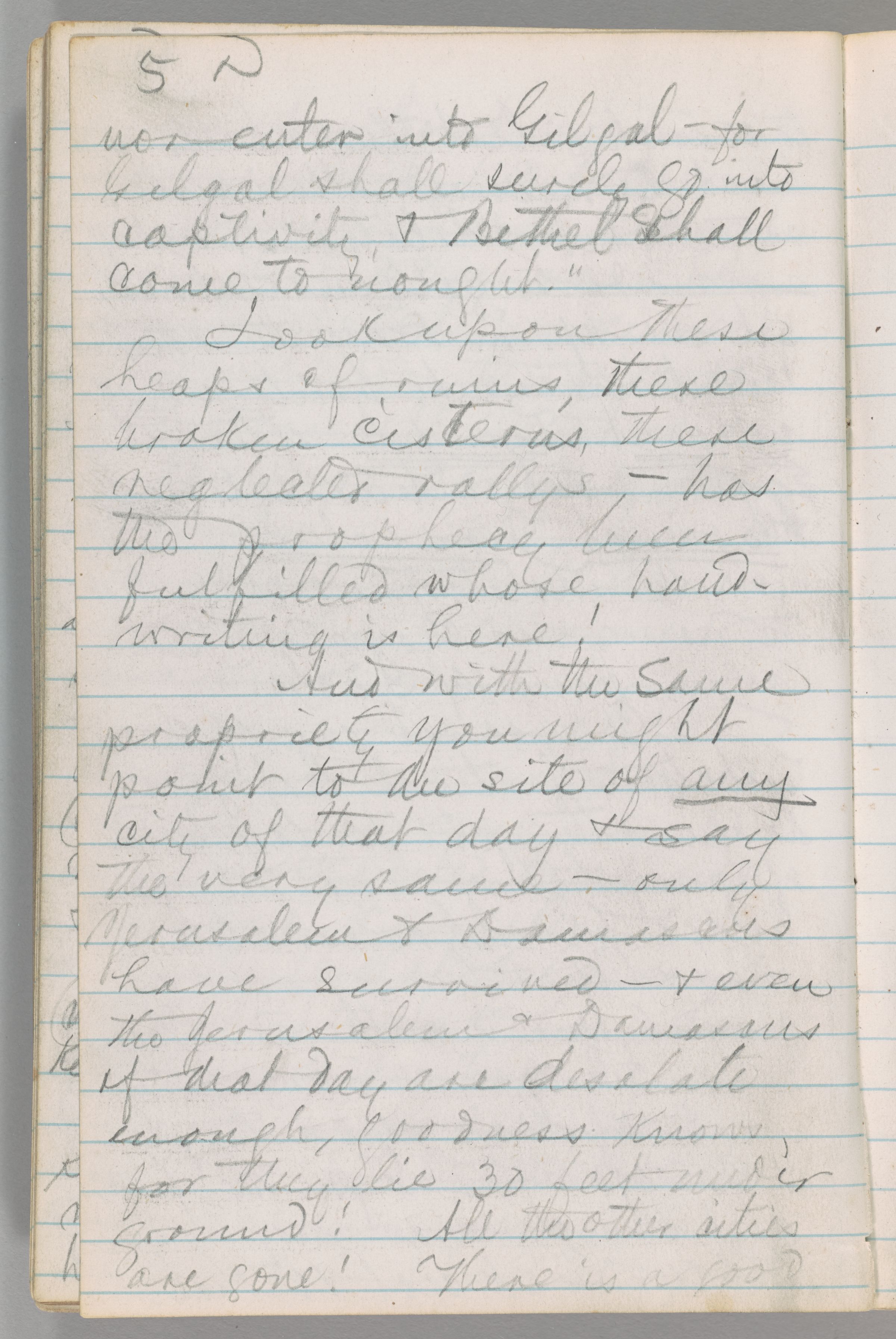
Amos was inspired to say: “Seek not Bethel,
[MS: N10_leaf_026v]
nor enterⓂemendation into Gilgal—for Gilgal shall surely go into captivity, & Bethel shall come to nought.”
Look upon these heaps of ruins, these broken ciscerns cisternsⓉtextual note, these neglected vallys—has the prophecy been fulfilled whose handwritingⓂemendation is here!11
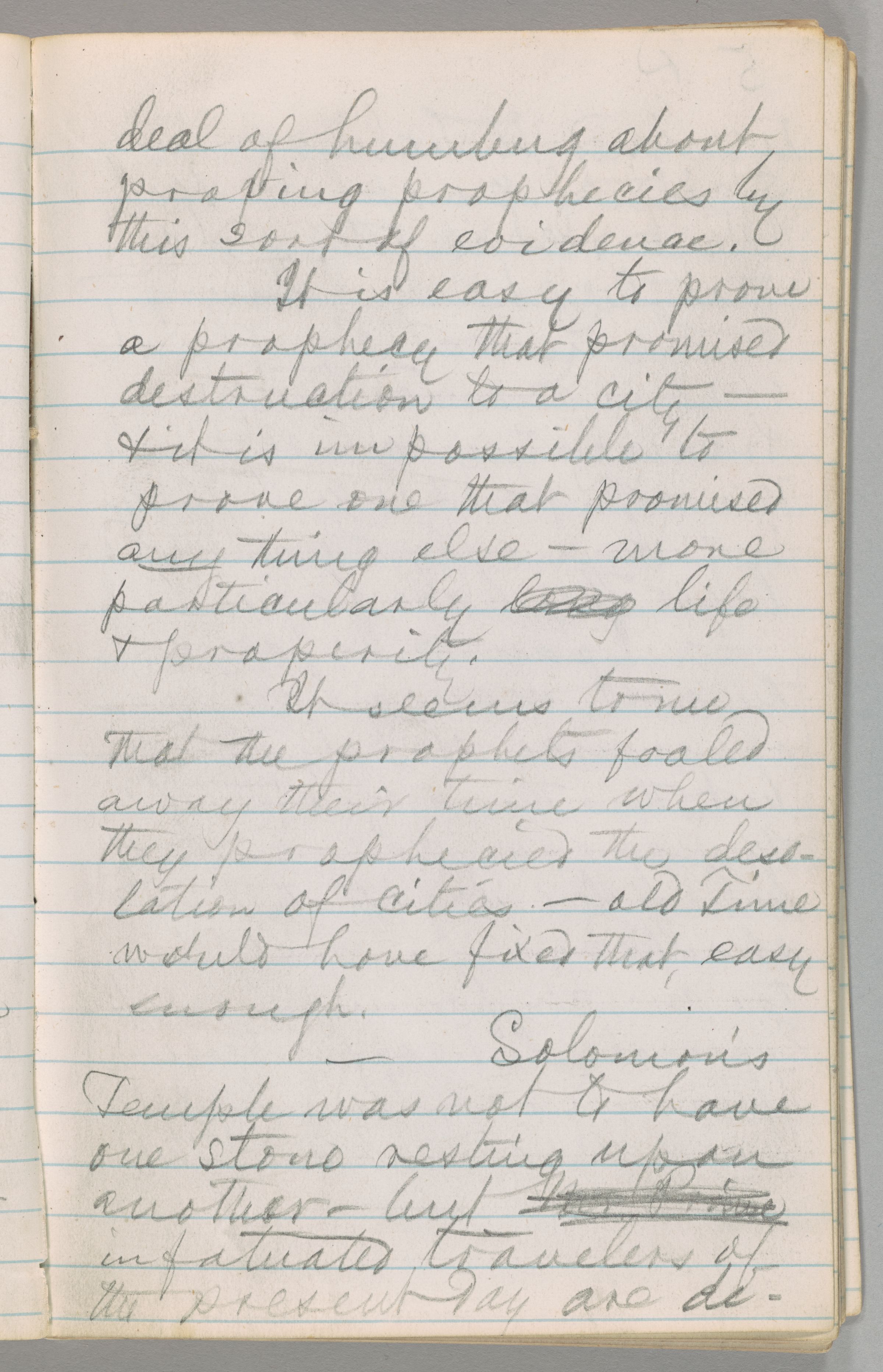
And with the same propriety you might point to the site of any city of that day & say the very same—only Jerusalem & Damascus have survived—& even
the Jerusalem & Damascus of that day are desolate enough, goodness knows, for they
lie 30 feet under ground! All the other cities are gone! There is a good
[MS: N10_leaf_027r]
deal of humbug about proving prophecies by this sort of evidence.
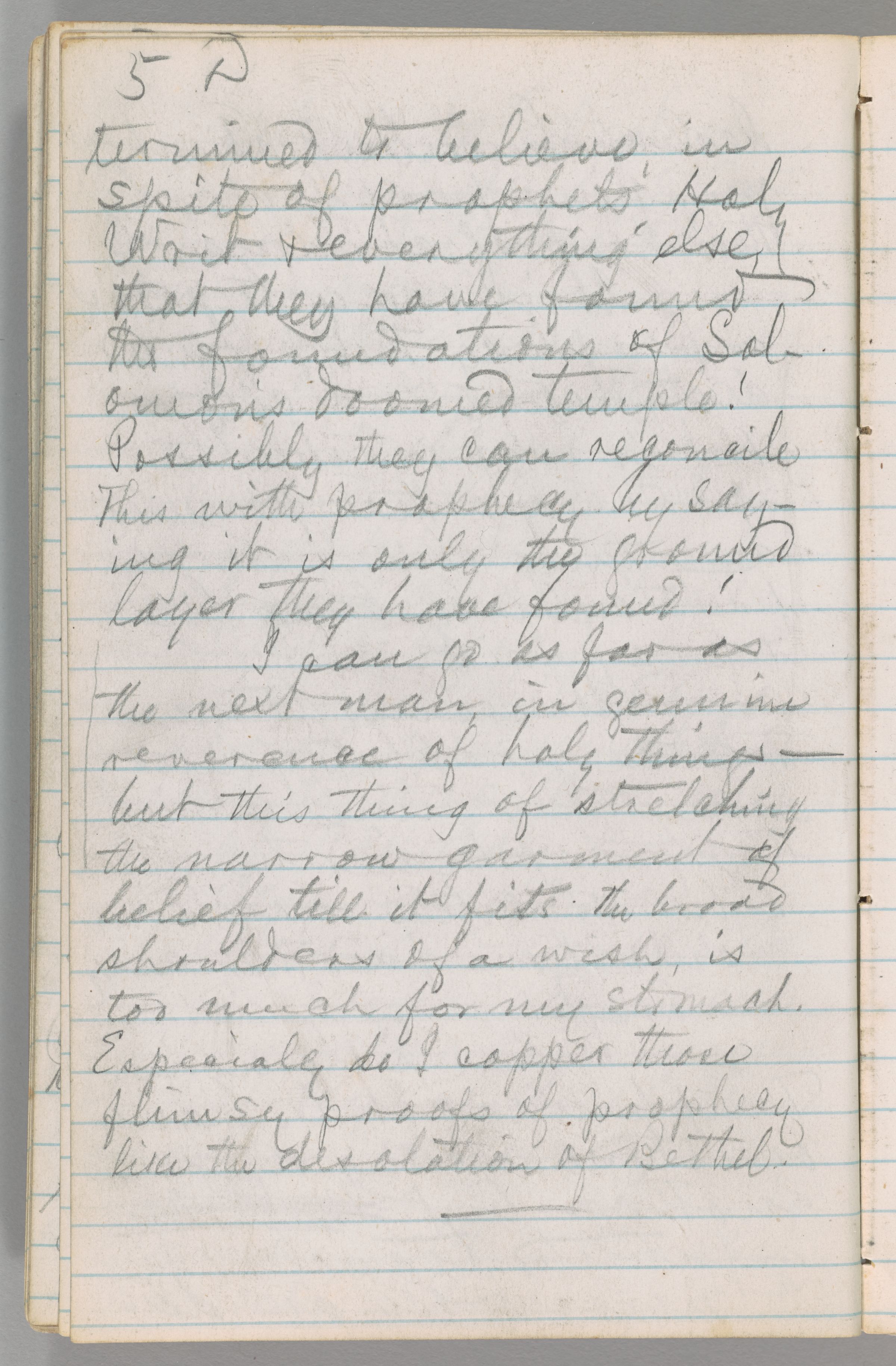
It is easy to prove a prophecy that promised destruction to a city—& it is impossible to prove one that promised any thing else—more particularly long life & properity.
It seems to me that the prophets fooled away their time when they prophecied the desolation of cities.—old Time wil wouldⓉtextual note have fixed that, easy enough.
—Solomon'sⓉtextual note Temple was not to have one stone resting upon another—but Mr. Prime infatuated travelers of the present day are de-
[MS: N10_leaf_027v]
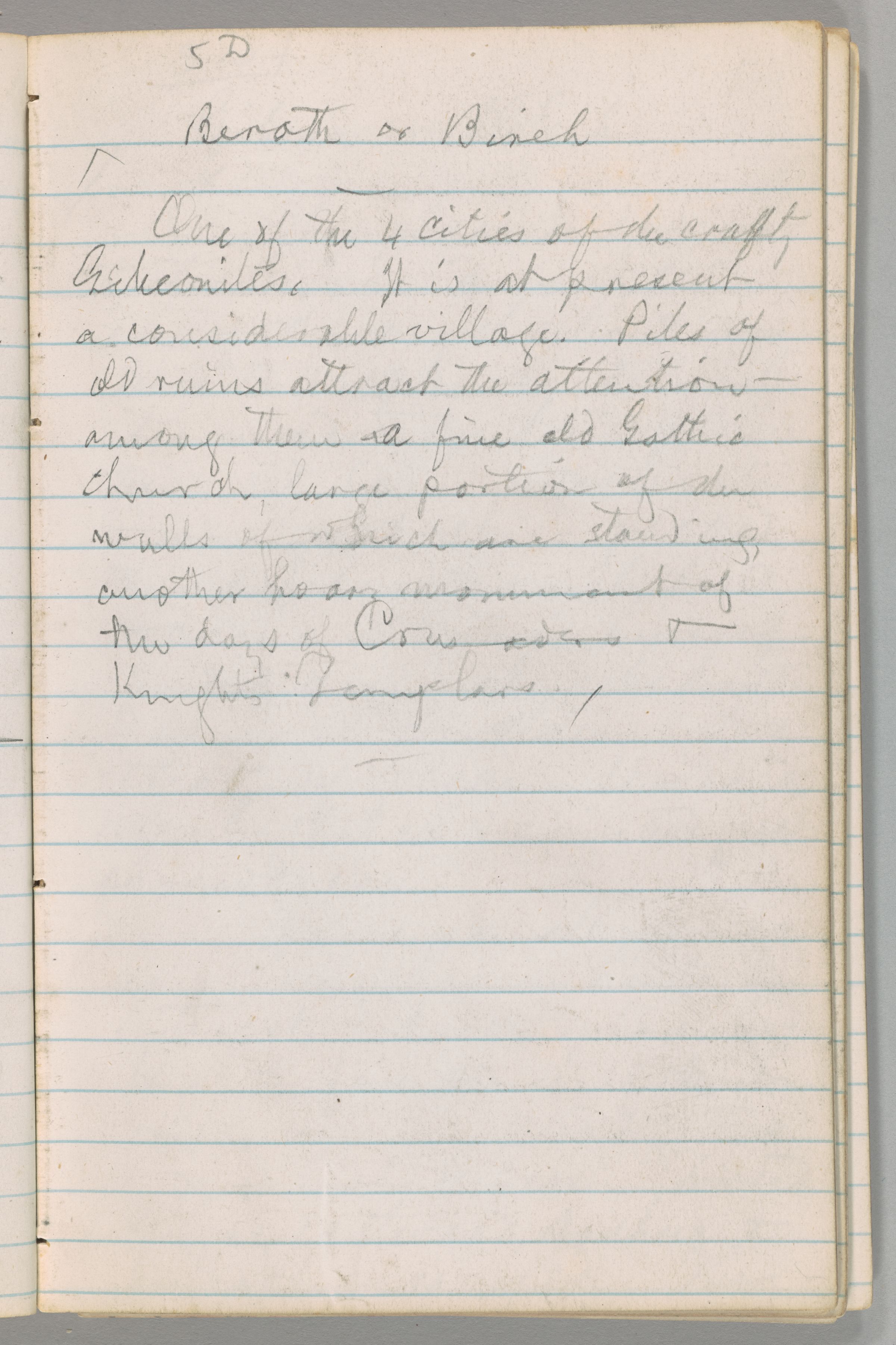
terminedⓂemendation to believe, in spite of prophets, Holy Writ & everything else, that they have found
the foundations of Solomon's doomed temple! Possibly they can reconcile this with
prophecy by saying it is only the ground layer they have found!
I can go as far as the next man, in genuine reverence of holy things—but this thing of stretching the narrow garment of belief till it fits the broad shoulders of a wish, is too much for my stomach. Especially do I copper those flimsy proofs of prophecy like the desolation of Bethel.
[MS: N10_leaf_028r]
5 D
Beroth or Bireh
One of the 4 cities of the crafty Gibeonites. It is at present a considerable village. Piles of old ruins attract the attention—among them a fine old Gothic church, large portion of the walls of which are standing, another hoary monument of the days of Crusaders & Knights Templars.Ⓣtextual note

[MS: N10_leaf_028v]
blank verso
[MS: N10_leaf_029r]
5 D—
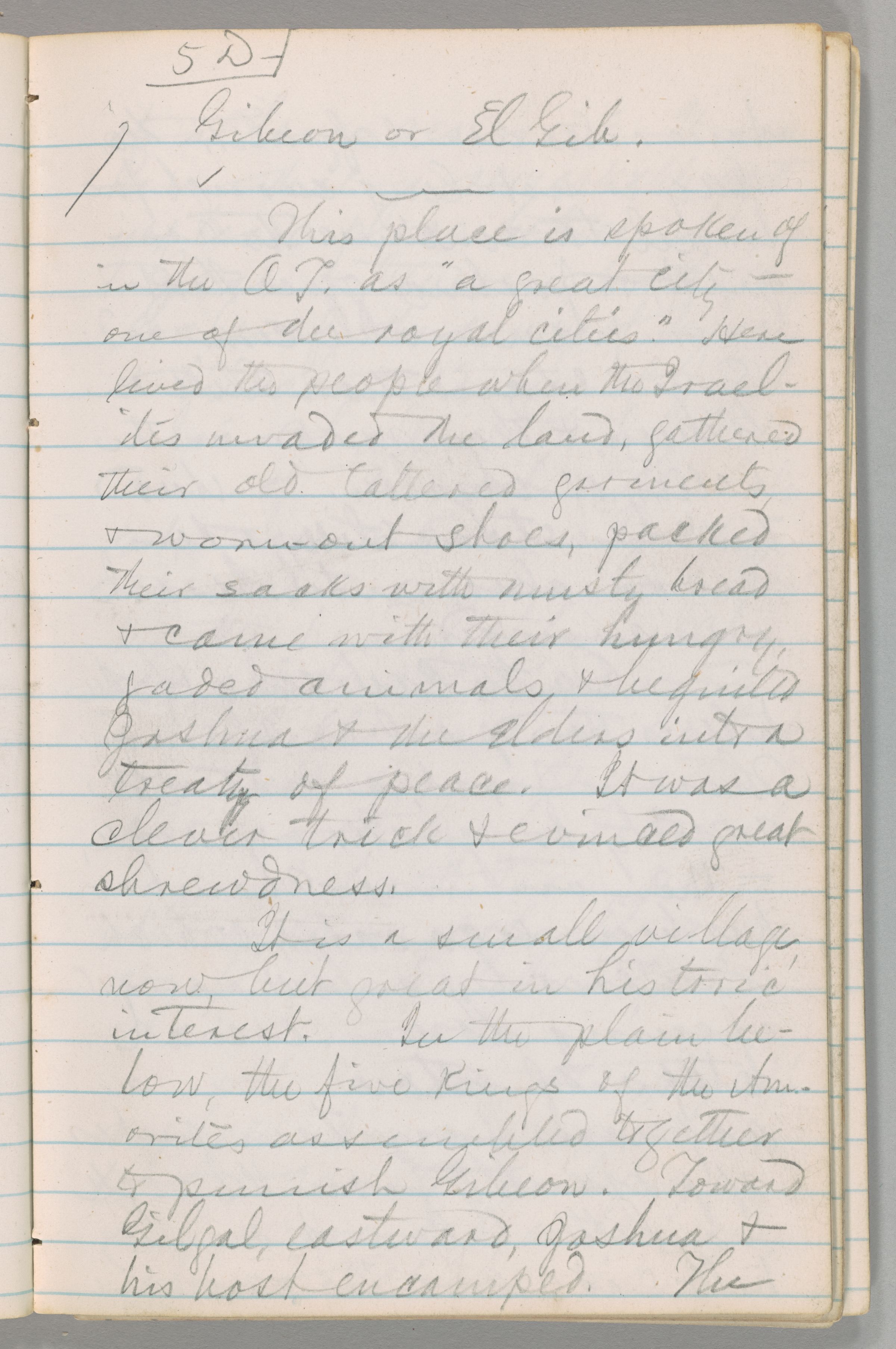
Gibeon or El Gib.
This place is spoken of in the O T. as “a great city—one of the royal cities.” Here lived the people when the Israelites invaded the land, gathered their old tattered garments, & worn-out shoes, packed their sacks with musty bread & came with their hungry, jaded animals & beguiled Joshua & the elders into a treaty of peace. It was a clever trick & evinced great shrewdness.
It is a small village, now, but great in historic interest. In the plain below, the
five kings of the Amorites assembled together to punish Gibeon. Toward Gilgal, eastward,
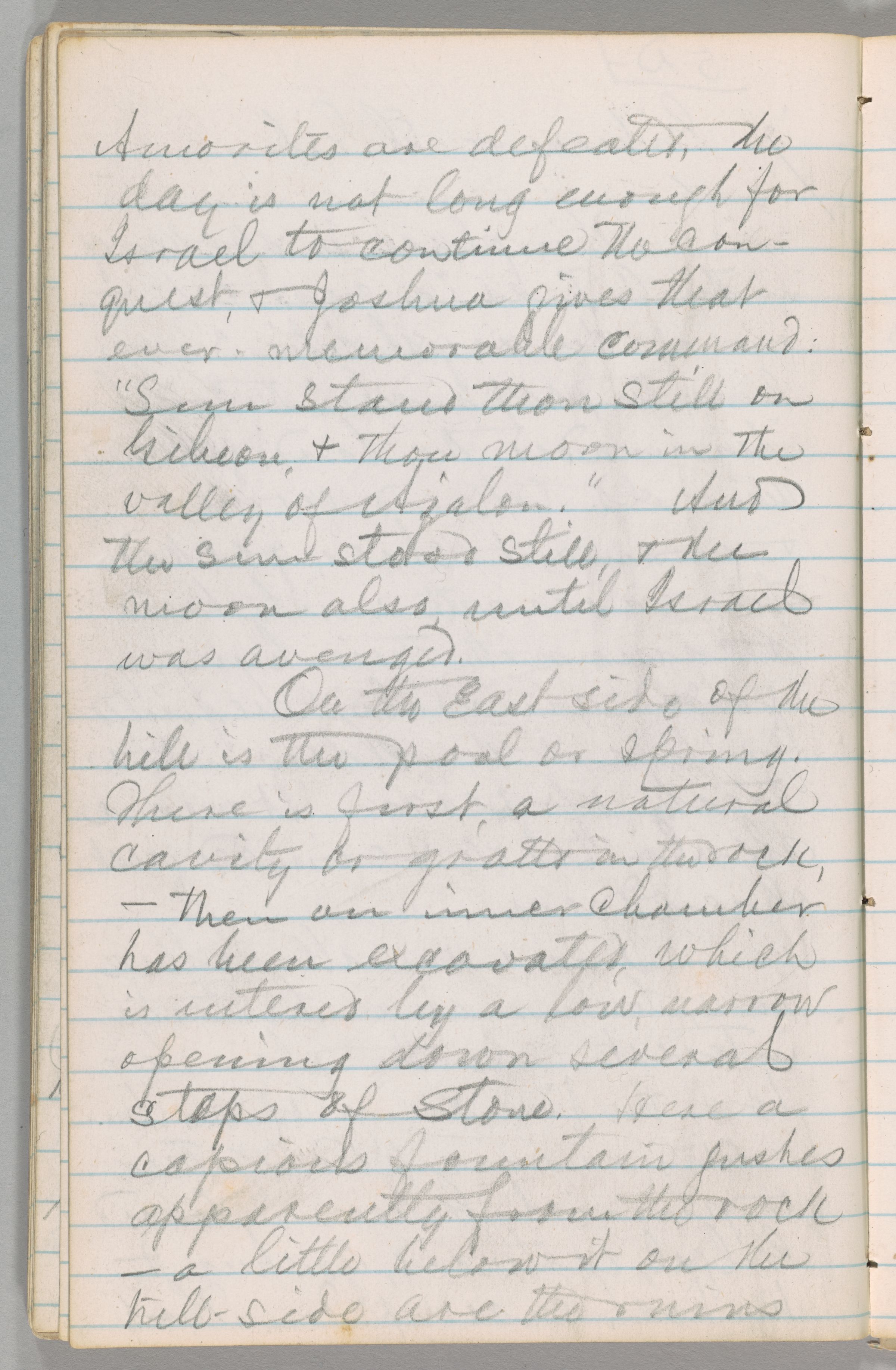
Joshua & his host encamped. The
[MS: N10_leaf_029v]
Amorites are defeated, the day is not long enough for Israel to continue the conquest,
& Joshua gives that ever-memorable command: “Sun stand thou still on Gibeon, & thou
moon in the valley of Ajalon.” And the sun stood still, & the moon also, until Israel
was avenged.
On the East side of the hill is the pool or spring. There is first, a natural cavity
or grotto in the rock,—then an inner chamber has been excavated, which is entered
by a low, narrow opening down several sto stepsⓉtextual note of stone. Here a copious fountain gushes apparently from the rock—a little below
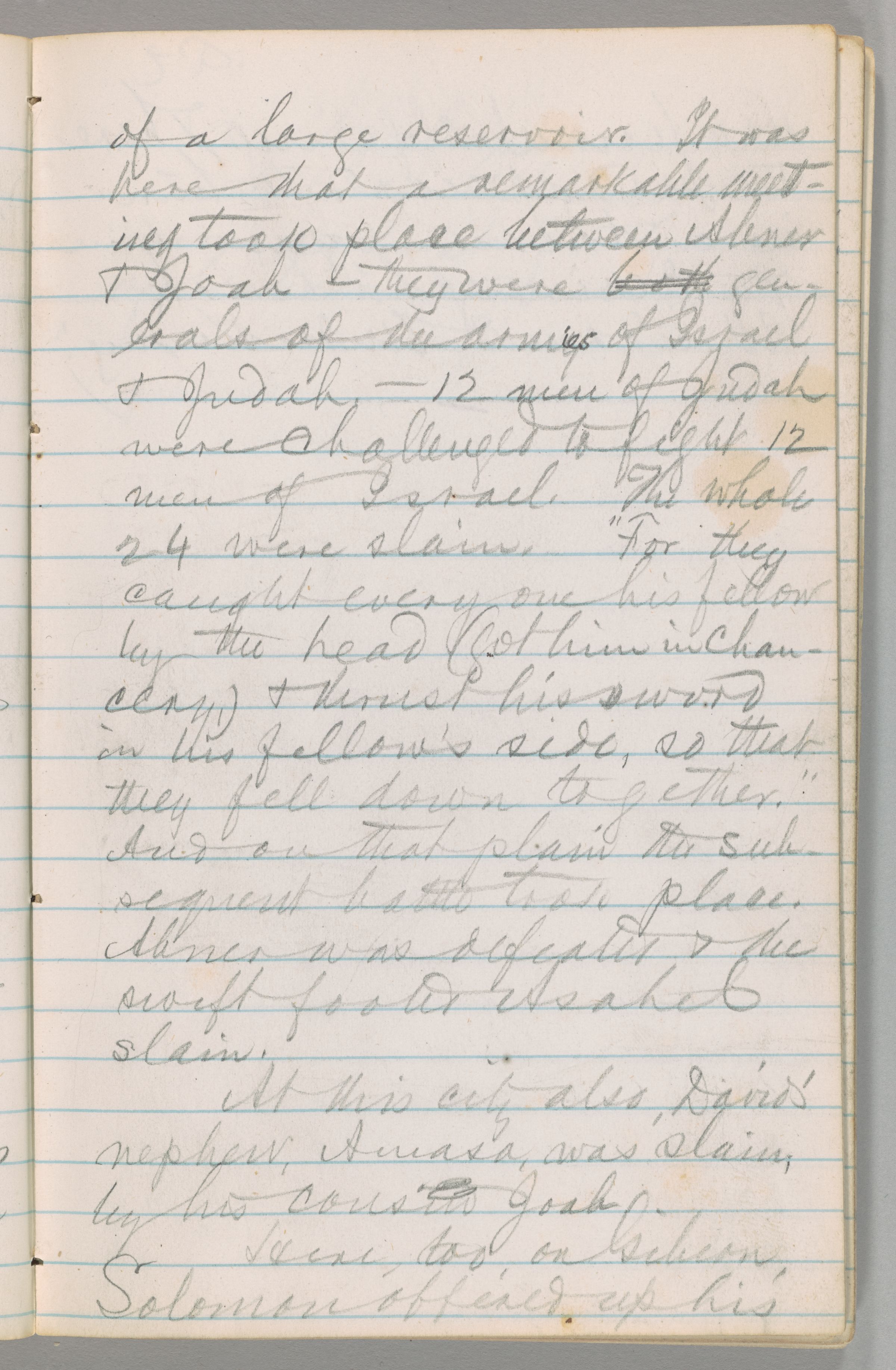
it on the hill-side are the ruins
[MS: N10_leaf_030r]
of a large reservoir. It was here that a remarkable meeting took place between Abner
& Joab—they were both generals of the army armiesⓉtextual note of Israel & Judah.—12 men of Judah were challenged to fight 12 men of Israel. The
whole 24 were slain. “For they caught every one his fellow by the head (got him in
chancery,) & thrust his sword in his fellow's side, so that they fell down together.”
And on that plain the subsequent battle took place. Abner was defeated & the swift footedⓂemendation Asahel slain.
At this city also, David's nephew, Amasa, was slain, by his cousin Joab.
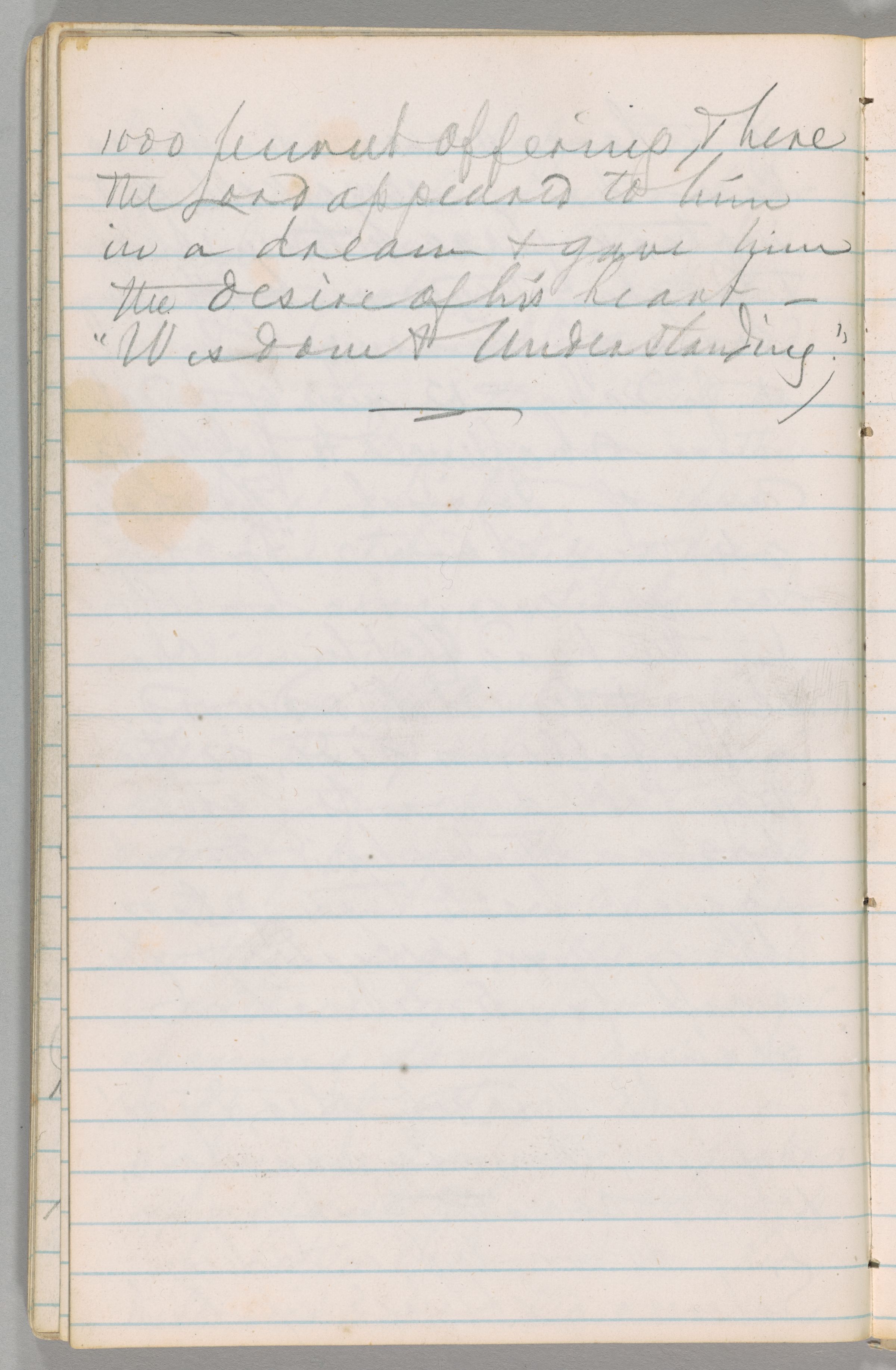
Here, too, on Gibeon, Solomon offered up his
[MS: N10_leaf_030v]
1000 burnt offerings, & here the Lord appeared to him in a dream & gave him the desire
of his heart—“Wisdom & Understanding.”
[MS: N10_leaf_031r]
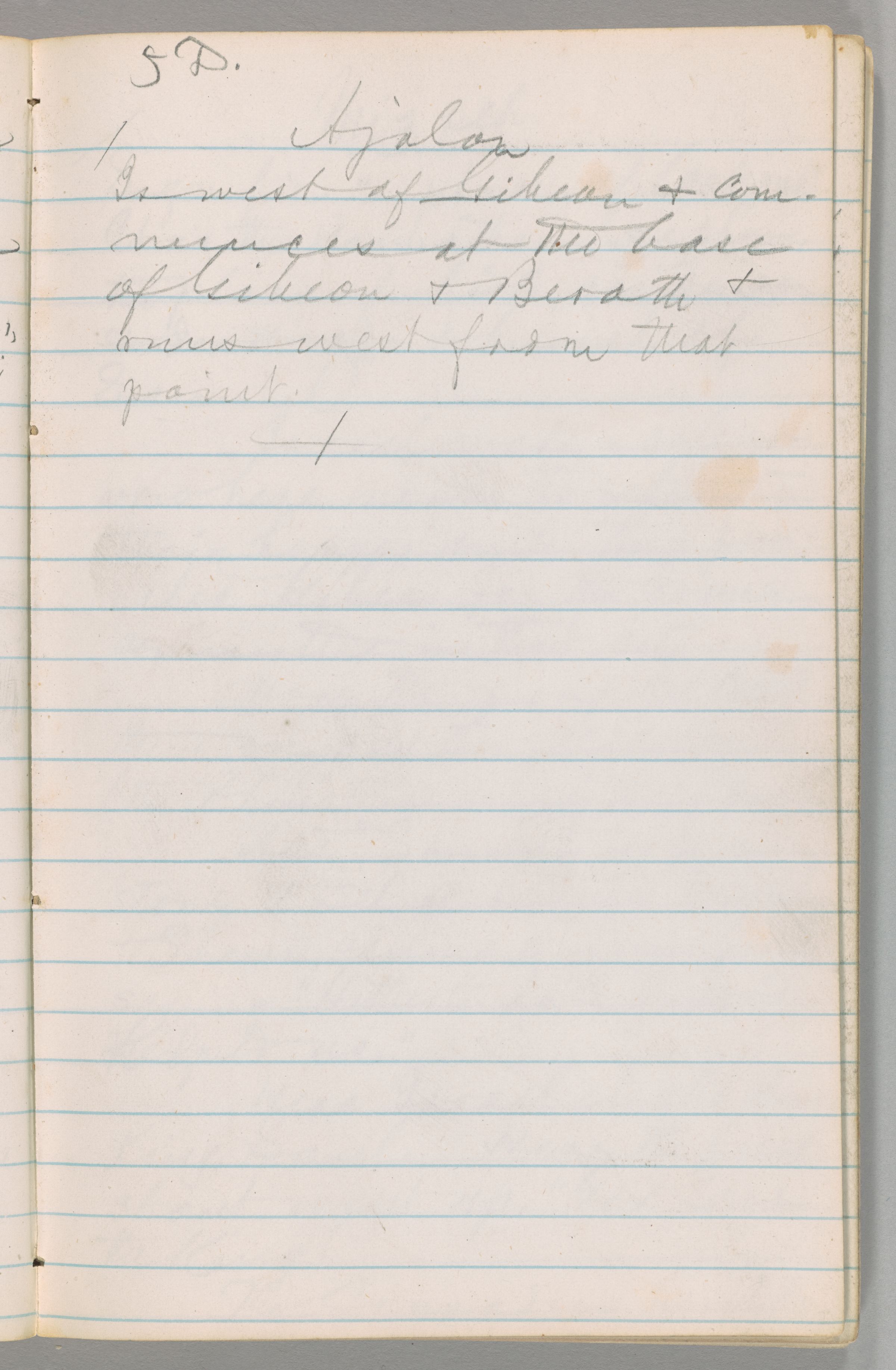
5 D.
Ajalon
Is west of Gibeon & commences at the base of Gibeon & Beroth & runs west from that point.Ⓣtextual note

[MS: N10_leaf_031v]
blank verso
[MS: N10_leaf_032r]
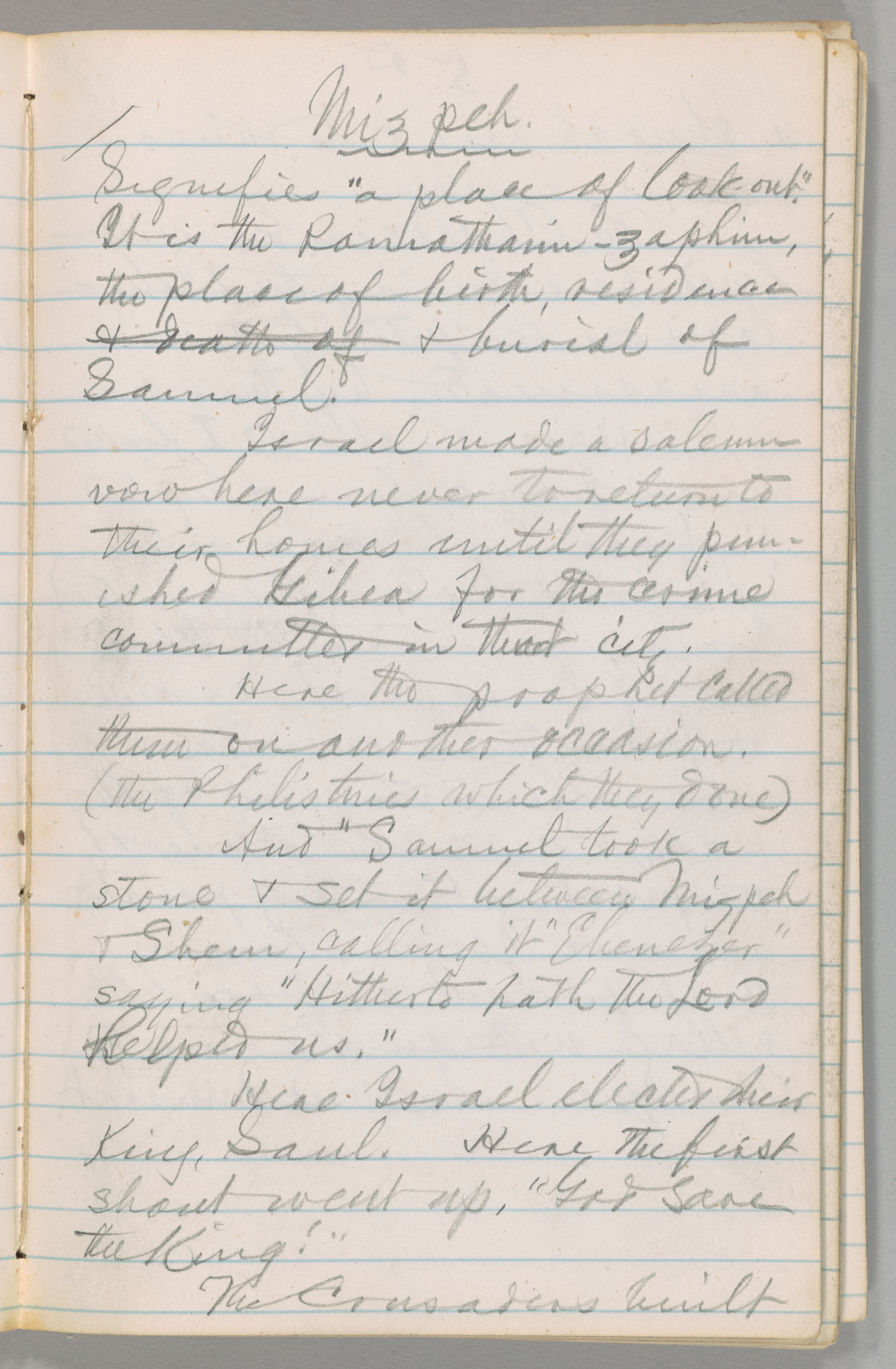
Mizpeh.
Signifies “a place of look-out.” It is the Ramathaim-zaphim, the place of birth, residence & death of & burial of Samuel.
Israel made a solemn vow here never to return to their homes until they punished Gibea for the crime committed in their thatⓉtextual note city.
Here the prophet called them on another occasion. (the Philistines which they done)
And “Samuel took a stone & set it between Mizpeh & Shem, calling it “Ebenezer” saying “Hitherto hath the Lord - helped us.”
Here Israel elected their King, Saul. Here the first shout went up, “God save the King!”
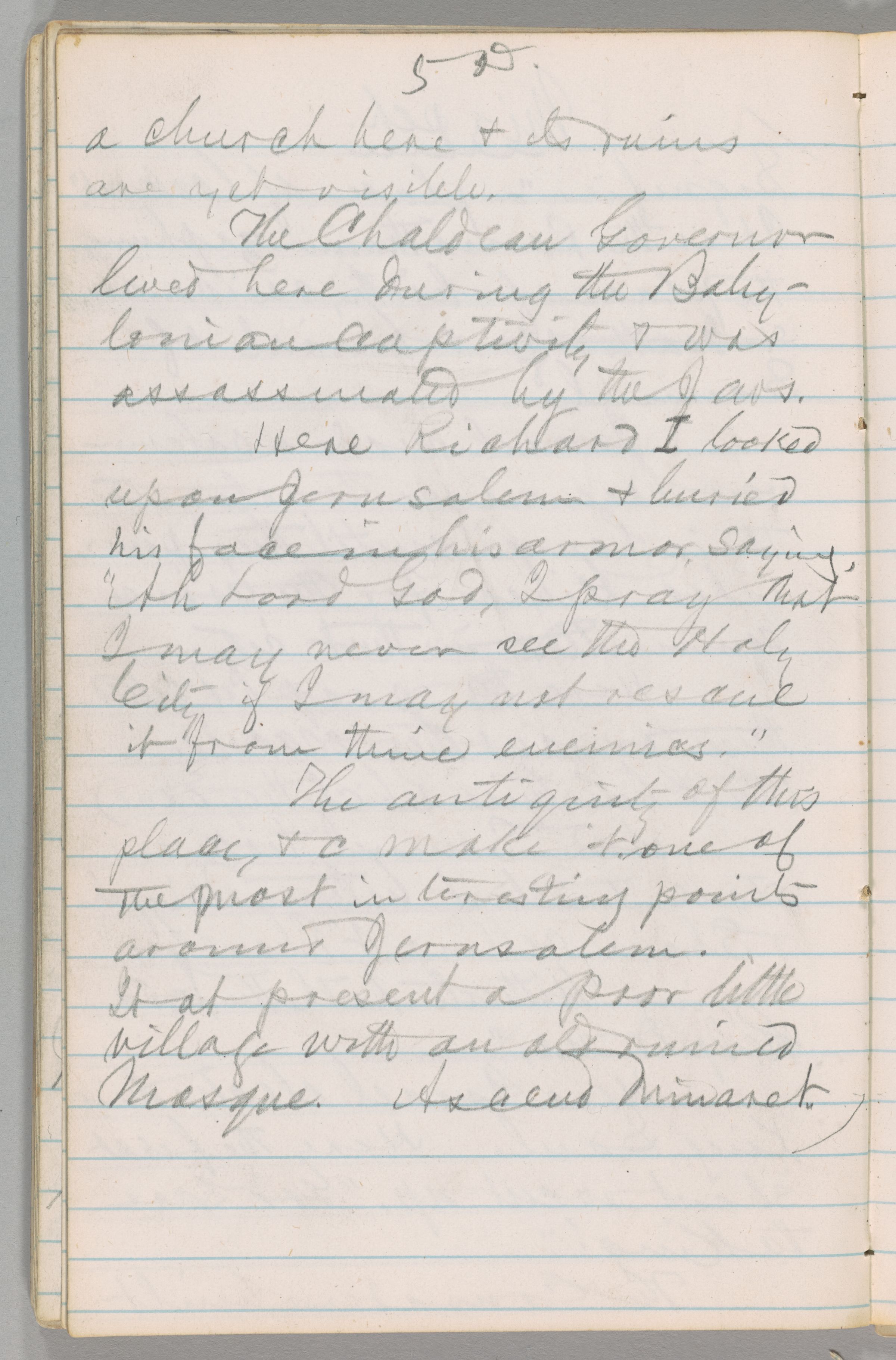
The Crusaders built
[MS: N10_leaf_032v]
a churchⓂemendation here & its ruins are yet visible.
The Chaldean Governor lived here during the Babylonian captivity & was assassinated by the Jews.
Here Richard I looked upon Jerusalem & buried his face in his armor, saying, “Ah Lord God, I pray that I may never see the Holy City if I may not rescue it from thine enemies.”
The antiquity of this place, &c make it one of the most interesting points around Jerusalem. It at present a poor little village with an old ruined Mosque. Ascend Minaret.Ⓣtextual note
[MS: N10_leaf_033r]
blank recto

[MS: N10_leaf_033v]
blank verso
[MS: N10_leaf_034r]
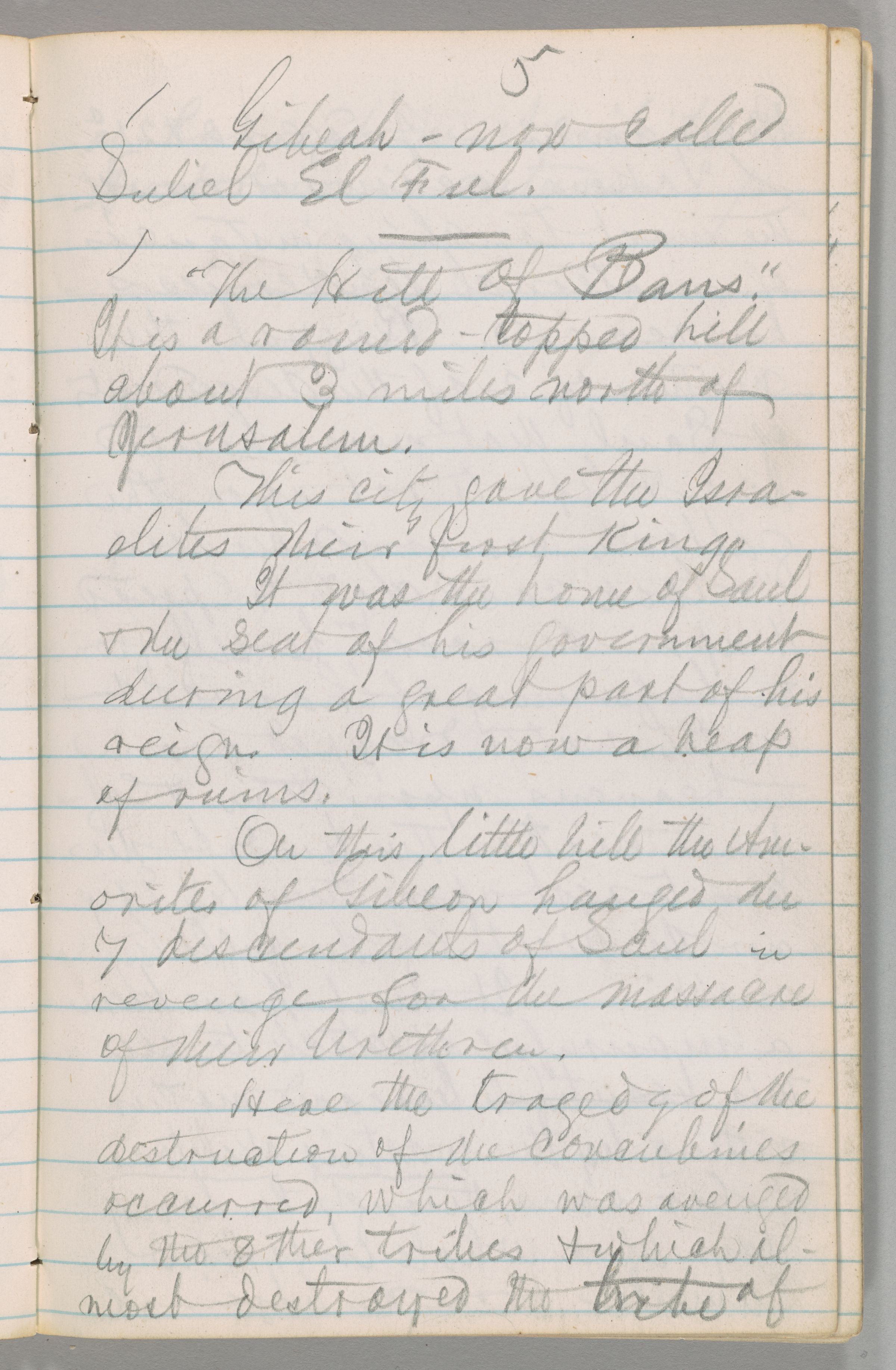
5
Gibeah—now called Suliel El Ful.
“The Hill of Bans.” It is a round-topped hill about 3 miles north of Jerusalem.
This city gave the Israelites their first king.
It was the home of Saul & the seat of his government during a great part of his reign. It is now a heap of ruins.
On this little hill the Amorites of Gibeon hanged the 7 descendants of Saul in revenge for the massacre of their brethren.
Here the tragedy of the destruction of the concubines occurred, which was avenged
by the other tribes & which almost destroyed the tribe of
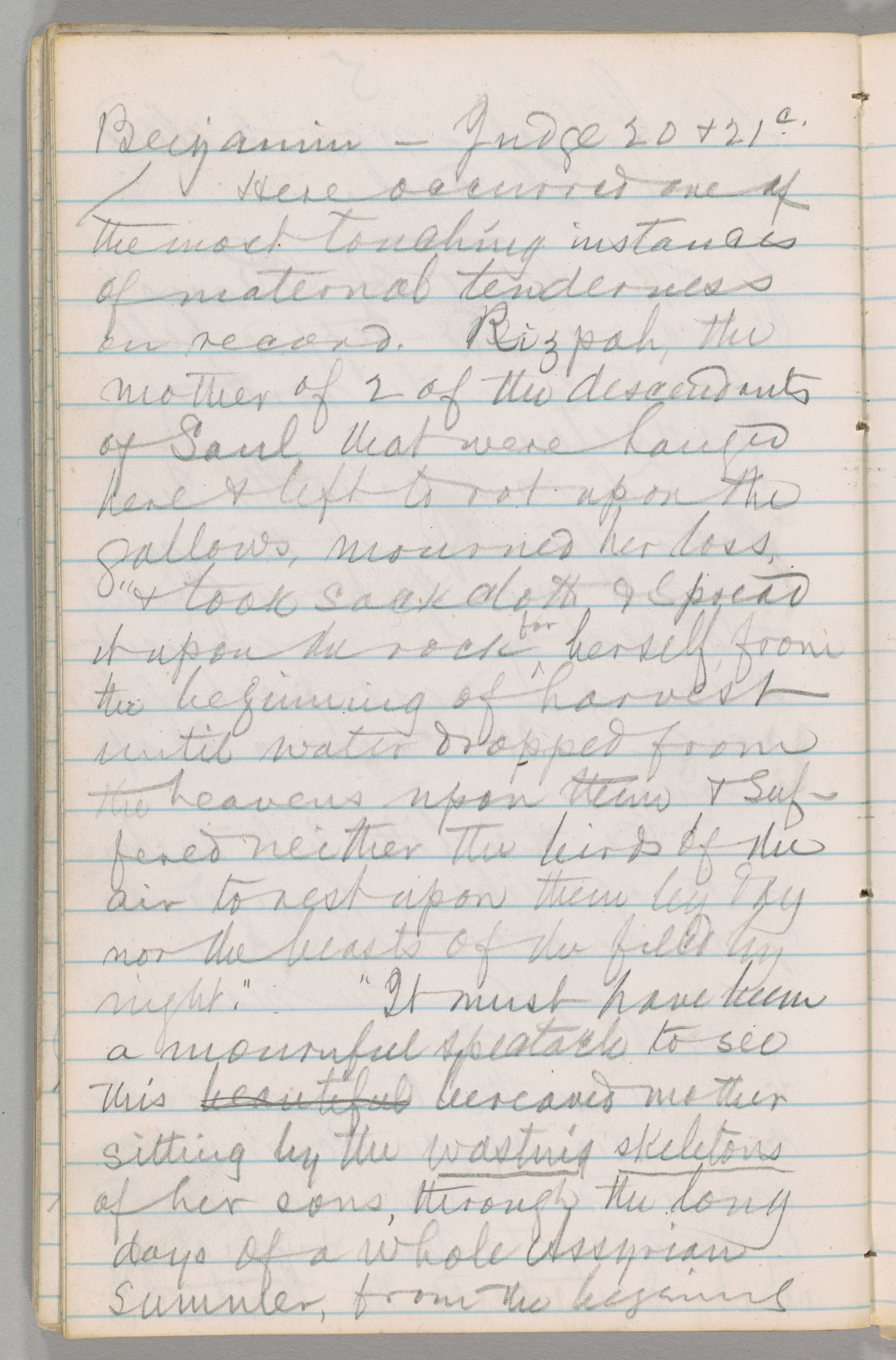
[MS: N10_leaf_034v]
Benjamin—Judge 20 & 21c.
Here occurred one of the most touching instances of maternal tenderness on record.
B Rizpah, the mother of 2 of the descendants of Saul, that were hanged here & left
to rot upon the gallows, mourned her loss, “& took sackcloth & spread it upon the
rock for herselfⓉtextual note, from the beginning of harvest until water dropped from the heavens upon them, &
suffered neither the birds of the air to rest upon them by day nor the beasts of the
field by night.” “It must have been a mournful spectacle to see this beautiful bereaved mother sitting by the wasting skeletons of her sons, through the long days of a whole Assyrian summer, from the beginning
[MS: N10_leaf_035r]
of harvest in April till the first rains in autumn.”Ⓣtextual noteⓉtextual note12

[MS: N10_leaf_035v]
blank verso

[MS: N10_leaf_036r]
blank recto

[MS: N10_leaf_036v]
blank verso

[MS: N10_leaf_037r]
blank recto
[MS: N10_leaf_037v]
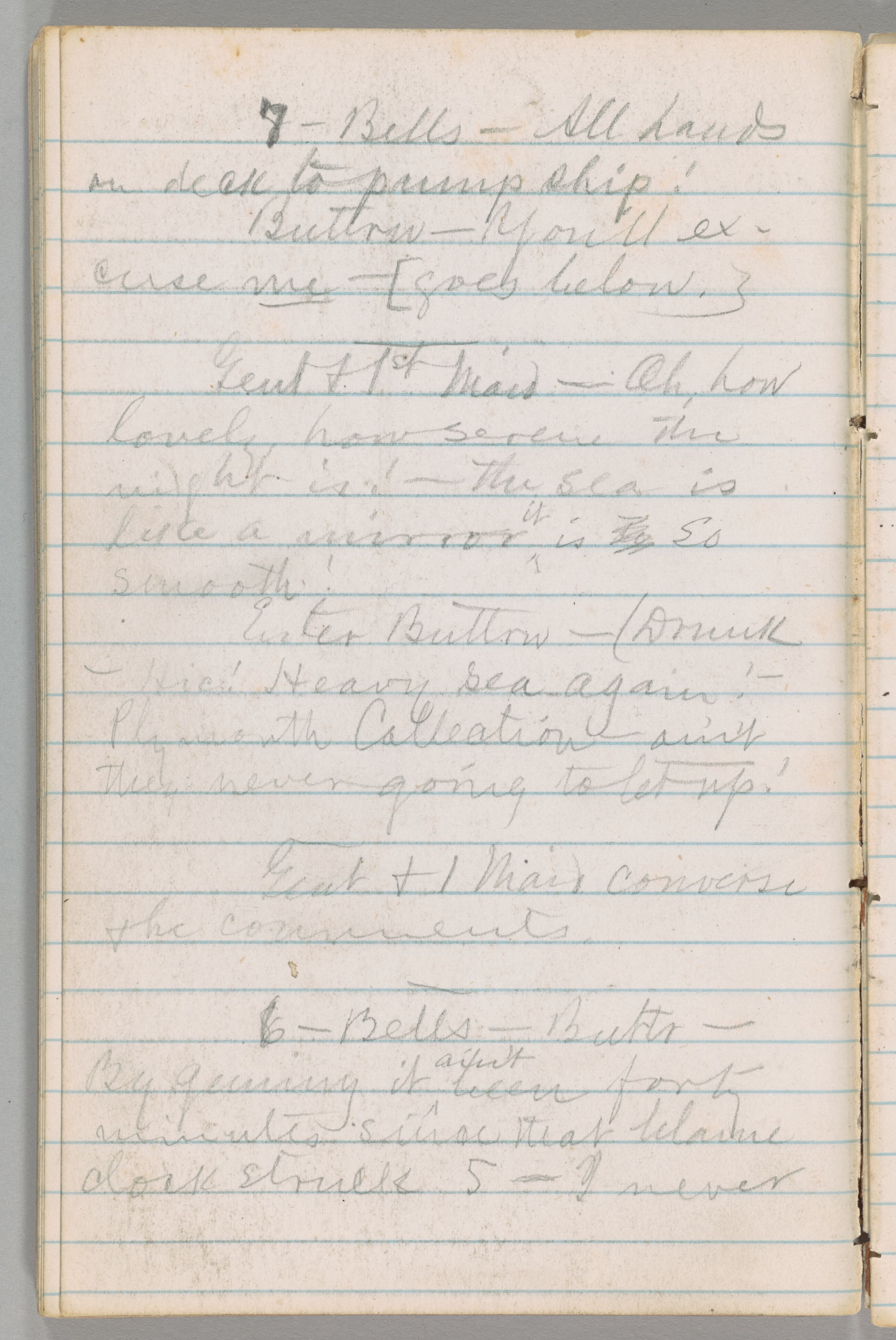
87—Bells—All hands on deck to pump ship!
Buttrw—You'll excuse me—(goes below.)
Gent & 1st Maid—Oh, how lovely, how serene the night is!—the sea is like a mirror it is toⓉtextual note so smooth!
Enter Buttrw—(Drunk—Hic! Heavy sea again!—Plymouth Collection—ain't they never going to let up!
Gent & 1 Maid converse & he comments.
8 6—Bells—Buttr—By geminy it ain'tⓉtextual note been forty minutes since that blame clock struck 5—I never
[MS: N10_leaf_038r]
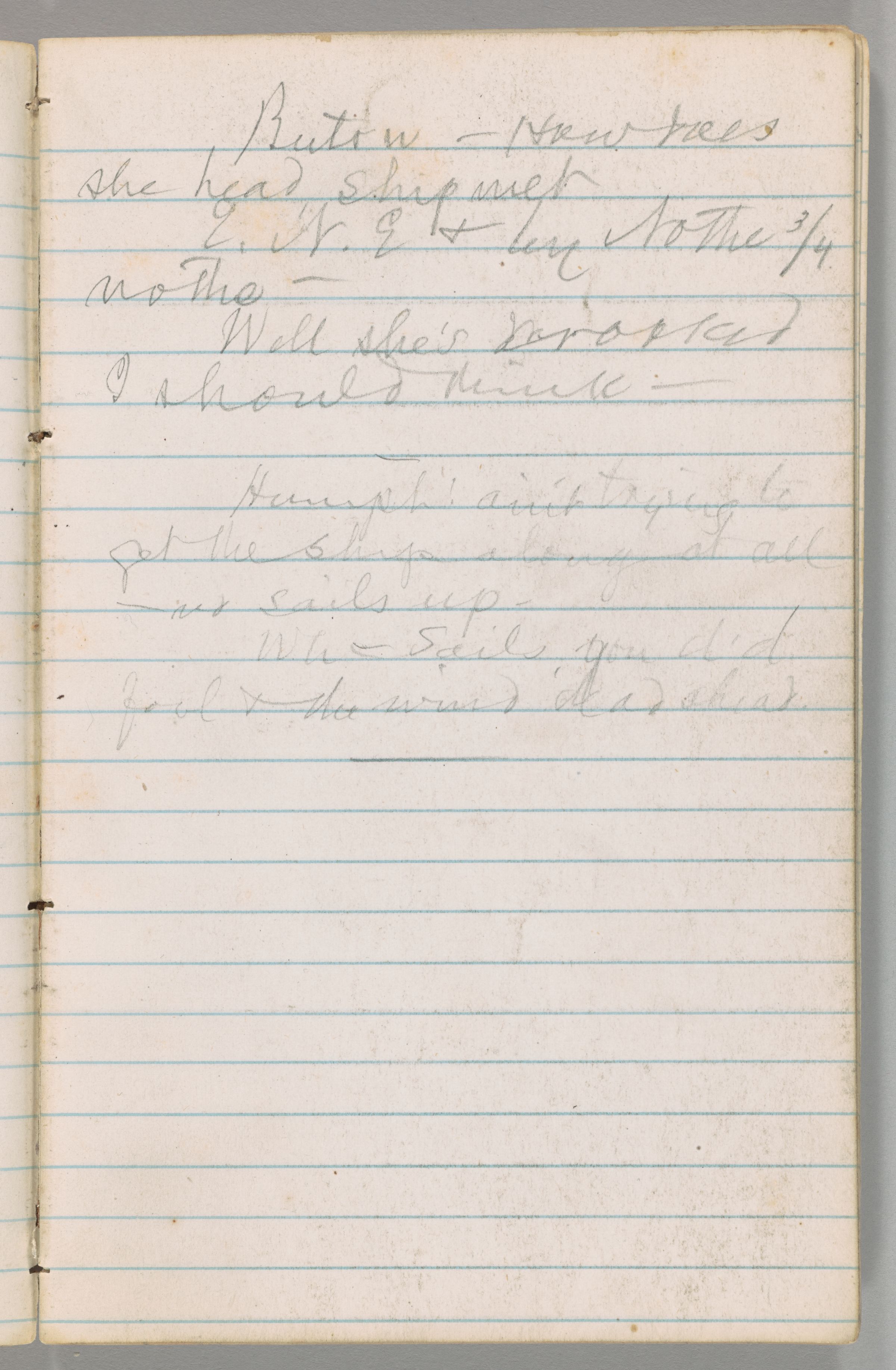
Butrw—How does she head, ship met
E.N.E & by Nothe ¾ nothe—
Well she's - crooked I should think—
Humph! ain't trying to get the ship along at all—no sails up.
Wh—Sails, you d'd fool & the wind dead ahead.Ⓣtextual note18

[MS: N10_leaf_038v]
blank verso
twelve blank pages follow the previous blank verso

[MS: N10_leaf_045r]
blank recto
[MS: N10_leaf_045v]
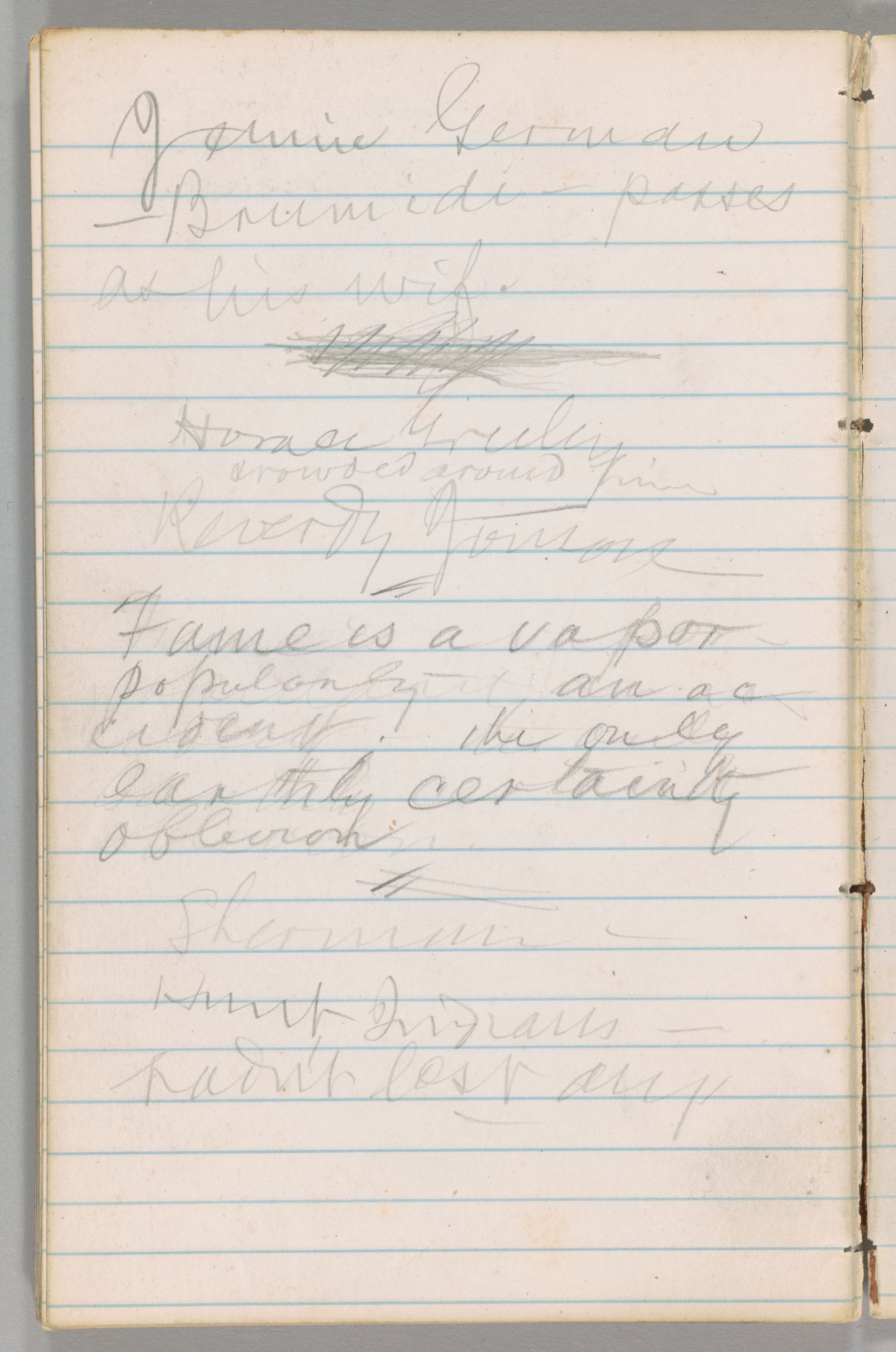
Jennie German—Brumidi—passes as his wif.21
Horace Greeley
crowded around himⓉtextual note
Reverdy Jonson22
Fame is a vapor—popularity an accident—Ⓜemendationthe only earthly certainty oblivion.Ⓣtextual note23
Sherman—
Hunt Indians—hadn't lost any.
[MS: N10_leaf_046r]
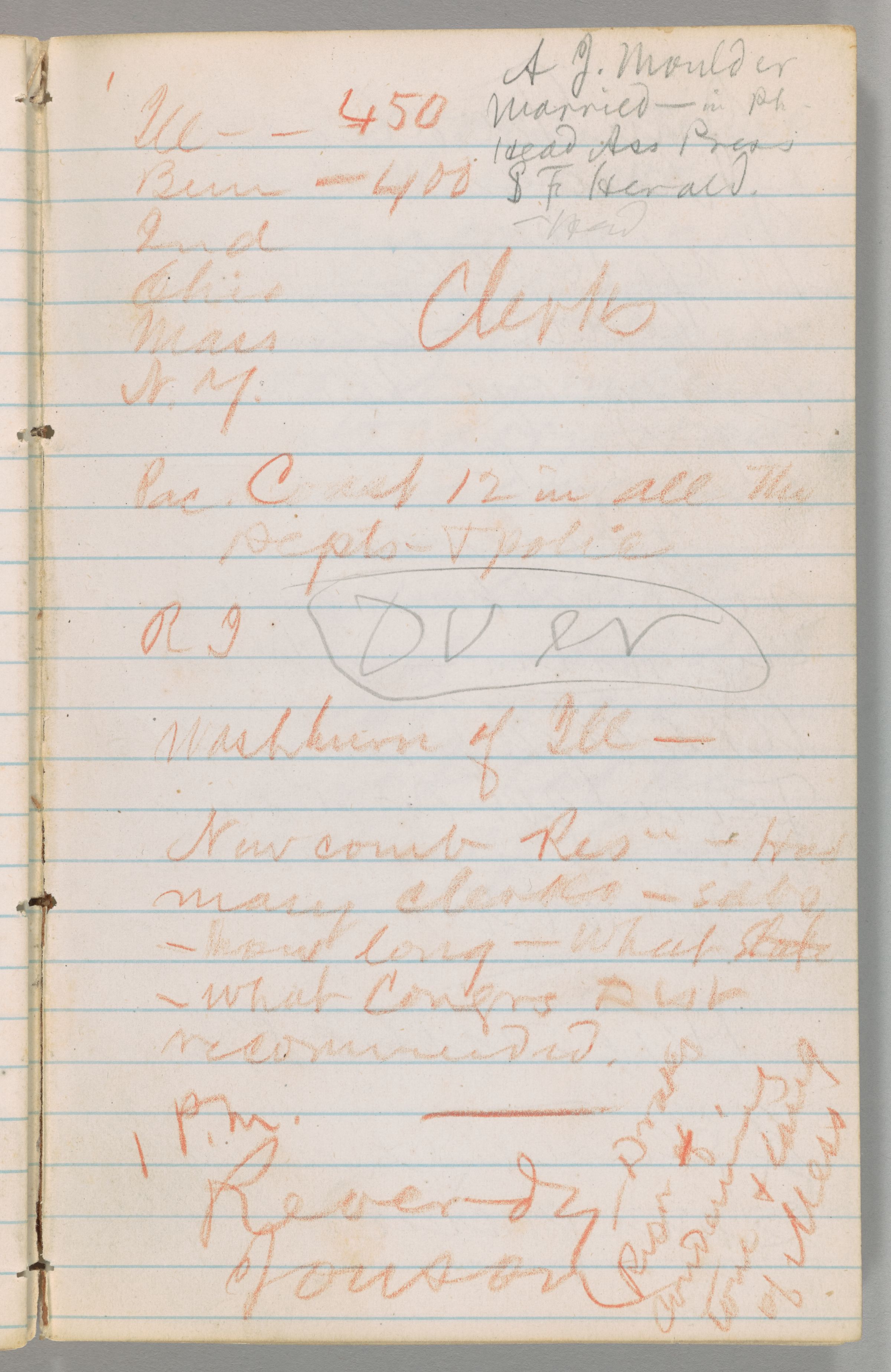
A J. Moulder24 married—in Ph. Head Ass Press S F Herald.—HeadⓉtextual note
Ill . . . . . . . . 45025
Benn . . . . . 400
Ind
OhioClerks
Mass
N.Y.
Pac. Coast 12 in all the Depts—& polieⓂemendation
Washburn of Ill—26
Newcomb Resn—HadⓂemendation many clerks—salry—how long—What State—what Congrs Dist recommended.
1 P.M.
Reverdy Jonson
—Drakes Resn of condemning tone & lang of MessⓉtextual noteⓉtextual note27
[MS: N10_leaf_046v]
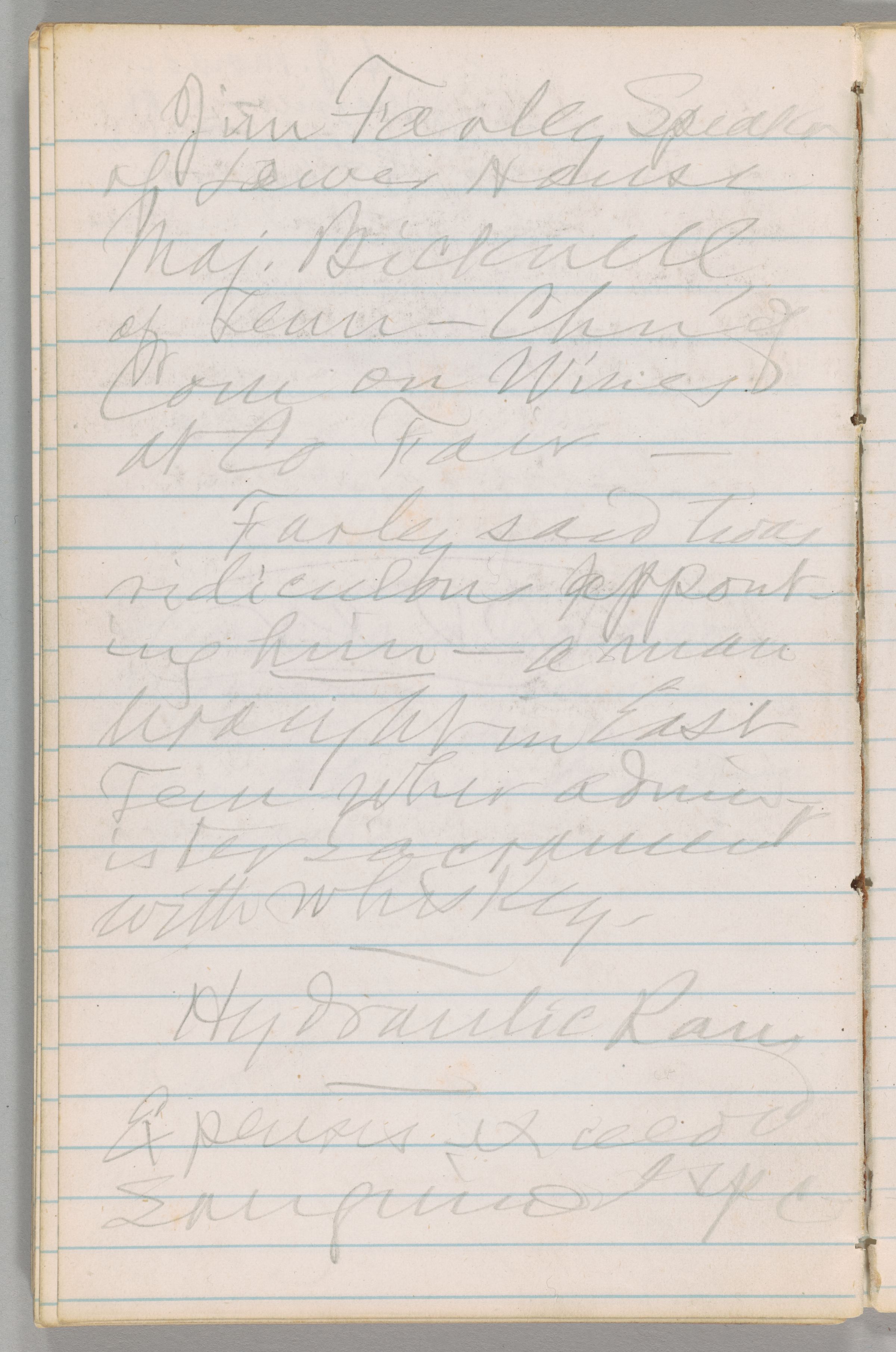
Jim Farley Speaker of Lower House28
Maj. Bicknell, of Tenn—Chn of Com on Wines at Co Fair—
Farley said twas ridiculous apponting him—a man brought in East Tenn wher administer Sacrament with whiskey.
Hydraulic Ram
Expenses exceeded sanguine expc—
[MS: N10_leaf_047r]
Didnt drink much in that ship—was like Congress—prohibit it save in Committee Rooms—ta carry it in in demijohnsⓂemendation & carry it out in demagogues.
Acquainted with Gen Grant—said I was glad to see him—he said I had the advantage of him.29
[MS: N10_leaf_047v]
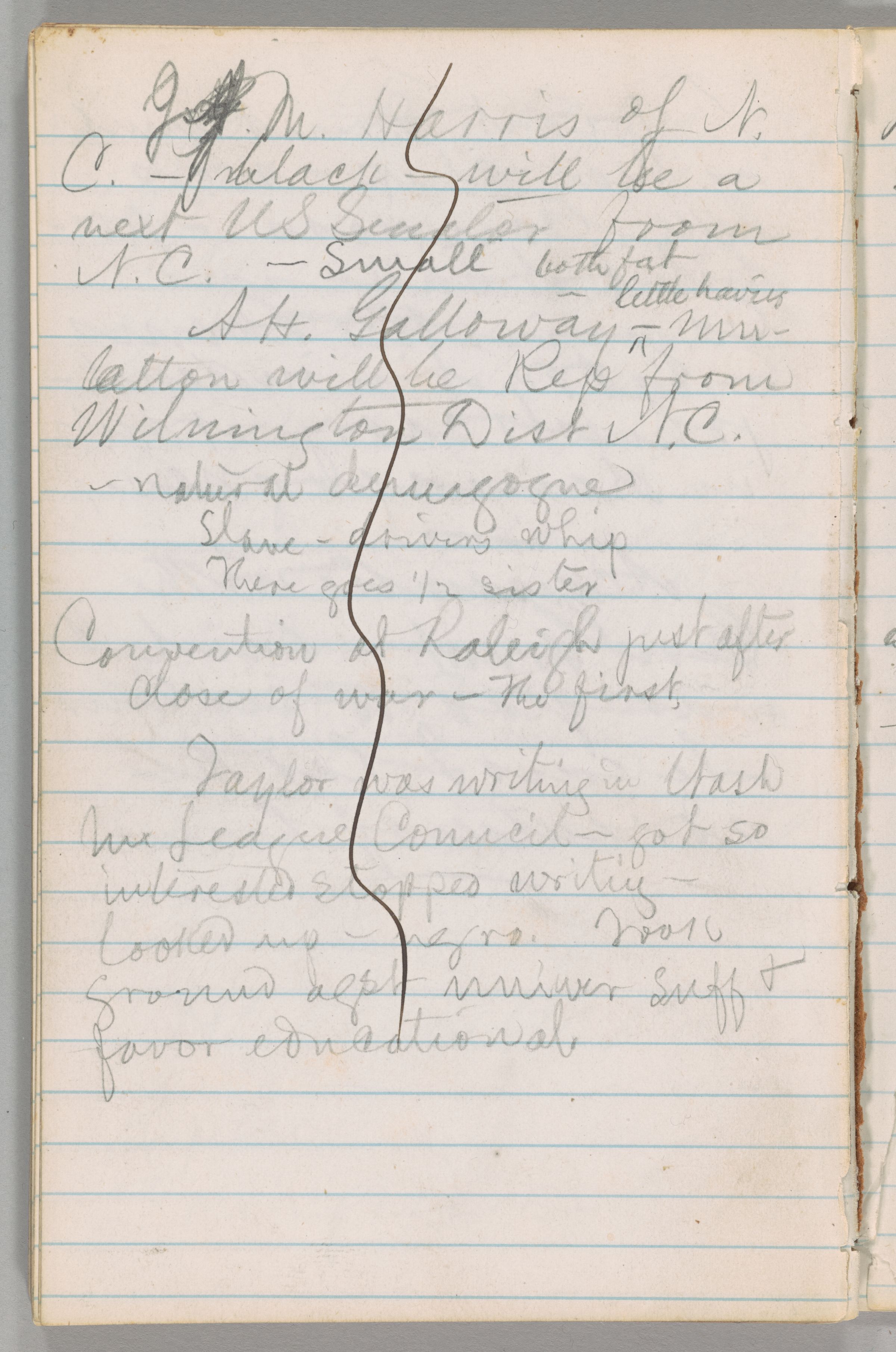
J -. M. Harris of N.C.—n blackⓂemendation—will be a next US Senator from N.C.—smallⓉtextual note
AH. Galloway—little heavierⓉtextual note—mulatton will be Rep from Wilmington Dist N.C.—natural demagogue
both fatⓉtextual note
Slave-drivers whip
There goes ½ sister
Convention at Raleigh just after close of war—the first.30
Taylor was writing in NashⓂemendation -- League Council—got so interested stopped writing—looked up—negro. Took ground agst univer suff & favor educational.Ⓣtextual note
[MS: N10_leaf_048r]
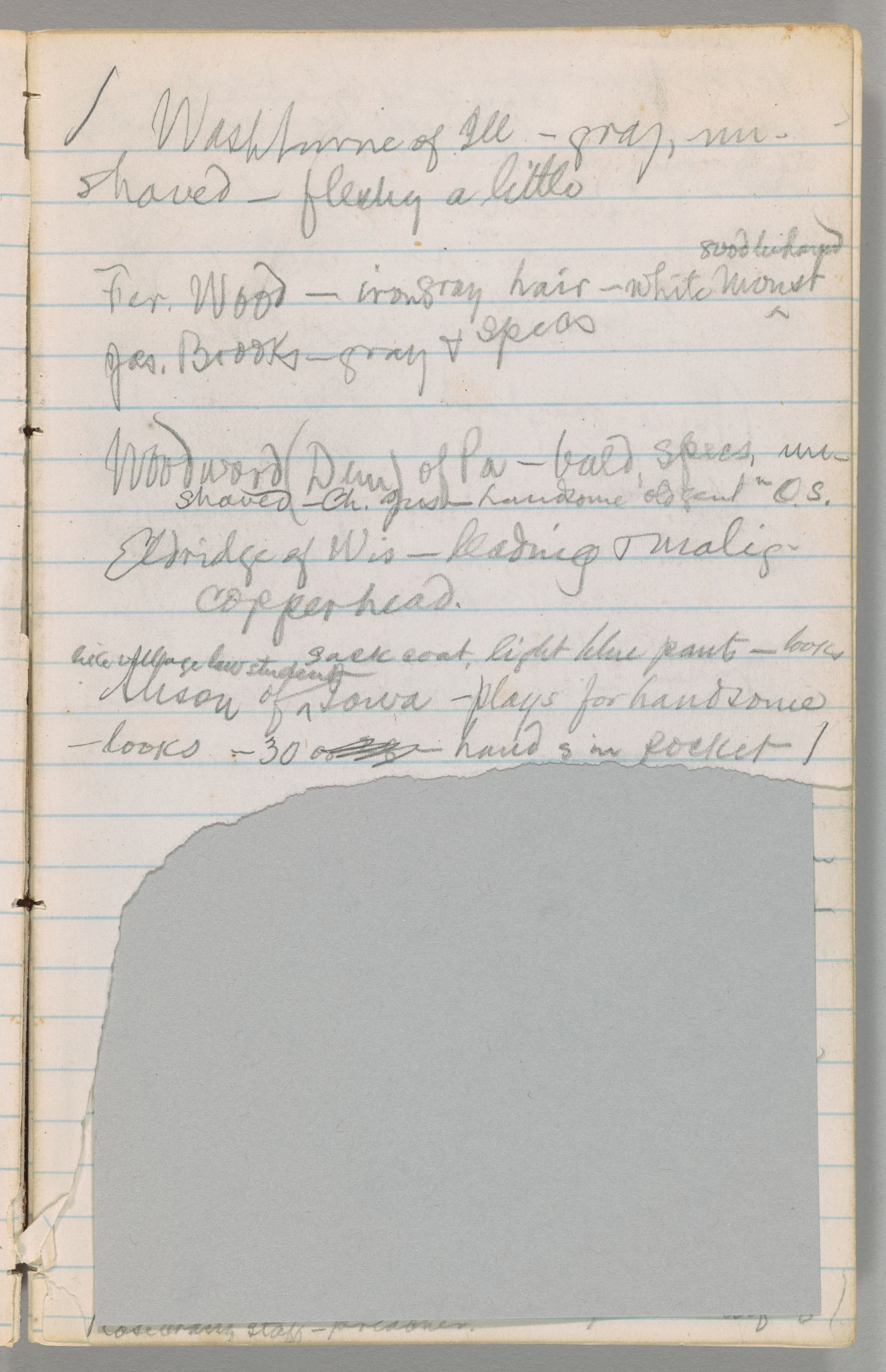
Washburne of Ill—gray, unshaved—fleshy a little31
Fer. Wood—iron gray hair—white moust good behavedⓉtextual note
Jas. Brooks—gray & specs
Woodward (Dem) of Pa—bald, specs, unshaved—Ch. Jus—handsome old gentn O.S.Ⓣtextual note
Eldridge of Wis—leading & malig. copperhead.
Alison of Iowa sack coat, light blue pants—looks like village law studentⓉtextual noteⓂemendation—plays for handsome—looks—30 or 28—hand s in pocketⓉtextual note
[MS: N10_leaf_048v]
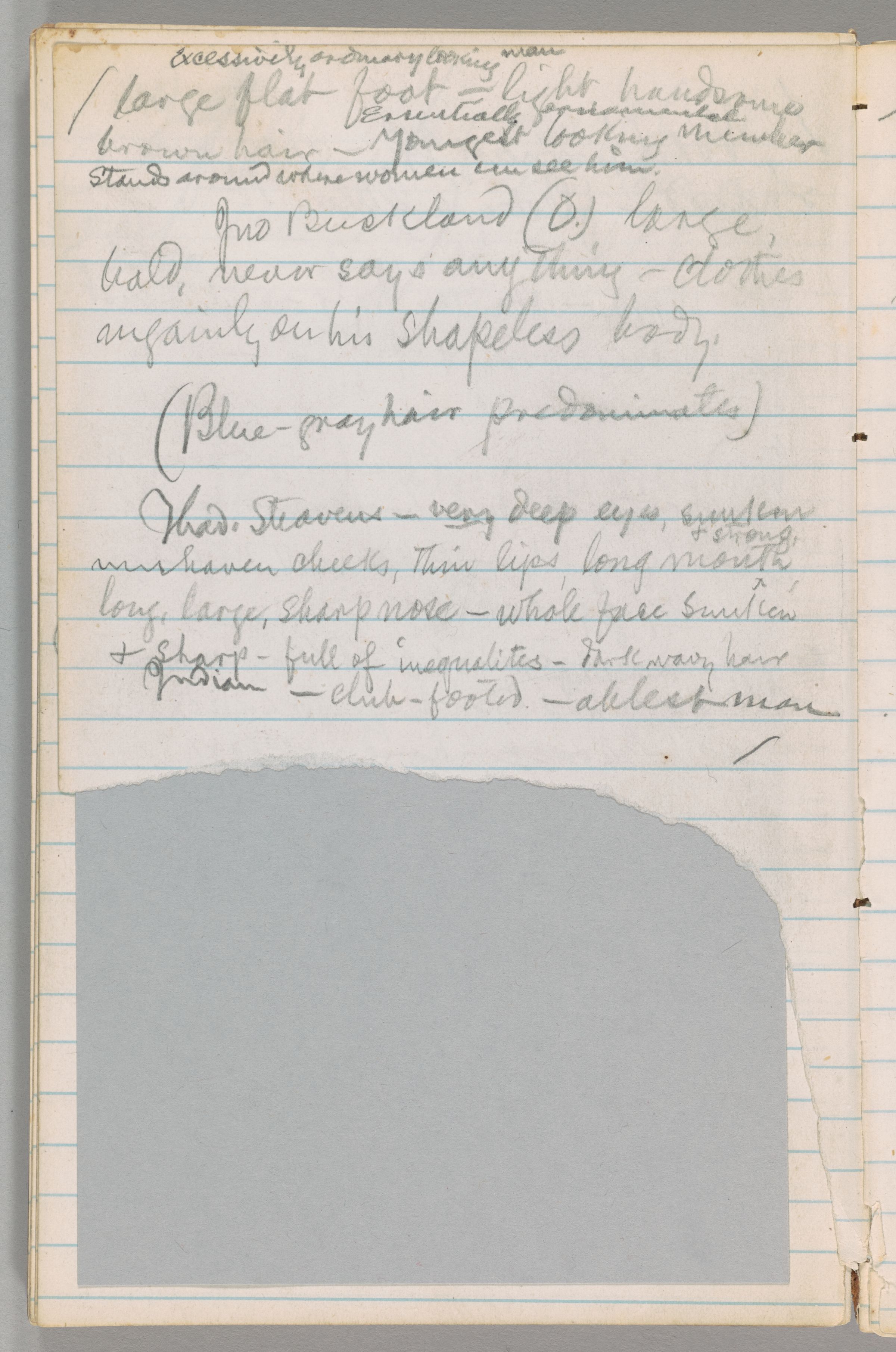
large flat foot—light, handsome brown hair—youngest looking member Excessively ordinary
looking man Essentially ornamental Stands around where women can see him.Ⓣtextual note
Jno Buckland32 (O.) large, bald, never says anything—clothes ungainly on his shapeless body.
(Blue-gray hair predominates)
Thad. Steavens—very deep eyes, sunken unshaven cheeks, thin lips, long mouth, & strong,Ⓣtextual note long, large, sharp nose—whole face sunken & sharp—full of inequalites—dark wavy hair Indian—club-footed.—ablest man.Ⓣtextual note
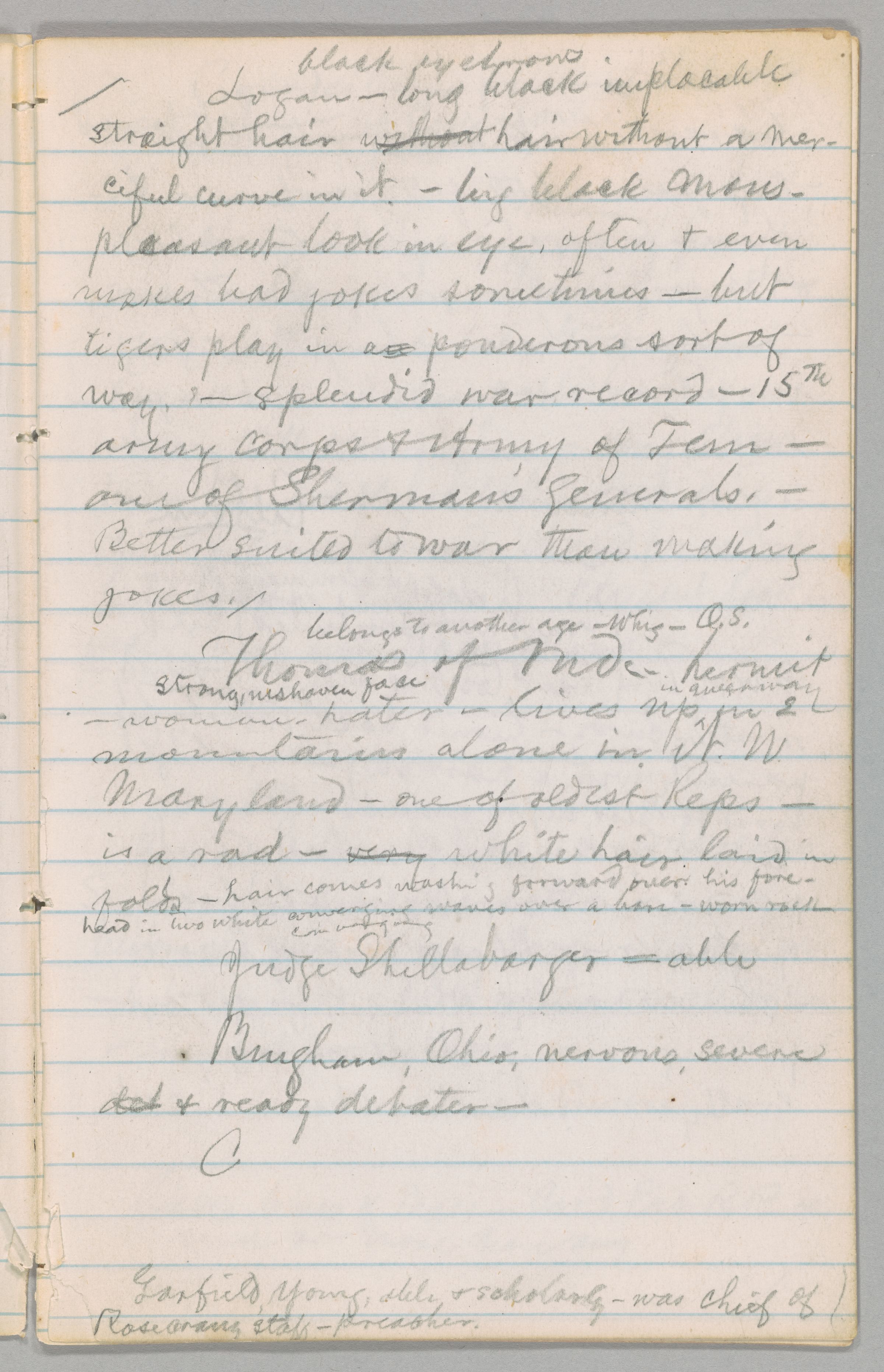
[MS: N10_leaf_049r]
Logan—black eyebrowsⓉtextual note long black implacable straight hair without hair without a merciful curve in it.—big black mous. pleasant look in eye, often & even makes bad jokes sometimes—but tigers play in a n ponderous sort of way.—splendid war record—15th army corps & Army of Tenn—one of Sherman's generals.—Better suited to war than making jokes.
Thomas of Md.—belongs to another age—Whig—O.S. strong, unshaven faceⓉtextual note hermit—woman-hater—lives up in queer wayⓉtextual note in ε mountainsⓂemendation alone in N. W. Maryland—one of oldest Reps—is a rad—very white hair laid in folds—hair comes washing forward over his forehead in two white converging waves over a bare-worn rockⓉtextual note
convergingⓉtextual note
Judge Shellabarger—able
Bingham, Ohio, nervous, severe de & ready debater—
C
Garfield, young, able & scholarly—was chief of Rosecranz staff—preacher.
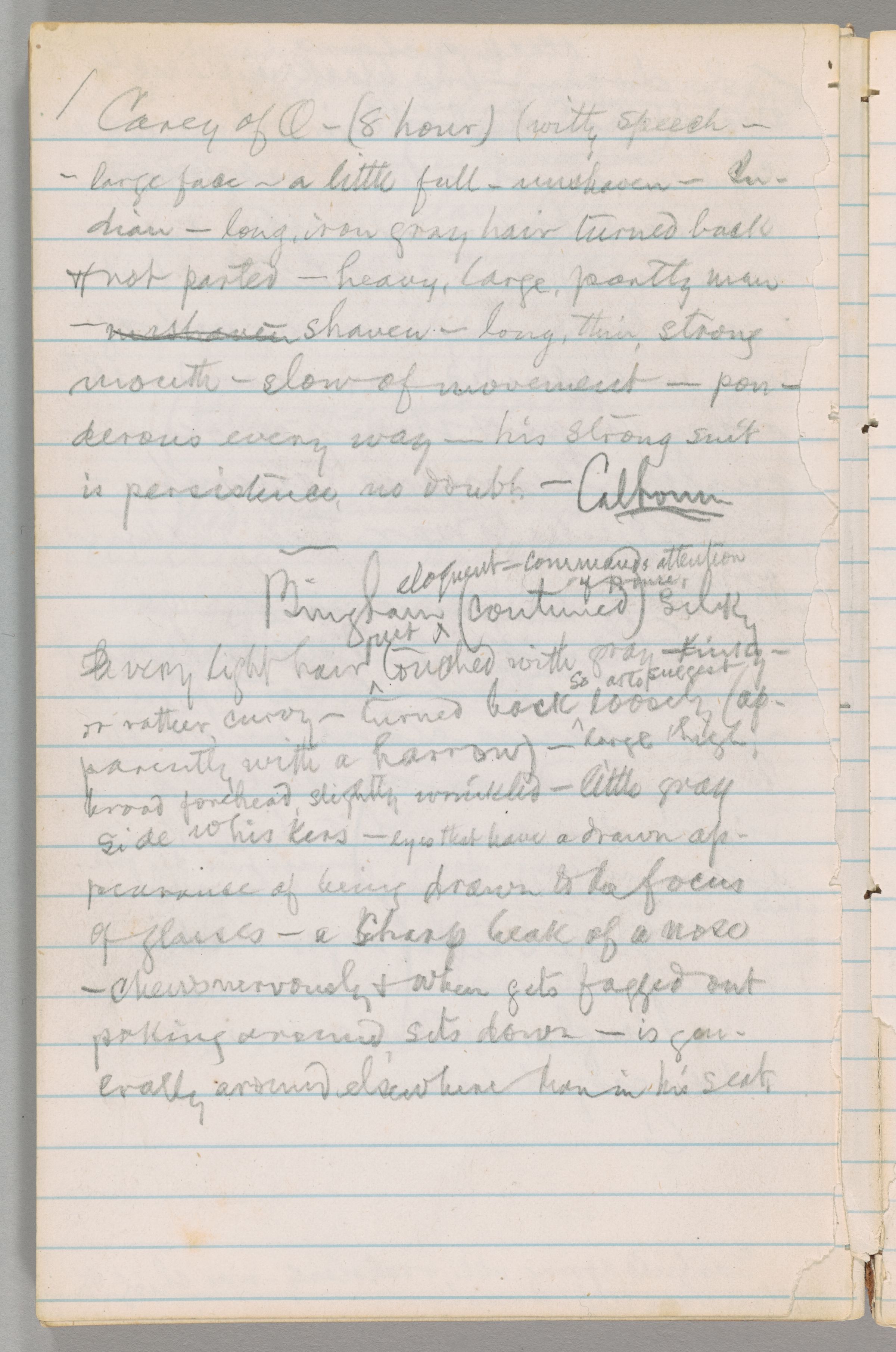
[MS: N10_leaf_049v]
Carey of O—(8 hour) (witty speech— —large face—a little full—unshaven—Indian—long, iron gray hair turned back & not parted—heavy, large, portly man —unshaven—shaven—long, thin, strong mouth—slow of movement—ponderous every way—his strong suit is persistence, no doubt.—CalhounⓉtextual note
Bingham (continued) eloquent—commands attention of House,Ⓣtextual noteⓂemendation silky li very light hair justⓉtextual note touched with gray—kinky—or rather, curvy—turned back so as to suggestⓉtextual note loosely (apparently with a harrow)—large, high, broad forehead, slightly wrinkled—little gray side whiskers—eyes that have a drawn appearance of being drawn to the focus of glasses—a b sharp beak of a nose—chews nervously & when gets fagged out poking around, sits down—is generally around elsewhere than in his seat.
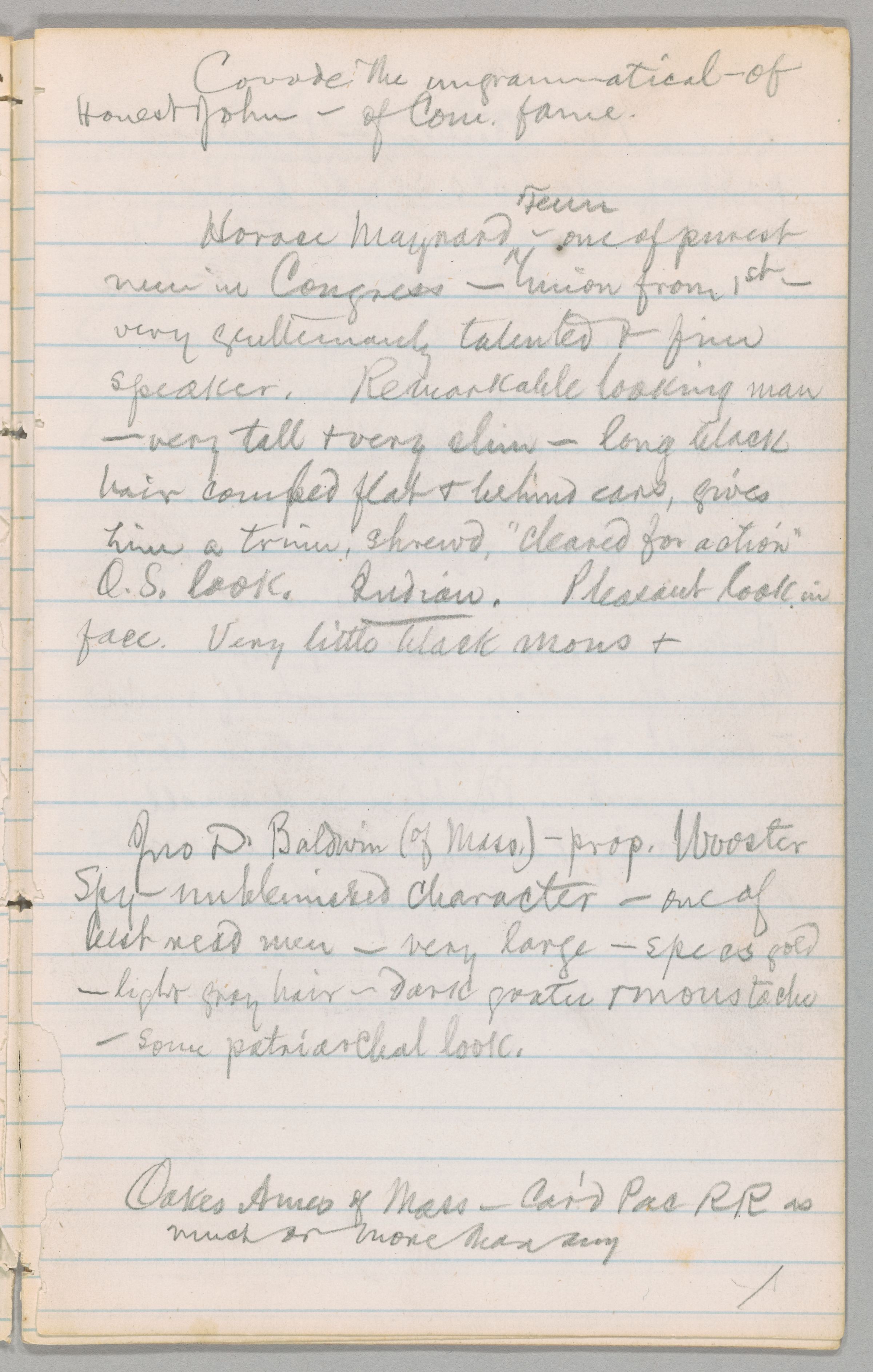
[MS: N10_leaf_050r]
Covode the ungrammatical—of Honest John33—of Com. fame.
Horace Maynard TennⓉtextual note—one of purest men in Congress—Union from 1st—very gentlemanly talented & fine speaker. Remarkable looking man—very tall & very slim—long black hair comped combedⓉtextual note flat & behind ears, gives him a trim, shrewd, “cleared for action” O.S. look. Indian. Pleasant look in face. Very little black mous &
Jno D. Baldwin (of Mass.)—prop. Wooster Spy34—unblemished character—one of best read men—very large—specs gold—light gray hair—dark goatee & moustache—some patriarchal look.
Oakes Ames of Mass—Car'd Pac RR as much or more than any
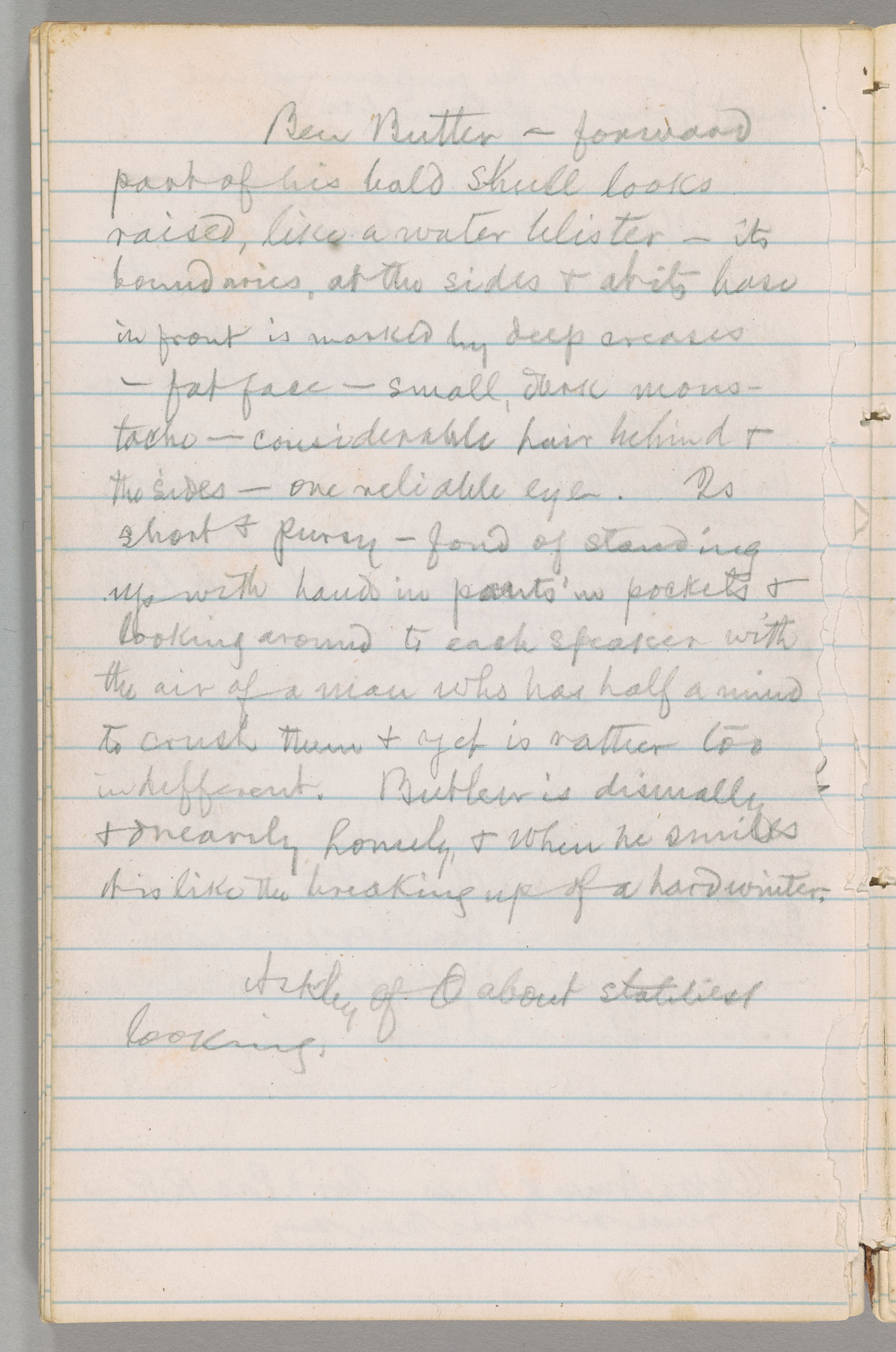
[MS: N10_leaf_050v]
Ben Butler—forward part of his bald skull looks raised, like a water blister—its boundaries, at the sides & at its base in front is marked by deep creases—fat face—small, dark moustache—considerable hair behind & the sides—one reliable eye. Is short & pursy—fond of standing up with hands in poc pants'Ⓣtextual note in pockets & looking around to each speaker with the air of a man who has half a mind to crush them & yet is rather too indifferent. Butler is dismally & drearily homely, & when he smiles it is like the breaking up of a hard winter.
Ashley of O about stateliest looking.Ⓣtextual note
[MS: N10_leaf_051r]
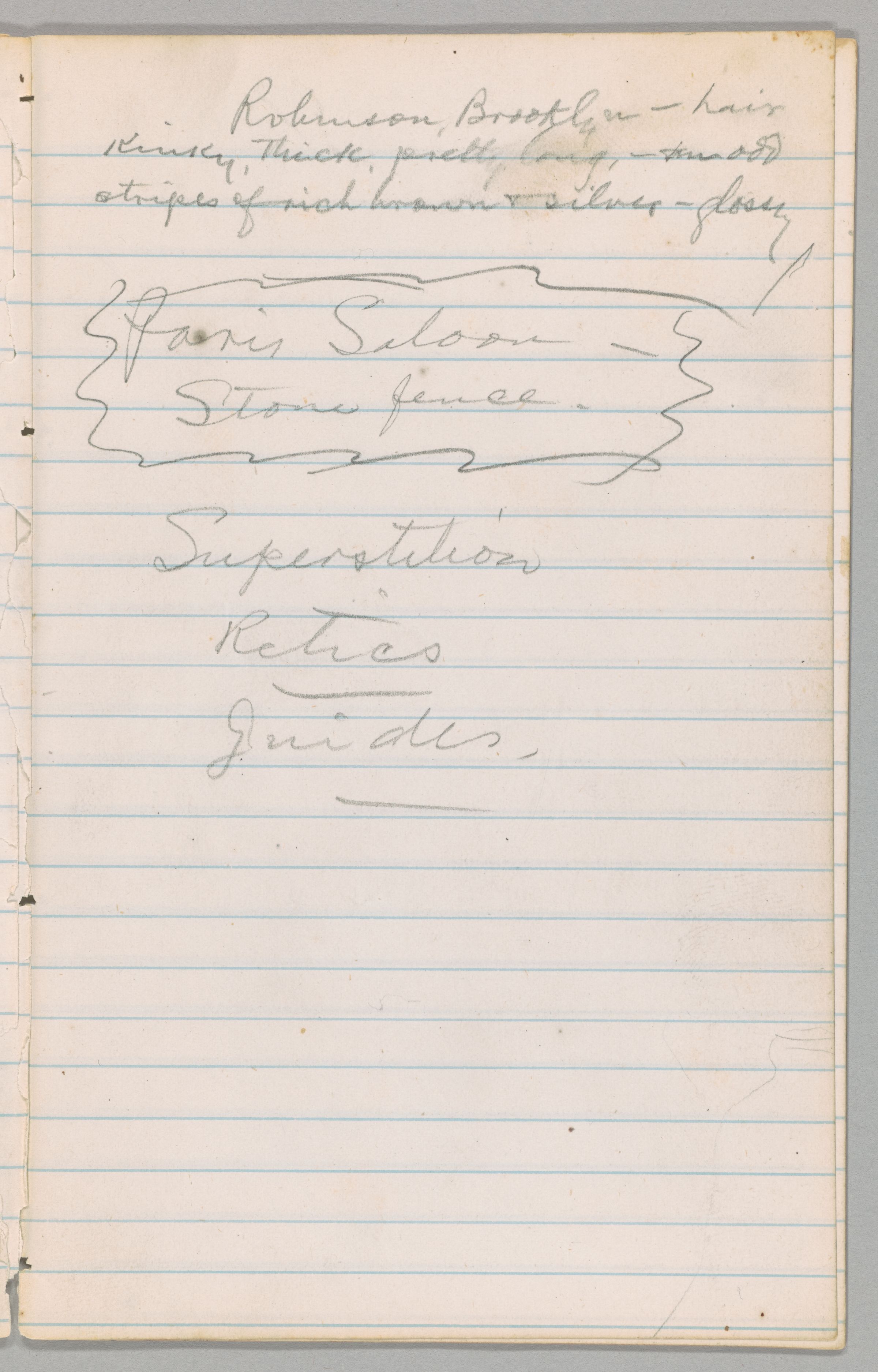
Robinson, Brooklyn—hair kinky, thick, pretty long,—& inⓉtextual note odd stripes of rich brown & silver—glossy
Paris Saloon—Stone fence.Ⓣtextual note35
Superstition
Relics
Guides.Ⓣtextual note

[MS: N10_leaf_051v]
blank verso
forty blank pages follow the previous blank verso
SLC used the remaining pages of this notebook from back to front; a new sequence of pages beginning with the back cover begins below
[MS: N10_outside back cover]
blank
[MS: N10_back endpaper]
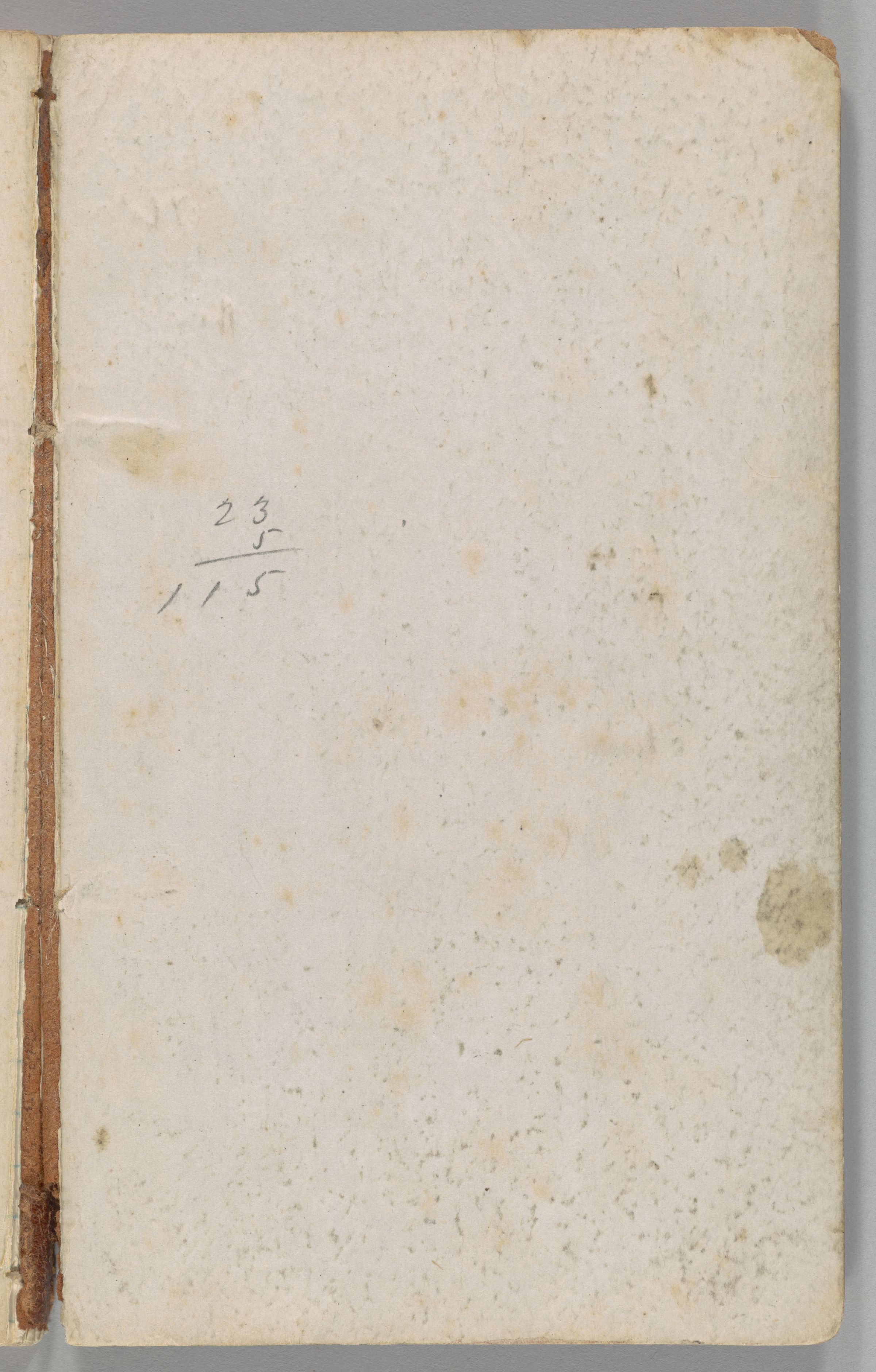
23
5
[MS: N10_back flyleaf recto]
blank recto
[MS: N10_back flyleaf verso]
blank verso
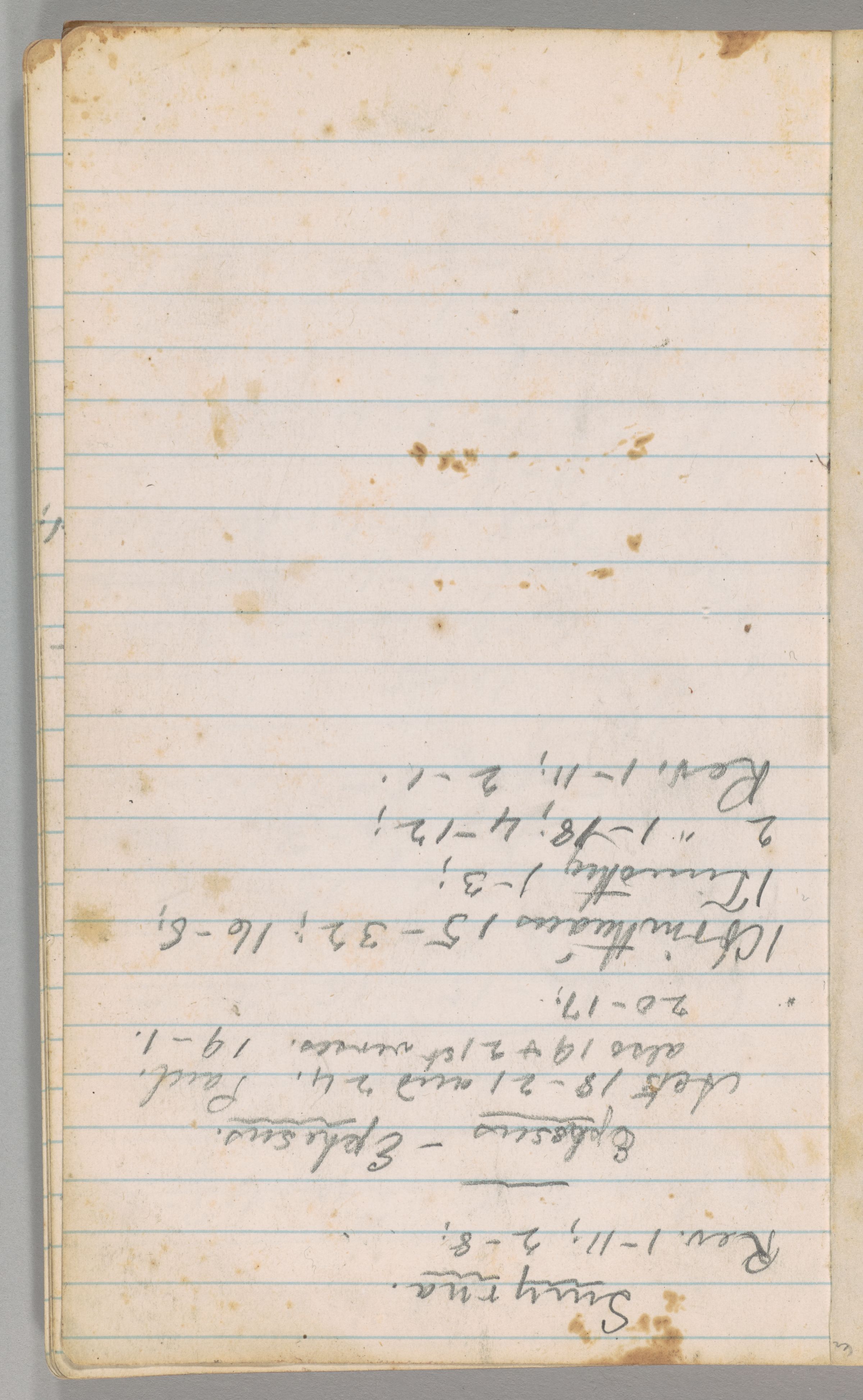
[MS: N10_leaf_001r]
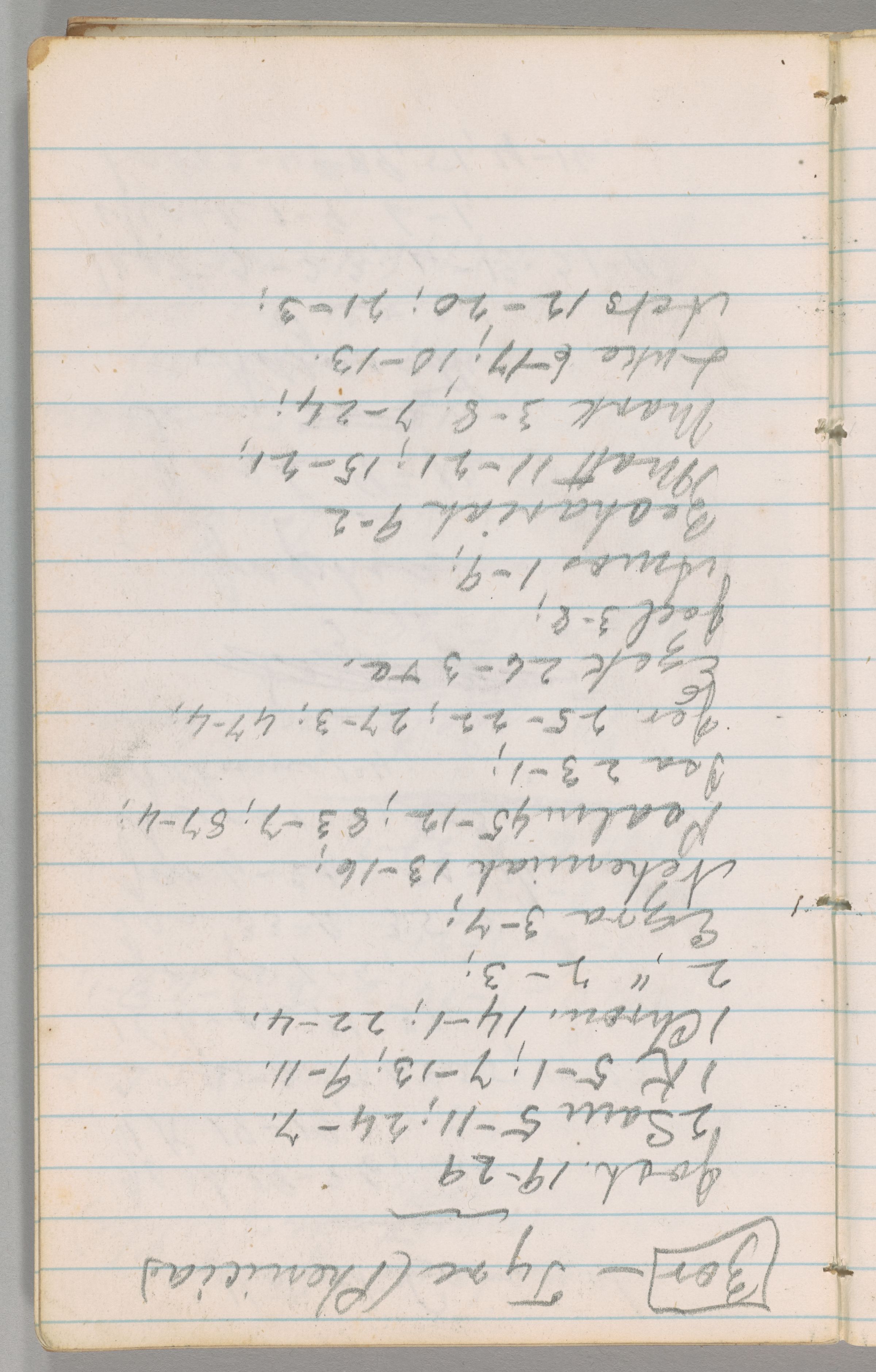
Smyrna.2
Rev. 1-11; 2-8;
Epessus EphssusⓉtextual note—Ephesus.
Acts 18-21 and 24. Paul. also 19 & 21st verses. 19-1. 20-17;
1 Corinthians 15-32; 16-8;
1 Timothy 1-3;
2 Timothy 1-18; 4-12;
Rev. 1-11; 2-1.Ⓣtextual note
[MS: N10_leaf_001v]
blank verso
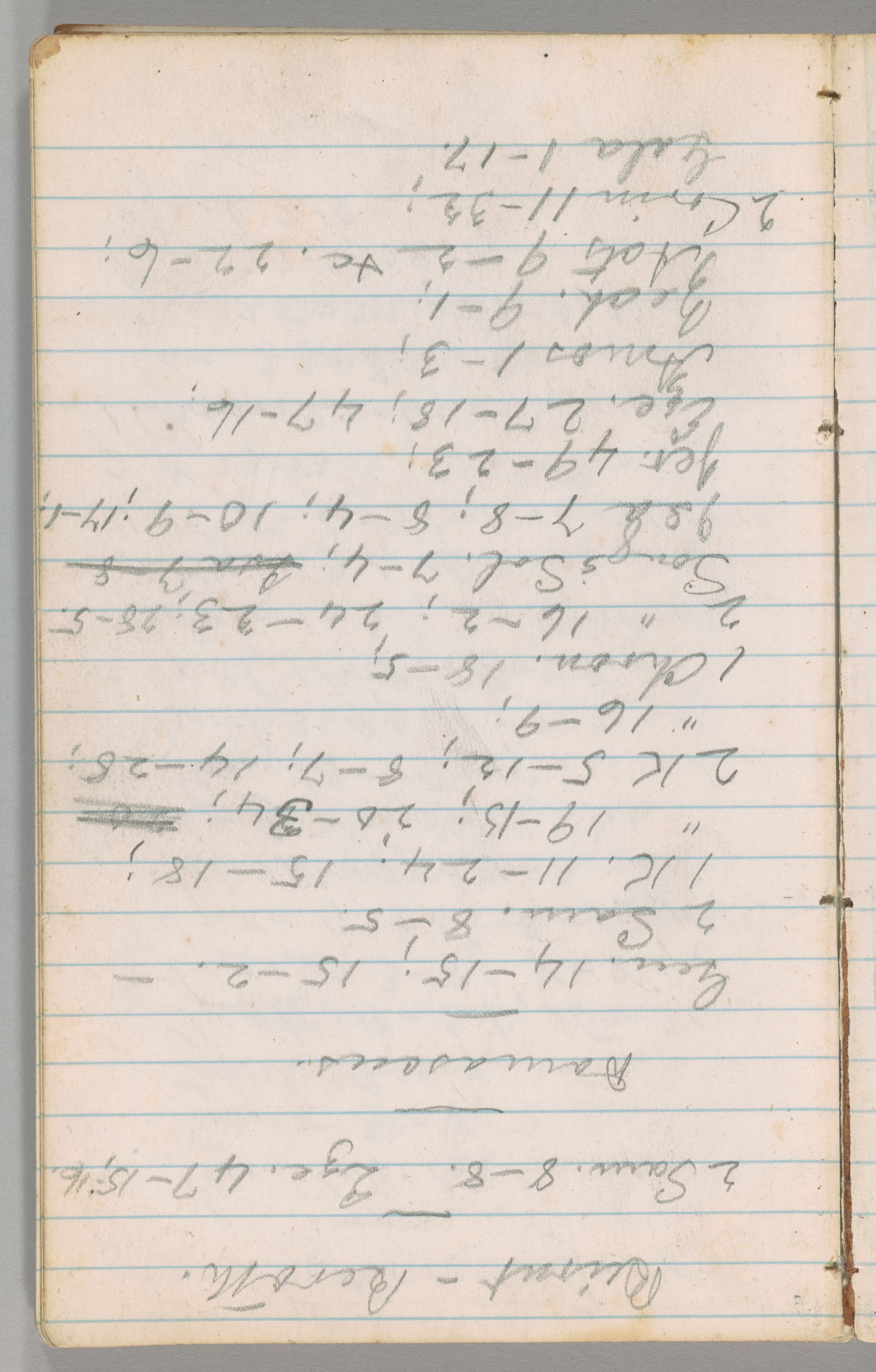
[MS: N10_leaf_002r]
Beirut—Beroth.
2 Sam. 8-8.Eze. 47-15; 16.
Damascus.
Gen. 14-15; 15-2.—
2 Sam. 8-5.
1 K. 11-24; 15-18;
1 K. 19-15; 20-2 34; 20
2 K 5-12; 8-7; 14-28;
2 K 16-9;
1 Chron. 18-5;
2 Chron. 16-2; 24-23; 28-5.
Songs Sol. 7-4; Isa 7-8
Isa 7-8; 8-4; 10-9; 17-1;
Jer. 49-23;
Eze. 27-18; 47-16;
Amos 1-3;
Zech. 9-1;
Acts 9-2 &c. 22-6;
2 Corin 11-32;
Gala 1-17.
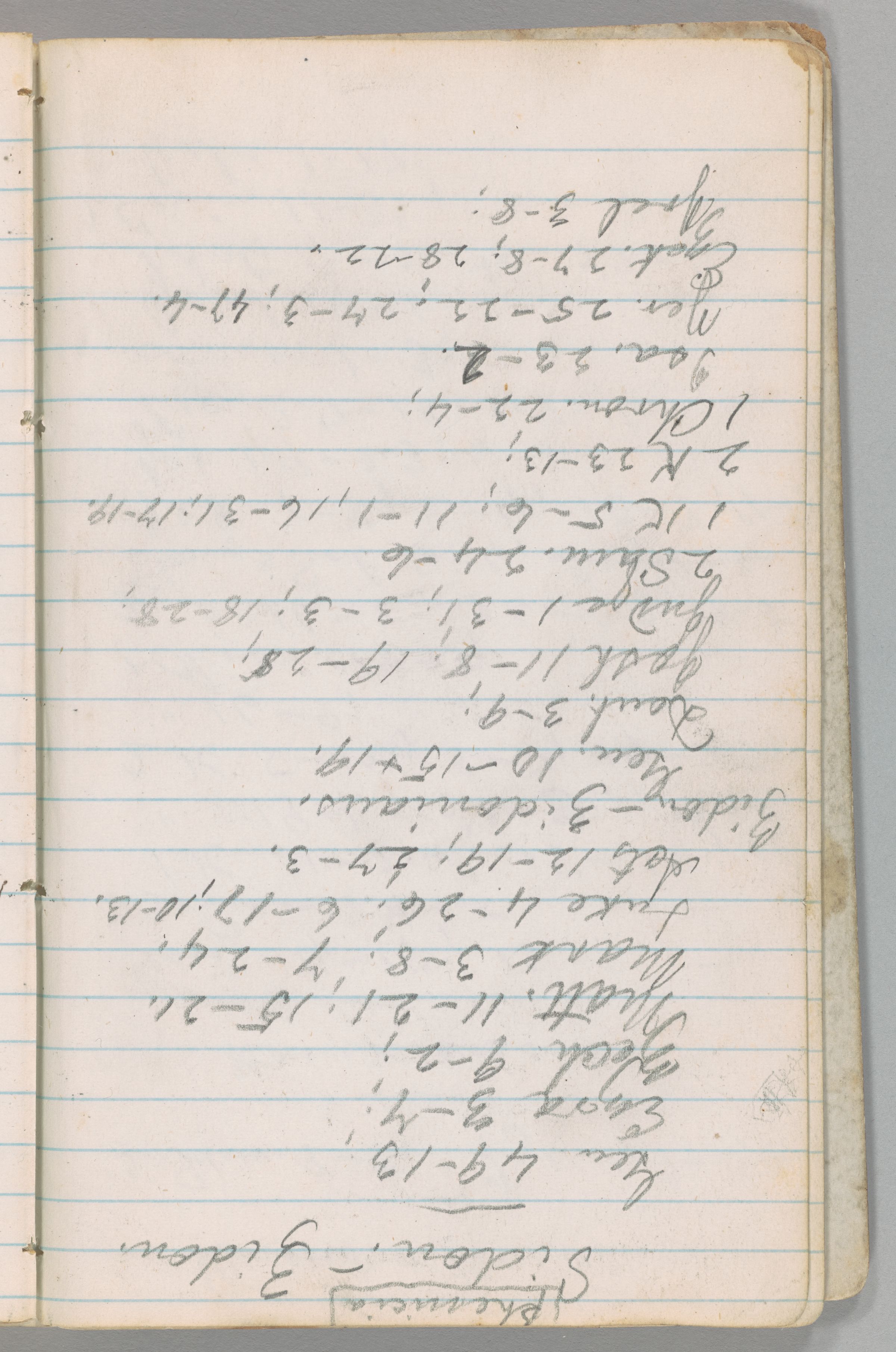
[MS: N10_leaf_002v]
PheniciaⓉtextual note
Sidon.—Zidon.
Gen. 49-13;
Ezra 3-7;
Zech. 9-2;
Matt. 11-21; 15-21.
Mark 3-8; 7-24.
Luke 4-26; 6-17; 10-13.
Acts 12-19; 27-3.
Zidon—Zidonians.
Gen. 10-15 & 19.
Deut. 3-9;
Josh 11-8; 19-28;
Judge 1-31; 3-3; 18-28;
2 Sam. 24-6.
1 K 5-6; 11-1; 16-31; 17-19.
2 K 23-13;
1 Chron. 22-4;
Isa. 23-6 2.
Jer. 25-22; 27-3; 47-4.
Ezek. 27-8; 28-22.
Joel 3-8;
[MS: N10_leaf_003r]
ZorⓉtextual note—Tyre (Phenicia.)
Josh. 19-29
2 Sam 5-11; 24-7.
1 K 5-1; 7-13; 9-11.
1 Chron. 14-1; 22-4.
2 Chron. 2-3;
Ezra 3-7;
Nehemiah 13-16;
Psalm 45-12; 83-7; 87-4;
Isa 23-1;
Jer. 25-22; 27-3; 47-4;
Ezek 26-3 &c.
Joel 3-8;
Amos 1-9;
Zechariah 9-2
Matt 11-21; 15-21;
Mark 3-8; 7-24;
Luke 6-17; 10-13.
Acts 12-20; 21-3;
[MS: N10_leaf_003v]
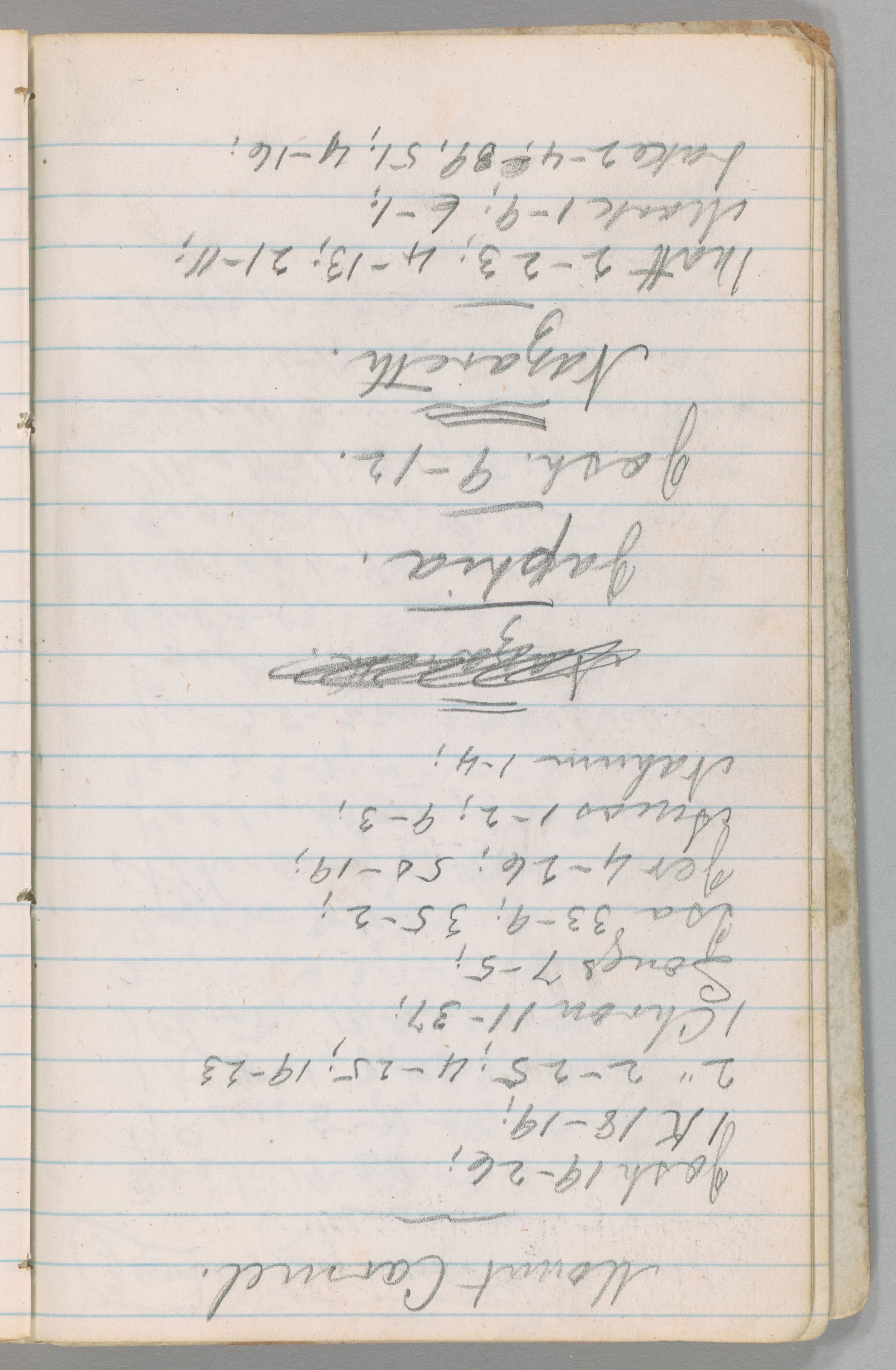
Mount Carmel.
Josh 19-26;
1 K 18-19;
2 K 2-25; 4-25; 19-23
1 Chron 11-37;
Songs 7-5;
Isa 33-9; 35-2;
Jer 4-26; 50-19;
Amos 1-2; 9-3;
Nahum 1-4;
Nazareth.
Japhia.
Josh. 9-12.
Nazareth.
Matt 2-23; 4-13; 21-11;
Mark 1-9; 6-1;
Luke 2-4 -, 39, 51; 4-16;
[MS: N10_leaf_004r]
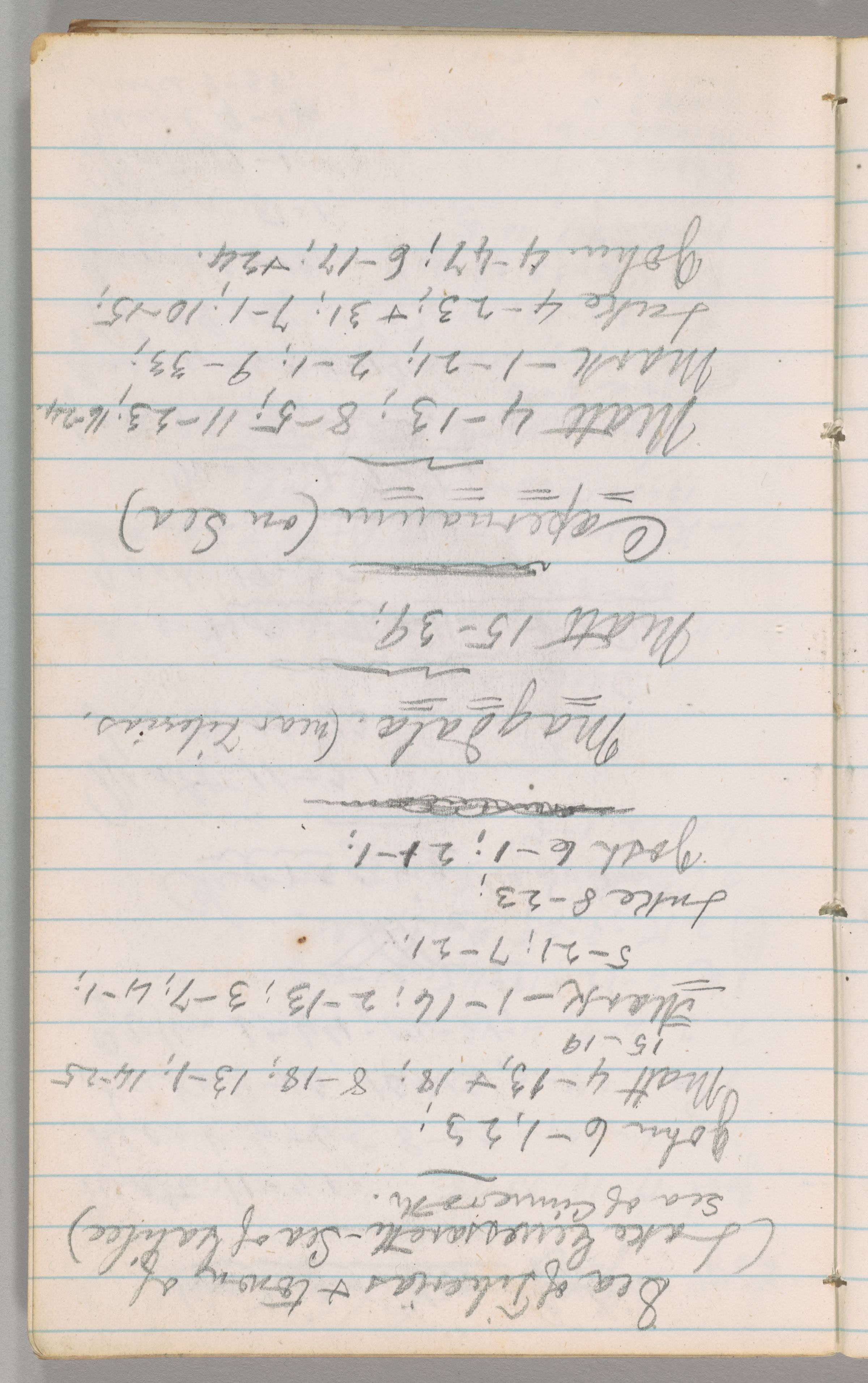
Sea of Tiberias & town of
(Lake Genessareth—Sea of Galilee)
Sea of Cinneroth.Ⓣtextual note
John 6-1, 23;
Matt 4-13, & 18; 8-18; 13-1; 14-25 15-19
Mark—1-16; 2-13; 3-7; 4-1; 5-21; 7-21.
Luke 8-23;
Josh 6-1; 2- 21-1Ⓣtextual note;
Magdala. (near Tiberias.
Matt 15-39;
Capernaum (on Sea)
Matt 4-13; 8-5; 11-23; 16-24.
Mark—1-21; 2-1; 9-33;
Luke 4-23; & 31; 7-1; 10-15;
John 4-47; 6-17; & 24.
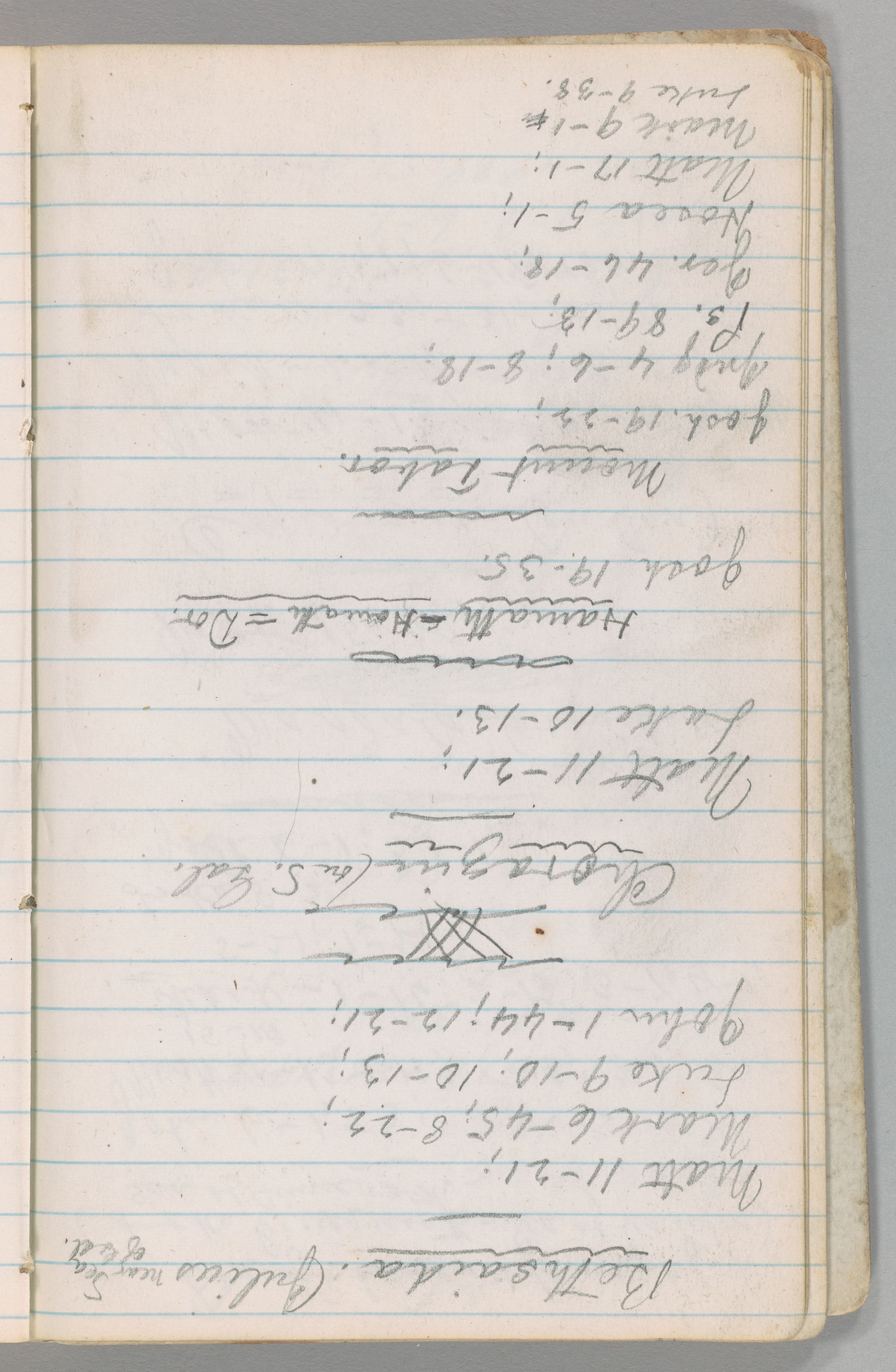
[MS: N10_leaf_004v]
Bethsaida. (Julius near Sea of Gal.Ⓣtextual note
Matt 11-21;
Mark 6-45; 8-22;
Luke 9-10; 10-13;
John 1-44; 12-21;
Chorazin (on S. Gal.
Matt 11-21;
Luke 10-13.
Hamath city in—Hamath-DorⓉtextual note.
Josh 19-35.
Mount Tabor.
Josh. 19-22;
Judg 4-6; 8-18;
Ps. 89-13;
Jer. 46-18;
Hosea 5-1;
Matt 17-1;
Mark 9-1 ;
Luke 9-38.
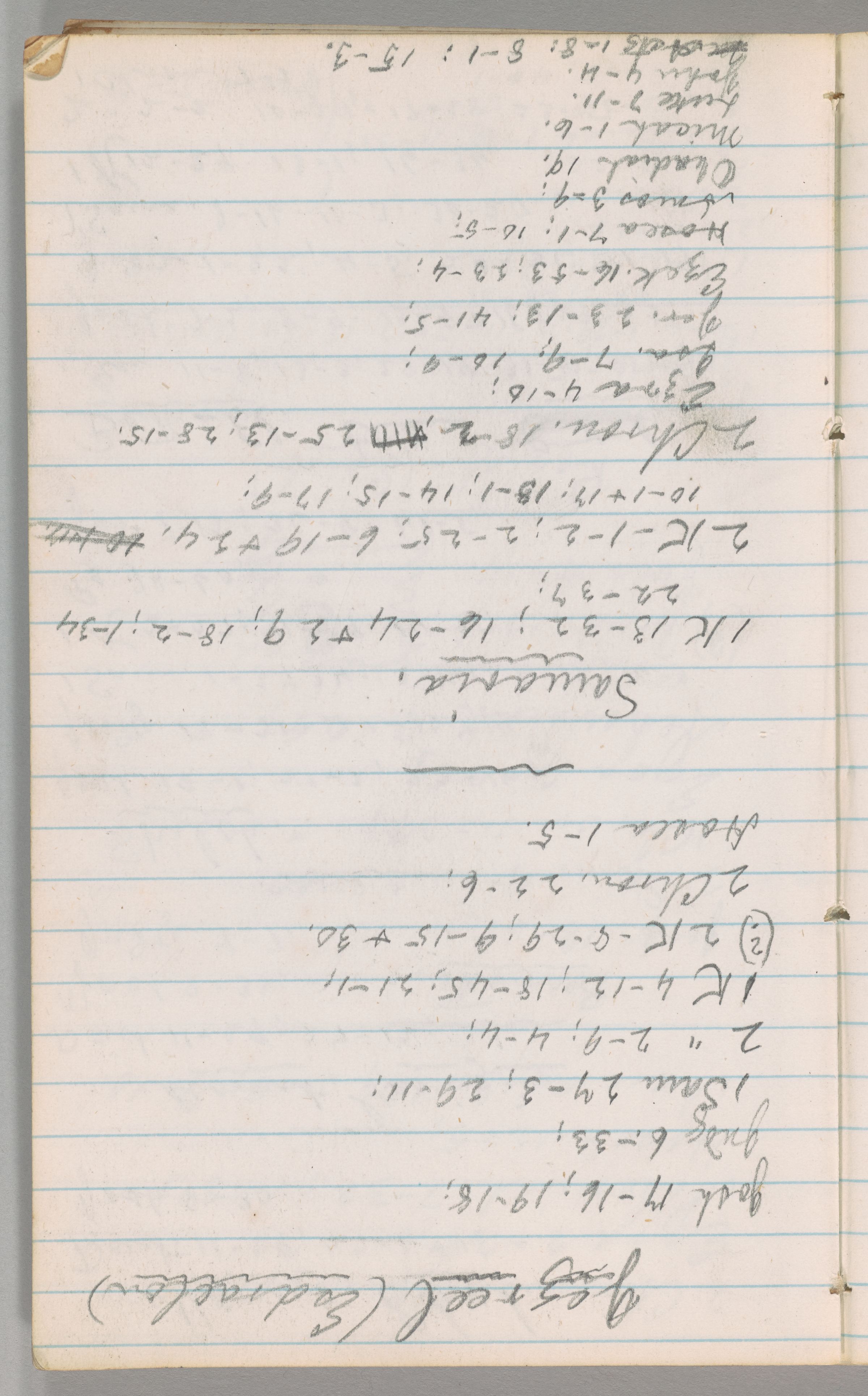
[MS: N10_leaf_005r]
Jezreel (Esdraelon)
Josh 17-16; 19-18;
Judg 6.-33;
1 Sam 27-3; 29-11;
2 Sam 2-9; 4-4;
1 K 4-12; 18-45; 21-1;
(?) 2 K—8-29; 9-15 & 30.
2 Chron. 22-6;
Hosea 1-5.
Samaria.
1 K 13-32; 16-24 & 29; 18-2; 1-34 22-37;
2 K—1-2; 2-25; 16-19 & 24. 10-1 & 17. 10-1 & 17; 13-1; 14-15; 17-9;
2 Chron. 18-2; & 25-13; 28-15.
Ezra 4-10;
Isa. 7-9; 10-9;
Jer. 23-13; 41-5;
Ezek. 16-53; 23-4;
Hosea 7-1; 10-5;
Amos 3-9;
Obadiah 19.
Micah 1-6.
Luke 7-11.
John 4-4.
- Acts 1-8; 8-1; 15-3.
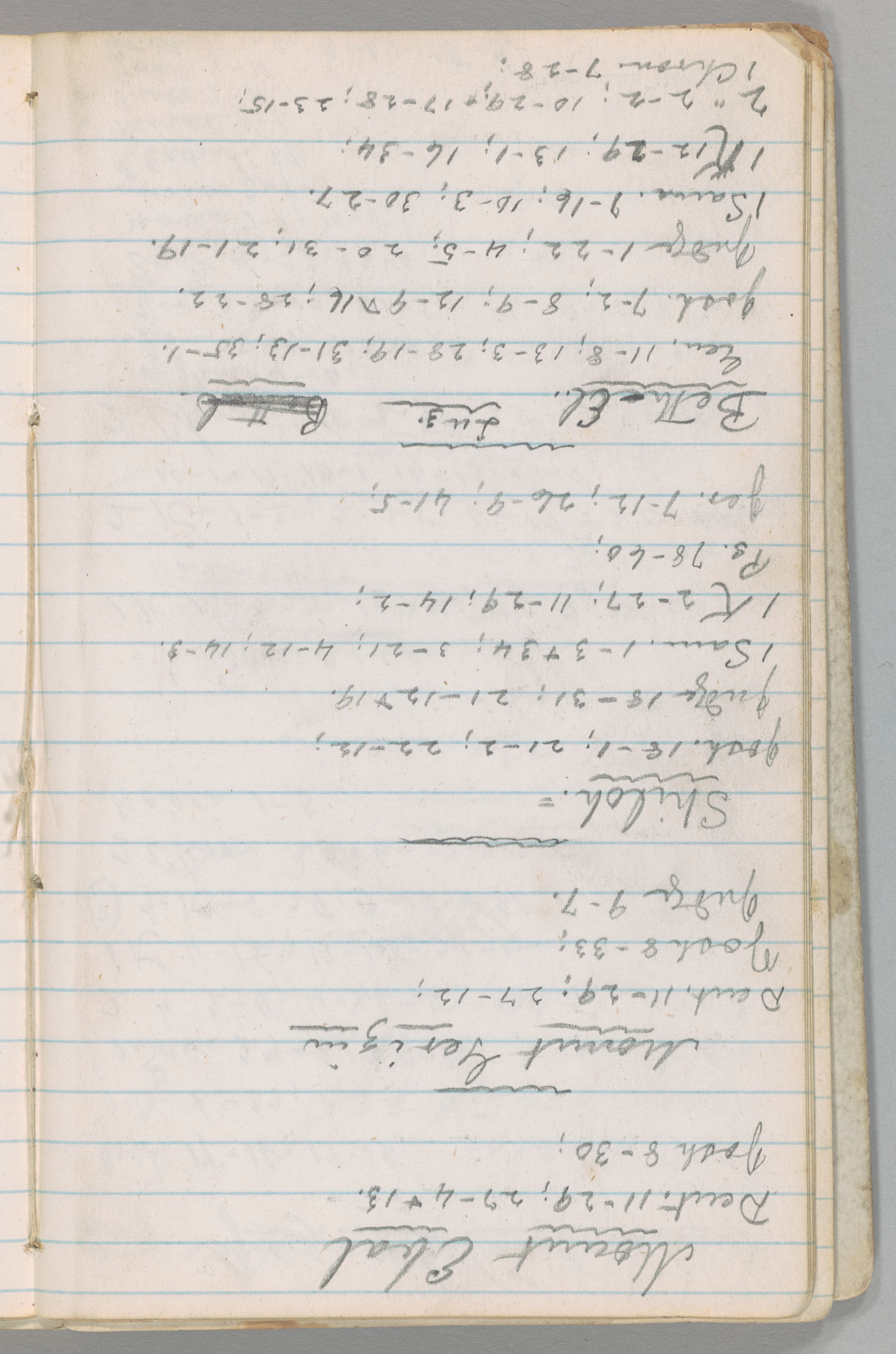
[MS: N10_leaf_005v]
Mount Ebal
Deut. 11-29; 27-4 & 13.
Josh 8-30;
Mount Gerizin
Deut. 11-29; 27-12;
Josh 8-33;
Judge 9-7.
Shiloh.=
Josh. 18-1; 21-2; 22-12;
Judge 18-31; 21-12 & 19.
1 Sam. 1-3 & 34; 3-21; 4-12; 14-3.
1 K 2-27; 11-29; 14-2;
Ps. 78-60;
Jer. 7-12; 26-9; 41-5;
Bethel. Beth-El.Ⓣtextual note Luz. Bethel.
Gen. 11-8; 13-3; 28-19; 31-13; 35-1.
Josh. 7-2; 8-9; 12-9 & 16; 28-22.
Judge 1-22; 4-5; 20-31; 21-19.
1 Sam. 7-16; 10-3; 30-27.
1 K 12-29; 13-1; 16-34;
2 KⓂemendation 2-2; 10-29; 17-28; 23-15;
1 Chron. 7-28;
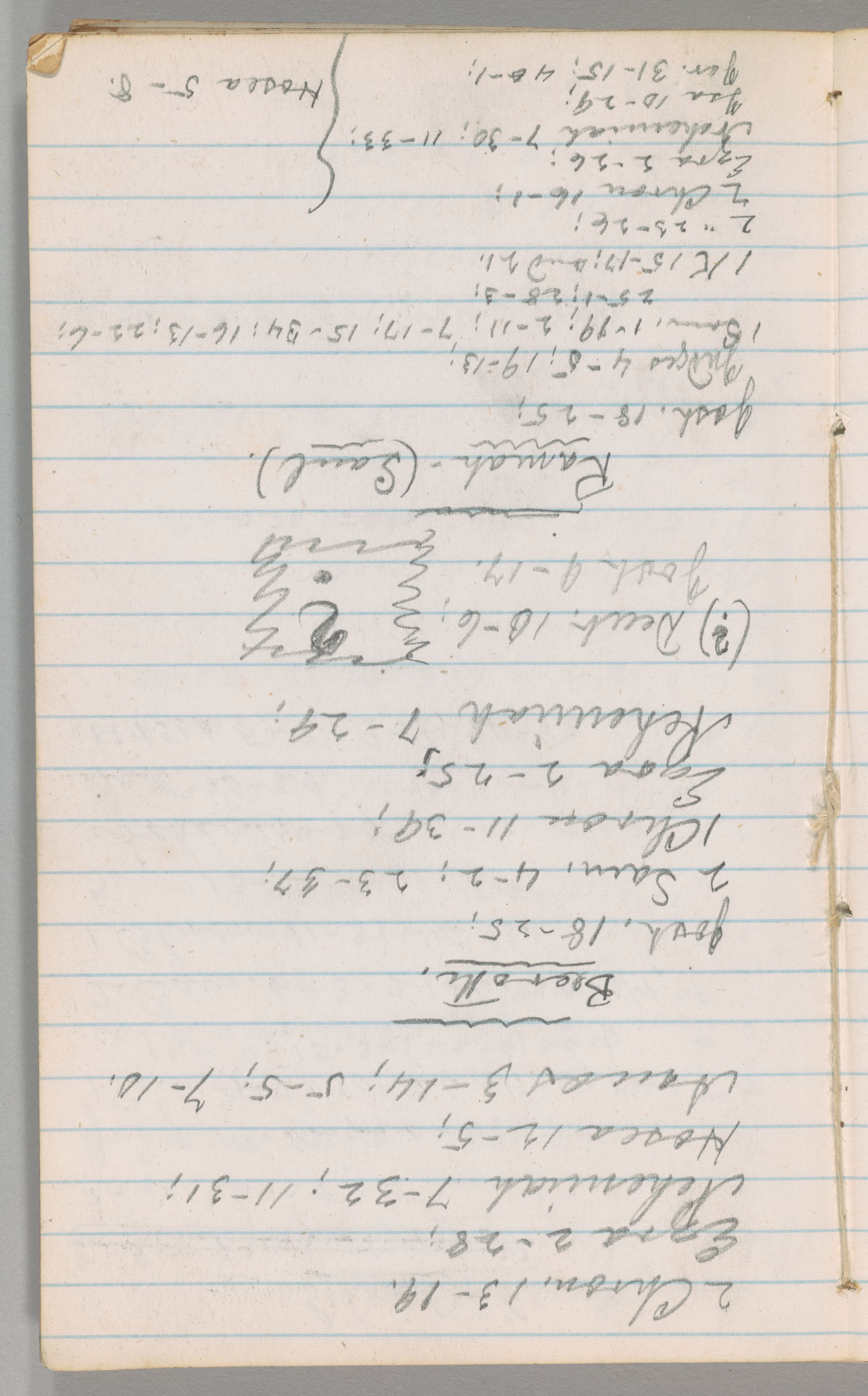
[MS: N10_leaf_006r]
2 Chron. 13-19.
Ezra 2-28;
Nehemiah 7-32; 11-31;
Hosea 12-5;
Amos 3-14; 5-5; 7-10.
Beeroth.
Josh. 18-25;
2 Sam. 4-2; 23-37;
1 Chron 11-39;
Ezra 2-25;
Nehemiah 7-29;
(?) Deut. 10-6;
?
Josh 9-17.Ⓣtextual note
Ramah. (Saul).
Josh. 18-25;
Judges 4-5; 19-13;
1 Sam. 1-19; 2-11; 7-17; 15-34; 16-13; 22-6; 25-1; 28-3;
1 K 15-17; and 21.
2 K 23-26;
2 Chron 16-1;
Ezra 2-26;
Nehemiah 7-30; 11-33;
Isa 10-29;
Jer. 31-15; 40-1;
Hosea 5-8.
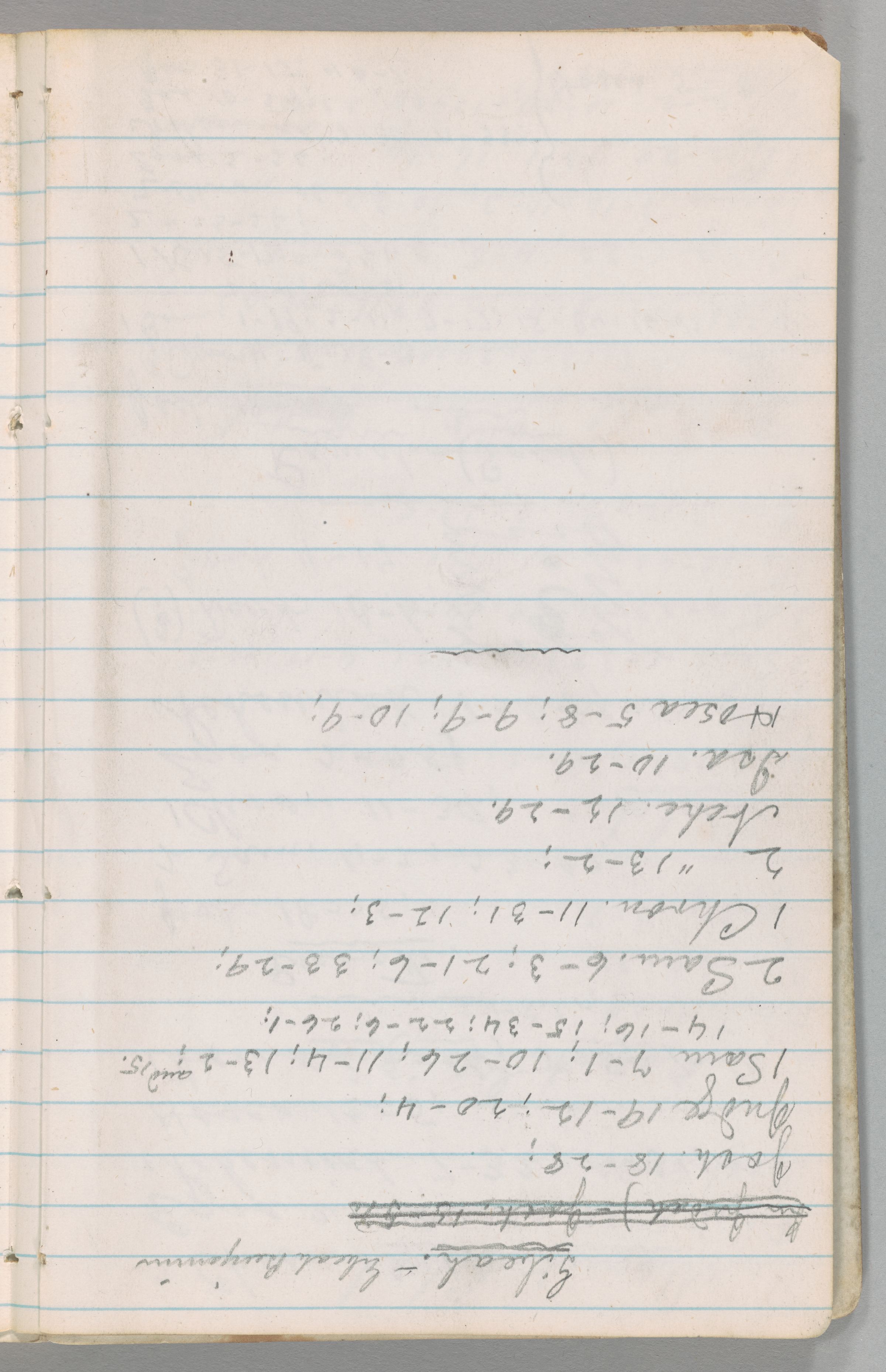
[MS: N10_leaf_006v]
Gibeah.—Gibeah BenjaminⓉtextual note
In Judah)—Josh. 15-57.
Josh. 18-28;
Judge 19-12; 20-4;
1 Sam 7-1; 10-26; 11-4; 13-2; and 15Ⓣtextual note. 14-16; 15-34; 22-6; 26-1;
2 Sam. 6-3; 21-6; 33-29;
1 Chron. 11-31; 12-3;
2 Chron. 13-2;
Nehe. 12-29.
Isa. 10-29.
Hosea 5-8; 9-9; 10-9;
[MS: N10_leaf_007r]
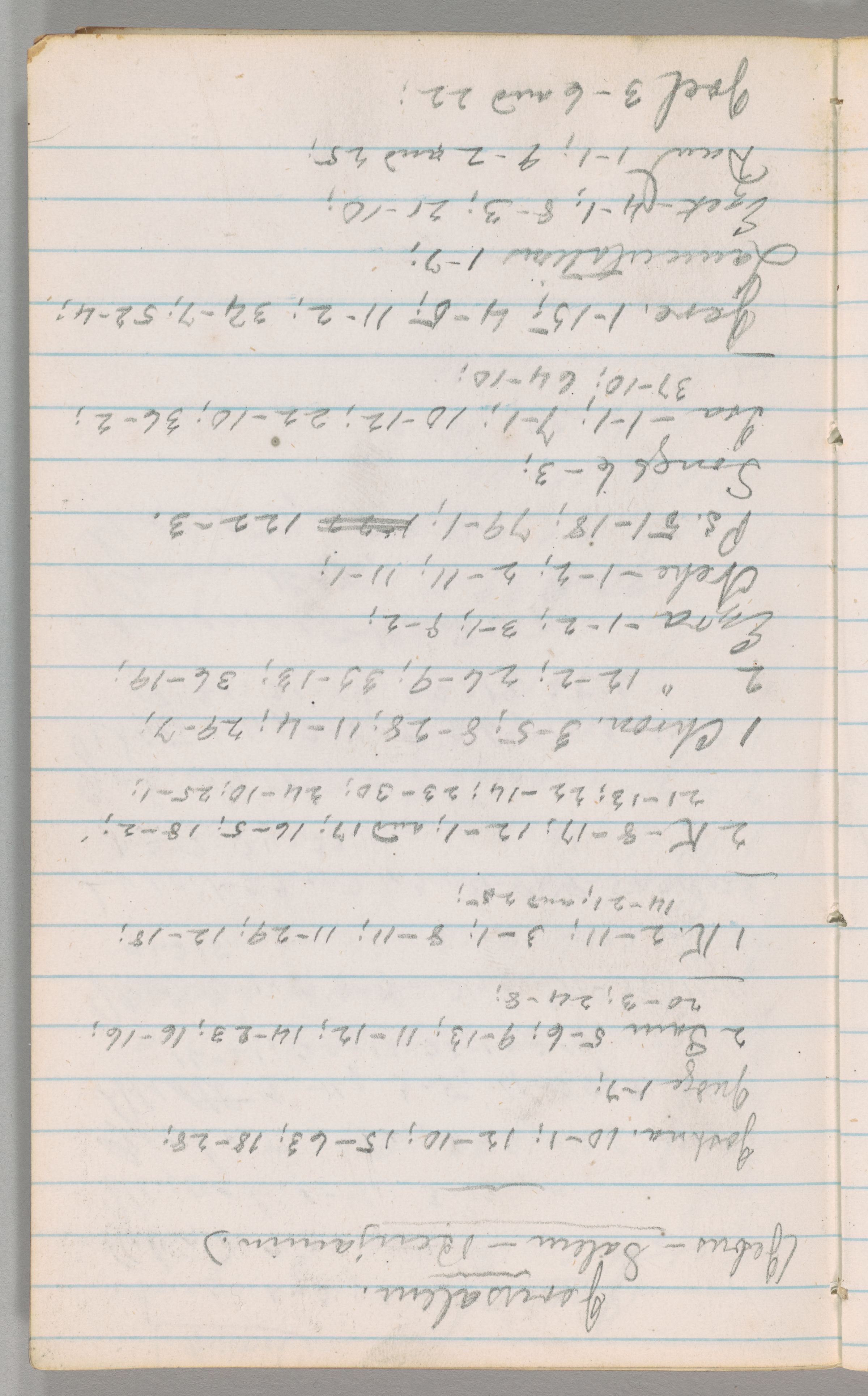
Jerusalem.
(Jebus—Salem—Benjamin.)
Joshua. 10-1; 12-10; 15-63; 18-28;
Judge 1-7;
2 Sam 5-6; 9-13; 11-12; 14-23; 16-16; 20-3; 24-8;
1 K. 2-11; 3-1; 8-11; 11-29; 12-18; 14-21; and 25;
2 K—8-17; 12-1; and 17; 16-5; 18-2; 21-13; 22-14; 23-30; 24-10; 25-1;
1 Chron. 3-5; 8-28; 11-4; 29-7;
2 Chron. 12-2; 26-9; 33-13; 36-19;
Ezra—1-2; 3-1; 8-2;
Nehe—1-2; 2-11; 11-1;
Ps. 51-18; 79-1; 1-22 122-3.
Songs 6-3;
Isa—1-1; 7-1; 10-12; 22-10; 36-2; 37-10; 64-10;
Jere. 1-15; 4-5; 11-2; 34-7; 52-4;
Lamentations 1-7;
Ezek—4-1; 8-3; 21-10;
Dan1 1-1; 9-2 ; andⓉtextual note 25;
Joel 3-6 and 22;
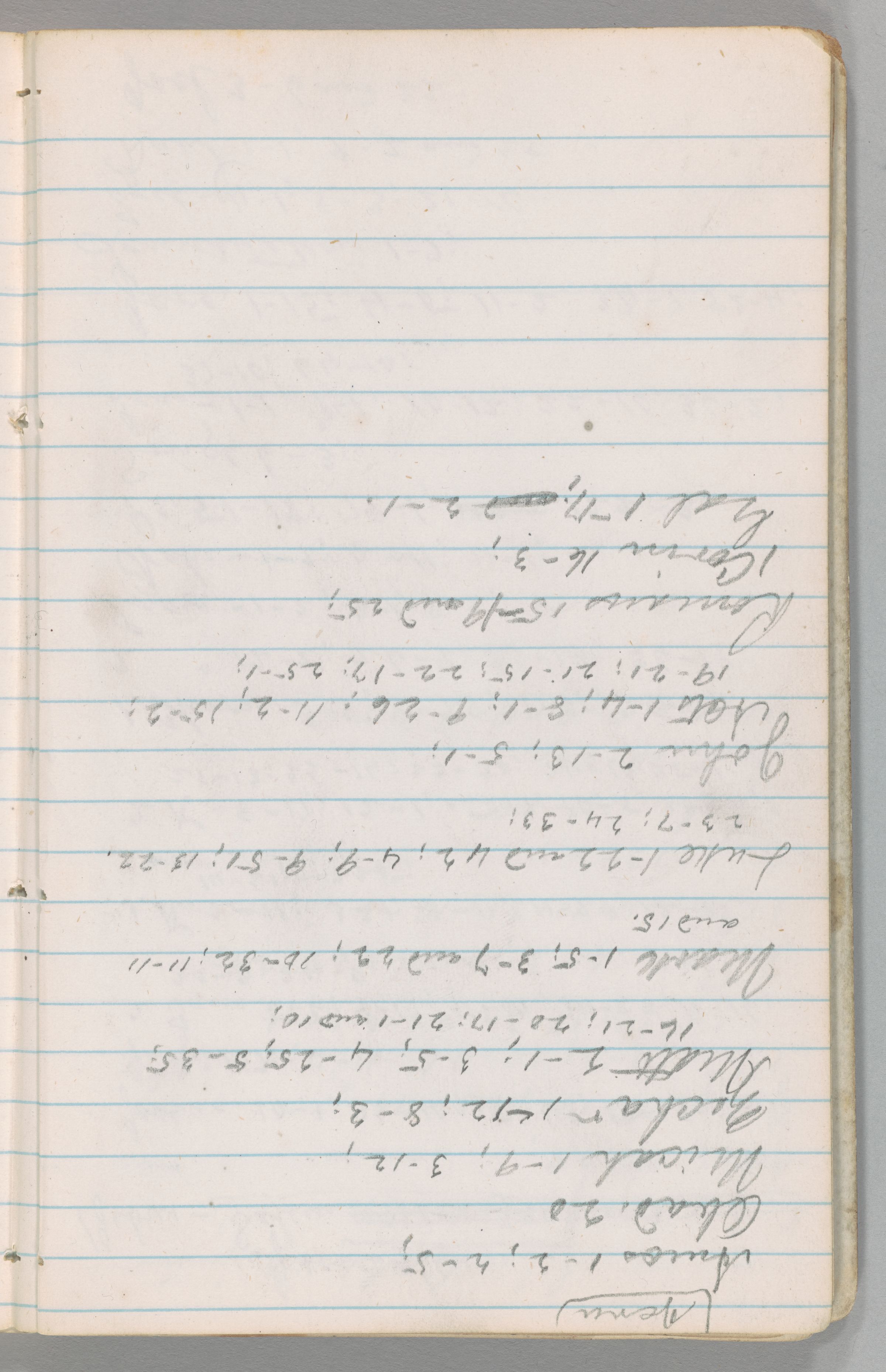
[MS: N10_leaf_007v]
Amos 1-2Ⓜemendation; 2-5;
Obad. 20
Micah 1-9; 3-12;
Zechar 1-12; 8-3;
Matt 2-1; 3-5; 4-25; 5-35; 16-21; 20-17; 21-1 and 10;
Mark 1-5; 3-7 and 22; 10-32; 11-11 and 15.
Luke 1-22 and 42; 4-9; 9-51; 13-22. 23-7; 24-33;
John 2-13; 5-1;
Acts 1-4; 8-1; 9-26; 11-2; 15-2; 19-21; 21-15; 22-17; 25-1;
Romans 15-19 and 25;
1 Corin 16-3;
Gal 1-17; and 2-1.
[MS: N10_leaf_008r]
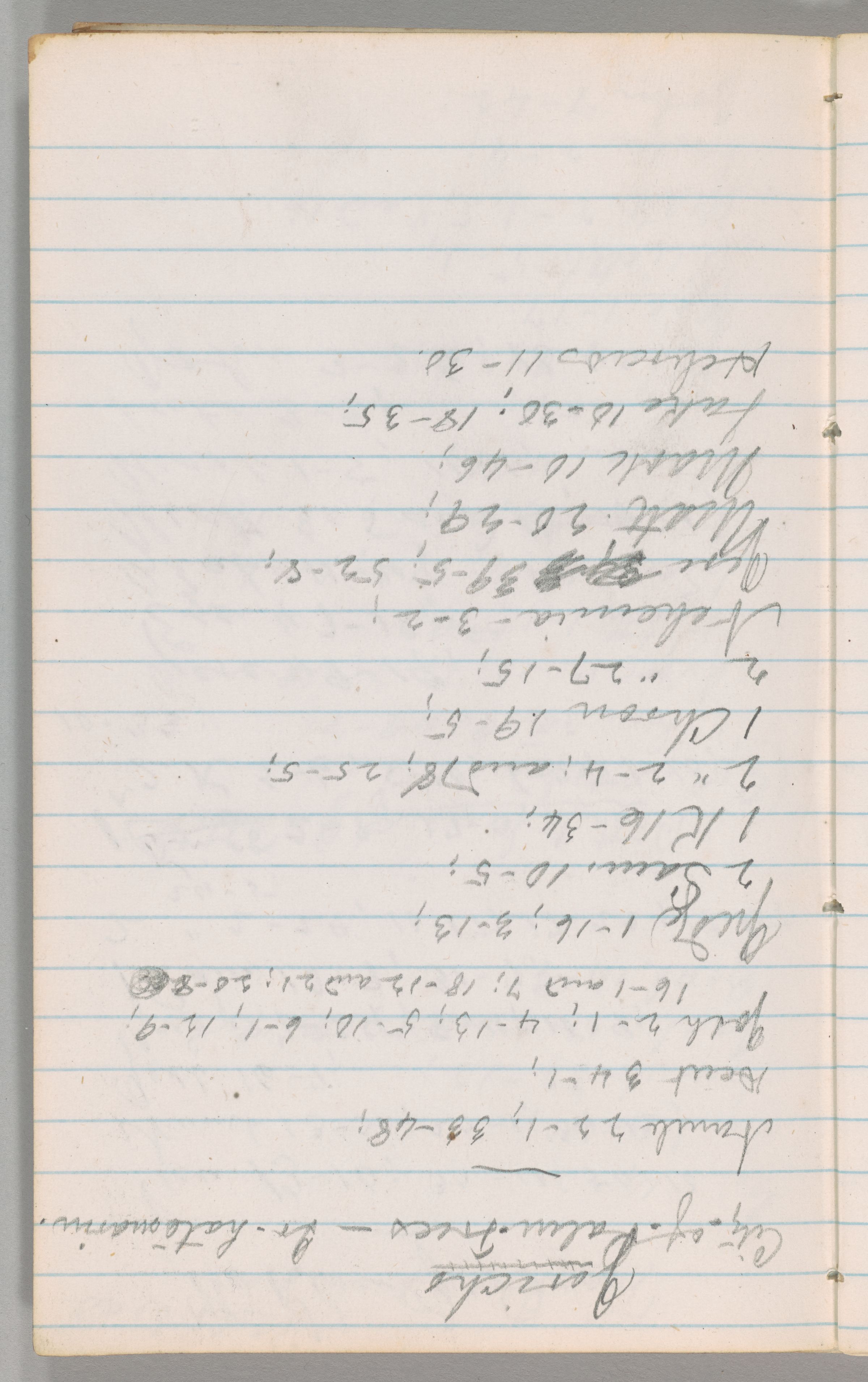
Jericho JerichoⓉtextual note
City-of-Palm-Trees—Ir-hatēmarin.
Numb 22-1; 33-48;
Deut 34-1;
Josh 2-1; 4-13; 5-10; 6-1; 12-9; 16-1 and 7; 18-12 and 21; 20-2-. 8Ⓣtextual note
Judge 1-16; 3-13;
2 Sam. 10-5;
1 K 16-34;
2 K 2-4; and 18; 25-5;
1 Chron 19-5;
2 Chron 27-15;
Nehemia—3-2;
Jere 59-3Ⓜemendation 39-5; 52-8;
Matt. 20-29;
Mark 10-46;
Luke 10-30; 18-35;
Hebrews 11-30.
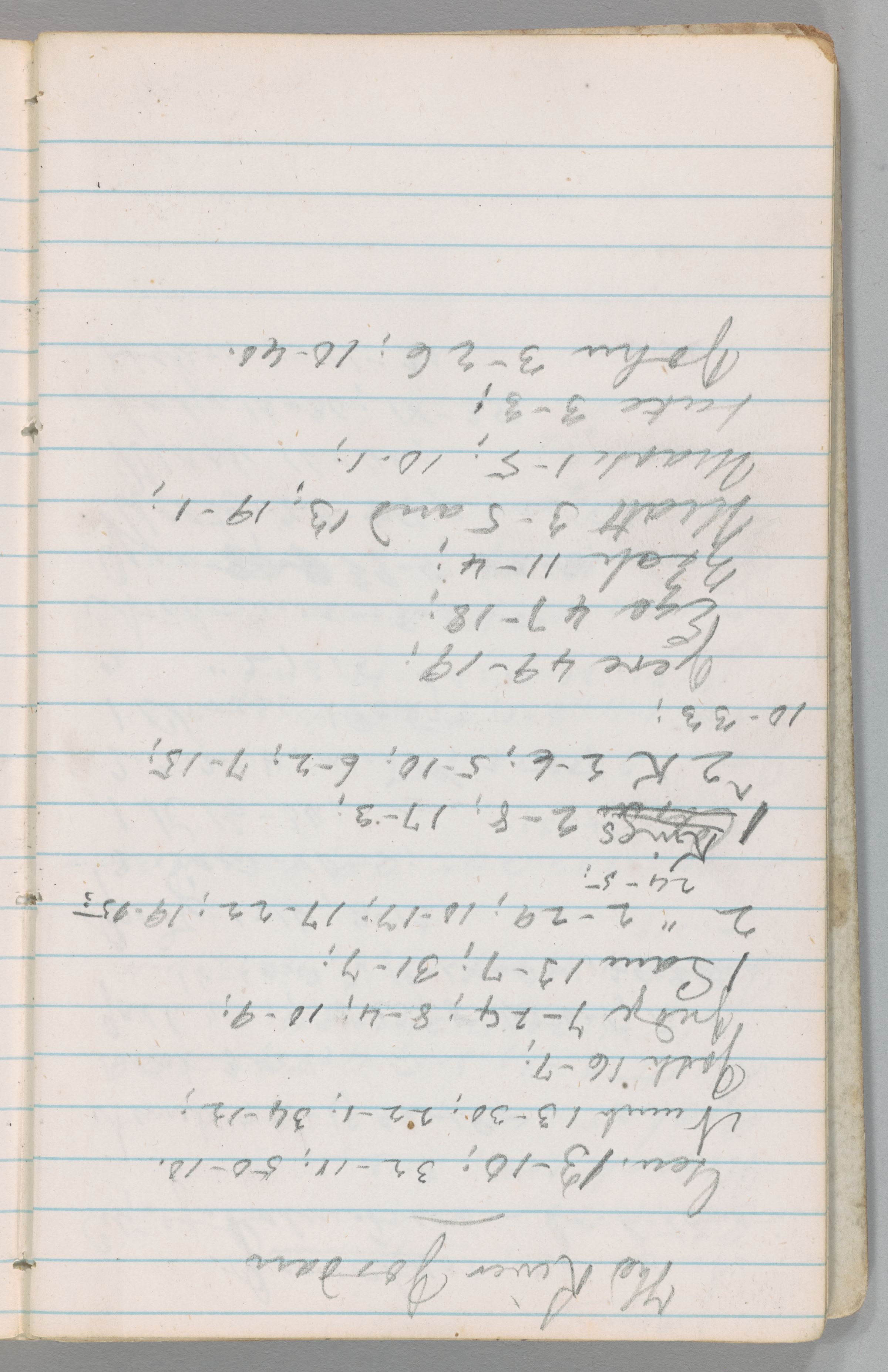
[MS: N10_leaf_008v]
The River Jordan
Gen. 13-10; 32-11; 50-10.
Numb 13-30; 22-1; 34-12;
Josh 16-7;
Judge 7-24; 8-4; 10-9;
1 Sam 13-7; 31-7;
2 Sam 2-29; 10-17; 17-22; 19-15; 24-5;
1 Corin KingsⓉtextual note 2-8; 17-3;
2 K 2-6; 5-10; 6-2; 7-15; 10-33;
Jere 49-19;
Eze 47-18;
Zech 11-4;
Matt 3-5 and 13; 19-1;
Mark 1-5; 10-1;
Luke 3-3;
John 3-26; 10-40.
[MS: N10_leaf_009r]
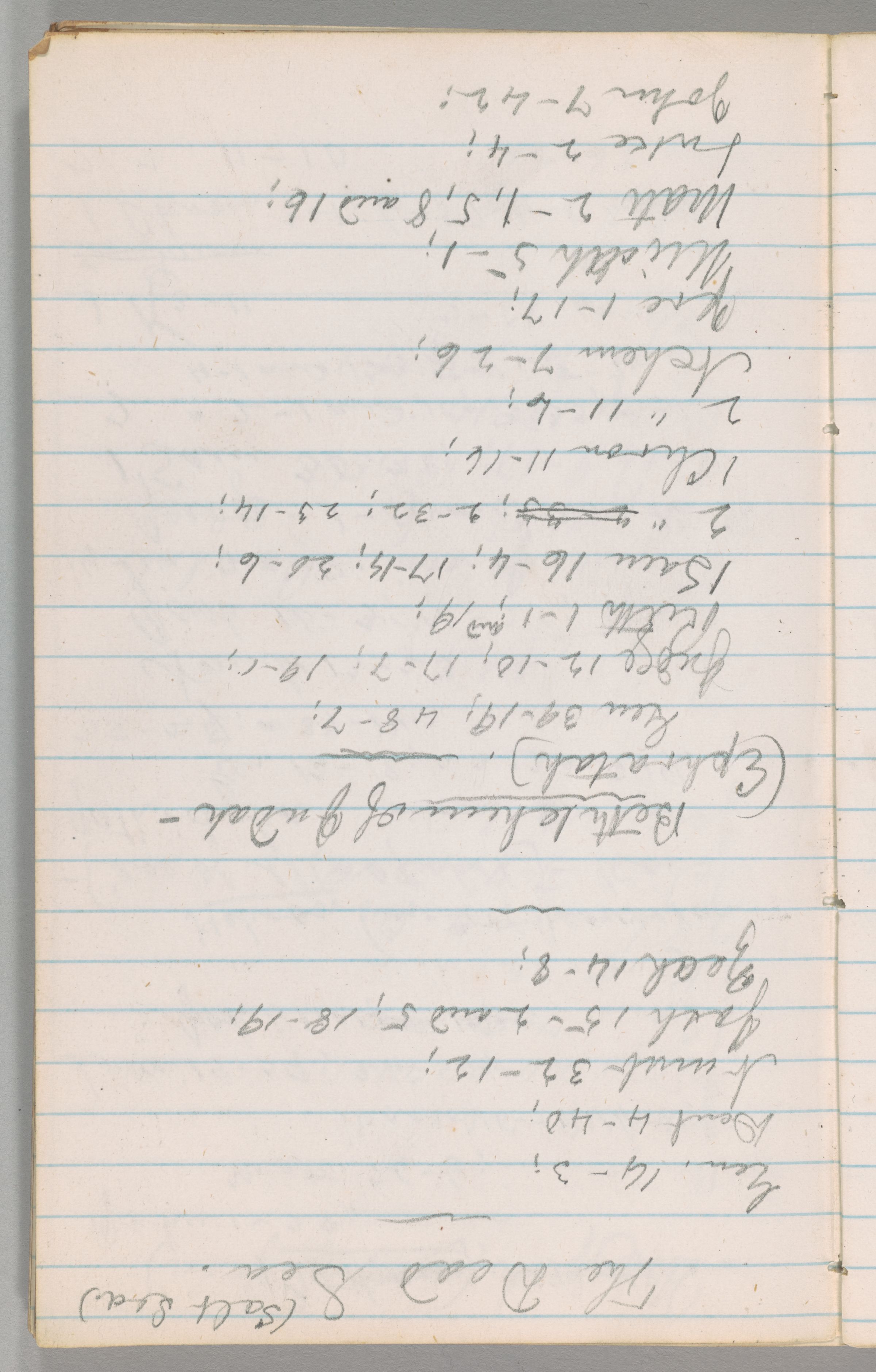
The Dead Sea. (Salt Sea.)Ⓣtextual note
Gen. 14-3;
Deut 4-40;
Numb 32-12;
Josh 15-2 and 5; 18-19;
Zech 14-8;
Bethlehem of Judah—(Ephratah).
Gen 39-19; 48-7;
Judge 12-10; 17-7; 19-1;
Ruth 1-1; and 19Ⓣtextual note;
1 Sam 16-4; 17-14Ⓜemendation; 20-6;
2 Sam 2-33; 2-32; 23-14;
1 Chron 11-16;
2 Chron 11-6;
Nehem 7-26;
Jere 1-17;
Micah 5-1;
Matt 2-1, 5, 8 and 16;
Luke 2-4;
John 7-42;
[MS: N10_leaf_009v]
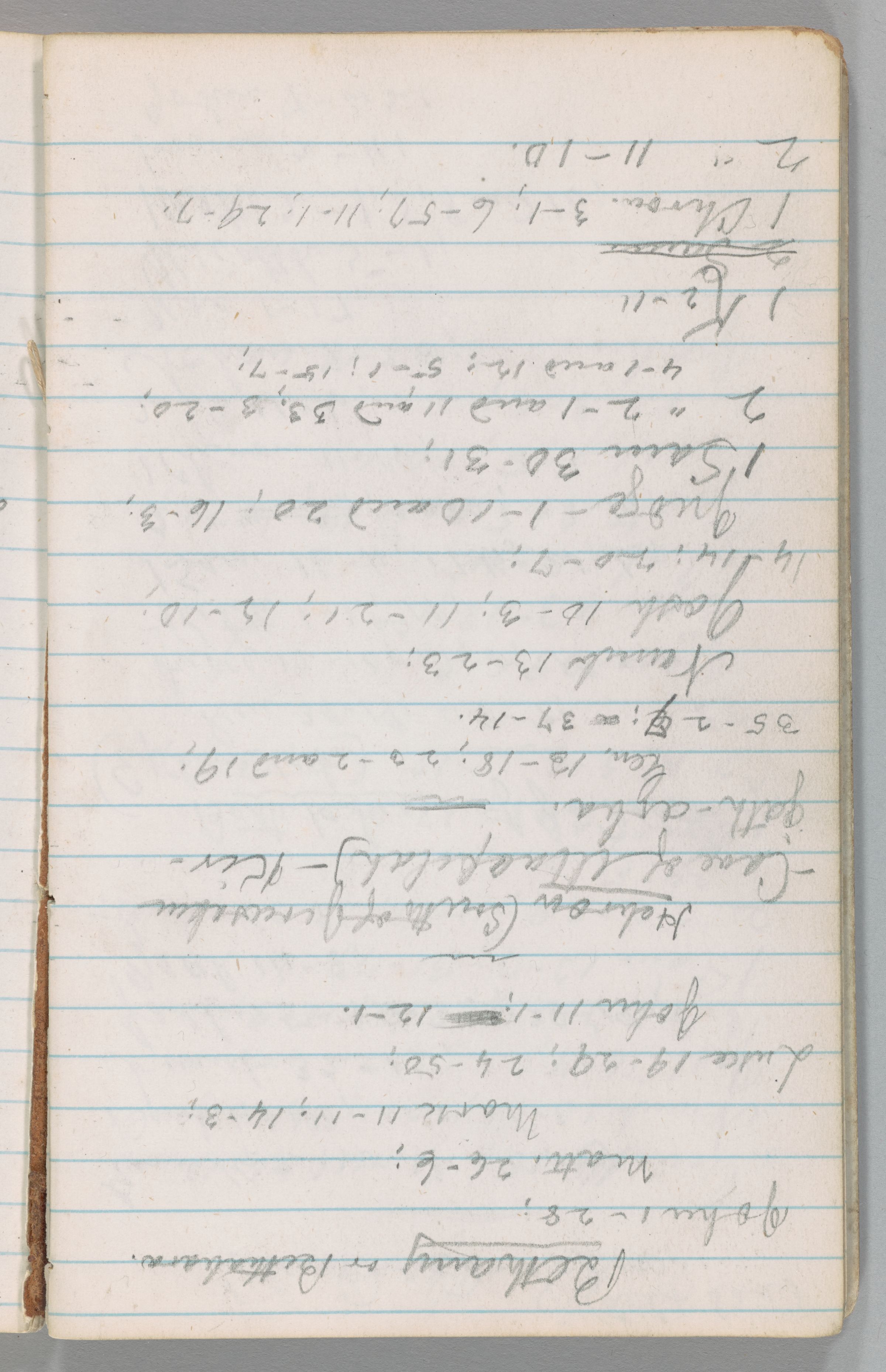
Bethany or Bethabara.
John 1-28;
Matt. 26-6;
Mark 11-11; 14-3;
Luke 19-29; 24-50;
John 11-1; an 12-1.
Hebron (South of Jerusalem—Cave of Macpelah)—
KirgathKirjath-arbaⓉtextual note.
Gen. 13-18; 23-2 and 19; 35-26 27Ⓣtextual note; a 37-14.
Numb 13-23;
Josh 10-3; 11-21; 12-10; 14-14; 20-7;
Judge—1-10 and 20; 16-3;
1 Sam 30-31;
2 Sam 2-1 and 11, and 33; 3-20; 4-1 and 12; 5-1; 15-7;
1 K 2-11
2 Sam
1 Chron. 3-1; 6-57; 11-1; 29-7;
2 Chron. 11-10.
[MS: N10_leaf_010r]
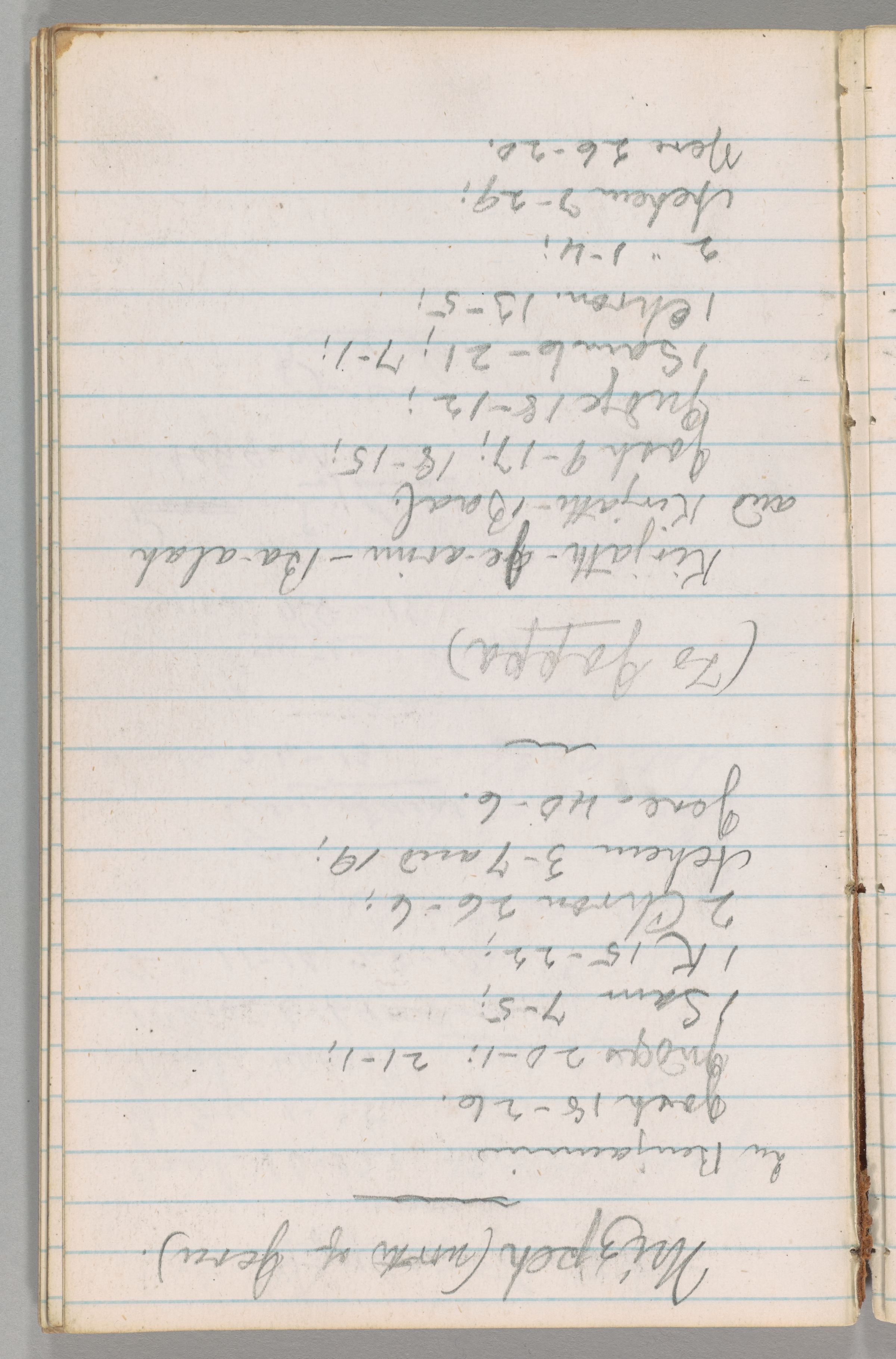
Mizpeh (north of Jeru).
In Benjamin
Josh 18-26.
Judges 20-1; 21-1;
1 Sam 7-5;
1 K 15-22;
2 Chron 26-6;
Nehem 3-7 and 19;
Jere. 40-6.
(To Joppa)
Kirjath-- Je-arim—Ba-alah and Kirjath-Baal.
Josh 9-17; 18-15;
Judge 18-12;
1 Sam 6-21; 7-1;
1 Chron. 13-5;
2 Chron. 1-4;
Nehem 7-29;
Jere 26-20.
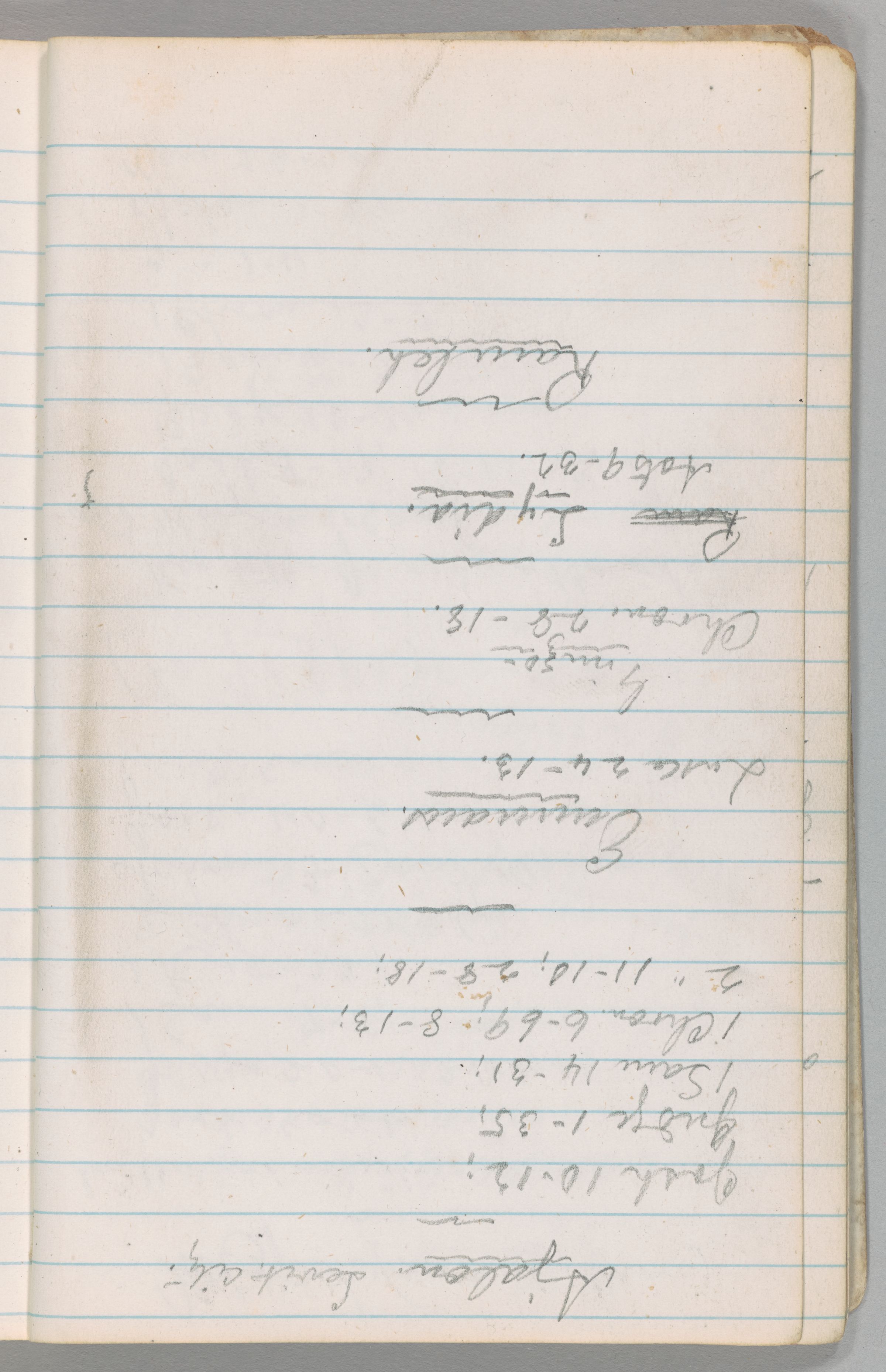
[MS: N10_leaf_010v]
Ajalon. Levit. city.
Josh 10-12;
Judge 1-35;
1 Sam 14-31;
1 Chron 6-69; 8-13;
2 Chron 11-10; 28-18;
Emmaus.
Luke 24-13.
Gimzo.
Chron. 28-18.
Ram Lydia.
Acts 9-32.
Ramleh.
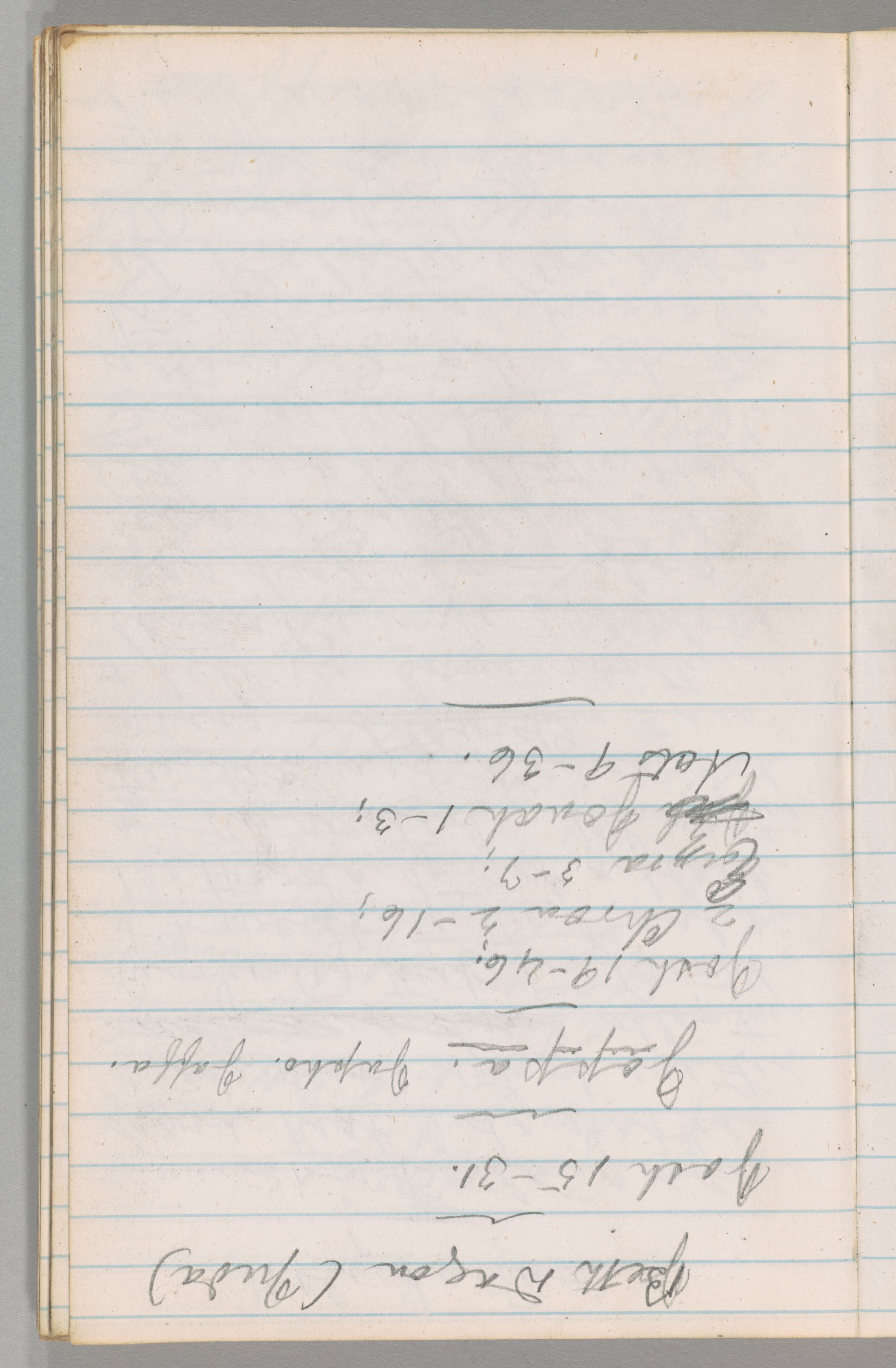
[MS: N10_leaf_011r]
J Beth Dagon (Juda)
Josh 15-31.
Joppa. Japho. Jaffa.
Josh 19-46;
2 Chron 2-16;
Ezra 3-7;
Joh Jonah 1-3;
Acts 9-36.Ⓣtextual note
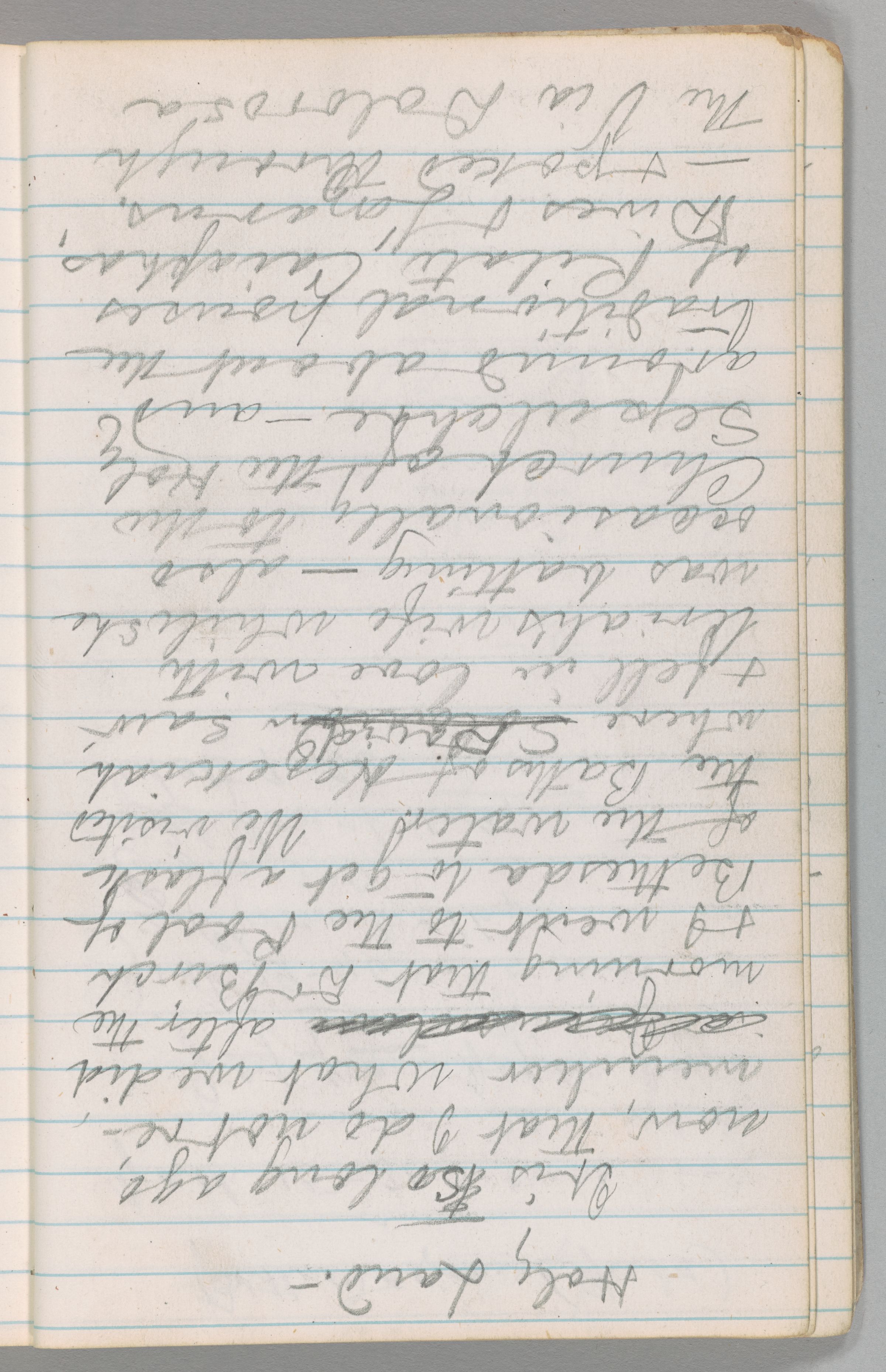
[MS: N10_leaf_011v]
Holy Land.—13
It is h so long ago, now, that I do not remember what we did in Jerusalem after the morning that Dr Birch & I went to the Pool of Bethesda to get a flask of the water. We visited the
Baths of Hezekiah, where Solomon DavidⓉtextual note saw & fell in love with Uriah's wife while she was bathing—also occasionally to the
Church of the Holy Sepulchre—and around about the traditional houses of Pilate, Caiaphas,
Dives & Lazarus.—& poked through the Via Dolorosa
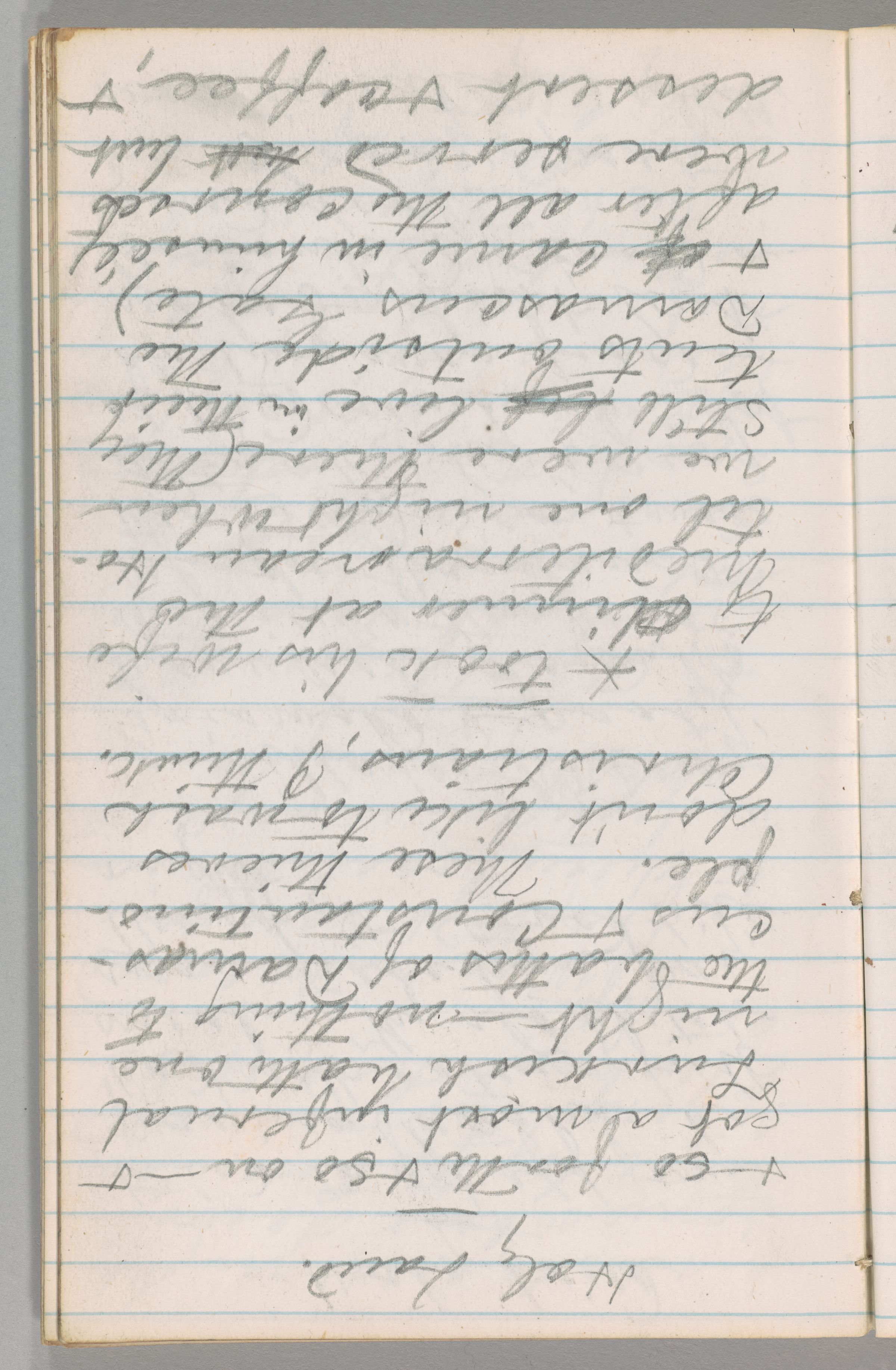
[MS: N10_leaf_012r]
& so forthⓂemendation & so on—& got a most infernal Turkish bath one night—nothing to the baths of Damascus
& Constantinople. These thieves don't like to wash Christians, I think.
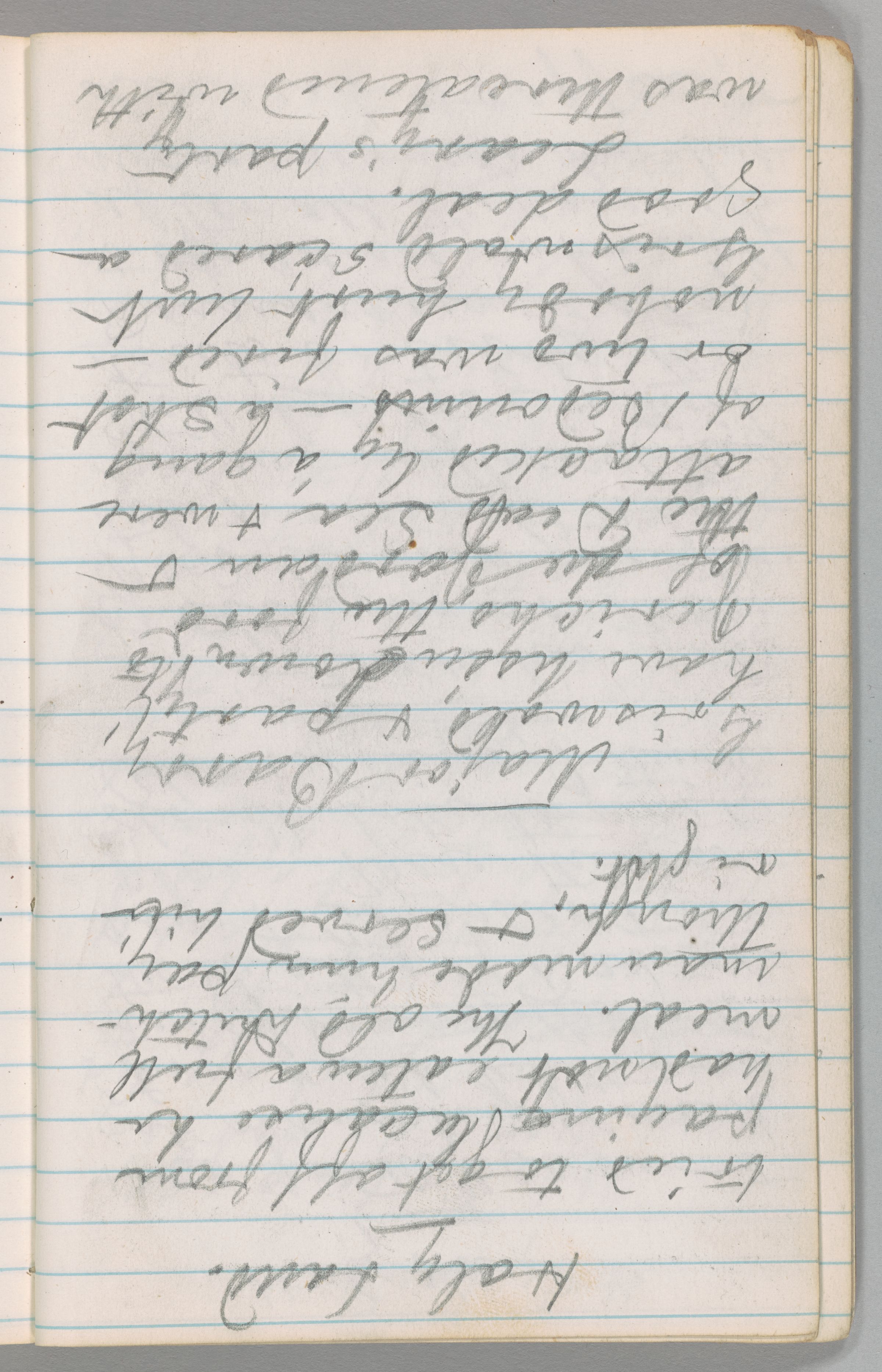
* took his wife to th dinner at the Mediterranean Hotel one night when we were there (they still lef live in their tents outside the Damascus Gate), & af came in himself after all the courses were served but dessert & coffee, &
[MS: N10_leaf_012v]
tried to getⓂemendation off from paying because he had not eaten a full meal. The old Dutchman made him pay,
though, & served him right.14
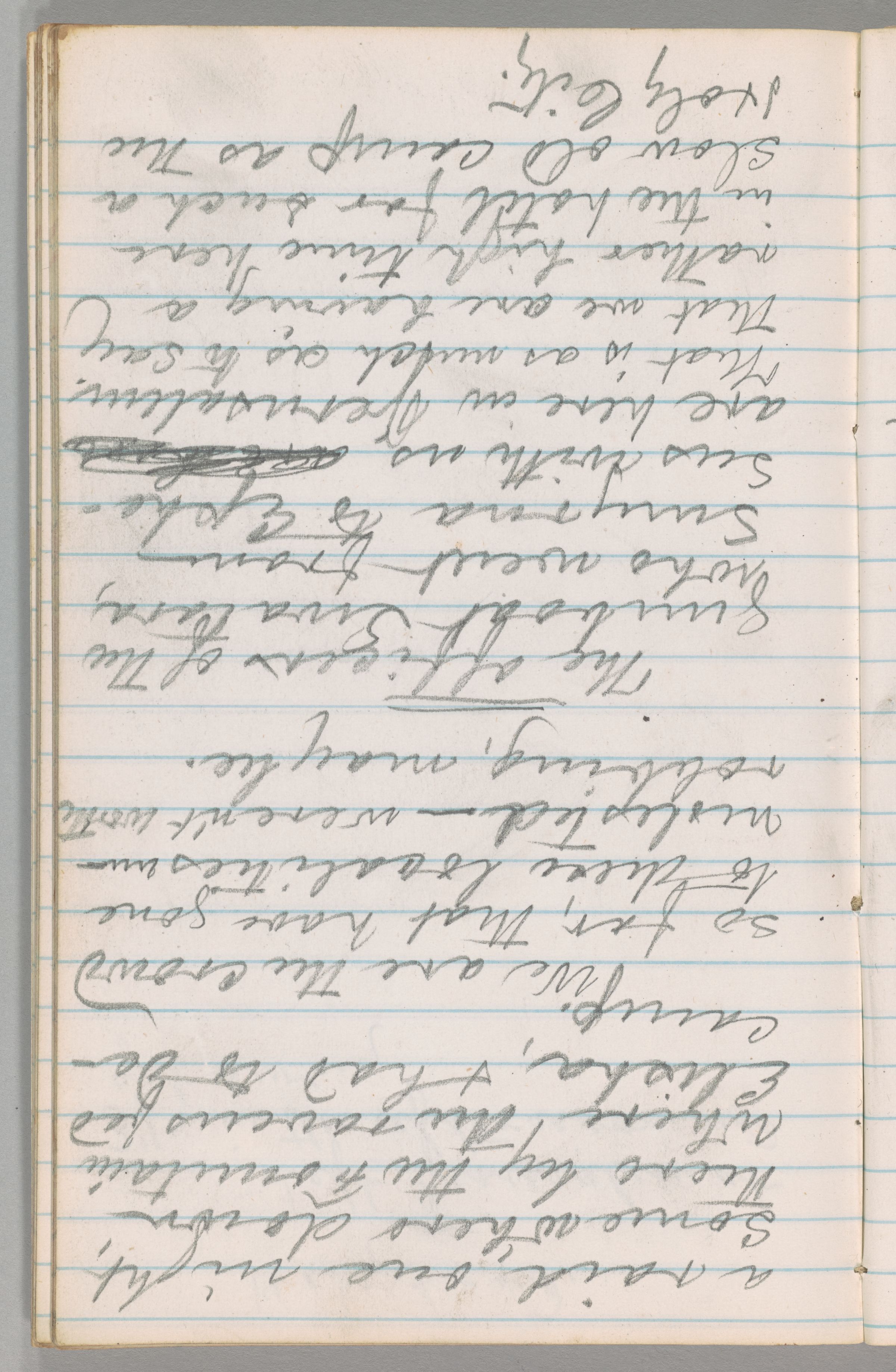
Major Barry, Griswold, & party have been down to Jericho, the ford of the Jordan & the Dead Sea, & were attacked by a gang of Bedouins—a shot or two was fired—nobody hurt, but Griswold scared a good deal.
Leary's party15 was threatened with
[MS: N10_leaf_013r]
a raid, one night, somewhere down there by the Fountain where the ravens fed Elisha,
& had to decamp.
We are the crowd so far, that have gone to these localities unmolested .—Ⓣtextual noteweren't worth robbing, maybe.
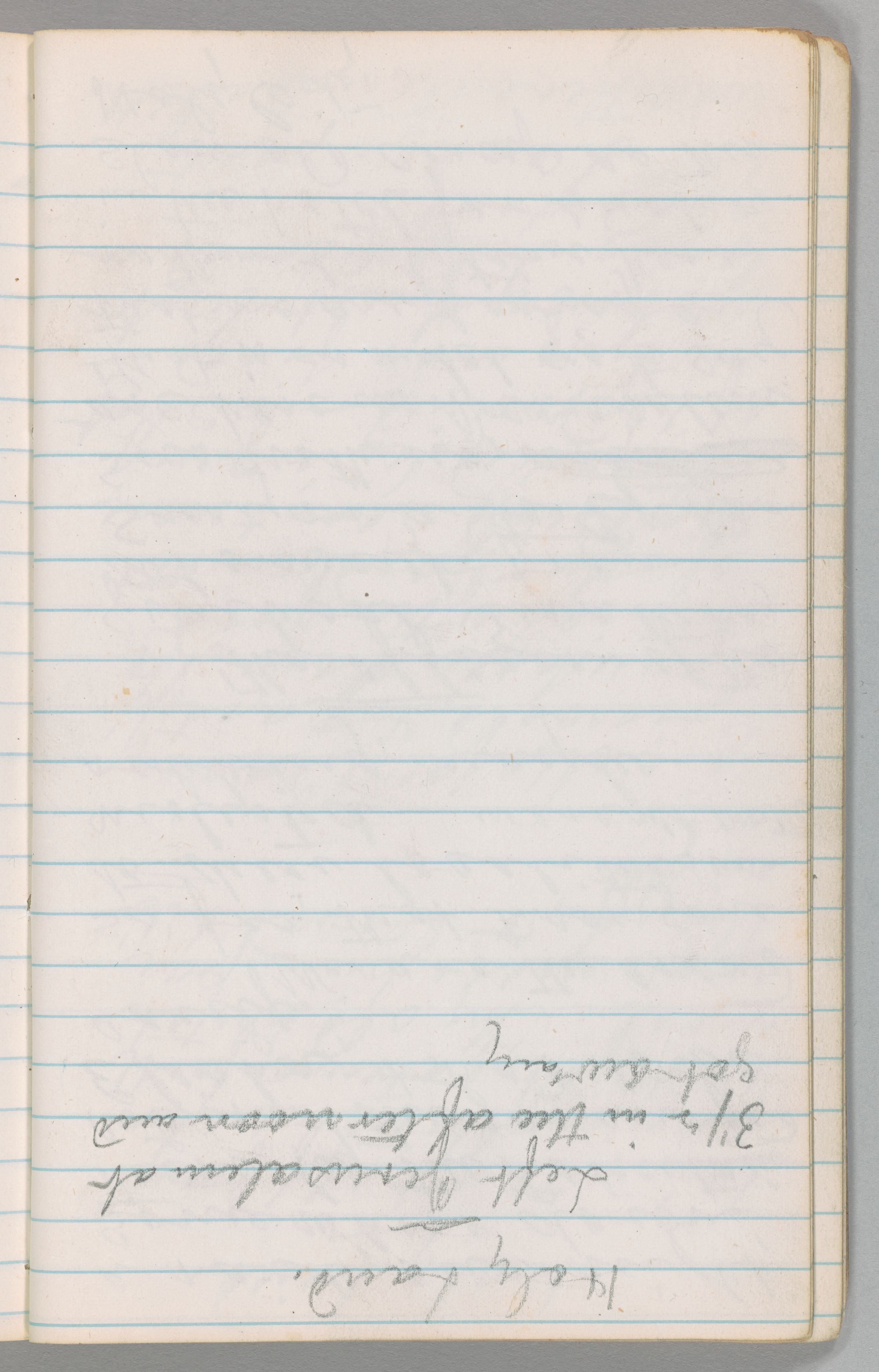
The officers of the gunboat Swatara, who went from Smyrna to Ephesus with us, are here in Jerusalem. That is as much as to say that we are having a rather high time here in the hotel for such a slow old camp as the Holy City.
[MS: N10_leaf_013v]
Left JerusalemⓂemendation at 3½ in the afternoon and got awayⓉtextual note16
fourteen blank pages follow the preceding verso
[MS: N10_leaf_021r]
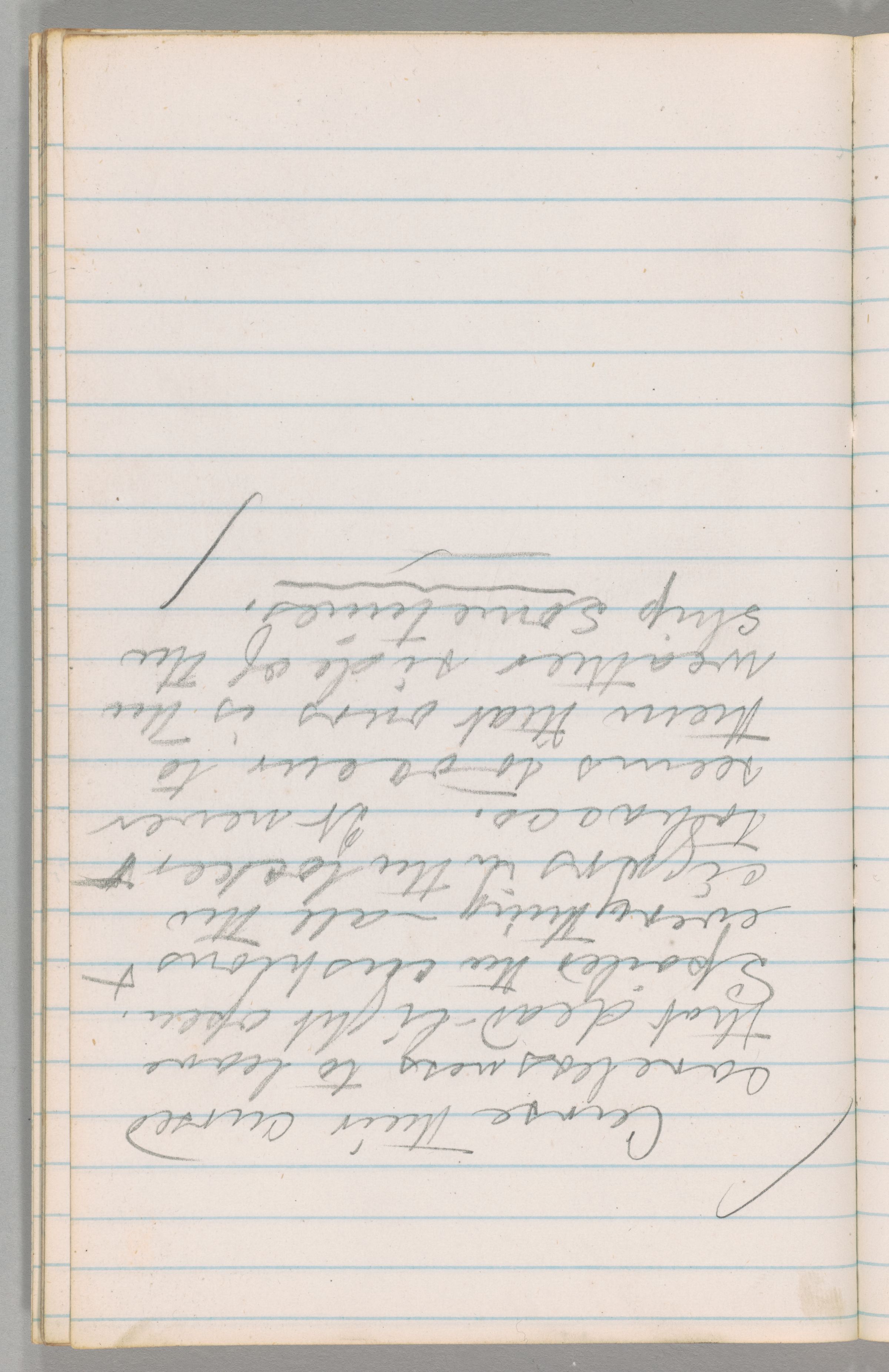
Curse their cursed carelessness to leave that dead-light open. Spoiled the cushions & everything—all the cigars in the locker & tobacco. It never seems to occur to them that ours is the weather side of the ship sometimes.Ⓣtextual noteⓉtextual note17

[MS: N10_leaf_021v]
blank verso
This entry and the following ones through “Beautiful sky, view—& Indian summer.” were written on the front flyleaf of the notebook but have been moved to their present position because of their obvious association with the notes on Congress which follow them here.
When Clemens arrived in Washington on 21 or 22 November 1867, the first session of the Fortieth Congress was in its final days. The second, or regular, session of the Fortieth Congress opened 2 December 1867. The following day, when President Andrew Johnson's annual message to the Congress was read in the House, Representative John A. Logan of Illinois facetiously offered a resolution to the House concerning President Johnson's remarks about the possibility of a “violent collision” between the executive and legislative branches of the government. Logan's resolution suggested that the “corps of pages that now constitute the ‘military force’ of this House be . . . abolished, to the end that the civil conflict so vividly described in President Johnson's message may be avoided” (The Congressional Globe for the Second Session Fortieth Congress, pt. 1 Washington, D.C.: Office of the Congressional Globe, 1868, p. 12).
Clemens' notes follow Randall's spritely remarks very closely—there are only rare interjections from Clemens himself. Randall's version of the episode above reads:
And now by the gate of this city, Eli, still anxious for the honor of Israel and the safety of the ark, sat waiting for tidings from the battle-field. A runner approaches, and cautiously announces the result: “Israel is smitten before the Philistines.” Heavy news for the man of God. “There has been a great slaughter, and thirty thousand of our men have perished.” Worse and worse. “Thy two sons, Hophni and Phineas, are slain.” Alas, those wicked sons; what a blow to an aged parent's heart; but still the old man could bear up under it. “And the Ark of God is taken captive.” (Handwriting of God, 2:273)
Clemens' only contribution to the account was the runner's speech “ ‘& lo there is no San. Com.’ ” In 1863 and 1864, writing for the Territorial Enterprise and the San Francisco Call, Clemens had reported on the efforts of the United States Sanitary Commission to raise funds for the relief of wounded soldiers.
Clemens probably made these notes on 26 November 1867, when Representative Carman A. Newcomb of Missouri offered a resolution to the House. Clemens' letter from Washington of 14 December 1867 (Alta, 21 January 1868) concerning government salaries and clerkships demonstrates his use of these notes:
These Departments are crowded with clerks and other small Government fish. Illinois heads the list. She furnishes four hundred and fifty of them! Whenever an official tooth needs filling, Mr. Washburne always stands ready with an Illinois plug. . . . Pennsylvania comes next. She furnishes four hundred. Indiana comes next; then Ohio, then Massachusetts, and then the great State of New York! Rhode Island, which is so small that the inhabitants have to trespass on other States when they want to take a walk, furnishes more than the whole Pacific Coast put together. Oregon, California, Nevada, Utah, Arizona, and Washington Territory furnish twelve, all told. . . . But Mr. Newcomb, of Missouri, has just introduced a resolution into Congress, inquiring how many clerks are employed in the various Departments, how long they have held their offices, what salaries they get, and what Congressional Districts they were recommended from. This will make a stir; and if there were an inquiry added of how much these clerks do, and how much they don't do, the stir would become an absolute flutter. As it was, Mr. Washburne jumped to his feet and objected to the measure, and so it had to lie over under the rule.
johns
hanging
mates
washed
Originally
for his covering
Lord
So, when Jacob
avan
nor enter
writing
determined
a church
johns
Amos 1-2
& so forth
tried to get
Left Jerusalem