(June–July 1873)
The only surviving notebook between 1868 and 1877 is the fragmentary stenographic notebook kept by a young theological student named S. C. Thompson, whom Clemens hired as his secretary just before his trip to England in May 1873. Thompson was employed by Clemens for only a few weeks—during the Atlantic crossing and for a short time thereafter in London—before Clemens dismissed him. It is clear that, apart from the personal antipathy he developed toward Thompson, Clemens found dictation impracticable at the time. He advanced Thompson enough money for his return passage to America and promptly forgot his existence. Thirtysix years later the man was recalled to Clemens' mind when Thompson, by then the pastor of a poverty-stricken parish in upstate New York, sent the author a check in partial payment for the advanced money (S. C. Thompson to SLC, 20 April 1909, DV 268). Thompson's 1909 letter and Clemens' note about that letter provide the only available biographical information about Thompson and his short-lived association with Clemens. Clemens wrote:
I can see him now. It was on the deck of the Batavia, in the dock.... Mrs. Clemens & little Susy & the nursemaid were leaving for England—& properly garbed for the occasion, in accordance with the custom of the time.... Every individual was in storm-rig—heavy clothes of sombre hue & melancholy to look upon, but new, & designed & constructed for the occasion, & strictly in accordance with sea-going etiquette.... Very well. On that deck, & gliding placidly among those honorably & properly upholstered groups, appeared Thompson, young, grave, long, slim, with an aged & fuzzy plug hat towering high on the upper end of him & followed by a gray linen duster which flowed down without break or wrinkle to his ancle-bones!
He came straight to us & shook hands, & compromised us. Everybody could see that we knew him. To see those passengers stare! A nigger in heaven could not have created a profounder astonishment.... I can still see him as he looked when we passed Sandy Hook & the winds of the big ocean smote us. He had not seen the big ocean for a good while, & he stood apart absorbed in it. Erect, & lofty, & grand he stood, facing the blast, holding his plug on with both hands, & his generous duster blowing out behind level with his neck & flapping & flopping like a loosed maintogallant royal in a gale. There were scoffers observing, but he didn't know it, & wasn't disturbed. He was dreaming: dreaming of the stately spectacle before him, & of ways to earn the money & pay his debts & be a free man again—a dream destined to last thirty-six years, & be only a dream after all!
Clemens had returned to Hartford from his first trip to England in November 1872 so enthusiastic about the country and its people that he proposed to take Livy and Susy, with the nursemaid, his secretary Thompson, and Livy's Elmira friend, Clara Spaulding, for a stay of several months in Great Britain. The idea of employing a shorthand secretary had occurred to Clemens during the 1872 trip: “If I could take notes of all I hear said, I should make a most interesting book—but of course these things are interminable—only a shorthand reporter could sieze them” (SLC to OLC, 25 October 1872, TS in MTP). The experiment was hardly successful, however, since Thompson was clearly not proficient enough in transcription to reproduce any extended conversation.
Clemens was taking the manuscript of The Gilded Age to his English publishers, George Routledge and Sons. The British edition of the book was to be published in England simultaneously with the American edition, and it was necessary, in order to assure clear British copyright for the novel, for the author to be a resident on the date of publication. Clemens expected to confer with his publishers throughout the summer and to correct proofs in London in time for an early fall publishing date.
The party sailed from New York aboard the S.S. Batavia on 17 May 1873 and reached London at the end of May. They established themselves at Edwards's Hotel in Hanover Square for a few weeks. However, Clemens soon announced: “We go to the Langham Hotel next Wednesday to live. My wife likes this awfully quiet place but I don't. I prefer a little more excitement” (SLC to FitzGibbon, 19 June 1873, Henry W. and Albert A. Berg Collection, New York Public Library). On 29 June Clemens wrote to Twichell that they were installed in “a luxuriously ample suite of apartments” at the Langham Hotel in Portland Place (MTL, p. 207 misdated).
London was busy throughout the summer months. The trial for perjury of the claimant to the Tichborne title and estates, under way since April, was attended by crowds of Londoners; banquets, exhibitions, and military reviews were prepared for the state visit of the shah of Persia in mid-June; the tragedienne Madame Ristori and opera stars Christine Nilsson and Adelina Patti were popular public attractions; and the Derby, the Oaks, and Ascot races occupied the last days of May and the first two weeks of June.
Mark Twain's entrance into London society was easily accomplished—he already had a large circle of acquaintances made during his visit in 1872. The current object of literary London's attention was another American—Joaquin Miller, “the Poet of the Sierras”—whom Clemens had first known in San Francisco in the early sixties, when both were contributing to the Golden Era. Miller's Life Amongst the Modocs: Unwritten History and his Songs of the Sun-Lands had just been published with great success, and the author could be found in the most fashionable houses in town, strutting about in his flamboyant Western costume.
It was undoubtedly Miller who introduced Clemens to Lord Houghton (Richard Monckton Milnes), the poet and statesman, and to Lord and Lady Thomas Duffus Hardy, whose daughter, Iza, Miller was engaged to marry. Sir Thomas, the archivist, and Lady Hardy, who was a popular novelist, entertained a “host of bright people” at their Saturday evening parties. Clemens evidently made other friendships in England's literary and political society through George and Edmund Routledge, his English publishers, and through Sir Charles Wentworth Dilke, whom he had apparently met on his first trip to England. Clemens also visited the Savage Club, the Whitefriars Club, and the Athenaeum. He attended the races on Ascot Cup Day (12 June) and the Lord Mayor's ball on 11 July and visited Stratford-on-Avon in early July. Joaquin Miller recalled that Clemens was “shy as a girl ... and could hardly be coaxed to meet the learned and great who wanted to take him by the hand” (M. M. Marberry, Splendid Poseur: Joaquin Miller—American Poet New York: Thomas Y. Crowell, 1953, p. 116). Clemens himself admitted his occasional timidity: “the really great ones are very easy to get along with, even when hampered with titles. But I will confess that mediocrity with a title is (to me) a formidable thing to encounter—it don't talk, & I'm afraid to” (SLC to Mrs. Fairbanks, 6 July 1873, MTMF, p. 174).
Thompson's notes cover the period from 10 June through 16 or 17 July 1873. The first dated entry (10 June) is preceded by about 3½ notebook pages of shorthand notes, of which 2½ pages are a very rough transcript of the testimony given at the Tichborne trial on 10 June 1873. The full transcript of the trial can be found in the London Standard. Thompson's notes about the trial and the unrecovered shorthand on the page following these notes—neither apparently written at Clemens' dictation—are not included in this text.
Early entries in the notebook concern Ascot and were dictated at various times between 12 and 15 June. The notes dated “Westminster Abbey, June 15” (which are too chaotic to decipher) and other occasional short entries about sermons, scripture, and church services were probably initiated by Thompson himself.
The Ascot notes are followed by several pages about the arrival in London of Nasr-Ed-Din, shah of Persia, and his attendance at the review of troops at Windsor on 24 June. Mark Twain had contracted with Dr. G. W. Hosmer of the New York Herald's London office to report the shah's visit for American readers, and on 18 June he and Thompson crossed over to Ostend in order to describe the shah's gaudy progress across the Channel. Mark Twain's letters appeared in the Herald in July 1873 but were not collected for book publication until Europe and Elsewhere appeared in 1923.
The rest of the entries in the notebook, except for the incomplete “Story of a casual acquaintance,” are brief. All of the entries suffer noticeably from the inadequacies and hesitancy of Thompson's shorthand transcription and from Mark Twain's difficulties with dictation. Despite these defects and the lack of distinctive personal comment from Clemens, the notebook entries provide a number of insights into Clemens' recurring interests. Clemens is present in two of his characteristic roles—as reporter (in the “O'Shah” notes) and tourist. His interest in Shakespeare, in the Delawarr case, and in the Tichborne Claimant are evidence of his fascination with impostors, claimants, and double identities; there are several entries dealing with the curiosities of English history and custom, which he would explore later in The Prince and the Pauper and A Connecticut Yankee.
It seems likely that shortly after the last dated entry in the notebook (the letter of 16 or 17 July to Bliss) Clemens dismissed Thompson. Thompson decided to stay on in Europe for a time to economize his slender resources and did not return to the United States until the fall (Thompson to SLC, 20 April 1909, DV 268). The Clemens party spent the end of July and August in Scotland and Ireland. They returned to London in early September. After Mark Twain's successful one-week engagement lecturing on “Our Fellow Savages of the Sandwich Islands” at the Queen's Concert Rooms in London (13–18 October), the Clemenses left for Liverpool, where Mark Twain lectured again before they sailed for home on 25 October 1873.
Clemens returned to England alone just two weeks later. And by mid-November, with Charles Warren Stoddard as his secretary-companion, he was again installed at the Langham Hotel, awaiting the delayed publication of The Gilded Age and preparing a new lecture, “Roughing It on the Silver Frontier,” for an early December presentation before an enthusiastic British public.
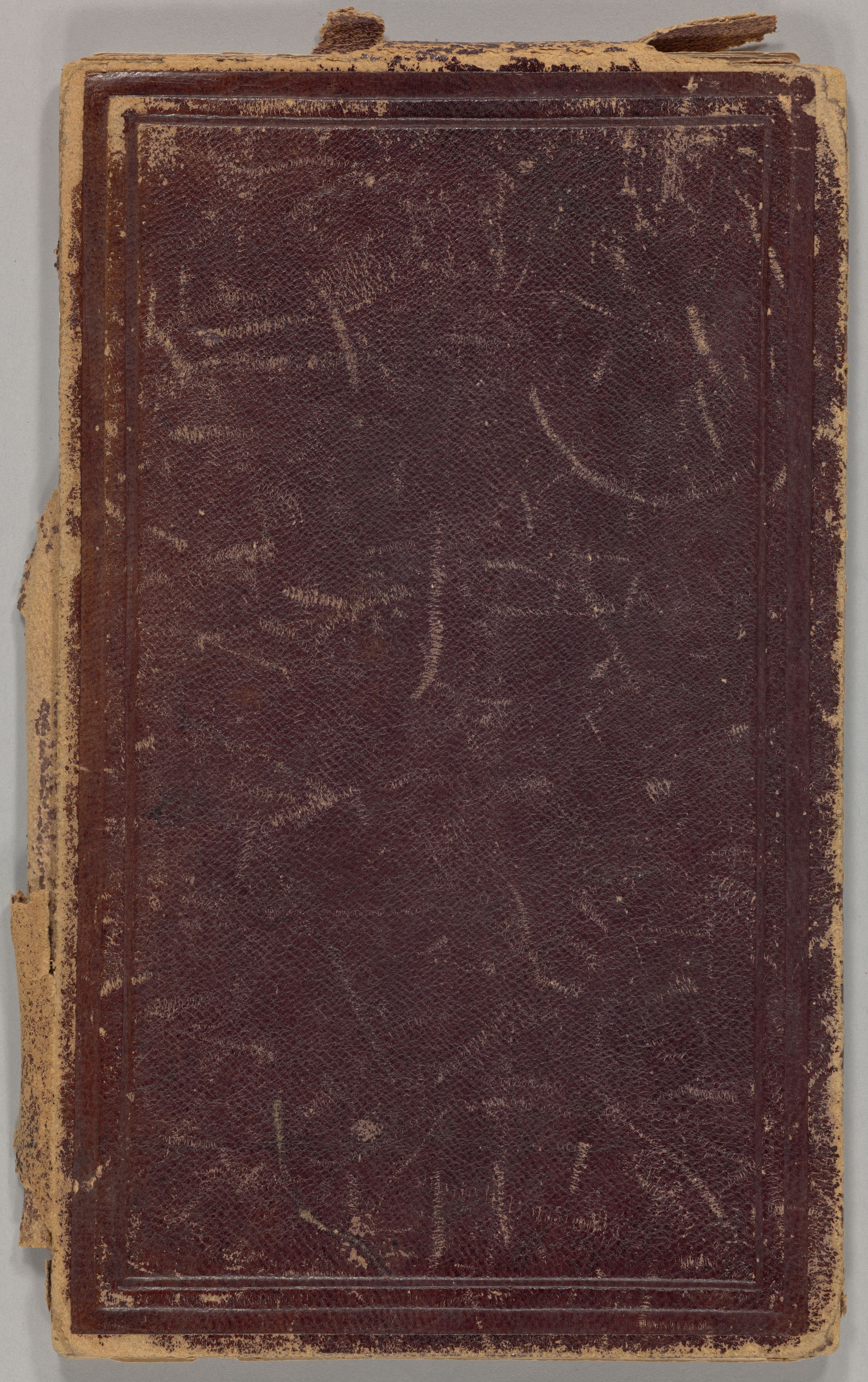
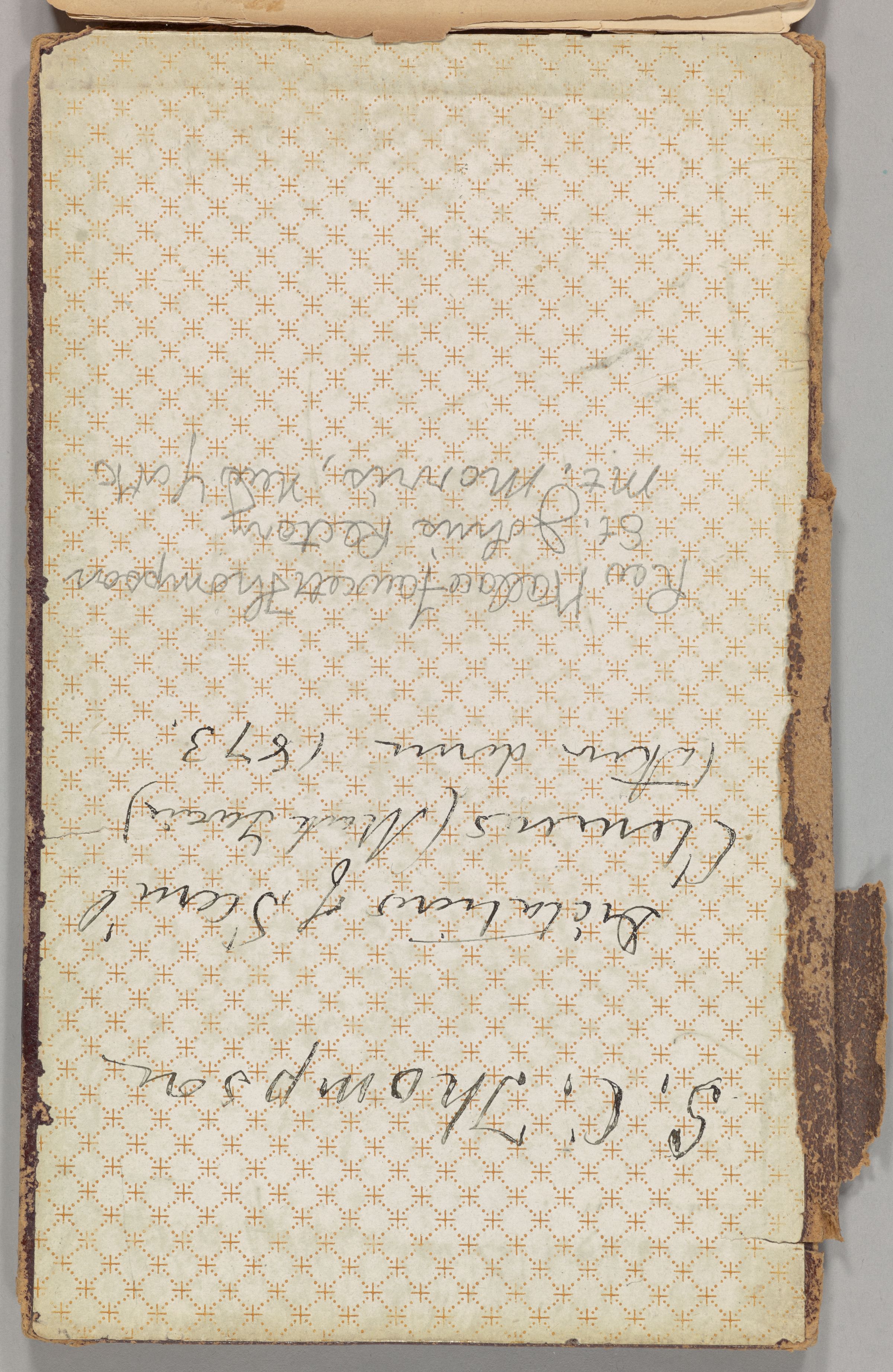
Notebook 12 is a stenographic notebook, hinged at the top, rather than at the side. It now contains 192 pages, 73 of them blank. An undetermined number of leaves are missing. The pages measure 7 5/16; by 4 5/16; inches (18.6 by 11 centimeters) and are lightly ruled with thirty-four blue horizontal lines arranged in pairs as an aid in writing stenographic symbols. The cover is stiff calf, dyed maroon, with blind stamped borders on the front and back and figured endpapers. There is a leather pocket attached to one side of the cover for carrying a pencil. The notebook is worn and tattered: the covers and several leaves are loose, the pages are yellowed, and the pencil entries are now faint. Except for a very few brief entries in ink, Thompson used pencil throughout.
Notebook 12 is written primarily in shorthand, with interspersed words and passages in longhand. The shorthand is based on the phonetic system in James E. Munson's The Complete Phonographer, of which a number of editions were published in the late 1860s and early 1870s, with Munson's system freely modified by Thompson's own shortened forms and by more or less standard abbreviations.
The transliteration of shorthand notes depends quite heavily on context. The shorthand
secretary himself would ordinarily rely on his recollection of the context as an aid
in deciphering his symbols; thus, shorthand words which he had rendered incorrectly
would still be decipherable to him.
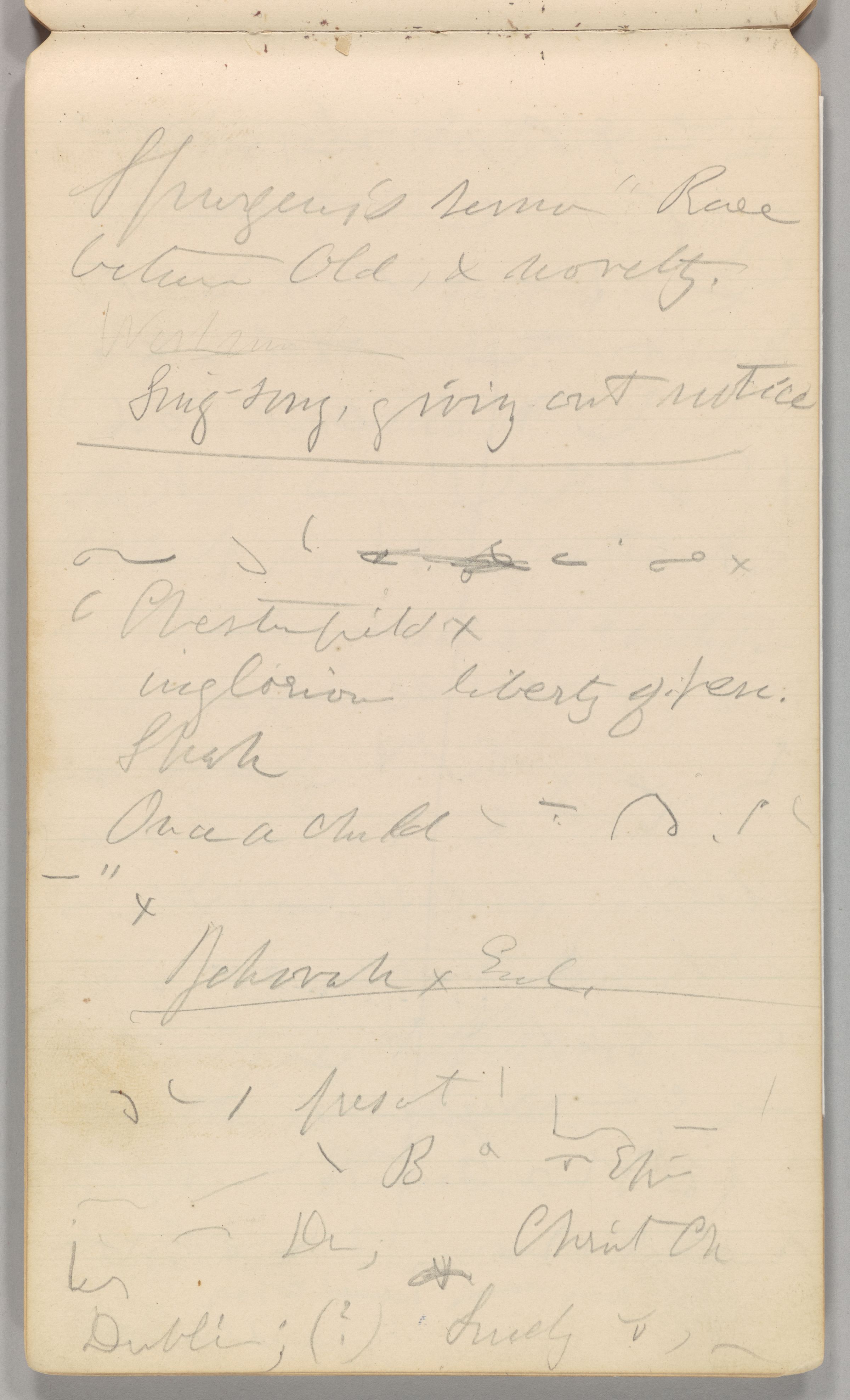
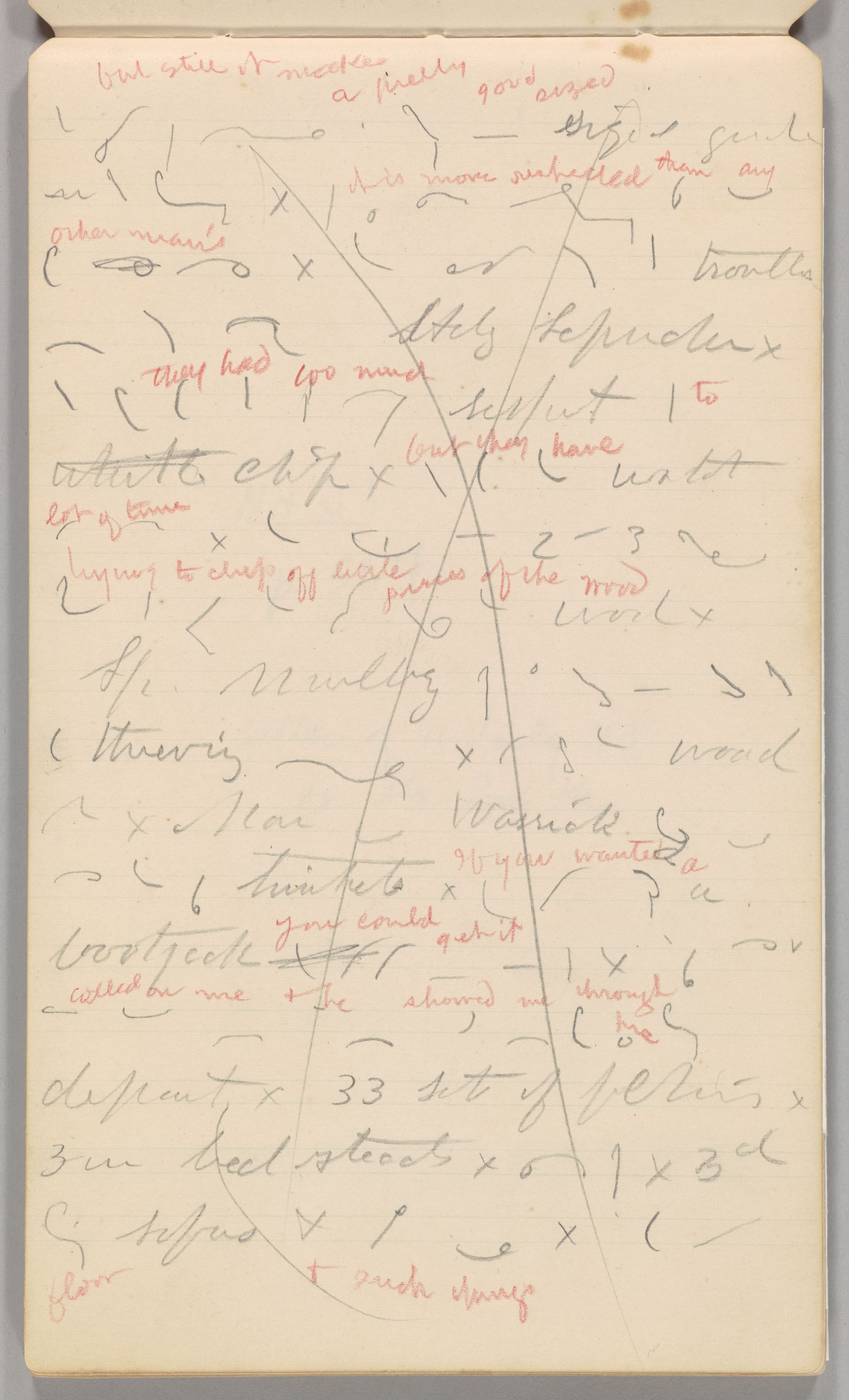
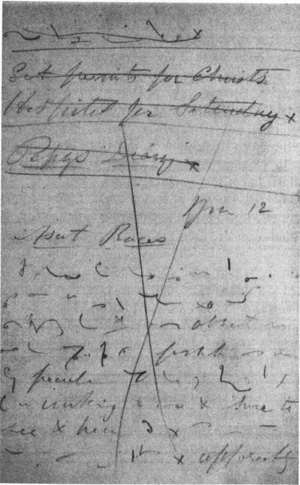 A sample of Thompson's longhand and shorthand notes. These notes are transcribed on
pages 527.13 through 528.9 of the present text.
Critics of phonographic stenography have pointed out the inefficiency of a system
in which the attention is on recording the sounds of speech, rather than the sense,
using a number of “strokes and dots and dashes which you cannot read afterwards, except
with a staggering amount of disquietude and uncertainty, or with careless inaccuracy,
while all the while you have been unable to give any intelligent heed to the ‘words
spoken’ ” (Thomas Anderson, History of Shorthand London: W. H. Allen & Co., 1882, p. 220).
A sample of Thompson's longhand and shorthand notes. These notes are transcribed on
pages 527.13 through 528.9 of the present text.
Critics of phonographic stenography have pointed out the inefficiency of a system
in which the attention is on recording the sounds of speech, rather than the sense,
using a number of “strokes and dots and dashes which you cannot read afterwards, except
with a staggering amount of disquietude and uncertainty, or with careless inaccuracy,
while all the while you have been unable to give any intelligent heed to the ‘words
spoken’ ” (Thomas Anderson, History of Shorthand London: W. H. Allen & Co., 1882, p. 220).
The task of the textual editor, coming to the shorthand text at a later date without independent knowledge of the content to aid him, is one of re-creating the original context. The difficulties are multiplied—and the incidence of error is inevitably increased—when problematical shorthand symbols have to be resolved within a context which is itself largely conjectural. Since Mark Twain's dictation comes to the reader through the double mediation of Thompson and the present editor, no claim can be made to a full recovery of the author's words, much less his intentions. The accuracy of the text depends upon the accuracy of the transcriber, and the text has therefore been presented without textual apparatus.
To avoid distracting the reader with Thompson's inaccuracies and idiosyncracies, his longhand abbreviations, capitalization, spelling, and punctuation have been consistently emended.
Thompson used his longhand abbreviations as an adjunct to his shorthand symbols. His abbreviations are only occasionally standard forms; most often they consist of the first few letters of a word, hastily scrawled. Thus, the letters luxu would be enough to recall luxurious to his mind; ad serves for admirals, contri for contrivance, fashb for fashionable. Moreover, Thompson's abbreviation of individual words varies from line to line, so that both ad and admr represent admirals in one entry; Duke appears as D, Duk, and Dk; and Shakespeare is abbreviated variously as Shak, Shk, S, and Sh. Odd abbreviations that incorporate misspellings such as Charring X for Charing Cross and W Abby for Westminster Abbey occur frequently. In order to avoid such confusing and arbitrary usages in this text, abbreviations which are inconsistent or ambiguous have been expanded to the full words.
Thompson's numerical short forms and his erratic shilling and pence signs have been normalized—thus, 3d and 3rd have been normalized to third in prose passages; ⅔d has been normalized to two-thirds in prose passages; 3d and 3 d have been normalized to 3d.; d and S have been normalized to 1d. or a penny and 1s. or a shilling to fit the context. Thompson's Mr., Mr, Dr., and Dr have been normalized to Mr. and Dr.
Thompson's usual style of capitalizing titles of nobility, which was also Mark Twain's practice, has been retained. Thompson, however, was by no means consistent in this practice, and it has been necessary occasionally to supply capitals. Since, according to standard shorthand practice, the initial words of sentences written in shorthand are not marked for capitalization, these initial capitals have been provided throughout the text. Longhand words which Thompson capitalized in an apparently random or accidental fashion appear in lower case here. In no instance has a substantive change in the text occurred because of the normalization of capitals.
Spelling has been normalized.
The erratic and unconventional punctuation throughout the notebook has been normalized when the existing punctuation creates ambiguity. The stenographic punctuation mark x, signaling a stop, is used with great flexibility in Thompson's notes and has no set punctuation value; therefore the x, and Thompson's x—, —x, xc, and xcxx, have been rendered variously, in accordance with the sense of each passage. Quotation marks and other necessary punctuation related to quoted passages have been normalized, since Thompson often neglected to supply adequate punctuation at the beginnings or ends of quotations. In short entries referring to church services, the name of the presiding minister, the name and address of the church, and the date and time of the service have been separated by commas for the sake of clarity.
In addition, punctuation has been provided in place of four kinds of natural breaks in the manuscript that Thompson used as a form of silent punctuation. Punctuation appropriate to the context has been supplied when necessary at the end of a notebook line, at the end of a notebook page, at points where Thompson switched from shorthand to longhand, and at points where Thompson left extra space on the line between words—in all four cases, Thompson used the natural break in his writing as a form of silent punctuation. Paragraphing, about which Thompson was equally casual, has been supplied when clearly necessary.
Certain stenographic errors which Thompson consistently made (confusing the stenographic symbols for pl and pr, for bl and br, and for and and the) have been silently corrected wherever context makes a choice possible.
There are very few cancellations in the notebook. Those cancellations which represent a substantive change in the text are printed within angle brackets. Fragmentary stenographic symbols which have been incompletely or incorrectly formed, then canceled and rewritten, have not been noted.
Doubtful words and phrases appear in square brackets.
The notebook presents a number of other problems: it is in poor condition, with many words partially obliterated; Thompson's stenographic symbols are poorly formed, irregular, and often incorrect; some words are written in Thompson's nearly illegible longhand (letters are fused with each other, and word endings are characteristically omitted). Clemens himself found Thompson's illegible hand exasperating. He wrote to Richard Bentley of London's Temple Bar on 13 October 1873: “Did my late turnip-headed clerk take that French Jumping Frog Sketch to you some time ago? And could you read his writing?”
Moreover, Thompson occasionally seems to have fallen behind the speaker and lost some part of the passage, characteristically indicating his lapse by a series of dots, a dash, or a blank space. This is clearly the case in the “O'Shah” transcription (and in the notes taken at the Tichborne trial, which have not been included here). The draft of “O'Shah” in the notebook has a number of such lapses. At such points Thompson's stenographic symbols become even more irregular and hurried, and the punctuation is chaotic. For example, Thompson's notes read, “If Ostend could impress him England could head clear off his headx—that not even—x.” The published version of “O'Shah” supplies the missing readings: “If Ostend could impress him, England could amaze the head clear off his shoulders and have marvels left that not even the trunk could be indifferent to” (“O'Shah,” Europe and Elsewhere, 1923). The missing words may have been added by Thompson from memory when he transcribed a longhand version of the piece or, more probably, by Clemens himself when he revised the longhand version.
Thompson has lined through almost every entry in the notebook, probably to indicate that he had completed such a longhand transcription for Clemens' perusal. None of Thompson's transcriptions are known to have survived except those for letters of 16 July 1873 to Elisha Bliss and Charles Dudley Warner. Thompson's longhand copies of these two letters, made from the shorthand drafts near the end of the stenographic notebook, are in the American Literature Collections, Beinecke Library at Yale University (PH in MTP).
Throughout the notebook there are occasional interlineations in red and blue pencil in an unidentified hand. These are evidently the traces of an attempt to translate the shorthand symbols at some later period in the notebook's history. The interlineations seem to be random, often only a word or two on the notebook page, and they are often inaccurate. They have not been included in this version of the notebook.
Undoubtedly, some notebook pages have been lost. The pages were originally bound into two gatherings, and there are loose pages at the front of the notebook and in the middle of the notebook at the juncture of these two gatherings. The “Story of a casual acquaintance,” at the close of the first gathering, ends abruptly in midsentence. The fact that the notebook commences almost two weeks after Clemens reached England seems to indicate that some initial pages have been lost.
The last entry in the notebook is a list of subjects covered in the shorthand notes; the final pages of the notebook are blank. The items on the list which are identifiable occur only in the second gathering of pages. The items on the list which cannot be found in the notebook, such as notes taken on board the Batavia on the way to England, are presumably missing from the front of the notebook or from the midpoint juncture of the two gatherings.
The entries in this notebook are longer and more detailed than most of Mark Twain's notebook entries, but they are also more stilted. Clemens later recalled: “Doubtless it was my first experience in dictating, for I remember that my sentences came slow & painfully, & were clumsily phrased, & had no life in them—certainly no humor” (DV 268).
Notebook 12 was transliterated at the Mark Twain Papers by Lin Salamo.
[MS: N11_outside front cover]
[MS: N11_front endpaper]
S. C. Thompson1
Dictations of Sam'l Clemens (Mark Twain) taken down 1873.
Rev Wallace Fawcett Thompson
St. John's Rectory
Mt. Morris, New York
[MS: N12_leaf_001r]
blank
[MS: N12_leaf_001v]
blank
3½ notebook pages occurring at this point have not been included2
[MS: N12_leaf_]
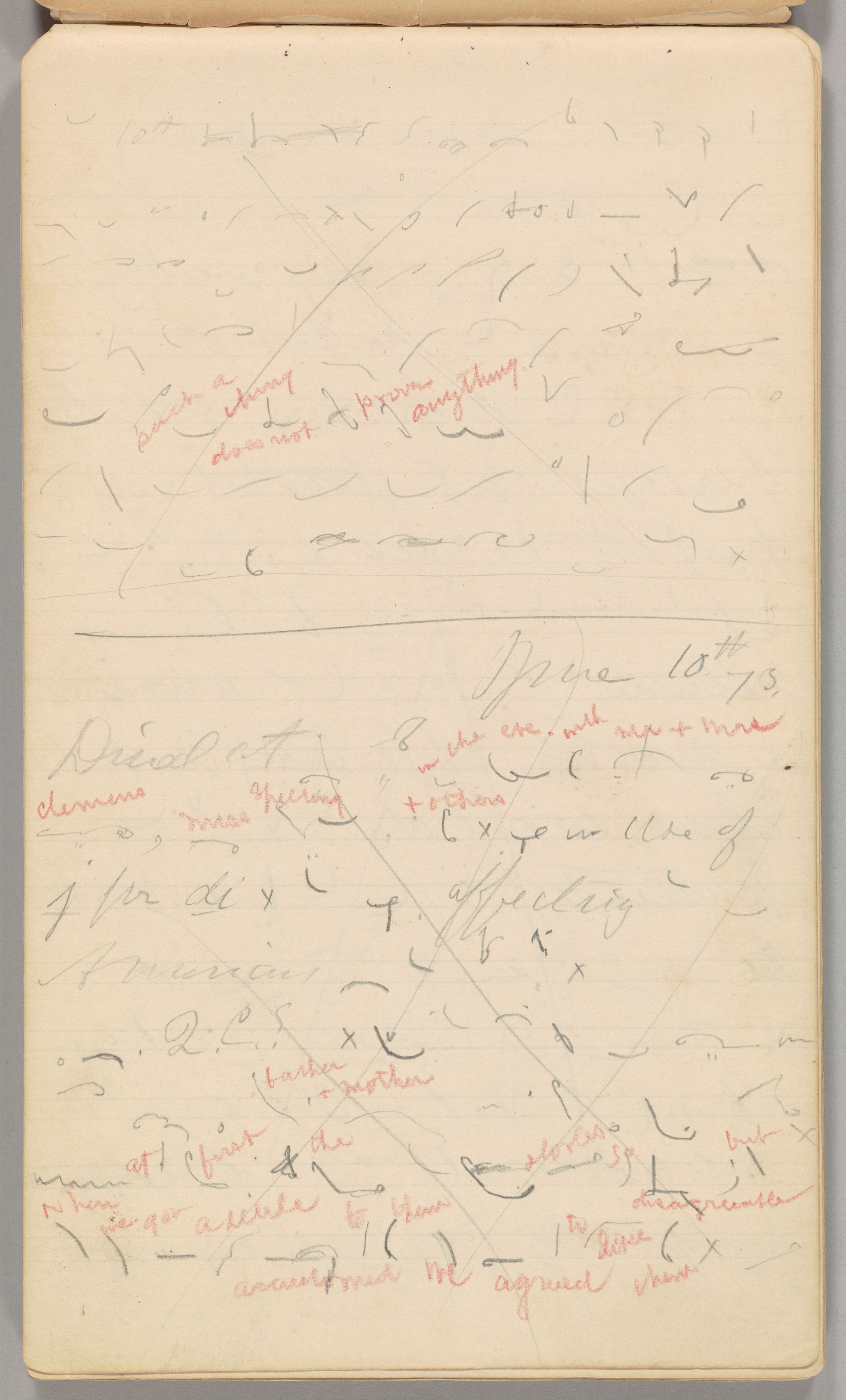
top half of page not transcribed
June 10th 73.
Dined at Mr. Routledge's in the evening with Mrs. Clemens, Miss Spaulding, and others. Notes—use of j for di. Have noticed the affecting of it in Americans who have traveled abroad.
Is he the Queen's Counsel? Buying of high posts in America—man murdered his father and mother—and plea is being orphan. At first the practice of boring stories was disagreeable; but when we got a little accustomed to them we agreed to like them.
There's
[MS: N12_leaf_]
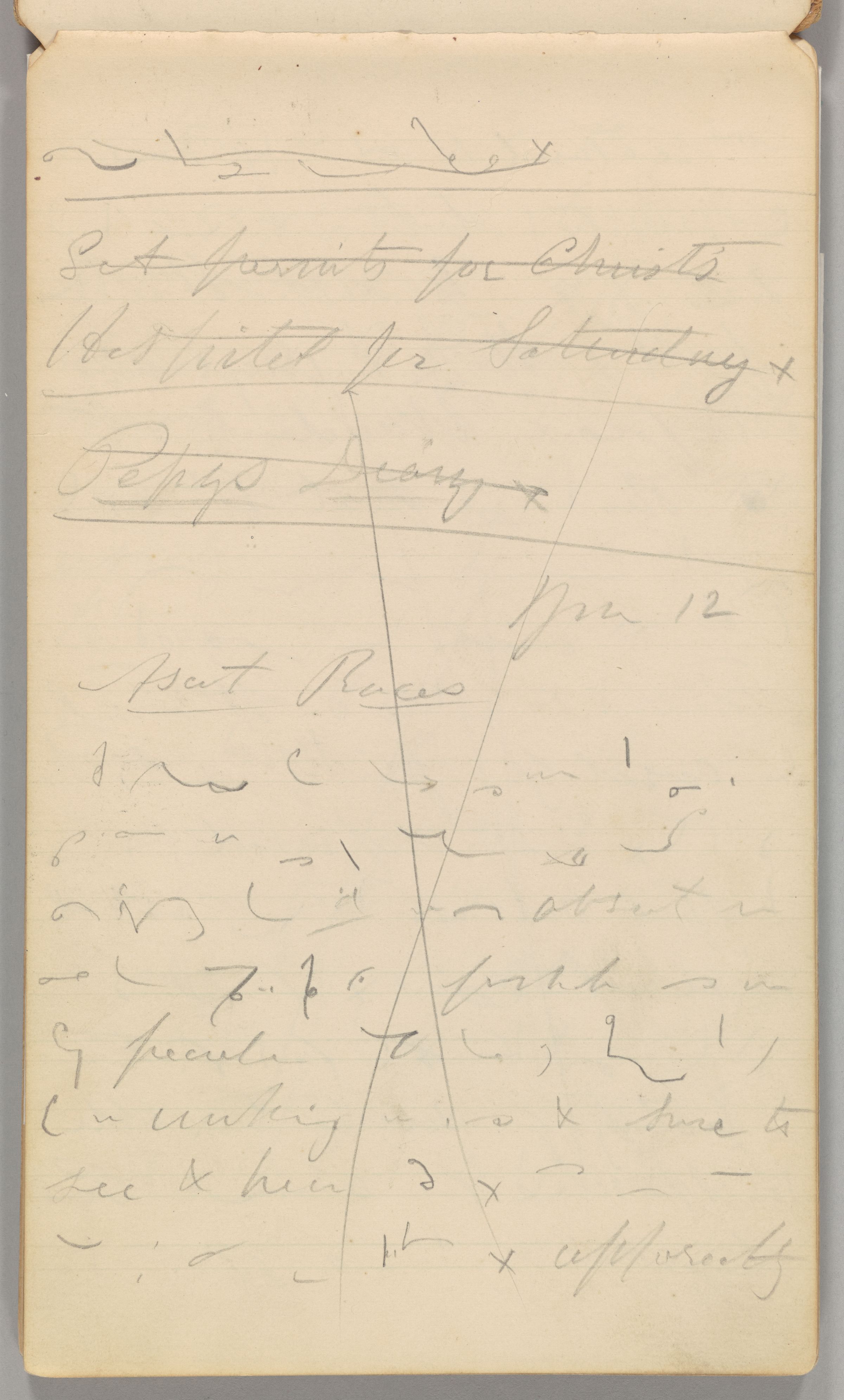
something picturesque in their persons.
Get permits for Christ's Hospital for Saturday.3
Pepys Diary.4
June 12
Ascot Races5
Trains leaving every few minutes—had secured the saloon car—couldn't be enough unless more three words—one word absent—scores of gorgeously-dressed ladies, fashionable men—one word peculiar English one word sit staring at each other—walking—comments & sure to see & hear words. Man may go along and stare in the daytime. Apparently
[MS: N12_leaf_]
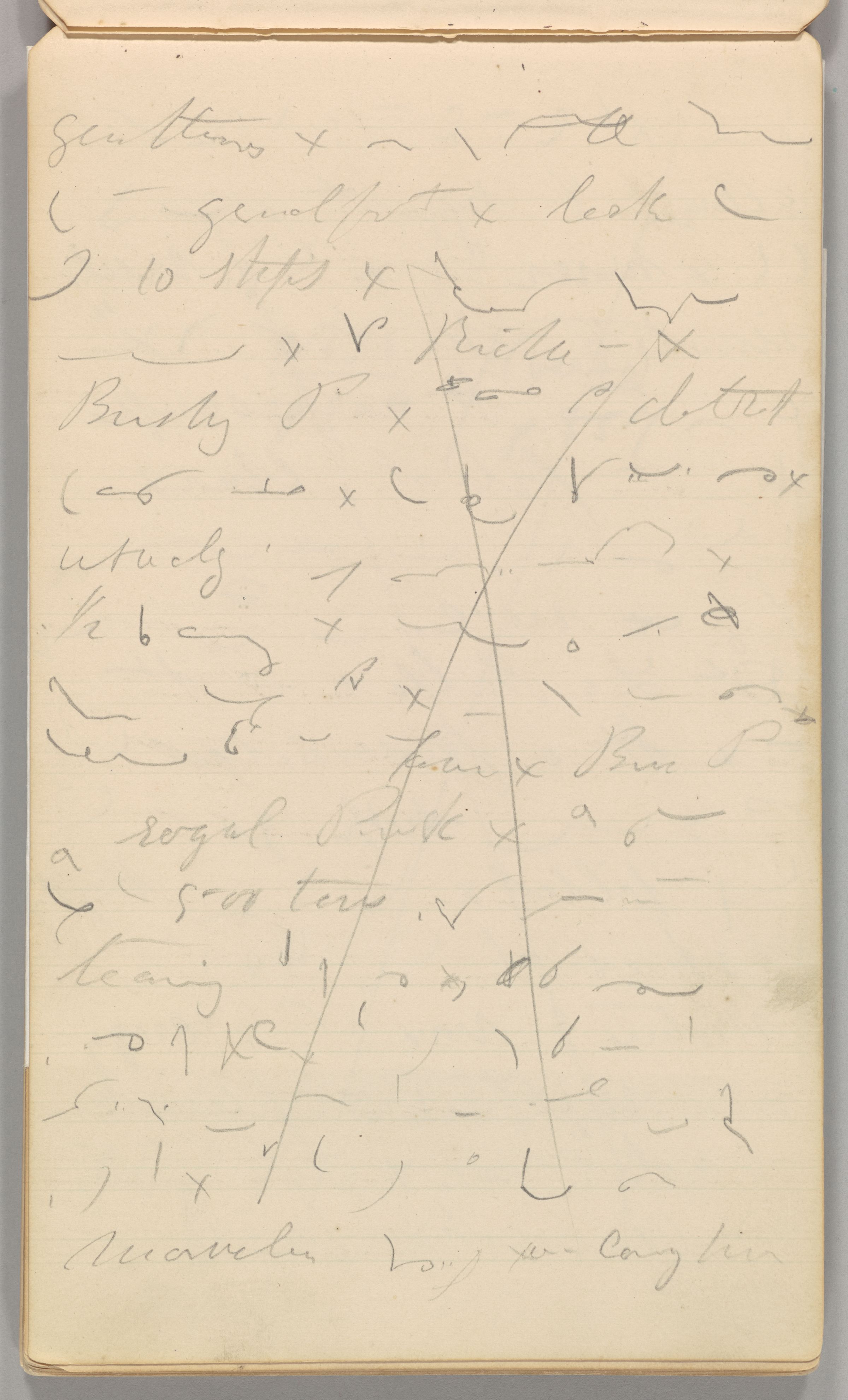
gentleman. May be looking walking with her grandfather. Look over shoulder 10 steps.
Perfectly bewitching country. Beyond Richmond & Bushy Park. Grass lands dotted with colossal oaks. Over dozen dollar-new houses. Usually a rich cream-color. ½ dozen colors. Never see red brick unless one word. Could be no more. fascinating than on the T---.
Bushy Park is a royal park. Has a sailing vessel of 500 tons, completely rigged—came
tearing down two words., just missing the houses tree etc. Thought she would just get to the rail-way in time to get herself in trouble three words. I thought she was doing some marvelous demonstration. Carry her through
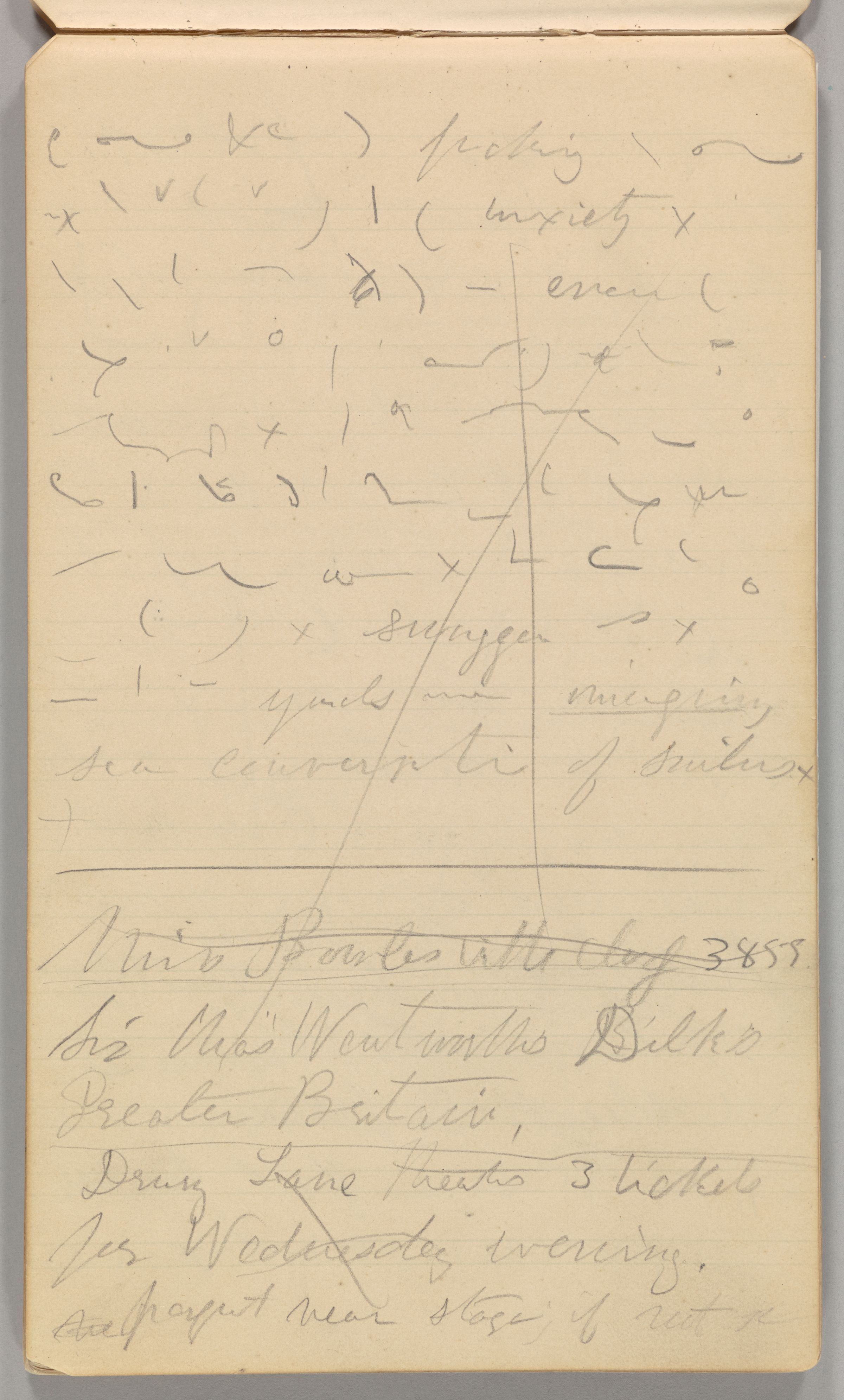
[MS: N12_leaf_]
gratings etc. without picking up something. But I thought I should die with anxiety. But by that time we got even with the vessel and I saw it a school-ship— for the reformatory.6
It was a remarkable thing as first day boys went to work in that vessel—were never awkward. Talk language of the sea in that ship. Swagger around. Go out on the yards—imagining sea conversations of sailors.
Miss Bowles two words 3859
Sir Chas Wentworth BDilke's Greater Britain.7
Drury Lane theatre 3 tickets for Wednesday evening.8
Ne Perfect near stage; if not R
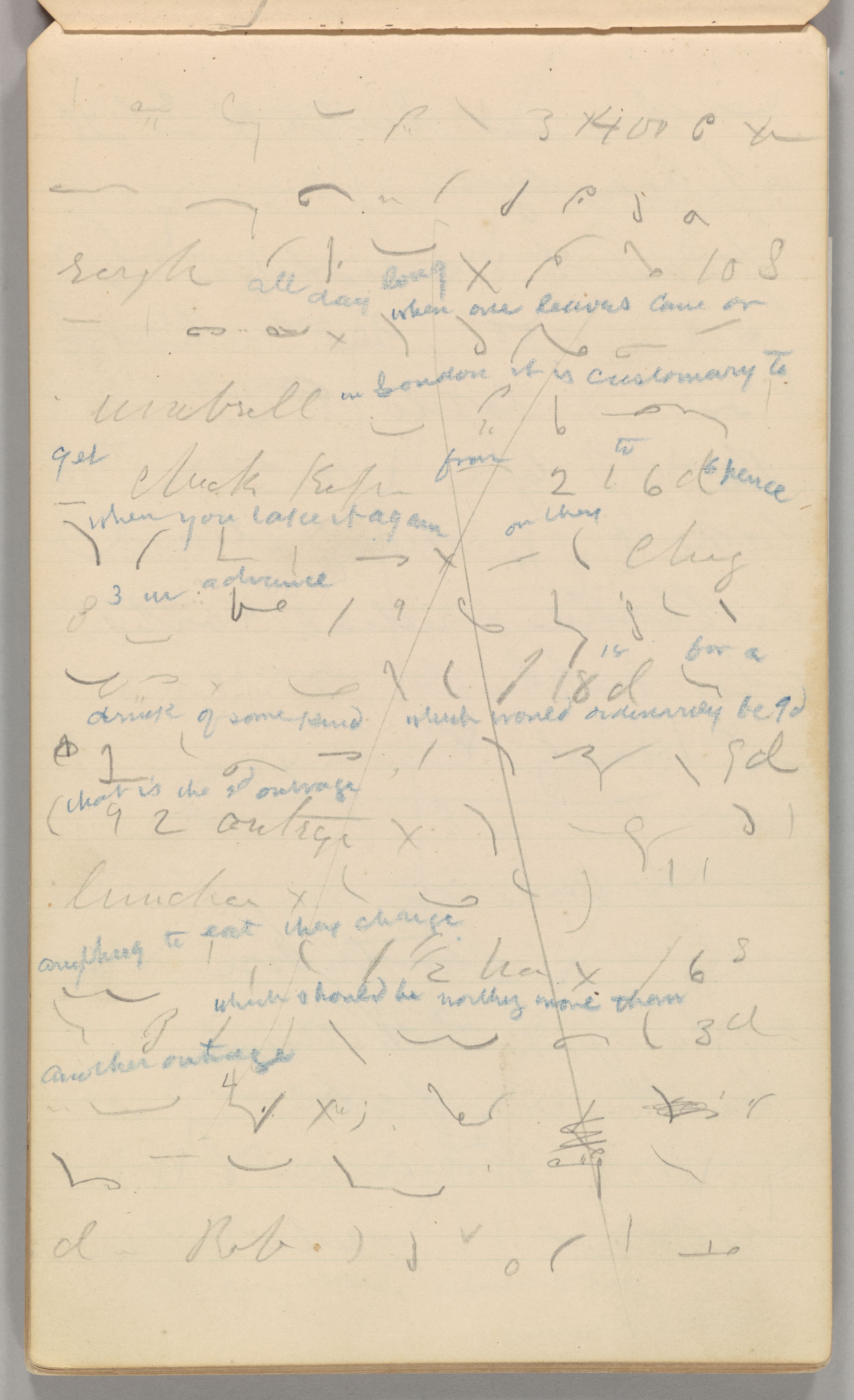
[MS: N12_leaf_]
At Ascot followed long line about 3 or 400 yards. Climbed moderately higher—all gentlemen ladies didn't see a rough all day long.
Usual price 10s. got at the grandstand. When one leaves cane or an umbrella in London it is customary to give check keeper from 2 to 6d. when you take it again. Here they charge a shilling in advance which was the first outrage complained of by the Englishman. Next bar they charge 18d. for a drink of some kind, which would ordinarily be 9d.—that was the second outrage. We necessarily went to a luncheon, for none of us had had anything to eat for 1½ hours. Charged 6s. for a luncheon which should be nothing more than 3d.—another outrage.
Presently Gypsy woman an old woman came along begging and asked for a penny—Rob said, “Didn't I see you at the Oaks'9
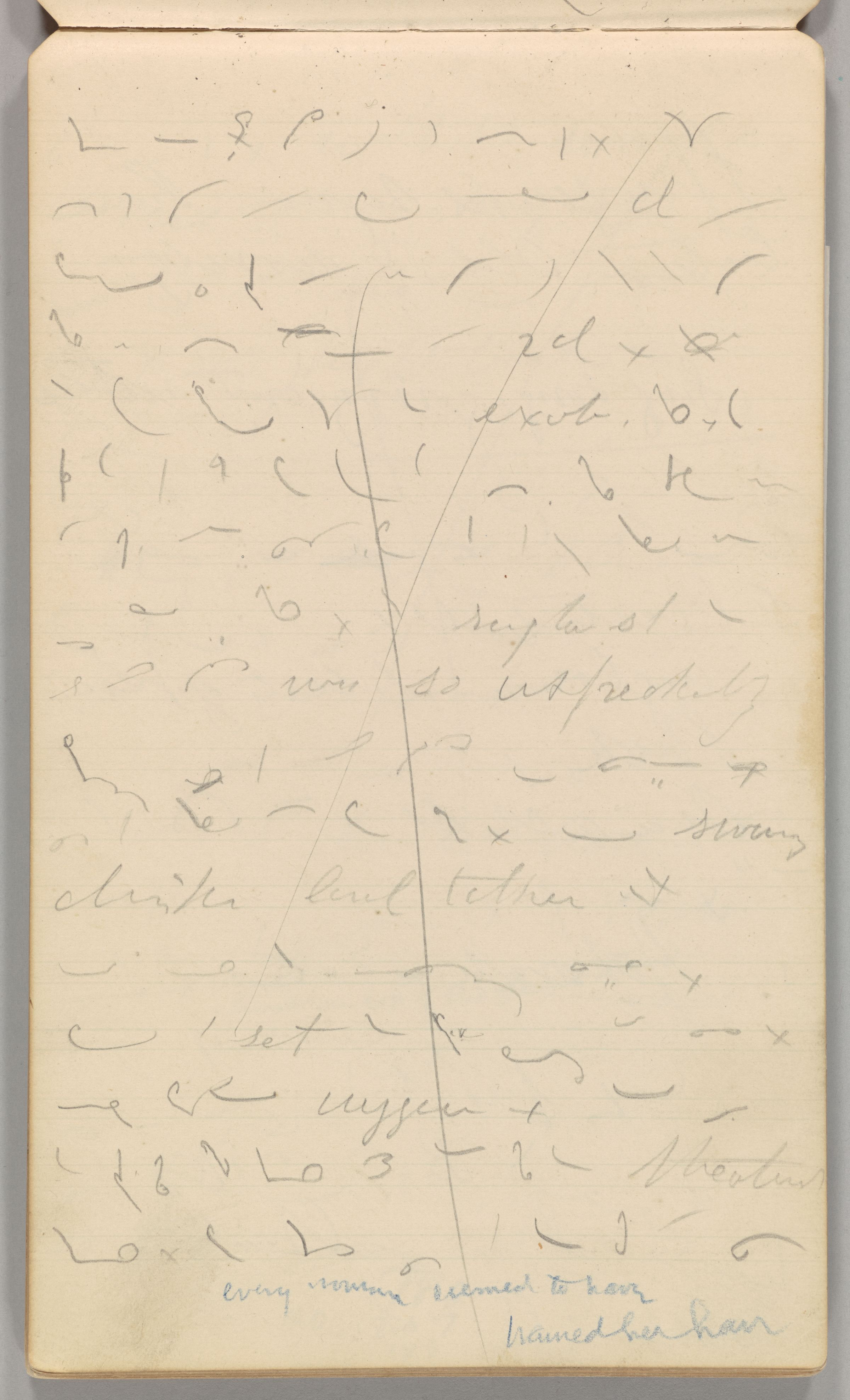
[MS: N12_leaf_]
back gate.?” Yes she said he did. “Well,” he said, “you were only asking a penny there, everything
is double here—you should put up your price.” He gave her 2d.
But after complaining awhile of the exorbitant prices, they decided that it was the very feature that made the place delightful—all the dirty ragged hardly ever had to be present—couldn't stand the prices. But the roughest of the rough element was so unspeakably superior to the rough element in America. six words.
No serving drinks two words & no noise but the customary Greys. Only one set of able singers on the grounds. Except everlasting niggers.10
Long row of double-tiers private boxes, 3 long tiers of theatrical boxes. Every woman
seemed to have trained her hair
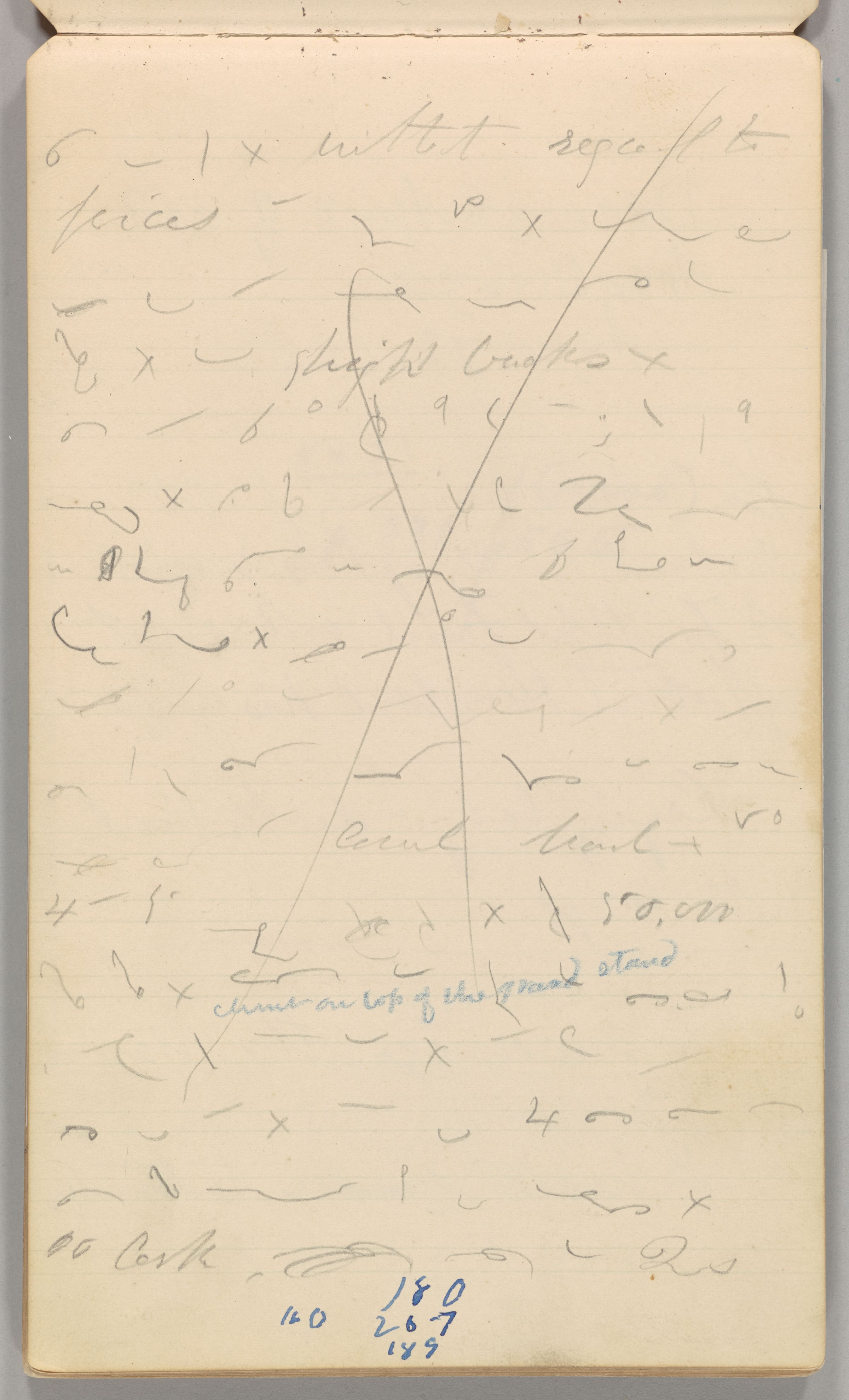
[MS: N12_leaf_]
so well indeed. Without regard to prices or wicked eyes. Never seen anywhere except in a house of prostitution. No straight backs. Some were just as tasteful as three words; but it was the exception. Ladies' dresses which combined every imaginable material—daintiest
silks—heaviest richest satins—velvet trimmings. There was no material, no which was not represented there. There seemed to be hardly ugly woman on the grounds—nearly
all comely, handsome. I saw 4 or 5 exceedingly beautiful.
Perhaps 50,000 persons present. Climb on top of the grandstand to see the royal party come along. Right over their heads in the air. Came in 4 horse car from some private country estate11 in the neighborhood. Lord Cork,12 master of the Queen's
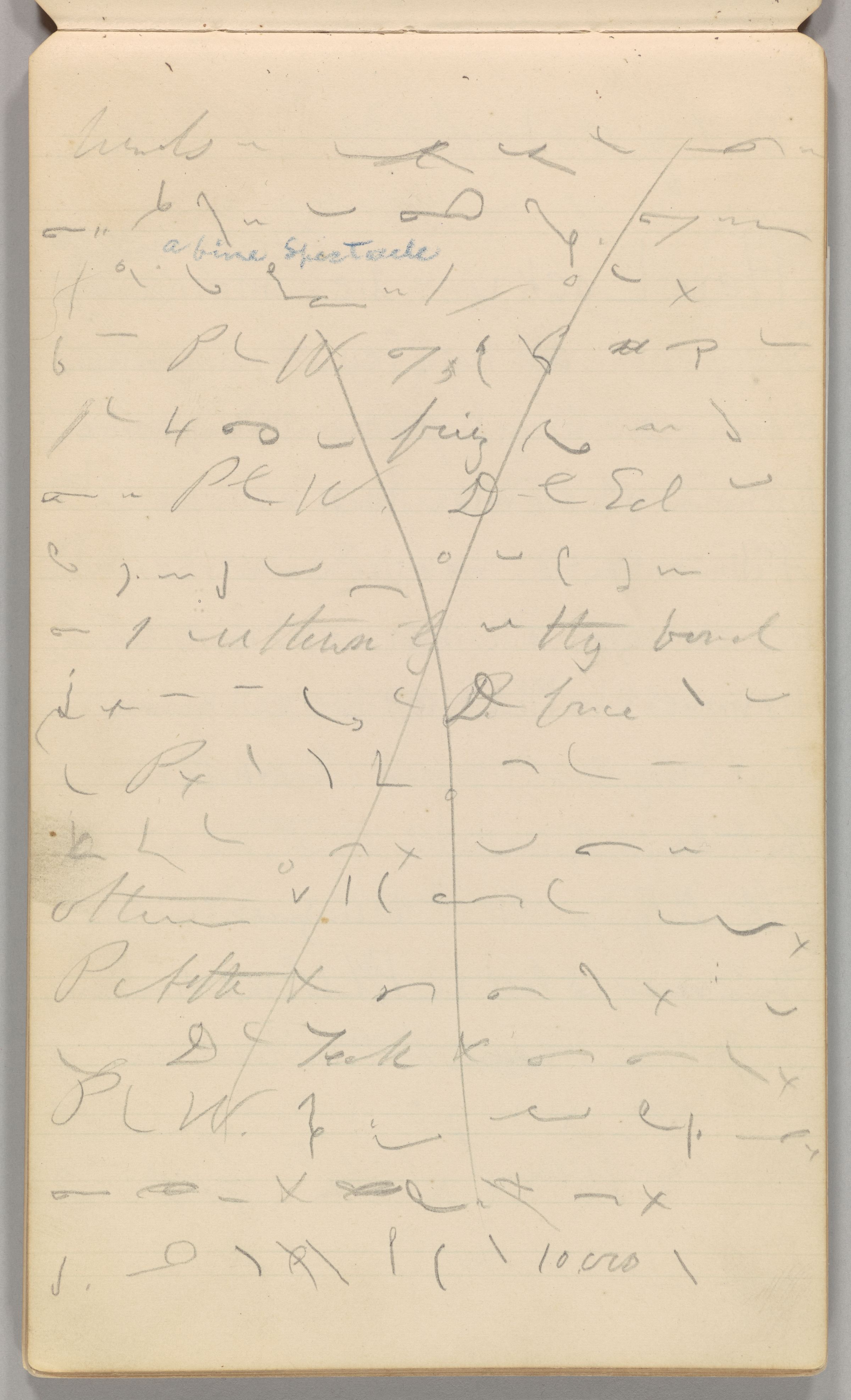
[MS: N12_leaf_]
hounds—noble custom—great-titled people—long one word preceded the carriage—it was a fine spectacle—four words.
Then came Prince of Wales' carriage, with postilion mounted on each of the 4 horses in fiery liveries—open car—Prince of Wales, Duke of Edinburgh on front seat—didn't know who was on the other seat—crowd cheered extensively—they bowed continually. Got good view of the P. Duke's face but not of the Prince's. But when took his hat off got good top of his head. No hair—otherwise I had that climb for nothing.
Prince Arthur & some more people. And in the next, Duke of Teck & some more people.
Prince of Wales dressed in ordinary everyday costume. Gray coat & stovepipe hat.
Between the races went up sat with about 10,000
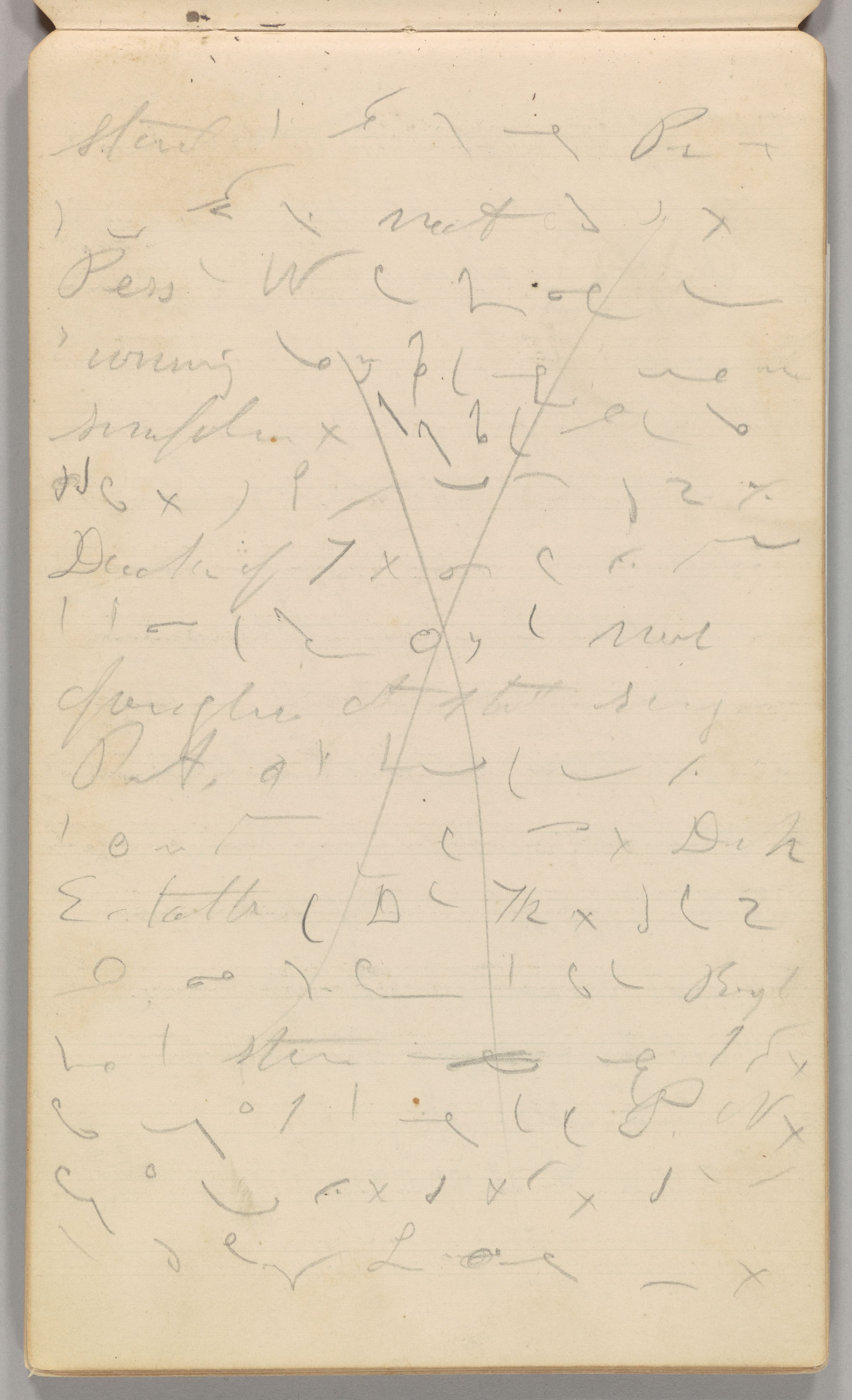
[MS: N12_leaf_]
people. Stared at the royal party except Prince. Sat in the royal one word, neat open shed.
Princess of Wales very trim graceful figure and a winning face, dressed with exceeding neatness—simplicity. Bright pretty dress with rows of bows down front. She sat there a long time with 2 ladies, Duchess of Teck & some other lady looking out at the crowd with perfect ease, though need opera glass at the racing. Prince Arthur sat talking with another lady, at ease—like any other man. Duke of Edinburgh talks with Duke of Teck.
Between every 2 races, crowds would flock to the front of royal box to stare—occasionally cheer a little. First nobody was cheered at except those with the Prince of Wales. Everybody was being lady. Gentlemen & all.
Gentlemen of our party won several pounds — except me.
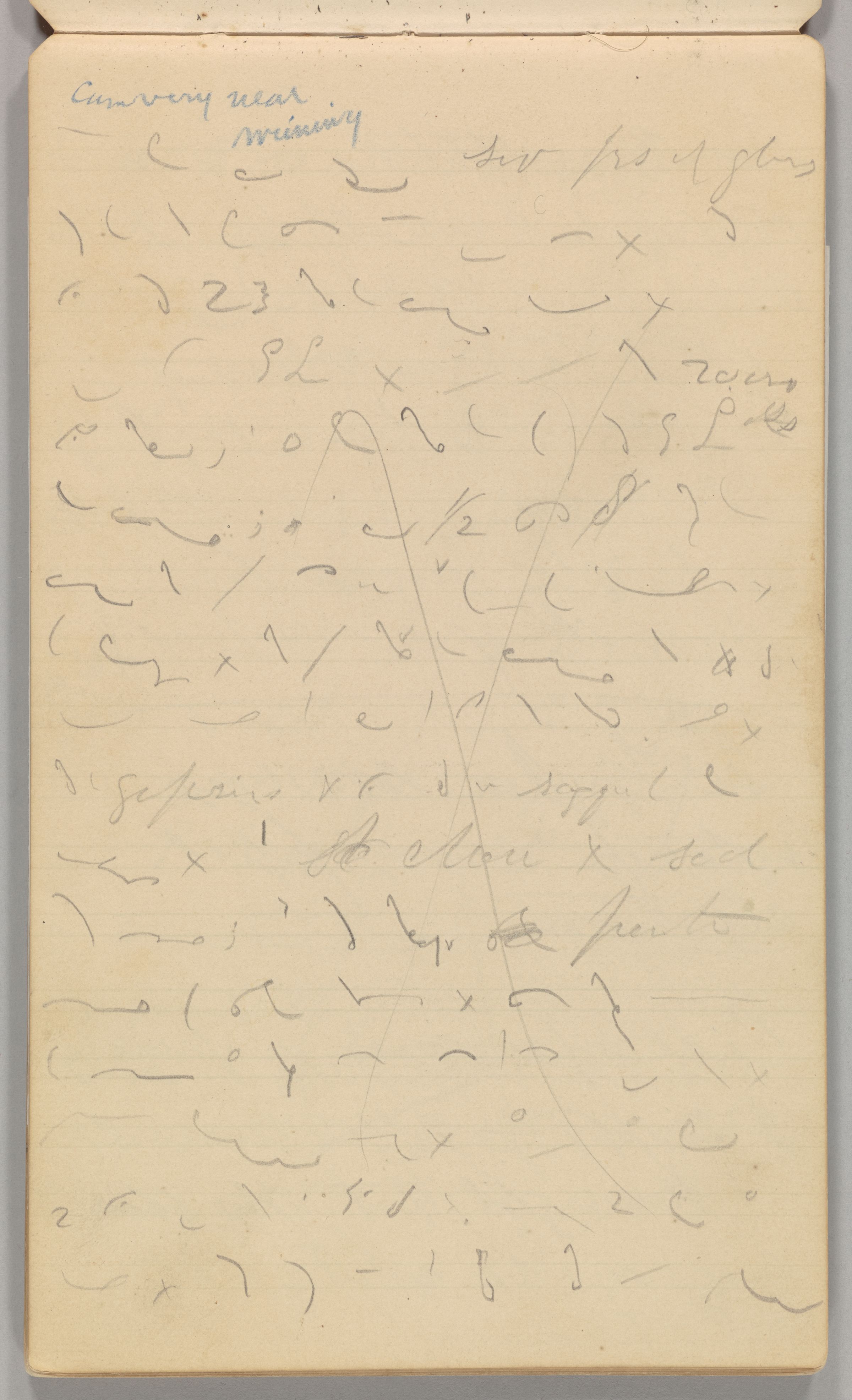
[MS: N12_leaf_]
Came very near winning several pairs of gloves,13 would have but other horse came in ahead. One lady won 23 pairs of gloves another. In all £9. There were about 20,000 ladies present, and so far perhaps half of them won £9 of gloves; and near ½ million $ worth of gloves brought changed hands—four sentences.
Red water mugs; and the waiters presented silver pewter mugs with silver bottoms. More people—that mug was passed from hand to hand in the box, like offering gift. As there was only 2 ladies in the box and 5 gentlemen, the three words was next.
When we got to the station, trains were leaving
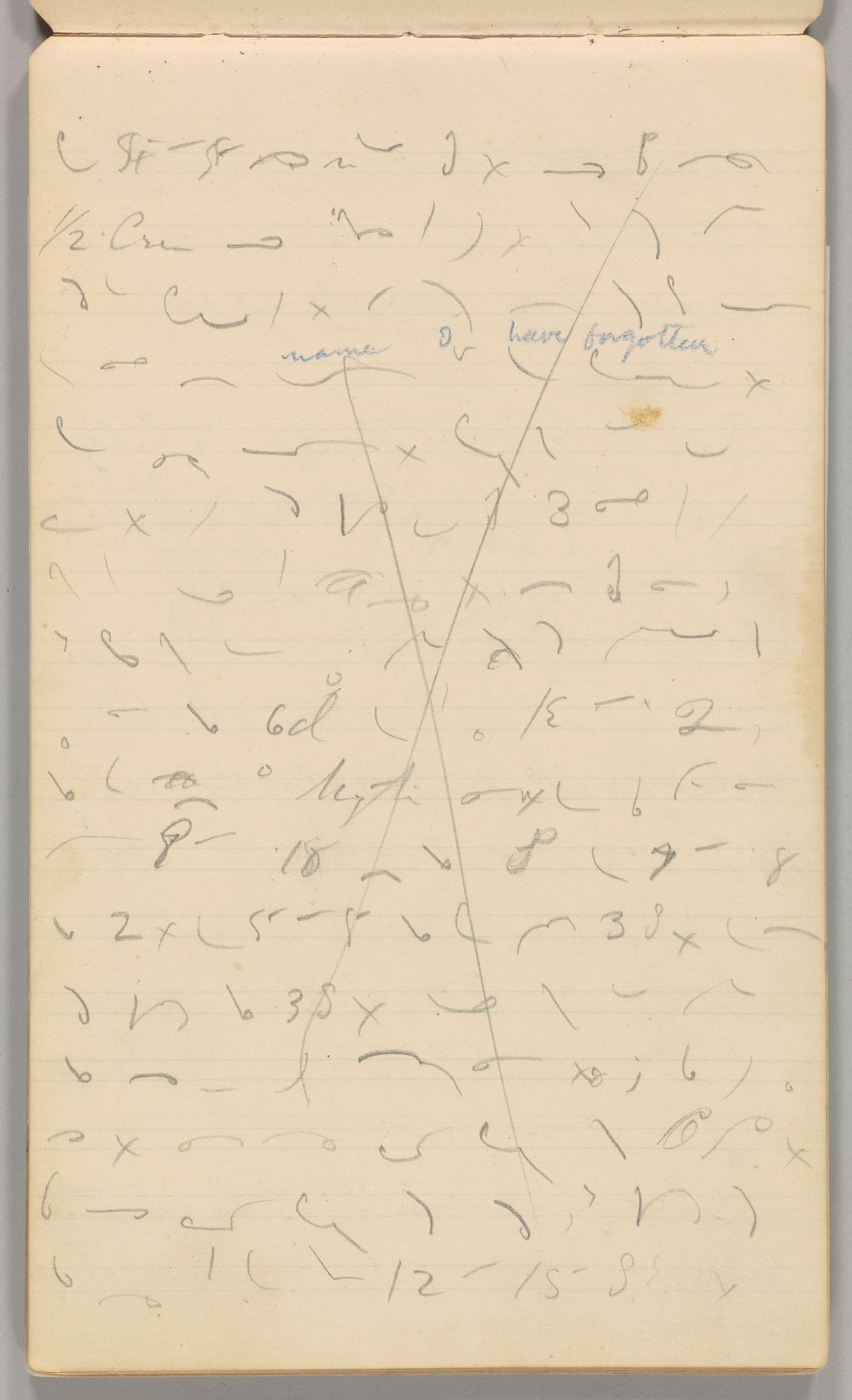
[MS: N12_leaf_]
every 54 or 5 minutes—on train. Gave station master half crown, gave compartment at wish. But we five words. All the way home we played game of cards whose name I have forgotten. Very simple game. Everybody
bet on the two words. Each one deals in turn 3 cards to each player but none to himself. He turns card,
and the first player on his left without looking at his card bets 6d. if it is King
or Queen, bets that he has high score. If it is low card like 79 or 8 10 he bets a shilling, if 7 or 8 bets 2. If 5 or 5 bets other limit, 3s. If he wins dealer pays 3s. Next player on the left bets his could show higher score.; then shows his hand. Sometimes nearly everybody would lose. Then again nearly everybody
would win, and the dealer would find himself out of pocket 12 or 15s.
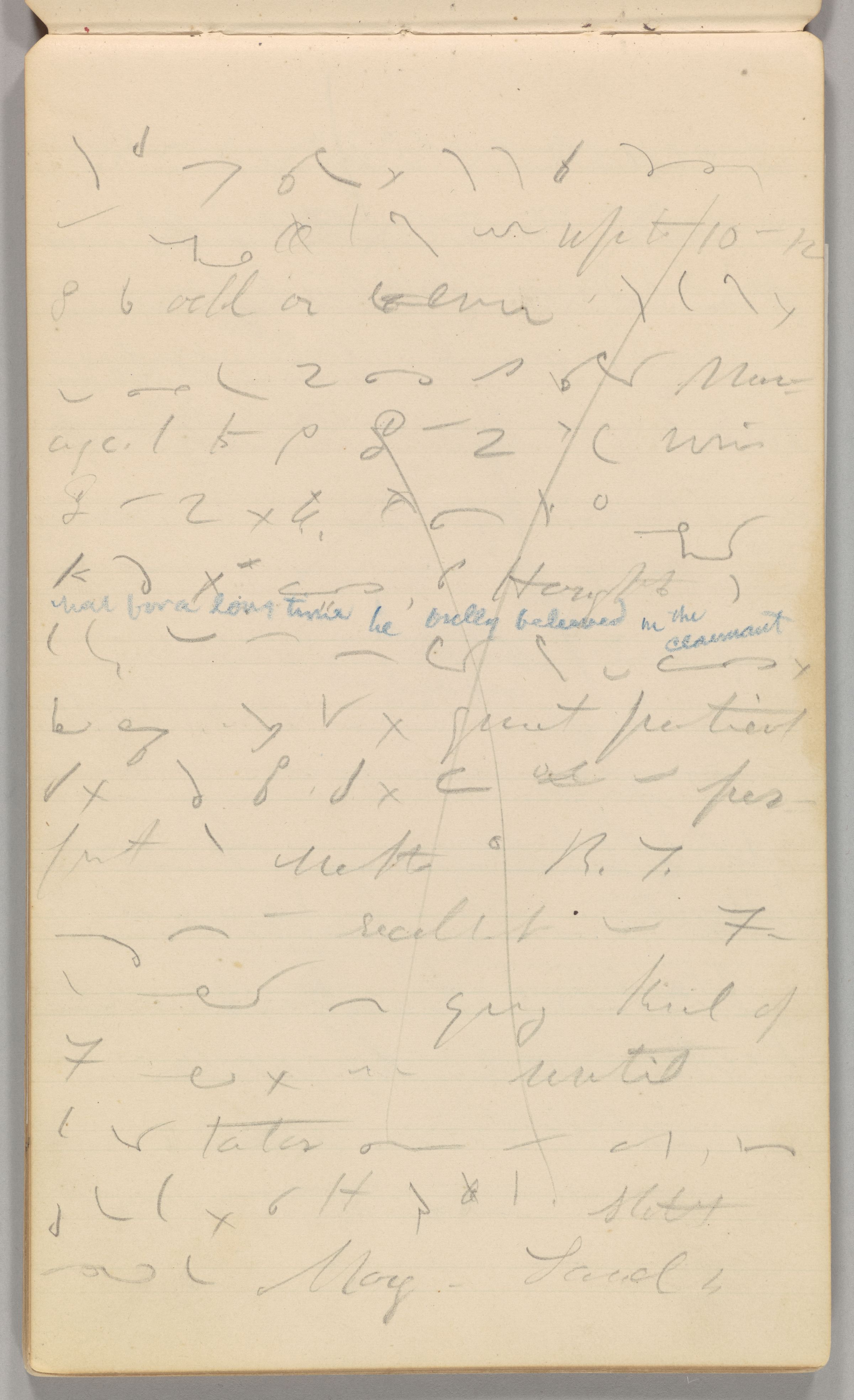
[MS: N12_leaf_]
We hadn't much silver, we would just remember our indebtedness to people—up to 10
or 12s. then odd or even and when that player, in the course of 2 two words unselfishly managed to lose a shilling or 2 and the other win a shilling or 2. The whole day
was exceedingly enjoyable one.
The Claimant: Lord Houghton14 said that for a long time he fully believed in the Claimant. Doesn't suggest the butcher at all. Quiet patient gentleman. Ways suggest the gentleman. Language was not not perfect but neither was Roger Tichborne's. Curious he can recollect no French but occasionally he one word kind of French accent. Until the fatal tattoo marks15 were related, he didn't have them.
Lord Houghton pointed out the stately mansion of the Mayor of London.
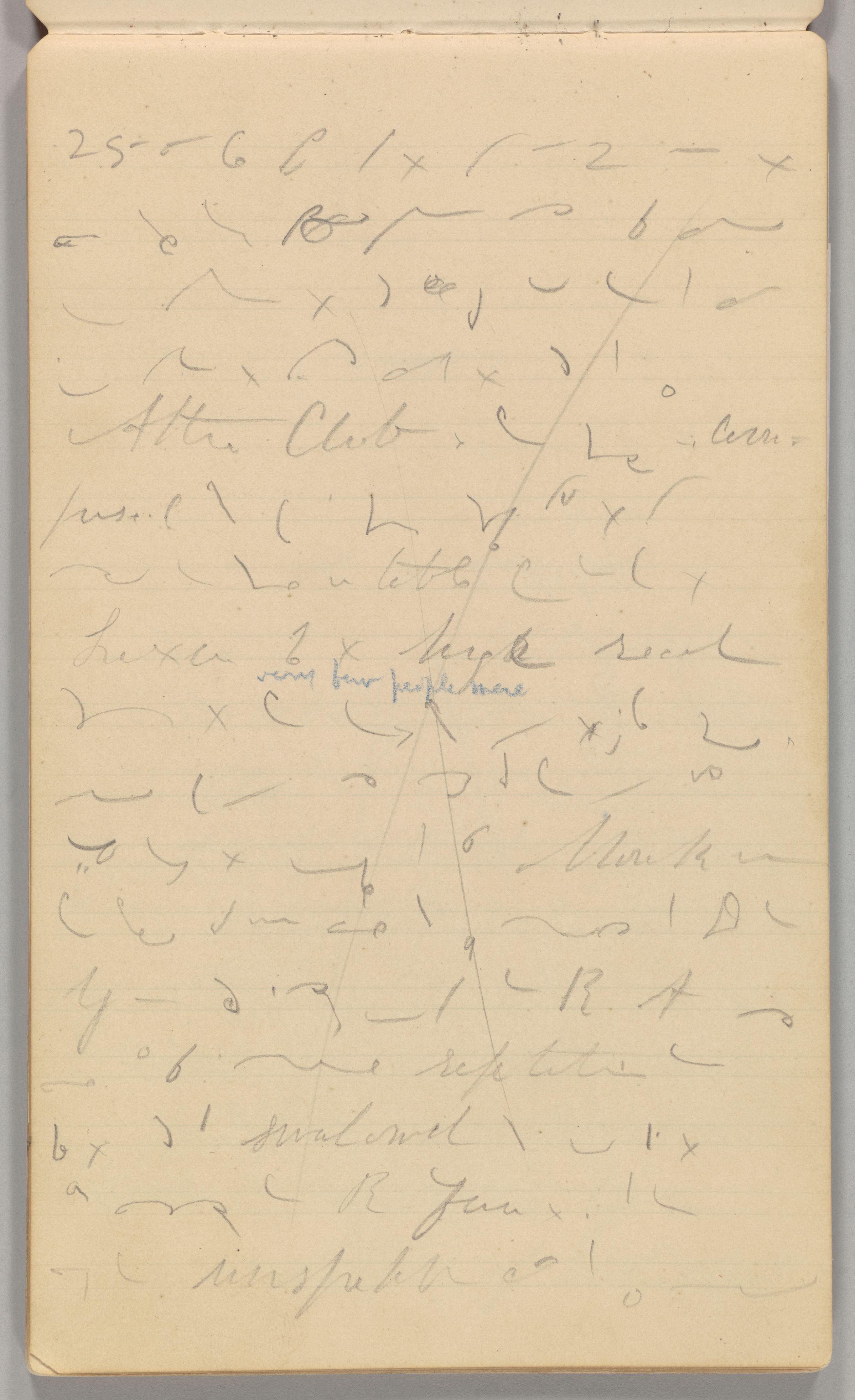
[MS: N12_leaf_]
25 or 6 years of age. four words. Great position for a young man just starting in life. Said was didn't not have to start in life, already started.
Went to see Athenaeum Club,16 very dignified, composed place with a dim religious light. All manner of books—tables full of them. Luxurious chairs. Huge reading room. Very few people there.; those sitting reading with their hats mashed down over their eyes English fashion.
Introduced to Lord Monk17—very pleasant gentleman.
Close by is the monument to the Duke of York—once commander in chief of the Royal
Army whose course was just a monotonous repetition of defeats. When died swallowed
up in debt. Was a member of the royal family. And out of gratitude for unselfish service to his country,
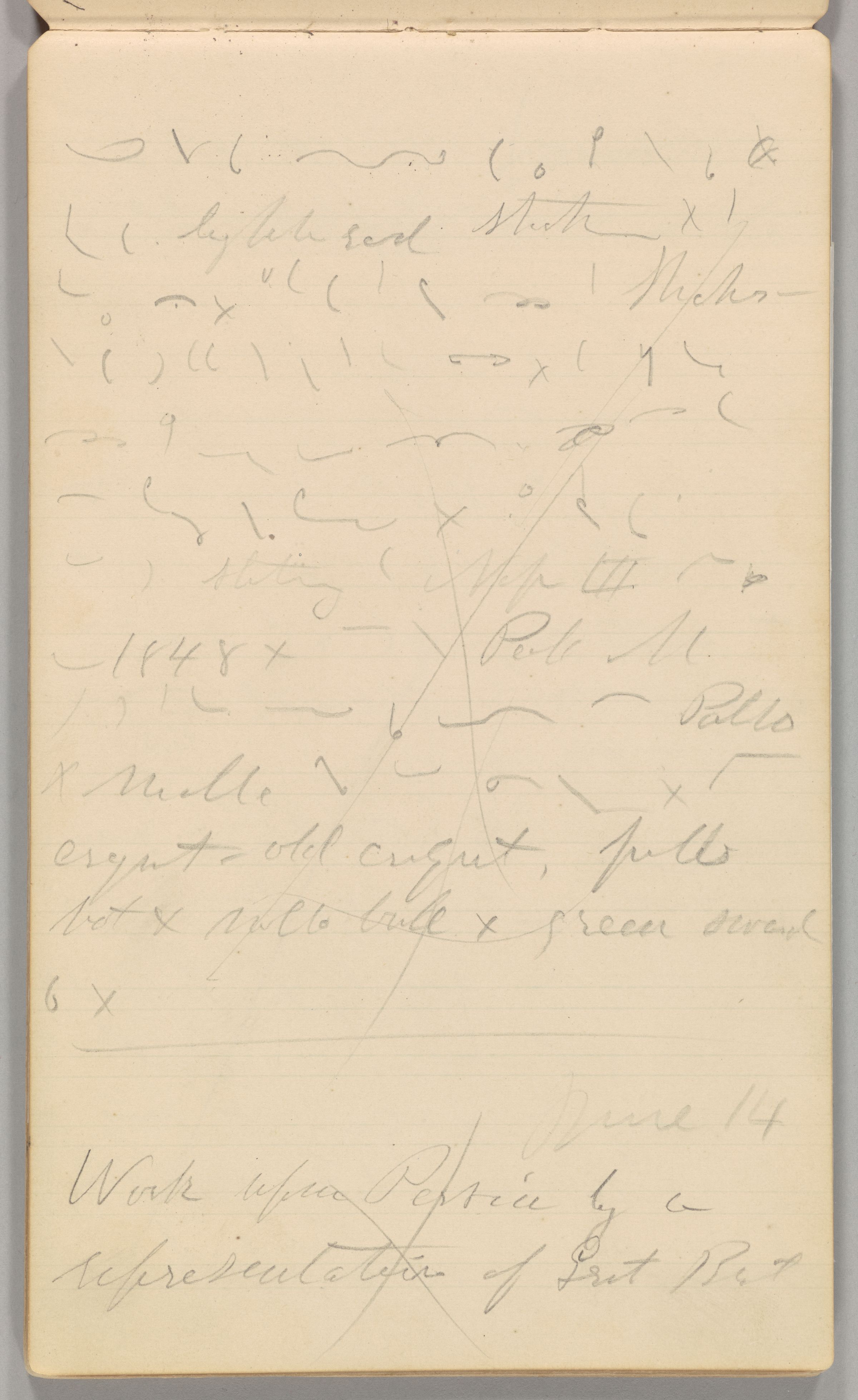
[MS: N12_leaf_]
nation built this monument with his statue upon its top with lightning rod sticking out of his head.18
I thought they ought to build monument to Shakespeare—but they said that that would be out of character. Their idea of a monument was to keep in memory the man that might otherwise be forgotten.19
Saw table with a two words stating that Napoleon III left it in 1848.
Came up Pall Mall which said to have gotten its name from Pallo & Mallo, persons in some book. Like croquet or old croquet, pallo bat & mallo ball. Greensward then.20
June 14
Work upon Persia by a representative of Great Britain
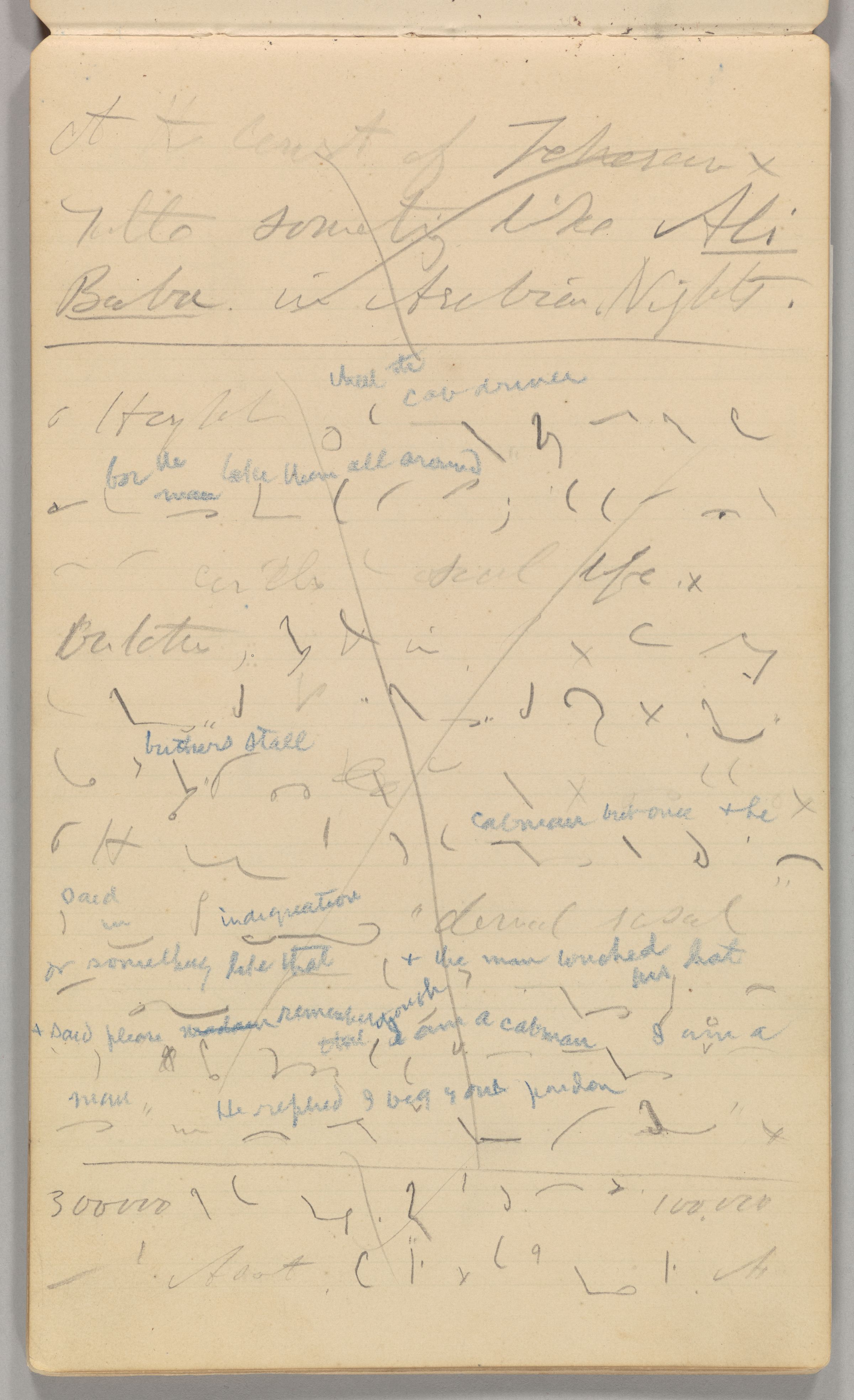
[MS: N12_leaf_]
at the court of Teheran. Title something like Ali Baba in Arabian Nights.21
Lord Houghton says that cab drivers are a part of every world for men take them all around; and that they are made up from all circles of social life. Butcher, brusher & three words. Quiet refuge of broken-down talent and broken-down wealth. The printing-office and the butcher's-stall seems to be no better. four words. Lord Houghton never had words with cabman but once and Houghton said in sudden indignation “damned rascal” or something like that, and the cabman touched his hat and said, “Please remember that though I am cabman I am man”—he replied, “I beg your pardon.”
300,000 people have witnessed the Derby at one time and the and 100,000 were at Ascot the other day. That was the biggest day Ascot has seen
yet.
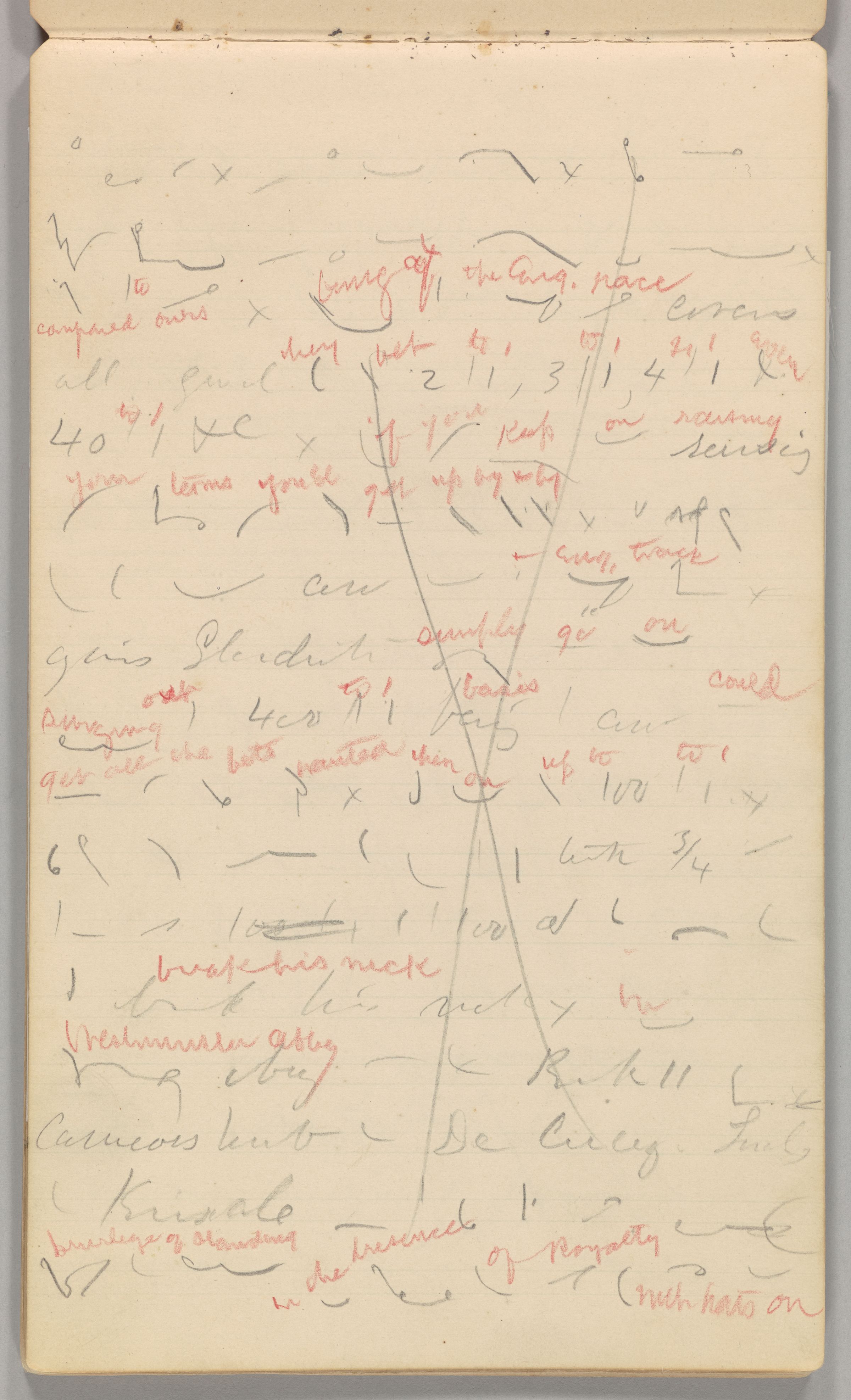
[MS: N12_leaf_]
There was no mob. Especially because properly speaking there is no mob in the country,
compared to ours.
Betting at an English race covers all ground; they bet 2 to 1, 3 to 1, 4 to 1 & 40 to 1 etc. If you keep on raising your terms you would get bet by and by. I believe if they enter cow on an English track, against Gladiateur,22 somebody come along singing out 400 to 1 two words cow can get all the bets wanted. one word no bet 100 to 1. Those people would argue that if two words took ¾ hour to go around 100 to 1 1 to 100 chances that the horse that does breaks his neck.
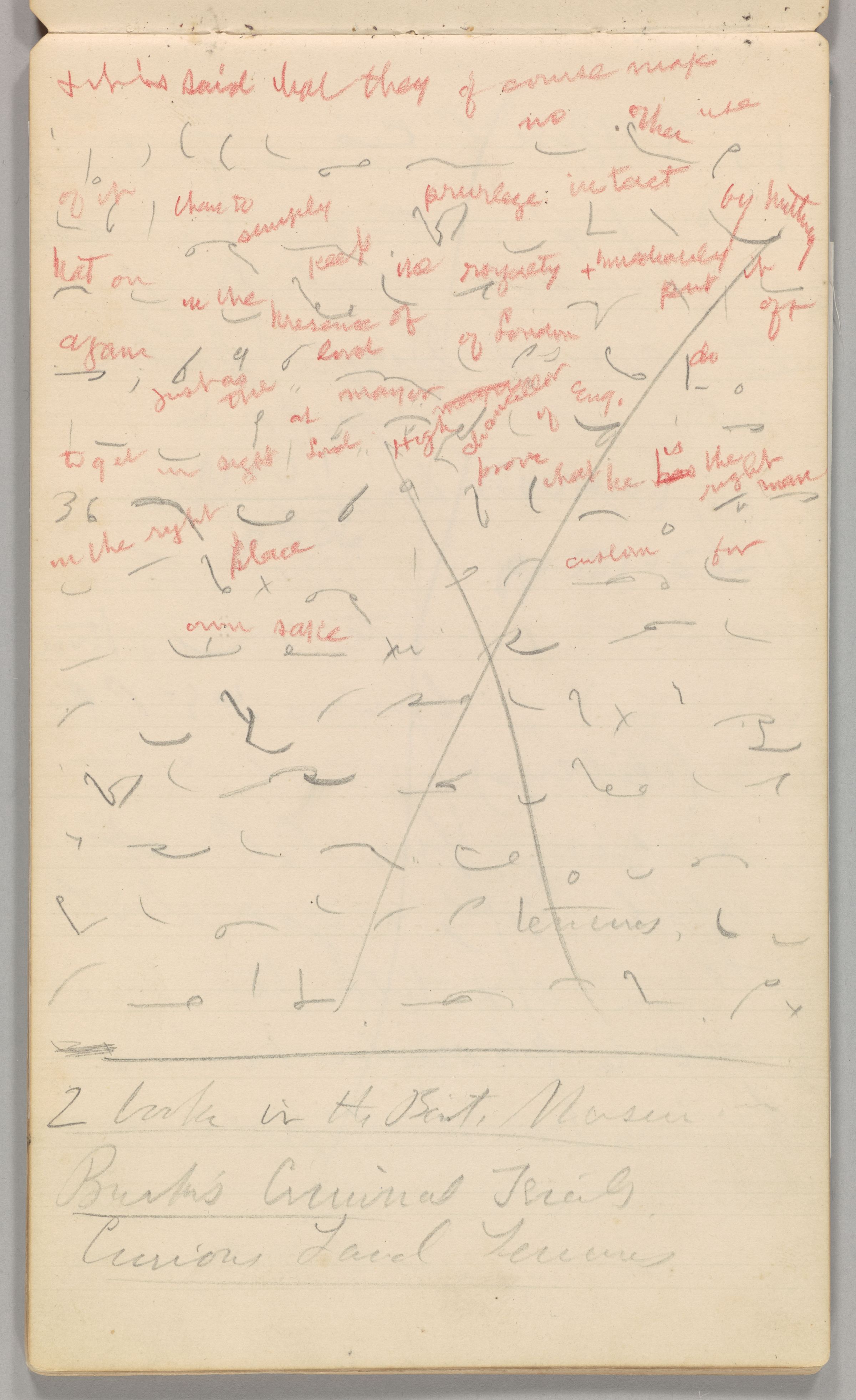
In Westminster Abbey one word of Richard II tomb. Curious tomb of De Courcy, Lords of Kinsale,23 who to this day share the singular privilege of standing in the presence of royalty with hats on
[MS: N12_leaf_]
and it is said that they of course make no further use of it than to simply keep the
privilege intact by putting hat on in presence of royalty and immediately put it off
again; just as the Lord Mayor of London's first duty is to go in state to the Lord High Chancellor of England and count 36 hobnails just as a proof that he
is right man in the right place. Simple to one word old customs for their own sake—a living record of old things providing four words. And the historic privilege of remaining covered in the presence of royalty and the
counting of hobnails is in the same spirit of some of the old land tenures, though
in the latter case to take the custom might break the laws.
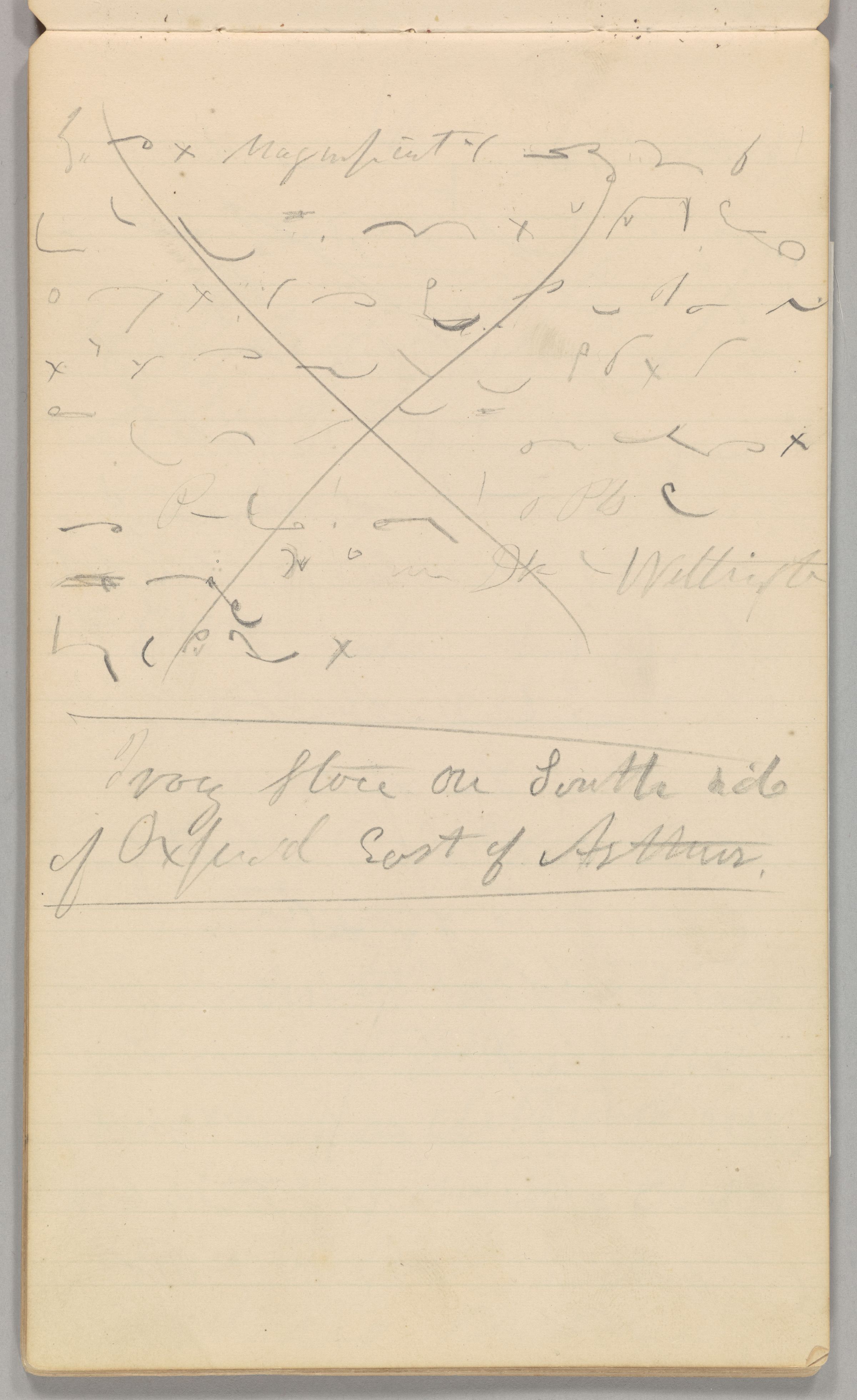
2 books in the British Museum—Burke's Criminal Trials, Curious Land Tenures24
[MS: N12_leaf_]
Charterhouse.25 Magnificent old governors' room just to think of being a home. I liked the fireplaces so much. The old men sitting around in the large court, reading. And the old man going by in such style. You ask if he were not a some nobleman.
one word P—thinks that the crypt at St. Paul's very impressive sight one word—Duke of Wellington's tomb with lights burning.
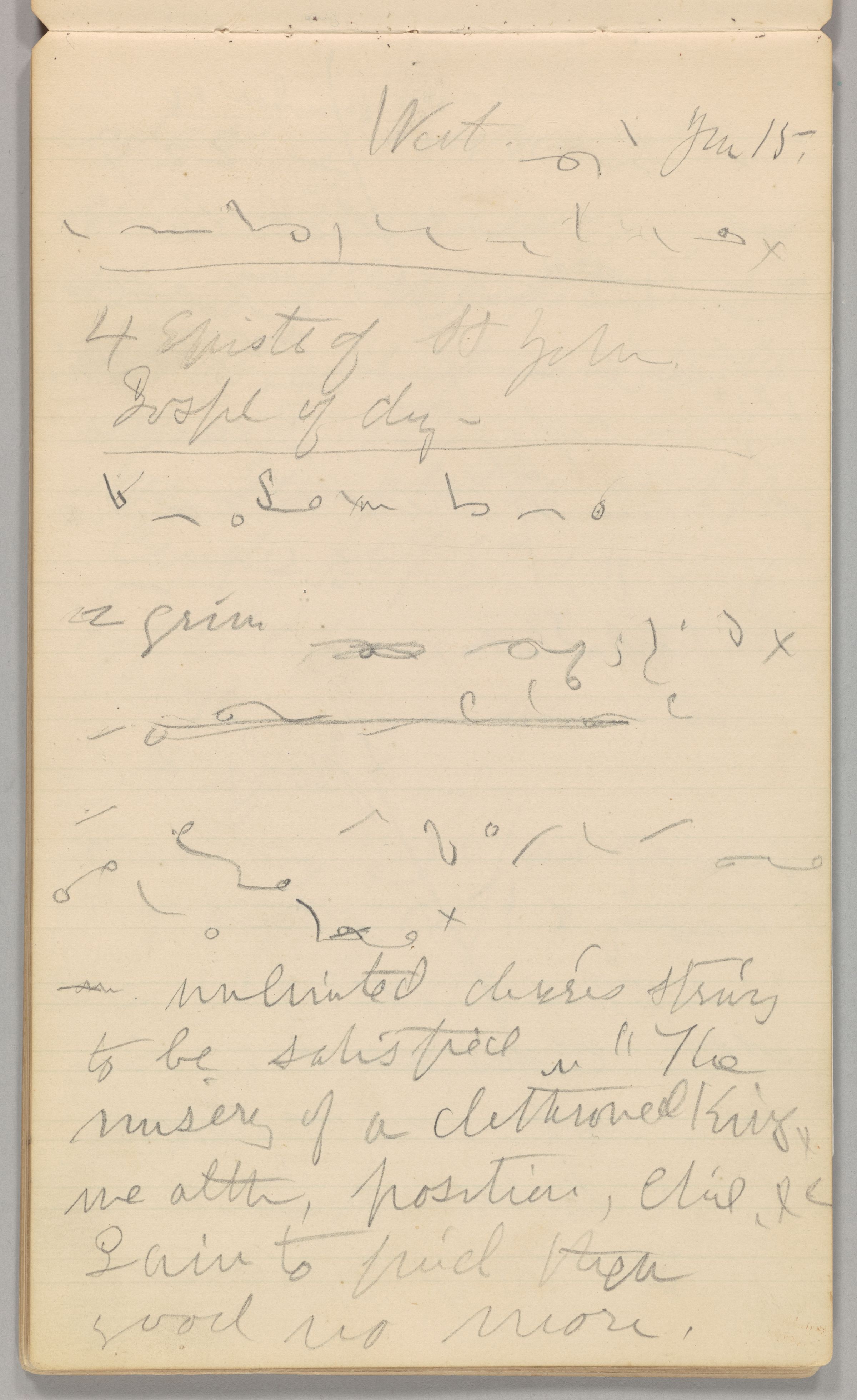
Ivory store on south side of Oxford, east of Arthur.
[MS: N12_leaf_]
2½ notebook pages, beginning with this page dated ‘Westminster Abbey, June 15’ and ending with ‘Dr. Hosmer’ have not been transcribed26
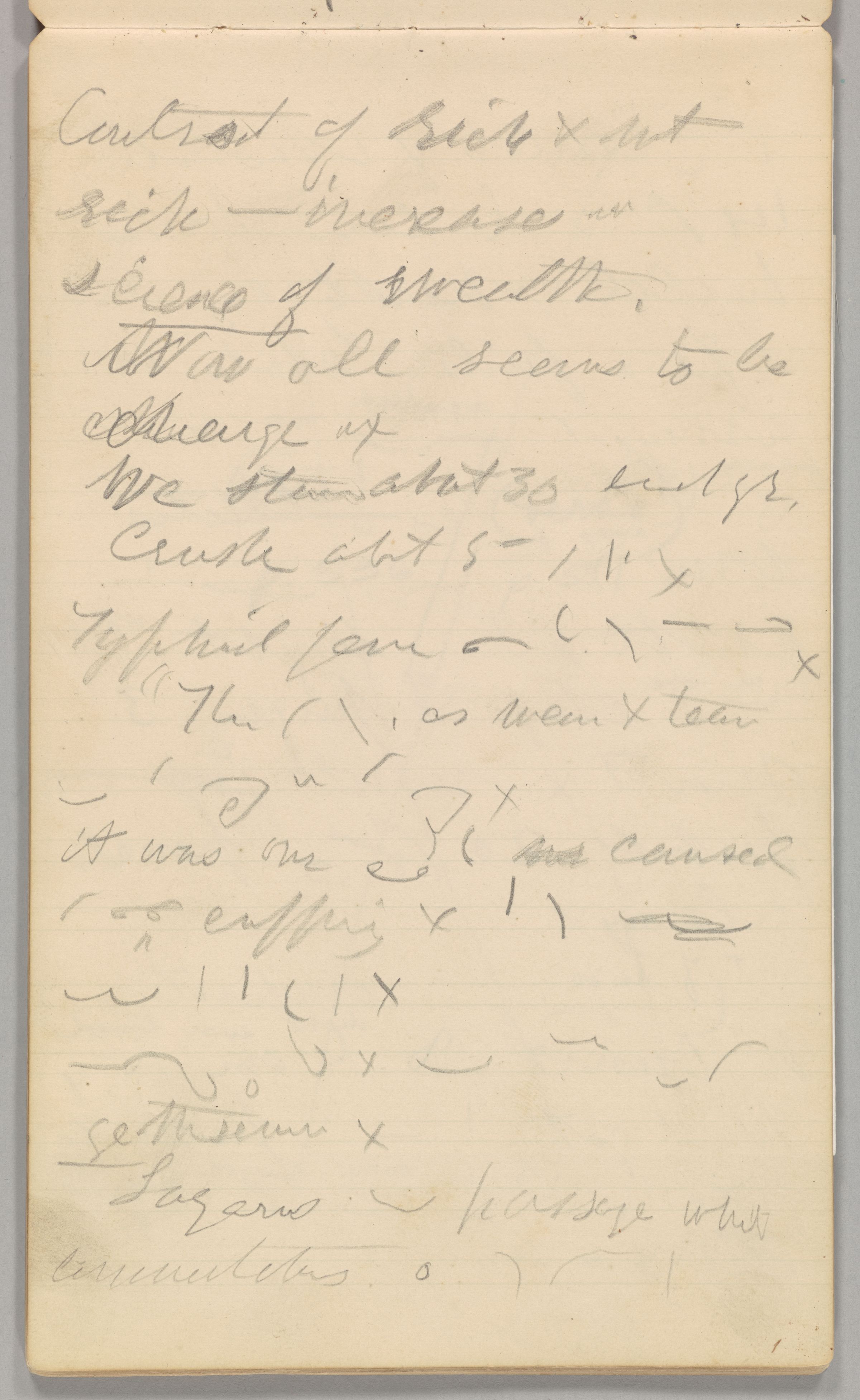
[MS: N12_leaf_]
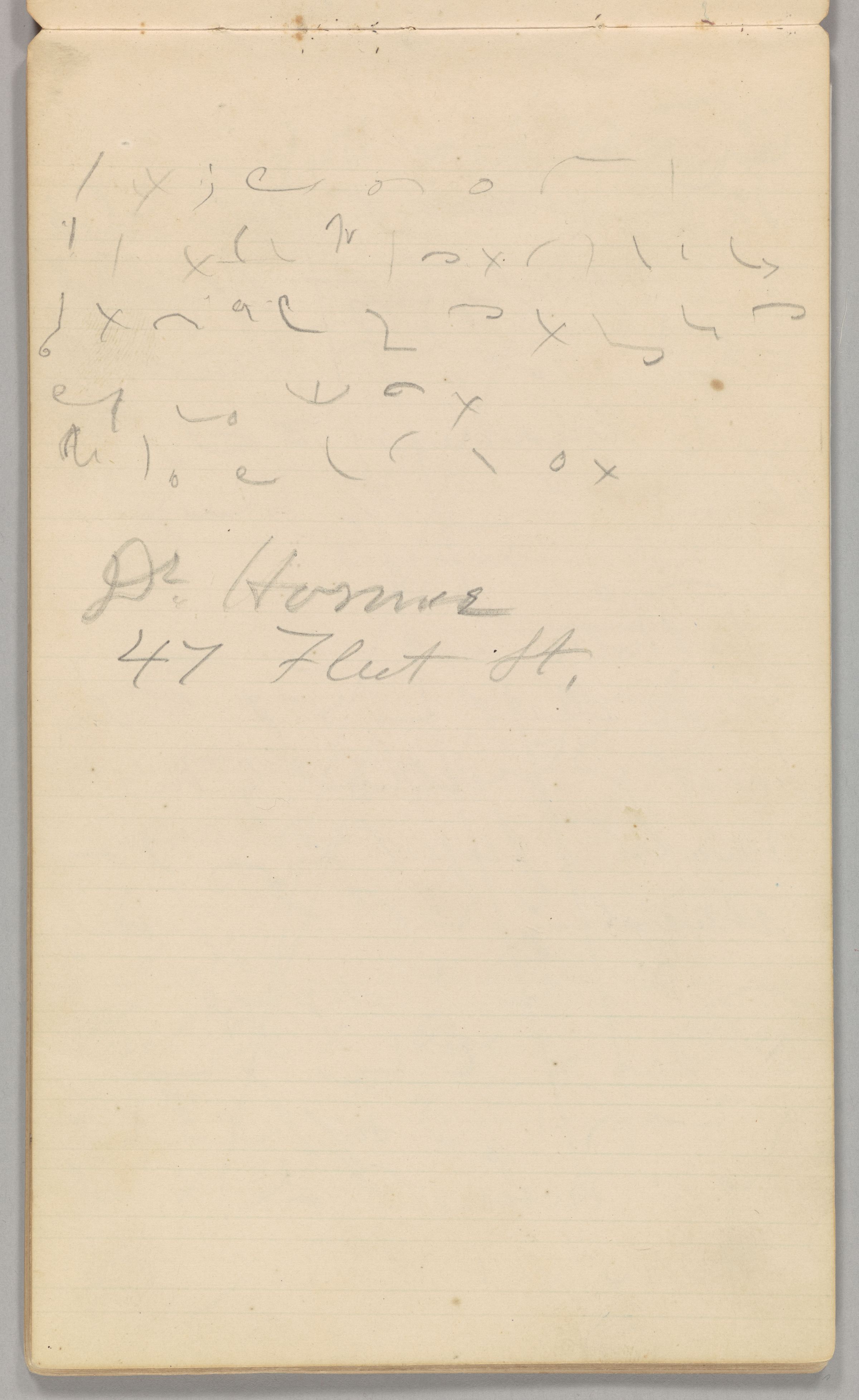
[MS: N12_leaf_]
shorthand on this page left untranscribed
Dr. Hosmer27
47 Fleet St.
[MS: N12_leaf_]
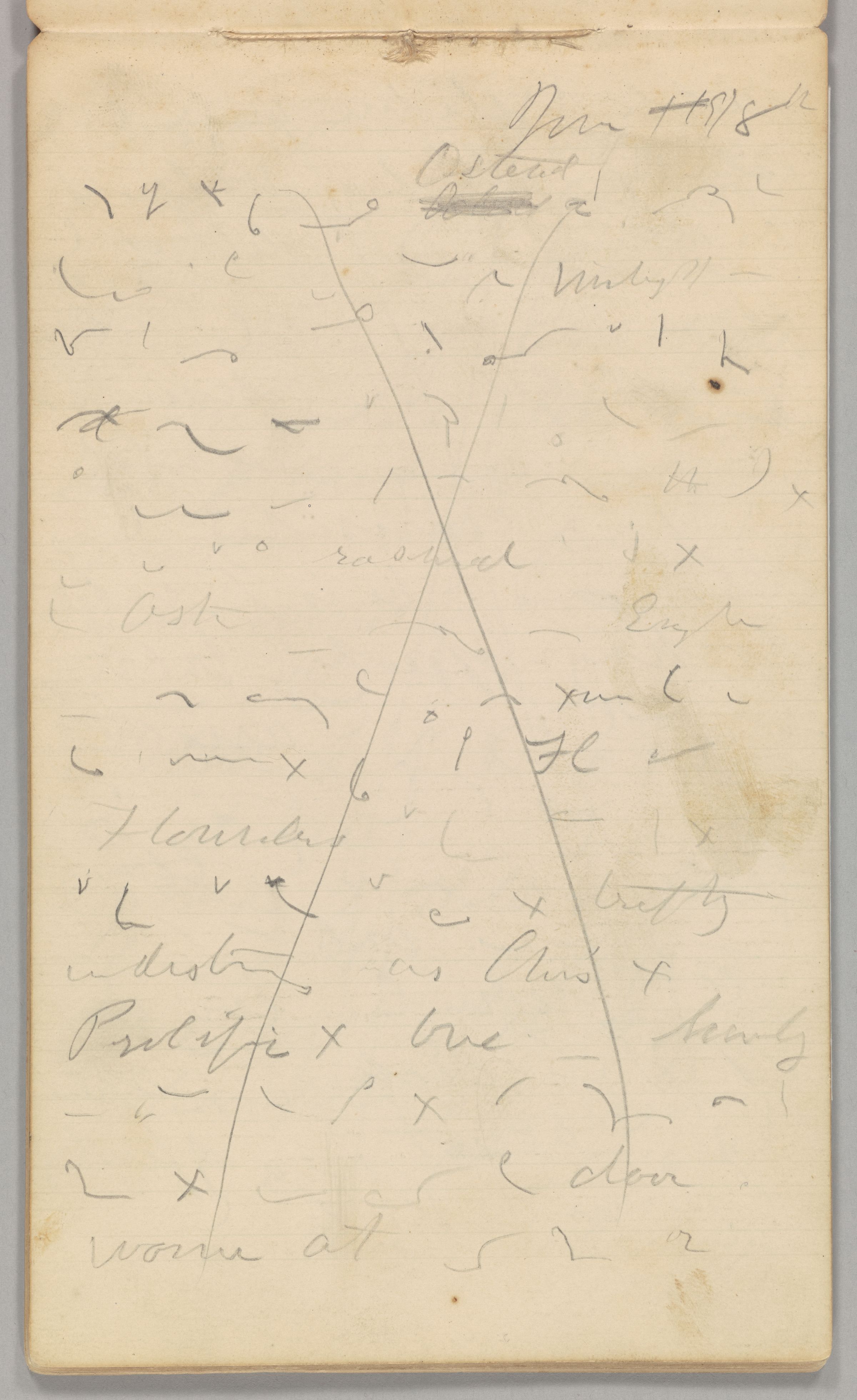
June 1 19 18th
We idled about this curious Ostend28 the remainder of the afternoon and far into long-lived twilight—apparently to amuse ourselves but secretly I had deeper motive—I wanted to see if there was anything there which might impress the Shah. In the end I was reassured and content. If Ostend could impress him, England could head clear off his head, that not even—
These citizens, Flanders or Flounders I think call them, I think I have I seen. Thrifty
industrious—as Chas'. Prolific. One could hardly get along for children. All the women
hard at work. In nearly every door women at needlework or
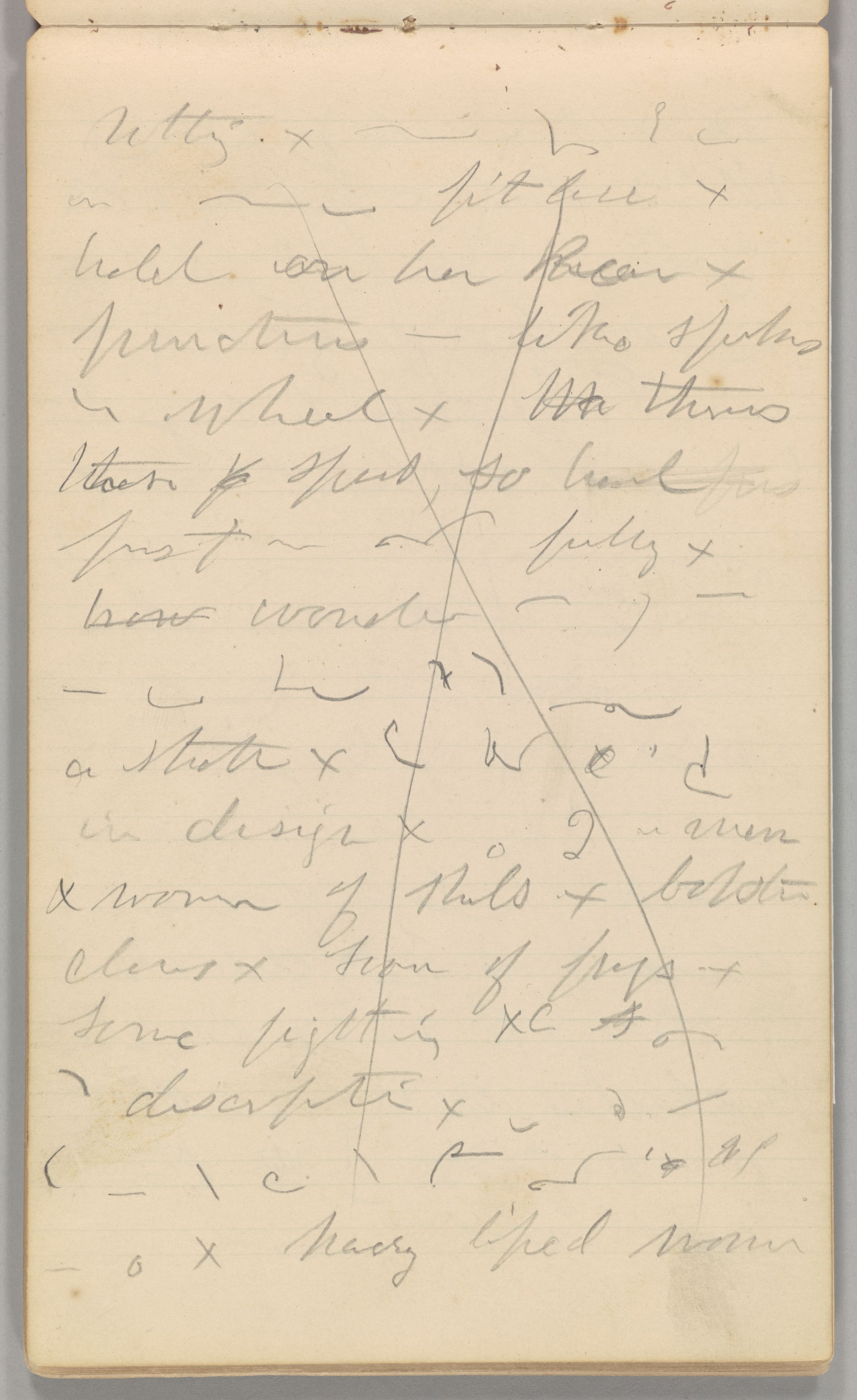
[MS: N12_leaf_]
knitting. Many women sat in—making point lace. Hold on her knee. Punctures—like spokes
of a wheel. Ma Throws these spools, so hard fas fast—hardly follow. How Wonder how she can go on talking without missing a stroke. Very tasteful. and delicate in design.
Sea shells—men & women of shells. Lobster claws. Some of frogs. Some fighting etc. Some without description. In the windows where they
could be seen by young girls and children could see. Hairy lipped woman
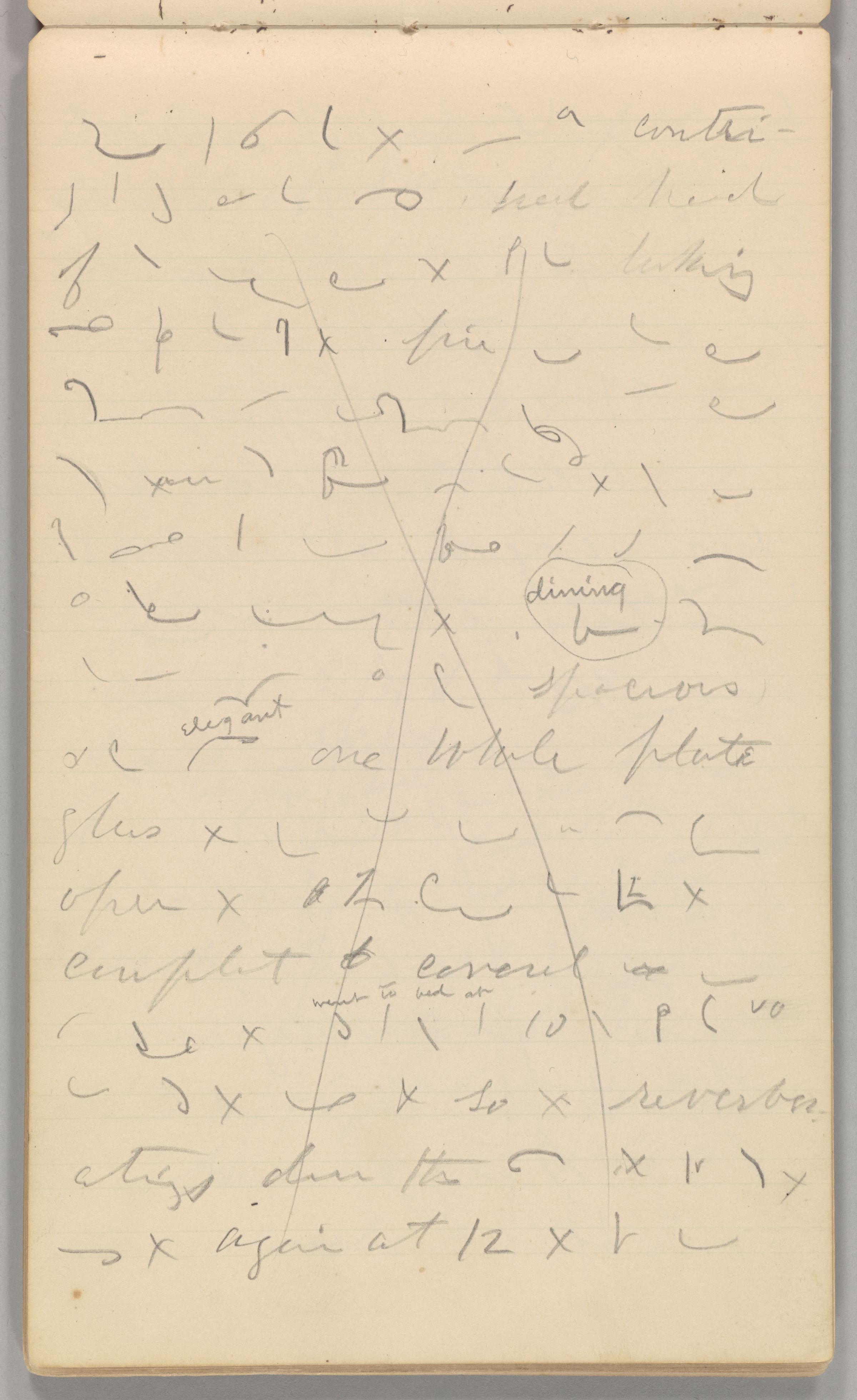
[MS: N12_leaf_]
waiting to sell them.
There was a contrivance attached to the better sort of houses, had heard of but never seen. Set of looking glasses outside of the door. Fine thing for seeing welcome or unwelcome visitors or seeing weather—without twisting head off. People in the upper stories had another contrivance which showed who was passing underneath.
The dining room of our hotel was very spacious, very elegant—one whole plate glass. If one entered—might think open. four words. Completely covered in oil paintings.
Went to bed at 10 but said that I was not one. Next & so. Reverberatings down the hall & died away. Again. Again
at 12. Told no—
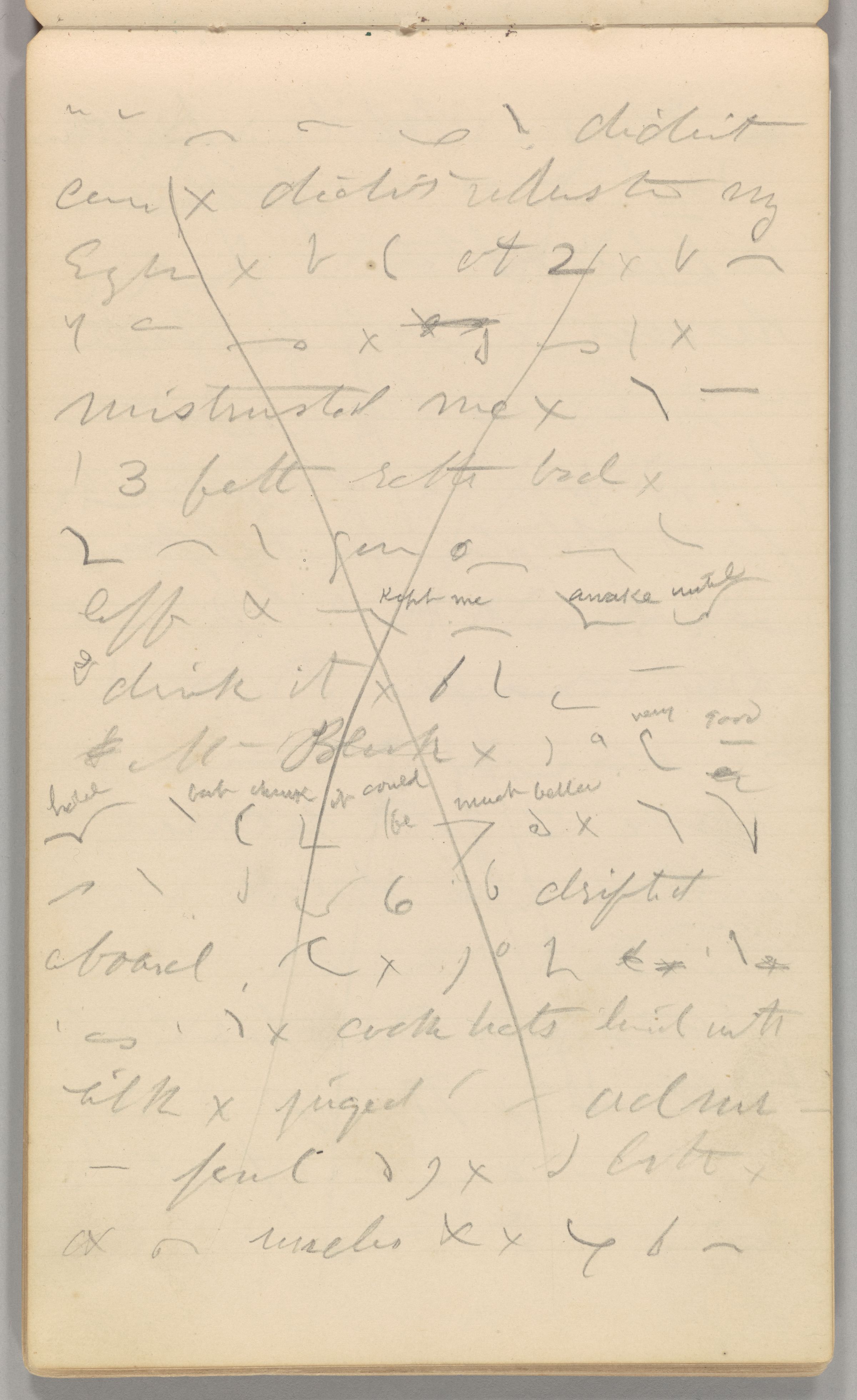
[MS: N12_leaf_]
not me, call next but didn't care. Didn't understand my English. Told them at 2. Told him I'd call myself. But Didn't mean it. Mistrusted me. When came at 3 felt rather bad. Woke me up, gave me
cup of coffee & kept me awake until I drank it. Just then in came S Mr. Blank. Said was a very good hotel but they took too much pains.
We wandered around about the town until 6 and then drifted aboard the Lively. She was trim. and bright. and clean and white.
Cock hats lined with silk. Judged all were admirals—got afraid, went ashore.
Shah's brother & some uncles etc.
Vessel just ahead
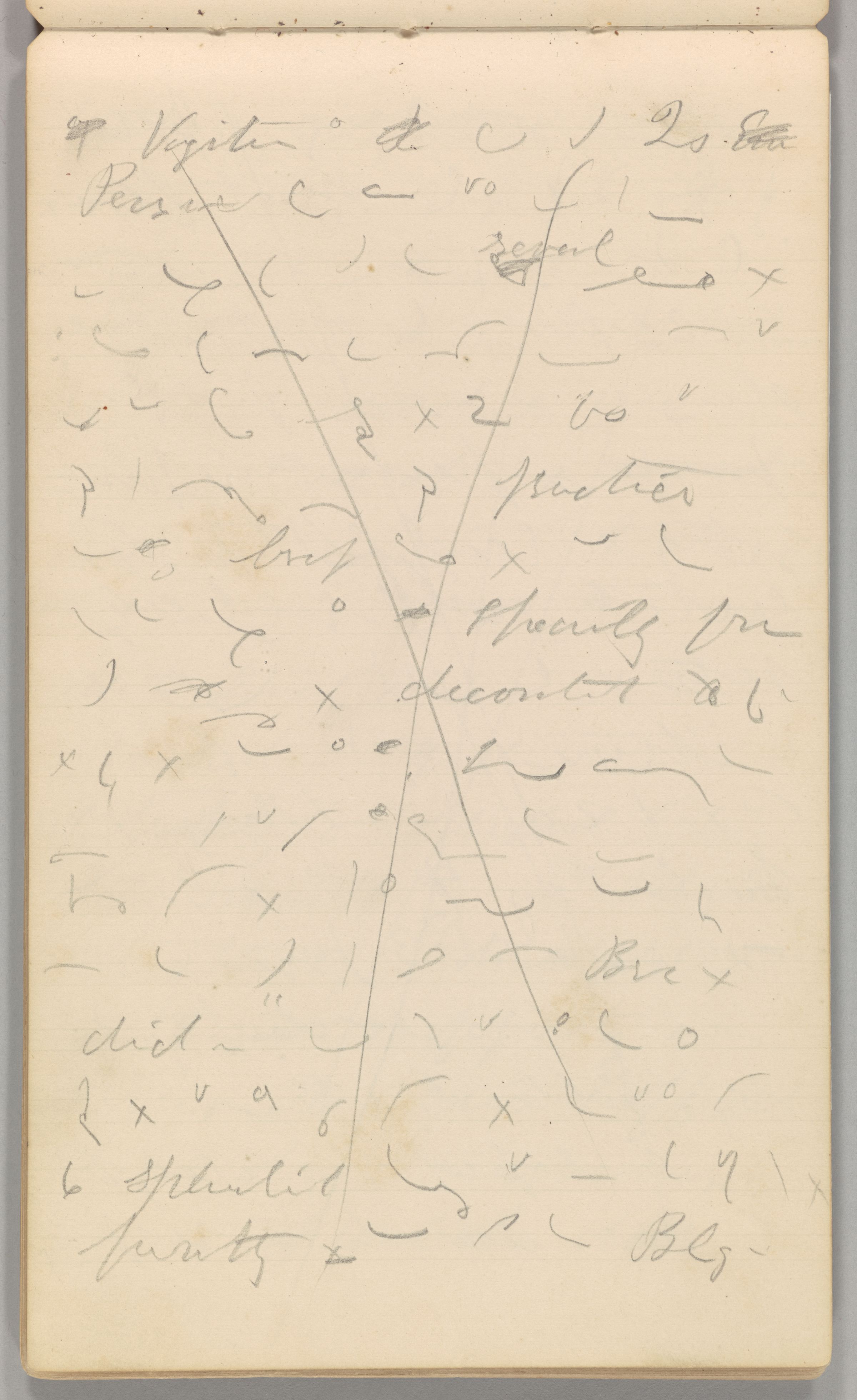
[MS: N12_leaf_]
was to, Vigilant, was Shah only Shah, Queen's Em, Persians. Very glad I was not to go in the vessel with Shah for several reasons:
first with him not immediately under my eye not feel responsibility. Second, because
I wanted to impress him wanted practice on his brother first.
Now the after part of the vessel was specially for Shah himself. Decorated within & without. Among was the charming color of green which I will speak of in tomorrow's letter.
It was getting along toward time for Shah to arrive from Brussels. Didn't know when I was ever so troubled. I saw a sealed letter. After I saw all those splendid officers I gave that idea up.
Presently long line of Belgian
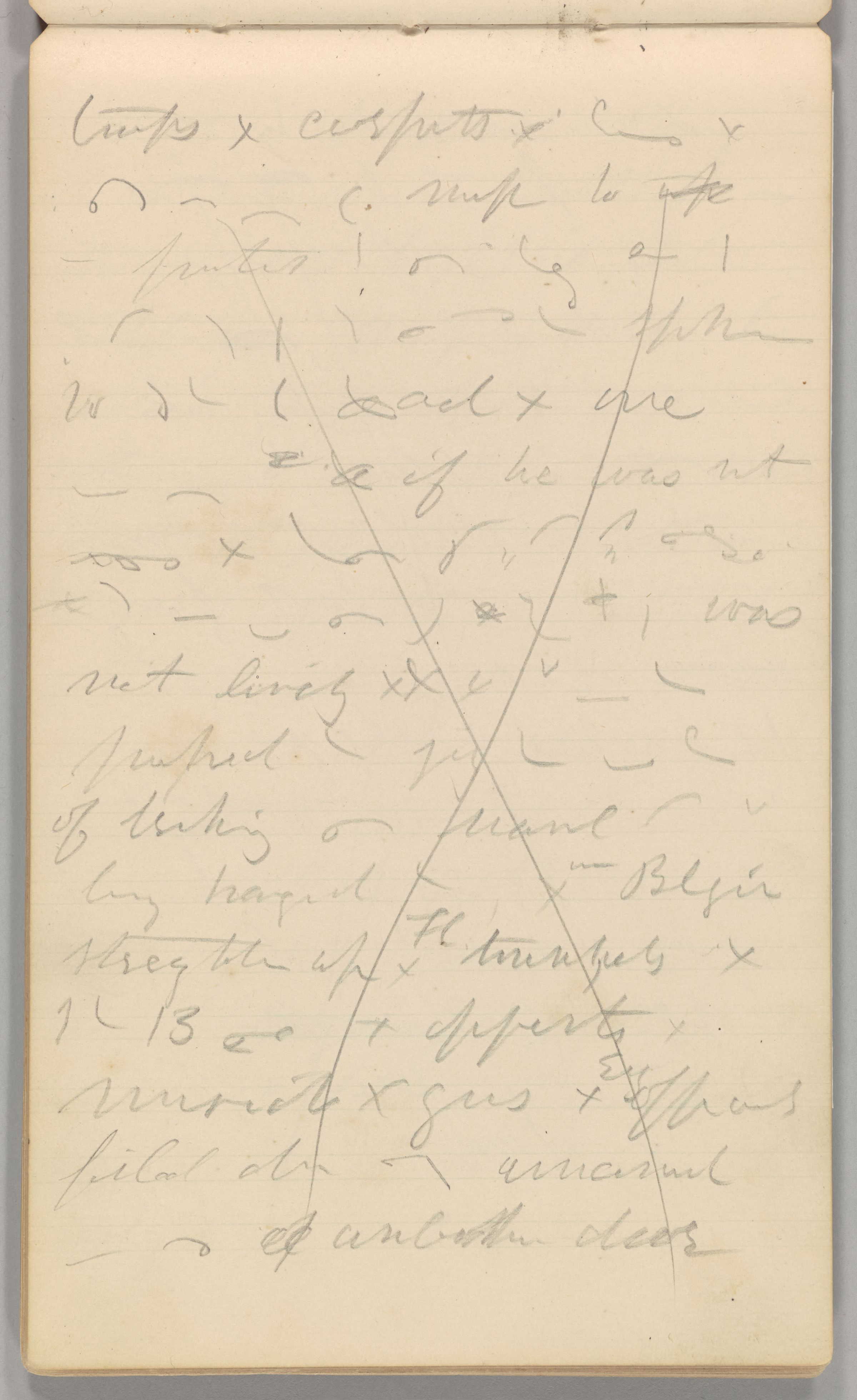
[MS: N12_leaf_]
troops. Carpets. and flags. The sailor met me with mop to wip—pointed at some officers asked what the law would do with man for speaking with one of those admirals. One knew me I if he was not mistaken. Furthermore still, all London correspondents would go in
the same ship. and if it was not lively etc. etc. I could have jumped for joy if not afraid of breaking
some naval law and being hanged for it.
Belgians straightened up. Flounders trumpets. Train of 13 cars. one word. Music. Guns. English officers filed down carpet, uncovered their heads, unbolted door.
[MS: N12_leaf_]
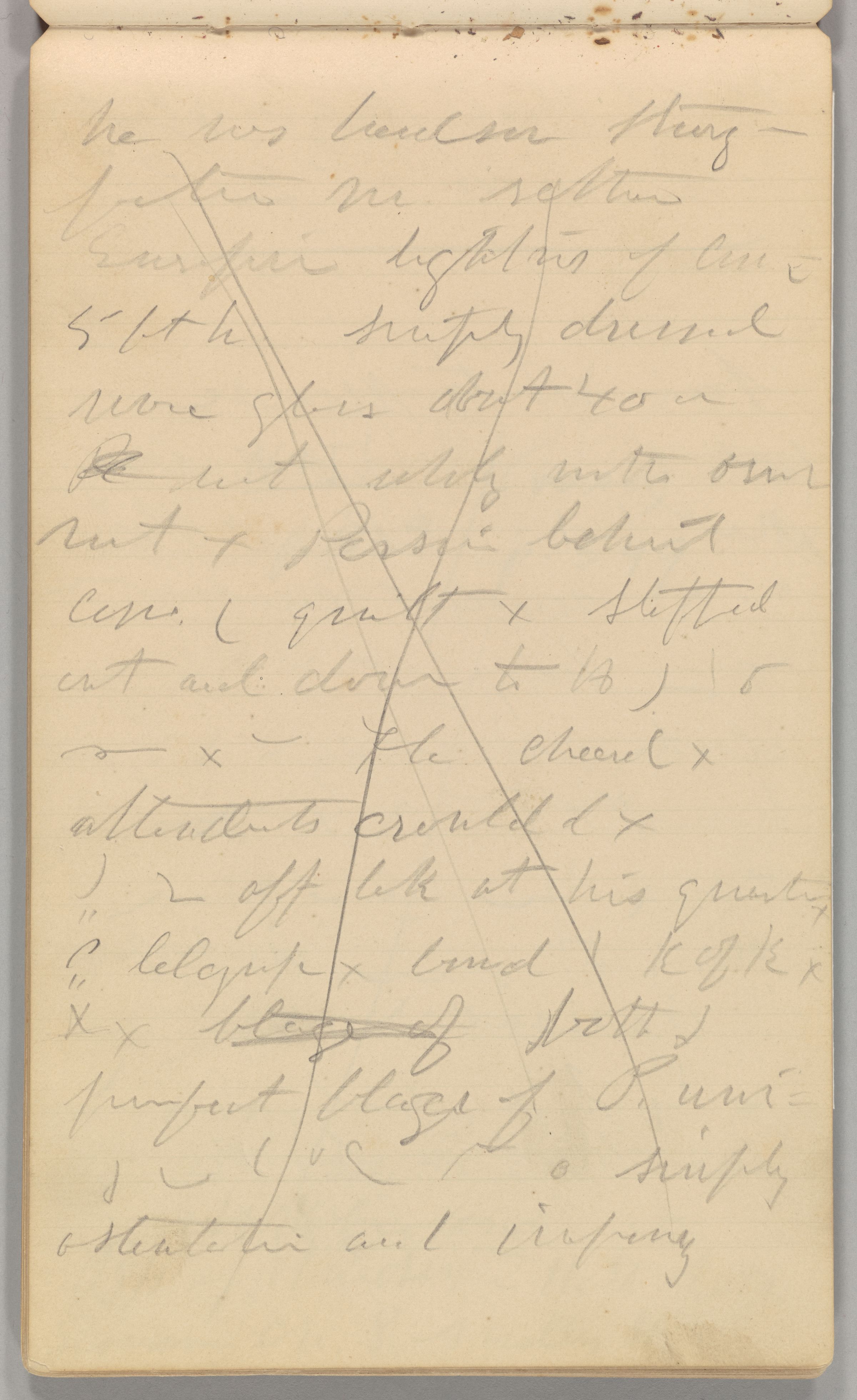
He was handsome strong-featured man, rather European lightness of complexion, 5 feet high, simply dressed, wore glasses, about 40—P not wholly without ornament. Persian behind covered with quilt. Stepped out and down to the ship to slow music. Not Flounder cheered. Attendants crowded. Shah walked aft look at his quarters. London telegraph. Bowed to the King of Kings etc. Blaze of Shah's brother, Shah perfect blazes of Persian uniform.
Don't know that I ever looked so simply ostentatious and imposing
[MS: N12_leaf_]
before in my life.
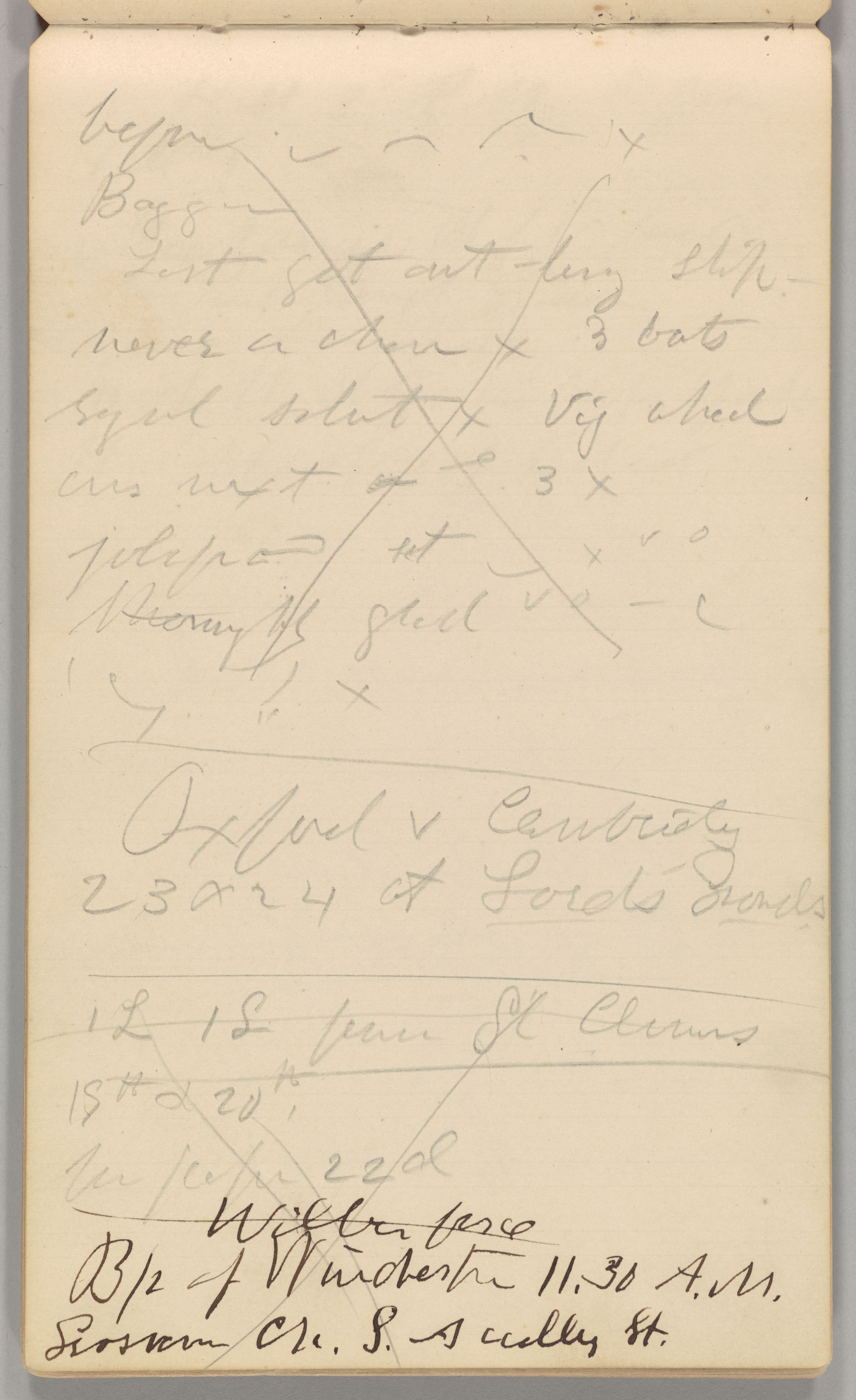
Baggage—
Last got out—long slip—never a cheer. 3 batteries, royal salute. Vigilant ahead, ours next, rest third. Jollification set in. I was thoroughly glad I was got over to fetch the Shah.
Oxford v Cambridge
23 & 24 at Lord's Grounds29
£1 1s. from S'l Clemens
19th & 20th.
two words 22d
Wilberforce, bishop of Winchester, 11:30 A.M., Grosvenor Ct., S. Audley St.
[MS: N12_leaf_]
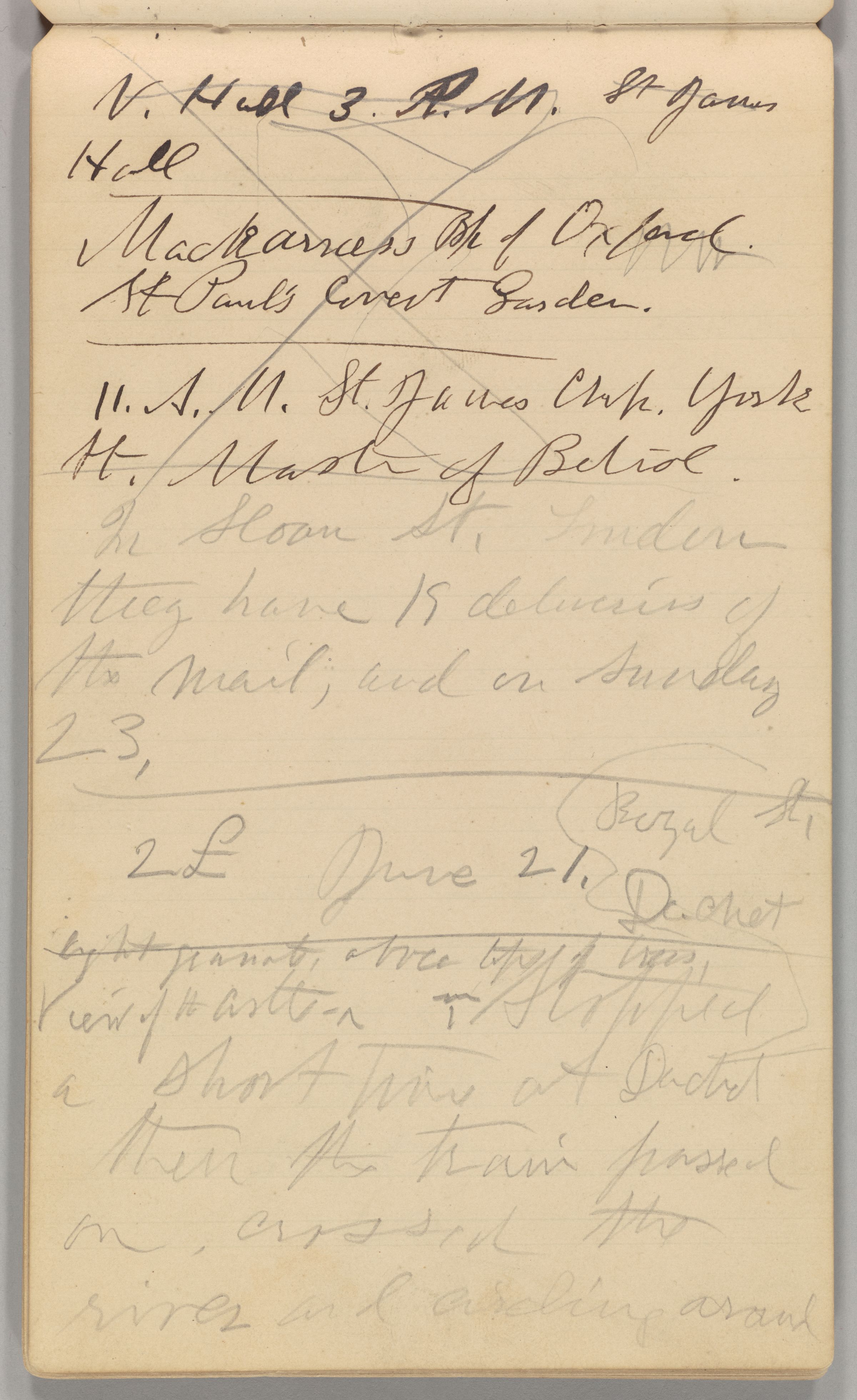
N. Hall, 3 A P.M., St. James Hall
Mackarness, bishop of Oxford, St. Paul's, Covent Garden.
11 A.M., St. James Chap., York St., Master of Balliol.
In Sloane St. London they have 19 deliveries of the mail, and on Sunday 23.
£2, June 21.
View of the Castle30—light granite, above tops of trees,—stopped a short time at Datchet (Royal St., Datchet)
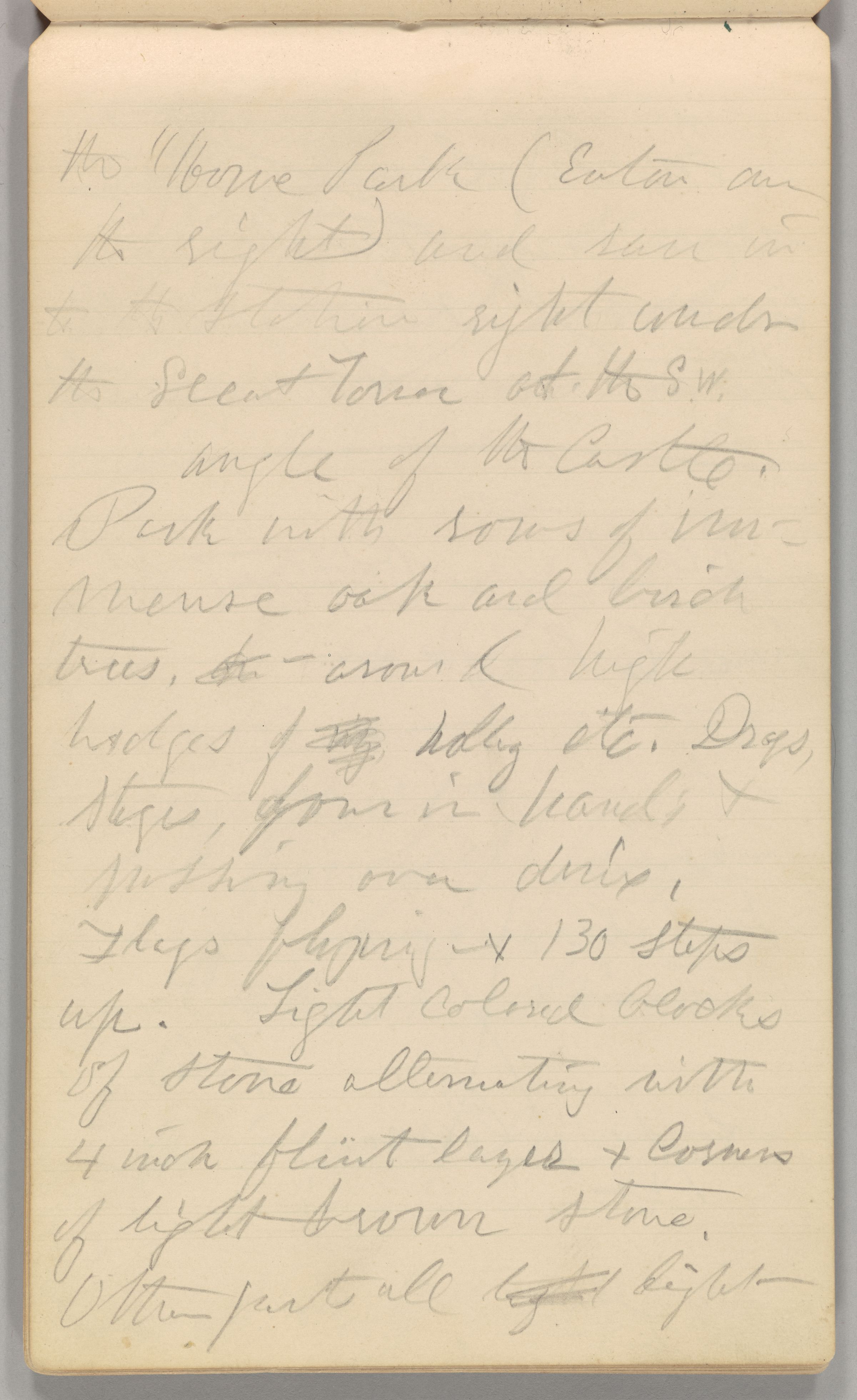
then the train passed on, crossed the river and circling around
[MS: N12_leaf_]
the “Home Park” (Eton on the right) and ran in to the station right under the Great
Tower at the southwest angle of the Castle. Park with rows of immense oak and birch
trees, around high hedges of ivy, holly etc. Drays, stages, four-in-hands & passing over drive. Flags flying. 130 steps
up. Light colored blocks of stone alternating with 4 inch flint layer. Corners of
light brown stone. Other parts all light
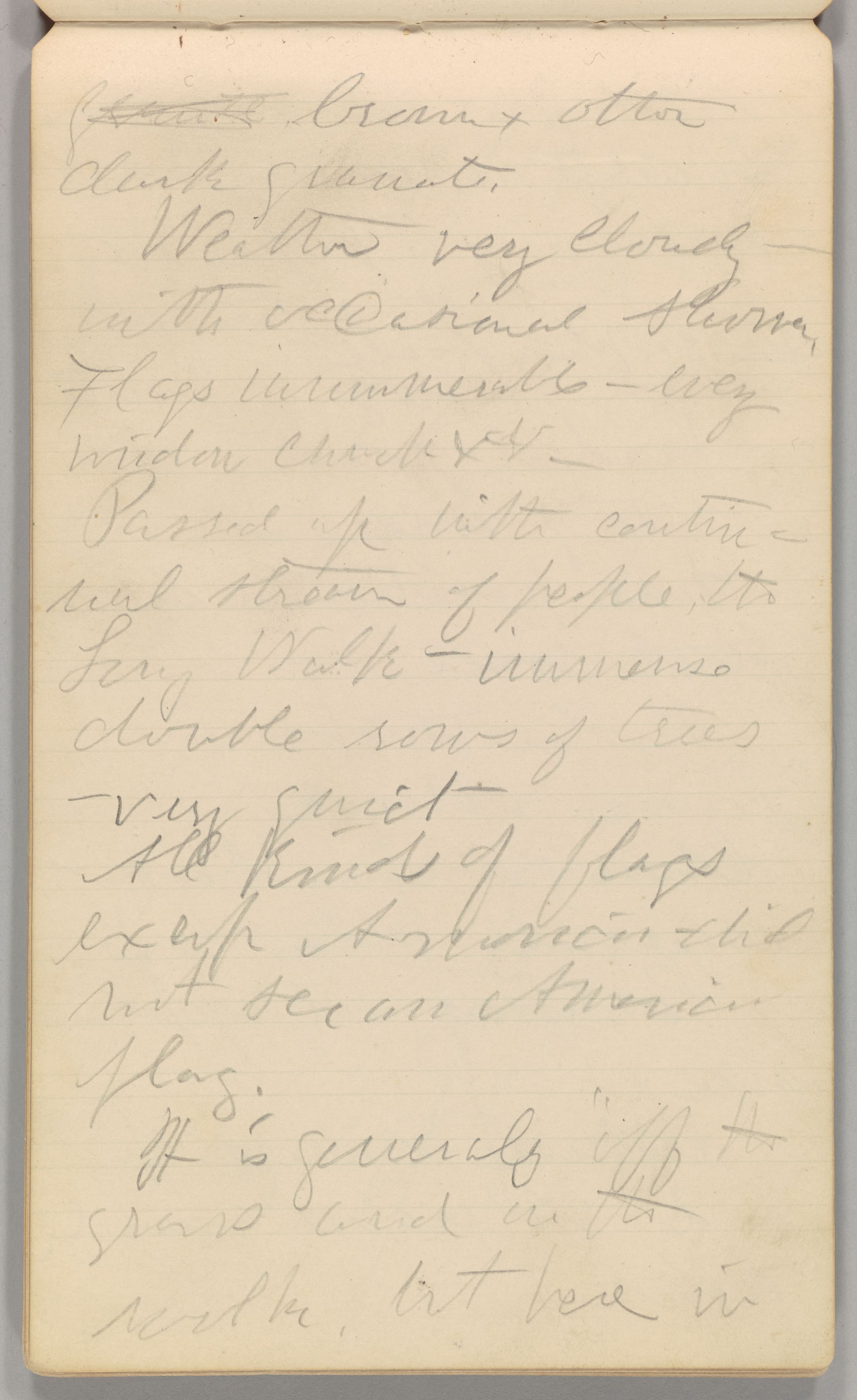
[MS: N12_leaf_]
granite brown. Others dark granite.
Weather very cloudy—with occasional shower. Flags innumerable—every window church etc.
Passed up with continual stream of people, the Long Walk—immense double rows of trees—very quiet
All kinds of flags except American—did not see an American flag.
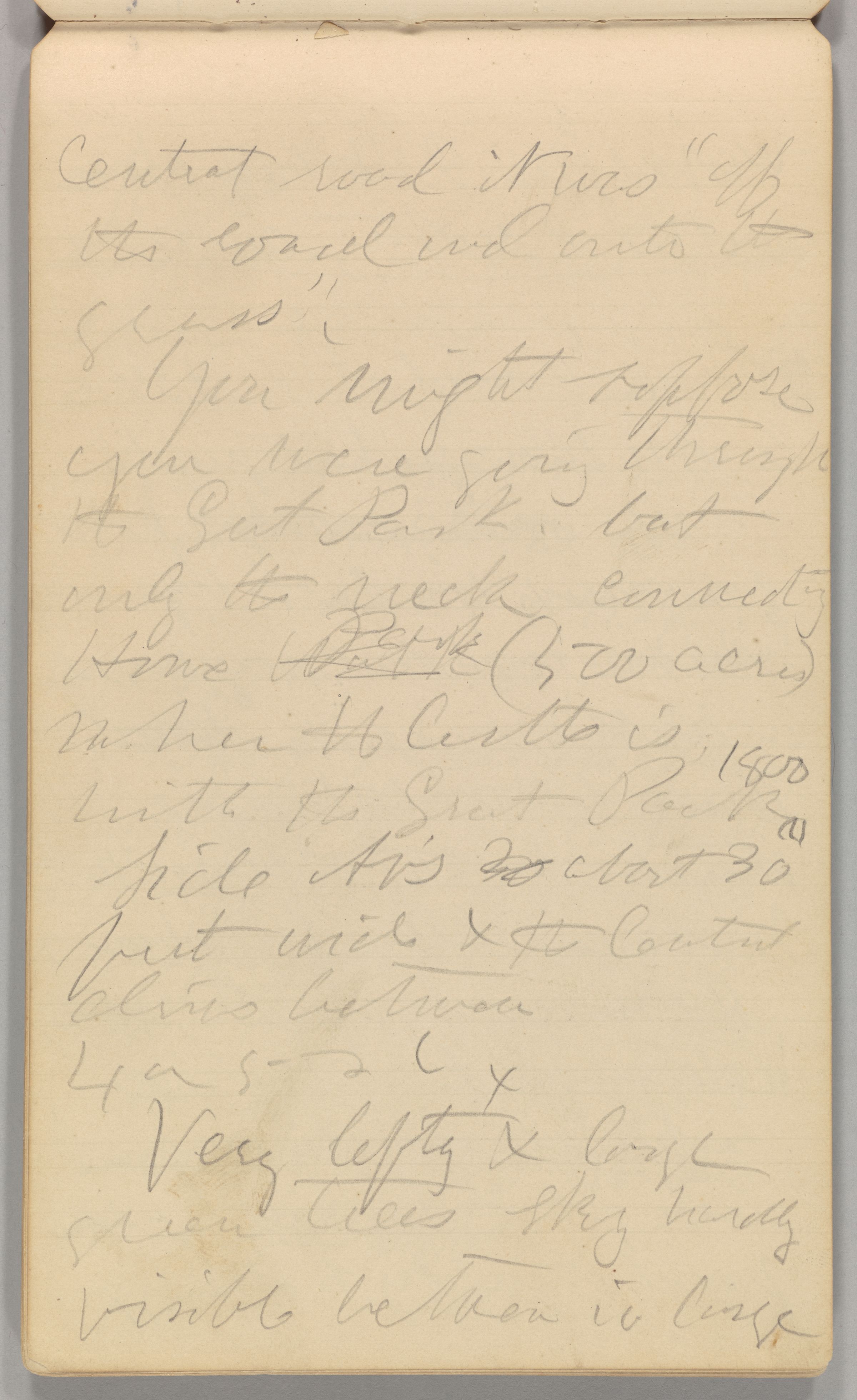
It is generally “off the grass and on the walk,” but here in
[MS: N12_leaf_]
central road it was “off the road and onto the grass.”
You might suppose you were going through the Great Park, but only the neck connecting Home WalkPark (500 acres), where the Castle is, with the Great Park (1800)
Side avenues 30 about 30 feet wide & the central drives between 4 or 5 two words.
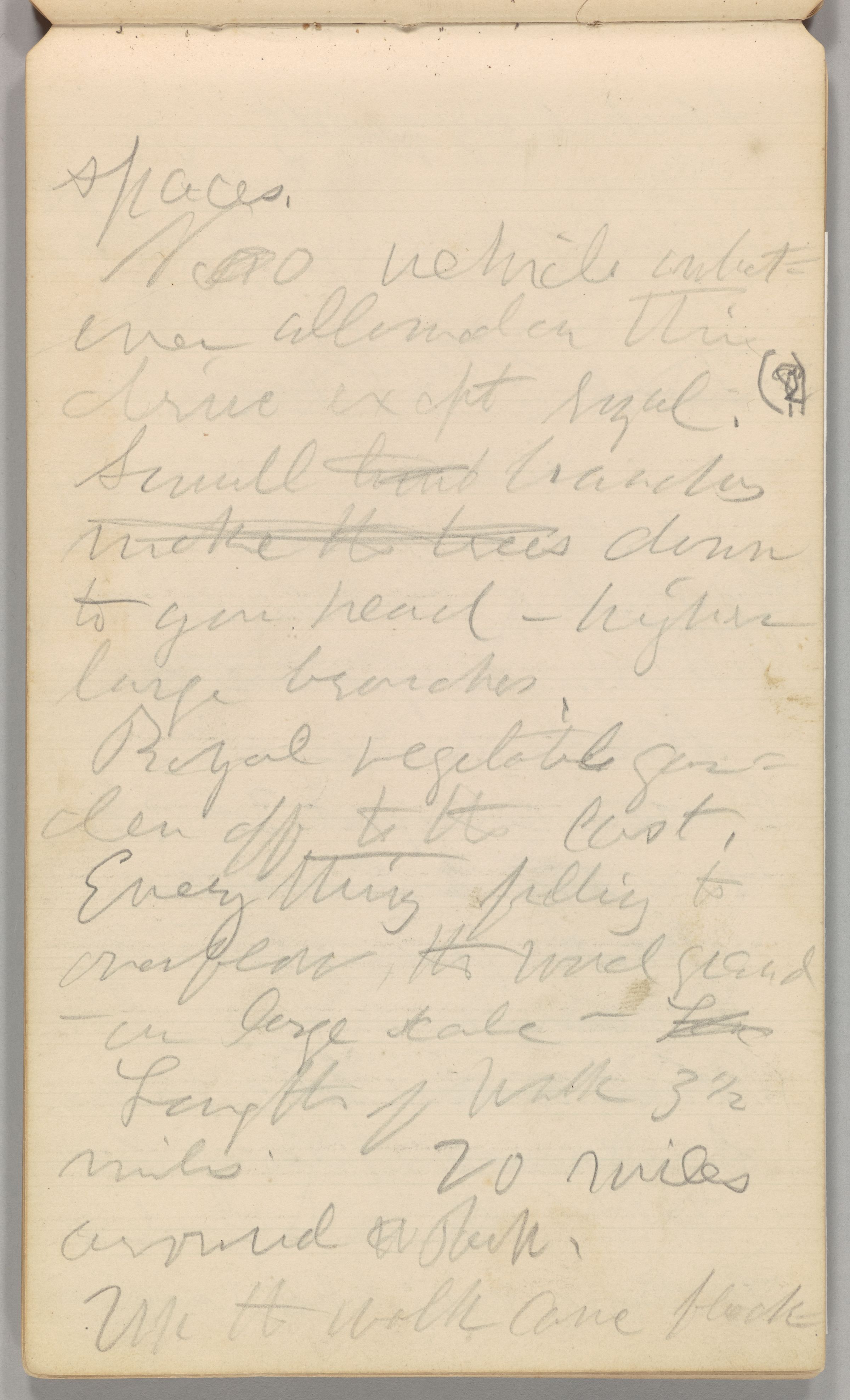
Very lofty & large green trees. Sky hardly visible between in large
[MS: N12_leaf_]
spaces.
No vehicle one word ever allowed in this drive except royal.(?) Small limb branches make the trees down to your head—higher large branches.
Royal vegetable garden off to the east.
Everything filling to overflow, the wood grand—on large scale.
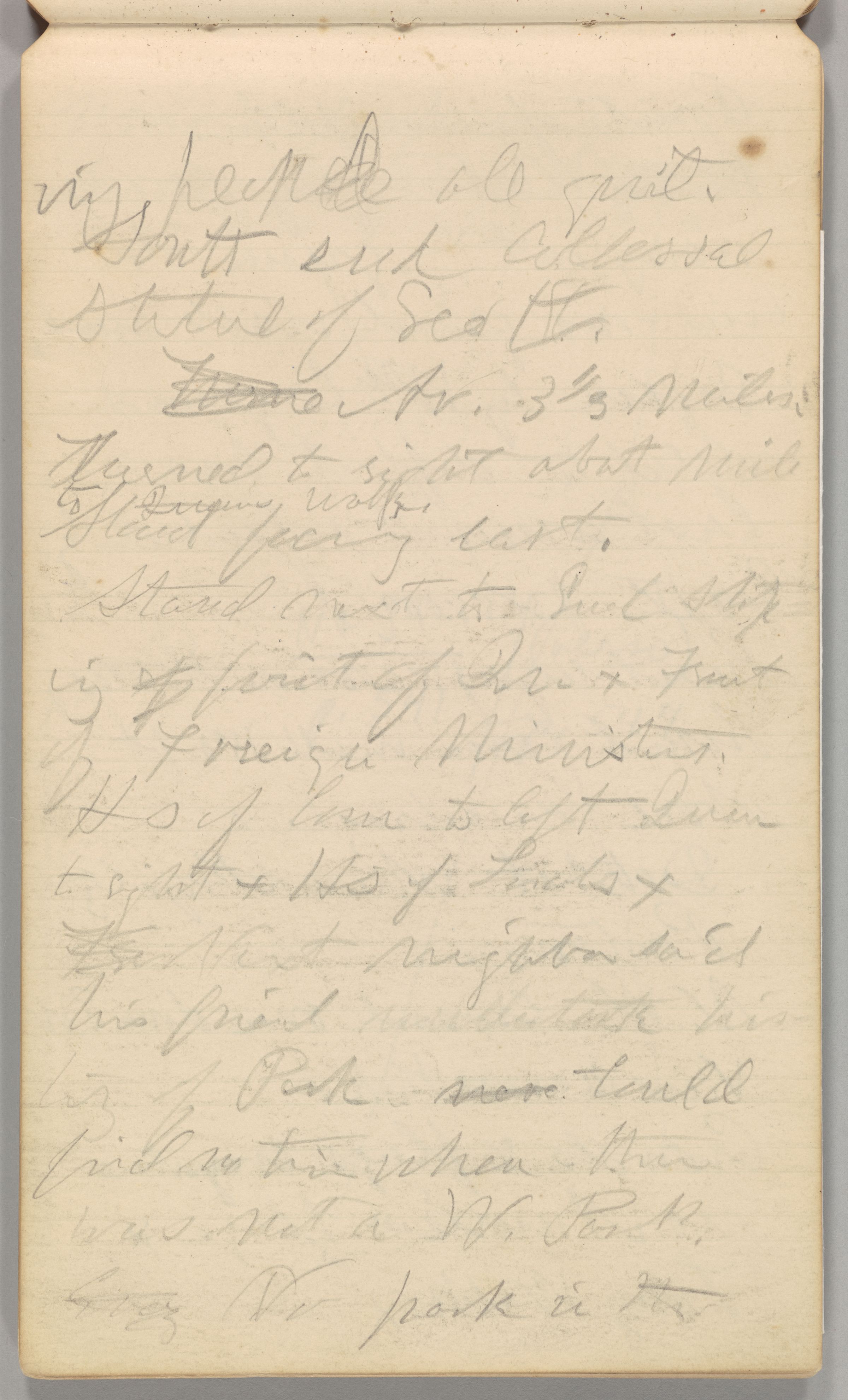
Length of walk 3½ miles. 20 miles around W park. Up the walk came flock
[MS: N12_leaf_]
ing people, all quiet.
South end colossal statue of Geo III.
Turne Avenue 3⅓ miles. Turned to right about mile to Queen's Walk.
Stand facing east.
Stand next to great stopping of point of Queen. Front of foreign ministers. House of Commons to left, Queen to right & House of Lords.
Fr- Next neighbor said his friend undertook history of park neve—could find no time when there was not a Windsor Park. Every No park in the
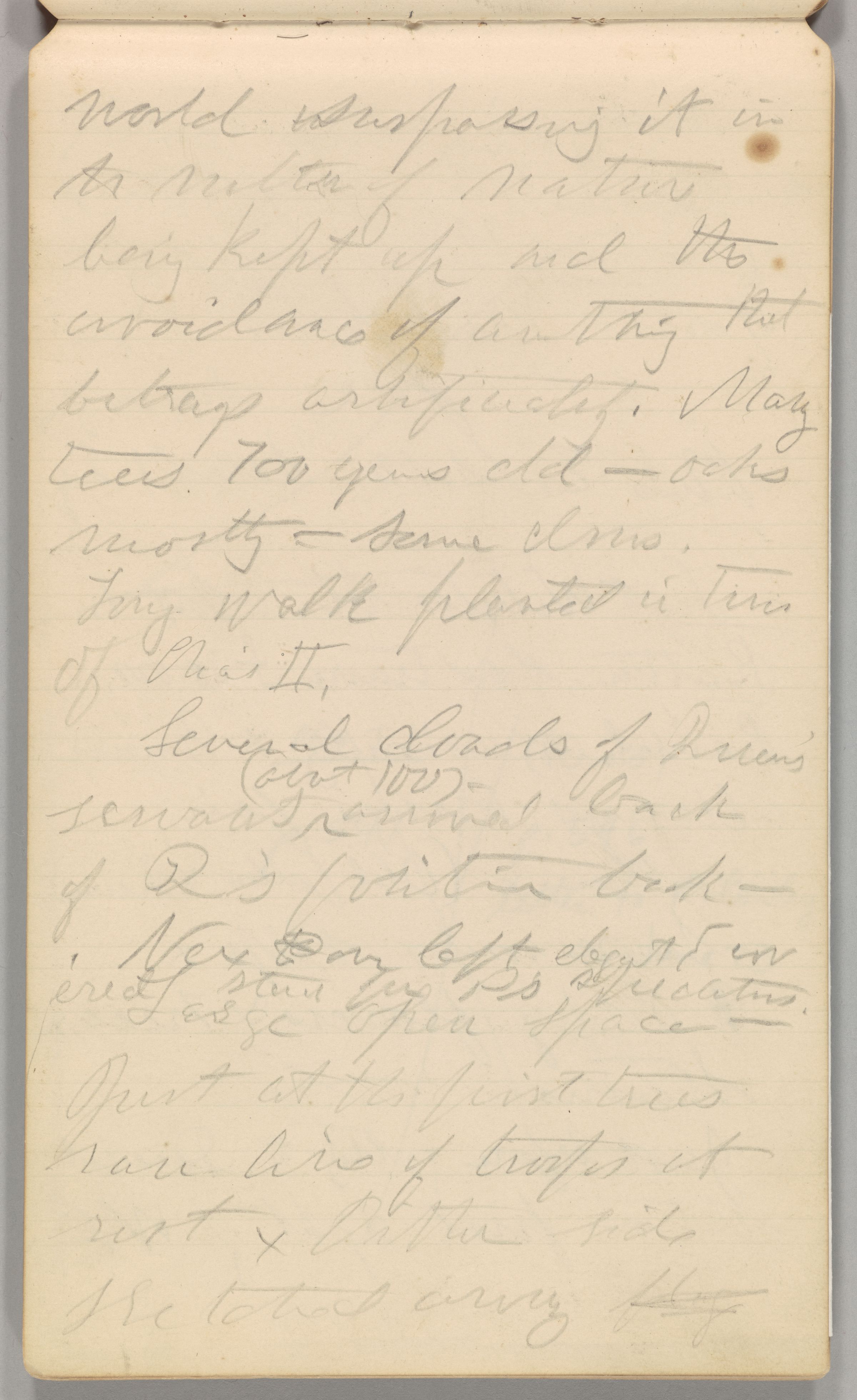
[MS: N12_leaf_]
world surpassing it in the matter of nature being kept up and the avoidance of anything
that betrays artificiality. Many trees 700 years old—oaks mostly—some elms.
Long Walk planted in times of Chas II.
Several carriageloads of Queen's servants (about 100) arrived back of Queen's position back. Next t on left elegant little covered stand for Persian spectators.
Large open space. Just at the first trees ran line of troops at rest. Other side stretched
army flag
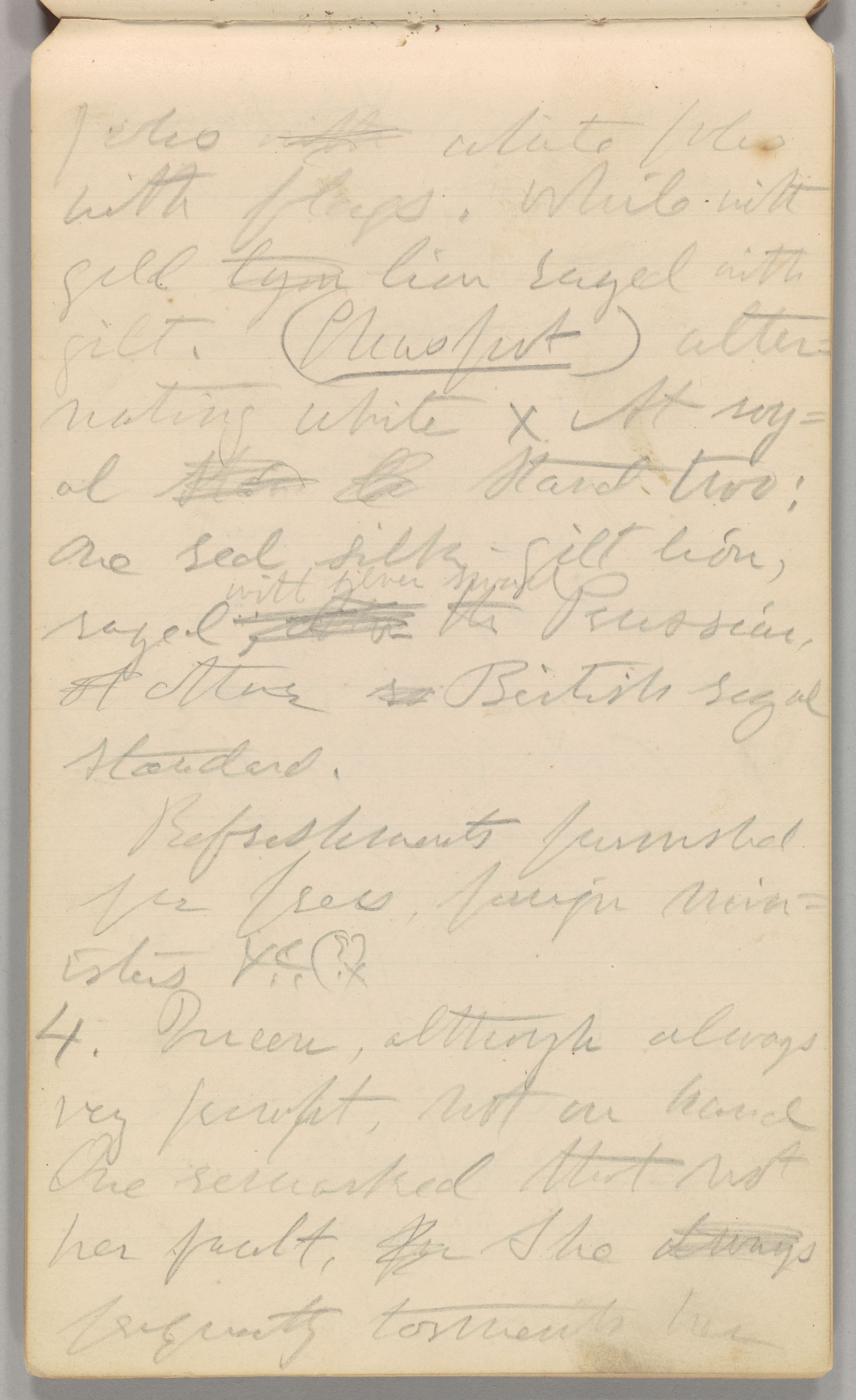
[MS: N12_leaf_]
poles with white poles with flags. White with gold lion rayed with gilt. (Chas first) alternating white. At royal stand two: one red silk-gilt lion, rayed ; other with silver sword; the Prussian, other ro British royal standard.
Refreshments furnished for press, foreign ministers etc.(?)
4 Queen, although always very prompt, not on hand. One remarked that not her fault,
for. She always frequently torments her
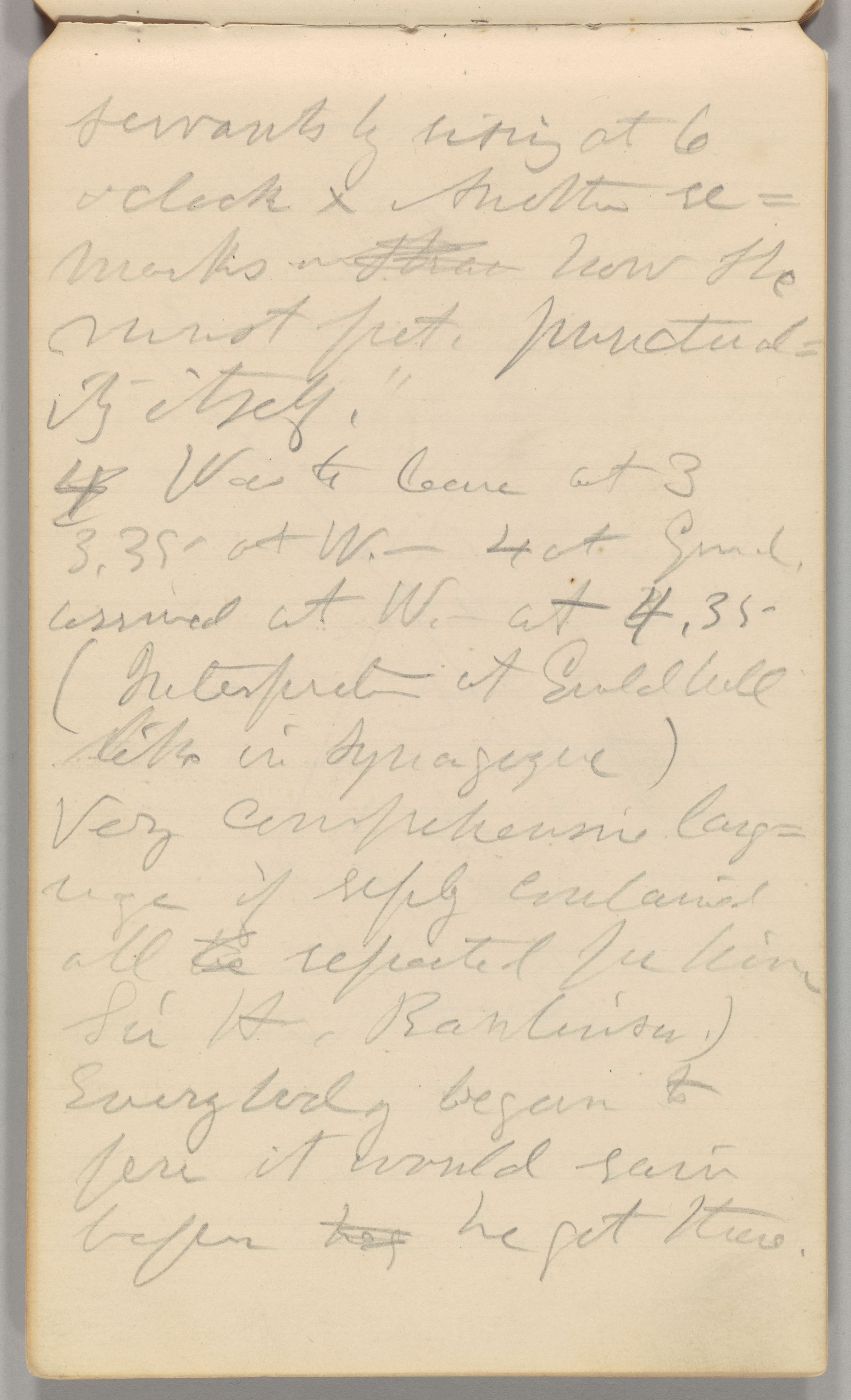
[MS: N12_leaf_]
servants by rising at 6 o'clock. Another remarks —tha how she must one word punctuality itself.
4 Was to leave at 3. 3:35 at Windsor, 4 at ground; arrived at Windsor at 34:35
(Interpreter at Guildhall like in synagogue.) Very comprehensive language if reply contained all the repeated for him (Sir H. Rawlinson).31 Everybody began to fear it would rain before he got there.
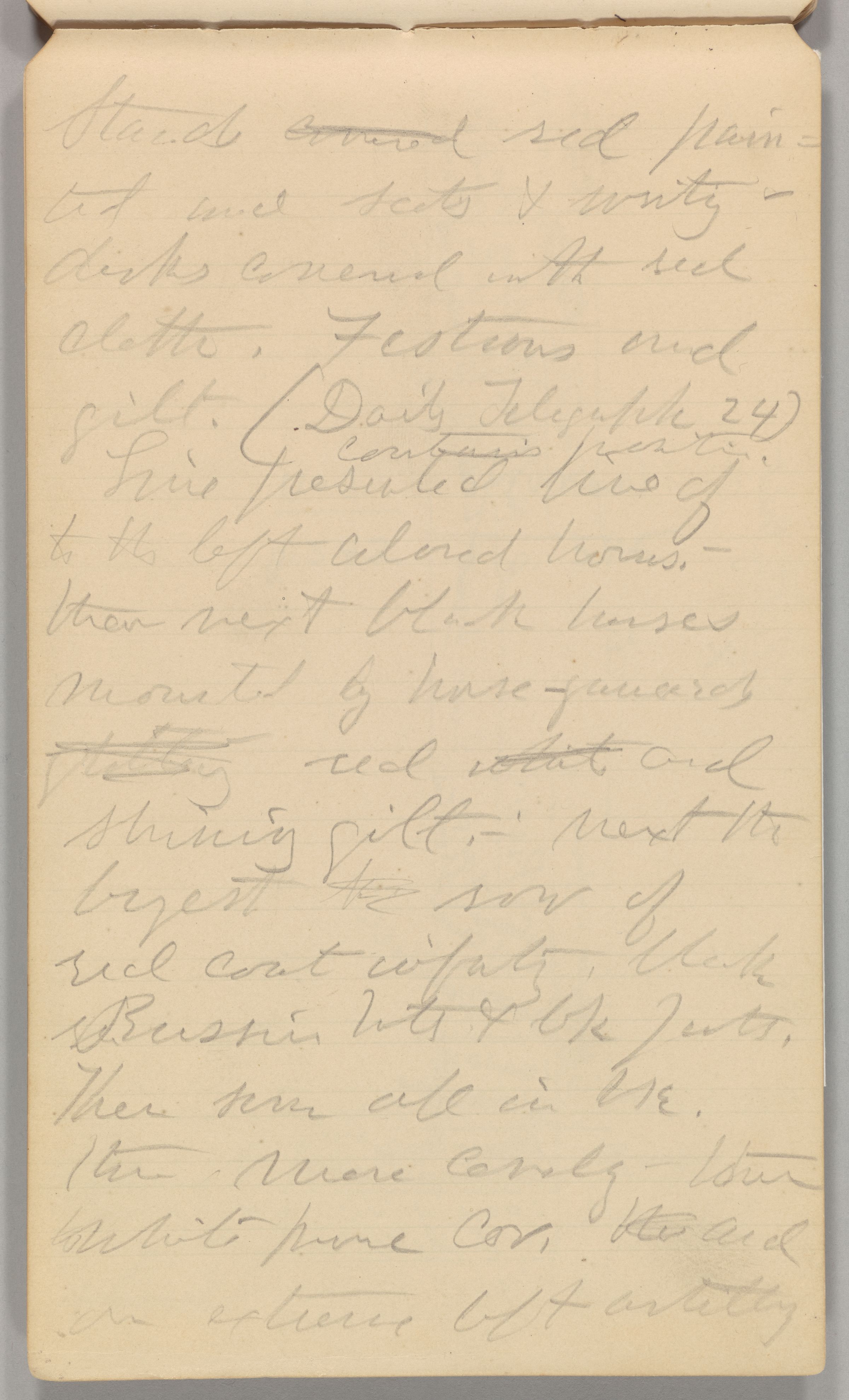
[MS: N12_leaf_]
Stands covered red painted and seats & writing-desks covered with red cloth. Festoons and gilt. (Daily Telegraph contains 24 positions)
Line presented line of to the left colored horses. Then next black horses mounted by Horse Guards, glittering red white and shining gilt. And next the biggest row of red coat infantry, black ruRussian hats & black pants. Then some all in black. Then more cavalry—then white horse cavalry the and on extreme left artillery
[MS: N12_leaf_]
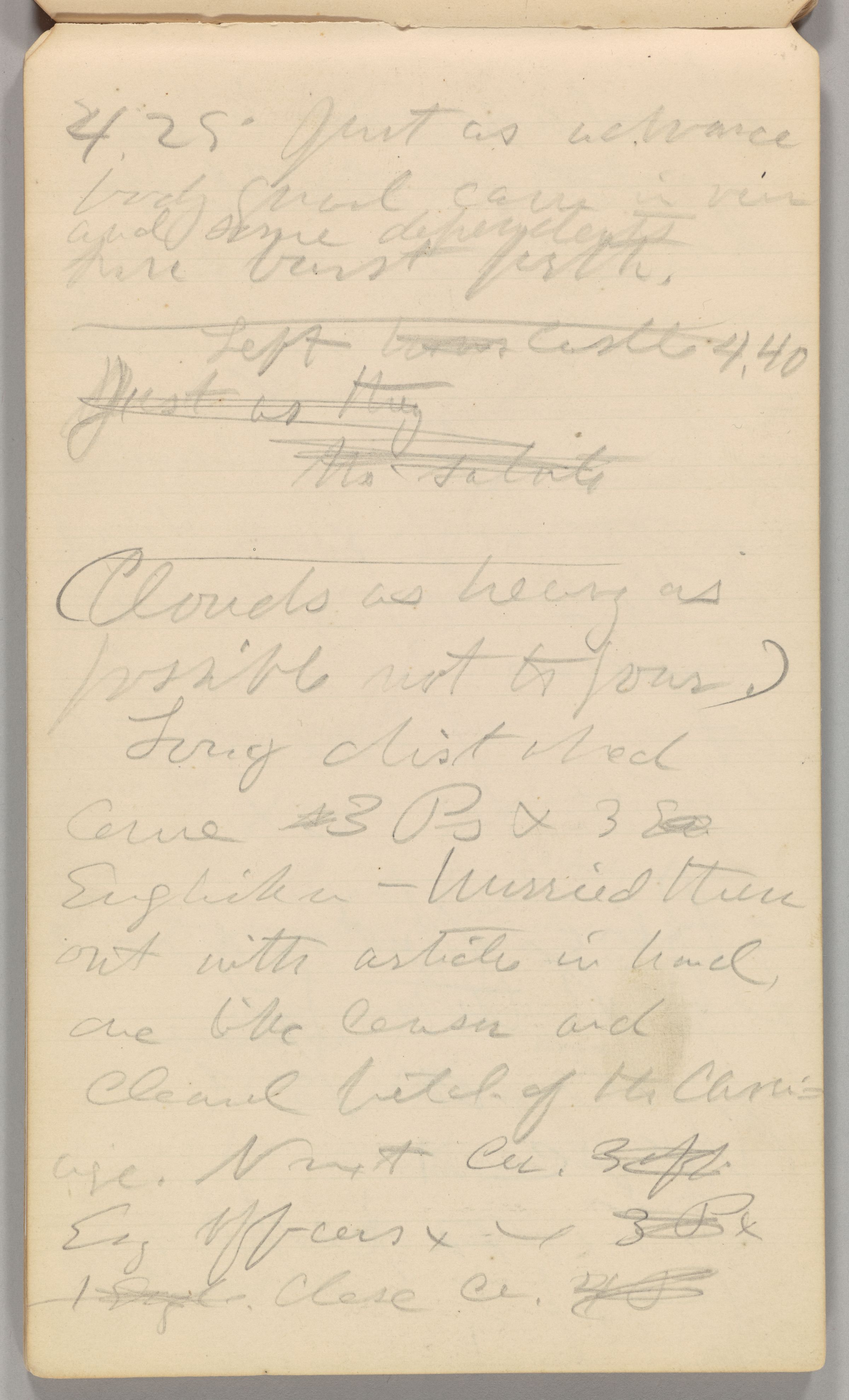
4:25 Just as advance body guard came in view, and some dependents, sun burst forth.
Left town Castle 4:40 just as they
The salute
(Clouds as heavy as possible not to pour.)
Long distance ahead came 3 Persians & 3 Englishmen—hurried them out with articles
in hand, one like censer and cleared field of the carriage. Next carriage 3 off English officers. Next 3 Persians & 1 English closed carriage 4 Persians
[MS: N12_leaf_]
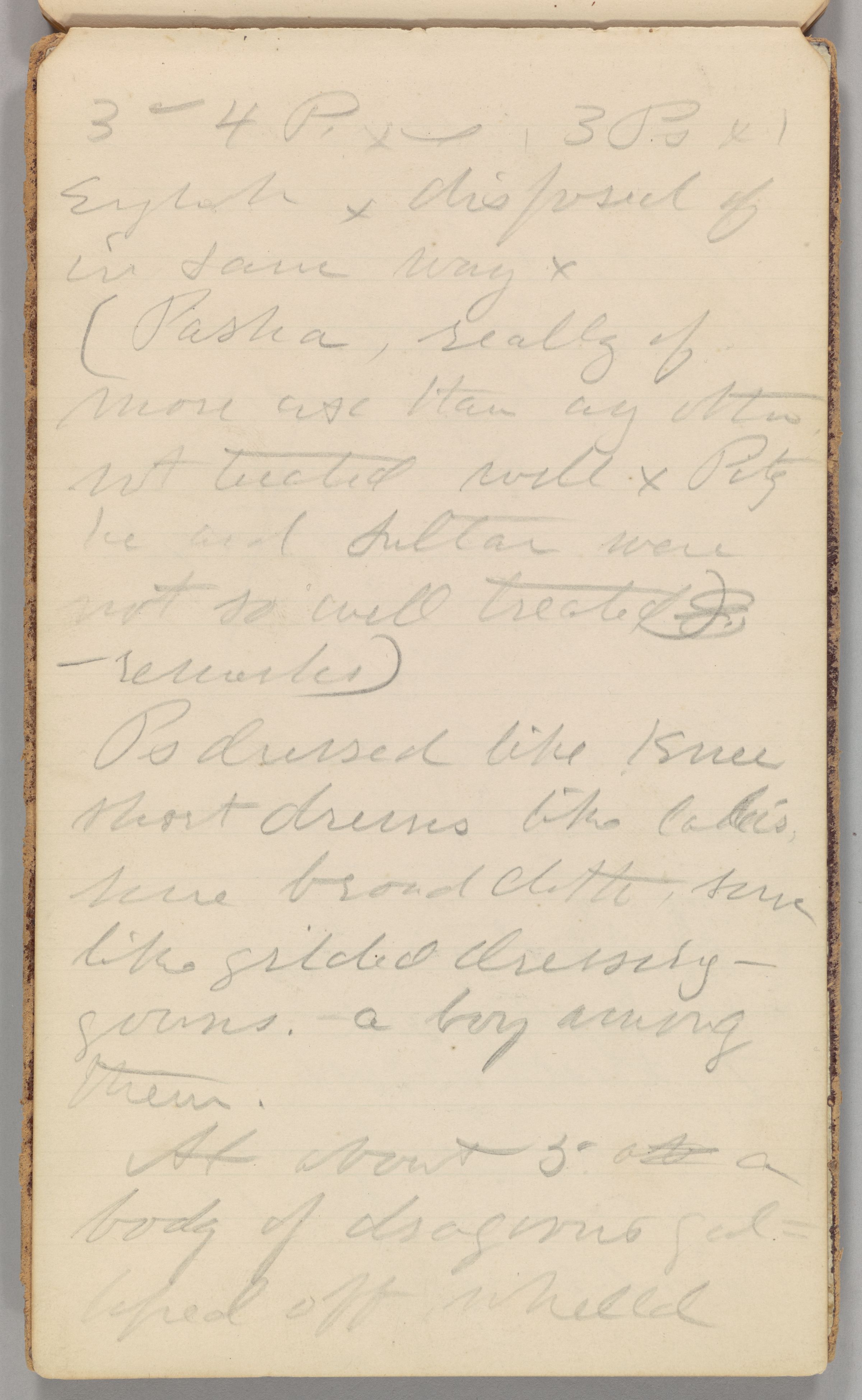
3 or 4 Persians. Next 3 Persians & 1 English. Disposed of in same way.
(Pasha, really of more use than any other, not treated well. Pity he and Sultan were not so well treated.)—remarks)
Persians dressed like knee short dresses like ladies, some broadcloth, some like gilded dressing gowns. A boy among them.
At about 5 ab a body of dragoons galloped off, wheeled
[MS: N12_leaf_]
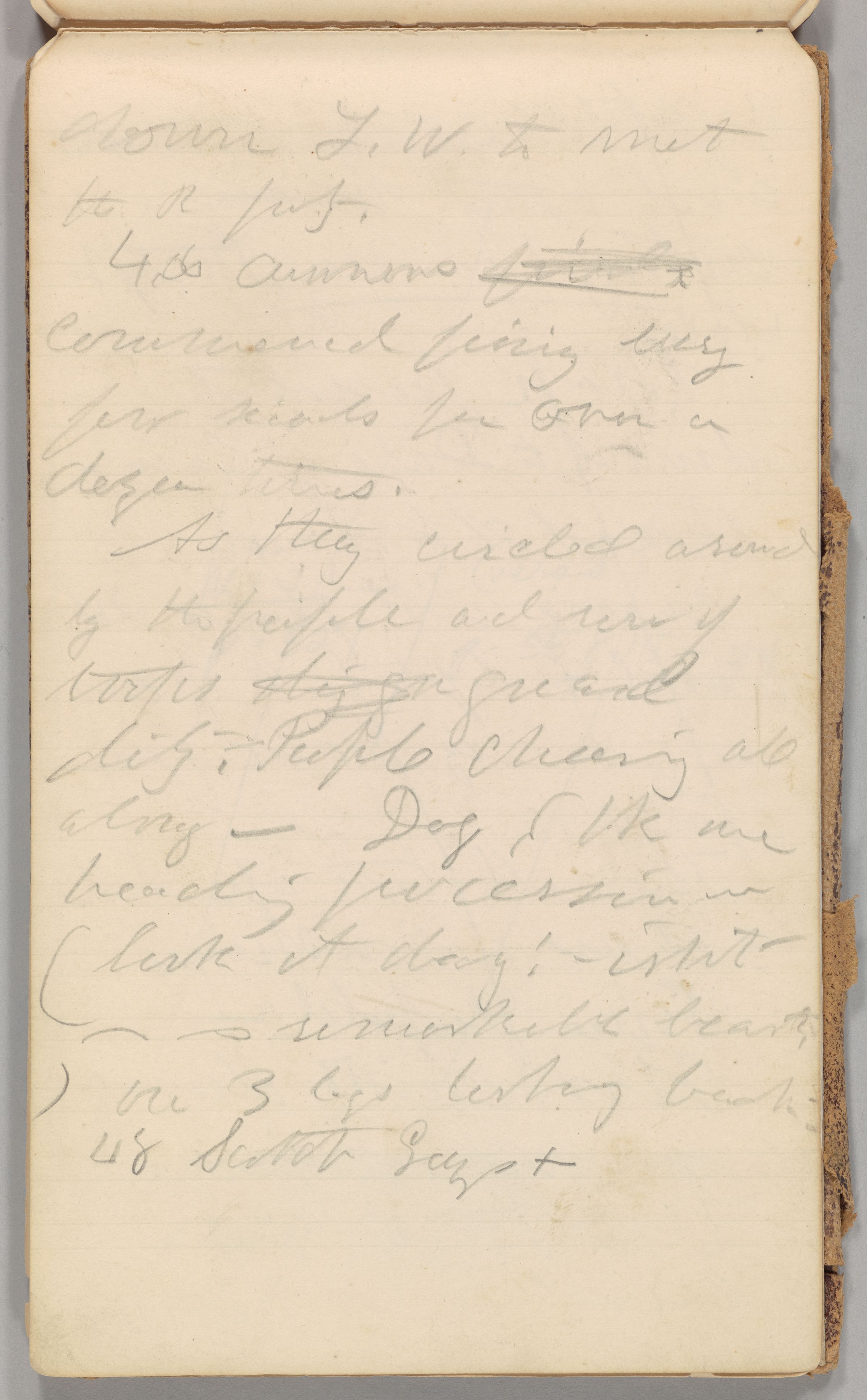
down Long Walk to meet the royal party.
4:06 Cannons fired commenced firing every few seconds for over a dozen times.
As they circled around by the people and row of troops doing gu guard duty. People cheering all along—
Dog little black one heading procession—(look at dog! Isn't he most remarkable beast?) On 3 legs walking back-
48 Scotch Greys.
[MS: N12_leaf_]
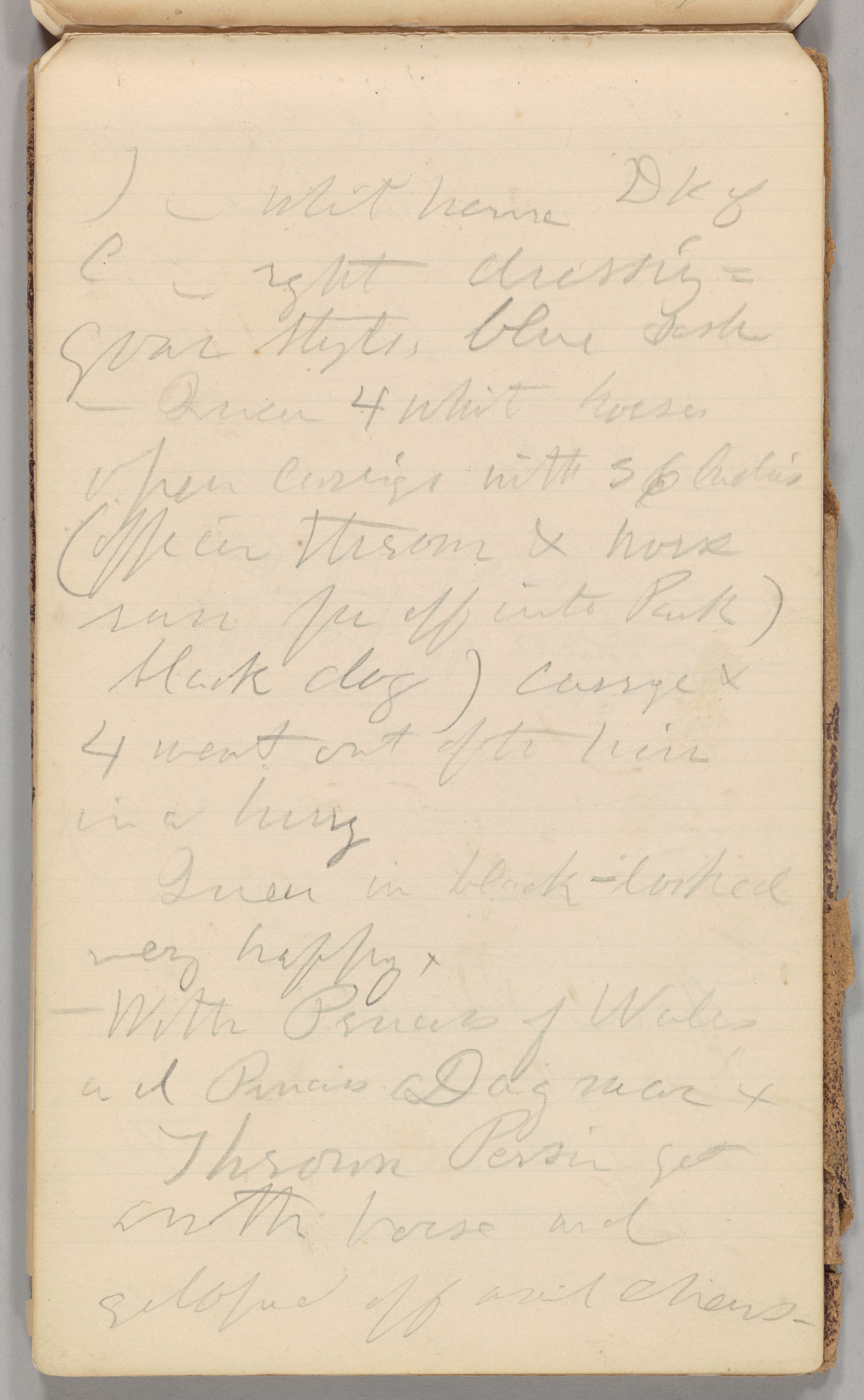
Shah on white horse. Duke of Cambridge on right, dressing gown style, blue sash—Queen 4 white horses, open carriage with 3 ladies.
(Officer thrown & horse ran far off into park)
Black dog, Shah's carriage & 4 went out after him in a hurry
Queen in black—looked very happy. With Princess of Wales and Princess Dagmar.
Thrown Persian got another horse and galloped off amid cheers.
[MS: N12_leaf_]
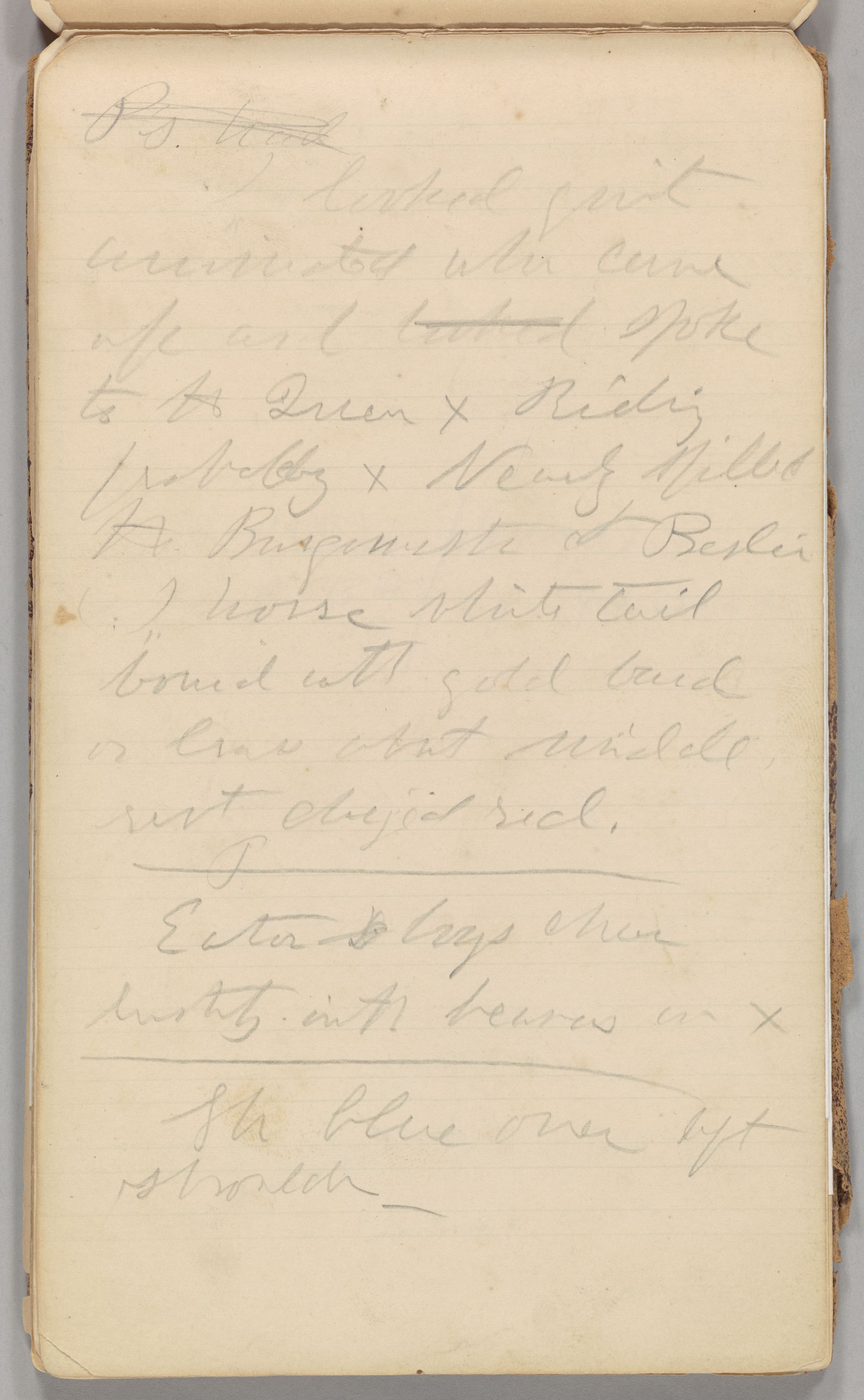
Persians had
Shah looked quite animated when came up and looked spoke to the Queen. Riding proudly. Nearly spilled. The Burgomaster of Berlin. That Shah's horse white tail bound with gold band or brass about middle, rest dyed red.
Eton boys cheer lustily with beavers on.
Shah, blue over left shoulder—
[MS: N12_leaf_]
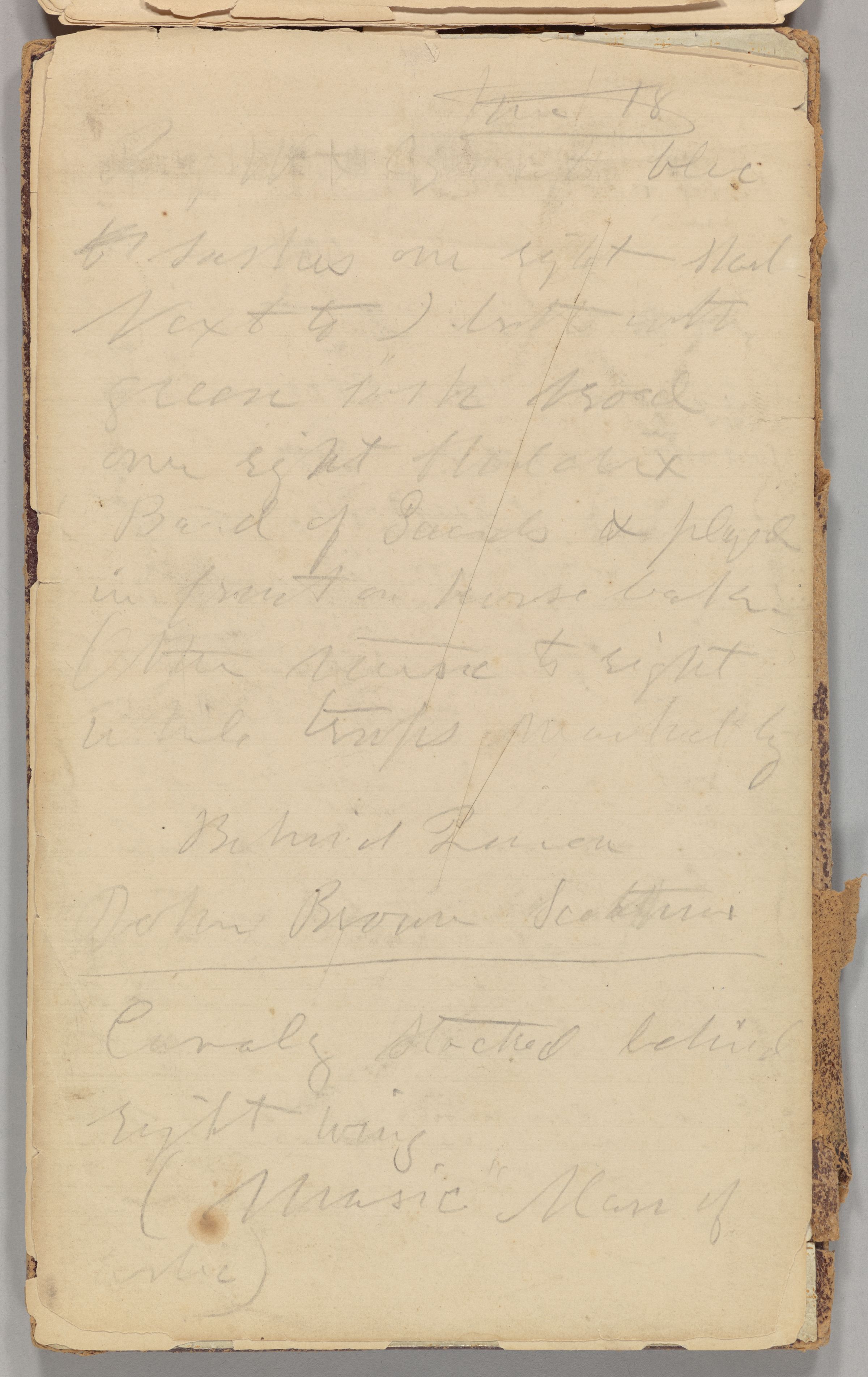
June 18
Prince of Wales & Czar32 with blue sashes over right shoulder. Next to Shah, brother with green sash broad over right shoulder. Then Band of Guards & played in front on horseback. Other music to right while troops marched by
Behind Queen, John Brown Scotchman33
Cavalry stacked behind right wing
(Music “Man of Airlie”)
[MS: N12_leaf_]
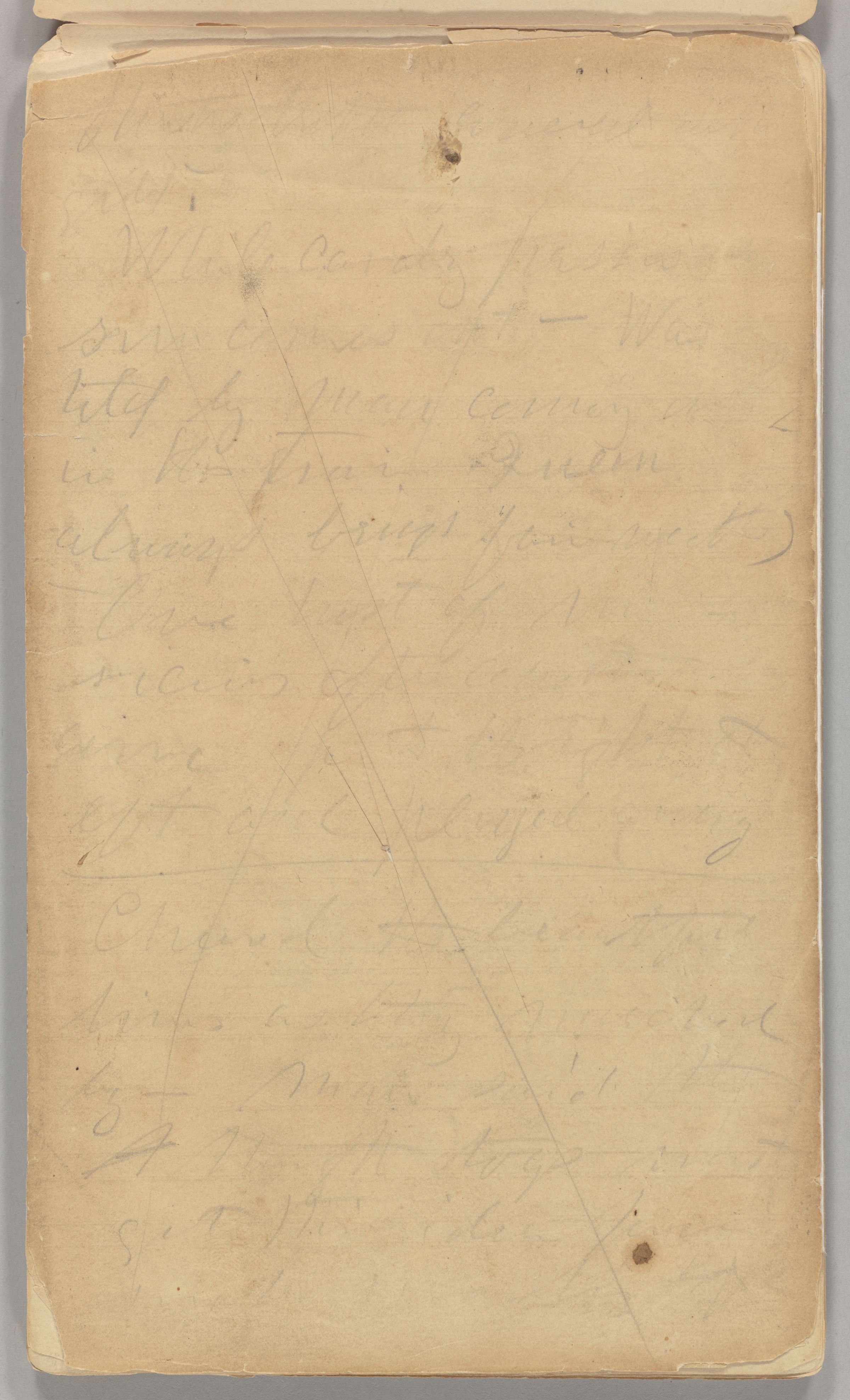
Shah's brother covered with gilt.
While cavalry passes, sun comes out. (Was told by man coming in in the train, Queen always brings fair weather)
One host of musicians after another came up to the right & left and played away
Cheered the beautiful lines as they marched by—man said that thought troops must get this idea from two or three words etc.
[MS: N12_leaf_]
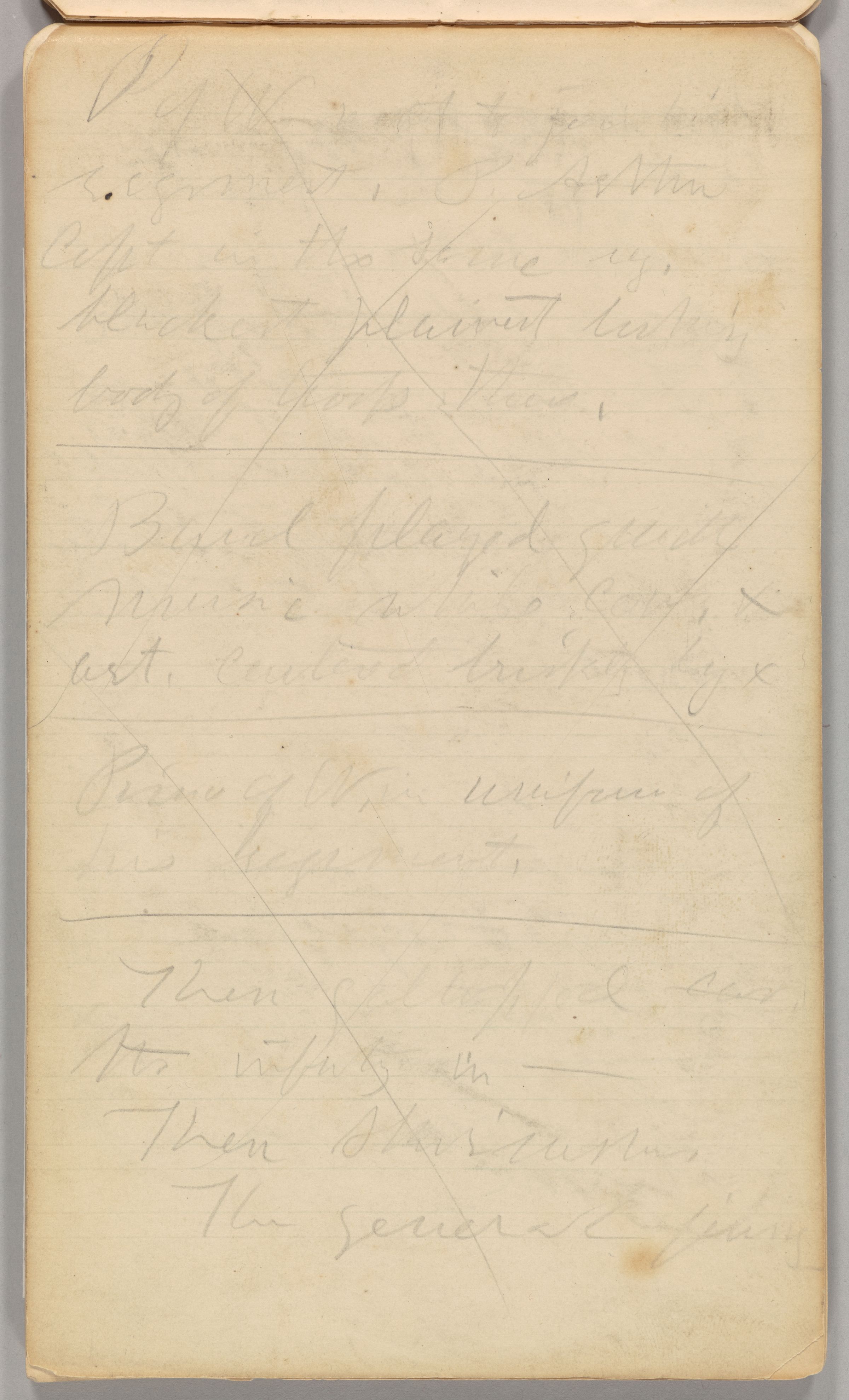
Prince of Wales went to join his regiment. Prince Arthur, captain in this same regiment. Blackest plainest looking body of troops there.
Band played quick music while cavalry & artillery cantered briskly by.
Prince of Wales in uniform of his regiment.
Then galloped cavalry the infantry in—
Then skirmishers
Then general firing
[MS: N12_leaf_]
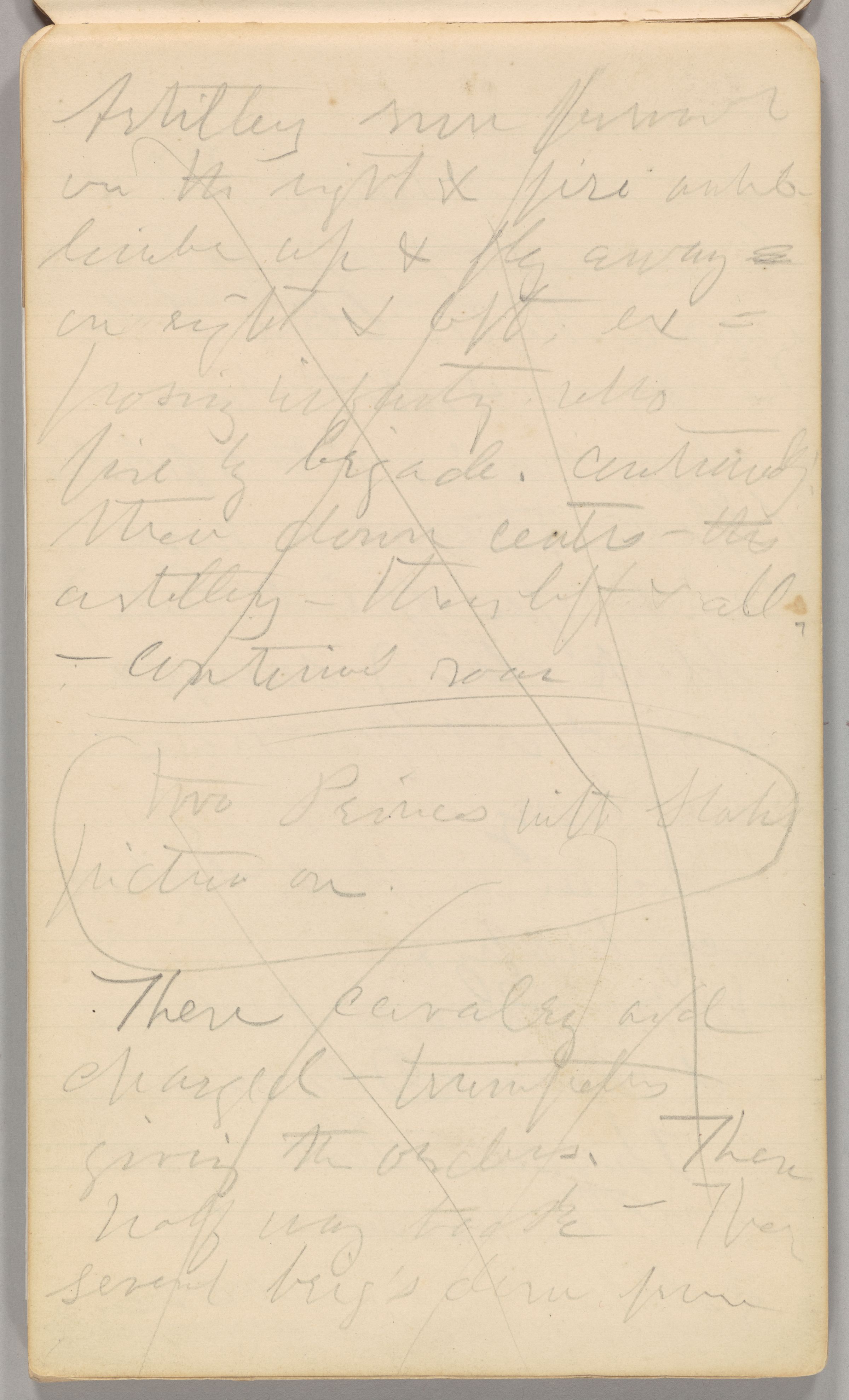
Artillery run forward on the right & fire awhile, limber up & fly away on right & left, exposing infantry who fire by brigade. Continually! Then down centre—the artillery—then left & all—continuous roar
Two princes with Shah's picture on.
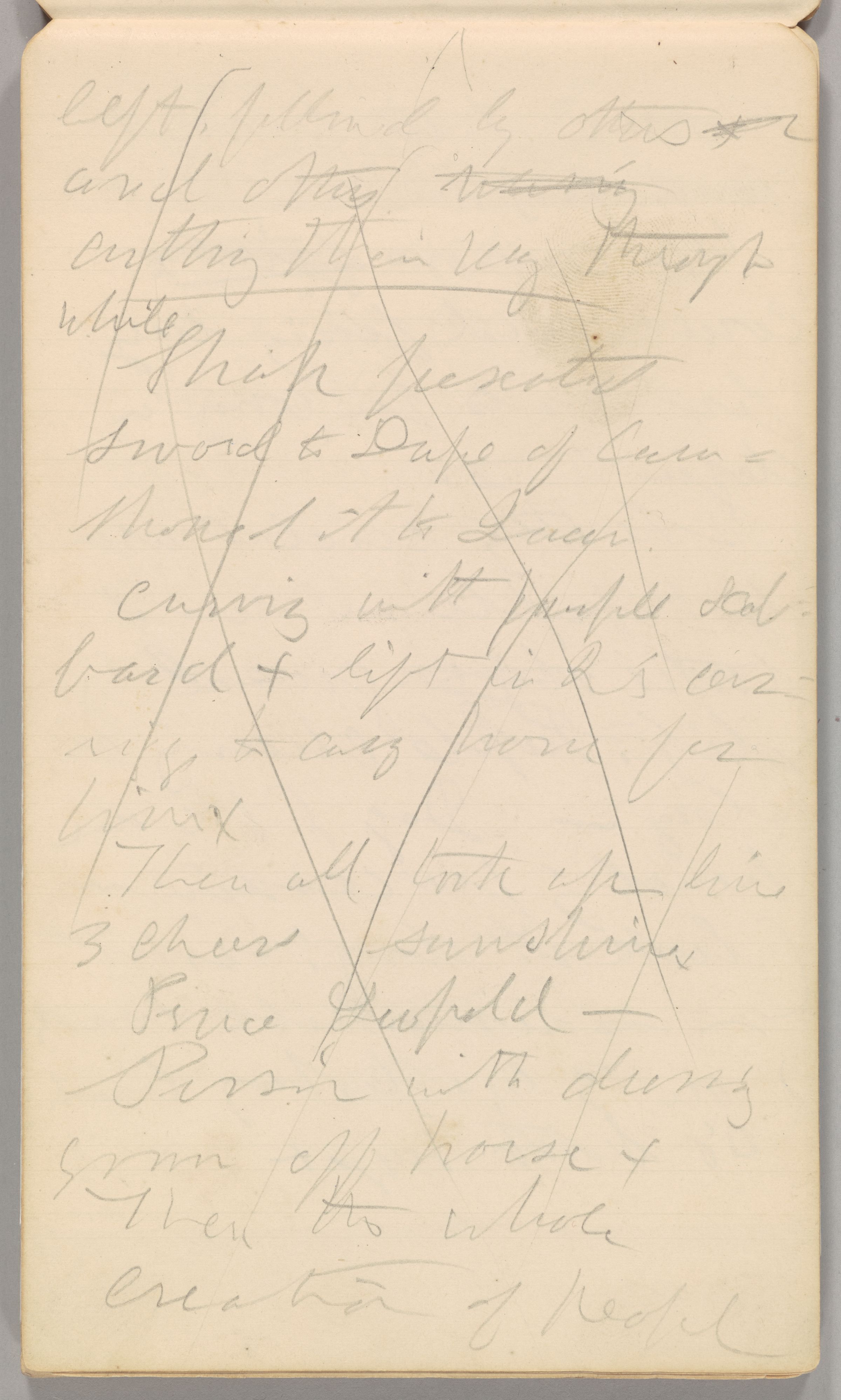
Then cavalry and charged—trumpeters giving the orders. Then halfway troops—then several brigades down from
[MS: N12_leaf_]
left, followed by others. and others weaving cutting their way through while
Shah presented sword to Duke of Cambridge, showed it to Queen. Curving with purple scabbard. Left in Queen's carriage to carry home for him.
Then all took up line. 3 cheers. Sunshine.
Prince Leopold—
Persian with dressing gown off horse.
Then the whole creation of people
[MS: N12_leaf_]
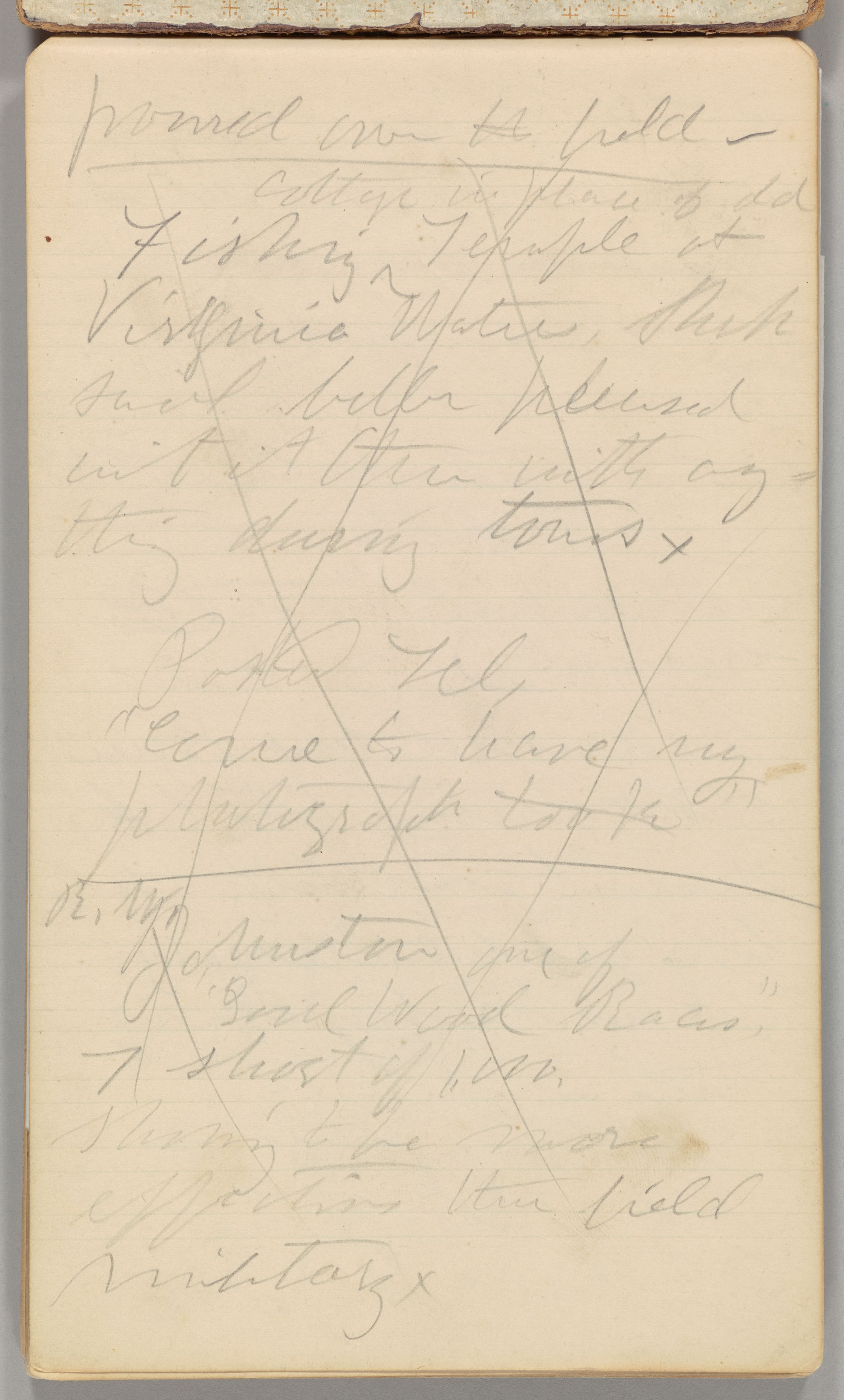
poured over the field—
Fishing Cottage in place of old temple at Virginia Waters. Shah said better pleased with it than with anything during tours.
Postal Telegraph, “Come to have my photograph took”
R.W. Johnston one of “Goodwood Races,”
7 short of 1,000
Showing to be more effective than field military.
[MS: N12_leaf_]
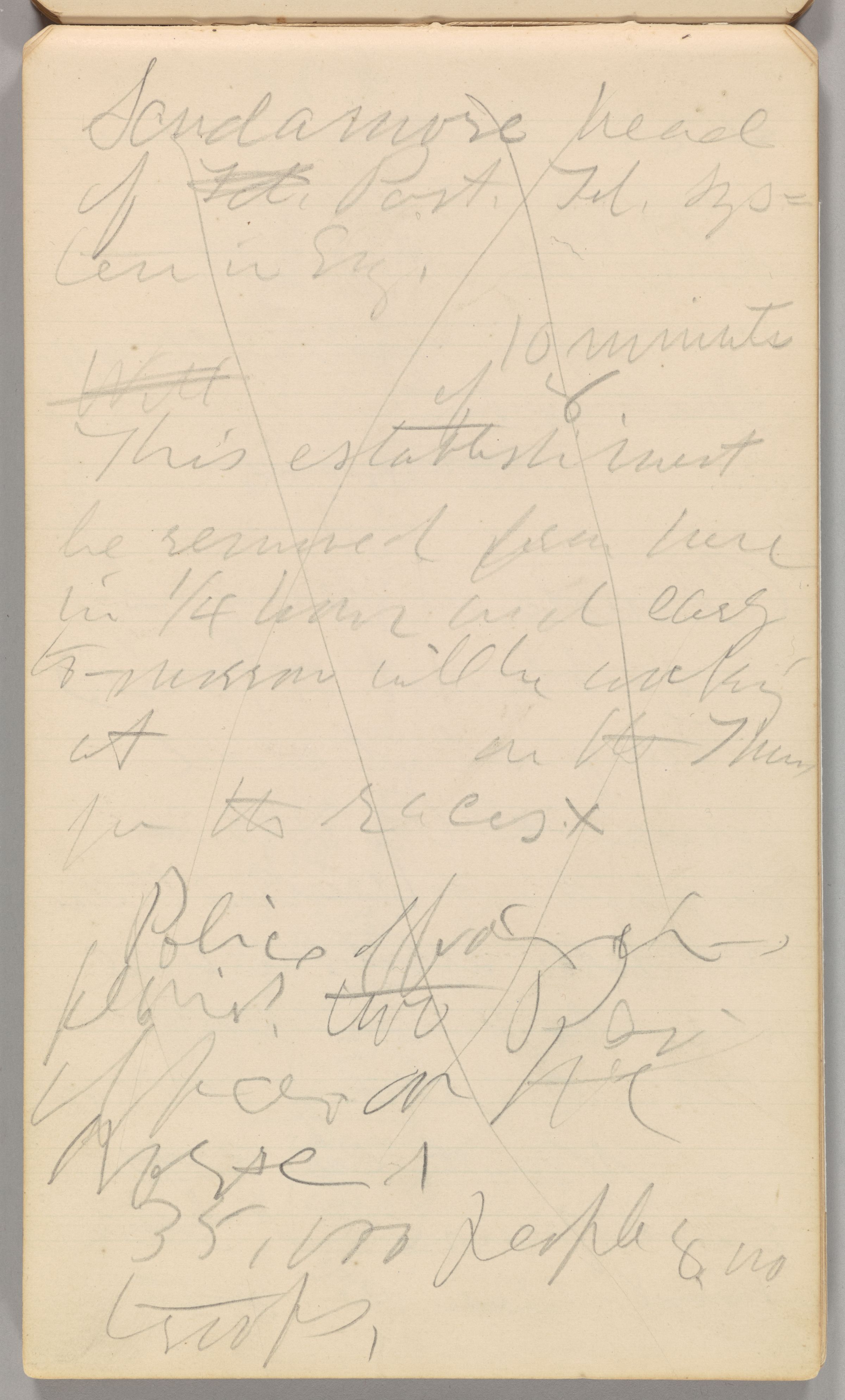
Scudamore head of Telegraph Postal Telegraph system in England.34
10 minutes of 8. Will This establishment be removed from here in ¼ hour and early tomorrow will be working at blank space on the Th--- for the races.
Police officer explained. Two Persian officers on the horse road
35,000 people 8,000 troops.
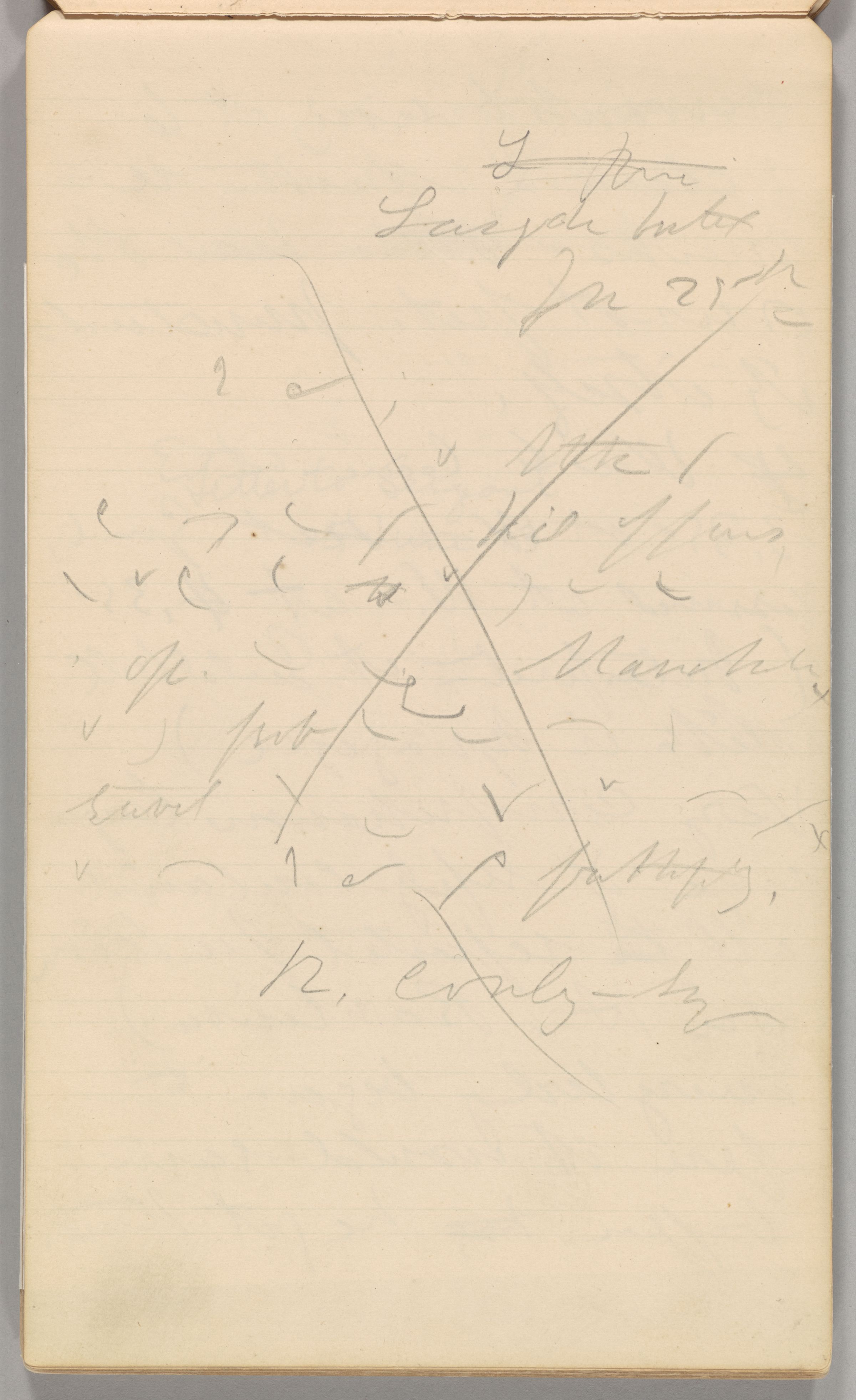
[MS: N12_leaf_]
L June
Langham hotel
June 25th
Dear sir;
I thank you very much for your kind offers, but I fear that I shall not have an opportunity of visiting Manchester. I shall probably have no time to travel about any while I am here. I am dear sir yours faithfully.
R. Cowley—Esq.35
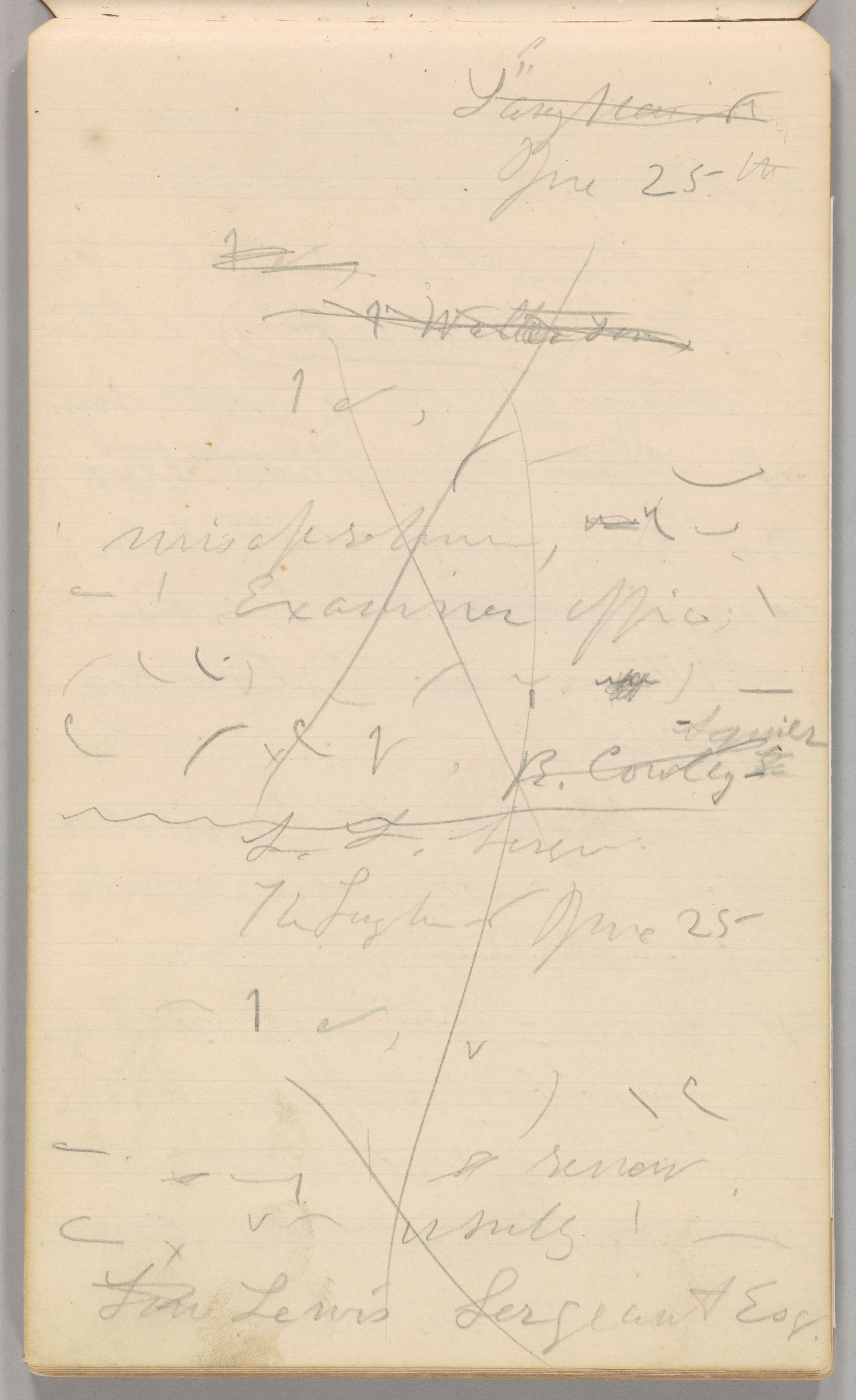
[MS: N12_leaf_]
Langham hotel
June 25th
Dear sir,
Dear Watterson,36
Dear sir,
You are under a misapprehension, I have not called at the Examiner office; but all that have said in your note—should go very well. Very dearly,
R. Cowley—Esquire
L. L. Sergeant
The Langham hotel
June 25
My dear sir,
I shall be very glad indeed to renew the acquaintance. I am usually at home
this signature probably intended for the closer on the next page
Lew Lewis Sergeant Esq.
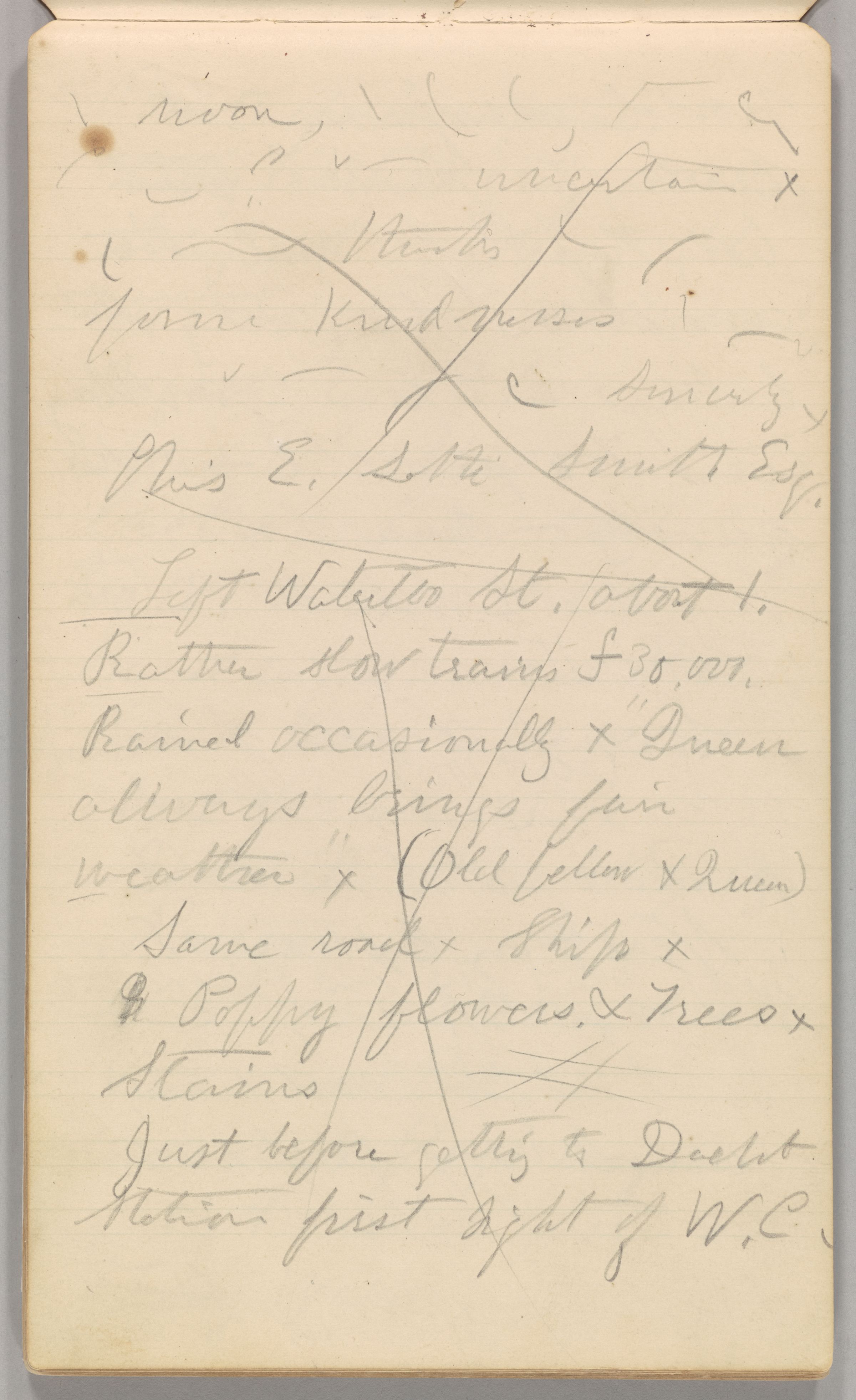
[MS: N12_leaf_] about noon, but after that, like everybody else in London I am uncertain. With many thanks for your former kindnesses to me, I am yours very sincerely.
Chas E. Soth Smith Esq.
Left Waterloo Station about 1. Rather slow trains £30,000. Rained occasionally. “Queen always brings fair weather.” (Old fellow & Queen)
Same road. Ship.
Poppy flowers. & trees.
Staines
Just before getting to Datchet Station first sight of Windsor Castle.37
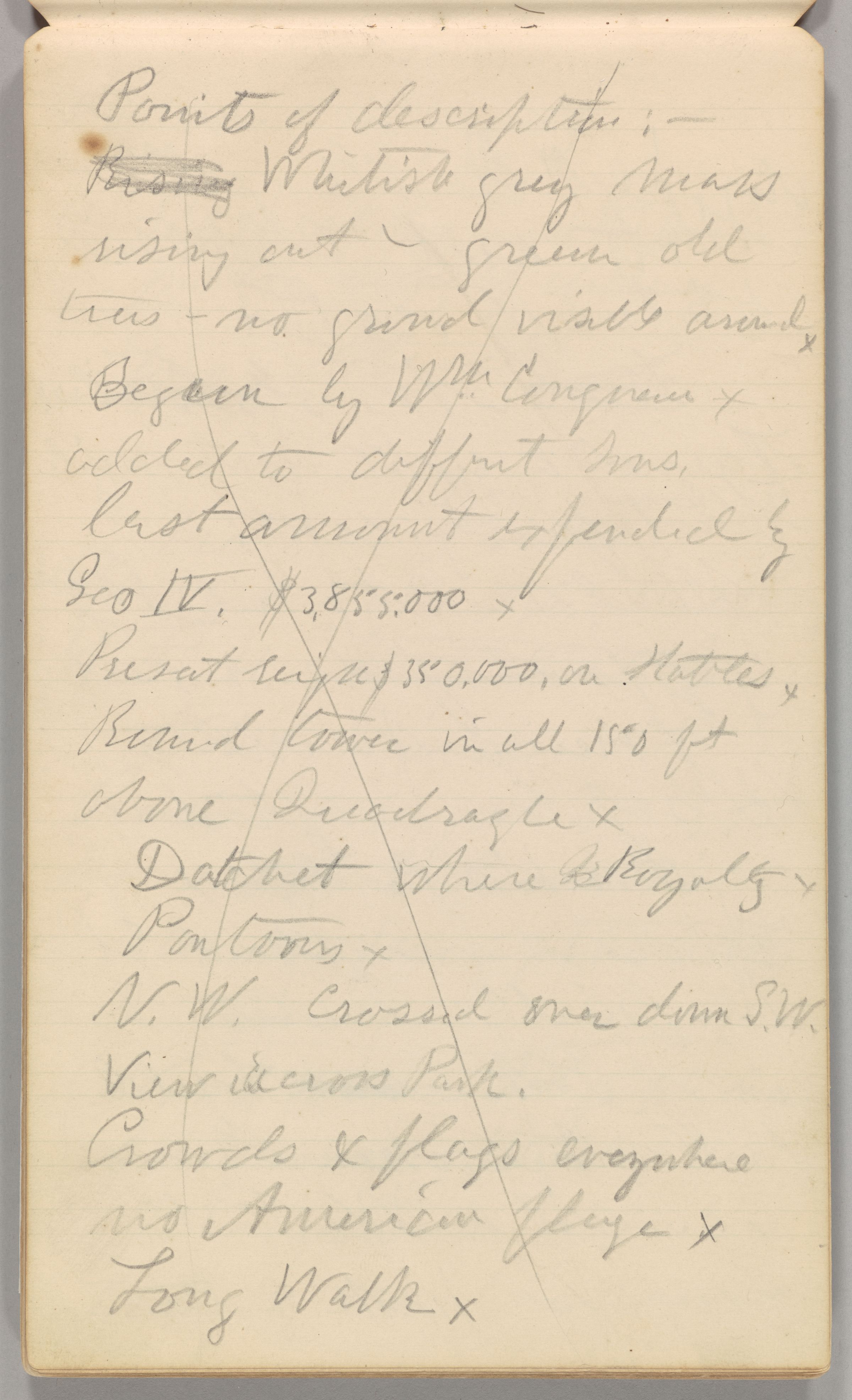
[MS: N12_leaf_]
Points of description:
Rising Whitish grey mass rising out of green old trees—no ground visible around.
Begun by Wm Conqueror, added to different sums, last amount expended by Geo IV, $3,855,000.
Present reign $350,000 on stables.
Round tower in all 150 ft above Quadrangle.
Datchet where Q royalty.
Pontoons.
N. W., Crossed over down S. W.
View across park.
Crowds & flags everywhere. No American flags.
Long Walk.
[MS: N12_leaf_]
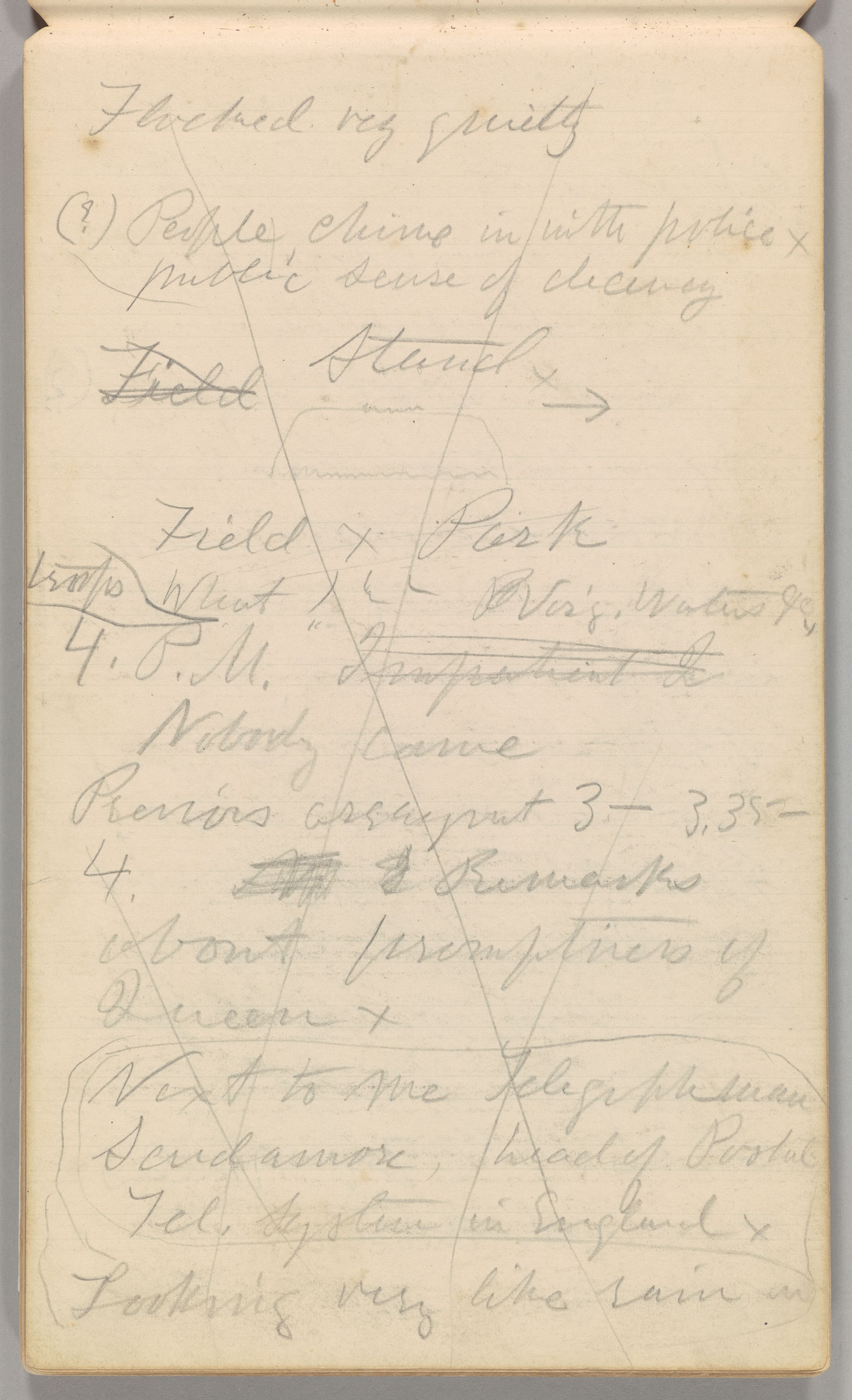
Flocked very quietly
(?) People chime in with police. Public sense of decency
What Shah thought of P Virginia Waters etc.
Troops
4 P.M. Impatient Q Nobody came
Previous arrangement 3—3:35—4. Remarks about promptness of Queen.
Next to me Telegraphman Scudamore, head of Postal Telegraph System in England.
Looking very like rain
[MS: N12_leaf_]
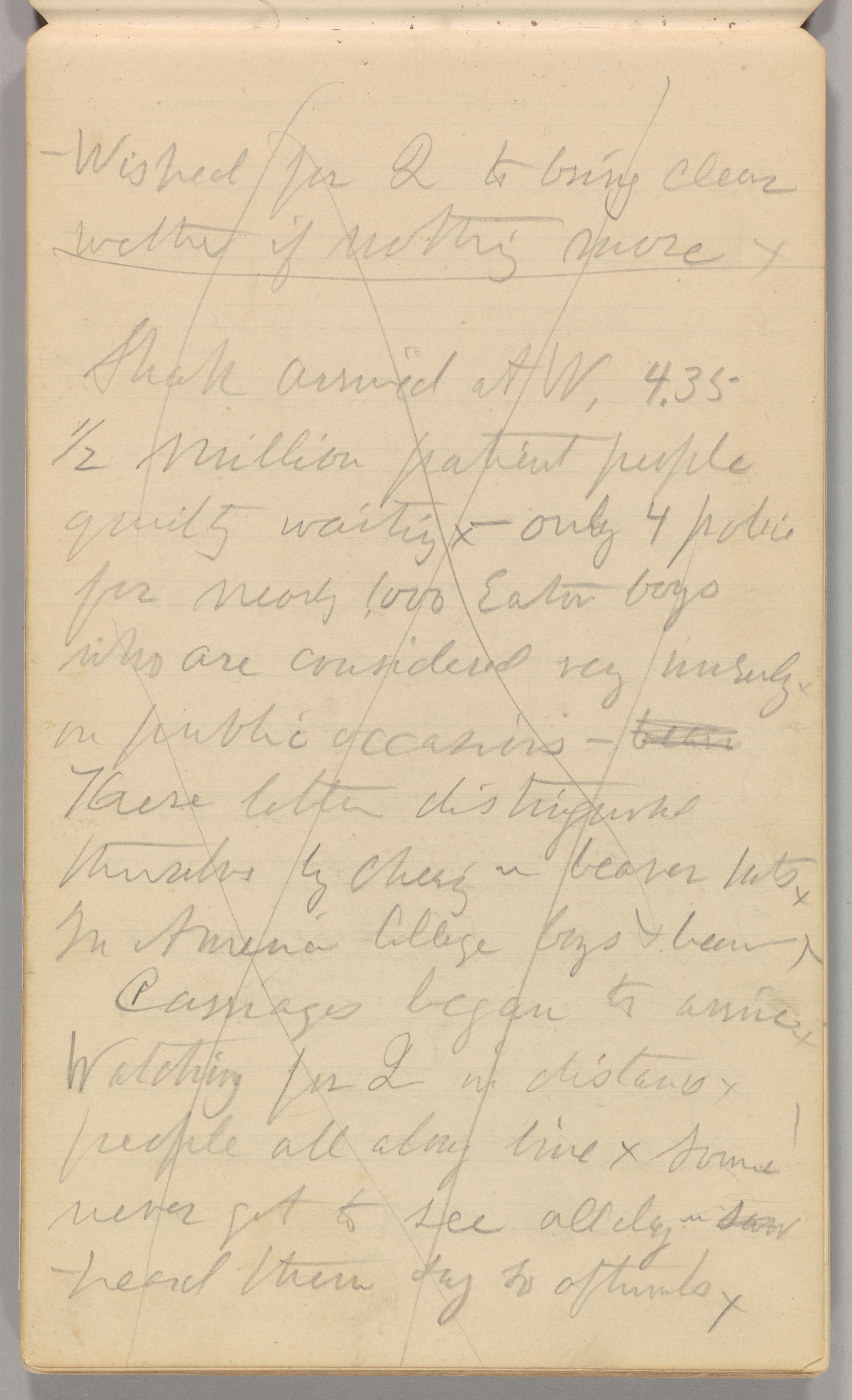
—wished for Queen to bring clear weather if nothing more.
Shah arrived at Windsor 4:35. ½ million patient people quietly waiting. Only 4 police for nearly 1,000 Eton boys who are considered very unruly, on public occasions—beav. These latter distinguished themselves by cheering—beaver hats. In America college boys & beavers.
Carriages began to arrive. Watching for Queen in distance. People all along line. Some never got to see all day—saw—heard them say so afterwards.
[MS: N12_leaf_]
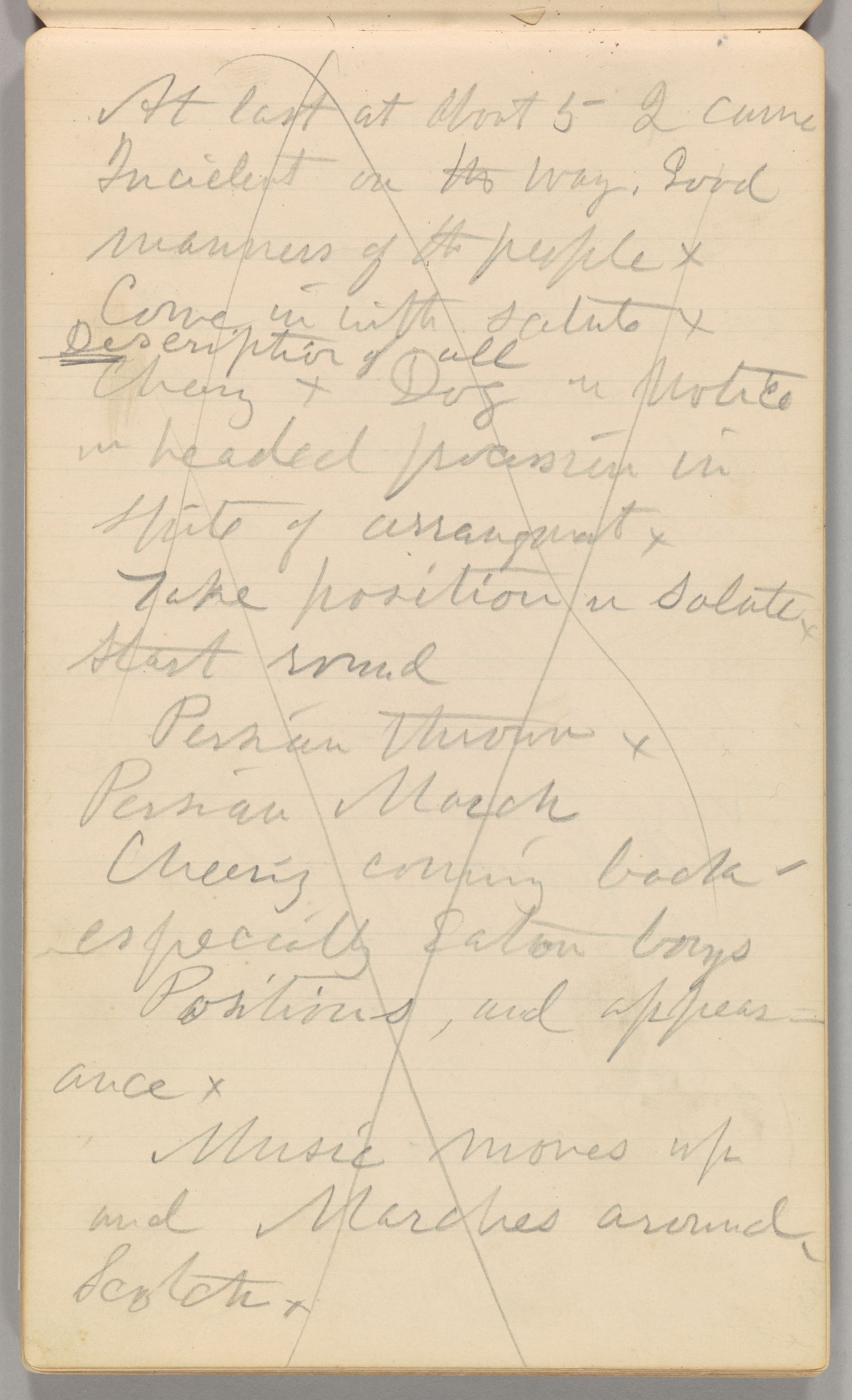
At last at about 5 Queen came. Incident on the way. Good manners of the people. Come in with salute. Description of all. Cheering. Dog—notice—headed procession in spite of arrangement. Take position—salute. Start round
Persian thrown.
Persian March
Cheering coming back—especially Eton boys
Positions, and appearance.
Music moves up and marches around.
Scotch.
[MS: N12_leaf_]
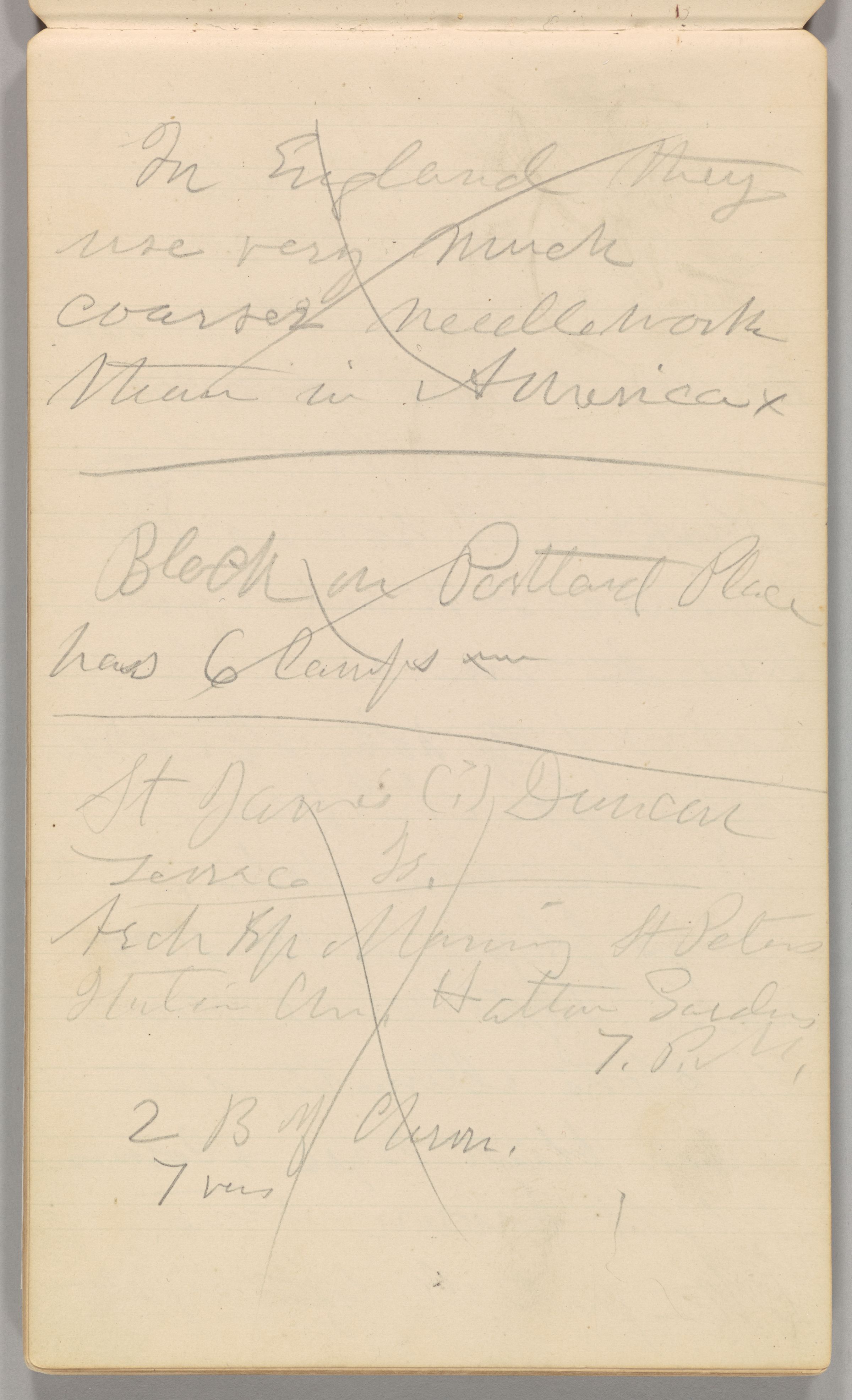
In England they use very much coarser needlework than in America.
Block on Portland Place has 6 lamps.
St. James'(?), Duncan Terrace, Islington.
Archbishop Manning, St. Peter's, Italian Church, Hatton Gardens, 7 P.M.
2 Book of Chron., 7 verse
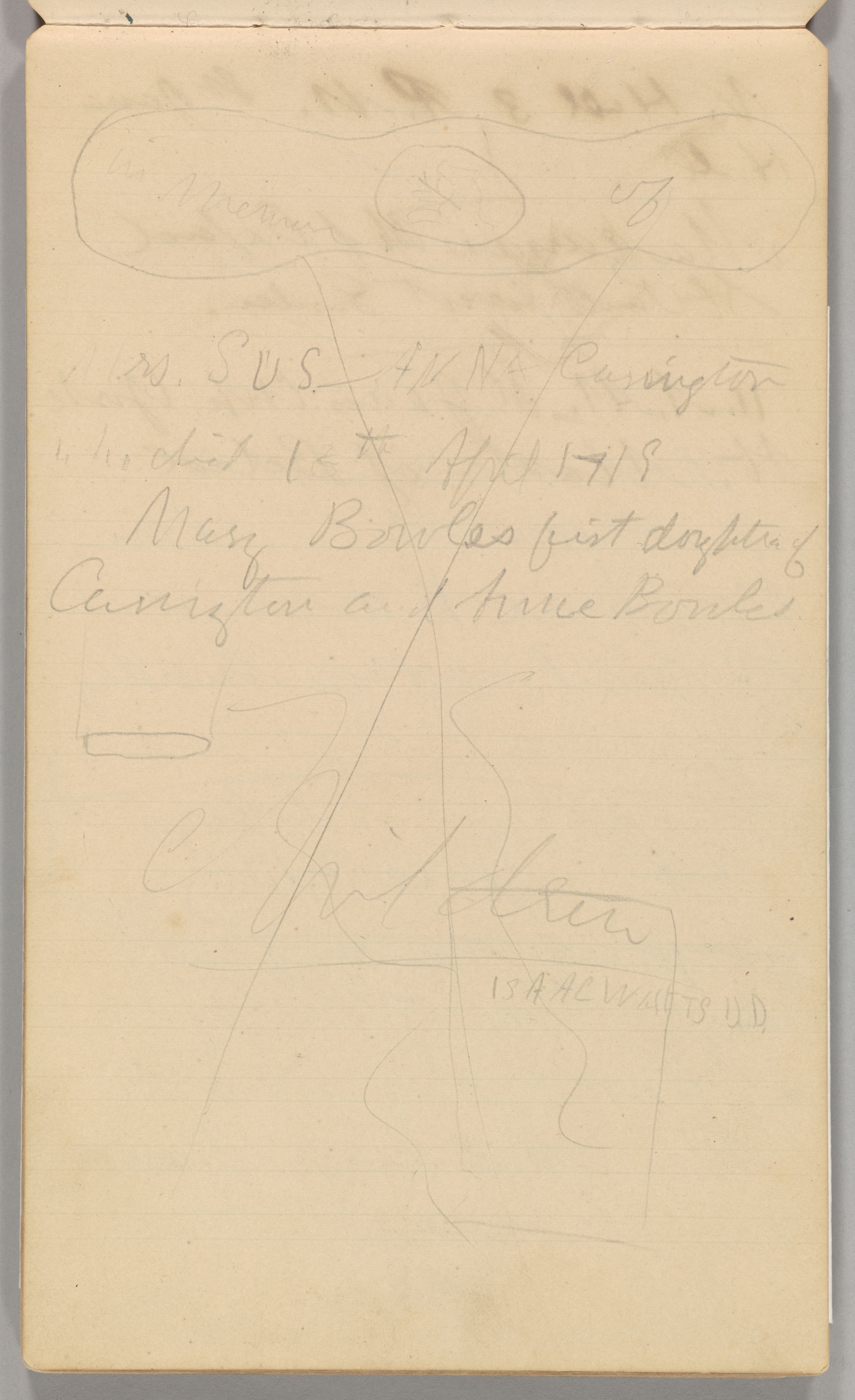
[MS: N12_leaf_]
Mrs. Susanna Carrington who died 18th April 1719
Mary Bowles first daughter of Carrington and Anne Bowles
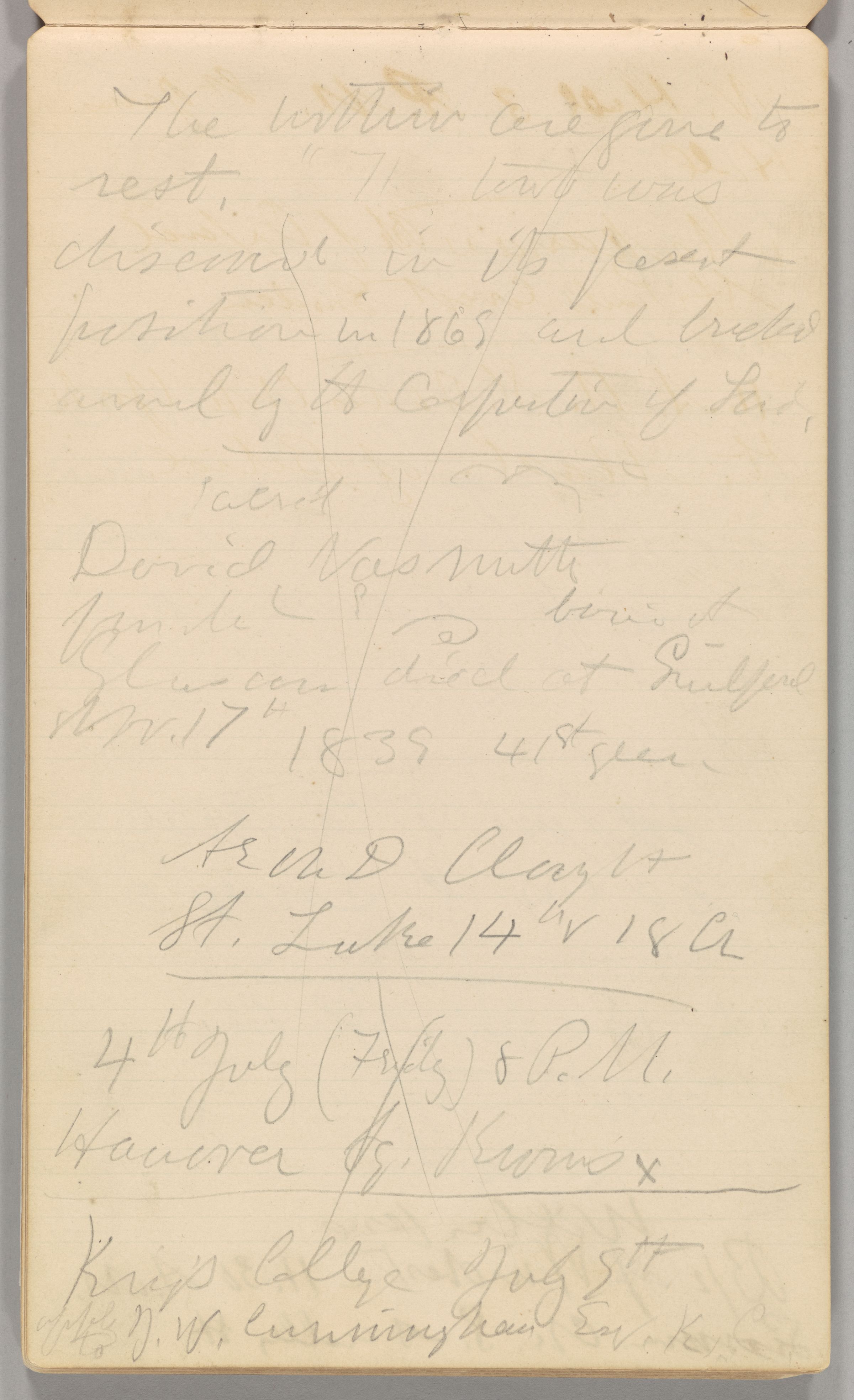
[MS: N12_leaf_]
The within are gone to rest. “This tomb was discovered in its present position in 1869 and bricked around by the Corporation of London.”
Sacred to the memory of David Nasmith founder of city missions, born at Glasgow died at Guilford Nov. 17th 1839, 41st year38
Archdeacon Claughton, St. Luke 14th v, 18 ch
4th July (Friday) 8 P.M., Hanover Sq. Rooms.
King's College, July 9th, apply to J. W. Cunningham Esq. K.C.
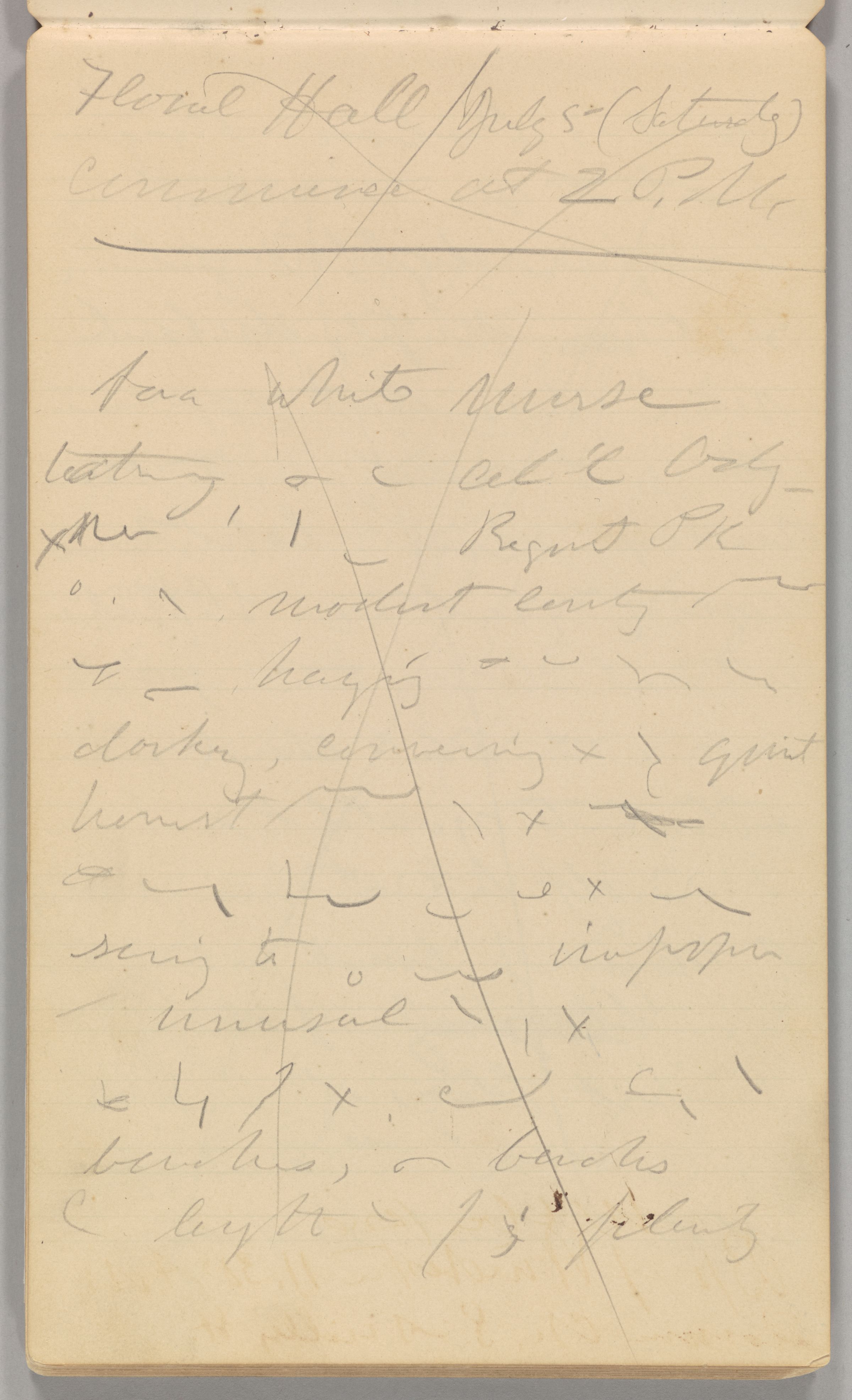
[MS: N12_leaf_]
Floral Hall, July 5 (Saturday), commence at 2 P.M.39
Saw a white nurse taking care of colored baby—today in Regent's Park saw a pretty, modest lady looking English girl, hanging on the arm of a darkey, conversing. Both quiet, honest looking air. Never taking any notice. Never seeming to see anything improper or unusual about it.
Attended church. The centre equipped by benches, more benches full length of the church;
plenty
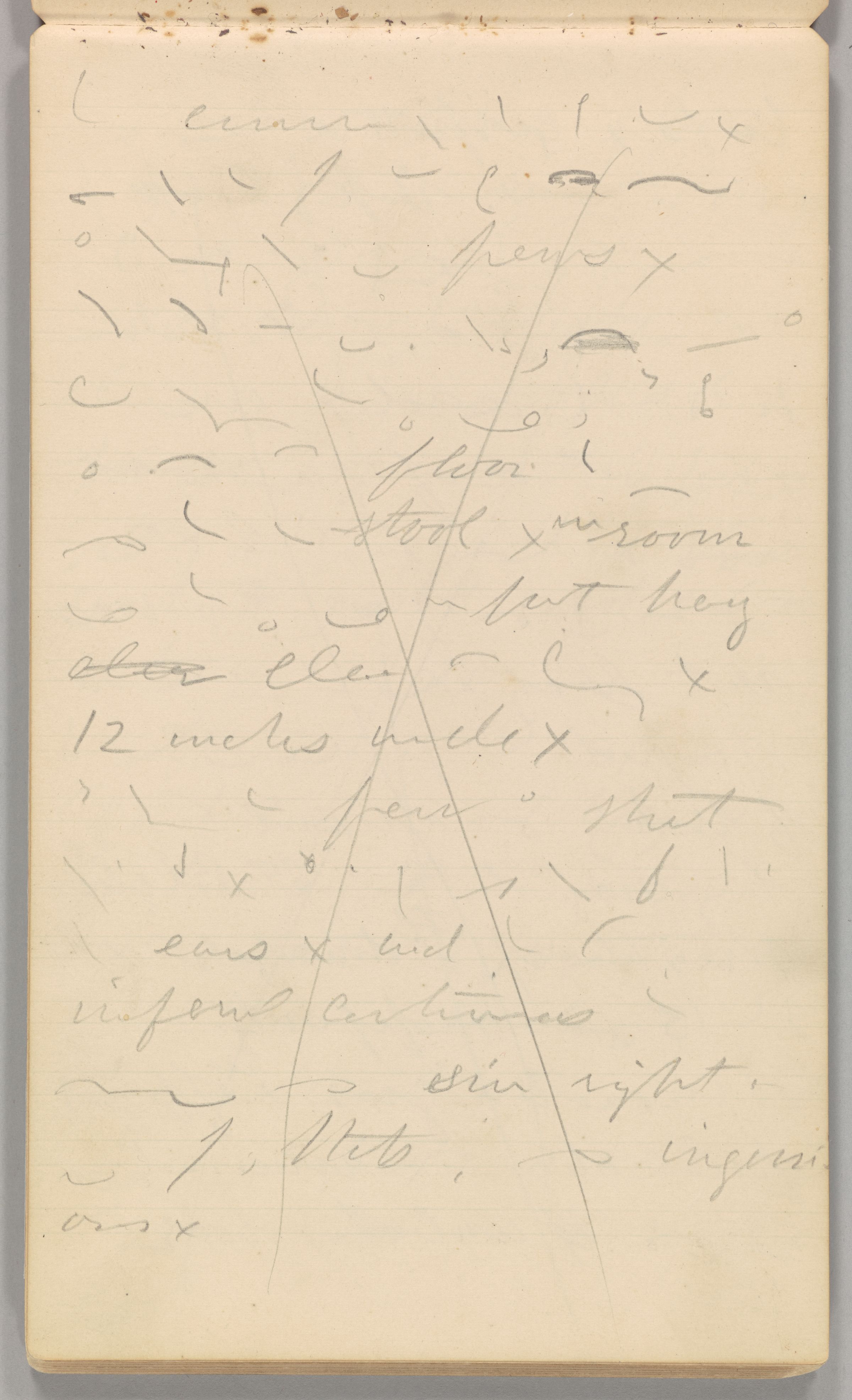
[MS: N12_leaf_]
that come up to sit on. Great part of the church on the other hand was boxed up in pews. When one got in the pew, he there was only room for his knees; and the seats so high from the floor that he must
have footstool. Room enough for his knees—but very close time otherwise. 12 inches wide. And the back of the pew was shut up and down. And it reached up
just to a person's ears. And of all the infernal contrivances for making men sin right
in church, that's the most ingenious.
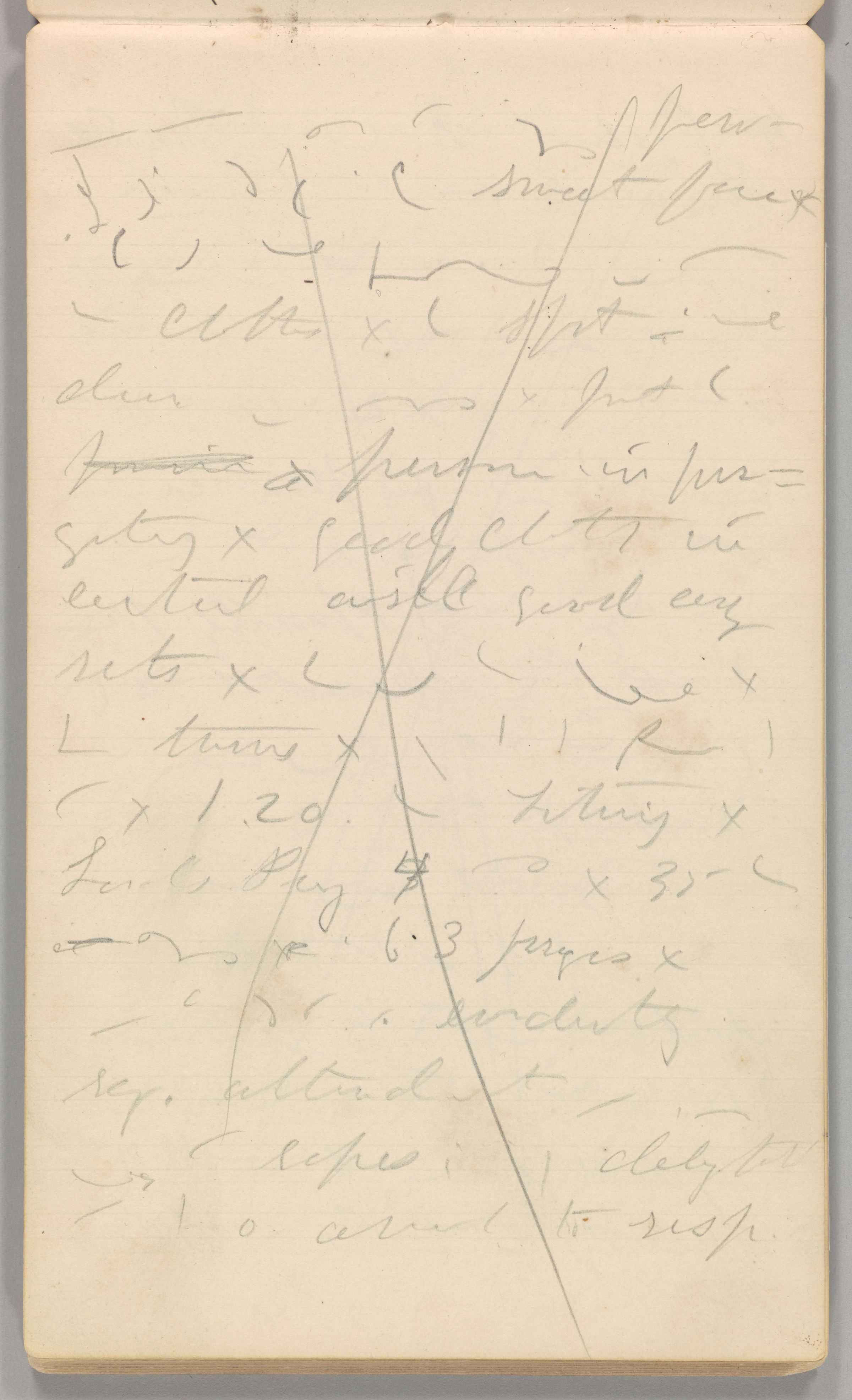
[MS: N12_leaf_]
There were some old women pew-openers; one with a very sweet face. And they showed nice discrimination in the matter of clothes. They spot a nice dress in moment. Put that person in purgatory. Good cloth in central aisle, good easy seats. Other one word for confessions. Take turns. People had to listen to you. 1.20 for Litany. Lord's Prayer 3 4 times. 35 for sermon etc. and then 3 prayers.
There was one old lady evidently regular attendant there who knew all the ropes; and
it delighted her to say one word to resp.,
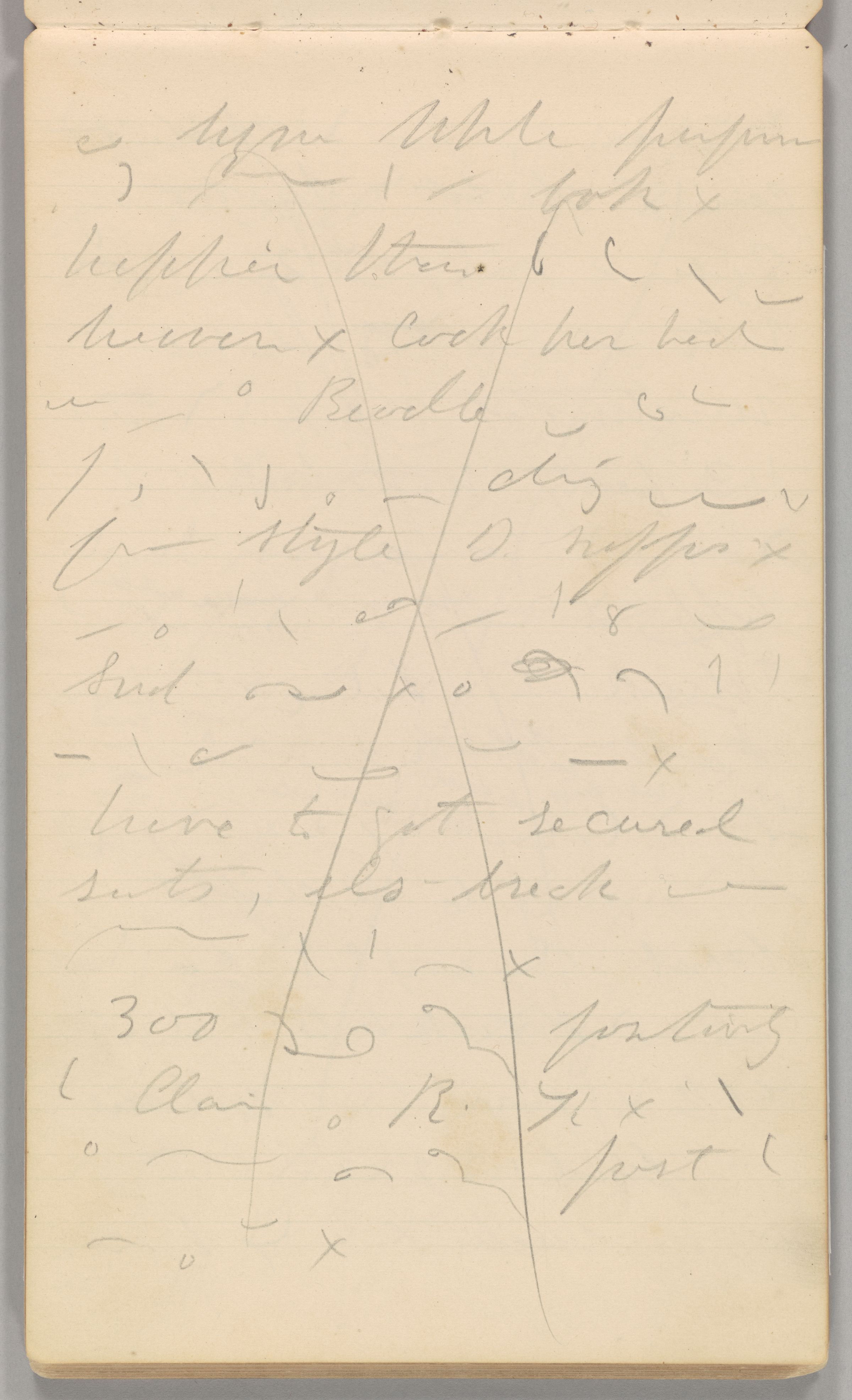
[MS: N12_leaf_]
sing hymn while performing two words looking at her book. Happier there than ever be in heaven. Cock her head—
There was beadle in front of the church, but didn't see him doing anything. For style, I suppose.
There is to be service here at 8 next Sunday morning. So will try to get up early enough and go. Have to get secured seats, else break neck looking up at him.
300 witnesses swear positively that Claimant is Roger Tichborne. And about as many
more swear positively that he is not.
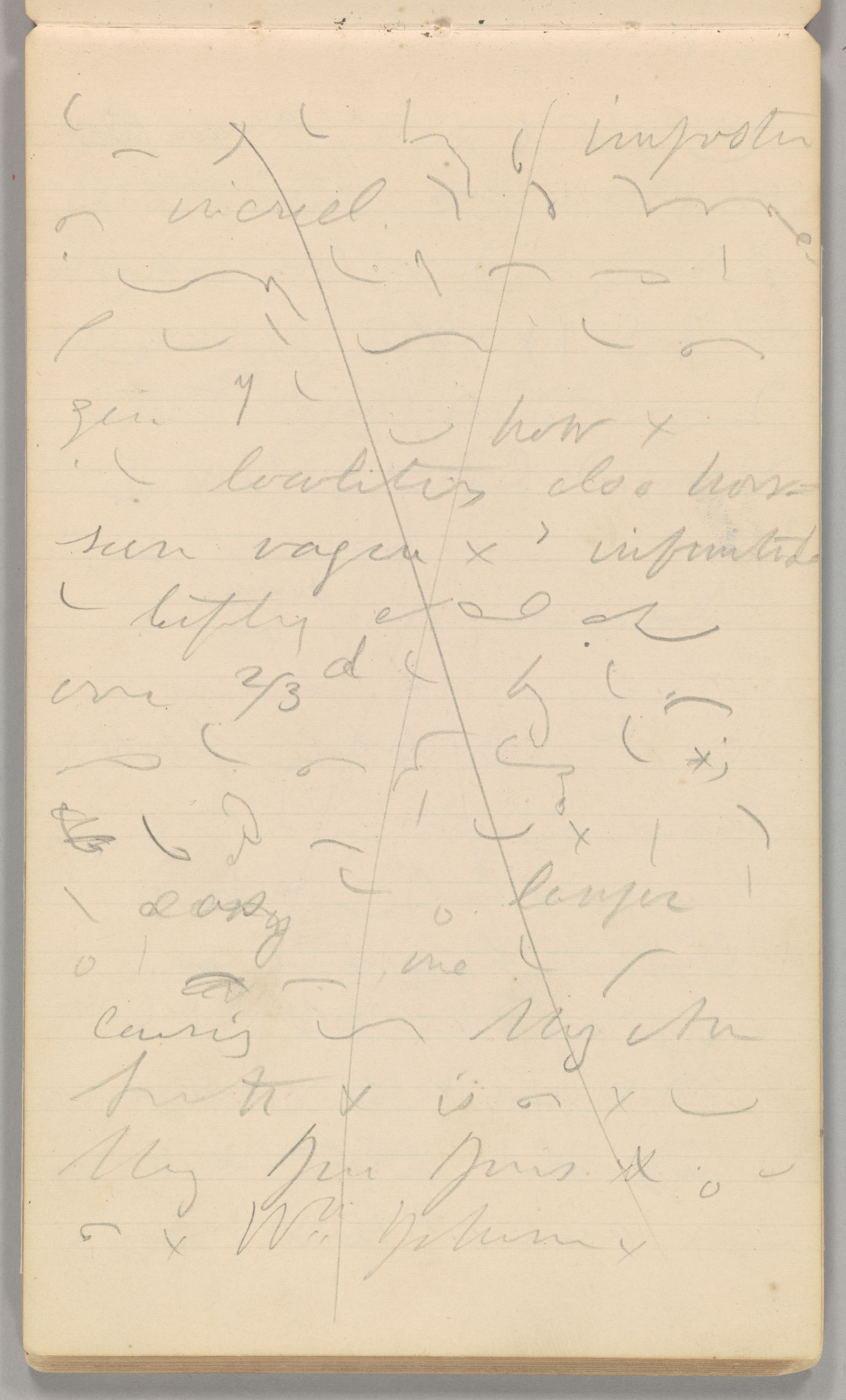
[MS: N12_leaf_]
That he should have attempted this imposture seems incredible when one remembers the
number of persons he must at least know by name and have some general idea of anyhow.
And of localities also however vague. And an infinitude of trifling circumstances stretching over two thirds of
generation that he must have some little acquaintance with .; even relationships he ought to know. It would be easy for his lawyer to say to him,
one of your cousin's named Mary Ann Smith & is married. Another, Mary Jane Jones &
is not married. Wm Johnson.
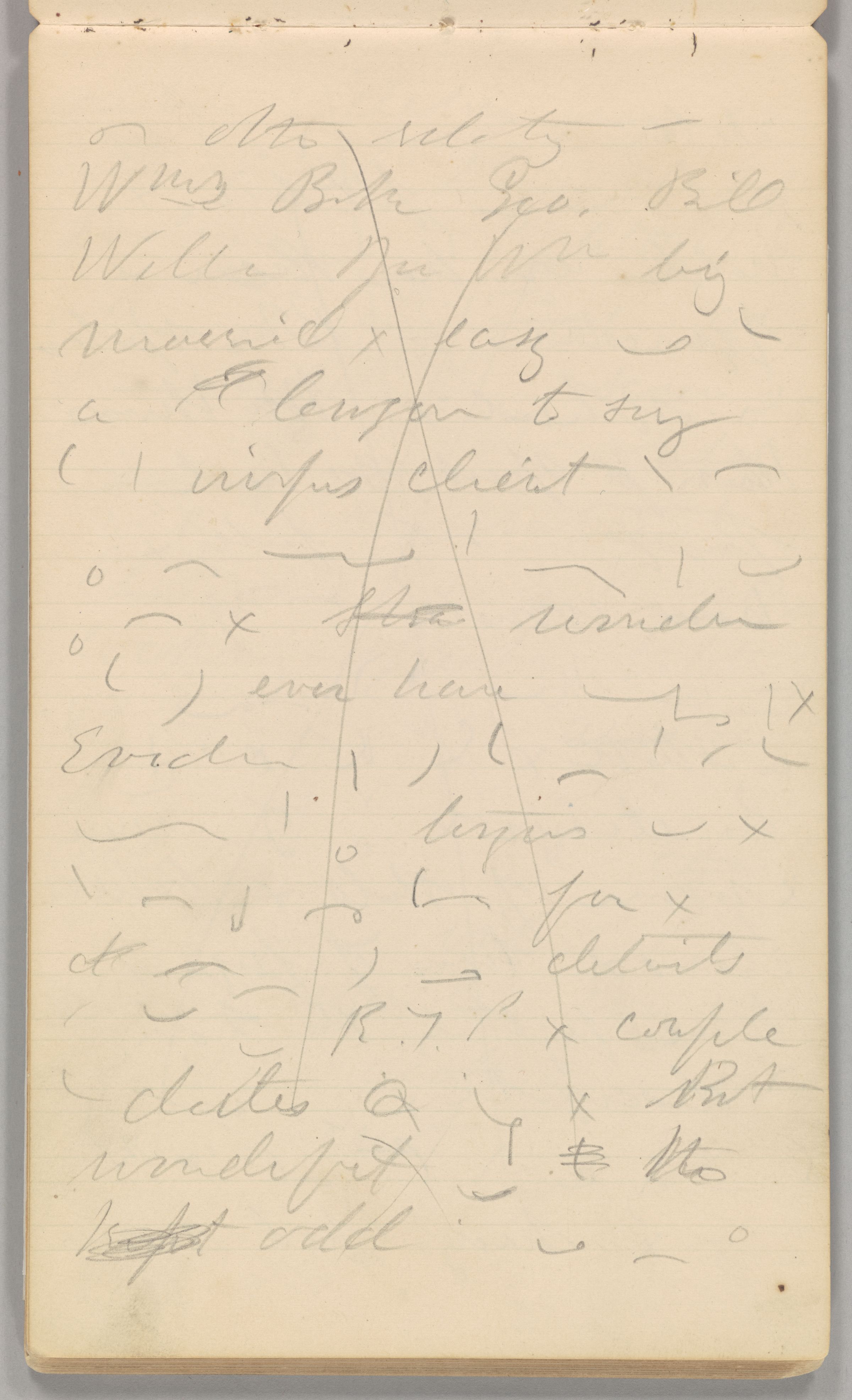
[MS: N12_leaf_]
Some other relatives are Wm, Bill, Geo., Bill, Willi, Jim, Wm being married. Easy enough for a lawyer to say that to one word client but how is he going to keep it in his head. Stra Wonder that should ever have undertaken it. Evidence did show that he had a lot of
names at his tongue's end. But he didn't three words. He should give details all along in Roger Tichborne's life. Couple of dates confused.
But wonderful in that he kept the odds and ends he was
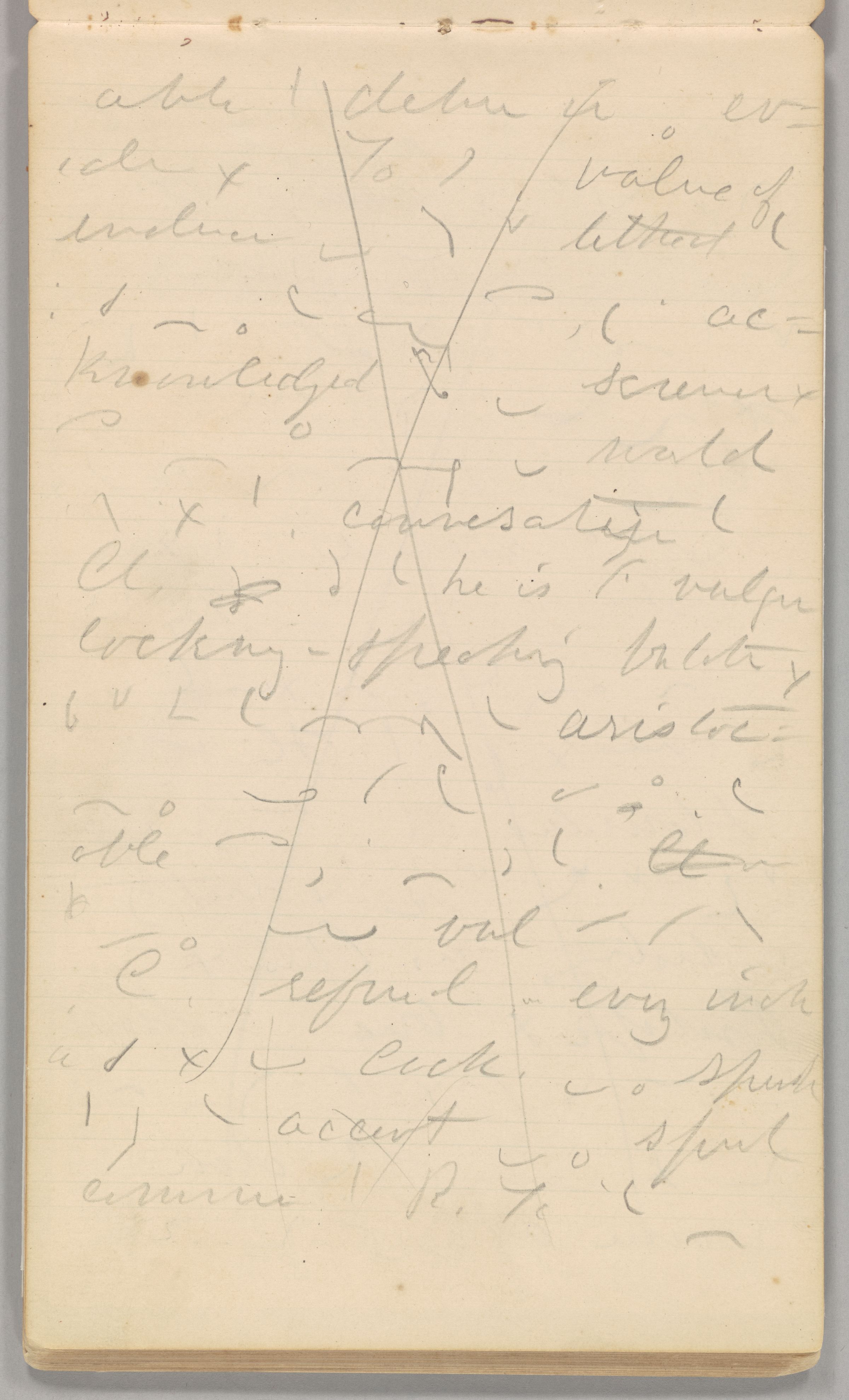
[MS: N12_leaf_]
able to deliver in his evidence.
To show the value of evidence anyway I talked with a gentleman who is very cultivated man, with an acknowledged place
in science. Man who has mixed in the world a bit. Had a conversation with Claimant. Says that he is low, vulgar, cockney-speaking
butcher. Then I talked with member of aristocracy who is known all over the world, as a very able man, and he said that the Claimant had there is nothing vulgar or low about the Claimant. Refined—every inch a gentleman.
No cockney in his speech. Had touch of accent in his speech common to Roger Tichborne
and that he
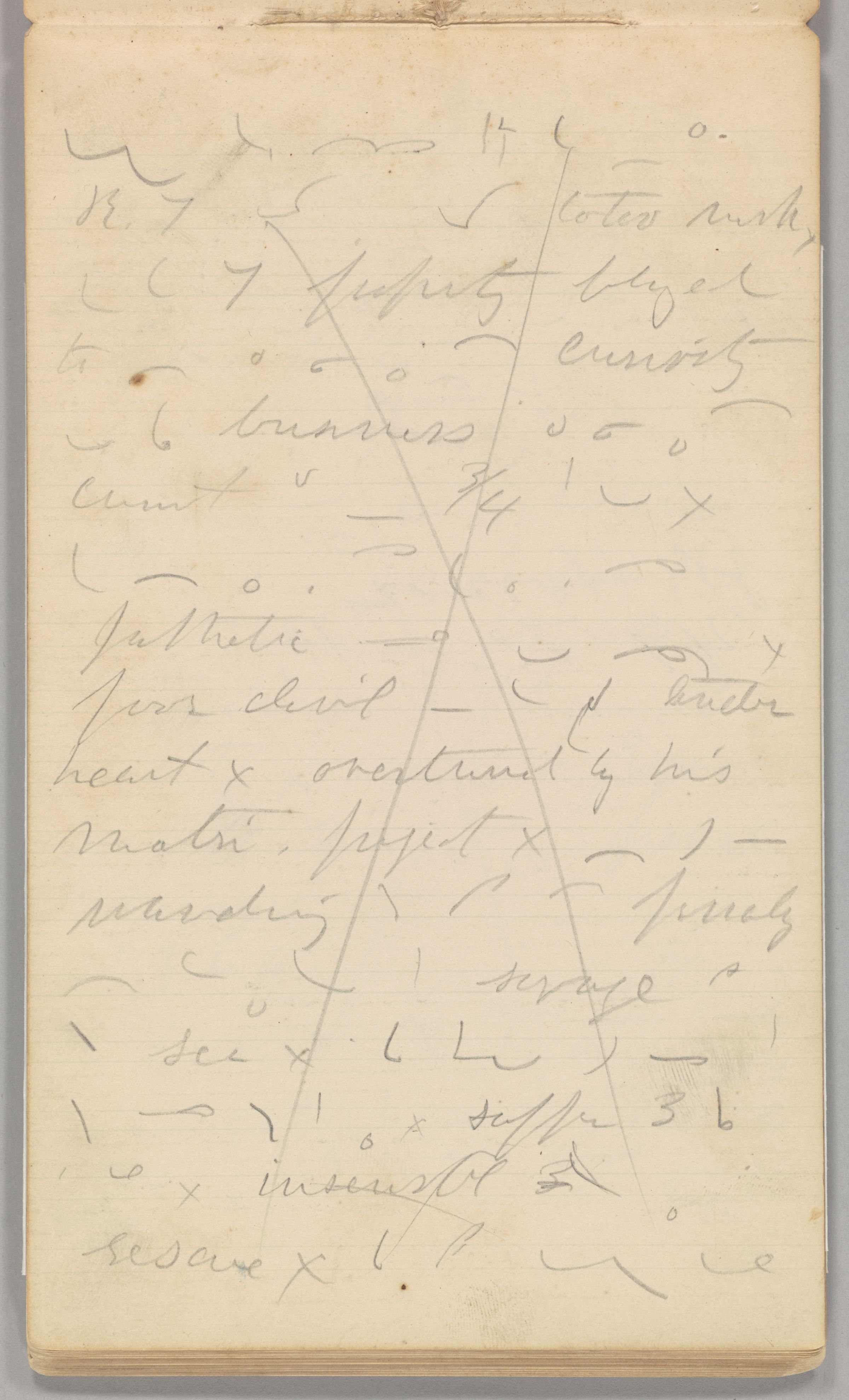
[MS: N12_leaf_]
never for a moment doubted that he was Roger Tichborne until the fatal tattoo mark.
If that Tichborne property belonged to me so great is my curiosity in this business
and so great is my one word I give ¾ to know. If he is the man this is the most pathetic case in history. Poor
devil could have gentle tender heart. Overturned by his matrimonial project. He shall
go wandering away life time, finally he three words to savage lands by the sea. And then taking ship again to be cast away at sea. Suffer 3 days and nights. Insensible 3 of his rescue. Then life nobody knows out
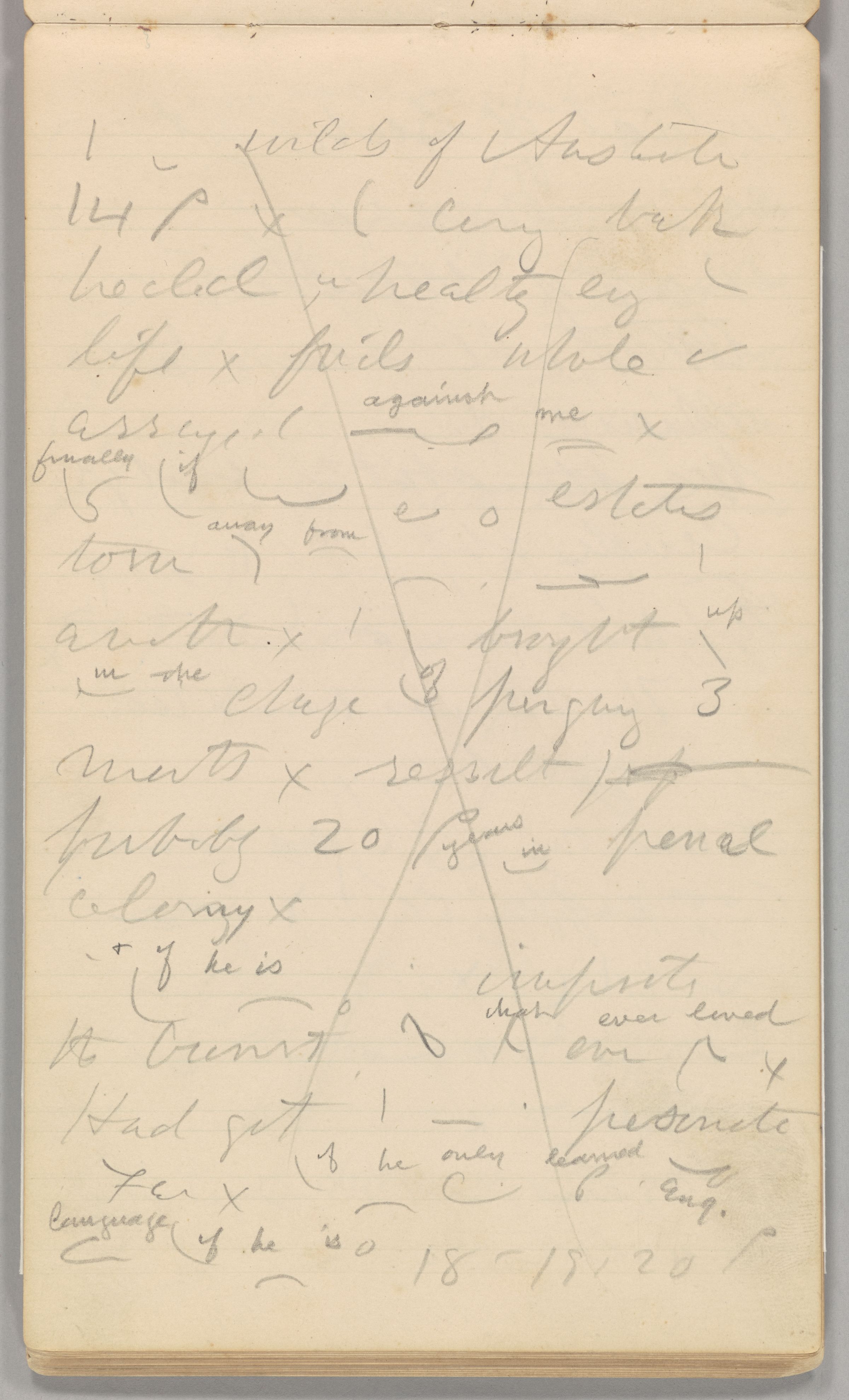
[MS: N12_leaf_]
in the wilds of Australia, 14 years. Then coming back healed, wealthy easy for life. Finds the whole world arrayed against him. Finally after having seen
his estates torn away from him and given to another, had been brought up on a charge
of perjury, 3 months. Result probably 20 years in penal colony. And if he is an impostor,
the bravest, the brightest that ever lived. Had got to go and personate foreigner. For he only learned the English language after he was 18 or 19 or 20 years
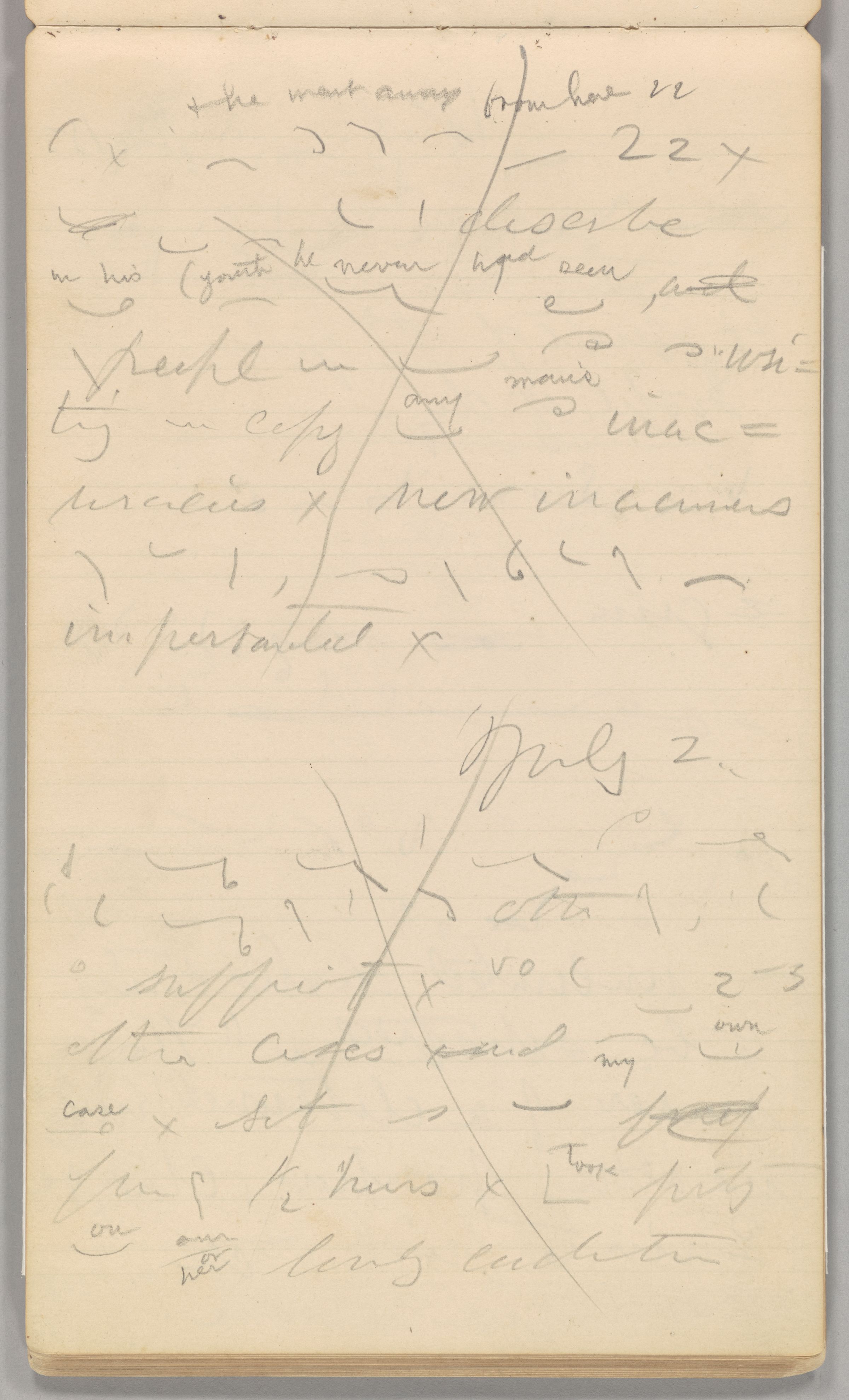
[MS: N12_leaf_]
old. And he went away from here 22. Knew he'd have to describe things that he never
had seen, and people—another man's handwriting—copy another man's inaccuracies. New
inaccuracies would not do, must be those of the person he impersonated.
July 2.
Didn't introduce anybody to anybody else except that they introduce person to one
other person, and that was sufficient. I saw that in 2 or 3 other cases. and my own case. Sat around among fine people ½ hour. Took pity on our lonely condition.
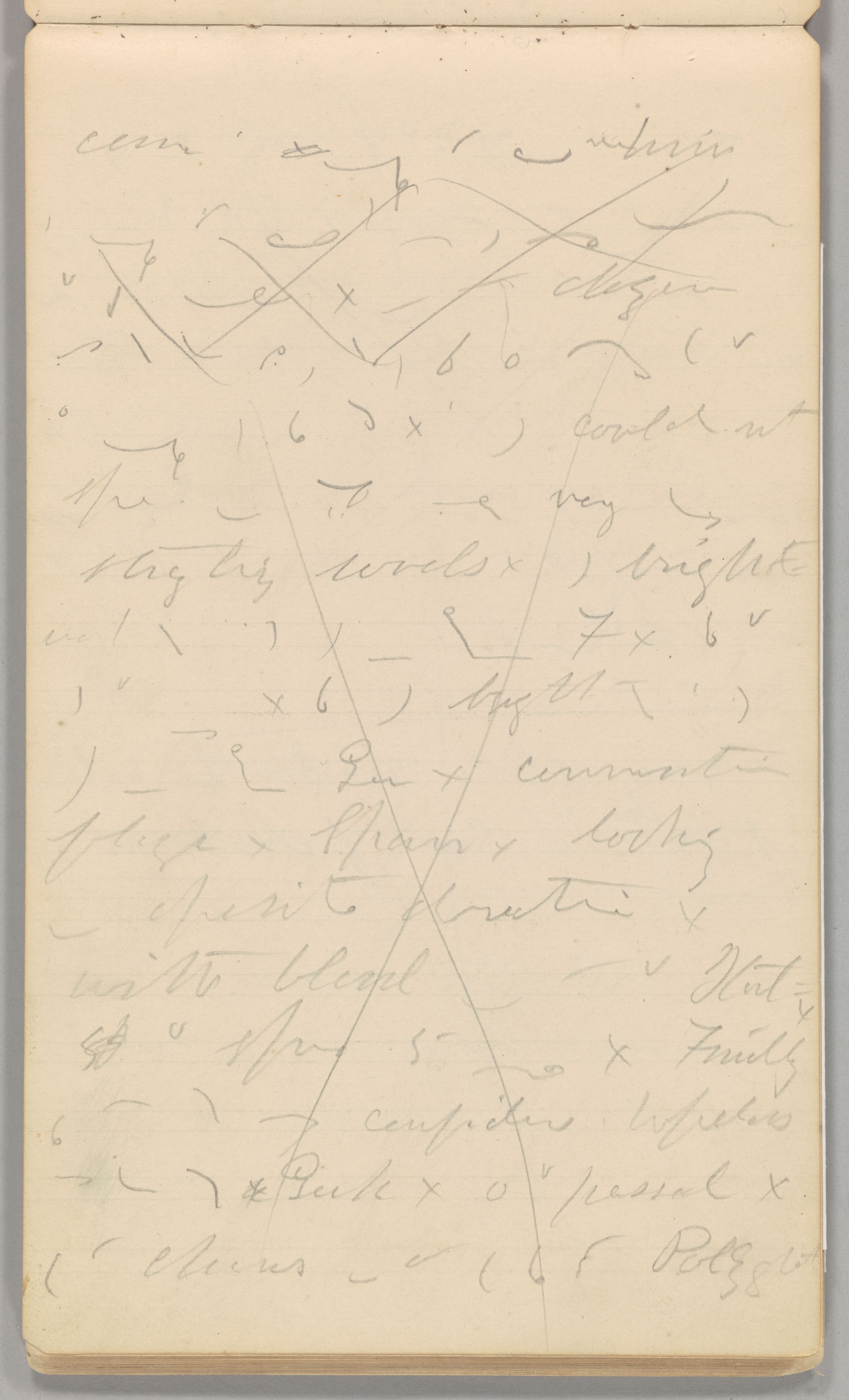
[MS: N12_leaf_]
Came and introduced lady near—and introduced lady nearest to me, whose name I didn't understand. There were dozen around about of ladies, but it just so happened that I was introduced to this one. And she couldn't speak any
English except very few struggling words. She brightened up and said she could speak
French. Then I said I couldn't. Then she brightened up and said she could speak German.
Conversation flags. Spanish. Looking in opposite direction. With blood in her eye. Italian 5 was spoken 5 minutes. Finally, this time without much confidence, hopeless kind of way .—Greek. So I passed. Through all the one word in the world with this little polyglot.
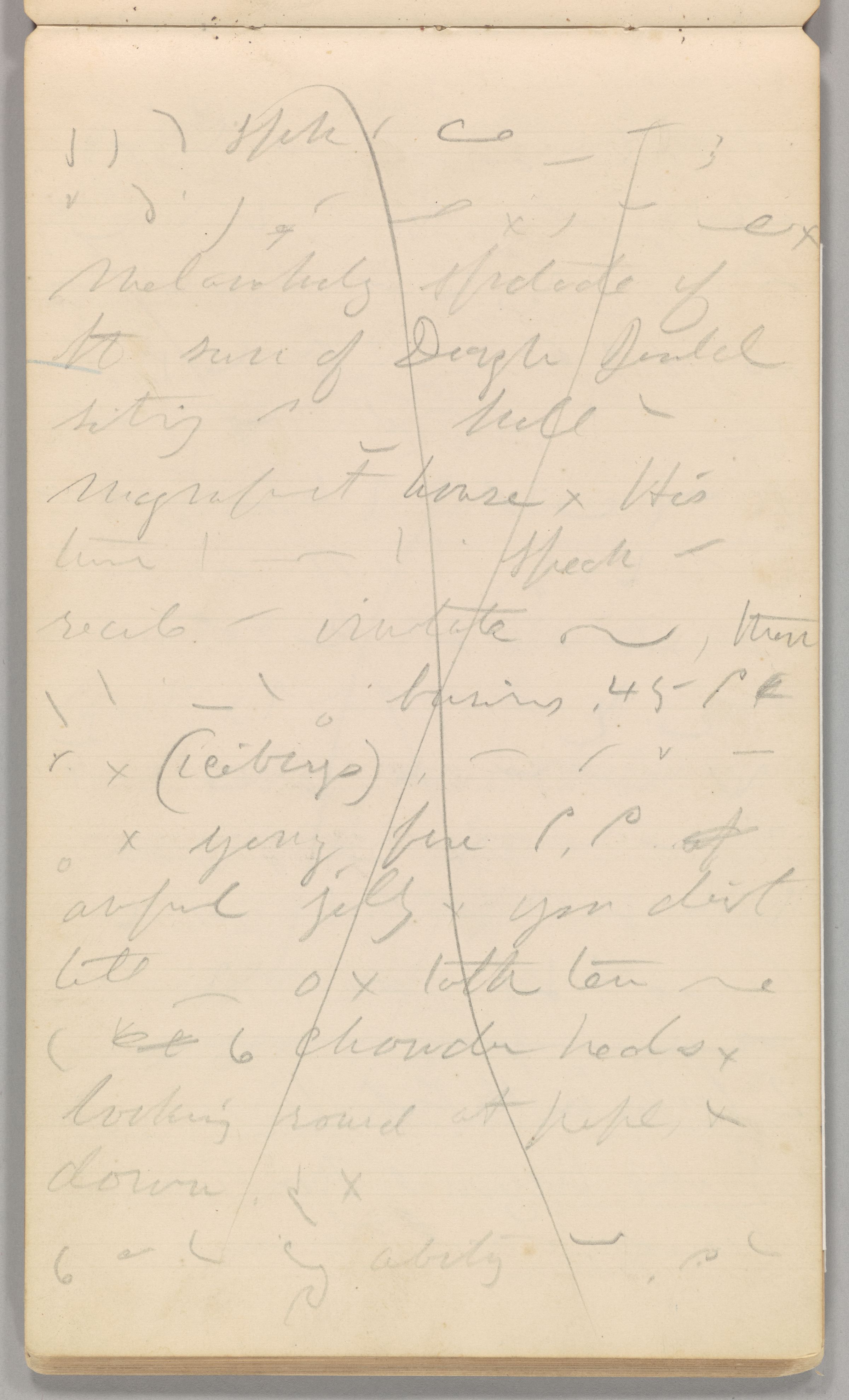
[MS: N12_leaf_]
Between us we spoke all the languages there are; I one and she all the rest. three words.
Melancholy spectacle of the son of Douglas Jerrold40 sitting around in the hall of magnificent house. His turn to come out and speak or recite or imitate something, then be up and go about his business. 45 years old. (Icebergs), from all I can see. Young one word, yes, yes awful jolly. You don't tell me so.
Talk ten minutes with 6 chowder heads. Looking round at people, & down the table.
This sort of conversational ability among the ladies of
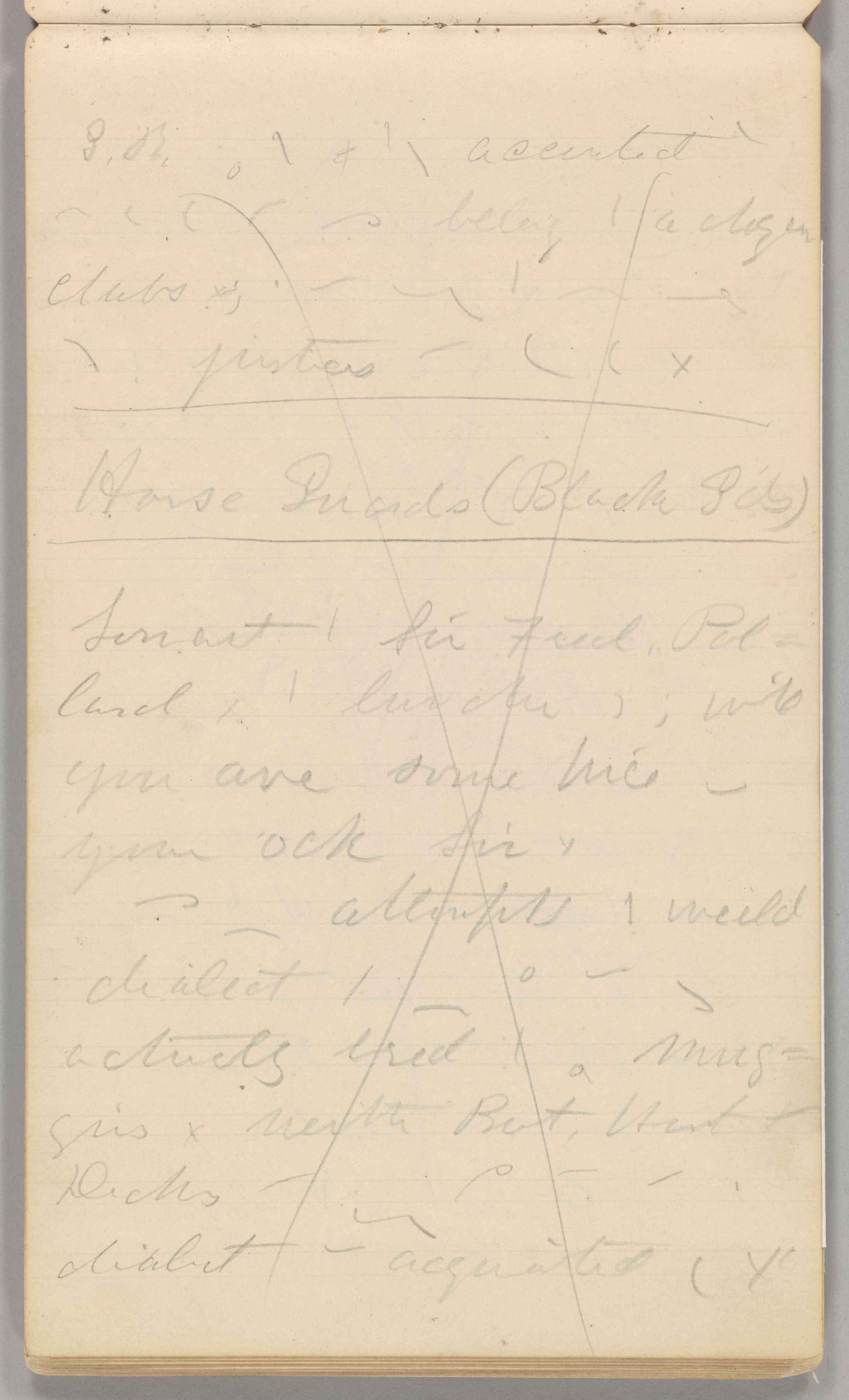
[MS: N12_leaf_]
Great Britain is probably to be accounted for from the fact that all men belong to a dozen clubs .; and are never at home except when the justices are after them.
Horse Guards (Black G'ds)
Servant to Sir Fred. Pollard,41 at luncheon said, “Will you 'ave some hice in your 'ock Sir.”
The man who attempts to wield a dialect which he has not been actually bred to is
a muggins. Neither Bret Harte nor Dickens nor anybody else can write a dialect not
acquainted with.
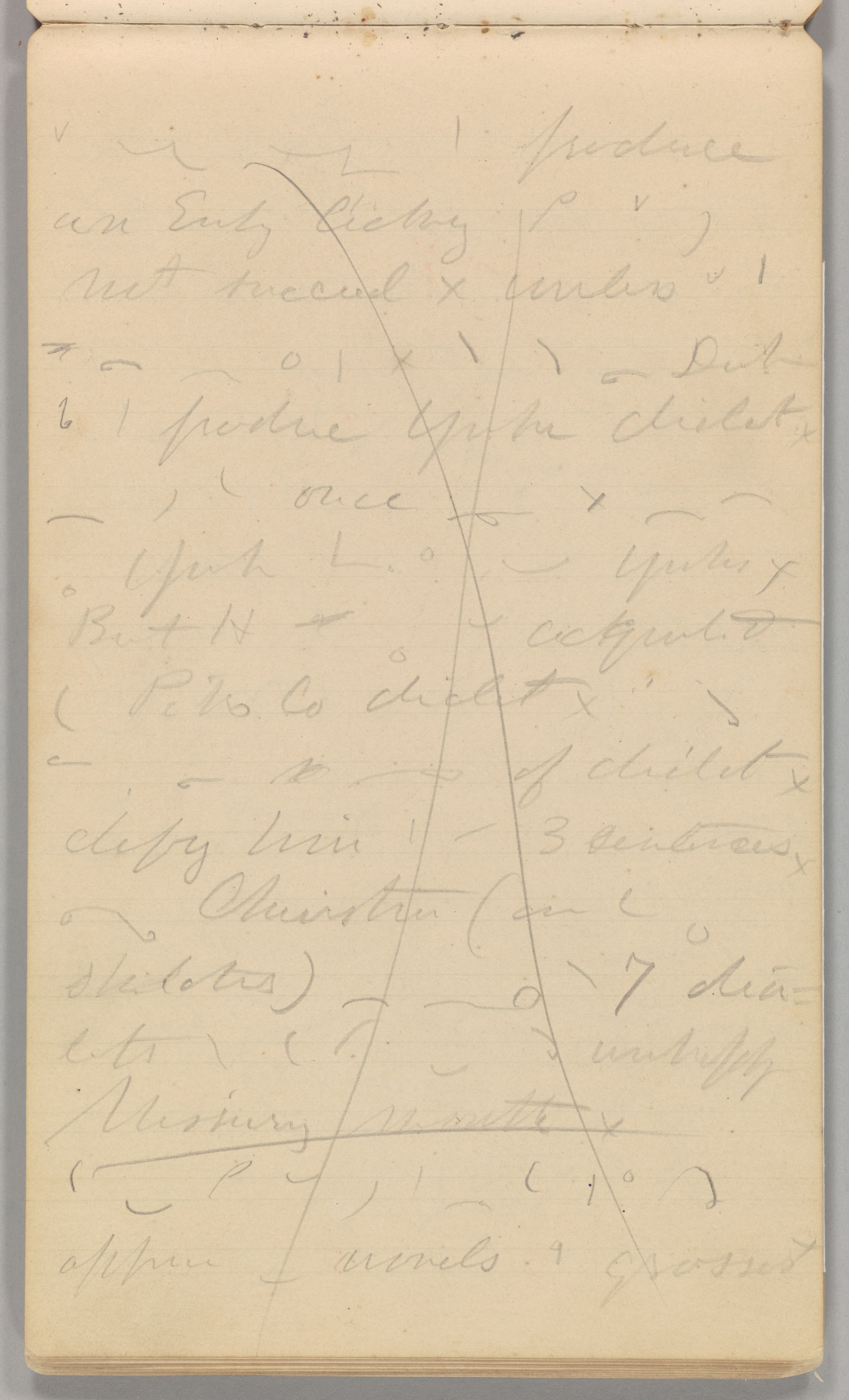
[MS: N12_leaf_]
I never undertook to produce an early cockney lest I should not succeed. Unless I had heard him say it. But when Mr. Dickens tries to
produce Yankee dialect, he showed for once mistake. He made his Yankee talk as no Yankee.
Bret Harte was the is not acquainted with Pike County dialect. And been called the great master of dialect.
Defy him to write 3 sentences. one word Christmas (one of his sketches)42 he mixes about 7 dialects, put them all in the one unhappy Missouri mouth. four words showed to me that what was always apparent in the novels as the grossest
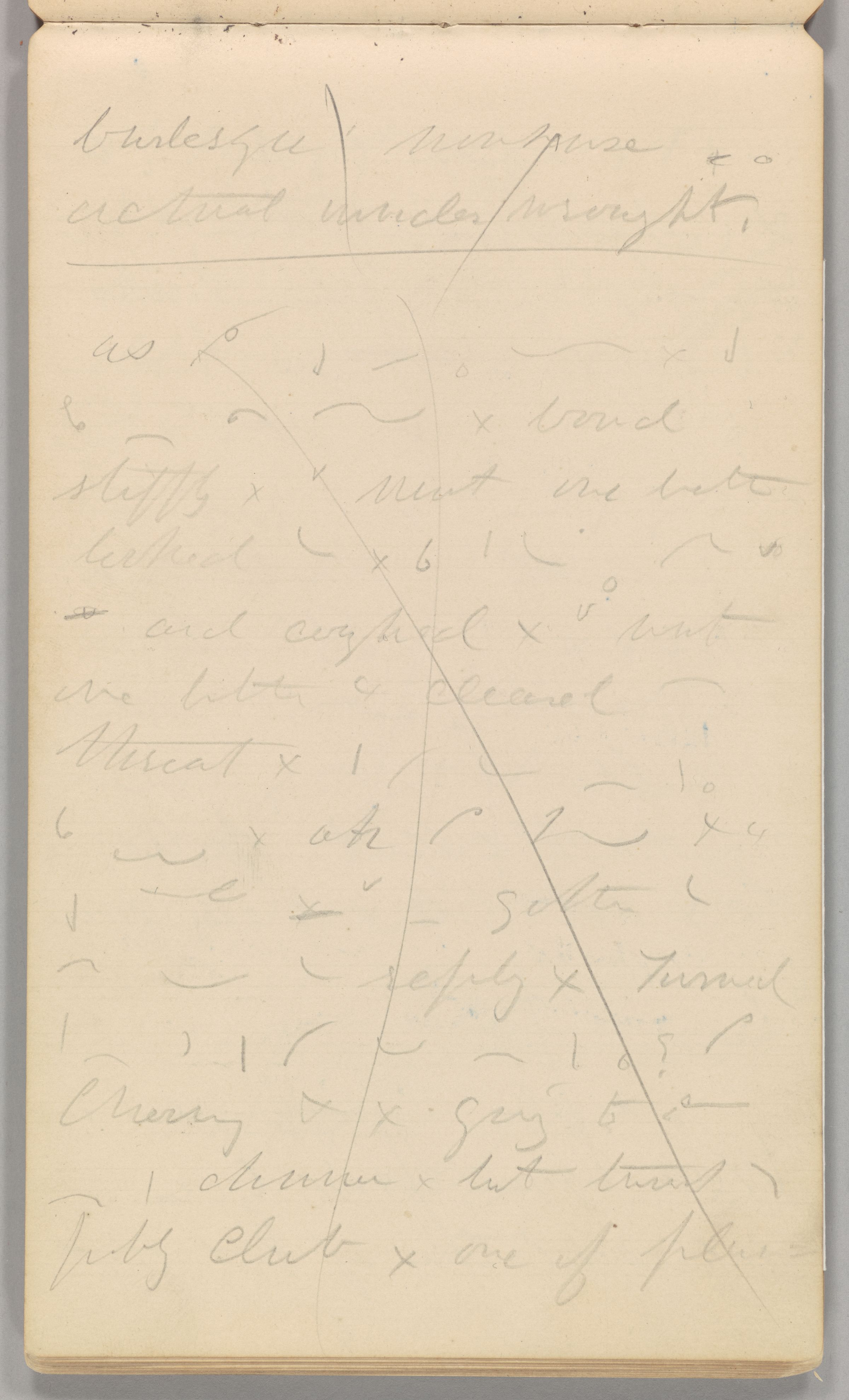
[MS: N12_leaf_]
burlesque and nonsense is the is actually underwrought.
As usual didn't hear his name. Don't suppose he heard mine. Bowed stiffly. I went
one better, looked off. Then out of his left eye and coughed. I went one better &
cleared my throat. “Do you know who it is that's singing?” “Ah yes charming,” etc.
Didn't understand .—I could gather that from the nature of the reply. Turned to him, said, “Do you know
who it is?” “Yes charming,” etc. Going to ask him to dinner, but turned away one word club. One of pleasant-
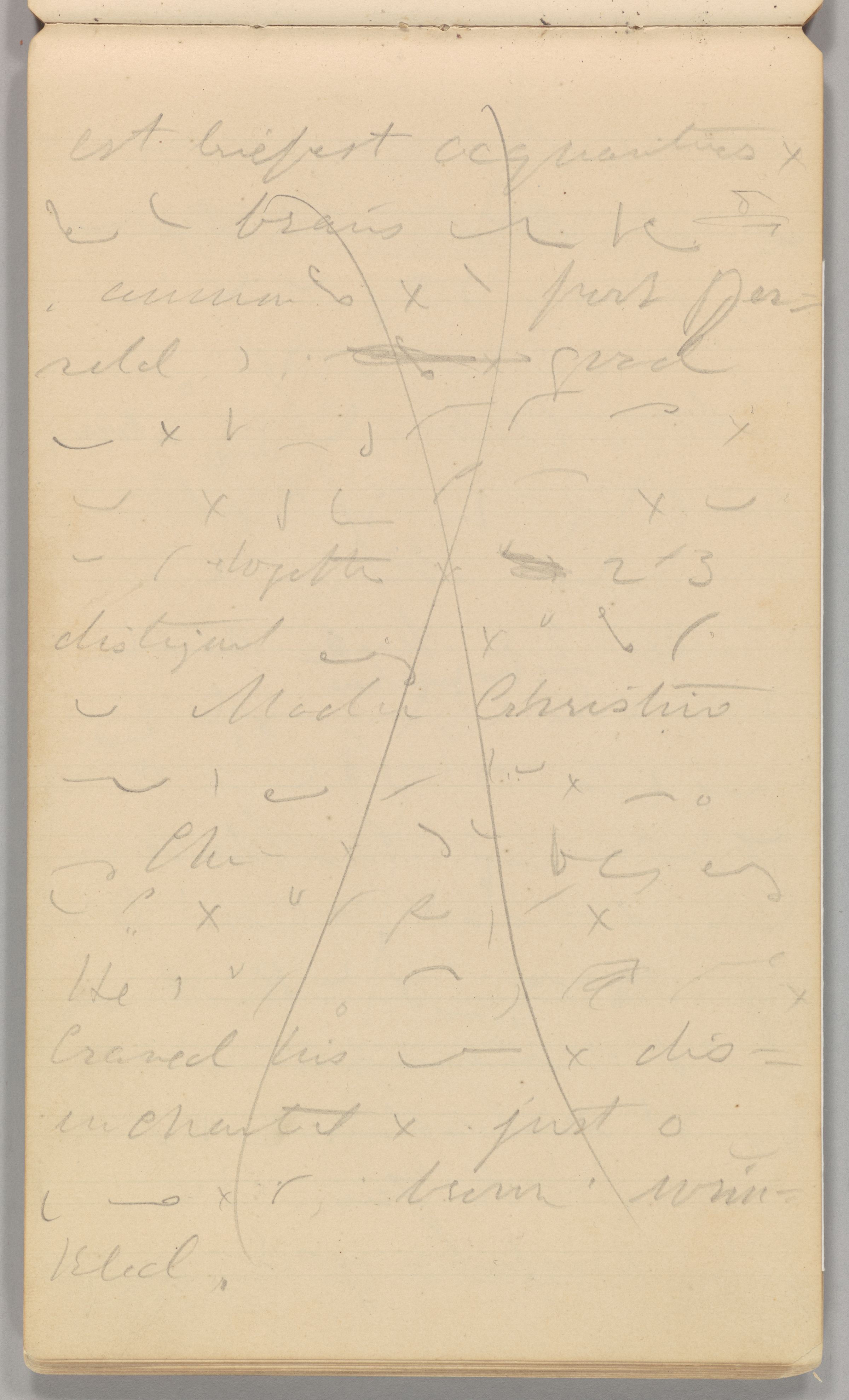
[MS: N12_leaf_]
est briefest acquaintances. Person of brains never delivers the commonplace. But first Jerrold said the commonplace. good thing. Told me didn't look like man. No. Didn't think two words. No not altogether. I said 2 or 3 distinguished singers.
“I suppose you know Madame Christine's43 going to sing here tonight.”
“Who is Miss Christine?”
“One of the distinguished singers of London.”
“I will listen to her.”
He said, “I will see how she looks.”
Craned his neck. Disenchanted. Just so in this case. Old, and brown and wrinkled.
[MS: N12_leaf_]
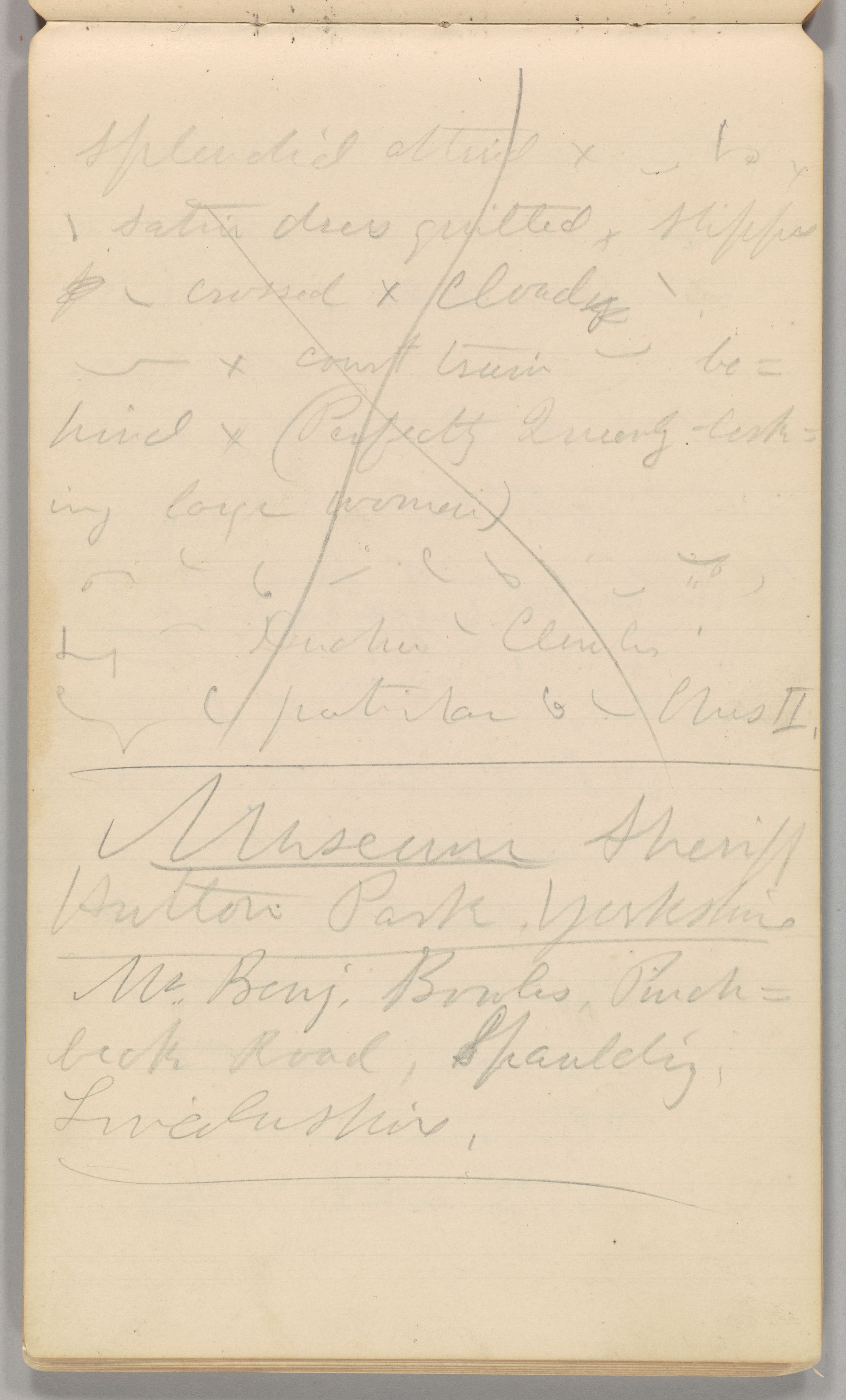
Splendidly attired. In diamonds. Red satin dress quilted. Slippers—feet crossed. Cloud about the neck. Court train on behind. (Perfectly queenly-looking large woman)
Some of the others were very best in England, descended from the Duchess of Cle veland and several other particular friends of Chas II.
Museum Sheriff, Hutton Park, Yorkshire
Mr. Benj. Bowles, Pinchbeck Road, Spalding, Lincolnshire.
[MS: N12_leaf_]
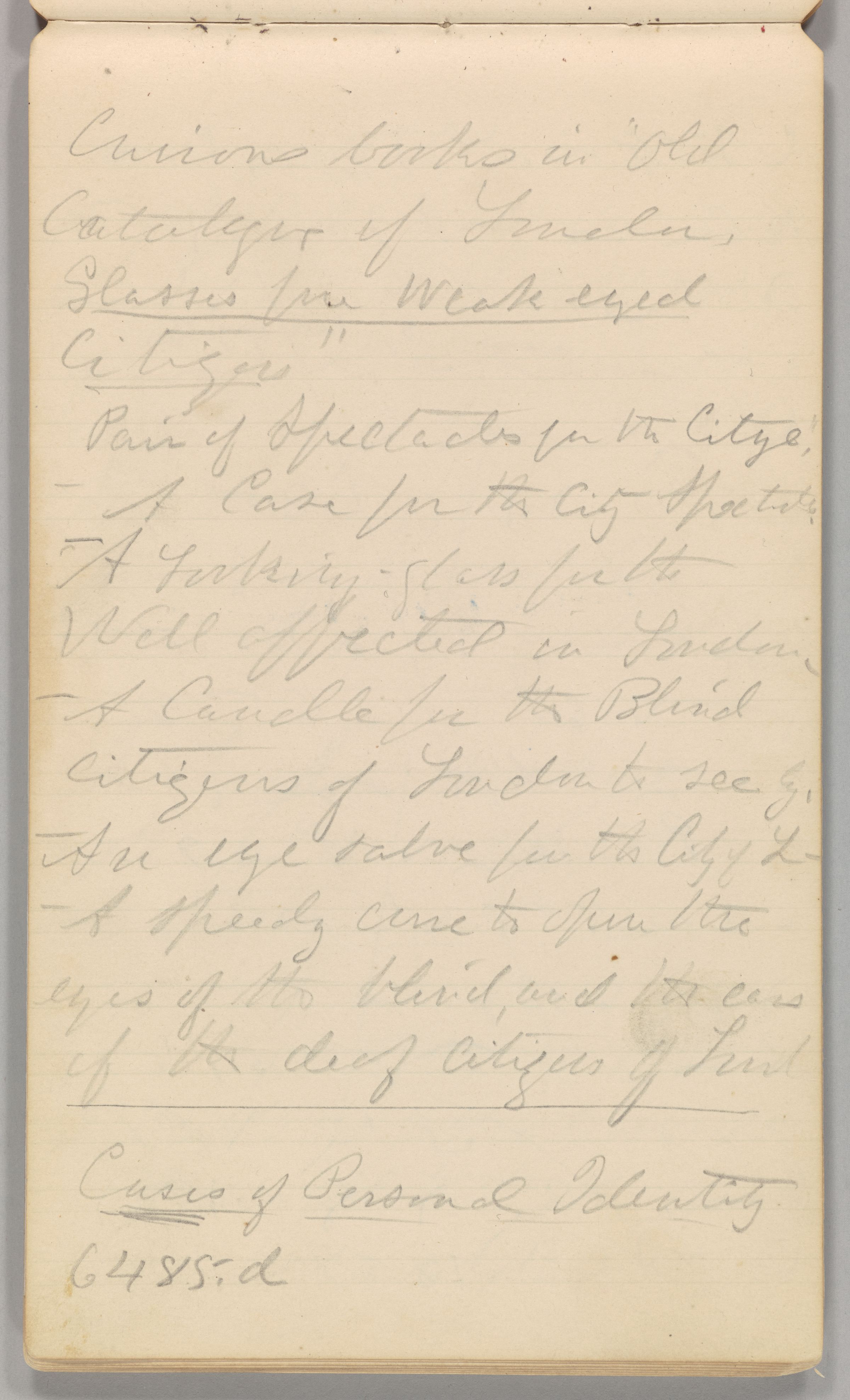
Curious books in “Old Catalogue of London.”
“Glasses for weak eyed citizens”44
“Pair of spectacles for the Citye.”
—A Case for the City Spectacles.
—A Looking-glass for the Well affected in London.
—A Candle for the Blind citizens of London to see by.
—An eye salve for the City of London
—A speedy cure to open the eyes of the blind, and the ears of the deaf citizens of London
Cases of Personal Identity
6485.d
[MS: N12_leaf_]
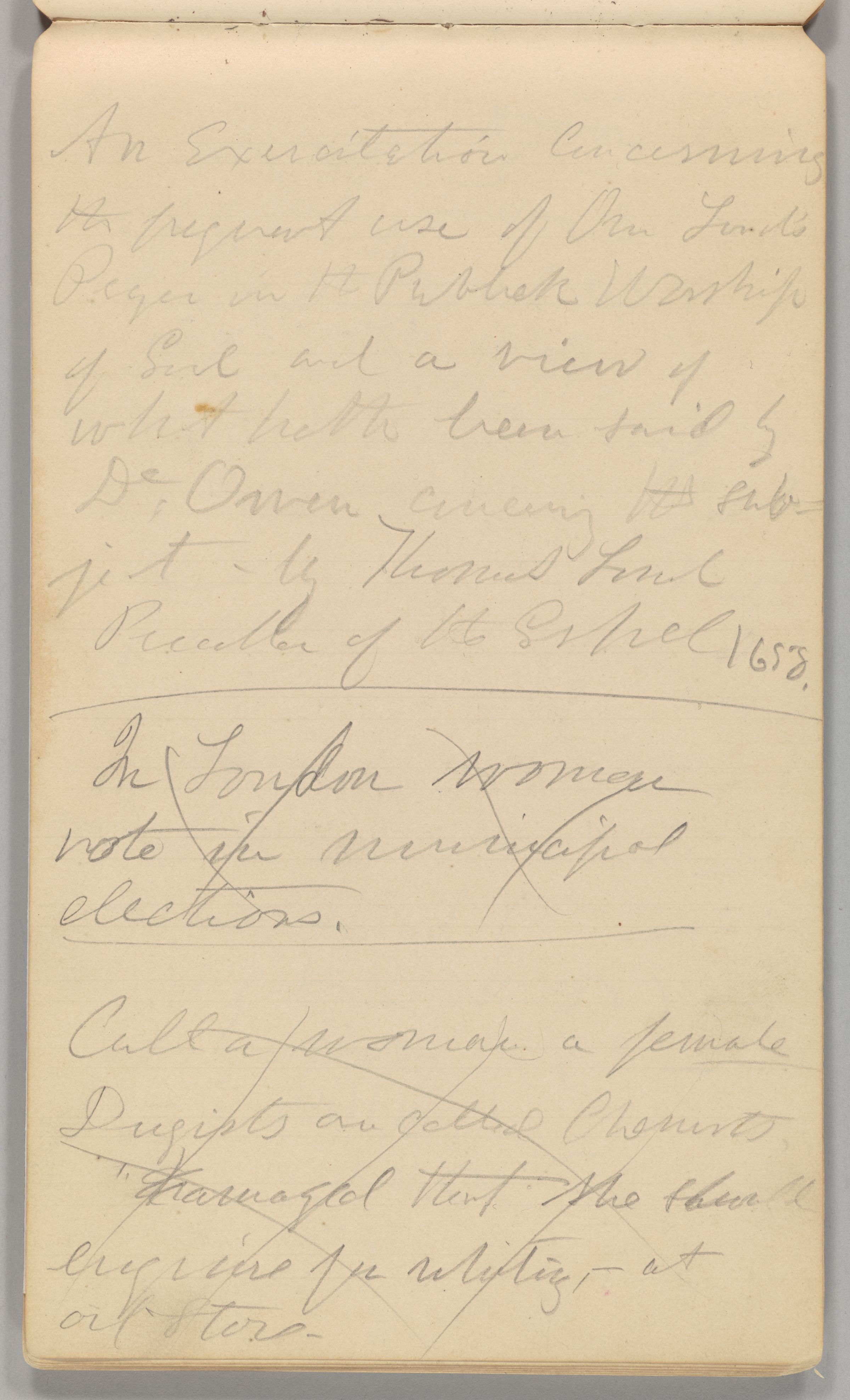
An Exercitation Concerning the frequent use of Our Lord's Prayer in the Publick Worship of God and a view of what hath been said by Dr. Owen concerning the subject—by Thomas Long, Preacher of the Gospel 1658.
In London women vote in municipal elections.
Call a woman a female
Druggists are called chemists
“Enraged that she should enquire for whiting rag at oil store.”
[MS: N12_leaf_]
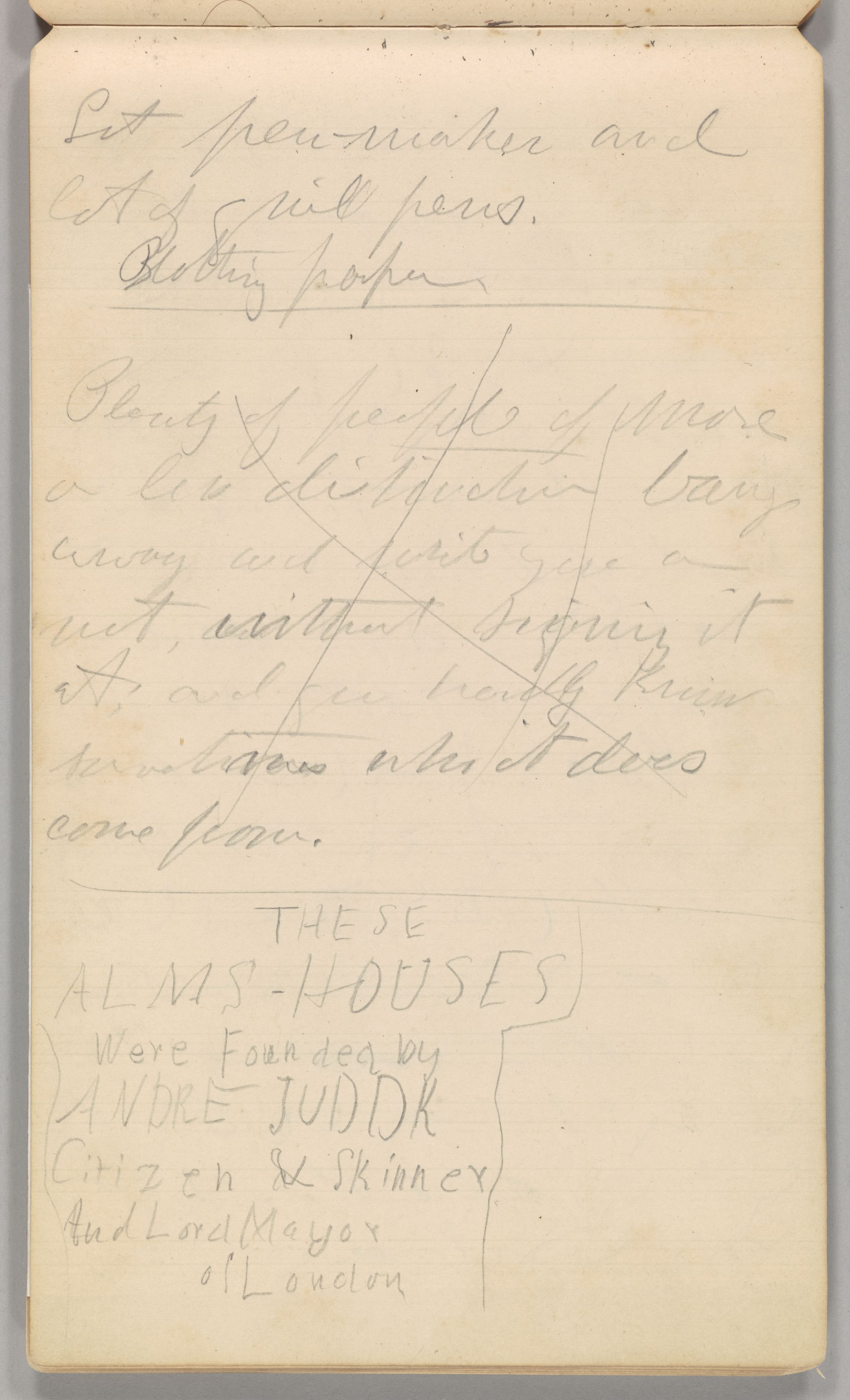
Get pen-maker and lot of quill pens.
Blotting paper.
Plenty of people of more or less distinction bang away and write you a note, without signing it at; and you hardly know sometimes who it does come from.45
THESE
ALMS-HOUSES
Were Founded by
ANDRE JUDD
Citizen & Skinner
And Lord Mayor of London46
[MS: N12_leaf_]
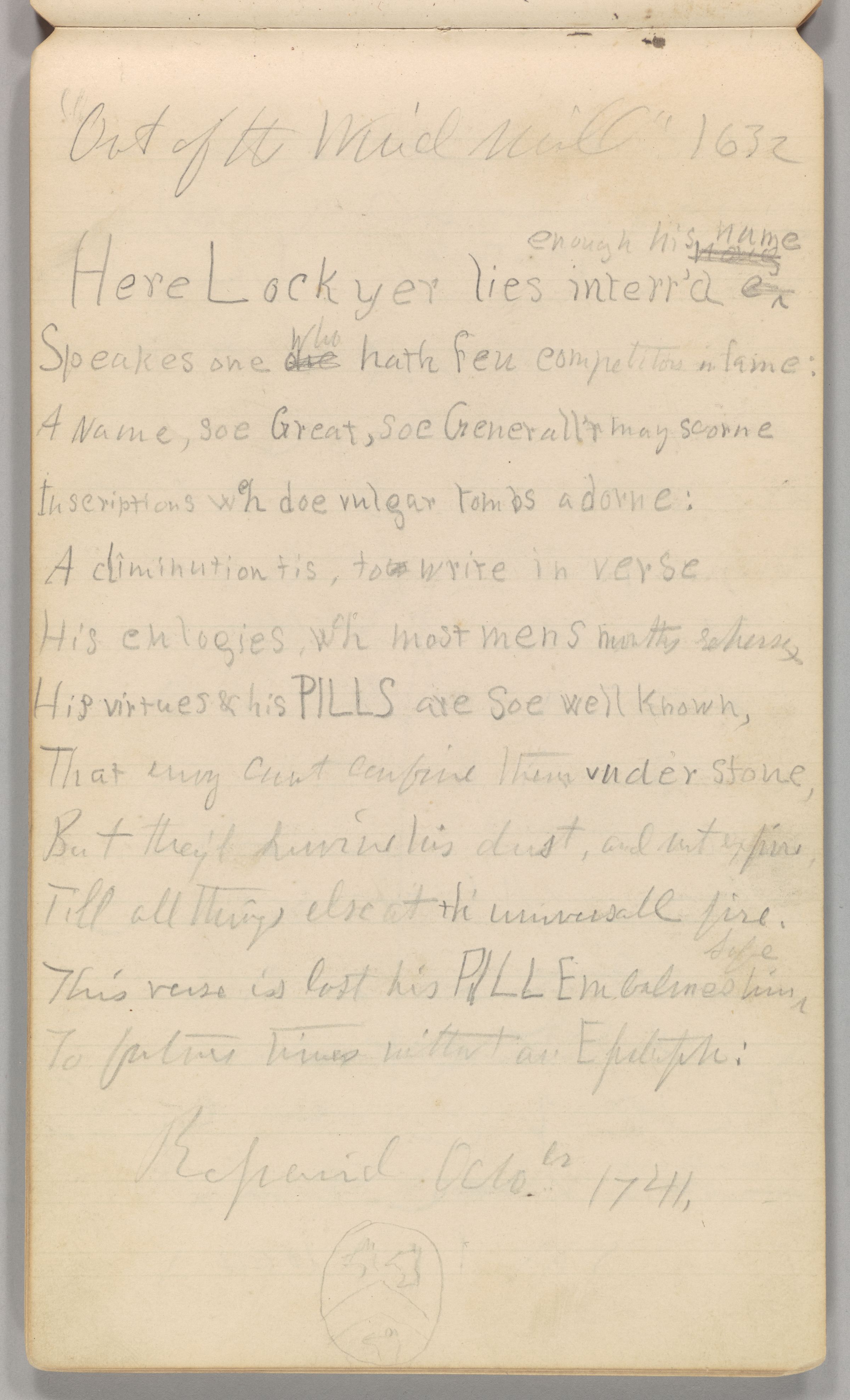
“Out of the Windmill” 1632
Here Lockyer lies interr'd enough his nameSpeakes one who hath feu competitors in fame:
A name, soe Great, soe Generall may scorne
Inscriptions wch doe vulgar tombs adorne:
A diminution tis, to write in verse
His eulogies, wch most mens mouths reherse,
His virtues & his PILLS are soe well known,
That envy cant confine them under stone,
But they'l survive his dust, and not expire,
Till all things else at th'universall fire,
This verse is lost his PILL Embalmes him Safe
To futures times without an Epitaph:
Repaired Octobr 1741.
[MS: N12_leaf_]
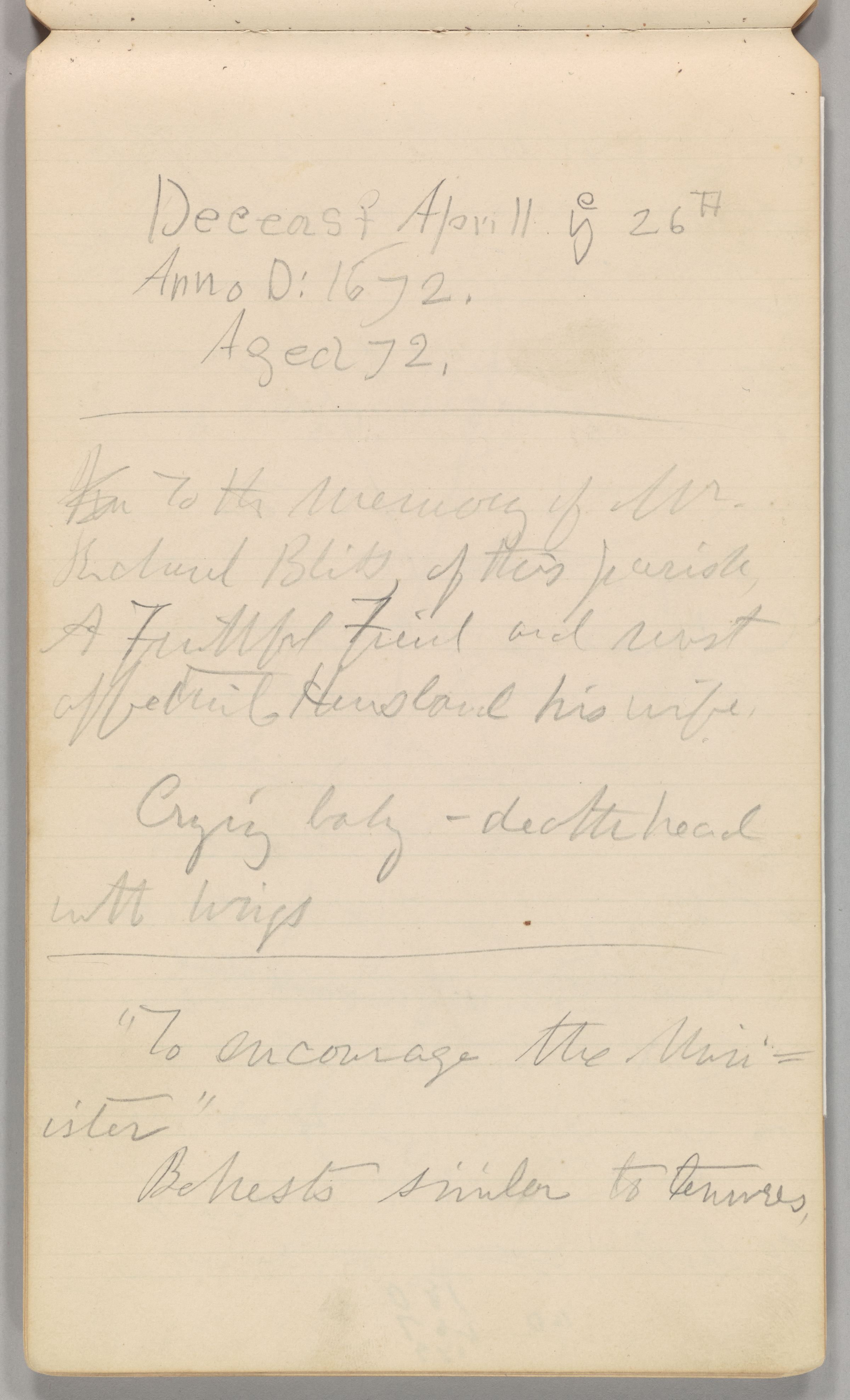
Deceast Aprill ye 26th
Anno D: 1672.
Aged 72.47
In To the memory of Mr. Richard Bliss, of this parish, A Faithful Friend and most affectionate Husband his wife.
Crying baby—deathhead with wings
“To encourage the Minister”
Behests similar to tenures.
[MS: N12_leaf_]
Spurgeon's sermon “Race between old, & novelty.”
Westminster
Sing-song, giving out notice
Something better than gold and silver gold and one word.
Lord Chesterfield.
Inglorious liberty of the pen.
Shah
“Once a child of God always the child of God.”
Jehovah. End.
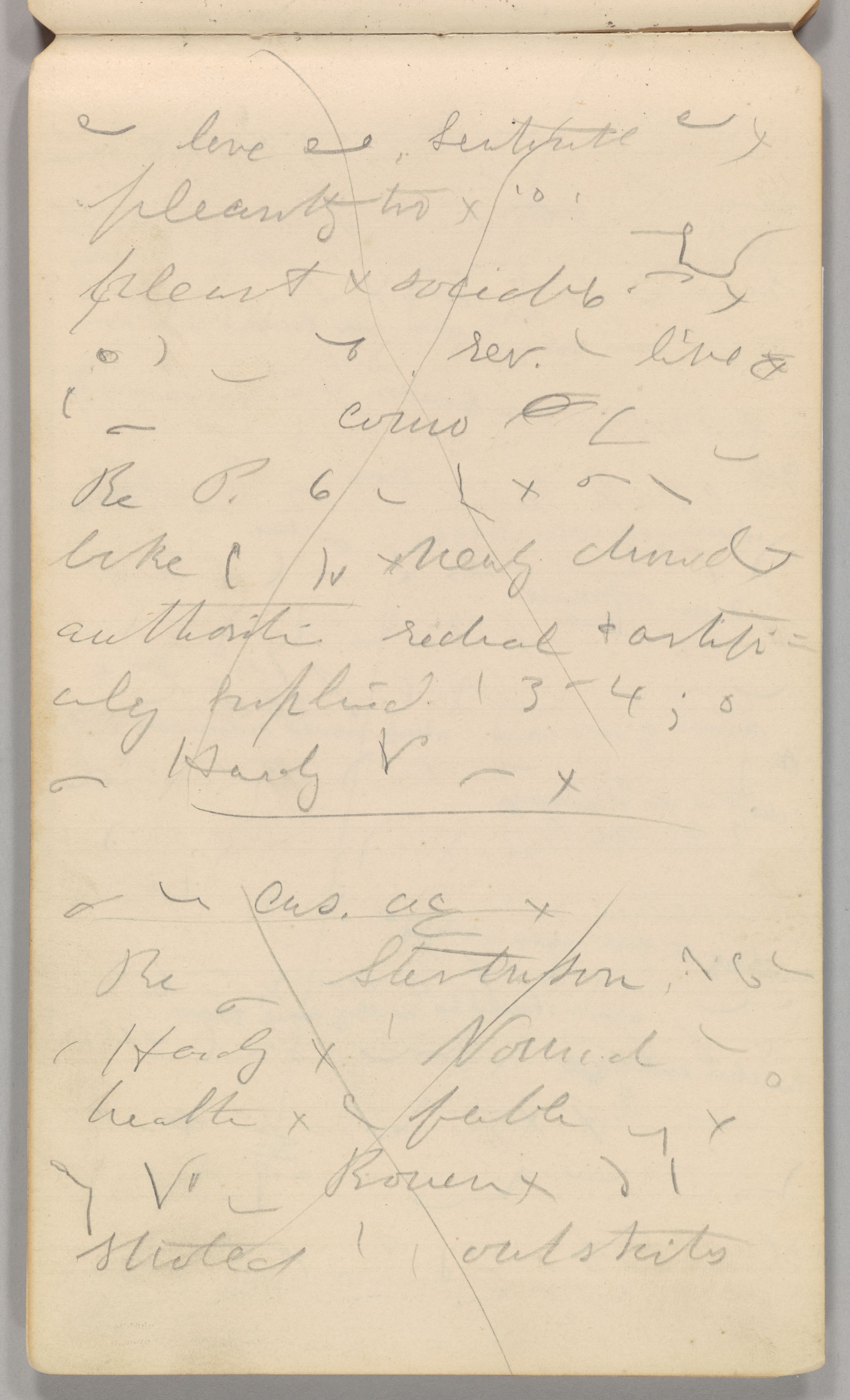
One of the gentlemen present at the dinner given to me here by B was a high Ch— tenor from D—; Christ Church, Dublin; (?) Sunday night, he
[MS: N12_leaf_]
sang love songs, sentimental songs, pleasantly too. And was an exceedingly pleasant
& sociable man.
Said in England the three words . that great blank space one word lake in Regent's Park, 6 feet deep. Somebody broke through ice. Nearly drowned. Authorities reduced & artificially supplied to 3 or 4;48 so Mr. Hardy49 tells me.
Story of a casual acquaintance.50
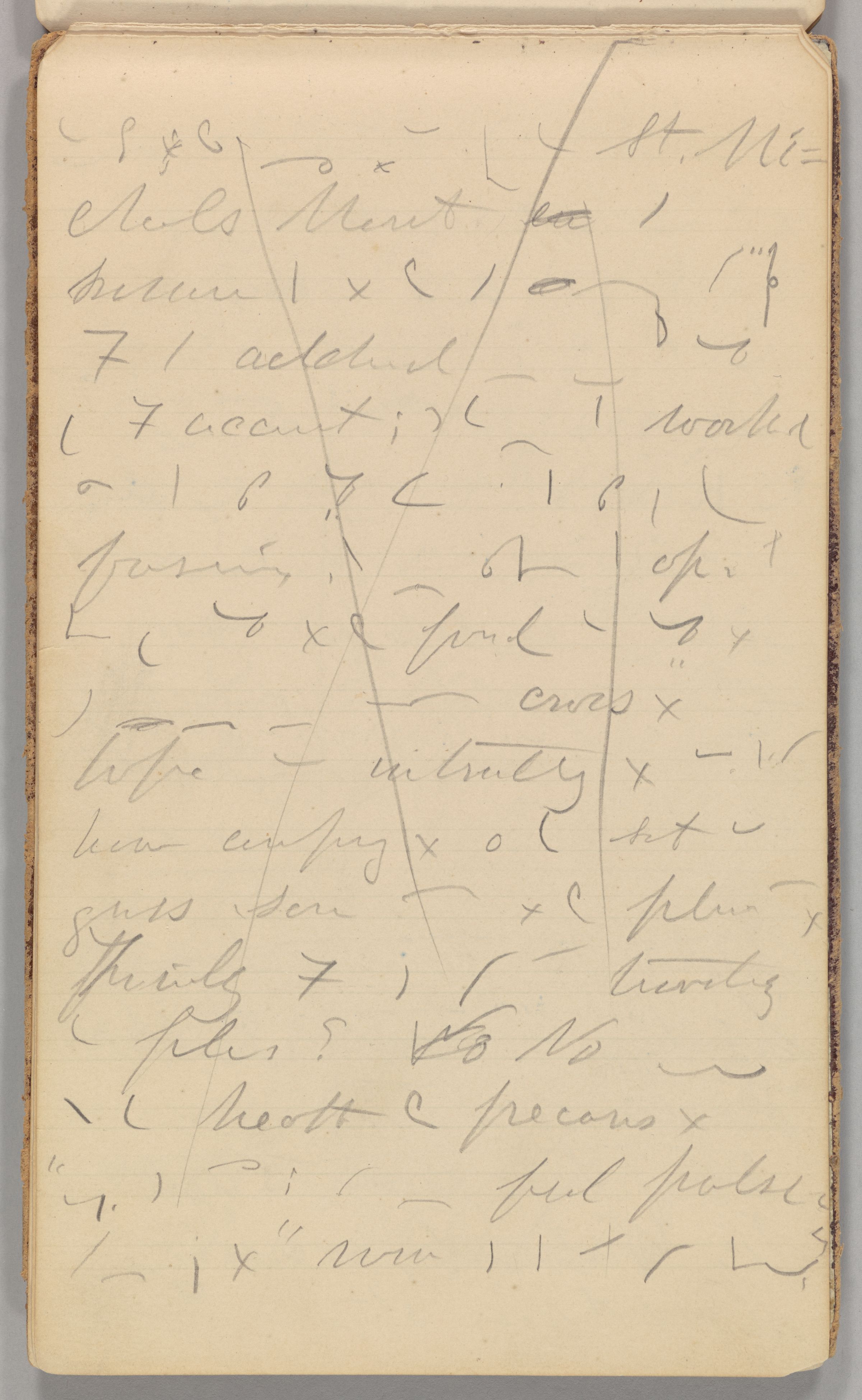
Re Mr. Stevenson, one word friend of Lady Hardy. To Normandy for his health. Very feeble indeed. Stopped awhile in Rouen. One day strolled out
to outskirts
[MS: N12_leaf_]
of the city .; found himself on the top of St. Michel's Mont each sunny day. Very gentlemanly modest well-dressed French gentleman addressed him in English with French accent; said that he had worked hard to learn
English language and had learned it after fashion, but he seldom had opportunity to
talk with Englishman. Very fond of the English. Wished he could come cross. Hope not intruding. Not at all, bear company. So they sat on the grass some time. Very pleasant time. Finally Frenchman
said, “You are traveling for pleasure?”
“No, anything but that; health very precarious.”
[MS: N12_leaf_]
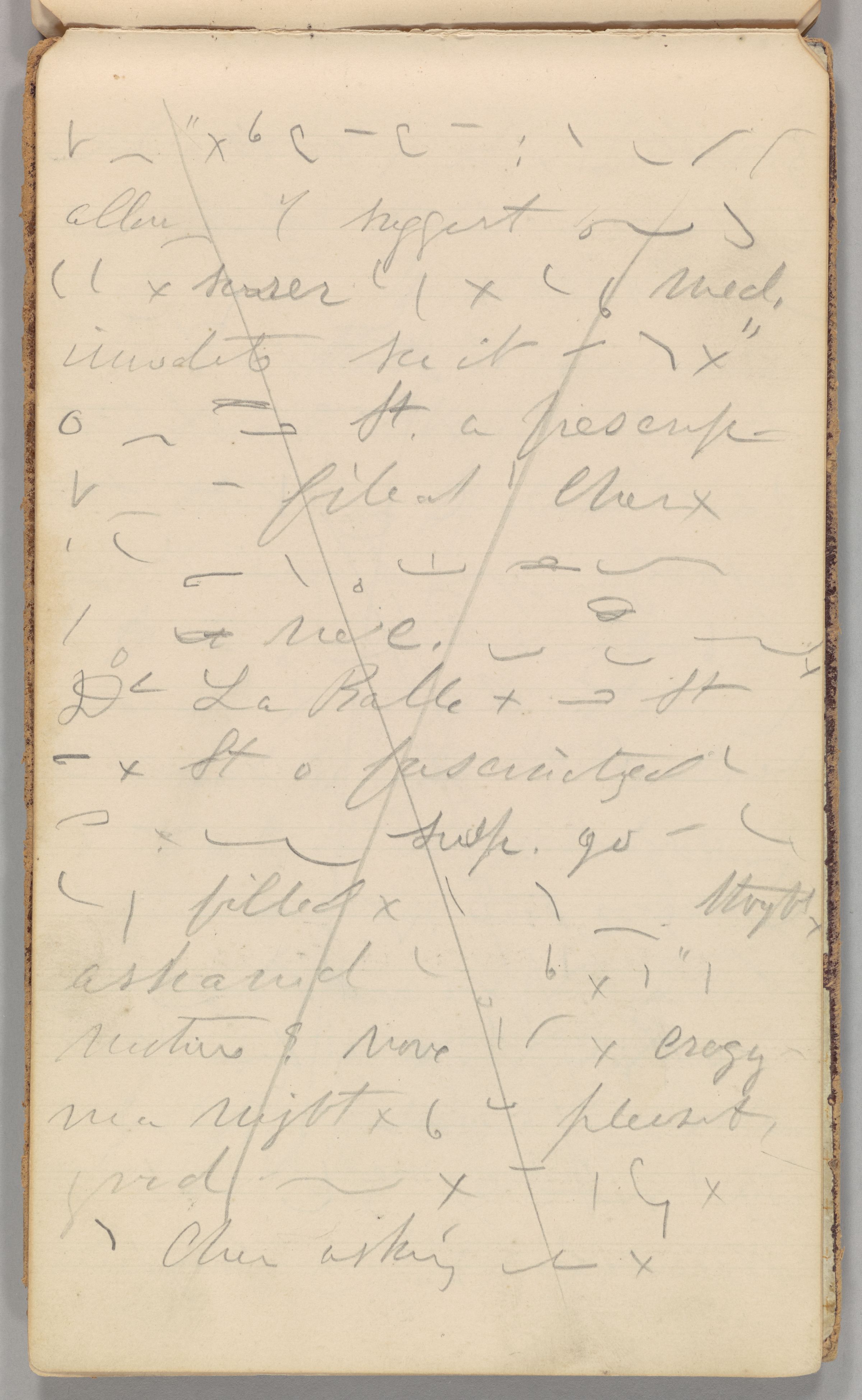
“Indeed,” said man, “let me feel pulse,” which he did. Man said, “What are you taking?”
Told him. “That's very good very good: but if you will allow me I'll suggest something
better than that. Surer than that. Have this medicine immediately, see it right away.”
So he gave Stevenson a prescription, told him get filled at Cherbourg. And have care about his own name which is necessary thing in country. Dr. La Balle. Gave Stevenson card.
Stevenson so fascinated by the man : never supposed go right off and have it filled. But when he thought, ashamed of his
doubts. Said, “What motive? None at all. Crazy man might. This only pleasant, good man.” Got it filled. Went Cherbourg asking unquiet.
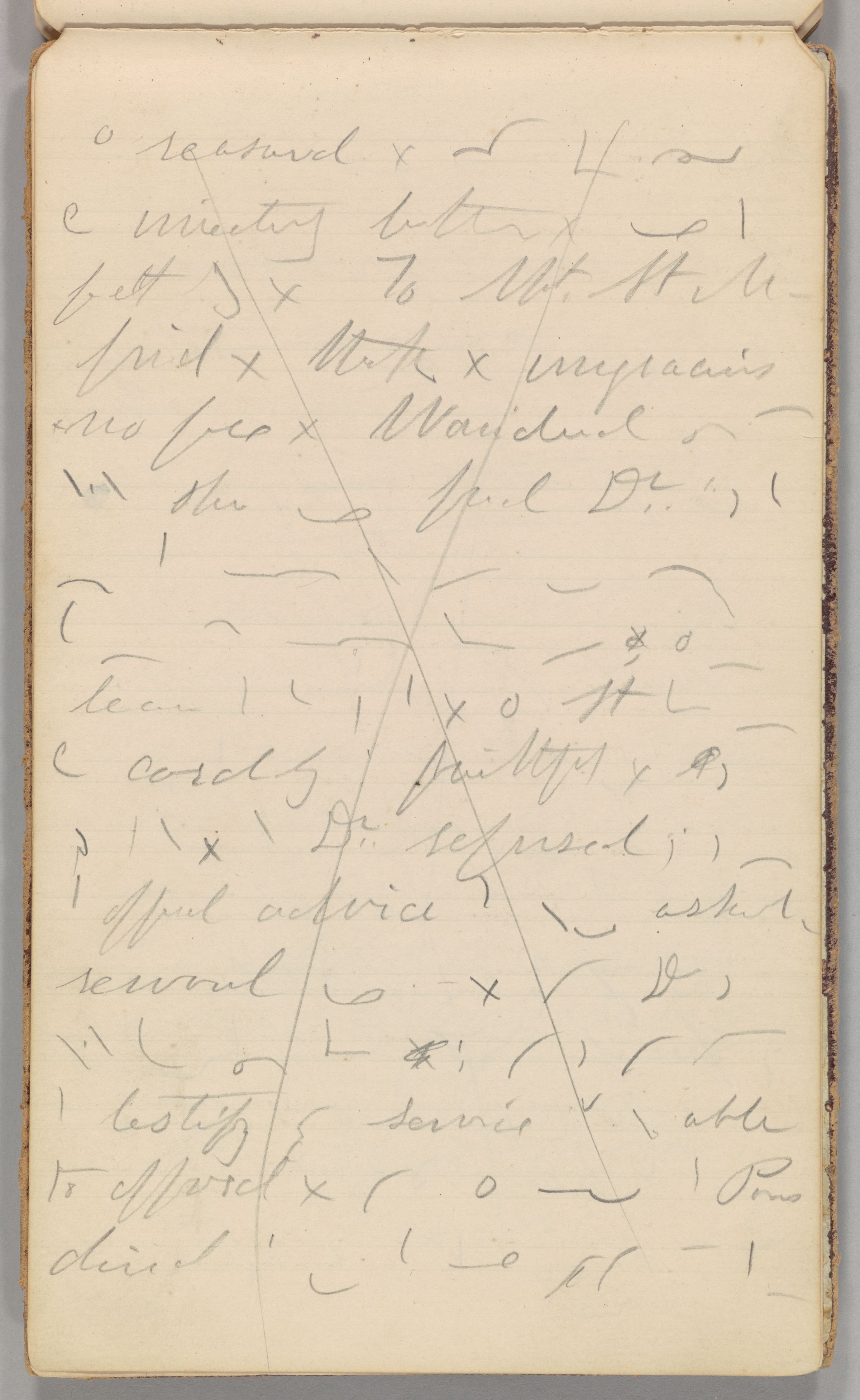
[MS: N12_leaf_]
Was reassured. Hotel—took medicine, felt immediately better. Next day felt better.
To Mt. St. Michel. Find. Thank. Ingracious, no fee. Wandered some time. By and by
sure enough, found Doctor. Said that he had come up there in hope that he might come back there ., so could learn what effect it had. So Stevenson thanked him very cordially and faithfully.
Said wanted to pay. But Doctor refused, and said he had offered advice without being
asked, reward unnecessary. “Well,” Doctor said by and by after some talk ., “you said you'd like to testify little service I been able to afford. You say going
to Paris direct and in that case you can do me
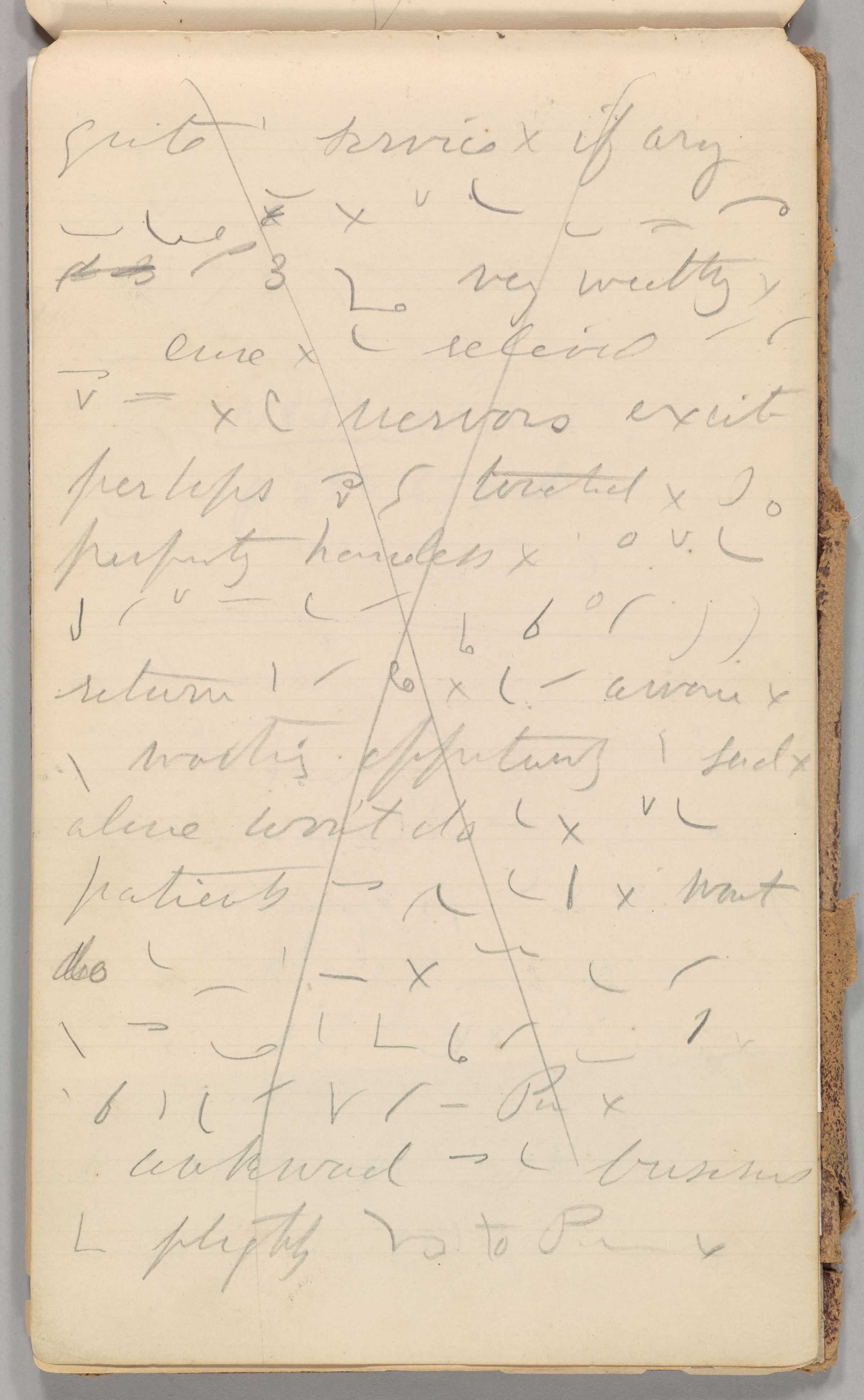
[MS: N12_leaf_]
quite a service. If any inconvenience . one word. I have in the house last 3 weeks blank space very wealthy, can't cure. Have relieved her all I can. Very nervous, excitable—perhaps
mind's little touched. She is perfectly harmless. And as I have done all I can for
her, it's just as well she should return to her friends. They are aware. Been waiting
opportunity to send. Alone won't do that. I have patients can't leave for day. Won't
do for me to go. Now if you be kind enough to take this lady in charge, and just sit
with her till you get Paris.”
Awkward kind of business, take flighty woman to Paris.
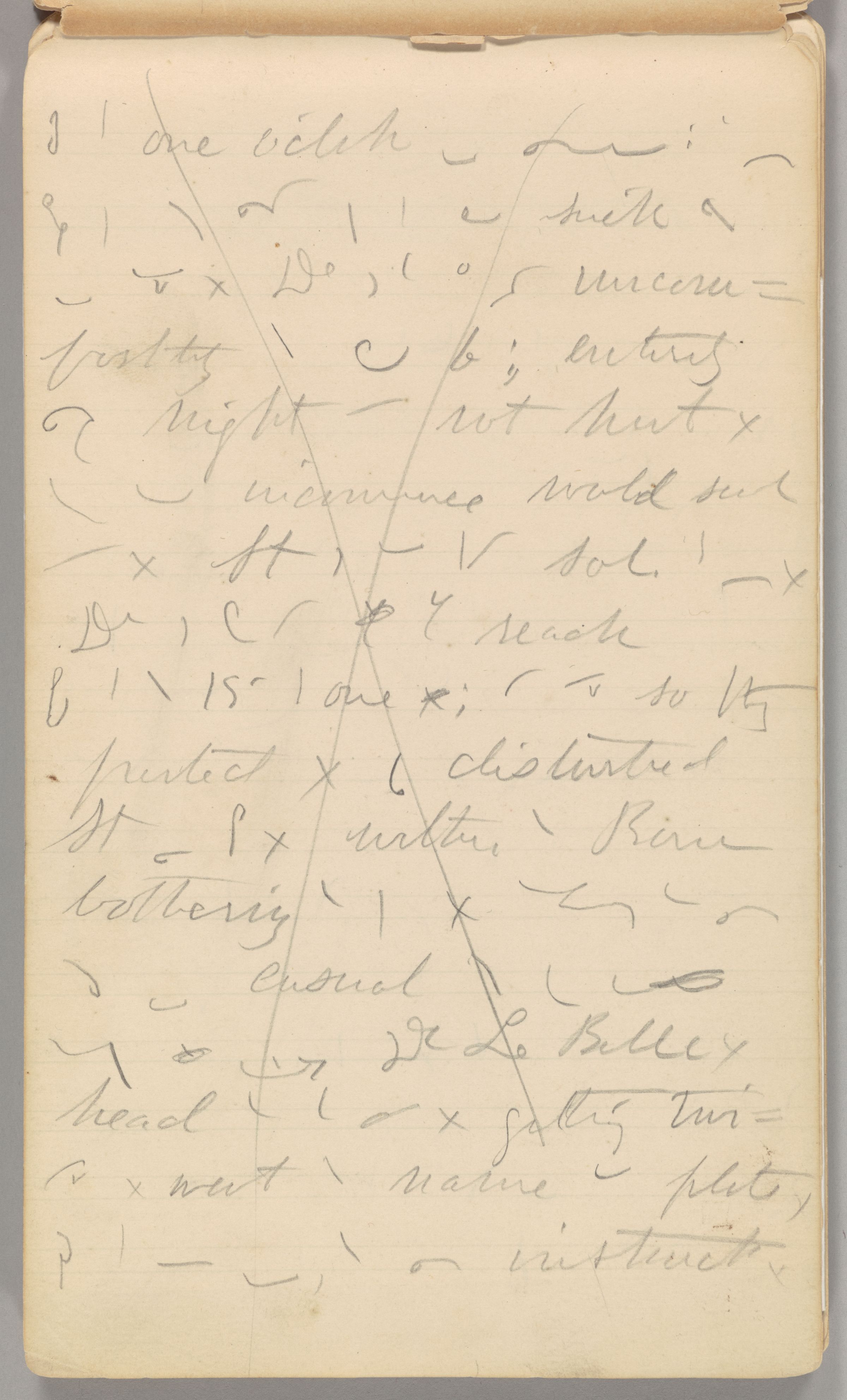
[MS: N12_leaf_]
Train at one o'clock in the morning: and he supposed it would hardly do to send sick
person in the night. Doctor said that was little uncomfortable but only chance; entirely
healthy, night air not hurt. If no inconvenience would send her. Stevenson said not
at all one word to him. Doctor said, “Very well I'll reach station at about 15 to one.” “All right.”
So they parted.
This disturbed Stevenson great deal. Walked about Rouen bothering about it. Inquired of someone in casual way if nothing nobody knew Dr. La Balle. Head of that stair. Getting twilight. Went by the name
on the plate. Wanted to go in, but some instinct.
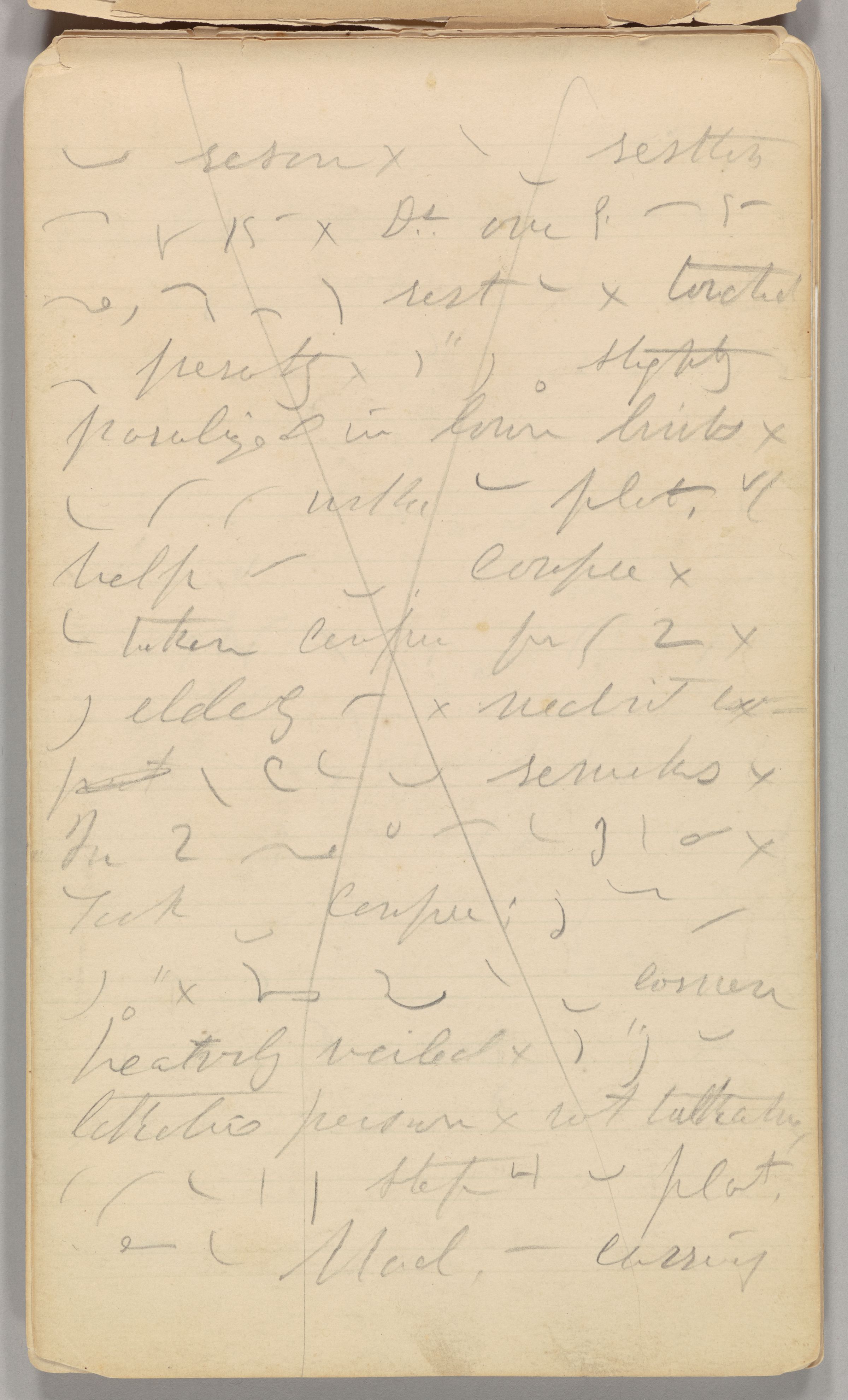
[MS: N12_leaf_]
No reason. Put in restless time till 15. Doctor on station from 5 minutes, hoped he would rest one word. Touched him presently. Said, “She is slightly paralyzed in lower limbs. If you will
walk along platform I'll help her in the coupé. Have taken coupé for you 2. She's
elderly lady. Needn't expect be full of any remarks.” In 2 minutes was time for train to start. Took in the coupé says, “Now
there she is.” Woman sitting up in the corner, heavily veiled. Said, “She's not talkative
person. Not talkative. All you have to do step out on the platform, and ask for Madame—'s
carriage
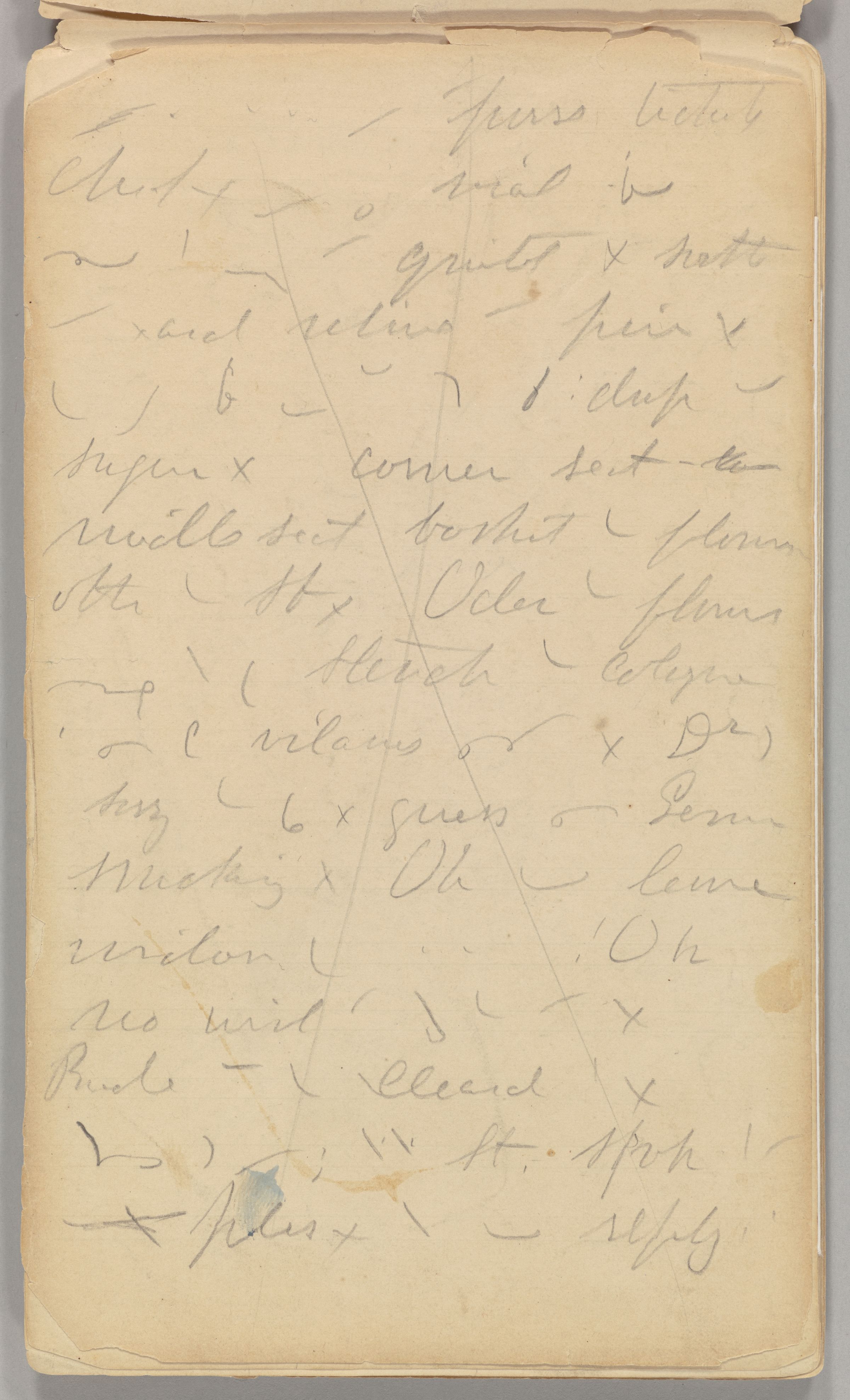
[MS: N12_leaf_]
... there are purse, tickets, chest. There is vial containing medicine to keep her
quiet & soothe her, and relieve her pain. If she complains in the night why just a drop on sugar.”
Corner seat, middle seat basket of flowers, other for Stevenson. Odor of flowers mixed up with stench of cologne and some other villainous smell. Doctor said, “Sorry for this. Guess some German smoking. Oh no, leave window if ...! Oh no, wind a lot better for her.”
La Balle got off, cleared out. Woman sat there; by and by Stevenson spoke to her pleasantly. But no reply. And
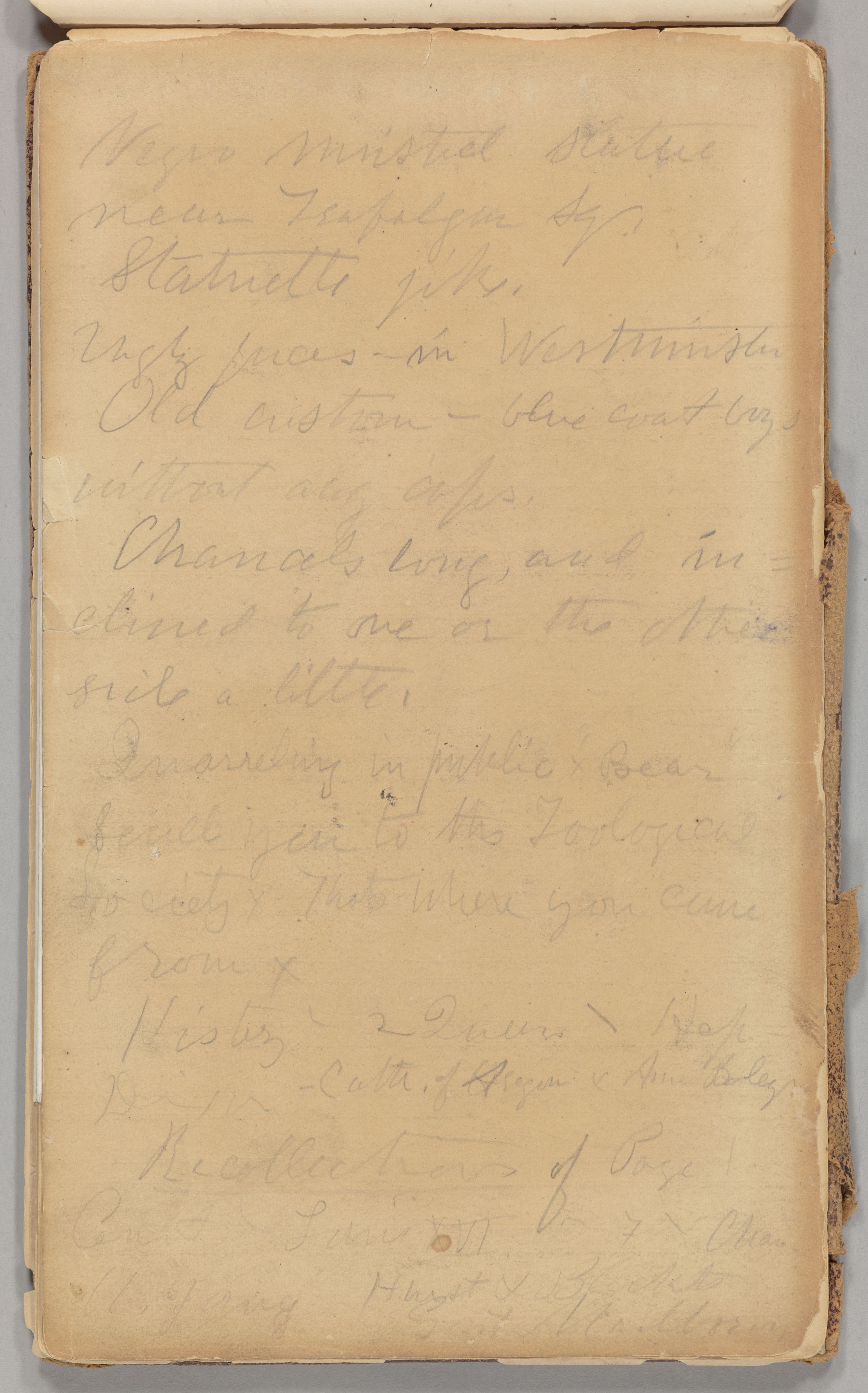
[MS: N12_leaf_]
Negro minstrel statue near Trafalgar Sq.
Statuette pike.
Ugly faces—in Westminster
Old custom—blue coat boys without any caps.
Chancels long, and inclined to one or the other side a little.
Quarreling in public. “Bear”
Send you to the Zoological Society. That's where you came from.
History of 2 Queens by Hepworth Dixon—Cath. of Aragon & Ann Boleyn.
Recollections of Page to Court of Louis XVI. From the French by Charlotte M. Yonge
Hurst & Blackett, Great Marlborough51
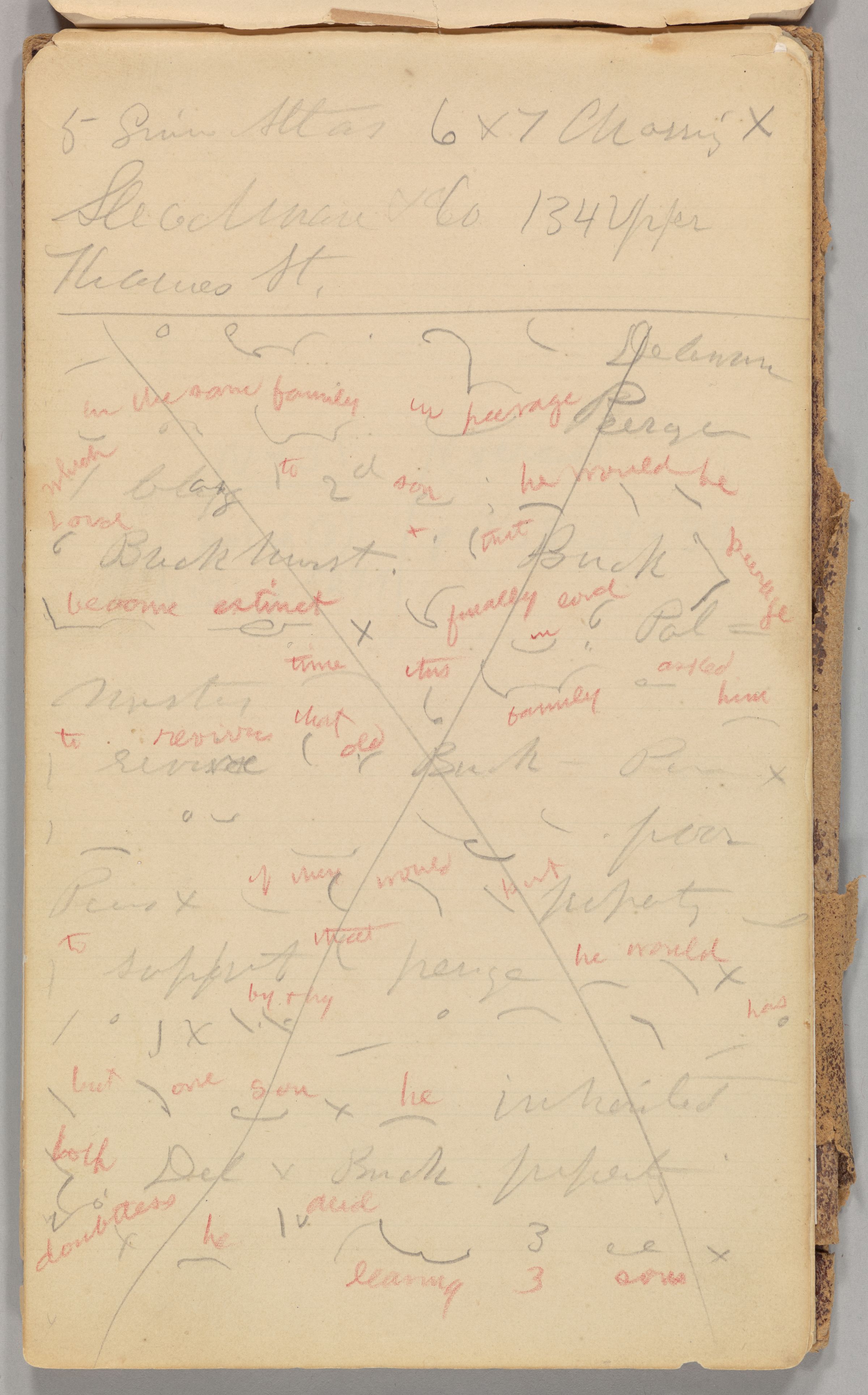
[MS: N12_leaf_]
5 Guinea Atlas, 6 & 7 Charing Cross
Sleadman & Co., 134 Upper Thames St.
There was formerly an earldom of Delawarr52 and in the same family another peerage which belonged to the second son; he would
be Lord Buckhurst. And that Buckhurst peerage became extinct. Finally in Lord Palmerston's
time this family asked him to revive that old Buckhurst peerage. Said he was not in
favor of poor peers. If they would put property enough to support that peerage he would. Which was done. By and by there
was time when there was but one son. He inherited both the Delawarr & Buckhurst property
and titles. He died leaving 3 sons.
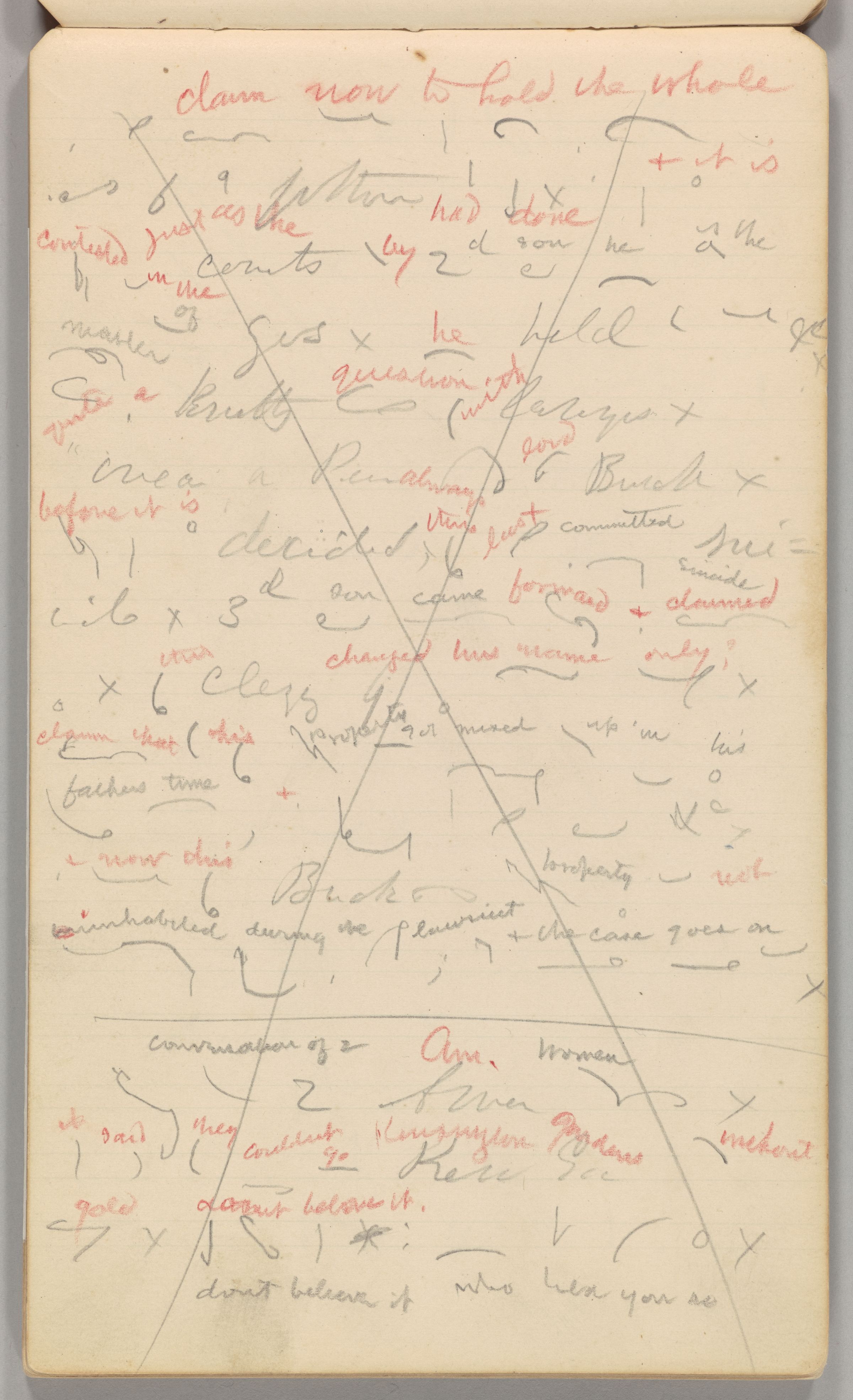
[MS: N12_leaf_]
The eldest claimed now to hold the whole concern just as the father had done. And it was contested in the courts by the second son who was a master of
the G - s. He held that now etc. Quite a knotty question with lawyers. “Was a peer always Lord Buckhurst?” Before it was decided, this last committed suicide.
Third son came forward and claimed his. This one word changed his mind naturally. Claimed that this property got mixed up in his father's time, and descended to the
eldest son etc., and now this Buckhurst property is not inhabited during the lawsuit;
and the case goes on.
Conversation of 2 American women.
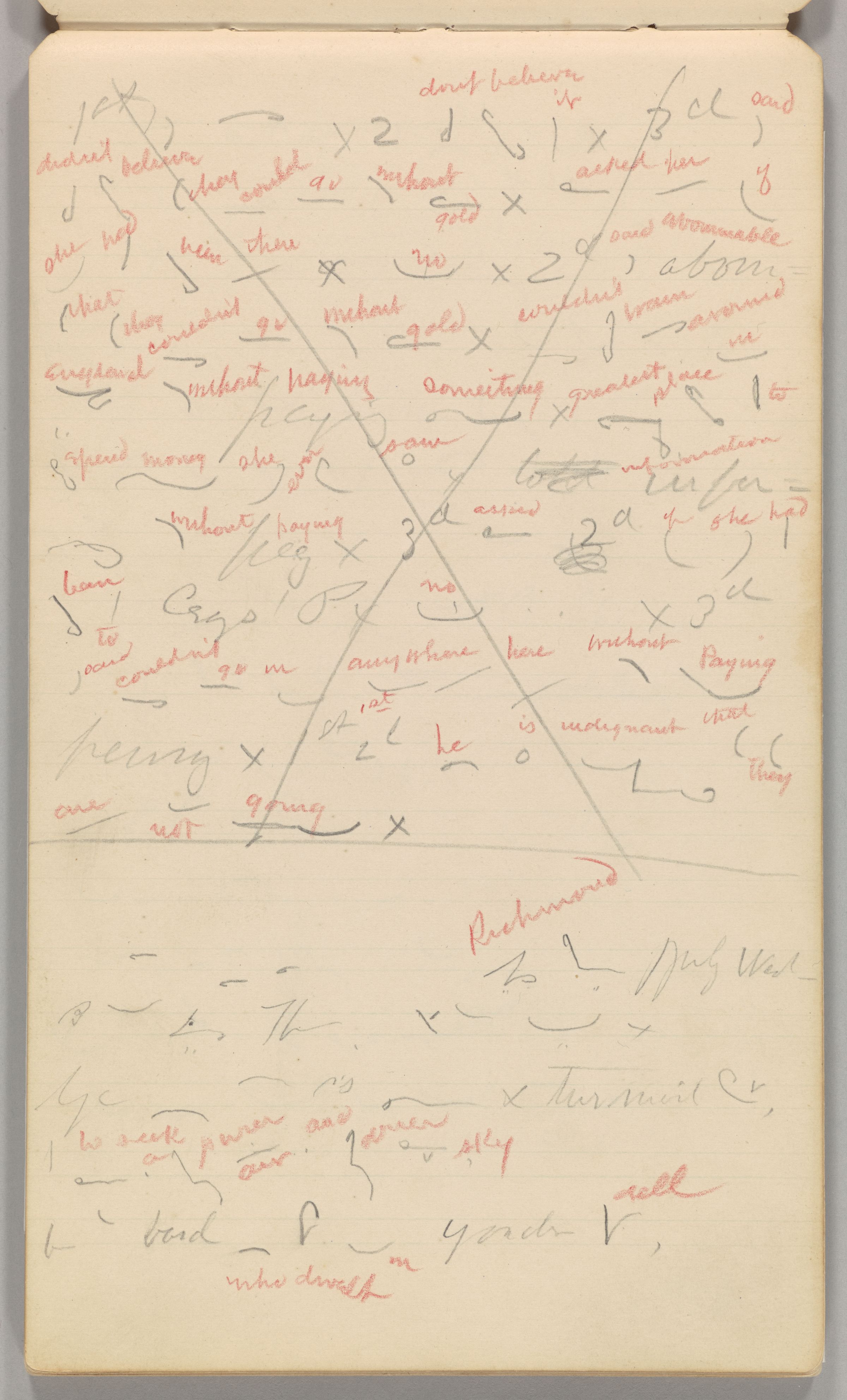
First said they couldn't go Kew Gardens without a carriage. Didn't believe it .: who told you so?
[MS: N12_leaf_]
First, said—man. Second doesn't believe it. Third said didn't believe they could go
without car. Asked her if she had been there so. No. Second said abominable that they couldn't go without car. Couldn't turn around
in England without paying something. Greatest place to spend money she ever saw. Told Information without paying. Third asked if second if she had been to Crystal Palace. No.... Third said couldn't go in anywhere
there without paying penny. First second seemed so indignant that they were not going.
kr kr kr53
Richmond Park July Wed—
Lines on James Th—54 the poet of Nature.Ye who from London's smoke & turmoil fly,
To seek the purer air and drier sky,
Think of the bard who dwelt in yonder dell,
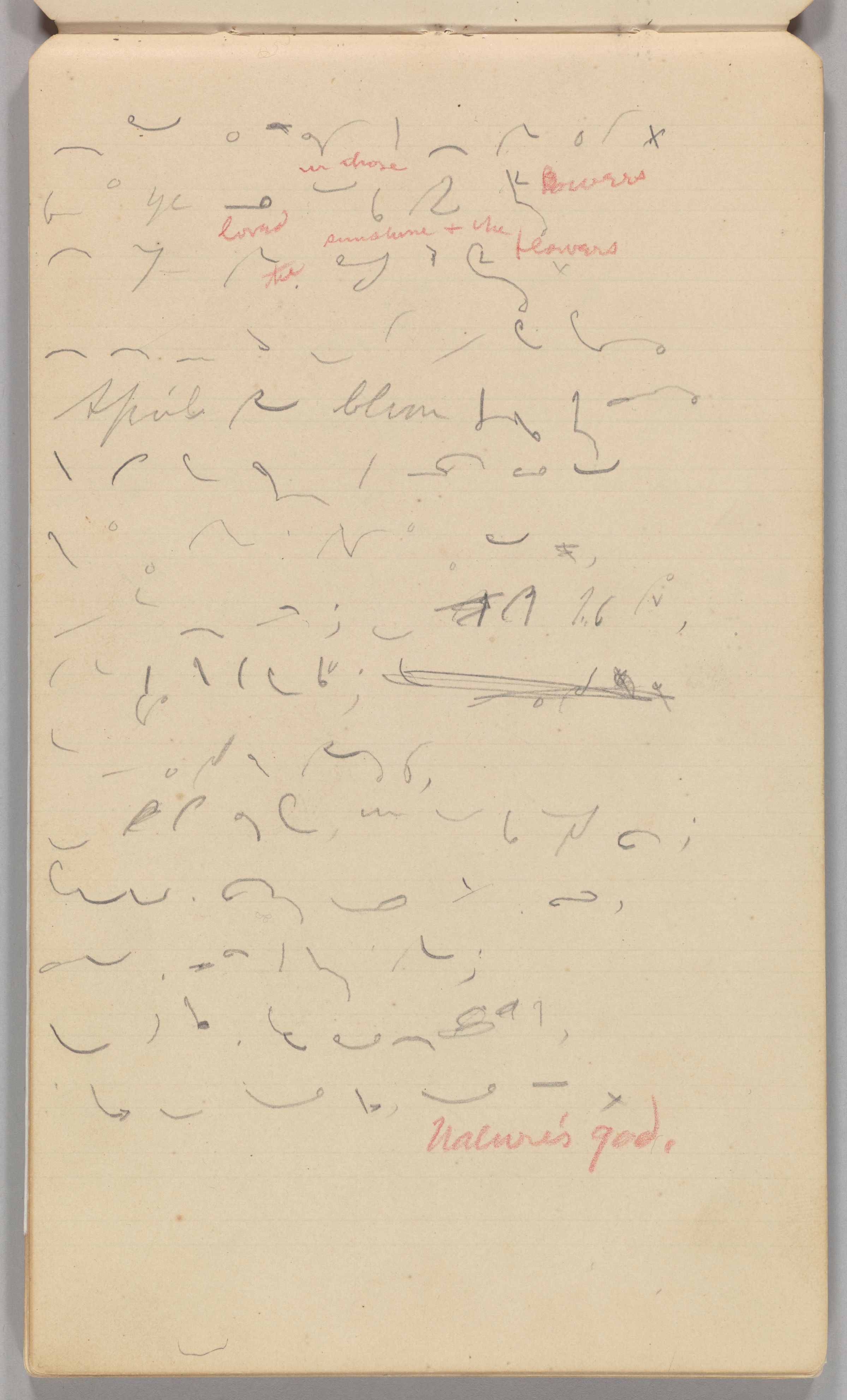
[MS: N12_leaf_] Who sang so sweetly what he loved so well.
Think as ye gaze on these luxuriant bowers
How T—loved the sunshine and the flowers.
He who could paint in all their varied forms
April's laughing bloom, December's dreary storms
By yon very stream which calmly glides along
Pure as his life and lovely as his song,
There oft he roved; in yonder churchyard lies,
All of the deathless bard that ever dies;
For there his gentle spirit lingers still,
In yon sweet vale,—on this unchanged hill;
Flinging the two words o'er the grove,
Stirring the heart to poetry and love;
Few so prize the favored scenes he trod,
And view in nature's beauty, nature's god.
[MS: N12_leaf_]
July 11th
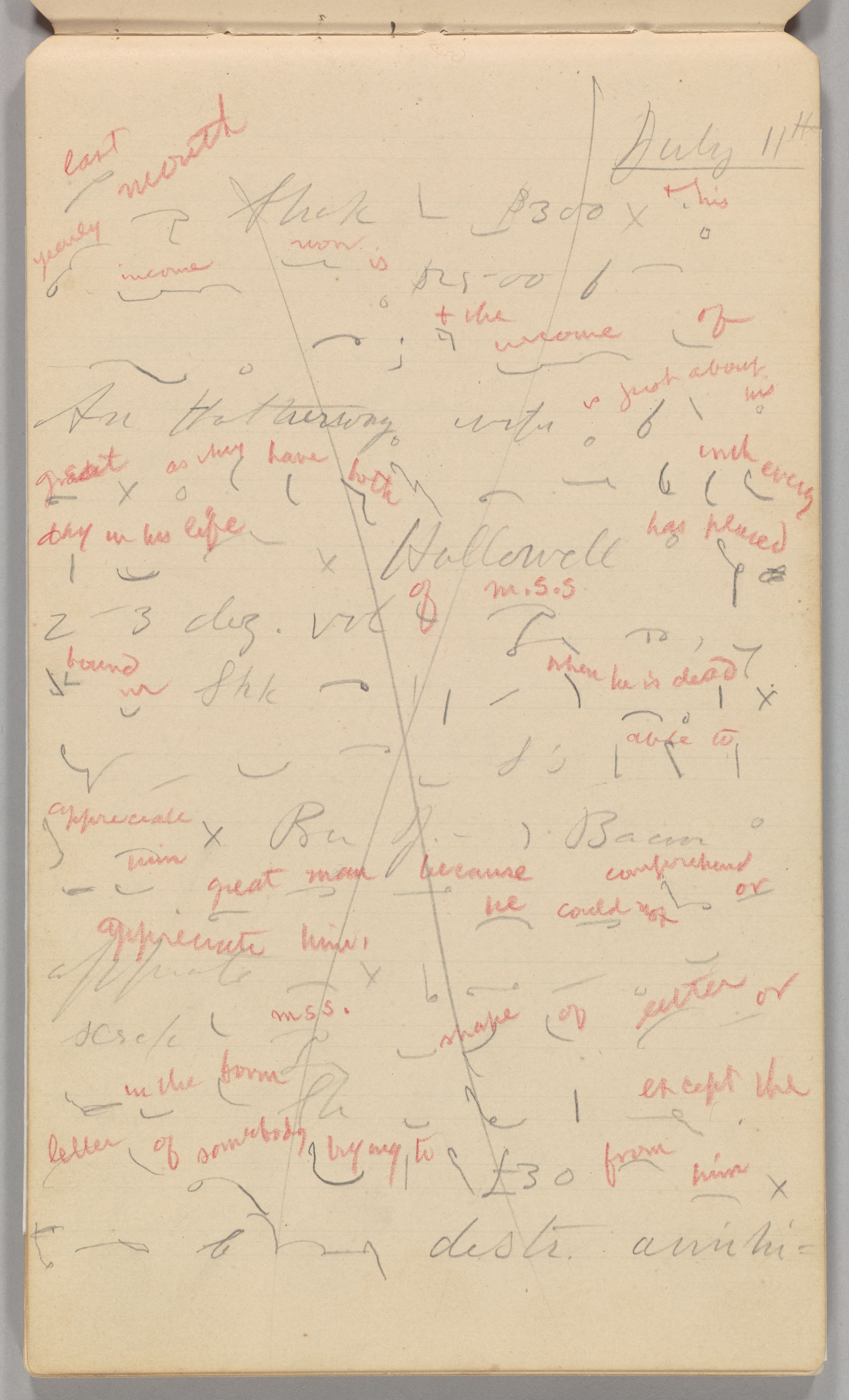
Last month Shakespeare55 took in $300. And his yearly income now is $2500 just from completing his house; and the income of Anne Hathaway, his wife, is just about as great. So that they both prosper more now than they ever did in life.
Halliwell56 has placed 2 or 3 doz. volumes of manuscript one word, neatly bound in the Shakespeare house to be read when he is dead. Evidently there no man in Shakespeare's day able to appreciate him. Ben Jonson said Bacon was not
a great man because he couldn't comprehend or appreciate him. It is curious there
is not scrap of manuscript in the shape of a letter or note of Shakespeare in the
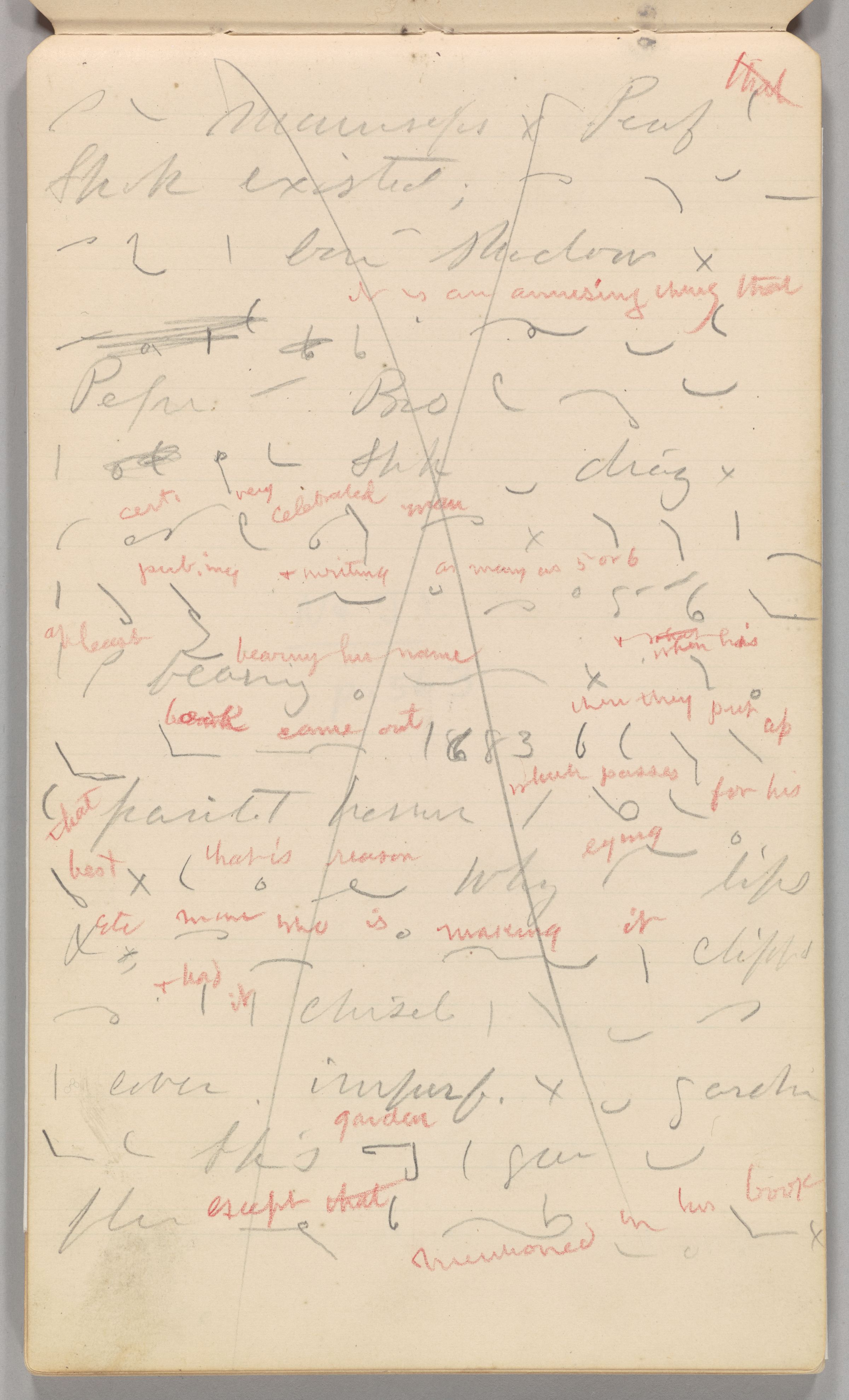
present day except the letter of somebody trying to borrow £30 from him.57 It is a most remarkable destr. annihi-
[MS: N12_leaf_]
lation of manuscripts. Proof that Shakespeare existed; man would not go around trying to b-- from shadow. There is a doubt that It is an amazing thing that Pepys or Boswell six words Shakespeare in the diary. Yet certainly very celebrated man. When without doubt he had been publishing and writing as many as 5 or 6 books at least bearing his name.
And when his big book came, 1883 1683, then they put up that painted horror which passes for his bust. They say reason
why long lips58 etc. ., man who was making it chipped amiss and had to chisel it up in order to cover the imperfections.
In the garden back of Shakespeare's garden they grow no flowers except those mentioned
in his books.
[MS: N12_leaf_]
But still it makes a pretty good-sized garden—pretty variegated. It is more respected than any other man's. For certainly without travelers he would have stately sepulcher. But even they had too much respect to whittle chip. But they have wasted a lot of time. Have only caught 2 or 3 persons trying to chip off little pieces of
the wood.
Shakespeare's mulberry tree59 has been cut down by that thieving monster.60 Yet plenty of the wood left. Man in Warwick furnishes any amount of these trinkets.
If you wanted a bootjack if you you could get it. And this man I called on him and he showed me through his various departments. 33 sets of one word. 300 bedsteads. Same tree. Third floor sofas & such things.
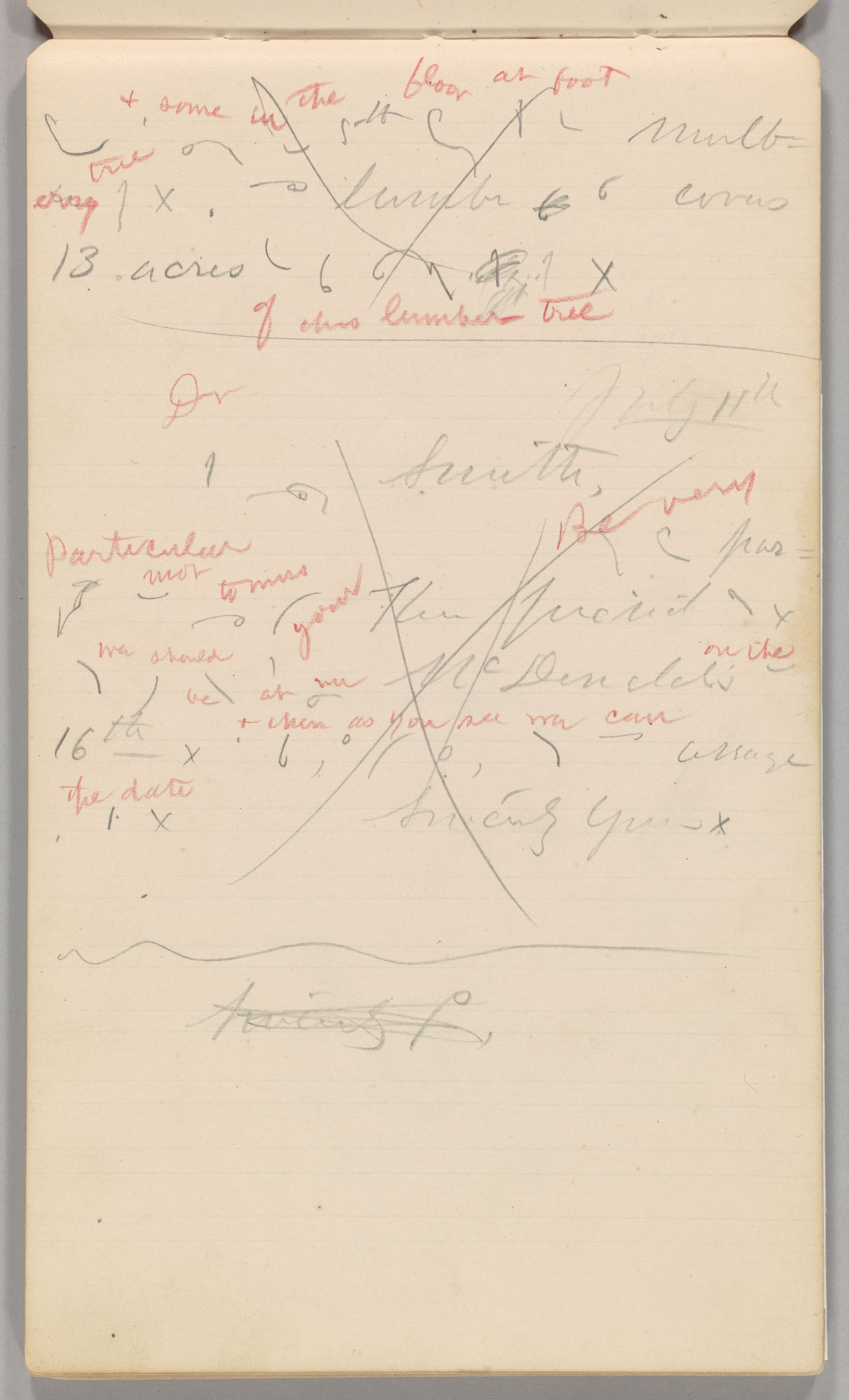
[MS: N12_leaf_]
And they were building a one word in the 5th floor out of the mulberry tree.
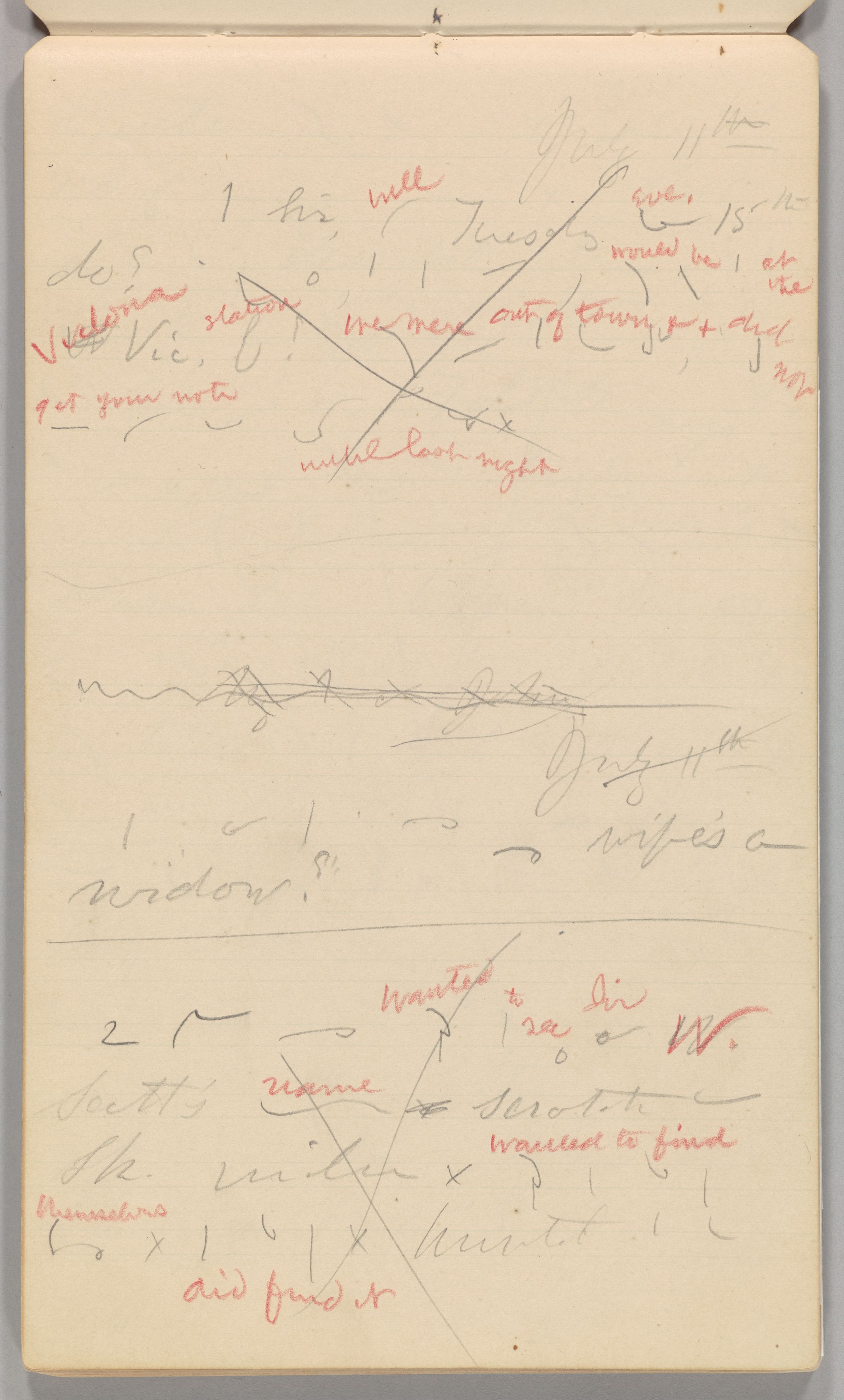
The man's lumberyard covers 13 acres of this mulberry tree.
July 11th
Dear Mr. Smith,
one sentence. We should be at Mr. MacDonald's on the 16th. And then, as you say, we can arrange the date.
Sincerely yours.61
[MS: N12_leaf_]
July 11th
Dear Sir,
Will Tuesday evening 15th do? And if so, at what hour should we be at the W Victoria Station? We were out of town, and didn't get your note until last night.
My dear Sir John,62
July 11th
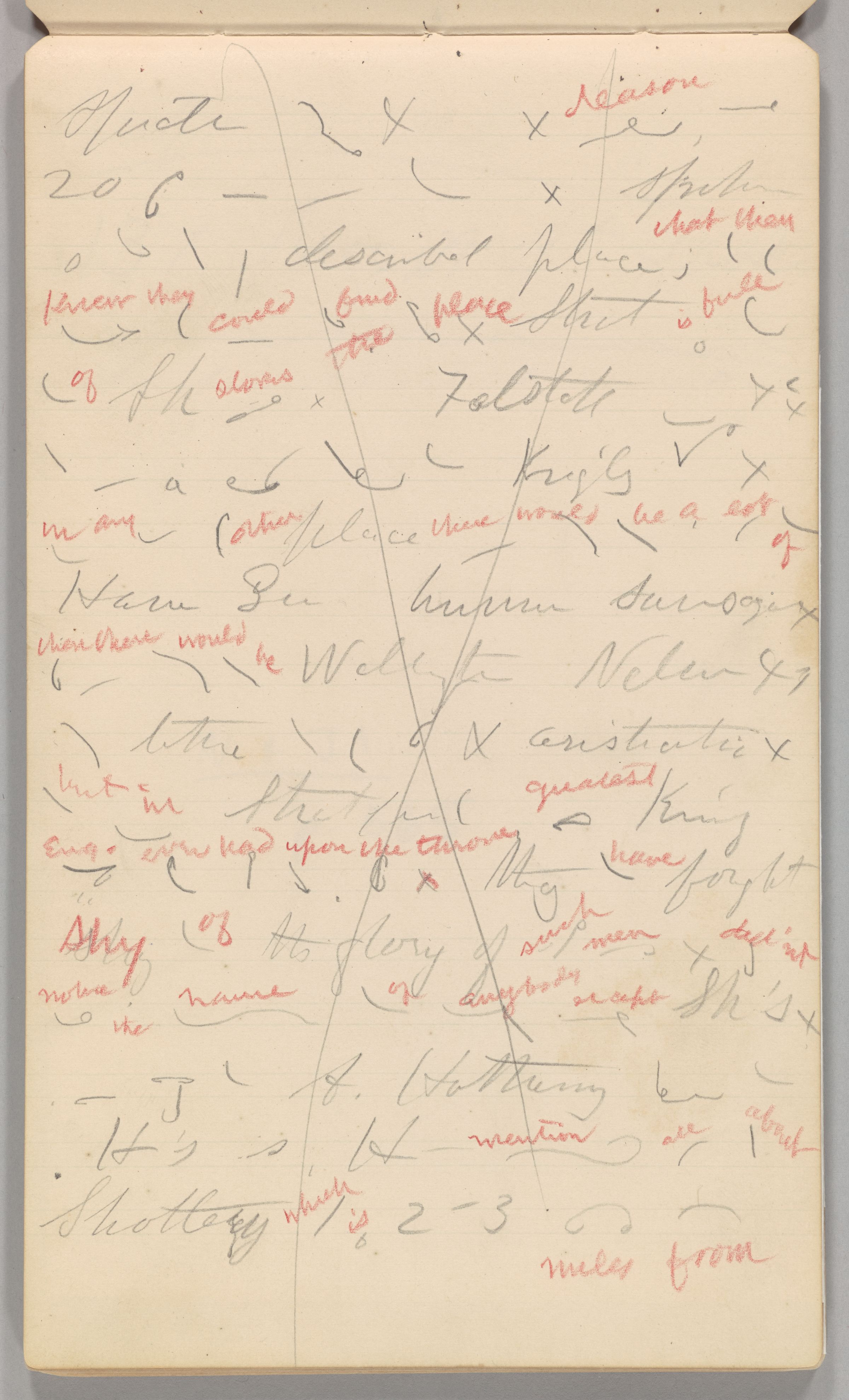
“four words a man whose wife's a widow?”
2 young men wanted to see Sir W. Scott's name . scratched on Shakespeare's window. Wanted to find it themselves. Did find it. Hunted
it out of the
[MS: N12_leaf_]
spider webs & blank space. Reason, because 20 years ago their father blank space. Spoken so often about it, described place; that they knew they could find the place.
Stratford is full of Shakespeare stories. Falstaff inn etc. But there is a singular absence of kingly titles. In any other place there would be a lot of four words. Then there would be Wellington, Nelson etc. four words lordly & aristocratic. But in Stratford the greatest king England ever sat upon the throne. They have fought shy of the glory of such men. Didn't notice the name of anybody except Shakespeare.
The great granddaughter of A. Hathaway, descendant of the Hathaways, runs the H—mansion
yet at Shottery which is 2 or 3 miles from
[MS: N12_leaf_]
Stratford.
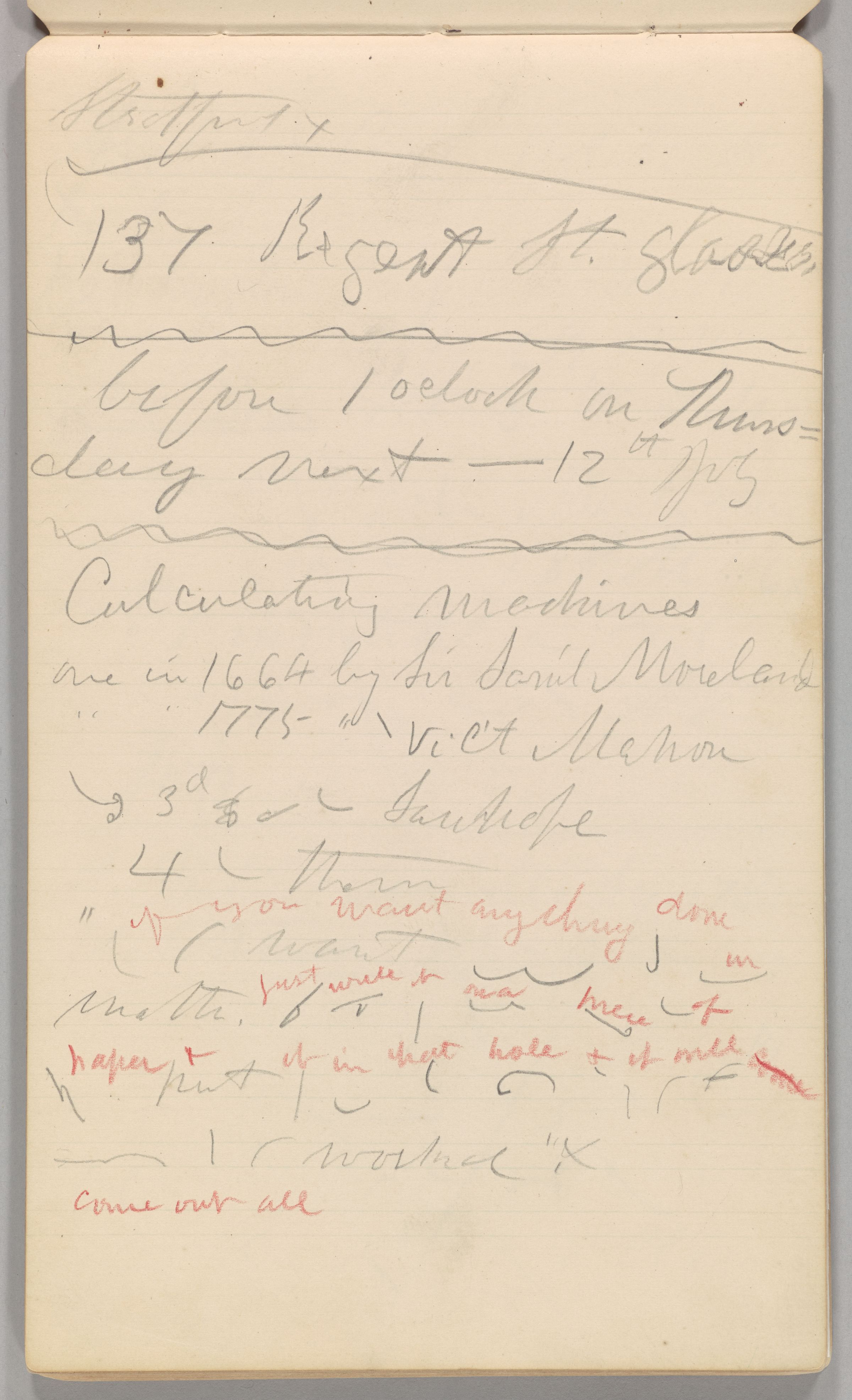
137 Regent St. glasses, before 1 o'clock on Thursday next—12th July
Calculating machines
one in 1664 by Sir Sam'l Morland
one in 1775 by Viscount Mahon, physicist, 3d earl of Stanhope63 4 of them
“If you want anything done in math., just write it on a piece of paper, put it in that hole and it will all come out all worked.”
[MS: N12_leaf_]
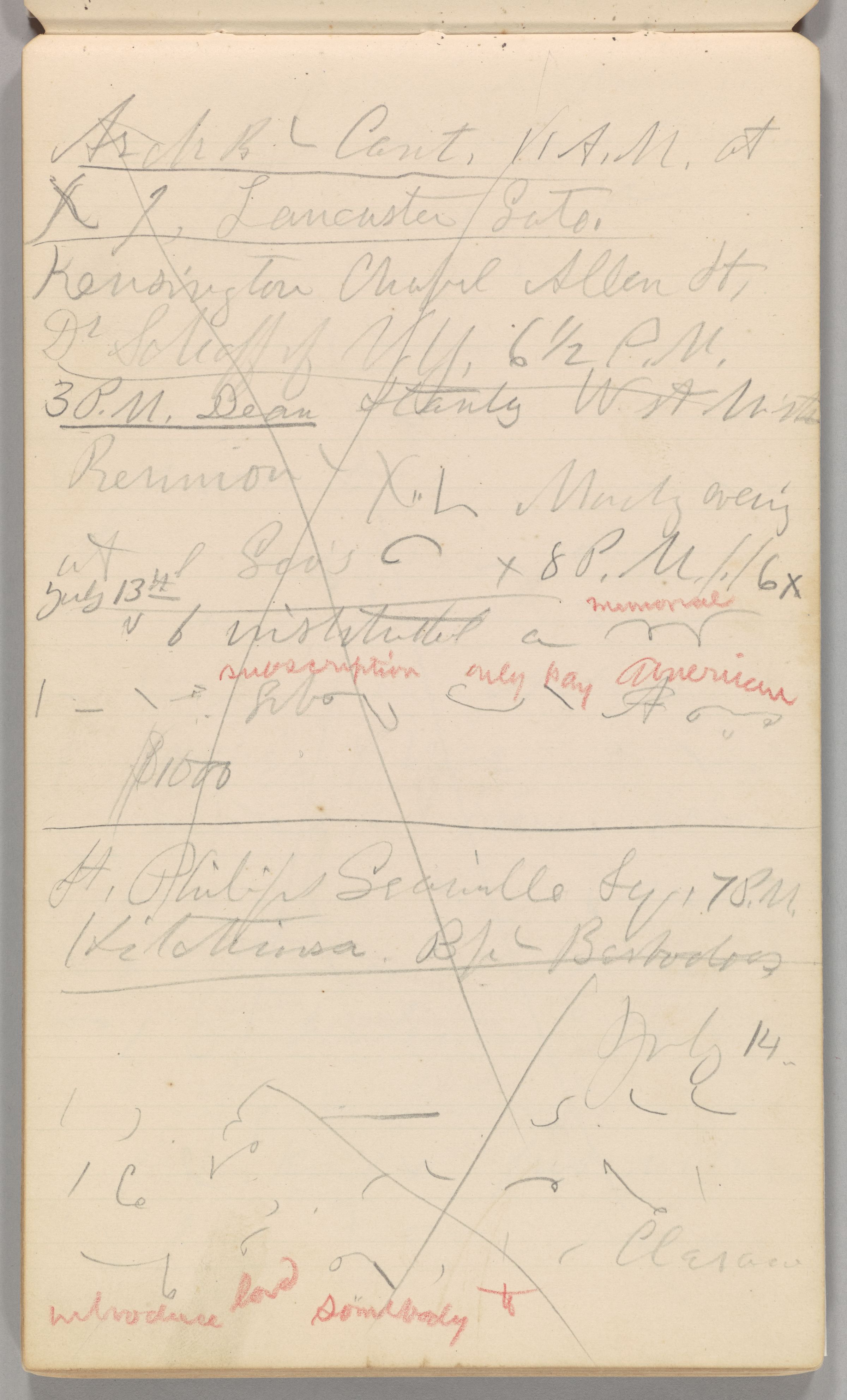
Archbishop of Canterbury, 11 A.M. at Christ Church, Lancaster Gate.
Kensington Chapel, Allen St., Dr. Schaff of N.Y., 6½ P.M.
3 P.M. Dean Stanley, Westminster
Reunion of Christendom Monday evening at St. George's Hall, 8 P.M. one word 6.
July 13th
I just instituted a memorial to get by subscription only by Americans—$1000
St. Philip's, Granville Sq., 7 P.M., Mitchinson, the bishop of Barbados.
July 14.
To show the little knowledge the English have of each others' titles, the lady of the house proposed to introduce Lord Somebody,
to Lady Cl----
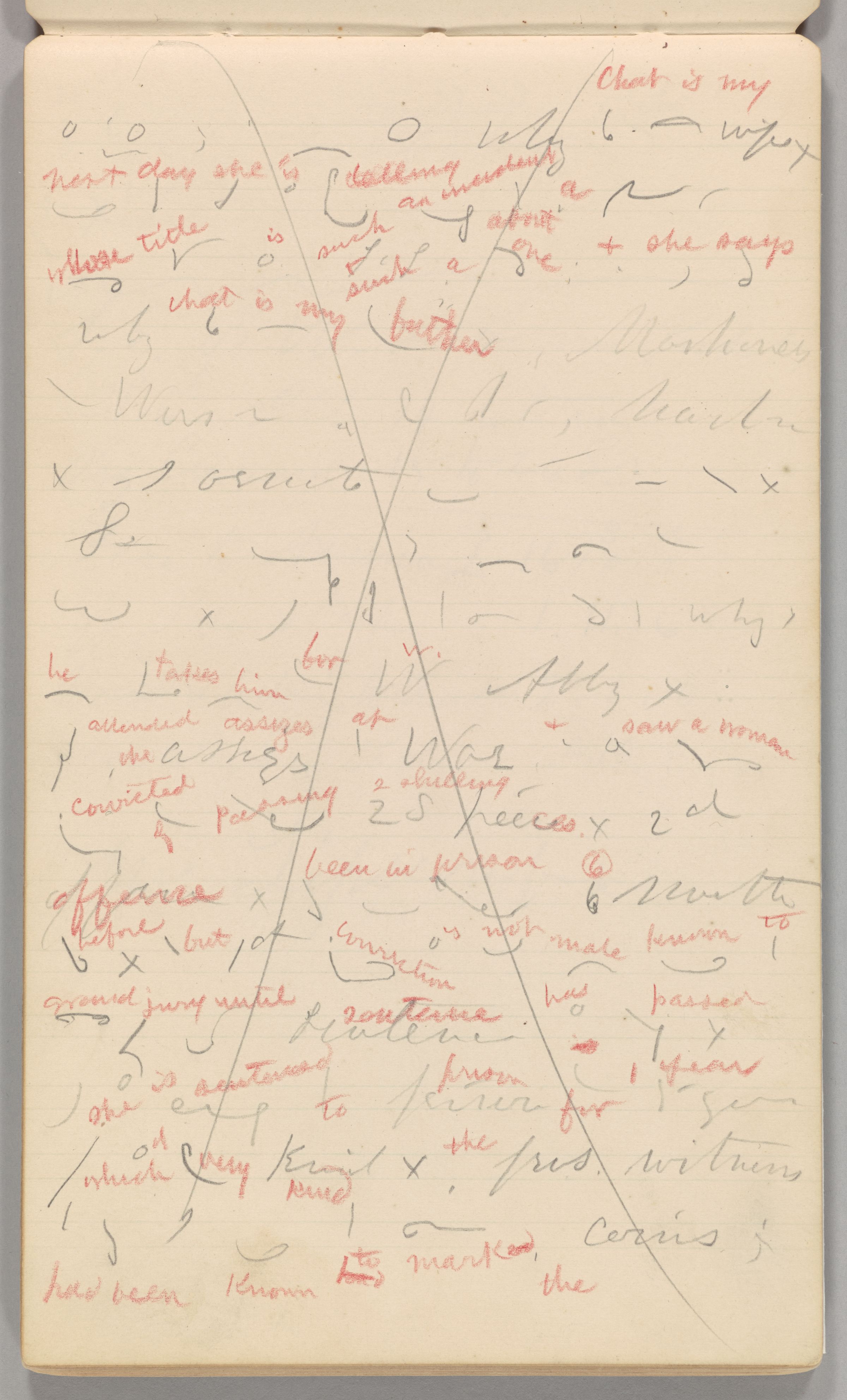
[MS: N12_leaf_]
so and so; and he says, “Why that's my wife.” Next day gentleman was telling incident
to a young lady whose title was such and such a one and she says, “Why that's my father.”
The Marchioness of Westminster is a very large lady, handsome & rather ornate in her get up. S—introduced said he heard of often. She turned to someone said, “Why, he takes me for Westminster Abbey.”
Attended the assizes at Warwick and saw a woman convicted of passing 2-shilling pieces.
Second offense. Been in prison 6 months before. But first conviction was not made
known to the grand jury until sentence was passed. She was sentenced to prison for
5 years which was very kind. The prosecution's witnesses had been one word enough to mark the coins;
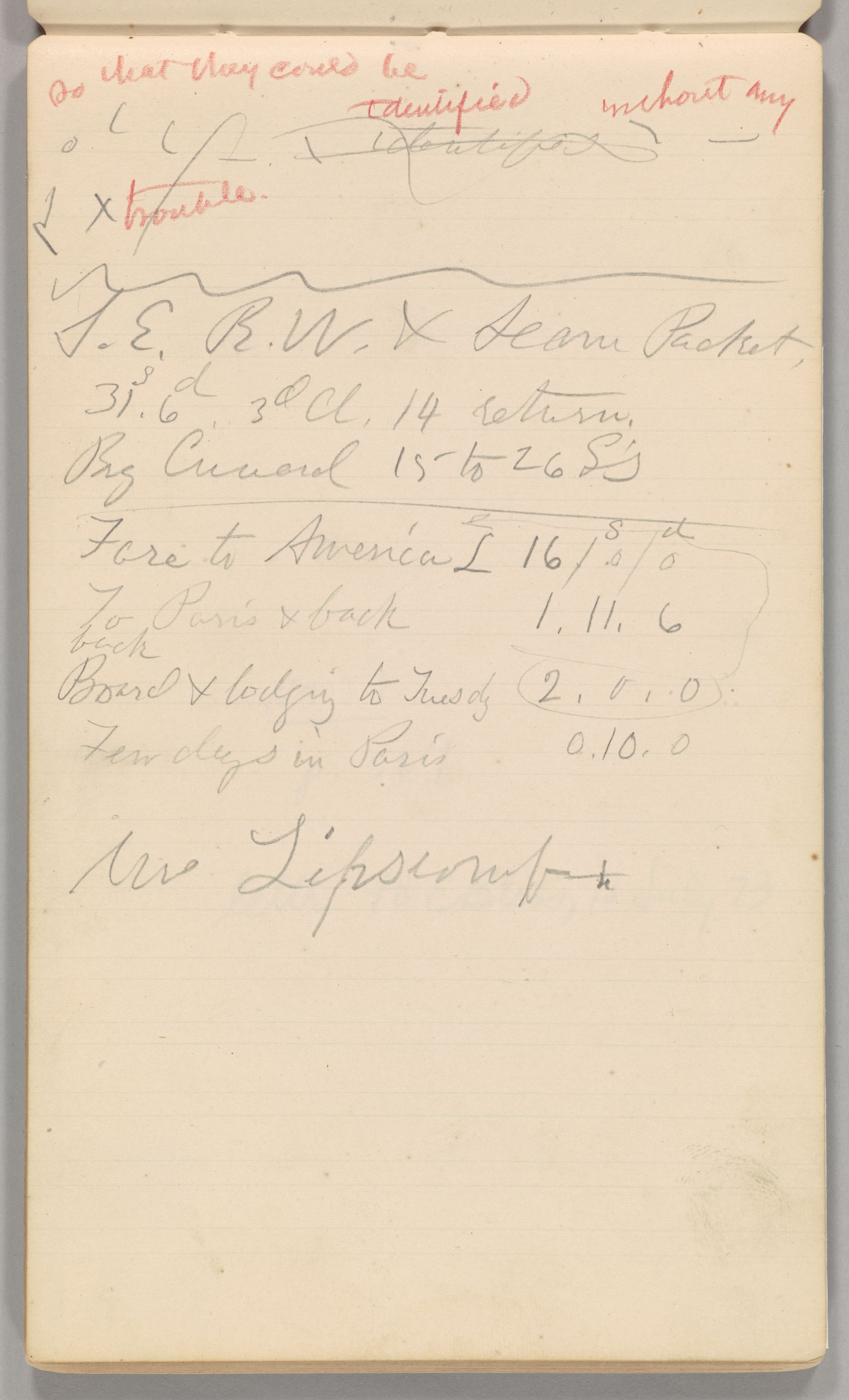
[MS: N12_leaf_]
so that they could be identified without any trouble.
S. E. R. W. & Steam Packet, 31s.6d. 3d class, 14 return. Brig Cunard 15 to 26s.
| £ s d | |
| Fare to America | 16/.0/0 |
| To Paris & back | 1.11.6 |
| back | |
| Board & lodging to Tuesday | 2. 0.0 |
| Few days in Paris64 | 0.10.0 |
Mrs. Lipscomb—
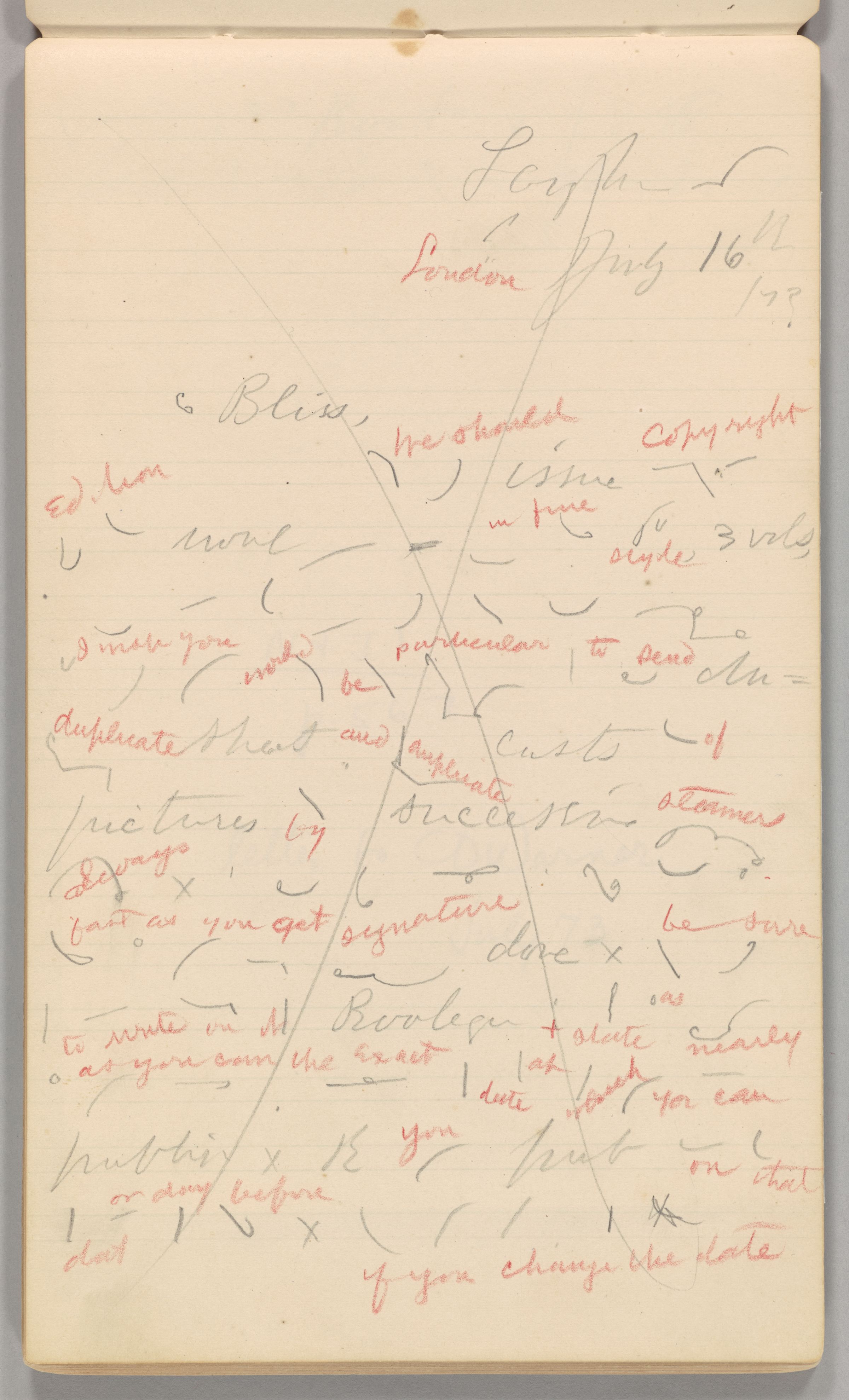
[MS: N12_leaf_]
Langham hotel
London July 16th
17?
Friend Bliss,
We should issue copyright edition of novel65 here in fine style, 3 volumes, and in order that there should be no mistakes I wish
you would be particular to send duplicate sheets and duplicate casts of pictures by
successive steamers always. And send these casts and proofs along as fast as you get
the signature done. Be sure to write now to Routledge and state as nearly as you can
the exact day at which you can publish. Routledge will publish on that day or the
day before. If you change the date
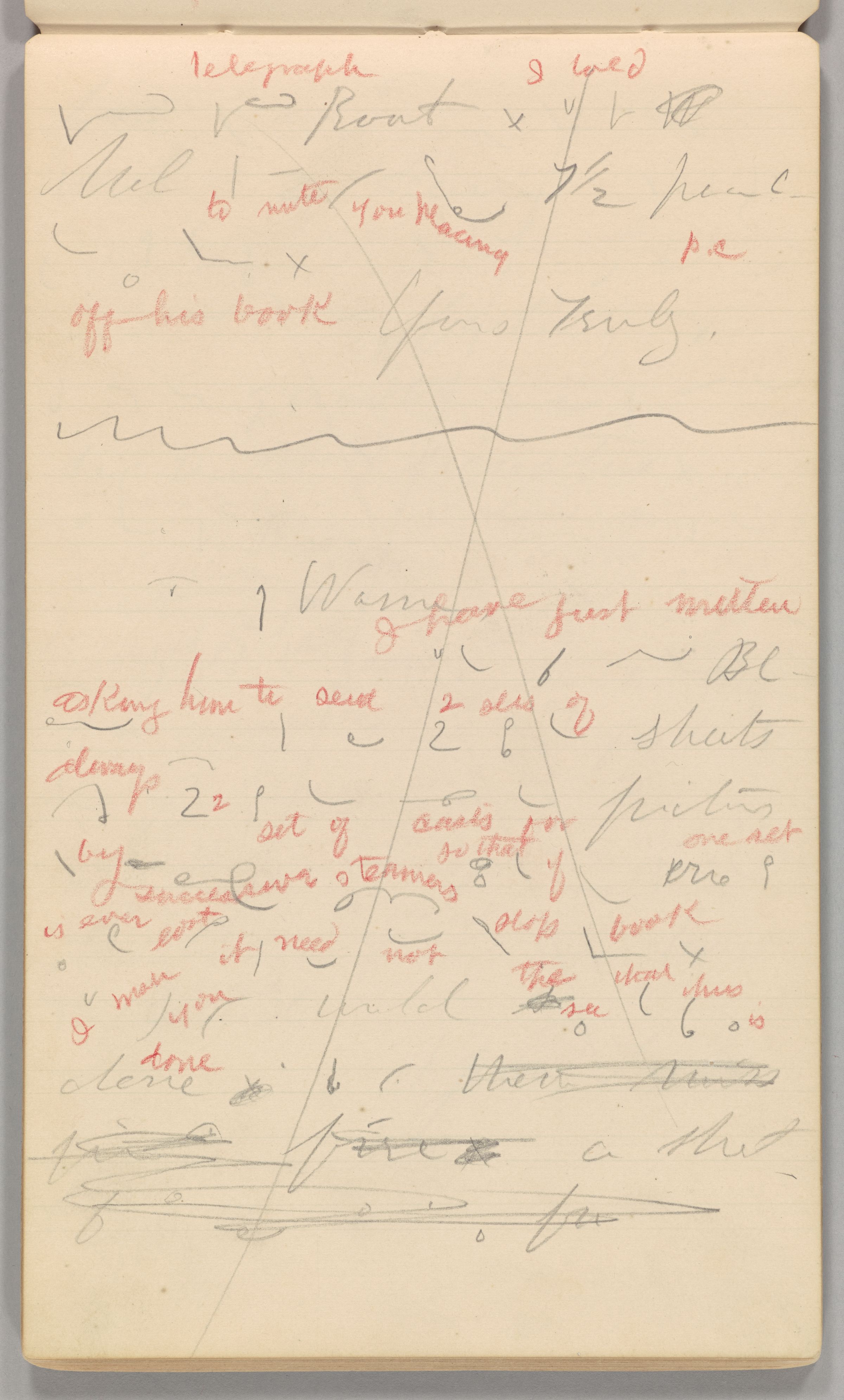
[MS: N12_leaf_]
of publication telegraph Routledge. I told W Miller to write you proposing 7½ percent for his book.66
Yours Truly.
My dear Warner,
I have just written Bliss asking him to send 2 sets of sheets always and 2 sets of
casts for pictures by successive steamers so that if one set is ever lost it need
not stop the book. I wish you would see that this is done . and don't let them miss fire or fire. a sheet just as soon as and see f-
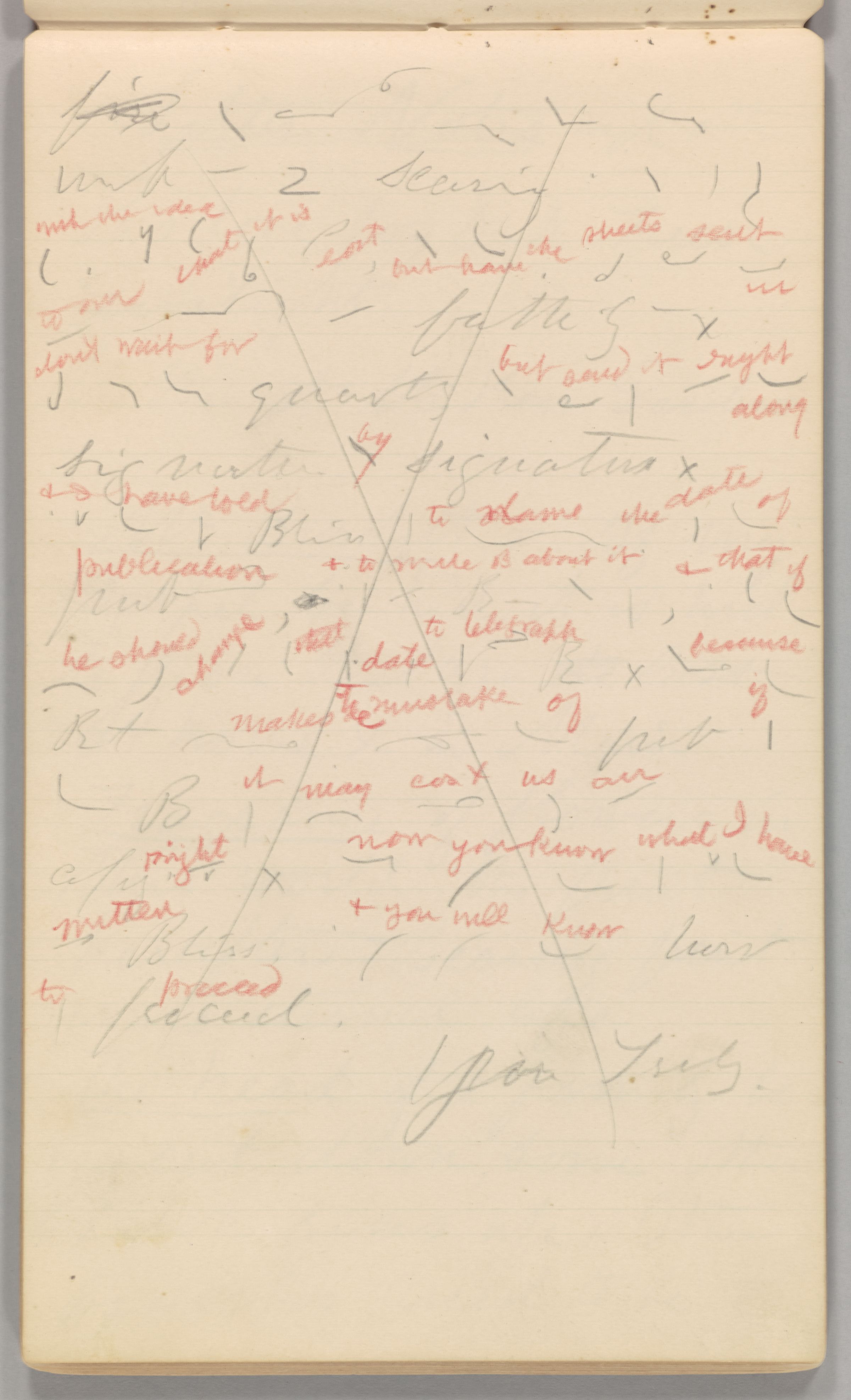
[MS: N12_leaf_]
fire be carelessly kept back for a week or 2 scaring a body to death with the idea that
it is lost, but have the sheets sent in their regular order faithfully. Don't wait
for a quantity but send it right along signature by signature. And I have told Bliss
to name the date of publication, and to write Routledge about it, and that if he should
change that date to telegraph Routledge, because if Routledge makes a mistake of publishing
date of Bliss it may cost us our copyright. Now you know what I have written Bliss,
and you will know how to proceed.
Yours Truly.
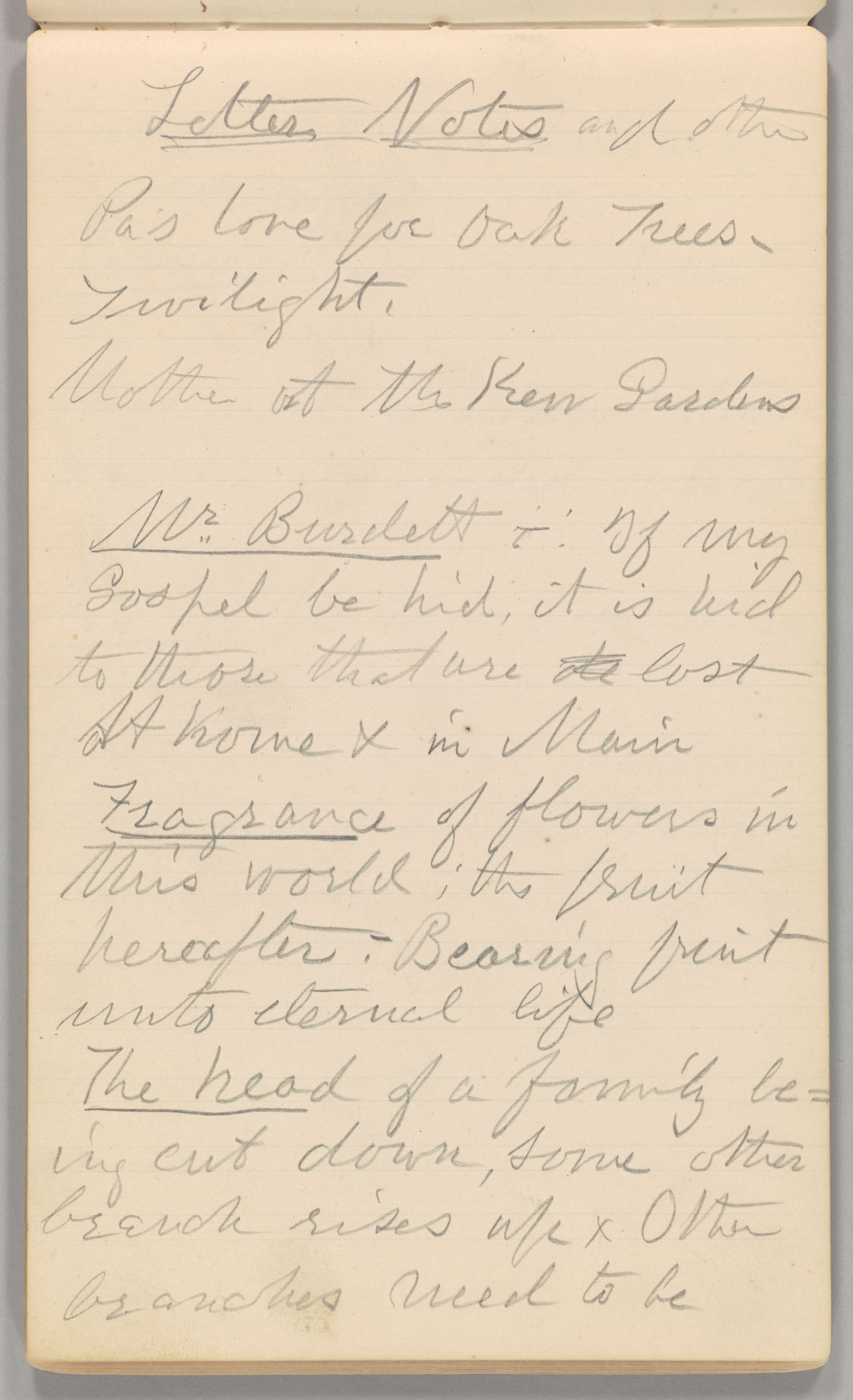
[MS: N12_leaf_]
Letter Notes and others
Pa's love for oak trees.
Twilight.
Mother at the Kew Gardens
Mr. Burdett —: If my gospel be hid, it is hid to those that are de lost. a At home & in Maine
Fragrance of flowers in this world; the fruit hereafter. Bearing fruit unto eternal life
The head of a family being cut down, some other branch rises up. Other branches need to be
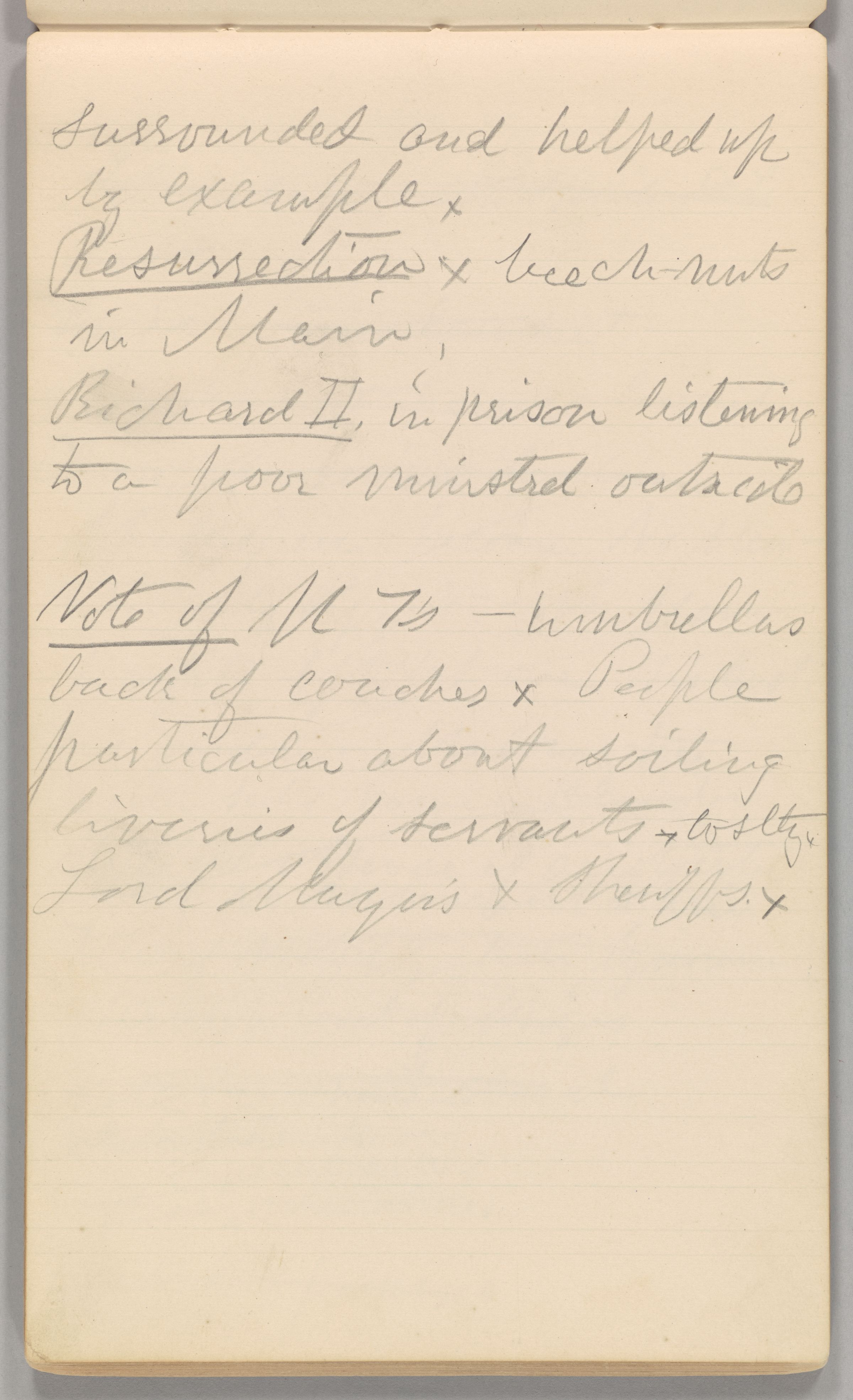
[MS: N12_leaf_]
surrounded and helped up by example.
Resurrection. beech-nuts in Maine.
Richard II, in prison listening to a poor minstrel outside
Note of MT's—umbrellas back of coaches. People particular about soiling liveries of servants, costly. Lord Mayor's & Sheriffs.
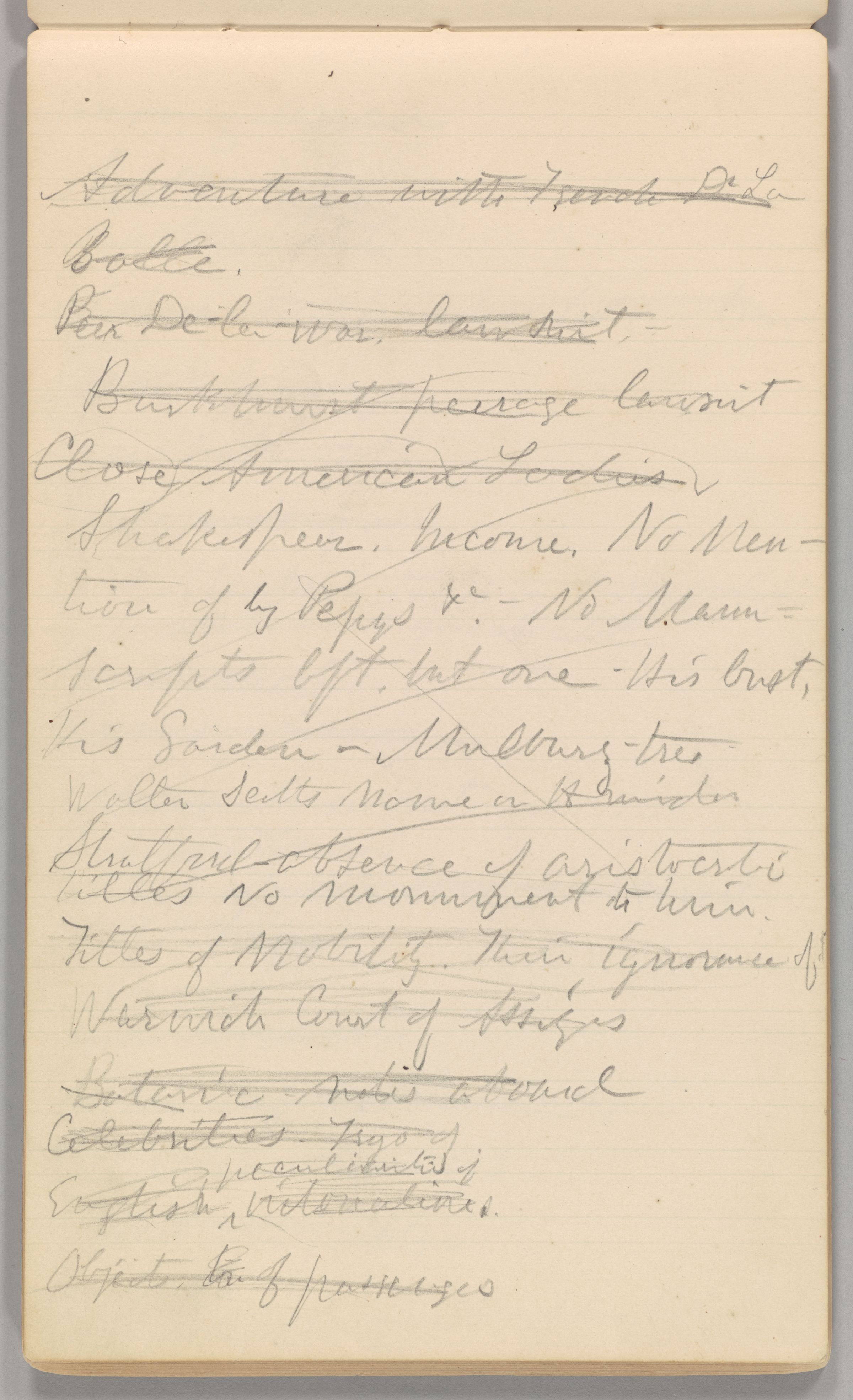
[MS: N12_leaf_]
Adventure with French Dr. La Balle.67
Peer Delawarr. lawsuit.
Buckhurst peerage lawsuit
Close American ladies
Shakespeare. Income. No mention of by Pepys etc.—No manuscripts left, but one. His bust, his garden—mulberry tree
Walter Scott's name on the window
Stratford—absence of aristocratic titles. No monument to him.
Titles of nobility. Their ignorance of
Warwick Court of Assizes
Batavia—notes aboard
Celebrities—trips of
English peculiarities of intonation.
Objects. tri of passengers
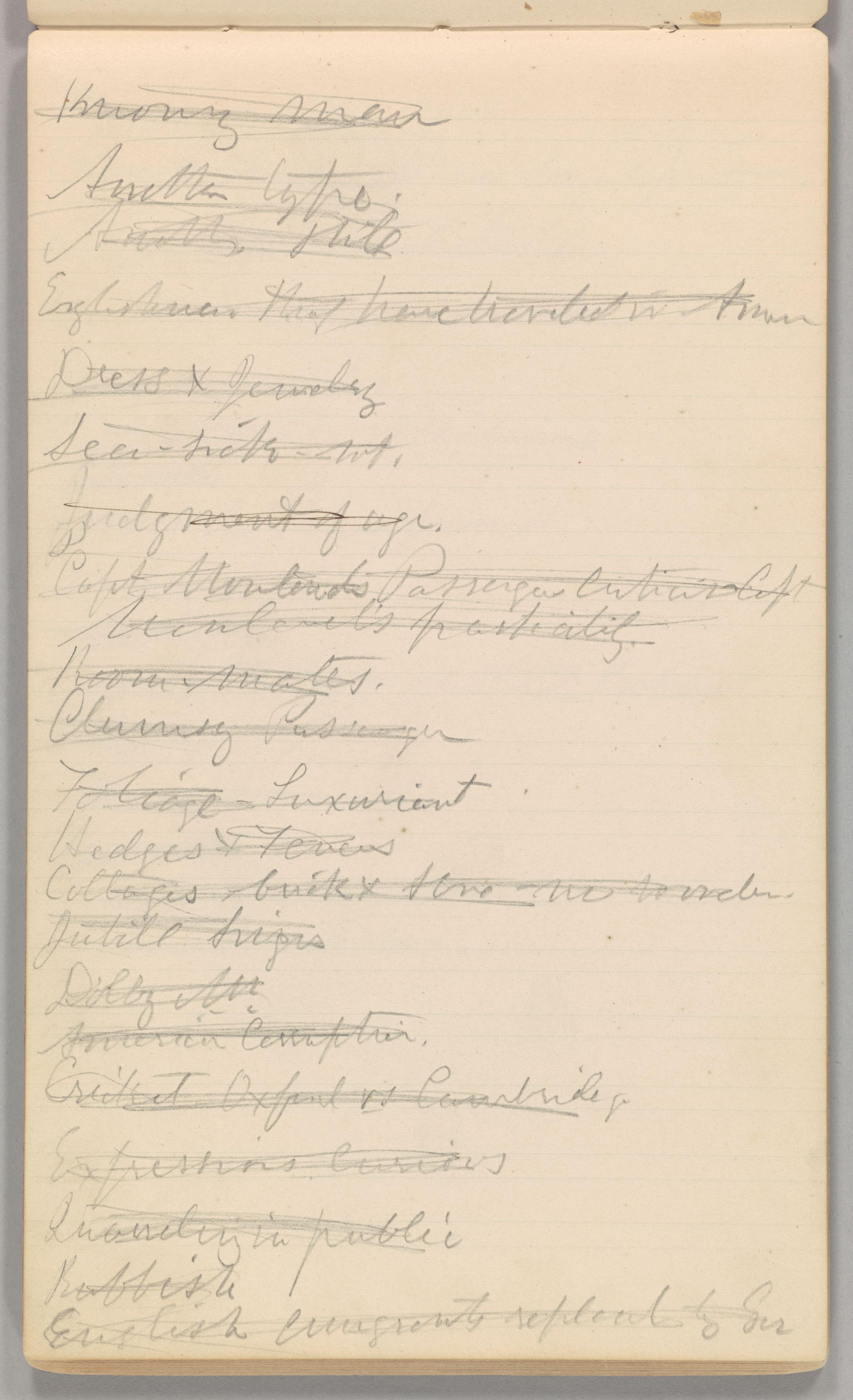
[MS: N12_leaf_]
Knowing man
Another type.
Another still
Englishmen that have traveled in America
Dress & jewelry
Seasick—one word.
Judgment of age.
P
Capt. Mouland's passengers criticize Capt. Mouland's partiality.68
Roommates.
Clumsy passenger
Foliage—luxuriant
Hedges & fences
Cottages brick & stone—no wooden.
Jubilee Singers69
Dolby Mr.70
American corruption
Cricket Oxford vs Cambridge
Expressions curious
Quarreling in public
Rubbish
English emigrants replaced by Ger
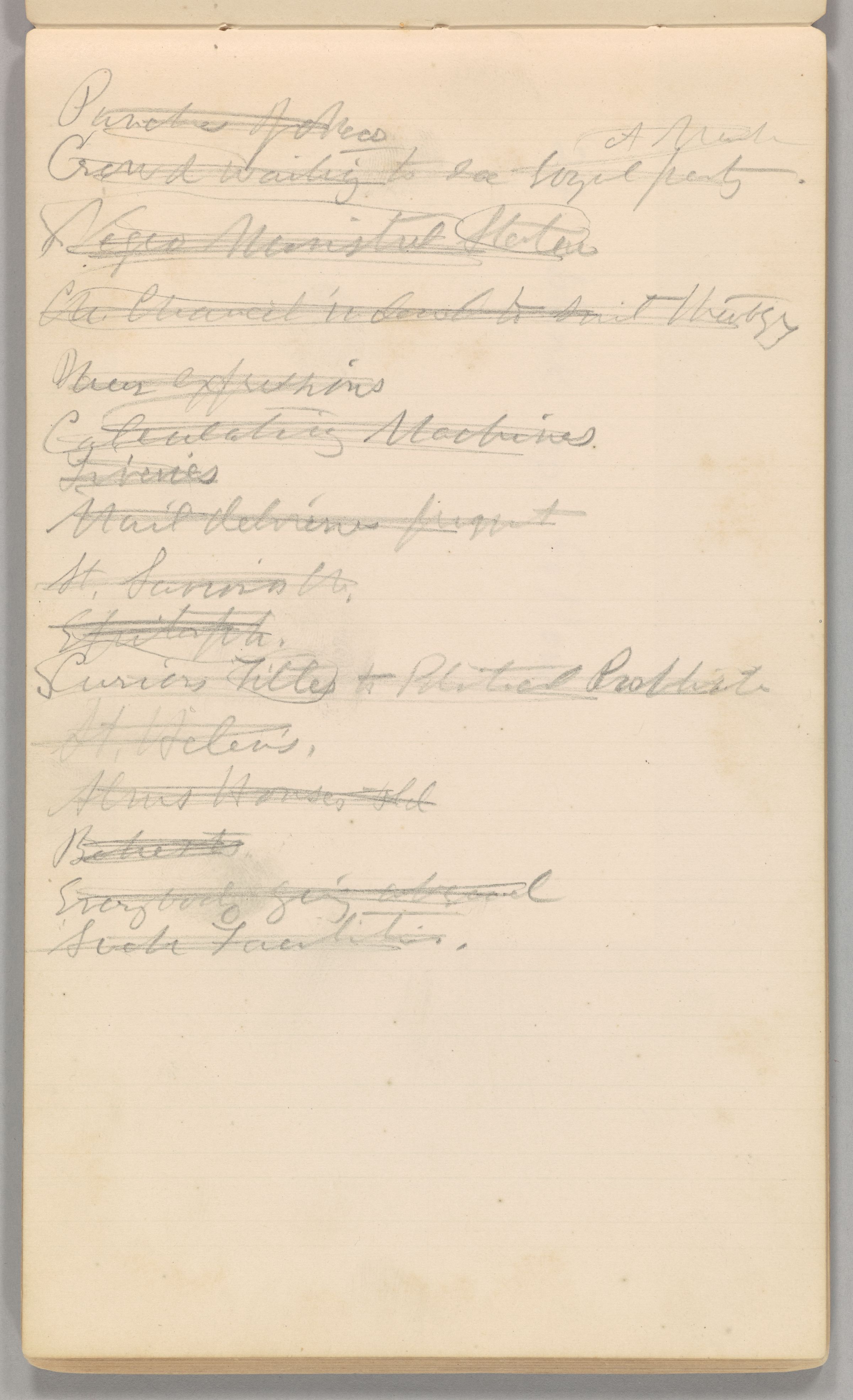
[MS: N12_leaf_]
Punches jokes
Crowd waiting to see royal party at Windsor.
Negro minstrel statue
Ch. Chancel in de-- to suit theology
Queer expressions
Calculating machines.
Liveries
Mail deliveries frequent
St. Saviour's Ch.
Epitaph.
Curious titles to political pro - - - ts
St. Helen's.
Almshouses—old
Behests.
Everybody going abroad
Such facilities.