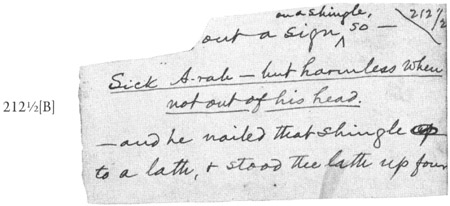
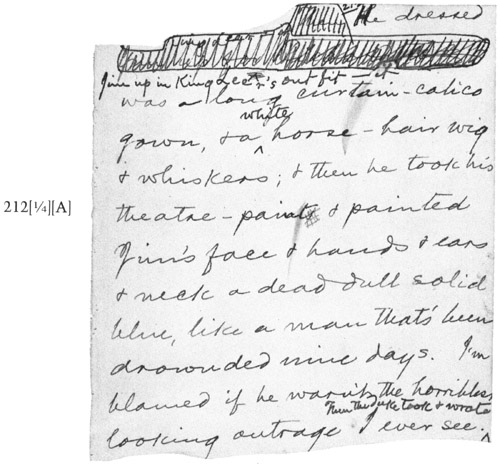
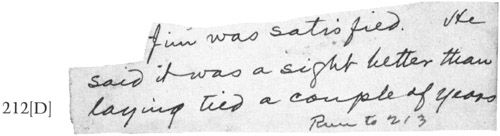
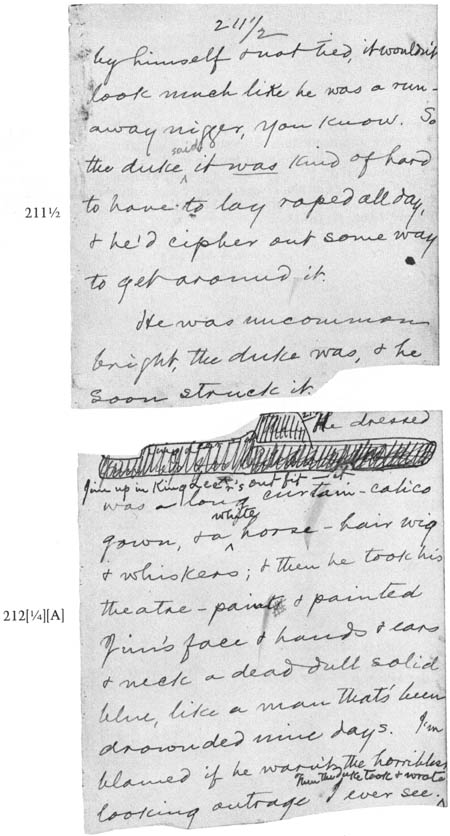
MTPO Doc Ed


[begin page 363]


[begin page 364]


[begin page 365]

MAPS OF THE MISSISSIPPI VALLEY

The title page for Adventures of Huckleberry Finn described the book’s setting as the Mississippi Valley “forty to fifty years ago,” that is, between about 1835 and 1845 (counting back from the book’s American publication date in 1885). An earlier version of the title page set the story “forty years ago” or about 1845 (see the explanatory note to xxix.6). This was the period of Clemens’s childhood in Missouri: the family moved to Hannibal in 1839 when Samuel Clemens was four years old. He left in 1853 at the age of seventeen, and made only a few brief return visits. The geography of the fictional St. Petersburg and Jackson’s Island, which correspond to Hannibal and Glasscock’s Island, borrows from his boyhood memory of the area. His firsthand knowledge of the rest of the river valley dates primarily from the years 1857 to 1861, when he worked as a pilot on steamboats plying between St. Louis and New Orleans. During these years he probably consulted the standard piloting guides of the 1840s and 1850s by George Conclin, Samuel Cummings, and U. P. James. The only river guide he is known to have owned, however, was a much earlier one, Zadok Cramer’s The Navigator, which went through twelve editions between 1801 and 1824 (Gribben 1980, 2:914).

In 1882, during a three-year gap of work on Huckleberry Finn, Mark Twain began work on Life on the Mississippi. He revisited the river in April and May. He made copious notes, but he found the river and the towns along its banks transformed since his piloting days. “The river is so thoroughly changed that I can’t bring it back to mind even when the changes have been pointed out to me,” he noted. “It is like a man pointing out to me a place in the sky where a cloud has been” (N&J2 , 530). He ordered up-to-date, detailed maps from the Mississippi River Commission and the U.S. Army Corps of Engineers, and he read a number of travel accounts written in the first half of the century. They proved disappointing. “I drudged through all those old books, mainly to find out what the procession of foreign tourists thought of the river towns of the Mississippi. But as a general thing, they forgot to say” (SLC 1944, 411; Kruse 1981, 48–53, 165–66; Blair 1960a, 294–99; Branch and Hirst, 37–38).

When in 1883 he returned to Huckleberry Finn, Mark Twain still had the bulk of Huck’s adventures on the river below Cairo to write. Despite his stock of memories, his recent river trip, and the research he had done


[begin page 366]

for Life on the Mississippi, he made no attempt to further particularize the locations in his early manuscript pages or to include in the later episodes more specific geographic information. He gives us only a few actual place names and unambiguous markers along the raft’s route: the raft passes St. Louis and Cairo; the fictional Bricksville is in Arkansas; the Wilkses’ village is on the lefthand (east) bank of the river, across from Arkansas and below Memphis, Tennessee; the Phelps farm is below the White River in the region of cotton plantations and Spanish moss, which places it south of Columbia, Arkansas (79.3, 99.1–9, 129.14–24, 180.8–9, 203.1–5, 204.15–16, 234.25–26, 265.6–10, 282.14). The only other specific geographic references are in Clemens’s working notes or later statements (see Mark Twain’s Working Notes, working notes 2-2, 2-7, 3-4, and 3-6; see also the explanatory notes to 266.9–267.7 and 358.33–34). He did, however, make specific reference to the speed of the river current and the approximate duration of the raft’s nightly travel, in chapters 12 and 15 of the book (78.30–31 and 100.35). This information has encouraged scholars to attempt to calculate the raft’s daily mileage, so as to assign actual place names to the deliberately generic Pokeville, Bricksville, and Pikesville. In the early chapters, the raft’s journey conforms well to a mathematical model based on an average river current of 4½ miles per hour and a travel time of 7½ hours per night. The model breaks down, however, soon after Cairo is passed; thenceforth the raft’s journey can only be traced in broad terms (see Miller, 193–95, 198–200). By the time the raft reaches Pikesville and the Phelps farm, which Mark Twain in several statements firmly located in Arkansas, the disjunction between daily mileage and the passage of time is so great that some scholars argue for a location much further south, deep in Louisiana (see the explanatory notes to 266.9–267.7 and 274.15–16).

Throughout the novel, Mark Twain appropriates aspects of real places in his descriptions, without intending a specific identification. His uncle’s Missouri farm, for instance, contributes to the descriptions of both the Grangerford house and the Phelps plantation (see the explanatory notes to 136.15–17 and 276.18). Similarly, the two towns that Huck and Jim encounter below Cairo recall Columbus and Hickman, Kentucky, in their basic topography and relative positions, but not their distance from Cairo (see the explanatory note to 129.23). Bricksville, where the “Royal Nonesuch” is performed, owes something of its character to Napoleon, Arkansas, although new evidence from the manuscript shows that Mark Twain originally located Bricksville in Council Bend, over one hundred miles upriver of Napoleon (see the explanatory note to 180.8–9). He eventually deleted the reference to Council Bend, perhaps in accordance with his decision to avoid such specifics. As some scholars have pointed out, this deliberate lack of geographic detail, coupled with the “extraordinary lyrical intensity” of Huck’s descriptions of the natural world (Marx 1957, 138), give the raft trip a dream-like dimension: it becomes an “unfettered voyage


[begin page 367]

into an eternal landscape” (Miller, 206; Henry Nash Smith 1958b, x–xii, xvi; Beaver, 62–64, 96–98).

The five maps that follow here are intended to represent some of the real geography on which Mark Twain relied in writing his story. When he used a fictional name for a real place, it appears within parentheses and in capitals and small capitals below the real name: for example, “Hannibal | (St. Petersburg)”. Not every fictional place is so readily equated with a real one. When the link is more tentative, the fictional name is preceded by “Vicinity of,” still within parentheses, and the rationale for the identification is discussed in the explanatory notes.

Map Sources

Mississippi River Valley, ca. 1845. Based on the frontispiece from Mighty Mississippi (Childs), this map also draws on plates 19 and 20 of the Century Atlas (Benjamin E. Smith, xix, xx), and an 1849 map of the river in Appletons’ Hand-Book (Hall, following page 428). It shows the valley during the period of the novel and of Clemens’s boyhood. (The system of citation used here is discussed at the beginning of the explanatory notes.)

Hannibal, ca. 1845. This map is based on the following: “Plat of Original Town of Hannibal,” dated 1836 (photofacsimile in CU-MARK), which provides the configuration of the town proper; “Map of the Mississippi River from the Falls of St. Anthony to the Junction of the Illinois River” (U.S. Army Corps of Engineers, 1887–88, DLC), which provides the Missouri and Illinois shorelines. No precisely scaled map has been found that shows Glasscock’s Island at the time Clemens knew it, and later maps demonstrate no consensus about its size and location. This map, therefore, relies on Mark Twain’s description of the island in chapters 7–9 of Huckleberry Finn and the virtually identical description, adjusted for the June rise of the river, in Tom Sawyer, chapters 13–15.

Bainbridge to Commerce, Mo., ca. 1857 (Vicinity of Walter Scott Wreck). Based on a river guide contemporary with Clemens’s career as a steamboat pilot (James, 25, 27), this map also draws on “Map of the Alluvial Valley of the Upper Mississippi River from the Falls of St. Anthony to the Mouth of the Ohio River” (Mississippi River Commission, 1899, CU-MAPS).

Cairo, ca. 1857. Based on maps provided in two contemporary river guides (Conclin, 65, 89, and James, 27). This map represents the area as Clemens knew it during his career as a steamboat pilot.

New Madrid Bend (Vicinity of Feud). Based on “Lloyd’s Map of the Lower Mississippi River from St. Louis to the Gulf of Mexico . . . Revised and corrected to the present time, by Captains Bart. and William Bowen” (J. T. Lloyd, 1862, DLC); “Map of a Reconnaissance of the Mississippi


[begin page 368]

River from Cairo, Ill’s. to New Orleans, La.” (U.S. Army Corps of Engineers, 1878?, DLC); “Preliminary Map of the Lower Mississippi River, from the Mouth of the Ohio River to the Head of the Passes” (Mississippi River Commission, 1881–85, DLC); “The Mississippi River from St. Louis to the Sea” (J. A. Ockerson, assisted by Charles W. Stewart, 1892, DLC). The stretch of river represented here is a composite of features from the 1850s to the early 1880s. Compromise Landing flourished and vanished in that period, and Island No. 10, hugging the Tennessee shore in Clemens’s piloting days, moved closer to the Missouri side (James, 29; SLC 1883a, 289; Branch and Hirst, 53–54). The map accurately represents the basic relationship of the Darnell and Watson lands, settled since the late 1820s (Branch and Hirst, 54, 56).


[begin page 369]

Mississippi River Valley, ca. 1845


[begin page 370]

Hannibal, ca. 1845

Bainbridge to Commerce, Mo., ca. 1857
(Vicinity of Walter Scott Wreck)


[begin page 371]

Cairo, ca. 1857

New Madrid Bend
(Vicinity of Feud)


[begin page 372]


[begin page 373]

EXPLANATORY NOTES

These notes identify real people, places, books, and events that Mark Twain drew upon for Adventures of Huckleberry Finn. They document historical, literary, and cultural allusions, parallels, analogues, or influences, both in the text and in E. W. Kemble’s illustrations. They identify important moments in the seven-year course of composition and in the process of revision and first publication: when Mark Twain wrote or revised parts of the text, when he stopped or resumed work on them, how he struggled with or commented on them. References to the manuscript may distinguish between its newly discovered first half (MS1) and its long familiar second half (MS2), now both in the Buffalo and Erie County Public Library. References to the typed copies of MS1 and MS2 which Mark Twain had made are to the documents which served as Kemble’s and the first edition printer’s copy, but the typescripts themselves are not known to survive. What they probably contained and how Mark Twain revised them are matters inferred from the manuscript, the first edition set from the typescripts, and other evidence. For the history of composition, revision, publication, and reception, see the introduction. References to the text are keyed to this volume by page and line: 3.10 means page 3, line 10. Chapter titles and picture captions are not included in the line count, but when they are referred to, the word title or caption is substituted for the line number: 3 caption means the caption on page 3. Frequently cited books have been assigned an abbreviation, always italicized, which is followed by a page (or volume and page) number: “MTBus, 21” or “MTL , 1:456–57.” But most works are cited by the author’s last name, followed by page number, unless there is only one page: “Abbott, 16–17” or simply “Pease.” When two or more works by the same author are cited, the year of publication differentiates them: “Budd 1985, 1” or “Budd 1962, 34–76.” For works likely to be consulted in any of various editions, citations give chapter numbers (or book, canto, or act numbers) rather than page numbers. Quotations of Mark Twain’s published work are from critically edited texts produced by the Mark Twain Project or from the first printings, as necessary. Quotations from original documents follow their wording and punctuation exactly, even when a published form is also cited and may differ slightly from the original. Repositories of unique documents are identified by the standard Library of Congress abbreviation.


[begin page 374]

Documents owned by individuals are cited by the owner’s last name. All abbreviations and names used as citations are defined in References, pp. 1121–64.


[begin page 377]


[begin page 383]


[begin page 385]


[begin page 387]


[begin page 390]


[begin page 395]


[begin page 399]


[begin page 413]


[begin page 415]


[begin page 417]


[begin page 418]


[begin page 420]


[begin page 425]


[begin page 433]


[begin page 436]


[begin page 438]


[begin page 442]


[begin page 444]


[begin page 448]


[begin page 449]


[begin page 452]

GLOSSARY

Among the lasting achievements of Huckleberry Finn is the ready accessibility of its language: most of its words and idiomatic expressions still require no gloss. We have, therefore, confined the entries here to words and phrases about which there is likely to be genuine uncertainty, or about which we have specialized knowledge pertinent to Mark Twain’s meaning. When vernacular words or phrases (most oaths, for example) are wholly intelligible, we have not defined them. When words or phrases are to a degree obscure and are not readily found in Webster’s Third New International Dictionary of the English Language, we have included them. If a word has more than one meaning (for instance, “spread-eagle”), some of which are in Webster’s and some not, we define only the omitted meaning. A few troublesome dialect spellings are glossed only with the canonical spelling, as an aid to finding the definition in Webster’s. A few words and phrases have proved more readily defined in the explanatory notes, to which the reader is referred in each case. All entries have been alphabetized letter by letter, always beginning with the first word of a phrase, even when that is a preposition.

The following dictionaries, glossaries, and other sources have been used to prepare the definitions: Bartlett; Bates; Burchfield; Century Dictionary; Clapin; Craigie; De Vere; Farmer; Farmer and Henley; Gove; Louis C. Hunter; Maitland; Mitford M. Mathews; Neilson, Knott, and Carhart; OED 1933; Partridge; Ramsay and Emberson; Smyth; Thornton; Watts; Way; Webster [1870], 1884, 1889, and 1894; Wentworth; and Worcester.

allycumpain]   Elecampane: hardy, European herb naturalized in the United States and commonly used in folk medicine. A white powder made by boiling the root is applied externally or internally, for lung diseases and for skin disorders, such as psoriasis and eczema. Spelling varied widely in the nineteenth century: elicampene, alycompaine, allicampane.
ash-hopper]   Funnel-shaped bin in which wood ashes were leached of their alkali, which was in turn used to make soap.


[begin page 453]

bar]
   Sand bar, any deposit of river sediment that forms a shallow place (shoal) or an island.
beat]   Idler, loafer, good-for-nothing. Short for “dead beat.”
beatenest]   Unsurpassable, not able to be “beaten”; hence, most extraordinary, inexplicable, unaccountable.
big water]   The Mississippi River, a translation of the Indian name for the river, from which “Mississippi” is supposed to derive. Huck also says “the old regular Muddy” to refer to the river (129.23).
bitts]   Sturdy posts for securing cables on a steamboat. They were fastened in pairs to the deck. About three feet high, the bitts had a cross-piece above the midpoint, forming an H. Kemble has drawn what a riverman would call a “kevel” (illustration on page 89).
blister]   Nuisance, irritating creature, characterized by an overweening, irrational persistence.
boom]   To go at full speed, roar along.
booming]   Splendid, grand, superb (135.16); very, extremely (208.35).
boss]   Term of address used toward ostensible superiors, strangers, often by blacks speaking to whites (103.20); best, first-rate, supreme (215.16).
bottoms]   Alluvial flood plain of a river, the “river bottom” during flood-stage. Usually fertile, low-lying, and flat. See Huck’s description of the “Illinois bottom” (60.12).
break-down]   See the explanatory note to 111.38–112.1.
by de back]   Thoroughly. Apparently a reference to marked cards, as in one of Mark Twain’s columns in the Virginia City Territorial Enterprise: “Mr. McCormick, who should be on the detective force regularly, but as yet is there only by brevet, can tell an obscene photograph by the back, as a sport tells an ace from a jack” (“San Francisco Letter,” dated 19 December 1865, clipping in YSMT, 42A). Similarly, in Following the Equator: “I know you—I know you ‘by the back,’ as the gamblers say” (chapter 28).
captain’s door]   Door by which the captain entered and left his room in the texas. Huck’s description places it in the center of the forward wall. See diagram, page 405.


[begin page 454]

chimbly-guy]
   Chimney-guy: a thin cable or wire used to steady the chimneys (or smokestacks) of the steamboat. See diagram, page 405.
chute]   Narrow channel or bayou outside the main part of the river, navigable only in middle to high water.
close place]   Uncomfortably delicate or dangerous position. Huck also says “tight place” (239.6) and “close-fit” (257.15) to mean the same thing.
coarse-hand]   Block, as opposed to cursive, lettering. Huck also says “coarse print” (242.20) to mean the same thing.
coase comb]   Coarse comb: a comb with large or widely spaced teeth, the opposite of a fine-tooth comb. Used as a crude musical instrument by wrapping it in paper and blowing against the side.
come any such game on]   To play any such trick on.
Congress-water]   Mineral water bottled at Congress Spring in Saratoga, New York.
cross-hall]   Narrow hallway at right angles to the texas hall, opening through a door onto the hurricane deck on both sides of the texas. Usually about two-thirds of the way from the captain’s door to the stern of the texas. See diagram, page 405.
crossing]   See the explanatory note to 78.23–29.
cross off]   To thwart, obstruct, hinder.
dam]   To bear young.
dead beat]   Worthless idler who never pays his own way, sponger, loafer.
dog my cats]   Mild imprecation (“dog” for “damn”), suggesting surprise or annoyance. It can also be found in the contemporary dialect writing of Clemens’s friends John Hay and Joel Chandler Harris (Hay 1871, 22; Joel Chandler Harris 1883a, 9).
double-hull ferry boat]   Steam ferryboat in which the deck is supported by two distinct hulls, with the paddle-wheel situated between them.
down in de bills]   Written down in the specifications, hence predestined, foreordained.
down the banks]   Scolding, reprimand.
fox-fire]   Rotten wood that emits phosphorescent light (caused by fungi).
freeze]   To yearn, long for intensely (169.15); to cling to, hold firmly or tenaciously (282.10).


[begin page 455]

gabble]
   Intimate, eager conversation (264.25); to jabber, prate, talk rapidly and foolishly (274.20).
gars]   Long, spear-like fish of various kinds, commonly deemed inedible.
gone to grass]   Gone to the devil, expired, ruined.
grand bulge]   Most difficult or critical phase of an enterprise.
gumption]   Sense, practical understanding, quick perception of the right thing to do under unusual circumstances.
hark from the tomb]   Serious or earnest reproof, as in Isaac Watts’s “A Funeral Thought”:“Hark! from the tombs a doleful sound; | My ears, attend the cry— | ‘Ye living men, come, view the ground | Where you must shortly lie.’ ”
have it for breakfast]   To save or postpone something.
hive]   To capture, catch, get (14.33); to appropriate, take without permission, steal (225.33).
holt]   Hold, grip, grasp. A “best holt” is one’s specialty or title to attention (161.4); “let go all holts” means to relax one’s grip, hence to abandon all restraint (284.23).
hollow]   See the explanatory note to 15.3.
horse-bill]   Handbill advertising a stallion available for breeding.
hunch]   To nudge.
jackstaff]   Pole on the bowsprit of a steamboat, used as a steering aid by the pilot, who aligned it with a given point on the horizon. See diagram, page 405.
janders]   Jaundice.
jour printer]   Journeyman printer: one who has completed his apprenticeship and is qualified to practice the trade, usually taking work by the day. See the explanatory note to 160.37.
juice-harp]   Jew’s harp.
law]   Lord (also “laws”). “Lawsy” (128.5) derives from “Lordy,” “law sakes” (278.6) from “for the Lord’s sake”; “laws-a-me” (278.18) and “lawsamercy” (348.38) derive from “Lord have mercy.”
meeky]   To move in a retiring manner.
melodeum]   Melodion (or melodium): a reed organ, resembling a small square piano, popular in the nineteenth century. One variety, when the single foot-pump was operated inexpertly, produced a displeasingly uneven sound.


[begin page 456]

mud-cat]
   Variety of catfish abounding in the Mississippi River, not highly prized for eating because of its coarse, muddy-tasting flesh.
mullet-headed]   Stupid, dull. A mullethead is a variety of freshwater fish known for its stupidity.
nigger-head]   Strong, black tobacco of an inferior grade, twisted or pressed into a flat cake or plug.
pat juba]   See the explanatory note to 111.37–38.
pilot house]   Topmost structure on a steamboat, housing the wheel and signaling devices used by the pilot. It was usually situated above the texas, far forward on the texas deck, with windows on all sides—all but the forward side glassed in. See diagram, page 405.
pow-wow]   To hold a meeting for discussion, to confer (14.35); any kind of din, uproar, loud noise or racket (158.22).
quarter]   To sustain a position behind a vessel. The view from any vessel is divided into four parts: the port bow and starboard bow forward, and the port quarter and starboard quarter astern.
sand in my craw]   Pluck, courage, determination. Huck also says “sand” for short (244.11). A bird’s craw uses sand to digest hard morsels like seeds; hence, to have “sand in your craw” is to be able to digest or face something difficult.
scoop]   To grab, gather up without ceremony, often surreptitiously (15.7); to vanquish, gain the advantage of, beat (326.24).
scrouch]   To scrooch, crouch, or huddle down.
shake the reefs out of my hind legs]   To put on speed. From the nautical expression “to shake out a reef,” that is, to enlarge a sail by unfurling one of its smaller reef sections, thereby increasing speed.
show up]   To present (oneself) for scrutiny or examination.
size their style]   To equal or match their characteristic manner; to estimate correctly their level of sophistication.
skylight]   Short for “skylight roof,” the part of the texas deck covering the skylight, a row of transom-like windows (often stained or etched) that ran the length of or even wholly encompassed the main cabin. See diagram, page 405.
slept in our cravats]   Were hanged.
slop]   To plod, tramp, or travel through a place in mud or slush. At 75.28–29 Huck “slopped through the timber” to gain dry land, and at 149.32 the Grangerford’s slave “slopped” back through the swamp where he


[begin page 457]

and Huck had just “waded ancle deep as much as half a mile.” Contrasts with “slope,” to make off, decamp, or leave suddenly (see The Adventures of Tom Sawyer, chapter 34: “Tom, we can slope, if we can find a rope”).

soul-butter]   Pious and sentimental words, perhaps in the sense of unctuous self-flattery.
spread around]   To assume airs, show off.
spread-eagle]   Extravagant (170.7).
stand from under]   To avoid something falling or thrown from aloft, hence to get to a safe place, avoid danger or punishment.
swap around]   To change from one place or subject to another (2.13) (also “swap about,” 45.13). To “swap knives” is to change plans or tactics (282.4).
texas]   Officers’ cabin of a steamboat, situated on the hurricane deck, usually below the pilothouse and above the main cabin (see diagram, page 405).
tow-head]   Small, recently formed island. Huck defines it as “a sand-bar that has cotton-woods on it as thick as harrow-teeth” (77.25). Mark Twain elsewhere wrote “tow-head (i.e., new island),” a definition for which he recorded the supposed etymology: “Towhead means infant—an infant island, a growing island—so it is said” (Life on the Mississippi, chapter 23; N&J2, 471).
tow-linen]   Coarse cloth woven from spun flax, hemp, or jute.
trot-line]   Long, sturdy fishing line to which shorter hooked lines are attached at intervals. Secured at one end to the river bank, it was used primarily to catch bottom feeders, such as catfish.
up to the hub]   Deeply, fully, without reservation. The reference is to a wheel sunk up to the axle in mud.
valley]   Valet.
whollop]   Wallop.
without a j’int started]   Effortlessly, without strain, without displacing a single joint.
wood-flat]   Raft or barge for transporting wood.
wood-rank]   Stacked firewood, wood-pile.
yaller-jackets]   Gold coins. Huck also says “yaller-boys” to mean the same thing (214.15).


[begin page 458]


[begin page 459]


[begin page 460]


[begin page 461]

Mark Twain’s Working Notes

Mark Twain’s working notes for Adventures of Huckleberry Finn show him developing the plot and considering alternatives for it, reviewing his work, perfecting the dialect of his characters, and reminding himself to tie up loose ends. In addition, they provide physical and textual evidence about the course of composition. All the extant working notes are reproduced here except for the notes he wrote in the margins of his manuscript, which are transcribed in Mark Twain’s Marginal Working Notes. In addition, there are a number of notebook entries written between 1877 and 1883 (including those for his 1882 river trip) which are to some degree relevant to the composition of the book. These entries have been published in full in N&J2 and N&J3 , and they are selectively cited here.

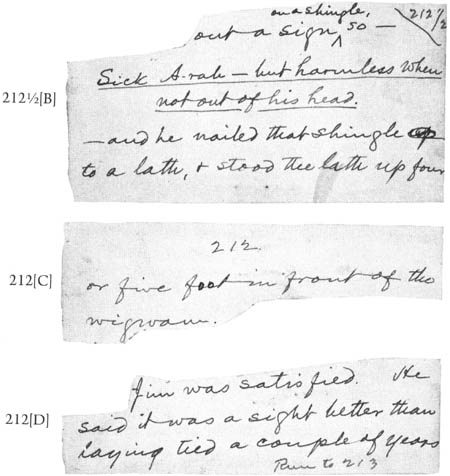
A total of twenty-nine manuscript pages—all in the Mark Twain Papers (CU-MARK)—are reproduced both in photofacsimile of the original manuscripts and in typographic transcription with accompanying footnotes. This extra measure of care is justified in light of the extraordinary influence these documents have had and still promise to have on our understanding of how and when Mark Twain wrote Huckleberry Finn. Bernard DeVoto pointed out that they “cast a flood of light on the writing of Huckleberry Finn” as well as on “the working of Mark’s mind and talent” (DeVoto 1942, 63).

Each group of working notes is largely consistent as to paper and writing medium. The exceptions are minor—a few words in pencil on a page of ink notes or vice versa, one leaf of differing paper in groups 1 and 2. The order of some of the pages within each group is somewhat arbitrary, although the appearance of the paper and handwriting and the styling and content of the entries often suggest a certain sequence.

Twenty-six pages of the working notes were first transcribed, grouped, and numbered by DeVoto (DeVoto 1942, 61–78). The groups are renamed and renumbered in this appendix to conform with a new chronological sequence. See the list below for the new numbers and equivalent DeVoto numbers. Three additional pages, not identified by DeVoto, are reproduced here. One, 3-14, is added to Group 3, and the remaining two, 4-1 and 4-2, comprise Group 4, a version of the burlesque Hamlet soliloquy in chapter 21.


[begin page 462]

In the following list, new numbers are given first and followed by former DeVoto numbers in square brackets, thus: 1-1 [B-2].


Group 1 [DeVoto’s Group B]
   1-1 [B-2] 1-2 [B-1]
Group 2 [DeVoto’s Group A]
   2-1 [A-7] 2-2 [A-1] 2-3 [A-2] 2-4 [A-3]
   2-5 [A-4] 2-6 [A-5] 2-7 [A-6] 2-8 [A-8]
   2-9 [A-9] 2-10 [A-10] 2-11 [A-11]
Group 3 [DeVoto’s Group C]
   3-1 [C-1] 3-2 [C-2] 3-3 [C-3] 3-4 [C-4]
   3-5 [C-5] 3-6 [C-6] 3-7 [C-7] 3-8 [C-8]
   3-9 [C-9] 3-10 [C-10] 3-11 [C-11] 3-12 [C-12]
   3-13 [C-13] 3-14 [not in DeVoto]
Group 4 [not in DeVoto]

Within each group of notes the facsimiles precede the typographic transcriptions, which stop short of type facsimiles: they do not, for instance, necessarily reproduce the lineation of the manuscripts. But they are otherwise as faithful as possible to every transcribable detail of the originals, including several brief entries not noticed or transcribed by DeVoto.

Words underscored once are rendered in italics, words underscored twice are in small capitals (with Initial Capitals if so inscribed), and words underscored three times are in FULL CAPITALS. Canceled text is shown with a horizontal rule (“buttons”) or, for solitary characters, a slash mark (“T”). (Note that Mark Twain’s deletions sometimes indicate not that he rejected an idea, but that he had used it in the story.) Inserted words or characters appear enclosed by carets (“old”); solitary inserted characters appear with a single sublinear caret (“n”). Words that Mark Twain revised internally are transcribed showing the canceled and the revised form separately (“HarveyHarney” rather than the more literal but less legible “Harvney”). Words added in ink or pencil different from the original inscription are transcribed in boldface type. Where part of the original inscription has been torn away or otherwise obscured, the original reading of the text is conjectured within square brackets: shirt. Editorial description within the text itself is always within square brackets and in italic type: added in the left margin. All superscript numbers for footnotes are editorial. All inscription not by Mark Twain has been ignored in the transcription.


[begin page 463]

Group 1

Mark Twain wrote these notes (formerly designated as Group B) on two disparate leaves, possibly at different times but certainly between 1876 and 1880. For the most part, he seems to be reviewing his earliest pages (MS1a pages 1–446, written in 1876) and refreshing his memory of characters and situations. He refers to specific passages by word cue and manuscript page number, and he copies marginal notations from the MS1a pages. Unlike the Group 2 and Group 3 working notes, the Group 1 notes do not sketch out ideas for the next section of the book (MS1b pages 447 through 663, written in 1880).

Mark Twain used pencil for all the Group 1 notes: page 1-1 is a torn half-sheet of unlined wove paper bearing the watermark “Antique Parchment Note Paper” and measuring 17.3 by 11.3 centimeters (6 13/16 by 4 7/16 inches); page 1-2 is a torn half-sheet of Crystal-Lake Mills wove paper, the same paper on which most of the first half of the manuscript is written (MS1a, pages 1–446).


Within this section:

1-1 | 1-2


[begin page 464]

1-1


[begin page 466]

1-1

2/Widow Douglas—then who is “Miss Watson?”

Ah, she’s W D’s sister.old spinster1

219 218—the dead man is Huck’s father.

223  the ″  ″ again

244 more about Finn—his disappearance.

270 (overflowed banks?)

273—river “pretty high yet” but maybe not overflowed.2

Let Jim say putty for “pretty” & nuvver for “never”3


[begin page 465]

1-2


[begin page 467]

1-2

Baby & barrel—350—Poetry 420 1

Remarks at a funeral2

Negro sermon—& the shouts.3

Child with rusty unloaded gun always kills.4


[begin page 468]

Group 2

The combined evidence of paper and ink color suggests that the notes in Group 2 (formerly designated as Group A), like the MS1b pages, were probably written between March and mid-June 1880. (It was in late March that Mark Twain, then working in purple ink on wove paper, put aside the manuscript of The Prince and the Pauper.) The 1880 period was the second of Mark Twain’s three major stints of work on Huckleberry Finn, when he wrote MS1b pages 447 through 663 (the second half of chapter 18 and all of chapters 19 through 21). It is clear that the eleven pages of Group 2 notes were not all written at one session. Most of the pages contain ideas for the MS1b section, while some look ahead to the final section of the book (MS2). One note in pencil on the back of 2-10 was added in 1883.

Mark Twain wrote these notes on eleven leaves: 2-1 through 2-10 on ten torn half-sheets of unlined wove paper, the same paper as that used for MS1b pages 447 through 663; and 2-11 on a torn half-sheet of laid paper, ruled horizontally in blue and embossed “P&P” (probably for Platner & Porter, the Connecticut paper manufacturer) in the upper left corner. (He used this stationery sporadically, for personal letters and literary manuscript, in the 1870s and in 1880: see Blair 1958, 7-8.) The notes are in the same purple ink used for MS1b pages 447 through 663, except for an addition in blue ink on 2-8 and a few added notations in pencil on 2-8, 2-9, 2-10, and 2-11. Two pages, 2-2 and 2-3, were numbered “1” and “2” by Mark Twain. Nonetheless, it is clear that page 2-1, with its list of characters from the feud episode, is the earliest page within the group.


Within this section:

2-1 | 2-2 | 2-3 | 2-4


2-5 | 2-6 | 2-7 | 2-8


2-9 | 2-10 | 2-11


[begin page 469]

2-1


[begin page 480]

2-1

George Jackson (Huck)1

Shepherdsons.

Bob & Tom Grangerford 28 & 30.abt 30.

old man (Saul) Col. ″ 60

Betsy (negro)   ″

old lady (Rachel)  ″

Buck     ″ 12–14

Emmeline (dead) ″

Charlotte (proud & grand) ″ 25

Sophia (sweet & gentle)  ″ 20

HarveyHarney Shepherdson


[begin page 470]

2-2


[begin page continued 480]

2-2

1

DE MULE.

Negro campmeeting & sermon—“See dat sinner how he run.”1

Swell Sunday costumes of negros.2


Poor white family & cabin at woodyard in Walnut Bend. Capt. Ed. Montgomery.3


The Burning Shame boys give bill of sale of Jim. at Napoleon, Ark.4


Legend of No. 10 Earthquake.5


o

Describe Lara.6


[begin page 471]

2-3


[begin page continued 482]

2-3

Rich III—15¢—B.S.1 50c

2

Being in a close place, Huck boldly offers to sell Jim—the latter turns pale but dasn’t speak—secretly is supported in the trial by firm belief that Huck is incapable of betraying him.


Huck gets decent suit of jeans.


They go down a bayou into Reelfoot Lake?


Up a bayou where are alligators.


Tow-linen shirts or naked.


[begin page 472]

2-4


[begin page continued 482]

2-4

Let some old liar of a keel-boatman on a raft tell about the earthquake of 1811. that raised No. 10—& mak made Reelfoot Lake &c.


& about Carpenter & Mike Fink—1


& Murrell’s gang (darkly hint he belonged to it)—No. 37 & Devil’s race-track2


shabby families.


[begin page 473]

2-5


[begin page continued 483]

2-5

Mrs. Holliday,1


The trading scow & family.


The scow with theatre aboard.2


Ruffian burnt up in Calaboose.3


A house-raising.


Village school—they haze Huck, the first day—describe Dawsons or Miss N.’s school.4


Fire in village—buckets & “bigBig Mo.” engine & swell village fire Co.5


Dog fight—del describe in detail.


[begin page 474]

2-6


[begin page continued 484]

2-6

The country cotillion.


The horse-trade.


Country quilting.


Candy-pulling.


Country funeral.


Describe aunt Patsy’s house.1


& Uncle Dan, aunt Hanner, & the 90-year blind negress.2


(Jim has fever & is in concealment while Huck makes these observations.)


(Keep ’em along.)

&c. The two printers deliver temp. lectures, teach dancing, elocution, feel heads, distribute tracts, preach, fiddle, doctor (quack)3


[begin page 475]

2-7


[begin page continued 485]

2-7

The circus—Huck’s astonishment when the drunkard invades the ring, scuffles with clown, & ring-master, then rides & strips.1


Can’t he escape from somewhere on the elephant?


An overflowed Arkansaw town. River booms up in the night.2


[begin page 476]

2-8

on verso


[begin page continued 485]

2-8

Dinner manners at the tavern with a crowd.


Drunken man rides in the circus.


How funny the clown was—quote his jokes. & how the people received them—Huck envies him.


Duel with rifles. 1 written in dark blue ink

A village graveyard written in pencil

written on the verso: 6642


[begin page 477]

2-9


[begin page continued 486]

2-9

When did the raft pass St Louis? Is there any mention of it? Yes 1


Negro Sermons.2


Burning Shame

Do the mesmeric foolishness, with Huck & the king for performers 3

Jim sawed in two.


po’ $22-nigger will set in Heaven wid de $1500 niggers.


[begin page 478]

2-10

on verso:


[begin page continued 486]

2-10

Back a little, change—raft only crippled by steamer.1


written on the verso: 81–44 2


[begin page 479]

2-11


[begin page continued 487]

2-11

A lynching scene. 1

A wake.

Put in.


scrub race

L. A. punished her child several days for disobediencerefusing to answer? & inattention (5 yr old) then while punishing discovered it was deaf & dumb & dumb! (from scarlet fever). T It showed no reproachfulness for the whippings—kissed the punisher & showed non-comprehension of what it was all about.


[begin page 488]

Group 3

Mark Twain probably wrote the Group 3 (formerly designated as Group C) notes during spring and summer 1883, when he was completing his book. They include ideas for changes to the chapters he had already written (see 3-3, note 1, and 3-4, notes 3 and 4), ideas for the chapters he had yet to write (3-9 through 3-13), and lists of characters and dialect usages (3-1 and 3-2). They record the minutest details, as well as the broadest possible scenarios: on 3-9, for example, Mark Twain determined the number of hound dogs that would squeeze into Jim’s cabin in chapter 36; and on 3-8 he imagined an episode in which Tom and Huck would adventure around the countryside on an elephant.

This group of notes (except for 3-14) is the last of the three identified by DeVoto. Page 3-14 has been included here because its physical properties match those of the other thirteen pages. They were written on eleven torn half-sheets and two full sheets (3-3 and 3-9/3-10) of Old Berkshire Mills stationery, the same stationery used for the second half of the book (MS2). The top portion, about two-fifths, of page 3-1 was torn off and has not survived. The verso of the page contains notes for Mark Twain’s burlesque “1,002. An Oriental Tale,” which he completed in July 1883, the same summer in which he finished Huckleberry Finn. All the notes are in pencil, except for a few additions on 3-2 and 3-13 in black ink. Mark Twain’s references by word cue and page number are to the lost typescript (TS1), which was prepared from the manuscript (MS1) of much of chapters 1-21 in late 1882 or early 1883. Where possible, these references are identified by page and line in the present text. Identifications have been determined in part by analyzing extant contemporary typescripts of Mark Twain’s letters and literary pieces and by calculating the number of words per page in order to simulate the missing TS1.


Within this section:

3-1 | 3-2 | 3-3 | 3-4


3-5 | 3-6 | 3-7 | 3-8


3-9 | 3-10 | 3-11 | 3-12


3-13 | 3-14


[begin page 489]

3-1


[begin page 503]

3-1
Jim has wife & 2 children.—90.3
$40 from men—95.
Sid & Mary, Tom’s sister Betsy—100
Aunt Polly″aunt Shepherdson—101
Widow Douglas. Grangerford—109
Judge Thatcher Duke & K—1364
Becky″ (or Bessie?)1 Another ref—147.

Miss Watson, (goggles) sister to Wd Douglas.

 ″  ″ ’s nigger Jim.

Jo Harper, Ben Rogers (tan yard)

Little Tommy Barnes (Page 13—old Finn supposed to2

Deacon Winn GaveSold $6000 to Judge—p. 19.)

Log raft—36 Plank raft 12 × 16.

Huck’s father in floating house—62.—64.—70.


[begin page 490]

3-2


[begin page continued 503]

3-2

raff1   ?

Jim—      considable hund’d

Nuff’nNuffn—some’n.

   kin   suffin

W’y,      sumfinsumf’n

(mouf.      suthin


[begin page 504]

(generly ×    sumf’n

(      sumfn


Huck says Nuther.    ef

h’yer  reck’n

       wouldn’ didn’

   W’y

        Bat—

43 “Bessie” or Becky?


[begin page 491]

3-3


[begin page continued 504]

3-3

P. 43. (“Bessie,” or Becky?)

Reflections upon the satisfaction of being a guest at one’s own funeral & with such prime refreshments furnished free.


And bread cast returns—which it don’t & can’t, less’n you heave it upstream—you letcast your bread downstream once, & see. It can’t stem the current; so it can’t come back no more. But the widow she didn’t know no better than to believe it, & it warn’t my business to correct my betters. There’s a heap of ignorance like that, around.1

$40 for Jim—who says “told you I’d be rich agin.”2


[begin page 492]

3-4


[begin page 505]

3-4

But they hived a nigger that stole a hog.

Let Huck miss Jim—king & duke have sold him.1


Sawed in two, nearly—Huck saves him.

& Jim can be smuggled north on a ship?—no, steamboat.2

143—let ’em tell these adventures.3


Back yonder, Huck reads & tells about monarchies & kings &c. So Jim stares when he learns the rank of these 2.4


They lynch a freenigger.


Solomon with child by de hine laig


Jim cries, to think of his wife & 2 chn5


Talk among Ark family & visitors.6

—using snuff with a stick.


[begin page 493]

3-5


[begin page continued 505]

3-5

Takes history class among the niggers?

Join Sunday school before 4th July 1


[begin page 506]

Teaches Jim to read & write—then uses dog-messenger. Had taught him a little before.


Desperadoes ride into village shooting promiscuously.2

Huck & Tom.

House-Raising.


Beef-shooting.

Debating Society. 3

Quilting. The world of gossip th of 75 yrs ago, that lies silent, stitched into quilt by hands that long ago lost their taper & silky silkiness & eyes & face their beauty, & all gone down to dust & silence; & to indifference to all gossip.

Cadets Temperance—Masons—Oddfellows—Militia 4 added in the left margin


[begin page 494]

3-6


[begin page 507]

3-6

He must hear some Arkansas women, over their pipes & knitting (spitting from between teeth), swap reminiscences of Sister this & Brother that, & “what become of so & so?—what was his first wife’s name? Very religious people. Ride 10 or 15 m to church & tie the horses to trees.

Let em drop in ignorant remarks about monarchs in Europe, & mix them up with Biblical monarchs.

Look through notebook & turn everything in.

s’I, sh-she, s-ze, 1


[begin page 495]

3-7


[begin page continued 507]

3-7

Incident of crazy man whose wife been dead 23 years—chaffs him & lies to him & is sorry afterwards1

Huck exposes k & d—& that makes ’em sell Jim?

Glass eye with mark on back of it—mentioned in letter. When his trunk comes, will prove everything.

The marriage?


Man interrupts at auction.


Then true appear.


Set candle in window.


& tell them not to sigh for me.

Elaborate a supper & then knock out that reference.2


[begin page 496]

3-8


[begin page 508]

3-8

They can’t play it again—they find everybody talking about it along the river.


So they lecture, &c.1


“He don’t run everage

interlard this & powder thrown in fire by Silas Phelps.


Farmer has bought an elephant at auction. Gives him to Tom Huck & Jim & they go about the country on him & make no end of trouble.


[begin page 497]

3-9


[begin page continued 508]

3-9

Tools too handy. (How’ll we get this pen to him?) in a cake, by aunt Sally.

He ain’t satisfied. Ought to be a watchman. Nonnymous note to recommend it. This when they are nearly ready.

Get tin plates for Jim


                  Dig a moat.

Objects because tools & everything so handy. (Spend many nights in cabin with Jim.)

Saw there, too.

3 weeks getting him out.

make the pens—Huck.


Make rope ladder, now. hiding it as they work.

Butter melts night of escape.


                  Ladder in pie

The dogs come in through the diggings—11.1 And themselves as ghosts. Nigger watchman faints.


Swallow the sawdust—Huck has to—& Jim. Gives them stomach ache. Blow up cabin?

aunt misses brass candlestick, shirt, sheet, flour &c (for they build the pie.) Uncle reads anonymous notes at table. added in the left margin


[begin page 498]

3-10


[begin page 509]

3-10

I fetched away a dog, part of the way—I had him by his teeth in my britches, behind.

Brass buttons

Nail in a biscuit—uncle Silas got it (cut em off.) behind)


Children bring in tin plates (with marks)

Jim must disguise in nigger woman’s dress & they in aunt S to get away. Men won’t shoot at women. Scares them away, & then coolly paddles the raft home—& explains.


Steal guns & get away under a volley of blank cartridges.


Smuggle a dirk to jim—yaghtagan—1

Uncle S wishes he would escape—if it warn’t wrong, he’d set him free—but it’s a too r gushy generosity with another man’s property.


They always take along a lunch.

Smuggle powder by Si—he throws it in kitchen fire.


[begin page 499]

3-11


[begin page continued 509]

3-11

They correspond through dog & marrow bone.


[begin page 500]

3-12


[begin page continued 509]

3-12

To fall in the dust makes a good disguise


dog-bone messenger.


Wouldn’t give a cent for an adventure that ain’t done in disguise.


[begin page 510]

Cut Jim out of cabin the back way.


Mat an accomplice.1


Notes shoved under door at night, nonnymous.


Tom shot.


3 5 unarmed but desperate men


[begin page 501]

3-13


[begin page continued 510]

3-13

Got an eye like a door-knob (dragonfly snake doctor) the only creatur of the bird specie that can flydart straight sideways & straight backwards.


in defference

in defferunce

to public opinion—don’t know which how to pronounce it. (He went through the motions of imprisoning Tom in defferunce


Take shirt to him in disguise.

Make pens. Jim does—their hands sore. Jim at it all night.

spider,
flower
mouse—rat


grindstone missed. tin plates do1—notice it when nonnymous letter comes.
shirt.
page torn

considers a Ber-
line2 & coffin

‘considers . . . coffin’ crossed out in ink


[begin page 502]

3-14


[begin page 511]

3-14

Publish this in England & Canada & Germany the day before the first number of it appears in S Century or N.Y. Sun—that makes full copyright.1


Turn Jim into an Injun.


Then exhib him for gorilla—then wild man Arab &c., using him for 2 shows same day.


Nigger-skin (shamoi) for sale as a pat med.


Tell me some mo’ histry, Huck.


[begin page 512]

Group 4

The duke’s recitation of “Hamlet’s Immortal Soliloquy” in chapter 21 is a comic pastiche of some of Shakespeare’s most frequently quoted lines (see the explanatory note to 179.10–39). The original soliloquy was written on four pages that were subsequently incorporated into MS1b (618-21), on the same paper and in the same purple ink as the other MS1b pages (see Alterations in the Manuscript). It cannot have been written later than 1880, and, with a few minor changes, matches the text in the first edition. The version of the soliloquy included here as Group 4 (formerly designated as Group D) was written on a letter from Charles L. Webster to Olivia L. Clemens, dated 19 March 1883. It cannot be a draft as previously thought (Blair 1958, 19–20; HF 1988 , 758), but must represent Mark Twain’s unproductive attempt to recall or tinker with his earlier text. Minor variations in the 1883 version as to punctuation and lineation were probably not intended as revisions, but were more likely caused by his failure to recreate the passage from memory. Of the few substantive variants, only one became part of the published text (see note 2, below).

Webster’s letter takes up one side of a folder of stationery, and Mark Twain used two of the three remaining blank sides for the soliloquy, which is written in pencil. It is reproduced here in facsimile. Each side of the folder measures 20.3 by 12.7 centimeters (8 by 5 inches), is made of laid paper with chain lines 2.4 centimeters (15/16 inch) apart, and bears the watermark “Pure Irish Linen F. H. D. & Co.” The notation “Mch 19,” written upside-down at the bottom of the second page of the soliloquy, was made by Albert Bigelow Paine.


Within this section:

4-1 | 4-2


[begin page 513]

4-1


[begin page 515]

4-1
To be or not to be, that is the bare bodkin
Makes calamity of so long life,
For who would fardels bear, till Birnam wood do come to Dunsinane,
But that the fear of something after death
Murders the innocent sleep,
Great Nature’s second course,
And makes us rather sling the arrows of outrageous fortune
Than fly to others that we know not of.

That is the
There lies the deep damnation of our taking off——1
Wake Duncan with thy knocking!
I would thou couldst—2
For who would bear the whips & scorns of time, the oppressor’s wrong, the proud man’s contumely, the insolence of office & the pangs which he himself might take

In the dead waste & middle of the night,3
When churchyards yawn
In customary suits of solemn black


[begin page 514]

4-2


[begin page continued 515]

4-2
But that the undiscovered country
From whose bourn no traveller returns
Breathes forth contagion on the world
Breathes forth contagion on the world—
& all the clouds &c, with th


[begin page 516]

& thus the native hue of resolution
(like the poor cat ’i’ the adage,)
With this regard their currents turn awry,
& lose the NAME of action.

Tis a consummation devoutly to be wished— —sh—sh—
But soft you, the fair Ophelia!
Ope not thy ponderous & marble jaws
But get thee to a nunnery—go.


[begin page 517]

Mark Twain’s Marginal Working Notes

Mark Twain wrote the working notes presented below in the margins of his manuscript for Adventures of Huckleberry Finn. They remind him of plot details, suggest subjects that might be developed, record alternate word choices, and dialectal spellings, and in general they demonstrate Mark Twain’s intention to avoid minor contradictions or inconsistencies. Because context is often the key to understanding the notes, their location in the manuscript is described in each case. Similarly, because the marginal notes were written over the seven years of the book’s composition, the writing medium—whether pencil or black, purple, or blue ink—may provide dating evidence and therefore is always noted (see Description of Texts for a full account of the writing media).

In the transcriptions, words underscored once are rendered in italics, and words underscored twice are rendered in small capitals. When the author wrote and then canceled the entire contents of a note, the fact of cancellation is editorially described; however, internal cancellations are shown with a horizontal rule (“sink”). Inserted words or characters appear surrounded by carets (“burn”). A vertical rule signals the end of a line in the manuscript (“House | 96”). In order to facilitate finding references to the present text, word cues to the manuscript page give the emended reading, not necessarily the words as they appear in the manuscript. Similarly, when a cue includes a word that is broken at the beginning or the end of a manuscript page, the entire word is given in the cue, for example, “blackberries” at MS1a, 157.22, and “lightning” at MS1a, 436.1. Although Mark Twain deleted Jim’s “ghost” story before publication (MS1a, 198.16–214.4) and it is consequently not part of this text, marginal notes on manuscript pages 205 and 208 are reported in the sequence they occur in the manuscript. They are cued to Three Passages from the Manuscript, where the passage is printed in full.


[begin page 521]


[begin page 522]


[begin page 527]

Three Passages from the Manuscript
Mark Twain’s Revisions

Three passages from the newly discovered first half of the manuscript, MS1, are reproduced here because of the intrinsic interest of the revisions they contain.

Typically, Mark Twain revised his original handwritten pages, both as he was composing them and as he reviewed them, sometimes more than once. He eventually had this revised manuscript typed, chiefly so that he could continue the process of revision on the typescript. None of these revised typescripts is known to survive for Huckleberry Finn. The process of revision and correction might also continue on the proofs of the first edition (of which only a limited number survive, see p. 427), but, with time growing short and the illustrations already in place on the proofs, few changes would have been made at that late stage. Mark Twain never revised Huckleberry Finn after its first publication.

The first passage transcribed here, Jim’s “ghost” story, was originally part of what became chapter 9, but it was omitted from the first edition. Before Mark Twain had the passage typed, he worked carefully through it using pencil to revise Jim’s dialect (the draft itself is in black ink). He doubtless also revised the typed copy of this passage, but because he decided to withdraw it before publication, and because none of that typescript survives, we have no record of those revisions. Except for the “raft chapter” (see the explanatory note to 107.1–123.20), this is the single longest passage cut out of Mark Twain’s text. It was finally published in 1995 as “Jim and the Dead Man” in the New Yorker and was included in the 1996 Random House edition of Huckleberry Finn (SLC 1995; SLC 1996b).

The second passage, the beginning of chapter 19, is Huck’s famous description of sunrise on the river. The manuscript itself has relatively little revision, but the published passage shows that dramatic changes must have been made on the typescript and possibly on the proof.

The third passage, from the camp meeting episode in chapter 20, was substantially revised on the manuscript and then, as the published text reveals, revised even more extensively on the typescript and possibly on the proof.


[begin page 528]

Transcription


The method of transcription used for all three selections is adapted from the “Guide to Editorial Practice” in Mark Twain’s Letters (see L5 , 695–722). Canceled text is shown with a horizontal rule (“candle”) or, for solitary characters, a slash mark (“&” or “,”). Inserted words or characters appear enclosed by carets (“lantern”); solitary inserted characters appear with a single sublinear caret (“I”). Words that Mark Twain revised internally are transcribed showing the canceled and the revised form separately (“ghosesghosts” rather than the more literal but less legible “ghosets”). Where Mark Twain interlined an alternate word, without canceling his original choice, a slash mark separates the two readings (“scared/scairt”). If he inadvertently omitted a word, it is supplied within square brackets (“he” at 534.32). If Mark Twain inadvertently wrote the same word twice (“& &” at 554.11), the error is corrected because the cause of the error (the line break in the original) is not preserved. Words or characters that Mark Twain misformed, then canceled, are not transcribed. When a compound word is hyphenated at the end of a line, the spelling printed here is Mark Twain’s usual or invariant spelling of that compound or similar compounds (“a-yelpin’ ” at 536.37). When the end of a sentence fell just short of the right margin in his manuscript, Mark Twain often used a brief dash-like mark after the period to fill up the line (“village.” at 534.26). He expected his typist to ignore these marks because their sole function was to fill up space, not to signal a pause. They are therefore omitted from the transcription.

Although for the first passage we have no record of the revisions Mark Twain made on the typescript, for the second and third passages we do: it is the text of the first edition. His revisions are identified by comparing the manuscript with the first edition which was set from the revised typescript, now lost. Any differences between them must result from Mark Twain’s pen, except when it is more likely that they were volunteered by the typist or typesetter (such as first edition “by-and-by” for manuscript’s invariable “by and by”). So for passages two and three we transcribe the handwritten manuscript with its internal revisions on lefthand pages, and provide a parallel text on righthand pages that is essentially a reconstruction of Mark Twain’s typed copy of the manuscript with all the revisions he added on typescript or proof. In these reconstructions, canceled readings appear with a horizontal rule (“as if”); additions or substitutions appear with gray shading (“like”). The ampersand (&) of the manuscript is rendered as “and” because Mark Twain expected the typist to expand abbreviations. But otherwise, if differences between the manuscript and the first edition were manifestly imposed by the typist or the typesetter, the manuscript reading appears unchanged (“by and by” instead of first edition


[begin page 529]

“by-and-by”). For a complete record of all variants between the manuscript and the first American edition, as well as the excerpts in the Century Magazine, see Emendations and Historical Collation.

All of the manuscript pages in this appendix are reproduced from the original manuscript in the Mark Twain Room of the Buffalo and Erie County Public Library (NBuBE), William H. Loos, Curator. They are reproduced from digital scans prepared for “Adventures of Huckleberry Finn”: The Buffalo & Erie County Public Library CD-ROM Edition, edited by Victor A. Doyno.


Within this section:

Jim’s “Ghost” Story | Huck Describes Sunrise on the River
The Pokeville Camp Meeting


[begin page 531]

Jim’s “Ghost” Story
A Passage Deleted from Chapter 9

Jim’s “ghost” story filled fifteen and one-half manuscript pages and originally followed the paragraph ending at 60.9 (“Well, . . . chile.”; MS1a, 198.16–214.4). Mark Twain wrote these pages in black ink during the summer of 1876 as part of the first long stint on his novel (MS1a, 1–446), and he subsequently made extensive changes in pencil to Jim’s dialect. The story remained part of the text after he had the manuscript typed in 1882–83, but he later deleted it, probably in the spring of 1884, during production of the book (see the introduction, p. 712). It was probably among the passages that young Susy Clemens recalled hearing read aloud by her father:

Papa read “Hucleberry Finn” to us in manuscript just before it came out, & then he would leave parts of it with Mamma to expergate, . . . and sometimes Clara & I would be sitting with Mamma while she was looking the manuscript over, & I remember so well, with what pangs of regret we used to see her turn down the leaves of the pages, which meant, that some delightfully dreadful part must be scratched out. And I remember one part pertickularly that Clara & I used to delight in, which was perfectly fascinating it was so dreadful, & oh with what dispair we saw mamma turn down the leaf on which it was written, we thought the book would be almost ruined without it. (OSC 1885–86, 87–88, in OSC 1985, 188–89)

Clemens admitted in 1906 that it was his practice to include a “dreadful” passage in his manuscript just to elicit the family reaction, and “not with any hope or expectation that it would get by the expergator alive” (SLC 1906?, [9–10], in OSC 1985, 189–90). Still, the care he took in writing and revising the “ghost” story suggests that he originally hoped to publish it in Huckleberry Finn. But by 1883 or 1884, he apparently felt the passage no longer fit the story as it had evolved since 1876.

Between 1866 and 1897, Clemens made at least four notes to himself about the core anecdote he relied on for Jim’s story (all are in CU-MARK). On an undated page of notes in purple ink (probably written in the late 1860s or early 1870s) he listed a dozen ideas for stories, including “Uncle Jim & the corpse.” In July 1866, bound from the Sandwich Islands to San Francisco, he wrote in his notebook, “Jim Lampton & the dead man in Dr. McDowell’s College” (N&J1, 136). Ten years after Huckleberry Finn was published, in November 1895 while on the trip he later described in Following the Equator, Clemens wrote in his notebook: “Put in uncle Jim Lampton’s adventure with the corpse in the dissecting room of Mc-Dowell’s college at midnight” (Notebook 34, TS p. 35). Then again in July


[begin page 532]

1897, he noted simply, “Jim Lampton dissecting room” (Notebook 41, TS p. 40).

James Andrew Hays Lampton (1824–79) was the much younger half-brother of Clemens’s mother, Jane Lampton Clemens (1803–90). He lived next to the Clemenses in Hannibal in about 1845 or 1846, before moving to St. Louis to study at McDowell Medical College. He then settled in New London, just south of Hannibal, but practiced medicine only briefly before abandoning the profession, in about 1849, because he could not stand the sight of blood. While Clemens was in the West in the early 1860s, scattered references to Lampton, then in St. Louis along with Clemens’s mother and sister, show that they were clearly friends and kept in touch. Clemens remembered him as a “good fellow, very handsome, full of life” and as a “young doctor without practice, poor” (SLC 1897b, 13–14; Inds, 98, 329–30; L1 , 15 n. 7, 130, 153, 248, 251).

McDowell College, the first medical school in St. Louis and the first west of the Mississippi, was founded in 1840 by the charismatic and eccentric anatomist, Joseph Nash McDowell. It was housed originally in a brick building in the open land southwest of the city, and its facilities included a laboratory, amphitheater, and two dissecting rooms. In 1847 the college became the Medical Department of Missouri State University and moved nearby to a new building, a massive three-story stone structure. Jim’s description—“ ‘Dat college was a powerful big brick building, three stories high, en stood all by hersef in a big open place out to de edge er de village.’ ”—appears to draw on elements of both structures (Wild and Thomas, 59–60, Plate XII; Norwood, 353–54; Stevens, 2:421–25; Scharf, 1:417–18, 2:1526–27, 1544).

Jim’s midnight errand to the dissecting room at the behest of his white master, a medical student, opens a window on the real relations between blacks and nineteenth-century American medical schools, presumably as Clemens learned about them from his uncle Jim Lampton. Many medical schools used blacks as janitors and porters, and it was common for them to accompany students and doctors on nocturnal grave-robbing forays, often among the graves of the recently deceased indigent. Partly for that reason, the cadavers used for instructional dissection were themselves likely to be black. In chapter 15 of The Gilded Age, Mark Twain’s coauthor, Charles Dudley Warner, acknowledged this fact when he described Ruth Bolton’s evening visit by candlelight to the dissecting room of her medical college. Ruth finds the “frightful” corpse of a black man, lying sheeted on a long table. Warner concludes: “the repulsive black face seemed to wear a scowl that said, ‘Haven’t you yet done with the outcast, persecuted black man, but you must now haul him from his grave, and send even your women to dismember his body?’ ” (SLC 1873–74, 146–48; French, 61; Plutzky; Shultz, 39; Blanton, 70; Norwood, 400).

The scarcity of cadavers given to or obtained legally by medical schools


[begin page 533]

meant that most cadavers were obtained illegally. Mark Twain was well aware of the traffic in illegal corpses: in chapter 9 of Tom Sawyer he described a late night grave robbing by “young Dr. Robinson,” Muff Potter, and Injun Joe (ATS , 74). He probably knew that Joseph Nash McDowell advocated and practiced body snatching in Missouri in the 1840s. And he may well have known—from local report or from Jim Lampton—of the vandalizing of St. Louis Medical College, in February 1844, by an enraged mob after two boys found body fragments from the school’s dissecting room. In the 1870s and 1880s, when he was writing Tom Sawyer and Huckleberry Finn, there were numerous newspaper reports of body snatchings, including such notorious cases as the 1878 theft of the body of John Scott Harrison, a son of the late president William Henry Harrison, by the Ohio Medical College.

Professional grave robbers typically filled large orders for both local and distant medical schools, well into the 1890s, by robbing graveyards for the poor, and by other illegal means. One detail of Mark Twain’s account indicates that he was familiar with this trade: Jim describes “ ‘a table ’bout forty foot long, down de middle er de room, wid fo’ dead people on it, layin’ on dey backs wid dey knees up en sheets over ’em.’ ” The raised knees suggest that the corpses were obtained illegally, for to avoid detection, grave robbers embalmed their corpses before shipping them, not in coffins, but in small boxes or barrels which required that the knees be flexed (Shultz, 34–35, 38–39, 59–66, 90–91; Blanton, 71–72; Doyno 1996b, 374).

Some details of Jim’s description—the cadaver’s eyes snapping open and the sudden movement of the toes and legs—are not explicable as normal signs of decomposition. They are, however, typical features mentioned in the voluminous literature about vampires and revenants, which derived in part from misunderstandings of normal postmortem changes. Disinterred bodies were sometimes found to have changed their position or appearance in ways that seemed clearly animate, but were actually the result of movement caused by decompositional gases.

The corpse in Mark Twain’s story, however, does not seem to be decomposed: Jim even comments that it looks “pretty natural.” In the absence of refrigeration, cadavers were necessarily dissected as soon as possible after death. If dissection were delayed, the corpse would be injected with a concoction of beeswax, tallow, resin, and turpentine (the most popular formula) which arrested decay and preserved a natural appearance. Jim is clearly dealing with an illegally acquired, embalmed corpse whose startling movements have a perfectly rational explanation (“Mars. William said I didn’t prop him good wid de rollers”) (Timbs, 429; Barber, 41–43, 102–9, 117–19; Ross, 3–5; Shultz, 18–19; medical information courtesy of Alameda County Deputy Coroner Kevin Hinkle and the Pathology Department of the University of California at San Francisco).

Jim’s story is not a “real sure-’nough” ghost story, as Huck ultimately


[begin page 534]

points out, but its grotesque effect and grisly humor are heightened by the realistic setting and the grounding in contemporary medical school practice (Shultz, 85–86; Blanton, 71–72; Flexner, 221–24, 278–79; Long, 97; Scharf, 2:1545, 1835–36; see Doyno 1996b, 372–76).


[begin page 530]

Manuscript page 198 (MS1a), written in 1876, shows the beginning of Jim’s “ghost” story (“I been in a storm here once before . . .”); the episode ended at manuscript page 214, line 4. It was included in the typescript of the first half of the manuscript which Mark Twain had made in late 1882 or 1883 (TS1). He deleted the entire story on his typed printer’s copy before publication. Courtesy of the Buffalo and Erie County Public Library (NBuBE).

“I been in a storm here once before, with Tom Sawyer & Jo Harper, Jim. It was a storm like this, too—last summer. We didn’t know about this place, & so we got soaked. The lightning tore a big tree all to flinders.1 Why don’t lightning cast a shadow, Jim?”

“Well, I reckon it do, but I don’t know.”

“Well, it don’t. I know. The sun does, & a candle does, but the lightning don’t. Tom Sawyer says it don’t, & it’s so.”

“Sho, child, I reckon you’s mistaken ’bout dat. Gimme de gun—I’s gwyne to see.”

So he stood up the gun in the door, & held it, & when it lightened the gun didn’t cast any shadow. Jim says:

“Well, dat’s mighty cur’us—dat’s oncommon cur’us. Now dey say ghosts a ghos’ don’t cas’ no shadder. Why is dat, you reckon? Of course de reason is dat ghosesghosts is made out ofout’n lightnin’, or else de lightnin’ is made out’n ghosesghosts—but I don’t know which it is. I wisht I knowed which it is, Huck.”

“Well I do, too; but I reckon there ain’t no way to find out. Did you ever see a ghost, Jim?”

“Has I ever seed a ghos’? Well I reckon I has.”

“O, tell me about it, Jim—tell me about it.”

“De storm’s a rippin’ an’en a tearin’, an’en a carryin’ on so, a body can’t hardly talk, but I reckon I’ll try. Long time ago, when I was ’bout sixteen year old, my young Mars. William, dat’s dead, now, was a stugent in a doctor college in de village whah we lived den. Dat college was a powerful big brick building, & three stories high, &en stood all by herselfhersef in a big open place out to de edge ofer de village. Well, one night in de middle of winter young Mars. William he tole me to go to de college, an’en go up stairs to de dissectin’ room on de second flo’, &en warm up a dead man dat was dah on de table, &en git him soft so he can cut him up—”

“What for, Jim?”

“I don’t do know—see if he can find suffinsumfin in him, maybe. Anyways, dat’s what he tole me. An’En he tole me to wait dah tell he come. So I takes a candle,lantern&en starts out acrost de town. My, but it was a-blowin’ &an’en a-sleetin’ an’en cold! Dey wan’t nobody stirrin


[begin page 535]

in de streets an’en I could scasely shove along agin de wind. It was mostmos’ midnight, an’en dreadful dark.

“I was mighty glad to git to de place, child. I onlocked de do’ &an’en went up star stairs to de dissectin’ room. Dat room was sixty foot long an’en twenty-five foot wide; an’en all along de wall, on bofe sides, was de long black gowns a-hangin’, dat de stugents wears when dey’s a-choppin’ up de dead people. Well, I goes a swingin’ de lantern along, &en de shadders ofer dem gowns went to spreadin’ out &en drawin’ in, along de wall, &en it scartscairt me. It looked like dey was swingin’ dey han’s to git ’em warm. Well, I never looked at ’em no mo’; but it seemed like dey was a-doin’ it behind my back jistjis’ de same.

“Dey was a table ’bout forty foot long, down de middle ofer de room, wid fourfo’ dead people on it, layin’ on dey backs wid dey knees up &en sheets over ’em. You could see de shapes under de sheets. Well, Mars. William he tole me to warm up de big man wid de black whiskers. So I unkivered one, &an’en he didn’t have no whiskers. But he had his eyes wide open, an’en I kuv kivered him up quick, I bet you. De next one was sich a gashly sight dat I mostmos’ let de lantern drap. Well, I sh skipped one carcass, an’en went for de las’ one. I raise’ up de sheet an’en I says, all right, boss, you’s de chap I’s afterarter. He had de black whiskers an’ena was a rattlin’ big man, an’en looked wicked like a pirate. He was naked2—dey all was. He was a layin’ on round sticks—rollers. iust in his shroud—do’ it was a pooty cold night3I rolled him I took de sheet off’n him an’en rolled him along feet fust, to de enden’ofer de table beforebefo’ de fire place. His legslaigs was spread openapartan’en his knees was cocked up some; so when I up-ended him on de enden’ofer de table, he sot up dah lookin pretty natural, wid his feet out an’en his big toes stickin’ up like he was warmin’ hissef. I propped him up wid de rollers, an’en den I spread de sheet over his back an’en over his head to help warm him, an’en den when I was a tyin’ de corners under his chin, by jings he opened his eyes! I let go an’en stood off an’en looked at him, a-feelin’feelin’ mighty shaky. Well, he didn’t look at nothin’nuthin particular, an’en didn’t do nuffin’, so I knowed he was good an’en dead, yit.

“But I couldn’t stan’ dem eyes, you know. It made me feel all-overish,


[begin page 536]

you know,justjis’ to look at ’em. So I pulled de sheet clearclerr down over his face &en under his chin, an’en tied it hard—an’en den dah he sot, all naked in front, wid his head like a big snow-ball, an’en de sheet a-kiverin’ his back an’en fallin down on de table behind. So dah he sot, wid his legslaigs spread out, but blame it he didn’t look no better’n what he did befo’, his head was so awful, somehow.

“But dem eyeseyes was kivered up, so I reckoned I’d let him stan’ at dat, an’en not try to improve him up no mo’. Well, I too stoop’ down between his legslaigs on de hathstone, an’en took de candle out’n de lantern an’enheld/hilt it in my han’ so as to make moremo’ light. Dey was some embers in de fire place, but de wood was all to de other endyuther en’ofer de room. WhileWhils’ I was a stoopin’ dah, gittin’ ready to go afterarter de wood, de candle flickered, an’en I thought de ole man moved his legs.laigs. It kind o’ kind er kinder made me shiver. I put out my han’ anen felt ofo’ his leglaig dat was poked along pas’ my lef’ jaw, an’en it was cold as ice. So I reckoned he didn’t move. Den I felt ofo’ de leglaig dat was poked past pas’ my right jaw, an’en it was powerful cold, too. You see I was a stoopin’ down right betwixtbetwix’ ’em.

“Well, pretty soon I thought I see his toes move; dey was jusjistjis’ in front ofer me, on bofe sides. I tell you, honey, I was gittin’ oneasy. You see dat was a great big old ramblin’ bildin’, an’en nobody but me in it, an’en dat man over me wid dat sheet roun’ his head/f over his face,4an’en de wind a wailin’ roun’ de place like sperits dat was in trouble, an’en de sleet a-drivin’ agin’ de glass; an’en den de clock struck twelve in de village, an’en it was so fur away, an’en de wind choke up de soun’ so dat it only soun’ like a moan—dat’s all. Well, thinks I, I wisht I was out ofout’n dis; what is gwyne to become o’er me?—an’en dis feller’s a-movin’ his toes, I knows it—I can/kinsee ’em move—an’en I cankinjistjis’ feel dem eyes ofer his’n an’en see dat ole dumplin’ head done up in de sheet, an’en

“Well, sir, jusjistjis’ at dat minute, down he comes,down he comes, right a-straddle ofer my neck wid his cold legs,laigs,&en kicked de candle out!”

“My! What did you do, Jim?”

“Do? Well I never done nuffin’; nuffin’, only I jistjis’ got up &/en heeled it in de dark. I warn’t gwyne to wait to fine out what he wanted. No sir; I jistjis’ split down star stairsan’en linked it home a-yelpin’ every jump.”

“What did your Mars. William say?”


[begin page 538]

“He said I was a fool. He went dah an’en found de dead man on de flo’ all comfortable, & an’/en took an’en chopped him up. Dod rot him, I wisht I’d a had a hack at him.”

“What made him hop on to your neck, Jim?”

“Well, Mars. William said I’dI didn’t prop him good wid de rollers. But I don’t know. It warn’t no way for a dead man to act, anyway/nohow; it might a scared/scairt some people to death.”

“But Jim, he warn’t a rightly a ghost—he was only a dead man. Didn’t you ever see a real sure-’nough ghost?”

“You bet I has—lots of ’em.”

“Well, tell me about them, Jim.”

“All right, I will, some time; but thede storm’s a-slackin’ up, now, so we better go an’en tend to de lines an’en bait ’em agin.”


[begin page 537]

Manuscript page 209 (MS1a) with Mark Twain’s revisions of Jim’s dialect, in both ink and pencil. Courtesy of the Buffalo and Erie County Public Library (NBuBE).


[begin page 539]

Huck Describes Sunrise on the River
A Revised Passage from Chapter 19

Chapter 19 begins with this passage, first drafted in 1880 (MS1b, 498.1–514.16), then revised extensively on the typescript in 1883–84. Huck’s “rhapsody” about life on the river, as Walter Blair called it, is one of the most famous passages in Huckleberry Finn (Blair 1960a, 258). In 1957, Leo Marx analyzed its style to explain how the excellence of Huckleberry Finn “follows from the inspired idea of having the western boy tell his own story in his own idiom”:

There are countless descriptions in literature of the sun coming up across a body of water, but it is inconceivable that a substitute exists for this one. It is unique in diction, rhythm, and tone of voice. . . . The scene is described in concrete details, but they come to us as subjective sense impressions. All the narrator’s senses are alive, and through them a high light is thrown upon the preciousness of the concrete facts. Furthermore, Huck is not . . . committed to any abstract conception of the scene. He sets out merely to tell how he and Jim put in their time. Because he has nothing to “prove” there is room in his account for all the facts. Nothing is fixed, absolute, or perfect. The passage gains immensely in verisimilitude from his repeated approximations. . . . Both subject and object are alive; the passage has more in common with a motion picture than a landscape painting.

. . . Much of the superior power of Huckleberry Finn must be ascribed to the sound of the voice we hear. It is the voice of the boy experiencing the event. Of course no one ever really spoke such concentrated poetry, but the illusion that we are hearing the spoken word is an important part of the total illusion of reality. . . .

. . . The vernacular method liberated Sam Clemens. When he looked at the river through Huck’s eyes he was suddenly free of certain arid notions of what a writer should write. It would have been absurd to have had Huck Finn describe the Mississippi as a sublime landscape painting. . . .

. . . Clemens not only fashioned a vital style, he sustained it. Its merit was the product not so much of technical virtuosity as of the kinds of truth to which it gave access. (Marx 1957, 129, 138–40, 143)

For further, similar analysis, see also Henry Nash Smith 1958a, xxv–xxvi, Hearn 2001, 201–5, and Angell).

The discovery of the first half of the manuscript in 1990 provided the first opportunity to compare how Mark Twain conceived the passage originally with how he revised and ultimately published it. One surprise was how many of the stylistic virtues Marx and others identified were achieved only by patient revision: the “vernacular” details of “bull-frogs a-cluttering,” breaking the otherwise total silence, and of rotting fish on the shore, for example, were clearly added on the typescript. The revisions show that Clemens was not “suddenly free” when he looked at the Mississippi


[begin page 540]

through Huck’s eyes: the truly vernacular style had to be achieved in stages and took, perhaps, more “technical virtuosity” than Marx or others suspected.

Revision occurred in two stages, designated here as: Manuscript Text—on lefthand pages, Mark Twain’s 1880 manuscript draft with its internal revisions; and Final Text—on righthand pages, that same revised passage as it was typed and then further revised in 1883 and 1884, with possibly some changes also made on proof. These two stages are published here, side by side, for the first time.


[begin page 541]

Manuscript page 507 (MS1b). Mark Twain made only a few changes here, but he later revised these lines extensively on the typescript. Courtesy of the Buffalo and Erie County Public Library (NBuBE).


[begin page 542]


[begin page 543]


[begin page 544]


[begin page 545]


[begin page 546]


[begin page 547]

View “Huck Describes Sunrise on the River.”


Manuscript Text

Mark Twain’s first draft with his revisions

CHAP.

Two or three days & nights went by; I reckon I might say they swum by, they slid along so quiet & smooth & lovely. Here is the way we put in the time. It was a monstrous big river down there—sometimes a mile & a half wide; we run, nights, & laid up & hid, daytimes; soon as day night was no m most gone, we would quitstopped navigating, & tied up—nearly always in the dead water under a tow-head; & then cut young cottonwoods & willows & hide the raft with them. But I’ll tell what we done & what we saw for one day,& night, & that will do for all—for all the days & nights was about alike.

Well, we hid in a towhead

Then we set out the lines. S Next we slid into the river & had a swim, so as to freshen up & cool off; then we set down on the sandy bottom where the water was about knee deep, & watched the daylight come. Not a sound, anywheres—perfectly still—just as if the whole world was dead asleep. The first thing to see, looking away across the water, was a kind of a dim, dull line—that was the forest on ’tother t’other side—you couldn’t make anything else out; then a pale place in the sky; then more paleness, spreading around; then the river softened up, away off, & wasn’t black, any more, but gray; you could see little dark spots drifting along, ever so far away—trading scows, & such things—things; & long, black streaks—rafts; sometimes you could hear the screak of a sweep, or jumbled sounds of voices, it was so still, & sounds traveled so far; now you could begin to see the ruffled streak on the water that the current from breaking past a snag makes; next, you would see the lightest & whitest mist curling up from the water; pretty soon the east reddens up, then the river reddens, & maybe you make out a little log cabin in the edge of the forest, away yonder on the bank on other t’other side of the river; then the nice breeze would spring up, & come fanning you from over the water, so cool & fresh, & so sweet to smell, on account of the woods & the flowers; next you’d have the full day, & everything shining in the sun, & the song-birds just agoing it!

A little smoke couldn’t be noticed, now, so we would take some fish off the lines, & cook up a hot breakfast. After we had a had a smoke, we would watch the awful lonesomeness of the river, & kind of dream along, & be happy, not talking much, & by & by nod off to sleep. Wake up, by & by, & look to see what done it, & maybe see a steamboat, coughing along up stream, so far off towards the other side that she didn’t seem to belong to this world at l all, hardly; then for about an hour there wouldn’t be a sound on the water, nor a solitary moving thing, as far as you could see—just solid Sunday & lonesomeness. Next you’d see a raft sliding by, away off yonder, & maybe a man on it, chopping; you’d see the axe flash, & come down—nary a sound, any more than if it had sunk into butter; you’d see that axe go up again, & by the time it was above the man’s head, then you’d hear the sound, sharp & clean—it had took all that time to travel over the water. So we would put in the day; dozing, dreaming, & listening to the stillness. Once there was a thick fog, & the rafts & things that went by werewas beating tin pans to warn steamboats to keep off & not run over them. Once A scow or a raft went by so close to us that we heard them talking & laughing—heard them just as plain as if they had been right at our noses;only five steps off; but we couldn’t see the faintest sign of them; it made me feel crawly, it was so like go ghots or spirits ghosts or spirits fluttering talking l & laughing in the air; & the voices drifted off & faded out, just the same as if they had been on the wing. Jim said he believed it was spirits; but I says, “No, spirits wouldn’t say, ‘Dern the derned fog.’ ”

Soon as it was night, out we shoved; when we got her out to about the middle, we let her alone, & let her float wherever s the current wanted her to; then we lit the pipes & dangled our legs in the water (we was al & talked about religion all kinds of things—we was always naked, day & night, whenever the mosquitoes would let us—the new clothes Buck’s folks made for me was too good to be comfortable, & besides I didn’t go much on clothes anyway.

Well, sometimes we’d have that whole monstrous river all to ourselves, for hours. Yonder was the dim banks & the islands away off acrossacrost the water; & now & then a spark—which was a candle in some cabin window—some family was at home, there, and they could see our lantern, of course, & so it was kind of sociable-like, & friendly; & w sometimes, away down the river, or away up it, we could see a spark or two—on a raft or a scow, you know; & maybe we would just hear the faintest scraping of a fiddle or sound of a song coming over the water from one of those crafts. Lordly, Lordy, its it is lovely to live on a raft. We had the sky, up there, all sprinkled thick with stars, & we used to lay on our backs & look up at them, & discuss about whether they was made, or only just happened—Jim he allowed they was made, a purpose but I allowed they happened; I judged it would have took too long to make so many. Jim said the moon could have laid them; well, that looked kind of reasonable & natural, so I didn’t say nothing against it, because I’ve seen a frog lay most as many, so of course it was plain enough it could be done. We used to watch the falling stars, too, & see them streak down the sky & trail their sparky tails behind them. Jim reckoned they had got spoiled & was flung out of the nest.

About once or twice a night we would see a steamboat slipping along in the dark, away over on t’other side, like a long string of glow-worms, & now & then she would belch a whole world of sparks up out of her chimneys, & they would trail off & rain down in the river & look awful pretty; then the boat would turn a corner & her light would wink out & her pow-wow die down & leave the big river all to us again; & by & by the wash of her waves would travel to us, long after she was gone, & joggle our raft a bit, & after that we would have the dead quiet again. once more.


Final Text

Mark Twain’s final revisions on typescript or proof

CHAP. Chapter XIX.

Two or three days and nights went by; I reckon I might say they swum swum by, they slid along so quiet and smooth and lovely. Here is the way we put in the time. It was a monstrous big river down there—sometimes a mile and a half wide; we run, nights, and laid up and hid, daytimes; soon as night was most gone, we stopped navigating, and tied up—nearly always in the dead water under a tow-head; and then cut young cottonwoods and willows and hid the raft with them. Then we set out the lines. Next we slid into the river and had a swim, so as to freshen up and cool off; then we set down on the sandy bottom where the water was about knee deep, and watched the daylight come. Not a sound, anywheres—perfectly still—just as iflike the whole world was dead asleep.asleep, only sometimes the bull-frogs a-cluttering, maybe. The first thing to see, looking away acrossover the water, was a kind of a dim, dull line—that was the forestwoods on t’other side—you couldn’t make anythingnothing else out; then a pale place in the sky; then more paleness, spreading around; then the river softened up, away off, and wasn’twarn’t black any more, but gray; you could see little dark spots drifting along, ever so far away—trading scows, and such things; and long, black streaks—rafts; sometimes you could hear the screak of a sweep,a sweep screaking; or jumbled sounds ofup voices, it was so still, and sounds traveledcome so far; nowand by and by you could begin to see the ruffleda streak on the water that the current breaking past a snag makes;which you know by the look of the streak that there’s a snag there in a swift current which breaks on it and makes that streak look that way;next,and you would see the lightest and whitest mist curlingcurl up fromoff of the water;water, andpretty soon the east reddens up, thenand the river reddens,river, and maybe you make out a little log cabin in the edge of the forest,woods, away yonder on the bank on t’other side of the river;river, being a wood-yard, likely, and piled by them cheats so you can throw a dog through it anywheres; then the nice breeze would springsprings up, and comecomes fanning you from over the water,there, so cool and fresh, and so sweet to smell, on account of the woods and the flowers; but sometimes not that way, because they’ve left dead fish laying around, gars, and such, and they do get pretty rank; and next you’d haveyou’ve got the full day, and everything shiningsmiling in the sun, and the song-birds just agoinggoing it!

A little smoke couldn’t be noticed, now, so we would take some fish off of the lines, and cook up a hot breakfast. After we had had a smoke,And afterwards we would watch the awful lonesomeness of the river, and kind of dreamlazy along, and be happy, not talking much, and by and by nodlazy off to sleep. Wake up, by and by, and look to see what done it, and maybe see a steamboat, coughing along up stream, so far off towards the other side that she didn’t seem to belong to this world at all, hardly;you couldn’t tell nothing about her only whether she was stern-wheel or side-wheel; then for about an hour there wouldn’t be a sound on the water, nor a solitary moving thing, as far as you couldnothing to hear nor nothing to see—just solid Sunday and lonesomeness. Next you’d see a raft sliding by, away off yonder, and maybe a mangaloot on it, chopping;it chopping, because they’re most always doing it on a raft; you’d see the axe flash, and come down—nary a sound, any more than if it had sunk into butter;you don’t hear nothing;you’dyou see that axe go up again, and by the time it wasit’s above the man’s head, then you’dthen you hear the sound, sharp and cleank’chunk!—it had took all that time to travelcome over the water. So we would put in the day; dozing, dreaming, andday, lazying around, listening to the stillness. Once there was a thick fog, and the rafts and things that went by was beating tin pans to warnso the steamboats to keep off and notwouldn’t run over them. A scow or a raft went by so close to us that we heardcould hear them talking and cussing and laughing—heard them just as plain as if they had been only five steps off;plain; but we couldn’t see the faintestno sign of them; it made meyou feel crawly, it was so like ghosts or spirits talking and laughingcarrying on that way in the air; and the voices drifted off and faded out, just the same as if they had been on the wing.air. Jim said he believed it waswas spirits; but I says,says:

“No, spirits wouldn’t say, ‘Dern the derneddern fog.’ ”

Soon as it was night, out we shoved; when we got her out to about the middle, we let her alone, and let her float wherever the current wanted her to; then we lit the pipes and dangled our legs in the water and talked about all kinds of things—we was always naked, day and night, whenever the mosquitoes would let us—the new clothes Buck’s folks made for me was too good to be comfortable, and besides I didn’t go much on clothes anyway.clothes, nohow.

Well, sometimesSometimes we’d have that whole monstrous river all to ourselves, for hours.the longest time. Yonder was the dim banks and the islands,away off acrost across the water; and now and thenmaybe a spark—which was a candle in somea cabin window—some family was at home, there, and they could see our lantern, of course, and so it was kind of sociable-like, and friendly; and sometimes, away down the river, or away up it, weon the water you could see a spark or two—on a raft or a scow, you know; and maybe we would justyou could hear the faintest scraping of a fiddle or sound of a song coming over the water from one of thosethem crafts. Lordy, it isIt’s lovely to live on a raft. We had the sky, up there, all sprinkled thickspeckled with stars, and we used to lay on our backs and look up at them, and discuss about whether they was made, or only just happened—Jim he allowed they was made, but I allowed they happened; I judged it would have took too long to make so many. Jim said the moon could havealaid them; well, that looked kind of reasonable and natural,reasonable, so I didn’t say nothing against it, because I’ve seen a frog lay most as many, so of course it was plain enough it could be done. We used to watch the falling stars,stars that fell, too, and see them streak down the sky and trail their sparky tails behind them.down. Jim reckoned they hadallowed they’d got spoiled and was flunghove out of the nest.

About onceOnce or twice of a night we would see a steamboat slipping along in the dark,away over on t’other side, like a long string of glow-worms, and now and then she would belch a whole world of sparks up out of her chimneys,chimbleys, and they would trail off and rain down in the river and look awful pretty; then the boatshe would turn a corner and her lights would wink out and her pow-wow die downshut off and leave the big river all to usstill again; and by and by the wash of her waves would travelget to us, a long time after she was gone, and joggle ourthe raft a bit, and after that we would have the dead quiet once more.you wouldn’t hear nothing for you couldn’t tell how long, except maybe frogs or something.


[begin page 549]

The Pokeville Camp Meeting
A Revised Passage from Chapter 20

The camp-meeting scene as published differs considerably from the original manuscript version written in 1880 (MS1b, 579.1–600.8). Mark Twain carefully edited the episode at the typescript stage—shortening it, toning down the racial and religious satire, and reducing its similarity to Johnson J. Hooper’s 1845 sketch, “The Captain Attends a Camp-Meeting.”


[begin page 548]

Manuscript page 582 (MS1b), in the account of the Pokeville camp meeting. Mark Twain changed his mind about which lines to quote from the hymn “Am I a Soldier of the Cross?” Later he would drop the hymn entirely (see the note on page 552). Courtesy of the Buffalo and Erie County Public Library (NBuBE).


[begin page continued 549]

As a child, Clemens may well have attended camp meetings with his family. He attended a Methodist Sunday school until 1841 when his mother joined the Presbyterian church, which maintained a site for an annual encampment three miles outside of Hannibal. Clemens also had firsthand experience of the intense revival preaching of the period, for in about 1850, while he was a printing apprentice on the Hannibal Missouri Courier, he witnessed a Campbellite revival at which Alexander Campbell himself preached. “All converted but me. All sinners again in a week,” he commented later (SLC [1897?]; Inds, 350; Sweets, 4, 17, 51–53; AD, 29 Mar 1906, CU-MARK, in MTA, 2:279; [Bacon] , 39; L4 , 86 n. 1).

Camp meetings were at their height in Missouri during the first half of the nineteenth century. Hundreds, even thousands, gathered at the camp sites, often traveling for miles, and bringing bedding and tents. “Many anticipated a profound conversion and religious experience; some came only to jest, swear, or be amused by the emotional excesses for which the meetings were known; others came to see the condition and prospects of the matrimonial market” (Windell, 256). Early meetings were associated with some immorality and rowdyism, as well as extraordinary physical manifestations of religious fervor, such as the “holy laugh,” the “jerks,” and the “falling exercise” or “holy toppling” (Charles A. Johnson, 54–62, 93; Windell, 259–61). Slaves and free blacks attended the meetings along with white worshipers; there were many accomplished black preachers, as well as white. Although certain areas were designated for the black congregation, and the sexes were also segregated, it is clear that race and gender barriers were not strictly observed (Bruce, 73, 89; Windell, 253–55, 261, 263, 266–67; Charles A. Johnson, 46, 113–18, 242–46; McCurdy, 156–60, 167).

While Mark Twain probably drew on his own personal knowledge in writing his camp-meeting episode, he was undoubtedly also aware of the numerous literary treatments of the theme. The general influence of Johnson J. Hooper’s backwoods sketch “The Captain Attends a Camp-Meeting”


[begin page 550]

has long been known. Hooper’s shifty rogue, Captain Simon Suggs—like the king in Mark Twain’s scene—comes to the mourners’ bench, feigns conversion, and then gulls the crowd by collecting funds for a spurious church. The rediscovered manuscript version of Mark Twain’s camp-meeting scene reveals a more specific debt to the Suggs sketch: Mark Twain’s “fat nigger woman” who in her religious fervor would “tackle” and “smother” the white mourners, recalls Hooper’s “huge, greasy negro woman” who falls on another mourner, yelling “ ‘Gl-o-ree!’ ” (Hooper 1845, 121; Blair 1960a, 279–81; DeVoto 1932, 255; see also Doyno 1996b, 379–81). Mark Twain excised this passage before publication, probably realizing that its coarse humor was too reminiscent of Hooper’s sketch.

Camp-meeting descriptions were commonplace in the travel memoirs and fiction of the period. All provided details of the camp sites, the style and language of the sermons and exhortations, the fervent hymn singing, and the frenzy of the congregation. Among the accounts that Mark Twain may have seen are the following: Frederick Marryat’s Diary in America (1839), chapter 32; Frances Trollope’s Domestic Manners of the Americans (1832), chapters 8 and 15; Fredrika Bremer’s Homes of the New World (1853), letter xiv; and Harriet Beecher Stowe’s Dred; A Tale of the Great Dismal Swamp (1856), chapter 23. (The works by Marryat and Trollope are among those he consulted while writing Life on the Mississippi.) Descriptions of village revivals and backwoods preaching can also be found in three of Edward Eggleston’s novels—The Hoosier School-Master (1871), The Circuit Rider (1874), and Roxy (1878)—as well as in Hamilton Pierson’s In the Brush (1881), a title that Clemens jotted down in his notebook in March 1882 ( N&J2, 453; Ganzel 1962a and 1962b; Kruse 1981, 49, 166).

Revision occurred in two stages, designated here as: Manuscript Text—on lefthand pages, Mark Twain’s 1880 manuscript draft with its internal revisions; and Final Text—on righthand pages, that same revised passage as it was typed and then further revised in 1883 and 1884, with possibly some changes also made on proof. These two stages are published here, side by side, for the first time.


[begin page 551]

Manuscript page 587 (MS1b). Mark Twain ended up deleting or revising most of the material on this page when he revised the typescript. Courtesy of the Buffalo and Erie County Public Library (NBuBE).


[begin page 552]


[begin page 553]


[begin page 554]


[begin page 555]


[begin page 556]


[begin page 557]


[begin page 558]


[begin page 559]

View “The Camp Meeting.”


Manuscript Text

Mark Twain’s first draft with his revisions

We got there in about a half an hour, sweating like sin, for it was ana most awful hot day. Everything was a-booming. There was as much as twoa thousand people there, from twenty forty mile around. The woods was full of teams & wagons, hitched everywheres, feeding out of the wagon troughs & stomping to keep off the flies. There was sheds made out of poles & roofed over with branches, where they had lemonade & ginger-bread to sell, & piles & piles of water-millionsmwatermillionswater-melons & green corn & such-like truck.

The preaching was going on under the same kind of sheds, only they was bigger & held crowds of people. The benches was made out of outside slabs of logs, with holes bored in the round side to drive sticks into for legs. They didn’t have noany backs. The preachers had high platforms to stand on, at one end of the sheds. The women had on sun-bonnets; & some had linsey-woolsey from frocks, some gingham ones, & a few of the young ones had on calico. Some of the young men was barefooted, & some of the good children & good-sized boys didn’t have on any clothes but just a tow-linen shirt. Some of the old women was knitting, & some of the young folks was courting on the sly.

The first shed we come to, o the preacher was lining-out a hymn, hymn. He lined out two lines; everybody sung it—roared it out, they did, in a most rousing way:

“Shall I be carried to the skies,
        On flowery beds of ease—”
“Am I a soldier of the cross,
       A follower of the Lamb,”—

—then the preacher lined-out the next two:

“Whilst others fight to win the prize,
        And sail through bloody seas?”
“And shall I fear to own his cause,
       Or blush to speak his name?-
1

—& so on. The people woke up more & more, & sung louder & louder; & towards the end, some begun to groan, & some begun to shout. The preacher begun to preach, & he warmed up, right away, & went a-weaving up first to one side of his platform & then to- to t’other, & then a-leaning down over the front of it, with his arms & his body a-going it all the time, & sing-songing his words out so with all his might & main, so you could a heard him a mile; & every now & then he would hold up his open Bible, & kind of pass it around this way & that, shouting, “It’s the brazen serpent in the wilderness-ah! look upon it & live!” live-ah!”2 & people would sing out, “Glo-o-ree!—A-a-men!” & so on, & next he would lay the Bible down & weave about the platform, & work back to the Bible again, pretty soon, & fetch it a whackbang with his fist & shout “Here it is! the rock of salvation-ah!” And so he went on a-raging, & the people groaning & crying, & jumping up & hugging one another, & Amens was popping off everywheres. Every little while he would tal preach right at people that he saw was stirred up:

“The sperrit’s a workin’ in you brother—don’t shake him off-ah! Now is the accepted time-ah! [A-a-men!] The devil’s holt is a weakenin’ on you, sister—shake him loose, shake him loose-ah! One more shake & the vict’ry’s won-ah! [Comedown, Lord!] Hell’s a-burning, the kingdom’s a-coming-ah!—one more shake, sister, one more shake & your

chains is broke-ah! [Gloryhal-lelujah!] O, come to the mourner’s bench! Come, black with sin-ah! sin! [Amen!] come, sich sick & sore! [Amen!] come, lame, & blind & halt! [Amen!] come, pore & needy, sunk in shame! [A-a-men!] come all that’s worn, & guilty & sufferin’!—come with a broken spirit! come with a contrite heart, heart! come, in your rags & sin & dirt, & dont dirt! the waters that cleanse is free, the door of heaven stands open—O, enter into the everlasting rest!” [A-a-men! Glo-o-ry-glory! Comedown, Lord!]

And so on. You couldn’t make out what the preacher said, anymore, on account of the whooping & shouting & crying that was going on. Folks got up, everywheres in the crowd, & worked their way, just by main force, to the mourner’s bench, with the tears a-pouring down their faces, & folks hugging them & crying over them all the way. And it was worse than every when all the mourners had got up there to the front benches in a gang. They hugged one another, & shouted, & flung themselves down on the straw, & wallowed around, just plum crazy & wild. One fat nigger wenchwoman about forty, was the worst. The white mour mourners couldn’t fend her off, no way—fast as one would get loose, she’d tackle the next one, & most & smother him! him. Next, down she went in the straw, along with the rest, & wallowed around, clawing dirt & shouting glory hallelujah same as they did.

Well, the first I knowed, the king got a start. He begun to warm up, & by & by he just laid over them all, for whooping & hugging & wallowing. And when everything was just at its boomingest, he went a-charging up onto the platform & flung his arms around the preacher & went to hugging him & kissing him, & crying all over him, & thanking him for saving him. The preacher felt so good about it, that he begged the king to speak to the people, & he done it. He warmed them up, too—told them he ’d been a was a pirate—been a pirate for thirty years, out in the Indian ocean, & his crew was killed off thinned out considerable, last spring in a fight, & he was home, now, to take out some fresh men, & thanks to goodness he’d been robbed last night & put ashore from a steamboat without a cent, & glory hallelujah he was glad of it, it was the blessedest thing that ever happened to him, because he’d got convertedreligion to-day, & was a changed man & happy for the first time in his

life; &, poor as he was, he meant to start right off & work his way back to the Indian ocean & put in the rest of his life converting pirates & turning them into the true path; for he could do it better than anybody else, being acquainted with all the pirate crews in that ocean; & though it would take him a long time to get there, without money, he would get there, anyway, & every time he converted a pirate, he would say to him, “Don’t you thank me, don’t you give me no credit, it all belongs to them dear people in Pokeville camp meeting, & that dear preacher that spoke the words that set my soul afire & saved it from that other fire that burns foreverlasting—glory hallelujah!”

And then he busted into tears, & so did everybody; & he hugged the preacher & cried on him again, & everybody hugged one another & sung out A-a-men! & all that sort of thing. Then somebody sings out “Take up a collection, take up a collection for the pore soul!” Well, a half a dozen made a jump to do it, but somebody sings out, “Let him pass the hat around!” Then everybody said it, the preacher, too.

So the king went all through that crowd with his hat, a-crying, & a-swabbing his eyes, & blessing the people & praising them & thanking them for being so good to the poor pirates away off there with nobody to give them a lift & show them the way to the light; & every little while the pretty prettiest kind of girls, with the tears a-running down their cheeks would up & ask him would he let them kiss him, for to remember him by; & he always let them; & sometimes he some of them he hugged & kissed as many as five or six times—& he was invited to stay a week; & everybody wanted him to live in their houses. houses, & & said they’d think it an honor; but he said as this was the last day of the camp meeting he couldn’t do no good, & besides he was in a sweat to get to the Indian ocean right off & go to saving pirates.

When we got back to the raft & he come to count up, he found he had collected eighty-seven dollars & seventy-five cents. And he had fetched away a three-gallon jug of whisky, too, that he had found under a wagon when we was coming home starting home through the woods. The king said, take it all around, it laid over any day he’d every put in in the missionarying line. He said it warn’t no use talking, heathens didn’t amount to a dern, alongside of pirates, to work a camp meeting with.

Final Text

Mark Twain’s final revisions on typescript or proof

We got there in about a half an hour, sweating like sin,fairly dripping, for it was a most awful hot day. Everything was a-booming. There was as much as a thousand people there, from twenty mile around. The woods was full of teams and wagons, hitched everywheres, feeding out of the wagon troughs and stomping to keep off the flies. There was sheds made out of poles and roofed over with branches, where they had lemonade and ginger-bread to sell, and piles and piles of watermelons and green corn and such-like truck.

The preaching was going on under the same kindkinds of sheds, only they was bigger and held crowds of people. The benches was made out of outside slabs of logs, with holes bored in the round side to drive sticks into for legs. They didn’t have anyno backs. The preachers had high platforms to stand on, at one end of the sheds. The women had on sun-bonnets; and some had linsey-woolsey frocks, some gingham ones, and a few of the young ones had on calico. Some of the young men was barefooted, and some of the children and good-sized boys didn’t have on any clothes but just a tow-linen shirt. Some of the old women was knitting, and some of the young folks was courting on the sly.

The first shed we come to, the preacher was lining-out a hymn. He lined out two lines;lines, everybody sung it—roared it out, they did, in a most rousing way:

“Am I a soldier of the cross,
        A follower of the Lamb,”—

—then the preacher lined-out the next two:

“And shall I fear to own his cause,
        Or blush to speak his name?”

it, and it was kind of grand to hear it, there was so many of them and they done it in such a rousing way; then he lined out two more for them to sing—and so on. The people woke up more and more, and sung louder and louder; and towards the end, some begun to groan, and some begun to shout. TheThen the preacher begun to preach, and he warmed up, right away,preach; and begun in earnest, too; and went a-weavingweaving first to one side of histhe platform and then to t’other,the other, and then a-leaning down over the front of it, with his arms and his body a-going itgoing all the time, and sing-songingshouting his words out with all his might and main, so you could a heard him a mile;might; and every now and then he would hold up his open Bible,Bible and spread it open, and kind of pass it around this way and that, shouting, “It’s the brazen serpent in the wilderness-ah! lookwilderness! look upon it and live-ah!”live!” and people would sing shout out, Glo-o-ree!—A-a-men!“Glory!—A-a-men!and so on, and next he would lay the Bible down and weave about the platform, and work back to the Bible again, pretty soon, and fetch it a bang with his fist and shout “Here it is! the rock of salvation-ah!” And so he went on a-raging,on, and the people groaning and crying, and jumping up and hugging one another, and Amens was popping off everywheres. Every little while he would preach right at people that he saw was stirred up:crying and saying amen:

“The sperrit’s a workin’ in you brother—don’t shake him off-ah! Now is the accepted time-ah! [A-a-men!] The devil’s holt is a weakenin’ on you, sister—shake him loose, shake him loose-ah! One more shake and the vict’ry’s won-ah! [Comedown, Lord!] Hell’s a-burning, the kingdom’s a-coming-ah!—one more shake, sister, one more shake and your

chains is broke-ah! [Gloryhal-lelujah!] “O, come to the mourner’smourners’ bench! Come, black with sin! [Amen!] come, sick and sore! [Amen!] come, lame, and blind and halt!lame and halt, and blind! [Amen!] come, pore and needy, sunk in shame! [A-a-men!] come all that’s worn, and guilty and sufferin’!and soiled, and suffering!—come with a broken spirit! come with a contrite heart! come in your rags and sin and dirt! the waters that cleanse is free, the door of heaven stands open—O, enter into the everlasting rest!” [A-a-men!Glo-o-ry-glory! Come down, Lord!]in and be at rest!” [A-a-men! Glory, glory hallelujah!]

And so on. You couldn’t make out what the preacher said, anymore,any more, on account of the whooping and shouting and crying that was going on.crying. Folks got up, everywheres in the crowd, and worked their way, just by main force,strength, to the mourner’smourners’ bench, with the tears a-pouringrunning down their faces, and folks hugging them and crying over them all the way. And it was worse than everfaces; and when all the mourners had got up there to the front benches in a gang. They hugged one another,crowd, they sung, and shouted, and flung themselves down on the straw, and wallowed around, just plum crazy and wild. One fat nigger woman about forty, was the worst. The white mourners couldn’t fend her off, no way—fast as one would get loose, she’d tackle the next one, and smother him. Next, down she went in the straw, along with the rest, and wallowed around, clawing dirt and shouting glory hallelujah same as they did.

Well, the first I knowed, the king got a start. He begun to warm up, and by and by he laid over them all, for whooping and hugging and wallowing. And when everything was just at its boomingest,agoing; and you could hear him over everybody; and next he went a-charging up onto the platform and flung his arms around the preacher and went to hugging him and kissing him, and crying all over him, and thanking him for saving him. The preacher felt so good about it, that he begged the kinghim to speak to the people, and he done it. He warmed them up, too— told them he was a pirate—been a pirate for thirty years, out in the Indian ocean, and his crew was thinned out considerable, last spring in a fight, and he was home, now, to take out some fresh men, and thanks to goodness he’d been robbed last night and put ashore fromoff of a steamboat without a cent, and glory hallelujah he was glad of it, it was the blessedest thing that ever happened to him, because he’d got religion today, andhe was a changed man now, and happy for the first time in his

life; and, poor as he was, he meantwas going to start right off and work his way back to the Indian ocean and put in the rest of his life converting pirates and turning themtrying to turn the pirates into the true path; for he could do it better than anybody else, being acquainted with all the pirate crews in that ocean; and though it would take him a long time to get there, without money, he would get get there, anyway, and every time he convertedconvinced a pirate, he would say to him, “Don’t you thank me,me, don’t you give me me no credit, it all belongs to them dear people in Pokeville camp meeting, natural brothers and benefactors of the race—and that dear preacher that spoke the words that set my soul afire and saved it from that other fire that burns foreverlasting—glory hallelujah!”there, the truest friend a pirate ever had!”

And then he busted into tears, and so did everybody; and he hugged the preacher and cried on him again, and everybody hugged one another and sung out A-a-men! and all that sort of thing.everybody. Then somebody sings out “Take up a collection, take up a collection for the pore soul!”him, take up a collection!” Well, a half a dozen made a jump to do it, but somebody sings out, “Let him pass the hat around!” Then everybody said it, the preacher, too.

So the king went all through thatthe crowd with his hat, a-crying, and a-swabbingswabbing his eyes, and blessing the people and praising them and thanking them for being so good to the poor pirates away off there with nobody to give them a lift and show them the way to the light;there; and every little while the prettiest kind of girls, with the tears a-runningrunning down their cheekscheeks, would up and ask him would he let them kiss him, for to remember him by; and he always let them;done it; and some of them he hugged and kissed as many as five or six times—and he was invited to stay a week; and everybody wanted him to live in their houses, and said they’d think it was an honor; but he said as this was the last day of the camp meeting he couldn’t do no good, and besides he was in a sweat to get to the Indian ocean right off and go to savingwork on the pirates.

When we got back to the raft and he come to count up, he found he had collected eighty-seven dollars and seventy-five cents. And then he had fetched away a three-gallon jug of whisky, too, that he had found under a wagon when we was starting home through the woods. The king said, take it all around, it laid over any day he’d ever put in in the missionarying line. He said it warn’t no use talking, heathens didn’tdon’t amount to a dern,shucks, alongside of pirates, to work a camp meeting with.


[begin page 560]

Manuscript Facsimiles

In 1882, the year before Mark Twain finished his manuscript draft of Adventures of Huckleberry Finn, he described the first half as “a book I have been working at, by fits and starts, during the past five or six years” (SLC 1883a, 42). That first half of the manuscript, written between 1876 and 1880, was missing and thought permanently lost until 1990, when it was discovered in a Los Angeles attic. Readers and scholars with access only to the second half, written in 1883, had long tried to determine when Mark Twain wrote each part of the story, which portions he revised or added later, what his original ideas were about the characters and plot, and exactly how the known half and the “lost” half of the manuscript fit together. The following pages from the entire manuscript—its two halves united at the Buffalo and Erie County Public Library since 1992—illustrate the physical evidence which answers some of those questions.

The manuscript breaks into three distinct sections, each representing a major period of composition separated enough in time from the others so that Mark Twain was using different inks and stationery. The pages he wrote in 1876 (MS1a, 1–446) are in black ink on embossed Crystal-Lake Mills paper; the pages he wrote in 1880 (MS1b, 447–663) are in purple ink on white wove paper; the pages he wrote in 1883 (MS2, title page, 81-A-1 through 81-60, 160-787 are in blue-gray ink on watermarked Old Berkshire Mills paper. Mark Twain had the 1876 and 1880 pages typed before he began writing the 1883 pages, which were numbered to follow (or to be interpolated into) the typescript pages. Although the typescript (TS1) is lost, the manuscript pages below show where the breaks between stints occurred and where the interpolations go.

On these pages are examples of Mark Twain’s revisions, sometimes in pencil, showing the author’s attention to even the smallest details of his text, and also a sample of his careful markings for emphasis which were lost in the transmission of the text to the first edition. In addition, several pages show notes Mark Twain wrote to himself in the margins. Because composition was often interrupted, for a day or for years, he used these notes to review and plan the book’s characters and incidents. For a detailed physical description of the manuscript and for a record of all manuscript revisions and marginal notes, see Description of Texts, Alterations in the Manuscript, and Mark Twain’s Marginal Working Notes.


[begin page 561]

The manuscript text does not, of course, correspond exactly to the critical text presented in this edition, in which all errors have been corrected, and all revised readings from the first edition that can be considered authorial have been incorporated. All of the manuscript pages in this appendix are reproduced from the originals at the Mark Twain Room of the Buffalo and Erie County Public Library (NBuBE), William H. Loos, Curator. The editors thank the Library for allowing us to use the digital scans prepared by the State University of New York at Buffalo (NBuU) for “Adventures of Huckleberry Finn”: The Buffalo & Erie County Public Library CD-ROM Edition, edited by Victor A. Doyno, which makes available for the first time a facsimile of the complete manuscript.


Within this section:

Title page, 1883 and 1884 (MS2) | Title page verso, 1883 and 1884 (MS2)

“Notice” page, late June 1880 or after (MS1b)

Page 1, 1876 (MS1a) | Page 280, 1876 (MS1a) | Page 81-A-1, 1883 (MS2)

Page 362, 1876 (MS1a) | Page 363, 1876 (MS1a) | Page 446, 1876 (MS1a)

Page 447, 1880 (MS1b) | Page 624, 1880 (MS1b) | Page 625, 1880 (MS1b)

Page 663, 1880 (MS1b) | Page 160, 1883 (MS2)

Page 786, 1883 (MS2) | Page 787, 1883 (MS2)


[begin page 562]

Title page, 1883 and 1884 (MS2). Most of this page, including the instruction to the printer on the verso, probably dates from the summer of 1883 when Mark Twain completed the second half of the book and decided on his final title. After the title page was typed, Mark Twain continued to tinker with it, apparently adding information about “Scene” and “Time” on his typescript (TS2), but not on this manuscript page. But in July 1884, months after he had submitted his typescript for publication, he decided to further modify the title page. He sent his changes to his publisher in a letter and brought this page (probably his own record copy) up to date, adding the publication date and the first two lines on the verso (see the next facsimile).


[begin page 563]

Title page verso, 1883 and 1884 (MS2). This page reflects Mark Twain’s decision, in July 1884, to alter the time of the book’s action from “forty years ago” to “Forty to fifty years ago” (see the explanatory note to xxix.6). Since the book’s publisher, Charles L. Webster, already had in hand the typed printer’s copy, including a typed and revised title page, this handwritten title page was probably Mark Twain’s own record copy. As instructed, Webster generally matched the title page style of The Prince and the Pauper, published in 1881 by James R. Osgood.


[begin page 564]

“Notice” page, late June 1880 or after (MS1b). This page is on the same paper Mark Twain used between late 1879 and mid-June 1880, but in the blue ink that he only started using in late June 1880 and that he used throughout the 1883 manuscript. The canceled notes at the top of the page include a version of the working title he had used since 1876, “ ‘Huckleberry Finn’—Autobiography,” and a direction to place the “Notice” “under preface of to ‘Huck.’ ” Ultimately, the “Notice” would precede the “Explanatory,” which was the book’s only “preface.” Mark Twain left uncanceled a penciled reminder to himself about his preferred dialect forms for ampersands (“en”) and “of” (“er” and “o’ ”) in Jim’s speech (for a sample of his dialect revisions, see the facsimile of manuscript page 209 in Three Passages from the Manuscript, p. 537). He replaced “book” with “narrative,” “this book” with “it,” and considered replacing “Ordnance” with “Artillery” but ultimately did not (see the explanatory note to xxxi title–5).


[begin page 565]

Page 1, 1876 (MS1a). Mark Twain began work on Huckleberry Finn in the summer of 1876, but he almost certainly added the penciled working title, “Huck Finn” (which he altered to “Huckleberry Finn”) and the attribution, “Reported by Mark Twain,” in 1880 or after. Although uncanceled here, this title and attribution were superseded in 1883, by the formal title and author credit as they appear on the manuscript title page and in the first American edition (see p. 379). Mark Twain twice revised the often-quoted opening line of the book: he altered “You will not know about me” to “You do not know about me” and finally settled on “You don’t know about me.” (Later, on his typescript, TS1, he added a final clause to the sentence.) The lower right corner of the manuscript page is now torn, obliterating parts of the words “nothing” and “anybody.”


[begin page 566]

Page 280, 1876 (MS1a). In the summer of 1883, seven years after he had written what would be the twelfth chapter of the book, Mark Twain decided to expand Huck and Jim’s early adventures, writing sixty pages (about two and a half chapters) of new manuscript, MS2, containing the account of the Walter Scott wreck and Huck’s conversations with Jim. The 1876 portion of the manuscript had been typed by this time, and the text of manuscript page 280, where he wished to interpolate his new pages (the new passage would have fallen between 280.5 and 280.6), was now on the typescript, TS1, page 81. So he numbered the new pages as 81-A-1 through 81-60 to accord with the typescript (see the facsimile on the facing page). In the second paragraph of this page, Mark Twain originally wrote “two nights more would fetch us to Cairo,” altered it to “two or three nights,” and then finally settled on “three nights” (see the explanatory note to 99.1–2).


[begin page 567]

Page 81-A-1, 1883 (MS2). This is the first page of the sixty-page Walter Scott passage, which Mark Twain added to the typescript of the first half of the book, and numbered to follow typescript page 81. The canceled page number (“18”), at the top of the page, is either a miswriting for “81” or evidence of an earlier numbering sequence. Mark Twain wrote “Whirp-powill!” in pencil in the top left corner, probably to remind himself of the association of the wreck “laying there so mournful and lonesome” and the fate of the men on the Walter Scott with the whippoorwill’s call or death portent that Huck heard in chapter 1 (see the note to 4.20–22). He canceled “naturally,” interlined “a felt,” above canceled “feel” and “slink” above canceled “spy.”


[begin page 568]

Page 362, 1876 (MS1a). This is the last of almost 54 manuscript pages about Huck’s encounter with the raftsmen, the so-called “raft episode” which was dropped from the first edition of Huckleberry Finn (see the next facsimile and the explanatory note to 107.1–123.20). The notes in the top margin suggest that page 362 may mark a break or a pause in the book’s composition. The marginal notes are prospective (“negro
sermon
Twichells
clothes—
p. 58
——80
A town 80
ball
46
House
236
Remarks at a funeral”), intended to remind the author of incidents he might use in the next chapters. The associated page references have not been explained. Mark Twain did make use of an incident involving his friend, the Reverend Joseph Twichell (see the explanatory note to 233.1; see also Mark Twain’s Marginal Working Notes, p. 522).


[begin page 569]

Page 363, 1876 (MS1a). This page immediately follows the raft episode. When the episode was dropped from the first edition, the first two sentences on this page (“I had . . . sorry.”), as well as the chapter break, were likewise dropped (see the note to 107.1–123.20). “Eddy,” which Mark Twain wrote in the top left margin, is one of the names given “Ed” by his skeptical mates in the raft episode (see 119.16 and 119.29). Mark Twain did not make use of the other note (“child with rusty unloaded gun always kills.”).


[begin page 570]

Page 446, 1876 (MS1a). This is the last page written in black ink on Crystal-Lake Mills paper. When Mark Twain resumed work on his manuscript, probably in 1880, he switched to purple ink and new paper. In the top right margin (in faint pencil) and on the next page as well, Mark Twain reminded himself that this chapter began at manuscript page “408.”


[begin page 571]

Page 447, 1880 (MS1b). This is the first of over 200 pages written in purple ink on wove paper. Mark Twain eventually redivided and renumbered his chapters and suppressed this chapter break entirely—this passage now occurs in the middle of chapter 18 (146.12).


[begin page 572]

Page 624, 1880 (MS1b). This is the first of three pages (two are reproduced here) on which Mark Twain carefully marked the handbill for the king and the duke’s Shakespearean performances, using single underlines for italics, double underlines for small capitals (or capitals and small capitals), triple underlines or block capitals for full capitals, and inscribing centered rules he meant to be typeset. The handbill appeared in the first edition with almost all of this styling dropped, probably because the manuscript had been typed on an all-capitals typewriter, which made difficult the transmission of capitals, small capitals, and italics. Mark Twain’s distinctive styling has been restored in the present edition.


[begin page 573]

Page 625, 1880 (MS1b). The second of the handbill pages marked up by the author.


[begin page 574]

Page 663, 1880 (MS1b). This is the last of the pages in purple ink and the end of the first half of the manuscript. It shows the original ending of what became chapter 21 (which ends at 188.16 in the present edition): “But they was too late. Sherburn’s friends had got him away, long ago.” Mark Twain’s penciled note at the bottom of the page (“No, let them lynch him.”) indicates that he continued to question the resolution of the Sherburn episode. When he resumed work on his manuscript three years later (see the next facsimile), he chose to take the episode in a new direction, with Sherburn scornfully facing down the lynch mob.


[begin page 575]

Page 160, 1883 (MS2). By the time Mark Twain returned to work on Huckleberry Finn in the summer of 1883, after a three-year hiatus, the first half of the book (663 manuscript pages) had been typed and comprised 159 typescript pages (TS1), so he picked up the pagination at that point. On the second and third lines of this page, he originally wrote “a-whooping & a-yelling,” later added “& a-raging,” and finally revised it to read “a-whooping & yelling & raging.” Below, he replaced “or” with “&” and canceled a comma following “it.”


[begin page 576]

Page 786, 1883 (MS2). The final paragraph of Huckleberry Finn begins on this page, with Huck’s particular voice and viewpoint very much in evidence. On line 4, to emphasize Tom’s calling attention to his bullet, Mark Twain replaced “&” with “& is always seeing what time it is, and so.” Finding the right intensifier for Huck took several attempts: he first wrote “powerful glad,” altered it to “cussed glad,” then “blame’ glad,” and finally “rotten glad.” On the last line of the page he replaced “they’re” with “aunt Sally she’s.”


[begin page 577]

Page 787, 1883 (MS2). The final page of the manuscript. In the first edition, the last line (“The end, yours truly Huck Finn.”) was changed to “the end. yours truly, huck finn.”—almost certainly not by Mark Twain—and became the caption for Kemble’s illustration of Huck doffing his hat in farewell. This edition capitalizes and punctuates the last line the way Mark Twain wrote it, and restores it to its proper place as the last line of the text.


[begin page 578]

Mark Twain’s Revisions for Public Reading, 1884–1885

From November 1884 through February 1885, Mark Twain participated in a joint lecture tour with George Washington Cable, traveling in the East, the Midwest, and briefly into Canada. He delivered platform “readings” (actually memorized recitations) from his forthcoming book, Adventures of Huckleberry Finn, and from older works as well, giving over one hundred performances in more than sixty cities.1 Some of the drafts and notes Mark Twain made while preparing his program survive and are presented here in three groups, arranged in the order in which the episodes occur in the book. Group A, “Call this a gov’ment?” consists of two pages of proof containing Pap Finn’s diatribe against the government. These pages, upon which the author marked changes to adapt the text for platform performance, are from a set of


[begin page 579]

folded and gathered sheets from the first American edition of Huckleberry Finn that he received during the final stages of book production (called “Pfs2” in the Description of Texts, pages 799–801). Group B, “Raftsmen fight,” consists of twelve pages marked for reading in a copy of Life on the Mississippi, which describe the Mississippi River and the fight between the raftsmen. Group C, “A Dazzling Achievement,” consists of six pages of handwritten notes and sixteen additional pages from the pre-publication sheets, marked for platform reading, which describe Jim’s captivity and Tom and Huck’s machinations to contrive his escape.

Mark Twain began to work on his reading program in late September 1884 when he returned to Hartford from his summer sojourn in Elmira. On September 20 he wrote to Charles Webster, “I would like to find an unbound copy of Huck Finn in Hartford when I reach there—I want to select readings from it for the platform, immediately.”2 At about the same time he listed in his notebook some three dozen possible lecture topics, one third of which were episodes from Huckleberry Finn, and he considered the idea of making “a whole reading from Huck.”3 He also gave a set of folded and gathered sheets to Cable and asked him to recommend some readings. Cable replied on October 13: “One passage I know would be great. . . . It is the runaway Jim’s account of his investments winding up with the 10 cents ‘give to de po’.’ ”4

Mark Twain planned to develop at least two programs for use in cities where he gave more than one performance.5 He began the tour with a primary, or first-night, program containing two readings from chapter 14: “King Sollermun” and “How Come a Frenchman Doan’ Talk Like a Man?”6 “King Sollermun” became a staple of Mark Twain’s first-night program, but the second selection was dropped from the printed program after opening night in order to shorten the performance, which ran a full two hours.7 Thereafter, the first-night program remained fairly constant until Christmas, except for the optional encores. The reading recommended by Cable, a passage Mark Twain titled “Jim’s Bank,” was not made part of the announced program, but was often delivered as an encore to “King Sollermun.”8 Mark Twain’s secondary program was continually changing and usually was made up of four selections chosen from a repertoire of about ten additional pieces, none of them from Huckleberry Finn.

Mark Twain’s notebooks show that one of the readings he had considered for the tour was the “Raftsmen fight,” a passage originally written for Huckleberry Finn but published in 1883 in Life on the Mississippi. He probably prepared the reading reproduced below in Group B by early November, but no evidence has been found that he ever delivered it.9


[begin page 580]

By December 15 Mark Twain had decided to revise his program and told Livy he planned to “work & study all day long” over the Christmas holiday. “I am by no means satisfied with my program for second nights; & when I leave home again I shall be letter-perfect in a new one—possibly two of them.”10 In a notebook entry of about December 22, he outlined a new program that included a two-part reading from chapters 38 through 40 of Huckleberry Finn, describing Jim’s imprisonment and escape.11 This episode, called “1st Escape” and “2d Escape” in the notebook, was one that Mark Twain had initially planned to read early in the tour. He had announced it, under the title “A Dazzling Achievement,” for his November 6 performance, but changed his mind, canceling the selection from the printed program and writing in a list of alternatives, none of them from Huckleberry Finn.12 And he evidently had considered reading it on 8 November at Providence, Rhode Island, since he wrote “Snakes &c
Prov. Matinee” on the first page of marked proof containing the passage (see C-1 below). But no mention of this piece has been found in the newspaper reviews of the pre-Christmas segment of the tour.

When Mark Twain resumed the tour on December 29, he added “A Dazzling Achievement” to his program. He reported to Livy that “the new piece” was now “the biggest card I’ve got in my whole repertoire. I always thought so. It went a-booming; & Cable’s praises are not merely loud, they are boisterous. Says its literary quality is high & fine—& great; its truth to boy nature unchallengeable; its humor constant & delightful; & its dramatic close full of stir, & boom, & GO. Well, he has stated it very correctly. . . . Ah, if it goes like that in its crude rude state, how won’t it go when I get it well in hand?”13 Later in the tour Mark Twain described the reading as a “triumph . . . from the first word to the last” and it apparently supplanted “King Sollermun” as his most frequently read book selection.14

Mark Twain’s work over the Christmas holiday also resulted in the addition of another Huckleberry Finn episode, one which was entirely new: “Call this a gov’ment?” He entered the title of this piece in his notebook


[begin page 581]

for the first time during the holiday break, and may have marked Group A of the proofs reproduced below at the same time.15

In marking the Huckleberry Finn proof sheets and Life on the Mississippi pages for his lecture readings, Mark Twain made numerous changes in the texts. He created introductory or bridge passages to explain his characters and their motives, shortened many other passages, and consistently softened his language. Although such changes could not fail at times to be “literary” in tone, their context and content make clear that Mark Twain intended them for public reading, not as revisions for his novel.

Since it was Mark Twain’s practice to memorize and continually improve his lecture selections, it is unlikely that he read from any of these materials while performing, and they may not represent the precise text he delivered to his audience.16

The Huckleberry Finn proofs and pages from Life on the Mississippi that Mark Twain revised for lecture performance are reproduced in photofacsimile, and his handwritten lecture notes are reproduced in typographic transcription. The facsimiles of the printed texts are accompanied by transcriptions of Mark Twain’s holograph insertions, which are sometimes hard to read in the facsimiles, but his deletions of printed text, normally clear in the facsimiles, are not transcribed. Words underscored once are rendered in italics, and words underscored twice are rendered in small caps. Within handwritten text, deletions are shown with a horizontal rule (“visiting”), or, for solitary characters, a slash mark (“&”). Inserted words or characters appear enclosed by carets (“was”); solitary inserted characters appear with a single sublinear caret (“”). Revisions are transcribed in the order in which they were intended to be read, when that order can be determined. Distinct additions to a single line of printed text are separated by a vertical rule (“our M town | each raft”). Mark Twain’s word counts, directions on where to begin or end a reading, and notes to himself about tone of voice or delivery (including underscores added by hand) are not transcribed from the printed pages unless they are illegible in the facsimile. Transcribed revisions to the printed pages are preceded by a page and line cue indicating their intended placement. Line numbers do not include titles or picture captions.


Within this section:

Group A | Group B | Group C


[begin page 582]

Group A

“Call this a gov’ment?”


The two pages reproduced below are in the Mark Twain Papers (CU-MARK). They are from the group of Huckleberry Finn proof sheets called “Pfs2” in the Description of Texts (see pages 799–801). All revisions are in pencil.


Within this section:

A-1 | A-2


[begin page 583]

A-1

top margin:Gov’ment.left margin: Another place in the book, H is talking about his worthless loafer & pauper of a father. He says: just after the law has been ineffectually interfering in poor H’s behalf: Huck says: 49.3: 1.
&—it was caked on him & dried, so’st he looked solid—
2
just glancing at him
he was a-souring af after a spree, 49.5: he went a-swellin’ around the old sugar-house & says: 49.11: Tries to take that son away from him; 49.25:& I
oldes’ citizens49.28:I’d be—if I was washed.


[begin page 584]

A-2

in right margin, presumably intended as an alternative reading to “A body . . . Adam” at 49.3:—if a body’d struck him in the Garden of Eden he’d just say “Adam, I presume.” 50.1: They call this a gov 50.6:I thought twas time. 50.9: bounced 50.15: & might as well say 6 years. 50.20: into a vat tank of molasses.
head over heels & was most drownded. We fished him out & stood him up. It was the first time I ever see him stuck. He couldn’t say a word. Just stood there & dripped—stood there & looked oncomfortable; I never see a man look so oncom over a little thing—by & by he just——


[begin page 585]

Group B

“Raftsmen fight”


The twelve pages reproduced below are from Mark Twain’s copy of Life on the Mississippi in the Clifton Waller Barrett Library at the University of Virginia (ViU). On pages B-10 and B-11, Mark Twain turned one raftsman’s lengthy boast into an exchange between the “corpse-maker” (“CM”) and the “Child of Sin” (“CS”). The notation “CD” on B-10 may refer to “Child of Death” or “Child of Desolation.” Revisions are in pencil.


Within this section:

B-1 | B-2 | B-3 | B-4

B-5 | B-6 | B-7 | B-8

B-9 | B-10 | B-11 | B-12


[begin page 586]

B-1

21.6: about


[begin page 587]

B-2

22.8: of rivers 22.9: brooks like the alle Seine & the Rhone


[begin page 588]

B-3


[begin page 589]

B-4


[begin page 590]

B-5

25.1: 1300


[begin page 591]

B-6


[begin page 592]

B-7

42.1:—ex-keelboatmen. 42.3: our M town
each raft 42.4: white pine
a dozen or 42.7: bragging
of ex-keelboatmen 42.11: raftsmen’s 42.13: part of
of mine
A boy, Huck Finn, is speaking. The scene is a mighty monster raft, at midnight. Clemens did not mark page 43, on which the raft episode began with the words “But . . . nearly” (107.1–11 in this edition).


[begin page 593]

B-8

44.21: It was a long song—
stuff 44.22: another 44.24: run to his mammy—she’d be uneasy to have him out so long.


[begin page 594]

B-9

45.1: fastned 45.17: Then he skips into the air agin & says—


[begin page 595]

B-10

46.19: He says—46.33: ocean 46.36: a cyclone


[begin page 596]

B-11

in bottom margin, marked for insertion at 46.38: Then t’other one interrupts & says—top margin: One of ’em was afraid & t’other dasn’t. 47.5: Then the first one he interrupted him & says “Whoop!
entrails! vitals! 47.34:By & by they
And so they went on & on & on till they got plum out of breath. Then they
went 47.35: still blowing 47.38: And you bet you he done it, too. Clemens did not mark page 48 (111.16–112.9 in this text).


[begin page 597]

B-12


[begin page 598]

Group C

“A Dazzling Achievement”


The documents below are of two types: Mark Twain’s holograph lecture notes, transcribed, and his marked page proofs, reproduced in facsimile. All are in the Mark Twain Papers (CU-MARK). The content of the notes (C-3 through C-8) ties them closely to the proofs (C-1 and C-2, and C-9 through C-22), which, like Group A, are from among those called “Pfs2” in the Description of Texts (see pages 799–801). When Mark Twain began revising the proofs, he evidently intended to divide the readings into four parts, parts 1 and 2 perhaps comprising chapters 36 and 37. Only portions of parts 3 and 4, which became the basis for readings he delivered, survive. He prepared some material for part 3 near the beginning of chapter 38, canceling page 325 (C-1), summarizing the action of pages 324–25 on page 326 (C-2), and then copying the revised page 326 onto two manuscript pages (C-3 and C-4). Manuscript notes C-5 through C-8 (which are missing at least one manuscript page to complete the sequence) evidently supersede the work on C-1 through C-4. They also provide a new beginning for the reading, summarizing the action of chapters 36 and 37. Note C-8 (which in part repeats the language of the second paragraph of proof page 335, note C-15) concludes with “Tom, he thought of something & says.” Virtually the same words introduce Tom’s discourse on the need for spiders and other vermin if Jim is to be a properly literary prisoner (page 328, missing from the proofs; 324.9 in this edition). Although Mark Twain at one time planned to divide parts 3 and 4 of his reading at the end of chapter 38 (he wrote the words “10 min” and “To be contin” at the end of the chapter on C-12), he noted other proposed divisions on the proofs as well. At the beginning of chapter 40 he wrote “Part 4 properly begins here” (C-17), and two pages later again noted “No 4”; his final division is not evident from these proofs.

Mark Twain wrote notes C-3 and C-4, which are numbered 1 and 2, on two sheets of laid tablet paper which measure 14.3 by 22.6 centimeters (5⅝ by 8⅞ inches) and have horizontal chain lines 1.9 centimeters (¾ inch) apart; these leaves are watermarked “PURE LINEN.” Notes C-5 through C-8 were written on four sheets of Blair’s Keystone Linen laid paper, torn from a tablet. The leaves measure 14 by 22.4 centimeters (5½ by 8 13/16 inches) and have vertical chain lines 2.4 centimeters (15/16 inch) apart. These pages are numbered 1, 2, 4, and 5; page 3 is missing. All the notes are in pencil.


Within this section:

C-1 | C-2 | C-3 | C-4

C-5 | C-6 | C-7 | C-8

C-9 | C-10 | C-11 | C-12

C-13 | C-14 | C-15 | C-16

C-17 | C-18 | C-19 | C-20

C-21 | C-22


[begin page 599]

C-1

top margin: Snakes &c
Prov. Matinee.


[begin page 600]

C-2

top margin: Well Tom he fixed up a coat of arms for Jim & a lot of mournful inscripns for him to scratch on the wall; but 326.14: Tom 326.22: But it had to be done. T. says: 326.29: it pages 327 and 328 are missing


[begin page 601]

C-3

1


Well, Tom he fixed up a coat of arms for Jim, & a lot of mournful inscriptions for him to scratch on the wall; but Jim said it would take him

a year.

to scrabble such a lot of truck onto the logs with a nail; then Tom said—

Come to think, the logs ain’t agoing to answer; they don’t have

log walls

in a dungeon. We got to dig the inscriptions into a

C-4

2


rock; we’ll fetchgo & get a rock.

Jim said it would take him such a pison long time to dig them into a rock, he wouldn’t ever get out.

But it had to be done. Tom says: We got to have “There’s a gaudy big grindstone down at the mill; well smouch that & carve the things on it.

It warn’t no slouch of an idea; & it warn’t no slouch of a grindstone, nuther. We smouched it, & set out to roll her home that hot summer night, & it was a most nation tough job. Sometimes, do what we could, we couldn’t keep her from falling over; & she come mighty

C-5

1

I wish to read

This is part of a chapter from an unpublished story of mine called the Adventures of Huckleberry Finn—the episode is a sort of story in itself— & I will divide it & make 2 separate readings of it.

Jim, a runaway slave from Missouri,—he is an old friend of Huck Finn & Tom Sawyer,is captured, far down the Mississippi, & by chance is imprisoned in an isolated log cabin on a small plantation belonging to Tom’s uncle,—& Tom is visiting there on a visit. When this episode begins, Tom & Huck have been secretly at work, 2 or 3 weeks, now, to set Jim free.


[begin page 602]

C-6

1-½ 2

They could get him out & turn1 him loose any night, without any trouble, for no watch is kept; but Tom has read all the remarkable prison-escapes

page 3 of Mark Twain’s notes does not survive

C-7

3 4

to put in a dozen nights digging a hole under a bottom log in the rear to get him out at. At this work they are protected from sight by a clabboard lean-to which joins the rear of the cabin.

Huck says:

C-8

5

Well sir, after bout 3 weeks of the most nation hard work every night, we’d got mostthe bulkof every kind of the work was done at last; & we was all pretty much wore faggedwore out & used up, but mainlyspecially Jim. So one midnight when we was just bout to creep out through the hole & shove home to bed, Tom he thought of something, & he thought of something & says:


[begin page 603]

C-9

left margin: clah to goodness I’s gwine to light out 329.7: jes as shore as you’s bawn, 329.8:—ain’t gwine to be a prisoner on no sich terms as dem.
ain’t gwine to stay in no sich place. 329.12:—kin stan’ ’em—
worry right margin: (pathetic) (almost tearful)


[begin page 604]

C-10

330.1: troublesomest
bout gallopin & scramblin round& carryin on over a pusson when he’s tryin’ to res—in de worl! 330.21: then they’ll come a piling out


[begin page 605]

C-11

331.24: so much fault


[begin page 606]

C-12

right margin: over the bed—a yelpin & screechin & a carryin on——perfect insurrection all by herself— well you never see anything like it—& the rats, the rats they was doing what


[begin page 607]

C-13

333.13: skippin’ & a scallopin’ around on the bed tryin’ to turn herself inside out. You never see a body act so 333.15: make it sociable 333.20: communion.


[begin page 608]

C-14

top margin:—that warn’t no matter, didn’t have time to set down. 334.11: when you warn’t expectin ’em they ’d come down ker-whop334.12: very often 334.15: denomination
somehow she, well 334.19:—in the night—334.20: the way
o’ that—334.21: She could make more fuss over a little thing 334.25: just take a frog or some thing cold & 334.29: if you b’lieve me, left margin: jest that prejudiced


[begin page 609]

C-15

335.4: sultry
well it was beautiful to see 335.11: shy
Well, he, well he was kinder dissatisfied. 335.13: for the escape335.21:astonishing


[begin page 610]

C-16

336.5: in the books, 336.12: let ’em take care of the nigger themselves—336.13: that 336 17:—wont be no excitement—336.19: Sawyer, when I’m a sett’n a runaway nigger free, pages 337 and 338 are missing


[begin page 611]

C-17

339.16:& we went339.19:for a disguisetop margin: Next night you bet the family was in an awful sweat & worry; & they sent us up to bed at sun-down; & we got up, nearly midnight, bottom margin: & Tom told me to gosneak down cellar & hook a lunch


[begin page 612]

C-18

in bottom margin; follows insertion at foot of 339: I got a hunk of butter & put it on a slab of corn-pone In a photograph made before the corner of the leaf broke away, “I got” and “slab” are clearly visible.340.1: to the cabin. 340.2:for a lay figure to leave behind,
said “I’ll go & 340.3: out with Jim 340.4:the window down the rod
& coming up I come ker- slam against A. S. She says:


[begin page 613]

C-19

341.3: ’count of the frei cargo in it. 341.7: tired waiting for midnightthe sheep signal


[begin page 614]

C-20

342.2: couldn’t stand it no more, & I lit out
yaller342.29:no sigal—yet;


[begin page 615]

C-21

343.3: under the wall,
& into the lean-to 343.4: tramp
scrape that door. 343.11: & Tom 343.12:till for 343.13: to get further; 343.17: slip slip 343.21: again, 343.22: & that 343.23:; 343.24:,343.25: & 343.26: there 343.27:soared flew


[begin page 616]

C-22

344.1: breakin for 344.2, follows “close”: d up [344.4:] now they was] 344.5: then
follows “come”:s the dogs, 344.9: behind 344.11: for 344.12: &
we344.13: hid 344.21: & the proudest,


[begin page 617]

Mark Twain’s Revisions for Public Reading, 1895–1896

Mark Twain prepared several selections from Huckleberry Finn for his 1895–96 world lecture tour by annotating volume one of Bernhard Tauchnitz’s two-volume edition (SLC 1895a), which he had purchased in Paris in 1894 or early 1895. This volume, comprising chapters 1–22, survives among the Mark Twain Papers (CU-MARK). Sixty-five pages (including the front cover) are reproduced here in photofacsimile. Five pages annotated by Mark Twain are not reproduced. On these five pages he indicated only where a particular selection was to begin or end, information which is reported at the end of this headnote.

At the age of fifty-nine, Mark Twain was reluctant to undertake a year-long tour, but the collapse of his publishing house and the failure of the Paige typesetting-machine venture obliged him “to mount the platform . . . or starve,” as he put it somewhat melodramatically to H. H. Rogers.1 Traveling with his wife, Olivia, and daughter Clara, he opened the tour in Cleveland on 15 July 1895, then made more than twenty stops in the United States and Canada before sailing on 23 August from Vancouver for Australia and thence to New Zealand, India, Ceylon, Mauritius, and South Africa, finally coming to rest in London.

The facetious plan of Mark Twain’s tour was to effect the moral regeneration of the human race by instructing it in principles of conduct illustrated from a variety of his own stories. The “Jumping Frog” tale, for example, illustrated the folly of putting too much faith in a passing stranger; the blue-jay yarn from A Tramp Abroad taught that every undertaking should be made wholeheartedly; and his reminiscence in The Innocents Abroad about the dead man he discovered as a boy in his father’s office taught that it was best to learn the limit of one’s personal courage early, so as not to strain it. The design of the “morals lecture” enabled Mark Twain to string together seven or eight unrelated stories that he selected from a working repertoire of about twenty-five—choosing according to his own mood and the temper of his audience.2 He began preparing for his tour in the spring


[begin page 618]

of 1895 by compiling several long lists of candidates for this repertoire. These included both favorite personal anecdotes and selections from his published works and a work in progress (Joan of Arc). More than twenty passages from Huckleberry Finn were so designated, and one list in particular reveals that in order to choose among them he had begun to consult the Tauchnitz edition. His page references in this list correspond to the selections that he annotated, the sole exception being “Polly-voo franzy?” on page 145, which contains no annotation:3

Turning Robbers H. 1–21.
Praying—Spiritual Gifts 28
Attacking the A-rabs. 30.
Jim tells Huck’s fortune 39
Reforming H’s pap 46
Jim & the “bank.” 87
King Sollermun 141
Polly-voo franzy? 145
Small-pox & a lie save Jim 160.
The Feud 195
″ ″ 204
Duke & Dauphin 217

Mark Twain probably annotated much of the Tauchnitz Huckleberry Finn sometime between late May and mid-July, when he started west. He may have worked on it during the initial weeks of the tour, since he was dissatisfied with his first few performances. In fact, he continued to expand and alter his repertoire throughout the North American phase of the trip.

He had been performing for a week before he actually used a selection from Huckleberry Finn. James B. Pond, his manager for the American portion of the tour, noted that on 23 July in Minneapolis Mark Twain “introduced a new entertainment, blending pathos with humor with unusual continuity. This was at Mrs. Clemens’s suggestion.”4 The selection was “Small-pox & a lie save Jim” (from chapter 16).5 It was enthusiastically received and Mark Twain himself was pleased with the results. “I am getting into good platform condition at last,” he wrote the following day. “It went well, went to suit me, here last night.”6 For the next three months, Mark Twain included the same selection in nearly every performance.

On 27 July, at his second performance in Winnipeg, Manitoba, Mark Twain tried out another selection from Huckleberry Finn—the “King Sollermun” passage from chapter 14, which had been a staple of his 1884–85


[begin page 619]

lecture tour with George Washington Cable.7 But he seems not to have repeated the experiment.

Late in August, as he neared Australia, he knew he was facing a schedule that required as many as five performances in some of the larger cities. He had therefore to plan several different programs to avoid repeating himself too often in the same city. His notebook reveals that he considered including two further selections from Huckleberry Finn: “Jim’s Bank” from chapter 8, and the “Raft-Quarrel,” possibly the episode from chapter 15 in which Jim berates Huck for cruelly tricking him.8 But judging from numerous reviews of his lectures, Mark Twain did not actually use either selection.

While en route to Australia, however, he did develop and refine his introduction for “Small-pox & a lie save Jim,” the most popular and commented-upon selection in his program. In his notebook he wrote out his introduction to it:

Next, I should exploit the proposition that in a crucial moral emergency a sound heart is a safer guide than an ill-trained conscience. I sh’d support this doctrine with a chapter from a book of mine where a sound heart & a deformed conscience come into collision & conscience suffers defeat. Two persons figure in this chapter: Jim, a middle-aged slave, & Huck Finn, a boy of 14, son of the town drunkard. These two are close friends, bosom friends, drawn together by community of misfortune. Huck is the child of neglect & acquaintd with cold, hunger, privation, humiliation, & with the unearned aversion of the upper crust of the community. The respectable boys were not allowed to play with him—so they played with him all the time—preferred his company to any other. There was nothing against him but his rags, & to a boy’s untutored eye rags don’t count if the person in them is satisfactory.

In those old slave-holding days the whole community was agreed as to one thing—the awful sacredness of slave property. To help steal a horse or a cow was a low crime, but to help a hunted slave, or feed him or shelter him, or hide him, or comfort him, in his troubles, his terrors, his despair, or hesitate to promptly betray him to the slave-catcher when opportunity offered was a much baser crime, & carried with it a stain, a moral smirch which nothing could wipe away. That this sentiment should exist among slave-owners is comprehensible—there were good commercial reasons for it—but that it should exist & did exist among the paupers, the loafers the tag-rag & bobtail of the community, & in a passionate & uncompromising form, is not in our remote day realizable. It seemed natural enough to me then; natural enough that Huck & his father the worthless loafer should feel it & approve it, though it seems now absurd. It shows that that strange thing, the conscience—that unerring monitor—can be trained to approve any wild thing you want it to approve if you begin its education early & stick to it.9


[begin page 620]

Another notebook entry, perhaps a revision of the end of the “Small-pox” episode, shows how Mark Twain was trying to make Huck’s conflict as explicit and intense as possible: “Well, old Jim was safe. And as I set there floating along & thinking it over, my conscience was bitter sorry I had done wrong;—but as for me, I was mighty/awful glad I hadn’t done right.10

This selection continued to receive high praise from newspaper reviewers throughout the tour. One Melbourne reporter commented:

In telling the half humorous, half pathetic story of Huck. Finn’s dilemma in sheltering a runaway slave, the author gives us in much greater detail than in the book the terrible struggle which goes on between Huck.’s sound heart and his “deformed conscience.” The audience fairly roared with laughter at Huck.’s naïve remark, “The truth is plenty good enough in ordinary places, but when you get into a tight place you can’t rely on it,” just as they accentuated with their perfect silence the pathos of the hunted slave’s cry across the water, rendered with tears in his voice by the author, “Dah you goes, de ole true Huck., de bes’ frien’ poor Jim ever had, de ony frien’ poor Jim has now.”11

And a reviewer in Bombay was moved to philosophize in earnest, if extravagant, terms about “Mark Twain’s power as a speaker, a writer, and a humorist”:

He is a personal embodiment of the truth that the springs of merriment and of pathos lie close together in the emotions of mankind. Mark Twain is not alone the laughter-maker that his books would pronounce him to be. That he has not allowed the humorous to smother the pathetic in his nature was abundantly evident in his narration of the escape of the slave by the aid of Huck Finn. It may be said that Mark Twain has the Virgilian sense of tears in human things, and he knows the acute suffering of the soul.12

Mark Twain clearly succeeded in achieving the effect he sought. The surviving Tauchnitz revisions for this and other passages in the book give us a rare opportunity to see the author at work as he shaped his own published text for platform delivery—more than ten years after it had been written.

The following marked pages of selections for reading are reproduced below. The titles are Mark Twain’s, taken either from his annotation on the cover of the Tauchnitz Huckleberry Finn or from his notebooks.

“life at widow’s” 12–15
“Praying—Spiritual Gifts” 28–29
“Attacking the A-rabs” 30–34
“Jim tells Huck’s fortune” 39–40
“Reforming H’s pap” 46–48
“Encounter” 82–84


[begin page 621]

“Jim & the ‘bank’ ” (or “Bees & bank”) 87,90
“King Sollermun” 140–42, 144
“Small-pox & a lie save Jim” 160–67
“Arrival at Buck’s” 173–82
“Spidery Girl” 183–85
“The Feud” 193–98
“The Feud” 203–208

No facsimiles are provided for five pages on which he merely marked where a selection began or ended: “Turning Robbers” began on page 21 and ended on page 26 (“So we unhitched a skiff . . . that settled the thing,” 8.33–12.10); “Call this a gov’ment” began on page 54, but Mark Twain did not indicate where he would end it (“I got the things . . . ,” 33.3); and the “Duke & Dauphin” began on page 217 and ended on page 225 (“One of these fellows . . . their own way,” 160.4–165.17).

Most of Mark Twain’s holograph revisions in the Tauchnitz Huckleberry Finn are reasonably legible in the facsimiles and have not been transcribed, but a few that present unusual problems have been transcribed using conventions similar to those in the transcriptions in other appendixes. Words underscored once are rendered in italics; deletions are shown with a horizontal rule (“lean”); and inserted words or characters appear enclosed by carets (“ sour & moral ”). Transcribed text is cued to the line where it was intended to be read, regardless of where on the page it was written. The revisions are all in a black ink that in places has faded to brown. The diagonal slashes drawn in the margins to mark the beginning and end of the selected passages are in pencil, occasionally overwritten or duplicated in ink, except for those on pages 12, 82, 84, 173, 194, 198, and 203, which are in ink only.


[begin page 622]

Cover of volume 1 of the Tauchnitz edition of Huckleberry Finn, on which Mark Twain listed several possible lecture selections for his 1895–96 world tour, calculated his reading time in minutes, and noted the page numbers of his selections. With the exception of Adam’s Diary and two passages from Roughing It (“Reform in the snow-storm” and “Bunker & the landslide”), the selections are all from Huckleberry Finn. The title of one of the readings, partially obscured by a stain, reads: “Arrival at Buck’s & Spidery Girl [17]4–91.”


[begin page 623]


[begin page 624]

[13.last line:] lean sour & moral


[begin page 625]

14.top margin: Drat a s. p. book—I don’t see no use in ’em. 14.last line: long 15.bottom margin:—it ended by his slipping out of the window & going off on a midnight lark with T. S.


[begin page 626]

29.21: you bet you ’twas all day with him.


[begin page 627]


[begin page 628]

32.last line: puddn’head.


[begin page 629]

34.5: a-trotting


[begin page 630]

40.15: Now de main thing—de main thing—46.6: out of my pile


[begin page 631]


[begin page 632]

83.top margin, for insertion at 82.26: Jim ran away from his mis slavery, & Huck had previously run away to get free from his drunken father’s brutality. The two hid in a wooded island, & their to mutual surprise & joy they encountered each other. After much talk, Huck says—


[begin page 633]


[begin page 634]


[begin page 635]

141.26: —or hogging, or whatever it is.


[begin page 636]

161.1:Then all of a sudden161.20: she tried to learn you to be a Xtian,


[begin page 638]

163.9: We’s safe, H, we’s safe, shore’s you’s bawn, we safe!


[begin page 639]

164.2:Bless de good old heart o’ you, Huck—”164.left margin:it’s164.22:It uz come time to165.5: gone about 150 100 yards


[begin page 640]

166.4: & then & then—167.19: As fur as I can see, a conscience is put in you just to object to whatever you do do, don’t make no difference what it is.167.25:And it’s the best way, too.


[begin page 641]


[begin page 642]


[begin page 643]


[begin page 644]


[begin page 645]


[begin page 646]


[begin page 647]


[begin page 648]


[begin page 649]

194.11:Harney 195.3:I noticed that, & judged it meant something—


[begin page 650]

197.6:—hearn the horse so close behind he


[begin page 651]

198.11: & talked it over & t.i.o.,


[begin page 652]


[begin page 653]


[begin page 654]


[begin page 655]

Publisher’s and General Agents’ Announcements, Advertisements, and Price Lists, 1884–1891

Included here in facsimile is a selection of documents prepared in 1884 and 1885 by Charles L. Webster & Company, New York, and by one of its general agents, the Occidental Publishing Company, San Francisco, to promote the sale of the first American edition of Adventures of Huckleberry Finn. Because the book was to be sold nationwide by subscription and because Clemens did not want to issue it before 40,000 copies had been sold, the Webster company needed to hire a large crew of local sales agents, or canvassers. Prospective canvassers received circulars such as the one issued by the Occidental Publishing Company of San Francisco, whom Webster had contracted to act as general agents for the entire Pacific Coast1 (see figures 1 and 2). Boasting that Mark Twain’s books were the “Quickest Selling in the World,” the advertisement offered financial incentives to agents who made large sales: “TO EVERY CANVASSER selling 50 copies of the book, we will send five additional copies FREE.

The salesman’s prospectus included either of two advertisements geared toward the book-buying public, one signed by the Webster company (see figures 3 and 4), and the other by the Occidental Publishing Company (see figure 5). These assured the reader that every line was “FRESH AND NEW” and “NOT a sentence of this book has ever before appeared in print in any form.” Each company may also have issued a separate advertising brochure.

Charles L. Webster & Company’s first public announcements of the book appeared in the November 1884 issues of Youth’s Companion and the December issue of Century Magazine and served the dual functions of calling for local agents and advertising the book for the public (see figures 6, 7, and 8).

Webster and Company (and, after 1896, Harper and Brothers) continued


[begin page 656]

to promote the book in leading journals, using advertisements that had at least the author’s tacit approval. A sampling reproduced here includes a three-quarter page ad that Webster placed in the Publishers’ Trade List Annual for 1889 (see figure 9); it offers a brief summary of the story as well as an illustration from the book. Two years later, the same illustration appeared at the back of Webster and Company’s “cheap edition” of Huckleberry Finn, on a page listing the “NEW HOLIDAY SET OF MARK TWAIN’S BOOKS” (see figure 10). Advertising at the back of other Webster and Company books in 1892 offered the “New cheap edition of the laughable adventures of Huck Finn and a runaway slave in a raft journey along the Mississippi,” containing “the famous description of a Southern feud” (for example, page 4 of advertising matter at the back of A Perplexed Philosopher by Henry George).


[begin page 657]

Figure 1. Occidental Publishing Company circular promoting Huckleberry Finn to prospective sales agents, recto (courtesy of Ronald R. Randall, Randall House, Santa Barbara, Calif.).


[begin page 658]

Figure 2. Occidental Publishing Company circular, verso.


[begin page 659]

Figure 3. Advertisement in a Huckleberry Finn sales prospectus, recto (CU-MARK).


[begin page 660]

Figure 4. Advertisement in a Huckleberry Finn sales prospectus, verso (CU-MARK).


[begin page 661]

Figure 5. Broadside bound into a Huckleberry Finn sales prospectus (Blanck 1950, 158).


[begin page 662]

Figure 6. From the Youth’s Companion, 11 December 1884.
Figure 7. From the Century Magazine, February 1885.
Figure 8. From the Youth’s Companion, 19 February 1885.


[begin page 663]

Figure 9. Webster and Company’s advertisement in the Publishers’ Trade List Annual for 1889.


[begin page 664]

Figure 10. Advertisement at the back of Webster and Company’s “cheap edition” of Huckleberry Finn, published in 1891 (CU-MARK).
INTRODUCTION


[begin page 665]

Overview

When Samuel Clemens turned forty at the end of 1875, he found himself a long way from the little river town in Missouri where he had grown up in genteel poverty. He was now a prosperous citizen of Hartford, Connecticut, and a literary celebrity known to the world as “Mark Twain,” the author of The Innocents Abroad and Roughing It. He had an open invitation to write for the Atlantic Monthly, edited by his friend William Dean Howells,1 and he was well on his way to having “the largest audience of any English writer above ground,” as Richard Watson Gilder put it nine years later.2

Clemens and his wife, Olivia (who celebrated her thirtieth birthday three days before he celebrated his fortieth), had recently built an elaborate brick mansion in Hartford,3 where they lived in modern splendor with their two young daughters, Susie and Clara, and a bevy of household servants.4


[begin page 666]

Despite this profound transformation of his personal circumstances, Clemens still had vivid memories of, and even intermittent correspondence with, the people in Hannibal, where he had lived from age four to age seventeen.5 He also had vivid memories of the Mississippi itself, and of the river-men in whose company he had spent more than four years (1857–61) becoming “a good average St. Louis and New Orleans pilot.”6

As recently as May 1875 Clemens had finished a rambling series of articles for the Atlantic called “Old Times on the Mississippi,” which drew extensively on his memories of those piloting days. And in July of that year he finished his first draft of The Adventures of Tom Sawyer, begun sometime in 1872, which drew even more extensively on memories of his Hannibal childhood.7 On 5 July he mentioned completing this draft in a letter to Howells:

I have finished the story & didn’t take the chap beyond boyhood. I believe it would be fatal to do it in any shape but autobiographically—like Gil Blas. I perhaps made a mistake in not writing it in the first person. If I went on, now, & took him into manhood, he would just be like all the one-horse men in literature & the reader would conceive a hearty contempt for him. It is not a boy’s book, at all. It will only be read by adults. It is only written for adults. . . .

By & by I shall take a boy of twelve & run him on through life (in the first person) but not Tom Sawyer—he would not be a good character for it.8

In July 1876, exactly one year after he thought of telling such a tale “in the first person,” and even as he was reading proof for the first chapters of Tom Sawyer, Clemens began work on the sequel. As predicted, he decided to tell it in the first person—and not in Tom’s voice but in the voice of Tom’s friend, Huckleberry Finn, described in chapter 6 of Tom Sawyer as the “idle, and lawless, and vulgar,” young outcast who horrified all the respectable mothers of St. Petersburg.9 More than seven years would pass


[begin page 667]

before he submitted the finished copy of this novel to his publisher. During those years he twice stopped work on it, for periods of four and three years, respectively; he completed and published three other full-length books;10 he welcomed a third child, Jean, into the family; and he twice changed publishers, in the end creating his own firm, Charles L. Webster and Company.

The typewritten copy of his book, which Clemens thoroughly revised before submitting it to that publisher, is lost. But the complete holograph manuscript from which the typescript was made is available for study—its first half, long assumed lost, having recently been reunited with the second half. Study of this manuscript, upon which the present edition is based, reveals how the text was altered before publication, by the author himself—often in previously unsuspected ways—and by his typists, typesetters, proofreaders, and publisher, sometimes with (but more often without) his active agreement. It also reveals, in greater detail than ever before, exactly when, and by what stages, Clemens composed and then meticulously revised his masterpiece.

The Lost Manuscript and the Emergence of Physical Evidence

From the moment it was published, Huckleberry Finn prompted questions about how and when Clemens wrote it. Brander Matthews and Jeannette Gilder were only the most prominent of the author’s contemporaries to ask him about these matters directly. Interviews with Clemens, and


[begin page 668]

statements by him in letters and other documents, are important evidence for determining the how and when. But it has been the gradual emergence and critical interpretation of physical evidence—notes, proofs, and manuscripts—which have proved decisive in the effort to understand the timing and the stages of composition for Huckleberry Finn.

Clemens’s biographer, Albert Bigelow Paine, who had access both to the author himself and to his private papers, published the first, brief chronological account of the book’s composition in 1912. Between 1912 and 1938, only a handful of critics wrote anything about the making of Huckleberry Finn, and of these, only one made use of the known manuscript, which was then still missing its first half.11 When DeVoto succeeded Paine as editor of the Mark Twain Papers in 1938, he welcomed the opportunity to examine, for the first time, the documents he hoped would permit him to speak with real authority about how Huckleberry Finn was written. In 1942 he published the result of his investigation, first as an introduction to a text of the novel, then in Mark Twain at Work. DeVoto’s remarkably detailed effort to describe and date the stages of composition was revolutionary, and was welcomed as “indispensable to scholars.”12 But over the years it was also gradually amended by those who reinterpreted the documents he had, and took advantage of evidence he did not.

Clemens was not especially forthcoming in his letters or notebooks


[begin page 669]

about the course of composition, and much of what he did say is ambiguous. Little additional evidence of this kind has been found since Paine wrote that Clemens composed Huckleberry Finn in three stages or stints: (a) “about half” in the summer of 1876; (b) an unspecified amount in the summer of 1880 (“writing alternately on The Prince and the Pauper and on the story about Huck Finn”); and (c) all the rest in 1883.13 Paine cited only two letters as evidence to support his dating of the composition. His manifest confidence in his report suggests that he had another primary source: Clemens himself. In any case, his very general description would ultimately be proved right, but only when independent documentary evidence was found to confirm it.

DeVoto, who added greatly to our detailed picture of how the text evolved (he was the first to appreciate the “working notes,” which he found in the Mark Twain Papers), rejected Paine’s middle stage because he said it lacked persuasive documentation.14 He opted instead for only two stages: (a) chapters 1 through 16 (except for chapters 12–14) up to “where Huck’s raft is rammed by a steamboat,” written in July and early August of 1876; and (b) all the rest of the book—chapters 12–14 and all of chapters 17–end—written in the summer of 1883. DeVoto was also the first to realize that a typescript (which he never saw, but which he understood was intended for the typesetter) must have been made of the first part of the book.15

Sixteen years later, Walter Blair (working, like DeVoto, from only the 1883 half of the manuscript) reanalyzed the physical evidence provided by the working notes, comparing their ink and paper to those which Clemens used in letters and other manuscripts found in widely scattered archives. He suggested that Huckleberry Finn had been written not in two stints, but most likely in four: (a) the first sixteen chapters (absent 12–14) in the summer of 1876, as DeVoto had first said; (b) the last three paragraphs of chapter 16 plus chapters 17 and 18 in 1879–80; (c) chapters 19 through 21 sometime between 1880 and 1883; and finally (d) chapters 12–14 and 22–end during the summer of 1883. Blair further argued that there had been two partial typescripts (both lost) made for the printer from the holograph manuscript. The first “consisted of that part of the book written before” the summer of 1883, the holograph for which he thought had been


[begin page 670]

“destroyed.” The second was of that part written during the summer of 1883, and “the autograph version of this was preserved . . . in the Buffalo Public Library.” Blair added that his own redating and refinement of the course of composition made it clear to him that both Paine and DeVoto, along “with most other students of Twain, overestimate the influence of Clemens’s Mississippi River trip of 1882 on the novel.”16

Thirty years later, Blair and Fischer, for the Iowa-California scholarly edition of the novel, had access to more thorough collations of the manuscript and first edition than had ever existed before, and they also had access to documentary materials donated in 1977 to the Vassar College Library.17 They used both to refine the dating of the four stints originally posited by Blair. They also proved that there must have been three partial typescripts, two of which were revised by Clemens. They further suggested that two complete versions of the finally revised text—a copy for the illustrator and a copy for the printer—were assembled from these several typescripts, and that the holograph manuscript of the first half of the book had never been sent to the printer. They could not, however, advance any theory to account for the disappearance of that first half.18

Despite these gradual improvements and refinements in the dating of composition, important questions remained, such as exactly which parts of the text were influenced by Clemens’s 1882 river trip. Everyone agreed that only the missing first half of the manuscript was likely to resolve such questions, and its loss, however mysterious, was widely assumed to be permanent.

Then in the first days of 1991 a truly remarkable rumor swept through the rare book and manuscript world, eventually reaching the Mark Twain Papers in Berkeley. It was said that the first half of the Huckleberry Finn manuscript, which had not been seen for more than one hundred years, had in fact been found in a Hollywood attic, and that it was being evaluated for auction by Sotheby’s in New York. Another rumor had it that a number of manuscript dealers were pooling their funds to come up with the winning bid (estimated to be as high as $1.5 million) while planning to recover their investment by reselling the manuscript, page by page. In January 1991 Sotheby’s telephoned the editors of the Mark Twain Project and confirmed that it had recently authenticated a manuscript of some six hundred pages which was indisputably the missing first half of Huckleberry


[begin page 671]

Finn. Sotheby’s wanted to know if there was any evidence in the files of the Mark Twain Papers which bore on Clemens’s disposition of this first half, and which might therefore establish who could properly claim to own it. There was such evidence, but it was understood only after these six hundred plus pages had been found, and partly because of where they had been found.

In November 1885, nine months after he published the first American edition of Huckleberry Finn, Clemens received a letter at his home in Hartford from James Fraser Gluck (1852–97), a lawyer and a curator for the library of the Young Men’s Association in Buffalo. Clemens had never met Gluck, but he had been a member of that association when he lived in Buffalo in 1869–71, as had his friend and partner on the Buffalo Express, Josephus N. Larned (1836–1913), who was now superintendent of the library. Gluck wrote to Clemens, in part:

I can assure you sir, that it would be highly appreciated in this city where you have many readers, if it should seem to you proper to send to the superintendent of the Library Mr. J. N. Larned, or to myself, such manuscript or manuscripts as you might with i.e., wish to present to the Library. They will be accorded a place of honor and preserved in perpetuo.

If I were asking this for myself, I should expect to be refused, for the compliance with such a request would be merely the gratification of a desire for a selfish possession—but I ask it in behalf of a large and constantly growing public institution, in one of the largest cities of our country, where such manuscript will be seen daily by hundreds of people, and through the sight of which interest in literature and literary men will be increased and perpetuated.19

Clemens answered this letter on the day he received it, 11 November, saying in part: “I will comply, as far as I can, with the greatest pleasure—that is, to the extent of 50 per cent, of a MS. book (‘The Adventures of Huckleberry Finn.’)” He was referring to the second half of Huckleberry Finn—the half written last, in 1883. “I have hunted the house over, & that is all I can find,” he explained, adding that the first half of the manuscript must have been sent to “the printers, who never returned it.”20 Gluck acknowledged this letter on 12 November, offering to show Clemens “how pleasant an abiding place” in the library had been set aside for “the much-abused Huckleberry Finn. When Boston & Concord desert him then the home of the Presidents shall take him up.”21 This half of the manuscript was duly shipped and its receipt acknowledged on 14 November 1885: “The manuscript of Huckleberry Finn arrived this afternoon and was at


[begin page 672]

once placed in the Library vault.” Clemens annotated the envelope simply, “MS for Buffalo.”22 On the envelope of Gluck’s first letter he wrote, “Sent what was left of Huck Finn.”23

There the matter stood, and might have remained, except that some nineteen months later, probably soon after 24 June 1887, when the Clemenses arrived in Elmira for their usual summer stay, Clemens came across some more of his old manuscript. He promptly sent it to his business agent in Hartford, Franklin G. Whitmore (1846–1926), and instructed him to have it sent to Buffalo. Larned, superintendent of what was by then called the Buffalo Library, acknowledged its receipt on 5 July:

I have received by Express to-day the first half of the Ms. of “Huckleberry Finn” kindly sent to us at Mr. Clemens’ request (we had the second half of the Ms. already). Please express to Mr. Clemens the thanks of the Library and of myself personally.24

Just a few days later, Gluck also sent an acknowledgment: “Please accept my thanks for your kindness in forwarding the first part of Mss. of ‘Finn’ which Mr Larned has just rec’d. The whole can now be bound and placed on exhibition.”25

Despite these letters of acknowledgment from library officials, the first half of the manuscript was neither deposited nor put on display there. As far back as its records go, the library has no indication that it owned anything except the second half, the one sent in 1885. That explains why the 1887 letters were not correctly understood until 1991. The pages at Buffalo actually consisted of chapters 22 through “Chapter the last” (chapter 43), plus sixty pages from chapters 12–14. The assumption had always been, therefore, that Clemens sent chapters 22 through 43 in 1885, then found


[begin page 673]

and sent a mere sixty pages from “the first part of Mss.” in July 1887. If he had found and sent the whole “first half of the Ms. of ‘Huckleberry Finn’ ” (as Larned’s letter certainly seemed to say), surely that large stack of pages would still be in the library.

This view of what must have occurred was understandable, but mistaken. In October 1990 one of James Fraser Gluck’s granddaughters, Barbara Gluck Testa, opened a trunk in her attic and found a stack of 665 manuscript pages in Clemens’s handwriting, together with a blue envelope labeled “MSS. of Huck Finn by Mark Twain.”26 She had found the great bulk of the first half, the part sent by Clemens and acknowledged by Larned and Gluck in July 1887. Clemens himself had been wrong about the printers’ having failed to return it (none of the holograph manuscript had ever gone to the printer). Having unsuccessfully searched the Hartford house in November 1885, Clemens must have found the first half belatedly among his papers in Elmira, in late June 1887. And when, ten years later, James Gluck died suddenly at the age of forty-five, he evidently had the pages of the first half still in his possession. They were presumably gathered up and stored along with his other papers, and these eventually passed to his daughter and then, in 1961, to his granddaughters. Exactly why he still had them instead of the library may never be known. What is clear is that the pages stayed within the Gluck family, tucked away in that trunk, until rediscovered by chance in the fall of 1990.27 The complete manuscript of Huckleberry Finn is now housed in the Mark Twain Room of the Buffalo and Erie County Public Library in Buffalo, New York (NBuBE).

The survival of the first half of the manuscript (here abbreviated MS1 for the whole, but MS1a and MS1b for its two constituent parts) confirms that Clemens kept it in his own possession, and that he must therefore have sent typewritten copy to his publisher instead of the holograph. It also shows that Paine’s 1912 account was essentially accurate, even though seemingly based on little documentation: there were just three (rather than two, or four) major stints or stages in the composition (1876, 1880, and 1883). Moreover it demonstrates for the first time exactly what parts of the text comprised each of these stints, since each can be identified from physical evidence: different writing materials used at different times. MS1


[begin page 674]

consists of two physically distinct parts that can be confidently identified as the product of the first two periods of composition. MS1a, drafted during the summer of 1876, extends from the beginning of the story up through the first part of chapter 18 (through line 11, page 146 of this edition), lacking only the second half of chapter 12 through chapter 14. MS1b, drafted between mid-March and mid-June 1880, extends from where MS1a ends through chapter 21 (page 188 of this edition), where the mob is preparing to lynch Colonel Sherburn for shooting Boggs. Both MS1a and MS1b were written (although they were not finally revised) before Clemens’s 1882 river trip, and could not have been directly influenced by it. The holograph housed in the Buffalo library since 1885, called MS2, is also physically distinct, and was written during the summer of 1883.

MS1a: July–September 1876

Beginning in 1874 and continuing as an almost unbroken habit for fifteen years, Clemens and his family spent at least part of the summer just outside Elmira, New York, at Quarry Farm, the home of Olivia Clemens’s sister and brother-in-law, Susan and Theodore Crane. There, isolated on a hilltop, in a small gazebolike octagonal study built especially for him by Sue Crane,28 Clemens wrote daily on whatever project interested him at the time. In 1874 he worked on the first half of Tom Sawyer, and in 1876 he read the proofs of that book and began a new project—Huckleberry Finn.

Mark Twain in 1874 at work in his study at Quarry Farm, near Elmira, New York. Stereopticon photograph by Elisha Van Aken. Mark Twain Papers, The Bancroft Library (CU-MARK).

His method of working on books was well established by 1876. As he explained to Jeannette Gilder just two years after the publication of Huckleberry Finn, in a letter so frank he decided not to send it, it was his “habit to keep four or five books in process of erection all the time, & every summer add a few courses of bricks to two or three of them; but I cannot forecast which of the two or three it is going to be. It takes seven years to complete


[begin page 675]

a book by this method.”29 In 1890 he described this process in even more detail to his friend, the writer and critic Brander Matthews, during a summer stay at Onteora, New York. Matthews reported that

It was in the course of one of our many conversations at Onteora that Mark described to me his method of work in writing ‘Tom Sawyer’ and ‘Huckleberry Finn.’ . . . He began the composition of ‘Tom Sawyer’ with certain of his boyish recollections in mind, writing on and on until he had utilized them all, whereupon he put his manuscript aside and ceased to think about it, except in so far as he might recall from time to time, and more or less unconsciously, other recollections of those early days. Sooner or later he would return to his work to make use of memories he had recaptured in the interval. After he had harvested this second crop, he again put his work away, certain that in time he would be able to call back other scenes and other situations. When at last he became convinced that he had made his profit out of every possible reminiscence, he went over what he had written with great care, adjusting the several instalments one to the other, sometimes transposing a chapter or two and sometimes writing into the earlier chapters the necessary preparation for adventures in the later chapters unforeseen when he was engaged on the beginnings of the book. Thus he was enabled to bestow on the completed story a more obvious coherence than his haphazard procedure would otherwise have attained.30

Clemens had earlier described how he hit a snag during the composition of Tom Sawyer. Having written a chapter that was “a failure, in conception, moral, truth to nature & execution,” he used for the first time what became a standard metaphor of his composition process: “I had worked myself


[begin page 676]

out, pumped myself dry.”31 And in 1906, with a lifetime of writing and self-observation behind him, he again recalled the circumstance and described his method:

It was by accident that I found out that a book is pretty sure to get tired, along about the middle, and refuse to go on with its work until its powers and its interest should have been refreshed by a rest and its depleted stock of raw materials reinforced by lapse of time. It was when I had reached the middle of “Tom Sawyer” that I made this invaluable find. At page 400 of my manuscript the story made a sudden and determined halt and refused to proceed another step. Day after day it still refused. I was disappointed, distressed, and immeasurably astonished, for I knew quite well that the tale was not finished, and I could not understand why I was not able to go on with it. The reason was very simple—my tank had run dry; it was empty; the stock of materials in it was exhausted; the story could not go on without materials; it could not be wrought out of nothing. When the manuscript had lain in a pigeon-hole two years I took it out, one day, and read the last chapter I had written. It was then I made the great discovery that when the tank runs dry you’ve only to leave it alone and it will fill up again, in time, while you are asleep—also while you are at work at other things, and are quite unaware that this unconscious and profitable cerebration is going on. There was plenty of material now, and the book went on and finished itself without any trouble.

Ever since then, when I have been writing a book I have pigeon-holed it without misgivings when its tank ran dry, well knowing that it would fill up again without any of my help within the next two or three years, and that then the work of completing it would be simple and easy.32

Huckleberry Finn was written over seven years in three widely separated stints. There is ample textual evidence of adjustments made to early portions of the book, aimed at providing the “necessary preparation” for later episodes. From the beginning, Clemens had the idea of writing this story of a boy’s adventures in the first person—“autobiographically—like Gil Blas”—as he told Howells in 1875. Brander Matthews recognized a two-fold debt, in method and in form, to Le Sage’s Gil Blas (originally published in 1715–35) and mentioned it to Clemens:

I ventured to remind him that this composition at irregular intervals had been the method of Le Sage, whose ‘Gil Blas,’ the most popular of picaresque romances, was a prototype of ‘Huckleberry Finn,’ in so far as it presented an unheroic hero who is not the chief actor in the chief episodes he sets forth and who is often little more than a recording spectator, before whose tolerant eyes the panorama of human vicissitude is unrolled. And I was not at all surprised when Mark promptly assured me that he had never read ‘Gil Blas’; I knew he was not a bookish man.33

Clemens was probably being disingenuous, if not simply forgetful. As his 5 July 1875 letter to Howells reveals, he had Gil Blas specifically in mind as a model for his sequel to Tom Sawyer. In fact, he had read Gil Blas in 1869 and commented on it in a letter to his then-fiancée, Olivia L. Langdon:


[begin page 677]

I have read several books, lately, but none worth marking, & so I have not marked any. I started to mark the Story of a Bad Boy, but for the life of me I could not admire the volume much. I am now reading Gil Blas, but am not marking it. If you have not read it you need not. It would sadly offend your delicacy, & I prefer not to have that dulled in you.34

The other book that he “could not admire” was one that, like Gil Blas, undoubtedly influenced the creation of Tom Sawyer and Huckleberry Finn: Thomas Bailey Aldrich’s semiautobiographical Story of a Bad Boy, published in 1869. Aldrich described his Tom Bailey as “a real human boy, such as you may meet anywhere in New England, and no more like the impossible boy in a story-book than a sound orange is like one that has been sucked dry,” and involved him in various mischievous escapades.35 Writing to an unidentified correspondent in 1891, Clemens asserted that he had been drawn to “the boy-life out on the Mississippi” as a subject for literature by the “peculiar charm” it held for him, as well as for a second, more pragmatic, reason—the competition was less intense in the “boyhood field” of literature.36

Ultimately, of course, Adventures of Huckleberry Finn was not driven by literary models, nor by simple nostalgia. In creating the book, Clemens drew on his memories, his reading, his humor, his wide sympathies, his anger at cruelty and injustice, and his interest in discovering how to recreate the voices of the Mississippi Valley and how to reimagine the place and time so that it seemed profoundly real to his readers.

Settled in at Quarry Farm by the middle of June 1876, Clemens first tried to work on what he called his “pet book”—perhaps the same work referred to as the “double-barreled novel” in a letter to Howells.37 But his


[begin page 678]

work on this manuscript stalled in early July. By early August he was writing enthusiastically to his friends about a new project. “We are up here at the farm for the summer,” he wrote to his friend and English agent, Moncure D. Conway (1832–1907), on 1 August:

You never have been here, I believe; therefore you don’t know what peace & comfort are; & you never can know till you come here one of these days & spend a week or so with us. . . . We are in the air, overhanging the valley 700 feet, & my study is 100 yards from the house. This is not my vacation, mind you—I take that in winter. I am booming along with my new book—have written ⅓ of it & shall finish it in 6 working weeks.

Tom Sawyer proofs come in slowly; received & read Chapter 8 yesterday.38

A few days later he wrote to Mary Mason Fairbanks: “I am tearing along on a new book & can’t interlard a vacation, being warned against it by the fate of my pet book, which lies at home one-third done & never more to be touched, I judge. Destroyed by a vacation. The mill got cold & could not be warmed up any more.”39 Finally in a letter of 9 August to Howells, he explicitly identified the new project:

The double-barreled novel lies torpid. I found I could not go on with it. . . . I waited & waited, to see if my interest in it would not revive, but gave it up a month ago & began another boys’ book—more to be at work than anything else. I have written 400 pages on it—therefore it is very nearly half done.40 It is Huck Finn’s Autobiography. I like it only tolerably well, as far as I have got, & may possibly pigeon-hole or burn the MS when it is done.41

Writing his new book as a first-person narrative—“Huck Finn’s Autobiography”—meant that Clemens had to create a transition from Tom Sawyer because the new book was both a sequel and a departure. In the very


[begin page 679]

first lines of the manuscript he distinguished Huck’s voice from the narrator of Tom Sawyer: “You will not know about me, without you have read a book by the name of ‘The Adventures of Tom Sawyer.’ That book was made by Mr. Mark Twain, & he told the truth, mainly.”42 In the second paragraph, Huck summarizes the conclusion of Tom Sawyer, making clear to the reader that the new book picks up just where Tom Sawyer left off, as Tom outlines his plan to form a gang of robbers and convinces Huck that he must return to the Widow Douglas’s care if he wants to be “respectable” enough to join the gang. Although it is evident that the recapitulation of events in the first chapter of Huckleberry Finn comes directly from the text of Tom Sawyer as Clemens published it, some of the detail about Huck’s life at the widow’s may derive from material he deleted while revising the present chapter 35 of Tom Sawyer or from a (lost) final chapter he wrote in 1875, which traced the subsequent history of his characters.43

The gang’s adventures are the subject of chapter 3 of Huckleberry Finn. In chapter 4, however, Clemens hints at an altogether darker narrative when Huck’s violent and drunken father, Pap Finn, reappears in his life (as Huck himself predicted he would in chapter 25 of Tom Sawyer).44 Saved from the widow’s “sivilizing” but trapped by his father’s violence and greed, Huck decides to escape. In chapter 7, he stages his own death and flees down the river in a salvaged canoe, deciding to stop at Jackson’s Island. He soon encounters a friend who is now a runaway slave, “Miss Watson’s Jim” (chapter 8). Jim’s plight as a fugitive slave introduces a subversive new element to the plot—slavery, a subject hardly touched upon in Tom Sawyer. In the next chapters, Jim tells a long “ghost” story about his experience with a cadaver in a medical college;45 the island floods; Huck


[begin page 680]

and Jim salvage “a little section of a lumber raft” (chapter 9); and Huck goes ashore disguised as a girl to “find out what was going on” (chapter 10). When he discovers that some townsmen are intending to search Jackson’s Island, he returns with the urgent news that “They’re after us!” and together he and Jim flee downstream on the raft (chapter 11). After they drift downstream for several days, Huck reports in chapter 15 (which in this draft immediately followed the first part of chapter 12), that they will raft down the river to Cairo, “at the bottom of Illinois, where the Ohio river comes in,” and “sell the raft and get on a steamboat and go away up the Ohio amongst the free States, and then be out of trouble.” With this decision, Clemens brought together two narrative strands: the river journey would provide the opportunity for a series of adventures both on the river itself and on shore, while the relationship of the outcast boy and the runaway slave would provide the moral dilemma of the protagonist. The plot would turn on whether Huck would help Jim to freedom, or turn him over to the authorities as he was trained to do. Although Clemens had Huck and Jim decide on a course that would take them north up the Ohio River, it seems unlikely that he ever seriously considered that line of development. His working notes show no evidence of plans to send the two fugitives up the Ohio, whereas both the manuscript and the working notes show his concern with finding plausible reasons to keep them drifting south on the Mississippi.46 In what became chapter 16, Huck and Jim—not yet aware they have already passed Cairo in the fog—begin to wonder how they will recognize it, and Huck secretly boards a passing lumber raft, hoping for information. The “raft episode” runs for more than fifty manuscript pages, with its own cast of characters, and with singing, dancing, fighting, and an embedded ghost story. Huck returns to Jim on their own raft, and Huck devises a lie to save Jim from capture in an encounter with a “skiff” of slave-hunters. Soon after, their journey is suddenly disrupted: the raft is smashed by a steamboat, and Huck and Jim are separated in the river. Jim’s plight is unknown, and the story thereafter follows Huck’s adventures on land as he joins the Grangerfords, one of two feuding families. Huck first encounters the Grangerfords on page 397 of MS1a. In what became chapter


[begin page 681]

17 and the first part of chapter 18, the family and their house are described in detail and the stage is set for the feud.

When, on 9 August, Clemens reported to Howells that he had “written 400 pages” of the new book,47 he still had about a month of his working summer season left. Even though he made no other reference to Huckleberry Finn in his letters of late August and early September, he seems to have continued to work on the book, albeit not exclusively: on 8 August he began compiling his “Record of the Small Foolishnesses,” unconscious witticisms of his two young daughters, and by 23 August he had written a sketch, “The Canvasser’s Tale,” which he sent to Howells for publication in the Atlantic.48 Despite these distractions, he probably finished the entire 446 pages of MS1a before he left Elmira on September 10 or 11.49

MS1a consists of manuscript pages 1 through 446 (1.1–80.29 and 99.1–146.11 in this edition) and comprises chapter 1 through the middle of chapter 12, and chapter 15 through the middle of chapter 18.50 The pages are all written in black ink on Crystal-Lake Mills stationery, with numerous revisions in pencil. There are some minor variations in handwriting and density of ink that might signal small breaks in composition, but the only evidence suggestive of a longer pause occurs on page 362, where his marginal notes refer to an as yet unidentified literary work.51 MS1a comprises just over a third of the full manuscript, which totals almost fourteen hundred pages. Clemens provided chapter breaks throughout, although only the first nine chapters were numbered. (Ultimately, he would reconfigure most of the chapter breaks before publication. The chapter numbers mentioned here and throughout the introduction are those of the first edition.)

Without access to the first half of the manuscript, and with the evidence of Clemens’s own reference to having completed 400 pages by 9 August, DeVoto and Blair speculated that he broke off his first writing stint where the steamboat collides with the raft in chapter 16. They assumed the collision


[begin page 682]

occurred about page 400. (We now know it occurs on page 394. On manuscript page 400, Huck, claiming to be “George Jackson,” is admitted to the Grangerford house.) They reasoned that Clemens was stymied by technical problems: how was he to convincingly explain Huck and Jim’s continued southward drift on the river, and what form should subsequent adventures take? Clemens’s impatience with these problems “blew the book from the writing table to a pigeonhole.”52 The evidence of the manuscript now makes clear that his work on the book was not stalled by these problems in 1876: he continued his story by shifting the action to the shore, and he was well into the Grangerford episode (chapter 18) before he stopped work.53 It would be 1880 before he returned to the manuscript.54

MS1b: March–June 1880

When Clemens put aside his manuscript in August or September 1876, he stopped rather abruptly at the top of page 446 in the middle of a conversation at the Grangerford house, where Huck asks Buck Grangerford to explain what a feud is. The six lines of inscription at the top of that page were the last of the manuscript written in black ink.55 Huck’s question apparently remained unanswered for more than three years, as Clemens worked


[begin page 683]

on other literary projects. Chief among them were The Prince and the Pauper, begun in earnest in the fall of 1877, and A Tramp Abroad, the record of his time in Europe from April 1878 through August 1879. A Tramp Abroad—and a myriad of other concerns—occupied him for a number of months after his return from Europe. His letters of late fall and winter 1879–80 are filled with the aggravation of finishing that book; details of its production and its early reception; reports of his progress on the manuscript of Prince; comments on his brother Orion’s literary work; references to his short scatological work, 1601; concerns about his investments in Kaolatype; and concerns for Olivia’s deteriorating health during her pregnancy with Jean.56 Early in 1880, Clemens finished his work on A Tramp Abroad and then turned his attention back to The Prince and the Pauper for several weeks, probably putting that manuscript aside around mid-March 1880. It was only then that he had an opportunity to return to Huckleberry Finn, and the physical evidence of the manuscript suggests that he did so.

MS1b is the shortest of the three physically distinct sections of manuscript: it comprises pages 447 through 663, which became the remainder of chapter 18 through the end of chapter 21 (“ ‘Well . . . with.”, 146.12–188.16 in this edition). It is written in the same purple ink and on the same white wove paper as pages 367 through 414 of The Prince and the Pauper manuscript,57 and matches ten of the eleven pages of Group 2 of the working notes for Huckleberry Finn.58 Blair believed that Clemens might have written chapters 19 through 21 at some point between mid-June 1880 and mid-June 1883, but that time span can now be narrowed considerably: the newly discovered manuscript shows that those chapters were written, like the second half of chapter 18, in the purple ink that Clemens used only until mid-June 1880 and then not again for several years. Although it is possible that MS1b pages were written anytime between


[begin page 684]

November 1879 and the middle of June 1880, when Clemens was known to be using the combination of purple ink and wove paper, the most likely time is when he took a break from The Prince and the Pauper in mid-March 1880. Clemens’s own 1883 reference to the book as “a big one that I half-finished two or three years ago,” confirms that he recalled a writing stint in 1880 or 1881.59 On the basis of this varied evidence, we assign the composition of the MS1b pages to the period from March to June 1880.

On 6 May 1880 Clemens wrote to Howells that he had “knocked off” writing and did not “intend to go to work again till we go away for the summer, 5 or 6 weeks hence.”60 But at Quarry Farm that summer his time was for the most part devoted to his work on The Prince and the Pauper. Except for the draft of the “Notice” page, which he added to the beginning of the Huckleberry Finn manuscript toward the end of June (or possibly later), the manuscript was put aside for a second stretch of years.61 Despite this break in composition, he clearly had both books in mind when he wrote a letter to his sister dated by Paine “near the end of the year” 1880:

I have two stories, and by the verbal agreement they are both going into the same book; but Livy says they’re not, and by George I. she ought to know. She says they’re going into separate books, and that one of them is going to be elegantly gotten up, even if the elegance of it eats up the publisher’s profits and mine too.

I anticipate that publisher’s melancholy surprise when he calls here Tuesday. However, let him suffer; it is his own fault. People who fix up agreements with me without first finding out what Livy’s plans are take their fate into their own hands.

I said two stories, but one of them is only half done; two or three months’ work on it yet. I shall tackle it Wednesday or Thursday; that is, if Livy yields and allows both stories to go in one book, which I hope she won’t.62

The “verbal agreement” with publisher James R. Osgood was overruled: The Prince and the Pauper was eventually published separately, and Clemens apparently did no further work on Huckleberry Finn in 1880.63

In the 217 pages Clemens completed in the spring of 1880 he brought the Grangerford-Shepherdson feud to its bloody conclusion and reunited


[begin page 685]

Huck and Jim, sending them on down the river where they encounter two fugitive confidence men, the king and the duke (chapters 18 and 19). The introduction of these characters provided the motivation for Huck and Jim’s continued travel south on the Mississippi: the king and the duke commandeer the raft by implicitly threatening to turn Jim in. The king makes a profitable appearance at a camp meeting, the duke plans a Shakespearean performance, and they stop at a “little one-horse town in a big bend,” Bricksville, Arkansas, and witness the deadly confrontation between the drunken Boggs and Colonel Sherburn (chapters 20 and 21). At that point, the last page of MS1b (663)—just about the mid-point of the book—the purple-ink inscription ends.64 Over the next three years, Clemens may have tinkered with his manuscript: there are numerous pencil revisions throughout MS1a and MS1b that cannot be assigned any clear date, many of them seemingly part of a concentrated and thorough revamping of dialect usages.65 It seems likely, however, that he did not go past page 663 of the Huckleberry Finn manuscript until 1883.

Between the fall of 1880 and the spring and summer of 1883, various events and projects affected the completion of Huckleberry Finn. The first was the death on 28 September 1880 of Clemens’s publisher, Elisha Bliss, Jr., of the American Publishing Company. Long dissatisfied with Bliss’s management of his books, Clemens signed a contract with James R. Osgood, a sociable Boston publisher with an impressive list of English and New England authors and a wide circle of literary friends. Osgood, however, proved to know little about subscription publishing. Over the next few years, his friendship with Osgood strained by disappointment over sales of his books, especially Life on the Mississippi, Clemens began to contemplate becoming his own subscription publisher.

Another project, a long-deferred trip to the Mississippi River region,66 finally became reality in April 1882. Clemens, accompanied by Osgood and a hired stenographer, Roswell H. Phelps, traveled first to St. Louis, and


[begin page 686]

from there, over three weeks, down the Mississippi by steamboat to New Orleans. There he spent time with George Washington Cable (1844–1925), whom he had first met in Hartford in June 1881, and with Joel Chandler Harris (1848–1908), whose dialect stories he had first encountered in 1880.67 The travelers then returned to St. Louis. Clemens continued upriver to Hannibal, where he visited with old friends, and as far north as St. Paul, Minnesota.68

Clemens’s observations and impressions, coupled with his extensive reading for the trip, formed the basis for forty-six of the sixty chapters of Life on the Mississippi (chapters 4 through 17 reprinted his 1875 Atlantic Monthly series, “Old Times on the Mississippi”). The influence of the trip on the second half of Huckleberry Finn is undeniable, but its relationship to the first half was not well understood until the discovery of MS1. Because Life on the Mississippi was published two years before Huckleberry Finn, and because so little was known about the composition of chapters 17 through 21 of the latter book, it was generally accepted that passages in those chapters—the Grangerford-Shepherdson feud and the description of the Grangerford parlor, in particular—were reworkings of incidents and descriptions already composed for Life on the Mississippi.69 In fact, the order of composition was the reverse: the passages in Huckleberry Finn came first and were then reworked for Life on the Mississippi.

The return to the river certainly revived Clemens’s youthful memories, but it also stoked his anger. The advances in the social and legal status of blacks achieved during Reconstruction, while under siege from the beginning, had been further deteriorating since 1876, and racial violence against the former slave population was increasing. With unhindered mob rule, intimidation, arson, and lynchings, the justice system in the South seemed to have entirely broken down.70 The adult Clemens, a “northernized ex-Missourian” as Walter Blair styled him,71 had in “Old Times on the Mississippi” and in The Adventures of Tom Sawyer nostalgically recreated the times, places, and voices he knew in his youth. In 1882 he was confronted with the reality of riverside scenes and towns, with the speech


[begin page 687]

and manners of the postbellum population, and with the failure of Reconstruction and reform. Walter Blair discussed the discernible impact of these “contradictory perceptions” on Huckleberry Finn: “Contrasting the past with the present, as he was bound to do, the author found the past both more glamorous and more sordid.” He was struck by the “unlovely aspects of Southern life,” and generalized those perceptions into a view of human nature as a whole. “The parts of the novel written in 1883 show the author well on his way to accepting the view of mankind that would lead him in his last years to speak of ‘the damned human race.’ ”72

Life on the Mississippi and the Typewriter: 1882–1883

Once back in Hartford in late May 1882, Clemens immediately began work on Life on the Mississippi. In mid-July he and his family relocated to Quarry Farm. Despite intermittent health problems that interfered with his work all summer,73 he made some progress. Between 31 July and 15 September he started two Elmira typists, Harry M. Clarke and Jakob B. Coykendall, on the job of copying the holograph manuscript of Life on the Mississippi. They typed at least to the middle of chapter 44.74 This would be the first of his books for which he would submit typewritten printer’s copy to the publisher. Clemens’s decision to start using typewritten copy must have been, to some extent, the result of his own recent successful attempts to use the machine. He had acquired a Remington all-capitals typewriter early in 1882 (similar to, but not identical with, the machine that Clarke and Coykendall used in Elmira), and he began typing some of his own letters and also dictating some to a secretary who then typed them.75 (His earlier experiences, with an all-capitals machine purchased


[begin page 688]

in November 1874, had been distinctly unsuccessful: he quickly became disillusioned with the balky machine and gave it away.)76

On 15 September, from Elmira, Clemens wrote Osgood about Life on the Mississippi: “Am mailing you another chapter or two. . . . Book nearly done, now. Is mainly in the hands of the copyist. Will send you the seven (reprint) chapters, revised and corrected presently—the ones first illustrated by the artist. Also, title-page, etc. (‘Life on the Mississippi’), so that you can hurry up your canvassing specimen.” Osgood, himself just back from a summer in Europe, wrote to Clemens on 22 September pressing him for matter for the salesmen’s prospectus or canvassing book.77 Clemens probably also had the “raft episode” from his Huckleberry Finn manuscript typed at this time: he had decided to include it in chapter 3 of Life on the Mississippi, and it would appear in the prospectus. With all the pressure to complete Life on the Mississippi, however, it seems unlikely that he had the rest of MS1 of Huckleberry Finn typed at this time.

Back in Hartford at the end of September, Clemens continued to struggle with Life on the Mississippi. While attempting to complete the book by writing new chapters, he found himself distracted by also having to respond to the publisher’s editing and deletions in the portion already completed.78 To add to Clemens’s difficulties, the woman he employed in Hartford to type the remainder of his manuscript succumbed to scarlet fever in December, further delaying the book.79 On 15 January 1883, however,


[begin page 689]

Clemens wrote George Washington Cable, “I have just finished my book at last.”80

Despite Clemens’s frustrating experience with Life on the Mississippi, the new technology of the typewriter transformed his way of working. It allowed him to make a clean copy of his manuscript, greatly facilitating his continued revision of the text. He described the process in a letter of recommendation for Harry M. Clarke:

this is to certify that mr. h. m. clarke copied a great portion of my forthcoming book, “life on the mississippi,” for me on a type-writer; that this was the first copying for the press done for me on the type-writer; that previously, my books had been copied for the press with the pen exclusively.

this experience with the type-writer has been of so high a value to me that not even the type-writer itself can describe it. it has banished one of the prime sorrows of my life. after one has read a chapter or two of his literature in the type-writer character, the pages of the sheets begin to look as natural, and rational, and as void of offense to his eye as do his own written pages; therefore he can alter and amend them with comfort and facility; but this is never the case with a book copied by pen. the pen pages have a foreign and unsympathetic look, and this they never lose. one cannot recognize himself in them. the emending and revamping of one’s literature in this form is as barren of interest, and indeed as repellant,as if it were the literature of a stranger and an enemy. my copying is always done on the type-writer, now, and i shall not be likely to ever use any other system.81

Although revision and proofreading on Life on the Mississippi continued briefly in late January and early February 1883,82 Clemens was able to report to Howells on 1 March:

i have been an utterly free person for a month or two; and i do not believe i ever so greatly appreciated and enjoyed and realized the absence of the chains of slavery as i do this time. usually my first waking thought in the morning is, . . . i have nothing to do today, i belong to nobody, i have ceased from being a slave. of course the highest pleasure to be got out of freedom, and the having nothing to do is labor. therefore i labor. but i take my time about it. i work one hour or four as happens to suit my mind, and quit when i please. and so these days are days of entire enjoyment.83

In all probability, Clemens’s “labor” included a return to Huckleberry Finn. He may have made new revisions to his manuscript (MS1a, 1–446, and MS1b, 447–663) at this time, mostly in pencil,84 but most of his revisions to this first part of the text would be made after he had it typed.


[begin page 690]

TS1: 1882–1883

TS1, a typed copy of MS1, was most likely prepared sometime between October 1882 and 7 May 1883 (although possibly as late as 4 June) on the all-capitals Remington typewriter Clemens and his typist used in Hartford.85 Clemens probably began revising it immediately, and the 159-page typescript, at least partially revised, went with him to Quarry Farm in late June 1883. (When he began writing the last half of the manuscript there, he began with page 160.)86 The new typescript was a boon to him: as he testified in April 1883, having clean, typewritten pages made it possible to “alter and amend them with comfort and facility.”87

TS1 is lost, as are all subsequent typescripts. What is known about it has been inferred from (a) Clemens’s references to it in the working notes he made for Huckleberry Finn during the spring and summer of 1883; (b) his entries in his notebooks to identify passages for public reading; (c) the references to it which the illustrator made on his original drawings when he used it as a guide;88 and (d) the documentary evidence of Clemens’s other contemporary typescripts.89


[begin page 691]

The differences between MS1 and the first American edition make it clear that Clemens made extensive revisions on TS1 during the weeks and months before the middle of April 1884, when he transmitted the finished text to his publisher.90 The revisions include pervasive refinements of dialect and diction (Jim’s “awluz” for “always”; Huck’s “didn’t hear nothing” for “never heard anything”). And they include development of Huck’s voice. In chapter 8, when Huck spends the night on Jackson’s Island, Clemens wrote in the manuscript, “it got sort of lonesome, & I . . . looked at the stars, & out over the river watching the rafts come down. So for an hour, & then to bed.” But he revised it, almost certainly on TS1: in the published text, this passage reads: “it got sort of lonesome, and so I . . . counted the stars and drift-logs and rafts that come down, and then went to bed; there ain’t no better way to put in time when you are lonesome; you can’t stay so, you soon get over it.” Later in the chapter, when Huck is on the Illinois shore, the manuscript has him say, “I had about made up my mind to stay there all night, when I heard horses.” But in the book he says, “I had about made up my mind I would stay there all night, when I hear a plunkety-plunk, plunkety-plunk, and says to myself, horses coming.” When Huck berates himself for not turning in Jim to the slave-hunters (at the end of chapter 16), leading them instead to think the raft is infected with smallpox, he says in the manuscript:

They went off & I hopped aboard the raft, saying to myself, I’ve done wrong again, & was trying as hard as I could to do right, too; but when it come right down to telling them it was a nigger on the raft, & I opened my mouth a-purpose to do it, I couldn’t. I am a mean, low coward, & it’s the fault of them that brung me up. If I had been raised right, I wouldn’t said anything about anybody being sick, but the more I try to do right, the more I can’t. I reckon I won’t ever try again, because it ain’t no sort of use & only makes me feel bad. From this out I mean to do everything as wrong as I can do it, & just go straight to the dogs & done with it. I don’t see why people’s put here, anyway.

But Huck’s narration as revised on TS1 and published in the first American edition shows a clear advance in his ability to identify and rationalize his moral dilemma. He says:

They went off, and I got aboard the raft, feeling bad and low, because I knowed very well I had done wrong, and I see it warn’t no use for me to try to learn to do right; a body that don’t get started right when he’s little, ain’t got no show—when the pinch comes there ain’t nothing to back him up and keep him to his work, and so he gets beat. Then I thought a minute, and says to myself, hold on,—s’pose you’d a done right and give Jim up; would you felt better than what you do now? No, says I, I’d feel bad—I’d feel just the same way I do now. Well, then, says I, what’s the use you learning


[begin page 692]

to do right, when it’s troublesome to do right and ain’t no trouble to do wrong, and the wages is just the same? I was stuck. I couldn’t answer that. So I reckoned I wouldn’t bother no more about it, but after this always do whichever come handiest at the time.

By the time Clemens finished revising TS1, its pages must have been dense with his markings.91


[begin page 696]

References to the Lost Typescripts, 1883–1884

Clemens referred to TS1 in a marginal note in MS1a and in his 1883 working notes (Group 3, notes 3–1, 3–2, and 3-4, in Mark Twain’s Working Notes, pp. 503–5) when he was reviewing what he had written so far. In addition, he referred to TS1, to the raftsmen’s passage from LoM, and to TS2 in the notebook he kept in late 1884 when he was choosing readings for his upcoming lecture tour. Between April and July 1884, Kemble annotated his illustration boards with references to TS1, TS2, and TS3. All the known references are listed below: in the first column, the typescript page, followed in parentheses by the page and line in the present edition; in the second column, the words mentioned by Clemens or Kemble; and in the third, the source of the information, whether from Kemble’s notations or from Clemens’s (SLC) marginal notes, working notes, or notebook (as published in N&J3).

TS1

13 (14.12–28) “old Finn supposed to” SLC, 3-1
19 (19.27–20.7) GaveSold $6000 to Judge” SLC, 3-1
36 (39.16–17) Log raft. . . Plank raft 12 × 16. SLC, 3-1
43 (47.17) “ ‘Bessie’ or Becky?” SLC, 3-1, 3-2
62 (61.3–14) “Huck’s father in floating house” SLC, 3-1
64 (63.1–16)     ″ SLC, 3-1
68 (67.8–12) “I started . . . quarters” MS1a, 235
70 (69.33–70.1) another reference to “Huck’s . . . house” SLC, 3-1

TS2 interpolation at TS1 page 81

81–10 (88.23) “ ‘Hello whats up’ ” Kemble
81–15 (92.7) “ ‘We turned in & slept like dead people’ ” Kemble
81–19 (96.2–13) “ ‘The story of Solomon’ ” Kemble

TS1

83 (100.24) “ ‘Amongst a lot of snags’ ” Kemble
84 (100.29–103.3) “waking Jim” SLC, N&J3, 60
86 (102.18) “Asleep with one arm across the oar” Kemble

LoM tear sheets interpolated at TS1 page 89

89½ (107.1) “Raftsmen fight” SLC, N&J3 , 60

TS1

90 (123.30–124.3) “Troubled conscience & smallpox” SLC, N&J3, 60
90 (124.20–22) “Jim has wife & 2 children.” SLC, 3-1
95 (127.10–15) “$40 from men” SLC, 3-1
100 (132.29) “Betsy” SLC, 3-1
101 (133.1) “Shepherdson” SLC, 3-1
105 (136.25–137.26) “Art & Bible” SLC, N&J3, 60
106 (137.12)   ″ SLC, N&J3, 60
109 (140.1) “Grangerford” SLC, 3-1
136 (163.7–165.3) “Duke & K” SLC, 3-1
143 (170.21–172.8?) “let ’em tell these adventures” SLC, 3-4
147 (174.6–30?) “Another ref” follows “Duke & K” SLC, 3-1

TS2 begins at 160–1

160–64 (241.20) “ ‘There! Royal Nonesuch, Brickville’ ” Kemble
Ch. 33 (271.1 Ch. 31) “ ‘All right, I’ll go to hell.’ ” SLC, N&J3, 61
120 (285.27–30) “Then he makes a graceful bow.” Kemble
191 (341.2–3) “I doan go from heah widout a doctor” Kemble
194 (345.2–3) “I nearly ran into him” Kemble

TS3 references to chapters 18–20 of TS3, the retyped version of TS1

123 (144.15) “ ‘Pretty soon . . . galloping down the road’ ” Kemble
134 (152.9) “ ‘A couple of young chaps behind a wood pile’ ” Kemble
149 (163.22) “ ‘I am the late Dauphin’ ” Kemble
156 (169.23–170.2) “ ‘The King as Juliet’ ” Kemble
MS2: June–September 1883

In mid-June 1883 the Clemens family once again traveled to Elmira for the summer, and by the end of the month they were at Quarry Farm, with Clemens enthusiastically at work. “The three summer months being my chief working time,” he wrote to Charles A. Dana on 19 July, “I slave it without losing a day while we are here. I have written one small book, & am far along in a bigger one—& shall finish it if I don’t run around any.”92 (The “small book” was his long-winded burlesque, “1,002. An Oriental Tale.” The “bigger one” was Huckleberry Finn.) The next day, he shared his good spirits in a letter to Howells:

I haven’t piled up MS so in years as I have done since we came here to the farm three weeks & a half ago. Why, it’s like old times, to step straight into the study, damp from the breakfast table, & sail right in & sail right on, the whole day long, without thought of running short of stuff or words. I wrote 4000 words to-day & I touch 3000 or & upwards pretty often, & don’t fall below 2600 on any working day. And when I get fagged out, I lie abed a couple of days & read & smoke, & then go it again for 6 or 7 days. I have finished one small book, & am away along in a big one that I half-finished two or three years ago. I expect to complete it in a month or six weeks or two months more. And I shall like it, whether anybody else does or not. It’s a kind of companion to Tom Sawyer. There’s a raft episode from it in second or third chapter of Life on the Mississippi.93

Clearly, the “tank” had refilled.94 With his invention and enthusiasm in full swing, Clemens produced 695 new manuscript pages before summer’s end. This final half of the manuscript (MS2) was written on Old Berkshire Mills stationery in blue ink. He also accumulated fourteen pages of working notes for this section of the manuscript.95 His summer’s work included sixty pages that he wrote, had typed, and eventually inserted into TS1 at page 81, comprising the adventure aboard the sinking Walter Scott and Huck’s conversations with Jim about the ways of royalty, Frenchmen, and cats (the second half of chapter 12 and all of chapters 13 and 14).

Aside from that long insertion, he picked up the main thread of his narrative


[begin page 693]

with page 160 (MS2), which he presumably numbered to follow the last page of TS1 (159), not the last page of MS1b (663).96 He had left off three years earlier with a lynch mob coming to get Colonel Sherburn. The chapter originally concluded that “they was too late. Sherburn’s friends had got him away, long ago,” and he afterwards added a direction to himself, “No, let them lynch him” at the bottom of his MS page.97 Instead, when he began the 1883 manuscript with Colonel Sherburn confronting the Bricksville mob, Clemens poured some of his own disgust at lynchings and mob rule into Sherburn’s speech. Then Huck attends a circus, and the king and the duke successfully perform the “Burning Shame” (which Clemens revised before publication to “Royal Nonesuch”).98 Two long and detailed episodes complete the book: the account of the king and the duke’s attempt to swindle the Wilks heirs, and the “evasion” chapters, in which Tom Sawyer and Huck rescue Jim from the Phelps farm. Clemens was able to write to Howells on 22 August, throwing in a joking reference to Olivia as “the boss”:

How odd it seems, to sit down to write a letter with the feeling that you’ve got time to do it. But I’m done work, for this season, & so have got time. I’ve done two seasons’ work in one, & haven’t anything left to do, now, but revise. I’ve written eight or nine hundred MS pages in such a brief space of time that I mustn’t name the number of days; I shouldn’t believe it myself, & of course couldn’t expect you to. I used to restrict myself to 4 & 5 hours a day & 5 days in the week; but this time I’ve wrought from breakfast till 5.15 p.m. six days in the week; & once or twice I smouched a Sunday when the boss wasn’t looking. Nothing is half so good as literature hooked on Sunday on the sly.99

A little more than a week later, on 1 September 1883, Clemens reported to his publishers the result of his summer’s efforts. To James R. Osgood, he wrote: “I’ve finished ‘1,002’ (Arabian Nights Tale,) & likewise ‘The Adventures of Huck Finn’; had written 50,000 words on it before; & this summer it took 70,000 to complete it.” (MS1 and MS2 are actually closer in length: about 55,000 words and 58,000 words.) To his English publisher, Andrew


[begin page 694]

Chatto, whose firm had published all of his major books since The Adventures of Tom Sawyer, he added his assessment of the novel: “I’ve just finished writing a book; & modesty compels me to say it’s a rattling good one, too—‘Adventures of Huckleberry Finn.’ (Tom Sawyer’s comrade.)”100

TS2, TS3, Illustrations, and Early Production: September 1883–June 1884

When Clemens wrote to his publishers on 1 September 1883 that he had “just finished,” he was in fact far from done. He had just completed the holograph manuscript for the second half of the book (MS2), chapters 22 through “Chapter the last,” as well as the new material to be interpolated into the first half of the book (half of what is now chapter 12 and all of chapters 13 and 14). So he now had in hand a full-length holograph manuscript (MS1 + MS2). But half of this holograph was already superseded—by TS1, the much-revised typescript of the first half of the book. And by the time Clemens left Elmira for Hartford on 13 September, MS2 was also superseded—by TS2, typed (on a machine that produced both capital and lowercase letters) by Harry M. Clarke, who almost certainly made both a ribbon and a carbon copy.101 That Clarke typed only the new manuscript material (MS2), and did not retype TS1, is established by E. W. Kemble’s later references to certain distinctive page numbers when identifying his drawings for the long interpolation.102 When Clarke was done, Clemens had a complete typed copy of his draft manuscript: it consisted of a single copy of the first half of the text (TS1, probably typed without a carbon), into which he placed Clarke’s typed version of the long interpolation,


[begin page 695]

and to which he appended the typescript of the last half of the text.103 This assembled copy (TS1 + TS2) served as the author’s own copy, and, in part, as the artist’s copy. Clemens also had, for future use, the carbon of TS2, to which he must eventually have transferred all the revisions from his working copy. (In 1884 TS1 would finally be retyped and the new typescript—TS3—would be combined with one of the TS2 copies to serve as the printer’s copy.) All the stages in the development of the book—as Clemens wrote the manuscript, had it typed, and then assembled the typescripts for the artist and printer—are shown in the chart, “From Manuscript to Printer’s Copy: 1876–1884” on pages 713–15.

More than six months would pass before Clemens relinquished this assembled typescript. During that time—from September 1883 to mid-April 1884—he continued to revise it. Collation of MS1 and MS2 with the first American edition makes clear that on the now missing typescript he rewrote incidents, deleted passages, settled on new chapter divisions, and perfected the distinctions among the various dialects.

It was probably sometime during these months that he wrote a dedication for the book and added it (in holograph manuscript) to his assembled typescript—although he ultimately deleted it before publication:


To the Once Boys & Girls
who comraded with me in the morning of time &
the youth of antiquity, in the village of
Hannibal, Missouri,
this book is inscribed, with affection for
themselves, respect for their virtues, &
reverence for their honorable gray hairs.
       The Author.104

Instead he substituted his “Explanatory” about the dialect distinctions he had so carefully perfected. (This is one of the few pages of the published text for which no holograph manuscript is known to survive.)

Of course, even before completing his holograph draft of Huckleberry Finn, Clemens had thought about how best to publish it. He considered serialization in the “Century or N.Y. Sun,” noting in early September 1883 that he ought to confer with the editors of both journals.105 He evidently approached both Richard Watson Gilder (1844–1909), editor-in-chief of the Century Illustrated Monthly Magazine since 1881, and Charles A.


[begin page 697]

Dana (1819–97), owner and editor of the New York Sun since 1868, with the idea, but he soon set it aside—temporarily—in favor of his usual method of publication by subscription.

At the same time, Clemens began to consider replacing his current publisher, James R. Osgood and Company, with another. By 13 September he was considering a new contract with the American Publishing Company, which (through Elisha and then Frank Bliss) had published all of his major books from The Innocents Abroad in 1869 through A Tramp Abroad in 1880. Clemens’s nephew by marriage, Charles L. Webster (1851–91), who acted both as Clemens’s business manager and Osgood’s subscription agent in New York, was charged with comparing the author’s financial returns from sales of his books by the two companies.106 On 15 October, having received the American Publishing Company’s record of sales, Clemens could report to Howells:

Tom Sawyer has been steadily climbing for years—& now at last, as per enclosed statement, has achieved second place in the list of my old books. I think that this promises pretty well for Huck Finn. Although I mean to publish Huck in a volume by itself, I think I will also publish it in a combine jam it & Sawyer into a volume together at the same time, since Huck is in some sense a continuation of the former story.107

By contrast, the record of sales for Life on the Mississippi (published earlier in 1883) grew steadily worse, and by December caused Clemens to break openly with Osgood. On 21 December he complained that Life on the Mississippi

could not have failed if you had listened to me. . . . The Prince & Pauper & the Mississippi are the only books of mine which have ever failed. The first failure was not unbearable—but this second one is so nearly so that it is not a calming subject for me to talk upon. I am out $50,000 on this last book—that is to say, the sale which should have been 80,000 (seeing that the Canadians were for the first time out of competition,) is only 30,000.108


[begin page 698]

On 2 January 1884, momentarily turning his attention to selling his and Howells’s play, “Colonel Sellers As a Scientist,” Clemens wrote Webster: “If the book business interferes with the dramatic business, drop the former—for it doesn’t pay salt; & I want the latter rushed.”109 He was also finishing another play, “Tom Sawyer,” written largely during the latter part of 1883.110 On 20 January Clemens summoned Webster to Hartford: “You can come up here, Monday or Tuesday & make contract with Am Pub Co. for Huck Finn, & then go on to Boston & reach an understanding about the N.Y. office. I shall put off the Library of Humor, & publish Finn first.”111 During February Webster did go to Boston and arrange with Osgood “to close the expensive office i.e., the New York office the 1st of May.”112 Still, no contract was made with the American Publishing Company. By the end of the month Clemens had decided instead that he would create a new publishing company with Webster as its manager and publish Huckleberry Finn himself. On 29 February he wrote Webster:

Let us canvass Huck Finn & Tom Sawyer both at once, selling both books for $4.50 where a man orders both, & arranging with the Pub Co that I shall have half the profit on all Sawyers so sold, & also upon all that they sell while our canvass lasts.

Also, canvass Finn, Sawyer & Prince all at once—a reduced price where a man orders the three.

It’s a good idea—don’t forget to arrange for it.113

Webster answered on 1 March, “Your idea about the three books is certainly good.” A week later he asked: “In regard to canvassing Huck & Tom


[begin page 699]

both at once would you advise having the covers alike? that is a matter we must talk over when I come up if I don’t forget it & I’ll try & not.”114 Although the idea of canvassing the American Publishing Company’s Tom Sawyer along with Huckleberry Finn was abandoned in September 1884, its active consideration led to a major change in the text of the new book: the omission of the lengthy “raft episode.”115 Meanwhile, however, Webster had a new set of responsibilities, and his uncle established a new relationship with him. During the next months, as Webster saw Huckleberry Finn through the early stages of production, he repeatedly solicited advice and approval at every step: hiring an illustrator, contracting for paper, engraving the illustrations, printing and binding the book, and advertising it as well. His letters were filled with details of the different papers available, the cost of warehousing, sizes of type, and colors for the binding, not to mention the various difficulties of selling as companion volumes two books of such disparate size as Tom Sawyer and Huckleberry Finn.

Charles L. Webster, about 1884 (MTBus , facing 154).

Sometime during March, Webster went to Hartford, where he and Clemens discussed choosing an illustrator. At this time Clemens had only one complete copy of his text, the combined typescripts, TS1 + TS2


[begin page 700]

(i.e., one of the two copies of TS2). At the conclusion of their meeting, Webster took away the first few chapters of TS1, from which prospective artists were to make trial drawings. On 31 March Clemens inquired about an artist they had discussed, whose work he had seen in a recent issue of Life:

Is that artist’s name Kemble?—I cannot recall that man’s name. Is that it? There is a Kemble on “Life,” but is he the man who illustrated the applying of electrical protectors to door-knobs, door-mats &c & electrical hurriers to messengers, waiters, &c., 4 or 5 weeks ago. That is the man I want to try.116

Edward Windsor Kemble (1861–1933), who in 1884 regularly served as featured cartoonist in both Life magazine and the New York Graphic, had little formal training and no experience in book illustration.117 Webster replied on 3 April:

I have picked up an artist here by the name of Hooper, who has done some work on Life, and on the Graphic.

He is a very cheap man, I have given him one or two of the first chapters to make a trial on so that we can see what he can do.

I have also seen Kemble he will do the work for $120000.

Shall I bring the drawings up Monday or Tuesday so that we can decide who we will have do the work?118

Clemens may already have decided on Kemble. He wrote on the envelope of this letter: “Kemble will do the drawings for $1200.” On 5 April Webster wrote again:

I have seen two artists and by Monday will have specimens of work taken from the ideas in the book from each of them. Mr Kemble is one of them, his price is a little lower, or about the same as we have paid before, but much higher than the other mans, it i.e., Kemble’s work is also much better.

This is rather of an important subject, and ought to be grinding so I thought it wise to ask if you wanted me to run up with the specimens about Tuesday?119

Clemens replied the next day, “Yes, come up & bring the pictures.” Webster probably went to Hartford with the samples on Tuesday, 8 April and returned to New York, accompanied by Clemens and Olivia, on Wednesday,


[begin page 701]

9 April. (The Clemenses were in New York through 11 April for “3 weary days’ shopping.”)120 Clemens chose Kemble (whose price Webster later bargained down to $1,000),121 and agreed to send Webster the complete typewritten copy of Huckleberry Finn soon. During the discussion, however, he became irritated at Webster’s attempts to fix a publication date, and upon his return to Hartford on 12 April he wrote:

Here is a question which has been settled not less than 30 times, & always in the same way——& yet you asked me about it once more in the cars. This is the answer—& it has never received any other: The book is to be issued when a big edition has been sold—& not before.

Now write it up, somewhere, & keep it in mind; & let us consider that question settled, & answered, & done with.

There is no date for the book. It can issue the 1st of December if 40,000 have been sold. It must wait till they are sold, if it is seven years.

Write it up, & don’t forget it any more.


I sent the MS. to-day. Let Kemble rush—time is already growing short. As fast as he gets through with the chapters, take them & read & select your matter for your canvassing book. . . .

Remember, Osgood fooled away no end of time on his canvassing book, & then got out one that was eminently calculated to destroy the sale.122

Clemens’s reference here to “the MS.” was not to the original holograph manuscript, but simply to the balance of his revised typescript, the first few chapters of which Webster had taken for the trial pictures in March.123 Clemens kept the holograph with him in Hartford (although he may have already lost track of MS1, which turned up in Elmira in 1887).

The canvassing book (or prospectus) for which Webster was to “read & select . . . matter” was a bound selection of pages from Huckleberry Finn to be used by salesmen to interest prospective customers. Such prospectuses usually included a generous selection of illustrated pages, as well as sample bindings.124 Clemens attributed the “failure” of Life on the Mississippi in part to Osgood’s creation of a disastrous prospectus. Nearly half of


[begin page 702]

it had been devoted to the chapters taken from “Old Times on the Mississippi,” material first published in the Atlantic Monthly (1874–75) almost a decade before the book. People who recognized this material may well have taken the book to be a mere reprint and an expensive one at that. With Osgood’s “failure” and the American Publishing Company’s comparative success clearly before him, Clemens reiterated his earlier instructions to Webster on 14 April:

Keep it diligently in mind that we don’t issue till we have made a big sale. Bliss never issued with less than 43,000 orders on hand, except in one instance—& it usually took him 5 or 6 months’ canvassing to get them.

Get at your canvassing early, & drive it with all your might, with the intent & purpose of issuing on the 10th (or 15th) of next December (the best time in the year to tumble a big pile into the trade)—but if we haven’t 40,000 orders then, we simply postpone publication till we’ve got them. It is a plain, simple policy, & would have saved both of my last books if it had been followed. There is not going to be any reason whatever, why this book should not succeed—& it shall & must.

If we make any change, it must be simply a change from 40,000 to 50,000 before issuing. The Tramp issued with 48,000.

Almost as an afterthought, he added: “Be particular & don’t get any of that old matter into your canvassing book—(the raft episode).”125 Clemens had already published the raft episode from Huckleberry Finn in chapter 3 of Life on the Mississippi (and in the prospectus for that book), “by way of illustrating keelboat talk and manners.” He clearly did not want to repeat the mistake of the Life on the Mississippi prospectus, that is, including previously published material that might lead prospective customers to assume they were being offered a mere reprint.

Webster, eager to avoid Osgood’s fate, for more than a month had been pondering the best way to market Huckleberry Finn. He assumed he could successfully negotiate with Frank Bliss, now in charge of the American Publishing Company, for a discount on Tom Sawyer, and he planned to sell it in tandem with Huckleberry Finn as Clemens had proposed at the end of February. Now, on 17 April, he wrote to Clemens, reassuring him that he had “started Kemble with the drawings,” and addressing some of the problems of selling the books as a set:

I have carefully measured both books and find that while Tom Sawyer only contains about 73,000 words, the new book contains 108,000 words. We will be obliged to drop a few pictures, print on thinner paper, and with smaller type than the Prince & Pauper. That book is printed on Small Pica, while Sawyer is on Long Primer. Of course the former looks much better but we will have to sacrifice appearance in this case. It is equally plain that it will not do to put the book in smaller type than Long Primer so we shall have to put it on thinner paper and have more pages & not increase the cuts over Sawyer, although there is more matter in the book.126


[begin page 703]

I am going to get some paper and make up a couple of dummys at once.

Now in regard to cover: Kemble is getting up a very pretty design, which I will send you when finished. The cover is one of the most important things about a book, and often decides its selling qualities as you know.

What I want to know about, is: What color shall we have it? You said some time ago we would have several colors but in that case agents will be continually changing, and customers shilly-shallying between two colors.

It seems to me we had better decide on some one color. Tom Sawyer is blue, but there is a growing dislike to that color. We are continually getting orders on different books, “Any color but blue.” Do you consider it necessary to have the color the same as Sawyer? the design is different you know.127 I had not forgotten not even for an instant, that we intended not to issue the book until a large edition were sold. When I asked you about it on the train it was simply my over cautiousness that prompted me. I was afraid the holiday question had been overlooked, although I then agreed with you, & still do in regard to holding it until such edition is sold . . . .

I shall start the Prospectus as soon as I get the cover & pictures which will be soon.128

The following day, 18 April, Webster reported receiving “the manuscript”—that is, the remainder of the typescript, which Clemens had mailed on 12 April—adding that “part of it is in the hands of the artist.129 . . . Mr Osgood is here. We have been unable to make any arrangement as yet about the office. I expect Mr Howells here tomorrow. I am getting estimates from the printers.”

In addition to making plans for Huckleberry Finn, Webster had been attempting to interest an actor or producer in “Colonel Sellers As a Scientist” (he was then negotiating with John T. Raymond [1836–87], who for almost ten years had appeared in the title role of Clemens’s most successful


[begin page 704]

play, Colonel Sellers). Webster had also been arranging for the manufacture and sale of some grape shears invented by Howells’s father. He kept Howells and Clemens regularly informed of his progress on each matter. On 10 April Howells had written Webster from Boston, hoping to arrange a conference, and he wrote again on 16 April to set the time.130

Although there was no mention of Huckleberry Finn at this point in the correspondence between Howells and Webster, Howells had clearly been informed of its progress by early April, when he offered, probably through Webster, to read “proof.” Ever since he had edited “Old Times on the Mississippi” for the Atlantic, Howells had given Mark Twain’s writings (whether articles or books) a critical reading before publication. He had made suggestions for revising the manuscript or proofs of The Adventures of Tom Sawyer, A Tramp Abroad, and The Prince and the Pauper.131 None of those books had been typed, however, and Howells’s reference here to “proof” meant the typewritten copy, a product of new technology which as yet had no customary term. But Clemens, hearing of the offer through Webster, understood Howells to mean he would take on the wearying job of reading galley proofs before publication. On 8 April, even before sending the typewritten copy to Webster, Clemens wrote Howells:

It took my breath away, & I haven’t recovered it yet, entirely—I mean the generosity of your proposal to read the proofs of Huck Finn. Now if you mean it, old man—if you are in earnest—proceed, in God’s name, & be by me forever blest. I cannot conceive of a rational man deliberately piling such an atrocious job upon himself; but if there is such a man, & you be that man, why then pile it on. It will cost me a pang every time I think of it, but this anguish will be eingebüsst i.e., compensated to me in the joy & comfort I shall get out of the not having to read the verfluchtete i.e., cursed proofs myself. But if you have repented of your augenblichlicher Tobsucht i.e., momentary delirium & got back to calm cold reason again, I won’t hold you to it unless I find I have got you down in writing somewhere. Herr, I would not read the proof of one of my books for any fair & reasonable sum whatever, if I could get out of it. The proof-reading on the P & Pauper cost me the last rags of my religion.132

Howells replied on 10 April:


[begin page 705]

It is all perfectly true about the generosity, unless I am going to read your proofs from one of the shabby motives which I always find at the bottom of my soul if I examine. But now, it seems as if I were glad of the notion of being of use to you; and I shall have the pleasure of admiring a piece of work I like under the microscope.133

Clemens and Howells met in Boston between 17 and 19 April.134 Howells must have clarified his offer then, agreeing that he would read the complete text of the book before it was set in type—the typewritten copy he called “proof”—just as he had earlier read Tom Sawyer and Prince in manuscript. Since Webster was in a hurry to choose selections for the canvassing book, he had probably asked Kemble to finish his notes about illustrations for the early chapters. Kemble was able to return the first part of TS1 with his first batch of six pictures, which he delivered sometime before 21 April. Howells, in New York for a conference with Webster, was therefore able to take away the whole typescript (TS1 + TS2) on that day. He remained in New York, reading it and carrying on further business with Webster, until 26 April, when he took the train to Hartford and spent a day or two with Clemens before continuing home to Boston.135

Howells now became a regular figure in Webster’s progress reports. On Monday, 21 April, Webster wrote to Clemens about several business matters. In regard to Huckleberry Finn, he reported Kemble’s progress and transmitted a question from Howells. He also seized upon Clemens’s 14 April instruction to be sure to exclude “the raft episode” from the prospectus, treating it as a means of solving a manufacturing problem with the matched set of Huckleberry Finn and Tom Sawyer:

Now as fast as the artist draws the sketches shall I send them to you? I have several here & will get more by Saturday. . . .

Mr Howells wanted me to ask you if he was to have a carte-blanche in making those corrections. the book is so much larger than Tom Sawyer would it not be better


[begin page 706]

to omit that old Mississippi matter? I think it would improve it. I have read it through & think it a splendid book.136

The next day, Clemens acquiesced to this suggestion to radically revise his text with surprising docility:

Yes, I think the raft chapter can be left wholly out, by heaving in a paragraph to say that Huck visited the raft say Huck visited the raft to find out how far it might be to Cairo, but got no satisfaction. Even this is not necessary unless that raft-visit is referred to later in the book. I think it is, but am not certain. . . .

Yes, send me the pictures by batches of half a dozen or more.

Yes, I want Howells to have carte blanche in making corrections.137

Clemens did not again mention the raft episode in the known correspondence with his publisher. A few weeks later, as the account in the next two paragraphs shows, Webster removed it from the text.

William Dean Howells in the 1880s. Steel engraving. Mark Twain Papers, The Bancroft Library (CU-MARK).

The manuscript of the raft episode, which had been typed for Life on the


[begin page 707]

Mississippi in 1882, had not been retyped when TS1 of Huckleberry Finn was made, probably because Clemens already had some form of the Life on the Mississippi typesetting which he could insert into TS1. The prospectus of Life on the Mississippi, which included the raft episode, had been set in type between October and December 1882, and the remainder of the book was completed in type by the spring of 1883.138 He probably used tear sheets or proofs of chapter 3 to restore the raft episode to Huckleberry Finn, and the episode became an interpolation numbered to follow typescript page 89 of TS1.139 It was therefore part of the text which Howells took away with him on 21 April 1884. Webster may have discussed the proposed deletion with Howells sometime during the next four days, but it seems unlikely that he removed it then, waiting instead until sometime after 19 May, by which time Howells had sent back the whole first part of the typescript.140

Comparison of the manuscript with the first edition makes clear that (a) Clemens did not heave in “a paragraph to say Huck visited the raft to find out how far it might be to Cairo”; and (b) that the “raft-visit” was not mentioned later in the manuscript, except for two sentences that began a new chapter immediately following the episode: “I had to tell Jim I didn’t find out how far it was to Cairo. He was pretty sorry.”141 When Webster removed the raft episode tear sheets, he had only to delete these two sentences


[begin page 708]

from the typescript. But he didn’t notice that some additional modification of the text was needed. Earlier in the chapter, just preceding the text Webster removed, when Huck and Jim realized they might not recognize Cairo when they came to it, Huck offered to “paddle ashore the first time a light showed” to ask “how far it was to Cairo. Jim thought it was a good idea, so we took a smoke on it and waited” (106.28–32). As Webster left the text, the sentence that immediately followed was a non sequitur, suggesting a contrary course of action: “There warn’t nothing to do now but to look out sharp for the town and not pass it without seeing it” (123.22–23). It is hardly surprising that Clemens himself did not notice this discrepancy, for he next saw the text while reading proof, impatiently. And Howells did not read this portion of the book in proof at all.142 Another consequence of Webster’s excision was that the raft episode never really went into production: no illustrations were drawn for it, no type was set. Subsequent chapter division was affected as well, since the episode was the length of three ordinary chapters.143

Around 21 April, the day Webster had written Clemens about omitting the raft episode, Kemble gave Webster his first batch of illustrations, promising another batch by 26 April. On 25 April he postponed that date to 28 April: “Monday, I shall bring 17 or thereabouts of the illustrations, which with the 6 you have will be 23 in all. I would like to rob you of a hundred dollars or more, please advise me when I will find you in.”144 Clemens wrote Webster on 28 April, setting up a meeting in New York for “Wednesday morning 9 o’clock” (30 April): “Remind me to give you all of Huck Finn that Howells has revised for the artist & printer.145 Kemble evidently brought the promised “17 or thereabouts” illustrations, on Tuesday, 29 April, in time for Webster’s meeting with Clemens the next morning.146 Clemens was then able to see the first two batches of illustrations, twenty-three in all. Except for the cover design, he saw no more pictures


[begin page 709]

for two weeks. Kemble soon realized that his third batch of illustrations would be delayed, and he wrote on 1 May to explain: “I cannot have many of the illustrations finished until the latter part of next week, as we all have the moving craze & are experiencing such little delights as eating our meals from off the mantle piece, bathing in a coal scuttle behind a fire screen &c &c. I have tried to work but cannot make it go.”147

E. W. Kemble’s sketch of working conditions at his house while moving, which he subtitled “A faint idea of my condition” (Kemble to Charles L. Webster, 1 May 84, in MTBus , 252).

At their 30 April meeting, Clemens did not in fact give Webster, as


[begin page 710]

promised, “all” of the typescript which Howells had “revised for the artist & printer.” Howells’s letter of 4 May to Webster from Boston makes clear that he retained TS1 and returned only TS2:

Mr. Clemens told me to get the copyMS. of “Huck” copied here up to a certain point, where another duplicate begins; and to-morrow I will send you one copy of up to of that part, and Tuesday another neat copy. You can work from either, for both are ready to go into the printer’s hands.148

Since evidently there were two copies of TS2, a ribbon and a carbon, it follows that the text Clemens told Howells to have “copied” was some or all of the text that preceded TS2. This text was not in fact “MS.” as Howells put it, but the 159-page TS1, which was heavily revised by Clemens and included at least two long interpolations—one typed to follow typescript page 81 (the Walter Scott passage), and one in the form of tear sheets to follow typescript page 89 (the raft episode). Clemens had at least two motives for asking Howells to have this early section typed: he needed a duplicate of it in order to provide two complete copies of the whole text to Webster, one for the artist and one for the printer; and he must have felt that the heavily revised TS1 was not clear enough for the printer. Such a request of Howells was not entirely surprising. Clemens had earlier marveled at a letter Howells wrote him on his new typewriter, which produced italic type with capital and lowercase letters: “You make a mighty clean proof with your type-writer.”149 In the present case, Howells apparently hired a typist, and on 9 May Webster paid fifteen dollars for the new typescript (TS3), which may have also included a carbon copy.150

While Howells was having TS1 retyped and proofreading the fresh typescript (TS3), Kemble was making progress on the illustrations. By 5 May he had delivered the cover illustration and design to Webster, who in turn sent it to Clemens “by express,” asking its return “as soon as possible with your approval or objections.”151 Clemens returned it on 7 May, saying “All


[begin page 711]

right & good, & will answer; although the boy’s mouth is a trifle more Irishy than necessary.” In the same letter Clemens asked about Webster’s ongoing negotiations to buy paper and suggested that he stop in Hartford to talk about other business—including the author’s recent “notion to print a very small book for railway circulation.”152 On 12 May Webster replied that he would “be along” by 13 or 14 May. By then Kemble had already delivered his third batch of about ten pictures, for Webster told Clemens that he would “bring along some more pictures and let you know how things stand.”153

Webster had a good deal to report. He had already won a lower price for the same grade of paper used in Life on the Mississippi, but, hoping for an even better deal, he had been negotiating with other suppliers and manufacturers. He showed Clemens Kemble’s new illustrations, of which Clemens was evidently somewhat critical, and took them away with him after the meeting; and he probably reported on Howells’s progress in preparing TS3, which turned out to be slower than Howells at first predicted. On 10 May Howells sent Webster the proofread portion of TS3 which he had hoped to have ready and in the mail by 6 May. “I sent you the duplicate of the pp. of H. Finn which I’d gone over, yesterday, and I’ll soon send you the rest,” he wrote on 11 May.154 On 16 May he wrote again, “I send by express this p.m. nearly all the rest of Huck Finn; and I’ll try to let you have the last on Monday.”155 Probably by Tuesday, 20 May, Webster had received all of TS3, proofread by Howells and ready for the printer, as well as the heavily revised TS1, corrected by Howells, from which TS3 had been made. It was probably at this point, as he assembled the printer’s copy, that Webster removed the raft episode from TS3 and renumbered the subsequent chapters to reflect the excision. Within a week or two, Webster contracted with a printer, J. J. Little and Company of New York, and the typesetting of the assembled printer’s copy (TS3 + TS2 ribbon or carbon) would begin.

Meanwhile, on 16 May, Kemble had written to Webster, promising a fourth batch of illustrations: “I shall call on you Tuesday forenoon i.e., 20 May & bring you twenty or more illustrations together with the headings. I shall hope to pluck one hundred & fifty dollars from your wallet. I hope you will stand the ordeal, nobly.”156 Kemble delivered only seventeen of the promised “twenty or more,” some of which Webster had already seen. Since Kemble drew his illustrations roughly in sequence, he had doubtless already drafted and submitted the pictures for the first eight or nine chapter


[begin page 712]

openings, but had taken these back to correct an error in size. With this batch (the new drawings and the resubmitted drawings with chapter headings), Kemble had completed forty-eight and had reached chapter 13.157 The illustration of Huck and Jim in the cave in chapter 9 was most likely among these early submissions. Jim’s expressive posture and Huck’s evident surprise or horror suggest strongly that Jim’s “ghost” story, in which Jim tells of his errand at a medical school dissecting room, was still part of the typescript when Kemble saw it and made notes for his drawings. In the published book only one short conversation in the cave remains, with Jim saying that Huck would not be there eating a hot dinner but for him, and that “Chickens knows when it’s gwyne to rain, en so do de birds, chile” (60.8–9). That Jim’s tale was omitted late in the production process is also suggested by the fact that the picture was neither altered nor replaced.158

Webster was concluding his arrangements for paper and binding. He had returned from his trip to Boston, where he had investigated Osgood’s manufacturing costs for The Prince and the Pauper and Life on the Mississippi. Now able to compare those contracts with his own, he wrote exultantly to Clemens on 22 May:

I have seen the vouchers and know that they paid the prices charged for the work, but contrast them with what I get the same work done here for. The binding of P. & P. & the new book is the same, but while their binding costs sheep, 55 cents, mine cost 35 cents, or 20 cents per book less. Their Half Mor. cost 70 cents, mine 60 cents. Their cloth 22 cents. I have not let that contract yet, but have one bid of 20 cents. These prices of theirs are without wrapping &c, while wrapping is included in my prices, which makes another difference in my favor. They paid 9 cents for their paper. I have made a splendid paper contract at Holyoke. I get the same paper in every particular as was put in Miss. & which cost 8¼ cents for 687/100 cents. I got two mills bidding against each other strong & thus got it at that price. I have agreed to take 900 reams which will cost $4,01895, and this amtt, will make 30,000 books & 1,000 prospectuses as near as we can figure at present. I have an agreement that they shall store what we don’t wish to use for a year if we wish, also that if at any time within the year we wish more paper we are to have it at the same price, up to two thousand reams, which will make about 65000 books. They made the last bargain rather reluctantly, but I have it all in the contract so that we are sound on that point. Enclosed is a sample of the paper. I promised the mills that I would not give the price to any one, as they said it was less than they were selling it to the N.Y. jobbers.

[Note: print pp. 713–15 occur out of sequence, for sense.]


[begin page 716]

I enclose a form which you may sign, and keep one copy, sending the other to me, as these are matters that involve more than $100000 I wish your approval. I am to pay cash for all these things as soon as they are delivered to me. The paper is not yet made & it will take some little time.159

Later the same day, Webster wrote again, asking, “How many cloth books shall I contract to bind at 20c or less? How many books shall I print in sheets?”160 Clemens answered on 23 May:

The paper bargain is splendid—& also the bargains for binding. . . .

Order 30,000 copies of Huck Finn to be printed & bound. The same to be paid for in cash on delivery.


Of course get into the contract as good terms as you can for subsequent editions to consist of 2,000 or 3,000 or 5,000 each.


Begin your canvass early, & drive it; for if, by the 5th of December, we have 40,000 orders, we will publish on the 15th, & “dump” books the same day & catch the holiday trade. Otherwise we will continue the canvass till we strike the full figure of 40,000 orders.

Now let’s never allow ourselves to think of issuing with any less than 40,000 while there’s the ghost of a show to get them.161

On 23 May Webster sent Kemble’s fourth batch of drawings. His covering letter shows that the author had expressed dissatisfaction with the earlier drawings and had required revisions in them:

I send you by express 17 drawings which are much better than the last. I think the Frontispiece very fine, it looks even better when reduced. Kemble has fixed the last lot so that they are all right, and he is going to make some landscape drawings next.

Please send them back as soon as possible with your suggestions.162

Clemens had now seen and criticized the illustrations for nearly a third of the book. Still somewhat dissatisfied, he replied on 24 May:

Some of the pictures are good, but none of them are very very good. The faces are generally ugly, & wrenched into inhuman distortions over-expression amounting sometimes to distortion. As a rule (though not always) the people in these pictures are forbidding & repulsive. Reduction will modify them, no doubt, but it can hardly make them pleasant folk to look at. An artist shouldn’t follow a book too


[begin page 717]

literally, perhaps—if this is the necessary result. And mind you, much of the drawing, in these pictures is careless & bad.

The pictures will do—they will just barely do—& that is the best I can say for them. Suppose you submit them to t

The frontispiece has the usual blemish—an ugly, ill-drawn face. Huck Finn is an exceedingly good-hearted boy, & should carry a good & good-looking face.

Don’t dishearten the artist—show him where he has improved, rather than where he has failed, & punch him up to improve more.

Suppose you have one of the pictures reduced & printed—then we can get a satisfying idea of the thing.163

E. W. Kemble’s original pen-and-ink drawing for chapter 1, altered by the artist to increase its width. Courtesy of Peter Benoliel.

On 29 May Webster wrote that he had made a contract for binding the prospectuses and had struck “a splendid bargain for binding the cloth books” and ordered 20,000 bound as soon as printed. He had not yet formally contracted for the typesetting and printing of the book, although he


[begin page 718]

had estimates in hand. (The contract, with J. J. Little and Company of New York, was probably made within the next few days.) “In regard to Kemble’s pictures,” he added, “I think they will come out all right. I showed them to Watson Gill today & he said, ‘Thats something like.’ ‘That looks more like the old Twain books & will make em, go.’ However, I shall not relax my efforts to get better work out of Kemble.”164

Detail of E. W. Kemble’s frontispiece drawing, modified by him in response to Mark Twain’s criticism (see the explanatory note to xxviii). Mark Twain House, Hartford (CtHMTH).

Sometime in late May, Webster delivered at least thirty-one of Kemble’s


[begin page 719]

drawings for the first twelve chapters (probably his first three batches) to the Moss Engraving Company of New York for reduction (photoprocessing), engraving, and electroplating. The Moss company identified groups of drawings by processing date and then assigned each one a number within its group. Although not all of Kemble’s drawings are known to survive, the dates and numbers on the extant ones, together with Webster’s record of payments for completed electros, provide the primary evidence for the timing of the production process.165 (In some instances—but certainly not all—it is possible to correlate the batches of illustrations that Kemble submitted with the groups that were processed and paid for.) The first two groups of drawings were initially processed by the Moss company on 29 and 31 May; Webster saw proofs of all these illustrations before they were electroplated,166 paying forty-five dollars for the first thirty-one on 4 June.167 At least fifteen more drawings for the first twelve chapters (probably from the batch Kemble had delivered on 20 May, some of which had required revision) were processed on 3 June, but were not delivered and paid for until 23 June.168


[begin page 720]

Meanwhile, Kemble was running out of text. On Monday, 2 June, he wrote twice to Webster: “I have the drawings merely in pencil & cannot bring them in until Thursday or Friday. I will ink them on Wednesday. I hope you can send the manuscript soon for I need it to refer to.”169 In the other letter he was more explicit:

Will you be kind enough to send me the manuscript from the XIII chapter on as there are Illustrations here & there which are described very minutely. I am afraid to touch them without the reading matter to refer to. I will bring in a detachment this week about Thursday or Friday.170

Webster must have complied with this request for “manuscript” (i.e., typescript) promptly, for within a week Kemble delivered a batch of thirty-four illustrations, apparently largely for chapters 13 through 20. His page references, penciled on the surviving illustration boards, show that he consulted two versions of the text: his references to chapters 13 through 15 are consistent with the pagination of the typescript (TS1 + TS2) that he had used in April to make his notes, and his references to chapters 18 through 20 are consistent with the pagination of the newer typescript, TS3.171

When Kemble brought in the batch of thirty-four drawings (his fifth batch) on Saturday, 7 June, Webster sent them to Clemens, who replied on 11 June:

I have reshipped the pictures to you. I knew Kemble had it in him, if he would only modify hims his violences & come down to careful, painstaking work. This batch of pictures is most rattling good. They please me exceedingly.

But you must knock out one of them—the lecherous old rascal kissing the girl at the campmeeting. It is powerful good, but it mustn’t go in—don’t forget it. No doub Let’s not make any pictures of the campmeeting. The subject won’t bear illustrating.


[begin page 721]

It is a disgusting thing, & pictures are sure to tell the truth about it too plainly.

Spread your general agencies all around—this book will have a big sale.172

Except for the rejected picture, Webster turned over this batch of drawings to the engravers, who processed them on 19 and 21 June and probably completed plates for them by 23 or 24 June. (Kemble ultimately found a camp meeting passage that would “bear illustrating”; his drawing of it appeared in the book as “Courting on the Sly,” on page 171 in this edition.)173 With these new illustrations—which included drawings of the Walter Scott, Huck and Jim lost in the fog, the Grangerford-Shepherdson feud, and the first appearances of the king and the duke—Kemble had submitted about eighty-four drawings in five batches (nearly half the total number in the book). Webster had now paid for eighty-one plates of approved pictures, presumably leaving the Moss company without any further work for the moment.174


[begin page 713]


From Manuscript to Printer’s Copy: 1876–1884

This chart shows in stages the documents Mark Twain wrote, had copied by typewriter, and revised as he prepared Adventures of Huckleberry Finn for publication. When he submitted the book to his publisher in April 1884, there was only one complete copy, here designated “Mark Twain’s Copy,” essentially a composite of two typescripts (TS1 + TS2), which had been made from the two halves of the manuscript at different times and by different typists. By the end of May 1884, the first typescript (TS1) had been retyped, incorporating late revisions by both Mark Twain and William Dean Howells (TS3). A new, completely revised copy of the text was now assembled—TS3 + the duplicate of TS2—to serve as the “Printer’s Copy” for the first American edition.

All page references to the manuscript (MS1a, MS1b, and MS2) correspond to the actual MS in the Buffalo and Erie County Public Library (NBuBE). All references to chapters are to those in the published book. All information about the typescripts (TS1, TS2, and TS3), none of which is known to survive, is inferred from references to them by Mark Twain or the illustrator of the book, Edward Windsor Kemble, and from reconstructed models of them at the Mark Twain Project based on those references and other documentary evidence. In these models, TS1 is 159 pages long; TS2 consists of 216 pages (numbered 160-1 through 216) and includes an additional sequence of pages (numbered 81-1 through 81-22) intended to be inserted into TS1 at page 81; and TS3 is 175 pages long.


[begin page 714]

1876:

Mark Twain begins Huckleberry Finn at Quarry Farm in July. By September his working copy consists of:

MS1a pages 1–446 became chapters 1–12½, 15–18½

1880:

Mark Twain brings the MS to the halfway point, most likely in Hartford from March through mid-June 1880, by which time his working copy consists of:

MS1b “Notice” added in late June or after
MS1a pages 1–446
MS1b pages 447–663 became chapters 18½–21

1882–83:

The raft episode (MS1a pages 309–62) is typed for inclusion in the printer’s copy of Life on the Mississippi (LoM), probably by Harry Clarke in Elmira in September 1882. By December 1882 the raft episode is typeset and printed tear sheets are available. MS1a and MS1b are typed (TS1), probably in Hartford between October 1882 and early May 1883. At that time, Mark Twain’s working copy consists of:

TS1 “Notice”
TS1 pages 1–159 with raft episode tear sheets at TS1 page 89

1883:

Mark Twain completes the rest of the book (MS2) at Quarry Farm between mid-June and 1 September, then has MS2 typed (TS2) with a carbon copy.

MS2 title page
MS2 pages 81-A-1 through 81-60 became chapters 12½–14
MS2 pages 160–787 became chapters 22–43
TS2 title page
TS2 pages 81-1 through 81-22
TS2 pages 160-1 through 216

By late September 1883 the holograph manuscript has been entirely superseded by Mark Twain’s new working copy: TS1 + TS2.


[begin page 715]

1883–84:
Mark Twain’s Copy

Mark Twain’s complete typescript (TS1 + TS2) has 45 chapters (2 more than the first edition because the raft episode is still in place). He adds a “dedication” (which he later replaces with the “Explanatory”). In April 1884 he sends the complete typescript to Webster and Company so that the artist can begin work. This copy is returned to Mark Twain by late September 1884.

TS2 title page
TS1 “Notice”
MS “dedication” possibly added at this stage
TS1 pages 1–81
TS2 pages 81–1 through 81–22
TS1 pages 82–89
LoM raft episode tear sheets
TS1 pages 90–159
TS2 pages 160–1 through 216

April–July 1884:
The Artist’s Copy

The illustrator, E. W. Kemble, initially uses Mark Twain’s copy to plan drawings for the first 12 chapters. In late May, after TS1 is retyped to create TS3, the raft episode is dropped; Kemble makes no drawings for it. In June and July he consults first TS1, then TS3, and then one of the copies of TS2. He finishes all illustrations by 12 July and returns all book copy to Webster and Company. His drawings are processed into electroplates between 29 May and 29 July.


May–August 1884:
The Printer’s Copy

The “ghost” story is dropped from chapter 9 before TS1 is retyped to create TS3; the raft episode is dropped in late May. The printer’s copy for the text—TS3 + TS2—is assembled, so that typesetting can begin in early June. The “Explanatory” is probably added about this time. The picture captions, running heads, and tables of contents and illustrations are ready by early August.

TS3 title page + “Notice” + “Explanatory”
TS3 pages 1–89 chapters 1–12½
TS2 pages 81–1 through 81–22 chapters 12½-14
TS3 pages 90–175 chapters 15–21
TS2 pages 160–1 through 216 chapters 22–43

The printing of the first American edition begins by late August 1884.


Production and Publication: June 1884–February 1885

In mid-June, before the illustrations for chapters 13–20 were ready for the printers, galley proofs began to arrive at Webster’s office. Each galley held


[begin page 722]

text divided into three successive pages stacked vertically, with the electrotype plates for the illustrations (or at least blocks of the correct size) in place. Because of the intermingling of pictures and text, type could not be efficiently set until the illustrations had been marked for reduction to size and either electroplated (with the electroplates mounted type-high for insertion in the type) or dummied in the form of correctly sized blocks (pending final production of the actual electrotypes).175 When the typesetting of Huckleberry Finn began, Kemble had finished the drawings for the first twelve chapters (each of which he drew double size, to be reduced photographically), and the printers had most or all of the corresponding electroplates in hand. These early proofs—variously called “galleys,” “slips,” or “revises”—could have included no more than those twelve chapters, and probably included less.


[begin page 723]

E. W. Kemble’s original pen-and-ink drawing of Harney Shepherdson for chapter 18 (p. 144 in this edition). On it Kemble wrote the text he was illustrating, “ ‘Pretty soon a splendid young man came galloping down the road’ ”; the chapter number, “XVIII”; and, in the upper left corner, the page number—“123”—of TS3, the typescript he was using for reference at this time. At the Moss Engraving Company, where the picture was engraved and electrotyped, an employee wrote “4-22215,” “Jn 19,” and “red ½,” indicating that the picture was the fourth of a group with the invoice number “22215,” that it began its processing on June 19, and that it was to be photographically reduced 50 percent before engraving. All notations are in pencil. Mark Twain Papers, The Bancroft Library (CU-MARK).

The three pages in each galley proof showed pictures and text only. They lacked running heads, “page titles,” picture captions, and final page numbers. Running heads, “the fixed or general title of the volume,” appeared on left-hand pages and were distinct from “page titles,” which appeared on right-hand pages and were based on the specific contents of that page, and thus could not be composed until the pages were “final.”176 At this early stage the captions for the illustrations had also not been fully prepared, and the number of pages of “front matter” which would precede the text was not known, so page numbers remained indeterminate. (The front matter, paged in sequence with the text, would include a table of contents which repeated the page titles, and a list of illustrations which repeated the captions. Both would of course require the actual page numbers as well, but could be set up pending those final numbers, and the numbers


[begin page 724]

added at the last moment.) The proofs sent to Webster were called “revises” (second galleys) because the first galley proofs had already been read by the printer’s proofreader, very probably with his copyholder reading aloud from the printer’s copy, and then the type was corrected—at least that was the standard practice.177 Once the “revises” or “author’s” galley proofs arrived at the Webster company, they were checked again before they were sent to Clemens, as Webster’s letters make clear.

Webster evidently ordered two sets of author’s galleys for these early chapters, one for Clemens and the other for Howells. (Howells’s clarification of what he had meant in offering to read “proof” had evidently not been passed along to Webster.) Howells may have felt some irritation when he received these proofs for the early chapters. He wrote to Webster on 16 June: “You need not send me proof of Huck Finn. I read the copy so carefully that a good proof-reader’s revision is all that is now necessary.”178 In the midst of final preparations for the annual move from Hartford to Elmira, Clemens also wrote Webster, chastising him for sending the proofs by letter rate rather than manuscript rate.179

Webster sent “more proof” on 25 June.180 By then the typesetters had certainly reached chapter 12, and possibly chapter 13—that is, twenty-five to twenty-eight galleys in all. Clemens complained to Howells on 28 June: “My days are given up to cursings—both loud & deep—for I am reading the H. Finn proofs. They don’t make a very great many mistakes; but those


[begin page 725]

that do occur are of a nature to make a man curse his teeth loose.”181 Somewhat bewildered, Howells replied on 2 July: “Why need you read the Huck Finn proofs? I went over the printed copy i.e., the typescript so carefully that a good office reading was all that was necessary. If I’d supposed they were going to send them to you I would have read them again myself.”182

For the time being, the question of who was to read the proofs was left in abeyance. Other procedures, however, for completing the illustrations and making electrotypes of them, and also for setting the type, were going smoothly. Kemble had to stay well ahead of the printers, continuing to work in sequence, and he did so. On 25 June he wrote Webster: “I shall be down Saturday noon i.e., 28 June with thirty or forty pictures. I would like to draw $200.00 or more. Will you be in. I would like to talk with you concerning the rest of the pictures.”183 By the time Kemble arrived with thirty-five pictures, Webster had new instructions from Clemens about an illustration he had already approved (and that had probably been processed by the electrotypers on 19 or 21 June):

It occurs to me, now, that on the pilot house of that steamboat-wreck the artist has put TEXAS—having been misled by some of Huck’s remarks about the boat’s “texas”—a thing which is a part of every boat. That word had better be removed from that pilot house—that is where a boat’s name is put, & that particular boats name was Walter Scott, I think. It is mentioned in a later chapter.184

The word “texas” was removed, probably by the engravers, from the electrotype of this illustration, but it was not replaced with “Walter Scott,” no doubt because that would have been more complicated or more expensive or both (see the illustration on page 91). Belated corrections were rare, however, since Clemens’s suggestions had been transmitted through Webster early enough to be incorporated before engraving. Of the 28 June batch of thirty-five drawings, sent to Clemens immediately after Webster received them, Clemens said on 1 July, “Kendall’s Kemble’s pictures are mighty good, now.”185 At this point, Kemble had completed at least one hundred and sixteen illustrations, or those for two-thirds of the book (up to about page 241, “How to Find Them”). He was well ahead of the typesetters: plates for his most recent drawings would not be ready until 14 July.186


[begin page 726]

Toward the end of June, Webster began to consider what to do about captions for the pictures. Although Clemens had criticized drawings that did not please him, so far as the evidence shows, Kemble alone chose their subjects, quoting a relevant portion of the text below his drawings to suggest captions. Sometime before 5 July, Webster, evidently working from Kemble’s tentative captions and preparing copy for the compositors, must have asked Clemens whether captions taken from the text needed quotation marks (referred to as “quotations”). That he did not send Clemens copy at this time is indicated by the reply on 5 July: “As a general thing, no quotations are needed. In the instance mentioned they were not necessary.”187 Webster wrote again on 9 July with his plan for captions (what he called “titles”): “In regard to quotations: I will put the titles in, plain, then when proof goes to you, if you think they are needed you can put them in. . . . I send you more proof today.”188

The captions that ultimately appeared in the book often differ significantly from Kemble’s working captions, but only some of these differences are traceable to Clemens. He had of course seen Kemble’s working captions when he approved the original drawings, and he could have asked to see the printer’s copy for captions before it went to the printer, but he probably waited to review them in proof, as Webster suggested. He had followed just this procedure during production of The Prince and the Pauper.189 When he did see proof, however, he must have supplied some captions that depart from the text in ways characteristic of him—for instance, “Solid Comfort” (page 30), which he liked so much that he had it repeated in chapter 26 of A Connecticut Yankee.190 Nonetheless, the captions show the work of Kemble and Webster as well as Clemens. Kemble, as a staff cartoonist on the New York Graphic and Life magazine, had experience in writing captions and was capable of doing so for Huckleberry Finn, though in his working captions he had been careful to quote the text.


[begin page 727]

Webster’s letters to Clemens show that he wanted detailed guidance from the author, which makes it seem unlikely that he would volunteer completely rewritten captions on his own. Yet Webster clearly did either modify many of the working captions or supply new captions (and later, page titles) for Clemens to edit in proof. Lacking both printer’s copy and edited proof for these captions, one can only speculate about the extent of the various principals’ contributions.191

Webster’s letter of 9 July said that he was sending “more proof,” but he did not actually send it until the following day, when he again wrote:

I send you by mail today 11 galleys of proof.

Please send them back as soon as you can without too much trouble, as: on account of Annies sickness, I did not send them to you as soon as I should.192


[begin page 728]

If by 25 June the compositors had set twenty-eight galleys, reaching the end of chapter 12, this additional batch of eleven galleys would have brought the total to thirty-nine, or two pages into chapter 17 (that is, past the point where the raft episode was omitted from chapter 16).

Having received on 10 July a promise from Kemble to bring the “remainder of the sketches” by the end of the week, Webster reported: “I will send you the last batch of pictures I hope by Saturday.”193 Kemble delivered his final batch of drawings on Saturday, 12 July, and was paid $585, the balance of his $1,000 fee. Webster sent them to Clemens the same day, calling them “another batch of good pictures.” On 15 July Webster picked up “1002 Sheep backs & 1002 ½ mor. backs of Huck”—the binding samples that were to be pasted on the inside covers of the salesmen’s prospectuses—and, presumably having received the last batch of illustrations back from Clemens, promised to have “everything, cuts and all, in the printers hands early next week.”194 He was too optimistic by a matter of two weeks: the final fifty-seven illustrations were not electroplated until 29 July, and Webster did not finish preparing the front matter until the first week in August.195

In mid-July Webster’s time was taken up with matters other than production of Huckleberry Finn, despite his continuing task of transmitting pictures and proofs between author, printer, and electrotyper. In addition to Webster’s increased responsibilities at home because of the birth of his son, Samuel Charles Webster, he had been asked by Clemens to: (1) intercept a statue by Karl Gerhardt that was being mistakenly shipped to Hartford; (2) search for reference books on the West (Clemens was then writing “Huck Finn and Tom Sawyer among the Indians”); (3) look into some financial matters; (4) “heave” his “surplus energies” into Clemens’s “to-be-patented portable calendar”; (5) hire someone to fix the furnace in the Hartford house; (6) negotiate a contract with John T. Raymond for production rights to “Colonel Sellers As a Scientist”; (7) work on the manufacture of the history game Clemens had invented the previous summer; and (8) prepare a detailed contract with James B. Pond for the reading tour Clemens was about to undertake with George Washington Cable, in part to publicize the new book.196 Webster was also making arrangements to hire general agents to sell Huckleberry Finn.


[begin page 729]

But production was still proceeding smoothly. In mid-July the printer began to produce “foundry proofs” for the first eleven or twelve chapters—that is, he transferred the corrected standing type from the vertical three-page galleys to horizontal two-page “foundry chases” in preparation for casting the printing plates.197 The foundry proofs from these chases were also called “page proofs,” or simply “pages.” They were much closer to the final book pages than the rudimentary pages in the three-page galleys because they now contained the running heads and page titles, as well as picture captions and probably even page numbers.198 Webster, hoping to avoid an explosion, sent these first foundry proofs to his uncle on 22 July, and carefully explained: “I send you by mail today a batch of paged proof that you have already corrected. I send this for the reason that I have inserted the titles of the pagesi.e., the running heads and the page titles and picturesi.e., the captions, and if you wish to make any changes it must be done before the pages are electrotyped.”199 The proofs may have included a title page, which Clemens would have seen when he opened the package, but he probably did not immediately examine the rest. For almost three weeks, he had been spending “every other day” in the dentist’s chair having “one or two teeth gouged out & stuffed . . . a couple of hours a day,” and he still dreaded another few days of treatment. On his “off days,” however, he was at work on “Huck Finn and Tom Sawyer among the Indians,”200 and his plan for it caused him to ask for a change in the subtitle of Huckleberry Finn. On 24 July he wrote:

Can you alter the title-page so as to say,

“Time, forty to fifty years ago”

instead of

“Time, forty years ago.”


If the printing isn’t begun, you can make the alteration, of course—so do it; but if it has begun, never mind, let it go.201

The printing had not begun. When the galleys sent to Clemens on or about 16 June and those sent on 25 June had been returned, the typesetters could have corrected the type and paged only as far as the end of chapter 12, and they would not electroplate the pages until they had been approved in


[begin page 730]

the form of foundry proofs. Even if Clemens had read and returned the “11 galleys of proof” sent him on 10 July (chapter 13 through the beginning of chapter 17), foundry proofs for the pages could not have reached him in the package Webster sent on 22 July. There would hardly have been enough time for him to return galleys to Webster, for Webster then to have added the picture captions, running heads, and page titles, and for the typesetters in turn to make the corrections and set the new matter. By 22 July some portion of the text following chapter 17 probably had been set in galleys: electrotypes of the illustrations were ready up through the first four pages of chapter 28 by 14 July, and the compositors had reached chapter 26 well before 7 August. But Clemens had not read these galley proofs. Moreover, the final portion of the book (at least chapters 26 through “Chapter the last”) was not yet in type. So on 26 July Webster had no difficulty agreeing to “alter the title-page.”202 At the same time he asked Clemens, “Please send back those paged proofs that I sent you as there are some corrections on them for the printer that we must have.”203 The reference to “corrections” on these foundry proofs shows that Webster’s firm had instituted its own proofreading of the pages before they were sent to Clemens. The foundry proofs clearly gave the author an opportunity to read and alter the captions and running heads, whether or not he did so. Clemens, who may already have had some of the galleys between chapters 17 and 26 on hand, reminded himself on the envelope of Webster’s 26 July letter, “Return the pages.”

By 6 August Clemens had certainly received galleys up to chapter 26, for on that day Webster transmitted a new batch containing most of chapters 26 through 29. Smarting from an impatient complaint about the history game, Webster wrote:

I send you more proof today. I am very busy making up the table of contents & illustrations, planning my Prospectus & getting matter together for circulars so I have had to drop the game again.

I work hard from morning to night, there is no loafing in the office but I haven’t had a moment for a week to touch it. the very first time I do get a chance I shall do so.204

Because Webster had now given his attention to the captions, and the printers had all of the electrotyped illustrations for the book, it was possible for the compositors to include captions as well as pictures in the galleys—clearly impossible for the first chapters—and they evidently did


[begin page 731]

just that, continuing, however, to set the type in galleys (“slips”), each with three pages stacked vertically. Although Clemens had now seen the picture captions for the first twelve chapters in foundry proof, this would have been his first opportunity to edit the captions for these new chapters. He did not do so, however, for he got only as far as opening the package before losing his temper. Remembering Howells’s offer on 2 July to read the proofs, he repacked them and sent them to Howells on 7 August:

I have no doubt I am doing a most criminal & outrageous thing—for I am sending you these infernal Huck Finn proofs—but the very last vestige of my patience has gone to the devil, & I cannot bear the sight of another slip of them. My hair turns white with rage, at sight of the mere outside of the package; & this time I didn’t even try to glance inside it, but re-enveloped it at once, & directed it to you. Now you’re not to read it unless you really don’t mind it—you’re only to re-ship it to Webster & tell him, from me, to read the remnant of the book himself, & send no more slips to me, under any circumstances. Will you?

Blackguard me if you want to—I deserve it.205

On the same day, Clemens explained to Webster what he had done:

I miscalculated my fortitude. I can’t read any more proof. I sent this batch to Howells without glancing at it—except to note that that proof reader had left it to me to mark turned letters under cuts! i.e., characters inadvertently set upside down in the newly set picture captions Howells will maybe return it to you to be read—in which case you may send it to me again, & I will get my profanity together & tackle it.206

Although he planned to be traveling the rest of the month, Howells gracefully agreed to take on the job, and he wrote Clemens on 10 August: “If I had written half as good a book as Huck Finn, I shouldn’t ask anything better than to read the proofs; even as it is I don’t. So send them on; they will always find me somewhere.”207 Two installments found him the next day in Boston, and he returned them to Webster two days later.208

Clemens, meanwhile, having skipped the galleys he packed off to Howells on 7 August, regained his composure and began to read the succeeding batch, which arrived soon after. First, though, he finished reading the galleys he had up to the beginning of chapter 26. He then read one later, out-of-sequence galley and the remainder of this newest batch, which began with chapter 30, after which he conscientiously asked Webster for the galleys he had passed on to Howells, which fell between the beginning of chapter 26 and chapter 30:

Most of this proof was clean & beautiful, & a pleasure to read; but the rest of it was read by that blind idiot whom I have cursed so much, & is a disgraceful mess.


[begin page 732]

Send me slips from where the frauds arrive & sit down to supper in Miss Mary’s house, up to slip No. 73.

Send me also slips from No. 75 up to 81.

And insist that the rest of the proofs be better read.209

Before reading this letter, Webster received more galleys from the printers, who wrote: “Will you please return us some of the galleys you have as we are compelled to come to a stand still for want of type. With these two galleys we send you, you now have about 90 pages.”210 With so much type standing, they had exhausted the font and could not continue to set type until some of the pages had been plated, thus releasing the type. Webster sent this letter to Clemens with the note “Please send if possible,” and added:

I have not heard from Howells, and you see what printers say. I have nothing here to send them.

I want to hurry them, as I cant leave to make contracts with General Agts, until the book is in binders hands & the prospectus finished, & this of course will delay Canvass that much.211

Webster must have received the corrected galleys from Clemens on 12 or 13 August, and on 14 August he reported the arrival of the package from Howells: “I have received from Mr Howells those galleys that you wanted returned, properly corrected, so that I need not send them to you again.”212 Clemens came to the same conclusion about the galleys he had missed reading, but again complained about the printer’s proofreading:

The missing galleys are the ones I sent to Howells, no doubt. In that case I don’t need to re-read them.

If all the proofs had been as well read as the first 2 or 3 chapters were, I should not have needed to see the revises i.e., second galleys at all. On the contrary it was the worst & silliest proof-reading I have ever seen. It was never read by copy at all—not a single galley of it.213

If we calculate from the first page of the text proper in the first edition (page numbered 17), and count three pages for each galley, the “missing galleys” that Clemens never proofread included first edition pages 221–35 (“slips” or galleys 69–73), and pages 239–59 (“slips” or galleys 75–81).214 Although he probably later saw foundry proofs for these pages, they would afford less latitude for revision. Any major revision in galley proof could


[begin page 733]

only have been introduced on the galleys by Howells, but such independent revision is very unlikely, despite his “carte blanche.”215 Besides, Clemens’s lack of concern about the galleys indicates that he was not eager to make substantive revisions of his own, but only to insure the accuracy of transmission from printer’s copy to type. His complaint that the proofs other than the “first 2 or 3 chapters” were “never read by copy at all” shows that he expected the printer’s proofreader to make this comparison. It also suggests that he was in a position to check because the printer returned copy with the galleys, and it further suggests that he was confident Howells would read against copy. Therefore, most revision between the manuscript and the first American edition must have been made on the typescript. Moreover, except for his concern with accuracy, the new matter in the proofs (captions and running heads) did not greatly concern him.

By mid-August the typesetting had begun again. At least the first twelve chapters had been approved in foundry proof and presumably plated. With Howells’s and Clemens’s recent submissions, galleys running through chapter 30 had been returned to Webster. By now the printers had not only all the captions and running heads, but the table of contents and list of illustrations, which Webster had finished preparing the first week of August. Now able to paginate the front matter, the printers began including page numbers along with pictures, captions, running heads, and page titles in all subsequent galleys. By mid-August, too, seeing that Clemens was resigned to reading proof himself instead of depending on Howells, Webster sent him galleys for the rest of the book, and quite possibly some additional foundry proofs as well. On 23 August Webster wrote, doubtless with some relief, “I have sent you the last batch of galley proofs.”216

The fifty pages of foundry proofs which survive show very little revision.217 But the author did make a few alterations in response to queries


[begin page 734]

from a Webster in-house editor or proofreader who was evidently reading for sense as well as accuracy. On page 160 of these proofs, this reader circled the word “canoe” in the phrase “took the canoe” and wrote in the margin “Qy see p 129
canoe lost”—referring to the point in chapter 16 where Huck and Jim discover that “the canoe was gone.” Clemens crossed out the query and altered Huck’s “took the” to “found a,” a change that was made in the type before plating (see the illustration on page 427). On page 164, the editor circled the identification of a speaker as “Baldy” (the king) and asked whether he should in fact be identified as the duke. Clemens so altered it, and the change was also incorporated in the type before plating. On page 188, the editor questioned whether the crowd following the “long lanky man” ought to be “stooping . . . to watch him mark the places on the ground” rather than “stopping,” as it was then in type. Clemens, probably remembering that he had written “stooping” in his manuscript, made the correction (see the illustrations of the proofs below). All three corrections appeared in the first American edition, corrected in the type before plates were cast.

With the return of these finally corrected pages and also the newly typeset final portion of the book then still in galleys, which Clemens “cursed his way through” by the end of August, Webster was finally able to authorize J. J. Little to begin printing and manufacturing the prospectus. He wrote Clemens on 30 August: “The prospectuses will be ready in a week or so, now. The book is being beautifully printed and will please you.”218

As it turned out, Webster was overly optimistic: the prospectus would not be ready for another month. In the meantime, he turned to other matters. In his letter of 23 August, he had enclosed an advertisement placed by the Frank Coker News Company of Alabama which offered unauthorized copies of seven of Mark Twain’s books in paper covers for fifty cents each, noting, “Something must be done about it soon.” He had also enclosed one of the Webster company’s “new circulars to agents, with prizes for selling books on the new plan.” Evidently having second thoughts about the “new plan,” Webster reverted to the matter in his letter of 30 August, hoping finally


[begin page 735]

to settle the terms for canvassers and gain Clemens’s approval of his list of incentives. Describing it as “quite an important matter,” Webster enclosed for reference a portion of the circular, headed “MAGNIFICENT AND UNPARALLELED OFFER TO CANVASSERS. A CHANCE TO MAKE MONEY FOR ALL” (see Publisher’s Advertisements, 1884–1891 for a facsimile of the full circular, issued by one of Webster’s general agents). In the same letter, he explained that the American Publishing Company was refusing to cooperate in the plan to sell Tom Sawyer along with Huckleberry Finn at a reduced price.219

Clemens, who had been in the dental chair or ill a good deal of the summer, and had just “cursed” his way through the last proofs, had had enough. The season in Elmira was nearly over and he now needed to get ready for his return to Hartford, then for the speaking tour he was to begin in November. Webster’s letter provided an excuse for a salutary explosion, which is worth quoting in full:

That question appears to answer itself: if the Am. Pub. Co. will not give you terms on Tom Sawyer which will afford you a profit, does not that end the project?

When you send me pirate ads which are calculated to enrage me, I wish you would also send me a form for a letter to the Am. Pub. Co to fit the case. You lay me liable to make trouble under a sudden & frantic impulse when there is no occasion for it. Besides, the episode unfits me for work for a week afterward. I have lost $3000 worth of time over this pirate business, & I do not see where any good has been done, unless the erection of a quarrel with the Pub. Co can come under that head.

If you would help me get along with the Pub Co, we could doubtless manage them to our advantage; but I have no diplomacy in my own nature, & you don’t suggest any to me. Try to remember that I fly off the handle altogether too easily, & that you want to think twice before you send me irritating news.

As to the prizes, you can think that out & decide upon it much better than I


[begin page 736]

can. It is not my function to help fix up arrive at conclusions in business matters. The thing should not be submitted to me except in a completed & determined form—then my function comes in: & it is merely & solely to approve or disapprove.

This is the first summer which I have lost. I haven’t a paragraph to show for my 3-months’ working-season. But there was no help for it—been in the doctor’s hands the greater part of the time.

I have foolishly gone so far with the Am Pub Co that I must now go on, if Whitford thinks it a winning case—which he won’t.

We shall reach our hotel the evening of Sept. 16. And thenceforward we can meet when there is business to be discussed—it is the only good way. . . .

Do not imagine from anything in this, that I misappreciate you. No, I am at loggerheads with myself.220

Clearly Clemens was in no mood to participate in business decisions, still less to ponder the consequences of abandoning the plan to market Tom Sawyer and Huckleberry Finn together. Although the original motive for omitting the raft episode from Huckleberry Finn was now moot, to restore the episode at this time would require having new pictures drawn and plated; new type set and proofread; new captions, page titles, and contents written and typeset; the illustrated chapter headings for each succeeding chapter altered to reflect new chapter numbers; and the plates for the remainder of the book newly made or altered to conform with the new chapter headings and new foliation. In short, to restore it would halt production, reimmerse everyone in book-making details, delay publication for some weeks, and cost a good deal of money. Even if restoring the episode crossed Clemens’s mind, he must have dismissed it as unfeasible. Webster was eager to get the prospectuses in hand and the printing and binding of the book underway so that he could leave on his cross-country trip to contract with general agents. If he remembered the raft episode, he restrained any impulse to mention it (“you want to think twice before you send me irritating news”).221


[begin page 737]

Detail of foundry proofs for first American edition, pages 164 and 188 (CU-MARK). On page 164, in pencil, the proofreader presumably wrote “Qy——the duke” (“duke” now torn away), and circled the queried reading, “Baldy,” which Clemens then crossed out, substituting “the duke.” On page 188, the proofreader wrote in pencil “Qy
stooping” and drew a line to “stopping” in the type. Clemens underlined the suggested reading in ink, crossed out “Qy,” and supplied an o over the first p of “stopping.”

In fact, before Webster left on his trip he hoped to have, in addition


[begin page 738]

to the prospectuses, a complete set of printed sheets for the book. His accounts for August and September are filled with amounts paid for items necessary for printing, production, and sales.222 Hoping to settle other outstanding matters, he wrote Clemens on 1 September: “Isn’t it about time we began to think about copyrighting the new book? Shall I attend to it or are you going to?” Assuring Clemens again that the book was being “beautifully printed,” Webster promised to send him “a set of sheets” as soon as possible.223 By 7 August Webster already had a “dummy” (that is, blank sheets equal in number to the leaves of the book) bound, which Clemens had seen, but the promise of true sheets was still not fulfilled by 20 September, when Clemens wrote requesting “an unbound copy of Huck Finn.” The copyright application was not submitted until 3 December.224

Although he had not suggested pulling apart the book to restore the raft episode, Clemens did have a new idea that might cause a delay—a second frontispiece. A young sculptor, Karl Gerhardt (1853–1940), recently arrived back in the United States after three years of art studies in Europe supported by the Clemenses, had made a clay bust of him in Elmira and cast it in plaster, and the author proposed to include a picture of it in the book. He wrote to Webster on 8 September, enclosing a photograph taken by Elisha M. Van Aken of Elmira:

Here is a photograph from the bust. How would it do to heliotype it (reducing it to half the present size), & make a frontispiece of it for Huck Finn, with

Mark Twain


from the bust by Karl Gerhardt

printed under it.225


[begin page 739]

Although Webster could hardly have welcomed a delay, he had no choice but to investigate, and his response, written on 13 September, was all Clemens could have hoped for:

I think it would help the sale of the book and would go nicely. As we have a frontispiece entitled “Huck Finn” & as it has been written in the table of contents which is already printed we could not leave it out, but we would have to face your picture against it, the same as in “Tramp Abroad . ” I find I can get it Heliotyped and inserted for just .02¢; this would cover the whole business. . . . There will be no difficulty about delaying the canvassers copies, so they promise me.226

Clemens replied on 15 September, reminding Webster, “Be sure & attach the words ‘From the bust by Karl Gerhardt.’ ” By 17 September Webster had “made a contract with the Heliotype people,” and two days later he sent “by express a bottle of Heliotype ink” to Elmira for Mark Twain to use in inscribing his signature, a facsimile of which was to be used as the caption to the photograph.227 The ink was delayed but evidently caught up with Clemens in Elmira before 23 September, or soon thereafter in New York or Hartford.228 Webster paid J. J. Little and Company sixty-nine dollars for “ptg. and electrotyping pages for 1000 prospectuses” on 23 September, but the new frontispiece, which had to be tipped into each prospectus or book, could not have been ready for several days.229 The author’s heliotyped signature appeared on the frontispiece along with the picture of the bust and his proposed caption identifying the sculptor.230


[begin page 740]

Meanwhile, on 19 September, about three weeks after printing began, Webster reported that he had sent “advance sheets” to Chatto and Windus, Clemens’s English publisher, and that he was “getting up a set of plates the same as ours” for Dawson Brothers, Clemens’s Canadian publisher.231 This report may mean that the printers had already completed a set of electrotype plates, and even perhaps that imposed pages (or folded and gathered sheets of each signature) for the entire book were ready. That seems to be what Clemens himself assumed when he replied on 20 September that he wanted “an unbound copy of Huck Finn” sent. The surviving Webster company accounts show no printer’s bill and therefore do not specify a completion date, or spell out charges for plating and printing. But at least one complete set of printing plates must have been included in the printer’s contract, and that set had doubtless been manufactured in sequential batches since the middle of August, when revised foundry proofs were returned. Collation shows that the sample pages in even the earliest prospectuses must have been printed from plates rather than from standing type. (The prospectuses also contain material, such as advertising, not included in the book.) These prospectus plates, which were typically duplicated from plates already made for the book, allowed simultaneous printing and ensured that the plates of pages selected for the prospectus would not undergo unequal wear. It follows that the book must have been plated by 23 September, the date of the bill for “ptg. and electrotyping” of the prospectus.

The corrections that Clemens marked on the foundry proofs were made in the standing type before plates were made: both the prospectus and book have the correct reading on page 164 (“the duke” instead of “Baldy”; 163.23 in this edition). One other correction, which had been overlooked in proof, was made after the first printing of the prospectus: the incorrect reading “base” was altered to “race” on page 174 (173.4 in this edition). The corrected reading appeared in even the earliest impressions of the book and in the late impressions of the prospectus. The implication is that


[begin page 741]

the error was first noted in the prospectus and immediately brought to the attention of the printers (in late September or early October), who were able to correct and re-plate the book page. Three other errors were not corrected until at least November, after the first impression of the book was completed (and after the duplicate plates for the Canadian issue were made): “Decided” was changed to “Decides” in the table of contents (xxxv.13 in this edition); the incorrect page “88” was changed to “87” in the list of illustrations; and “was” was changed to “saw” in the text on page 57 (41.13 in this edition). In addition, sometime after the prospectus and a portion of the first impression were printed and bound, the date on the copyright page was changed from 1885 to 1884 to reflect the earlier submission of the book for copyright. Between the initial printing and 1891, all other changes in the plates were to correct type batter or plate wear, with one exception. A discovery in November 1884 that one of the illustrations had been tampered with to make it obscene caused a halt in production and a flurry of corrective activity.

At the time the offending illustration was first noticed, Webster was away in the West, contracting with book agents. When he left in late September (he had already made brief trips to see some general agents in Washington, D.C., Baltimore, and Philadelphia earlier in the month), he was confident that he had indeed “engineered the book through all its critical periods, and everything is in working order.”232 The prospectus would soon be in print with the new frontispiece tipped in, ready for delivery to the general agents; the advertising campaign was begun; the New York canvassers were ready to begin their work; and the first impression of the book may have been completed—some copies would be bound before the middle of November. Perhaps as early as the first week of November, when he was in San Francisco, Webster was informed of the discovery of the obscene illustration in the prospectus. The picture of Uncle Silas on first-edition page 283 (page 281 in this edition) had been altered so that it appeared his genitals were exposed.233 Webster later said that no more than


[begin page 742]

250 copies had “left the office . . . before the mistake was discovered.” According to the New York Tribune, he “telegraphed at once to this city and had the publication stopped.” The World reported that “the prospectuses were called in. The page containing the cut was torn from the book, a new and perfect illustration being substituted.”234 According to Merle Johnson, who interviewed the printer, J. J. Little, only pages torn from the prospectuses were called in (and salesmen faced dismissal unless they complied). Johnson’s version was most likely correct—return of the entire prospectus would have stopped the canvass, whereas removing the page allowed it to continue.235 Furthermore, from his talk with Little, Johnson deduced that “thousands of copies of the book were in the plant at the time the marred plate was discovered . . .; that a new sheet was run off with a reëngraved plate to eliminate the damage, and that these sheets i.e., pages from the sheets were tipped in, using the stub of the excised page. In the unbound copies whole signatures were printed and supplied in the regular manner of binding.” The bibliographical evidence fully supports this account.236

Webster’s search for the culprit led him to suspect that the damage had occurred after the entire page (with type and illustration) was plated but before printing had begun. On 28 November he explained to a reporter from the New York Tribune why he believed the plate had been altered at that stage:

The original drawing, photo-engraving and stereotype i.e., electrotype plates are all right. The proofs were first examined by the printers’ proof-reader, next by Mr. Clemens himself, then by W. D. Howells, and finally by myself, and were found to be correct. Stereotype plates were then made, proofs taken therefrom, read, and found correct, and sent to the printers for publication. I am satisfied that the printers knew nothing of the matter. If the first edition had been printed


[begin page 743]

containing this picture, it would have entailed a loss of at least $25,000. So far as I at present know I believe the alteration was made in the press-room, where there are about fifty hands employed.237

E. W. Kemble’s illustration of Uncle Silas as it appeared in the original picture proof and as it appeared in the prospectus after its defacement. Left: Original picture proof (Meine’s state 1), NPV. Right: Defaced plate (Meine’s state 2), in Meine, 32.

The first Canadian issue of Huckleberry Finn, printed from a duplicate set of the Webster company plates and published by Dawson Brothers on 10 December 1884, shows the illustration in its repaired state. The first English edition, published by Chatto and Windus on 10 December 1884, likewise shows the repaired illustration. Clemens made no changes to the text of either the Canadian issue or the English edition.

The first American edition’s official publication date was 18 February 1885. The first impression of 30,000 copies and most of a second impression of 10,000 copies were exhausted in less than a month. On 14 March 1885 Webster reported that he had ordered “paper for 10000 more books and shall print them right away, this will make 50,000 printed.”238 The book sold steadily thereafter; Webster continued to have the printers run off new impressions of the book as needed. Signatures from these impressions were in turn given to the binders, who produced new books essentially on demand. Because not all signatures from the earlier impressions were bound into books before the new impressions were printed, unbound


[begin page 744]

signatures from early impressions shared warehouse space with later ones. This procedure resulted in the binders’ assembling books with signatures from earlier and later impressions, which for over a hundred years has caused consternation to bibliographers comparing “points” in an attempt to determine the earliest copies of the first edition.239 The last known issue of the first edition was dated on the title page 1891. No evidence of any authorial change has been found after the first impression was printed.

Excerpts in the Century Magazine: December 1884–February 1885

Before the first American edition was published, three excerpts from Huckleberry Finn appeared in the Century Illustrated Monthly Magazine of December 1884, and January and February 1885. In the mid-1880s the Century enjoyed an extraordinary expansion of its popularity and influence.240 In January 1885 its circulation was estimated at 180,000 copies per month, with some issues reprinted several times to meet subsequent demand; in April 1885 the cover advertised a “first edition” of 225,000 copies.241 According to Arthur John, during the next ten years the magazine “reached a pinnacle of prestige and influence unprecedented in American magazine history.”242

The excerpts from Huckleberry Finn were edited by Richard Watson Gilder, probably with the help of one or both of his Century colleagues—Robert Underwood Johnson, first associate editor, and C. C. Buel, second assistant editor.243 In 1932 Bernard DeVoto characterized Gilder as a liberal


[begin page 745]

“civilizing force” whose “intelligence, courage, and integrity are beyond question,” but asserted that his editing of Huckleberry Finn for the Century, especially his suppressions of parts of the text, expressed contemporary “standards of gentility.” Critics since DeVoto have made much of Gilder’s editing, but until 1988, when the first Mark Twain Project scholarly edition of Huckleberry Finn was published, the relationship of the magazine selections to the book was not clearly understood, partly because the magazine selections were published before the book. Without ascertaining what the Century’s setting copy had been, DeVoto assumed that Mark Twain acquiesced in the editing, but subsequently “restored his own text when the book appeared.”244 In 1955 Arthur L. Scott thought that Gilder had made his selections “from Mark Twain’s manuscript,” and that the Century’s editing was of little consequence to the author, since he was simultaneously publishing his book (presumably from another “manuscript” or setting copy). In 1970 Herbert F. Smith, noting that the first English edition had been published in December 1884, wrote that “Gilder was working from the manuscript of a novel already in print! . . . It is even possible, since there is no evidence either for or against it, that Gilder worked from a galley proof of the novel. Such an arrangement served as a


[begin page 746]

constant reminder to the editor, if he needed one, that whatever was published in the magazine would have no influence on the text of the book.”245

Richard Watson Gilder in the mid-1880s (Harper’s New Monthly Magazine 73 [Nov 86]: 819).

In fact, the Century excerpts were not set from manuscript or from galley proof but, as Gilder’s letters show, from final book pages—most likely folded and gathered sheets (unbound signatures), marked to incorporate Gilder’s changes. Although Gilder or his editors proposed the major omissions and changes, Clemens evidently saw proof of what they proposed to publish, because the Century text exhibits some evidence of authorial change. There was no subsequent need to “restore” readings to the first American edition since they had not been affected by the Century revision: the first impression of the book was already printed (even though not formally published) before the last two episodes appeared. The author willingly acquiesced in the extraction and editing of his text for a magazine audience.

Clemens seems not to have pursued his idea of serializing Huckleberry Finn in the Century or the New York Sun after speaking with the editors, Gilder and Charles A. Dana, respectively, in September 1883. Both editors must have expressed their desire to publish something by Mark Twain, however, and in August, Clemens did give the Sun a brief sketch, but insisted it be published anonymously.246 Gilder, however, had not forgotten Huckleberry Finn. Perhaps in late September 1884 when Clemens stopped off in New York on the way to Hartford from Elmira, Gilder approached him, hoping to revive the idea of publication in the Century in advance of the book. Clemens gave permission for a short excerpt, and probably gave Gilder a set of folded and gathered sheets from which to choose it.247 Gilder had read at least through chapter 18 by 10 October, when he wrote asking for a much longer excerpt than Clemens had offered:

Take a long pull & a strong pull & a pull altogether & listen to what I have to say & dont get wrothy till you get through. You say Huckleberries won’t be ripe for the public for a month or two——make it a bit longer before the book comes out & let


[begin page 747]

us have a good bit more of it. Here is what I propose. Our Dec. no is our very best—(& late for that) delay the book—& let us print half or three quarters of it with a whole lot of pictures in the Century!

Its against your rule. Yes—but we find that the best thing we can do now & then is to break a rule—as we did when, for instance, we went against nature & philosophy & reprinted Mrs. Burnetts Louisiana from the back numbers of Peterson’s magazine! We could just skim through that book, make up a jolly thing of it for four or five numbers—conservative, interesting & in every way creditable to you & the magazine—then you could in announcing your book through agents &c. say that the book version contained twice as much matter—or one third—or one fourth as much. It would not kill the sale in book form for two reasons—one is that it would not all be in the magazine—& the second is that a very large part of your audience lies outside of the magazine’s regular readers.

Then, please take this into consideration: The advertising & notoriety of the serial publication could not hurt & might help your winter readings. You could moreover, as did Cable, with Sevier, run ahead of the serial publication in your readings and thereby secure greater novelty & freshness for these. In my opinion the whole scheme would work together finely.

In making this suggestion I know I am thinking largely of the magazine’s interest—mainly thereof—for I am trying to get an unusual & highly desirable “card”: I can hardly think of a better one. But I believe there is nothing in the proposition or in the scheme that could work injury to your interests—if you can arrange matters with your publishers.

We would, in such a case as this, let you precede in your publication the issue of the book by subscription, if you so demand.

Consider the matter well & telegraph the result of your cogitation. If you can do it—what would you charge—in any offer you make us please throw in any of the pictures which we might wish—248

In his eagerness to secure a large portion (“half or three quarters”) of Huckleberry Finn for the Century, Gilder was replying to objections Clemens had already expressed, and also trying to forestall any new ones that might arise from his offer. Clemens’s “rule” must have been that he would not allow periodical publication of a significant portion of a book to precede book publication: a short extract might awaken interest, but a longer one would undercut book sales. Although Gilder began by asking him to break this “rule” by delaying book publication, four paragraphs later he offered to let publication by subscription precede or coincide with publication in the Century.249 In the remainder of the letter he set out some of the criteria that would guide him in editing the text for a Century audience:

There are some few expressions “not adapted to our audience” (I do not find many) that we would wish the liberty of expunging, and a good deal would have to


[begin page 748]

be omitted on acct. of space—and in omitting we might also have a regard for our audience. But I have a pretty “robustuous taste,” (for a pharisaical dude) and wouldn’t mutilate your book you may be sure. I can only think of one expression that would be of the kind that I would expunge—as far as I have read—the two lines at top of page 44—about navigation.250

The book has some telling points—such as the old daddies talk about the mulatter.—That is one of your best things.251

If we can only use one installment it may be somewhat awkward to select as the story runs in and out. I am thinking of that part about the feuds—but it would be hard to dove-tail it in—can you suggest a way—without making it a mere extract from the book.

In naming a price please remember that you have the largest audience of any English writer above ground—also dont name a price so high that all advantage to the magazine would be discounted in advance.

I want this badly. . . . We are holding things over for your telegram. (The extra sheets have come.)

What Gilder meant by the “extra sheets” is uncertain. If he had been given only a partial set of folded and gathered sheets, he might have meant that the remainder had arrived. More likely, however, he had been given a complete set, and had requested a second. (Since the book pages were printed on both sides, two sets would be needed to allow him to cut and paste copy for the Century typesetter.)

Clemens replied in a telegram (not known to survive) on 10 or 11 October. Apparently he was not upset by Gilder’s proposed editing of Huckleberry Finn for the Century. His major concern seems to have been financial—what effect this partial magazine publication would have on sales of the book. Despite his “rule,” he apparently agreed at least to experiment,


[begin page 749]

at his “former” rate of pay. He evidently did not suggest a way to edit the feud chapter as a self-contained episode.

Gilder, who had preferred the feud episode for the December issue if allowed only one excerpt, was now faced with selecting from the whole narrative. He therefore dropped the idea of using Huckleberry Finn in the December issue, and wrote Clemens on 11 October about a new plan:

Your telegram has been received & I have ordered the Dec. no closed up without delay. Four numbers is what we would like to have. Jan. Feb. March April—(April closes a volume.) At the former price—(“what you paid me last time”) do you mean lump price $400—or $30 a page?252

The more I read the story the more I am impressed with the feasibleness of the scheme. I hope you will go into it heartily.—Of course it is something of an experiment—but I hope you will not feel it is a dangerous one. I spoke to Cable about it to-day—he seemed to think the serial idea a capital one.

I am extremely delighted that you favor the plan.253

Soon after Clemens sent his telegram, however, he had second thoughts. On 11 or 12 October he wrote Gilder a long letter (also lost) explaining his change of heart. Presumably worried that extended selections in more than one issue of the Century would look like full serialization and therefore undercut book sales, he withdrew his consent to the experiment. He apparently renewed his offer of a single episode, of any length, before book publication. In response, Gilder returned to his original idea of using the feud episode for the supposedly “closed up” December issue. He devised a way to edit it that resolved his earlier worry about dovetailing it in “without making it a mere extract from the book.” On 13 October he wrote Clemens:

Your long letter is at hand. We’ll drop the idea of a serial (with profound regret on my part.) If you are so doubtful about it, I don’t think we ought to consider it. Perhaps you’ll live up to the idea, yet; with another book.

I am sending to the printer an eleven or twelve magazine page episode—for the December no, which I’ve wrenched open again for the purpose.

AN ADVENTURE OF HUCKLEBERRY FINN:
Being an Account of the Famous Grangerford-Shepherdson Feud.

By Mark Twain.

We use as a prelude the description of the river—beginning “Here is the way” p. 157 to dern the dern fog p. 159—254

The story begins p. 130—We shoved out after dark on the raft—omit the next paragraph about the snake-skin—resume with the words “The place to buy” & continue


[begin page 750]

without omission to end of page 156 (“on a raft.”) This is a complete episode.255 But will not Huckleberry send a brief introduction to tell where he is, & who Jim is—& let me have it by return mail. We have sent copy to printer—and will have five of the cuts in the morning.256

Gilder’s solution to the problem of editing the feud chapters for the Century turned out to be a simple one after all. To set the scene he chose the opening paragraphs of chapter 19, describing Jim and Huck’s life on the river, and then planned to use the end of chapter 16, and chapters 17 and 18 in full. His letter shows that he (or his deputy on the staff) made the editorial choices assuming Clemens’s consent, but without his guidance. Gilder was evidently primarily concerned with making the episode coherent to a magazine reader who was not familiar with the earlier part of the book, and for that purpose he omitted the “paragraph about the snakeskin”: “Anybody that don’t believe, yet, that it’s foolishness to handle a snake-skin, after all that that snake-skin done for us, will believe it now, if they read on and see what more it done for us” (130.4–6). Clemens supplied a paragraph identifying Huck and Jim, and by 17 October it had been typeset, having undergone at least two minor modifications by Gilder. It appeared in the December Century as follows:

[The following episode is taken from an unpublished book called “The Adventures of Huckleberry Finn, Tom Sawyer’s Comrade.” A word will explain the situation: The negro Jim is escaping from slavery in Missouri, and Huck Finn is running away from a drunken father, who maltreats him. The two fugitives are floating down the Mississippi on a fragment of a lumber-raft, doing their voyaging by night and hiding themselves and the raft in the day-time. When this chapter opens they have already floated four hundred miles—a trip which has occupied ten or twelve adventurous nights. Readers who have met Huck Finn before (in “Tom Sawyer”) will not be surprised to note that whenever Huck is caught in a close place and is obliged to explain, the truth gets well crippled before he gets through.—M.T.]257

Gilder had altered the opening sentence of the paragraph and made a few more cuts in the story:

The little note is in print. I only changed “brief chapter” to “episode”—and omitted the words “now in press” which gave an advertising & second hand look to the thing. Considering that this is an episode—& has not quite the completeness & value of an original story—would $30 per page (the same rate as before) be out of the way. I think that would be fairer than the round sum before given of $400. Indeed I think that the price of the last story was regulated by the rate per page—which would make this the same price. (This includes electrotypes for the pictures.)

I enclose the first page which we have sent to press. I have only omitted the poem, and a few cuss words—about the fog.—

With many thanks for letting us have this & hopes that you will do it again—& next time earlier in the enterprise—258


[begin page 751]

Gilder’s letter evidently put an end to negotiations, at least temporarily. Neither he nor Clemens expected further episodes from the book in the Century. The December issue went to press and was later distributed with no announcement of further episodes from Huckleberry Finn for January.259

Although no further correspondence about the December episode has been found, it is likely that Clemens saw not only “the first page . . . sent to press,” but other proofs as well. It was customary for the Century to send author’s proofs,260 and only time constraints might have forced Gilder to abandon his usual practice. If Clemens did see proof for this episode, however, he made little or no detectable alteration to it. Collation of the December Century against the first edition reveals only twenty-seven small substantive changes (and changes in accidentals affecting dialect) other than those already mentioned by Gilder. Three of them, while possibly authorial, do not constitute enough of a case to establish Clemens’s intervention. The change from “hands” to “hand” at 133.33 could as easily have been made by an editor or compositor. Similarly, the change from “was” to “is” at 143.33 (in which the substitute reading is clearly inferior to the original) is most likely a compositor’s error. The change from “him” to “it” at 142.28 (making “no frivolishness” refer only to the Colonel’s mahogany cane rather than to the Colonel himself) so trivializes the meaning that it is unlikely to be authorial. The remaining changes are all attributable to editorial intervention: the process of excerpting, the imposition of house style, and the sophistication of nonstandard grammar and dialect to more standard usage.261 Consistency of dialect spelling was also imposed, not only by the Century editors but by the proofreaders and compositors in the De Vinne print shop, which produced the magazine. Theodore De Vinne’s manual asserted that dialect “must be made uniform in its spelling, even if it is irregular in copy. Different abbreviations or clippings of the same word by the same speaker or writer should not be


[begin page 752]

passed.”262 The Century changes in dialect reflect this instruction: whenever dialect forms were corrected, they were made to match nearby spellings of the same word (for instance, the change from “ ’m” to “ ’em” at 149.31, and five changes from “ ’um” or “ ’m” to “um” at 150.34–151.2).263

Two additional extracts from the book did subsequently appear in the Century. Just when Clemens gave his consent for them remains uncertain. Negotiations may have been reopened as early as October when Gilder sent the proofs of the December episode; an agreement had certainly been reached by 9 November, when Clemens wrote Webster from Providence, where he was performing on his “Twins of Genius” speaking tour with George Washington Cable: “Gilder of the Century said to me, ‘We are not only indebted to you for a good chapter for our next number, but are profoundly indebted to you for unearthing a gem of an artist for us.’ ” But the selection of material probably did not occur until later in the month, when Gilder came to one of Clemens’s New York readings at Chickering Hall and talked with him afterwards.264 Clemens read “King Sollermun,” from chapter 14 of Huckleberry Finn, at the evening performance on the eighteenth, and at the matinee on the nineteenth, noting on his own program that he added “de Bank” from chapter 8 as an encore both times.265 These two dialogues between Huck and Jim make up the second (January) episode in the Century, and Gilder’s hearing them read aloud may well have prompted their selection. In any case, the decision about content must have occurred well before the end of November in order for the episode to be included in the January issue. Clemens and Gilder evidently agreed on a third extract at the same time, for the February episode was announced in the January Century.266


[begin page 753]

Mark Twain and George Washington Cable, 1884. Photograph taken in New York by Napoleon Sarony prior to their 1884–85 “Twins of Genius” speaking tour. Mark Twain Papers, The Bancroft Library (CU-MARK).

Clemens did not furnish a prefatory note for the January episode,267 but unlike the December one, it shows clear evidence of authorial revision. Jim’s summing-up remark at 57.14–15 (“I wisht I had de money, I wouldn’ want no mo’ ” in the first American edition) is replaced by “But live stock’s


[begin page 754]

too resky, Huck—I wisht I had de eight hund’d dollars en somebody else had de nigger,” a change only Clemens could have made.268 Out of ten other substantive or dialect changes, only one seems likely to be Clemens’s: a revision from Jim’s “old” in the first American edition to “ole” in the Century.269 The Century editors, who had made an effort in the December episode to substitute the house spelling “gwine” for Clemens’s “gwyne,” seem to have nearly given up the effort in the January episode, substituting “gwine” for “gwyne” only two out of ten times. They did, however, pull the apostrophes from Clemens’s “ain’t” and “hain’t,” each of which occurs once. Either Clemens objected to the respelling or the effort was finally given up as unproductive, for in the next episode they changed neither “gwyne” nor the apostrophes.

The February episode, entitled “Royalty on the Mississippi: As Chronicled by Huckleberry Finn,” was by far the longest of the three extracts and contained the most substantive change. Comprising the greater part of chapters 19–28, with an additional bit from chapter 29, it began with an editorial note to place the characters: “See The Century for December and January. The negro Jim is escaping on a raft from slavery in Missouri, and Huck Finn is running away from a drunken and cruel father.—Ed.”270 In all, there were 107 substantive changes (and accidental changes affecting dialect), more than half of them simple omissions from the text. Analysis of their content—especially that of the omissions—suggests strongly that they originated with Gilder or the Century editors. In his letter of 10 October, Gilder had promised not to “mutilate” Mark Twain’s book, but proposed three categories of change: (1) alteration of material “not adapted to our audience”; (2) omissions on account of space; and (3) omissions determined by both space and suitability. Alterations in the February episode for the most part fit these categories. Those specifically aimed at the Century audience include, as DeVoto, Arthur L. Scott, and Herbert F. Smith noted, not only corrections of Huck’s grammar and softening of “coarse” expressions, but deletion of descriptive passages or incidents that might offend refined taste: Huck’s statement that he and Jim were “always naked, day and night, whenever the mosquitoes would let us” (157.37–38); the preacher’s wild address and the king kissing the girls at the camp meeting (172.5–16, 173.13–17); the “signs of a dead cat” (198.7) and other references to smells; and the matter-of-fact references to Peter


[begin page 755]

Wilks’s corpse and coffin (230.20–24).271 Also in this category are the Century’s omission of the “biggest line of all” on the Royal Nonesuch handbill, “LADIES AND CHILDREN NOT ADMITTED,” and the duke’s comment, “There, . . . if that line don’t fetch them, I don’t know Arkansaw!” (195.6–9).

Gilder’s concern about extracting the feud episode—“it may be somewhat awkward to select as the story runs in and out”—must have also applied to the episodic nature of the ten-chapter selection about the king and the duke. Omissions for space were of particular necessity here. Thus he dropped passages that do not advance the plot: the death of Boggs; Huck’s visit to the circus (chapters 21, 22); Jim’s story about his daughter ’Lizabeth (chapters 23); Huck and Joanna’s discussion of life in England (chapter 26); and the description of the undertaker (chapter 27). “Suitability” must also have played a part in the selection of some of these passages. Of course there were other reasons to cut, among them relevance—a passage might lose its meaning when extracted from the context of the book: thus the omission of the snakeskin reference in the December extract, and of the reference to Pap (at 165.15–17) in the February extract.272

Gilder’s responsibility for these changes is confirmed by his 1886 reply to a letter from a Century reader, a “superintendent of public schools in a distant part of the West,” who criticized the magazine for publishing its selections from Huckleberry Finn:

We understand the points at which you object in Mark Twain’s writings, but we cannot agree with you that they are “destitute of a single redeeming quality.” We think that the literary judgment of this country and of England will not sustain you in such an opinion. I ask you in all fairness to read Mr. Howells’ essay on Mark Twain in the September number of the Century for 1882. To say that the writings of Mark Twain “are hardly worthy a place in the columns of the average county newspaper


[begin page 756]

which never assumes any literary airs,” seems to us to be singularly untrue. Mr. Clemens has great faults; at times he is inartistically and indefensibly coarse, but we do not think anything of his that has been printed in the Century is without very decided value, literary and otherwise. At least as a picture of the life which he describes, his Century sketches are of decided force and worth.

Mark Twain is not a giber at religion or morality. He is a good citizen, and believes in the best things. Nevertheless there is much of his writing that we would not print for a miscellaneous audience. If you should ever carefully compare the chapters of “Huckleberry Finn,” as we printed them, with the same as they appear in his book you will see the most decided difference. These extracts were carefully edited for a magazine audience with his full consent.273

Clemens apparently did give his “full consent” to the editing of Huckleberry Finn for a magazine audience. Although no letter about Huckleberry Finn survives, the author’s letters to the Century editors about other works he published there show that he expected such editing for magazine publication as a matter of course, at times even asked for and welcomed it. In August 1885 he wrote one of the editors before submission of his next contribution, “The Private History of a Campaign That Failed,” commissioned by the Century:

Mrs. Clemens will edit it to-night; I will re-edit it to-morrow, & then send it. I have made so many little alterations that I must ask you or Mr. Buell to read the whole of


[begin page 757]

it anew, page by page. Then tell me what to strike out; also what to add, if anything occurs to you. If the passage about the old man reading his Bible & praying were stricken out, that would shorten the article noticeably; probably you or Mrs. Clemens will do that. There is a restraint about writing for the Century, somehow. It is not intemperate language to say it is the best magazine that was ever printed; & so, what would read quite fairly elsewhere, loses force & grace in the company of so much derned good writing.274

The editing of the Century episodes of Huckleberry Finn in almost every instance originated with the editors and was a requirement of the magazine’s format and its implicit contract with its audience.

Readers, Reviewers, and Controversy: 1884 to the Present

Although the raft episode as published in Life on the Mississippi in 1883 drew some scattered comment by reviewers, the extracts from Huckleberry Finn published in the Century were the first to reach a general audience and to elicit published (and unpublished) comment on the book. Clemens was on his speaking tour with George Washington Cable, reading selections from his book, when the first Century extracts appeared. Although most of the newspaper notices of the Century were bland or perfunctory, Clemens may have been slightly alarmed at the tone of others, especially since these came on top of the bad publicity he was getting for suing a Boston bookseller who had offered Huckleberry Finn for sale before the Webster company had even completed its canvass.275 On 1 February 1885 the Boston Herald, in reviewing the February Century (with the episode about the king and the duke, “Royalty on the Mississippi”), wrote that it “has a trifle of ‘too muchness of that sort of thing,’ which is the prevailing


[begin page 758]

characteristic of this kind of writing. It is pitched in but one key, and that is the key of a vulgar and abhorrent life.”276

After publication of The Gilded Age in 1873, Clemens had become convinced by the persistence of an unfair accusation printed in an early unfavorable review that “the latest review of a book was pretty sure to be just a reflection of the earliest review of it. That whatever the first reviewer found to praise or censure in the book would be repeated in the latest reviewer’s report, with nothing fresh added.”277 He therefore tried to stage-manage the reviews of Huckleberry Finn by making sure that the first were favorable and published in influential journals. On 23 January, more than a month after the first English edition of Huckleberry Finn was published and three weeks before the American publication, he began to issue instructions to Webster about review copies: “A day or two after the book issues, you want to send a cloth copy to the prominent journals & magazines of the country.—but none to the N.Y. Perhaps you better send to the prominent magazinesnow (with unbound copies to make extracts from.)”278 Three days later he repeated the gist of this instruction, but expressed the hope that Gilder could “review it in next Century.”279 The next day, 27 January, he refined this strategy: “The following is a positive order: Send no copy of the book to any newspaper until after the ser Century or the Atlantic shall have reviewed it. I make an exception in New York.” He added: “What we want is a favorable review, by an authority—then immediately distribute the book among the press.”280 When Webster replied that Gilder could not get a review into the March issue of the Century or even guarantee one for April, Clemens began weighing still another plan, “sending out 300 press copies early—say Feb. 23d—without waiting for the magazines—Heavens & earth! the book ought to have been reviewed in the March Century & Atlantic!—how have we been dull enough to go & overlook that? It is an irreparable blunder.”281 On 10 February, just eight days before the official publication of the first American edition, Clemens settled on what proved to be the final plan, which Webster followed. It began by singling out three powerful New York dailies and one venerable weekly magazine:

As to notices, I suggest this plan: Send immediately, copies (bound & unbound) to the Evening Post, Sun, World, & the Nation; the Hartford Courant, Post


[begin page 759]

& Times; & the principal Boston dailies; Baltimore American. (Never send any to N.Y. Graphic.)

Keep a sharp lookout, & if the general tone of the resulting notices is favorable, then send out your 300 press copies over the land. . . . No use to wait for the magazines—how in hell we overlooked that unspeakably important detail, utterly beats my time. We have not even arranged to get English notices from Chatto & shove them into the papers ahead of our publication.282

Webster responded on 14 February, reminding Clemens that “you told me in the start that press notices hurt the last book before it was out & that this year we would send none until the book was out.” He assured Clemens that he had sent off “copies (bound & unbound)” to the newspapers and journals listed in Clemens’s letter. Although it seems unlikely that Webster followed them with the “300 press copies,” most of the named publications did review the book, as did numerous others, which probably received their review copies from local agents.283 Clemens’s English publisher, Chatto and Windus, also apparently sent out review copies.284 In addition to the formal reviews in English and American journals, Clemens received a virtual flood of mail from family and friends—including many fellow writers—to whom he had sent complimentary copies of the book.

The English reviews were for the most part favorable. An unsigned review in the Athenaeum, probably by William Ernest Henley, found the book to be “Mark Twain at his best”: “For some time past Mr. Clemens has been carried away by the ambition of seriousness and fine writing. In ‘Huckleberry Finn’ he returns to his right mind, and is again the Mark Twain of old time. . . . Jim and Huckleberry are real creations.”285 The American critic Brander Matthews, writing in the London Saturday Review, noted the technical achievement of the book: “The skill with which the character of Huck Finn is maintained is marvellous. We see everything through his eyes—and they are his eyes and not a pair of Mark Twain’s spectacles. . . . one of the most artistic things in Huckleberry Finn is the sober self-restraint with which Mr. Clemens lets Huck Finn set down, without any comment at all, scenes which would have afforded the ordinary writer matter for endless moral and political and sociological


[begin page 760]

disquisition. . . . In Tom Sawyer we saw Huckleberry Finn from the outside; in the present volume we see him from the inside. . . . Jim is an admirably drawn character.”286

Friends and family and many early reviewers easily recognized and praised the “real” and “documentary” character of the book—that is, the real people behind the fictional characters, the real speech and manner and popular culture of Hannibal and of the Mississippi Valley generally—and they remarked on the moral of its plot, doubtless provoked by the disclaimer in Mark Twain’s “Notice.” On 17 January 1885 Clemens’s sister-in-law wrote from Keokuk, Iowa: “Sam I have just finished Huck Finn. It simply amazes me to see how you kept up the dialects and the underlying moral lesson without a particle of apparent effort. It is real, to me.”287 John Milton Hay, Lincoln’s former private secretary and a long-time friend and admirer of Clemens’s, wrote to him after publication:

It is a strange life you have described, one which I imagine must be already pretty nearly obsolete in most respects. I, who grew up in the midst of it, have almost forgotten it, except when I read of it in your writings—the only place, I think, where a faithful record of it survives. To me the great interest of this, and your other like books, independent of their wit and humor and pathos, which everybody can see, is “documentary.” Without them I should not know today, the speech and the way of living, with which I was familiar as a child. Huck Finns and Tom Sawyers were my admired and trusted friends—though I had to cultivate them as the early Christians did their religion—in out of the way places. I am glad to meet them again in your luminous pages.288

Some of the earliest reviews took the same tone. The Hartford Times praised the novel for “the fidelity with which it paints the characters and the scenes” it depicts and said that it “is a good book, and it does teach a certain moral, notwithstanding the author’s disclaimer; it teaches, without seeming to do it, the virtue of honest simplicity, directness, truth.”289 The Hartford Courant review (probably written by Charles Dudley Warner, or possibly by Charles Hopkins Clark) said:

Mr. Clemens has made a very distinct literary advance over Tom Sawyer, as an interpreter of human nature and a contributor to our stock of original pictures of American life. Still adhering to his plan of narrating the adventures of boys, with a primeval and Robin Hood freshness, he has broadened his canvas and given us a picture


[begin page 761]

of a people, of a geographical region, of a life that is new in the world. The scene of his romance is the Mississippi river. Mr. Clemens has written of this river before specifically, but he has not before presented it to the imagination so distinctly nor so powerfully. Huck Finn’s voyage down the Mississippi . . . is an adventure fascinating in itself as any of the classic out law stories, but in order that the reader may know what the author has done for him, let him notice the impression left on his mind of this lawless, mysterious, wonderful Mississippi, when he has closed the book. But it is not alone the river that is indelibly impressed upon the mind, the life that went up and down it and went on along its banks are projected with extraordinary power. Incidentally, and with a true artistic instinct, the villages, the cabins, the people of this river become startlingly real. The beauty of this is that it is apparently done without effort. Huck floating down the river happens to see these things and to encounter the people and the characters that made the river famous forty years ago—that is all. They do not have the air of being invented, but of being found.290

The Courant’s review was one of several to praise the psychological insight in the portrayal of Huck’s struggles with his conscience:

What, for instance, in the case of Huck, the son of the town drunkard, perverted from the time of his birth, is conscience, and how does it work? Most amusing is the struggle Huck has with his conscience in regard to slavery. . . . The whole study of Huck’s moral nature is as serious as it is amusing, his confusion of wrong as right and his abnormal mendacity, traceable to his training from infancy, is a singular contribution to the investigation of human nature.

The New York Sun reviewer agreed. In describing the incident in chapter 16 where Huck nearly turns Jim in, he noted that “Huck’s moral nature began to experience a singular reawakening. A conscience that was sufficiently elastic on the subject of mendacity, and that never kicked when Huck stole chickens or watermelons, . . . was strongly agitated by the thought that here he was helping a slave to escape to freedom.” After quoting the episode from chapter 31, where Huck determines to turn Jim in and then finds he cannot pray because “You can’t pray a lie,” the reviewer wrote: “Although this seems like an audacious burlesque of religious sentiment, reaching quite to the limits of the permissible, the reflections attributed to Huckleberry on the enormity of his transgression are probably as true as anything else in the book to the Missouri creed of forty years ago.”291

But other critics reacted to the book with hostility and contempt. Where the positive reviews had seen “realism,” they saw “coarseness,” “bad taste,” and “grotesqueness.” Where the positive reviews had seen the conflict between conscience and training as a serious and sophisticated “study of human nature,” they saw “irreverence” and immorality, and questioned the appropriateness of the book for young readers. The New York World subtitled its review, “ ‘Humor’ of a Very Low Order—Wit and


[begin page 762]

Literary Ability Wasted on a Pitiable Exhibition of Irreverence and Vulgarity,” and called the book “cheap and pernicious stuff”:

The humor of the work, if it can be called such, depends almost wholly on the scrapes into which the quartet are led by the rascality of the impostors, “Huck’s” lying, the negro’s superstition and fear and on the irreverence which makes parents, guardians and people who are at all good and proper ridiculous. That such stuff should be considered humor is more than a pity. Even the author objects to it being considered literature. But what can be said of a man of Mr. Clemens’s wit, ability and position deliberately imposing upon an unoffending public a piece of careless hack-work in which a few good things are dropped amid a mass of rubbish. . . . There is an abundance of moving accidents by fire and flood, a number of situations more or less unpleasant in which he involves his dramatis personae and then leaves them to lie themselves out of it, a series of episodes and digressions apparently introduced to give Mr. Twain’s peculiar sense of humor a breathing spell, and finally two or three unusually atrocious murders in cold blood, thrown in by way of incidental diversion.292

The Boston Advertiser similarly charged the book with vulgarity and irreverence: “Here and there are snatches of Mark Twain’s best work, which could be read over and over again, and yet bring each time an outburst of laughter; but one cannot have the book long in his hands without being tempted to regret that the author should so often have laid himself open to the charge of coarseness and bad taste.”293

Reviews from the newspapers in San Francisco tended to echo these same concerns. The Examiner wrote:

It is apparently, as the art critics say, a pot-boiler in its baldest form. As a picture of life in the Southwest, however, there is little to be said in the book’s favor, though there are several passages which are drawn with much ability, with occasionally a touch of a sort of grotesque pathos which greatly interests the reader. As to the rest, it is very much of the same character as many of the author’s Pacific Coast sketches, in the utter absence of truth and being unlike anything that ever existed in the earth, above the earth, or in the waters under the earth.294

The San Francisco Bulletin raised the question of whether the book was appropriate for children: “The author starts out by telling his juvenile readers that there are some lies in his book—that most people lie, and that it is not very bad after all. Of course the warning is timely that persons attempting to seek a moral in the story should be banished.” Although the reviewer recognized Mark Twain’s “genuine” vein of wit, he concluded that “there is very little of literary art in the story.”295 The San Francisco Chronicle objected to these criticisms:


[begin page 763]

It is a more minute and faithful picture of Southwestern manners and customs fifty years ago than was “Life on the Mississippi,” while in regard to the dialect it surpasses any of the author’s previous stories in the command of the half-dozen species of patois which passed for the English language in old Missouri. Mark Twain may be called the Edison of our literature. There is no limit to his inventive genius, and the best proof of its range and originality is found in this book, in which the reader’s interest is so strongly enlisted in the fortunes of two boys and a runaway negro that he follows their adventures with keen curiosity, although his common sense tells him that the incidents are as absurd and fantastic in many ways as the “Arabian Nights.” Here is where the genius and the human nature of the author come in. Nothing else can explain such a tour de force as this, in which the most unlikely materials are transmuted into a work of literary art.296

Clemens continued to get personal letters praising his book. William Livingston Alden, a columnist and editorial writer on the New York Times, who had written on 28 February to say that he had enjoyed the Century episodes “more than I ever enjoyed any magazine articles anywhere,” wrote him again on 15 March: “I have just read Huck through in course. It is the best book ever written.”297

In the middle of March 1885, the Concord, Massachusetts, Library Committee decided not to circulate a copy of Huckleberry Finn that had been ordered for the collection, and the story of this rejection, widely published in the newspapers, set off a debate about the book, with reactions appearing in hundreds of newspapers all across the country. One of the most complete stories, quoting members of the committee, was published in the St. Louis Globe-Democrat of 17 March:

Said one member of the committee: “While I do not wish to state it as my opinion that the book is absolutely immoral in its tone, still it seems to me that it contains but very little humor, and that little is of a very coarse type. If it were not for the author’s reputation the book would undoubtedly meet with severe criticism. I regard it as the veriest trash.” Another member says: “I have examined the book and my objections to it are these: It deals with a series of adventures of a very low grade of morality; it is couched in the language of a rough, ignorant dialect, and all through its pages there is a systematic use of bad grammar and an employment of rough, coarse, inelegant expressions. It is also very irreverent. To sum up, the book is flippant and irreverent in its style. It deals with a series of experiences that are certainly not elevating. The whole book is of a class that is more profitable for the slums than it is for respectable people, and it is trash of the veriest sort.”298

Clemens was at first unruffled by the controversy. He wrote to Webster on 18 March: “The Committee . . . have given us a rattling tip-top puff which will go into every paper in the country. They have expelled Huck


[begin page 764]

from their library as ‘trash & suitable only for the slums.’ That will sell 25,000 copies for us, sure.”299

Although some critics found the objections of the committee easy to mock, others did not. For them, the question then became whether the book was truly “very coarse,” of a “low grade of morality,” and “trash of the veriest sort.” The Boston papers agreed almost entirely with the committee, and the Springfield (Mass.) Republican wrote:

Mr Clemens is a genuine and powerful humorist, with a bitter vein of satire on the weaknesses of humanity which is sometimes wholesome, sometimes only grotesque, but in certain of his works degenerates into a gross trifling with every fine feeling. The trouble with Mr Clemens is that he has no reliable sense of propriety. . . . The advertising samples of this book, which have disfigured the Century magazine, are enough to tell any reader how offensive the whole thing must be. They are no better in tone than the dime novels which flood the blood-and-thunder reading population; Mr Clemens has made them smarter, for he has an inexhaustible fund of “quips and cranks and wanton wiles,” and his literary skill is of course superior, but their moral level is low, and their perusal cannot be anything less than harmful.300

As Clemens followed the controversy in the newspapers over the following weeks, he lost his equanimity. He became so furious at the Springfield Republican and Boston Advertiser for what he saw as a personal attack on him as well as his book that he wrote a “Prefatory Remark” for future editions of Huckleberry Finn, and wanted to send copies of the altered book to “all the New York & Boston papers, & to a scattering few western ones.”301 It stated:

Prefatory Remark.

Huckleberry Finn is not an imaginary person. He still lives; or rather, they still live; for Huckleberry Finn is two persons in one—namely, the author’s two uncles, the present editors of the Boston Advertiser & the Springfield Republican. In character, language, clothing, education, instinct, & origin, he is the painstakingly & truthfully drawn photograph & counterpart of these two gentlemen as they were in the time of their boyhood, forty years ago. The work has been most carefully & conscientiously done, & is exactly true to the originals, in even the minutest particulars, with but one exception, & that a trifling one: this boy’s language has been toned down & softened, here & there, in deference to the taste of a more modern & fastidious day.302

He had dropped the idea by the next day, when he wrote Webster: “Livy forbids the ‘Prefatory Remark’—therefore, put it in the fire.”303

Across the country, many defenses of the book were published. One of


[begin page 765]

them, a sober but insightful editorial response to the controversy, appeared in the San Francisco Chronicle (which had already reviewed the book) on 29 March:

The action of the Concord Public Library in excluding Mark Twain’s new book, “Huckleberry Finn,” on the ground that it is flippant and irreverent, is absurd. The managers of this library evidently look on this book as written for boys, whereas we venture to say that upon nine boys out of ten much of the humor, as well as the pathos, would be lost. The more general knowledge one has the better he is fitted to appreciate this book, which is a remarkably careful sketch of life along the Mississippi river forty years ago. If one has lived in the South he can appreciate the art with which the dialect is managed, exactly as he can in Joel Chandler Harris’ “Uncle Remus,” or in Craddock’s Tennessee mountain tales. If he has not he will be forced to take it on trust. So with the characters. They are peculiarly Southern, but only those who have lived south of Mason and Dixon’s line can thoroughly appreciate the fidelity to nature with which they have been drawn. When the boy under 16 reads a book he wants adventure and plenty of it. He doesn’t want any moral thrown in or even implied; the elaborate jokes worked out with so much art, which are Mark Twain’s specialty, are wasted upon him. All the character sketches go for nothing with this eager reader, who demands a story. To be sure, here is a story in the astonishing series of adventures of “Huck” Finn and the runaway negro, but it is so overlaid with this embroidery of jokes, sketches and sarcasm, that the story really forms the least part of it. Take the whole latter part of the book, which is given up to the ludicrous attempt to free the negro, Jim, from his imprisonment on the Arkansas plantation. This is a well sustained travesty of the escapes of great criminals, and can only be fully appreciated by one who has read what it ridicules. Running all through the book is the sharpest satire on the ante-bellum estimate of the slave. Huckleberry Finn, the son of a worthless, drunken, poor white, is troubled with many qualms of conscience because of the part he is taking in helping the negro to gain his freedom. This has been called exaggerated by some critics, but there is nothing truer in the book. The same may be said of the ghastly feud between the Shepperdsons and the Grangerfords, which is described with so much dramatic force. The latter depicts a phase of Southern life which the advance in civilization has had no power to alter. The telegraphic reports of periodical affrays in the South and Southwest show that the medieval blood-feud is still in force there and receives the countenance of the best society.

These are only a few instances which go to show that this is not a boy’s book and does not fall under the head of flippant and worthless literature. Of its humor nothing need be said. There is a large class of people who are impervious to a joke, even when told by as consummate a master of the art of narration as Mark Twain. For all these the book will be dreary, flat, stale and unprofitable. But for the great body of readers it will furnish much hearty, wholesome laughter. In regard to the charge of grossness, there is not a line in it which cannot be read by a pure-minded woman. There are too few books of genuine humor produced nowadays to have one of them stigmatized as unfit for general reading, and it is on this ground only that the absurd attack of these New England library authorities is worth notice.304

Clemens’s sister, Pamela, then living in California, probably sent him the San Francisco Chronicle editorial and asked him about it. On 15 April he responded, again dismissing the library controversy: “The Chronicle understands the book—those idiots in Concord are not a court of last


[begin page 766]

resort, & I am not disturbed by their moral gymnastics. No other book of mine has sold so many copies within 2 months after issue as this one has done.”305

Joel Chandler Harris wrote privately to Clemens that Huckleberry Finn’s “value as a picture of life and as a study in philology will yet come to be recognized by those whose recognition is worth anything. It is the most original contribution that has yet been made to American literature.”306 And later Harris wrote for publication that “there is not in our fictive literature a more wholesome book than ‘Huckleberry Finn.’ It is history, it is romance, it is life. Here . . . we see people growing and living; we laugh at their humor, share their griefs; and . . . we are taught the lesson of honesty, justice and mercy.”307 Clemens thanked him “for the good word about Huck, that abused child of mine who has had so much unfair mud flung at him. Somehow I can’t help believing in him, & it’s a great refreshment to my faith to have a man back me up who has been where such boys live, & knows what he is talking about.”308 Franklin Benjamin Sanborn, one of the founders of the Concord School of Philosophy and an advocate of social reform who helped to organize the National Prison Association, published one of the most eloquent defenses of the book in the Springfield Republican:

I cannot subscribe to the extreme censure passed upon this volume, which is no coarser than Mark Twain’s books usually are, while it has a vein of deep morality beneath its exterior of falsehood and vice, that will redeem it in the eyes of mature persons. It is not adapted to Sunday-school libraries, and should perhaps be left unread by growing boys; but the mature in mind may read it, without distinction of age or sex, and without material harm. It is in effect an argument against negro-slavery, lynching, whisky-drinking, family feuds, promiscuous shooting, and nearly all the vices of Missouri in the olden time, when Benton represented that state in the Senate; and before the people of western Missouri undertook to colonize Kansas in the interest of slavery, and then to force that institution upon the freemen who went there from the North. As a picture of Missouri life and manners it is simply invaluable, and goes farther to explain the political history of the United States from 1854 to 1860 than any other work I have seen. . . . Huck Finn’s father is the drunken poor white of Missouri, upon whom Atchison and his betters relied to fight slavery into Kansas; and the Grangerfords, Shepherdsons and Col Sherburn are the gentlemen of courage and wealth who sometimes led on and sometimes thwarted the diabolism of the poor whites. . . .

This is a curious reproduction of the manners that prevailed in the time of Benton and Clay, and farther back, in the days of Andrew Jackson, who used to drink his morning draught as described, and then hand the tumbler to one of his suite, who would pour in water and drink the heel-tap, as Huck Finn and Buck Grangerford do in this sketch. . . . There is hardly anything so true to human nature in the whole


[begin page 767]

realm of casuistry as the young hero’s meditations with himself over his duty regarding the runaway slave, Jim, when it first dawns upon the boy that he is an accomplice in the escape from slavery. . . .

Good people must make no mistake about the teachings of this book: for although the author declares that “persons attempting to find a moral in it will be banished,” and though the Concord library committee have banished the book itself as immoral, I can see nothing worse in it than in the story of Samson, which contains a great deal of deliberate lying, or the story of Noah, which has a good deal about drinking, rafting and high water.309

Although Clemens did not respond publicly to the criticism of his book at the time, he was clearly disturbed by the charges of immorality that had been leveled against it. On his 1895–96 lecture tour, he did provide an indirect public response in the introduction to one of his reading selections from Huckleberry Finn, “Small-pox & a lie save Jim” (Huck’s struggle with his conscience in chapter 16). In his draft of the passage he laid out his own interpretation of the central conflict in his book, saying that “in a crucial moral emergency a sound heart is a safer guide than an ill-trained conscience”:

I sh’d support this doctrine with a chapter from a book of mine where a sound heart & a deformed conscience come into collision & conscience suffers defeat. Two persons figure in this chapter: Jim, a middle-aged slave, & Huck Finn, a boy of 14, son of the town drunkard. . . .

In those old slave-holding days the whole community was agreed as to one thing—the awful sacredness of slave property. To help steal a horse or a cow was a low crime, but to help a hunted slave, or feed him or shelter him, or hide him, or comfort him, in his troubles, his terrors, his despair, or hesitate to promptly betray him to the slave-catcher when opportunity offered was a much baser crime, & carried with it a stain, a moral smirch which nothing could wipe away. That this sentiment should exist among slave-owners is comprehensible—there were good commercial reasons for it—but that it should exist & did exist among the paupers, the loafers the tag-rag & bobtail of the community, & in a passionate & uncompromising form, is not in our remote day realizable. It seemed natural enough to me then; natural enough that Huck & his father the worthless loafer should feel it & approve it, though it seems now absurd. It shows that that strange thing, the conscience—that unerring monitor—can be trained to approve any wild thing you want it to approve if you begin its education early & stick to it.310

By 1896, when the third American edition was published, most critical opposition to the book had apparently evaporated. Critics began comparing Mark Twain to the “classic” authors, and they regularly used superlatives in descriptions of the book. Punch called it “a bit of the most genuine and incisive humour ever printed,” a “great book,” and a “Homeric book—for Homeric it is in the true sense, as no other English book is, that I know of.”311 The Critic called it a “masterpiece” which the editors (Jeannette


[begin page 768]

and Joseph Gilder) read again “with even more zest and appreciation than before.”312 In 1897, Brander Matthews compared Mark Twain to Cervantes “in that he makes us laugh first and think afterwards”:

It is perhaps rather with the picaroon romances of Spain that “Huckleberry Finn” is to be compared than with the masterpiece of Cervantes; but I do not think it will be a century or take three generations before we Americans generally discover how great a book “Huckleberry Finn” really is, how keen its vision of character, how close its observation of life, how sound its philosophy, and how it records for us once and for all certain phases of Southwestern society which it is very important for us to perceive and to understand. The influence of slavery, the prevalence of feuds, the conditions and the circumstances that make lynching possible—all these things are set before us clearly and without comment. It is for us to draw our own moral, each for himself, as we do when we see Shakespeare acted.313

In the twentieth century, the book’s reputation continued to grow among writers and critics. In 1900 William Archer wrote in the London Morning Leader, in an essay on the subject of moral parables in contemporary literature, about the passage in chapter 31 where Huck struggles with his conscience:

Perhaps you wonder to find Mark Twain among the moralists at all? If so, you have read his previous books to little purpose. They are full of ethical suggestion. . . . Let me merely remind you of that exquisite page—one of how many!—in Huckleberry Finn, where Huck goes through his final wrestle with his conscience as to the crime of helping to steal Jim out of slavery. . . . “I felt good and all washed clean of sin. . . . It was awful thoughts, and awful words, but they was said. And I let them stay said.”314

This is much more and much better than an apologue; it is one of the master-passages in a masterpiece of fiction. Yet if the reader should ever find it crop up as a finger-post at one of the cross-roads of life, I think he may safely follow its guidance.315

Clemens called Archer’s article “compact & virile,” and commented:

A compliment from him is gold, 98 fine.

And compensation is mine at last! The paragraph which he quotes, with approval, from Huck Finn, caused that book to be banished with holy indignation from the public library of Mr Emerson’s town (Concord, Mass.) fifteen years ago.316

In 1902 the book was adapted into a play by Lee Arthur, who was commissioned by the producer Charles B. Dillingham. In early August, Clemens read the script (based on both Tom Sawyer and Huckleberry Finn, but true to neither), which prompted him to suggest to Dillingham switching the names of the boys to show something of their relationship in Tom


[begin page 769]

Sawyer, since he apparently found neither boy true to character: “You see, the public will expect to see these two boys as they familiarly know them: Tom Sawyer, ostentatiously smart & inventive & always boss; Huck Finn, humble, timid, ignorant, uninventive, Tom’s willing slave and enthusiastic admirer.”317 Dillingham apparently made little or no change to the play, but later invited Clemens to a rehearsal, which Clemens attended, after which he wrote performance notes for the lead actor who played Huck:318

I believe it will improve the performance for Huck to study his character from my book. He will see that it is sharply differentiated from Tom’s, & gains a good deal, with its unconscious depth & long-headedness & sobriety, as contrasted with Tom’s rattle-brained vivacities. However, it may be that he can’t see the deeps & the dignity of Huck’s character; in which case it will perhaps be better to let him play it his own way. We greatly liked Jim, & wished there was more of him. I hope you will have every success in Hartford.319

The play sentimentalized Huck and gave him a girlfriend, Amy Lawrence. According to one of the actors, Walter C. Kelly, it also included “a chorus of forty white-satined pierrots assisting Huck Finn to sing a march song entitled ‘I want to be a drummer in the band.’ ”320 It had its premier performance on 11 November 1902 in Hartford, where it ran for five days. Although the Hartford and New York newspapers were for the most part complimentary, the New York Dramatic-Mirror called it a “dreadful fiasco.”321 According to Kelly, on opening night, “Slowly the proof of this assault on this classic dawned upon the audience and the final curtain fell to complete silence, and a polite but angry audience made their way into the night.”322 After twenty-five performances in Philadelphia, where it was badly reviewed, it closed in Baltimore.323

The play’s failure had no apparent effect on the book’s reputation. In a 1907 letter to Clemens, George Bernard Shaw recounted a visit to William Morris:

Once, when I was in Morris’s house, a superior anti-Dickens sort of man (sort of man that thinks Dickens no gentleman) was annoyed by Morris disparaging Thackeray.


[begin page 770]

With studied gentleness he asked whether Morris could name a greater master of English. Morris promptly said “Mark Twain.” This delighted me extremely, as it was my own opinion; and I then found that Morris was an incurable Huckfinomaniac. . . . I am persuaded that the future historian of America will find your works as indispensable to him as a French historian finds the political tracts of Voltaire. I tell you so because I am the author of a play in which a priest says “Telling the truth’s the funniest joke in the world,” a piece of wisdom which you helped to teach me.324

But questions continued to be raised locally about the novel: its irreverence, its appropriateness for children, and its morality, as it came under scrutiny by library boards and religious organizations. In August 1902 it was “excluded” from the “list of books for boys”325 by the Denver Public Library, the first such banning since 1885, according to Clemens. In a letter to the Denver Post he ascribed the banning in part to local supporters of General Frederick Funston, a “hero” of the Spanish American War about whom he had recently written a highly uncomplimentary article.326 After explaining that his wife was seriously ill, Clemens wrote:

I am aware that I am not privileged to speak freely in this matter, funny as the occasion is and dearly as I should like to laugh at it; and when I can’t speak freely I don’t speak at all.

You see, there are two or three pointers:

First—Huck Finn was turned out of a New England library 17 years ago—ostensibly on account of its morals; really to curry favor with a parsonage. There has been no other instance until now.

Second—A few months ago I published an article which threw mud at that pinchbeck hero, Funston, and his extraordinary morals.

Third—Huck’s morals have stood the strain in Denver and in every English, German and French speaking community in the world—save one—for seventeen years until now. . . .

There’s nobody for me to attack in this matter even with soft and gentle ridicule—and I shouldn’t ever think of using a grown-up weapon in this kind of a nursery. Above all, I couldn’t venture to attack the clergymen whom you mention for I have their habits and live in the same glass house which they are occupying. I am always reading immoral books on the sly and then selfishly to prevent other people from having the same wicked good time.

No, if Satan’s morals and Funston’s are preferable to Huck’s, let Huck’s take a back seat; they can stand any ordinary competition, but not a combination like that. And I’m going to defend them anyway.327


[begin page 771]

Although the Denver ban was lifted even before Clemens’s letter was published in the Post, within days Huckleberry Finn was apparently banned again, this time in Omaha, Nebraska.328 Six weeks later Clemens received a letter of support from Gertrude Swain, a twelve-year-old from Greeley, Nebraska, clearly written in response to newspaper reports of the ban and public condemnation of the book by a minister: “I have read Huck Finn, about fifty times. Papa calls it my Bible, I think it is the best book ever written, and I don’t think it would hurt any little boy or girl to read it. I think it would do lots of them a lot of good. I don’t think that preacher knew what he was talking about.”329 Clemens responded, “I would rather have your judgment of the moral quality of the Huck Finn book, after your fifty re-readings of it, than that of fifty clergymen after reading it once apiece. I should have confidence in your moral vision, but not so much in theirs, because it is limited in the matter of distance, & is pretty often out of focus.”330

In 1906 news of yet another “banning” circulated in the press. Although Huckleberry Finn had long been on the shelves of the adult fiction section of the Brooklyn Public Library, in November 1905 the superintendent of the Children’s Department, “a conscientious and enthusiastic young woman,” ordered it removed from the children’s shelves. A Brooklyn branch librarian, Asa Don Dickinson, “begged” his colleagues to reinstate it, but the children’s librarians refused, responding “in effect that Huck was a deceitful boy; that he not only itched but scratched; and that he said sweat when he should have said perspiration.331 Dickinson wrote Clemens of the deliberations and asked for his help. Clemens responded privately:

Nov. 21/05

Dear Sir

I am greatly troubled by what you say. I wrote Tom Sawyer & Huck Finn for adults exclusively, & it always distresses me when I find that boys & girls have been allowed access to them. The mind that becomes soiled in youth can never again be washed clean; I know this by my own experience, & to this day I cherish an unappeasable bitterness against the unfaithful guardians of my young life, who not only permitted but compelled me to read an unexpurgated Bible through before I was 15 years old. None can do that & ever draw a clean sweet breath again this side of the grave. Ask that young lady—she will tell you so.

Most honestly do I wish I could say a softening word or two in defence of


[begin page 772]

Huck’s character, since you wish it, but really in my opinion it is no better than God’s (in the Ahab chapter & 97 others,) & those of Solomon, David, Satan, & the rest of the sacred brotherhood.

If there is an Unexpurgated in the Children’s Department, won’t you please help that young woman remove Huck & Tom from that questionable companionship?

Sincerely yours

S L. Clemens

I shall not show your letter to any one—it is safe with me.332

Dickinson showed Clemens’s letter to the children’s librarians, but it did not convince them to change their minds—instead they decided to suppress the letter and to exclude The Adventures of Tom Sawyer as well. In March 1906 the Brooklyn Public Library issued “an order withholding Mark Twain’s ‘Huckleberry Finn’ and ‘Tom Sawyer’ from children considered by the library authorities to be under the age of discretion.”333

In the decades after Clemens’s death in 1910, critics began to argue successfully for Huckleberry Finn’s status as literature worthy of being taught and studied in the academy. The book became what Clemens would never have predicted for it—assigned reading in colleges and in secondary schools. Perhaps in part because of this new association of the book with secondary education (which was concurrent with efforts which began in the 1950s to integrate the schools nationwide), the challenges to it increased in the 1950s. In addition to the objections mounted by religious fundamentalists, who disliked the book’s evident skepticism towards religious doctrine (among other things), there were challenges on racial grounds. These were mainly based on objections to the book’s language—in particular, the pervasive use of the word “nigger”—but also on discomfort and impatience with the book’s ironic condemnation of racism, and fear that the portrayal of the racial politics of the pre-Civil War South would affect the present-day treatment of African-American children.334 These challenges continue today: Huckleberry Finn was fifth on the list of most challenged or banned American books in the 1990s.335 In defense of the book, writers and educators have pointed out that instead of encouraging


[begin page 773]

racial prejudice, the book shows the effects of early indoctrination—of the “ill-trained conscience,” as Mark Twain put it—and they argue that most readers cannot fail to understand its underlying message: it advocates, as its author did, racial justice.336 Its “voice” and deadpan humor and its ironic confrontation with complex issues of class and culture and race have come in some way to represent the United States, for better or worse. Writer and broadcast journalist Charles Kuralt declared on television in the early 1980s, “If I had to say as much about America as I possibly could in only two words, I would say . . . ‘Huck Finn.’ ”337

In the last half-century, scores of critical books and articles devoted to Huckleberry Finn have been produced. In the academy, the book has been variously interpreted, argued over, and analyzed. Its place in the “literary canon” has come to seem so unshakeable that one critic, Jonathan Arac, has argued that the book has been “hypercanonized,” preventing accurate assessment and interpretation of it.338

Many American writers have weighed in with an opinion about Huckleberry Finn, most of them acknowledging a debt to Mark Twain, perhaps most famously Ernest Hemingway, who wrote in Green Hills of Africa, “All modern American literature comes from one book by Mark Twain called Huckleberry Finn.339 The way Huck tells his story—in language that resembles actual speech, without any direct comment from the author, and that incorporates both black and white vernacular idioms—


[begin page 774]

seems to preserve the past while providing something immediate and modern and liberating. In 1970, analyzing the influence of “the spoken idiom of Negro Americans,” Ralph Ellison wrote:

Its flexibility, its musicality, its rhythms, freewheeling diction and metaphors, as projected in Negro American folklore, were absorbed by the creators of our great 19th century literature even when the majority of blacks were still enslaved. Mark Twain celebrated it in the prose of Huckleberry Finn; without the presence of blacks, the book could not have been written. No Huck and Jim, no American novel as we know it.340

In 1996 Toni Morrison wrote:

Although its language—sardonic, photographic, persuasively aural—and the structural use of the river as control and chaos seem to me quite the major feats of Huckleberry Finn, much of the novel’s genius lies in its quiescence, the silences that pervade it and give it a porous quality that is by turns brooding and soothing. It lies in the approaches to and exits from action; the byways and inlets seen out of the corner of the eye; the subdued images in which the repetition of a simple word, such as “lonesome,” tolls like an evening bell; the moments when nothing is said, when scenes and incidents swell the heart unbearably precisely because unarticulated, and force an act of imagination almost against the will. . . . It is classic literature.341

Writers all over the world have also acknowledged a debt. One Russian writer and critic, Dmitry Urnov, still a boy during World War II, recalled in 1986: “When the enemy was advancing on Moscow, my mother and I were evacuated from the city to a safe area in the Ural Mountains. We could take only a few necessities. Among these necessities was a copy of ‘Huckleberry Finn,’ with the original Kemble illustrations. I learned it by heart.”342 Japanese author Kenzaburo Oe said he found his greatest inspiration in Huckleberry Finn and that it was the book that convinced him to become a writer.343

Sales figures for Adventures of Huckleberry Finn are difficult to pin down, but it is safe to put the total in the millions.344 Well over a hundred editions of the book are currently in print in the United States alone. It endures on compact disk, in e-book format, in more than a score of audio tapes, and in nearly a dozen adaptations for film and video.345 In the 1980s


[begin page 775]

it inspired a hit Broadway musical, Big River, which is still performed regularly in the United States.346 It has been translated into more than fifty-three languages, and has appeared in more than seven hundred foreign editions; it is currently in print in scores of languages worldwide.347

The Text

When Clemens submitted his text of Adventures of Huckleberry Finn to Charles L. Webster for typesetting and publication he had, during the previous fifteen years, published several books, mainly through two publishers: among them were The Innocents Abroad; Roughing It; The Gilded Age; Sketches, New & Old; The Adventures of Tom Sawyer; and A Tramp Abroad with the American Publishing Company; The Prince and the Pauper and Life on the Mississippi with James R. Osgood and Company. The publication history of these books shows that Mark Twain understood the collaborative nature of the production process and depended upon and welcomed the contributions of his illustrators and publishers. For the most part, he allowed the artists to choose what to illustrate; he allowed them and his publishers to write captions for the illustrations and supply descriptions of the contents of the book for page headings and tables of contents; and he allowed his publishers to choose the paper, typeface, format of the pages, and bindings for his books. But in all cases, in particular those involving illustrations and text, he reserved the right to approve or modify the result. He sought outside readers, especially William Dean Howells, to suggest improvements or corrections to his text, and he expected printer’s proofreaders or publisher’s readers to discover errors and suggest corrections. Adventures of Huckleberry Finn, the first volume published by the new Webster company, followed the same pattern. But Clemens had regularly been frustrated and angry with the difficulty of maintaining control of those aspects of his text which mattered greatly to him, a problem which recurred with every book and every publisher, even his own company. As the text was copied and recopied by typists and typesetters and passed through the hands of the printer’s proofreaders and others, errors were introduced, styling was imposed, and slowly but inexorably the text began to diverge from the author’s copy.

This newly edited text is an unmodernized critical edition designed to recover, as much as possible, Mark Twain’s specific intentions for the text at the time he submitted the printer’s copy to his publisher in 1884. A critical text, according to modern practice, must place before the reader not only the text itself but the evidence and reasoning used by the editor to establish


[begin page 776]

it. As a first step the editor designates a “copy-text,” the form of the text to be edited—usually the manuscript or first printing—which, because it is least corrupt, provides the most satisfactory basis for establishing a text free from unauthorized readings. The editor agrees to follow the copy-text in every particular except where he considers emendation justified or required. And he agrees to report and defend all such emendations, so that a reader may if he chooses reconstruct the base from which the editor has departed. Central to the theory of copy-text is W. W. Greg’s distinction between substantives and accidentals. Greg recognized that authors are less likely to revise their accidentals (such as punctuation and spelling) than the wording of their work, whereas copyists, proofreaders, and house editors are likely to alter the formal features of a work while, for the most part, respecting the substantives. This house styling is likely to prevail, since the economics of publishing put great pressure on authors to acquiesce in it. In general, therefore, the theory of copy-text proposes that an editor adopt as copy-text the text closest to the author’s hand, incorporating as the author’s revisions most of the substantive variants appearing in later authoritative texts, while, on the whole, adhering to the copy-text’s accidentals.348 Unauthorized changes made by copyists, editors, and compositors are excluded from the text, while authorized changes in the printer’s copy and proofs, along with simple corrections supplied by the editor, appear in the text as emendations and are so recorded. The result is a text that is as close as the evidence permits to the text the author wanted. Despite the general applicability of this theory, in practice each text provides a unique set of historical circumstances. For instance, in the text of Adventures of Huckleberry Finn, the author himself revised large classes of accidentals (dialect spelling, among them) that are by their nature also highly subject to mistranscription and styling.

Clemens’s complete holograph manuscript for Adventures of Huckleberry Finn survives and serves as copy-text for this edition. The first portion of the manuscript, MS1, comprises nearly half (49 percent) of the text.


[begin page 777]

Written in two separate stints, MS1 can best be broken down into two sequential sections, MS1a and MS1b, each with a distinct history and physical appearance. The second portion of the manuscript, MS2, comprises the remainder (51 percent) of the text. Although it is possible that Clemens had an amanuensis copy of some portion of MS1, this copy (if it existed) was replaced by a typescript and was not part of the line of transmission from manuscript to printer’s copy to published text. Clemens’s working typescript made directly from MS1 (TS1) is lost, as are the typescript copies TS3 and TS2, which were subsequently made of TS1 and MS2, respectively, and which then in combination served as printer’s copy for the first American edition (A). Although a handful of A proofs with half a dozen autograph corrections or revisions survive, most of the proofs on which Clemens had an opportunity to revise and correct his text are lost. And he did not again revise it: all editions later than A are now known to derive directly or indirectly from it, without any infusion of new authority.349

Of the major documents or portions of documents now known to have comprised the original transmission from manuscript into print, only the MS (MS1a, MS1b, and MS2) and A survive. Barring only the raft episode from MS1a, which was omitted from A but published in Life on the Mississippi (LoM), there were two major lines of descent—one from MS1 (MS1a and MS1b) and one from MS2—for discrete parts of the text. With the raft episode reinstated, as it is in this edition, there are three lines of descent, thus:

1. MS1a and MS1b (copy-text) → TS1 → TS3 → A

Clemens wrote MS1a during the summer of 1876; he wrote MS1b almost four years later during the spring of 1880. He then put aside the combined MS1a and MS1b for almost three years, returning to it only


[begin page 778]

for some revision—primarily of dialect—and review. Between October 1882 and early May 1883, he had his manuscript typed, almost certainly on an all-capitals typewriter. This typescript, TS1, entirely superseded MS1a and MS1b; thereafter he made his revisions on TS1, presumably deleting and interlining his changes in the usual way, but also interpolating new sections in holograph. In 1884 he had TS1, now heavily revised, retyped to provide clean copy for the typesetters. This new typescript, TS3, was most likely made (probably with a carbon copy) on an italic typewriter that included both capital and lowercase letters. It also incorporated William Dean Howells’s “corrections,” which have not been further identified, but would not have included any major revision undertaken without Clemens’s consent. TS3 ultimately served as printer’s copy for this part of the text of A. Neither TS1 nor TS3 survives, but the manuscript from which they derived, discovered in 1990, serves as copy-text for this portion of the book: xxxi title through 80.29; from 99.1 through 106.32; and from 123.21 through 188.16. For these sections of the book, the primary source of emendation is A.

2. MS1a raft episode (copy-text) → LoM TS → LoM

For essentially practical and commercial reasons, Clemens allowed his publisher to omit the raft episode from A, but because those reasons no longer obtain, and because no other authorial reason for omitting it has so far been documented, it is restored here. Around September 1882, before TS1 was created, Clemens had the raft episode separately typed so that he might include it in chapter 3 of Life on the Mississippi (LoM). The episode, along with the typescript that had been made from the holograph manuscript for LoM, was corrected and revised to some extent by Clemens (LoM TS), and that revised typescript served as printer’s copy for LoM, published in May 1883. When Clemens had Huckleberry Finn typed (TS1), sometime between October 1882 and early May 1883, he probably just inserted printed tear sheets of the raft episode from LoM into the typescript, numbering them as an interpolation and making any new revisions directly onto them. The episode was probably not retyped when TS3 was made. Because the printer’s copy for Huckleberry Finn is lost, the revisions Clemens may have made for it are likewise lost. None of these documents survives except MS1a and LoM; MS1a is copy-text from 107.1 through 123.20. For this section of the book, the primary source of emendation is LoM.

3. MS2 (copy-text) → TS2 → A

Clemens wrote MS2 and had it typed during the summer of 1883. Unlike TS1, this new typescript (TS2) almost certainly comprised both ribbon and carbon copies. It was typed by Harry Clarke, who also typed “1,002. An Oriental Tale,” on a typewriter with capital and lowercase letters. Although MS2 included a long interpolation about the Walter


[begin page 779]

Scott for insertion in TS1, it consisted principally of the concluding twenty-two chapters. Clemens must have extensively revised the ribbon copy and then presumably brought the carbon copy into accord with it. Ultimately TS2 also incorporated “corrections” by Howells, and one of its duplicate corrected copies served as printer’s copy for this part of A. Neither the ribbon nor the carbon copy of TS2 has survived, but MS2 has, and is therefore copy-text from 80.30 through 98.7 (the Walter Scott interpolation) and from 189.1 through the end (362.11). For this section of the book, the primary source of emendation is A.

Emendation of the Copy-Text

Collation of the MS (MS1a, MS1b, and MS2) with A reveals that Clemens must have revised and corrected his text in great detail on the intervening TS1 or TS2 and (to a lesser extent) on the proofs of A. Therefore all variant readings in A which can be confidently attributed to his revision or correction, rather than to unauthorized departure by typist or typesetter, have been adopted as emendations of the MS: more than 3,600 variants, both in substantives (words and word order) and in accidentals (spelling, punctuation, emphasis, and capitalization), out of about 5,800 variants in all. It is also obvious that because of its transcription history, the book suffered a good deal of unauthorized departure and error—the first part, which was retyped twice, somewhat more than the second. The nature of these unauthorized changes can be inferred in part from analysis of the normal pattern of Clemens’s manuscript revisions. Each half of the holograph manuscript has more than 1,700 authorial revisions, including rewritten and inserted passages: 88 percent of these changes are to substantives, or to some combination of substantives and accidentals; only 12 percent are changes to accidentals alone. In contrast, of the 5,800 variants between the revised manuscript text and the first edition, only about 50 percent (50 percent in the first half, 52 percent in the second) are changes to substantives (or a combination of substantives and accidentals); the other 50 percent or so are changes to accidentals only. This unusually high percentage of accidental variants was more likely the result, not of the author’s hand, but of errors and “corrections” volunteered or imposed by the typist and the typesetter.

The principal difficulty in applying this emendation policy is how to discriminate authorized from unauthorized variation between the MS and A, since the intervening documents—the typescripts on which Clemens made his revisions—are lost. Although this discrimination can sometimes be problematic for variants of a sentence or more, the problem is more troublesome with spelling variants of a single word and with short words supplied or omitted in A—differences so slight that it is sometimes


[begin page 780]

difficult to know whether they result from unintentional transcription error, unauthorized tampering, or authorial correction and revision. The number of such variants is quite large because the entire text is in dialect, and the evidence of MS revision confirms that the author continued on the lost typescripts to revise and correct the accidentals as well as the substantives precisely in order to perfect his representation of that dialect.

Several kinds of evidence have been called upon to assess the authority of variants in A. Clemens’s revisions and corrections of MS1a, MS1b, and MS2 (fully recorded in Alterations in the Manuscript) provide indispensable evidence for this purpose. By counting and categorizing the changes demonstrably made by the author in his MS, we can identify as authorial many individual variants and classes of variants between the MS and A simply because they repeat or extend a pattern for the same word or kind of word. Likewise, the history of all the documents through which the text evolved (whether or not they still exist) is essential to judge who had the opportunity to create variants in A. So, for example, some variants that might otherwise be classified as authorial (although somewhat puzzling) deletions can instead be confidently assigned to the typist because their nature and timing are more satisfactorily explained by typing error than by authorial revision. The typist’s role in producing variants in A has been strongly illuminated by collating two of Clemens’s contemporary manuscripts against the surviving typescripts made for them. The first is a rejected chapter of the Life on the Mississippi manuscript transcribed in 1882 by Harry Clarke or Jakob Coykendall (who probably also typed the raft episode), on an all-capitals typewriter with the capacity for underlining. This machine was quite similar to the typewriter used between October 1882 and May 1883 to transcribe MS1. The second is Clemens’s manuscript of “1,002. An Oriental Tale,” transcribed in 1883 by Clarke on a capitals-lowercase typewriter, almost certainly the same typewriter used for MS2 of Huckleberry Finn.350 Analysis of both typescripts has helped to establish the kind and relative frequency of errors which the typist is likely to have made in transcribing MS1 and MS2, as well as the extent to which such errors were corrected by the typist or author.

Finally, a working hypothesis about Clemens’s purpose and methods in representing and revising dialect has proved indispensable to the task of distinguishing authorized from unauthorized variants. Although any hypothesis of this kind is necessarily conjectural and tentative, without such a theory the choice between variant accidentals would almost always be resolved by adhering to the copy-text, thereby rejecting the result of the author’s painstaking efforts to fine-tune his dialect.


[begin page 781]

Mark Twain claimed in his “Explanatory” (page xxxiii)—the only part of the book written in his own voice and signed by him—that “a number of dialects are used” in the text, “to wit: the Missouri negro dialect; the extremest form of the backwoods South-Western dialect; the ordinary ‘Pike-County’ dialect; and four modified varieties of this last.” If we accept this as the author’s statement of his intention (and there seems to be no good reason not to do so), we can recognize that the literary dialects employed by Clemens were based on genuine, recognizable patterns of speech. They were to some degree nonstandard and geographically or socially limited, and were frequently distinguished from one another by small or subtle differences. He went on to claim that the “shadings” he relied on to make these seven dialects distinct from one another had “not been done in a haphazard fashion, or by guess-work; but pains-takingly, and with the trustworthy guidance and support of personal familiarity with these several forms of speech.” But he also acknowledged that the means employed for this purpose were so ineffable that, despite his efforts, the undiscerning reader might “suppose that all these characters were trying to talk alike and not succeeding.”

It was, in fact, principally Clemens’s painstaking attention to such “shadings” which produced the very large number of variant accidentals between the MS and A. The grounds for this hypothesis were established in 1979, when David Carkeet—using MS2, the only part of the manuscript then known to exist—first construed the author’s “Explanatory” literally, and proceeded to demonstrate that these seven dialects could be reliably identified and distinguished by objective criteria. Each dialect, he discovered, was consistently used by specific characters and constituted a significant part of Clemens’s characterization of them.351 Carkeet identified the dialects and speakers as follows:

(1) Missouri Negro: Jim and four other black characters (Jack, Lize, Nat, young “wench” at Phelps farm);

(2) Southwestern: Arkansas gossips (Sister Hotchkiss and others);

(3) Ordinary Pike County: Huck, Tom, Aunt Polly, Ben Rogers, the Wilks daughters, Pap, Judith Loftus;

(4) Modified Pike County #1: thieves on the Walter Scott;


[begin page 782]

(5) Modified Pike County #2: the king;

(6) Modified Pike County #3: Bricksville loafers;

(7) Modified Pike County #4: Aunt Sally and Uncle Silas Phelps.

Carkeet showed that Clemens had in fact distinguished by “shadings” (but had later forgotten about) more than the seven dialects he finally claimed.352

An analysis for this edition of the variant dialectal forms in MS1 and MS2, by speaker and context, amply confirms Carkeet’s conjecture and shows in addition that most of the revision within the MS was aimed at making the speech of each speaker more consistent with the “rules” of his or her dialect, rules which Clemens knew intuitively from having heard real speakers: “the trustworthy guidance and support of personal familiarity with these several forms of speech.” Although Clemens only occasionally specified these rules, as in “Let Jim say putty for ‘pretty’ & nuvver for ‘never,’ ” or “Huck says Nuther,” or his equivalents for Jim’s “and” and “of” (“& en of er of o’ ”),353 analysis of the variant dialectal forms shows that he distinguished among speakers in the following four ways:

Word choice or idiom: for the word “steal” Huck says “smouch”; the king says “hook.”

Word form (often affecting tense or agreement): Huck says “I know”; Jim says “I knows.”

Pronunciation: Huck says “been”; Jim says “ben.”

Eye dialect (nonstandard spelling for standard pronunciation): Huck says “was”; Jim says “wuz.”


[begin page 783]

Variants of word choice or idiom and usually of word form between the MS and A are substantives and, barring special circumstances discussed below, are typically assigned to the author and adopted as emendations. Variants in the other two categories—pronunciation and eye dialect—would conventionally be regarded as accidentals and are more difficult to assign confidently either to Clemens or to the typist and typesetters, since variants in accidentals can be so easily produced unintentionally by authorial or nonauthorial mistakes, or by unauthorized “correction.” These variant accidentals, therefore, are adopted as emendations only when the change from the MS to A conforms to a pattern that can be plausibly assigned to the author’s late revisions on typescripts or proofs.

Variant Substantives between the MS and A

Because Clemens for the most part supervised both the typing and the typesetting of his text, it is usually the case that changes in wording between the MS and A originated with his revisions on TS1, TS2, or on the proofs of A. Generally speaking, the larger and more substantial the change, the less likely it is that anyone but the author would have the nerve—not to mention the imaginative power—to create it. For instance, the addition of the following thirty-five words in A (chapter 23) is assigned to the author’s revision on TS2 because of length and literary quality:

What was the use to tell Jim these warn’t real kings and dukes? It wouldn’t a done no good; and besides, it was just as I said; you couldn’t tell them from the real kind. (201.4–6)

Omissions of comparable size can likewise be identified as the author’s work. For instance, when A omits MS1a’s “ghost” story (see Three Passages from the Manuscript) it seems evident that nobody but Clemens would have the temerity to delete it, and when A omits MS2’s comparison of publishers with kings (“Of course most any publisher would do that, but you wouldn’t think a king would. If you didn’t know kings”), it seems obvious that Clemens recognized the implausibility of Huck’s saying such a thing and so removed it. Even simple substitutions can often be recognized as authorial, although their purpose may be more difficult to characterize: “Stuff” for “Bosh”; “town” for “village”; “nation” for “mischief”; “lick” for “big-bug” for “swell”; “wallowed” for “rolled”; “bothered” for “flusticated”; “unfavorable to” for “dead agin”; “be in a bad fix” for “lose his life”; “laughed their bones loose” for “laughed themselves hoarse.” No one but the author is likely to have made such verbal changes, many of them directed at the most appropriate word choice or idiom for the speaker, and they are accordingly adopted from A as emendations of the MS.

On the other hand, when variant substantives between the MS and A create problematic readings in A, and when there is more reason than usual to suspect transcription error by the typist or the typesetter, the A reading may be rejected in favor of the MS. Among the errors here attributed


[begin page 784]

to the typist are words or phrases omitted in the first edition that were in fact critical to the sense of the passage. For instance, when Huck is still at the widow’s and Pap Finn is suing to get him back (chapter 6), the first edition reads:

That law trial was a slow business; appeared like they warn’t ever going to get started on it; so every now and then I’d borrow two or three dollars off of the judge for him, to keep from getting a cowhiding.

But collation shows that MS1a, the manuscript for this passage, reads:

That law trial was a slow business; appeared as if they warn’t ever going to get started on it; so every now and then, all winter, the old man would lay for me and catch me, and then I’d borrow two or three dollars off of the judge for him, to keep from getting a raw-hiding.

No one but Clemens is likely to have changed “raw-hiding” to “cowhiding,” or to have altered Huck’s original but too literate “as if” to “like,” but the largest change here does not appear to be authorial. It was evidently made by the typist, or possibly the typesetter, who inadvertently dropped the clause that explained the occasion for Huck’s borrowing money from Judge Thatcher (“all winter, the old man would lay for me and catch me, and then”), probably because he skipped from the first “and then” to the second. The necessary phrase is restored in the present edition. Similarly, in chapter 13, where Huck rows a skiff toward shore in a desperate attempt to find help for the thieves he and Jim have just abandoned on the Walter Scott, A reads as follows:

I closed in above the shore-light, and laid on my oars and floated. As I went by, I see it was a lantern hanging on the jackstaff of a double-hull ferry-boat. I skimmed around for the watchman, a-wondering whereabouts he slept; and by-and-by I found him roosting on the bitts, forward, with his head down between his knees. I give his shoulder two or three little shoves, and begun to cry.

Collation shows that between the second and third sentences of this passage, MS2 had the following:

Everything was dead still, nobody stirring. I floated in under the stern, made fast, and clumb aboard.

Since the likelihood is strong that the typist inadvertently omitted one or both of these sentences (the danger of an eye skip from the “I” of “I floated” to the “I” of “I skimmed” was increased by their positions at the end and beginning of lines in the manuscript), the omission from MS2 is judged an error, not a deliberate revision, and the A reading rejected. This decision resolves the minor puzzle that had been created by the change in A. It is now clear exactly where Huck was when he “skimmed around” in search of the watchman: he was on the deck of the ferryboat, not in his skiff, as A seemed momentarily to imply.

It is useful to distinguish, in addition, two groups of variant substantives (Similar substitutes and Small words, below) which are more difficult than usual to assign confidently to the author or to his typists and typesetters.


[begin page 785]

Similar substitutes. These are variants in A which are extremely close to the MS in their spelling, pronunciation, or meaning, and which may be unique or nearly so in the text as a whole: for example, “bounded” in A for “bounced” in the MS; “Rouse” for “Roust”; “Confound” for “Consound”; “skipped out” for “slipped out”; “sling” for “fling”; “pisonest” for “piousest”; “begone” for “bedone”; and “Laws alive” for “Land alive.” Authorial revisions and corrections with this degree of subtlety occur in the MS. For instance, in MS2 “clean up the things” replaces “clear up the things”; “mud-stripes” replaces “mud-strips.” But variants of this kind between the MS and A are also suspect because variation can so easily have arisen from transcription error alone. For example, the letters k and l are next to each other on a typewriter keyboard, so that the typist could have mistakenly transformed “slipped out” into “skipped out.” In preparing the 1985 and 1988 text, with the evidence of only a unique reading in MS2, the editors suspected transcription error, and trusted the copy-text reading. With the discovery of MS1, analysis of variants within it and between it and A provided more instances of the same or analogous changes, which in aggregate could have come only from the author.354 However, when the likelihood of misreading by the typist is great, the copy-text is respected. For instance, the top of Clemens’s f in MS2 “fling” is formed like his usual s, and the typist could easily have misread it as “sling” (194.4; see the textual note).

To add to the complication, the collation of manuscript and typescript for LoM and for “1,002. An Arabian Tale” shows that Clemens was most apt to overlook unauthorized variation of this kind when the new reading approximated the original, or was at least plausible. In one unpublished chapter of LoM, the typist mistranscribed “human spirit” for the manuscript’s “humane spirit”; “tables” for “table”; “whiskey” for “whisky”; “fell” for “feel”; “favorable” for “favourable”; “unpracticed” for “unpractised”; and “customs” for “custom”; none corrected by the typist (or by Clemens, although unlike the “1,002” typescript the LoM TS has no authorial marks). In the “1,002” typescript, he failed to restore his manuscript reading when the typist substituted “proposed” for “purposed” (twice); “not” for “naught”; “continued” for “continuing”; and “mine” for “my.” And even when he did correct such errors on the typescript, he corrected for sense without consulting the original manuscript: thus, when the typist replaced “exuded” with “extended,” Clemens changed the typescript to “discharged.” Such variants between the MS and A must, therefore, be assessed individually on the particular merits of the evidence, but they are naturally more suspect than substitutions like A’s “howl” for the MS’s “yelp.”

Small words. These are variants in A which add or omit small words


[begin page 786]

that are often elided in ordinary speech or skipped inadvertently in transcription—usually conjunctions, prepositions, articles, or pronouns. Because they might be deliberate elisions to signify a dialect, or merely inadvertent or “helpful” omissions or additions, they are typically difficult to assign. Throughout the MS the author did in fact revise his text in respect to such words, and not infrequently. For instance, he added the first “as” to Huck’s “fix a day as soon as they could”; he added “of” to “outside of the shadows”; he deleted “to” from “said it would help to cure him”; and he deleted “that” from “Jim thought that it was a good idea.” He added the second “to” in Huck’s “I can’t imitate him, and so I ain’t agoing to try to”; he added the second “he” in “it was only one dog, but he made a racket for a million; and he kept it up, right along”; he deleted “of” from “It warn’t of no consequence”; and he deleted the first “that” in “and that he’d been sleeping like that.”

Nevertheless, similar variants between the MS and A are not necessarily authorial. Clemens’s typists were prone to omitting or changing such words, as the collations of the typescripts for LoM and for “1,002” show. In the small selection of surviving LoM TS pages (which show no authorial corrections), the typist omitted “and,” “the,” “her,” and “is” (and also substituted “the” for “a,” “this” for “the”). In the “1,002” typescript, which shows both unauthorized additions and deletions by the typist, either the typist or the author corrected three-fourths of these errors, but both typist and author overlooked omitted “again,” “be,” “first,” “that,” and “the,” as well as adding “the” in “the Tabernacles” and “to” in “vouchsafed to.” Some of these typing errors probably led to authorial corrections which did not, however, restore the original reading. When Clarke omitted “his,” Clemens supplied “the”; when Clarke typed “a blaze of” for manuscript “ablaze with,” and “a sound of” for “the sound of,” Clemens corrected to “aflame with” and “a sound as of,” respectively. Without access to the Huckleberry Finn typescripts, of course, revisions prompted by typing errors cannot be readily identified, but such variants in A have been assigned to the author when one or more of the following holds true:

(1) The A variant is identical with or very like demonstrable revisions in the MS. When A adds “of” to “outside of the house” or “to” to “helped a nigger to get his freedom,” the A variants have been judged authorial because each is similar to revisions in the MS, such as the “of” added to “come off of the steamboat.”

(2) The A variant is repeated, either in the same sentence or in the text as a whole. When A twice omits “of” from the MS “banging of tin pans and blowing of horns,” the change seems more likely to be deliberate authorial revision than a double oversight by the typist, who might be expected to drop one but not two such words in an eight-word phrase. Similarly, variants in A which either add or delete “that” occur so frequently throughout the text that they are treated as a class of authorial revision and all adopted.


[begin page 787]

A omits the MS “that” thirty-nine times in phrases like “why don’t deacon Winn get back the money that he lost on pork,” “I see in a minute that there warn’t much chance,” “he never suspicioned that I was around,” or “I see, straight off, that he pronounced.” A also substitutes “the” for “that” ten times and adds “that” three times. Such changes are too numerous and too pervasive in their effect, as well as too character-specific, to have been created either at random or deliberately by a strong-willed typist or typesetter, and are in fact only explicable when understood as the author’s effort to make Huck (and sometimes other characters) less formal in speech.

(3) The A variant is not only repeated, but belongs to an unmistakable pattern of purposeful change within the speech of one or more characters. The direction of this change may even be diametrically opposed to the direction of change evident in the MS. For instance, in the MS Clemens often revised away from conventional usage by adding the article “a”: the first “a” in Huck’s “a half a mile wide” and “a” in Huck’s “kind of a harrow,” Tom’s “what kind of a show,” and Aunt Sally’s “not a one of us.” Variants in the portion of A based on MS1a continue this trend, although the portion based on MS1b has an equal number of variants tending toward the conventional as toward the unconventional. The latter part of A, based on MS2, more often shows the reverse trend, dropping the MS “a” from “half a second,” “kind of a cold,” and “a half an hour,” or dropping it while also adding a new element: MS2 “puzzled kind of a way” becomes “puzzled-up kind of way” in A; MS2 “kind of a general” becomes “kind of generl” in A. These last two phrases contain manifestly authorial fine-tuning in the variant “puzzled-up” for “puzzled” and the nonstandard pronunciation “generl” for “general,” and together they suggest that the coincident omission of the indefinite article is part of that revision. In spite of the great susceptibility of “a” to inadvertent omission by typist and typesetter, this pattern suggests authorial omission of “a” in all cases where the MS differs from A.

Variant Accidentals between the MS and A or LoM

The authority of variant accidentals is discussed in the following sections: Dialect spelling, Emphasis variants, Punctuation and other accidentals, and End-line dashes. Identification of authorial corrections and revisions in spelling, emphasis, and punctuation is dependent on the recognition of purposeful change.

Dialect spelling. The dialect of each character has a number of distinctive features that are meant to be recognizably consistent, or nearly so. Change between the MS and A toward greater consistency of dialect is therefore one of the grounds for emendation, on the assumption that achieving consistency was the author’s purpose. Such change has often the effect of making the pronunciation or the eye dialect (spelling not affecting pronunciation) for any character or characters more consistent


[begin page 788]

with respect to some reasonably specifiable “rule.” The patterns of change which are taken to represent authorial purpose can, however, be rather complex, so that an account of the assumptions and reasoning brought to bear on some typical cases may be of use here.

We assume, along with Carkeet, the character-specific nature of the dialects, even though some dialects are spoken by two or more characters. We also assume that any “rule” must have the purpose of making the final representation in A as consistent as possible with respect to some recognizable aspect of pronunciation or spelling, even if in applying that rule the author has not perfectly achieved the intended result. This requirement does not preclude the possibility that rules may specify different pronunciations in different circumstances, or even that a character may use several different forms of a word interchangeably, apparently regardless of circumstances. Implicit rules may be quite simply deduced and successfully demonstrated, as in “the king says ‘jest’ for ‘just,’ ” but they may also be rather complicated and harder to apply consistently, as in “Jim tends to drop the final t of a contraction when the next word begins with a consonant (as in ‘ain’ dat’ or ‘ain’ no’), but to retain the t when the next word begins with a vowel or is emphatic (as in ‘ain’t any’ or ‘ain’t dat’).”355

The supposition that Clemens revised his dialect for greater consistency with respect to such rules is grounded in the changes he introduced within the MS itself. For example, the king does say “jest” for “just” in thirteen out of the fourteen times he uses the word in the MS. In ten of these cases Clemens wrote “jest”; in one he wrote “ju,” immediately correcting it to “jest”; in two he wrote “just” but later altered the manuscript to “jest.” When, therefore, the king’s unique MS form, “just,” appears in A as “jest,” it is reasonable to suppose that the author corrected the errant form on his typescript or proofs of A. It is extremely unlikely that the form was changed by the typist or typesetter to achieve uniformity in spelling, even though uniformity was usually part of the typesetter’s responsibilities.356 In these cases no ordinary rule of uniformity could possibly have been applied by the typesetter, since, for example, Aunt Sally—in contrast with the king—says “jest” in six out of eleven instances in the MS, but uniformly says “just” in A. Only the author would undertake to make different characters use alternative forms of the same word, each more consistently


[begin page 789]

in A than in the MS, while also making one of these characters use a different form in A than in the MS.

For the king’s speech, in fact, most variant forms in A continue a trend toward what may be described as “more nonstandard forms used more consistently,” which begins within the MS itself. A has “agin” for MS “again”; “kin” or “k’n” for “can”; “yit” for “yet.” So when the king says “git” for “get” six times in the MS (including two times corrected from “get”), but A renders five of these as “git” and one as “get,” it is more reasonable to suspect a typist’s or compositor’s error or sophistication than the author’s deliberate retreat from consistency already achieved, and the MS reading is therefore retained.

On the other hand, A variants leading to greater consistency of a standard form in the king’s speech are also adopted as emendations. The king says “if” fifteen times and “ef” four times out of the nineteen times he uses the word in the MS. In A, however, each of the four instances of “ef” is changed to “if.” These four variants in A are attributed to the author because they generate greater consistency in the king’s use of a word that has a nonstandard spelling or pronunciation in dialects of other characters. Again there is virtually no likelihood that this greater consistency was imposed by anyone but the author, especially because no one else would undertake to make the king say “if” more consistently, while, for example, simultaneously making Jim say “ef” (or “ ’f”) more consistently. The movement toward greater consistency even of a standard usage in the dialect of a given character is a reliable sign of authorial revision, despite a more sweeping general trend toward nonstandard usage.

Clemens’s revision of the accidentals can sometimes be detected even when it does not aim at making a character use the same form of a word in every instance.357 The rule governing Jim’s retention of terminal t in contractions has already been mentioned. In the MS Jim also uses three past-tense forms of the verb “to be”: ““ ’uz,” “wuz,” and “was” (and its contracted form, “ ’s”). In MS1 Jim says only “was” (ninety-nine times), but in MS2, where Clemens introduced the other two dialect forms, he carefully distinguished between eye-dialect “wuz” and the less emphatic but differently pronounced “ ’uz”; and he tended to revise so that Jim says either “ ’uz” (five times) or “wuz” (seven times) nearly as often as he says “was” (fourteen times). In MS2 he changed four instances of “was” to “wuz,” two instances of “was” to “ ’uz,” and one instance of “wuz” to “ ’uz.” When


[begin page 790]

other instances of “was” remaining in MS1 or MS2 appear in A as “ ’uz” (twenty times) and “wuz” (twenty-four times), these variants are recognizably authorial, even though Jim still also says “was” in A (twenty-two times).358

One rather weak but useful generalization that emerges from this and several similar cases is that when variants in A move toward nonstandard forms, they are less likely to have been caused by the typist or compositor than if they moved toward standard forms. But even where the rules, so far as we understand them, do not seem to specify which of several forms is preferred in a given situation, authority can be recognized. When he was about halfway through composition, Clemens wrote a note to himself about two dialect equivalents for “of” in Jim’s speech—“er” and “o’ ”—either as a direction to make revisions in MS1 or as a reminder of the revisions he had recently made: twenty-six changes to “er” and five to “o’,” leaving twenty “of” and seven “ ’n” (as in “out’n”).359 In MS2, in addition to “o’,” “of,” “er,” and “ ’n,” Clemens introduced another form: Jim also says “un.” Although these five different forms are sometimes associated with specific contexts, to all appearances they are used interchangeably. Jim says “outer me” and “out’n de rain”; “sight o’ trouble,” “pack er k’yards,” and “coat o’ arms”; “all of a sudden” and “half un it”; “kiner smilin’ ” and “kine er time.” The MS contains some revision of these various usages (“coat o’ arms” was originally “coat er arms”), but no conclusive pattern. Nevertheless, when Jim says “of” in the MS but “uv” in A seven times, the change to eye dialect is recognizably authorial even though this form never occurs in Jim’s speech in the MS. The A variant “uv” is recognizably authorial because (a) it moves toward nonstandard usage; (b) it is consistent with Jim’s undifferentiated use of five or six distinct forms for the same word; and (c) it is consistent with demonstrable revisions in other words of Jim’s speech toward eye dialect.

Emphasis variants. Clemens carefully marked his MS for emphasis, using single underlines for italics, double underlines for small capitals (or capitals and small capitals), and triple underlines or block capitals for full capitals: “And they call that govment!”; “You talk like an Englishman—don’t you? It’s the worst imitation I ever heard. You Peter Wilks’s brother”; “h-wack!”; “The Balcony Scene”; “you mustn’t bellow out ROMEO! that way.” Of such emphasis markings, italics were the most consistently transmitted to A.

The overall reliability of transmission of italics makes clear that (a) for the most part the typescripts must have transmitted underlines, and (b)


[begin page 791]

the more direct the transmission from MS to A, the more reliable it was: 63 percent of MS1a italics, transmitted through TS1 and then TS3, are preserved in A; 80 percent of MS1a italics in the raft episode, transmitted through LoM TS, are preserved in LoM; 45 percent of MS1b italics, transmitted through TS1 and then TS3, are preserved in A; and 93 percent of MS2 italics, transmitted through TS2, are preserved in A. But accuracy of transmission from MS to A is not an altogether reliable standard, for as carefully as he revised his italics in the MS, Clemens continued to revise them on the intervening typescripts. For instance, in the MS itself, he changed Huck’s “till I was afeard I had made a mistake” to “till I was afeard I had made a mistake” and Jim’s “No, sah, I doan’ want no sich” to “No, sah, I doan’ want no sich.” When in A, Jim’s “Well, I believes you, Huck. I—I run off” becomes “Well, I b’lieve you, Huck. I—I run off,” and the duke’s “Quick sales and small profits” becomes “Quick sales and small profits,” it is clearly the author’s hand at work. Even subtler changes, such as variants in words with divided emphasis, show the same care in recreating the sound of speech and are presumed to be the author’s: the omission of italics from the MS “gimme” in the Bricksville loafer’s phrase “gimme the chaw, and you take the plug” in A, or the change of emphasis from two syllables in the MS “inter” to one syllable in the king’s “the Hebrew jeesum, to plant, cover up; hence inter” in A. Although variants where italics have been eliminated altogether cannot by any satisfactory means be divided into authorized and unauthorized changes, by far the largest proportion of variants can be identified with some confidence as authorial. Therefore, italic variants from the MS to A (and LoM) are treated as a class: all A variants are adopted unless there is a particular reason to suspect mistranscription or deliberate unauthorized styling.

One exception to this rule governs contractions, where Clemens most often emphasized only the first part, as in: “that’ll,” “I’m,” and “they’d.” Although one such form from MS1a and four from MS2 appear in A unaltered, for the most part such contractions appeared in A styled to full italics: “that’ll,” “I’m,” and “they’d.” Because Clemens may have intended some dialectal effect, however subtle, and because such forms are so easily mistranscribed by the typist and typesetter or styled by the printer’s proofreader, the MS is presumed to be a better guide to his preference than A. The copy-text form has therefore been respected wherever such variants appear.

No small capitals or full capitals survived in the portion of the text transmitted from MS1 through TS1 and TS3. A combination of circumstances probably accounted for it. In all likelihood, the TS1 typist was thwarted by the limitations of the all-capitals typewriter. He or she may have adopted a system of marking similar to the very imperfect one used by the LoM typist, who marked italic words and single capital letters with an underline but had no mechanical way to show small capitals or full capitals


[begin page 792]

(and had to choose between showing the capital or italics if a word had both). A typical sentence from the LoM typescript demonstrates the system: “SPRINGFIELD, MASSACHUSETTS WAS A VILLAGE OF LITTLE FRAME HOUSES WITH PORTICOES OF HUGE WOODEN CORINTHIAN AND IONIC COLUMNS.”360 Either the typist or the author would have had to hand copy all additional MS emphasis markings onto the typescript. Such copying was apparently not done. When TS1 was given to William Dean Howells for retyping (TS3), the typist could copy only what was on the page. Neither Howells nor his typist had access to the manuscript to verify the emphasis markings, and Clemens did not see this section of the book again until it was in proof. In the manuscript of the duke’s first handbill (MS1b), Clemens carefully distinguished levels of emphasis by marking in the manuscript for full capitals, capitals and small capitals, and italics (see the facsimile pages in Manuscript Facsimiles, pages 572–73). None of these markings survived into the first American edition. In contrast, in the second handbill, whose text was transmitted directly from MS2 to TS2 (typed with capitals and lowercase letters), he was able to either preserve or improve upon his MS styling. For styling of small capitals and full capitals in the text transmitted from MS1 through TS1 and TS3 only, the copy-text is a better guide to Mark Twain’s preference than the first American edition, and its reading is respected.

Punctuation and other accidentals. The punctuation of the copy-text has in general been retained, except where variants in A or LoM are manifestly or probably authorial. Several categories of variants of punctuation and other accidentals in A have been identified and adopted on the assumption that they result from Clemens’s revisions on his typescript. They include variants associated with substantive reworking of sentences, a small number of variants linked to or dependent upon emphasis revisions, and changes from two sentences to one and vice versa, all analogous to demonstrably authorial revision in the manuscript. For instance, in chapter 1, where Huck is describing the difference between the Widow Douglas’s and Pap’s cooking methods, the MS reads “In a barrel of odds and ends it is different. Things get mixed up, and the juice kind of swaps around and the things go better.” In A, these two sentences are made one by the substitution of a semicolon after “different,” and lowercase “things” for “Things.” This change is typical of a class of about forty variants between the MS and A. Often such variants are linked to other, clearly authorial, substantive revision. But even simple variants such as this one are analogous to alterations Clemens made in his MS (see, for instance, the alteration at 354.4). Similarly adopted from A are the addition or deletion of line spaces (often linked to changes in chapter division) and new paragraphing. Except where a probable misreading of the manuscript or inadvertent


[begin page 793]

introduction of error by the typist or compositor provides the more likely explanation of the variants, such A variants are assumed to be authorial.

End-line dashes. Clemens’s manuscript contains numerous instances of short dashes following periods at the ends of lines. These dashes are a holdover from his days setting type in columns for newspapers, where a convention existed of filling a short line with a dash to avoid confusing the end of a line with the end of a paragraph. When such dashes in his manuscripts were transcribed, they appeared in the middles of lines, punctuating his text in a way he did not intend. Some survived the process of transcription, editing, and typesetting in The Innocents Abroad (1869), Roughing It (1872), The Adventures of Tom Sawyer (1876), The Prince and the Pauper (1881), and Life on the Mississippi (1883).361 In Huckleberry Finn, out of eighty-three uncanceled end-line dashes inscribed in the 1876 and 1880 manuscripts, MS1a and MS1b, two survive in A and three in LoM, but most were deleted before publication, quite possibly by Clemens on the typescript. In fact, it may have been his experience with TS1 that led him to carefully search for and cancel all ten of his end-line dashes in his 1883 manuscript, MS2, before it in turn was transcribed.362 All instances are routinely emended out in this edition.

A, Cent, and LoM as Sources of Emendation

A is the sole authority for substantives as well as accidentals in the matter added during production—the table of contents, list of illustrations, and captions, which are emended to agree with the text when quotation marks indicate an intention to quote. For the portions of text excerpted in the Century Magazine, which were set from proofs of A and specially revised by the author, the Century has collateral authority.363 While most variant substantives in the Century were imposed either by the magazine’s editors or the author specifically for the purpose of publishing extracts, a few revisions are adopted as corrections, or on the grounds that they were made by


[begin page 794]

the author and intended as literary improvements quite apart from the needs of the magazine printing. Since the printing of A was in progress during the time Clemens saw and revised the Century proofs, he did not have the opportunity to incorporate these late improvements in the text of his book. For the raft episode, where MS1a is copy-text, chapter 3 of the first American edition of Life on the Mississippi is the only authoritative source of emendation. It supplies the illustrations and their captions. The captions and list of illustrations are emended in this edition to agree with the text when quotation marks indicate an intention to quote.

A full description of the relevant texts, a discussion of problematic readings in the copy-text and in the edited text, a list of every departure from the copy-text in this edition and of variants in the authorized editions, a comprehensive record of the author’s manuscript revisions, and a guide to compound words hyphenated at the ends of lines in this edition can be found in the following sections of the Textual Apparatus—Description of Texts, Textual Notes, Emendations and Historical Collation, and Alterations in the Manuscript—each of which is described in brief on the page immediately following this introduction and more fully in the headnote to each section.

December 2002                  V.F. and L.S.


[begin page 795]

TEXTUAL APPARATUS

The Textual Apparatus consists of the following sections:

Description of Texts describes Mark Twain’s manuscript and identifies which lifetime editions bear his authority, specifying the copies collated or examined.

Textual Notes discuss problematic readings in the edited text and describe authorial revision not fully explained in Alterations in the Manuscript.

Emendations and Historical Collation records every departure from the copy-text, giving the source of the adopted reading. Because the manuscript is copy-text, the record of emendations is principally of Mark Twain’s revisions on now-missing typescripts or proofs. Emendations entries are signaled by a square bullet in the left margin. The list likewise records in sequence variant substantive and accidental readings among the authorized texts used as copy-text or as sources of emendation. The spelling of any compound word hyphenated ambiguously at the end of a line in the copy-text is reported here.

Alterations in the Manuscript records every authorial revision made on the manuscript.


[begin page 796]


[begin page 797]

Description of Texts

Each of the documents described below contains an authoritative form of the text of Adventures of Huckleberry Finn. Derivative printings of the complete text and of extracts are separately listed following these descriptions. Collations performed and the specific copies used are given last.

MS   Mark Twain’s complete manuscript in the Buffalo and Erie County Public Library, Buffalo, New York (NBuBE), was reassembled in 1992 from two portions, each with a distinct documentary history, which are designated MS1 and MS2 in this volume. The first portion, MS1, consists of two sections written in 1876 and in 1880 (MS1a and MS1b), and corresponds to roughly 49 percent of the present text (45 percent of the novel as published in 1885). It consists of 665 leaves, the majority of them Crystal-Lake Mills stationery (CLM), and the remainder white wove stationery (WW). The second portion, MS2, written in 1883, corresponds to roughly 51 percent of the present text (55 percent of the book as published in 1885). It consists of 695 leaves of two varieties of Old Berkshire Mills stationery (OBM1 and OBM2). See Three Passages from the Manuscript and Manuscript Facsimiles for facsimiles of MS pages.
   Mark Twain used three distinctively colored inks in his MS—black in MS1a, purple in MS1b, and blue in MS2—in addition to pencil, which he used for revision only. The papers and inks are listed in the table below and described in detail following the table. (The word cues given in the table are from the edited text and may not agree with the manuscript readings; see Emendations and Historical Collation.)
Paper Ink
xxix.1–8 (MS2: title page) ADVENTURES . . . TWAIN OBM1 blue


[begin page 798]

xxxi title–5 (MS1b: notice page) NOTICE . . . Ordnance. WW blue
1.1–80.29 (MS1a: 1–280) You . . . come. CLM black
80.30–81.32 (MS2: 81-A-1-81-5) Well . . . just OBM1 blue
81.32–82.9 (MS2: 81-6-81-7) then . . . kept OBM2 blue
82.9–98.7 (MS2: 81-8-81-60) pointing . . . quit. OBM1 blue
99.1-146.11 (MS1a: 280-446) We . . . it.” CLM black
146.12–188.16 (MS1b: 447–663). “Well . . . with. WW purple
189.1–362.11 (MS2: 160–787) They . . . Finn. OBM1 blue

papers and inks in the manuscript

CLM   Crystal-Lake Mills is white, unwatermarked, wove stationery, ruled horizontally in blue and torn into half-sheets measuring 20.3 by 12.5 centimeters, or 8 by 4 15/16 inches. It is embossed in the upper left corner with a picture of a building and the words “Crystal-Lake Mills.” Mark Twain used the same kind of paper for the Prince and the Pauper manuscript and for page 1-2 of the Huckleberry Finn working notes.
WW   White wove is white, unwatermarked, wove stationery torn into half-sheets measuring 17.8 by 11.5 centimeters, or 7 by 4½ inches. Mark Twain used the same kind of paper for the Prince and the Pauper manuscript and for pages 2-2 through 2-10 of the Huckleberry Finn working notes.
OBM1   The first variety of Old Berkshire Mills is white, unlined, wove notepaper watermarked “Old Berkshire Mills” and torn into half-sheets. The collector James F. Gluck (sometimes Glück), had about two-thirds of the leaves bound into two volumes for display at the Buffalo Library, which required trimming the leaves. The trimmed leaves, all of which have since been disbound, measure 20.9 by 13.4 centimeters, or 87/32 by 5¼ inches (MS2, title page, 81-A-1 through 81-5, 81-8 through 81-60, and 160-263) and 21 by 13.5 centimeters or 8¼ by 5 5/16 inches (MS2, 264–423 and 635–787). The untrimmed leaves, which were never bound, measure 21.3 by 13.6 centimeters, or 8⅜ by 5 11/32 inches (MS2, 424–634). Mark Twain used the same kind of paper for all of Group 3 of the Huckleberry Finn working notes.
OBM2   The second variety of Old Berkshire Mills is white, unlined, laid notepaper watermarked “Old Berkshire Mills,” and


[begin page 799]

torn into half-sheets. The leaves, which were trimmed when they were bound into two volumes but which have since been disbound, measure 20.9 by 13.4 centimeters, or 8 7/32 by 5¼ inches. Mark Twain used this paper for two pages only of MS2 (81-6 and 81-7).

   black ink • Mark Twain used black ink for MS1a, the portion of MS1 on CLM stationery, which he wrote and first revised in 1876.
   purple ink • Mark Twain used purple ink for MS1b, the portion of MS1 on WW stationery, which he wrote and first revised in 1880. He also revisited the black-ink portion of the manuscript, making changes on MS1a page 443 in purple ink.
   blue ink • Mark Twain used blue ink for MS2, which he wrote and first revised in 1883, on OBM1 and OBM2 stationery. He also used blue ink to write the “Notice” page, in June 1880 or after, and, in a very few cases, to mark or annotate MS1a and MS1b, written in black and purple inks.
   pencil • Mark Twain used pencil intermittently for revision throughout MS1 and MS2. Revisions in pencil are identified by their medium in Alterations in the Manuscript and in Marginal Working Notes.
LoM Pr   Prospectus. Life on the Mississippi. Boston: James R. Osgood and Company, 1883. Excerpts printed on eight pages in the prospectus correspond to the following passages in this edition and in LoM.
LoM pages
109.7–111.16 copper . . . ye!” 45–47
116.7–119.2 anything . . . that.” 54–56
122.4–123.20 told . . . again. 60.1–61.15

LoM   First American edition. Life on the Mississippi. Boston: James R. Osgood and Company, 1883 (BAL 3411). The text of pages 43.12 through 61.15 in LoM derives from MS1, copy-text for pages 107.1 through 123.20 in this edition (“But . . . again.”).
Pfs   Proof sheets. Adventures of Huckleberry Finn (A). From the press of J. J. Little and Company, New York. Two partial sets of proof sheets have been preserved. The first set (Pfs1) consists of foundry proofs, printed in two-page spreads, and includes A pages 128–59 and even-numbered pages 160–96, except for page 178, which is missing. The proof sheets for pages 160–97 were torn in half and the right-hand or odd-numbered pages were apparently discarded. The second partial set of proof sheets (Pfs2) consists of imposed page proofs that have been folded, gathered, and cut (not trimmed), forming one complete sixteen-page signature


[begin page 800]

and parts of four others. This set comprises the following: pages 33–48, signature 3; pages 49–50, the first leaf of signature 4; pages 65–70 and 75–80, signature 5 minus two leaves in the center; pages 325–26 and 329–36, the third leaf and the second half of signature 21; and pages 339–44, the first half of signature 22 minus the first leaf.1 See p. 427 for a facsimile of page 160 from Pfs1. For a discussion of the corrections marked on Pfs1, see the explanatory note to 158.32 and the introduction (pp. 733–34). Mark Twain’s Revisions for Public Reading, 1884–1885 includes a selection of facsimile pages from Pfs2 revised by Mark Twain for public reading.

The pages of Pfs1 correspond to the following passages in this edition and in A.

A pages
127.25–158.29 got . . . These 128–59
158.29–159.13 sparks . . . they 160
160.34–161.28 “Old . . . brought 162
162.12–163.27 acknowledge . . . Antonette.” 164
164.11–165.17 the palace . . . way. 166
166.27–167.31 no . . . lantern; and 168
168.31–169.22 them . . . Juliet. 170
170.32–172.1 hot . . . Then the 172
172.37–174.8 in . . . fetched 174
174.31–176.14 Then . . . it. 176
180.4–40 The . . . Appointments! 180
181.39–183.2 and Hank . . . nigger-head.” 182
183.39–184.33 The . . . yells— 184
185.16–186.28 throwed . . . off. 186
187.13–188.16 crowd . . . with. 188
189.28–190.34 double-barrel . . . Harkness
Pfs1 page ends with “Hark-
190
191.17–192.33 how . . . anybody 192
193.15–194.29 pretty . . . said: 194
196 title–27 Chapter . . . him 196


[begin page 801]

The pages of Pfs2 correspond to the following passages in this edition and in A.

A pages
16.26–33.5 waltz . . . sort 33–48
33.5–34.36 of . . . maybe. 49–50
48.22–54.29 green . . . lighting. 65–70
58.29–65.5 So . . . snakes 75–80
321.27–323.29 “I . . . mighty 325–26
325.23–332.39 “Why . . . anyway. 329–36
335 title–340.31 Chapter . . . sweeps!” 339–44

Pr   Prospectus. Adventures of Huckleberry Finn (A). New York: Charles L. Webster and Company, 1885. The prospectus contains all the front matter of A, including the inserted photograph of the Gerhardt bust of Mark Twain, “Notice,” and “Explanatory”; seventy-eight pages of text and illustrations; two pages of advertising for the book; and sixteen ledger pages lined into three columns for recording subscribers’ names, addresses, and the style of binding ordered. All pages in Pr correspond exactly in make-up and numbering to pages in A, but collation reveals that some pages exist in more than one state, designated in Emendations and Historical Collation as Pra and Prb. The early impressions of Pr, containing Webster Company advertising, printed the mutilated version of the engraving on A page 283; but in all copies examined, the leaf bearing page 283 on the recto and 287 on the verso has been excised. In later impressions, such as the CU-MARK copy containing an Occidental Publishing Company flyer, pages 283 and 287 are printed on an integral leaf with the engraving in its repaired state. See Publisher’s Advertisements, 1884–1891 for facsimile reproductions of the Webster Company and Occidental Publishing Company advertising. The excerpts printed in Pr correspond to the following passages in this edition and in A.
A pages
1 title–4.11 The Adventures . . . think 17–19
7.33–8.35 and after . . . ashore. 24
14.35–16.26 and pow-wow . . . got to 31–32
18 title–27 Chapter . . . me. 34
19.34–21.3 He . . . him I 36
25.20–27.18 He . . . sun-up. 42–43
51.1–19 He . . . killed.” 67
55.24–56.7 But . . . dat 72
60.33–61.12 here . . . gashly.” 77
63 title–28 Chapter . . . Jim.” 79
65.5–30 clear . . . fool. 81
70.31–71.16 little . . . Mary.” 87
82.1–85.4 By . . . fix. 98–100
86 title–29 Chapter . . . set 102
93.28–94.17 your majesty . . . the 110


[begin page 802]

126.11–127.25 “I will, sir . . . ain’t 126–27
137.32–139.36 right . . . great. 138–40
143.30–144.13 had . . . woods!” 145
148.2–149.9 stretched . . . in 149
152.4–153.3 front . . . front 153
160.34–164.11 “Old . . . come to 162–65
170.32–174.30 hot . . . it. 172–75
186.29–187.13 They . . . big 187
190.34–191.17 Harkness . . . telling
Pr page begins with “ness”
191
211 title–213.2 Chapter . . . its 211–12
232.2–233.20 and . . . I’ve 232–33
236.37–237.17 “Is . . . would 237
239.32–240.33 uncles at . . . answer 241
244.31–246.5 “Sakes . . . dark? 246
256.2–257.11 Well . . . stunned, 257
261 title–26 Chapter . . . now, and 261
262.32–263.11 “Shucks . . . now 263
272.30–273.14 for . . . nigger.” 274
282.16–29 what . . . me. 283
285.31–287.3 “No . . . says: 287
289.1–290.18 nothing . . . before, 290–91
291 title–25 Chapter . . . up 293
299.30–300.13 I . . . ladder.” 302
301.31–303.30 Prisoners . . . settled 304–5
310.34–312.4 him, and . . . something
Pr page ends with “some-”
314
314.30–315.28 “Ther’s . . . a-raging 318
318.34–319.35 washpans . . . on
Pr page begins with “pans”
322
321 title–26 Chapter . . . hain’t.” 324
327.15–328.16 “Well . . . most 331
329 title–28 Chapter . . . they’d 333
330.32–332.5 them . . . it 335
336.31–337.13 was always . . . pretty 341
338.25–341.16 So . . . islands, 343–45
343 title–26 Chapter . . . three?” 347
345.36–347.5 cretur . . . s’e; think 350
351 title–25 Chapter . . . says: 355
352.33–354.2 help . . . before he 357
357.2–358.39 “I mean . . . here.” 361–62
360 title–362.10 Chapter . . . before. 364–66

A   First American edition. Adventures of Huckleberry Finn. New York: Charles L. Webster and Company, 1885–91 (BAL 3415).


[begin page 803]

Collation reveals that several pages exist in more than one state, designated in Emendations and Historical Collation as Aa and Ab. These designations refer to earlier and later states of particular sheets, not of whole copies; copies of A have various combinations of sheets in earlier and later states.

First American edition (A). Charles L. Webster and Company, 1885. Mark Twain Papers, The Bancroft Library (CU-MARK).
Can   Canadian issue of A. Adventures of Huckleberry Finn. Montreal: Dawson Brothers, 1885. This issue was printed from a duplicate set of plates of A.
Century Magazine (Cent). The January 1885 issue. Mark Twain Papers, The Bancroft Library (CU-MARK).
Cent   Excerpts from Huckleberry Finn, set from A and revised by Mark Twain, were printed in three issues of the Century Magazine;


[begin page 804]

those excerpts correspond to the following passages in this edition. In several instances some of the A text was deleted from the passages in the Century: see Emendations and Historical Collation for details.

“An Adventure of Huckleberry Finn: With an Account of the Famous Grangerford-Shepherdson Feud,” Century 29 (December 1884): 268–78.

156.5–157.31 Here . . . air.
130.3–155.5 we . . . raft. “We . . . raft.” in Cent

“Jim’s Investments, and King Sollermun,” Century 29 (January 1885): 456–58.

55.6–57.15 Jim . . . no mo’.” “Jim . . . nigger.’” in Cent
93.26–96.9 I . . . him!”

“Royalty on the Mississippi: As Chronicled by Huckleberry Finn,” Century 29 (February 1885): 544–67.

157.34–184.4 Soon . . . fights.
194.20–249.6 Well . . . up. “Well . . . up!” in Cent
Derivative Texts

The following complete editions were found to derive from A without authority.

E   First issue of the first English edition. The Adventures of Huckleberry Finn. London: Chatto and Windus, 1884 (BAL 3414). Second impression, 1885; third and later impressions, 1897–1910. This illustrated edition was typeset from a set of proof sheets of A.
First English edition, first issue (E). Chatto and Windus, 1884. Mark Twain Papers, The Bancroft Library (CU-MARK).

Eb   Second issue of the first English edition. The Adventures of Huckleberry Finn. London: Chatto and Windus, 1884 and later. This inexpensive volume was printed from plates made by overrunning the type originally set for E on a shorter measure, after the removal of the illustrations and extra leading between lines. Apparently the first two impressions,


[begin page 805]

made in 1884, were shipped en bloc to George Robertson of Melbourne as a “colonial edition” not to be sold in the British Isles. No copy of either impression having been located, it is not known whether the imprint used was Chatto and Windus or Robertson. Beginning with the third impression in 1886 and continuing until well after Clemens’s death, this issue was sold in England, probably in both wrappers and illustrated boards.2 One impression was made in 1910 with the imprint of the Musson Book Company of Toronto on the title page.

Tau   Continental edition. The Adventures of Huckleberry Finn. Leipzig: Bernhard Tauchnitz, 1885. Collection of British and American Authors, volumes 2307 and 2308. This unillustrated edition was set from E. See Mark Twain’s Revisions for Public Reading, 1895–1896 for facsimiles of pages from Tau marked by Clemens for his 1895–96 reading tour.
A2   Second American edition. Adventures of Huckleberry Finn. New York: Charles L. Webster and Company, 1891–94. This edition was set from A.
Second American edition (A2). Charles L. Webster and Company, 1891. Mark Twain Papers, The Bancroft Library (CU-MARK).

A3   Third American edition. The Adventures of Huckleberry Finn. New York: Harper and Brothers, 1896 and later. This edition was set from A2.
A4   Fourth American edition. The Adventures of Huckleberry Finn. Hartford: American Publishing Company, 1899, 1901, 1903; New York: Harper and Brothers, 1903 and later; New York: P. F. Collier and Son, 1921 and later; Gabriel Wells, 1922 and later. This edition was set from A3.3


[begin page 806]

Fourth American edition (A4). A selection of imprints, 1899–1922. From left to right: the American Publishing Company’s “Royal Edition,” “Autograph Edition,” and “Edition De Luxe”; Harper and Brothers’ “Library Edition” and “Hillcrest Edition”; and Gabriel Wells’s “Definitive Edition.” Mark Twain Papers, The Bancroft Library (CU-MARK).

E2   Second English edition. The Adventures of Huckleberry Finn, London: Chatto and Windus, 1909. This edition was set from E.
   The following excerpts were found to derive without authority from A and Cent.

The first part of the January 1885 Century Magazine installment (55.6–57.15), evidently syndicated by the Century, was reprinted in at least four newspapers:

“Jim’s Investment: A Colored Citizen Demonstrates Why Signs of Good Luck Are Useless,” Louisville (Ky.) Courier-Journal, 4 January 1885, 4.

“Jim’s Investments,” Boston Budget 12 (4 January 1885): 6.

“Jim’s Investment,” Cleveland Leader, 11 January 1885, 11.

“Jim’s Investments,” New Orleans Picayune, 11 January 1885, 15.

The “Notice” (p. xxxi) and chapter 21 (177.1–188.16), syndicated by Allen Thorndike Rice, were reprinted in at least three newspapers:


[begin page 807]

“Two Tramps: The ‘King’ and the ‘Duke’ Afloat and Ashore,” Chicago Times, 11 January 1885, 13.

“Two Tramps: The King and the Duke Afloat and Ashore,” Boston Herald, 11 January 1885, 13.

“Shakespeare and Murder in Mississippi: A Sketch from Twain’s Unpublished Book, ‘Adventures of Huckleberry Finn’—A Wandering Show—A Tragedy of the Street,” New York Tribune, 11 January 1885, 9.

The episode about Jim and his deaf daughter (201.21–202.10, “What . . . so!”) was reprinted in at least two newspapers:

“Didn’t Shut the Door: Nigger Jim’s Story to Huck Finn; the Kid Didn’t Obey the Parental Command Because She Was Deaf and Dumb,” Chicago Herald, 20 February 1885, 3.

“Nigger Jim and His Kid,” Cleveland Herald, 22 February 1885, 12.

The feud episode (142.1–154.33, “Col. Grangerford . . . Mississippi”) was reprinted, with Clemens’s permission, in an anthology:

“The Feud,” in Edmund Clarence Stedman and Ellen Mackay Hutchinson, eds., A Library of American Literature, 11 vols. (New York: Charles L. Webster and Company, 1891), 9:299–307.

Collations

Four types of collation were employed in the preparation of this edition. Sight collation was used to compare two or more texts either not in type or printed from different typesettings. Machine collation with the Hinman collator was used to compare two copies printed from the same typesetting or from plates cast from the same typesetting. Light-box collation was used to compare the same sorts of copies by superimposing high-quality photocopies of the original texts. Electronic collation was used to compare electronic transcriptions of different authorized texts.

This revised edition is based on the complete manuscript (MS1 and MS2), the first half of which was unknown to exist during preparation of the 1985 and 1988 editions. In order to make use of electronic collating and editing tools, new electronic transcriptions of both the manuscript and the text as published in the first American editions of Adventures of Huckleberry Finn and Life on the Mississippi were prepared for this edition. These transcriptions were sight collated in both single-person readings and two-person readings against the original documents. The corrected transcriptions, in WordPerfect 8, were then electronically compared (using DocuComp software, version 1.2) to supply a full record of variants. During the editing process, these variants were checked against the documents several times. In addition, in order to provide a complete and accurate record of the author’s usage and revision, the perfected electronic texts of the manuscript and the first American edition


[begin page 808]

—ASCII texts tagged for speaker, page, document, and emphasis—were analyzed using the TACT concordance and text-retrieval program. The results were then imported into separate fields in Access 97, a database management system, which enabled more sophisticated searching and comparison.

Printer’s copy for this edition was a marked photocopy of the 1988 edition. The printer’s copy was exhaustively checked against the complete manuscript: the original MS1 and MS2 at the Buffalo and Erie County Public Library; the photocopy of MS1 prepared at Buffalo; and the published facsimile of MS2 [SLC 1983]). ]). During production the manuscript (photocopy and facsimile) was once again sight collated against the proofs for this edition.

All new collations were checked against records of collations performed at the Iowa Textual Center and against records of the collations undertaken at the Mark Twain Project for the 1985 and 1988 editions of Adventures of Huckleberry Finn.


sight collations

MS1 (NBuBE, PH) vs. MS1 transcription, three collations

MS2 (NBuBE, PH) vs. MS2 transcription, three collations

MS2 (NBuBE, PH) vs. A (Hill [facsimile edition, SLC 1962]), four collations

Cent (CU-MARK copy 1) vs. A (Hill)

Cent (CU) vs. A (Hill)

A (CU-MARK Nowell) vs. A2 (Koundakjian “O. A. Webster”)

A (CU-MARK Nowell) vs. A3 (Koundakjian “Gabriel”)

A (CU-MARK Nowell) vs. A4a (CtY-BR “Royal Edition,” PH)

A (CU-MARK Nowell) vs. A4b (CU-MARK “Edition De Luxe”)

A (CU-MARK Nowell) vs. E (CU-MARK Barrett)

A (CU-MARK Blake) vs. E (CU-MARK Appert) [partial collation, chapters 1–8]

A (NBuBE) vs. Can (NBuBE) [spot collation]

E (CU-MARK Barrett) vs. E (TxU AC-L/W357/C591a) [partial collation, chapters 1, 8, 22]

E (CU-MARK Barrett) vs. Eb (CU-MARK) [partial collation, chapters 1, 8, 22, 23, 32, 43]

E (CU-MARK Barrett) vs. E2 (Koundakjian) [partial collation, chapters 1, 8, 22, 23, 32, 43]

E (CU-MARK Barrett) vs. Tau (NN, PH) [partial collation, chapters 1, 8, 22, 23, 32, 43]

Cent (CU) vs. Louisville Courier-Journal (MoU, PH)

Cent (CU) vs. Boston Budget (ICRL, PH)

Cent (CU) vs. Cleveland Leader (OHi, PH)

Cent (CU) vs. New Orleans Picayune (CU-MARK, PH)


[begin page 809]

A (CU-MARK Nowell) vs. Boston Herald (MU, PH)

A (CU-MARK Nowell) vs. New York Tribune (CU, PH)

A (CU-MARK Nowell) vs. Chicago Times (CtY-BR, PH)

A (CU-MARK Blake) vs. Chicago Herald (IU, PH)

A (CU-MARK Blake) vs. Cleveland Herald (OHi, PH)

A (CU-MARK Blake) vs. A Library of American Literature (CU-MARK)


machine collations

Pfs (CU-MARK) vs. A (CU-MARK Blake)

Pr (CU-MARK Appert F38) vs. Pr (CU-MARK Occidental)

Pr (CU-MARK Appert F38) vs. A (CU-MARK Blake)

A (CU-MARK Nowell) vs. A (CU-MARK Blake)

A (CU-MARK Nowell) vs. A (CU-MARK Appert F34)

A (CU-MARK Nowell) vs. A (NcD 1891 impression [817.44/C625AF])

A (CU-MARK Blake) vs. A (Hill)

A (CU-MARK Blake) vs. Can (WU, Brownell)


light-box collations

LoM (CU-MARK Caldwell) vs. LoM (CU-MARK McCrea)

LoM Pr (CU-MARK) vs. LoM Pr (CU-MARK Appert F28)

LoM Pr (CU-MARK “ERRQ”) vs. LoM Pr (CU-BANC)

LoM Pr (CU-MARK “ERRQ”) vs. LoM (CU-MARK McCrea)

LoM Pr (CU-MARK Appert F28) vs. LoM (CU-MARK Caldwell)

LoM Pr (CU-MARK Appert F28) vs. LoM (CU-MARK Schaertzer)


electronic collations

MS transcript vs. transcript from A (CU-MARK Nowell) and LoM (CU-MARK Caldwell)


[begin page 810]

Textual Notes

These notes explain, for specific variants and classes of variants, how the documentary evidence has been analyzed to identify active authorial intention or revision, or (conversely) to detect errors, inadvertent changes, and changes by typists, compositors, and proofreaders who intended to “improve” the text. The notes also report or describe authorial revision not fully accounted for in Alterations in the Manuscript. When the first American edition (hereafter “first edition”) of Adventures of Huckleberry Finn is cited as the source of an emendation, all extant forms of that typesetting agree (that is, the proofs, the salesmen’s prospectus, books issued under the Webster company imprint, and books issued in Canada from duplicate plates under the Dawson company imprint). Similarly, when the first American edition (hereafter “first edition”) of Life on the Mississippi is cited, all extant forms of that typesetting agree. For the convenience of the reader who wishes to consult the manuscript, where the manuscript is extant it is cited parenthetically following the page and line cue to the text of this edition, thus: “13.34 (MS1a, 43.9–11).” All of the manuscript facsimiles reproduced in the notes are by courtesy of the Buffalo and Erie County Public Library (NBuBE), which houses the original manuscript in the Mark Twain Room. A photofacsimile of MS2 is available in two-volume book form (SLC 1983), and a photofacsimile of the complete manuscript (MS1 and MS2) is available in “Adventures of Huckleberry Finn”: The Buffalo & Erie County Public Library CD-ROM Edition (Doyno 2003).


te frontispiece of Mark Twain] The position and order of the two frontispieces in this edition differ slightly from the first edition. In mid-September 1884, when Clemens suggested including this photograph as a frontispiece, a substantial but unknown number of salesmen’s prospectuses and signatures of book pages had already been printed with the original frontispiece—Kemble’s drawing of Huck—on the verso of the half-title page, facing the title page (and listed in the table of illustrations). Even so, Charles L. Webster agreed to Clemens’s suggestion, and was able to cite a precedent for including two frontispieces: A Tramp Abroad, published in 1880, where a leaf with Mark Twain’s portrait and


[begin page 811]

autograph was tipped in facing the engraved frontispiece called “Titian’s Moses.” Webster had the new frontispiece for Huckleberry Finn tipped in facing the Kemble frontispiece, which resulted in a blank page facing the title page. He did so for technical and economic reasons: he was not able to print both frontispieces on two sides of a single page, and it would have been unconventional to allow any frontispiece to precede the half-title page. In the present edition, the two frontispieces are printed back to back on a single page, and the Kemble frontispiece of Huck can therefore face the title page as originally intended (SLC to Webster, 8 Sept 84, NPV, in MTBus, 275–76; SLC to Webster, 15 Sept 84, NPV, in MTBus, 277; Webster to SLC, 13 Sept 84, CU-MARK; Merle Johnson, 34). Although Webster was able to add the second frontispiece at the last minute, he did not choose to list it in the table of illustrations. He would have had to reset the entire three-page table to accommodate the addition and then reprint the first signature of the book. If he considered doing so, he most likely thought it not worth the expense and delay. The correction is made for the first time in this edition (see Emendations and Historical Collation, xxxix[1]1).
te ADVENTURES . . . TWAIN] Mark Twain’s manuscript title page, as he revised it in July 1884, is substantially the same as the one in the first American edition (see Emendations and Historical Collation for details). The copy-text has been emended to remove words and figures which referred uniquely to the first edition—the publisher, year, and city. Photofacsimiles of the manuscript title page and its verso are in Manuscript Facsimiles, pp. 562–63.
te “Give . . . Overboard.—] The table of contents in the first edition of Huckleberry Finn does not analyze the “raft episode” because that “episode” was dropped from the book shortly before publication. It is part of the present text, so this portion of the table of contents is adopted from the running heads, not the table of contents, for chapter 3 of the first edition of Life on the Mississippi, where the “raft episode” first appeared. Unlike Huckleberry Finn where the chapter descriptions in the table of contents are the same as the running heads on recto pages (called “page titles” by Webster), Life on the Mississippi has contents entries different from its running heads. The running heads are here preferred over the contents descriptions because they derive from the contents of each page and because they are written in the third person, thus more closely resembling the other contents entries in Huckleberry Finn.
te News of Jim] The first edition reads “News from Jim” in the table of contents and in the “page title,” a description supplied by the publisher and meant to analyze the passage in chapter 31 where Huck


[begin page 812]

learns from a passing boy that the king has sold Jim for forty dollars. Clearly, Huck hears news of Jim, not from Jim. The correction is made for the first time in this edition.
te The Lost Shirt] The first edition reads “The Last Shirt” in the table of contents and in the “page title,” a description supplied by the publisher and meant to analyze the passage in chapter 37 where Aunt Sally complains to Uncle Silas about his missing shirt and Silas responds “I don’t believe I’ve ever lost one of them off of me” (see 314.22–23). The first edition’s mistaken “Last” might well have resulted from a mistranscription of the publisher’s handwritten “Lost”. The correction is made for the first time in this edition.
te It stands to reason there ain’t nothing in it.] This sentence does not appear in the first edition, doubtless because the typist copying the manuscript skipped from the last word in “ain’t nothing in it” to the last word in the identical phrase just two lines below the first.
te agoing] As in the first edition. The manuscript reads “a-going”. As a general matter, Mark Twain seems to have developed no settled preference for hyphenated versus unhyphenated forms of words like “a coming” (vs. “a-coming”). He used both forms in his manuscript throughout the seven-year period of composition. Overall, the manuscript shows about 30 percent of such words unhyphenated and 70 percent hyphenated, and the first edition slightly adjusts these percentages to about 40 and 60 percent, respectively. Variants between the manuscript and first edition show no pattern that has been identified as authorial or compositorial. The inconsistent forms appearing in the copy-text are therefore retained throughout, with one exception: “agoing”, which varies between the solid and hyphenated form. The author’s preference for “agoing” over “a-going” is established from the manuscript evidence. Mark Twain wrote “a-going” eight times in MS1a, but only once in MS1b. He wrote “agoing” three times in MS1b, and twenty-two times in MS2. His emerging preference is so consistently


[begin page 813]

demonstrated in the 1883 manuscript that it seems likely he was responsible for the first edition “agoing” where the manuscript has “a-going”. Presumably he marked the typescript with his preferred form. First edition “agoing” is therefore adopted here and wherever else it occurs (see also the textual note to 21.21).
te pap] The manuscript copy-text reads “Pap”, here emended to lowercase “pap” from the first edition. Clemens’s preference for names like “pap” and “aunt Polly” throughout his manuscript was lowercase, but that preference was for the most part ignored in the first edition, which usually printed the more conventional uppercase. The change here from uppercase in the manuscript to lowercase in the first edition is therefore unusual. Clemens’s consistent preference for lowercase names in his 1883 manuscript is taken to mean that when the reading of the first edition agrees with this preference against the reading of the copy-text, the first edition reading should be adopted as the result of the author’s presumed intervention on the typescript or proofs.
te I said, all right, then the thing for us to do was to go for the magicians.] The comma after “right” is emended from the first edition; the manuscript had a semicolon. The substitution of comma for semicolon is probably Mark Twain’s correction on the typescript or proof. It is a substantive change designed to make clear that what follows the comma is to be understood as part of Huck’s indirect discourse.
te belting a Sunday School superintendent] As in the manuscript and the first edition (ignoring variants in spelling and capitalization). On page 41 of the Tom Sawyer play manuscript, in a section which Mark Twain essentially copied from MS1 or TS1 of Huckleberry Finn, this phrase became “welting a county judge” (CU-MARK). Since Mark Twain completed the play by the end of January 1884, he had time to transfer any such changes to his typescript printer’s copy for Huckleberry Finn (HH&T, 250). Since he evidently did not do so, this and other changes are regarded as made for the play only, not part of Mark Twain’s final intentions for his novel.
te highest tree there was in the country] As in the manuscript and first edition. On page 43 of the Tom Sawyer play manuscript, the last three words are given as “in 7 counties” (CU-MARK). In 1988, lacking the manuscript for this part of the text, the editors considered the possibility that first edition “country” was an error for “county”. The newly discovered manuscript shows beyond doubt that the word was always “country”. The revision of those words is regarded as a change made solely for the play.
te agwyne] The word is divided at the end of a line in the manuscript, leaving unclear whether Mark Twain meant a solid or hyphenated compound. Based on the clear evidence that Clemens preferred “agoing” (see the textual note to 14.10), and on one manuscript use of “agwyne”, the solid compound is adopted here and in two other identical instances where it is divided at the end of a line in the manuscript (53.34 [MS1a, 178.21–22] and 55.12 [MS1a, 185.13–14]).
te git] Here, and at 33.21 and 34.5 (MS1a, 107.2 and 109.14), the first edition has Pap say “get” instead of what he almost always says (seven out of eight times) in the manuscript (“git”). These three changes do not present a persuasively authorial pattern. In fact, in the second instance, the manuscript shows the author’s effort during composition to transform Pap’s initial “get” to “git” by writing i over e, and the altered word might well have been misread by the typist (see Alterations in the Manuscript, 33.21). For that reason, and because this section of the text was ultimately transcribed three times (TS1 from MS1, TS3 from TS1, and first edition from TS3), the three changes to “get” are deemed transcription errors and the copy-text readings are retained.
te he cried, and his wife she cried, and the old man cried again; said he’d] The first edition rendered these words as “he cried, and his wife she cried again; pap said he’d”. The reduction was certainly inadvertent, the result of an eyeskip by the typist from the second to the third “cried”. As a consequence, the judge’s wife, who had not cried before, was made to cry again, and the clause that began with “said” stood in the typescript without a subject. Mark Twain or a proof-reader must have noticed the lapse without realizing its cause, and inserted “pap” as the subject of “said”. The reading of the manuscript is retained without incorporating the addition of “pap” which, even if authorial, was a change made only to correct the typist’s error.

te 

old] Huck’s invariant “old” appears 212 times in the manuscript. In this place only, it appears as “ole” in the first edition, but is otherwise invariant “old” there as well. The first edition reading is therefore unlikely to be an authorial change, and more likely to be a


[begin page 815]

transcription error, possibly introduced by the typist, who could easily have misread Mark Twain’s widely looped d as an e.

te 

and then, all winter, the old man would lay for me and catch me, and then I’d borrow] As in the manuscript. The first edition reads simply “and then I’d borrow”. While it is possible that Mark Twain deleted “all winter, the old man would lay for me and catch me,” on the typescript, the change seems unlikely to be his since the missing words made it clear why Huck borrowed money from Judge Thatcher. It is more likely that the typist skipped from the first “and then” to the second, inadvertently deleting the intervening words, and that Mark Twain did not notice the omission. The eyeskip could have occurred between MS1 and TS1, or between TS1 and TS3, or even between TS3 and the first edition. The original reading of the manuscript is therefore retained.

te 

fishing lines] The manuscript originally read “fishing lines”. Mark Twain canceled and then restored “fishing” in the manuscript—probably when he realized a reader might misconstrue Huck’s reference at 32.10 to “tow” (short for “tow-linen”) as a reference to tow-lines. While it is possible that Mark Twain changed his mind again on the typescript, it is much more likely that the typist overlooked the author’s restoration marks and neglected to type “fishing”. The manuscript reading is therefore retained.

te govment] Mark Twain’s manuscript has “govment” here but “gov’ment” at twelve other points (the first is 33.10 [MS1a, 105.13]). All instances of the word that survive in the first edition (twelve of thirteen) appear without the apostrophe. Because a typist or printer’s proofreader would be likely to retain the more conventional spelling (“gov’ment”), the first edition readings are regarded as the author’s likely revision on the typescript and so adopted.
te Git] As illustrated by Kemble in the first edition, without the manuscript’s opening quotation marks. Nineteenth-century American bookmaking practice, as shown in the first editions of several of Mark Twain’s books, usually typeset opening quotation marks where they were called for preceding initial capitals in chapter openings. However, it also permitted the omission of such quotation marks preceding illustrated or ornamental opening capital letters, as demonstrated in Dan Beard’s designs for initial letters in chapters 1 and 15 of A Connecticut Yankee in King Arthur’s Court (SLC 1889, 27, 175). See also the textual note to 68.1.
te firing cannons] The manuscript reading “firing cannons” appeared in the first edition as “firing cannon”. While Mark Twain may have altered the plural of “cannons” to the more literary “cannon” on the typescript, the badly formed final s in the manuscript is so liable to mistranscription, that the first edition reading is assumed to have been more likely a typist’s error than an authorial variant, and the copy-text reading is retained.

te Becky] In 1883, while he was reviewing TS1, the typescript made from the early chapters of Huckleberry Finn, Mark Twain three times questioned the name he had given to Judge Thatcher’s daughter, no doubt intending to find out her correct name from The Adventures of Tom Sawyer and alter it here (see Mark Twain’s Working Notes, working notes 3-1, 3-2, and 3-3). Although he neglected to make the change—the name “Bessie” appeared in the first edition as it had in the manuscript—his intention to correct is manifest and the reading is emended.
te aunt Polly] The manuscript and first edition here read “Aunt Polly”, one of two exceptions to Mark Twain’s consistent lowercase titles for “aunt Polly” and “aunt Sally” (excluding the beginnings of sentences). The other exception is at 279.5 (MS2, 471.5–6:


[begin page 817]

“Don’t say yes’m—say Aunt Sally”). The remaining forty-three instances in the manuscript all appear in the first edition with a capital A. Because the readings were probably styled subsequent to the submission of printer’s copy for the first edition (either on TS3, which Mark Twain did not supervise, or in the typesetting), and because this portion of the manuscript was most likely originally typed on the all-capitals typewriter (TS1), it is unlikely the author would have seen the need to revise to his preferred lowercase form on the typescript. The readings are nonetheless emended to that preference, giving him the benefit of the doubt. In later manuscripts, such as “Huck Finn and Tom Sawyer among the Indians,” Mark Twain’s preference for “aunt Polly” and “aunt Sally” persisted.
te him,] As in the first edition. The manuscript reads, “I set there behind a clump of bushes, within six foot of him and kept my eyes on him steady.” When Mark Twain intended an adverb or adverbial phrase to modify a preceding verb or clause, he sometimes did not set it off with commas; more often, however, he did set it off with commas preceding and following. When he included the first comma, however, he seldom failed to include the second, as he did here, and there is no indication from his practice that he intended the resultant confusion as part of Huck’s style. The omission of a comma following “him” is therefore deemed an oversight (rather than an intentional error in diction) quite likely corrected by the author himself in revision of the typescript when he changed the manuscript’s “within” to “in about” (see also Emendations and Historical Collation, 68.29, 69.31, 72.27, 101.15, 102.1, and 117.22).
te som’ers] As in the first edition. The manuscript reads “some’rs”—the only time the word appears in this form and in Jim’s dialect. In MS1b and MS2, the form “som’ers” is consistently found in the Pike dialect of Buck Grangerford, Tim Collins, and the boy Huck meets on the road in chapter 31. Although it is possible that Mark Twain was making a subtle distinction between dialects that was later corrupted in transcription, it seems more likely that he revised the reading on the typescript, using his later preferred form of the word. Jim’s dialect is extensively revised in the section where this variant appears.
te ole] As in the Century. Although the change from the first edition reading, “old”, to the Century reading, “ole”, could have been offered by a careful Century editor or printing-house proofreader who noticed Jim’s “sole”, “tole”, and “ole” (for “sold”, “told”, and “old”, at 55.28, 56.11, and 94.1), it seems at least as likely that the change was made by Mark Twain on the magazine proof. Mark Twain


[begin page 818]

was careful to have Jim say “ole” in the manuscript here, and it was clearly his dialect preference for Jim (twenty-four out of twenty-seven instances in the manuscript read “ole”, with two of the three instances of “old” occurring in a passage deleted before publication). The change is adopted as the author’s correction in the Century of a transcription error he had overlooked in the first edition (see Emendations and Historical Collation, 199.6, for another such case).
te I wisht . . . mo’.] As in the manuscript and the first edition (but see Emendations and Historical Collation for small dialect variants). Mark Twain reprinted as an extract the dialogue that ends with this line in the January 1885 issue of the Century, but in late November or early December he altered the magazine proofs to read “But live stock’s too resky, Huck;—I wisht I had de eight hund’d dollars en somebody else had de nigger.” Between 17 and 22 December 1884, as he was filling his notebook with proposed changes in the 1884–85 lecture program, he wrote a new substitute: “Hang it, Huck ef I could ony c’leck de intrust I would let de principal GO” (N&J3, 83; it is possible he was contemplating the new reading as a substitute for an earlier line in the dialogue, “Ef I could git de ten cents back, I’d call it squah, en be glad er de chanst,” at 57.9–10). Finally, in 1895, once again planning to read the episode publicly, he marked his copy of the Tauchnitz edition, leaving the reading “I wisht . . . mo’ ” and adding “Cuz niggers is mighty resky property” (see Mark Twain’s Revisions for Public Reading, 1895–1896, p. 634). Although the three alterations are clearly authorial and intended as improvements, each is deemed specific to its new context. The Century version, while intended to be read, was probably to heighten the effect of the episode extracted from the context of the book, and quite likely the result of an experiment (later rejected by the author) to improve it for lecture audiences. The latter two versions, intended to be heard, were simply further attempts to refine and improve it for lecture audiences and thus never intended as literary revisions.
te I] As in the manuscript. Mark Twain originally wrote: “So Jim says:  |  ‘Hello, you dah!’  |  But it didn’t budge. So Jim hollered again, and then says: ‘De man ain’t asleep—he’s dead . . . .’ ” He altered the passage in pencil to read: “So I says:  |  ‘Hello, you!’  |  But it didn’t budge. So I hollered again, and then Jim says:  |  ‘De man ain’t asleep—he’s dead. . . .’ ” In the first edition, the first “I” appears once again as “Jim”, almost certainly a transcription error on the part of the typist, who must have overlooked the light pencil mark canceling it. Mark Twain clearly intended in both his original inscription and the passage as revised to have the same character speak and then holler “again”.
te Come] Kemble’s 1884 illustration board and the subsequent picture proof of this illustrated chapter head show no opening


[begin page 819]

quotation marks preceding his rendering of the first word of the chapter, but the first edition substituted a typeset opening word with quotation marks for Kemble’s. In consequence the first edition treated chapter openings two ways: in chapter 7, where Kemble’s drawing omitted the quotation marks, the first edition likewise omitted them, but here, where the first word was typeset, the first edition inserted them. This edition, following the artist’s practice in both drawings and the publisher’s practice in chapter 7 (and also in Connecticut Yankee) does not print the quotation marks in either illustrated chapter heading (see the note to 37.1).
te next day] As in the first edition. In the manuscript, Mark Twain included a comma (“next day,”) which makes the phrase modify the imprecisely timed “while they was full of it,”. In the first edition, the omission of the comma makes the phrase modify the following clause, “back comes old Finn and went boo-hooing to Judge Thatcher”. This small modification, which creates a subtle but definite shift in meaning, also repeats the diction of Judith Loftus’s previous sentence (“next day they found out the nigger was gone”) and is deemed to have been the author’s.
te crabapples] As in the first edition. In the manuscript, Mark Twain originally hyphenated the compound “crab-apples” and then marked out the hyphen in such a way that it is not clear whether he meant the result to be one or two words. As the second instance of the compound on the page is written with a ligature between “crab” and “apples”, and is apparently meant to be one word, Mark Twain’s alteration of the first instance is here interpreted as his attempt to make the form of the two compounds the same.
te Well . . . I quit.] In the 1876 manuscript, the text ending at 80.29 (“come.”) is immediately followed by the text beginning with “We judged” at 99.1 (MS1a, 280.5–6). In 1883, Clemens wrote a long new passage, sixty pages of MS2, to be inserted between these two points in his story. He added the new manuscript pages to his recently created typescript, TS1, between typescript pages 81 and 82, numbering the opening section of the new passage 81-A-1 through 81-43 (80.30 to 93.25). The remaining section (“I read considerable to Jim about kings, and dukes, . . . I quit.” [93.26 to 98.7]) was evidently written earlier—the original manuscript page numbers 1 through 17 are still visible—and then incorporated into the sequence as 81-44 through 81-60. He probably wrote these pages in response to the direction to himself on working note 3-4, “Back yonder, Huck reads & tells about monarchies & kings &c. So Jim stares when he learns the rank of these 2” (Mark Twain’s Working Notes, p. 505), but he did not insert them into his


[begin page 820]

text until he had established how Huck had gotten hold of the books (see 86.28 and 93.1–8, or MS2, 81-21.7–8 and 81-41.9–15; see also the explanatory note to 93.26–98.7 and Manuscript Facsimiles, pp. 566–67).
te long as] As in the first edition. In the manuscript Mark Twain originally wrote “long as” and later interlined “ ’s” to precede it. Although the typist might have overlooked the interlineation, it is more likely that the author later reversed himself (as he did, for instance, at 264.17; see Emendations and Historical Collation).
te I could tell where they was, and how close they was,] In the first edition, the second phrase was deleted, probably because of an eyeskip by the typist from the first “they was,” to the second “they was,” one line below in the manuscript.

te mo’,] The first edition reading is adopted here as the author’s alteration on typescript or proof from the original manuscript reading, “mo;”. The manuscript is so clear that it seems highly unlikely that the typist could have accidentally misread Mark Twain’s semicolon as an apostrophe followed by a comma. Although the typist or compositor might have added the apostrophe in an attempt to regularize to the form Mark Twain preferred elsewhere (all twenty-six other instances in the manuscript read “mo’ ”), neither would have purposely substituted the comma for the original semicolon to create a run-on sentence. The consistency of the author’s preferred spelling, coupled with the change of punctuation to a less standard, more idiosyncratic style typical of Mark Twain, makes it most likely that he was responsible for both changes.
te staid] As in the first edition. Although the typist or compositor of the first edition could have made the change from the manuscript “stayed”, Mark Twain’s own preference in the manuscript for “staid” (thirteen out of sixteen instances), makes it more likely he was reverting to his habitual spelling here.
te steering-oar,] As in the first edition, which may paradoxically be a better indicator of the original manuscript reading here


[begin page 821]

than the manuscript itself, which now shows no comma. The binder who prepared the manuscript for the Buffalo Young Men’s Association Library trimmed the edge of the page so that it is now impossible to determine if the comma was ever there.
te skipped out] Although the alteration from the manuscript reading, “slipped out”, could have been made inadvertently by the typist (the letters k and l are next to each other on a typewriter keyboard), the first edition reading is both so unusual and so typical of Huck that it is adopted as the author’s (see, for instance, 50.38, 192.21–22, 226.21, and 265.22–24—“they didn’t yellocute long till the audience got up and give them a solid good cussing and made them skip out”). At 153.3 (MS1b, 484.11) he evidently made the opposite subtle revision, substituting “slipped in” for the manuscript’s “skipped in”.
te jis’] As in the manuscript. Although the dialect change from Jim’s nearly invariable “jis’ ” in the manuscript to “jes’ ” in the first edition is possibly Mark Twain’s change on the typescript or in proof, it more likely resulted from the typist’s difficulty in deciphering the author’s handwriting here: Mark Twain had altered his original manuscript “jes’ ” to “jis’ ” by writing an i over the e.

te doin’s] In the manuscript, Mark Twain originally wrote “doin’s” and then wiped out the apostrophe to read “doins”. Although the typist could have missed the cancellation and typed the apostrophe, it is more likely that the author, seeing the word typed, reversed himself again and restored his original reading (as he evidently did at 325.25; see Emendations and Historical Collation).
te Huck—] As in the first edition. The manuscript reads: “No, you ain’t dead, you’s back agin, ’live en soun’, jes’ de same ole Huck, de same ole, Huck, thanks be to goodness!” The revision from comma to dash following the first “Huck” in the first edition, clearly intended as a rhetorical improvement, was probably made by the author on the typescript when he added other refinements to the sentence, such as the exclamation point following “dead”, the revision of “jes” to Jim’s dialect “jis”, and the deletion of “be” (see Emendations and Historical Collation).
te chance] The manuscript reads “chance” with “st” first interlined and canceled above the “ce” and then rewritten below it


[begin page 822]

to create the alternate reading “chanst”. Although it is possible that the typist was confused by the cancellation and that he rather than the author was responsible for the choice of reading here, it is more likely that the author gave instructions or made the ultimate choice as he was perfecting his dialect on the typescript.
te resk] The manuscript shows a clear movement in Huck’s Pike County dialect from “risk”, in the 1876 manuscript, to “resk”, which Mark Twain began to adopt in 1883. Four out of five remaining instances of “risk” (used for both Huck and Tom) are altered to “resk” in the first edition of Huckleberry Finn, almost certainly a result of Mark Twain’s perfecting his dialect on the typescript. The fifth instance, from the raft episode, appears as “risk” in Life on the Mississippi. Because Life on the Mississippi was published before Mark Twain had the opportunity to perfect his typescript for Huckleberry Finn, and the typescript is lost, the editors supply Mark Twain’s preferred form here.
te warn’t] As in the manuscript. The first edition of Life on the Mississippi reads “was n’t”. Huck (both in narration and speech) says “warn’t” 226 times in the manuscript, and “wasn’t” twenty-six times, thirteen of which appear in the first edition as “warn’t”. Mark Twain had begun the process of revising Huck’s “wasn’t” to “warn’t” in the manuscript (see, for instance, Alterations in the Manuscript, 319.23, 324.1, and 336.34), and the variants in the first edition of Huckleberry Finn are almost certainly the result of his continued revision on the typescript (the thirteen variants are consequently adopted in this edition). Although he neglected to change every instance of “wasn’t” to “warn’t” (in which case the copy-text reading is respected), in only two instances did a variant from “warn’t” to “wasn’t” or “was n’t” appear. This variant, in the raft episode in Life on the Mississippi, is deemed a sophistication by the printer’s proofreader or typesetters. The other, in the first edition of Huckleberry Finn, is most likely the result of the typist’s misreading of the MS, where Clemens altered “wasn’t” to “warn’t” by writing the r over the s (see Alterations in the Manuscript, 291.17).
te “There . . . wed’l.”] Although Mark Twain wrote the words “strike out” and drew two consecutive rules in blue ink alongside the lyrics of this song, clearly contemplating dropping it from his text entirely, he did not actually delete it on the manuscript in any of his standard ways, nor was it dropped from the published text of Life on the Mississippi. Because TS1 is lost, there is no evidence of


[begin page 823]

whether he eventually deleted the song when he was preparing his text for publication in Adventures of Huckleberry Finn. The uncanceled manuscript reading is retained.
te dwed’l (dwell,)] In both the Huckleberry Finn manuscript and in the first edition of Life on the Mississippi, “dwed’l” in the raftsman’s song is followed by the parenthetical gloss. Huck does sometimes explain a word in the course of his narrative (“A tow-head is a sand-bar that has cottonwoods on it as thick as harrow-teeth” [77.24–25]), although there is no other instance in which he interrupts the text with a parenthetical gloss. Without access to this part of the Huckleberry Finn manuscript, the editors in 1988 deleted the gloss, reasoning that it had been “intended specifically for the readers of Life on the Mississippi” (HF 1988, 530). The reading is, however, demonstrably in the manuscript and is retained here.
te ’bout] As in the manuscript; the first edition of Life on the Mississippi reads “bout”. Mark Twain was invariant in his spelling of “ ’bout” with an apostrophe (45 instances in the manuscript, always rendered with an apostrophe in the first edition of Huckleberry Finn). The aberrant form in Life on the Mississippi is most likely the result of a transcription error by the typist or typesetter.
te great American desert] As in Life on the Mississippi; the manuscript reads “Great American Desert”. When Mark Twain in his manuscript had the Child of Calamity evoke the “boundless vastness of the Great American Desert”, he clearly meant to refer to the entire desert of western North America, not the “Forty Mile Desert” of Nevada, otherwise known as the “Great American Desert”, which the Clemens brothers had crossed in the Overland Stage on their way West in 1861 (see RI 1993, 130, 607–8, 628). Despite the possibility that the capital letters were dropped by the typesetter because the manuscript had been transcribed ambiguously on an all-capitals typewriter, the Life on the Mississippi reading is adopted as the author’s correction.
te graveyards] As in the first edition of Life on the Mississippi. Although “grave  |  yards” was divided at the end of a line in the manuscript with no hyphen, Mark Twain was elsewhere so consistent in his styling of the compound as one word, it is assumed he accidentally dropped the hyphen in his end-line division and corrected it to his usual style on the typescript.
te just after midnight,] As in the manuscript. This phrase is missing in Life on the Mississippi. Although it is possible that


[begin page 824]

Mark Twain canceled it on the typescript, it is such a likely eyeskip, from “night,” to “night,” in the line below, that the deletion is deemed a transcription error rather than an authorial revision.

te setting] As in the manuscript; the first edition of Life on the Mississippi reads “sitting”. Mark Twain was nearly invariant in assigning the form “set” for “sit” in the dialect of every character in Huckleberry Finn. The only instance of “sit” in the manuscript appeared as “set” in the first edition, doubtless revised by the author when he edited the book on the typescript (see Emendations and Historical Collation, 7.6). In this instance, in the raft episode in Life on the Mississippi, “setting” was almost certainly transcribed in error as “sitting” by the typist or the typesetter.
te sprained his ancle so bad he had to lay up] As in the manuscript; Life on the Mississippi reads “sprained his ankle so that he had to lay up”. Although it is possible that Mark Twain made the change from “bad” to “that”, it is such an easy sophistication to have been made in transcription by the typist or the typesetter, that the more unconventional and idiomatic manuscript reading is preserved, as is the author’s acceptable variant spelling “ancle”.
te man a sweep] As in the manuscript. Mark Twain originally wrote in his manuscript, “They wouldn’t man a sweep with him”, which appeared in the Life on the Mississippi prospectus as “They would n’t man sweep with him”. He must have noted the omission of the article and corrected it just before book publication, to the Life on the Mississippi first edition reading, “They would n’t man the sweeps with him”. Since this revision was Mark Twain’s response to an error, and was a manifest attempt to restore the original reading, the earlier reading is retained.
te he] As in the manuscript; Life on the Mississippi reads “I”. Although it is possible to imagine Huck looking around at the men through his tears after he is threatened with being painted by Bob, as the published reading suggests, it makes better sense for Davy to


[begin page 825]

look around at the men he has just challenged, as the manuscript reading has it. The published reading, though conceivably authorial, is rejected as a corruption, most likely brought about by transcription error or sophistication.
te know.”] As in the first edition. In the manuscript, Huck’s speech is followed by a paragraph that is missing in the first edition: “ ‘Dat’s so, Huck. A body can’t be too keerful. I’ll float along en wait. But it’s Cairo, I jes’ knows it is.’ ” It is tempting to ascribe the omission to the typist’s eyeskip from an earlier reference to Cairo (“ ‘Cairo at las’ I jes’ knows it!’ ”) to the mention of Cairo in the omitted paragraph. It is extremely unlikely, however, that such a skip would not have resulted in the omission of two brief intervening paragraphs as well. The omission is therefore deemed to be an authorial deletion on the typescript.
te up stream] As in the manuscript. Although the first edition reading, “up the stream”, provides a parallel between “the shore” (mentioned earlier in the same sentence) and “the stream”, it is an unusual and somewhat misleading locution, given that Huck seems to mean “against the current”. Perhaps the typist or printer’s proof-reader, misled by Mark Twain’s rendering of “up stream” as two words, supplied the article.
te and Tom and Mort died, and by and by mam died,] As in the manuscript; the second clause is missing in the first edition. Although Mark Twain might have deleted it on the typescript, it is more likely that the typist accidentally omitted it, when his eye skipped from “died,” to “died,” in exactly the same position in the line below.

te madam;” and they] The manuscript reads “and then they bowed and said


[begin page 826]

‘Our duty to you, sir, and madam,’ and they bowed the least bit in the world . . .”, leaving unclear that the first “they” was meant to refer to the Grangerford boys and the second to their parents. The first edition reads “and then they bowed and said ‘Our duty to you, sir, and madam;’ and they bowed the least bit in the world. . . .” The first edition reading, which substitutes a semicolon for the comma and italicizes the second “they”, is adopted as Mark Twain’s attempt to clear up the confusion.
te mars Jawge] During the composition of Huckleberry Finn, Mark Twain’s preferences for the dialectal form of the title “Master” changed from “Mars.” in the 1876 manuscript (all of them deleted before publication), to “Mars” in the 1880 manuscript, to “mars” in the 1883 manuscript. The first edition styled the word as the more conventional, capitalized “Mars” throughout. Because Mark Twain had not altered the capitalized forms in the 1876 and 1880 manuscript before it was typed in 1883, and the typescript (TS1), most likely typed on an all-capitals typewriter, was ambiguous, Howells (on TS3) or the typesetters or printer’s proofreader may have styled it to the more conventional form. But Mark Twain’s later preference is unambiguous (nineteen times in the 1883 manuscript). As there is no way to recover how he may have marked TS1, and because the first edition’s styling is an untrustworthy guide to his practice and preference in this instance, the 1883 manuscript form is imposed throughout.
te some er de] As in the first edition. The manuscript originally read “some o’ de”; Mark Twain canceled “O’ ” and interlined and then canceled “er”, leaving no preposition. The first edition reading is presumably Mark Twain’s correction of the omission on the typescript.
te en] As in the manuscript. One of two separately inscribed interlineations (“en” and “he say”), “en” runs into the descender of “agin” on the line above and could easily have been overlooked by the typist during transcription, which would account for its omission from the first edition.
te any more] As in the first edition. The manuscript reads “any- | more”. Mark Twain’s preference for the form is consistently two words throughout his manuscript (22 instances). The first edition reading is taken as the author’s correction on his typescript.
te seeing] As in the manuscript. The manuscript reads “There couldn’t anything wake them up all over, and make them happy all over, like a dog-fight—unless it might be putting turpentine on a stray dog and setting fire to him, or tying a tin pan to his tail and seeing him run himself to death.” While it is conceivable that Mark Twain might have made the change on the typescript from “seeing” to


[begin page 827]

the first edition’s reading, “see”, it is unlikely that he would have done so without further altering the sentence. The first edition reading is rejected as a corruption.
te fling] Although Mark Twain could have altered his manuscript reading, “fling”, to the first edition reading, “sling”, on typescript or proof, the top of his manuscript fis formed so like his characteristic s and could have been so easily misread by the typist that the manuscript reading is retained here.

te Sick Arab] As in the first edition; the manuscript reads “Sick A-rab”. The change to conventional spelling on the duke’s sign was almost certainly Mark Twain’s revision on the typescript. He was throughout the book generally careful to show the duke as literate even through the medium of Huck’s reporting (see for instance his handbills and poems). He did not alter the later instance of “A-rab” at 259.4, presumably because it occurs in Huck’s narration and is meant to signal Huck’s pronunciation of the word.
te lonesome] The manuscript reads “lonse- | some”. Although Mark Twain may have intended some dialectal subtlety here for the country boy, it seems more likely that he simply miswrote “lonesome”.
te meet at last] In the manuscript Huck says “Everybody . . . cried for joy to see them meet again at last”, forgetting that the Wilks girls had never before met their uncles Harvey and William Wilks (see 206.5–7). The error was corrected for the first time in HF 1985 and HF 1988.
te uncle] In the manuscript Huck says Mary Jane “fetched the letter her father left behind”, a slip of the tongue, for the “young country jake” who provided the king with his information made it clear that George Wilks, the girls’ father, died penniless, and that their uncle Peter left the testamentary letter (206.9–24). The error was first corrected in HF 1985 and HF 1988.
te thish-yer] The manuscript reads “this”, and the first edition “this h-yer”. Mark Twain’s invariable rendering of the dialect form in his manuscript is “thish-yer” or “dish-yer” (see 95.2–3, 214.24, 295.38, 321.23, and 84.4 [emended]). Most likely when he revised the


[begin page 828]

typescript, he interlined “h-yer” to follow “this”, and the compositor, unfamiliar with the form, mistook his intention and set the words with a space between them. The same revision and error of interpretation probably accounted for the reading at 164.13–14.
te git] As in the manuscript. The first edition reads “get”. The manuscript shows Mark Twain’s efforts to make the king’s dialect form consistently “git”. In at least two cases, where he had initially written “get”, he altered it to “git” (208.18 [MS2, 229.13 and 229.14]). He overlooked only one instance of “get” in the manuscript, which appears as “git” in the first edition, having doubtless been changed by the author on the typescript (see Emendations and Historical Collation, 227.18). While it is conceivable that in this instance Mark Twain, in order to approximate the king’s assumed accent, changed his preferred manuscript “git” to the more conventional “get”, the king’s dialect does not otherwise seem to have been altered to that purpose. The variant is therefore deemed more likely a sophistication on the part of the typesetter.
te shaded his mouth with his hands] As in the first edition. In the manuscript the undertaker “shaded his mouth with his hand”; the revision to “hands”, which is judged to be authorial, must have taken place on the typescript before it was sent to Kemble, whose illustration depicts both hands.
te shaming] One critic argues that Mark Twain’s manuscript was in error and that he could not have meant to write that the king and the duke were “shaming” Mary Jane (making her feel ashamed), but rather that he inadvertently omitted an m from “shamming” (cheating, tricking, deceiving, deluding her with false pretenses; Byers 1973–74). The manuscript reading makes perfect contextual sense, however, if “shaming” is understood to mean heaping shame upon her by deceiving her (as in Jim’s “trash is what people is dat puts dirt on de head er dey fren’s en makes ’em ashamed”, 105.11–12; see Oehlschlaeger 1981).
te piousest] The first edition reading, “pisonest”, is not adopted here, because Mark Twain probably made the change to correct a typist’s error. If the typist misread Mark Twain’s manuscript u as an n, producing “pionsest”, this simple error may well have prompted the author to think he had originally written “pisonest”, which he then supplied by transposing s and on in the typescript. Huck does use “pison” elsewhere, to mean “poison” (“If I had a yaller dog . . . I would pison him”, 290.21–23), or as an intensifier meaning “extremely” (“the funeral sermon was very good, but pison-long and tiresome”, 233.8–9;


[begin page 829]

“Jim said . . . it would take him such a pison long time to dig them [inscriptions] into a rock”, 323.12–13). Nicodemus Dodge in chapter 23 of A Tramp Abroad uses it similarly to mean “most intense or extreme” (“he’s ben the pizenest kind of a Free-will Babtis’ for forty year. They ain’t no pizener ones ’n’ what he is”). Although in Huckleberry Finn the substitution makes a rough kind of sense—the king was looking his very most intense—it makes distinctly less sense than looking his very most “pious”.
te the canoe] Both the manuscript reading, “a canoe”, and the first edition reading, “the canoe”, make sense in context. Huck in fact did find “a canoe . . . that warn’t fastened with nothing but a rope” in which to make his way back to the raft (258.30–31). The revised reading could have been intended to make Huck tell the king that he went back to the canoe, the same canoe that they had hidden before the Wilks episode (208.21), but most likely Mark Twain substituted the definite article when he remembered that the canoe Huck had just used to get back to the raft would be in plain sight.
te frum] As in the first edition. Although it is possible that the first edition reading, a unique form, is a corruption of the manuscript’s “from”, it is adopted as an authorial revision on the analogy of other eye-dialect changes in the manuscript and first edition (such as “wuz” for “was” and “becuz” for “because”). Only two characters deviate from the standard “from”: Boggs and the boy. The boy, who seems to speak a modified variety of the Pike dialect, uses two forms of the word, each with different emphasis: “He run off f’m down south” (267.14) and “It tells all about him . . . and tells the plantation he’s frum” (268.8–9).
te Miss . . . Finn.] In the top left corner of the manuscript page, above the text of Huck’s letter to Miss Watson, Mark Twain wrote directions to the printer, “This ¶ in small type”, calling for a common convention for extract type. These instructions were presumably repeated in the typescript as they were carried out in the first edition (the extract is here styled to accord with the specifications of this edition). He evidently continued to work on the text of the letter on the typescript or in proof. Three commas that appear in the manuscript (following “Miss Watson,” “Pikesville,” and “got him,”) are absent in the first edition. It is clear both from the nature of the alteration (away from conventional punctuation to a more characteristic, run-on style) and from its effect (the absence of any pause as Huck sets down his letter in a rush) that the author was responsible for the change. The first edition reading is therefore adopted.
te “The] As in the manuscript, where, unlike the first edition, it begins a new paragraph. The manuscript is easily misread, however. In order to show placement of the preceding paragraph, which he added on the verso of the page, Mark Twain wrote his direction “OVER” in the space immediately preceding ‘ “The’, filling the line. Most likely, the typist misread the author’s intentions, and typed the paragraph to run on, which accounts for the reading of the first edition.
te bedone] Although Mark Twain might have made the change from the manuscript reading, “bedone”, to the more common “begone” of the first edition, the proximity of the two words on the manuscript page (“Begone” is directly above “bedone”) makes it more likely that the typist either inadvertently repeated the earlier word or typed it as a “correction” of the manuscript.
te Confound] The manuscript reads “Consound”. The first edition reading, “Confound”, is the more common expression and might have resulted from a typist or compositor’s efforts to correct an unusual reading. It is however adopted here as Mark Twain’s revision since there are two such variants (in Buck Grangerford’s conversation at 135.19 and Huck’s here) and the change is consonant with the subtle dialect changes that the author makes throughout the book.
te with . . . chawed by a dog] Mark Twain interlined this phrase in the manuscript. The last three words, “by a dog”, which do not appear in the first edition, were squeezed in on a second line of the interlineation and because of their placement could have easily been overlooked by the typist. The manuscript reading is retained.
te ancesters] Mark Twain originally wrote “ancesters” in his manuscript, and then altered it to “anzesters” by writing a z over the c. Although possibly the typist was confused by the alteration and typed the word with its original spelling, it seems more likely that the author was responsible for the change, reverting to the original reading, as he did in several analogous instances.
te aunt Sally’s gown] In the manuscript Tom says that Jim will take “the nigger woman’s gown” from him for the escape. But Tom has forgotten that he will be wearing Aunt Sally’s gown. The error remained uncorrected in the first edition.
te Beware . . . Friend.] In the left margin of the manuscript page alongside the text of Tom’s anonymous letter, Mark Twain wrote directions to the printer: “small type”, a nineteenth-


[begin page 831]

century convention for extracts. Presumably these instructions were repeated on the typescript, for they were carried out in the first edition. The extract is here styled according to the specifications of this edition.
te Don’t . . . thing.Unknown Friend.] In the top left corner of the manuscript page, above the text of the second anonymous letter, Mark Twain wrote, “Put this paragraph in italics”; below the letter he wrote “(end of italics)”. He later added “—or small type” to the first instruction and “or small type” to the second. If these instructions were transferred intact to the typescript, either by the typist or the author, the first edition nonetheless printed the text of the letter in both italics and reduced type. The printers probably chose italics for uniformity, because Mark Twain had specified them for the previous anonymous letter; it was house style to put all extracts in reduced type. This edition preserves the italics, but otherwise styles the extract to conform with its own specifications.
te over my head] Mark Twain originally wrote “over- | head”, dividing the word at the end of a line in his manuscript. Though the typist might have mistranscribed it as two words (as he did with “spell- | bound” in the “1,002” typescript), causing Mark Twain to add “my” as a correction of the typescript, the change is so like Mark Twain’s usual, independently supplied revisions that the first edition reading is adopted. (See for instance the emended reading at 220.20–21, from “a curtain of calico that hung to the floor” to “a curtain made out of calico that hung down to the floor”.)
te S’e, . . . s’e; think . . . s’I; think . . . s’e;] As in the manuscript. In the first edition text of this passage, question marks were substituted for each of the manuscript’s semicolons, almost certainly in an attempt to turn the manuscript’s long run-on sentence (which incorporates in sequence the indirect dialogue of two characters) into distinct units to help distinguish the speakers. The question marks, however, in each case were placed after the speaker of the question rather than after the question itself. If Mark Twain had been responsible for the revision, he doubtless would have placed the question mark after the question, not the speaker, as he does at 347.6 (“think of it? s’I;”).
te Laws alive] The manuscript reads “Land alive”, and the first edition “Laws alive”. Mark Twain used both “land” and “laws” as a substitute for “Lord” in Pike County dialect. Aunt Sally says “for the land’s sake” (at 315.5, 316.7, and 337.18), and “law sakes”, “law-samercy”, and “laws-a-me” (at 278.6, 348.38, and 278.18). Although it is possible his manuscript could have been misinterpreted by the typist


[begin page 832]

as “Laud” or “Lawd” and his subsequent change occasioned by the typist’s error, it is more likely that the author revised it to perfect Aunt Sally’s dialect. The first edition reading is adopted.
te you] As in the manuscript; the first edition reads “you”. Mark Twain revised the emphasis of this word twice in the manuscript. He originally wrote “you” in ink, then canceled his underline in pencil, and later, in an attempt to restore the underscore, redrew it in ink. While it is possible that he changed his mind again on the typescript or in proof, it is so likely that the typist misunderstood his markings here (and took the restored underline as a cancellation) that the manuscript reading is retained.
te gwineter] In the first edition, “gwineter” is followed by a redundant “to”. Clearly intended by Mark Twain as a substitute for Jim’s predominant usage, “gwyne to” (meaning “going to”), “gwineter” occurs only two times in the book, here and, without the redundant “to”, at 361.3. The surrounding passage, not part of the extant manuscript, was probably added in Mark Twain’s hand to TS2 (see Emendations and Historical Collation, 360.27–361.5). The reading may have been the result of an imperfect revision (Mark Twain might have originally written “going to”, inadvertently canceled only “going”, and interlined “gwineter” above it), or perhaps the compositor, unfamiliar with the usage, supplied the redundancy.
te The . . . Finn.] As in the manuscript. The last line of the manuscript became, in the first edition, the final caption under the tailpiece of Huck taking a bow. Its demotion from text to caption was probably the result of the following sequence of events: Kemble used the line on his drawing as a working caption; Webster adopted it when he prepared the list of captions; finally, confronted with the awkwardness of having the words “the end” appearing twice in succession on the same page, Webster deleted the text and retained the caption. Although Mark Twain probably approved the caption when he approved the other picture captions, he did not see the result of Webster’s decision until very late in production, when the book was in foundry proof, and he most likely gave it no more than a perfunctory look.


[begin page 833]

Emendations and Historical Collation

This list records every reading that has been adopted from a source other than the copy-text (emendation). It also records every rejected variant found in authoritative sources other than the copy-text (historical collation). The following readings are exceptions: (1) page numbers in the table of contents and the list of illustrations are silently changed to refer to the present edition; (2) picture captions are drawn from the first American edition and, for thirteen illustrations on pages 107–23, from the first American edition of Life on the Mississippi, but only departures from these two sources are noted as emendations; (3) superscript letters are silently lowered to the line; and (4) the style of the opening words of chapters, which appear in the present edition in small capitals and with no paragraph indention as an editorial convention, is not recorded as variant from the copy-text. All manuscript ampersands are transcribed in entries as “and.” Mark Twain’s periods after chapter headings are styled as bullets in Kemble’s illustrations; such bullets are always reported as periods in this list. Mechanical errors in inscription resulting from incomplete revision in the manuscript are noted only in Alterations in the Manuscript. In each emendations entry—marked by a square bullet to the left of the page and line cue—the reading of this edition is given first, with its source identified by a symbol in parentheses (or symbols, if multiple authoritative texts agree); this adopted reading is separated by a dot from the rejected copy-text reading on the right, thus: “bobbing (A, Cent) • nodding (MS2)”. Although the combined MS is copy-text throughout, its subsections are here identified, and each change from one to the other is noted on the list, signaled by a row of asterisks. The following symbols identify the divisions of the copy-text and all other authoritative texts included in this list, each of which (except for C) is more fully defined in the Description of Texts:


[begin page 834]

The editorially determined spelling of any compound word hyphenated ambiguously at the end of a line in the copy-text is recorded here, not in a separate list. The symbol for the present edition (C) follows any emendation whose source is not an authoritative text. A caret () indicates the absence of a punctuation mark. Thus the entry “places, (MS1a) (A)” reports that a comma follows “places” in the copy-text but not in the first American edition, and that the editors have not adopted the reading of A as an authorial revision or correction. A vertical rule (“ferry-|boat”) indicates the end of a line; a double vertical rule (“black-


berries”) indicates the end of a page; a slash mark (“suppose/spose”) separates alternate readings left uncanceled in the manuscript. Editorial comment is always italicized and enclosed in square brackets, thus: “not in.” Entries marked with a heavy asterisk (✱) are discussed in the Textual Notes. Citations are by page and line or, when necessary, by page, column, and line: xxxix(1).1.


Within this section:

Page xxix | Page xxxi

Page xxxiii through page 80, print line 29

Page 80, print line 30, through page 98 | Page 99 through page 146, print line 11

Page 146, print line 12, through page 188 | Page 189 through page 362


Page xxix

MS2 title page (1883) is copy-text for xxix.1 (‘ADVENTURES’) through xxix.8 (‘TWAIN’)


Page xxxi

MS1b notice page (1880) is copy-text for xxxi title (‘NOTICE’) through xxxi.5 (‘Ordnance.’)


Page xxxiii through page 80, print line 29

MS1a 1 through 280.5 (1876) is copy-text for xxxiii title (‘EXPLANATORY’) through 80.29 (‘come.’; emended)


Page 80, print line 30, through page 98

MS2 81-A-1 through 81-60 (1883) is copy-text for 80.30 (‘Well’) through 98.7 (‘quit’)


Page 99 through page 146, print line 11

MS1a 280.6 through 446 (1876) is copy-text for 99.1 (‘We’) through 146.11 (‘it.” ’)


Page 146, print line 12, through page 188

MS1b 447 through 663 (1880) is copy-text for 146.12 (‘ “Well’) through 188.16 (‘with.’; emended)


Pages 189 through 362

MS2 160 through 787 (1883) is copy-text for 189.1 (‘They’) through 362.11 (‘Finn.’)


[begin page 994]

Alterations in the Manuscript

This list records the changes Mark Twain made on his manuscript of Adventures of Huckleberry Finn, both in the approximately 49 percent of the story he wrote in 1876 and 1880 (MS1a and MS1b), and in the approximately 51 percent he wrote in 1883 (MS2). The entire manuscript is in the Mark Twain Room of the Buffalo and Erie County Public Library (NBuBE). The list can be used most effectively in conjunction with the manuscript itself, the latter portion of which has been available since 1983 in an excellent facsimile published by the Gale Research Company, “Adventures of Huckleberry Finn (Tom Sawyer’s Comrade)”: A Facsimile of the Manuscript (SLC 1983). A compact disk edition of the full manuscript, “Adventures of Huckleberry Finn”: The Buffalo and Erie County Public Library CD-ROM Edition, edited by Victor A. Doyno, is currently in production (Doyno 2003). Each entry therefore includes the manuscript page and line number in parentheses, following the page and line cue of the present edition. Although Mark Twain deleted Jim’s “ghost” story before publication (MS1a, 198.16–214.4) and it is consequently not part of this text, alterations are reported in the sequence in which they occur in the manuscript. They are cued to Three Passages from the Manuscript, where the passage is printed in full.

Certain categories of revision have been excluded from the list: (1) malformed letters or words that were subsequently mended, traced over, or canceled and then rewritten for clarity; (2) slips of the pen, which do not form identifiable characters; (3) words or phrases repeated inadvertently, then corrected by deletion. The cue words always accord with the edited text; whenever the edited text does not match the manuscript reading, the manuscript reading is given in the entry, followed by “(emended).” (All references to emendations are to the entries marked with a square bullet in Emendations and Historical Collation.) The first words of chapters appear in this list as Mark Twain wrote them, even if they have been styled in the present edition in capital and small capital letters. All ampersands in the manuscript are reported here as “and.”

The word “interlined” means that new material was written above the original line with a caret indicating its intended placement; in some cases new material was “interlined without a caret.” “Squeezed in” or “added” material was inserted without a caret within an existing line; in some few


[begin page 995]

cases an entirely new line of text was inserted between existing lines. “Over” indicates that a new reading covered and supplanted the original; “wiped out” signifies a deletion Mark Twain made by wiping the wet ink with his finger; “follows” and “followed by” refer to spatial, not necessarily temporal, order. A vertical rule (“over-|head”) indicates the end of a line in the manuscript; a double vertical rule indicates the end of a page (“tow-
head”). Each change in paper and ink is signaled in the list with a centered heading. Revision in another medium is specified where it occurs. For a full description of the paper and ink used in the manuscript, see the Description of Texts.


Within this section:

Page xxix | Page xxxi | Page 1 through page 80, print line 29

Page 80, print line 30, through page 81, print line 32

Page 81, print line 32, through page 82, print line 9

Page 82, print line 9, through page 98 | Page 99 through page 146, print line 11

Page 146, print line 12, through page 188 | Page 189 through page 362


Page xxix

Written in blue ink on OBM1 paper from xxix.1 (‘ADVENTURES’) through xxix.8 (‘TWAIN’) [MS2 title page]


Page xxxi

Written in blue ink on WW paper from xxxi title (‘NOTICE’) through xxxi.5 (‘Ordnance.’) [MS1b notice page]


Page 1 through page 80, print line 29

Written in black ink on CLM paper from 1.1 (‘You’) through 80.29 (‘come.’; emended) [MS1a 1 through 280.5]


[begin page 996]


[begin page 998]


[begin page 999]


[begin page 1000]


[begin page 1001]


[begin page 1002]


[begin page 1003]


[begin page 1004]


[begin page 1005]


[begin page 1007]


[begin page 1009]


[begin page 1010]


[begin page 1011]


[begin page 1012]


[begin page 1013]


[begin page 1014]


[begin page 1015]


[begin page 1016]


[begin page 1017]


[begin page 1018]


[begin page 1019]


[begin page 1020]


[begin page 1021]


[begin page 1022]


[begin page 1023]


[begin page 1024]


[begin page 1025]


[begin page 1026]


[begin page 1027]


[begin page 1028]


[begin page 1029]


[begin page 1030]

Page 80, print line 30, through page 81, print line 32

Written in blue ink on OBM1 paper from 80.30 (‘Well’) through 81.32 (‘just’) [MS2 81-A-1 through 81-5]


[begin page 1031]


Page 81, print line 32, through page 82, print line 9

Written in blue ink on OBM2 paper from 81.32 (‘then’) through 82.9 (‘kept’) [MS2 81-6 through 81-7]


Page 82, print line 9, through page 98

Written in blue ink on OBM1 paper from 82.9 (‘pointing’) through 98.7 (‘quit.’) [MS2 81-8 through 81-60]


[begin page 1033]


[begin page 1034]


[begin page 1035]


Page 99 through page 146, print line 11

Written in black ink on CLM paper from 99.1 (‘We’) through 146.11 (‘it.” ’) [MS1a 280.5 through 446]


[begin page 1036]


[begin page 1037]


[begin page 1038]


[begin page 1040]


[begin page 1041]


[begin page 1042]


[begin page 1043]


[begin page 1044]


[begin page 1045]


[begin page 1046]


Page 146, print line 12, through page 188

Written in purple ink on WW paper from 146.12 (‘ “Well’; emended) through 188.16 (‘with.’; emended) [MS1b 447 through 663]


[begin page 1047]


[begin page 1048]


[begin page 1049]


[begin page 1050]


[begin page 1051]


[begin page 1052]


[begin page 1053]


[begin page 1054]


[begin page 1055]


[begin page 1057]


[begin page 1059]


[begin page 1060]


Page 189 through page 362

Written in blue ink on OBM1 paper from 189.1 (‘They’) through 362.11 (‘Finn.’) [MS2 160 through 786]


[begin page 1061]


[begin page 1062]


[begin page 1063]


[begin page 1065]
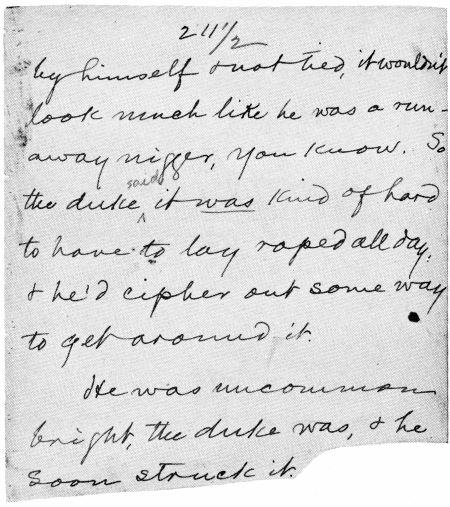
Original manuscript page 211½

211½

about six words trimmed

212½[B]

Mark Twain cut manuscript pages originally numbered 211½ and 212 into two and three pieces, respectively; after trimming away and discarding two segments, he reassembled the remaining fragments in a different order. He numbered one of the fragments 212½ and probably numbered another 212[¼]. In its reassembled form, the passage beginning with 212[¼] is comprised of four fragments, which we have labeled A, B, C, and D. The photographs on this page and the facing page show the cut fragments arranged in their original order. On the following pages, the fragments are shown in the order of Mark Twain’s final revision of manuscript pages 211½ and 212.


[begin page 1066]
Original manuscript page 212

212[C]

212¼[A]

word trimmed

212[D]


[begin page 1067]

211½


[begin page 1068]

Fragments of manuscript pages 211½ and 212 as reassembled by Mark Twain. By canceling or removing certain portions of manuscript and adding some phrases, the author created a new passage beginning at the top of 211½ (“by himself . . .”) and ending at the bottom of 212[D] (“. . . a couple of years”). Manuscript fragments are reproduced from Adventures of Huckleberry Finn . . . A Facsimile of the Manuscript, introduction by Louis Budd, afterword by William H. Loos (Detroit: Gale Research Company, 1983), 1:116–18.


[begin page 1063 continued]


[begin page 1069]


[begin page 1070]


[begin page 1071]


[begin page 1072]


[begin page 1073]


[begin page 1074]


[begin page 1079]


[begin page 1080]


[begin page 1083]


[begin page 1084]


[begin page 1085]


[begin page 1087]


[begin page 1089]


[begin page 1090]


[begin page 1092]


[begin page 1093]


[begin page 1094]


[begin page 1095]


[begin page 1096]


[begin page 1097]


[begin page 1098]


[begin page 1099]


[begin page 1100]


[begin page 1102]


[begin page 1103]


[begin page 1104]


[begin page 1105]


[begin page 1106]


[begin page 1107]


[begin page 1108]


[begin page 1110]


[begin page 1111]


[begin page 1112]


[begin page 1113]


[begin page 1114]


[begin page 1116]


[begin page 1117]


[begin page 1118]


[begin page 1119]


[begin page 1120]


[begin page 1121]

REFERENCES

This list defines the abbreviations used in this book and provides full bibliographic information for works cited by the author’s name, or by name and publication date. Any edition listed here known to be the one that Clemens owned is identified by a heavy asterisk (✱). [The 2009 web edition did not include a list of references; it has been restored as of 2016, together with relevant references introduced in HF 2010.]


Abbott, Keene. 1913. “Tom Sawyer’s Town.” Harper’s Weekly 57 (9 August): 16–17.

AD. Autobiographical Dictation. [Clemens’s dictations have been published 2010–2015 in print and on MTPO.]

Aiken, Albert W. 1880. Richard Talbot of Cinnabar: or, The Brothers of the Red Hand. Citations are to the reprint edition in The Dime Library 82 (August 1901), New York: M. J. Ivers and Co.

Ainsworth, William Harrison. 1840. The Tower of London: A Historical Romance. London: R. Bentley.

Aldrich, Thomas Bailey. 1869. The Story of a Bad Boy. Boston: Fields, Osgood and Co.

AMT. 1959. The Autobiography of Mark Twain. Edited by Charles Neider. New York: Harper and Brothers.

Anderson, Frederick, and Hamlin Hill. 1972. “How Samuel Clemens Became Mark Twain’s Publisher.” Proof 2: 117–43.

Anderson, Frederick, and Kenneth M. Sanderson, eds. 1971. Mark Twain: The Critical Heritage. New York: Barnes and Noble.

Andrews, William L. 1981. “Mark Twain and James W. C. Pennington: Huckleberry Finn’s Smallpox Lie.” Studies in American Fiction 9 (Spring): 103–12.

Angell, Roger. 1995. “In ‘Huck, Continued.’ ” New Yorker 71 (26 June and 3 July): 130–32.

Arabian Nights. 1839–41. The Thousand and One Nights, Commonly Called, in England, the Arabian Nights’ Entertainments. Translated by Edward William Lane. 3 vols. London: Charles Knight and Co.

Arac, Jonathan. 1997. “Huckleberry Finn” As Idol and Target: The Functions of Criticism in Our Time. Madison: University of Wisconsin Press.


[begin page 1122]

Archer, William. 1900. “Study and Stage, A New Parable.” London Morning Leader, 22 September, 4.

Arner, Robert D. 1972. “Acts Seventeen and Huckleberry Finn: A Note on Silas Phelps’ Sermon.” Mark Twain Journal 16 (Summer): 12.

Ashmead, John. 1962. “A Possible Hannibal Source for Mark Twain’s Dauphin.” American Literature 34 (March): 105–7.

ATS. 1982. The Adventures of Tom Sawyer. Foreword and notes by John C. Gerber; text established by Paul Baender. The Mark Twain Library. Berkeley, Los Angeles, London: University of California Press.

AutoMT1. 2010. Autobiography of Mark Twain, Volume 1. Edited by Harriet Elinor Smith, Benjamin Griffin, Victor Fischer, Michael B. Frank, Sharon K. Goetz, and Leslie Diane Myrick. The Mark Twain Papers. Berkeley and Los Angeles: University of California Press. Also online at MTPO.

Ayres, John W. 1917. “Recollections of Hannibal.” Letter dated 22 August. Undated clipping from the Palmyra (Mo.) Spectator, Morris Anderson scrapbook, MoHM. Reprinted in part by Wecter 1952, 149.

[Bacon, Thomas]. 1990. A Mirror of Hannibal. Edited by J. Hurley Hagood and Roberta Hagood. Rev. ed. Hannibal: Hannibal Free Public Library. First published in 1905 by C. P. Greene.

Baetzhold, Howard G.

1961. “The Course of Composition of A Connecticut Yankee.” American Literature 33 (May): 195–214.

1970. Mark Twain and John Bull: The British Connection. Bloomington: Indiana University Press.

Baker, William. 1985. “Mark Twain and the Shrewd Ohio Audiences.” American Literary Realism 18 (Spring and Autumn): 14–30.

BAL. 1955–91. Bibliography of American Literature. Compiled by Jacob Blanck. 9 vols. New Haven: Yale University Press.

Baldanza, Frank. 1955. “The Structure of Huckleberry Finn.” American Literature 27 (November): 347–55.

Bales, E. G. 1939. “Folklore from West Norfolk.” Folk-Lore 50: 66–75. Citations are to the 1969 reprint edition, Nendeln: Kraus Reprint.

✱ Ball, Charles. 1837. Slavery in the United States: A Narrative of the Life and Adventures of Charles Ball, a Black Man, Who Lived Forty Years in Maryland, South Carolina and Georgia, as a Slave. New York: J. S. Taylor.

Barber, Paul. 1988. Vampires, Burial, and Death: Folklore and Reality. New Haven: Yale University Press.

Barker, E. H. 1852. Literary Anecdotes and Contemporary Reminiscences, of Professor Porson and Others. 2 vols. London: J. R. Smith.

Bartlett, John Russell. 1896. Dictionary of Americanisms. A Glossary of Words and Phrases Usually Regarded as Peculiar to the United States. 4th ed. Boston: Little, Brown, and Co.


[begin page 1123]

Bates, Alan. 1968. The Western Rivers Steamboat Cyclopoedium; or, American Riverboat Structure & Detail, Salted with Lore, with a Nod to the Modelmaker. Leonia, N.J.: Hustle Press.

Baughman, Ernest W. 1966. Type and Motif Index of the Folktales of England and North America. Indiana University Series, no. 20. The Hague: Mouton and Co.

Beaver, Harold. 1987. Huckleberry Finn. Unwin Critical Library. London: Allen and Unwin.

Beidler, Peter G.

1968. “The Raft Episode in Huckleberry Finn.” Modern Fiction Studies 14 (Spring): 11–20.

1990. “Christian Schultz’s Travels: A New Source for Huckleberry Finn?” English Language Notes 28 (December): 51–61.

Belden, H. M., ed. 1940. Ballads and Songs Collected by the Missouri Folk-Lore Society. University of Missouri Studies 15 (1 January).

Bentley. Collection of Mr. and Mrs. Fred D. Bentley, Sr.

Bercovich, Sacvan. 2002. “Deadpan Huck: Or, What’s Funny about Interpretation.” Kenyon Review 24 (Spring–Autumn), 90–134.

Berkove, Lawrence I. 1994. “Mark Twain’s Vision of Truth.” Journal of American Studies 26 (December): 204–22.

Berret, Anthony J.

1985. “The Influence of Hamlet on Huckleberry Finn.” American Literary Realism 18 (Spring and Autumn): 196–207.

1986. “Huckleberry Finn and the Minstrel Show.” American Studies 27 (Fall): 37–49.

Berridge, W S., and W. Percival Westell. 1911. The Book of the Zoo. London: J. M. Dent and Sons.

Bertram, Paul, and Bernice W. Kliman, eds. 1991. The Three-Text Hamlet. New York: AMS Press.

Bickerstaff, Isaac. 1981. The Plays of Isaac Bickerstaff. Edited by Peter A. Tasch. 3 vols. New York: Garland Publishing.

Bikle, Lucy Leffingwell Cable. 1928. George W. Cable: His Life and Letters. New York: Charles Scribner’s Sons.

Birchfield, James. 1969. “Jim’s Coat of Arms.” Mark Twain Journal 14 (Summer): 15–16.

✱ [Bird, Robert M.] 1837. Nick of the Woods; or, The Jibbenainosay. 2 vols. Philadelphia: Carey, Lea and Blanchard.

Blair, Walter.

“The Methods of Mark Twain.” Saturday Review of Literature 25 (20 June): 11.

1957. “The French Revolution and Huckleberry Finn.” Modern Philology 55 (August): 21–35.


[begin page 1124]

1958. “When Was Huckleberry Finn Written?” American Literature 30 (March): 1–25.

1960a. Mark Twain & Huck Finn. Berkeley and Los Angeles: University of California Press.

1960b. Native American Humor. San Francisco: Chandler Publishing Company.

1976. “Charles Mathews and His ‘Trip to America.’ ” In Salzman 1976, 2:1–23.

1979. “Was Huckleberry Finn Written?.” Mark Twain Journal 19 (Summer): 1–3.

Blair, Walter, and Hamlin Hill. 1978. America’s Humor: From Poor Richard to Doonesbury. New York: Oxford University Press.

Blair, Walter, and Franklin J. Meine. 1956. Half Horse Half Alligator: The Growth of the Mike Fink Legend. Chicago: University of Chicago Press.

Blanck, Jacob.

1939. A Supplement to “A Bibliography of Mark Twain.” New York: Privately printed.

1950. “In Re Huckleberry Finn.” New Colophon 3: 153–59.

1960. “ ‘Mark Twain & Huck Finn’ Reviewed.” Antiquarian Bookman 26 (28 November): 1931–35.

Blanton, Wyndham B. 1933. Medicine in Virginia in the Nineteenth Century. Richmond: Garrett and Massie.

Blathwait, Raymond. 1891. “Mark Twain on Humor.” New York World, 31 May, 26.

Bliven, Bruce, Jr. 1954. The Wonderful Writing Machine. New York: Random House.

Boewe, Mary. 1985. “Twain on Lecky: Some Marginalia at Quarry Farm.” Mark Twain Society Bulletin 8 (January): 1–6.

Bontemps, Arna, ed. 1969. Great Slave Narratives. Boston: Beacon Press.

Bowen, Elbert R. [1959]. Theatrical Entertainments in Rural Missouri before the Civil War. University of Missouri Studies, vol. 32. Columbia: University of Missouri Press.

Bradley, David. 1996. “Introduction.” In How to Tell a Story and Other Essays. New York: Oxford University Press.

Bragg, Marion. 1977. Historic Names and Places on the Lower Mississippi River. Vicksburg, Miss.: Mississippi River Commission.

Branch, Edgar Marquess.

1983. “Mark Twain: Newspaper Reading and the Writer’s Creativity.” Nineteenth-Century Fiction 37 (March): 576–603.


[begin page 1125]

1984. “Three New Letters by Samuel Clemens in the Muscatine Journal.” Mark Twain Journal 22 (Spring): 2–7.

Branch, Edgar Marquess, and Robert H. Hirst. 1985. The Grangerford–Shepherdson Feud . . . with an Account of Mark Twain’s Literary Use of the Bloody Encounters at Compromise, Kentucky. Berkeley: The Friends of The Bancroft Library.

Brand, John. 1877. Observations on Popular Antiquities. London: Chatto and Windus.

Bremer, Fredrika. 1853. The Homes of the New World; Impressions of America. Translated by Mary Howitt. 3 vols. London: Arthur Hall, Virtue, and Co.

Brewer, Ebenezer Cobham. 1882. Dictionary of Phrase and Fable. 14th ed., rev. London: Cassell, Petter, Galpin and Co.

[Bridges, Robert.] 1885. “Mark Twain’s Blood-Curdling Humor.” Life 5 (26 February): 119. Reprinted in Da Ponte 1959, 79, and Anderson and Sanderson 1971, 126–27.

Bronson, Bertrand Harris, ed.

1962. The Traditional Tunes of the Child Ballads. 4 vols. Princeton: Princeton University Press.

1976. The Singing Tradition of Child’s Popular Ballads. Princeton: Princeton University Press.

Brooks, Van Wyck.

1920a. The Ordeal of Mark Twain. New York: E. P. Dutton and Co.

1920b. “The Genesis of Huck Finn.” The Freeman 1 (31 March): 59–63.

Brown, Spencer. 1967. “Huckleberry Finn for Our Time.” Michigan Quarterly Review 6 (Winter): 41–46.

Browne, Ray B. 1960. “Shakespeare in American Vaudeville and Negro Minstrelsy.” American Quarterly 12 (Fall): 374–91.

Bruce, Dickson D., Jr. 1974. And They All Sang Hallelujah: Plain-Folk Camp-Meeting Religion, 1800–1845. Knoxville: University of Tennessee Press.

Bruchac, Joseph. 1993. The Native American Sweat Lodge: History and Legends. Freedom, Calif.: Crossing Press.

Budd, Louis J.

1959. “The Southward Currents under Huck Finn’s Raft.” Mississippi Valley Historical Review 46 (September): 222–37.

1962. Mark Twain: Social Philosopher. Bloomington: Indiana University Press.


[begin page 1126]

1977. “A Listing of and Selection from Newspaper and Magazine Interviews with Samuel L. Clemens, 1874–1910.” American Literary Realism 10 (Winter): i–100.

1982. “Who Wants to Go to Hell? An Unsigned Sketch by Mark Twain.” Studies in American Humor, n.s., 1 (June): 6–16.

1983. Our Mark Twain: The Making of His Public Personality. Philadelphia: University of Pennsylvania Press.

1985. “ ‘A Nobler Roman Aspect’ of Adventures of Huckleberry Finn.” In Sattelmeyer and Crowley, 26–40.

1992a. Mark Twain: Collected Tales, Sketches, Speeches, & Essays, 1852–1890. The Library of America. New York: Literary Classics of the United States.

1992b. Mark Twain: Collected Tales, Sketches, Speeches, & Essays, 1891–1910. The Library of America. New York: Literary Classics of the United States.

1999. Mark Twain: The Contemporary Reviews. Cambridge: Cambridge University Press.

✱ Bunyan, John. [1678] 1875. The Pilgrim’s Progress as Originally Published by John Bunyan, Being a Facsimile Reproduction of the First Edition. London: Elliot Stock.

Burchfield, R. W., ed. 1972–86. A Supplement to the Oxford English Dictionary. 4 vols. Oxford: Clarendon Press.

Buxbaum, Katherine. 1927. “Mark Twain and American Dialect.” American Speech 2 (February): 233–36.

Byers, John R., Jr.

1971. “Miss Emmeline Grangerford’s Hymn Book.” American Literature 43 (May): 259–63.

1973–74. “Mark Twain’s Miss Mary Jane Wilks: Shamed or Shammed?” Mark Twain Journal 17 (Winter): 13–14.

1977. “The Pokeville Preacher’s Invitation in Huckleberry Finn.” Mark Twain Journal 18 (Summer): 15–16.

Camfield, Gregg. 1992. “ ‘I Wouldn’t Be as Ignorant as You for Wages’: Huck Finn Talks Back to His Conscience.” Studies in American Fiction 20 (Autumn): 169–75.

Cardwell, Guy A. 1953. Twins of Genius. [East Lansing]: Michigan State College Press.

Carkeet, David.

1979. “The Dialects in Huckleberry Finn.” American Literature 51 (November): 315–32.

1981. “The Source for the Arkansas Gossips in Huckleberry Finn.” American Literary Realism 14 (Spring): 90–92.


[begin page 1127]

✱ Carlyle, Thomas. 1856. The French Revolution: A History. 2 vols. New York: Harper and Brothers.

Carlyon, David. 2007. “Twain’s ‘Stretcher’: The Circus Shapes Huckleberry Finn.” South Atlantic Review 72 (Fall): 1–36.

Carrington, George C., Jr. 1976. The Dramatic Unity of “Huckleberry Finn.” Columbus: Ohio State University Press.

✱ Casanova de Seingalt, Giacomo Girolamo. 1833–37. Memoires de Jacques Casanova de Seingalt. 10 vols. Paris: Paulin.

Cassidy, Frederic G., and Joan Houston Hall, eds. 1985–. Dictionary of American Regional English. 6 vols. to date. Cambridge: Belknap Press of Harvard University Press.

Cayton, Frank M., comp. 1879. Landings on the Mississippi River, Showing Locations, etc. St. Louis: Woodward, Tiernan and Hale.

CCamarSJ. St. John’s Seminary, Camarillo, California. Formerly home to the Estelle Doheny collection (now dispersed).

Cellini, Benvenuto. 1851. Memoirs of Benvenuto Cellini, a Florentine Artist. Translated by Thomas Roscoe. New York: George P. Putnam.

Century Dictionary. 1889–91. The Century Dictionary: An Encyclopedic Lexicon of the English Language. Prepared under the superintendence of William Dwight Whitney. 6 vols. New York: Century Company.

Cervantes Saavedra, Miguel de.

1855. The Exemplary Novels of Miguel de Cervantes Saavedra. Translated from the Spanish by Walter K. Kelly. London: Henry G. Bohn.

1992. Don Quixote de la Mancha. Translated by Charles Jarvis, with an introduction by E. C. Riley. Oxford: Oxford University Press.

Champion, Laurie, ed. 1991. The Critical Response to Mark Twain’s Huckleberry Finn. New York: Greenwood Press.

Childs, Marquis W. 1982. Mighty Mississippi: Biography of a River. New Haven and New York: Ticknor and Fields.

CL. Los Angeles Public Library, Los Angeles, Calif.

Clapin, Sylva. 1902. A New Dictionary of Americanisms. New York: Louis Weiss and Co.

Clarke, Asia Booth. 1882. The Elder and the Younger Booth. Boston: James R. Osgood and Co.

Clemens, Olivia Susan (Susy). See OSC.

Clifton, William. [1840?]. “The Last Link Is Broken. A duet composed and arranged for the piano forte, by Wm. Clifton.” New York: Firth and Hall. The Lester S. Levy Sheet Music Collection, Johns Hopkins University.

CLjC. The James S. Copley Library, La Jolla, California. The collection of the Copley Library was sold in a series of auctions at Sotheby’s, New York, in 2010 and 2011.

Cohen, William. 1991. At Freedom’s Edge: Black Mobility and the Southern White Quest for Racial Control, 1861–1915. Baton Rouge: Louisiana State University Press.


[begin page 1128]

Colwell, James L. 1971. “Huckleberries and Humans: On the Naming of Huckleberry Finn.” PMLA 86 (January): 70–76.

Conard, Howard L., ed. 1901. Encyclopedia of the History of Missouri. 6 vols. New York: Southern History Company.

Conclin, George, comp. 1848. Conclin’s New River Guide; or, A Gazetteer of All the Towns on the Western Waters. Cincinnati: George Conclin.

Cooper, Helen A. 1982. John Trumbull: The Hand and Spirit of a Painter. New Haven, Conn.: Yale University Art Gallery.

Couch, W. T. 1934. Culture in the South. Chapel Hill: University of North Carolina Press. Citations are to the 1970 reprint edition, Westport, Cohn.: Negro Universities Press.

Covici, Pascal, Jr. 1960. “Dear Master Wattie: The Mark Twain–David Watt Bowser Letters.” Southwest Review 45 (Spring): 106–9.

Craigie, William, ed., with James R. Hurlbert. 1936. A Dictionary of American English on Historical Principles. 4 vols. Chicago: University of Chicago Press.

✱ Cramer, Zadok. 1817. The Navigator, Containing Directions for Navigating the Monongahela, Allegheny, Ohio and Mississippi Rivers. 9th ed. Pittsburgh: Cramer, Spear and Eichbaum. Cramer’s book was in Clemens’s library (Gribben, 2:914), but it is not known which edition cf the twelve published between 1801 and 1824 he owned.

Crossett, Judith Hale. 1977. “A Critical Edition of Mark Twain’s Life on the Mississippi.” 3 vols. Ph.D. diss., University of Iowa, Iowa City.

CSmH. Henry E. Huntington Library, Art Collections and Botanical Gardens, San Marino, Calif.

CtHMTH. Mark Twain Memorial, Hartford, Conn.

CtY-BR. Yale University, Beinecke Rare Book and Manuscript Library, New Haven, Conn.

CU. University of California, Berkeley, Main Library, Berkeley, Calif.

CU-BANC. University of California, The Bancroft Library, Berkeley.

CU-MAPS. University of California, Berkeley, Maps Collection, Berkeley, Calif.

CU-MARK. University of California, Mark Twain Papers, The Bancroft Library, Berkeley.

Cummings, Samuel. 1854. The Western Pilot; Containing Charts of the Ohio River and of the Mississippi, from the Mouth of the Missouri to the Gulf of Mexico; Accompanied with Directions for Navigating the Same, and a Gazetteer. Corrected by Capts. Charles Ross and John Klinefelte. Cincinnati: J. A. and U. P. James.


[begin page 1129]

Cummings, Sherwood.

1988. Mark Twain and Science: Adventures of a Mind. Baton Rouge: Louisiana State University Press.

1991. “Mark Twain’s Moveable Farm and the Evasion.” American Literature 63 (September): 440–58.

Current, Richard N. 1954. The Typewriter and the Men Who Made It. Urbana: University of Illinois Press.

CY. 1979. A Connecticut Yankee in King Arthur’s Court. Edited by Bernard L. Stein, with an introduction by Henry Nash Smith. The Works of Mark Twain. Berkeley and Los Angeles: University of California Press.

Da Ponte, Durant. 1959. “Life Reviews Huckleberry Finn.” American Literature 31 (March): 78–81.

✱ Darwin, Charles. 1871. The Descent of Man, and Selection in Relation to Sex. Vol. 1 of 2. New York: D. Appleton and Co. Copy owned by Clemens, with marginalia, CU-MARK.

David, Beverly R.

1974. “The Pictorial Huck Finn: Mark Twain and His Illustrator, E. W. Kemble.” American Quarterly 26 (October): 331–51.

1982. “Mark Twain and the Legends for Huckleberry Finn.” American Literary Realism 15 (Autumn): 155–65.

David, Beverly R., and Ray Sapirstein. 1996. “Reading the Illustrations in Huckleberry Finn.” In SLC 1996, editorial back matter, 33–40.

Davidson, Loren K. 1968. “The Darnell-Watson Feud.” Duquesne Review 13 (Fall): 76–95.

Davis, Chester L., Sr. 1955. “Mark Twain’s Personal Marked Copy of History of European Morals by William Edward Hartpole Lecky (Continuation).” Twainian 14 (September-October): 1–4.

✱ Defoe, Daniel. 1747. Life and Strange Surprising Adventures of Robinson Crusoe. London: Printed for T. Woodward.

De Forest, J. W. 1872. “An Independent Ku-Klux.” Galaxy 13 (April): 480–88.

Den Hollander, A. N. J. [1934] 1970. “The Tradition of ‘Poor Whites.’ ” In Couch, 403–31.

De Vere, M. Schele. 1872. Americanisms: The English of the New World. New York: Charles Scribner and Co.

DeVinne, Theodore Low. [1883] 1926. Manual of Printing Office Practice. Reprint, with an introductory note by Douglas C. McMurtrie. New York: Press of Ars Typographica.


[begin page 1130]

DeVoto, Bernard.

1932. Mark Twain’s America. Boston: Houghton Mifflin Company.

1942. Mark Twain at Work. Cambridge: Harvard University Press.

1946. The Portable Mark Twain. New York: Viking Press. (BAL 3574).

DGU. Georgetown University, Washington, D.C.

Dickens, Charles.

1842. American Notes for General Circulation. New York: Harper and Brothers.

✱ 1866–1870. The Works of Charles Dickens. Household Edition. 55 vols. New York: Hurd and Houghton.

✱ 1882. A Tale of Two Cities. New York: J. W. Lovell Company.

1970. A Tale of Two Cities. Penguin English Library. Harmondsworth, England: Penguin Books.

Dickinson, Asa Don. 1935. “Huckleberry Finn Is Fifty Years Old—Yes; But Is He Respectable?” Wilson Bulletin for Librarians 10 (November): 180–85.

DLC. United States Library of Congress, Washington, D.C.

Dorson, Richard M., ed. 1967. American Negro Folktales. Greenwich, Conn.: Fawcett Publications.

Douglass, Frederick. 1997. Narrative of the Life of Frederick Douglass, an American Slave, Written by Himself. Edited by William L. Andrews and William S. McFeely. A Norton Critical Edition. New York: W. W. Norton and Co.

Doyno, Victor A.

1991. Writing “Huck Finn”: Mark Twain’s Creative Process. Philadelphia: University of Pennsylvania Press.

1996a. “Afterword.” In SLC 1996.

1996b. “Textual Addendum.” In SLC 1996.

Doyno, Victor A., ed. 2003. Adventures of Huckleberry Finn: The Buffalo & Erie County Public Library CD-ROM Edition.

Drake, Samuel Adams. 1875. Nooks and Corners of the New England Coast. New York: Harper and Brothers.

Dresser, Amos. 1836. The Narrative of Amos Dresser with Stone’s Letters from Natchez, an Obituary Notice of the Writer, and Two Letters from Tallahassee, Relating to the Treatment of Slaves. New York: American Anti-Slavery Society.

Drew, Benjamin. 1882. Hints and Helps for Those Who Write, Print, or Read. Boston: Lee and Shepard; New York: Charles T. Dillingham.

Dumas, Alexandre.

[187–]a. The Count of Monte-Cristo. London: G. Routledge and Sons.

[187–]b. Novels and Tales. 14 vols. London and New York: George Routledge.


[begin page 1131]

Dundes, Alan. 1990. Mother Wit from the Laughing Barrel. Jackson: University Press of Mississippi.

Eby, Cecil D., Jr. 1960. “Mark Twain’s ‘Plug’ and ‘Chaw’: An Anecdotal Parallel.” Mark Twain Journal 11 (Summer): 11, 25.

Edwards, Cyrus. 1940. Cyrus Edwards’ Stories of Early Days and Others. Edited and compiled by Florence Edwards Gardiner. Louisville, Ky.: The Standard Printing Company.

Edwards, Richard, ed. 1855. Statistical Gazetteer of the State of Virginia. Richmond, Va.: Richard Edwards.

Eggleston, Edward.

1871. The Hoosier School-Master: A Novel. New York: Orange Judd and Co.

1874. The Circuit Rider: A Tale of the Heroic Age. New York: J. B. Ford and Co.

1878. Roxy. New York: C. Scribner’s Sons.

Eliot, T. S.

1950. Introduction to The Adventures of Huckleberry Finn, by Samuel L. Clemens (Mark Twain). London: Cresset Press.

1953. American Literature and the American Language. Washington University Studies, Language and Literature, n.s., 23. St. Louis, Mo.: Committee on Publications, Washington University.

Ellis, James. 1991. “The Bawdy Humor of The King’s Camelopard or The Royal Nonesuch.” American Literature 63 (December): 729–35.

Ellison, Ralph. 1970. “What America Would Be Like Without Blacks.” Time 95 (6 April): 54–55.

Engle, Gary D. 1978. This Grotesque Essence: Plays from the American Minstrel Stage. Baton Rouge: Louisiana State University Press.

Ensor, Allison. 1969. “The Location of the Phelps Farm in ‘Huckleberry Finn.’ ” South Atlantic Bulletin 34 (May): 7.

Esling, Catharine H. W., ed. 1842. Friendship’s Offering. Boston: E. Littlefield.

Estes, David C., ed. 1989. A New Collection of Thomas Bangs Thorpe’s “Sketches of the Old Southwest.” Baton Rouge: Louisiana State University Press.

ET&S1. 1979. Early Tales & Sketches, Volume 1 (1851–1864). Edited by Edgar Marquess Branch and Robert H. Hirst, with the assistance of Harriet Elinor Smith. The Works of Mark Twain. Berkeley and Los Angeles: University of California Press.

ET&S2. 1981. Early Tales & Sketches, Volume 2 (1864–1865). Edited by Edgar Marquess Branch and Robert H. Hirst, with the assistance of Harriet Elinor Smith. The Works of Mark Twain. Berkeley and Los Angeles: University of California Press.


[begin page 1132]

Falk, Bernard. 1942. The Bridgewater Millions: A Candid Family History. London: Hutchinson and Co.

Farmer, John S., comp. and ed. 1889. Americanisms—Old & New. London: Privately printed by Thomas Poulter and Sons.

Farmer, John S., and W. E. Henley. 1905. A Dictionary of Slang and Colloquial English. Abridged from the seven-volume work, entitled Slang and Its Analogues. London: George Routledge and Sons.

Fatout, Paul.

1960. Mark Twain on the Lecture Circuit. Bloomington: Indiana University Press.

1976. Mark Twain Speaking. Iowa City: University of Iowa Press.

Ferguson, DeLancey.

1938. “Huck Finn Aborning.” Colophon, n.s., 3 (Spring): 171–80.

1943. Mark Twain: Man and Legend. Indianapolis: Bobbs-Merrill Company.

Field, J. M. 1847. The Drama in Pokerville; The Bench and Bar of Jury-town, and Other Stories. Philadelphia: T. B. Peterson and Brothers.

Fischer [Fisher], Henry W. 1922. Abroad with Mark Twain and Eugene Field: Tales They Told to a Fellow Correspondent. New York: Nicholas L. Brown.

Fischer, Victor. 1983. “Huck Finn Reviewed: The Reception of Huckleberry Finn in the United States, 1885–1897.” American Literary Realism 16 (Spring): 1–57.

Fishkin, Shelley Fisher. 1993. Was Huck Black? Mark Twain and African-American Voices. New York: Oxford University Press.

[Fitch, George Hamlin.] 1885. “Literature.” San Francisco Chronicle, 15 March, 6.

Fleming, Walter L. 1906. Documentary History of Reconstruction. 2 vols. Citations are to the 1960 reprint edition, Gloucester, Mass.: Peter Smith.

Flexner, James Thomas. 1937. Doctors on Horseback: Pioneers of American Medicine. New York: Viking Press.

FM. 1972. Mark Twain’s Fables of Man. Edited by John S. Tuckey. Text established by Kenneth M. Sanderson and Bernard L. Stein. The Mark Twain Papers. Berkeley and Los Angeles: University of California Press.


[begin page 1133]

Foner, Philip S. 1958. Mark Twain: Social Critic. New York: International Publishers.

Freedman. Collection of Samuel N. Freedman.

French, Bryant Morey. 1965. Mark Twain and “The Gilded Age”: The Book That Named an Era. Dallas: Southern Methodist University Press.

Fry, Gladys-Marie. 1975. Night Riders in Black Folk History. Knoxville: University of Tennessee Press.

✱ Fuller, Horace W. 1882. Noted French Trials: Impostors and Adventurers. Boston: Soule and Bugbee.

Gaffney, W. G. 1966. “Mark Twain’s ‘Duke’ and ‘Dauphin.’ ” ANS Notes 14 (September): 175–78.

Ganzel, Dewey.

1962a. “Samuel Clemens and Captain Marryat.” Anglia: Zeitschrift für Englische Philologie 80: 405–16.

1962b. “Twain, Travel Books, and Life on the Mississippi.” American Literature 34 (March): 40–55.

Gardner, Joseph H. 1968. “Gaffer Hexam and Pap Finn.” Modern Philology 66 (November): 155–56.

Gates, William Bryan. 1939. “Mark Twain to His English Publishers.” American Literature 11 (March): 78–80.

Genovese, Eugene D. 1974. Roll, Jordan, Roll: The World the Slaves Made. New York: Pantheon Books.

Gerber, John C. 1985. “Introduction: The Continuing Adventures of Huckleberry Finn.” In Sattelmeyer and Crowley, 1–12.

GEU. Emory University, Atlanta, Ga.

Gibson, William M. 1976. The Art of Mark Twain. New York: Oxford University Press.

Giddings, Robert, ed. 1985. Mark Twain: A Sumptuous Variety. London and Totowa, N.J.: Vision Press and Barnes and Noble Books.

Gilder, Richard Watson. 1887. “Certain Tendencies in Current Literature.” New Princeton Review, n.s., 4 (July): 1–13.

Gilder, Rosamond, ed. 1916. Letters of Richard Watson Gilder. Boston: Houghton Mifflin Company.

Gneiting, Teona Tone. 1977. “Picture and Text: A Theory of Illustrated Fiction in the Nineteenth Century.” Ph.D. diss., University of California, Los Angeles.


[begin page 1134]

✱ Goldsmith, Oliver. 1882. The Vicar of Wakefield, a Tale. New York: John W. Lovell Company.

Goodyear, Russell H. 1971. “Huck Finn’s Anachronistic Double Eagles.” American Notes & Queries 10 (November): 39.

Gordon, Robert Winslow. 1927. “Negro ‘Shouts’ from Georgia.” New York Times Magazine, 24 April. Reprinted in Dundes, 445–51.

Gove, Philip Babcock, and the Merriam-Webster editorial staff. 1961. Webster’s Third New International Dictionary of the English Language, Unabridged. Springfield, Mass.: G. and C. Merriam Company.

Graff, Gerald, and James Phelan, eds. 1995. “Adventures of Huckleberry Finn”: A Case Study in Critical Controversy. Boston and New York: Bedford Books of St. Martin’s Press.

Graves, Wallace. 1968. “Mark Twain’s ‘Burning Shame.’ ” Nineteenth-Century Fiction 23 (June): 93–98.

Gribben, Alan.

1980. Mark Twain’s Library: A Reconstruction. 2 vols. Boston: G. K. Hall and Co.

1985. “ ‘I Did Wish Tom Sawyer Was There’: Boy-Book Elements in Tom Sawyer and Huckleberry Finn.” In Sattelmeyer and Crowley, 149–70.

Griska, Joseph M., Jr. 1977. “Two New Joel Chandler Harris Reviews of Mark Twain.” American Literature 48 (January): 584–89.

✱ Grose, Francis. 1785. A Classical Dictionary of the Vulgar Tongue. London: S. Hooper. PH of Clemens’s own copy, with marginalia, in CU-MARK, courtesy of Justin G. Turner and Howard Baetzhold.

Gunn, John C.

1836. Gunn’s Domestic Medicine, or Poor Man’s Friend, in the Hours of Affliction, Pain and Sickness. 8th ed. Springfield, Ohio: John M. Gallagher.

1867. Gunn’s New Family Physician: or, Home Book of Health. 100th ed. Cincinnati, New York: Moore, Wilstach and Baldwin.

Hale, Sarah J., and Louis A. Godey. 1856. “The Art of Making Wax Fruit and Flowers.” Godey’s Lady’s Book and Magazine 52 (January): 20–22.

Hall, Edward H. 1867. Appletons’ Hand-Book of American Travel. New York: D. Appleton and Co.

Hapgood, Olive C. 1893. School Needlework. Boston: Ginn and Co.

Hardwick, Charles. 1872. Traditions, Superstitions, and Folk-lore. Manchester: A. Ireland and Co.

Harris, Joel Chandler.

1883a. Nights with Uncle Remus. Boston: Houghton Mifflin Company.


[begin page 1135]

1883b. “At Teague Poteet’s. A Sketch of the Hog Mountain Range.” Parts 1 and 2. Century Magazine 26 (May and June): 137–50, 185–94.

1885. “To the Editors of the Critic.” Letter dated 21 November. Critic, n.s., 4 (28 November): 253.

Harris, Julia Collier. 1918. The Life and Letters of Joel Chandler Harris. Boston and New York: Houghton Mifflin Company.

Harris, N. Dwight. 1904. The History of Negro Servitude in Illinois and of the Slavery Agitation in That State, 1719–1864. Reprint. New York: Negro Universities Press.

Haupt, Clyde V. 1994. “Huckleberry Finn” on Film: Film and Television Adaptations of Mark Twain’s Novel, 1920–1993. Jefferson, N.C.: McFarland and Co.

Hauptman, William, and Roger Miller. 1986. Big River: The Adventures of Huckleberry Finn. A Musical Play. New York: Grove Press.

Hay, John M.

1871. Pike County Ballads and Other Pieces. Boston: James R. Osgood and Co.

1872. “Mark Twain at Steinway Hall.” New York Tribune, 25 January, 5.

Hazlitt, W. Carew.

1890. Studies in Jocular Literature: A Popular Subject More Closely Considered. London: Elliot Stock.

1905. Faiths and Folklore: A Dictionary of National Beliefs, Superstitions and Popular Customs, Past and Current, with Their Classical and Foreign Analogues, Described and Illustrated. 2 vols. London: Reeves and Turner.

Hearn, Michael Patrick.

1981. “Mark Twain, E. W. Kemble, and Huckleberry Finn.” American Book Collector 2 (November–December): 14–19.

2001. The Annotated Huckleberry Finn. New York: W. W. Norton and Co.

Heitman, Francis B. 1903. Historical Register and Dictionary of the United States Army, from Its Organization, September 29, 1789, to March 2, 1903. 2 vols. Washington, D.C.: Government Printing Office.

Helper, Hinton Rowan. 1857. The Impending Crisis of the South: How to Meet It. New York: Burdick Brothers. Citations are to the 1968 reprint edition, edited by George M. Frederickson, Cambridge: Belknap Press of Harvard University Press.

Hemingway, Ernest. 1935. Green Hills of Africa. New York: Charles Scribner’s Sons.

[Henley, William Ernest.] 1884. “Novels of the Week.” Athenaeum 2983 (27 December): 855. Reprinted in Anderson and Sanderson, 120–21.


[begin page 1136]

Herkimer County Historical Society. 1923. The Story of the Typewriter, 1873–1923. Published in Commemoration of the Fiftieth Anniversary of the Invention of the Writing Machine. Herkimer, N.Y.: Herkimer Historical Society.

HF 1985. 1985. Adventures of Huckleberry Finn. Edited by Walter Blair and Victor Fischer. The Mark Twain Library. Berkeley and Los Angeles: University of California Press.

HF 1988. 1988. Adventures of Huckleberry Finn. Edited by Walter Blair and Victor Fischer, with the assistance of Dahlia Armon and Harriet Elinor Smith. The Works of Mark Twain. Berkeley and Los Angeles: University of California Press.

HF 2001. 2001. Adventures of Huckleberry Finn. Edited by Victor Fischer and Lin Salamo, with Harriet Elinor Smith and the late Walter Blair. The Mark Twain Library. Berkeley and Los Angeles: University of California Press.

HF 2003. 2003. Adventures of Huckleberry Finn. Edited by Victor Fischer and Lin Salamo, with the late Walter Blair. The Works of Mark Twain. Berkeley and Los Angeles: University of California Press. Also online at MTPO.

HF 2010. 2010. Adventures of Huckleberry Finn. Edited by Victor Fischer and Lin Salamo, with Harriet Elinor Smith and the late Walter Blair. 125th anniversary edition, including “Mark Twain on Tour.” The Mark Twain Library. Berkeley and Los Angeles: University of California Press.

HH&T. 1969. Mark Twain’s Hannibal, Huck & Tom. Edited by Walter Blair. The Mark Twain Papers. Berkeley and Los Angeles: University of California Press.

HHR. 1969. Mark Twain’s Correspondence with Henry Huttleston Rogers, 1893–1909. Edited by Lewis Leary. The Mark Twain Papers. Berkeley and Los Angeles: University of California Press.

Higginson, Thomas Wentworth. 1870. Army Life in a Black Regiment. Citations are to the 1960 reprint edition, Michigan State University Press.

Highfill, Phillip H., Jr. 1961. “Incident in Huckleberry Finn.” Mark Twain Journal 11 (Fall): 6.

Hildreth, Richard. 1856. Archy Moore, The White Slave; or, Memoirs of a Fugitive. New York: Miller, Orton, and Mulligan. Citations are to the 1969 reprint edition, New York: Negro Universities Press.

Hill, Hamlin. 1964. Mark Twain and Elisha Bliss. Columbia: University of Missouri Press.

Hill, Richard. 1991. “Overreaching: Critical Agenda and the Ending of Adventures of Huckleberry Finn.” In Graff and Phelan 1995, 312–34.

Hilton, G. W., R. Plummer, and J. Jobé. 1976. The Illustrated History of Paddle Steamers. Drawings by Carlo Demand. Lausanne: Edita; New York: Two Continents Pub. Group.

Hirsh, James. 1992. “Samuel Clemens and the Ghost of Shakespeare.” Studies in the Novel 24 (Fall): 251–72.

Hirst, Robert H. 2000. “Who Was ‘G. G., Chief of Ordnance’?” Bancroftiana (Fall): 8, 11.

Hoag, Gerald. 1989. “The Delicate Art of Geography: The Whereabouts of the Phelps Plantation in Huckleberry Finn.” English Language Notes 26 (June): 63–66.


[begin page 1137]

Hoffman, Daniel G. 1960. “Jim’s Magic: Black or White.” American Literature 32 (March): 47–54.

✱ Holcombe, Return I. 1884. History of Marion County, Missouri. St. Louis: E. F. Perkins. Citations are to the 1979 reprint edition, Hannibal: Marion County Historical Society.

Hooper, Johnson J.

1845. Some Adventures of Captain Simon Suggs, Late of the Tallapoosa Volunteers; . . . and Other Alabama Sketches. Philadelphia: Carey and Hart.

1851. The Widow Rugby’s Husband. Philadelphia: T. B. Peterson and Brothers.

Howell, Elmo.

1968. “Huckleberry Finn in Mississippi.” Louisiana Studies 7 (Summer): 167–72.

1970. “Mark Twain’s Arkansas.” Arkansas Historical Quarterly 29 (Autumn): 195–208.

Howells, William Dean.

1910. My Mark Twain: Reminiscences and Criticisms. New York: Harper and Brothers.

1960. The Complete Plays of W. D. Howells. Edited by Walter J. Meserve. Under the general editorship of William M. Gibson and George Arms. New York: New York University Press.

Hughes, Langston, and Arna Bontemps, eds. 1958. The Book of Negro Folklore. New York: Dodd, Mead, and Co.

Hughes, Langston, Milton Meltzer, C. Eric Lincoln, and Jon Michael Spencer. 1995. Pictorial History of African Americans. New York: Crown Publishers.

Hundley, Daniel R. 1860. Social Relations in Our Southern States. New York: Henry B. Price. Citations are to the 1979 reprint edition, edited, with an introduction, by William J. Cooper, Jr., Baton Rouge: Louisiana State University Press.

Hunter, Jim. 1963. “Mark Twain and the Boy-Book in 19th-Century America.” College English 24 (March): 430–38.

Hunter, Louis C., with Beatrice Jones Hunter. 1949. Steamboats on the Western Rivers: An Economic and Technological History. Cambridge: Harvard University Press.

Hunting, Robert. 1958. “Mark Twain’s Arkansaw Yahoos.” Modern Language Notes 73 (April): 264–68.

Hurd, John Codman. 1858–62. The Law of Freedom and Bondage in the United States. 2 vols. Boston: Little, Brown and Co.


[begin page 1138]

Hyatt, Harry Middleton. 1965. Folk-lore from Adams County Illinois. Memoirs of the Alma Egan Hyatt Foundation. 2d rev. ed. Hannibal, Mo.: Harry Middleton Hyatt.

ICRL. Center for Research Libraries, Chicago, Ill.

Inds. 1989. Huck Finn and Tom Sawyer among the Indians, and Other Unfinished Stories. Foreword and notes by Dahlia Armon and Walter Blair. The Mark Twain Library. Berkeley and Los Angeles: University of California Press. Also online at MTPO.

IU. University of Illinois, Urbana, Ill.

Ives, Sumner. 1950. “A Theory of Literary Dialect.” Tulane Studies in English 2: 137–82.

Jackson, Bruce, ed. 1967. The Negro and His Folklore in Nineteenth Century Periodicals. Austin: University of Texas Press.

Jacobi, Charles Thomas. 1888. The Printers’ Vocabulary: A Collection of Some 2500 Technical Terms, Phrases, Abbreviations and Other Expressions Mostly Relating to Letterpress Printing. London: Chiswick Press.

Jacobs, Donald M., ed. 1993. Courage and Conscience: Black and White Abolitionists in Boston. Bloomington: Indiana University Press.

James, U. P. 1857. River Guide: Containing Descriptions of All the Cities, Towns, and Principal Objects of Interest, on the Navigable Waters of the Mississippi Valley. Cincinnati: U. P. James.

Janows, Jill, and Leslie Lee. 2000. “Born to Trouble: Adventures of Huckleberry Finn.” Part one of the four-part Public Broadcasting System series, Culture Shock. Videocassette, produced by the WGBH Educational Foundation, Boston.

JLC. Jane Lampton Clemens.

Johannsen, Albert. 1950. The House of Beadle and Adams and Its Dime and Nickel Novels. 2 vols. Norman: University of Oklahoma Press.

John, Arthur. 1981. The Best Years of the “Century”: Richard Watson Gilder, “Scribner’s Monthly,” and “Century Magazine,” 1870–1909. Urbana: University of Illinois Press.

Johnson, Charles A. 1955. The Frontier Camp Meeting: Religion’s Harvest Time. Dallas: Southern Methodist University Press.

Johnson, Merle. 1935. A Bibliography of the Works of Mark Twain, Samuel Langhorne Clemens. 2d ed., rev. and enl. New York: Harper and Brothers.

Jones, Joseph. 1946. “The ‘Duke’s’ Tooth-Powder Racket: A Note on Huckleberry Finn.” Modern Language Notes 61 (November): 468–69.

Jussim, Estelle. 1974. Visual Communication and the Graphic Arts: Photographic Technologies in the Nineteenth Century. New York and London: R. R. Bowker Company.


[begin page 1139]

Keeler, Ralph. 1871. “From Vicksburg to Memphis.” Every Saturday 16 (September): 284–86.

Kelly, Walter C. 1953. Of Me I Sing. New York: Dial Press.

Kemble, E. W. 1930. “Illustrating Huckleberry Finn.” Colophon, Part 1 (February): [41–48].

Kerr, Howard. 1972. Mediums, and Spirit-Rappers, and Roaring Radicals: Spiritualism in American Literature, 1850–1900. Urbana: University of Illinois Press.

Keynes, Simon. 1999. “Heptarchy.” In The Blackwell Encyclopedia of Anglo-Saxon England, edited by Michael Lapidge et al. Oxford: Blackwell.

King, Moses. 1893. King’s Handbook of New York City: An Outline History and Description of the American Metropolis. 2d ed. Boston: Moses King.

Kirkham, E. Bruce. 1969. “Huck and Hamlet: An Examination of Twain’s Use of Shakespeare.” Mark Twain Journal 14 (Summer): 17–19.

Kiskis, Michael J., ed. 1990. Mark Twain’s Own Autobiography: The Chapters from the “North American Review.” Wisconsin Studies in American Literature, edited by William L. Andrews. Madison: University of Wisconsin Press.

Koundakjian. Collection of Theodore H. Koundakjian.

Kruse, Horst H.

1967. “Annie and Huck: A Note on The Adventures of Huckleberry Finn.” American Literature 39 (May): 207–14.

1981. Mark Twain and “Life on the Mississippi.” Amherst: University of Massachusetts Press.

Kuralt, Charles. 1985. Quoted in Edward Ziegler, “Huck Finn at 100,” Reader’s Digest 126 (February): 101.

L1. 1988. Mark Twain’s Letters, Volume 1: 1853–1866. Edited by Edgar Marquess Branch, Michael B. Frank, and Kenneth M. Sanderson. The Mark Twain Papers. Berkeley and Los Angeles: University of California Press. Also online at MTPO.

L2. 1990. Mark Twain’s Letters, Volume 2: 1867–1868. Edited by Harriet Elinor Smith, Richard Bucci, and Lin Salamo. The Mark Twain Papers. Berkeley and Los Angeles: University of California Press. Also online at MTPO.

L3. 1992. Mark Twain’s Letters, Volume 3: 1869. Edited by Victor Fischer, Michael B. Frank, and Dahlia Armon. The Mark Twain Papers. Berkeley and Los Angeles: University of California Press. Also online at MTPO.

L4. 1995. Mark Twain’s Letters, Volume 4: 1870–1871. Edited by Victor Fischer, Michael B. Frank, and Lin Salamo. The Mark Twain Papers. Berkeley and Los Angeles: University of California Press. Also online at MTPO.

L5. 1997. Mark Twain’s Letters, Volume 5: 1872–1873. Edited by Lin Salamo and Harriet Elinor Smith. The Mark Twain Papers. Berkeley and Los Angeles: University of California Press. Also online at MTPO.


[begin page 1140]

L6. 2002. Mark Twain’s Letters, Volume 6: 1874–1875. Edited by Michael B. Frank and Harriet Elinor Smith. The Mark Twain Papers. Berkeley and Los Angeles: University of California Press. Also online at MTPO.

Letters 1876–1880. 2007. Mark Twain’s Letters, 1876–1880. Edited by Victor Fischer, Michael B. Frank, and Harriet Elinor Smith, with Sharon K. Goetz, Benjamin Griffin, and Leslie Myrick. Mark Twain Project Online. Berkeley and Los Angeles: University of California Press. [To locate a letter text from its citation, select the Letters link at http://www.marktwainproject.org, then use the “Date Written” links in the left-hand column.]

Landau, Sidney I. 1984. Dictionaries: The Art and Craft of Lexicography. New York: Charles Scribner’s Sons.

Landon, Melville D. [Eli Perkins, pseud.]. 1891. Thirty Years of Wit. New York: Cassell Publishing Company.

[Lathrop, George Parsons.] 1883. “Mark Twain’s Life on the Mississippi.” Atlantic Monthly 52 (September): 406–8.

LE. 1962. Mark Twain: Letters from the Earth. Edited by Bernard DeVoto, with a preface by Henry Nash Smith. New York: Harper and Row.

Leary, Lewis. 1974. “Troubles with Mark Twain: Some Considerations on Consistency.” Studies in American Fiction 2: 89–103.

✱ Lecky, William Edward Hartpole. 1874. History of European Morals from Augustus to Charlemagne. 2 vols. New York: D. Appleton and Co.

Leonard, James S., Thomas A. Tenney, and Thadious M. Davis, eds. 1992. Satire or Evasion? Black Perspectives on “Huckleberry Finn.” Durham: Duke University Press.

Litwack, Leon. 1980. Been in the Storm So Long: The Aftermath of Slavery. New York: Vintage Books.

Litwack, Leon F. 1998. Trouble in Mind: Black Southerners in the Age of Jim Crow. New York: Alfred A. Knopf.

LLMT. 1949. The Love Letters of Mark Twain. Edited by Dixon Wecter. New York: Harper and Brothers.

LNT. Tulane University, New Orleans, La.

Long, Esmond R. 1962. A History of American Pathology. Springfield: Charles C. Thomas.

Lorch, Fred W. 1968. The Trouble Begins at Eight: Mark Twain’s Lecture Tours. Ames: Iowa State University Press.

Lott, Eric. 1995. “Mr. Clemens and Jim Crow: Twain, Race, and Blackface.” In Robinson 1995, 129–52.

Lucas, E. V.

1910. “E. V. Lucas and Twain at a ‘Punch Dinner.’ ” Bookman 38 (June): 116–17.

1929. Notes dated 1 February. RPB-JH.

Lynn, Kenneth S.

1958. “Huck and Jim.” Yale Review 47 (Spring): 421–31. In Lynn 1961, 211–15.

1961. “Huckleberry Finn”: Text, Sources, and Criticism. New York: Harcourt, Brace and World.


[begin page 1141]

Lytle, William M., comp. 1952. Merchant Steam Vessels of the United States, 1807–1868. Edited by Forrest R. Holdcamper. Publication no. 6. Mystic, Conn.: Steamship Historical Society of America.

MacCann, Donnarae, and Gloria Woodard, eds. 1985. The Black American in Books for Children: Readings in Racism. 2d ed. Metuchen, N.J.: Scarecrow Press.

McCullough, Joseph B., and Janice McIntire-Strasburg. 1999. Mark Twain at the Buffalo “Express”: Articles and Sketches by America’s Favorite Humorist, Mark Twain. DeKalb: Northern Illinois University Press.

McCurdy, Frances Lea. 1969. Stump, Bar, and Pulpit: Speechmaking on the Missouri Frontier. Columbia: University of Missouri Press.

McDougall, Marion Gleason. 1891. Fugitive Slaves (1619–1865). Publications of the Society for the Collegiate Instruction of Women, Fay House Monographs no. 3. Boston: Ginn and Co.

McIlwaine, Shields. 1939. The Southern Poor-White from Lubberland to Tobacco Road. Norman: University of Oklahoma Press.

Mackay, Alexander. 1849. The Western World; or, Travels in the United States in 1846–47. Philadelphia: Lea and Blanchard.

MacKellar, Thomas.

1867. The American Printer: A Manual of Typography. 3d ed. Philadelphia: MacKellar, Smiths and Jordan.

1882. The American Printer: A Manual of Typography. 13th ed. Philadelphia: MacKellar, Smiths and Jordan.

1885. The American Printer: A Manual of Typography. 15th ed., rev. and enl. Philadelphia: MacKellar, Smiths and Jordan. Citations are to the 1977 reprint edition, Nevada City, Calif.: Harold A. Berliner.

MacKethan, Lucinda H. 1984. “Huck Finn and the Slave Narratives: Lighting Out as Design.” Southern Review 20 (April): 247–64.

McKinney, John. 1981. “Tom Sawyer’s Island.” Islands 1 (October-November): 60–65.

Mailloux, Steven. 1989. Rhetorical Power. Ithaca: Cornell University Press.

Maitland, James. 1891. The American Slang Dictionary. Chicago: R. J. Kittredge and Co.

Manierre, William R. 1968. “On Keeping the Raftsmen’s Passage in Huckleberry Finn.” English Language Notes 6 (December): 118–22.

✱ Marryat, Frederick. 1839. A Diary in America, with Remarks on Its Institutions. New York: William H. Colyer.


[begin page 1142]

Martin, Francis, Jr. 1976. “Edward Windsor Kemble, a Master of Pen and Ink.” American Art Review 3 (January-February): 54–67.

Marx, Leo.

1957. “The Pilot and the Passenger: Landscape Conventions and the Style of Huckleberry Finn.” American Literature 28 (January): 129–46.

1967. “Introduction and notes.” In SLC 1967.

Masterson, James R. 1946. “Travelers’ Tales of Colonial Natural History (Concluded).” Journal of American Folklore 59 (April–June): 174–88.

Mathews, Anne. 1838. Memoirs of Charles Mathews, Comedian. 4 vols. London: Richard Bentley.

Mathews, Mitford M., ed. 1951. A Dictionary of Americanisms on Historical Principles. 2 vols. Chicago: University of Chicago Press.

Matthews, Brander.

1885. “Huckleberry Finn.” Saturday Review 59 (31 January): 153–54. Reprinted in Anderson and Sanderson 1971, 121–25.

1922. “Memories of Mark Twain.” In The Tocsin of Revolt and Other Essays, 253–94. New York: Charles Scribner’s Sons.

May, Earl Chapin. 1932. The Circus from Rome to Ringling. New York: Duffield and Green.

MBAt. Boston Athenaeum, Boston, Mass.

MCo. Concord Free Public Library, Concord, Mass.

Meine, Franklin J. 1960. “Some Notes on the First Editions of ‘Huck Finn.’ ” American Book Collector 10 (June): 31–34.

Mencken, H. L.

1909. “Novels and Other Books—Mostly Bad.” Smart Set 28 (August): 156–57.

1910. “The Greatest of American Writers.” Smart Set 31 (June): 153–54.

Merrick, George Byron. 1909. Old Times on the Upper Mississippi: The Recollections of a Steamboat Pilot from 1854 to 1863. Cleveland: Arthur H. Clark Company.

MH-H. Harvard University, Houghton Library, Cambridge, Mass.

Michaelson, L. W. 1961. “Four Emmeline Grangerfords.” Mark Twain Journal 11 (Fall): 10–12.

✱ Michelet, Jules. 1848. Historical View of the French Revolution. Translated by Charles Cocks. London: H. G. Bohn.

Mieder, Wolfgang, Stewart A. Kingsbury, and Kelsie B. Harder, eds. 1992. A Dictionary of American Proverbs. New York: Oxford University Press.


[begin page 1143]

Miller, Michael G. 1980. “Geography and Structure in Huckleberry Finn.” Studies in the Novel 12 (Fall): 192–209.

Minor, Mary Willis. 1898. “How to Keep Off Witches (as Related by a Negro),” in “Notes and Queries.” Journal of American Folklore 11 (January–March): 76.

Minstrel Gags. 1875. Minstrel Gags and End Men’s Handbook. New York: Dick and Fitzgerald.

Missouri v. Owsley. 1845. State of Missouri v. William P. Owsley, File 3873. Marion County Circuit Court, Palmyra, Missouri.

Moody, Richard, ed. 1966. Dramas from the American Theatre 1762–1909. Cleveland and New York: World Publishing Company.

Moore, Chauncey O. 1964. Ballads and Folk Songs of the Southwest. Norman: University of Oklahoma Press.

Moore, Julia A. 1928. The Sweet Singer of Michigan. Edited by Walter Blair. Chicago: Pascal Covici.

Moore, Olin Harris. 1922. “Mark Twain and Don Quixote.” PMLA 37 (June): 324–46.

Morris, Courtand P.

1930. “Philadelphia Business Man Original ‘Huck’ Finn of E. W. Kemble’s Drawings for Mark Twain’s Classic; Posed as Other Characters in Parents’ Old Clothes.” Clipping from an unidentified newspaper, conjecturally dated 18 May 1930, PH in CU-MARK; courtesy of Louis J. Budd and the Rare Book Room of the University of Illinois at Urbana-Champaign.

1938. “The Model for Huck Finn.” Mark Twain Journal 2 (Summer–Fall): 22–23.

✱ Morrison, D. H., ed. 1882. The Treasury of Song for the Home Circle: The Richest, Best-Loved Gems. Philadelphia: Hubbard Brothers.

Morrison, Toni. 1996. “Introduction.” In SLC 1996.

Mott, Frank Luther.

1931. A History of American Magazines, 1741–1850. Cambridge: Harvard University Press.

1957. A History of American Magazines, 1865–1885. 2d printing [1st printing, 1938]. Cambridge: Belknap Press of Harvard University Press.

MoU. University of Missouri, Columbia, Mo.

MS. Manuscript.

MS1. 1876–1880. The first half of the Huckleberry Finn manuscript, comprising pages numbered 1–663, written over a four-year period, 1876–1880. Paper and ink differences distinguish two subsections of MS1: MS1a (1–446), all


[begin page 1144]

or most of which was written in June–September 1876, and MS1b (447–663), written in March–June 1880. The manuscript was believed lost until 1990, when it was discovered in a Los Angeles attic. Now at the Buffalo and Erie County Public Library (NBuBE).

MS2. 1883. The second half of the Huckleberry Finn manuscript, written in the summer of 1883, comprising pages numbered 160–787 (continuing the pagination of TS1, the typescript made from MS1) and pages numbered 81–A-1 through 81–60. Now at the Buffalo and Erie County Public Library (NBuBE).

MSM. 1969. Mark Twain’s Mysterious Stranger Manuscripts. Edited by William M. Gibson. The Mark Twain Papers. Berkeley and Los Angeles: University of California Press.

MTA. 1924. Mark Twain’s Autobiography. Edited by Albert Bigelow Paine. 2 vols. New York: Harper and Brothers.

MTB. 1912. Mark Twain: A Biography. By Albert Bigelow Paine. 3 vols. New York: Harper and Brothers. Volume numbers in citations are to this edition; page numbers are the same in all editions.

MTBus. 1946. Mark Twain, Business Man. Edited by Samuel Charles Webster. Boston: Little, Brown and Co.

MTE. 1940. Mark Twain in Eruption. Edited by Bernard DeVoto. New York: Harper and Brothers.

MTH. 1947. Mark Twain and Hawaii. By Walter Francis Frear. Chicago: Lakeside Press.

MTHL. 1960. Mark Twain–Howells Letters. Edited by Henry Nash Smith and William M. Gibson, with the assistance of Frederick Anderson. 2 vols. Cambridge: Belknap Press of Harvard University Press.

MTL. 1917. Mark Twain’s Letters. Edited by Albert Bigelow Paine. 2 vols. New York: Harper and Brothers.

MTLBowen. 1941. Mark Twain’s Letters to Will Bowen. Edited by Theodore Hornberger. Austin: University of Texas Press.

MTLP. 1967. Mark Twain’s Letters to His Publishers, 1867–1894. Edited by Hamlin Hill. The Mark Twain Papers. Berkeley and Los Angeles: University of California Press.

MTMF. 1949. Mark Twain to Mrs. Fairbanks. Edited by Dixon Wecter. San Marino, Calif.: Huntington Library.

MTPO. Mark Twain Project Online. Edited by the Mark Twain Project. Berkeley and Los Angeles: University of California Press. [Launched 1 November 2007.] http://www.marktwainproject.org.

MTS.

1910. Mark Twain’s Speeches. Edited by Albert Bigelow Paine. New York: Harper and Brothers.

1923. Mark Twain’s Speeches. Edited by Albert Bigelow Paine. New York: Harper and Brothers.


[begin page 1145]

MTTB. 1940. Mark Twain’s Travels with Mr. Brown. Edited by Franklin Walker and G. Ezra Dane. New York: Alfred A. Knopf.

MU. University of Massachusetts, Amherst, Mass.

✱ Murray, Charles Augustus. 1839. Travels in North America during the Years 1834, 1835, & 1836. 2 vols. London: Richard Bentley.

Musick, Ruth Ann. 1948. “The Tune the Old Cow Died On.” Hoosier Folk-lore 7 (December): 105–6.

N&J1. 1975. Mark Twain’s Notebooks & Journals, Volume 1 (1855–1873). Edited by Frederick Anderson, Michael B. Frank, and Kenneth M. Sanderson. The Mark Twain Papers. Berkeley and Los Angeles: University of California Press.

N&J2. 1975. Mark Twain’s Notebooks & Journals, Volume 2 (1877–1883). Edited by Frederick Anderson, Lin Salamo, and Bernard Stein. The Mark Twain Papers. Berkeley and Los Angeles: University of California Press.

N&J3. 1979. Mark Twain’s Notebooks & Journals, Volume 3 (1883–1891). Edited by Robert Pack Browning, Michael B. Frank, and Lin Salamo. The Mark Twain Papers. Berkeley and Los Angeles: University of California Press.

Nathan, Hans. 1962. Dan Emmett and the Rise of Early Negro Minstrelsy. Norman: University of Oklahoma Press.

Naylor, Benjamin. 1851. Naylor’s System of Teaching Geography. Philadelphia: T. Ellwood Chapman.

NBuBE. Buffalo and Erie County Public Library, Buffalo, N.Y.

NBuU. State University of New York at Buffalo, Buffalo, N.Y.

NcD. Duke University, Durham, N.C.

Neider, Charles, ed. 1961. Mark Twain: Life As I Find It. Garden City, N.Y.: Hanover House.

Neilson, William Allen, Thomas A. Knott, and Paul W. Carhart, eds. 1945. Webster’s New International Dictionary of the English Language. 2d ed. unabridged. Springfield, Mass.: G. and C. Merriam Company.

NElmHi. Chemung County Historical Society, Elmira, N.Y.

NjP-SC. Princeton University, Princeton Special Collection, Princeton, N.J.

NN. New York Public Library, New York, N.Y.

NNAL. American Academy of Arts and Letters, New York, N.Y.

NN-BGC. New York Public Library, Albert A. and Henry W. Berg Collection, New York, N.Y.

NNC. Columbia University, New York, N.Y.

NNPM. Pierpont Morgan Library, New York, N.Y.

Northup, Solomon. 1853. Twelve Years a Slave. Auburn, N.Y.: Derby and Miller.


[begin page 1146]

Norwood, William Frederick. 1944. Medical Education in the United States before the Civil War. Philadelphia: University of Pennsylvania Press.

NPV. Vassar College, Poughkeepsie, N.Y.

O’Connor, William Van. 1955. “Why Huckleberry Finn Is Not the Great American Novel.” College English 17 (October): 6–10.

Oe, Kenzaburo. 1994. Quoted in Carlin Romano, “Nobel to Japanese writer; Oe’s political themes evoke a deep unease,” Houston Chronicle, 14 October, A20, and in Teresa Watanabe, “Japanese Writer Wins Nobel in Literature,” San Francisco Chronicle, 14 October, A1, A9.

OED.

1933. The Oxford English Dictionary: Being a Corrected Re-issue, with an Introduction, Supplement, and Bibliography, of A New English Dictionary on Historical Principles. Prepared by James A. H. Murray, Henry Bradley, W. A. Craigie, and C. T. Onions. 13 vols. Oxford: Clarendon Press.

1989. The Oxford English Dictionary. 2d ed. Prepared by J. A. Simpson and E. S. C. Weiner. 20 vols. Oxford: Clarendon Press.

Oehlschlaeger, Fritz H. 1981. “Huck Finn and the Meaning of Shame.” Mark Twain Journal 20 (Summer): 13–14.

OHi. Ohio Historical Society, Columbus, Ohio.

OLC. Olivia Langdon Clemens (née Olivia Louise Langdon).

OLL. Olivia Louise Langdon.

Opitz, Glenn B. 1984. Dictionary of American Sculptors: 18th Century to the Present. Poughkeepsie, N.Y.: Apollo.

OSC (Olivia Susan [Susy] Clemens).

1885–86. Untitled biography of her father, MS of 131 pages, annotated by SLC, ViU. Published in OSC 1985, 83–225; in part in MTA, vol. 2, passim; and in Salsbury 1965, passim.

1985. Papa: An Intimate Biography of Mark Twain. Edited by Charles Neider. Garden City, N.Y.: Doubleday and Co.

Ottley, Roi, and William J. Weatherby, eds. 1969. The Negro in New York: An Informal Social History, 1626–1940. New York: Praeger Publishers.

Paine, Albert Bigelow. 1923. Introduction to What Is Man? And Other Essays, by Samuel Langhorne Clemens. Volume 26 of the Writings of Mark Twain, Definitive Edition. New York: Gabriel Wells.

PAM. Pamela Ann Moffett.

P&P. 1979. The Prince and the Pauper. Edited by Victor Fischer and Lin Salamo, with the assistance of Mary Jane Jones. The Works of Mark Twain. Berkeley and Los Angeles: University of California Press.


[begin page 1147]

Partridge, Eric. 1967. A Dictionary of Slang and Unconventional English. 6th ed. New York: Macmillan Company.

Pasko, Wesley Washington. 1894. American Dictionary of Printing and Bookmaking. New York: Howard Lockwood and Co. Citations are to the 1967 reprint edition, Detroit: Gale Research Company.

Paulding, James Kirke. 1832. Westward Ho! A Tale. New York: J. and J. Harper.

[Pease, Lute]. 1895. “Mark Twain Talks.” Portland Oregonian, 11 August, 10. Reprinted in Budd 1977, 51–53. Pease later admitted that he had supplied some of Mark Twain’s words after the interview was unavoidably cut short, but that Mark Twain had later telegraphed him, “You said it better than I could have said it myself” (Shirley M. Friedman, “Mark Twain’s Favorite Reporter,” Editor & Publisher 82 [19 February 1949]: 10).

Penick, James Lal, Jr. 1981. The New Madrid Earthquakes. Rev. ed. Columbia: University of Missouri Press.

Pennington, J. W. C. 1849. The Fugitive Blacksmith; or, Events in the History of James W. C. Pennington. In Bontemps 1969, 193–267.

Penny, Virginia. 1863. The Employments of Women: A Cyclopedia of Women’s Work. Boston: Walker, Wise, and Co.

Pettit, Arthur G. 1974. Mark Twain and the South. Lexington: University Press of Kentucky.

PH. Photocopy.

Pierson, Hamilton W. 1881. In the Brush; or, Old-Time Social, Political, and Religious Life in the Southwest. New York: D. Appleton and Co.

Pike, Martha V., and Janice Gray Armstrong. 1980. A Time to Mourn: Expressions of Grief in Nineteenth Century America. Stony Brook, N.Y.: The Museums at Stony Brook.

Pitcher, E. W. 1991. “Huck Finn as Sarah Williams: A Precedent for the Discovery Trick.” Notes and Queries, n.s., 38 (September): 324.

Plutzky, Jorge. 1998. Unpublished article and personal communication by Dr. Jorge Plutzky, Boston, Mass. PH in CU-MARK.

Poe, Edgar Allan. 1978. Collected Works of Edgar Allan Poe. Edited by Thomas Ollive Mabbott. 3 vols. Cambridge: Belknap Press of Harvard University Press.

Pond, James B. 1900. Eccentricities of Genius: Memories of Famous Men and Women of the Platform and Stage. New York: G. W. Dillingham Company.

Powers, Lyall. 1985. “Mark Twain and the Future of Picaresque.” In Giddings 1985, 155–75.


[begin page 1148]

Puckett, Newbell Niles. 1926. Folk Beliefs of the Southern Negro. Chapel Hill: University of North Carolina Press. Citations are to the 1968 reprint edition, New York: Negro Universities Press.

Quarles, John A. 1855. Deed of Emancipation. Recorded on 14 November by George Glenn, Clerk, Monroe County Circuit Court, Paris, Missouri. Monroe County Deed Records, Book O, 240.

Quick, Herbert, and Edward Quick. 1926. Mississippi Steamboatin’. New York: Henry Holt and Co.

Radford, E., and M. A. Radford. 1969. Encyclopedia of Superstitions. Westport, Conn.: Greenwood Press.

Railton, Stephen. 1987. “Jim and Mark Twain: What Do They Stan’ For?” Virginia Quarterly Review 63 (Summer): 393–408.

Railton, Stephen, et al. 2002. “Reviews of Huckleberry Finn.” The Electronic Text Center, University of Virginia. http://etext.lib.virginia.edu/railton/huckfinn/hucrevhp.html. Accessed 30 November 2002.

Ramsay, Robert L., and Frances G. Emberson. 1963. A Mark Twain Lexicon. New York: Russell and Russell.

Rasmussen, R. Kent. 1995. Mark Twain A to Z. New York: Oxford University Press.

Reade, Charles. 1861. The Cloister and the Hearth. London: Trübner and Co.

Redpath, James. 1859. The Roving Editor: or, Talks with Slaves in the Southern States. New York: A. B. Burdick. Citations are to the 1968 reprint edition, New York: Negro Universities Press.

Reed, E. J., ed. 1861. Transactions of the Institution of Naval Architects. Vol. 2. London: Institution of Naval Architects.

Reif, Rita. 1991. “The First Half of ‘Huck Finn’ Manuscript Is Discovered.” New York Times, 14 February, A2, B1–B2.

Reilly, Bernard F., Jr. 1993. The Art of the Antislavery Movement. Vol. 2. In Jacobs 1993, 47–74.

Revised Statutes.

1835. Revised Statutes of the State of Missouri, Revised and Digested by the Eighth General Assembly. St. Louis: Printed at the Argus Office.

1845. The Revised Statutes of the State of Missouri, Revised and Digested by the Thirteenth General Assembly. St. Louis: Printed for the State by J. W. Dougherty.

RI 1993. 1993. Roughing It. Edited by Harriet Elinor Smith, Edgar Marquess Branch, Lin Salamo, and Robert Pack Browning. The Works of Mark Twain. Berkeley and Los Angeles: University of California Press. This edition supersedes the one published in 1972. Also online at MTPO.


[begin page 1149]

Ringwalt, J. Luther, ed. 1871. American Encyclopaedia of Printing. Philadelphia: Menamin and Ringwalt.

Roberts, John W. 1989. From Trickster to Badman: The Black Folk Hero in Slavery and Freedom. Philadelphia: University of Pennsylvania Press.

Robinson, Fayette. 1848. “Supplication.” Graham’s American Monthly Magazine of Literature and Art 33 (November): frontispiece, 267.

Robinson, Forrest G., ed. 1995. The Cambridge Companion to Mark Twain. Cambridge: Cambridge University Press.

Rodney, Robert M., ed. 1982. Mark Twain International: A Bibliography and Interpretation of His Worldwide Popularity. Westport, Conn.: Greenwood Press.

Rolfe, William J., ed. 1898. Shakespeare’s Tragedy of Hamlet, Prince of Denmark. New York: American Book Company.

Ross, Joan M. 1937. Post-Mortem Appearances. 3d ed. London: Oxford University Press.

Roueché, Berton. 1960. “Annals of Medicine: Alcohol, III–The Bird of Warning.” New Yorker 35 (23 January): 78–106.

RPB-JH. Brown University, John Hay Library of Rare Books and Special Collections, Providence, R.I.

Rubin, Louis D., Jr. 1967. The Teller in the Tale. Seattle: University of Washington Press.

Rulon, Curt Morris. 1967. “The Dialects in Huckleberry Finn.” Ph.D. diss., University of Iowa, Iowa City.

Saintine, Joseph Xavier Boniface. 1848. Picciola. The Prisoner of Fenestrella; or, Captivity Captive. Philadelphia: Lea and Blanchard.

Salm. Collection of Peter A. Salm.

Salsbury, Edith Colgate, ed. 1965. Susy and Mark Twain: Family Dialogues. New York: Harper and Row.

Salzman, Jack, ed. 1976. Prospects. New York: Burt Franklin and Co.

Sanborn, Franklin B. 1885. “Mark Twain and Lord Lytton.” Springfield (Mass.) Republican, 27 April, 2–3.

S&B. 1967. Mark Twain’s Satires & Burlesques. Edited by Franklin R. Rogers. The Mark Twain Papers. Berkeley and Los Angeles: University of California Press.

Sattelmeyer, Robert, and J. Donald Crowley, eds. 1985. One Hundred Years of “Huckleberry Finn”: The Boy, His Book, and American Culture. Columbia: University of Missouri Press.

Scharf, J. Thomas. 1883. History of Saint Louis City and County, from the Earliest Periods to the Present Day. 2 vols. Philadelphia: Louis H. Everts and Co.


[begin page 1150]

Schirer, Thomas. 1984. Mark Twain and the Theatre. Nuremburg: Hans Carl.

Schmitz, Neil. 1971. “Twain, Huckleberry Finn, and the Reconstruction.” American Studies 12 (Spring): 59–67.

Schultz, Christian. 1810. Travels on an Inland Voyage through the States of New-York, Pennsylvania, Virginia, Ohio, Kentucky, and Tennessee . . . Performed in the Years 1807 and 1808. 2 vols. New York: Isaac Riley.

Scott, Arthur L. 1955. “The Century Magazine Edits Huckleberry Finn, 1884–1885.” American Literature 27 (November) 356–62.

Scott, Walter.

1822. The Fortunes of Nigel. 3 vols. Edinburgh: Archibald Constable and Co.

1823. Quentin Durward. 3 vols. Edinburgh: Archibald Constable and Co.

✱ 1827. The Poetical Works of Sir Walter Scott. 5 vols. Philadelphia: J. Maxwell.

✱ 1842–47. Quentin Durward. Vol. 8 of The Waverley Novels, Abbotsford Edition. Edinburgh: Archibald Constable and Co.

✱ 1871. The Lady of the Lake. Edinburgh: John Ross and Co.

Seabrook, E. B. 1867. “The Poor Whites of the South.” Galaxy 4 (October): 681–90.

Shapiro, Michael Edward. 1985. Bronze Casting and American Sculpture 1850–1900. Newark, Del.: University of Delaware Press.

Sharp, Cecil J. 1932. English Folk Songs from the Southern Appalachians. London: Oxford University Press.

Shaw, George Bernard. 1972. Bernard Shaw: Collected Letters, 1898–1910. Edited by Dan H. Laurence. London: Max Reinhardt.

Shultz, Suzanne M. 1992. Body Snatching: The Robbing of Graves for the Education of Physicians in Early Nineteenth Century America. Jefferson, N.C.: McFarland and Co.

Siebert, Wilbur H.

1947. “Beginnings of the Underground Railroad in Ohio.” Ohio State Archaeological and Historical Quarterly 56 (January): 70–93.

1967. The Underground Railroad from Slavery to Freedom. Reprint. New York: Russell and Russell.

Simpson, F. A. 1929. The Rise of Louis Napoleon. London: Longmans, Green and Co.

Slater, Joseph. 1949. “Music at Col. Grangerford’s: A Footnote to Huckleberry Finn.” American Literature 21 (March): 108–11.


[begin page 1151]

SLC (Samuel Langhorne Clemens).

1851 [attributed]. “The New Costume.” Hannibal Western Union, 10 July.

1862. “Petrified Man.” Virginia City Territorial Enterprise, 4 October. Reprinted in ET&S1, 159.

1864. “Whereas.” Californian 1 (22 October): 1. Reprinted in ET&S2, 88–93, and in part as “Aurelia’s Unfortunate Young Man” in SLC 1867a, 20–25.

1865. “Jim Smiley and His Jumping Frog.” New York Saturday Press 4 (18 November): 248–49. Reprinted in ET&S2, 262–72, 282–88.

1866a. “San Francisco Letter.” Virginia City Territorial Enterprise, 13–16 January, not extant. Reprinted as “Mark Twain’s Reminiscence” in both the Austin (Nev.) Reese River Reveille, 18 January, 3, and the Shasta (Calif.) Courier 15 (17 February): 1, and as “Captain Montgomery” in the Golden Era 14 (28 January): 6. Modern reprintings may be found in Walker 1938, 104–5; Henry Nash Smith, 8–9; Taper, 197–99.

1866b. “An Open Letter to the American People.” New York Weekly Review 17 (17 February): 1.

1866c. “Scenes in Honolulu—No. 13.” Letter dated 22 June, number 14 in the sequence. Sacramento Union, 16 July, 3. Scrapbook 6:118–19, CU-MARK. Reprinted in MTH, 328–34.

1867. “Letter from ‘Mark Twain.’ [No. 14.]” Letter dated 16 April. San Francisco Alta California, 26 May, 1. Reprinted in MTTB, 141–48.

1868. “Cannibalism in the Cars.” Broadway: A London Magazine, n.s. 1 (November): 189–94.

1868–1907. “Captain Stormfield’s Visit to Heaven.” MSS. Various unfinished manuscripts with various titles, including “The Travels of Capt. Stormfield, Mariner, in Heaven,” “From Captain Stormfield’s Reminiscences,” and “Captain Stormfield Resumes,” NNAL and CU-MARK. Partially published in SLC 1907–8; reprinted in SLC 1909a, SLC 1922, 223–78, and Budd 1992b, 826–63.

1869a. The Innocents Abroad; or, The New Pilgrims’ Progress. Hartford: American Publishing Company.

1869b. “Only a Nigger.” Buffalo Express, 26 August, 2. In McCullough and McIntire-Strasburg, 22–23.

1869c. “The ‘Wild Man.’ ‘Interviewed.’ ” Buffalo Express, 18 September, 1. In McCullough and McIntire-Strasburg, 53–56.

1870a. “The Tennessee Land.” Untitled autobiographical reminiscence. Published, with omissions, as “The Tennessee Land,” in MTA, 1:3–7; untitled, in AMT, 22–24; and in AutoMT1, 61–63.

1870b. “A Big Thing.” Buffalo Express, 12 March, 2. Reprinted in McCullough and McIntire-Strasburg, 161–66.

1870c. “Post-Mortem Poetry.” Galaxy 9 (June): 864–65.

1872. English travel diary. Partial MS of 100 pages, CU-MARK. Published in L5, 583–629; online on MTPO.


[begin page 1152]

1873–74. The Gilded Age: A Tale of To-day. Charles Dudley Warner, coauthor. Hartford: American Publishing Company. Early copies bound with 1873 title page, later ones with 1874 title page: see BAL, 2:3357.

1874. “A True Story, Repeated Word for Word as I Heard It.” Atlantic Monthly 34 (November): 591–94. Reprinted in Budd 1992a, 578–82.

1875. “Old Times on the Mississippi.” Atlantic Monthly 35 (January–June): 69–73, 217–24, 283–89, 446–52, 567–74, 721–30; Atlantic Monthly 36 (August): 190–96.

1876a. The Adventures of Tom Sawyer. Hartford: American Publishing Company.

1876b. “A Literary Nightmare.” Atlantic Monthly 37 (February): 167–69. Reprinted as “Punch, Brothers, Punch!” in SLC 1878a, 5–12. Reprinted in Budd 1992a, 639–43.

1876c. “A Murder, a Mystery, and a Marriage.” MS of eighty-nine leaves, written 21–22 April, TxU-Hu. Published in SLC 2001a and SLC 2001c.

1876d. “The Facts Concerning the Recent Carnival of Crime in Connecticut.” Atlantic Monthly 37 (June): 641–50. Reprinted in Budd 1992a, 644–60.

1876e. “The Canvasser’s Tale.” Atlantic Monthly 38 (December): 673–76. Reprinted in SLC 1878a, 131–40, and Budd 1992a, 667–72.

1876–77. Ah Sin. Bret Harte, coauthor. Play written between October 1876 and February 1877. The only complete text is a prompt copy of 217 pages, in an unknown hand, at ViU. Published in SLC 1961. Twenty-seven MS pages of discarded dialogue, written by both Clemens and Harte, also at ViU.

1876–85. “A Record of the Small Foolishnesses of Susie & ‘Bay’ Clemens (Infants).” MS of 111 pages, “begun in August 1876 at ‘Quarry Farm,’ ” ViU.

1877a. MS of eleven pages, NNAL. Published as “Early Years in Florida, Missouri” in MTA, 1: 7–10, and AutoMT1, 64–65.

1877b. “Autobiography of a Damned Fool.” MS of 115 pages, written March–May, with minor revisions after 1880, CU-MARK. Published in S&B, 134–61.

1877c. “Cap’n Simon Wheeler, The Amateur Detective.” Play written between 27 June and 11 July. MS of 315 pages, including notes; amanuensis copy by Fanny C. Hesse of 162 pages, both CU-MARK. Published in S&B, 216–89.


[begin page 1153]

1877d. “The Undertaker’s Tale.” MS of thirty-six leaves, written ca. September–October, CU-MARK. Published in SLC 2001b, 60–69.

1877–78. “Some Rambling Notes of an Idle Excursion.” Atlantic Monthly 40 (October–December): 443–47, 586–92, 718–24; Atlantic Monthly 41 (January 1878): 12–19.

1878a. Punch, Brothers, Punch! and Other Sketches. New York: Slote, Woodman and Co.

1878b. “The Loves of Alonzo Fitz Clarence and Rosannah Ethelton.” Atlantic Monthly 41 (March): 320–30. Reprinted in SLC 1878a, 102–30.

1878c. “About Magnanimous-Incident Literature.” Atlantic Monthly 41 (May): 615–19. Reprinted in Budd 1992a, 703–9.

1878d. “The Stolen White Elephant.” MS of 117 pages, written ca. November 1878 and originally intended for SLC 1880a, NN-BGC. First published in SLC 1882a, 7–35. Reprinted in Budd 1992a, 804–23.

1878e. “The Great Revolution in Pitcairn.” Two Atlantic Monthly galley proofs, corrected by SLC, CU-MARK. Written ca. December 1878 and originally intended for SLC 1880a. First published in SLC 1879b. Reprinted in Budd 1992a, 710–21.

1879a. “Concerning the American Language.” Written ca. March 1879 and originally intended for SLC 1880a. First published in SLC 1882a, 265–69. Reprinted in Budd 1992a, 830–33.

1879b. “The Great Revolution in Pitcairn.” Atlantic Monthly 43 (March): 295–302.

1880?. “A Few Epitaphs: Mark Twain Unfolds a Few Striking Specimens.” Interview printed in the Hartford Post of unknown date, clipping, marked “80s,” in CU-MARK.

1880a. A Tramp Abroad. Hartford: American Publishing Company.

1880b. [Date, 1601.] Conversation, as It Was by the Social Fireside, in the Time of the Tudors. A small, unauthorized edition privately printed for John Hay by Alexander Gunn of Cleveland, Ohio. Reprinted in SLC 1920 (in facsimile) and in Budd 1992a, 661–66. According to Mark Twain, 1601 was originally written as a letter to Joseph Hopkins Twichell in the summer of 1876 (AD, 31 July 1906).

1880c. “A Cat-Tale.” MS of forty-three pages, illustrated by the author, written for the Clemens children, CU-MARK. First published in SLC 1959. Reprinted in LE, 125–34, and Budd 1992a, 763–72.

1880d. “On the Decay of the Art of Lying.” Paper presented at the Hartford Monday Evening Club on 5 April. Published in SLC 1882a, 217–25. Reprinted in Budd 1992a, 824–29.


[begin page 1154]

1880e. “Unlearnable Things.” Atlantic Monthly 45 (June): 849–52. Reprinted as “Reply to a Boston Girl” in Budd 1992a, 742–46.

1880f. “A Telephonic Conversation.” Atlantic Monthly 45 (June): 841–43. MS of seventeen pages, CtY-BR; one galley proof, corrected by SLC. CU-MARK. Reprinted in Budd 1992a, 738–41.

1880g. “Edward Mills and George Benton: A Tale.” Atlantic Monthly 46 (August): 226–29. Reprinted in Budd 1992a, 747–52.

1880h. “Mrs. McWilliams and the Lightning.” Atlantic Monthly 46 (September): 380–84. Reprinted in Budd 1992a, 753–60.

1880i. “The Shakspeare Mulberry.” MS of twelve pages, written on 23 November, CtHMTH.

1881a. [“Burlesque Etiquette.”] Untitled MS of 102 leaves, CU-MARK; two additional leaves, CL. Published in part in MTB, 2:705–6, and LE, 193–208.

1881b. The Prince and the Pauper: A Tale for Young People of All Ages. Boston: James R. Osgood and Co.

1881c. “The Second Advent.” Unfinished MS of eighty-six leaves, CU-MARK. Published in FM, 50–68.

1881d. “Hamlet.” Unfinished MS of fifty-eight leaves written August–September, including working notes and interpolated pages from an acting copy of Hamlet published by Samuel French, CU-MARK. Published as “Burlesque Hamlet” in S&B, 49–87.

1881e. “A Curious Experience.” MS of 120 pages (missing its final page or two), NjP-SC. Published in Century Magazine 23 (November): 35–46.

[1882?]. “[Advice to Youth].” Untitled speech. MS of sixteen pages, CU-MARK. Published as “Advice to Youth” in MTS 1923, 104–8.

1882a. The Stolen White Elephant, Etc. Boston: James R. Osgood and Co.

1882b. Date 1601. Conversation, as It Was by the Social Fireside, in the Time of the Tudors. [West Point, N.Y.]: Done att Ye Academie Presse. Reprinted in facsimile in SLC 1920.

1882c. Draft of Chapter 51 of Life on the Mississippi. MS of thirty-seven pages, NNPM.

1882d. “The McWilliamses and the Burglar Alarm.” Harper’s Christmas: Pictures & Papers Done by the Tile Club and Its Literary Friends (December): 28–29. Reprinted in SLC 1922a, 315–24, and Budd 1992a, 837–43.

1883a. Life on the Mississippi. Boston: James R. Osgood and Co.

1883b. “1,002. An Oriental Tale.” MS of 179 leaves and PH of an additional five leaves, written between 14 June and 20 July, CU-MARK;


[begin page 1155]

typed title page and two TSS of sixty-seven leaves, revised by the author, CU-MARK. TS version published as “1,002” (listed in table of contents as “1,002d Arabian Night”) in S&B, 88–133.”

1883c. “Colonel Sellers As a Scientist.” William Dean Howells, coauthor. Play written primarily between October and December 1883. MS of 425 pages, CU-MARK; complete TS, CtY-BR; partial TS, ViU. Published in Howells 1960, 205–41.

1883–84. Unused dedication for Adventures of Huckleberry Finn entitled “To the Once Boys & Girls.” MS of one page, with a note by Charles L. Webster (“Never used.”). Tipped into a copy of SLC 1885, with the following note on the flyleaf: “This copy of ‘Adventures of Huckleberry Finn’ was bound by J. F. Tapley Nov. 26th 1884, and is the first copy ever bound. | Chas. L. Webster | Publisher.” PH in CU-MARK.

1884a. “Hunting for H——.” New York Sun, 24 August, 2. Reprinted in Budd 1982, 11–15.

1884b. “An Adventure of Huckleberry Finn: With an Account of the Famous Grangerford-Shepherdson Feud.” Century Magazine 29 (December): 268–78.

1885a. Adventures of Huckleberry Finn. New York: Charles L. Webster and Co.

1885b. The Adventures of Huckleberry Finn. 2 vols. Leipzig: Bernhard Tauchnitz.

1885c. “Jim’s Investments, and King Sollermun.” Century Magazine 29 (January): 456–58.

1885d. “Royalty on the Mississippi: As Chronicled by Huckleberry Finn.” Century Magazine 29 (February): 544–67.

1885e. “Remarks at Actors’ Fund Fair, Academy of Music, Philadelphia, 9 April.” Speech delivered at the Actors Fund Fair at the Academy of Music, Philadelphia, on 9 April 1885. In MTS 1910, 265, as “Obituary Poetry (misdated) and Fatout 1976, 194.

1885f. “The Private History of a Campaign That Failed.” Century Magazine 31 (December): 193–204. Reprinted in Budd 1992a, 863–82.

1886. Speech at the Typothetae Dinner, Delmonico’s, New York, on 18 January, as reported in “The Typothetae.” Hartford Courant, 20 January, 1. Reprinted as “The Compositor” in Fatout 1976, 200–202.

1889. A Connecticut Yankee in King Arthur’s Court. New York: Charles L. Webster and Co.

1893–94. "Tom Sawyer Abroad.” St. Nicholas: An Illustrated Magazine for Young Folks 21 (November 1893–April 1894): 20–29, 116–127, 250–58, 348–56, 392–401, 539–48.


[begin page 1156]

1894. The Tragedy of Pudd’nhead Wilson and the Comedy Those Extraordinary Twins. Hartford: American Publishing Company.

1895a. “Annotation for public reading of Adventures of Huckleberry Finn.” Leipzig: Bernhard Tauchnitz, 1885 (with November 1893 advertisement on back cover). Author’s personal copy in CU-MARK. Volume 2 no longer extant. Pages annotated by Clemens are reproduced in Mark Twain’s Revisions for Public Reading, 1895–1896.

1895b. “Fenimore Cooper’s Literary Offences.” North American Review 161 (July): 1–12.

1896. “Tom Sawyer, Detective.” Harper’s New Monthly Magazine 93 (August–September): 344–61, 519–37.

[1897?]. Autobiographical notes. MS of one page (beginning “Campmeeting. . . . ”), PH in CU-MARK. Formerly acquisition no. A-1392, CCamarSJ. Sold as lot 1198, Estelle Doheny Collection . . . Part IV, 17 and 18 October 1988, Christie, Manson and Woods International; present location unknown.

1897a. “A Little Note to M. Paul Bourget.” In Tom Sawyer, Detective, As Told by Huck Finn, and Other Tales, 225–46. London: Chatto and Windus.

1897b. “Villagers of 1840–3.” MS of forty-three leaves, written in July–August, CU-MARK. Published in Inds, 93–108.

1897–98. “My Autobiography. [Random Extracts from It.]” MS of seventy-five pages, CU-MARK. Published with omissions as “Early Days” in MTA, 1:81–115, and in full in AutoMT1, 203–20.

[1900]. “Scraps from My Autobiography. Playing ‘Bear.’ Herrings. Jim Wolf and the Cats.” MS of forty-two leaves, CU-MARK. Published in MTA, 1:125–43, and AutoMT1, 155–63.

[1902]. Autobiographical notes. MS of one page (numbered “3” and beginning “Seek & get measles . . . ”), CU-MARK.

1902a. “A Defence of General Funston.” North American Review 174 (May): 613–24. Reprinted in Zwick 1992, 119–32.

1902b. Letter to the Denver Post dated 14 August. In “Mark Twain Scores: Some Individuals Who Don’t Like ‘Huckleberry Finn.’ ” New York Tribune, 22 August, 9.

1902c. Letter to the editor of the Omaha World-Herald dated 23 August. In “Mark Twain on ‘Huck Finn.’ New York Times, 6 September, 597.


[begin page 1157]

[1906?]. “Notes on Susy Clemens’s Biography of Mark Twain.” Notes glossing OSC 1885–86. MS of thirty-two pages, ViU. Published in OSC 1985.

1906a. “A Family Sketch.” MS of sixty-one leaves, written and revised from about 1896 to 1906, CU-MARK.

1906b. “The $30,000 Bequest” and Other Stories. New York: Harper and Brothers.

1906c. “William Dean Howells.” Harper’s Monthly Magazine 113 (July): 221–25. Reprinted in Budd 1992b, 722–30.

1907. “Chapters from My Autobiography.—XXIII. By Mark Twain.” North American Review 186 (October): 161–73. Reprinted in Kiskis, 210–20.

1907–8. “Extract from Captain Stormfield’s Visit to Heaven.” Harper’s Monthly Magazine 116 (December 1907): 41–49; (January 1908): 266–76.

1909a. Extract from Captain Stormfield’s Visit to Heaven. New York and London: Harper and Brothers.

1909b. Is Shakespeare Dead? From My Autobiography. New York: Harper and Brothers.

1909c. Autobiographical MS of six pages, dated 25 March, CU-MARK. Published in SLC 1909b, 144–50.

1920. Date 1601. Conversation As It Was by the Social Fireside in the Time of the Tudors. Comprising facsimiles of the original edition and the revised or West Point Edition. Privately printed.

1922. The Mysterious Stranger and Other Stories. New York: Harper and Brothers.

1923. “The United States of Lyncherdom.” New York and London: Harper and Brothers. In Europe and Elsewhere, edited by Albert Bigelow Paine, 239–49.

1942. Adventures of Huckleberry Finn. Edited by Bernard DeVoto. New York: Limited Editions Club.

1944. Life on the Mississippi. Edited by Willis Wager. New York: Limited Editions Club.

1958. Adventures of Huckleberry Finn. Edited, with an introduction and notes, by Henry Nash Smith. Boston: Houghton Mifflin Company, Riverside Press.

1959. Concerning Cats: Two Tales by Mark Twain. Introduction by Frederick Anderson. San Francisco: The Book Club of California.

1961. “Ah Sin.” A Dramatic Work by Mark Twain and Bret Harte. Edited by Frederick Anderson. San Francisco: Book Club of California.


[begin page 1158]

1962. Adventures of Huckleberry Finn. A Facsimile of the First Edition. With an introduction by Hamlin Hill. San Francisco: Chandler Publishing Company.

1967. Adventures of Huckleberry Finn. Edited, with an introduction and notes, by Leo Marx. The Library of Literature. Indianapolis: Bobbs-Merrill Company.

1982. The Adventures of Tom Sawyer . . . A Facsimile of the Author’s Holograph Manuscript. Introduction by Paul Baender. 2 vols. Frederick, Md., and Washington, D.C.: University Publications of America and Georgetown University Library.

1983. Adventures of Huckleberry Finn . . . A Facsimile of the Manuscript. Detroit: Gale Research Company.

1995. “Jim and the Dead Man.” Previously unpublished excerpt from the manuscript of Adventures of Huckleberry Finn, printed as “Jim and the Dead Man.” New Yorker 71 (26 June and 3 July): 128–30.

1996a. Adventures of Huckleberry Finn. Foreword by Shelley Fisher Fishkin. Introduction by Toni Morrison. Afterword by Victor A. Doyno. The Oxford Mark Twain. New York: Oxford University Press.

1996b. Adventures of Huckleberry Finn. Introduction by Justin Kaplan. Foreword and addendum by Victor A. Doyno. New York: Random House.

1996c. The Adventures of Huckleberry Finn. Edited by Michael Hulse. Cologne: Könemann.

2001a. A Murder, a Mystery, and a Marriage. Foreword and afterword by Roy Blount, Jr. New York: W. W. Norton and Co.

2001b. Twenty-Two Easy Pieces by Mark Twain. Unpublished Manuscripts Selected from the Mark Twain Papers. Foreword by Robert H. Hirst. Berkeley and Los Angeles: University of California Press.

2001c. “A Murder, a Mystery, and a Marriage.” Atlantic Monthly 288 (July–August): 54–64.

Sloane, David E. E. 1988. Adventures of Huckleberry Finn: American Comic Vision. Boston: Twayne Publishers.

Smith, Benjamin E., ed. 1902. The Century Atlas of the World. New York: Century Company.

Smith, David L. 1984. “Huck, Jim, and American Racial Discourse.” Mark Twain Journal 22 (Fall): 4–12. In Leonard, Tenney, and Davis 1992, 103–20.

Smith, Henry Nash.

1958a. Introduction to Adventures of Huckleberry Finn. Boston: Houghton Mifflin Company, Riverside Press.


[begin page 1159]

1958b. “Mark Twain’s Images of Hannibal: From St. Petersburg to Eseldorf.” Texas Studies in English 37: 3–23.

1962. Mark Twain: The Development of a Writer. Cambridge: Belknap Press of Harvard University Press.

Smith, Herbert F. 1970. Richard Watson Gilder. New York: Twayne Publishers.

Smith, John David. 1996. Black Voices from Reconstruction, 1865–1877. Brookfield, Conn.: Millbrook Press.

Smith, Solomon F. 1868. Theatrical Management in the West and South for Thirty Years. New York: Harper and Brothers. Citations are to the 1968 reprint edition, edited by Arthur Thomas Tees, New York: Benjamin Blom.

Smyth, W. H. 1867. The Sailor’s Word-Book: An Alphabetical Digest of Nautical Terms. London: Blackie and Son.

Spaulding, Henry G. 1863. Excerpt from Under the Palmetto. In Jackson, 64–73.

Sprague, William B. 1858. Annals of the American Pulpit: Presbyterian. New York: Robert Carter and Brothers.

Stevens, Walter B. 1911. St. Louis: The Fourth City, 1764–1911. 2 vols. St. Louis: S. J. Clarke Publishing Company.

Stevenson, Burton, ed. 1934. The Home Book of Quotations, Classical and Modern. New York: Dodd, Mead and Co.

Stewart, A. A., comp. 1912. The Printer’s Dictionary of Technical Terms. Boston: School of Printing, North End Union.

Still, William.

1872. The Underground Rail Road. Philadelphia: Porter and Coates.

✱ 1883. The Underground Rail Road. Rev. ed. Philadelphia: William Still.

Stowe, Harriet Beecher.

1853. A Key to “Uncle Tom’s Cabin”; Presenting the Original Facts and Documents upon Which the Story Is Founded. Boston: John P. Jewett and Co.

1856. Dred; A Tale of the Great Dismal Swamp. 2 vols. Boston: Phillips, Sampson and Co.

Stower, Caleb. 1808. The Printer’s Grammar; or, Introduction to the Art of Printing. London: C. Stower.

Strickland, Carol Colclough. 1976. “Emmeline Grangerford, Mark Twain’s Folk Artist.” Bulletin of the New York Public Library 79 (Winter): 225–33.


[begin page 1160]

Summers, Montague. 1946. Witchcraft and Black Magic. London: Rider and Co.

Sweets, Henry H., III. 1984. The Hannibal, Missouri, Presbyterian Church: A Sesquicentennial History. Hannibal, Mo.: Presbyterian Church of Hannibal.

Tadman, Michael. 1989. Speculators and Slaves. Madison: University of Wisconsin Press.

Tanselle, G. Thomas.

1972. “Some Principles for Editorial Apparatus.” Studies in Bibliography 25: 41–88.

1975. “Problems and Accomplishments in the Editing of the Novel.” Studies in the Novel 7 (Fall): 323–60.

1976. “The Editorial Problem of Final Authorial Intention.” Studies in Bibliography 29: 167–211.

1981. “Literary Editing.” In Vogt and Jones, 35–56.

1986. “Historicism and Critical Editing.” Studies in Bibliography 39: 1–46.

1990. “Textual Criticism and Deconstruction.” Studies in Bibliography 43: 1–33.

1994. “Editing Without a Copy-Text.” Studies in Bibliography 47: 1–22.

Taper, Bernard, ed. 1963. Mark Twain’s San Francisco. New York: McGraw-Hill Book Company.

Taylor, Arnold H. 1976. Travail and Triumph: Black Life and Culture in the South Since the Civil War. Contributions in Afro-American Studies, Number 26. Westport, Conn.: Greenwood Press.

Thayer, Stuart. 1974. “A Short History of Three Equestrian Acts.” Bandwagon 18 (March–April): 8–10.

Thomas, Daniel Lindsey, and Lucy Blayney Thomas. 1920. Kentucky Superstitions. Princeton: Princeton University Press.

[Thompson, William T.] 1845. The Chronicles of Pineville. Philadelphia: Carey and Hart.

Thornton, Richard H. 1912. An American Glossary. 3 vols. Philadelphia: J. B. Lippincott Company.

Thorpe, Thomas Bangs.

1842. “The Disgraced Scalp Lock, or Incidents on the Western Waters.” Spirit of the Times 16 (July): 229–30. In Estes 1989, 170–80.

1855. “Remembrances of the Mississippi.” Harper’s New Monthly Magazine 12 (December): 25–41.

Ticknor, Caroline.

1914. “ ‘Mark Twain’s’ Missing Chapter.” Bookman 39 (May): 298–309.

1922. Glimpses of Authors. Boston: Houghton Mifflin Company.


[begin page 1161]

Tidwell, James Nathan. 1942. “Mark Twain’s Representation of Negro Speech.” American Speech 17 (October): 174–76.

Timbs, John. 1876. Doctors and Patients; or, Anecdotes of the Medical World and Curiosities of Medicine. London: Richard Bentley and Son.

Tooker, L. Frank. 1924. The Joys and Tribulations of an Editor. New York: The Century Company.

Trelease, Allen W. 1971. White Terror: The Ku Klux Klan Conspiracy and Southern Reconstruction. New York: Harper and Row.

Trenck, Friedrich. 1853. The Life of Baron Frederick Trenck. Albany, N.Y.: J. Munsell.

Trexler, Harrison Anthony. 1914. Slavery in Missouri, 1804–1865. Baltimore: Johns Hopkins Press.

Trollope, Frances. 1832. Domestic Manners of the Americans. 2 vols. London: Whittaker, Treacher, and Co. Clemens owned an 1832 edition, complete in one volume (London: Whittaker, Treacher, and Co.; New York: Reprinted for the booksellers).

Trowbridge, J. T. 1864. Cudjo’s Cave. Boston: J. E. Tilton and Co.

TS. Typescript.

TS1. Typescript, no longer extant, of the first half of the Huckleberry Finn manuscript (MS1), probably made in late 1882 or early 1883 and apparently numbered 1–159.

TS2. Typescript, no longer extant, of the second half of the Huckleberry Finn manuscript (MS2), made in the late summer of 1883. TS2 became printer’s copy for the second half of the book.

TS3. Typescript, no longer extant, of the first half of Huckleberry Finn, made in 1884 from TS1. TS3 incorporated Mark Twain’s revisions on TS1 and William Dean Howells’s corrections, and it became printer’s copy for the first half.

TS. 1980. The Adventures of Tom Sawyer; Tom Sawyer Abroad; and Tom Sawyer, Detective. Edited by John C. Gerber, Paul Baender, and Terry Firkins. The Works of Mark Twain. Berkeley and Los Angeles: University of California Press.

TSA. 1982. Tom Sawyer Abroad; Tom Sawyer, Detective. Foreword and notes by John C. Gerber, text established by Terry Firkins. The Mark Twain Library. Berkeley and Los Angeles: University of California Press.

Turner, Arlin. 1960. Mark Twain and George W. Cable: The Record of a Literary Friendship. [East Lansing]: Michigan State University Press.


[begin page 1162]

Turner, Timothy G. 1867. Gazetteer of the St. Joseph Valley, Michigan and Indiana, with a View of Its Hydraulic and Business Capacities. Chicago: Hazlitt and Reed.

TxU. University of Texas, Austin.

TxU-Hu. Harry Ransom Humanities Research Center, University of Texas, Austin.

Uk. British Library, London, England.

UkReU. University of Reading Library, Whiteknights, Reading, Berkshire, England.

Urnov, Dimitri. 1986. Quoted in Diana Ketcham, “Soviet Study at UC Focuses on Twain,” Oakland Tribune, 28 July, C-1, C-3.

ViU. University of Virginia, Charlottesville.

Vogelback, Arthur Lawrence. 1939. “The Publication and Reception of Huckleberry Finn in America.” American Literature 11 (November): 260–72.

Vogt, George L., and John Bush Jones, eds. 1981. Literary and Historical Editing. Lawrence: University of Kansas Libraries.

✱ Walpole, Horace. 1861–66. The Letters of Horace Walpole, Earl of Oxford. Edited by Peter Cunningham. 9 vols. London: Henry G. Bohn.

Waterman, Catharine H., ed. 1841. Friendship’s Offering. Philadelphia: Marshall, Williams, and Butler.

Watts, Peter. 1977. A Dictionary of the Old West, 1850–1900. New York: Alfred A. Knopf.

Way, Frederick, Jr.

1943. Pilotin’ Comes Natural. New York and Toronto: Farrar and Rinehart.

1972. “Diagrams.” S&D Reflector 9 (June): 24.

WEU. University of Wisconsin, Eau Claire, Wis.

Webster, Noah.

[1870]. A Dictionary of the English Language. Rev. and enl. by Chauncey A. Goodrich and Thomas Heber Orr. 2 vols. Glasgow: William Mackenzie.

1884. An American Dictionary of the English Language. Rev. and enl. by Chauncey A. Goodrich. Springfield, Mass.: G. and C. Merriam and Co.

1889. An American Dictionary of the English Language. Rev. and enl. by Chauncey A. Goodrich and Noah Porter. Springfield, Mass.: G. and C. Merriam and Co.

1894. An American Dictionary of the English Language. Rev. and enl. by Chauncey A. Goodrich. Chicago: Webster’s Dictionary Pub. Company.


[begin page 1163]

Wecter, Dixon. 1952. Sam Clemens of Hannibal. Boston: Houghton Mifflin Company, Riverside Press.

Wells, Amos S. 1945. A Treasure of Hymns: Brief Biographies of One Hundred and Twenty Leading Hymn-Writers with Their Best Hymns. Boston: W. A. Wilde Company.

Wells, David M. 1973. “More on the Geography of ‘Huckleberry Finn.’ ” South Atlantic Bulletin 38 (November): 82–86.

Wells, Evelyn Kendrick. 1950. The Ballad Tree. New York: Ronald Press Company.

Welsh, Donald H. 1962. “Sam Clemens’ Hannibal, 1836–1838.” Midcontinent American Studies Journal 3 (Spring): 28–43. The article actually covers the years 1846–48.

Wentworth, Harold. 1944. American Dialect Dictionary. New York: Thomas Y. Crowell Company.

Westerhoff, John H., III. 1978. McGuffey and His Readers. Nashville: Abingdon.

✱ White, Gilbert. 1875. The Natural History of Selborne. London: Bickers and Son.

Whiting, B. J. 1944. “Guyuscutus, Royal Nonesuch and Other Hoaxes.” Southern Folklore Quarterly 8 (December): 251–75.

Wild, J. C., and Lewis F. Thomas, eds. 1841. The Valley of the Mississippi, Illustrated . . . Drawn and Lithographed by J. C. Wild. No. 3, September. St. Louis: J. C. Wild.

Wilkinson, Tracy. 1991. “Missing Twain Manuscript Is Believed Found.” Los Angeles Times, 13 February, A1, A3.

Wilson, F. P., ed. 1970. The Oxford Dictionary of English Proverbs. 3d ed. Oxford: Clarendon Press.

WIM. 1973. What Is Man? and Other Philosophical Writings. Edited by Paul Baender. The Works of Mark Twain. Berkeley and Los Angeles: University of California Press.

Windell, Marie George. 1943. “The Camp Meeting in Missouri.” Missouri Historical Review 37 (April): 253–70.

Wolford, Leah Jackson. 1916. The Play-Party in Indiana. Indianapolis: Indiana Historical Commission.

Woodard, Fredrick, and Donnarae MacCann.

1984. “ ‘Huckleberry Finn’ and the Traditions of Blackface Minstrelsy.” Interracial Books for Children Bulletin 15: 4–13. Also in MacCann and Woodard 1985, 75–103.

1992. “Minstrel Shackles and Nineteenth-Century ‘Liberality’ in Huckleberry Finn.” In Leonard, Tenney, and Davis 1992, 141–53.


[begin page 1164]

Worcester, Joseph E. 1863. A Dictionary of the English Language. Boston: Brewer and Tileston.

Workwoman’s Guide. 1838. The Workwoman’s Guide . . . By a Lady. London: Simpkin, Marshall, and Co.

✱ Wright, William [Dan De Quille, pseud.]. 1877. History of the Big Bonanza. Hartford: American Publishing Company.

WU. University of Wisconsin, Madison, Wis.

WWD. 1967. Mark Twain’s Which Was the Dream? and Other Symbolic Writings of the Later Years. Edited by John S. Tuckey. The Mark Twain Papers. Berkeley and Los Angeles: University of California Press.

Wyeth, John Allan. 1914. With Sabre and Scalpel. New York: Harper and Brothers.

Yellin, Jean Fagan. 1972. The Intricate Knot: Black Figures in American Literature, 1776–1863. New York: New York University Press.

YSMT. Yale Scrapbook, Willard S. Morse Collection, CtY-BR. Clemens used this scrapbook to collect clippings of his articles dating from December 1863 to October 1866, many of which he revised in the margins.

Zellers, John A. 1948. The Typewriter: A Short History, on its 75th Anniversary, 1873–1948. New York: Newcomen Society of England, American Branch.

Zwick, Jim. 1992. Mark Twain’s Weapons of Satire: Anti-Imperialist Writings on the Philippine-American War. Syracuse: Syracuse University Press.

Editorial Notes
ed Mark Twain’s forgetfulness about Jim’s owner, Miss Watson, may reflect the fact that she is not mentioned between MS1a pages 174 and 366. To refresh his memory, he returned to his first mention of the Widow Douglas on MS1a page 2 (1.15–16 in the present text) and the identification of her “old maid” sister, Miss Watson, on MS1a page 7 (3.10–11 in the present text). At the beginning of chapter 2, Mark Twain had at first identified Jim’s owner as the widow, before revising that to Miss Watson (MS1a page 16; see the alteration at 6.9–10). He overlooked Miss Watson again in 1882 when, in his introduction to the Huckleberry Finn extract in Life on the Mississippi, he stated that Jim belonged to the widow (SLC 1883a, chapter 3, 42–43). The next three passages to which Mark Twain refers, on MS1a pages 218, 223, and 244, are in the present text at 61.3–14, 63.1–22, and 69.23–70.5.
ed The references here to MS1a pages 270 and 273 are related to a marginal note Mark Twain wrote to himself on MS1a page 270 (78.3–10 in the present text), where Jim suggests that their pursuers might be using a dog to track them: “Dog no good, if island still overflowd.” All the notes reflect his concern to avoid an apparent contradiction in his narrative. He had mentioned the height of the river three times in his manuscript. First, he established that the great June rise of the river had begun just as Huck engineered his escape from Pap and that the “water was three or four foot deep on the island in the low places” (60.11–12; see the explanatory note to 37.25). Then, in the next chapter, he wrote that “the days went along, and the river went down between its banks” (65.31–32). Finally, on MS1a page 273, he described the river as “pretty high, yet.” Eventually he acted on his concerns and modified the last statement, probably on the lost typescript, by adding the phrase “very low banks being still a little under water” (78.27), to clarify that the island was not in fact too flooded to allow the use of a dog.
ed In the earliest manuscript pages (MS1a pages 1–446, written in 1876) Jim consistently uses “pretty” and “never” until page 372, where the new forms “putty” and “nuvver” are introduced. It is probable that Mark Twain’s decision here to “let Jim say putty . . . & nuvver” dates from 1876 and the writing of page 372. In his next section of manuscript, however, dating from 1880 (MS1b pages 447–663), Mark Twain twice used “pretty” in Jim’s speech and then revised his manuscript to “putty” (see the alterations at 473.6 and 474.11), changes that possibly could have been contemporary with this working note. Besides the occurrence on MS1a page 372, Jim’s only other use of “nuvver” is on MS2 page 209, written in 1883, where it is canceled and replaced by “never.” During the final stages of revision, Mark Twain adopted “pooty” and “never” as Jim’s forms: all instances of “putty” and “nuvver” in MS1a and MS1b were superseded in his published text (see the emendations at 125.6, 125.8, 150.34, and 151.3).
ed These two references are squeezed in at the top of the page and therefore were added later than the other entries. Mark Twain alludes by word cues and MS1a page numbers to the passages where the raftsmen question Ed carefully about his story of a baby strangled by its father, and where Huck sees the periodical Friendship’s Offering on the Grangerfords’ table but does not “read the poetry” (in chapters 16 and 17, at 119.3–20 and 137.15–16, respectively, in the present text). The notation “Baby & Barrel.—350” can also be found on the verso of MS1a page 103, which contains the list of supplies that Pap Finn brings to his cabin (32.8–15) just before he tries to murder Huck in a drunken fit (chapter 6).
ed This note and the two following repeat the notations that Mark Twain made, presumably in the summer of 1876, in the margins of MS1a pages 362 and 363 (see Mark Twain’s Marginal Working Notes). On reviewing his manuscript pages, probably sometime between 1876 and 1880, he copied the marginal notes to this page so that he would have the ideas at hand as he began work on the next section of manuscript. Only one—“Remarks at a funeral”—found its way into the book in some form, as the king’s remarks over Peter Wilks’s coffin in chapter 25.
ed 

The “shout,” which developed in the religious practice of slaves in the antebellum South, was “a peculiar combination of singing combined with a rhythmic shuffling dance, a ‘holy dance’ as it is sometimes called” (Gordon, 446). Clearly rooted in African tradition, the “shout” was the slaves’ concession to the Methodist interdiction of dancing, and was an intense experience, “half pow-wow, half prayer-meeting” (Higginson, 13–14; Genovese, 233). It would often follow the more formal religious service:

Three or four, standing still, clapping their hands and beating time with their feet, commence singing in unison one of the peculiar shout melodies, while the others walk round in a ring, in single file, joining also in the song. Soon those in the ring leave off their singing, the others keeping it up the while with increased vigor, and strike into the shout step, observing most accurate time with the music. This step is something halfway between a shuffle and a dance. . . . At the end of each stanza of the song the dancers stop short with a slight stamp on the last note, and then, putting the other foot forward, proceed through the next verse. They will often dance to the same song for twenty or thirty minutes. (Spaulding, in Jackson, 67–68)

ed Mark Twain did not use this idea in Huckleberry Finn, but it reappeared in an 1882 speech, “Advice to Youth,” where he commented, “A youth who can’t hit a cathedral at thirty yards with a Gatling gun in three quarters of an hour, can take up an old empty musket & bag his mother every time, at a hundred” (SLC [1882?], 13), and in an 1883 notebook entry: “You can always kill a relative with a gun that ain’t loaded” (N&J3, 37).
ed After introducing the Grangerford and Shepherdson families in the portion of the manuscript written in the summer of 1876 (MS1a), Mark Twain put the book aside in the middle of chapter 18 and did not return to it for almost four years. Here he prepared to resume work on the feud episode by reviewing, roughly in order of their appearance in chapter 17 and the opening of chapter 18, Huck’s pseudonym, the name of the second feuding family, the members of the Grangerford household, and the first Shepherdson to be encountered. This page of notes is the only one that refers to the feud episode. It probably predates the other pages in this group, which sketch ideas for Huck’s later adventures and mention locations in the Arkansas stretch of the river south of the feud area.
ed Mark Twain described a camp meeting and the preaching typical at such events in chapter 20. He did not include a specifically “negro” sermon in the book, although


[begin page 481]

he referred to the idea several times in his notes—in a marginal note on MS1a page 362, and in other working notes on pages 1-1 and 2-9. His continued interest in making some literary use of such a sermon may have motivated an entry in his 1882 notebook, where he reminded himself to “attend a colored religious meeting” while on his trip to gather information for Life on the Mississippi. He attended a service with George Washington Cable at a black church in New Orleans on 30 April 1882, but did not use the experience in Life on the Mississippi (or Huckleberry Finn, for that matter) because it was “too good for literature” (N&J2, 458, 552). His interest in the subject was still alive two years after the publication of Huckleberry Finn: in 1887, he included in a list of potentially useful anecdotes a text from the New Testament (2 Pet. 1:10): “Negro sermon, ‘Make yo’ callin’ & election sure’ ” (N&J3, 354).
ed Mark Twain used this idea in Life on the Mississippi, a book whose composition in 1882 and 1883 interrupted the writing of Huckleberry Finn. His 1882 trip to the Mississippi River area confirmed the impression noted here of the “swell” outfits of the black population. In chapter 30 of Life on the Mississippi, he described a Sunday in Helena, Arkansas: “In the back streets but few white people were visible, but there were plenty of colored folk—mainly women and girls; and almost without exception upholstered in bright new clothes of swell and elaborate style and cut—a glaring and hilarious contrast to the mournful mud and the pensive puddles” (SLC 1883a, 336; N&J2, 482).
ed Clemens remembered Captain James Ed. Montgomery affectionately from his piloting days, when they had served together on the City of Memphis in 1860 (see N&J2, 536, and Life on the Mississippi, chapter 49). Montgomery’s connection with the woodyard at Walnut Bend, Arkansas (Dunn’s Woodyard, according to river guides of the 1840s and 1850s) is not clear. In an 1866 sketch, Mark Twain recalled Montgomery’s kindness to Mother Utterback, an “old Arkansas woman” with “six gawky ‘gals.’ ” The captain regularly stopped at her small woodyard (located in Mississippi in the sketch) and sometimes took his “lady passengers ashore to be entertained with Mother Utterback’s quaint conversation” (SLC 1866a). Walnut Bend, about fifty-five miles south of Memphis, Tennessee, was known to pilots as a treacherous, snag-ridden stretch of river, although it ceased to be a problem after an 1874 cut-off isolated it from the main channel. Mark Twain remembered it in chapter 30 of Life on the Mississippi as “the great and once much-frequented Walnut Bend” (SLC 1883a, 335), and had considered stopping at “Walnut Bend or some other wretched place” on his 1882 river trip (N&J2 , 457, 467, 571; Conclin, 99; Samuel Cummings, 95, 98, 99; James, 37; Bragg, 90). There are no references to Walnut Bend or Captain Montgomery in Huckleberry Finn.
ed See the explanatory note to 180.8–9.
ed In the winter of 1811–12 a series of violent earthquakes centered near New Madrid, in southeastern Missouri, drastically changed the topography of that region. Eyewitness accounts of gaping fissures, large sections of forest collapsing with the river banks, and giant waves hardly need embellishment to qualify as tall tales. If, in this working note and one on 2-4, Mark Twain had in mind a particular earthquake legend, it has not been identified. Island No. 10, just above New Madrid, was raised substantially higher by an elevation of the river bed. One eyewitness reported that the earth “had been raised so high as to stop the progress of the river, and caused it to overflow its banks” (Penick, 69). When the river pushed itself over the barrier, it temporarily created a dangerous waterfall right below the island. To the east of New Madrid, in western Tennessee, a huge tract of bottom land sunk by the earthquakes led to the formation of Reelfoot Lake, eighteen miles long and up to five miles wide (Penick, 5–8, 68–71, 73–74, 90).
ed Lara has not been identified. It has been suggested that Clemens intended to write Sara, referring to a town about thirty-six miles above Baton Rouge, Louisiana (DeVoto 1942, 64; Blair 1958, 11). An 1854 river guide states that Bayou Sara, situated


[begin page 482]

in a “rich, thickly settled, and well cultivated” region, was “a noted place for descending boats,” where “great quantities of cotton are shipped” (Samuel Cummings, 119–20). The notebook that a stenographer kept for Clemens on their 1882 river trip contains the following entry: “Below Bayou Sara the plantation buildings & most of the cabins are whitewashed. Occasionally painted brick color. These buildings are over behind the levee and lower than our boat” ( N&J2, 545).
ed An abbreviation for the “Burning Shame,” Mark Twain’s original name for the “Royal Nonesuch” (see the explanatory note to 195.1–4).
ed The famous keelboatman Mike Fink (1770?–1823?) tried to shoot a tin cup off his friend Carpenter’s head, but killed him instead; Fink was then killed by a vengeful friend of Carpenter’s. (For several versions of this story see Blair and Meine, 257–77.) In March or April 1882, just before starting his tour of the Mississippi River, Clemens repeated the substance of this note in his notebook (N&J2, 459).
ed John A. Murrell (1806–44) was a notorious bandit leader whose bloody exploits


[begin page 483]

Mark Twain recounted at length in chapter 29 of Life on the Mississippi: “There is a tradition that Island 37 was one of the principal abiding places of the once celebrated ‘Murel’s Gang.’ This was a colossal combination of robbers, horse-thieves, negro-stealers, and counterfeiters, engaged in business along the river some fifty or sixty years ago.” Island No. 37 was about twenty-five miles north of Memphis, Tennessee; Devil’s Race Track—a narrow channel alongside Island No. 36—was approximately ten miles above No. 37. Mark Twain made note of “Murrell’s Gang, Island 37” in his spring 1882 notebook, and in an entry immediately following recalled a “trip through Devil’s Race Ground” that he and his fellow pilot Bill Hood had made in 1860 (N&J2, 459).
ed See the explanatory note to 1.15–16.
ed Mark Twain noticed the disappearance of such scows when he returned to the river in 1882, commenting in chapter 28 of Life on the Mississippi, “Formerly . . . we should have passed . . . occasional little trading-scows, peddling along from farm to farm, with the pedler’s family on board; possibly, a random scow, bearing a humble Hamlet and Co. on an itinerant dramatic trip” (SLC 1883a, 298).
ed In chapter 56 of Life on the Mississippi Clemens recalled the drunken tramp who burned to death after accidentally setting fire to his mattress in Hannibal’s small jail; only a few hours earlier the young Clemens had provided the man with matches for his pipe. He believed himself “as guilty of the man’s death as if I had given him the matches purposely that he might burn himself up with them.” This working note is repeated in Clemens’s 1882 river notebook (N&J2 , 482).
ed Clemens explained in his autobiography that J. D. Dawson’s one-room school-house in Hannibal, which he attended from 1847 to 1849, was the model for the school in Tom Sawyer (MTA, 2:179; ATS, 479). “Miss N.” was Mary Ann Newcomb, who is identified in the explanatory note to 3.10.
ed After several unsuccessful attempts to organize a fire company, Hannibal citizens in late 1849 formed the Liberty Fire Company and purchased an engine from


[begin page 484]

the Missouri Fire Company of St. Louis. When the “Big Mo.,” as Clemens calls it, arrived by steamboat, the townspeople turned out to admire the “glittering structure,” with “its elegant appearance—its beautiful painting,—its appropriate devices,—and its bright gilded mountings, reflecting the rays of the sun with dazzling splendor.” The newspaper account of the engine’s arrival stated that the crowd “felt almost as much elated as the joyous troop of boys that went shouting in its train” (“The New Fire Engine,” Hannibal Missouri Courier, 29 Nov 49; “Fire Company,” Hannibal Missouri Courier, 27 Sept 49). Mark Twain wrote a caret beneath the period of “Mo.” He evidently intended to follow the word with an interlineation, but changed his mind.
ed Clemens’s Aunt Patsy was the wife of John A. Quarles, whose farm in Florida, Missouri, was the prototype for the Phelps’s plantation (see the explanatory note to 276.18). Although Clemens claimed that he “never consciously” used his aunt and uncle in a book, the following childhood reminiscence is certainly familiar: “Along outside of the front fence ran the country road; dusty in the summertime, and a good place for snakes—they liked to lie in it and sun themselves; . . . when they were ‘house-snakes,’ or ‘garters’ we carried them home and put them in Aunt Patsy’s work-basket for a surprise; for she was prejudiced against snakes, and always when she took the basket in her lap and they began to climb out of it it disordered her mind. She never could seem to get used to them; her opportunities went for nothing” (SLC 1897–98, 37, 51–52).
ed Uncle Daniel and Aunt Hannah were slaves on the Quarles’s farm (see the explanatory notes to 6.10 and 4.35–36). In his autobiography Clemens recalled, “In the little log cabin lived a bedridden white-headed slave woman whom we visited daily, and looked upon with awe, for we believed she was upwards of a thousand years old


[begin page 485]

and had talked with Moses. . . . She had a round bald place on the crown of her head, and we used to creep around and gaze at it in reverent silence, and reflect that it was caused by fright through seeing Pharaoh drowned. We called her ‘Aunt’ Hannah, southern fashion” (SLC 1897–98, 43–44).
ed See the explanatory note to 158.32. When Mark Twain eventually drafted the pages of chapter 19 that introduced these two characters (MS1b, 516–45), only one was an itinerant printer.
ed See the explanatory note to 192.25–26. This note projects the circus episode in chapter 22 (MS2), which Clemens wrote during the summer of 1883. There are additional notes about the circus on 2-8.
ed See the explanatory note to 180.8–9.
ed Clemens may be recalling an incident that attracted widespread attention throughout northeast Missouri in 1846. A resident of Palmyra (twelve miles from Hannibal), upon being challenged to a duel, set rather unusual terms: the parties were to fight with double-barreled shotguns and stand two feet from the muzzles. The challenger’s second objected that such “inhuman” terms were “without precedent in the code of honor.” Before new terms were negotiated, however, both principals went into hiding from the sheriff. A few weeks later, the two men’s seconds met by chance on the street and fatally shot each other. The proposed duel never took place (Holcombe, 276–82). This blue ink note, although it matches the ink of the


[begin page 486]

1883 manuscript (MS2), might have been added any time between June 1880, when Mark Twain first began using blue ink, and 1883.
ed Mark Twain wrote “664” in purple ink at the top center of the back of the page containing the 2-8 working notes. Presumably, he had just completed his 1880 writing stint (MS1b pages 447 through 663), with the death of Boggs at the end of what became chapter 21, and was about to continue with page 664. Instead, he decided to turn the leaf over and use it to record some ideas for Huck’s subsequent adventures. When he finally resumed work on his manuscript in 1883, he would start a new numbering scheme, based on his typescript (see Manuscript Facsimiles, pp. 574–75).
ed The raft passed St. Louis in chapter 12 (79.3).
ed See 2-2, note 1.
ed See the explanatory note to 160.38–39.
ed Early in his 1880 writing stint (MS1b pages 447 through 663), after a three-year hiatus, Mark Twain presumably “hit upon this expedient” of having the raft merely damaged rather than destroyed by the steamboat crash as a “way to keep his story going beyond the feud chapters” (Blair 1960a, 253–54). Accordingly, as he began work on MS1b with the second half of chapter 18, he had Jim explain to Huck that the raft was not irrevocably destroyed, but only “tore up a good deal” (150.21; MS1b, 471). In this working note Mark Twain reminds himself that some modification will be necessary earlier in the book, in chapter 16 where the collision between raft and steamer is first described. That manuscript page, however, shows no evidence of revision: in the original inscription the steamer “come smashing through the raft & tore it to tooth-picks & splinters” (MS1a, 394). Apparently, he did not modify that description until the summer of 1883 when he reviewed these notes and resumed work on the book. By that time, the first half of the manuscript had been typed. He


[begin page 487]

must have made the change on his typescript to the less explicit expression, “she come smashing straight through the raft” (130.30). See also the next note.
ed Mark Twain undoubtedly made the pencil notation “81-44” in 1883 while reviewing the 1880 working notes. He was prompted, perhaps, by the note about the raft on the front of the same page to make another change to his early pages: the addition of a lengthy manuscript sequence written in 1883 to be inserted into the typescript of the first half of the book (see Alterations in the Manuscript, 93.26–98.7). The new pages, originally numbered 1 through 17, were renumbered 81-44 through 81-60 to follow the adventure aboard the Walter Scott wreck, itself an insertion that ended at 81-43. In the new sequence, Huck takes advantage of the books salvaged from the wreck and reads “considerable to Jim about kings, and dukes, and earls and such.” They discuss, among other topics, King Louis XVI and his son the “dolphin,” preparing the way for the introduction of Mark Twain’s two “noble” scoundrels, the king and the duke, in chapter 19.
ed Mark Twain eventually made some use of all four ideas on this page. He used three in the final section of Huckleberry Finn, written in 1883: Colonel Sherburn confronts a lynch mob in chapter 22 (also, the king and the duke fall into the hands of angry mobs in chapters 29 and 33); Peter Wilks’s wake is described in chapter 27; and the anecdote about the deaf child becomes Jim’s moving account of “po’ little ’Lizabeth” in chapter 23. Although a “scrub race” does not figure in Huckleberry Finn, Mark Twain included a description of a lively and eccentric mule race in chapter 45 of Life on the Mississippi (SLC 1883a, 462–64). Such “scrub” races were impromptu or casual contests entered into for amusement, not for a prize; the term also describes a race between “scrub” horses, meaning those of poor quality.
ed For the passages referred to here and in the next four lines by TS1 page numbers 90, 95, 100, 101, and 109, see 124.20–22, 127.10–15, 132.29, 133.1, and 140.1.
ed Mark Twain’s reference to TS1 page 136 is apparently to the end of the passage where the duke and king reveal their aristocratic and royal lineage, 163.12–165.3; “Another ref” on TS1 page 147 may refer to the paragraphs where the king and duke are reunited on the raft after the king returns from the camp meeting and the duke from the printing office, 174.6–30.
ed Mark Twain repeated this question about the name of Judge Thatcher’s daughter on 3-2 and 3-3, in both cases adding a reference to page 43 of TS1, his working copy of the text on which, apparently, her name appeared as “Bessie” (47.17 in the present text; see the textual note).
ed For the passages referred to here and in the next three lines by TS1 page numbers 13, 19, 36, 62, 64, and 70, see 14.12–28, 19.27–20.7, 39.16–17, 61.3–14, 63.1–16, and 69.33–70.1. Huck and Jim find their “Plank raft 12 × 16” at 60.27–30.
ed Mark Twain probably jotted down this and the following dialect words, mostly spoken by Jim and other black characters, in the summer of 1883 as he leafed through the typed version of the pages he had written between 1876 and 1880. His need to reacquaint himself with these dialect forms at this time was understandable. He was preparing to write the most sustained passages of Jim’s speech: the episode aboard the Walter Scott and the King Sollermun dialogue (which were inserted in the first half of the book), and the discussion of royalty and Jim’s account of his deaf child in chapter 23. That Mark Twain was consulting his typescript, rather than his manuscript pages, is clear: some of these dialect words (“raff,” “nuff’n,” “sumfn,” “h-yer,” and “reck’n,” for example) cannot be found in his manuscript at all, and were obviously added on the typescript.
ed This note suggests that Mark Twain considered revising or expanding the passage in chapter 8, where Huck eats the bread that has been set afloat to find his corpse and reflects on the efficacy of prayer (45.27–47.7). Huck’s reflections were inspired by the biblical admonition, “Cast thy bread upon the waters: for thou shalt find it after many days” (Ecclesiastes 11:1).
ed Jim predicts in chapter 8 that he will be rich again (55.19), and, finally, in chapter 43, he is awarded forty dollars by Tom Sawyer, in a passage that is not in the manuscript but was added by Mark Twain on TS2 (360.27–361.5).
ed See chapter 31 (266.36–268.11).
ed The phrase “& Jim can be smuggled north” has been transcribed as if underlined by Mark Twain, but he may have intended to cross the words out. This working note repeats a marginal notation by Mark Twain on MS1b page 607 (see Mark Twain’s Marginal Working Notes).
ed The reference cannot be identified with assurance. The language echoes a passage in chapter 21 which refers to the king and the duke—“they took a rest, and had a talk about all kinds of adventures they’d had in other times along the river” (177.29–31; in MS1b, page 613)—but the text on TS1 page 143 would have been in the middle of chapter 20, while the king is at the camp meeting (see 171.11–172.8). If Mark Twain did mean to refer to the king and the duke, he decided to develop new episodes in subsequent chapters, rather than having them recount past adventures.
ed Mark Twain included discussions about the eccentric ways of royalty in two passages written in 1883 for chapters 14 and 23 (93.26–97.4 and 199.1–201.6). He acted on the intention expressed in this note by revising the passage in chapter 19 where the duke reveals his lineage, adding, apparently on the typescript, “Jim’s eyes bugged out when he heard that; and I reckon mine did, too” (161.38–39). See also 2-10, note 2.
ed See chapter 23 (201.8–18).
ed The conversation among the Phelpses’ gossipy neighbors is in chapter 41.
ed Joining a Sunday school before the Fourth of July would presumably make a boy eligible to march in the annual procession (see note 4 below).
ed Mark Twain later used this idea in the story of “Hellfire Hotchkiss” (1897), in which two “desperadoes” repeatedly terrorize a Missouri village by riding the streets when drunk, “firing their revolvers in the air and scaring the people out of their wits” (Inds, 130). Mark Twain modeled the characters after the Hyde brothers of Hannibal, whose violence he recalls in his autobiography (SLC [1900], MS, 16, and TS, 7, in MTA, 1:132; Inds, 327).
ed In “Villagers of 1840–3,” Mark Twain’s detailed notes about life in antebellum Hannibal, he lists the debating society as one of the town’s entertainments, together with the circus, the “mesmerizer,” and the minstrel show (Inds, 102). No doubt Mark Twain was recalling the amusing performances given by groups like the Down East Debating Society of Hannibal, formed in 1853, which argued such questions as “Where does fire go when it goes out?” and “When a house is on fire, does it burn up or burn down?” (Bowen, 3).
ed The Cadets of Temperance was an organization of boys pledged not to smoke or chew tobacco. Clemens, a smoker since the age of eight, briefly joined the Cadets at age fourteen so he could wear the red wool sash members donned for holiday processions (Wecter, 152–54). In “Villagers of 1840–3,” Mark Twain recalled that Hannibal’s Fourth of July celebrations had a “Declaration and Spreadeagle speech in public square” and a procession that included the “Sunday schools, Masons, Odd Fellows, Temperance Society, Cadets of Temperance,” and other local organizations (Inds, 102).
ed See the explanatory note to 345.32 on the Arkansas gossips.
ed When Mark Twain was in California in 1865, he made a notebook entry about a deranged miner who asked after “his wife, who had been dead 13 years” ( N&J1, 77). Subsequent notebook entries and this working note reveal Mark Twain’s interest in putting the incident to literary use, but he did not do so until 1891 when he wrote “The Californian’s Tale,” which was included in The First Book of the Authors Club; Liber Scriptorum (New York, 1893).
ed This note and most of the others on 3-7 sketch ideas for the episode of the Wilks inheritance in chapters 24 through 29. The crucial tattoo mark on the dead man’s breast in chapter 29 replaces the “Glass eye” mentioned here; the arrival of the true heirs interrupts the auction at the end of chapter 28; Huck tells Mary Jane Wilks to put a candle in the window as a signal for him in chapter 28. The description of the supper prepared for the spurious Wilks heirs is in chapter 26. It is preceded, in the manuscript (MS2, 266–67), by the reference that Mark Twain decided to “knock out”: some observations by the king and Huck on their sleeping arrangements (see Alterations in the Manuscript, 220.4–26).
ed Twice in the second half of the book, the king and the duke try to gauge whether it is safe to revive the Royal Nonesuch scam: in chapter 24 (204.10–12) and at the beginning of chapter 31 (265.1–266.12), where there is also a list of the alternative scams they attempt. Given the sequence of episodes from the manuscript mentioned on 3-7 and 3-8, the present note probably refers to the latter instance.
ed That is, eleven dogs (see 310.24–27).
ed Instead of a dirk, a straight-bladed dagger associated with the Scottish Highlanders, Mark Twain proposes smuggling to Jim a yataghan, or short saber, associated with the armies of the Ottoman Empire, whose blade usually has a cutting edge with a double curve.
ed Mark Twain’s manuscript shows that he originally planned to have two of the Phelps children, Mat and Phil, play a more prominent role in the story (see Alterations in the Manuscript, 279.26–29, 282.27, and 285.12). “Mat” may be the nickname of Matilda Angelina Araminta Phelps, whose name appears only at 314 38–39.
ed That is, “ditto.”
ed A berlin, or Berline, was “a large four-wheeled carriage with a suspended body, two interior seats, and a top or hood that can be raised or lowered” (Century Dictionary, 1:529).
ed In September 1883, just before a visit to New York City, Clemens listed in his notebook a number of errands that he planned to do. They included speaking to Charles A. Dana, editor and owner of the New York Sun, and Richard Watson Gilder of the Century magazine about possible serial publication of Huckleberry Finn. Undoubtedly both editors expressed interest, but it was Gilder who eventually convinced Clemens to publish three excerpts from the book in the Century in December 1884 and January and February 1885. Dana had solicited some such contribution from Clemens in September 1882 and renewed his urging in the spring and summer of 1884, but was rewarded only with an unsigned sketch, “Hunting for H——,” published in the newspaper on 24 August 1884 (N&J3, 58 n. 131, 59; Dana to SLC, 13 Sept 82, 20 Sept 82, 8 May 84, 10 June 84, and 3 July 84, all CU-MARK; SLC 1884a).
ed Based on a line from Macbeth (act 1, scene 7). The MS1b version of the soliloquy and the first edition have instead a scrambled line from Hamlet (act 3, scene 1).
ed These four words complete the preceding line from act 2, scene 2 of Macbeth (“Wake Duncan . . .”). They are absent from the MS1b text of the soliloquy, but are included in the first edition, presumably having been added by Mark Twain on the typescript of his book.
ed Mark Twain’s “dead waste” is not his own invention, as has been suggested (Kirkham, 18). The reading of the Shakespeare first quarto (“dead vast”) is more common, but “dead waste” also has some authority, deriving from the “dead wast” of the later Shakespeare quartos and the first folio (Rolfe, 186 n. 198; Bertram and Kliman, 36–37; Hamlet, act 1, scene 2). The acting copies of the play that Clemens purchased in August 1881 and used in writing his own burlesque Hamlet were published by Samuel French and contained the “dead waste” reading (SLC 1881e, 22; S&B, 52, 54).
ed 

The wild storm on Jackson’s Island is described in chapter 16 of Tom Sawyer.

ed 

Below the words ‘He was naked’, in the margin of his manuscript page (MS1a, 205), Mark Twain scrawled what appears to be the word ‘leave’ followed by a wavering line or flourish that could be a note in shorthand. A few pages later, he inscribed another wavering line in the margin above the words ‘all naked’ (536.3 in this text). His marks may have been related to his decision to modify the cadaver’s nakedness with a reference to his “shroud” (see the next note).

ed 

Mark Twain interlined these words (’iust . . . night’) in pencil, without a caret, and in an erratic, crabbed hand, below ‘a layin’ on round sticks’ and above’—rollers. I rolled him’ (MS1a, 206). The initial word, perhaps an attempt at a dialect rendering of ‘just’, is doubtful. He may have intended the words as an addition or as an alternative to his text; in either case their placement is ambiguous.

ed 

Mark Twain wrote the single character ’f’ above ‘head’, apparently because he was considering writing ‘face’ as an alternative to ‘head’. He then interlined an alternative phrase (‘over his face’) above his original inscription (’roun’ his head’), leaving the ’f’ in place but effectively canceled.

ed 

Mark Twain here substitutes the first for the second verse of “Am I a Soldier of the Cross?” written by Isaac Watts in 1709 (Amos R. Wells, 82–84). He had already used the second verse in chapter 5 of Tom Sawyer, where it is read “with relish” by the St. Petersburg minister. Watts’s hymns were a staple of the camp-meeting repertoire, and “Am I a Soldier of the Cross?” in particular, was well known as the “recruiting song of Methodism” (Eggleston 1874, 226; Charles A. Johnson, 57, 123, 192, 194). After the manuscript was typed, Mark Twain deleted the Watts hymn entirely (see the facing page), perhaps because the words were too familiar to be “lined”: “The practice of ‘lining the hymn’ . . . was especially helpful to the many in the audience who were illiterate. In this procedure the preacher read two lines and then everyone sang them; he continued in this way until all the verses had been sung. If the selection was as popular as Isaac Watts’s ‘Am I a Soldier of the Cross?’ prompting was not necessary” (Charles A. Johnson, 195–96).

ed 

The Reverend Hamilton Pierson, in his memoir of 1850s ministerial life in the “wilds” of Tennessee and Kentucky, described in detail a similar “sing-songing” style of delivery:

Scarcely a sentence in the sermon was uttered in the usual method of speech. It was drawled out in a sing-song tone from the beginning to the end. The preacher ran his voice up, and sustained it at so high a pitch that he could make but little variation of voice upward. The air in his lungs would become exhausted, and at the conclusion of every sentence he would “catch” his breath with an “ah.” As he proceeded with his sermon, and his vocal organs became wearied with this most unnatural exertion, the “ah” was repeated more and more frequently, until, with the most painful contortions of face and form, he would with difficulty articulate, in his sing-song tone:

“Oh, my beloved brethren—ah, and sisters—ah, you have all got to die—ah, and be buried—ah, and go to the judgment—ah, and stand before the great white throne—ah, and receive your rewards—ah, for the deeds—ah, done in the body—ah.”

From the beginning to the end of his sermon, which occupied just an hour and ten minutes by my watch, I could not see the slightest evidence that he had any idea what he was going to say from one sentence to another. While “catching his breath,” and saying “ah,” he seemed to determine what he would say next.

There was no more train of thought or connection of ideas than in the harangue of a maniac. And yet many hundreds of such sermons are preached in the Brush, and I am sorry to add that thousands of the people had rather hear these sermons than any others. This “holy tone” has charms for them not possessed by any possible eloquence. As the preacher “warms up” and becomes more animated in the progress of his discourse, the more impressible sisters begin to move their heads and bodies, and soon all the devout brethren and sisters sway their bodies back and forth in perfect unison, keeping time, in some mysterious manner, to his sing-song tone. (Pierson, 3, 73–74, 313–14, 320)

In his 1871 novel The Hoosier School-Master, Edward Eggleston also included such a sermon, characterized by “the see-sawing gestures, the nasal resonance, the sniffle, the melancholy minor key” and the repeated “ah” of the “holy tone” described by Pierson (Eggleston 1871, 104–7). In his final revision of this scene, Mark Twain shortened the sermon and deleted all the “ahs” found in the manuscript version.

ed 

For full accounts of the tour, see Cardwell; Fatout 1960, 204–31; Lorch, 161–82; and Turner, 43–114.

ed 

SLC to Webster, 20 Sept 84, NPV, in MTBus , 277.

ed 

In the first of two notebook lists made at this time, Clemens included the following selections from Huckleberry Finn: “1 & 2dchapters,” “waking Jim,” “Raftsmen fight,” “Troubled conscience & small pox,” “Art & Bible,” “King Solomon; Henry VIII,” “Jim’s little girl—dumb,” “Hamlet’s Soliloquy,” “Ch. 33—‘All right, I’ll go to hell,’ ” and “Meeting of H & Aunt Sally.” His second list was nearly identical, but included “Decorative Art—Spider-armed woman” and omitted “Jim’s little girl” (N&J3, 60–61, 69–73). Several of the selections were followed by page references to the typescript that had served as the illustrator’s copy of Huckleberry Finn; Clemens had not yet received an unbound copy of the book from Webster, and had only the typescript at hand, which, unlike the published book, included the “Raftsmen fight.”

ed 

Cable to SLC, 13 Oct 84, CU-MARK, in Cardwell, 104.

ed 

SLC to James B. Pond, “Sunday” [26 Oct 84], and “Tuesday” [28 Oct 84], NN-B; the second letter is published in Cardwell, 49–50.

ed 

SLC to James B. Pond, 22 Oct 84, NN-B. The second title was suggested by Cable, who objected to Mark Twain’s original title—“Can’t learn a nigger to argue” (see the explanatory note to 4.15).

ed 

Printed program for 6 November 1884 in Orange, New Jersey (CU-MARK); SLC to James B. Pond, after 27 Oct 84, NN-B, in Cardwell, 48.

ed 

N&J3, 83; see, for example, N&J3, 113, for Clemens’s notes for his first night in Boston (November 13) and his holograph comments on the printed programs for 18 and 19 November in New York City (CU-MARK).

ed 

N&J3, 60, 70. Although he didn’t include the “Raftsmen fight” in his lecture readings, Clemens took such delight in the passage that in early January 1885 he dramatized it for his private enjoyment. On 8 January he wrote Livy that he had just spent an hour cutting up the raftsmen’s dialogue “into single-sentence speeches . . . to be spoken alternately (a lively running-fire of brag & boast) by Cable & me, for Pond’s amusement, nights, in our room” (CU-MARK).

ed 

SLC to OLC, 15 Dec 84, CU-MARK. By 22 December Clemens was even more determined to make program changes—now in Cable’s portion of the show as well as his own, because of growing irritation with his partner’s habit of lengthening his readings with every performance (SLC to Pond, 22 Dec 84, NN-B).

ed 

N&J3 , 84.

ed 

Printed program for 6 November 1884 in Orange, New Jersey (CU-MARK).

ed 

SLC to OLC, 29 Dec 84, CU-MARK, in LLMT, 223; “Twain and Cable,” Pittsburgh Gazette, 30 Dec 84.

ed 

SLC to OLC, 17 and 18 Jan 85, CU-MARK, in LLMT, 230–31. The many discrepancies between the announced programs and the selections actually read make it difficult to determine the contents of performances with certainty. All indications are, however, that Clemens read “King Sollermun” less and less often after the Christmas break; see, for example, N&J3, 87–88, 91–92.

ed 

N&J3, 82.

ed 

MTE, 216; SLC to OLC, 3 Feb 85, CU-MARK.

ed Written over about three unrecovered characters.
ed SLC to Henry H. Rogers, 8 and 9 Feb 95, CU-MARK, in HHR, 129.
ed Lorch, 186; see Lorch, 322–32, for a composite text of “The Morals Lecture.”
ed Notebook 35, TS pp. 6–7, CU-MARK. Two other lists of possibilities are in Notebooks 34, TS pp. 3–4, and 35, TS pp. 4–6, CU-MARK. In the latter, Clemens copied most of the Huckleberry Finn selections from a decade-old list in an earlier notebook (N&J3, 69–71) which he had used to prepare for his 1884–85 lecture tour with George Washington Cable.
ed Pond, 206.
ed Notebook 35, TS p. 14, CU-MARK; “Twice Told Tales,” Minneapolis Times, 24 July 95, 1, CU-MARK.
ed SLC to Henry H. Rogers, 24 July 95, Salm, in HHR, 174.
ed Notebook 35, TS p. 14, CU-MARK.
ed Notebook 35, TS pp. 3–4, 37, CU-MARK. “Raft-Quarrel” may be the same as “Waking Jim” in Notebook 35, TS p. 4, or it may instead refer to the raftsmen’s fight in chapter 16 of the present text (108–12), which would not have been available in Huckleberry Finn itself, but only in Life on the Mississippi (see the introduction, pages 702, 705–7). Another notebook entry, probably written in October 1895, shows that Mark Twain also considered reading the “Feud” from chapter 18, but no evidence has been found that he did so (Notebook 34, TS p. 12, CU-MARK).
ed Notebook 35, TS pp. 34–36, CU-MARK.
ed Notebook 35, TS p. 52, CU-MARK. The entry was probably written between 27 September and 2 October 1895 in Melbourne.
ed “Mark Twain ‘At Home,’ ” Melbourne Age, 30 Sept 95, CU-MARK.
ed “Mark Twain ‘At Home.’ An Enthusiastic Reception,” Bombay Gazette, 25 Jan 96, transcript in CU-MARK.
ed Although issued by Occidental, the advertisement’s language and format was evidently designed by Webster and Company (Charles L. Webster to SLC, 30 Aug 84, CU-MARK).
ed 

Mark Twain’s first published sketch in the Atlantic was “A True Story,” his touching first-person account of an incident in the life of former slave Mary Ann Cord, which appeared in the November 1874 issue. According to the author, two previous contributions to the prestigious literary monthly had been rejected (L6, 219–20 nn. 2,4). Between 1874 and 1880, often at Howells’s solicitation, he contributed more than a dozen other pieces to the Atlantic.

All abbreviations and all works cited by author’s name are fully defined in References. Quotations are made to correspond exactly with the original printing or document, except for insignificant cancellations in letters and notebooks, which are usually omitted. Letters not yet published in Mark Twain’s Letters (University of California Press, 1988–2002) are cited by repository or owner, with the standard Library of Congress abbreviation or the last name of the owner, both defined in References. If the quoted words have not been published in Mark Twain’s Letters but have been published elsewhere, accurately or otherwise, that publication is also cited following the repository.

ed Richard Watson Gilder to SLC, 10 Oct 84, CU-MARK. For the full context of his statement, see below, p. 748.
ed One reporter described it as a “conglomeration” of no discernible architectural style, a “brick-kiln gone crazy, the outside ginger breaded with woodwork”: “It stands on one of the finest avenues and sites in the city, and looks as if put there to snub the neighboring aristocracy” (“Mark Twain’s House,” Elmira Advertiser, 30 Jan 74, reprinting the Titusville Herald of unknown date, L6, 29–30 n. 3).
ed The servants included George Griffin, the Clemenses’ butler, a former slave who joined the household about the spring of 1875. According to Clemens, he “came to wash some windows, & remained half a generation” (SLC 1906a, 9; L6, 583 n. 5). See the explanatory note to xxxi title–5.
ed The Clemens family moved to Hannibal from Florida, Missouri, in November 1839, when Samuel Clemens was not quite four; he left Hannibal in June 1853 and returned only for brief visits between July 1855 and his final visit in 1902 (Inds, 278, 310, 314). But for the rest of his life, memories of Hannibal were reinforced and enriched by his ability to “keep the run of every body” through his correspondence (L1, 183). His memories of Hannibal were a literary resource that he used again and again in his books: in the St. Petersburg of Tom Sawyer and Huckleberry Finn, Dawson’s Landing of Pudd’nhead Wilson, and Eseldorf of No. 44, The Mysterious Stranger (Henry Nash Smith 1958b).
ed RI 1993 , chapter 42, 272.
ed The seven articles, later incorporated into Life on the Mississippi (1883), appeared between January and August 1875: Atlantic Monthly 35 (Jan–June): 69–73, 217–24, 283–89, 446–52, 567–74, 721–30; Atlantic Monthly 36 (Aug): 190–96; L6, 477, 478 n. 2, 508, 509 n. 3.
ed SLC to William Dean Howells, 5 July 75, L6, 503–4.
ed At this time Clemens was also intensely interested in seeing Tom Sawyer dramatized, as a contractual work featuring either Tom or Huck, “whichever turns out to be the principal character—for I want the play to depart from the book as widely as the dramatist chooses, even though he leave the book’s incidents out entirely” (SLC to Moncure D. Conway, 24 July 76, NNC).
ed Hannibal and the Mississippi River of his youth were only one strand of Clemens’s literary interests. Between 1876 and 1883 he began and completed A Tramp Abroad (1880), The Prince and the Pauper (1882), and Life on the Mississippi (1883), as well as all but the final revision of Huckleberry Finn (1885). During the same period, he worked on shorter pieces in an astonishing variety of genres and settings. Some were completed and published (many in the Atlantic Monthly), others remained unpublished or unfinished. They include: “Captain Stormfield’s Visit to Heaven,” “A Literary Nightmare,” “A Murder, a Mystery and a Marriage,” “The Facts Concerning the Recent Carnival of Crime in Connecticut,” “1601,” “The Canvasser’s Tale,” Ah Sin, “A Record of the Small Foolishnesses of Susie & ‘Bay’ Clemens (Infants),” “Autobiography of a Damned Fool,” “Cap’n Simon Wheeler, The Amateur Detective,” “The Undertaker’s Tale,” “Some Rambling Notes of an Idle Excursion,” “The Loves of Alonzo Fitz Clarence and Rosannah Ethelton,” “About Magnanimous-Incident Literature,” “The Stolen White Elephant,” “The Great Revolution in Pitcairn,” “Concerning the American Language,” “A Cat-Tale,” “On the Decay of the Art of Lying,” “Unlearnable Things,” “A Telephonic Conversation,” “Edward Mills and George Benton: A Tale,” “Mrs. McWilliams and the Lightning,” “The Shakspeare Mulberry,” a burlesque Hamlet and a burlesque etiquette book, “The Second Advent,” “A Curious Experience,” “The McWilliamses and the Burglar Alarm,” and “1,002. An Oriental Tale” (SLC 1868–1907, 1876b–e, 1876–77, 1876–85, 1877b–d, 1877–78, 1878b–e, 1879a, 1880a–i, 1881a–e, 1882d, 1883a–b).
ed Van Wyck Brooks, “The Genesis of Huck Finn,” The Freeman (31 Mar 1920), 1:59–63, reprinted as chapter 8 of The Ordeal of Mark Twain, published in April 1920; Brander Matthews, “Memories of Mark Twain,” in The Tocsin of Revolt and Other Essays (1922), 265–69; Bernard DeVoto, Mark Twain’s America (1932), 77, 241, 254–55, 310–21; and DeLancey Ferguson, “Huck Finn Aborning,” Colophon, n.s., 3 (Spring 1938): 171–80, which is largely subsumed in chapter 13 of Ferguson’s Mark Twain: Man and Legend (1943). DeVoto’s “Foreword” to Mark Twain’s America, dated May 1932, shows that he felt handicapped by Paine’s refusal to let him see the Mark Twain Papers: “To write with an authority lacking to these pages, one should be able to report on, say, the rejected portions of ‘Huckleberry Finn.’ . . . Until some one can report on these, all criticism of Mark Twain must be insecure” (xii–xiii). Ferguson’s essay noted that “It speaks little for the enterprise of the critics that a large part of the original manuscript of Huck Finn has for the past fifty years lain in the Buffalo Public Library without attracting the least notice.” Ferguson’s conclusions about revisions were to some degree compromised by his mistakenly assuming that the manuscript “must be the text from which the book was set up” (172).
ed Walter Blair, “The Methods of Mark Twain,” Saturday Review of Literature 25 (20 June 1942): 11. In this brief review of Mark Twain at Work, Blair praised the value of the documents DeVoto published, and said that in three essays he “brilliantly records the results of his study of these and other relevant documents. He ponders all his evidence, reasons shrewdly, and unfolds the story of his deductions with skill comparable to that of a mystery novel writer. Consequently, this book sets forth information which hereafter will be indispensable to scholars, and sets it forth in such a way as to make fascinating reading.” Bernard DeVoto’s “Introduction,” in Adventures of Huckleberry Finn (New York: Limited Editions Club, 1942), lv–lxx, was published as “Noon and the Dark: Huckleberry Finn,” in Mark Twain at Work (Cambridge: Harvard University Press, 1942), 45–104.
ed MTB, 2:578, 683–84, 696, 754.
ed DeVoto put his dismissal into a single footnote: “Paine says that Mark worked on Huckleberry Finn in 1880. His evidence is a line in a letter of that year which alludes to an unfinished manuscript but not by name, and a line in a letter of 1883 in which Mark speaks of his having half-finished the book two or three years ago. There is no reason to suppose that the unnamed manuscript was Huckleberry Finn—it could have been any of a dozen, or several dozen, unfinished jobs—and no need to take the ‘two or three years’ literally, since we know that he half-finished the book in 1876. There is no other evidence for Paine’s assertion, and all the evidence of the notebooks and of the manuscript is against it” (DeVoto 1942, 57 n. 5).
ed DeVoto 1942, 45–82.
ed Blair 1958, 1, 6–10, 17–20.
ed The Jean Webster McKinney Family Papers were given to the Vassar College Library (NPV) in 1977. They include correspondence between Clemens and Charles L. Webster during the production of Huckleberry Finn, most of which had been published in Mark Twain: Business Man in 1946 (MTBus), but also many of the original illustrations made for the book, to which scholars had not had access before.
ed HF 1988 , xxxi–xxxii, xxxiv–xxxviii, 432–35, 443–52.
ed James Fraser Gluck (sometimes Glück) to SLC, 7 Nov 85, CU-MARK.
ed SLC to James Fraser Gluck, 11 Nov 85 (misdated 12 November by Clemens), NBuBE.
ed James Fraser Gluck to SLC, 12 Nov 85, CU-MARK. Gluck cunningly referred to the hostile reception Huckleberry Finn received in Boston and Concord, for an account of which, see pp. 763–67.
ed James Fraser Gluck to SLC, 14 Nov 85, with note by SLC on the envelope, CU-MARK.
ed Note by SLC on the envelope of James Fraser Gluck to SLC, 7 Nov 85, CU-MARK.
ed Josephus N. Larned to Franklin G. Whitmore, 5 July 87, CU-MARK.
ed James Fraser Gluck to SLC, 11 July 87, CU-MARK. To the editors of the Mark Twain Project the 1887 letters from Larned and Gluck seemed decisive: Clemens had given the entire manuscript to the library, and therefore the library could properly claim ownership. In January 1991, we sent copies of this correspondence to Sotheby’s and also to officials at the Buffalo and Erie County Public Library. It was crucial to the fate of the newly found first half that the Buffalo Library prevent Sotheby’s from either auctioning it off or returning it to the consignor, at least until its ownership could be legally established. On or about 6 February 1991, lawyers for the Buffalo and Erie County Public Library lodged such a claim with Sotheby’s, beginning a legal tussle that would not be completely resolved for a year and a half. Tracy Wilkinson of the Los Angeles Times and Rita Reif in the New York Times broke the story of the newfound manuscript, and for the next three months it seemed the entire press corps of the country was taken with the tale (Tracy Wilkinson, “Missing Twain Manuscript Is Believed Found,” Los Angeles Times, 13 Feb 1991, A1, A3; Rita Reif, “The First Half of ‘Huck Finn’ Manuscript Is Discovered,” New York Times, 14 Feb 1991, A2, B1–B2). Only a portion of the second half of the manuscript was ever bound (see Description of Texts, pp. 798–99).
ed Envelope now at NBuBE. Barbara Gluck Testa inherited her grandparents’ trunks in 1961, but took nearly thirty years to go through them. “I have four children, a full-time job. . . . I went very slowly. That’s the way life is sometimes,” she told the Los Angeles Times (Wilkinson, A3).
ed “James T. Gluck,” New York Times, 16 Dec 97, 7. DeVoto, and before him Ferguson (1938), knew that the manuscript at Buffalo was “unfortunately, not complete.” DeVoto added that “There is reason to believe that other manuscripts of portions of the book at one time existed—in fact, they may still exist. Various clues, so far unfruitful, may eventually lead me to some of them” (DeVoto 1942, 45–46 n). DeVoto died in 1955.
ed 

Clemens wrote to his friends Joseph and Harmony Twichell in June 1874:

Susie Crane has built the loveliest study for me, you ever saw. It is octagonal, with a peaked roof, each octagon filled with a spacious window, & it sits perched in complete isolation on top of an elevation that commands leagues of valley & city & retreating ranges of distant blue hills. It is a cosy nest, with just room in it for a sofa & a table & three or four chairs—& when the storms sweep down the remote valley & the lightning flashes above the hills beyond, & the rain beats upon the roof over my head, imagine the luxury of it! It stands 500 feet above the valley & 2½ miles from it. (11 June 74, L6, 158)

The Clemenses usually visited briefly at the Elmira home of Livy’s mother, Olivia Langdon, before heading up to Quarry Farm just outside the city limits. Between 1874 and 1889, the only years when they did not spend part of the summer at the farm were 1875, when they vacationed in Newport, Rhode Island, and 1878, when they left in April for an extended stay in Europe, having visited Elmira in late March and early April.

ed SLC to Jeannette L. Gilder, 14 May 87, CU-MARK, in MTL, 2:486. This letter was never sent, in part because Clemens feared Gilder would seek to publish it.
ed Matthews 1922, 265–66.
ed SLC and OLC to John Brown, 4 Sept 74, L6, 221.
ed AD, 30 Aug 1906, CU-MARK, in MTE, 196–97.
ed Matthews 1922, 266–67. According to Matthews the conversation took place about 1894.
ed SLC to OLL, 27 Dec 69, L3, 440.
ed Aldrich, chapter 1. Aldrich’s book was to some extent a new departure in American literature: what has been called the “boy-book”—a blending of a children’s story with writing about children intended “for the amusement of adults” (Jim Hunter, 431, 432–34, 437–38; see also Gribben 1985; Mailloux, 108–12).
ed 

SLC to unidentified correspondent (probably British), February 1891 or later, draft in CU-MARK. Partly published by Paine in MTL, 2:541–43, and by DeVoto 1946 773–75, but both Paine and DeVoto omitted the full text of the concluding paragraph:

Now then: as the onlymost valuable capital, or culture, or education usable in the building of novels is personal experience, I ought to be well equipped for that trade. I surely have the equipment, a wide culture; & all of it real, none of it artificial, for I don’t know anything about books. And yet I can’t go away from the boyhood period & write novels, because capital is not sufficient by itself & I lack the other essential: interest in handling the men & experiences of later times. Yes, & there was another consideration: the boyhood field isn’t much or effectively occupied, there’s plenty of room; but the other field is crowded, & most competently, too.

ed SLC to Mary Mason Fairbanks, 4 Aug 76, CSmH, in MTMF, 201; SLC to William Dean Howells, 9 Aug 76, NN-B, in MTHL, 1:144. The unfinished “double-barreled novel” has not been conclusively identified, but one recent suggestion is that it was the same work Clemens described to William Dean Howells in 1898: “40,000 words of a story . . . wherein the nub was the preventing an execution through testimony furnished by mental telegraphy from the other side of the globe” (L6 , 585 n. 9).
ed SLC to Moncure D. Conway, 1 Aug 76, PH in CU-MARK, in MTLP, 103.
ed SLC to Mary Mason Fairbanks, 4 Aug 76, CSmH, in MTMF, 201.
ed Clemens’s estimate that he was “nearly half done” was based on his rule of thumb that he needed three manuscript pages for every printed page of a book (including the illustrations, which took up some space on almost every page). For example, Roughing It was by contract to be “a book of about 600 pages octavo,” which he calculated would require 1800 pages of manuscript. In January 1879, while working on A Tramp Abroad (also projected at 600 book pages), Clemens wrote Twichell that he had “got about 900” pages of manuscript, “so the book is half finished” (contract for Roughing It, dated 15 July 1870, CU-MARK, in L4, 565; SLC to Joseph H. Twichell, 23 Jan 79, CtY-BR, in MTLP, 110). Tom Sawyer was less than half the size of Roughing It and A Tramp Abroad (591 and 631 illustrated book pages, respectively): its 876 manuscript pages became a 275-page illustrated book. Assuming that Huckleberry Finn would be about the same size as Tom Sawyer, Clemens must have projected a need for about 900 manuscript pages, and calculated that 450 pages would be the halfway point (RI 1993, 807, 812–13, 852–53; TS , 504). But Huckleberry Finn turned out to be a much longer book than Tom Sawyer: Clemens finally produced 1360 pages of manuscript (although that was reduced by about 70 pages before publication).
ed SLC to William Dean Howells, 9 Aug 76, NN-B, in MTHL, 1:144. In 1898, Clemens implied that he at one time conceived of Huckleberry Finn as a short story, but if so, by this time he had clearly decided to make it a book (SLC to Henry L. Nelson, 12 Jan 98, CU-MARK).
ed See Manuscript Facsimiles, p. 565, for a facsimile of the first page of MS1a. Clemens revised the opening sentence on this holograph, and later, on the typescript made of it.
ed 

When William Dean Howells read Tom Sawyer in manuscript (a secretarial copy) in November 1875, he wrote Clemens: “I don’t seem to think I like the last chapter. I believe I would cut that” (21 Nov 75, L6, 595 n. 1). Clemens responded:

As to that last chapter, I think of just leaving it off & adding nothing in its place. Something told me that the book was done when I got to that point—& so the strong temptation to put Huck’s life at the widow’s into detail instead of generalizing it in a paragraph, was resisted. (SLC to William Dean Howells, 23 Nov 75, L6, 595)

It has been unclear whether the first chapter of Huckleberry Finn merely reviewed the ending of Tom Sawyer, or was a redraft of a chapter originally written for that book but omitted. The editors of L6 argue convincingly that Clemens did omit a last chapter but that Tom Sawyer’s “Conclusion,” which replaced it, gives “a better hint of what the omitted chapter contained”: “When one writes a novel about grown people, he knows exactly where to stop—that is, with a marriage; but when he writes of juveniles, he must stop where he best can” (L6, 596–97 n. 4; ATS, 260).

ed Huck declines to save money for his future, arguing that Pap “would come back to thish-yer town some day and get his claws on it” and “clean it out pretty quick” (ATS, 178).
ed Apparently, at a late stage of the production process, Clemens removed this episode from the typescript that served as printer’s copy (see p. 712 and Three Passages from the Manuscript, pp. 531–38).
ed 

Henry Nash Smith suggested a reason that Clemens did not develop this scheme:

Jim’s notion that he would be free as soon as he entered the mouth of the Ohio was oversimplified, but that river was certainly his pathway to freedom. It made no sense for Huck and Jim to move a single mile farther past the mouth of the Ohio than they were forced to. If Mark Twain took Jim down the Mississippi he committed himself to a narrative plan that was very unlikely to lead Jim to freedom. . . .

Why then did Mark Twain not cause Huck and Jim to make their way up the Ohio? To ask this question is to answer it: he did not know the Ohio. But he had known the lower Mississippi intimately for four years as cub and pilot. As Huck and Jim float past Cairo, Mark Twain’s desire to write a story drawing upon his memories of the lower Mississippi comes into conflict with the idea of telling the story of Jim’s escape from slavery. (Henry Nash Smith 1958a, viii)

ed SLC to William Dean Howells, 9 Aug 76, NN-B, in MTHL, 1:144.
ed SLC 1876–85; SLC to William Dean Howells, 23 Aug 76, NN-B, in MTHL, 1:147; SLC 1876e.
ed The Clemenses were still in Elmira on 1 September, but on 14 September Clemens reported, “We got home three days ago” (SLC to Mary Mason Fairbanks, 14 Sept 76, CSmH, in MTMF, 202; SLC to Annie Moffett Webster, 1 Sept 76, NPV, partly published in MTBus, 135).
ed Clemens did not write or insert the material at the end of chapter 12, and chapters 13 through 14, until 1883. Therefore those pages are not part of MS1a (the 1876 manuscript), but of MS2.
ed See Manuscript Facsimiles, p. 558. Some of the possible breaks in MS1a, suggested by inking changes and by marginal notes, are before 26.25 (MS1a, 87.14); 54.18 (MS1a, 182.2); 60.10 (MS1a, 214.5); 67.8 (MS1a, 235 title); 78.11 (MS1a, 271.1); 106.1 (MS1a, 306.1); 111.20 (“and laugh,” MS1a, 323.13); 112.4 (MS1a, 326.1); 123.21 (MS1a, 363.1); and 134.1 (MS1a, 405.2).
ed Blair 1960a, 145–49; DeVoto 1942, 50–53.
ed Henry Nash Smith, in agreement with DeVoto and Blair, suggested that Clemens’s dilemma over the direction taken by his two fugitives caused him to put aside the manuscript in 1876, and that not until three years later did he hit upon a new scheme for the book: “Instead of concentrating on the story of Huck’s and Jim’s escape, he now launched into a satiric description of the society of the prewar South,” beginning with the account of the Grangerfords and the feud (Henry Nash Smith 1962, 116). Smith defined “three main elements” in the book: the story of Huck’s and Jim’s “flight toward freedom,” the “social satire of the towns along the river,” and the “developing characterization of Huck,” and, he suggested, “all three elements must have been present to Mark Twain’s mind in some sense from the beginning” (114). That these elements were present “from the beginning” is confirmed by the evidence of the manuscript, something Smith could not have known (see also the explanatory note to 158.32).
ed Clemens may have had his unfinished manuscript copied by hand as a security measure, perhaps as early as 1877 or in advance of his trip to Europe in 1878–79. In 1876 and 1877, he employed Fanny C. Hesse as his secretary in Hartford. Besides handling some of his correspondence, Hesse copied at least one manuscript for him—the playscript of “Cap’n Simon Wheeler,” written in the summer of 1877. One possible indication that she may have made a copy of the Huckleberry Finn manuscript is his memory in 1885 that the first “half” had been hand copied (SLC to James Fraser Gluck, 11 Nov 85, NBuBE; MTHL, 1:164 n. 2). Another is a penciled note to his copyist, “To follow the batch which has already been copied” (written in the top margin of MS1a, 353 [119.38–120.2 in this edition])—a note which may have been directed at a different and later copyist, Harry M. Clarke, who probably typed the raft episode for Life on the Mississippi in 1882.
ed See the facsimile in Manuscript Facsimiles, p. 570.
ed Letters by SLC, November 1879–March 1880 passim.
ed While writing The Prince and the Pauper, Clemens ran out of Crystal-Lake Mills paper at page 366 and switched to torn half-sheets of a creamy-white wove paper. Using purple ink and the new paper, he then completed up to page 414 by mid-March 1880. He switched to blue ink when he continued work on the manuscript that summer, although he continued to use the same wove paper for the last 500 pages (P&P, 5–7, 456–58).
ed See the description of Group 2 in Mark Twain’s Working Notes, p. 468. Walter Blair’s survey of the papers and inks Clemens used between 1876 and 1884 (Blair 1958, 7–8), coupled with evidence from the records of the Mark Twain Project, show that Clemens’s use of purple ink together with white wove paper occurred sporadically during a period from December 1877 until mid-June 1880, but in a more sustained way from November 1879 through the middle of June 1880. Except for the time of his sojourn in Europe in 1878 and 1879, he used purple ink exclusively in Hartford, in late 1877 and early 1878 and again in the winter and spring of 1879–80. He used white wove paper between December 1877 and 4 June 1881 in letters and manuscripts which, with the exception of one letter, were written in Hartford.
ed SLC to William Dean Howells, 20 July 83, NN-B, in MTHL, 1:435; N&J2, 41–42, 46–49, 351–52; P&P, 5–6, 456–58; Blair 1958, 7–10, 15–16.
ed SLC to William Dean Howells, 6 and 7 May 80, NN-B, in MTHL, 1:306–7.
ed Although he might have kept a fugitive page of the white wove paper and used it at any time during the next three years, the “Notice” page, with its blue ink and white wove paper, corresponds to the Prince pages written “in Elmira during the summer of 1880 and in Hartford during the following fall and winter” (Blair 1958, 8–9; P&P, 455–58). See also the note to xxxi title–5 and Appendix D, p. 564.
ed SLC to Pamela A. Moffett, 14? Nov 80, MTB, 2:696 (Paine corrected the addressee to Moffett in the 1935 edition); see also P&P, 6–7.
ed The “verbal agreement” to publish The Prince and the Pauper and Huckleberry Finn in one volume may have dated from November 1880 when Clemens reported “my contract for the ‘Little Prince’ is made” in a letter to his brother, Orion, on 27 November (NPV and CU-MARK). The formal contract for The Prince and the Pauper was not drawn until 9 February 1881 (Anderson and Hill, 120–25).
ed See the facsimile in Manuscript Facsimiles, p. 574.
ed Typical pencil revisions include substitute readings such as “flatheads” for “softies” at 16.28 (MS1a, 56.4) and “en” for “and” at 53.39 (MS1a, 179.15), and proposed alternate readings such as “huffy” for “mad” at 3.19 (MS1a, 8.13) and “innards” for “bowels” at 110.22 (MS1a, 319.5). There are a few longer cancellations such as “and next about why it was best to strop a razor toward the point and a butcher knife toward the heel” when Huck is describing the raftsmen’s subjects of discussion at 112.10 (MS1a, 327.7–10).
ed Clemens seems to have considered a trip down the Mississippi as the basis for a book as early as 1866. The idea was still with him in November 1871, when he wrote to Olivia Clemens, “When I come to write the Mississippi book, then look out! I will spend 2 months on the river & take notes, & I bet you I will make a standard work” (L4, 499). Between 1874 and 1882 he tried to convince his friends James Redpath, John Hay, William Dean Howells, and Osgood to make the trip with him (L1, 329, 331 n. 8; L6, 298–99).
ed Of that visit Clemens wrote to his wife: “We spent yesterday afternoon & last night at Mr. Cable’s house. Uncle Remus was there, but was too bashful to read; so the children of the neighborhood flocked in to look at him (& were grievously disappointed to find he was white & young,) & I read Remus’ stories & my own stuff to them, & Cable read from the Grandissimes & sketches” (SLC to OLC, 2 May 82, CU-MARK, in LLMT, 212; George Washington Cable to Louise S. Cable, 14 June 81, in Bikle, 69; N&J2, 362 n. 21).
ed Clemens’s itinerary, his journal entries about the trip, and Phelps’s stenographic record can be found in N&J2, 436–574. Osgood left the party in St. Louis, and Phelps in Hannibal, apparently (N&J2, 437, 518).
ed See the explanatory notes to 136.15–17 and 146.12–17.
ed Cohen, 202–17; Litwack 1998, xiii–xv, 247–63; John David Smith, 147–50; Langston Hughes et al., 212–19; Taylor, 22–46; Fishkin, 70–73.
ed HF 1988, xl.
ed HF 1988, xxxix, xl, xliii.
ed N&J2, 435.
ed “Elmira Takes Pride in Honoring Twain Memory,” unidentified clipping in Chemung County Historical Society Scrapbook 119:20 (NElmHi); James R. Osgood and Company (per W. Rowlands) to SLC, 29 Sept 82 and 30 Sept 82, both in CU-MARK; Crossett, 2:698, 702.
ed A number of such typed letters survive for 1882, dating from Hartford in February through mid-April, June through early July, and October through December. Some were clearly the work of an unidentified secretary, who took stenographic dictation, then created the typescripts (N&J2, 521; MTHL, 1:393, which misidentified the secretary as Roswell Phelps). Clemens clearly was recalling this experience (although conflating it with his 1874 typewriter experiment) when he wrote: “By-and-by I hired a young woman, and did my first dictating (letters, mainly,) and my last until now. The machine did not do both capitals and lower case (as now), but only capitals. Gothic capitals they were, and sufficiently ugly” (AD, 27 Feb 1907, which incorporates and revises AD, Jan 1904, CU-MARK, partly published in SLC 1906b, 167–70; L6, 309–10, 497–500).
ed 

Clemens gave a scrambled account of his typewriter experiences in his autobiographical dictation of 27 February 1907, claiming that he was the first to “apply the type-machine to literature”:

Now I come to an important matter—as I regard it. In the year ’74’73 the young woman copied a considerable part of a book of mine on the machine. In a previous chapter of this Autobiography I have claimed that I was the first person in the world that ever had a telephone in his house for practical purposes; I will now claim—until dispossessed—that I was the first person in the world to apply the type-machine to literature. That book must have been The Adventures of Tom Sawyer. I wrote the first half of it in ’72, the rest of it in ’73.or 74. My machinist type-copied a book for me in ’74,’73, so I concluded it was that one. (AD, 27 Feb 1907, which incorporates and revises AD, Jan 1904, CU-MARK, partly published in SLC 1906b, 167–70)

The typing could not have been as early as 1873 or 1874, and the book could not have been Tom Sawyer, which was copied by amanuensis. His next two books, A Tramp Abroad and The Prince and the Pauper, were also copied by amanuensis. The first book had to have been Life on the Mississippi, which his 24 April 1883 letter of recommendation for Harry M. Clarke (quoted below) confirms. See L6, 309–10.

ed SLC to James R. Osgood, 15 Sept 82, in auction catalog of C. F. Libbie and Co., 15 and 16 Feb 1910, Item 562; James R. Osgood to SLC, 22 Sept 82, CU-MARK.
ed “I never had such a fight over a book in my life before. And the foolishest part of the whole business is, that I started Osgood to editing it before I had finished writing it. As a consequence, large areas of it are condemned here and there and yonder, and I have the burden of these unfilled gaps harassing me and the thought of the broken continuity of the work, while I am at the same time trying to build the last quarter of the book” (SLC to William Dean Howells, 4 Nov 82, NN-B, in MTHL, 1:418).
ed SLC to James R. Osgood, 29 Dec 82, NNPM, in MTLP, 160.
ed SLC to George Washington Cable, 15 Jan 83, LNT, in Cardwell, 89.
ed SLC to unidentified correspondent (typed and revised by Clemens himself), 24 Apr 83, Freedman.
ed SLC to James R. Osgood, 15 Jan 83, CtY-BR, in MTLP, 162; 21 Jan 83, Bentley; and 2 Feb 83, in auction catalog of C. F. Libbie and Co., 15 and 16 Feb 1910, Item 563.
ed SLC to William Dean Howells, 1 Mar 83, NN-B, in MTHL, 1:427.
ed See note 65 and Alterations in the Manuscript.
ed Before the summer of 1883, the last known letter typed on the all-capitals Remington typewriter Clemens used in Hartford is dated 4 June 1883. This typewriter was also used to transcribe a portion of the Tom Sawyer play. On 7 May Clemens or his typist apparently tried out a new, all-italics typewriter with both capital and lowercase letters (which was also used to type parts of the Tom Sawyer play and “Colonel Sellers As a Scientist”). If TS1 was produced in Hartford before early May 1883, as seems most probable, it would have been typed on the capitals-only Remington (SLC to Karl Gerhardt and Hattie J. Gerhardt, 1 and 3 May 83, CLjC; SLC to Mary Mason Fairbanks, 7 May 83, CSmH, in MTMF, 251–53; SLC to George Washington Cable, 4 June 83, LNT).
ed See note 96.
ed SLC to unidentified correspondent, 24 Apr 83, Freedman.
ed Clemens’s and Edward Windsor Kemble’s references to the three partial typescripts, combinations of which served as the artist’s copy and the printer’s copy, can be found in Clemens’s marginal notes, working notes, and notebooks and in Kemble’s notations on his illustration boards. See the chart “References to the Lost Typescripts” on p. 696, which lists all the page references to these typescripts; also see “From Manuscript to Printer’s Copy: 1876–1884” on pp. 713–15 for a guide to how the typescripts were assembled.
ed The editors used the specifications of Clemens’s contemporary extant typescripts (number of characters per line, lines per page, number of spaces indented for paragraphs, and so on) to create physical models of TS1 and the other two lost typescripts, TS2 and TS3. They compared these models with Clemens’s and Kemble’s page references to the Huckleberry Finn typescripts. The determination that TS1 was probably typed in Hartford rather than Elmira was based in part on the fact that page references to TS1 do not fit the specifications of the Life on the Mississippi typescript made by Harry Clarke in Elmira in 1882 (whereas the page references to the second typescript, TS2, fit exactly the specifications of the typescript Clarke made of “1,002” in 1883). Furthermore, these models helped establish that Clemens’s and Kemble’s page references to the first half of the text are to two typescripts, TS1 and TS3 (see pp. 694–96, 720).
ed Charles L. Webster to SLC, 18 Apr 84, CU-MARK.
ed For a sample of two passages that Clemens extensively revised on TS1, see Three Passages from the Manuscript, pp. 539–59.
ed SLC to Charles A. Dana, 19 July 83, NNC.
ed SLC to William Dean Howells, 20 July 83, NN-B, in MTHL. 1:435.
ed See pp. 675–76.
ed See Group 3 in Mark Twain’s Working Notes.
ed When he resumed work during the summer of 1883 he must have had a typescript numbered from 1 through 159 (TS1), because the first numbered page of MS2 was “160.” The new manuscript pages inserted into TS1 included those numbered from “81-A-1” through “81-60” (the Walter Scott passage, 80.30–98.7 in this edition); the succeeding pages were numbered from 160 through 787 (189.1–362.11). MS2 itself shows revision throughout, with passages added and deleted and reordered. Most such revision had occurred during composition and was probably completed by 1 September (see Alterations in the Manuscript for a full record). Victor A. Doyno’s Writing “Huck Finn”: Mark Twain’s Creative Process (Philadelphia: University of Pennsylvania Press, 1991), is a full-length study of the MS2 revisions.
ed See Manuscript Facsimiles, p. 574.
ed See explanatory notes to 195.1–4 and 198.1–8. Clemens’s revisions are listed in Emendations and Historical Collation, 195.2–4, 204.10, 241.20, 241.23, 264.10, 266.12, 271.32, 272.31–32, and 289.19.
ed SLC to William Dean Howells, 22 Aug 83, NN-B, in MTHL, 1:438.
ed SLC to James R. Osgood, 1 Sept 83, WEU; SLC to Andrew Chatto, 1 Sept 83, Uk, in Gates, 79.
ed Clarke also typed “1,002. An Oriental Tale” at this time, producing both a ribbon copy and a carbon copy; that manuscript and both copies of the typescript survive in the Mark Twain Papers (CU-MARK). The “1,002” typescript, presumably identical to TS2, provided the specifications for a reconstruction of TS2 (see note 89). The accuracy of this reconstructed model is amply confirmed by Kemble’s references to TS2 pages on his illustration boards (see notes 102 and 103). Kemble’s references also show that the typescript was paginated unusually: the first page was “160–1,” reflecting the fact that MS2, from which TS2 was made, began at page 160. But unlike MS2, which was paged consecutively thereafter (160–787), TS2 was paged independently beginning at page 1 (hence “160-1”). Both the ribbon and carbon copies of TS2 would be used in the production process, one by the typesetter and one by the artist.
ed Kemble’s references to the typescript he used make clear that interpolated TS2 pages numbered “81-10,” “81-15,” and “81-19” had replaced interpolated MS2 pages “81-29,” “81-41,” and (about) “81-53.” If Clarke had retyped all of the revised TS1 as well as MS2, he presumably would have paged the entire resultant typescript consecutively, and there would have been no reason to retain the “81” prefix.
ed The evidence for these typescripts is in part Clemens’s and Kemble’s references to them in 1883 and 1884; see the chart on p. 696.
ed This page, apparently on the same paper as MS2, survives tipped into a copy of the first American edition in which Webster wrote: “This copy of ‘Adventures of Huckleberry Finn’ was bound by J. F. Tapley Nov. 26th 1884. and is the first copy ever bound.” Webster signed his note “Charles L. Webster
Publisher,” and added at the bottom of the dedication page, “(Never used. Chas L. Webster)” (PH in CU-MARK). That Webster had the dedication suggests that it was superseded during production.
ed See Mark Twain’s Working Notes, working note 3-14; N&J3, 58, 59.
ed 

Clemens seems to have formed his plan to change publishers earlier in the summer. A page of notes to Webster, evidently written about 26 July, concerning Frank Bliss, president of the American Publishing Company, includes this instruction: “See Frank & tell him my intention, but I withdraw if we trace any more underground work to his house” (NPV). A 13 September memorandum by Webster reads:

1000 words
10 to 12% old bks.
20 on H.F. Bk if 20 represents ¾ profits
full statement 3 yrs 5 yrs
then copy rights to all books were to belong to S. L. C.
Not interfere with Osgood & other books.
Adven. of Huck Finn

Webster later added: “not to be acted upon at present” (NPV).

ed SLC to William Dean Howells, 15 Oct 83, MH-H, in MTHL, 1:445–46.
ed SLC to James R. Osgood, 21 Dec 83, MH-H, in MTLP, 164. The actual disengagement of their business affairs took place over the next fourteen months, culminating in the transfer of all title, rights, stock, and unsold books to the Charles L. Webster company on 5 February 1885 (various letters by Clemens, Webster, and Os-good, between December 1883 and February 1885, in CU-MARK, MH-H, and NPV; for facsimiles of the contracts between Clemens and the Osgood company, see Anderson and Hill, 121–24, 126–31, 134–37, 139–42).
ed SLC to Charles L. Webster, 2 Jan 84, NPV, in MTBus, 230.
ed The manuscript of the Tom Sawyer play includes in act 2 two dialogue passages lifted directly from Huckleberry Finn, probably from TS1 (see HH&T, 258–324, for the text of the play, excluding the two Huckleberry Finn passages, omitted by Clemens in revision; recent investigation has altered our understanding of the play’s composition, so that the account given in HH&T , 243–50 and 377–79, is no longer entirely accurate). The textual relationship of the play manuscript to Huckleberry Finn is discussed in note 361 below.
ed SLC to Charles L. Webster, 20 Jan 84, TS in CU-MARK, courtesy of Richard Parke and Samuel C. Webster. Clemens still had a contract to publish the Library of Humor with Osgood, but wanted to put off arrangements for publication until other matters were settled between them (see SLC to William Dean Howells, 13 Feb 84, MH-H, in MTHL, 2:471).
ed Charles L. Webster to SLC, 5 Feb 84, CU-MARK.
ed SLC to Charles L. Webster, 29 Feb 84, NPV, in MTLP, 172. Webster had written to his mother-in-law, Pamela A. Moffett, and her son, Samuel, on 26 February: “The next book (‘Adventures of Huck. Fin.’) will be published by me, and will bear the imprint Chas. L. Webster & Co. New York. the Co. is S. L. C. please say nothing of this at present” (CU-MARK).
ed Charles L. Webster to SLC, 1 Mar 84, 8 Mar 84, CU-MARK.
ed See pp. 705–8.
ed SLC to Charles L. Webster, 31 Mar 84, NPV, in MTBus, 246. “Some Uses for Electricity,” the drawing that brought Kemble to Clemens’s attention, was published in the 3 March 1884 issue of Life (3:148–49). Kemble’s recollection was inaccurate. In 1930 he remembered making “a small picture of a little boy being stung by a bee. . . . Mark Twain happened to see this picture. It had action and expression, and bore a strong resemblance to his mental conception of Huck Finn. I was sent for and immediately got in touch with Webster” (Kemble, [42]). Kemble’s contribution to Huckleberry Finn is discussed in depth in Gneiting, 196–219, David 1974, David and Sapirstein, and Hearn 2001, xxxix–l.
ed Martin, 56–58.
ed Charles L. Webster to SLC, 3 Apr 84, CU-MARK. Hooper did make some drawings for Life during 1883 and 1884, and he often drew the cover cartoons for the New York Graphic during the same period, but no source will reveal so much as his first name.
ed Charles L. Webster to SLC, 5 Apr 84, CU-MARK.
ed SLC to Charles L. Webster, 6 Apr 84, NPV; SLC to Jane Lampton Clemens, 15 Apr 84, NPV; Clara Clemens to SLC, 9 Apr 84, CSmH; SLC to Thomas Bailey Aldrich, 10 Apr 84, MH-H.
ed Payments to Kemble are listed in an “account of all expenses up to Sept. 1st” enclosed in Webster’s letter to SLC, 2 Sept 84, CU-MARK.
ed SLC to Charles L. Webster, 12 Apr 84, NPV, in MTBus, 248.
ed Although Clemens sometimes intended to distinguish manuscript from typescript when he used the abbreviation “MS”—for instance, when he asked Webster to send “the MS copy” of “Colonel Sellers As a Scientist” (SLC to Charles L. Webster, 27 Dec 83, NPV, in MTBus, 230)—he, Webster, and Howells all used the term loosely in referring to Huckleberry Finn, meaning only a complete copy of the text, not manuscript as distinct from typescript.
ed See Description of Texts for a list of the contents of the prospectus, and Publisher’s Advertisements, 1884–1891 for a facsimile of the flyer used by the Webster company to attract subscription salespeople.
ed SLC to Charles L. Webster, 14 Apr 84, NPV, in MTBus, 248–49.
ed Small Pica was the equivalent of 11-point type and Long Primer the equivalent of 10-point type. Webster thought Small Pica looked “much better” because it was larger and therefore easier to read, but expected that they would have to set Huckleberry Finn in the smaller face to shorten the book. A smaller face than Long Primer was unacceptable, however, not only because it would be difficult to read, but also because the combination of smaller type, thinner paper with more “show through,” and fewer illustrations than Tom Sawyer would cheapen the appearance of the new book by comparison. Huckleberry Finn was set in Long Primer.
ed Webster meant only that the cover design—with its illustration of Huck—would be different from the American Publishing Company’s Tom Sawyer (which, like Sketches, New and Old, had only the title surrounded by a decorative embossed design). The size of the book would match the American Publishing Company’s editions of Sketches, The Adventures of Tom Sawyer, and The Prince and the Pauper, the pages of which were about 6½ by 8½ inches (rather than a more conventional 5½ by 8½ [or 9] inches). The unconventional size had been a deliberate design choice, according to Clemens. In 1876, when told by his English agent that the specifications of Tom Sawyer were “fatally unorthodox” in England, Clemens had replied “My dear Conway, we borrowed our shape & style of book from England. We exactly copied the size, style, & get-up, of a half a dozen of Cassel, Petter & Galpin’s pretty books” (Moncure D. Conway to SLC, 24 Mar 76, CU-MARK; SLC to Conway, 9 Apr 76, NNC). Clemens is known to have owned at least three of Cassell, Petter, and Galpin’s books, each illustrated by Gustave Doré: the Bible (1872), Milton’s Paradise Lost (1866), and Münchausen’s The Adventures of Baron Münchausen (no date; Gribben 1980, 1:67, 476, 490).
ed Charles L. Webster to SLC, 17 Apr 84, CU-MARK.
ed Charles L. Webster to SLC, 18 Apr 84, CU-MARK. Webster may have delayed in acknowledging receipt of the typescript, which would otherwise seem to have been very long in transit. The “part” of the book in Kemble’s hands seems to have been only the few early chapters that Webster had given him in March (see p. 701).
ed 

William Dean Howells to Charles L. Webster, 10 Apr 84, NPV. Howells’s second letter (16 Apr 84, NPV) read:

I expect to be in New York on Saturday i.e., 19 April, and should like very much to see you. If you are to be absent, please leave the name and address of our Newark shears-maker, with details of your proposed contract, so that I can go out to see him.

I will call at 658 about 10 a.m.

The address of the Webster company was 658 Broadway.

ed For discussions of Howells’s contributions to Clemens’s books, see L6, 218–597 passim; MTHL, 1:42–84 passim, 248, 251; TS, 12–18, 452–57, 505–6; and P&P, 7–8, 395–98.
ed SLC to William Dean Howells, 8 Apr 84, NN-B, in MTHL, 2:482–83. Howells, upset because Clemens had used Webster to transmit messages about the “Colonel Sellers As a Scientist” negotiations instead of writing directly, had written Webster on 4 April: “If Mr. Clemens is disabled, or in trouble, or has some unknown offence with me, I can understand his preferring to write to his friend by the hand of his agent; but not otherwise. I am, of course, always glad to hear from you personally” (NPV). On 5 April Webster wrote Clemens: “Do please write to Mr Howells. I am sure from his letters to me, that he thinks you are offended at him for something, in that you have answered him lately through me. Do please write as though I had said nothing to you, and in such a manner as to persuade him out of that idea” (CU-MARK). Clemens’s letter of 8 April seems clearly written to do as Webster suggested, offering the excuse “I’ve had the dam gout, & been felt too much insulted by it & annoyed over it to write you, or take an interest in anything but cursing; but I reckon I’m mainly all right now, again.” For a discussion of this near-rift between Clemens and Howells, see Schirer, 75–76.
ed William Dean Howells to SLC, 10 Apr 84, CU-MARK, in MTHL, 2:484.
ed The Clemenses were staying with Thomas Bailey Aldrich and his wife, Lilian (SLC to Aldrich, 10 Apr 84, 22 Apr 84; Susy Clemens to SLC and OLC, 17 Apr 84; Clara Clemens to SLC and OLC, 17 Apr 84; OLC to Lilian Aldrich, 20 Apr 84 [all in MH-H]; SLC to Edgar W. Howe, 20 Apr 84, TxU).
ed William Dean Howells to William C. Howells, 21 Apr 84, 25 Apr 84, MH-H; William Dean Howells to Edmund W. Gosse, 27 Apr 84, Uk.
ed Charles L. Webster to SLC, 21 Apr 84, CU-MARK.
ed SLC to Charles L. Webster, 22 Apr 84, NPV, in MTBus, 249–50. On the envelope of Webster’s letter he wrote: “Old M Raft matter. answered.”
ed See Kruse 1981, 118–24; SLC to Benjamin Ticknor, 14 Mar 83, DLC, in Ticknor 1922, 138–39; and Crossett, 703–4, 712–14. The surviving manuscript of Life on the Mississippi, with a gap where the raft episode had been temporarily interpolated, is in the collection of the Pierpont Morgan Library (NNPM). The manuscript of Huckleberry Finn shows no evidence of the raft episode pages (MS1a, 309.6–362.2) having been physically removed, although a note by Clemens on page 353 suggests that it was copied (and the copying interrupted and resumed) at an unspecified time, possibly by an amanuensis as early as 1877 or 1878 (see note 54). Most likely the episode was typed in the late summer of 1882 by Harry Clarke. If Clarke did his typing at Quarry Farm in Elmira, Clemens might have just handed him a sheaf of manuscript pages from Huckleberry Finn and then reinserted them into his manuscript, leaving no evidence the pages had ever been removed.
ed Clemens used marked tear sheets pulled from a copy of the Canadian edition of The Adventures of Tom Sawyer in a portion of the Tom Sawyer play that he wrote at the end of 1883, undoubtedly to save the bother of hand copying the text he was adapting (CU-MARK). Similarly, he might have chosen to use Life on the Mississippi tear sheets or proofs, comprising nineteen printed pages, to save the time and expense of having the episode typed for Huckleberry Finn, and also to ensure that the copy reflected his latest revision (although he quite likely would have marked it with further revision of chapter division or to remove some of the Life on the Mississippi styling). Webster’s reference to “that old Mississippi matter” suggests it was recognizable as such from its appearance as an interpolation of tear sheets or proofs. During the summer of 1884, Clemens jotted in his notebook possible lecture selections from Huckleberry Finn, identifying some of them by their typescript page numbers: the “Raftsmen fight” was numbered 89½, one of his standard ways of paging inserted matter (N&J3, 60).
ed See p. 70.
ed See MS1a page 363, reproduced in facsimile in Manuscript Facsimiles, p. 569.
ed Bernard DeVoto may have been the first to notice the discrepancy; in any event, he discovered the episode’s original placement and restored it there in his 1942 edition of Huckleberry Finn (SLC 1942, 120–33).
ed The raft episode comprised almost three full chapters in MS1 (the manuscript shows chapter breaks at 106 title, at 112.4 and at 119.38); in TS1 the episode comprised most of chapter 16, as well as 17 and 18. After its removal, the remaining narrative was covered by chapter 16 alone. Clemens inadvertently reverted to the old chapter numbering—evidently still present in the typescript returned to him in the late summer of 1884—when he noted for possible public reading, “Ch. 33—‘All right, I’ll go to hell’ ” (N&J3, 61). In the first edition, Huck’s statement occurs in chapter 31. In the present edition, where the raft episode and the two sentences that Webster deleted have been retained, the chapter division nonetheless necessarily follows that of the first American edition.
ed Edward Windsor Kemble to Charles L. Webster, 25 Apr 84, NPV; Charles L. Webster to SLC, 21 Apr 84, CU-MARK.
ed SLC to Charles L. Webster, 28 Apr 84, NPV, in MTBus, 251.
ed Webster paid Kemble $125 on 29 April (“account . . . to Sept. 1st,” enclosed in Charles L. Webster to SLC, 2 Sept 84, CU-MARK).
ed Edward Windsor Kemble to Charles L. Webster, 1 May 84, MTBus, 251–52.
ed William Dean Howells to Charles L. Webster, 4 May 84, NPV.
ed SLC to William Dean Howells, 21 Nov 83, MH-H, in MTHL, 1:451. Howells used his new typewriter to produce his pages of “Colonel Sellers As a Scientist” (William Dean Howells to SLC, 19 Nov 83, CU-MARK, MTHL, 1:448–49).
ed Webster paid Howells $15.00 on 9 May “for typewriting ‘Huck Finn.’ ” In comparison, on 27 May, he paid an unidentified typist $3.25 for typing “Taming the Bicycle” (Webster’s “account . . . to Sept. 1st,” in Charles L. Webster to SLC, 2 Sept 84, CU-MARK). The complete “Bicycle” typescript would have been about twenty-one pages, if the typescript in CU-MARK is the one that Webster paid for on 27 May (eighteen legal-size pages are known to survive). At the rate per page paid to the “Bicycle” typist, $15.00 to Howells would have paid for only about a hundred pages of legal-size typescript. The TS3 model typescript shows it to have been letter-size and about one hundred and seventy-five pages long. If Howells employed a considerably less expensive typist, it is possible that $15.00 was sufficient to pay for a complete copy of TS1.
ed Charles L. Webster to SLC, 5 May 84, CU-MARK. In the same letter Webster wrote: “You won’t get any more pictures until the latter part of the week.”
ed SLC to Charles L. Webster, 7 May 84, NPV, in MTLP, 174–75. The cheap book project, probably “1,002. An Oriental Tale,” was given up on 6 June. See page 379 for a reproduction of the cover design.
ed Charles L. Webster to SLC, 12 May 84, CU-MARK.
ed William Dean Howells to Charles L. Webster, 11 May 84, NPV.
ed William Dean Howells to Charles L. Webster, 16 May 84, NPV.
ed Edward Windsor Kemble to Charles L. Webster, 16 May 84, NPV.
ed Forty-five originals of Kemble’s drawings are known to survive (thirty-seven at NPV, one each at CtHMTH and CU-MARK, two in the possession of Peter Benoliel, and four sold by Christie’s in 1994). Of them, a number of the chapter openings are pieced together in a way that suggests that he had to increase their width (although such piecing together may conceal other revision). The pictures were dated in groups when processed by the electrotypers, and the groups are essentially in sequence.
ed Rachel Palencia Harper, a student of Professor Tom Quirk’s at the University of Missouri, was the first to suggest that the illustration on page 59 does not appropriately represent the text at 60.3–9 and more likely was meant to illustrate the “ghost” story. See Three Passages from the Manuscript.
ed Charles L. Webster to SLC, 22 May 84 (1st of 2), CU-MARK.
ed Charles L. Webster to SLC, 22 May 84 (2nd of 2), CU-MARK.
ed SLC to Charles L. Webster, 23 May 84, NPV, in MTLP, 175. According to Clemens, a subscription book had “just two lives: One drawn from the public before issuing; & one drawn from the trade, after” (SLC to James R. Osgood, 7 Apr 82, MH-H, in MTLP, 154). “Dumping” was the releasing of subscription books to trade booksellers (see Blair 1960a, 369-70). Although subscription publishers insisted publicly that they would never “dump” their books in the trade, it was privately acknowledged that they did so, and in fact Clemens had recently dumped Life on the Mississippi.
ed Charles L. Webster to SLC, 23 May 84, CU-MARK.
ed SLC to Charles L. Webster, 24 May 84, NPV, in MTBus, 255-56.
ed 

As he had in his earlier letters to his uncle, Webster spelled out the terms of his agreements at length. The books were

to be bound in all respects as well as the “Prince,” and at 17½ cents each. This includes wrapping each volume. . . . It cost 23 cents to bind “Tom Sawyer,” and 22 cents to bind the “Prince” & these prices did not include wrapping. I have made this contract with Robert Rutter one of the oldest & best binders in the city. . . . My contract provides that for subsiquent copies ordered I am to have them at the same price; “provided they are in lots of 1,000 copies or over.

The contract also provided for a year’s free use of Rutter’s storehouse as a base for storage and shipping of large orders. Webster’s estimate of costs for the new book (“after paying for illustration, plates & composition”) totaled 35½ cents per volume, compared to 43 cents for Tom Sawyer and Prince. His estimate of costs for the prospectus was “about 36 or 37 cents each. The Prospectuses to Prince cost 75 cents & to Miss. cost 90 cents” (Charles L. Webster to SLC, 29 May 84, CU-MARK). Clemens answered on 31 May, “The contracts you have made are beyond praise. If we had had such on those other books I would have come out a good deal better” (SLC to Charles L. Webster, 31 May 84, NPV, in MTBus, 258). Watson Gill was a bookseller, publisher, and Syracuse book agent.

ed 

Of the five extant drawings dated 29 May, one is numbered “1-21647” and another “16-21647,” indicating they were the first and sixteenth pictures of group “21647.” From this we can infer that at least sixteen pictures were processed on that day, and possibly more. The five drawings processed on 29 May are:

(1) “Learning about Moses and the ‘Bulrushers,’ ” page 2 Kemble’s working caption: “ ‘After supper she got out her book & learned me about Moses & the bulrushes’ ”

(2) “Rubbing the Lamp,” page 17 “I got an old tin lamp and Iron Ring”

(3) “Reforming the Drunkard,” page 27 “held out his hand & says”

(4) “Falling from Grace,” page 28 “Nearly froze to death”

(5) “Raising a Howl,” page 35 “He hopped around the cabin” (all in NPV)

Eight extant drawings, of at least eleven, were processed on 31 May:

(1) “Jim and the Ghost,” page 51 “Then he dropped on his knees”

(2) “Misto Bradish’s Nigger,” page 56 “Mista Braddish’s nigga”

(3) “Old Hank Bunker,” page 66 “ ‘Old Hank Bunker’ ”

(4) “ ‘A Fair Fit,’ ” page 67 “ ‘Jim hitched it behind with hooks’ ”

(5) “ ‘Him and another Man,’ ” page 71 “ ‘Him & another man’ ”

(6) “She puts up a Snack,” page 74 “ ‘She put me up a snack’ ”

(7) “ ‘Please don’t, Bill,’ ” page 82 “ ‘Then I see a man stretched on the floor’ ”

(8) “ ‘It ain’t Good Morals,’ ” page 84 “ ‘Then they stood there & talked’ ” (all in NPV)

ed Picture proofs for 155 out of 174 drawings are at NPV. Some of these proofs were used to reproduce the illustrations in the present text when the originals were not available.
ed Webster’s general policy of contracting to pay cash on delivery in exchange for discounts makes it clear that he was paying for completed, electroplated illustrations when he paid the Moss company for “31 electros” on 4 June (Webster’s “account . . . to Sept. 1st,” in Charles L. Webster to SLC, 2 Sept 84, CU-MARK).
ed 

The extant 3 June drawings included the following seven (out of at least fifteen), five of which were chapter headings:

(1) “The Widow’s,” page 1, chapter 1 heading Kemble’s working caption: “The Widows”

(2) “They Tip-toed Along,” page 6, chapter 2 heading “We tip toed along”

(3) “Exploring the Cave,” page 58, chapter 9 heading “Exploring the cave”

(4) “Jim and the Snake,” page 64 “Jim grabbed Paps whiskey”

(5) “ ‘Come In,’ ” page 68, chapter 11 heading “ ‘Come in’ ”

(6) “ ‘Hump Yourself!’ ” page 76 “ ‘Git up & hump youself’ ”

(7) “On the Raft,” page 77, chapter 12 heading “ ‘on the raft’ ” (nos. 1 and 7 in Benoliel; all others in NPV)

Four other early drawings, including the frontispiece and the headings for chapters 4 and 6, lack the Moss company’s processing dates, but were probably also processed on 3 June:

(1) “Huckleberry Finn,” page xxviii, frontispiece not captioned by Kemble

(2) “!!!!!” page 18, chapter 4 heading not captioned by Kemble

(3) “Judge Thatcher surprised,” page 20 not captioned by Kemble

(4) “Getting out of the Way,” page 29, chapter 6 heading Kemble’s working caption: “I outrun him most of the time” (the frontispiece in CtHMTH, all others in NPV)

ed Edward Windsor Kemble to Charles L. Webster, 2 June 84 (1st of 2), NPV.
ed Edward Windsor Kemble to Charles L. Webster, 2 June 84 (2nd of 2), NPV.
ed Kemble’s drawings for chapters 13 and 14 refer to the Walter Scott pages (TS2 pages interpolated into TS1), which were paginated independently with an “81-” prefix; his drawings for chapter 15 refer to two pages of TS1 that followed the Walter Scott section. All of Kemble’s page references are consistent with the editorial reconstructions of TS1, TS2, and TS3 at the Mark Twain Project. See also notes 102 and 103 above.
ed SLC to Charles L. Webster, 11 June 84, NPV, in MTBus, 260; Kemble was paid $100 (Webster’s “account . . . to Sept. 1st,” enclosed in Charles L. Webster to SLC, 2 Sept 84, CU-MARK).
ed In all, Webster paid for a total of fifty electroplates on 23 and 24 June (“account . . . to Sept. 1st,” enclosed in Webster to SLC, 2 Sept 84, CU-MARK). He kept the rejected picture, and it eventually passed through the family and was sold. His daughter-in-law identified it in 1957 as “the one on the religious orgy that M.T. thought was too horrible to use” (Doris Webster to Henry Nash Smith, 8 Nov 1957, CU-MARK). The current location of the picture is unknown.
ed 

Eight of at least ten pictures dated 19 June by the Moss company are known to survive:

(1) “ ‘Hello, What’s Up?’ ” page 89 Kemble’s working caption: “ ‘Hello whats up’ ”

(2) “We turned in and Slept,” page 92 “ ‘We turned in & slept like dead people’ ”

(3) “The story of ‘Sollermun,’ ” page 96 “ ‘The story of Solomon’ ”

(4) “Young Harney Shepherdson,” page 144 “ ‘Pretty soon a young man came galloping down the road’ ”

(5) “ ‘Behind the Wood-rank,’ ” page 152 “ ‘A couple of young chaps behind a wood pile’ ”

(6) “Hiding Daytimes,” page 156 “ ‘And maybe see a steamboat’ ”

(7) “ ‘I am the Late Dauphin!’ ” page 164 “ ‘I am the late Dauphin’ ”

(8) “The King as Juliet,” page 169 The King as Juliet’ ” (no. 4 in CU-MARK, all others in NPV)

Of at least sixteen pictures dated 21 June, nine are known to survive:

(1) “Among the Snags,” page 101 “ ‘Amongst a lot of snags’ ”

(2) “Asleep on the Raft,” page 102 “Asleep with one arm across the oar”

(3) “ ‘Boy, that’s a Lie,’ ” page 126 “He’s white”

(4) “ ‘Here I is, Huck,’ ” page 128 “ ‘He was in the river under the stern oar’ ”

(5) “Climbing up the Bank,” page 131 “I climbed up the bank”

(6) “ ‘Buck,’ ” page 134 “Buck”

(7) “ ‘It made Her look too Spidery,’ ” page 138 “ ‘It made her look too spidery seemed to me’ ”

(8) “Col. Grangerford,” page 142 “Col Grangerford”

(9) uncaptioned tailpiece, page 165 “Tail piece” (all in NPV)

ed Galleys were shallow trays, normally measuring two feet in length (Stewart, 85). They held type for three book pages arranged vertically one below another. Although the type for unillustrated books was usually set solid with no page divisions, it was standard practice in the case of profusely illustrated books to allow for the pictures in the initial typesetting, and page divisions were therefore included in the galleys. A fragment of galley proof survives for the Webster company’s A Connecticut Yankee in King Arthur’s Court, showing three pages printed on one sheet (formerly at CCamarSJ). See CY for a facsimile of the proofsheet and a detailed account of the book’s production (544–46, 571–89).
ed Although many contemporary printer’s manuals defined “running head” (also called “running headline” or “running title”) to include any title in the top margins of a page (Ringwalt, 392; Pasko, 496), others limited the definition to the repeated title of the work, printed on alternate pages only and distinct from the chapter or section title (see Jacobi, 117). Although possibly Webster meant the term inclusively, he seems to have used “page title” for the titles that were not repeated.
ed Conventionally, first galley proofs were given a two-person reading by the printer’s proofreaders. Printer’s manuals of the day specified that “copy on first proof must always be read aloud by the reading boy” with the reader holding proof (De Vinne, 31; see also MacKellar, 202).
ed William Dean Howells to Charles L. Webster, 16 June 84, NPV. Webster received the letter on 17 June and sent it to Clemens for permission to comply with Howells’s request for payment for his work on Library of Humor. Clemens’s note on the letter reads: “Yes, all right, Charley.”
ed 

Clemens’s complaint about postage, which does not survive, evoked this explanation from Webster:

Not long since we sent a prospectus through the mail with the simple words sheep, half calf, & half morocco, written by the sample bindings, it was returned to us by the P.O. authorities with the information that it was subject to letter postage, & if any written word whatever was sent when we only paid paper postage we would be subject to a fine of $5000.

In view of this, when I sent you the proof the other day I saw the different typos. i.e., typographers had written their names in ink on each sheet, and as I did not want to pay a fine of $5000 which I knew would be imposed for a second breach, I sent it by letter postage. All the rules that we had access to, indicated that we must pay letter postage. Now you know that I have had no experience with authors manuscript and did not know of the exception, until I sent to the P.O. to find out this morning.

I write this simply to show you that that blunder was not carelessly done, but through a mistaken understanding of the law. (Charles L. Webster to SLC, 23 June 84, CU-MARK)

On 24 June Clemens offered a near apology: “I ran the risk of being mistaken, for that P.O. Department are always changing & distorting their rules” (SLC to Charles L. Webster, NPV, in MTBus, 261).

ed Charles L. Webster to SLC, 25 June 84, NPV, printed in MTBus, 261, omitting the postscript, “I send you more proof today.”
ed SLC to William Dean Howells, 28 June 84, MH-H, in MTHL, 2:493.
ed William Dean Howells to SLC, 2 July 84, CU-MARK, in MTHL, 2:494–95.
ed Edward Windsor Kemble to Charles L. Webster, 25 June 84, NPV.
ed SLC to Charles L. Webster, 25 June 84, NPV, in MTBus, 262.
ed SLC to Charles L. Webster, 1 July 84, NPV, in MTBus, 263.
ed 

A group of Kemble’s drawings processed by the electrotypers on 23 June included at least thirty-one pictures from chapters 33 through 41. Three are known to survive:

(1) “Jim advises a Doctor,” page 341 “I doan go from heah widout a doctor”

(2) “Uncle Silas in Danger,” page 344 “I nearly ran into him”

(3) “ ‘Mr. Archibald Nichols, I presume?’ ” page 286 “Then he makes a graceful bow” (all courtesy of Christie’s)

On 8 July at least twenty-nine pictures were processed, only one of which—from chapter 28—is known to survive:

(1) “How to Find Them,” page 241 “ ‘There! Royal Nonesuch, Brickville’ ” (courtesy of Christie’s)

(Webster’s “account . . . to Sept. 1st,” in Charles L. Webster to SLC, 2 Sept 84, CU-MARK).

ed SLC to Charles L. Webster, 5 July 84 (1st of 2), NPV, in MTBus, 264.
ed Charles L. Webster to SLC, 9 July 84, CU-MARK. In his letters Webster usually referred not to “picture captions” or “running heads,” but to “picture titles” and “page titles.” It seems more likely that he was asking about the picture captions than about the running heads or page titles at this time, because the illustrations were being prepared for the printer before type was set, and the running heads were not inserted until after; but he could have meant to include both.
ed During production of The Prince and the Pauper, Clemens wrote to Benjamin H. Ticknor, Osgood’s partner, about the picture captions, “Put titles under the pictures yourself—I’ll alter them in proof if any alteration shall seem necessary” (SLC to Benjamin Ticknor, 1 Aug 81, CtY-BR, in MTLP, 139; P&P, 391).
ed CY, 307.
ed 

Such speculation is aided by a comparison of Kemble’s working captions with those eventually adopted, and a further comparison of the style of the captions with that of the page titles. The new captions tended to move away from Huck’s voice and to be specific to the drawings as well as to the text, in effect creating emblematic cartoons, or tableaux, complete in themselves. They often provided a commentary on the text, and sometimes their tone was ironic or at least showed editorial distance: for instance, “Reforming the Drunkard,” “Falling from Grace,” “Raising a Howl,” and “Jim and the Ghost” were substituted for Kemble’s working captions “held out his hand & says,” “Nearly froze to death,” “He hopped around the cabin,” and “Then he dropped on his knees” (pp. 27, 28, 35, and 51). Other alterations substituted different extracts from the text, such as “ ‘A Fair Fit’ ” and “ ‘Please don’t, Bill’ ” for Kemble’s “ ‘Jim hitched it behind with hooks’ ” and “ ‘Then I see a man stretched on the floor’ ” (pp. 67, 82). Still other captions were adopted from Kemble: for instance, those which simply identified a character, such as “Old Hank Bunker” (p. 66), “ ‘Buck’ ” (p. 134), and “Col. Grangerford” (p. 142). Clemens added or approved quotation marks for only 41 out of 174 captions, most of them quoting a speaker other than Huck, but a few taken from Huck’s speeches or narrative. In the “page titles,” many written in the same somewhat heavy-handed, ironic style as the captions, he added or approved quotation marks for only 6 out of 149 (and the quotation marks were kept in only 3 of the 177 titles that appeared following the chapter numbers in the table of contents).

In 1977 Teona Tone Gneiting discussed the Huckleberry Finn illustrations in depth, noting that Kemble deftly switched point of view where appropriate in his drawings—that is, from Huck’s perspective to that of the “omniscient illustrator.” Clearly, an omniscient illustrator’s pictures (which included pictures of Huck, and other “visual information that the text could not provide”) would by their nature call for captions not quoting Huck. She only speculated, however, that Clemens might have had something to do with the texts of the captions (Gneiting, 196–219). In 1982, Beverly David, who had access to the original Kemble drawings, correctly understood that a relationship existed between Kemble’s working captions and the revised captions, although she misconstrued the language of Kemble’s letter to Webster of 16 May 1884, in which he promised to bring the “illustrations together with the headings”; she assumed that Kemble meant picture captions rather than illustrated chapter headings (David 1982, 156).

ed Charles L. Webster to SLC, 10 July 84, CU-MARK. Webster’s wife—Annie Moffett Webster, Clemens’s niece—had given birth to a son, Samuel Charles Webster, on 8 July and was still confined.
ed Edward Windsor Kemble to Charles L. Webster, 9 July 84, NPV; Charles L. Webster to SLC, 10 July 84, CU-MARK.
ed Charles L. Webster to SLC, 12 July 84; Webster’s “account . . . to Sept. 1st,” enclosed in Charles L. Webster to SLC, 2 Sept 84; Charles L. Webster to SLC, 15 July 84 (all in CU-MARK).
ed Charles L. Webster to SLC, 6 Aug 84, CU-MARK.
ed SLC to Charles L. Webster, 5 July 84, 6 July 84, 10 July 84 (four letters), 11 July 84, 13 July 84, and 15 July 84; John T. Raymond to Charles L. Webster, 11 July 84 (all in NPV, all but two in MTBus, 264–69); Charles L. Webster to SLC, 9 July 84, 6 Aug 84, CU-MARK.
ed A distinguishing feature of “foundry proofs” was the “guard lines” formed by “strips of metal, type-high or a little higher, placed around type forms which are to be moulded for electrotyping” (Stewart, 92, 219). See the illustration, p. 427.
ed Once Webster began to prepare page titles and captions, he could have estimated the length of the table of contents and the list of illustrations, which, with the half-title, frontispiece, title page, copyright page, “Notice,” and “Explanatory,” would make up a standard sixteen pages of “front matter”: the compositors would then have known to give the number 17 to the first page of text.
ed Charles L. Webster to SLC, 22 July 84, CU-MARK.
ed SLC to William Dean Howells, 15 July 84, MH-H, in MTHL, 2:495–96.
ed SLC to Charles L. Webster, 24 July 84, NPV, in MTBus, 271.
ed Around this time, Clemens altered his manuscript title page (MS2), which he must have retained when he sent Webster the combined typescripts, to reflect the new subtitle. See the explanatory note to xxix.6 and the facsimiles of the manuscript page and its verso on pp. 562–63.
ed Charles L. Webster to SLC, 26 July 84, CU-MARK.
ed Charles L. Webster to SLC, 6 Aug 84, CU-MARK.
ed SLC to William Dean Howells, 7 Aug 84, MH-H, in MTHL, 2:497.
ed SLC to Charles L. Webster, 7 Aug 84, NPV, in MTBus, 271.
ed William Dean Howells to SLC, 10 Aug 84, CU-MARK, in MTHL, 2:499.
ed William Dean Howells to Charles L. Webster, 11 Aug 84, NPV, partially quoted in MTHL, 2:498; Charles L. Webster to SLC, 14 Aug 84, CU-MARK.
ed SLC to Charles L. Webster, 11 Aug 84, NPV, in MTBus , 272.
ed J. J. Little and Company to Charles L. Webster, 11 Aug 84, CU-MARK.
ed Charles L. Webster to SLC, [12] Aug 84, addendum to letter from J. J. Little and Company to Charles L. Webster, 11 Aug 84, CU-MARK.
ed Charles L. Webster to SLC, 14 Aug 84, CU-MARK.
ed SLC to Charles L. Webster, 14 Aug 84, NPV, in MTBus, 272.
ed In this edition, 220.28–236.2 (“and I stood . . . think.’ ”) and 238 title–259.9 (“Chapter XXVIII . . . slide!’ ”). The bottom of galley 68 would have corresponded with the bottom of page 220 of the first edition, which ends with the words “That night they had a big supper, and all them men and women was there” (220.27–28 in this edition).
ed Howells had already had an opportunity to suggest revisions on the typescript. The tactful way he offered such suggestions in other of Clemens’s books makes clear that he never would have undertaken revision without Clemens’s approval (see note 130).
ed Charles L. Webster to SLC, 23 Aug 84, CU-MARK. Howells, however, was not immediately informed of the change, and wrote Webster to inquire: “I thought the Huck Finn proofs were to be sent me?” (William Dean Howells to Charles L. Webster, 28 Aug 84, NPV). On 31 August Clemens brought Howells up to date: “Thank you ever so much for reading that batch of the proof. It was a relief & respite, & I cursed my way through the rest & survived. I was most heavenly glad to get done with it. The sight of a proof-slip is always exasperating to me; but on this book it was maddening” (SLC to William Dean Howells, 31 Aug 84, NN-B, in MTHL, 2:500).
ed The surviving foundry proofs (all in CU-MARK) include first edition pages 128–59, and most even-numbered pages thereafter through 196 (see Description of Texts for the corresponding pages in this edition). Two attempted revisions were of a minor matter of style. Kemble had drawn the first word or letter of each chapter as part of his design. In some cases, but not consistently, the printers styled the following word in full capitals. In chapter 18, Kemble drew the first word “Col.” in capital and lowercase, and the printers followed with “GRANGERFORD” in full capitals. Clemens marked the latter in ink for capital and lowercase letters. Either he thought better of the revision or it was disallowed by the publisher, for Clemens’s proof mark is crossed out in pencil and the word was printed in the first edition as it appeared on the proof. Similarly, chapter 19 begins with the word “Two”: Kemble drew the capital “T” and the printers set “WO” in capitals. Clemens drew a line in ink to the margin over “WO” as if he meant to mark it for lowercase (but he neglected to write “l.c.”). Clemens’s line is crossed out in pencil and the type remained unchanged. Both pencil cross-outs could as easily have been by Clemens as by his publisher—the method of crossing out is identical to Clemens’s, and he marked the proofs in both ink and pencil.
ed SLC to William Dean Howells, 31 Aug 84, NN-B, in MTHL, 2:500; Charles L. Webster to SLC, 30 Aug 84, CU-MARK.
ed 

Charles L. Webster to SLC, 23 Aug 84, 30 Aug 84, CU-MARK. In his letter of 30 August, Webster went on at length about both the Tom Sawyer plan and the proposed incentives for canvassers:

It seems impossible to make any arrangement whereby the other Gen. Agts. can sell “Huck Finn” and “Tom Sawyer” together, at a reduced price, as in order to do so they must have “Tom Sawyer” billed to them at 60% off at the very least.

The American Pub. Co. won’t bill them to me for a cent less than that, so that taking freights &c. out, I would lose money to bill them to Gen Agts at 60%.

The Gen. Agts. all say they can’t afford it, and I know this is true as we can hardly do it ourselves.

I wrote to Bliss asking him if he would bill to my Gen. Agts at 60%, charging goods to me, but he has not answered me as yet.

I write him today that he must do so, if he expects me to advertise Tom Sawyer in my circulars. I think that Co. are acting very foolishly. . . .

Webster’s typeset list of prizes for canvassers attached here. in order to make all the Gen Agents give the same prizes we shall have to bill the books used for such purposes at half Gen Agents price, or in other words pay half of it ourselves but even in such case we make a small profit on such books.

Of course all such books as we give to our own canvassers will be clear loss.

If you think the above too high a premium let me know. I think not myself as I think it will stimulate agts very much, and a good many will strive to reach the figures and fall short getting no prize.

Possibly we might strike out the prize for 50 copies, and make the first one for 100.

ed SLC to Charles L. Webster, 1 Sept 84, NPV, in MTLP , 178–79. Clemens reiterated four days later, “You mustn’t feel it necessary to join teams with the Am Pub on Tom Sawyer unless you can make money by it” (SLC to Charles L. Webster, 5 Sept 84, NPV, in MTBus , 275). In mid-September he described his “lost” summer in more detail: “I spent several weeks in the dental chair, coming down from the hill every day for the purpose; then I made a daily trip during several more weeks to a doctor to be treated for catarrh & have my palate burnt off. The remnant of the season I wasted in ineffectual efforts to work. I haven’t a paragraph to show for my summer” (SLC to Joseph H. Twichell, 16 Sept 84, CtY-BR).
ed Clemens was later asked about the omission of the raft episode. In answer to an 1890 request from a book club to explain “how it is that the chapter taken from ‘Huck Finn’ which appears in ‘Life on the Mississippi,’ is not in ‘Huck Finn,’ ” he instructed his agent, “Brer, please tell him it is too long a story to tell—would require a chapter” (note from SLC to Franklin G. Whitmore, 18? Mar 90, on the envelope of Albert Johannsen to SLC, 15 Mar 90, CU-MARK). In 1907, in a conversation with the English literary critic E. V. (Edward Verrall) Lucas he implied practical rather than aesthetic reasons for continuing to omit it (Lucas 1929; see the explanatory note to 107.1–123.20).
ed Webster’s “account . . . to Sept. 1st,” enclosed in Charles L. Webster to SLC, 2 Sept 84, CU-MARK; “Statement of Account,” enclosed in Charles L. Webster and Company (per Frederick J. Hall) to SLC, 24 Nov 84, CU-MARK.
ed Charles L. Webster to SLC, 1 Sept 84 (2nd of 2), CU-MARK.
ed Webster’s “account . . . to Sept. 1st,” enclosed in Charles L. Webster to SLC, 2 Sept 84, CU-MARK; SLC to Charles L. Webster, 20 Sept 84, NPV, in MTBus, 277; BAL , 200.
ed SLC to Charles L. Webster, 8 Sept 84 (1st of 2), NPV, in MTBus, 275; Opitz, 146. The Heliotype Printing Company, of Boston and New York, was an affiliate of Clemens’s former publisher, James R. Osgood. The heliotype process, in which the photographic image was transferred onto a thin sheet of gelatin and then mounted on a plate or cylinder and printed twice, for dark and light tones, was widely used for art reproductions, but was not type compatible (Pasko, 265; Jussim, 341). Clemens later called the bust “excellent,” noting that sitting for an earlier version of it had “occupied some portion” of his time “every day for four weeks,” and adding that Gerhardt “ruined it in attempting to cast it in plaster; but went to work & made a new one, & just as good, in five days, & has gone to Philadelphia to cast it in bronze” (SLC to Joseph H. Twichell, 16 Sept 84, CtY-BR). Clemens apparently sent a photograph of what may have been the earlier clay bust with this letter. Two Van Aken photographs of the clay or plaster cast of the second bust survive in CU-MARK. One view shows an inscription etched into the shoulder edge, “To my friend, S. Clemens—Karl Gerhardt,” which is partially obscured by the words painted over it, “Karl Gerhardt, Sc.”
ed Charles L. Webster to SLC, 13 Sept 84, CU-MARK.
ed SLC to Charles L. Webster, 15 Sept 84, NPV, in MTBus, 277; Charles L. Webster to SLC, 17 Sept 84, 19 Sept 84, CU-MARK. In his 17 September letter Webster called the photograph of the bust “splendid, in fact the best picture” he had seen of Clemens, and repeated that it was “certainly going to pay to put it into the book.”
ed SLC to Charles L. Webster, 20 Sept 84, “Wednesday” [17 Sept 84, redated from the previously conjectured 24 Sept 84], and 20 Sept 84, NPV, in MTBus, 277–78. Clemens apparently went to Philadelphia on 18 September as he proposed in the “Wednesday” letter, returning to Elmira two days later via New York. He and his family left Elmira on 23 September, stopped in New York, and were back in Hartford on 26 September (SLC to Karl Gerhardt, 23 Sept 84, CU-MARK; SLC to James B. Pond, 26 Sept 84, NN-BGC; “Personal Intelligence,” New York Times, 25 Sept 84, 2).
ed “Statement of Account,” enclosed in Charles L. Webster and Company (per Frederick J. Hall) to SLC, 24 Nov 84, CU-MARK. The first of three payments “on a/c” for 31,000 engraved copies of the bust was on 30 October, the second on 8 November, and the final “balance” on 13 November, implying that the heliotype contract was not strictly cash on delivery and also that the full print run had been delivered before mid-November.
ed Clemens sent a photograph on 8 September, but Webster replied on 13 September, asking “if the bust is where we can take a better photograph of it or will we have to work from the one which you have sent.” Clemens offered instead on 15 September to send “one or two excellent negatives” the following day. Webster reported on 17 September that “the Heliotype people . . . have got the photos, at Phila. all right so the matter is under way.” Clemens, before receiving Webster’s letter, sent him the Philadelphia address where the bust was on exhibition, but reminded him that rephotographing Van Aken’s photo was unnecessary because “there are 3 good negatives of it to be had here by ordering them from Mr. Van Aken, Elmira,” (SLC to Charles L. Webster, 8 Sept 84, 15 Sept 84, “Wednesday” [17 Sept 84], all in NPV and in MTBus, 275, 277, 278; Charles L. Webster to SLC, 13 Sept 84, 17 Sept 84, CU-MARK). There are three versions or “states” of the page in the prospectus and the first edition (BAL, 200), based on two photographs (neither of them of the bronze bust exhibited in Philadelphia). In the first (probably based on the photograph Clemens sent Webster on 8 September), the tablecloth beneath the bust is clearly visible and the Heliotype company imprint appears below the image, but the shoulder edge of the bust shows no painted words. In the second (based on a photograph similar to but distinct from the Van Aken photos in CU-MARK), the tablecloth is not visible, “Karl Gerhardt, Sc.” appears on the shoulder edge, and the Heliotype imprint is below. In the third, otherwise identical to the second, the imprint of the Photo-Gravure Company of New York is substituted for the Heliotype. The second photo was substituted for the first by the Heliotype company during or just after the initial print run of 31,000, and is reproduced in this edition on the assumption that it was Clemens’s preference.
ed Charles L. Webster to SLC, 19 Sept 84, CU-MARK.
ed Charles L. Webster to SLC, 19 Sept 84, CU-MARK; Charles L. Webster to Pamela A. and Samuel E. Moffett, 7 Oct 84, CU-MARK; “Statement of Account,” enclosed in Charles L. Webster and Company (per Frederick J. Hall) to SLC, 24 Nov 84, CU-MARK.
ed The story was reported in three contemporary New York newspapers—the World, the Tribune, and the Herald (“Mark Twain in a Dilemma,” New York World, 27 Nov 84, 1 reprinted in the Chicago Tribune of 30 November; “Mark Twain’s Altered Book,” New York Herald, 29 Nov 84; and “Tampering with Mark Twain’s Book,” New York Tribune, 29 Nov 84, 3). None gave the date of the occurrence, but the World said “the Chicago agent” had first called the attention of the Webster company to the picture, and the Tribune reported that Webster had heard about it “in San Francisco a few days ago.” Webster was in San Francisco for several days at the end of October and the beginning of November (Charles L. Webster to Pamela A. and Samuel E. Moffett: 28 Oct 84, ViU, and 12 Nov 84, CU-MARK).
ed “Mark Twain’s Altered Book,” New York Herald, 29 Nov 84, reprinted in Blanck 1939, [4]; “Tampering with Mark Twain’s Book,” New York Tribune, 29 Nov 84, 3; “Mark Twain in a Dilemma,” New York World, 27 Nov 84, 1.
ed Moreover, examination of every available copy of the prospectus bound without a repaired illustration shows the page torn out.
ed Merle Johnson, 48. The bibliographical evidence has been variously interpreted by, among others, Merle Johnson and Jacob Blanck (Merle Johnson, 47–49; BAL, 200; Blanck 1939, [1–4]; and Blanck 1960, 1934–35). The sequence of the first two states of the illustration was settled beyond doubt, however, by Franklin J. Meine’s publication in 1960 of the original picture proof (now at NPV; Meine, 31–34; Meine’s account agrees in most of its essentials with Walter Blair’s in Blair 1960a (364–68, 385–87). No copy of the first edition has been found with the illustration as it appeared in the picture proof (Meine’s state 1). The earliest known set of sheets—the set of unbound, folded and gathered sheets that Clemens gave to Cable in early October 1884—contain the mutilated picture (Meine’s state 2; ViU). The earliest bound volumes show a tipped-in page (not an entire tipped-in signature as Johnson seemed to imply) with the repaired plate (Meine’s state 3). Others, presumably those not yet bound by mid-November, show a whole signature bound in, with one or the other of what appear to be two plates showing distinct repair (Meine’s states 3 and 4).
ed “Tampering with Mark Twain’s Book,” New York Tribune, 29 Nov 84, 3.
ed Charles L. Webster to SLC, 14 Mar 85, CU-MARK.
ed BAL, 199–200; Merle Johnson, 43–50. See Description of Texts, pp. 799–803.
ed Its contents ranged from the most practical and prosaic household help to science, history, and aesthetics. Concurrently with the excerpts from Huckleberry Finn, the Century published in serialized chapters William Dean Howells’s The Rise of Silas Lapham and Henry James’s The Bostonians; scientific and practical articles such as “The New Astronomy” by S. P. Langley and “The Principles and Practice of House-Drainage” by George E. Waring, Jr.; articles in the “Battles and Leaders of the Civil War” series such as “The Capture of Fort Donelson” by General Lew Wallace and “The Battle of Shiloh” by General Ulysses S. Grant; articles calling for social reform such as “The Freedman’s Case in Equity” by George Washington Cable; biographical articles such as “Oliver Wendell Holmes” by Edmund C. Stedman and “The Poet Heine” by Emma Lazarus; and illustrated articles about art and architecture such as “Recent Architecture in America” by M. G. van Rensselaer.
ed “Mr. Devinne has 27 presses going night and day in printing the current issue and new editions of the December number” (“The Lounger,” Critic, n.s., 3 [10 Jan 85]: 19). In March 1885, the editors announced “NEW EDITIONS OF BACK NUMBERS. A seventh edition of the November number, and the fifth of both December and January have just been issued. A fourth edition of the February Century . . . is on the press” (Cincinnati Commercial Gazette, 16 Mar 85, 5; illustration of Century 29 [Apr 85]: cover, in John, facing 125).
ed John, 137; Mott 1957, 467–73.
ed John, 114–16.
ed DeVoto 1932, 212, 213, 216.
ed Arthur L. Scott, 357, 362; Herbert F. Smith, 127.
ed The unsigned sketch “Hunting for H——,” first identified by Louis J. Budd, was published in the New York Sun on 24 August 1884 (Budd 1982; SLC 1884a; see also Budd 1983, 253 n. 14). An unrevised set of galley proofs for it, dated “Aug 22,” was sent to Clemens by William Mackay Laffan of the Sun on 22 August. Laffan’s letter and the proofs he enclosed are in CU-MARK.
ed References to the text by page in Gilder’s letters show that his proof copy of Huckleberry Finn was divided into pages; and collation of the Century with the surviving proofs of the first American edition and the first American edition itself show that the Century texts incorporated the corrections Clemens made on the foundry proofs in late August or early September 1884 (see pp. 733–34 above), the latest known authorial revision of the first-edition text. Unbound signatures were ready by early October, for Clemens also gave a set to George Washington Cable, who wrote on 13 October that he was “delighted” with them, mistakenly calling them “proof sheets” (Cable to SLC, 13 Oct 84, CU-MARK; the signatures Clemens gave Cable are at ViU).
ed Richard Watson Gilder to SLC, 10 Oct 84, CU-MARK.
ed Gilder’s language here seems carefully chosen, however. When he wrote that “we would . . . let you precede in your publication the issue of the book by subscription,” he clearly meant to exclude trade publication. Subscription books were sometimes dumped in the trade shortly after their initial publication. But a trade market for Huckleberry Finn would make it less of an “unusual & highly desirable ‘card’ ” for the Century, which depended on the same audience.
ed “And when they come to look at that spare room, they had to take soundings before they could navigate it,” says Huck, describing the effect of Pap’s spree with a “jug of forty-rod” (page 44 in the first edition; p. 27 in this edition; note that all of Gilder’s page references are to the unbound signatures and hence also refer to the first American edition pages). The incident was not used in the Century. The Century was most concerned with offending the sensibilities of its readers by allowing profanity, libel, irreverence towards religion, sexual suggestiveness, immorality, or vulgarity. “The strongest of taboos barred the frank treatment of sex. Gilder’s . . . staff was even more vigilantly prudish. Clarence Clough Buel and L. Frank Tooker were the grim Puritans of the office, while Johnson was famous for his sensitivity to offensive passages.” Gilder, who loosened the rules for dialect writing and realism, nonetheless wrote in 1887 that “all art is a selection. There is no real real in literature; and the world will have its own opinion of the taste and art of a writer who is swamped by the commonplace, or who betrays an engrossing love for the unlovely. . . . Hateful is the false art that winces at every touch of unconventional and unrestrained vitality in nature and in society; and hateful, alike, the false art that delights in the disgusting” (Gilder 1887, 1–2; John, 153–56; see also Tooker, 114–15).
ed Gilder clearly meant to praise Pap’s rant about the “govment” and the “mulatter who . . . was a p’fessor in a college. . .  They said he could vote” (pages 49–50 in the first edition; pp. 33–34 in this edition). He did not choose the episode for the Century, however.
ed Clemens had been paid $400 for “A Curious Experience,” published in the November 1881 issue of the Century, “with the understanding that if it should exceed 13⅓ pages” he would be “paid for such excess at the rate of $30 per page” (James R. Osgood to SLC, 11 May 81, CU-MARK). It ran 11⅔ pages. In an 1882 notebook Clemens roughly extrapolated the basic rate of “$33.50 per page,” and “13½ pages, $450” for publication in the Century, repeating the same amount a number of times in later notebooks kept during the 1880s (N&J2, 437; N&J3, 10, 68, 179, 227).
ed Richard Watson Gilder to SLC, 11 Oct 84, CU-MARK.
ed 156.5–157.33 in this edition.
ed 130.3–155.5 in this edition.
ed Richard Watson Gilder to SLC, 13 Oct 84, CU-MARK.
ed SLC 1884b, 268.
ed Richard Watson Gilder to SLC, 17 Oct 84, CU-MARK. Although it is possible that the opening sentence of the “little note” as printed in the Century reflects a further change suggested by Clemens when Gilder sent him “the first page which we have sent to press,” there is no evidence that he did not simply accede to Gilder’s change. The omitted poem was the “Ode to Stephen Dowling Bots, Dec’d” (139.12–36); the passage with the “cuss words” was “Jim . . . dern fog” (157.31–33).
ed The copies of the December Century in the Mark Twain Papers show no advertisement of Mark Twain’s contribution in the January issue. The Century, however, often reprinted an issue once or twice upon demand, and a later impression of the December issue might well include advertisement of additional selections.
ed Correspondence from the 1880s and 1890s between Clemens and the Century’s editors, discussing contributions other than Huckleberry Finn, survives in the Mark Twain Papers (CU-MARK). These letters and evidence of authorial proof revision in Clemens’s contributions themselves indicate that he customarily did see proof for the Century.
ed For instance, the substitution of “gwine” for Jim’s “gwyne” (the former never appears in Clemens’s manuscript or in the first American edition), and the omission of the apostrophe in contractions such as “aint” and “dont” (Clemens dropped the apostrophe in only a few, anomalous cases).
ed Century Collection, Manuscripts and Archives, NN; De Vinne, 32. Correspondence between the Century editors and De Vinne in the 1880s confirms that such styling for uniformity was routinely imposed.
ed For details of all the Century changes see Emendations and Historical Collation, 130.3–157.31.
ed SLC to Charles L. Webster, [9 Nov 84], NPV, in MTBus, 282. Clemens’s later recollections of the New York encounter with Gilder made no mention of Huckleberry Finn, but he did remember the occasion, for it was the night that he heard that Ulysses S. Grant was writing his memoirs and determined to secure them for the Webster company. Clemens recorded more than one version of that incident (“About General Grant’s Memoirs,” dictated in 1885, in MTA, 1:32; AD, 6 Feb 1906, in MTA, 2:59; AD, 28 May 1906, in MTE, 170; see also MTB, 2:799–802; Cardwell, 21).
ed Clemens’s program is in CU-MARK. None of the accounts in the New York papers mentions the encore. For a discussion of Clemens’s reading selections from Huckleberry Finn, see Mark Twain’s Revisions for Public Reading, 1884–1885.
ed “Mark Twain’s ‘Royalty on the Mississippi, as Chronicled in the Autobiography of Huckleberry Finn,’ with thirteen designs by Kemble, will form part of the fiction of the February number” (“Present Features of ‘The Century,’ ” Century 29 [Jan 85]: advertising section, 8).
ed An editorial footnote merely referred to the preceding issue: “See ‘An Adventure of Huckleberry Finn: with an Account of the Famous Grangerford-Shepherdson Feud,’ by Mark Twain, in The Century for December” (SLC 1885c, 456).
ed See the textual note on this passage for a discussion of the author’s revisions.
ed See the textual note to 55.32. Almost certainly supplied by the Century or De Vinne Press were several changes from nonstandard dialect or grammar to more standard usage and one change toward nonstandard dialect, probably due to compositor error (see Emendations and Historical Collation, 57.3, 93.31, 94.28, 95.10, 95.16, 96.6; and 95.7). These changes deviate from known authorial dialect or usage in a way that makes it very unlikely Clemens was responsible for them.
ed SLC 1885d, 544.
ed See Description of Texts for a comparison of the Century and first American edition texts. DeVoto, Scott, and Smith all noted that much of the Century editing was done to abbreviate the text. In further analyzing the alterations, DeVoto also conjectured that the Hamlet soliloquy and Huck’s garbling of English history were “left out on the single ground that they weren’t funny” (DeVoto 1932, 212–16). Scott also noted the presence of euphemisms, and omissions to “eliminate redundant material of a descriptive or expository nature.” He concluded nonetheless that editing “accomplished with strokes of the blue pencil” was “about the only kind of editing done to Huck for the Century” (Arthur L. Scott, 358–61). Smith organized the deletions into three categories: (1) unsuitable language; (2) unsuitable descriptions or situations; and (3) “material that does not advance the main action . . ., interferes with the continuity, or is unnecessarily repetitive, overstated, or conclusive.” He stressed, however, that the “saving of space” was Gilder’s primary consideration (Herbert F. Smith, 129–30).
ed Of the remaining revisions, only the introduction of dialect spelling could be deemed authorial. Although one such instance seems persuasively Clemens’s restoration of his manuscript reading (see Emendations and Historical Collation, 199.6), the rest more likely originated with a careful editor or De Vinne proofreader trying to impose consistency (see 215.8, 239.9, and 246.4).
ed 

Gilder enclosed a typewritten copy of his response and the original of the superintendent’s complaint (also typewritten) in an 8 January 1886 letter to Clemens (CU-MARK; Gilder’s response and part of his letter to Clemens are published in Gilder, 398–99). Before doing so, however, he cut the printed letterhead, dateline, and signature from the superintendent’s letter. A printed dateline, canceled but legible, on the second sheet of the letter reads, “South Pueblo, Colorado. . . . 1885.” The letter in its entirety constitutes one of the earliest critical comments on the Century extracts:

The Century,

New York.

To the Editor;–

Doubtless the editor of the Century, in common with other editors, receives a vast amount of gratuitous advice. Every one imagines he would make a better editor than any one else. As a matter of business, if one does not like a piece of goods, he has the privilege of letting it alone. It is a satisfaction, however, to be allowed to protest against the quality. Your correspondent has been a paying and enthusiastic reader of the Century for many years. The magazine is one of his most valued friends. As such it is as mortifying to have it commit a fault as for any personal friend to show lack of discretion and well ordered behavior. I must emphatically object to any more Mark Twain articles of merit, or demerit, and tone of those that have recently appeared in your otherwise most excellent periodical. They are atrocious, and destitute of a single redeeming quality, and wholly unworthy a great magazine like our beloved Century. They are hardly worthy a place in the columns of the average country newspaper which never assumes any literary airs. If written by any one else but Mark Twain, such silly, pointless wit and puerile literary attempts would be relegated to the most convenient waste basket. Mark Twain has written some readable and laughable books and sketches. Either he has “written out” or is speculating on a name. This is the first time that I have ever written to an editor or public teacher or servant relative to his work. But my allegiance to my duty as a teacher, my interest in placing high ideals before the youth of our land, and my desire to see a refined and discriminating literary taste fostered among the people have induced me to turn free adviser and venture a protest which I am sure is amply sustained by many other readers.

Yours very truly,

signature torn away by Gilder

ed SLC to Robert Underwood Johnson, 15 Aug 85, Cyril Clemens Collection, CtHMTH; SLC 1885f.
ed The history of the 1884 and 1885 press coverage of his lawsuit against Estes and Lauriat, as well as the first comprehensive survey of how the book was reviewed at the time of publication, may be found in Victor Fischer, “Huck Finn Reviewed: The Reception of Huckleberry Finn in the United States, 1885–1897” (American Literary Realism 16 [Spring 1983]: 1–57). The most comprehensive collection of reviews is to be found in Louis J. Budd, Mark Twain: The Contemporary Reviews (Cambridge: Cambridge University Press, 1999). To save space, however, Budd listed but did not reprint some major reviews which had been previously reprinted elsewhere, as in Frederick Anderson and Kenneth M. Sanderson, eds., Mark Twain: The Critical Heritage (New York: Barnes and Noble, 1971). See also Arthur Lawrence Vogelback, “The Publication and Reception of Huckleberry Finn in America” (American Literature 11 [Nov 1939]: 260–72) and “Reviews of Huckleberry Finn” in the University of Virginia Electronic Text Center’s “Mark Twain and His Times” website (Railton, Stephen, et al.). Many works have dealt with Mark Twain’s public persona and how he was perceived in the press, among them, Steven Mailloux, Rhetorical Power (Ithaca, N.Y.: Cornell University Press, 1989); Mailloux also discovered several previously unknown reviews.
ed Boston Herald, 1 Feb 85, 17.
ed AD, 7 Feb 1906, in MTA, 2:69–70. In his 1906 account Clemens conflated two early reviews: the New York Graphic had given the Gilded Age an unfavorable review, but it was the Chicago Tribune that had accused him and Warner of perpetuating a “fraud to the reading public” (L5, 464–65 n. 11, 466 n. 14).
ed SLC to Charles L. Webster, 23 Jan 85 (1st of 3), NPV, in MTBus, 294.
ed SLC to Charles L. Webster, 26 Jan 85, NPV, in MTBus, 297.
ed SLC to Charles L. Webster, 27 Jan 85, NPV, in MTBus, 298.
ed SLC to Charles L. Webster, 8 Feb 85, NPV, in MTBus, 299; Webster to SLC, 7 Feb 85, CU-MARK.
ed SLC to Charles L. Webster, 10 Feb 85, NPV, in MTBus, 300.
ed Charles L. Webster to SLC, 14 Feb 85, CU-MARK, in MTBus, 303. No reviews have been found in the New York Evening Post, the Nation, or the Baltimore American. All the other papers named by Clemens, as well as three Boston dailies, the Globe, the Advertiser, and the Evening Traveller, published reviews. The interdiction of the New York Graphic is explained in note 277.
ed Clemens urged Webster to pick up a copy of the “fine notice in London Saturday Review,” probably sometime around 1 February (SLC to Charles L. Webster, ca. 1 Feb 85, NPV, in MTBus, 298). And on 11 March he thanked Chatto for sending “those clippings”—presumably a packet of the English reviews (SLC to Andrew Chatto, 11 Mar 85, Uk4).
ed William Ernest Henley, “Novels of the Week,” Athenaeum 2983 (27 Dec 84): 855. See Anderson and Sanderson, 120, for the attribution to Henley.
ed Brander Matthews, “Huckleberry Finn,” (London) Saturday Review 59 (31 Jan 85): 153–54. Matthews later acknowledged authorship of this unsigned review (Matthews 1922, 255).
ed Jane Lampton Clemens and Mary E. (Mollie) Clemens to SLC and OLC, 17 Jan 85, CU-MARK.
ed John M. Hay to SLC, 14 Apr 85, CU-MARK and RPB-JH. Hay grew up in and around Pike County, Illinois, and was famous for his own dialect poems, the “Pike County Ballads” (first published in the New York Tribune in 1870 and 1871). In 1872 he had called Clemens “the finest living delineator of the true Pike accent” (Hay 1872).
ed “Huckleberry Finn—Mark Twain’s New Story,” Hartford Times, 9 Mar 85, 4.
ed “Huckleberry Finn,” Hartford Courant, 20 Feb 85, 2.
ed “Mark Twain’s New Story,” New York Sun, 15 Feb 85,3. William Mackay Laffan (1848–1909) was a former dramatic critic and editor for, now publisher of, the New York Sun. It is possible that Laffan wrote the Sun’ review of Huckleberry Finn.
ed “Mark Twain’s Bad Boy,” New York World, 2 Mar 85, 6.
ed “Mark Twain’s New Book,” Boston Advertiser, 12 Mar 85, 2.
ed “Adventures of Huckleberry Finn,” San Francisco Examiner, 9 Mar 85, 3. Mark Twain’s “Pacific Coast sketches” were pieces he published in various California and Nevada newspapers between 1864 and 1866, including daily letters he wrote from San Francisco to the Virginia City Territorial Enterprise in 1865 and 1866. They typically mixed fiction, reporting, and social satire in ways that sometimes shocked his San Francisco audience.
ed “Current Literature,” San Francisco Bulletin, 14 Mar 1885, 1.
ed George Hamlin Fitch, “Literature,” San Francisco Chronicle, 15 Mar 85, 6. See Victor Fischer, 13, for the attribution to Fitch.
ed William Livingston Alden to SLC, 28 Feb 85 and 15 Mar 85, both in CU-MARK. On the envelope of this second letter Clemens wrote: “best book ever written.” Because of Alden’s miswritten dateline, the second letter was misdated 1881 in HF 1988, xxxv.
ed “ ‘Huckleberry Finn.’ Mark Twain’s Last Book Excluded from a Public Library,” St. Louis Globe-Democrat, 17 Mar 85, 1.
ed SLC to Charles L. Webster, 18 Mar 85, CU-MARK, in MTL, 2:452–53.
ed Springfield (Mass.) Republican, 17 Mar 85, 4.
ed See Victor Fischer, 19–29, for a discussion of the stories in the Springfield Republican and the Boston Advertiser.
ed SLC to Charles L. Webster, 4 Apr 85, NPV, in MTLP, 187–88.
ed SLC to Charles L. Webster, 5 Apr 85, NPV, in MTBus, 309.
ed “Ruling Out Humor,” San Francisco Chronicle, 29 Mar 85, 4.
ed SLC to Pamela A. Moffett, 15 Apr 85, NPV, in MTBus, 317.
ed Joel Chandler Harris to SLC, 1 June 85, CU-MARK.
ed Joel Chandler Harris 1885.
ed SLC to Joel Chandler Harris, 29 Nov 85, GEU, partially reprinted in Julia Collier Harris, 566.
ed Franklin B. Sanborn, “Mark Twain and Lord Lytton,” Springfield (Mass.) Republican, 27 Apr 85, 2–3, in Budd 1999, 276–77.
ed For a full text of the draft of this introductory passage, see Mark Twain’s Revisions for Public Reading, 1895–1896.
ed “Roundabout Readings,” Punch (4 Jan 96): 5.
ed Critic 28 (20 June 96): 446. Jeannette Gilder and her brother Joseph B. Gilder, siblings of Richard Watson Gilder, were then still the editors of the Critic, which they founded in 1881.
ed Brander Matthews, “Mark Twain—His Work,” Book Buyer, n.s., 13 (Jan 97): 978–79.
ed From chapter 31 (269.33–271.3).
ed William Archer, “Study and Stage, A New Parable,” London Morning Leader, 22 Sept 1900, 4, in Budd 1999, 503–5.
ed SLC to Charles L. Atchison, 25 Sept 1900, transcript in Uk.
ed SLC to Charles B. Dillingham, 2 Aug 1902, Shubert Archive, in Brooks McNamara, “Huckleberry Finn On Stage: A Mark Twain Letter in the Shubert Archive,” 2–3, unpublished article in CU-MARK.
ed Charles B. Dillingham to SLC, 7 Aug 1902 and 21 Oct 1902, both in CU-MARK; SLC to Klaw and Erlanger, 27 July 1902, CtHMTH, and 7 Aug 1902, CLjC.
ed SLC to Charles B. Dillingham, 9 Nov 1902, Karanovich.
ed Walter C. Kelly, Of Me I Sing (New York: Dial Press, 1953), 46–48.
ed New York Dramatic-Mirror, 29 Nov 1902, 12; “ ‘Huckleberry Finn.’ First Presentation, at Parson’s, Well Received,” Hartford Courant, 12 Nov 1902, 8; “ ‘Huckleberry Finn’ Wins Favor at Its Premiere,” New York Telegram, 12 Nov 1902, 4; “ ‘Huckleberry Finn,’ ” New York Times, 11 Nov 1902, no page; “Chestnut Street Theatre,” Philadelphia Inquirer, 18 Nov 1902, 3; “Academy of Music,” Baltimore Morning Sun, 9 Dec 1902, 6.
ed Kelly, 47.
ed Financial records sent by dramatic agent Elisabeth Marbury to SLC; information courtesy of Richard Bucci.
ed George Bernard Shaw to SLC, 3 July 1907, CU-MARK, in Bernard Shaw: Collected Letters, 1898–1910, edited by Dan H. Laurence (London: Max Reinhardt, 1972), 697.
ed “Huck Finn Tabooed by Denver Library,” Harper’s Weekly 46 (6 Sept 1902): 1253.
ed “A Defence of General Funston,” North American Review 174 (May 1902): 613–24, in Zwick, 119–32. Clemens was particularly critical of Funston’s capture “by unlawful means” of the Philippine hero, Emilio Aguinaldo, after the war was finished.
ed SLC to the Denver Post, 14 Aug 1902, in “Mark Twain Scores: Some Individuals Who Don’t Like ‘Huckleberry Finn,’ ” New York Tribune, 22 Aug 1902, 9, clipping in CU-MARK.
ed SLC to the Editor of the Omaha World-Herald, 23 Aug 1902, in “Mark Twain on ‘Huck Finn,’ ” New York Times, 6 Sept 1902, 597.
ed Gertrude Swain to SLC, 7 Oct 1902, CU-MARK. Clemens wrote on the envelope, “Write this child a note, & add her letter to the introduction to the new Huck,” but he never wrote such an introduction.
ed SLC to Gertrude Swain, 16 Oct 1902, CLjC.
ed Asa Don Dickinson to SLC, 19 Nov 1905, CU-MARK; Asa Don Dickinson, “Huckleberry Finn Is Fifty Years Old—Yes; But Is He Respectable?” Wilson Bulletin for Librarians (Nov 1935): 183; AD, 9 Apr 1906, CU-MARK, in MTA, 2:332–40.
ed SLC to Asa Don Dickinson, 21 Nov 1905, in Dickinson, 183–84. Four months later, when rumor that Clemens had written this letter brought “a freshet of newspaper reporters” to the house, Clemens wrote to Dickinson: “Be wise as a serpent & wary as a dove! The newspaper boys want that letter—don’t you let them get hold of it” (AD, 9 Apr 1906, CU-MARK, in MTA, 2:337; SLC to Asa Don Dickinson, 26 Mar 1906, transcript in CU-MARK, in Dickinson, 185).
ed “Mark Twain Books Unfit for Youths! Thus Brooklyn Public Libraries Hold in Taking Action Against Two of Them,” New York World, 27 Mar 1906, 1.
ed The book was banned in the New York elementary and junior high schools in 1957 (“ ‘Racially Offensive’: ‘Huck Finn’ Dropped by New York Schools,” Newark [N.J.] News, 11 Sept 1957, 5; see the explanatory note to 4.15, for a discussion of the use of the term “nigger”).
ed Some of these challenges, where they have been successful, have resulted in the removal of the book from required or recommended reading lists in the secondary schools, making it optional but not banning it altogether. See records in CU-MARK, and the American Library Association’s website, “The 100 Most Frequently Challenged Books of 1990–2000,” http://www.ala.org/bbooks/top100 bannedbooks.html.
ed One of these challenges, in Tempe, Arizona, in 1998, is the subject of a television documentary film produced by WGBH, Born to Trouble, by Jill Janows and Leslie Lee, which aired in 2000.
ed Charles Kuralt, quoted in Edward Ziegler, “Huck Finn at 100,” Reader’s Digest 126 (Feb 1985): 101. See Bercovitch 2002 for a discussion of “deadpan.”
ed Jonathan Arac, “Huckleberry Finn” As Idol and Target: The Functions of Criticism in Our Time (Madison: University of Wisconsin Press, 1997), vii, 6–7. So much has been published and written about Huckleberry Finn that this essay cannot begin to encompass it. Many of the standard works are cited throughout the editorial matter of this book and listed in full in References. For teachers and students, there are several useful guides that survey the major theoretical approaches to Adventures of Huckleberry Finn and the controversies over its interpretation, among them: Laurie Champion, ed., The Critical Response to Mark Twain’s “Huckleberry Finn” (New York: Greenwood Press, 1991); Gerald Graff and James Phelan, eds., “Adventures of Huckleberry Finn”: A Case Study in Critical Controversy (Boston and New York: Bedford Books of St. Martin’s Press, 1995); and James S. Leonard, Thomas A. Tenney, and Thadious M. Davis, eds., Satire or Evasion? Black Perspectives on “Huckleberry Finn” (Durham, N.C.: Duke University Press, 1992).
ed Hemingway goes on to say: “If you read it you must stop where the Nigger Jim is stolen from the boys. That is the real end. The rest is just cheating. But it’s the best book we’ve had. All American writing comes from that. There was nothing before. There has been nothing as good since” (Green Hills of Africa [New York: Charles Scribner’s Sons, 1935], 22).
ed Ralph Ellison, “What America Would Be Like Without Blacks,” Time 95 (6 Apr 1970): 55.
ed Toni Morrison, “Introduction,” Adventures of Huckleberry Finn (New York: Oxford University Press, 1996), xxxiii, xli.
ed Dmitry Urnov, quoted in Diana Ketcham, “Soviet Study at UC Focuses on Twain,” Oakland Tribune, 28 July 1986, C-1, C-3.
ed Kenzaburo Oe, quoted in Carlin Romano, “Nobel to Japanese Writer; Oe’s Political Themes Evoke a Deep Unease,” Houston Chronicle, 14 Oct 1994, A20, and in Teresa Watanabe, “Japanese Writer Wins Nobel in Literature,” San Francisco Chronicle, 14 Oct 1994, A1, A9.
ed In 1984, John Gerber asked twenty-four publishers for annual sales figures for Huckleberry Finn. Eight responded with aggregate annual sales of 239,000 (Gerber, 2).
ed For a description of eleven film or television adaptations of Huckleberry Finn, see Clyde V. Haupt, “Huckleberry Finn” on Film: Film and Television Adaptations of Mark Twain’s Novel, 1920–1993 (Jefferson, N.C.: McFarland and Co., 1994).
ed William Hauptman and Roger Miller, Big River: The Adventures of Huckleberry Finn. A Musical Play (New York: Grove Press, 1986).
ed Rodney, 264, 268–73.
ed See W. W. Greg, “The Rationale of Copy-Text,” in Collected Papers, ed. J. C. Maxwell (London: Oxford University Press, 1966), 374–91. This general discussion of copy-text is in part adapted from the textual introductions to the 1979 editions of A Connecticut Yankee in King Arthur’s Court and The Prince and the Pauper (CY, 611–12; P&P , 409–10). The most comprehensive studies of the theory of copy-text, of how it has been adapted or modified in practice, and also of its critics, may be found in the works of G. Thomas Tanselle. See, for instance, “Some Principles for Editorial Apparatus,” Studies in Bibliography 25 (1972): 41–88; “Problems and Accomplishments in the Editing of the Novel,” Studies in the Novel 7 (Fall 1975): 323–60; “The Editorial Problem of Final Authorial Intention,” Studies in Bibliography 29 (1976): 167–211; “Literary Editing,” Literary and Historical Editing, eds. George L. Vogt and John Bush Jones (Lawrence: University of Kansas Libraries, 1981), 35–56; “Historicism and Critical Editing,” Studies in Bibliography 39 (1986): 1–46; “Textual Criticism and Deconstruction,” Studies in Bibliography 43 (1990): 1–33; and “Editing Without a Copy-Text,” Studies in Bibliography 47 (1994): 1–22.
ed Clemens made no changes in the two editions published more or less contemporaneously with the first American edition: the first English edition, published by Chatto and Windus on 10 December 1884, was set from late proofsheets of the first American edition; the Continental edition, published by Bernhard Tauchnitz in 1885, was set from the first English edition. He also made no alterations for the first Canadian issue of Huckleberry Finn, which was published by Dawson Brothers on 10 December 1884 from a duplicate set of the Webster company plates. Nor, collation shows, did Clemens revise any other editions or any excerpts (apart from those in the Century magazine) published in his lifetime. These include three excerpts printed by newspaper syndicates in January and February 1885 and another anthologized in 1891. Later derivative American editions include a second edition, published by the Webster company in 1891–93; a third edition, published by Harper and Brothers in 1896; a fourth edition, published in various impressions by, among others, the American Publishing Company in 1899, 1901, 1903, and Harper and Brothers in 1903 and after. An unillustrated issue of the first English edition, published in Australia in 1884 under the George Robertson imprint and in England after 1884 with the Chatto and Windus imprint, was also derivative, as was a second English edition, published by Chatto and Windus in 1909. See Description of Texts for further information about these publications.
ed The MS and partial TS of Life on the Mississippi survive in NNPM and MH-H; the MS and TS of “1,002. An Oriental Tale” (SLC 1883b) are both in CU-MARK.
ed Carkeet 1979, 315–32. Carkeet’s analysis depends partly on the assumption that “literary” dialect by its nature is governed by a different set of standards or “rules” from, say, the spoken dialect analyzed in linguistic field studies. In 1950, Sumner Ives defined “literary” dialect as a distinct form, one necessarily more selective, more regular, and more exaggerated in some of its features than spoken dialect, but also limited in its ability to portray certain distinctive characteristics of real speech: “Both the author’s desire to keep his representation within readable limits and his difficulties in finding suitable spelling devices will inhibit his portrayal of a speech type” (Ives 1950, 152).
ed For the purposes of rationalizing Clemens’s claim, Carkeet grouped speakers who are nevertheless distinct from one another in small ways (Huck and Pap, for instance). He suggested that on the same basis even more characters could be subsumed into the seven dialect groups: the duke, Buck Grangerford, and the watchman of the Walter Scott episode, whose dialects differ only “very slightly” from Huck’s, may be assigned to the ordinary Pike County group; Tim Collins to the same group as the king; and the Pikesville boy to the same group as Aunt Sally and Uncle Silas (Carkeet 1979, 319–21; see also the explanatory note to xxxiii title–11).
ed Mark Twain’s Working Notes, working notes 1-1 and 3-2, and Mark Twain’s Marginal Working Notes, note to xxxi title–5. Although Clemens evidently never made an explicit grammar book of his “rules,” he worked with many of the same dialect materials throughout his literary career. Earlier dialect works show similar efforts to refine and perfect—including Simon Wheeler’s Pike County dialect in the 1865 “Jim Smiley and His Jumping Frog” (see ET&S2, 666–82) and Aunt Rachel’s Southern black “Fo’ginny” dialect in the 1874 “A True Story, Repeated Word for Word as I Heard It” (ViU). His notebooks and working notes for Huckleberry Finn are filled with dialect forms such as “s’I, sh-she, s-ze” for the “Arkansas women,” and spelling experiments in which he tried to determine the best form, as he did for Jim’s “something” (“suffinsumfin sumf’n suthin sumf’n sumfn”; see Mark Twain’s Working Notes, working notes 3-6, 3-2). Linguistic studies confirm that Clemens’s “rules” often conform to actual speech patterns in Missouri and the Southeast (see, for instance, Rulon).
ed See Emendations and Historical Collation, 94.13, 100.37, and 153.3 (“skip” to “slip” and vice versa); 135.19 and 304.16 (“Consound” to “Confound”).
ed James Nathan Tidwell pointed out this principle in his 1942 article about black dialect in Huckleberry Finn, although he identified omitted consonants with both black and white Southern speech (Tidwell, 175, 176). Unfortunately, his analysis of the frequency and regularity of Clemens’s practice is unreliable because it was not based on either the manuscript or first edition, but rather the heavily styled fourth American edition (see Description of Texts, pp. 805–6).
ed Conversely, such a consistent pattern of revision by Clemens makes it more likely that a change in the other direction is a corruption, as at 167.17 where A reads “just” for the king’s MS “jest.”
ed In 1874 Clemens discussed the problem of variants of the same word within a dialect group: “I amend dialect stuff by talking & talking & talking it till it sounds right—& I had difficulty with this negro talk because a negro sometimes (rarely) says ‘goin’ ’ & sometimes ‘gwyne,’ & they make just such discrepancies in other words—& when you come to reproduce them on paper they look as if the variation resulted from the writer’s carelessness” (SLC to William Dean Howells, 20 Sept 74, L6, 233).
ed Similarly, changes from the MS “was” to its contracted form in A in Jim’s dialect (as in “you was” to “you’s”) are recognizably authorial (see Emendations and Historical Collation, 51.19, 53.20, 53.24, 53.34, 56.8, 150.9, 154.21, and 154.23).
ed For a description of the note see Mark Twain’s Marginal Working Notes, note to xxxi title–5, and for a facsimile of the MS page see Manuscript Facsimiles, p. 564.
ed LoM TS, 98, NNPM.
ed  RI 1993, 871–72, 900; see also the discussion of these marks in TS, 507–8, and P&P, 413–15.
ed Despite his apparent efforts to stop the practice, he once again fell into his old ways and wrote several in his manuscript of A Connecticut Yankee in King Arthur’s Court (CY, 618).
ed Another of Clemens’s works bears an indirect relationship to the text, however. In 1883 the author adapted some episodes from MS1 or TS1 of Huckleberry Finn into dialogue for the Tom Sawyer play. The play manuscript has been collated against both MS1 and A. Substantive and accidental differences between MS1 and the play, and between the play and A, however, do not suggest mistranscribed readings in A, but rather authorial revision in the play, resulting from the formal requirements of changing narrative to dialogue and the author’s tendency to adapt as he copied. Only two readings, both rejected, bear on possible emendations of this text (see the textual notes to 16.17 and 16.36–37).
ed Signature numbers in both sets of proof sheets appear exactly as they are in the first edition: in Pfs1 page 129 is signed “9,” and page 145 is signed “10”; in Pfs2 page 33 is signed “3,” page 49 is signed “4,” and page 65 is signed “5.” Moreover, although page 161 is one of the odd-numbered pages missing from Pfs1, the sheet was torn so roughly that the lower left corner of page 161, with signature number “11” in place, appears at the edge of the surviving half of the sheet bearing page 160. No copy of the book has been seen (including the set of folded and gathered sheets presented to G. W. Cable by Clemens in October 1884, now at ViU) in which this signature number is present as originally set. (In the Canadian issue, printed from a duplicate set of plates of A, signature number “11” was added in a different font on the right side of the lower margin; the signature numbers set in New York appear on the left side of the margin.)
ed Chatto and Windus Ledger Book 4, 83, 222.
ed After publication in 1899, it was discovered that the typesetting of A4 had introduced a number of errors into the text. Frank Bliss, president of the American Publishing Company, put a fastidious proofreader to work correcting the texts for subsequent impressions. This proofreader, who signed himself “FM,” was evidently Forrest Morgan, a former editor of the Hartford Travelers Record. Of the copy of Huckleberry Finn that he corrected (the American Publishing Company’s so-called “Royal Edition,” CtY-BR), he said “This . . . is, take it all in all, the rottenest read book, for combined sluttish carelessness and impudence, that I have struck in the series.” The changes approved by Bliss restored or corrected readings of A3 and were incorporated into later impressions for the American Publishing Company, Harper, and Collier. Although a few of the corrections introduced into other books of his at this time were brought to Mark Twain’s attention, there is no evidence that he was consulted about Huckleberry Finn (see CY, 608; P&P, 408–9; TS , 531).
Explanatory Notes
an 

frontispiece of Mark Twain] A week or so after printing had begun on the first edition, Mark Twain suggested to his publisher, Charles L. Webster, that they include this frontispiece, saying “I suppose it would help sell the book” (SLC to Webster, 8 Sept 84, NPV, in MTBus, 276). It is a photograph of a plaster casting of a clay bust sculpted from life by Karl Gerhardt (1853–1940), who had just returned from Paris after three years of art study financed by the Clemenses. (Neither Gerhardt’s clay original nor this plaster cast is known to survive; the only known bronze casting is in the Mark Twain House in Hartford.) Webster agreed to Mark Twain’s suggestion, even as he pointed out that it was too late to drop the original frontispiece (“Huckleberry Finn”) and that they would therefore “have to face your picture against it,” creating a double frontispiece like that in A Tramp Abroad (Webster to SLC, 13 Sept 84, CU-MARK; SLC 1880a; see the introduction, pp. 738–39). As Clemens had recommended, the photograph was reproduced by the heliotype photo-gelatine process, which was widely used for art reproductions (Jussim, 341; Pasko, 265). The heliotypes were separately printed, then inserted into each book and salesman’s prospectus before binding. This frontispiece appeared in successive printings of the first edition over the next six years, but was omitted from the second or “cheap” edition (1891–94) and all subsequent lifetime editions. Louis J. Budd has suggested that Mark Twain may have had more than helping sales in mind when he decided to include this image of himself: “did the bust say: Don’t confuse me totally with the ragged, naive, barely literate narrator?” (Budd 1985, 34). The first half of the manuscript found in 1990 tends to confirm the suggestion that Mark Twain was anxious about such a confusion. The first manuscript page bears the working title, “Huckleberry Finn | Reported by | Mark Twain” (see Manuscript Facsimiles, p. 565). In two later works written in Huck’s voice, Mark Twain found other solutions to the problem: “Tom Sawyer Abroad,” first published serially in St. Nicholas Magazine in 1893–94, was “By Huck Finn. Edited by Mark Twain,” and “Tom Sawyer, Detective,” first published in Harper’s New Monthly Magazine in 1896, was “BY MARK TWAIN” but “as told by huck finn” (SLC 1893–94, 20; SLC 1896, 344).

an 

frontispiece of Huckleberry Finn] In early April 1884, Clemens chose the young cartoonist Edward Windsor Kemble (1861–1933) to illustrate his book. Although Kemble’s sample drawings for the first chapters won him the job, Clemens was not entirely satisfied with the


[begin page 375]

drawings he then began to submit, roughly in sequence, for the book as a whole. He returned the cover design to his publisher on 7 May 1884, saying “All right & good, & will answer; although the boy’s mouth is a trifle more Irishy than necessary.” On 24 May, having seen the illustrations through chapter 12 and having insisted on some changes to them, Clemens again complained to Webster, concluding with a specific criticism of this frontispiece:

Some of the pictures are good, but none of them are very very good. The faces are generally ugly, & wrenched into inhuman distortions over-expression amounting sometimes to distortion. As a rule (though not always) the people in these pictures are forbidding & repulsive. Reduction will modify them, no doubt, but it can hardly make them pleasant folk to look at. An artist shouldn’t follow a book too literally, perhaps—if this is the necessary result. And mind you, much of the drawing, in these pictures is careless & bad.

The pictures will do—they will just barely do—& that is the best I can say for them. Suppose you submit them to t

The frontispiece has the usual blemish—an ugly, ill-drawn face. Huck Finn is an exceedingly good-hearted boy, & should carry a good & good-looking face.

The original drawing for the frontispiece shows numerous and extensive revisions to the arms and face, at least some of which must have been Kemble’s effort to respond to Clemens’s criticism (see the introduction, p. 718). Kemble’s later drawings were more to Mark Twain’s satisfaction, however. On 11 June 1884 the author commented on the illustrations submitted for chapters 13 through 20: “I knew Kemble had it in him, if he would only modify hims his violences & come down to careful, painstaking work. This batch of pictures is most rattling good. They please me exceedingly” (SLC to Webster: 7 May 84, 24 May 84, 11 June 84, NPV, in MTBus, 253, 255–56, 260).

an Time: Forty to Fifty Years Ago] That is, between about 1835 and 1845. In the typed printer’s copy for the title page Mark Twain had specified “Time, forty years ago.” But on 24 July 1884, well before printing had begun, he asked his publisher to substitute this more inclusive phrase. Probably at the same time he also inserted the later reading on the manuscript title page, which did not originally have any designation for “scene” or “time” (see the manuscript title page recto and verso in Manuscript Facsimiles, pp. 562–63). Pushing the time back ten years made it consistent with a sequel he was just beginning to write, called “Huck Finn & Tom Sawyer among the Indians 40 or 50 years ago.” He had set the sequel on the Oregon Trail prior to the great migration of the 1840s (SLC to Webster, 24 July 84, NPV, in MTBus, 271; SLC to Howells, 15 July 84, MH-H, in MTHL, 2:496; HH&T , 81–140, 372–74; Inds, 33–81, 270–72; SLC 1983, 1–2).
an 

NOTICE . . . Per G. G., Chief of Ordnance.] Mark Twain’s manuscript draft did not include the phrase, “persons attempting to


[begin page 376]

find a Moral in it will be banished,” which he added in revision, probably on the typed printer’s copy (see Manuscript Facsimiles, p. 564). In “A Little Note to M. Paul Bourget” (1897) Mark Twain quoted this entire “Notice” and indicated that its purpose was ironic, to “playfully warn the public against taking” his book “seriously” (SLC 1897a, 232). If “G. G., Chief of Ordnance” refers to a real person, his identity remains uncertain. The initials could stand for General Grant: Mark Twain had been acquainted with Ulysses S. Grant (1822–85) since 1870, and occasionally, in 1885, referred to him privately by these initials (N&J3, 108, 128, 135, 156; L4, 167, 168–69 n. 5). But Grant never signed himself in this way, nor was he ever chief of ordnance, the high-ranking officer responsible for the army’s munitions and weaponry. The initials “G. G.” do not correspond to any actual chief of ordnance from 1815 through 1900 (Heitman, 1:44). More likely, they are a playful (albeit private) reference to George Griffin (1849?–97), who worked in the Hartford household as the family butler from 1875 to 1891. Griffin, born a Maryland slave, had served as body servant to a Union general, Charles Devens (1820–91), during the Civil War (SLC 1906a, 9, 30–31; SLC to Howells, 4 Nov 75, MH-H, in L6, 581–82). According to Clemens’s “A Family Sketch” (1906), Griffin was “handsome, well built, shrewd, wise, polite, always good-natured, cheerful to gaiety, honest, religious, a cautious truth-speaker, devoted friend to the family, champion of its interests. . . . He was the peace-maker in the kitchen . . . for by his good sense & right spirit & mollifying tongue he adjusted disputes in that quarter before they reached the quarrel-point” (SLC 1906a, 9–10). But it was a combination of Griffin’s role as peace-maker and two incidents involving firearms that qualified him playfully as “Chief of Ordnance.” He was chief among the household servants, entrusted with the security of the house during the family’s absences. During one such absence, in July 1877, Griffin fired from the house upon three “ruffians” in the street who were yelling insults directed at Clemens. “George shot at them twice,” Clemens reported to Olivia, “but unluckily failed to get them; they threatened him, then, & he went down in the yard & very gallantly defied the gang” (SLC to OLC, 17 July 77 [1st of 2], CU-MARK, in LLMT, 198). Clemens recalled another occasion, in the “early days” of Griffin’s employment at the Hartford house, when George applied to use the family firearm, this time in defense of his own honor:

One morning he appeared in my study in a high state of excitement, & wanted to borrow my revolver. He had had a rupture with a colored man, & was going to kill him on sight. . . . I saw that at bottom he didn’t want to kill anyone—he only wanted some person of known wisdom & high authority to persuade him out of it; it would save his character with his people; they would see that he was properly bloodthirsty, but had been obliged to yield to wise & righteous counsel. (SLC 1906a, 24–25; see also Hirst)

an 

EXPLANATORY . . . The Author.] Mark Twain was neither joking nor being deliberately obscure, despite the conclusions drawn by some critics (see, among others, Rulon, and Buxbaum). David Carkeet has shown that, except for what he characterizes as some inconsistencies overlooked during the long course of composition and revision, Mark Twain indeed made distinctions among “dialects,” or kinds of nonstandard English (Carkeet 1979; see also the introduction, pp. 781–90 passim). The seven mentioned in this notice can be identified with the following speakers:

1.   “the Missouri negro dialect”: Jim and four other black characters (Jack, Lize, Nat, young “wench” at Phelps farm);
2.   “the extremest form of the backwoods South-Western dialect”: Arkansas gossips (Sister Hotchkiss and others, chapter 41);
3.   “the ordinary ‘Pike-County’ dialect”: Huck, Tom, Aunt Polly, Ben Rogers, Pap Finn, Judith Loftus, the duke, Buck Grangerford, the Wilks daughters, and the watchman of the Walter Scott passage;
4–7.   “four modified varieties of this last”: |  (a) thieves on the Walter Scott; |  (b) the king, Tim Collins; |  (c) the Bricksville loafers; |  (d) Aunt Sally and Uncle Silas Phelps, the Pikesville boy.

Editorial work on the complete manuscript and other documents has shown that many, though not all, of the “inconsistencies” noted by Carkeet were intentional: Mark Twain regularly had different speakers within these seven groups use different locutions, and he made fine distinctions within the speech even of a single character, often through meticulous revision. For instance, Huck always says “again” while Pap almost always says “agin,” even though both are “ordinary” Pike County speakers. And Jim is made to say both “ain’ dat” and “ain’t it,” dropping the t of “ain’t” only when the word following begins with a consonant. In 1874, preparing to revise “A True Story,” Clemens wrote to William Dean Howells, “I amend dialect stuff by talking & talking & talking it till it sounds right—& I had difficulty with this negro talk because a negro sometimes (rarely) says ‘goin’ ’ & sometimes ‘gwyne,’ & they make just such discrepancies in other words—& when you come to reproduce them on paper they look as if the variation resulted from the writer’s carelessness. But I want to work at the proofs & get the dialect as nearly right as possible” (20 Sept 74, NN-B, in L6, 233). On 17 January 1885, his sister-in-law Mollie wrote from Keokuk, Iowa:


[begin page 378]

“Sam I have just finished Huck Finn. It simply amazes me to see how you kept up the dialects and the underlying moral lesson without a particle of apparent effort. It is real, to me” (Jane L. Clemens and Mary E. [Mollie] Clemens to SLC and OLC, 17 Jan 85, CU-MARK). As early as 1872 John Hay publicly praised Mark Twain’s Roughing It lecture, acknowledging his authority as “the finest living delineator of the true Pike accent.” And in 1891 Melville D. Landon (Eli Perkins) expressed a preference for Huckleberry Finn over Mark Twain’s other books “because it has the truest dialect” (Hay 1872; Landon, 76). Mark Twain himself once told an interviewer, “the only one of my own books that I can ever read with pleasure is . . . ‘Huck Finn,’ and partly because I know the dialect is true and good” (Blathwait, 26).

an 

The Adventures . . . Finn.] Kemble’s use of “The” in the title here is mistaken. The definite article was also mistakenly used in the running heads of the first edition, and in some of Webster and Company’s advertisements for the book (see, for example, Publisher’s Advertisements, 1884–1891, pp. 659–61, 663). It appeared throughout the English and Continental editions, as well as the third and fourth American editions, published in 1896 and 1899 (see Description of Texts, pp. 804–6). Just after completing the book manuscript, Clemens himself quoted the title with the article in a letter to James R. Osgood, but without it in one to Andrew Chatto, both on 1 September 1883. And probably he, rather than the editor or typesetter, used it in the introductory note for the selections published in the Century Magazine (SLC 1884b). Still, there is little room for doubt that he intended the book title to omit the article. Kemble’s design for the cover, which was among the first illustrations reviewed and approved by Webster and Clemens, omitted the article, as did Clemens’s holograph title page from the summer of 1883 (see Manuscript Facsimiles, p. 562). The printed title page of the first edition, as well as the printed half-title, the illustrated cover and the spine (and both front and back of the prospectus) all agree with the holograph title page in omitting the definite article (SLC to Osgood, 1 Sept 83, WEU; SLC to Chatto, 1 Sept 83, Uk, in Gates, 79; Webster to SLC, 5 May 84, CU-MARK; SLC to Webster, 7 May 84, NPV, in MTLP, 174; David and Sapirstein, 38).

Edward W. Kemble’s cover design for the first American edition of Huckleberry Finn. Vassar College Library, Poughkeepsie, New York (NPV). See the note to 1 illustration.

Title page of the first American edition. Mark Twain Papers, The Bancroft Library (CU-MARK).

an 

You don’t know about me . . . “The Adventures of Tom Sawyer,”] In chapter 6 of Tom Sawyer (1876) Mark Twain had described Huck Finn as “the juvenile pariah of the village . . . son of the town drunkard,” adding that he “was cordially hated and dreaded by all the mothers of the town, because he was idle, and lawless, and vulgar and bad—and because all their children admired him so, and delighted in his forbidden society” (ATS, 47).


[begin page 379]


[begin page 380]

Huckleberry came and went, at his own free will. He slept on doorsteps in fine weather and in empty hogsheads in wet; he did not have to go to school or to church, or call any being master or obey anybody; he could go fishing or swimming when and where he chose, and stay as long as it suited him; nobody forbade him to fight; he could sit up as late as he pleased; he was always the first boy that went barefoot in the spring and the last to resume leather in the fall; he never had to wash, nor put on clean clothes; he could swear wonderfully. In a word, everything that goes to make life precious, that boy had. So thought every harassed, hampered, respectable boy in St. Petersburg. (ATS, 48)

On hearing this passage read aloud, Clemens’s sister Pamela said, “Why, that’s Tom Blankenship!” (MTBus, 265). Mark Twain had said in his preface that “Huck Finn is drawn from life” (ATS, xvii), and in 1906 he repeated the assertion in his autobiography. A letter from Alex C. Toncray, an old Hannibal acquaintance, asked him if it were true that Huck Finn was based on his brother, A. O. Toncray. Clemens said:

I have replied that “Huckleberry Finn” was Tom Blankenship. . . . Tom’s father was at one time Town Drunkard, an exceedingly well defined and unofficial office of those days. . . .

In “Huckleberry Finn” I have drawn Tom Blankenship exactly as he was. He was ignorant, unwashed, insufficiently fed; but he had as good a heart as ever any boy had. His liberties were totally unrestricted. He was the only really independent person—boy or man—in the community, and by consequence he was tranquilly and continuously happy, and was envied by all the rest of us. We liked him; we enjoyed his society. And as his society was forbidden us by our parents, the prohibition trebled and quadrupled its value, and therefore we sought and got more of his society than of any other boy’s. (AD, 8 Mar 1906, CU-MARK, in MTA, 2:174–75)

One of eight children of Woodson and Mahala Blankenship, Tom was four years older than Clemens (Inds, 302–3). Huck’s last name was borrowed from another town drunkard—Jimmy Finn, the prototype for Pap Finn (see the note to 10.10–12). The origin of Huck’s first name is less clearly documented. Mark Twain certainly knew the derogatory meaning for “huckleberry”—an inconsequential or unimportant person. When he wrote chapter 26 of Connecticut Yankee, four years after finishing Huckleberry Finn, he had the local reporter for the Camelot Weekly Hosannah and Literary Volcano praise two knights, including Sir Palamides the Saracen, “who is no huckleberry himself” (CY , 11, 304). Mark Twain doubtless also knew the huckleberry’s general connotation: a plain, common fruit, not requiring cultivation in order to flourish, often signifying something backward or rural (Colwell, 71, 74).

an Tom Sawyer] In his preface to Tom Sawyer, Mark Twain explained that like Huck Finn, Tom Sawyer was “drawn from life,” but not from “an individual—he is a combination of the characteristics of three boys whom I knew” (ATS xvii). Albert Bigelow Paine identified the three boys as John B. Briggs (1837–1907), William Bowen (1836–93), and


[begin page 381]

Clemens himself (MTB, 1:54–55). In less guarded moments Clemens sometimes revealed his own role as the primary model for Tom. For example, on 31 May 1902, during his last visit to Hannibal, he reported to his wife that he “went & stood in the door of the old house I lived in when I whitewashed the fence 53 years ago.” And on 1 December 1907 he replied to a “nice note” from a young girl, Florence Benson: “Private. I have always concealed it before, but now I am compelled to confess that I am Tom Sawyer!” (SLC to OLC, 31 May 1902, CU-MARK, in LLMT, 338; SLC to Florence Benson, 1 Dec 1907, MCo). In 1895, Mark Twain reflected on his reasons for naming Tom Sawyer as he did: “ ‘Tom Sawyer’ and ‘Huckleberry Finn’ were both real characters, but ‘Tom Sawyer’ was not the real name of the former, nor the name of any person I ever knew, so far as I can remember, but the name was an ordinary one—just the sort that seemed to fit the boy, some way, by its sound, and so I used it” (Pease).
an aunt Polly] Clemens said that his mother, Jane Lampton Clemens, was the prototype for Tom Sawyer’s aunt Polly: “I fitted her out with a dialect, & tried to think up other improvements for her, but did not find any” (SLC 1897–98, 49). Aunt Polly bears a striking resemblance, however, to B. P. Shillaber’s character Mrs. Partington, who is also a tender-hearted Calvinist widow charged with raising a mischievous nephew. Mark Twain had long been familiar with Shillaber’s work when he published Tom Sawyer, which concluded with an illustration ostensibly of Aunt Polly, but actually reproducing the likeness of Mrs. Partington from the frontispiece of Life and Sayings of Mrs. Partington (Blair 1960a, 62–63).
an Mary] Tom Sawyer’s sister and Aunt Polly’s niece, as Clemens reminded himself in 1883 (Mark Twain’s Working Notes, working note 3-1, pp. 489, 503). She was in part based upon Clemens’s older sister, Pamela, known for her “amiable deportment and faithful application to her various studies” (MTB, 139).
an the widow Douglas] In gratitude for Huck’s rescuing her from the malevolent designs of Injun Joe, the widow adopted Huck in the last chapters of Tom Sawyer. Earlier in that book, Mark Twain had described her as “fair, smart and forty, a generous, good-hearted soul and well-to-do” (chapter 5, ATS, 37). Her Hannibal prototype was the twice-widowed Melicent S. (Mrs. Richard T.) Holliday, born ca. 1800, whom the author described in his 1897 “Villagers of 1840–3”: “Lived on Holiday’s Hill. Well off. Hospitable. Fond of having parties of young people. Widow. Old, but anxious to marry. Always consulting fortune-tellers; always managed to make them understand that she had been promised 3 husbands by the first fraud. . . . She finally died before the prophecies had a full chance” (Inds, 95–96, 325). She appeared again


[begin page 382]

in “Tom Sawyer’s Conspiracy,” and as the “widow Guthrie” in Mark Twain’s “Schoolhouse Hill” manuscript (Inds, 134, 325; MSM, 193, 432).
an Judge Thatcher] Father of Tom Sawyer’s sweetheart, Becky Thatcher, he was described in chapter 4 of Tom Sawyer as “a fine, portly, middle-aged gentleman with iron-gray hair” and as “a prodigious personage—no less a one than the county judge” ( ATS, 32–33).
an 

illustration] Kemble used a single model, for Huck and “for every character in the story,” a neighbor, sixteen-year-old Courtland P. Morris, hired at four dollars a week. Morris, Kemble wrote, “tallied with my idea of Huck. He was a bit tall for the ideal boy, but I could jam him down a few pegs in my drawing and use him for the other characters. . . . He was always grinning, and one side of his cheek was usually well padded with a ‘sour ball’ or a huge wad of molasses taffy” (Kemble, 43). Morris recalled:

The props we used for illustrating the characters in Huckleberry Finn were, for the most part, old clothes belonging to my father and mother, with some of mine thrown in, which I found stored away in trunks up in the attic of our house.

The battered old straw hat, which was so much a part of Huck, was mine. . .  The old single-barrel shotgun, another of Huck’s treasured possessions, was a gun which my aunt had given me a few years before. . . .

In portraying the female characters in the book, Aunt Polly, Widow Douglas, the woman who caught Huck trying to pass off as a girl, and the others, I would get into an old faded dress of my mother’s. Sometimes, if the text called for it, I’d don a sun-bonnet belonging to my mother. (Morris 1930)

Kemble presented his young model with one of the first copies of the book, autographed “To ‘Huckleberry Court’ ” (Morris 1938).

an Moses and the bulrushers] In 1861, when Clemens’s eight-year-old niece, Annie Moffett, attempted to explain the story of Moses in Exodus 2:1–10 to him, “he just couldn’t understand” (MTBus, 38–39; L1, 180). In an 1866 sketch, Mark Twain published a letter from Annie which began, “Uncle Mark, if you was here I could tell you about Moses in the Bulrushers again, I know it better, now” (SLC 1866b, 1).
an get down on a thing . . . that had some good in it] Huck’s remarks bear more than a passing resemblance to Clemens’s own response to similar disapproval from the Langdon family, just before his marriage to Olivia Langdon in 1870: “I cannot attach any weight to either the arguments or the evidence of those who know nothing about the matter personally & so must simply theorize. Theorizing has no effect on me. I have smoked habitually for 26 of my 34 years, & I am the only healthy member our family has. . . . There is no argument that can have even a feather’s weight with me against smoking . . . for I know, & others merely suppose” (L4, 21).
an Miss Watson] This dour spinster’s Hannibal prototype was Mary Ann Newcomb (1809–94), a schoolteacher of Clemens’s who for a time boarded with his family. In “Villagers of 1840–3” Clemens described her as an “old maid and thin” (Inds, 95, 338). In “Autobiography of a Damned Fool” (1877), Mark Twain based the printer’s wife on her: “Mrs. Bangs was three years older than her husband. She was a very thin, tall, Yankee person, who came west when she was thirty, taught school nine years in our town, and then married Mr. Bangs. . . . She had ringlets, and a long sharp nose, and thin, colorless lips, and you could not tell her breast from her back if she had her head up a stove-pipe hole looking for something in the attic. . . . She was a Calvinist and devotedly pious. . . . She had her share of vinegar” (S&B, 140, 163).
an go around all day long with a harp and sing] Mark Twain had satirized this conventional vision of heaven in a story mapped out in 1869, worked on sporadically during the 1870s, and eventually published as Extract from Captain Stormfield’s Visit to Heaven: “People take the figurative language of the Bible and the allegories for literal, and the first thing they ask for when they get here is a halo and a harp, and so on. . . . They go and sing and play just about one day, and that’s the last you’ll ever see them in the choir. They don’t need anybody to tell them that that sort of thing wouldn’t make a heaven—at least not a heaven that a sane man could stand a week and remain sane” (SLC 1909a, 40). Mark Twain returned to the subject in “Letters from the Earth,” written in 1909 (WIM, 409).
an 

fetched the niggers in and had prayers] During the time of Huck’s story, “nigger” was a common colloquial term for black person, used by whites and blacks to refer to slave or freeman, both in the North and the South. Colonel Thomas Wentworth Higginson (1823–1911), the white commander of the first regiment of ex-slaves mustered into Union service, noted in 1862 that “This offensive word . . . is almost as common with them as at the North, and far more common than with well-bred slaveholders” (Higginson, 1, 21). Mark Twain was certainly aware of growing objections to its use, and about 1869 he seems to have stopped using it in print, at least when speaking in his own voice (Pettit, 42–43; but see the note to 188.13–16). In Huckleberry Finn, however, he deliberately reprises it as a literary device to realistically depict the social class and speech of his characters. Nevertheless, by 1885, he would probably have agreed with the editor of the Century Dictionary (1889–91) who declared that even though “nigger” was “formerly and to some extent still is used without opprobrious intent . . . its use is now confined to colloquial or illiterate speech, in which it generally conveys more or less of contempt” (4:3989). In addition to those who deplored


[begin page 384]

its implicit “contempt” were those who found it indelicate, vulgar, or low. In 1884, George Washington Cable advised Mark Twain before their joint reading tour not to list one of his selections in the printed program as “Can’t learn a nigger to argue” (Huck’s rationalization after losing a debate to Jim in chapter 14) because in isolation it might hint at a “gross” entertainment:

When we consider that the programme is advertised & becomes cold-blooded newspaper reading I think we should avoid any risk of appearing—even to the most thin-skinned and super-sensative and hypercritical matrons and misses—the faintest bit gross. In the text, whether on the printed page or in the readers utterances the phrase is absolutely without a hint of grossness; but alone on a published programme, it invites discreditable conjectures of what the context may be, from that portion of our public who cannot live without aromatic vinegar. (Cable to SLC, 25 Oct 84, CU-MARK, in Cardwell, 105)

Objections to the use of “nigger” in Huckleberry Finn were not made explicit by even a single newspaper reviewer, north or south, at the time of first publication, although it is likely that Concord and Boston’s objections to the book’s “ignorant dialect” and “vulgarity” tacitly included its use of the term (see Victor Fischer; Budd 1999; Mailloux, 102; and additional notices and reviews in CU-MARK courtesy of Steven Mailloux). All three extracts from the book published by the Century Magazine in late 1884 and early 1885 used the word without warning or apology, unless we count Mark Twain’s signed introduction to these passages which carefully referred to “The negro Jim” (29:268). For an acute discussion of the different connotations of “nigger” in Huckleberry Finn, see David L. Smith, especially 4–6; for a modern lexicographer’s analysis, including four senses distinguished by the color and intent of the speaker, see Cassidy, 3:788–89; for a personal account of a black youth’s encounter with this loaded word in Huckleberry Finn, see Bradley, xxxix–xlviii; for further critical and factual contributions to the discussion of Mark Twain’s use of the term, see Railton, 393–99; Sloane, 28–29; Janows and Lee; Rasmussen, 338; and Pettit, 40–50 (despite use of four 1869–70 Buffalo Express articles misattributed to Mark Twain).

an The stars . . . waiting for me.] Compare chapter 9 of Tom Sawyer, which Mark Twain read in proof at about the time he composed the first chapters of Huckleberry Finn (ATS , 70–72; Blair 1960a, 104–5).
an an owl, . . . a whippowill and a dog crying] Folklore held that the cries of the owl, whippoorwill, and dog were signs or portents of death (Hyatt, items 14525, 14577–80, 14680–90, and Thomas and Thomas, items 3340–46, 3617, 3653; for descriptions of the traditions regarding death portents, see Brand, 682–83, 693–94, and Hardwick, 245).
an a ghost . . . can’t rest easy in its grave] An ancient belief, dating from at least the tenth century. See, for example, Hamlet, 1.5.9–13.
an a spider . . . lit in the candle] “If a spider is consumed through falling into a lamp, witches are near” (Thomas and Thomas, item 3808). This is apparently a variation of the widespread belief that killing a spider is unlucky (Hazlitt 1905, 2:559).
an I . . . turned around in my tracks three times and crossed my breast every time] Two ancient gestures for warding off evil (see, for example, Hardwick, 248). Crossing one’s breast is comparable to the Christian sign of the cross invoking the protection of the Trinity.
an I tied up a little lock of my hair] Closely tying one’s hair was supposed to protect against the designs of witches, who braided the hair of victims at night in order to possess and ride them (Hoffman, 50; Hughes and Bontemps, 199–200). In 1866, Clemens recorded this superstition in his notebook, and in 1897 he recalled his boyhood awe of “Aunt” Hannah, an aged, “bed-ridden white-headed slave woman” on his uncle John Quarles’s farm near Florida, Missouri: “Whenever witches were around she tied up the remnant of her wool in little tufts, with white thread, & this promptly made the witches impotent” (N&J1, 160; SLC 1897–98, 43–44).
an when you’ve lost a horse-shoe that you’ve found] Hanging a found horseshoe over a doorway was protection against witches: “Dey say de witch got to travel all over de road dat horseshoe been ’fo’ she can git in de house” (Minor, 76; see also Thomas and Thomas, item 3435, and Hazlitt 1905, 1:330–31).
an 

Jim] In 1897, recalling the summers he spent as a boy at his uncle John Quarles’s farm, Mark Twain said:

All the negroes were friends of ours, & with those of our own age we were in effect comrades. I say, in effect, using the phrase as a modification. We were comrades, & yet not comrades; color & condition interposed a subtle line which both parties were conscious of, & which rendered complete fusion impossible. We had a faithful & affectionate good friend, ally & adviser in “Uncle Dan’l,” a middle-aged slave whose head was the best one in the negro-quarter, whose sympathies were wide & warm, & whose heart was honest & simple & knew no guile. He has served me well, these many, many years. I have not seen him for half a century, & yet spiritually I have had his welcome company a good part of that time, & have staged him in books under his own name & as “Jim,” & carted him all around—to Hannibal, down the Mississippi on a raft, & even across the Desert of Sahara in a balloon [in Tom Sawyer Abroad]—& he has endured it all with the patience & friendliness & loyalty which were his birthright. It was on the farm that I got my strong liking for his race & my appreciation of certain of its fine qualities. This feeling & this estimate have stood the test of fifty years & have suffered no impairment. (SLC 1897–98, 44–46)


[begin page 386]

Daniel, or “Dann,” was “in the fiftieth year of his age” when John Quarles freed him in 1855, two years after Clemens had left Missouri (Quarles). For an argument that two other black men Clemens knew well—John T. Lewis (1835–1906), who worked on Quarry Farm, and George Griffin, the family butler in Hartford—were also important as models for Jim, see Pettit, 95–106.

an witches bewitched him . . . rode him all over the State] The belief that witches could commandeer people or animals to ride at night was common in European as well as American folklore (Hoffman, 50; Dorson, 238; Hughes and Bontemps, 199–200).
an Jim always kept that five-center . . . fetch witches] Although wearing a coin around the neck was thought to bring good luck and protect the wearer against evil spirits and disease, Jim’s particular beliefs about the coin’s powers have not been independently documented (Hazlitt 1905, 1:6–7; Thomas and Thomas, item 3020).
an village] As in Tom Sawyer, the village of St. Petersburg is modeled on Hannibal, Missouri, a busy river-port on the western bank of the Mississippi, where Clemens lived between the ages of four and seventeen (1839–53). In that time Hannibal nearly tripled its 1839 population of less than one thousand. “St. Petersburg” may be intended to suggest “St. Peter’s town,” or “heaven,” even as it alludes to the American habit of grandiosely naming small towns and villages after the great cities of Europe and Asia: for example, Paris, Cairo, Alexandria, and Constantinople—the hometown of Becky and Judge Thatcher ( ATS, 33).
an Jo Harper, and Ben Rogers] Mark Twain’s working notes for “Tom Sawyer’s Conspiracy” (1897–?1902) show that he based Harper on his best friend, Will Bowen, and Rogers on another close friend, John Briggs. Rogers first appears in chapter 2, and Harper in chapter 3 of Tom Sawyer (HH&T, 383; Inds, 289–90, 304–5, 307).
an hacked a cross in their breasts] Tom appears to have read Robert Montgomery Bird’s Nick of the Woods; or, The Jibbenainosay (1837), in which the murderous title character marks his victims with “a knife-cut, or a brace of ’em, over the ribs in the shape of a cross” (chapter 3). Mark Twain had probably read this book by the time he was twenty-three, for in his 1859 sketch “The Mysterious Murders in Risse” he portrayed an assassin who leaves his victim “bearing upon the centre of his forehead the form of a cross, apparently cut with a knife” (ET&S1, 134–41). In chapter 55 of Life on the Mississippi, written in 1882 or 1883, the author recalled hearing, as a young man, grisly confessions of murder that turned out to be fabrications inspired by Nick of the Woods.
an a father . . . lay drunk with the hogs in the tanyard] The chief model for Pap Finn was the Hannibal town drunkard Jimmy Finn, although Pap may also owe something to “General” Gaines and Woodson Blankenship: his bellicosity when drunk to Gaines, and his fatherhood to Blankenship (see the notes to 1.1–4 and 110.7). Mark Twain wrote at least five separate descriptions of Jimmy Finn: one in 1867 (see the note to 26.25–26); one in an 1870 letter to Will Bowen (L4, 50); one in the 1877 “Autobiography of a Damned Fool,” where the character based on him is said to be “a monument of rags and dirt; he was the profanest man in town; . . . he slept with the hogs in an abandoned tan-yard” (S&B, 152, 164); a fourth in chapter 23 of A Tramp Abroad (1880); and a fifth in chapter 56 of Life on the Mississippi (1883), where Finn is said to have died “in a tan vat, of a combination of delirium tremens and spontaneous combustion” (SLC 1883a, 548). He was buried a pauper in 1845, when Clemens was nine years old (Abbott, 16; Wecter, 150–51; Inds, 318–19).
an she took me in the closet and prayed] Miss Watson follows literally the injunction of Matthew 6:6, “But thou, when thou prayest, enter into thy closet” (Marx 1967, 21n). Huck’s word “closet” means pantry, as it does in chapter 3 of Tom Sawyer, where Aunt Polly took Tom “into the closet and selected a choice apple and delivered it to him, along with an improving lecture” and a “happy Scriptural flourish” (ATS, 18).
an whatever I asked for I would get it] Miss Watson’s admonitions about prayer and Huck’s disappointment in it derive from the author’s recollection of his Hannibal schoolteacher Mrs. Elizabeth Horr (1790?–1873), described in a 1906 dictation as “a New England lady of middle-age, with New England ways and principles, and she always opened school with prayer and a chapter from the New Testament; also she explained the chapter with a brief talk. In one of these talks she dwelt upon the text ‘Ask and ye shall receive,’ and said that whosoever prayed for a thing with earnestness and strong desire need not doubt that his prayer would be answered.” Dissatisfied with the result of his prayers, the young Clemens eventually decided the injunction was unsound (AD, 15 Aug 1906, CU-MARK, in MTE, 108–9; Inds, 326).
an 

a drownded man don’t float on his back, but on his face] Folklore held that one would “always find the body of a drowned woman floating face up; the body of a drowned man, face down. Although these positions are occasionally reversed in some sayings, this is the general belief—they are the normal positions in coitus” (Hyatt, item 15134). Mark Twain may well have encountered a variant of this belief in one of his favorite books, W. E. H. Lecky’s History of European Morals from Augustus to Charlemagne. Lecky quotes the Roman historian Pliny:


[begin page 388]

“It was said that drowned men floated on their backs, and drowned women on their faces; and this, in the opinion of Roman naturalists, was due to the superior purity of the latter” (Lecky, 2:318). Dr. Alvin Tarlov of the University of Chicago Medical School has compared reports by police in Norwalk and Westport, Connecticut, the New York City Harbor Squad, and the Marine Unit of the Chicago Police Department. All agreed with the findings of a veteran of the last unit: “I have been fishing bodies out of Lake Michigan for nine years running, about forty-four a year. . . . Men, women, boys and girls—they all float face down.”

an blazing stick, which he called a slogan] Leo Marx has suggested that “Tom has confused two passages from Sir Walter Scott. In The Lay of the Last Minstrel (Canto IV, xxvii), ‘slogan’ is used in its earlier sense to mean a battle cry; in a well-known episode in The Lady of the Lake (Canto III), a ‘fiery cross’ is carried through the countryside to call the clans to battle” (Marx 1967, 23n).
an Cave Hollow] Mark Twain defined “hollow” as “Missourian for ‘valley.’ ” Cave Hollow was the valley containing the entrance to McDowell’s cave, south of Hannibal. In Tom Sawyer, Mark Twain described it as “a woody hollow” three miles below town, and in 1906, he remembered that “on the Saturday holidays in summertime we used to borrow skiffs whose owners were not present and go down the river three miles to the cave hollow” (AD, 16 Mar 1906, CU-MARK, in MTA, 2:215 and SLC 1907, 165; chapters 29 and 33, ATS , 204, 243).
an “sumter” mules] Tom refers to “sumpter” or pack mules, a term Clemens may have recalled from Cervantes (see also the next note). “Sumpter” mules are twice mentioned in the early pages of Cervantes’s picaresque novel about the adventures of two boys, Rinconete and Cortadillo (1613). This work was included in the 1855 translation of Cervantes’s Exemplary Novels which Clemens acquired in 1875. The term also occurs twice in Charles Jarvis’s standard translation of Don Quixote (1605), first published in 1742, in chapter 19 of part I (Powers, 155, 159, 174 n. 9; Cervantes 1855, 45, 46; Cervantes 1992, xvii, 154, 156; Gribben 1980, 1:136).
an a book called “Don Quixote,” . . . just out of spite] Tom refers to chapter 18 of part I of Cervantes’s masterpiece, where “Don Quixote imagines that a herd of sheep, which he sees approaching, is really a motley army of Arabs, Spaniards, Christians and pagans. He attacks the sheep, and the shepherds repulse him, using their slings. Don Quixote explains that his enemy, the magician, has turned the armies into sheep, for spite.” The relationship between Tom and Huck, and later


[begin page 389]

between Huck and Jim, is in many ways similar to that between Don Quixote and Sancho Panza (Olin Harris Moore, 327–28, 337–38). In March 1869 Clemens told Olivia Langdon that “Don Quixote is one of the most exquisite books that was ever written, & to lose it from the world’s literature would be as the wresting of a constellation from the symmetry & perfection of the firmament” (L3, 132).
an before you could say Jack Robinson] Mark Twain marked this expression in his copy of Grose’s Classical Dictionary of the Vulgar Tongue (1785), which he acquired in 1875. Grose defined it as “a saying to express a very short time, originating from a very volatile gentleman of that appellation, who would call on his neighbours, and be gone before his name could be announced” (Grose, 93; Gribben 1980, 1:280).
an they rub an old tin lamp] Aladdin does this, thereby conjuring up a genie, in “History of Aladdin, or the Wonderful Lamp,” in The Arabian Nights’ Entertainments (1839–41). In 1913, one of Clemens’s boyhood friends recalled: “In those days, . . . we didn’t have much to read. There was but one copy of the Arabian Nights in the village, and that volume was the property of Squire Clemens, Mark Twain’s father. Sam knew all the stories. He could hire us, any day, to help him do his chores by merely a promise that, as soon as we were done, he would give us the Forty Thieves or some other yarn” (Abbott, 17).
an chewing gum] Indians taught the New England colonists to chew spruce-tree resins. Spruce gum was first commercially sold in the early 1800s.
an sweat like an Injun] Native American sweat lodges, widely used for health and ceremonial purposes, were described by European colonizers and travelers as early as the sixteenth century (Bruchac, 2, 17–24; Hearn 2001, 45).
an I . . . could spell, and read, and write just a little] Some readers have questioned whether a boy so unschooled could have written this long novel (see, for example, O’Connor). In answer, William M. Gibson has suggested that Huck talked the book, addressing the “reader orally—for it is a speaking letter, dictated or tape-recorded as it were. . . . the absurdity of the form is glimpsed only momentarily” (Gibson, 102). Huck’s narrative conforms to a centuries-old literary convention of picaresque “autobiographies” (Blair 1979, 2).
an turn over the salt-cellar . . . bad luck] A common superstition, recorded in Thomas and Thomas, items 1809, 1812, and in Hazlitt 1905, 2:532–33.
an a cross in the left boot heel] In Europe and America a cross was commonly invoked to ward off evil. For example, to avoid conjuration blacks in the South made a plus or cross sign on the inner sole of a shoe or used two needles to make a cross in the crown of a hat (see Hyatt, items 16508–13, and Hazlitt 1905, 1:156; Puckett, 292).
an don’t ask me nothing—then I won’t have to tell no lies] Huck’s remark echoes the proverb, “Ask me no questions and I’ll tell you no lies,” which is the American variant of an English proverb, found, for instance, in Oliver Goldsmith’s She Stoops to Conquer (1773, act 3, scene 1) and in Dickens’s Great Expectations (1861, chapter 2) (Mieder, 29; Wilson, 20; Hearn 2001, 49).
an hair-ball] A dense, rounded mass of hair formed in the stomach of an animal. Jim’s divination with the hair-ball of an ox is the only “voodoo belief . . . of incontestably African origin” in the book (Hoffman, 52).
an You think you’re better’n your father . . . because he can’t] Mark Twain had read Dickens’s Our Mutual Friend (1864–65) by 1867. There (book 1, chapter 6) Gaffer Hexam likewise scolds his son after discovering that he has learned to read and write (Gardner, 155–56).
an took up a book . . . something about General Washington and the wars] Anecdotes and praise of George Washington were frequent selections in the textbooks published by William H. McGuffey (1800–73), and used almost without exception in American schools at the time of the story. For instance, The Eclectic Second Reader; Consisting of Progressive Lessons in Reading and Spelling (1836) lists “Story about George Washington” and “More about George Washington,” and The Eclectic Fourth Reader: Containing Elegant Extracts in Prose and Poetry, from the Best American and English Writers (1838) includes Daniel Webster’s “Washington’s Birth Day” (Westerhoff, 126, 148).
an 

new judge said he was agoing to make a man of him] In 1867, having visited Hannibal for the first time since 1861, Mark Twain recalled an incident from his youth when

Jimmy Finn, the town drunkard, reformed, and that broke up the only saloon in the village. But the temperance people liked it; they were willing enough to sacrifice public prosperity to public morality. And so they made much of Jimmy Finn—dressed him up in new clothes, and had him out to breakfast and to dinner, and so forth, and showed him off as a great living curiosity—a shining example of the power of temperance doctrines when earnestly and eloquently set forth. Which was all very well, you know, and sounded well, and looked well in print, but Jimmy Finn couldn’t stand it. He got remorseful about the loss of his liberty; and then he got melancholy from thinking about it so much; and after that, he got drunk. He got awfully drunk in the chief citizen’s house, and the next morning that house was as if the swine had tarried in it. That outraged the temperance


[begin page 391]

people and delighted the opposite faction. The former rallied and reformed Jim once more, but in an evil hour temptation came upon him, and he sold his body to a doctor for a quart of whiskey, and that ended all his earthly troubles. He drank it all at one sitting, and his soul went to its long account and his body went to Dr. Orville Grant. (SLC 1867)

In 1877 Mark Twain attributed an effort to “reform” the town drunkard to the character based on his brother Orion in “Autobiography of a Damned Fool” (S&B, 152–55). In 1906, he asserted that his father had tried, and failed, to reform both Finn and Injun Joe (AD, 8 Mar 1906, CU-MARK, in MTA, 2:175).

an thought he was Adam, he was just all mud] In Genesis 2:7 God creates Adam “of the dust of the ground.”
an he most always went for the govment] Pap’s favorite theme, like his contempt for blacks and literates, would have been recognized by contemporary readers as typical of southern whites who, according to Louis J. Budd, “served the South’s reactionaries by opposing education, insisting on white supremacy, and lining up against ‘governmental interference of any kind’ ” (Budd 1962, 96). Travelers in the South both before and after the Civil War deplored a class of shiftless and intemperate “poor whites”—“poor white trash” or “mean whites,” as they became known—whose jobs were lost to slave labor and whose sole remaining distinction was the right to vote, “however blindly and ignorantly” (Hundley, 265–66). According to Harriet Beecher Stowe, they were “a material for the most horrible and ferocious of mobs” and “utterly ignorant, and inconceivably brutal. . . . Singular as it may appear, though slavery is the cause of the misery and degradation of this class, yet they are the most vehement and ferocious advocates of slavery” (Stowe 1853, 185; Hundley, 257–58, 265–74; Helper, 43–45; Seabrook; Den Hollander, 403–4, 414–22; Hildreth, 183, 265–66). Shields McIlwaine has traced the “mean white” as a literary type, related to the profane, shiftless characters depicted in the vernacular sketches of Southwestern humor, and discoverable as a minor character in the works of Harriet Beecher Stowe, William Gilmore Simms, and J. W. De Forest, among others (McIlwaine, 32–42, 48–74, 96–99). Pap was doubtless recognizable to Mark Twain’s readers as an exemplar of a real class, as were fictional kinsmen such as J. W. De Forest’s Selnarten Bowen in “An Independent Ku-Klux” (1872), James Kirke Paulding’s backwoodsman, Ambrose Bushfield, in Westward Ho! (1832), and the drunken mob leader in J. T. Trowbridge’s 1864 Civil War novel, Cudjo’s Cave (De Forest; Paulding, 1:68, 2:182–83; Yellin, 40–41; Trowbridge, 105; Sloane 1988, 46–47).
an free nigger there, from Ohio . . . talk all kinds of languages] The learned black professor could hail from Ohio, because slavery had


[begin page 392]

been banned there by the 1787 Northwest Ordinance long before Ohio became a state in 1803. Clemens may not have known him, but there was in fact such a professor in the 1860s: John G. Mitchell (1827–1900), a light-skinned black, who earned his doctorate of divinity and became a professor of Greek, Latin, and mathematics at Wilberforce (Ohio) University. During the Civil War Mitchell raised funds for his university in Missouri (Baker, 17, 28). Clemens did know and greatly admired Frederick Douglass (1817?–95), whom he met in 1869. Born a slave, Douglass escaped to freedom in 1838. Although not a professor, he was an eloquent writer and lecturer against slavery.
an he could vote, when he was at home] Actually, free blacks were not allowed to vote in Ohio. Like most states outside the Northeast, Ohio limited the “elective franchise to white male persons” (Hurd, 2:36, 37, 50, 51, 61, 116, 168).
an 

he couldn’t be sold till he’d been in the State six months] By the 1840s all slave states, including Missouri, absolutely prohibited immigration of free blacks. In Hannibal free blacks could be treated as runaways if they failed to satisfy stringent legal requirements that they register with the state and have a certificate of freedom. An 1843 Missouri law further stipulated that free blacks be licensed; and the 1855 statutes, which restricted licensing and length of residence, “were very severe”:

No colored person could live in this State without a license, and these licenses were to be issued only to certain classes of them; moreover, bond, not exceeding a thousand dollars, had to be given in security for good behavior. The negro was not allowed to retain in his possession the license or other free papers, though he could obtain them in the event of his moving from one county to another, as they had to be filed with the clerk of the county court where he resided. No free negro or mulatto could emigrate into the State or enter the State unless in the service of a white man, or for the purpose of passing through. In either case the time that he could remain in the borders was limited. If he stayed longer he was liable to arrest, a fine of $10, and expulsion. If the fine was not paid he was further liable to not more than twenty lashes, and the court could either order that he immediately leave the State or else hire him out until the fine, costs and expenses of imprisonment had been paid for by his labor. (Conard, 5:604–5)

One Hannibal ordinance made mandatory an annual fee of five dollars, a cash bond, and “evidence of good moral character and behavior” for the required license (Hurd, 2:168n, 169n, 170; Welsh, 38).

an pap, looking wild and skipping around] The passage that follows is an accurate description of a delirium tremens attack; indeed, “many clinicians are inclined to think that it is the most artful account on record” (Roueché, 96). Mark Twain was certainly familiar with accounts of the horrors of alcohol addiction, which abounded in


[begin page 393]

temperance literature and in newspapers of the day (N&J1, 505; Branch 1983, 577–78). One contemporary temperance lecturer whom he knew, John Bartholomew Gough (1817–86), was famous for his dramatic recreations of alcoholic fits on stage.
an 

Tramp—tramp—tramp; that’s the dead] “Tramp, tramp, tramp,” a common nineteenth-century refrain, appears, for instance, in “The Dead March,” a temperance song included in an 1882 collection that Clemens owned, The Treasury of Song for the Home Circle: The Richest, Best-Loved Gems. The lyrics read in part:

Tramp, tramp, tramp, in the drunkard’s way
March the feet of a million men.
If none shall pity and none shall save,
Where will all this marching end?
The young, the strong, and the old are there,
In woeful ranks as they hurry past,
With not a moment to think or care
What the fate that comes at last.
 |  Tramp, tramp, tramp . . .
They are rushing madly on,
Tramp, tramp, tramp . . .
What a fearful ghastly throng;
Rouse, Christian rouse ere it be too late,
Rescue these souls from the drunkard’s fate.
(Morrison, 448–49; thanks to Paul Baender for this discovery)
an June rise] The June or “Rocky Mountain” rise of the Mississippi resulted from the late outpouring of spring flood waters from the Missouri River (Miller, 194–95, 207 n. 8; Cramer, 133). In an 1875 installment of “Old Times on the Mississippi,” written the year before he wrote this passage for Huckleberry Finn, Mark Twain described the June rise from the perspective of a cub pilot: “we met a great rise coming down the river. The whole vast face of the stream was black with drifting dead logs, broken boughs, and great trees that had caved in and been washed away. It required the nicest steering to pick one’s way through this rushing raft, even in the day-time” (SLC 1875, 448).
an matches] Described as “new-fangled things” in chapter 33 of Tom Sawyer (ATS, 242), phosphorus friction matches (sometimes called “lucifer” matches) were patented in 1836 in the United States.
an Jackson’s Island] In Tom Sawyer, Joe Harper, Tom, and Huck use this island as their pirate refuge (chapters 13–16). Its geographical prototype was Glasscock’s Island, near the Illinois shore and, according to Clemens, three miles long and three miles downstream from Hannibal in a mile-wide stretch of the Mississippi (see the map on page 370). At


[begin page 394]

age 62, Clemens wrote Walter Besant of his “longing to go back to the seclusion of Jackson’s island & give up the futilities of life. I suppose we all have a Jackson’s island somewhere, & dream of it when we are tired” (SLC to Besant, 22 Feb 98, NN-B, in Hearn 2001, 76).
an The sun . . . very friendly] Mark Twain described comparable woodland scenes in Tom Sawyer, chapter 14, and A Tramp Abroad, chapter 2.
an firing cannons over the water . . . carcass come to the top] A common and persistent superstition, both in Great Britain and the United States, was that “a gun fired over a corpse thought to be lying at the bottom of the sea, or a river, will by concussion break the gall bladder, and thus cause the body to float” (Radford and Radford, 87). A similar scene in Tom Sawyer (chapter 14) also made use of a boyhood memory. On 6 February 1870, in a letter to his childhood friend Will Bowen, Clemens recalled that “I jumped overboard from the ferry boat in the middle of the river that stormy day to get my hat, & swam two or three miles after it (& got it,) while all the town collected on the wharf & for an hour or so looked out across the angry waste of ‘white-caps’ toward where people said Sam. Clemens was last seen before he went down” (L4, 50–51). In a late note to himself, Clemens supplied one further detail of this incident: “fired cannon to raise drowned bodies of Clint Levering & me—when I escaped from ferry boat” (SLC [1902]). Clint Levering (1837?–47), a playmate of Clemens’s, did drown in the Mississippi (Inds, 331–32).
an quicksilver in loaves of bread . . . go right to the drownded carcass] Folklore stipulated: “to locate a drowned person, lay some quicksilver on the middle of a slice of bread and let the bread rest on the water where the person went down. The bread and quicksilver will float and stop above the submerged body” (Hyatt, item 15131). This superstition is “widely held in Britain. . . . A Biblical reference to quicksilver and life is probably the origin” (Radford and Radford, 46). An 1859 St. Louis Missouri Democrat, which Clemens might have seen, reports that after a long and fruitless search for the drowned body of a young man, a “loaf of brown bread” containing three ounces of quicksilver was thrown into the water and traveled “against the wind” to the very spot where the body had sunk (Branch 1983, 579).
an Becky Thatcher] In Tom Sawyer Becky is Judge Thatcher’s daughter and of course Tom’s sweetheart. She is based on one of Clemens’s Hannibal contemporaries, Anna Laura Hawkins (1837–1928), generally known as “Laura,” who for a time lived across the street from the Clemenses.
an Sid] Sid Sawyer is described in chapter 1 of Tom Sawyer as “Tom’s younger brother, (or rather, half-brother),” but whether they shared the same mother or father is never specified (ATS, 3). Clemens acknowledged elsewhere that Sid was based in part on his own younger brother, Henry (1838–58), “but Sid was not Henry. Henry was a very much finer and better boy than ever Sid was” (AD, 12 Feb 1906, CU-MARK, in MTA, 2:92–93).
an bounded right onto the ashes of a camp fire . . . still smoking] A comparable scene occurs in Daniel Defoe’s Robinson Crusoe (1719), where Crusoe finds a footprint on the shore of his island. In chapter 2 of Life on the Mississippi, Mark Twain called Marquette and his party’s coming upon footprints “a Robinson Crusoe experience which carries an electric shiver with it yet, when one stumbles on it in print” (SLC 1883a, 33).
an 

illustration] Kemble’s drawing of Jim quotes unmistakably from one of the most widely known graphic symbols of the campaign to abolish slavery:

The image is of a kneeling African man, all but naked, his hands and feet chained, his gaze directed heavenward, and is usually captioned, “Am I Not a Man and a Brother?” It was originally adopted in the 1780s as the seal of the Society for the Abolition of Slavery in England. . . . Beginning in the 1820s, American


[begin page 396]

abolitionists blanketed the Northeast with this image. It was printed on countless pamphlets, on stationery (advertised and sold through antislavery newspapers), and on handbills. It was also emblazoned on pottery and other goods.

The most famous version of this image appeared on a broadside of John Greenleaf Whittier’s poem “My Countryman in Chains,” first published in 1837 and sold, beginning in March of that year, from the Anti-Slavery Offices in Boston and New York. (Reilly, 54–55)

“Am I Not a Man and a Brother?” Unknown artist, n.d. Schomburg Center for Research in Black Culture, New York Public Library (NN).

Mark Twain alluded to the slogan (“Am I not a man and a brother?”) in chapter 4 of Tom Sawyer. When cousin Mary undertakes to wash Tom before church, he emerges from the cleansing as “a man and a brother, without distinction of color” (ATS, 28, 263).

an 

People would call me a low-down ablitionist . . . for keeping mum] In 1847, Tom Blankenship’s older brother, Benson, shunned the fifty-dollar reward offered for a runaway slave he found hiding on Sny Island, near the Illinois shore. He “kept the runaway over there in the marshes all summer. The negro would fish and Ben would carry him scraps of other food” (MTB, 1:63–64; see also Wecter, 148). This kindness must have been the more impressive because Benson’s family was itself so poor. “In those old slave-holding days the whole community was agreed as to one thing,” Mark Twain wrote in 1895,

the awful sacredness of slave property. To help steal a horse or a cow was a low crime, but to help a hunted slave, or feed him or shelter him, or hide him, or comfort him, in his troubles, his terrors, his despair, or hesitate to promptly betray him to the slave-catcher when opportunity offered was a much baser crime, & carried with it a stain, a moral smirch which nothing could wipe away. That this sentiment should exist among slave-owners is comprehensible—there were good commercial reasons for it—but that it should exist & did exist among the paupers, the loafers the tag-rag & bobtail of the community, & in a passionate & uncompromising form, is not in our remote day realizable. (Notebook 35, TS p. 35, CU-MARK, in Blair 1960a, 144)

The strong local sentiment about “the awful sacredness of slave property” was amply demonstrated in 1841 when three abolitionists from around Quincy, Illinois (across the river from Hannibal), tried to induce three Missouri slaves to escape. The slaves betrayed and helped capture their would-be liberators, who narrowly escaped lynching. After a brief trial, the jury—which included Clemens’s father, John Marshall Clemens—found them guilty, and the judge imposed a sentence of twelve years’ imprisonment at hard labor. Sharp clashes with abolitionists continued in the 1840s as anti-abolitionist vigilance committees were appointed in every township of Marion County. As a teenager, Clemens clearly shared his community’s view of the “infernal abolitionists,” as he wrote in an 1853 letter to his mother (24 Aug 53, L1, 4). Over the next ten or fifteen years, however, his attitudes underwent a fundamental change. When he died in 1910, William Dean Howells characterized him as “the most desouthernized Southerner I ever


[begin page 397]

knew. No man more perfectly sensed and more entirely abhorred slavery” (Howells 1910, 35; Holcombe, 256–59, 262–64; Blair 1960a, 109–10; Foner, 192–210).

an 

sell me down to Orleans] Being sold “down the river” was the worst of fates for any slave: not only would he be permanently separated from his family, he would likely face a life of hard labor on a sugar or cotton plantation in Louisiana. In 1890 or 1891, in an attempt to explain how his “kind-hearted and compassionate” mother could tolerate slavery, Mark Twain wrote that

there was nothing about the slavery of the Hannibal region to rouse one’s dozing humane instincts to activity. It was the mild domestic slavery, not the brutal plantation article. Cruelties were very rare, and exceedingly and wholesomely unpopular. To separate and sell the members of a slave family to different masters was a thing not well liked by the people, and so it was not often done, except in the settling of estates. . . . The “nigger trader” was loathed by everybody. He was regarded as a sort of human devil who bought and conveyed poor helpless creatures to hell—for to our whites and blacks alike the southern plantation was simply hell; no milder name could describe it. If the threat to sell an incorrigible slave “down the river” would not reform him, nothing would—his case was past cure. (“Jane Lampton Clemens,” Inds , 88)

Clemens’s memory of how slaves and slave families were treated in Hannibal is somewhat at odds with the statistics for Missouri as a whole. In the 1850s, for instance, perhaps thirty percent of Missouri slaves sold locally “were children under fifteen who were sold without either parent” (Tadman, 138).

an eight hund’d dollars for me] A price of $800 for Jim is consistent with actual prices on record for young male slaves in Missouri in the 1830s and 1840s (Trexler, 38–39; N. Dwight Harris


[begin page 398]

[1904] 1969
, 261).
an swim asho’ en take to de woods on de Illinoi side] Jim’s initial plan was fraught with danger. Illinois, though nominally free, would not have recognized him as a free man, and southern Illinois was a particularly dangerous place for runaway slaves. In compliance with the Fugitive Slave Act of 1793, Illinois authorities arrested blacks who were unable to produce a certificate of freedom, holding them as indentured laborers until claimed by their owners (McDougall, 105–6; Hurd, 2:134–35). Substantial rewards offered for fugitive slaves made their capture and return profitable to local residents as well as professional bounty hunters. Although the law required that blacks be given a certificate of freedom if not claimed within a year, they were always in danger of being kidnapped, as were all “unattached” or free blacks. Laws against kidnapping were not enforced, with the result that it “assumed the proportions of an established enterprise” (N. Dwight Harris [1904] 1969, 54). Mark Twain knew that Jim’s best route to freedom would be northeast, up the Ohio River, which he must reach by first going south (see the note to 99.2–8).
an I was going to catch some . . . it was death] Similar superstitions about catching birds are recorded in Hyatt, items 630, 639, 1748, 1756, 1770, 1771, and Thomas and Thomas, items 1908, 3634, 3647, 3658.
an you mustn’t count . . . bad luck] According to Daniel J. Hoffman, “Counting victuals as an invitation to bad luck would seem a derivation of witch belief, since the witches suffered a fatal compulsion of counting everything in their way. Hence many charms for the avoidance of witches advised laying brooms, brushes, or bundles of faggots on the doorstep, since it would take the witches all night to count the hairs or strands” (Hoffman, 52).
an shook the table-cloth after sundown] Another superstition of European origin (recorded in Hyatt, items 11691–92, and Thomas and Thomas, item 1657).
an if . . . that man died, the bees must be told] This ancient, widely observed European custom apparently derived from the belief that the bees are messengers of the gods (Hoffman, 51; Hazlitt 1905, 1:39; Radford and Radford, 30–31; recorded in Thomas and Thomas, item 3669).
an bees wouldn’t sting idiots] The innocence of virgins, children, priests, and idiots was believed to protect them from bee stings. In 1881, five years after first composing this section of the book, Clemens noted to himself: “Gilbert White, bees & idiots.” White gave an account of an idiot boy’s obsession with bees and his lack of any “apprehensions from their stings” in letter 27 of The Natural History and Antiquities of Selborne (1789). Clemens owned an 1875 edition of this work (N&J2, 408).
an got hairy arms . . . you’s agwyne to be rich] This superstition is recorded in Hyatt, items 3584, 3591.
an I tuck to specalat’n’, en got busted out] Jim’s account is like one in chapter 38 of History of the Big Bonanza by William Wright (Dan De Quille), in which a Piute guide named “Capitan” Juan tells how he “was pretty well off once, . . . had fifty dollars,” but was “burst all to smash” when he married a Spanish woman, “one mucho bad spectoolashe” (Wright, 272–73). Clemens, Wright’s friend since they worked together on the Virginia City Territorial Enterprise, invited him to Hartford in 1875 to write his book and was instrumental in getting it published.
an one-laigged nigger dat b’longs to ole Misto Bradish] Higgins, the “one legged mulatto, who belonged to Mr. Garth,” was a familiar character in Hannibal (1889 clipping from the Hannibal Journal, enclosed in Ben Coontz to SLC, 18 Apr 89, CU-MARK). It may have been fifteen-year-old Sam Clemens who wrote in the Hannibal Western Union that when a certain Miss Jemima walked through the town wearing the new “Bloomer costume,” Higgins was one of her critics: “Higgins (everybody knows Higgins,) plied his single leg with amazing industry and perseverance, keeping up a running fire of comment not calculated to initiate him in the good graces of the person addressed. When the leg became tired, its owner would seat himself and recover a little breath, after which, the indomitable leg would drag off the persevering Higgins at an accelerated pace” (SLC 1851). In a 6 February 1870 letter to Will Bowen, Clemens recalled the time he and Bowen “taught that one-legged nigger, Higgins,” to pester another Hannibal resident (L4, 50). See also Inds, 324–25.
an Balum’s Ass] Balaam, an Old Testament prophet, was rebuked by the ass he was riding (Numbers, 22:21–33).
an “Well, . . . so do de birds, chile.”] In the manuscript for this portion of the book, discovered in 1990, this paragraph is followed by a passage of some fifteen and one-half pages, which contains a “ghost” story told by Jim. Mark Twain wrote the passage in 1876 but deleted it in 1884, after it had been typed but before the book was submitted in typescript to the typesetter. For the text of this passage and background information, see Three Passages from the Manuscript (pp. 531–38).
an We got an old tin lantern . . . hunted all around] T. S. Eliot admired the “consistency and perfect adaptation of the writing” in Huckleberry Finn, citing this paragraph as exemplary, partly because “in the details he remembers . . . Huck is true to himself.” The paragraph “provides the right counterpoise to the horror of the wrecked house and the corpse; it has a grim precision which tells the reader all he needs to know about the way of life of the human derelicts who had used the house; and (especially the wooden leg, and the fruitless search for its mate) reminds us at the right moment of the kinship of mind and the sympathy between the boy outcast from society and the negro fugitive from the injustice of society” (Eliot 1950, x, xi). Mark Twain had a weakness for “wooden leg” jokes: see, for instance, “Petrified Man,” “Whereas,” and “Cannibalism in the Cars” (SLC 1862; SLC 1864; SLC 1868).
an worst bad luck . . . to touch a snake-skin] One of many superstitions linking snakes with bad luck (Thomas and Thomas, item 3723;


[begin page 400]

Hyatt, item 1607). In 1906 Clemens wrote that “Aunty” Mary Ann Cord, a former slave whom he knew by the early 1870s, believed that snakes were so unlucky they “must be killed on sight, even the harmless ones; & the discoverer of a sloughed snake-skin lying in the road was in for all kinds of calamities” (SLC 1906a, 61, in Pettit, 53–54).
an 

Jim grabbed pap’s whisky jug and begun to pour it down] For snakebite the 1867 Gunn’s New Family Physician prescribed the following remedy:

Internally, give the patient all the Whisky he can drink. From a quart to a gallon should be drunk in six or eight hours. No fears need be entertained of making the patient drunk. You may fill him with Whisky, then let him swim in it, and it will not make him drunk, so long as the poison of the snake remains in the system. . . . It is a complete antidote for Snakebite, if taken freely, and may be relied on in any and all cases. It should be drunk like water for a few hours, and continued, at short intervals, until the patient gives signs of intoxication, when the quantity should gradually be diminished, as the disease is beginning to recede. Keep him “under the influence of liquor,” however, until you are sure he is out of danger. (Gunn 1867, 515)

An 1861 newspaper story in the St. Louis Missouri Democrat, which Clemens could have read, told of a snakebite victim cured by “a full quart of whisky and ninety drops of hartshorn” given in three doses at five-minute intervals (“Remarkable Case of a Rattlesnake Bite,” 11 June 61, in Branch 1983, 578).

an wherever you leave a dead snake its mate always comes] A folk belief and frequent observation of travelers: “The friends and relatives of a slain snake would wage war upon the slayer and the latter’s friends and relatives” (Hyatt, item 1585; Masterson, 177).
an see the new moon over his left shoulder] Another well-known cause of bad luck (Thomas and Thomas, item 2212; Hazlitt 1905, 2:417).
an cat-fish that . . . weighed over two hundred pounds] In Life on the Mississippi, Mark Twain said that he had “seen a Mississippi cat-fish that was more than six feet long, and weighed two hundred and fifty pounds” (chapter 2, SLC 1883a, 32), and in a late autobiographical note to himself he associated such a fish with the person whose actions were in part the model for the Jackson’s Island episode: “Big catfish. Bence Blankenship” (SLC [1897?]). See the note to 52.39–53.1 about Benson Blankenship.
an Hookerville, seven mile below] In his working notes for “Tom Sawyer’s Conspiracy” (1897–?1902), Mark Twain identified Hookerville


[begin page 401]

as Saverton, Missouri, the first river town below Hannibal. In that story, the boys paddle “down the river seven miles in the dugout to Hookerville” (HH&T, 383, 180; Inds, 151).
an my father and mother was dead, and the law had bound me out] In Missouri, male orphans could be indentured as apprentices by court order until the age of twenty-one. Those who helped runaway apprentices to elude their employers risked a fine of up to $500 (Revised Statutes 1835, 67, 69; Revised Statutes 1845, 116–17, 119).
an Goshen’s ten mile further up the river] Goshen corresponds to Marion City, Missouri, ten miles upriver from Hannibal. After his 1882 visit, Mark Twain wrote in Life on the Mississippi, “When I first saw Marion City, thirty-five years ago, it contained one street, and nearly or quite six houses” (chapter 57, SLC 1883a, 555).
an “If fifteen cows . . . mum.”] Clemens made a similar observation, probably in 1871, in the margin of his copy of Descent of Man, next to Darwin’s discussion of “sociability” in animals: “sheep eat with their heads all turned the same way on the hillside—cows, mostly, too” (marginal note in Darwin, 71; Sherwood Cummings 1989, 33).
an child, when you set out to thread a needle . . . t’other way] Nineteenth-century needlework manuals did not regard the manner of threading a needle as gender specific, indicating only that it was customary to hold the needle and push the thread through the eye, but the reverse method could be used “if preferred” (Hapgood, 6; Workwoman’s Guide, 1). In 1879 or 1880, about three years after writing this needle-threading episode in Huckleberry Finn, Mark Twain gave the opposite gender information in chapter 13 of The Prince and the Pauper: Miles Hendon “did as men have always done, and probably always will do, to the end of time—held the needle still, and tried to thrust the thread through the eye, which is the opposite of a woman’s way” (P&P, 5, 148–49).
an a girl . . . throws her knees apart] This gender test has been found in various sources from the eighteenth through the twentieth centuries, both English and American (Charleston Morning Post, 1 May 1786, 2, in Pitcher; Barker, 1:282, in Highfill; Bales, 74). It is also described in chapter 63 of Charles Reade’s The Cloister and the Hearth, which Clemens had read and enjoyed in 1869 (L3, 413; see Gribben 1980, 2:571).
an stick to hang the old lantern on . . . hunted easy water] In “Old Times on the Mississippi” Mark Twain said that the “law required all


[begin page 402]

such helpless traders to keep a light burning, but it was a law that was often broken” (SLC 1875, 448). Like the raft, downstream boats followed the current in the river’s natural channel, where the water was fastest and safest. Since such boats operated under power, there was always some danger of their overtaking and colliding with a raft, especially at night. Upstream boats, on the other hand, at least during high water, deliberately avoided the resistance of the channel, seeking out “easy water” near the banks. Since the channel itself meandered from one side of the river to the other, in what were called “crossings,” upstream boats were sometimes obliged to cross in the opposite direction to avoid it. Huck reasons that upstream boats posed a danger of collision only when their paths intersected the channel.
an between seven and eight hours . . . over four mile an hour] The hours traveled and the rate of speed (repeated as “four or five mile an hour” at 100.35) show that Mark Twain was roughly calculating the distance Huck and Jim travel each night as somewhere between twenty-eight and forty miles, the average of which is thirty-four miles. For the part of the trip above Cairo, that distance is realistic enough to make the narrative plausible to anyone familiar with the actual distance between cities such as St. Louis and Cairo. But Mark Twain would soon abandon any attempt to be precise about time and distance traveled. He wrote this portion of his narrative before he had acquired the detailed maps of the Mississippi that he ordered in 1882. So when the following notes refer to actual distances between places, they rely on numbers from U. P. James’s River Guide, published in 1857, the year Clemens began to learn the river. Because the course of the river was constantly changing, James’s mileage necessarily varies slightly from figures given by earlier and by later river guides.
an The fifth night we passed St. Louis] St. Louis is 137 miles below Hannibal, or “St. Petersburg.” The raft’s location—after three full nights’ and two partial nights’ travel—is consistent with an average speed of thirty-four miles a night (see the previous note; James, 3; Miller, 193–98).
an big straight river . . . steamboat that had killed herself on a rock] It remains uncertain which section of the river Mark Twain had in mind. The “straight” stretch of river encountered on the “fifth night below St. Louis” corresponds well to the 20-mile stretch that ends about 129 miles below St. Louis and 50 miles above Cairo. In that case, the wreck is about 2 miles below the fictional “Booth’s Landing” (90.3–9), which would correspond to the real town of Bainbridge, Missouri, just at the end of the stretch. The hillside village with the ferryboat, on the right-hand shore (88.6–15), would then correspond to Cape Girardeau,


[begin page 403]

Missouri, on a hillside 10 miles beyond Bainbridge (Miller, 198–99). On the other hand, Mark Twain may have had in mind a treacherous section of the river that he navigated in his piloting days. In chapter 25 of Life on the Mississippi, he described the “Grand Chain,” about 150 miles below St. Louis in the 3-mile section of river between Thebes, Illinois, and Commerce, Missouri, as “a chain of sunken rocks admirably arranged to capture and kill steamboats on bad nights. A good many steamboat corpses lie buried there, out of sight” (SLC 1883a, 276; James, 3, 25, 27, 28). See the map, p. 370.
an chair by the big bell, with an old slouch hat hanging on the back of it] The “big bell” was used to signal arrivals and departures as well as various alarms. It was a standard fixture on the roof of the upper (hurricane) deck. The captain would routinely “come on the roof” and stand beside the three-foot fixed bell, briefly resuming command from his pilot until the boat was again under way (Bates, 67; Way 1943, 260–61, 264; chapter 14, SLC 1883, 163–64). See the steamboat diagrams below.
an Well, . . . I quit.] In the summer of 1883, Mark Twain inserted this long passage, consisting of sixty pages of manuscript, into his typescript of the first half of the book. The interpolation consists of the remainder of chapter 12 and all of chapters 13 and 14, known collectively as the Walter Scott passage after the name of the wrecked steamboat that Huck and Jim board (see the note to 89.12). Mark Twain made this revision a year after his trip down the Mississippi to gather information for Life on the Mississippi (April–May 1882), and seven years after he wrote the chapter into which he inserted it. That the new pages were inserted into a typescript rather than the manuscript was first proposed by Bernard DeVoto in 1942, corroborated in 1988 by references to the lost typescript, and is now finally confirmed by the manuscript found in 1990 (see DeVoto 1942, 62, 63; Blair 1958, 18). See also the introduction, pp. 692–96 and Manuscript Facsimiles, pp. 566–67.
an fetched the starboard derrick . . . down through the texas hall we see a light!] Here and elsewhere (see pages 86–87) Huck’s description of the steamboat is laced with precise river jargon. The steamboat is pointed upstream, listing to port, with only her hurricane deck, texas, and pilothouse above water: see the steamboat diagrams below. Huck and Jim tie the raft to “the starboard derrick,” an upright pole that passes just in front of the hurricane deck, onto which they climb. They move across this sloping surface, fending off the chimney guy wires, toward the officers’ cabin, or “texas.” They first reach a slight upward step in the deck, the front end of the skylight roof (also called the texas deck).


[begin page 404]

Climbing onto this roof, they find themselves in front of the “captain’s door,” at the head of the “texas hall,” which bisects the cabin and gives access to the staterooms on either side of it.


[begin page 405]

Bow view of the Memphis, a Mississippi steamboat built in 1860, tilted to suggest the position of the wrecked Walter Scott. Scale: ½ inch = 20.75 feet. (Reed, plate 14)
Side view of the Memphis. Scale: ½ inch = 20.75 feet. (Reed, plate 12)
Plan of the texas of a Mississippi steamboat. (Based on Bates, figures 66, 69, 70, 71; Reed, plate 12; Hilton, Plummer, and Jobé, 88, 94; Way 1972, 24.)
an scrabbled along forwards on the skylight . . . to the cross-hall door] That is, they scramble forward on the left side of the texas, walking on the narrow and sloping skylight roof (or texas deck), holding onto the stateroom shutters because the edge of this deck is “in the water.” See the steamboat diagrams above.
an 

a sailor’s life’s the life for me] The ferryman echoes a line from a song in Isaac Bickerstaff’s Spoil’d Child, a long-lived two-act farce first staged in 1790:

I am a brisk and sprightly lad,
Just come home from sea, Sir,
Of all the lives I ever led,
A sailor’s life for me, Sir.
Yeo, yeo, yeo! yeo, yeo, yeo!
(act 2, scene 1, in Bickerstaff, 3:21)
an Walter Scott] Names such as Walter Scott, Waverley, and Ivanhoe were common for steamboats during the time of the story (Lytle, 92, 109, 166, 198, 200). In Life on the Mississippi, Mark Twain argued that the South still suffered from “the Sir Walter disease” because antebellum southerners had been influenced by Scott’s popular medieval romances to emulate “decayed and degraded systems of government; . . . sham chivalries of a brainless and worthless long-vanished society” (chapter 46, SLC 1883a, 467, 468).
an 

illustration] On 25 June 1884, Clemens wrote to his publisher, Charles L. Webster, about the proof of this illustration: “It occurs to me, now, that on the pilot house of that steamboat-wreck the artist has put TEXAS—having been misled by some of Huck’s remarks about the boat’s ‘texas’—a thing which is a part of every boat. That word had better be removed from that pilot house” (NPV, in MTBus, 262). Webster had the picture corrected before publication.

an I read considerable to Jim about kings . . . I quit.] Comprising all of chapter 14, this passage is the last part of the long section Mark Twain inserted into his typescript in 1883 (see the note to 80.30–98.7). Having already introduced “the king” and “the duke” in 1880, in what became chapter 19 (158.36), Mark Twain reminded himself in 1883 to set the stage for their appearance: “Back yonder, Huck reads & tells about monarchies & kings &c. So Jim stares when he learns the rank of these 2” (see Mark Twain’s Working Notes, working note 3-4, p. 505). The


[begin page 406]

debates between Huck and Jim in the new passage are reminiscent of the comic dialogues between the genteel interlocutor and the vernacular end men, Bones and Tambo, which were a standard feature of minstrel shows of the mid-nineteenth century. In 1906 Clemens fondly recalled the minstrel shows of his youth, in particular the “delightful jangle of assertion and contradiction” that characterized them (AD, 30 Nov 1906, CU-MARK, in MTE, 113; Berret 1986, 38–40; Engle, xviii–xxi; Moody, 479–80, 485–87; Minstrel Gags, 5–13, 20–23, and passim). The suggestion of minstrel show elements in Huckleberry Finn has led some critics to describe Jim’s character and behavior as a racial stereotype (Woodard and MacCann 1984 and 1992; Lott; Graff and Phelan, 335–479; Leonard, Tenney, and Davis, 124–237; and Champion, 143–225). They have been well answered by critics who recognize how ingeniously Mark Twain has put minstrel conventions in the service of ridiculing Huck’s racism and giving the reader a lively sense of Jim’s intelligence (Mailloux, 72–87; Fishkin, 79–83; David L. Smith, 8).
an hawking and sp—] A venerable pun, found at least as early as 1639, but possibly suggested to Mark Twain by Scott’s The Fortunes of Nigel (1822), a source for The Prince and the Pauper.Scott’s Lord Dalgarno says to Dame Nelly, “you shall ride a hunting and hawking with a lord, instead of waiting upon an old ship-chandler, who could do nothing but hawk and spit” (Scott 1822, 3:307; Baetzhold 1970, 94).
an dat chile dat he ’uz gwyne to chop in two] See 1 Kings 3:16–28.
an little boy the dolphin . . . come to America] Although Louis XVII (1785–95?), son of the guillotined Louis XVI, died in a French prison, he was widely believed to have escaped and come to America (DeVoto 1932, 318–19). In 1882 Clemens acquired Horace W. Fuller’s Noted French Trials: Impostors and Adventurers, in which one chapter recounted the stories of “seven impostors who have claimed the name and the rights of the unhappy Louis XVII,” some of whom visited the United States, and one of whom—Eleazar Williams—was born there (Fuller, 100, in Blair 1957, 27). Mark Twain’s 1869 newspaper sketch “The ‘Wild Man’ ” shows his familiarity with Williams and the controversy surrounding his claims, and Clemens almost certainly had earlier knowledge of other such impostors: for instance, in 1853 the Hannibal Journal reprinted a story about the visit to a newspaper office of a Bourbon pretender calling himself “Aminidab Fitz-Louis Dolphin Borebon,” whom the staff hailed as the “Dolphin” (SLC 1869c; Ashmead).
an Some of them gets on the police] Mark Twain remarked in The Innocents Abroad (chapter 13) that Napoleon III “kept his faithful watch and walked his weary beat a common policeman of London” (SLC 1869a,


[begin page 407]

127; noted by Henry Nash Smith, personal communication). Napoleon III had joined a special constabulary formed in London in 1848 to prevent Chartist demonstrations (Simpson, 277–78).
an some of them learns people how to talk French] In A Tale of Two Cities, Charles Darnay, a noble French emigrant, is “established in England as a higher teacher of the French language” before the French Revolution. As Dickens commented, “Princes that had been, and Kings that were to be, were not yet of the Teacher class” (book 2, chapter 10, Dickens 1970, 159, 160).
an We judged that three nights more would fetch us to Cairo] In his manuscript, Mark Twain first wrote “two nights,” then changed it to “two or three nights,” and finally to just “three nights” (MS1, 280.6–7). Although the point is never made explicit, Mark Twain may have intended the estimate of three nights’ travel to be their mistaken judgment, which becomes clear when the raft passes Cairo in the fog just two nights later (see the note to 129.14).
an Cairo . . . was what we was after. We would . . . go way up the Ohio amongst the free States] One leg of Jim’s intended flight to freedom was necessarily south on the Mississippi. Illinois would not have offered him a true refuge, as the note to 54.9 explains. In notes he made for his 1895–96 lecture tour, Mark Twain accounted for Huck’s and Jim’s southward journey as follows: “Night after night they kept a sharp lookout for Cairo, where the Ohio river comes in; for there they would land & try to escape far north & east away from the domain of slavery” (SLC 1895a, 1:160; see Mark Twain’s Revisions for Public Reading, 1895–1896, p. 637). In addition to the escape route provided by the Ohio River itself, Ohio had far more Underground Railroad operators than any other state. Most routes of this famed network began at the river and proceeded northward through eastern Indiana and Ohio (Siebert [1898] 1967, map facing 113, 119, appendix E; Siebert 1947, 77, 85, 89).
an dog my cats ef it ain’t de powerfullest dream I ever see] In chapter 72 of William Wright’s History of the Big Bonanza, some miners fool a companion, Pike, leading him to believe that an Indian attack that they had staged to frighten him was only a dream. Pike remarks that his “dream” was as “plain” as an actual experience—“the dogonest plainest dream I ever did hev” (Wright, 555; see the note to 55.20).
an But you know . . . home again.] In 1882 Mark Twain temporarily pulled this passage (later called the “raft episode” or “the raft chapter”) out of his still unfinished manuscript for Adventures of Huckleberry Finn, and had it typed for publication in Life on the Mississippi.


[begin page 408]

He introduced it there as “a chapter from a book which I have been working at, by fits and starts, during the past five or six years, and may possibly finish in the course of five or six more” (chapter 3, SLC 1883a, 42; SLC to Webster, 14 Apr 84, NPV, in MTBus, 248–49; SLC to Howells, 20 July 83, NN-B, in MTHL , 1:435). When the first half of the Huckleberry Finn manuscript was typed in late 1882 or 1883, the raft episode pages apparently were not typed, probably because printed tear sheets from Life on the Mississippi were by then available and could be put in place in the Huckleberry Finn typescript he was revising for publication (MS1, 309–62, NBuBE; see also the introduction, pp. 706–7; N&J3, 60). After Clemens submitted the printer’s copy of Huckleberry Finn to Charles L. Webster, he began to worry that including any part of the raft episode in the salesmen’s prospectus would hurt sales because prospective buyers would regard it as a “reprint.” He therefore instructed Webster to “be particular” to exclude the raft episode from the prospectus (SLC to Webster, 14 Apr 84, NPV, in MTBus, 248–49). Webster, who was then trying to solve the manufacturing problem of how to make Tom Sawyer and Huckleberry Finn into matching volumes when the second book was so much longer than the first, suggested leaving it out, not just from the prospectus, but from the book itself. Clemens agreed: “Yes, I think the raft chapter can be left wholly out, by heaving in a paragraph to say Huck visited the raft to find out how far it might be to Cairo, but got no satisfaction. Even this is not necessary unless that raft-visit is referred to later in the book. I think it is, but am not certain” (SLC to Webster, 22 Apr 84, NPV, in MTBus , 249–50; Webster to SLC, 21 Apr 84, CU-MARK). Webster then removed (or deleted) the episode from the printer’s copy, apparently unaware that its omission did indeed create a problem in the text. Huck’s plan to “paddle ashore the first time a light showed” and ask “how far it was to Cairo” is agreed to: “Jim thought it was a good idea, so we took a smoke on it and waited.” But in the altered text (and ultimately in the first edition) this sentence was followed immediately by an unexplained change of plan, “There warn’t nothing to do, now, but to look out sharp for the town” (SLC 1885a, 122–23; see Beidler 1968, 12–13; see also the note to 129.22–24). Until the discovery of the first half of the manuscript in 1990, it was not known what, if any, further change Mark Twain or Webster might have made at the time. The manuscript makes clear, however, that the “raft-visit” was not “referred to later in the book,” and that rather than “heaving in a paragraph” as Clemens suggested (a paragraph which Clemens certainly would have written himself if required), Webster most likely attempted to solve any problem of coherence or continuity himself by simply deleting two sentences from the printer’s copy. The sentences immediately followed the raft episode and made no sense with the episode left out: “I had to tell Jim I didn’t find out how far it was


[begin page 409]

to Cairo. He was pretty sorry” (123.21–22; Manuscript Facsimiles, p. 569). No illustrations were prepared for the episode, and it never appeared in the novel during the author’s lifetime. Because Mark Twain’s decision to omit it seems to have been solely to serve the practical convenience of his publisher, the raft episode was restored from the printed text of Life on the Mississippi in the 1985 Mark Twain Library and 1988 Works of Mark Twain editions. The discovery of the manuscript provides no new evidence that alters the import of the circumstances of omission (see the introduction, pp. 705–8). In the present edition the raft episode, and the two sentences omitted by Webster, are restored from the manuscript. In the absence of Kemble illustrations, the thirteen illustrations made by John Harley for this passage in Life on the Mississippi are included here. Mark Twain had seen and approved these two years before publishing Huckleberry Finn. In 1885, George Washington Cable urged Mark Twain to restore the episode. In 1907, Mark Twain alluded to practical difficulties rather than aesthetic reasons for continuing to omit it, when the essayist and biographer E. V. Lucas, likewise an advocate of restoration, asked him about it: “I asked him why he had never incorporated in Huckleberry Finn the glorious chapter about the boasting bargemen which he dropped into Life on the Mississippi. His reasons were not too understandable but I gathered that some copyright question was involved” (N&J3 , 98; Lucas 1929; Lucas 1910, 116). More recently, Bernard DeVoto, Peter G. Beidler, and William R. Manierre have argued for restoring the passage, on various grounds (SLC 1942, x–xi; Beidler 1968; Manierre), but restoration remains controversial. Hamlin Hill, and more recently Jonathan Arac, have argued against it (see SLC 1962, xii; Arac, 139–42). DeVoto was the first of several editors to publish the passage in place, but he and others who followed his lead all used editorial markers, notes, or a change in type size to set it off (SLC 1942, 120–33; DeVoto 1946, 291–307; Lynn 1961, 42–48; SLC 1996b, 112–29). Other editors have elected to include it as an appendix (see SLC 1958, 247–58; SLC 1967, 331–43). Discussions of the crux can be found in Lynn 1958, 425–27; Leary, 100–103; Rasmussen, 385–86; and SLC 1996b, 377–78.
an “There was a woman in our towdn, . . . twyste as wed’l.”] This folk-ballad, originally from Britain, was a particular favorite of Mark Twain’s: he had already used it in 1865 in a play which he left unfinished (S&B, 211); his niece remembered his singing it in the family’s private railroad car during his wedding journey from Elmira to Buffalo in 1870 (MTBus, 109); he used it in 1876 in this section of the Huckleberry Finn manuscript; and he assigned the song to Miles Hendon in the 1880 portion of The Prince and the Pauper manuscript (P&P, 5, 148–50). He later recalled his own rendition in an 1885 family parlor performance


[begin page 410]

of Prince and the Pauper: “I was great in that song” (MTS 1910 , 72). Under various titles, among them “There Was an Old Woman in Ireland,” “The Rich Old Lady,” and “She Loved Her Husband Dearly,” it survives as a folk song in Missouri and neighboring states (Wolford, 93; Sharp, 348–49; Chauncey O. Moore, 218–19; Belden, 238–39). Despite his fondness for the song, Mark Twain wrote “strike out” next to the verses in his manuscript (MS1, 312). See the textual note to 108.1–8.
an 

the tune the old cow died on] Although the old cow dies in a great many folk and minstrel songs, the only one found in which she is killed by the tune is a folk song, evidently of English or Irish origin:

Farmer John from his work came home
One summer’s afternoon,
And sat himself down by the maple grove
And sang himself this tune.
Chorus:
Ri fol de ol, Di ri fol dal di
Tune the old cow died on.

(Musick, 105–6; in Hearn 2001, 455–56)

an 

“Whoo-oop! I’m the old original . . . after sweeps.] Literary depictions of comic braggarts such as Bob and the Child of Calamity date back at least to Aristophanes’ The Frogs (405 b.c.). In the United States, early nineteenth-century frontier humor and tall tales were filled with characters such as the legendary keelboatman, Mike Fink, who in an 1842 tale was reported to have said:

I never was particular, about what’s called a fair fight, I just ask a half a chance, and the odds against me; and if I then don’t keep clear of snags and sawyers, let me spring a leak, and go to the bottom. . . . Well, I walk tall into varmint and Indian, it’s a way I’ve got, and it comes as natural as grinning to a hyena. I’m a regular tornado, tough as a hickory withe, long-winded as a nor’-wester. I can strike a blow like a falling tree, and every lick makes a gap in the crowd that lets in an acre of sunshine. . . . I must fight something, or I’ll catch the dry rot, burnt brandy won’t save me. (Thorpe 1842, in Estes, 177–78)

Unlike early American swaggerers whose exploits almost justified their threats, typical Old World specimens had been bluffing cowards who ran away from fights. Beginning in the 1850s most American comic writers followed European patterns, as did Clemens in his 1852 sketch “The Dandy Frightening the Squatter” (ET&S1, 63–65), and in the present episode (see Blair 1960a, 115–16; Blair 1960b, 29–31, 154; Blair and Hill, 128–51, 255–62, 314).

an Whoo-oop! Bow your neck and spread] Mark Twain recalled in a letter to Will Bowen that “old General Gaines used to say, ‘Whoop! Bow your neck & spread!’ ” ( L4, 50). Gaines, one of Hannibal’s “prominent &


[begin page 411]

very intemperate neer-do-weels,” was the “first town-drunkard before Jimmy Finn got the place” (SLC 1909c, 5; SLC 1897–98, 54). He appears in chapter 1 of “Huck Finn and Tom Sawyer among the Indians” (1884), and in the working notes for “Tom Sawyer’s Conspiracy” (1897–?1902), which show that Mark Twain intended to base another fictional keelboatman on him, “Admiral Grimes” (HH&T, 94, 383, 384; Inds , 35).
an another patted Juba] In patting juba, adapted from African dances, slaves used their hands in rhythmic accompaniment to music. According to a former slave, one patted by “striking the hands on the knees, then striking the hands together, then striking the right shoulder with one hand, the left with the other—all the while keeping time with the feet, and singing” (Northup, 219). According to another account, “the position was usually a half-stoop or forward bend, with a slap of one hand on the left knee followed by the same stroke and noise on the right, and then a loud slap of the two palms together. . . . the left hand made two strokes in half-time to one for the right. . . . One of the best-known . . . dance tunes was called ‘Juba’ ” (Wyeth, 59, 62).
an a regular old-fashioned keel-boat break-down] A breakdown was a boisterous, rapid, shuffling dance in the “Negro style,” often danced competitively by dancers in succession, and sometimes accompanied by patting juba (Nathan, 92). Like the music that accompanied them, breakdowns were especially popular among white riverboatmen. An 1844 St. Louis newspaper reported the boatmen’s fondness for “river yarns, boatman songs, and ‘nigger break-downs,’ interspersed with wrestling-matches, jumping, laugh, and yell” (Field, 180). But the dance had been observed among slaves as early as 1700: “The dancers brought along boards, called shingles, upon which they performed. These wooden planks were usually about five or six feet long and equally wide, and were kept in place during the dancing by four of their companions. Rarely in their deft ‘turning and shying off’ did they step from the boards” (Ottley and Weatherby, 25–26). Dickens described a breakdown dancer he saw in 1842: “Single shuffle, double shuffle, cut and cross-cut: snapping his fingers, rolling his eyes, turning in his knees, presenting the backs of his legs in front, spinning about on his toes and heels . . . dancing with two left legs, two right legs, two wooden legs, two wire legs, two spring legs—all sorts of legs and no legs” (Dickens 1842, 36).
an 

“Jolly, jolly raftsman’s the life for me,”] An 1844 minstrel song attributed to Daniel Emmett, with lyrics by Andrew Evans (entitled “The Raftsman,” as sung by A. F. Winnemore of the Georgia Champions, and


[begin page 412]

“The Jolly Raftsman,” in Old Dan Emmit’s Original Banjo Melodies, the latter in Nathan, 302–3).

Chorus:
My Raft is by the shore
She’s light and free
To be a jolly Raftsman’s the life for me
And as we glide along
Our song shall be
Dearest Dine I love but thee.
an the muddy Mississippi water was wholesomer to drink than the clear water of the Ohio] More than one nineteenth-century traveler reported hearing claims about the potability of Mississippi River water. Zadok Cramer, in his early river guide, recommended filtering the muddy water and commented on its usefulness as a “powerful cathartic” and “cure for most cutaneous diseases”: “It is upon the whole, after filtration, . . . the most agreeable water I ever drank, and I am led to believe the wholesomest. I have frequently drove off a slight stomach fever after eating, . . . by drinking two, three, or four tumblers of this delightful water” (Cramer, 135–36, 138). Christian Schultz described the water as “thick and turbid” in the record of his 1807–8 travels: “It will deposit a sediment of half an inch deep in a half pint tumbler of water. Yet no other is used for the table.” And he noted the water’s reputation as a remedy for both sterility and “the itch” (Schultz, 2:199, in Beidler 1990, 58). Charles Murray explained that “a stranger . . . cannot endure the dirty and muddy appearance of the water, although he is told (and with truth) that, when placed in a barrel, or any other vessel, and allowed to settle, it purifies very rapidly and becomes excellent drinking-water” (Murray, 1:233). Dickens in American Notes commented on the belief of natives that the water was wholesome (Dickens 1842, 65). And in 1849 Alexander Mackay noted that the “Mississippi water, turgid though it be, is not considered unwholesome, and those long accustomed to it prefer it to any other” (Mackay, 2:128).
an Ohio water didn’t like to mix with Mississippi water . . . for a hundred mile or more] Alexander Mackay reported that “in passing the Ohio, we were for a few minutes in clear and limpid water; quite a contrast, in this respect, to the turgid and muddy volume with which it mingled. . . . Opposite the northern bank of the Ohio, the line where the two currents mingle is distinctly traceable for some distance into the Mississippi” (Mackay, 2:128).
an the old saying, ‘Give a nigger an inch and he’ll take an ell.’] This variation of a venerable English proverb—“Give an inch and you’ll take an ell,” recorded as early as 1546—can also be found in Frederick Douglass’s 1845 autobiography (Douglass, 29, 31; MacKethan, 259; Burton Stevenson, 1635).
an a twenty-dollar gold piece] A technical anachronism, since coins of this denomination did not begin to circulate until 1850 (Goodyear).
an 

a body that don’t get started right when he’s little, ain’t got no show] This passage echoes an opinion Mark Twain held about the moral nature of mankind. According to Albert Bigelow Paine, “Among the books of his summer reading at Quarry Farm, as far back as 1874, there was a copy of W. E. H. Lecky’s History of European Morals, a volume that made a deep impression upon Mark Twain and exerted no small influence upon his intellectual life” (Paine, ix). Lecky distinguished two opposing schools of morality:

One of them is generally described as the stoical, the intuitive, the independent or the sentimental; the other as the epicurean, the inductive, the utilitarian, or the selfish. The moralists of the former school . . . believe that we have a natural power of perceiving that some qualities, such as benevolence, chastity, or veracity, are better than others. . . . The moralist of the opposite school denies that we have any such natural perception. He maintains that we have by nature absolutely no knowledge of merit and demerit, . . . and that we derive these notions solely from an observation of the course of life which is conducive to human happiness. (Lecky, 1:3)

Lecky favored “the former school,” and Huck, in his instinctual desire to help Jim, seems to conform to this point of view. Nevertheless, his statement that he has failed to do the right thing because he didn’t “get started right” when he was little, illustrates the position of “the opposite school,” which held that environment determines morality. In a marginal comment written in his copy of Lecky, Clemens expressed his own belief that “all moral perceptions are acquired by the influences around us; these influences begin in infancy; we never get a chance to find out whether we have any that are innate or not” (Davis, 4; see Blair 1960a, 131–44, and Boewe).

an Dat wuz de smartes’ dodge] Huck’s “dodge”—by which he ingeniously leads the two slave hunters to conclude that his father has smallpox—has an analogue in the autobiography of fugitive slave James Pennington, The Fugitive Blacksmith (1849)—a book which Clemens may have read, although decisive evidence has not been found that he either owned or read it (Andrews; MacKethan, 256–58; Pennington, 220–24). He had long been familiar with such accounts, both spoken and printed. By 1869 he knew and admired Frederick Douglass, who in 1838 had been one of many fugitive slaves helped by Clemens’s abolitionist in-laws, the Langdons, and who had published his famous Narrative in 1845 (L3, 426, 428 n. 2). He doubtless heard stories from his good friend James Redpath, a prominent abolitionist, who was both his and Douglass’s lecture agent. Redpath collected and published slave narratives in his Roving Editor: or, Talks with Slaves in the Southern States in 1859 (L3, 217–18 n. 8; L4, 315 n. 2). Mark Twain’s “A True Story, Repeated


[begin page 414]

Word for Word as I Heard It” (1874) was based on the personal narrative of Mary Ann Cord, who worked for the Langdons in Elmira. His library included an 1836 pamphlet autobiography of the slave Amos Dresser, as well as the 1883 revised edition of William Still’s massive compilation of fugitive slave narratives, The Underground Rail Road, first published in 1872 (in which Mark Twain wrote down the story, told by his mother-in-law, of a slave family who escaped to Elmira in the 1840s). He also owned a copy of Charles Ball’s autobiographical Slavery in the United States, a work he consulted in the late 1880s when writing A Connecticut Yankee (Gribben 1980, 1:43, 203, 2:666; N&J3, 501; Baetzhold 1970, 151, 349–50 n. 33; MacKethan, 253–54; Fishkin, 96–99).
an “Maybe we went by Cairo in the fog that night.”] That is, two nights earlier. In the introduction to the raftsmen’s episode in chapter 3 of Life on the Mississippi, and in his 1895 notes, Mark Twain confirmed that the raft passed Cairo “in a fog” (SLC 1883a, 43; SLC 1895a, 1:174; Mark Twain’s Revisions for Public Reading, 1895–1896, p. 642). Mark Twain clearly did not expect his readers to identify the various villages he mentions either above or below Cairo. Nonetheless, he seems to have drawn on his memory of the geography of some real towns (see the note to 80.22–25). The situation of Columbus and Hickman, Kentucky, twenty-two and forty-two miles below Cairo, matches that of the two towns that the raft has just passed—one “in a left-hand bend” and the second on “high ground” (128.17, 129.10) (Miller, 200–201; James, 3, 27–30; see the map on page 369). On his 1882 downriver trip, Mark Twain noted that “Hickman looks about as it always did; and so does Columbus” (N&J2, 534).
an the clear Ohio water in shore . . . So it was all up with Cairo] In the first edition of Huckleberry Finn, which omitted the “raft episode” and consequently the explanation of the difference between Ohio and Mississippi river water (112.12–14 and 113.11–16), the reader was left unintentionally perplexed as to why the contrasting colors meant “it was all up with Cairo,” not to mention how Huck suddenly knew what he was clearly ignorant of just pages before (106.20–27; see Beidler 1968, 13–14). Inexplicably, Huck and Jim do not notice the “clear Ohio water” until the third day after they pass Cairo (and the confluence with the Ohio River) in the fog.
an She aimed right for us . . . going to try to shave us] In “Old Times on the Mississippi” Mark Twain recalled that the timber rafts, coal barges, and little trading scows heading downstream during the June rise were regarded by steamboat pilots as an “intolerable nuisance.” “Pilots bore a mortal hatred” to such “small-fry craft,” because the latter often failed to keep a light burning and were difficult to see on a murky night (SLC 1875, 448, 449; see also the note to 78.23–29).
an I dived—and I aimed to find the bottom] In “Old Times on the Mississippi,” Mark Twain told of a cub pilot who “plunged head-first into the river and dived under the wheel” and thus saved himself when his sounding boat was struck in the dark by the steamboat’s paddle-wheel (SLC 1875, 570).
an towards the left-hand shore . . . long, slanting, two-mile crossings . . . I made a safe landing] Huck apparently comes ashore at the foot of New Madrid Bend where the current crosses from the west (Missouri) side of the river to the east shore, where Kentucky and Tennessee share a narrow neck of land bisected by the state line (James, 3, 29–30; see the map on page 371). In his introductory remarks to the excerpted episode in the December 1884 Century Magazine, Mark Twain explained that the raft had “already floated four hundred miles” down river at this point: New Madrid, Missouri, was, in fact, four hundred and two miles below Hannibal, the equivalent of the fictional St. Petersburg (James, 3). This location is also indicated by the incidents described in the next two chapters, based on Mark Twain’s recollection of events at Compromise, Kentucky, in New Madrid Bend (see the note to 146.12–17). In 1895, when introducing a reading from the upcoming chapters, Mark Twain specified that “Huck swam to the Kentucky side” of the river, that is, the east side (SLC 1895a, 1:174; Mark Twain’s Revisions for Public Reading, 1895–1896, p. 642).
an about as old as me—thirteen or fourteen or along there] In 1895, while preparing to read from his book, Mark Twain noted to himself that Huck was “a boy of 14” (Notebook 35, TS p. 35, CU-MARK, in Blair 1960a, 143). Kemble’s illustrations, however, mistakenly suggest a younger boy. In chapter 26, for example, Huck appears diminutive compared with Joanna Wilks, a girl of fourteen (206.35–36 and illustrations on pages 221 and 224).
an he asked me where Moses was when the candle went out] This “common riddle” inspired an 1878 “popular ‘serio-comic song’ ” by John Stamford, “Where Was Moses When the Lights Went Out?” (Hearn 2001, 168).
an hadn’t seen no house . . . had so much style] The Grangerford property generally resembles that of John Quarles, Clemens’s uncle, who lived in the country near Florida, Missouri, where Clemens recalled he spent “two or three months every year, from the fourth year after we removed to Hannibal till I was eleven or twelve years old” (SLC 1897–98, 37). In many of its furnishings, however, the Grangerford parlor resembles what Mark Twain described in the “House Beautiful” chapter of Life on the Mississippi as the typical “residence of the principal citizen” of towns in the Mississippi Valley, “all the way from the


[begin page 416]

suburbs of New Orleans to the edge of St. Louis” (chapter 38, SLC 1883a, 406). Mark Twain almost certainly wrote the description of the Grangerford house and parlor in 1876, six years before he wrote the “House Beautiful” chapter.
an There was a clock . . . strike a hundred and fifty before she got tuckered out] The clock of the Sellers household exhibits the same peculiarity in chapter 7 of The Gilded Age (SLC 1873–74; Hearn 2001, 172).
an prettier than real ones . . . white chalk or whatever it was, underneath] In Life on the Mississippi, Mark Twain scorned such decorative fruit, “all done in plaster, rudely, or in wax, and painted to resemble the originals—which they don’t” (chapter 38, SLC 1883, 400). The Grangerfords’ “apples and oranges and peaches and grapes” were perhaps manufactured by the daughters, acting on the sort of encouragement one could find in articles like “The Art of Making Wax Fruit and Flowers” in Godey’s Lady’s Book and Magazine: “So exact indeed are they, if well made, that the most practised eye cannot sometimes detect the real from the artificial” (Hale and Godey, 20).
an “Pilgrim’s Progress,” about a man that left his family, it didn’t say why] John Bunyan’s allegory, The Pilgrim’s Progress from This World, to That Which Is to Come (1678). Clemens owned several copies, including a facsimile of the first edition, published in 1875 (Gribben 1980, 1:111–12).
an “Friendship’s Offering,”. . . but I didn’t read the poetry] In Life on the Mississippi, Mark Twain included Friendship’s Offering, with its “sappy inanities illustrated in die-away mezzotints,” among the books arranged “with cast-iron exactness” on the center table of the House Beautiful (chapter 38, SLC 1883a, 400). First published in 1841 in Philadelphia, Friendship’s Offering was typical of the annuals and gift books that flooded the market in the 1840s. It combined moralizing verse and prose with a dozen or so illustrative steel engravings. Its first editor, Miss Catharine H. Waterman, argued that such books “elevate the general standard of taste,” and that the illustrations helped ensure that the contributions “will be read” (Waterman, iii-iv). But Mark Twain recognized that the books were, in fact, designed as much to be seen as read. When, several years later, he criticized the unnatural speech of certain characters in James Fenimore Cooper’s novels, he likened their style to “an illustrated, gilt-edged, tree-calf, hand-tooled, seven-dollar Friendship’s Offering” (SLC 1895b, 2, cited by Gribben 1980, 1:246–47).
an Henry Clay’s Speeches] Probably Speeches of the Honorable Henry Clay, in the Congress of the United States, edited by Richard Chambers and published in 1842. Famous for his eloquence and his combativeness, Clay (1777–1852) was closely identified with Kentucky throughout his public career as congressman, senator, and secretary of state. He was an advocate of states’ rights and one of the architects of the Missouri Compromise. According to an 1884 biographical sketch written with Orion Clemens’s assistance, John Marshall Clemens “believed strongly in Henry Clay” (Holcombe,915).
an Dr. Gunn’s Family Medicine . . . if a body was sick or dead] Gunn’s Domestic Medicine, or Poor Man’s Friend, in the Hours of Affliction, Pain and Sickness, first copyrighted by John C. Gunn in 1832. The title page of the eighth edition (1836) gives an account of the book’s purpose: “This book points out, in plain language, free from doctors’ terms, the diseases of men, women, and children, and the latest and most approved means used in their cure, and is intended expressly for the benefit of families in the western and southern states. It also contains descriptions of the medicinal roots and herbs of the western and southern country, and how they are to be used in the cure of diseases. Arranged on a new and simple plan, by which the practice of medicine is reduced to principles of common sense.”
an Washingtons, and Lafayettes, and battles . . . “Signing the Declaration.”] Engraved reproductions of portraits of George Washington and other Revolutionary War heroes, such as the Marquis de Lafayette, from paintings by John Trumbull (1756–1843), Emanuel Leutze (1816–68), and many others, were very popular in the early nineteenth century. Mark Twain mentioned an engraving of Leutze’s “Washington Crossing the Delaware” and two of paintings by Trumbull in chapter 38 of Life on the Mississippi. “Signing the Declaration” was almost certainly a reproduction of Trumbull’s most famous painting, “The Declaration of Independence, July 4, 1776,” completed in 1820 (Cooper, 76).
an Highland Marys] Widely circulated pictures of Mary Campbell, or “Highland Mary,” whose early death in 1786 inspired several of Robert Burns’s poems, and made her a favorite subject for sentimental painters and engravers in Britain and the United States.
an some that they called crayons . . . blacker, mostly, than is common] “Crayon” was the term used for a drawing executed in pastel or paste. In chapter 38 of Life on the Mississippi, Mark Twain said that the House Beautiful had “framed in black mouldings on the wall, other works of art, conceived and committed on the premises, by the young ladies; being grim black-and-white crayons; landscapes, mostly . . . name of criminal conspicuous in the corner” (SLC 1883a, 403).
an 

a woman in a slim black dress . . . Never See Thee More Alas.”] Although new to Huck, this picture would have been familiar to any middle-class reader. It includes the “stock elements” of standard nineteenth-century mourning pictures: “the weeping willow, tombstone, and pensive mourner leaning on the monument. Even the style of dress common in mourning pictures is accurately reproduced” by Huck’s description (Strickland, 228). Huck’s allusion to this woman’s “very wee black slippers, like a chisel” is echoed in Mark Twain’s characterization, in chapter 38 of Life on the Mississippi, of illustrations in Godey’s Lady’s Book: “each five-foot woman with a two-inch wedge sticking from under her dress and letting-on to be half of her foot” (SLC 1883a, 400). See the illustrations.

Left: Mourning print, by D. W. Kellogg and Company, lithographers (Hartford, ca. 1835); the purchaser of the print wrote the name and death date of the deceased on the tombstone. From the collection of Professor Barton Levi St. Armand. Right: Mourning print, by William S. Pendleton, lithographer (Boston, ca. 1836), with a handwritten inscription on the tombstone. Courtesy of The Harry T. Peters “America on Stone” Lithography Collection, Smithsonian Institution, Washington, D.C.

an 

dead bird laying on its back . . . tears running down her cheeks] Magazines such as Godey’s Lady’s Book frequently illustrated children mourning their dead pets, particularly pet birds: for example, “The Dead Dove” in the February 1852 issue, or “The Dead Robin” in The Ladies’ Repository (Cincinnati) for May 1855. Engravings depicting bereaved women—often using narrative details like the black sealing-wax—were likewise commonplace. See, for example, “The Widow” in the 1847 Friendship’s Offering; “The Empty Cradle” in Godey’s Lady’s Book for 1847; or “Woman’s Grief” in the 1842 Friendship’s


[begin page 419]

Offering, reproduced below. In this case the accompanying verse solemnly indicates that the bereaved woman broods “Over one only thought,—the stunning thought | That he was dead, who loved so long and well!” (Esling, 33).

an 

young woman . . . on the rail of a bridge all ready to jump off] Portrayals of women in despair, appealing to heaven for relief or threatening suicide, were less than commonplace in the ladies’ magazines and annuals; nonetheless the genre of even this outlandish drawing can be identified with the following, called “Supplication,” in the November 1848 issue of Graham’s Magazine (Fayette Robinson, frontispiece, 267).

an the Presbyterian Observer] The Presbyterian Observer (Baltimore and Philadelphia) did not begin publication until 1872, but there were numerous newspapers and magazines with very similar names at the time of the story; for example, the Christian Observer, subtitled “ ‘A Presbyterian Family Newspaper,’ founded at Philadelphia in 1813” (Mott 1931, 137), and the Presbyterian Sentinel, published in Louisville, 1841–44.
an 

Ode to Stephen Dowling Bots, Dec’d] Sentimental obituary verse was ubiquitous in American magazines, annuals, and gift books at the time of the story. Like many fellow humorists, Mark Twain could not resist the temptation to burlesque this form. He published his first parody of an elegiac poem, “The Burial of Sir Abner Gilstrap,” in 1853 at the age of seventeen (ET&S1, 106–9). In 1854 he became familiar with mortuary doggerel published routinely in the death notices of the Philadelphia Public Ledger, and almost certainly “set up some of that poetry” altered for comic purposes while working as a compositor on the Ledger (SLC 1885e). He eventually published two brief articles in 1870 and another in the 1880s on the subject (SLC 1870c; SLC 1870d; SLC [1880?]; Budd 1977, 2). A number of “sources” for this “Ode” have been proposed, ranging from the poetry of Julia A. Moore to the hymns of Isaac Watts to the columns of the Philadelphia Ledger itself (Blair 1960a, 209–13; Byers 1971; Branch 1984, 2–3). But Mark Twain’s “Ode” is a burlesque of the form, not a parody of any particular obituary verse or writer of such verse, and given his long acquaintance with such poems, it is unlikely that any single “model” can be identified. In his manuscript, Mark Twain originally ended the poem with an additional stanza, which he deleted before publication. It burlesques the diction and exhorting tone of such verse, and echoes the first or last stanzas of typical English ballads (see, for instance, Evelyn Kendrick Wells, 217–19, 272; Bronson 1962, 2:327–29; Bronson 1976, 23, 414):

Now all young people, come listen unto me:
So shape ye your varigated lots,
That you can all die, when you come for to die,
Like the late sweet Stephen D. Bots.
(MS1, 427½, NBuBE)
an Emmeline Grangerford] In the library of the Clemens family’s Hartford house was an “impressionist water-color” of the “head of a beautiful young girl, life-size—called Emmeline, because she looked just about like that.” The Clemenses purchased this portrait by Daniele Ranzoni in Italy in 1878 (AD, 8 Feb 1906, CU-MARK, in MTA, 2:73; N&J2, 187 n. 50).
an They kept Emmeline’s room . . . just the way she liked] This procedure, common in the period of the book, received the ultimate endorsement


[begin page 421]

in 1861, upon the death of Prince Albert. Queen Victoria kept his room at Windsor Castle unchanged and, like Huck and Mrs. Grangerford with Emmeline’s room, visited it and meditated there.
an little old piano, too, that had tin pans in it] The piano may actually have had tin pans in it: “Piano-makers of the early nineteenth century, responding to the programmatic demands of the battle-pieces and to the popularity of Turkish music and instruments, introduced devices for the production of a variety of unusual musical effects. Extra pedals were constructed which permitted the pianist to embellish his performance with the sound of cymbals, drums, and bells” (Slater, 111). See also the note to 141.19.
an 

“The Last Link is Broken”] A sentimental song written by William Clifton in about 1840:

The last link is broken that bound me to thee,
And the words thou hast spoken have render’d me free;
That bright glance misleading, on others may shine,
Those eyes smil’d unheeding when tears burst from mine.

(Clifton)

In the margin of the manuscript page on which Sophia Grangerford is introduced, Clemens wrote “Sophia. Last Link.” In 1897 he recalled that he associated this song with a Hannibal contemporary of his, Eliza Hyde, and he used it to illustrate his remark that “songs tended to regrets for bygone days and vanished joys” in the days of his youth ( Inds, 96, 99). In chapter 38, Tom will call it “painful music.”

an 

“The Battle of Prague”] A ten-minute piano piece of program music written in 1788 by Franz Kotzwara (1730–91) of Bohemia. It featured staccato notes to simulate flying bullets and a wailing treble figure to suggest the cries of the wounded. By the 1840s it had become an overworked standard (Slater, 108–9). In 1913, Clemens’s childhood friend Anna Laura Hawkins (Laura Frazer) remembered how she and the twelve-year-old Clemens used to climb a hill to visit Mrs. Richard T. Holliday: “Her house, I remember, had a special attraction for us. She owned a piano, and it was not merely a piano; it was a piano with a drum attachment. Oh, ‘The Battle of Prague,’ executed with that marvelous drum attachment! It was our favorite selection, because it had so much drum in it” (Abbott, 17; Hawkins and Holliday are identified in notes to 47.17 and 1.15–16). In A Tramp Abroad—and in an 1878 notebook entry (N&J2, 142)—Mark Twain described a performance of this piece by an Arkansas bride which he had heard in a Swiss hotel drawing room:

Without any more preliminaries, she turned on all the horrors of the “Battle of Prague,” that venerable shivaree, and waded chin deep in the blood of the slain. . . . The audience stood it with pretty fair grit for a while, but when the cannonade


[begin page 422]

waxed hotter and fiercer, and the discord-average rose to four in five, the procession began to move. A few stragglers held their ground ten minutes longer, but when the girl began to wring the true inwardness out of the “cries of the wounded,” they struck their colors and retired in a kind of panic. . . . She got an amount of anguish into the cries of the wounded that shed a new light on human suffering. (Chapter 32, SLC 1880a, 341–45)

an The walls of all the rooms was plastered] Plastered walls were thought to be a sign of affluence or sophistication. In an 1870 reminiscence Mark Twain quoted a woman from Fentress County, Tennessee, who expressed the following opinion of what her son and daughter-in-law had done to their house: “ ‘They’ve tuck ’n’ gaumed the inside of theirn all over with some kind of nasty disgustin’ truck which they say is all the go in Kaintuck amongst the upper hunky, & which they calls it plarsterin’!’ ” (SLC 1870a, 7). Mark Twain later adapted this description for Si Higgins’s “high-toned” house in chapter 1 of The Gilded Age (SLC 1873–74, 21).
an 

Col. Grangerford . . . good mannered where he was.] This description of Colonel Grangerford, written in the summer of 1876, is very similar to that of Judge Griswold in Mark Twain’s unfinished novel “Simon Wheeler, Detective,” written in the winter of 1877–78, which also featured a destructive feud:

He was sixty years old; very tall, very spare, with a long, thin, smooth-shaven, intellectual face, and long black hair that lay close to his head, was kept to the rear by his ears as one keeps curtains back by brackets, and fell straight to his coat collar without a single tolerant kink or relenting curve. He had an eagle’s beak and an eagle’s eye. He was a Kentuckian by birth and rearing; he came of the oldest and best Kentucky Griswolds, and they from the oldest and proudest Griswolds of Virginia. Judge Griswold’s manners and carriage were of the courtly old-fashioned sort; he had never worked; he was a gentleman. . . .

The Judge was punctiliously honorable, austerely upright. No man wanted his bond who had got his word. He was grave even to sternness; he seldom smiled. He loved strongly, but without demonstration; he hated implacably. (S&B, 313–14)

Both Grangerford and Griswold recall some characteristics of Clemens’s own father: Judge Clemens was tall, slim, and smooth shaven, and he had elaborate manners. Like Griswold, he had roots in Virginia and Kentucky, and was stern and unsmiling. Like Grangerford, he often wore a swallow-tailed coat with brass buttons. Grangerford is also a recognizable type: the southern aristocratic gentleman, who appears in scores of nineteenth-century novels in the “plantation tradition” (Blair 1960a, 214–19; S&B, 307–9; see also the note to 146.12–17). Although Grangerford was previously described as “gray and about sixty” (133.19), here his hair is black, presumably a simple oversight.

an mixed a glass of bitters . . . sugar and the mite of whisky or apple brandy] In 1874, Clemens proposed to improve his own digestion


[begin page 423]

by the regime of a morning “cocktail” made with scotch whiskey, lemon, Angostura bitters, and sugar (SLC to OLC, 2 Jan 74, CU-MARK, in L6, 3). While “bitters” might mean almost any kind of alcoholic drink taken in the morning, ostensibly to stimulate the appetite, the Grangerfords’ morning tonic appears to be comparable to a “whisky cocktail,” which according to the Century Dictionary consisted of corn or rye whiskey, “water flavored with bitters, usually also with the peel of orange or lemon, and sweetened with sugar” (6:6906).
an a feud . . . takes a long time] On 12 March 1885, Reginald Cholmondeley wrote Mark Twain from England: “I have been reading Huckleberry Finn with delight. You appear to be inexhaustible & evergreen but is it possible that blood-feuds really existed in Arkansas within 50 years?” Mark Twain explained that “indeed, feuds existed in Kentucky, Tennessee and Arkansas, of the nature described, within my time and memory. I came very near being an eye-witness to the general engagement detailed in the book. The details are historical and correct” (Cholmondeley to SLC, 12 Mar 85, and SLC to Cholmondeley, 28 Mar 85, CU-MARK, in Blair 1960a, 225). This “engagement” took place in 1859 at Compromise, Kentucky, a steamboat landing at the foot of New Madrid Bend near the border between Kentucky and Tennessee. (Compromise acquired its name in 1852 but eventually, by the early 1880s, was isolated by a sandbar and disappeared from river maps.) In 1882, during his trip down the river, Mark Twain planned to revisit Compromise and New Madrid “& ask about the old feuds” (N&J2, 456–57). He discussed this feud with pilot Horace Bixby, recalling that the “row” he nearly witnessed had taken place when he was “on a Memphis packet & at a landing we made on the Kentucky side” (N&J2, 567–68). Bixby remembered the feud, and was able to supply the names of the real families—Darnell and Watson. (The Watson territory extended from Compromise upriver toward Watson’s Point; the Darnell family lived slightly downriver in Tennessee, in the area around Darnell’s Point: see the map on page 371.) Mark Twain relied in part on the notes of this conversation to write his account of the Darnell-Watson feud in chapter 26 of Life on the Mississippi (SLC 1883a, 286–88; see also the note to 152.9–154.6). For his depiction of the feud in Huckleberry Finn, which predated his 1882 research, he must have drawn on his own experience of the events of 1859 at Compromise, along with details he had gleaned from conversations, such as the one he evidently had with John H. “Windy” Marshall, captain of the John H. Dickey, who was an eyewitness to the most violent incident at Compromise (Branch and Hirst, 42–45). He may also have read about an 1869 feud incident in eastern newspapers and noted the descriptions of the Darnell family at that time (Branch and Hirst, 73). Colonel Grangerford himself somewhat resembles


[begin page 424]

General Henry M. Darnall (as he preferred to spell his name), the family patriarch who figured in newspaper accounts of both incidents and was probably familiar to Clemens’s fellow pilots. Darnall, a wealthy landowner, was chivalrous and hospitable, but also possessed “a very vindictive temper” (Davidson, 82–84, 93 n. 17, 95 n. 36; Branch and Hirst, 53–55, 61–80; Cayton, 3).
an 

Next Sunday we all went to church. . . . The Shepherdsons done the same.] In Life on the Mississippi (chapter 26), Mark Twain, clearly drawing on knowledge of his own, ostensibly quoted a fellow steamboat passenger who lived in the neighborhood of the Darnells and Watsons:

Both families belonged to the same church (everybody around here is religious); through all this fifty or sixty years’ fuss, both tribes was there every Sunday, to worship. They lived each side of the line, and the church was at a landing called Compromise. Half the church and half the aisle was in Kentucky, the other half in Tennessee. Sundays you ’d see the families drive up, all in their Sunday clothes, men, women, and children, and file up the aisle, and set down, quiet and orderly, one lot on the Tennessee side of the church and the other on the Kentucky side; and the men and boys would lean their guns up against the wall, handy, and then all hands would join in with the prayer and praise; though they say the man next the aisle did n’t kneel down, along with the rest of the family; kind of stood guard. (SLC 1883a, 286–87; Branch and Hirst, 42)

an preforeordestination] Huck’s combination of terms for two theological doctrines, predestination and foreordination.
an 

hogs likes a puncheon floor] In a reminiscence written in 1877, Clemens recalled the church in Florida, Missouri, near his uncle John Quarles’s farm:

There was a log church, with a puncheon floor & slab benches. A puncheon floor is made of logs whose upper surfaces have been chipped flat with the adze. The cracks between the logs were not filled; there was no carpet; consequently, if you dropped anything smaller than a peach, it was likely to go through. The church was perched upon short sections of logs, which elevated it two or three feet from the ground. Hogs slept under there, & whenever the dogs got after them during services, the minister had to wait till the disturbance was over. In winter there was always a refreshing breeze up through the puncheon floor; in summer there were fleas enough for all. (SLC 1877a, 2–3)

an He ain’t ever told me . . . truth.”] Jack’s subterfuge illustrates the slaves’ need for verbal indirection in encounters with all whites, not just their legal masters. This “signifying” speech, rooted in African verbal traditions, “can generate two meanings: one appears neutral and unobjectionable; the other may embody potentially dangerous information and ideas” (Fishkin, 61). For a discussion of Mark Twain’s appreciation of this form of speech, see Fishkin, 54–67.
an 

a couple of young chaps that was behind the wood-rank . . . found the two bodies laying in the edge of the water] Mark Twain’s model for this incident in Huckleberry Finn and in the nearly identical scene in Life on the Mississippi was manifestly the incident at Compromise, Kentucky, a flare-up in the Darnell-Watson feud, to which Clemens told Cholmondeley he had come “near being an eye-witness” (SLC to Cholmondeley, 28 Mar 85, CU-MARK; Branch and Hirst, 45). This is how he recalled it in dictation taken down by his secretary Roswell Phelps in 1882:

I was on a Memphis packet & at a landing we made on the Kentucky side there was a row. Don’t remember as there was anybody hurt then; but shortly afterwards there was another row at that place and a youth of 19 belonging to the Mo. tribe had wandered over there. Half a dozen of that Ky. tribe got after him. He dodged among the wood piles & answered their shots. Presently he jumped into the river & they followed on after & peppered him & he had to make for the shore. By that time he was about dead—did shortly die. (N&J2, 568)

an I found a canoe] Mark Twain first wrote “I took the canoe,” an error he overlooked until the publisher’s proofreader noticed that the canoe had been “lost” in chapter 16 (129.29–30). Because the book was in page proof, almost ready to print, Mark Twain was obliged to make an economical correction. He therefore substituted “found a” for “took the” (see the illustration below). But this solution left a larger problem unresolved: why, when Huck finds a new canoe, does he say nothing about going north with it? Mark Twain’s wish to write about the Mississippi he knew had, in 1876, collided with the implausibility of Jim’s trying to escape slavery by traveling south. Continuing the journey south was first made plausible by Huck and Jim’s not knowing they had passed Cairo in the fog, and then, temporarily, by the loss of the canoe, which caused Huck and Jim to decide to “go along down with the raft” and look for another canoe to buy for their northward journey. Mark Twain’s next solution, also temporary, was to have the steamboat crash into the raft, destroying it, and shifting the action ashore (the manuscript reads “she come smashing through the raft & tore it to toothpicks & splinters” [MS1, 394]). He then wrote the end of chapter 16, all of chapter 17, and a portion of chapter 18 (Huck at the Grangerford house) before he put the book aside again, the basic problem unsolved. When Mark Twain returned to his manuscript in 1880, he made a note about two characters who would eventually provide him with the solution to his dilemma: “The two printers deliver temp, lectures, teach dancing, elocution, feel heads, distribute tracts, preach, fiddle, doctor (quack).” To this note he added parenthetically, “Keep ’em along.” Bringing the tramps aboard the raft, where they could enforce a southward journey, meant Mark Twain could continue to write about the river he knew, but it also required resurrecting the raft, to which end he


[begin page 426]

wrote another note to himself: “Back a little, change—raft only crippled by steamer” (see Mark Twain’s Working Notes, working notes 2-6 and 2-10, pp. 478–79 and 481–82). Sometime before publication, he revised his text to read “she come smashing straight through the raft.” Having at last devised a plausible motive and means for sustaining Huck and Jim’s southward journey, he had forgotten the ostensible reason they were still drifting south: the lost canoe and the need for a new one. When the proofreader caught the inconsistency, Mark Twain concealed the oversight as best he could by the slight change in wording (Henry Nash Smith 1958a, viii-x, 263; Blair 1960a, 250–59).


[begin page 427]

Foundry proof for page 160 of the first American edition, revised by the author in response to a proofreader’s query. Mark Twain Papers, The Bancroft Library (CU-MARK). See the note to 158.32.
an One of these fellows . . . brass buttons] Although Mark Twain may have had no specific model for this rascal, Walter Blair has noted a resemblance—citing his baldness and gray whiskers, and his coat with slick brass buttons—to Captain Charles C. Duncan of the Quaker City, whose picture appears in chapter 60 of The Innocents Abroad (1869). Ten years after the voyage, Clemens publicly quarreled with Duncan, calling him a temperance advocate who tippled in secret, “heartless enough to rob any . . . orphan he can get his clutches upon; . . . a canting hypocrite, filled to the chin with sham godliness, and forever oozing and dripping false piety and pharisaical prayers” (SLC to the editor of the New York World, 14 and 16 Feb 77, in MTMF, 213–14; Blair 1960a, 274–77).
an take the tartar off . . . generly the enamel along with it] On 24 August 1871 the New York Weekly rejoiced because the peddler of a similar dentifrice made of acid and potash, with an equally disastrous effect, “obtained his deserts by being sentenced to a year’s imprisonment” (Jones, 468–69).
an they’d tar and feather me and ride me on a rail] Two common mob-inflicted punishments in nineteenth-century America, especially in the South. The first consisted of smearing the victim with hot tar and shaking feathers over him; the second involved transporting him astraddle the sharp edge of a split log, to the accompaniment of jeers and abuse. Both punishments were likely to cause serious injury, even death.
an 

Jour printer, by trade] The wandering journeyman printer was common in the antebellum South, and a recurrent rascally figure in American humor. In 1886 Clemens would recall from his days in Hannibal “the tramping ‘jour’ who flitted by in the summer and tarried a day, with his wallet stuffed with one shirt and a hatful of handbills; for if he couldn’t get any type to set he would do a temperance lecture. . . . All he wanted was plate and bed and money enough to get drunk on”


[begin page 428]

(SLC 1886). Clemens himself had followed this trade from the spring of 1853, when he left Hannibal, until the summer of 1854. Working notes show that Mark Twain had originally planned to make both confidence men jour printers (see the note to 158.32).

an do a little in patent medicines] Itinerant patent-medicine peddlers selling cure-alls regularly appeared in the work of nineteenth-century humorists (see, for instance, “The Erasive Soap Man,” in Hooper 1851, 109–11). During the summer of 1883, when Mark Twain was writing and revising Huckleberry Finn, he read a typical advertisement from the Magnetic Rock Spring Water Company of Colfax, Iowa, which claimed that their product cured “Rheumatism, Dyspepsia, Liver Complaint, Constipation, Dropsy, Paralysis, St. Vitus’ Dance, Delirium Tremens, Diabetes, Stone in the Bladder, Blood Diseases, Scrofula, Ulcers, Female Weakness and General Debility.” He thereupon ordered a barrel with the comment, “I do believe that is what is the matter with me. It reads just like my symptoms” (SLC to Magnetic Rock Spring Company, 1 Aug 83, transcript in CU-MARK).
an mesmerism and phrenology] Mesmerism, or hypnotism, and phrenology, the reading of character from the shape of the skull, were popular forms of entertainment in the early nineteenth century, often used by traveling “Professors” to exploit the gullible (Field, 129, in Hearn 2001, 215–17). Clemens himself had observed practitioners of both as a boy in Hannibal. In his autobiography he recalled acting as a willing and convincing confederate to a traveling hypnotist (AD, 1 Dec 1906, CU-MARK, in MTE, 118–25). His 1880 working notes show that he considered having Huck play a similar role: “Do the mesmeric foolishness, with Huck & the king for performers” (see Mark Twain’s Working Notes, working note 2–9, p. 481).
an 

singing-geography school] In the late 1840s, Benjamin Naylor of Philadelphia introduced his new “system of teaching geography” through public demonstrations and tutorials at various public and private schools. The method used large outline maps:

The teacher with a rod points out the various parts and repeats their names, grouping several together; the class repeats the names after him; after they are somewhat familiarized with the names, they chant or sing them over repeatedly. . . . The children all join in the singing right merrily, keeping their eyes fixed upon the places on the map as he points them out. Mr. Naylor teaches the whole of what is called Geography in thirty lessons. . . . By this system the labour of years is performed, in effect, in a month, the mind is agreeably stimulated, the memory healthfully exercised, the social feeling kindly indulged, while the simple tunes which they chant, blend the class and teacher into the most cordial harmony. (Naylor, 140–41, 143)

Cyrus Edwards (1846–1939) of Kentucky recalled the “old practice of ‘Singing Geography’ ” from his schooldays: “This method of occasionally


[begin page 429]

‘singing lessons’ seemed foolish to me in my youth and appears to me now as a little questionable,. . . but I must admit that with a certain class of students,. . . it enabled them to retain at least a portion of what they had been taught” (Cyrus Edwards, xiv, 72).

an I am a duke!] The duke resembles Clemens’s distant cousin Jesse M. Leathers, who claimed to be the rightful earl of Durham. In several letters to Clemens during the composition of Huckleberry Finn, Leathers often used a gaudy style similar to the duke’s. For instance, “Owing to my impecunious condition I have done nothing to assert the rights of the American heirs,” and (in response to Clemens’s invitation to visit) “I . . . shall be only too happy if I can bring one little sunbeam to mingle with the pure light which brightens and cheers your humble hearth and home” (Leathers to SLC, 25 and 29 Nov 79, CU-MARK). Clemens was long fascinated by the subject of the “rightful heir,” and during his sojourn in England in 1873 he closely followed the perjury trial of Arthur Orton, who claimed to be the heir to the great Tichborne estate.
an eldest son of the duke of Bridgewater . . . I am the rightful duke] Francis Egerton, third and last duke of Bridgewater and one of England’s wealthiest and most eccentric peers, died without issue in 1803, an event that eventually led to a long public quarrel about the inheritance and the title. The dukedom was never revived after 1803, and the related earldom of Bridgewater became extinct in 1829 (Gaffney; Falk, 8, 13–14, 176, 180–83, 222–24; Hearn 2001, 220–21). Clemens had personal knowledge of the intricacies of the Egerton family dispute (see the next note).
an Bilgewater] One of Mark Twain’s favorite comic names, found in his notes as early as 1865: “Bilgewater . . . Good God what a name” (N&J1, 76). The impulse to conflate the Bridgewater title with the ridiculous “Bilgewater” may have derived from Clemens’s unpleasant experience in 1879, when he made a week-long stay at the home of Reginald Cholmondeley, who was married to an Egerton (the heirs to the Bridgewater estate) and was entertaining various members of his wife’s family. Clemens saw “two American ladies” rudely excluded from all conversation by the snobbish concentration on “wills & other family matters” (N&J2, 336–37). In 1885 when Cholmondeley read Huckleberry Finn, he took the satire directed at his relatives in good spirit, offering to present Clemens “to the original Bilgewater.” Clemens replied, alluding to his earlier discomfort with Cholmondeley’s family: “maybe I can meet the original Bilgewater; and if he is in your company, I’ll be mighty glad to.” Mary Cholmondeley (a niece) later explained the reference when she sent Albert Bigelow Paine a copy of Clemens’s letter: “Reginald Cholmondeley had invited Mark Twain to meet his


[begin page 430]

brother in law the late Lord Egerton of Tatton. There had been some question of Lord Egerton taking the title of Bridgewater, which Mark Twain miscalls so delightfully” (Cholmondeley to SLC, 12 Mar 85, and SLC to Cholmondeley, 28 Mar 85, transcript by Mary Cholmondeley, both in CU-MARK).
an Pike county, in Missouri . . . my brother Ike] Pike County, Missouri, on the Mississippi River below Hannibal, about forty-five miles north of St. Louis. In antebellum lore, this county was the birthplace of some of the most worthless characters on the frontier. A stock character, Ike, appears in popular songs from the Gold Rush days, such as “Sweet Betsey from Pike” and “Joe Bowers.”
an the middle watch] The middle watch customarily lasted from midnight to four in the morning.
an Garrick the Younger] David Garrick (1717–79) was a great Shakespearean actor and manager of the Drury Lane Theatre; there was no Garrick the Younger.
an finding water and gold with a “divining rod,”] In 1870, Mark Twain wrote: “I have seen more than four hundred ‘gold-finders,’ first and last, but I never saw anybody that ever heard of one of them ever finding anything. . . . I recall how for four dreadful weeks I followed step by step in the track of a ‘Professor’ with a hazel stick in his hand,—a ‘divining-rod’—which was to turn and tilt down and point to the gold whenever we came to any. But we never came to any, I suppose” (SLC 1870b; Hearn 2001, 227).
an sword-fight in Richard III] In the manuscript for chapter 51 of Life on the Mississippi, Mark Twain recalled that during his boyhood “a couple of young Englishmen came to the town & sojourned a while; & one day they got themselves up in cheap royal finery & did the Richard III sword-fight with maniac energy & prodigious pow-wow” (SLC 1882c, 95–96; in SLC 1883a, 503–4). The actor Edmund Kean (see the note to 180.29–30) was largely responsible for the popularity of this flamboyant way of staging the sword fight: “Every personator of Richard must fight like a madman, and fence on the ground, and when disarmed and wounded, thrust with savage impotence with his naked hand. . . . Mr. Kean has passed this manner into a law and woe be to him who breaks it” (Champion, 16 Feb 17, in Clarke, 15).
an little one-horse town about three mile down the bend . . . gone to camp-meeting] This village, later called “Pokeville” (173.3), lies four or five nights’ travel (perhaps 150 miles at the average speed)


[begin page 431]

south of the Kentucky-Tennessee border area inhabited by the Grangerfords and Shepherdsons. Mark Twain does not indicate whether it is on the right or left bank of the river and hardly characterizes it. One of his working notes for the book, however, mentions a “Negro camp-meeting & sermon” and is followed by a reference to Walnut Bend, Arkansas, about two hundred miles below the feud area, suggesting that he may have imagined Pokeville as upriver of Walnut Bend or as Walnut Bend itself (Mark Twain’s Working Notes, working note 2–2, p. 475).
an king . . . allowed he’d go and work that camp meeting] The king’s camp-meeting skills have been compared to those of the backwoods confidence man Simon Suggs, in Johnson J. Hooper’s sketch “The Captain Attends a Camp-Meeting,” included in Some Adventures of Captain Simon Suggs (1845). Mark Twain considerably revised his camp-meeting scene before publication. The original manuscript version of the text, and a discussion of the influence of Hooper’s story and other camp-meeting descriptions, may be found in Three Passages from the Manuscript (pp. 549–59).
an “It’s the brazen serpent in the wilderness! look upon it and live!”] After the wandering Israelites were plagued by snakes, God commanded Moses to make a brass serpent and set it on a pole; those bitten by snakes would be restored by the sight (Num. 21:4–9). This biblical scene was evoked with thrilling effect in sermons by the fiery and charismatic Presbyterian preacher Gideon Blackburn (1772–1838), who was active in Tennessee and Kentucky in the early decades of the century (Sprague, 43, 53–54).
an 

come to the mourners’ bench! . . . be at rest!”] At camp-meeting sites, the mourners’ bench (also known as the “altar,” the “anxious seat,” or the “glory pen”) was an area immediately in front of the preachers’ stand, separated from the congregation, “where sinners under conviction were brought to experience conversion” (Bruce, 71–73). It was the job of the camp-meeting “exhorters,” usually ordained ministers, to invite sinners “to enter the pen by reminding them of the prospects of hell and damnation awaiting those who failed to take the step” (Bruce, 75; McCurdy, 160, 172). Mark Twain’s preacher uses the conventional language of salvation, reminiscent of Joseph Hart’s popular hymn, “Come Ye Sinners” (1759):

Come, ye sinners, poor and needy,
Weak and wounded, sick and sore;
Jesus ready stands to save you,
Full of pity, love and power. . . .
(Byers 1977)


[begin page 432]

Frances Trollope, in her Domestic Manners of the Americans, a book very familiar to Clemens, described a minister urging sinners to “come to the anxious bench, and we will show you Jesus!” (1:108; Gribben 1980, 2:713–14). And Harriet Beecher Stowe recorded an exhorter’s fierce entreaty to “Come up, come up!” to the mourners’ bench, in her 1856 novel, Dred; A Tale of the Great Dismal Swamp (1:316).

an would he let them kiss him . . . and he always done it] When Clemens saw Kemble’s drawings for this episode in June 1884, he told his publisher to “knock out one of them—the lecherous old rascal kissing the girl at the campmeeting. It is powerful good, but it mustn’t go in—don’t forget it. Let’s not make any pictures of the campmeeting. The subject won’t bear illustrating. It is a disgusting thing, & pictures are sure to tell the truth about it too plainly” (SLC to Webster, 11 June 84, NPV, in MTBus, 260). Clemens was not alone in his reaction to this subject. Frances Trollope witnessed the plain “truth” of the liberties taken with overwrought young women at both revivals and camp meetings and voiced her disgust in her travel memoir (1:109–111, 239–40). In Hooper’s camp-meeting sketch, Simon Suggs observed sourly that the camp-meeting preachers “never hugs up the old, ugly women” (Hooper 1845, 122).
an heathens don’t amount to shucks, alongside of pirates, to work a camp meeting with] Fund-raising appeals for the conversion of the Indians were found to be especially effective at camp meetings. In 1826, one minister produced a converted Indian chief, Between-the-Logs, who petitioned the congregation in strange broken English. Most fund-raisers, however, were not as successful as the king; collections were “exceedingly modest, often totaling less than five dollars” (Charles A. Johnson, 130, 286 n. 21).
an they were going to pay in cord-wood and onions, as usual] Clemens in 1886 recalled that when he worked for his brother Orion’s Hannibal newspaper, “The town subscribers paid in groceries and the country ones in cabbages and cord-wood—when they paid at all, which was merely sometimes, and then we always stated the fact in the paper” (SLC 1886).
an “Yes, Crush, Cold world, this Breaking Heart”] In the unfinished “Simon Wheeler, Detective” (1877–78), written about two and a half years earlier than this passage, Hugh Burnside wrote a “ten-line deformity” called “The Crushed Heart’s Farewell” (S&B, 360). At the age of seventeen, Clemens himself wrote a number of highly conventional love poems for Hannibal newspapers (ET&S1, 88–90, 92–94, 100–101).
an picture of a runaway nigger, with a bundle on a stick, over his shoulder] The duke accurately rendered the typical illustrative woodcut found on fugitive-slave handbills of the antebellum period:


[begin page 434]

From the Anti-Slavery Record of July 1837. Courtesy of the Boston Athenæum (MBAt). See the note to 174.32–33.
A similar slave-with-bundle motif was used on envelopes to signal the senders’ abolitionist sentiments (Jacobs, 136, 143; see also Still 1872, 99, 101, and 103, for examples of other such fugitive-slave stereotype cuts, both male and female). Kemble reused the motif, again following Mark Twain’s text, in his sketch of Jim’s coat of arms at the beginning of chapter 38.
an Capet] Thomas Carlyle, in The French Revolution (one of Clemens’s favorite books), reported that after Louis XVI was dethroned, the Revolutionists referred to him as Citizen Louis Capet. The Capets were a ruling family of medieval France.
an To be . . . go!] Although the duke claims he is reciting the soliloquy from Hamlet, 3:3, he disarranges it, intermingling lines from Macbeth and Richard III. Scrambled Shakespeare was a staple of nineteenth-century comedy and minstrelsy, and Hamlet was the most frequently lampooned Shakespearean play in the popular theater. Charles Mathews (1776–1835), a British comic actor, offered an “irresistibly laughable performance” as Hamlet to London audiences in 1811, and during an 1822–23 trip to America he impersonated a “black tragedian” who tried to recite Hamlet’s most famous soliloquy but similarly mangled it (Blair 1976, 6–7, 8). Dan Rice, an American circus clown whose performance Clemens enjoyed as a youth, also made comic use of Shakespeare (Kirkham, 17–19; Browne, 381–83; Wecter, 192). Mark Twain himself attempted several Shakespearean burlesques, including a fragmentary Hamlet travesty in 1881 (Berret 1985, 198–99; Hirsh, 254–55; S&B, 49–87).
an 

pretty well down the State of Arkansaw . . . little one-horse town in a big bend] Mark Twain originally located this town, later called “Bricksville” (241.20), “in Council Bend” (MS1, 622), which was about 288 miles below Cairo, on the Arkansas side of the river (Bragg, 80, 86–87; James, 3–4). Eventually, probably on the typescript, he substituted “in a big bend” for “in Council Bend.” (Council Bend may have seemed too far north to be consistent with the raft’s progress, or perhaps Mark Twain again wanted to avoid using real names for places on the river.) He may have modeled Bricksville on Napoleon, Arkansas, 405 miles below Cairo at the confluence of the Arkansas and Mississippi rivers, a busy commercial center with as many as a thousand inhabitants during the 1840s and 1850s (Bragg, 115). The principal evidence for this identification is Mark Twain’s working note: “The Burning Shame boys give bill of sale of Jim. at Napoleon, Ark.” (Mark Twain’s Working Notes,


[begin page 435]

working note 2-2, p. 475). Although he planned to locate the “Burning Shame” (the “Royal Nonesuch” of chapters 22 and 23) in Napoleon, he did not ultimately follow his plan to have the king and the duke sell Jim in the same place. In any event, Mark Twain seems to have borrowed some of Napoleon’s features for Bricksville: another working note, “an overflowed Arkansas town,” describes both. Although Napoleon was still extant when he was a river pilot, he undoubtedly knew that by the early 1870s it had been all but destroyed by the river (Mark Twain’s Working Notes, working note 2-7, p. 479; see the note to 183.37–38). His friend Ralph Keeler included an illustration of Napoleon in an article about the Mississippi, one of a series he wrote for Every Saturday in 1871: “You have a faithful representation of what is left of Napoleon, Arkansas. It used to have the reputation of being the wickedest town on the Mississippi; but the streets once vocal with the ‘sharp note of the pistol and the pleasing squeak of the victim’ have all caved into the river” (Keeler, 284). (The same illustration of Napoleon was appropriated for chapter 32 of Life on the Mississippi.) Mark Twain also remembered Napoleon’s reputation for lawlessness, describing it in chapter 32 of Life on the Mississippi as a “good big self-complacent town twenty years ago. . . . town of innumerable fights—an inquest every day” (SLC 1883a, 363; L4, 485 n. 3; Thorpe 1855, 37; Blair 1960a, 305–6; Howell 1970, 199–202).

an SHAKSPEREAN REVIVAL . . . cents.] Mark Twain carefully marked his manuscript to recreate the eye-catching showbills of the period, with their varied type styles and sizes. Most of his markings for capitals, italics, and small capitals did not survive in the first edition, probably because the manuscript was typed on an all-capitals typewriter. His original styling is here restored. See Manuscript Facsimiles, pp. 572–73.
an Edmund Kean the Elder, of the Royal Haymarket Theatre] Edmund Kean (1787–1833) was a famous British actor who performed primarily at the Haymarket, Drury Lane, and Covent Garden theaters in London. He was sometimes called “the elder Kean” to distinguish him from his son, Charles John Kean (1811?–68), who was also an actor but considered a lesser talent.
an loafers . . . gimme the chaw, and you take the plug] Antebellum travel books and humorous writings were packed with depictions of lazy loafers in sleepy southern towns. Tobacco chewers resembling these occur in an often-reprinted 1844 sketch, “The Mystery Revealed,” by William T. Thompson, a Georgia humorist well-known to Clemens (Thompson, 60–61). The chaw and plug incident evidently derives from a western mining-camp anecdote (Eby, 11).
an because the river’s always gnawing at it] During his piloting years, Clemens undoubtedly saw many towns ravaged by the periodic Mississippi River floods. He wrote two other descriptions of river towns that were being destroyed by cave-ins. The first, dating from the late 1870s, is in a fragment called “Tupperville-Dobbsville”; the second is in the opening chapter of “Indiantown,” an unfinished novel he wrote in 1899 (Inds, 24–26, 269–70; WWD, 151–55).
an Boggs throws up both of his hands . . . Bang! goes the first shot] The shooting of Boggs by Sherburn was based upon an actual incident that occurred in Hannibal in 1845, when Clemens was nine—the shooting of Sam Smarr by William Owsley. Clemens recalled in 1900, “I can’t ever forget Boggs, because I saw him die, with a family Bible spread open on his breast. . . . Boggs represents Smarr in the book” (SLC to Goodrich-Freer, 11 Jan 1900, ViU, noted by Howard Baetzhold). Smarr, whom one neighbor had called “as honest a man as any in the state” though “a little turbulent” when drunk, had on at least one occasion gone through Hannibal shooting his pistol, and had several times publicly insulted Owsley and also threatened his life. After the incident, an eyewitness recounted to Judge John Marshall Clemens that Owsley had called out, “ ‘You Sam Smar.’ Mr. Smar turned round, seeing Mr. Owsley in the act of drawing a pistol from his pocket, said Mr. Owsley dont fire, or something to that effect. Mr Owsley was within about four paces of Mr. Smar when he drew the pistol and fired twice in succession, after the second fire, Mr Smarr fell, when Mr. Owsley turned on his heel and walked off.” Smarr was carried into Orville Grant’s drugstore, where he died (Missouri v. Owsley; Wecter, 106–8; SLC [1900], 14–15).
an The people . . . said he done it perfect] In chapter 23 of A Tramp Abroad, Mark Twain recounts an incident he witnessed in Germany, after the fall of a boy: “All who had seen the catastrophe were describing it at once, and each trying to talk louder than his neighbor; and one youth of a superior genius ran a little way up the hill, called attention, tripped, fell, rolled down among us, and thus triumphantly showed exactly how the thing had been done” (SLC 1880a, 230).
an somebody said Sherburn ought to be lynched . . . to do the hanging with.] Lynching was a common practice in nineteenth-century America, especially in the South during Reconstruction, where it was rationalized as retaliation for alleged crimes, but really was a form of intimidation directed against blacks. Mark Twain had written an editorial in 1869 about the discovery that a young black man who had been lynched for rape was innocent: “A little blunder in the administration of justice by Southern mob-law; but nothing to speak of. Only ‘a nigger’


[begin page 437]

killed by mistake—that is all. . . . But mistakes will happen, even in the conduct of the best regulated and most high toned mobs, and surely there is no good reason why Southern gentlemen should worry themselves with useless regrets, so long as only an innocent ‘nigger’ is hanged, or roasted or knouted to death, now and then” (SLC 1869b). When writing Huckleberry Finn, however, Mark Twain was aware that the violence he described was also rooted in genuine frustration with the southern judicial system. In a chapter written for—but excluded from—Life on the Mississippi, he wrote that southern juries “fail to convict, even in the clearest cases. That this is not agreeable to the public, is shown by the fact that very frequently such a miscarriage of justice so rouses the people that they rise, in a passion, and break into the jail, drag out their man and lynch him” (SLC 1944, 414). In 1880, before putting his manuscript aside for three years, Mark Twain ended this chapter with two additional sentences, just after the lynch mob arrives at Sherburn’s house, clothesline in hand: “But they was too late. Sherburn’s friends had got him away, long ago” (MS1, 663; see Manuscript Facsimiles, p. 574). Sometime later, Mark Twain wrote a note to himself, at the bottom of the manuscript page, about taking the episode in a different direction: “No, let them lynch him.” When he resumed writing in 1883, however, he decided to delete the two sentences about the colonel’s escape and instead began the next chapter with Sherburn confronting the mob.
an 

swarmed up the street . . . Sherburn steps out onto the roof] Sherburn, although portrayed as a villain in the previous chapter, here plays a more sympathetic role, becoming to some extent a spokesman for the author’s own viewpoint—a raisonneur whose scorn for the mob is nearly identical to feelings Clemens himself expressed in 1901:

For no mob has any sand in the presence of a man known to be splendidly brave. Besides, a lynching mob would like to be scattered, for of a certainty there are never ten men in it who would not prefer to be somewhere else—and would be, if they but had the courage to go. When I was a boy I saw a brave gentleman deride and insult a mob and drive it away; and afterward, in Nevada, I saw a noted desperado make two hundred men sit still, with the house burning under them, until he gave them permission to retire. (SLC 1923, 245)

Many narratives that the author read about the French Revolution recount the quelling of an irate mob by a forceful figure (for instance, Mirabeau, Marat, Robespierre, Danton). Mark Twain told a friend that such reading had confirmed his belief that “men in a crowd do not act as they would as individuals. In a crowd they don’t think for themselves, but become impregnated by the contagious sentiment uppermost in the minds of all who happen to be en masse” (Henry W. Fischer, 59).

an In the south one man . . . robbed the lot.] Mark Twain used the same example, identifying the highwayman as a Kentuckian, in a chapter on violence in the South that was omitted from Life on the Mississippi (SLC 1944, 415; Ganzel 1962a, 415 n. 2).
an 

all through the circus they done the most astonishing things] The comic acts Huck describes here were a traditional part of the circus in the nineteenth century. Talking clowns were a “key element”: Dan Rice (whose circus Clemens may have seen in Hannibal in 1848 and 1852) was famous for his quick rejoinders to the ringmaster, who served as the butt (Carlyon, 5–7). The “flying wardrobe act” in which the circus rider is initially disguised in the audience as a rube, often drunken, was known as “The Peasant’s Frolic” and “Countryman” in the early 1880s and thereafter as a “Pete Jenkins” act, after the title given it in the 1850s by the famous comic rider, Charles Sherwood (Thayer). Joe Pentland, another clown and rider “who cracked jokes with the ringmaster,” disguised himself as a drunken sailor and

shouted from the seats that he could ride “that danged fat nag.” Amid the jeers of ringmaster and audience the sailor mounted the circus animal, only to fall off repeatedly. But while the audience still jeered at him the sailor doffed his uniform and rode superbly in spangled tights. (May, 70–71)

Descriptions of such traditional circus acts had long been standard material in humorous writings. At least four humorists known to Clemens had written about a purported drunk’s disrobing on horseback—William T. Thompson in 1843, William Wright in 1867, George W. Harris in 1868, and Richard M. Johnston in 1881 (see Blair 1960a, 315–16).

an 

Thrilling Tragedy of THE KING’S CAMELOPARD or THE ROYAL NONESUCH] In his manuscript Mark Twain entitled this skit “The Tragedy of the Burning Shame” and, as he recalled in 1907, it was based on an indecent entertainment he had heard Jim Gillis describe in 1865 in his cabin on Jackass Hill:

In one of my books—“Huckleberry Finn,” I think—I have used one of Jim’s impromptu tales, which he called “The Tragedy of the Burning Shame.” I had to modify it considerably to make it proper for print, and this was a great damage. As Jim told it—inventing it as he went along—I think it was one of the most outrageously funny things I have ever listened to. How mild it is in the book, and how pale; how extravagant and how gorgeous in its unprintable form! (AD, 26 May 1907, CU-MARK, in MTE, 361)

The tale’s title apparently derived from a much earlier term: “burning shame” is defined in Francis Grose’s Classical Dictionary of the Vulgar Tongue (1785) as “a lighted candle stuck into the private parts of a woman” (Grose, s.v.). Clemens acquired a copy of Grose’s dictionary in 1875 and annotated it extensively while working on The Prince and the Pauper—a book written concurrently with Huckleberry Finn. Gillis’s


[begin page 439]

“impromptu” tale may also have been related to a story with the same title, current as recently as the 1930s, in which two traveling players stage a theatrical performance of a naked man on his hands and knees with a candle inserted in his posterior and then lit (Graves, 98). Mark Twain presumably altered the title of the skit for the sake of propriety. (Many years later, however, when recalling the Huckleberry Finn episode in his unfinished novel “Tom Sawyer’s Conspiracy,” Mark Twain reverted to his original “Burning Shame” title [Inds, 205].) The title he finally chose—the “Tragedy of the King’s Camelopard or the Royal Nonesuch”—suggests some indebtedness to Edgar Allan Poe’s sketch “Four Beasts in One; The Homo-Cameleopard,” which describes the antics of Antiochus Epiphanes, a Syrian king of the second century b.c. who capers on all fours before his subjects in the skin of a camelopard, that is, a giraffe. Mark Twain may also have known of the ill-fated giraffe presented to King George IV of England by the pasha of Egypt in 1827. The first of its kind seen in England, the giraffe attracted much attention for a few years, but then wasted away and died. In 1830 King William IV arranged for the skin and skeleton to be preserved and exhibited in London at the museum of the Zoological Society (London Times: “Messrs. Gould and Tomkins, of the Zoological Gardens . . .,” 19 Oct 29, 2; “The Giraffe,” 15 Apr 30, 5; Berridge and Westell, 8, 182; Blair 1960a, 317–20; Whiting, 251–75; Ellis, 733; Gribben 1980, 1:280; P&P, 24; Poe, 2:117–30).

an The third night . . . went in.] Mark Twain’s account of the final “Royal Nonesuch” performance is similar in tone and detail to a scene in Albert W. Aiken’s Richard Talbot of Cinnabar; or, The Brothers of the Red Hand, serialized in the Saturday Journal from 8 May to 14 August 1880 and published in book form in Beadle and Adams’s “Dime Library” series in November 1880. Aiken described an entertainment in a western mining camp by an itinerant actor billed as J. Lysander Tubbs, “The Arkansaw Comedian,” late of the Drury Lane Theatre. Like the king and the duke, Tubbs advertises his advent with a comically bombastic handbill, which lists recitations and musical interludes, as well as scenes from Hamlet and Julius Caesar, all performed by Tubbs in different guises. The show is attended by “quite a large party of the boys” who come armed “with sundry articles,” including potatoes, with which to assault the performer (Aiken, 7–9, in Johannsen, 1:10–11, 207, 440).
an Them rapscallions took in four hundred and sixty-five dollars] An Elizabethan variant of the king and duke’s scam occurs in a tale “laid somewhere about 1567.” The London swindler, however, absconds with the proceeds and strands his audience in Northumberland


[begin page 440]

Place before giving them even a single performance. John Chamberlain (1553–1627), “the letter-writer,” reported that “a precisely similar adventure” actually took place in 1602 (Hazlitt 1890, 203–4).
an Saxon heptarchies] “Heptarchy,” or rule of seven, refers to the sixth- to ninth-century kingdoms unified later as Anglo-Saxon England. The heptarchy concept is now known to have been the highly simplified yet convenient invention of a twelfth-century historian (see Keynes).
an Henry the Eight . . . Nell Gwynn . . . Jane Shore . . . Fair Rosamun] Although King Henry VIII (1491–1547) did behead two of his wives, neither is mentioned here. Eleanor (Nell) Gwyn (1650–87) was the mistress of Charles II; Jane Shore (d. 1527), the mistress of Edward IV; and Rosamond Clifford (d. 1176), the mistress of Henry II.
an tell him a tale every night . . . Domesday Book] Huck confuses The Arabian Nights’ Entertainments with the Domesday Book, a general census and survey of land holdings in England completed in 1086 for William the Conqueror. Neither book concerned Henry VIII, nor did any of the other events or persons mentioned in the rest of the paragraph: the Boston tea party (1773), the Declaration of Independence (1776), the duke of Wellington (1769–1852), or George, duke of Clarence (1449–78), reputedly drowned in a butt of malmsey wine in the Tower of London.
an she was plumb deef en dumb] One of Mark Twain’s 1880 working notes, which gives a real antecedent for this episode, specifies that the child’s deafness was caused by scarlet fever (Mark Twain’s Working Notes, working note 2-11, p. 482). In late 1882 or early 1883 the author noted to himself: “Some rhymes about the little child whose mother boxed its ears for inattention & presently when it did not notice the heavy slamming of a door, perceived that it was deaf” (N&J2, 510). Clemens had recent personal experience with the ravages of scarlet fever: the Clemens children, particularly little Jean, were ill for several weeks in June and July 1882, and the children of his coachman, Patrick McAleer, were stricken in January 1883 (SLC to Fairbanks, 7 May 83, CSmH, in MTMF, 252). In January 1884, when William Dean Howells’s son, John, was recovering from the same disease, Clemens recalled the scarlet fever “calamity” and sounded a cautionary note: “I suppose lots of people will say it is safe to let John get out of bed within 6 weeks after he is well; but history does seem to condemn that course. . . . Our Patrick could answer that with a sigh. One of his children is deaf” (SLC to Howells, 7 Jan 84, NN-B, and 20 Jan 84, MH-H, in MTHL, 2:460, 465).
an the Arkansaw village; and . . . t’other village] These two villages are on “each side of the river” (203.4–5), a day and a night’s travel


[begin page 441]

south of Bricksville (Napoleon, Arkansas, or its vicinity). In that stretch of river only Columbia, Arkansas, and Greenville, Mississippi, correspond to this description: the original pre-Civil War Greenville site, across Point Chicot from Columbia, was about seventy-four miles below Napoleon (Howell 1968,168–70; James, 4,38,41; see the map on page 369). That Mark Twain may have had at least their basic geography in mind is also suggested by Huck’s later reference to “a big steamboat laying at the shore away up under the point, about three mile above town,” which he further says had “been there a couple of hours—taking on freight” (204.27–29). In the manuscript Mark Twain first wrote “taking on cotton”; Point Chicot was the site of a notable cotton plantation.
an I’m going in a ship . . . for Ryo Janeero] In 1857 the twenty-one-year-old Clemens started a journey down the Mississippi River to New Orleans, whence he planned to sail to South America to make his fortune (AD, 29 Mar 1906, CU-MARK, in MTA, 2:289; L1, 70).
an If gentlemen kin afford to pay a dollar a mile . . . a steamboat kin afford to carry ’em] The king’s offer of a dollar a mile was understandably persuasive: in 1857, for example, steamboat fares on the Mississippi, upstream and downstream, ranged from three to six cents a mile, depending on the distance traveled, with a minimum charge of twenty-five cents (Merrick, 167–69). During the 1830s and 1840s, the period of Huck’s adventures, the rates were apparently even lower: in 1832, for instance, the fare between St. Louis and New Orleans, a distance of over 1100 miles, was twenty dollars for the downstream trip (Quick, 172).
an some of them putting on their coats as they come] In chapter 55 of Life on the Mississippi and in “Villagers of 1840–3,” Mark Twain recalled a Hannibal saddler who “used to go tearing down the street” to meet the boat, “putting on his coat as he went” (SLC 1883a, 540–41; Inds, 102). For an acute analysis of the style in the opening portion of this chapter, see Henry Nash Smith 1958a, xiii–xvi; see also Blair 1960a, 328–30.
an hogwash] In a letter to John Horner of Belfast, Ireland, dated 12 January 1906, Clemens stated that this word was “a term which was invented by the night foreman of the newspaper whereunto I was attached 40 yrs ago, in the capacity of local reporter, to describe my literary efforts” (CU-MARK). Clemens had evidently forgotten his discovery that one of his favorite writers, Horace Walpole, used the word in a letter dated 22 March 1796 (Clemens’s annotated copy of Walpole, 9:462, CtY-BR; see Baetzhold 1970, 274).
an set up with the ashes of the diseased] The king is speaking figuratively when he refers to Peter Wilks’s remains as “the ashes,” which can be defined as “a dead body or corpse; mortal remains” (Century Dictionary, 1:336).
an a word that’s made up out’n the Greek orgo . . . and the Hebrew jeesum] The king’s false etymology and pretentious vocabulary were familiar devices in humorous literature. Twice in Oliver Goldsmith’s Vicar of Wakefield, a book Clemens frequently read, sharper Ephraim Jenkinson supports claims to learning by dropping classical allusions (chapters 14 and 25). In Hamilton W. Pierson’s In the Brush; or, Old-Time Social, Political, and Religious Life in the Southwest, a book whose title Clemens jotted down in his notebook in March 1882 ( N&J2, 453), a local political candidate tries to settle a contested point and impress his hosts with his erudition: “ ‘The Greek settles that question. Blabtow may not always, in all circumstances, mean ‘immerse,’ but blabtezer, its derivative, means immerse—go in all over—every time. There’s no getting away from that’ ” (Pierson, 137–38). Mark Twain may not have intended “jeesum” to suggest “jism,” a vulgar term for semen. He had, however, used the expression “funeral orgies” with pointed intent in 1866 in one of his letters to the Sacramento Union, in describing the wild and licentious ceremonies attendant on the death of the king of the Sandwich Islands. “The term is coarse,” admitted Mark Twain, “but perhaps it is a better one than a milder one would be” (SLC 1866c; Rasmussen, 345–46).
an William Fourth] William IV, who became king of England in 1830, was succeeded by Queen Victoria upon his death in 1837.
an Honest injun] Although some sources suggest that this expression originated with Mark Twain (in chapter 2 of Tom Sawyer), it appeared in the western press as early as 1851 (ATS, 15; Burchfield, 2:307; Mitford M. Mathews, 1:825; Ramsay and Emberson, 119; Partridge, 400).
an I see it warn’t nothing but a dictionary] During his first trip to England in 1872, Clemens wrote a note about the American consul’s requirement: “If you want to ship anything to America you must go there & swear to a great long rigmarole, & kiss the book (years ago they found it was a dictionary)” (SLC 1872, in L5, 597–98).
an He was the softest, glidingest, stealthiest man] In chapter 8 of Quentin Durward, a novel Mark Twain consulted when writing The Prince and the Pauper, Walter Scott pictures an obsequious barber, councillor of Louis XI, as a little man who conceals his quick glances


[begin page 443]

“by keeping his eyes fixed on the ground, as, with the stealthy and quiet pace of a cat, he seemed modestly rather to glide than to walk. . . . He glided quietly back towards the royal apartment whence he had issued, every one giving place to him” (Scott 1823, 1:189–90; Baetzhold 1970, 94–95).
an “He had a rat!”] This episode was apparently based on an actual incident that took place while Clemens’s close friend the Reverend Joseph Twichell was delivering a Decoration Day (Memorial Day) prayer in Hartford: “The ‘He had a rat’ story put into a funeral scene, where it actually occurred in this city, will be recognized by a number of Hartford people, who have had many hearty laughs at it in its chrysalis period” (“New Publications,” Hartford Evening Post, 17 Feb 85, 3, in Victor Fischer, 9). Clemens reminded himself in 1878 and several times thereafter to make use of the story (N&J2, 58, 343; N&J3 , 16, 92).
an I can’t ever get it out of my memory] Clemens was similarly unable to forget the grief caused by the separation of slave families when they were sold. He wrote about it in “A True Story” (1874), chapter 21 of A Connecticut Yankee (1889), and chapter 3 of Pudd’nhead Wilson (1894).
an Quick sales and small profits] The duke makes sarcastic reference to the common nineteenth-century mercantile maxim, also expressed as “light gains make a heavy purse,” that is, “small profits and a quick return, is the best way of gaining wealth” (Brewer, 511; see also Penny, 120; Drake, 120; and advertisements in Richard Edwards, business directory, 62; Timothy G. Turner, 106, 135).
an the dreadful pluribus-unum mumps] Huck’s source for this impressive diagnosis is the United States motto. In chapter 24 of The Prince and the Pauper, Miles Hendon similarly uses irrelevant Latin phrases to frighten a man.
an Here’s your two sets o’ heirs] A chapter in Fuller’s Noted French Trials: Impostors and Adventurers, “The False Martin Guerre,” tells how an impostor, after passing himself off as a lost relative, disposes of most of the opposition and is about to establish his alleged identity when “a new Martin Guerre” arrives “just at the right time to drag the judges back into uncertainty” (Fuller, 21).
an you pays your money and you takes your choice] This expression seems to have been current in England in the 1840s. Its earliest known occurrence in print was in 1846, in the English humor weekly Punch, as a cartoon caption referring to the shift in power from Sir Robert Peel’s ministry to that of Lord John Russell (Punch 10:17; Wilson, 615).
an trees with Spanish moss on them . . . first I ever see it] According to the standard river guides of the period, the growth of Spanish moss (Tillandsia usneoides) began at Spanish Moss Bend, near Columbia, Arkansas (Cramer, 146, 178, 267; Conclin, 96, 98; Samuel Cummings, 105; James, 11, 38; see the note to 204.15–16).
an a shabby village, named Pikesville . . . Silas Phelps’s place, two mile below here] In Huckleberry Finn Mark Twain does not name the state in which the fictional Pikesville is located, but in other works written between 1884 and 1902, he places the Phelps farm in southern Arkansas, a location supported by references in the working notes to Huckleberry Finn (Mark Twain’s Working Notes, working notes 3-4 and 3-6, pp. 505 and 507; “Huck Finn and Tom Sawyer among the Indians” and “Tom Sawyer’s Conspiracy” in Inds, 33, 197; “Tom Sawyer, Detective” in TSA, 107,112; SLC 1897–98, 37; Ensor, 7). Mark Twain apparently had no actual prototype for Pikesville, and no exact geographical equivalent in southern Arkansas can be determined. Several scholars have nonetheless attempted to determine its location and have noted that if the identification of the Wilkses’ village with the vicinity of Columbia, Arkansas, or Greenville, Mississippi, is correct (see the note to 204.15–16), and the raft floats south from there to Pikesville for many days, it should progress well beyond Arkansas into Louisiana (Budd 1959, 234–35; Marx 1967, xli, 324n; Miller, 202–3; Hoag; Sherwood Cummings 1991, 440–47; Rasmussen, 356).
an forty mile back here in the country, on the road to Lafayette] Lafayette, like almost all places named in the book, may be fictional. Or it may be Lafayette County, Arkansas, in the southwestern part of the state, about 135 miles away from Mark Twain’s intended location for the Phelps farm in southern Arkansas. Despite Mark Twain’s persistent identification of Pikesville with southern Arkansas (see the previous note), one scholar has suggested that it was based on Point Coupee, Louisiana, about 175 miles upriver from New Orleans and 1100 miles south of Hannibal—a location consistent with Aunt Polly’s statement in chapter 42 (see the note to 358.33–34)—and that the “road to Lafayette” is one that connects Point Coupee to Lafayette Parish, 60 miles away (Sherwood Cummings 1991, 443–47).
an 

Phelps’s was one of these little one-horse cotton plantations] Mark Twain explained in an autobiographical dictation that the model for the Phelps farm was his uncle John Quarles’s farm near Florida, Missouri:

My uncle, John A. Quarles, was a farmer, & his place was out in the country four miles from Florida. . . . I have never consciously used him or his wife in a book, but his farm has come very handy to me in literature, once or twice. In


[begin page 445]

“Huck Finn” & in “Tom Sawyer Detective” I moved it down to Arkansas. It was all of six hundred miles, but it was no trouble. . . . The house was a double log one, with a spacious floor (roofed in) connecting it with the kitchen. . . .

The farm-house stood in the middle of a very large yard, & the yard was fenced on three sides with rails & on the rear side with high palings; against these stood the smoke-house. . . . The front yard was entered over a stile, made of sawed-off logs of graduated heights. . . .

Down a piece, abreast the house, stood a little log cabin against the rail fence. (SLC 1897–98, 36–42)

an 

hum of a spinning-wheel . . . lonesomest sound in the whole world] In his description of the Quarles farm in his autobiography, Clemens recalled the family room of the house, which contained a “spinning-wheel . . . whose rising & falling wail, heard from a distance, was the mournfulest of all sounds to me, & made me homesick & low-spirited, & filled my atmosphere with the wandering spirits of the dead” (SLC 1897–98, 49–50). Henry Nash Smith noted that Mark Twain used his memory of the farm and the sound of the spinning wheel to even more telling effect in his fictionalized account of his brief but traumatic experience as a Confederate militiaman during the Civil War:

We staid several days at Mason’s; and after all these years the memory of the dullness, the stillness and lifelessness of that slumberous farm-house still oppresses my spirit as with a sense of the presence of death and mourning. There was nothing to do, nothing to think about; there was no interest in life. The male part of the household were away in the fields all day, the women were busy and out of our sight; there was no sound but the plaintive wailing of a spinning-wheel, forever moaning out from some distant room,—the most lonesome sound in nature, a sound steeped and sodden with homesickness and the emptiness of life. (SLC 1885f, 201; Henry Nash Smith 1962, 130–32)

an Lally Rook] A sidewheeler named Lallah Rookh operated on the Mississippi between 1838 and 1847 (Lytle, 109). The name comes from Thomas Moore’s epic poem Lalla Rookh (1817), and thus, like the Walter Scott, this boat got its name from a British Romantic.
an illustration] In November 1884, when book agents were beginning their door-to-door sales of Huckleberry Finn with a prospectus containing sheets from the forthcoming first edition, a “glaring indecency” was discovered in this illustration—Uncle Silas appeared to be exposing himself (“Mark Twain in a Dilemma,” New York World, 27 Nov 84, 1). The offending pages from the prospectuses were immediately called in so the sale could continue. Mark Twain’s publisher offered a five-hundred-dollar reward “for the discovery and conviction” of the culprit who had defaced the engraving, but he was never found. The printers, using a re-engraved picture, repaired all copies of the first edition so far in print (“Tampering with Mark Twain’s Book,” New York Tribune, 29


[begin page 446]

Nov 84, 3), although one copy of the proofsheets showing the defaced illustration survives (ViU; the defaced picture is reprinted in Meine, 32). This edition reproduces the defaced illustration as well as the repaired illustration, from a first edition in CU-MARK (see the introduction, p. 743).
an the mouth of White river] Sixteen miles north of the mouth of the Arkansas River and Napoleon, Arkansas (James, 4); see the map on page 369.
an Hicksville, Ohio] A village in northwest Ohio, near the Indiana border.
an Baron Trenck, nor Casanova, nor Benvenuto Chelleeny, nor Henri IV] Baron Friedrich von der Trenck (1726–94), the Prussian soldier and adventurer; Giacomo Girolamo Casanova de Seingalt (1725–98), the Italian adventurer; Benvenuto Cellini (1500–71), the Italian goldsmith and sculptor; and Henry IV of France (1553–1610). All made exciting escapes, and the first three wrote memoirs recounting them.
an break your leg . . . nineteen foot too short] “Benvenuto Cellini’s rope-ladder was too short. He fell into a moat, breaking his leg, when he attempted to escape from the castle of S. Angelo” (Olin Harris Moore, 335).
an Langudoc, or Navarre] Languedoc was a southern province of medieval France; Navarre, Henry IV’s inheritance and refuge after his escape, was an ancient kingdom in the Pyrenees.
an we can tear up our sheets and make him a rope ladder] An expedient described by Baron Trenck, Casanova, and Cellini, among others. (Olin Harris Moore, 333–35, cites relevant source passages; see also notes to 302.2, 302.5–6, and 304.20.)
an a shirt . . . for Jim to keep a journal on] In addition to the memoirs of the actual prisoners mentioned above, Tom may have been familiar with one or more books by Alexandre Dumas. In The Man in the Iron Mask, from Celebrated Crimes (1839), a prisoner at the Ile Sainte Marguerite also wrote on a shirt; and in The Count of Monte Cristo (1845), the imprisoned Abbé Faria wrote a political treatise on two shirts.
an Jim can’t write] In most slave states, strict laws prohibited the teaching of slaves, mainly to prevent them from reading abolitionist literature. In 1836, after a purge of its abolitionist president and faculty by proslavery forces, Missouri’s Marion College forbade its students to


[begin page 447]

teach slaves to read and write unless they first secured the slaveowners’ permission. In 1847, a Missouri state law was passed which made it a crime to instruct blacks in reading and writing (Trexler, 82–84; Holcombe, 230).
an the best authorities uses their own blood] A practice followed by Baron Trenck and Abbé Faria.
an write it on the bottom of a tin plate . . . Iron Mask] The Iron Mask scratched his name on a plate and threw it out of the window of his cell.
an dig out with a caseknife] Baron Trenck sawed through iron bars with a pen-knife, and Abbé Faria, as Mark Twain recalled in chapter 11 of The Innocents Abroad, “dug through the thick wall with some trifling instrument which he wrought himself out of a stray piece of iron or table cutlery” (SLC 1869a, 104).
an Castle Deef] Tom’s name for the Château d’If, site of the Count of Monte Cristo’s imprisonment and of a brief sojourn for the Iron Mask. Clemens visited it during the Quaker City voyage in 1867: “We saw the damp, dismal cells in which two of Dumas’ heroes passed their confinement—heroes of ‘Monte Christo.’ . . . They showed us the noisome cell where the celebrated ‘Iron Mask’—that ill-starred brother of a hard-hearted king of France—was confined for a season, before he was sent to hide the strange mystery of his life from the curious in the dungeons of St. Marguerite” (chapter 11, SLC 1869a, 104).
an Thirty-seven year] Tom exaggerates: after digging for three years the abbé came up, not in China, but in another prisoner’s cell.
an I said, “Don’t do nothing of the kind . . . his way when he’d got his plans set.] Mark Twain added this three-line paragraph on the typescript, or possibly in proof. Probably at the same time, he changed several pronouns in the next paragraph (“we” became “he” or “Tom”) in order to make clear Tom’s controlling voice in the evasion plan (for details, see Emendations and Historical Collation). These changes show that he was well aware of the problem of allowing Huck to be swept along by Tom’s cruel enthusiasm for the mock evasion—a problem that has preoccupied critics of the ending increasingly since first publication (for an overview of critical reaction to the ending since 1885, see Richard Hill).
an make them a witch pie] Recipes for this dish (sometimes containing murdered babies or disinterred corpses) were so ancient and obscure that neither Nat nor Tom would know how to make one (Summers, 207).
an Matilda Angelina Araminta Phelps!] In a footnote to chapter 11 of The Gilded Age, Mark Twain explained: “In those old days the average man called his children after his most revered literary and historical idols; consequently there was hardly a family, at least in the West, but had a Washington in it—and also a Lafayette, a Franklin, and six or eight sounding names from Byron, Scott, and the Bible, if the offspring held out” (SLC 1873–74, 109). Matilda is the heroine of Scott’s poem Rokeby (1813); Angelina is the heroine of Goldsmith’s “The Hermit,” included in The Vicar of Wakefield; and Araminta, the female lead in William Congreve’s The Old Bachelor (1693), as well as Moneytrap’s wife in Sir John Vanbrugh’s The Confederacy (1705). See also the name of Matilda Phelps’s brother (329.9–11).
an Acts seventeen] Silas’s biblical namesake preaches with Paul in Acts 17. Mark Twain may have intended an ironic reference to either verse 26 (“And He hath made of one blood all nations of men for to dwell on all the face of the earth”) or verse 29 (“Forasmuch then as we are the offspring of God, we ought not to think that the Godhead is like unto gold, or silver, or stone, graven by art and man’s device”). Either statement can be understood as a condemnation of slavery, a practice which denies the brotherhood of mankind for the sake of economic gain (SLC 1996c, 302; Hearn 2001, 394; Arner).
an lady Jane Grey . . . Dudley . . . Northumberland] William Harrison Ainsworth’s popular romance, The Tower of London (1840), recounts the story of Lady Jane Grey (1537–54), her husband Lord Guildford Dudley (d. 1554), and her father-in-law, the duke of Northumberland (1502?–53), whose plot to secure the succession to the throne resulted in her reigning for nine days after Edward VI’s death in 1553. All three were imprisoned in the Tower and eventually beheaded. In book 2, chapter 7, Northumberland is described “putting the finishing touches to a carving on the wall. . . . This curious sculpture . . . contains his cognizance, a bear and lion supporting a ragged staff surrounded by a border of roses, acorns and flowers intermingled with foliage.”
an coat of arms] Tom’s design is described in a hodge-podge of sometimes colliding, though for the most part authentic, heraldic terms (see Birchfield, 15–16). Kemble’s illustration on page 320 ingeniously incorporates most of the elements.
an Maggiore fretta, minore atto] Literally, “More haste, less action.”
an Prisoners ain’t ever without rats] Casanova complained of the huge rats in his prison, but Baron Trenck tamed a mouse and taught it to play with him (Olin Harris Moore, 334).
an Pitchiola] Picciola (1836) by Joseph Xavier Boniface Saintine. In this highly sentimental novel, a prisoner carefully nurtures a plant and becomes obsessed with its survival; the watering with tears is Mark Twain’s embellishment.
an Thomas Franklin Benjamin Jefferson Elexander Phelps] Another Phelps offspring named after the “most revered literary and historical idols” of the time (see the note to 314.38–39). Samuel Clemens himself was delivered by a doctor named Thomas Jefferson Chowning; he had a father named after Chief Justice John Marshall, a brother named Benjamin, another named Orion, and even an uncle named Hannibal.
an Sometimes it’s done one way, sometimes another] Carlyle’s French Revolution, “Varennes,” chapters 3–4, tells of both: a palace chambermaid informed Commandant Gouvion of Louis XVI’s plans to escape from the Tuileries, and “a billet” warned “some Patriot Deputy.”
an it’s usual for the prisoner’s mother to change clothes with him] Many novels about the French Revolution tell of such exchanges, and for the flight to Varennes the dauphin actually dressed as a girl.
an Ingean Territory] The area known as Indian Territory originally included all the present state of Oklahoma, except the panhandle, and was set aside by the federal government as a home for certain Indian tribes who had been forced to relocate there during the 1820s and 1830s. Never an organized territory, it became a haven for white outlaws.
an I wish . . . ‘Son of Saint Louis, ascend to heaven!’] Several historians, including Carlyle and Jules Michelet, whose Historical View of the French Revolution Clemens is known to have read, emphasized the fact that mistake after mistake occurred during Louis XVI’s bungled escape attempt (Gribben 1980, 1:466). The words that Tom quotes were spoken by Abbé Edgeworth just before Louis’s execution (The French Revolution, “Regicide,” chapter 8).
an make him swear to be silent . . . and put a purse full of gold in his hand] Tom’s suggestions are similar to details in Dr. Manette’s story in book 3, chapter 10, of Dickens’s Tale of Two Cities.
an Well, sister Phelps] Mark Twain wrote in 1898 that “Sister” was a common form of address in the “Methodist, or Presbyterian, or Baptist, or Campbellite church” (MSM , 191). For the following description of the Arkansas gossips, Mark Twain may have borrowed some features


[begin page 450]

from a story by Joel Chandler Harris, “At Teague Poteet’s,” which was published in the Century Magazine in May and June 1883, shortly before he wrote this scene. Harris’s characters use expressions like “s’I” and “se’ she” (for “says I” and “says she”) and one of them is even named Hightower (Carkeet 1979, 323–24; Carkeet 1981, 91).
an Nebokoodneezer] Nebuchadnezzar (d. 562 b.c.), a king of Babylon who went insane (Daniel 4:33).
an sister Utterback] Clemens was familiar with this unusual name from his childhood, when his mother took him to visit her friend Mrs. Utterback, a faith healer who specialized in curing toothaches (SLC 1897–98, 63–64). He also used it in an 1866 sketch about “Old Mother Utterback,” who lived “in the bend below Grand Gulf, Mississippi” (SLC 1866a, 6). See also N&J2, 381.
an I reckon they must a been sperits] Clemens, who was interested in (but skeptical about) spiritualism, may have read about the strange “haunting” of the Eliakim Phelps family in 1850 and adapted some of the widely reported supernatural occurrences for his tale. These included straw-stuffed dummies, anonymous letters, disappearing sheets and spoons, and “captious nails and candlesticks.” The mysterious incidents of 1850 may well have been the work of enterprising, mischievous children (Kerr, 172–81).
an he ain’t a bad nigger] The expression “bad nigger” had a particular meaning in the antebellum period: it defined the “bold individuals who refused to accept whippings, sauced masters and mistresses with impunity, ran away at the slightest provocation, and even killed masters and overseers who abused them” (Roberts, 176). “Being labeled ‘bad’ by Southern white plantation owners in the sense of being dangerous, obstreperous, and the like indicated to black people that the individual in question was unwilling to submit passively to the oppression of slavery. Thus ‘bad niggers’ were Negroes with spirit, Negroes who were willing to fight the system” (Dundes, 581n). In some cases, “behaviors defined by whites during slavery as those of the ‘bad nigger’ came to be viewed by African Americans after emancipation as the free and open expression of citizenship” (Roberts, 177).
an Then what on earth did you want to set him free for, seeing he was already free?] In the 1840s, a freedman in Jim’s position was still not free: he could not vote, or safely travel at will, and without his manumission papers (easily stolen or held by local authorities), he could be imprisoned and sold into slavery again. Although slavery was abolished in 1865 (eleven years before Clemens began writing this book), after the war conditions worsened for the new freedmen and women, despite the passage of the 14th and 15th amendments to the Constitution. The Freedman’s Bureau, established to provide help and legal protection from local abuses, was abolished in 1872, and in 1877 the last of the federal troops were withdrawn from the South. Local authorities were often complicit in the terrorist tactics of mobs and white supremacist groups such as the White Brotherhood and the Ku Klux Klan, and the former “black codes” were replaced by “Jim Crow” practices and laws, restricting the rights of freedmen to vote and threatening them with beatings, fines, and imprisonment for random minor infractions (Litwack 1980, 220 passim). Several scholars have suggested that Huckleberry Finn, ostensibly an evocation of the antebellum South, actually reflects the deteriorating social and political situation in the Reconstruction and post-Reconstruction era, when the slave found himself “free at last and thoroughly impotent, the object of devious schemes and a hapless victim of constant brutality”


[begin page 451]

(Schmitz, 60; see also Fishkin, 70–75; Budd 1962, 105–6; Berkove 1994, 213–16; Carrington, 189–92; and Doyno 1996a, 15–16). This thesis is particularly relevant to the concluding “evasion” chapters of the book, where Jim is made to suffer through Tom Sawyer’s elaborate scheme to “set a nigger free that was already free before” (360.6–8). The thesis, however intriguing, remains undocumented: Mark Twain nowhere explicitly stated such a purpose for his novel, either at the time of publication or later.
an So now I got to go and trapse all the way down the river eleven hundred mile] The actual distance from Hannibal to the southeast corner of Arkansas (the equivalent of the distance from St. Petersburg to Pikesville in Mark Twain’s fictional geography) was about 820 miles along the river. A distance of 1100 miles would have put the farm well down into Louisiana or Mississippi, a result which Mark Twain clearly did not intend (James, 3–4; see the notes to 266.9–267.7 and 274.15–16). Mark Twain made two later, somewhat ambiguous, statements about the distance to the Phelps farm. In chapter 3 of “Tom Sawyer Abroad,” written in 1892, when Tom announces that the balloon has traveled “close onto eight hundred mile,” Huck recalls, “in my experience I knowed it wouldn’t take much short of two weeks to do it down the Mississippi on a raft” (TSA, 20, 189). And in chapter 2 of “Tom Sawyer, Detective,” written in 1895, Mark Twain located the Phelps farm “in Arkansaw . . . not so very much short of a thousand miles” from St. Petersburg (TSA, 112, 191–92). Such discrepancies show that Mark Twain was fairly casual about adhering to exact mileage to make his narrative plausible.
an go for howling adventures amongst the Injuns] In the summer of 1884 Mark Twain began the narrative forecast here, “Huck Finn and Tom Sawyer among the Indians,” which he never finished (Inds, 33–81, 270–72).
Alterations in the Manuscript
alt of] written over one or two wiped-out unrecovered letters.
alt Scene . . . Ago] added on the verso of the MS page with instructions to turn over; (emended); squeezed in above the instruction ‘Follow general style of Prince & Pauper—& send no proof.  |  SLC’.
alt narrative] interlined following canceled ‘book’.
alt prosecuted; persons . . . banished; persons . . . shot.] the MS originally read ‘prosecuted. Persons . . . shot.’; the period following ‘prosecuted’ mended to a semicolon, and ‘Persons’ marked to close up; the ‘P’ not reduced to ‘p’ (emended).
alt it] interlined above canceled ‘this book’.
alt Ordnance.] followed by canceled ‘(Artillery)?’ below it on the next line.
alt You] follows ‘Huckleberry Finn  |  Reported by  |  Mark Twain  |  Chap. 1.’ (emended); ‘leberry’ interlined; all in pencil except ‘Chap. 1.’ in black ink; ‘Huckleberry Finn . . . Mark Twain’ marked for capitals and small capitals; ‘Chap. 1.’ marked for full capitals.
alt don’t] the MS reads ‘do n’t’ (emended); originally ‘will not’; ‘do’ interlined above canceled ‘will’ in black ink; ‘not’ canceled and ‘n’t’ added in pencil.
alt nothing] the MS reads ‘ing’ (emended); originally ‘noth- | ing’; ‘noth-’ torn away and missing.
alt anybody] the MS reads ‘body’ (emended); originally ‘any- || body’; ‘any-’ torn away and missing.
alt or maybe] follows canceled ‘or M’.
alt —Tom’s] follows what appears to be a partly formed canceled ‘and’ or ‘o’.
alt and satisfied.] follows canceled ‘and happ’; originally ‘and satisfied again.’; ‘again.’ canceled, and the period added following ‘satisfied’.
alt a lot of] interlined in pencil.
alt go right to eating,] interlined above canceled ‘sail in’.
alt victuals;] the semicolon added in pencil; followed by a dash written in ink and canceled in pencil.
alt barrel of odds and ends] originally ‘swill barrel’; ‘swill’ canceled and ‘of odds and ends’ interlined.
alt slim] alternate reading: interlined without a caret above uncanceled ‘lanky’ (emended).
alt took a set at] interlined above canceled ‘she tackled’.
alt worked me middling hard] interlined following canceled ‘made me hump myself’.
alt ease up.] interlined without a caret above canceled ‘let up.’
alt deadly dull,] the MS readsso dull,’ (emended);sointerlined above canceled ‘awful’.
alt there,] followed by canceled closing quotation marks.
alt like] followed by a canceled comma.
alt Don’t] originally ‘Down’; ‘wn’ wiped out and ‘n’t’ added.
alt gap] follows ‘yawn and stretch and’ canceled in pencil.
alt and stretch] interlined in pencil.
alt wished] originally ‘wisht’; ‘ed’ interlined above canceled ‘t’.
alt mad] alternate reading: ‘huffy’ interlined in pencil without a caret above uncanceled ‘mad’ (emended).
alt wouldn’t] ‘n’t’ possibly squeezed in.
alt I wouldn’t try for it.] interlined above canceled ‘to lay low and keep dark and go for the other place.’
alt had] interlined.
alt think much of it.] interlined above canceled ‘take no stock in it.’
alt that, because . . . together.] the MS reads ‘that, because I wanted him and me to be together. cause I knowed I would be lonesome with angels, not being used to them, and they not being used to my kind, but I could get along anywheres with Tom Sawyer.’ (emended); originally ‘that. So I guessed my head was level about steering for the other place. I did n’t want to go to a place where I warn’t acquainted, anyway.’ The period following ‘that’ mended to a comma, ‘So . . . anyway.’ canceled, ‘be- | added on the line, ‘cause I wanted him and me to be together.’ interlined without a caret; all in


[begin page 997]

black ink. Finally, without canceling ‘cause . . . together.’, ‘cause I knowed . . . Sawyer.’ interlined in pencil.
alt tiresome] interlined above canceled ‘mighty’.
alt most] interlined.
alt dead.] follows canceled ‘dead. Pretty soon there was a sp’.
alt shining] originally ‘a- | shining’; ‘a-’ canceled.
alt rustled] the MS reads ‘rustling’ (emended); originally ‘a- | rustling’; ‘a-’ canceled.
alt so] follows canceled ‘so low’.
alt an awful bad] originally ‘an awful bad’; ‘awful’ canceled, leaving ‘an bad’; emended.
alt after a long time] interlined above canceled ‘in about ten minutes’.
alt licks—] originally ‘strokes—’; ‘licks—’ interlined in pencil above canceled ‘strokes’; two dashes inadvertently left standing.
alt good!] interlined above canceled ‘jolly!’.
alt slipped] originally ‘shipped’; ‘h’ mended to ‘l’.
alt waiting] originally ‘a-waiting’; ‘a-’ canceled.
alt tip-toeing] originally ‘a-tip-toeing’; ‘a-’ canceled.
alt Miss Watson’s] interlined above canceled ‘The widow’s’.
alt setting] originally ‘a- || setting’; ‘a- || canceled.
alt clear,] interlined above canceled ‘good,’.
alt listening] originally ‘a- | listening’; ‘a-’ canceled.
alt “Who dah?”] originally ‘ “Who’s dah?” ’ and run on; ‘ ’s’ canceled; marked to begin a new paragraph with a paragraph sign; all revisions in pencil.
alt He] originally run on; marked to begin a new paragraph with a paragraph sign in pencil.
alt tip-toeing] originally ‘a tip-toeing’; ‘a’ canceled.
alt a touched] originally ‘a-touched’; the hyphen canceled.
alt nearly.] interlined above canceled ‘I reckon.’
alt itching;] originally ‘itching like sin;’ ‘like sin;’ canceled and semicolon added following ‘itching’.
alt plenty] interlined above canceled ‘lots’.
alt with the quality,] interlined above canceled ‘in a starchy company,’.
alt sleepy] follows canceled ‘sleepy, blame’.
alt anywheres] the MS readsany- | wheres’ (emended); ‘s’ added in pencil and mended from what appears to be an apostrophe in pencil.
alt why you will] interlined above canceled ‘blamed if you won’t’.
alt Pretty] follows canceled opening quotation marks.
alt Dog] interlined above canceled ‘Blame’.
alt what I’s] ‘I’s’ written over wiped-out ‘is’.
alt betwixt] interlined above canceled ‘right between’.
alt going] originally ‘a- | going’; ‘a-’ canceled.
alt eleven] ‘l’ written over possible ‘v’ or ‘a’.
alt more’n] originally ‘more’nt’ with the partly formed ‘t’ wiped out.
alt I . . . again.] interlined above canceled ‘I turned my claws loose, and I don’t think I ever had such a good time in my life.’; ‘my claws’ originally ‘myself’; ‘claws’ interlined above canceled ‘self’.
alt —kind . . . mouth—and] interlined in pencil above canceled ‘which I could just make out to see, and’.
alt creeping] originally ‘a creeping’; ‘a’ canceled.
alt disturbance,] interlined above canceled ‘row,’.
alt five] follows canceled ‘a’.
alt hat] ‘t’ written over what appears to be a partly formed ‘d’.
alt and rode] follows canceled ‘and hung his hat in the tree’.
alt State,] the MS reads ‘state’ (emended); interlined above canceled ‘world,’.
alt give] follows canceled ‘g v’.
alt got] follows canceled ‘had’.
alt twinkling] originally ‘a-twinkling’; ‘a-’ canceled.
alt sparkling] originally ‘a-sparkling’; ‘a-’ canceled.
alt mile] originally ‘miles’; ‘s’ canceled.
alt hole] followed by canceled ‘right in’.
alt soon ducked] follows canceled ‘soon found’.
alt hole.] follows canceled ‘wall.’
alt Gang.] followed by wiped-out closing quotation marks.
alt he had] originally ‘he’d’; ‘had’ interlined above canceled ‘ ’d’.
alt must have] follows canceled ‘be’.
alt and then] follows canceled ‘and his insides took out and burnt up before his face,’; ‘insides’ interlined above canceled ‘bowels’; all revisions in pencil.
alt forgot,] originally ‘forgotte’; ‘te’ canceled and the comma added.
alt forever.] followed by canceled closing quotation marks.
alt Some] follows what appears to be canceled closing quotation marks.
alt He used] originally ‘Used’; ‘He’ interlined; ‘U’ not reduced to ‘u’.
alt been] interlined above canceled ‘ben’.
alt going] originally ‘a-going’; ‘a-’ canceled.
alt her.] originally ‘her if’; ‘if’ canceled and the period added.
alt Ben Rogers,] interlined above canceled ‘Jo Harper,’.
alt “Stuff!] the MS reads ‘ “Bosh!’ (emended); followed by canceled ‘we are’.
alt what we] originally ‘whave’; ‘t we’ written over wiped-out ‘ve’.
alt fine] originally ‘bully’; ‘good’ interlined above canceled ‘bully’; ‘fine’ interlined above canceled ‘good’.
alt nation] the MS reads ‘mischief’ (emended); interlined above canceled ‘nation are we’.
alt Now,] the MS reads ‘O, now’ (emended); the comma written over partly formed wiped-out ‘h’.
alt before?] the question mark mended in pencil from a period.
alt to death—] interlined above canceled ‘deader’n a smelt—and a blamed’.
alt and a] interlined.
alt Ben Rogers.] originally ‘Joe Harper.’; ‘e’ of ‘Joe’ wiped out; ‘Jo Harper.’ canceled and ‘Ben Rogers.’ interlined above it.
alt that is] originally ‘that’s’; ‘isinterlined above canceled ‘ ’s’.
alt that’s] followed by canceled ‘blamed’.
alt as] interlined.
alt Ben Rogers,] originally ‘Joe Harper,’; ‘e’ of ‘Joe’ wiped out; ‘Jo Harper,’ canceled and ‘Ben Rogers,’ interlined following it.
alt that made] ‘that’ interlined.
alt knows] ‘s’ possibly added.
alt fool] follows canceled ‘dern’.
alt Well Ben Rogers,] originally ‘Well by jings, Jo Harper,’; ‘Ben Rogers,’ interlined above canceled ‘Jo Harper,’; then ‘by jings,’ canceled.
alt together] written over ‘r’.
alt as soon] ‘as’ interlined.
alt Sawyer] follows canceled ‘Sawyer Capt’.
alt into] the MS reads ‘in to’ (emended); ‘to’ interlined above canceled ‘at’.
alt breaking] originally ‘a-breaking’; ‘a-’ canceled.
alt new] follows canceled ‘clo’.
alt closet] originally ‘closed’; ‘t’ written over ‘d’.
alt so] follows canceled ‘s’.
alt without] originally ‘witt’; ‘h’ written over second ‘t’ and ‘out’ added.
alt it work.] interlined above canceled ‘the trip.’
alt can] follows canceled ‘cou’.
alt and she said] interlined.
alt a] follows canceled ‘abo’ with the ‘o’ partly formed.
alt spiritual] followed by canceled closing quotation marks.
alt told] follows canceled ‘explained’.
alt help] follows canceled ‘think about other people, and’.
alt just let it go.] interlined above canceled ‘tackle something else.’
alt take] follows canceled ‘get’.
alt side] written over partly formed ‘n’ or ‘m’.
alt I could see that] interlined.
alt widow’s Providence,] originally ‘widow’s,’; the comma canceled and ‘Providence,’ interlined following it.
alt got . . . more.] interlined above canceled ‘took him into camp he was a goner’.
alt he wanted] ‘he’ interlined in pencil above canceled ‘He’.
alt he] the MS reads ‘He’ (emended); originally ‘he’; ‘H’ written over ‘h’.
alt been] originally ‘b’; ‘b’ canceled and followed by ‘ben’; ‘ben’ canceled and ‘been’ interlined following it.
alt more than] originally ‘more’n’; ‘than’ interlined above canceled ‘ ’n’.
alt drownded] originally ‘drowned’; ‘ded’ written over ‘ed’.
alt ragged,] followed by canceled ‘and hadn’t no beard,’.
alt uncommon] interlined above canceled ‘mighty’.
alt floating] originally ‘a-floating’; ‘a-’ canceled.
alt uncomfortable] the second ‘o’ written over partly formed ‘t’.
alt resigned.] interlined above canceled ‘shook the Gang.’
alt charging] originally ‘a-charging’; ‘a-’ canceled.
alt women] follows canceled ‘fe’.
alt we had] originally ‘we’d’; ‘had’ interlined above canceled ‘ ’d’.
alt slick] interlined in pencil following canceled ‘polish’.
alt go after] interlined above canceled ‘tackle’.
alt the] originally ‘them’; ‘m’ canceled.
alt scoured] interlined in pencil above canceled ‘polished’.
alt scour] interlined in pencil above canceled ‘polish’.
alt more than] originally ‘more’n’; ‘than’ interlined above canceled ‘ ’n’.
alt lick such a crowd of] originally ‘lick them’; then ‘lick them’ canceled and ‘whip such a crowd of’ interlined; finally ‘whip’ canceled in pencil and ‘lick’ interlined to replace it.
alt next] followed by a wiped-out period.
alt Saturday,] interlined.
alt no] followed by canceled ‘me’.
alt nor] interlined in pencil.
alt picnic,] originally ‘pic- | nic. We busted it up,’; ‘nic. We busted it up,’ canceled and followed by ‘nic,’.
alt rag] follows canceled ‘h’.
alt Jo] originally ‘Joe’; ‘e’ wiped out.
alt charged in and] originally ‘skipped in’; ‘charged in and’ interlined in pencil above canceled ‘skipped in’; ‘skipped’ canceled in ink and ‘in’ canceled in pencil.
alt loads] follows canceled ‘dead’.
alt thing] interlined above canceled ‘caboodle’.
alt spite] follows canceled ‘mean’.
alt for] originally ‘for’; ‘after’ interlined above canceled ‘for’; ‘for’ interlined preceding ‘after’ canceled in pencil.
alt a numscull.] added following canceled ‘a fool.’
alt nothing,] interlined following canceled ‘smoke,’.
alt Robinson.] followed by a canceled single closing quotation mark.
alt lick] the MS reads ‘thrash’ (emended); interlined above canceled ‘lick’.
alt tearing] originally ‘a-tearing’; ‘a-’ canceled.
alt up and] interlined in pencil above ‘up and’ canceled in ink.
alt flatheads] originally ‘chuckle- | heads,’; ‘softies,’ interlined above canceled ‘chuckle- | heads,’; ‘flatheads’ interlined in pencil without a caret to replace ‘softies,’ canceled in pencil.
alt them] followed by canceled ‘genies’.
alt drop] follows canceled ‘put’.
alt Injun,] followed by canceled ‘; but it warn’t’; the comma apparently added; ‘but’ follows what may be a canceled comma.
alt none of the genies come.] interlined above canceled ‘I never fetched one of them genies.’
alt judged] interlined above canceled ‘knowed’.
alt and write just a little,] interlined.
alt could] follows what appears to be canceled ‘c’.
alt mathematics] the MS reads ‘these mathematics’ (emended); ‘these’ interlined above canceled ‘them’.
alt At first I hated] written over wiped-out ‘One morning’.
alt school,] followed by canceled ‘like sin,’; the comma following ‘school’ added.
alt but] originally ‘by’; ‘y’ mended to ‘u’.
alt uncommon] interlined above canceled ‘mighty’.
alt before] follows canceled ‘now’.
alt bit. The widow] originally ‘bit. [¶] One mor’; [¶]‘One mor’ canceled and ‘The widow’ added.
alt coming] follows canceled ‘do’.
alt me,] the comma mended from a period; followed by canceled ‘She said’.
alt She] follows canceled ‘ “Ta’.
alt going] originally ‘a-going’; ‘a-’ canceled.
alt somebody’s] follows canceled ‘a man’s tr’.
alt went] interlined above canceled ‘gone’.
alt around] followed by a wiped-out comma.
alt very] interlined.
alt going] originally ‘a-going’; ‘a-’ canceled.
alt heel,] originally ‘heels’; ‘s’ canceled and the comma added.
alt as quick as I could get there.] interlined above canceled ‘in a mighty little while.’
alt looked] followed by canceled ‘wond’.
alt the] follows canceled ‘what’.
alt read] interlined above canceled ‘handed’.
alt says:] originally followed by [¶] ‘ “Y’; ‘ “Y’ canceled and followed by ‘ “Read it’, which was in turn canceled.
alt it, and] follows canceled ‘it, and dropp’.
alt solid] written over wiped-out ‘solid’.
alt slick] followed by a wiped-out comma.
alt so] interlined.
alt I said] follows canceled ‘I said maybe the hair- | ball would’.
alt a raw] interlined in pencil above canceled ‘an’.
alt feel] follows canceled ‘be rough like good’.
alt it] originally ‘in’; ‘t’ written over ‘n’ and wiped out; ‘it’ rewritten.
alt I] follows canceled ‘I’.
alt is] follows canceled ‘d’.
alt his own] originally ‘he own’; ‘e’ mended to ‘i’ and ‘s’ interlined; all revisions in pencil.
alt ’bout] originally ‘about’; the apostrophe added above canceled ‘a’.
alt agin] follows canceled ‘again’.
alt fum] interlined in pencil above canceled ‘from’.
alt resk] originally ‘risk’; ‘e’ mended from ‘i’ in pencil; follows miswritten ‘risk’ canceled in ink.
alt self!] the exclamation point mended in pencil from a period.
alt sort] interlined following canceled ‘kind’.
alt through, like] the comma added and ‘like’ interlined in pencil.
alt He] follows canceled ‘On’.
alt so] follows canceled ‘she’.
alt none] alternate reading: interlined in pencil without a caret above uncanceled ‘any’ (emended).
alt done] follows canceled ‘down’.
alt hifalut’n] alternate reading: the apostrophe added above uncanceled second ‘i’ of ‘hifalutin’ (emended).
alt boy] ‘b’ written over what may be miswritten ‘b’ or possibly ‘o’.
alt lemme] follows canceled ‘let me’.
alt you hear?] follows wiped-out ‘you he’ written in the bottom margin of the preceding MS page.
alt I] originallyI’; the underline canceled in pencil.
alt cows] follows canceled ‘cl’.
alt sweet-scented] follows canceled ‘see’ or ‘sw’.
alt though?] followed by an end-line dash canceled in pencil.
alt I . . . son.] interlined.
alt I’m] originallyI’m’; the underline canceled in pencil.
alt hain’t] follows canceled ‘hain’t’, possibly miswritten.
alt no] alternate reading: interlined in pencil without a caret above uncanceled ‘any’ (emended).
alt to] originally ‘too’; the second ‘o’ canceled.
alt be] interlined.
alt families] originally ‘family’; ‘ies’ written over canceled ‘y’.
alt So] follows canceled ‘So’.
alt Judge] originally ‘the judge and the w’; the first ‘the’ canceled; ‘J’ written over ‘j’; and ‘and the w’ canceled.
alt quit] interlined above canceled ‘let up’.
alt cowhide] the MS reads ‘raw-hide’ (emended); interlined following canceled ‘lick’.
alt and pap] the MS reads ‘and Pap’ (emended); follows canceled ‘and the’.
alt son] follows canceled ‘g’.
alt So] follows canceled ‘So him’.
alt was] written over wiped-out ‘w’.
alt leaf] follows canceled ‘life’.
alt that] written over ‘w’.
alt Then . . . a pledge—] the MS reads ‘Then . . . a pledge.’ (emended); interlined.
alt room] follows canceled ‘h’.
alt sun-up] the second ‘u’ written over partially formed and wiped-out ‘f’ or ‘j’.
alt money,] the comma possibly mended from a period.
alt Cain around] follows canceled ‘cain’.
alt wasn’t] the underline added in pencil.
alt watched out] interlined following canceled ‘laid’.
alt houses] followed by a wiped-out period.
alt he] originally ‘we’; ‘h’ written over ‘w’.
alt cowhide] the MS reads ‘raw-hide’ (emended); follows canceled ‘h’.
alt lazy] originally ‘lad’; ‘z’ written over ‘d’; ‘y’ added.
alt bothering over] interlined following canceled ‘bully-raging’.
alt I had] follows canceled ‘Y’.
alt didn’t . . . because] ‘she didn’t . . . because’ interlined above canceled ‘was down on it; but’; ‘she’ canceled in the interlineation.
alt hadn’t] follows canceled ‘he’.
alt pretty good times] interlined above canceled ‘much bullier’.
alt take it all a round.] the MS reads ‘take it all round.’ (emended); added on the line; the preceding comma mended from a period.
alt He . . . me in.] interlined.
alt dreadful] interlined above canceled ‘awful’.
alt I was scared.] interlined.
alt out . . . cabin] originally ‘out,’; the comma apparently mended to a caret and ‘of that cabin’ interlined.
alt big . . . chimbly, it was too narrow.] the MS reads ‘big . . . chimney, it was too narrow’ (emended); interlined above canceled ‘; nothing but a door and a chimney. I couldn’t get up the chimney, it was too narrow.’
alt The] originally ‘They’; ‘y’ canceled.
alt thick, solid oak.] interlined. See entry at 31.8–22.
alt Pap . . . come in.] added on a new page 99 to replace a passage canceled at the bottom of MS page 98, and continued presumably on a now discarded old page 99: ‘fastened with a chain and padlock. It was a thick, strong oak door, and a heavy chain. The chain was rove through an augur-hole in the door, and the inside end made fast by a staple drove into the oak log that was the door post. I hadn’t ever med-’.
alt the time] follows canceled ‘the time the tim’; ‘tim’ possibly written over ‘th’.
alt he] originally ‘hel’; ‘l’ wiped out.
alt going] originally ‘a-going’; ‘a-’ canceled.
alt shook] interlined above canceled ‘jolted’.
alt got] originally ‘gott’; the second ‘t’ wiped out; follows canceled ‘he’.
alt skipped] follows canceled ‘left any’.
alt considerable] ‘er’ interlined above canceled ‘er’.
alt went] interlined above canceled ‘waltzed’.
alt along] followed by a canceled comma.
alt he would like] ‘he would’ originally ‘he’d’; ‘would’ interlined above canceled ‘ ’d’.
alt me. . . . he would] ‘he would’ originally ‘he’d’; ‘would’ interlined above canceled ‘ ’d’.
alt they] follows canceled ‘nobody’.
alt dropped] interlined above canceled ‘rotted’.
alt made . . . again,] interlined above canceled ‘jolted me up again, and mighty uncomfortable, too,’.
alt stay] interlined in pencil above canceled ‘be’.
alt ammunition, and] originally followed by ‘a new gun, and’; ‘shot’ interlined above canceled ‘new’; ‘a shot gun, and’ canceled.
alt the gun] originally ‘one of the guns’; ‘one of’ and ‘s’ of ‘guns’ canceled.
alt fishing] canceled and then marked for restoration.
alt out and] interlined above canceled ‘the door and’.
alt hollered] interlined above canceled ‘yelled’.
alt whether] written over wiped-out ‘if’.
alt man] followed by canceled ‘he’.
alt ripping] followed by canceled ‘and cussing’.
alt a] interlined.
alt he was . . . mud.] originally ‘he’d been whitewashed with mud.’; ‘had’ interlined above canceled ‘ ’d’ of ‘he’d’; ‘was . . . mud.’ interlined without a caret above canceled ‘had . . . mud.’
alt govment] originally ‘gov’ment’; the apostrophe canceled and ‘er’ interlined above it in ink; then the interlineation canceled in pencil.
alt what] originally ‘whats’; ‘s’ wiped out.
alt last,] followed by canceled ‘and about’.
alt nuther] alternate reading: interlined in pencil without a caret above uncanceled ‘neither’ (emended).
alt git] originally ‘get’; ‘e’ mended to ‘i’.
alt just] written over ‘a’ or partly formed ‘q’.
alt Thatcher] written over wiped-out ‘J’.
alt tell] follows canceled ‘say’.
alt a mulatter, . . . white man.] interlined; the preceding semicolon mended from a period.
alt too,] interlined.
alt p’fessor] originally ‘perfessor’; the apostrophe interlined above canceled ‘er’.
alt drawed] follows canceled ‘says’.
alt language] interlined above canceled ‘cussing’.
alt some,] interlined above canceled ‘a show,’.
alt considerable] originally ‘considable’; ‘er’ interlined.
alt the other,] interlined following canceled ‘ ’tother,’.
alt then the other] originally ‘then ’tother’; ‘the’ interlined above the canceled apostrophe and canceled initial ‘t’ of ‘ ’tother’.
alt one,] interlined.
alt and] follows canceled ‘and a cussing,’.
alt tub] follows canceled ‘but’ with the ‘t’ partly formed.
alt kick.] originally ‘kick; bu’; the semicolon partially wiped out to create a period; ‘bu’ canceled.
alt the] interlined above canceled ‘the busted up’, which follows canceled ‘the boot’.
alt leaking] originally ‘a-leaking’; ‘a-’ canceled.
alt raised] interlined above canceled ‘got off’.
alt body’s hair raise,] the MS reads ‘body shiver,’ (emended);


[begin page 1006]

originally ‘body’s hair raise,’; ‘shiver,’ interlined above canceled ‘ ’s hair raise,’.
alt he had] originally ‘he’d’; ‘had’ interlined above canceled ‘ ’d’.
alt said] interlined above canceled ‘ ’lowed’.
alt sort] interlined above canceled ‘kind’.
alt took] the MS reads ‘took to’ (emended); interlined above canceled ‘tackled’.
alt said] follows canceled ‘I ju’.
alt That . . . word.] interlined.
alt the] originally ‘they’; ‘y’ canceled.
alt drank and drank,] interlined above canceled ‘swilled and swilled,’.
alt down] interlined.
alt on] followed by canceled ‘to’.
alt burning] originally ‘a-burning’; ‘a-’ canceled.
alt scream,] interlined above canceled ‘yell’.
alt scream,] the MS reads ‘a scream’ (emended); interlined above canceled ‘fetch a howl’.
alt cheek—] the dash altered from a period.
alt hollering] originally ‘four times, yelling’; then ‘hollering’ interlined above canceled ‘yelling’; finally, ‘four times,’ canceled.
alt biting] originally ‘a-biting’; ‘a-’ canceled.
alt fell down, panting] originally ‘fell, a-panting’; ‘down,’ interlined above canceled comma and canceled ‘a-’.
alt then] follows canceled ‘and’.
alt ahold] originally ‘a-hold’; ‘a’ canceled and rewritten over the hyphen.
alt stiller,] ‘er,’ added.
alt off] the second ‘f’ added.
alt laying] originally ‘a-laying’; ‘a-’ canceled.
alt side] written over wiped-out ‘sai’.
alt “Tramp] originally run on; marked in pencil to begin a new paragraph with a paragraph sign.
alt go—O,] the MS reads ‘go; . . . . . . . . O,’ (emended); ellipsis points interlined.
alt Then] originally run on; marked in pencil to begin a new paragraph with a paragraph sign.
alt all] added.
alt calling] originally ‘a-calling’; ‘a-’ canceled.
alt So] originally run on; marked in pencil to begin a new paragraph with a paragraph sign.
alt dozed] originally ‘dosed’; ‘z’ written over ‘s’.
alt the gun] originally ‘one of the guns’; ‘one of’ and ‘s’ of ‘guns’ canceled.
alt turnip barrel,] originally ‘table,’; ‘corne’ interlined and canceled preceding ‘table,’; then ‘turnip barrel,’ interlined above canceled ‘table,’.
alt wait] followed by a wiped-out period.
alt how] follows canceled ‘laws-a-me,’.
alt ’bout!”] followed by canceled [¶] ‘I rubbed my eyes’.
alt I had] originally ‘I’d’; ‘had’ interlined following canceled ‘ ’d’.
alt standing] originally ‘a-standing’; ‘a-’ canceled.
alt about] interlined.
alt he had] originally ‘he’d’; ‘had’ interlined above canceled ‘ ’d’.
alt laying] originally ‘a-laying’; ‘a-’ canceled.
alt out with you and] interlined following ‘shin out and catch a’ canceled in stages; ‘catch a’ apparently canceled first, then ‘and’, and finally ‘shin out’.
alt lines] originally ‘trot-lines’; ‘trot-’ canceled.
alt the river] follows canceled ‘the river’.
alt that] follows canceled ‘the’.
alt have] followed by ‘got’ canceled in pencil.
alt thirteen or fourteen] interlined above canceled ‘twelve’; ‘fourteen’ apparently interlined first, and then ‘thirteen or’ added to the interlineation.
alt expected] interlined above canceled ‘allowed’.
alt glad] interlined above canceled ‘tickled’.
alt and willows,] interlined above a canceled comma.
alt ’stead] originally ‘stead’; ‘in’ interlined in ink before ‘stead’; the apostrophe interlined in pencil above canceled ‘in’.
alt coming] originally ‘a-coming’; ‘a-’ canceled.
alt out] the MS reads ‘stepped out’ (emended); ‘stepped’ interlined above canceled ‘hopped’.
alt down . . . apiece] interlined following canceled ‘by the shanty’.
alt seen anything.] the MS reads ‘seen anything.’ (emended); interlined above canceled ‘started yet.’
alt trot-line] originally ‘trot line’; ‘fish’ interlined in ink above canceled ‘trot’; ‘trot-’ interlined to replace ‘fish’ canceled in pencil.
alt abused] interlined above canceled ‘cussed’.
alt he would] originally ‘he s’; ‘s’ wiped out and ‘ ’d’ added to read ‘he’d’; ‘would’ interlined above canceled ‘ ’d’.
alt he would] originally ‘he’d’; ‘would’ interlined above canceled ‘ ’d’.
alt breakfast,] followed by canceled ‘for’.
alt about] interlined above canceled ‘kind of’.
alt certainer] follows canceled ‘more’.
alt me; you] originally ‘me. You’; the period mended to a semicolon;


[begin page 1008]

‘Y’ of ‘You’ not reduced to ‘y’; followed by canceled ‘see, the canoe might upset’.
alt by and by] follows canceled ‘p’.
alt pap] the MS reads ‘Pap’ (emended); originally ‘pap’; ‘P’ written over initial ‘p’.
alt water,] followed by a canceled caret with no interlineation.
alt dropped] originally ‘flopped’; ‘dr’ interlined above canceled ‘fl’.
alt he had] originally ‘he’d’; ‘had’ interlined above canceled ‘ ’d’.
alt turned] followed by a wiped-out comma.
alt out and] originally ‘out, eat dinner, and then’; ‘and’ interlined above canceled ‘, eat dinner, and then’.
alt coming] originally ‘a- | coming’; ‘a-’ canceled.
alt went] interlined above canceled ‘hopped’.
alt judged he] interlined above canceled ‘knowed he’; originally ‘jug’; ‘g’ mended to ‘d’.
alt I waited . . . then] interlined to replace canceled ‘I watched him through the chinks, and as soon as he was three hundred yards off,’.
alt was hid,] originally ‘was,’; ‘hid,’ interlined above canceled comma.
alt then . . . jug;] interlined.
alt gourd] follows canceled ‘dip’ with the ‘p’ partly formed.
alt and my . . . blankets,] interlined.
alt fish . . . matches and] interlined.
alt wasn’t any,] the MS reads ‘warn’t any,’ (emended); interlined in pencil above canceled ‘was none,’.
alt out] follows canceled ‘on’; ‘o’ of ‘on’ mended from ‘a’.
alt —for . . . ground.] interlined without a caret; the preceding comma mended from a period.
alt they had] originally ‘they’d’; ‘had’ interlined following canceled ‘ ’d’.
alt pig] follows canceled ‘pig to about the middle of the room’.
alt hacked] interlined in pencil above canceled ‘sawed’.
alt lot] follows canceled ‘big’, which was written over wiped-out ‘lo’.
alt big] interlined.
alt through the woods] interlined.
alt business] followed by a wiped-out comma.
alt and throw] interlined above canceled ‘and sling’.
alt Well] originally ‘Win’; ‘ell,’ written over ‘in’.
alt (so he couldn’t drip,)] interlined.
alt clasp-knife] follows canceled ‘big’.
alt about] follows canceled ‘across’.
alt to] followed by canceled ‘the slough’, which was followed by ‘to the’ added and canceled.
alt pap’s] the MS reads ‘Pap’s’ (emended); interlined above canceled ‘a’.
alt the river] interlined.
alt bank] followed by canceled ‘a little piece below the house’.
alt willow;] the semicolon mended from a period.
alt eat,] the comma written over a period.
alt Island is] originally ‘Island’s’; ‘is’ interlined following canceled ’ ‘s’.
alt Jackson’s] follows canceled ‘It’s agreed’.
alt a little] interlined above canceled ‘sort of’.
alt going] originally ‘agoing’; ‘a’ canceled.
alt rowlocks] interlined in pencil above canceled ‘rollocks’.
alt water] follows canceled ‘current’.
alt he] follows canceled ‘as’.
alt I didn’t] the MS reads ‘CHAP. 8 [¶] I didn’t’ (emended); ‘CHAP.’ added preceding ‘I didn’t’, then ‘8’ interlined.
alt bank.] followed by a wiped-out end-line dash.
alt looking] originally ‘a-looking’; ‘a-’ canceled.
alt ever so] interlined above canceled ‘powerful’.
alt moonshine] originally ‘moon- | light’; ‘shine’ added following canceled ‘light’.
alt getting] originally ‘a-getting’; ‘a-’ canceled.
alt the short ones,] interlined above canceled ‘ ’em,’.
alt and they] ‘they’ interlined.
alt laugh;] the semicolon written over what may be a wipedout period.
alt ’lowed] follows canceled ‘allowed’.
alt more than] originally ‘more’n’; ‘than’ interlined above canceled ‘ ’n’.
alt I couldn’t] follows canceled ‘I could’, which follows canceled ‘I’.
alt shot] follows canceled ‘dr’.
alt I had] ‘I’ interlined.
alt and] written over partly formed ‘w’.
alt twinkling] originally ‘a-twinkling’; ‘a-’ canceled.
alt creeping] originally ‘a-creeping’; ‘a-’ canceled.
alt I . . . side.] interlined without a caret to replace a passage that was revised and then canceled: ‘Then I see a man get up and start from where the lantern was and walk aft.’; the period after ‘aft’ altered to a dash and followed by ‘and a powerful distance it was, too.’; ‘—and . . . too.’ canceled; finally, the period following ‘aft’ added.
alt thinking] originally ‘thing’; ‘king’ written over canceled ‘g’.
alt freckled] interlined.
alt dozing] originally ‘a-dozing’; ‘a-’ canceled.
alt smoke] follows canceled ‘smoke rising’.
alt eat] written over ‘s’.
alt happened] follows partly formed ‘t’ or ‘h’.
alt think] originally ‘thing’; ‘k’ written over canceled ‘g’.
alt changed] follows canceled ‘dropped’.
alt stick,] interlined above canceled ‘slip,’.
alt I won.] interlined above canceled ‘I fetched her.’
alt set] written over wiped-out ‘say’.
alt —what the . . . corn-pone.] the MS reads ‘—what the quality eat—none of your low-down corn-pone. Says I, you started out to look up this corpse, and you’ve filled your contract to a dot; you couldn’t done better under no circumstances.’ (emended); ‘—what . . . Says’ interlined above canceled ‘and terrible good. Says’; ‘to look up’ interlined above canceled ‘for to roust out’; ‘dot;’ followed by canceled ‘you’ve come to the right place;’.
alt watching] written over wiped-out ‘m’ or ‘w’.
alt very] interlined above canceled ‘uncommon’.
alt says,] followed by canceled ‘to myself,’; the comma added following ‘says’.
alt here] written over wiped-out partly formed ‘c’ or ‘d’.
alt it has] originally ‘it’s’;’ ‘s’ canceled and ‘has’ added.
alt went] follows canceled ‘then’.
alt watching] originally ‘a-watching’; ‘a-’ canceled.
alt on] written over wiped-out ‘in’.
alt close] originally ‘closee’ or ‘closed’; the final ‘e’ or the beginning of a ‘d’ wiped out.
alt aunt] the MS reads ‘Aunt’ (emended); originally ‘aunt’; ‘A’ written over ‘a’.
alt Sid] originally ‘sid’; ‘S’ written over ‘s’.
alt plenty] interlined above canceled ‘lots’.
alt ashore] interlined.
alt so] originally ‘sa’; ‘o’ written over wiped-out ‘a’.
alt I] the MS readsI(emended); the underline added in pencil.
alt nearly] the MS reads ‘almost’ (emended); originally ‘most’; ‘al’ interlined.
alt first-rate,] interlined above canceled ‘good,’.
alt such a] interlined above canceled ‘a’.
alt me] interlined in fine ink above canceled ‘my nose’.
alt gone.] interlined above canceled ‘a goner.’
alt they’d a had] the MS reads ‘they had had’ (emended); originally ‘they’d had’; ‘had’ interlined above canceled ‘ ’d’.
alt they’d] the MS reads ‘they would’ (emended); originally ‘they’d’; ‘would’ interlined above canceled ‘ ’d’.
alt hurt,] the comma written over a wiped-out comma.
alt after an hour,] interlined.
alt they had] originally ‘they’d’; ‘had’ interlined above canceled ‘ ’d’.
alt would] originally ‘wh’; ‘ould’ written over wiped-out ‘h’.
alt I] follows canceled ‘I didn’t’.
alt counted . . . it.] the MS reads ‘looked at the stars and out over the river watching the rafts come down. So for an hour, and then to bed.’ (emended); ‘stars’ written over wiped-out ‘started’; ‘and out’ interlined; ‘river watching . . . down.’ interlined without a caret above canceled ‘river, to the village.’, which follows canceled ‘big’.
alt And] follows ‘CHAP. 9.’ interlined without a caret (emended).
alt same] followed by canceled ‘old’.
alt so] written over wiped-out ‘I’.
alt razberries;] the MS reads ‘raspberries;’ (emended); followed by canceled ‘and green’; the semicolon possibly mended from a comma.
alt by, I judged.] originally ‘by.’; the period mended to a comma in ink and ‘I thought’ added; ‘thought’ canceled and ‘judged.’ added in pencil.
alt smoking] originally ‘a-smoking’; ‘a-’ canceled.
alt up] follows canceled ‘right’.
alt slunk] written over wiped-out ‘moved’.
alt it made . . . too.] the MS reads ‘it nearly took my breath away.’ (emended); ‘nearly’ interlined above canceled ‘most’.
alt I] follows canceled ‘thinks’.
alt says,] interlined above a canceled comma.
alt no] follows canceled ‘n’.
alt got] interlined above canceled ‘hustled’.
alt I] follows canceled ‘then’.
alt as much as] interlined above canceled ‘about’.
alt stay up] interlined above canceled ‘roost’.
alt berries and] interlined.
alt before moonrise] interlined in pencil.
alt hear] the MS reads ‘heard’ (emended); followed by canceled ‘the tramp of’.
alt voices] written over wiped-out partly formed ‘p’.
alt canoe] originally ‘canoes’; ‘s’ wiped out.
alt creeping] interlined above canceled ‘sneaking’.
alt shadows. The . . . outside] originally ‘shadows. Outside’; then ‘The moon was up, now; and’ interlined; ‘and high,’ interlined following ‘up,’; ‘up, and high,’ canceled; ‘shining,’ interlined; ‘O’ of ‘Outside’ not reduced to ‘o’; all revisions in pencil.
alt of] interlined.
alt shadows it] ‘it’ interlined in pencil above canceled ‘the moon’.
alt little] originally ‘littlee’; the second ‘e’ wiped out.
alt edge of the] interlined.
alt slow.] followed by ‘When I was in about twenty yards of it, I took to my hands and knees.’ canceled in pencil.
alt It most . . . fan-tods.] the MS reads ‘My heart fell to thumping.’ (emended); ‘fell to thumping.’ interlined in different ink above canceled ‘was just a jumping.’
alt nearly] interlined above canceled ‘most’.
alt six] ‘so’ interlined in pencil without a caret and then canceled above ‘six’.
alt foot] interlined in pencil above canceled ‘feet’.
alt kept . . . steady.] originally ‘a-looking with all the eyes I had.’; ‘a-’ canceled; ‘kept . . . steady.’ interlined above canceled ‘looking . . . had.’; the period following ‘steady’ apparently mended from a colon in pencil.
alt hurt] followed by a wiped-out comma.
alt b’longs,] originally ‘belong,’; the apostrophe interlined above canceled ‘e’; ‘s’ added following the comma; all revisions in pencil.
alt yo’] originally ‘you’; the apostrophe added in pencil above canceled ‘u’.
alt ever so] interlined above canceled ‘mighty’.
alt says] the MS reads ‘said’ (emended); written over ‘a’.
alt breakfast.] followed by canceled closing quotation marks.
alt er] interlined in pencil above canceled ‘of’.
alt git] written over wiped-out ‘h’.
alt sumfn] the MS reads ‘sumfin’ (emended); interlined in pencil without a caret above canceled ‘suffin’.
alt Is] the MS reads ‘is’ (emended); written over wiped-out ‘Is’.
alt arter] interlined in pencil above canceled ‘after’.
alt ¶ “What, all that] written over wiped-out ‘ “Hain’t you’.
alt sah] alternate reading: interlined in pencil without a caret above uncanceled ‘sir’ (emended).
alt nuffn] in the MS, alternate reading ‘nuth’n’ interlined in pencil without a caret above uncanceled ‘nothing’ (emended).
alt you] originally ‘you’ve’; ‘s’ interlined above canceled ‘ve’, then ‘ ’s’ canceled; all revisions in pencil.
alt sumfn] in the MS, alternate reading ‘sumfin’ interlined in pencil without a caret above uncanceled ‘suffin’ (emended).
alt en] interlined in pencil without a caret above uncanceled ‘an’’ (emended).
alt when] follows canceled ‘we’.
alt it dat] ‘dat’ written over wiped-out ‘w’.
alt said] written over wiped-out partly formed ‘tt’.
alt smart] follows canceled ‘mighty’.
alt “Jim!”] originally ‘ “My sakes, Jim!” ’; quotation marks interlined above canceled ‘ “My sakes,’.
alt will.] followed by canceled ‘There—shake hands on it.’
alt know] written over wiped-out ‘no’.
alt en] interlined in pencil without a caret above canceled ‘and’.
alt Orleans,] followed by canceled ‘ca’.
alt hill en] interlined in pencil without a caret above canceled ‘an’’.
alt mawnin’] in the MS, alternate reading ‘mawnin’ interlined in pencil without a caret above uncanceled ‘morning’ (emended).
alt en] interlined in pencil without a caret above canceled ‘an’’.
alt yo’] originally ‘you’; the apostrophe added in pencil above canceled ‘u’.
alt come] follows ‘had’ canceled in pencil.
alt Dese] written over wiped-out ‘De sk’ with the ‘k’ partly formed.
alt skifts] originally ‘skiffs’; ‘t’ written over canceled second ‘f’.
alt en] interlined in pencil without a caret above canceled ‘and’.
alt see] written over ‘d’.
alt en] interlined in pencil without a caret above canceled ‘and’.
alt b’fo’] the MS reads ‘befo’’ (emended); originally ‘before’; the apostrophe added in pencil above canceled ‘re’.
alt ’bout] originally ‘about’; the apostrophe added in pencil above canceled ‘a’.
alt killin’] originally ‘killing’; the apostrophe added in pencil above canceled ‘g’.
alt shavin’s] originally ‘shavings’; the apostrophe added in pencil above canceled ‘g’.
alt hungry] the MS reads ‘hongry’ (emended); originally ‘hungry’; ‘o’ written in pencil over ‘u’.
alt en] interlined in pencil without a caret above canceled ‘and’.
alt camp-meetn’] the MS reads ‘camp-meetin’ (emended); ‘meetin’ originally ‘meeting’; ‘g’ canceled in pencil.
alt arter] originally ‘after’; ‘r’ interlined in pencil without a caret above canceled ‘f’.
alt en be] ‘en’ interlined in pencil without a caret above canceled ‘and’.
alt en dey] ‘en’ interlined in pencil without a caret above canceled ‘and’.
alt en] interlined in pencil without a caret above canceled ‘and’.
alt arter] interlined in pencil above canceled ‘after’.
alt evenin’] originally ‘evening’; the apostrophe added in pencil above canceled ‘g’.
alt yuther] alternate reading: interlined in pencil without a caret above uncanceled ‘other’ (emended).
alt en] interlined in pencil without a caret above canceled ‘and’.
alt out’n de] ‘ ’n de’ interlined in pencil without a caret above canceled ‘of de’.
alt en] interlined in pencil without a caret above canceled ‘and’.
alt ’bout] originally ‘about’; the apostrophe added in pencil above canceled ‘a’.
alt whah] originally ‘whe’; ‘ah’ written over ‘e’.
alt ef] the MS reads ‘if’ (emended); originally ‘ef’; ‘e’ mended to ‘i’.
alt skift] originally ‘skiff’; ‘t’ mended in pencil from second ‘f’.
alt en] interlined in pencil without a caret above canceled ‘and’.
alt ’bout] originally ‘about’; the apostrophe added in pencil above canceled ‘a’.
alt whah] alternate reading: originally ‘where’; ‘ah’ interlined in pencil without a caret above uncanceled ‘ere’ (emended).
alt lan’] originally ‘land’; the apostrophe added in pencil above canceled ‘d’.
alt yuther] alternate reading: interlined in pencil without a caret above uncanceled ‘other’ (emended).
alt whah] interlined above canceled ‘where’.
alt arter] alternate reading: interlined in pencil without a caret above uncanceled ‘after’ (emended).
alt make] the MS reads ‘make’ (emended); follows canceled ‘le’.
alt a-comin’] the MS reads ‘comin’’ (emended); originally ‘coming’; the apostrophe added in pencil above canceled ‘g’.
alt bymeby] the MS reads ‘by en by’ (emended); ‘en’ interlined in pencil without a caret above canceled ‘and’.
alt en] interlined in pencil without a caret above canceled ‘and’.
alt more’n] originally ‘more’nt’; ‘t’ wiped out; ‘mo’ en’ interlined and canceled in pencil above uncanceled ‘more’n’.
alt riber] originally ‘river’ (emended); ‘b’ written over ‘V’.
alt en got] ‘en’ interlined in pencil without a caret above canceled ‘and’.
alt wood en] ‘en’ interlined in pencil without a caret above canceled ‘and’.
alt kep’] originally ‘kept’; the apostrophe interlined in pencil above canceled ‘t’.
alt kinder] the MS reads ‘kind er’ (emended); ‘er’ interlined in pencil without a caret above canceled ‘of’.
alt it en] ‘en’ interlined in pencil without a caret above canceled ‘and’.
alt it clouded . . . ’uz] the MS reads ‘It clouded up en was’ (emended); originally ‘It was’; ‘clouded up and was’ interlined above canceled ‘was’; ‘en’ interlined without a caret above canceled ‘and’; all revisions in pencil.
alt for a little while.] the MS reads ‘for a little while,’ (emended); interlined in pencil above a canceled comma.
alt en] interlined in pencil above canceled ‘and’.
alt en] interlined in pencil without a caret above canceled ‘and’.
alt mawnin’] alternate reading: interlined in pencil without a caret above uncanceled ‘mornin’’ (emended).
alt I’d be] originally ‘I would be’;’ ‘d’ interlined in pencil without a caret above canceled ‘would’.
alt twenty-five] follows canceled ‘twenty or’.
alt en] interlined in pencil without a caret above canceled ‘and’.
alt jis’] the MS reads ‘jist’ (emended); originally ‘just’; ‘u’ mended to ‘i’.
alt en swim] interlined in pencil without a caret above canceled ‘and’.
alt en take] ‘en’ interlined in pencil without a caret above canceled ‘and’.
alt mos’] originally ‘most’; the apostrophe added in pencil above canceled ‘t’.
alt er] interlined in pencil without a caret above canceled ‘of’.
alt use fer] the MS reads ‘use for’ (emended); ‘for’ interlined in pencil.
alt en struck] ‘en’ interlined in pencil without a caret above canceled ‘and’.
alt lan’] originally ‘land’; the apostrophe added in pencil above canceled ‘d’.
alt mos’] originally ‘most’; the apostrophe added in pencil above canceled ‘t’.
alt er] interlined in pencil without a caret above canceled ‘of’.
alt b’fo’] the MS reads ‘befo’’ (emended); interlined in pencil above canceled ‘when’.
alt foun’] originally ‘found’; the apostrophe added in pencil above canceled ‘d’.
alt en] interlined in pencil without a caret above canceled ‘and’.
alt dey] followed by canceled ‘nor’.
alt roun’] the MS reads ‘aroun’’ (emended); originally ‘around’; the apostrophe added in pencil above canceled ‘d’.
alt pipe] followed by a canceled comma.
alt en] interlined in pencil without a caret above canceled ‘and’.
alt er] interlined in pencil without a caret above canceled ‘of’.
alt dog-leg] followed by a canceled comma.
alt en] interlined in pencil without a caret above canceled ‘and’.
alt en grab] ‘en’ interlined in pencil without a caret above canceled ‘and’.
alt en how’s] the MS reads ‘en how is’ (emended); ‘en’ interlined in pencil without a caret above canceled ‘an’’.
alt En] alternate reading: interlined in pencil without a caret above uncanceled ‘An’’ (emended).
alt I] follows canceled ‘besides,’.
alt mysef] originally ‘myself’; ‘f’ canceled and new ‘f’ mended from ‘l’; all revisions in pencil.
alt ’em] originally ‘them’; the apostrophe interlined in pencil above canceled ‘th’.
alt arter] interlined in pencil without a caret above lightly canceled ‘after’.
alt heah] alternate reading: interlined in pencil without a caret above uncanceled ‘here’ (emended).
alt thoo] originally ‘through’; ‘froo’ interlined and canceled above canceled ‘through’; then ‘thoo’ interlined; all revisions in pencil.
alt going] originally ‘a-going’; ‘a-’ canceled.
alt did.] followed by an end-line dash canceled in pencil.
alt are] interlined above canceled ‘was’.
alt same] originally ‘shame’; ‘h’ canceled.
alt the] originally ‘them’; ‘m’ canceled.
alt these] originally ‘them’; ‘se’ written over canceled ‘m’.
alt me like] the MS reads ‘me as if’ (emended); originally ‘me, if’; ‘as’ interlined above a canceled comma.
alt “Mighty] originally run on; marked to begin a new paragraph with a paragraph sign in pencil.
alt a-comin’] originally ‘a-coming’; the apostrophe added in pencil above canceled ‘g’.
alt en] the MS reads ‘an’’ (emended); the ‘a’ written over what may be partly formed ‘and’.
alt dat] originally ‘dat’s’ ‘s’ canceled.
alt en] interlined in pencil without a caret above canceled ‘and’.
alt en] interlined in pencil without a caret above canceled ‘an’’.
alt yo’sef] originally ‘yousellf’; the apostrophe added above canceled ‘u’; the first ‘l’ mended to ‘f’ and ‘If’ canceled; all revisions in pencil.
alt bymeby] the MS reads ‘by en by’ (emended); ‘en’ interlined in pencil without a caret above canceled ‘an’’.
alt are] follows canceled ‘you’.
alt and] the MS reads ‘en’ (emended); interlined in pencil without a caret above canceled ‘and’.
alt specalat’n’] the MS reads ‘speculat’n’’ (emended); originally ‘speculatin’’; ‘ulat’n’’ follows canceled ‘ulatin’’.
alt I] follows canceled ‘But I ain’t gwy’ with the ‘y’ partly formed.
alt mo’] originally ‘more’; the apostrophe added in pencil above canceled ‘re’.
alt ’n’] the MS reads ‘en’ (emended); interlined in pencil without a caret above canceled ‘and’.
alt los’] originally ‘lost’; the apostrophe added above canceled ‘t’.
alt sole] the MS reads ‘sol’’ (emended); originally ‘sole’; ‘d’ written over wiped-out ‘e’; the apostrophe added in pencil above canceled ‘d’.
alt en] interlined in pencil without a caret above canceled ‘an’’.
alt dollar] alternate reading: ‘h’ interlined in pencil without a caret above uncanceled ‘r’ (emended).
alt en] interlined in pencil without a caret above canceled ‘an’’.
alt dollar] alternate reading: ‘h’ interlined in pencil without a caret above uncanceled ‘r’ (emended).
alt git] written over wiped-out ‘git’ or ‘get’ with the ‘t’ partly formed.
alt fo’] originally ‘four’; the apostrophe added in pencil above canceled ‘ur’.
alt dollars] alternate reading: ‘h’ interlined in pencil without a caret above uncanceled ‘r’ (emended).
alt er] interlined in pencil without a caret above canceled ‘of’.
alt fo’] originally ‘four’; the apostrophe added in pencil above canceled ‘ur’.
alt dollars] alternate reading: ‘h’ interlined in pencil without a caret above uncanceled ‘r’ (emended).
alt en] interlined in pencil without a caret above canceled ‘an’’.
alt mysef] originally ‘myself’; ‘l’ mended to ‘f’ and the original ‘f’ canceled; all revisions in pencil.
alt o’] originally ‘of’; the apostrophe added in pencil above canceled ‘f’.
alt er] interlined in pencil without a caret above canceled ‘of’.
alt dollars] alternate reading: ‘h’ interlined in pencil without a caret above uncanceled ‘r’ (emended).
alt en] interlined in pencil without a caret above canceled ‘an’’.
alt en’] originally ‘end’; miswritten ‘e’ mended, canceled, and rewritten; the apostrophe added above canceled ‘d’; all revisions in pencil.
alt er] interlined in pencil without a caret above canceled ‘of’.
alt “So] the quotation marks added in pencil.
alt dollars] alternate reading: ‘h’ interlined in pencil without a caret above uncanceled ‘r’ (emended).
alt en] interlined in pencil without a caret above canceled ‘an’’.
alt en I] ‘en’ interlined in pencil without a caret above canceled ‘an’’.
alt en] interlined in pencil without a caret above canceled ‘an’’.
alt en’] originally ‘end’; the apostrophe added in pencil above canceled ‘d’.
alt er] interlined in pencil without a caret above canceled ‘of’.
alt wood-flat] originally ‘wood-boat’; ‘flat’ interlined above canceled ‘boat’.
alt en] interlined in pencil without a caret above canceled ‘an’’.
alt no] alternate reading: interlined in pencil without a caret above uncanceled ‘our’ (emended).
alt en] interlined in pencil without a caret above canceled ‘an’’.
alt —he’s] the dash interlined above canceled ‘an’’.
alt er] interlined in pencil without a caret above canceled ‘of’.
alt you know.] interlined above canceled ‘anyway.’
alt he’s lucky] ‘he’s’ originally ‘he is’; ‘is’ canceled in pencil and ‘‘s’ added to ‘he’.
alt en] interlined in pencil without a caret above canceled ‘an’’.
alt hear] alternate reading: originally ‘hear’; ‘h’ interlined in pencil without a caret above uncanceled ‘r’ (emended).
alt en] interlined in pencil without a caret above canceled ‘an’’.
alt hund’d] originally ‘hundred’; the apostrophe added in pencil above canceled ‘re’.
alt en give] ‘en’ interlined in pencil without a caret above canceled ‘an’’.
alt po’ en] ‘en’ interlined in pencil without a caret above canceled ‘an’’.
alt Nuffn’] in the MS, alternate reading ‘Nuthin’ interlined in pencil without a caret above uncanceled ‘Nothin’ (emended).
alt en] interlined in pencil without a caret above canceled ‘an’’.
alt ’dout I see de] the MS reads ‘widout I see de’ (emended); interlined above canceled ‘on sich’; ‘widout’ follows canceled ‘ ’dout’ in the interlineation.
alt security.] originally ‘security as dat. It’ll bust anybody dat tries it.’; ‘as . . . it.’ canceled and the period added following ‘security’.
alt yo’] originally ‘your’; the apostrophe added in pencil above canceled ‘ur’.
alt hund’d] originally ‘hundred’; the apostrophe added in pencil above canceled ‘re’.
alt squah] alternate reading: originally ‘square’; ‘h’ interlined in pencil without a caret above uncanceled ‘re’ (emended).
alt en] interlined in pencil without a caret above canceled ‘an’’.
alt er] interlined in pencil without a caret above canceled ‘of’.
alt chanst] originally ‘chance’; ‘st’ written in pencil over ‘ce’.
alt all] interlined in pencil.
alt en] interlined in pencil without a caret above canceled ‘an’’.
alt mysef] originally ‘myself’; ‘l’ mended to ‘f’ and the original ‘f’ canceled; all revisions in pencil.
alt eight] the MS reads ‘seben or eight’ (emended); interlined in pencil above canceled ‘five or six’.
alt hund’d] originally ‘hundred’; the apostrophe added in pencil above canceled ‘re’.
alt right] followed by canceled ‘in’.
alt little] originally ‘littlee’; the second ‘e’ wiped out.
alt birds] interlined.
alt too,] the comma mended from a period.
alt these] originally ‘them’; ‘m’ mended to ‘se’.
alt that] interlined.
alt a-plunging about,] interlined.
alt yonder] followed by canceled ‘here’.
alt now] interlined above canceled ‘then’.
alt nice,” I] interlined above canceled ‘bully,” I’.
alt gittn’] the MS reads ‘gittin’’ (emended); originally ‘getting’; ‘e’ mended to ‘i’; the apostrophe added above canceled ‘g’.
alt en] interlined in pencil without a caret above canceled ‘an’’.
alt chile.”] the MS reads ‘child.” ’ (emended); originally followed by 15½MS pages (MS 198.16–214.4) that were revised in the MS and then deleted at a later stage. The text of these pages can be found in Three Passages from the Manuscript on pages 534–38 of this volume. The following entries from 534.7 to 538.13 record revisions Mark Twain made on these pages.
alt don’t.] followed by wiped-out closing quotation marks.
alt ghosts a] ‘a’ follows canceled ‘ghosts’.
alt ghosesghosts] originally ‘ghoses’; ‘t’ written over ‘e’.
alt out ofout’n] originally ‘out of’; ‘ ’n’ interlined above canceled ‘of’.
alt ghosesghosts] originally ‘ghoses’; ‘e’ mended to ‘t’.
alt know] interlined.
alt rippin’ an’en] ‘en’ interlined in pencil without a caret above canceled ‘an’’.
alt an’en a carryin’] ‘en’ interlined in pencil without a caret above canceled ‘an’’.
alt & three] ‘three’ written over ampersand.
alt &en] ‘en’ interlined in pencil without a caret above canceled ampersand.
alt herselfhersef] originally ‘herself’; ‘l’ mended to ‘f’ and the original ‘f’ canceled in pencil.
alt ofer] ‘er’ interlined in pencil without a caret above canceled ‘of’.
alt an’en] ‘en’ interlined in pencil without a caret above canceled ‘an’’.
alt &en] ‘en’ interlined in pencil without a caret above canceled ampersand.
alt don’t do] ‘don’t’ followed by canceled ‘do’.
alt suffinsumfin] ‘sumfin’ interlined in pencil without a caret above canceled ‘suffin’.
alt An’En] ‘En’ interlined in pencil without a caret above canceled ‘An’’.
alt candle,lantern] ‘lantern’ interlined above canceled ‘candle,’; the caret mended from the comma.
alt &en] ‘en’ interlined in pencil without a caret above canceled ampersand.
alt a-blowin’ &an’en] ‘en’ interlined in pencil without a caret above canceled ‘an’’, which follows ampersand canceled in ink.
alt an’en cold] ‘en’ interlined in pencil without a caret above canceled ‘an’’.
alt an’en] ‘en’ interlined in pencil without a caret above canceled ‘an’’.
alt mostmos’] originally ‘most’; the apostrophe added in pencil above canceled ‘t’.
alt an’en] ‘en’ interlined in pencil without a caret above canceled ‘an’’.
alt &an’en] ‘en’ interlined in pencil without a caret above canceled ‘an’’, which was written over ampersand.
alt star stairs] originally ‘star’; ‘irs’ written over ‘r’.
alt an’en] ‘en’ interlined in pencil without a caret above canceled ‘an’’.
alt &en] ‘en’ interlined in pencil without a caret above canceled ampersand.
alt ofer] ‘er’ interlined in pencil without a caret above canceled ‘of’.
alt &en] ‘en’ interlined in pencil without a caret above canceled ampersand.
alt scartscairt] originally ‘scart’; ‘i’ interlined in pencil.
alt jistjis’] originally ‘jist’; the apostrophe added in pencil above canceled ‘t’.
alt ofer] ‘er’ interlined in pencil without a caret above canceled ‘of’.
alt fourfo’] originally ‘four’; the apostrophe added in pencil above canceled ‘ur’.
alt &en] ‘en’ interlined in pencil without a caret above canceled ampersand.
alt &an’en] ‘en’ interlined in pencil without a caret above canceled ‘an’’, which was written over ampersand.
alt an’en] ‘en’ interlined in pencil without a caret above canceled ‘an’’.
alt kuv kivered] ‘kivered’ follows canceled ‘kuv’.
alt mostmos’] originally ‘most’; the apostrophe added in pencil above canceled ‘t’.
alt sh skipped] ‘skipped’ follows canceled ‘sh’.
alt an’en went] ‘en’ interlined in pencil without a caret above canceled ‘an’’.
alt an’en I] ‘en’ interlined in pencil without a caret above canceled ‘an’’.
alt boss,] interlined in pencil.
alt afterarter] ‘arter’ interlined in pencil without a caret above canceled ‘after’.
alt an’en] ‘en’ interlined in pencil without a caret above canceled ‘an’’.
alt a was] ‘was’ written over ‘a’.
alt an’en] ‘en’ interlined in pencil without a caret above canceled ‘an’’.
alt iust . . . night] interlined in pencil without a caret above ‘I rolled him’, which is canceled in ink.
alt an’en] ‘en’ interlined in pencil without a caret above canceled ‘an’’.
alt enden’] originally ‘end’; the apostrophe added in pencil above canceled ‘d’.
alt ofer] ‘er’ interlined in pencil without a caret above canceled ‘of’.
alt beforebefo’] originally ‘before’; the apostrophe added in pencil above canceled ‘re’.
alt legslaigs] ‘laigs’ interlined following canceled ‘legs’.
alt spread openapart] ‘apart’ interlined in pencil without a caret above canceled ‘spread open’.
alt an’en] ‘en’ interlined in pencil without a caret above canceled ‘an’’.
alt enden’] originally ‘end’; the apostrophe added in pencil above canceled ‘d’.
alt ofer] ‘er’ interlined in pencil without a caret above canceled ‘of’.
alt an’en] ‘en’ interlined in pencil without a caret above canceled ‘an’’.
alt de sheet] interlined.
alt an’en] ‘en’ interlined in pencil without a caret above canceled ‘an’’.
alt an’en stood] ‘en’ interlined in pencil without a caret above canceled ‘an’’.
alt an’en looked] ‘en’ interlined in pencil without a caret above canceled ‘an’’.
alt a-feelin’feelin’] originally ‘a-feelin’’; ‘a-’ canceled.
alt nothin’nuthin] interlined in pencil without a caret above canceled ‘nothin’’.
alt an’en] ‘en’ interlined in pencil without a caret above canceled ‘an’’.
alt all-overish, you know,] ‘all-overish,’ followed by canceled ‘you know,’.
alt justjis’] originally ‘just’; ‘i’ written over ‘u’ in ink; the apostrophe added in pencil above canceled ‘t’; follows canceled ‘you know’.
alt clearclerr] originally ‘clear’; the first ‘r’ interlined in pencil above canceled ‘a’.
alt &en] ‘en’ interlined in pencil without a caret above canceled ampersand.
alt an’en tied] ‘en’ interlined in pencil without a caret above canceled ‘an’’.
alt an’en den] ‘en’ interlined in pencil without a caret above canceled ‘an’’.
alt an’en] ‘en’ interlined in pencil without a caret above canceled ‘an’’.
alt legs laigs] ‘laigs’ interlined above canceled ‘legs’.
alt eyeseyes] ‘eyes’ interlined above canceled ‘eyes’.
alt an’en] ‘en’ interlined in pencil without a caret above canceled ‘an’’.
alt too stoop’] ‘stoop’’ follows canceled ‘too’.
alt legslaigs] ‘laigs’ interlined above canceled ‘legs’.
alt an’en] ‘en’ interlined in pencil without a caret above canceled ‘an’’.
alt held/hilt] alternate readings: ‘hilt’ interlined in pencil without a caret above uncanceled ‘held’.
alt moremo’] originally ‘more’; the apostrophe interlined in pencil above canceled ‘re’.
alt other endyuther en’] ‘yuther en’’ interlined in pencil without a caret above canceled ‘other end’.
alt ofer] ‘er’ interlined in pencil without a caret above canceled ‘of’.
alt WhileWhils’] originally ‘While’; ‘s’’ written in pencil over ‘e’; the apostrophe added; all revisions in pencil.
alt afterarter] ‘arter’ interlined in pencil without a caret above canceled ‘after’.
alt an’en] ‘en’ interlined in pencil without a caret above canceled ‘an’’.
alt legs.laigs.] ‘laigs.’ interlined above canceled ‘legs.’
alt kind o’ kind er kinder] originally ‘kind o’’; ‘er’ interlined and canceled above canceled ‘o’’, ‘er’ added following ‘kind’; all revisions in pencil.
alt anen] ‘en’ interlined in pencil without a caret above canceled ‘an’.
alt ofo’] ‘o’’ interlined in pencil without a caret above canceled ‘of’.
alt leglaig] ‘laig’ interlined following canceled ‘leg’.
alt an’en] ‘en’ interlined in pencil without a caret above canceled ‘an’’.
alt ofo’] ‘o’’ interlined in pencil without a caret above canceled ‘of’.
alt leglaig] ‘laig’ interlined above canceled ‘leg’.
alt past pas’] originally ‘past’; ‘t’ wiped out and the apostrophe added.
alt an’en] ‘en’ interlined in pencil without a caret above canceled ‘an’’.
alt betwixtbetwix’] originally ‘betwixt’; the apostrophe added in pencil above canceled ‘t’.
alt justjistjis’] originally ‘jus’; ‘ist’ mended from ‘us’ in ink; the apostrophe added in pencil above canceled ‘t’.
alt ofer] ‘er’ interlined in pencil without a caret above canceled ‘of’’.
alt an’en nobody] ‘en’ interlined in pencil without a caret above canceled ‘an’’.
alt it, an’en] ‘en’ interlined in pencil without a caret above canceled ‘an’’.
alt roun’ his head/f over his face] alternate readings: ‘over his face’ interlined in light pencil without a caret above uncanceled ‘roun’ his head’; another ‘f’ (shown canceled here), presumably a start on another alternate reading that Mark Twain was considering, was interlined without a caret above uncanceled ‘head’ and inadvertently left standing.
alt an’en] ‘en’ interlined in pencil without a caret above canceled ‘an’’.
alt out ofout’n] originally ‘out of’; ‘ ’n’ interlined in pencil without a caret above canceled ‘of’.
alt o’er] ‘er’ interlined in pencil without a caret above canceled ‘o’’.
alt an’en] ‘en’ interlined in pencil without a caret above canceled ‘an’’.
alt can/kin] alternate readings: ‘kin’ interlined in pencil without a caret above uncanceled ‘can’.
alt an’en] ‘en’ interlined in pencil without a caret above canceled ‘an’’.
alt cankin] ‘kin’ interlined in pencil without a caret above canceled ‘can’.
alt jistjis’] originally ‘jist’; the apostrophe added in pencil above canceled ‘t’.
alt ofer] ‘er’ interlined in pencil without a caret above canceled ‘of’.
alt an’en] ‘en’ interlined in pencil without a caret above canceled ‘an’’.
alt jusjistjis’] originally ‘jus’; ‘ist’ written in ink over ‘us’; the apostrophe added in pencil above canceled ‘t’.
alt down he comes,down he comes,] the underline for italics added in pencil.
alt ofer] ‘er’ interlined in pencil without a caret above canceled ‘of’.
alt legs,laigs,] ‘laigs,’ interlined following canceled ‘legs,’.
alt &en] ‘en’ interlined in pencil without a caret above canceled ampersand.
alt nuffin’; nuffin’,] the comma written over a wiped-out semicolon.
alt jistjis’] originally ‘jist’; the apostrophe added in pencil above canceled ‘t’.
alt &/en] alternate readings: ‘en’ interlined in pencil without a caret above uncanceled ampersand.
alt jistjis’] originally ‘jist’; the apostrophe added in pencil above canceled ‘t’.
alt star stairs] originally ‘star’; ‘irs’ written over ‘r’.
alt an’en] ‘en’ interlined in pencil without a caret above canceled ‘an’’.
alt & an’/en] alternate readings: ‘en’ interlined in pencil without a caret above uncanceled ‘an’’, which was written over the ampersand in ink.
alt an’en] ‘en’ interlined in pencil without a caret above canceled ‘an’’.
alt I’dI] originally ‘I’d’; ‘ ’d’ canceled.
alt anyway/nohow] alternate readings: ‘nohow’ interlined in pencil without a caret above uncanceled ‘anyway’.
alt scared/scairt] alternate readings: ‘scairt’ interlined in pencil without a caret above uncanceled ‘scared’.
alt a rightly] ‘rightly’ written over what appears to be wipedout ‘a’.
alt thede] ‘de’ interlined in pencil above canceled ‘the’.
alt an’en] ‘en’ interlined in pencil without a caret above canceled ‘an’’.
alt lines an’en] ‘en’ interlined in pencil without a caret above canceled ‘an’’.
alt on raising] ‘raising’ originally ‘a-raising’; ‘a-’ canceled.
alt and raising . . . days,] interlined; ‘raising’ originally ‘a-raising’; ‘a-’ canceled.
alt foot] alternate reading: interlined in pencil without a caret above uncanceled ‘feet’ (emended).
alt that side] the MS reads ‘that side (the east side)’ (emended); ‘(the east side)’ interlined.
alt canoe.] the period written over a comma.
alt the deep] ‘the’ originally ‘them’; ‘m’ canceled.
alt blazing] originally ‘a-blazing’; ‘a-’ canceled.
alt winding] originally ‘a-winding’; ‘a-’ canceled.
alt two,] followed by canceled ‘su’.
alt and turtles] interlined; follows a possible canceled comma.
alt ridge] the MS reads ‘high ridge’ (emended); ‘high’ written over wiped-out ‘ri’.
alt them.] originally ‘them, and we had’; ‘and we had’ canceled and the period written over a wiped-out comma.
alt we’d] originally ‘we had’; ‘ ’d’ interlined in pencil above canceled ‘had’.
alt twelve foot] ‘foot’ originally ‘feet’; ‘oo’ written over ‘ee’.
alt just before daylight,] interlined above canceled ‘very late,’.
alt west] written over what may be wiped-out ‘ri’.
alt considerable] originally ‘considable’; ‘er’ interlined.
alt window] followed by interlined and canceled ‘on the tilted side.’
alt I] interlined in pencil without a caret above canceled ‘Jim’.
alt you!] originally ‘you dah!’; ‘dah’ canceled; an exclamation point added following ‘you’ and the original exclamation point inadvertently left standing; all revisions in pencil.
alt I] interlined in pencil without a caret above canceled ‘Jim’.
alt Jim] interlined in pencil.
alt —he’s] written over wiped-out ‘—if it’.
alt en] interlined in pencil without a caret above canceled ‘an’’, which was written over ‘and’ in ink.
alt bent down and] interlined.
alt “It’s] the MS reads ‘ “My! it’s’ (emended); ‘ “My’ written over wiped-out ‘ “M’.
alt Yes, indeedy;] the MS reads ‘yes, indeedy;’ (emended); interlined above canceled ‘sho’ ’nuff;’.
alt face] followed by canceled ‘; don’t’.
alt Jim . . . it;] interlined.
alt bottles, and . . . cloth;] the MS reads ‘bottles, and . . . made of black cloth;’ (emended); originally ‘bottles;’; the comma added after ‘bottles’ and ‘and . . . cloth;’ interlined; the original semicolon after ‘bottles’ inadvertently left standing; ‘made’ originally ‘make’; ‘d’ written over ‘k’.
alt ignorantest] alternate reading: interlined in pencil without a caret above uncanceled ‘vulgarest’ (emended).
alt a tin candlestick, and] interlined.
alt thick] follows canceled ‘big’.
alt and . . . buckskin,] interlined.
alt a] originally ‘as’; ‘s’ canceled in pencil.
alt enough leg,] the MS reads ‘enough leg.’ (emended); added in pencil following canceled ‘as new.’
alt good] follows canceled ‘mighty’.
alt When] follows canceled ‘We was rich.’
alt because] written over wiped-out ‘and I’; follows a canceled opening parenthesis.
alt go a-ha’nting] originally ‘go-a-ha’nting’; the first hyphen wiped out.
alt what] follows ‘who done it and’ canceled in pencil.
alt eight] written over wiped-out ‘three’.
alt knowed] alternate reading: ‘ed’ interlined above uncanceled ‘n’ of ‘known’ (emended).
alt the foot of] interlined.
alt varmint] ‘nt’ written over wiped-out partly formed ‘t’.
alt spring] follows canceled ‘jump’.
alt down. [¶] He] ‘down.’ originally followed, on an MS page numbered 227, by canceled [¶] ‘The snake bit him right on the heel’; Mark Twain turned this manuscript leaf over, renumbered it 227, and used it to continue his manuscript with [¶] ‘He’.
alt cure] follows canceled ‘to’.
alt He . . . help.] interlined without a caret.
alt that] follows canceled ‘that’.
alt and . . . so,] interlined.
alt of] originally ‘off’; the second ‘f’ canceled.
alt fool] follows interlined ‘born’; the interlineation canceled in pencil.
alt and set it] interlined.
alt just] written over wiped-out ‘set’.
alt slow] ‘ow’ written over wiped-out ‘o’.
alt look] follows canceled ‘have’.
alt turned up] interlined in pencil without a caret above canceled ‘cut off’.
alt to] follows ‘up’ canceled in pencil.
alt me, even] the comma added following ‘me’; ‘even,’ interlined, then the comma canceled; all revisions in pencil.
alt to the town] the MS reads ‘to the village’ (emended); ‘to’ added and ‘the village’ interlined in pencil.
alt and] interlined in pencil.
alt weakening] originally ‘weaking’; ‘ening’ written over wiped-out ‘ing’.
alt cheer.”] followed by wiped-out ‘I’.
alt farm;] the semicolon probably mended from a comma.
alt what] the ‘h’ interlined.
alt quite] written over wiped-out ‘mu’.
alt weeks.] originally ‘weeks yet.’; ‘yet.’ canceled and the period following ‘weeks’ added.
alt afeard] written over wiped-out ‘afrai’.
alt know] interlined in pencil.
alt I was] originallyI was’; the underline canceled.
alt I had] the underline below ‘I’ possibly added.
alt Finn.”] followed by canceled ‘Some says one, some says another.” ’
alt smart] originally ‘smark’; ‘t’ written over wiped-out ‘k’.
alt done] originally ‘dont’; ‘ne’ written over wiped-out ‘nt’.
alt on,] originally ‘on;’; the semicolon altered to a comma.
alt sence] originally ‘since’; ‘i’ mended to ‘e’ in pencil.
alt the] interlined in pencil.
alt that] follows canceled ‘wa’.
alt sence] originally ‘since’; ‘i’ mended to ‘e’ in pencil.
alt folks] follows canceled ‘somebody would’.
alt thinks] the MS reads ‘think’ (emended); originally ‘thinks’; ‘s’ canceled in pencil.
alt about . . . island,] interlined to replace canceled ‘that very day.’
alt sence] originally ‘since’; ‘i’ mended to ‘e’ in pencil.
alt my] interlined.
alt “O, yes. He] interlined above canceled ‘ “Can’t tell, yet. He’.
alt after] follows canceled ‘some time’.
alt that.”] followed by the interlined and canceled instruction ‘OVER.’; the caret inadvertently left standing. Nothing was written on the verso.
alt knot] follows canceled ‘not’.
alt let on.] originally ‘let.’; ‘on.’ interlined in pencil; the original period inadvertently left standing.
alt lead] written over ‘t’.
alt It ain’t] ‘ain’t’ interlined in pencil.
alt my] follows canceled ‘I’.
alt daughter’s] written over partly formed ‘f’.
alt nights] interlined without a caret above canceled ‘days’.
alt bag of] interlined.
alt Abner] interlined.
alt Goshen] ‘Goshen’ canceled lightly in pencil and ‘St Petersb’ interlined without a caret and then canceled; the cancellation of ‘Goshen’ inadvertently left standing; all revisions in pencil.
alt river.] followed by canceled closing quotation marks.
alt woods] originally ‘wood’s’; the apostrophe canceled in pencil.
alt regular] the MS reads ‘reglar’ (emended); originally ‘regular’; ‘u’ canceled.
alt of] interlined above canceled ‘of’.
alt first? Answer] originally ‘first?” [¶] “The hi’; the closing quotation marks canceled and ‘Answer’ written over wiped-out ‘ “The hi’.
alt most] interlined.
alt eats] the MS reads ‘eat’ (emended); follows canceled ‘point their heads’.
alt have] originally ‘have’; the underline added in pencil.
alt go,] the comma altered from a semicolon.
alt don’t] the apostrophe added in pencil.
alt head,] the comma added following ‘head’ and ‘ ’stead of out to one side,’ interlined and then canceled; all revisions in pencil.
alt foot] follows canceled ‘feet—like a girl’.
alt there] originally ‘theres’; ‘s’ canceled.
alt I doubled] ‘I’ interlined.
alt in a hurry.] interlined above canceled ‘like a shot.’
alt enough] the MS reads ‘enough so as’ (emended); ‘so as’ interlined.
alt waited] the ‘i’ added.
alt there] the MS reads ‘there.’ (emended); interlined above canceled ‘in the same old ash-bed.’
alt place] follows canceled ‘place as hard’.
alt that.] originally ‘there’; ‘at.’ written over wiped-out ‘ere’.
alt below] interlined in pencil without a caret above canceled ‘behind’.
alt if] interlined.
alt a] follows canceled ‘the’.
alt down] interlined above canceled ‘on’.
alt shore] follows canceled ‘side’.
alt looked] ‘ed’ interlined in pencil.
alt fire] follows canceled ‘cam’.
alt short] followed by a comma canceled in pencil.
alt on; because] originally ‘on. We’; ‘because’ interlined and the period mended to a semicolon; ‘W’ not reduced to ‘w’; all revisions in pencil.
alt must] interlined in pencil.
alt light] interlined in pencil above canceled ‘lit’.
alt wouldn’t have to] the MS reads ‘wouldnt have to’ (emended); interlined in pencil above canceled ‘didn’t’.
alt night, nor] ‘nor’ possibly added.
alt twenty or thirty] originally ‘fifteen or twenty’; ‘fifteen’ canceled and ‘or thirty’ interlined following ‘twenty’; original ‘or’ inadvertently left standing; all revisions in pencil.
alt borrowed a] ‘a’ interlined.
alt mushmelon] originally ‘muskmelon’; ‘h’ written over ‘k’ in pencil.
alt or a punkin . . . corn,] interlined; ‘punkin’ originally ‘pumpkin’; the first ‘n’ mended in pencil from ‘mp’.
alt Pap] follows canceled ‘Pap said’.
alt make] follows canceled ‘drop’.
alt mushmelons] originally ‘muskmelons’; ‘h’ written over ‘k’ in pencil.
alt crabapples] the MS reads ‘crab apples’ (emended); originally ‘crab-apples’; the hyphen canceled.
alt p’simmons] originally ‘persimmons’; the apostrophe interlined in pencil above canceled ‘er’.
alt We] follows canceled ‘I was glad o’.
alt good,] interlined above canceled ‘ripe,’.
alt p’simmons] originally ‘persimmons’; the apostrophe interlined in pencil above canceled ‘er’.
alt 

chimbly-guy] the MS reads ‘chimney-guy’ (emended); the hyphen added in pencil.


alt felt just] follows canceled ‘naturally’.
alt a felt,] interlined above canceled ‘feel,’.
alt slink] interlined above canceled ‘spy’.
alt blame’ well,] originally ‘well enough,’; ‘blame’’ interlined; the comma added following ‘well’; ‘enough,’ canceled.
alt blame’ well] originally ‘well enough’; ‘blame’’ interlined and ‘enough’ canceled.
alt life] followed by canceled ‘watching’.
alt such] follows canceled ‘when’.
alt down the river] interlined.
alt Seegars . . . was here.”] added on the verso of the MS page with instructions to turn over; replaces ‘Steamboat captains is always rich, and have everything they want, you know.” ’ canceled on the recto.
alt know, long] the MS reads ‘know, ’s long’ (emended); ‘ ’s’ interlined following the comma.
alt The lightning . . . fetched] ‘lightning . . . fetched’ squeezed in to replace canceled ‘we headed for the wreck, and fetched’; ‘The’ altered from ‘Then’.
alt labboard] the MS reads ‘larboard’ (emended); mended from ‘larbor’.
alt towards the texas,] interlined.
alt onto] originally ‘on to’; connecting stroke added.
alt light!] followed by canceled ‘and then rip comes a flash out of the sky, and shows us a skiff tied to the skylight pretty close beyond the door, for all that side was under water; and’; ‘out of the sky,’ interlined above canceled ‘of lightning’.
alt and] interlined.
alt the] altered from ‘this’.
alt yonder!] followed by canceled ‘—quarreling.’; the exclamation point possibly added.
alt pretty loud] interlined; the preceding comma added.
alt jist] mended from ‘ju’.
alt Tom . . . I won’t either;] the MS reads ‘Tom . . . I won’t either;’ (emended); interlined.
alt in . . . passage,] interlined.
alt there] followed by a wiped-out comma.
alt of them had] interlined above canceled ‘with’.
alt hand, and] originally ‘hand. All’; the period mended to a comma, ‘and’ added on the line, and ‘All’ canceled.
alt at] interlined above canceled ‘and’.
alt shrivel] follows canceled ‘str’ or possibly miswritten ‘shr’.
alt And . . . said:] interlined.
alt noth’n’] follows canceled ‘nuth’.
alt Jist] mended from ‘Ju’.
alt to, Jake Packard.] originally ‘to.’; the comma added and ‘Jake Packard.’ interlined; two periods inadvertently left standing.
alt didn’t] follows canceled ‘jist the way he killed old Hatfield, that begged for his life, and hadn’t any weepon and didn’t stand any chance’; ‘jist’ mended from ‘ju’.
alt I’ll] follows canceled ‘I’ll’.
alt catched,] interlined above canceled ‘caught,’.
alt in the dark,] interlined above a canceled comma.
alt they . . . because] interlined.
alt Blame . . . wasn’t.] interlined above canceled ‘The nation you are!’.
alt we’ve overlooked] interlined above canceled ‘is left’.
alt Then] written over wiped-out ‘N’.
alt say] followed by a canceled comma.
alt breaks] follows canceled ‘busts’.
alt can’t we?] followed in the MS by ‘Then if the thing don’t work, it’ll still be long befo’ daylight, and we’ll come back and do the next best thing—tie a rock to him and dump him


[begin page 1032]

into the river.’ (emended); ‘tie’ follows canceled ‘come back and’; ‘dump’ interlined above canceled ‘drop’.
alt with . . . moan,] interlined.
alt it . . . time] interlined.
alt murderers] the second ‘er’ interlined.
alt get away from] interlined above canceled ‘leave’.
alt I’ll] follows canceled ‘You’.
alt you hunt] ‘hunt’ interlined.
alt Raf’] the MS reads ‘Raf’’ (emended); follows a canceled dash; originally ‘raf’’; ‘R’ written over ‘r’.
alt Dey . . . mo’, she] originally ‘She’; ‘Dey . . . mo;’ interlined (emended); ‘S’ not reduced to ‘s’.
alt en gone] ‘en’ interlined above canceled ‘and’.
alt we] follows canceled ‘this wreck breaks’.
alt in a fix] follows canceled ‘goners.’
alt forwards] interlined.
alt enough!] the exclamation point possibly squeezed in.
alt ever so] interlined above canceled ‘awful’.
alt a] interlined above canceled ‘have’.
alt off!”] followed in the MS by [¶] ‘I never was so miserable in my life.’ (emended); ‘miserable’ interlined above canceled ‘sick’.
alt couldn’t] originally ‘could har’; ‘n’t’ written over wiped-out ‘har’; followed by canceled ‘more than’.
alt 

weak.] originally ‘weak and excited.’; ‘and excited.’ canceled and the period added after ‘weak’; followed by the passage below, which was revised in the MS and then canceled at a later stage. The superior numbers refer to Mark Twain’s revisions, which are listed following the passage: ‘But just then comes a wail out of Turner:

“O, please, boys, don’t leave me—don’t leave me to be drownded—please,1 please, boys, lemme go with you!”2

“Cuss him, he’s got his gag out, aready!” says Packard; and him and Bill jumped for the door, allowing3 they would fix it this time so it would stick4 till Christmas.’ (emended).

1. please] may have originally been ‘p-p’; ‘lease’ written over wiped-out ‘-p’.

2. you!”] the second closing quotation mark added in pencil.

3. allowing] interlined above canceled ‘swearing’, which was written over wiped-out ‘say’.

4. stick] originally ‘still’; ‘ck’ written over wiped-out ‘ll’.

alt tip of the] interlined.
alt wreck] written over wiped-out ‘bo’.
alt three] follows canceled ‘about’.
alt rascals] interlined above canceled ‘murderers’.
alt there] follows canceled ‘I don’t know’.
alt a] interlined above canceled ‘a long,’.
alt time] followed by a canceled comma.
alt float] follows canceled ‘keep in the midd’.
alt two] interlined above wiped-out ‘a’.
alt mile and . . . come;] the MS reads ‘miles and . . . come;’ (emended); originally ‘mile’, altered to ‘miles,’; ‘and . . . come’ interlined and the comma mended to a semicolon.
alt see] interlined above canceled ‘saw’.
alt a-wondering . . . slept;] interlined.
alt cry, bub.] originally ‘cry.’; the comma added and ‘bub’ interlined.
alt Pap] originally ‘Paw’; ‘p’ written over wiped-out ‘w’.
alt this’n ’ll] ‘ ’ll’ interlined.
alt pilot,] the comma possibly mended from a period.
alt and watchman,] interlined.
alt as what] follows a wiped-out comma; ‘as’ written over wiped-out ‘and’; ‘what’ written over ‘s’.
alt Walter] ‘linterlined.
alt goodness,] interlined above canceled ‘geewhillikins,’.
alt ’em] followed by a canceled exclamation point and canceled ‘How in’.
alt and] written over what may be a wiped-out ‘f’.
alt cretur!] interlined above canceled ‘feller!’.
alt get] ‘get’ mended from ‘git’.
alt if] the MS reads ‘if if’ (emended); the second ‘if’ written over a wiped-out letter.
alt blame] followed by a wiped-out apostrophe.
alt light] follows canceled ‘tavern, yonder, where you see’.
alt around] follows wiped-out ‘a-’.
alt Tell . . . town.] ‘Tell . . . he’ interlined and ‘can . . . town.’ added on the verso of the MS page with instructions to turn over.
alt agoing] originally ‘a-going’; ‘a’ wiped out and rewritten over the hyphen.
alt corner] followed by a canceled comma.
alt pulled] interlined above canceled ‘started’.
alt yards,] followed by canceled ‘till’.
alt around,] the comma possibly added.
alt taking all] interlined.
alt this trouble] followed by canceled ‘I had took’; ‘this’ mended from ‘the’.
alt gang, for . . . done it.] originally ‘gang.’; the comma added and ‘for . . . done it.’ interlined; two periods inadvertently left standing.
alt is] written over wiped-out ‘in’.
alt because the] originally ‘because they’; ‘y’ canceled.
alt beginning] follows canceled ‘turning’.
alt By and by] follows wiped-out [¶] ‘B’; the cancellation apparently made for the purpose of inserting extra space between paragraphs.
alt seegars] originally ‘cigars’; ‘see’ interlined above canceled ‘ci’.
alt reading] written over wiped-out ‘h’.
alt drownded;] the semicolon replaces a wiped-out semicolon.
alt right;] followed by canceled ‘fact is,’; the semicolon possibly mended from a comma.
alt I read . . . I quit.] written on seventeen MS pages, originally numbered 1–17, composed earlier than the preceding MS pages, 81-A-1 through 81-43. The page numbers were altered to 81-44 through 81-60 when these pages were integrated with the preceding pages (MS 81-A-1 through 81-43, and in the present text, 80.30–98.7).
alt earls] originally ‘early’; ‘s’ written over wiped-out ‘y’.
alt called] follows canceled ‘how’.
alt Of course] originally ‘Course’; ‘Of’ interlined; ‘C’ not reduced to ‘c’.
alt sp—] follows canceled ‘spitting’.
alt everybody] originally ‘everb’; ‘y’ written over wiped-out ‘b’.
alt doan] originally ‘doan’’; the apostrophe canceled.
alt dad-fetchedes’] originally ‘dad-fetchedest’; the final ‘t’ canceled and the apostrophe added.
alt beatenes’] written over wiped-out ‘a’.
alt jis’] originally ‘jes’’; ‘i’ written over ‘e’.
alt one] interlined.
alt What] written over wiped-out ‘D’.
alt mongs’ de neighbors. . . out] ‘mongs’ de neighbors’ possibly squeezed in; follows canceled ‘mongs’ de neighbors en fine out’.
alt en give] ‘en’ written over wiped-out ‘and’.
alt Dat’s] follows canceled ‘Dat’s de way Soller’.
alt chile.] followed by a canceled end-line dash.
alt what’s de use er] originally ‘what use’;‘ ’s’ added, ‘de’ and ‘er’ interlined.
alt bill?] the question mark possibly squeezed in.
alt noth’n] originally ‘nothin’; ‘ ’n’ written over wiped-out ‘in’.
alt dern] interlined above canceled ‘dam’.
alt Doan] originally ‘Don’; ‘an’ written over wiped-out ‘n’.
alt doin’s] the MS reads ‘doins’ (emended); originally ‘doin’s’; the apostrophe wiped out.
alt er] written over wiped-out ‘or’.
alt as] interlined.
alt consekens] originally ‘consequ’; ‘ken’s’ written over wiped-out ‘qu’; then ‘ken’s’ altered to ‘kens’.
alt such] originally ‘si’; ‘uch’ written over wiped-out ‘i’.
alt So] follows canceled ‘So I let up on’.
alt do?”] the question mark and quotation marks written over a wiped-out comma and wiped-out ‘you’.
alt Why] ‘W’ written over partly formed ‘H’.
alt doan] ‘an’ written over wiped-out ‘nt’.
alt Jim] follows canceled closing quotation marks.
alt ridicklous] originally ‘ridiculous’; ‘k’ written over ‘u’.
alt hear] originally ‘heah’; ‘r’ written over wiped-out ‘h’.
alt like] mended from ‘lie’.
alt “Does . . . ‘Course.”] added on a new MS page (originally numbered 15) after the following MS pages, originally numbered 15–16 (‘ “And. . . quit.’, 97.29–98.7), were written.
alt “Does] follows canceled [¶] ‘ “Well, then,’.
alt cat?] ‘cat’ originallycat’; the underline canceled.
alt And ain’t] originally ‘Ain’t’; ‘And’ interlined; ‘A’ of ‘Ain’t’ not reduced to ‘a’.
alt natural and right] interlined above canceled ‘different’.
alt “Well] follows canceled [¶] ‘ “Is a cow a man’.
alt 

So I quit.] possibly added.

alt three nights] originally ‘two nights’; ‘or three’ interlined following ‘two’; then ‘two’ and ‘or’ canceled.
alt but] originally followed, on an MS page numbered 281, by canceled ‘we missed the head of the tow-head’; ‘head’ written over wiped-out ‘tow’. After canceling the passage, Mark Twain turned this manuscript leaf over, renumbered it 281, and used it to continue his manuscript with ‘when’.
alt lively] ‘i’ written over wiped-out ‘v’.
alt and scared] interlined.
alt most] interlined.
alt it . . . me] interlined.
alt couldn’t] ‘n’t’ interlined in pencil.
alt than] originally ‘that’; ‘n’ written over ‘t’.
alt I] follows canceled ‘can’t’.
alt look] follows canceled ‘sound’.
alt on a . . . smoky ghosts of] the MS reads ‘on a cut bank with dim ghosts of’ (emended); originally ‘on a dim cut bank with’; ‘dim’ canceled and ‘plot of a’ interlined and canceled above it; ‘dim ghosts of’ interlined following ‘with’, then the interlineation and ‘with’ canceled; ‘with dim ghosts of’ interlined following ‘bank’.
alt and still] the MS reads ‘and still,’ (emended); interlined.
alt draw] follows canceled ‘take’.
alt a half] ‘a’ interlined.
alt snag] the ‘a’ interlined in pencil.
alt you’ll] originally ‘you will’;’ ‘ll’ interlined in pencil above canceled ‘will’.
alt Next,] the MS reads ‘Next I set up and listened’ (emended); ‘and’ written over wiped-out ‘in’.
alt only] follows canceled ‘quit’.
alt a] follows canceled ‘a floating light’.
alt En] interlined in pencil without a caret above canceled ‘And’.
alt agin] originally ‘agai’; ‘in’ written over wiped-out ‘ai’.
alt o’] interlined in pencil without a caret above canceled ‘of’.
alt en] interlined in pencil without a caret above canceled ‘an’’.
alt jis’] the MS reads ‘jes’’ (emended); originally ‘jess’; the apostrophe added in pencil above canceled ‘s’.
alt Drinkin’] the apostrophe written over wiped-out partly formed ‘g’.
alt chance] alternate reading: originally ‘chance’; ‘st’ written over ‘ce’, then canceled and rewritten for clarity below ‘ce’; all revisions in pencil.
alt Well] ‘e’ written over wiped-out partly formed ‘h’.
alt me,] originally ‘me,’; the underline added in pencil.
alt heah] alternate reading: originally ‘here’; ‘ah’ interlined in pencil without a caret above uncanceled ‘re’ (emended).
alt loose en] ‘en’ interlined in pencil without a caret above canceled ‘and’.
alt en leave] ‘en’ interlined in pencil without a caret above canceled ‘and’.
alt you en] ‘en’ interlined in pencil without a caret above canceled ‘an’’.
alt aroun’] originally ‘around’; the apostrophe added in pencil above canceled ‘d’.
alt night.] followed by wiped-out closing quotation marks.
alt En] interlined in pencil without a caret above canceled ‘An’’.
alt en didn’t] ‘en’ interlined in pencil without a caret above canceled ‘an’’.
alt en one] ‘en’ interlined in pencil without a caret above canceled ‘an’’.
alt en] interlined in pencil without a caret above canceled ‘an’’.
alt jis’] the MS reads ‘jes’’ (emended); originally ‘jess’; the apostrophe interlined in pencil above canceled ‘s’.
alt En] interlined in pencil without a caret above canceled ‘And’.
alt er] interlined in pencil without a caret above canceled ‘of’.
alt en] interlined in pencil without a caret above canceled ‘and’.
alt turrible] originally ‘terrible’; ‘u’ interlined in pencil without a caret above canceled ‘e’.
alt en] interlined in pencil without a caret above canceled ‘an’’.
alt mos’] originally ‘most’; the apostrophe added in pencil above canceled ‘t’.
alt been] the first ‘e’ added in pencil.
alt ago, and] the comma added; ‘en’ interlined above canceled ‘and’; ‘en’ and the cancellation of ‘and’ erased; all revisions in pencil.
alt jis’] the MS reads ‘jes’’ (emended); originally ‘jess’; the apostrophe added in pencil above canceled ‘s’.
alt En] interlined in pencil without a caret above canceled ‘An’’.
alt stood] written over wiped-out ‘was a’.
alt up pretty dark] originally ‘up,’; the comma canceled and ‘pretty dark’ interlined.
alt “O] follows canceled [¶] ‘ “O, you can’t interpret worth shucks,” I says’.
alt place] possibly written over ‘h’.
alt did get] originally ‘got’; ‘did’ interlined and ‘o’ mended to ‘e’.
alt looked . . . and] ‘looked . . . smiling,’ interlined above canceled ‘was sort of mad, and’; ‘and’ added following ‘smiling’.
alt stan’] originally ‘stand’; the apostrophe interlined in pencil above canceled ‘d’.
alt I’s . . . you.] interlined above canceled ‘Why dey means dis.’; ‘dey’ follows canceled ‘dey’, with a miswritten and wiped-out ‘y’.
alt out . . . you, en] interlined in ink above canceled ‘out, and’; in the interlineation the first ‘en’ interlined in pencil without a caret above canceled ‘an’’, and the second ‘en’ added in pencil following canceled ‘an’’.
alt mos’] originally ‘most’; the apostrophe added in pencil above canceled ‘t’.
alt bekase] the MS reads ‘becase’ (emended); ‘se’ written over ‘u’.
alt en] originally ‘and’, ‘an’’ follows canceled ‘and’; ‘en’ interlined in pencil without a caret above canceled ‘an’’.
alt me en] ‘en’ interlined in pencil without a caret above canceled ‘an’’.
alt En] interlined in pencil without a caret above canceled ‘An’’.
alt en fine] ‘en’ interlined in pencil without a caret above canceled ‘an’’.
alt soun’ en] ‘en’ interlined in pencil without a caret above canceled ‘an’’.
alt de tears come en] ‘de tears come an’’ interlined in ink; ‘an’’ canceled in pencil and ‘en’ added to the interlineation.
alt en] interlined in pencil without a caret above canceled ‘an’’.
alt I’s] originally ‘I was’; ‘ ’s’ interlined in pencil without a caret above canceled ‘was’.
alt En] interlined in pencil without a caret above canceled ‘An’’.
alt en] interlined in pencil without a caret above canceled ‘an’’.
alt er] interlined in pencil without a caret above canceled ‘of’.
alt en] interlined in pencil without a caret above canceled ‘an’’.
alt go] originally ‘going’; ‘ing’ canceled.
alt humble] originally ‘humbling’; ‘ng’ canceled; ‘e’ mended from ‘i’.
alt amounted] originally ‘amounted’; the underline added in pencil.
alt something] followed by a canceled comma.
alt behind,] originally ‘behind me,’; ‘me,’ canceled and the comma following ‘behind’ added.
alt it was] follows canceled ‘that’.
alt he is] originally ‘his s’; ‘e is’ written over wiped-out ‘is s’.
alt be . . . go] interlined above canceled ‘go’.
alt plan] follows canceled ‘sensible’.
alt when] followed by canceled ‘a bo’.
alt they was] originally ‘the off’; ‘the’ altered to ‘they’; ‘was’ written over wiped-out ‘off’.
alt dwed’l] second ‘d’ written over wiped-out ‘l’.
alt Singing] follows canceled ‘Singing toorol loorol loorol.’
alt verse] followed by canceled ‘they’.
alt take] ‘ke’ written over wiped-out ‘l’.
alt They was] originally ‘The biggest’; ‘The’ altered to ‘They’; ‘was’ written over wiped-out ‘biggest’.
alt the] follows canceled ‘the’.
alt take] interlined above canceled ‘eat’.
alt nineteen] originally ‘nineteent’; the second ‘t’ wiped out.
alt bar’l] originally ‘barrel’; the apostrophe added above canceled ‘re’.
alt whisky] the ‘i’ added.
alt squench] interlined above canceled ‘drown’.
alt and] interlined.
alt a] written over wiped-out ‘an’.
alt tilted . . . hat] originally ‘picked it u’; ‘it u’ canceled and ‘up


[begin page 1039]

his hat’ added; then, apparently, ‘picked up’ canceled and ‘took’ interlined; then ‘hat’ canceled and ‘old slouch hat and set it on top of his head and tilted it’ added; and finally ‘took . . . head and’ canceled and ‘his old slouch hat’ interlined above canceled ‘it’.
alt his back sagged and] interlined.
alt his fists a-shoving] ‘his’ added and ‘fists a-’ interlined.
alt sorrow’s] appears to have been originally ‘sorrow is’;’ ‘s’ written over wiped-out ‘is’.
alt for a seine,] interlined.
alt lightning] written over wiped-out ‘thunder’.
alt thunder] follows canceled ‘thun’, which was written over wiped-out ‘h’.
alt thirsty] written over wiped-out ‘dry’.
alt in my tracks!] interlined to replace canceled ‘after me!’.
alt crumble] alternate reading: interlined without a caret above uncanceled ‘disturb’ (emended).
alt bowels] alternate reading: ‘innards’ interlined in pencil without a caret below uncanceled ‘bowels’ (emended).
alt The] follows canceled ‘Massacres’.
alt destruction] originally ‘destructions’; final ‘s’ wiped out.
alt premises!”] originally ‘prit’; ‘e’ written over wiped-out ‘it’; ‘premises!’ originally followed by canceled ‘Bow your neck and spread, for the pet child of Calamity’s a-coming!” ‘; ‘Whoop!’ interlined preceding ‘Bow’; ‘Whoop . . . a-coming!” ’ canceled and the closing quotation marks added following ‘premises!’.
alt out:] the colon written over a wiped-out semicolon.
alt “Whoo-oop! Bow] the MS reads ‘ “Whoop! Bow’ (emended); originally [¶] ‘ “ ’; ‘ “Whoop!’ added to run on and ‘Bow’ written over wiped-out opening quotation marks.
alt Calamity’s] follows canceled ‘Cal’.
alt next] follows a canceled dash.
alt Child] originally ‘child’; ‘c’ marked for capitalization with triple underlining.
alt Child names] ‘Child’ originally ‘child’; ‘C’ written over ‘c’.
alt next] follows canceled ‘finally Bob said’.
alt Child’s] originally ‘child’s’ ‘C’ written over ‘c’.
alt Bob’s] follows canceled ‘Bob’s buckskin’.
alt to him] interlined; follows canceled miswritten ‘to’ in interlineation.
alt black-whiskered] originally ‘black-whispered’; ‘k’ written over ‘p’.
alt the Child] originally ‘Child’; ‘the’ interlined; the capitalization of ‘C’ emphasized with triple underlining.
alt was] interlined above canceled ‘were’, which was written over wiped-out ‘h’.
alt then] written over ‘and’.
alt Bob and the Child] interlined above canceled ‘they’.
alt [¶] They] follows canceled [¶] ‘They got to talking about’.
alt and next] follows ‘and next about why it was best to strop a razor toward the point and a butcher knife toward the heel;’ canceled in pencil.
alt of] followed by canceled ‘Mis- | ’.
alt inch] ‘i’ written over ‘a’.
alt mud] originally ‘mudd’ with the partly formed ‘d’ wiped out.
alt and] follows canceled ‘and bring’.
alt years] the MS reads ‘year’ (emended); originally ‘ya’; ‘ear’ written over wiped-out ‘a’.
alt moonshiny] originally ‘moonlight’; ‘shiny’ written over wiped-out ‘light’.
alt washed] originally ‘wat’; ‘shed’ written over partly formed ‘t’.
alt yander] follows canceled ‘yonder’.
alt off] the second ‘f’ added in pencil.
alt says] follows canceled ‘I’.
alt quit,] followed by canceled ‘in this’.
alt stabboard] the ‘o’ interlined.
alt too;] followed by canceled ‘at’.
alt Allbright] originally ‘Ab’; ‘I’ inserted between the two letters; the second ‘I’ mended from ‘b’; ‘bright’ added.
alt aft] originally ‘afte’; ‘e’ wiped out.
alt winking] originally ‘play- | ing’; ‘play-’ canceled and ‘wink’ interlined above ‘ing’.
alt warn’t] originally ‘want’; original ‘n’ reused as ‘r’; ‘n’t’ written over wiped-out ‘t’.
alt “Everybody] the quotation marks added in pencil.
alt “After] the quotation marks added in pencil.
alt nobody sung,] follows canceled ‘and for two hours’.
alt the wind . . . hurricane;] interlined.
alt all] interlined.
alt come] written over wiped-out ‘sid’.
alt “After] interlined above canceled ‘ “Towards’.
alt come,] interlined.
alt whispers] interlined above canceled ‘talk’.
alt stark naked] interlined.
alt ‘Yes] follows canceled ‘—they’.
alt scared] written over ‘a’.
alt bar’l] originally ‘barrel’; the apostrophe added in pencil above canceled ‘re’.
alt always] originally ‘al- | ways begun with sprained’; ‘ways . . . sprained’ canceled and ‘ways’ added.
alt agoing] the MS reads ‘a-going’ (emended); follows canceled ‘g’.
alt poor] written over wiped-out ‘no’.
alt keep] originally ‘keep’; the underline added in pencil.
alt Davy.] interlined above canceled ‘Ed.’
alt though,—that’s] originally ‘though,” that’; final ‘t’ of ‘that’ partly formed; the dash and ‘that’s’ written over wiped-out quotation marks and ‘that’.
alt did] follows canceled ‘have’.
alt like] follows canceled ‘as’.
alt Then . . . haw-hawed.] possibly added.
alt mad] written over wiped-out ‘and s’.
alt Child] the capitalization of ‘C’ emphasized by triple underlining.
alt and] follows canceled ‘pr’.
alt says] follows canceled ‘say’.
alt boys—there’s] originally ‘boys. There’s’; the dash written over the period; ‘T’ of ‘There’ reduced to ‘t’.
alt “less] written over wiped-out ‘ “lets’.
alt Jimmy.”] followed by canceled [¶] ‘ “Now you hold on with your’.
alt begun] originally ‘began’; ‘u’ interlined in pencil above canceled ‘a’.
alt cry,] followed by canceled ‘and Davy says:’.
alt that tetches] originally ‘that lays a hand on’; ‘that tetches’ interlined in ink above canceled ‘a hand on’; ‘lays’ canceled in pencil; original ‘that’ inadvertently left standing.
alt yourself.] followed by canceled ‘What’.
alt here?] the question mark written over closing quotation marks.
alt you?] followed by wiped-out closing quotation marks.
alt nobody] ‘od’ interlined in pencil.
alt talking] the MS readstalking(emended); originally ‘talking’; the underline added in pencil.
alt When] follows canceled ‘The’.
alt the big] written over wiped-out ‘I swu’.
alt freedom. Every] originally ‘freedom. [¶] Every’; marked to run on.
alt again,] the comma mended from a period.
alt couldn’t rest] ‘couldn’t’ originally ‘could not’; ‘n’t’ interlined in pencil without a caret above canceled ‘not’.
alt couldn’t stay] ‘couldn’t’ originally ‘could not’; ‘n’t’ interlined in pencil without a caret above canceled ‘not’.
alt ab’litionist] the apostrophe added in pencil.
alt harm.] followed by canceled [¶] ‘I began to hate Jim’.
alt My] follows canceled ‘I’.
alt until] the MS reads ‘till’ (emended); followed by canceled ‘pretty’.
alt says to it,] the MS reads ‘says, to it’ (emended); originally ‘says,’; ‘to it’ interlined in pencil following the comma.
alt I’ll] ‘ ’ll’ interlined in pencil.
alt sings] followed by canceled opening quotation marks.
alt jis’] the MS reads ‘jes’’ (emended); originally ‘jess’; the apostrophe added in pencil over canceled ‘s’.
alt mightn’t] originally ‘mighn’t’; ‘t’ added.
alt 

know.”] followed by a paragraph that was revised and then deleted at a later stage. The superior numbers refer to Mark Twain’s revisions, which are listed following the passage: [¶] ‘ “Dat’s so, Huck. A body can’t be too keerful. I’ll float along en1 wait. But it’s Cairo, I jes’2 knows it is.” ’ (emended).

1. en] interlined in pencil without a caret above canceled ‘and’.

2. jes’] originally ‘jess’; the apostrophe added in pencil above canceled ‘s’.

alt en] interlined in pencil without a caret above canceled ‘an’’.
alt Jim’s ever] the MS reads ‘I’s ever’ (emended); originally ‘I ever’; ‘ ’s’ added in pencil and a crosshatch mark, indicating word space, interlined between ‘s’ and ‘ever’.
alt had] follows ‘has’ canceled in pencil.
alt en] interlined in pencil without a caret above canceled ‘an’’.
alt tuck] interlined in pencil without a caret above canceled ‘spirit’.
alt Jim.”] followed by canceled [¶] ‘The promise! [¶] Somehow, that fetched me. I couldn’t do right’.
alt get] the MS reads ‘git’ (emended); originally ‘get’; ‘e’ mended to ‘i’ in pencil.
alt I tried . . . says—] added and revised in pencil on the verso of the MS page with instructions to turn over; replaces ‘Then I says:’ canceled in pencil on the recto (MS 374.13).
alt for . . . two,] interlined in pencil; the preceding comma added.
alt enough— . . . says—] the MS reads ‘enough; I couldn’t bear it, I hadn’t the heart to do it. I see I was weakening; so I just give up trying, and up and says—’ (emended); originally ‘enough. I weakened, and says:’; the period following ‘enough’ mended to a semicolon and ‘I couldn’t bear it.’ interlined; then the period following ‘it’ mended to a comma and ‘I hadn’t . . . do it,’ added to the interlineation; then a period written over the comma following ‘do it’ and ‘I weakened, and says:’ canceled; then ‘I see . . . weakening.’ added; and finally, the period following ‘weakening’ canceled and ‘; so . . . says—’ added.
alt because] first ‘e’ written over wiped-out ‘l’ or ‘t’.
alt paddle,] the comma mended from a period.
alt two,] followed by canceled ‘one man s’.
alt mean] originally ‘mead’; ‘n’ written over wiped-out ‘d’.
alt father?”] the question mark and quotation marks written over a wiped-out dash.
alt small-pox,] the comma added in pencil; followed by ‘my lad,’ canceled in pencil.
alt we] followed by canceled ‘are’.
alt me.] followed by wiped-out closing quotation marks.
alt get] follows canceled ‘nab’.
alt 

feeling . . . time.] the MS passage was revised and then replaced at a later stage. The superior numbers refer to Mark Twain’s revisions, which are listed following the passage: ‘saying to myself, I’ve done wrong again, and was trying as hard as I could to do right, too; but when it come right down to telling them it was a nigger on the raft, and I opened my mouth a-purpose to do it, I couldn’t. I am a mean, low coward, and it’s the fault of them that brung me up. If I had been raised right, I wouldn’t said anything about anybody1 being sick, but the more I try to do right, the more I can’t. I reckon I won’t ever try again, because it ain’t no sort of use and only makes me feel bad. From this out I mean to do everything as wrong as I can do it, and just go straight to the dogs2 and done with it. I don’t see why people’s put here, anyway.’ (emended).

1. anybody] follows canceled ‘the small’.

2. dogs] interlined in pencil above canceled ‘bad place’.

alt en I] ‘en’ interlined in pencil without a caret above canceled ‘an’’.
alt en was] ‘en’ interlined in pencil without a caret above canceled ‘an’’.
alt save’] originally ‘save’; the apostrophe added in pencil.
alt twenty] written over wiped-out ‘f’.
alt now,] the comma added in pencil.
alt bend.] followed by canceled ‘and I went off’; the period added.
alt canoe,] the comma mended from a period.
alt was going] interlined above canceled ‘went’.
alt day,] followed by canceled ‘and I begun to’.
alt it,] the comma added in pencil.
alt laid] follows canceled ‘seen’.
alt yo’] originally ‘you’; the apostrophe added in pencil above canceled ‘u’.
alt yo’self] the MS reads ‘yousef’ (emended); originally ‘youself’; the final ‘f’ canceled and ‘l’ mended to ‘f’; all revisions in pencil.
alt the] interlined in pencil.
alt gone!] the exclamation point mended in pencil from a period.
alt fetch] follows canceled ‘keep the run of’.
alt on] written over wiped-out ‘w’.
alt don’t] interlined in pencil above canceled ‘does not’.
alt after] follows canceled ‘will be’.
alt us;] possibly added.
alt seem] follows canceled ‘sh’.
alt shining] follows canceled ‘shi- | ’.
alt yell at us,] originally ‘yell,’; the comma canceled and ‘at us,’ interlined.
alt come] follows canceled ‘struck’.
alt out] followed by a canceled comma.
alt for] written over wiped-out ‘on’.
alt which] follows canceled ‘so’.
alt don’t] ‘d’ written over partially formed ‘t’.
alt some of you,] interlined above canceled ‘old woman,’.
alt Betsy,] interlined.
alt Shepherdsons?”] follows canceled ‘Petersons?’.
alt Now,] follows canceled ‘Step for’.
alt you;] the semicolon mended in pencil from a comma.
alt parlor] follows canceled ‘si’.
alt old] follows canceled ‘o’.
alt Betsy,”] the quotation marks added in pencil.
alt “you] the MS reads ‘ “You’ (emended); the quotation marks added in pencil.
alt a little] follows canceled ‘bigger’.
alt one. He] originally ‘one. [¶] He took’; [¶] ‘He took’ canceled and ‘He’ added.
alt Shepherdsons] originally ‘Shepherdson’s’; the apostrophe wiped out.
alt I] originally ‘I’’; the apostrophe wiped out.
alt now] originally ‘know’; ‘k’ canceled.
alt a roundabout] the MS reads ‘a yellow nankeen roundabout’ (emended); ‘a yellow nankeen’ interlined above canceled ‘some blue jeans’.
alt could] followed by a caret added and canceled with no interlineation.
alt catched] follows one or two canceled partly formed letters.
alt she] possibly added.
alt Are] follows canceled ‘All’.
alt all] interlined.
alt no] followed by a canceled comma.
alt left,] followed by canceled ‘and before’.
alt everybody] follows canceled ‘I w’.
alt in the morning,] interlined above canceled ‘away yonder in the morning,’.
alt name,] the comma mended from a period.
alt right,” says I, “go] originally ‘right—go’; the comma added following ‘right’; the closing quotation marks and ‘says I,’ interlined above the uncanceled dash, and the opening quotation marks added preceding ‘go’; the dash inadvertently left standing.
alt ahead.”] followed by canceled [¶] ‘ “Gorge Jaxon—now’.
alt “G-o-r-g-e] followed by an added comma and ‘George,’ interlined and then canceled; the comma inadvertently left standing; all revisions in pencil.
alt J-a-x-o-n] followed by ‘Jackson’ interlined and then canceled in pencil.
alt “Well,” says I, “you] originally ‘ “Well, you’; ‘says I,’ interlined; the closing and opening quotation marks added.
alt on] follows canceled ‘no’.
alt parlors] interlined without a caret above canceled ‘houses’.
alt pouring] written over ‘r’.
alt call] originally ‘called’; ‘ed’ canceled.
alt start in] ‘in’ interlined in pencil.
alt chalk,] interlined above canceled ‘hard dough’.
alt other;] the semicolon possibly mended from a period.
alt wild-turkey-wing] follows canceled ‘turk’ with the ‘k’ partly formed; the hyphen following ‘wild’ added in pencil.
alt kind] follows canceled ‘plate’.
alt redder] follows canceled ‘brigh’.
alt spread-eagle] followed by canceled ‘on it’.
alt reticule, and] ‘a reticule, and’ interlined; ‘a’ canceled; all revisions in pencil.
alt laying] interlined.
alt black] follows canceled ‘a’.
alt fan-tods. Everybody] originally ‘fan-tods, as you’; the period and ‘Everybody’ written over the wiped-out comma and ‘as you’.
alt because] follows canceled ‘but I reckoned maybe it was best,’.
alt all] interlined above canceled ‘nearly’.
alt of a] ‘a’ added.
alt and accidents . . . suffering] interlined.
alt Dec’d.] the MS reads ‘Dec’d.’ (emended); originally ‘Deceased.’;’ ‘d.’ interlined above canceled ‘eased.’
alt thickened,] interlined without a caret below ‘him’ to replace interlined and canceled ‘sickened,’.
alt sickness’] the MS reads ‘sickness’s’ (emended); originally ‘sicknesses’; the apostrophe added above canceled ‘e’.
alt head] follows canceled ‘curly’.
alt falling] originally ‘fallen’ or ‘fallin’; either ‘e’ mended to ‘i’ or ‘i’ retraced; an apostrophe added to read ‘fallin’’; ‘g’ added and the apostrophe inadvertently left standing.
alt dead . . . all,] interlined.
alt pap] the MS reads ‘Pap’ (emended); originally ‘pap’; ‘P’ written over ‘p’.
alt anywheres;] the MS reads ‘anywhere;’ (emended); the semicolon mended in pencil from a comma.
alt every] the second ‘e’ added.
alt thin] interlined; originally ‘thin,’; the comma canceled.
alt out] follows canceled ‘out’ with the ‘t’ partly formed.
alt killed] follows canceled ‘shot; and’.
alt round] originally ‘rounda’; ‘a’ wiped out.
alt dances and] ‘and’ written over wiped-out ‘in’.
alt family.] followed by canceled ‘and the’; the period added.
alt We] follows canceled ‘Buck’.
alt Harney] originally ‘Harney’ in black ink; ‘v’ written over ‘n’; ‘Harvey’ interlined and canceled above canceled ‘Harvey’; finally ‘Harney’ interlined; all revisions in purple ink.
alt mainly] originally ‘man’; ‘i’ added and ‘nly’ written over ‘n’.
alt advantage] ‘e’ written over ‘s’.
alt get] interlined.
alt 

to] written over partly formed ‘y’.

alt It] follows canceled ‘It started in Ole Fojinny.’
alt or] follows canceled dash.
alt something] follows canceled ‘some land, or some cattle, or’.
alt suit] follows canceled ‘Grangerfords’.
alt course.] originally ‘course;’ the semicolon canceled and the period added.
alt Well] originally ‘Wh’; ‘ell’ written over wiped-out ‘h’.
alt killed,] interlined above canceled ‘shot,’.
alt Yes—right] originally ‘Yes—both sides. Right’; ‘both sides.’ canceled; ‘R’ of ‘Right’ not reduced to ‘r’.
alt we] originally ‘we’; the underline canceled.
alt they] originally ‘they’; the underline canceled.
alt hears] originally ‘hars’; ‘h’ mended to ‘he’.
alt and] follows canceled ‘and ’st’.
alt Grangerfords] originally ‘Grangerford’s’; the apostrophe canceled.
alt They] follows canceled ‘He was’.
alt bullets;] the semicolon possibly mended from a comma.
alt don’t] follows canceled ‘can’.
alt went] interlined above canceled ‘leave’.
alt handy] interlined.
alt —all] follows canceled ‘and tiresome’.
alt went] follows canceled ‘was’.
alt it] follows canceled ‘in’.
alt summer] follows canceled ‘som’.
alt but] follows canceled ‘f’.
alt water-moccasins] the MS reads ‘water- | moccasins’ (emended); ‘moccasins’ follows canceled ‘no’.
alt ’m] originally ‘ ’em’; ‘e’ canceled in pencil.
alt I] follows canceled ‘I don’t wish to’.
alt it] interlined above canceled ‘he’.
alt Says he—] squeezed in.
alt en] interlined in pencil without a caret above canceled ‘and’.
alt fas’] follows canceled ‘fast’ with the ‘t’ partly formed.
alt considable] follows canceled ‘g’.
alt ’dout] follows canceled ‘ ’doub’.
alt some er de] the MS reads ‘some de’ (emended); originally ‘some o’ de’; ‘er’ interlined without a caret and canceled above canceled ‘o’’; all revisions in pencil.
alt en dey] ‘en’ interlined in pencil without a caret above canceled ‘and’.
alt me en] ‘en’ interlined in pencil without a caret above canceled ‘and’.
alt en] interlined in pencil without a caret above canceled ‘and’.
alt gitt’n] follows canceled ‘gittin’.
alt sumfn] the MS reads ‘sumfin’ (emended); originally ‘suffin’; ‘m’ interlined in pencil without a caret above canceled ‘f’.
alt pots en] ‘en’ interlined in pencil without a caret above canceled ‘and’.
alt pans en] ‘en’ interlined in pencil without a caret above canceled ‘and’.
alt en] interlined in pencil without a caret above canceled ‘and’.
alt de] interlined above canceled ‘our ole’.
alt nights] the ‘s’ added.
alt warn’t] follows canceled ‘wasn’t’.
alt en’] originally ‘end’; apparently altered to ‘eend’; ‘eend’ interlined above canceled ‘eend’; then, in pencil, the first ‘e’ canceled, ‘d’ canceled, and the apostrophe added to the interlineation.
alt mos’] originally ‘most’; the apostrophe added in pencil above canceled ‘t’.
alt los’] originally ‘lost’; the apostrophe added in pencil above canceled ‘t’.
alt deep en] ‘en’ interlined in pencil without a caret above canceled ‘and’.
alt water en] ‘en’ interlined in pencil without a caret above canceled ‘and’.
alt ben so] ‘ben’ interlined above canceled ‘been’.
alt en we] ‘en’ interlined in pencil without a caret above canceled ‘and’.
alt en ben] ‘en’ interlined in pencil without a caret above canceled ‘and’.
alt as de] follows a canceled dash.
alt we’d] follows a canceled dash.
alt jis’] originally ‘jist’; the apostrophe added in pencil above canceled ‘t’.
alt mos’] interlined in purple ink; originally ‘most’; the apostrophe added in pencil above canceled ‘t’.
alt en] interlined in pencil without a caret above canceled ‘and’.
alt o’ what] ‘o’’ interlined in pencil without a caret above canceled ‘of’.
alt los’] originally ‘lost’; the apostrophe added in pencil above canceled ‘t’.
alt get] follows canceled ‘git’.
alt How] originally ‘How’s’; ‘ ’s’ canceled in pencil.
alt her,] followed by canceled closing quotation marks.
alt en] interlined in pencil without a caret above canceled ‘and’.
alt woods?] followed by canceled closing quotation marks.
alt heah] alternate reading: originally ‘here’; ‘ah’ interlined in pencil without a caret above uncanceled ‘re’ (emended).
alt en] interlined in pencil without a caret above canceled ‘and’.
alt heah] alternate reading: originally ‘hear’; ‘h’ interlined in pencil above uncanceled ‘r’ (emended).
alt pooty] the MS reads ‘putty’ (emended); interlined in pencil above canceled ‘pretty’.
alt en] interlined in pencil without a caret above canceled ‘and’.
alt de] follows canceled ‘m’.
alt en me] ‘en’ interlined in pencil without a caret above canceled ‘and’.
alt en I] ‘en’ interlined in pencil without a caret above canceled ‘and’.
alt en] interlined in pencil without a caret above canceled ‘and’.
alt ’m] originally ‘ ’em’; ‘e’ canceled in pencil.
alt en dey] ‘en’ interlined in pencil without a caret above canceled ‘and’.
alt en wisht] ‘en’ interlined in pencil without a caret above canceled ‘and’.
alt en] interlined in pencil without a caret above canceled ‘and’.
alt ’m] originally ‘ ’em’; ‘e’ canceled in pencil.
alt en] interlined in pencil without a caret above canceled ‘and’.
alt pooty] the MS reads ‘putty’ (emended); interlined in pencil without a caret above canceled ‘pretty’.
alt dawn,] followed by ‘in the morning,’ canceled in pencil.
alt a-wondering,] followed by canceled ‘and as I passes by Miss So’.
alt mars] the MS reads ‘Mars’ (emended); follows canceled ‘Mrs’.
alt jis’] follows canceled ‘jus’; originally ‘jist’; the apostrophe added in pencil above canceled ‘t’.
alt ’spec] the MS reads ‘ ’speck’; (emended); originally ‘ ’spect’; ‘k’ mended from ‘t’ in pencil.
alt mo’] interlined above canceled ‘more’.
alt en] interlined in pencil without a caret above canceled ‘an’’.
alt en] interlined in pencil without a caret above canceled ‘and’.
alt relations, en] ‘en’ interlined in pencil without a caret above canceled ‘and’.
alt ole] follows canceled ‘de’.
alt mars] the MS reads ‘Mars’ (emended); originally ‘mars’; ‘m’ marked for capitalization with triple underlining.
alt en de] ‘en’ interlined in pencil without a caret above canceled ‘and’.
alt en rode] ‘en’ interlined in pencil without a caret above canceled ‘and’.
alt en kill] ‘en’ interlined in pencil without a caret above canceled ‘and’.
alt en] interlined in pencil without a caret above canceled ‘and’.
alt ’m] originally ‘ ’em’; interlined in ink; ‘e’ canceled in pencil.
alt en] interlined in pencil without a caret above canceled ‘and’.
alt cottonwood] follows canceled ‘syca’.
alt four] follows canceled ‘a litt’ with the second ‘t’ partly formed.
alt in] follows a caret inserted and canceled with no interlineation.
alt one] follows canceled ‘they’.
alt over] follows canceled ‘and dr’ with the ‘r’ partly formed.
alt chap] originally ‘chapt’; ‘t’ canceled.
alt rip,] interlined above canceled ‘swear,’.
alt without their horses] interlined.
alt The boys] interlined in pencil following canceled ‘Tom and Joe’.
alt to] originally ‘too’; the second ‘o’ canceled.
alt it . . . dark,] interlined above canceled ‘night,’.
alt past] the ‘t’ added.
alt the tree] ‘the’ originally ‘their’; ‘ir’ canceled.
alt them] followed by canceled ‘th’.
alt covering . . . scared!] written on the verso of this page is ‘De’ with the ‘e’ written over ‘a’. Mark Twain evidently first began to use this sheet as stationery for a letter; he then abandoned the letter and reused the clean side of the sheet as part of his manuscript.
alt says—] the second ‘s’ added.
alt dat] follows canceled ‘dat’ and partly formed ‘h’; ‘h’ canceled and ‘dat’ rewritten for clarity.
alt en] interlined in pencil or different ink without a caret above canceled ‘and’.
alt he say] interlined above canceled ‘said’.
alt reck’n] the MS reads ‘reckon’ (emended); originally ‘reckoned’; ‘ed’ canceled.
alt jes’] originally ‘jest’; the apostrophe added in pencil above canceled ‘t’.
alt er] interlined in pencil without a caret above canceled ‘o’’.
alt en] interlined in pencil without a caret above canceled ‘and’.
alt and buttermilk,] interlined.
alt Here . . . time.] interlined.
alt daytimes;] the semicolon mended from a period.
alt night] follows canceled ‘day’.
alt most] follows canceled ‘no m’.
alt stopped] interlined above canceled ‘would quit’.
alt tied] the ‘d’ added.
alt tow-head;] the semicolon mended from a comma.
alt hid] originally ‘hide’; ‘e’ canceled.
alt them.] followed by canceled ‘But I’ll tell what we done and what we saw for one day and night, and that will do for all—for all the days and nights was about alike. [¶] Well, we hid in a towhead’; ‘and night,’ interlined above a canceled comma. Mark Twain probably continued this passage onto a page 500 that was discarded and replaced with the present page 500.
alt Next] follows canceled ‘S’.
alt like] the MS reads ‘as if’ (emended); ‘if’ interlined.
alt t’other] originally ‘ ’tother’; the apostrophe canceled and rewritten following the first ‘t’.
alt black] followed by a canceled comma.
alt things;] originally ‘things—’; the dash canceled and the semicolon added.
alt which . . . way] the MS reads ‘that the current breaking past a snag makes’ (emended); ‘current’ followed by canceled ‘from’.
alt t’other] the ‘t’’ added.
alt you . . . side-wheel] the MS reads ‘that she didn’t seem to belong to this world at all, hardly’ (emended); ‘at’ followed by canceled ‘l’.
alt for] interlined.
alt nothing to hear nor nothing to] the MS reads ‘a sound on the water, nor a solitary moving thing as far as you could’ (emended); ‘you’ originally ‘youl’; the ‘l’ canceled.
alt axe] the ‘e’ added.
alt was] interlined above canceled ‘were’.
alt A] follows canceled ‘Once’.
alt plain;] the MS reads ‘just as plain as if they had been only five steps off;’ (emended); ‘only . . . off;’ interlined above canceled ‘right at our noses;’.
alt 

like . . . air] the MS passage was revised and then replaced at a later stage. The superior numbers refer to Mark Twain’s revisions, which are listed following the passage: ‘so like ghosts or spirits1 talking2 and3 laughing in the air; and the voices drifted off and faded out, just the same as if they had been on the wing’ (emended).

1. ghosts or spirits] follows canceled ‘ghots or spirits’, which follows canceled ‘go’.

2. talking] follows canceled ‘fluttering’.

3. and] follows canceled ‘l’.

alt “No] originally run on; marked to begin a new paragraph with a paragraph sign in pencil.
alt the current] ‘the’ possibly originally ‘she’; ‘t’ written over ‘s’.
alt and] follows canceled ‘(we was al’.
alt about] followed by canceled ‘religion’.
alt across] the MS reads ‘acrost’ (emended); originally ‘across’; ‘t’ written over second ‘s’.
alt sometimes] written over ‘w’.
alt It’s] the MS reads ‘Lordy, it is’ (emended); ‘Lordy’ originally ‘Lordly,’; ‘ly,’ canceled and ‘y,’ added; ‘it’ originally ‘its’; ‘s’ canceled.
alt made, or] ‘made,’ followed by canceled ‘a-purpose,’; the comma probably added.
alt in the dark,] interlined.
alt you . . . something] the MS reads ‘we would have the dead quiet once more’ (emended); ‘once’ follows canceled ‘again.’
alt two or] interlined.
alt about] followed by canceled ‘al’ or partly formed ‘ab’.
alt to] originally ‘too’; the second ‘o’ canceled.
alt was] follows canceled partly formed ‘p’.
alt a] interlined.
alt They] follows canceled ‘I’.
alt minutes] interlined following canceled ‘minutes I had them hid in the cottonwoods all safe. In about a quarter of an hour’.
alt towards the crick,] interlined above canceled ‘by,’.
alt seventy,] interlined above canceled ‘fifty’.
alt very] interlined above canceled ‘considerable’.
alt gray] followed by canceled ‘in his’.
alt and] follows canceled ‘and a fat old’.
alt one another] originally ‘each other’; ‘one an’ interlined in pencil without a caret above canceled ‘each’.
alt I’d been] the MS reads ‘I had been’ (emended); originally ‘I’d ben a’; ‘had been’ interlined above canceled ‘ ’d ben a’.
alt off the] originally ‘off’n’; ‘the’ interlined above canceled ‘ ’n’.
alt generly] the MS reads ‘generally’ (emended); originally ‘genally’; ‘er’ interlined.
alt enamel] interlined in pencil without a caret above canceled ‘gums’.
alt about] the MS reads ‘just about’ (emended); interlined.
alt longer than] originally ‘longer’n’; ‘than’ interlined above canceled ‘ ’n’.
alt just] originally ‘jist’; ‘u’ written over ‘i’.
alt across] originally ‘acrost’; the second ‘s’ written over ‘t’.
alt were] originally ‘was a-coming’; ‘were’ interlined above canceled ‘was a-’.
alt fancy] interlined above canceled ‘reckon’.
alt patent] interlined above canceled ‘paytent’.
alt phrenology] originally ‘frenology’; ‘p’ written over canceled ‘f’; ‘phrenology’ interlined above canceled ‘prenology’.
alt I’ve] follows an MS passage that was revised and then deleted at a later stage. The superior number refers to Mark Twain’s revision, which is listed following the passage: ‘Gospil-work, mainly—most any kind of gospil work: boosting revivals along, or getting ’em up; working camp meetings; ‘occupying’ for a preacher that wants to take a week’s rest; and missionarying. Thar’s more money in missionarying than the others; folks will plank out cash for the heathen mighty free, if you only locate your heathen fur enough off. I’ve took in as much as seventeen dollars at one grist for the pore benighted Goojoos—invented ’em myself—located ’em away up jest back of the north pole. Seeing that that worked so good, I kind1 of strained myself, next time, and located some in a comet, expectin to jest simply bust the community—but it warn’t a go. They wouldn’t ante a red—and I come mighty near getting ducked, too.’ (emended). 1. kind] written over ‘s’.
alt done] interlined above canceled ‘don’t’.
alt hands] followed by a canceled comma.
alt have] interlined above canceled ‘a’.
alt a] interlined above canceled ‘a’.
alt eye] interlined in pencil above canceled ‘I’.
alt did] interlined above canceled ‘done’.
alt anybody] originally ‘nobody’; ‘any’ interlined above canceled ‘no’.
alt somewhere] originally ‘somewheres’; the final ‘s’ canceled.
alt lie] interlined above canceled ‘lay’.
alt poor] interlined above canceled ‘pore’.
alt He . . . wiping.] possibly added.
alt haven’t.] interlined above canceled ‘hain’t.’
alt blaming] follows canceled ‘a’.
alt did] interlined above canceled ‘done’.
alt any] interlined above canceled ‘no’.
alt great-grandfather] originally ‘great-grand- | fathr’; ‘er’ written over ‘r’ of ‘fathr’.
alt forlorn] the MS reads ‘poor, forlorn’ (emended); ‘poor,’ interlined above canceled ‘degraded,’.
alt despised] follows canceled ‘loathed’.
alt companionship] originally ‘com- | pany’; ‘panionship’ interlined above canceled ‘pany’.
alt plain] interlined.
alt yo’] originally ‘you’’; the apostrophe added in blue ink above canceled ‘u’’.
alt a] follows canceled ‘it’.
alt But] written over ‘I’.
alt says,—] the dash follows a canceled dash.
alt Seventeen] ‘S’ marked for capitalization with triple underlining.
alt premature] the MS reads ‘primmature’ (emended); originally ‘premature’; ‘e’ mended to ‘i’ and the second ‘m’ interlined; all revisions in pencil.
alt blue] follows canceled ‘je’.
alt with the duke,] the MS reads ‘for the duke,’ (emended); interlined.
alt and waited] follows canceled ‘and didnt’.
alt first] follows canceled ‘proper’.
alt presence] follows canceled ‘pers’.
alt But the] originally ‘The’; ‘But’ interlined; ‘T’ of ‘The’ not reduced to ‘t’.
alt still,] interlined above canceled ‘but’.
alt and all] follows canceled ‘was’.
alt his] follows interlined and canceled ‘the kin’.
alt me] originally ‘me’; ‘I’ interlined above canceled ‘me’; ‘me’ interlined above canceled ‘I’.
alt It] the ‘t’ added.
alt because] followed by what appears to be a canceled comma, but is actually a dead fly.
alt raft;] the semicolon possibly mended from a comma.
alt be] follows canceled ‘fee’.
alt what] interlined above canceled ‘why’.
alt way, so] originally ‘way.’; the period mended to a comma and ‘so’ interlined without a caret.
alt live] follows canceled ‘lve’.
alt place] followed by canceled ‘in’.
alt the forrard corner of] interlined.
alt and we] follows canceled ‘when’.
alt overboard and dove] interlined.
alt it.] followed by canceled closing quotation marks.
alt shiver] follows canceled ‘shv’.
alt jest] interlined.
alt Jim] follows canceled ‘W’.
alt We] follows canceled ‘We slid by all right’.
alt around, and] followed in the MS by a passage that was revised and then deleted at a later stage: ‘made them look like whole armies of white worms . . . islands’ (emended); ‘white’ follows ‘milky- | canceled in pencil; see emendations for a complete transcription of the deleted passage.
alt through the sheets] followed by canceled ‘slanting’.
alt bumble-umble-um-bum-bum-bum-bum] the hyphen following the second ‘bum’ inadvertently written over the final minim.
alt plenty] follows canceled ‘plnty’.
alt warm,] followed by a canceled dash.
alt harm;] the semicolon possibly added.
alt washed me overboard.] the MS reads ‘overboard I washed.’ (emended); ‘washed.’ interlined in pencil above canceled ‘went.’
alt after] written over ‘and’.
alt while,] interlined above canceled ‘long time,’.
alt celebrated] follows canceled ‘celerat’ with the ‘t’ partly formed.
alt of Paris,] interlined; the preceding comma added.
alt place, on] ‘on’ written over ‘and’.
alt Bilgewater,] follows canceled ‘duke’.
alt “Easy!”] followed by canceled ‘Is it’.
alt costume,] interlined above canceled ‘costoom,’.
alt Juliet’s] follows canceled ‘you’ll have’.
alt Here are] originally ‘Here’s’; ‘are’ interlined above canceled ‘‘s’.
alt costumes] interlined above canceled ‘costooms’.
alt a ruffled] follows canceled ‘a high’.
alt had got] interlined above canceled ‘was’.
alt dangersome] follows canceled ‘dangerous’.
alt horses and runaway-niggers] interlined in blue ink above canceled ‘stallions’.
alt a most] originally ‘an’; ‘most’ interlined above canceled ‘n’.
alt a] interlined in pencil without a caret above canceled ‘two’.
alt twenty] ‘forty’ interlined and canceled in pencil above partly canceled ‘twenty’. Mark Twain’s cancellation is apparently meant to restore ‘twenty’, which is needed for the sense of the sentence, but he made no further marking.
alt everywheres] the ‘s’ added in pencil.
alt stomping] written over partly formed character.
alt watermelons] originally ‘water-millions’; ‘m’ follows canceled ‘water-millions’; ‘watermillions’ follows canceled ‘m’; all in ink; then ‘melons’ interlined in pencil without a caret above canceled ‘millions’.
alt no] the MS reads ‘any’ (emended); interlined above canceled ‘no’.
alt frocks] originally ‘from’; ‘ck’ mended from ‘m’ and ‘s’ added.
alt children] follows canceled ‘good’.
alt the] written over ‘o’.
alt hymn.] the period written over a comma.
alt 

sung] followed in the MS by a passage that was revised and then deleted at a later stage. The superior numbers refer to Mark Twain’s revisions, which are listed following the passage: ‘it—roared it out, they did, in a most rousing way: [¶] “Am I a soldier of the cross,  |  A follower of the Lamb,”—1


[begin page 1056]

[¶]—then the preacher lined- | out the next two: [¶] “And shall I fear to own his cause,  |  Or blush to speak his name?”2 [¶]—and so on.’ (emended).

1. “Am I . . . Lamb,”—] interlined above canceled ‘ “Shall I be carried to the skies,  |  On flowery beds of ease—” ’.

2. “And . . . name?”] squeezed in at the bottom of the page to replace canceled ‘ “Whilst others fight to win the prize,  |  And sail through bloody seas?” ’ at the top of the following page; ‘name?” ’ followed by a canceled dash.

alt first] follows canceled ‘up’.
alt the other] the MS reads ‘to- | t’other’ (emended); the hyphen surrounded by what appear to be parentheses, presumably to indicate that it is to be preserved.
alt with] written over ‘so’.
alt live!”] the MS reads ‘live-ah!” ’ (emended); originally ‘live!” ’; the exclamation point and quotation marks canceled, and ‘-ah!” ’ added.
alt “Glory!’] the MS reads ‘ “Glo-o-ree!(emended); originally ‘ “Go’; ‘l’ written over ‘o’; ‘ “Glo-o-ree!follows canceled ‘ “Gl’.
alt A-a-men!”] followed in the MS by a passage that was revised and then deleted at a later stage: ‘and so on, and next he would lay the Bible down and and weave about the platform, and work back to the Bible again, pretty soon, and fetch it a bang with his fist and shout “Here it is! the rock of salvation-ah!” ’ (emended); ‘bang’ interlined above canceled ‘whack’.
alt 

groaning and] followed in the MS by a passage that was revised and then deleted at a later stage. The superior numbers refer to Mark Twain’s revisions, which are listed following the passage: ‘crying, and jumping up and hugging one another, and Amens was popping off everywheres. Every little while he would preach1 right at people that he saw was stirred up: [¶] “The sperrit’s a workin’ in you brother—don’t shake him off-ah—[¶] Now is the accepted time-ah! [A-a-men!] The devil’s holt is a weakenin’ on you, sister—shake him loose, shake him loose-ah! One more shake and the2 vict’ry’s won-ah!’ (emended; see emendations for full text of deleted passage).

1. preach] follows canceled ‘tal’.

2. the] interlined.

alt sin!] originally ‘sin-ah!’; ‘ah!’ canceled and the exclamation point written over the hyphen.
alt [Amen!] come, sick] ‘[Amen!]’ interlined; ‘sick’ originally ‘sich’; ‘k’ mended from ‘h’.
alt sore! [Amen!]] ‘[Amen!]’ interlined.
alt sufferin’!—] the exclamation point added.
alt heart!] the exclamation point written over a comma.
alt dirt!] the exclamation point written over a comma; followed by canceled ‘and dont’ with the ‘t’ partly formed.
alt when] the MS reads ‘ever when’ (emended); ‘ever’ originally ‘every’; ‘y’ canceled.
alt 

wild.] followed in the MS by a passage that was revised and then deleted at a later stage. The superior numbers refer to Mark Twain’s revisions, which are listed following the passage: ‘One fat nigger woman1 about forty, was the worst. The white mourners2 couldn’t fend her off, no way—fast as one would get loose, she’d tackle the next one, and3 smother him.4 Next, down she went in the straw, along with the rest, and wallowed around, clawing dirt and shouting glory hallelujah same as they did.’ (emended).

1. woman] interlined above canceled ‘wench’.

2. mourners] follows canceled ‘mour’.

3. and] follows canceled ‘and most’.

4. him.] originally ‘him!’; the exclamation point canceled and the period added.

alt agoing; and . . . next] the MS reads ‘a start. He begun to warm up, and by and by he laid over them all . . . boomingest,’ (emended); ‘laid’ follows canceled ‘just’; (see emendations for full text of MS passage).
alt he] originally ‘he’d been a’; ‘ ’d been a’ canceled.
alt thinned] follows canceled ‘killed off’.
alt because he] the MS reads ‘because he’d got religion to-day, and’ (emended); ‘religion’ interlined above canceled ‘converted’.
alt everybody] the MS reads ‘everybody; and he hugged the preacher and cried on him again, and everybody hugged one another and sung out A-a-men! and all that sort of thing’ (emended); ‘A-a-men!’ follows canceled opening quotation marks.
alt them] interlined.
alt prettiest] follows canceled ‘pretty’.
alt some] originally ‘sometimes he’; ‘times he’ canceled.
alt live] follows canceled ‘lv’.
alt houses,] followed by canceled ‘and’; the comma written over a period.
alt starting] follows canceled ‘coming home’.
alt ever] originally ‘every’; ‘y’ canceled.
alt horse-bills,—] the MS reads ‘horse- || bills,—’; the dash interlined (emended).
alt ten] follows canceled ‘so’.
alt year,] originally ‘year;’; the semicolon altered to a comma.
alt dollar] originally ‘dollars’; ‘s’ canceled.
alt on . . . paying him] the MS reads ‘on condition of pay’ (emended); interlined.
alt as low] follows canceled ‘to next to’.
alt $200] ‘$’ interlined in pencil.
alt reward.] followed by canceled ‘We can buy handcuffs and a


[begin page 1058]

chain at one of these towns along the river, and they will be still better’.
alt pretty] interlined.
alt be] follows canceled ‘me’.
alt the pow-wow] follows canceled ‘that’.
alt laid] written over ‘h’.
alt kings] followed by a canceled comma.
alt en] interlined in pencil without a caret above canceled ‘and’.
alt let] written over ‘h’.
alt and . . . pipe,] interlined.
alt you know,] interlined.
alt says] follows ‘he’ canceled in pencil.
alt would] followed by canceled ‘ef’ or ‘lf’.
alt next he] ‘next’ written over what appears to be partly formed ‘h’.
alt and his arms] follows canceled ‘and his aw’.
alt away] followed by a canceled comma.
alt up,] the comma mended from a period.
alt begins] originally ‘bi’; ‘i’ mended to ‘e’ and ‘gins’ added.
alt king:] followed by one-half page left blank.
alt To . . . go!] the MS reads ‘To . . . go.’ (emended). These four MS pages were originally numbered 1–4 in the upper right corners. Although Mark Twain wrote them on the same paper and in the same ink as the surrounding pages, he probably wrote them first, out of sequence, intending to incorporate them into the MS where appropriate. When he did so, he numbered them 618–21, resuming the story after the end of the soliloquy, near the top of page 621.
alt knocking!] originally ‘noise!’; ‘knocking’ interlined and canceled without a caret above canceled ‘noise!’; ‘knocking!’ added on the line.
alt take] alternate reading: interlined in pencil without a caret above uncanceled ‘make’ (emended).
alt o’er] originally ‘oe’r’; the apostrophe canceled and interlined without a caret following ‘o’.
alt fair] written over ‘F’.
alt but] written over partly formed ‘v’.
alt rehearsing] follows canceled ‘he’.
alt crick] followed by a canceled comma.
alt in] followed by canceled ‘and dim’.
alt SHAKSPEREAN REVIVAL!!!] squeezed in.
alt Royal] interlined.
alt Haymarket] followed by a canceled comma.
alt Appointments!] the following centered rule squeezed in.
alt three] follows canceled ‘on’.
alt old] follows canceled ‘an’.
alt played-out] follows canceled ‘smashed’; originally ‘play-out’; ‘ed’ interlined.
alt loafers] follows canceled ‘mangy’.
alt waistcoats] originally ‘wait’; ‘s’ mended from ‘t’ and ‘tcoats’ added.
alt post] originally ‘posts’; the final ‘s’ canceled.
alt “Cain’t—] follows canceled [¶] ‘ “I hain’.
alt len’] the MS reads ‘lend’ (emended); interlined above canceled ‘let’.
alt a chaw] ‘a’ interlined above canceled ‘have jist one’.
alt this] follows canceled ‘this minit’.
alt is] followed by canceled ‘gl’.
alt off’n] follows canceled ‘off’.
alt loan] follows canceled ‘len’.
alt chaws] the MS reads ‘chaw’ (emended); followed by canceled ‘twist’.
alt twisted] follows canceled ‘th’ or ‘tw’.
alt just] follows canceled ‘just’.
alt litter] follows canceled ‘littl’ with the second ‘I’ partly formed.
alt she’d] the MS reads ‘she would’ (emended); interlined.
alt shut] follows canceled ‘shet’ with the ‘t’ partly formed.
alt most] interlined.
alt again,] the comma mended from a period.
alt On] follows canceled [¶] ‘That town’.
alt The bank] follows canceled ‘Some’.
alt strip] originally ‘strips’; the final ‘s’ canceled.
alt belt] originally ‘bet’; ‘1’ mended from ‘t’ and the final ‘t’ added.
alt seen] the MS reads ‘saw’ (emended); follows canceled ‘sw’.
alt considerble] the MS reads ‘considable’ (emended); originally ‘considerable’; ‘er’ canceled in pencil.
alt ruputation] follows canceled ‘rep’, which is written over ‘rup’.
alt ’cuz] interlined above canceled ‘ ’case’.
alt Boggs] originally ‘Bog’s’; the first ‘g’ added and the apostrophe canceled.
alt waw] interlined above canceled ‘war’.
alt his] originally ‘he’; ‘is’ mended from ‘e’.
alt You] originally ‘Is you’; ‘Is’ canceled and ‘Y’ written over ‘y’.
alt that, when he’s drunk.] originally ‘that.’; ‘when he’s drunk.’ interlined and the period following ‘that’ mended to a comma.
alt houn’] interlined above canceled ‘man’.
alt street;] the semicolon possibly mended from a comma.
alt shut] followed by partly formed canceled ‘h’.
alt him] interlined.
alt throwed . . . it,] interlined.
alt again . . . flying.] originally ‘again.’; ‘with his gray hair a-flying.’ interlined, canceled and interlined again without the hyphen; all revisions in pencil; two periods inadvertently left standing.
alt so] follows canceled ‘or’.
alt a ways] follows canceled ‘a pie’.
alt ten] follows canceled ‘tw’.
alt bareheaded,] interlined in pencil.
alt with] follows ‘bareheaded, and his gray hair blowing in the wind,’ interlined in ink and canceled in pencil.
alt and looked uneasy] interlined; the preceding comma added.
alt to] follows canceled ‘back’.
alt Boggs] the first ‘g’ added.
alt trying to] interlined.
alt shove] originally ‘shoving’; ‘e’ written over canceled ‘ing’.
alt the] originally ‘I’; ‘I’ mended to ‘t’ and ‘he’ added.
alt screaming] originally ‘a-screaming’; ‘a-’ canceled.
alt never] interlined above canceled ‘nuvver’.
alt up] follows canceled ‘where’.
alt  “Bang!”] originally ‘ “ban’; ‘ “Bang!” ’ follows canceled ‘ “ban’; the closing quotation marks canceled and ‘. . .  . . . Bang!” ’ added; ‘ “Bang!” ’ follows canceled ‘ “Bang! . . .  . . . Bang!” ’.
alt yelling] originally ‘a-yelling’; ‘a-’ canceled.
alt and raging] interlined; originally ‘and a-raging’; ‘a-’ canceled.
alt and tromped] ‘and’ interlined above canceled ‘or’.
alt it] followed by a canceled comma.
alt Lots] interlined above canceled ‘Most’.
alt up] followed by canceled ‘to’.
alt palings] interlined above canceled ‘house’.
alt jam together] originally ‘be joined together’; ‘be’ and ‘ed’ of ‘joined’ canceled; then ‘join’ canceled and ‘jam’ interlined.
alt steps] interlined above canceled ‘perfectly ca’m and deliberate, steps’.
alt his hand] ‘his’ interlined above canceled ‘each’.
alt deliberate,] followed by canceled ‘and begun’.
alt racket] originally ‘racked’; ‘t’ written over ‘d’.
alt sneaky] follows canceled ‘sickish and’.
alt here] followed in the MS by ‘lowering themselves to your level to earn a bite of bitter bread to eat, did it fool you into thinking you had courage’ (emended); ‘thinking’ interlined above canceled ‘supposing’.
alt anybody] followed by canceled ‘that’.
alt back, and] ‘and’ interlined above canceled ‘and breaks the jail and’.
alt the] interlined.
alt don’t] interlined.
alt real] ‘real’ interlined (emended).
alt they’ll] ‘ ’ll’ interlined.
alt went] follows canceled ‘got’.
alt and undershirts,] interlined above a canceled comma.
alt with] interlined.
alt hips, and] interlined above canceled ‘waist, and’.
alt stuck out] interlined.
alt on her] originally ‘on hi’; ‘er’ written over wiped-out ‘i’.
alt and] interlined above canceled ‘and how they did’.
alt scampered] originally ‘skampered’; ‘c’ written over ‘k’.
alt word] interlined above canceled ‘thing’.
alt so] follows canceled ‘and so, the ring-master sp’.
alt trouble] originally ‘trob’; ‘uble’ written over wiped-out ‘b’.
alt circus] interlined.
alt went] followed by a canceled comma.
alt on] interlined following canceled ‘on’.
alt up] followed by a canceled comma.
alt and dropped the bridle] ‘and dropped the bridle and’ interlined; the second ‘and’ canceled.
alt stood up] interlined.
alt He] follows canceled ‘They’.
alt with] written over wiped-out ‘f’.
alt sickest] followed by canceled ‘looking’.
alt for] written over ‘a’.
alt I] follows canceled ‘After’.
alt can] followed by canceled ‘always’.
alt Well, that] follows wiped-out [¶] ‘Well, tha’; the cancellation apparently made for the purpose of inserting extra space between paragraphs.
alt warn’t] originally ‘wasn’t’; ‘r’ interlined above canceled ‘s’.
alt to pay] written over wiped-out ‘for ex’.
alt only!] the MS reads ‘ONLY!’ (emended); the exclamation point written over what may be two wiped-out exclamation points.
alt Elder] originally ‘elder’; ‘E’ written over ‘e’ and underlined three times.
alt all over] ‘all’ followed by a canceled comma.
alt splendid] written over wiped-out ‘g’.
alt lets] the ‘s’ added.
alt be] follows canceled ‘take it’.
alt sings out “Sold!” and] the MS reads ‘sung out “Sold!” and’ (emended); interlined.
alt jumps] originally ‘jumped’; ‘s’ written over ‘ed’.
alt here] originally ‘hear’; ‘re’ written over wiped-out ‘ar’.
alt that night,] interlined.
alt the king] ‘the’ originally ‘The’; ‘t’ mended from ‘T’.
alt the duke] followed by canceled ‘got to the raft’ and canceled ‘laid off all day resting’.
alt home] followed by canceled ‘that’.
alt the] originally ‘she’; ‘t’ written over ‘s’.
alt hadn’t] ‘n’t’ interlined.
alt I’d . . . it.] the MS reads ‘I’d . . . it. Now’ (emended); interlined above canceled ‘welcome’.
alt They] follows canceled ‘Not’.
alt Henry] follows canceled ‘Charles Second; this’n’.
alt and Louis Fourteen . . . Fifteen,] interlined.
alt He was] ‘He’ originally ‘He’; the underline canceled.
alt ‘Ring] interlined above canceled ‘ ‘Fetch’.
alt up Fair] ‘Fair’ written over wiped-out ‘J’.
alt head.’] followed in the MS by ‘—and next thing you see is the chief of police with it in a rag.’ (emended); ‘a rag.’ follows canceled ‘a basket.’ and is followed by a canceled end-line dash.
alt put] the MS reads ‘got out a copyright, and published’ (emended); ‘published’ written over wiped-out ‘prin’.
alt Book—which . . . case.] originally ‘Book.’; ‘—which . . . case.’ interlined; two periods inadvertently left standing.
alt All] written over ‘He’.
alt harbor] ‘h’ written over partly formed ‘H’.
alt chance.] followed by a canceled end-line dash.
alt it] followed by a canceled question mark.
alt If] written over wiped-out ‘H’.
alt heap] written over wiped-out ‘lon’.
alt he’s] follows canceled ‘he diffunt.” ’
alt man, in some ways.”] the MS reads ‘man, in some ways” ’ (emended); originally ‘man.” ’; the period mended to a comma and ‘in some ways’ interlined.
alt very] originallyvery’; the underline canceled.
alt This one’s] interlined above canceled ‘He’s’.
alt lot,—] the dash squeezed in; the comma possibly mended from a period.
alt could tell] follows canceled ‘can tell’.
alt theirn] the MS reads ‘theirn’; ‘n’ interlined above canceled ‘s’.
alt when . . . asleep,] interlined above canceled ‘when’.
alt Jim was.] the MS page that ends here (206) was originally followed by the MS page at 203.1–16, ‘Next day . . . all’. Initially numbered 207, the page became 211 when the intervening pages at 201.19–202.10, ‘But this . . . so!” ’ (MS 207–10), were added. See the entry at 203.1–16.
alt But this . . . so!”] added on four MS pages, numbered 207–10, after the MS page at 203.1–16, ‘Next day . . . all’ (originally MS 207, now 211), was written. See the entry at 203.1–16.
alt jis’] originally ‘jes’’; ‘i’ mended from ‘e’.
alt hear] originally ‘heah’; ‘r’ interlined above canceled ‘h’.
alt de] ‘d’ written over partly formed ‘w’.
alt sont her] ‘her’ interlined.
alt en ’uz] ‘en’ written over wiped-out ‘and’.
alt agwyne] interlined above canceled ‘agoin’’.
alt jis’ den] ‘den’ followed by a canceled apostrophe.
alt never] interlined above canceled ‘nuvver’.
alt I crope] follows canceled ‘So’.
alt She never budge!] the MS reads ‘She never move’!’ (emended); interlined.
alt Lord] originally ‘lord’; ‘L’ written over ‘l’.
alt Next . . . all] this MS page originally followed ‘Jim was.’ (201.18); the intervening pages added later.
alt out] interlined.
alt middle,] originally ‘middle of the river,’; the comma following ‘middle’ added, and ‘of the river,’ canceled.
alt all] followed at the bottom of the MS page by the instruction ‘Run to 211½’. Mark Twain had evidently numbered two succeeding MS pages as 211. When he discovered the error, he added the instruction to this page and altered the following page number from 211 to 211½.
alt said] interlined.
alt around] followed by a wiped-out dash.
alt struck it.] Mark Twain cut off the bottom third of the MS page below these words when he revised and reordered his manuscript. The MS page fragment ‘out . . . four’, now numbered 212½[B] (203.27–29), originally followed here. Mark Twain evidently cut out a number of intervening words when he cut the page apart. The words on the discarded fragment may have been ‘The duke took and wrote’ or ‘Then the duke took and wrote’, the phrase Mark Twain interlined to precede this fragment in its new position (see the entries at 203.26–27 and 203.27–29).
alt He dressed . . . wrote] written on an MS page fragment (now numbered 212[¼][A]), with both the top and bottom portions


[begin page 1064]

cut off. The fragment originally comprised the middle portion of an MS page that Mark Twain cut in three when he revised and reordered his manuscript (see the entry at 203.29–30 for the other portions).
alt He dressed . . . outfit—it] originally ‘Then he dressed Jim up for Richard III.—it’; ‘Then’ canceled; ‘H’ written over ‘h’ of ‘he’; ‘for Richard III.—it’ canceled, and ‘King Leer—it’ interlined following ‘for’; then ‘Jim up . . . it’ heavily canceled, and ‘Jim . . . outfit—it’ squeezed in below the cancellation; the top portion of the MS page (‘or five . . . wigwam.’, 203.29–30 in the present text) has been cut off above these words. These revisions were apparently made when Mark Twain reordered his manuscript. See the entry at 203.22–27.
alt white] interlined.
alt paint] originally ‘paints’; ‘s’ canceled.
alt see. Then . . . wrote] ‘see.’ originally followed by ‘Jim . . . years’ (203.31–204.1) on what was once the bottom portion of the MS page, cut off when Mark Twain revised and reordered his manuscript. He interlined ‘Then . . . wrote’ at the bottom of this page, 212[¼][A], to read continuously with the MS page fragment that presently follows, now numbered 212½[B], ‘out . . . four’ (see the entry at 203.27–29).
alt out . . . four] the MS fragment on which these words appear, now numbered 212½[B], originally comprised the bottom third of the MS page ending at ‘struck it.’ (203.21). A number of intervening words were cut out and discarded (see the entry at 203.21).
alt on a shingle,] interlined.
alt shingle] followed by canceled ‘up’.
alt the lath] ‘l’ written over an apparent wiped-out ‘h’.
alt or five . . . wigwam.] originally written on the top portion of an MS page (212) that Mark Twain later cut into three parts when he revised and reordered his manuscript. The middle portion of the MS page (now numbered 212[¼][A]) presently reads ‘He dressed . . . wrote’ (203.22–27; see the entries at 203.22 and 203.27). The bottom portion of the MS page, for which Mark Twain wrote no new page number, now reads ‘Jim . . . years’ (see the entry at 203.30–204.1).
alt foot] originally ‘feet’; ‘oo’ written over ‘ee’.
alt 

Jim . . . years] originally written on the bottom portion of the MS page that Mark Twain later cut into three parts when he revised and reordered his manuscript (see the entry at 203.29–30). When he cut the page apart he evidently cut out and discarded a word preceding ‘Jim’ (possibly ‘But’ or ‘Then’), thereby making ‘Jim’ appear to begin a new paragraph. At the bottom of the MS fragment, Mark Twain wrote the instruction ‘Run to 213’.

alt if anybody] written over wiped-out ‘whenever’ and another unrecovered letter.
alt hop . . . wigwam, and] interlined.
alt Which . . . considerable more than that.] the MS reads ‘Which . . . like he was mortified.’ (emended); added on the verso of the MS page with instructions to turn over.
alt They] follows canceled ‘So’.
alt and . . . brains] interlined; followed by interlined and canceled ‘and’.
alt his’n] ‘ ’n’ interlined.
alt of course.] interlined; followed by canceled ‘but it was because I had to; it warn’t because I wanted to.’
alt hours . . . freight.] originally ‘hours.’;’—taking on cotton, likely.’ interlined following ‘hours’; ‘freight.’ interlined, and ‘cotton, likely.’ canceled; two periods inadvertently left standing.
alt fetched] follows canceled ‘paddled’.
alt of] interlined.
alt shore,”] the comma mended from a period.
alt says the] written over wiped-out ‘I done’.
alt for] interlined.
alt sure] follows canceled ‘shore’.
alt wouldn’t] ‘n’t’ written over wiped-out ‘b’.
alt servants.] followed by canceled quotation marks.
alt jest] originally ‘just’; ‘es’ written over ‘us’.
alt he’s] originally ‘he has’; ‘has’ canceled, and’ ‘s’ interlined.
alt he] interlined.
alt can] interlined.
alt and . . . seen] interlined above canceled ‘nor’.
alt at all—] interlined above canceled ‘neither’; the dash after ‘neither’ inadvertently left standing.
alt William ain’t] ‘William’ interlined above canceled ‘he’.
alt Harvey and William’s] originally ‘Harvey’s’;’ ‘s’ canceled, and ‘and William’s’ interlined.
alt ones] the ‘s’ added.
alt they] the ‘t’ and ‘y’ added.
alt haven’t] originally ‘hasn’t’; ‘v’ written over ‘s’, and ‘e’ interlined; follows canceled ‘didn’t’.
alt anybody] interlined above canceled ‘they’.
alt ’em] the MS reads ‘them’ (emended); originally ‘him’; ‘t’ added, and ‘e’ written over ‘i’.
alt or two] interlined below interlined and canceled ‘and more’; ‘and’ written over what may be wiped-out ‘or’.
alt sorter] follows canceled ‘warn’t’.
alt and] interlined following canceled ‘and he’.
alt hid,] interlined above a canceled comma.
alt he] written over wiped-out ‘to’.
alt so] followed in the MS by ‘that’ (emended); ‘that’ written over ‘as’.
alt nothing.] the MS reads ‘anything.’ (emended); followed by canceled quotation marks.
alt preaches there—] interlined.
alt any] written over wiped-out ‘hard’.
alt mightn’t] ‘n’t’ added.
alt all,] the comma apparently mended from a period.
alt wisht] the MS reads ‘wish’ (emended); originally ‘wa’; ‘i’ written over ‘a’.
alt agoing.] followed by canceled quotation marks.
alt fourteen] interlined above canceled ‘twelve’.
alt that’s the] followed by canceled ‘freckled’.
alt deacon] interlined in pencil.
alt and their wives;] interlined.
alt but] written over what appears to be wiped-out ‘best’.
alt was thickest with,] originally ‘was with, most,’; ‘thickest’ interlined, and ‘most,’ canceled.
alt in that blessed] originally ‘that bel’; ‘in’ interlined, and ‘le’ of ‘blessed’ written over partially wiped-out ‘el’.
alt dissentering] originally ‘dissenting’; then ‘er’ interlined without a caret lightly in pencil as an alternate reading, possibly at the same time Mark Twain was considering other dialect changes (see the note to 207.9–17, Appendix B); later ‘er’ canceled and a better-placed ‘er’ interlined in pencil.
alt afeard] interlined above canceled ‘afraid’.
alt three] follows canceled ‘two’.
alt “When . . . that.”] added on the verso of the MS page with instructions to turn over.
alt ’bout] originally ‘about’; the apostrophe added above canceled ‘a’.
alt Ma . . . that.”] added following canceled quotation marks; ‘used’ written over wiped-out ‘y’.
alt says] originally ‘said’; ‘ys’ written over ‘id’.
alt here, and . . . carpet-bags.] originally ‘here.’; the comma added, and ‘and . . . carpet-bags’ interlined.
alt to t’other] the MS reads ‘to ’tother’ (emended); originally ‘to other’;’ ‘t’ added.
alt and git] originally ‘and get’; ‘i’ mended from ‘e’.
alt to git] originally ‘to get’; ‘i’ mended from ‘e’.
alt nothing,] interlined above canceled ‘anything,’.
alt we . . . then] interlined.
alt too, for a slouch.] originally ‘too.’; the comma added, and ‘for a slouch’ interlined.
alt him,] the comma added; followed by canceled ‘with a pen,’.
alt try to] ‘to’ interlined.
alt good. Then] originally ‘good, for’; the period written over the comma, and ‘for’ wiped out.
alt Bilgewater] the MS reads ‘Bilgegwater’ (emended); originally ‘Br’; ‘r’ wiped out and ‘ilegwater’ added to read ‘Bilegwater’; the additional ‘g’ squeezed in, and the original ‘g’ left standing.
alt So . . . steamboat.] squeezed in.
alt one, and they] originally ‘one from’; the comma added, and ‘and they’ written over wiped-out ‘from’.
alt booming] interlined.
alt d’] interlined above canceled ‘did’.
alt Sudden as winking, the] ‘Sudden as winking,’ interlined in pencil; ‘T’ of MS ‘The’ not reduced to ‘t’.
alt cretur went . . . and] originally ‘cretur’; a comma added and ‘kerflummuxed and’ interlined without a caret; then the comma mended to a caret, ‘kerflummuxed and’ canceled, and ‘went . . . and’ interlined; all revisions in pencil.
alt the man,] interlined above canceled ‘him,’.
alt brother—gone . . . hard!”] originally ‘brother!” ’; the exclamation point and the quotation marks canceled, and ‘—gone . . . hard!” ’ interlined without a caret.
alt the hill] ‘the’ originally ‘thei’ with the partly formed ‘i’ wiped out.
alt king all] ‘king’ written over wiped-out ‘duke’.
alt and the] followed by canceled ‘king’.
alt 

times.] followed by the passage below, which was revised in the MS and then canceled at a later stage. The superior numbers refer to Mark Twain’s revisions, which are listed following the passage: ‘Soon as he could, the duke shook the hairlip, and sampled1 Susan, which was better looking. After the king had kissed Mary Jane fourteen2 or fifteen times, he give the duke a show, and tapered off on the others.’ (emended).

1. sampled] interlined above canceled ‘tried’.

2. fourteen] written over wiped-out ‘consu’.

alt “Sh!” and] originally’ “Sh! sh’; the closing quotation marks added and ‘and’ written over wiped-out ‘sh’.
alt the coffin,] interlined above a canceled comma.
alt then] follows canceled ‘then let go’.
alt woman] interlined above canceled ‘heifer’.
alt over] interlined.
alt bully.] followed by canceled [¶] ‘Then Mary Jane she give the king the letter her father left behind’.
alt Then . . . nieces] the MS reads [¶] ‘Then the king says: [¶] “My brother and me, and our nieces,’ (emended); the comma following ‘me’ added, and ‘and our nieces,’ interlined.
alt with] written over what appears to be wiped-out ‘thi’.
alt knows] the MS reads ‘know’ (emended); written over wiped-out ‘wo’.
alt and Mr.] ‘and’ interlined.
alt Rev.] interlined.
alt together;] followed by what may be canceled ‘and’ and canceled ‘where’.
alt away] interlined.
alt sapheads] interlined above canceled ‘fools’.
alt goo-goo-goo] the first ‘goo’ originally ‘good’; a hyphen written over wiped-out ‘d’.
alt to Peter] ‘Peter’ written over wiped-out ‘pe’.
alt house . . . tanyard] originally ‘house and the tanyard’; ‘and three niggers’ interlined following ‘house’; ‘niggers’ and ‘and the’ canceled, and ‘thousand dollars, to the girls; and it give the’ interlined preceding ‘tanyard’; ‘gold,’ interlined following ‘dollars,’.
alt business,). . . other] originally ‘business,) to the girls, and it give some other’; ‘thousand’ interlined and canceled following ‘business,)’; ‘to . . . some’ canceled and replaced by ‘along with some’ interlined without a caret.
alt about seven] interlined above canceled ‘thirteen’.
alt three thousand] followed by canceled ‘and thirty’;‘three’ interlined above canceled ‘four’.
alt six . . . cash] interlined above canceled ‘gold’.
alt bein’] follows canceled ‘being’.
alt fifteen] written over wiped-out ‘thi’.
alt haul] follows canceled ‘fetch out’.
alt six] interlined above canceled ‘four’.
alt thousand] originally ‘thousand,’; the comma canceled and ‘and thirty,’ interlined and then canceled.
alt give it to the girls] originally’ give . . . girls’; the underline apparently added.
alt dazzling] the MS reads ‘gorjis’ (emended); follows canceled ‘gorgis’, which follows canceled ‘gorgis’.
alt we] follows canceled ‘they’.
alt twenty] interlined following canceled ‘thirteen or fourteen’.
alt they raked it into . . . and] the MS reads ‘twas raked into . . . and’ (emended); interlined.
alt that’s] ‘ ’s’ interlined.
alt done] follows canceled ‘told us in his letter’.
alt poor] mended from ‘pore’.
alt woundin’] originally ‘wounded’; ‘in’’ written over wiped-out ‘ed’.
alt seems] the MS reads ‘seem’ (emended); followed by a canceled apostrophe.
alt him] followed by canceled ‘and kisses’.
alt that] originally ‘that’; the underline apparently added.
alt up . . . and] originally ‘up and’; the comma possibly added following ‘up’, and ‘with . . . eyes,’ interlined.
alt pretty soon] interlined.
alt the] originally ‘they’ with the partly formed ‘y’ wiped out.
alt the] interlined.
alt so] ‘s’ written over wiped-out partly formed ‘h’.
alt folds it up and] the MS reads ‘folded it and’ (emended); interlined.
alt goo-gooing] originally ‘goo-ing’; ‘gooing’ written over wiped-out ‘ing’.
alt afflicted . . . is,] interlined.
alt heart’s] the underline possibly added.
alt aluz] the MS reads ‘always’ (emended); originallyalways’; the underline canceled.
alt before.] followed by a canceled end-line dash.
alt obsequies] originally ‘obsequees’; ‘i’ written over ‘e’.
alt bein’] interlined above canceled ‘is’.
alt orgies is] interlined above canceled ‘it’s’.
alt eager,] interlined.
alt shoved] follows canceled ‘pu’.
alt flapper,] interlined above canceled ‘paw’.
alt knowed] originally ‘kne’; ‘owed’ written over ‘e’.
alt by] interlined.
alt hurt] ‘h’ written over partly formed ‘H’.
alt six] interlined above canceled ‘four’.
alt feel] interlined above canceled ‘be’.
alt doctor] interlined; the preceding comma possibly added when the interlineation was made.
alt send] follows canceled ‘throw’.
alt 

she had . . . cubby.] written on two added pages (MS 265-A and 265-B) to replace the following canceled passage (which ran from MS 265.10 to 266.10). The two superior numbers refer to Mark Twain’s revisions, which are listed following the passage: ‘they had two; so he said she could put his valley in the same bed with him1—meaning me. He said in England it warn’t usual for a valley to sleep with his master, but in Rome he always done the way the Romans done, and besides he warn’t proud, and reckoned he could stand Adolphus very well. Maybe he could; but I couldn’t a stood him,2 only I was long ago used to sleeping with the other kind of hogs. So Mary Jane showed us all up, and they was plain rooms but nice.’

1. him] originally ‘him’; the underline added.

2. him,] interlined above canceled ‘it’.

alt she had] follows canceled ‘she only’.
alt uncle] interlined.
alt and . . . traps] interlined.
alt niggers . . . on the] interlined.
alt rest.] the period added; followed by canceled ‘passed the things to each other.’
alt biscuits was,] interlined above canceled ‘bread rose,’; ‘rose’ written over wiped-out ‘was,’.
alt always] originally ‘always’; the underline canceled.
alt these] interlined.
alt clean] originally ‘clear’; ‘n’ written over ‘r’.
alt over] written over ‘in’.
alt choked] ‘k’ written over ‘c’ or ‘e’.
alt so] written over ‘t’.
alt there] interlined.
alt here,” I says; “did] originally ‘here; did’; the comma and closing quotation marks squeezed in, ‘I says’ interlined, and the opening quotation marks squeezed in.
alt “Yes—regular.”] squeezed in.
alt he] originally ‘he’; the underline added.
alt “Wants it to] originally’ “To’; ‘Wants it’ interlined; ‘T’ of ‘To’ not reduced to ‘t’.
alt a preacher] ‘a’ interlined above canceled ‘the’.
alt Then I says] follows canceled ‘Says I:’.
alt do] ‘o’ possibly written over wiped-out ‘i’.
alt glory.] originally ‘glory!’; the exclamation point altered to a period.
alt Oh] written over wiped-out ‘On’.
alt them] interlined above canceled ‘ ’em’.
alt Joanna] written over ‘S’.
alt nigger] follows canceled ‘to’.
alt church] follows canceled ‘to’.
alt Well] follows canceled opening quotation marks.
alt  rest.”] followed at the bottom of MS page 278 by two canceled paragraphs: [¶] ‘So I let it stand at that. It was getting off tolerable easy, and I didn’t want to crowd her. [¶] I went to bed, then, pretty soon, but didn’t go to sleep. It laid kinder heavy on my conscience to see them girls getting robbed, because it seemed’; the second paragraph (‘I went . . . seemed’) was canceled before the first one (‘So I . . . her.’). This MS page (278) was originally followed by one now missing page (old MS 279) and then two renumbered pages (MS 280–81, now renumbered 289–90). Mark Twain discarded old MS 279 when he canceled the two paragraphs on MS 278, partially canceled and then renumbered old MS 280–81, and then inserted ten new MS pages (279-88) to complete the revision of this portion of the story. See the entry below at 227.6–18 for the text of the canceled passage


[begin page 1075]

which, with the discarded MS 279, originally followed the above canceled paragraphs from MS 278.
alt “What . . . rips] inserted on ten new MS pages (279-88) between MS 278 and old MS 280–81 (renumbered 289–90). The inserted material replaces the two canceled paragraphs from MS 278 (see entry immediately preceding this one), the discarded old MS 279, and a canceled portion of old MS 280–81 (now MS 289–90). The following twenty-three entries recount the alterations Mark Twain made on the ten new inserted pages and the two renumbered pages (‘What . . . too.” ’; 224.14–227.10).
alt Joe?] the question mark written over a comma.
alt him,] the comma apparently mended from a period.
alt That’s] ‘ ’s’ interlined.
alt sailing] the MS reads ‘a-sailin’’ (emended); originally ‘a-sailing’; the apostrophe added above canceled ‘g’.
alt I did] follows canceled ‘that’.
alt to say] follows canceled ‘to ever to’.
alt Says I] originally run-on; marked to begin a new paragraph with a paragraph sign.
alt again] interlined.
alt hardly] interlined above canceled ‘scarcely’.
alt Her] ‘H’ written over ‘T’.
alt they’ve] ‘y’ possibly written over ‘n’.
alt I’ll] ‘ ’ll’ interlined.
alt I better] follows canceled ‘the’.
alt So I judged . . . time, I] originally ‘So I was going to leave, then, and have a think; but I didn’t get the chance. I’; ‘I was . . . chance.’ canceled, and ‘I judged . . . time,’ added on the verso of the MS page with instructions to turn over.
alt footsteps] interlined above canceled ‘voices’.
alt I reached] follows canceled ‘and’.
alt still.] followed by canceled ‘Good enough place for a short watch; I judged they hadn’t come up for nothing but to talk a little business, and wouldn’t stay long; it wouldn’t be quite the thing for them to jump the wake so early.’; ‘Good . . . watch;’ interlined above canceled ‘I warn’t much worried because’.
alt it’s better] interlined.
alt what] followed by ‘swag’ interlined and canceled.
alt got. Specially, seeing . . . out.” [¶] That] originally ‘got.” [¶] That’; the quotation marks canceled, ‘Specially,’ added, and ‘seeing . . . out.” ’ added on the verso of the MS page with instructions to turn over.
alt bad and] follows canceled ‘ever so’.
alt  out . . . it’ll] written on two MS pages before the MS pages that now precede (‘ “What . . . rips’, 224.14–227.6) were added; see the entry at 224.13. Preceding ‘out’ at the top of


[begin page 1076]

the MS page is a canceled passage:
‘reckoning we would give that wake the slip, late in the night, some time, and pack off down the river with the swag. So was the duke; but when he mentioned it, the king rips’.
alt eight or nine] interlined above canceled ‘twelve or fifteen’.
alt worth o’ property] the MS reads ‘worth of property’ (emended); interlined.
alt and all . . . too.”] interlined above canceled ‘to say nothing of this house and the niggers and the tanyard, which is all good saleable stuff.” ’; the period after ‘too’ replaces a canceled question mark in the interlineation.
alt bag of gold] interlined above canceled ‘money’.
alt this] the MS reads ‘their’ (emended); originally ‘the’; ‘ir’ squeezed in.
alt agin, and . . . them: they’re] the MS reads ‘again, and . . . them: they’re’ (emended); originally ‘again; and they’re’; the comma added, ‘and’ canceled, and ‘and . . . them:’ interlined; the semicolon following ‘again’ inadvertently left standing.
alt think] followed by canceled ‘of the’.
alt nigh] interlined.
alt noth’n] follows canceled ‘noth’n to com’.
alt “Because] the MS reads ‘ “Becuz’ (emended); follows canceled [¶] ‘ “Becuz a girl’s always fussin’ at her clothes’.
alt nigger] followed by canceled ‘maid ‘ll’.
alt duds] interlined.
alt two . . . from] interlined above canceled ‘pretty close to’.
alt stuck] followed by canceled ‘mighty’.
alt still, though quivery;] originally ‘still;’; the comma added and ‘though quivery’ interlined.
alt around.] interlined above canceled ‘there’.
alt the straw] follows canceled ‘in’.
alt twice] follows canceled ‘twi’.
alt a gone] follows canceled ‘go’.
alt hadn’t begun] ‘n’t’ interlined.
alt anywheres] the ‘s’ added.
alt just down beyond] the MS reads ‘just beyond’ (emended); interlined above canceled ‘onto’.
alt if it] follows canceled ‘when’.
alt smouch] written over wiped-out ‘stea’.
alt some] ‘s’ written over ‘o’.
alt up,] the comma mended from a period; followed by canceled ‘so’.
alt at] written over ‘and’.
alt  feet . . . church.] originally ‘feet.’; the period wiped out, and ‘on the floor.’ added; then the period after ‘floor’ mended to a comma, and ‘and blowing noses.’ added; then the period


[begin page 1077]

after
‘noses’ altered to a dash, and ‘because . . . church.’ added on the verso of the MS page with instructions to turn over.
alt place] the MS reads ‘station’ (emended); followed by a superscript caret in pencil with no interlineation.
alt ham.] follows canceled ‘wax figger.’
alt —a sick one] interlined.
alt joined] the MS reads ‘jined’ (emended); follows canceled ‘joined’.
alt he kept] ‘he’ interlined.
alt preacher] interlined above canceled ‘undertaker’.
alt the wall] interlined.
alt mouth] follows canceled ‘hand’.
alt You] follows canceled ‘I judged he was a’.
alt sneak up on] originally ‘slip upon’ or ‘slip up on’; ‘slip’ canceled, ‘sneak’ interlined, and what may have been ‘upon’ mended to ‘up on’.
alt then] the MS reads ‘now’ (emended); follows canceled ‘n’ or ‘w’.
alt there] originally ‘there yet,’; ‘yet,’ canceled.
alt sly?] the question mark follows a wiped-out comma.
alt awful] originally ‘awfully’; ‘ly’ canceled.
alt Them poor] written over wiped-out ‘I did’.
alt in] written over wiped-out ‘and’.
alt house and the niggers and] originally ‘house, the niggers, and’; the commas canceled, and ‘and’ apparently added after ‘house’.
alt couple of nigger traders] the MS reads ‘couple of traders’ (emended); originally ‘trader’; ‘couple of’ interlined, and ‘s’ added to ‘trader’.
alt them the] interlined following canceled ‘him the three’.
alt reasonable, for three-day drafts] the MS reads ‘reasonable, for three-day drafts,’ (emended); originally ‘reasonable for cash,’; the comma added following ‘reasonable’, ‘three-day drafts,’ interlined, and ‘cash,’ canceled.
alt them] possibly altered from ‘the’.
alt on so it] follows canceled ‘on, so, it’.
alt I couldn’t . . . a had] originally ‘I’d been bound’; ‘a’ interlined before ‘been’; then, apparently, ‘I’d a’ canceled, and ‘I couldn’t . . . would a’ interlined before ‘been bound’; finally, ‘had’ added to the interlineation and ‘been bound’ canceled.
alt flatfooted] appears to have been originally ‘flatl’; ‘l’ wiped out and ‘footed’ added.
alt Next day] follows a passage that was revised and then canceled: [¶] ‘Next day was auction. They sold off the girls’ house, and the tanyard and the rest of the property, but the


[begin page 1078]

prices warn’t the very highest,’; ‘auction’ written over wiped-out ‘sale’; ‘girls’’ follows canceled ‘dwellin’.
alt king] originally ‘kings’; ‘s’ wiped out.
alt the duke] interlined above canceled ‘his grace’.
alt and . . . chance;] interlined above canceled ‘and’.
alt I says] ‘I’ interlined.
alt Both . . . says:] added on the verso of the MS page with instructions to turn over.
alt Then] the ‘n’ added.
alt all] originally ‘all’; the underline added.
alt see] originally ‘seen’; ‘n’ canceled.
alt go on] originallygo on!’; the exclamation point canceled.
alt away; so,] originally ‘away. So’; the period mended to a semicolon, and ‘so,’ written over wiped-out ‘So’.
alt seen,] originally ‘see,’; ‘n’ written over the comma, and a new comma added.
alt majesty’s] interlined.
alt they] interlined.
alt without] follows canceled ‘before’.
alt up] interlined.
alt thinking] followed by what appears to be a canceled comma, but may be a canceled semicolon (the page is cut).
alt region!] originally ‘region;’; the semicolon canceled, and the exclamation point added.
alt that] follows a canceled dash and closing quotation marks.
alt gone and] interlined.
alt and ain’t] follows canceled ‘and can’t sing the song’.
alt timid-like] originally ‘timid,’; the comma canceled, and ‘-like’ added.
alt wrong?] originally ‘wrong,’; the question mark written over the comma.
alt says] followed by a canceled comma.
alt noth’n:] originally ‘nu’; altered to ‘nothing;’; ‘nothing;’ then canceled and ‘noth’n:’ interlined.
alt and] the MS reads ‘and’ (emended); originallyand’; the underline canceled.
alt come] follows canceled ‘was’.
alt the girls’] the MS reads ‘the girls’s’ (emended); interlined above canceled ‘Mary Jane’s’.
alt Mary Jane] interlined above canceled ‘her’.
alt old hair] interlined.
alt “Miss . . . had spoke] the MS reads ‘ “Miss . . . had shot my’ (emended). The two MS pages on which these words are written, originally numbered 372 and 373, follow page 326. Apparently Mark Twain inadvertently reversed the last two numerals of 327, making 372, and followed it with 373 before he realized his error and corrected it.
alt She said the] the MS reads ‘Said the’ (emended); originally ‘Said she didn’t’; ‘t’ written over ‘s’ of ‘she’; ‘didn’t’ canceled.
alt more—] originally ‘more.’; the dash written over the period.
alt then] interlined.
alt than] interlined above canceled ‘and’.
alt think!] the exclamation point possibly squeezed in.
alt happy and . . . out.] originally ‘happy.’; the period canceled, and ‘and . . . out.’ interlined.
alt I reckon] follows canceled ‘a’.
alt a body] follows canceled ‘that’.
alt ups and] ‘up and’ interlined; then ‘s’ added to the interlineation.
alt truth] followed by a canceled comma.
alt better] follows canceled ‘better than a lie’.
alt strange] the MS reads ‘curious’ (emended); interlined following canceled ‘queer’, which was interlined above canceled ‘curious’.
alt a little ways,] originally ‘ten or fifteen mile,’; ‘or fifteen’ canceled, and ‘five or’ interlined before ‘ten’; then ‘five or ten mile,’ canceled, and ‘a little ways,’ interlined.
alt I’ll] ‘ ’ll’ interlined.
alt two] written over wiped-out ‘three’.
alt “Four days] written over wiped-out ‘ “Three da’.
alt she] originally ‘see’; ‘he’ written over wiped-out ‘ee’.
alt bolt] written over wiped-out ‘lo’.
alt middling] follows canceled ‘pretty’.
alt was] follows canceled ‘had’.
alt —her . . . time—and] interlined, following interlined and canceled ‘and’.
alt up] written over wiped-out ‘to’.
alt “Cert’nly. But do] the MS reads ‘ “Exackly. But do’ (emended); ‘Exackly. But’ interlined; ‘D’ of MS ‘Do’ not reduced to ‘d’.
alt won’t] follows canceled ‘will’ and what appears to be canceled ‘be’ or ‘te’.
alt so] ‘o’ written over two unrecovered letters.
alt “it’s] quotation marks possibly squeezed in.
alt two] ‘w’ written over ‘o’.
alt them.”] followed by canceled ‘Now another thing—the bag of money’, which is followed by canceled [¶] ‘I thought a while, and I had a mighty notion to tell her to’.
alt I see] follows canceled ‘It was this.’
alt then] interlined.
alt do—] the dash possibly written over a period.
alt four] interlined below canceled ‘ten’ after the interlineation reported in the next entry was made.
alt miles—right . . . here.”] originally ‘miles.” ’; the period following ‘miles’ canceled, and ‘—right . . . here.’ interlined.
alt nine] follows canceled ‘ten’.
alt put . . . up,] interlined above canceled ‘and don’t find me here,’, which follows canceled ‘wait’.
alt wait] originally ‘wil’; ‘ait’ written over wiped-out ‘il’.
alt just] written over wiped-out ‘s’.
alt nostrils] follows canceled ‘eyes’; ‘n’ possibly written over ‘e’.
alt “If I . . . shan’t] originally ‘I shan’t’; ‘f’ added to ‘I’, and ‘I get away, I’ interlined.
alt it] interlined.
alt better] follows canceled ‘and’.
alt a piece] follows canceled ‘I’ll write it’.
alt something] written over wiped-out ‘these two pill’, which follows what appears to be canceled ‘who’.
alt why] follows canceled ‘you’ll have the’.
alt wink, Miss Mary.] originally ‘wink.’; the comma added, and ‘Miss Mary Jane’ interlined; then ‘Jane’ canceled, and the period after ‘Mary’ added; two periods inadvertently left standing.
alt before] originally ‘before’; the underline added.
alt They’ve] mended from ‘I’.
alt if] follows canceled ‘the’.
alt uncles] follows canceled ‘dear’.
alt or to see a friend,] interlined.
alt “Gone . . . friend] interlined above canceled ‘ “The rest’.
alt It was . . . nothing.] added on the verso of the MS page with instructions to turn over.
alt it’s] originally ‘in’; ‘t’s’ written over wiped-out ‘n’.
alt that smoothes] follows canceled ‘that keeps’.
alt and it wouldn’t cost nothing.] the MS reads ‘and wouldn’t cost nothing.’ (emended); ‘nothing’ followed on the same line by a long canceled flourish.
alt don’t.] followed by wiped-out quotation marks.
alt and . . . allow it] interlined.
alt fault.] followed by canceled quotation marks.
alt for a] ‘a’ written over wiped-out ‘I’.
alt nothing] written over wiped-out ‘any’.
alt too] follows canceled ‘too!’.
alt she] originally ‘she’d a’; ‘ ’d a’ canceled.
alt more] interlined.
alt she] written over wiped-out ‘y’.
alt It . . . flattery.] interlined.
alt lays] the ‘s’ apparently added.
alt door; no] the MS reads ‘door, like light and comfort agoing


[begin page 1081]

out of a body’s life; no’ (emended); ‘like light. . . . life;’ interlined above canceled ‘and turn at the stairs and kinder throw a kiss back at me;’.
alt hare-lip] the MS reads ‘hair-lip’ (emended); follows canceled ‘Hair-’.
alt goes] interlined above canceled ‘go’.
alt Jane she . . . she’s gone] originally ‘Jane’s gone’; ‘ ’s’ of ‘Jane’s’ canceled, and ‘she . . . she’s’ interlined.
alt know;] originally ‘know. She didn’t say.” ’; the first period mended to a semicolon and ‘She . . . say.” ’ canceled.
alt “I’m sorry] the MS reads ‘ “I’m rotten sorry’ (emended); ‘rotten’ interlined.
alt My goodness] written over wiped-out ‘ “Is she’.
alt It . . . it.] interlined.
alt that,] originally ‘that!” ’; the comma added and the exclamation point and quotation marks canceled.
alt off] followed by a canceled comma.
alt “They . . . These] added to replace canceled ‘ “But these’.
alt Why] follows canceled ‘Is a’.
alt If] written over wiped-out ‘Y’.
alt a harrow, as] ‘a’ interlined.
alt And do] ‘And’ interlined; ‘D’ of MS ‘Do’ not reduced to ‘d’.
alt yourselves] originally ‘yourself’; ‘ves’ written over wiped-out ‘f’.
alt the dreadful pluribus-unum] interlined above canceled ‘the new’, which follows canceled ‘the new mumps, in comparison of the catchingness of which’.
alt got] the MS reads ‘ketched’ (emended); written over wiped-out ‘ca’.
alt “Listen at that, now. You] the MS reads ‘My, but you’ (emended); originally ‘My sakes, you’; the comma following ‘My’ added, and ‘but’ interlined above canceled ‘sakes,’.
alt natural] interlined.
alt give] follows canceled ‘tell’.
alt see] followed by a canceled dash.
alt for to] ‘to’ interlined.
alt and] interlined above canceled ‘and she’.
alt uncles,] the comma written over a wiped-out period.
alt give] follows canceled ‘tell’.
alt than] originally ‘that’; ‘n’ written over wiped-out ‘t’.
alt neater, himself.] originally ‘neater.” ’; the comma added, ‘himself’ interlined, and the quotation marks canceled.
alt he] written over ‘s’.
alt along . . . afternoon,] interlined.
alt  little Scripture] the MS reads ‘little dab of Scripture’


[begin page 1082]

(emended); ‘little’ is followed by canceled ‘dab’, which is followed by canceled ‘Scrip’.
alt spreading] written over wiped-out ‘g’.
alt the] written over ‘s’.
alt singing] follows canceled ‘they’.
alt king some, to] originally ‘king, some, too’; ‘too’ mended to ‘to’; the comma after ‘king’ canceled; ‘too,’ interlined before ‘to’, then canceled.
alt they’d] ‘d’ written over wiped-out ‘l’.
alt never] ‘ne’ mended from ‘w’.
alt sorrowful] interlined.
alt good!—and] the dash written over wiped-out ‘and’.
alt off of] ‘of’ interlined.
alt and glancing] follows interlined and canceled ‘and he talking back,’.
alt Powell, from Cincinnati.”] the MS reads ‘Powell from Cincinnati” ’ (emended); originally ‘Powell.” ’; the comma added, the period following ‘Powell’ canceled, and ‘from Cincinnati’ interlined, with no new period.
alt mornin’] originally ‘morning’; the apostrophe added above wiped-out ‘g’.
alt he] followed by canceled ‘snaked me’.
alt think] originally ‘thinks’; ‘s’ canceled.
alt affront] follows canceled ‘confront’.
alt It . . . sundown.] interlined.
alt and lit . . . candles,] interlined.
alt couple] originally ‘couple, and there we had it, up’; the comma after ‘couple’ altered to a period, ‘and . . . up’ canceled, and ‘First . . . it, up’ (252.1–34) written on the following five MS pages with instructions to insert after ‘couple.’; Mark Twain wrote the instructions ‘Insert 381A and C.’ but numbered his pages 380-A-1, 381-2, 381-3, 381-4, and 381-5. At the bottom of page 381-5 he wrote the instruction ‘Run back to 380.’
alt object] ‘ct’ written over ‘t’.
alt right—] the dash altered from a period.
alt king] ‘g’ written over ‘d’.
alt I ain’t] ‘I’ interlined.
alt Well, when] ‘Well,’ interlined; ‘W’ of MS ‘When’ not reduced to ‘w’.
alt keep] follows canceled ‘keep’.
alt not] follows canceled ‘calculating to wait’.
alt the few] follows canceled ‘litt’, which is written over wiped-out ‘th’.
alt the bed a] interlined to replace canceled ‘that a’.
alt honest, like . . . England.] originally ‘honest.’; the comma added, and ‘like . . . England’ interlined.
alt I see] written over wiped-out ‘one’.
alt whirls] ‘i’ written over ‘r’.
alt I] written over wiped-out ‘Ar’.
alt general] interlined.
alt and nobody] follows canceled ‘and I’.
alt so they] followed by interlined and canceled ‘fetched in candles, and’.
alt Wilkses] originally ‘Wilkes’ with the ‘s’ partly formed; ‘ses’ written over ‘es’.
alt the doctor . . . and] interlined.
alt used] written over wiped-out ‘yo’.
alt it,] followed by canceled ‘to’; the comma apparently added.
alt lawyer] follows canceled ‘doctor’.
alt looked] written over wiped-out ‘say’.
alt and says:] originally ‘and says:’; ‘and’ canceled, ‘but’ interlined and canceled, and ‘and’ interlined; followed by canceled [¶] ‘ “Well, it beats me”—and he’, which is followed by canceled [¶] ‘ “Now get your brother’.
alt he copies] the MS reads ‘he always copies’ (emended); ‘always’ originally ‘all’; the second ‘l’ wiped out and ‘ways’ added.
alt too] follows canceled ‘too; so we’ll—” [¶] “ ’; ‘so we’ll’ written over wiped-out ‘so if’.
alt I] followed by a canceled, partly formed interlined character.
alt heap] interlined.
alt ’em] written over wiped-out ‘them’.
alt Well] follows canceled quotation marks.
alt along, till . . . actuly] the MS reads ‘along . . . actually’ (emended); originally ‘along and beginning’; ‘and’ canceled, the comma added, and ‘till . . . actually’ interlined.
alt broke] follows canceled ‘say’.
alt to lay out] follows canceled ‘to lay out’.
alt br—] the MS reads ‘b—’ (emended); written over wiped-out ‘b’.
alt We’re] first ‘e’ written over an apostrophe.
alt “Peraps] follows canceled [¶] ‘ “Perhap’.
alt A body . . . didn’t.] the MS reads ‘I wish I’m a nigger if he did.’ (emended); originally ‘I wish I may never stir if he did.’; a comma added and canceled following second ‘I’; ‘ ’m a nigger’ interlined above canceled ‘may never stir’.
alt “Mf!] interlined.
alt clost] originally ‘close’; ‘t’ written over ‘e’.
alt pard,] the comma apparently altered from a semicolon.
alt small dim] interlined.
alt (which . . . young,)] interlined.
alt seen] written over wiped-out ‘saw’.
alt Le’s] the MS reads ‘Less’ (emended); first ‘s’ written over ‘e’.
alt once] ‘c’ written over partly formed ‘e’.
alt Hear] originally ‘Ha’; ‘ear’ written over wiped-out ‘a’.
alt let’s] originally ‘let us’; ‘us’ canceled and ‘ ’s’ added.
alt look] the MS readslook(emended); originally ‘look’; the underline added.
alt too!”] originally ‘too, and’; the exclamation point written over the comma, ‘and’ wiped out, and the quotation marks added.
alt lynch] follows canceled ‘han’.
alt nine] followed by interlined and canceled ‘or ten’.
alt wind] follows canceled ‘li’.
alt every thing] originally ‘everything’ written at the end of a line; ‘thing’ canceled, and ‘thing’ rewritten at the beginning of the following line, with no hyphen.
alt Hines . . . panting.] the MS reads ‘Hines hurt . . . reckon he had clean . . . was that excited and panting.’ (emended); ‘Hines . . . dreadful,’ added at the bottom of the MS page; ‘a pulling . . . panting.’ added on the verso of the MS page with instructions to turn over.
alt the solid] the MS reads ‘the company of the solid’ (emended); follows canceled ‘the company of the’.
alt window!] originally ‘window,’; the comma canceled, and the exclamation point added.
alt bust;] the semicolon apparently mended from a comma.
alt borrow] written over wiped-out ‘steal’; ‘l’ in ‘steal’ written over ‘d’.
alt and set] interlined above canceled ‘and cast’; the preceding comma added.
alt arms] interlined above canceled ‘hands’.
alt he was so full of joy,] the MS reads ‘he was so brim full of joy,’ (emended); interlined.
alt my] written over wiped-out ‘the’.
alt it] interlined.
alt knowed] written over wiped-out ‘notice’.
alt up] written over wiped-out ‘it’.
alt Quick] written over ‘L’.
alt such] follows canceled ‘so’.
alt lets] follows canceled ‘whispers’.
alt the boy,] interlined above canceled ‘of him,’.
alt that’s entitled to it] ‘ ’s entitled to it’ interlined above canceled ‘needs it’.
alt them] follows canceled ‘that’.
alt rush] follows canceled ‘crazy’.
alt wear,] the comma added.
alt That made me squirm!] squeezed in.
alt referrin’] originally ‘referring’; the apostrophe added above wiped-out ‘g’.
alt The duke] follows canceled [¶] ‘The king s’.
alt hid] follows canceled ‘put’.
alt coffin?”] followed by canceled [¶] ‘I felt bully!’.
alt first,] interlined.
alt jest] interlined above canceled ‘just’.
alt one question,] interlined.
alt didn’t, and] ‘didn’t’ written over wiped-out ‘you’.
alt only jest this] interlined; ‘e’ of ‘jest’ written over wiped-out ‘u’.
alt have] follows canceled ‘ever’.
alt hook . . . it?] added following canceled ‘do it?” ’.
alt did,] comma possibly altered from a semicolon.
alt somebody] follows canceled ‘the’.
alt then] interlined.
alt baby] written over wiped-out ‘sp’.
alt ostrich] interlined above canceled ‘hog’.
alt been] interlined following canceled ‘be’.
alt deffesit] the MS reads ‘deffersit’ (emended); ‘sit’ written over wiped-out ‘st’.
alt G’long] follows canceled ‘Go ‘long’.
alt in each . . . everything.] the MS page ends with ‘everything’ (emended), leaving one-third of the page blank below; Mark Twain probably intended to signal a change of chapter (the following page begins with a blank space) and inadvertently neglected to finish his sentence with a period.
alt again.] follows canceled ‘any more.’
alt days and] interlined following canceled ‘four or five’.
alt it] interlined.
alt growing,] the comma altered from a semicolon.
alt know] follows canceled ‘no’.
alt yellocute] originally ‘yellow’; ‘cute’ written over wiped-out ‘w’.
alt floated] originally ‘floatin’; ‘ed’ written over ‘in’.
alt hours] interlined above canceled ‘hours’.
alt named Pikesville,] the MS reads ‘named Pikeville,’ (emended); interlined.
alt got any] follows canceled ‘hear’.
alt (“House . . . wondering.”)] added on the verso of the MS page with instructions to turn over.
alt come] interlined above canceled ‘rush’, which follows canceled ‘come’.
alt you’ll] follows canceled ‘I reckon’.
alt So we staid where we] written at the top of MS page 429.


[begin page 1086]

Mark Twain had begun another MS page 429 with the same words, but wiped out the page number and
[¶] ‘So . . . where we’. He later used the verso for the MS page presently numbered 448 (‘I took . . . there, and’, 271.12–14). The page number of the canceled page 429 had originally been 439. Mark Twain wrote a 2 over the original 3.
alt was in] follows canceled ‘scolded’.
alt thing. Something . . . sure.] the period following ‘thing’ altered from a semicolon; ‘Something . . . sure.’ interlined to replace canceled ‘and he even cussed Jim for being a fool and keeping his blue paint and King Leer clothes on, and made him take them off and wash himself off; and yet it warn’t no fault of Jim’s, for nobody hadn’t ever told him he might do it.’
alt anyway—and . . . of it.] originally ‘anyway.’; ‘—and . . . of it.’ interlined; two periods inadvertently left standing.
alt me and the duke] the MS reads ‘the duke and me’ (emended); ‘duke and’ written over wiped-out ‘duke and’.
alt do] interlined.
alt up my mind] follows canceled ‘up their minds that’.
alt all] written over wiped-out ‘all’.
alt up] interlined above canceled ‘to the chin’.
alt Whereabouts?] the MS reads ‘Where?’ (emended); the question mark mended from a comma.
alt to] interlined above canceled ‘at’.
alt here.] followed by a canceled end-line dash.
alt looking] the MS reads ‘lookin’’ (emended); originally ‘looking’; the apostrophe written over wiped-out ‘g’.
alt about] interlined.
alt he] interlined.
alt f’m] originally ‘fum’; the apostrophe interlined above canceled ‘u’.
alt could] written over wiped-out ‘had’.
alt it] interlined.
alt No-sir-ree-bob] originally ‘No-sirree-bob’; a hyphen interlined between ‘sir’ and ‘ree’.
alt no] interlined.
alt you.] the period replaces a wiped-out dash.
alt Say, gimme] ‘Say,’ interlined; ‘G’ of MS ‘Gimme’ not reduced to ‘g’.
alt tobacker,] the comma mended from a period.
alt to the raft] follows canceled ‘in the wood’.
alt till I wore] interlined; the preceding comma added.
alt we’d] follows canceled ‘the’.
alt to] interlined.
alt to serve] follows canceled ‘to be mean enough’.
alt too,] interlined; the preceding comma added.
alt to myself] interlined.
alt helped] follows canceled ‘had’.
alt wicked,] interlined above canceled ‘bad,’.
alt no] interlined above canceled ‘any’.
alt me there’s] the MS reads ‘me that there’s’ (emended); originally ‘me that’s always’; ‘ ’s’ canceled, and ‘th’ interlined; then ‘th’ and ‘always’ canceled.
alt just] written over ‘s’.
alt so] written over what may be a wiped-out ‘it’.
alt there] originally ‘tha’; ‘ere’ written over ‘a’.
alt It made . . . So then] written on seven MS pages, numbered 441–47, that were apparently inserted here. The inserted MS pages probably replace four now missing MS pages discarded when Mark Twain revised his manuscript. See the entry at 271.12–36.
alt excited] follows canceled ‘trem’.
alt Jim] interlined.
alt thinking;] the semicolon written over a wiped-out period or comma.
alt and I see] follows canceled ‘but’.
alt and singing, and laughing.] originally ‘and glad.’; ‘laughing.’ interlined above canceled ‘glad.’; then ‘and’ canceled and ‘and singing, and’ added to the interlineation.
alt such-like] ‘such’ written over wiped-out ‘w’.
alt place.] the period replaces a canceled semicolon and canceled ‘it was’.
alt considerable] written over what appears to be wiped-out ‘and’.
alt I took . . . place?”] written on four MS pages, originally numbered 445–48, that were renumbered 448, 448-A, 448-B, 448-C to follow a number of MS pages that were inserted to precede this passage. The inserted pages apparently replace a number of now missing MS pages, discarded when Mark Twain revised his MS (see the entry at 269.12–271.12). Although the evidence is not entirely conclusive, it appears that Mark Twain may have discarded as many as four MS pages (his original MS 441–44), and replaced them with the present pages 441–47 (‘It made . . . So then’, 269.12–271.12). The present page 441 begins a new paragraph, and an episode that Mark Twain may well have reworked; his handwriting seems to change subtly between MS pages 440 and 441. In addition, on the present pages 441–47, often Mark Twain seems to leave less space than usual between lines, as if he were at least partly copying something written previously and trying to fit as much as possible on the page. The writing on the present page 447 ends halfway down the page and the following page numbers are altered to follow 447. At the top of MS page 448 above ‘I took’, Mark Twain canceled the following passage: ‘for, and longing for, and pining for, always, day and night and Sundays, was a career of


[begin page 1088]

crime. And just that thing was the thing I was a-starting in on, now, for good and all. [¶] When I got my plan fixed,’; ‘thing was’ follows canceled ‘very’.
alt woody] written over wiped-out ‘wod’.
alt and went] written over wiped-out ‘and w’.
alt and went . . . there, and] followed by canceled ‘then come back in the canoe, and hid the canoe in a new place. Then I went to where the raft used to was, and set down and waited.’ Mark Twain began his cancellation with a line that would have included ‘and went . . . there, and’, but wiped out that portion of the line and canceled only the cited passage.
alt my store] interlined above canceled ‘some old rough’.
alt others . . . another] interlined following canceled ‘traps’.
alt landed] written over what appears to be wiped-out ‘fou’.
alt her,] the comma mended from a period.
alt mill] originally ‘sawmill’; ‘saw’ canceled.
alt two] written over wiped-out ‘a’.
alt want] interlined above canceled ‘wish’.
alt looked] written over wiped-out ‘say’.
alt over,] the comma replaces what appears to be a wiped-out semicolon.
alt ‘They’ve . . . living;’] the single quotation marks mended from double quotation marks.
alt I slept . . . night.] interlined.
alt then?] the question mark possibly squeezed in.
alt Jim!”] originally ‘Jim?” ’; the exclamation point written over the question mark.
alt ‘That] the single quotation mark mended from double quotation marks.
alt nigger] originally ‘nigger’; the underline apparently added.
alt We never] written over wiped-out ‘I never’.
alt dry] follows canceled ‘without a’.
alt We’d] interlined above canceled ‘I’d’.
alt blow?] followed by a canceled end-line dash.
alt blubbering.] followed by canceled quotation marks.
alt Why,] interlined above canceled ‘By George,’.
alt ugly] interlined above canceled ‘wicked’.
alt nobody;] the semicolon possibly mended from a period.
alt his bills] written over wiped-out ‘one o’.
alt and he says: [¶] “A farmer . . . says:] ‘and he says:’ followed by a canceled caret; [¶] ‘ “A farmer . . . says:’ added on the verso of the MS page with instructions to turn over.
alt Silas] interlined.
alt three] interlined above canceled ‘two’.
alt us,] interlined above canceled ‘me,’.
alt Foster] written over wiped-out ‘Abr’.
alt you] follows canceled ‘he’.
alt ’em] interlined above canceled ‘them’.
alt want] originally ‘want’; the underline canceled.
alt knowed] follows canceled ‘judged’.
alt out] possibly added.
alt —the hands . . . fields] interlined.
alt them] interlined above canceled ‘those’.
alt faint] interlined.
alt you] follows canceled ‘it’.
alt dead] interlined.
alt mud-stripes] the ‘e’ added.
alt log] follows canceled ‘smok’.
alt all] interlined.
alt away] interlined; the preceding comma added.
alt about three] interlined in pencil above canceled ‘no’.
alt trees, away off in a corner] the MS reads ‘trees, way off in a corner’ (emended); the comma added in pencil following ‘trees’, and ‘way . . . corner’ interlined in pencil.
alt the cotton] the MS reads ‘the other side of that, the cotton’ (emended); ‘the other’ follows canceled ‘but the’.
alt begins] ‘s’ added in pencil.
alt ash-hopper] second ‘p’ written over partly formed ‘e’.
alt ways] ‘s’ interlined.
alt wailing along up] the MS reads ‘raising up its wail’ (emended); ‘wail’ follows canceled ‘long’.
alt lonesomest] the first ‘e’ interlined.
alt to Providence] the MS reads ‘to luck’ (emended); ‘to’ follows canceled ‘in’; ‘luck’ interlined above canceled ‘Providence’.
alt alone.] interlined above canceled ‘to him and just let him fit it his own way.’
alt as they made!] the exclamation point altered from a semicolon; ‘it was like a’ interlined without a caret and canceled above ‘as they’; a caret canceled following ‘made!’.
alt a wheel] ‘a’ interlined.
alt spokes] interlined in pencil above canceled ‘wheel’.
alt a-barking and howling;] originally ‘a-barking;’; ‘and howling;’ interlined; two semicolons inadvertently left standing.
alt tearing] originally ‘a-tearing’; ‘a-’ canceled.
alt singing] follows canceled ‘and’.
alt Spot] ‘S’ written over ‘s’ and marked for capitalization.
alt the next] ‘the’ interlined.
alt running] interlined.
alt forty-five or fifty] interlined above canceled ‘forty’.
alt doing.] the period altered from a comma and followed by canceled ‘and dressed about the same.’
alt smiling] originally ‘a-smiling’; ‘a-’ canceled.
alt and hugged . . . gripped me] interlined.
alt shook and shook;] originally ‘shook and shook,’; a comma added following the first ‘shook’ and ‘and hugged,’ interlined to read ‘shook, and hugged, and shook,’; then the comma following the first ‘shook’, the ‘and’ preceding ‘hugged’, and the comma following ‘hugged’ all canceled; then ‘them hard, and then’ and ‘me,’ added to the interlineation, and the comma following the second ‘shook’ mended to a semicolon so that the altered passage would read ‘shook them hard, and then hugged me, and shook;’; finally, ‘them . . . me,’ canceled.
alt hug and] interlined.
alt But] originally ‘Buck’; ‘t’ written over wiped-out ‘ck’.
alt holding] follows canceled ‘still’.
alt I’ve] written over wiped-out ‘if’.
alt all these long years,] interlined.
alt and more] interlined in pencil.
alt the river,] interlined.
alt down.] the period written over a wiped-out comma.
alt said] interlined above canceled ‘told me’.
alt down towards] interlined.
alt Babtist] originally ‘Baptist’; ‘b’ interlined without a caret above canceled ‘p’.
alt Your . . . a—”] added on the verso of the MS page with instructions to turn over to replace a passage that was revised and then canceled: ‘My, but you and Phil and Mat will have good times, won’t you!” [¶] I said I bet we would. She said: [¶] “They’re just dying to see you. They’ve been up every day with their pa to fetch you. And they’ve gone again—not more’n an hour ago. They’ll be back any minute, now. Didn’t you meet ’em?” ’ (emended); ‘more’n’ interlined above canceled ‘a half’; ‘They’ll . . . now.’ interlined.
alt baggage] interlined above canceled ‘carpet bag’.
alt baggage] ‘gage’ added.
alt and told] follows canceled ‘with my carpet-bag,’.
alt show,] the comma written over a period.
alt works] interlined above canceled ‘jaws’; ‘jaws’ originally ‘jaw’; ‘s’ added.
alt start-up yourn;] interlined.
alt Providence] the MS reads ‘Luck’ (emended); interlined above canceled ‘Providence’.
alt he comes] originally ‘they come’; ‘he’ interlined above canceled ‘they’; ‘s’ added to ‘come’.
alt Stick] follows canceled ‘Children’.
alt him . . . word.”] interlined to replace a passage that was


[begin page 1091]

revised and canceled in the MS;
‘him.’ followed by canceled quotation marks; the canceled passage originally read ‘ ’em. Children, don’t you say a word.” [¶] I was all of a tremble now, and tolerable desperate. But I shook my brains to- | ’; then apparently ‘now . . . brains to- | canceled, and ‘now, I was so excited’ added; next apparently ‘I was all . . . excited’ canceled; and finally ‘ ’em . . . word.” ’ canceled and replaced by the interlineation.
alt come in,] followed by canceled ‘with a girl and a boy behind him about my size’.
alt him.] interlined above canceled ‘them.’
alt for him] ‘him’ interlined above canceled ‘them’.
alt of] interlined above canceled ‘have’.
alt Sally,] interlined above canceled ‘Ruth,’.
alt He must] follows canceled ‘You’.
alt acknowledging ’t] ‘ ’t’ interlined above canceled ‘that’.
alt me] interlined above canceled ‘we’.
alt him.] followed by canceled quotation marks.
alt sure] originally ‘sure’; the underline canceled.
alt Silas] originallySilas’; the underline canceled.
alt He sprung] interlined above canceled ‘They all rushed’.
alt he] interlined above canceled ‘they’.
alt The old gentleman stared, and says:] originally ‘They all stared, and the old gentleman says:’; ‘They all stared, and’ canceled, ‘t’ of ‘the’ mended to ‘T’, and ‘stared, and’ interlined.
alt the old . . . shaking; and] interlined above a passage that was revised and canceled in the MS; ‘and’ following ‘shaking;’ possibly added to the interlineation. The canceled passage originally read ‘the whole biling went for me, and such another hugging I never got before. And how’; ‘how’ canceled; then ‘the whole biling went for me,’ canceled and ‘the old . . . shaking; and’ interlined to replace it; finally ‘and such . . . And’ canceled.
alt cry;] originally ‘cry.’; the period mended to a semicolon.
alt and then . . . both did] ‘and how they did all’ added; ‘then’ and ‘both’ interlined; ‘all’ canceled.
alt fire . . . tribe.] added on the verso of the MS page with instructions to turn over.
alt cry; and then how they both did fire . . . tribe.] originally ‘cry.’; the period mended to a semicolon and ‘and how they did all’ added; ‘then’ and ‘both’ interlined, ‘all’ canceled, and ‘fire . . . tribe.’ added on the verso of the MS page with instructions to turn over.
alt two] followed by canceled ‘solid’.
alt chin] interlined above canceled ‘jaw’.
alt go,] interlined above canceled ‘wag’.
alt all right] follows canceled ‘a little tough, but was all right’.
alt pretty] interlined above canceled ‘dreadful’.
alt spose Tom] alternate reading: ‘spose’ interlined without a caret above uncanceled ‘suppose’ (emended).
alt spose he] alternate reading: ‘spose’ interlined without a caret above uncanceled ‘suppose’ (emended).
alt steps] interlined in pencil above canceled ‘pops’.
alt sings] interlined above canceled ‘yells’; ‘yells’ follows canceled ‘I’.
alt throw] interlined above canceled ‘tip’.
alt quiet?] the question mark added; followed by canceled ‘and let on that he’s somebody else?’.
alt couldn’t] follows canceled ‘just’.
alt go] interlined above canceled ‘walk’.
alt baggage. The old gentleman] ‘baggage.’ originally ‘carpet bag.’; ‘carpet’ canceled, and ‘gage’ interlined; originally followed at the bottom of the MS page (487) by [¶] ‘ “Walk?” says cousin Phil, “ ‘deed you won’t, Tom;’ and probably by further inscription on nine MS pages, now missing; ‘The old gentleman’ added to follow ‘baggage.’ apparently when five new MS pages were added to replace the discarded pages. See the entries at 282.27–284.10 and 284.11–32.
alt was for . . . I says:] added on five MS pages, numbered 488–92, to replace nine now missing MS pages numbered 488–96; see the entry at 284.11–32.
alt I says] written over wiped-out ‘When’.
alt back] follows a wiped-out period.
alt righted] follows canceled ‘set him right up, and he says:’.
alt injun, I . . . says.] originally ‘injun.” ’; the comma written over an apparent period and ‘I says.’ added; ‘I ain’t,” ’ interlined, and the quotation marks following ‘injun,’ canceled.
alt thought and] ‘thought’ mended from ‘h’ and a wiped-out partly formed letter.
alt “All right . . . nothing about him.”] written on three MS pages, originally numbered 497–99, that were renumbered 493–95; the nine MS pages that originally preceded were replaced by five new MS pages; ‘ “All right’ follows canceled ‘to the house, along at first.” ’ at the top of MS page 493; ‘about him.” ’ apparently added at the bottom of MS page 495 when four now missing MS pages that originally followed ‘nothing’ were removed (see the entry at 284.33–285.4).
alt “All . . . There’s] originally’ ‘ “All right; I’m William. Go on.” [¶] “Now there’s’; ‘I’m . . . on.” ’ and ‘ “Now’ canceled, ‘t’ of ‘there’s’ mended to ‘T’, and ‘but wait a minute.’ added.
alt is Jim—old . . . Jim.] originally ‘is Jim. You’ll say it’s dirty low-down business’; ‘You’ll . . . business’ canceled, and closing quotation marks added following ‘is Jim.’; then ‘—old . . . Jim.’ interlined in pencil; the period following ‘Jim’ inadvertently left standing.
alt He says:] added.
alt say. You’ll] ‘say.’ originally ‘say.’; the underline canceled.
alt what if it is?—] interlined.
alt Then . . . worth.”] added on a new MS page, numbered 496, to replace four now missing MS pages numbered 500–503; see the entry at 285.5–286.13.
alt we] interlined above canceled ‘I’.
alt trunk] followed by a canceled comma.
alt a heap] interlined.
alt quick] followed by a canceled comma.
alt That’s . . . bow.] written on seven MS pages originally numbered 504–10. The pages were renumbered 497–503 when four MS pages that originally preceded were removed and replaced with a new MS page numbered 496 (284.33–285.4); ‘That’s’ follows a passage at the top of the MS page that was revised and then canceled: [¶] ‘When we got home and fetched the trunk in, uncle Silas chuckles and says: [¶] “So that’s your carpet bag, is it? You’re too modest, Tom; don’t let it strike in, it might kill you.” ’; ‘fetched’ interlined in pencil above canceled ‘took’; ‘in,’ interlined in pencil above canceled ‘out,’; ‘chuckles and’ interlined.
alt preaching, and . . . too.] originally ‘preaching;’; the semicolon canceled, the comma added, and ‘and . . . too.’ interlined.
alt In about . . . drove] squeezed in following a passage that was revised and then canceled: [¶] ‘We couldn’t set in the house; Phil and Mat was too fidgetty and excited; so we went outside and romped and ripped around till we see Tom Sawyer’s wagon coming, way down the road; then we come in and set down, and said we was hungry, and begun to ask about dinner, so as to make talk and keep from letting on. When Tom’s wagon drove’; ‘romped’ follows canceled ‘rip’, and ‘wagon’ interlined following ‘Sawyer’s’.
alt and] interlined.
alt run] followed by a canceled comma and canceled ‘quick,’.
alt come] interlined above canceled ‘arrive’.
alt lays] follows canceled ‘most’.
alt it warn’t . . . throw] interlined above canceled ‘he could always throw’.
alt boy,” says the old gentleman, “I’m] originally ‘boy, I’m’; the quotation marks added, and ‘says . . . gentleman,’ interlined.
alt in.] the period replaces a canceled exclamation point.
alt took . . . shoulder, and] interlined without a caret to replace a passage that was revised and then canceled: ‘whirled around and took a quick step, then’; ‘around’ and ‘quick’ interlined; ‘then’ follows a canceled dash.
alt down to Nichols’s.”] originally ‘down.” ’; ‘to Nichols’s.” ’ added; ‘to’ written over the original quotation marks; the period following ‘down’ inadvertently left standing.
alt already] written over wiped-out ‘ord’.
alt Well . . . smack.”] added on seven MS pages numbered 504–10 to replace six now missing pages numbered 511–16. Mark Twain added a new MS page 511 with the instructions ‘Skip to page 517.’ when he integrated the seven new MS pages into his manuscript; see the entry at 288.29.
alt right] interlined.
alt kind of hurt,] the MS reads ‘kind of injured,’ (emended); interlined above canceled ‘surprised’.
alt I’m] written over wiped-out ‘You’.
alt Why] the MS reads ‘why’ (emended); originally ‘wha’; ‘y’ written over ‘a’.
alt it—every . . . them.] originally ‘it.’; ‘—every . . . them.’ interlined; two periods inadvertently left standing.
alt Sally’d] originally ‘Sally—” ’; ‘ ’d’ interlined above a canceled dash and canceled closing quotation marks.
alt hugged him] followed by a canceled comma.
alt all,] the comma replaces what appears to be a wiped-out semicolon.
alt Tom.] followed by a canceled end-line dash.
alt Tom,] the comma replaces a wiped-out semicolon.
alt him] follows canceled ‘me’.
alt here to the house] interlined.
alt for me to] interlined.
alt tag along and] interlined above canceled ‘I’.
alt ain’t] written over wiped-out ‘is’.
alt when.] followed by canceled quotation marks.
alt willing] the MS reads ‘willin’’ (emended); originally ‘willing’; the apostrophe written over wiped-out ‘g’.
alt here.] followed by canceled quotation marks.
alt of] the MS reads ‘o’’ (emended); originally ‘of’; the apostrophe added above canceled ‘f’.
alt deny] followed by a wiped-out comma.
alt We had] follows canceled [¶] ‘ “Oh, nothing,” says Tom, “only it’s just all a joke which we hatched up: I ain’t no William Thompson, I’m Sid Sawyer!” [¶] Then there was another hugging match, you bet you; and gaily times after it.’; ‘We had’, which was originally run on, marked to begin a new paragraph with a paragraph sign; ‘ “Oh . . . it.’, at the top of MS page 517, originally followed six now missing MS pages that were removed when Mark Twain integrated seven new pages into his manuscript (see the entry at 286.14–288.28).
alt in the morning] interlined.
alt neither, the way . . . times.] originally ‘neither.’; the period mended to a comma and ‘the way . . . times.’ added; ‘the’ altered from ‘they’; all revisions in pencil.
alt considerable] follows canceled ‘power’.
alt one of the little boys] interlined above canceled ‘Phil’.
alt scandalous] interlined.
alt up] follows canceled ‘right’.
alt window] follows a passage that was revised and canceled; originally ‘window into’; ‘into’ canceled and followed by ‘onto’; then ‘window onto’ canceled and followed by ‘window into the branches of a tree’; finally, ‘window . . . tree’ canceled and followed by ‘window’.
alt town; for . . . sure.] the MS reads ‘village; for . . . sure.’ (emended); originally ‘village.’; the period mended to a semicolon and ‘for . . . sure.’ added on the verso of the MS page with instructions to turn over.
alt our] follows canceled ‘the’.
alt and up . . . of it] interlined.
alt eight,] followed by interlined and canceled ‘or nine,’.
alt any more] interlined above canceled ‘again’.
alt looking] follows canceled ‘with’.
alt So we] originally run on; marked to begin a new paragraph with a paragraph sign.
alt warn’t] originally ‘wasn’t’; ‘r’ written over ‘s’.
alt noticed it.] followed by a canceled end-line dash.
alt watermelon.] followed by canceled quotation marks.
alt He fetched . . . bet.] added on the verso of the MS page with instructions to turn over.
alt I bet.] originally ‘you bet you.’; ‘I’ interlined in ink above canceled ‘you’ to read ‘I bet you.’; ‘you.’ canceled in pencil and a period added in pencil following ‘bet’.
alt such] interlined.
alt too;] interlined; followed by canceled ‘two;’.
alt duke, nor] ‘nor’ originally ‘or’; ‘n’ interlined.
alt mate] written over wiped-out ‘capta’.
alt steamboat, . . . think of.] originally ‘steamboat.’; the comma added and ‘nor . . . think of.’ interlined; two periods inadvertently left standing.
alt very] interlined in pencil above canceled ‘mighty’.
alt —bring it out.”] originally ‘—out with it.” ’; ‘with it.” ’ canceled, ‘bring it’ interlined, and the period and quotation marks added; all revisions in pencil.
alt there.] originally ‘there—we can ask, if we want to’; ‘—we . . . to’ canceled and the period added.
alt britches] originally ‘breeches’; ‘it’ written over ‘ee’.
alt would] interlined.
alt like] follows canceled ‘r’.
alt it.] followed by a canceled end-line dash.
alt would] interlined.
alt killed,] interlined to replace canceled ‘shot,’, which was interlined above canceled ‘killed’.
alt in] interlined.
alt That was] originally ‘That’s’; ‘ ’s’ canceled and ‘is’ interlined; ‘is’ mended to ‘was’; all revisions in pencil.
alt brung] originally ‘bro’; ‘ung’ written over wiped-out ‘o’.
alt and not mean, but kind;] the MS reads ‘and not mean, but kind hearted;’ (emended); interlined.
alt business] follows canceled ‘low-down’.
alt me up,] the comma added following ‘up’; followed by canceled ‘square,’; both revisions in pencil.
alt “Yes.”] squeezed in.
alt no] follows canceled ‘any’.
alt go into this thing;] interlined in pencil following canceled ‘help steal this nigger out of slavery, with his bringing up;’.
alt country dogs is] interlined above canceled ‘they was’.
alt warn’t] follows canceled ‘hadn’t’.
alt than] originally ‘that’; ‘n’ written over wiped-out ‘t’.
alt way] possibly written over partly formed ‘p’.
alt so he took it] interlined.
alt The chain] originally ‘So the chain’; ‘So’ canceled and ‘T’ written over ‘t’ of ‘the’.
alt it] interlined above canceled ‘the door’.
alt no floor] follows canceled ‘nothing in the’.
alt a crippled] ‘a’ written over wiped-out ‘cr’.
alt We’ll] written over ‘I’.
alt have] interlined.
alt would] originally ‘wouldn’t’; ‘n’t’ canceled.
alt the trip.] follows canceled ‘it.’
alt Jim—if . . . fed.] originally ‘Jim.’; ‘—if . . . fed.’ interlined; two periods inadvertently left standing.
alt what he’d . . . do.] squeezed in following canceled ‘poor Jim.’
alt and whispers:] follows canceled ‘and says:’.
alt right] written over ‘in broa’.
alt anything,] interlined above canceled ‘Jim at all,’.
alt Jim was . . . enough, and] interlined following canceled ‘he’.
alt out:] the colon replaces a wiped-out dash.
alt do] follows canceled ‘does’.
alt says, in . . . way:] originally ‘says:’; the colon altered to a comma, and ‘in . . . way:’ added.
alt sah] originally ‘sir’; ‘ah’ written over wiped-out ‘ir’.
alt says, kind] originally ‘says:’; the comma added and ‘kind’ written over the colon.
alt en] interlined above canceled ‘and’.
alt awluz] interlined above canceled ‘always’.
alt kill] originally ‘kills’; ‘s’ canceled.
alt sah] originally ‘sh’; ‘ah’ written over ‘h’.
alt mars] follows canceled ‘m’, which was written over wipedout ‘Mars’.
alt awluz] interlined above canceled ‘always’.
alt noth’n] followed by a canceled comma and canceled ‘en’.
alt b’lieve] follows what appears to be canceled ‘b’ and canceled ‘l’.
alt was] written over wiped-out ‘was’.
alt And] originally began a new paragraph; marked to run on.
alt let on] interlined above canceled ‘seem’.
alt nights] follows canceled ‘some’.
alt then.] originally ‘then, that they couldn’t’; ‘that they couldn’t’ canceled and the comma altered to a period.
alt most an] interlined above canceled ‘a half an’.
alt called] interlined.
alt and set . . . and Tom says] follows a comma mended from a period; originally ‘and went to breakfast. Tom set down to rest, and says’; ‘went to breakfast.’ canceled, then ‘Tom’ canceled and ‘Tom’ interlined before ‘says’.
alt thing] interlined.
alt just] follows canceled ‘je’.
alt easy and awkard as] ‘awkard as’ interlined; ‘easy and’ added to the interlineation.
alt And so it] ‘And so’ interlined; ‘I’ of ‘It’ not reduced to ‘i’.
alt rotten] interlined above canceled ‘consounded’.
alt a difficult] ‘l’ written over ‘t’.
alt the nigger.] followed by canceled ‘We could hire him, for a half a dollar,’.
alt stupidest arrangement] originally ‘stupidest, awkardest fix’; the comma and ‘awkardest fix’ canceled, and ‘arrangement’ interlined.
alt down] follows canceled ‘right’.
alt Why,] interlined above canceled ‘Shucks,’; the canceled comma may have been added to replace a canceled exclamation point.
alt to,] the comma mended from a period.
alt Now] interlined following canceled ‘Looky-here,’.
alt something . . . first] originally ‘an old saw, first’; then ‘the’ interlined to read ‘an old saw, the first’; ‘an . . . first’ canceled; and finally ‘something . . . first’ interlined above it.
alt like] originally ‘like’; the underline canceled.
alt Finn.] the period replaces a canceled exclamation point.
alt infant-schooliest] ‘infant-’ interlined above canceled ‘Sunday-’.
alt nor Henri IV,] interlined.
alt being] ‘ing’ written over what may be a wiped-out ‘s’.
alt down] written over wiped-out ‘slip’.
alt gaudy] the MS reads ‘gorgeous’ (emended); follows canceled ‘just’.
alt sighs,] follows canceled ‘says:’.
alt And . . . still.] interlined in pencil.
alt besides,] interlined in pencil.
alt Europe;] followed by ‘anyway;’ canceled in pencil.
alt enough.] followed by canceled ‘If we can make it short enough.’
alt got to, too] originally ‘got to do it, too’; ‘do it,’ canceled and a comma added following ‘to’; both revisions in pencil.
alt Huck, you] originally ‘You’; ‘Huck,’ interlined in pencil; ‘Y’ of ‘You’ not reduced to ‘y’.
alt they’ll] ‘ ’ll’ interlined in pencil.
alt will] interlined above canceled ‘do’.
alt howdy-do] originally ‘howdyedo’; the hyphen written over wiped-out ‘e’.
alt it!] originally ‘it.’; a question mark written over the period; then the question mark mended to an exclamation point; both revisions in pencil.
alt in the] interlined.
alt into trouble with aunt Sally,] originally ‘into trouble with aunt Sally,’; ‘into trouble with’ canceled, the comma canceled following ‘Sally’, and ‘into our hair,’ interlined to read ‘aunt Sally into our hair,’; the preceding revisions all in ink; then, in pencil, ‘into trouble with’ interlined, a comma added following ‘Sally’, and ‘into our hair,’ canceled, restoring the original reading.
alt start;] the semicolon possibly mended from a comma.
alt he . . . so] interlined.
alt what] ‘t’ written over ‘d’.
alt ladder?] the question mark written in pencil over an exclamation point.
alt shirt, Tom?”] originally ‘shirt?” ’; ‘Tom’ interlined in pencil following the question mark; then, in ink, a comma added following ‘shirt’, the question mark and ‘Tom” ’ canceled, and ‘Tom?” ’ added.
alt “Why, Tom, we] originally ‘ “We’; ‘Why, Tom,’ interlined in pencil; ‘W’ of ‘We’ not reduced to ‘w’.
alt too,] the comma mended from a period.
alt uses] the second ‘s’ added.
alt that,] the comma mended from a period; followed by canceled quotation marks.
alt plates. They] originally ‘plates.” ’; ‘They’ written over the quotation marks.
alt he’s] originally ‘he’s’; the underline added in pencil.
alt sheet] written over wiped-out ‘sh’.
alt needs] followed by a comma canceled in pencil.
alt said] followed by what appears to be a wiped-out comma.
alt till] follows canceled ‘till everything was’.
alt went] followed by canceled ‘away’.
alt to talk] follows canceled ‘to talk. He was grouty again.’
alt crippled] possibly mended from ‘cru’.
alt a show] ‘a’ interlined.
alt is,] interlined above canceled ‘looks,’.
alt “What’s] originally ‘ “Well, what’s’; ‘ “Well,’ canceled, ‘W’ written over ‘w’ of ‘what’s’, and the quotation marks added.
alt years] the ‘s’ added.
alt it] follows canceled ‘we’.
alt hear] follows canceled ‘find out’.
alt ought to.] originally ‘ought to be.’; ‘be.’ canceled, and the period added following ‘to’.
alt really] written over wiped-out ‘w’ or ‘n’.
alt was] originally ‘wast’; ‘t’ canceled.
alt unregular] originally ‘onregular’; ‘o’ canceled and ‘u’ interlined in pencil.
alt get] interlined above canceled ‘have’.
alt and it] follows canceled ‘but’.
alt but] follows canceled ‘and’.
alt “Now you’re talking!” I says; “Your] the MS reads ‘ “Now your’e . . . says; Your’ (emended); originally ‘ “Your’; ‘Now,’ interlined preceding ‘Your’, ‘Y’ not reduced to ‘y’; then the comma canceled following ‘Now’ and ‘your’e shouting!” I says;’ added to the interlineation; finally, ‘talking!” I says;’ interlined to replace canceled ‘shouting!” I says;’.
alt so] follows canceled ‘as lon’.
alt about] followed by a wiped-out comma.
alt it] written over a partly formed, wiped-out letter.
alt wrong when] ‘wrong’ interlined.
alt mine.] followed by canceled quotation marks.
alt He flung . . . says:] written over wiped-out [¶] ‘ “Gimme a casek’.
alt pick-axe] ‘-axe’ interlined.
alt make] followed by canceled ‘o’.
alt then] interlined above canceled ‘so’.
alt said] written over wiped-out ‘h’.
alt come] written over wiped-out ‘don’.
alt them.”] may have originally been ‘them.” ’; the period mended to a semicolon; then the semicolon and quotation marks canceled and a period and new quotation marks added.
alt or put . . . pocket,] interlined.
alt the shirt] follows canceled ‘his’.
alt corn-cob] interlined.
alt right down] interlined in pencil above canceled ‘right down’.
alt bed, with . . . dog.] originally ‘bed.’; the comma added, and ‘with . . . dog.’ interlined; two periods inadvertently left standing.
alt in] interlined.
alt his] written over wiped-out ‘th’.
alt only] interlined.
alt always getting] interlined above canceled ‘likely to get’.
alt in there] interlined.
alt knowed] originally ‘knock’; ‘wed’ written over wiped-out ‘ck’.
alt million] ‘ion’ possibly written over wiped-out ‘o’.
alt Sid, I felt] ‘linfeltpossibly written overe’.
alt Dad] written over ‘I’.
alt this] follows canceled ‘Jim’s’.
alt wusshup] the first ‘s’ interlined.
alt und’] originally ‘under’; the apostrophe added in pencil above canceled ‘er’.
alt we’ve] follows ‘you find’ canceled in pencil.
alt at] originally ‘all’; the first ‘l’ mended to a ‘t’ and the second ‘l’ wiped out.
alt Hannel ‘m] a space mark written between ‘Hannel’ and ‘ ’m’.
alt things] written over wiped-out ‘tr’.
alt scrabble] interlined above canceled ‘scratch’.
alt in] followed by canceled ‘the pocket’.
alt corn-crust] the hyphen added in pencil.
alt was] interlined above canceled ‘got’.
alt fishing-worm] the hyphen added in pencil.
alt quarter of] interlined above canceled ‘half’.
alt sudden] interlined in pencil.
alt off] originally ‘off’; the underline added in pencil.
alt the third] ‘the’ interlined.
alt nor] follows canceled ‘mo’.
alt There . . . nine.] interlined.
alt to-morrow] the hyphen added in pencil.
alt —Spose . . . sheet?] interlined.
alt gone, Lize?”] originally ‘gone?” ’; the question mark and quotation marks canceled in pencil and ‘Polly?” ’ added in pencil; then, in ink, the comma added following ‘gone’ and ‘Lize?” ’ written over ‘Polly?” ’.
alt Clah] written over wiped-out ‘Ch’.
alt can—”] follows canceled ‘can’.
alt “Cler out] written over wiped-out ‘ “Clear ou’.
alt insurrection] originally ‘little insurrection’; ‘old’ interlined


[begin page 1101]

in pencil without a caret to read
‘little old insurrection’. Then ‘little old’ was canceled and replaced in pencil by ‘old’ interlined without a caret. Finally, ‘old’ was canceled in pencil.
alt and] interlined.
alt Jeruslem] originally ‘Jerusalem’; ‘a’ canceled.
alt he says,] interlined in pencil.
alt put my Testament] ‘T’ in ‘Testament’ possibly mended from ‘t’ or ‘b’.
alt in, and it] originally ‘in. It’; the period canceled, the comma added and ‘and’ interlined; ‘I’ of ‘It’ not reduced to ‘i’; all revisions in pencil.
alt in, but I’ll] originally ‘in. I’ll’; the period mended to a comma, and ‘but’ interlined; both revisions in pencil.
alt see,] the comma added in pencil to replace a canceled semicolon.
alt is] interlined above canceled ‘ain’t’.
alt biling] the MS reads ‘bilin’’ (emended); originally ‘biling’; the apostrophe added above canceled ‘g’.
alt I’d] follows canceled quotation marks.
alt a heard] ‘a’ interlined above canceled ‘of’.
alt just merely] interlined in pencil.
alt and remembered . . . spoon,] interlined in pencil.
alt send things by] ‘send things by h’ interlined in pencil above canceled ‘trust’; ‘h’ canceled in pencil.
alt Tom] originally run on; marked to begin a new paragraph with an interlined paragraph sign.
alt a think] ‘a’ written over wiped-out ‘he’.
alt She] originally ‘So’; ‘he’ written over ‘o’.
alt troublesome rubbage,] originally ‘pesky things,’; ‘things,’ canceled and ‘rubbage,’ interlined; then ‘pesky’ canceled and ‘troublesome’ added to the interlineation.
alt “Well, I’ll] originally ‘ “Drat the things, I’ll’; ‘the things,’ canceled, and ‘it,’ interlined; then ‘ “Drat it,’ canceled, and ‘ “Well,’ interlined.
alt nine,] interlined above a canceled comma.
alt and counted, till she got . . . so, three times they] originally ‘till she couldn’t see to count no more; and three times they’; ‘and counted,’ interlined; then ‘till she got . . . so, three times they’ interlined to replace canceled ‘till she couldn’t . . . and three times they’.
alt basket] originally ‘basket’; an underline added in pencil.
alt said] followed by canceled ‘if’.
alt “cle’r . . . us.”] the MS reads ‘ “clear . . . us.” ’ (emended); the quotation marks added in pencil.
alt pocket whilst . . . sailing-orders, and] originally ‘pocket, and’; the comma canceled, and ‘whilst . . . sailing-orders,’ interlined.
alt shingle-nail, before noon.] originally ‘shingle nail.’; the hyphen added in pencil; the comma added in ink and ‘before noon’ interlined in ink.
alt said that] interlined.
alt about] follows canceled ‘most’.
alt putting] written over wiped-out ‘stealin’.
alt and said] follows canceled ‘and didn’t’.
alt soul] interlined above canceled ‘life’.
alt she] originally ‘she’d’; ‘ ’d’ canceled.
alt warn’t] followed by ‘of’ canceled in pencil.
alt But] originally run on; marked to begin a new paragraph with an interlined paragraph sign.
alt We fixed] follows canceled ‘The rope ladder warn’t a’.
alt it up] ‘it’ interlined.
alt We let . . . it.] the MS reads ‘We let . . . the ladder.’ (emended); squeezed in.
alt forty] interlined above canceled ‘a lot of’.
alt if we’d a wanted] ‘if we’ written over wiped-out ‘and p’; ‘ ’d a’ interlined above canceled ‘had’.
alt plenty] interlined above canceled ‘rope’.
alt pie,] the comma mended from a period.
alt We didn’t] follows canceled ‘The original’.
alt noble] interlined.
alt ancesters] the MS reads ‘anzesters’ (emended); originally ‘ancesters’; ‘z’ written over ‘c’.
alt Mayflower or . . . ships and] originally ‘Mayflower, and’; then ‘or . . . ships,’ interlined following ‘Mayflower,’; later, in pencil, the commas following ‘Mayflower’ and ‘ships’ canceled.
alt warn’t] originallywasn’t’; ‘r’ written over ‘s’ in ink; the underline canceled in pencil.
alt her] interlined above canceled ‘it’.
alt one.] originally ‘one, you bet.’; the comma altered to a period, and ‘you bet.’ canceled; both revisions in pencil.
alt and set . . . coals,] interlined.
alt with] written over wiped-out ‘to the’.
alt rag-rope] ‘rag-’ interlined in pencil.
alt and put . . . top,] interlined.
alt five] written over wiped-out ‘s’.
alt she] interlined.
alt toothpicks] originally ‘toothpics’; ‘k’ interlined in pencil.
alt Making] written over wiped-out ‘Them’.
alt going to be] interlined.
alt scrabbling] follows canceled ‘leaving’.
alt hain’t got no] the MS reads ‘ain’ got no’ (emended); originally ‘ain’t’; ‘t’ canceled.
alt o’ arms] originally ‘er arms’; ‘er’ canceled, and ‘no’ interlined; then in pencil ‘no’ canceled, and ‘o’’ interlined.
alt got] added in pencil.
alt nuffn] interlined above canceled ‘noth’n’.
alt ole] interlined.
alt knows] the ‘s’ added.
alt keep] interlined above canceled ‘do’.
alt So] follows canceled [¶] ‘So whil’ which was written over [¶] ‘So he set’.
alt me and Jim] interlined above canceled ‘we’.
alt his’n] originally ‘hisn’’; an apostrophe canceled following ‘n’ and added following ‘s’.
alt arms.] originally ‘arms for Jim.’; ‘for Jim.’ canceled, and the period added following ‘arms’.
alt hardly] interlined.
alt couchant] originallycouchant’; the underline canceled.
alt sinister; and a] originally ‘sinister; a’; ‘with’ interlined before ‘a’; then ‘with’ canceled, and ‘and’ interlined.
alt —a fess] follows canceled ‘is’.
alt I’ll] originallyI’ll’; the underline canceled in pencil.
alt of that] ‘of’ interlined.
alt 1. Here] ‘1.’ written over wiped-out ‘H’.
alt whilst] ‘i’ added.
alt for] follows canceled ‘to’.
alt nail,] the comma replaces a wiped-out semicolon.
alt dig] follows canceled ‘have’.
alt the inscriptions] originally ‘them’; ‘m’ canceled and ‘inscriptions’ interlined.
alt took a look] interlined above canceled ‘come over’.
alt that] the first ‘t’ written over a partly formed letter.
alt we’ll smouch it, and] originally ‘we steal it, and’; ‘ ’ll’ interlined following ‘we’; then in pencil ‘steal it, and’ canceled and ‘smouch it, and’ added to the interlineation.
alt and] interlined above canceled ‘but’.
alt drownded] originally ‘drowned’; ‘ded’ written over wiped-out ‘ed’.
alt of] interlined.
alt bed-leg] ‘bed-’ interlined.
alt crawled . . . hole and] interlined above canceled ‘went’.
alt superintended.] originally ‘superintend.’; ‘ed’ interlined.
alt warn’t] originally ‘wasn’t’; ‘r’ written over ‘s’.
alt Jim] interlined above canceled ‘Tom’.
alt under] follows canceled ‘under the bed or in the hole, whichever was best.’
alt and was] follows canceled ‘and went off to bed ourselves.’
alt Tom] interlined above canceled ‘Sid’.
alt and sleep . . . minute;] ‘and won’t . . . minute;’ interlined; ‘and sleep with you;’ added to the interlineation in pencil.
alt it?] followed by a canceled dash; the question mark possibly squeezed in.
alt him. En . . . me.”] originally ‘him.” ’ the quotation marks canceled, and ‘En . . . me.” ’ squeezed in.
alt “Why] the MS reads ’“W’y’ (emended); originally ‘ “Why’; ‘W’’ written over wiped-out and canceled ‘Wh’.
alt No] originally ‘No’; the underline canceled.
alt I doan’] originallyI doan’’; the underline canceled.
alt mos’] interlined.
alt ’at] interlined following canceled ‘dat’, which was interlined above canceled ‘that’; all revisions in pencil.
alt for] follows canceled ‘fo’’.
alt tame, I’s] interlined in pencil above canceled ‘practice on, I’s’.
alt get you] ‘you’ written over ‘s’.
alt you can] interlined.
alt Tom] written over wiped-out ‘Huc’.
alt sah] ‘ah’ written over wiped-out ‘h’.
alt flies.] ‘muskeeters.’ interlined above in ink, presumably as an alternative reading, and later canceled in pencil.
alt ain’] originally ‘ain’t’; ‘t’ canceled.
alt nuffn] interlined above canceled ‘noth’n’.
alt Yes] followed by a canceled comma.
alt rat.] followed by canceled ‘You want to set on your’.
alt Specially,] the MS reads ‘Speshaly,’ (emended); originally ‘Speshally,’; the second ‘l’ canceled in pencil.
alt painful] follows ‘mournful music,’ canceled in pencil.
alt et] interlined above canceled ‘make’.
alt out of] interlined above canceled ‘on’.
alt It] originally ‘Its’; ‘s’ wiped out.
alt what’s . . . you.] interlined in ink above canceled ‘what you’re doing to yourself.’, which was interlined in pencil to replace canceled ‘what’s the matter with you.’
alt fixed] followed by a comma canceled in pencil.
alt scoop] interlined above canceled ‘fetch’.
alt spiders] ‘d’ written over ‘r’.
alt feel . . . about you,] interlined in ink over uncanceled ‘weaken’, which was interlined in pencil without a caret following canceled ‘throw up the sponge’.
alt and have] ‘and’ interlined above canceled ‘and you’ll’.
alt will, I reck’n,] the MS reads ‘will, I reckon,’ (emended); interlined in pencil above canceled ‘is,’.
alt havin’?] originally ‘havin’ in de meantime?” ’; the quotation marks canceled in ink; ‘in de meantime?’ canceled in pencil and the question mark added in pencil following ‘havin’’.
alt animals] originally ‘ani- | mles’; ‘mals’ follows canceled ‘mles’.
alt wasn’t] originally ‘was a’; ‘n’t’ written over wiped-out ‘a’.
alt en I] ‘en’ written over wiped-out ‘and’.
alt nohow,] interlined in pencil.
alt sight o’] interlined in pencil above canceled ‘lot o’’.
alt other] interlined in pencil.
alt over] interlined in pencil.
alt raise it.] followed by canceled quotation marks.
alt want] follows canceled ‘want to get up just at early daylight, every morning,’.
alt want] originally ‘wat’; ‘nt’ written over ‘t’ and the underline added.
alt kase] the MS reads ‘kaze’ (emended); originally ‘kase’; ‘z’ written over ‘s’.
alt it] interlined.
alt then] interlined.
alt go to . . . cabins and] interlined in pencil.
alt “jis’ . . . coffee”] the quotation marks added; ‘jis’’ originally ‘just’; ‘u’ mended to ‘i’; the apostrophe added above canceled ‘t’; all revisions in pencil.
alt petting] follows canceled ‘flattering’.
alt spiders] followed by a comma canceled in pencil.
alt he] written over wiped-out ‘on’.
alt wire] interlined.
alt and put] interlined above canceled ‘set’.
alt bed] written over wiped-out ‘C’.
alt hickry] originally ‘hicky’; ‘ry’ written over wiped-out ‘y’; follows canceled ‘hickory’.
alt cub,] interlined in pencil above canceled ‘boy,’.
alt spiders] follows ‘assorted’ canceled in pencil.
alt hungry?] the question mark added in pencil.
alt we didn’t] ‘we’ added in pencil.
alt matter] followed by a canceled comma.
alt somewheres] interlined.
alt generly] originally ‘generally’; ‘al’ canceled.
alt landed] interlined in pencil above canceled ‘fell’.
alt and] follows canceled ‘or’.
alt aholt] written over wiped-out ‘o’.
alt and lift] interlined above canceled ‘and fetch’.
alt out] follows canceled ‘of’.
alt a] interlined.
alt it] interlined in pencil.
alt right] interlined in pencil.
alt [¶] We] the MS reads [¶] ‘We’ (emended); follows canceled [¶] ‘It was so much’.
alt in,] originally ‘in;’; the semicolon altered to a comma.
alt blithesome] the MS reads ‘gay’ (emended); ‘gay’ interlined above canceled ‘lively’.
alt was] interlined in pencil.
alt him.] originally ‘him, you bet.’; the comma and ‘you bet.’ canceled, and the period added following ‘him’; all revisions in pencil.
alt because] written over wiped-out ‘and’.
alt one time,] interlined above canceled ‘once,’.
alt chance] the MS reads ‘shy’ (emended); interlined in pencil above canceled ‘chance’.
alt wouldn’t ever] ‘ever’ interlined in pencil.
alt the bed-leg . . . letters.] originally ‘and we was all pretty much fagged out, too, but mainly Jim. So Tom said, now for the nonnamous letters.’; ‘too,’ interlined; then, ‘the bed-leg . . . up the sawdust,’ interlined on the recto of the MS page and ‘and it . . . last;’ added on the verso with instructions to turn over (the semicolon following ‘last’ possibly mended from a period); finally, on the recto, ‘and we . . . letters.’ canceled, and, on the verso, ‘and we . . . letters.’ added to replace it; the instructions on the verso to turn the MS page over canceled (with no new instructions written) when they intruded on the new material added to the revision.
alt amazing] the MS reads ‘surprising’ (emended); interlined above canceled ‘amazing’.
alt man] interlined.
alt up.] followed by canceled quotation marks and wiped-out [¶] ‘ “What’.
alt out] interlined.
alt left us to do everything.] originally ‘left everything to us.’; ‘to us.’ canceled, ‘us to do’ interlined, and the period added after ‘everything’.
alt so] interlined.
alt hard work and] interlined.
alt I’d] originallyI’d’; the underline below ‘I’ canceled.
alt look like,] interlined above canceled ‘am,’.
alt anyway] originally ‘anyway’; the underline added and canceled under ‘any’; then the cancellation wiped out and ‘any-way’ underlined.
alt mother.] followed by canceled ‘You hoo’.
alt a gown . . . Sally.”] originally ‘the nigger woman’s gown.” ’; ‘the nigger woman’s’, the period, and the quotation marks canceled; ‘a’ interlined preceding ‘gown’ and ‘from aunt Sally.” ’ added.
alt wear it] follows canceled ‘put it’.
alt Unknown] follows canceled ‘A Friend.’
alt the place . . . air.] added on the verso of the MS page with instructions to turn over to replace canceled ‘they’d a tried.’
alt a] interlined.
alt when] written over wiped-out ‘s’.
alt her every time—] originally ‘her.’; a dash written over the period; ‘every time’ interlined.
alt dasn’t] written over ‘s’.
alt he said, now] originally ‘now, he said,’; ‘now,’ canceled, and ‘now’ interlined.
alt ready] follows canceled ‘ready, wrote in a more diff’; ‘wrote’ interlined.
alt what] follows canceled ‘whether’.
alt we heard] follows canceled ‘Tom’.
alt he] interlined.
alt stuck it . . . neck] interlined above canceled ‘laid it by his foot’; ‘it’ after ‘stuck’ written over wiped-out ‘in’.
alt desprate] the MS reads ‘desperate’ (emended); originally ‘desperade’; ‘te’ written over wiped-out ‘de’; the emphasis added by instruction (see the textual note to 334.25–39).
alt to-night,] originally ‘to- | night,’ (emended); followed by interlined and canceled ‘and praps other kinds of arson, too,’; the emphasis added by instruction.
alt but] originally ‘but’; followed by canceled ‘I wish’; the emphasis added by instruction.
alt northards] originally ‘northwards’; ‘w’ canceled; the emphasis added by instruction.
alt and not blow at all] interlined; originally ‘and not blow at all’; the emphasis added by instruction.
alt in,] interlined; originally ‘in,’; the emphasis added by instruction.
alt anything] ‘anything’ interlined above canceled ‘nothing’; the emphasis added by instruction.
alt whoopjamboreehoo.] originally ‘whoopjamboreewho.’; ‘hoo.’ written over wiped-out ‘who.’; the emphasis added by instruction.
alt slid] followed by wiped-out ‘o’.
alt it] followed by canceled ‘and hid’.
alt half past] interlined.
alt that he stole] interlined.
alt then] interlined.
alt sheep] interlined above canceled ‘calf’.
alt blowed] follows canceled ‘star’.
alt stairs] ‘i’ written over ‘r’.
alt What you] ‘What’ interlined; ‘Y’ of MS ‘You’ not reduced to ‘y’.
alt know ’m] ‘know’ followed by a wiped-out comma.
alt want] originally ‘wan’t’; the apostrophe canceled.
alt generl] originally ‘general’; ‘a’ canceled.
alt so] follows canceled ‘too’.
alt strange] interlined above canceled ‘suspicious’.
alt march] written over wiped-out ‘wal’.
alt setting-room] the MS reads ‘sett’n-room’ (emended); originally ‘setting-room’; the apostrophe interlined above canceled ‘i’; ‘g’ canceled.
alt went away] written over wiped-out ‘went’.
alt fumbling] written over wiped-out ‘foolin’.
alt buttons.] the period replaces a wiped-out comma or semicolon.
alt I warn’t] follows canceled ‘I wasn’t’.
alt same.] the MS reads ‘same, you can depend on it.’ (emended); originally ‘same.’; the period mended to a comma, and ‘you . . . it.’ added.
alt how] written over ‘a’; follows canceled ‘what’.
alt got] follows canceled ‘woke’.
alt straight off] originally ‘straight, and’; the comma canceled, and ‘off’ written over ‘and’.
alt of me] interlined.
alt now] followed by a canceled comma.
alt questions,] the comma possibly altered from a semicolon.
alt sink down] the MS reads ‘drop’ (emended); follows canceled ‘bust’.
alt and right now,] interlined.
alt and turns . . . sheet,] interlined.
alt he’s got the] written over wiped-out ‘his brains’.
alt says] follows canceled ‘cried and laughed at the same’.
alt whydn’t] originally ‘why’d’’; the apostrophe following ‘why’ canceled, and closure of the space indicated by ligature marks; the apostrophe following ‘d’ wiped out and ‘n’t’ added.
alt cared] originally ‘cr’; ‘ared’ written over ‘r’.
alt must] written over ‘j’.
alt lose] originally ‘loo’; ‘se’ written over second ‘o’.
alt guns!] originally ‘guns, and all’; the comma altered to an exclamation point, ‘and’ wiped out, and ‘all’ canceled.
alt His . . . says:] squeezed in.
alt Huck,] interlined following canceled ‘Huck,’, which follows canceled ‘by jings,’.
alt hundred! If . . . till—”] originally ‘hundred!” ’; the quotation marks canceled and ‘If . . . till—” ’ added.
alt But then] ‘But’ interlined; ‘T’ of MS ‘Then’ not reduced to ‘t’.
alt and heard . . . heels] added on two MS pages, numbered 704


[begin page 1109]

and 704½, presumably to replace a now missing MS page (numbered 704) discarded by Mark Twain when he revised the passage.
alt and kill . . . come] interlined.
alt hustling to get] interlined above canceled ‘scratching for’.
alt right, and . . . soft—Jim] originally ‘right,—Jim’; ‘and . . . soft—’ interlined; two dashes inadvertently left standing.
alt last. So . . . crack and listened] originally ‘last, and not breathe, and not make any noise, and stoop down, and slip stealthy to the fence, and over it, and then pick up our heels So he set his ear to the crack. And he listened’; the comma following ‘last’ altered to a period; ‘and not . . . heels’ canceled; ‘and’ written over the period following ‘crack’; ‘And he’ canceled.
alt all the time; and] interlined above canceled ‘and’; the preceding comma possibly mended from a period.
alt not breathing,] written over wiped-out ‘and was slipp’.
alt slipped] interlined above canceled ‘was slipping’.
alt towards] ‘wards’ interlined.
alt to] follows canceled ‘just about’.
alt then] interlined.
alt which] followed by wiped-out ‘b’.
alt bang!] the MS reads ‘bang!’ (emended); the exclamation point written over a comma or semicolon.
alt Here they are!] interlined.
alt boys! And . . . dogs!”] originally ‘boys!” ’; the quotation marks canceled, and ‘And . . . dogs!” ’ squeezed in.
alt here] originally ‘hear’; ‘re’ written over wiped-out ‘ar’.
alt them. They’d . . . till we] originally ‘them; and when we’; the semicolon and ‘and when we’ canceled and the period added after ‘them’; ‘They’d . . . till we’ added on the verso of the MS page with instructions to turn over.
alt They’d had] originally ‘They had’; ‘ ’d had’ written over wiped-out ‘had’.
alt us,] followed by canceled ‘they’.
alt and tore] interlined following canceled ‘and boomed’.
alt we] follows canceled ‘we picked up our heels and tore along after them till we’.
alt and then] interlined following canceled ‘we’.
alt towards] originally ‘too’; ‘wards’ written over second ‘o’.
alt to.] followed by a wiped-out end-line dash.
alt and barking] interlined.
alt no] interlined above canceled ‘any’.
alt it wuz,] interlined, probably for clarity, above canceled ‘it wuz,’; the original ‘wuz’ written over ‘was’.
alt It ’uz] originally ‘It was’; ‘ ’uz’ interlined above canceled ‘was’.
alt en it] ‘en’ written over wiped-out ‘and’.
alt it ’uz] originally ‘it was’; ‘ ’uz’ interlined above canceled ‘was’.
alt dey] follows canceled ‘day’.
alt en splendid] interlined above canceled ‘an’ fine,’, which follows what may be canceled ‘an’.
alt in the] interlined following canceled ‘through the’.
alt didn’t] written over wiped-out ‘w’.
alt and bleeding;] interlined.
alt wigwam] originally ‘wagwam’; ‘i’ written over ‘a’.
alt for] follows canceled ‘for a’.
alt stop,] the comma possibly altered from a semicolon.
alt loose!] followed by canceled quotation marks.
alt elegant!] interlined above canceled ‘bully’.
alt wrote] written over wiped-out ‘in’.
alt too.] originally ‘too, dontchuknow.’; the comma altered to a period, and ‘dontchuknow.’ canceled.
alt consulting—] the dash written over a period.
alt minute,] interlined above canceled ‘while,’.
alt me,] interlined above canceled ‘Jim,’.
alt Ef] follows canceled ‘If’.
alt wuz] originally ‘wa’; ‘u’ written over wiped-out ‘a’.
alt ’uz] originally ‘wuz’; the apostrophe added above canceled ‘w’.
alt one?’] the question mark and quotation mark possibly written over a period and wiped-out quotation mark.
alt Is] follows canceled ‘Would’.
alt Jim] follows canceled ‘Jim gwyne’.
alt doan’] interlined above canceled ‘don’t’.
alt doctor;] originally ‘doctor,’, apparently; the comma mended to a semicolon and the underline added.
alt not] ‘t’ written over ‘r’.
alt make him swear] originally ‘swear him’; ‘him’ canceled, and ‘make him’ interlined.
alt full] interlined.
alt in a . . . islands,] interlined.
alt gun] written over ‘d’.
alt afeard,] interlined above canceled ‘afraid,’.
alt said] follows canceled ‘says:’.
alt spos’n] originally ‘spose’; ‘ ’n’ written over wiped-out ‘e’.
alt rammed my head] interlined above canceled ‘come kerslam’.
alt Tom!] interlined above canceled ‘Sid!’.
alt rascal] follows canceled ‘young’.
alt Sid’s] interlined following canceled ‘Tom’s’.
alt So] follows canceled [¶] ‘So he told’.
alt ‘Sid’] interlined above canceled ‘Tom’.
alt Sid] ‘‘Sid’’ interlined above canceled ‘Tom’; the quotation marks canceled.
alt let] follows canceled ‘let him’; ‘him’ follows canceled ‘T’.
alt foot it] originally ‘foot-it’; the hyphen canceled.
alt hearn] originally ‘heard’; ‘n’ interlined above canceled ‘d’.
alt ’n’ sich] ‘ ’n’’ interlined above canceled ‘and’.
alt o’] interlined above canceled ‘of’.
alt Nebokoodneezer] may have originally been ‘Na’ or ‘No’; the second letter wiped out and ‘ebokoodneezer’ added.
alt th’n] interlined above canceled ‘than’.
alt Sh-she] originally ‘She’; the hyphen written over wiped-out ‘e’.
alt anyway? ’n’] the question mark written over a semicolon; the first apostrophe written over a colon.
alt ‘thout] originally ‘without’; the apostrophe added above canceled ‘wi’.
alt wher’] originally ‘where’; ‘er’’ written over wiped-out ‘er’; the second ‘e’ canceled.
alt ther’s] originally ‘there’s’; the second ‘e’ canceled.
alt moreover, s’I] originally ‘moreover’; ‘s’I’ interlined and the comma added.
alt been] the MS reads ‘ben’ (emended); originally ‘been’; the second ‘e’ canceled.
alt caseknife] originally ‘caseknives’; ‘fe’ written over wiped-out ‘ves’.
alt been] the MS reads ‘ben’ (emended); originally ‘been’; ‘n’ written over wiped-out ‘en’.
alt look . . . bed;] interlined in pencil.
alt a-sayin’] originally ‘a-saying’; the apostrophe added above canceled ‘g’.
alt Hotchkiss] originally ‘Hoc’; ‘tchkiss’ written over ‘c’.
alt sawed] interlined above canceled ‘done’, which was written over wiped-out ‘s’.
alt ‘count] originally ‘account’; the apostrophe added above canceled ‘ac’.
alt over] interlined.
alt writ’n,] interlined.
alt for] followed by a canceled dash and canceled quotation marks.
alt o’] interlined above canceled ‘ ’n’.
alt ther’] originally ‘there’; the apostrophe added above canceled ‘e’.
alt old] followed by canceled ‘bed’.
alt and] originally ‘and’; the underline added.
alt a one] ‘a’ interlined.
alt under] written over wiped-out ‘and’.
alt actuly] originally ‘actually’; ‘al’ canceled.
alt just] the MS reads ‘jest’ (emended); written over wiped-out ‘just’.
alt ther’] originally ‘there’; the apostrophe added above canceled ‘e’.
alt ben] originally ‘been’; ‘n’ written over wiped-out ‘en’.
alt afeard] interlined above canceled ‘afraid’.
alt they’d] ‘ ’d’ interlined.
alt fluster] interlined above canceled ‘state’ and following interlined and canceled ‘stew’.
alt night.] the MS reads ‘night:’ (emended); the colon possibly mended from a period.
alt o’] originally ‘of’; the apostrophe added above canceled ‘f’.
alt my] interlined above canceled ‘them’.
alt poor] interlined.
alt o’] originally ‘of’; the apostrophe added above canceled ‘f’.
alt study] originally ‘tal’; ‘l’ mended to ‘k’ and ‘take a’ written and then wiped out; ‘study’ written over wiped-out ‘take a’.
alt me and ‘Sid,’] written over wiped-out ‘Sid and me’.
alt wher’] originally ‘where’; the apostrophe added above canceled ‘e’.
alt one’s] originally ‘one’s’; the underline apparently added.
alt Tom’s] interlined above canceled ‘his’.
alt he] interlined.
alt he said] ‘said’ written over wiped-out ‘says’.
alt right.] followed by a wiped-out comma or a wiped-out caret with no interlineation.
alt mean] follows canceled ‘awful’.
alt and . . . face] interlined.
alt the tears] ‘the’ originally ‘she’; ‘t’ written over ‘s’.
alt that] originally ‘that’; the underline canceled.
alt front,] followed by interlined and canceled ‘to look,’.
alt coffee] written over wiped-out ‘break’.
alt yesterday,] originally ‘yesterday.’’; the period altered to a comma, and the closing quotation mark or quotation marks canceled (the MS page is cut here, making it impossible to tell if Mark Twain completed the quotation marks before revising).
alt somewheres where] originally ‘somewhere w’; ‘s’ added to ‘somewhere’, and ‘where’ written over wiped-out ‘w’.
alt laid] follows canceled ‘left’.
alt Sis.”] interlined above canceled ‘Polly.” ’
alt him;] the semicolon mended from a period.
alt at] interlined above canceled ‘on’.
alt crying] written over ‘and’.
alt I] followed by a wiped-out apostrophe.
alt and scattering] interlined above canceled ‘and shouting’; ‘a-’ added to the interlineation and then canceled preceding ‘scattering’.
alt right and left] interlined.
alt very] interlined above canceled ‘terrible’.
alt example] followed by a wiped-out comma.
alt owner] originally ‘own w’; ‘w’ wiped out and ‘er’ added to ‘own’.
alt cooled] interlined above canceled ‘called’.
alt he was] ‘he’ interlined.
alt said] interlined.
alt must] interlined above canceled ‘would’.
alt the cabin] originally ‘there’; ‘re’ canceled and ‘cabin’ interlined.
alt the job] follows canceled ‘the job and was giving him’, which follows canceled ‘the job and was giving Jim a ta’.
alt with a] ‘with’ written over wiped-out ‘o’.
alt generl] the MS reads ‘general’ (emended); interlined.
alt for me] interlined.
alt help; and] ‘and’ added.
alt 

he got . . . well.] added on a new MS page, numbered 752, to replace a canceled passage at the bottom of MS page 751, and at the top and on the verso of MS page 753 (originally 752). The canceled passage is reproduced below. The superior numbers refer to Mark Twain’s revisions, which are listed following the passage: ‘and he got a little worse every hour, and by and by out of his head,1 and when I says this, out crawls this nigger from behind the wigwam or somewheres, and says he’ll help, and the boy was mad, and told him to clear out, and said he wouldn’t have no strange niggers meddling around him, but the nigger helped anyhow, and done it very well, too. Then he pretended to leave the raft, so as to satisfy’2

1. and he . . . head,] interlined; ‘a little’ interlined within the interlineation.

2. Then he . . . satisfy] ‘Then he . . . raft,’ interlined, and ‘so . . . satisfy’ added on the verso of the MS page with instructions to turn over.

alt head, and . . . so I] originally ‘head; and I’; the comma added, and ‘and wouldn’t . . . so’ added, on the verso of the MS page with instructions to turn over, to replace canceled ‘and’; the original semicolon inadvertently left standing.
alt any more,] interlined above interlined and canceled ‘some’.
alt got] originally ‘got’; the underline canceled.
alt all . . . night.] interlined to replace canceled ‘the rest of that night and all next day and next night.’; the preceding comma possibly added.
alt and yet . . . hail.] squeezed in; the preceding semicolon mended from a period.
alt or faithfuller,] interlined above a canceled comma.
alt was] written over ‘a’.
alt needed,] interlined above canceled ‘wanted,’.
alt skiff come] interlined above canceled ‘little empty wood flat come floating’.
alt good] written over wiped-out ‘l’.
alt by the] written over wiped-out ‘with’.
alt propped] written over wiped-out ‘do’.
alt that old] ‘that’ originally ‘the’; ‘at’ written over ‘e’.
alt in] interlined.
alt Then] interlined above canceled ‘So’.
alt took] written over wiped-out ‘taken’.
alt Then] originally run on; marked to begin a new paragraph with a paragraph sign.
alt I mean,] interlined; the preceding comma added.
alt ‘Sid’] interlined to replace canceled ‘Tom’.
alt get] interlined above canceled ‘snatch’.
alt was, up] the comma and ‘up’ written over a wiped-out exclamation point.
alt he’d] follows canceled ‘that’.
alt ever] originally ‘every’; ‘y’ wiped out.
alt thing—there . . . one:] originally ‘thing:’; the colon altered to a dash, and ‘there . . . one:’ interlined.
alt free—] originally ‘free.” ’; the period altered to a dash, and the quotation marks canceled.
alt Set the run—] interlined above canceled ‘Set the run—’.
alt talking] the MS reads ‘talkin’’ (emended); originally ‘talking’; ‘g’ wiped out and the apostrophe added.
alt He’d] follows canceled ‘She’.
alt and stared,] interlined above canceled ‘her eyes out,’.
alt and the] originally ‘and let the rats catch it; and’; ‘and let . . . it; and’ canceled and followed by ‘and the’; then ‘and the’ canceled and ‘and a’ interlined; finally, ‘and a’ canceled and ‘and the’ interlined.
alt the] interlined to replace interlined and canceled ‘a’, which was interlined above canceled ‘the’.
alt and spoons,] interlined.
alt and flour,] interlined.
alt apron] written over wiped-out ‘p’.
alt pocket”—] the dash written over what appears to be canceled ‘L’ or a canceled open bracket; the quotation marks possibly added.
alt “Mercy] originally ‘ “The mercy’; ‘ “The’ canceled, quotation


[begin page 1115]

marks added, and
‘M’ written over ‘m’; all revisions in pencil.
alt then] interlined.
alt come near] the MS reads ‘come very near’ (emended); ‘very’ interlined in pencil above canceled ‘mighty’.
alt spiling] originally ‘spl’; ‘iling’ written over wiped-out ‘l’.
alt let] follows canceled ‘opened’.
alt warn’t] written over wiped-out ‘wag’.
alt clean] interlined above canceled ‘clean’.
alt as ever] ‘as’ written over wiped-out ‘as’.
alt it] written over ‘and’.
alt you] originally ‘ye’; ‘ou’ written over ‘e’.
alt think,] the comma possibly added.
alt and] follows canceled ‘for’.
alt both] originally ‘both’; the underline canceled in pencil.
alt says:] followed at the bottom of the MS page by canceled [¶] ‘ “What ever possessed’; the canceled passage may have extended to additional MS pages, now missing.
alt again] originally ‘again’; the underline canceled in pencil.
alt looking] written over ‘s’.
alt reckon?”] interlined in pencil above canceled ‘suppose?” ’.
alt Tom] written over wiped-out ‘Jim’.
alt just] interlined.
alt he was] ‘he’ written over canceled and wiped-out ‘he’.
alt right?] followed by canceled quotation marks.
alt out] followed by a canceled colon.
alt I’ve knowed him] written over wiped-out ‘Old Miss Watson’.
alt ashamed] followed by canceled ‘that’.
alt so;] interlined.
alt I must say] interlined in pencil.
alt contented] written over wiped-out ‘gentle’.
alt half-full] the MS reads ‘full’ (emended): ‘half’ interlined and canceled above ‘full’.
alt seemed to me.] interlined in pencil above canceled ‘I tell you.’
alt herself] interlined in pencil.
alt better] originally ‘better’; the underline added in pencil.
alt y’r] interlined.
alt why,] originally ‘where’; ‘y,’ written over first ‘e’, and ‘re’ canceled.
alt is] originally ‘is’; the underline canceled in pencil.
alt pretty] originally ‘pretty’; the underline canceled.
alt told] followed by canceled ‘him’.
alt Tom’s . . . what; and] interlined.
alt she] follows canceled ‘and’.
alt chipped] interlined in pencil above canceled ‘clipped’.
alt he] originally ‘he’; the underline canceled in pencil.
alt wouldn’t] ‘n’t’ interlined in pencil.
alt would] originally ‘was’; ‘o’ written over ‘a’; ‘u’ written over wiped-out ‘s’.
alt and he] ‘and’ written over wiped-out ‘he’.
alt as soft] ‘as’ written over wiped-out ‘s’.
alt Sawyer] interlined.
alt free!] the exclamation point replaces a canceled semicolon.
alt until . . . how] squeezed in above canceled ‘how he could do such a low-down’.
alt a body] interlined.
alt his] originally ‘his’; the underline canceled in pencil.
alt bringing-up] followed by canceled ‘Well, when it comes to adventures,’.
alt eleven hundred mile,] interlined.
alt out of] interlined above canceled ‘from’.
alt you] the underline canceled in pencil and then restored in ink; see the textual note.
alt I] originally ‘I’; the underline canceled in pencil.
alt ’em,] the MS reads ‘ ’m,’ (emended); written over wiped-out ‘them’.
alt what?] the underline canceled in pencil and then restored in ink.
alt pettish.] followed by canceled quotation marks.
alt letters?] the question mark written over wiped-out quotation marks.
alt hain’t] interlined above canceled ‘haven’t’.
alt that] originally ‘that’; the underline canceled.
alt bet] follows canceled ‘‘copper’ that bet’.
alt two dollars] interlined.
alt The . . . on the] written on a page added to the MS to replace a passage canceled at the botton of MS page 781: [¶] ‘Well, to go back: Tom’s idea time of the evasion he said, was for us to run Jim down the river on a’; in the canceled passage, ‘Well . . . said,’ is interlined in pencil to replace canceled ‘Tom’s idea’, and ‘Jim’ is written over wiped-out ‘dow’.
alt him] interlined above canceled ‘Tom’.
alt was his idea,] originally ‘his idea was,’; ‘was,’ canceled, ‘was’ interlined, and the comma following ‘idea’ added.
alt evasion] written over what appears to be wiped-out ‘in’.
alt if] follows canceled ‘after’, which follows canceled ‘with’.
alt and . . . ahead,] interlined.
alt and a brass band, and] interlined above canceled ‘and’.
alt helped] the ‘l’ added.
alt fuss over] interlined.
alt time, and nothing to do.] originally ‘time.’; the comma added, and ‘and . . . do’ interlined.
alt talk] follows ‘old’ canceled in pencil.
alt howling] interlined to replace interlined and canceled ‘gory’.
alt hain’t,” Tom says; “it’s] originally ‘hain’t. It’s’; the comma added, the period inadvertently left standing, the quotation marks added, ‘Tom says;’ interlined, and ‘I’ of ‘It’s’ not reduced to ‘i’.
alt dollars] interlined.
alt Hadn’t . . . anyhow.”] added following canceled closing quotation marks.
alt says, kind of solemn:] the comma replaces a canceled colon; ‘kind of solemn:’ added.
alt ain’t] the MS reads ‘ain’’ (emended); originally ‘ain’t’; ‘t’ canceled.
alt says: [¶] “Why] originally ‘says, “Why’; the comma altered to a colon; ‘ “Why’ marked to begin a new paragraph with an interlined paragraph sign.
alt ain’t] the MS reads ‘ain’’ (emended); originally ‘ain’t’; ‘t’ canceled.
alt wuz] interlined above canceled ‘was’.
alt kivered] originally ‘kiwe’; ‘vered’ written over wiped-out ‘we’.
alt in en] ‘in’ interlined.
alt en didn’ . . . in] interlined.
alt wuz] interlined above canceled ‘was’.
alt and is . . . and so] interlined above canceled ‘and’; originally ‘and’; ‘so’ interlined in ink; then ‘and is . . . and’ added to the interlineation in pencil and the original ‘and’ canceled in pencil.
alt rotten] originally ‘powerful’; ‘powerful’ was canceled, and then the order of revision is unclear: ‘cussed’ and ‘blame’’, probably in that order, were interlined and canceled above ‘powerful’; finally, ‘rotten’ interlined.
alt to] followed by a canceled comma.
alt aunt Sally she’s] interlined in pencil above canceled ‘they’re’.
Alterations in the Manuscript
 don’t.] followed by wiped-out closing quotation marks.
 ghosts a] ‘a’ follows canceled ‘ghosts’.
 ghosesghosts] originally ‘ghoses’; ‘t’ written over ‘e’.
 out ofout’n] originally ‘out of’; ‘ ’n’ interlined above canceled ‘of’.
 ghosesghosts] originally ‘ghoses’; ‘e’ mended to ‘t’.
 know] interlined.
 rippin’ an’en] ‘en’ interlined in pencil without a caret above canceled ‘an’’.
 an’en a carryin’] ‘en’ interlined in pencil without a caret above canceled ‘an’’.
 & three] ‘three’ written over ampersand.
 &en] ‘en’ interlined in pencil without a caret above canceled ampersand.
 herselfhersef] originally ‘herself’; ‘l’ mended to ‘f’ and the original ‘f’ canceled in pencil.
 ofer] ‘er’ interlined in pencil without a caret above canceled ‘of’.
 an’en] ‘en’ interlined in pencil without a caret above canceled ‘an’’.
 &en] ‘en’ interlined in pencil without a caret above canceled ampersand.
 &en] ‘en’ interlined in pencil without a caret above canceled ampersand.
 don’t do] ‘don’t’ followed by canceled ‘do’.
 suffinsumfin] ‘sumfin’ interlined in pencil without a caret above canceled ‘suffin’.
 An’En] ‘En’ interlined in pencil without a caret above canceled ‘An’’.
 candle,lantern] ‘lantern’ interlined above canceled ‘candle,’; the caret mended from the comma.
 &en] ‘en’ interlined in pencil without a caret above canceled ampersand.
 a-blowin’ &an’en] ‘en’ interlined in pencil without a caret above canceled ‘an’’, which follows ampersand canceled in ink.
 an’en cold] ‘en’ interlined in pencil without a caret above canceled ‘an’’.
 an’en] ‘en’ interlined in pencil without a caret above canceled ‘an’’.
 mostmos’] originally ‘most’; the apostrophe added in pencil above canceled ‘t’.
 an’en] ‘en’ interlined in pencil without a caret above canceled ‘an’’.
 &an’en] ‘en’ interlined in pencil without a caret above canceled ‘an’’, which was written over ampersand.
 star stairs] originally ‘star’; ‘irs’ written over ‘r’.
 an’en] ‘en’ interlined in pencil without a caret above canceled ‘an’’.
 an’en] ‘en’ interlined in pencil without a caret above canceled ‘an’’.
 &en] ‘en’ interlined in pencil without a caret above canceled ampersand.
 ofer] ‘er’ interlined in pencil without a caret above canceled ‘of’.
 &en] ‘en’ interlined in pencil without a caret above canceled ampersand.
 &en] ‘en’ interlined in pencil without a caret above canceled ampersand.
 scartscairt] originally ‘scart’; ‘i’ interlined in pencil.
 jistjis’] originally ‘jist’; the apostrophe added in pencil above canceled ‘t’.
 ofer] ‘er’ interlined in pencil without a caret above canceled ‘of’.
 fourfo’] originally ‘four’; the apostrophe added in pencil above canceled ‘ur’.
 &en] ‘en’ interlined in pencil without a caret above canceled ampersand.
 &an’en] ‘en’ interlined in pencil without a caret above canceled ‘an’’, which was written over ampersand.
 an’en] ‘en’ interlined in pencil without a caret above canceled ‘an’’.
 kuv kivered] ‘kivered’ follows canceled ‘kuv’.
 mostmos’] originally ‘most’; the apostrophe added in pencil above canceled ‘t’.
 sh skipped] ‘skipped’ follows canceled ‘sh’.
 an’en went] ‘en’ interlined in pencil without a caret above canceled ‘an’’.
 an’en I] ‘en’ interlined in pencil without a caret above canceled ‘an’’.
 boss,] interlined in pencil.
 afterarter] ‘arter’ interlined in pencil without a caret above canceled ‘after’.
 an’en] ‘en’ interlined in pencil without a caret above canceled ‘an’’.
 a was] ‘was’ written over ‘a’.
 an’en] ‘en’ interlined in pencil without a caret above canceled ‘an’’.
 iust . . . night] interlined in pencil without a caret above ‘I rolled him’, which is canceled in ink.
 an’en] ‘en’ interlined in pencil without a caret above canceled ‘an’’.
 enden’] originally ‘end’; the apostrophe added in pencil above canceled ‘d’.
 ofer] ‘er’ interlined in pencil without a caret above canceled ‘of’.
 beforebefo’] originally ‘before’; the apostrophe added in pencil above canceled ‘re’.
 legslaigs] ‘laigs’ interlined following canceled ‘legs’.
 spread openapart] ‘apart’ interlined in pencil without a caret above canceled ‘spread open’.
 an’en] ‘en’ interlined in pencil without a caret above canceled ‘an’’.
 enden’] originally ‘end’; the apostrophe added in pencil above canceled ‘d’.
 ofer] ‘er’ interlined in pencil without a caret above canceled ‘of’.
 an’en] ‘en’ interlined in pencil without a caret above canceled ‘an’’.
 an’en] ‘en’ interlined in pencil without a caret above canceled ‘an’’.
 de sheet] interlined.
 an’en] ‘en’ interlined in pencil without a caret above canceled ‘an’’.
 an’en] ‘en’ interlined in pencil without a caret above canceled ‘an’’.
 an’en stood] ‘en’ interlined in pencil without a caret above canceled ‘an’’.
 an’en looked] ‘en’ interlined in pencil without a caret above canceled ‘an’’.
 a-feelin’feelin’] originally ‘a-feelin’’; ‘a-’ canceled.
 nothin’nuthin] interlined in pencil without a caret above canceled ‘nothin’’.
 an’en] ‘en’ interlined in pencil without a caret above canceled ‘an’’.
 an’en] ‘en’ interlined in pencil without a caret above canceled ‘an’’.
 all-overish, you know,] ‘all-overish,’ followed by canceled ‘you know,’.
 justjis’] originally ‘just’; ‘i’ written over ‘u’ in ink; the apostrophe added in pencil above canceled ‘t’; follows canceled ‘you know’.
 clearclerr] originally ‘clear’; the first ‘r’ interlined in pencil above canceled ‘a’.
 &en] ‘en’ interlined in pencil without a caret above canceled ampersand.
 an’en tied] ‘en’ interlined in pencil without a caret above canceled ‘an’’.
 an’en den] ‘en’ interlined in pencil without a caret above canceled ‘an’’.
 an’en] ‘en’ interlined in pencil without a caret above canceled ‘an’’.
 an’en] ‘en’ interlined in pencil without a caret above canceled ‘an’’.
 legs laigs] ‘laigs’ interlined above canceled ‘legs’.
 eyeseyes] ‘eyes’ interlined above canceled ‘eyes’.
 an’en] ‘en’ interlined in pencil without a caret above canceled ‘an’’.
 too stoop’] ‘stoop’’ follows canceled ‘too’.
 legslaigs] ‘laigs’ interlined above canceled ‘legs’.
 an’en] ‘en’ interlined in pencil without a caret above canceled ‘an’’.
 an’en] ‘en’ interlined in pencil without a caret above canceled ‘an’’.
 held/hilt] alternate readings: ‘hilt’ interlined in pencil without a caret above uncanceled ‘held’.
 moremo’] originally ‘more’; the apostrophe interlined in pencil above canceled ‘re’.
 other endyuther en’] ‘yuther en’’ interlined in pencil without a caret above canceled ‘other end’.
 ofer] ‘er’ interlined in pencil without a caret above canceled ‘of’.
 WhileWhils’] originally ‘While’; ‘s’’ written in pencil over ‘e’; the apostrophe added; all revisions in pencil.
 afterarter] ‘arter’ interlined in pencil without a caret above canceled ‘after’.
 an’en] ‘en’ interlined in pencil without a caret above canceled ‘an’’.
 legs.laigs.] ‘laigs.’ interlined above canceled ‘legs.’
 kind o’ kind er kinder] originally ‘kind o’’; ‘er’ interlined and canceled above canceled ‘o’’, ‘er’ added following ‘kind’; all revisions in pencil.
 anen] ‘en’ interlined in pencil without a caret above canceled ‘an’.
 ofo’] ‘o’’ interlined in pencil without a caret above canceled ‘of’.
 leglaig] ‘laig’ interlined following canceled ‘leg’.
 an’en] ‘en’ interlined in pencil without a caret above canceled ‘an’’.
 ofo’] ‘o’’ interlined in pencil without a caret above canceled ‘of’.
 leglaig] ‘laig’ interlined above canceled ‘leg’.
 past pas’] originally ‘past’; ‘t’ wiped out and the apostrophe added.
 an’en] ‘en’ interlined in pencil without a caret above canceled ‘an’’.
 betwixtbetwix’] originally ‘betwixt’; the apostrophe added in pencil above canceled ‘t’.
 justjistjis’] originally ‘jus’; ‘ist’ mended from ‘us’ in ink; the apostrophe added in pencil above canceled ‘t’.
 ofer] ‘er’ interlined in pencil without a caret above canceled ‘of’’.
 an’en nobody] ‘en’ interlined in pencil without a caret above canceled ‘an’’.
 it, an’en] ‘en’ interlined in pencil without a caret above canceled ‘an’’.
 roun’ his head/f over his face] alternate readings: ‘over his face’ interlined in light pencil without a caret above uncanceled ‘roun’ his head’; another ‘f’ (shown canceled here), presumably a start on another alternate reading that Mark Twain was considering, was interlined without a caret above uncanceled ‘head’ and inadvertently left standing.
 an’en] ‘en’ interlined in pencil without a caret above canceled ‘an’’.
 an’en] ‘en’ interlined in pencil without a caret above canceled ‘an’’.
 an’en] ‘en’ interlined in pencil without a caret above canceled ‘an’’.
 an’en] ‘en’ interlined in pencil without a caret above canceled ‘an’’.
 an’en] ‘en’ interlined in pencil without a caret above canceled ‘an’’.
 out ofout’n] originally ‘out of’; ‘ ’n’ interlined in pencil without a caret above canceled ‘of’.
 o’er] ‘er’ interlined in pencil without a caret above canceled ‘o’’.
 an’en] ‘en’ interlined in pencil without a caret above canceled ‘an’’.
 can/kin] alternate readings: ‘kin’ interlined in pencil without a caret above uncanceled ‘can’.
 an’en] ‘en’ interlined in pencil without a caret above canceled ‘an’’.
 cankin] ‘kin’ interlined in pencil without a caret above canceled ‘can’.
 jistjis’] originally ‘jist’; the apostrophe added in pencil above canceled ‘t’.
 ofer] ‘er’ interlined in pencil without a caret above canceled ‘of’.
 an’en] ‘en’ interlined in pencil without a caret above canceled ‘an’’.
 an’en] ‘en’ interlined in pencil without a caret above canceled ‘an’’.
 jusjistjis’] originally ‘jus’; ‘ist’ written in ink over ‘us’; the apostrophe added in pencil above canceled ‘t’.
 down he comes,down he comes,] the underline for italics added in pencil.
 ofer] ‘er’ interlined in pencil without a caret above canceled ‘of’.
 legs,laigs,] ‘laigs,’ interlined following canceled ‘legs,’.
 &en] ‘en’ interlined in pencil without a caret above canceled ampersand.
 nuffin’; nuffin’,] the comma written over a wiped-out semicolon.
 jistjis’] originally ‘jist’; the apostrophe added in pencil above canceled ‘t’.
 &/en] alternate readings: ‘en’ interlined in pencil without a caret above uncanceled ampersand.
 jistjis’] originally ‘jist’; the apostrophe added in pencil above canceled ‘t’.
 star stairs] originally ‘star’; ‘irs’ written over ‘r’.
 an’en] ‘en’ interlined in pencil without a caret above canceled ‘an’’.
 an’en] ‘en’ interlined in pencil without a caret above canceled ‘an’’.
 & an’/en] alternate readings: ‘en’ interlined in pencil without a caret above uncanceled ‘an’’, which was written over the ampersand in ink.
 an’en] ‘en’ interlined in pencil without a caret above canceled ‘an’’.
 I’dI] originally ‘I’d’; ‘ ’d’ canceled.
 anyway/nohow] alternate readings: ‘nohow’ interlined in pencil without a caret above uncanceled ‘anyway’.
 scared/scairt] alternate readings: ‘scairt’ interlined in pencil without a caret above uncanceled ‘scared’.
 a rightly] ‘rightly’ written over what appears to be wipedout ‘a’.
 thede] ‘de’ interlined in pencil above canceled ‘the’.
 an’en] ‘en’ interlined in pencil without a caret above canceled ‘an’’.
 lines an’en] ‘en’ interlined in pencil without a caret above canceled ‘an’’.
 in the dark,] interlined.